EP2025382A2 - Verfahren und Vorrichtung zur Behandlung von Produkten mit einem Gasstrom - Google Patents
Verfahren und Vorrichtung zur Behandlung von Produkten mit einem Gasstrom Download PDFInfo
- Publication number
- EP2025382A2 EP2025382A2 EP08104647A EP08104647A EP2025382A2 EP 2025382 A2 EP2025382 A2 EP 2025382A2 EP 08104647 A EP08104647 A EP 08104647A EP 08104647 A EP08104647 A EP 08104647A EP 2025382 A2 EP2025382 A2 EP 2025382A2
- Authority
- EP
- European Patent Office
- Prior art keywords
- gas stream
- gas
- stream
- partial
- product
- Prior art date
- Legal status (The legal status is an assumption and is not a legal conclusion. Google has not performed a legal analysis and makes no representation as to the accuracy of the status listed.)
- Granted
Links
Images

Classifications
-
- B—PERFORMING OPERATIONS; TRANSPORTING
- B01—PHYSICAL OR CHEMICAL PROCESSES OR APPARATUS IN GENERAL
- B01D—SEPARATION
- B01D5/00—Condensation of vapours; Recovering volatile solvents by condensation
- B01D5/0027—Condensation of vapours; Recovering volatile solvents by condensation by direct contact between vapours or gases and the cooling medium
- B01D5/003—Condensation of vapours; Recovering volatile solvents by condensation by direct contact between vapours or gases and the cooling medium within column(s)
-
- B—PERFORMING OPERATIONS; TRANSPORTING
- B01—PHYSICAL OR CHEMICAL PROCESSES OR APPARATUS IN GENERAL
- B01D—SEPARATION
- B01D19/00—Degasification of liquids
- B01D19/0005—Degasification of liquids with one or more auxiliary substances
-
- B—PERFORMING OPERATIONS; TRANSPORTING
- B01—PHYSICAL OR CHEMICAL PROCESSES OR APPARATUS IN GENERAL
- B01D—SEPARATION
- B01D5/00—Condensation of vapours; Recovering volatile solvents by condensation
- B01D5/0057—Condensation of vapours; Recovering volatile solvents by condensation in combination with other processes
- B01D5/0069—Condensation of vapours; Recovering volatile solvents by condensation in combination with other processes with degasification or deaeration
-
- B—PERFORMING OPERATIONS; TRANSPORTING
- B01—PHYSICAL OR CHEMICAL PROCESSES OR APPARATUS IN GENERAL
- B01D—SEPARATION
- B01D53/00—Separation of gases or vapours; Recovering vapours of volatile solvents from gases; Chemical or biological purification of waste gases, e.g. engine exhaust gases, smoke, fumes, flue gases, aerosols
- B01D53/002—Separation of gases or vapours; Recovering vapours of volatile solvents from gases; Chemical or biological purification of waste gases, e.g. engine exhaust gases, smoke, fumes, flue gases, aerosols by condensation
-
- B—PERFORMING OPERATIONS; TRANSPORTING
- B01—PHYSICAL OR CHEMICAL PROCESSES OR APPARATUS IN GENERAL
- B01D—SEPARATION
- B01D2257/00—Components to be removed
- B01D2257/80—Water
Definitions
- the invention relates to a method for treating a product with a gas stream, wherein the gas stream is charged by contact with the product with a substance, and then the gas stream is at least partially freed from the loaded substance.
- the invention further relates to a corresponding device.
- a method for treating a product with a gas stream in which the gas stream is charged by contact with the product with a substance, and the gas stream is then at least partially freed from the loaded material, so according to the invention characterized in that the laden gas stream separated a partial stream and the unloaded gas stream is supplied, wherein at least the separated partial flow of the loaded gas stream passes through a purification stage. In this way, the consumption of gas is significantly reduced.
- substances that are to be removed from the product, here substances of any consistency understood that can be absorbed or entrained by the gas stream, such as water in the form of vapor and / or droplets, aqueous solutions, solvents, outgassing and solid particles or aerosols ,
- the partial flow is sucked into an injector in the unloaded gas stream.
- injector is here understood a device in which the gas of the partial flow is fed due to the Venturi effect in the supply line for the unloaded gas. This can be due to the use of conveyor systems such as pumps and the energy consumption is thus particularly low.
- An advantageous embodiment of the invention provides that at least the partial stream to be cleaned is brought into thermal contact with the cold content of a cryogenic medium. If the boiling point of the substance previously present in gaseous or vaporous form in the laden gas stream is not reached, it condenses out and can be collected and disposed of. To very high degrees of purification, especially in the recovery of To achieve solvents, a plant for cryocondensation can be used, as for example in the EP 1 674 140 A1 or the EP1 602 401 A1 is described.
- a particularly expedient embodiment provides that gas is used as the cryogenic medium, which is provided in the cryogenic, in particular liquefied state, then comes into thermal contact with the laden gas at least with a partial flow in a heat exchanger of the purification stage and thereby evaporates.
- the vaporized medium is then used as a gas stream - or at least part of it - to treat the product.
- the object of the invention is also achieved by a device for treating a product with a gas stream comprising a reactor in which the material laden product is brought into contact with the gas stream, a supply line for the unloaded gas stream and a discharge for with gas stream laden with the substance, characterized in that it comprises means for purifying at least a partial stream of the laden gas stream and means for feeding the purified partial stream into the unloaded gas stream.
- a device for treating a product with a gas stream comprising a reactor in which the material laden product is brought into contact with the gas stream, a supply line for the unloaded gas stream and a discharge for with gas stream laden with the substance, characterized in that it comprises means for purifying at least a partial stream of the laden gas stream and means for feeding the purified partial stream into the unloaded gas stream.
- the purification stage comprises a filter, a cyclone or a separator.
- a filter retains solids.
- filters can also be used, which are used alternately to clean the gas stream and then cleaned manually or automatically.
- a cyclone is particularly suitable for the separation of liquid substances.
- a separator can be used for the separation of solid and / or liquid substances in continuous operation.
- the cleaning gas does not or at least not appreciably react chemically with the product to be treated appreciably.
- the substance to be removed ie
- the water or the solvent is only physically separated from the product and entrained in the gas stream.
- the type of cleaning stage 14 depends on the particular cleaning task. It may be a filter, a cyclone, absorption stages, cooling devices, or a combination of these devices.
- the cleaning stage 14 is a cooling device in the form of a device for cryogenic gas purification, which is particularly suitable for removing solvents.
- the loaded gas stream is brought into thermal contact with a cryogenic refrigerant, for example nitrogen in the liquid or cryogenic gaseous state, which is supplied via a supply line 16, and strongly cooled.
- a cryogenic refrigerant for example nitrogen in the liquid or cryogenic gaseous state
- the solvent contained in the gas stream condenses out.
- the condensate is collected, withdrawn via a discharge line 17 and then disposed of or sent for further use.
- the unloaded gas is used for cryogenic cleaning of the loaded gas stream.
- the withdrawn from the tank 5 liquid nitrogen - in contrast to the embodiments according to Fig. 2 and Fig. 3 - No cold gasifier, but the nitrogen passes through the preferably thermally insulated line 7 in a still liquid state in the purification stage 14.
- the purification stage 14 is a heat exchange between the supplied liquid nitrogen and the loaded gas stream, wherein the liquid nitrogen is evaporated and the line 8 is supplied.
- the loaded gas stream cools at least to a temperature below the condensation temperature of the substance, with which the gas stream is loaded.
- the substance condenses or freezes and can be removed via the discharge line 17.
- the purified gas stream is then divided at the branch point 12, wherein a partial stream is supplied to the unloaded stream in line 8.
- the branching point can also be arranged fluidically before the purification stage 14.
- the embodiment acc. Fig. 3 shows an ideal arrangement in which the cold content of the liquefied refrigerant is sufficient exactly to clean the loaded gas stream.
- the cleaning stage 14 must be additionally supplied refrigerant.
- the additional coolant may for example be passed either through a separate coolant line through the purification stage 14, or the additional coolant may be brought together with the gas stream provided for treating the product via the front portion 9 and coupled out after passing through the cleaning stage 14 from the line 8.
- the flow guides shown in the exemplary embodiments can also be combined with one another by a plurality of successive cleaning stages 14 become.
- the loaded gas stream may completely pass through a first purification stage, for example, to reduce the loading of the gas stream to a value which satisfies the limits prescribed with respect to this substance.
- the gas stream branches, whereupon only the untreated gas flow again to be supplied partial flow passes through a further purification stage to further reduce the load.
- the consumption of gas is reduced by up to 50% compared to a procedure without feedback feed.
- the use of an injector significantly reduces energy consumption.
- the invention thus provides a cost effective way to significantly reduce the gas and energy consumption in a device for treating a product with a gas stream.
Landscapes
- Chemical & Material Sciences (AREA)
- Chemical Kinetics & Catalysis (AREA)
- Engineering & Computer Science (AREA)
- Analytical Chemistry (AREA)
- General Chemical & Material Sciences (AREA)
- Oil, Petroleum & Natural Gas (AREA)
- Separation By Low-Temperature Treatments (AREA)
- Gas Separation By Absorption (AREA)
- Vaporization, Distillation, Condensation, Sublimation, And Cold Traps (AREA)
Abstract
Description
- Die Erfindung betrifft ein Verfahren zum Behandeln eines Produkts mit einem Gasstrom, bei dem der Gasstrom durch Kontakt mit dem Produkt mit einem Stoff beladen wird, und der Gasstrom anschließend zumindest teilweise vom beladenen Stoff befreit wird. Die Erfindung betrifft des Weiteren eine entsprechende Vorrichtung.
- Zur Trocknung eines Produkts oder zur Befreiung eines Produkts von einem Stoff, beispielsweise einem Lösungsmittel, ist es bekannt, das mit dem Stoff beladene Produkt mit einem Gasstrom in Kontakt zu bringen, der die im Produkt enthaltene Feuchte bzw. den im Produkt enthaltenen Stoff aufnimmt. Als Gasstrom kommt dabei üblicherweise Luft zum Einsatz, jedoch können auch andere Gase wie Stickstoff, Edelgase oder Kohlendioxid zum Einsatz kommen. Der beladene Gasstrom wird anschließend abgeführt.
- So ist beispielsweise aus der
DE 28 37 216 A1 ein Verfahren zur Wiedergewinnung von Lösungsmitteln bekannt, die in einem Ofen beim Härten von Überzügen auf Lösungsmittelbasis verdampfen. Dabei wird dem Ofen ein Inertgasstrom zugeführt, der das verdampfte Lösungsmittel mit sich reißt. Der mit dem Lösungsmittel beladene Gasstrom wird anschließend in einer Kondensationsanlage vom Lösungsmittel gereinigt. Das gereinigte Gas, üblicherweise Stickstoff, wird anschließend in die Atmosphäre abgegeben. - Um den Verbrauch an Gas zu senken, könnte versucht werden, das beladene Abgas aufzufangen und vom beladenen Stoff zu reinigen, um es anschließend wieder auf den zur Behandlung des Produkts geforderten Betriebsdruck zu bringen. Diese Prozedur wäre jedoch außerordentlich aufwändig und zudem mit einem hohem Energieverbrauch sowie mit hohen und apparativen Kosten verknüpft.
- Aufgabe der Erfindung ist somit, ein Verfahren der eingangs genannten Art derart zu verbessern, dass der Verbrauch an Gas und/oder Energie reduziert wird.
- Gelöst wird diese Aufgabe durch ein Verfahren mit den Merkmalen des Patentanspruchs 1 sowie mit einer Vorrichtung mit den Merkmalen des Patentanspruchs 5.
- Ein Verfahren zur Behandlung eines Produkts mit einem Gasstrom, bei dem der Gasstrom durch Kontakt mit dem Produkt mit einem Stoff beladen wird, und der Gasstrom anschließend zumindest teilweise vom beladenen Stoff befreit wird, ist also erfindungsgemäß dadurch gekennzeichnet, dass vom beladenen Gasstrom ein Teilstrom abgetrennt und dem unbeladenen Gasstrom zugeführt wird, wobei zumindest der abgetrennte Teilstrom des beladenen Gasstroms eine Reinigungsstufe durchläuft. Auf diese Weise wird der Verbrauch an Gas deutlich reduziert. Als "Stoffe", die vom Produkt entfernt werden sollen, werden hier Stoffe jedweder Konsistenz verstanden, die vom Gasstrom aufgenommen oder mitgerissen werden können, wie beispielsweise Wasser in Form von Dampf und/oder Tröpfchen, wässerige Lösungen, Lösungsmittel, Ausgasungen sowie Feststoffpartikel oder Aerosole.
- Bevorzugt wird dabei der Teilstrom an einem Injektor in den unbeladenen Gasstrom eingesaugt. Als "Injektor" wird hier eine Einrichtung verstanden, bei der das Gas des Teilstroms aufgrund des Venturi-Effekts in die Zuleitung für das unbeladene Gas eingespeist wird. Dadurch kann auf den Einsatz von Fördersystemen wie beispielsweise Pumpen werden und der Energieverbrauch ist somit besonders niedrig.
- Eine vorteilhafte Ausgestaltung der Erfindung sieht vor, dass zumindest der zu reinigende Teilstrom mit dem Kälteinhalt eines kryogenen Mediums in thermischen Kontakt gebracht wird. Wird dabei der Siedepunkt des zuvor gas- oder dampfförmig im beladenen Gasstrom anwesenden Stoffes unterschritten, kondensiert dieser aus und kann aufgefangen und entsorgt werden. Um besonders hohe Reinigungsgrade, insbesondere bei der Rückgewinnung von Lösungsmitteln zu erzielen, kann auch eine Anlage zur Kryokondensation verwendet werden, wie sie beispielsweise in der
EP 1 674 140 A1 oder derEP1 602 401 A1 beschrieben ist. - Eine besonders zweckmäßige Ausführungsform sieht vor, dass als kryogenes Medium Gas zum Einsatz kommt, das im tiefkalten, insbesondere verflüssigten Zustand bereitgestellt, anschließend zumindest mit einem Teilstrom in einem Wärmetauscher der Reinigungsstufe mit dem beladenen Gas in Wärmekontakt tritt und dabei verdampft. Das verdampfte Medium wird anschließend als Gasstrom - oder zumindest als Teil desselben - zur Behandlung des Produkts eingesetzt.
- Die Aufgabe der Erfindung wird auch durch eine Vorrichtung zum Behandeln eines Produkts mit einem Gasstrom gelöst, die einen Reaktor, in dem das mit einem Stoff beladene Produkt mit dem Gasstrom in Kontakt gebracht wird, eine Zuleitung für den unbeladenen Gastrom und eine Ableitung für den mit dem Stoff beladenen Gasstrom umfasst, und die dadurch gekennzeichnet ist, dass sie Mittel zum Reinigen von zumindest einem Teilstrom des beladenen Gasstroms und Mitteln zum Zuführen des gereinigten Teilstroms in den unbeladenen Gasstrom aufweist. Als bevorzugtes Mittel zum Zuführen des gereinigten Teilstroms in den unbeladenen Gasstrom ist dabei ein Injektor vorgesehen, durch den der Teilstrom mit Hilfe des Venturieffekts in den Gasstrom des unbeladenen Gases eingesaugt wird.
- Eine vorteilhafte Ausgestaltung der Erfindung sieht als Reinigungsstufe eine kryogene Gasreinigung vor, bei der zumindest der zu reinigende Teilstrom mit dem Kälteinhalt eines kryogenen Mediums in thermischen Kontakt kommt, wodurch der im Gas enthaltene Stoff auskondensiert. Um besonders hohe Reinigungsgrade, insbesondere bei der Rückgewinnung von Lösungsmitteln zu erzielen, kann auch eine Anlage zur Kryokondensation verwendet werden, wie sie beispielsweise in der
EP 1 674 140 A1 oder derEP1 602 401 A1 beschrieben ist. Eine besonders zweckmäßige Ausführungsform der Erfindung sieht vor, dass als kryogenes Medium der unbeladene Gasstrom selbst zum Einsatz kommt. Dabei wird das unbeladene Gas, beispielsweise Stickstoff, im tiefkalten, insbesondere verflüssigten Zustand bereitgestellt und zumindest in einem Teilstrom einem Wärmetauscher zugeführt, in welchem es in thermischen Kontakt mit dem beladenen Teilstrom gebracht wird. - Alternativ oder ergänzend sieht eine andere Ausgestaltung der Erfindung vor, dass die Reinigungsstufe einen Filter, einen Zyklon oder einen Separator umfasst. Ein Filter hält insbesondere feste Stoffe zurück. Auch mehrere Filter können zum Einsatz kommen, die abwechselnd zur Reinigung des Gasstroms verwendet und anschließend manuell oder automatisch gereinigt werden. Ein Zyklon ist insbesondere zur Abtrennung flüssiger Stoffe geeignet. Ein Separator kann zur Abtrennung fester und/oder flüssiger Stoffe im kontinuierlichen Betreib eingesetzt werden.
- In einer anderen und gleichfalls vorteilhaften Weiterbildung der Erfindung umfasst die Reinigungsstufe einen Adsorber, wie beispielsweise in der
DE 195 27 960 A1 beschrieben. - Insbesondere beim Einsatz zum Trocknen umfasst die Reinigungsstufe bevorzugt um eine konventionelle Kältemaschine, etwa eine Absorptions- oder eine Kompressionskältemaschine.
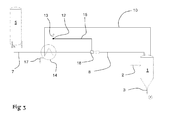
- Anhand der Zeichnungen sollen Ausführungsbeispiele der Erfindung näher erläutert werden. In schematischen Anzeigen zeigen:
- Fig. 1:
- Eine erfindungsgemäße Vorrichtung in einer ersten Ausführungsform,
- Fig. 2:
- Eine erfindungsgemäße Vorrichtung in einer zweiten Ausführungsform
- Fig. 3:
- Eine erfindungsgemäße Vorrichtung in einer dritten Ausführungsform.
- In den Zeichnungen nach
Fig. 1 bis Fig. 3 sind gleiche Bestandteile mit den gleichen Bezugsziffern versehen. - Allen Anordnungen gemeinsam ist ein Gefäß oder Reaktor 1 in dem ein zu behandelndes Produkt mit einem Gasstrom in Kontakt gebracht wird, wobei ein im Produkt enthaltender Stoff vom Gasstrom aufgenommen wird. Der Stoff kann dabei als Gas, in flüssiger Form oder in Form von Feststoffpartikeln vorliegen; beispielsweise handelt es sich bei dem Stoff um Wasser oder um ein Lösungsmittel. Gas-Mengenfluss sowie Druck und Temperatur im Reaktor 1 richten sich dabei nach den jeweiligen Erfordernissen und werden vor Inbetriebnahme oder während des Betriebs entsprechend eingestellt. Die Zuführung des Produkts erfolgt über eine Zuleitung 2. Je nach Art des Reaktors 1 erfolgt die Zuführung kontinuierlich oder chargenweise. Das in Reaktor 1 behandelte Produkt wird über eine Ausleitung 3 entfernt. Bei den Leitungen 2, 3 handelt es sich im Falle von flüssigen oder rieselfähigen Produkten üblicherweise um Rohrleitungen; es kommen jedoch auch andere Fördersysteme in Betracht, beispielsweise Förderbänder o.ä.
- Als Reinigungsgas kommt in den Ausführungsbeispielen Stickstoff zum Einsatz, der im flüssigen Zustand in einem Tank 5 bereitgestellt wird und über eine Leitung 7 einem Verdampfer, beispielsweise einem Kaltvergaser 6 (nur in den Ausführungsbeispielen nach
Fig. 1 und Fig. 2 ) zugeführt wird. Das verdampfte Gas bildet einen Gasstrom, der über eine Leitung 8 in den Reaktor 1 eingeleitet wird, in dem es in direkten Kontakt mit dem Produkt gebracht wird. Anstelle des in flüssiger Form gelagerten Stickstoffs kann auch direkt gasförmiger Stickstoff einer entsprechenden Gasversorgung, beispielsweise einem Flaschenbündel oder einer Rohrleitung, entnommen werden. Anstelle von Stickstoff kann auch ein anderes Gas oder Gasgemisch zum Einsatz kommen; als Beispiele seien hier Luft, Kohlendioxid oder Edelgas genannt. Wesentlich für die Wahl des Reinigungsgases ist, dass es nicht oder zumindest nicht nennenswert mit dem zu behandelnden Produkt chemisch reagiert. Der zu entfernende Stoff, also beispielsweise das Wasser oder das Lösungsmittel, wird lediglich physikalisch vom Produkt getrennt und im Gasstrom mitgerissen. - Im Reaktor 1 durchläuft der Gasstrom eine oder mehrere Stufen, in denen der Gasstrom mit einem im Produkt enthaltenen bzw. dem Produkt anhaftenden Stoff beladen wird. Der beladene Gasstrom wird anschließend über eine Ableitung 10 vom Reaktor 1 abgeführt. Der beladene Gasstrom wird anschließend an einer Verzweigungsstelle 12 aufgeteilt in einen ersten Teilstrom, der über eine Abgasleitung 13 abgeführt wird, um in die Atmosphäre abgeblasen oder einer sonstigen Verwertung zugeführt zu werden, und in einen zweiten Teilstrom, der, nach Durchlaufen einer Reinigungsstufe 14, über eine Leitung 15 wiederum dem unbeladenen Gasstrom in der Leitung 8 zugeführt wird. Das Mengenverhältnis der beiden Teilströme hängt von den in den Leitungen 8, 13, 15 vorliegenden Druckverhältnissen ab und kann über eine entsprechende Auslegung der Leitungen 8, 13,15 oder über geeignete Armaturen festgelegt werden. Die Art der Reinigungsstufe 14 hängt von der jeweiligen Reinigungsaufgabe ab. Es kann sich dabei um einen Filter, einen Zyklon, um Absorptionsstufen, um Kühleinrichtungen oder um eine Kombination dieser Einrichtungen handeln. In den hier gezeigten Ausführungsbeispielen handelt es sich bei der Reinigungsstufe 14 um eine Kühleinrichtung in Gestalt einer Einrichtung zur kryogenen Gasreinigung, die insbesondere zum Entfernen von Lösungsmitteln geeignet ist. Dabei wird der der beladene Gasstrom mit einem kryogenen Kältemittel, beispielsweise Stickstoff im flüssigen oder tiefkalten gasförmigen Zustand, das über eine Zuleitung 16 herangeführt wird, in thermischen Kontakt gebracht und stark abgekühlt. Bei der Abkühlung kondensiert das im Gasstrom enthaltene Lösungsmittel aus. Das Kondensat wird aufgefangen, über eine Ableitung 17 abgezogen und anschließend entsorgt oder einer weiteren Verwertung zugeführt. Derartige Einrichtungen zur kryogenen Gasreinigung sind beispielsweise in der
EP 1 674 140 A1 oder derEP 1 602 401 A1 beschrieben, auf die hier ausdrücklich Bezug genommen wird. Bei diesen Gegenständen erfolgt die Gasreinigung in mindestens zwei aufeinander folgenden Stufen, die jeweils durch mindestens einen indirekten Wärmetauscher realisiert werden. Dabei wird darauf geachtet, dass zwischen dem zu reinigenden Gasstrom und dem Kühlmedium jeweils ein möglichst geringer Temperaturunterschied besteht, um insbesondere die Entstehung von Aerosolen zu unterbinden. - Die Unterschiede zwischen den Ausführungsbeispielen betreffen die Auftrennung der Teilströme des beladenen Gasstroms und die Reinigungsstufe 14.
- In der in
Fig. 1 gezeigten ersten Ausführungsform erfolgt die Auftrennung der beiden Teilströme vor der Reinigung des dem unbeladenen Gasstrom zuzuführenden Teilstroms. Die Verzweigungsstelle 12 ist strömungstechnisch vor der Reinigungsstufe 14 angeordnet. Der über die Abgasleitung 13 abgeführte Teilstrom ist also nach wie vor mit dem Stoff beladen. Es wird nur der Teilstrom durch die Reinigungsstufe 14 geführt, der tatsächlich über die Leitung 15 dem unbeladenen Gasstrom in der Leitung 8 zugeführt wird. Eine solche Anordnung eignet sich insbesondere dann, wenn der Gasstrom zur Trocknung des Produkts bestimmt ist, oder generell, wenn der Stoff, mit dem der Gasstrom beladen ist, nicht schädlich für die Umwelt oder für eine nachfolgende Verwendung des Gasstroms ist. - Im Ausführungsbeispiel nach
Fig. 2 erfolgt die Auftrennung der beiden Teilströme erst nach der Reinigung des gesamten beladenen Gasstroms. Die Verzweigungsstelle 12 ist also strömungstechnisch hinter der Reinigungsstufe 14 vorgesehen. Auch der über die Abgasleitung 13 abgeführte Teilstrom ist somit gereinigt. Eine solche Anordnung eignet sich insbesondere in den Fällen, in denen gesetzliche Vorgaben zu Grenzwerten bezüglich des Stoffes, mit dem der Gasstrom beladen ist, einzuhalten sind, insbesondere also, wenn von dem Stoff eine potenzielle Gefährdung für die Umwelt ausgeht. - Im Ausführungsbeispiel nach
Fig. 3 wird das unbeladene Gas zur kryogenen Reinigung des beladenen Gasstroms eingesetzt. Dabei durchläuft der aus dem Tank 5 entnommene Flüssigstickstoff - im Unterschied zu den Ausführungsbeispielen nachFig. 2 undFig. 3 - keinen Kaltvergaser, sondern der Stickstoff gelangt über die vorzugsweise wärmeisolierte Leitung 7 in noch flüssigem Zustand in die Reinigungsstufe 14. In der Reinigungsstufe 14 findet ein Wärmeaustausch zwischen dem zugeführten Flüssigstickstoff und dem beladenen Gasstrom statt, wobei der Flüssigstickstoff verdampft und der Leitung 8 zugeführt wird. Der beladene Gastrom kühlt sich dabei zumindest auf einen Temperaturwert unterhalb der Kondensationstemperatur des Stoffes ab, mit dem der Gasstrom beladen ist. Der Stoff kondensiert bzw. friert aus und kann über die Ableitung 17 entfernt werden. Der gereinigte Gasstrom wird anschließend an der Verzweigungsstelle 12 aufgeteilt, wobei ein Teilstrom dem unbeladenen Strom in Leitung 8 zugeführt wird. Entsprechend dem Ausführungsbeispiel nachFig. 1 kann im Übrigen die Verzweigungsstelle strömungstechnisch auch vor der Reinigungsstufe 14 angeordnet sein. - Das Ausführungsbeispiel gem.
Fig. 3 zeigt eine ideale Anordnung, in der der Kälteinhalt des verflüssigten Kältemittels exakt zur Reinigung des beladenen Gasstroms ausreicht. Es kann indes zur Herstellung einer ausreichenden Reinigungswirkung in der Reinigungsstufe 14 erforderlich sein, der Reinigungsstufe 14 einen größeren Kälteinhalt zuzuführen, als dies durch die Zuführung der Gasmenge, der zur Behandlung des Produkts vorgesehen ist, erzielt werden kann. In diesem Fall muss der Reinigungsstufe 14 zusätzlich Kältemittel zugeführt werden. Das zusätzliche Kühlmittel kann beispielsweise entweder über eine separate Kühlmittelleitung durch die Reinigungsstufe 14 geführt werden, oder das zusätzliche Kühlmittel kann gemeinsam mit dem zum Behandeln des Produkts vorgesehenen Gasstrom über den Vorderabschnitt 9 herangeführt und nach Durchlaufen der Reinigungsstufe 14 aus der Leitung 8 ausgekoppelt werden. Andererseits ist es ebenfalls vorstellbar, dass die in der Reinigungsstufe 14 auf das Kältemittel übertragene Wärme nicht ausreicht, um die gesamte, dem Produkt zuzuführende Gasmenge zu verdampfen. In diesem Falle muss eine zusätzliche Verdampfungseinrichtung vorgesehen sein, etwa eine Heizeinrichtung oder eine Bypassleitung mit integriertem Verdampfer, durch die ein Teil des Gases verdampft und an der Reinigungsstufe 14 vorbei zum Reaktor 1 gefördert wird. - Die in den Ausführungsbeispielen gezeigten Strömungsführungen können durch mehrere aufeinander folgende Reinigungsstufen 14 auch miteinander kombiniert werden. So kann beispielsweise der beladene Gasstrom vollständig eine erste Reinigungsstufe durchlaufen, um beispielsweise die Beladung des Gasstroms auf einen Wert zu reduzieren, der den in Bezug auf diesen Stoff vorgeschriebenen Grenzwerten genügt. Anschließend verzweigt sich der Gasstrom, woraufhin lediglich der dem unbeladenen Gasstrom wieder zuzuführende Teilstrom eine weitere Reinigungsstufe durchläuft, um die Beladung weiter zu verringern.
- Die Einspeisung des gereinigten Teilstroms in die Leitung 8 erfolgt in allen drei Ausführungsbeispielen mittels eines Injektors 18. Bei dem nach Art einer VenturiDüse aufgebautem Injektor 18 handelt es sich um eine Engstelle innerhalb der Leitung 8, in die die Leitung 15 einmündet. Aufgrund der hohen Strömungsgeschwindigkeit des unbeladenen Gases innerhalb des Injektors 18 wird auf das in der Leitung 15 befindliche Gas eine Sogwirkung ausgeübt, und das Gas aus der Leitung 15 strömt in die Leitung 8 ein. Eine Pumpe zum Fördern des Gases in der Leitung 15 ist somit nicht erforderlich, jedoch im Rahmen der Erfindung nicht ausgeschlossen. Die Saugleistung am Injektor 18 hängt im Wesentlichen vom Kompressionsfaktor ab, also vom Differenzdruck zwischen dem Druck in der Engstelle und dem Ausgang des Injektors 18 sowie vom Druck des unbeladenen Gases am Eingang des Injektors 18 ab. Bei einer entsprechenden Auslegung des Injektors 18 ist es möglich, die gleiche Menge an gereinigtem Gas einzusaugen, wie an unbeladenem Gas durch den Injektor 18 hindurchgeführt wird.
- Durch die Reinigung und Rückführung eines Teilstroms des beladenen Gases in den unbeladenen Gasstrom wird der Verbrauch an Gas um bis zu 50% gegenüber einer Verfahrensführung ohne Rückeinspeisung reduziert. Zugleich verringert der Einsatz eines Injektors den Energieverbrauch deutlich. Durch die Erfindung wird damit eine kostengünstige Möglichkeit geschaffen, den Gas- und Energieverbrauch bei einer Vorrichtung zum Behandeln eines Produkts mit einem Gasstrom deutlich zu senken.
-
- 1.
- Reaktor
- 2.
- Zuführung
- 3.
- Ausleitung
- 4.
- -
- 5.
- Tank
- 6.
- Kaltvergaser
- 7.
- Leitung
- 8.
- Leitung
- 9.
- -
- 10.
- Ableitung
- 11.
- -
- 12.
- Verzweigungsstelle
- 13.
- Abgasleitung
- 14.
- Reinigungsstufe
- 15.
- Leitung
- 16.
- Zuleitung (für kryogenes Kältemittel)
- 17.
- Ableitung (für Kondensat)
- 18.
- Injektor
Claims (10)
- Verfahren zum Behandeln eines Produkts mit einem Gasstrom, bei dem der Gasstrom durch Kontakt mit dem Produkt mit einem Stoff beladen wird, und der Gasstrom anschließend zumindest teilweise vom beladenen Stoff befreit wird,
dadurch gekennzeichnet,
dass vom beladenen Gasstrom ein Teilstrom abgetrennt und dem unbeladenen Gasstrom zugeführt wird, wobei zumindest der abgetrennte Teilstrom des beladenen Gasstroms eine Reinigungsstufe (14) durchläuft. - Verfahren nach Anspruch 1, dadurch gekennzeichnet, dass der Teilstrom an einem Injektor (18) aufgrund des Venturi-Effekts in den unbeladenen Gasstrom eingesaugt wird.
- Verfahren nach Anspruch 1 oder 2, dadurch gekennzeichnet, dass in der Reinigungsstufe (14) zumindest der abgetrennte Teilstrom mit dem Kälteinhalt eines kryogenen Mediums in thermischen Kontakt gebracht wird.
- Verfahren nach Anspruch 3, dadurch gekennzeichnet, dass als kryogenes Medium in der Reinigungsstufe (14) verflüssigtes Gas zum Einsatz kommt, dass beim Wärmetausch mit dem abgetrennten Teilstrom verdampft und dem unbeladenen Gasstrom zugeführt wird.
- Vorrichtung zum Behandeln eines Produkts mit einem Gasstrom, mit einem Reaktor (1) in dem das mit einem Stoff beladene Produkt mit dem Gasstrom in Kontakt gebracht und der Gasstrom mit dem Stoff beladen wird, einer Zuleitung (8) für den unbeladenen Gastrom und einer Ableitung (10) für den mit dem Stoff beladenen Gasstrom, gekennzeichnet durch eine Reinigungsstufe (14) zum Reinigen von zumindest einem Teilstrom des beladenen Gasstroms und Mitteln (15, 18) zum Zuführen des gereinigten Teilstroms in den unbeladenen Gasstrom.
- Vorrichtung nach Anspruch 5, dadurch gekennzeichnet, dass die Mittel zum Zuführen des gereinigten Teilstroms einen Injektor (18) vom Venturi-Typ umfassen.
- Vorrichtung nach Anspruch 5 oder 6, dadurch gekennzeichnet, dass als Reinigungsstufe (14) eine kryogene Gasreinigungseinrichtung zum Einsatz kommt, bei der zumindest der abgetrennte Teilstrom in wenigstens einem Wärmetauscher mit dem Kälteinhalt eines kryogenen Mediums in thermischen Kontakt gebracht wird.
- Vorrichtung nach einem der Ansprüche 5 bis 7, dadurch gekennzeichnet, dass die Reinigungsstufe (14) ein Filter, ein Zyklon oder einen Separator umfasst.
- Vorrichtung nach einem der Ansprüche 5 bis 8, dadurch gekennzeichnet, dass die Reinigungsstufe (14) einen Adsorber umfasst.
- Vorrichtung nach einem der Ansprüche 5 bis 9, dadurch gekennzeichnet, dass die Reinigungsstufe (14) eine konventionelle Kältemaschine umfasst.
Applications Claiming Priority (1)
| Application Number | Priority Date | Filing Date | Title |
|---|---|---|---|
| DE200710034787 DE102007034787A1 (de) | 2007-07-25 | 2007-07-25 | Verfahren und Vorrichtung zur Behandlung von Produkten mit einem Gasstrom |
Publications (3)
| Publication Number | Publication Date |
|---|---|
| EP2025382A2 true EP2025382A2 (de) | 2009-02-18 |
| EP2025382A3 EP2025382A3 (de) | 2012-07-25 |
| EP2025382B1 EP2025382B1 (de) | 2015-12-09 |
Family
ID=39941801
Family Applications (1)
| Application Number | Title | Priority Date | Filing Date |
|---|---|---|---|
| EP08104647.6A Active EP2025382B1 (de) | 2007-07-25 | 2008-07-07 | Verfahren und vorrichtung zur behandlung von produkten mit einem gasstrom |
Country Status (3)
| Country | Link |
|---|---|
| EP (1) | EP2025382B1 (de) |
| DE (1) | DE102007034787A1 (de) |
| ES (1) | ES2564520T3 (de) |
Families Citing this family (1)
| Publication number | Priority date | Publication date | Assignee | Title |
|---|---|---|---|---|
| DE102020001331B4 (de) * | 2020-02-28 | 2025-10-30 | Messer Se & Co. Kgaa | Verfahren zur Abscheidung von Paraffinen aus einem Gasstrom |
Citations (4)
| Publication number | Priority date | Publication date | Assignee | Title |
|---|---|---|---|---|
| DE2837216A1 (de) | 1977-08-29 | 1979-03-15 | Airco Inc | Verfahren und vorrichtung zur wiedergewinnung von loesungsmitteln |
| DE19527960A1 (de) | 1995-07-29 | 1997-01-30 | Messer Griesheim Gmbh | Verfahren und Vorrichtung zur Desorption von Adsorbern oder Adsorptionsanlagen |
| EP1602401A1 (de) | 2004-06-01 | 2005-12-07 | Messer Group GmbH | Verfahren und Vorrichtung zur aerosolarmen Partialkondensation |
| EP1674140A1 (de) | 2004-12-21 | 2006-06-28 | Messer Group GmbH | Verfahren und Vorrichtung zur Partialkondensation |
Family Cites Families (8)
| Publication number | Priority date | Publication date | Assignee | Title |
|---|---|---|---|---|
| GB992062A (en) * | 1960-12-16 | 1965-05-12 | Ass Elect Ind | Improvements in or relating to adsorption apparatus |
| US4322265A (en) * | 1980-06-03 | 1982-03-30 | Maloney-Crawford Corporation | Atmospheric glycol reclaimer with vapor recycle |
| FR2507097B1 (fr) * | 1981-06-04 | 1986-05-09 | Sussmeyer Sprl Ateliers | Procede et appareil pour la vaporisation et la condensation automatiques et continues |
| DE3149847A1 (de) * | 1981-12-16 | 1983-07-21 | Linde Ag, 6200 Wiesbaden | "verfahren zur entfernung von kohlenwasserstoffen und anderen verunreinigungen aus einem gas" |
| DE19812960C1 (de) * | 1998-03-24 | 1999-11-04 | Kompressoren Und Druckluft Tec | Membrantrockner |
| DE19852914C1 (de) * | 1998-11-17 | 2000-07-13 | Messer Griesheim Gmbh | Verfahren und Vorrichtung zur Rückgewinnung von niedrig siedenden Halogenalkanen aus Abgasen |
| DE10361266B4 (de) * | 2003-12-24 | 2010-07-01 | Keller Lufttechnik Gmbh & Co. Kg | Vorrichtung zur Beseitigung von Luftverunreinigungen in einer Nasslackieranlage |
| PT103325B (pt) * | 2005-07-26 | 2008-08-27 | Partex Services Portugal Servi | Processo para separação de líquidos em emulsão em misturas de líquidos e de gases dissolvidos em misturas de líquidos e gases por redução localizada de pressão e dispositivo para a realização do processo |
-
2007
- 2007-07-25 DE DE200710034787 patent/DE102007034787A1/de not_active Ceased
-
2008
- 2008-07-07 ES ES08104647.6T patent/ES2564520T3/es active Active
- 2008-07-07 EP EP08104647.6A patent/EP2025382B1/de active Active
Patent Citations (4)
| Publication number | Priority date | Publication date | Assignee | Title |
|---|---|---|---|---|
| DE2837216A1 (de) | 1977-08-29 | 1979-03-15 | Airco Inc | Verfahren und vorrichtung zur wiedergewinnung von loesungsmitteln |
| DE19527960A1 (de) | 1995-07-29 | 1997-01-30 | Messer Griesheim Gmbh | Verfahren und Vorrichtung zur Desorption von Adsorbern oder Adsorptionsanlagen |
| EP1602401A1 (de) | 2004-06-01 | 2005-12-07 | Messer Group GmbH | Verfahren und Vorrichtung zur aerosolarmen Partialkondensation |
| EP1674140A1 (de) | 2004-12-21 | 2006-06-28 | Messer Group GmbH | Verfahren und Vorrichtung zur Partialkondensation |
Also Published As
| Publication number | Publication date |
|---|---|
| EP2025382B1 (de) | 2015-12-09 |
| ES2564520T3 (es) | 2016-03-23 |
| EP2025382A3 (de) | 2012-07-25 |
| DE102007034787A1 (de) | 2009-01-29 |
Similar Documents
| Publication | Publication Date | Title |
|---|---|---|
| EP0273406B1 (de) | Verfahren und Anlage zum Trocknen von Rohbraunkohle in einem Wirbelbett-Trockner | |
| EP1363855B1 (de) | Verfahren und vorrichtung zur aufbereitung von flüssigkeiten | |
| DE102007017613A1 (de) | Verfahren und Vorrichtung zur Aufbereitung von Flüssigkeiten | |
| EP0543134A1 (de) | Verfahren und Anlage zur Rückgewinnung eines Sterilisiergases | |
| EP1901017A1 (de) | Verfahren und Anlage zum Trocknen von Gegenständen | |
| DE102012112040B4 (de) | Vorrichtung und Verfahren zum Trocknen von Gasen | |
| CH656549A5 (de) | Verfahren und anlage zur rueckgewinnung von loesungsmitteln. | |
| DE60301399T2 (de) | Methode und system zur desorption und rückgewinnung von desorbierten verbindungen | |
| DE3935094A1 (de) | Verfahren zum abtrennen von loesemittel aus prozessabluft und zum reinigen der prozessabluft | |
| EP1602401B1 (de) | Verfahren und Vorrichtung zur aerosolarmen Partialkondensation | |
| EP2025382B1 (de) | Verfahren und vorrichtung zur behandlung von produkten mit einem gasstrom | |
| EP0491339B1 (de) | Verfahren und Vorrichtung zur Rückgewinnung von Lösungsmitteln | |
| EP0588840B1 (de) | Vorrichtung zum kontinuierlichen reinigen der hilfs- bzw. betriebsflüssigkeit eines verdichters | |
| EP2477725B1 (de) | Verfahren zum trocknen von erdgas durch gemeinsame kühlung von lösungsmittel und erdgas | |
| EP1674140B1 (de) | Verfahren und Vorrichtung zur Partialkondensation | |
| WO2020025214A1 (de) | Verfahren zum wiederverwerten von argon | |
| DD266636A5 (de) | Verfahren und anlage zum trocknen von feuchten schuettguetern in einem wirbelbett-trockner | |
| EP4599918B1 (de) | Kühlschrankrecyclinganlage | |
| DE10338418B4 (de) | Verfahren und Anlage zur Abgasreinigung | |
| DE69203942T2 (de) | Rückgewinnung von kondensierbaren organischen Verbindungen aus Gasströmen. | |
| DE102011109271B4 (de) | Verfahren und Vorrichtung zum Reinigen eines Verunreinigungen enthaltenden Rohgases | |
| DE10056785A1 (de) | Verfahren zum Verdampfen kryogener Flüssigkeiten | |
| EP4640372A1 (de) | Reinigungsanlage und verfahren zum reinigen einer oberfläche mittels eines co2-schnee-strahls | |
| EP0437221A2 (de) | Emissionsfreier Desorptionsprozess | |
| DE202009014159U1 (de) | Trocknungsanordnung, insbesondere für industrielle Reinigungs- und Entgratungsvorrichtungen |
Legal Events
| Date | Code | Title | Description |
|---|---|---|---|
| PUAI | Public reference made under article 153(3) epc to a published international application that has entered the european phase |
Free format text: ORIGINAL CODE: 0009012 |
|
| AK | Designated contracting states |
Kind code of ref document: A2 Designated state(s): AT BE BG CH CY CZ DE DK EE ES FI FR GB GR HR HU IE IS IT LI LT LU LV MC MT NL NO PL PT RO SE SI SK TR |
|
| AX | Request for extension of the european patent |
Extension state: AL BA MK RS |
|
| PUAL | Search report despatched |
Free format text: ORIGINAL CODE: 0009013 |
|
| AK | Designated contracting states |
Kind code of ref document: A3 Designated state(s): AT BE BG CH CY CZ DE DK EE ES FI FR GB GR HR HU IE IS IT LI LT LU LV MC MT NL NO PL PT RO SE SI SK TR |
|
| AX | Request for extension of the european patent |
Extension state: AL BA MK RS |
|
| RIC1 | Information provided on ipc code assigned before grant |
Ipc: B01D 5/00 20060101AFI20120621BHEP Ipc: B01D 19/00 20060101ALI20120621BHEP Ipc: B01D 53/00 20060101ALI20120621BHEP |
|
| RIN1 | Information on inventor provided before grant (corrected) |
Inventor name: MATHEOUD, PATRICK Inventor name: QUETIN, GILLES |
|
| 17P | Request for examination filed |
Effective date: 20130125 |
|
| AKX | Designation fees paid |
Designated state(s): AT BE BG CH CY CZ DE DK EE ES FI FR GB GR HR HU IE IS IT LI LT LU LV MC MT NL NO PL PT RO SE SI SK TR |
|
| 17Q | First examination report despatched |
Effective date: 20130418 |
|
| GRAP | Despatch of communication of intention to grant a patent |
Free format text: ORIGINAL CODE: EPIDOSNIGR1 |
|
| INTG | Intention to grant announced |
Effective date: 20150701 |
|
| GRAS | Grant fee paid |
Free format text: ORIGINAL CODE: EPIDOSNIGR3 |
|
| GRAA | (expected) grant |
Free format text: ORIGINAL CODE: 0009210 |
|
| AK | Designated contracting states |
Kind code of ref document: B1 Designated state(s): AT BE BG CH CY CZ DE DK EE ES FI FR GB GR HR HU IE IS IT LI LT LU LV MC MT NL NO PL PT RO SE SI SK TR |
|
| REG | Reference to a national code |
Ref country code: GB Ref legal event code: FG4D Free format text: NOT ENGLISH |
|
| REG | Reference to a national code |
Ref country code: AT Ref legal event code: REF Ref document number: 764314 Country of ref document: AT Kind code of ref document: T Effective date: 20151215 Ref country code: CH Ref legal event code: EP |
|
| REG | Reference to a national code |
Ref country code: IE Ref legal event code: FG4D Free format text: LANGUAGE OF EP DOCUMENT: GERMAN |
|
| REG | Reference to a national code |
Ref country code: DE Ref legal event code: R096 Ref document number: 502008013654 Country of ref document: DE |
|
| REG | Reference to a national code |
Ref country code: ES Ref legal event code: FG2A Ref document number: 2564520 Country of ref document: ES Kind code of ref document: T3 Effective date: 20160323 |
|
| REG | Reference to a national code |
Ref country code: LT Ref legal event code: MG4D |
|
| REG | Reference to a national code |
Ref country code: NL Ref legal event code: MP Effective date: 20151209 |
|
| PG25 | Lapsed in a contracting state [announced via postgrant information from national office to epo] |
Ref country code: LT Free format text: LAPSE BECAUSE OF FAILURE TO SUBMIT A TRANSLATION OF THE DESCRIPTION OR TO PAY THE FEE WITHIN THE PRESCRIBED TIME-LIMIT Effective date: 20151209 Ref country code: NO Free format text: LAPSE BECAUSE OF FAILURE TO SUBMIT A TRANSLATION OF THE DESCRIPTION OR TO PAY THE FEE WITHIN THE PRESCRIBED TIME-LIMIT Effective date: 20160309 |
|
| PG25 | Lapsed in a contracting state [announced via postgrant information from national office to epo] |
Ref country code: FI Free format text: LAPSE BECAUSE OF FAILURE TO SUBMIT A TRANSLATION OF THE DESCRIPTION OR TO PAY THE FEE WITHIN THE PRESCRIBED TIME-LIMIT Effective date: 20151209 Ref country code: LV Free format text: LAPSE BECAUSE OF FAILURE TO SUBMIT A TRANSLATION OF THE DESCRIPTION OR TO PAY THE FEE WITHIN THE PRESCRIBED TIME-LIMIT Effective date: 20151209 Ref country code: GR Free format text: LAPSE BECAUSE OF FAILURE TO SUBMIT A TRANSLATION OF THE DESCRIPTION OR TO PAY THE FEE WITHIN THE PRESCRIBED TIME-LIMIT Effective date: 20160310 Ref country code: SE Free format text: LAPSE BECAUSE OF FAILURE TO SUBMIT A TRANSLATION OF THE DESCRIPTION OR TO PAY THE FEE WITHIN THE PRESCRIBED TIME-LIMIT Effective date: 20151209 Ref country code: NL Free format text: LAPSE BECAUSE OF FAILURE TO SUBMIT A TRANSLATION OF THE DESCRIPTION OR TO PAY THE FEE WITHIN THE PRESCRIBED TIME-LIMIT Effective date: 20151209 |
|
| REG | Reference to a national code |
Ref country code: FR Ref legal event code: PLFP Year of fee payment: 9 |
|
| PG25 | Lapsed in a contracting state [announced via postgrant information from national office to epo] |
Ref country code: IS Free format text: LAPSE BECAUSE OF FAILURE TO SUBMIT A TRANSLATION OF THE DESCRIPTION OR TO PAY THE FEE WITHIN THE PRESCRIBED TIME-LIMIT Effective date: 20151209 |
|
| PG25 | Lapsed in a contracting state [announced via postgrant information from national office to epo] |
Ref country code: IT Free format text: LAPSE BECAUSE OF FAILURE TO SUBMIT A TRANSLATION OF THE DESCRIPTION OR TO PAY THE FEE WITHIN THE PRESCRIBED TIME-LIMIT Effective date: 20151209 Ref country code: CZ Free format text: LAPSE BECAUSE OF FAILURE TO SUBMIT A TRANSLATION OF THE DESCRIPTION OR TO PAY THE FEE WITHIN THE PRESCRIBED TIME-LIMIT Effective date: 20151209 |
|
| PG25 | Lapsed in a contracting state [announced via postgrant information from national office to epo] |
Ref country code: IS Free format text: LAPSE BECAUSE OF FAILURE TO SUBMIT A TRANSLATION OF THE DESCRIPTION OR TO PAY THE FEE WITHIN THE PRESCRIBED TIME-LIMIT Effective date: 20160409 Ref country code: SK Free format text: LAPSE BECAUSE OF FAILURE TO SUBMIT A TRANSLATION OF THE DESCRIPTION OR TO PAY THE FEE WITHIN THE PRESCRIBED TIME-LIMIT Effective date: 20151209 Ref country code: RO Free format text: LAPSE BECAUSE OF FAILURE TO SUBMIT A TRANSLATION OF THE DESCRIPTION OR TO PAY THE FEE WITHIN THE PRESCRIBED TIME-LIMIT Effective date: 20151209 Ref country code: PT Free format text: LAPSE BECAUSE OF FAILURE TO SUBMIT A TRANSLATION OF THE DESCRIPTION OR TO PAY THE FEE WITHIN THE PRESCRIBED TIME-LIMIT Effective date: 20160411 Ref country code: EE Free format text: LAPSE BECAUSE OF FAILURE TO SUBMIT A TRANSLATION OF THE DESCRIPTION OR TO PAY THE FEE WITHIN THE PRESCRIBED TIME-LIMIT Effective date: 20151209 |
|
| REG | Reference to a national code |
Ref country code: DE Ref legal event code: R097 Ref document number: 502008013654 Country of ref document: DE |
|
| PLBE | No opposition filed within time limit |
Free format text: ORIGINAL CODE: 0009261 |
|
| STAA | Information on the status of an ep patent application or granted ep patent |
Free format text: STATUS: NO OPPOSITION FILED WITHIN TIME LIMIT |
|
| PG25 | Lapsed in a contracting state [announced via postgrant information from national office to epo] |
Ref country code: PL Free format text: LAPSE BECAUSE OF FAILURE TO SUBMIT A TRANSLATION OF THE DESCRIPTION OR TO PAY THE FEE WITHIN THE PRESCRIBED TIME-LIMIT Effective date: 20151209 Ref country code: DK Free format text: LAPSE BECAUSE OF FAILURE TO SUBMIT A TRANSLATION OF THE DESCRIPTION OR TO PAY THE FEE WITHIN THE PRESCRIBED TIME-LIMIT Effective date: 20151209 |
|
| 26N | No opposition filed |
Effective date: 20160912 |
|
| PG25 | Lapsed in a contracting state [announced via postgrant information from national office to epo] |
Ref country code: SI Free format text: LAPSE BECAUSE OF FAILURE TO SUBMIT A TRANSLATION OF THE DESCRIPTION OR TO PAY THE FEE WITHIN THE PRESCRIBED TIME-LIMIT Effective date: 20151209 |
|
| GBPC | Gb: european patent ceased through non-payment of renewal fee |
Effective date: 20160707 |
|
| PG25 | Lapsed in a contracting state [announced via postgrant information from national office to epo] |
Ref country code: MC Free format text: LAPSE BECAUSE OF FAILURE TO SUBMIT A TRANSLATION OF THE DESCRIPTION OR TO PAY THE FEE WITHIN THE PRESCRIBED TIME-LIMIT Effective date: 20151209 |
|
| REG | Reference to a national code |
Ref country code: IE Ref legal event code: MM4A |
|
| PG25 | Lapsed in a contracting state [announced via postgrant information from national office to epo] |
Ref country code: GB Free format text: LAPSE BECAUSE OF NON-PAYMENT OF DUE FEES Effective date: 20160707 |
|
| REG | Reference to a national code |
Ref country code: FR Ref legal event code: PLFP Year of fee payment: 10 |
|
| PG25 | Lapsed in a contracting state [announced via postgrant information from national office to epo] |
Ref country code: IE Free format text: LAPSE BECAUSE OF NON-PAYMENT OF DUE FEES Effective date: 20160707 |
|
| PG25 | Lapsed in a contracting state [announced via postgrant information from national office to epo] |
Ref country code: LU Free format text: LAPSE BECAUSE OF NON-PAYMENT OF DUE FEES Effective date: 20160707 |
|
| PG25 | Lapsed in a contracting state [announced via postgrant information from national office to epo] |
Ref country code: HU Free format text: LAPSE BECAUSE OF FAILURE TO SUBMIT A TRANSLATION OF THE DESCRIPTION OR TO PAY THE FEE WITHIN THE PRESCRIBED TIME-LIMIT; INVALID AB INITIO Effective date: 20080707 Ref country code: CY Free format text: LAPSE BECAUSE OF FAILURE TO SUBMIT A TRANSLATION OF THE DESCRIPTION OR TO PAY THE FEE WITHIN THE PRESCRIBED TIME-LIMIT Effective date: 20151209 |
|
| REG | Reference to a national code |
Ref country code: FR Ref legal event code: PLFP Year of fee payment: 11 |
|
| PG25 | Lapsed in a contracting state [announced via postgrant information from national office to epo] |
Ref country code: HR Free format text: LAPSE BECAUSE OF FAILURE TO SUBMIT A TRANSLATION OF THE DESCRIPTION OR TO PAY THE FEE WITHIN THE PRESCRIBED TIME-LIMIT Effective date: 20151209 Ref country code: MT Free format text: LAPSE BECAUSE OF FAILURE TO SUBMIT A TRANSLATION OF THE DESCRIPTION OR TO PAY THE FEE WITHIN THE PRESCRIBED TIME-LIMIT Effective date: 20151209 Ref country code: TR Free format text: LAPSE BECAUSE OF FAILURE TO SUBMIT A TRANSLATION OF THE DESCRIPTION OR TO PAY THE FEE WITHIN THE PRESCRIBED TIME-LIMIT Effective date: 20151209 |
|
| PG25 | Lapsed in a contracting state [announced via postgrant information from national office to epo] |
Ref country code: BG Free format text: LAPSE BECAUSE OF FAILURE TO SUBMIT A TRANSLATION OF THE DESCRIPTION OR TO PAY THE FEE WITHIN THE PRESCRIBED TIME-LIMIT Effective date: 20151209 |
|
| PGFP | Annual fee paid to national office [announced via postgrant information from national office to epo] |
Ref country code: BE Payment date: 20190617 Year of fee payment: 12 |
|
| PGFP | Annual fee paid to national office [announced via postgrant information from national office to epo] |
Ref country code: ES Payment date: 20190801 Year of fee payment: 12 |
|
| PGFP | Annual fee paid to national office [announced via postgrant information from national office to epo] |
Ref country code: AT Payment date: 20190625 Year of fee payment: 12 |
|
| PGFP | Annual fee paid to national office [announced via postgrant information from national office to epo] |
Ref country code: CH Payment date: 20190718 Year of fee payment: 12 |
|
| REG | Reference to a national code |
Ref country code: CH Ref legal event code: PL |
|
| REG | Reference to a national code |
Ref country code: AT Ref legal event code: MM01 Ref document number: 764314 Country of ref document: AT Kind code of ref document: T Effective date: 20200707 |
|
| REG | Reference to a national code |
Ref country code: BE Ref legal event code: MM Effective date: 20200731 |
|
| PG25 | Lapsed in a contracting state [announced via postgrant information from national office to epo] |
Ref country code: LI Free format text: LAPSE BECAUSE OF NON-PAYMENT OF DUE FEES Effective date: 20200731 Ref country code: CH Free format text: LAPSE BECAUSE OF NON-PAYMENT OF DUE FEES Effective date: 20200731 |
|
| PG25 | Lapsed in a contracting state [announced via postgrant information from national office to epo] |
Ref country code: AT Free format text: LAPSE BECAUSE OF NON-PAYMENT OF DUE FEES Effective date: 20200707 Ref country code: BE Free format text: LAPSE BECAUSE OF NON-PAYMENT OF DUE FEES Effective date: 20200731 |
|
| PGFP | Annual fee paid to national office [announced via postgrant information from national office to epo] |
Ref country code: DE Payment date: 20210731 Year of fee payment: 14 |
|
| REG | Reference to a national code |
Ref country code: ES Ref legal event code: FD2A Effective date: 20211228 |
|
| PG25 | Lapsed in a contracting state [announced via postgrant information from national office to epo] |
Ref country code: ES Free format text: LAPSE BECAUSE OF NON-PAYMENT OF DUE FEES Effective date: 20200708 |
|
| REG | Reference to a national code |
Ref country code: DE Ref legal event code: R119 Ref document number: 502008013654 Country of ref document: DE |
|
| PG25 | Lapsed in a contracting state [announced via postgrant information from national office to epo] |
Ref country code: DE Free format text: LAPSE BECAUSE OF NON-PAYMENT OF DUE FEES Effective date: 20230201 |
|
| PGFP | Annual fee paid to national office [announced via postgrant information from national office to epo] |
Ref country code: FR Payment date: 20250610 Year of fee payment: 18 |