EP2022922A1 - Window regulator - Google Patents
Window regulator Download PDFInfo
- Publication number
- EP2022922A1 EP2022922A1 EP07744154A EP07744154A EP2022922A1 EP 2022922 A1 EP2022922 A1 EP 2022922A1 EP 07744154 A EP07744154 A EP 07744154A EP 07744154 A EP07744154 A EP 07744154A EP 2022922 A1 EP2022922 A1 EP 2022922A1
- Authority
- EP
- European Patent Office
- Prior art keywords
- wire
- outer tube
- holding portion
- slide bush
- drum
- Prior art date
- Legal status (The legal status is an assumption and is not a legal conclusion. Google has not performed a legal analysis and makes no representation as to the accuracy of the status listed.)
- Granted
Links
Images



Classifications
-
- E—FIXED CONSTRUCTIONS
- E05—LOCKS; KEYS; WINDOW OR DOOR FITTINGS; SAFES
- E05F—DEVICES FOR MOVING WINGS INTO OPEN OR CLOSED POSITION; CHECKS FOR WINGS; WING FITTINGS NOT OTHERWISE PROVIDED FOR, CONCERNED WITH THE FUNCTIONING OF THE WING
- E05F11/00—Man-operated mechanisms for operating wings, including those which also operate the fastening
- E05F11/38—Man-operated mechanisms for operating wings, including those which also operate the fastening for sliding windows, e.g. vehicle windows, to be opened or closed by vertical movement
- E05F11/48—Man-operated mechanisms for operating wings, including those which also operate the fastening for sliding windows, e.g. vehicle windows, to be opened or closed by vertical movement operated by cords or chains or other flexible elongated pulling elements, e.g. tapes
- E05F11/481—Man-operated mechanisms for operating wings, including those which also operate the fastening for sliding windows, e.g. vehicle windows, to be opened or closed by vertical movement operated by cords or chains or other flexible elongated pulling elements, e.g. tapes for vehicle windows
- E05F11/483—Man-operated mechanisms for operating wings, including those which also operate the fastening for sliding windows, e.g. vehicle windows, to be opened or closed by vertical movement operated by cords or chains or other flexible elongated pulling elements, e.g. tapes for vehicle windows by cables
- E05F11/485—Man-operated mechanisms for operating wings, including those which also operate the fastening for sliding windows, e.g. vehicle windows, to be opened or closed by vertical movement operated by cords or chains or other flexible elongated pulling elements, e.g. tapes for vehicle windows by cables with cable tensioners
-
- B—PERFORMING OPERATIONS; TRANSPORTING
- B60—VEHICLES IN GENERAL
- B60J—WINDOWS, WINDSCREENS, NON-FIXED ROOFS, DOORS, OR SIMILAR DEVICES FOR VEHICLES; REMOVABLE EXTERNAL PROTECTIVE COVERINGS SPECIALLY ADAPTED FOR VEHICLES
- B60J1/00—Windows; Windscreens; Accessories therefor
- B60J1/08—Windows; Windscreens; Accessories therefor arranged at vehicle sides
- B60J1/12—Windows; Windscreens; Accessories therefor arranged at vehicle sides adjustable
- B60J1/16—Windows; Windscreens; Accessories therefor arranged at vehicle sides adjustable slidable
- B60J1/17—Windows; Windscreens; Accessories therefor arranged at vehicle sides adjustable slidable vertically
-
- E—FIXED CONSTRUCTIONS
- E05—LOCKS; KEYS; WINDOW OR DOOR FITTINGS; SAFES
- E05F—DEVICES FOR MOVING WINGS INTO OPEN OR CLOSED POSITION; CHECKS FOR WINGS; WING FITTINGS NOT OTHERWISE PROVIDED FOR, CONCERNED WITH THE FUNCTIONING OF THE WING
- E05F15/00—Power-operated mechanisms for wings
- E05F15/60—Power-operated mechanisms for wings using electrical actuators
- E05F15/603—Power-operated mechanisms for wings using electrical actuators using rotary electromotors
- E05F15/665—Power-operated mechanisms for wings using electrical actuators using rotary electromotors for vertically-sliding wings
- E05F15/689—Power-operated mechanisms for wings using electrical actuators using rotary electromotors for vertically-sliding wings specially adapted for vehicle windows
-
- E—FIXED CONSTRUCTIONS
- E05—LOCKS; KEYS; WINDOW OR DOOR FITTINGS; SAFES
- E05Y—INDEXING SCHEME ASSOCIATED WITH SUBCLASSES E05D AND E05F, RELATING TO CONSTRUCTION ELEMENTS, ELECTRIC CONTROL, POWER SUPPLY, POWER SIGNAL OR TRANSMISSION, USER INTERFACES, MOUNTING OR COUPLING, DETAILS, ACCESSORIES, AUXILIARY OPERATIONS NOT OTHERWISE PROVIDED FOR, APPLICATION THEREOF
- E05Y2900/00—Application of doors, windows, wings or fittings thereof
- E05Y2900/50—Application of doors, windows, wings or fittings thereof for vehicles
- E05Y2900/53—Type of wing
- E05Y2900/55—Windows
Definitions
- the present invention relates to a window regulator including a drum mounted to of an inner panel of a door on a surface facing an outer panel and being capable of rotating in the forward direction and the reverse direction; an annular wire partly wound around the drum; a wire guide member mounted to the inner panel of the door on the surface facing the outer panel for guiding the wire so that the wire is arranged along the direction of upward and downward movement of a window glass; and window glass mounting means for mounting the window glass to the wire at a portion along the direction of upward and downward movement of the window glass, in which the window glass is moved upward and downward by moving the wire by rotating the drum in the forward direction or the reverse direction.
- a drum 3 on which a wire 1 is wound is provided in a drum housing 5, and the drum housing 5 is attached to an inner panel of a door on a surface facing an outer panel.
- the drum 3 is adapted to be rotated by a motor 7 in the forward direction/reverse direction.
- a guide rail 9 is mounted to the inner panel of the door on the surface facing the outer panel along the direction of upward and downward movement of a window glass.
- a slider 11 movably engages the guide rail 9, and the window glass, not shown, is mounted to the slider 11. Therefore, the slider 11 functions as window glass mounting means.
- An upper pulley 13 is provided on the upper portion of the guide rail 9, and a lower pulley 15 is provided on the lower portion thereof.
- the upper pulley 13 and the lower pulley 15 function as wire guide members which guide the wire 1.
- wire 1 One end of the wire 1 is fixed to the slider 11 via the upper pulley 13.
- the other end of the wire 1 is fixed to the slider 11 via the lower pulley 15.
- a wire sag compensating mechanism 20 will now be described.
- Outer tubes 21 for allowing passage of the wire 1 therethrough are arranged between the drum 3 and the upper pulley 13 and between the drum 3 and the lower pulley 15.
- One end of the each outer tube 21 is fixed to a member on which the upper pulley 13 and the lower pulley 15 are provided.
- the other end, that is, the end on the drum 3 side of the outer tube 21 is provided with a slide bush 23 for allowing passage of the wire 1 therethrough as shown in Fig. 7 .
- the slide bush 23 movably engages a cylindrical tube holding portion 25a formed on a base 25 provided with the drum 3. Therefore, the tube holding portion 25a functions as guide means which guides the outer tube 21 on the drum 3 side in the axial direction of the outer tube 21.
- the outer tube 21 is urged in the direction of being pushed out from the tube holding portion 25a by a spring 27 as urging means arranged in the tube holding portion 25a and abutted at one end to the bottom of the tube holding portion and at the other end to the slide bush 23 of the outer tube 21.
- a spring 27 as urging means arranged in the tube holding portion 25a and abutted at one end to the bottom of the tube holding portion and at the other end to the slide bush 23 of the outer tube 21.
- the window regulator is assembled in such a manner that an assembly including a drive source, a wire and a slider assembled together is assembled to the door as shown in Fig. 6 .
- an assembly including a drive source, a wire and a slider assembled together is assembled to the door as shown in Fig. 6 .
- Fig. 7 even when the wire sag compensating mechanism 20 is in operation, since the upper pulley 13 and the lower pulley 15 are fixed to the guide rail 9, and hence the assembly is not broken into pieces due to generation of tension on the wire 1.
- an object of the present invention is to provide a window regulator having a wire sag compensating mechanism which prevents an outer tube from coming apart from guide means.
- the invention according to Claim 1 is a window regulator including a drum mounted to an inner panel of a door on a surface facing an outer panel and being capable of rotating in the forward direction and the reverse direction; an annular wire wounded partly around the drum; a wire guide member mounted to the inner panel of the door on the surface facing the outer panel for guiding the wire so that the wire is arranged along the direction of upward and downward movement of a window glass; and window glass mounting means for mounting the window glass to the wire at a portion along the direction of upward and downward movement of the window glass, wherein the window glass is moved upward and downward by moving the wire by rotating the drum in the forward direction or the reverse direction, characterized in that a wire sag compensating mechanism includes: an outer tube arranged between the vicinity of the drum and the vicinity of the wire guide member for allowing passage of the wire therethrough and fixed to one of the drum side and the wire guide member side; guide means provided on the other side of the drum side and the wire guide member side for allowing movable engagement of the outer tube therewith and guiding the outer
- the invention according to Claim 2 is the window regulator according to Claim 1, characterized in that a slide bush which allows passage of the wire therethrough is attached to the outer tube on the guide means side, in that the guide means is a cylindrical tube holding portion having an opened surface at one end for allowing movable fitting of the slide bush of the outer tube through the opened surface, in that the urging means is a spring which comes into abutment with a member having the guide means at one end and comes into abutment with the slide bush of the outer tube at the other end for urging the outer tube in the direction to be pushed out from the tube holding portion, and in that the disengagement restricting means includes an elongated hole formed on a cylindrical surface of the tube holding portion along the axial direction and a projection which is formed on the slide bush to engage the elongated hole.
- the invention according to Claim 3 is the window regulator according to Claim 2, characterized in that the tube holding portion is formed with a slit extending to the opened surface on the cylindrical surface along the axial direction and the projection has an inclined surface which is reduced in height along the elongated hole toward the member provided with the guide means.
- the invention according to Claim 4 is the window regulator according to Claim 1, characterized in that a slide bush which allows passage of the wire therethrough and is formed with a projection on the peripheral surface thereof is attached to the outer tube on the guide means side, in that the guide means is a cylindrical tube holding portion having an opened surface at one end, being formed with a slit extending to the opened surface along the axial direction for allowing movable fitting of the slide bush of the outer tube through the opened surface so that the projection of the slide bush fits the slit, in that the urging means is a spring which comes into abutment with a member having the guide means at one end and comes into abutment with the slide bush of the outer tube at the other end for urging the outer tube in the direction to be pushed out from the tube holding portion, in that the disengagement restricting means includes first and second slit projections formed in the vicinity of the opened surface on two surfaces facing to each other which constitute the slit of the tube holding portion respectively and projecting toward opposite surfaces where the projections by themselves are formed and
- the invention according to Claim 5 is the wind regulator according to Claim 4, characterized in that the projection of the slide bush is formed with surfaces which come into abutment with the first slit projection and the second slit projection of the tube holding portion on the side of the member provided with the guide means and enlarge the width of the slit when the slide bush is inserted into the tube holding portion.
- the window regulator having the wire sag compensating mechanism for preventing disengagement of the outer tube from the guide means by the provision of the disengagement restricting means which restricts the outer tube from being disengaged from the guide means.
- the projection formed on the slide bush comes into abutment with the end of the elongated hole, so that the further movement of the slide bush is restricted.
- the tube holding portion is formed with the slit extending to the opened surface on the cylindrical surface along the axial direction and the projection has the inclined surface which is reduced in height along the elongated hole toward the member provided with the guide means, so that when the slide bush is inserted into the tube holding potion, the tube holding portion is enlarged in diameter by the inclined surface formed on the projection of the slide bush, and hence easy insertion of the slide bush into the tube holding portion is achieved.
- the slide bush which allows passage of the wire therethrough and is formed with the projection on the peripheral surface thereof is attached to the outer tube on the guide means side
- the guide means is the cylindrical tube holding portion having the opened surface at one end, being formed with the slit extending to the opened surface along the axial direction for allowing movable fitting of the slide bush of the outer tube through the opened surface so that the projection of the slide bush fits the slit
- the urging means is the spring which comes into abutment with the member having the guide means at one end and comes into abutment with the slide bush of the outer tube at the other end for urging the outer tube in the direction to be pushed out from the tube holding portion
- the disengagement restricting means includes the first and second slit projections formed in the vicinity of the opened surface on the two surfaces facing to each other which constitute the slit of the tube holding portion respectively and projecting toward the opposite surfaces where the projections by themselves are formed and having the engaged surfaces on the side of the member provided with the guide means and the projection of the
- the projection of the slide bush is formed with surfaces which come into abutment with the first slit projection and the second slit projection of the tube holding portion on the side of the member provided with the guide means and enlarge the width of the slit when the slide bush is inserted into the tube holding portion. Therefore, when inserting the slide bush into the tube holding portion, the tube holding portion is enlarged in diameter by the inclined surfaces of the projection of the slide bush, so that easy insertion of the slide bush into the tube holding portion is achieved.
- Fig. 1 is a drawing showing a door in a state in which the window regulator in the embodiment is provided and an inner panel is removed viewed from the cabin side
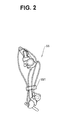
- Fig. 2 is a perspective view of the window regulator to be assembled.
- the window regulator 55 for moving a window glass 53 upward and downward is disposed in a space between the inner panel (a panel on the inside) and an outer panel (a panel on the outside) which constitute a door panel.
- a configuration of the window regulator 55 will be described.
- a wire drive unit 57 is mounted to the inner panel on a surface facing the outer panel.
- the wire drive unit 57 is rotatably provided on a base 61, and is provided with a drum 65 which is driven to rotate in the forward direction or the reverse direction by a motor 63.
- a wire 71 is formed substantially into an annular shape and is partly wound around the drum 65.
- a first upper guide member 81, a first lower guide member 83, a second upper guide member 91 and a second lower guide member 93 which function as wire guide members for guiding the wire 71 are provided along the direction of upward and downward movement of the window glass 53 on the inner panel on the surface facing the outer panel 51.
- pulleys are used for these members other than the first lower guide member 83 and a fixed guide formed with a groove for allowing engagement of the wire 71 on the outer peripheral surface thereof is used as the first lower guide member.
- the wire 71 is routed in a substantially N-shape in the order of the first lower guide member 83, the first upper guide member 81, the second lower guide member 93 and the second upper guide member 91.
- First window glass mounting means (glass holder) 101 for mounting the window glass 53 is provided on the wire 71 between the first upper guide member 81 and the first lower guide member 83 (a portion of the wire 71 along the direction of the upward and downward movement of the window glass 53).
- Second window glass mounting means (glass holder) 103 for mounting the window glass 53 is provided on the wire 71 between the second upper guide member 91 and the second lower guide member 93 (a portion of the wire 71 along the direction of the upward and downward movement of the window glass 53).
- the window regulator 55 is provided with a wire sag compensating mechanism for compensating the sag of the wire 71.
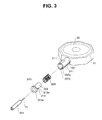
- a second wire sag compensating mechanism 113 is provided between the wire drive unit 57 and the first lower guide member 83, and a first wire sag compensating mechanism 111 is provided between the wire drive unit 57 and the second upper guide member 91. Since the structures of the first wire sag compensating mechanism 111 and the second wire sag compensating mechanism 113 are the same, description will be made on the second wire sag compensating mechanism 113 referring to Fig. 3 , and description of the structure of the first wire sag compensating mechanism will be omitted.
- an outer tube 201 having the wire 71 passed therethrough and being fixed to a member on which the first lower guide member 83 is provided at an end thereof on the first lower guide member 83 side is arranged between the vicinity of the drum 65 and the vicinity of the first lower guide 83.
- a slide bush 203 for allowing passage of the wire 71 therethrough is attached to the outer tube 201 on the drum 65 side.
- the base 61 having the drum 65 provided thereon is formed with a cylindrical tube holding portion 207 as guide means having an opened surface 207a at one end for allowing the slide bush 203 of the outer tube 201 to be movably fitted thereto through the opened surface 207a.
- a spring 209 as urging means is arranged in the tube holding portion 207.
- One end of the spring 209 comes into abutment with the bottom of the tube holding portion 207, and the other end thereof comes into abutment with a flange 203a formed on the slide bush 203 of the outer tube 201 on the outer tube 201 side, and urges the outer tube 201 in the direction to be pushed out from the tube holding portion 207.
- the tube holding portion 207 is formed with two elongated holes 211 on a cylindrical surface along the axial direction.
- the slide bush 203 is formed with two projections 213 which engage the elongated holes 211.
- the projections 213 formed on the slide bush 203 abut against the end portions of the elongated holes 211 of the tube holding portion 207, so that further movement of the slide bush 203 is restricted.
- the elongated holes 211 and the projections 213 constitute disengagement restricting means for restricting the outer tube 201 from being disengaged from the tube holding portion 207 as the guide means.
- the tube holding portion 207 is formed with a slit 207b extending to the opened surface 207a on the cylindrical surface thereof along the axial direction.
- the projections 213 also each have an inclined surface 213a which is reduced in height along the elongated hole 211 toward the drum 65.
- the window regulator 55 is bunched with a band 151 as shown in Fig. 2 so as to prevent the wire portion from being entangled, and supplied for assembly.
- the first wire sag compensating mechanism 111 and the second wire sag compensating mechanism 113 absorb the sag of the wire 71 and prevent the wire 71 from coming off the guide member.
- the drum 65 is rotated in the forward direction or the reverse direction by driving the motor 63 to move the wire 71, the window glass 53 mounted to the wire 71 is moved upward and downward via the first window glass mounting means 101 and the second window glass mounting means 103.
- the tube holding portion 207 is enlarged in diameter by the inclined surfaces 213a of the projections 213 of the slide bush 203, and hence easy insertion of the slide bush 203 into the tube holding portion 207 is ensured.
- the disengagement restricting means for restricting the outer tube from being disengaged from the guide means may have the shape as shown in Fig. 4 and Fig. 5 .
- Fig. 4 and Fig. 5 portions different from the one in Fig. 3 are the slide bush and the tube holding portion and other portions are the same. Therefore, the same parts are designated by the same reference numerals and overlapped description is omitted.
- Fig. 4 is an exploded perspective view and Fig. 5 is a drawing viewed in the direction indicated by an arrow A in Fig. 4 .
- a slide bush 303 is formed with a projection 303a on the peripheral surface thereof.
- the projection 303a is adapted to be fitted to a slit 307b of a tube holding portion 307.
- the disengagement restricting means in this embodiment includes first and second slit projections 307e, 307f formed in the vicinity of opened surfaces 307a on two surfaces 307c, 307d facing to each other which constitute the slit 307b of the tube holding portion 307 and the projection 303a formed on the slide bush 303 as shown in Fig. 5 .
- the first slit projection 307e projects toward the surface 307d (the other surface) which faces the surface 307c provided with the first slit projection 307e, and is formed with an engaged surface 307g on the drum 65 side.
- the second slit projection 307f projects toward the surface 307c (the other surface) which faces the surface 307d provided with the second slit projection 307f and is formed with an engaged surface 307h on the drum 65 side.
- the projection 303a of the slide bush 303 is formed with first and second engaging surfaces 303g, 303h which are engageable with the engaged surfaces 307g, 307h of the first and second slit projections 307e, 307f.
- the engaged surfaces 307g, 307h of the first and second slit projection 307e, 307f and the first and second engaging surfaces 303g, 303h of the projection 303a are designed to shape so as to restrict the further movement of the slide bush 303 and prevent enlargement in diameter of the tube holding portion 307 by the engagement therebetween.
- the drum 65 side of the projection 303a of the slide bush 303 is formed with surfaces 303c, 303d which come into abutment with the first slit projection 307e and the second slit projection 307f of the tube holding portion 307 when inserting the slide bush 303 into the tube holding portion 307, and enlarge the width of the slit.
- the present invention is not limited to the embodiments shown above.
- the description is made with an example in which the wire sag compensating mechanism is provided on the drum 65 side.
- the wire sag compensating mechanism may be provided on the first lower guide member 83 side or the second upper guide member 91 side.
- the tube holding portion 207 is formed with the two elongated holes 211 and the slide bush 203 is formed with the two projections 213 which engage the elongated holes 211.
- the tube holding portion 207 is formed with the two elongated holes 211 and the slide bush 203 is formed with the two projections 213 which engage the elongated holes 211.
- one elongated hole and one projection, or three or more elongated holes and three or more projections are also applicable.
Landscapes
- Engineering & Computer Science (AREA)
- Mechanical Engineering (AREA)
- Window Of Vehicle (AREA)
- Power-Operated Mechanisms For Wings (AREA)
Abstract
Description
- The present invention relates to a window regulator including a drum mounted to of an inner panel of a door on a surface facing an outer panel and being capable of rotating in the forward direction and the reverse direction; an annular wire partly wound around the drum; a wire guide member mounted to the inner panel of the door on the surface facing the outer panel for guiding the wire so that the wire is arranged along the direction of upward and downward movement of a window glass; and window glass mounting means for mounting the window glass to the wire at a portion along the direction of upward and downward movement of the window glass, in which the window glass is moved upward and downward by moving the wire by rotating the drum in the forward direction or the reverse direction.
- As an example of a window regulator using a drum, there is the one as shown in
Fig. 6 . In the drawing, a drum 3 on which a wire 1 is wound is provided in adrum housing 5, and thedrum housing 5 is attached to an inner panel of a door on a surface facing an outer panel. The drum 3 is adapted to be rotated by amotor 7 in the forward direction/reverse direction. - A
guide rail 9 is mounted to the inner panel of the door on the surface facing the outer panel along the direction of upward and downward movement of a window glass. Aslider 11 movably engages theguide rail 9, and the window glass, not shown, is mounted to theslider 11. Therefore, theslider 11 functions as window glass mounting means. - An
upper pulley 13 is provided on the upper portion of theguide rail 9, and alower pulley 15 is provided on the lower portion thereof. Theupper pulley 13 and thelower pulley 15 function as wire guide members which guide the wire 1. - One end of the wire 1 is fixed to the
slider 11 via theupper pulley 13. The other end of the wire 1 is fixed to theslider 11 via thelower pulley 15.
A wiresag compensating mechanism 20 will now be described. -
Outer tubes 21 for allowing passage of the wire 1 therethrough are arranged between the drum 3 and theupper pulley 13 and between the drum 3 and thelower pulley 15. One end of the eachouter tube 21 is fixed to a member on which theupper pulley 13 and thelower pulley 15 are provided. The other end, that is, the end on the drum 3 side of theouter tube 21 is provided with aslide bush 23 for allowing passage of the wire 1 therethrough as shown inFig. 7 . Theslide bush 23 movably engages a cylindricaltube holding portion 25a formed on abase 25 provided with the drum 3. Therefore, thetube holding portion 25a functions as guide means which guides theouter tube 21 on the drum 3 side in the axial direction of theouter tube 21. Theouter tube 21 is urged in the direction of being pushed out from thetube holding portion 25a by aspring 27 as urging means arranged in thetube holding portion 25a and abutted at one end to the bottom of the tube holding portion and at the other end to theslide bush 23 of theouter tube 21. When the wire 1 sags, theouter tube 21 is pushed out by an urging force of thespring 27 so that a wire path between thebase 25 and theupper pulley 13 and a wire path between thebase 25 and thelower pulley 15 are expanded, thereby absorbing the sag of the wire 1. - When the drum 3 is rotated in the forward direction or the reverse direction by driving the
motor 7, and hence the wire 1 is moved, theslider 11 moves along theguide rail 9 and the window glass is moved upward or downward (for example, see Patent Document 1). - Patent Document 1:
JP-A-9-144424 - In general, the window regulator is assembled in such a manner that an assembly including a drive source, a wire and a slider assembled together is assembled to the door as shown in
Fig. 6 .
In the case of the window regulator assembly of a shape as shown inFig. 6 ,Fig. 7 , even when the wiresag compensating mechanism 20 is in operation, since theupper pulley 13 and thelower pulley 15 are fixed to theguide rail 9, and hence the assembly is not broken into pieces due to generation of tension on the wire 1. - However, in a case of the window regulator assembly in which no
guide rail 9 is provided and the upper pulley and the lower pulley are mounted directly to the door, since the tension is not generated in the wire, and hence in the case of the wire sag compensating mechanism as shown inFig. 6 andFig. 7 , there arises a problem such that the slide bush or the outer tube comes out from the tube holding portion as the guide means due to the urging force of the spring, and hence it cannon be mounted to a vehicle. - In view of such a problem, it is an object of the present invention is to provide a window regulator having a wire sag compensating mechanism which prevents an outer tube from coming apart from guide means.
- The invention according to Claim 1 is a window regulator including a drum mounted to an inner panel of a door on a surface facing an outer panel and being capable of rotating in the forward direction and the reverse direction; an annular wire wounded partly around the drum; a wire guide member mounted to the inner panel of the door on the surface facing the outer panel for guiding the wire so that the wire is arranged along the direction of upward and downward movement of a window glass; and window glass mounting means for mounting the window glass to the wire at a portion along the direction of upward and downward movement of the window glass, wherein the window glass is moved upward and downward by moving the wire by rotating the drum in the forward direction or the reverse direction, characterized in that a wire sag compensating mechanism includes: an outer tube arranged between the vicinity of the drum and the vicinity of the wire guide member for allowing passage of the wire therethrough and fixed to one of the drum side and the wire guide member side; guide means provided on the other side of the drum side and the wire guide member side for allowing movable engagement of the outer tube therewith and guiding the outer tube in the axial direction of the outer tube; urging means for urging the outer tube in the direction away from the guide means; and disengagement restricting means for restricting the outer tube from being disengaged from the guide means.
- When the drum is rotated in the forward or the reverse direction, the wire is moved and the window glass is moved upward and downward. The invention according to Claim 2 is the window regulator according to Claim 1, characterized in that a slide bush which allows passage of the wire therethrough is attached to the outer tube on the guide means side, in that the guide means is a cylindrical tube holding portion having an opened surface at one end for allowing movable fitting of the slide bush of the outer tube through the opened surface, in that the urging means is a spring which comes into abutment with a member having the guide means at one end and comes into abutment with the slide bush of the outer tube at the other end for urging the outer tube in the direction to be pushed out from the tube holding portion, and in that the disengagement restricting means includes an elongated hole formed on a cylindrical surface of the tube holding portion along the axial direction and a projection which is formed on the slide bush to engage the elongated hole.
- The invention according to Claim 3 is the window regulator according to Claim 2, characterized in that the tube holding portion is formed with a slit extending to the opened surface on the cylindrical surface along the axial direction and the projection has an inclined surface which is reduced in height along the elongated hole toward the member provided with the guide means.
- The invention according to Claim 4 is the window regulator according to Claim 1, characterized in that a slide bush which allows passage of the wire therethrough and is formed with a projection on the peripheral surface thereof is attached to the outer tube on the guide means side, in that the guide means is a cylindrical tube holding portion having an opened surface at one end, being formed with a slit extending to the opened surface along the axial direction for allowing movable fitting of the slide bush of the outer tube through the opened surface so that the projection of the slide bush fits the slit, in that the urging means is a spring which comes into abutment with a member having the guide means at one end and comes into abutment with the slide bush of the outer tube at the other end for urging the outer tube in the direction to be pushed out from the tube holding portion, in that the disengagement restricting means includes first and second slit projections formed in the vicinity of the opened surface on two surfaces facing to each other which constitute the slit of the tube holding portion respectively and projecting toward opposite surfaces where the projections by themselves are formed and having an engaged surfaces on the side of the member provided with the guide means and a projection of the slide bush engageable with the engaged surfaces of the first and second slit projections and having first and second engaging surfaces, and in that the engaged surfaces of the first and second slit projections and the first and second engaging surfaces of the projection are designed to shapes so as to restrict the further movement of the slide bush and prevent enlargement in diameter of the tube holding portion by engagement therebetween.
- The invention according to
Claim 5 is the wind regulator according to Claim 4, characterized in that the projection of the slide bush is formed with surfaces which come into abutment with the first slit projection and the second slit projection of the tube holding portion on the side of the member provided with the guide means and enlarge the width of the slit when the slide bush is inserted into the tube holding portion. - According to the invention as stated in Claim 1 to
Claim 5, there is provided the window regulator having the wire sag compensating mechanism for preventing disengagement of the outer tube from the guide means by the provision of the disengagement restricting means which restricts the outer tube from being disengaged from the guide means. - According to the invention as stated in Claim 2, the projection formed on the slide bush comes into abutment with the end of the elongated hole, so that the further movement of the slide bush is restricted.
According to the invention as stated in Claim 3, the tube holding portion is formed with the slit extending to the opened surface on the cylindrical surface along the axial direction and the projection has the inclined surface which is reduced in height along the elongated hole toward the member provided with the guide means, so that when the slide bush is inserted into the tube holding potion, the tube holding portion is enlarged in diameter by the inclined surface formed on the projection of the slide bush, and hence easy insertion of the slide bush into the tube holding portion is achieved. - According to the invention as state in Claim 4, the slide bush which allows passage of the wire therethrough and is formed with the projection on the peripheral surface thereof is attached to the outer tube on the guide means side, the guide means is the cylindrical tube holding portion having the opened surface at one end, being formed with the slit extending to the opened surface along the axial direction for allowing movable fitting of the slide bush of the outer tube through the opened surface so that the projection of the slide bush fits the slit, the urging means is the spring which comes into abutment with the member having the guide means at one end and comes into abutment with the slide bush of the outer tube at the other end for urging the outer tube in the direction to be pushed out from the tube holding portion, the disengagement restricting means includes the first and second slit projections formed in the vicinity of the opened surface on the two surfaces facing to each other which constitute the slit of the tube holding portion respectively and projecting toward the opposite surfaces where the projections by themselves are formed and having the engaged surfaces on the side of the member provided with the guide means and the projection of the slide bush engageable with the engaged surfaces of the first and second slit projections and having the first and second engaging surfaces, and the engaged surfaces of the first and second slit projections and the first and second engaging surfaces of the projection are designed to shapes so as to restrict the further movement of the slide bush and prevent enlargement in diameter of the tube holding portion by engagement therebetween, so that the tube holding portion cannot be enlarged in diameter against, and hence retention thereof is further enhanced.
- According to the invention as stated in
Claim 5, the projection of the slide bush is formed with surfaces which come into abutment with the first slit projection and the second slit projection of the tube holding portion on the side of the member provided with the guide means and enlarge the width of the slit when the slide bush is inserted into the tube holding portion. Therefore, when inserting the slide bush into the tube holding portion, the tube holding portion is enlarged in diameter by the inclined surfaces of the projection of the slide bush, so that easy insertion of the slide bush into the tube holding portion is achieved. - Referring first to
Fig. 1 to Fig. 2 , a window regulator according to an embodiment will be described.Fig. 1 is a drawing showing a door in a state in which the window regulator in the embodiment is provided and an inner panel is removed viewed from the cabin side, andFig. 2 is a perspective view of the window regulator to be assembled. - As shown in
Fig. 1 , thewindow regulator 55 for moving awindow glass 53 upward and downward is disposed in a space between the inner panel (a panel on the inside) and an outer panel (a panel on the outside) which constitute a door panel. - A configuration of the
window regulator 55 will be described. Awire drive unit 57 is mounted to the inner panel on a surface facing the outer panel. Thewire drive unit 57 is rotatably provided on abase 61, and is provided with adrum 65 which is driven to rotate in the forward direction or the reverse direction by amotor 63. - A
wire 71 is formed substantially into an annular shape and is partly wound around thedrum 65.
A firstupper guide member 81, a firstlower guide member 83, a secondupper guide member 91 and a secondlower guide member 93 which function as wire guide members for guiding thewire 71 are provided along the direction of upward and downward movement of thewindow glass 53 on the inner panel on the surface facing theouter panel 51. - In the embodiment, pulleys are used for these members other than the first
lower guide member 83 and a fixed guide formed with a groove for allowing engagement of thewire 71 on the outer peripheral surface thereof is used as the first lower guide member.
Thewire 71 is routed in a substantially N-shape in the order of the firstlower guide member 83, the firstupper guide member 81, the secondlower guide member 93 and the secondupper guide member 91. - First window glass mounting means (glass holder) 101 for mounting the
window glass 53 is provided on thewire 71 between the firstupper guide member 81 and the first lower guide member 83 (a portion of thewire 71 along the direction of the upward and downward movement of the window glass 53). - Second window glass mounting means (glass holder) 103 for mounting the
window glass 53 is provided on thewire 71 between the secondupper guide member 91 and the second lower guide member 93 (a portion of thewire 71 along the direction of the upward and downward movement of the window glass 53). - The
window regulator 55 is provided with a wire sag compensating mechanism for compensating the sag of thewire 71. In the embodiment, a second wiresag compensating mechanism 113 is provided between thewire drive unit 57 and the firstlower guide member 83, and a first wiresag compensating mechanism 111 is provided between thewire drive unit 57 and the secondupper guide member 91. Since the structures of the first wiresag compensating mechanism 111 and the second wiresag compensating mechanism 113 are the same, description will be made on the second wiresag compensating mechanism 113 referring toFig. 3 , and description of the structure of the first wire sag compensating mechanism will be omitted. - In
Fig. 3 , anouter tube 201 having thewire 71 passed therethrough and being fixed to a member on which the firstlower guide member 83 is provided at an end thereof on the firstlower guide member 83 side is arranged between the vicinity of thedrum 65 and the vicinity of the firstlower guide 83. - A
slide bush 203 for allowing passage of thewire 71 therethrough is attached to theouter tube 201 on thedrum 65 side.
On the other hand, thebase 61 having thedrum 65 provided thereon is formed with a cylindricaltube holding portion 207 as guide means having an openedsurface 207a at one end for allowing theslide bush 203 of theouter tube 201 to be movably fitted thereto through theopened surface 207a. - A
spring 209 as urging means is arranged in thetube holding portion 207. One end of thespring 209 comes into abutment with the bottom of thetube holding portion 207, and the other end thereof comes into abutment with aflange 203a formed on theslide bush 203 of theouter tube 201 on theouter tube 201 side, and urges theouter tube 201 in the direction to be pushed out from thetube holding portion 207. - The
tube holding portion 207 is formed with twoelongated holes 211 on a cylindrical surface along the axial direction. Theslide bush 203 is formed with twoprojections 213 which engage theelongated holes 211. Theprojections 213 formed on theslide bush 203 abut against the end portions of theelongated holes 211 of thetube holding portion 207, so that further movement of theslide bush 203 is restricted. In other words, theelongated holes 211 and theprojections 213 constitute disengagement restricting means for restricting theouter tube 201 from being disengaged from thetube holding portion 207 as the guide means. - The
tube holding portion 207 is formed with aslit 207b extending to the openedsurface 207a on the cylindrical surface thereof along the axial direction. Theprojections 213 also each have aninclined surface 213a which is reduced in height along theelongated hole 211 toward thedrum 65.
Thewindow regulator 55 is bunched with aband 151 as shown inFig. 2 so as to prevent the wire portion from being entangled, and supplied for assembly. - An operation of the above-described configuration will be described below.
The first wiresag compensating mechanism 111 and the second wiresag compensating mechanism 113 absorb the sag of thewire 71 and prevent thewire 71 from coming off the guide member. When thedrum 65 is rotated in the forward direction or the reverse direction by driving themotor 63 to move thewire 71, thewindow glass 53 mounted to thewire 71 is moved upward and downward via the first window glass mounting means 101 and the second window glass mounting means 103. - In this configuration, following effects are achieved.
- (1) With the provision of the disengagement restricting means for restricting the
outer tube 201 from being disengaged from thetube holding portion 207 as the guide means, the window regulator having the first and second wiresag compensating mechanisms outer tube 201 from coming apart from thetube holding portion 207 is obtained. - (2) By the abutment of the
projections 213 formed on theslide bush 203 against the end portions of theelongated holes 211 of thetube holding portion 207, further movement of theslide bush 203 may be restricted. - (3) The
tube holding portion 207 is formed with theslit 207b extending to the openedsurface 207a on the cylindrical surface thereof along the axial direction. Theprojections 213 each have theinclined surface 213a which is reduced in height along theelongated hole 211 toward thedrum 65. - Therefore, when inserting the
slide bush 203 into thetube holding portion 207, thetube holding portion 207 is enlarged in diameter by theinclined surfaces 213a of theprojections 213 of theslide bush 203, and hence easy insertion of theslide bush 203 into thetube holding portion 207 is ensured. - The present invention is not limited to the embodiment shown above. For example, the disengagement restricting means for restricting the outer tube from being disengaged from the guide means may have the shape as shown in
Fig. 4 andFig. 5 . InFig. 4 andFig. 5 , portions different from the one inFig. 3 are the slide bush and the tube holding portion and other portions are the same. Therefore, the same parts are designated by the same reference numerals and overlapped description is omitted.Fig. 4 is an exploded perspective view andFig. 5 is a drawing viewed in the direction indicated by an arrow A inFig. 4 . - A
slide bush 303 is formed with aprojection 303a on the peripheral surface thereof. Theprojection 303a is adapted to be fitted to aslit 307b of atube holding portion 307.
The disengagement restricting means in this embodiment includes first andsecond slit projections surfaces 307a on twosurfaces slit 307b of thetube holding portion 307 and theprojection 303a formed on theslide bush 303 as shown inFig. 5 . - The
first slit projection 307e projects toward thesurface 307d (the other surface) which faces thesurface 307c provided with thefirst slit projection 307e, and is formed with an engagedsurface 307g on thedrum 65 side. In the same manner, thesecond slit projection 307f projects toward thesurface 307c (the other surface) which faces thesurface 307d provided with thesecond slit projection 307f and is formed with an engagedsurface 307h on thedrum 65 side. - The
projection 303a of theslide bush 303 is formed with first and second engagingsurfaces surfaces second slit projections - The engaged surfaces 307g, 307h of the first and
second slit projection surfaces projection 303a are designed to shape so as to restrict the further movement of theslide bush 303 and prevent enlargement in diameter of thetube holding portion 307 by the engagement therebetween. - The
drum 65 side of theprojection 303a of theslide bush 303 is formed withsurfaces first slit projection 307e and thesecond slit projection 307f of thetube holding portion 307 when inserting theslide bush 303 into thetube holding portion 307, and enlarge the width of the slit. - In this configuration, the following effects are achieved.
- (1) The
tube holding portion 207 is formed with theelongated holes 211 on the peripheral surface thereof. Therefore, when molding thetube holding portion 207 with resin, a trimming die is necessary to form theelongated holes 211, and hence the cost of the die increases. On the other hand, thetube holding portion 307 in this embodiment has no elongated holes, the trimming die is not necessary correspondingly, so that the cost of the die is reduced. - (2) The engaged surfaces 307g, 307h of the first and
second slit projections surfaces projection 303a are designed to shapes so as to restrict further movement of theslide bush 303 by the engagement therebetween, and prevent enlargement in diameter of thetube holding portion 307. Therefore, retention is further enhanced. - (5) The
drum 65 side of theprojection 303a of theslide bush 303 is formed with thesurfaces first slit projection 307e and thesecond slit projection 307f of thetube holding portion 307 when inserting theslide bush 303 into thetube holding portion 307, and enlarge the width of the slit. Therefore, easy insertion of theslide bush 303 into thetube holding portion 307 is ensured. - The present invention is not limited to the embodiments shown above. In the embodiments shown above, the description is made with an example in which the wire sag compensating mechanism is provided on the
drum 65 side. However, the wire sag compensating mechanism may be provided on the firstlower guide member 83 side or the secondupper guide member 91 side. - Furthermore, as shown in
Fig. 3 , thetube holding portion 207 is formed with the twoelongated holes 211 and theslide bush 203 is formed with the twoprojections 213 which engage theelongated holes 211. However, one elongated hole and one projection, or three or more elongated holes and three or more projections are also applicable. -
- [
Fig. 1] Fig. 1 is a drawing showing a door in a state in which a window regulator in an embodiment is provided and an inner panel is removed viewed from the cabin side. - [
Fig. 2] Fig. 2 is a perspective view of the window regulator to be assembled. - [
Fig. 3] Fig. 3 is a perspective view of a first wire sag compensating mechanism inFig. 1 . - [
Fig. 4] Fig. 4 is a perspective view of a wire sag compensating mechanism in another embodiment. - [
Fig. 5] Fig. 5 is a drawing viewed in the direction indicated by an arrow A inFig. 4 . - [
Fig. 6] Fig. 6 is a configuration diagram showing a window regulator using a drum. - [
Fig. 7] Fig. 7 is a perspective view of a wire sag compensating mechanism inFig. 6 . -
- 65
- drum
- 71
- wire
- 201
- outer tube
- 203
- slide bush
- 209
- spring
- 211
- elongated holes
- 213
- projections
Claims (5)
- A window regulator comprising:a drum mounted to an inner panel of a door on a surface facing an outer panel and being capable of rotating in the forward direction and the reverse direction;an annular wire wound partly around the drum;a wire guide member mounted to the inner panel of the door on the surface facing the outer panel for guiding the wire so that the wire is arranged along the direction of upward and downward movement of a window glass; andwindow glass mounting means for mounting the window glass to the wire at a portion along the direction of upward and downward movement of the window glass,wherein the window glass is moved upward and downward by moving the wire by rotating the drum in the forward direction or the reverse direction,characterized in that a wire sag compensating mechanism includes:an outer tube arranged between the vicinity of the drum and the vicinity of the wire guide member for allowing passage of the wire therethrough and fixed to one of the drum side and the wire guide member side;guide means provided on the other side of the drum side and the wire guide member side for allowing movable engagement of the outer tube therewith and guiding the outer tube in the axial direction of the outer tube;urging means for urging the outer tube in the direction away from the guide means; anddisengagement restricting means for restricting the outer tube from being disengaged from the guide means.
- The window regulator according to Claim 1,
characterized in that a slide bush which allows passage of the wire therethrough is attached to the outer tube on the guide means side,
in that the guide means is a cylindrical tube holding portion having an opened surface at one end for allowing movable fitting of the slide bush of the outer tube through the opened surface,
in that the urging means is a spring which comes into abutment with a member having the guide means at one end and comes into abutment with the slide bush of the outer tube at the other end for urging the outer tube in the direction to be pushed out from the tube holding portion, and
in that the disengagement restricting means includes an elongated hole formed on a cylindrical surface of the tube holding portion along the axial direction and a projection which is formed on the slide bush to engage the elongated hole. - The window regulator according to Claim 2, characterized in that the tube holding portion is formed with a slit extending to the opened surface on the cylindrical surface along the axial direction and the projection has an inclined surface which is reduced in height along the elongated hole toward the member provided with the guide means.
- The window regulator according to Claim 1, characterized in that a slide bush which allows passage of the wire therethrough and is formed with a projection on the peripheral surface thereof is attached to the outer tube on the guide means side,
in that the guide means is a cylindrical tube holding portion having an opened surface at one end, being formed with a slit extending to the opened surface along the axial direction for allowing movable fitting of the slide bush of the outer tube through the opened surface so that the projection of the slide bush fits the slit,
in that the urging means is a spring which comes into abutment with a member having the guide means at one end and comes into abutment with the slide bush of the outer tube at the other end for urging the outer tube an the direction to be pushed out from the tube holding portion,
in that the disengagement restricting means includes first and second slit projections formed in the vicinity of the opened surface on two surfaces facing to each other which constitute the slit of the tube holding portion respectively and projecting toward opposite surfaces where the projections by themselves are formed and having an engaged surfaces on the side of the member provided with the guide means and a projection of the slide bush engageable with the engaged surfaces of the first and second slit projections and having first and second engaging surfaces, and
in that the engaged surfaces of the first and second slit projections and the first and second engaging surfaces of the projection are designed to shapes so as to restrict the further movement of the slide bush and prevent enlargement in diameter of the tube holding portion by engagement therebetween. - The window regulator according to Claim 4, characterized in that the projection of the slide bush is formed with surfaces which come into abutment with the first slit projection and the second slit projection of the tube holding portion on the side of the member provided with the guide means and enlarge the width of the slit when the slide bush is inserted into the tube holding portion.
Applications Claiming Priority (2)
| Application Number | Priority Date | Filing Date | Title |
|---|---|---|---|
| JP2006149429A JP4579864B2 (en) | 2006-05-30 | 2006-05-30 | Window regulator |
| PCT/JP2007/060720 WO2007139027A1 (en) | 2006-05-30 | 2007-05-25 | Window regulator |
Publications (3)
| Publication Number | Publication Date |
|---|---|
| EP2022922A1 true EP2022922A1 (en) | 2009-02-11 |
| EP2022922A4 EP2022922A4 (en) | 2013-03-06 |
| EP2022922B1 EP2022922B1 (en) | 2014-09-17 |
Family
ID=38778548
Family Applications (1)
| Application Number | Title | Priority Date | Filing Date |
|---|---|---|---|
| EP07744154.1A Not-in-force EP2022922B1 (en) | 2006-05-30 | 2007-05-25 | Window regulator |
Country Status (5)
| Country | Link |
|---|---|
| US (1) | US8209907B2 (en) |
| EP (1) | EP2022922B1 (en) |
| JP (1) | JP4579864B2 (en) |
| CN (1) | CN101351610B (en) |
| WO (1) | WO2007139027A1 (en) |
Families Citing this family (12)
| Publication number | Priority date | Publication date | Assignee | Title |
|---|---|---|---|---|
| US8819995B2 (en) * | 2006-12-13 | 2014-09-02 | Shiroki Kogyo Co., Ltd. | Window regulator and jig |
| WO2008111097A2 (en) * | 2007-03-14 | 2008-09-18 | Ifb Automotive Private Ltd | Wire holder brush for window regulator |
| FR2940344B1 (en) * | 2008-12-18 | 2011-04-01 | Arvinmeritor Light Vehicle Sys | METHOD FOR MANUFACTURING A WINDOW LIFTER AND WINDOW LIFTER |
| JP2014020005A (en) * | 2012-07-12 | 2014-02-03 | Shiroki Corp | Guide pulley support structure for wind regulator |
| FR3003510B1 (en) * | 2013-03-21 | 2015-03-27 | Inteva Products France Sas | PIVOTING SHEATH STOP FOR SHEATH, SUPPORT, GUIDE RAIL, ASSEMBLY, WINDOW LIFTER, CORRESPONDING MOUNTING METHOD |
| US9637969B2 (en) * | 2014-08-07 | 2017-05-02 | Hi-Lex Controls, Inc. | Integrated window regulator assembly |
| JP6345063B2 (en) * | 2014-09-26 | 2018-06-20 | シロキ工業株式会社 | Vehicle window regulator and tilt suppression mechanism |
| US9771746B2 (en) * | 2015-07-30 | 2017-09-26 | GM Global Technology Operations LLC | Window regulator for a door assembly of a vehicle |
| DE202016005232U1 (en) * | 2016-08-17 | 2017-11-20 | Brose Fahrzeugteile Gmbh & Co. Kommanditgesellschaft, Bamberg | Apparatus for compensating for a cable-free within a cable window regulator, the cable has at least a portion with a Bowden |
| US10669764B2 (en) * | 2017-05-18 | 2020-06-02 | Magna Closures Inc. | Rail module with cable conduits for window regulator systems |
| US11193320B2 (en) * | 2019-11-04 | 2021-12-07 | Brose Fahrzeugteile Gmbh & Co. Kommanditgesellschaft, Bamberg | Window regulator assembly |
| JP7692380B2 (en) * | 2022-02-28 | 2025-06-13 | 株式会社ハイレックスコーポレーション | Mounting structure and window regulator |
Family Cites Families (16)
| Publication number | Priority date | Publication date | Assignee | Title |
|---|---|---|---|---|
| DE2750904C2 (en) * | 1977-11-14 | 1983-10-20 | Brose Fahrzeugteile GmbH & Co KG, 8630 Coburg | Window regulators, in particular for motor vehicles |
| DE2849445A1 (en) * | 1978-11-15 | 1980-05-29 | Volkswagenwerk Ag | WINDOW REGULATOR |
| FR2584469A1 (en) * | 1985-07-05 | 1987-01-09 | Mecanisme Cie Indle | UNIDIRECTIONAL CABLE TENSIONER FOR A WINDOW REGULATOR OF A MOTOR VEHICLE |
| JPS62140223U (en) * | 1986-02-28 | 1987-09-04 | ||
| JPH0419493A (en) * | 1990-05-10 | 1992-01-23 | Kubota Corp | How to connect thermosetting resin pipes |
| JP3720438B2 (en) * | 1995-11-24 | 2005-11-30 | 日本ケーブル・システム株式会社 | Wind regulator drive unit |
| US5749174A (en) | 1996-03-11 | 1998-05-12 | Excel Industries, Inc. | Window regulator with spring retainer |
| JP3556802B2 (en) * | 1997-04-24 | 2004-08-25 | シロキ工業株式会社 | Wire slack removal mechanism and window regulator |
| DE19824131C1 (en) * | 1998-05-29 | 1999-07-22 | Kuester & Co Gmbh | Clamp for draw cable of vehicle window lifter |
| DE19852977C1 (en) * | 1998-11-17 | 1999-10-07 | Brose Fahrzeugteile | Arrangement for ensuring a relative movement between parts of a chord window raising device |
| JP2003293651A (en) * | 2002-03-28 | 2003-10-15 | Oi Seisakusho Co Ltd | Wire type window regulator device |
| JP3894431B2 (en) * | 2002-04-08 | 2007-03-22 | 株式会社大井製作所 | Mobile cable tensioning device |
| US7591104B2 (en) * | 2003-07-23 | 2009-09-22 | Ohi Seisakusho Co., Ltd. | Mounting structure of a power window apparatus |
| EP1870604B1 (en) * | 2006-06-19 | 2009-07-29 | Magna Closures Inc. | An automatic length compensating device for a flexible cable transmission |
| JP4806310B2 (en) * | 2006-08-11 | 2011-11-02 | 三井金属アクト株式会社 | Open / close drive device |
| US20100043295A1 (en) * | 2008-08-20 | 2010-02-25 | Geoffrey Barr | Automatic cable tensioner for cable drive window regulators |
-
2006
- 2006-05-30 JP JP2006149429A patent/JP4579864B2/en active Active
-
2007
- 2007-05-25 WO PCT/JP2007/060720 patent/WO2007139027A1/en not_active Ceased
- 2007-05-25 EP EP07744154.1A patent/EP2022922B1/en not_active Not-in-force
- 2007-05-25 CN CN2007800010904A patent/CN101351610B/en not_active Expired - Fee Related
- 2007-05-25 US US11/992,739 patent/US8209907B2/en not_active Expired - Fee Related
Also Published As
| Publication number | Publication date |
|---|---|
| EP2022922A4 (en) | 2013-03-06 |
| JP4579864B2 (en) | 2010-11-10 |
| CN101351610B (en) | 2012-06-13 |
| WO2007139027A1 (en) | 2007-12-06 |
| US20090090065A1 (en) | 2009-04-09 |
| EP2022922B1 (en) | 2014-09-17 |
| CN101351610A (en) | 2009-01-21 |
| JP2007321345A (en) | 2007-12-13 |
| US8209907B2 (en) | 2012-07-03 |
Similar Documents
| Publication | Publication Date | Title |
|---|---|---|
| EP2022922A1 (en) | Window regulator | |
| US5505022A (en) | Window regulator | |
| JP4928498B2 (en) | Window regulator | |
| EP2302753B1 (en) | Electric power supplying device and harness routing structure using the same | |
| JP6076386B2 (en) | Window regulator | |
| JP5207678B2 (en) | Cable guide and sliding door drive using the same | |
| JP2008045311A (en) | Open / close drive device | |
| US20130133265A1 (en) | Window regulator | |
| JP2011069059A (en) | Wire drum-type window regulator | |
| JP2017002673A (en) | Object movement device | |
| EP2095982A1 (en) | Window regulator and jig | |
| JP5930665B2 (en) | Vehicle window regulator device | |
| JP5711310B2 (en) | Window regulator with wire tension enhancing means | |
| JP5154965B2 (en) | Assembly method of cable winding mechanism and cable winding mechanism | |
| JP3118237U (en) | Inner cable relay device for window regulator | |
| JP6625833B2 (en) | Object moving device | |
| JP6154117B2 (en) | Drive unit mounting structure | |
| JP2013096208A (en) | Window regulator device for vehicle | |
| JP5171133B2 (en) | Carrier plate and window regulator using the same | |
| JP2006076440A (en) | Module plate and window regulator using it | |
| JP5226977B2 (en) | Driving device unit for window regulator and window regulator using the same | |
| JP7706430B2 (en) | Object moving device and window regulator | |
| JP6882952B2 (en) | Mobile device | |
| WO2017169405A1 (en) | Movable body driving device, vehicle window glass raising and lowering device, and sunroof device | |
| JP5689384B2 (en) | Window regulator |
Legal Events
| Date | Code | Title | Description |
|---|---|---|---|
| PUAI | Public reference made under article 153(3) epc to a published international application that has entered the european phase |
Free format text: ORIGINAL CODE: 0009012 |
|
| 17P | Request for examination filed |
Effective date: 20080312 |
|
| AK | Designated contracting states |
Kind code of ref document: A1 Designated state(s): AT BE BG CH CY CZ DE DK EE ES FI FR GB GR HU IE IS IT LI LT LU LV MC MT NL PL PT RO SE SI SK TR |
|
| AX | Request for extension of the european patent |
Extension state: AL BA HR MK RS |
|
| RBV | Designated contracting states (corrected) |
Designated state(s): DE FR GB |
|
| DAX | Request for extension of the european patent (deleted) | ||
| RAP1 | Party data changed (applicant data changed or rights of an application transferred) |
Owner name: SHIROKI KOGYO CO., LTD. Owner name: TOYOTA JIDOSHA KABUSHIKI KAISHA |
|
| A4 | Supplementary search report drawn up and despatched |
Effective date: 20130204 |
|
| RIC1 | Information provided on ipc code assigned before grant |
Ipc: E05F 11/48 20060101AFI20130129BHEP Ipc: E05F 15/16 20060101ALI20130129BHEP Ipc: B60J 1/17 20060101ALI20130129BHEP |
|
| GRAP | Despatch of communication of intention to grant a patent |
Free format text: ORIGINAL CODE: EPIDOSNIGR1 |
|
| INTG | Intention to grant announced |
Effective date: 20140422 |
|
| GRAS | Grant fee paid |
Free format text: ORIGINAL CODE: EPIDOSNIGR3 |
|
| GRAA | (expected) grant |
Free format text: ORIGINAL CODE: 0009210 |
|
| AK | Designated contracting states |
Kind code of ref document: B1 Designated state(s): DE FR GB |
|
| REG | Reference to a national code |
Ref country code: GB Ref legal event code: FG4D |
|
| REG | Reference to a national code |
Ref country code: DE Ref legal event code: R096 Ref document number: 602007038580 Country of ref document: DE Effective date: 20141030 |
|
| REG | Reference to a national code |
Ref country code: FR Ref legal event code: PLFP Year of fee payment: 9 |
|
| REG | Reference to a national code |
Ref country code: DE Ref legal event code: R097 Ref document number: 602007038580 Country of ref document: DE |
|
| PLBE | No opposition filed within time limit |
Free format text: ORIGINAL CODE: 0009261 |
|
| STAA | Information on the status of an ep patent application or granted ep patent |
Free format text: STATUS: NO OPPOSITION FILED WITHIN TIME LIMIT |
|
| PGFP | Annual fee paid to national office [announced via postgrant information from national office to epo] |
Ref country code: GB Payment date: 20150520 Year of fee payment: 9 Ref country code: DE Payment date: 20150519 Year of fee payment: 9 |
|
| 26N | No opposition filed |
Effective date: 20150618 |
|
| PGFP | Annual fee paid to national office [announced via postgrant information from national office to epo] |
Ref country code: FR Payment date: 20150508 Year of fee payment: 9 |
|
| REG | Reference to a national code |
Ref country code: DE Ref legal event code: R119 Ref document number: 602007038580 Country of ref document: DE |
|
| GBPC | Gb: european patent ceased through non-payment of renewal fee |
Effective date: 20160525 |
|
| REG | Reference to a national code |
Ref country code: FR Ref legal event code: ST Effective date: 20170131 |
|
| PG25 | Lapsed in a contracting state [announced via postgrant information from national office to epo] |
Ref country code: DE Free format text: LAPSE BECAUSE OF NON-PAYMENT OF DUE FEES Effective date: 20161201 Ref country code: FR Free format text: LAPSE BECAUSE OF NON-PAYMENT OF DUE FEES Effective date: 20160531 |
|
| PG25 | Lapsed in a contracting state [announced via postgrant information from national office to epo] |
Ref country code: GB Free format text: LAPSE BECAUSE OF NON-PAYMENT OF DUE FEES Effective date: 20160525 |