EP2017226A2 - Fabrication method of electrode material on the basis of V2O5, electrode material, and non-aqueous lithium ion secondary battery - Google Patents
Fabrication method of electrode material on the basis of V2O5, electrode material, and non-aqueous lithium ion secondary battery Download PDFInfo
- Publication number
- EP2017226A2 EP2017226A2 EP08157259A EP08157259A EP2017226A2 EP 2017226 A2 EP2017226 A2 EP 2017226A2 EP 08157259 A EP08157259 A EP 08157259A EP 08157259 A EP08157259 A EP 08157259A EP 2017226 A2 EP2017226 A2 EP 2017226A2
- Authority
- EP
- European Patent Office
- Prior art keywords
- lithium ions
- ions
- doped
- securing member
- electrode material
- Prior art date
- Legal status (The legal status is an assumption and is not a legal conclusion. Google has not performed a legal analysis and makes no representation as to the accuracy of the status listed.)
- Withdrawn
Links
- HBBGRARXTFLTSG-UHFFFAOYSA-N Lithium ion Chemical compound [Li+] HBBGRARXTFLTSG-UHFFFAOYSA-N 0.000 title claims abstract description 125
- 229910001416 lithium ion Inorganic materials 0.000 title claims abstract description 125
- GNTDGMZSJNCJKK-UHFFFAOYSA-N divanadium pentaoxide Chemical compound O=[V](=O)O[V](=O)=O GNTDGMZSJNCJKK-UHFFFAOYSA-N 0.000 title claims description 105
- 238000000034 method Methods 0.000 title claims description 19
- 239000007772 electrode material Substances 0.000 title claims description 17
- 238000004519 manufacturing process Methods 0.000 title description 7
- 239000013078 crystal Substances 0.000 claims abstract description 75
- 239000011229 interlayer Substances 0.000 claims abstract description 46
- 229910001935 vanadium oxide Inorganic materials 0.000 claims abstract description 43
- XHCLAFWTIXFWPH-UHFFFAOYSA-N [O-2].[O-2].[O-2].[O-2].[O-2].[V+5].[V+5] Chemical compound [O-2].[O-2].[O-2].[O-2].[O-2].[V+5].[V+5] XHCLAFWTIXFWPH-UHFFFAOYSA-N 0.000 claims abstract description 33
- 150000002500 ions Chemical class 0.000 claims abstract description 19
- 229910001415 sodium ion Inorganic materials 0.000 claims abstract description 13
- 239000010410 layer Substances 0.000 claims description 84
- 239000011149 active material Substances 0.000 claims description 52
- 150000001768 cations Chemical class 0.000 claims description 11
- 229910001417 caesium ion Inorganic materials 0.000 claims description 9
- 229910001413 alkali metal ion Inorganic materials 0.000 claims description 3
- 229910052720 vanadium Inorganic materials 0.000 claims description 3
- LEONUFNNVUYDNQ-UHFFFAOYSA-N vanadium atom Chemical group [V] LEONUFNNVUYDNQ-UHFFFAOYSA-N 0.000 claims description 3
- 238000001308 synthesis method Methods 0.000 claims 2
- 239000011255 nonaqueous electrolyte Substances 0.000 claims 1
- -1 vanadium oxide compound Chemical class 0.000 description 19
- 229910052744 lithium Inorganic materials 0.000 description 17
- 230000015556 catabolic process Effects 0.000 description 15
- 239000000463 material Substances 0.000 description 14
- WHXSMMKQMYFTQS-UHFFFAOYSA-N Lithium Chemical compound [Li] WHXSMMKQMYFTQS-UHFFFAOYSA-N 0.000 description 13
- 239000011343 solid material Substances 0.000 description 10
- 239000000243 solution Substances 0.000 description 10
- 239000000758 substrate Substances 0.000 description 10
- HEMHJVSKTPXQMS-UHFFFAOYSA-M Sodium hydroxide Chemical compound [OH-].[Na+] HEMHJVSKTPXQMS-UHFFFAOYSA-M 0.000 description 9
- 238000007599 discharging Methods 0.000 description 9
- 239000002245 particle Substances 0.000 description 9
- 239000003792 electrolyte Substances 0.000 description 8
- 239000007774 positive electrode material Substances 0.000 description 8
- 230000000052 comparative effect Effects 0.000 description 7
- 229920001940 conductive polymer Polymers 0.000 description 7
- NINIDFKCEFEMDL-UHFFFAOYSA-N Sulfur Chemical compound [S] NINIDFKCEFEMDL-UHFFFAOYSA-N 0.000 description 6
- 230000000694 effects Effects 0.000 description 6
- 229910052717 sulfur Inorganic materials 0.000 description 6
- 239000011593 sulfur Substances 0.000 description 6
- 238000002441 X-ray diffraction Methods 0.000 description 5
- 229910052751 metal Inorganic materials 0.000 description 5
- 239000002184 metal Substances 0.000 description 5
- XLYOFNOQVPJJNP-UHFFFAOYSA-N water Substances O XLYOFNOQVPJJNP-UHFFFAOYSA-N 0.000 description 5
- OKTJSMMVPCPJKN-UHFFFAOYSA-N Carbon Chemical compound [C] OKTJSMMVPCPJKN-UHFFFAOYSA-N 0.000 description 4
- 229910052782 aluminium Inorganic materials 0.000 description 4
- XAGFODPZIPBFFR-UHFFFAOYSA-N aluminium Chemical compound [Al] XAGFODPZIPBFFR-UHFFFAOYSA-N 0.000 description 4
- 239000003125 aqueous solvent Substances 0.000 description 4
- FJDQFPXHSGXQBY-UHFFFAOYSA-L caesium carbonate Chemical compound [Cs+].[Cs+].[O-]C([O-])=O FJDQFPXHSGXQBY-UHFFFAOYSA-L 0.000 description 4
- 229910052799 carbon Inorganic materials 0.000 description 4
- 238000006243 chemical reaction Methods 0.000 description 4
- 238000011156 evaluation Methods 0.000 description 4
- 239000013081 microcrystal Substances 0.000 description 4
- WEVYAHXRMPXWCK-UHFFFAOYSA-N Acetonitrile Chemical compound CC#N WEVYAHXRMPXWCK-UHFFFAOYSA-N 0.000 description 3
- OIFBSDVPJOWBCH-UHFFFAOYSA-N Diethyl carbonate Chemical compound CCOC(=O)OCC OIFBSDVPJOWBCH-UHFFFAOYSA-N 0.000 description 3
- WMFOQBRAJBCJND-UHFFFAOYSA-M Lithium hydroxide Chemical compound [Li+].[OH-] WMFOQBRAJBCJND-UHFFFAOYSA-M 0.000 description 3
- SECXISVLQFMRJM-UHFFFAOYSA-N N-Methylpyrrolidone Chemical compound CN1CCCC1=O SECXISVLQFMRJM-UHFFFAOYSA-N 0.000 description 3
- PXHVJJICTQNCMI-UHFFFAOYSA-N Nickel Chemical compound [Ni] PXHVJJICTQNCMI-UHFFFAOYSA-N 0.000 description 3
- 238000005280 amorphization Methods 0.000 description 3
- 238000004458 analytical method Methods 0.000 description 3
- 238000006731 degradation reaction Methods 0.000 description 3
- 239000000178 monomer Substances 0.000 description 3
- 239000011734 sodium Substances 0.000 description 3
- YEJRWHAVMIAJKC-UHFFFAOYSA-N 4-Butyrolactone Chemical compound O=C1CCCO1 YEJRWHAVMIAJKC-UHFFFAOYSA-N 0.000 description 2
- RYGMFSIKBFXOCR-UHFFFAOYSA-N Copper Chemical compound [Cu] RYGMFSIKBFXOCR-UHFFFAOYSA-N 0.000 description 2
- XTHFKEDIFFGKHM-UHFFFAOYSA-N Dimethoxyethane Chemical compound COCCOC XTHFKEDIFFGKHM-UHFFFAOYSA-N 0.000 description 2
- KMTRUDSVKNLOMY-UHFFFAOYSA-N Ethylene carbonate Chemical compound O=C1OCCO1 KMTRUDSVKNLOMY-UHFFFAOYSA-N 0.000 description 2
- XEEYBQQBJWHFJM-UHFFFAOYSA-N Iron Chemical compound [Fe] XEEYBQQBJWHFJM-UHFFFAOYSA-N 0.000 description 2
- KDLHZDBZIXYQEI-UHFFFAOYSA-N Palladium Chemical compound [Pd] KDLHZDBZIXYQEI-UHFFFAOYSA-N 0.000 description 2
- WYURNTSHIVDZCO-UHFFFAOYSA-N Tetrahydrofuran Chemical compound C1CCOC1 WYURNTSHIVDZCO-UHFFFAOYSA-N 0.000 description 2
- 150000001450 anions Chemical class 0.000 description 2
- QVGXLLKOCUKJST-UHFFFAOYSA-N atomic oxygen Chemical compound [O] QVGXLLKOCUKJST-UHFFFAOYSA-N 0.000 description 2
- 239000011230 binding agent Substances 0.000 description 2
- 230000015572 biosynthetic process Effects 0.000 description 2
- 229910000024 caesium carbonate Inorganic materials 0.000 description 2
- 238000001311 chemical methods and process Methods 0.000 description 2
- 239000004020 conductor Substances 0.000 description 2
- 229910052802 copper Inorganic materials 0.000 description 2
- 239000010949 copper Substances 0.000 description 2
- 230000003247 decreasing effect Effects 0.000 description 2
- 238000005516 engineering process Methods 0.000 description 2
- 239000000706 filtrate Substances 0.000 description 2
- PCHJSUWPFVWCPO-UHFFFAOYSA-N gold Chemical compound [Au] PCHJSUWPFVWCPO-UHFFFAOYSA-N 0.000 description 2
- 229910052737 gold Inorganic materials 0.000 description 2
- 239000010931 gold Substances 0.000 description 2
- 229910044991 metal oxide Inorganic materials 0.000 description 2
- 150000004706 metal oxides Chemical class 0.000 description 2
- 239000000203 mixture Substances 0.000 description 2
- 238000012986 modification Methods 0.000 description 2
- 230000004048 modification Effects 0.000 description 2
- 239000007773 negative electrode material Substances 0.000 description 2
- 229910052760 oxygen Inorganic materials 0.000 description 2
- 239000001301 oxygen Substances 0.000 description 2
- BASFCYQUMIYNBI-UHFFFAOYSA-N platinum Chemical compound [Pt] BASFCYQUMIYNBI-UHFFFAOYSA-N 0.000 description 2
- 229920000642 polymer Polymers 0.000 description 2
- 239000000843 powder Substances 0.000 description 2
- RUOJZAUFBMNUDX-UHFFFAOYSA-N propylene carbonate Chemical compound CC1COC(=O)O1 RUOJZAUFBMNUDX-UHFFFAOYSA-N 0.000 description 2
- 238000011160 research Methods 0.000 description 2
- 239000002002 slurry Substances 0.000 description 2
- 238000003860 storage Methods 0.000 description 2
- 238000003786 synthesis reaction Methods 0.000 description 2
- GKWLILHTTGWKLQ-UHFFFAOYSA-N 2,3-dihydrothieno[3,4-b][1,4]dioxine Chemical compound O1CCOC2=CSC=C21 GKWLILHTTGWKLQ-UHFFFAOYSA-N 0.000 description 1
- 229910001148 Al-Li alloy Inorganic materials 0.000 description 1
- 229910001558 CF3SO3Li Inorganic materials 0.000 description 1
- VEXZGXHMUGYJMC-UHFFFAOYSA-M Chloride anion Chemical compound [Cl-] VEXZGXHMUGYJMC-UHFFFAOYSA-M 0.000 description 1
- KRHYYFGTRYWZRS-UHFFFAOYSA-M Fluoride anion Chemical compound [F-] KRHYYFGTRYWZRS-UHFFFAOYSA-M 0.000 description 1
- DGAQECJNVWCQMB-PUAWFVPOSA-M Ilexoside XXIX Chemical compound C[C@@H]1CC[C@@]2(CC[C@@]3(C(=CC[C@H]4[C@]3(CC[C@@H]5[C@@]4(CC[C@@H](C5(C)C)OS(=O)(=O)[O-])C)C)[C@@H]2[C@]1(C)O)C)C(=O)O[C@H]6[C@@H]([C@H]([C@@H]([C@H](O6)CO)O)O)O.[Na+] DGAQECJNVWCQMB-PUAWFVPOSA-M 0.000 description 1
- 229910000733 Li alloy Inorganic materials 0.000 description 1
- 229910001290 LiPF6 Inorganic materials 0.000 description 1
- NHNBFGGVMKEFGY-UHFFFAOYSA-N Nitrate Chemical compound [O-][N+]([O-])=O NHNBFGGVMKEFGY-UHFFFAOYSA-N 0.000 description 1
- 229910019142 PO4 Inorganic materials 0.000 description 1
- 239000002033 PVDF binder Substances 0.000 description 1
- BQCADISMDOOEFD-UHFFFAOYSA-N Silver Chemical compound [Ag] BQCADISMDOOEFD-UHFFFAOYSA-N 0.000 description 1
- QAOWNCQODCNURD-UHFFFAOYSA-L Sulfate Chemical compound [O-]S([O-])(=O)=O QAOWNCQODCNURD-UHFFFAOYSA-L 0.000 description 1
- ATJFFYVFTNAWJD-UHFFFAOYSA-N Tin Chemical compound [Sn] ATJFFYVFTNAWJD-UHFFFAOYSA-N 0.000 description 1
- 150000008065 acid anhydrides Chemical class 0.000 description 1
- 229910045601 alloy Inorganic materials 0.000 description 1
- 239000000956 alloy Substances 0.000 description 1
- 239000006229 carbon black Substances 0.000 description 1
- 150000005678 chain carbonates Chemical class 0.000 description 1
- 239000011248 coating agent Substances 0.000 description 1
- 238000000576 coating method Methods 0.000 description 1
- 239000012141 concentrate Substances 0.000 description 1
- 150000005676 cyclic carbonates Chemical class 0.000 description 1
- 238000011161 development Methods 0.000 description 1
- 238000010586 diagram Methods 0.000 description 1
- 239000008151 electrolyte solution Substances 0.000 description 1
- 230000001747 exhibiting effect Effects 0.000 description 1
- 238000002474 experimental method Methods 0.000 description 1
- 239000012467 final product Substances 0.000 description 1
- 239000011888 foil Substances 0.000 description 1
- 239000011245 gel electrolyte Substances 0.000 description 1
- 229910052738 indium Inorganic materials 0.000 description 1
- APFVFJFRJDLVQX-UHFFFAOYSA-N indium atom Chemical compound [In] APFVFJFRJDLVQX-UHFFFAOYSA-N 0.000 description 1
- 229910003437 indium oxide Inorganic materials 0.000 description 1
- PJXISJQVUVHSOJ-UHFFFAOYSA-N indium(iii) oxide Chemical compound [O-2].[O-2].[O-2].[In+3].[In+3] PJXISJQVUVHSOJ-UHFFFAOYSA-N 0.000 description 1
- 239000003112 inhibitor Substances 0.000 description 1
- 229910000765 intermetallic Inorganic materials 0.000 description 1
- 229910052742 iron Inorganic materials 0.000 description 1
- 239000001989 lithium alloy Substances 0.000 description 1
- 150000002642 lithium compounds Chemical class 0.000 description 1
- IDBFBDSKYCUNPW-UHFFFAOYSA-N lithium nitride Chemical compound [Li]N([Li])[Li] IDBFBDSKYCUNPW-UHFFFAOYSA-N 0.000 description 1
- MHCFAGZWMAWTNR-UHFFFAOYSA-M lithium perchlorate Chemical compound [Li+].[O-]Cl(=O)(=O)=O MHCFAGZWMAWTNR-UHFFFAOYSA-M 0.000 description 1
- 229910001486 lithium perchlorate Inorganic materials 0.000 description 1
- 229910003002 lithium salt Inorganic materials 0.000 description 1
- 159000000002 lithium salts Chemical class 0.000 description 1
- 239000007769 metal material Substances 0.000 description 1
- 150000007522 mineralic acids Chemical class 0.000 description 1
- 239000011259 mixed solution Substances 0.000 description 1
- 229910052759 nickel Inorganic materials 0.000 description 1
- 239000012811 non-conductive material Substances 0.000 description 1
- 239000011368 organic material Substances 0.000 description 1
- 229910052763 palladium Inorganic materials 0.000 description 1
- 230000002093 peripheral effect Effects 0.000 description 1
- 239000010452 phosphate Substances 0.000 description 1
- 229910052697 platinum Inorganic materials 0.000 description 1
- 229920000098 polyolefin Polymers 0.000 description 1
- 229920000131 polyvinylidene Polymers 0.000 description 1
- 229920002981 polyvinylidene fluoride Polymers 0.000 description 1
- 239000000047 product Substances 0.000 description 1
- 229910052710 silicon Inorganic materials 0.000 description 1
- 239000010703 silicon Substances 0.000 description 1
- 229910052709 silver Inorganic materials 0.000 description 1
- 239000004332 silver Substances 0.000 description 1
- 229910052708 sodium Inorganic materials 0.000 description 1
- 150000003388 sodium compounds Chemical class 0.000 description 1
- 238000007711 solidification Methods 0.000 description 1
- 230000008023 solidification Effects 0.000 description 1
- 239000002904 solvent Substances 0.000 description 1
- 239000011877 solvent mixture Substances 0.000 description 1
- 239000000126 substance Substances 0.000 description 1
- HXJUTPCZVOIRIF-UHFFFAOYSA-N sulfolane Chemical compound O=S1(=O)CCCC1 HXJUTPCZVOIRIF-UHFFFAOYSA-N 0.000 description 1
- YLQBMQCUIZJEEH-UHFFFAOYSA-N tetrahydrofuran Natural products C=1C=COC=1 YLQBMQCUIZJEEH-UHFFFAOYSA-N 0.000 description 1
- XOLBLPGZBRYERU-UHFFFAOYSA-N tin dioxide Chemical compound O=[Sn]=O XOLBLPGZBRYERU-UHFFFAOYSA-N 0.000 description 1
- 229910001887 tin oxide Inorganic materials 0.000 description 1
- 238000013519 translation Methods 0.000 description 1
- WFKWXMTUELFFGS-UHFFFAOYSA-N tungsten Chemical compound [W] WFKWXMTUELFFGS-UHFFFAOYSA-N 0.000 description 1
- 229910052721 tungsten Inorganic materials 0.000 description 1
- 239000010937 tungsten Substances 0.000 description 1
- 238000003466 welding Methods 0.000 description 1
Images



Classifications
-
- H—ELECTRICITY
- H01—ELECTRIC ELEMENTS
- H01M—PROCESSES OR MEANS, e.g. BATTERIES, FOR THE DIRECT CONVERSION OF CHEMICAL ENERGY INTO ELECTRICAL ENERGY
- H01M4/00—Electrodes
- H01M4/02—Electrodes composed of, or comprising, active material
- H01M4/04—Processes of manufacture in general
-
- C—CHEMISTRY; METALLURGY
- C01—INORGANIC CHEMISTRY
- C01G—COMPOUNDS CONTAINING METALS NOT COVERED BY SUBCLASSES C01D OR C01F
- C01G31/00—Compounds of vanadium
-
- H—ELECTRICITY
- H01—ELECTRIC ELEMENTS
- H01M—PROCESSES OR MEANS, e.g. BATTERIES, FOR THE DIRECT CONVERSION OF CHEMICAL ENERGY INTO ELECTRICAL ENERGY
- H01M10/00—Secondary cells; Manufacture thereof
- H01M10/02—Details
-
- H—ELECTRICITY
- H01—ELECTRIC ELEMENTS
- H01M—PROCESSES OR MEANS, e.g. BATTERIES, FOR THE DIRECT CONVERSION OF CHEMICAL ENERGY INTO ELECTRICAL ENERGY
- H01M4/00—Electrodes
- H01M4/02—Electrodes composed of, or comprising, active material
-
- H—ELECTRICITY
- H01—ELECTRIC ELEMENTS
- H01M—PROCESSES OR MEANS, e.g. BATTERIES, FOR THE DIRECT CONVERSION OF CHEMICAL ENERGY INTO ELECTRICAL ENERGY
- H01M4/00—Electrodes
- H01M4/02—Electrodes composed of, or comprising, active material
- H01M4/36—Selection of substances as active materials, active masses, active liquids
- H01M4/48—Selection of substances as active materials, active masses, active liquids of inorganic oxides or hydroxides
-
- H—ELECTRICITY
- H01—ELECTRIC ELEMENTS
- H01M—PROCESSES OR MEANS, e.g. BATTERIES, FOR THE DIRECT CONVERSION OF CHEMICAL ENERGY INTO ELECTRICAL ENERGY
- H01M4/00—Electrodes
- H01M4/02—Electrodes composed of, or comprising, active material
- H01M4/36—Selection of substances as active materials, active masses, active liquids
- H01M4/48—Selection of substances as active materials, active masses, active liquids of inorganic oxides or hydroxides
- H01M4/485—Selection of substances as active materials, active masses, active liquids of inorganic oxides or hydroxides of mixed oxides or hydroxides for inserting or intercalating light metals, e.g. LiTi2O4 or LiTi2OxFy
-
- C—CHEMISTRY; METALLURGY
- C01—INORGANIC CHEMISTRY
- C01P—INDEXING SCHEME RELATING TO STRUCTURAL AND PHYSICAL ASPECTS OF SOLID INORGANIC COMPOUNDS
- C01P2002/00—Crystal-structural characteristics
- C01P2002/50—Solid solutions
- C01P2002/52—Solid solutions containing elements as dopants
-
- C—CHEMISTRY; METALLURGY
- C01—INORGANIC CHEMISTRY
- C01P—INDEXING SCHEME RELATING TO STRUCTURAL AND PHYSICAL ASPECTS OF SOLID INORGANIC COMPOUNDS
- C01P2002/00—Crystal-structural characteristics
- C01P2002/50—Solid solutions
- C01P2002/52—Solid solutions containing elements as dopants
- C01P2002/54—Solid solutions containing elements as dopants one element only
-
- C—CHEMISTRY; METALLURGY
- C01—INORGANIC CHEMISTRY
- C01P—INDEXING SCHEME RELATING TO STRUCTURAL AND PHYSICAL ASPECTS OF SOLID INORGANIC COMPOUNDS
- C01P2002/00—Crystal-structural characteristics
- C01P2002/70—Crystal-structural characteristics defined by measured X-ray, neutron or electron diffraction data
- C01P2002/72—Crystal-structural characteristics defined by measured X-ray, neutron or electron diffraction data by d-values or two theta-values, e.g. as X-ray diagram
-
- C—CHEMISTRY; METALLURGY
- C01—INORGANIC CHEMISTRY
- C01P—INDEXING SCHEME RELATING TO STRUCTURAL AND PHYSICAL ASPECTS OF SOLID INORGANIC COMPOUNDS
- C01P2006/00—Physical properties of inorganic compounds
- C01P2006/40—Electric properties
-
- Y—GENERAL TAGGING OF NEW TECHNOLOGICAL DEVELOPMENTS; GENERAL TAGGING OF CROSS-SECTIONAL TECHNOLOGIES SPANNING OVER SEVERAL SECTIONS OF THE IPC; TECHNICAL SUBJECTS COVERED BY FORMER USPC CROSS-REFERENCE ART COLLECTIONS [XRACs] AND DIGESTS
- Y02—TECHNOLOGIES OR APPLICATIONS FOR MITIGATION OR ADAPTATION AGAINST CLIMATE CHANGE
- Y02E—REDUCTION OF GREENHOUSE GAS [GHG] EMISSIONS, RELATED TO ENERGY GENERATION, TRANSMISSION OR DISTRIBUTION
- Y02E60/00—Enabling technologies; Technologies with a potential or indirect contribution to GHG emissions mitigation
- Y02E60/10—Energy storage using batteries
Definitions
- the present invention relates to a battery technology such as a lithium ion secondary battery or the like, and more particularly to a technology that is well adaptable to a battery employing a vanadium oxide, into which lithium ions are doped, as an active material.
- a lithium ion battery (LIB) has high energy density, so that it has been mentioned as one of the strongest candidates for a storage power source for an electric vehicle. An increase in the energy density compared with the current energy density has been demanded for the lithium ion battery. Further, the lithium ion battery should be excellent in safety when it is mounted to an electric vehicle.
- the lithium ion battery having a vanadium oxide compound used for an active material of an electrode is under development. Attention has been given to the vanadium oxide compound, since high energy can be taken out from the vanadium oxide compound because of its high property of taking lithium ions into layers of its layered crystal.
- vanadium pentoxide V 2 O 5
- a lithium ion battery can be increased in size and in capacity. Therefore, such a battery has been a promising storage battery for an electric vehicle as a safe battery having high energy density.
- Japanese Translation of PCT Application No. 2004-511407 discloses a proposal for using the vanadium pentoxide as an active material. It discloses that the vanadium pentoxide used as the active material is expressed by a chemical formula M x V 2 O 5 A y ⁇ nH 2 O to be precise. In this formula, it discloses that M is a cation, and A is an anion, and since a strong inorganic acid is used in the fabrication, A is a nitrate ion, sulfate ion, or chlorine ion.
- the present inventors have made a research for a vanadium oxide material into which lithium ions are readily doped or from which lithium ions are readily dedoped. During the research, the present inventors have found that the ease of doping or dedoping the lithium ions can be enhanced by reducing a layer length of a crystal structure of the vanadium oxide material, and disclosed this proposal in the application filed earlier than the present application.
- This proposal is based on the idea that the layer length is specified to a layer length not more than a certain length, whereby the coming-in and going-out of the lithium ions to and from the layered crystal structure is smoothly maintained.
- This proposal is of course an excellent invention. However, it is more preferable, if there is means for securing smoothness of the coming-in and going-out of the lithium ions to and from the layered crystal structure without changing the layer length.
- An object of the present invention is to suppress the breakdown of a crystal structure involved with charging/discharging and to secure smoothness of coming-in and going-out of lithium ions, although the vanadium oxide material used for an active material of an electrode material is in a microcrystal state in order to exhibit high capacity.
- cations which are other than lithium ions and have a large ion radius, are temporarily doped, and then, lithium ions are doped. Therefore, the breakdown of the crystal of the vanadium oxide involved with the dedoping of the lithium ions is suppressed, so that the smoothness of coming-in and going-out of the lithium ions can be secured.
- FIG. 1 schematically shows the state in which lithium ions are doped to or dedoped from between layers of a layered crystal structure of a vanadium pentoxide.
- FIG. 2 schematically shows the state in which the layered structure is broken, because the lithium ions are released from between the layers.
- the layered crystal structure of V 2 O 5 is schematically illustrated as parallel layers opposite to each other in the vertical direction for better understanding.
- the present invention is a technique relating to an electrode material or the like. Particularly, the present invention aims to achieve the ease of repeating doping or dedoping lithium ions in a vanadium oxide material in which the lithium ions are doped and used as an active material of a positive electrode of a lithium ion secondary battery or the like.
- the present inventors have proposed previously that a layer length of a vanadium pentoxide is decreased so as to secure a property of coming-in and going-out of lithium ions, i.e., secure doping and dedoping of lithium ions to the layered crystal structure of the vanadium pentoxide.
- the layer length of the vanadium pentoxide is specified as 1 nm or more and 30 nm or less so as to decrease the length of the path of lithium ions, thereby securing smoothness of coming-in and going-out of the lithium ions.
- the affect to the cycle characteristic or the like of the active material can greatly depend upon to what degree the crystal structure having the layer length of 30 nm or less is contained in the whole crystal structure. If the crystal structure having the short layer length is contained in 100 %, there is no problem. However, a suitable management is needed in the fabrication method of a crystal structure.
- the present inventors have considered the measure for securing smoothness of coming-in and going-out of lithium ions regardless of the layer length, i.e., even if the layer length is short or long.
- the present inventors have considered the fact that the crystal structure is broken when the lithium ions are dedoped, and substituted this fact for a simplified model, during the consideration for the solution from the microscopic viewpoint of the crystal structure.
- the present inventors have supposed that the breakdown of the crystal structure is as if the upper one of two flat plate surfaces provided so as to be opposite to each other in the vertical direction with a predetermined space falls down, in a simplified model.
- a column is mounted between the upper flat plate surface and the lower flat plate surface.
- the present inventors have applied the simple model, in which the column is provided, to the crystal structure, and found that the breakdown of the crystal can easily be prevented by interposing alternatives to the column between the layers. Specifically, the present inventors have found that ions are interposed between the layers of the layered crystal to serve as alternatives to the column. Since the maximum object is to secure the smoothness of coming-in and going-out of the lithium ions involved with the breakdown of the crystal, it is preferable that the ions of which radius is greater than that of the lithium ion are interposed.
- the ions to be interposed can be anions, but the present inventors have considered that, since the lithium ions are cations, the ions to be interposed are preferably cations. The present inventors have considered that, thanks to the interposed ions, the gap between the layers of the layered crystal structure is maintained, so that the breakdown of the crystal caused when the lithium ions are dedoped can be prevented.
- the ions of which radius is greater than that of the lithium ions are selected as the ions to be interposed between the layers as described above. With this structure, it is considered that the gap between the layers is increased, and hence, the lithium ions are more easily doped and dedoped repeatedly. It should go without saying that it is important that the ions, which function as an interlayer securing member for securing the gap between the layers in order to maintain or increase the gap between the layers of the layered crystal structure, should not break down the layered crystal structure by increasing too much the gap between the layers.
- the interlayer securing member interposed between the layers of the layered crystal structure is doped before the lithium ions are doped, by which the lithium ions is easily doped or dedoped after that.
- the cations include alkali metal ions such as sodium ions, or caesium ions.
- the gap between the layers of the vanadium pentoxide is maintained to at least the gap by which the lithium ions are easily doped or dedoped as schematically shown in FIG. 1 .
- the crystal structure of the vanadium pentoxide to which the lithium ions are doped between the layers is broken down due to the dedope of the lithium ions as shown in FIG. 2 , for example. It is supposed that not only the crystal structure at the end from which the lithium ions go out but also the peripheral crystal structure are distorted.
- the lithium ions are not doped again or lithium ions are difficult to be doped due to the breakdown of the crystal structure. Accordingly, when the vanadium pentoxide schematically shown in FIG. 1 is used as the active material, and charging and discharging are repeated, it is supposed that the crystal structure is broken down every charging and discharging, with the result that the discharging characteristic is gradually deteriorated.
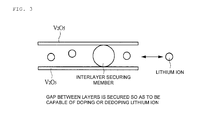
- the present inventors have considered that the lithium ions can be smoothly doped or dedoped by doping the interlayer securing member into the gap between the layers of the layered crystal structure of the vanadium pentoxide before the lithium ions are doped as described above. This state is schematically shown in FIG. 3 .
- FIG. 3 schematically shows the state in which an interlayer securing member which is the ions having the radius greater than the radius of the lithium ions, is interposed between the upper layer and the lower layer of the layered crystal structure of the vanadium pentoxide, whereby the coming-in and going-out of the lithium ions to and from the gap between the layers of the layered crystal structure is smoothly secured.
- an interlayer securing member which is the ions having the radius greater than the radius of the lithium ions
- the interlayer securing member at least in an amount of 0.01 mol or more and 0.5 mol or less with respect to 1 mol of a vanadium atom of the vanadium oxide compound such as the vanadium pentoxide is effective.
- the amount of the interlayer securing member is less than 0.01 mol, the interlayer securing function can not sufficiently be achieved.
- the amount of the interlayer securing member exceeds 0.5 mol, the crystal structure can be changed into the crystal structure other than V 2 O 5 .
- the interlayer securing member such as sodium ions, caesium ions, or the like may be doped into the gap between the layers of the vanadium oxide compound such as the vanadium pentoxide within the above described range.
- the vanadium oxide compound such as the vanadium pentoxide in which the interlayer securing member is interposed between the layers can be obtained as follows. Specifically, when sodium ions are used as the interlayer securing member, mixed solution of a vanadium pentoxide and a sodium compound is stirred for a predetermined time, and then, filtered. The filtrate is depressurized and concentrated to obtain a solid material. The obtained solid material is vacuum-dried, whereby the vanadium pentoxide in which sodium ions are doped between the layers can be synthesized.
- the vanadium pentoxide is pulverized to have a predetermined particle size by means of a ball mill or the like, and sieved to be classified so as to manufacture powders of an active material as a positive electrode material.
- the vanadium pentoxide having caesium ions used as the interlayer securing member can be synthesized in the same manner.
- the vanadium oxide compound such as the vanadium pentoxide having sodium ions or the like doped into the layers is synthesized as described above.
- a positive electrode is formed with the thus synthesized vanadium pentoxide used as an active material, while a lithium electrode using lithium metal is formed as a counter electrode, thereby fabricating a battery.
- the lithium ions can be doped into the vanadium pentoxide in the positive electrode.
- the ions other than the lithium ions are doped into the vanadium oxide compound such as the vanadium pentoxide in a chemical process, and the lithium ions are doped in a physical process afterward for short-circuiting the positive electrode and the counter electrode.
- V 2 O 5 vanadium pentoxide
- the lithium ions are chemically doped into the vanadium oxide compound such as the vanadium pentoxide having the layered crystal structure in which the above described interlayer securing member is interposed between the layers.
- the doped amount of the lithium ions is preferably in a ratio of not less than 0.1 and not more than 10 in a molar ratio with respect to the vanadium oxide compound such as the vanadium pentoxide, more preferably in a ratio of not less than 0.1 and not more than 6.
- the doped amount of the lithium ions is less than 0.1 in a molar ratio, the doping effect is not sufficiently exhibited.
- the doped amount of the lithium ions exceeds 10 in a molar ratio, the vanadium oxide is unpreferably reduced to a metal.
- the term “dope” involves “occlude”, “carry”, “absorb” or “insert”, and specifically a phenomenon where lithium ions enter the positive-electrode active material.
- the term “dedope” is specifically a phenomenon where lithium ions exit from the positive-electrode active material.
- a sulfur-containing conductive polymer can be contained as a sulfur-containing organic material.
- the sulfur-containing conductive polymer has a redox activity and contains sulfur.
- 3,4-ethylene dioxythiophene is used as an example of the corresponding monomer.
- the sulfur-containing conductive polymer decrease the performance as the active material for the product after the reaction is ended, it is preferably removed by the depressurization and concentration from a final product in order to enhance the performance of the active material.
- the active material thus obtained is mixed with a binder such as polyvinylidene fluoride (PDVF) and preferably conductive particles to form a material for the positive electrode, and the obtained material is coated onto a conductive substrate, whereby the positive electrode having no lithium ions doped can be fabricated. It is preferable that the layer of the positive electrode material having no lithium ions doped is formed in a thickness of, e.g., 10 ⁇ m to 100 ⁇ m.
- a binder such as polyvinylidene fluoride (PDVF) and preferably conductive particles to form a material for the positive electrode
- PDVF polyvinylidene fluoride
- the layer of the positive electrode material having no lithium ions doped is formed in a thickness of, e.g., 10 ⁇ m to 100 ⁇ m.
- the conductive particles include conductive carbon (conductive carbon such as Kitchen black), metal such as copper, iron, silver, nickel, palladium, gold, platinum, indium, tungsten, or conductive metal oxide such as indium oxide, tin oxide.
- conductive carbon conductive carbon such as Kitchen black
- metal such as copper, iron, silver, nickel, palladium, gold, platinum, indium, tungsten, or conductive metal oxide such as indium oxide, tin oxide.
- the conductive particles may be contained in a ratio of 1 to 30 % of the weight of the above described vanadium oxide.
- a conductive substrate exhibiting conductivity at least at the surface being in contact with the positive electrode material having no lithium ions doped is used as the substrate (current-collector) supporting the positive-electrode material layer having no lithium ions doped.
- the substrate can be made of a conductive material such as a metal, conductive metal oxide, conductive carbon. It is preferable that the substrate is made of copper, gold, aluminum or an alloy thereof, or conductive carbon. Alternatively, a substrate of which main body made of a non-conductive material with coating of a conductive material can be applicable.
- the positive electrode having no lithium ions doped is formed by using the above described active material, a lithium electrode serving as a negative electrode that is a counter electrode is formed, and an electrolyte is interposed between both electrodes, whereby a battery can be fabricated.
- the positive electrode having no lithium ions doped and the lithium electrode are short-circuited in the battery structure described above, with the result that a positive electrode for a non-aqueous lithium secondary battery is perfectly formed.
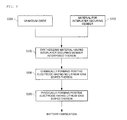
- FIG. 4 shows a flowchart of the fabrication of the non-aqueous lithium ion secondary battery according to the present invention.
- a vanadium oxide such as a vanadium pentoxide is prepared at step S101
- a material for an interlayer securing member such as ions of sodium
- the vanadium pentoxide and the material for the interlayer securing member prepared at steps S101 and S102 are mixed with water or the like, and stirred for a predetermined time. Thereafter, the resultant is filtered, and the filtrate is depressurized and concentrated. The concentrate is dried, pulverized, and sieved to be classified, so as to synthesize an active material having the interlayer securing member at step S100.
- a positive electrode having no lithium ions doped is formed by using the active material obtained in the chemical process as described above.
- a lithium electrode that is a counter electrode is formed, as a negative electrode, to the positive electrode having no lithium ions doped, which is fabricated at step S200, and then, the lithium ions are chemically doped to form the positive electrode having the lithium ions doped therein.
- a non-aqueous lithium ion secondary battery can be fabricated by using the positive electrode having the lithium ions doped therein in above described manner.
- the negative electrode used as the counter electrode can be made of a lithium material generally used.
- the lithium material include a lithium metal material such as a metal lithium, lithium alloy (e.g., Li-Al alloy), an intermetallic compound of such as a metal of tin or silicon and a lithium metal, a lithium compound such as lithium nitride.
- Usable lithium salts as the electrolyte include CF 3 SO 3 Li, C 4 F 9 SO 8 Li, (CF 3 SO 2 ) 2 NLi, (CF 3 SO 2 ) 3 CLi, LiBF 4 , LiPF 6 , LiClO 4 .
- a solvent that dissolves the electrolyte is a non-aqueous solvent.
- non-aqueous solvent examples include a chain carbonate, cyclic carbonate, cyclic ester, nitrile compound, acid anhydride, amide compound, phosphate compound, amine compound.
- specific examples of the non-aqueous solvent include ethylene carbonate, diethyl carbonate (DEC), propylene carbonate, dimethoxyethane, ⁇ -butyrolactone, n-methyl pyrrolidone, N,N'-dimethyl acetoamide, acetonitrile, mixture of propylene carbonate and dimethoxyethane, or mixture of sulfolane and tetrahydrofuran.
- the vanadium pentoxide is used as the active material having the interlayer securing member.
- the crystal state of the vanadium pentoxide is a macroscopically amorphous state in which the layer length is not specified.
- the vanadium pentoxide having a crystal state with a long layer length or a crystal state with a short layer length can be used. It is expected that, by using the crystal state with the short layer length, the effect can be increased synergistically by the factor that the layer length is short and the factor that the interlayer securing member is interposed.
- the breakdown of the crystal structure caused by the dedope of the lithium ions is difficult to occur. Since the ions having a radius greater than that of the lithium ion are interposed as the interlayer securing member in the present invention, the gap between the layers is maintained, or further increased. Therefore, it is considered that the doping or dedoping of the lithium ions is more effectively acted in the case of the short layer length.
- the crystal state in which the layer length is not more than 30 nm but not zero means a macroscopic amorphization with keeping the layered crystal structure of the vanadium pentoxide.
- the state can be obtained by decrease of the layer length of the layered crystal material (microfabrication). For example, the layered crystal state with a long layer length is cut, so that the layered crystal state with a short layer length appears.
- the above described state cannot be realized if the entire structure is in the amorphous state. Therefore, the amorphization is stopped during the progression in order to achieve the above described state, i.e., in order that the layered crystal state with a short layer length can be present.
- the macroscopic amorphization means as follows. Specifically, from the microscopic viewpoint in which the observation with not more than nm-order can be performed, it is confirmed that only the crystal structure with a layer length of not more than 30 nm is present, or this crystal structure and the amorphous state are co-present. On the other hand, from the macroscopic viewpoint in which only the observation with ⁇ m-order that is greater than nm can be performed, the amorphous structure in which the crystal structure is randomly arranged is observed.
- the layer length L1 of a microcrystal particle of a so-called short-period structure with a short layer length is preferred to fall within a range of 1 nm or more and 30 nm or less without including Zero (0).
- the lithium ions are difficult to be doped or dedoped, so that high capacity is difficult to achieve.
- the layer length is preferably not more than 30 nm not including 0, more preferably within a range of 1 nm or more and 30 nm or less, and most preferably within a range of 5 nm or more and 25 nm or less.
- the path relating to the coming-in and going-out of the lithium ions between the layers is shortened to make the lithium ions easily go in and out between the layers of the vanadium oxide, whereby the charging capacity and cycle characteristic can be enhanced.
- the lithium ions are difficult to come in and go out between the layers, compared to the short-period structure having the short layer length L1.
- the layered crystal structure of the microcrystal particle of the vanadium oxide with the layer length of not more than 30 nm not including zero is 100 % in terms of the area ratio of a microcrystal particle in any cross-section, the amorphous state is not present, and only the layered crystal state is present.
- the layered crystal with the layer length of not more than 30 nm not including zero can of course be 100 % in terms of the area ratio.
- the layered crystal structure occupys at least 30 % of the cross-section of the vanadium oxide in terms of the area ratio.
- the area ratio of the crystal structure with the layer length not more than 30 nm can be other than 30 %, i.e., the area ratio of the above discribed crystal structure can be less than 30 %.
- the electrolyte layer interposed between the positive electrode and the negative electrode can be a solution in the non-aqueous solvent in which the electrolyte is dissolved, or can be a polymer gel (polymer gel electrolyte) containing this electrolyte solution.
- the lithium secondary battery can take the configuration shown in FIG. 7 .
- a non-aqueous lithium secondary battery 10 has a positive electrode 11 and a negative electrode 12, which are opposite to each other with an electrolyte layer 13 interposed therebetween.
- the positive electrode 11 is made of a positive-electrode active material 11a having a layered crystal structure in a predetermined amount and a substrate 11b as a current collector.
- the layer of the positive-electrode active material 11a is formed on the surface of the substrate 11b as shown in FIG. 7 .
- the negative electrode 12 is made of a negative-electrode active material 12a and a substrate 12b as a current collector, wherein the layer of the negative-electrode active material 12a is formed on the surface of the substrate 12b.
- the positive electrode 11 and the negative electrode 12 are opposite to each other with the electrolyte layer 13 interposed therebetween.
- Example 1 sodium ions are used as an interlayer securing member for a vanadium pentoxide as an active material.
- the active material into which sodium ions are chemically doped as the interlayer securing member is synthesized as follows. Specifically, 30 g of a commercially available vanadium pentoxide was weighed and dispersed in 1000 ml of pure water. 0.6 g of sodium hydroxide was weighed separately, and dispersed in 300 ml of pure water. Thereafter, the solution of sodium hydroxide was added to the solution of the vanadium pentoxide, and then, the resultant was stirred and mixed for 20 hours at 25 °C.
- the reaction solution was filtered, and the solution part was depressurized and concentrated at 40 hPa at 45 °C, thereby obtaining a solid material.
- the obtained solid material was vacuum-dried at 70 °C for 12 hours to obtain an orange solid material.
- the obtained solid material was pulverized by means of a ball mill or the like, and sieved to be classified so as to synthesize an active material having a predetermined particle size, having an interlayer securing member, and having no lithium ions doped therein.
- the Na amount as prepared was detected according to an ICP analysis, so that the active material having no lithium ions doped therein was Na 0 1 V 2 O 5 .0.3H 2 O.
- a positive electrode having no lithium ions doped therein was formed by using the active material having no lithium ions doped therein and having the interlayer securing member.
- the active material having no lithium ions doped therein thus synthesized, a carbon black, and a polyvinyliden fluoride (PVdF) as a binder were mixed in a weight ratio of 90 : 5 : 5, and then, the resultant was dispersed with n-methylpyrrolidone (NMP) so as to prepare a slurry. This slurry was uniformly coated on a current collector made of aluminum.
- PVdF polyvinyliden fluoride
- the resultant was dried under a depressurized condition at 150 °C, and pressed, whereby the positive electrode having no lithium ions doped therein and having the active material layer in a thickness of 100 ⁇ m was formed.
- This positive electrode having no lithium ions doped therein was cut into 20 mm x 20 mm, and then, an aluminum terminal was welded to a non-coated portion.
- a lithium metal pressed against a current collector made of a Ni foil was defined as a negative electrode that was a counter electrode, and the positive electrode having no lithium ions doped therein and the negative electrode were made opposite to each other with a separator made of a polyolefin microporous film interposed therebetween.
- the resultant was inserted into an aluminum laminate, and then an electrolyte obtained by dissolving lithium fluoroborate (LiBF 4 ) at 1 mol/l into a solvent mixture containing ethylene carbonate and diethyl carbonate at the weight ratio of 1 : 3 was injected. Thereafter, the opening portion was sealed by a thermal welding to fabricate a battery cell. Two cells were fabricated, and subject to a charging evaluation. FIG. 9 shows the result of the charging evaluation.
- LiBF 4 lithium fluoroborate
- Example 2 a case in which caesium ions are used as the interlayer securing member for a vanadium pentoxide of an active material is described.
- the active material into which caesium ions are chemically doped as the interlayer securing member is synthesized as follows. Specifically, 30 g of a commercially available vanadium pentoxide was weighed and dispersed in 1000 ml of pure water. 2.35 g of caesium carbonate was weighed separately, and dispersed in 300 ml of pure water.
- the obtained solid material was pulverized by means of a ball mill or the like, and sieved to be classified so as to synthesize an active material having a predetermined particle size, and having no lithium ions doped.
- the Cs amount as prepared was detected according to an ICP analysis, so that the active material having no lithium ions doped therein was Cs 0.1 V 2 O 5 ⁇ 0.3H 2 O.
- a positive electrode having no lithium ions doped therein was fabricated in the same manner as Example 1 by using the thus obtained active material having no lithium ions doped therein, and then, a lithium electrode was formed as a counter electrode, whereby a non-aqueous lithium ion secondary battery was fabricated.
- FIG. 9 shows the result of the charging/discharging evaluation for the non-aqueous lithium ion secondary battery.
- an active material having no interlayer securing member which is the ions having a greater radius other than the lithium ions, is used in this Comparative Example.
- the active material was formed as follows. Specifically, instead of the sodium hydroxide in Example 1, an amount of 0.33 g of lithium hydroxide was employed to synthesize orange powder materials.
- the Li amount as prepared was detected according to an ICP analysis, so that the active material thus synthesized was Li 01 V 2 O 5 ⁇ 0.3H 2 O.
- a non-aqueous lithium ion secondary battery was fabricated in the same manner as Example 1, and the charging/discharging evaluation was performed.
- FIG. 9 shows the result.
- Example 1 the cycle degradation ratio in Example 1 in which the interlayer securing member was interposed was 0.1 %, which was extremely higher than 0.6 % of Comparative Example.
- the capacity at the first cycle was 370 mAh/g in both of Example 1 and Comparative Example 1.
- the capacity at the twentieth cycle in Example 1 was 361 mAh/g
- the capacity at the twentieth cycle in Comparative Example was 324 mAh/g, which was extremely lower than that in Example 1.
- Example 2 the initial capacity at the first cycle was 365 mAh/g, which was lower than that in Comparative Example, but the capacity at the twentieth cycle was 358 mAh/g, which was higher than 324 mAh/g in Comparative Example. From this, the effect by the interlayer securing member was confirmed like Example 1.
- Example 2 there was no difference in the cycle degradation ratio between Example 1 and Example 2, but it was found that the value of the capacity per unit weight of active material at the first cycle and the value of the capacity at the twentieth cycle were different such that the value in the case of using caesium ions in Example 2 was lower than the value in the case of using sodium ions. The molecular amount of the active material was increased, so that the electric capacity per weight of active material was decreased.
- the present invention is effectively useful in the field of a lithium secondary battery using a vanadium oxide, into which lithium ions are doped therein or de-doped therefrom, as an active material of a positive electrode.
Landscapes
- Chemical & Material Sciences (AREA)
- Chemical Kinetics & Catalysis (AREA)
- Electrochemistry (AREA)
- General Chemical & Material Sciences (AREA)
- Inorganic Chemistry (AREA)
- Organic Chemistry (AREA)
- Engineering & Computer Science (AREA)
- Manufacturing & Machinery (AREA)
- Battery Electrode And Active Subsutance (AREA)
- Inorganic Compounds Of Heavy Metals (AREA)
Abstract
Description
- The present invention relates to a battery technology such as a lithium ion secondary battery or the like, and more particularly to a technology that is well adaptable to a battery employing a vanadium oxide, into which lithium ions are doped, as an active material.
- The technique described below has been examined by the present inventors for completing the present invention. The summary is as follows.
- The increase in the traveling distance is essential for really popularizing an electric vehicle (EV). A lithium ion battery (LIB) has high energy density, so that it has been mentioned as one of the strongest candidates for a storage power source for an electric vehicle. An increase in the energy density compared with the current energy density has been demanded for the lithium ion battery. Further, the lithium ion battery should be excellent in safety when it is mounted to an electric vehicle.
- The lithium ion battery having a vanadium oxide compound used for an active material of an electrode is under development. Attention has been given to the vanadium oxide compound, since high energy can be taken out from the vanadium oxide compound because of its high property of taking lithium ions into layers of its layered crystal.
- Among the vanadium oxide compounds, vanadium pentoxide (V2O5) has attracted more attention. When the vanadium pentoxide is used for an active material of an electrode, a lithium ion battery can be increased in size and in capacity. Therefore, such a battery has been a promising storage battery for an electric vehicle as a safe battery having high energy density.
- For example, Japanese Translation of PCT Application No.
2004-511407 - The present inventors have made a research for a vanadium oxide material into which lithium ions are readily doped or from which lithium ions are readily dedoped. During the research, the present inventors have found that the ease of doping or dedoping the lithium ions can be enhanced by reducing a layer length of a crystal structure of the vanadium oxide material, and disclosed this proposal in the application filed earlier than the present application.
- This proposal is based on the idea that the layer length is specified to a layer length not more than a certain length, whereby the coming-in and going-out of the lithium ions to and from the layered crystal structure is smoothly maintained. This proposal is of course an excellent invention. However, it is more preferable, if there is means for securing smoothness of the coming-in and going-out of the lithium ions to and from the layered crystal structure without changing the layer length.
- An object of the present invention is to suppress the breakdown of a crystal structure involved with charging/discharging and to secure smoothness of coming-in and going-out of lithium ions, although the vanadium oxide material used for an active material of an electrode material is in a microcrystal state in order to exhibit high capacity.
- The foregoing and other objects and novel features of the present invention will become apparent from the description of the present specification and attached drawings.
- The summary of the representative inventions among the inventions disclosed in the present application will be briefly explained as follows. Specifically, in a vanadium oxide material that is an active material used as an electrode material, cations, which are other than lithium ions and have a large ion radius, are temporarily doped, and then, lithium ions are doped.
- The effect obtained by the representative inventions among the inventions disclosed in the present application will be briefly explained as follows.
- Specifically, in a vanadium oxide material that is an active material used as an electrode material, cations, which are other than lithium ions and have a large ion radius, are temporarily doped, and then, lithium ions are doped. Therefore, the breakdown of the crystal of the vanadium oxide involved with the dedoping of the lithium ions is suppressed, so that the smoothness of coming-in and going-out of the lithium ions can be secured.
-
- FIG. 1
- is an explanatory view schematically showing the state in which lithium ions are doped and dedoped into and from a vanadium oxide;
- FIG. 2
- is an explanatory view schematically showing the state in which lithium ions are not doped and de-doped into and from a vanadium oxide due to a breakdown of a crystal structure;
- FIG. 3
- is an explanatory view schematically showing the state in which the lithium ions are smoothly doped and de-doped into and from the vanadium oxide since an interlayer securing member is interposed between layers of the crystal structure of the vanadium oxide;
- FIG. 4
- is a flowchart showing a fabrication process of a non-aqueous lithium ion secondary battery using an active material having an interlayer securing member interposed between layers of a layered crystal structure according to the present invention;
- FIG. 5
- is an explanatory view schematically showing a layered crystal structure with a short layer length;
- FIG. 6
- is an explanatory view schematically showing a layered crystal structure with a long layer length;
- FIG. 7
- is a diagram showing a schematic configuration of a non-aqueous lithium secondary battery to which the present invention is applicable;
- FIG. 8
- is a graph showing the result of an X-ray diffraction of an active material used in the present invention; and
- FIG. 9
- is table showing the effect of the present invention.
- An embodiment of the present invention will be described in detail with reference to the drawings.
FIG. 1 schematically shows the state in which lithium ions are doped to or dedoped from between layers of a layered crystal structure of a vanadium pentoxide.FIG. 2 schematically shows the state in which the layered structure is broken, because the lithium ions are released from between the layers. InFIGs. 1 and 2 , the layered crystal structure of V2O5 is schematically illustrated as parallel layers opposite to each other in the vertical direction for better understanding. - The present invention is a technique relating to an electrode material or the like. Particularly, the present invention aims to achieve the ease of repeating doping or dedoping lithium ions in a vanadium oxide material in which the lithium ions are doped and used as an active material of a positive electrode of a lithium ion secondary battery or the like.
- The present inventors have proposed previously that a layer length of a vanadium pentoxide is decreased so as to secure a property of coming-in and going-out of lithium ions, i.e., secure doping and dedoping of lithium ions to the layered crystal structure of the vanadium pentoxide. In the configuration described above, the layer length of the vanadium pentoxide is specified as 1 nm or more and 30 nm or less so as to decrease the length of the path of lithium ions, thereby securing smoothness of coming-in and going-out of the lithium ions.
- However, in this proposal, the affect to the cycle characteristic or the like of the active material can greatly depend upon to what degree the crystal structure having the layer length of 30 nm or less is contained in the whole crystal structure. If the crystal structure having the short layer length is contained in 100 %, there is no problem. However, a suitable management is needed in the fabrication method of a crystal structure.
- In view of this, the present inventors have considered the measure for securing smoothness of coming-in and going-out of lithium ions regardless of the layer length, i.e., even if the layer length is short or long. The present inventors have considered the fact that the crystal structure is broken when the lithium ions are dedoped, and substituted this fact for a simplified model, during the consideration for the solution from the microscopic viewpoint of the crystal structure.
- The present inventors have supposed that the breakdown of the crystal structure is as if the upper one of two flat plate surfaces provided so as to be opposite to each other in the vertical direction with a predetermined space falls down, in a simplified model. In this model, in order to prevent the upper flat plate surface from falling down, a column is mounted between the upper flat plate surface and the lower flat plate surface.
- In view of this, the present inventors have applied the simple model, in which the column is provided, to the crystal structure, and found that the breakdown of the crystal can easily be prevented by interposing alternatives to the column between the layers. Specifically, the present inventors have found that ions are interposed between the layers of the layered crystal to serve as alternatives to the column. Since the maximum object is to secure the smoothness of coming-in and going-out of the lithium ions involved with the breakdown of the crystal, it is preferable that the ions of which radius is greater than that of the lithium ion are interposed.
- The ions to be interposed can be anions, but the present inventors have considered that, since the lithium ions are cations, the ions to be interposed are preferably cations. The present inventors have considered that, thanks to the interposed ions, the gap between the layers of the layered crystal structure is maintained, so that the breakdown of the crystal caused when the lithium ions are dedoped can be prevented.
- The ions of which radius is greater than that of the lithium ions are selected as the ions to be interposed between the layers as described above. With this structure, it is considered that the gap between the layers is increased, and hence, the lithium ions are more easily doped and dedoped repeatedly. It should go without saying that it is important that the ions, which function as an interlayer securing member for securing the gap between the layers in order to maintain or increase the gap between the layers of the layered crystal structure, should not break down the layered crystal structure by increasing too much the gap between the layers.
- The present inventors have considered that the interlayer securing member interposed between the layers of the layered crystal structure is doped before the lithium ions are doped, by which the lithium ions is easily doped or dedoped after that. Examples of the cations include alkali metal ions such as sodium ions, or caesium ions.
- When the lithium ions are easily doped or dedoped into the gap between the layers of the layered crystal structure of the vanadium pentoxide, it is naturally necessary that the gap between the layers of the vanadium pentoxide is maintained to at least the gap by which the lithium ions are easily doped or dedoped as schematically shown in
FIG. 1 . - However, in actuality, in the crystal structure of the vanadium pentoxide to which the lithium ions are doped between the layers, the crystal structure is broken down due to the dedope of the lithium ions as shown in
FIG. 2 , for example. It is supposed that not only the crystal structure at the end from which the lithium ions go out but also the peripheral crystal structure are distorted. - Therefore, it is understood that the lithium ions are not doped again or lithium ions are difficult to be doped due to the breakdown of the crystal structure. Accordingly, when the vanadium pentoxide schematically shown in
FIG. 1 is used as the active material, and charging and discharging are repeated, it is supposed that the crystal structure is broken down every charging and discharging, with the result that the discharging characteristic is gradually deteriorated. - In view of this, the present inventors have considered that the lithium ions can be smoothly doped or dedoped by doping the interlayer securing member into the gap between the layers of the layered crystal structure of the vanadium pentoxide before the lithium ions are doped as described above. This state is schematically shown in
FIG. 3 . -
FIG. 3 schematically shows the state in which an interlayer securing member which is the ions having the radius greater than the radius of the lithium ions, is interposed between the upper layer and the lower layer of the layered crystal structure of the vanadium pentoxide, whereby the coming-in and going-out of the lithium ions to and from the gap between the layers of the layered crystal structure is smoothly secured. - The breakdown of the crystal structure that causes the crush of the gap between the layers is prevented or avoided, with the result that the coming-in and going-out, i.e., doping and de-doping, of the lithium ions to and from the gap between the layers of the vanadium pentoxide is smoothly maintained.
- The current experiment made by the present inventors shows that the interlayer securing member at least in an amount of 0.01 mol or more and 0.5 mol or less with respect to 1 mol of a vanadium atom of the vanadium oxide compound such as the vanadium pentoxide is effective. When the amount of the interlayer securing member is less than 0.01 mol, the interlayer securing function can not sufficiently be achieved. When the amount of the interlayer securing member exceeds 0.5 mol, the crystal structure can be changed into the crystal structure other than V2O5. Specifically, the interlayer securing member such as sodium ions, caesium ions, or the like may be doped into the gap between the layers of the vanadium oxide compound such as the vanadium pentoxide within the above described range.
- The vanadium oxide compound such as the vanadium pentoxide in which the interlayer securing member is interposed between the layers can be obtained as follows. Specifically, when sodium ions are used as the interlayer securing member, mixed solution of a vanadium pentoxide and a sodium compound is stirred for a predetermined time, and then, filtered. The filtrate is depressurized and concentrated to obtain a solid material. The obtained solid material is vacuum-dried, whereby the vanadium pentoxide in which sodium ions are doped between the layers can be synthesized.
- After the solidification, the vanadium pentoxide is pulverized to have a predetermined particle size by means of a ball mill or the like, and sieved to be classified so as to manufacture powders of an active material as a positive electrode material. The vanadium pentoxide having caesium ions used as the interlayer securing member can be synthesized in the same manner.
- The vanadium oxide compound such as the vanadium pentoxide having sodium ions or the like doped into the layers is synthesized as described above. In order to dope the lithium ions into the thus synthesized vanadium pentoxide, a positive electrode is formed with the thus synthesized vanadium pentoxide used as an active material, while a lithium electrode using lithium metal is formed as a counter electrode, thereby fabricating a battery. With this structure, the lithium ions can be doped into the vanadium pentoxide in the positive electrode.
- Specifically, in the present invention, the ions other than the lithium ions are doped into the vanadium oxide compound such as the vanadium pentoxide in a chemical process, and the lithium ions are doped in a physical process afterward for short-circuiting the positive electrode and the counter electrode.
- A vanadium pentoxide (V2O5) can be given as usable vanadium oxide compound in the present invention.
- As described above, the lithium ions are chemically doped into the vanadium oxide compound such as the vanadium pentoxide having the layered crystal structure in which the above described interlayer securing member is interposed between the layers. The doped amount of the lithium ions is preferably in a ratio of not less than 0.1 and not more than 10 in a molar ratio with respect to the vanadium oxide compound such as the vanadium pentoxide, more preferably in a ratio of not less than 0.1 and not more than 6. When the doped amount of the lithium ions is less than 0.1 in a molar ratio, the doping effect is not sufficiently exhibited. On the other hand, when the doped amount of the lithium ions exceeds 10 in a molar ratio, the vanadium oxide is unpreferably reduced to a metal.
- In the specification of the present invention, the term "dope" involves "occlude", "carry", "absorb" or "insert", and specifically a phenomenon where lithium ions enter the positive-electrode active material. The term "dedope" is specifically a phenomenon where lithium ions exit from the positive-electrode active material.
- During the synthesis of the vanadium oxide, as the active material, having the interlayer securing member, a sulfur-containing conductive polymer can be contained as a sulfur-containing organic material. Although details are unknown, it is thought that, when a monomer corresponding to the sulfur-containing conductive polymer is present during the synthesis, the oxygen concentration of the reaction system is kept constant with the monomer as an oxygen inhibitor, and the structure of the synthesized vanadium oxide is controlled. The sulfur-containing conductive polymer has a redox activity and contains sulfur. As an example of the corresponding monomer, 3,4-ethylene dioxythiophene is used.
- However, since the sulfur-containing conductive polymer decrease the performance as the active material for the product after the reaction is ended, it is preferably removed by the depressurization and concentration from a final product in order to enhance the performance of the active material.
- It is confirmed that the active material, having the interlayer securing member, to which the fabrication technique according to the present invention is applied, and which is used for the positive electrode to which lithium ions have not yet been doped, has a peak at around the diffraction angle 2θ = 10° in an X-ray diffraction pattern, for example.
- The active material thus obtained is mixed with a binder such as polyvinylidene fluoride (PDVF) and preferably conductive particles to form a material for the positive electrode, and the obtained material is coated onto a conductive substrate, whereby the positive electrode having no lithium ions doped can be fabricated. It is preferable that the layer of the positive electrode material having no lithium ions doped is formed in a thickness of, e.g., 10 µm to 100 µm.
- Examples of the conductive particles include conductive carbon (conductive carbon such as Kitchen black), metal such as copper, iron, silver, nickel, palladium, gold, platinum, indium, tungsten, or conductive metal oxide such as indium oxide, tin oxide. The conductive particles may be contained in a ratio of 1 to 30 % of the weight of the above described vanadium oxide.
- A conductive substrate exhibiting conductivity at least at the surface being in contact with the positive electrode material having no lithium ions doped is used as the substrate (current-collector) supporting the positive-electrode material layer having no lithium ions doped. The substrate can be made of a conductive material such as a metal, conductive metal oxide, conductive carbon. It is preferable that the substrate is made of copper, gold, aluminum or an alloy thereof, or conductive carbon. Alternatively, a substrate of which main body made of a non-conductive material with coating of a conductive material can be applicable.
- The positive electrode having no lithium ions doped is formed by using the above described active material, a lithium electrode serving as a negative electrode that is a counter electrode is formed, and an electrolyte is interposed between both electrodes, whereby a battery can be fabricated. Specifically, the positive electrode having no lithium ions doped and the lithium electrode are short-circuited in the battery structure described above, with the result that a positive electrode for a non-aqueous lithium secondary battery is perfectly formed.
-
FIG. 4 shows a flowchart of the fabrication of the non-aqueous lithium ion secondary battery according to the present invention. Specifically, a vanadium oxide such as a vanadium pentoxide is prepared at step S101, and a material for an interlayer securing member such as ions of sodium, is prepared at step S102. The vanadium pentoxide and the material for the interlayer securing member prepared at steps S101 and S102 are mixed with water or the like, and stirred for a predetermined time. Thereafter, the resultant is filtered, and the filtrate is depressurized and concentrated. The concentrate is dried, pulverized, and sieved to be classified, so as to synthesize an active material having the interlayer securing member at step S100. - At step S200, a positive electrode having no lithium ions doped is formed by using the active material obtained in the chemical process as described above. At step S300, a lithium electrode that is a counter electrode is formed, as a negative electrode, to the positive electrode having no lithium ions doped, which is fabricated at step S200, and then, the lithium ions are chemically doped to form the positive electrode having the lithium ions doped therein. A non-aqueous lithium ion secondary battery can be fabricated by using the positive electrode having the lithium ions doped therein in above described manner.
- In the non-aqueous lithium ion secondary battery thus configured, the negative electrode used as the counter electrode can be made of a lithium material generally used. Examples of the lithium material include a lithium metal material such as a metal lithium, lithium alloy (e.g., Li-Al alloy), an intermetallic compound of such as a metal of tin or silicon and a lithium metal, a lithium compound such as lithium nitride.
- Usable lithium salts as the electrolyte include CF3SO3Li, C4F9SO8Li, (CF3SO2)2NLi, (CF3SO2)3CLi, LiBF4, LiPF6, LiClO4. A solvent that dissolves the electrolyte is a non-aqueous solvent.
- Examples of the non-aqueous solvent include a chain carbonate, cyclic carbonate, cyclic ester, nitrile compound, acid anhydride, amide compound, phosphate compound, amine compound. Specific examples of the non-aqueous solvent include ethylene carbonate, diethyl carbonate (DEC), propylene carbonate, dimethoxyethane, γ-butyrolactone, n-methyl pyrrolidone, N,N'-dimethyl acetoamide, acetonitrile, mixture of propylene carbonate and dimethoxyethane, or mixture of sulfolane and tetrahydrofuran.
- It is described in the above described explanation that the vanadium pentoxide is used as the active material having the interlayer securing member. The crystal state of the vanadium pentoxide is a macroscopically amorphous state in which the layer length is not specified. The vanadium pentoxide having a crystal state with a long layer length or a crystal state with a short layer length can be used. It is expected that, by using the crystal state with the short layer length, the effect can be increased synergistically by the factor that the layer length is short and the factor that the interlayer securing member is interposed.
- In the crystal state with a short layer length, the breakdown of the crystal structure caused by the dedope of the lithium ions is difficult to occur. Since the ions having a radius greater than that of the lithium ion are interposed as the interlayer securing member in the present invention, the gap between the layers is maintained, or further increased. Therefore, it is considered that the doping or dedoping of the lithium ions is more effectively acted in the case of the short layer length.
- The crystal state in which the layer length is not more than 30 nm but not zero means a macroscopic amorphization with keeping the layered crystal structure of the vanadium pentoxide. The state can be obtained by decrease of the layer length of the layered crystal material (microfabrication). For example, the layered crystal state with a long layer length is cut, so that the layered crystal state with a short layer length appears.
- The above described state cannot be realized if the entire structure is in the amorphous state. Therefore, the amorphization is stopped during the progression in order to achieve the above described state, i.e., in order that the layered crystal state with a short layer length can be present.
- The macroscopic amorphization means as follows. Specifically, from the microscopic viewpoint in which the observation with not more than nm-order can be performed, it is confirmed that only the crystal structure with a layer length of not more than 30 nm is present, or this crystal structure and the amorphous state are co-present. On the other hand, from the macroscopic viewpoint in which only the observation with µm-order that is greater than nm can be performed, the amorphous structure in which the crystal structure is randomly arranged is observed.
- Specifically, as schematically shown in
FIG. 5 , the layer length L1 of a microcrystal particle of a so-called short-period structure with a short layer length is preferred to fall within a range of 1 nm or more and 30 nm or less without including Zero (0). From the viewpoint of going in and out of lithium ions between the layers, when the layered crystal is less than 1 nm, the lithium ions are difficult to be doped or dedoped, so that high capacity is difficult to achieve. - On the other hand, when the layered crystal exceeds 30 nm, it is susceptible to the breakdown of the crystal structure involved with the charging and discharging, so that the cycle characteristic can be deteriorated. Therefore, the layer length is preferably not more than 30 nm not including 0, more preferably within a range of 1 nm or more and 30 nm or less, and most preferably within a range of 5 nm or more and 25 nm or less.
- As described above, the path relating to the coming-in and going-out of the lithium ions between the layers is shortened to make the lithium ions easily go in and out between the layers of the vanadium oxide, whereby the charging capacity and cycle characteristic can be enhanced. As shown in
FIG. 6 , in a so-called long-period structure in which the layer length L2 is long, the lithium ions are difficult to come in and go out between the layers, compared to the short-period structure having the short layer length L1. - In a case where the layered crystal structure of the microcrystal particle of the vanadium oxide with the layer length of not more than 30 nm not including zero is 100 % in terms of the area ratio of a microcrystal particle in any cross-section, the amorphous state is not present, and only the layered crystal state is present. The layered crystal with the layer length of not more than 30 nm not including zero can of course be 100 % in terms of the area ratio.
- It suffices that the layered crystal structure occupys at least 30 % of the cross-section of the vanadium oxide in terms of the area ratio. However, since the cycle characteristic or the like by the charging and discharging can be enhanced similarly by applying the present invention even if the layer length is more than 30 nm, the area ratio of the crystal structure with the layer length not more than 30 nm can be other than 30 %, i.e., the area ratio of the above discribed crystal structure can be less than 30 %.
- The electrolyte layer interposed between the positive electrode and the negative electrode can be a solution in the non-aqueous solvent in which the electrolyte is dissolved, or can be a polymer gel (polymer gel electrolyte) containing this electrolyte solution.
- The lithium secondary battery can take the configuration shown in
FIG. 7 . Specifically, a non-aqueous lithiumsecondary battery 10 has apositive electrode 11 and anegative electrode 12, which are opposite to each other with anelectrolyte layer 13 interposed therebetween. Thepositive electrode 11 is made of a positive-electrode active material 11a having a layered crystal structure in a predetermined amount and asubstrate 11b as a current collector. The layer of the positive-electrode active material 11a is formed on the surface of thesubstrate 11b as shown inFIG. 7 . - Similarly, the
negative electrode 12 is made of a negative-electrodeactive material 12a and asubstrate 12b as a current collector, wherein the layer of the negative-electrodeactive material 12a is formed on the surface of thesubstrate 12b. Thepositive electrode 11 and thenegative electrode 12 are opposite to each other with theelectrolyte layer 13 interposed therebetween. - The present invention will be explained in detail with reference to Examples. It is described in the following Examples that a vanadium pentoxide including sodium ions or caesium ions as an interlayer securing member is used as an active material. However, the present invention is not limited to Examples described below. It is needless to say that the modifications are possible without departing from the scope of the present invention, and applicable to the other active materials or other batteries.
- In Example 1, sodium ions are used as an interlayer securing member for a vanadium pentoxide as an active material. The active material into which sodium ions are chemically doped as the interlayer securing member is synthesized as follows. Specifically, 30 g of a commercially available vanadium pentoxide was weighed and dispersed in 1000 ml of pure water. 0.6 g of sodium hydroxide was weighed separately, and dispersed in 300 ml of pure water. Thereafter, the solution of sodium hydroxide was added to the solution of the vanadium pentoxide, and then, the resultant was stirred and mixed for 20 hours at 25 °C.
- Then, the reaction solution was filtered, and the solution part was depressurized and concentrated at 40 hPa at 45 °C, thereby obtaining a solid material. The obtained solid material was vacuum-dried at 70 °C for 12 hours to obtain an orange solid material. The obtained solid material was pulverized by means of a ball mill or the like, and sieved to be classified so as to synthesize an active material having a predetermined particle size, having an interlayer securing member, and having no lithium ions doped therein. The Na amount as prepared was detected according to an ICP analysis, so that the active material having no lithium ions doped therein was Na0 1V2O5.0.3H2O. The peak was observed around 2θ = 10° as shown in
FIG. 8 from the result of the X-ray diffraction of the active material. - A positive electrode having no lithium ions doped therein was formed by using the active material having no lithium ions doped therein and having the interlayer securing member. The active material having no lithium ions doped therein thus synthesized, a carbon black, and a polyvinyliden fluoride (PVdF) as a binder were mixed in a weight ratio of 90 : 5 : 5, and then, the resultant was dispersed with n-methylpyrrolidone (NMP) so as to prepare a slurry. This slurry was uniformly coated on a current collector made of aluminum.
- The resultant was dried under a depressurized condition at 150 °C, and pressed, whereby the positive electrode having no lithium ions doped therein and having the active material layer in a thickness of 100 µm was formed. This positive electrode having no lithium ions doped therein was cut into 20 mm x 20 mm, and then, an aluminum terminal was welded to a non-coated portion.
- On the other hand, a lithium metal pressed against a current collector made of a Ni foil was defined as a negative electrode that was a counter electrode, and the positive electrode having no lithium ions doped therein and the negative electrode were made opposite to each other with a separator made of a polyolefin microporous film interposed therebetween.
- The resultant was inserted into an aluminum laminate, and then an electrolyte obtained by dissolving lithium fluoroborate (LiBF4) at 1 mol/l into a solvent mixture containing ethylene carbonate and diethyl carbonate at the weight ratio of 1 : 3 was injected. Thereafter, the opening portion was sealed by a thermal welding to fabricate a battery cell. Two cells were fabricated, and subject to a charging evaluation.
FIG. 9 shows the result of the charging evaluation. - In this Example 2, a case in which caesium ions are used as the interlayer securing member for a vanadium pentoxide of an active material is described. The active material into which caesium ions are chemically doped as the interlayer securing member is synthesized as follows. Specifically, 30 g of a commercially available vanadium pentoxide was weighed and dispersed in 1000 ml of pure water. 2.35 g of caesium carbonate was weighed separately, and dispersed in 300 ml of pure water.
- Thereafter, the solution of caesium carbonate was added to the solution of the vanadium pentoxide, and then, the resultant was stirred and mixed for 20 hours at 25°C. Then, the reaction solution was filtered, and the solution part was depressurized and concentrated at 40 hPa and 45 °C, thereby obtaining a solid material. The obtained solid material was vacuum-dried at 70 °C for 12 hours to obtain an orange solid material.
- The obtained solid material was pulverized by means of a ball mill or the like, and sieved to be classified so as to synthesize an active material having a predetermined particle size, and having no lithium ions doped. The Cs amount as prepared was detected according to an ICP analysis, so that the active material having no lithium ions doped therein was Cs0.1V2O5·0.3H2O. The peak was observed around 2θ = 10° as shown in
FIG. 8 from the result of the X-ray diffraction of the active material. - A positive electrode having no lithium ions doped therein was fabricated in the same manner as Example 1 by using the thus obtained active material having no lithium ions doped therein, and then, a lithium electrode was formed as a counter electrode, whereby a non-aqueous lithium ion secondary battery was fabricated.
FIG. 9 shows the result of the charging/discharging evaluation for the non-aqueous lithium ion secondary battery. - Different from Examples 1 and 2, an active material having no interlayer securing member, which is the ions having a greater radius other than the lithium ions, is used in this Comparative Example. The active material was formed as follows. Specifically, instead of the sodium hydroxide in Example 1, an amount of 0.33 g of lithium hydroxide was employed to synthesize orange powder materials.
- The Li amount as prepared was detected according to an ICP analysis, so that the active material thus synthesized was Li01V2O5·0.3H2O. The peak was observed around 2θ = 10° as shown in
FIG. 8 from the result of the X-ray diffraction of the active material. Thereafter, a non-aqueous lithium ion secondary battery was fabricated in the same manner as Example 1, and the charging/discharging evaluation was performed.FIG. 9 shows the result. - It was understood from
FIG. 9 that the cycle degradation ratio in Example 1 in which the interlayer securing member was interposed was 0.1 %, which was extremely higher than 0.6 % of Comparative Example. The capacity at the first cycle was 370 mAh/g in both of Example 1 and Comparative Example 1. However, the capacity at the twentieth cycle in Example 1 was 361 mAh/g, while the capacity at the twentieth cycle in Comparative Example was 324 mAh/g, which was extremely lower than that in Example 1. - From this result, it was supposed that a breakdown of the crystal structure was caused due to the repeated charging/discharging, which was exhibited in the characteristic such as the cycle degradation ratio, when the interlayer securing member such as sodium ions was not interposed between the layers.
- It was confirmed that, in Example 2, the initial capacity at the first cycle was 365 mAh/g, which was lower than that in Comparative Example, but the capacity at the twentieth cycle was 358 mAh/g, which was higher than 324 mAh/g in Comparative Example. From this, the effect by the interlayer securing member was confirmed like Example 1.
- On the other hand, there was no difference in the cycle degradation ratio between Example 1 and Example 2, but it was found that the value of the capacity per unit weight of active material at the first cycle and the value of the capacity at the twentieth cycle were different such that the value in the case of using caesium ions in Example 2 was lower than the value in the case of using sodium ions. The molecular amount of the active material was increased, so that the electric capacity per weight of active material was decreased.
- The invention made by the present inventors have specifically been described with reference to the embodiments and examples. The present invention is not limited to the above described embodiment, but various modifications are possible without departing from the scope of the invention.
- The present invention is effectively useful in the field of a lithium secondary battery using a vanadium oxide, into which lithium ions are doped therein or de-doped therefrom, as an active material of a positive electrode.
Claims (17)
- A synthesis method for fabricating an electrode material employing a vanadium oxide, which has a layered crystal, into which lithium ions can be doped, as an active material, the method comprising:a doping process for doping an interlayer securing member, which is made of ions other than the lithium ions, into a gap between layers of the layered crystal for securing the gap between the layers.
- The method according to claim 1,
wherein the doping process for doping the interlayer securing member is performed before a process for doping the lithium ions. - The method according to claim 1 or 2,
wherein the interlayer securing member consists of cations, other than the lithium ions, whose radii are greater than that of the lithium ions. - The method according to any one of claims 1 to 3,
wherein the doping amount of the interlayer securing member is less than the doping amount of the lithium ions into the gap between the layers. - The method according to any one of claims 1 to 4,
wherein the interlayer securing member is doped into the vanadium oxide in an amount of 0.5 mol or less and not including 0 for 1.0 mol of vanadium atom in the vanadium oxide. - The method according to claim 5,
wherein the interlayer securing member is doped into the vanadium oxide in an amount of 0.01 mol or more for 1.0 mol of vanadium atom in the vanadium oxide. - The method according to any one of claims 1 to 6,
wherein the interlayer securing member is selected from alkali metal ions. - The method according to any one of claims 1 to 7,
wherein the interlayer securing member is one selected from a group consisting of sodium ions and caesium ions. - The method according to any one of claims 1 to 8,
wherein the vanadium oxide is a vanadium pentoxide. - An electrode material in which lithium ions are doped into a gap between layers of a layered crystal as an active material,
wherein the lithium ions and an interlayer securing member, which consists of cations other than lithium ions, for securing the gap between the layers are doped into the gap between the layers of the layered crystal. - The electrode material according to claim 10,
wherein the cations other than the lithium ions are doped in an amount less than the amount of the lithium ion. - The electrode material according to claim 10 or 11,
wherein the cations other than the lithium ions are selected from alkali metal ions. - The electrode material according to any one of claims 10 to 12,
wherein the cations other than the lithium ions are the ions selected from a group consisting of sodium ions and caesium ions. - The electrode material according to any one of claims 10 to 13,
wherein the electrode material is a vanadium oxide used as an active material for the electrode. - The electrode material according to claim 14,
wherein the vanadium oxide is a vanadium pentoxide. - The electrode material according to claim 15,
wherein the vanadium pentoxide has a layer length of 30 nm or less and not including 0. - A non-aqueous lithium ion secondary battery (10) including a positive electrode (11) having a vanadium oxide into which lithium ions are doped, as an active material, and a negative electrode (12) that is opposite to the positive electrode (11) via a non-aqueous electrolyte (13), the battery (10) comprising:a positive electrode (11) using an electrode material fabricated by means of the synthesis method according to any of claims 1 to 9 or an electrode material according to any of claims 10 to 16.
Applications Claiming Priority (1)
| Application Number | Priority Date | Filing Date | Title |
|---|---|---|---|
| JP2007145922A JP2008300234A (en) | 2007-05-31 | 2007-05-31 | Method for manufacturing electrode material, electrode material, and non-aqueous lithium ion secondary battery |
Publications (2)
| Publication Number | Publication Date |
|---|---|
| EP2017226A2 true EP2017226A2 (en) | 2009-01-21 |
| EP2017226A3 EP2017226A3 (en) | 2010-09-15 |
Family
ID=39884998
Family Applications (1)
| Application Number | Title | Priority Date | Filing Date |
|---|---|---|---|
| EP08157259A Withdrawn EP2017226A3 (en) | 2007-05-31 | 2008-05-30 | Fabrication method of electrode material on the basis of V2O5, electrode material, and non-aqueous lithium ion secondary battery |
Country Status (5)
| Country | Link |
|---|---|
| US (1) | US20080299459A1 (en) |
| EP (1) | EP2017226A3 (en) |
| JP (1) | JP2008300234A (en) |
| KR (1) | KR101085303B1 (en) |
| CN (1) | CN101315977A (en) |
Families Citing this family (7)
| Publication number | Priority date | Publication date | Assignee | Title |
|---|---|---|---|---|
| JP2011016670A (en) * | 2009-07-07 | 2011-01-27 | Niigata Univ | Method for synthesizing vanadate |
| US8906548B2 (en) * | 2009-10-07 | 2014-12-09 | Miltec Corporation | Actinic and electron beam radiation curable electrode binders and electrodes incorporating same |
| JP2011103195A (en) | 2009-11-10 | 2011-05-26 | Fuji Heavy Ind Ltd | Electrode material, production method of same, and lithium ion secondary battery |
| CN103022457B (en) * | 2012-12-19 | 2014-12-10 | 同济大学 | High-performance nano granular vanadium pentoxide lithium ion battery cathode material and preparation method thereof |
| WO2015178790A1 (en) * | 2014-05-21 | 2015-11-26 | Общество с ограниченной ответственностью "Литион" | Electrode for an electrical current source and method for the production thereof |
| US11426818B2 (en) | 2018-08-10 | 2022-08-30 | The Research Foundation for the State University | Additive manufacturing processes and additively manufactured products |
| CN116190585A (en) * | 2022-09-07 | 2023-05-30 | 南京航空航天大学 | A kind of vanadium oxide composite electrode and preparation method thereof |
Citations (1)
| Publication number | Priority date | Publication date | Assignee | Title |
|---|---|---|---|---|
| JP2004511407A (en) | 2000-10-07 | 2004-04-15 | イー・アイ・デュポン・ドウ・ヌムール・アンド・カンパニー | Vanadium oxide hydrate composition |
Family Cites Families (7)
| Publication number | Priority date | Publication date | Assignee | Title |
|---|---|---|---|---|
| JPS62195854A (en) * | 1986-02-21 | 1987-08-28 | Nippon Telegr & Teleph Corp <Ntt> | Lithium cell |
| JPH03289049A (en) * | 1990-04-05 | 1991-12-19 | Bridgestone Corp | Nonaqueous electrolytic secondary battery |
| US6322927B1 (en) * | 1994-02-04 | 2001-11-27 | Valence Technology, Inc. | Vanadate cathode active material and method of making same |
| FR2807024B1 (en) * | 2000-04-04 | 2002-05-17 | Centre Nat Rech Scient | SODIUM AND VANADIUM OXIDE, ITS USE AS AN ACTIVE SUBSTANCE OF A POSITIVE ELECTRODE |
| JP4608743B2 (en) * | 2000-07-19 | 2011-01-12 | パナソニック株式会社 | Nonaqueous electrolyte secondary battery |
| JP4123507B2 (en) * | 2002-04-04 | 2008-07-23 | ソニー株式会社 | Battery and negative electrode manufacturing method |
| JP4993891B2 (en) * | 2005-09-22 | 2012-08-08 | 三洋電機株式会社 | Nonaqueous electrolyte secondary battery |
-
2007
- 2007-05-31 JP JP2007145922A patent/JP2008300234A/en active Pending
-
2008
- 2008-05-13 KR KR1020080043924A patent/KR101085303B1/en not_active Expired - Fee Related
- 2008-05-28 US US12/128,001 patent/US20080299459A1/en not_active Abandoned
- 2008-05-30 EP EP08157259A patent/EP2017226A3/en not_active Withdrawn
- 2008-06-02 CN CNA2008100997363A patent/CN101315977A/en active Pending
Patent Citations (1)
| Publication number | Priority date | Publication date | Assignee | Title |
|---|---|---|---|---|
| JP2004511407A (en) | 2000-10-07 | 2004-04-15 | イー・アイ・デュポン・ドウ・ヌムール・アンド・カンパニー | Vanadium oxide hydrate composition |
Also Published As
| Publication number | Publication date |
|---|---|
| EP2017226A3 (en) | 2010-09-15 |
| US20080299459A1 (en) | 2008-12-04 |
| JP2008300234A (en) | 2008-12-11 |
| CN101315977A (en) | 2008-12-03 |
| KR20080106001A (en) | 2008-12-04 |
| KR101085303B1 (en) | 2011-11-22 |
Similar Documents
| Publication | Publication Date | Title |
|---|---|---|
| JP6524158B2 (en) | Negative electrode active material for non-aqueous electrolyte secondary battery, negative electrode, non-aqueous electrolyte secondary battery, battery pack and vehicle | |
| CN102201559B (en) | Electrical storage device | |
| JP5159681B2 (en) | Non-aqueous electrolyte battery | |
| US10644347B2 (en) | Negative electrode active material and lithium ion secondary battery using the same | |
| US10454095B2 (en) | Anode active material for lithium secondary battery, anode and lithium secondary battery including the same | |
| EP2575197B1 (en) | Non-aqueous electrolyte secondary battery | |
| US20090081534A1 (en) | Secondary battery, battery pack and car | |
| JP6096985B1 (en) | Nonaqueous electrolyte battery and battery pack | |
| US20110108760A1 (en) | Electrode material, production method of same and lithium ion secondary battery | |
| EP2017226A2 (en) | Fabrication method of electrode material on the basis of V2O5, electrode material, and non-aqueous lithium ion secondary battery | |
| US9231248B2 (en) | Electrode, nonaqueous electrolyte battery, and battery pack | |
| US11387442B2 (en) | Negative electrode for lithium ion secondary battery and lithium ion secondary battery comprising the same | |
| EP2581969A2 (en) | Cathode active material for lithium secondary battery and lithium secondary battery provided with same | |
| US9312534B2 (en) | Nonaqueous electrolytic solution secondary battery, and positive electrode and negative electrode used in the same | |
| EP2270916A2 (en) | Electrode material and lithium ion secondary battery | |
| EP2104174A1 (en) | Lithium-ion secondary battery | |
| US20150318571A1 (en) | Lithium-ion secondary battery | |
| EP3306733A1 (en) | Lithium ion secondary battery | |
| JP5474596B2 (en) | Power storage device | |
| KR20230048788A (en) | Cathode active material for secondary battery and lithium secondary battery including the same | |
| US9531034B2 (en) | Nonaqueous electrolyte battery and battery pack | |
| JP2010097707A (en) | Pre-doping method of lithium ion, electrode, and storage capacitor using the same | |
| CN112840485A (en) | Negative electrode active material, negative electrode and secondary battery using the same | |
| JP5063891B2 (en) | Positive electrode material for non-aqueous lithium secondary battery and non-aqueous lithium secondary battery using the same | |
| US20220344657A1 (en) | A positive electrode active material manufacturing method thereof, and lithium secondary battery comprising the same |
Legal Events
| Date | Code | Title | Description |
|---|---|---|---|
| PUAI | Public reference made under article 153(3) epc to a published international application that has entered the european phase |
Free format text: ORIGINAL CODE: 0009012 |
|
| PUAI | Public reference made under article 153(3) epc to a published international application that has entered the european phase |
Free format text: ORIGINAL CODE: 0009012 |
|
| AK | Designated contracting states |
Kind code of ref document: A2 Designated state(s): AT BE BG CH CY CZ DE DK EE ES FI FR GB GR HR HU IE IS IT LI LT LU LV MC MT NL NO PL PT RO SE SI SK TR |
|
| AX | Request for extension of the european patent |
Extension state: AL BA MK RS |
|
| PUAL | Search report despatched |
Free format text: ORIGINAL CODE: 0009013 |
|
| RIC1 | Information provided on ipc code assigned before grant |
Ipc: H01M 4/48 20100101ALI20100802BHEP Ipc: C01G 31/00 20060101AFI20081106BHEP |
|
| AK | Designated contracting states |
Kind code of ref document: A3 Designated state(s): AT BE BG CH CY CZ DE DK EE ES FI FR GB GR HR HU IE IS IT LI LT LU LV MC MT NL NO PL PT RO SE SI SK TR |
|
| AX | Request for extension of the european patent |
Extension state: AL BA MK RS |
|
| 17P | Request for examination filed |
Effective date: 20110315 |
|
| AKX | Designation fees paid |
Designated state(s): DE FR GB NL |
|
| STAA | Information on the status of an ep patent application or granted ep patent |
Free format text: STATUS: THE APPLICATION HAS BEEN WITHDRAWN |
|
| 18W | Application withdrawn |
Effective date: 20121016 |