EP2016524B1 - Robuster cipher-entwurf - Google Patents
Robuster cipher-entwurf Download PDFInfo
- Publication number
- EP2016524B1 EP2016524B1 EP07713382.5A EP07713382A EP2016524B1 EP 2016524 B1 EP2016524 B1 EP 2016524B1 EP 07713382 A EP07713382 A EP 07713382A EP 2016524 B1 EP2016524 B1 EP 2016524B1
- Authority
- EP
- European Patent Office
- Prior art keywords
- function
- round
- implementation
- key generation
- mixing
- Prior art date
- Legal status (The legal status is an assumption and is not a legal conclusion. Google has not performed a legal analysis and makes no representation as to the accuracy of the status listed.)
- Not-in-force
Links
- 238000000034 method Methods 0.000 claims description 38
- 230000002123 temporal effect Effects 0.000 claims description 16
- 239000013598 vector Substances 0.000 claims description 9
- 238000006467 substitution reaction Methods 0.000 claims description 5
- 230000001419 dependent effect Effects 0.000 claims 1
- 230000006870 function Effects 0.000 description 163
- 238000010586 diagram Methods 0.000 description 18
- 230000009021 linear effect Effects 0.000 description 9
- 230000009466 transformation Effects 0.000 description 4
- 230000007246 mechanism Effects 0.000 description 3
- 230000008901 benefit Effects 0.000 description 1
- 238000007796 conventional method Methods 0.000 description 1
- 230000009699 differential effect Effects 0.000 description 1
- 238000012804 iterative process Methods 0.000 description 1
- 238000012805 post-processing Methods 0.000 description 1
- 238000007781 pre-processing Methods 0.000 description 1
- 230000008569 process Effects 0.000 description 1
Images



Classifications
-
- H—ELECTRICITY
- H04—ELECTRIC COMMUNICATION TECHNIQUE
- H04L—TRANSMISSION OF DIGITAL INFORMATION, e.g. TELEGRAPHIC COMMUNICATION
- H04L9/00—Cryptographic mechanisms or cryptographic arrangements for secret or secure communications; Network security protocols
- H04L9/06—Cryptographic mechanisms or cryptographic arrangements for secret or secure communications; Network security protocols the encryption apparatus using shift registers or memories for block-wise or stream coding, e.g. DES systems or RC4; Hash functions; Pseudorandom sequence generators
- H04L9/0618—Block ciphers, i.e. encrypting groups of characters of a plain text message using fixed encryption transformation
-
- H—ELECTRICITY
- H04—ELECTRIC COMMUNICATION TECHNIQUE
- H04L—TRANSMISSION OF DIGITAL INFORMATION, e.g. TELEGRAPHIC COMMUNICATION
- H04L2209/00—Additional information or applications relating to cryptographic mechanisms or cryptographic arrangements for secret or secure communication H04L9/00
- H04L2209/24—Key scheduling, i.e. generating round keys or sub-keys for block encryption
Definitions
- the present invention relates to methods of encryption, and more particularly, to fault tolerant cipher design.
- Block ciphers are a well known family of symmetric key-based ciphers. Block ciphers operate on plain text in groups of bits. The groups of bits are referred to as blocks. Block ciphers are dealt with at length in Chapters 12 - 15 of Applied Cryptography, Second Edition, by Bruce Schneier, published by John Wiley and Sons, 1996 . Many block ciphers are constructed by repeatedly applying a function. Such block ciphers are known as iterated block ciphers. An iteration of the block cipher is termed a round, and the repeated function is termed a round function. The number of times the round is repeated in an iterated block cipher is referred to as a round number (RN).
- RN round number
- DES block cipher
- FIPS 46-3 available on the Internet at: csrc.nist.gov/publications/fips/fips4b-3/fips46-3.pdf.
- AES block cipher
- the present invention seeks to provide an improved method and system for cipher design.
- a first function F i and a second function F j providing a round key generation function, the round key generation function being operative to utilize, in any given round, exactly one of the first function F i , and the second function F j , providing a round mixing function, the round mixing function being operative to utilize, in any given round, exactly one of the first function F i , and the second function F j , utilizing the round key generation function in at least a first round to generate a second round key for use in a second round, and utilizing the round mixing function in at least the first round to mix a first round key with a cipher state, wherein one of the following is performed in the first round the round key generation function utilizes the first function F i to generate the second round key for use in the second round, substantially simultaneously with the round key mixing function utilizing the second function F j to mix the first round key with the cipher state, and the round key generation function utilizes the second function
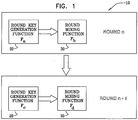
- FIG. 1 is a simplified block diagram illustration of a system 10 for robust cipher design constructed and operative in accordance with a preferred embodiment of the present invention.
- the system 10 of Fig. 1 comprises different instances of a function F, depicted in round n as F a and F b . In round n+1, the different instances of function F are depicted as F c and F d .
- the function F in preferred embodiments thereof, preferably comprises at least one of:
- the function F therefore, preferably comprises a significant portion of cipher security and comprises a significant portion of the hardware implementation of the cipher.
- the function F may preferably comprise a layer of S-boxes (well known cryptographic structures), such as the AES invertible 8-bit-to-8-bit S-boxes, or DES non-invertible 6-bit-to-4-bit S-boxes.
- the function F may comprise a linear transformation such as the AES ShiftRows transformation function, or the AES MixColumns transformation function.
- the system of Fig. 1 also comprises a round key generation function 20, depicted in round n as comprising the first function, F a , and later depicted in round n+1 as comprising the second function, F c .
- the system of Fig. 1 also comprises a round mixing function 30, depicted in round n as comprising a third function, F b , and later depicted in round n+1 as comprising a fourth function, F d .
- F a , F b , F c , and F d are preferably selected from among two functions, F i and F j , thereby allowing implementation of only the two functions, F i and F j for the four functions, F a , F b , F c , and F d .
- the functions F a and F d can be either of functions F i or F j .
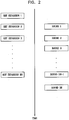
- Fig. 2 is a time line showing one preferred implementation of the relationship between key expansion (note that the terms “key expansion” and “key generation” are used interchangeably in the present disclosure and figures) and encryption rounds in a cipher designed according to the method of Fig. 1 .
- the round key generation function 20 Prior to round 1, the round key generation function 20 produces a round key for use by the round mixing function 30 in round 1. Substantially in parallel to the operation of the round mixing function 30 in round 1, the round key generation function 20 produces a round key for use by the round mixing function 30 in round 2.
- the process of the round key generation function 20 producing a round key for use by the round mixing function 30 in the next round continues substantially in parallel to the operation of the round mixing function 30 until in round rounds number - 1 (RN - 1), the round key generation function 20 produces a round key for use by the round mixing function 30 in round RN.
- the round key generation function 20 preferably does not generate a key.
- F, F a and F b are preferably implemented only once, preferably in hardware. It is appreciated that F a and F b may, under some circumstances, also be implemented in software.
- F a and F b in hardware, instead of implementing a single function in hardware, requires additional gates in are, and additional voltage in order to power the gates.
- F b when F a is operating as part of round mixing function 30, F b preferably is operating as part of the round key generation function 20 for the next round.
- F a when F b is operating as part of round mixing function 30, F a preferably is operating as part of the round key generation function 20 ( Fig. 1 ) for the next round.
- a MUX module and a DEMUX module are preferably operative to differentiate between different sources for input, a key expansion input or an input as part of the round, as well as the different outputs, a register for round keys or a round key state register.
- the MUX modules are preferably updated by a counter (not depicted) which is operative to count rounds.
- Hardware comprising key expansion logic 310 outputs a temporal result to a first MUX module 320.
- hardware comprising round encryption logic 330 outputs a temporal result to the first MUX module 320.
- the first MUX module 320 determines if the output of the MUX module 320 has to be a value taken as MUX input from the key expansion logic 310 hardware or the value taken as MUX input from the round encryption logic 330 hardware.
- a preferred implementation, given by way of example, relevant for the discussion below of Figs. 8 and 9 , of the selection criteria 340 comprises a counter ranging in value from 0 to 3. If the counter value is 0 or 1, one option is implemented by the MUX module.
- the second option is implemented by the MUX module.
- Output from the MUX module 320 is preferably sent to F i as appropriate for a particular round.
- Output from F i is preferably input into a DEMUX module 360.
- the DEMUX module 360 preferably applies the selection criteria 340 to determine if the received input needs to be preferably output as a round key generation temporal result 370 to the key expansion logic 310 hardware or as a round key mixing temporal result 380 to the round encryption logic 330 hardware.
- key expansion logic 310 has a MUX component (not depicted) which selects between the round key generation temporal result 370 of F i and the round key mixing temporal result 380 of F j .
- the round encryption logic 330 has a MUX component (not depicted) which selects between the round key generation temporal result 370 of F j and the round key mixing temporal result 380 of F i .
- a design similar to the system of Fig. 3A comprises a preferred embodiment of MUX and DEMUX selection logic for F j , where the selection criteria 340 that is used for F j is preferably the negation of the selection logic that is used for F i . That is, when the function F i is used for round key generation, function F j is preferably used for round key mixing, and vice-versa.
- a cipher designed as described herein also has additional security in that if, for instance, F j is found to be weak (for example and without limiting the generality of the foregoing, F j comprises linear properties; or F j comprises differential properties), F i still preferably gives some measure of protection to the cipher.
- the function F is deliberately designed to be inefficient in any implementation, except for an implementation comprising specialized hardware, thereby making a cipher comprising the function F inefficient in any implementation, except for an implementation comprising specialized hardware. Therefore, a cipher designed so as to comprise such an embodiment of the function F in F i and in F j , F i being is inefficient, except for an implementation comprising specialized hardware, and F j not being inefficient in an implementation not comprising specialized hardware, comprises an implementation of the cipher which is still, substantially inefficient except for an implementation comprising specialized hardware.
- constant round vectors may preferably be used in order to affect the behavior of function F i .
- constant round vectors may preferably be used in order to affect the behavior of function F j .
- Constant round vectors may preferably be used for at least one of two purposes:
- FIG. 3B is a simplified block diagram illustration of a preferred implementation of a round key generation function operative to generate round keys in a cipher designed according to the method of Fig. 1 .
- F i and F j may comprise either invertible functions or non-invertible functions, as appropriate, depending on the cipher in which functions F i and F j are implemented, and on the stage of implementing the cipher in which functions F i and F j are implemented. As will be discussed below with reference to Figs.
- Feistel based encryption schemes such as DES
- F i and F j (as part of the key mixing mechanism) preferably comprise a part of the combination of the round key with "right" half, prior to combining (XORing in DES) with the "left" half (a non-invertible operation).
- functions F i and F j are preferably implemented as non-invertible functions.
- F i and F j in substitution permutation ciphers such as the AES cipher (FIPS 197), F i and F j preferably comprise part of the round function.
- functions F i and F j are preferably implemented as invertible functions.
- the round key generation function 327 operates iteratively in order to generate a plurality of keys.
- the iterative operation of round key generation function 327 comprises a state, R.
- the state R is initialized by executing a function, StateInit 337, with root key K as input during every round.
- R is updated by a State Update function 347.
- the State Update function 347 is applied to the state from the previous round in order to update R for the round.
- a Round Key Generate function 357 generates a new round key RK i 367 from the updated value of R.
- the size of the state R is preferably equal to the size of the key.
- the key is 128 bits
- the state R is preferably 128 bits.
- One preferred method of determining the state during the iterative process described above, applicable when RN is less than the size of the key in bits comprises initializing an L-bit state with an L-bit key K, and circularly shifting the L bit key one bit each round.
- RoundKeyGenerate 357 need not be an invertible function.
- non-invertible function F preferably comprises a portion of the RoundKeyGenerate 357 function.
- the StateUpdate 347 function is preferably invertible, and invertible function F preferably comprises a portion of the StateUpdate 347 function.
- FIG. 4 is a simplified block diagram illustration of four rounds of a typical Feistel block cipher 400 constructed and operative in accordance with the system of Fig. 1 . It is appreciated that Fig. 4 provides an illustration of data structures and methods for implementing an encryption network, the illustration being drawn in a format which is well known in the art.
- the Feistel block cipher 400 comprises round mixing function designated hereinafter as function A 420 and function B 430. Additionally, a combine function 440, depicted in Fig. 1 as ⁇ , XOR (exclusive OR), combines the output of either of function A 420 or of function B 430 with an input. Even though the combine function 440 is depicted as XOR, it is appreciated that any appropriate combining function may be implemented to combine the output of either of function A 420 or of function B 430 with the input.
- a function, F operative as a sub-function comprised in the round function of the block cipher 410 is replaced with different instances of F: F i and F j .
- F i and F j the different instances of F (F i and F j ) are used.
- function B 430, comprising function F j are used in alternate rounds.
- the round encryption function preferably uses a round key generated during a previous round
- function A 420 comprising function F i
- function F j is preferably used in the round key generation function to generate the round key for the next round.
- function B 430 comprising function F j
- F i is preferably used in the round key generation function to generate the round key for the next round.
- each sequence of rounds comprises ABAB..., such that each round alternates the use of the implementation of F (F i , F j , F i , F j , ).
- key expansion preferably comprises XBABA..., where a first round uses a key, X, that can be derived either from A or B.
- Fig. 4 the following table describes the preferred implementation depicted in Fig. 4 : Round Key Generation Round Function 1 X F i 2 F j F j 3 F i F i 4 F j F j 5 F i F i
- FIG. 5 is a simplified block diagram illustration of four rounds of a typical AES-like block cipher 500 constructed and operative in accordance with the system of Fig. 1 .
- Each round of the AES-like block cipher comprises a round key generation function 510 (for ease of depiction, "key setup", in Fig. 5 ) operative to provide the round key to the round mechanism 520.
- Each round mechanism 520 typically comprises a key mixing function 530 (for ease of depiction, "key comb”, in Fig. 5 ), which is operative to receive the key from the round key generation function 510, and combine, typically using a XOR function, the key with a known constant.
- Output from the key mixing function 530 is typically input into a linear layer 540.
- the linear layer 540 typically comprises functions well known in the art, such as "MixRows" and "ShiftColumns".
- Output from the linear layer 540 is typically input into a non-linear layer 550.
- the non-linear layer 550 typically comprises S-boxes. Additionally, in preferred embodiments of the present invention, the non-linear layer 550 comprises an implementation of the function F, either F i or F j . In the preferred implementation of the present invention depicted in Fig. 5 , implementations of F i or F j alternate, similar to the preferred implementation depicted in Fig. 4 .
- Fig. 6 is a simplified block diagram illustration of eight rounds of a typical Feistel block cipher.
- Fig. 7 is a simplified block diagram illustration of eight rounds of a typical AES-like block cipher.
- each sequence of several rounds first comprises function F i in the round mixing function and comprises the function F j in the round key generation function. Then, after the sequence of several rounds, functions F i and F j switch roles, and function F i is comprised in the round key generation function, and function F j is comprised in the round mixing function.
- the following table describes the preferred implementation 5 depicted in Figs. 6 and 7 :
- Round Key Generation Round Function 1 X F i 2 F j F i ... F j F i n F j F i n+1 F j F i n+2 F j F j n+3 F i F j ... F i F j n+m F i F j n+m+1 F i F j n+m+2 F i F j j
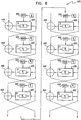
- Fig. 8 is a simplified block diagram illustration of eight rounds of a typical Feistel block cipher.
- Fig. 9 is simplified block diagram illustration of eight rounds of a typical AES-like block cipher.
- input into the ciphers and rounds therein described above may comprise preprocessing.
- output of the ciphers and rounds therein may comprise postprocessing.
- software components of the present invention may, if desired, be implemented in ROM (read only memory) form.
- the software components may, generally, be implemented in hardware, if desired, using conventional techniques.
Landscapes
- Engineering & Computer Science (AREA)
- Computer Security & Cryptography (AREA)
- Computer Networks & Wireless Communication (AREA)
- Signal Processing (AREA)
- Lock And Its Accessories (AREA)
- Mobile Radio Communication Systems (AREA)
- Storage Device Security (AREA)
- Studio Circuits (AREA)
Claims (22)
- In einem iterierten Blockcipher, ein Verfahren zur Rundenschlüsselverschlüsselung und -schlüsselerzeugung, wobei das Verfahren Folgendes umfasst:Bereitstellen einer ersten Funktion Fi und einer zweiten Funktion Fj, worin Fi und Fj verschiedene Instanzen einer Funktion F sind;Bereitstellen einer Implementierung der ersten Funktion Fi und einer Implementierung der zweiten Funktion Fj;Bereitstellen einer Rundenschlüsselerzeugungsfunktion (20), wobei die Rundenschlüsselerzeugungsfunktion (20) dazu dient, in jeder gegebenen Runde exakt eine der folgenden zu benutzen:der ersten Funktion Fi; undder zweiten Funktion Fj;Bereitstellen einer Rundenmischfunktion (30), wobei die Rundenmischfunktion (30) dazu dient, in jeder gegebenen Runde exakt eine der folgenden zu benutzen:der ersten Funktion Fi; undder zweiten Funktion Fj;Bereitstellen einer Implementierung der Rundenschlüsselerzeugungsfunktion (20), wobei die Implementierung der Rundenschlüsselerzeugungsfunktion (20) dazu dient, in jeder gegebenen Runde exakt eine der folgenden zu benutzen:der Implementierung der ersten Funktion Fi; undder Implementierung der zweiten Funktion Fj;Bereitstellen einer Implementierung der Rundenmischfunktion (30), wobei die Implementierung der Rundenmischfunktion (30) dazu dient, in jeder gegebenen Runde exakt eine der folgenden zu benutzen:gekennzeichnet durch:der Implementierung der ersten Funktion Fi; undder Implementierung der zweiten Funktion Fj;Benutzung der Implementierung der Rundenschlüsselerzeugungsfunktion (20) in mindestens einer ersten Runde, um einen zweiten Rundenschlüssel, zur Verwendung in einer zweiten Runde, zu erzeugen; undBenutzung der Implementierung der Rundenmischfunktion (30) in mindestens der ersten Runde zum Mischen eines ersten Rundenschlüssels mit einem Cipher-Zustand, worin eine der folgenden in der ersten Runde durchgeführt wird:die Implementierung der Rundenschlüsselerzeugungsfunktion (20) benutzt die Implementierung der ersten Funktion Fi, um den zweiten Rundenschlüssel, zur Verwendung in der zweiten Runde, zu erzeugen, im Wesentlichen gleichzeitig mit der Implementierung der Rundenschlüsselmischfunktion (30) unter Verwendung der Implementierung der zweiten Funktion Fj zum Mischen des ersten Rundenschlüssels mit dem Cipher-Zustand; unddie Implementierung der Rundenschlüsselerzeugungsfunktion (20) benutzt die Implementierung der zweiten Funktion Fj, um den zweiten Rundenschlüssel, zur Verwendung in der zweiten Runde, zu erzeugen, im Wesentlichen gleichzeitig mit der Implementierung der Rundenschlüsselmischfunktion (30) unter Verwendung der Implementierung der ersten Funktion Fi zum Mischen des ersten Rundenschlüssels mit dem Cipher-Zustand; undworin jede Runde die Verwendung der Implementierung der ersten Funktion Fi und der zweiten Funktion Fj in der Rundenschlüsselerzeugungsfunktion (20) und der Rundenmischfunktion (30) alterniert.
- Verfahren nach Anspruch 1, und worin eine erste Eingabe umfassend ein temporales Ergebnis der Rundenschlüsselerzeugungsfunktion (20) und eine zweite Eingabe umfassend ein temporales Ergebnis der Rundenmischfunktion (30) an einem ersten MUX-Modul (320) und an einem zweiten MUX-Modul empfangen werden, worin die Ausgabe des ersten MUX-Moduls (320) in die erste Funktion Fi eingegeben wird und die Ausgabe des zweiten MUX-Moduls in die zweite Funktion Fj eingegeben wird.
- Verfahren nach Anspruch 2 und auch umfassend das Differenzieren zwischen dem Nehmen des temporalen Ergebnisses der Rundenschlüsselerzeugungsfunktion (20) und dem Nehmen des temporalen Ergebnisses der Rundenmischfunktion (30), da eine Eingabe der ersten Funktion Fi auf einem Auswahlkriterium beruht; und das Differenzieren zwischen dem Nehmen des temporalen Ergebnisses der Rundenschlüsselerzeugungsfunktion (20) und dem Nehmen des temporalen Ergebnisses der Rundenmischfunktion (30), da eine Eingabe der zweiten Funktion Fj auf einer Negierung des Auswahlkriteriums beruht.
- Verfahren nach Anspruch 3 und worin das Auswahlkriterium das Fällen einer Entscheidung auf Basis eines Werts eines Zählers umfasst.
- Verfahren nach einem der Ansprüche 2-4, und worin eine Ausgabe umfassend das Ergebnis der ersten Funktion Fi an einem ersten DEMUX-Modul (360) empfangen wird; und eine Ausgabe umfassend das Ergebnis der zweiten Funktion Fj an einem zweiten DEMUX-Modul empfangen wird;
die am ersten DEMUX-Modul (360) empfangene Ausgabe eingegeben wird, als ein temporales Ergebnis, in eine:der Implementierung der Rundenschlüsselerzeugungsfunktion (20), wodurch der Abschluss der Rundenschlüsselerzeugung ermöglicht wird; undder Implementierung der Rundenmischfunktion (30), wodurch der Abschluss des Rundenmischens ermöglicht wird; unddie am zweiten DEMUX-Modul (360) empfangene Ausgabe eingegeben wird, als ein temporales Ergebnis, in die andere:der Implementierung der Rundenschlüsselerzeugungsfunktion (20), wodurch der Abschluss der Rundenschlüsselerzeugung ermöglicht wird; undder Implementierung der Rundenmischfunktion (30), wodurch der Abschluss des Rundenmischens ermöglicht wird. - Verfahren nach Anspruch 5, wie von Anspruch 3 abhängig, und auch umfassend das Differenzieren zwischen der Eingabe in die Rundenschlüsselerzeugungsfunktion (20) und der Eingabe in die Rundenmischfunktion (30) auf Basis des Auswahlkriteriums.
- Verfahren nach Anspruch 6 und worin das Auswahlkriterium das Fällen einer Entscheidung auf Basis eines Werts eines Zählers umfasst.
- Verfahren nach einem der Ansprüche 1-7 und auch umfassend das Eingeben verschiedener konstanter Vektoren zur Implementierung der ersten Funktion Fi während verschiedener Betriebsrunden.
- Verfahren nach einem der Ansprüche 1-8 und auch umfassend das Eingeben verschiedener konstanter Vektoren zur Implementierung der zweiten Funktion Fj während verschiedener Betriebsrunden.
- Verfahren nach einem der Ansprüche 1-9 und auch umfassend das Eingeben eines verschiedenen konstanten Rundenvektors zur Implementierung der ersten Funktion Fi während der Schlüsselerweiterung als während des Rundenbetriebs.
- Verfahren nach einem der Ansprüche 1-9 und auch umfassend das Eingeben eines verschiedenen konstanten Rundenvektors zur Implementierung der zweiten Funktion Fj während der Schlüsselerweiterung als während des Rundenbetriebs.
- Verfahren nach einem der Ansprüche 1-11 und worin der iterierte Blockcipher ein Feistel-basiertes Verschlüsselungsschema umfasst.
- Verfahren nach einem der Ansprüche 1-11 und worin der iterierte Blockcipher ein Substitutionspermutations-Verschlüsselungsschema umfasst.
- Verfahren nach einem der Ansprüche 1-13, worin die Rundenschlüsselerzeugungsfunktion einen Rundenschlüssel, mit RKi bezeichnet, für eine gegebene Runde, mit Ri bezeichnet, durch Durchführung von Folgendem erzeugt:Bereitstellen eines Zustands, mit R bezeichnet;Bereitstellen eines Wurzelschlüssels, mit K bezeichnet, sodass R ein Ergebnis einer Funktion InitState(K) umfasst;Bereitstellen einer Rundennummer, mit RN bezeichnet;Bereitstellen einer Funktion StateUpdate(), wobei die Funktion StateUpdate() dazu dient, den Zustand von K jede Runde nach InitState(K) zu aktualisieren; undBereitstellen einer Funktion RoundKeyGenerate(), wobei die Funktion RoundKeyGenerate() dazu dient, einen Rundenschlüssel zur Verwendung während einer kryptographischen Runde zu erzeugen,worin R0 = InitState(K); und
für i = 1 bis RN:Ri = StateUpdate(Ri-1); undRKi = RoundKeyGenerate(Ri). - Verfahren nach Anspruch 14 und worin die Größe von Ri gleich einer Größe eines Schlüssels ist.
- Verfahren entweder nach Anspruch 14 oder Anspruch 15 und auch umfassend, wenn RN weniger als die Größe eines Schlüssels ist, Initialisieren eines L-Bit-Zustands mit einem Schlüssel von L-Bits, und danach zirkulares Verschieben des L-Bit-Schlüssels um ein Bit nach jeder Runde.
- Verfahren nach einem der Ansprüche 14-16 und worin die erste Funktion Fi eine nicht-invertible Funktion umfasst, und die RoundKeyGenerate-Funktion ferner die erste Funktion Fi umfasst.
- Verfahren nach einem der Ansprüche 14-16 und worin der ersten Funktion Fi eine invertible Funktion umfasst, und die StateUpdate-Funktion ferner die erste Funktion Fi umfasst.
- Verfahren nach einem der Ansprüche 14-18 und worin die zweite Funktion Fj eine nicht-invertible Funktion umfasst, und die RoundKeyGenerate-Funktion ferner die zweite Funktion Fj umfasst.
- Verfahren nach einem der Ansprüche 14-18 und worin die zweite Funktion Fj eine invertible Funktion umfasst, und die StateUpdate-Funktion ferner die zweite Funktion Fj umfasst.
- Verfahren nach einem der Ansprüche 1-20 und worin ein Muster zur Benutzung der ersten Funktion Fi und der zweiten Funktion Fj Folgendes umfasst:
Runde Schlüsselerzeugung Rundenfunktion 1 X Fi 2 Fj Fj 3 Fi Fi 4 Fj Fj 5 Fi Fi ... - In einem iterierten Blockcipher, ein System zur Rundenschlüsselverschlüsselung und -schlüsselerzeugung, wobei das System Folgendes umfasst:eine erste Funktion Fi und eine zweite Funktion Fj, worin Fi und Fj verschiedene Instanzen einer Funktion F sind;eine Implementierung der ersten Funktion Fi und eine Implementierung der zweiten Funktion Fj;eine Rundenschlüsselerzeugungsfunktion (20), wobei die Rundenschlüsselerzeugungsfunktion (20) dazu dient, in jeder gegebenen Runde exakt eine der folgenden zu benutzen:der ersten Funktion Fi; undder zweiten Funktion Fj;eine Rundenmischfunktion (30), wobei die Rundenmischfunktion (30) dazu dient, in jeder gegebenen Runde exakt eine der folgenden zu benutzen:der ersten Funktion Fi; undder zweiten Funktion Fj;eine Implementierung der Rundenschlüsselerzeugungsfunktion (20), wobei die Implementierung der Rundenschlüsselerzeugungsfunktion (20) dazu dient, in jeder gegebenen Runde exakt eine der folgenden zu benutzen:der Implementierung der ersten Funktion Fi; undder Implementierung der zweiten Funktion Fj;eine Implementierung der Rundenmischfunktion (30), wobei die Implementierung der Rundenmischfunktion (30) dazu dient, in jeder gegebenen Runde exakt eine der folgenden zu benutzen:worin jede Runde die Verwendung der Implementierung der ersten Funktion Fi und der zweiten Funktion Fj in der Rundenschlüsselerzeugungsfunktion (20) und der Rundenmischfunktion (30) alterniert.der Implementierung der ersten Funktion Fi; undder Implementierung der zweiten Funktion Fj;gekennzeichnet durch:die Implementierung der Rundenschlüsselerzeugungsfunktion (20), die in mindestens einer ersten Runde verwendet wird, um einen zweiten Rundenschlüssel, zur Verwendung in einer zweiten Runde, zu erzeugen; unddie Implementierung der Rundenmischfunktion (30), die in mindestens der ersten Runde verwendet wird zum Mischen eines ersten Rundenschlüssels mit einem Cipher-Zustand,
worin eine der folgenden in der ersten Runde durchgeführt wird:die Implementierung der Rundenschlüsselerzeugungsfunktion (20) benutzt die Implementierung der ersten Funktion Fi, um den zweiten Rundenschlüssel, zur Verwendung in der zweiten Runde, zu erzeugen, im Wesentlichen gleichzeitig mit der Implementierung der Rundenschlüsselmischfunktion (30) unter Verwendung der Implementierung der zweiten Funktion Fj zum Mischen des ersten Rundenschlüssels mit dem Cipher-Zustand; unddie Implementierung der Rundenschlüsselerzeugungsfunktion (20) benutzt die Implementierung der zweiten Funktion Fj, um den zweiten Rundenschlüssel, zur Verwendung in der zweiten Runde, zu erzeugen, im Wesentlichen gleichzeitig mit der Implementierung der Rundenschlüsselmischfunktion (30) unter Verwendung der Implementierung der ersten Funktion Fi zum Mischen des ersten Rundenschlüssels mit dem Cipher-Zustand; und
Applications Claiming Priority (2)
| Application Number | Priority Date | Filing Date | Title |
|---|---|---|---|
| IL174784A IL174784A0 (en) | 2006-04-04 | 2006-04-04 | Robust cipher design |
| PCT/IL2007/000364 WO2007113796A2 (en) | 2006-04-04 | 2007-03-20 | Robust cipher design |
Publications (3)
| Publication Number | Publication Date |
|---|---|
| EP2016524A2 EP2016524A2 (de) | 2009-01-21 |
| EP2016524A4 EP2016524A4 (de) | 2013-03-20 |
| EP2016524B1 true EP2016524B1 (de) | 2017-03-01 |
Family
ID=38564058
Family Applications (1)
| Application Number | Title | Priority Date | Filing Date |
|---|---|---|---|
| EP07713382.5A Not-in-force EP2016524B1 (de) | 2006-04-04 | 2007-03-20 | Robuster cipher-entwurf |
Country Status (5)
| Country | Link |
|---|---|
| US (1) | US8000471B2 (de) |
| EP (1) | EP2016524B1 (de) |
| AU (1) | AU2007232123B2 (de) |
| IL (2) | IL174784A0 (de) |
| WO (1) | WO2007113796A2 (de) |
Families Citing this family (11)
| Publication number | Priority date | Publication date | Assignee | Title |
|---|---|---|---|---|
| JP4882598B2 (ja) * | 2006-07-28 | 2012-02-22 | ソニー株式会社 | 暗号処理装置、暗号処理アルゴリズム構築方法、および暗号処理方法、並びにコンピュータ・プログラム |
| CN100581101C (zh) * | 2007-11-19 | 2010-01-13 | 西安西电捷通无线网络通信有限公司 | 一种基于分组密码算法的加密处理设备 |
| CN100495961C (zh) | 2007-11-19 | 2009-06-03 | 西安西电捷通无线网络通信有限公司 | 一种基于分组密码算法的加密处理方法 |
| US9336160B2 (en) * | 2008-10-30 | 2016-05-10 | Qualcomm Incorporated | Low latency block cipher |
| US20100329450A1 (en) * | 2009-06-30 | 2010-12-30 | Sun Microsystems, Inc. | Instructions for performing data encryption standard (des) computations using general-purpose registers |
| US8837715B2 (en) * | 2011-02-17 | 2014-09-16 | Gradiant, Centro Tecnolóxico de Telecomunicacións de Galica | Method and apparatus for secure iterative processing and adaptive filtering |
| WO2015146431A1 (ja) * | 2014-03-28 | 2015-10-01 | ソニー株式会社 | 暗号処理装置、および暗号処理方法、並びにプログラム |
| US9515818B2 (en) * | 2014-09-16 | 2016-12-06 | Apple Inc. | Multi-block cryptographic operation |
| US9252943B1 (en) * | 2014-09-26 | 2016-02-02 | The Boeing Company | Parallelizable cipher construction |
| US11283619B2 (en) * | 2019-06-20 | 2022-03-22 | The Boeing Company | Bit mixer based parallel MAC and hash functions |
| CN111274613B (zh) * | 2020-01-20 | 2022-05-20 | 广州安研信息科技有限公司 | 迭代式sm2数字签名生成方法、系统、介质和设备 |
Family Cites Families (14)
| Publication number | Priority date | Publication date | Assignee | Title |
|---|---|---|---|---|
| DE2658065A1 (de) * | 1976-12-22 | 1978-07-06 | Ibm Deutschland | Maschinelles chiffrieren und dechiffrieren |
| US4543646A (en) * | 1980-06-05 | 1985-09-24 | Western Digital Corporation | Chip topography for MOS Data Encryption Standard circuit |
| US5533123A (en) * | 1994-06-28 | 1996-07-02 | National Semiconductor Corporation | Programmable distributed personal security |
| JPH09233066A (ja) * | 1996-02-23 | 1997-09-05 | Sony Corp | 暗号化/解読化方法および装置 |
| US6028939A (en) * | 1997-01-03 | 2000-02-22 | Redcreek Communications, Inc. | Data security system and method |
| US6182216B1 (en) * | 1997-09-17 | 2001-01-30 | Frank C. Luyster | Block cipher method |
| US6243470B1 (en) * | 1998-02-04 | 2001-06-05 | International Business Machines Corporation | Method and apparatus for advanced symmetric key block cipher with variable length key and block |
| GB2345229B (en) * | 1998-12-23 | 2003-12-03 | Motorola Ltd | Method for encrypting data |
| JP3851115B2 (ja) * | 2001-06-28 | 2006-11-29 | 富士通株式会社 | 暗号回路 |
| US20030198345A1 (en) * | 2002-04-15 | 2003-10-23 | Van Buer Darrel J. | Method and apparatus for high speed implementation of data encryption and decryption utilizing, e.g. Rijndael or its subset AES, or other encryption/decryption algorithms having similar key expansion data flow |
| US20040047466A1 (en) * | 2002-09-06 | 2004-03-11 | Joel Feldman | Advanced encryption standard hardware accelerator and method |
| KR20050053379A (ko) * | 2003-12-01 | 2005-06-08 | 삼성전자주식회사 | AES Rijndael(라인달) 알고리즘을 빠르게구현하는 암호/복호 장치 및 그 방법 |
| MX2007001072A (es) * | 2004-07-29 | 2007-04-17 | Vadium Technology Inc | Tecnicas para consolidar el cifrado pad de una sola vez. |
| US20100067687A1 (en) * | 2004-12-06 | 2010-03-18 | The Trustees Of The Stevens Institute Of Technology | Method and apparatus for maintaining data integrity for block-encryption algorithms |
-
2006
- 2006-04-04 IL IL174784A patent/IL174784A0/en unknown
-
2007
- 2007-03-20 US US12/223,137 patent/US8000471B2/en not_active Expired - Fee Related
- 2007-03-20 WO PCT/IL2007/000364 patent/WO2007113796A2/en not_active Ceased
- 2007-03-20 EP EP07713382.5A patent/EP2016524B1/de not_active Not-in-force
- 2007-03-20 AU AU2007232123A patent/AU2007232123B2/en not_active Ceased
-
2008
- 2008-07-24 IL IL193056A patent/IL193056A0/en unknown
Non-Patent Citations (1)
| Title |
|---|
| None * |
Also Published As
| Publication number | Publication date |
|---|---|
| IL174784A0 (en) | 2006-12-31 |
| EP2016524A2 (de) | 2009-01-21 |
| US8000471B2 (en) | 2011-08-16 |
| US20090202070A1 (en) | 2009-08-13 |
| AU2007232123A1 (en) | 2007-10-11 |
| IL193056A0 (en) | 2009-08-03 |
| WO2007113796A3 (en) | 2009-04-09 |
| WO2007113796A2 (en) | 2007-10-11 |
| AU2007232123B2 (en) | 2011-05-19 |
| EP2016524A4 (de) | 2013-03-20 |
Similar Documents
| Publication | Publication Date | Title |
|---|---|---|
| EP2016524B1 (de) | Robuster cipher-entwurf | |
| KR20120115425A (ko) | 블록 사이퍼 암호화의 사용을 위한 방법 및 시스템 | |
| Rodriguez-Henriquez et al. | 4.2 Gbit/s single-chip FPGA implementation of AES algorithm | |
| JP2005527853A (ja) | 高度暗号化規格(aes)のハードウェア暗号法エンジン | |
| WO2015146431A1 (ja) | 暗号処理装置、および暗号処理方法、並びにプログラム | |
| CN111262685B (zh) | 一种新型密钥生成的Shield分组密码实现方法、装置及可读存储介质 | |
| US11770237B2 (en) | Hardware accelerator for Feistel block ciphers | |
| KR102279245B1 (ko) | 사물인터넷 응용을 위한 암호화 장치 및 그 방법 | |
| Shah Kruti et al. | New approach of data encryption standard algorithm | |
| WO2015146430A1 (ja) | 暗号処理装置、および暗号処理方法、並びにプログラム | |
| Kumari et al. | An RTL implementation of the data encryption standard (DES) | |
| JP2002510058A (ja) | 2進データ・ブロックの暗号変換のための方法 | |
| Sivakumar et al. | High speed VLSI design CCMP AES cipher for WLAN (IEEE 802.11 i) | |
| US8437470B2 (en) | Method and system for block cipher encryption | |
| Balamurugan et al. | High speed low cost implementation of advanced encryption standard on fpga | |
| Patil et al. | An enhancement in international data encryption algorithm for increasing security | |
| EP1001398B1 (de) | Verschlüsselungsgerät | |
| Kwan et al. | A general purpose technique for locating key scheduling weaknesses in DES-like cryptosystems | |
| JPWO2008117804A1 (ja) | ストリーム暗号向け擬似乱数生成装置とプログラムと方法 | |
| Rawat et al. | Comparative Analysis of Blowfish and Twofish Cryptographic Protocol | |
| Hattab et al. | Developing the complexity and security of the twofish algorithm through a new key scheduling design | |
| Cook et al. | Elastic aes | |
| JP3748184B2 (ja) | 秘話通信装置 | |
| Hassan | New approach for modifying des algorithm using 4-states multi-keys | |
| Ajlouni et al. | A New Approach in Key Generation and Expansion in Rijndael Algorithm. |
Legal Events
| Date | Code | Title | Description |
|---|---|---|---|
| PUAI | Public reference made under article 153(3) epc to a published international application that has entered the european phase |
Free format text: ORIGINAL CODE: 0009012 |
|
| 17P | Request for examination filed |
Effective date: 20080806 |
|
| AK | Designated contracting states |
Kind code of ref document: A2 Designated state(s): AT BE BG CH CY CZ DE DK EE ES FI FR GB GR HU IE IS IT LI LT LU LV MC MT NL PL PT RO SE SI SK TR |
|
| AX | Request for extension of the european patent |
Extension state: AL BA HR MK RS |
|
| R17D | Deferred search report published (corrected) |
Effective date: 20090409 |
|
| RIC1 | Information provided on ipc code assigned before grant |
Ipc: H04L 9/00 20060101AFI20090427BHEP |
|
| 111Z | Information provided on other rights and legal means of execution |
Free format text: AT BE BG CH CY CZ DE DK EE ES FI FR GB GR HU IE IS IT LT LU LV MC MT NL PL PT RO SE SI SK TR Effective date: 20090430 |
|
| RIC1 | Information provided on ipc code assigned before grant |
Ipc: H04K 1/06 20060101ALI20090723BHEP Ipc: H04L 9/00 20060101AFI20090723BHEP |
|
| RAP1 | Party data changed (applicant data changed or rights of an application transferred) |
Owner name: NDS LIMITED |
|
| D11X | Information provided on other rights and legal means of execution (deleted) | ||
| DAX | Request for extension of the european patent (deleted) | ||
| REG | Reference to a national code |
Ref country code: DE Ref legal event code: R079 Ref document number: 602007049943 Country of ref document: DE Free format text: PREVIOUS MAIN CLASS: G06F0021240000 Ipc: H04L0009000000 |
|
| A4 | Supplementary search report drawn up and despatched |
Effective date: 20130218 |
|
| RIC1 | Information provided on ipc code assigned before grant |
Ipc: H04K 1/06 20060101ALI20130212BHEP Ipc: H04L 9/06 20060101ALI20130212BHEP Ipc: H04L 9/00 20060101AFI20130212BHEP |
|
| RIC1 | Information provided on ipc code assigned before grant |
Ipc: H04L 9/06 20060101ALI20130314BHEP Ipc: H04K 1/06 20060101ALI20130314BHEP Ipc: H04L 9/00 20060101AFI20130314BHEP |
|
| 17Q | First examination report despatched |
Effective date: 20131015 |
|
| GRAP | Despatch of communication of intention to grant a patent |
Free format text: ORIGINAL CODE: EPIDOSNIGR1 |
|
| INTG | Intention to grant announced |
Effective date: 20160909 |
|
| GRAS | Grant fee paid |
Free format text: ORIGINAL CODE: EPIDOSNIGR3 |
|
| GRAA | (expected) grant |
Free format text: ORIGINAL CODE: 0009210 |
|
| AK | Designated contracting states |
Kind code of ref document: B1 Designated state(s): AT BE BG CH CY CZ DE DK EE ES FI FR GB GR HU IE IS IT LI LT LU LV MC MT NL PL PT RO SE SI SK TR |
|
| REG | Reference to a national code |
Ref country code: GB Ref legal event code: FG4D |
|
| REG | Reference to a national code |
Ref country code: CH Ref legal event code: EP Ref country code: AT Ref legal event code: REF Ref document number: 872458 Country of ref document: AT Kind code of ref document: T Effective date: 20170315 |
|
| REG | Reference to a national code |
Ref country code: IE Ref legal event code: FG4D |
|
| REG | Reference to a national code |
Ref country code: FR Ref legal event code: PLFP Year of fee payment: 11 |
|
| REG | Reference to a national code |
Ref country code: SE Ref legal event code: TRGR |
|
| REG | Reference to a national code |
Ref country code: DE Ref legal event code: R096 Ref document number: 602007049943 Country of ref document: DE |
|
| REG | Reference to a national code |
Ref country code: NL Ref legal event code: MP Effective date: 20170301 |
|
| REG | Reference to a national code |
Ref country code: LT Ref legal event code: MG4D |
|
| REG | Reference to a national code |
Ref country code: AT Ref legal event code: MK05 Ref document number: 872458 Country of ref document: AT Kind code of ref document: T Effective date: 20170301 |
|
| PG25 | Lapsed in a contracting state [announced via postgrant information from national office to epo] |
Ref country code: GR Free format text: LAPSE BECAUSE OF FAILURE TO SUBMIT A TRANSLATION OF THE DESCRIPTION OR TO PAY THE FEE WITHIN THE PRESCRIBED TIME-LIMIT Effective date: 20170602 Ref country code: LT Free format text: LAPSE BECAUSE OF FAILURE TO SUBMIT A TRANSLATION OF THE DESCRIPTION OR TO PAY THE FEE WITHIN THE PRESCRIBED TIME-LIMIT Effective date: 20170301 Ref country code: FI Free format text: LAPSE BECAUSE OF FAILURE TO SUBMIT A TRANSLATION OF THE DESCRIPTION OR TO PAY THE FEE WITHIN THE PRESCRIBED TIME-LIMIT Effective date: 20170301 |
|
| PG25 | Lapsed in a contracting state [announced via postgrant information from national office to epo] |
Ref country code: LV Free format text: LAPSE BECAUSE OF FAILURE TO SUBMIT A TRANSLATION OF THE DESCRIPTION OR TO PAY THE FEE WITHIN THE PRESCRIBED TIME-LIMIT Effective date: 20170301 Ref country code: BG Free format text: LAPSE BECAUSE OF FAILURE TO SUBMIT A TRANSLATION OF THE DESCRIPTION OR TO PAY THE FEE WITHIN THE PRESCRIBED TIME-LIMIT Effective date: 20170601 Ref country code: ES Free format text: LAPSE BECAUSE OF FAILURE TO SUBMIT A TRANSLATION OF THE DESCRIPTION OR TO PAY THE FEE WITHIN THE PRESCRIBED TIME-LIMIT Effective date: 20170301 Ref country code: AT Free format text: LAPSE BECAUSE OF FAILURE TO SUBMIT A TRANSLATION OF THE DESCRIPTION OR TO PAY THE FEE WITHIN THE PRESCRIBED TIME-LIMIT Effective date: 20170301 |
|
| PG25 | Lapsed in a contracting state [announced via postgrant information from national office to epo] |
Ref country code: NL Free format text: LAPSE BECAUSE OF FAILURE TO SUBMIT A TRANSLATION OF THE DESCRIPTION OR TO PAY THE FEE WITHIN THE PRESCRIBED TIME-LIMIT Effective date: 20170301 |
|
| PG25 | Lapsed in a contracting state [announced via postgrant information from national office to epo] |
Ref country code: CZ Free format text: LAPSE BECAUSE OF FAILURE TO SUBMIT A TRANSLATION OF THE DESCRIPTION OR TO PAY THE FEE WITHIN THE PRESCRIBED TIME-LIMIT Effective date: 20170301 Ref country code: SK Free format text: LAPSE BECAUSE OF FAILURE TO SUBMIT A TRANSLATION OF THE DESCRIPTION OR TO PAY THE FEE WITHIN THE PRESCRIBED TIME-LIMIT Effective date: 20170301 Ref country code: RO Free format text: LAPSE BECAUSE OF FAILURE TO SUBMIT A TRANSLATION OF THE DESCRIPTION OR TO PAY THE FEE WITHIN THE PRESCRIBED TIME-LIMIT Effective date: 20170301 Ref country code: EE Free format text: LAPSE BECAUSE OF FAILURE TO SUBMIT A TRANSLATION OF THE DESCRIPTION OR TO PAY THE FEE WITHIN THE PRESCRIBED TIME-LIMIT Effective date: 20170301 |
|
| REG | Reference to a national code |
Ref country code: CH Ref legal event code: PL |
|
| PG25 | Lapsed in a contracting state [announced via postgrant information from national office to epo] |
Ref country code: IS Free format text: LAPSE BECAUSE OF FAILURE TO SUBMIT A TRANSLATION OF THE DESCRIPTION OR TO PAY THE FEE WITHIN THE PRESCRIBED TIME-LIMIT Effective date: 20170701 Ref country code: PT Free format text: LAPSE BECAUSE OF FAILURE TO SUBMIT A TRANSLATION OF THE DESCRIPTION OR TO PAY THE FEE WITHIN THE PRESCRIBED TIME-LIMIT Effective date: 20170703 Ref country code: PL Free format text: LAPSE BECAUSE OF FAILURE TO SUBMIT A TRANSLATION OF THE DESCRIPTION OR TO PAY THE FEE WITHIN THE PRESCRIBED TIME-LIMIT Effective date: 20170301 |
|
| REG | Reference to a national code |
Ref country code: DE Ref legal event code: R097 Ref document number: 602007049943 Country of ref document: DE |
|
| REG | Reference to a national code |
Ref country code: IE Ref legal event code: MM4A |
|
| PLBE | No opposition filed within time limit |
Free format text: ORIGINAL CODE: 0009261 |
|
| STAA | Information on the status of an ep patent application or granted ep patent |
Free format text: STATUS: NO OPPOSITION FILED WITHIN TIME LIMIT |
|
| PG25 | Lapsed in a contracting state [announced via postgrant information from national office to epo] |
Ref country code: LU Free format text: LAPSE BECAUSE OF NON-PAYMENT OF DUE FEES Effective date: 20170320 Ref country code: DK Free format text: LAPSE BECAUSE OF FAILURE TO SUBMIT A TRANSLATION OF THE DESCRIPTION OR TO PAY THE FEE WITHIN THE PRESCRIBED TIME-LIMIT Effective date: 20170301 Ref country code: MC Free format text: LAPSE BECAUSE OF FAILURE TO SUBMIT A TRANSLATION OF THE DESCRIPTION OR TO PAY THE FEE WITHIN THE PRESCRIBED TIME-LIMIT Effective date: 20170301 |
|
| 26N | No opposition filed |
Effective date: 20171204 |
|
| PG25 | Lapsed in a contracting state [announced via postgrant information from national office to epo] |
Ref country code: SI Free format text: LAPSE BECAUSE OF FAILURE TO SUBMIT A TRANSLATION OF THE DESCRIPTION OR TO PAY THE FEE WITHIN THE PRESCRIBED TIME-LIMIT Effective date: 20170301 Ref country code: LI Free format text: LAPSE BECAUSE OF NON-PAYMENT OF DUE FEES Effective date: 20170331 Ref country code: CH Free format text: LAPSE BECAUSE OF NON-PAYMENT OF DUE FEES Effective date: 20170331 Ref country code: IE Free format text: LAPSE BECAUSE OF NON-PAYMENT OF DUE FEES Effective date: 20170320 |
|
| REG | Reference to a national code |
Ref country code: BE Ref legal event code: MM Effective date: 20170331 |
|
| REG | Reference to a national code |
Ref country code: FR Ref legal event code: PLFP Year of fee payment: 12 |
|
| PG25 | Lapsed in a contracting state [announced via postgrant information from national office to epo] |
Ref country code: BE Free format text: LAPSE BECAUSE OF NON-PAYMENT OF DUE FEES Effective date: 20170331 |
|
| REG | Reference to a national code |
Ref country code: GB Ref legal event code: 732E Free format text: REGISTERED BETWEEN 20180809 AND 20180815 |
|
| PG25 | Lapsed in a contracting state [announced via postgrant information from national office to epo] |
Ref country code: MT Free format text: LAPSE BECAUSE OF NON-PAYMENT OF DUE FEES Effective date: 20170320 |
|
| REG | Reference to a national code |
Ref country code: DE Ref legal event code: R082 Ref document number: 602007049943 Country of ref document: DE Representative=s name: BOEHMERT & BOEHMERT ANWALTSPARTNERSCHAFT MBB -, DE Ref country code: DE Ref legal event code: R081 Ref document number: 602007049943 Country of ref document: DE Owner name: ACANO (UK) LTD., GB Free format text: FORMER OWNER: NDS LIMITED, STAINES, MIDDLESEX, GB |
|
| PG25 | Lapsed in a contracting state [announced via postgrant information from national office to epo] |
Ref country code: HU Free format text: LAPSE BECAUSE OF FAILURE TO SUBMIT A TRANSLATION OF THE DESCRIPTION OR TO PAY THE FEE WITHIN THE PRESCRIBED TIME-LIMIT; INVALID AB INITIO Effective date: 20070320 |
|
| PG25 | Lapsed in a contracting state [announced via postgrant information from national office to epo] |
Ref country code: CY Free format text: LAPSE BECAUSE OF NON-PAYMENT OF DUE FEES Effective date: 20170301 |
|
| PG25 | Lapsed in a contracting state [announced via postgrant information from national office to epo] |
Ref country code: TR Free format text: LAPSE BECAUSE OF FAILURE TO SUBMIT A TRANSLATION OF THE DESCRIPTION OR TO PAY THE FEE WITHIN THE PRESCRIBED TIME-LIMIT Effective date: 20170301 |
|
| PGFP | Annual fee paid to national office [announced via postgrant information from national office to epo] |
Ref country code: FR Payment date: 20210325 Year of fee payment: 15 Ref country code: IT Payment date: 20210323 Year of fee payment: 15 |
|
| PGFP | Annual fee paid to national office [announced via postgrant information from national office to epo] |
Ref country code: GB Payment date: 20210329 Year of fee payment: 15 Ref country code: DE Payment date: 20210329 Year of fee payment: 15 |
|
| PGFP | Annual fee paid to national office [announced via postgrant information from national office to epo] |
Ref country code: SE Payment date: 20210331 Year of fee payment: 15 |
|
| REG | Reference to a national code |
Ref country code: DE Ref legal event code: R119 Ref document number: 602007049943 Country of ref document: DE |
|
| GBPC | Gb: european patent ceased through non-payment of renewal fee |
Effective date: 20220320 |
|
| PG25 | Lapsed in a contracting state [announced via postgrant information from national office to epo] |
Ref country code: SE Free format text: LAPSE BECAUSE OF NON-PAYMENT OF DUE FEES Effective date: 20220321 Ref country code: GB Free format text: LAPSE BECAUSE OF NON-PAYMENT OF DUE FEES Effective date: 20220320 Ref country code: FR Free format text: LAPSE BECAUSE OF NON-PAYMENT OF DUE FEES Effective date: 20220331 Ref country code: DE Free format text: LAPSE BECAUSE OF NON-PAYMENT OF DUE FEES Effective date: 20221001 |
|
| PG25 | Lapsed in a contracting state [announced via postgrant information from national office to epo] |
Ref country code: IT Free format text: LAPSE BECAUSE OF NON-PAYMENT OF DUE FEES Effective date: 20220320 |
|
| P01 | Opt-out of the competence of the unified patent court (upc) registered |
Effective date: 20230523 |