EP2016444B1 - Modellierung des detektoransprechverhaltens - Google Patents
Modellierung des detektoransprechverhaltens Download PDFInfo
- Publication number
- EP2016444B1 EP2016444B1 EP07728638.3A EP07728638A EP2016444B1 EP 2016444 B1 EP2016444 B1 EP 2016444B1 EP 07728638 A EP07728638 A EP 07728638A EP 2016444 B1 EP2016444 B1 EP 2016444B1
- Authority
- EP
- European Patent Office
- Prior art keywords
- fluence
- radiation
- spectra
- pencil
- kernels
- Prior art date
- Legal status (The legal status is an assumption and is not a legal conclusion. Google has not performed a legal analysis and makes no representation as to the accuracy of the status listed.)
- Active
Links
Images



Classifications
-
- A—HUMAN NECESSITIES
- A61—MEDICAL OR VETERINARY SCIENCE; HYGIENE
- A61N—ELECTROTHERAPY; MAGNETOTHERAPY; RADIATION THERAPY; ULTRASOUND THERAPY
- A61N5/00—Radiation therapy
- A61N5/10—X-ray therapy; Gamma-ray therapy; Particle-irradiation therapy
- A61N5/103—Treatment planning systems
-
- G—PHYSICS
- G01—MEASURING; TESTING
- G01T—MEASUREMENT OF NUCLEAR OR X-RADIATION
- G01T1/00—Measuring X-radiation, gamma radiation, corpuscular radiation, or cosmic radiation
- G01T1/02—Dosimeters
Definitions
- the present invention relates in general to radiation dosimetry and in particular to methods and devices for radiation detector response correction.
- Exposure for ionizing radiation is used in many technical fields, both therapeutical and non-therapeutical, e.g. for sterilizing purposes, radiotherapy, material modification etc. Common for most applications is that there is a need for dosimetry. Dosimetry deals with the process of determining the absorbed dose to an irradiated medium. Such a determining is generally applicable for all kinds of applications and therefore not a part of any treatment or diagnosing of a human being.
- radiotherapy patients are treated for cancer with beams of ionizing radiation.
- the aim is to sterilize the tumor cells while spearing the healthy tissue surrounding them as far as possible. It is imperative that the planning, delivery and quality assurance through measurements of the absorbed dose, is done with high accuracy as to ensure precisely tailored treatments.
- radiations such as conventional photon beams, intensity modulated photons (IMRT), electrons, protons or light ions.
- detectors can be used, e.g. ionization chambers, calorimeters, solid state detectors, diodes, film, or thermoluminescence detectors (TLD), for different applications such as in vitro dosimetry or in vivo dosimetry.
- In vitro dosimetry relates to quality assurance of the irradiation using phantoms of water or tissue equivalent plastics.
- detectors are placed in contact with a patient.
- dosimetry deals with the process of determining the absorbed dose to an irradiated medium.
- a measurement device itself, i.e. a dosimeter, will introduce changes in the radiation conditions. It is not trivial to obtain the actual absorbed dose in an irradiated object from the reading from a measurement device. Placing a detector in, or on the surface of, an object to be irradiated the reading will give a different value than what is the actual dose deposition in equivalent volumes in the irradiated object. Knowing the proportion between deposited dose in different materials at different positions enables the determination of the dose to the object. In dosimetry, correction factors are used to express such relations.
- correction factors are typically determined experimentally in water phantoms along the central axis of the radiation field, and tabulated as correction factors for different depths for standard field sizes.
- An alternative approach is to calculate correction factors, e.g. through extensive and lengthy Monte Carlo simulations of the radiation transport and interactions as to determine the full spectral distribution of particles incident on the detector.
- Modulating the irradiation field is done with different techniques, e.g. by dividing the treatment irradiation into partitions delivered with different amounts and field shapes, from different incident angles. Shaping the field, and their partitions, can be done either with adjustable collimator leaves, specific molded collimators or by scanning a narrow beam.
- response correction factors A general problem with prior art devices and methods for providing response correction factors is that they are extremely time consuming and expertise demanding in operation. Response correction factors for an arbitrary field shape, fluence modulation and position in the irradiated object can therefore not be provided with satisfactory accuracy within a reasonable short time, simplicity and reliability for online corrections. Predetermined response correction factors can be provided for some situations, but only for standard radiation field shapes and positions.
- a general object of the present invention is to provide reliable methods and devices for online radiation detector response correction applicable for an arbitrary radiation field shape, fluence modulation and position in the irradiated object.
- a further object of the present invention is to use the method also for online corrections of dosimeters used for "in vivo" dosimetry.
- the corresponding spectrum of particles at the detector position can be calculated by integrating the kernel to completely describe the particle and energy fluence for the specific field shape and fluence modulation used.
- a total fluence spectra is achieved, which comprises fluence spectra for primary radiation as well as fluence spectra for scattered radiation.
- the dose at any position can be determined, in the irradiated medium as well as in a detector volume.
- the correction factor to apply to the detector signal value for determining the absorbed dose to the irradiated object can be calculated, based on a local total fluence spectra at a point and a medium of the detector or radiation dosimeter.
- the technique is general and can be applied for all ionizing radiation and for all radiation applications.
- One advantage with the present invention is that it enables reliable online radiation detector response correction for any arbitrary radiation field and for a variety of different detectors, radiation sources and radiation energies.
- a general radiation treatment unit 1 as can be found in prior art is illustrated in Fig. 1 .
- ionizing radiation 12 is produced by a radiation source 10 and modulated in a gantry with collimators.
- the gantry is arranged for exposing an object 20 or media as well as a radiation dosimeter 14 to ionizing radiation 12.
- the radiation source 10 can be of different kinds, e.g. a photon radiation source, an electron radiation source, a proton radiation source or a light ion radiation source.
- the radiation dosimeter 14, i.e. the radiation measurement device is placed within the media 20 to be irradiated, in Fig. 1 a water phantom.
- the radiation dosimeter 14 can be of different kinds, e.g. an ionization chamber, a solid state detector, a diode, a photographic film or a thermoluminescence detector.
- the system illustrated in the particular embodiment of Fig. 1 is intended to comprise an electron radiation source and a diode dosimeter. Photographic film and thermoluminescence detectors typically require offline post processing, whereby the system is adapted accordingly.
- a measurement signal 16 is read out by an electrometer 18 and data 28 representing the measured signal is processed with tabulated correction factors in a computer unit 30.
- Differences in absorbed dose to a detector volume and the medium in which the absorbed dose is to be measured raise the need of means to correct the detector response to achieve an equivalent dose.
- the differences stems from variations in the ionization response to the particle fluence spectrum in the irradiated volume due to the different material properties. The difference will vary with on the beam quality, the field shape and fluence modulation, and the position in the medium relative the volume/radiation field. Today these differences are determined experimentally in water phantoms along the central axis of the radiation field, and tabulated as correction factors for different depths for standard field sizes or calculated through extensive Monte Carlo simulations.
- Fig. 2 an irradiation device according to the present invention is illustrated. Besides the components illustrated in Fig. 1 , the irradiation device according to the present invention also comprises an arrangement for detector response correction 40 connected to the radiation dosimeter 14 readout instead of using tabulated correction factors. Information 26 about the radiation field from the irradiating device 10 is also provided to the arrangement for detector response correction 40.
- the arrangement 40 comprises an input means 42 for obtaining a signal or data 28 representing an absorbed dose from a radiation dosimeter 14.
- a signal 16 from the radiation dosimeter 14 is obtained with an electrometer, which passes a data signal to the input means 42.
- the electrometer or any corresponding equipment may be comprised in the input means 42 of the arrangement for detector response correction 40, in which case a measurement signal 16 can be accepted directly from the radiation dosimeter 14.
- the input means 42 may comprise a disc drive, in which a data storage medium with stored radiation dosimeter 14 data is introduced.
- Information about the fluence of the ionizing radiation incident onto the irradiated object is also received by the input means 42, e.g. by a connection to the radiation source 10. However, such information may also be provided to the arrangement for detector response correction 40 manually, whereby the input means 42 then comprises e.g. a keyboard.
- a processor 44 is connected to the input means.
- the processor 44 calculates a correction factor for the field shape, fluence modulation, position in the irradiated object, irradiated medium composition and detector material used during the exposure.
- the correction factors are applied onto the measured absorbed dose signal 16 and a corrected equivalent absorbed dose is presented by an output means 46.
- the equivalent absorbed dose is the dose that would have been absorbed if the radiation dosimeter would have been made by the same medium as the surroundings of the radiation dosimeter.
- the output means in the present embodiment is constituted by an output interface to a monitor screen 30 or any other presentation means.
- the monitor screen 30 or any corresponding equipment may be comprised in the output means 46 of the arrangement for detector response correction 40.
- the output means 46 may comprise e.g. a disc drive, by which a data storage medium may store data concerning corrected equivalent dose for later presentation at an external monitor.
- the arrangement for detector response correction 40 further comprises a data storage 48 arranged for storing precalculated fluence pencil kernels.
- the precalculated fluence pencil kernels describe fluence response spectra for a point in a medium irradiated by a point monodirectional beam of a specific energy in a surrounding of he beam, per incident amount of radiation.
- the data storage 48 is connected to the processor means 44 in such a way that the processor means 44 is allowed to retrieve the precalculated fluence pencil kernels.
- the processor 44 comprises an integrating section 50 for integrating the retrieved precalculated fluence pencil kernels over an incident fluence of the ionizing radiation to yield a total fluence spectra (primary and scattered parts) at the point of interest (the detector position).
- the total fluence spectra comprises fluence spectra for primary radiation as well as fluence spectra for scattered radiation.
- the processor 44 further comprises a factor determination section 52 arranged for determining a correction factor for the radiation dosimeter 14 based on the total fluence spectra and a medium of the radiation dosimeter 14.
- the processor 44 also comprises a correction section 54, connected to the input means 42 and the factor determination section 52.
- the measured absorbed dose as obtained by the input means 42 is corrected in to the requested equivalent absorbed dose, to be output via the output means 46.
- arrangement for detector response correction 40 is illustrated as one unit.
- the arrangement can also be considered as a functional unit, whereby hardware involved in the arrangement may be integrated with other units in the system.
- the processor 44 which in the embodiment above is described as one common processor may also be implemented in several communicating physical units.
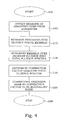
- FIG. 4 A flow diagram of main steps of an embodiment of a method for online detector response correction according to the present invention is shown in Fig. 4 .
- the procedure starts in step 200.
- a medium is irradiated by an incident fluence of ionization radiation modulated into a fluence distribution over some desired field shape.
- a measure of the absorbed dose is obtained in step 210 from the dosimeter exposed to the ionizing radiation.
- precalculated fluence pencil kernels are retrieved from a data storage. More precisely, the radiation quality of current interest is selected from a library of, by Monte Carlo Simulation technique, precalculated fluence pencil kernels for different radiation qualities.
- the precalculated fluence pencil kernels describe fluence response spectra for a point in a medium irradiated by a point monodirectional beam of a specific energy in a surrounding of the beam, per incident amount of radiation.
- the retrieved precalculated fluence pencil kernel is integrated to match the shape and fluence distribution of the incident radiation field in step 214 giving a total fluence spectrum at the point of the detector.
- the total fluence spectra comprises fluence spectra for primary radiation as well as fluence spectra for scattered radiation.
- the ionizing radiation comprises photons and the total fluence spectra comprises spectra for at least scattered photons and secondary charged particles.
- step 216 the correction factor for the material in the detector is calculated from said total fluence spectrum and tabulated material data for the material in the radiation dosimeter.
- the obtained radiation dosimeter value is corrected into an equivalent dose in step 218.
- the correction is made by the correction factor into an equivalent dose as if the radiation dosimeter would have been made by a different medium, e.g. the same medium as the surroundings of the radiation dosimeter.
- An energy deposition kernel is defined as the distribution of energy imparted to a volume element (per unit mass) in a medium, commonly water, from an elemental beam incident at the origin of the coordinates of the kernel.
- a volume element per unit mass
- the irradiated material has to be known and the properties of the material is used for calculation of the kernels.
- An integration over the entire volume and over the energy domain thereby gives a total dose for the entire irradiated area.
- the model used by Ostapiak et al also assumes that secondary radiation effects are neglectable.
- a fluence kernel is instead used to calculate a total fluence spectrum according to the present invention.
- absorption differences between different materials have to be estimated.
- when radiation reaches a medium only a part of the direct radiation is absorbed.
- Another part interacts with the material by different scattering processes giving rise to different kinds of secondary charged particles and/or photon radiation. This secondary radiation can then be absorbed or be scattered again.
- the energy and radiation type distribution has to be known in a point of interest.
- a fluence pencil kernel can be defined as the fluence spectrum in a volume element, per incident energy, in a semi-infinite medium, typically water, due to a point monodirectional ionizing radiation beam incident at the origin of the kernel. Scoring fluence, instead of dose, enables using the kernel to calculate, not only deposited dose, but also the spectral variations and subsequently correction factors by for different detector materials using the same fluence kernel, but choosing the proper material data.
- photon beam radiation can be treated in an analogous manner, e.g. electron radiation, proton radiation or light ion radiation.
- the pencil kernel modeling is described in particular in connection with Fig. 5 .
- the slab has a thickness H and is infinite in its lateral extension.
- the resulting fluence is scored in cylindrical voxels to utilize the circular symmetry to increase the scoring statistical accuracy.
- the total scoring volume is a cylinder of radius R and a height H .
- the cylindrical voxels have a thickness dR and height dH.
- the center voxel has a diameter equal to dR .
- the voxels are numbered from the centermost voxel closest to the source and outwards.
- the medium surrounding the scoring cylinder is divided into three extra voxels, ⁇ ⁇ in z-direction and ⁇ in r-direction.
- the quantity ⁇ E ( E 0 , r , z ) express, per amount of radiant energy incident onto the phantom through the point monodirectional beam of energy E 0 , the fluence at position r , z per energy E of the particles.
- the reciprocity theorem and the superposition principle enables convolution of the fluence pencil kernel by the incident fluence distribution of the radiation field to yield the total fluence at the points of interest.
- Appropriate weights need to be calculated in order to integrate the fluence pencil kernel to arbitrary shaped and fluence modulated fields. An example is demonstrated in Fig. 6 .
- the convolution (2) is implemented to consider beam geometry specifics as inverse square fluence decrease, in accordance with prior art calculations.
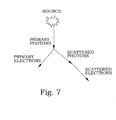
- the simulation of the fluence pencil kernel tallies the primary (p) and scattered (s) photon- (y) and electron- (e - ) fluencies separately.
- the primary photon fluence being produced by the initial photons from the source and the primary electron fluence by the electrons produced directly in interactions by these primary photons in the medium. All the photons that have interacted at least once in the medium contribute to the scattered photon fluence, and the electrons produced in interactions of these scattered photons contribute to the scattered electron fluence.
- the total fluence spectrum is divided into the four categories: the primary photon fluence ⁇ E p , ⁇ , the primary electron fluence ⁇ E p , e - , the scattered photon fluence ⁇ E s , ⁇ , and the scattered electron fluence ⁇ E s , e - as illustrated in Fig 7 .
- Cavity theories relate the dose deposited in a material to the dose deposited in a probe inserted into the material. Cavity theory was developed for ionization chambers where the probe normally is a small gas filled volume. Different theories valid for different cavity sizes have been developed. A cavity's size is related to the characteristic range of the secondary electrons produced inside it. If the range is much larger than the cavity dimension, the cavity is regarded as small and the two Bragg-Gray conditions are fulfilled:
- D TE ⁇ E e - ⁇ S / ⁇ ⁇
- S / p the unrestricted mass-collision stopping power
- ⁇ the cutoff energy
- the Burlin extended the Spencer-Attix theory to cavities of intermediate size by combining it with this large Cavity theory with a mixing factor, ⁇ .
- ⁇ E e - is the electron fluence spectrum
- S ⁇ / ⁇ is the restricted mass-collision stopping power
- ⁇ the cutoff energy above which energy deposition of secondary electrons is excluded
- ⁇ ⁇ e - is the electron fluence spectrum evaluated at the energy ⁇
- S / ⁇ is the unrestricted mass-collision stopping power at same energy
- ⁇ ⁇ E ⁇ the photon fluence spectrum and ⁇ en / ⁇ is the mass attenuation coefficient
- the fluence spectrum from fluence pencil kernels superpositions can be inserted into this theory and correction factors can thus be calculated.
- the fluence spectrum is differentiated in particle type and primary and scattered particles in the Monte Carlo simulation.
- Correction factors relate the signal measured with a dosimeter to the absorbed dose into the material the detector is probing. This will depend on the dosimeter and the beam quality.
- M Q is the reading from the dosimeter
- N D,w,Q 0 the calibration factor of the dosimeter in water for the beam reference quality
- Q 0 the chamber-specific factor to correlate the difference between the reference beam Q 0 and the actual quality, Q being used.
- k Q,Q 0 is tabulated for different chamber types and beam qualities (specified by the TPR 20/10 ).
- correction factors are obtained from the simulated fluence pencil kernels by assuming that the fluence spectra incident onto a detector-volume will be the same as the calculated fluence spectra onto a corresponding volume in water. The correction factors can then be calculated directly for different detector materials using equation (10).
Landscapes
- Health & Medical Sciences (AREA)
- Life Sciences & Earth Sciences (AREA)
- Physics & Mathematics (AREA)
- General Physics & Mathematics (AREA)
- High Energy & Nuclear Physics (AREA)
- Molecular Biology (AREA)
- Spectroscopy & Molecular Physics (AREA)
- Biomedical Technology (AREA)
- Engineering & Computer Science (AREA)
- Pathology (AREA)
- Nuclear Medicine, Radiotherapy & Molecular Imaging (AREA)
- Radiology & Medical Imaging (AREA)
- Animal Behavior & Ethology (AREA)
- General Health & Medical Sciences (AREA)
- Public Health (AREA)
- Veterinary Medicine (AREA)
- Radiation-Therapy Devices (AREA)
- Measurement Of Radiation (AREA)
Claims (15)
- Verfahren zur Korrektur des Ansprechvermögens eines Detektors, welches die folgenden Schritte umfasst:Erhalten (210) eines Maßes einer absorbierten Dosis von einem Strahlungsdosimeter (14), das einer ionisierenden Strahlung (12) ausgesetzt ist;Korrigieren (218) des Maßes der absorbierten Dosis mit einem Korrekturfaktor zu einer äquivalenten Dosis, als ob das Strahlungsdosimeter (14) aus dem gleichen Medium wie die Umgebung des Strahlungsdosimeters hergestellt wäre,welches die folgenden Schritte umfasst:Abrufen (212) vorausberechneter Fluenz-Pencil-Kernel aus einem Datenspeicher (48);wobei die vorausberechneten Fluenz-Pencil-Kernel Fluenz-Antwortspektren für einen Punkt in einem Medium, das mit einem monodirektionalen, punktförmigen Strahl einer bestimmten Energie bestrahlt wird, in einer Umgebung des Strahls pro einfallender Strahlungsmenge beschreiben;Integrieren (214) der abgerufenen, vorausberechneten Fluenz-Pencil-Kernel über eine einfallende Fluenz der ionisierenden Strahlung (12) zu Gesamt-Fluenzspektren;wobei die Gesamt-Fluenzspektren Fluenzspektren für Primärstrahlung sowie Fluenzspektren für Streustrahlung umfassen; undBestimmen (216) des Korrekturfaktors für das Strahlungsdosimeter (14), basierend auf einem lokalen Gesamt-Fluenzspektrum in dem Punkt und einem Medium des Strahlungsdosimeters (14).
- Verfahren nach Anspruch 1, dadurch gekennzeichnet, dass die vorausberechneten Fluenz-Pencil-Kernel aus Monte-Carlo-Simulationen erhalten werden.
- Verfahren nach Anspruch 2, dadurch gekennzeichnet, dass die vorausberechneten Fluenz-Pencil-Kernel in zylindrischen Voxeln bewertet werden.
- Verfahren nach einem der Ansprüche 1 bis 3, dadurch gekennzeichnet, dass der Schritt des Bestimmens der Korrekturfaktoren auf der Hohlraumtheorie basiert.
- Verfahren nach einem der Ansprüche 1 bis 4, dadurch gekennzeichnet, dass der Schritt des Abrufens vorausberechnete Fluenz-Pencil-Kernel abruft, die für Energien und Teilchenarten erhalten werden, welche in der ionisierenden Strahlung (12) verwendet werden.
- Verfahren nach einem der Ansprüche 1 bis 5, dadurch gekennzeichnet, dass der Schritt des Abrufens vorausberechnete Fluenz-Pencil-Kernel abruft, die für das umgebende Medium erhalten werden.
- Verfahren nach einem der Ansprüche 1 bis 6, dadurch gekennzeichnet, dass die Gesamt-Fluenzspektren Fluenzspektren für eine bestimmte Feldform und Fluenzverteilung der ionisierenden Strahlung (12) und für eine bestimmte Position im Raum relativ zu der Feldform umfassen.
- Verfahren nach einem der Ansprüche 1 bis 7, dadurch gekennzeichnet, dass die ionisierende Strahlung (12) wenigstens eines aus:Photonen;Elektronen;Protonen; undleichten Ionen umfasst.
- Verfahren nach einem der Ansprüche 1 bis 8, dadurch gekennzeichnet, dass die ionisierende Strahlung (12) Photonen umfasst und die Gesamt-Fluenzspektren Spektren wenigstens für gestreute Photonen und geladene Sekundärteilchen umfassen.
- Verfahren nach einem der Ansprüche 1 bis 9, dadurch gekennzeichnet, dass das Verfahren in vitro durchgeführt wird.
- Verfahren nach einem der Ansprüche 1 bis 10, dadurch gekennzeichnet, dass das andere Medium das gleiche Medium ist wie die Umgebung des Strahlungsdosimeters (14).
- Anordnung zur Korrektur des Ansprechvermögens eines Detektors (40), welche Folgendes umfasst:Eingabeeinrichtung (42) zum Erhalten eines Maßes einer absorbierten Dosis von einem Strahlungsdosimeter (14), das einer ionisierenden Strahlung (12) ausgesetzt ist;Prozessoreinrichtung (44), angeordnet zum Korrigieren des Maßes der absorbierten Dosis mit einem Korrekturfaktor zu einer äquivalenten absorbierten Dosis, als ob das Strahlungsdosimeter (14) aus dem gleichen Medium wie die Umgebung des Strahlungsdosimeters hergestellt wäre; undAusgabeeinrichtung (46) zum Präsentieren der äquivalenten absorbierten Dosis, Datenspeicher (48), angeordnet zum Speichern vorausberechneter Fluenz-Pencil-Kernel;wobei die vorausberechneten Fluenz-Pencil-Kernel Fluenz-Antwortspektren für einen Punkt in einem Medium, das mit einem monodirektionalen, punktförmigen Strahl einer bestimmten Energie bestrahlt wird, in einer Umgebung des Strahls pro einfallender Strahlungsmenge beschreiben;wobei die Prozessoreinrichtung (44) ferner zum Abrufen der vorausberechneten Fluenz-Pencil-Kernel angeordnet ist;wobei die Prozessoreinrichtung (44) ferner zum Integrieren der abgerufenen, vorausberechneten Fluenz-Pencil-Kernel über eine einfallende Fluenz der ionisierenden Strahlung zu Gesamt-Fluenzspektren angeordnet ist;wobei die Gesamt-Fluenzspektren Fluenzspektren für Primärstrahlung sowie Fluenzspektren für Streustrahlung umfassen; undwobei die Prozessoreinrichtung (44) ferner zum Bestimmen des Korrekturfaktors für das Strahlungsdosimeter (14) basierend auf einem lokalen Gesamt-Fluenzspektrum in dem Punkt und einem Medium des Strahlungsdosimeters (14) angeordnet ist.
- Anordnung nach Anspruch 12, dadurch gekennzeichnet, dass die ionisierende Strahlung (12) Photonen umfasst und die Gesamt-Fluenzspektren Spektren wenigstens für gestreute Photonen und geladene Sekundärteilchen umfassen.
- Anordnung nach Anspruch 12 oder 13, dadurch gekennzeichnet, dass das andere Medium das gleiche Medium wie die Umgebung des Strahlungsdosimeters (14) ist.
- Bestrahlungsvorrichtung (1), welche Folgendes umfasst:ein Strahlungsdosimeter (14); undeine Strahlungsquelle (10), angeordnet, um das Strahlungsdosimeter (14) ionisierender Strahlung (12) auszusetzen,gekennzeichnet durcheine Anordnung zur Korrektur des Ansprechvermögens eines Detektors (40) nach einem der Ansprüche 12 bis 14.
Applications Claiming Priority (2)
| Application Number | Priority Date | Filing Date | Title |
|---|---|---|---|
| SE0600995A SE530825C2 (sv) | 2006-05-04 | 2006-05-04 | Metod och anordning för bestämning av en korrektionsfaktor för en strålningsdosimeter genom integrering av bidrag från förberäknade fluensspektra |
| PCT/EP2007/054184 WO2007128718A1 (en) | 2006-05-04 | 2007-04-27 | Detector response modeling |
Publications (2)
| Publication Number | Publication Date |
|---|---|
| EP2016444A1 EP2016444A1 (de) | 2009-01-21 |
| EP2016444B1 true EP2016444B1 (de) | 2015-04-08 |
Family
ID=38458168
Family Applications (1)
| Application Number | Title | Priority Date | Filing Date |
|---|---|---|---|
| EP07728638.3A Active EP2016444B1 (de) | 2006-05-04 | 2007-04-27 | Modellierung des detektoransprechverhaltens |
Country Status (4)
| Country | Link |
|---|---|
| US (1) | US8053736B2 (de) |
| EP (1) | EP2016444B1 (de) |
| SE (1) | SE530825C2 (de) |
| WO (1) | WO2007128718A1 (de) |
Families Citing this family (24)
| Publication number | Priority date | Publication date | Assignee | Title |
|---|---|---|---|---|
| DE102009018545A1 (de) * | 2009-04-24 | 2010-11-04 | Gsi Helmholtzzentrum Für Schwerionenforschung Gmbh | Verfahren zur Bestrahlung eines Zielvolumens |
| DE102009055902B4 (de) * | 2009-11-26 | 2013-02-21 | Gsi Helmholtzzentrum Für Schwerionenforschung Gmbh | Verfahren und Vorrichtung zur Steuerung der Dosisapplikation bei der Bestrahlung |
| CN101968369B (zh) * | 2010-08-31 | 2012-09-12 | 哈尔滨工业大学 | 基于b样条和扩展卡尔曼滤波的多功能传感器信号重构方法及多功能传感器的标定方法 |
| EP3524159B1 (de) * | 2010-12-08 | 2021-01-20 | Bayer Healthcare LLC | Erzeugung eines geeigneten modells zur messung der an einen patienten abgegebenen strahlungsdosis während scans zur medizinischen bildgebung |
| CN102221373B (zh) * | 2011-03-25 | 2013-02-06 | 哈尔滨工业大学 | 基于自由节点递推b样条的传感器非线性补偿方法 |
| US20130304409A1 (en) * | 2012-05-10 | 2013-11-14 | Board Of Regents, The University Of Texas System | Methods for validating plastic scintillating detectors and applications of same |
| US9586060B2 (en) * | 2012-05-29 | 2017-03-07 | The Royal Institution For The Advancement Of Learning/Mcgill University | Method and system for calorimetry probe |
| US10099067B2 (en) | 2014-12-19 | 2018-10-16 | Sun Nuclear Corporation | Radiation therapy dose calculation |
| US10617891B2 (en) | 2015-04-23 | 2020-04-14 | Sun Nuclear Corporation | Radiation detector calibration |
| US20170348547A1 (en) * | 2016-05-27 | 2017-12-07 | W. Davis Lee | Ion beam kinetic energy dissipater apparatus and method of use thereof |
| CN106199671B (zh) * | 2016-06-24 | 2019-03-01 | 北京华泰诺安探测技术有限公司 | 一种核辐射剂量率的测量处理方法及核辐射检测设备 |
| WO2018023049A1 (en) | 2016-07-28 | 2018-02-01 | Sun Nuclear Corporation | Beam angle direction determination |
| US11623107B2 (en) | 2016-10-20 | 2023-04-11 | William Beaumont Hospital | Particle arc therapy |
| US10918888B2 (en) | 2017-02-28 | 2021-02-16 | Sun Nuclear Corporation | Radiation therapy treatment verification with electronic portal imaging device transit images |
| CN108415058A (zh) * | 2018-01-23 | 2018-08-17 | 深圳市旭东数字医学影像技术有限公司 | 放射线的剂量计算方法及系统 |
| US11278744B2 (en) | 2018-09-28 | 2022-03-22 | Sun Nuclear Corporation | Systems and methods to account for tilt of a radiation measurement system |
| CN109765604B (zh) * | 2019-01-30 | 2021-06-11 | 清华大学 | 场所伽玛剂量仪现场校准的环境散射校正方法及系统 |
| US11600004B2 (en) | 2019-07-10 | 2023-03-07 | Sun Nuclear Corporation | Image-based radiation therapy quality assurance |
| WO2021007459A1 (en) | 2019-07-10 | 2021-01-14 | Sun Nuclear Corporation | Scintillator-based radiation therapy quality assurance |
| US12011616B2 (en) | 2019-07-10 | 2024-06-18 | Sun Nuclear Corporation | Image-based radiation therapy quality assurance |
| CN114613454B (zh) * | 2022-02-25 | 2024-06-21 | 西北核技术研究所 | 一种热释光剂量计的带电粒子平衡体设计方法 |
| US12201850B2 (en) | 2022-06-16 | 2025-01-21 | Sun Nuclear Corporation | High dose rate radiation therapy systems and dosimetry |
| CN115856992B (zh) * | 2022-12-08 | 2025-11-25 | 中国原子能科学研究院 | γ能注量谱的修正方法、存储介质、修正装置及修正系统 |
| US12544596B2 (en) | 2023-03-30 | 2026-02-10 | Sun Nuclear Corporation | Adjustable radiation detector support |
Family Cites Families (3)
| Publication number | Priority date | Publication date | Assignee | Title |
|---|---|---|---|---|
| DE602004022964D1 (de) * | 2004-12-23 | 2009-10-15 | Nucletron Bv | Verfahren und Vorrichtung zur Berechnung der Strahlendosisverteilung für ein Strahlentherapiesystem |
| US8000435B2 (en) * | 2006-06-22 | 2011-08-16 | Koninklijke Philips Electronics N.V. | Method and system for error compensation |
| US7519150B2 (en) * | 2006-07-26 | 2009-04-14 | Best Medical International, Inc. | System for enhancing intensity modulated radiation therapy, program product, and related methods |
-
2006
- 2006-05-04 SE SE0600995A patent/SE530825C2/sv unknown
-
2007
- 2007-04-27 EP EP07728638.3A patent/EP2016444B1/de active Active
- 2007-04-27 WO PCT/EP2007/054184 patent/WO2007128718A1/en not_active Ceased
- 2007-04-27 US US12/299,526 patent/US8053736B2/en active Active
Also Published As
| Publication number | Publication date |
|---|---|
| SE530825C2 (sv) | 2008-09-23 |
| EP2016444A1 (de) | 2009-01-21 |
| US20090090870A1 (en) | 2009-04-09 |
| WO2007128718A1 (en) | 2007-11-15 |
| SE0600995L (nl) | 2007-11-05 |
| US8053736B2 (en) | 2011-11-08 |
Similar Documents
| Publication | Publication Date | Title |
|---|---|---|
| EP2016444B1 (de) | Modellierung des detektoransprechverhaltens | |
| Laub et al. | The volume effect of detectors in the dosimetry of small fields used in IMRT | |
| Haryanto et al. | Investigation of photon beam output factors for conformal radiation therapy—Monte Carlo simulations and measurements | |
| Scott et al. | Monte Carlo modeling of small photon fields: quantifying the impact of focal spot size on source occlusion and output factors, and exploring miniphantom design for small‐field measurements | |
| Engelsman et al. | Impact of simple tissue inhomogeneity correction algorithms on conformal radiotherapy of lung tumours | |
| Esthappan et al. | Dosimetry of therapeutic photon beams using an extended dose range film | |
| Bouchard et al. | Ionization chamber gradient effects in nonstandard beam configurations | |
| Opp et al. | Validation of measurement‐guided 3D VMAT dose reconstruction on a heterogeneous anthropomorphic phantom | |
| Childress et al. | Effect of processing time delay on the dose response of Kodak EDR2 film | |
| Hermida‐López | Calculation of dose distributions for 12 106Ru/106Rh ophthalmic applicator models with the PENELOPE Monte Carlo code | |
| Carnicer et al. | Study of the secondary neutral radiation in proton therapy: toward an indirect in vivo dosimetry | |
| Podgorsak | External photon beams: Physical aspects | |
| Aima et al. | Dosimetric characterization of a new directional low‐dose rate brachytherapy source | |
| Heilemann et al. | Multidimensional dosimetry of 106Ru eye plaques using EBT3 films and its impact on treatment planning | |
| Miljanić et al. | Out-of-field dose measurements in radiotherapy–An overview of activity of EURADOS Working Group 9: Radiation protection in medicine | |
| Mijnheer | EPID-based dosimetry and its relation to other 2D and 3D dose measurement techniques in radiation therapy | |
| Weber et al. | Build-up cap materials for measurement of photon head-scatter factors | |
| Samuelsson et al. | Dose accuracy check of the 3D electron beam algorithm in a treatment planning system | |
| Wieslander et al. | A virtual linear accelerator for verification of treatment planning systems | |
| Fogliata et al. | Collimator scatter factor: Monte Carlo and in-air measurements approaches | |
| Yewondwossen | Characterization and use of a 2D-array of ion chambers for brachytherapy dosimetric quality assurance | |
| Mobit et al. | Response of LiF-TLD micro-rods around 125I radioactive seed | |
| Klimanov et al. | Monte‐Carlo calculation of output correction factors for ionization chambers, solid‐state detectors, and EBT3 film in small fields of high‐energy photons | |
| Trnka et al. | MCNP‐based computational model for the Leksell Gamma Knife | |
| Sikora et al. | Virtual source modelling of photon beams for Monte Carlo based radiation therapy treatment planning |
Legal Events
| Date | Code | Title | Description |
|---|---|---|---|
| PUAI | Public reference made under article 153(3) epc to a published international application that has entered the european phase |
Free format text: ORIGINAL CODE: 0009012 |
|
| 17P | Request for examination filed |
Effective date: 20081204 |
|
| AK | Designated contracting states |
Kind code of ref document: A1 Designated state(s): AT BE BG CH CY CZ DE DK EE ES FI FR GB GR HU IE IS IT LI LT LU LV MC MT NL PL PT RO SE SI SK TR |
|
| AX | Request for extension of the european patent |
Extension state: AL BA HR MK RS |
|
| RAP1 | Party data changed (applicant data changed or rights of an application transferred) |
Owner name: IBA DOSIMETRY AKTIEBOLAG |
|
| RIN1 | Information on inventor provided before grant (corrected) |
Inventor name: GRUSELL, ERIK Inventor name: ROENNQVIST, CAMILLA Inventor name: RIKNER, GOERAN Inventor name: EKLUND, KARIN Inventor name: AHNESJOE, ANDERS |
|
| RAP1 | Party data changed (applicant data changed or rights of an application transferred) |
Owner name: IBA S.A. |
|
| DAX | Request for extension of the european patent (deleted) | ||
| 17Q | First examination report despatched |
Effective date: 20140606 |
|
| GRAP | Despatch of communication of intention to grant a patent |
Free format text: ORIGINAL CODE: EPIDOSNIGR1 |
|
| INTG | Intention to grant announced |
Effective date: 20141202 |
|
| GRAS | Grant fee paid |
Free format text: ORIGINAL CODE: EPIDOSNIGR3 |
|
| GRAA | (expected) grant |
Free format text: ORIGINAL CODE: 0009210 |
|
| RIN1 | Information on inventor provided before grant (corrected) |
Inventor name: GRUSELL, ERIK Inventor name: EKLUND, KARIN Inventor name: AHNESJOE, ANDERS Inventor name: ROENNQVIST, CAMILLA Inventor name: RIKNER, GOERAN |
|
| AK | Designated contracting states |
Kind code of ref document: B1 Designated state(s): AT BE BG CH CY CZ DE DK EE ES FI FR GB GR HU IE IS IT LI LT LU LV MC MT NL PL PT RO SE SI SK TR |
|
| REG | Reference to a national code |
Ref country code: GB Ref legal event code: FG4D |
|
| REG | Reference to a national code |
Ref country code: CH Ref legal event code: EP |
|
| REG | Reference to a national code |
Ref country code: IE Ref legal event code: FG4D |
|
| REG | Reference to a national code |
Ref country code: AT Ref legal event code: REF Ref document number: 720981 Country of ref document: AT Kind code of ref document: T Effective date: 20150515 |
|
| REG | Reference to a national code |
Ref country code: DE Ref legal event code: R096 Ref document number: 602007040960 Country of ref document: DE Effective date: 20150521 |
|
| REG | Reference to a national code |
Ref country code: AT Ref legal event code: MK05 Ref document number: 720981 Country of ref document: AT Kind code of ref document: T Effective date: 20150408 |
|
| REG | Reference to a national code |
Ref country code: NL Ref legal event code: VDEP Effective date: 20150408 |
|
| REG | Reference to a national code |
Ref country code: LT Ref legal event code: MG4D |
|
| PG25 | Lapsed in a contracting state [announced via postgrant information from national office to epo] |
Ref country code: NL Free format text: LAPSE BECAUSE OF FAILURE TO SUBMIT A TRANSLATION OF THE DESCRIPTION OR TO PAY THE FEE WITHIN THE PRESCRIBED TIME-LIMIT Effective date: 20150408 |
|
| PG25 | Lapsed in a contracting state [announced via postgrant information from national office to epo] |
Ref country code: FI Free format text: LAPSE BECAUSE OF FAILURE TO SUBMIT A TRANSLATION OF THE DESCRIPTION OR TO PAY THE FEE WITHIN THE PRESCRIBED TIME-LIMIT Effective date: 20150408 Ref country code: PT Free format text: LAPSE BECAUSE OF FAILURE TO SUBMIT A TRANSLATION OF THE DESCRIPTION OR TO PAY THE FEE WITHIN THE PRESCRIBED TIME-LIMIT Effective date: 20150810 Ref country code: ES Free format text: LAPSE BECAUSE OF FAILURE TO SUBMIT A TRANSLATION OF THE DESCRIPTION OR TO PAY THE FEE WITHIN THE PRESCRIBED TIME-LIMIT Effective date: 20150408 Ref country code: LT Free format text: LAPSE BECAUSE OF FAILURE TO SUBMIT A TRANSLATION OF THE DESCRIPTION OR TO PAY THE FEE WITHIN THE PRESCRIBED TIME-LIMIT Effective date: 20150408 |
|
| PG25 | Lapsed in a contracting state [announced via postgrant information from national office to epo] |
Ref country code: LV Free format text: LAPSE BECAUSE OF FAILURE TO SUBMIT A TRANSLATION OF THE DESCRIPTION OR TO PAY THE FEE WITHIN THE PRESCRIBED TIME-LIMIT Effective date: 20150408 Ref country code: GR Free format text: LAPSE BECAUSE OF FAILURE TO SUBMIT A TRANSLATION OF THE DESCRIPTION OR TO PAY THE FEE WITHIN THE PRESCRIBED TIME-LIMIT Effective date: 20150709 Ref country code: IS Free format text: LAPSE BECAUSE OF FAILURE TO SUBMIT A TRANSLATION OF THE DESCRIPTION OR TO PAY THE FEE WITHIN THE PRESCRIBED TIME-LIMIT Effective date: 20150808 Ref country code: AT Free format text: LAPSE BECAUSE OF FAILURE TO SUBMIT A TRANSLATION OF THE DESCRIPTION OR TO PAY THE FEE WITHIN THE PRESCRIBED TIME-LIMIT Effective date: 20150408 |
|
| REG | Reference to a national code |
Ref country code: CH Ref legal event code: PL |
|
| REG | Reference to a national code |
Ref country code: DE Ref legal event code: R097 Ref document number: 602007040960 Country of ref document: DE |
|
| REG | Reference to a national code |
Ref country code: IE Ref legal event code: MM4A |
|
| PG25 | Lapsed in a contracting state [announced via postgrant information from national office to epo] |
Ref country code: IT Free format text: LAPSE BECAUSE OF FAILURE TO SUBMIT A TRANSLATION OF THE DESCRIPTION OR TO PAY THE FEE WITHIN THE PRESCRIBED TIME-LIMIT Effective date: 20150408 Ref country code: DK Free format text: LAPSE BECAUSE OF FAILURE TO SUBMIT A TRANSLATION OF THE DESCRIPTION OR TO PAY THE FEE WITHIN THE PRESCRIBED TIME-LIMIT Effective date: 20150408 Ref country code: LI Free format text: LAPSE BECAUSE OF NON-PAYMENT OF DUE FEES Effective date: 20150430 Ref country code: EE Free format text: LAPSE BECAUSE OF FAILURE TO SUBMIT A TRANSLATION OF THE DESCRIPTION OR TO PAY THE FEE WITHIN THE PRESCRIBED TIME-LIMIT Effective date: 20150408 Ref country code: MC Free format text: LAPSE BECAUSE OF FAILURE TO SUBMIT A TRANSLATION OF THE DESCRIPTION OR TO PAY THE FEE WITHIN THE PRESCRIBED TIME-LIMIT Effective date: 20150408 Ref country code: CH Free format text: LAPSE BECAUSE OF NON-PAYMENT OF DUE FEES Effective date: 20150430 |
|
| PLBE | No opposition filed within time limit |
Free format text: ORIGINAL CODE: 0009261 |
|
| STAA | Information on the status of an ep patent application or granted ep patent |
Free format text: STATUS: NO OPPOSITION FILED WITHIN TIME LIMIT |
|
| PG25 | Lapsed in a contracting state [announced via postgrant information from national office to epo] |
Ref country code: PL Free format text: LAPSE BECAUSE OF FAILURE TO SUBMIT A TRANSLATION OF THE DESCRIPTION OR TO PAY THE FEE WITHIN THE PRESCRIBED TIME-LIMIT Effective date: 20150408 Ref country code: SK Free format text: LAPSE BECAUSE OF FAILURE TO SUBMIT A TRANSLATION OF THE DESCRIPTION OR TO PAY THE FEE WITHIN THE PRESCRIBED TIME-LIMIT Effective date: 20150408 Ref country code: CZ Free format text: LAPSE BECAUSE OF FAILURE TO SUBMIT A TRANSLATION OF THE DESCRIPTION OR TO PAY THE FEE WITHIN THE PRESCRIBED TIME-LIMIT Effective date: 20150408 Ref country code: RO Free format text: LAPSE BECAUSE OF NON-PAYMENT OF DUE FEES Effective date: 20150408 |
|
| 26N | No opposition filed |
Effective date: 20160111 |
|
| REG | Reference to a national code |
Ref country code: FR Ref legal event code: PLFP Year of fee payment: 10 |
|
| PG25 | Lapsed in a contracting state [announced via postgrant information from national office to epo] |
Ref country code: IE Free format text: LAPSE BECAUSE OF NON-PAYMENT OF DUE FEES Effective date: 20150427 |
|
| PG25 | Lapsed in a contracting state [announced via postgrant information from national office to epo] |
Ref country code: SI Free format text: LAPSE BECAUSE OF FAILURE TO SUBMIT A TRANSLATION OF THE DESCRIPTION OR TO PAY THE FEE WITHIN THE PRESCRIBED TIME-LIMIT Effective date: 20150408 |
|
| PG25 | Lapsed in a contracting state [announced via postgrant information from national office to epo] |
Ref country code: MT Free format text: LAPSE BECAUSE OF FAILURE TO SUBMIT A TRANSLATION OF THE DESCRIPTION OR TO PAY THE FEE WITHIN THE PRESCRIBED TIME-LIMIT Effective date: 20150408 |
|
| REG | Reference to a national code |
Ref country code: FR Ref legal event code: PLFP Year of fee payment: 11 |
|
| PG25 | Lapsed in a contracting state [announced via postgrant information from national office to epo] |
Ref country code: HU Free format text: LAPSE BECAUSE OF FAILURE TO SUBMIT A TRANSLATION OF THE DESCRIPTION OR TO PAY THE FEE WITHIN THE PRESCRIBED TIME-LIMIT; INVALID AB INITIO Effective date: 20070427 Ref country code: BG Free format text: LAPSE BECAUSE OF FAILURE TO SUBMIT A TRANSLATION OF THE DESCRIPTION OR TO PAY THE FEE WITHIN THE PRESCRIBED TIME-LIMIT Effective date: 20150408 |
|
| PG25 | Lapsed in a contracting state [announced via postgrant information from national office to epo] |
Ref country code: CY Free format text: LAPSE BECAUSE OF FAILURE TO SUBMIT A TRANSLATION OF THE DESCRIPTION OR TO PAY THE FEE WITHIN THE PRESCRIBED TIME-LIMIT Effective date: 20150408 Ref country code: SE Free format text: LAPSE BECAUSE OF FAILURE TO SUBMIT A TRANSLATION OF THE DESCRIPTION OR TO PAY THE FEE WITHIN THE PRESCRIBED TIME-LIMIT Effective date: 20150408 |
|
| PG25 | Lapsed in a contracting state [announced via postgrant information from national office to epo] |
Ref country code: TR Free format text: LAPSE BECAUSE OF FAILURE TO SUBMIT A TRANSLATION OF THE DESCRIPTION OR TO PAY THE FEE WITHIN THE PRESCRIBED TIME-LIMIT Effective date: 20150408 |
|
| PG25 | Lapsed in a contracting state [announced via postgrant information from national office to epo] |
Ref country code: LU Free format text: LAPSE BECAUSE OF NON-PAYMENT OF DUE FEES Effective date: 20150427 |
|
| REG | Reference to a national code |
Ref country code: FR Ref legal event code: PLFP Year of fee payment: 12 |
|
| PGFP | Annual fee paid to national office [announced via postgrant information from national office to epo] |
Ref country code: DE Payment date: 20250429 Year of fee payment: 19 |
|
| PGFP | Annual fee paid to national office [announced via postgrant information from national office to epo] |
Ref country code: GB Payment date: 20250428 Year of fee payment: 19 |
|
| PGFP | Annual fee paid to national office [announced via postgrant information from national office to epo] |
Ref country code: BE Payment date: 20250428 Year of fee payment: 19 |
|
| PGFP | Annual fee paid to national office [announced via postgrant information from national office to epo] |
Ref country code: FR Payment date: 20250425 Year of fee payment: 19 |