EP2015791B1 - Bildung einer therapeutischen narbe mit kleinen teilchen - Google Patents
Bildung einer therapeutischen narbe mit kleinen teilchen Download PDFInfo
- Publication number
- EP2015791B1 EP2015791B1 EP07728903A EP07728903A EP2015791B1 EP 2015791 B1 EP2015791 B1 EP 2015791B1 EP 07728903 A EP07728903 A EP 07728903A EP 07728903 A EP07728903 A EP 07728903A EP 2015791 B1 EP2015791 B1 EP 2015791B1
- Authority
- EP
- European Patent Office
- Prior art keywords
- particles
- implant
- delivery device
- inflammatory
- tissue
- Prior art date
- Legal status (The legal status is an assumption and is not a legal conclusion. Google has not performed a legal analysis and makes no representation as to the accuracy of the status listed.)
- Not-in-force
Links
Images
Classifications
-
- A—HUMAN NECESSITIES
- A61—MEDICAL OR VETERINARY SCIENCE; HYGIENE
- A61L—METHODS OR APPARATUS FOR STERILISING MATERIALS OR OBJECTS IN GENERAL; DISINFECTION, STERILISATION OR DEODORISATION OF AIR; CHEMICAL ASPECTS OF BANDAGES, DRESSINGS, ABSORBENT PADS OR SURGICAL ARTICLES; MATERIALS FOR BANDAGES, DRESSINGS, ABSORBENT PADS OR SURGICAL ARTICLES
- A61L31/00—Materials for other surgical articles, e.g. stents, stent-grafts, shunts, surgical drapes, guide wires, materials for adhesion prevention, occluding devices, surgical gloves, tissue fixation devices
- A61L31/14—Materials characterised by their function or physical properties, e.g. injectable or lubricating compositions, shape-memory materials, surface modified materials
-
- A—HUMAN NECESSITIES
- A61—MEDICAL OR VETERINARY SCIENCE; HYGIENE
- A61L—METHODS OR APPARATUS FOR STERILISING MATERIALS OR OBJECTS IN GENERAL; DISINFECTION, STERILISATION OR DEODORISATION OF AIR; CHEMICAL ASPECTS OF BANDAGES, DRESSINGS, ABSORBENT PADS OR SURGICAL ARTICLES; MATERIALS FOR BANDAGES, DRESSINGS, ABSORBENT PADS OR SURGICAL ARTICLES
- A61L27/00—Materials for grafts or prostheses or for coating grafts or prostheses
- A61L27/28—Materials for coating prostheses
- A61L27/30—Inorganic materials
- A61L27/303—Carbon
-
- A—HUMAN NECESSITIES
- A61—MEDICAL OR VETERINARY SCIENCE; HYGIENE
- A61L—METHODS OR APPARATUS FOR STERILISING MATERIALS OR OBJECTS IN GENERAL; DISINFECTION, STERILISATION OR DEODORISATION OF AIR; CHEMICAL ASPECTS OF BANDAGES, DRESSINGS, ABSORBENT PADS OR SURGICAL ARTICLES; MATERIALS FOR BANDAGES, DRESSINGS, ABSORBENT PADS OR SURGICAL ARTICLES
- A61L27/00—Materials for grafts or prostheses or for coating grafts or prostheses
- A61L27/40—Composite materials, i.e. containing one material dispersed in a matrix of the same or different material
- A61L27/44—Composite materials, i.e. containing one material dispersed in a matrix of the same or different material having a macromolecular matrix
-
- A—HUMAN NECESSITIES
- A61—MEDICAL OR VETERINARY SCIENCE; HYGIENE
- A61L—METHODS OR APPARATUS FOR STERILISING MATERIALS OR OBJECTS IN GENERAL; DISINFECTION, STERILISATION OR DEODORISATION OF AIR; CHEMICAL ASPECTS OF BANDAGES, DRESSINGS, ABSORBENT PADS OR SURGICAL ARTICLES; MATERIALS FOR BANDAGES, DRESSINGS, ABSORBENT PADS OR SURGICAL ARTICLES
- A61L27/00—Materials for grafts or prostheses or for coating grafts or prostheses
- A61L27/50—Materials characterised by their function or physical properties, e.g. injectable or lubricating compositions, shape-memory materials, surface modified materials
- A61L27/54—Biologically active materials, e.g. therapeutic substances
-
- A—HUMAN NECESSITIES
- A61—MEDICAL OR VETERINARY SCIENCE; HYGIENE
- A61L—METHODS OR APPARATUS FOR STERILISING MATERIALS OR OBJECTS IN GENERAL; DISINFECTION, STERILISATION OR DEODORISATION OF AIR; CHEMICAL ASPECTS OF BANDAGES, DRESSINGS, ABSORBENT PADS OR SURGICAL ARTICLES; MATERIALS FOR BANDAGES, DRESSINGS, ABSORBENT PADS OR SURGICAL ARTICLES
- A61L27/00—Materials for grafts or prostheses or for coating grafts or prostheses
- A61L27/50—Materials characterised by their function or physical properties, e.g. injectable or lubricating compositions, shape-memory materials, surface modified materials
- A61L27/58—Materials at least partially resorbable by the body
-
- A—HUMAN NECESSITIES
- A61—MEDICAL OR VETERINARY SCIENCE; HYGIENE
- A61L—METHODS OR APPARATUS FOR STERILISING MATERIALS OR OBJECTS IN GENERAL; DISINFECTION, STERILISATION OR DEODORISATION OF AIR; CHEMICAL ASPECTS OF BANDAGES, DRESSINGS, ABSORBENT PADS OR SURGICAL ARTICLES; MATERIALS FOR BANDAGES, DRESSINGS, ABSORBENT PADS OR SURGICAL ARTICLES
- A61L31/00—Materials for other surgical articles, e.g. stents, stent-grafts, shunts, surgical drapes, guide wires, materials for adhesion prevention, occluding devices, surgical gloves, tissue fixation devices
- A61L31/08—Materials for coatings
- A61L31/082—Inorganic materials
- A61L31/088—Other specific inorganic materials not covered by A61L31/084 or A61L31/086
-
- A—HUMAN NECESSITIES
- A61—MEDICAL OR VETERINARY SCIENCE; HYGIENE
- A61L—METHODS OR APPARATUS FOR STERILISING MATERIALS OR OBJECTS IN GENERAL; DISINFECTION, STERILISATION OR DEODORISATION OF AIR; CHEMICAL ASPECTS OF BANDAGES, DRESSINGS, ABSORBENT PADS OR SURGICAL ARTICLES; MATERIALS FOR BANDAGES, DRESSINGS, ABSORBENT PADS OR SURGICAL ARTICLES
- A61L31/00—Materials for other surgical articles, e.g. stents, stent-grafts, shunts, surgical drapes, guide wires, materials for adhesion prevention, occluding devices, surgical gloves, tissue fixation devices
- A61L31/08—Materials for coatings
- A61L31/10—Macromolecular materials
-
- A—HUMAN NECESSITIES
- A61—MEDICAL OR VETERINARY SCIENCE; HYGIENE
- A61L—METHODS OR APPARATUS FOR STERILISING MATERIALS OR OBJECTS IN GENERAL; DISINFECTION, STERILISATION OR DEODORISATION OF AIR; CHEMICAL ASPECTS OF BANDAGES, DRESSINGS, ABSORBENT PADS OR SURGICAL ARTICLES; MATERIALS FOR BANDAGES, DRESSINGS, ABSORBENT PADS OR SURGICAL ARTICLES
- A61L31/00—Materials for other surgical articles, e.g. stents, stent-grafts, shunts, surgical drapes, guide wires, materials for adhesion prevention, occluding devices, surgical gloves, tissue fixation devices
- A61L31/14—Materials characterised by their function or physical properties, e.g. injectable or lubricating compositions, shape-memory materials, surface modified materials
- A61L31/148—Materials at least partially resorbable by the body
-
- A—HUMAN NECESSITIES
- A61—MEDICAL OR VETERINARY SCIENCE; HYGIENE
- A61P—SPECIFIC THERAPEUTIC ACTIVITY OF CHEMICAL COMPOUNDS OR MEDICINAL PREPARATIONS
- A61P9/00—Drugs for disorders of the cardiovascular system
- A61P9/06—Antiarrhythmics
-
- A—HUMAN NECESSITIES
- A61—MEDICAL OR VETERINARY SCIENCE; HYGIENE
- A61L—METHODS OR APPARATUS FOR STERILISING MATERIALS OR OBJECTS IN GENERAL; DISINFECTION, STERILISATION OR DEODORISATION OF AIR; CHEMICAL ASPECTS OF BANDAGES, DRESSINGS, ABSORBENT PADS OR SURGICAL ARTICLES; MATERIALS FOR BANDAGES, DRESSINGS, ABSORBENT PADS OR SURGICAL ARTICLES
- A61L2300/00—Biologically active materials used in bandages, wound dressings, absorbent pads or medical devices
- A61L2300/10—Biologically active materials used in bandages, wound dressings, absorbent pads or medical devices containing or releasing inorganic materials
- A61L2300/102—Metals or metal compounds, e.g. salts such as bicarbonates, carbonates, oxides, zeolites, silicates
-
- A—HUMAN NECESSITIES
- A61—MEDICAL OR VETERINARY SCIENCE; HYGIENE
- A61L—METHODS OR APPARATUS FOR STERILISING MATERIALS OR OBJECTS IN GENERAL; DISINFECTION, STERILISATION OR DEODORISATION OF AIR; CHEMICAL ASPECTS OF BANDAGES, DRESSINGS, ABSORBENT PADS OR SURGICAL ARTICLES; MATERIALS FOR BANDAGES, DRESSINGS, ABSORBENT PADS OR SURGICAL ARTICLES
- A61L2300/00—Biologically active materials used in bandages, wound dressings, absorbent pads or medical devices
- A61L2300/60—Biologically active materials used in bandages, wound dressings, absorbent pads or medical devices characterised by a special physical form
- A61L2300/602—Type of release, e.g. controlled, sustained, slow
-
- A—HUMAN NECESSITIES
- A61—MEDICAL OR VETERINARY SCIENCE; HYGIENE
- A61L—METHODS OR APPARATUS FOR STERILISING MATERIALS OR OBJECTS IN GENERAL; DISINFECTION, STERILISATION OR DEODORISATION OF AIR; CHEMICAL ASPECTS OF BANDAGES, DRESSINGS, ABSORBENT PADS OR SURGICAL ARTICLES; MATERIALS FOR BANDAGES, DRESSINGS, ABSORBENT PADS OR SURGICAL ARTICLES
- A61L2300/00—Biologically active materials used in bandages, wound dressings, absorbent pads or medical devices
- A61L2300/60—Biologically active materials used in bandages, wound dressings, absorbent pads or medical devices characterised by a special physical form
- A61L2300/62—Encapsulated active agents, e.g. emulsified droplets
- A61L2300/622—Microcapsules
-
- A—HUMAN NECESSITIES
- A61—MEDICAL OR VETERINARY SCIENCE; HYGIENE
- A61L—METHODS OR APPARATUS FOR STERILISING MATERIALS OR OBJECTS IN GENERAL; DISINFECTION, STERILISATION OR DEODORISATION OF AIR; CHEMICAL ASPECTS OF BANDAGES, DRESSINGS, ABSORBENT PADS OR SURGICAL ARTICLES; MATERIALS FOR BANDAGES, DRESSINGS, ABSORBENT PADS OR SURGICAL ARTICLES
- A61L2300/00—Biologically active materials used in bandages, wound dressings, absorbent pads or medical devices
- A61L2300/60—Biologically active materials used in bandages, wound dressings, absorbent pads or medical devices characterised by a special physical form
- A61L2300/62—Encapsulated active agents, e.g. emulsified droplets
- A61L2300/624—Nanocapsules
-
- A—HUMAN NECESSITIES
- A61—MEDICAL OR VETERINARY SCIENCE; HYGIENE
- A61L—METHODS OR APPARATUS FOR STERILISING MATERIALS OR OBJECTS IN GENERAL; DISINFECTION, STERILISATION OR DEODORISATION OF AIR; CHEMICAL ASPECTS OF BANDAGES, DRESSINGS, ABSORBENT PADS OR SURGICAL ARTICLES; MATERIALS FOR BANDAGES, DRESSINGS, ABSORBENT PADS OR SURGICAL ARTICLES
- A61L2400/00—Materials characterised by their function or physical properties
- A61L2400/12—Nanosized materials, e.g. nanofibres, nanoparticles, nanowires, nanotubes; Nanostructured surfaces
-
- A—HUMAN NECESSITIES
- A61—MEDICAL OR VETERINARY SCIENCE; HYGIENE
- A61L—METHODS OR APPARATUS FOR STERILISING MATERIALS OR OBJECTS IN GENERAL; DISINFECTION, STERILISATION OR DEODORISATION OF AIR; CHEMICAL ASPECTS OF BANDAGES, DRESSINGS, ABSORBENT PADS OR SURGICAL ARTICLES; MATERIALS FOR BANDAGES, DRESSINGS, ABSORBENT PADS OR SURGICAL ARTICLES
- A61L2400/00—Materials characterised by their function or physical properties
- A61L2400/16—Materials with shape-memory or superelastic properties
-
- A—HUMAN NECESSITIES
- A61—MEDICAL OR VETERINARY SCIENCE; HYGIENE
- A61L—METHODS OR APPARATUS FOR STERILISING MATERIALS OR OBJECTS IN GENERAL; DISINFECTION, STERILISATION OR DEODORISATION OF AIR; CHEMICAL ASPECTS OF BANDAGES, DRESSINGS, ABSORBENT PADS OR SURGICAL ARTICLES; MATERIALS FOR BANDAGES, DRESSINGS, ABSORBENT PADS OR SURGICAL ARTICLES
- A61L2430/00—Materials or treatment for tissue regeneration
- A61L2430/34—Materials or treatment for tissue regeneration for soft tissue reconstruction
Definitions
- This application generally relates to techniques for scarring a desired tissue location in the human body. These techniques can be implemented through devices such as those described in U.S. Patent No. 7,097,643 filed March 2, 2004 ; and U.S. Publication Nos. 2004-0220655 filed March 2, 2004 ; 2006-0116666 filed October 7, 2005 ; and 2004-0254597 filed April 30, 2004 , in addition to the specified applications below, and in other possible delivery modes as described in this specification.
- a catheter based inflatable balloon is described on to which a microparticle coating comprising of metals such as iron or copper is placed.
- the microparticles in this disclosure are conceived to induce the formation of a thrombosis, with subsequent invasion by capillaries and fibroblasts and scar tissue formation.
- WO2006/042246A teaches a method and apparatus of causing deep scar formation, using degradable spheres which are coated and/or encapsulate a drug, alkylating agent, an antibiotic, biodegradable polymer, or other material such as metallic copper or copper containing compounds being embedded in a biodegradeable matrix.
- this scar generation may be used for treatment of heart arrhythmias such as atrial fibrillation or treatment of certain cancers.
- one such device creates scar tissue around the pulmonary vein ostium for treatment of atrial fibrillation. This ring of scar tissue stops transmission of electrical potentials from the pulmonary vein to the atrial tissue, thereby reducing or stopping arrhythmia.
- transmural lesions in the pulmonary vein can be performed using a balloon catheter which utilizes titanium or aluminium oxide particles to scatter visible or near-infrared radiation.
- the particles were bound permanently to the implant and should therefore not be released into the targeted tissue.
- the prior art describes different mechanisms for producing therapeutic scarring, such as mechanical pressure, energy ablation, inflammatory materials, ablative drugs and combinations thereof.
- transmural scarring In some clinical applications, such as for electrical isolation of the pulmonary veins, it is important for the scar to extend through the full thickness of the tissue wall ("transmural" scarring) to yield the desired electrical isolation.
- prior art mechanisms may not achieve this transmural or deep tissue scarring necessary for some procedures (e.g., arrhythmia treatments). Hence, an improved method or apparatus for achieving such scarring would be advantageous.
- embodiments of the present invention preferably seek to mitigate, alleviate or eliminate one or more deficiencies, disadvantages or issues in the art, such as the above-identified, singly or in any combination by providing a method and apparatus according to the appended patent claims.
- One aspect of the present invention describes the use of small particles, such as micro particles or nanoparticles, to produce a therapeutic scar such as "trans-mural" scarring or other desired “deep tissue” scarring.
- these particles may be delivered to a target location by an implant. More specifically, these particles may be incorporated into the structure of implants or into the coatings on implants. In other preferred embodiments, these particles may directly be delivered by electrophoresis or hydraulic injection into the target tissue.
- a method of generating a substantially transmural scar in mammalian tissue comprises providing a plurality of particles, the particles sized for causing an inflammatory response in the mammalian tissue; introducing the particles into the mammalian tissue; causing the particles to disburse substantially into a thickness of the mammalian tissue; allowing the particles to inflame the tissue until a substantially transmural scar is generated in the mammalian tissue.
- an apparatus for causing a substantially transmural scar in body tissue comprises a plurality of particles; a delivery device for introducing said particles to said body tissue; a mechanism for disbursing said particles substantially through a thickness of said body tissue; wherein said particles are sufficiently sized to cause a substantially transmural scar in said body tissue.
- One aspect of this invention relates to how the body handles different sizes of foreign materials.
- the body can handle perceived foreign materials in two ways. If the foreign material is relatively large, the body will respond by attempting to isolate the foreign material from the body by encasing it in scar tissue. This occurs with an inflammatory response around the surface of the foreign material which heals into an encasing layer of scar. If the foreign material is smaller, for example on the scale of a cell, the body will respond by trying to absorb and digest or "eat" the foreign material, as it does with virus.
- This latter response may be used for treatment purposes by introducing materials which are at or below the size of cells, such as microparticles or nanoparticles.
- these particles When delivered to a desired target location, for example by way of implants or coatings on implants, these particles are believed to promote scarring through macrophage/phagocytosis activation, often causing cell death of macrophages that attempt "digestion".
- the death of these macrophage cells may result in inflammation deeper in the wall of the tissue from where the foreign material was originally deposited.
- the inflammatory response is not limited to the identified foreign body, but also to the surrounding tissue. Phagocytosis and fibrosis (scarring) are concurrent inflammatory response which cause a deeper tissue scarring effect.
- the macrophage cell may transport the foreign material deeper into the tissue and thereby further increase the depth of the inflammatory response.
- the end result of this reaction is deeper and more aggressive scar generation which may be synergistically used with other scarring techniques (e.g., tissue cutting).
- nanofibers such as asbestos or carbon nanotubes are known to cause intensive and potential uncontrolled inflammatory response. They offer a very high surface area which is believed to be the cause for the identification as a foreign substance. Further, due to agglomeration, these materials can be difficult to be cleared by phagocytosis. Clay-like materials can offer the beneficial aspect ratio of fiber-like substances but due to their natural surface charge they separate in aqueous solutions and can be cleared by phagocytosis. This kind of additive is beneficial in order to create a controlled inflammatory response. In general, particle sizes greater than 1 ⁇ m can be difficult to be cleared by phagocytosis and in this example, signal substances are transmitted from phagocytes in order to stimulate more intensive fibrosis (scar generation) and phagocytosis.
- scar generation intensive fibrosis
- the amount of adsorption that is often key for the foreign body identification is dependent, at least in part, on surface area, surface charge and dispersive surface effects.
- positive charged surfaces are less biocompatible due to effective adsorption of negatively charged body fluid contents.
- Most metal oxides and ceramic surfaces offer a more biocompatible surface due to their natural negative surface charge.
- Materials with a very low surface polarity and charge, such as PE and PTFE which are known to be highly biocompatible.
- a further example factor that may influence the biological response is radiation. It is well known that radiation can directly cause cell death/necrosis. Therefore the use of radioactive particles may lead to long term identification as a foreign body.
- Yet another example factor that may influence the biological response of the body is the use of enzymes, either as "foreign" particles or in addition to particles.
- enzymes During an inflammatory reaction, the body requires increased amounts of fibrin, plasmin, thrombin and kinins.
- the primary response to inflammation is through the immune system and its increased use of enzymes in order to support these raw materials. Localized deficiencies of enzymes can prolong inflammation and delay healing. Oral use of proteolytic enzymes may reduce healing times by up to 50 percent.
- amylases and lipases also play a role in the inflammatory response. Each contributes in specific functions to assist the inflammatory responses. These enzymes can be gathered from several sources and concentrated for supplemental use.
- pancreatin The use of fungal enzymes typically function in a broader pH range than those taken from beef and pork (so-called pancreatin). An important consideration may be that there are specific pH changes in tissue during inflammation so that the affected tissue comes either more alkaline or more acidic than normal. Plant enzymes have a broader range of substrates that can be used. Further, digestive enzymes from the pancrease (e.g., collagenases and proteases) are selective in the bonds they can hydrolyze and therefore digest.
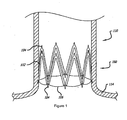
- Figure 1 illustrates an embodiment of a self expanding mechanical implant 100 according to the present invention located near an ostium 114 of a pulmonary vein 110.
- the implant includes a plurality of struts 102 that are configured to exert a mechanical pressure against the desired target tissue.
- the peaks where each strut 102 connects to the next strut 102 includes an anchoring barb 104 which is shaped to pierce the target tissue and therefore provide anchoring support to the implant 100.
- the implant 100 optionally includes a wire 106 that is fixed to the peak of the struts 102 on one end of the implant 100 for creating a narrow band of pressure on the target tissue.
- the implant 100 is further coated with a biodegradable polymer such as 50/50 PLGA loaded with 50% by weight of 2 micron copper particles.
- a biodegradable polymer such as 50/50 PLGA loaded with 50% by weight of 2 micron copper particles.
- the 50/50 PLGA will have largely or completely degraded after 30 days thereby freeing the 2 micron particles to direct exposure to the tissue. After 30 days there will be significantly more inflammation around the implant than would be possible with no coating, only a PLGA coating or even only a solid copper plating. Further, this inflammation caused by the implant 100 will extend much deeper into the tissue wall than for copper plated devices.
- inflammation from the implant 100 resolves into a scar yielding the desired deeper scarring from the deeper inflammation generated by the small particle copper loaded coating. It is believed that the body's digestive immune response (phagocytosis) to the foreign material occurs with particles that are as large as 10-20 microns and be fully evident as the particle size reduces to 5 micron or less. Further, an inflammation response is also possible with the use of even smaller particles such as nanoparticles. Additional information about nanoparticles can be found in Nanotechnology: A Brief Literature Review by M. Ellin Doyle, Ph.D., June 2006 University of Wiscons in FRI Briefings and in Industrial Application of Nanomaterials - Chances and Risks, Wolfgang Luther (ed.), VDI Technologietician GmbH.
- This previously described principal i.e., a bodily immune response to small particles
- the total amount of the inflammatory particles introduced may be varied through control of the coating thickness or the percent weight loading of the particles in coating. In this respect, the thickness of scar generation may be adjusted to achieve a desired result.
- the inflammatory particles may be incorporated to be released in predetermined quantities over a period of time.
- inflammatory materials may be filled, coumpounded or otherwise incorporated into additional materials that degrade within the body after predetermined times, thereby delaying inflammatory reactions after implantation.
- time release techniques may be used to release constant amounts of inflammatory materials over an extended period of time or provide multiple "spikes" of inflammatory material at predetermined times after delivery of a device within a patient.
- the scar generating material may be a drug such as Actinomycin, FUDR or Vinblastin as examples.
- these drugs can be encapsulated in biodegradable micro-spheres having diameters of less than about 5 microns made of materials such as, but not limited to, PLGA, PLA, Polyanhydride, or chitosan.
- the micro-sphere material may also be made of a durable material which allows diffusion of the encapsulated drug. These micro-spheres may then be coated directly to the surface of an implant or adhered to the implant with a binder material.
- this embodiment allows the micro-spheres to diffuse or to be carried by macrophages deeper into the tissue before delivering the encapsulated drug or material.
- this technique may achieve deeper scarring as compared to direct delivery.
- the encapsulated drug itself i.e., not just the size of the drug particle
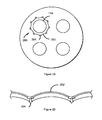
- FIGs 2A and 2B illustrate another embodiment of an implant 200 that delivers inflammatory particles via a strand 202 made with a biodegradable polymer matrix.
- the strand 202 is connected to a plurality of staples 204.
- the staples 204 are punctured into the tissue, fastening the strand 202 against the target tissue.
- Further details of this implant and example delivery systems can be seen in U.S. Patent No. 7,097,643 filed March 2, 2004 , (e.g. figures 21 a and 21 b) and U.S. Publication No. 2004-0220655, filed March 2, 2004 fig. 21.
- the delivery device feeds out lengths of the particle loaded strand 202 with staples 204 attached at intervals along the length (e.g., every 5 millimeters).
- the steerable delivery catheter may be maneuvered over the desired path of scar generation, leaving behind a line of the particle containing strand 202.
- This path may be visualized during the procedure using either radioopaque markers incorporated into the staples 204 or radioopaque loading of the strand material.
- the staples of the previously described embodiment are formed of a superelastic and/or shape memory material, such as a polymer or metal, for instance Nitinol, in an open ring shape with the ends being in close proximity to each other (e.g., a "C" shape).
- a superelastic and/or shape memory material such as a polymer or metal, for instance Nitinol
- the ends of the staples are flexed apart and are pressed against the tissue by the tip of the catheter. In this way, when the staple is released, the ends spring back together and embed in the tissue at the targeted site. This anchors the strand to the tissue at this point.
- another mechanism of adhering the strand to the tissue surface is a bio-adhesive.
- inflammatory particles may be released from materials such as filled degradable polymers, crystallites of degradable semi crystalline plastics, contents of plastic blends, copolymers, fiber containing materials, and carbon fibers.
- materials such as filled degradable polymers, crystallites of degradable semi crystalline plastics, contents of plastic blends, copolymers, fiber containing materials, and carbon fibers.
- degradable ceramics or degradable metals may be used instead of a matrix based on degradable polymers.
- the particles may be delivered directly into the tissue at the targeted site without any additional implant using direct injection of the particles. This may be performed using the technique of electrophoresis on a charged particles surface or particle coating to enable the electrophoreretic delivery.
- An electrode at the end of the catheter drives the particles away from the catheter tip and into the tissue when the electrode is polarized. This basic technology is well known and examples are shown in patents 4,411,648 ; 5,807,306 ; 5,704,908 ; and 6,219,577 .
- the direct delivery of the particles (e.g., microparticles or nanoparticles) into the tissue may also be accomplished using hydraulic pressure for particle injection.
- This technique is also a commonly known method, whereby the particles are injected using fluid pressure either through micro-needle(s) or nozzle(s) at the tip of the catheter or around the circumference of a centering device, for example placed in the ostium of the pulmonary vein. Examples of devices to enable this type of delivery are shown in patents 5,306,250 ; 5,538,504 ; or 6,254,573 .
- carbon fibers may be used to cause inflammation and enhance the modulus of composites (e.g., by enhancing the forces provided by a mechanical implant).
- the carbon fibers may be incorporated into a resorbable matrix, thereby offering a high surface area that can be identified as a foreign body.
- the inflammatory reaction of carbon fibers has been described in some literature as "low and not critical". However, using, for example, textile fiber finishing methods or plasma treatment, the surface charge and polarity may be modified. Thus, due to their mechanical reinforcement and low inflammatory reaction, carbon fibers may synergistically compliment the effects of traditional scar generating techniques (e.g., cutting or pressure).
Landscapes
- Health & Medical Sciences (AREA)
- Chemical & Material Sciences (AREA)
- Life Sciences & Earth Sciences (AREA)
- Veterinary Medicine (AREA)
- Public Health (AREA)
- General Health & Medical Sciences (AREA)
- Animal Behavior & Ethology (AREA)
- Epidemiology (AREA)
- Medicinal Chemistry (AREA)
- Heart & Thoracic Surgery (AREA)
- Surgery (AREA)
- Inorganic Chemistry (AREA)
- Vascular Medicine (AREA)
- Transplantation (AREA)
- Oral & Maxillofacial Surgery (AREA)
- Dermatology (AREA)
- Engineering & Computer Science (AREA)
- Materials Engineering (AREA)
- Biomedical Technology (AREA)
- Composite Materials (AREA)
- Molecular Biology (AREA)
- General Chemical & Material Sciences (AREA)
- Pharmacology & Pharmacy (AREA)
- Organic Chemistry (AREA)
- Bioinformatics & Cheminformatics (AREA)
- Chemical Kinetics & Catalysis (AREA)
- Cardiology (AREA)
- Nuclear Medicine, Radiotherapy & Molecular Imaging (AREA)
- Materials For Medical Uses (AREA)
- Medicinal Preparation (AREA)
- Pharmaceuticals Containing Other Organic And Inorganic Compounds (AREA)
- Surgical Instruments (AREA)
- Prostheses (AREA)
Claims (15)
- Gerät, das zur Bildung einer gewünschten transmuralen Narbe in einem Körpergewebe angepasst ist, wobei das Gerät umfasst:eine Vielzahl von Teilchen;ein Zuführgerät, das für die Einführung der Teilchen in das Körpergewebe konfiguriert ist;einen Mechanismus zur Ausgabe der Teilchen durch eine Dicke des Körpergewebes,wobei diese Teilchen so angepasst sind, dass sie transmurale Narbe in dem Körpergewebe bilden, wobei die Teilchen ein Größe von weniger als 20 Mikron aufweisen.
- Gerät gemäß Anspruch 1, wobei es sich bei den Teilchen um inflammatorische Teilchen handelt, und wobei eine Gesamtmenge der inflammatorischen Teilchen durch die Dicke einer Beschichtung des Zuführgerätes oder die prozentuale Gewichtsbelastung der inflammatorischen Teilchen in der Beschichtung reguliert wird, so dass eine Zieldicke der Narbenbildung eingestellt werden kann.
- Gerät gemäß Anspruch 1, wobei es sich bei den Teilchen um inflammatorische Teilchen handelt, die in dem Zuführgerät integriert sind, so dass sie in zuvor festgelegt Mengen über einen Zeitraum hinweg freigesetzt werden können; oder wobei es sich bei den Teilchen um inflammatorische Teilchen handelt, die in dem Zuführgerät integriert sind, so dass sie über einen Zeitraum in zuvor festgelegten Mengen freigesetzt werden können, und wobei die inflammatorischen Teilchen in zusätzlichen Materialen integriert sind, welche im Laufe einer zuvor festgelegten Zeit im Körper abgebaut werden, so dass inflammatorische Reaktionen infolge der Zuführung verzögert werden; oder wobei es sich bei den Teilchen um inflammatorische Teilchen handelt, die in dem Zuführgerät integriert sind, um in zuvor festgelegten Mengen über einen Zeitraum hinweg freigesetzt zu werden, und wobei das Gerät über Time-Release-Mechanismen verfügt, die bei Verwendung des Geräts gleichbleibende Mengen von inflammatorischen Teilchen über einen längeren Zeitraum freisetzen oder nach der Zuführung des Zuführgeräts im Körper eines Patienten an zuvor festgelegten Zeitpunkten mehrere Spitzen von inflammatorischen Teilchen liefern.
- Gerät gemäß Anspruch 1, wobei die Teilchen ein Medikament enthalten, das in biologisch abbaubaren Mikrosphären eingekapselt ist, welche Durchmesser von weniger als ungefähr 5 Mikron aufweisen, und wobei die Teilchen aus PLGA, PLA, Polyanhydrid oder Chitosan bestehen; oder wobei die Teilchen ein Medikament umfassen, das in biologisch abbaubaren Mikrosphären eingekapselt ist, welche Durchmesser von weniger als ungefähr 5 Mikron aufweisen, und wobei die Teilchen aus PLGA, PLA, Polyanhydrid oder Chitosan bestehen, und wobei es sich bei dem Mikrosphärenmaterial um ein strapazierbares Material handelt, das die Diffusion des eingekapselten Medikaments ermöglicht; oder wobei die Teilchen ein Medikament umfassen, das in biologisch abbaubaren Mikrosphären eingekapselt ist, welche Durchmesser von weniger als ungefähr 5 Mikron aufweisen, und wobei die Teilchen aus PLGA, PLA, Polyanhydrid oder Chitosan bestehen, und wobei die Mikrosphären auf der Oberfläche eines Implantats aufgebracht oder unter Verwendung eines Bindemittels an das Implantat angehaftet sind.
- Gerät gemäß Anspruch 1, wobei es sich bei dem Zuführgerät um ein Implantat (200) handelt, das über einen Strang (202), welcher aus einer biologisch abbaubaren Polymermatrix besteht, an die Teilchen angeordnet ist, wobei der Strang (202) mit einer Vielzahl von Klammern (204) verbunden ist, die so angeordnet sind, dass sie bei der Benutzung des Geräts in das Körpergewebe eingestochen werden können, so dass der Strang (202) am Körpergewebe befestigt wird; oder wobei es sich bei dem Zuführgerät um ein Implantat (200) handelt, das über einen Strang (202), welcher aus einer biologisch abbaubaren Polymermatrix besteht, an die Teilchen angeordnet ist, wobei der Strang (202) mit einer Vielzahl von Klammern (204) verbunden ist, die so angeordnet sind, dass sie bei der Benutzung des Geräts in das Körpergewebe eingestochen werden können, so dass der Strang (202) am Körpergewebe befestigt wird und wobei die Klammern (204) strahlenundurchlässige Marker umfassen, oder der Strang (202) ein Material umfasst, das eine radio-opake Ladung hat und/oder die Klammern aus einem superelastischen Material bestehen.
- Gerät gemäß Anspruch 1, wobei es sich bei den Teilchen um inflammatorische Teilchen handelt, die in gefüllten abbaubaren Polymeren, Kristalliten von abbaubaren teilkristallinen Kunststoffen, Inhaltsstoffen von Kunststoffgemischen, Copolymeren, faserigen Materialien und Carbonfasern angeordnet sind; oder wobei es sich bei den Teilchen um inflammatorische Teilchen handelt, die in abbaubaren keramischen Materialien oder abbaubaren Metallen angeordnet sind.
- Gerät gemäß Anspruch 1, wobei das Zuführgerät ein Implantat oder ein selbstexpandierbares mechanisches Implantat umfasst; oder wobei das Zuführgerät ein Implantat, oder ein selbstexpandierbares mechanisches Implantat umfasst, und wobei das Implantat ferner eine Beschichtung umfasst, wobei die Teilchen in der Beschichtung enthalten sind; oder wobei das Zuführgerät ein Implantat oder ein selbstexpandierbares mechanisches Implantat umfasst, und wobei das Implantat ferner eine Beschichtung aufweist, wobei die Teilchen in der Beschichtung enthalten sind, und wobei die Beschichtung so angeordnet ist, dass sie im Laufe einer zuvor festgelegten Zeitspanne im Körper abgebaut wird.
- Gerät gemäß Anspruch 7, wobei die Teilchen im Implantat enthalten sind.
- Gerät gemäß einem beliebigen der Ansprüche 1 oder 7, wobei es sich bei den Teilchen um Kupfer handelt.
- Gerät gemäß Anspruch 1, wobei es sich bei den Teilchen um Fasern oder Carbonfasern handelt; oder wobei die Teilchen in Mikrosphären eingekapselt sind; oder wobei es sich bei dem Zuführgerät um ein Elektrophorese-Zuführgerät handelt; oder wobei es sich bei dem Zuführgerät um ein hydraulisches Zuführgerät handelt; oder wobei es sich bei den Teilchen um Nanoteilchen handelt.
- Gerät gemäß Anspruch 1, wobei die Teilchen ein Größe von weniger als 5 Mikron haben.
- Teilchen von weniger als 20 Mikron Größe zum Einsatz in der Behandlung von Herzrhythmusstörungen, wobei der Einsatz die Erzeugung einer transmuralen Narbe in Säugetiergewebe umfasst, wobei die Teilchen eine inflammatorische Reaktion in dem Säugetiergewebe hervorrufen, wenn die Teilchen in das Säugetiergewebe eingeführt und in einer Dicke des Säugetiergewebes ausgegeben werden, um in dem Gewebe eine Entzündung hervorzurufen, bis die transmurale Narbe in dem Säugetiergewebe erzeugt wird.
- Teilchen zum Einsatz gemäß Anspruch 12, wobei die Teilchen eine Größe von weniger als 5 Mikron aufweisen, oder wobei es sich bei den Teilchen um Nanoteilchen handelt.
- Teilchen zum Einsatz gemäß Ansprüchen 12 bis 13, wobei die eingeführten Teilchen mittels eines Implantats zugeführt werden, das an einer Zielstelle innerhalb eines Säugetierkörpers implantiert wird, und wobei es sich bei den Teilchen, die in einer Dicke des Säugetiergewebes ausgegeben werden, um von dem Implantat oder von der Beschichtung des Implantats freigesetzte Teilchen handelt.
- Teilchen zum Einsatz gemäß einem beliebigen der vorangegangenen Ansprüche 12 bis 14, wobei das Einbringen der Teilchen in das Säugetiergewebe ferner umfasst, dass die Teilchen in Mikrosphären zugeführt werden; oder wobei die Teilchen ferner durch eine Krafteinwirkung in das Säugetiergewebe eingebracht werden, die auf einer geladenen Beschichtung mittels Elektrophorese auf die Teilchen ausgeübt wird; oder wobei die Teilchen ferner durch einen auf die Teilchen ausgeübten hydraulischen Druck in das Säugetiergewebe eingeführt werden.
Applications Claiming Priority (2)
| Application Number | Priority Date | Filing Date | Title |
|---|---|---|---|
| US79912206P | 2006-05-09 | 2006-05-09 | |
| PCT/EP2007/054450 WO2007128818A1 (en) | 2006-05-09 | 2007-05-08 | Formation of therapeutic scar using small particles |
Publications (2)
| Publication Number | Publication Date |
|---|---|
| EP2015791A1 EP2015791A1 (de) | 2009-01-21 |
| EP2015791B1 true EP2015791B1 (de) | 2013-03-20 |
Family
ID=38283494
Family Applications (1)
| Application Number | Title | Priority Date | Filing Date |
|---|---|---|---|
| EP07728903A Not-in-force EP2015791B1 (de) | 2006-05-09 | 2007-05-08 | Bildung einer therapeutischen narbe mit kleinen teilchen |
Country Status (7)
| Country | Link |
|---|---|
| US (2) | US20210290828A1 (de) |
| EP (1) | EP2015791B1 (de) |
| JP (1) | JP2009536057A (de) |
| CN (1) | CN101426538A (de) |
| AU (1) | AU2007247110A1 (de) |
| CA (1) | CA2647870A1 (de) |
| WO (1) | WO2007128818A1 (de) |
Families Citing this family (1)
| Publication number | Priority date | Publication date | Assignee | Title |
|---|---|---|---|---|
| JP2014120527A (ja) * | 2012-12-13 | 2014-06-30 | Shi Exaination & Inspection Ltd | 半導体装置の製造方法、及び半導体装置 |
Family Cites Families (15)
| Publication number | Priority date | Publication date | Assignee | Title |
|---|---|---|---|---|
| US4411648A (en) | 1981-06-11 | 1983-10-25 | Board Of Regents, The University Of Texas System | Iontophoretic catheter device |
| US4638803A (en) | 1982-09-30 | 1987-01-27 | Rand Robert W | Medical apparatus for inducing scar tissue formation in a body |
| US5306250A (en) | 1992-04-02 | 1994-04-26 | Indiana University Foundation | Method and apparatus for intravascular drug delivery |
| US5538504A (en) | 1992-07-14 | 1996-07-23 | Scimed Life Systems, Inc. | Intra-extravascular drug delivery catheter and method |
| US5807306A (en) | 1992-11-09 | 1998-09-15 | Cortrak Medical, Inc. | Polymer matrix drug delivery apparatus |
| US5704908A (en) | 1996-10-10 | 1998-01-06 | Genetronics, Inc. | Electroporation and iontophoresis catheter with porous balloon |
| US6309370B1 (en) | 1998-02-05 | 2001-10-30 | Biosense, Inc. | Intracardiac drug delivery |
| US6219577B1 (en) | 1998-04-14 | 2001-04-17 | Global Vascular Concepts, Inc. | Iontophoresis, electroporation and combination catheters for local drug delivery to arteries and other body tissues |
| AU2001239964A1 (en) | 2000-02-29 | 2001-09-12 | Johns Hopkins University | Circumferential pulmonary vein ablation using a laser and fiberoptic balloon catheter |
| AU2002327219B2 (en) * | 2001-07-06 | 2009-04-23 | Syntach Ag | Anti-arrhythmia devices and methods of use |
| WO2004078066A2 (en) | 2003-03-03 | 2004-09-16 | Sinus Rhythm Technologies, Inc. | Primary examiner |
| US20040220655A1 (en) | 2003-03-03 | 2004-11-04 | Sinus Rhythm Technologies, Inc. | Electrical conduction block implant device |
| EP1631233A2 (de) | 2003-05-01 | 2006-03-08 | Sinus Rhythm Technologies, Inc. | Verfahren und vorrichtungen zur erzeugung eines elektrischen blocks an bestimmten targetstellen in herzgewebe |
| KR20070108131A (ko) | 2004-10-08 | 2007-11-08 | 씬태치 에이지 | 심방 세동 치료용의 2단계 반흥 발생 |
| EP1948210A4 (de) * | 2005-11-08 | 2010-07-14 | Found Biomedical Res & Innov | Verfahren zur behandlung von ischämischer herzkrankheit |
-
2007
- 2007-05-08 EP EP07728903A patent/EP2015791B1/de not_active Not-in-force
- 2007-05-08 US US12/298,287 patent/US20210290828A1/en not_active Abandoned
- 2007-05-08 CA CA002647870A patent/CA2647870A1/en not_active Abandoned
- 2007-05-08 AU AU2007247110A patent/AU2007247110A1/en not_active Abandoned
- 2007-05-08 CN CNA2007800145371A patent/CN101426538A/zh active Pending
- 2007-05-08 JP JP2009508374A patent/JP2009536057A/ja active Pending
- 2007-05-08 WO PCT/EP2007/054450 patent/WO2007128818A1/en not_active Ceased
-
2022
- 2022-12-16 US US18/067,588 patent/US20230118531A1/en not_active Abandoned
Also Published As
| Publication number | Publication date |
|---|---|
| US20230118531A1 (en) | 2023-04-20 |
| CA2647870A1 (en) | 2007-11-15 |
| CN101426538A (zh) | 2009-05-06 |
| JP2009536057A (ja) | 2009-10-08 |
| AU2007247110A1 (en) | 2007-11-15 |
| EP2015791A1 (de) | 2009-01-21 |
| WO2007128818A1 (en) | 2007-11-15 |
| US20210290828A1 (en) | 2021-09-23 |
Similar Documents
| Publication | Publication Date | Title |
|---|---|---|
| US6541039B1 (en) | Nanoscale particles having an iron oxide-containing core enveloped by at least two shells | |
| CA2792179C (en) | Heterogeneous implantable devices for drug delivery | |
| JP2006505306A5 (de) | ||
| WO2006080951A8 (en) | Targeted and high density drug loaded polymeric materials | |
| US9394612B2 (en) | Implant and method for manufacturing same | |
| US20090171444A1 (en) | Two-Stage Scar Generation for Treating Atrial Fibrillation | |
| US20230118531A1 (en) | Formation Of Therapeutic Scar Using Small Particles | |
| WO2008060575A3 (en) | Drug delivery system and method | |
| CN101337090A (zh) | 一种复合涂层镁/镁合金生物医用器件及其制备方法 | |
| WO2004060447A3 (en) | Transdermal delivery using encapsulated agent activated by ultrasound and/or heat | |
| WO2011016881A4 (en) | An implantable drug depot having a reversible phase transition material for treatment of pain and/or inflammation | |
| JP2019510596A (ja) | 治療薬を送達するシステム及び方法 | |
| JP7324448B2 (ja) | マイクロ構造体 | |
| FI3659627T3 (fi) | Polyfosfaattifunktionalisoituja epäorgaanisia nanopartikkeleita hemostaattisina koostumuksina ja käyttömenetelmiä | |
| JP6517362B2 (ja) | 治療的加熱処理のための装置および方法 | |
| WO2010093528A2 (en) | On-demand and reversible drug release by external cue | |
| US8709073B2 (en) | Implant and method for production of the same | |
| WO2024148177A2 (en) | Microneedle particles and methods of incorporating a substance into or onto microneedle particles | |
| EP2465476A1 (de) | Implantat und Verfahren zur Herstellung desselben | |
| KR20250128990A (ko) | 미세바늘 입자, 조성물 및 입자 비활성화 방법 | |
| CN116869914A (zh) | 无针注射系统的投递物 | |
| Byun et al. | Comprehensive Osteosarcoma Treatment with Multifunctional Composite Hydrogels Enabling Combined Photothermal Cancer Ablation and Osteoinductive Tissue Regeneration | |
| TW202446432A (zh) | 無針注射系統之投遞物 |
Legal Events
| Date | Code | Title | Description |
|---|---|---|---|
| PUAI | Public reference made under article 153(3) epc to a published international application that has entered the european phase |
Free format text: ORIGINAL CODE: 0009012 |
|
| 17P | Request for examination filed |
Effective date: 20081015 |
|
| AK | Designated contracting states |
Kind code of ref document: A1 Designated state(s): AT BE BG CH CY CZ DE DK EE ES FI FR GB GR HU IE IS IT LI LT LU LV MC MT NL PL PT RO SE SI SK TR |
|
| AX | Request for extension of the european patent |
Extension state: AL BA HR MK RS |
|
| RIN1 | Information on inventor provided before grant (corrected) |
Inventor name: SEIBOLD, GERD Inventor name: NIELSEN, STEVAN Inventor name: CORNELIUS, RICHARD Inventor name: JOERGENSEN, IB ERLING Inventor name: QUINT, BODO |
|
| 17Q | First examination report despatched |
Effective date: 20090331 |
|
| DAX | Request for extension of the european patent (deleted) | ||
| RIC1 | Information provided on ipc code assigned before grant |
Ipc: A61L 31/08 20060101ALI20120827BHEP Ipc: A61L 31/14 20060101ALI20120827BHEP Ipc: A61L 31/10 20060101ALI20120827BHEP Ipc: A61L 27/30 20060101AFI20120827BHEP Ipc: A61P 9/06 20060101ALI20120827BHEP |
|
| GRAP | Despatch of communication of intention to grant a patent |
Free format text: ORIGINAL CODE: EPIDOSNIGR1 |
|
| GRAS | Grant fee paid |
Free format text: ORIGINAL CODE: EPIDOSNIGR3 |
|
| GRAA | (expected) grant |
Free format text: ORIGINAL CODE: 0009210 |
|
| AK | Designated contracting states |
Kind code of ref document: B1 Designated state(s): AT BE BG CH CY CZ DE DK EE ES FI FR GB GR HU IE IS IT LI LT LU LV MC MT NL PL PT RO SE SI SK TR |
|
| REG | Reference to a national code |
Ref country code: GB Ref legal event code: FG4D |
|
| REG | Reference to a national code |
Ref country code: CH Ref legal event code: EP |
|
| REG | Reference to a national code |
Ref country code: IE Ref legal event code: FG4D |
|
| REG | Reference to a national code |
Ref country code: AT Ref legal event code: REF Ref document number: 601653 Country of ref document: AT Kind code of ref document: T Effective date: 20130415 |
|
| REG | Reference to a national code |
Ref country code: DE Ref legal event code: R096 Ref document number: 602007029182 Country of ref document: DE Effective date: 20130516 |
|
| PG25 | Lapsed in a contracting state [announced via postgrant information from national office to epo] |
Ref country code: LT Free format text: LAPSE BECAUSE OF FAILURE TO SUBMIT A TRANSLATION OF THE DESCRIPTION OR TO PAY THE FEE WITHIN THE PRESCRIBED TIME-LIMIT Effective date: 20130320 Ref country code: BG Free format text: LAPSE BECAUSE OF FAILURE TO SUBMIT A TRANSLATION OF THE DESCRIPTION OR TO PAY THE FEE WITHIN THE PRESCRIBED TIME-LIMIT Effective date: 20130620 Ref country code: SE Free format text: LAPSE BECAUSE OF FAILURE TO SUBMIT A TRANSLATION OF THE DESCRIPTION OR TO PAY THE FEE WITHIN THE PRESCRIBED TIME-LIMIT Effective date: 20130320 Ref country code: ES Free format text: LAPSE BECAUSE OF FAILURE TO SUBMIT A TRANSLATION OF THE DESCRIPTION OR TO PAY THE FEE WITHIN THE PRESCRIBED TIME-LIMIT Effective date: 20130701 |
|
| REG | Reference to a national code |
Ref country code: AT Ref legal event code: MK05 Ref document number: 601653 Country of ref document: AT Kind code of ref document: T Effective date: 20130320 |
|
| REG | Reference to a national code |
Ref country code: LT Ref legal event code: MG4D |
|
| PG25 | Lapsed in a contracting state [announced via postgrant information from national office to epo] |
Ref country code: SI Free format text: LAPSE BECAUSE OF FAILURE TO SUBMIT A TRANSLATION OF THE DESCRIPTION OR TO PAY THE FEE WITHIN THE PRESCRIBED TIME-LIMIT Effective date: 20130320 Ref country code: LV Free format text: LAPSE BECAUSE OF FAILURE TO SUBMIT A TRANSLATION OF THE DESCRIPTION OR TO PAY THE FEE WITHIN THE PRESCRIBED TIME-LIMIT Effective date: 20130320 Ref country code: GR Free format text: LAPSE BECAUSE OF FAILURE TO SUBMIT A TRANSLATION OF THE DESCRIPTION OR TO PAY THE FEE WITHIN THE PRESCRIBED TIME-LIMIT Effective date: 20130621 Ref country code: FI Free format text: LAPSE BECAUSE OF FAILURE TO SUBMIT A TRANSLATION OF THE DESCRIPTION OR TO PAY THE FEE WITHIN THE PRESCRIBED TIME-LIMIT Effective date: 20130320 |
|
| REG | Reference to a national code |
Ref country code: NL Ref legal event code: VDEP Effective date: 20130320 |
|
| PG25 | Lapsed in a contracting state [announced via postgrant information from national office to epo] |
Ref country code: BE Free format text: LAPSE BECAUSE OF FAILURE TO SUBMIT A TRANSLATION OF THE DESCRIPTION OR TO PAY THE FEE WITHIN THE PRESCRIBED TIME-LIMIT Effective date: 20130320 |
|
| PG25 | Lapsed in a contracting state [announced via postgrant information from national office to epo] |
Ref country code: EE Free format text: LAPSE BECAUSE OF FAILURE TO SUBMIT A TRANSLATION OF THE DESCRIPTION OR TO PAY THE FEE WITHIN THE PRESCRIBED TIME-LIMIT Effective date: 20130320 Ref country code: CZ Free format text: LAPSE BECAUSE OF FAILURE TO SUBMIT A TRANSLATION OF THE DESCRIPTION OR TO PAY THE FEE WITHIN THE PRESCRIBED TIME-LIMIT Effective date: 20130320 Ref country code: RO Free format text: LAPSE BECAUSE OF FAILURE TO SUBMIT A TRANSLATION OF THE DESCRIPTION OR TO PAY THE FEE WITHIN THE PRESCRIBED TIME-LIMIT Effective date: 20130320 Ref country code: IS Free format text: LAPSE BECAUSE OF FAILURE TO SUBMIT A TRANSLATION OF THE DESCRIPTION OR TO PAY THE FEE WITHIN THE PRESCRIBED TIME-LIMIT Effective date: 20130720 Ref country code: PT Free format text: LAPSE BECAUSE OF FAILURE TO SUBMIT A TRANSLATION OF THE DESCRIPTION OR TO PAY THE FEE WITHIN THE PRESCRIBED TIME-LIMIT Effective date: 20130722 Ref country code: AT Free format text: LAPSE BECAUSE OF FAILURE TO SUBMIT A TRANSLATION OF THE DESCRIPTION OR TO PAY THE FEE WITHIN THE PRESCRIBED TIME-LIMIT Effective date: 20130320 Ref country code: SK Free format text: LAPSE BECAUSE OF FAILURE TO SUBMIT A TRANSLATION OF THE DESCRIPTION OR TO PAY THE FEE WITHIN THE PRESCRIBED TIME-LIMIT Effective date: 20130320 Ref country code: NL Free format text: LAPSE BECAUSE OF FAILURE TO SUBMIT A TRANSLATION OF THE DESCRIPTION OR TO PAY THE FEE WITHIN THE PRESCRIBED TIME-LIMIT Effective date: 20130320 |
|
| PG25 | Lapsed in a contracting state [announced via postgrant information from national office to epo] |
Ref country code: CY Free format text: LAPSE BECAUSE OF FAILURE TO SUBMIT A TRANSLATION OF THE DESCRIPTION OR TO PAY THE FEE WITHIN THE PRESCRIBED TIME-LIMIT Effective date: 20130320 Ref country code: PL Free format text: LAPSE BECAUSE OF FAILURE TO SUBMIT A TRANSLATION OF THE DESCRIPTION OR TO PAY THE FEE WITHIN THE PRESCRIBED TIME-LIMIT Effective date: 20130320 |
|
| PG25 | Lapsed in a contracting state [announced via postgrant information from national office to epo] |
Ref country code: MC Free format text: LAPSE BECAUSE OF FAILURE TO SUBMIT A TRANSLATION OF THE DESCRIPTION OR TO PAY THE FEE WITHIN THE PRESCRIBED TIME-LIMIT Effective date: 20130320 |
|
| REG | Reference to a national code |
Ref country code: CH Ref legal event code: PL |
|
| PLBE | No opposition filed within time limit |
Free format text: ORIGINAL CODE: 0009261 |
|
| STAA | Information on the status of an ep patent application or granted ep patent |
Free format text: STATUS: NO OPPOSITION FILED WITHIN TIME LIMIT |
|
| PG25 | Lapsed in a contracting state [announced via postgrant information from national office to epo] |
Ref country code: DK Free format text: LAPSE BECAUSE OF FAILURE TO SUBMIT A TRANSLATION OF THE DESCRIPTION OR TO PAY THE FEE WITHIN THE PRESCRIBED TIME-LIMIT Effective date: 20130320 Ref country code: LI Free format text: LAPSE BECAUSE OF NON-PAYMENT OF DUE FEES Effective date: 20130531 Ref country code: CH Free format text: LAPSE BECAUSE OF NON-PAYMENT OF DUE FEES Effective date: 20130531 |
|
| 26N | No opposition filed |
Effective date: 20140102 |
|
| REG | Reference to a national code |
Ref country code: IE Ref legal event code: MM4A |
|
| PG25 | Lapsed in a contracting state [announced via postgrant information from national office to epo] |
Ref country code: IT Free format text: LAPSE BECAUSE OF FAILURE TO SUBMIT A TRANSLATION OF THE DESCRIPTION OR TO PAY THE FEE WITHIN THE PRESCRIBED TIME-LIMIT Effective date: 20130320 |
|
| REG | Reference to a national code |
Ref country code: DE Ref legal event code: R097 Ref document number: 602007029182 Country of ref document: DE Effective date: 20140102 |
|
| PG25 | Lapsed in a contracting state [announced via postgrant information from national office to epo] |
Ref country code: IE Free format text: LAPSE BECAUSE OF NON-PAYMENT OF DUE FEES Effective date: 20130508 |
|
| PGFP | Annual fee paid to national office [announced via postgrant information from national office to epo] |
Ref country code: DE Payment date: 20140507 Year of fee payment: 8 |
|
| PG25 | Lapsed in a contracting state [announced via postgrant information from national office to epo] |
Ref country code: MT Free format text: LAPSE BECAUSE OF FAILURE TO SUBMIT A TRANSLATION OF THE DESCRIPTION OR TO PAY THE FEE WITHIN THE PRESCRIBED TIME-LIMIT Effective date: 20130320 |
|
| PG25 | Lapsed in a contracting state [announced via postgrant information from national office to epo] |
Ref country code: TR Free format text: LAPSE BECAUSE OF FAILURE TO SUBMIT A TRANSLATION OF THE DESCRIPTION OR TO PAY THE FEE WITHIN THE PRESCRIBED TIME-LIMIT Effective date: 20130320 |
|
| PG25 | Lapsed in a contracting state [announced via postgrant information from national office to epo] |
Ref country code: HU Free format text: LAPSE BECAUSE OF FAILURE TO SUBMIT A TRANSLATION OF THE DESCRIPTION OR TO PAY THE FEE WITHIN THE PRESCRIBED TIME-LIMIT; INVALID AB INITIO Effective date: 20070508 Ref country code: LU Free format text: LAPSE BECAUSE OF NON-PAYMENT OF DUE FEES Effective date: 20130508 |
|
| REG | Reference to a national code |
Ref country code: FR Ref legal event code: PLFP Year of fee payment: 9 |
|
| REG | Reference to a national code |
Ref country code: DE Ref legal event code: R119 Ref document number: 602007029182 Country of ref document: DE |
|
| PGFP | Annual fee paid to national office [announced via postgrant information from national office to epo] |
Ref country code: GB Payment date: 20151111 Year of fee payment: 9 |
|
| PGFP | Annual fee paid to national office [announced via postgrant information from national office to epo] |
Ref country code: FR Payment date: 20151110 Year of fee payment: 9 |
|
| PG25 | Lapsed in a contracting state [announced via postgrant information from national office to epo] |
Ref country code: DE Free format text: LAPSE BECAUSE OF NON-PAYMENT OF DUE FEES Effective date: 20151201 |
|
| GBPC | Gb: european patent ceased through non-payment of renewal fee |
Effective date: 20160508 |
|
| REG | Reference to a national code |
Ref country code: FR Ref legal event code: ST Effective date: 20170131 |
|
| PG25 | Lapsed in a contracting state [announced via postgrant information from national office to epo] |
Ref country code: FR Free format text: LAPSE BECAUSE OF NON-PAYMENT OF DUE FEES Effective date: 20160531 |
|
| PG25 | Lapsed in a contracting state [announced via postgrant information from national office to epo] |
Ref country code: GB Free format text: LAPSE BECAUSE OF NON-PAYMENT OF DUE FEES Effective date: 20160508 |