EP2014688A1 - Thermosensitive adhesive material - Google Patents
Thermosensitive adhesive material Download PDFInfo
- Publication number
- EP2014688A1 EP2014688A1 EP20080159903 EP08159903A EP2014688A1 EP 2014688 A1 EP2014688 A1 EP 2014688A1 EP 20080159903 EP20080159903 EP 20080159903 EP 08159903 A EP08159903 A EP 08159903A EP 2014688 A1 EP2014688 A1 EP 2014688A1
- Authority
- EP
- European Patent Office
- Prior art keywords
- thermosensitive adhesive
- layer
- thermosensitive
- group
- adhesive material
- Prior art date
- Legal status (The legal status is an assumption and is not a legal conclusion. Google has not performed a legal analysis and makes no representation as to the accuracy of the status listed.)
- Granted
Links
- 239000000463 material Substances 0.000 title claims abstract description 119
- 230000001070 adhesive effect Effects 0.000 title claims abstract description 97
- 239000000853 adhesive Substances 0.000 title claims abstract description 93
- 239000012790 adhesive layer Substances 0.000 claims abstract description 82
- 239000000178 monomer Substances 0.000 claims abstract description 54
- 239000012943 hotmelt Substances 0.000 claims abstract description 33
- 229920001577 copolymer Polymers 0.000 claims abstract description 32
- 229920005992 thermoplastic resin Polymers 0.000 claims abstract description 30
- NLHHRLWOUZZQLW-UHFFFAOYSA-N Acrylonitrile Chemical compound C=CC#N NLHHRLWOUZZQLW-UHFFFAOYSA-N 0.000 claims abstract description 12
- 229920006243 acrylic copolymer Polymers 0.000 claims abstract description 12
- 230000009477 glass transition Effects 0.000 claims abstract description 5
- 239000000155 melt Substances 0.000 claims abstract description 4
- 239000010410 layer Substances 0.000 claims description 106
- 239000002245 particle Substances 0.000 claims description 50
- -1 silver halide Chemical class 0.000 claims description 48
- 239000011241 protective layer Substances 0.000 claims description 22
- 238000012546 transfer Methods 0.000 claims description 11
- GOXQRTZXKQZDDN-UHFFFAOYSA-N 2-Ethylhexyl acrylate Chemical compound CCCCC(CC)COC(=O)C=C GOXQRTZXKQZDDN-UHFFFAOYSA-N 0.000 claims description 5
- 239000002985 plastic film Substances 0.000 claims description 4
- 229920006255 plastic film Polymers 0.000 claims description 4
- 229910052709 silver Inorganic materials 0.000 claims description 3
- 239000004332 silver Substances 0.000 claims description 3
- 230000000903 blocking effect Effects 0.000 abstract description 23
- 239000011096 corrugated fiberboard Substances 0.000 abstract description 14
- 229920005989 resin Polymers 0.000 description 75
- 239000011347 resin Substances 0.000 description 75
- 239000000243 solution Substances 0.000 description 66
- 238000000576 coating method Methods 0.000 description 34
- 150000001875 compounds Chemical class 0.000 description 33
- 239000011248 coating agent Substances 0.000 description 31
- 239000000123 paper Substances 0.000 description 28
- 239000000203 mixture Substances 0.000 description 24
- VYPSYNLAJGMNEJ-UHFFFAOYSA-N Silicium dioxide Chemical compound O=[Si]=O VYPSYNLAJGMNEJ-UHFFFAOYSA-N 0.000 description 23
- 238000000034 method Methods 0.000 description 23
- XLYOFNOQVPJJNP-UHFFFAOYSA-N water Substances O XLYOFNOQVPJJNP-UHFFFAOYSA-N 0.000 description 22
- 239000006185 dispersion Substances 0.000 description 20
- 230000000052 comparative effect Effects 0.000 description 19
- 239000000975 dye Substances 0.000 description 18
- NIXOWILDQLNWCW-UHFFFAOYSA-N acrylic acid group Chemical group C(C=C)(=O)O NIXOWILDQLNWCW-UHFFFAOYSA-N 0.000 description 17
- 125000000217 alkyl group Chemical group 0.000 description 17
- VTYYLEPIZMXCLO-UHFFFAOYSA-L Calcium carbonate Chemical compound [Ca+2].[O-]C([O-])=O VTYYLEPIZMXCLO-UHFFFAOYSA-L 0.000 description 16
- 238000007725 thermal activation Methods 0.000 description 16
- 239000004372 Polyvinyl alcohol Substances 0.000 description 15
- 229920002451 polyvinyl alcohol Polymers 0.000 description 15
- 239000000945 filler Substances 0.000 description 14
- 230000000694 effects Effects 0.000 description 13
- SMZOUWXMTYCWNB-UHFFFAOYSA-N 2-(2-methoxy-5-methylphenyl)ethanamine Chemical compound COC1=CC=C(C)C=C1CCN SMZOUWXMTYCWNB-UHFFFAOYSA-N 0.000 description 12
- FWQHNLCNFPYBCA-UHFFFAOYSA-N fluoran Chemical compound C12=CC=CC=C2OC2=CC=CC=C2C11OC(=O)C2=CC=CC=C21 FWQHNLCNFPYBCA-UHFFFAOYSA-N 0.000 description 12
- 238000002844 melting Methods 0.000 description 12
- 125000000391 vinyl group Chemical group [H]C([*])=C([H])[H] 0.000 description 12
- 239000000839 emulsion Substances 0.000 description 11
- 150000002148 esters Chemical class 0.000 description 11
- 238000010438 heat treatment Methods 0.000 description 11
- 230000008018 melting Effects 0.000 description 10
- 125000001424 substituent group Chemical group 0.000 description 10
- 239000007864 aqueous solution Substances 0.000 description 9
- 230000007423 decrease Effects 0.000 description 9
- 238000003860 storage Methods 0.000 description 9
- 229910000019 calcium carbonate Inorganic materials 0.000 description 8
- 125000005843 halogen group Chemical group 0.000 description 8
- 239000007787 solid Substances 0.000 description 8
- 229920002554 vinyl polymer Polymers 0.000 description 8
- RSWGJHLUYNHPMX-UHFFFAOYSA-N Abietic-Saeure Natural products C12CCC(C(C)C)=CC2=CCC2C1(C)CCCC2(C)C(O)=O RSWGJHLUYNHPMX-UHFFFAOYSA-N 0.000 description 7
- KHPCPRHQVVSZAH-HUOMCSJISA-N Rosin Natural products O(C/C=C/c1ccccc1)[C@H]1[C@H](O)[C@@H](O)[C@@H](O)[C@@H](CO)O1 KHPCPRHQVVSZAH-HUOMCSJISA-N 0.000 description 7
- PPBRXRYQALVLMV-UHFFFAOYSA-N Styrene Chemical compound C=CC1=CC=CC=C1 PPBRXRYQALVLMV-UHFFFAOYSA-N 0.000 description 7
- WNROFYMDJYEPJX-UHFFFAOYSA-K aluminium hydroxide Chemical compound [OH-].[OH-].[OH-].[Al+3] WNROFYMDJYEPJX-UHFFFAOYSA-K 0.000 description 7
- 125000003118 aryl group Chemical group 0.000 description 7
- 125000002496 methyl group Chemical group [H]C([H])([H])* 0.000 description 7
- 239000012860 organic pigment Substances 0.000 description 7
- 239000000049 pigment Substances 0.000 description 7
- 229920000098 polyolefin Polymers 0.000 description 7
- 239000000047 product Substances 0.000 description 7
- 239000000377 silicon dioxide Substances 0.000 description 7
- KHPCPRHQVVSZAH-UHFFFAOYSA-N trans-cinnamyl beta-D-glucopyranoside Natural products OC1C(O)C(O)C(CO)OC1OCC=CC1=CC=CC=C1 KHPCPRHQVVSZAH-UHFFFAOYSA-N 0.000 description 7
- KAKZBPTYRLMSJV-UHFFFAOYSA-N Butadiene Chemical compound C=CC=C KAKZBPTYRLMSJV-UHFFFAOYSA-N 0.000 description 6
- XLOMVQKBTHCTTD-UHFFFAOYSA-N Zinc monoxide Chemical compound [Zn]=O XLOMVQKBTHCTTD-UHFFFAOYSA-N 0.000 description 6
- 238000001994 activation Methods 0.000 description 6
- 230000004913 activation Effects 0.000 description 6
- TZCXTZWJZNENPQ-UHFFFAOYSA-L barium sulfate Chemical compound [Ba+2].[O-]S([O-])(=O)=O TZCXTZWJZNENPQ-UHFFFAOYSA-L 0.000 description 6
- 238000001035 drying Methods 0.000 description 6
- 125000004435 hydrogen atom Chemical group [H]* 0.000 description 6
- 229910052751 metal Inorganic materials 0.000 description 6
- 239000002184 metal Substances 0.000 description 6
- 229920003023 plastic Polymers 0.000 description 6
- 239000004033 plastic Substances 0.000 description 6
- NIXOWILDQLNWCW-UHFFFAOYSA-M Acrylate Chemical compound [O-]C(=O)C=C NIXOWILDQLNWCW-UHFFFAOYSA-M 0.000 description 5
- GWEVSGVZZGPLCZ-UHFFFAOYSA-N Titan oxide Chemical compound O=[Ti]=O GWEVSGVZZGPLCZ-UHFFFAOYSA-N 0.000 description 5
- XTXRWKRVRITETP-UHFFFAOYSA-N Vinyl acetate Chemical compound CC(=O)OC=C XTXRWKRVRITETP-UHFFFAOYSA-N 0.000 description 5
- 239000011230 binding agent Substances 0.000 description 5
- 125000002915 carbonyl group Chemical group [*:2]C([*:1])=O 0.000 description 5
- 239000004927 clay Substances 0.000 description 5
- 239000007822 coupling agent Substances 0.000 description 5
- 235000014113 dietary fatty acids Nutrition 0.000 description 5
- 239000000194 fatty acid Substances 0.000 description 5
- 229930195729 fatty acid Natural products 0.000 description 5
- 150000004665 fatty acids Chemical class 0.000 description 5
- 125000002887 hydroxy group Chemical group [H]O* 0.000 description 5
- 239000001023 inorganic pigment Substances 0.000 description 5
- WNZQDUSMALZDQF-UHFFFAOYSA-N isobenzofuranone Natural products C1=CC=C2C(=O)OCC2=C1 WNZQDUSMALZDQF-UHFFFAOYSA-N 0.000 description 5
- 229920000139 polyethylene terephthalate Polymers 0.000 description 5
- 239000005020 polyethylene terephthalate Substances 0.000 description 5
- 239000000126 substance Substances 0.000 description 5
- 150000003505 terpenes Chemical class 0.000 description 5
- 235000007586 terpenes Nutrition 0.000 description 5
- JAHNSTQSQJOJLO-UHFFFAOYSA-N 2-(3-fluorophenyl)-1h-imidazole Chemical compound FC1=CC=CC(C=2NC=CN=2)=C1 JAHNSTQSQJOJLO-UHFFFAOYSA-N 0.000 description 4
- RNIHAPSVIGPAFF-UHFFFAOYSA-N Acrylamide-acrylic acid resin Chemical compound NC(=O)C=C.OC(=O)C=C RNIHAPSVIGPAFF-UHFFFAOYSA-N 0.000 description 4
- 229920000877 Melamine resin Polymers 0.000 description 4
- CNCOEDDPFOAUMB-UHFFFAOYSA-N N-Methylolacrylamide Chemical compound OCNC(=O)C=C CNCOEDDPFOAUMB-UHFFFAOYSA-N 0.000 description 4
- ISWSIDIOOBJBQZ-UHFFFAOYSA-N Phenol Chemical compound OC1=CC=CC=C1 ISWSIDIOOBJBQZ-UHFFFAOYSA-N 0.000 description 4
- 239000004698 Polyethylene Substances 0.000 description 4
- 239000004793 Polystyrene Substances 0.000 description 4
- 229920002125 Sokalan® Polymers 0.000 description 4
- 239000002253 acid Substances 0.000 description 4
- 150000001447 alkali salts Chemical class 0.000 description 4
- 125000003342 alkenyl group Chemical group 0.000 description 4
- 125000003545 alkoxy group Chemical group 0.000 description 4
- 125000004432 carbon atom Chemical group C* 0.000 description 4
- 125000001495 ethyl group Chemical group [H]C([H])([H])C([H])([H])* 0.000 description 4
- 239000011521 glass Substances 0.000 description 4
- 238000004519 manufacturing process Methods 0.000 description 4
- LVHBHZANLOWSRM-UHFFFAOYSA-N methylenebutanedioic acid Natural products OC(=O)CC(=C)C(O)=O LVHBHZANLOWSRM-UHFFFAOYSA-N 0.000 description 4
- 125000000449 nitro group Chemical group [O-][N+](*)=O 0.000 description 4
- 229920001200 poly(ethylene-vinyl acetate) Polymers 0.000 description 4
- 239000004584 polyacrylic acid Substances 0.000 description 4
- 229920000573 polyethylene Polymers 0.000 description 4
- 229920000193 polymethacrylate Polymers 0.000 description 4
- 229920002223 polystyrene Polymers 0.000 description 4
- 150000003839 salts Chemical class 0.000 description 4
- 239000004576 sand Substances 0.000 description 4
- 229920002050 silicone resin Polymers 0.000 description 4
- 239000000725 suspension Substances 0.000 description 4
- RIOQSEWOXXDEQQ-UHFFFAOYSA-N triphenylphosphine Chemical compound C1=CC=CC=C1P(C=1C=CC=CC=1)C1=CC=CC=C1 RIOQSEWOXXDEQQ-UHFFFAOYSA-N 0.000 description 4
- 239000013053 water resistant agent Substances 0.000 description 4
- 229920003067 (meth)acrylic acid ester copolymer Polymers 0.000 description 3
- 239000005995 Aluminium silicate Substances 0.000 description 3
- WPYMKLBDIGXBTP-UHFFFAOYSA-N Benzoic acid Natural products OC(=O)C1=CC=CC=C1 WPYMKLBDIGXBTP-UHFFFAOYSA-N 0.000 description 3
- 229920002134 Carboxymethyl cellulose Polymers 0.000 description 3
- 239000001856 Ethyl cellulose Substances 0.000 description 3
- ZZSNKZQZMQGXPY-UHFFFAOYSA-N Ethyl cellulose Chemical compound CCOCC1OC(OC)C(OCC)C(OCC)C1OC1C(O)C(O)C(OC)C(CO)O1 ZZSNKZQZMQGXPY-UHFFFAOYSA-N 0.000 description 3
- 229920000663 Hydroxyethyl cellulose Polymers 0.000 description 3
- 239000004354 Hydroxyethyl cellulose Substances 0.000 description 3
- CERQOIWHTDAKMF-UHFFFAOYSA-N Methacrylic acid Chemical compound CC(=C)C(O)=O CERQOIWHTDAKMF-UHFFFAOYSA-N 0.000 description 3
- 239000004743 Polypropylene Substances 0.000 description 3
- OFOBLEOULBTSOW-UHFFFAOYSA-N Propanedioic acid Natural products OC(=O)CC(O)=O OFOBLEOULBTSOW-UHFFFAOYSA-N 0.000 description 3
- HEMHJVSKTPXQMS-UHFFFAOYSA-M Sodium hydroxide Chemical compound [OH-].[Na+] HEMHJVSKTPXQMS-UHFFFAOYSA-M 0.000 description 3
- 229920002472 Starch Polymers 0.000 description 3
- 235000012211 aluminium silicate Nutrition 0.000 description 3
- 125000003710 aryl alkyl group Chemical group 0.000 description 3
- 239000001768 carboxy methyl cellulose Substances 0.000 description 3
- 235000010948 carboxy methyl cellulose Nutrition 0.000 description 3
- 239000008112 carboxymethyl-cellulose Substances 0.000 description 3
- 229920002678 cellulose Polymers 0.000 description 3
- 239000001913 cellulose Substances 0.000 description 3
- 239000002131 composite material Substances 0.000 description 3
- 238000007334 copolymerization reaction Methods 0.000 description 3
- 239000003431 cross linking reagent Substances 0.000 description 3
- 229920001249 ethyl cellulose Polymers 0.000 description 3
- 235000019325 ethyl cellulose Nutrition 0.000 description 3
- 239000005038 ethylene vinyl acetate Substances 0.000 description 3
- 238000011156 evaluation Methods 0.000 description 3
- 230000002349 favourable effect Effects 0.000 description 3
- 235000019447 hydroxyethyl cellulose Nutrition 0.000 description 3
- NLYAJNPCOHFWQQ-UHFFFAOYSA-N kaolin Chemical compound O.O.O=[Al]O[Si](=O)O[Si](=O)O[Al]=O NLYAJNPCOHFWQQ-UHFFFAOYSA-N 0.000 description 3
- 239000011976 maleic acid Substances 0.000 description 3
- 238000002156 mixing Methods 0.000 description 3
- 125000004108 n-butyl group Chemical group [H]C([H])([H])C([H])([H])C([H])([H])C([H])([H])* 0.000 description 3
- 229920006173 natural rubber latex Polymers 0.000 description 3
- 125000001997 phenyl group Chemical group [H]C1=C([H])C([H])=C(*)C([H])=C1[H] 0.000 description 3
- 229920000642 polymer Polymers 0.000 description 3
- 229920001155 polypropylene Polymers 0.000 description 3
- 238000002360 preparation method Methods 0.000 description 3
- 230000004043 responsiveness Effects 0.000 description 3
- 235000019698 starch Nutrition 0.000 description 3
- 229920003048 styrene butadiene rubber Polymers 0.000 description 3
- 239000004094 surface-active agent Substances 0.000 description 3
- 239000000454 talc Substances 0.000 description 3
- 229910052623 talc Inorganic materials 0.000 description 3
- OGIDPMRJRNCKJF-UHFFFAOYSA-N titanium oxide Inorganic materials [Ti]=O OGIDPMRJRNCKJF-UHFFFAOYSA-N 0.000 description 3
- VZCYOOQTPOCHFL-UHFFFAOYSA-N trans-butenedioic acid Natural products OC(=O)C=CC(O)=O VZCYOOQTPOCHFL-UHFFFAOYSA-N 0.000 description 3
- 229920001567 vinyl ester resin Polymers 0.000 description 3
- 239000011787 zinc oxide Substances 0.000 description 3
- DTGKSKDOIYIVQL-WEDXCCLWSA-N (+)-borneol Chemical group C1C[C@@]2(C)[C@@H](O)C[C@@H]1C2(C)C DTGKSKDOIYIVQL-WEDXCCLWSA-N 0.000 description 2
- IXPNQXFRVYWDDI-UHFFFAOYSA-N 1-methyl-2,4-dioxo-1,3-diazinane-5-carboximidamide Chemical compound CN1CC(C(N)=N)C(=O)NC1=O IXPNQXFRVYWDDI-UHFFFAOYSA-N 0.000 description 2
- UPHOPMSGKZNELG-UHFFFAOYSA-N 2-hydroxynaphthalene-1-carboxylic acid Chemical class C1=CC=C2C(C(=O)O)=C(O)C=CC2=C1 UPHOPMSGKZNELG-UHFFFAOYSA-N 0.000 description 2
- JQXYBDVZAUEPDL-UHFFFAOYSA-N 2-methylidene-5-phenylpent-4-enoic acid Chemical compound OC(=O)C(=C)CC=CC1=CC=CC=C1 JQXYBDVZAUEPDL-UHFFFAOYSA-N 0.000 description 2
- GPNYZBKIGXGYNU-UHFFFAOYSA-N 2-tert-butyl-6-[(3-tert-butyl-5-ethyl-2-hydroxyphenyl)methyl]-4-ethylphenol Chemical compound CC(C)(C)C1=CC(CC)=CC(CC=2C(=C(C=C(CC)C=2)C(C)(C)C)O)=C1O GPNYZBKIGXGYNU-UHFFFAOYSA-N 0.000 description 2
- PYSRRFNXTXNWCD-UHFFFAOYSA-N 3-(2-phenylethenyl)furan-2,5-dione Chemical compound O=C1OC(=O)C(C=CC=2C=CC=CC=2)=C1 PYSRRFNXTXNWCD-UHFFFAOYSA-N 0.000 description 2
- GFGSEGIRJFDXFP-UHFFFAOYSA-N 6'-(diethylamino)-2'-(2,4-dimethylanilino)-3'-methylspiro[2-benzofuran-3,9'-xanthene]-1-one Chemical compound C=1C(N(CC)CC)=CC=C(C2(C3=CC=CC=C3C(=O)O2)C2=C3)C=1OC2=CC(C)=C3NC1=CC=C(C)C=C1C GFGSEGIRJFDXFP-UHFFFAOYSA-N 0.000 description 2
- HRPVXLWXLXDGHG-UHFFFAOYSA-N Acrylamide Chemical compound NC(=O)C=C HRPVXLWXLXDGHG-UHFFFAOYSA-N 0.000 description 2
- MOZDKDIOPSPTBH-UHFFFAOYSA-N Benzyl parahydroxybenzoate Chemical compound C1=CC(O)=CC=C1C(=O)OCC1=CC=CC=C1 MOZDKDIOPSPTBH-UHFFFAOYSA-N 0.000 description 2
- 0 CCC(C)(C)C(*)(CCC1)CCC1OC(C(C1O)=CC(*)=C(C=CC=C)C1=C)=O Chemical compound CCC(C)(C)C(*)(CCC1)CCC1OC(C(C1O)=CC(*)=C(C=CC=C)C1=C)=O 0.000 description 2
- 108010010803 Gelatin Proteins 0.000 description 2
- RRHGJUQNOFWUDK-UHFFFAOYSA-N Isoprene Chemical compound CC(=C)C=C RRHGJUQNOFWUDK-UHFFFAOYSA-N 0.000 description 2
- VVQNEPGJFQJSBK-UHFFFAOYSA-N Methyl methacrylate Chemical compound COC(=O)C(C)=C VVQNEPGJFQJSBK-UHFFFAOYSA-N 0.000 description 2
- 229920002845 Poly(methacrylic acid) Chemical class 0.000 description 2
- 239000004952 Polyamide Substances 0.000 description 2
- FAPWRFPIFSIZLT-UHFFFAOYSA-M Sodium chloride Chemical compound [Na+].[Cl-] FAPWRFPIFSIZLT-UHFFFAOYSA-M 0.000 description 2
- 229920000147 Styrene maleic anhydride Polymers 0.000 description 2
- QAOWNCQODCNURD-UHFFFAOYSA-N Sulfuric acid Chemical compound OS(O)(=O)=O QAOWNCQODCNURD-UHFFFAOYSA-N 0.000 description 2
- 229920002433 Vinyl chloride-vinyl acetate copolymer Polymers 0.000 description 2
- 239000004840 adhesive resin Substances 0.000 description 2
- 229920006223 adhesive resin Polymers 0.000 description 2
- IBVAQQYNSHJXBV-UHFFFAOYSA-N adipic acid dihydrazide Chemical compound NNC(=O)CCCCC(=O)NN IBVAQQYNSHJXBV-UHFFFAOYSA-N 0.000 description 2
- 125000001931 aliphatic group Chemical class 0.000 description 2
- 229910052782 aluminium Inorganic materials 0.000 description 2
- XAGFODPZIPBFFR-UHFFFAOYSA-N aluminium Chemical compound [Al] XAGFODPZIPBFFR-UHFFFAOYSA-N 0.000 description 2
- PNEYBMLMFCGWSK-UHFFFAOYSA-N aluminium oxide Inorganic materials [O-2].[O-2].[O-2].[Al+3].[Al+3] PNEYBMLMFCGWSK-UHFFFAOYSA-N 0.000 description 2
- VEQOALNAAJBPNY-UHFFFAOYSA-N antipyrine Chemical class CN1C(C)=CC(=O)N1C1=CC=CC=C1 VEQOALNAAJBPNY-UHFFFAOYSA-N 0.000 description 2
- 239000008346 aqueous phase Substances 0.000 description 2
- 230000008901 benefit Effects 0.000 description 2
- IOJUPLGTWVMSFF-UHFFFAOYSA-N benzothiazole Chemical compound C1=CC=C2SC=NC2=C1 IOJUPLGTWVMSFF-UHFFFAOYSA-N 0.000 description 2
- 150000001565 benzotriazoles Chemical class 0.000 description 2
- OCWYEMOEOGEQAN-UHFFFAOYSA-N bumetrizole Chemical compound CC(C)(C)C1=CC(C)=CC(N2N=C3C=C(Cl)C=CC3=N2)=C1O OCWYEMOEOGEQAN-UHFFFAOYSA-N 0.000 description 2
- CQEYYJKEWSMYFG-UHFFFAOYSA-N butyl acrylate Chemical compound CCCCOC(=O)C=C CQEYYJKEWSMYFG-UHFFFAOYSA-N 0.000 description 2
- 125000000484 butyl group Chemical group [H]C([*])([H])C([H])([H])C([H])([H])C([H])([H])[H] 0.000 description 2
- 125000003178 carboxy group Chemical group [H]OC(*)=O 0.000 description 2
- 239000005018 casein Substances 0.000 description 2
- BECPQYXYKAMYBN-UHFFFAOYSA-N casein, tech. Chemical compound NCCCCC(C(O)=O)N=C(O)C(CC(O)=O)N=C(O)C(CCC(O)=N)N=C(O)C(CC(C)C)N=C(O)C(CCC(O)=O)N=C(O)C(CC(O)=O)N=C(O)C(CCC(O)=O)N=C(O)C(C(C)O)N=C(O)C(CCC(O)=N)N=C(O)C(CCC(O)=N)N=C(O)C(CCC(O)=N)N=C(O)C(CCC(O)=O)N=C(O)C(CCC(O)=O)N=C(O)C(COP(O)(O)=O)N=C(O)C(CCC(O)=N)N=C(O)C(N)CC1=CC=CC=C1 BECPQYXYKAMYBN-UHFFFAOYSA-N 0.000 description 2
- 235000021240 caseins Nutrition 0.000 description 2
- 230000015556 catabolic process Effects 0.000 description 2
- 238000006243 chemical reaction Methods 0.000 description 2
- 239000003795 chemical substances by application Substances 0.000 description 2
- 229910052570 clay Inorganic materials 0.000 description 2
- 125000004093 cyano group Chemical group *C#N 0.000 description 2
- 238000006731 degradation reaction Methods 0.000 description 2
- GVPWHKZIJBODOX-UHFFFAOYSA-N dibenzyl disulfide Chemical compound C=1C=CC=CC=1CSSCC1=CC=CC=C1 GVPWHKZIJBODOX-UHFFFAOYSA-N 0.000 description 2
- WOZVHXUHUFLZGK-UHFFFAOYSA-N dimethyl terephthalate Chemical compound COC(=O)C1=CC=C(C(=O)OC)C=C1 WOZVHXUHUFLZGK-UHFFFAOYSA-N 0.000 description 2
- UKMSUNONTOPOIO-UHFFFAOYSA-N docosanoic acid Chemical compound CCCCCCCCCCCCCCCCCCCCCC(O)=O UKMSUNONTOPOIO-UHFFFAOYSA-N 0.000 description 2
- 239000003995 emulsifying agent Substances 0.000 description 2
- 230000001747 exhibiting effect Effects 0.000 description 2
- 238000011049 filling Methods 0.000 description 2
- 229920000159 gelatin Polymers 0.000 description 2
- 239000008273 gelatin Substances 0.000 description 2
- 235000019322 gelatine Nutrition 0.000 description 2
- 235000011852 gelatine desserts Nutrition 0.000 description 2
- LEQAOMBKQFMDFZ-UHFFFAOYSA-N glyoxal Chemical compound O=CC=O LEQAOMBKQFMDFZ-UHFFFAOYSA-N 0.000 description 2
- 125000000623 heterocyclic group Chemical group 0.000 description 2
- WVDDGKGOMKODPV-UHFFFAOYSA-N hydroxymethyl benzene Natural products OCC1=CC=CC=C1 WVDDGKGOMKODPV-UHFFFAOYSA-N 0.000 description 2
- 239000004615 ingredient Substances 0.000 description 2
- 229910010272 inorganic material Inorganic materials 0.000 description 2
- 239000011147 inorganic material Substances 0.000 description 2
- NNPPMTNAJDCUHE-UHFFFAOYSA-N isobutane Chemical compound CC(C)C NNPPMTNAJDCUHE-UHFFFAOYSA-N 0.000 description 2
- 125000000959 isobutyl group Chemical group [H]C([H])([H])C([H])(C([H])([H])[H])C([H])([H])* 0.000 description 2
- 239000000314 lubricant Substances 0.000 description 2
- ZLNQQNXFFQJAID-UHFFFAOYSA-L magnesium carbonate Chemical compound [Mg+2].[O-]C([O-])=O ZLNQQNXFFQJAID-UHFFFAOYSA-L 0.000 description 2
- 239000001095 magnesium carbonate Substances 0.000 description 2
- 229910000021 magnesium carbonate Inorganic materials 0.000 description 2
- HCWCAKKEBCNQJP-UHFFFAOYSA-N magnesium orthosilicate Chemical compound [Mg+2].[Mg+2].[O-][Si]([O-])([O-])[O-] HCWCAKKEBCNQJP-UHFFFAOYSA-N 0.000 description 2
- 239000000391 magnesium silicate Substances 0.000 description 2
- 229910052919 magnesium silicate Inorganic materials 0.000 description 2
- 235000019792 magnesium silicate Nutrition 0.000 description 2
- VZCYOOQTPOCHFL-UPHRSURJSA-N maleic acid Chemical compound OC(=O)\C=C/C(O)=O VZCYOOQTPOCHFL-UPHRSURJSA-N 0.000 description 2
- 229920003145 methacrylic acid copolymer Polymers 0.000 description 2
- 125000005395 methacrylic acid group Chemical group 0.000 description 2
- YKUCHDXIBAQWSF-UHFFFAOYSA-N methyl 3-hydroxybenzoate Chemical compound COC(=O)C1=CC=CC(O)=C1 YKUCHDXIBAQWSF-UHFFFAOYSA-N 0.000 description 2
- 229920000609 methyl cellulose Polymers 0.000 description 2
- 239000001923 methylcellulose Substances 0.000 description 2
- 235000010981 methylcellulose Nutrition 0.000 description 2
- 239000010445 mica Substances 0.000 description 2
- 229910052618 mica group Inorganic materials 0.000 description 2
- 230000004048 modification Effects 0.000 description 2
- 238000012986 modification Methods 0.000 description 2
- 125000001280 n-hexyl group Chemical group C(CCCCC)* 0.000 description 2
- 125000004123 n-propyl group Chemical group [H]C([H])([H])C([H])([H])C([H])([H])* 0.000 description 2
- 239000003921 oil Substances 0.000 description 2
- 239000011368 organic material Substances 0.000 description 2
- TWNQGVIAIRXVLR-UHFFFAOYSA-N oxo(oxoalumanyloxy)alumane Chemical compound O=[Al]O[Al]=O TWNQGVIAIRXVLR-UHFFFAOYSA-N 0.000 description 2
- 239000012071 phase Substances 0.000 description 2
- 239000005011 phenolic resin Substances 0.000 description 2
- XDUXGEPGVNWEBQ-UHFFFAOYSA-N phenyl 1,4-dihydroxynaphthalene-2-carboxylate Chemical compound OC=1C2=CC=CC=C2C(O)=CC=1C(=O)OC1=CC=CC=C1 XDUXGEPGVNWEBQ-UHFFFAOYSA-N 0.000 description 2
- 239000004014 plasticizer Substances 0.000 description 2
- 229920001495 poly(sodium acrylate) polymer Polymers 0.000 description 2
- 229920002401 polyacrylamide Polymers 0.000 description 2
- 229920002647 polyamide Polymers 0.000 description 2
- 239000004417 polycarbonate Substances 0.000 description 2
- 229920000515 polycarbonate Polymers 0.000 description 2
- 229920000728 polyester Polymers 0.000 description 2
- 229920002635 polyurethane Polymers 0.000 description 2
- 239000004814 polyurethane Substances 0.000 description 2
- 229920002689 polyvinyl acetate Polymers 0.000 description 2
- 239000011118 polyvinyl acetate Substances 0.000 description 2
- 239000004800 polyvinyl chloride Substances 0.000 description 2
- 229920000915 polyvinyl chloride Polymers 0.000 description 2
- 229920000036 polyvinylpyrrolidone Polymers 0.000 description 2
- 239000001267 polyvinylpyrrolidone Substances 0.000 description 2
- 235000013855 polyvinylpyrrolidone Nutrition 0.000 description 2
- 239000000843 powder Substances 0.000 description 2
- QELSKZZBTMNZEB-UHFFFAOYSA-N propylparaben Chemical compound CCCOC(=O)C1=CC=C(O)C=C1 QELSKZZBTMNZEB-UHFFFAOYSA-N 0.000 description 2
- 238000007127 saponification reaction Methods 0.000 description 2
- 235000012239 silicon dioxide Nutrition 0.000 description 2
- 229920002379 silicone rubber Polymers 0.000 description 2
- 239000000661 sodium alginate Substances 0.000 description 2
- 235000010413 sodium alginate Nutrition 0.000 description 2
- 229940005550 sodium alginate Drugs 0.000 description 2
- NNMHYFLPFNGQFZ-UHFFFAOYSA-M sodium polyacrylate Chemical compound [Na+].[O-]C(=O)C=C NNMHYFLPFNGQFZ-UHFFFAOYSA-M 0.000 description 2
- 239000008107 starch Substances 0.000 description 2
- 229920001897 terpolymer Polymers 0.000 description 2
- 125000000999 tert-butyl group Chemical group [H]C([H])([H])C(*)(C([H])([H])[H])C([H])([H])[H] 0.000 description 2
- AAAQKTZKLRYKHR-UHFFFAOYSA-N triphenylmethane Chemical compound C1=CC=CC=C1C(C=1C=CC=CC=1)C1=CC=CC=C1 AAAQKTZKLRYKHR-UHFFFAOYSA-N 0.000 description 2
- 229920003169 water-soluble polymer Polymers 0.000 description 2
- 239000004246 zinc acetate Substances 0.000 description 2
- XOOUIPVCVHRTMJ-UHFFFAOYSA-L zinc stearate Chemical compound [Zn+2].CCCCCCCCCCCCCCCCCC([O-])=O.CCCCCCCCCCCCCCCCCC([O-])=O XOOUIPVCVHRTMJ-UHFFFAOYSA-L 0.000 description 2
- MLVWCBYTEFCFSG-UHFFFAOYSA-L zinc;dithiocyanate Chemical compound [Zn+2].[S-]C#N.[S-]C#N MLVWCBYTEFCFSG-UHFFFAOYSA-L 0.000 description 2
- ZNGSVRYVWHOWLX-KHFUBBAMSA-N (1r,2s)-2-(methylamino)-1-phenylpropan-1-ol;hydrate Chemical compound O.CN[C@@H](C)[C@H](O)C1=CC=CC=C1.CN[C@@H](C)[C@H](O)C1=CC=CC=C1 ZNGSVRYVWHOWLX-KHFUBBAMSA-N 0.000 description 1
- SXJSETSRWNDWPP-UHFFFAOYSA-N (2-hydroxy-4-phenylmethoxyphenyl)-phenylmethanone Chemical compound C=1C=C(C(=O)C=2C=CC=CC=2)C(O)=CC=1OCC1=CC=CC=C1 SXJSETSRWNDWPP-UHFFFAOYSA-N 0.000 description 1
- RJHSCCZVRVXSEF-UHFFFAOYSA-N (2-hydroxyphenyl) benzoate Chemical compound OC1=CC=CC=C1OC(=O)C1=CC=CC=C1 RJHSCCZVRVXSEF-UHFFFAOYSA-N 0.000 description 1
- MDJZGXRFYKPSIM-JCYAYHJZSA-N (2r,3r)-2,3-dihydroxybutanedihydrazide Chemical compound NNC(=O)[C@H](O)[C@@H](O)C(=O)NN MDJZGXRFYKPSIM-JCYAYHJZSA-N 0.000 description 1
- LIZLYZVAYZQVPG-UHFFFAOYSA-N (3-bromo-2-fluorophenyl)methanol Chemical compound OCC1=CC=CC(Br)=C1F LIZLYZVAYZQVPG-UHFFFAOYSA-N 0.000 description 1
- FIEBLPNOFHPFOI-UHFFFAOYSA-N (3-hydroxyphenyl) 4-chlorobenzoate Chemical compound OC1=CC=CC(OC(=O)C=2C=CC(Cl)=CC=2)=C1 FIEBLPNOFHPFOI-UHFFFAOYSA-N 0.000 description 1
- WAOCEEXLEFNWKA-UHFFFAOYSA-N (4-chlorophenyl)methyl 4-hydroxybenzoate Chemical compound C1=CC(O)=CC=C1C(=O)OCC1=CC=C(Cl)C=C1 WAOCEEXLEFNWKA-UHFFFAOYSA-N 0.000 description 1
- JFAXJRJMFOACBO-UHFFFAOYSA-N (4-hydroxyphenyl) benzoate Chemical compound C1=CC(O)=CC=C1OC(=O)C1=CC=CC=C1 JFAXJRJMFOACBO-UHFFFAOYSA-N 0.000 description 1
- BYFJLAHGKYACPI-UHFFFAOYSA-N (4-methylphenyl)methyl 4-hydroxybenzoate Chemical compound C1=CC(C)=CC=C1COC(=O)C1=CC=C(O)C=C1 BYFJLAHGKYACPI-UHFFFAOYSA-N 0.000 description 1
- FOWAVPREFGTTQS-OWOJBTEDSA-N (e)-4-hydrazinyl-4-oxobut-2-enoic acid Chemical compound NNC(=O)\C=C\C(O)=O FOWAVPREFGTTQS-OWOJBTEDSA-N 0.000 description 1
- SNVRDQORMVVQBI-UPHRSURJSA-N (z)-but-2-enedihydrazide Chemical compound NNC(=O)\C=C/C(=O)NN SNVRDQORMVVQBI-UPHRSURJSA-N 0.000 description 1
- GIMDPFBLSKQRNP-UHFFFAOYSA-N 1,1-diphenylethanol Chemical compound C=1C=CC=CC=1C(O)(C)C1=CC=CC=C1 GIMDPFBLSKQRNP-UHFFFAOYSA-N 0.000 description 1
- OIYMUIUXMYAXIX-UHFFFAOYSA-N 1,1-diphenylpropan-1-ol Chemical compound C=1C=CC=CC=1C(O)(CC)C1=CC=CC=C1 OIYMUIUXMYAXIX-UHFFFAOYSA-N 0.000 description 1
- BNSRFLSWNIACBZ-UHFFFAOYSA-N 1,2-bis(1,3-benzodioxol-5-yl)-2-hydroxyethanone Chemical compound C1=C2OCOC2=CC(C(C(=O)C=2C=C3OCOC3=CC=2)O)=C1 BNSRFLSWNIACBZ-UHFFFAOYSA-N 0.000 description 1
- YJTKZCDBKVTVBY-UHFFFAOYSA-N 1,3-Diphenylbenzene Chemical group C1=CC=CC=C1C1=CC=CC(C=2C=CC=CC=2)=C1 YJTKZCDBKVTVBY-UHFFFAOYSA-N 0.000 description 1
- QFGQQQYBIDSQDV-UHFFFAOYSA-N 1,3-bis(2-ethenoxyethoxy)benzene Chemical compound C=COCCOC1=CC=CC(OCCOC=C)=C1 QFGQQQYBIDSQDV-UHFFFAOYSA-N 0.000 description 1
- DDMUCNBBNKTNCX-UHFFFAOYSA-N 1,3-bis(3-chlorophenyl)thiourea Chemical compound ClC1=CC=CC(NC(=S)NC=2C=C(Cl)C=CC=2)=C1 DDMUCNBBNKTNCX-UHFFFAOYSA-N 0.000 description 1
- VOYADQIFGGIKAT-UHFFFAOYSA-N 1,3-dibutyl-4-hydroxy-2,6-dioxopyrimidine-5-carboximidamide Chemical compound CCCCn1c(O)c(C(N)=N)c(=O)n(CCCC)c1=O VOYADQIFGGIKAT-UHFFFAOYSA-N 0.000 description 1
- NKCVHIPHZCIEFC-UHFFFAOYSA-N 1,3-diphenoxypropan-2-ol Chemical compound C=1C=CC=CC=1OCC(O)COC1=CC=CC=C1 NKCVHIPHZCIEFC-UHFFFAOYSA-N 0.000 description 1
- USUVZXVXRBAIEE-UHFFFAOYSA-N 1,4-bis(2-ethenoxyethoxy)benzene Chemical compound C=COCCOC1=CC=C(OCCOC=C)C=C1 USUVZXVXRBAIEE-UHFFFAOYSA-N 0.000 description 1
- IBAQDKCEVPEJDU-UHFFFAOYSA-N 1,4-bis(phenylmethoxy)naphthalene Chemical compound C=1C=CC=CC=1COC(C1=CC=CC=C11)=CC=C1OCC1=CC=CC=C1 IBAQDKCEVPEJDU-UHFFFAOYSA-N 0.000 description 1
- LJSLYKNKVQMIJY-UHFFFAOYSA-N 1,4-diethoxynaphthalene Chemical compound C1=CC=C2C(OCC)=CC=C(OCC)C2=C1 LJSLYKNKVQMIJY-UHFFFAOYSA-N 0.000 description 1
- FWWRTYBQQDXLDD-UHFFFAOYSA-N 1,4-dimethoxynaphthalene Chemical compound C1=CC=C2C(OC)=CC=C(OC)C2=C1 FWWRTYBQQDXLDD-UHFFFAOYSA-N 0.000 description 1
- APQSQLNWAIULLK-UHFFFAOYSA-N 1,4-dimethoxynaphthalene Natural products C1=CC=C2C(C)=CC=C(C)C2=C1 APQSQLNWAIULLK-UHFFFAOYSA-N 0.000 description 1
- HDRRUNJJFKSXKE-UHFFFAOYSA-N 1-(2-ethenoxyethoxy)-4-phenylbenzene Chemical group C1=CC(OCCOC=C)=CC=C1C1=CC=CC=C1 HDRRUNJJFKSXKE-UHFFFAOYSA-N 0.000 description 1
- SQZCAOHYQSOZCE-UHFFFAOYSA-N 1-(diaminomethylidene)-2-(2-methylphenyl)guanidine Chemical compound CC1=CC=CC=C1N=C(N)N=C(N)N SQZCAOHYQSOZCE-UHFFFAOYSA-N 0.000 description 1
- AGPLQTQFIZBOLI-UHFFFAOYSA-N 1-benzyl-4-phenylbenzene Chemical group C=1C=C(C=2C=CC=CC=2)C=CC=1CC1=CC=CC=C1 AGPLQTQFIZBOLI-UHFFFAOYSA-N 0.000 description 1
- 125000004973 1-butenyl group Chemical group C(=CCC)* 0.000 description 1
- SJJCQDRGABAVBB-UHFFFAOYSA-N 1-hydroxy-2-naphthoic acid Chemical class C1=CC=CC2=C(O)C(C(=O)O)=CC=C21 SJJCQDRGABAVBB-UHFFFAOYSA-N 0.000 description 1
- DZIMWCTUBBVQON-UHFFFAOYSA-N 1-methoxy-4-[2-(4-methoxyphenyl)sulfanylethylsulfanyl]benzene Chemical compound C1=CC(OC)=CC=C1SCCSC1=CC=C(OC)C=C1 DZIMWCTUBBVQON-UHFFFAOYSA-N 0.000 description 1
- AJXHXSKQHBJNPB-UHFFFAOYSA-N 1-methoxy-4-[2-[2-(4-methoxyphenoxy)ethoxy]ethoxy]benzene Chemical compound C1=CC(OC)=CC=C1OCCOCCOC1=CC=C(OC)C=C1 AJXHXSKQHBJNPB-UHFFFAOYSA-N 0.000 description 1
- OAGNKYSIOSDNIG-UHFFFAOYSA-N 1-methyl-3-[2-(3-methylphenoxy)ethoxy]benzene Chemical compound CC1=CC=CC(OCCOC=2C=C(C)C=CC=2)=C1 OAGNKYSIOSDNIG-UHFFFAOYSA-N 0.000 description 1
- UIFAEJQCFLEWCF-UHFFFAOYSA-N 1-methyl-4-[2-(4-methylphenoxy)ethoxy]benzene Chemical compound C1=CC(C)=CC=C1OCCOC1=CC=C(C)C=C1 UIFAEJQCFLEWCF-UHFFFAOYSA-N 0.000 description 1
- LNETULKMXZVUST-UHFFFAOYSA-N 1-naphthoic acid Chemical class C1=CC=C2C(C(=O)O)=CC=CC2=C1 LNETULKMXZVUST-UHFFFAOYSA-N 0.000 description 1
- FNINXXHWYIAAPW-UHFFFAOYSA-N 1-phenyl-4-prop-2-ynoxybenzene Chemical group C1=CC(OCC#C)=CC=C1C1=CC=CC=C1 FNINXXHWYIAAPW-UHFFFAOYSA-N 0.000 description 1
- 125000006017 1-propenyl group Chemical group 0.000 description 1
- WJFKNYWRSNBZNX-UHFFFAOYSA-N 10H-phenothiazine Chemical compound C1=CC=C2NC3=CC=CC=C3SC2=C1 WJFKNYWRSNBZNX-UHFFFAOYSA-N 0.000 description 1
- JFNWGAYGVJGNBG-UHFFFAOYSA-N 2'-anilino-3'-methyl-6'-pyrrolidin-1-ylspiro[2-benzofuran-3,9'-xanthene]-1-one Chemical compound CC1=CC=2OC3=CC(N4CCCC4)=CC=C3C3(C4=CC=CC=C4C(=O)O3)C=2C=C1NC1=CC=CC=C1 JFNWGAYGVJGNBG-UHFFFAOYSA-N 0.000 description 1
- FZKCAHQKNJXICB-UHFFFAOYSA-N 2,1-benzoxazole Chemical group C1=CC=CC2=CON=C21 FZKCAHQKNJXICB-UHFFFAOYSA-N 0.000 description 1
- KGRVJHAUYBGFFP-UHFFFAOYSA-N 2,2'-Methylenebis(4-methyl-6-tert-butylphenol) Chemical compound CC(C)(C)C1=CC(C)=CC(CC=2C(=C(C=C(C)C=2)C(C)(C)C)O)=C1O KGRVJHAUYBGFFP-UHFFFAOYSA-N 0.000 description 1
- YAJYJWXEWKRTPO-UHFFFAOYSA-N 2,3,3,4,4,5-hexamethylhexane-2-thiol Chemical compound CC(C)C(C)(C)C(C)(C)C(C)(C)S YAJYJWXEWKRTPO-UHFFFAOYSA-N 0.000 description 1
- JHJUYGMZIWDHMO-UHFFFAOYSA-N 2,6-dibromo-4-(3,5-dibromo-4-hydroxyphenyl)sulfonylphenol Chemical compound C1=C(Br)C(O)=C(Br)C=C1S(=O)(=O)C1=CC(Br)=C(O)C(Br)=C1 JHJUYGMZIWDHMO-UHFFFAOYSA-N 0.000 description 1
- UDFARPRXWMDFQU-UHFFFAOYSA-N 2,6-ditert-butyl-4-[(3,5-ditert-butyl-4-hydroxyphenyl)methylsulfanylmethyl]phenol Chemical compound CC(C)(C)C1=C(O)C(C(C)(C)C)=CC(CSCC=2C=C(C(O)=C(C=2)C(C)(C)C)C(C)(C)C)=C1 UDFARPRXWMDFQU-UHFFFAOYSA-N 0.000 description 1
- LCPVQAHEFVXVKT-UHFFFAOYSA-N 2-(2,4-difluorophenoxy)pyridin-3-amine Chemical compound NC1=CC=CN=C1OC1=CC=C(F)C=C1F LCPVQAHEFVXVKT-UHFFFAOYSA-N 0.000 description 1
- OEPOKWHJYJXUGD-UHFFFAOYSA-N 2-(3-phenylmethoxyphenyl)-1,3-thiazole-4-carbaldehyde Chemical compound O=CC1=CSC(C=2C=C(OCC=3C=CC=CC=3)C=CC=2)=N1 OEPOKWHJYJXUGD-UHFFFAOYSA-N 0.000 description 1
- LEVFXWNQQSSNAC-UHFFFAOYSA-N 2-(4,6-diphenyl-1,3,5-triazin-2-yl)-5-hexoxyphenol Chemical compound OC1=CC(OCCCCCC)=CC=C1C1=NC(C=2C=CC=CC=2)=NC(C=2C=CC=CC=2)=N1 LEVFXWNQQSSNAC-UHFFFAOYSA-N 0.000 description 1
- ZMWRRFHBXARRRT-UHFFFAOYSA-N 2-(benzotriazol-2-yl)-4,6-bis(2-methylbutan-2-yl)phenol Chemical compound CCC(C)(C)C1=CC(C(C)(C)CC)=CC(N2N=C3C=CC=CC3=N2)=C1O ZMWRRFHBXARRRT-UHFFFAOYSA-N 0.000 description 1
- LHPPDQUVECZQSW-UHFFFAOYSA-N 2-(benzotriazol-2-yl)-4,6-ditert-butylphenol Chemical compound CC(C)(C)C1=CC(C(C)(C)C)=CC(N2N=C3C=CC=CC3=N2)=C1O LHPPDQUVECZQSW-UHFFFAOYSA-N 0.000 description 1
- RTNVDKBRTXEWQE-UHFFFAOYSA-N 2-(benzotriazol-2-yl)-6-butan-2-yl-4-tert-butylphenol Chemical compound CCC(C)C1=CC(C(C)(C)C)=CC(N2N=C3C=CC=CC3=N2)=C1O RTNVDKBRTXEWQE-UHFFFAOYSA-N 0.000 description 1
- CFYIDYJMMLPAIK-UHFFFAOYSA-N 2-[2,4-bis(2-methylbutan-2-yl)phenyl]-3,5-ditert-butyl-4-hydroxybenzoic acid Chemical compound CCC(C)(C)C1=CC(C(C)(C)CC)=CC=C1C1=C(C(O)=O)C=C(C(C)(C)C)C(O)=C1C(C)(C)C CFYIDYJMMLPAIK-UHFFFAOYSA-N 0.000 description 1
- PHXLONCQBNATSL-UHFFFAOYSA-N 2-[[2-hydroxy-5-methyl-3-(1-methylcyclohexyl)phenyl]methyl]-4-methyl-6-(1-methylcyclohexyl)phenol Chemical compound OC=1C(C2(C)CCCCC2)=CC(C)=CC=1CC(C=1O)=CC(C)=CC=1C1(C)CCCCC1 PHXLONCQBNATSL-UHFFFAOYSA-N 0.000 description 1
- BAYSHFQWTRUCAD-UHFFFAOYSA-N 2-chloro-4-(3-chloro-4-hydroxyphenyl)sulfanylphenol Chemical compound C1=C(Cl)C(O)=CC=C1SC1=CC=C(O)C(Cl)=C1 BAYSHFQWTRUCAD-UHFFFAOYSA-N 0.000 description 1
- XBQRPFBBTWXIFI-UHFFFAOYSA-N 2-chloro-4-[2-(3-chloro-4-hydroxyphenyl)propan-2-yl]phenol Chemical compound C=1C=C(O)C(Cl)=CC=1C(C)(C)C1=CC=C(O)C(Cl)=C1 XBQRPFBBTWXIFI-UHFFFAOYSA-N 0.000 description 1
- 125000006176 2-ethylbutyl group Chemical group [H]C([H])([H])C([H])([H])C([H])(C([H])([H])*)C([H])([H])C([H])([H])[H] 0.000 description 1
- 125000006040 2-hexenyl group Chemical group 0.000 description 1
- LRRQSCPPOIUNGX-UHFFFAOYSA-N 2-hydroxy-1,2-bis(4-methoxyphenyl)ethanone Chemical compound C1=CC(OC)=CC=C1C(O)C(=O)C1=CC=C(OC)C=C1 LRRQSCPPOIUNGX-UHFFFAOYSA-N 0.000 description 1
- NBYSFWKNMLCZLO-UHFFFAOYSA-N 2-hydroxy-1,2-bis(4-methylphenyl)ethanone Chemical compound C1=CC(C)=CC=C1C(O)C(=O)C1=CC=C(C)C=C1 NBYSFWKNMLCZLO-UHFFFAOYSA-N 0.000 description 1
- MDTCOHCLYIIHEY-UHFFFAOYSA-N 2-hydroxy-4-[2-(4-methoxyphenoxy)ethoxy]benzoic acid Chemical compound C1=CC(OC)=CC=C1OCCOC1=CC=C(C(O)=O)C(O)=C1 MDTCOHCLYIIHEY-UHFFFAOYSA-N 0.000 description 1
- LGWROMGRXCZCLA-UHFFFAOYSA-N 2-hydroxybutanedihydrazide Chemical compound NNC(=O)CC(O)C(=O)NN LGWROMGRXCZCLA-UHFFFAOYSA-N 0.000 description 1
- XYNRBWZUEXGYBG-UHFFFAOYSA-N 2-hydroxyethyl 2-methylprop-2-enoate;prop-2-enenitrile Chemical compound C=CC#N.CC(=C)C(=O)OCCO XYNRBWZUEXGYBG-UHFFFAOYSA-N 0.000 description 1
- OMIGHNLMNHATMP-UHFFFAOYSA-N 2-hydroxyethyl prop-2-enoate Chemical compound OCCOC(=O)C=C OMIGHNLMNHATMP-UHFFFAOYSA-N 0.000 description 1
- NEWFQHAOPHWBPR-UHFFFAOYSA-N 2-methylidenebutanedihydrazide Chemical compound NNC(=O)CC(=C)C(=O)NN NEWFQHAOPHWBPR-UHFFFAOYSA-N 0.000 description 1
- RUMACXVDVNRZJZ-UHFFFAOYSA-N 2-methylpropyl 2-methylprop-2-enoate Chemical compound CC(C)COC(=O)C(C)=C RUMACXVDVNRZJZ-UHFFFAOYSA-N 0.000 description 1
- XCSGHNKDXGYELG-UHFFFAOYSA-N 2-phenoxyethoxybenzene Chemical compound C=1C=CC=CC=1OCCOC1=CC=CC=C1 XCSGHNKDXGYELG-UHFFFAOYSA-N 0.000 description 1
- WLTCCDHHWYAMCG-UHFFFAOYSA-N 2-phenylmethoxynaphthalene Chemical compound C=1C=C2C=CC=CC2=CC=1OCC1=CC=CC=C1 WLTCCDHHWYAMCG-UHFFFAOYSA-N 0.000 description 1
- 125000003903 2-propenyl group Chemical group [H]C([*])([H])C([H])=C([H])[H] 0.000 description 1
- ZDRSNHRWLQQICP-UHFFFAOYSA-N 2-tert-butyl-4-[2-(3-tert-butyl-4-hydroxyphenyl)propan-2-yl]phenol Chemical compound C1=C(O)C(C(C)(C)C)=CC(C(C)(C)C=2C=C(C(O)=CC=2)C(C)(C)C)=C1 ZDRSNHRWLQQICP-UHFFFAOYSA-N 0.000 description 1
- WYIHUDNDPCJCJL-UHFFFAOYSA-N 2-tert-butyl-6-[1-(3-tert-butyl-2-hydroxy-5-methylphenyl)butyl]-4-methylphenol Chemical compound C=1C(C)=CC(C(C)(C)C)=C(O)C=1C(CCC)C1=CC(C)=CC(C(C)(C)C)=C1O WYIHUDNDPCJCJL-UHFFFAOYSA-N 0.000 description 1
- VEORPZCZECFIRK-UHFFFAOYSA-N 3,3',5,5'-tetrabromobisphenol A Chemical compound C=1C(Br)=C(O)C(Br)=CC=1C(C)(C)C1=CC(Br)=C(O)C(Br)=C1 VEORPZCZECFIRK-UHFFFAOYSA-N 0.000 description 1
- YMTYZTXUZLQUSF-UHFFFAOYSA-N 3,3'-Dimethylbisphenol A Chemical compound C1=C(O)C(C)=CC(C(C)(C)C=2C=C(C)C(O)=CC=2)=C1 YMTYZTXUZLQUSF-UHFFFAOYSA-N 0.000 description 1
- ABJAMKKUHBSXDS-UHFFFAOYSA-N 3,3-bis(6-amino-1,4-dimethylcyclohexa-2,4-dien-1-yl)-2-benzofuran-1-one Chemical compound C1=CC(C)=CC(N)C1(C)C1(C2(C)C(C=C(C)C=C2)N)C2=CC=CC=C2C(=O)O1 ABJAMKKUHBSXDS-UHFFFAOYSA-N 0.000 description 1
- DJRJYWNDMBCUSJ-UHFFFAOYSA-N 3,3-bis[4-(dibutylamino)phenyl]-2-benzofuran-1-one Chemical compound C1=CC(N(CCCC)CCCC)=CC=C1C1(C=2C=CC(=CC=2)N(CCCC)CCCC)C2=CC=CC=C2C(=O)O1 DJRJYWNDMBCUSJ-UHFFFAOYSA-N 0.000 description 1
- UYMBCDOGDVGEFA-UHFFFAOYSA-N 3-(1h-indol-2-yl)-3h-2-benzofuran-1-one Chemical compound C12=CC=CC=C2C(=O)OC1C1=CC2=CC=CC=C2N1 UYMBCDOGDVGEFA-UHFFFAOYSA-N 0.000 description 1
- PGAAZCXJMPDCHO-UHFFFAOYSA-N 3-(4-chloro-2-hydroxy-5-methylphenyl)-3-[4-(dimethylamino)-2-methoxyphenyl]-2-benzofuran-1-one Chemical compound COC1=CC(N(C)C)=CC=C1C1(C=2C(=CC(Cl)=C(C)C=2)O)C2=CC=CC=C2C(=O)O1 PGAAZCXJMPDCHO-UHFFFAOYSA-N 0.000 description 1
- RHWGUGLTKRIMRC-UHFFFAOYSA-N 3-(5-chloro-2-methoxyphenyl)-3-[4-(dimethylamino)-2-hydroxyphenyl]-2-benzofuran-1-one Chemical compound COC1=CC=C(Cl)C=C1C1(C=2C(=CC(=CC=2)N(C)C)O)C2=CC=CC=C2C(=O)O1 RHWGUGLTKRIMRC-UHFFFAOYSA-N 0.000 description 1
- ALKYHXVLJMQRLQ-UHFFFAOYSA-N 3-Hydroxy-2-naphthoate Chemical compound C1=CC=C2C=C(O)C(C(=O)O)=CC2=C1 ALKYHXVLJMQRLQ-UHFFFAOYSA-N 0.000 description 1
- ZFXDUWYVZMVVQT-UHFFFAOYSA-N 3-[2-(4-hydroxyphenyl)propan-2-yl]phenol Chemical compound C=1C=CC(O)=CC=1C(C)(C)C1=CC=C(O)C=C1 ZFXDUWYVZMVVQT-UHFFFAOYSA-N 0.000 description 1
- WMOULUHRMJQPDK-UHFFFAOYSA-N 3-[4-(diethylamino)-2-hydroxyphenyl]-3-(2-methoxy-5-methylphenyl)-2-benzofuran-1-one Chemical compound OC1=CC(N(CC)CC)=CC=C1C1(C=2C(=CC=C(C)C=2)OC)C2=CC=CC=C2C(=O)O1 WMOULUHRMJQPDK-UHFFFAOYSA-N 0.000 description 1
- LSYHVTSZEQZQNJ-UHFFFAOYSA-N 3-[4-(dimethylamino)-2-hydroxyphenyl]-3-(2-methoxy-5-nitrophenyl)-2-benzofuran-1-one Chemical compound COC1=CC=C([N+]([O-])=O)C=C1C1(C=2C(=CC(=CC=2)N(C)C)O)C2=CC=CC=C2C(=O)O1 LSYHVTSZEQZQNJ-UHFFFAOYSA-N 0.000 description 1
- SSEOOCRUUJYCKA-UHFFFAOYSA-N 3-benzoyloxypropyl benzoate Chemical compound C=1C=CC=CC=1C(=O)OCCCOC(=O)C1=CC=CC=C1 SSEOOCRUUJYCKA-UHFFFAOYSA-N 0.000 description 1
- 125000004975 3-butenyl group Chemical group C(CC=C)* 0.000 description 1
- IJFXRHURBJZNAO-UHFFFAOYSA-N 3-hydroxybenzoic acid Chemical compound OC(=O)C1=CC=CC(O)=C1 IJFXRHURBJZNAO-UHFFFAOYSA-N 0.000 description 1
- GNSFRPWPOGYVLO-UHFFFAOYSA-N 3-hydroxypropyl 2-methylprop-2-enoate Chemical compound CC(=C)C(=O)OCCCO GNSFRPWPOGYVLO-UHFFFAOYSA-N 0.000 description 1
- MDWVSAYEQPLWMX-UHFFFAOYSA-N 4,4'-Methylenebis(2,6-di-tert-butylphenol) Chemical compound CC(C)(C)C1=C(O)C(C(C)(C)C)=CC(CC=2C=C(C(O)=C(C=2)C(C)(C)C)C(C)(C)C)=C1 MDWVSAYEQPLWMX-UHFFFAOYSA-N 0.000 description 1
- IBNFPRMKLZDANU-UHFFFAOYSA-N 4-(4-hydroxy-3-methylphenyl)sulfanyl-2-methylphenol Chemical compound C1=C(O)C(C)=CC(SC=2C=C(C)C(O)=CC=2)=C1 IBNFPRMKLZDANU-UHFFFAOYSA-N 0.000 description 1
- UWPJWCBDMZHMTN-UHFFFAOYSA-N 4-(4-phenylmethoxyphenyl)sulfonylphenol Chemical compound C1=CC(O)=CC=C1S(=O)(=O)C(C=C1)=CC=C1OCC1=CC=CC=C1 UWPJWCBDMZHMTN-UHFFFAOYSA-N 0.000 description 1
- MAGWIQVVZZSCMI-UHFFFAOYSA-N 4-[2-[2-(4-hydroxyphenyl)sulfanylbutoxy]ethylsulfanyl]phenol Chemical compound C=1C=C(O)C=CC=1SC(CC)COCCSC1=CC=C(O)C=C1 MAGWIQVVZZSCMI-UHFFFAOYSA-N 0.000 description 1
- QBZPUSKHVURBGP-UHFFFAOYSA-N 4-[2-[2-(4-hydroxyphenyl)sulfanylethoxymethoxy]ethylsulfanyl]phenol Chemical compound C1=CC(O)=CC=C1SCCOCOCCSC1=CC=C(O)C=C1 QBZPUSKHVURBGP-UHFFFAOYSA-N 0.000 description 1
- PVFQHGDIOXNKIC-UHFFFAOYSA-N 4-[2-[3-[2-(4-hydroxyphenyl)propan-2-yl]phenyl]propan-2-yl]phenol Chemical compound C=1C=CC(C(C)(C)C=2C=CC(O)=CC=2)=CC=1C(C)(C)C1=CC=C(O)C=C1 PVFQHGDIOXNKIC-UHFFFAOYSA-N 0.000 description 1
- LKWGELSXCONAIO-UHFFFAOYSA-N 4-[2-hydroxy-3-(4-hydroxyphenyl)sulfanylpropyl]sulfanylphenol Chemical compound C=1C=C(O)C=CC=1SCC(O)CSC1=CC=C(O)C=C1 LKWGELSXCONAIO-UHFFFAOYSA-N 0.000 description 1
- FBEZGURIIDZGTJ-UHFFFAOYSA-N 4-[3-(4-hydroxyphenyl)sulfanylpropylsulfanyl]phenol Chemical compound C1=CC(O)=CC=C1SCCCSC1=CC=C(O)C=C1 FBEZGURIIDZGTJ-UHFFFAOYSA-N 0.000 description 1
- PRMDDINQJXOMDC-UHFFFAOYSA-N 4-[4,4-bis(5-cyclohexyl-4-hydroxy-2-methylphenyl)butan-2-yl]-2-cyclohexyl-5-methylphenol Chemical compound C=1C(C2CCCCC2)=C(O)C=C(C)C=1C(C)CC(C=1C(=CC(O)=C(C2CCCCC2)C=1)C)C(C(=CC=1O)C)=CC=1C1CCCCC1 PRMDDINQJXOMDC-UHFFFAOYSA-N 0.000 description 1
- PRWJPWSKLXYEPD-UHFFFAOYSA-N 4-[4,4-bis(5-tert-butyl-4-hydroxy-2-methylphenyl)butan-2-yl]-2-tert-butyl-5-methylphenol Chemical compound C=1C(C(C)(C)C)=C(O)C=C(C)C=1C(C)CC(C=1C(=CC(O)=C(C=1)C(C)(C)C)C)C1=CC(C(C)(C)C)=C(O)C=C1C PRWJPWSKLXYEPD-UHFFFAOYSA-N 0.000 description 1
- JYAILDIIEZUWIC-UHFFFAOYSA-N 4-[5-[4-(dimethylamino)phenyl]-3-naphthalen-1-ylsulfonylpenta-1,4-dienyl]-n,n-dimethylaniline Chemical compound C1=CC(N(C)C)=CC=C1C=CC(S(=O)(=O)C=1C2=CC=CC=C2C=CC=1)C=CC1=CC=C(N(C)C)C=C1 JYAILDIIEZUWIC-UHFFFAOYSA-N 0.000 description 1
- DBCAQXHNJOFNGC-UHFFFAOYSA-N 4-bromo-1,1,1-trifluorobutane Chemical compound FC(F)(F)CCCBr DBCAQXHNJOFNGC-UHFFFAOYSA-N 0.000 description 1
- 125000004203 4-hydroxyphenyl group Chemical group [H]OC1=C([H])C([H])=C(*)C([H])=C1[H] 0.000 description 1
- GAYRSXIEXCUIOZ-UHFFFAOYSA-N 4-phenoxybut-2-enoxybenzene Chemical compound C=1C=CC=CC=1OCC=CCOC1=CC=CC=C1 GAYRSXIEXCUIOZ-UHFFFAOYSA-N 0.000 description 1
- PMVVWYMWJBCMMI-UHFFFAOYSA-N 4-phenoxybutoxybenzene Chemical compound C=1C=CC=CC=1OCCCCOC1=CC=CC=C1 PMVVWYMWJBCMMI-UHFFFAOYSA-N 0.000 description 1
- KGYNGVVNFRUOOZ-UHFFFAOYSA-N 5-chloro-2-hydroxy-n-phenylbenzamide Chemical compound OC1=CC=C(Cl)C=C1C(=O)NC1=CC=CC=C1 KGYNGVVNFRUOOZ-UHFFFAOYSA-N 0.000 description 1
- 125000006043 5-hexenyl group Chemical group 0.000 description 1
- LYCCNHVQBSOODL-UHFFFAOYSA-N 6-(diethylamino)-3,3-bis[4-(dimethylamino)phenyl]-2-benzofuran-1-one Chemical compound C=1C(N(CC)CC)=CC=C2C=1C(=O)OC2(C=1C=CC(=CC=1)N(C)C)C1=CC=C(N(C)C)C=C1 LYCCNHVQBSOODL-UHFFFAOYSA-N 0.000 description 1
- ZVVFVKJZNVSANF-UHFFFAOYSA-N 6-[3-(3,5-ditert-butyl-4-hydroxyphenyl)propanoyloxy]hexyl 3-(3,5-ditert-butyl-4-hydroxyphenyl)propanoate Chemical compound CC(C)(C)C1=C(O)C(C(C)(C)C)=CC(CCC(=O)OCCCCCCOC(=O)CCC=2C=C(C(O)=C(C=2)C(C)(C)C)C(C)(C)C)=C1 ZVVFVKJZNVSANF-UHFFFAOYSA-N 0.000 description 1
- KCBLOCLSUSTAMW-UHFFFAOYSA-N 6-chloro-3,3-bis[4-(dimethylamino)phenyl]-2-benzofuran-1-one Chemical compound C1=CC(N(C)C)=CC=C1C1(C=2C=CC(=CC=2)N(C)C)C2=CC=C(Cl)C=C2C(=O)O1 KCBLOCLSUSTAMW-UHFFFAOYSA-N 0.000 description 1
- ZCYVEMRRCGMTRW-UHFFFAOYSA-N 7553-56-2 Chemical compound [I] ZCYVEMRRCGMTRW-UHFFFAOYSA-N 0.000 description 1
- JJBTZOWLFBHYGR-UHFFFAOYSA-N 9-hydrazinyl-9-oxononanoic acid Chemical compound NNC(=O)CCCCCCCC(O)=O JJBTZOWLFBHYGR-UHFFFAOYSA-N 0.000 description 1
- CSCPPACGZOOCGX-UHFFFAOYSA-N Acetone Chemical group CC(C)=O CSCPPACGZOOCGX-UHFFFAOYSA-N 0.000 description 1
- 229920002126 Acrylic acid copolymer Polymers 0.000 description 1
- 235000021357 Behenic acid Nutrition 0.000 description 1
- 239000005711 Benzoic acid Substances 0.000 description 1
- HTVITOHKHWFJKO-UHFFFAOYSA-N Bisphenol B Chemical compound C=1C=C(O)C=CC=1C(C)(CC)C1=CC=C(O)C=C1 HTVITOHKHWFJKO-UHFFFAOYSA-N 0.000 description 1
- GIXXQTYGFOHYPT-UHFFFAOYSA-N Bisphenol P Chemical compound C=1C=C(C(C)(C)C=2C=CC(O)=CC=2)C=CC=1C(C)(C)C1=CC=C(O)C=C1 GIXXQTYGFOHYPT-UHFFFAOYSA-N 0.000 description 1
- SDDLEVPIDBLVHC-UHFFFAOYSA-N Bisphenol Z Chemical compound C1=CC(O)=CC=C1C1(C=2C=CC(O)=CC=2)CCCCC1 SDDLEVPIDBLVHC-UHFFFAOYSA-N 0.000 description 1
- WKBOTKDWSSQWDR-UHFFFAOYSA-N Bromine atom Chemical compound [Br] WKBOTKDWSSQWDR-UHFFFAOYSA-N 0.000 description 1
- QFOHBWFCKVYLES-UHFFFAOYSA-N Butylparaben Chemical compound CCCCOC(=O)C1=CC=C(O)C=C1 QFOHBWFCKVYLES-UHFFFAOYSA-N 0.000 description 1
- 229920002284 Cellulose triacetate Polymers 0.000 description 1
- ZAMOUSCENKQFHK-UHFFFAOYSA-N Chlorine atom Chemical compound [Cl] ZAMOUSCENKQFHK-UHFFFAOYSA-N 0.000 description 1
- VYZAMTAEIAYCRO-UHFFFAOYSA-N Chromium Chemical compound [Cr] VYZAMTAEIAYCRO-UHFFFAOYSA-N 0.000 description 1
- IPAJDLMMTVZVPP-UHFFFAOYSA-N Crystal violet lactone Chemical compound C1=CC(N(C)C)=CC=C1C1(C=2C=CC(=CC=2)N(C)C)C2=CC=C(N(C)C)C=C2C(=O)O1 IPAJDLMMTVZVPP-UHFFFAOYSA-N 0.000 description 1
- VOWAEIGWURALJQ-UHFFFAOYSA-N Dicyclohexyl phthalate Chemical compound C=1C=CC=C(C(=O)OC2CCCCC2)C=1C(=O)OC1CCCCC1 VOWAEIGWURALJQ-UHFFFAOYSA-N 0.000 description 1
- BWGNESOTFCXPMA-UHFFFAOYSA-N Dihydrogen disulfide Chemical compound SS BWGNESOTFCXPMA-UHFFFAOYSA-N 0.000 description 1
- RPWFJAMTCNSJKK-UHFFFAOYSA-N Dodecyl gallate Chemical compound CCCCCCCCCCCCOC(=O)C1=CC(O)=C(O)C(O)=C1 RPWFJAMTCNSJKK-UHFFFAOYSA-N 0.000 description 1
- BRLQWZUYTZBJKN-UHFFFAOYSA-N Epichlorohydrin Chemical compound ClCC1CO1 BRLQWZUYTZBJKN-UHFFFAOYSA-N 0.000 description 1
- VGGSQFUCUMXWEO-UHFFFAOYSA-N Ethene Chemical compound C=C VGGSQFUCUMXWEO-UHFFFAOYSA-N 0.000 description 1
- 239000005977 Ethylene Substances 0.000 description 1
- PXGOKWXKJXAPGV-UHFFFAOYSA-N Fluorine Chemical compound FF PXGOKWXKJXAPGV-UHFFFAOYSA-N 0.000 description 1
- CMHMMKSPYOOVGI-UHFFFAOYSA-N Isopropylparaben Chemical compound CC(C)OC(=O)C1=CC=C(O)C=C1 CMHMMKSPYOOVGI-UHFFFAOYSA-N 0.000 description 1
- CERQOIWHTDAKMF-UHFFFAOYSA-M Methacrylate Chemical compound CC(=C)C([O-])=O CERQOIWHTDAKMF-UHFFFAOYSA-M 0.000 description 1
- GYCMBHHDWRMZGG-UHFFFAOYSA-N Methylacrylonitrile Chemical compound CC(=C)C#N GYCMBHHDWRMZGG-UHFFFAOYSA-N 0.000 description 1
- FCSHMCFRCYZTRQ-UHFFFAOYSA-N N,N'-diphenylthiourea Chemical compound C=1C=CC=CC=1NC(=S)NC1=CC=CC=C1 FCSHMCFRCYZTRQ-UHFFFAOYSA-N 0.000 description 1
- 239000004677 Nylon Substances 0.000 description 1
- CTQNGGLPUBDAKN-UHFFFAOYSA-N O-Xylene Chemical compound CC1=CC=CC=C1C CTQNGGLPUBDAKN-UHFFFAOYSA-N 0.000 description 1
- JKIJEFPNVSHHEI-UHFFFAOYSA-N Phenol, 2,4-bis(1,1-dimethylethyl)-, phosphite (3:1) Chemical compound CC(C)(C)C1=CC(C(C)(C)C)=CC=C1OP(OC=1C(=CC(=CC=1)C(C)(C)C)C(C)(C)C)OC1=CC=C(C(C)(C)C)C=C1C(C)(C)C JKIJEFPNVSHHEI-UHFFFAOYSA-N 0.000 description 1
- 239000006087 Silane Coupling Agent Substances 0.000 description 1
- XUIMIQQOPSSXEZ-UHFFFAOYSA-N Silicon Chemical compound [Si] XUIMIQQOPSSXEZ-UHFFFAOYSA-N 0.000 description 1
- 235000021355 Stearic acid Nutrition 0.000 description 1
- 206010057040 Temperature intolerance Diseases 0.000 description 1
- RTAQQCXQSZGOHL-UHFFFAOYSA-N Titanium Chemical compound [Ti] RTAQQCXQSZGOHL-UHFFFAOYSA-N 0.000 description 1
- BZHJMEDXRYGGRV-UHFFFAOYSA-N Vinyl chloride Chemical compound ClC=C BZHJMEDXRYGGRV-UHFFFAOYSA-N 0.000 description 1
- NNLVGZFZQQXQNW-ADJNRHBOSA-N [(2r,3r,4s,5r,6s)-4,5-diacetyloxy-3-[(2s,3r,4s,5r,6r)-3,4,5-triacetyloxy-6-(acetyloxymethyl)oxan-2-yl]oxy-6-[(2r,3r,4s,5r,6s)-4,5,6-triacetyloxy-2-(acetyloxymethyl)oxan-3-yl]oxyoxan-2-yl]methyl acetate Chemical compound O([C@@H]1O[C@@H]([C@H]([C@H](OC(C)=O)[C@H]1OC(C)=O)O[C@H]1[C@@H]([C@@H](OC(C)=O)[C@H](OC(C)=O)[C@@H](COC(C)=O)O1)OC(C)=O)COC(=O)C)[C@@H]1[C@@H](COC(C)=O)O[C@@H](OC(C)=O)[C@H](OC(C)=O)[C@H]1OC(C)=O NNLVGZFZQQXQNW-ADJNRHBOSA-N 0.000 description 1
- ZKURGBYDCVNWKH-UHFFFAOYSA-N [3,7-bis(dimethylamino)phenothiazin-10-yl]-phenylmethanone Chemical compound C12=CC=C(N(C)C)C=C2SC2=CC(N(C)C)=CC=C2N1C(=O)C1=CC=CC=C1 ZKURGBYDCVNWKH-UHFFFAOYSA-N 0.000 description 1
- OFLXLNCGODUUOT-UHFFFAOYSA-N acetohydrazide Chemical compound C\C(O)=N\N OFLXLNCGODUUOT-UHFFFAOYSA-N 0.000 description 1
- 125000005396 acrylic acid ester group Chemical group 0.000 description 1
- 150000008360 acrylonitriles Chemical class 0.000 description 1
- 230000003213 activating effect Effects 0.000 description 1
- 125000005073 adamantyl group Chemical group C12(CC3CC(CC(C1)C3)C2)* 0.000 description 1
- 239000000654 additive Substances 0.000 description 1
- 230000000996 additive effect Effects 0.000 description 1
- 238000013019 agitation Methods 0.000 description 1
- 238000007754 air knife coating Methods 0.000 description 1
- XYLMUPLGERFSHI-UHFFFAOYSA-N alpha-Methylstyrene Chemical compound CC(=C)C1=CC=CC=C1 XYLMUPLGERFSHI-UHFFFAOYSA-N 0.000 description 1
- 229940037003 alum Drugs 0.000 description 1
- AZDRQVAHHNSJOQ-UHFFFAOYSA-N alumane Chemical class [AlH3] AZDRQVAHHNSJOQ-UHFFFAOYSA-N 0.000 description 1
- CEGOLXSVJUTHNZ-UHFFFAOYSA-K aluminium tristearate Chemical compound [Al+3].CCCCCCCCCCCCCCCCCC([O-])=O.CCCCCCCCCCCCCCCCCC([O-])=O.CCCCCCCCCCCCCCCCCC([O-])=O CEGOLXSVJUTHNZ-UHFFFAOYSA-K 0.000 description 1
- 229940063655 aluminum stearate Drugs 0.000 description 1
- 150000001408 amides Chemical class 0.000 description 1
- 239000012164 animal wax Substances 0.000 description 1
- JPIYZTWMUGTEHX-UHFFFAOYSA-N auramine O free base Chemical compound C1=CC(N(C)C)=CC=C1C(=N)C1=CC=C(N(C)C)C=C1 JPIYZTWMUGTEHX-UHFFFAOYSA-N 0.000 description 1
- 230000004888 barrier function Effects 0.000 description 1
- 229940116226 behenic acid Drugs 0.000 description 1
- UTTHLMXOSUFZCQ-UHFFFAOYSA-N benzene-1,3-dicarbohydrazide Chemical compound NNC(=O)C1=CC=CC(C(=O)NN)=C1 UTTHLMXOSUFZCQ-UHFFFAOYSA-N 0.000 description 1
- ALHNLFMSAXZKRC-UHFFFAOYSA-N benzene-1,4-dicarbohydrazide Chemical compound NNC(=O)C1=CC=C(C(=O)NN)C=C1 ALHNLFMSAXZKRC-UHFFFAOYSA-N 0.000 description 1
- WARCRYXKINZHGQ-UHFFFAOYSA-N benzohydrazide Chemical compound NNC(=O)C1=CC=CC=C1 WARCRYXKINZHGQ-UHFFFAOYSA-N 0.000 description 1
- 235000010233 benzoic acid Nutrition 0.000 description 1
- BJFLSHMHTPAZHO-UHFFFAOYSA-N benzotriazole Chemical compound [CH]1C=CC=C2N=NN=C21 BJFLSHMHTPAZHO-UHFFFAOYSA-N 0.000 description 1
- 239000012964 benzotriazole Substances 0.000 description 1
- BDDYZHKLKHFEBJ-UHFFFAOYSA-N benzoyloxymethyl benzoate Chemical compound C=1C=CC=CC=1C(=O)OCOC(=O)C1=CC=CC=C1 BDDYZHKLKHFEBJ-UHFFFAOYSA-N 0.000 description 1
- MSALVKYEWHLRGS-UHFFFAOYSA-N benzyl 2,2-bis(4-hydroxyphenyl)acetate Chemical compound C1=CC(O)=CC=C1C(C=1C=CC(O)=CC=1)C(=O)OCC1=CC=CC=C1 MSALVKYEWHLRGS-UHFFFAOYSA-N 0.000 description 1
- BPLKDVGMXNZCQO-UHFFFAOYSA-N benzyl 4-phenylmethoxybenzoate Chemical compound C=1C=C(OCC=2C=CC=CC=2)C=CC=1C(=O)OCC1=CC=CC=C1 BPLKDVGMXNZCQO-UHFFFAOYSA-N 0.000 description 1
- 235000019445 benzyl alcohol Nutrition 0.000 description 1
- 125000001797 benzyl group Chemical group [H]C1=C([H])C([H])=C(C([H])=C1[H])C([H])([H])* 0.000 description 1
- 230000015572 biosynthetic process Effects 0.000 description 1
- IISBACLAFKSPIT-UHFFFAOYSA-N bisphenol A Chemical compound C=1C=C(O)C=CC=1C(C)(C)C1=CC=C(O)C=C1 IISBACLAFKSPIT-UHFFFAOYSA-N 0.000 description 1
- GDTBXPJZTBHREO-UHFFFAOYSA-N bromine Substances BrBr GDTBXPJZTBHREO-UHFFFAOYSA-N 0.000 description 1
- 229910052794 bromium Inorganic materials 0.000 description 1
- HCOMFAYPHBFMKU-UHFFFAOYSA-N butanedihydrazide Chemical compound NNC(=O)CCC(=O)NN HCOMFAYPHBFMKU-UHFFFAOYSA-N 0.000 description 1
- 125000004106 butoxy group Chemical group [*]OC([H])([H])C([H])([H])C(C([H])([H])[H])([H])[H] 0.000 description 1
- 159000000007 calcium salts Chemical class 0.000 description 1
- CJZGTCYPCWQAJB-UHFFFAOYSA-L calcium stearate Chemical compound [Ca+2].CCCCCCCCCCCCCCCCCC([O-])=O.CCCCCCCCCCCCCCCCCC([O-])=O CJZGTCYPCWQAJB-UHFFFAOYSA-L 0.000 description 1
- 239000008116 calcium stearate Substances 0.000 description 1
- 235000013539 calcium stearate Nutrition 0.000 description 1
- 229940078456 calcium stearate Drugs 0.000 description 1
- 239000002775 capsule Substances 0.000 description 1
- XEVRDFDBXJMZFG-UHFFFAOYSA-N carbonyl dihydrazine Chemical compound NNC(=O)NN XEVRDFDBXJMZFG-UHFFFAOYSA-N 0.000 description 1
- 150000001735 carboxylic acids Chemical class 0.000 description 1
- 239000000460 chlorine Substances 0.000 description 1
- 229910052801 chlorine Inorganic materials 0.000 description 1
- KRVSOGSZCMJSLX-UHFFFAOYSA-L chromic acid Substances O[Cr](O)(=O)=O KRVSOGSZCMJSLX-UHFFFAOYSA-L 0.000 description 1
- 229910052804 chromium Inorganic materials 0.000 description 1
- 239000011651 chromium Substances 0.000 description 1
- 229920006026 co-polymeric resin Polymers 0.000 description 1
- 239000011247 coating layer Substances 0.000 description 1
- 229910052681 coesite Inorganic materials 0.000 description 1
- 239000008119 colloidal silica Substances 0.000 description 1
- 239000011246 composite particle Substances 0.000 description 1
- 230000008602 contraction Effects 0.000 description 1
- 238000007796 conventional method Methods 0.000 description 1
- 239000011162 core material Substances 0.000 description 1
- 229910052906 cristobalite Inorganic materials 0.000 description 1
- 238000007766 curtain coating Methods 0.000 description 1
- 125000000753 cycloalkyl group Chemical group 0.000 description 1
- VBWIZSYFQSOUFQ-UHFFFAOYSA-N cyclohexanecarbonitrile Chemical compound N#CC1CCCCC1 VBWIZSYFQSOUFQ-UHFFFAOYSA-N 0.000 description 1
- HAOWVEVISIQKSC-UHFFFAOYSA-N cyclohexyl 4-hydroxybenzoate Chemical compound C1=CC(O)=CC=C1C(=O)OC1CCCCC1 HAOWVEVISIQKSC-UHFFFAOYSA-N 0.000 description 1
- 125000000113 cyclohexyl group Chemical group [H]C1([H])C([H])([H])C([H])([H])C([H])(*)C([H])([H])C1([H])[H] 0.000 description 1
- 125000002933 cyclohexyloxy group Chemical group C1(CCCCC1)O* 0.000 description 1
- ZWLIYXJBOIDXLL-UHFFFAOYSA-N decanedihydrazide Chemical compound NNC(=O)CCCCCCCCC(=O)NN ZWLIYXJBOIDXLL-UHFFFAOYSA-N 0.000 description 1
- 125000006612 decyloxy group Chemical group 0.000 description 1
- 238000011161 development Methods 0.000 description 1
- SWXVUIWOUIDPGS-UHFFFAOYSA-N diacetone alcohol Chemical group CC(=O)CC(C)(C)O SWXVUIWOUIDPGS-UHFFFAOYSA-N 0.000 description 1
- IWGFEQWCMAADJZ-UHFFFAOYSA-N dibenzyl benzene-1,4-dicarboxylate Chemical compound C=1C=C(C(=O)OCC=2C=CC=CC=2)C=CC=1C(=O)OCC1=CC=CC=C1 IWGFEQWCMAADJZ-UHFFFAOYSA-N 0.000 description 1
- ZYZXGWGQYNTGAU-UHFFFAOYSA-N dibenzyl oxalate Chemical compound C=1C=CC=CC=1COC(=O)C(=O)OCC1=CC=CC=C1 ZYZXGWGQYNTGAU-UHFFFAOYSA-N 0.000 description 1
- 238000007607 die coating method Methods 0.000 description 1
- MTHSVFCYNBDYFN-UHFFFAOYSA-N diethylene glycol Chemical compound OCCOCCO MTHSVFCYNBDYFN-UHFFFAOYSA-N 0.000 description 1
- 238000003618 dip coating Methods 0.000 description 1
- ROORDVPLFPIABK-UHFFFAOYSA-N diphenyl carbonate Chemical compound C=1C=CC=CC=1OC(=O)OC1=CC=CC=C1 ROORDVPLFPIABK-UHFFFAOYSA-N 0.000 description 1
- GRGBENNNGZARRZ-UHFFFAOYSA-N dodecanedihydrazide Chemical compound NNC(=O)CCCCCCCCCCC(=O)NN GRGBENNNGZARRZ-UHFFFAOYSA-N 0.000 description 1
- GVGUFUZHNYFZLC-UHFFFAOYSA-N dodecyl benzenesulfonate;sodium Chemical compound [Na].CCCCCCCCCCCCOS(=O)(=O)C1=CC=CC=C1 GVGUFUZHNYFZLC-UHFFFAOYSA-N 0.000 description 1
- 235000010386 dodecyl gallate Nutrition 0.000 description 1
- MCPKSFINULVDNX-UHFFFAOYSA-N drometrizole Chemical compound CC1=CC=C(O)C(N2N=C3C=CC=CC3=N2)=C1 MCPKSFINULVDNX-UHFFFAOYSA-N 0.000 description 1
- 229920001971 elastomer Polymers 0.000 description 1
- 230000002708 enhancing effect Effects 0.000 description 1
- 230000007613 environmental effect Effects 0.000 description 1
- 238000005530 etching Methods 0.000 description 1
- SWRGUMCEJHQWEE-UHFFFAOYSA-N ethanedihydrazide Chemical compound NNC(=O)C(=O)NN SWRGUMCEJHQWEE-UHFFFAOYSA-N 0.000 description 1
- GFJVXXWOPWLRNU-UHFFFAOYSA-N ethenyl formate Chemical compound C=COC=O GFJVXXWOPWLRNU-UHFFFAOYSA-N 0.000 description 1
- UIWXSTHGICQLQT-UHFFFAOYSA-N ethenyl propanoate Chemical compound CCC(=O)OC=C UIWXSTHGICQLQT-UHFFFAOYSA-N 0.000 description 1
- 125000001301 ethoxy group Chemical group [H]C([H])([H])C([H])([H])O* 0.000 description 1
- TUKWPCXMNZAXLO-UHFFFAOYSA-N ethyl 2-nonylsulfanyl-4-oxo-1h-pyrimidine-6-carboxylate Chemical compound CCCCCCCCCSC1=NC(=O)C=C(C(=O)OCC)N1 TUKWPCXMNZAXLO-UHFFFAOYSA-N 0.000 description 1
- MWSMNBYIEBRXAL-UHFFFAOYSA-N ethyl 3-hydroxybenzoate Chemical compound CCOC(=O)C1=CC=CC(O)=C1 MWSMNBYIEBRXAL-UHFFFAOYSA-N 0.000 description 1
- 239000004403 ethyl p-hydroxybenzoate Substances 0.000 description 1
- 235000010228 ethyl p-hydroxybenzoate Nutrition 0.000 description 1
- 229940043351 ethyl-p-hydroxybenzoate Drugs 0.000 description 1
- STVZJERGLQHEKB-UHFFFAOYSA-N ethylene glycol dimethacrylate Substances CC(=C)C(=O)OCCOC(=O)C(C)=C STVZJERGLQHEKB-UHFFFAOYSA-N 0.000 description 1
- NUVBSKCKDOMJSU-UHFFFAOYSA-N ethylparaben Chemical compound CCOC(=O)C1=CC=C(O)C=C1 NUVBSKCKDOMJSU-UHFFFAOYSA-N 0.000 description 1
- 230000005496 eutectics Effects 0.000 description 1
- 239000004744 fabric Substances 0.000 description 1
- 239000010419 fine particle Substances 0.000 description 1
- 125000003983 fluorenyl group Chemical group C1(=CC=CC=2C3=CC=CC=C3CC12)* 0.000 description 1
- 229910052731 fluorine Inorganic materials 0.000 description 1
- 239000011737 fluorine Substances 0.000 description 1
- 238000005187 foaming Methods 0.000 description 1
- IVJISJACKSSFGE-UHFFFAOYSA-N formaldehyde;1,3,5-triazine-2,4,6-triamine Chemical compound O=C.NC1=NC(N)=NC(N)=N1 IVJISJACKSSFGE-UHFFFAOYSA-N 0.000 description 1
- MSYLJRIXVZCQHW-UHFFFAOYSA-N formaldehyde;6-phenyl-1,3,5-triazine-2,4-diamine Chemical compound O=C.NC1=NC(N)=NC(C=2C=CC=CC=2)=N1 MSYLJRIXVZCQHW-UHFFFAOYSA-N 0.000 description 1
- XZBIXDPGRMLSTC-UHFFFAOYSA-N formohydrazide Chemical compound NNC=O XZBIXDPGRMLSTC-UHFFFAOYSA-N 0.000 description 1
- 238000009472 formulation Methods 0.000 description 1
- AWJWCTOOIBYHON-UHFFFAOYSA-N furo[3,4-b]pyrazine-5,7-dione Chemical compound C1=CN=C2C(=O)OC(=O)C2=N1 AWJWCTOOIBYHON-UHFFFAOYSA-N 0.000 description 1
- 239000007789 gas Substances 0.000 description 1
- 229940015043 glyoxal Drugs 0.000 description 1
- 238000007756 gravure coating Methods 0.000 description 1
- 238000009499 grossing Methods 0.000 description 1
- 230000008543 heat sensitivity Effects 0.000 description 1
- HSEMFIZWXHQJAE-UHFFFAOYSA-N hexadecanamide Chemical compound CCCCCCCCCCCCCCCC(N)=O HSEMFIZWXHQJAE-UHFFFAOYSA-N 0.000 description 1
- MEFJMBSAHDEPGF-UHFFFAOYSA-N hexanedioic acid;2-(2-hydroxyethylamino)ethanol Chemical compound OCCNCCO.OC(=O)CCCCC(O)=O MEFJMBSAHDEPGF-UHFFFAOYSA-N 0.000 description 1
- 125000003707 hexyloxy group Chemical group [H]C([H])([H])C([H])([H])C([H])([H])C([H])([H])C([H])([H])C([H])([H])O* 0.000 description 1
- 230000002209 hydrophobic effect Effects 0.000 description 1
- 239000011630 iodine Substances 0.000 description 1
- 229910052740 iodine Inorganic materials 0.000 description 1
- 238000005342 ion exchange Methods 0.000 description 1
- 239000001282 iso-butane Substances 0.000 description 1
- 229940119545 isobornyl methacrylate Drugs 0.000 description 1
- 125000001972 isopentyl group Chemical group [H]C([H])([H])C([H])(C([H])([H])[H])C([H])([H])C([H])([H])* 0.000 description 1
- 125000001449 isopropyl group Chemical group [H]C([H])([H])C([H])(*)C([H])([H])[H] 0.000 description 1
- 229920000126 latex Polymers 0.000 description 1
- 239000004816 latex Substances 0.000 description 1
- FPYJFEHAWHCUMM-UHFFFAOYSA-N maleic anhydride Chemical compound O=C1OC(=O)C=C1 FPYJFEHAWHCUMM-UHFFFAOYSA-N 0.000 description 1
- 238000005259 measurement Methods 0.000 description 1
- JDSHMPZPIAZGSV-UHFFFAOYSA-N melamine Chemical compound NC1=NC(N)=NC(N)=N1 JDSHMPZPIAZGSV-UHFFFAOYSA-N 0.000 description 1
- 150000002739 metals Chemical class 0.000 description 1
- 125000005641 methacryl group Chemical group 0.000 description 1
- WSFSSNUMVMOOMR-NJFSPNSNSA-N methanone Chemical compound O=[14CH2] WSFSSNUMVMOOMR-NJFSPNSNSA-N 0.000 description 1
- 125000000956 methoxy group Chemical group [H]C([H])([H])O* 0.000 description 1
- HMIBDRSTVGFJPB-UHFFFAOYSA-N methyl 1-hydroxynaphthalene-2-carboxylate Chemical compound C1=CC=CC2=C(O)C(C(=O)OC)=CC=C21 HMIBDRSTVGFJPB-UHFFFAOYSA-N 0.000 description 1
- GKFFBAQBFJBIDR-UHFFFAOYSA-N methyl 2,2-bis(4-hydroxyphenyl)acetate Chemical compound C=1C=C(O)C=CC=1C(C(=O)OC)C1=CC=C(O)C=C1 GKFFBAQBFJBIDR-UHFFFAOYSA-N 0.000 description 1
- MWCRSWMJQSTWMA-UHFFFAOYSA-N methyl 2-methylprop-2-enoate;octyl prop-2-enoate Chemical compound COC(=O)C(C)=C.CCCCCCCCOC(=O)C=C MWCRSWMJQSTWMA-UHFFFAOYSA-N 0.000 description 1
- 239000004292 methyl p-hydroxybenzoate Substances 0.000 description 1
- 235000010270 methyl p-hydroxybenzoate Nutrition 0.000 description 1
- LXCFILQKKLGQFO-UHFFFAOYSA-N methylparaben Chemical compound COC(=O)C1=CC=C(O)C=C1 LXCFILQKKLGQFO-UHFFFAOYSA-N 0.000 description 1
- 239000012184 mineral wax Substances 0.000 description 1
- OMNKZBIFPJNNIO-UHFFFAOYSA-N n-(2-methyl-4-oxopentan-2-yl)prop-2-enamide Chemical compound CC(=O)CC(C)(C)NC(=O)C=C OMNKZBIFPJNNIO-UHFFFAOYSA-N 0.000 description 1
- 125000003136 n-heptyl group Chemical group [H]C([H])([H])C([H])([H])C([H])([H])C([H])([H])C([H])([H])C([H])([H])C([H])([H])* 0.000 description 1
- 125000000740 n-pentyl group Chemical group [H]C([H])([H])C([H])([H])C([H])([H])C([H])([H])C([H])([H])* 0.000 description 1
- 125000001624 naphthyl group Chemical group 0.000 description 1
- 229910052757 nitrogen Inorganic materials 0.000 description 1
- IJGRMHOSHXDMSA-UHFFFAOYSA-N nitrogen Substances N#N IJGRMHOSHXDMSA-UHFFFAOYSA-N 0.000 description 1
- QJGQUHMNIGDVPM-UHFFFAOYSA-N nitrogen group Chemical group [N] QJGQUHMNIGDVPM-UHFFFAOYSA-N 0.000 description 1
- 229920001778 nylon Polymers 0.000 description 1
- LYRFLYHAGKPMFH-UHFFFAOYSA-N octadecanamide Chemical compound CCCCCCCCCCCCCCCCCC(N)=O LYRFLYHAGKPMFH-UHFFFAOYSA-N 0.000 description 1
- QIQXTHQIDYTFRH-UHFFFAOYSA-N octadecanoic acid Chemical compound CCCCCCCCCCCCCCCCCC(O)=O QIQXTHQIDYTFRH-UHFFFAOYSA-N 0.000 description 1
- OQCDKBAXFALNLD-UHFFFAOYSA-N octadecanoic acid Natural products CCCCCCCC(C)CCCCCCCCC(O)=O OQCDKBAXFALNLD-UHFFFAOYSA-N 0.000 description 1
- BRNPAEUKZMBRLQ-UHFFFAOYSA-N octadecyl 3,4,5-trihydroxybenzoate Chemical compound CCCCCCCCCCCCCCCCCCOC(=O)C1=CC(O)=C(O)C(O)=C1 BRNPAEUKZMBRLQ-UHFFFAOYSA-N 0.000 description 1
- ITYCRFXTOMEQFF-UHFFFAOYSA-N octadecyl 4-hydroxybenzoate Chemical compound CCCCCCCCCCCCCCCCCCOC(=O)C1=CC=C(O)C=C1 ITYCRFXTOMEQFF-UHFFFAOYSA-N 0.000 description 1
- NRPKURNSADTHLJ-UHFFFAOYSA-N octyl gallate Chemical compound CCCCCCCCOC(=O)C1=CC(O)=C(O)C(O)=C1 NRPKURNSADTHLJ-UHFFFAOYSA-N 0.000 description 1
- 239000000574 octyl gallate Substances 0.000 description 1
- 235000010387 octyl gallate Nutrition 0.000 description 1
- ANISOHQJBAQUQP-UHFFFAOYSA-N octyl prop-2-enoate Chemical compound CCCCCCCCOC(=O)C=C ANISOHQJBAQUQP-UHFFFAOYSA-N 0.000 description 1
- 125000005447 octyloxy group Chemical group [H]C([H])([H])C([H])([H])C([H])([H])C([H])([H])C([H])([H])C([H])([H])C([H])([H])C([H])([H])O* 0.000 description 1
- 150000007524 organic acids Chemical class 0.000 description 1
- 235000005985 organic acids Nutrition 0.000 description 1
- 238000007254 oxidation reaction Methods 0.000 description 1
- 229910052760 oxygen Inorganic materials 0.000 description 1
- LGYJSPMYALQHBL-UHFFFAOYSA-N pentanedihydrazide Chemical compound NNC(=O)CCCC(=O)NN LGYJSPMYALQHBL-UHFFFAOYSA-N 0.000 description 1
- 239000013500 performance material Substances 0.000 description 1
- 239000012466 permeate Substances 0.000 description 1
- 239000003208 petroleum Substances 0.000 description 1
- 239000012169 petroleum derived wax Substances 0.000 description 1
- 235000019381 petroleum wax Nutrition 0.000 description 1
- 125000001828 phenalenyl group Chemical group C1(C=CC2=CC=CC3=CC=CC1=C23)* 0.000 description 1
- 229920001568 phenolic resin Polymers 0.000 description 1
- 150000002989 phenols Chemical class 0.000 description 1
- 229950000688 phenothiazine Drugs 0.000 description 1
- 229920006287 phenoxy resin Polymers 0.000 description 1
- 239000013034 phenoxy resin Substances 0.000 description 1
- QHDYIMWKSCJTIM-UHFFFAOYSA-N phenyl 1-hydroxynaphthalene-2-carboxylate Chemical compound C1=CC2=CC=CC=C2C(O)=C1C(=O)OC1=CC=CC=C1 QHDYIMWKSCJTIM-UHFFFAOYSA-N 0.000 description 1
- GJLNWLVPAHNBQN-UHFFFAOYSA-N phenyl 4-hydroxybenzoate Chemical compound C1=CC(O)=CC=C1C(=O)OC1=CC=CC=C1 GJLNWLVPAHNBQN-UHFFFAOYSA-N 0.000 description 1
- XBDNVPPAQQNVBW-UHFFFAOYSA-N phenyl naphthalene-2-carboxylate Chemical compound C=1C=C2C=CC=CC2=CC=1C(=O)OC1=CC=CC=C1 XBDNVPPAQQNVBW-UHFFFAOYSA-N 0.000 description 1
- 125000000286 phenylethyl group Chemical group [H]C1=C([H])C([H])=C(C([H])=C1[H])C([H])([H])C([H])([H])* 0.000 description 1
- 125000004344 phenylpropyl group Chemical group 0.000 description 1
- 150000003003 phosphines Chemical class 0.000 description 1
- 229910052698 phosphorus Inorganic materials 0.000 description 1
- 239000011574 phosphorus Substances 0.000 description 1
- 229920001490 poly(butyl methacrylate) polymer Polymers 0.000 description 1
- 229920003229 poly(methyl methacrylate) Polymers 0.000 description 1
- 229920006122 polyamide resin Polymers 0.000 description 1
- 229920001707 polybutylene terephthalate Polymers 0.000 description 1
- 229920001225 polyester resin Polymers 0.000 description 1
- 239000004645 polyester resin Substances 0.000 description 1
- 238000006116 polymerization reaction Methods 0.000 description 1
- 239000004926 polymethyl methacrylate Substances 0.000 description 1
- 229920001296 polysiloxane Polymers 0.000 description 1
- 229920005990 polystyrene resin Polymers 0.000 description 1
- 235000019422 polyvinyl alcohol Nutrition 0.000 description 1
- USHAGKDGDHPEEY-UHFFFAOYSA-L potassium persulfate Chemical compound [K+].[K+].[O-]S(=O)(=O)OOS([O-])(=O)=O USHAGKDGDHPEEY-UHFFFAOYSA-L 0.000 description 1
- 238000003825 pressing Methods 0.000 description 1
- 125000002924 primary amino group Chemical group [H]N([H])* 0.000 description 1
- 230000008569 process Effects 0.000 description 1
- FZYCEURIEDTWNS-UHFFFAOYSA-N prop-1-en-2-ylbenzene Chemical compound CC(=C)C1=CC=CC=C1.CC(=C)C1=CC=CC=C1 FZYCEURIEDTWNS-UHFFFAOYSA-N 0.000 description 1
- HJWLCRVIBGQPNF-UHFFFAOYSA-N prop-2-enylbenzene Chemical compound C=CCC1=CC=CC=C1 HJWLCRVIBGQPNF-UHFFFAOYSA-N 0.000 description 1
- 125000002572 propoxy group Chemical group [*]OC([H])([H])C(C([H])([H])[H])([H])[H] 0.000 description 1
- 125000001436 propyl group Chemical group [H]C([*])([H])C([H])([H])C([H])([H])[H] 0.000 description 1
- 125000001725 pyrenyl group Chemical group 0.000 description 1
- 239000010453 quartz Substances 0.000 description 1
- 238000004064 recycling Methods 0.000 description 1
- 230000009467 reduction Effects 0.000 description 1
- GDESWOTWNNGOMW-UHFFFAOYSA-N resorcinol monobenzoate Chemical compound OC1=CC=CC(OC(=O)C=2C=CC=CC=2)=C1 GDESWOTWNNGOMW-UHFFFAOYSA-N 0.000 description 1
- 238000007763 reverse roll coating Methods 0.000 description 1
- 239000005060 rubber Substances 0.000 description 1
- WKEDVNSFRWHDNR-UHFFFAOYSA-N salicylanilide Chemical compound OC1=CC=CC=C1C(=O)NC1=CC=CC=C1 WKEDVNSFRWHDNR-UHFFFAOYSA-N 0.000 description 1
- 229950000975 salicylanilide Drugs 0.000 description 1
- 125000005624 silicic acid group Chemical class 0.000 description 1
- 229910052710 silicon Inorganic materials 0.000 description 1
- 239000010703 silicon Substances 0.000 description 1
- 229910052814 silicon oxide Inorganic materials 0.000 description 1
- 239000002210 silicon-based material Substances 0.000 description 1
- 239000002356 single layer Substances 0.000 description 1
- 238000007767 slide coating Methods 0.000 description 1
- 239000011780 sodium chloride Substances 0.000 description 1
- 229940080264 sodium dodecylbenzenesulfonate Drugs 0.000 description 1
- CHQMHPLRPQMAMX-UHFFFAOYSA-L sodium persulfate Substances [Na+].[Na+].[O-]S(=O)(=O)OOS([O-])(=O)=O CHQMHPLRPQMAMX-UHFFFAOYSA-L 0.000 description 1
- 238000001256 steam distillation Methods 0.000 description 1
- 239000008117 stearic acid Substances 0.000 description 1
- 229910052682 stishovite Inorganic materials 0.000 description 1
- 229920000468 styrene butadiene styrene block copolymer Polymers 0.000 description 1
- 230000002459 sustained effect Effects 0.000 description 1
- 229920002994 synthetic fiber Polymers 0.000 description 1
- 239000012209 synthetic fiber Substances 0.000 description 1
- 238000010345 tape casting Methods 0.000 description 1
- 238000012360 testing method Methods 0.000 description 1
- 125000000383 tetramethylene group Chemical group [H]C([H])([*:1])C([H])([H])C([H])([H])C([H])([H])[*:2] 0.000 description 1
- 150000003585 thioureas Chemical class 0.000 description 1
- 239000004408 titanium dioxide Substances 0.000 description 1
- 229910052905 tridymite Inorganic materials 0.000 description 1
- 125000003960 triphenylenyl group Chemical group C1(=CC=CC=2C3=CC=CC=C3C3=CC=CC=C3C12)* 0.000 description 1
- IIOSDXGZLBPOHD-UHFFFAOYSA-N tris(2-methoxyphenyl)phosphane Chemical compound COC1=CC=CC=C1P(C=1C(=CC=CC=1)OC)C1=CC=CC=C1OC IIOSDXGZLBPOHD-UHFFFAOYSA-N 0.000 description 1
- COIOYMYWGDAQPM-UHFFFAOYSA-N tris(2-methylphenyl)phosphane Chemical compound CC1=CC=CC=C1P(C=1C(=CC=CC=1)C)C1=CC=CC=C1C COIOYMYWGDAQPM-UHFFFAOYSA-N 0.000 description 1
- VWYRSZSJZBCMRK-UHFFFAOYSA-N tris(3-butoxyphenyl)phosphane Chemical compound CCCCOC1=CC=CC(P(C=2C=C(OCCCC)C=CC=2)C=2C=C(OCCCC)C=CC=2)=C1 VWYRSZSJZBCMRK-UHFFFAOYSA-N 0.000 description 1
- CCXTYQMZVYIQRP-UHFFFAOYSA-N tris(3-methoxyphenyl)phosphane Chemical compound COC1=CC=CC(P(C=2C=C(OC)C=CC=2)C=2C=C(OC)C=CC=2)=C1 CCXTYQMZVYIQRP-UHFFFAOYSA-N 0.000 description 1
- LFNXCUNDYSYVJY-UHFFFAOYSA-N tris(3-methylphenyl)phosphane Chemical compound CC1=CC=CC(P(C=2C=C(C)C=CC=2)C=2C=C(C)C=CC=2)=C1 LFNXCUNDYSYVJY-UHFFFAOYSA-N 0.000 description 1
- ITRIZVRNQNIDOC-UHFFFAOYSA-N tris(4-butoxyphenyl)phosphane Chemical compound C1=CC(OCCCC)=CC=C1P(C=1C=CC(OCCCC)=CC=1)C1=CC=C(OCCCC)C=C1 ITRIZVRNQNIDOC-UHFFFAOYSA-N 0.000 description 1
- LQEKTSMTEYLBLJ-UHFFFAOYSA-N tris(4-ethoxyphenyl)phosphane Chemical compound C1=CC(OCC)=CC=C1P(C=1C=CC(OCC)=CC=1)C1=CC=C(OCC)C=C1 LQEKTSMTEYLBLJ-UHFFFAOYSA-N 0.000 description 1
- UYUUAUOYLFIRJG-UHFFFAOYSA-N tris(4-methoxyphenyl)phosphane Chemical compound C1=CC(OC)=CC=C1P(C=1C=CC(OC)=CC=1)C1=CC=C(OC)C=C1 UYUUAUOYLFIRJG-UHFFFAOYSA-N 0.000 description 1
- WXAZIUYTQHYBFW-UHFFFAOYSA-N tris(4-methylphenyl)phosphane Chemical compound C1=CC(C)=CC=C1P(C=1C=CC(C)=CC=1)C1=CC=C(C)C=C1 WXAZIUYTQHYBFW-UHFFFAOYSA-N 0.000 description 1
- LVPYRNQIAFVHRT-UHFFFAOYSA-N tris(4-propoxyphenyl)phosphane Chemical compound C1=CC(OCCC)=CC=C1P(C=1C=CC(OCCC)=CC=1)C1=CC=C(OCCC)C=C1 LVPYRNQIAFVHRT-UHFFFAOYSA-N 0.000 description 1
- CTDHQKKQQBCBPW-UHFFFAOYSA-N tris[3-[(2-methylpropan-2-yl)oxy]phenyl]phosphane Chemical compound CC(C)(C)OC1=CC=CC(P(C=2C=C(OC(C)(C)C)C=CC=2)C=2C=C(OC(C)(C)C)C=CC=2)=C1 CTDHQKKQQBCBPW-UHFFFAOYSA-N 0.000 description 1
- UGNAOCDIZFIEQK-UHFFFAOYSA-N tris[4-[(2-methylpropan-2-yl)oxy]phenyl]phosphane Chemical compound C1=CC(OC(C)(C)C)=CC=C1P(C=1C=CC(OC(C)(C)C)=CC=1)C1=CC=C(OC(C)(C)C)C=C1 UGNAOCDIZFIEQK-UHFFFAOYSA-N 0.000 description 1
- 239000012178 vegetable wax Substances 0.000 description 1
- 239000011800 void material Substances 0.000 description 1
- 239000012463 white pigment Substances 0.000 description 1
- 239000008096 xylene Substances 0.000 description 1
- 150000003751 zinc Chemical class 0.000 description 1
- 229940012185 zinc palmitate Drugs 0.000 description 1
- 229940057977 zinc stearate Drugs 0.000 description 1
- IJQXGKBNDNQWAT-UHFFFAOYSA-L zinc;docosanoate Chemical compound [Zn+2].CCCCCCCCCCCCCCCCCCCCCC([O-])=O.CCCCCCCCCCCCCCCCCCCCCC([O-])=O IJQXGKBNDNQWAT-UHFFFAOYSA-L 0.000 description 1
- GJAPSKMAVXDBIU-UHFFFAOYSA-L zinc;hexadecanoate Chemical compound [Zn+2].CCCCCCCCCCCCCCCC([O-])=O.CCCCCCCCCCCCCCCC([O-])=O GJAPSKMAVXDBIU-UHFFFAOYSA-L 0.000 description 1
Classifications
-
- C—CHEMISTRY; METALLURGY
- C08—ORGANIC MACROMOLECULAR COMPOUNDS; THEIR PREPARATION OR CHEMICAL WORKING-UP; COMPOSITIONS BASED THEREON
- C08L—COMPOSITIONS OF MACROMOLECULAR COMPOUNDS
- C08L9/00—Compositions of homopolymers or copolymers of conjugated diene hydrocarbons
- C08L9/02—Copolymers with acrylonitrile
-
- B—PERFORMING OPERATIONS; TRANSPORTING
- B41—PRINTING; LINING MACHINES; TYPEWRITERS; STAMPS
- B41M—PRINTING, DUPLICATING, MARKING, OR COPYING PROCESSES; COLOUR PRINTING
- B41M5/00—Duplicating or marking methods; Sheet materials for use therein
- B41M5/50—Recording sheets characterised by the coating used to improve ink, dye or pigment receptivity, e.g. for ink-jet or thermal dye transfer recording
- B41M5/502—Recording sheets characterised by the coating used to improve ink, dye or pigment receptivity, e.g. for ink-jet or thermal dye transfer recording characterised by structural details, e.g. multilayer materials
-
- C—CHEMISTRY; METALLURGY
- C08—ORGANIC MACROMOLECULAR COMPOUNDS; THEIR PREPARATION OR CHEMICAL WORKING-UP; COMPOSITIONS BASED THEREON
- C08F—MACROMOLECULAR COMPOUNDS OBTAINED BY REACTIONS ONLY INVOLVING CARBON-TO-CARBON UNSATURATED BONDS
- C08F220/00—Copolymers of compounds having one or more unsaturated aliphatic radicals, each having only one carbon-to-carbon double bond, and only one being terminated by only one carboxyl radical or a salt, anhydride ester, amide, imide or nitrile thereof
- C08F220/02—Monocarboxylic acids having less than ten carbon atoms; Derivatives thereof
- C08F220/10—Esters
- C08F220/12—Esters of monohydric alcohols or phenols
- C08F220/16—Esters of monohydric alcohols or phenols of phenols or of alcohols containing two or more carbon atoms
- C08F220/18—Esters of monohydric alcohols or phenols of phenols or of alcohols containing two or more carbon atoms with acrylic or methacrylic acids
- C08F220/1804—C4-(meth)acrylate, e.g. butyl (meth)acrylate, isobutyl (meth)acrylate or tert-butyl (meth)acrylate
-
- C—CHEMISTRY; METALLURGY
- C08—ORGANIC MACROMOLECULAR COMPOUNDS; THEIR PREPARATION OR CHEMICAL WORKING-UP; COMPOSITIONS BASED THEREON
- C08F—MACROMOLECULAR COMPOUNDS OBTAINED BY REACTIONS ONLY INVOLVING CARBON-TO-CARBON UNSATURATED BONDS
- C08F220/00—Copolymers of compounds having one or more unsaturated aliphatic radicals, each having only one carbon-to-carbon double bond, and only one being terminated by only one carboxyl radical or a salt, anhydride ester, amide, imide or nitrile thereof
- C08F220/02—Monocarboxylic acids having less than ten carbon atoms; Derivatives thereof
- C08F220/10—Esters
- C08F220/12—Esters of monohydric alcohols or phenols
- C08F220/16—Esters of monohydric alcohols or phenols of phenols or of alcohols containing two or more carbon atoms
- C08F220/18—Esters of monohydric alcohols or phenols of phenols or of alcohols containing two or more carbon atoms with acrylic or methacrylic acids
- C08F220/1808—C8-(meth)acrylate, e.g. isooctyl (meth)acrylate or 2-ethylhexyl (meth)acrylate
-
- C—CHEMISTRY; METALLURGY
- C08—ORGANIC MACROMOLECULAR COMPOUNDS; THEIR PREPARATION OR CHEMICAL WORKING-UP; COMPOSITIONS BASED THEREON
- C08L—COMPOSITIONS OF MACROMOLECULAR COMPOUNDS
- C08L13/00—Compositions of rubbers containing carboxyl groups
-
- C—CHEMISTRY; METALLURGY
- C08—ORGANIC MACROMOLECULAR COMPOUNDS; THEIR PREPARATION OR CHEMICAL WORKING-UP; COMPOSITIONS BASED THEREON
- C08L—COMPOSITIONS OF MACROMOLECULAR COMPOUNDS
- C08L51/00—Compositions of graft polymers in which the grafted component is obtained by reactions only involving carbon-to-carbon unsaturated bonds; Compositions of derivatives of such polymers
- C08L51/003—Compositions of graft polymers in which the grafted component is obtained by reactions only involving carbon-to-carbon unsaturated bonds; Compositions of derivatives of such polymers grafted on to macromolecular compounds obtained by reactions only involving unsaturated carbon-to-carbon bonds
-
- C—CHEMISTRY; METALLURGY
- C08—ORGANIC MACROMOLECULAR COMPOUNDS; THEIR PREPARATION OR CHEMICAL WORKING-UP; COMPOSITIONS BASED THEREON
- C08L—COMPOSITIONS OF MACROMOLECULAR COMPOUNDS
- C08L51/00—Compositions of graft polymers in which the grafted component is obtained by reactions only involving carbon-to-carbon unsaturated bonds; Compositions of derivatives of such polymers
- C08L51/04—Compositions of graft polymers in which the grafted component is obtained by reactions only involving carbon-to-carbon unsaturated bonds; Compositions of derivatives of such polymers grafted on to rubbers
-
- C—CHEMISTRY; METALLURGY
- C09—DYES; PAINTS; POLISHES; NATURAL RESINS; ADHESIVES; COMPOSITIONS NOT OTHERWISE PROVIDED FOR; APPLICATIONS OF MATERIALS NOT OTHERWISE PROVIDED FOR
- C09J—ADHESIVES; NON-MECHANICAL ASPECTS OF ADHESIVE PROCESSES IN GENERAL; ADHESIVE PROCESSES NOT PROVIDED FOR ELSEWHERE; USE OF MATERIALS AS ADHESIVES
- C09J133/00—Adhesives based on homopolymers or copolymers of compounds having one or more unsaturated aliphatic radicals, each having only one carbon-to-carbon double bond, and at least one being terminated by only one carboxyl radical, or of salts, anhydrides, esters, amides, imides, or nitriles thereof; Adhesives based on derivatives of such polymers
- C09J133/18—Homopolymers or copolymers of nitriles
-
- G—PHYSICS
- G03—PHOTOGRAPHY; CINEMATOGRAPHY; ANALOGOUS TECHNIQUES USING WAVES OTHER THAN OPTICAL WAVES; ELECTROGRAPHY; HOLOGRAPHY
- G03G—ELECTROGRAPHY; ELECTROPHOTOGRAPHY; MAGNETOGRAPHY
- G03G7/00—Selection of materials for use in image-receiving members, i.e. for reversal by physical contact; Manufacture thereof
- G03G7/0006—Cover layers for image-receiving members; Strippable coversheets
- G03G7/002—Organic components thereof
- G03G7/0026—Organic components thereof being macromolecular
- G03G7/004—Organic components thereof being macromolecular obtained by reactions only involving carbon-to-carbon unsaturated bonds
-
- G—PHYSICS
- G03—PHOTOGRAPHY; CINEMATOGRAPHY; ANALOGOUS TECHNIQUES USING WAVES OTHER THAN OPTICAL WAVES; ELECTROGRAPHY; HOLOGRAPHY
- G03G—ELECTROGRAPHY; ELECTROPHOTOGRAPHY; MAGNETOGRAPHY
- G03G8/00—Layers covering the final reproduction, e.g. for protecting, for writing thereon
-
- B—PERFORMING OPERATIONS; TRANSPORTING
- B41—PRINTING; LINING MACHINES; TYPEWRITERS; STAMPS
- B41M—PRINTING, DUPLICATING, MARKING, OR COPYING PROCESSES; COLOUR PRINTING
- B41M2205/00—Printing methods or features related to printing methods; Location or type of the layers
- B41M2205/04—Direct thermal recording [DTR]
-
- B—PERFORMING OPERATIONS; TRANSPORTING
- B41—PRINTING; LINING MACHINES; TYPEWRITERS; STAMPS
- B41M—PRINTING, DUPLICATING, MARKING, OR COPYING PROCESSES; COLOUR PRINTING
- B41M2205/00—Printing methods or features related to printing methods; Location or type of the layers
- B41M2205/36—Backcoats; Back layers
-
- B—PERFORMING OPERATIONS; TRANSPORTING
- B41—PRINTING; LINING MACHINES; TYPEWRITERS; STAMPS
- B41M—PRINTING, DUPLICATING, MARKING, OR COPYING PROCESSES; COLOUR PRINTING
- B41M5/00—Duplicating or marking methods; Sheet materials for use therein
- B41M5/26—Thermography ; Marking by high energetic means, e.g. laser otherwise than by burning, and characterised by the material used
- B41M5/40—Thermography ; Marking by high energetic means, e.g. laser otherwise than by burning, and characterised by the material used characterised by the base backcoat, intermediate, or covering layers, e.g. for thermal transfer dye-donor or dye-receiver sheets; Heat, radiation filtering or absorbing means or layers; combined with other image registration layers or compositions; Special originals for reproduction by thermography
- B41M5/42—Intermediate, backcoat, or covering layers
-
- B—PERFORMING OPERATIONS; TRANSPORTING
- B41—PRINTING; LINING MACHINES; TYPEWRITERS; STAMPS
- B41M—PRINTING, DUPLICATING, MARKING, OR COPYING PROCESSES; COLOUR PRINTING
- B41M5/00—Duplicating or marking methods; Sheet materials for use therein
- B41M5/26—Thermography ; Marking by high energetic means, e.g. laser otherwise than by burning, and characterised by the material used
- B41M5/40—Thermography ; Marking by high energetic means, e.g. laser otherwise than by burning, and characterised by the material used characterised by the base backcoat, intermediate, or covering layers, e.g. for thermal transfer dye-donor or dye-receiver sheets; Heat, radiation filtering or absorbing means or layers; combined with other image registration layers or compositions; Special originals for reproduction by thermography
- B41M5/42—Intermediate, backcoat, or covering layers
- B41M5/44—Intermediate, backcoat, or covering layers characterised by the macromolecular compounds
-
- B—PERFORMING OPERATIONS; TRANSPORTING
- B41—PRINTING; LINING MACHINES; TYPEWRITERS; STAMPS
- B41M—PRINTING, DUPLICATING, MARKING, OR COPYING PROCESSES; COLOUR PRINTING
- B41M5/00—Duplicating or marking methods; Sheet materials for use therein
- B41M5/50—Recording sheets characterised by the coating used to improve ink, dye or pigment receptivity, e.g. for ink-jet or thermal dye transfer recording
- B41M5/502—Recording sheets characterised by the coating used to improve ink, dye or pigment receptivity, e.g. for ink-jet or thermal dye transfer recording characterised by structural details, e.g. multilayer materials
- B41M5/504—Backcoats
-
- C—CHEMISTRY; METALLURGY
- C08—ORGANIC MACROMOLECULAR COMPOUNDS; THEIR PREPARATION OR CHEMICAL WORKING-UP; COMPOSITIONS BASED THEREON
- C08F—MACROMOLECULAR COMPOUNDS OBTAINED BY REACTIONS ONLY INVOLVING CARBON-TO-CARBON UNSATURATED BONDS
- C08F212/00—Copolymers of compounds having one or more unsaturated aliphatic radicals, each having only one carbon-to-carbon double bond, and at least one being terminated by an aromatic carbocyclic ring
- C08F212/02—Monomers containing only one unsaturated aliphatic radical
- C08F212/04—Monomers containing only one unsaturated aliphatic radical containing one ring
- C08F212/06—Hydrocarbons
- C08F212/08—Styrene
-
- C—CHEMISTRY; METALLURGY
- C08—ORGANIC MACROMOLECULAR COMPOUNDS; THEIR PREPARATION OR CHEMICAL WORKING-UP; COMPOSITIONS BASED THEREON
- C08F—MACROMOLECULAR COMPOUNDS OBTAINED BY REACTIONS ONLY INVOLVING CARBON-TO-CARBON UNSATURATED BONDS
- C08F218/00—Copolymers of compounds having one or more unsaturated aliphatic radicals, each having only one carbon-to-carbon double bond, and at least one being terminated by an acyloxy radical of a saturated carboxylic acid, of carbonic acid or of a haloformic acid
- C08F218/02—Esters of monocarboxylic acids
- C08F218/04—Vinyl esters
- C08F218/08—Vinyl acetate
-
- C—CHEMISTRY; METALLURGY
- C08—ORGANIC MACROMOLECULAR COMPOUNDS; THEIR PREPARATION OR CHEMICAL WORKING-UP; COMPOSITIONS BASED THEREON
- C08F—MACROMOLECULAR COMPOUNDS OBTAINED BY REACTIONS ONLY INVOLVING CARBON-TO-CARBON UNSATURATED BONDS
- C08F220/00—Copolymers of compounds having one or more unsaturated aliphatic radicals, each having only one carbon-to-carbon double bond, and only one being terminated by only one carboxyl radical or a salt, anhydride ester, amide, imide or nitrile thereof
- C08F220/02—Monocarboxylic acids having less than ten carbon atoms; Derivatives thereof
- C08F220/04—Acids; Metal salts or ammonium salts thereof
- C08F220/06—Acrylic acid; Methacrylic acid; Metal salts or ammonium salts thereof
-
- C—CHEMISTRY; METALLURGY
- C08—ORGANIC MACROMOLECULAR COMPOUNDS; THEIR PREPARATION OR CHEMICAL WORKING-UP; COMPOSITIONS BASED THEREON
- C08F—MACROMOLECULAR COMPOUNDS OBTAINED BY REACTIONS ONLY INVOLVING CARBON-TO-CARBON UNSATURATED BONDS
- C08F220/00—Copolymers of compounds having one or more unsaturated aliphatic radicals, each having only one carbon-to-carbon double bond, and only one being terminated by only one carboxyl radical or a salt, anhydride ester, amide, imide or nitrile thereof
- C08F220/02—Monocarboxylic acids having less than ten carbon atoms; Derivatives thereof
- C08F220/10—Esters
- C08F220/12—Esters of monohydric alcohols or phenols
- C08F220/14—Methyl esters, e.g. methyl (meth)acrylate
-
- C—CHEMISTRY; METALLURGY
- C08—ORGANIC MACROMOLECULAR COMPOUNDS; THEIR PREPARATION OR CHEMICAL WORKING-UP; COMPOSITIONS BASED THEREON
- C08F—MACROMOLECULAR COMPOUNDS OBTAINED BY REACTIONS ONLY INVOLVING CARBON-TO-CARBON UNSATURATED BONDS
- C08F220/00—Copolymers of compounds having one or more unsaturated aliphatic radicals, each having only one carbon-to-carbon double bond, and only one being terminated by only one carboxyl radical or a salt, anhydride ester, amide, imide or nitrile thereof
- C08F220/02—Monocarboxylic acids having less than ten carbon atoms; Derivatives thereof
- C08F220/42—Nitriles
- C08F220/44—Acrylonitrile
-
- C—CHEMISTRY; METALLURGY
- C08—ORGANIC MACROMOLECULAR COMPOUNDS; THEIR PREPARATION OR CHEMICAL WORKING-UP; COMPOSITIONS BASED THEREON
- C08F—MACROMOLECULAR COMPOUNDS OBTAINED BY REACTIONS ONLY INVOLVING CARBON-TO-CARBON UNSATURATED BONDS
- C08F220/00—Copolymers of compounds having one or more unsaturated aliphatic radicals, each having only one carbon-to-carbon double bond, and only one being terminated by only one carboxyl radical or a salt, anhydride ester, amide, imide or nitrile thereof
- C08F220/02—Monocarboxylic acids having less than ten carbon atoms; Derivatives thereof
- C08F220/52—Amides or imides
- C08F220/54—Amides, e.g. N,N-dimethylacrylamide or N-isopropylacrylamide
- C08F220/58—Amides, e.g. N,N-dimethylacrylamide or N-isopropylacrylamide containing oxygen in addition to the carbonamido oxygen, e.g. N-methylolacrylamide, N-(meth)acryloylmorpholine
-
- C—CHEMISTRY; METALLURGY
- C08—ORGANIC MACROMOLECULAR COMPOUNDS; THEIR PREPARATION OR CHEMICAL WORKING-UP; COMPOSITIONS BASED THEREON
- C08F—MACROMOLECULAR COMPOUNDS OBTAINED BY REACTIONS ONLY INVOLVING CARBON-TO-CARBON UNSATURATED BONDS
- C08F222/00—Copolymers of compounds having one or more unsaturated aliphatic radicals, each having only one carbon-to-carbon double bond, and at least one being terminated by a carboxyl radical and containing at least one other carboxyl radical in the molecule; Salts, anhydrides, esters, amides, imides, or nitriles thereof
- C08F222/02—Acids; Metal salts or ammonium salts thereof, e.g. maleic acid or itaconic acid
-
- C—CHEMISTRY; METALLURGY
- C08—ORGANIC MACROMOLECULAR COMPOUNDS; THEIR PREPARATION OR CHEMICAL WORKING-UP; COMPOSITIONS BASED THEREON
- C08L—COMPOSITIONS OF MACROMOLECULAR COMPOUNDS
- C08L2666/00—Composition of polymers characterized by a further compound in the blend, being organic macromolecular compounds, natural resins, waxes or and bituminous materials, non-macromolecular organic substances, inorganic substances or characterized by their function in the composition
- C08L2666/02—Organic macromolecular compounds, natural resins, waxes or and bituminous materials
- C08L2666/04—Macromolecular compounds according to groups C08L7/00 - C08L49/00, or C08L55/00 - C08L57/00; Derivatives thereof
-
- C—CHEMISTRY; METALLURGY
- C08—ORGANIC MACROMOLECULAR COMPOUNDS; THEIR PREPARATION OR CHEMICAL WORKING-UP; COMPOSITIONS BASED THEREON
- C08L—COMPOSITIONS OF MACROMOLECULAR COMPOUNDS
- C08L33/00—Compositions of homopolymers or copolymers of compounds having one or more unsaturated aliphatic radicals, each having only one carbon-to-carbon double bond, and only one being terminated by only one carboxyl radical, or of salts, anhydrides, esters, amides, imides or nitriles thereof; Compositions of derivatives of such polymers
- C08L33/04—Homopolymers or copolymers of esters
- C08L33/06—Homopolymers or copolymers of esters of esters containing only carbon, hydrogen and oxygen, which oxygen atoms are present only as part of the carboxyl radical
- C08L33/08—Homopolymers or copolymers of acrylic acid esters
-
- Y—GENERAL TAGGING OF NEW TECHNOLOGICAL DEVELOPMENTS; GENERAL TAGGING OF CROSS-SECTIONAL TECHNOLOGIES SPANNING OVER SEVERAL SECTIONS OF THE IPC; TECHNICAL SUBJECTS COVERED BY FORMER USPC CROSS-REFERENCE ART COLLECTIONS [XRACs] AND DIGESTS
- Y10—TECHNICAL SUBJECTS COVERED BY FORMER USPC
- Y10T—TECHNICAL SUBJECTS COVERED BY FORMER US CLASSIFICATION
- Y10T428/00—Stock material or miscellaneous articles
- Y10T428/28—Web or sheet containing structurally defined element or component and having an adhesive outermost layer
- Y10T428/2852—Adhesive compositions
- Y10T428/2896—Adhesive compositions including nitrogen containing condensation polymer [e.g., polyurethane, polyisocyanate, etc.]
Definitions
- the present invention relates to a thermosensitive adhesive material having high adhesion to a target, including a thermosensitive adhesive layer which does not have adhesiveness at normal temperature but exhibits adhesiveness by being heated and can sustain the adhesiveness after the exhibition of the adhesiveness. Further, the present invention relates to a thermosensitive adhesive material which performs excellent adhesion in a wide temperature range to a target with little smoothness.
- Adhesive label sheets have been increasingly used for price display labels, product display (bar code) labels, product quality display labels, measurement display labels, advertising labels (stickers) and the like. Meanwhile, as methods for recording onto labels, a variety of methods have been developed, including ink-jet recording method, thermosensitive recording method and pressure-sensitive recording method.
- Typical examples of such adhesive label sheets include an adhesive label sheet in which an adhesive layer and a sheet of release paper are laid over a surface of the label on the side opposite an information recording surface.
- Adhesive label sheets like this are widely used because at the time of affixing they can be easily and conveniently affixed to targets by simply removing release paper and then applying pressure.
- Conventional adhesive label sheets are used with release paper removed; it should be noted that the removed release paper is hard to reuse through recycling and discarded in most cases.
- thermosensitive adhesive label sheets as thermosensitive adhesive materials including thermosensitive adhesive layers which, at normal temperature, do not exhibit adhesiveness and therefore do not require release paper
- thermosensitive adhesive layers in such thermosensitive adhesive label sheets contain thermoplastic resins and hot-melt materials and further contain tackifiers in accordance with the necessity (" Adhesive Handbook", 12th ED., pp 131-135, 1980, published by Kobunshi Kankokai ).
- thermosensitive adhesive layers in the thermosensitive adhesive label sheets are disadvantageous in that after the exhibition of their adhesiveness, their adhesion decreases with time, and also their adhesion to targets with little smoothness such as corrugated fiberboard is weak. Moreover, the adhesion of the thermosensitive adhesive layers depends largely upon temperature, so that even when they can show favorable adhesiveness at normal temperature, their adhesiveness noticeably degrades at other temperatures such as 0°C, and they often detach from targets. Therefore, as things stand at present, it is impossible to realize a thermosensitive adhesive label sheet which has adequate adhesion if used in an outdoor environment, etc.
- thermosensitive adhesive materials containing phosphoric compounds as materials having superior adhesive properties to targets, and sheets using the thermosensitive adhesive materials have been proposed ( JP-A No. 2000-103969 , JP-A No. 2000-191922 , JP-A No. 2000-212527 , JP-A No. 2004-117941 , JP-A No. 2001-64401 , JP-A No. 2001-262117 , JP-A No. 2002-88678 , JP-A No. 2002-338935 and JP-A No. 2006-257320 ).
- JP-A No. 2000-103969 JP-A No. 2000-191922
- JP-A No. 2000-212527 JP-A No. 2004-117941
- JP-A No. 2001-64401 JP-A No. 2001-262117
- JP-A No. 2002-88678 JP-A No. 2002-338935
- JP-A No. 2006-257320 JP-A No.
- 2000-103969 proposes use of a phosphorus compound having a melting point of 85°C to 100°C as a hot-melt compound (solid plasticizer), in which the use of a low-melting material gives an advantage to exhibition of adhesion by heating.
- a hot-melt compound solid plasticizer
- thermoplastic resins which are other major components.
- JP-A No. 2001-200227 proposes exhibiting adhesiveness at the time of heating by means of a mixture composed of a high-Tg resin having a high acid value, a low-Tg resin and a tackifier.
- a solid plasticizer since the viscosity of a thermosensitive adhesive layer hardly decreases after heating, and also the resins are not sufficiently mixed by short-time heating with a thermal head; thus, adhesiveness is almost not exhibited.
- JP-A No. 8-333565 and the like introduce some cases in which adhesiveness is improved by reducing emulsion particle diameters.
- adhesiveness is improved by reducing emulsion particle diameters.
- smooth surfaces for example, of plastic containers, glass bottles and stainless plates
- adequate adhesion cannot be obtained to targets with rough surfaces, wavy surfaces, etc., such as surfaces of corrugated fiberboard and frosted surfaces; also, thermal responsiveness degrades because of the necessity of heating that lasts a fairly long time.
- the present invention can solve the problems in related art, and an object of the present invention is to provide a thermosensitive adhesive material which is superior in blocking resistance when not active and which has adequate adhesion in a wide temperature range to a target with little smoothness such as corrugated fiberboard.
- thermosensitive adhesive layer in the present invention contains a thermoplastic resin and a hot-melt material as essential components and further contains other components such as a tackifier and a non-melting material in accordance with the necessity.
- the thermoplastic resin and the hot-melt material occupy 50% by mass or more of all materials. When they occupy less than 50% by mass, it is unfavorable because the thermosensitive adhesive layer cannot perform adequate adhesion to a target and may therefore detach therefrom depending upon the use environment.
- the thermoplastic resin contains as a main component a (meth)acrylic copolymer in which acrylonitrile, a monomer component, occupies 5% by mass to 20% by mass of all monomer components.
- (meth)acrylic denotes acrylic and/or methacrylic.
- the acrylonitrile component occupies less than 5% by mass, the effects of the thermoplastic resin are nullified.
- a bonding force inside the resin strengthens, which makes it difficult for melt mixing to occur between the thermoplastic resin and the after-mentioned hot-melt material at the time of heating, and thus adhesiveness is not exhibited.
- the acrylonitrile component is a component for raising the glass transition temperature (Tg) of the copolymer.
- Tg glass transition temperature
- the acrylonitrile component is a component for raising the glass transition temperature (Tg) of the copolymer.
- Tg glass transition temperature
- these components do not make it possible to remove temperature dependence.
- the proportion of the acrylonitrile component is in the above-mentioned range but the Tg is lower than -70°C, the problem of blocking cannot be solved.
- the Tg is higher than -30°C or an acrylic component is not adequately contained, although the thermosensitive adhesive layer may be able to adhere to smooth surfaces, it cannot sufficiently stick to a target with little smoothness such as corrugated fiberboard.
- Examples of monomer components other than acrylonitrile include [A] ethylene-based unsaturated carboxylic acids such as acrylic acid, methacrylic acid, maleic acid and itaconic acid, (meth)acrylic acid esters such as methyl (meth)acrylate, ethyl (meth)acrylate, n-butyl (meth)acrylate, isobutyl (meth)acrylate and 2-ethylhexyl (meth)acrylate, amide-based vinyl compounds such as acrylamide and N-methylolacrylamide, and hydroxyl group-containing vinyl compounds such as 2-hydroxyethyl acrylate and 3-hydroxypropyl methacrylate; and [B] conjugate double bond-containing compounds such as butadiene, isoprene and butylene, aromatic vinyl monomers such as styrene, ⁇ -methylstyrene and vinyltoluene, vinyl esters such as vinyl acetate, vinyl cyanide compounds such as (meth)acrylonit
- the (meth)acrylic copolymer in the present invention contains as a main component a component [A] selected from the components having acrylic group, methacrylic group, etc. among the monomer components, and a component [B] which can polymerize with [A] to form a copolymer, selected from among the rest of the monomer components.
- the mass ratio of [A] to [B] is preferably in the range of 100/0 to 60/40, more preferably in the range of 98/2 to 70/30.
- use of 2-ethylhexyl acrylate as the component [A] enables the thermosensitive adhesive layer to conform favorably to a target and adhere firmly thereto.
- the Tg of the (meth)acrylic copolymer in the present invention is adjusted to the range of -70°C to -30°C.
- the Tg is lower than -70°C, for instance, adhesion to the opposite surface of the thermosensitive adhesive layer arises when stored in the form of a roll, which is problematic in terms of practical use.
- the thermosensitive adhesive layer has little flexibility after thermal activation; therefore, although the thermosensitive adhesive layer may be able to adhere to smooth surfaces such as glass, it cannot be suitably stuck on a target surface which is not smooth, because it comes into contact with the target surface only at some points.
- the thermoplastic resin may be formed by mixing the (meth)acrylic copolymer with an emulsion such as a natural rubber latex produced by subjecting a vinyl monomer to graft copolymerization, an acrylic acid ester copolymer, a methacrylic acid ester copolymer, an acrylic acid ester-methacrylic acid ester copolymer, an acrylic acid ester-styrene copolymer, an acrylic acid ester-methacrylic acid ester-styrene copolymer or an ethylene-vinyl acetate copolymer, and/or a water-soluble resin such as polyvinyl alcohol. It should, however, be noted that the (meth)acrylic copolymer needs to occupy 70% by mass or more of the thermoplastic resin as a main component.
- an emulsion such as a natural rubber latex produced by subjecting a vinyl monomer to graft copolymerization
- an acrylic acid ester copolymer a meth
- the amount of the thermoplastic resin contained in the thermosensitive adhesive layer is preferably 10% by mass to 60% by mass, more preferably 15% by mass to 50% by mass. When the amount is less than 10% by mass, it is undesirable because there is a reduction in adhesion. When it is greater than 60% by mass, there is such a storage-related trouble that adhesion is exhibited at temperatures in a normal storage environment (e.g. blocking).
- the hot-melt material Since the hot-melt material is solid at normal temperature, it does not give plasticity to resin. However, the hot-melt material melts by heating and exhibits adhesiveness as it makes the resin swollen or soft, then it slowly crystallizes; therefore, the adhesiveness can be sustained for a long time even after a heat source has been removed.
- hot-melt material in the present invention examples include benzotriazole compounds represented by the following Structural Formula (1), hydroxybenzoic acid ester compounds represented by the following Structural Formula (2), compounds represented by the following Structural Formulae (3) to (5) and phosphine compounds represented by the following Structural Formulae (6) and (7), which may be used in combination.
- R 1 and R 2 may be identical or different from each other, and they each denote any one of a hydrogen atom, an alkyl group and an ⁇ , ⁇ -dimethylbenzyl group; X denotes a hydrogen atom or a halogen atom.
- the alkyl group is preferably an alkyl group having 1 to 8 carbon atoms, for example methyl group, ethyl group, n-propyl group, n-butyl group, n-pentyl group, n-hexyl group or n-heptyl group. Each of these groups may be substituted by a substituent.
- substituents examples include hydroxyl group, halogen atoms, nitro group, carboxyl group and cyano group.
- substituents examples include alkyl groups, aryl groups and heterocyclic groups, each of which may have a specific substituent (may be substituted by a halogen atom or nitro group, for example).
- halogen atoms denote fluorine, chlorine, bromine and iodine.
- benzotriazole compounds represented by Structural Formula (1) include, but are not limited to, 2-(2'-hydroxy-5'-methylphenyl)benzotriazole, 2-(2'-hydroxy-5'-t-octylphenyl)benzotriazole, 2-(2'-hydroxy-3'-t-butyl-5'-methylphenyl)-5-chlorobenzotriazole, 2-(2'-hydroxy-3',5'-di-t-amylphenyl)benzotriazole, 2-(2'-hydroxy-3',5'-t-butylphenyl)-5-chlorobenzotriazole, 2-[2'-hydroxy-3',5'-di(1,1-dimethylbenzyl)phenyl]benzotriazole, 2-(2'-hydroxy-3',5'-di-t-butylphenyl)benzotriazole and 2-(2'-hydroxy-3'-sec-butyl-5'-t-butylphenyl
- R 3 denotes any one of an alkyl group, an alkenyl group, an aralkyl group and an aryl group, each of which may be substituted by a substituent.
- alkyl group examples include those having 1 to 18 carbon atoms, which are exemplified by alkyl groups such as methyl group, ethyl group, n-propyl group, n-butyl group, n-hexyl group, n-octyl group, n-dodecyl group, n-octadecyl group, isopropyl group, isobutyl group, t-butyl group, isoamyl group, 2-ethylbutyl group, 2-ethylhexyl group and t-octyl group, and cycloalkyl groups such as cyclohexyl group, 4-methylcyclohexyl group, 4-ethylcyclohexyl group, 4-t-butylcyclohexyl group, 4-(2-ethylhexyl)cyclohexyl group, bornyl group, isobornyl group and adamanty
- the alkenyl group is preferably an alkenyl group having 2 to 8 carbon atoms, for example vinyl group, allyl group, 1-propenyl group, methacryl group, crotyl group, 1-butenyl group, 3-butenyl group, 2-hexenyl group, 5-hexenyl group or 2-octenyl group. Each of these groups may be substituted by a substituent.
- the aralkyl group is not particularly limited and may be suitably selected in accordance with the intended use. Examples thereof include benzyl group, phenylethyl group and phenylpropyl group, each of which may be substituted by a substituent.
- aryl group examples include phenyl group, naphthyl group, anthranil group, fluorenyl group, phenalenyl group, phenanthranyl group, triphenylenyl group and pyrenyl group, each of which may be substituted by a substituent.
- Examples of the substituent for the alkyl group, the alkenyl group, the aralkyl group or the aryl group include hydroxyl group, halogen atoms, nitro group, carboxyl group and cyano group. Examples thereof also include alkyl groups, aryl groups and heterocyclic groups, each of which may have a specific substituent (may be substituted by a halogen atom or nitro group, for example).
- Examples of the hydroxybenzoic acid ester compounds represented by Structural Formula (2) include, but are not limited to, methyl m-hydroxybenzoate, ethyl m-hydroxybenzoate, phenyl m-hydroxybenzoate, methyl p-hydroxybenzoate, ethyl p-hydroxybenzoate, n-propyl p-hydroxybenzoate, n-butyl p-hydroxybenzoate, stearyl p-hydroxybenzoate, cyclohexyl p-hydroxybenzoate, benzyl p-hydroxybenzoate, 4-chlorobenzyl p-hydroxybenzoate, 4-methylbenzyl p-hydroxybenzoate and phenyl p-hydroxybenzoate.
- each of these compounds may be used alone or in combination with two or more.
- R 4 and R 5 may be identical or different from each other, and they each denote an alkyl group or an alkoxy group; Y denotes a hydrogen atom or a hydroxyl group.
- R 6 denotes any one of a hydrogen atom, a halogen atom, an alkyl group and an alkoxy group; Y denotes a hydrogen atom or a hydroxyl group.
- R 7 denotes any one of a hydrogen atom, a halogen atom, an alkyl group and an alkoxy group.
- Examples of the alkyl groups in Structural Formulae (3) to (5) include alkyl groups similar to those suitable for the alkyl group in Structural Formula (1).
- Examples of the alkoxy groups in Structural Formulae (3) to (5) include methoxy group, ethoxy group, propyloxy group, isopropyloxy group, butoxy group, i-butoxy group, t-butoxy group, hexyloxy group, cyclohexyloxy group, octyloxy group, 2-ethylhexyloxy group, decyloxy group, dodecyloxy group and octadecyloxy group.
- Examples of the compounds represented by Structural Formula (3) include, but are not limited to, p-anisoin, 4,4'-dimethylbenzoin and piperoin.
- Examples of the compounds represented by Structural Formula (4) include, but are not limited to, 1-hydroxy-2-phenyl naphthoate, 1-hydroxy-2-naphthoic acid-p-chlorophenyl, 1-hydroxy-2-naphthoic acid-o-chlorophenyl, 1-hydroxy-2-naphthoic acid-p-methylphenyl, 1-hydroxy-2-naphthoic acid-o-methylphenyl, 1,4-dihydroxy-2-phenyl naphthoate, 1,4-dihydroxy-2-naphthoic acid-p-chlorophenyl and 1,4-dihydroxy-2-naphthoic acid-o-chlorophenyl.
- Examples of the compounds represented by Structural Formula (5) include, but are not limited to, 3-hydroxyphenyl benzoate, 4-hydroxyphenyl benzoate, 2-hydroxyphenyl benzoate, o-methyl 3-hydroxyphenyl benzoate and 3-hydroxyphenyl p-chlorobenzoate. Each of these compounds may be used alone or in combination with two or more.
- R denotes an alkyl group having 1 to 4 carbon atoms, which may be branched. Examples thereof include methyl group, ethyl group, propyl group, butyl group and t-butyl group.
- "n" denotes an integer of 1 to 5.
- Examples of the compounds represented by Structural Formula (6) include, but are not limited to, triphenylphosphine, tri-m-tolylphosphine, tri-p-tolylphosphine, tri-o-tolylphosphine, tri-2,4-xylenephosphine, tri-2,5-xylenephosphine, tri-2,6-xylenephosphine, tri-3,4-xylenephosphine and tri-3,5-xylenephosphine.
- Examples of the compounds represented by Structural Formula (7) include, but are not limited to, tris(o-methoxyphenyl)phosphine, tris(m-methoxyphenyl)phosphine, tris(p-methoxyphenyl)phosphine, tris(p-ethoxyphenyl)phosphine, tris(p-n-propyloxyphenyl)phosphine, tris(m-t-butoxyphenyl)phosphine, tris(m-n-butoxyphenyl)phosphine, tris(p-n-butoxyphenyl)phosphine and tris(p-t-butoxyphenyl)phosphine.
- Each of these compounds may be used alone or in combination with two or more.
- each of these compounds is preferably 70°C or higher, more preferably 80°C or higher.
- the upper limit of the melting point is approximately 200°C.
- thermosensitive adhesive when any of the compounds is incorporated in a thermosensitive adhesive, there may be such a storage-related trouble that adhesion is exhibited at temperatures in a normal storage environment (e.g. blocking). Also, there may be such a production-related trouble that adhesion is exhibited when a thermosensitive adhesive coating solution is applied onto a support and dried. In the case where the melting point is higher than 200°C, a large amount of energy is required to exhibit adhesion, and thus there may be a trouble in practical use. Also, when thermosensitive recording paper is used as a support and adhesion is exhibited with a large amount of energy, there is such a trouble that printed images cannot be read because a thermosensitive recording layer develops color.
- a hot-melt material derived from any of the compounds represented by Structural Formulae (1) to (7) can be pulverized into particles of 10 ⁇ m or less, preferably 3 ⁇ m or less, in volume average particle diameter. Additionally, by further reducing the volume average particle diameter of the particles, for example to 0.5 ⁇ m or less, the dynamic heat sensitivity of the hot-melt material improves, and the hot-melt material can become compatible with the thermoplastic resin and a tackifier even with low energy to constitute a thermally activated adhesive.
- any of the above-mentioned compounds may be used alone and may be combined with any of the compounds represented by Structural Formulae (1) to (7) with an arbitrary proportion, in which case the mixture ratio can be arbitrarily adjusted.
- the tackifier is added so as to improve the adhesion of the thermosensitive adhesive layer, and it is not particularly limited and may be suitably selected from known tackifiers in accordance with the intended use.
- rosin derivatives e.g. rosin, polymerized rosin and hydrogenated rosin
- terpene resins e.g. terpene resins, aromatic modified terpene resins, terpene phenol resins and hydrogenated terpene resins
- petroleum resins phenolic resins and xylene resins.
- rosin derivatives are particularly preferable.
- thermoplastic resin any of these tackifiers is compatible with the thermoplastic resin and the hot-melt material and improves the adhesion of the thermosensitive adhesive layer remarkably.
- the melting point (or softening point) of the tackifier is preferably 80°C or greater, more preferably in the range of 80°C to 200°C.
- the melting point (or softening point) is lower than 80°C, there may be a storage-related trouble at temperatures in a normal storage environment (e.g. degradation of blocking resistance).
- the amount of the tackifier contained in the thermosensitive adhesive layer is preferably 1% by mass to 30% by mass, more preferably 1% by mass to 20% by mass. When the amount is less than 1% by mass, there may be a dramatic decrease in adhesion. When it is more than 30% by mass, there may be a storage-related trouble at temperatures in a normal storage environment (e.g. degradation of blocking resistance), or there may be a decrease in initial adhesion in a low-temperature environment.
- a non-melting material may be additionally used so as to prevent blocking or reduce the frictional force of a surface.
- a non-melting material include commonly used inorganic pigments, organic pigments and composite pigments of organic and inorganic pigments, each having a volume average particle diameter of 0.5 ⁇ m to 30 ⁇ m, preferably 1 ⁇ m to 20 ⁇ m.
- inorganic pigments examples include calcium carbonate, silica, titanium oxide, aluminum hydroxide, clay, fired clay, magnesium silicate, magnesium carbonate, white carbon, zinc oxide, barium sulfate, calcium carbonate, talc, kaolin, swellable mica and non-swellable mica.
- organic pigments examples include fine powders of benzoguanamine-formaldehyde condensates, benzoguanamine-melamine-formaldehyde condensates, melamine-formaldehyde condensates, methyl polymethacrylate crosslinked products, butyl polymethacrylate crosslinked products, urea-formalin resins, styrene-methacrylic acid copolymers and polystyrene resins.
- particles of any of these organic pigments that have been processed so as to have a porous structure, for example porous particles of methyl polymethacrylate crosslinked products.
- Examples of the composite pigments of organic and inorganic pigments include silica-acrylic composite compounds, and particles of silicone-based materials superior in release property, for example silicone rubbers, particles of silicone resins and composite particles of silicone rubbers and silicone resins.
- these fillers may be subjected to partial or total surface modification, either chemically with the use of a silane coupling agent, titanate coupling agent, aluminum-based coupling agent, zircoaluminate coupling agent, etc. or physically with the use of a polymer such as a silicone resin.
- organic pigments superior in release property are preferable, with silicone particles and methyl polymethacrylate crosslinked products being particularly preferable. It is inferred that the spherical structures of these resin particles contribute to enhancement of release property relative to blocking resistance as well as that the materials of these resin particles per se are superior in release property relative to blocking resistance. Additionally, in the case where exhibition of adhesiveness (activation) by a thermal head is taken into consideration, the extent to which the resin particles are damaged when adhesiveness is exhibited by the thermal head is small, and thus the resin particles are superior in head matching capability.
- thermosensitive adhesive layer is not particularly limited, and a known coating method, a known printing method or the like can be employed therefor, with a coating method being particularly preferable.
- the thermosensitive adhesive layer can be suitably formed using a thermosensitive adhesive layer coating solution containing the above-mentioned components.
- Examples of the coating method include blade coating, gravure coating, gravure offset coating, bar coating, roll coating, knife coating, air knife coating, comma coating, U comma coating, AKKU coating, smoothing coating, microgravure coating, reverse roll coating, four- or five-roll coating, dip coating, falling curtain coating, slide coating and die coating.
- thermosensitive adhesive layer coating solution On the occasion of the coating or printing, the thermosensitive adhesive layer coating solution must be dried within such a temperature range that the hot-melt material and an eutectic agent used do not melt.
- a drying method utilizing a heat source based upon an infrared ray, a microwave or a high-frequency wave, besides drying with hot air.
- the amount of the thermosensitive adhesive layer coating solution applied is preferably 2g/m 2 to 30g/m 2 , more preferably 5g/m 2 to 20g/m 2 , as a dry application amount.
- the application amount is less than 2g/m 2 , there is caused a decrease in adhesion to a target with a rough surface, such as corrugated fiberboard.
- it is greater than 30g/m 2 , the amount of energy required for the thermosensitive adhesive layer to exhibit adhesiveness becomes large; also, when an intermediate layer is provided between the thermosensitive adhesive layer and a support, heat-insulating effects yielded by the intermediate layer are reduced, which is unfavorable. Additionally, it goes without saying that there is economic inferiority.
- the shape, structure, size and the like of a support are not particularly limited and may be suitably selected in accordance with the intended use of the thermosensitive adhesive material.
- Examples of the shape include the shape of a flat plate, and the structure may be a single-layer structure or a laminated structure.
- the material for the support is not particularly limited and may be suitably selected in accordance with the intended use.
- the material may be selected from a variety of inorganic materials and organic materials.
- Examples of the inorganic materials include glass, quartz, silicon, silicon oxide, aluminum oxide, SiO 2 and metals.
- Examples of the organic materials include papers such as high-quality paper, art paper, coated paper and synthetic paper; cellulose derivatives such as cellulose triacetate; polyester resins such as polyethylene terephthalate (PET) and polybutylene terephthalate; and polyolefins such as polycarbonates, polystyrene, polymethyl methacrylate, polyamide, polyethylene and polypropylene.
- PET polyethylene terephthalate
- polybutylene terephthalate polybutylene terephthalate
- polyolefins such as polycarbonates, polystyrene, polymethyl methacrylate, polyamide, polyethylene and polypropylene.
- high-quality paper, coated paper, plastic film and synthetic paper are preferable, with plastic film and synthetic paper being particularly preferable.
- Examples of the synthetic paper include materials made of synthetic fibers such as polyethylene, polypropylene, polyethylene terephthalate and polyamide; and any of these materials which is affixed to a part, one surface or both surfaces of paper.
- Examples of commercially available synthetic paper include FPG, FGS, GFG, KPK and the like produced by Oji-Yuka Synthetic Paper Co., Ltd.
- the support When the support is formed of film or synthetic paper, the support does not sufficiently allow a thermosensitive adhesive or the like to permeate into it, in comparison with a support formed of high-quality paper, used paper, etc. made from pulp or the like, and also the support is very poor in anchor property. Further, in recent years, note has been taken of contact activation using a thermal head, which is due to the advantages of safety and high-speed property as a thermal activation method and the current trend of on-demand requirements. Unfortunately, this method has such a side effect that a surface of an active layer is shaved off; particularly in thermal activation, the thermal head itself becomes hot so as to activate a whole surface of a label, and thus detachment of a thermosensitive adhesive layer becomes noticeable. However, in the present invention, even when a film or synthetic paper is used as the support, it is possible to prevent detachment or contraction of the film or the synthetic paper at the time of thermal activation, and an adhesive deposit is not created when a label is replaced.
- the support be subjected to surface modification by means of corona discharge, oxidation reaction (using chromic acid, for example), etching, facilitation of adhesion, antistatic treatment, etc. for the purpose of improving the adhesiveness of the coating layer. Also, it is desirable to color the support white by addition of, for example, a white pigment such as titanium oxide.
- the thickness of the support is not particularly limited and may be suitably selected in accordance with the intended use, with the range of 50 ⁇ m to 2,000 ⁇ m being desirable and the range of 100 ⁇ m to 1,000 ⁇ m being more desirable.
- the intermediate layer contains a thermoplastic resin and a pigment (filler) and further contains other components in accordance with the necessity.
- a pigment filler
- fine hollow particles a hollow filler
- Plastic spherical hollow particles of 2.0 ⁇ m to 5.0 ⁇ m in volume average particle diameter and 70% or more in hollowness, which have heat-insulating effects, particularly those which are 10.0 ⁇ m or less in maximum particle diameter, are suitable for the fine hollow particles in view of the effort of low-energy thermal activation (high-sensitivity thermal activation).
- Those which are low in hollowness are inferior in terms of high-sensitivity thermal activation effects because thermal energy from a thermal head is discharged to the outside through the support owing to their insufficient heat-insulating effects.
- the fine hollow particles in the present invention denote particles which have shells formed of a thermoplastic resin and contain air and other gases inside thereof and which are already in a foamed state. Additionally, the term “hollowness” herein used denotes the ratio of the volume of hollow portions (internal void portions) to the volume of whole hollow particles.
- the fine hollow particles have a volume average particle diameter of greater than 5.0 ⁇ m
- the thermosensitive adhesive layer when the thermosensitive adhesive layer is provided on the intermediate layer containing these components, there are parts created in which the thermosensitive adhesive layer is not formed because of the large particles, and thus adhesion is liable to decrease on the occasion of thermal activation.
- the fine hollow particles In the case where the fine hollow particles have a volume average particle diameter of less than 2.0 ⁇ m, it is difficult to secure a hollowness of 70% or more, and thus high-sensitivity thermal activation effects may not be obtained.
- it is desirable for the hollowness of hollow particles used in the intermediate layer to be 70% or more.
- an acrylonitrile-vinylidene chloride-methyl methacrylate copolymer or an acrylonitrile-methacrylonitrile-isobornyl methacrylate copolymer is suitable.
- thermoplastic resin used in the intermediate layer can be selected from a variety of known compounds, for example polyvinyl chloride, polyvinyl acetate, vinyl chloride-vinyl acetate copolymers, ethyl cellulose, polystyrene, styrene copolymers, phenoxy resins, polyester, aromatic polyester, polyurethane, polycarbonates, polyacrylic acid esters, polymethacrylic acid esters, acrylic acid copolymers, maleic acid copolymers, polyvinyl alcohol, modified polyvinyl alcohol, hydroxyethyl cellulose, carboxymethyl cellulose and starches.
- polyvinyl chloride polyvinyl acetate
- vinyl chloride-vinyl acetate copolymers ethyl cellulose
- polystyrene polystyrene copolymers
- phenoxy resins polyester, aromatic polyester, polyurethane, polycarbonates, polyacrylic acid esters, polymethacrylic acid esters, acrylic acid
- a resin similar to the thermoplastic resin used in the thermosensitive adhesive layer makes it possible to improve the compatibility between the resins of both layers.
- a natural rubber latex produced by subjecting a vinyl monomer to graft copolymerization, an acrylic acid ester copolymer, a methacrylic acid ester copolymer, an acrylic acid ester-methacrylic acid ester copolymer, an acrylic acid ester-styrene copolymer, an acrylic acid ester-methacrylic acid ester-styrene copolymer and an ethylene-vinyl acetate copolymer.
- the plastic spherical hollow particles be 0.1 parts by mass to 1.0 part by mass in relation to 1 part by mass of the thermoplastic resin.
- the intermediate layer is inferior in high-sensitivity thermal activation, and further, its blocking resistance degrades.
- the plastic spherical hollow particles are contained by more than 1.0 part by mass, there is a decrease in adhesion to a target with a rough surface (such as corrugated fiberboard), polyolefin wrap and the like, and thus adhesion may be derived only from the thermosensitive adhesive layer provided thereover.
- the amount of the intermediate layer applied is normally 0.2g/m 2 to 10g/m 2 , preferably 1g/m 2 to 5g/m 2 , as a dry application amount. When the amount is less than 0.2g/m 2 , sufficient heat-insulating effects cannot be obtained at the time of thermal activation. When it is greater than 10g/m 2 , adhesion and heat-insulating effects do not improve any further, which is economically unfavorable.
- the intermediate layer can be formed in a similar manner to the thermosensitive adhesive layer.
- an adhesive under layer (adhesive resin layer) between the support and the intermediate layer.
- a resin used for the adhesive under layer a thermoplastic resin which has a Tg of-70°C to -10°C and which is also used for the thermosensitive adhesive layer is preferable, for example at least one selected from a natural rubber latex produced by subjecting a vinyl monomer to graft copolymerization, an acrylic acid ester copolymer, a methacrylic acid ester copolymer, an acrylic acid ester-methacrylic acid ester copolymer, an acrylic acid ester-styrene copolymer, an acrylic acid ester-methacrylic acid ester-styrene copolymer and an ethylene-vinyl acetate copolymer.
- the amount of the adhesive under layer applied is normally 2g/m 2 to 35g/m 2 , preferably 4g/m 2 to 25g/m 2 , as a dry application amount. When the amount is less than 2g/m 2 , adequate adhesion cannot be obtained when bonding is carried out after thermal activation. When it is greater than 35g/m 2 , adhesion and heat-insulating effects do not improve any further, which is unfavorable.
- the adhesive under layer can be formed in a similar manner to the thermosensitive adhesive layer.
- thermosensitive adhesive material of the present invention preferably includes a recording layer or a combination of a recording layer and a protective layer, laid over a surface of the support, which is opposite to a surface on which the thermosensitive adhesive layer is provided. Further, the thermosensitive adhesive material may incorporate other layers in accordance with the necessity.
- the recording layer is not particularly limited and may be suitably selected in accordance with the intended use.
- the recording layer is preferably any one of a thermosensitive recording layer, an ink receiving layer for hot-melt transfer recording, an electrophotographic toner image receiving layer, a recording layer for silver halide photography, and an ink-jet ink image receiving layer.
- thermosensitive adhesive material for thermosensitive recording provided with a thermosensitive recording layer containing a leuco dye and a color developer
- a thermosensitive adhesive material for hot-melt transfer recording provided with an ink receiving layer for hot-melt transfer recording
- targets especially a target with a rough surface (such as corrugated fiberboard) and polyolefin wrap, and are excellent in terms of low-energy thermal activation and blocking resistance.
- thermosensitive recording layer in the thermosensitive adhesive material for thermosensitive recording contains a leuco dye as a color-developing agent, a color developer and a binder resin and further contains other components in accordance with the necessity.
- the leuco dye is not particularly limited and may be suitably selected from known dyes in accordance with the intended use. Examples thereof include triphenylmethane dyes, fluoran dyes, phenothiazine dyes, auramine dyes, spiropyran dyes and indolylphthalide dyes.
- the leuco dye examples include 3,3-bis(p-dimethylaminophenyl)phthalide, 3,3-bis(p-dimethylaminophenyl)-6-dimethylaminophthalide (otherwise called “crystal violet lactone"), 3,3-bis(p-dimethylaminophenyl)-6-diethylaminophthalide, 3,3-bis(p-dimethylaminophenyl)-6-chlorphthalide, 3,3-bis(p-dibutylaminophenyl)phthalide, 3-cyclohexylamino-6-chlorfluoran, 3-dimethylamino-5,7-dimethylfluoran, 3-diethylamino-7-chlorfluoran, 3-diethylamino-7-methylfluoran, 3-diethylamino-7,8-benzfluoran, 3-diethylamino-6-methyl-7-chlorfluoran, 3-(N-p-tolyl-N-ethyl
- the color developer is not particularly limited and may be suitably selected from known electron-accepting compounds in accordance with the intended use. Examples thereof include phenolic compounds, thiophenolic compounds, thiourea derivatives, organic acids and metal salts thereof.
- the color developer examples include 4,4'-isopropylidenebisphenol, 3,4'-isopropylidenebisphenol, 4,4'-isopropylidenebis(o-methylphenol), 4,4'-s-butylidenebisphenol, 4,4'-isopropylidenebis(o-t-butylphenol), 4,4'-cyclohexylidenediphenol, 4,4'-isopropylidenebis(2-chlorophenol), 2,2'-methylenebis(4-methyl-6-t-butylphenol), 2,2'-methylenebis(4-ethyl-6-t-butylphenol), 4,4'-butylidenebis(6-t-butyl-2-methyl)phenol, 1,1,3-tris(2-methyl-4-hydroxy-5-t-butylphenyl)butane, 1,1,3-tris(2-methyl-4-hydroxy-5-cyclohexylphenyl)butane, 4,4'-thiobis(6-t-
- the amount of the color developer added into the thermosensitive recording layer may be suitably selected in accordance with the intended use.
- the ratio of the color developer to the leuco dye the color developer is preferably 1 part by mass to 20 parts by mass, more preferably 2 parts by mass to 10 parts by mass, in relation to 1 part by mass of the leuco dye.
- the binder resin is not particularly limited and may be suitably selected from known binder resins in accordance with the intended use.
- examples thereof include polyvinyl alcohol; starch and derivatives thereof; cellulose derivatives such as methoxycellulose, hydroxyethylcellulose, carboxymethylcellulose, methylcellulose and ethylcellulose; water-soluble polymers such as sodium polyacrylate, polyvinylpyrrolidone, acrylamide-acrylic acid ester copolymers, acrylamide-acrylic acid ester-methacrylic acid terpolymers, styrene-maleic anhydride copolymer alkali salts, isobutylene-maleic anhydride copolymer alkali salts, polyacrylamide, sodium alginate, gelatin and casein; emulsions such as polyvinyl acetate, polyurethane, polyacrylic acid, polyacrylic acid esters, polymethacrylic acid esters, polybutyl methacrylate, vinyl chloride-vinyl
- a thermally fusible material can be used as a filling material, and the thermally fusible material can be selected from a variety of thermally fusible materials.
- thermally fusible materials include fatty acids such as stearic acid and behenic acid; fatty acid amides such as stearic acid amide and palmitic acid amide; fatty acid metal salts such as zinc stearate, aluminum stearate, calcium stearate, zinc palmitate and zinc behenate; and p-benzylbiphenyl, terphenyl, triphenylmethane, benzyl p-benzyloxybenzoate, ⁇ -benzyloxynaphthalene, ⁇ -naphthoic acid phenyl ester, 1-hydroxy-2-naphthoic acid phenyl ester, 1-hydroxy-2-naphthoic acid methyl ester, diphenyl carbonate, terephthalic acid dibenzyl ester,
- thermosensitive recording layer auxiliary additive components such as a surfactant, a lubricant and a filler may be additionally used in accordance with the necessity.
- auxiliary additive components such as a surfactant, a lubricant and a filler may be additionally used in accordance with the necessity.
- the lubricant include higher aliphatic acids or metal salts thereof, higher aliphatic acid amides, higher aliphatic acid esters, animal waxes, vegetable waxes, mineral waxes and petroleum waxes.
- the filler can be selected from known materials, which are exemplified by, but not limited to, inorganic pigments such as calcium carbonate, zinc oxide, aluminum oxide, titanium dioxide, silica, aluminum hydroxide, barium sulfate, talc, kaolin, alumina and clay, and known organic pigments.
- silica, kaolin and alumina which are acid pigments (i.e. pigments which exhibit acidity in aqueous solution), are preferable in view of water resistance (resistance to peeling by water), particularly preferably silica in terms of color development density.
- thermosensitive recording layer is not particularly limited, and a conventionally known method can be employed therefor.
- the thermosensitive recording layer can be formed as follows: the leuco dye and the color developer are separately pulverized and dispersed along with a coupling agent and other components with the use of a disperser such as a ball mill, attritor or sand mill until the dispersion particle diameter becomes 1 ⁇ m to 3 ⁇ m; afterward, these ingredients are mixed together, with addition of the filling material, the thermally fusible material (sensitizer) dispersion solution and the like if necessary, according to a certain formulation so as to prepare a thermosensitive recording layer coating solution, and the thermosensitive recording layer coating solution is applied onto the support.
- a disperser such as a ball mill, attritor or sand mill
- the thickness of the thermosensitive recording layer cannot be unequivocally defined because it varies depending upon the composition of the thermosensitive recording layer, the use of the thermosensitive adhesive material, etc. However, the thickness is preferably 1 ⁇ m to 50 ⁇ m, more preferably 3 ⁇ m to 20 ⁇ m.
- the ink receiving layer for hot-melt transfer recording in the thermosensitive adhesive material for hot-melt transfer recording contains a filler, a binder resin and a water-resistant agent and further contains other components in accordance with the necessity.
- the filler is not particularly limited and may be suitably selected in accordance with the intended use.
- examples thereof include fine powders of calcium carbonate, silica, titanium oxide, aluminum hydroxide, clay, fired clay, magnesium silicate, magnesium carbonate, white carbon, zinc oxide, barium sulfate, surface-treated calcium carbonate, surface-treated silica, urea-formalin resins, styrene-methacrylic acid copolymers and polystyrene.
- the binder resin is not particularly limited and may be suitably selected from known water-soluble resins in accordance with the intended use.
- examples thereof include polyvinyl alcohol; starch and derivatives thereof; cellulose derivatives such as methoxycellulose, hydroxyethylcellulose, carboxymethylcellulose, methylcellulose and ethylcellulose; and water-soluble polymers such as sodium polyacrylate, polyvinylpyrrolidone, acrylamide-acrylic acid ester copolymers, acrylamide-acrylic acid ester-methacrylic acid terpolymers, styrene-maleic anhydride copolymer alkali salts, isobutylene-maleic anhydride copolymer alkali salts, polyacrylamide, sodium alginate, gelatin and casein.
- the ratio of the filler to the water-soluble resin in the ink receiving layer is related to blocking resistance and is preferably in the range of 1:0.1 to 1:0.2 as a mass ratio (solid content).
- the water-resistant agent is not particularly limited and may be suitably selected in accordance with the intended use.
- examples thereof include formaldehyde, glyoxal, chromium alum, melamine, melamine-formaldehyde resins, polyamide resins and polyamide-epichlorhydrin resins.
- the ratio of the water-soluble resin to the water-resistant agent is also related to blocking resistance and is preferably in the range of 1:0.3 to 1:0.5 as a mass ratio (solid content).
- the ink receiving layer is formed with a specific ratio of the filler to the water-soluble resin and also with a specific ratio of the water-soluble resin to the water-resistant agent. Further, by treating the surface of the ink receiving layer with a calender or the like so as to become 500sec or greater in smoothness, it is possible to further improve printing quality as well as the effects produced by the filler.
- the protective layer contains a resin component and further contains other components in accordance with the necessity.
- a resin component in this case, a hydrophobic resin emulsion or a water-soluble resin can be used, with a film containing a water-soluble resin being preferable in view of barrier capability as a protective layer.
- a water-soluble resin when used, the effect can be improved by providing it with water resistance with the use of a crosslinking agent.
- polyvinyl alcohol is normally used; however, a combination of the water-soluble resin and the crosslinking agent for water resistance can be suitably selected. For instance, there is a combination of carboxy-modified polyvinyl alcohol and a polyamide-epichlorohydrin resin, and a combination of polyvinyl alcohol having a reactive carbonyl group and a hydrazide compound.
- a protective layer which contains polyvinyl alcohol having a reactive carbonyl group (hereinafter referred to as "PVA ⁇ ") and a hydrazide compound as a crosslinking agent has extremely high heat resistance and water resistance and is not much subject to the effects caused by application of pressure, temperature or humidity. Therefore the protective layer makes it possible to improve blocking resistance greatly.
- PVA ⁇ polyvinyl alcohol having a reactive carbonyl group
- a hydrazide compound as a crosslinking agent
- the PVA ⁇ can be produced in accordance with a known method, for example a method in which a polymer obtained by copolymerizing a vinyl monomer having a reactive carbonyl group and a fatty acid vinyl ester is saponified.
- the vinyl monomer having a reactive carbonyl group include groups having ester residues, and acetone group-containing groups, preferably diacetone group-containing vinyl monomers, specifically diacetone acrylamide and metadiacetone acrylamide.
- the fatty acid vinyl ester include vinyl formate, vinyl acetate and vinyl propionate, with vinyl acetate being particularly preferable.
- the PVAa may be produced by copolymerizing other copolymerizable vinyl monomers.
- examples thereof include acrylic acid esters, butadiene, ethylene, propylene, acrylic acid, methacrylic acid, maleic acid, maleic anhydride and itaconic acid.
- the amount of the reactive carbonyl group contained in the PVA ⁇ is preferably 0.5mol% to 20mol% relative to the whole polymer, more preferably 2mol% to 10mol% in view of water resistance. When the amount is less than 2mol%, water resistance sufficient for practical use cannot be yielded. When it is more than 10mol%, water resistance does not improve any further and the cost becomes higher, which is not economical.
- the polymerization degree of the PVA ⁇ is preferably 300 to 3,000, more preferably 500 to 2,200.
- the saponification degree of the PVA ⁇ is preferably 80% or more.
- the hydrazide compound is not particularly limited and may be suitably selected in accordance with the intended use, as long as it has a hydrazide group.
- Examples thereof include carbohydrazide, oxalic acid dihydrazide, formic acid hydrazide, acetic acid hydrazide, malonic acid dihydrazide, succinic acid dihydrazide, adipic acid dihydrazide, azelaic acid hydrazide, sebacic acid dihydrazide, dodecanedioic acid dihydrazide, maleic acid dihydrazide, fumaric acid hydrazide, itaconic acid dihydrazide, benzoic acid hydrazide, glutaric acid dihydrazide, diglycol acid hydrazide, tartaric acid dihydrazide, malic acid dihydrazide, isophthalic acid hydrazide, terephthalic acid dihydrazide, 2,7-
- Each of these compounds may be used alone or in combination with two or more.
- use of adipic acid dihydrazide is preferable in view of water resistance and safety.
- the amount of the hydrazide compound contained is preferably 5 parts by mass to 40 parts by mass, more preferably 15 parts by mass to 25 parts by mass, in relation to 100 parts by mass of the PVA ⁇ .
- the filler is preferably a basic filler, and examples thereof include aluminum hydroxide, calcium carbonate, talc and alkaline silicic acids, with aluminum hydroxide and calcium carbonate being preferable in view of matching with a thermal head (attachment of a residue), and aluminum hydroxide being particularly preferable in view of controlling the pH by means of appropriate water solubility.
- the method of forming the protective layer is not particularly limited, and a conventionally known method can be employed therefor.
- the protective layer can be formed by applying a protective layer coating solution, prepared in accordance with a conventional method, over the recording layer.
- the thickness of the protective layer is not particularly limited and may be suitably selected in accordance with the intended use, with the range of 1.0 ⁇ m to 7.0 ⁇ m being preferable.
- thermosensitive recording layer it is also possible to provide an intermediate layer and the like between the support and the thermosensitive recording layer in accordance with the necessity.
- the pigment containing the fine hollow particles, the coupling agent, the thermally fusible material and the surfactant, mentioned above, can be used as components to constitute the layer(s).
- thermosensitive adhesive material of the present invention may be cut before or after the thermosensitive adhesive layer is thermally activated (heated). In this case, if a cut is made in the thermosensitive adhesive material beforehand, the thermosensitive adhesive material is advantageous in that it can be applied to a variety of uses such as labels and tags.
- thermosensitive adhesive material of the present invention is not particularly limited, and suitable examples thereof include the form of a label, the form of a sheet, the form of a label sheet and the form of a roll.
- thermosensitive adhesive material be wound around a cylindrical core material and stored in the form of a roll with a long length, in view of convenience, its storage place and handleability.
- thermosensitive adhesive material of the present invention is not particularly limited, and the size, form, structure, material and the like thereof may be suitably selected in accordance with the intended use.
- suitable examples of the material include resin plates made of polyolefins (polyethylene, polypropylene, etc.), acrylic, polyethylene terephthalate (PET), polystyrene and nylon; metal plates made of SUS and aluminum; paper products such as envelopes and corrugated fiberboard; wraps made of polyolefins, and wraps made of polyvinyl chloride; unwoven cloth made of polyethylene (envelopes, etc.); and glass.
- the method for thermally activating the thermosensitive adhesive layer of the thermosensitive adhesive material of the present invention is not particularly limited and may be suitably selected in accordance with the intended use. Examples thereof include an activation method utilizing hot air, an activation method utilizing a thermal roll, and an activation method utilizing a thermal head.
- an activation method utilizing a thermal head is preferable and is advantageous in that recording to the thermosensitive recording layer and thermal activation of the thermosensitive adhesive layer can be simultaneously carried out by heating both surfaces of the thermosensitive adhesive material with the use of an existing thermosensitive recording printer apparatus.
- thermosensitive adhesive material which is excellent in blocking resistance when not active and which has adequate adhesion in a wide temperature range to a target with little smoothness such as corrugated fiberboard.
- Monomer mixtures (A to O) having the compositions shown in Tables 1 and 2 below were prepared.
- mixtures having the following compositions were each polymerized at 70°C in 9hr with agitation.
- the pH of each of the copolymers obtained was adjusted to 7 to 9 using a sodium hydroxide aqueous solution, unreacted monomers and the like were removed by steam distillation, the nonvolatile content of each copolymer was adjusted by addition of water, and copolymer emulsions having a nonvolatile content of 50% were thus obtained.
- a mixture having the following composition was dispersed so as to have an average particle diameter of 1.0 ⁇ m, using a sand mill, and a hot-melt material dispersion solution [Q solution] was thus obtained.
- thermosensitive adhesive layer coating solution [R solution] was thus obtained.
- [P solution] copolymer emulsion
- [Q solution] hot-melt material dispersion solution
- SUPER ESTER E-650 special rosin ester emulsion
- TOSPEARL 120 spherical silicone resin fine particles
- ion-exchange water 55g of sodium chloride was dissolved, and 1.0g of adipic acid-diethanolamine condensate and 25g of colloidal silica 20% aqueous solution were added; thereafter, the pH was adjusted to the range of 3.8 to 4.2 with sulfuric acid, and the ingredients were evenly mixed to form an aqueous phase.
- An oil phase was formed by mixing, agitating and dissolving 45g of acrylonitrile, 16g of methacrylonitrile, 5g of N-methylolacrylamide, 23g of isobonyl methacrylate, 0.1g of ethylene glycol dimethacrylate, 0.3g of azobisisobutyronitril, 0.1g of 1,1-azobis(cyclohexane-1-carbonitrile) and 15g of isobutane.
- the aqueous phase and the oil phase were mixed together and agitated using a homomixer at 4,000rpm for 1min to obtain a suspension.
- This suspension was transferred into a separable flask and substituted by nitrogen; thereafter, while being agitated, the suspension was subjected to reaction at 70°C for 6hr then at 90°C for 14hr. After the reaction, the suspension was cooled and filtered, and capsule particles were thus obtained.
- hollow particles were formed through foaming by heating. These hollow particles had a hollowness of 89% and a volume average particle diameter (median diameter) of 4.5 ⁇ m.
- An intermediate layer coating solution was prepared by agitating and dispersing the following mixture.
- aqueous dispersion solution of the fine hollow particles (nonvolatile content: 30%) 30 parts • acrylic copolymer emulsion (NEW COAT SFK-1000A, produced by Shin-Nakamura Chemical Co., Ltd., nonvolatile content: 46%) 28 parts • polyvinyl alcohol aqueous solution (PVA117, produced by Kuraray Co., Ltd., nonvolatile content: 16%) 9 parts • water 50 parts
- thermosensitive adhesive layer coating solution [R solution] containing the resin with Monomer Structure A was applied and dried such that its dry attachment amount was 20g/m 2 , thereby forming a thermosensitive adhesive layer, and a thermosensitive adhesive material was thus produced.
- thermosensitive adhesive layer was formed in a similar manner to Example 1, except that the resin with Monomer Structure A was changed to the resin with Monomer Structure B; and a thermosensitive adhesive material was thus produced.
- thermosensitive adhesive layer was formed in a similar manner to Example 1, except that the resin with Monomer Structure A was changed to the resin with Monomer Structure C; and a thermosensitive adhesive material was thus produced.
- thermosensitive adhesive layer was formed in a similar manner to Example 1, except that the resin with Monomer Structure A was changed to the resin with Monomer Structure D; and a thermosensitive adhesive material was thus produced.
- thermosensitive adhesive layer was formed in a similar manner to Example 1, except that the resin with Monomer Structure A was changed to the resin with Monomer Structure E; and a thermosensitive adhesive material was thus produced.
- the intermediate layer coating solution [S solution] was applied and dried such that its dry attachment amount was 5g/m 2 , thereby forming an intermediate layer.
- the thermosensitive adhesive layer coating solution [R solution] containing the resin with Monomer Structure A was applied and dried such that its dry attachment amount was 15g/m 2 , thereby forming a thermosensitive adhesive layer, and a thermosensitive adhesive material was thus produced.
- thermosensitive adhesive layer coating solution [R solution] containing the resin with Monomer Structure A was applied and dried such that its dry attachment amount was 15g/m 2 , thereby forming a thermosensitive adhesive layer, and a thermosensitive adhesive material was thus produced.
- thermosensitive adhesive layer was formed in a similar manner to Example 1, except that the resin with Monomer Structure A was changed to the resin with Monomer Structure F; and a thermosensitive adhesive material was thus produced.
- thermosensitive adhesive layer was formed in a similar manner to Example 1, except that the resin with Monomer Structure A was changed to the resin with Monomer Structure G; and a thermosensitive adhesive material was thus produced.
- thermosensitive adhesive layer was formed in a similar manner to Example 1, except that the resin with Monomer Structure A was changed to the resin with Monomer Structure H; and a thermosensitive adhesive material was thus produced.
- thermosensitive adhesive layer was formed in a similar manner to Example 1, except that the resin with Monomer Structure A was changed to the resin with Monomer Structure I; and a thermosensitive adhesive material was thus produced.
- thermosensitive adhesive layer was formed in a similar manner to Example 1, except that the resin with Monomer Structure A was changed to the resin with Monomer Structure J; and a thermosensitive adhesive material was thus produced.
- thermosensitive adhesive layer was formed in a similar manner to Example 1, except that the resin with Monomer Structure A was changed to the resin with Monomer Structure K; and a thermosensitive adhesive material was thus produced.
- thermosensitive adhesive layer coating solution [R' solution] was thus obtained.
- copolymer emulsion (Monomer Structure L) 3 parts • copolymer emulsion (Monomer Structure M) 7 parts • special rosin ester emulsion (SUPER ESTER E-650, produced by Arakawa Chemical Industries, Ltd.) 2 parts • water 15 parts
- thermosensitive adhesive layer was formed in a similar manner to Example 1, except that the thermosensitive adhesive layer coating solution [R solution] was changed to the thermosensitive adhesive layer coating solution [R' solution]; and a thermosensitive adhesive material was thus produced.
- thermosensitive adhesive layer was formed in a similar manner to Example 1, except that the resin with Monomer Structure A was changed to the resin with Monomer Structure N; and a thermosensitive adhesive material was thus produced.
- thermosensitive adhesive layer was formed in a similar manner to Example 1, except that the resin with Monomer Structure A was changed to the resin with Monomer Structure O; and a thermosensitive adhesive material was thus produced.
- thermosensitive adhesive materials according to Examples 1 to 7 and Comparative Examples 1 to 9 were laid over a surface of the support on the side where the thermosensitive adhesive layer was not provided, in accordance with the following procedure.
- An [under layer forming solution] was prepared by agitating and dispersing a mixture having the following composition.
- • fine hollow particle dispersion copolymer resin based upon vinylidene chloride and acrylonitrile, solid content concentration: 32%, volume average particle diameter: 3.0 ⁇ m, hollowness: 92%) 30 parts • styrene-butadiene copolymer latex (Tg: +4°C) 10 parts • water 60 parts
- a material mixture for a [leuco dye dispersion solution] having the following composition and a material mixture for a [color developer dispersion solution] having the following composition were each dispersed so as to have a volume average particle diameter of approximately 1.5 ⁇ m, using a sand mill, and the [leuco dye dispersion solution] and the [color developer dispersion solution] were thus prepared. Subsequently, they were mixed and agitated such that the ratio of the [leuco dye dispersion solution] to the [color developer dispersion solution] was 1:8, and a [thermosensitive color-developing layer forming solution] was thus obtained.
- a material mixture having the following composition was pulverized and dispersed so as to have a volume average particle diameter of 1 ⁇ m or less, using a vertical sand mill, and a [protective layer primary dispersion solution] was thus prepared; afterward, a [protective layer forming solution] having the following composition was prepared using the [protective layer primary dispersion solution].
- [Protective Layer Primary Dispersion Solution] • aluminum hydroxide 20 parts • polyvinyl alcohol (10% aqueous solution) 20 parts • water
- Protective Layer Forming Solution 40 parts • protective layer primary dispersion solution 10 parts • polyvinyl alcohol (10% aqueous solution) 20 parts • 12.5% epichlorhydrin aqueous solution 5 parts • 30% zinc stearate dispersion solution 2 parts
- the [under layer forming solution] was applied and dried such that its post-drying weight was 4g/m 2 , and a heat-insulating layer was thus provided.
- the [thermosensitive color-developing layer forming solution] was applied and dried such that its post-drying weight was 5g/m 2 , and a thermosensitive color-developing layer was thus provided.
- thermosensitive color-developing layer over the thermosensitive color-developing layer, the [protective layer forming solution] was applied and dried such that its post-drying weight was approximately 3g/m 2 , and further, it was supercalendered such that its Oken-type smoothness was 2,000sec. A thermosensitive recording layer was thus provided.
- thermosensitive adhesive materials obtained were cut into a 40mm ⁇ 120mm rectangle and then thermally activated using a thermosensitive printing apparatus (TH-PMD, manufactured by Ohkura Electric Co., Ltd.) under the following conditions: 0.40mJ/dot and 0.50mJ/dot for sources of energy, as head condition; 6ms/line as printing speed; and 6kgf/line as platen pressure.
- T-PMD thermosensitive printing apparatus
- each activated sample was swiftly affixed to a piece of corrugated fiberboard (C5 Liner A) previously set under certain environmental conditions (the sample was stuck thereto with pressure, as a rubber roller with pressurization of 2kg moved back and forth twice on the sample at a rate of 20mm/s, in accordance with the measuring process described in JIS Z 0237, which involves detaching a sample at an angle of 180° so as to test its adhesion).
- each sample was left to stand in the same environment for 24hr; subsequently, it was detached at a detachment angle of 180° and a detachment rate of 300mm/min.
- the adhesion thereof at that time was measured using a force gauge (DPS-5, manufactured by Imada Co., Ltd.), and data was read at intervals of O.lsec.
- DPS-5 force gauge
- Table 4 averaged values concerning the data are shown, and those values are based upon N/40mm. Adhesion was ranked as follows.
- thermosensitive adhesive material obtained was evaluated for blocking resistance in the following manner: a thermosensitive adhesive layer surface and a protective layer surface of a thermosensitive recording layer, placed so as to face the thermosensitive adhesive layer surface, were brought into contact with each other, then a pressure of 200gf/cm 2 was applied, and the thermosensitive adhesive materials were left to stand at 60°C under dry conditions for 15hr. Subsequently, after they were left to stand at room temperature, a sample (one of the thermosensitive adhesive materials) was detached, and the blocking resistance thereof at that time was evaluated according to the criteria shown in Table 3 below. Blocking resistance was classified into ten grades, with the grades 10 and 9 corresponding to A, the grades 8 and 7 corresponding to B, the grades 6, 5 and 4 corresponding to C, and the grades 3, 2 and 1 corresponding to D.
- the terms “feeling of resistance at the time of detachment”, “sound heard upon detachment”, “transfer of dot points” and “detachment” in Table 3 represent extents of blocking, where blocking intensifies in this order.
- the term “feeling of resistance at the time of detachment” means that the sample adheres weakly to a thermosensitive adhesive material even when not given adhesiveness
- the term “deadweight” used in relation thereto denotes a state in which two sheets of paper naturally separate from each other when only the upper one of the two is held, in the case where the sample adheres weakly.
- the term “sound heard upon detachment” means that when the sample is being detached, a sound is heard.
- thermosensitive adhesive layer denotes a state in which the thermosensitive adhesive layer is transferred onto the back surface in the form of dot points.
- detachment means that the thermosensitive adhesive layer adheres strongly to the back surface, and thus the thermosensitive adhesive layer detaches, or paper on the back surface detaches (tears).
- Table 3 Grade Feeling of resistance at the time of detachment Sound heard upon detachment Transfer of dot points Detachment 10 A Deadweight 9 Slightly felt Not heard 8 B Felt Slightly heard 7 Heard 6 C Partly found 5 30% to 50% 4 50% to whole surface 3 D Partly found 2 30% to 50% 1 50% to whole surface The evaluation results of the thermosensitive adhesive materials are shown all together in Table 4.
Landscapes
- Chemical & Material Sciences (AREA)
- Chemical Kinetics & Catalysis (AREA)
- Organic Chemistry (AREA)
- Health & Medical Sciences (AREA)
- Medicinal Chemistry (AREA)
- Polymers & Plastics (AREA)
- Physics & Mathematics (AREA)
- General Physics & Mathematics (AREA)
- Spectroscopy & Molecular Physics (AREA)
- Adhesives Or Adhesive Processes (AREA)
- Adhesive Tapes (AREA)
- Laminated Bodies (AREA)
- Heat Sensitive Colour Forming Recording (AREA)
Abstract
Description
- The present invention relates to a thermosensitive adhesive material having high adhesion to a target, including a thermosensitive adhesive layer which does not have adhesiveness at normal temperature but exhibits adhesiveness by being heated and can sustain the adhesiveness after the exhibition of the adhesiveness. Further, the present invention relates to a thermosensitive adhesive material which performs excellent adhesion in a wide temperature range to a target with little smoothness.
- Adhesive label sheets have been increasingly used for price display labels, product display (bar code) labels, product quality display labels, measurement display labels, advertising labels (stickers) and the like. Meanwhile, as methods for recording onto labels, a variety of methods have been developed, including ink-jet recording method, thermosensitive recording method and pressure-sensitive recording method.
- Typical examples of such adhesive label sheets include an adhesive label sheet in which an adhesive layer and a sheet of release paper are laid over a surface of the label on the side opposite an information recording surface. Adhesive label sheets like this are widely used because at the time of affixing they can be easily and conveniently affixed to targets by simply removing release paper and then applying pressure. Conventional adhesive label sheets are used with release paper removed; it should be noted that the removed release paper is hard to reuse through recycling and discarded in most cases.
- Accordingly, in recent years, note has been taken of thermosensitive adhesive label sheets as thermosensitive adhesive materials including thermosensitive adhesive layers which, at normal temperature, do not exhibit adhesiveness and therefore do not require release paper (Japanese Utility Model Application Laid-Open (JP-U) No.
06-25869 - The thermosensitive adhesive layers in the thermosensitive adhesive label sheets are disadvantageous in that after the exhibition of their adhesiveness, their adhesion decreases with time, and also their adhesion to targets with little smoothness such as corrugated fiberboard is weak. Moreover, the adhesion of the thermosensitive adhesive layers depends largely upon temperature, so that even when they can show favorable adhesiveness at normal temperature, their adhesiveness noticeably degrades at other temperatures such as 0°C, and they often detach from targets. Therefore, as things stand at present, it is impossible to realize a thermosensitive adhesive label sheet which has adequate adhesion if used in an outdoor environment, etc.
- Hitherto, for instance, attempts have been made to improve adhesive properties by using, as hot-melt materials, ester-based materials such as dicyclohexyl phthalate with the intention of enhancing adhesion (Japanese Patent Application Laid-Open (JP-A) No.
61-9479 JP-A No. 07-278521 - Additionally, thermosensitive adhesive materials containing phosphoric compounds as materials having superior adhesive properties to targets, and sheets using the thermosensitive adhesive materials have been proposed (
JP-A No. 2000-103969 JP-A No. 2000-191922 JP-A No. 2000-212527 JP-A No. 2004-117941 JP-A No. 2001-64401 JP-A No. 2001-262117 JP-A No. 2002-88678 JP-A No. 2002-338935 JP-A No. 2006-257320 JP-A No. 2000-103969 - Meanwhile, apart from hot-melt materials, attempts have been made to alter thermoplastic resins, which are other major components. For instance,
JP-A No. 2001-200227 - Additionally,
JP-A No. 8-333565 - The present invention can solve the problems in related art, and an object of the present invention is to provide a thermosensitive adhesive material which is superior in blocking resistance when not active and which has adequate adhesion in a wide temperature range to a target with little smoothness such as corrugated fiberboard.
- The problems can be solved by <1> to <8> below, which are elements of the present invention.
- <1> A thermosensitive adhesive material including a support, and a thermosensitive adhesive layer provided on one surface of the support, the thermosensitive adhesive layer containing as essential components a thermoplastic resin and a hot-melt material that melts when heated, wherein the thermoplastic resin contains as a main component a (meth)acrylic copolymer in which acrylonitrile as a monomer component occupies 5% by mass to 20% by mass of all monomer components, and wherein the glass transition temperature of the copolymer is in the range of -70°C to -30°C.
- <2> The thermosensitive adhesive material according to <1>, wherein the (meth)acrylic copolymer contains 2-ethylhexyl acrylate as a main component.
- <3> The thermosensitive adhesive material according to any one of <1> and <2>, further including an intermediate layer which contains fine hollow particles and a thermoplastic resin as main components, between the thermosensitive adhesive layer and the support.
- <4> The thermosensitive adhesive material according to <3>, further including an adhesive under layer between the support and the intermediate layer.
- <5> The thermosensitive adhesive material according to any one of <1> to <4>, further including one of a recording layer and a combination of a recording layer and a protective layer, laid over a surface of the support, which is opposite to a surface on which the thermosensitive adhesive layer is provided.
- <6> The thermosensitive adhesive material according to <5>, wherein the recording layer is any one of a thermosensitive recording layer, an ink receiving layer for hot-melt transfer recording, an electrophotographic toner image receiving layer, a recording layer for silver halide photography, and an ink-jet ink image receiving layer.
- <7> The thermosensitive adhesive material according to any one of <5> and <6>, wherein the support is one of synthetic paper and plastic film.
- <8> The thermosensitive adhesive material according to any one of <5> to <7>, being in a form of any one of a label, a sheet, a label sheet and a roll.
- The following explains embodiments of the present invention in detail.
- A thermosensitive adhesive layer in the present invention contains a thermoplastic resin and a hot-melt material as essential components and further contains other components such as a tackifier and a non-melting material in accordance with the necessity. Normally, the thermoplastic resin and the hot-melt material occupy 50% by mass or more of all materials. When they occupy less than 50% by mass, it is unfavorable because the thermosensitive adhesive layer cannot perform adequate adhesion to a target and may therefore detach therefrom depending upon the use environment.
- The thermoplastic resin contains as a main component a (meth)acrylic copolymer in which acrylonitrile, a monomer component, occupies 5% by mass to 20% by mass of all monomer components. Here, the term "(meth)acrylic" denotes acrylic and/or methacrylic. When the acrylonitrile component occupies less than 5% by mass, the effects of the thermoplastic resin are nullified. When it occupies more than 20% by mass, a bonding force inside the resin strengthens, which makes it difficult for melt mixing to occur between the thermoplastic resin and the after-mentioned hot-melt material at the time of heating, and thus adhesiveness is not exhibited.
- The acrylonitrile component is a component for raising the glass transition temperature (Tg) of the copolymer. Although the glass transition temperature (Tg) can also be raised by increasing a methyl methacrylate component or a styrene component in amount, these components do not make it possible to remove temperature dependence. Meanwhile, when the proportion of the acrylonitrile component is in the above-mentioned range but the Tg is lower than -70°C, the problem of blocking cannot be solved. When the Tg is higher than -30°C or an acrylic component is not adequately contained, although the thermosensitive adhesive layer may be able to adhere to smooth surfaces, it cannot sufficiently stick to a target with little smoothness such as corrugated fiberboard.
- Examples of monomer components other than acrylonitrile include [A] ethylene-based unsaturated carboxylic acids such as acrylic acid, methacrylic acid, maleic acid and itaconic acid, (meth)acrylic acid esters such as methyl (meth)acrylate, ethyl (meth)acrylate, n-butyl (meth)acrylate, isobutyl (meth)acrylate and 2-ethylhexyl (meth)acrylate, amide-based vinyl compounds such as acrylamide and N-methylolacrylamide, and hydroxyl group-containing vinyl compounds such as 2-hydroxyethyl acrylate and 3-hydroxypropyl methacrylate; and [B] conjugate double bond-containing compounds such as butadiene, isoprene and butylene, aromatic vinyl monomers such as styrene, α-methylstyrene and vinyltoluene, vinyl esters such as vinyl acetate, vinyl cyanide compounds such as (meth)acrylonitrile, and vinyl chloride.
- The (meth)acrylic copolymer in the present invention contains as a main component a component [A] selected from the components having acrylic group, methacrylic group, etc. among the monomer components, and a component [B] which can polymerize with [A] to form a copolymer, selected from among the rest of the monomer components. The mass ratio of [A] to [B] is preferably in the range of 100/0 to 60/40, more preferably in the range of 98/2 to 70/30. In particular, use of 2-ethylhexyl acrylate as the component [A] enables the thermosensitive adhesive layer to conform favorably to a target and adhere firmly thereto.
- The Tg of the (meth)acrylic copolymer in the present invention is adjusted to the range of -70°C to -30°C. When the Tg is lower than -70°C, for instance, adhesion to the opposite surface of the thermosensitive adhesive layer arises when stored in the form of a roll, which is problematic in terms of practical use. When a material having a Tg of higher than -30°C is used, the thermosensitive adhesive layer has little flexibility after thermal activation; therefore, although the thermosensitive adhesive layer may be able to adhere to smooth surfaces such as glass, it cannot be suitably stuck on a target surface which is not smooth, because it comes into contact with the target surface only at some points.
- The thermoplastic resin may be formed by mixing the (meth)acrylic copolymer with an emulsion such as a natural rubber latex produced by subjecting a vinyl monomer to graft copolymerization, an acrylic acid ester copolymer, a methacrylic acid ester copolymer, an acrylic acid ester-methacrylic acid ester copolymer, an acrylic acid ester-styrene copolymer, an acrylic acid ester-methacrylic acid ester-styrene copolymer or an ethylene-vinyl acetate copolymer, and/or a water-soluble resin such as polyvinyl alcohol. It should, however, be noted that the (meth)acrylic copolymer needs to occupy 70% by mass or more of the thermoplastic resin as a main component.
- The amount of the thermoplastic resin contained in the thermosensitive adhesive layer is preferably 10% by mass to 60% by mass, more preferably 15% by mass to 50% by mass. When the amount is less than 10% by mass, it is undesirable because there is a reduction in adhesion. When it is greater than 60% by mass, there is such a storage-related trouble that adhesion is exhibited at temperatures in a normal storage environment (e.g. blocking).
- Since the hot-melt material is solid at normal temperature, it does not give plasticity to resin. However, the hot-melt material melts by heating and exhibits adhesiveness as it makes the resin swollen or soft, then it slowly crystallizes; therefore, the adhesiveness can be sustained for a long time even after a heat source has been removed.
- Examples of the hot-melt material in the present invention include benzotriazole compounds represented by the following Structural Formula (1), hydroxybenzoic acid ester compounds represented by the following Structural Formula (2), compounds represented by the following Structural Formulae (3) to (5) and phosphine compounds represented by the following Structural Formulae (6) and (7), which may be used in combination.

- The alkyl group is preferably an alkyl group having 1 to 8 carbon atoms, for example methyl group, ethyl group, n-propyl group, n-butyl group, n-pentyl group, n-hexyl group or n-heptyl group. Each of these groups may be substituted by a substituent.
- Examples of the substituent include hydroxyl group, halogen atoms, nitro group, carboxyl group and cyano group. Examples thereof also include alkyl groups, aryl groups and heterocyclic groups, each of which may have a specific substituent (may be substituted by a halogen atom or nitro group, for example).
- The halogen atoms denote fluorine, chlorine, bromine and iodine.
- Examples of the benzotriazole compounds represented by Structural Formula (1) include, but are not limited to,
2-(2'-hydroxy-5'-methylphenyl)benzotriazole,
2-(2'-hydroxy-5'-t-octylphenyl)benzotriazole,
2-(2'-hydroxy-3'-t-butyl-5'-methylphenyl)-5-chlorobenzotriazole,
2-(2'-hydroxy-3',5'-di-t-amylphenyl)benzotriazole,
2-(2'-hydroxy-3',5'-t-butylphenyl)-5-chlorobenzotriazole,
2-[2'-hydroxy-3',5'-di(1,1-dimethylbenzyl)phenyl]benzotriazole,
2-(2'-hydroxy-3',5'-di-t-butylphenyl)benzotriazole and 2-(2'-hydroxy-3'-sec-butyl-5'-t-butylphenyl)benzotriazole. Also, each of these compounds may be used alone or in combination with two or more.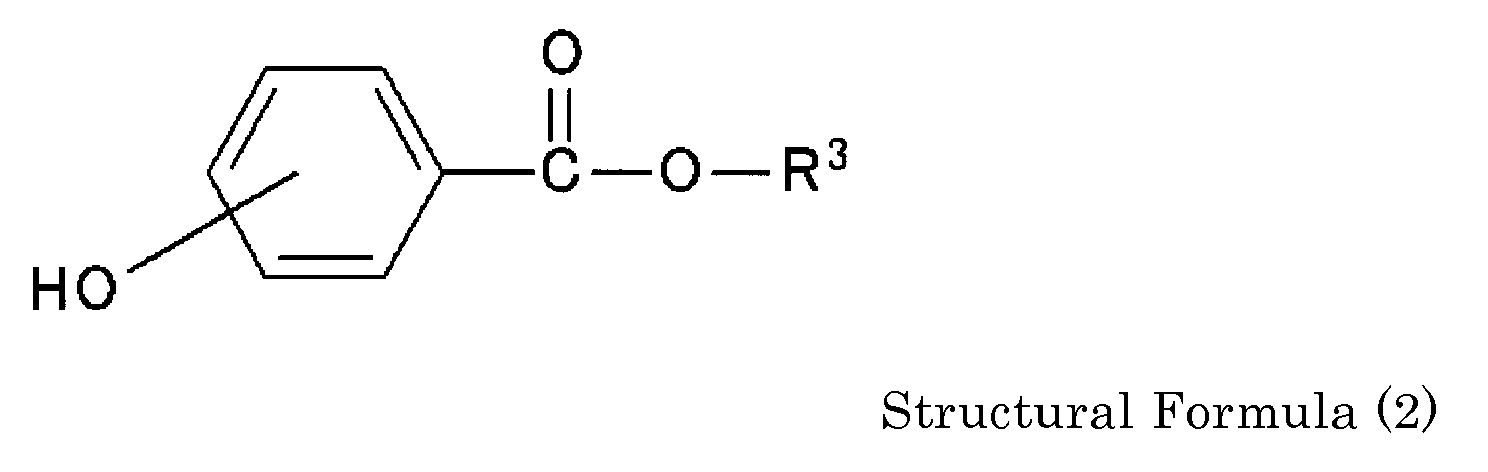
- Examples of the alkyl group include those having 1 to 18 carbon atoms, which are exemplified by alkyl groups such as methyl group, ethyl group, n-propyl group, n-butyl group, n-hexyl group, n-octyl group, n-dodecyl group, n-octadecyl group, isopropyl group, isobutyl group, t-butyl group, isoamyl group, 2-ethylbutyl group, 2-ethylhexyl group and t-octyl group, and cycloalkyl groups such as cyclohexyl group, 4-methylcyclohexyl group, 4-ethylcyclohexyl group, 4-t-butylcyclohexyl group, 4-(2-ethylhexyl)cyclohexyl group, bornyl group, isobornyl group and adamantyl group. Each of these may be substituted by a substituent.
- The alkenyl group is preferably an alkenyl group having 2 to 8 carbon atoms, for example vinyl group, allyl group, 1-propenyl group, methacryl group, crotyl group, 1-butenyl group, 3-butenyl group, 2-hexenyl group, 5-hexenyl group or 2-octenyl group. Each of these groups may be substituted by a substituent.
- The aralkyl group is not particularly limited and may be suitably selected in accordance with the intended use. Examples thereof include benzyl group, phenylethyl group and phenylpropyl group, each of which may be substituted by a substituent.
- Examples of the aryl group include phenyl group, naphthyl group, anthranil group, fluorenyl group, phenalenyl group, phenanthranyl group, triphenylenyl group and pyrenyl group, each of which may be substituted by a substituent.
- Examples of the substituent for the alkyl group, the alkenyl group, the aralkyl group or the aryl group include hydroxyl group, halogen atoms, nitro group, carboxyl group and cyano group. Examples thereof also include alkyl groups, aryl groups and heterocyclic groups, each of which may have a specific substituent (may be substituted by a halogen atom or nitro group, for example).
- Examples of the hydroxybenzoic acid ester compounds represented by Structural Formula (2) include, but are not limited to, methyl m-hydroxybenzoate, ethyl m-hydroxybenzoate, phenyl
m-hydroxybenzoate, methyl p-hydroxybenzoate, ethyl
p-hydroxybenzoate, n-propyl p-hydroxybenzoate, n-butyl
p-hydroxybenzoate, stearyl p-hydroxybenzoate, cyclohexyl
p-hydroxybenzoate, benzyl p-hydroxybenzoate, 4-chlorobenzyl
p-hydroxybenzoate, 4-methylbenzyl p-hydroxybenzoate and phenyl p-hydroxybenzoate. Also, each of these compounds may be used alone or in combination with two or more.


- Examples of the alkyl groups in Structural Formulae (3) to (5) include alkyl groups similar to those suitable for the alkyl group in Structural Formula (1).
- Examples of the alkoxy groups in Structural Formulae (3) to (5) include methoxy group, ethoxy group, propyloxy group, isopropyloxy group, butoxy group, i-butoxy group, t-butoxy group, hexyloxy group, cyclohexyloxy group, octyloxy group, 2-ethylhexyloxy group, decyloxy group, dodecyloxy group and octadecyloxy group.
- Examples of the compounds represented by Structural Formula (3) include, but are not limited to, p-anisoin, 4,4'-dimethylbenzoin and piperoin. Examples of the compounds represented by Structural Formula (4) include, but are not limited to, 1-hydroxy-2-phenyl naphthoate, 1-hydroxy-2-naphthoic acid-p-chlorophenyl,
1-hydroxy-2-naphthoic acid-o-chlorophenyl, 1-hydroxy-2-naphthoic acid-p-methylphenyl, 1-hydroxy-2-naphthoic acid-o-methylphenyl, 1,4-dihydroxy-2-phenyl naphthoate, 1,4-dihydroxy-2-naphthoic
acid-p-chlorophenyl and 1,4-dihydroxy-2-naphthoic
acid-o-chlorophenyl. Examples of the compounds represented by Structural Formula (5) include, but are not limited to,
3-hydroxyphenyl benzoate, 4-hydroxyphenyl benzoate,
2-hydroxyphenyl benzoate, o-methyl 3-hydroxyphenyl benzoate and 3-hydroxyphenyl p-chlorobenzoate. Each of these compounds may be used alone or in combination with two or more.

- Examples of the compounds represented by Structural Formula (6) include, but are not limited to, triphenylphosphine, tri-m-tolylphosphine, tri-p-tolylphosphine, tri-o-tolylphosphine, tri-2,4-xylenephosphine, tri-2,5-xylenephosphine,
tri-2,6-xylenephosphine, tri-3,4-xylenephosphine and
tri-3,5-xylenephosphine. Examples of the compounds represented by Structural Formula (7) include, but are not limited to,
tris(o-methoxyphenyl)phosphine, tris(m-methoxyphenyl)phosphine, tris(p-methoxyphenyl)phosphine, tris(p-ethoxyphenyl)phosphine, tris(p-n-propyloxyphenyl)phosphine, tris(m-t-butoxyphenyl)phosphine, tris(m-n-butoxyphenyl)phosphine, tris(p-n-butoxyphenyl)phosphine and tris(p-t-butoxyphenyl)phosphine. Each of these compounds may be used alone or in combination with two or more. - Besides the compounds represented by Structural Formulae (1) to (7), compounds which are solid at normal temperature and miscible with the thermoplastic resin when they melt by heating can be used for the hot-melt material of the present invention. Examples of such compounds are shown below. However, it should be noted that these examples do not limit the scope of the present invention.
- These examples include
2,2-ethylidene-bis-(4,6-di-t-butylphenol),
bis(3,5-di-t-butyl-4-hydroxybenzyl)sulfide,
2-(3,5-di-t-butyl-4-hydroxybenzyl)-2-n-butylmalonate-bis(1,2,2,6,6-pentamethyl-4-piperidyl),
1,6-hexanediol-bis[3-(3,5-di-t-butyl-4-hydroxyphenyl)propionate], 3,9-bis[2-[3-(3-t-butyl-4-hydroxy-5-methylphenyl)propionyloxy]-1,1-dimethylethyl]-2,4,6-(1H,3H,5H)trione,
2,4-di-t-pentylphenyl-3,5-di-t-butyl-4-hydroxybenzoate,
2,2'-methylenebis[6-(1-methylcyclohexyl)-p-cresol],
4,4'-methylenebis(2,6-di-t-butylphenol), 1,4-dihydroxy-2-naphthoic acid phenyl ester, 2,2'-butylidenebis(4-methyl-6-t-butylphenol), 2,2'4,4'-tetrahydroxybenzophenone,
4-benzyloxy-2-hydroxybenzophenone,
2-(4,6-diphenyl-1,3,5-triazine-2-yl)-5- [(hexyl)oxy]phenol,
6- [3-(3-t-butyl-4-hydroxy-5-methylpropoxy)-2, 4, 8,10-tetra-t-butyldibenz[d,f][1,3,2]-dioxaphosphepin, phosphoric acid ester amide, 2-(4'-morpholinodithio)benzothiazole, 1-o-tolylbiguanide,
O,O'-dibenzamidediphenyl disulfide and
tris(2,4-di-t-butylphenyl)phosphite. - Among the compounds represented by Structural Formulae (1) to (7), compounds which are solid at room temperature and melt when heated can be suitably used. The melting point of each of these compounds is preferably 70°C or higher, more preferably 80°C or higher. The upper limit of the melting point is approximately 200°C.
- In the case where the melting point is lower than 70°C, when any of the compounds is incorporated in a thermosensitive adhesive, there may be such a storage-related trouble that adhesion is exhibited at temperatures in a normal storage environment (e.g. blocking). Also, there may be such a production-related trouble that adhesion is exhibited when a thermosensitive adhesive coating solution is applied onto a support and dried. In the case where the melting point is higher than 200°C, a large amount of energy is required to exhibit adhesion, and thus there may be a trouble in practical use. Also, when thermosensitive recording paper is used as a support and adhesion is exhibited with a large amount of energy, there is such a trouble that printed images cannot be read because a thermosensitive recording layer develops color.
- Also, a hot-melt material derived from any of the compounds represented by Structural Formulae (1) to (7) can be pulverized into particles of 10µm or less, preferably 3µm or less, in volume average particle diameter. Additionally, by further reducing the volume average particle diameter of the particles, for example to 0.5µm or less, the dynamic heat sensitivity of the hot-melt material improves, and the hot-melt material can become compatible with the thermoplastic resin and a tackifier even with low energy to constitute a thermally activated adhesive.
- For the hot-melt material, any of the above-mentioned compounds may be used alone and may be combined with any of the compounds represented by Structural Formulae (1) to (7) with an arbitrary proportion, in which case the mixture ratio can be arbitrarily adjusted.
- The tackifier is added so as to improve the adhesion of the thermosensitive adhesive layer, and it is not particularly limited and may be suitably selected from known tackifiers in accordance with the intended use. Examples thereof include rosin derivatives (e.g. rosin, polymerized rosin and hydrogenated rosin), terpene resins (e.g. terpene resins, aromatic modified terpene resins, terpene phenol resins and hydrogenated terpene resins), petroleum resins, phenolic resins and xylene resins. Among these, rosin derivatives are particularly preferable.
- Any of these tackifiers is compatible with the thermoplastic resin and the hot-melt material and improves the adhesion of the thermosensitive adhesive layer remarkably.
- The melting point (or softening point) of the tackifier is preferably 80°C or greater, more preferably in the range of 80°C to 200°C. When the melting point (or softening point) is lower than 80°C, there may be a storage-related trouble at temperatures in a normal storage environment (e.g. degradation of blocking resistance).
- The amount of the tackifier contained in the thermosensitive adhesive layer is preferably 1% by mass to 30% by mass, more preferably 1% by mass to 20% by mass. When the amount is less than 1% by mass, there may be a dramatic decrease in adhesion. When it is more than 30% by mass, there may be a storage-related trouble at temperatures in a normal storage environment (e.g. degradation of blocking resistance), or there may be a decrease in initial adhesion in a low-temperature environment.
- In the present invention, a non-melting material may be additionally used so as to prevent blocking or reduce the frictional force of a surface. Examples of such a non-melting material include commonly used inorganic pigments, organic pigments and composite pigments of organic and inorganic pigments, each having a volume average particle diameter of 0.5µm to 30µm, preferably 1µm to 20µm.
- Examples of the inorganic pigments include calcium carbonate, silica, titanium oxide, aluminum hydroxide, clay, fired clay, magnesium silicate, magnesium carbonate, white carbon, zinc oxide, barium sulfate, calcium carbonate, talc, kaolin, swellable mica and non-swellable mica.
- Examples of the organic pigments include fine powders of benzoguanamine-formaldehyde condensates,
benzoguanamine-melamine-formaldehyde condensates,
melamine-formaldehyde condensates, methyl polymethacrylate crosslinked products, butyl polymethacrylate crosslinked products, urea-formalin resins, styrene-methacrylic acid copolymers and polystyrene resins. - Also, it is possible to use particles of any of these organic pigments, that have been processed so as to have a porous structure, for example porous particles of methyl polymethacrylate crosslinked products.
- Examples of the composite pigments of organic and inorganic pigments include silica-acrylic composite compounds, and particles of silicone-based materials superior in release property, for example silicone rubbers, particles of silicone resins and composite particles of silicone rubbers and silicone resins.
- Further, these fillers may be subjected to partial or total surface modification, either chemically with the use of a silane coupling agent, titanate coupling agent, aluminum-based coupling agent, zircoaluminate coupling agent, etc. or physically with the use of a polymer such as a silicone resin.
- Among these filler materials, organic pigments superior in release property are preferable, with silicone particles and methyl polymethacrylate crosslinked products being particularly preferable. It is inferred that the spherical structures of these resin particles contribute to enhancement of release property relative to blocking resistance as well as that the materials of these resin particles per se are superior in release property relative to blocking resistance. Additionally, in the case where exhibition of adhesiveness (activation) by a thermal head is taken into consideration, the extent to which the resin particles are damaged when adhesiveness is exhibited by the thermal head is small, and thus the resin particles are superior in head matching capability.
- The method for forming the thermosensitive adhesive layer is not particularly limited, and a known coating method, a known printing method or the like can be employed therefor, with a coating method being particularly preferable. The thermosensitive adhesive layer can be suitably formed using a thermosensitive adhesive layer coating solution containing the above-mentioned components.
- Examples of the coating method include blade coating, gravure coating, gravure offset coating, bar coating, roll coating, knife coating, air knife coating, comma coating, U comma coating, AKKU coating, smoothing coating, microgravure coating, reverse roll coating, four- or five-roll coating, dip coating, falling curtain coating, slide coating and die coating.
- On the occasion of the coating or printing, the thermosensitive adhesive layer coating solution must be dried within such a temperature range that the hot-melt material and an eutectic agent used do not melt. As a means of drying, it is possible to employ a drying method utilizing a heat source based upon an infrared ray, a microwave or a high-frequency wave, besides drying with hot air.
- Normally, the amount of the thermosensitive adhesive layer coating solution applied is preferably 2g/m2 to 30g/m2, more preferably 5g/m2 to 20g/m2, as a dry application amount. When the application amount is less than 2g/m2, there is caused a decrease in adhesion to a target with a rough surface, such as corrugated fiberboard. When it is greater than 30g/m2, the amount of energy required for the thermosensitive adhesive layer to exhibit adhesiveness becomes large; also, when an intermediate layer is provided between the thermosensitive adhesive layer and a support, heat-insulating effects yielded by the intermediate layer are reduced, which is unfavorable. Additionally, it goes without saying that there is economic inferiority.
- The shape, structure, size and the like of a support are not particularly limited and may be suitably selected in accordance with the intended use of the thermosensitive adhesive material. Examples of the shape include the shape of a flat plate, and the structure may be a single-layer structure or a laminated structure.
- The material for the support is not particularly limited and may be suitably selected in accordance with the intended use. The material may be selected from a variety of inorganic materials and organic materials.
- Examples of the inorganic materials include glass, quartz, silicon, silicon oxide, aluminum oxide, SiO2 and metals. Examples of the organic materials include papers such as high-quality paper, art paper, coated paper and synthetic paper; cellulose derivatives such as cellulose triacetate; polyester resins such as polyethylene terephthalate (PET) and polybutylene terephthalate; and polyolefins such as polycarbonates, polystyrene, polymethyl methacrylate, polyamide, polyethylene and polypropylene. Among these, high-quality paper, coated paper, plastic film and synthetic paper are preferable, with plastic film and synthetic paper being particularly preferable.
- Examples of the synthetic paper include materials made of synthetic fibers such as polyethylene, polypropylene, polyethylene terephthalate and polyamide; and any of these materials which is affixed to a part, one surface or both surfaces of paper. Examples of commercially available synthetic paper include FPG, FGS, GFG, KPK and the like produced by Oji-Yuka Synthetic Paper Co., Ltd.
- When the support is formed of film or synthetic paper, the support does not sufficiently allow a thermosensitive adhesive or the like to permeate into it, in comparison with a support formed of high-quality paper, used paper, etc. made from pulp or the like, and also the support is very poor in anchor property. Further, in recent years, note has been taken of contact activation using a thermal head, which is due to the advantages of safety and high-speed property as a thermal activation method and the current trend of on-demand requirements. Unfortunately, this method has such a side effect that a surface of an active layer is shaved off; particularly in thermal activation, the thermal head itself becomes hot so as to activate a whole surface of a label, and thus detachment of a thermosensitive adhesive layer becomes noticeable. However, in the present invention, even when a film or synthetic paper is used as the support, it is possible to prevent detachment or contraction of the film or the synthetic paper at the time of thermal activation, and an adhesive deposit is not created when a label is replaced.
- It is desirable that the support be subjected to surface modification by means of corona discharge, oxidation reaction (using chromic acid, for example), etching, facilitation of adhesion, antistatic treatment, etc. for the purpose of improving the adhesiveness of the coating layer. Also, it is desirable to color the support white by addition of, for example, a white pigment such as titanium oxide.
- The thickness of the support is not particularly limited and may be suitably selected in accordance with the intended use, with the range of 50µm to 2,000µm being desirable and the range of 100µm to 1,000µm being more desirable.
- In the present invention, it is desirable to provide an intermediate layer between the support and the thermosensitive adhesive layer. Since provision of the intermediate layer makes it possible to smooth the support surface and adjust the wetness of the surface, the thickness of the thermosensitive adhesive layer becomes uniform as a result and so it becomes possible to reduce variation in the extent of thermal activation. The intermediate layer contains a thermoplastic resin and a pigment (filler) and further contains other components in accordance with the necessity. For the pigment, it is particularly desirable to use fine hollow particles (a hollow filler) in view of thermal responsiveness in exhibiting adhesiveness. Inclusion of the fine hollow particles enables the intermediate layer to be a material superior in thermal responsiveness.
- Plastic spherical hollow particles of 2.0µm to 5.0µm in volume average particle diameter and 70% or more in hollowness, which have heat-insulating effects, particularly those which are 10.0µm or less in maximum particle diameter, are suitable for the fine hollow particles in view of the effort of low-energy thermal activation (high-sensitivity thermal activation). Those which are low in hollowness are inferior in terms of high-sensitivity thermal activation effects because thermal energy from a thermal head is discharged to the outside through the support owing to their insufficient heat-insulating effects.
- The fine hollow particles in the present invention denote particles which have shells formed of a thermoplastic resin and contain air and other gases inside thereof and which are already in a foamed state. Additionally, the term "hollowness" herein used denotes the ratio of the volume of hollow portions (internal void portions) to the volume of whole hollow particles.
- Also, in the case where the fine hollow particles have a volume average particle diameter of greater than 5.0µm, when the thermosensitive adhesive layer is provided on the intermediate layer containing these components, there are parts created in which the thermosensitive adhesive layer is not formed because of the large particles, and thus adhesion is liable to decrease on the occasion of thermal activation. In the case where the fine hollow particles have a volume average particle diameter of less than 2.0µm, it is difficult to secure a hollowness of 70% or more, and thus high-sensitivity thermal activation effects may not be obtained. In order to secure adhesion in a thermal activation method using a thermal head, it is desirable for the hollowness of hollow particles used in the intermediate layer to be 70% or more.
- For the material forming the plastic spherical hollow particles which satisfy the above-mentioned conditions, an acrylonitrile-vinylidene chloride-methyl methacrylate copolymer or an acrylonitrile-methacrylonitrile-isobornyl methacrylate copolymer is suitable.
- The thermoplastic resin used in the intermediate layer can be selected from a variety of known compounds, for example polyvinyl chloride, polyvinyl acetate, vinyl chloride-vinyl acetate copolymers, ethyl cellulose, polystyrene, styrene copolymers, phenoxy resins, polyester, aromatic polyester, polyurethane, polycarbonates, polyacrylic acid esters, polymethacrylic acid esters, acrylic acid copolymers, maleic acid copolymers, polyvinyl alcohol, modified polyvinyl alcohol, hydroxyethyl cellulose, carboxymethyl cellulose and starches. Among these compounds, those which are -70°C to -5°C in Tg are preferable because use of a resin similar to the thermoplastic resin used in the thermosensitive adhesive layer makes it possible to improve the compatibility between the resins of both layers. For instance, at least one of the following is preferable: a natural rubber latex produced by subjecting a vinyl monomer to graft copolymerization, an acrylic acid ester copolymer, a methacrylic acid ester copolymer, an acrylic acid ester-methacrylic acid ester copolymer, an acrylic acid ester-styrene copolymer, an acrylic acid ester-methacrylic acid ester-styrene copolymer and an ethylene-vinyl acetate copolymer.
- In the case of high-Tg resins which are higher than -5°C in Tg, the features of the intermediate layer cannot be obtained at all, and thus there is a decrease in adhesion to a target with a rough surface (such as corrugated fiberboard), polyolefin wrap and the like.
- As to the ratio between the fine hollow particles and the thermoplastic resin used in the intermediate layer, it is desirable that the plastic spherical hollow particles be 0.1 parts by mass to 1.0 part by mass in relation to 1 part by mass of the thermoplastic resin. When the plastic spherical hollow particles are contained by less than 0.1 parts by mass, the intermediate layer is inferior in high-sensitivity thermal activation, and further, its blocking resistance degrades. When the plastic spherical hollow particles are contained by more than 1.0 part by mass, there is a decrease in adhesion to a target with a rough surface (such as corrugated fiberboard), polyolefin wrap and the like, and thus adhesion may be derived only from the thermosensitive adhesive layer provided thereover.
- The amount of the intermediate layer applied is normally 0.2g/m2 to 10g/m2, preferably 1g/m2 to 5g/m2, as a dry application amount. When the amount is less than 0.2g/m2, sufficient heat-insulating effects cannot be obtained at the time of thermal activation. When it is greater than 10g/m2, adhesion and heat-insulating effects do not improve any further, which is economically unfavorable.
- The intermediate layer can be formed in a similar manner to the thermosensitive adhesive layer.
- In the present invention, it is further desirable to provide an adhesive under layer (adhesive resin layer) between the support and the intermediate layer. As a resin used for the adhesive under layer, a thermoplastic resin which has a Tg of-70°C to -10°C and which is also used for the thermosensitive adhesive layer is preferable, for example at least one selected from a natural rubber latex produced by subjecting a vinyl monomer to graft copolymerization, an acrylic acid ester copolymer, a methacrylic acid ester copolymer, an acrylic acid ester-methacrylic acid ester copolymer, an acrylic acid ester-styrene copolymer, an acrylic acid ester-methacrylic acid ester-styrene copolymer and an ethylene-vinyl acetate copolymer.
- In the case of high-Tg resins which are higher than -10°C in Tg, the features of the adhesive under layer cannot be obtained at all; therefore, there is a decrease in adhesion to a target with a rough surface (such as corrugated fiberboard), polyolefin wrap and the like, and thus adhesion may be derived only from the thermosensitive adhesive layer provided thereover. Meanwhile, low-Tg resins which are lower than -70°C in Tg are not particularly problematic; however, they are not favorable because costs rise. Additionally, almost all resins are -70°C or higher in Tg.
- The amount of the adhesive under layer applied is normally 2g/m2 to 35g/m2, preferably 4g/m2 to 25g/m2, as a dry application amount. When the amount is less than 2g/m2, adequate adhesion cannot be obtained when bonding is carried out after thermal activation. When it is greater than 35g/m2, adhesion and heat-insulating effects do not improve any further, which is unfavorable.
- The adhesive under layer can be formed in a similar manner to the thermosensitive adhesive layer.
- Next, the thermosensitive adhesive material of the present invention preferably includes a recording layer or a combination of a recording layer and a protective layer, laid over a surface of the support, which is opposite to a surface on which the thermosensitive adhesive layer is provided. Further, the thermosensitive adhesive material may incorporate other layers in accordance with the necessity.
- The recording layer is not particularly limited and may be suitably selected in accordance with the intended use. For instance, the recording layer is preferably any one of a thermosensitive recording layer, an ink receiving layer for hot-melt transfer recording, an electrophotographic toner image receiving layer, a recording layer for silver halide photography, and an ink-jet ink image receiving layer. Among these, a thermosensitive adhesive material for thermosensitive recording, provided with a thermosensitive recording layer containing a leuco dye and a color developer, and a thermosensitive adhesive material for hot-melt transfer recording, provided with an ink receiving layer for hot-melt transfer recording, are extremely useful because they firmly adhere to targets, especially a target with a rough surface (such as corrugated fiberboard) and polyolefin wrap, and are excellent in terms of low-energy thermal activation and blocking resistance.
- The thermosensitive recording layer in the thermosensitive adhesive material for thermosensitive recording contains a leuco dye as a color-developing agent, a color developer and a binder resin and further contains other components in accordance with the necessity.
- The leuco dye is not particularly limited and may be suitably selected from known dyes in accordance with the intended use. Examples thereof include triphenylmethane dyes, fluoran dyes, phenothiazine dyes, auramine dyes, spiropyran dyes and indolylphthalide dyes.
- Specific examples of the leuco dye include
3,3-bis(p-dimethylaminophenyl)phthalide,
3,3-bis(p-dimethylaminophenyl)-6-dimethylaminophthalide (otherwise called "crystal violet lactone"),
3,3-bis(p-dimethylaminophenyl)-6-diethylaminophthalide,
3,3-bis(p-dimethylaminophenyl)-6-chlorphthalide,
3,3-bis(p-dibutylaminophenyl)phthalide,
3-cyclohexylamino-6-chlorfluoran,
3-dimethylamino-5,7-dimethylfluoran, 3-diethylamino-7-chlorfluoran, 3-diethylamino-7-methylfluoran, 3-diethylamino-7,8-benzfluoran, 3-diethylamino-6-methyl-7-chlorfluoran,
3-(N-p-tolyl-N-ethylamino)-6-methyl-7-anilinofluoran,
3-pyrrolidino-6-methyl-7-anilinofluoran,
2-{N-(3'-trifluormethylphenyl)amino}-6-diethylaminofluoran, 2-{3,6-bis(diethylamino)-9-(o-chloranilino)xanthyl benzoic acid lactam},
3-diethylamino-6-methyl-7-(m-trichlormethylanilino)fluoran,
3-diethylamino-7-(o-chloranilino)fluoran,
3-dibutylamino-7-(o-chloranilino)fluoran,
3-N-methyl-N-amylamino-6-methyl-7-anilinofluoran,
3-N-methyl-N-cyclohexylamino-6-methyl- 7-anilinofluoran, 3-diethylamino-6-methyl-7-anilinofluoran,
3-(N,N-diethylamino)-5-methyl-7-(N,N-dibenzylamino)fluoran,
benzoyl leuco methylene blue,
6'-chloro-8'-methoxy-benzoindolino-pyrylospirane, 6'-bromo-3'-methoxy-benzoindolino-pyrylospirane,
3-(2'-hydroxy-4'-dimethylaminophenyl)-3-(2'-methoxy-5'-chlorphenyl) phthalide,
3-(2'-hydroxy-4'-dimethylaminophenyl)-3-(2'-methoxy-5'-nitrophenyl) phthalide,
3-(2'-hydroxy-4'-diethylaminophenyl)-3-(2'-methoxy-5'-methylphenyl) phthalide,
3-diethylamino-6-methyl-7-(2',4'-dimethylanilino)fluoran, 3-(2'-methoxy-4'-dimethylaminophenyl)-3-(2'-hydroxy-4'-chlor-5'-methylphenyl)phthalide,
3-morpholino-7-(N-propyl-trifluoromethylanilino)fluoran,
3-pyrrolidino-7-trifluoromethylanilinofluoran, 3-diethylamino-5-chloro-7-(N-benzyl-trifluoromethylanilino)fluoran,
3-pyrrolidino-7-(di-p-chlorphenyl)methylaminofluoran,
3-diethylamino-5-chlor-7-(α-phenylethylamino)fluoran,
3-(N-ethyl-p-toluidino)-7-(α-phenylethylamino)fluoran,
3-diethylamino-7-(o-methoxycarbonylphenylamino)fluoran,
3-diethylamino-5-methyl-7-(α-phenylethylamino)fluoran,
3-diethylamino-7-piperidinofluoran,
2-chloro-3-(N-methyltoluidino)-7-(p-n-butylanilino)fluoran,
3-(N-benzyl-N-cyclohexylamino)-5,6-benzo-7-α-naphthylamino-4'-o-bromofluoran,
3-diethylamino-6-methyl-7-mesitydino-4',5'-benzofluoran,
3-diethylamino-6-methyl-7-(2',4'-dimethylanilino)fluoran,
3-(p-dimethylaminophenyl)-3-{1,1-bis(p-dimethylaminophenyl) ethylene-2-yl}phthalide,
3-(p-dimethylaminophenyl)-3-{1,1-bis(p-dimethylaminophenyl) ethylene-2-yl}-6-dimethylaminophthalide,
3-(p-dimethylaminophenyl)-3-(1-p-dimethylaminophenyl-1-phenylethylene-2-yl)phthalide, 3-(p-dimethylaminophenyl-3-(1-p-dimethylaminophenyl-1-p-chlorophenylethylene-2-yl)-6-dimethylaminophthalide),
3-(4'-dimethylamino-2'-methoxy)-3-(1"-p-dimethylaminophenyl-1"-p-chlorophenyl-1",3"-butadiene-4"-yl)benzophthalide,
3-(4'-dimethylamino-2'-benzyloxy)-3-(1"-p-dimethylaminophenyl-1"-phenyl-1",3"-butadiene-4"-yl)benzophthalide,
3-dimethylamino-6-dimethylamino-fluorene-9-spiro-3'-(6'-dimethylamino)phthalide,
3,3-bis{2-(p-dimethylaminopheny1)-2-(p-methoxypheny1)ethenyl}-4,5, 6,7-tetrachlorophthalide,
3-bis{1,1-bis(4-pyrrolidinopheny1)ethylene-2-yl}-5,6-dichloro-4,7-dibromophthalide,
bis(p-dimethylaminostyryl)-1-naphthalenesulfonylmethane, 3-(N-methyl-N-propylamino)-6-methyl-7-anilidefluoran,
3-diethylamino-6-methyl-7-anilinofluoran,
3,6-bis(dimethylamino)fluoranspiro(9,3')- 6'-dimethylaminophthalide, 3-diethylamino-6-chlor-7-anilinofluoran,
3-N-ethyl-N-(2-ethoxypropyl)amino-6-methyl-7-anilinofluoran,
3-N-ethyl-N-tetrahydrofurfurylamino-6-methyl-7-anilinofluoran,
3-diethylamino-6-methyl-7-mesitydino-4', 5'-benzofluoran, 3-N-methyl-N-isobutyl-6-methyl-7-anilinofluoran and 3-N-ethyl-N-isoamyl-6-methyl-7-anilinofluoran. Each of these may be used alone or in combination with two or more. - The color developer is not particularly limited and may be suitably selected from known electron-accepting compounds in accordance with the intended use. Examples thereof include phenolic compounds, thiophenolic compounds, thiourea derivatives, organic acids and metal salts thereof.
- Specific examples of the color developer include
4,4'-isopropylidenebisphenol, 3,4'-isopropylidenebisphenol, 4,4'-isopropylidenebis(o-methylphenol), 4,4'-s-butylidenebisphenol, 4,4'-isopropylidenebis(o-t-butylphenol), 4,4'-cyclohexylidenediphenol,
4,4'-isopropylidenebis(2-chlorophenol),
2,2'-methylenebis(4-methyl-6-t-butylphenol),
2,2'-methylenebis(4-ethyl-6-t-butylphenol),
4,4'-butylidenebis(6-t-butyl-2-methyl)phenol,
1,1,3-tris(2-methyl-4-hydroxy-5-t-butylphenyl)butane,
1,1,3-tris(2-methyl-4-hydroxy-5-cyclohexylphenyl)butane,
4,4'-thiobis(6-t-butyl-2-methyl)phenol, 4,4'-diphenolsulfone,
4,2'-diphenolsulfone, 4-isopropoxy-4'-hydroxydiphenylsulfone, 4-benzyloxy-4'-hydroxydiphenylsulfone, 4,4'-diphenolsulfoxide, isopropyl p-hydroxybenzoate, benzyl p-hydroxybenzoate, benzyl protocatechuate, stearyl gallate, lauryl gallate, octyl gallate, 1,7-bis(4-hydroxyphenylthio)-3,5-dioxaheptane,
1,5-bis(4-hydroxyphenylthio)-3-oxaheptane,
1,3-bis(4-hydroxyphenylthio)-propane,
2,2'-methylenebis(4-ethyl-6-t-butylphenol),
1,3-bis(4-hydroxyphenylthio)-2-hydroxypropane,
N,N'-diphenylthiourea, N,N'-di(m-chlorophenyl)thiourea, salicylanilide, 5-chloro-salicylanilide, salicyl-o-chloroanilide, 2-hydroxy-3-naphthoic acid, antipyrine complexes of zinc thiocyanate, 2-acetyloxy-3-zinc salts of naphthoic acid, 2-hydroxy-1-naphthoic acid, 1-hydroxy-2-naphthoic acid, metal salts (e.g. zinc salts, aluminum salts and calcium salts) of hydroxynaphthoic acid,
bis-(4-hydroxyphenyl)acetic acid methyl ester,
bis-(4-hydroxyphenyl)acetic acid benzyl ester,
4-{β-(p-methoxyphenoxy)ethoxy}salicylate,
1,3-bis(4-hydroxycumyl)benzene, 1,4-bis(4-hydroxycumyl)benzene,
2,4'-diphenolsulfone, 3,3'-diallyl-4,4'-diphenolsulfone, antipyrine complexes of α,α-bis(4-hydroxyphenyl)-α-methyltoluene zinc thiocyanate, tetrabromobisphenol A, tetrabromobisphenol S, 4,4'-thiobis(2-methylphenol), 3,4-hydroxy-4'-methyl-diphenylsulfone and 4,4'-thiobis(2-chlorophenol). Each of these may be used alone or in combination with two or more. - The amount of the color developer added into the thermosensitive recording layer may be suitably selected in accordance with the intended use. As the ratio of the color developer to the leuco dye, the color developer is preferably 1 part by mass to 20 parts by mass, more preferably 2 parts by mass to 10 parts by mass, in relation to 1 part by mass of the leuco dye.
- The binder resin is not particularly limited and may be suitably selected from known binder resins in accordance with the intended use. Examples thereof include polyvinyl alcohol; starch and derivatives thereof; cellulose derivatives such as methoxycellulose, hydroxyethylcellulose, carboxymethylcellulose, methylcellulose and ethylcellulose; water-soluble polymers such as sodium polyacrylate, polyvinylpyrrolidone, acrylamide-acrylic acid ester copolymers, acrylamide-acrylic acid ester-methacrylic acid terpolymers,
styrene-maleic anhydride copolymer alkali salts, isobutylene-maleic anhydride copolymer alkali salts, polyacrylamide, sodium alginate, gelatin and casein; emulsions such as polyvinyl acetate, polyurethane, polyacrylic acid, polyacrylic acid esters, polymethacrylic acid esters, polybutyl methacrylate, vinyl chloride-vinyl acetate copolymers and ethylene-vinyl acetate copolymers; and latexes such as styrene-butadiene copolymers and styrene-butadiene-acrylic copolymers. Each of these may be used alone or in combination with two or more. - In the thermosensitive recording layer, a thermally fusible material can be used as a filling material, and the thermally fusible material can be selected from a variety of thermally fusible materials. Examples thereof include fatty acids such as stearic acid and behenic acid; fatty acid amides such as stearic acid amide and palmitic acid amide; fatty acid metal salts such as zinc stearate, aluminum stearate, calcium stearate, zinc palmitate and zinc behenate; and p-benzylbiphenyl, terphenyl, triphenylmethane, benzyl
p-benzyloxybenzoate, β-benzyloxynaphthalene, β-naphthoic acid phenyl ester, 1-hydroxy-2-naphthoic acid phenyl ester,
1-hydroxy-2-naphthoic acid methyl ester, diphenyl carbonate, terephthalic acid dibenzyl ester, terephthalic acid dimethyl ester, 1,4-dimethoxynaphthalene, 1,4-diethoxynaphthalene,
1,4-dibenzyloxynaphthalene, 1,2-bis(phenoxy)ethane,
1,2-bis(3-methylphenoxy)ethane, 1,2-bis(4-methylphenoxy)ethane,
1,4-bis(phenoxy)butane, 1,4-bis(phenoxy)-2-butene,
1,2-bis(4-methoxyphenylthio)ethane,
1,3-bis(2-vinyloxyethoxy)benzene, 1,4-bis(2-vinyloxyethoxy)benzene,
p-(2-vinyloxyethoxy)biphenyl, p-aryloxybiphenyl,
p-propargyloxybiphenyl, dibenzoyloxymethane,
1,3-dibenzoyloxypropane, dibenzyldisulfide, 1,1-diphenylethanol, 1,1-diphenylpropanol, p-(benzyloxy)benzyl alcohol,
1,3-diphenoxy-2-propanol,
N-octadecylcarbamoyl-p-methoxycarbonylbenzene,
N-octadecylcarbamoylbenzene, oxalic acid dibenzyl ester and 1,5-bis(p-methoxyphenyloxy)-3-oxapentane. Each of these may be used alone or in combination with two or more. - Further, in the thermosensitive recording layer, auxiliary additive components such as a surfactant, a lubricant and a filler may be additionally used in accordance with the necessity. Examples of the lubricant include higher aliphatic acids or metal salts thereof, higher aliphatic acid amides, higher aliphatic acid esters, animal waxes, vegetable waxes, mineral waxes and petroleum waxes. The filler can be selected from known materials, which are exemplified by, but not limited to, inorganic pigments such as calcium carbonate, zinc oxide, aluminum oxide, titanium dioxide, silica, aluminum hydroxide, barium sulfate, talc, kaolin, alumina and clay, and known organic pigments. Among these, silica, kaolin and alumina, which are acid pigments (i.e. pigments which exhibit acidity in aqueous solution), are preferable in view of water resistance (resistance to peeling by water), particularly preferably silica in terms of color development density.
- The method of forming the thermosensitive recording layer is not particularly limited, and a conventionally known method can be employed therefor. For instance, the thermosensitive recording layer can be formed as follows: the leuco dye and the color developer are separately pulverized and dispersed along with a coupling agent and other components with the use of a disperser such as a ball mill, attritor or sand mill until the dispersion particle diameter becomes 1µm to 3µm; afterward, these ingredients are mixed together, with addition of the filling material, the thermally fusible material (sensitizer) dispersion solution and the like if necessary, according to a certain formulation so as to prepare a thermosensitive recording layer coating solution, and the thermosensitive recording layer coating solution is applied onto the support.
- The thickness of the thermosensitive recording layer cannot be unequivocally defined because it varies depending upon the composition of the thermosensitive recording layer, the use of the thermosensitive adhesive material, etc. However, the thickness is preferably 1µm to 50µm, more preferably 3µm to 20µm.
- The ink receiving layer for hot-melt transfer recording in the thermosensitive adhesive material for hot-melt transfer recording contains a filler, a binder resin and a water-resistant agent and further contains other components in accordance with the necessity.
- The filler is not particularly limited and may be suitably selected in accordance with the intended use. Examples thereof include fine powders of calcium carbonate, silica, titanium oxide, aluminum hydroxide, clay, fired clay, magnesium silicate, magnesium carbonate, white carbon, zinc oxide, barium sulfate, surface-treated calcium carbonate, surface-treated silica, urea-formalin resins, styrene-methacrylic acid copolymers and polystyrene.
- The binder resin is not particularly limited and may be suitably selected from known water-soluble resins in accordance with the intended use. Examples thereof include polyvinyl alcohol; starch and derivatives thereof; cellulose derivatives such as methoxycellulose, hydroxyethylcellulose, carboxymethylcellulose, methylcellulose and ethylcellulose; and water-soluble polymers such as sodium polyacrylate, polyvinylpyrrolidone, acrylamide-acrylic acid ester copolymers, acrylamide-acrylic acid ester-methacrylic acid terpolymers, styrene-maleic anhydride copolymer alkali salts, isobutylene-maleic anhydride copolymer alkali salts, polyacrylamide, sodium alginate, gelatin and casein.
- Each of these may be used alone or in combination with two or more.
- The ratio of the filler to the water-soluble resin in the ink receiving layer is related to blocking resistance and is preferably in the range of 1:0.1 to 1:0.2 as a mass ratio (solid content).
- The water-resistant agent is not particularly limited and may be suitably selected in accordance with the intended use. Examples thereof include formaldehyde, glyoxal, chromium alum, melamine, melamine-formaldehyde resins, polyamide resins and
polyamide-epichlorhydrin resins. - The ratio of the water-soluble resin to the water-resistant agent is also related to blocking resistance and is preferably in the range of 1:0.3 to 1:0.5 as a mass ratio (solid content).
- As just described, the ink receiving layer is formed with a specific ratio of the filler to the water-soluble resin and also with a specific ratio of the water-soluble resin to the water-resistant agent. Further, by treating the surface of the ink receiving layer with a calender or the like so as to become 500sec or greater in smoothness, it is possible to further improve printing quality as well as the effects produced by the filler.
- The protective layer contains a resin component and further contains other components in accordance with the necessity. For the resin in this case, a hydrophobic resin emulsion or a water-soluble resin can be used, with a film containing a water-soluble resin being preferable in view of barrier capability as a protective layer. Also, when a water-soluble resin is used, the effect can be improved by providing it with water resistance with the use of a crosslinking agent.
- For the water-soluble resin, polyvinyl alcohol is normally used; however, a combination of the water-soluble resin and the crosslinking agent for water resistance can be suitably selected. For instance, there is a combination of carboxy-modified polyvinyl alcohol and a polyamide-epichlorohydrin resin, and a combination of polyvinyl alcohol having a reactive carbonyl group and a hydrazide compound.
- Among these, a protective layer which contains polyvinyl alcohol having a reactive carbonyl group (hereinafter referred to as "PVAα") and a hydrazide compound as a crosslinking agent has extremely high heat resistance and water resistance and is not much subject to the effects caused by application of pressure, temperature or humidity. Therefore the protective layer makes it possible to improve blocking resistance greatly.
- The PVAα can be produced in accordance with a known method, for example a method in which a polymer obtained by copolymerizing a vinyl monomer having a reactive carbonyl group and a fatty acid vinyl ester is saponified. Examples of the vinyl monomer having a reactive carbonyl group include groups having ester residues, and acetone group-containing groups, preferably diacetone group-containing vinyl monomers, specifically diacetone acrylamide and metadiacetone acrylamide. Examples of the fatty acid vinyl ester include vinyl formate, vinyl acetate and vinyl propionate, with vinyl acetate being particularly preferable.
- The PVAa may be produced by copolymerizing other copolymerizable vinyl monomers. Examples thereof include acrylic acid esters, butadiene, ethylene, propylene, acrylic acid, methacrylic acid, maleic acid, maleic anhydride and itaconic acid.
- The amount of the reactive carbonyl group contained in the PVAα is preferably 0.5mol% to 20mol% relative to the whole polymer, more preferably 2mol% to 10mol% in view of water resistance. When the amount is less than 2mol%, water resistance sufficient for practical use cannot be yielded. When it is more than 10mol%, water resistance does not improve any further and the cost becomes higher, which is not economical. The polymerization degree of the PVAα is preferably 300 to 3,000, more preferably 500 to 2,200. The saponification degree of the PVAα is preferably 80% or more.
- The hydrazide compound is not particularly limited and may be suitably selected in accordance with the intended use, as long as it has a hydrazide group. Examples thereof include carbohydrazide, oxalic acid dihydrazide, formic acid hydrazide, acetic acid hydrazide, malonic acid dihydrazide, succinic acid dihydrazide, adipic acid dihydrazide, azelaic acid hydrazide, sebacic acid dihydrazide, dodecanedioic acid dihydrazide, maleic acid dihydrazide, fumaric acid hydrazide, itaconic acid dihydrazide, benzoic acid hydrazide, glutaric acid dihydrazide, diglycol acid hydrazide, tartaric acid dihydrazide, malic acid dihydrazide, isophthalic acid hydrazide, terephthalic acid dihydrazide, 2,7-naphthoic acid dihydrazide and polyacrylic acid hydrazide.
- Each of these compounds may be used alone or in combination with two or more. However, use of adipic acid dihydrazide is preferable in view of water resistance and safety.
- The amount of the hydrazide compound contained is preferably 5 parts by mass to 40 parts by mass, more preferably 15 parts by mass to 25 parts by mass, in relation to 100 parts by mass of the PVAα.
- It is desirable that a filler be contained in the protective layer. The filler is preferably a basic filler, and examples thereof include aluminum hydroxide, calcium carbonate, talc and alkaline silicic acids, with aluminum hydroxide and calcium carbonate being preferable in view of matching with a thermal head (attachment of a residue), and aluminum hydroxide being particularly preferable in view of controlling the pH by means of appropriate water solubility.
- The method of forming the protective layer is not particularly limited, and a conventionally known method can be employed therefor. For instance, the protective layer can be formed by applying a protective layer coating solution, prepared in accordance with a conventional method, over the recording layer.
- The thickness of the protective layer is not particularly limited and may be suitably selected in accordance with the intended use, with the range of 1.0µm to 7.0µm being preferable.
- Further, it is also possible to provide an intermediate layer and the like between the support and the thermosensitive recording layer in accordance with the necessity. For instance, the pigment containing the fine hollow particles, the coupling agent, the thermally fusible material and the surfactant, mentioned above, can be used as components to constitute the layer(s).
- The thermosensitive adhesive material of the present invention may be cut before or after the thermosensitive adhesive layer is thermally activated (heated). In this case, if a cut is made in the thermosensitive adhesive material beforehand, the thermosensitive adhesive material is advantageous in that it can be applied to a variety of uses such as labels and tags.
- The form of the thermosensitive adhesive material of the present invention is not particularly limited, and suitable examples thereof include the form of a label, the form of a sheet, the form of a label sheet and the form of a roll. In particular, it is desirable that the thermosensitive adhesive material be wound around a cylindrical core material and stored in the form of a roll with a long length, in view of convenience, its storage place and handleability.
- The target to which the thermosensitive adhesive material of the present invention is affixed is not particularly limited, and the size, form, structure, material and the like thereof may be suitably selected in accordance with the intended use. Suitable examples of the material include resin plates made of polyolefins (polyethylene, polypropylene, etc.), acrylic, polyethylene terephthalate (PET), polystyrene and nylon; metal plates made of SUS and aluminum; paper products such as envelopes and corrugated fiberboard; wraps made of polyolefins, and wraps made of polyvinyl chloride; unwoven cloth made of polyethylene (envelopes, etc.); and glass.
- The method for thermally activating the thermosensitive adhesive layer of the thermosensitive adhesive material of the present invention is not particularly limited and may be suitably selected in accordance with the intended use. Examples thereof include an activation method utilizing hot air, an activation method utilizing a thermal roll, and an activation method utilizing a thermal head.
- Among these, an activation method utilizing a thermal head is preferable and is advantageous in that recording to the thermosensitive recording layer and thermal activation of the thermosensitive adhesive layer can be simultaneously carried out by heating both surfaces of the thermosensitive adhesive material with the use of an existing thermosensitive recording printer apparatus.
- According to the present invention, it is possible to provide a thermosensitive adhesive material which is excellent in blocking resistance when not active and which has adequate adhesion in a wide temperature range to a target with little smoothness such as corrugated fiberboard.
- The following explains the present invention in further detail, with reference to Examples; however, it should be noted that the present invention is not confined to these Examples in any way. It should also be noted that the term "part" and the symbol "%" shown below are both based upon mass.
- Monomer mixtures (A to O) having the compositions shown in Tables 1 and 2 below were prepared.
- Subsequently, mixtures having the following compositions were each polymerized at 70°C in 9hr with agitation. The pH of each of the copolymers obtained was adjusted to 7 to 9 using a sodium hydroxide aqueous solution, unreacted monomers and the like were removed by steam distillation, the nonvolatile content of each copolymer was adjusted by addition of water, and copolymer emulsions having a nonvolatile content of 50% were thus obtained.
- Resins A to N - • water 170 parts • emulsifier (ELEMINOL ES-70, produced by Sanyo Chemical Industries, Ltd.) 2.5 parts • potassium persulfate 0.5 parts • monomer mixture 100 parts - Resin O - • water 100 parts • emulsifier (sodium dodecylbenzenesulfonate) 2.5 parts • sodium persulfate 0.5 parts • α-methylstyrene dimer 0.5 parts • t-dodecyl mercaptan 0.4 parts • monomer mixture 100 parts Table 1 Monomer structural ratio (Parts by mass) A B C D E n-butyl acrylate 67 2-ethylhexyl acrylate 75 75 75 10 92 n-octyl acrylate Methyl methacrylate 17 12 2 10 2-hydroxyethyl methacrylate Acrylonitrile 5 10 20 10 5 Acrylic acid 2 2 2 2 2 Itaconic acid n-methylolacrylamide Vinyl acetate 1 1 1 1 1 Styrene Butadiene Copolymer Tg (°C) -45 -45 -43 -33 -67 Table 2 Monomer structural ratio (Parts by mass) F G H I J K L M N O n-butyl acrylate 60 2-ethylhexyl acrylate 75 75 75 75 62 88 n-octyl acrylate 92 Methyl methacrylate 20 22 15 50 8 17 3 Isobutyl methacrylate 30 5 Acrylonitrile 2 22 5 20 2 10 5 Acrylic acid 2 2 2 2 2 2 20 2 5 Itaconic acid 3 n-methylolacrylamide 3 Vinyl acetate 1 1 1 1 1 1 Styrene 22 39 Butadiene 50 Copolymer Tg (°C) -43 -47 -42 -40 -72 -27 93 -58 4 -35 - A mixture having the following composition was dispersed so as to have an average particle diameter of 1.0µm, using a sand mill, and a hot-melt material dispersion solution [Q solution] was thus obtained.
• triphenylphosphine 15 parts • 2-(3'-t-butyl-5'-methyl-2'-hydroxyphenyl)-5-chlorobenzotriazole 15 parts • polyvinyl alcohol (L-3266, produced by The Nippon Synthetic Chemical Industry Co., Ltd., average molecular weight: 15,000, saponification degree: 88%) 5 parts • surfactant (alkyl = allylsulfonate) 0.15 parts • water 64.85 parts - The following composition was sufficiently agitated, and a thermosensitive adhesive layer coating solution [R solution] was thus obtained.
• [P solution] (copolymer emulsion) 10 parts • [Q solution] (hot-melt material dispersion solution) 66 parts • special rosin ester emulsion (SUPER ESTER E-650, produced by Arakawa Chemical Industries, Ltd., nonvolatile content: 50%) 6 parts • spherical silicone resin fine particles (TOSPEARL 120, produced by Momentive Performance Materials Inc.) 3 parts • water 15 parts - In 160g of ion-exchange water, 55g of sodium chloride was dissolved, and 1.0g of adipic acid-diethanolamine condensate and 25g of colloidal silica 20% aqueous solution were added; thereafter, the pH was adjusted to the range of 3.8 to 4.2 with sulfuric acid, and the ingredients were evenly mixed to form an aqueous phase.
- An oil phase was formed by mixing, agitating and dissolving 45g of acrylonitrile, 16g of methacrylonitrile, 5g of
N-methylolacrylamide, 23g of isobonyl methacrylate, 0.1g of ethylene glycol dimethacrylate, 0.3g of azobisisobutyronitril, 0.1g of 1,1-azobis(cyclohexane-1-carbonitrile) and 15g of isobutane. - The aqueous phase and the oil phase were mixed together and agitated using a homomixer at 4,000rpm for 1min to obtain a suspension. This suspension was transferred into a separable flask and substituted by nitrogen; thereafter, while being agitated, the suspension was subjected to reaction at 70°C for 6hr then at 90°C for 14hr. After the reaction, the suspension was cooled and filtered, and capsule particles were thus obtained.
- Next, hollow particles were formed through foaming by heating. These hollow particles had a hollowness of 89% and a volume average particle diameter (median diameter) of 4.5µm.
- An intermediate layer coating solution was prepared by agitating and dispersing the following mixture.
• aqueous dispersion solution of the fine hollow particles (nonvolatile content: 30%) 30 parts • acrylic copolymer emulsion (NEW COAT SFK-1000A, produced by Shin-Nakamura Chemical Co., Ltd., nonvolatile content: 46%) 28 parts • polyvinyl alcohol aqueous solution (PVA117, produced by Kuraray Co., Ltd., nonvolatile content: 16%) 9 parts • water 50 parts - Over a surface on the side where a coated layer was not provided, of a single-sided coated paper (OK ADNIS ROUGH, produced by Oji paper Co., Ltd.) serving as a support and having a basis weight of 80g/m2, the thermosensitive adhesive layer coating solution [R solution] containing the resin with Monomer Structure A was applied and dried such that its dry attachment amount was 20g/m2, thereby forming a thermosensitive adhesive layer, and a thermosensitive adhesive material was thus produced.
- A thermosensitive adhesive layer was formed in a similar manner to Example 1, except that the resin with Monomer Structure A was changed to the resin with Monomer Structure B; and a thermosensitive adhesive material was thus produced.
- A thermosensitive adhesive layer was formed in a similar manner to Example 1, except that the resin with Monomer Structure A was changed to the resin with Monomer Structure C; and a thermosensitive adhesive material was thus produced.
- A thermosensitive adhesive layer was formed in a similar manner to Example 1, except that the resin with Monomer Structure A was changed to the resin with Monomer Structure D; and a thermosensitive adhesive material was thus produced.
- A thermosensitive adhesive layer was formed in a similar manner to Example 1, except that the resin with Monomer Structure A was changed to the resin with Monomer Structure E; and a thermosensitive adhesive material was thus produced.
- Over a surface on the side where a coated layer was not provided, of the same support as the one in Example 1, the intermediate layer coating solution [S solution] was applied and dried such that its dry attachment amount was 5g/m2, thereby forming an intermediate layer. Subsequently, over the intermediate layer, the thermosensitive adhesive layer coating solution [R solution] containing the resin with Monomer Structure A was applied and dried such that its dry attachment amount was 15g/m2, thereby forming a thermosensitive adhesive layer, and a thermosensitive adhesive material was thus produced.
- Over a surface on the side where a coated layer was not provided, of a same support as the one in Example 1, E-1054K (nonvolatile content: 50%) produced by Soken Chemical & Engineering Co., Ltd. was applied and dried such that its dry attachment amount was 15g/m2, thereby forming an adhesive under layer. Subsequently, over the adhesive under layer, the intermediate layer coating solution [S solution] was applied and dried such that its dry attachment amount was 5g/m2, thereby forming an intermediate layer; further, the thermosensitive adhesive layer coating solution [R solution] containing the resin with Monomer Structure A was applied and dried such that its dry attachment amount was 15g/m2, thereby forming a thermosensitive adhesive layer, and a thermosensitive adhesive material was thus produced.
- A thermosensitive adhesive layer was formed in a similar manner to Example 1, except that the resin with Monomer Structure A was changed to the resin with Monomer Structure F; and a thermosensitive adhesive material was thus produced.
- A thermosensitive adhesive layer was formed in a similar manner to Example 1, except that the resin with Monomer Structure A was changed to the resin with Monomer Structure G; and a thermosensitive adhesive material was thus produced.
- A thermosensitive adhesive layer was formed in a similar manner to Example 1, except that the resin with Monomer Structure A was changed to the resin with Monomer Structure H; and a thermosensitive adhesive material was thus produced.
- A thermosensitive adhesive layer was formed in a similar manner to Example 1, except that the resin with Monomer Structure A was changed to the resin with Monomer Structure I; and a thermosensitive adhesive material was thus produced.
- A thermosensitive adhesive layer was formed in a similar manner to Example 1, except that the resin with Monomer Structure A was changed to the resin with Monomer Structure J; and a thermosensitive adhesive material was thus produced.
- A thermosensitive adhesive layer was formed in a similar manner to Example 1, except that the resin with Monomer Structure A was changed to the resin with Monomer Structure K; and a thermosensitive adhesive material was thus produced.
- The following composition was sufficiently agitated, and a thermosensitive adhesive layer coating solution [R' solution] was thus obtained.
• copolymer emulsion (Monomer Structure L) 3 parts • copolymer emulsion (Monomer Structure M) 7 parts • special rosin ester emulsion (SUPER ESTER E-650, produced by Arakawa Chemical Industries, Ltd.) 2 parts • water 15 parts - A thermosensitive adhesive layer was formed in a similar manner to Example 1, except that the thermosensitive adhesive layer coating solution [R solution] was changed to the thermosensitive adhesive layer coating solution [R' solution]; and a thermosensitive adhesive material was thus produced.
- A thermosensitive adhesive layer was formed in a similar manner to Example 1, except that the resin with Monomer Structure A was changed to the resin with Monomer Structure N; and a thermosensitive adhesive material was thus produced.
- A thermosensitive adhesive layer was formed in a similar manner to Example 1, except that the resin with Monomer Structure A was changed to the resin with Monomer Structure O; and a thermosensitive adhesive material was thus produced.
- To each of the thermosensitive adhesive materials according to Examples 1 to 7 and Comparative Examples 1 to 9, a thermosensitive recording layer was laid over a surface of the support on the side where the thermosensitive adhesive layer was not provided, in accordance with the following procedure.
- An [under layer forming solution] was prepared by agitating and dispersing a mixture having the following composition.
• fine hollow particle dispersion (copolymer resin based upon vinylidene chloride and acrylonitrile, solid content concentration: 32%, volume average particle diameter: 3.0µm, hollowness: 92%) 30 parts • styrene-butadiene copolymer latex (Tg: +4°C) 10 parts • water 60 parts - A material mixture for a [leuco dye dispersion solution] having the following composition and a material mixture for a [color developer dispersion solution] having the following composition were each dispersed so as to have a volume average particle diameter of approximately 1.5µm, using a sand mill, and the [leuco dye dispersion solution] and the [color developer dispersion solution] were thus prepared. Subsequently, they were mixed and agitated such that the ratio of the [leuco dye dispersion solution] to the [color developer dispersion solution] was 1:8, and a [thermosensitive color-developing layer forming solution] was thus obtained.
[Leuco Dye Dispersion Solution] • 3-di-n-butylamino-6-methyl-7-anilinofluoran 20 parts • polyvinyl alcohol (10% aqueous solution) 10 parts • water
Color Developer Dispersion Solution]70 parts • 4-isopropoxy-4'-hydroxydiphenylsulfone 10 parts • polyvinyl alcohol (10% aqueous solution) 25 parts • calcium Carbonate 15 parts • water 50 parts - A material mixture having the following composition was pulverized and dispersed so as to have a volume average particle diameter of 1µm or less, using a vertical sand mill, and a [protective layer primary dispersion solution] was thus prepared; afterward, a [protective layer forming solution] having the following composition was prepared using the [protective layer primary dispersion solution].
[Protective Layer Primary Dispersion Solution] • aluminum hydroxide 20 parts • polyvinyl alcohol (10% aqueous solution) 20 parts • water
[Protective Layer Forming Solution]40 parts • protective layer primary dispersion solution 10 parts • polyvinyl alcohol (10% aqueous solution) 20 parts • 12.5% epichlorhydrin aqueous solution 5 parts • 30% zinc stearate dispersion solution 2 parts - Over the surface of the support, the [under layer forming solution] was applied and dried such that its post-drying weight was 4g/m2, and a heat-insulating layer was thus provided. Subsequently, over the heat-insulating layer, the [thermosensitive color-developing layer forming solution] was applied and dried such that its post-drying weight was 5g/m2, and a thermosensitive color-developing layer was thus provided.
- Afterward, over the thermosensitive color-developing layer, the [protective layer forming solution] was applied and dried such that its post-drying weight was approximately 3g/m2, and further, it was supercalendered such that its Oken-type smoothness was 2,000sec. A thermosensitive recording layer was thus provided.
- Each of the thermosensitive adhesive materials obtained was cut into a 40mm×120mm rectangle and then thermally activated using a thermosensitive printing apparatus (TH-PMD, manufactured by Ohkura Electric Co., Ltd.) under the following conditions: 0.40mJ/dot and 0.50mJ/dot for sources of energy, as head condition; 6ms/line as printing speed; and 6kgf/line as platen pressure.
- Subsequently, each activated sample was swiftly affixed to a piece of corrugated fiberboard (C5 Liner A) previously set under certain environmental conditions (the sample was stuck thereto with pressure, as a rubber roller with pressurization of 2kg moved back and forth twice on the sample at a rate of 20mm/s, in accordance with the measuring process described in JIS Z 0237, which involves detaching a sample at an angle of 180° so as to test its adhesion).
- After affixed, each sample was left to stand in the same environment for 24hr; subsequently, it was detached at a detachment angle of 180° and a detachment rate of 300mm/min. The adhesion thereof at that time was measured using a force gauge (DPS-5, manufactured by Imada Co., Ltd.), and data was read at intervals of O.lsec. In Table 4, averaged values concerning the data are shown, and those values are based upon N/40mm. Adhesion was ranked as follows.
- A: 10N/40mm or greater
- B: 5N/40mm or greater, and less than 10N/40mm
- C: 2N/40mm or greater, and less than 5N/40mm
- D: Less than 2N/40mm
- Each kind of thermosensitive adhesive material obtained was evaluated for blocking resistance in the following manner: a thermosensitive adhesive layer surface and a protective layer surface of a thermosensitive recording layer, placed so as to face the thermosensitive adhesive layer surface, were brought into contact with each other, then a pressure of 200gf/cm2 was applied, and the thermosensitive adhesive materials were left to stand at 60°C under dry conditions for 15hr. Subsequently, after they were left to stand at room temperature, a sample (one of the thermosensitive adhesive materials) was detached, and the blocking resistance thereof at that time was evaluated according to the criteria shown in Table 3 below. Blocking resistance was classified into ten grades, with the grades 10 and 9 corresponding to A, the grades 8 and 7 corresponding to B, the grades 6, 5 and 4 corresponding to C, and the grades 3, 2 and 1 corresponding to D.
- Note that the terms "feeling of resistance at the time of detachment", "sound heard upon detachment", "transfer of dot points" and "detachment" in Table 3 represent extents of blocking, where blocking intensifies in this order. Specifically, the term "feeling of resistance at the time of detachment" means that the sample adheres weakly to a thermosensitive adhesive material even when not given adhesiveness, and the term "deadweight" used in relation thereto denotes a state in which two sheets of paper naturally separate from each other when only the upper one of the two is held, in the case where the sample adheres weakly. The term "sound heard upon detachment" means that when the sample is being detached, a sound is heard. The term "transfer of dot points" denotes a state in which the thermosensitive adhesive layer is transferred onto the back surface in the form of dot points. The term "detachment" means that the thermosensitive adhesive layer adheres strongly to the back surface, and thus the thermosensitive adhesive layer detaches, or paper on the back surface detaches (tears).
Table 3 Grade Feeling of resistance at the time of detachment Sound heard upon detachment Transfer of dot points Detachment 10 A Deadweight 9 Slightly felt Not heard 8 B Felt Slightly heard 7 Heard 6 C Partly found 5 30% to 50% 4 50% to whole surface 3 D Partly found 2 30% to 50% 1 50% to whole surface Table 4 Judgment of Adhesion Blocking resistance Low-temperature environment 0°C Normal-temperature environment 23°C High-temperature environment 40°C Example 1 11.3 A 7.3 B 7.6 B B Example 2 10.8 A 12.2 A 8.9 B B Example 3 7.4 B 10.6 A 13.7 A A Example 4 5.3 B 6.6 B 8.4 B B Example 5 16.6 A 10.5 A 5.3 B B Example 6 12.4 A 14.7 A 9.5 B A Example 7 15.7 A 20.5 A 11.4 A B Comparative Example 1 12.7 A 9.2 B 2.4 C B Comparative Example 2 1.5 D 6.8 B 10.5 A A Comparative Example 3 17.6 A 4.2 C 3.8 C A Comparative Example 4 11.3 A 7.8 B 2.9 C A Comparative Example 5 23.3 A 3.6 C 1.2 D D Comparative Example 6 1.1 D 8.4 B 2.7 C A Comparative Example 7 0.0 D 0.1 D 0.1 D A Comparative Example 8 0.2 D 2.7 C 4.1 C A Comparative Example 9 1.8 D 4.1 C 5.9 B A
Claims (8)
- A thermosensitive adhesive material comprising:a support, anda thermosensitive adhesive layer provided on one surface of the support, the thermosensitive adhesive layer containing as essential components a thermoplastic resin and a hot-melt material that melts when heated,wherein the thermoplastic resin contains as a main component a (meth)acrylic copolymer in which acrylonitrile as a monomer component occupies 5% by mass to 20% by mass of all monomer components, and
wherein the glass transition temperature of the copolymer is in the range of -70°C to -30°C. - The thermosensitive adhesive material according to claim 1,
wherein the (meth)acrylic copolymer comprises 2-ethylhexyl acrylate as a main component. - The thermosensitive adhesive material according to any one of claims 1 and 2, further comprising an intermediate layer which contains fine hollow particles and a thermoplastic resin as main components, between the thermosensitive adhesive layer and the support.
- The thermosensitive adhesive material according to claim 3, further comprising an adhesive under layer between the support and the intermediate layer.
- The thermosensitive adhesive material according to any one of claims 1 to 4, further comprising one of a recording layer and a combination of a recording layer and a protective layer, laid over a surface of the support, which is opposite to a surface on which the thermosensitive adhesive layer is provided.
- The thermosensitive adhesive material according to claim 5,
wherein the recording layer is any one of a thermosensitive recording layer, an ink receiving layer for hot-melt transfer recording, an electrophotographic toner image receiving layer, a recording layer for silver halide photography, and an ink-jet ink image receiving layer. - The thermosensitive adhesive material according to any one of claims 5 and 6, wherein the support is one of synthetic paper and plastic film.
- The thermosensitive adhesive material according to any one of claims 5 to 7, being in a form of any one of a label, a sheet, a label sheet and a roll.
Applications Claiming Priority (1)
| Application Number | Priority Date | Filing Date | Title |
|---|---|---|---|
| JP2007180258A JP5100223B2 (en) | 2007-07-09 | 2007-07-09 | Heat sensitive adhesive material |
Publications (2)
| Publication Number | Publication Date |
|---|---|
| EP2014688A1 true EP2014688A1 (en) | 2009-01-14 |
| EP2014688B1 EP2014688B1 (en) | 2012-05-30 |
Family
ID=39769306
Family Applications (1)
| Application Number | Title | Priority Date | Filing Date |
|---|---|---|---|
| EP20080159903 Not-in-force EP2014688B1 (en) | 2007-07-09 | 2008-07-08 | Thermosensitive adhesive material |
Country Status (4)
| Country | Link |
|---|---|
| US (1) | US20090017299A1 (en) |
| EP (1) | EP2014688B1 (en) |
| JP (1) | JP5100223B2 (en) |
| CN (1) | CN101343519B (en) |
Cited By (4)
| Publication number | Priority date | Publication date | Assignee | Title |
|---|---|---|---|---|
| EP2072597A1 (en) * | 2007-12-17 | 2009-06-24 | Ricoh Company, Ltd. | Heat-Sensitive Adhesive and Heat-Sensitive Adhesive Material |
| RU2407649C1 (en) * | 2009-08-18 | 2010-12-27 | Алексей Викторович Кочуков | Material for jet printing |
| EP2327560A1 (en) | 2009-11-27 | 2011-06-01 | Martinovic Zvonimir | Improved self-adhesive transfer paper |
| US10953682B2 (en) | 2018-11-19 | 2021-03-23 | Kaspar Papir Pte Ltd | Light-stabilizing transfer medium |
Families Citing this family (13)
| Publication number | Priority date | Publication date | Assignee | Title |
|---|---|---|---|---|
| JP5369632B2 (en) * | 2007-11-20 | 2013-12-18 | 株式会社リコー | Heat sensitive adhesive material |
| US9752022B2 (en) | 2008-07-10 | 2017-09-05 | Avery Dennison Corporation | Composition, film and related methods |
| GB0904378D0 (en) * | 2009-03-13 | 2009-04-29 | Innovia Films Ltd | Delayed-tack material |
| EP2542409B1 (en) | 2010-03-04 | 2018-12-19 | Avery Dennison Corporation | Non-pvc film and non-pvc film laminate |
| JP2012001643A (en) | 2010-06-17 | 2012-01-05 | Ricoh Co Ltd | Heat-sensitive adhesive material |
| CN103782334A (en) | 2011-11-07 | 2014-05-07 | 株式会社理光 | Thermosensitive recording label |
| EP2743091A1 (en) | 2012-12-17 | 2014-06-18 | Martinovic Zvonimir | Improved transfer medium |
| BR112016014704A8 (en) | 2013-12-30 | 2020-05-26 | Avery Dennison Corp | protective film, film laminate, advertising or informational graphic, method of producing a protective film, use of a transparent protective film and advertising graphic roll or sheet |
| US9534156B2 (en) * | 2014-09-17 | 2017-01-03 | Appvion, Inc. | Linerless record material |
| AU2016243997B2 (en) * | 2015-04-03 | 2019-02-28 | H.B. Fuller Company | Hot melt wetness indicator composition that includes a leuco dye, and articles including the same |
| EP3424743B1 (en) * | 2016-03-08 | 2020-08-19 | Dai Nippon Printing Co., Ltd. | Thermal transfer sheet and combination of transfer foil and thermal transfer sheet |
| EP3535335B1 (en) | 2017-03-17 | 2020-10-21 | HP Indigo B.V. | Liquid electrophotographic ink(s) |
| CN112391123A (en) * | 2020-11-16 | 2021-02-23 | 张家港保税区汇英聚福材料科技合伙企业(有限合伙) | Pressure-sensitive adhesive for low-temperature environment and preparation method thereof |
Citations (22)
| Publication number | Priority date | Publication date | Assignee | Title |
|---|---|---|---|---|
| GB2061981A (en) * | 1979-10-20 | 1981-05-20 | Raychem Ltd | Hot melt adhesive comprising grafted polyamides |
| JPS619479A (en) | 1984-06-26 | 1986-01-17 | Dainippon Printing Co Ltd | Heat-sensitive adhesive |
| JPH01121385A (en) * | 1987-11-05 | 1989-05-15 | Shinko Kagaku Kogyo Kk | Adhesive film for bonding electronic part |
| JPH0625869U (en) | 1992-07-20 | 1994-04-08 | 冨士シール工業株式会社 | Thermal label |
| JPH07278521A (en) | 1994-04-08 | 1995-10-24 | Toyo Ink Mfg Co Ltd | Heat-sensitive adhesive and heat-sensitive adhesive sheet |
| JPH08333565A (en) | 1994-07-29 | 1996-12-17 | New Oji Paper Co Ltd | Heat-sensitive adhesive and heat-sensitive adhesive sheet |
| JPH10279891A (en) * | 1997-04-10 | 1998-10-20 | Sliontec:Kk | Adhesive sheet and decorative aggregate mounting sheet using the same |
| EP0893247A1 (en) * | 1996-02-22 | 1999-01-27 | Idemitsu Petrochemical Co., Ltd. | Decorative film or sheet, and decorative material and building material made by using the same |
| JPH11246837A (en) * | 1998-02-27 | 1999-09-14 | Sanyo Chem Ind Ltd | Additive for adhesive, and hot melt adhesive composition |
| JP2000103969A (en) | 1998-09-28 | 2000-04-11 | Daicel Chem Ind Ltd | Thermoplastic resin composition, heat-sensitive adhesive and heat-sensitive adhesive sheet |
| JP2000191922A (en) | 1998-12-28 | 2000-07-11 | Daicel Chem Ind Ltd | Thermoplastic resin composition, heat-sensitive adhesive sheet, and method for producing heat-sensitive adhesive sheet |
| JP2000212527A (en) | 1999-01-25 | 2000-08-02 | Daicel Chem Ind Ltd | Shrink label |
| JP2000256631A (en) * | 1999-03-09 | 2000-09-19 | Hitachi Chem Co Ltd | Substrate with adhesive layer using acrylic resin and adhesive film |
| JP2001064401A (en) | 1999-08-26 | 2001-03-13 | Daicel Chem Ind Ltd | Thermoplastic resin composition, heat-sensitive adhesive sheet, and method for producing heat-sensitive adhesive sheet |
| JP2001200227A (en) | 2000-01-18 | 2001-07-24 | Mitsubishi Chemicals Corp | Heat-sensitive adhesive composition and heat-sensitive adhesive sheet or label |
| JP2001262117A (en) | 2000-03-21 | 2001-09-26 | Toyo Ink Mfg Co Ltd | Heat-sensitive adhesive and heat-sensitive adhesive sheet |
| JP2002088678A (en) | 2000-09-08 | 2002-03-27 | Daicel Chem Ind Ltd | Heat sensitive paper |
| JP2002338935A (en) | 2001-05-18 | 2002-11-27 | Daicel Chem Ind Ltd | Heat-sensitive adhesive composition, heat-sensitive adhesive laminate, and method for producing heat-sensitive adhesive laminate |
| JP2003082034A (en) * | 2001-09-13 | 2003-03-19 | Hitachi Chem Co Ltd | Acrylic resin, adhesive and adhesive film using the same |
| JP2004117941A (en) | 2002-09-27 | 2004-04-15 | Daicel Chem Ind Ltd | Heat-sensitive recording sheet |
| JP2006037257A (en) * | 2004-07-23 | 2006-02-09 | Daio Paper Corp | Method for producing coated paper |
| JP2006257320A (en) | 2005-03-18 | 2006-09-28 | Ricoh Co Ltd | Heat sensitive adhesive and heat sensitive adhesive material |
Family Cites Families (12)
| Publication number | Priority date | Publication date | Assignee | Title |
|---|---|---|---|---|
| JP2764460B2 (en) * | 1990-06-29 | 1998-06-11 | 神東塗料株式会社 | One-piece painting method |
| WO1999050356A1 (en) * | 1998-03-31 | 1999-10-07 | Daicel Chemical Industries, Ltd. | Thermoplastic resin composition, water-based composition, heat-sensitive pressure-sensitive adhesive, and heat-sensitive sheet |
| US6624273B1 (en) * | 1999-03-19 | 2003-09-23 | 3M Innovative Properties Company | Plasticized acrylics for pressure sensitive adhesive applications |
| AU753906B2 (en) * | 1999-11-24 | 2002-10-31 | Oji Paper Co. Ltd. | Film laminates for printing |
| WO2001054917A1 (en) * | 2000-01-28 | 2001-08-02 | Sipix Imaging, Inc. | Heat sensitive recording material |
| US20040151886A1 (en) * | 2000-03-06 | 2004-08-05 | Bobsein Barrett Richard | Binder composition |
| US6828017B2 (en) * | 2000-09-29 | 2004-12-07 | Ricoh Company, Ltd. | Heat-sensitive adhesive material, method of preparing same and method of using same |
| US6777080B2 (en) * | 2002-04-04 | 2004-08-17 | 3M Innovative Properties Company | Pressure sensitive adhesive composition |
| JP4330006B2 (en) * | 2004-09-13 | 2009-09-09 | 株式会社リコー | Thermosensitive recording material having a thermosensitive adhesive layer |
| DE602005008681D1 (en) * | 2004-09-13 | 2008-09-18 | Ricoh Kk | Heat-sensitive adhesive article |
| JP4554308B2 (en) * | 2004-09-14 | 2010-09-29 | 株式会社リコー | Heat-sensitive adhesive label sheet |
| JP4990512B2 (en) * | 2004-09-14 | 2012-08-01 | 株式会社リコー | Heat sensitive adhesive material |
-
2007
- 2007-07-09 JP JP2007180258A patent/JP5100223B2/en not_active Expired - Fee Related
-
2008
- 2008-07-07 CN CN2008101281331A patent/CN101343519B/en not_active Expired - Fee Related
- 2008-07-08 EP EP20080159903 patent/EP2014688B1/en not_active Not-in-force
- 2008-07-09 US US12/170,139 patent/US20090017299A1/en not_active Abandoned
Patent Citations (22)
| Publication number | Priority date | Publication date | Assignee | Title |
|---|---|---|---|---|
| GB2061981A (en) * | 1979-10-20 | 1981-05-20 | Raychem Ltd | Hot melt adhesive comprising grafted polyamides |
| JPS619479A (en) | 1984-06-26 | 1986-01-17 | Dainippon Printing Co Ltd | Heat-sensitive adhesive |
| JPH01121385A (en) * | 1987-11-05 | 1989-05-15 | Shinko Kagaku Kogyo Kk | Adhesive film for bonding electronic part |
| JPH0625869U (en) | 1992-07-20 | 1994-04-08 | 冨士シール工業株式会社 | Thermal label |
| JPH07278521A (en) | 1994-04-08 | 1995-10-24 | Toyo Ink Mfg Co Ltd | Heat-sensitive adhesive and heat-sensitive adhesive sheet |
| JPH08333565A (en) | 1994-07-29 | 1996-12-17 | New Oji Paper Co Ltd | Heat-sensitive adhesive and heat-sensitive adhesive sheet |
| EP0893247A1 (en) * | 1996-02-22 | 1999-01-27 | Idemitsu Petrochemical Co., Ltd. | Decorative film or sheet, and decorative material and building material made by using the same |
| JPH10279891A (en) * | 1997-04-10 | 1998-10-20 | Sliontec:Kk | Adhesive sheet and decorative aggregate mounting sheet using the same |
| JPH11246837A (en) * | 1998-02-27 | 1999-09-14 | Sanyo Chem Ind Ltd | Additive for adhesive, and hot melt adhesive composition |
| JP2000103969A (en) | 1998-09-28 | 2000-04-11 | Daicel Chem Ind Ltd | Thermoplastic resin composition, heat-sensitive adhesive and heat-sensitive adhesive sheet |
| JP2000191922A (en) | 1998-12-28 | 2000-07-11 | Daicel Chem Ind Ltd | Thermoplastic resin composition, heat-sensitive adhesive sheet, and method for producing heat-sensitive adhesive sheet |
| JP2000212527A (en) | 1999-01-25 | 2000-08-02 | Daicel Chem Ind Ltd | Shrink label |
| JP2000256631A (en) * | 1999-03-09 | 2000-09-19 | Hitachi Chem Co Ltd | Substrate with adhesive layer using acrylic resin and adhesive film |
| JP2001064401A (en) | 1999-08-26 | 2001-03-13 | Daicel Chem Ind Ltd | Thermoplastic resin composition, heat-sensitive adhesive sheet, and method for producing heat-sensitive adhesive sheet |
| JP2001200227A (en) | 2000-01-18 | 2001-07-24 | Mitsubishi Chemicals Corp | Heat-sensitive adhesive composition and heat-sensitive adhesive sheet or label |
| JP2001262117A (en) | 2000-03-21 | 2001-09-26 | Toyo Ink Mfg Co Ltd | Heat-sensitive adhesive and heat-sensitive adhesive sheet |
| JP2002088678A (en) | 2000-09-08 | 2002-03-27 | Daicel Chem Ind Ltd | Heat sensitive paper |
| JP2002338935A (en) | 2001-05-18 | 2002-11-27 | Daicel Chem Ind Ltd | Heat-sensitive adhesive composition, heat-sensitive adhesive laminate, and method for producing heat-sensitive adhesive laminate |
| JP2003082034A (en) * | 2001-09-13 | 2003-03-19 | Hitachi Chem Co Ltd | Acrylic resin, adhesive and adhesive film using the same |
| JP2004117941A (en) | 2002-09-27 | 2004-04-15 | Daicel Chem Ind Ltd | Heat-sensitive recording sheet |
| JP2006037257A (en) * | 2004-07-23 | 2006-02-09 | Daio Paper Corp | Method for producing coated paper |
| JP2006257320A (en) | 2005-03-18 | 2006-09-28 | Ricoh Co Ltd | Heat sensitive adhesive and heat sensitive adhesive material |
Non-Patent Citations (1)
| Title |
|---|
| "Adhesive Handbook", 1980, KOBUNSHI KANKOKAI, pages: 131 - 135 |
Cited By (5)
| Publication number | Priority date | Publication date | Assignee | Title |
|---|---|---|---|---|
| EP2072597A1 (en) * | 2007-12-17 | 2009-06-24 | Ricoh Company, Ltd. | Heat-Sensitive Adhesive and Heat-Sensitive Adhesive Material |
| RU2407649C1 (en) * | 2009-08-18 | 2010-12-27 | Алексей Викторович Кочуков | Material for jet printing |
| EP2327560A1 (en) | 2009-11-27 | 2011-06-01 | Martinovic Zvonimir | Improved self-adhesive transfer paper |
| WO2011064331A1 (en) * | 2009-11-27 | 2011-06-03 | Zvonimir Martinovic | Improved self-adhesive transfer paper |
| US10953682B2 (en) | 2018-11-19 | 2021-03-23 | Kaspar Papir Pte Ltd | Light-stabilizing transfer medium |
Also Published As
| Publication number | Publication date |
|---|---|
| EP2014688B1 (en) | 2012-05-30 |
| US20090017299A1 (en) | 2009-01-15 |
| CN101343519A (en) | 2009-01-14 |
| JP2009013382A (en) | 2009-01-22 |
| JP5100223B2 (en) | 2012-12-19 |
| CN101343519B (en) | 2011-05-18 |
Similar Documents
| Publication | Publication Date | Title |
|---|---|---|
| EP2014688B1 (en) | Thermosensitive adhesive material | |
| US20090155569A1 (en) | Heat-sensitive adhesive, and heat-sensitive adhesive material | |
| US8354359B2 (en) | Heat-sensitive adhesive agent and heat-sensitive adhesive sheet | |
| JP5369632B2 (en) | Heat sensitive adhesive material | |
| JP4554308B2 (en) | Heat-sensitive adhesive label sheet | |
| JP4990512B2 (en) | Heat sensitive adhesive material | |
| JP4676732B2 (en) | Heat sensitive adhesive label | |
| JP5365796B2 (en) | Heat sensitive adhesive material | |
| EP1788014B1 (en) | Thermosensitive adhesive composition, method of manufacturing the same and thermosensitive adhesive article | |
| JP5058639B2 (en) | Heat sensitive adhesive material | |
| JP5664155B2 (en) | Thermosensitive adhesive material and thermosensitive adhesive sheet using the thermosensitive adhesive material | |
| JP5266629B2 (en) | Heat sensitive adhesive and heat sensitive adhesive material | |
| JP5532546B2 (en) | Heat sensitive adhesive and heat sensitive adhesive material | |
| JP2013122014A (en) | Heat-sensitive adhesive and heat-sensitive adhesive material | |
| JP5151295B2 (en) | Heat sensitive adhesive material | |
| JP4902979B2 (en) | Laminate and heat-sensitive adhesive material | |
| JP4814551B2 (en) | Thermosensitive adhesive and adhesive material | |
| JP4800640B2 (en) | Heat-sensitive adhesive and heat-sensitive adhesive sheet | |
| JP5073984B2 (en) | Heat sensitive adhesive material | |
| JP4995516B2 (en) | Heat sensitive adhesive and heat sensitive adhesive material | |
| JP5069487B2 (en) | Heat sensitive adhesive material | |
| JP2007077288A (en) | Heat sensitive adhesive and heat sensitive adhesive material | |
| JP2007246720A (en) | Heat-sensitive adhesive and heat-sensitive adhesive sheet |
Legal Events
| Date | Code | Title | Description |
|---|---|---|---|
| PUAI | Public reference made under article 153(3) epc to a published international application that has entered the european phase |
Free format text: ORIGINAL CODE: 0009012 |
|
| AK | Designated contracting states |
Kind code of ref document: A1 Designated state(s): AT BE BG CH CY CZ DE DK EE ES FI FR GB GR HR HU IE IS IT LI LT LU LV MC MT NL NO PL PT RO SE SI SK TR |
|
| AX | Request for extension of the european patent |
Extension state: AL BA MK RS |
|
| 17P | Request for examination filed |
Effective date: 20090703 |
|
| 17Q | First examination report despatched |
Effective date: 20090731 |
|
| AKX | Designation fees paid |
Designated state(s): DE FR GB |
|
| GRAP | Despatch of communication of intention to grant a patent |
Free format text: ORIGINAL CODE: EPIDOSNIGR1 |
|
| GRAS | Grant fee paid |
Free format text: ORIGINAL CODE: EPIDOSNIGR3 |
|
| GRAA | (expected) grant |
Free format text: ORIGINAL CODE: 0009210 |
|
| AK | Designated contracting states |
Kind code of ref document: B1 Designated state(s): DE FR GB |
|
| REG | Reference to a national code |
Ref country code: GB Ref legal event code: FG4D |
|
| REG | Reference to a national code |
Ref country code: DE Ref legal event code: R096 Ref document number: 602008015990 Country of ref document: DE Effective date: 20120802 |
|
| PLBE | No opposition filed within time limit |
Free format text: ORIGINAL CODE: 0009261 |
|
| STAA | Information on the status of an ep patent application or granted ep patent |
Free format text: STATUS: NO OPPOSITION FILED WITHIN TIME LIMIT |
|
| 26N | No opposition filed |
Effective date: 20130301 |
|
| REG | Reference to a national code |
Ref country code: DE Ref legal event code: R097 Ref document number: 602008015990 Country of ref document: DE Effective date: 20130301 |
|
| REG | Reference to a national code |
Ref country code: FR Ref legal event code: PLFP Year of fee payment: 9 |
|
| PGFP | Annual fee paid to national office [announced via postgrant information from national office to epo] |
Ref country code: DE Payment date: 20160722 Year of fee payment: 9 Ref country code: GB Payment date: 20160721 Year of fee payment: 9 |
|
| PGFP | Annual fee paid to national office [announced via postgrant information from national office to epo] |
Ref country code: FR Payment date: 20160721 Year of fee payment: 9 |
|
| REG | Reference to a national code |
Ref country code: DE Ref legal event code: R119 Ref document number: 602008015990 Country of ref document: DE |
|
| GBPC | Gb: european patent ceased through non-payment of renewal fee |
Effective date: 20170708 |
|
| REG | Reference to a national code |
Ref country code: FR Ref legal event code: ST Effective date: 20180330 |
|
| PG25 | Lapsed in a contracting state [announced via postgrant information from national office to epo] |
Ref country code: GB Free format text: LAPSE BECAUSE OF NON-PAYMENT OF DUE FEES Effective date: 20170708 Ref country code: DE Free format text: LAPSE BECAUSE OF NON-PAYMENT OF DUE FEES Effective date: 20180201 |
|
| PG25 | Lapsed in a contracting state [announced via postgrant information from national office to epo] |
Ref country code: FR Free format text: LAPSE BECAUSE OF NON-PAYMENT OF DUE FEES Effective date: 20170731 |