EP2014340B1 - Fersenbügel für eine Snowboard-Bindung - Google Patents
Fersenbügel für eine Snowboard-Bindung Download PDFInfo
- Publication number
- EP2014340B1 EP2014340B1 EP08159411A EP08159411A EP2014340B1 EP 2014340 B1 EP2014340 B1 EP 2014340B1 EP 08159411 A EP08159411 A EP 08159411A EP 08159411 A EP08159411 A EP 08159411A EP 2014340 B1 EP2014340 B1 EP 2014340B1
- Authority
- EP
- European Patent Office
- Prior art keywords
- hoop
- chamber
- connecting means
- boot binding
- snowboard boot
- Prior art date
- Legal status (The legal status is an assumption and is not a legal conclusion. Google has not performed a legal analysis and makes no representation as to the accuracy of the status listed.)
- Active
Links
Images
Classifications
-
- A—HUMAN NECESSITIES
- A63—SPORTS; GAMES; AMUSEMENTS
- A63C—SKATES; SKIS; ROLLER SKATES; DESIGN OR LAYOUT OF COURTS, RINKS OR THE LIKE
- A63C10/00—Snowboard bindings
- A63C10/24—Calf or heel supports, e.g. adjustable high back or heel loops
-
- Y—GENERAL TAGGING OF NEW TECHNOLOGICAL DEVELOPMENTS; GENERAL TAGGING OF CROSS-SECTIONAL TECHNOLOGIES SPANNING OVER SEVERAL SECTIONS OF THE IPC; TECHNICAL SUBJECTS COVERED BY FORMER USPC CROSS-REFERENCE ART COLLECTIONS [XRACs] AND DIGESTS
- Y10—TECHNICAL SUBJECTS COVERED BY FORMER USPC
- Y10T—TECHNICAL SUBJECTS COVERED BY FORMER US CLASSIFICATION
- Y10T29/00—Metal working
- Y10T29/49—Method of mechanical manufacture
Definitions
- the present invention relates to a rear hoop for attaching a shoe to a snowboard, also known by its English name "heel cup”. It also relates to a device for attaching a boot to a snowboard comprising such an arch and a snowboard comprising such a fixing device. Finally, it also relates to a method of manufacturing such a rear arch.
- the fasteners implemented on the rear arch for example for fixing this arch with the base or the attachment of a strap or gutter rear on the hoop, are made using screws or mechanical means visible from outside the fastener which have an unsightly appearance.
- a general object of the present invention is therefore a device for attaching a boot to an improved snowboard, at least partially overcoming the drawbacks mentioned above.
- the present invention consists of a solution that tries to reach the following objects as much as possible.
- a first object of the present invention is a shoe attachment device solution on a snowboard suitable for a large number of shoe sizes.
- a second object of the present invention is a shoe attachment device solution on an economical snowboard, easy to manufacture.
- a third object of the present invention is a shoe attachment device solution on a snowboard which has a very attractive aesthetic appearance, improved over the prior art.
- the invention is based on a rear hoop for a shoe binding device on a snowboard, having a global shape U, comprising a central portion of connection disposed between two branches adapted for a removable connection with a shoe attachment device on a snowboard, characterized in that the bow comprises at least one zone where it is an extruded hollow body.
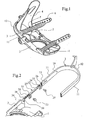
- the figure 1 illustrates a partial view of a device for attaching a boot to a snowboard, which comprises a base having a horizontal portion 1 for receiving a shoe between vertical side portions 2 which serve to maintain the boot side and on which is fixed at least the attachment means 6 of the front part of the shoe, in a manner known from the prior art.
- the invention relates to the rear part of this device, and in particular to the rear arch 3 in the shape of a U-shape which comes to conform to the rear shape of the heel, serves as a support and a rear support for the boot, via a gutter 4 extending vertically and mounted on the hoop at an attachment point 5, its rear face remaining abutting on the hoop 3.
- a fastening strap 6 of the shoe is mounted on this hoop at the same connection point 5, rotatable around this point to be positioned at best on the top of the shoe at the ankle.
- the upper part of the straps 6 is not shown to facilitate the legibility of the figure.
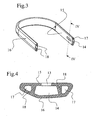
- the rear arch 3 more particularly illustrated on the Figures 2 to 4 , comprises two parallel lateral branches 11 positioned on both sides of the shoe and a central rounded connection portion 12, intended to match the rear portion of the shoe just above the heel.
- this arch 3 is distinct from the base 1, 2 and connected to the base by its two extreme parallel branches 11 which cooperate with housings arranged in the side portions 2 of the base.
- a window arranged in the upper surface of the lateral parts makes it possible to visualize the arch, on which are present graduations which make it possible to know precisely the longitudinal adjustment chosen.
- the arch has a hollow structure whose section illustrated on the figure 4 has a central hollow portion forming a large chamber 14, delimited by the inner side walls 15 and outer 16 of the arch 3, surrounded above and below by two small separate chambers 17 arranged within high and low parts of less wide section of the arch, which has a trapezoidal section, separated from the large chamber by two internal partitions 18.
- This hollow structure achieves high rigidity and resistance with little material, even after the folding of the hoop, and the two walls of the hoop, inner and outer 15, and the internal partitions 18, have a thickness of about 1 millimeter only. More generally, they may have a metal thickness between 0.5 and 2 millimeters only to achieve rigidity and satisfactory performance.
- the arch 3 is obtained by bending a profile formed by extrusion and the extruded metal arch 3 thus has the structural specificity of having its different rooms 14, 17 extending over its entire length.
- a first nut 24 is disposed within the central chamber 14 towards the end of each lateral branch 11, this nut 24 cooperating with a screw 23 positioned from the inner side of the fixing device and through successively respectively the inner wall.
- the vertical side portion 2 of the base and the inner wall 15 of the arch 3 through an opening 13 whose width corresponds to the diameter of the screw 23.
- This opening 13 extends longitudinally on the inner wall 15 of the bar, thus forming a light, to allow a substantially longitudinal adjustment of the positioning of the arch 3 relative to the base 2.
- a stop is provided within the chamber 14 to limit the displacement of the nut 24 to a length substantially equivalent to that of the light and to prevent the loss of the nut 24, either within the chamber 14 or the outside of the hoop 3.
- Such an abutment could for example be obtained by a narrowing of the chamber 14 made by a slight punching of the inner wall 15 of the hoop on either side of the opening 13.
- the stops are obtained by an insert 27 positioned within the central chamber 14, which will be detailed later.
- the trapezoidal shape of the chamber 14 allows controlled retention of the nut 24 within it, of complementary trapezoidal shape, which remains locked in a position and can not slide in the chamber 14 in a tight configuration thanks to the cooperation between the inclined slopes of the nut and the chamber.
- a second similar fixation on the arch is made further back on each leg 11, by a second nut 26 positioned in the same large central chamber 14 and accessible for screwing from an opening 19 provided on the inner wall 15 of the arch at this nut 26, and of dimension corresponding to the screw 25 cooperating with the nut 26.
- This arrangement thus allows the attachment of a shoe holding device, based for example on a strap 6 fixing intended to cover the top of the shoe at the ankle and on a rear gutter 4.
- the opening 19 could be a light providing a possibility of adjustment of these elements, similarly to the front opening 13.
- the fasteners thus arranged on the hoop make it possible to leave the fastening means visible in a limited manner with respect to the state of the art since only the heads of the screws 23, 25 are visible on the single inner side of the hoop.
- fixing device that is to say oriented towards the horizontal base 1, which side is hidden by the shoe when using the device. This therefore allows to achieve a significantly improved aesthetic appearance since no fastening means is visible from outside the fastener in the area of the arch.
- an insert 27 is inserted into the large chamber 14 by the end of each leg 11 of the arch.
- This insert defines two housings 28, 29 for each nut 24, 26, stops 30, 31, 32, 33 on each side of each housing 28, 29 to delimit the longitudinal displacement of the nuts 24, 26, and an end face 34 which remains outside the arch 3 and allows to close and dress the ends of the two branches 11 of the arch.
- This insert 27 thus makes it possible to guarantee the correct positioning of the first nut 24 over its range of displacement corresponding to the light and the correct positioning of the second nut 26 in front of the opening 19.
- Such an insert also fulfills a sealing function of the hoop and can even improve the fixing cooperating with the screws 23, 25 so as to make the nuts 24, 26 equivalent to nilstop nuts.
- the invention also relates to the manufacturing method which consists of a step of manufacturing a section of trapezoidal section comprising three chambers 14, 17, by extrusion, and then cutting and shaping, for example by bending or folding, of this profile to achieve the final geometry described above and shown in the figures. Finally, openings 13, 19 are made by machining and the inserts 27, 24, 26 positioned within the hoop. Such a method has the advantage of being economical, since it uses a small amount of metal per profile and generates little or no drop.
- advantageous hoops incorporating the concept of the invention may be made by other methods on the basis of other materials.
- arches of plastics material comprising at least some hollow parts may be obtained by extrusion.
- plastic hoops could be obtained by injection or profiling.
- arches can also be made of other materials such as carbon fiber, Kevlar or glass, embedded in a thermosetting or thermoplastic matrix.
- a fabric composed of these fibers may be shaped around a mandrel or by any other known equivalent method.
- the combination of an arch independent of the base and at least partially hollow has the advantage of offering a multitude of possibilities for the geometry and appearance of the arch. Indeed, this combination of distinct and hollow arch characteristics makes it possible to overcome, on the one hand, the constraints imposed by the manufacturing process of the base and, on the other hand, the mechanical stresses of rigidity since the hollow parts reach a certain height. satisfactory rigidity quite easily.
- the solution allows to choose relatively freely the shape of the section of the arch and allows a real aesthetic research.
- the presence of the chambers also improves the aesthetic appearance of the arch hiding at least partially the various fastening means implemented on the hoop.
- the illustrated arch has a constant section and chambers extending over its entire length due to the extrusion process used.
- its section could vary, and the arch could have only a few hollow parts, with one or more chambers, without departing from the concept of the invention, from the moment these hollow parts are sufficient to mechanically strengthen the structure of set of the hoop and / or set up the aesthetic fastening means described above.
- the intermediate portion 12 of the arch, between the two branches 11 may have a shape other than a rounded.
- it could be in the form of several broken lines, obtained for example by several bends of a profile.
- the hollow structure of the arch has been illustrated with completely closed chambers, with the exception of the openings 13, 19 made for the fastening functions.
- other openings may be added on the inner and / or outer walls 16 and / or the upper and / or lower of the arch, for example to lighten the arch and reduce the amount of material used, or simply to form decorations.
- the presence of zones comprising at least one closed chamber has the advantage of making it possible to achieve good rigidity for a small amount of material used.
- the hoop can be in different rigid materials, metal or plastic. These materials can provide new opportunities for decorating arches. They may for example be aluminum, decorated by anodizing process, sanding or pad printing. As a variant, they may comprise parts made of transparent plastics material, revealing, by transparency, decorative elements positioned in an inner hollow portion or on its inner face.
- the hoop is a separate element of the base, which has been connected to the base by an adjustable screw nut device. Any other means of attachment could alternatively be used, such as the positioning of the screw head in a shaft chamber and the nut on the outside, or any other means that a screw / nut couple as a solution with eccentric connection, operable without tools.
Landscapes
- Footwear And Its Accessory, Manufacturing Method And Apparatuses (AREA)
- Diaphragms And Bellows (AREA)
- Package Frames And Binding Bands (AREA)
- Holders For Apparel And Elements Relating To Apparel (AREA)
Claims (19)
- Hinteres Bogenstück (3)für eine Bindungsvorrichtung zum Befestigen eines Schuhs auf einem Snowboard, welches insgesamt eine U-Form hat und einen zentralen Verbindungsteil (12) aufweist, der zwischen zwei Schenkeln (11) angeordnet ist, welche für eine bewegliche Verbindung mit einer zum Befestigen des Schuhs auf einem Snowboard dienenden Bindungsvorrichtung geeignet sind, dadurch gekennzeichnet, dass das Bogenstück (3) wenigstens einen Bereich aufweist, in dem es ein extrudierter Hohlkörper ist.
- Hinteres Bogenstück (3) nach Anspruch 1, dadurch gekennzeichnet, dass es wenigstens einen Bereich mit wenigstens einer Kammer (14) auf jedem Schenkel (11) aufweist.
- Hinteres Bogenstück (3) nach Anspruch 1 oder 2, dadurch gekennzeichnet, dass es über seine gesamte Länge eine Hohlkörperstruktur hat.
- Hinteres Bogenstück (3) nach dem vorangehenden Anspruch, dadurch gekennzeichnet, dass es mehrere im wesentlichen parallele Kammern aufweist.
- Hinteres Bogenstück (3) nach einem der Ansprüche 2 bis 4, dadurch gekennzeichnet, dass es wenigstens einen Bereich mit wenigstens einer geschlossenen Kammer aufweist.
- Hinteres Bogenstücke (3) nach Anspruch 3 oder 4, dadurch gekennzeichnet, dass es aus extrudiertem Metall oder Kunststoffmaterial besteht.
- Hinteres Bogenstück (3) nach einem der vorangehenden Ansprüche, dadurch gekennzeichnet, dass es wenigstens ein Verbindungsmittel (24; 26) aufweist, das im Inneren der Kammer (14) angeordnet und dazu geeignet ist, das Bogenstück mit einem Element einer Bindungsvorrichtung zum Befestigen eines Snowboardschuhs zu verbinden.
- Hinteres Bogenstück (3) nach Anspruch 7, dadurch gekennzeichnet, dass die Innenwand (15) des Bogenstücks eine Öffnung (13; 19) aufweist, durch welche das Bindungsmittel (24; 26), welches das Bogenstücks mit einem Element einer Bindungsvorrichtung zum Befestigen eines Snowboardschuhs zu verbinden erlaubt, zugänglich ist.
- Hinteres Bogenstück (3) nach Anspruch 8, dadurch gekennzeichnet, dass es wenigstens ein Verbindungsmittel (24) für ein Element der Bindungsvorrichtung zum Befestigen eines Snowboardschuhs, welches Verbindungsmittel im Inneren einer Kammer (14) der Bogenstückstruktur angeordnet und im Inneren dieser Kammer (14) beweglich ist, um eine Einstellung der Bindung zu erlauben, sowie ein diesem Verbindungsmittel (24) entsprechendes Langloch in der Innenwand (15) des Bogenstücks aufweist.
- Hinters Bogenstück (3) nach einem der Ansprüche 7 bis 9, dadurch gekennzeichnet, dass die das Verbindungsmittel (24) aufweisende Kammer (14) einen im wesentlichen trapezförmigen Abschnitt hat, um dieses Verbindungselements (24) in ihrem Inneren besser zu halten.
- Hinteres Bogenstück (3) nach einem der Ansprüche 7 bis 10, dadurch gekennzeichnet, dass es einen Einsatz (27) vom Typ einer Schraubenmutter aufweist, der wenigstens einen Unterbringungsraum (28; 29) für ein in einer Kammer (14) des Bogenstücks angeordnetes Verbindungsmittel (24; 26) hat.
- Hinteres Bogenstück (3) nach einem der Ansprüche 7 bis 11, dadurch gekennzeichnet, dass die äussere Wand (16) des Bogenstücks (3) das oder wenigstens ein in einer Kammer (14) eingesetztes Verbindungsmittel (24; 26) verdeckt.
- Hinteres Bogenstück (3) nach einem der vorangehenden Ansprüche, dadurch gekennzeichnet, dass der zentrale Verbindungsteil (12) des Bogenstücks eine abgerundete gewölbte Form hat oder in Form gefalteter gebrochener Linien ausgebildet ist.
- Bindungsvorrichtung zum Befestigen eines Schuhs auf einem Snowboard, dadurch gekennzeichnet, das sie ein Bogenstücke (3) nach einem der vorangehenden Ansprüche aufweist.
- Bindungsvorrichtung nach Anspruch 14, dadurch gekennzeichnet, dass sie ein Bogenstück (3) aufweist, das ein von einer Grundplatte (1, 2) verschiedenes Teil darstellt und in Längsrichtung zum Einstellen der Bindung in bezug auf die Grundplatte beweglich ist.
- Bindungsvorrichtung nach Anspruch 15, dadurch gekennzeichnet, dass das Bogenstück (3) in einem in jedem Seitenteil (2) der Bindungsvorrichtung angeordneten Unterbringungsraum in Längsrichtung beweglich montiert ist, und zwar mittels eines ersten Verbindungsmittels (24), das beweglich im Innern einer Kammer (14) des Bogenstücks (3) montiert ist und mit einem zweiten Verbindungsmittel (23) zusammenarbeitet, das aufeinanderfolgend eine Innenwand des Seitenteils (2) und die Innenwand (15) des Bogenstücks (3) durchquert, welche ein Langloch aufweist, das den Verstellweg zum Einstellen der Position des Bogenstücks (3) definiert.
- Snowboard, dadurch gekennzeichnet, dass es eine Bindungsvorrichtung zum Befestigen eines Schuhs aufweist, welche mit einem Bogenstück (3) nach einem der Ansprüche 1 bis 13 ausgerüstet ist.
- Verfahren zum Herstellen eines Bogenstücks (3) für eine Bindungsvorrichtung zum Befestigen eines Schuhs auf einem Snowboard, gekennzeichnet durch die folgenden Schritte:- Herstellung eines Profils mit einer durch Extrudieren erhaltenen Hohlstruktur,- Schneiden und Formen des Profils.
- Verfahren nach Anspruch 18, gekennzeichnet durch die folgenden zusätzlichen Schritte:- Einsetzen wenigstens eines Verbindungsmittels (24; 26) in eine Kammer (14);- Anbringen einer diesem wenigstens einem Verbindungsmittels (24; 26) entsprechenden Öffnung (13; 19) in der Innenwand (15) des Bogenstücks (3).
Applications Claiming Priority (1)
| Application Number | Priority Date | Filing Date | Title |
|---|---|---|---|
| FR0704973A FR2918573A1 (fr) | 2007-07-10 | 2007-07-10 | Arceau arrriere pour un dispositif de fixation de snowboard. |
Publications (2)
| Publication Number | Publication Date |
|---|---|
| EP2014340A1 EP2014340A1 (de) | 2009-01-14 |
| EP2014340B1 true EP2014340B1 (de) | 2010-01-06 |
Family
ID=39004811
Family Applications (1)
| Application Number | Title | Priority Date | Filing Date |
|---|---|---|---|
| EP08159411A Active EP2014340B1 (de) | 2007-07-10 | 2008-07-01 | Fersenbügel für eine Snowboard-Bindung |
Country Status (5)
| Country | Link |
|---|---|
| US (1) | US8960710B2 (de) |
| EP (1) | EP2014340B1 (de) |
| AT (1) | ATE454192T1 (de) |
| DE (1) | DE602008000499D1 (de) |
| FR (1) | FR2918573A1 (de) |
Families Citing this family (3)
| Publication number | Priority date | Publication date | Assignee | Title |
|---|---|---|---|---|
| FR2958556B1 (fr) * | 2010-04-12 | 2012-12-21 | Salomon Sas | Dispositif d'accueil d'un pied ou d'une chaussure sur un engin de glisse. |
| US9545560B2 (en) | 2014-12-22 | 2017-01-17 | Helos, Llc | Heel locking binding system |
| US10086257B2 (en) * | 2016-06-28 | 2018-10-02 | Mad Jack Snow Sports | Apparatus for adapting a snowboard boot for use with an alpine ski |
Family Cites Families (26)
| Publication number | Priority date | Publication date | Assignee | Title |
|---|---|---|---|---|
| US2176226A (en) * | 1938-07-23 | 1939-10-17 | Jr Verner Z Reed | Ski binding |
| US2610068A (en) * | 1948-02-16 | 1952-09-09 | Ludwig A Majneri | Ski binding |
| US2822613A (en) * | 1956-03-13 | 1958-02-11 | Lundberg Eric | Ski boot fitting device |
| US2987834A (en) * | 1959-01-19 | 1961-06-13 | Howe Folding Furniture Inc | Snowshoe harness |
| US3825273A (en) * | 1971-06-07 | 1974-07-23 | Safe Flight Instrument | Ski binding |
| US3861698A (en) * | 1973-07-11 | 1975-01-21 | James W Greig | Combination snowshoe and ski |
| US3944237A (en) * | 1974-03-25 | 1976-03-16 | James Reed Morris, IV | Ski binding |
| CA1069143A (en) * | 1976-04-27 | 1980-01-01 | G. Theodore Buel | Heel binding for trail skis |
| IT1060719B (it) * | 1976-04-28 | 1982-08-20 | Faulin A | Struttura di attacco per sci |
| US4251894A (en) * | 1977-01-19 | 1981-02-24 | Farallon Industries, Inc. | Self-adjusting swim fin strap |
| FR2636854B1 (fr) * | 1988-09-28 | 1991-12-06 | Gilot Francois | Adaptateur; chaussures de ski, fixations de ski sur surf des neiges |
| FR2641703B3 (fr) * | 1989-01-17 | 1991-04-19 | Bataille Ind Sa | Dispositif de fixation de securite de ski, monoski ou surf de neige |
| US6283492B1 (en) * | 1996-12-27 | 2001-09-04 | Noah W. Hale | Snowboard binding system and a snowboard step-in boot system with gradually increasing resistance |
| US6027136A (en) * | 1997-01-08 | 2000-02-22 | The Burton Corporation | System for preventing toe-edge travel of a hi-back |
| US6648365B1 (en) * | 1997-01-08 | 2003-11-18 | The Burton Corporation | Snowboard binding |
| US6315318B1 (en) * | 1998-01-14 | 2001-11-13 | Caron Alpine Technologies, Inc. | Boot binding system |
| FR2788992B1 (fr) * | 1999-02-02 | 2001-04-06 | Look Fixations Sa | Ensemble chaussure-fixation de ski de securite |
| FR2793422B1 (fr) * | 1999-05-12 | 2002-02-08 | Rene Bressand | Talonniere suspendue de fixation de securite pour le ski |
| US6416075B1 (en) * | 2000-04-28 | 2002-07-09 | The Burton Corporation | Tool-free adjustable binding strap |
| US6485035B1 (en) * | 2000-04-28 | 2002-11-26 | The Burton Corporation | Binding baseplate for a gliding board |
| US6619533B1 (en) * | 2000-09-22 | 2003-09-16 | Tower Automotive Technology Products, Inc. | Multi-piece extruded link arm |
| FR2838977B1 (fr) | 2002-04-30 | 2004-12-31 | Rossignol Sa | Fixation de planche de surf avec fenetre de lecture |
| ITMI20050091A1 (it) * | 2005-01-24 | 2006-07-25 | Core S R L | Attacco per la connessione di una calzatura ad una tavola da neve e simili |
| KR20090004843A (ko) * | 2005-11-30 | 2009-01-12 | 이 아이 듀폰 디 네모아 앤드 캄파니 | 개선된 보드 바인딩 |
| EP1957173A1 (de) * | 2005-11-30 | 2008-08-20 | E.I. Du Pont De Nemours And Company | Bindung mit einstellbarem absatzschalenrahmen |
| US7681905B2 (en) * | 2007-02-01 | 2010-03-23 | Rottefella As | Ski binding, especially telemark binding |
-
2007
- 2007-07-10 FR FR0704973A patent/FR2918573A1/fr not_active Withdrawn
-
2008
- 2008-07-01 AT AT08159411T patent/ATE454192T1/de not_active IP Right Cessation
- 2008-07-01 EP EP08159411A patent/EP2014340B1/de active Active
- 2008-07-01 DE DE602008000499T patent/DE602008000499D1/de active Active
- 2008-07-09 US US12/169,765 patent/US8960710B2/en not_active Expired - Fee Related
Also Published As
| Publication number | Publication date |
|---|---|
| US8960710B2 (en) | 2015-02-24 |
| US20090014984A1 (en) | 2009-01-15 |
| FR2918573A1 (fr) | 2009-01-16 |
| DE602008000499D1 (de) | 2010-02-25 |
| ATE454192T1 (de) | 2010-01-15 |
| EP2014340A1 (de) | 2009-01-14 |
Similar Documents
| Publication | Publication Date | Title |
|---|---|---|
| CA2812693C (fr) | Vitrage a joint profile encapsule et piece rapportee fixee au joint, element de fixation de la piece rapportee pour le vitrage et procede de fabrication du vitrage | |
| EP0886539B1 (de) | Verstärktes gestell für rollschuhe | |
| FR2912373A1 (fr) | Pedale de bicyclette a enclenchement et declenchement automatiques. | |
| EP3230101B1 (de) | Fenster mit dichtungsprofil, kappe und kern, sowie verfahren zur herstellung dieses fensters | |
| EP2014340B1 (de) | Fersenbügel für eine Snowboard-Bindung | |
| FR2767034A1 (fr) | Chaussure de sport a flexibilite determinee | |
| WO2007031527A1 (fr) | Ensemble de profiles | |
| EP1108452B1 (de) | Verbindungselement zum Kuppeln eines Stiefels mit einem Snowboard | |
| WO2012062973A1 (fr) | Pain de mousse a inserts | |
| EP3177167B1 (de) | Abnehmbarer schuhabsatz und schuh zur aufnahme solch eines absatzes | |
| FR2774605A1 (fr) | Procede de fabrication d'un element rigide de structure d'un article de sport | |
| EP2950677B1 (de) | Dekorelement mit einer anzahl von in einem geschlossenen rahmen angeordneten steinen und zwei dekorativen flächen | |
| FR2907318A1 (fr) | Systeme de talon interchangeable, procede de fabrication du talon et chaussure associe. | |
| FR2961075A3 (fr) | Paroi prefabriquee ultralegere | |
| BE1016764A6 (fr) | Ensemble de profiles. | |
| EP1716776A2 (de) | Vorrichtung zur Korrektur der Länge eines Armbandes mit Faltverschluss | |
| EP1554625A1 (de) | Abschirmung für brillen und komponenten zur herstellung einer solchen abschirmung | |
| EP2471398B1 (de) | Absatz eines Gleitschuhs mit Einsatz | |
| EP2127845B1 (de) | Verbessertes Herstellungsverfahren eines Teils, das eine Armstütze mit Komfortüberzug bildet | |
| FR3074746A1 (fr) | Procede de realisation d'un element d'habillage avec une couche de revetement composite | |
| BE1004558A4 (fr) | Guide pour element coulissant et procede de fabrication dudit guide. | |
| EP1702596A2 (de) | Maske, insbesondere für Gleitsport | |
| WO2024132699A1 (fr) | Mécanisme d'interchangeabilité de bracelet de montre | |
| FR2737168A1 (fr) | Porte-charge a fixer sur le toit d'un vehicule automobile | |
| CH720341A2 (fr) | Mécanisme de fixation pour bracelet interchangeable à un boîtier et boîtier de montre |
Legal Events
| Date | Code | Title | Description |
|---|---|---|---|
| PUAI | Public reference made under article 153(3) epc to a published international application that has entered the european phase |
Free format text: ORIGINAL CODE: 0009012 |
|
| 17P | Request for examination filed |
Effective date: 20081003 |
|
| AK | Designated contracting states |
Kind code of ref document: A1 Designated state(s): AT BE BG CH CY CZ DE DK EE ES FI FR GB GR HR HU IE IS IT LI LT LU LV MC MT NL NO PL PT RO SE SI SK TR |
|
| AX | Request for extension of the european patent |
Extension state: AL BA MK RS |
|
| GRAP | Despatch of communication of intention to grant a patent |
Free format text: ORIGINAL CODE: EPIDOSNIGR1 |
|
| GRAS | Grant fee paid |
Free format text: ORIGINAL CODE: EPIDOSNIGR3 |
|
| AKX | Designation fees paid |
Designated state(s): AT DE FR |
|
| GRAA | (expected) grant |
Free format text: ORIGINAL CODE: 0009210 |
|
| AK | Designated contracting states |
Kind code of ref document: B1 Designated state(s): AT DE FR |
|
| REF | Corresponds to: |
Ref document number: 602008000499 Country of ref document: DE Date of ref document: 20100225 Kind code of ref document: P |
|
| PG25 | Lapsed in a contracting state [announced via postgrant information from national office to epo] |
Ref country code: AT Free format text: LAPSE BECAUSE OF FAILURE TO SUBMIT A TRANSLATION OF THE DESCRIPTION OR TO PAY THE FEE WITHIN THE PRESCRIBED TIME-LIMIT Effective date: 20100106 |
|
| PLBE | No opposition filed within time limit |
Free format text: ORIGINAL CODE: 0009261 |
|
| STAA | Information on the status of an ep patent application or granted ep patent |
Free format text: STATUS: NO OPPOSITION FILED WITHIN TIME LIMIT |
|
| 26N | No opposition filed |
Effective date: 20101007 |
|
| REG | Reference to a national code |
Ref country code: FR Ref legal event code: PLFP Year of fee payment: 9 |
|
| REG | Reference to a national code |
Ref country code: FR Ref legal event code: PLFP Year of fee payment: 10 |
|
| REG | Reference to a national code |
Ref country code: FR Ref legal event code: PLFP Year of fee payment: 11 |
|
| PGFP | Annual fee paid to national office [announced via postgrant information from national office to epo] |
Ref country code: DE Payment date: 20180727 Year of fee payment: 11 |
|
| REG | Reference to a national code |
Ref country code: DE Ref legal event code: R119 Ref document number: 602008000499 Country of ref document: DE |
|
| PG25 | Lapsed in a contracting state [announced via postgrant information from national office to epo] |
Ref country code: DE Free format text: LAPSE BECAUSE OF NON-PAYMENT OF DUE FEES Effective date: 20200201 |
|
| PGFP | Annual fee paid to national office [announced via postgrant information from national office to epo] |
Ref country code: FR Payment date: 20250725 Year of fee payment: 18 |