EP2013240B1 - Process for the preparation of crosslinked nitroxide polymers - Google Patents
Process for the preparation of crosslinked nitroxide polymers Download PDFInfo
- Publication number
- EP2013240B1 EP2013240B1 EP07727445.4A EP07727445A EP2013240B1 EP 2013240 B1 EP2013240 B1 EP 2013240B1 EP 07727445 A EP07727445 A EP 07727445A EP 2013240 B1 EP2013240 B1 EP 2013240B1
- Authority
- EP
- European Patent Office
- Prior art keywords
- transition metal
- use according
- bis
- formula
- chloro
- Prior art date
- Legal status (The legal status is an assumption and is not a legal conclusion. Google has not performed a legal analysis and makes no representation as to the accuracy of the status listed.)
- Not-in-force
Links
- 238000000034 method Methods 0.000 title claims description 10
- AVXURJPOCDRRFD-UHFFFAOYSA-N Hydroxylamine Chemical class ON AVXURJPOCDRRFD-UHFFFAOYSA-N 0.000 title claims description 8
- 238000002360 preparation method Methods 0.000 title claims description 6
- 229920000642 polymer Polymers 0.000 title description 6
- -1 nitroxide groups Chemical group 0.000 claims description 93
- 229910052723 transition metal Inorganic materials 0.000 claims description 23
- 150000001875 compounds Chemical class 0.000 claims description 16
- 150000003624 transition metals Chemical class 0.000 claims description 12
- 239000003446 ligand Substances 0.000 claims description 11
- 230000003647 oxidation Effects 0.000 claims description 9
- 238000007254 oxidation reaction Methods 0.000 claims description 9
- 125000006850 spacer group Chemical group 0.000 claims description 9
- 125000003118 aryl group Chemical group 0.000 claims description 7
- 229910052736 halogen Inorganic materials 0.000 claims description 7
- 150000002367 halogens Chemical class 0.000 claims description 7
- 125000001997 phenyl group Chemical group [H]C1=C([H])C([H])=C(*)C([H])=C1[H] 0.000 claims description 7
- 150000001732 carboxylic acid derivatives Chemical class 0.000 claims description 6
- ZUOUZKKEUPVFJK-UHFFFAOYSA-N diphenyl Chemical compound C1=CC=CC=C1C1=CC=CC=C1 ZUOUZKKEUPVFJK-UHFFFAOYSA-N 0.000 claims description 6
- 150000001412 amines Chemical class 0.000 claims description 5
- 229920006037 cross link polymer Polymers 0.000 claims description 5
- 150000002366 halogen compounds Chemical class 0.000 claims description 5
- 229910052751 metal Inorganic materials 0.000 claims description 5
- 239000002184 metal Substances 0.000 claims description 5
- LFQSCWFLJHTTHZ-UHFFFAOYSA-N Ethanol Chemical compound CCO LFQSCWFLJHTTHZ-UHFFFAOYSA-N 0.000 claims description 4
- 239000011149 active material Substances 0.000 claims description 4
- 229910052794 bromium Inorganic materials 0.000 claims description 4
- 229910052801 chlorine Inorganic materials 0.000 claims description 4
- 150000002739 metals Chemical class 0.000 claims description 4
- 229910052757 nitrogen Inorganic materials 0.000 claims description 4
- 125000004178 (C1-C4) alkyl group Chemical group 0.000 claims description 3
- KWYHDKDOAIKMQN-UHFFFAOYSA-N N,N,N',N'-tetramethylethylenediamine Chemical compound CN(C)CCN(C)C KWYHDKDOAIKMQN-UHFFFAOYSA-N 0.000 claims description 3
- 125000002252 acyl group Chemical group 0.000 claims description 3
- 239000004305 biphenyl Substances 0.000 claims description 3
- 235000010290 biphenyl Nutrition 0.000 claims description 3
- 230000000536 complexating effect Effects 0.000 claims description 3
- 125000001624 naphthyl group Chemical group 0.000 claims description 3
- 125000003367 polycyclic group Chemical group 0.000 claims description 3
- WLDGDTPNAKWAIR-UHFFFAOYSA-N 1,4,7-trimethyl-1,4,7-triazonane Chemical compound CN1CCN(C)CCN(C)CC1 WLDGDTPNAKWAIR-UHFFFAOYSA-N 0.000 claims description 2
- LRPVVAOGGZFVFO-UHFFFAOYSA-N 1,5,9-trimethyl-1,5,9-triazacyclododecane Chemical compound CN1CCCN(C)CCCN(C)CCC1 LRPVVAOGGZFVFO-UHFFFAOYSA-N 0.000 claims description 2
- ROFVEXUMMXZLPA-UHFFFAOYSA-N Bipyridyl Chemical group N1=CC=CC=C1C1=CC=CC=N1 ROFVEXUMMXZLPA-UHFFFAOYSA-N 0.000 claims description 2
- 229910002651 NO3 Inorganic materials 0.000 claims description 2
- NHNBFGGVMKEFGY-UHFFFAOYSA-N Nitrate Chemical compound [O-][N+]([O-])=O NHNBFGGVMKEFGY-UHFFFAOYSA-N 0.000 claims description 2
- QAOWNCQODCNURD-UHFFFAOYSA-L Sulfate Chemical compound [O-]S([O-])(=O)=O QAOWNCQODCNURD-UHFFFAOYSA-L 0.000 claims description 2
- 125000002619 bicyclic group Chemical group 0.000 claims description 2
- 150000007942 carboxylates Chemical class 0.000 claims description 2
- 229910052804 chromium Inorganic materials 0.000 claims description 2
- 229910052802 copper Inorganic materials 0.000 claims description 2
- 229910052742 iron Inorganic materials 0.000 claims description 2
- 229910052748 manganese Inorganic materials 0.000 claims description 2
- 229910052750 molybdenum Inorganic materials 0.000 claims description 2
- VMGSQCIDWAUGLQ-UHFFFAOYSA-N n',n'-bis[2-(dimethylamino)ethyl]-n,n-dimethylethane-1,2-diamine Chemical compound CN(C)CCN(CCN(C)C)CCN(C)C VMGSQCIDWAUGLQ-UHFFFAOYSA-N 0.000 claims description 2
- DWFKOMDBEKIATP-UHFFFAOYSA-N n'-[2-[2-(dimethylamino)ethyl-methylamino]ethyl]-n,n,n'-trimethylethane-1,2-diamine Chemical compound CN(C)CCN(C)CCN(C)CCN(C)C DWFKOMDBEKIATP-UHFFFAOYSA-N 0.000 claims description 2
- 229910052759 nickel Inorganic materials 0.000 claims description 2
- 125000004076 pyridyl group Chemical group 0.000 claims description 2
- 229910052707 ruthenium Inorganic materials 0.000 claims description 2
- BDHFUVZGWQCTTF-UHFFFAOYSA-M sulfonate Chemical compound [O-]S(=O)=O BDHFUVZGWQCTTF-UHFFFAOYSA-M 0.000 claims description 2
- HRFJEOWVAGSJNW-UHFFFAOYSA-N 1,4,8,11-tetramethyl-1,4,8,11-tetrazacyclotetradecane Chemical compound CN1CCCN(C)CCN(C)CCCN(C)CC1 HRFJEOWVAGSJNW-UHFFFAOYSA-N 0.000 claims 1
- CSCPPACGZOOCGX-UHFFFAOYSA-N Acetone Chemical compound CC(C)=O CSCPPACGZOOCGX-UHFFFAOYSA-N 0.000 description 25
- YMWUJEATGCHHMB-UHFFFAOYSA-N Dichloromethane Chemical compound ClCCl YMWUJEATGCHHMB-UHFFFAOYSA-N 0.000 description 15
- 239000000203 mixture Substances 0.000 description 14
- XLYOFNOQVPJJNP-UHFFFAOYSA-N water Substances O XLYOFNOQVPJJNP-UHFFFAOYSA-N 0.000 description 11
- 125000004432 carbon atom Chemical group C* 0.000 description 10
- 150000003254 radicals Chemical class 0.000 description 10
- XKRFYHLGVUSROY-UHFFFAOYSA-N Argon Chemical compound [Ar] XKRFYHLGVUSROY-UHFFFAOYSA-N 0.000 description 9
- VLKZOEOYAKHREP-UHFFFAOYSA-N n-Hexane Chemical compound CCCCCC VLKZOEOYAKHREP-UHFFFAOYSA-N 0.000 description 9
- 239000007772 electrode material Substances 0.000 description 8
- 239000000843 powder Substances 0.000 description 8
- 239000000243 solution Substances 0.000 description 8
- WYURNTSHIVDZCO-UHFFFAOYSA-N Tetrahydrofuran Chemical compound C1CCOC1 WYURNTSHIVDZCO-UHFFFAOYSA-N 0.000 description 7
- HEMHJVSKTPXQMS-UHFFFAOYSA-M Sodium hydroxide Chemical compound [OH-].[Na+] HEMHJVSKTPXQMS-UHFFFAOYSA-M 0.000 description 6
- YXFVVABEGXRONW-UHFFFAOYSA-N Toluene Chemical compound CC1=CC=CC=C1 YXFVVABEGXRONW-UHFFFAOYSA-N 0.000 description 6
- CERQOIWHTDAKMF-UHFFFAOYSA-N alpha-methacrylic acid Natural products CC(=C)C(O)=O CERQOIWHTDAKMF-UHFFFAOYSA-N 0.000 description 6
- 238000004132 cross linking Methods 0.000 description 6
- 229920000193 polymethacrylate Polymers 0.000 description 6
- 239000002244 precipitate Substances 0.000 description 6
- 229910052786 argon Inorganic materials 0.000 description 5
- 238000006243 chemical reaction Methods 0.000 description 5
- 125000001841 imino group Chemical group [H]N=* 0.000 description 5
- 239000002904 solvent Substances 0.000 description 5
- 238000003756 stirring Methods 0.000 description 5
- 229910021589 Copper(I) bromide Inorganic materials 0.000 description 4
- UIIMBOGNXHQVGW-UHFFFAOYSA-M Sodium bicarbonate Chemical compound [Na+].OC([O-])=O UIIMBOGNXHQVGW-UHFFFAOYSA-M 0.000 description 4
- MUMVIYLVHVCYGI-UHFFFAOYSA-N n,n,n',n',n",n"-hexamethylmethanetriamine Chemical compound CN(C)C(N(C)C)N(C)C MUMVIYLVHVCYGI-UHFFFAOYSA-N 0.000 description 4
- 238000006116 polymerization reaction Methods 0.000 description 4
- QTBSBXVTEAMEQO-UHFFFAOYSA-N Acetic acid Chemical compound CC(O)=O QTBSBXVTEAMEQO-UHFFFAOYSA-N 0.000 description 3
- WEVYAHXRMPXWCK-UHFFFAOYSA-N Acetonitrile Chemical compound CC#N WEVYAHXRMPXWCK-UHFFFAOYSA-N 0.000 description 3
- 0 C*N(*)C(C)(*)N Chemical compound C*N(*)C(C)(*)N 0.000 description 3
- HBBGRARXTFLTSG-UHFFFAOYSA-N Lithium ion Chemical compound [Li+] HBBGRARXTFLTSG-UHFFFAOYSA-N 0.000 description 3
- CFFOWCCBGNZDJF-UHFFFAOYSA-N [3-(2-chloropropanoyloxy)-2,2-bis(2-chloropropanoyloxymethyl)propyl] 2-chloropropanoate Chemical compound CC(Cl)C(=O)OCC(COC(=O)C(C)Cl)(COC(=O)C(C)Cl)COC(=O)C(C)Cl CFFOWCCBGNZDJF-UHFFFAOYSA-N 0.000 description 3
- 125000005262 alkoxyamine group Chemical group 0.000 description 3
- 229910052799 carbon Inorganic materials 0.000 description 3
- 239000000460 chlorine Substances 0.000 description 3
- KRKNYBCHXYNGOX-UHFFFAOYSA-N citric acid Chemical compound OC(=O)CC(O)(C(O)=O)CC(O)=O KRKNYBCHXYNGOX-UHFFFAOYSA-N 0.000 description 3
- 239000003431 cross linking reagent Substances 0.000 description 3
- 150000002148 esters Chemical class 0.000 description 3
- 229910001416 lithium ion Inorganic materials 0.000 description 3
- 125000004433 nitrogen atom Chemical group N* 0.000 description 3
- JEQDSBVHLKBEIZ-REOHCLBHSA-N (2s)-2-chloropropanoyl chloride Chemical compound C[C@H](Cl)C(Cl)=O JEQDSBVHLKBEIZ-REOHCLBHSA-N 0.000 description 2
- HXZIJAVWTGVVJX-UHFFFAOYSA-N 12-(2-bromopropanoyloxy)dodecyl 2-bromopropanoate Chemical compound CC(Br)C(=O)OCCCCCCCCCCCCOC(=O)C(C)Br HXZIJAVWTGVVJX-UHFFFAOYSA-N 0.000 description 2
- OBNPDQQJYLNJPU-UHFFFAOYSA-N 2-(2-bromopropanoyloxy)ethyl 2-bromopropanoate Chemical compound CC(Br)C(=O)OCCOC(=O)C(C)Br OBNPDQQJYLNJPU-UHFFFAOYSA-N 0.000 description 2
- VHYFNPMBLIVWCW-UHFFFAOYSA-N 4-Dimethylaminopyridine Chemical compound CN(C)C1=CC=NC=C1 VHYFNPMBLIVWCW-UHFFFAOYSA-N 0.000 description 2
- WKBOTKDWSSQWDR-UHFFFAOYSA-N Bromine atom Chemical compound [Br] WKBOTKDWSSQWDR-UHFFFAOYSA-N 0.000 description 2
- ZAMOUSCENKQFHK-UHFFFAOYSA-N Chlorine atom Chemical compound [Cl] ZAMOUSCENKQFHK-UHFFFAOYSA-N 0.000 description 2
- PEDCQBHIVMGVHV-UHFFFAOYSA-N Glycerine Chemical compound OCC(O)CO PEDCQBHIVMGVHV-UHFFFAOYSA-N 0.000 description 2
- CSNNHWWHGAXBCP-UHFFFAOYSA-L Magnesium sulfate Chemical compound [Mg+2].[O-][S+2]([O-])([O-])[O-] CSNNHWWHGAXBCP-UHFFFAOYSA-L 0.000 description 2
- KFSLWBXXFJQRDL-UHFFFAOYSA-N Peracetic acid Chemical compound CC(=O)OO KFSLWBXXFJQRDL-UHFFFAOYSA-N 0.000 description 2
- NQRYJNQNLNOLGT-UHFFFAOYSA-N Piperidine Chemical compound C1CCNCC1 NQRYJNQNLNOLGT-UHFFFAOYSA-N 0.000 description 2
- 125000004423 acyloxy group Chemical group 0.000 description 2
- 125000003342 alkenyl group Chemical group 0.000 description 2
- 125000003545 alkoxy group Chemical group 0.000 description 2
- 125000000217 alkyl group Chemical group 0.000 description 2
- 125000004429 atom Chemical group 0.000 description 2
- 125000001797 benzyl group Chemical group [H]C1=C([H])C([H])=C(C([H])=C1[H])C([H])([H])* 0.000 description 2
- GDTBXPJZTBHREO-UHFFFAOYSA-N bromine Substances BrBr GDTBXPJZTBHREO-UHFFFAOYSA-N 0.000 description 2
- MVPPADPHJFYWMZ-UHFFFAOYSA-N chlorobenzene Chemical compound ClC1=CC=CC=C1 MVPPADPHJFYWMZ-UHFFFAOYSA-N 0.000 description 2
- 238000001035 drying Methods 0.000 description 2
- 239000012530 fluid Substances 0.000 description 2
- 239000001257 hydrogen Substances 0.000 description 2
- 229910052739 hydrogen Inorganic materials 0.000 description 2
- 125000002887 hydroxy group Chemical group [H]O* 0.000 description 2
- 239000002198 insoluble material Substances 0.000 description 2
- 239000000463 material Substances 0.000 description 2
- 125000002496 methyl group Chemical group [H]C([H])([H])* 0.000 description 2
- UFXIIZNOWZBSAA-UHFFFAOYSA-N n,n-bis(2,2,6,6-tetramethylpiperidin-4-yl)prop-2-enamide Chemical compound C1C(C)(C)NC(C)(C)CC1N(C(=O)C=C)C1CC(C)(C)NC(C)(C)C1 UFXIIZNOWZBSAA-UHFFFAOYSA-N 0.000 description 2
- 150000002894 organic compounds Chemical class 0.000 description 2
- 239000012044 organic layer Substances 0.000 description 2
- 229910052760 oxygen Inorganic materials 0.000 description 2
- 239000001301 oxygen Substances 0.000 description 2
- WXZMFSXDPGVJKK-UHFFFAOYSA-N pentaerythritol Chemical compound OCC(CO)(CO)CO WXZMFSXDPGVJKK-UHFFFAOYSA-N 0.000 description 2
- 125000000843 phenylene group Chemical group C1(=C(C=CC=C1)*)* 0.000 description 2
- 230000000379 polymerizing effect Effects 0.000 description 2
- 238000007342 radical addition reaction Methods 0.000 description 2
- 150000003839 salts Chemical class 0.000 description 2
- 229910000030 sodium bicarbonate Inorganic materials 0.000 description 2
- 239000003381 stabilizer Substances 0.000 description 2
- 238000010561 standard procedure Methods 0.000 description 2
- 125000000547 substituted alkyl group Chemical group 0.000 description 2
- 229910000314 transition metal oxide Inorganic materials 0.000 description 2
- ARCGXLSVLAOJQL-UHFFFAOYSA-N trimellitic acid Chemical compound OC(=O)C1=CC=C(C(O)=O)C(C(O)=O)=C1 ARCGXLSVLAOJQL-UHFFFAOYSA-N 0.000 description 2
- 229920002554 vinyl polymer Polymers 0.000 description 2
- GGAUUQHSCNMCAU-ZXZARUISSA-N (2s,3r)-butane-1,2,3,4-tetracarboxylic acid Chemical compound OC(=O)C[C@H](C(O)=O)[C@H](C(O)=O)CC(O)=O GGAUUQHSCNMCAU-ZXZARUISSA-N 0.000 description 1
- 125000000229 (C1-C4)alkoxy group Chemical group 0.000 description 1
- XJOUCILNLRXRTF-UHFFFAOYSA-N 1,2,3,4,5,6-hexakis(bromomethyl)benzene Chemical compound BrCC1=C(CBr)C(CBr)=C(CBr)C(CBr)=C1CBr XJOUCILNLRXRTF-UHFFFAOYSA-N 0.000 description 1
- CBXSRZCXQWNWTK-UHFFFAOYSA-N 1,2,3,4,5,6-hexakis(chloromethyl)benzene Chemical compound ClCC1=C(CCl)C(CCl)=C(CCl)C(CCl)=C1CCl CBXSRZCXQWNWTK-UHFFFAOYSA-N 0.000 description 1
- KGKAYWMGPDWLQZ-UHFFFAOYSA-N 1,2-bis(bromomethyl)benzene Chemical compound BrCC1=CC=CC=C1CBr KGKAYWMGPDWLQZ-UHFFFAOYSA-N 0.000 description 1
- FMGGHNGKHRCJLL-UHFFFAOYSA-N 1,2-bis(chloromethyl)benzene Chemical compound ClCC1=CC=CC=C1CCl FMGGHNGKHRCJLL-UHFFFAOYSA-N 0.000 description 1
- GHITVUOBZBZMND-UHFFFAOYSA-N 1,3,5-tris(bromomethyl)benzene Chemical compound BrCC1=CC(CBr)=CC(CBr)=C1 GHITVUOBZBZMND-UHFFFAOYSA-N 0.000 description 1
- PJKMOHIGRNELRP-UHFFFAOYSA-N 1,3,5-tris(chloromethyl)benzene Chemical compound ClCC1=CC(CCl)=CC(CCl)=C1 PJKMOHIGRNELRP-UHFFFAOYSA-N 0.000 description 1
- OXHOPZLBSSTTBU-UHFFFAOYSA-N 1,3-bis(bromomethyl)benzene Chemical compound BrCC1=CC=CC(CBr)=C1 OXHOPZLBSSTTBU-UHFFFAOYSA-N 0.000 description 1
- GRJWOKACBGZOKT-UHFFFAOYSA-N 1,3-bis(chloromethyl)benzene Chemical compound ClCC1=CC=CC(CCl)=C1 GRJWOKACBGZOKT-UHFFFAOYSA-N 0.000 description 1
- RBZMSGOBSOCYHR-UHFFFAOYSA-N 1,4-bis(bromomethyl)benzene Chemical compound BrCC1=CC=C(CBr)C=C1 RBZMSGOBSOCYHR-UHFFFAOYSA-N 0.000 description 1
- ZZHIDJWUJRKHGX-UHFFFAOYSA-N 1,4-bis(chloromethyl)benzene Chemical compound ClCC1=CC=C(CCl)C=C1 ZZHIDJWUJRKHGX-UHFFFAOYSA-N 0.000 description 1
- DURPTKYDGMDSBL-UHFFFAOYSA-N 1-butoxybutane Chemical compound CCCCOCCCC DURPTKYDGMDSBL-UHFFFAOYSA-N 0.000 description 1
- AYORTOFSIKLNIK-UHFFFAOYSA-N 1-n-[2-(dimethylamino)ethyl]-2-n,2-n-dimethylpropane-1,2-diamine Chemical compound CN(C)C(C)CNCCN(C)C AYORTOFSIKLNIK-UHFFFAOYSA-N 0.000 description 1
- DOXCLXFOJUTEOQ-UHFFFAOYSA-N 12-(2-bromoacetyl)oxydodecyl 2-bromoacetate Chemical compound BrCC(=O)OCCCCCCCCCCCCOC(=O)CBr DOXCLXFOJUTEOQ-UHFFFAOYSA-N 0.000 description 1
- CLRWOSFRFDZAIX-UHFFFAOYSA-N 12-(2-chloroacetyl)oxydodecyl 2-chloroacetate Chemical compound ClCC(=O)OCCCCCCCCCCCCOC(=O)CCl CLRWOSFRFDZAIX-UHFFFAOYSA-N 0.000 description 1
- SAXFYHWCFCTLDG-UHFFFAOYSA-N 12-(2-chloropropanoyloxy)dodecyl 2-chloropropanoate Chemical compound CC(Cl)C(=O)OCCCCCCCCCCCCOC(=O)C(C)Cl SAXFYHWCFCTLDG-UHFFFAOYSA-N 0.000 description 1
- IOCLFIGHHOKNTE-UHFFFAOYSA-N 2,2,6,6-tetramethyl-n-(2,2,6,6-tetramethylpiperidin-4-yl)piperidin-4-amine Chemical compound C1C(C)(C)NC(C)(C)CC1NC1CC(C)(C)NC(C)(C)C1 IOCLFIGHHOKNTE-UHFFFAOYSA-N 0.000 description 1
- REYWSDZGTOLUMX-UHFFFAOYSA-N 2,3,4,5,6-pentakis(2-bromopropanoyloxy)hexyl 2-bromopropanoate Chemical compound CC(Br)C(=O)OCC(OC(=O)C(C)Br)C(OC(=O)C(C)Br)C(OC(=O)C(C)Br)C(OC(=O)C(C)Br)COC(=O)C(C)Br REYWSDZGTOLUMX-UHFFFAOYSA-N 0.000 description 1
- HHWISXRVQXVEBS-UHFFFAOYSA-N 2,3,4,5,6-pentakis(2-chloropropanoyloxy)hexyl 2-chloropropanoate Chemical compound CC(Cl)C(=O)OCC(OC(=O)C(C)Cl)C(OC(=O)C(C)Cl)C(OC(=O)C(C)Cl)C(OC(=O)C(C)Cl)COC(=O)C(C)Cl HHWISXRVQXVEBS-UHFFFAOYSA-N 0.000 description 1
- KXLVTWBHOAXHQM-UHFFFAOYSA-N 2,3,4,5,6-pentakis[(2-bromoacetyl)oxy]hexyl 2-bromoacetate Chemical compound BrCC(=O)OCC(OC(=O)CBr)C(OC(=O)CBr)C(OC(=O)CBr)C(OC(=O)CBr)COC(=O)CBr KXLVTWBHOAXHQM-UHFFFAOYSA-N 0.000 description 1
- MEWJQVAXYZEADD-UHFFFAOYSA-N 2,3,4,5,6-pentakis[(2-chloroacetyl)oxy]hexyl 2-chloroacetate Chemical compound ClCC(=O)OCC(OC(=O)CCl)C(OC(=O)CCl)C(OC(=O)CCl)C(OC(=O)CCl)COC(=O)CCl MEWJQVAXYZEADD-UHFFFAOYSA-N 0.000 description 1
- VGHMVAOPCWXNSU-UHFFFAOYSA-N 2,3,4,5-tetrakis(2-bromopropanoyloxy)pentyl 2-bromopropanoate Chemical compound CC(Br)C(=O)OCC(OC(=O)C(C)Br)C(OC(=O)C(C)Br)C(OC(=O)C(C)Br)COC(=O)C(C)Br VGHMVAOPCWXNSU-UHFFFAOYSA-N 0.000 description 1
- RGICHAATAMHSRN-UHFFFAOYSA-N 2,3,4,5-tetrakis(2-chloropropanoyloxy)pentyl 2-chloropropanoate Chemical compound CC(Cl)C(=O)OCC(OC(=O)C(C)Cl)C(OC(=O)C(C)Cl)C(OC(=O)C(C)Cl)COC(=O)C(C)Cl RGICHAATAMHSRN-UHFFFAOYSA-N 0.000 description 1
- CGCDYRRTLGGCSO-UHFFFAOYSA-N 2,3,4,5-tetrakis[(2-bromoacetyl)oxy]pentyl 2-bromoacetate Chemical compound BrCC(=O)OCC(OC(=O)CBr)C(OC(=O)CBr)C(COC(=O)CBr)OC(=O)CBr CGCDYRRTLGGCSO-UHFFFAOYSA-N 0.000 description 1
- RHZXQTZKQSINGN-UHFFFAOYSA-N 2,3,4,5-tetrakis[(2-chloroacetyl)oxy]pentyl 2-chloroacetate Chemical compound ClCC(=O)OCC(OC(=O)CCl)C(OC(=O)CCl)C(OC(=O)CCl)COC(=O)CCl RHZXQTZKQSINGN-UHFFFAOYSA-N 0.000 description 1
- NUMGHLDXLVYDJE-UHFFFAOYSA-N 2,3,4-tris(2-bromopropanoyloxy)butyl 2-bromopropanoate Chemical compound CC(Br)C(=O)OCC(OC(=O)C(C)Br)C(OC(=O)C(C)Br)COC(=O)C(C)Br NUMGHLDXLVYDJE-UHFFFAOYSA-N 0.000 description 1
- YKQSTBRFIOZWIN-UHFFFAOYSA-N 2,3,4-tris(2-chloropropanoyloxy)butyl 2-chloropropanoate Chemical compound CC(Cl)C(=O)OCC(OC(=O)C(C)Cl)C(OC(=O)C(C)Cl)COC(=O)C(C)Cl YKQSTBRFIOZWIN-UHFFFAOYSA-N 0.000 description 1
- LNRUXTLVWMPFRT-UHFFFAOYSA-N 2,3,4-tris[(2-bromoacetyl)oxy]butyl 2-bromoacetate Chemical compound BrCC(=O)OCC(OC(=O)CBr)C(COC(=O)CBr)OC(=O)CBr LNRUXTLVWMPFRT-UHFFFAOYSA-N 0.000 description 1
- DNXCTQQFVCOZPD-UHFFFAOYSA-N 2,3,4-tris[(2-chloroacetyl)oxy]butyl 2-chloroacetate Chemical compound ClCC(=O)OCC(OC(=O)CCl)C(OC(=O)CCl)COC(=O)CCl DNXCTQQFVCOZPD-UHFFFAOYSA-N 0.000 description 1
- USYJOJKCHJDVKH-UHFFFAOYSA-N 2,3-bis(2-bromopropanoyloxy)propyl 2-bromopropanoate Chemical compound CC(Br)C(=O)OCC(OC(=O)C(C)Br)COC(=O)C(C)Br USYJOJKCHJDVKH-UHFFFAOYSA-N 0.000 description 1
- IIRAKBMRUQYLAX-UHFFFAOYSA-N 2,3-bis(2-chloropropanoyloxy)propyl 2-chloropropanoate Chemical compound CC(Cl)C(=O)OCC(OC(=O)C(C)Cl)COC(=O)C(C)Cl IIRAKBMRUQYLAX-UHFFFAOYSA-N 0.000 description 1
- CJUOWAWICLNGCQ-UHFFFAOYSA-N 2,3-bis[(2-bromoacetyl)oxy]propyl 2-bromoacetate Chemical compound BrCC(=O)OCC(OC(=O)CBr)COC(=O)CBr CJUOWAWICLNGCQ-UHFFFAOYSA-N 0.000 description 1
- XKMCNTNSJGQDLU-UHFFFAOYSA-N 2,3-bis[(2-chloroacetyl)oxy]propyl 2-chloroacetate Chemical compound ClCC(=O)OCC(OC(=O)CCl)COC(=O)CCl XKMCNTNSJGQDLU-UHFFFAOYSA-N 0.000 description 1
- WGHAPLWNJPAJDE-UHFFFAOYSA-N 2-(2-bromoacetyl)oxyethyl 2-bromoacetate Chemical compound BrCC(=O)OCCOC(=O)CBr WGHAPLWNJPAJDE-UHFFFAOYSA-N 0.000 description 1
- WQKCXVIOSBWDNU-UHFFFAOYSA-N 2-(2-bromopropanoylamino)ethyl 2-bromopropanoate Chemical compound CC(Br)C(=O)NCCOC(=O)C(C)Br WQKCXVIOSBWDNU-UHFFFAOYSA-N 0.000 description 1
- HIIBHBNRMVLLKH-UHFFFAOYSA-N 2-(2-chloroacetyl)oxyethyl 2-chloroacetate Chemical compound ClCC(=O)OCCOC(=O)CCl HIIBHBNRMVLLKH-UHFFFAOYSA-N 0.000 description 1
- BYCCIRDKSIQFAT-UHFFFAOYSA-N 2-(2-chloropropanoylamino)ethyl 2-chloropropanoate Chemical compound CC(Cl)C(=O)NCCOC(=O)C(C)Cl BYCCIRDKSIQFAT-UHFFFAOYSA-N 0.000 description 1
- YDSQMPXJAKQZGY-UHFFFAOYSA-N 2-(2-chloropropanoyloxy)ethyl 2-chloropropanoate Chemical compound CC(Cl)C(=O)OCCOC(=O)C(C)Cl YDSQMPXJAKQZGY-UHFFFAOYSA-N 0.000 description 1
- DIEFOGBIJXJDBG-UHFFFAOYSA-N 2-bromo-n-[2-(2-bromopropanoylamino)ethyl]propanamide Chemical compound CC(Br)C(=O)NCCNC(=O)C(C)Br DIEFOGBIJXJDBG-UHFFFAOYSA-N 0.000 description 1
- KVYQYCFMFUJPCM-UHFFFAOYSA-N 2-bromo-n-[4-(2-bromopropanoylamino)phenyl]propanamide Chemical compound CC(Br)C(=O)NC1=CC=C(NC(=O)C(C)Br)C=C1 KVYQYCFMFUJPCM-UHFFFAOYSA-N 0.000 description 1
- KMYQBBLUABWEOG-UHFFFAOYSA-N 2-bromo-n-[6-(2-bromopropanoylamino)hexyl]propanamide Chemical compound CC(Br)C(=O)NCCCCCCNC(=O)C(C)Br KMYQBBLUABWEOG-UHFFFAOYSA-N 0.000 description 1
- ILLHORFDXDLILE-UHFFFAOYSA-N 2-bromopropanoyl bromide Chemical compound CC(Br)C(Br)=O ILLHORFDXDLILE-UHFFFAOYSA-N 0.000 description 1
- 125000004974 2-butenyl group Chemical group C(C=CC)* 0.000 description 1
- KUXLJRZDJQRYFL-UHFFFAOYSA-N 2-chloro-n-[2-(2-chloropropanoylamino)ethyl]propanamide Chemical compound CC(Cl)C(=O)NCCNC(=O)C(C)Cl KUXLJRZDJQRYFL-UHFFFAOYSA-N 0.000 description 1
- YKZVFPZGEAHXOM-UHFFFAOYSA-N 2-chloro-n-[4-(2-chloropropanoylamino)phenyl]propanamide Chemical compound CC(Cl)C(=O)NC1=CC=C(NC(=O)C(C)Cl)C=C1 YKZVFPZGEAHXOM-UHFFFAOYSA-N 0.000 description 1
- BEWOMLHRAJHJQX-UHFFFAOYSA-N 2-chloro-n-[6-(2-chloropropanoylamino)hexyl]propanamide Chemical compound CC(Cl)C(=O)NCCCCCCNC(=O)C(C)Cl BEWOMLHRAJHJQX-UHFFFAOYSA-N 0.000 description 1
- 125000006176 2-ethylbutyl group Chemical group [H]C([H])([H])C([H])([H])C([H])(C([H])([H])*)C([H])([H])C([H])([H])[H] 0.000 description 1
- 125000003229 2-methylhexyl group Chemical group [H]C([H])([H])C([H])([H])C([H])([H])C([H])([H])C([H])(C([H])([H])[H])C([H])([H])* 0.000 description 1
- 125000000094 2-phenylethyl group Chemical group [H]C1=C([H])C([H])=C(C([H])=C1[H])C([H])([H])C([H])([H])* 0.000 description 1
- OLJMMTCILHIUQT-UHFFFAOYSA-N 3-(2-bromoacetyl)oxypropyl 2-bromoacetate Chemical compound BrCC(=O)OCCCOC(=O)CBr OLJMMTCILHIUQT-UHFFFAOYSA-N 0.000 description 1
- VZAMPIHJMSQCQF-UHFFFAOYSA-N 3-(2-bromopropanoyloxy)propyl 2-bromopropanoate Chemical compound CC(Br)C(=O)OCCCOC(=O)C(C)Br VZAMPIHJMSQCQF-UHFFFAOYSA-N 0.000 description 1
- CAIUGLGGRMAQLA-UHFFFAOYSA-N 3-(2-chloroacetyl)oxypropyl 2-chloroacetate Chemical compound ClCC(=O)OCCCOC(=O)CCl CAIUGLGGRMAQLA-UHFFFAOYSA-N 0.000 description 1
- WCNMLFLJFPQNRP-UHFFFAOYSA-N 3-(2-chloropropanoyloxy)propyl 2-chloropropanoate Chemical compound CC(Cl)C(=O)OCCCOC(=O)C(C)Cl WCNMLFLJFPQNRP-UHFFFAOYSA-N 0.000 description 1
- 125000004975 3-butenyl group Chemical group C(CC=C)* 0.000 description 1
- QOXOZONBQWIKDA-UHFFFAOYSA-N 3-hydroxypropyl Chemical group [CH2]CCO QOXOZONBQWIKDA-UHFFFAOYSA-N 0.000 description 1
- UWFWUCCZIMDIIJ-UHFFFAOYSA-N 4-(2-bromoacetyl)oxybutyl 2-bromoacetate Chemical compound BrCC(=O)OCCCCOC(=O)CBr UWFWUCCZIMDIIJ-UHFFFAOYSA-N 0.000 description 1
- WRVXOLJJAHIPQQ-UHFFFAOYSA-N 4-(2-bromopropanoyloxy)butyl 2-bromopropanoate Chemical compound CC(Br)C(=O)OCCCCOC(=O)C(C)Br WRVXOLJJAHIPQQ-UHFFFAOYSA-N 0.000 description 1
- YNQCLNBKLRNWSW-UHFFFAOYSA-N 4-(2-chloroacetyl)oxybutyl 2-chloroacetate Chemical compound ClCC(=O)OCCCCOC(=O)CCl YNQCLNBKLRNWSW-UHFFFAOYSA-N 0.000 description 1
- MDPOOIQTJWSPOS-UHFFFAOYSA-N 4-(2-chloropropanoyloxy)butyl 2-chloropropanoate Chemical compound CC(Cl)C(=O)OCCCCOC(=O)C(C)Cl MDPOOIQTJWSPOS-UHFFFAOYSA-N 0.000 description 1
- SXIFAEWFOJETOA-UHFFFAOYSA-N 4-hydroxy-butyl Chemical group [CH2]CCCO SXIFAEWFOJETOA-UHFFFAOYSA-N 0.000 description 1
- CGUQBYCWVIRCLW-UHFFFAOYSA-N 5-(2-bromoacetyl)oxypentyl 2-bromoacetate Chemical compound BrCC(=O)OCCCCCOC(=O)CBr CGUQBYCWVIRCLW-UHFFFAOYSA-N 0.000 description 1
- KPMRDMGYLIQKQC-UHFFFAOYSA-N 5-(2-bromopropanoyloxy)pentyl 2-bromopropanoate Chemical compound CC(Br)C(=O)OCCCCCOC(=O)C(C)Br KPMRDMGYLIQKQC-UHFFFAOYSA-N 0.000 description 1
- OQORMPABZFOUFE-UHFFFAOYSA-N 5-(2-chloroacetyl)oxypentyl 2-chloroacetate Chemical compound ClCC(=O)OCCCCCOC(=O)CCl OQORMPABZFOUFE-UHFFFAOYSA-N 0.000 description 1
- AWHPRBSPFAVEDA-UHFFFAOYSA-N 5-(2-chloropropanoyloxy)pentyl 2-chloropropanoate Chemical compound CC(Cl)C(=O)OCCCCCOC(=O)C(C)Cl AWHPRBSPFAVEDA-UHFFFAOYSA-N 0.000 description 1
- MBAXPIAOENZZIN-UHFFFAOYSA-N 6-(2-bromoacetyl)oxyhexyl 2-bromoacetate Chemical compound BrCC(=O)OCCCCCCOC(=O)CBr MBAXPIAOENZZIN-UHFFFAOYSA-N 0.000 description 1
- BHQGXUAZDCYQMG-UHFFFAOYSA-N 6-(2-bromopropanoyloxy)hexyl 2-bromopropanoate Chemical compound CC(Br)C(=O)OCCCCCCOC(=O)C(C)Br BHQGXUAZDCYQMG-UHFFFAOYSA-N 0.000 description 1
- UEGODEYUQJMSMH-UHFFFAOYSA-N 6-(2-chloroacetyl)oxyhexyl 2-chloroacetate Chemical compound ClCC(=O)OCCCCCCOC(=O)CCl UEGODEYUQJMSMH-UHFFFAOYSA-N 0.000 description 1
- LXXOKAPEONACAC-UHFFFAOYSA-N 6-(2-chloropropanoyloxy)hexyl 2-chloropropanoate Chemical compound CC(Cl)C(=O)OCCCCCCOC(=O)C(C)Cl LXXOKAPEONACAC-UHFFFAOYSA-N 0.000 description 1
- ZCYVEMRRCGMTRW-UHFFFAOYSA-N 7553-56-2 Chemical compound [I] ZCYVEMRRCGMTRW-UHFFFAOYSA-N 0.000 description 1
- 125000005330 8 membered heterocyclic group Chemical group 0.000 description 1
- GAWIXWVDTYZWAW-UHFFFAOYSA-N C[CH]O Chemical group C[CH]O GAWIXWVDTYZWAW-UHFFFAOYSA-N 0.000 description 1
- OKTJSMMVPCPJKN-UHFFFAOYSA-N Carbon Chemical compound [C] OKTJSMMVPCPJKN-UHFFFAOYSA-N 0.000 description 1
- MYMOFIZGZYHOMD-UHFFFAOYSA-N Dioxygen Chemical compound O=O MYMOFIZGZYHOMD-UHFFFAOYSA-N 0.000 description 1
- SNRUBQQJIBEYMU-UHFFFAOYSA-N Dodecane Natural products CCCCCCCCCCCC SNRUBQQJIBEYMU-UHFFFAOYSA-N 0.000 description 1
- ZGTMUACCHSMWAC-UHFFFAOYSA-L EDTA disodium salt (anhydrous) Chemical compound [Na+].[Na+].OC(=O)CN(CC([O-])=O)CCN(CC(O)=O)CC([O-])=O ZGTMUACCHSMWAC-UHFFFAOYSA-L 0.000 description 1
- 239000004386 Erythritol Substances 0.000 description 1
- UNXHWFMMPAWVPI-UHFFFAOYSA-N Erythritol Natural products OCC(O)C(O)CO UNXHWFMMPAWVPI-UHFFFAOYSA-N 0.000 description 1
- UFHFLCQGNIYNRP-UHFFFAOYSA-N Hydrogen Chemical compound [H][H] UFHFLCQGNIYNRP-UHFFFAOYSA-N 0.000 description 1
- WHXSMMKQMYFTQS-UHFFFAOYSA-N Lithium Chemical compound [Li] WHXSMMKQMYFTQS-UHFFFAOYSA-N 0.000 description 1
- BZLVMXJERCGZMT-UHFFFAOYSA-N Methyl tert-butyl ether Chemical compound COC(C)(C)C BZLVMXJERCGZMT-UHFFFAOYSA-N 0.000 description 1
- 239000007832 Na2SO4 Substances 0.000 description 1
- PMZURENOXWZQFD-UHFFFAOYSA-L Sodium Sulfate Chemical compound [Na+].[Na+].[O-]S([O-])(=O)=O PMZURENOXWZQFD-UHFFFAOYSA-L 0.000 description 1
- ZJCCRDAZUWHFQH-UHFFFAOYSA-N Trimethylolpropane Chemical compound CCC(CO)(CO)CO ZJCCRDAZUWHFQH-UHFFFAOYSA-N 0.000 description 1
- LOQIHFQFOVZLMO-UHFFFAOYSA-N [3-(2-bromoacetyl)oxy-2,2-bis[(2-bromoacetyl)oxymethyl]propyl] 2-bromoacetate Chemical compound BrCC(=O)OCC(COC(=O)CBr)(COC(=O)CBr)COC(=O)CBr LOQIHFQFOVZLMO-UHFFFAOYSA-N 0.000 description 1
- QKMPGXHMTXYYRM-UHFFFAOYSA-N [3-(2-bromopropanoyloxy)-2,2-bis(2-bromopropanoyloxymethyl)propyl] 2-bromopropanoate Chemical compound CC(Br)C(=O)OCC(COC(=O)C(C)Br)(COC(=O)C(C)Br)COC(=O)C(C)Br QKMPGXHMTXYYRM-UHFFFAOYSA-N 0.000 description 1
- QYZPJWQEFRMYAU-UHFFFAOYSA-N [3-(2-chloroacetyl)oxy-2,2-bis[(2-chloroacetyl)oxymethyl]propyl] 2-chloroacetate Chemical compound ClCC(=O)OCC(COC(=O)CCl)(COC(=O)CCl)COC(=O)CCl QYZPJWQEFRMYAU-UHFFFAOYSA-N 0.000 description 1
- KAPXWLLNNJSFPA-UHFFFAOYSA-N [4-(2-bromopropanoyloxy)phenyl] 2-bromopropanoate Chemical compound CC(Br)C(=O)OC1=CC=C(OC(=O)C(C)Br)C=C1 KAPXWLLNNJSFPA-UHFFFAOYSA-N 0.000 description 1
- CUBMWVVSQUIONB-UHFFFAOYSA-N [4-(2-chloropropanoyloxy)phenyl] 2-chloropropanoate Chemical compound CC(Cl)C(=O)OC1=CC=C(OC(=O)C(C)Cl)C=C1 CUBMWVVSQUIONB-UHFFFAOYSA-N 0.000 description 1
- 239000002253 acid Substances 0.000 description 1
- HFBMWMNUJJDEQZ-UHFFFAOYSA-N acryloyl chloride Chemical compound ClC(=O)C=C HFBMWMNUJJDEQZ-UHFFFAOYSA-N 0.000 description 1
- 150000001298 alcohols Chemical class 0.000 description 1
- 150000001338 aliphatic hydrocarbons Chemical class 0.000 description 1
- 125000006193 alkinyl group Chemical group 0.000 description 1
- 150000004945 aromatic hydrocarbons Chemical class 0.000 description 1
- QVGXLLKOCUKJST-UHFFFAOYSA-N atomic oxygen Chemical compound [O] QVGXLLKOCUKJST-UHFFFAOYSA-N 0.000 description 1
- QMKYBPDZANOJGF-UHFFFAOYSA-N benzene-1,3,5-tricarboxylic acid Chemical compound OC(=O)C1=CC(C(O)=O)=CC(C(O)=O)=C1 QMKYBPDZANOJGF-UHFFFAOYSA-N 0.000 description 1
- 230000015572 biosynthetic process Effects 0.000 description 1
- 150000001735 carboxylic acids Chemical class 0.000 description 1
- 229920001577 copolymer Polymers 0.000 description 1
- 239000013078 crystal Substances 0.000 description 1
- 125000000582 cycloheptyl group Chemical group [H]C1([H])C([H])([H])C([H])([H])C([H])([H])C([H])(*)C([H])([H])C1([H])[H] 0.000 description 1
- 125000000113 cyclohexyl group Chemical group [H]C1([H])C([H])([H])C([H])([H])C([H])(*)C([H])([H])C1([H])[H] 0.000 description 1
- 125000000640 cyclooctyl group Chemical group [H]C1([H])C([H])([H])C([H])([H])C([H])([H])C([H])(*)C([H])([H])C([H])([H])C1([H])[H] 0.000 description 1
- 125000001511 cyclopentyl group Chemical group [H]C1([H])C([H])([H])C([H])([H])C([H])(*)C1([H])[H] 0.000 description 1
- 125000002704 decyl group Chemical group [H]C([H])([H])C([H])([H])C([H])([H])C([H])([H])C([H])([H])C([H])([H])C([H])([H])C([H])([H])C([H])([H])C([H])([H])* 0.000 description 1
- 230000001627 detrimental effect Effects 0.000 description 1
- LSXWFXONGKSEMY-UHFFFAOYSA-N di-tert-butyl peroxide Chemical compound CC(C)(C)OOC(C)(C)C LSXWFXONGKSEMY-UHFFFAOYSA-N 0.000 description 1
- 238000010494 dissociation reaction Methods 0.000 description 1
- 230000005593 dissociations Effects 0.000 description 1
- GHLKSLMMWAKNBM-UHFFFAOYSA-N dodecane-1,12-diol Chemical compound OCCCCCCCCCCCCO GHLKSLMMWAKNBM-UHFFFAOYSA-N 0.000 description 1
- 125000003438 dodecyl group Chemical group [H]C([H])([H])C([H])([H])C([H])([H])C([H])([H])C([H])([H])C([H])([H])C([H])([H])C([H])([H])C([H])([H])C([H])([H])C([H])([H])C([H])([H])* 0.000 description 1
- 239000003792 electrolyte Substances 0.000 description 1
- 230000008030 elimination Effects 0.000 description 1
- 238000003379 elimination reaction Methods 0.000 description 1
- UNXHWFMMPAWVPI-ZXZARUISSA-N erythritol Chemical compound OC[C@H](O)[C@H](O)CO UNXHWFMMPAWVPI-ZXZARUISSA-N 0.000 description 1
- 235000019414 erythritol Nutrition 0.000 description 1
- 229940009714 erythritol Drugs 0.000 description 1
- 150000002170 ethers Chemical class 0.000 description 1
- 125000001495 ethyl group Chemical group [H]C([H])([H])C([H])([H])* 0.000 description 1
- 235000011187 glycerol Nutrition 0.000 description 1
- 230000005484 gravity Effects 0.000 description 1
- 125000000623 heterocyclic group Chemical group 0.000 description 1
- 125000004435 hydrogen atom Chemical class [H]* 0.000 description 1
- 239000005457 ice water Substances 0.000 description 1
- 238000003780 insertion Methods 0.000 description 1
- 230000037431 insertion Effects 0.000 description 1
- 229910052740 iodine Inorganic materials 0.000 description 1
- 239000011630 iodine Substances 0.000 description 1
- 125000000959 isobutyl group Chemical group [H]C([H])([H])C([H])(C([H])([H])[H])C([H])([H])* 0.000 description 1
- 125000001972 isopentyl group Chemical group [H]C([H])([H])C([H])(C([H])([H])[H])C([H])([H])C([H])([H])* 0.000 description 1
- 125000001449 isopropyl group Chemical group [H]C([H])([H])C([H])(*)C([H])([H])[H] 0.000 description 1
- 125000005647 linker group Chemical group 0.000 description 1
- 229910052744 lithium Inorganic materials 0.000 description 1
- 229920002521 macromolecule Polymers 0.000 description 1
- 229910052943 magnesium sulfate Inorganic materials 0.000 description 1
- 238000004519 manufacturing process Methods 0.000 description 1
- 125000002960 margaryl group Chemical group [H]C([*])([H])C([H])([H])C([H])([H])C([H])([H])C([H])([H])C([H])([H])C([H])([H])C([H])([H])C([H])([H])C([H])([H])C([H])([H])C([H])([H])C([H])([H])C([H])([H])C([H])([H])C([H])([H])C([H])([H])[H] 0.000 description 1
- 239000000178 monomer Substances 0.000 description 1
- 125000001421 myristyl group Chemical group [H]C([*])([H])C([H])([H])C([H])([H])C([H])([H])C([H])([H])C([H])([H])C([H])([H])C([H])([H])C([H])([H])C([H])([H])C([H])([H])C([H])([H])C([H])([H])C([H])([H])[H] 0.000 description 1
- 125000004108 n-butyl group Chemical group [H]C([H])([H])C([H])([H])C([H])([H])C([H])([H])* 0.000 description 1
- 125000003136 n-heptyl group Chemical group [H]C([H])([H])C([H])([H])C([H])([H])C([H])([H])C([H])([H])C([H])([H])C([H])([H])* 0.000 description 1
- 125000001280 n-hexyl group Chemical group C(CCCCC)* 0.000 description 1
- 125000000740 n-pentyl group Chemical group [H]C([H])([H])C([H])([H])C([H])([H])C([H])([H])C([H])([H])* 0.000 description 1
- 125000001400 nonyl group Chemical group [H]C([*])([H])C([H])([H])C([H])([H])C([H])([H])C([H])([H])C([H])([H])C([H])([H])C([H])([H])C([H])([H])[H] 0.000 description 1
- 125000001117 oleyl group Chemical group [H]C([*])([H])C([H])([H])C([H])([H])C([H])([H])C([H])([H])C([H])([H])C([H])([H])C([H])([H])/C([H])=C([H])\C([H])([H])C([H])([H])C([H])([H])C([H])([H])C([H])([H])C([H])([H])C([H])([H])C([H])([H])[H] 0.000 description 1
- 239000007800 oxidant agent Substances 0.000 description 1
- 125000000913 palmityl group Chemical group [H]C([*])([H])C([H])([H])C([H])([H])C([H])([H])C([H])([H])C([H])([H])C([H])([H])C([H])([H])C([H])([H])C([H])([H])C([H])([H])C([H])([H])C([H])([H])C([H])([H])C([H])([H])C([H])([H])[H] 0.000 description 1
- 125000002958 pentadecyl group Chemical group [H]C([*])([H])C([H])([H])C([H])([H])C([H])([H])C([H])([H])C([H])([H])C([H])([H])C([H])([H])C([H])([H])C([H])([H])C([H])([H])C([H])([H])C([H])([H])C([H])([H])C([H])([H])[H] 0.000 description 1
- 238000001556 precipitation Methods 0.000 description 1
- 230000002028 premature Effects 0.000 description 1
- 125000001844 prenyl group Chemical group [H]C([*])([H])C([H])=C(C([H])([H])[H])C([H])([H])[H] 0.000 description 1
- 125000004368 propenyl group Chemical group C(=CC)* 0.000 description 1
- 125000001436 propyl group Chemical group [H]C([*])([H])C([H])([H])C([H])([H])[H] 0.000 description 1
- 125000002577 pseudohalo group Chemical group 0.000 description 1
- 125000001453 quaternary ammonium group Chemical group 0.000 description 1
- 230000035484 reaction time Effects 0.000 description 1
- 238000006479 redox reaction Methods 0.000 description 1
- 238000010992 reflux Methods 0.000 description 1
- 229930195734 saturated hydrocarbon Natural products 0.000 description 1
- 125000002914 sec-butyl group Chemical group [H]C([H])([H])C([H])([H])C([H])(*)C([H])([H])[H] 0.000 description 1
- 229910052938 sodium sulfate Inorganic materials 0.000 description 1
- 125000004079 stearyl group Chemical group [H]C([*])([H])C([H])([H])C([H])([H])C([H])([H])C([H])([H])C([H])([H])C([H])([H])C([H])([H])C([H])([H])C([H])([H])C([H])([H])C([H])([H])C([H])([H])C([H])([H])C([H])([H])C([H])([H])C([H])([H])C([H])([H])[H] 0.000 description 1
- 239000012258 stirred mixture Substances 0.000 description 1
- 125000001424 substituent group Chemical group 0.000 description 1
- 125000000999 tert-butyl group Chemical group [H]C([H])([H])C(*)(C([H])([H])[H])C([H])([H])[H] 0.000 description 1
- 125000001302 tertiary amino group Chemical group 0.000 description 1
- 125000002889 tridecyl group Chemical group [H]C([*])([H])C([H])([H])C([H])([H])C([H])([H])C([H])([H])C([H])([H])C([H])([H])C([H])([H])C([H])([H])C([H])([H])C([H])([H])C([H])([H])C([H])([H])[H] 0.000 description 1
- LENZDBCJOHFCAS-UHFFFAOYSA-N tris Chemical compound OCC(N)(CO)CO LENZDBCJOHFCAS-UHFFFAOYSA-N 0.000 description 1
- 125000002948 undecyl group Chemical group [H]C([*])([H])C([H])([H])C([H])([H])C([H])([H])C([H])([H])C([H])([H])C([H])([H])C([H])([H])C([H])([H])C([H])([H])C([H])([H])[H] 0.000 description 1
- 125000000391 vinyl group Chemical group [H]C([*])=C([H])[H] 0.000 description 1
Classifications
-
- C—CHEMISTRY; METALLURGY
- C08—ORGANIC MACROMOLECULAR COMPOUNDS; THEIR PREPARATION OR CHEMICAL WORKING-UP; COMPOSITIONS BASED THEREON
- C08F—MACROMOLECULAR COMPOUNDS OBTAINED BY REACTIONS ONLY INVOLVING CARBON-TO-CARBON UNSATURATED BONDS
- C08F4/00—Polymerisation catalysts
-
- C—CHEMISTRY; METALLURGY
- C08—ORGANIC MACROMOLECULAR COMPOUNDS; THEIR PREPARATION OR CHEMICAL WORKING-UP; COMPOSITIONS BASED THEREON
- C08F—MACROMOLECULAR COMPOUNDS OBTAINED BY REACTIONS ONLY INVOLVING CARBON-TO-CARBON UNSATURATED BONDS
- C08F8/00—Chemical modification by after-treatment
- C08F8/18—Introducing halogen atoms or halogen-containing groups
-
- H—ELECTRICITY
- H01—ELECTRIC ELEMENTS
- H01M—PROCESSES OR MEANS, e.g. BATTERIES, FOR THE DIRECT CONVERSION OF CHEMICAL ENERGY INTO ELECTRICAL ENERGY
- H01M4/00—Electrodes
- H01M4/02—Electrodes composed of, or comprising, active material
- H01M4/36—Selection of substances as active materials, active masses, active liquids
- H01M4/60—Selection of substances as active materials, active masses, active liquids of organic compounds
-
- C—CHEMISTRY; METALLURGY
- C08—ORGANIC MACROMOLECULAR COMPOUNDS; THEIR PREPARATION OR CHEMICAL WORKING-UP; COMPOSITIONS BASED THEREON
- C08F—MACROMOLECULAR COMPOUNDS OBTAINED BY REACTIONS ONLY INVOLVING CARBON-TO-CARBON UNSATURATED BONDS
- C08F2810/00—Chemical modification of a polymer
- C08F2810/20—Chemical modification of a polymer leading to a crosslinking, either explicitly or inherently
-
- H—ELECTRICITY
- H01—ELECTRIC ELEMENTS
- H01M—PROCESSES OR MEANS, e.g. BATTERIES, FOR THE DIRECT CONVERSION OF CHEMICAL ENERGY INTO ELECTRICAL ENERGY
- H01M10/00—Secondary cells; Manufacture thereof
- H01M10/05—Accumulators with non-aqueous electrolyte
- H01M10/052—Li-accumulators
- H01M10/0525—Rocking-chair batteries, i.e. batteries with lithium insertion or intercalation in both electrodes; Lithium-ion batteries
-
- Y—GENERAL TAGGING OF NEW TECHNOLOGICAL DEVELOPMENTS; GENERAL TAGGING OF CROSS-SECTIONAL TECHNOLOGIES SPANNING OVER SEVERAL SECTIONS OF THE IPC; TECHNICAL SUBJECTS COVERED BY FORMER USPC CROSS-REFERENCE ART COLLECTIONS [XRACs] AND DIGESTS
- Y02—TECHNOLOGIES OR APPLICATIONS FOR MITIGATION OR ADAPTATION AGAINST CLIMATE CHANGE
- Y02E—REDUCTION OF GREENHOUSE GAS [GHG] EMISSIONS, RELATED TO ENERGY GENERATION, TRANSMISSION OR DISTRIBUTION
- Y02E60/00—Enabling technologies; Technologies with a potential or indirect contribution to GHG emissions mitigation
- Y02E60/10—Energy storage using batteries
Definitions
- the invention relates to a process for the preparation of crosslinked polymers bearing nitroxide groups, which are prepared by a method frequently called atom transfer radical addition (ATRA).
- a further aspect of the invention is the use of such polymeric crosslinked nitroxides as stabilizers for polymers against the detrimental influences of heat and UV light, as stabilizers against premature polymerization of vinyl aromatic monomers and as active electrode materials in secondary batteries.
- a recent method for the preparation of monomeric alkoxyamines is based on "Atom Transfer Radical Addition (ATRA) as described for example in Macromolecules 1996, 29, 7661 and in WO 00/61544 .
- This method is based on the reaction of nitroxides with halogen or pseudo- halogen containing organic compounds in the presence of suitable metals or metal salts and optionally a complexing ligand.
- WO 2004/026915 in general discloses also polymers, which have been prepared by ATRA polymerization.
- WO 2005/116092 A2 describes a method for producing a crosslinked imino poly(meth)acrylate compound and/or a crosslinked nitroxide poly(meth)acrylate compound.
- the crosslinked imino poly(meth)acrylate compound can be obtained by polymerizing an imino (meth)acrylate compound in the presence of a crosslinking agent, while the crosslinked nitroxide poly(meth)acrylate compound can be obtained by nitroxidation of an imino poly(meth)acrylate compound obtained through polymerization in the presence of a crosslinking agent, or by polymerizing a nitroxide (meth)acrylate compound, which is obtained through nitroxidation of an imino (meth)acrylate compound, in the presence of a crosslinking agent.
- the thus-obtained crosslinked nitroxide poly(meth)acrylate compound has excellent stability to solvents and high energy density, and can be used as an electrode material for high capacity secondary batteries.
- JP 2001083672 A (the formulas mentioned in this paragraph refer to the formulas described in JP 2001083672 A ) describes a copolymer of the therein formula I is treated with an oxidizing agent to produce the objective polymer of formula III.
- A1 is repeating units each having a tertiary amino group or a quaternary ammonium group
- B1 is repeating units of formula II
- C1 is repeating units each having a copolymerizable ethylenically unsaturated group other than A1 and B1
- (x) is 0-90 wt.%
- R1 is H or a 1-6C alkyl
- R2-R5 are each optionally substituted alkyl
- R6 and R7 are each H or optionally substituted alkyl
- L1 is a 1-20C divalent combining group.
- B2 is repeating units of formula IV.
- lithium-ion secondary battery Today the most frequently used secondary battery for such applications is the lithium-ion secondary battery.
- a lithium-ion secondary battery uses a transition-metal oxide containing lithium in the positive electrode (cathode) and carbon in a negative electrode (anode) as active materials, and performs charge and discharge via insertion of Li in and elimination of Li from these active materials.
- EP 1 128 453 similarly discloses, for example, nitroxide radicals as active components in electrode materials of secondary batteries.
- One aspect of the invention is the use of a crosslinked polymer obtainable by a process for the preparation of a crosslinked polymer with pending nitroxide groups comprising the following steps reacting a bis nitroxide of formula (A) ⁇ ON-Ln-NO ⁇ (A) or a polynitroxide of formula (B) Ln-[NO ⁇ ]n (B) with a bis-functional or polyfunctional organic halogen containing compound in the presence of a transition metal or transition metal salt in its lower oxidation state and a ligand, capable of complexing the transition metal or transition metal salt; wherein
- the molar ratio of the bis or polynitroxide compound of formula (A) or (B) to the bis-functional or polyfunctional halogen compound is preferably greater 10:1, more preferably greater 50:1, in particular greater 100:1 and most preferably greater 500:1.
- the spacer group Ln and the nitroxide radical may for example be of structure (F) (F) wherein
- Alkyl having up to 18 carbon atoms is a branched or unbranched radical, for example methyl, ethyl, propyl, isopropyl, n-butyl, sec-butyl, isobutyl, tert-butyl, 2-ethylbutyl, n-pentyl, isopentyl, 1-methylpentyl, 1,3-dimethylbutyl, n-hexyl, 1-methylhexyl, n-heptyl, isoheptyl, 1,1,3,3-tetramethylbutyl, 1-methylheptyl, 3-methylheptyl, n-octyl, 2-ethylhexyl, 1,1,3-trimethylhexyl, 1,1,3,3-tetramethylpentyl, nonyl, decyl, undecyl, 1-methylundecyl, dodecyl, 1,1,3,3,5,5-hexamethylhexy
- C 3 -C 18 alkyl interrupted by oxygen or by is, for example, CH 3 -O-CH 2 CH 2 -, CH 3 -S-CH 2 CH 2 -, CH 3 -N(CH 3 )-CH 2 CH 2 -, CH 3 -O-CH 2 CH 2 -O-CH 2 CH 2 -, CH 3 -(O-CH 2 CH 2 -) 2 O-CH 2 CH 2 -, CH 3 -(O-CH 2 CH 2 -) 3 O-CH 2 CH 2 - or CH 3 -(O-CH 2 CH 2 -) 4 O-CH 2 CH 2 -.
- C 7 -C 9 phenylalkyl is, for example, benzyl, ⁇ -methylbenzyl, ⁇ , ⁇ -dimethylbenzyl or 2-phenylethyl. Preference is given to benzyl and ⁇ , ⁇ -dimethylbenzyl.
- C 1 -C 25 alkylene is a branched or unbranched radical, for example methylene, ethylene, propylene, trimethylene, tetramethylene, pentamethylene, hexamethylene, heptamethylene, octamethylene, decamethylene, dodecamethylene or octadecamethylene.
- Alkenyl having 3 to 18 carbon atoms is a branched or unbranched radical such as, for example, vinyl, propenyl, 2-butenyl, 3-butenyl, isobutenyl, n-2,4-pentadienyl, 3-methyl-2-butenyl, n-2-octenyl, n-2-dodecenyl, iso-dodecenyl, oleyl, n-2-octadecenyl or n-4-octadecenyl. Preference is given to alkenyl having 3 to 12, for example 3 to 6, especially 3 to 4 carbon atoms.
- Alkinyl having from 3 to 18 carbon atoms is a branched or unbranched radical, for example propinyl, 2-butinyl, 3-butinyl, isobutinyl, n-2,4-pentadiinyl, 3-methyl-2-butinyl, n-2-octinyl, n-2-dodecinyl, isododecinyl.
- Halogen is, for example, chlorine, bromine or iodine. Preference is given to chlorine and bromine.
- Alkoxy having up to 18 carbon atoms is a branched or unbranched radical, for example methoxy, ethoxy, propoxy, isopropoxy, n-butoxy, isobutoxy, pentyloxy, isopentyloxy, hexyl-oxy, heptyloxy, octyloxy, decyloxy, tetradecyloxy, hexadecyloxy or octadecyloxy.
- Alkanoyloxy having up to 18 carbon atoms is a branched or unbranched radical, for example acetoxy, propionyloxy, butanoyloxy, pentanoyloxy, hexanoyloxy, heptanoyloxy, octanoyloxy, nonanoyloxy, decanoyloxy, undecanoyloxy, dodecanoyloxy, tridecanoyloxy, tetradecanoyl-oxy, pentadecanoyloxy, hexadecanoyloxy, heptadecanoyloxy, octadecanoyloxy, icosanoyl-oxy or docosanoyloxy.
- Preference is given to alkanoyloxy having from 2 to 12, e.g. from 2 to 6, carbon atoms.
- Hydroxyl-substituted C 2 -C 18 alkyl is a branched or unbranched radical which contains preferably 1 to 3, in particular 1 or 2, hydroxyl groups, such as, for example, hydroxyethyl, 3-hydroxypropyl, 2-hydroxypropyl, 4-hydroxybutyl, 3-hydroxybutyl, 2-hydroxybutyl, 5-hydroxypentyl, 4-hydroxypentyl, 3-hydroxypentyl, 2-hydroxypentyl, 6-hydroxyhexyl, 5-hydroxyhexyl, 4-hydroxyhexyl, 3-hydroxyhexyl, 2-hydroxyhexyl, 7-hydroxyheptyl, 6-hydroxyheptyl, 5-hydroxy-heptyl, 4-hydroxyheptyl, 3-hydroxyheptyl, 2-hydroxyheptyl, 8-hydroxyoctyl, 7-hydroxyoctyl, 6-hydroxyoctyl, 5-hydroxyoctyl, 4-hydroxyoctyl, 3-hydroxyoctyl, 2-hydroxyoctyl,
- C 5 -C 12 cycloalkyl is for example cyclopentyl, cyclohexyl, cycloheptyl, methylcyclopentyl or cyclooctyl.
- Aryl is phenyl, naphthyl or biphenyl, preferably phenyl.
- nitroxides can be prepared in analogy to known methods or they are partially items of commerce.
- nitroxides and alkoxyamines are for example described in WO 99/03894 or in WO 00/07981 .
- Nitroxides and Alkoxyamines based on tetraalkyl piperidine are for example described in GB 2 335 1290 or in GB 2 361 235 . Further heterocyclic alkoxyamines are described in GB 2 342 649 .
- Individual ligands are, for example, selected from the group consisting of tris[2-(dimethylamino)ethyl]amine, N,N,N',N',N'-pentamethyldiethylenetriamine, N,N,N',N'-tetramethylethylene- diamine, 1,1,4,7,10,10-hexamethyltriethylenetetramine, 1,4,7-trimethyl-1,4,7-triazacyclononane, 1,5,9-trimethyl-1,5,9-triazacyclododecane, 1,4,8,11-etramethyl-1,4,8, 11-tetraazacyclotetradecane, 2,2'-bipyridyl, 2,2'-bi(4-t-butyl)pyridyl and 2,2',2'-terpyridyl.
- the transition metal must have the possibility to exist in at least two oxidation states.
- the transition metal is preferably selected from the group consisting of Cu, Fe, Mn, Mo, Cr, Ni and Ru and the transition metal salt in its lower oxidation state is a halogenide, sulfate, nitrate, carboxylate or trifluormethane sulfonate of these metals.
- the molar ratio between the transition metal or transition metal salt in its lower oxidation state and the halogen containing compound is from 1:1 to 3:1.
- the molar ratio between the transition metal or transition metal salt in its lower oxidation state and the ligand is from 2:1 to 1:5, in particular from 1:1 to 1:3.
- the process is, for example, carried out at a temperature from -20°C to 100°C, preferably from 0°C to 40°C.
- reaction time can vary in a wide range, for example, from 30 minutes to 24 hours.
- the bis-functional or polyfunctional halogen compound is of formula (IIa) or (IIb) wherein
- Suitable individual compounds are, for example the following:
- nitroxide group attached to the spacer group or repeating unit is of formulae and wherein * denotes the point of attachment.
- nitroxide group attached to the spacer group or repeating unit is of formulae or
- the spacer group or repeating unit (Ln) is the residue of a divalent, trivalent or tetravalent acyl residue derived from the corresponding carboxylic acid, the residue of a divalent, trivalent or tetravalent alcohol derived from the corresponding alcohol or the residue of a divalent, trivalent or tetravalent amine derived from the corresponding amine or as repeating unit the residue of an ethylenically unsaturated carboxylic acid or carboxylic acid derivative.
- polynitroxide of formula (B) has a repeating unit and is of formula (III) wherein
- trivalent or tetravalent acyl residues are derived from the corresponding carboxylic acids, such as citric acid, trimellitic acid, trimesinic acid, pyromelitic acid or butane tetracarboxylic acid.
- trivalent or tetravalent alcohols examples include glycerine, tris(hydroxymethyl)-propane, pentaerythritol, erythritol or tris(hydroxymethyl)-aminomethane.
- the corresponding amines can be derived in analogy.
- the polymerization/crosslinking can be carried out in many solvents, preferred are aliphatic or aromatic hydrocarbons or ethers, for example tetrahydrofurane (THF), dibutyl ether or methyl-t-butyl ether.
- solvents preferred are aliphatic or aromatic hydrocarbons or ethers, for example tetrahydrofurane (THF), dibutyl ether or methyl-t-butyl ether.
- the polymeric nitroxide can be isolated by standard procedures, such as for example by precipitation in a suitable solvent.
- suitable solvents are for example saturated hydrocarbons.
- a 100 ml round flask equipped with a magnetic stirrer, termometer and reflux condenser is charged with 20 ml chlorobenzene, 17.48 g (50 mmol) N,N-bis-(2,2,6,6-tetramethyl-piperidin-4-yl)-acrylamide and 0.75 ml (3.75 mmol) di-t-butyl-peroxide.
- the mixture is deoxygenated by 3 vacuum-argon cycles and then stirred at 125 °C for 17 h.
- the thick reaction mass is evaporated in vacuo and the glassy residue (19.65 g) is dissolved in 50 ml THF.
- the solution is slowly under stirring added to 2500 ml hexane.
- the precipitate is filtered off and dried to afford 15.55 g of the title polymer as a white powder.
- a 750 ml flask equipped with stirrer, termometer and dropping funnel is charged with 30 g NaHCO 3 (357 mmol) and 200 g of ice-water (1:1) mixture. To the stirred mixture is then slowly dropped 45.63 g (240 mmol) of peracetic acid (40 % solution in acetic acid). To the resulting cold (-9 °C) mixture ias then during 30 minutes dropped the solution of 13.98 g (40 mmol) poly-(N,N-Bis-(2,2,6,6-tetramethyl-piperidin-4-yl)-acrylamide) in 150 ml dichloromethane while keeping the temperature at 0-2°C.
- the mixture is stirred at room temperature for 22h.
- the originally fluid mixture transforms into a thick, deep green, gummy mass.
- Water (200 ml) is then added and the mixture is vigorously stirred for 3 h.
- the precipitate is filtered off and washed with water.
- the brown residue is slurried in 200 ml water containing 1 g EDTA-Disodium salt, stirred for 3 h, filtered off, washed thoroughly with water and dried.
- the red powder residue (12.37 g) is 4x slurried up in 150g acetone and centrifuged. Drying of the acetone insoluble material afforded 9.57 g of orange powder. This material is completely insoluble in tetrahydrofurane, dichloromethane, toluene and acetone.
Landscapes
- Chemical & Material Sciences (AREA)
- Chemical Kinetics & Catalysis (AREA)
- Health & Medical Sciences (AREA)
- General Chemical & Material Sciences (AREA)
- Medicinal Chemistry (AREA)
- Polymers & Plastics (AREA)
- Organic Chemistry (AREA)
- Engineering & Computer Science (AREA)
- Materials Engineering (AREA)
- Electrochemistry (AREA)
- Organic Low-Molecular-Weight Compounds And Preparation Thereof (AREA)
- Addition Polymer Or Copolymer, Post-Treatments, Or Chemical Modifications (AREA)
- Secondary Cells (AREA)
- Battery Electrode And Active Subsutance (AREA)
Description
- The invention relates to a process for the preparation of crosslinked polymers bearing nitroxide groups, which are prepared by a method frequently called atom transfer radical addition (ATRA). A further aspect of the invention is the use of such polymeric crosslinked nitroxides as stabilizers for polymers against the detrimental influences of heat and UV light, as stabilizers against premature polymerization of vinyl aromatic monomers and as active electrode materials in secondary batteries.
- A recent method for the preparation of monomeric alkoxyamines is based on "Atom Transfer Radical Addition (ATRA) as described for example in Macromolecules 1996, 29, 7661 and in
WO 00/61544 -
WO 2004/026915 in general discloses also polymers, which have been prepared by ATRA polymerization. -
WO 2005/116092 A2 describes a method for producing a crosslinked imino poly(meth)acrylate compound and/or a crosslinked nitroxide poly(meth)acrylate compound. The crosslinked imino poly(meth)acrylate compound can be obtained by polymerizing an imino (meth)acrylate compound in the presence of a crosslinking agent, while the crosslinked nitroxide poly(meth)acrylate compound can be obtained by nitroxidation of an imino poly(meth)acrylate compound obtained through polymerization in the presence of a crosslinking agent, or by polymerizing a nitroxide (meth)acrylate compound, which is obtained through nitroxidation of an imino (meth)acrylate compound, in the presence of a crosslinking agent. The thus-obtained crosslinked nitroxide poly(meth)acrylate compound has excellent stability to solvents and high energy density, and can be used as an electrode material for high capacity secondary batteries. -
JP 2001083672 A JP 2001083672 A - Crosslinked and in many solvents insoluble polymers with pending nitroxide radicals are particularly useful as active electrode materials in secondary batteries.
- The use of various radicals, such as, for example, nitroxide radicals as active component in electrode materials of secondary batteries has been disclosed in
EP 1 128 453 . Since low solubility or insolubility of the electrode material in the battery electrolyte is preferable, insoluble polymeric or oligomeric nitroxides are of particular interest. - Due to the fast growing market of electronic devices, such as mobile telephones and mobile personal computers (lap-tops), there have been increasing needs in the last years for small and large-capacity secondary batteries with high energy density.
- Today the most frequently used secondary battery for such applications is the lithium-ion secondary battery. Such a lithium-ion secondary battery uses a transition-metal oxide containing lithium in the positive electrode (cathode) and carbon in a negative electrode (anode) as active materials, and performs charge and discharge via insertion of Li in and elimination of Li from these active materials.
- However, since the lithium-ion secondary battery uses a transition-metal oxide with a large specific gravity, particularly in the positive electrode, it has an undesirable secondary battery capacity per unit weight. There have been, therefore, attempts for developing a large-capacity secondary battery using a lighter electrode material. For example,
US Patents No. 4,833 and2,715,778 have disclosed a secondary battery using an organic compound having a disulfide bond in a positive electrode, which utilizes, as a principle of a secondary battery, an electrochemical oxidation-reduction reaction associated with formation and dissociation of a disulfide bond. - As mentioned above
EP 1 128 453 similarly discloses, for example, nitroxide radicals as active components in electrode materials of secondary batteries. - Surprisingly it has now been found that crosslinked polymeric radicals afford active electrode materials with high charge capacity.
- One aspect of the invention is the use of a crosslinked polymer obtainable by a process for the preparation of a crosslinked polymer with pending nitroxide groups comprising the following steps reacting a bis nitroxide of formula (A) ●ON-Ln-NO● (A) or a polynitroxide of formula (B) Ln-[NO●]n (B) with a bis-functional or polyfunctional organic halogen containing compound in the presence of a transition metal or transition metal salt in its lower oxidation state and a ligand, capable of complexing the transition metal or transition metal salt; wherein
- Ln is a n valent spacer group or a repeating unit connecting the nitroxide groups;
- n is a number from 3 to 50 000 and wherein
- the molar ratio of the bis or polynitroxide compound of formula (A) or (B) to the bis-functional or polyfunctional halogen compound is equal or greater than 5:1 and
- wherein the ligand is of formula I

- wherein R10, R11, R13 and R14 are independently H, C1-C12alkyl, C5-C12cycloalkyl or aryl;
- R12 is H, C1-C12alkyl, C5-C12cycloalkyl or aryl or a group-(CH2)q-NR10R11;
- m, p and q are numbers from 1-4;
- n is a number from 0 to 4; or
- The molar ratio of the bis or polynitroxide compound of formula (A) or (B) to the bis-functional or polyfunctional halogen compound is preferably greater 10:1, more preferably greater 50:1, in particular greater 100:1 and most preferably greater 500:1.
- The spacer group Ln and the nitroxide radical may for example be of structure (F)

- G1 and G2 independently represent a tertiary carbon atom to which unsubstituted C1-C18alkyl or phenyl; or
C1-C18alkyl or phenyl substituted with CN, OH, COC1-C18alkyl, CO-phenyl, COOC1-C18alkyl, OC1-C18alkyl, NO2, NHC1-C18alkyl or N(C1-C18)2alkyl are bonded; or one of
G1 and G2 is a secondary carbon atom to which a group -P(O)(OR22)2 is bonded and the other is as defined above; or
G1 and G2 together with the nitrogen atom to which they are bonded form a 5 to 8 membered heterocyclic ring or a polycyclic or spirocyclic 5 to 20 membered heterocyclic ring system, which is substituted with 4 C1-C4alkyl groups or 2 C5-C12 spirocycloalkyl groups in ortho position to the nitrogen atom and which may be further substituted with one or more C1-C18alkyl, C1-C18alkoxy or =O groups; and
which may be interrupted by a further oxygen or nitrogen atom; - L1 and L2 are linking groups which are for example R101-Y or R102-C(O)-Y- where Y is attached to G1 and/or G2; C1-C25alkylene, C2-C25alkylene interrupted by -O-, -S-, -SO-, -SO2-,

wherein R101 is C1-C18alkylene, R102 is a direct bond or C1-C18alkylene, R103 and R104 are independently hydrogen or C1-C18alkyl and R109 is hydrogen, C1-C18alkyl, C3-C18alkenyl, C3-C18alkinyl, phenyl, C7-C9phenylalkyl, which all may be unsubstituted or substituted by one or more hydroxy, halogen or C1-C4alkoxy groups. - Alkyl having up to 18 carbon atoms is a branched or unbranched radical, for example methyl, ethyl, propyl, isopropyl, n-butyl, sec-butyl, isobutyl, tert-butyl, 2-ethylbutyl, n-pentyl, isopentyl, 1-methylpentyl, 1,3-dimethylbutyl, n-hexyl, 1-methylhexyl, n-heptyl, isoheptyl, 1,1,3,3-tetramethylbutyl, 1-methylheptyl, 3-methylheptyl, n-octyl, 2-ethylhexyl, 1,1,3-trimethylhexyl, 1,1,3,3-tetramethylpentyl, nonyl, decyl, undecyl, 1-methylundecyl, dodecyl, 1,1,3,3,5,5-hexamethylhexyl, tridecyl, tetradecyl, pentadecyl, hexadecyl, heptadecyl or octadecyl.
- C3-C18alkyl interrupted by oxygen or by

- C7-C9phenylalkyl is, for example, benzyl, α-methylbenzyl, α, α -dimethylbenzyl or 2-phenylethyl. Preference is given to benzyl and α,α-dimethylbenzyl.
- C1-C25alkylene is a branched or unbranched radical, for example methylene, ethylene, propylene, trimethylene, tetramethylene, pentamethylene, hexamethylene, heptamethylene, octamethylene, decamethylene, dodecamethylene or octadecamethylene.
- C2-C25alkylene interrupted by -O-, -S-, -SO-, -SO2-,


- Alkenyl having 3 to 18 carbon atoms is a branched or unbranched radical such as, for example, vinyl, propenyl, 2-butenyl, 3-butenyl, isobutenyl, n-2,4-pentadienyl, 3-methyl-2-butenyl, n-2-octenyl, n-2-dodecenyl, iso-dodecenyl, oleyl, n-2-octadecenyl or n-4-octadecenyl. Preference is given to alkenyl having 3 to 12, for example 3 to 6, especially 3 to 4 carbon atoms.
- Alkinyl having from 3 to 18 carbon atoms is a branched or unbranched radical, for example propinyl, 2-butinyl, 3-butinyl, isobutinyl, n-2,4-pentadiinyl, 3-methyl-2-butinyl, n-2-octinyl, n-2-dodecinyl, isododecinyl.
- Halogen is, for example, chlorine, bromine or iodine. Preference is given to chlorine and bromine.
- Alkoxy having up to 18 carbon atoms is a branched or unbranched radical, for example methoxy, ethoxy, propoxy, isopropoxy, n-butoxy, isobutoxy, pentyloxy, isopentyloxy, hexyl-oxy, heptyloxy, octyloxy, decyloxy, tetradecyloxy, hexadecyloxy or octadecyloxy. Preference is given to alkoxy having from 1 to 12, especially from 1 to 8, e.g. from 1 to 6, carbon atoms.
- Alkanoyloxy having up to 18 carbon atoms is a branched or unbranched radical, for example acetoxy, propionyloxy, butanoyloxy, pentanoyloxy, hexanoyloxy, heptanoyloxy, octanoyloxy, nonanoyloxy, decanoyloxy, undecanoyloxy, dodecanoyloxy, tridecanoyloxy, tetradecanoyl-oxy, pentadecanoyloxy, hexadecanoyloxy, heptadecanoyloxy, octadecanoyloxy, icosanoyl-oxy or docosanoyloxy. Preference is given to alkanoyloxy having from 2 to 12, e.g. from 2 to 6, carbon atoms.
- Hydroxyl-substituted C2-C18alkyl is a branched or unbranched radical which contains preferably 1 to 3, in particular 1 or 2, hydroxyl groups, such as, for example, hydroxyethyl, 3-hydroxypropyl, 2-hydroxypropyl, 4-hydroxybutyl, 3-hydroxybutyl, 2-hydroxybutyl, 5-hydroxypentyl, 4-hydroxypentyl, 3-hydroxypentyl, 2-hydroxypentyl, 6-hydroxyhexyl, 5-hydroxyhexyl, 4-hydroxyhexyl, 3-hydroxyhexyl, 2-hydroxyhexyl, 7-hydroxyheptyl, 6-hydroxyheptyl, 5-hydroxy-heptyl, 4-hydroxyheptyl, 3-hydroxyheptyl, 2-hydroxyheptyl, 8-hydroxyoctyl, 7-hydroxyoctyl, 6-hydroxyoctyl, 5-hydroxyoctyl, 4-hydroxyoctyl, 3-hydroxyoctyl, 2-hydroxyoctyl, 9-hydroxynonyl, 10-hydroxydecyl, 11-hydroxyundecyl, 12-hydroxydodecyl, 13-hydroxytridecyl, 14-hydroxytetradecyl, 15-hydroxypentadecyl, 16-hydroxyhexadecyl, 17-hydroxyheptadecyl, 18-hydroxy-octadecyl.
- C5-C12cycloalkyl is for example cyclopentyl, cyclohexyl, cycloheptyl, methylcyclopentyl or cyclooctyl.
- Aryl is phenyl, naphthyl or biphenyl, preferably phenyl.
- The above nitroxides can be prepared in analogy to known methods or they are partially items of commerce.
- The preparation of open chain nitroxides and alkoxyamines is for example described in
WO 99/03894 WO 00/07981 GB 2 335 1290 GB 2 361 235 GB 2 342 649 - Individual ligands are, for example, selected from the group consisting of tris[2-(dimethylamino)ethyl]amine, N,N,N',N',N'-pentamethyldiethylenetriamine, N,N,N',N'-tetramethylethylene- diamine, 1,1,4,7,10,10-hexamethyltriethylenetetramine, 1,4,7-trimethyl-1,4,7-triazacyclononane, 1,5,9-trimethyl-1,5,9-triazacyclododecane, 1,4,8,11-etramethyl-1,4,8, 11-tetraazacyclotetradecane, 2,2'-bipyridyl, 2,2'-bi(4-t-butyl)pyridyl and 2,2',2'-terpyridyl.
- The transition metal must have the possibility to exist in at least two oxidation states.
- The transition metal is preferably selected from the group consisting of Cu, Fe, Mn, Mo, Cr, Ni and Ru and the transition metal salt in its lower oxidation state is a halogenide, sulfate, nitrate, carboxylate or trifluormethane sulfonate of these metals.
- It is also possible to use a mixture of transition metals or transition metal salts or a mixture of metals and salts.
- Preferably the molar ratio between the transition metal or transition metal salt in its lower oxidation state and the halogen containing compound is from 1:1 to 3:1.
- For example the molar ratio between the transition metal or transition metal salt in its lower oxidation state and the ligand is from 2:1 to 1:5, in particular from 1:1 to 1:3.
- The process is, for example, carried out at a temperature from -20°C to 100°C, preferably from 0°C to 40°C.
- Typically the process is carried out at normal pressure. The reaction time can vary in a wide range, for example, from 30 minutes to 24 hours.
- For instance the bis-functional or polyfunctional halogen compound is of formula (IIa) or (IIb)

- R15, and R16 are H, C1-C12alkyl, C6-C10aryl, C5-C12cycloalkyl;
- aryl is phenyl, naphthyl or biphenyl;
- Y is O or NR15;
- R17 is a 2-10 valent organic or inorganic residue
- r is a number from 2 to 10
- s is a number from 2 to 6 and
- X is Cl or Br.
- Suitable individual compounds are, for example the following:
- Bromo-acetic acid 2-(2-bromo-acetoxy)-ethyl ester,
- 2-Bromo-propionic acid 2-(2-bromo-propionyloxy)-ethyl ester,
- Bromo-acetic acid 3-(2-bromo-acetoxy)-propyl ester,
- 2-Bromo-propionic acid 3-(2-bromo-propionyloxy)-propyl ester,
- Bromo-acetic acid 4-(2-bromo-acetoxy)-butyl ester,
- 2-Bromo-propionic acid 4-(2-bromo-propionyloxy)-butyl ester,
- Bromo-acetic acid 5-(2-bromo-acetoxy)-pentyl ester,
- 2-Bromo-propionic acid 5-(2-bromo-propionyloxy)-pentyl ester,
- Bromo-acetic acid 6-(2-bromo-acetoxy)-hexyl ester,
- 2-Bromo-propionic acid 6-(2-bromo-propionyloxy)-hexyl ester,
- Bromo-acetic acid 12-(2-bromo-acetoxy)-dodecyl ester,
- 2-Bromo-propionic acid 12-(2-bromo-propionyloxy)-dodecyl ester,
- Chloro-acetic acid 2-(2-chloro-acetoxy)-ethyl ester,
- 2-Chloro-propionic acid 2-(2-chloro-propionyloxy)-ethyl ester,
- Chloro-acetic acid 3-(2-chloro-acetoxy)-propyl ester,
- 2-Chloro-propionic acid 3-(2-chloro-propionyloxy)-propyl ester,
- Chloro-acetic acid 4-(2-chloro-acetoxy)-butyl ester,
- 2-Chloro-propionic acid 4-(2-chloro-propionyloxy)-butyl ester,
- Chloro-acetic acid 5-(2-chloro-acetoxy)-pentyl ester,
- 2-Chloro-propionic acid 5-(2-chloro-propionyloxy)-pentyl ester,
- Chloro-acetic acid 6-(2-chloro-acetoxy)-hexyl ester,
- 2-Chloro-propionic acid 6-(2-chloro-propionyloxy)-hexyl ester,
- Chloro-acetic acid 12-(2-chloro-acetoxy)-dodecyl ester,
- 2-Chloro-propionic acid 12-(2-chloro-propionyloxy)-dodecyl ester,
- Bromo-acetic acid 2,3-bis-(2-bromo-acetoxy)-propyl ester,
- 2-Bromo-propionic acid 2,3-bis-(2-bromo-propionyloxy)-propyl ester,
- Bromo-acetic acid 2,3,4-tris-(2-bromo-acetoxy)-butyl ester,
- 2-Bromo-propionic acid 2,3,4-tris-(2-bromo-propionyloxy)-butyl ester,
- Bromo-acetic acid 2,3,4,5-tetrakis-(2-bromo-acetoxy)-pentyl ester,
- 2-Bromo-propionic acid 2,3,4,5-tetrakis-(2-bromo-propionyloxy)-pentyl ester,
- Bromo-acetic acid 2,3,4,5,6-pentakis-(2-bromo-acetoxy)-hexyl ester,
- 2-Bromo-propionic acid 2,3,4,5,6-pentakis-(2-bromo-propionyloxy)-hexyl ester,
- Chloro-acetic acid 2,3-bis-(2-chloro-acetoxy)-propyl ester,
- 2-Chloro-propionic acid 2,3-bis-(2-chloro-propionyloxy)-propyl ester,
- Chloro-acetic acid 2,3,4-tris-(2-chloro-acetoxy)-butyl ester,
- 2-Chloro-propionic acid 2,3,4-tris-(2-chloro-propionyloxy)-butyl ester,
- Chloro-acetic acid 2,3,4,5-tetrakis-(2-chloro-acetoxy)-pentyl ester,
- 2-Chloro-propionic acid 2,3,4,5-tetrakis-(2-chloro-propionyloxy)-pentyl ester,
- Chloro-acetic acid 2,3,4,5,6-pentakis-(2-chloro-acetoxy)-hexyl ester,
- 2-Chloro-propionic acid 2,3,4,5,6-pentakis-(2-chloro-propionyloxy)-hexyl ester,
- Bromo-acetic acid 3-(2-bromo-acetoxy)-2,2-bis-(2-bromo-acetoxymethyl)-propyl ester,
- 2-Bromo-propionic acid 3-(2-bromo-propionyloxy)-2,2-bis-(2-bromo-propionyloxymethyl)-propyl ester,
- Chloro-acetic acid 3-(2-chloro-acetoxy)-2,2-bis-(2-chloro-acetoxymethyl)-propyl ester,
- 2-Chloro-propionic acid 3-(2-chloro-propionyloxy)-2,2-bis-(2-chloro-propionyloxymethyl)-propyl ester,
- 1,2-Bis-bromomethyl-benzene,
- 1,3-Bis-bromomethyl-benzene,
- 1,4-Bis-bromomethyl-benzene,
- 1,3,5-Tris-bromomethyl-benzene,
- 1,2,3,4,5,6-Hexakis-bromomethyl-benzene,
- 2-Bromo-N-[4-(2-bromo-propionylamino)-phenyl]-propionamide,
- 2-Bromo-propionic acid 4-(2-bromo-propionyloxy)-phenyl ester,
- 2-Bromo-N-[2-(2-bromo-propionylamino)-ethyl]-propionamide,
- 2-Bromo-propionic acid 2-(2-bromo-propionylamino)-ethyl ester,
- 2-Bromo-N-[6-(2-bromo-propionylamino)-hexyl]-propionamide,
- 1,2-Bis-chloromethyl-benzene,
- 1,3-Bis-chloromethyl-benzene,
- 1,4-Bis-chloromethyl-benzene,
- 1,3,5-Tris-chloromethyl-benzene,
- 1,2,3,4,5,6-Hexakis-chloromethyl-benzene,
- 2-Chloro-N-[4-(2-chloro-propionylamino)-phenyl]-propionamide,
- 2-Chloro-propionic acid 4-(2-chloro-propionyloxy)-phenyl ester,
- 2-Chloro-N-[2-(2-chloro-propionylamino)-ethyl]-propionamide,
- 2-Chloro-propionic acid 2-(2-chloro-propionylamino)-ethyl ester and
- 2-Chloro-N-[6-(2-chloro-propionylamino)-hexyl]-propionamide.
- Examples for the substituents have already been given. The compounds are mostly commercial or can be prepared by standard methods.
- For example, the nitroxide group attached to the spacer group or repeating unit is of formulae


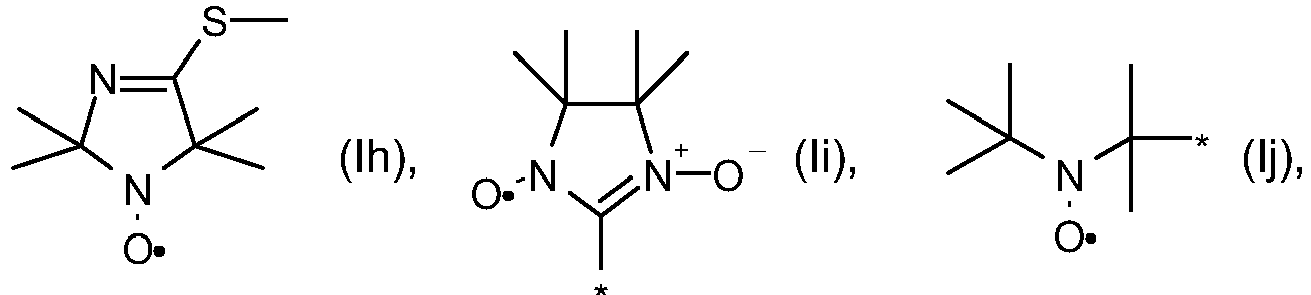


- Preferably the nitroxide group attached to the spacer group or repeating unit is of formulae


- For instance the spacer group or repeating unit (Ln) is the residue of a divalent, trivalent or tetravalent acyl residue derived from the corresponding carboxylic acid, the residue of a divalent, trivalent or tetravalent alcohol derived from the corresponding alcohol or the residue of a divalent, trivalent or tetravalent amine derived from the corresponding amine or as repeating unit the residue of an ethylenically unsaturated carboxylic acid or carboxylic acid derivative.
- In a preferred embodiment of the invention the polynitroxide of formula (B) has a repeating unit and is of formula (III)

- R200 is H or C1-C4alkyl
- Y is O or NR201 wherein R201 is H or C1-C18alky;
- Q is a niroxide radical selected from the group of formulae (Ia) to (Ip) and
- n is a number from 10 to 50 000.
- Examples for trivalent or tetravalent acyl residues are derived from the corresponding carboxylic acids, such as citric acid, trimellitic acid, trimesinic acid, pyromelitic acid or butane tetracarboxylic acid.
- Examples for trivalent or tetravalent alcohols are glycerine, tris(hydroxymethyl)-propane, pentaerythritol, erythritol or tris(hydroxymethyl)-aminomethane. The corresponding amines can be derived in analogy.
- The polymerization/crosslinking can be carried out in many solvents, preferred are aliphatic or aromatic hydrocarbons or ethers, for example tetrahydrofurane (THF), dibutyl ether or methyl-t-butyl ether.
- The polymeric nitroxide can be isolated by standard procedures, such as for example by precipitation in a suitable solvent. Suitable solvents are for example saturated hydrocarbons.
- The following examples illustrate the invention.
-

- To a stirred solution of 2.40 g (10 mmol) of poly-(2-methyl-acrylic acid 2,2,6,6-tetramethyl-piperidin-N-oxyl-4-yl)ester (Mn = 13 334, Mw = 53048, prepared as described in European Patent Application No.
05104974.9-2109 -

- To a stirred solution of 1.20 g (5 mmol) of poly-(2-methyl-acrylic acid 2,2,6,6-tetramethyl-piperidin-N-oxyl-4-yl) ester (Mn= 15394, Mw= 33040, prepared as described in European Patent Application No.
05104974.9-2109 -

- To a stirred solution of 2.40 g (10 mmol) of poly-(2-methyl-acrylic acid 2,2,6,6-tetramethyl-piperidin-N-oxyl-4-yl) ester (Mn= 15394, Mw= 39040, prepared as described in European Patent Application No.
05104974.9-2109 -
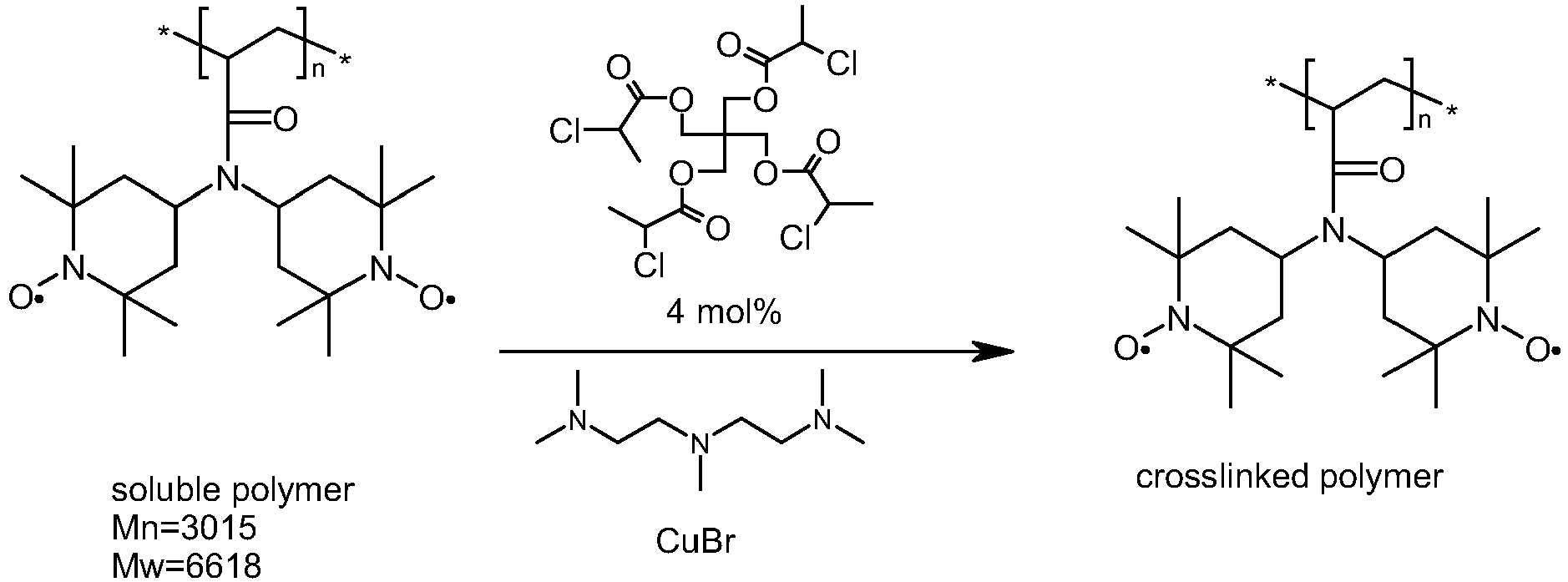
- A 2500 ml flask equipped with stirrer, termometer and dropping funnel is charged with 1000 ml of dichloromethane, 147.75 g (500 mmol) N,N-bis-(2,2,6,6-tetramethyl-piperidin-4-yl)-amine (prepared as desribed in
EP 838 455 A1 - A 100 ml round flask equipped with a magnetic stirrer, termometer and reflux condenser is charged with 20 ml chlorobenzene, 17.48 g (50 mmol) N,N-bis-(2,2,6,6-tetramethyl-piperidin-4-yl)-acrylamide and 0.75 ml (3.75 mmol) di-t-butyl-peroxide. The mixture is deoxygenated by 3 vacuum-argon cycles and then stirred at 125 °C for 17 h. The thick reaction mass is evaporated in vacuo and the glassy residue (19.65 g) is dissolved in 50 ml THF. The solution is slowly under stirring added to 2500 ml hexane. The precipitate is filtered off and dried to afford 15.55 g of the title polymer as a white powder.
- A 750 ml flask equipped with stirrer, termometer and dropping funnel is charged with 30 g NaHCO3 (357 mmol) and 200 g of ice-water (1:1) mixture. To the stirred mixture is then slowly dropped 45.63 g (240 mmol) of peracetic acid (40 % solution in acetic acid). To the resulting cold (-9 °C) mixture ias then during 30 minutes dropped the solution of 13.98 g (40 mmol) poly-(N,N-Bis-(2,2,6,6-tetramethyl-piperidin-4-yl)-acrylamide) in 150 ml dichloromethane while keeping the temperature at 0-2°C. Additional 28.8 g (343 mmol) NaHCO3 are added carefully after 2 h of stirring. The red mixture is then allowed to warm to room temperature during 21 h of stirring. The red organic layer is separated, washed with 5% aqueous NaOH (200 ml), dried over Na2SO4 and evaporated. The red residue is dissolved in 50 ml dichloromethane and poured slowly and under stirring into 800 ml hexane. The red precipitate is filtered off, wased with hexane and dried to afford 12.56 g of orange powder, Mn= 3015. Mw=6618).
- To a stirred solution of 11.39 g (30 mmol) of poly-(N,N-Bis-(2,2,6,6-tetramethyl-piperidin-N-oxyl-4-yl)-acrylamide) (Mn= 3015, Mw= 6618), in 120 ml acetone are added under argon 0.60 g (1.2 mmol) 2-chloro-propionic acid 3-(2-chloro-propionyloxy)-2,2-bis-(2-chloro-propionyloxymethyl)-propyl ester (prepared by reaction of pentaerythritol with 2-chloropropionyl chloride), 2.58 g (18 mmol) CuBr, and 3.12 g (18 mmol) N,N,N',N',N'-pentamethyldiethylentriamine. The mixture is stirred at room temperature for 22h. The originally fluid mixture transforms into a thick, deep green, gummy mass. Water (200 ml) is then added and the mixture is vigorously stirred for 3 h. The precipitate is filtered off and washed with water. The brown residue is slurried in 200 ml water containing 1 g EDTA-Disodium salt, stirred for 3 h, filtered off, washed thoroughly with water and dried. The red powder residue (12.37 g) is 4x slurried up in 150g acetone and centrifuged. Drying of the acetone insoluble material afforded 9.57 g of orange powder. This material is completely insoluble in tetrahydrofurane, dichloromethane, toluene and acetone.
Claims (11)
- Use of a crosslinked polymer obtainable by a process for the preparation of a crosslinked polymer with pending nitroxide groups comprising the following steps reacting a bis nitroxide of formula (A) ●ON-Ln-NO● (A) or a polynitroxide of formula (B) Ln-[NO●]n (B) with a bis-functional or polyfunctional organic halogen containing compound in the presence of a transition metal or transition metal salt in its lower oxidation state and a ligand, capable of complexing the transition metal or transition metal salt;
wherein
Ln is a n valent spacer group or a repeating unit connecting the nitroxide groups;
n is a number from 3 to 50 000 and wherein
the molar ratio of the bis or polynitroxide compound of formula (A) or (B) to the bis-functional or polyfunctional halogen compound is equal or greater than 5:1 and
wherein the ligand is of formula I wherein R10, R11, R13 and R14 are independently H, C1-C12alkyl, C5-C12cycloalkyl or aryl;R12 is H, C1-C12alkyl, C5-C12cycloalkyl or aryl or a group -(CH2)q-NR10R11;m, p and q are numbers from 1-4;n is a number from 0 to 4; orthe ligand is a bicyclic or polycyclic heteroaliphatic ring as active material in secondary batteries.
 - The use according to claim 1 wherein the ligand is selected from the group consisting of tris[2-(dimethylamino)ethyl]amine, N,N,N',N,N'-pentamethyldiethylenetriamine, N,N,N',N'- tetramethylethylenediamine, 1,1,4,7,10,10-hexamethyltriethylenetetramine, 1,4,7-trimethyl-1,4,7-triazacyclononane, 1,5,9-trimethyl-1,5,9-triazacyclododecane, 1,4,8,11-tetramethyl-1,4,8,11-tetraazacyclotetradecane, 2,2'-bipyridyl, 2,2'-bi(4-t-butyl)pyridyl and 2,2',2'-terpyridyl.
- The use according to claim 1 wherein the molar ratio between the transition metal or transition metal salt in its lower oxidation state and the halogen containing compound is from 1:1 to 3:1.
- The use according to claim 1 wherein the transition metal is selected from the group consisting of Cu, Fe, Mn, Mo, Cr, Ni and Ru and the transition metal salt in its lower oxidation state is a halogenide, sulfate, nitrate, carboxylate or trifluormethane sulfonate of these metals.
- The use according to claim 1 wherein the molar ratio between the transition metal or transition metal salt in its lower oxidation state and the ligand is from 2:1 to 1:5.
- The use according to claim 1, which is carried out at a temperature from -20°C to 100°C.
- The use according to claim 1 wherein the bis-functional or polyfunctional halogen compound is of formula (IIa) or (IIb)
 R15, and R16 are H, C1-C12alkyl, C6-C10aryl, C5-C12cycloalkyl;aryl is phenyl, naphthyl or biphenyl;Y is O or NR15;R1 is a 2-10 valent organic or inorganic residuer is a number from 2 to 10s is a number from 2 to 6 andX is Cl or Br.
 - The use according to claim 1 wherein the nitroxide group attached to the spacer group or repeating unit is of formulae


- The use according to claim 8 wherein the nitroxide group attached to the spacer group or repeating unit is of formulae


- The use according to claim 1 wherein the spacer group or repeating unit is the residue of a divalent, trivalent or tetravalent acyl residue derived from the corresponding carboxylic acid, the residue of a divalent, trivalent or tetravalent alcohol derived from the corresponding alcohol or the residue of a divalent, trivalent or tetravalent amine derived from the corresponding amine or as repeating unit the residue of an ethylenically unsaturated carboxylic acid or carboxylic acid derivative.
- The use according to claim 1 wherein the polynitroxide of formula (B) has a repeating unit and is of formula (III)
 R200 is H or C1-C4alkylY is O or NR201 wherein R201 is H or C1-C18alkyl;Q is a nitroxide radical selected from the group of formulae (Ia) to (Ip) according to claim 9and n is a number from 10 to 50 000.
Priority Applications (1)
| Application Number | Priority Date | Filing Date | Title |
|---|---|---|---|
| EP07727445.4A EP2013240B1 (en) | 2006-04-07 | 2007-03-28 | Process for the preparation of crosslinked nitroxide polymers |
Applications Claiming Priority (3)
| Application Number | Priority Date | Filing Date | Title |
|---|---|---|---|
| EP06112360 | 2006-04-07 | ||
| PCT/EP2007/052973 WO2007115939A1 (en) | 2006-04-07 | 2007-03-28 | Process for the preparation of crosslinked nitroxide polymers |
| EP07727445.4A EP2013240B1 (en) | 2006-04-07 | 2007-03-28 | Process for the preparation of crosslinked nitroxide polymers |
Publications (2)
| Publication Number | Publication Date |
|---|---|
| EP2013240A1 EP2013240A1 (en) | 2009-01-14 |
| EP2013240B1 true EP2013240B1 (en) | 2017-05-31 |
Family
ID=37057248
Family Applications (1)
| Application Number | Title | Priority Date | Filing Date |
|---|---|---|---|
| EP07727445.4A Not-in-force EP2013240B1 (en) | 2006-04-07 | 2007-03-28 | Process for the preparation of crosslinked nitroxide polymers |
Country Status (6)
| Country | Link |
|---|---|
| US (1) | US8492511B2 (en) |
| EP (1) | EP2013240B1 (en) |
| JP (1) | JP5364947B2 (en) |
| CN (1) | CN101490100B (en) |
| TW (1) | TWI472542B (en) |
| WO (1) | WO2007115939A1 (en) |
Families Citing this family (9)
| Publication number | Priority date | Publication date | Assignee | Title |
|---|---|---|---|---|
| KR20120127754A (en) | 2004-12-20 | 2012-11-23 | 제넨테크, 인크. | Pyrrolidine inhibitors of iap |
| US20090274947A1 (en) * | 2006-09-12 | 2009-11-05 | Peter Nesvadba | Imidazolidinone nitroxides as electrode materials for energy storage devices |
| CA2730448A1 (en) | 2008-08-02 | 2010-02-11 | Genentech, Inc. | Inhibitors of iap |
| JP5366854B2 (en) * | 2009-02-19 | 2013-12-11 | 三菱レイヨン株式会社 | (Meth) acrylic acid ester |
| JP5555485B2 (en) * | 2009-12-16 | 2014-07-23 | 住友精化株式会社 | N, N-bis- (2,2,6,6-tetramethyl-piperidin-4-yl) -amine- (meth) acrylamide and N, N-bis- (2,2,6,6-tetramethyl- Piperidine-N-oxyl-4-yl) -amine- (meth) acrylamide compound cross-linked polymer |
| JP2011126969A (en) * | 2009-12-16 | 2011-06-30 | Sumitomo Seika Chem Co Ltd | N,n-bis-(2,2,6,6-tetramethylpiperidin-n-oxyl-4-yl)-amine-(meth)acrylamide compound and n,n-bis-(2,2,6,6-tetramethylpiperidin-n-oxyl-4-yl)-amine-(meth)acrylamide compound crosslinked polymer |
| CN109196000B (en) | 2016-06-02 | 2021-04-30 | 赢创运营有限公司 | Method for producing electrode material |
| KR102159015B1 (en) | 2016-09-06 | 2020-09-24 | 에보니크 오퍼레이션즈 게엠베하 | Improved oxidation method of secondary amine groups |
| JP7285419B2 (en) * | 2018-01-24 | 2023-06-02 | パイオトレック株式会社 | Separatorless conductive polymer solid electrolyte secondary battery |
Family Cites Families (4)
| Publication number | Priority date | Publication date | Assignee | Title |
|---|---|---|---|---|
| FR2791979B1 (en) * | 1999-04-08 | 2003-05-16 | Atochem Elf Sa | PROCESS FOR THE PREPARATION OF ALCOXYAMINES FROM NITROXIDES |
| JP2001083672A (en) * | 1999-09-08 | 2001-03-30 | Fuji Photo Film Co Ltd | Production of polymer and dye fixing element containing same |
| AU2003270201A1 (en) * | 2002-09-23 | 2004-04-08 | Ciba Specialty Chemicals Holding Inc. | Polymeric alkoxyamines prepared by atom transfer radical addition (atra) |
| EP1752474B1 (en) * | 2004-05-31 | 2013-06-12 | Sumitomo Seika Chemicals Co., Ltd. | Method for producing crosslinked poly(meth)acrylate compound |
-
2007
- 2007-03-28 JP JP2009503541A patent/JP5364947B2/en not_active Expired - Fee Related
- 2007-03-28 CN CN200780020934XA patent/CN101490100B/en not_active Expired - Fee Related
- 2007-03-28 US US12/296,330 patent/US8492511B2/en not_active Expired - Fee Related
- 2007-03-28 WO PCT/EP2007/052973 patent/WO2007115939A1/en not_active Ceased
- 2007-03-28 EP EP07727445.4A patent/EP2013240B1/en not_active Not-in-force
- 2007-04-04 TW TW96112032A patent/TWI472542B/en not_active IP Right Cessation
Non-Patent Citations (1)
| Title |
|---|
| None * |
Also Published As
| Publication number | Publication date |
|---|---|
| JP5364947B2 (en) | 2013-12-11 |
| CN101490100A (en) | 2009-07-22 |
| JP2009532544A (en) | 2009-09-10 |
| WO2007115939A1 (en) | 2007-10-18 |
| US20100240858A1 (en) | 2010-09-23 |
| EP2013240A1 (en) | 2009-01-14 |
| CN101490100B (en) | 2012-08-22 |
| US8492511B2 (en) | 2013-07-23 |
| TW200745184A (en) | 2007-12-16 |
| TWI472542B (en) | 2015-02-11 |
Similar Documents
| Publication | Publication Date | Title |
|---|---|---|
| US8492511B2 (en) | Process for the preparation of crosslinked nitroxide polymers | |
| AU754927B2 (en) | 1-Alkoxy-polyalkyl-piperidine derivatives and their use as polymerization regulators | |
| RU2719592C2 (en) | Acylphosphate production method | |
| CN114478886B (en) | Imidazole polyion liquid and preparation method thereof | |
| KR20010005861A (en) | Controlled free radical polymerization process | |
| AU2804901A (en) | 2,2,6,6 diethyl-dimethyl-1-alkoxy-piperidine compounds and their corresponding 1-oxides | |
| AU2002224840B2 (en) | N-alkoxy-4,4-dioxy-polyalkyl-piperidines as radical polymerization initiators | |
| EP1397349B1 (en) | 4-imino-n-alkoxy or oxy-polyalkyl-piperidine compounds and their use as polymerization regulators | |
| EP1417171B1 (en) | Multifunctional alkoxyamines based on polyalkylpiperidines, polyalkylpiperazinones and polyalkylmorpholinones and their use as polymerization regulators/initiators | |
| KR101015028B1 (en) | Cationic Alkoxyamines, and Uses thereof in Manufacturing Nanoparticles from Natural or Synthetic Clay | |
| US6875831B1 (en) | Mono and multifunctional alkoxyamines for the preparation of functionalized macromers | |
| EP1572758B1 (en) | Process for the preparation of hydroxy-vinyl-aromatic polymers or copolymers by anionic or controlled radical polymerization | |
| US20090171008A1 (en) | Novel functionalized (METH)acrylic monomers and polymers for acetylenic alcohols | |
| CN105932293A (en) | Adhesive, preparation method thereof and secondary battery containing same | |
| US4093596A (en) | Method for polymerization of polyphenylene oxides | |
| CN101503513A (en) | Preparation of conductive polymers based bisulfide | |
| JP2008545863A (en) | Polymer nitroxide, its manufacture and use | |
| US20080274074A1 (en) | Method for Controlled Free Radical Polymerization or Copolymerization of Methacrylic and/or Methacrylate Monomers or Exclusively Methacrylic and/or Methacrylate Copolymers | |
| KR20160091321A (en) | Triazine mediated living radical controlled polymerization |
Legal Events
| Date | Code | Title | Description |
|---|---|---|---|
| PUAI | Public reference made under article 153(3) epc to a published international application that has entered the european phase |
Free format text: ORIGINAL CODE: 0009012 |
|
| 17P | Request for examination filed |
Effective date: 20081023 |
|
| AK | Designated contracting states |
Kind code of ref document: A1 Designated state(s): AT BE BG CH CY CZ DE DK EE ES FI FR GB GR HU IE IS IT LI LT LU LV MC MT NL PL PT RO SE SI SK TR |
|
| AX | Request for extension of the european patent |
Extension state: AL BA HR MK RS |
|
| 17Q | First examination report despatched |
Effective date: 20090401 |
|
| DAX | Request for extension of the european patent (deleted) | ||
| GRAP | Despatch of communication of intention to grant a patent |
Free format text: ORIGINAL CODE: EPIDOSNIGR1 |
|
| INTG | Intention to grant announced |
Effective date: 20161025 |
|
| GRAS | Grant fee paid |
Free format text: ORIGINAL CODE: EPIDOSNIGR3 |
|
| STAA | Information on the status of an ep patent application or granted ep patent |
Free format text: STATUS: GRANT OF PATENT IS INTENDED |
|
| GRAJ | Information related to disapproval of communication of intention to grant by the applicant or resumption of examination proceedings by the epo deleted |
Free format text: ORIGINAL CODE: EPIDOSDIGR1 |
|
| GRAL | Information related to payment of fee for publishing/printing deleted |
Free format text: ORIGINAL CODE: EPIDOSDIGR3 |
|
| STAA | Information on the status of an ep patent application or granted ep patent |
Free format text: STATUS: EXAMINATION IS IN PROGRESS |
|
| GRAP | Despatch of communication of intention to grant a patent |
Free format text: ORIGINAL CODE: EPIDOSNIGR1 |
|
| STAA | Information on the status of an ep patent application or granted ep patent |
Free format text: STATUS: GRANT OF PATENT IS INTENDED |
|
| INTG | Intention to grant announced |
Effective date: 20170217 |
|
| GRAA | (expected) grant |
Free format text: ORIGINAL CODE: 0009210 |
|
| GRAF | Information related to payment of grant fee modified |
Free format text: ORIGINAL CODE: EPIDOSCIGR3 |
|
| STAA | Information on the status of an ep patent application or granted ep patent |
Free format text: STATUS: THE PATENT HAS BEEN GRANTED |
|
| AK | Designated contracting states |
Kind code of ref document: B1 Designated state(s): AT BE BG CH CY CZ DE DK EE ES FI FR GB GR HU IE IS IT LI LT LU LV MC MT NL PL PT RO SE SI SK TR |
|
| REG | Reference to a national code |
Ref country code: CH Ref legal event code: EP Ref country code: GB Ref legal event code: FG4D |
|
| REG | Reference to a national code |
Ref country code: AT Ref legal event code: REF Ref document number: 897392 Country of ref document: AT Kind code of ref document: T Effective date: 20170615 |
|
| REG | Reference to a national code |
Ref country code: IE Ref legal event code: FG4D |
|
| REG | Reference to a national code |
Ref country code: DE Ref legal event code: R096 Ref document number: 602007051154 Country of ref document: DE |
|
| REG | Reference to a national code |
Ref country code: NL Ref legal event code: MP Effective date: 20170531 |
|
| REG | Reference to a national code |
Ref country code: LT Ref legal event code: MG4D |
|
| REG | Reference to a national code |
Ref country code: AT Ref legal event code: MK05 Ref document number: 897392 Country of ref document: AT Kind code of ref document: T Effective date: 20170531 |
|
| PG25 | Lapsed in a contracting state [announced via postgrant information from national office to epo] |
Ref country code: LT Free format text: LAPSE BECAUSE OF FAILURE TO SUBMIT A TRANSLATION OF THE DESCRIPTION OR TO PAY THE FEE WITHIN THE PRESCRIBED TIME-LIMIT Effective date: 20170531 Ref country code: FI Free format text: LAPSE BECAUSE OF FAILURE TO SUBMIT A TRANSLATION OF THE DESCRIPTION OR TO PAY THE FEE WITHIN THE PRESCRIBED TIME-LIMIT Effective date: 20170531 Ref country code: GR Free format text: LAPSE BECAUSE OF FAILURE TO SUBMIT A TRANSLATION OF THE DESCRIPTION OR TO PAY THE FEE WITHIN THE PRESCRIBED TIME-LIMIT Effective date: 20170901 Ref country code: AT Free format text: LAPSE BECAUSE OF FAILURE TO SUBMIT A TRANSLATION OF THE DESCRIPTION OR TO PAY THE FEE WITHIN THE PRESCRIBED TIME-LIMIT Effective date: 20170531 Ref country code: ES Free format text: LAPSE BECAUSE OF FAILURE TO SUBMIT A TRANSLATION OF THE DESCRIPTION OR TO PAY THE FEE WITHIN THE PRESCRIBED TIME-LIMIT Effective date: 20170531 |
|
| PG25 | Lapsed in a contracting state [announced via postgrant information from national office to epo] |
Ref country code: NL Free format text: LAPSE BECAUSE OF FAILURE TO SUBMIT A TRANSLATION OF THE DESCRIPTION OR TO PAY THE FEE WITHIN THE PRESCRIBED TIME-LIMIT Effective date: 20170531 Ref country code: BG Free format text: LAPSE BECAUSE OF FAILURE TO SUBMIT A TRANSLATION OF THE DESCRIPTION OR TO PAY THE FEE WITHIN THE PRESCRIBED TIME-LIMIT Effective date: 20170831 Ref country code: IS Free format text: LAPSE BECAUSE OF FAILURE TO SUBMIT A TRANSLATION OF THE DESCRIPTION OR TO PAY THE FEE WITHIN THE PRESCRIBED TIME-LIMIT Effective date: 20170930 Ref country code: SE Free format text: LAPSE BECAUSE OF FAILURE TO SUBMIT A TRANSLATION OF THE DESCRIPTION OR TO PAY THE FEE WITHIN THE PRESCRIBED TIME-LIMIT Effective date: 20170531 Ref country code: LV Free format text: LAPSE BECAUSE OF FAILURE TO SUBMIT A TRANSLATION OF THE DESCRIPTION OR TO PAY THE FEE WITHIN THE PRESCRIBED TIME-LIMIT Effective date: 20170531 |
|
| PG25 | Lapsed in a contracting state [announced via postgrant information from national office to epo] |
Ref country code: SK Free format text: LAPSE BECAUSE OF FAILURE TO SUBMIT A TRANSLATION OF THE DESCRIPTION OR TO PAY THE FEE WITHIN THE PRESCRIBED TIME-LIMIT Effective date: 20170531 Ref country code: RO Free format text: LAPSE BECAUSE OF FAILURE TO SUBMIT A TRANSLATION OF THE DESCRIPTION OR TO PAY THE FEE WITHIN THE PRESCRIBED TIME-LIMIT Effective date: 20170531 Ref country code: EE Free format text: LAPSE BECAUSE OF FAILURE TO SUBMIT A TRANSLATION OF THE DESCRIPTION OR TO PAY THE FEE WITHIN THE PRESCRIBED TIME-LIMIT Effective date: 20170531 Ref country code: CZ Free format text: LAPSE BECAUSE OF FAILURE TO SUBMIT A TRANSLATION OF THE DESCRIPTION OR TO PAY THE FEE WITHIN THE PRESCRIBED TIME-LIMIT Effective date: 20170531 Ref country code: DK Free format text: LAPSE BECAUSE OF FAILURE TO SUBMIT A TRANSLATION OF THE DESCRIPTION OR TO PAY THE FEE WITHIN THE PRESCRIBED TIME-LIMIT Effective date: 20170531 |
|
| PG25 | Lapsed in a contracting state [announced via postgrant information from national office to epo] |
Ref country code: PL Free format text: LAPSE BECAUSE OF FAILURE TO SUBMIT A TRANSLATION OF THE DESCRIPTION OR TO PAY THE FEE WITHIN THE PRESCRIBED TIME-LIMIT Effective date: 20170531 Ref country code: IT Free format text: LAPSE BECAUSE OF FAILURE TO SUBMIT A TRANSLATION OF THE DESCRIPTION OR TO PAY THE FEE WITHIN THE PRESCRIBED TIME-LIMIT Effective date: 20170531 |
|
| REG | Reference to a national code |
Ref country code: DE Ref legal event code: R097 Ref document number: 602007051154 Country of ref document: DE |
|
| REG | Reference to a national code |
Ref country code: FR Ref legal event code: PLFP Year of fee payment: 12 |
|
| PLBE | No opposition filed within time limit |
Free format text: ORIGINAL CODE: 0009261 |
|
| STAA | Information on the status of an ep patent application or granted ep patent |
Free format text: STATUS: NO OPPOSITION FILED WITHIN TIME LIMIT |
|
| PGFP | Annual fee paid to national office [announced via postgrant information from national office to epo] |
Ref country code: GB Payment date: 20180326 Year of fee payment: 12 |
|
| 26N | No opposition filed |
Effective date: 20180301 |
|
| PG25 | Lapsed in a contracting state [announced via postgrant information from national office to epo] |
Ref country code: SI Free format text: LAPSE BECAUSE OF FAILURE TO SUBMIT A TRANSLATION OF THE DESCRIPTION OR TO PAY THE FEE WITHIN THE PRESCRIBED TIME-LIMIT Effective date: 20170531 |
|
| PGFP | Annual fee paid to national office [announced via postgrant information from national office to epo] |
Ref country code: FR Payment date: 20180326 Year of fee payment: 12 |
|
| REG | Reference to a national code |
Ref country code: CH Ref legal event code: PL |
|
| PG25 | Lapsed in a contracting state [announced via postgrant information from national office to epo] |
Ref country code: MC Free format text: LAPSE BECAUSE OF FAILURE TO SUBMIT A TRANSLATION OF THE DESCRIPTION OR TO PAY THE FEE WITHIN THE PRESCRIBED TIME-LIMIT Effective date: 20170531 |
|
| REG | Reference to a national code |
Ref country code: BE Ref legal event code: MM Effective date: 20180331 |
|
| REG | Reference to a national code |
Ref country code: IE Ref legal event code: MM4A |
|
| PG25 | Lapsed in a contracting state [announced via postgrant information from national office to epo] |
Ref country code: LU Free format text: LAPSE BECAUSE OF NON-PAYMENT OF DUE FEES Effective date: 20180328 |
|
| PG25 | Lapsed in a contracting state [announced via postgrant information from national office to epo] |
Ref country code: IE Free format text: LAPSE BECAUSE OF NON-PAYMENT OF DUE FEES Effective date: 20180328 |
|
| PG25 | Lapsed in a contracting state [announced via postgrant information from national office to epo] |
Ref country code: CH Free format text: LAPSE BECAUSE OF NON-PAYMENT OF DUE FEES Effective date: 20180331 Ref country code: LI Free format text: LAPSE BECAUSE OF NON-PAYMENT OF DUE FEES Effective date: 20180331 Ref country code: BE Free format text: LAPSE BECAUSE OF NON-PAYMENT OF DUE FEES Effective date: 20180331 |
|
| PGFP | Annual fee paid to national office [announced via postgrant information from national office to epo] |
Ref country code: DE Payment date: 20190924 Year of fee payment: 13 |
|
| GBPC | Gb: european patent ceased through non-payment of renewal fee |
Effective date: 20190328 |
|
| PG25 | Lapsed in a contracting state [announced via postgrant information from national office to epo] |
Ref country code: GB Free format text: LAPSE BECAUSE OF NON-PAYMENT OF DUE FEES Effective date: 20190328 Ref country code: MT Free format text: LAPSE BECAUSE OF NON-PAYMENT OF DUE FEES Effective date: 20180328 |
|
| PG25 | Lapsed in a contracting state [announced via postgrant information from national office to epo] |
Ref country code: FR Free format text: LAPSE BECAUSE OF NON-PAYMENT OF DUE FEES Effective date: 20190331 |
|
| PG25 | Lapsed in a contracting state [announced via postgrant information from national office to epo] |
Ref country code: TR Free format text: LAPSE BECAUSE OF FAILURE TO SUBMIT A TRANSLATION OF THE DESCRIPTION OR TO PAY THE FEE WITHIN THE PRESCRIBED TIME-LIMIT Effective date: 20170531 |
|
| PG25 | Lapsed in a contracting state [announced via postgrant information from national office to epo] |
Ref country code: HU Free format text: LAPSE BECAUSE OF FAILURE TO SUBMIT A TRANSLATION OF THE DESCRIPTION OR TO PAY THE FEE WITHIN THE PRESCRIBED TIME-LIMIT; INVALID AB INITIO Effective date: 20070328 Ref country code: PT Free format text: LAPSE BECAUSE OF FAILURE TO SUBMIT A TRANSLATION OF THE DESCRIPTION OR TO PAY THE FEE WITHIN THE PRESCRIBED TIME-LIMIT Effective date: 20170531 |
|
| PG25 | Lapsed in a contracting state [announced via postgrant information from national office to epo] |
Ref country code: CY Free format text: LAPSE BECAUSE OF FAILURE TO SUBMIT A TRANSLATION OF THE DESCRIPTION OR TO PAY THE FEE WITHIN THE PRESCRIBED TIME-LIMIT Effective date: 20170531 |
|
| REG | Reference to a national code |
Ref country code: DE Ref legal event code: R119 Ref document number: 602007051154 Country of ref document: DE |
|
| PG25 | Lapsed in a contracting state [announced via postgrant information from national office to epo] |
Ref country code: DE Free format text: LAPSE BECAUSE OF NON-PAYMENT OF DUE FEES Effective date: 20201001 |