EP2011527A1 - Procédé de fabrication d'un obturateur diaphysaire biodégradable, synthétique et souple - Google Patents
Procédé de fabrication d'un obturateur diaphysaire biodégradable, synthétique et souple Download PDFInfo
- Publication number
- EP2011527A1 EP2011527A1 EP08352013A EP08352013A EP2011527A1 EP 2011527 A1 EP2011527 A1 EP 2011527A1 EP 08352013 A EP08352013 A EP 08352013A EP 08352013 A EP08352013 A EP 08352013A EP 2011527 A1 EP2011527 A1 EP 2011527A1
- Authority
- EP
- European Patent Office
- Prior art keywords
- mold
- process according
- support
- mixture
- article
- Prior art date
- Legal status (The legal status is an assumption and is not a legal conclusion. Google has not performed a legal analysis and makes no representation as to the accuracy of the status listed.)
- Granted
Links
- 238000004519 manufacturing process Methods 0.000 title description 9
- PEDCQBHIVMGVHV-UHFFFAOYSA-N Glycerine Chemical compound OCC(O)CO PEDCQBHIVMGVHV-UHFFFAOYSA-N 0.000 claims abstract description 39
- 239000000203 mixture Substances 0.000 claims abstract description 29
- CXMXRPHRNRROMY-UHFFFAOYSA-N sebacic acid Chemical compound OC(=O)CCCCCCCCC(O)=O CXMXRPHRNRROMY-UHFFFAOYSA-N 0.000 claims abstract description 26
- 229920000642 polymer Polymers 0.000 claims abstract description 7
- 239000013013 elastic material Substances 0.000 claims abstract description 3
- 238000000034 method Methods 0.000 claims description 25
- 230000008569 process Effects 0.000 claims description 17
- 239000002904 solvent Substances 0.000 claims description 4
- 239000004020 conductor Substances 0.000 claims description 3
- 238000002360 preparation method Methods 0.000 claims description 3
- 230000000284 resting effect Effects 0.000 claims description 2
- 238000000926 separation method Methods 0.000 claims 1
- 238000001816 cooling Methods 0.000 abstract description 2
- 239000000178 monomer Substances 0.000 description 11
- 238000006116 polymerization reaction Methods 0.000 description 11
- 108010010803 Gelatin Proteins 0.000 description 7
- 230000015572 biosynthetic process Effects 0.000 description 7
- 229920000159 gelatin Polymers 0.000 description 7
- 239000008273 gelatin Substances 0.000 description 7
- 235000019322 gelatine Nutrition 0.000 description 7
- 235000011852 gelatine desserts Nutrition 0.000 description 7
- -1 polyéthylène Polymers 0.000 description 7
- 210000000988 bone and bone Anatomy 0.000 description 6
- 239000004568 cement Substances 0.000 description 5
- 239000000463 material Substances 0.000 description 4
- 239000004696 Poly ether ether ketone Substances 0.000 description 3
- 239000004698 Polyethylene Substances 0.000 description 3
- 239000003522 acrylic cement Substances 0.000 description 3
- 230000008901 benefit Effects 0.000 description 3
- 210000001185 bone marrow Anatomy 0.000 description 3
- 230000007547 defect Effects 0.000 description 3
- 239000007788 liquid Substances 0.000 description 3
- 229920003229 poly(methyl methacrylate) Polymers 0.000 description 3
- 238000006068 polycondensation reaction Methods 0.000 description 3
- 229920002530 polyetherether ketone Polymers 0.000 description 3
- 229920000573 polyethylene Polymers 0.000 description 3
- 229920000139 polyethylene terephthalate Polymers 0.000 description 3
- 239000005020 polyethylene terephthalate Substances 0.000 description 3
- 239000004926 polymethyl methacrylate Substances 0.000 description 3
- 229920001296 polysiloxane Polymers 0.000 description 3
- 229920001343 polytetrafluoroethylene Polymers 0.000 description 3
- 239000004810 polytetrafluoroethylene Substances 0.000 description 3
- 238000011882 arthroplasty Methods 0.000 description 2
- 238000006243 chemical reaction Methods 0.000 description 2
- LKFHUFAEFBRVQX-UHFFFAOYSA-N decanedioic acid;propane-1,2,3-triol Chemical compound OCC(O)CO.OC(=O)CCCCCCCCC(O)=O LKFHUFAEFBRVQX-UHFFFAOYSA-N 0.000 description 2
- 238000011049 filling Methods 0.000 description 2
- 235000013305 food Nutrition 0.000 description 2
- 239000007789 gas Substances 0.000 description 2
- 239000000499 gel Substances 0.000 description 2
- 230000036541 health Effects 0.000 description 2
- 238000002156 mixing Methods 0.000 description 2
- 230000003647 oxidation Effects 0.000 description 2
- 238000007254 oxidation reaction Methods 0.000 description 2
- 229920000747 poly(lactic acid) Polymers 0.000 description 2
- 239000004626 polylactic acid Substances 0.000 description 2
- 230000007847 structural defect Effects 0.000 description 2
- 239000000126 substance Substances 0.000 description 2
- 238000001356 surgical procedure Methods 0.000 description 2
- XLYOFNOQVPJJNP-UHFFFAOYSA-N water Substances O XLYOFNOQVPJJNP-UHFFFAOYSA-N 0.000 description 2
- 238000004383 yellowing Methods 0.000 description 2
- IJGRMHOSHXDMSA-UHFFFAOYSA-N Atomic nitrogen Chemical compound N#N IJGRMHOSHXDMSA-UHFFFAOYSA-N 0.000 description 1
- OFOBLEOULBTSOW-UHFFFAOYSA-N Malonic acid Chemical compound OC(=O)CC(O)=O OFOBLEOULBTSOW-UHFFFAOYSA-N 0.000 description 1
- 208000003076 Osteolysis Diseases 0.000 description 1
- 102000029797 Prion Human genes 0.000 description 1
- 108091000054 Prion Proteins 0.000 description 1
- XSTXAVWGXDQKEL-UHFFFAOYSA-N Trichloroethylene Chemical compound ClC=C(Cl)Cl XSTXAVWGXDQKEL-UHFFFAOYSA-N 0.000 description 1
- 239000002253 acid Substances 0.000 description 1
- 230000002009 allergenic effect Effects 0.000 description 1
- XAGFODPZIPBFFR-UHFFFAOYSA-N aluminium Chemical compound [Al] XAGFODPZIPBFFR-UHFFFAOYSA-N 0.000 description 1
- 229910052782 aluminium Inorganic materials 0.000 description 1
- 238000005266 casting Methods 0.000 description 1
- 230000007850 degeneration Effects 0.000 description 1
- 238000011161 development Methods 0.000 description 1
- 238000009792 diffusion process Methods 0.000 description 1
- 229910001873 dinitrogen Inorganic materials 0.000 description 1
- 238000004090 dissolution Methods 0.000 description 1
- 238000009826 distribution Methods 0.000 description 1
- 229920001971 elastomer Polymers 0.000 description 1
- 239000000806 elastomer Substances 0.000 description 1
- 229940082150 encore Drugs 0.000 description 1
- 238000001704 evaporation Methods 0.000 description 1
- 230000008020 evaporation Effects 0.000 description 1
- 238000000605 extraction Methods 0.000 description 1
- 239000000835 fiber Substances 0.000 description 1
- 238000009472 formulation Methods 0.000 description 1
- 239000001963 growth medium Substances 0.000 description 1
- 238000010438 heat treatment Methods 0.000 description 1
- 239000007943 implant Substances 0.000 description 1
- 238000002513 implantation Methods 0.000 description 1
- 239000011261 inert gas Substances 0.000 description 1
- 230000028709 inflammatory response Effects 0.000 description 1
- 210000003127 knee Anatomy 0.000 description 1
- 238000009533 lab test Methods 0.000 description 1
- 208000029791 lytic metastatic bone lesion Diseases 0.000 description 1
- 238000012423 maintenance Methods 0.000 description 1
- 229920002529 medical grade silicone Polymers 0.000 description 1
- 238000002844 melting Methods 0.000 description 1
- 230000008018 melting Effects 0.000 description 1
- 125000002496 methyl group Chemical group [H]C([H])([H])* 0.000 description 1
- 230000005012 migration Effects 0.000 description 1
- 238000013508 migration Methods 0.000 description 1
- 239000006082 mold release agent Substances 0.000 description 1
- 230000007935 neutral effect Effects 0.000 description 1
- 239000002245 particle Substances 0.000 description 1
- 230000001575 pathological effect Effects 0.000 description 1
- 231100000614 poison Toxicity 0.000 description 1
- 239000000843 powder Substances 0.000 description 1
- 238000010926 purge Methods 0.000 description 1
- 239000012429 reaction media Substances 0.000 description 1
- 239000011541 reaction mixture Substances 0.000 description 1
- 238000011084 recovery Methods 0.000 description 1
- 238000007789 sealing Methods 0.000 description 1
- 239000007787 solid Substances 0.000 description 1
- 238000003756 stirring Methods 0.000 description 1
- 238000006467 substitution reaction Methods 0.000 description 1
- 230000003746 surface roughness Effects 0.000 description 1
- 238000003786 synthesis reaction Methods 0.000 description 1
- 238000012360 testing method Methods 0.000 description 1
- 229920001187 thermosetting polymer Polymers 0.000 description 1
- 210000001519 tissue Anatomy 0.000 description 1
- 230000009772 tissue formation Effects 0.000 description 1
- 239000003440 toxic substance Substances 0.000 description 1
Images

Classifications
-
- B—PERFORMING OPERATIONS; TRANSPORTING
- B29—WORKING OF PLASTICS; WORKING OF SUBSTANCES IN A PLASTIC STATE IN GENERAL
- B29C—SHAPING OR JOINING OF PLASTICS; SHAPING OF MATERIAL IN A PLASTIC STATE, NOT OTHERWISE PROVIDED FOR; AFTER-TREATMENT OF THE SHAPED PRODUCTS, e.g. REPAIRING
- B29C67/00—Shaping techniques not covered by groups B29C39/00 - B29C65/00, B29C70/00 or B29C73/00
- B29C67/24—Shaping techniques not covered by groups B29C39/00 - B29C65/00, B29C70/00 or B29C73/00 characterised by the choice of material
- B29C67/246—Moulding high reactive monomers or prepolymers, e.g. by reaction injection moulding [RIM], liquid injection moulding [LIM]
-
- A—HUMAN NECESSITIES
- A61—MEDICAL OR VETERINARY SCIENCE; HYGIENE
- A61F—FILTERS IMPLANTABLE INTO BLOOD VESSELS; PROSTHESES; DEVICES PROVIDING PATENCY TO, OR PREVENTING COLLAPSING OF, TUBULAR STRUCTURES OF THE BODY, e.g. STENTS; ORTHOPAEDIC, NURSING OR CONTRACEPTIVE DEVICES; FOMENTATION; TREATMENT OR PROTECTION OF EYES OR EARS; BANDAGES, DRESSINGS OR ABSORBENT PADS; FIRST-AID KITS
- A61F2/00—Filters implantable into blood vessels; Prostheses, i.e. artificial substitutes or replacements for parts of the body; Appliances for connecting them with the body; Devices providing patency to, or preventing collapsing of, tubular structures of the body, e.g. stents
- A61F2/02—Prostheses implantable into the body
- A61F2/30—Joints
- A61F2/30721—Accessories
- A61F2/30723—Plugs or restrictors for sealing a cement-receiving space
-
- A—HUMAN NECESSITIES
- A61—MEDICAL OR VETERINARY SCIENCE; HYGIENE
- A61L—METHODS OR APPARATUS FOR STERILISING MATERIALS OR OBJECTS IN GENERAL; DISINFECTION, STERILISATION OR DEODORISATION OF AIR; CHEMICAL ASPECTS OF BANDAGES, DRESSINGS, ABSORBENT PADS OR SURGICAL ARTICLES; MATERIALS FOR BANDAGES, DRESSINGS, ABSORBENT PADS OR SURGICAL ARTICLES
- A61L31/00—Materials for other surgical articles, e.g. stents, stent-grafts, shunts, surgical drapes, guide wires, materials for adhesion prevention, occluding devices, surgical gloves, tissue fixation devices
- A61L31/14—Materials characterised by their function or physical properties, e.g. injectable or lubricating compositions, shape-memory materials, surface modified materials
- A61L31/148—Materials at least partially resorbable by the body
-
- C—CHEMISTRY; METALLURGY
- C08—ORGANIC MACROMOLECULAR COMPOUNDS; THEIR PREPARATION OR CHEMICAL WORKING-UP; COMPOSITIONS BASED THEREON
- C08G—MACROMOLECULAR COMPOUNDS OBTAINED OTHERWISE THAN BY REACTIONS ONLY INVOLVING UNSATURATED CARBON-TO-CARBON BONDS
- C08G63/00—Macromolecular compounds obtained by reactions forming a carboxylic ester link in the main chain of the macromolecule
- C08G63/02—Polyesters derived from hydroxycarboxylic acids or from polycarboxylic acids and polyhydroxy compounds
- C08G63/12—Polyesters derived from hydroxycarboxylic acids or from polycarboxylic acids and polyhydroxy compounds derived from polycarboxylic acids and polyhydroxy compounds
-
- C—CHEMISTRY; METALLURGY
- C08—ORGANIC MACROMOLECULAR COMPOUNDS; THEIR PREPARATION OR CHEMICAL WORKING-UP; COMPOSITIONS BASED THEREON
- C08G—MACROMOLECULAR COMPOUNDS OBTAINED OTHERWISE THAN BY REACTIONS ONLY INVOLVING UNSATURATED CARBON-TO-CARBON BONDS
- C08G63/00—Macromolecular compounds obtained by reactions forming a carboxylic ester link in the main chain of the macromolecule
- C08G63/02—Polyesters derived from hydroxycarboxylic acids or from polycarboxylic acids and polyhydroxy compounds
- C08G63/12—Polyesters derived from hydroxycarboxylic acids or from polycarboxylic acids and polyhydroxy compounds derived from polycarboxylic acids and polyhydroxy compounds
- C08G63/16—Dicarboxylic acids and dihydroxy compounds
- C08G63/20—Polyesters having been prepared in the presence of compounds having one reactive group or more than two reactive groups
-
- C—CHEMISTRY; METALLURGY
- C08—ORGANIC MACROMOLECULAR COMPOUNDS; THEIR PREPARATION OR CHEMICAL WORKING-UP; COMPOSITIONS BASED THEREON
- C08G—MACROMOLECULAR COMPOUNDS OBTAINED OTHERWISE THAN BY REACTIONS ONLY INVOLVING UNSATURATED CARBON-TO-CARBON BONDS
- C08G63/00—Macromolecular compounds obtained by reactions forming a carboxylic ester link in the main chain of the macromolecule
- C08G63/78—Preparation processes
- C08G63/785—Preparation processes characterised by the apparatus used
-
- A—HUMAN NECESSITIES
- A61—MEDICAL OR VETERINARY SCIENCE; HYGIENE
- A61F—FILTERS IMPLANTABLE INTO BLOOD VESSELS; PROSTHESES; DEVICES PROVIDING PATENCY TO, OR PREVENTING COLLAPSING OF, TUBULAR STRUCTURES OF THE BODY, e.g. STENTS; ORTHOPAEDIC, NURSING OR CONTRACEPTIVE DEVICES; FOMENTATION; TREATMENT OR PROTECTION OF EYES OR EARS; BANDAGES, DRESSINGS OR ABSORBENT PADS; FIRST-AID KITS
- A61F2/00—Filters implantable into blood vessels; Prostheses, i.e. artificial substitutes or replacements for parts of the body; Appliances for connecting them with the body; Devices providing patency to, or preventing collapsing of, tubular structures of the body, e.g. stents
- A61F2/02—Prostheses implantable into the body
- A61F2/30—Joints
- A61F2/3094—Designing or manufacturing processes
-
- A—HUMAN NECESSITIES
- A61—MEDICAL OR VETERINARY SCIENCE; HYGIENE
- A61F—FILTERS IMPLANTABLE INTO BLOOD VESSELS; PROSTHESES; DEVICES PROVIDING PATENCY TO, OR PREVENTING COLLAPSING OF, TUBULAR STRUCTURES OF THE BODY, e.g. STENTS; ORTHOPAEDIC, NURSING OR CONTRACEPTIVE DEVICES; FOMENTATION; TREATMENT OR PROTECTION OF EYES OR EARS; BANDAGES, DRESSINGS OR ABSORBENT PADS; FIRST-AID KITS
- A61F2/00—Filters implantable into blood vessels; Prostheses, i.e. artificial substitutes or replacements for parts of the body; Appliances for connecting them with the body; Devices providing patency to, or preventing collapsing of, tubular structures of the body, e.g. stents
- A61F2/02—Prostheses implantable into the body
- A61F2/30—Joints
- A61F2002/30001—Additional features of subject-matter classified in A61F2/28, A61F2/30 and subgroups thereof
- A61F2002/30003—Material related properties of the prosthesis or of a coating on the prosthesis
- A61F2002/3006—Properties of materials and coating materials
- A61F2002/30062—(bio)absorbable, biodegradable, bioerodable, (bio)resorbable, resorptive
-
- A—HUMAN NECESSITIES
- A61—MEDICAL OR VETERINARY SCIENCE; HYGIENE
- A61F—FILTERS IMPLANTABLE INTO BLOOD VESSELS; PROSTHESES; DEVICES PROVIDING PATENCY TO, OR PREVENTING COLLAPSING OF, TUBULAR STRUCTURES OF THE BODY, e.g. STENTS; ORTHOPAEDIC, NURSING OR CONTRACEPTIVE DEVICES; FOMENTATION; TREATMENT OR PROTECTION OF EYES OR EARS; BANDAGES, DRESSINGS OR ABSORBENT PADS; FIRST-AID KITS
- A61F2/00—Filters implantable into blood vessels; Prostheses, i.e. artificial substitutes or replacements for parts of the body; Appliances for connecting them with the body; Devices providing patency to, or preventing collapsing of, tubular structures of the body, e.g. stents
- A61F2/02—Prostheses implantable into the body
- A61F2/30—Joints
- A61F2002/30001—Additional features of subject-matter classified in A61F2/28, A61F2/30 and subgroups thereof
- A61F2002/30003—Material related properties of the prosthesis or of a coating on the prosthesis
- A61F2002/3006—Properties of materials and coating materials
- A61F2002/30069—Properties of materials and coating materials elastomeric
-
- A—HUMAN NECESSITIES
- A61—MEDICAL OR VETERINARY SCIENCE; HYGIENE
- A61F—FILTERS IMPLANTABLE INTO BLOOD VESSELS; PROSTHESES; DEVICES PROVIDING PATENCY TO, OR PREVENTING COLLAPSING OF, TUBULAR STRUCTURES OF THE BODY, e.g. STENTS; ORTHOPAEDIC, NURSING OR CONTRACEPTIVE DEVICES; FOMENTATION; TREATMENT OR PROTECTION OF EYES OR EARS; BANDAGES, DRESSINGS OR ABSORBENT PADS; FIRST-AID KITS
- A61F2/00—Filters implantable into blood vessels; Prostheses, i.e. artificial substitutes or replacements for parts of the body; Appliances for connecting them with the body; Devices providing patency to, or preventing collapsing of, tubular structures of the body, e.g. stents
- A61F2/02—Prostheses implantable into the body
- A61F2/30—Joints
- A61F2/30767—Special external or bone-contacting surface, e.g. coating for improving bone ingrowth
- A61F2/30771—Special external or bone-contacting surface, e.g. coating for improving bone ingrowth applied in original prostheses, e.g. holes or grooves
- A61F2002/30878—Special external or bone-contacting surface, e.g. coating for improving bone ingrowth applied in original prostheses, e.g. holes or grooves with non-sharp protrusions, for instance contacting the bone for anchoring, e.g. keels, pegs, pins, posts, shanks, stems, struts
- A61F2002/30879—Ribs
- A61F2002/30881—Circumferential ribs, flanges or fins
-
- A—HUMAN NECESSITIES
- A61—MEDICAL OR VETERINARY SCIENCE; HYGIENE
- A61F—FILTERS IMPLANTABLE INTO BLOOD VESSELS; PROSTHESES; DEVICES PROVIDING PATENCY TO, OR PREVENTING COLLAPSING OF, TUBULAR STRUCTURES OF THE BODY, e.g. STENTS; ORTHOPAEDIC, NURSING OR CONTRACEPTIVE DEVICES; FOMENTATION; TREATMENT OR PROTECTION OF EYES OR EARS; BANDAGES, DRESSINGS OR ABSORBENT PADS; FIRST-AID KITS
- A61F2210/00—Particular material properties of prostheses classified in groups A61F2/00 - A61F2/26 or A61F2/82 or A61F9/00 or A61F11/00 or subgroups thereof
- A61F2210/0004—Particular material properties of prostheses classified in groups A61F2/00 - A61F2/26 or A61F2/82 or A61F9/00 or A61F11/00 or subgroups thereof bioabsorbable
-
- B—PERFORMING OPERATIONS; TRANSPORTING
- B29—WORKING OF PLASTICS; WORKING OF SUBSTANCES IN A PLASTIC STATE IN GENERAL
- B29C—SHAPING OR JOINING OF PLASTICS; SHAPING OF MATERIAL IN A PLASTIC STATE, NOT OTHERWISE PROVIDED FOR; AFTER-TREATMENT OF THE SHAPED PRODUCTS, e.g. REPAIRING
- B29C33/00—Moulds or cores; Details thereof or accessories therefor
- B29C33/38—Moulds or cores; Details thereof or accessories therefor characterised by the material or the manufacturing process
- B29C33/40—Plastics, e.g. foam or rubber
-
- B—PERFORMING OPERATIONS; TRANSPORTING
- B29—WORKING OF PLASTICS; WORKING OF SUBSTANCES IN A PLASTIC STATE IN GENERAL
- B29K—INDEXING SCHEME ASSOCIATED WITH SUBCLASSES B29B, B29C OR B29D, RELATING TO MOULDING MATERIALS OR TO MATERIALS FOR MOULDS, REINFORCEMENTS, FILLERS OR PREFORMED PARTS, e.g. INSERTS
- B29K2067/00—Use of polyesters or derivatives thereof, as moulding material
-
- B—PERFORMING OPERATIONS; TRANSPORTING
- B29—WORKING OF PLASTICS; WORKING OF SUBSTANCES IN A PLASTIC STATE IN GENERAL
- B29K—INDEXING SCHEME ASSOCIATED WITH SUBCLASSES B29B, B29C OR B29D, RELATING TO MOULDING MATERIALS OR TO MATERIALS FOR MOULDS, REINFORCEMENTS, FILLERS OR PREFORMED PARTS, e.g. INSERTS
- B29K2995/00—Properties of moulding materials, reinforcements, fillers, preformed parts or moulds
- B29K2995/0037—Other properties
- B29K2995/0059—Degradable
- B29K2995/006—Bio-degradable, e.g. bioabsorbable, bioresorbable or bioerodible
Definitions
- the present invention relates to the field of medical devices used in bone surgery, and in particular to the closure systems of the medullary canal used when sealing a prosthesis. It relates to a process for preparing a biodegradable article for medical use, such as a diaphyseal shutter, wherein poly (glycerol sebacate) is formed in elastic molds with a totally smooth surface.
- Total prostheses (hip, knee 7) can replace a damaged joint and thus relieve pain and improve patient mobility.
- the main indications for this type of implant are joint degeneration and certain fractures.
- a prosthesis In total cemented hip arthroplasty, a prosthesis is introduced into the medullary canal and is fixed with an acrylic cement, usually based on PMMA (polymethylmethacrylate methyl). The polymerization reaction of the monomer occurs within a few minutes.
- the implementation of a cemented total hip prosthesis requires a good preparation of bone surfaces and a homogeneous and total filling of the proximal canal with acrylic cement.
- the introduction of the prosthesis into the medullary canal filled with cement induces a pressurization of the latter which tends to escape from the implanted zone by the proximal orifice or coming into contact with the bone marrow. These voids are responsible for phenomena of stress concentrations and breaking points.
- the primary function of the shutter is to avoid the formation of these empty areas of cement around the prosthesis by limiting the progression of cement in the distal part. It not only prevents the diffusion of PMMA and its monomer in the bone marrow but also increases the intramedullary pressure impaction of the prosthesis and thus promote good stability of the prosthesis by interpenetration of cement in the bone marrow. surrounding bone tissue.
- these shutters have disadvantages. Some are too rigid and do not sufficiently marry the shape of the femoral canal to prevent cement leaks. This high rigidity also gives these systems a tendency to distal migration during the impaction of the prosthesis. They are mainly non-biodegradable which hinders the surgical procedure during a possible subsequent recovery. Indeed, this extraction must be performed without generating debris responsible for well-known osteolysis phenomenon, and lengthens the duration of the intervention.
- Bioabsorbable polylactic acid obturators may cause inflammatory responses in some patients and the use of cancellous bone is prohibited because bone bridge formation is difficult to remove.
- Gelatin-based stoppers do not have these disadvantages and are currently widely used. Nevertheless, being mainly constituted of gelatin of porcine origin, they can be regarded as potential vehicles of pathological entities (prions 7) and take for some patients an allergenic character. Health safety requirements now require the provision of medical devices free from uncertainty as to their safety, in accordance with the precautionary principle. Finally, their use on patients of Jewish or Muslim religion can be misunderstood. The limitation or prohibition of this type of product must be prevented by the development of a new shutter.
- the shutter obtained according to the method which is the subject of the invention is provided with all the physico-chemical and mechanical properties necessary for its function, it is totally free of any substance that may pose a risk to the health of patients.
- the process according to the present invention thus makes it possible to obtain a substitution polymer for the currently used porcine gelatin formulation.
- PGS for poly (glycerol sebacate) met all the criteria of the specification defined above, provided that its manufacture is carried out under well defined conditions to obtain compact and homogeneous massive objects, free of structural defects.
- This new material is fully synthetic, bioabsorbable and has elastic properties close to the current product.
- the PGS thus produced is obtained by direct polycondensation of glycerol and sebacic acid. It is known and used in the field of tissue engineering as a culture medium. However, its application is limited in the form of thin ribbed films to guide tissue formation. It is also used in the form of yarn, particles, tube, fiber, or woven webs. Only objects of very small thickness are obtained by the polymerization process described until now in the state of the art ( WO 03/064496 ). The method comprises condensing a mixture of glycerol and sebacic acid at 120 ° C in a two-stage pressure cycle in rigid polytetrafluoroethylene (PTFE) molds where a water-soluble mold release agent is recommended.
- PTFE polytetrafluoroethylene
- gel point refers to the moment when the average molar mass of the polymer as well as its viscosity increases abruptly towards infinity.
- compact refers to the character of a full solid three-dimensional structure object as opposed to a porous or lacunar structure, or in the form of a film or wire. Homogeneity indicates that compactness is uniform throughout the mass of the object in question. It derives from these two characters a structure devoid of defects of internal structure or surface, offering no zone of lesser resistance or less elasticity likely to promote breakage by tearing.
- thermosetting copolymer The direct polycondensation of glycerol and of sebacic acid, that is to say respectively of a triol and of a linear dicarboxylic acid, results in the formation of a thermosetting copolymer.
- the sebacic acid is in powder form (its melting point is 130 ° C.).
- Glycerol is a viscous liquid.
- the mixture of two monomers can be made by bringing the sebacic acid in the liquid state and by mixing it with glycerol. This procedure has the advantage of not involving any solvent whose traces could lead to the release of harmful or toxic substances in the body after implantation of the shutter.
- the glycerol / sebacic acid molar ratio is less than 1.
- the mixture of glycerol and sebacic acid is obtained by liquefaction of the second in the first at 150 ° C.
- This step can be carried out in an inert atmosphere to prevent any oxidation of the monomers and prevent the yellowing of the mixture.
- An advantage of the present invention is that the entire process can be carried out without a solvent.
- steps a), d) and e) of the process according to the present invention can be carried out under an inert atmosphere.
- the liquid mixture of monomers is poured into a mold (in practice under industrial conditions in a series of molds) which has the originality of being made of an elastic and integral material.
- the essential advantage over rigid traditional molds of two or more hulls is that it lacks a joint plane, which, if fine, creates a discontinuity at the junction of the two hulls. This discontinuity proved to be at the origin of the formation of bubbles that do not make it possible to obtain a compact and homogeneous object during the polymerization under reduced pressure.
- the visible joint plane on the molded object constitutes a zone of lesser resistance at the origin of embrittlement of the object under heavy mechanical stress.
- the use of a perfectly smooth inner surface mold without a joint plane solves this problem.
- the elasticity of the molds makes it possible to elaborate objects of complex geometry and facilitates their demolding without damaging them. For this type of application, it must also be grade for medical or food use.
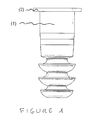
- the figures 1 and 2 represent two silicone molds to obtain shutters 8 and 18 millimeters in diameter according to the method of the present invention.
- the mold comprises a tank (1) with an upper rim (2) adapted to support said mold resting on its support.
- the thickness of the wall is chosen according to the tear resistance of the material constituting the mold.
- the mold inserted into its support slightly larger dimension (a few millimeters at most) to the largest outer diameter of the cavity provides very homogeneously polymerized articles.
- a uniform degree of polymerization is noted throughout the height of the articles, which is not the case when using aluminum or polytetrafluoroethylene impressions. This phenomenon is attributed to the small spacing between the mold and its support favoring radial heat exchange and thus a homogeneous distribution of the heat transmitted to the reaction mixture.
- the mold used in the method which is the subject of the invention has its highest section at the level of the upper opening of the tank (1).
- the support of the molds is made of thermally conductive material and of internal geometry closely matching the external global outline of the molds.
- the polymerization of the PGS is carried out under reduced pressure of air or of an inert gas, in order to progressively eliminate the water produced by the polymerization reaction. This accelerates the kinetics of reaction and reduces production time and costs.
- the pressure level is less than 500 mbar.
- the polymerization temperature must be high enough so that the sebacic acid does not solidify in the monomer mixture, and not be too high not to promote the formation of bubbles in the volume of the mixture.
- the minimum and maximum temperatures of the process according to the invention were evaluated at 80 and 150 ° C respectively.
- the working temperature can be chosen according to the kinetics of the polymerization reaction, the latter being faster at high temperature.
- the reaction is stopped by returning to ambient temperature.
- the product obtained is stable, so that it can be demolded immediately or store it as it is.
- the demolding must be done without damaging the article obtained.
- the elasticity of the mold and its low resistance to tearing are used to gently remove it. Those skilled in the art can appreciate this parameter by a few simple tests on the chosen material.
- the polymerized object, then elastic, can be cured by pre-cooling to -15 ° C to -25 ° C in a freezer to facilitate this step.
- the method which has just been described can be used for the manufacture of any massive article in PGS, including biodegradable articles for medical use. It finds a particularly suitable application in the manufacture of a diaphyseal shutter.
- the glycerol and the sebacic acid are introduced into a melter heated to 150 ° C and swept at the surface by a stream of nitrogen gas in order to prevent the oxidation of the monomers in contact with the air. Stirring is provided by a slow speed propeller to prevent the introduction of bubbles into the mixture. The mixture is stirred until complete dissolution of the acid in glycerol.
- the mixture of monomers is cast at 150 ° C. in the molds placed on their support by the opening of a low valve of the tank of the melter.
- the mixing volume is determined according to the size of the object to be manufactured.
- the elasticity of the molds allows easy deformation and manual evacuation of any air bubbles that would have been trapped in the asperities of the impression.
- the molds are made of food grade or medical grade silicone, only holding and have no discontinuity or internal surface roughness related to their manufacture.
- the molds filled and positioned on their support are arranged in a vacuum chamber with heating plates.
- This device makes it possible to control both the temperature, the vacuum level of the enclosure and the maintenance of an inert atmosphere avoiding the yellowing of the PGS.
- the temperature is set at 130 ° C and the pressure at 200 mbar.
- the inert atmosphere is obtained by successive purges of the chamber following 2 to 3 emptying / filling cycles using a vacuum pump and a reserve of neutral gas connected to the enclosure.
- the water produced by the polycondensation reaction of the monomers is removed by evaporation at the interface of the reaction medium with the surrounding gas.
- the polymerization time is between 2 and 3 days for a volume of PGS of 1 ml.
- the product obtained is an elastomer having elastic properties comparable to those of porcine gelatin currently used for the manufacture of diaphyseal plugs (CEMSTOP ® type).
- the molded articles have no surface defect or gaseous inclusion likely to affect their good quality, especially with regard to the tear resistance.
Landscapes
- Health & Medical Sciences (AREA)
- Chemical & Material Sciences (AREA)
- Organic Chemistry (AREA)
- Polymers & Plastics (AREA)
- Medicinal Chemistry (AREA)
- Chemical Kinetics & Catalysis (AREA)
- Veterinary Medicine (AREA)
- Engineering & Computer Science (AREA)
- Heart & Thoracic Surgery (AREA)
- Vascular Medicine (AREA)
- Life Sciences & Earth Sciences (AREA)
- Animal Behavior & Ethology (AREA)
- General Health & Medical Sciences (AREA)
- Public Health (AREA)
- Transplantation (AREA)
- Mechanical Engineering (AREA)
- Epidemiology (AREA)
- Biomedical Technology (AREA)
- Oral & Maxillofacial Surgery (AREA)
- Cardiology (AREA)
- Orthopedic Medicine & Surgery (AREA)
- Surgery (AREA)
- Materials For Medical Uses (AREA)
- Compositions Of Macromolecular Compounds (AREA)
- Prostheses (AREA)
- Addition Polymer Or Copolymer, Post-Treatments, Or Chemical Modifications (AREA)
- Surgical Instruments (AREA)
- Biological Depolymerization Polymers (AREA)
Abstract
Description
- La présente invention se rapporte au domaine des dispositifs médicaux utilisés en chirurgie osseuse, et en particulier aux systèmes d'obturation du canal médullaire utilisés lors du scellement d'une prothèse. Elle a pour objet un procédé de préparation d'un article biodégradable à usage médical, tel qu'un obturateur diaphysaire, dans lequel du poly(glycerol sebacate) est formé dans des moules élastiques de surface totalement lisse.
- Les prothèses totales (de hanche, genou...) permettent de remplacer une articulation endommagée et ainsi de soulager la douleur et d'améliorer la mobilité du patient. Les principales indications de pose de ce type d'implant sont les dégénérescences articulaires et certaines fractures.
- Lors d'une arthroplastie totale de hanche cimentée, une prothèse est introduite dans le canal médullaire et y est fixée à l'aide d'un ciment acrylique, généralement à base de PMMA (polyméthylméthacrylate de méthyle). La réaction de polymérisation du monomère se produit en quelques minutes. La mise en place d'une prothèse totale de hanche cimentée nécessite une bonne préparation des surfaces osseuses et un remplissage homogène et total du canal proximal avec le ciment acrylique. L'introduction de la prothèse dans le canal médullaire rempli de ciment induit une mise sous pression de ce dernier qui a tendance à s'échapper de la zone implantée par l'orifice proximal ou en venant au contact de la moelle osseuse. Ces vides sont responsables de phénomènes de concentrations de contraintes et de points de rupture. Pour éviter ces phénomènes, l'utilisation d'un obturateur diaphysaire placé dans le canal médullaire au fond de la zone implantée est nécessaire. La fonction première de l'obturateur est d'éviter la formation de ces zones vides de ciment autour de la prothèse en limitant la progression de ciment dans la partie distale. Il permet non seulement d'éviter la diffusion du PMMA et de son monomère dans la moelle osseuse mais aussi d'augmenter la pression intramédullaire à l'impaction de la prothèse et donc de favoriser une bonne stabilité de la prothèse par interpénétration du ciment dans les tissus osseux environnants.
- L'intérêt de l'occlusion du fût fémoral lors d'une arthroplastie totale de hanche cimentée est aujourd'hui parfaitement établi. L'obturateur doit être stérile, biocompatible et suffisamment souple pour s'adapter aux irrégularités de forme du canal diaphysaire. L'obturation a été réalisée avec différents types de bouchons décrits dans la technique:
- bouchon en ciment acrylique,
- bouchon en polyéthylène (PE), silicone, polyéthylène téréphtalate (PET), ou encore en polyétheréthercétone (PEEK),
- bouchon d'os spongieux, prélevé à partir de la pièce d'ostéotomie ou creusé dans la partie supérieure du canal médullaire,
- bouchon en matière biorésorbable à base de gélatine, d'acide polylactique ou de copolymère PEGT/PBT (Polyactive™).
- Selon leur nature, ces obturateurs présentent des inconvénients. Certains sont trop rigides et ne permettent pas d'épouser suffisamment la forme du canal fémoral pour éviter les fuites de ciment. Cette importante rigidité confère également à ces systèmes une tendance à la migration distale lors de l'impaction de la prothèse. Ils sont majoritairement non biodégradables ce qui gêne l'intervention chirurgicale lors d'une éventuelle reprise ultérieure. En effet, cette extraction doit être réalisée sans générer de débris responsables de phénomène d'ostéolyse bien connus, et allonge la durée de l'intervention.
- Les obturateurs biorésorbables en acide polylactique peuvent provoquer des réponses inflammatoires chez certains patients et l'emploi d'os spongieux est proscrit car on observe fréquemment la formation d'un pont osseux difficile à retirer.
- Les bouchons à base de gélatine ne présentent pas ce type d'inconvénients et sont actuellement largement utilisés. Néanmoins, étant majoritairement constitués de gélatine d'origine porcine, ils peuvent être considérés comme véhicules potentiels d'entités pathologiques (prions...) et revêtent pour certains patients un caractère allergène. Les exigences de sécurité sanitaire imposent désormais de proposer des dispositifs médicaux exempts de toute incertitude quant à leur innocuité, conformément au principe de précaution. Enfin, leur emploi sur des patients de religion juive ou musulmane peut être mal apprécié. La limitation ou l'interdiction de ce type de produit doit être prévenue par la mise au point d'un nouvel obturateur.
- L'obturateur obtenu selon le procédé objet de l'invention est doté de toutes les propriétés physico-chimiques et mécaniques nécessaires à sa fonction, il est totalement exempt de toute substance susceptible de présenter un risque pour la santé des patients. Le procédé selon la présente invention permet ainsi d'obtenir un polymère de substitution à la formulation à base de gélatine porcine actuellement utilisée. Après la réalisation d'essais préliminaires en laboratoire sur divers systèmes, il a été découvert que le polymère appelé PGS pour poly(glycerol sebacate) répondait à l'ensemble des critères du cahier des charges défini plus haut, à condition que sa fabrication soit réalisée dans des conditions bien définies permettant d'obtenir des objets massifs compacts et homogènes, dépourvus de défauts de structure. Ce nouveau matériau est entièrement synthétique, biorésorbable et présente des propriétés élastiques proches du produit actuel.
- Le PGS ainsi fabriqué est obtenu par polycondensation directe du glycérol et de l'acide sébacique. Il est connu et utilisé dans le domaine de l'ingénierie tissulaire comme support de culture. Toutefois, son application est limitée sous forme de films minces nervurés pour guider la formation des tissus. Il est également utilisé sous forme de fil, de particules, de tube, de fibre, ou de trames tissées. Seuls des objets de très faible épaisseur sont obtenus par le procédé de polymérisation décrit jusqu'à présent dans l'état de la technique (
WO 03/064496 - Il n'a donc pas été possible à ce jour de fabriquer des obturateurs diaphysaires biocompatibles, biorésorbables, et totalement synthétique qui soient massifs et homogènes, exempts de défauts de structure, et dont les propriétés mécaniques soient voisines des produits actuels à base de gélatine. La présente invention résout ces problèmes grâce à un procédé de fabrication d'un polymère à base de PGS, dont les conditions opératoires permettent d'obtenir un objet massif de forme aussi complexe soit-elle, compact et homogène. Il a été en particulier mis en évidence qu'il était primordial d'empêcher la formation de bulles lors du coulage du mélange de monomères dans les moules et que le choix des moules revêtait une importance capitale.
- Le terme compact désigne le caractère d'un objet de structure tridimensionnelle massive pleine par opposition à une structure poreuse ou lacunaire, ou sous forme de film ou de fil. L'homogénéité indique que le caractère compact est uniforme dans toute la masse de l'objet en question. Il découle de ces deux caractères une structure dépourvue de défauts de structure interne ou de surface, n'offrant pas de zone de moindre résistance ou de moindre élasticité susceptible de favoriser la rupture par déchirement.
- Plus précisément, est objet de la présente invention un procédé de préparation d'un article biodégradable à usage médical comprenant les étapes consistant à :
- a) préparer un mélange comprenant du glycérol et de l'acide sébacique, sans l'utilisation d'un quelconque solvant,
- b) verser ledit mélange dans un moule constitué d'une seule pièce (quelle que soit la complexité dimensionnelle de l'objet à mouler), en matériau élastique,
- c) placer le moule contenant ledit mélange sur un support en matériau thermiquement conducteur,
- d) placer le support soutenant le moule contenant ledit mélange dans une enceinte à vide à plateaux chauffants à une température comprise entre 80 et 150 °C, sous une pression comprise entre 5 et 500 mbar, jusqu'à obtention d'un polymère de consistance adaptée à sa fonction (semblable à celle de l'obturateur diaphysaire CEMSTOP® à base de gélatine),
- e) retirer le support de l'enceinte et laisser refroidir à température ambiante, et
- f) procéder au démoulage de l'article ainsi obtenu, par ouverture (éventuellement déchirement) et décollement de la paroi élastique du moule en contact avec l'objet moulé.
- La polycondensation directe du glycérol et de l'acide sébacique, c'est-à-dire respectivement d'un triol et d'un diacide carboxylique linéaire, aboutit à la formation d'un copolymère thermodurcissable. A température ambiante, l'acide sébacique se présente sous forme pulvérulente (sa température de fusion est de 130°C). Le glycérol est quant à lui un liquide visqueux. Le mélange de deux monomères peut se faire en amenant l'acide sébacique à l'état liquide et en le mélangeant avec le glycérol. Ce mode opératoire présente l'avantage de ne faire intervenir aucun solvant dont les traces pourraient conduire au relargage de substances nocives ou toxiques dans l'organisme après implantation de l'obturateur. Le rapport molaire glycérol/acide sébacique est inférieur à 1. Selon une caractéristique préférée de l'invention, le mélange du glycérol et de l'acide sébacique est obtenu par liquéfaction du second dans le premier à 150°C. Cette étape peut être réalisée dans une atmosphère inerte pour éviter toute oxydation des monomères et prévenir le jaunissement du mélange.
- Un avantage de la présente invention réside dans le fait que l'ensemble du procédé peut être réalisé sans solvant.
- De manière préférée, les étapes a), d) et e) du procédé selon la présente invention peuvent être réalisées sous atmosphère inerte.
- Le mélange liquide de monomères est versé dans un moule (en pratique dans les conditions industrielles dans une série de moules) qui présente l'originalité d'être réalisé dans un matériau élastique et d'un seul tenant. L'avantage essentiel par rapport aux moules traditionnels rigides formés de deux coques ou plus, est qu'il est dépourvu de plan de joint, qui si fin soit-il, créée une discontinuité à la jonction des deux coques. Cette discontinuité s'est avérée être à l'origine de la formation de bulles ne permettant pas d'obtenir un objet compact et homogène lors de la polymérisation sous pression réduite. Le plan de joint visible sur l'objet moulé constitue une zone de moindre résistance à l'origine d'une fragilisation de l'objet sous fortes contraintes mécaniques. L'emploi d'un moule de surface interne parfaitement lisse et sans plan de joint résout ce problème. L'élasticité des moules rend possible l'élaboration d'objets de géométrie complexe et facilite leur démoulage sans les endommager. Pour ce type d'application, il doit de plus être de grade à usage médical ou alimentaire.
- Les
figures 1 et2 représentent deux moules en silicone permettant d'obtenir des obturateurs de diamètre 8 et 18 millimètres selon le procédé objet de la présente invention. - Selon une caractéristique préférée de l'invention, le moule comprend un réservoir (1) avec un rebord supérieur (2) apte à soutenir ledit moule en appui sur son support. L'épaisseur de la paroi est choisie en fonction de la résistance au déchirement du matériau qui constitue le moule.
- Selon une caractéristique avantageuse du procédé de la présente invention, le moule inséré dans son support de dimension légèrement supérieure (quelques millimètres au maximum) au plus grand diamètre extérieur de l'empreinte permet d'obtenir des articles polymérisés de façon très homogène. On note un degré de polymérisation uniforme sur toute la hauteur des articles, ce qui n'est pas le cas lorsqu'on utilise des empreintes en aluminium ou en polytetrafluoroéthylène. Ce phénomène est attribué au faible espacement entre le moule et son support favorisant des échanges thermiques radiaux donc une répartition homogène de la chaleur transmise au mélange réactionnel.
- De manière préférée, le moule utilisé dans le procédé objet de l'invention présente sa section la plus élevée au niveau de l'ouverture supérieure du réservoir (1). Le support des moules est en matériau thermiquement conducteur et de géométrie interne épousant de façon intime le contour global externe des moules.
- Selon une caractéristique préférée, la polymérisation du PGS est réalisée sous pression réduite d'air ou d'un gaz inerte, pour éliminer progressivement l'eau produite par la réaction de polymérisation. Ceci permet d'accélérer la cinétique de réaction et de diminuer les temps et les coûts de production. Le niveau de pression est inférieur à 500 mbar.
- La température de polymérisation doit être suffisamment élevée pour ne pas que l'acide sébacique ne solidifie dans le mélange de monomères, et ne pas être trop élevée pour ne pas favoriser la formation de bulles dans le volume du mélange. Les températures minimale et maximale du procédé selon l'invention ont été évaluées à 80 et 150°C respectivement. Selon l'invention, la température de travail peut être choisie en fonction de la cinétique de la réaction de polymérisation, celle-ci étant plus rapide à haute température.
- Lorsque la polymérisation a atteint le taux d'avancement conférant à l'objet moulé la consistance souhaitée, la réaction est stoppée par retour à la température ambiante. Le produit obtenu est stable, de sorte qu'on peut le démouler immédiatement ou bien le stocker en l'état. Le démoulage doit être réalisé sans endommager l'article obtenu. On met à profit l'élasticité du moule et sa faible résistance au déchirement pour retirer celui-ci en douceur. L'homme de l'art sait apprécier ce paramètre par quelques essais simples sur le matériau choisi. L'objet polymérisé, alors élastique, peut être durci par refroidissement préalable entre -15 et -25°C dans un congélateur pour faciliter cette étape.
- Le procédé qui vient d'être décrit peut être mis en oeuvre pour la fabrication de tout article massif en PGS, notamment des articles biodégradables à usage médical. Il trouve une application particulièrement adaptée dans la fabrication d'un obturateur diaphysaire.
- L'exemple ci-après a pour but d'illustrer un mode de réalisation de la présente invention sans pour autant en limiter la portée.
- Le glycérol et l'acide sébacique sont introduits dans un fondoir chauffé à 150°C et balayé en surface par un flux d'azote gazeux afin d'éviter l'oxydation des monomères au contact de l'air. L'agitation est assurée par une hélice à vitesse lente pour prévenir l'introduction de bulles dans le mélange. Le mélange est maintenu sous agitation jusqu'à dissolution complète de l'acide dans le glycérol.
- Le mélange des monomères est coulé à 150°C dans les moules placés sur leur support par l'ouverture d'une vanne basse de la cuve du fondoir. Le volume de mélange est dosé en fonction de la taille de l'objet à fabriquer. L'élasticité des moules permet une déformation aisée et une évacuation manuelle d'éventuelles bulles d'air qui auraient été piégées dans les aspérités de l'empreinte. Les moules sont en silicone de grade alimentaire ou médical, d'un seul tenant et ne présentent aucune discontinuité ni rugosité de surface interne liée à leur confection.
- Les moules remplis et positionnés sur leur support sont disposés dans une enceinte à vide à plateaux chauffants. Ce dispositif permet de contrôler à la fois la température, le niveau de vide de l'enceinte et le maintien d'une atmosphère inerte évitant le jaunissement du PGS. La température est fixée à 130°C et la pression à 200 mbar. L'atmosphère inerte est obtenue par purges successives de l'enceinte suivant 2 à 3 cycles vidange/remplissage à l'aide d'une pompe à vide et d'une réserve en gaz neutre reliées à l'enceinte. L'eau produite par la réaction de polycondensation des monomères est évacuée par évaporation à l'interface du milieu réactionnel avec le gaz environnant. Le temps de polymérisation est compris entre 2 et 3 jours pour un volume de PGS de 1 mL.
- Le produit obtenu est un élastomère ayant des propriétés élastiques comparables à celles de la gélatine porcine actuellement employée pour la fabrication des obturateurs diaphysaires (type CEMSTOP®). Les articles moulés ne présentent aucun défaut de surface, ni inclusion gazeuse susceptible de nuire à leur bonne qualité, notamment au regard de la résistance au déchirement.
Claims (11)
- Procédé de préparation d'un article biodégradable à usage médical caractérisé en ce qu'il comprend les étapes consistant à :a) préparer un mélange comprenant du glycérol et de l'acide sébacique ;b) verser ledit mélange dans un moule constitué d'une seule pièce en matériau élastique ;c) placer ledit moule contenant ledit mélange sur un support ;d) placer le support dans une enceinte à température et niveau de vide contrôlés jusqu'à obtention d'un polymère de consistance souhaitée ;e) retirer le support de l'enceinte et laisser refroidir jusqu'à température ambiante ;f) procéder au démoulage de l'article ainsi obtenu.
- Procédé selon la revendication précédente caractérisé en ce que le rapport molaire glycérol/acide sébacique est inférieur à 1.
- Procédé selon la revendication 1 ou 2 caractérisé en ce que l'ensemble du procédé est réalisé sans solvant.
- Procédé selon l'une quelconque des revendications précédentes caractérisé en ce que les étapes a), d) et e) sont réalisées sous atmosphère inerte.
- Procédé selon l'une quelconque des revendications précédentes caractérisé en ce que l'étape d) est réalisée à une température comprise entre 80 et 150°C.
- Procédé selon l'une quelconque des revendications précédentes caractérisé en ce que l'étape d) est réalisée à un niveau de pression compris entre 5 et 500 mbar.
- Procédé selon l'une quelconque des revendications précédentes caractérisé en ce que le démoulage de l'article est réalisé par ouverture et décollement de la paroi élastique du moule en contact avec l'objet moulé.
- Procédé selon l'une quelconque des revendications précédentes caractérisé en ce que, préalablement à la séparation du moule et de l'article moulé, le moule et l'article qu'il contient sont refroidis à une température comprise entre -15 et -25°C.
- Procédé selon l'une quelconque des revendications précédentes caractérisé en ce que le moule comprend un rebord supérieur (2) apte à soutenir ledit moule en appui sur son support.
- Procédé selon l'une quelconque des revendications précédentes caractérisé en ce que le moule présente sa section la plus élevée au niveau de l'ouverture supérieure du réservoir (1).
- Procédé selon l'une quelconque des revendications précédentes caractérisé en ce que le support des moules est en matériau thermiquement conducteur et de géométrie interne épousant de façon intime le contour global externe des moules.
Applications Claiming Priority (2)
| Application Number | Priority Date | Filing Date | Title |
|---|---|---|---|
| US11/772,336 US7794645B2 (en) | 2007-07-02 | 2007-07-02 | Method for producing a biodegradable, synthetic and flexible diaphyseal obturator |
| FR0704752A FR2918307B1 (fr) | 2007-07-02 | 2007-07-02 | Procede de fabrication d'un obturateur diaphysaire biodegradable, synthetique et souple |
Publications (2)
| Publication Number | Publication Date |
|---|---|
| EP2011527A1 true EP2011527A1 (fr) | 2009-01-07 |
| EP2011527B1 EP2011527B1 (fr) | 2010-11-24 |
Family
ID=39720400
Family Applications (1)
| Application Number | Title | Priority Date | Filing Date |
|---|---|---|---|
| EP08352013A Not-in-force EP2011527B1 (fr) | 2007-07-02 | 2008-06-13 | Procédé de fabrication d'un article biodégradable massif à usage médical |
Country Status (5)
| Country | Link |
|---|---|
| EP (1) | EP2011527B1 (fr) |
| JP (1) | JP2009028531A (fr) |
| AT (1) | ATE489124T1 (fr) |
| DE (1) | DE602008003620D1 (fr) |
| FR (1) | FR2918307B1 (fr) |
Citations (3)
| Publication number | Priority date | Publication date | Assignee | Title |
|---|---|---|---|---|
| FR2763500A1 (fr) * | 1997-05-21 | 1998-11-27 | Landanger Camus Sa | Bouchon obturateur pour canal diaphysaire |
| WO2003064496A2 (fr) | 2001-10-22 | 2003-08-07 | Massachusetts Institute Of Technology | Polymere biodegradable |
| WO2003089492A1 (fr) * | 2002-04-22 | 2003-10-30 | Novamont S.P.A. | Polyesters thermoplastiques biodégradables |
-
2007
- 2007-07-02 FR FR0704752A patent/FR2918307B1/fr not_active Expired - Fee Related
-
2008
- 2008-06-13 DE DE602008003620T patent/DE602008003620D1/de active Active
- 2008-06-13 AT AT08352013T patent/ATE489124T1/de not_active IP Right Cessation
- 2008-06-13 EP EP08352013A patent/EP2011527B1/fr not_active Not-in-force
- 2008-07-01 JP JP2008172700A patent/JP2009028531A/ja active Pending
Patent Citations (3)
| Publication number | Priority date | Publication date | Assignee | Title |
|---|---|---|---|---|
| FR2763500A1 (fr) * | 1997-05-21 | 1998-11-27 | Landanger Camus Sa | Bouchon obturateur pour canal diaphysaire |
| WO2003064496A2 (fr) | 2001-10-22 | 2003-08-07 | Massachusetts Institute Of Technology | Polymere biodegradable |
| WO2003089492A1 (fr) * | 2002-04-22 | 2003-10-30 | Novamont S.P.A. | Polyesters thermoplastiques biodégradables |
Non-Patent Citations (1)
| Title |
|---|
| NAGATA, M. ET AL.: "Synthesis and enzymatic degradation of regular network aliphatic polyesters", REACTIVE & FUNCTIONAL POLYMERS, vol. 30, 1996, pages 165 - 171, XP002468752 * |
Also Published As
| Publication number | Publication date |
|---|---|
| DE602008003620D1 (de) | 2011-01-05 |
| FR2918307A1 (fr) | 2009-01-09 |
| ATE489124T1 (de) | 2010-12-15 |
| FR2918307B1 (fr) | 2009-10-09 |
| JP2009028531A (ja) | 2009-02-12 |
| EP2011527B1 (fr) | 2010-11-24 |
Similar Documents
| Publication | Publication Date | Title |
|---|---|---|
| CH621059A5 (fr) | ||
| FR2945293A1 (fr) | Procede de preparation d'un gel reticule. | |
| US6709149B1 (en) | Method of bone cement preparation | |
| WO1983003193A1 (fr) | Protheses acryliques polymeres | |
| FR2500297A1 (fr) | Implant utilisable comme element de reparation d'os spongieux, et son procede de fabrication | |
| FR2952806A1 (fr) | Implant destine a la reconstruction anatomique ou l'augmentation volumetrique | |
| WO2009138591A1 (fr) | Matériau polymère acrylique, hydrophobe pour lentille intraoculaire, à souplesse améliorée par l'utilisation d'un agent de transfert. | |
| EP2011527B1 (fr) | Procédé de fabrication d'un article biodégradable massif à usage médical | |
| JP5179976B2 (ja) | ニードルシートの製造方法 | |
| CN117412782A (zh) | 一种具有多孔结构的水凝胶的制造方法 | |
| FR2850282A1 (fr) | Implant injectable a base de ceramique pour le comblement de rides, depressions cutanees et cicatrices, et sa preparation | |
| FR2643555A1 (fr) | Dispositif d'implant a surface poreuse pour chirurgie plastique | |
| Sultana et al. | Study of in vitro degradation of biodegradable polymer based thin films and tissue engineering scaffolds | |
| FR2754173A1 (fr) | Dispositif de mise en tension de la capsule cristallinienne, susceptible d'etre charge en au moins un principe actif et de liberer ledit principe actif, et sa preparation | |
| Cellesi et al. | A new process for cell microencapsulation and other biomaterial applications: Thermal gelation and chemical cross-linking in “tandem” | |
| US7794645B2 (en) | Method for producing a biodegradable, synthetic and flexible diaphyseal obturator | |
| EP3582817B1 (fr) | Échafaudage tissulaire et composition d'échafaudage | |
| SE537634C2 (sv) | Titandioxidscaffold | |
| WO2014068235A1 (fr) | Procede de fabrication d'une prothese temporaire, moule associe et prothese temporaire obtenue par la mise en oeuvre dudit procede | |
| WO2013083935A1 (fr) | Ciments polymeres pour la fixation de protheses, la reparation osseuse et la vertebroplastie obtenus a partir de formulations monophasiques liquides. | |
| CN110157936A (zh) | 一种生物医用有序多孔的铸态锌基材料的制备方法 | |
| ES2357172T3 (es) | Procedimiento de preparación de un producto biodegradable macizo para uso médico. | |
| FR2889442A1 (fr) | Procede de fabrication d'un dispositif medical interne | |
| WO2025029196A1 (fr) | Encre d'hydrogel et procédés d'impression 3d directe de structures d'hydrogel | |
| CN120347170A (zh) | 一种基于镓基液态金属制备透皮微针的方法 |
Legal Events
| Date | Code | Title | Description |
|---|---|---|---|
| PUAI | Public reference made under article 153(3) epc to a published international application that has entered the european phase |
Free format text: ORIGINAL CODE: 0009012 |
|
| AK | Designated contracting states |
Kind code of ref document: A1 Designated state(s): AT BE BG CH CY CZ DE DK EE ES FI FR GB GR HR HU IE IS IT LI LT LU LV MC MT NL NO PL PT RO SE SI SK TR |
|
| AX | Request for extension of the european patent |
Extension state: AL BA MK RS |
|
| RTI1 | Title (correction) |
Free format text: METHOD OF MANUFACTURING A BIODEGRADABLE SYNTHETIC FLEXIBLE DIAPHYSEAL OBTURATOR |
|
| 17P | Request for examination filed |
Effective date: 20090622 |
|
| 17Q | First examination report despatched |
Effective date: 20090723 |
|
| AKX | Designation fees paid |
Designated state(s): AT BE BG CH CY CZ DE DK EE ES FI FR GB GR HR HU IE IS IT LI LT LU LV MC MT NL NO PL PT RO SE SI SK TR |
|
| GRAP | Despatch of communication of intention to grant a patent |
Free format text: ORIGINAL CODE: EPIDOSNIGR1 |
|
| RTI1 | Title (correction) |
Free format text: METHOD OF MANUFACTURING A BIODEGRADABLE MASSIF ARTICLE FOR MEDICAL USE |
|
| GRAS | Grant fee paid |
Free format text: ORIGINAL CODE: EPIDOSNIGR3 |
|
| GRAA | (expected) grant |
Free format text: ORIGINAL CODE: 0009210 |
|
| AK | Designated contracting states |
Kind code of ref document: B1 Designated state(s): AT BE BG CH CY CZ DE DK EE ES FI FR GB GR HR HU IE IS IT LI LT LU LV MC MT NL NO PL PT RO SE SI SK TR |
|
| REG | Reference to a national code |
Ref country code: GB Ref legal event code: FG4D Free format text: NOT ENGLISH |
|
| REG | Reference to a national code |
Ref country code: CH Ref legal event code: EP |
|
| REG | Reference to a national code |
Ref country code: IE Ref legal event code: FG4D |
|
| REF | Corresponds to: |
Ref document number: 602008003620 Country of ref document: DE Date of ref document: 20110105 Kind code of ref document: P |
|
| REG | Reference to a national code |
Ref country code: NL Ref legal event code: VDEP Effective date: 20101124 |
|
| REG | Reference to a national code |
Ref country code: ES Ref legal event code: FG2A Ref document number: 2357172 Country of ref document: ES Kind code of ref document: T3 Effective date: 20110419 |
|
| LTIE | Lt: invalidation of european patent or patent extension |
Effective date: 20101124 |
|
| PG25 | Lapsed in a contracting state [announced via postgrant information from national office to epo] |
Ref country code: NO Free format text: LAPSE BECAUSE OF FAILURE TO SUBMIT A TRANSLATION OF THE DESCRIPTION OR TO PAY THE FEE WITHIN THE PRESCRIBED TIME-LIMIT Effective date: 20110224 Ref country code: LT Free format text: LAPSE BECAUSE OF FAILURE TO SUBMIT A TRANSLATION OF THE DESCRIPTION OR TO PAY THE FEE WITHIN THE PRESCRIBED TIME-LIMIT Effective date: 20101124 |
|
| PG25 | Lapsed in a contracting state [announced via postgrant information from national office to epo] |
Ref country code: SI Free format text: LAPSE BECAUSE OF FAILURE TO SUBMIT A TRANSLATION OF THE DESCRIPTION OR TO PAY THE FEE WITHIN THE PRESCRIBED TIME-LIMIT Effective date: 20101124 Ref country code: NL Free format text: LAPSE BECAUSE OF FAILURE TO SUBMIT A TRANSLATION OF THE DESCRIPTION OR TO PAY THE FEE WITHIN THE PRESCRIBED TIME-LIMIT Effective date: 20101124 Ref country code: FI Free format text: LAPSE BECAUSE OF FAILURE TO SUBMIT A TRANSLATION OF THE DESCRIPTION OR TO PAY THE FEE WITHIN THE PRESCRIBED TIME-LIMIT Effective date: 20101124 Ref country code: SE Free format text: LAPSE BECAUSE OF FAILURE TO SUBMIT A TRANSLATION OF THE DESCRIPTION OR TO PAY THE FEE WITHIN THE PRESCRIBED TIME-LIMIT Effective date: 20101124 Ref country code: HR Free format text: LAPSE BECAUSE OF FAILURE TO SUBMIT A TRANSLATION OF THE DESCRIPTION OR TO PAY THE FEE WITHIN THE PRESCRIBED TIME-LIMIT Effective date: 20101124 Ref country code: LV Free format text: LAPSE BECAUSE OF FAILURE TO SUBMIT A TRANSLATION OF THE DESCRIPTION OR TO PAY THE FEE WITHIN THE PRESCRIBED TIME-LIMIT Effective date: 20101124 Ref country code: IS Free format text: LAPSE BECAUSE OF FAILURE TO SUBMIT A TRANSLATION OF THE DESCRIPTION OR TO PAY THE FEE WITHIN THE PRESCRIBED TIME-LIMIT Effective date: 20110324 Ref country code: BG Free format text: LAPSE BECAUSE OF FAILURE TO SUBMIT A TRANSLATION OF THE DESCRIPTION OR TO PAY THE FEE WITHIN THE PRESCRIBED TIME-LIMIT Effective date: 20110224 Ref country code: PT Free format text: LAPSE BECAUSE OF FAILURE TO SUBMIT A TRANSLATION OF THE DESCRIPTION OR TO PAY THE FEE WITHIN THE PRESCRIBED TIME-LIMIT Effective date: 20110324 Ref country code: AT Free format text: LAPSE BECAUSE OF FAILURE TO SUBMIT A TRANSLATION OF THE DESCRIPTION OR TO PAY THE FEE WITHIN THE PRESCRIBED TIME-LIMIT Effective date: 20101124 Ref country code: CY Free format text: LAPSE BECAUSE OF FAILURE TO SUBMIT A TRANSLATION OF THE DESCRIPTION OR TO PAY THE FEE WITHIN THE PRESCRIBED TIME-LIMIT Effective date: 20101124 |
|
| REG | Reference to a national code |
Ref country code: IE Ref legal event code: FD4D |
|
| PG25 | Lapsed in a contracting state [announced via postgrant information from national office to epo] |
Ref country code: GR Free format text: LAPSE BECAUSE OF FAILURE TO SUBMIT A TRANSLATION OF THE DESCRIPTION OR TO PAY THE FEE WITHIN THE PRESCRIBED TIME-LIMIT Effective date: 20110225 |
|
| PG25 | Lapsed in a contracting state [announced via postgrant information from national office to epo] |
Ref country code: EE Free format text: LAPSE BECAUSE OF FAILURE TO SUBMIT A TRANSLATION OF THE DESCRIPTION OR TO PAY THE FEE WITHIN THE PRESCRIBED TIME-LIMIT Effective date: 20101124 Ref country code: IE Free format text: LAPSE BECAUSE OF FAILURE TO SUBMIT A TRANSLATION OF THE DESCRIPTION OR TO PAY THE FEE WITHIN THE PRESCRIBED TIME-LIMIT Effective date: 20101124 Ref country code: CZ Free format text: LAPSE BECAUSE OF FAILURE TO SUBMIT A TRANSLATION OF THE DESCRIPTION OR TO PAY THE FEE WITHIN THE PRESCRIBED TIME-LIMIT Effective date: 20101124 |
|
| PG25 | Lapsed in a contracting state [announced via postgrant information from national office to epo] |
Ref country code: PL Free format text: LAPSE BECAUSE OF FAILURE TO SUBMIT A TRANSLATION OF THE DESCRIPTION OR TO PAY THE FEE WITHIN THE PRESCRIBED TIME-LIMIT Effective date: 20101124 Ref country code: SK Free format text: LAPSE BECAUSE OF FAILURE TO SUBMIT A TRANSLATION OF THE DESCRIPTION OR TO PAY THE FEE WITHIN THE PRESCRIBED TIME-LIMIT Effective date: 20101124 Ref country code: RO Free format text: LAPSE BECAUSE OF FAILURE TO SUBMIT A TRANSLATION OF THE DESCRIPTION OR TO PAY THE FEE WITHIN THE PRESCRIBED TIME-LIMIT Effective date: 20101124 Ref country code: DK Free format text: LAPSE BECAUSE OF FAILURE TO SUBMIT A TRANSLATION OF THE DESCRIPTION OR TO PAY THE FEE WITHIN THE PRESCRIBED TIME-LIMIT Effective date: 20101124 |
|
| PLBE | No opposition filed within time limit |
Free format text: ORIGINAL CODE: 0009261 |
|
| STAA | Information on the status of an ep patent application or granted ep patent |
Free format text: STATUS: NO OPPOSITION FILED WITHIN TIME LIMIT |
|
| 26N | No opposition filed |
Effective date: 20110825 |
|
| REG | Reference to a national code |
Ref country code: DE Ref legal event code: R097 Ref document number: 602008003620 Country of ref document: DE Effective date: 20110825 |
|
| PG25 | Lapsed in a contracting state [announced via postgrant information from national office to epo] |
Ref country code: MT Free format text: LAPSE BECAUSE OF FAILURE TO SUBMIT A TRANSLATION OF THE DESCRIPTION OR TO PAY THE FEE WITHIN THE PRESCRIBED TIME-LIMIT Effective date: 20101124 |
|
| BERE | Be: lapsed |
Owner name: TEKNIMED SAS Effective date: 20110630 |
|
| PG25 | Lapsed in a contracting state [announced via postgrant information from national office to epo] |
Ref country code: BE Free format text: LAPSE BECAUSE OF NON-PAYMENT OF DUE FEES Effective date: 20110630 |
|
| REG | Reference to a national code |
Ref country code: CH Ref legal event code: PL |
|
| REG | Reference to a national code |
Ref country code: CH Ref legal event code: PL |
|
| PG25 | Lapsed in a contracting state [announced via postgrant information from national office to epo] |
Ref country code: CH Free format text: LAPSE BECAUSE OF NON-PAYMENT OF DUE FEES Effective date: 20120630 Ref country code: MC Free format text: LAPSE BECAUSE OF NON-PAYMENT OF DUE FEES Effective date: 20110630 Ref country code: LI Free format text: LAPSE BECAUSE OF NON-PAYMENT OF DUE FEES Effective date: 20120630 |
|
| PG25 | Lapsed in a contracting state [announced via postgrant information from national office to epo] |
Ref country code: LU Free format text: LAPSE BECAUSE OF NON-PAYMENT OF DUE FEES Effective date: 20110613 |
|
| PG25 | Lapsed in a contracting state [announced via postgrant information from national office to epo] |
Ref country code: TR Free format text: LAPSE BECAUSE OF FAILURE TO SUBMIT A TRANSLATION OF THE DESCRIPTION OR TO PAY THE FEE WITHIN THE PRESCRIBED TIME-LIMIT Effective date: 20101124 |
|
| PG25 | Lapsed in a contracting state [announced via postgrant information from national office to epo] |
Ref country code: HU Free format text: LAPSE BECAUSE OF FAILURE TO SUBMIT A TRANSLATION OF THE DESCRIPTION OR TO PAY THE FEE WITHIN THE PRESCRIBED TIME-LIMIT Effective date: 20101124 |
|
| REG | Reference to a national code |
Ref country code: FR Ref legal event code: PLFP Year of fee payment: 9 |
|
| REG | Reference to a national code |
Ref country code: FR Ref legal event code: PLFP Year of fee payment: 10 |
|
| PGFP | Annual fee paid to national office [announced via postgrant information from national office to epo] |
Ref country code: GB Payment date: 20170616 Year of fee payment: 10 Ref country code: DE Payment date: 20170614 Year of fee payment: 10 Ref country code: FR Payment date: 20170427 Year of fee payment: 10 |
|
| PGFP | Annual fee paid to national office [announced via postgrant information from national office to epo] |
Ref country code: IT Payment date: 20170621 Year of fee payment: 10 |
|
| PGFP | Annual fee paid to national office [announced via postgrant information from national office to epo] |
Ref country code: ES Payment date: 20170707 Year of fee payment: 10 |
|
| REG | Reference to a national code |
Ref country code: DE Ref legal event code: R082 Ref document number: 602008003620 Country of ref document: DE Representative=s name: WUNDERLICH & HEIM PATENTANWAELTE PARTNERSCHAFT, DE |
|
| REG | Reference to a national code |
Ref country code: DE Ref legal event code: R119 Ref document number: 602008003620 Country of ref document: DE |
|
| GBPC | Gb: european patent ceased through non-payment of renewal fee |
Effective date: 20180613 |
|
| PG25 | Lapsed in a contracting state [announced via postgrant information from national office to epo] |
Ref country code: DE Free format text: LAPSE BECAUSE OF NON-PAYMENT OF DUE FEES Effective date: 20190101 Ref country code: IT Free format text: LAPSE BECAUSE OF NON-PAYMENT OF DUE FEES Effective date: 20180613 Ref country code: GB Free format text: LAPSE BECAUSE OF NON-PAYMENT OF DUE FEES Effective date: 20180613 Ref country code: FR Free format text: LAPSE BECAUSE OF NON-PAYMENT OF DUE FEES Effective date: 20180630 |
|
| REG | Reference to a national code |
Ref country code: ES Ref legal event code: FD2A Effective date: 20190916 |
|
| PG25 | Lapsed in a contracting state [announced via postgrant information from national office to epo] |
Ref country code: ES Free format text: LAPSE BECAUSE OF NON-PAYMENT OF DUE FEES Effective date: 20180614 |