EP2009434A2 - System und Verfahren zur Bestimmung der Konzentration von Biodiesel in einer Mischung aus Biodiesel und Petrodiesel - Google Patents
System und Verfahren zur Bestimmung der Konzentration von Biodiesel in einer Mischung aus Biodiesel und Petrodiesel Download PDFInfo
- Publication number
- EP2009434A2 EP2009434A2 EP08158131A EP08158131A EP2009434A2 EP 2009434 A2 EP2009434 A2 EP 2009434A2 EP 08158131 A EP08158131 A EP 08158131A EP 08158131 A EP08158131 A EP 08158131A EP 2009434 A2 EP2009434 A2 EP 2009434A2
- Authority
- EP
- European Patent Office
- Prior art keywords
- biodiesel
- concentration
- mixture
- microprocessor
- circuit
- Prior art date
- Legal status (The legal status is an assumption and is not a legal conclusion. Google has not performed a legal analysis and makes no representation as to the accuracy of the status listed.)
- Withdrawn
Links
Images



Classifications
-
- G—PHYSICS
- G01—MEASURING; TESTING
- G01N—INVESTIGATING OR ANALYSING MATERIALS BY DETERMINING THEIR CHEMICAL OR PHYSICAL PROPERTIES
- G01N33/00—Investigating or analysing materials by specific methods not covered by groups G01N1/00 - G01N31/00
- G01N33/26—Oils; Viscous liquids; Paints; Inks
- G01N33/28—Oils, i.e. hydrocarbon liquids
- G01N33/2829—Mixtures of fuels
-
- G—PHYSICS
- G01—MEASURING; TESTING
- G01N—INVESTIGATING OR ANALYSING MATERIALS BY DETERMINING THEIR CHEMICAL OR PHYSICAL PROPERTIES
- G01N27/00—Investigating or analysing materials by the use of electric, electrochemical, or magnetic means
- G01N27/02—Investigating or analysing materials by the use of electric, electrochemical, or magnetic means by investigating impedance
- G01N27/028—Circuits therefor
Definitions
- FT-IR Fourier transform infrared
- the inventors herein have recognized a need for a system and a method for determining a concentration of biodiesel in a mixture of biodiesel and petrodiesel that minimizes and/or eliminates the above mentioned deficiencies.
- a method for determining a concentration of biodiesel in a mixture of biodiesel and petrodiesel in accordance with the exemplary embodiment includes receiving an oscillatory signal at an inductance-capacitance-resistance circuit.
- the circuit has a sensing element fluidly communicating with the mixture of biodiesel and petrodiesel.
- the method further includes generating a resonant current at a resonant frequency utilizing the circuit in response to the oscillatory signal.
- the method further includes determining a concentration value indicating the concentration of the biodiesel in the mixture based on an amplitude of the resonant current, utilizing a microprocessor.
- the method further includes storing the concentration value in a memory device, utilizing the microprocessor.
- a system for determining a concentration of biodiesel in a mixture of biodiesel and petrodiesel in accordance with another exemplary embodiment includes an inductance-capacitance-resistance circuit configured to receive an oscillatory signal.
- the circuit has a sensing element fluidly communicating with the mixture of biodiesel and petrodiesel.
- the circuit is further configured to generate a resonant current at a resonant frequency in response to the oscillatory signal.
- the system further includes a microprocessor operatively associated with the circuit.
- the microprocessor is configured to determine a concentration value indicating the concentration of the biodiesel in the mixture based on an amplitude of the resonant current.
- the microprocessor is further configured to store the concentration value in a memory device.
- a method for determining a concentration of biodiesel in a mixture of biodiesel and petrodiesel in accordance with another exemplary embodiment includes receiving an oscillatory signal at an inductance-capacitance-resistance circuit.
- the circuit has a sensing element fluidly communicating with the mixture of biodiesel and petrodiesel.
- the method further includes generating a resonant current at a resonant frequency utilizing the circuit in response to the oscillatory signal.
- the method further includes determining a dielectric constant value indicating a dielectric constant associated with the biodiesel in the mixture based on the resonant frequency of the resonant current, utilizing a microprocessor.
- the method further includes determining a concentration value indicating the concentration of the biodiesel in the mixture based on the dielectric constant value, utilizing the microprocessor.
- the method further includes storing the concentration value in a memory device, utilizing the microprocessor.
- a system for determining a concentration of biodiesel in a mixture of biodiesel and petrodiesel in accordance with another exemplary embodiment includes an inductance-capacitance-resistance circuit configured to receive an oscillatory signal.
- the circuit has a sensing element fluidly communicating with the mixture of biodiesel and petrodiesel.
- the circuit is further configured to generate a resonant current at a resonant frequency in response to the oscillatory signal.
- the system further includes a microprocessor operatively associated with the circuit.
- the microprocessor is configured to determine a dielectric constant value indicating a dielectric constant associated with the biodiesel in the mixture based on the resonant frequency of the resonant current.
- the microprocessor is further configured to determine a concentration value indicating the concentration of the biodiesel in the mixture based on the dielectric constant value.
- the microprocessor is further configured to store the concentration value in a memory device.
- a method for determining a concentration of biodiesel in a mixture of biodiesel and petrodiesel in accordance with another exemplary embodiment includes receiving an oscillatory signal at an inductance-capacitance-resistance circuit.
- the circuit has a sensing element fluidly communicating with the mixture of biodiesel and petrodiesel.
- the method further includes generating a resonant current at a resonant frequency utilizing the circuit in response to the oscillatory signal.
- the method further includes determining a dielectric constant value indicating a dielectric constant associated with the biodiesel in the mixture based on the resonant frequency of the resonant current, utilizing a microprocessor.
- the method further includes determining an index value based on the dielectric constant value and an amplitude of the resonant current, utilizing the microprocessor.
- the method further includes determining a concentration value indicating a concentration of the biodiesel in the mixture based on the index value, utilizing the microprocessor.
- the method further includes storing the concentration value in a memory device, utilizing the microprocessor.
- a system for determining a concentration of biodiesel in a mixture of biodiesel and petrodiesel in accordance with another exemplary embodiment includes an inductance-capacitance-resistance circuit configured to receive an oscillatory signal.
- the circuit has a sensing element fluidly communicating with the mixture of biodiesel and petrodiesel.
- the circuit is further configured to generate a resonant current at a resonant frequency in response to the oscillatory signal.
- the system further includes a microprocessor operatively associated with the circuit.
- the microprocessor is configured to determine a dielectric constant value indicating a dielectric constant associated with the biodiesel in the mixture based on the resonant frequency of the resonant current.
- the microprocessor is further configured to determine an index value based on the dielectric constant value and an amplitude of the resonant current.
- the microprocessor is further configured to determine a concentration value indicating a concentration of the biodiesel in the mixture based on the index value.
- the microprocessor is further configured to store the concentration value in a memory device.
- Biodiesel can be obtained from several different source feedstocks.
- biodiesel can be obtained from soy feedstock, cottonseed feedstock, and poultry fat feedstock.
- biodiesel obtained from differing source feedstocks include several fatty acids in differing concentrations.
- the table 150 indicates that: (i) biodiesel obtained from soy feedstock has a 0% concentration by volume of the fatty acid C14:0, (ii) biodiesel obtained from a cottonseed feedstock has a 0.76% concentration by volume of the fatty acid C14:0, and (iii) biodiesel obtained from a poultry fat feedstock has a 1.04% concentration by volume of the fatty acid C14:0.
- the system 10 includes an inductance-capacitance-resistance (LCR) circuit 20, capacitors 21, 22, a current-to-voltage converter 23, a phase lock loop circuit 24, a resistor 25, an alternating current (AC)/direct current (DC) voltage converter 26, a DC amplifier 28, a microprocessor 30, and a memory device 32.
- LCR inductance-capacitance-resistance
- AC alternating current
- DC direct current
- L corresponds to inductance
- R corresponds to resistance
- C corresponds to capacitance herein.
- index value corresponds to any value which is indicative of a concentration of biodiesel.
- the LCR circuit 20 is provided to generate an oscillatory signal having an amplitude indicative of a concentration of biodiesel in a mixture of biodiesel and petrodiesel.
- the LCR circuit 20 includes an inductor 40 electrically coupled in series with a sensing element 42.
- the sensing element 42 includes electrodes 44 and 46.
- the electrodes 44, 46 are spaced apart from one another a distance (D) and are constructed of an electrically conductive material.
- the electrodes 44, 46 can be constructed from one or more of steel, copper, brass, gold, silver, titanium, or alloys thereof.
- a portion of a mixture of biodiesel and petrodiesel is received in a region (G) disposed between the electrodes 44, 46.
- the LCR circuit 20 When an oscillatory signal at a predetermined frequency is received by the LCR circuit 20, the LCR circuit 20 outputs a resonant current at a resonant frequency.
- the oscillatory signal received by the LCR circuit 20 is in a frequency range of 1-10 Mhz.
- the amplitude of the resonant current output by the LCR circuit 20 at the electrode 46 has an amplitude indicative of the concentration of biodiesel in the mixture of biodiesel and petrodiesel disposed between the electrodes 44, 46.
- the resonant current from the LCR circuit 20 is received by the current-to-voltage converter 23 via the capacitor 21.
- the LCR circuit 20 is electrically coupled in series between a node 27 and the capacitor 21.
- the LCR circuit 20 can be represented by an equivalent circuit having an inductance (L), a resistance (Rs), and a capacitance (Cs) electrically coupled in series with one another.
- the current-to-voltage converter 23 is provided to generate an output voltage signal in response to the resonant current from the LCR circuit 20, which is received by both the phase lock loop circuit 24 and the AC/DC voltage converter 26.
- the current-to-voltage converter 23 is electrically coupled in series between the capacitor 21 and a node 29.
- the phase lock loop circuit 24 is provided to generate an oscillatory signal that is received by the LCR circuit 20.
- the phase lock loop circuit 24 includes a phase lock loop microchip 60, a buffer 62, and a phase inverter 64.
- the phase lock loop circuit 24 receives signals from both the current-to-voltage converter 23 and a phase inverter 64.
- the phase lock loop circuit 24 outputs the oscillatory signal that is transmitted through the buffer 62 to a node 66. From the node 66, the oscillatory signal propagates through the capacitor 22 to the LCR circuit 20 to stimulate the LCR circuit 20. Further, from the node 66 the oscillatory signal propagates to the phase inverter 64.
- the phase inverter 64 modifies a phase of the oscillatory signal which is received by the phase lock loop microchip 60.
- the phase lock loop microchip 60 generates the oscillatory signal that is received by the LCR circuit 20 to induce the LCR circuit 20 to output a resonant current at a resonant frequency.
- the phase lock loop microchip 60 sends a message to the microprocessor 30 having data indicating a resonant frequency of the output oscillatory signal from the phase lock loop circuit 24, that is further indicative of a resonant frequency of the resonant current of the LCR circuit 20.
- phase lock loop circuit 24 could be replaced with a signal generator (not shown) that receives a signal from the current-to-voltage converter 23 and adjusts an output oscillatory signal is received by the LCR circuit 20 based on the signal from the current-to-voltage converter 23.
- a node 27 is electrically coupled to both the capacitor 22 and the LCR circuit 20.
- a resistor 25 is electrically coupled between the node 27 and electrical ground. The resistor 25 is provided to reset a mean value of the oscillatory signal from the phase lock loop circuit 24 to a ground level.
- the AC/DC voltage converter 26 is provided to receive the voltage signal from the current-to-voltage converter 23 and to generate a DC voltage signal indicative of an amplitude of the received voltage signal.
- the AC/DC voltage converter 26 is electrically coupled between the node 29 and the DC amplifier 28.
- the DC amplifier 28 is provided to amplify the DC voltage signal received from the AC/DC voltage converter 26 and to send the amplified DC voltage signal to the microprocessor 30.
- the DC amplifier 28 is electrically coupled between the AC/DC voltage converter 26 and the microprocessor 30.
- the microprocessor 30 is provided to determine a concentration value indicative of a concentration of biodiesel in a mixture of biodiesel and petrodiesel.
- the microprocessor 30 is configured to execute software algorithms to determine the concentration of biodiesel in the mixture based on (i) a dielectric constant associated with the mixture, (ii) an amplitude of the resonant current of the LCR circuit 20, or (iii) both the dielectric constant associated with the mixture and the amplitude of the resonant current of the LCR circuit 20, as will be explained in greater detail below.
- the microprocessor is further configured to store the concentration value in the memory device 32. As shown, the microprocessor 30 is electrically coupled to the DC amplifier 28, the memory device 32, and the phase lock loop microchip 60.
- a graph 70 having curves 72, 74, 76 is illustrated.
- the graph 70 has an x-axis corresponding to a biodiesel concentration and a y-axis corresponding to an amplitude of a resonant current from the LCR circuit 20 is illustrated.
- the curve 72 corresponds to fresh biodiesel obtained from a soy feedstock.
- the curve 74 (almost identical to curve 72) corresponds to fresh biodiesel obtained from a poultry fat feedstock.
- the curve 76 (almost identical to curves 72 and 74) corresponds to fresh biodiesel obtained from a cottonseed feedstock.
- the curves 72, 74, 76 illustrate a substantially linear relationship between the biodiesel concentration and an amplitude of the resonant current.
- concentration of biodiesel in the mixture of biodiesel and petrodiesel can be determined utilizing data corresponding to one or more of the curves 72, 74, 76.
- one or more of the curves 72, 74, 76 can be utilized to determine a concentration of biodiesel where the biodiesel is obtained from a soy feedstock, a poultry fat feedstock, or a cottonseed feedstock, for example.
- a graph 80 having curves 82, 84, 86 is illustrated.
- the graph 80 has an x-axis corresponding to a biodiesel concentration and a y-axis corresponding to a dielectric constant associated with the sensing element 42 and a mixture of biodiesel and petrodiesel is illustrated.
- the curve 82 corresponds to fresh biodiesel obtained from a soy feedstock.
- the curve 84 (almost identical to curve 82) corresponds to fresh biodiesel obtained from a poultry fat feedstock.
- the curve 86 (almost identical to curves 82 and 84) corresponds to fresh biodiesel obtained from a cottonseed feedstock.
- the curves 82, 84, 86 illustrate a substantially linear relationship between the biodiesel concentration and the dielectric constant.
- the concentration ofbiodiesel can be determined utilizing data corresponding to one or more of the curves 82, 84, 86.
- one or more of the curves 82, 84, 86 can be utilized to determine a concentration of biodiesel where the biodiesel is obtained from a soy feedstock, a poultry fat feedstock, or a cottonseed feedstock, for example.
- the curve 92 represents a delta resonant current associated with a mixture of fresh (e.g., non-oxidized) biodiesel and petrodiesel versus a biodiesel concentration.
- the delta resonant current is obtained by subtracting a resonant current amplitude associated with pure petrodiesel from a resonant current amplitude associated with a mixture of biodiesel and petrodiesel.
- the curve 94 represents a delta resonant current associated with a mixture of baked (e.g., oxidized) biodiesel and petrodiesel versus a biodiesel concentration.
- the relationship between the delta resonant current and the biodiesel concentration can vary based upon whether the biodiesel is oxidized or non-oxidized.
- the curve 96 represents a delta dielectric constant associated with a mixture of fresh (e.g., non-oxidized) biodiesel and petrodiesel versus a biodiesel concentration.
- the delta dielectric constant is obtained by subtracting a dielectric constant associated with pure petrodiesel from a dielectric constant associated with a mixture of biodiesel and petrodiesel.
- the curve 98 represents a delta dielectric constant associated with a mixture of baked (e.g., oxidized) biodiesel and petrodiesel versus a biodiesel concentration. As shown by curves 96, 98, the relationship between the delta dielectric constant and the biodiesel concentration can vary based upon whether the biodiesel is oxidized or non-oxidized.
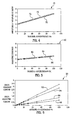
- the graph 110 has an x-axis corresponding to a biodiesel concentration and a y-axis corresponding to (delta resonant current) 2 / delta dielectric constant.
- the curve 114 corresponds to fresh biodiesel obtained from a soy feedstock.
- the curve 116 corresponds to fresh biodiesel obtained from a poultry fat feedstock.
- the curve 118 corresponds to fresh biodiesel obtained from a cottonseed feedstock.
- the linear characteristics including the slope of the curves 114, 116, 118 are a substantially similar to one another.
- the concentration of biodiesel in a mixture of biodiesel and petrodiesel can be determined utilizing data corresponding to one or more of the curves 114, 116, 118.
- the graph 130 has an x-axis corresponding to a biodiesel concentration and a y-axis corresponding to (delta resonant current) 2 / delta dielectric constant.
- the curve 138 corresponds to fresh biodiesel obtained from a soy feedstock.
- the curve 134 corresponds to biodiesel obtained from a soy feedstock that has been oxidized for 12 hours.
- the curve 136 corresponds to biodiesel obtained from a soy feedstock that has been oxidized five hours.
- the curve 132 corresponds to biodiesel with 1500 parts-per-million water by volume in biodiesel obtained from a soy feedstock.
- the single data point 140 (shown as a square marker at around 20% biodiesel concentration) corresponds to biodiesel with insoluble components therein.
- concentration of biodiesel in a mixture of biodiesel and petrodiesel can be determined utilizing data corresponding to one or more of the curves 132, 134, 136, 138, irrespective of water or insoluble components being in the mixture.
- FIG. 10 a flowchart of a method for determining a concentration of biodiesel and a mixture of biodiesel and petrodiesel based on an amplitude of a resonant current in accordance with another exemplary embodiment will now be explained.
- the method can be implemented in part utilizing software algorithms executed by the microprocessor 30.
- the phase lock loop circuit 24 generates an oscillatory signal that is received by the LCR circuit 20, based on a feedback signal, and a first voltage signal from the current-to-voltage converter 23.
- the LCR circuit 20 generates a resonant current at a resonant frequency that is received by the current-to-voltage converter 23 in response to the oscillatory signal.
- the LCR circuit 20 has the sensing element 42 fluidly communicating with a mixture of biodiesel and petrodiesel.
- the current-to-voltage converter 23 generates the first voltage signal in response to the resonant current that is received by both the phase lock loop circuit 24 and the AC/DC voltage converter 26.
- the AC/DC voltage converter 26 generates a second voltage signal in response to the first voltage signal.
- the DC amplifier 28 amplifies the second voltage signal to obtain a third voltage signal that is received by the microprocessor 30.
- the third signal is indicative of an amplitude of the resonant current.
- the microprocessor 30 determines a concentration value indicating the concentration of the biodiesel in the mixture based on the third voltage signal.
- the microprocessor 30 can utilize a lookup table stored in the memory device 32 having data corresponding to the graph 70 and the curves 72, 74, 76 to determine the biodiesel concentration based upon the third voltage signal indicating the amplitude of the resonant current.
- step 172 the microprocessor 30 stores the concentration value in the memory device 32. After step 172, the method is exited.
- FIG. 11 a flowchart of a method for determining a concentration of biodiesel in a mixture ofbiodiesel and petrodiesel based on a dielectric constant in accordance with another exemplary embodiment will now be explained.
- the method can be implemented in part utilizing software algorithms executed by the microprocessor 30.
- the phase lock loop circuit 24 generates an oscillatory signal that is received by the LCR circuit 20, based on a feedback signal, and a first voltage signal from the current-to-voltage converter 23.
- the LCR circuit 20 generates a resonant current at a resonant frequency that is received by the current-to-voltage converter 23 in response to the oscillatory signal.
- the LCR circuit 20 has the sensing element 42 fluidly communicating with a mixture of biodiesel and petrodiesel.
- the LCR circuit 20 sends a message to the microprocessor 30 having data indicating the resonant frequency of the resonant current.
- the current-to-voltage converter 23 generates the first voltage signal in response to the resonant current that is received by the phase lock loop circuit 24.
- the microprocessor 30 determines a dielectric constant value indicating a dielectric constant associated with the biodiesel in the mixture based on the resonant frequency of the resonant current. It should be noted that the relationship between the resonant frequency of the resonant current and the dielectric constant can be empirically determined by one skilled in the art.
- the microprocessor 30 determines a concentration value indicating the concentration of the biodiesel in the mixture based on the dielectric constant value.
- the microprocessor 30 can utilize a lookup table stored in the memory device 32 having data corresponding to the graph 80 and the curves 82, 84, 86 to determine the biodiesel concentration based on the dielectric constant value.
- the microprocessor 30 stores the concentration value in the memory device 32.
- FIG. 12 a flowchart of a method for determining a concentration of biodiesel in a mixture ofbiodiesel and petrodiesel based on a resonant current and a dielectric constant in accordance with another exemplary embodiment will now be explained.
- the method can be implemented in part utilizing software algorithms executed by the microprocessor 30.
- the phase lock loop circuit 24 generates an oscillatory signal that is received by the LCR circuit, based on a feedback signal, and a first voltage signal from the current-to-voltage converter 23.
- the LCR circuit 20 generates a resonant current at a resonant frequency that is received by the current-to-voltage converter 23 in response to the oscillatory signal.
- the LCR circuit 20 has the sensing element 42 fluidly communicating with a mixture of biodiesel and petrodiesel.
- the LCR circuit 20 sends a message to the microprocessor 30 having data indicating the resonant frequency of the resonant current.
- the current-to-voltage converter 23 generates the first voltage signal in response to the resonant current that is received by both the phase lock loop circuit 24 and an AC/DC voltage converter 26.
- the AC/DC voltage converter 26 generates a second voltage signal in response to the first voltage signal.
- the DC amplifier 28 amplifies the second voltage signal to obtain a third voltage signal that is received by the microprocessor 30.
- the third signal is indicative of an amplitude of the resonant current.
- the microprocessor 30 determines a dielectric constant value indicating a dielectric constant associated with the biodiesel in the mixture based on the resonant frequency of the resonant current.
- the first predetermined value corresponds to amplitude of a resonant current when pure petrodiesel is being measured.
- the second predetermined value corresponds to a dielectric constant value when pure petrodiesel is being measured. It should be noted that the value (amplitude of resonant current - first predetermined value) corresponds to the delta resonant current discussed above. It should be further noted that the value (dielectric constant value - second predetermined value) corresponds to the delta dielectric constant discussed above.
- the microprocessor 30 determines a concentration value indicating a concentration of the biodiesel in the mixture based on the index value.
- the microprocessor 30 can utilize a lookup table stored in the memory device 32 and access a concentration value in the lookup table based upon the index value.
- step 218 the microprocessor 30 stores the concentration value in the memory device 32. After step 218, the method is exited.
- the systems and methods for determining a concentration of biodiesel in a mixture of biodiesel and petrodiesel represent a substantial advantage over other systems and methods.
- the systems and methods provide a technical effect of accurately measuring the concentration of biodiesel in a mixture of biodiesel and petrodiesel utilizing a relatively small inexpensive sensing element.
- the system and methods are able to accurately measure a concentration of biodiesel in the mixture of biodiesel and petrodiesel irrespective of moisture impurities and insoluble components being in the mixture.
Landscapes
- Chemical & Material Sciences (AREA)
- Health & Medical Sciences (AREA)
- Life Sciences & Earth Sciences (AREA)
- General Health & Medical Sciences (AREA)
- Immunology (AREA)
- Engineering & Computer Science (AREA)
- Analytical Chemistry (AREA)
- Biochemistry (AREA)
- Chemical Kinetics & Catalysis (AREA)
- General Physics & Mathematics (AREA)
- Physics & Mathematics (AREA)
- Pathology (AREA)
- Electrochemistry (AREA)
- General Chemical & Material Sciences (AREA)
- Oil, Petroleum & Natural Gas (AREA)
- Food Science & Technology (AREA)
- Medicinal Chemistry (AREA)
- Investigating Or Analyzing Materials By The Use Of Electric Means (AREA)
Applications Claiming Priority (1)
| Application Number | Priority Date | Filing Date | Title |
|---|---|---|---|
| US11/771,516 US20090001961A1 (en) | 2007-06-29 | 2007-06-29 | Systems and methods for determining a concentration of biodiesel in a mixture of biodiesel and petrodiesel |
Publications (1)
| Publication Number | Publication Date |
|---|---|
| EP2009434A2 true EP2009434A2 (de) | 2008-12-31 |
Family
ID=39768911
Family Applications (1)
| Application Number | Title | Priority Date | Filing Date |
|---|---|---|---|
| EP08158131A Withdrawn EP2009434A2 (de) | 2007-06-29 | 2008-06-12 | System und Verfahren zur Bestimmung der Konzentration von Biodiesel in einer Mischung aus Biodiesel und Petrodiesel |
Country Status (2)
| Country | Link |
|---|---|
| US (1) | US20090001961A1 (de) |
| EP (1) | EP2009434A2 (de) |
Cited By (2)
| Publication number | Priority date | Publication date | Assignee | Title |
|---|---|---|---|---|
| GB2466802A (en) * | 2009-01-08 | 2010-07-14 | Stanhope Seta Ltd | Measuring low levels of contaminants in fuels using Fourier Transform Infra red spectroscopy with dynamic reference analysis |
| WO2012007718A2 (en) | 2010-07-13 | 2012-01-19 | Oxford Rf Sensors Ltd | Permittivity sensor |
Families Citing this family (2)
| Publication number | Priority date | Publication date | Assignee | Title |
|---|---|---|---|---|
| FR3035970B1 (fr) * | 2015-05-05 | 2017-06-02 | Ifp Energies Now | Procede de suivi en continu de l'etat d'avancement d'oxydation d'un carburant |
| JP6681547B2 (ja) * | 2016-12-21 | 2020-04-15 | パナソニックIpマネジメント株式会社 | 濃度センサ |
-
2007
- 2007-06-29 US US11/771,516 patent/US20090001961A1/en not_active Abandoned
-
2008
- 2008-06-12 EP EP08158131A patent/EP2009434A2/de not_active Withdrawn
Cited By (5)
| Publication number | Priority date | Publication date | Assignee | Title |
|---|---|---|---|---|
| GB2466802A (en) * | 2009-01-08 | 2010-07-14 | Stanhope Seta Ltd | Measuring low levels of contaminants in fuels using Fourier Transform Infra red spectroscopy with dynamic reference analysis |
| GB2466802B (en) * | 2009-01-08 | 2013-03-13 | Stanhope Seta Ltd | Sampling apparatus and process for measuring low levels of contaminants, or additives/components, in fuels using FTIR with dynamic reference analysis |
| WO2012007718A2 (en) | 2010-07-13 | 2012-01-19 | Oxford Rf Sensors Ltd | Permittivity sensor |
| WO2012007718A3 (en) * | 2010-07-13 | 2012-03-15 | Oxford Rf Sensors Ltd | Permittivity sensor |
| US9739740B2 (en) | 2010-07-13 | 2017-08-22 | Salunda Limited | Permittivity sensor |
Also Published As
| Publication number | Publication date |
|---|---|
| US20090001961A1 (en) | 2009-01-01 |
Similar Documents
| Publication | Publication Date | Title |
|---|---|---|
| EP2009439A2 (de) | Systeme und Verfahren zur Bestimmung der Gesamtzahl von mit Biodiesel verbundenen Säuren in einer Mischung aus Biodiesel und Petrodiesel | |
| AU2002304121B2 (en) | Biosensor apparatus and method with sample type and volume detection | |
| US20160018248A1 (en) | Method and Apparatus for Monitoring a Predefined Filling Level of a Medium in a Container | |
| US7659731B2 (en) | Liquid properties sensor circuit | |
| EP2009434A2 (de) | System und Verfahren zur Bestimmung der Konzentration von Biodiesel in einer Mischung aus Biodiesel und Petrodiesel | |
| US6693444B2 (en) | Circuit design for liquid property sensor | |
| CA2412204A1 (en) | Determination of sample volume adequacy in biosensor devices | |
| RU2009112406A (ru) | Неразрушающие системы, устройства и способы оценки устройств для ионтофоретической доставки лекарственных веществ | |
| JP2002323526A (ja) | 絶縁抵抗劣化検出方法及びその装置 | |
| CN112292587B (zh) | 具有温度补偿的填充物位传感器或极限物位传感器 | |
| JP2022529498A (ja) | 二重極性相互容量式液体検知 | |
| JP2014215073A (ja) | 燃料性状センサ及びその故障検出方法 | |
| KR20170140234A (ko) | 센서 요소의 내부 저항을 결정하기 위한 방법 및 장치 | |
| US6664796B2 (en) | Water contamination sensing algorithms for ethanol containing fuel | |
| CN109196315A (zh) | 电容式限位开关 | |
| US7777504B2 (en) | Sensor for determining the electric properties of a sample | |
| JPWO2011086677A1 (ja) | 濃度検出装置 | |
| RU2509531C1 (ru) | Способ определения составляющих импеданса биообъекта | |
| RU2460065C1 (ru) | Устройство для измерения октанового числа бензинов | |
| JP2021006781A (ja) | 異物検知装置 | |
| RU2354980C2 (ru) | Способ определения диэлектрической постоянной диэлектрического продукта | |
| RU2137146C1 (ru) | Способ измерения емкости с потерями | |
| Akbar et al. | Analysis of the relation between glucose concentration in water and resonant frequency using the resonance model | |
| TWI440863B (zh) | Impedance measurement equipment and systems | |
| Snyder et al. | Impedance resonance: A novel technique for signal acquisition from interdigitated electrodes (IDE) in sensor applications |
Legal Events
| Date | Code | Title | Description |
|---|---|---|---|
| PUAI | Public reference made under article 153(3) epc to a published international application that has entered the european phase |
Free format text: ORIGINAL CODE: 0009012 |
|
| AK | Designated contracting states |
Kind code of ref document: A2 Designated state(s): AT BE BG CH CY CZ DE DK EE ES FI FR GB GR HR HU IE IS IT LI LT LU LV MC MT NL NO PL PT RO SE SI SK TR |
|
| AX | Request for extension of the european patent |
Extension state: AL BA MK RS |
|
| STAA | Information on the status of an ep patent application or granted ep patent |
Free format text: STATUS: THE APPLICATION IS DEEMED TO BE WITHDRAWN |
|
| 18D | Application deemed to be withdrawn |
Effective date: 20110104 |