EP2008182B1 - Programmierung eines multiprozessorsystems - Google Patents
Programmierung eines multiprozessorsystems Download PDFInfo
- Publication number
- EP2008182B1 EP2008182B1 EP07759497A EP07759497A EP2008182B1 EP 2008182 B1 EP2008182 B1 EP 2008182B1 EP 07759497 A EP07759497 A EP 07759497A EP 07759497 A EP07759497 A EP 07759497A EP 2008182 B1 EP2008182 B1 EP 2008182B1
- Authority
- EP
- European Patent Office
- Prior art keywords
- processors
- communication
- tasks
- processor
- source code
- Prior art date
- Legal status (The legal status is an assumption and is not a legal conclusion. Google has not performed a legal analysis and makes no representation as to the accuracy of the status listed.)
- Active
Links
Images





Classifications
-
- G—PHYSICS
- G06—COMPUTING OR CALCULATING; COUNTING
- G06F—ELECTRIC DIGITAL DATA PROCESSING
- G06F8/00—Arrangements for software engineering
- G06F8/40—Transformation of program code
- G06F8/41—Compilation
-
- G—PHYSICS
- G06—COMPUTING OR CALCULATING; COUNTING
- G06F—ELECTRIC DIGITAL DATA PROCESSING
- G06F8/00—Arrangements for software engineering
- G06F8/40—Transformation of program code
- G06F8/41—Compilation
- G06F8/45—Exploiting coarse grain parallelism in compilation, i.e. parallelism between groups of instructions
- G06F8/451—Code distribution
-
- G—PHYSICS
- G06—COMPUTING OR CALCULATING; COUNTING
- G06F—ELECTRIC DIGITAL DATA PROCESSING
- G06F8/00—Arrangements for software engineering
- G06F8/30—Creation or generation of source code
-
- G—PHYSICS
- G06—COMPUTING OR CALCULATING; COUNTING
- G06F—ELECTRIC DIGITAL DATA PROCESSING
- G06F9/00—Arrangements for program control, e.g. control units
- G06F9/06—Arrangements for program control, e.g. control units using stored programs, i.e. using an internal store of processing equipment to receive or retain programs
- G06F9/46—Multiprogramming arrangements
- G06F9/52—Program synchronisation; Mutual exclusion, e.g. by means of semaphores
-
- G—PHYSICS
- G06—COMPUTING OR CALCULATING; COUNTING
- G06F—ELECTRIC DIGITAL DATA PROCESSING
- G06F9/00—Arrangements for program control, e.g. control units
- G06F9/06—Arrangements for program control, e.g. control units using stored programs, i.e. using an internal store of processing equipment to receive or retain programs
- G06F9/46—Multiprogramming arrangements
- G06F9/54—Interprogram communication
-
- G—PHYSICS
- G06—COMPUTING OR CALCULATING; COUNTING
- G06F—ELECTRIC DIGITAL DATA PROCESSING
- G06F9/00—Arrangements for program control, e.g. control units
- G06F9/06—Arrangements for program control, e.g. control units using stored programs, i.e. using an internal store of processing equipment to receive or retain programs
- G06F9/46—Multiprogramming arrangements
- G06F9/54—Interprogram communication
- G06F9/546—Message passing systems or structures, e.g. queues
Definitions
- the present invention relates to the methodology and tools used to program a computing system with multiple processors.
- the memory tends to be large, unified, and hierarchical.
- Memory access is fast and communication is relatively costly in terms of speed and power, hence the strategy of minimizing communication when multiple conventional single-processor systems are linked together to form a multi-processor system.
- the cost of communication is relatively inexpensive.
- Ample communication channels are provided for processors to communication with other processors or memory efficiently, therefore, memory in such systems tends to be smaller, distributed, and less hierarchical.
- the different memory architecture and the complex communication mechanism of a modem multi-processor system present significant programming productivity challenges.
- Embodiments of the invention may be used in a multi-processor system, i.e., a parallel computational platform comprising multiple processors, memories (unified and/or distributed), and communication network resources.
- One exemplary multi-processor system comprises a system referred to as the HyperX architecture.
- the central core building block of the HyperX architecture is a scalable unit-cell-based hardware fabric, a HyperSlice.
- the entire hardware architecture is formed by replicating this core unit-cell to create a multi-core parallel processing system.
- Each HyperSlice contains a DMR (Data Memory and Router) and Processing Element (PE).
- the DMR provides data memory, control logic, registers, and routers for fast routing services to the processing resources.
- the architecture of the DMR allows different interchangeable PEs to be used in a multi-processor fabric to optimize the system for specific applications.
- a HyperX multi-processor system may comprise either a heterogeneous or homogeneous array of PEs.
- Embodiments of the present invention circumvent this problem by creating a number of automation steps to effectively break up the parallel program into multiple conventional serial programs for each processor in the system so that conventional compilers written for single processor systems can be used.
- Embodiments of the present invention allow efficient program development without requiring expertise in parallel programming or detailed knowledge of the architecture of the machine.
- Programs are written to be structurally independent of the actual processor core or other resources used.
- the object code produced can be easily re-targeted to any processor core in the system.
- Communication, task allocation to processor, and memory allocation for program variables are performed automatically to satisfy system level design constraints such as latency, throughput, power, and resource limitations.
- Communication is accomplished by message passing or shared memory, expressed in symbolic form in the program and does not require the need to understand the hardware architecture of the communication fabric.
- a communication synthesis process is created to convert the symbolic communication representation into an efficient physical communication routing scheme without deadlocks.
- the design system has a continuous verification flow from top to bottom. Tests used at the high level can be used to verify the design at lower level of the design flow.
- embodiments of the present invention provide a mechanism to express and model parallelism inherent in the design graphically or procedurally, to optimize parallelism manually or automatically, and to visualize parallelism graphically and interactively.
- a computer-implemented method for creating a program for a multi-processor system comprises a plurality of processors, wherein each of the processors is coupled to at least one other processor, and wherein there are multiple communication mechanisms between the respective processors.
- the multi-processor system may comprise a plurality of memoriescoupled to the processors, e.g.. interspersed among the processors. More specifically, the multi-processor system may comprise a plurality of communication units coupled to, e.g., interspersed among, the processors, wherein each of the communication units comprises a memory and routing logic.
- the method may comprise first storing source code in response to user input, wherein the source code specifies first functionality.
- a user may specify or create the source code using a programming language.
- the source code is intended to execute on the multi-processor system.
- the source code specifies a plurality of tasks and communication of data among the plurality of tasks.
- the source code may not (in one embodiment is not required to) 1) explicitly specify which physical processor will execute each task and/or 2) explicitly specify which communication mechanism to use among the plurality of tasks.
- the source code may specify communication between tasks in symbolic 'send' and 'receive' form.
- the possible communication mechanisms may comprise messages passed between respective ones of the processors or the use of shared variables between respective ones of the processors.
- the method then creates machine language instructions based on the source code, wherein the machine language instructions are designed to execute on the plurality of processors.
- the method compiles the source code into machine language instructions (also called "object code").
- Creation of the machine language instructions comprises assigning tasks for execution on respective processors if task allocation is not explicitly specified in the source code.
- Creation of the machine language instructions may also comprise selecting communication mechanisms between the processors based on location of the respective processors and required communication of data if the communication mechanism is not explicitly selected in the source code.
- the created machine language instructions are stored on a memory.
- the machine language instructions are executable on the multi-processor system to implement the first functionality specified by the original source code program instructions.
- Creation of the machine language instructions comprises allocating local variables to memories proximate to the processors executing tasks that own the local variables.
- the allocation of local variables to memories may be performed based on data size and resource availability within the respective communication units.
- one or more of the tasks use shared variables
- the creation of the machine language instructions comprises allocating tasks using common shared variables to neighboring processors which share access to the same memories.
- the allocation of tasks using common shared variables is preferably performed prior to allocating tasks that do not have common shared variables.
- the method may create a performance model based on the source code, wherein the performance model is designed to optimize for one or more of latency, throughput, and power. For example, in one embodiment, for each of one or more respective communications, the method determines a data location of data as well as the location of the sending and receiving blocks of the respective communication. The method then creates a performance model for the respective communication. The communication mechanisms between the tasks or processors may then be selected based on the performance model. Selection of communication mechanisms may comprise synthesizing communication links between processors by binding communication requirements in the source code to the routing logic. The binding may be performed based on maximum utilization of available routing resources to minimize performance-robbing communication congestion and collision and to reduce the potential of fatal communication deadlocks.
- the source code specifies a first message, at least one message send command for the first message, at least one message receive command for the first message, source information for the first message, and destination information for the first message.
- the source information and the destination information may be expressed in symbolic terms, wherein the source information and the destination information do not specify a location of a processor to execute the at least one message send command and the at least one message receive command.
- Creation of the machine language instructions may comprise allocating tasks sending and/or receiving messages to specific processors. Creation of the machine language instructions may also comprise determining the optimal communication mechanism to use for the message.
- the method creates a communication dependency graph for all communication channels supporting multiple message passing. The method then determines if a dependency exists between communications using the same channel. If so, the method may automatically reassign the routing channel so that conflicting communications occur on different physical routes. If re-assignment is not feasible, the method may explicitly schedule the communication channel to prevent a deadlock from occurring.
- multiple tasks are clustered, scheduled, and allocated to a processor for serial execution without deadlock. Communications between tasks allocated to the same processor are performed using variables/memory shared between the tasks within a processor, resulting in the most efficient form of communication without synchronization overhead.
- the creation of the machine language instructions comprises breaking up the program instructions into multiple conventional serial programs for each processor in the multi-processor system. The method then executes conventional compilers designed for single processor systems to compile each of the multiple conventional serial programs.
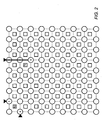
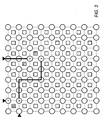
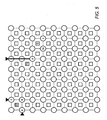
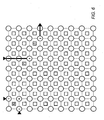
- Figures 1 - 6 illustrate a network of processing elements (PE's) and Data Memory Routers (DMRs) of a HyperX system; Figures 1 - 6 further depict a trace of an algorithm executing on the mutlti-processor system (or network); Figures 1 - 6 may also represent a GUI for specifying and/or viewing operation of the multi-processor system;
- PE's processing elements
- DMRs Data Memory Routers
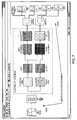
- Figure 7 is an exemplary graphical block diagram which comprises source code for a desired program defining the System - the application model and the system model.
- Figure 8a illustrates an example main program representing a system/algorithm in ANSI-C and explicitly using the SPMD programming model.
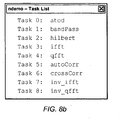
- Figure 8b is a task list extracted from the Main Program ( Figure 8a ) to drive automation of optimization.
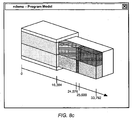
- Figure 8c is the 4-D+ optimized program model shown in 3-D derived from the main program and extracted task information list ( Figure8b ). Optimizations across dimensions include spatial (hardware fabric resources used at a specific point in time), temporal (timeline - represented in cycle-counts in this figure [0; 16,384; 24,576; 25,600; 33,792]), and system constraints. This figure shows the result of the optimization process in terms of resources utilization in response to system constraints (e.g., throughout, latency, power, etc.) as a function of time.
- system constraints e.g., throughout, latency, power, etc.
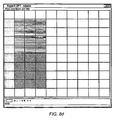
- Figure 8d is a spatial course-grain view of hardware fabric resources of the Program Model ( Figure 8c ) from the Main Program ( Figure 8a ) in the temporal region between clock-cycles 16,384 and 24,576. Note that the different functional blocks in Figure 7 are color coded (using gray scale shading / patterning), and the same color coding scheme is used in Figure 8c and 8d to trace the execution of functions spatially and temporally.
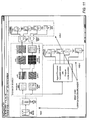
- Figure 9 is an overview of 'C' software development flow.
- Figure 10 illustrates the Graphical Layout Tool (GLT)/ Graphical Programming Tool (GPT) view providing the low-level view of the target architecture with tasks and communication allocated.
- GLT Graphical Layout Tool
- GPS Graphical Programming Tool
- Each rectangle represents a PE or a DMR, showing internal states of the respective block. Lines between PEs & DMRs represent data communication between them
- This view provides a complete interactive simulation and hardware design/debugging environment, and is able to track performance, power, and other useful metrics to aid in design/development.
- Figure 11 illustrates that the performance capturing simulator and developed program can be interfaced into 3rd party system-level development tools to provide golden verification at the system-level. The same input from the system level model is used to verify the design. The output of the design is compared against the golden output of the system model. This enables a rapid development and verification flow.
- a multi-processor system is a parallel computational platform comprising multiple processors, memories (unified and/or distributed), and communication (or communication network) resources.
- An exemplary multi-processor system comprises a plurality of processors, wherein each of the processors is coupled to at least one other processor, and wherein there are multiple communication mechanisms between the respective processors.
- the multi-processor system may comprise a plurality of memories coupled to the processors. For example, the memories may be interspersed among the processors. More specifically, the multi-processor system may comprise a plurality of communication units interspersed among the processors, wherein each of the communication units comprises a memory and routing logic.
- the term "coupled" means directly or indirectly connected.
- the central core building block of the HyperX architecture is a scalable unit-cell-based hardware fabric, a HyperSlice.
- the entire hardware architecture is formed by replicating this core unit-cell to create a multi-core parallel processing system.
- Each HyperSlice contains a DMR (Data Memory and Router) and Processing Element (PE).
- DMR Data Memory and Router
- PE Processing Element
- the DMR provides data memory, control logic, registers, and routers for fast routing services to the processing resources.
- the hardware fabric is created by joining HyperSlices together, forming the on-chip network. This on-chip network operates independently and transparently to the processing resources. It provides on-demand bandwidth through a real-time programmable and adaptable communication fabric between HyperSlices supporting arbitrary network topologies of functions or system implementations. Coordinated groups of HyperSlices may be formed and reformed "on-the-fly" under software control. This ability to dynamically alter the amount of hardware used to evaluate a function allows for the optimal application of hardware resources to relieve processing bottlenecks.
- the DMR provides nearest neighbor, regional, and global communication across the chip and from chip to chip.
- the DMR does this through four different transfer modes; memory to memory, memory to register, register to memory, and register to register. Each of the transfer modes may physically use the DMR resources to send data/messages differently depending on locality of data and software algorithm requirements.
- a "Quick Port" facility is provided to transfer a word of data from a processor to anywhere rapidly.
- DMA Direct Memory Access
- the use of shared memory and registers is the most efficient method of data movement.
- routing fabric is the most efficient method. Communication channels can either be dynamic or static.
- Dynamic routes are set up for data transfer and torn down upon the completion of the transfer to free up routing resources for other data transfers. Static routes remain in place throughout the program execution and are primarily used for high priority and critical communications. All data transfers and the choice of communication channel are under software program control. Multiple communication channels exist to support simultaneous data transfer between any senders and receivers.
- a HyperX multi-processor system may comprise either a heterogeneous or homogeneous array of PEs.
- a PE may be a conventional processor, or alternatively a PE may not conform to the conventional definition of a processor.
- a PE may simply be a collection of logic gates serving as a hard-wired processor for certain logic functions where programmability is traded off for higher performance, smaller area, and/or lower power.
- FIGS. 1 - 6 Exemplary Multi-Processor System
- FIG. 1 a view of the network of processing elements (PE's) and Data Memory Routers (DMR) of a HyperX system is shown.
- the PE's are shown as boxes and the DMRs are shown as circles.
- the routing channels between DMRs are shown as dotted lines.
- Solid triangles show off-mesh communication and solid lines show active data communication between DMRs.
- a computational task is shown by its numerical identifier and is placed on the PE that is executing it.
- a data variable being used for communication is shown by its name and is placed on the DMR that contains it.
- the algorithm brings sample data onto the mesh, processes the data, and then sends the result off mesh. Then the algorithm starts over at the beginning, and brings the next set of sample data onto the mesh.
- task 62 is reading data from off-mesh sources and storing the data in variables "t” and "u”. At the same time, task 62 is combining variables "t” and “u” and writing the results into variable "w”. Simultaneously, task 71 is bringing data from off-mesh and storing it in variable "x".
- task 62 finishes reading variables "t” and “u” and begins transmitting variable “w” to task 12 where it will be further processed.
- Task 12 must wait until variable "w” and variable "x" are both available to begin its next computational task.
- task 12 computes variable "sv” from its inputs "x" and "y” ( Figure 4 ). "sv” is a shared variable.
- task 5 sends the final result (variable "z") off the mesh while tasks 62 and 71 continue to read the next data samples.
- Figures 1 - 6 may also represent a graphical user interface (GUI) for specifying the "program" or the desired operation of the system.
- GUI graphical user interface
- Figures 1 - 6 may comprise screen shots represented on the display that are used by the user in specifying desired functionality.
- Figures 1 -6 may also be displayed during execution to visually indicate to the user the operations as they are being performed.
- Figures 1 - 6 may be used as a visualization / debugging / optimization tool.
- this graphical method also shows other detailed mesh activity. For example:
- PE states include: not started, running, stopped, stalled, and waiting.
- Some PE's may be directed to mn more than one task serially. Show which task is being executed by changing the color of the task identifier, making it more prominent, or other means of distinguishing it from the other tasks assigned to that PE.
- stalling behavior For example, a task may be stalled because it is waiting for some other tasks to give up ownership of a common resource. Display the stalling relationship graphically.
- the method may first comprise creating source code that specifies the program desired to be executed.
- the source code can be created in any of various programming languages, including textual languages (such as C or C++) and graphical programming languages (such as Simulink and LabVIEW).
- the source is stored on a memory medium.
- the source code comprises / specifies a plurality of tasks and communication among the plurality of tasks.
- ANSI C/C++ is used as the programming language.
- a C program is written as a collection of computational tasks with communication between them, as illustrated in Figures 8a and 8b .
- Figure 8a illustrates an example main program representing a system/algorithm in ANSI-C and which uses the MPI API.
- Figure 8b illustrates task list and connectivity information extracted from the Main Program ( Figure 8a ) to drive automation of optimizations.
- Figure 8c illustrates a 4-D+ optimized program model shown in 3-D derived from the main program ( Figure 8a ) and extracted task information list ( Figure 8b ). Optimizations across dimensions include spatial (hardware fabric resources used at a specific point in time), temporal (timeline - represented in cycle-counts in this figure [0; 16.384; 24,576; 25,600; 33,792]), and system constraints.
- Figure 8d shows a time slice of figure 8c representing the result of the optimization process in terms of resources utilization in response to system constraints (e.g., throughout, latency, power, etc.).
- a 'C' program can be written like a conventional SPMD (Single Program Multiple Data) program where a single program contains instructions for all processors. Unlike the conventional SPMD compilation practice of compiling the program into a single object code program for all processors, one embodiment of the present invention separates the code and creates a unique object file for each processor in order to conserve memory. Alternatively, programs need not be SPMD and can be implemented as a mixture of:
- a graphical input mechanism such as the SIMULINK tool from The MATHWORKS or LABVIEW from NATIONAL INSTRUMENTS is used to create the source code.
- the graphical programming language may more easily model parallelism.
- Simulink and LabVIEW have a number of advantages. Each is an interactive graphical environment for algorithm development. For example, the Simulink system provides a complete graphical entry system as well as verification environment. Since Simulink is built on top of Matlab, another product from MathWorks, a user can freely mix Matlab and Simulink for design and verification, and then transition the design to pure Simulink for implementation. LabVIEW and MathScript from National Instruments can be used together in a similar fashion.
- the terms “Simulink”, “MatLab” and “MathWorks” are trademarks of The MathWorks.
- the terms "LabVIEW”, “MathScript” and “National Instruments” are trademarks of National Instruments.
- Figure 7 illustrates an exemplary graphical block diagram created using the Simulink software.
- the block diagram of Figure 7 specifies a model of a system or application that is desired to be executed.
- the block diagram of Figure 7 essentially comprises source code for the desired program.
- Simulink the design is represented as a number of connected functional blocks. These blocks are assumed to be acting independently and communicate by passing variables between blocks. Variables may be scalars, vectors, or matrices of fixed or floating data.
- the computational model is the well-known "synchronous dataflow" model. In this model, each block produces its output(s) only after all of its necessary inputs have been received. In addition, each of the external inputs to the design occurs at a fixed rate although inputs with different rates are allowed.
- Simulink inherently represents block level parallelism.
- the blocks may be defined hierarchically or they can be primitives with associated function. The functionality of a primitive may be as simple as an inverter or as complex as a FFT.
- Each functional block has an associated "map" that specifies how a block's computations and variables are distributed across one or more processors on the processor array. For example, the map defines a set of processors to use and how the data of each I/O scalar/vector/matrix is distributed among the processors.
- a simple example of the "map” is the matrix multiply operator. Assume it is operating on 100x100 element matrices. The "map” might specify that the block is to use 1, 10, or 100 processors, from which an implementation can be created and performance calculated.
- a library of building blocks is parameterized based on the level of parallelism, data distribution schemes, different physical implementations, or different algorithmic implementations; representation different tradeoffs between performance, area, and power.
- Each block implementation has an associated model use in the optimization process.
- the design system selects the optimal block implementation from the library and the optimal communication mode between blocks to satisfy system requirements.
- Different variations of a building block can also be generated on the fly and on demand based on the results and the requirements of the optimization process.
- parallelism is expressed and modeled at the lowest machine level using assembly language.
- Figure 9 illustrates the overall compilation process.
- the term "compilation process” may be used to refer to most or all of the process shown in Figure 9 , including the C compile, Assemble and Task-linker steps, as well as the Place-and-route step and the Link/Simulate step.
- a program or source code (referred to in Figure 9 as "C Program") may be created by the user as described above.
- the source code may be created in any of various programming languages, including textual languages and graphical languages.
- communication between tasks may be specified in the program in symbolic form, e.g., 'send' and 'receive' symbolic form.
- symbolic form means that the respective statement in the program that directs communication is not associated with any specific hardware, e.g., is independent of hardware, path, etc.
- C compile, Assemble and Task-Linker steps may be performed.
- the C compile, Assemble and Task-Linker steps may be performed using standard currently available software.
- the C compile, Assemble and Task-Linker steps may operate to produce machine language instructions.
- the Place & Route step as illustrated in Figure 9 is then performed. This may involve allocating tasks to processors, allocating memory, and creating communication links between processors.
- the Place and Route step can be performed manually, automatically, or a combination of both.
- the term "automatically” in this context refers to performing the place and route without direct user input specifying the place (allocating tasks to processor and variables to memory) and route (allocating routing resources for communications).
- the choice of how to place and route the design is an optimization exercise that depends on many factors: latency and throughput requirements, power requirements, design size, data size, and array size.
- Local variables are allocated to immediate DMRs surrounding the PE executing the tasks that own the local variables, based on data size and resources availability within a particular DMR.
- Tasks using shared variables to communicate are clustered and allocated to neighboring PEs which share access to the same memory locations. Local variables and shared variables carry low communication overhead because of the proximity to the PEs consuming them.
- Tasks sharing variables and constrained variables have the highest priority in the process of placing tasks into PEs. Examples of constrained variable include data from off-chip that must be placed near the IO frame and other variables with user supplied constraints for high priority placement.
- Other Tasks are then allocated based on minimizing communication distance between PEs. Short communication distance reduces latency, improves performance, and decreases power consumption. Communication distance is measured in terms of numbers of hops between the sender and the receiver along the communication path. For example, passing through a DMR adds one hop to the communication distance.
- the system creates performance models for that communication to optimize the system-level performance of the design.
- the communication between processors is then synthesized automatically.
- the communication is specified in symbolic 'send' and 'receive' form in the program. For example, give all the message passing or tasks unique symbolic names ("a", "b", "c”). This makes all communication unique but without giving an absolute processor array location (for example, send_data("a”, data) instead of send_data((1,4), data), where (1,4) refers to a specific processor location in the multi-processor array).
- the allocation step can manually or automatically assign tasks to any processor array locations.
- Communication synthesis includes the automatic selection of the optimal communication modes. Communication can be continuous (streaming transfer), batch (block transfer), and/or overlapped with computations depending the characteristics and needs of the sending and receiving blocks. In the case of the HyperX system, the choice is made between shared memory, memory to memory, memory to register, register to memory, and register to register transfer or a combination of these communication modes, implemented by the shared memory, Quick Port or DMA mechanism.
- a routing step is applied to synthesize all communications links between PEs by binding the communication requirements in the program to physical hardware routing resources.
- the routing step allocates routing resources based on maximum utilization of all available routing resources to minimize performance-robbing communication congestion and collision and to reduce the potential of fatal communication deadlocks.
- Task A expects data from Task B through communication Channel B and data from Task C through communication Channel C
- Channel B and Channel C are dynamic channels assigned to the same physical routing resources based on minimal communication distance criteria.
- a deadlock occurs when Task A expects data from Task C while Task B attempts to send data to Task A on the same physical channel at the same time.
- Task C cannot set up Channel C because the routing hardware is in use by Channel B which stalls (waiting for Task A to respond) and will not release the routing resources to Channel C.
- One embodiment of the present invention employs a low cost deadlock removal scheme to create a deadlock free program during compile time.
- a communication dependency graph is created for all communication channels supporting multiple message passing. If no dependency exists between communications using the same channel, then no deadlock is possible. If there is dependency then the routing channel can be reassigned so that conflicting communication occur on different physical routes. If re-assignment is not feasible, as in the case of a resources constrained or performance constrained situation, the use of the communication channel is explicitly scheduled and sequenced in a way that deadlock doesn't occur. For example, to remove the deadlock in the above mentioned deadlock case, Task A is modified to send a signal through the Quick Port mechanism to Task B after Channel C transfer is completed. Task B is modified to wait for the signal from Task A before it can transfer data to Task A.
- Task A and Task B ensures that Channel B and Channel C are deadlock free while sharing the same physical routing hardware.
- the modification of Task A and Task B are performed by inserting code into the object code of the respective tasks automatically during the linking phase with no programmer intervention.
- the execution order is determined either dynamically during run time or statically during compile time.
- dynamic scheduling each processor keeps track of the conditions under which each task can be executed and then execute them when they are ready.
- Static scheduling creates an execution order during compile time so that a task is scheduled to be executed only when all its prerequisite data is available.
- the scheduling process serializes parallel tasks for execution by a single processor without deadlocks. Deadlocks are detected by augmenting the task graph with the dependencies introduced by the clustering and scheduling process. Cycles in the task graph correspond to potential deadlock conditions, which are removed by changing the clustering or scheduling scheme.
- Memory allocation follows similar tradeoffs of throughput, latency, power, and resources constraints.
- a vector of data can be arranged in many different ways:
- temporary storage could be eliminated altogether and the output data could reuse the storage of a, b, c, or d. This is particularly important when a, b, c, and d are very long vectors or very large matrices.
- the operations in an algorithm can be defined to enable reuse. Furthermore, if latency is at a premium and the input matrix data for a matrix multiply block is arranged all in one memory, the first thing the block implementation might do is to copy the data to more memories and then begin parallel calculations from there.
- the keyword _shared identifies that a variable will be shared across tasks.
- _shared int xyz identifies the integer variable xyz as a shared variable.
- Shared variable is used as a form of communication between tasks.
- Synchronization between tasks in accessing the shared variable is through the use of semaphores.
- semaphores are registers with special hardware support.
- a mutex (mutual exclusive) semaphore is a 1-bit register that is used to flag mutual exclusive ownership of some resource by a task. When a mutex semaphore (and implicitly, the shared resource) is owned by a task, it is locked and the shared resource cannot be simultaneously accessed by other tasks that are respecting the semaphore.
- the communication synthesis step automatically ensures that communication using shared variables is appropriately protected using semaphores.
- MPI Message Passing Interface
- MPI libraries exist for systems of PC's communicating across a typical local area network.
- the MPI standard contains over 120 functions but only a subset is needed for a single chip multi-processor system like the HyperX. These functions are implemented in software or, for efficiency, could be implemented in hardware
- MPI_Reduce Combines a partial result from a group of processors For example, to add N integers (each located on a separate processor) invoke the "Reduce ADD" operation on the set of processors.
- the final step of the tool flow is to assemble code streams into an executable object image file suitable for execution by a processor.
- a compilation methodology has been treated to produce object code from C for a heterogeneous or homogeneous array of processors using conventional compilers written to generate code for a single processor system.
- the ability to use a conventional compiler without rewriting it for a multi-processor application is important because the need to build a variety of multi-processor systems using different processors.
- the Spatial-Temporal Algorithm Viewer/Editor allows the algorithm designer to understand the relationship between what the algorithm is computing, where it is computing it, and when it is computing it.
- Figure 10 illustrates the Graphical Layout Tool (GLT)/ Graphical Programming Tool (GPT) view providing the low-level view of the target architecture with tasks and communication allocated.
- GLT Graphical Layout Tool
- GPS Graphical Programming Tool
- Each rectangle represents a PE or a DMR, showing internal states of the respective block. Lines between PEs & DMRs represent data communication between them
- This view provides a complete interactive simulation and hardware design/debugging environment, and is able to track performance, power, and other useful metrics to aid in design/development.
- Figure 11 illustrates that the performance capturing simulator and developed program can be interfaced into 3rd party system-level development tools to provide golden verification at the system-level. The same input from the system level model is used to verify the design. The output of the design is compared against the golden output of the system model. This enables a rapid development and verification flow.
- the method described herein provides a number of advantages.
- there are multiple means of communication between processors each representing different trade off between latency, throughput, and power.
- the user program does not have to explicitly select which communication mechanism to use. Rather, the communication is synthesized based on the knowledge of the location of the processor and the layout of the data which can be derived either manually or automatically.
- the system may create a performance model to optimize for latency, throughput, and power and selected the optimal communication mechanism.
- Tasks are linked by symbolic communication links and are allocated to processors to satisfy design constraints.
- the symbolic links are resolved and the optimal communication mode is selected to satisfy design constraints.
- a programmer thus does not have to worry about the physical location of a processor.
- the source and destination of the message send and receive command are expressed in symbolic terms, so that the exact location of the processor can be allocated optimally to satisfy design constraints. Shared variables may be used as a means of communication between the tasks executing on the processors.
- the method described herein provides a general compilation strategy for multi-processor system that supports the use of different processors in the multi-processor system.
- the method uses a conventional (existing) compiler for serial code without developing a specialized parallel compiler.
- the object code is separated so that the instruction memory of a processor is only loaded with the instructions assigned to it.
- a graphical programming specification is used where the design is represented as a number of connected functional blocks, e.g. a data flow diagram.
- the graphical data flow diagram provides a graphical way to express and specify parallelism.
- the functional blocks can be parameterized based on number of processors and memory usage model.
- the parameterized block implementations are selected and optimized to satisfy design constraints.
- memory usage and allocation are optimized, communication between blocks is optimized, and functional blocks can be scheduled to be executed by single or multiple processors.
- parallelism is modeled in C by writing a SPMD program.
- a message passing interface may be used to communicate.
- MPI message passing as used in a conventional multi-processor system communicating over a local area network, has high overhead relative to memory access.
- the communication overhead is relatively small compared to memory access because of the extensive on-chip communication facilities, thus enabling an architecture with relatively small memory per processor.
- a spatial-temporal development GUI / viewer may be used to enable the user to visually specify the program and/or to view the operation of the program.
Landscapes
- Engineering & Computer Science (AREA)
- Theoretical Computer Science (AREA)
- Software Systems (AREA)
- General Engineering & Computer Science (AREA)
- Physics & Mathematics (AREA)
- General Physics & Mathematics (AREA)
- Multi Processors (AREA)
- Devices For Executing Special Programs (AREA)
Claims (15)
- Computerimplementiertes Verfahren zum Erzeugen eines Programms für ein Multiprozessorsystem, wobei das Multiprozessorsystem mehrere Prozessoren und mehrere Speicher, die mit den Prozessoren verbunden sind, umfasst, wobei jeder der Prozessoren mit wenigstens einem anderen Prozessor verbunden ist, wobei es mehrere Kommunikationsmechanismen zwischen den entsprechenden Prozessoren gibt, wobei das Verfahren folgendes umfasst:Speichern von Sourcecode als Reaktion auf eine Benutzereingabe, wobei der Sourcecode eine erste Funktionalität beschreibt, wobei der Sourcecode dazu vorgesehen ist, auf dem Multiprozessorsystem ausgeführt zu werden, wobei der Sourcecode mehrere Aufgaben und Datenkommunikation zwischen den mehreren Aufgaben beschreibt, wobei der Sourcecode weiter nicht angibt, welcher Kommunikationsmechanismus zwischen den mehreren Aufgaben verwendet werden soll,Erzeugen von Anweisungen in Maschinensprache auf Basis des Sourcecode, wobei die Anweisungen in Maschinensprache dazu vorgesehen sind, auf den mehreren Prozessoren ausgeführt zu werden,Auswählen von Kommunikationsmechanismen zwischen den Prozessoren auf Basis der Anordnung des entsprechenden Prozessors und der erforderlichen Datenkommunikation,Speichern der Anweisungen in Maschinensprache in verschiedenen der mehreren Speicher, wobei das Multiprozessorsystem so betrieben werden kann, dass es die Anweisungen in Maschinensprache, die die ausgewählten Kommunikationsmechanismen verwenden, ausführt, um die erste Funktionalität zu implementieren.
- Verfahren nach Anspruch 1, bei dem die Kommunikationsmechanismen Nachrichten, die zwischen entsprechenden Prozessoren weitergeleitet werden und gemeinsam benutzte Variablen zwischen entsprechenden der Prozessoren umfassen,
wobei das Auswählen von Kommunikationsmechanismen zwischen den Prozessoren die Auswahl von entweder gemeinsam verwendeten Variablen oder Nachrichtenweiterleitung umfasst. - Verfahren nach einem der vorangehenden Ansprüche, das weiter folgendes umfasst:Zuordnen von lokalen Variablen zu Speichern, die in der Nähe von Prozessoren angeordnet sind, die Aufgaben ausführen, zu denen die lokalen Variablen gehören,wobei die Zuordnung von lokalen Variablen zu Speichern auf Basis von Datengröße und Ressourcenverfügbarkeit innerhalb der Speicher durchgeführt wird.
- Verfahren nach einem der vorangehenden Ansprüche, bei dem das Multiprozessorsystem mehrere Kommunikationseinheiten umfasst, die mit den Prozessoren verbunden sind, wobei jede der Kommunikationseinheiten einen Speicher und eine Logik für die Weiterleitung umfasst,
wobei das Verfahren weiter das Zuordnen von lokalen Variablen zu Speichern in entsprechenden Kommunikationseinheiten umfasst, die in der Nähe von Prozessoren angeordnet sind, die Aufgaben ausführen, zu denen die lokalen Variablen gehören, und wobei das Zuordnen von lokalen Variablen auf Basis von Datengröße und Ressourcenverfügbarkeit innerhalb der Kommunikationseinheiten durchgeführt wird. - Verfahren nach einem der vorangehenden Ansprüche, bei dem das Auswählen von Kommunikationsmechanismen zwischen den Prozessoren das Auswählen von gemeinsam verwendeten Variablen für wenigstens eine Untermenge der Aufgaben umfasst,
wobei das Verfahren weiter das Zuordnen von Aufgaben, die allgemeine gemeinsam verwendete Variablen benutzen, zu benachbarten Prozessoren umfasst, die sich den Zugriff auf gleiche Speicher teilen. - Verfahren nach einem der vorangehenden Ansprüche, das weiter folgendes umfasst:Zuordnen von Aufgaben, die allgemeine gemeinsam verwendete Variablen benutzen, vor dem Zuordnen von Aufgaben, die keine gemeinsam verwendeten Variablen haben.
- Verfahren nach einem der vorangehenden Ansprüche, das weiter folgendes umfasst:Erzeugen eines Leistungsfähigkeitsmodells auf Basis des Sourcecodes, wobei das Leistungsfähigkeitsrnodell dazu vorgesehen ist, eine oder mehrere der Größen Wartezeit, Durchsatz und Leistung zu optimieren,und wobei das Auswählen von Kommunikationsmechanismen zwischen den Aufgaben oder Prozessoren das Auswählen von Kommunikationsmechanismen auf Basis des Leistungsfähigkeitsmodells umfasst.
- Verfahren nach einem der vorangehenden Ansprüche, das weiter folgendes umfasst:Festiegen eines Datenortes für das Senden und das Empfangen von Blöcken der entsprechenden Kommunikation für jede der einen oder mehreren jeweiligen Kommunikationen,Erzeugen eines Leistungsfähigkeitsmodells für die entsprechende Kommunikation,wobei das Auswählen von Kammunikationsmechanismen zwischen den Aufgaben oder Prozessoren das Auswählen von Kommunikationsmechanismen auf Basis des Leistungsfähigkeitsmodells umfasst.
- Verfahren nach einem der vorangehenden Ansprüche, bei dem der Sourcecode Kommunikation in symbolischer Form beschreibt.
- Verfahren nach einem der vorangehenden Ansprüche,
bei dem der Sourcecode eine erste Nachricht, wenigstens einen Nachricht-Senden-Befehl für die erste Nachricht, wenigstens einen Nachricht-Empfangen-Befehl für die erste Nachricht, Quellinformationen für die erste Nachricht und Zielinformationen für die erste Nachricht beschreibt,
wobei die Quellinformation und die Zielinformation in symbolischen Begriffen ausgedrückt sind, und wobei die Quellinformation und die Zielinformation kleinen Ort eines Prozessors angeben, auf dem der wenigstens eine Befehl zum Senden einer Nachricht und der wenigstens eine Befehl zum Empfangen einer Nachricht ausgeführt wird,
wobei das Verfahren weiter das Zuordnen von Aufgaben umfasst, die Nachrichten zu bestimmten Prozessoren senden und/oder empfangen. - Verfahren nach einem der vorangehenden Ansprüche,
bei dem das Multiprozessorsystem mehrere Speichereinheiten umfasst, die mit den Prozessoren verbunden sind, wobei jede der Speichereinheiten einen Speicher und eine Weiterleitungslogik umfasst,
wobei das Verfahren weiter das Erzeugen von Kommunikationsverbindungen zwischen Prozessoren umfasst, indem Kommunikationsanforderungen in dem Sourcecode mit der Weiterleitungslog ik verknüpft werden. - Verfahren nach einem der vorangehenden Ansprüche, das weiter folgendes umfasst:Erzeugen eines Graphs für die Abhängigkeiten der Kommunikation für alle Kommunikationskanäle, die das Mehrfachweiterleiten von Nachrichten unterstützen,Feststellen, ob eine Abhängigkeit zwischen Kommunikationen besteht, die desselben Kanal verwenden,wenn eine Abhängigkeit zwischen Kommunikationen, die denselben Kanal verwenden, besteht, den Weiterleitungskanal automatisch neu zuordnen, so dass kollidierende Kommunikationen auf verschiedenen physikalischen Routen stattfinden,wenn eine Neuzuordnung nicht machbar ist, den Kommunikationskanal automatisch und explizit zuteilen, um zu verhindern, dass eine gegenseitige Blockade auftritt.
- Verfahren nach einem der vorangehenden Ansprüche, bei dem das Erzeugen von Anweisungen in Maschinensprache das Auflösen des Sourcecodes in mehrere herkömmliche serielle Programme für jeden Prozessor in dem Multiprozessorsystem aufweist, und
Ausführen eines herkömmlichen Compilers, der für Systeme mit einem einzelnen Prozessor entworfen ist, der jedes der mehreren herkömmlichen seriellen Programme kompiliert. - Verfahren nach einem der vorangehenden Ansprüche, das weiter folgendes umfasst:Ausführen der Anweisungen in Maschinensprache durch das Multiprozessorsystem unter Verwendung der ausgewählten Kommunikationsmechanismen, um die erste Funktionalität zu implementieren, undAnzeigen einer graphischen Benutzerschnittstelle, die das Multiprozessorsystem visuell darstellt, wobei die graphische Benutzerschnittstelle während der Ausführung aktualisiert wird, um Vorgänge, die durchgeführt werden, visuell anzuzeigen,wobei die graphische Benutzerschnittstelle wenigstens eine Untermenge der mehreren Prozessoren und wenigstens eine Untermenge der mehreren Speicher visuell darstellt,
wobei das Anzeigen der graphischen Benutzerschnittstelle das Anzeigen einer visuellen Angabe über entsprechende Prozessoren umfasst, um den Zustand der entsprechenden Prozessoren anzuzeigen. - Speicher, der Anweisungen eines Programms zum Erzeugen eines Programms für ein Multiprozessorsystem umfasst, wobei die Anweisungen des Programms ausgeführt werden können, um Schritte nach einem der vorangehenden Ansprüche durchzuführen.
Applications Claiming Priority (2)
| Application Number | Priority Date | Filing Date | Title |
|---|---|---|---|
| US78658206P | 2006-03-27 | 2006-03-27 | |
| PCT/US2007/065268 WO2007112406A2 (en) | 2006-03-27 | 2007-03-27 | Programming a multi-processor system |
Publications (2)
| Publication Number | Publication Date |
|---|---|
| EP2008182A2 EP2008182A2 (de) | 2008-12-31 |
| EP2008182B1 true EP2008182B1 (de) | 2010-05-12 |
Family
ID=38349549
Family Applications (1)
| Application Number | Title | Priority Date | Filing Date |
|---|---|---|---|
| EP07759497A Active EP2008182B1 (de) | 2006-03-27 | 2007-03-27 | Programmierung eines multiprozessorsystems |
Country Status (5)
| Country | Link |
|---|---|
| US (4) | US8826228B2 (de) |
| EP (1) | EP2008182B1 (de) |
| CN (2) | CN103530187B (de) |
| DE (1) | DE602007006467D1 (de) |
| WO (1) | WO2007112406A2 (de) |
Families Citing this family (82)
| Publication number | Priority date | Publication date | Assignee | Title |
|---|---|---|---|---|
| US8478811B2 (en) * | 2002-10-08 | 2013-07-02 | Netlogic Microsystems, Inc. | Advanced processor with credit based scheme for optimal packet flow in a multi-processor system on a chip |
| US7627721B2 (en) | 2002-10-08 | 2009-12-01 | Rmi Corporation | Advanced processor with cache coherency |
| US7961723B2 (en) | 2002-10-08 | 2011-06-14 | Netlogic Microsystems, Inc. | Advanced processor with mechanism for enforcing ordering between information sent on two independent networks |
| US8037224B2 (en) | 2002-10-08 | 2011-10-11 | Netlogic Microsystems, Inc. | Delegating network processor operations to star topology serial bus interfaces |
| US7346757B2 (en) * | 2002-10-08 | 2008-03-18 | Rmi Corporation | Advanced processor translation lookaside buffer management in a multithreaded system |
| US7334086B2 (en) | 2002-10-08 | 2008-02-19 | Rmi Corporation | Advanced processor with system on a chip interconnect technology |
| US9088474B2 (en) | 2002-10-08 | 2015-07-21 | Broadcom Corporation | Advanced processor with interfacing messaging network to a CPU |
| JP5003673B2 (ja) * | 2006-03-23 | 2012-08-15 | 富士通株式会社 | マルチプロセッシング方法及びマルチプロセッサシステム |
| US8010953B2 (en) * | 2006-04-04 | 2011-08-30 | International Business Machines Corporation | Method for compiling scalar code for a single instruction multiple data (SIMD) execution engine |
| EP2030135A2 (de) | 2006-05-22 | 2009-03-04 | Coherent Logix Incorporated | Asic-entwurf auf basis der ausführung eines softwareprogramms in einem verarbeitungssystem |
| US8161480B2 (en) | 2007-05-29 | 2012-04-17 | International Business Machines Corporation | Performing an allreduce operation using shared memory |
| US20090006663A1 (en) * | 2007-06-27 | 2009-01-01 | Archer Charles J | Direct Memory Access ('DMA') Engine Assisted Local Reduction |
| US8140731B2 (en) | 2007-08-27 | 2012-03-20 | International Business Machines Corporation | System for data processing using a multi-tiered full-graph interconnect architecture |
| US7958183B2 (en) | 2007-08-27 | 2011-06-07 | International Business Machines Corporation | Performing collective operations using software setup and partial software execution at leaf nodes in a multi-tiered full-graph interconnect architecture |
| US7793158B2 (en) | 2007-08-27 | 2010-09-07 | International Business Machines Corporation | Providing reliability of communication between supernodes of a multi-tiered full-graph interconnect architecture |
| US7904590B2 (en) | 2007-08-27 | 2011-03-08 | International Business Machines Corporation | Routing information through a data processing system implementing a multi-tiered full-graph interconnect architecture |
| US7769891B2 (en) | 2007-08-27 | 2010-08-03 | International Business Machines Corporation | System and method for providing multiple redundant direct routes between supernodes of a multi-tiered full-graph interconnect architecture |
| US7822889B2 (en) | 2007-08-27 | 2010-10-26 | International Business Machines Corporation | Direct/indirect transmission of information using a multi-tiered full-graph interconnect architecture |
| US7809970B2 (en) | 2007-08-27 | 2010-10-05 | International Business Machines Corporation | System and method for providing a high-speed message passing interface for barrier operations in a multi-tiered full-graph interconnect architecture |
| US7769892B2 (en) | 2007-08-27 | 2010-08-03 | International Business Machines Corporation | System and method for handling indirect routing of information between supernodes of a multi-tiered full-graph interconnect architecture |
| US7840703B2 (en) | 2007-08-27 | 2010-11-23 | International Business Machines Corporation | System and method for dynamically supporting indirect routing within a multi-tiered full-graph interconnect architecture |
| US8185896B2 (en) | 2007-08-27 | 2012-05-22 | International Business Machines Corporation | Method for data processing using a multi-tiered full-graph interconnect architecture |
| US8108545B2 (en) | 2007-08-27 | 2012-01-31 | International Business Machines Corporation | Packet coalescing in virtual channels of a data processing system in a multi-tiered full-graph interconnect architecture |
| US7958182B2 (en) | 2007-08-27 | 2011-06-07 | International Business Machines Corporation | Providing full hardware support of collective operations in a multi-tiered full-graph interconnect architecture |
| US8014387B2 (en) | 2007-08-27 | 2011-09-06 | International Business Machines Corporation | Providing a fully non-blocking switch in a supernode of a multi-tiered full-graph interconnect architecture |
| US20090064166A1 (en) * | 2007-08-28 | 2009-03-05 | Arimilli Lakshminarayana B | System and Method for Hardware Based Dynamic Load Balancing of Message Passing Interface Tasks |
| US8312464B2 (en) * | 2007-08-28 | 2012-11-13 | International Business Machines Corporation | Hardware based dynamic load balancing of message passing interface tasks by modifying tasks |
| US8127300B2 (en) * | 2007-08-28 | 2012-02-28 | International Business Machines Corporation | Hardware based dynamic load balancing of message passing interface tasks |
| US8234652B2 (en) * | 2007-08-28 | 2012-07-31 | International Business Machines Corporation | Performing setup operations for receiving different amounts of data while processors are performing message passing interface tasks |
| US8108876B2 (en) * | 2007-08-28 | 2012-01-31 | International Business Machines Corporation | Modifying an operation of one or more processors executing message passing interface tasks |
| US7827428B2 (en) | 2007-08-31 | 2010-11-02 | International Business Machines Corporation | System for providing a cluster-wide system clock in a multi-tiered full-graph interconnect architecture |
| US7921316B2 (en) | 2007-09-11 | 2011-04-05 | International Business Machines Corporation | Cluster-wide system clock in a multi-tiered full-graph interconnect architecture |
| US8077602B2 (en) | 2008-02-01 | 2011-12-13 | International Business Machines Corporation | Performing dynamic request routing based on broadcast queue depths |
| US7779148B2 (en) | 2008-02-01 | 2010-08-17 | International Business Machines Corporation | Dynamic routing based on information of not responded active source requests quantity received in broadcast heartbeat signal and stored in local data structure for other processor chips |
| US8751211B2 (en) | 2008-03-27 | 2014-06-10 | Rocketick Technologies Ltd. | Simulation using parallel processors |
| US8422402B2 (en) | 2008-04-01 | 2013-04-16 | International Business Machines Corporation | Broadcasting a message in a parallel computer |
| US20090254319A1 (en) * | 2008-04-03 | 2009-10-08 | Siemens Aktiengesellschaft | Method and system for numerical simulation of a multiple-equation system of equations on a multi-processor core system |
| US9032377B2 (en) * | 2008-07-10 | 2015-05-12 | Rocketick Technologies Ltd. | Efficient parallel computation of dependency problems |
| US8281053B2 (en) | 2008-07-21 | 2012-10-02 | International Business Machines Corporation | Performing an all-to-all data exchange on a plurality of data buffers by performing swap operations |
| WO2010064260A1 (en) | 2008-12-01 | 2010-06-10 | Kpit Cummins Infosystems Ltd. | Method and system for parallelization of sequencial computer program codes |
| US9032407B2 (en) * | 2009-05-25 | 2015-05-12 | Panasonic Intellectual Property Corporation Of America | Multiprocessor system, multiprocessor control method, and multiprocessor integrated circuit |
| US8417778B2 (en) * | 2009-12-17 | 2013-04-09 | International Business Machines Corporation | Collective acceleration unit tree flow control and retransmit |
| US9424087B2 (en) | 2010-04-29 | 2016-08-23 | International Business Machines Corporation | Optimizing collective operations |
| US8949577B2 (en) | 2010-05-28 | 2015-02-03 | International Business Machines Corporation | Performing a deterministic reduction operation in a parallel computer |
| US8769496B2 (en) * | 2010-08-13 | 2014-07-01 | Accenture Global Services Limited | Systems and methods for handling database deadlocks induced by database-centric applications |
| US8661424B2 (en) | 2010-09-02 | 2014-02-25 | Honeywell International Inc. | Auto-generation of concurrent code for multi-core applications |
| US8776081B2 (en) * | 2010-09-14 | 2014-07-08 | International Business Machines Corporation | Send-side matching of data communications messages |
| EP2628090B1 (de) | 2010-10-15 | 2018-05-30 | Coherent Logix Incorporated | Deaktivierung von kommunikation in einem multiprozessorsystem |
| KR101623564B1 (ko) * | 2010-10-19 | 2016-05-24 | 삼성전자주식회사 | 멀티쓰레드 환경을 테스트하는 커버리지 장치 및 방법 |
| US8566841B2 (en) | 2010-11-10 | 2013-10-22 | International Business Machines Corporation | Processing communications events in parallel active messaging interface by awakening thread from wait state |
| GB2529075A (en) * | 2011-06-16 | 2016-02-10 | Imagination Tech Ltd | Graphics processor with non-blocking concurrent architecture |
| US8893083B2 (en) | 2011-08-09 | 2014-11-18 | International Business Machines Coporation | Collective operation protocol selection in a parallel computer |
| US8667501B2 (en) | 2011-08-10 | 2014-03-04 | International Business Machines Corporation | Performing a local barrier operation |
| US8910178B2 (en) | 2011-08-10 | 2014-12-09 | International Business Machines Corporation | Performing a global barrier operation in a parallel computer |
| US9003383B2 (en) * | 2011-09-15 | 2015-04-07 | You Know Solutions, LLC | Analytic engine to parallelize serial code |
| US8799693B2 (en) * | 2011-09-20 | 2014-08-05 | Qualcomm Incorporated | Dynamic power optimization for computing devices |
| US9098309B2 (en) | 2011-09-23 | 2015-08-04 | Qualcomm Incorporated | Power consumption optimized translation of object code partitioned for hardware component based on identified operations |
| US9495135B2 (en) | 2012-02-09 | 2016-11-15 | International Business Machines Corporation | Developing collective operations for a parallel computer |
| US8706847B2 (en) | 2012-02-09 | 2014-04-22 | International Business Machines Corporation | Initiating a collective operation in a parallel computer |
| US8769549B2 (en) * | 2012-04-30 | 2014-07-01 | National Instruments Corporation | Graphical programming system enabling data sharing from a producer to a consumer via a memory buffer |
| KR101926464B1 (ko) * | 2012-10-11 | 2018-12-07 | 삼성전자 주식회사 | 멀티코어 프로세서에서 수행되는 프로그램의 컴파일 방법, 멀티코어 프로세서의 태스크 매핑 방법 및 태스크 스케줄링 방법 |
| US9904542B2 (en) * | 2012-11-06 | 2018-02-27 | Coherent Logix, Incorporated | Multiprocessor programming toolkit for design reuse |
| CN107239420B (zh) * | 2012-11-21 | 2020-05-05 | 相干逻辑公司 | 具有散布处理器dma-fifo的处理系统 |
| EP3614273A3 (de) * | 2012-12-13 | 2020-04-15 | Coherent Logix, Incorporated | Multiprozessorsystem mit verbessertem sekundärem verbindungsnetzwerk |
| US9195575B2 (en) * | 2013-05-17 | 2015-11-24 | Coherent Logix, Incorporated | Dynamic reconfiguration of applications on a multi-processor embedded system |
| US9582251B2 (en) | 2014-11-14 | 2017-02-28 | Cavium, Inc. | Algorithm to achieve optimal layout of decision logic elements for programmable network devices |
| US10528525B2 (en) * | 2015-03-19 | 2020-01-07 | International Business Machines Corporation | Establishing connections in a multi-tenant environment |
| US20170147402A1 (en) * | 2015-11-25 | 2017-05-25 | GM Global Technology Operations LLC | Optimized task partitioning through data mining |
| JP6522537B2 (ja) * | 2016-03-09 | 2019-05-29 | ソフトバンク株式会社 | コマンド処理装置及びプログラム |
| US9705978B1 (en) * | 2016-07-01 | 2017-07-11 | Red Hat Israel, Ltd. | Dependency graph management |
| US10860332B2 (en) * | 2017-09-25 | 2020-12-08 | Qualcomm Incorporated | Multicore framework for use in pre-boot environment of a system-on-chip |
| JP2021501949A (ja) * | 2017-11-03 | 2021-01-21 | コーヒレント・ロジックス・インコーポレーテッド | マルチ・プロセッサ・システム用プログラミングの流れ |
| CN108132834B (zh) * | 2017-12-08 | 2020-08-18 | 西安交通大学 | 多级共享高速缓冲存储器架构下的任务分配方法和系统 |
| CN108632142B (zh) * | 2018-03-28 | 2021-02-12 | 华为技术有限公司 | 节点控制器的路由管理方法和装置 |
| EP3575976A1 (de) * | 2018-05-29 | 2019-12-04 | dSPACE digital signal processing and control engineering GmbH | Verfahren zum bestimmen einer physikalischen verbindungstopologie eines für die steuergerätentwicklung eingerichteten, echtzeitfähigen testgeräts |
| US20190369585A1 (en) * | 2018-05-29 | 2019-12-05 | Dspace Digital Signal Processing And Control Engineering Gmbh | Method for determining a physical connectivity topology of a controlling development set up for a real-time test apparatus |
| CN111381958B (zh) * | 2018-12-29 | 2022-12-09 | 上海寒武纪信息科技有限公司 | 通信装置、神经网络处理芯片、组合装置和电子设备 |
| US10970132B2 (en) * | 2019-03-19 | 2021-04-06 | International Business Machines Corporation | Deadlock resolution between distributed processes |
| CN111467796B (zh) * | 2020-04-02 | 2023-05-02 | 北京代码乾坤科技有限公司 | 分布式物理结算方法和装置 |
| US11269526B2 (en) | 2020-04-23 | 2022-03-08 | Next Silicon Ltd | Interconnected memory grid with bypassable units |
| US11275586B2 (en) * | 2020-05-29 | 2022-03-15 | Advanced Micro Devices, Inc. | Task graph generation for workload processing |
| US12079113B1 (en) * | 2021-04-30 | 2024-09-03 | Zoox, Inc. | Resource management for software tests |
Family Cites Families (49)
| Publication number | Priority date | Publication date | Assignee | Title |
|---|---|---|---|---|
| US5459846A (en) * | 1988-12-02 | 1995-10-17 | Hyatt; Gilbert P. | Computer architecture system having an imporved memory |
| US4493048A (en) * | 1982-02-26 | 1985-01-08 | Carnegie-Mellon University | Systolic array apparatuses for matrix computations |
| US4873630A (en) * | 1985-07-31 | 1989-10-10 | Unisys Corporation | Scientific processor to support a host processor referencing common memory |
| US4945479A (en) * | 1985-07-31 | 1990-07-31 | Unisys Corporation | Tightly coupled scientific processing system |
| US4739476A (en) * | 1985-08-01 | 1988-04-19 | General Electric Company | Local interconnection scheme for parallel processing architectures |
| US4720780A (en) * | 1985-09-17 | 1988-01-19 | The Johns Hopkins University | Memory-linked wavefront array processor |
| US4807183A (en) * | 1985-09-27 | 1989-02-21 | Carnegie-Mellon University | Programmable interconnection chip for computer system functional modules |
| US4933836A (en) * | 1986-10-29 | 1990-06-12 | United Technologies Corporation | n-Dimensional modular multiprocessor lattice architecture |
| EP0266300B1 (de) | 1986-10-29 | 1994-12-07 | United Technologies Corporation | Modulare Multiprozessor-N-Dimensionsgitterarchitektur |
| GB8914983D0 (en) * | 1989-06-29 | 1989-08-23 | Digital Equipment Int | Congestion control in computer networks |
| US5109512A (en) * | 1990-05-31 | 1992-04-28 | International Business Machines Corporation | Process for dispatching tasks among multiple information processors |
| US5963746A (en) * | 1990-11-13 | 1999-10-05 | International Business Machines Corporation | Fully distributed processing memory element |
| US5630162A (en) * | 1990-11-13 | 1997-05-13 | International Business Machines Corporation | Array processor dotted communication network based on H-DOTs |
| US5689719A (en) * | 1991-06-28 | 1997-11-18 | Sanyo Electric O., Ltd. | Parallel computer system including processing elements |
| JP2642039B2 (ja) * | 1992-05-22 | 1997-08-20 | インターナショナル・ビジネス・マシーンズ・コーポレイション | アレイ・プロセッサ |
| US5634043A (en) * | 1994-08-25 | 1997-05-27 | Intel Corporation | Microprocessor point-to-point communication |
| US5944779A (en) * | 1996-07-02 | 1999-08-31 | Compbionics, Inc. | Cluster of workstations for solving compute-intensive applications by exchanging interim computation results using a two phase communication protocol |
| US6226776B1 (en) * | 1997-09-16 | 2001-05-01 | Synetry Corporation | System for converting hardware designs in high-level programming language to hardware implementations |
| US6106575A (en) * | 1998-05-13 | 2000-08-22 | Microsoft Corporation | Nested parallel language preprocessor for converting parallel language programs into sequential code |
| JPH11353288A (ja) * | 1998-06-04 | 1999-12-24 | Toshiba Corp | 並列計算機及びメモリ装置 |
| US6473805B2 (en) * | 1998-06-08 | 2002-10-29 | Telxon Corporation | Method and apparatus for intergrating wireless and non-wireless devices into an enterprise computer network using an interfacing midware server |
| US6289369B1 (en) * | 1998-08-25 | 2001-09-11 | International Business Machines Corporation | Affinity, locality, and load balancing in scheduling user program-level threads for execution by a computer system |
| CN1331079C (zh) * | 1998-09-30 | 2007-08-08 | 凯登丝设计系统公司 | 基于块的设计方法 |
| US6433802B1 (en) * | 1998-12-29 | 2002-08-13 | Ncr Corporation | Parallel programming development environment |
| US6865541B1 (en) * | 1999-11-18 | 2005-03-08 | International Business Machines Corporation | Replaceable outcome decider |
| US20010042138A1 (en) * | 1999-12-23 | 2001-11-15 | Reinhard Buendgen | Method and system for parallel and procedural computing |
| US6766437B1 (en) * | 2000-02-28 | 2004-07-20 | International Business Machines Corporation | Composite uniprocessor |
| US6651163B1 (en) * | 2000-03-08 | 2003-11-18 | Advanced Micro Devices, Inc. | Exception handling with reduced overhead in a multithreaded multiprocessing system |
| US6938252B2 (en) * | 2000-12-14 | 2005-08-30 | International Business Machines Corporation | Hardware-assisted method for scheduling threads using data cache locality |
| CN1311376C (zh) * | 2001-02-24 | 2007-04-18 | 国际商业机器公司 | 一种计算结构和计算系统 |
| US6968447B1 (en) * | 2001-04-13 | 2005-11-22 | The United States Of America As Represented By The Secretary Of The Navy | System and method for data forwarding in a programmable multiple network processor environment |
| US7152151B2 (en) * | 2002-07-18 | 2006-12-19 | Ge Fanuc Embedded Systems, Inc. | Signal processing resource for selective series processing of data in transit on communications paths in multi-processor arrangements |
| US7130457B2 (en) * | 2001-07-17 | 2006-10-31 | Accuimage Diagnostics Corp. | Systems and graphical user interface for analyzing body images |
| US7356670B2 (en) * | 2001-12-14 | 2008-04-08 | Nxp B.V. | Data processing system |
| US6920545B2 (en) * | 2002-01-17 | 2005-07-19 | Raytheon Company | Reconfigurable processor with alternately interconnected arithmetic and memory nodes of crossbar switched cluster |
| US20030163507A1 (en) * | 2002-02-26 | 2003-08-28 | Zarlink Semiconductor V.N. Inc. | Task-based hardware architecture for maximization of intellectual property reuse |
| US7415594B2 (en) * | 2002-06-26 | 2008-08-19 | Coherent Logix, Incorporated | Processing system with interspersed stall propagating processors and communication elements |
| US7143412B2 (en) * | 2002-07-25 | 2006-11-28 | Hewlett-Packard Development Company, L.P. | Method and apparatus for optimizing performance in a multi-processing system |
| GB0224023D0 (en) * | 2002-10-16 | 2002-11-27 | Roysmith Graeme | Reconfigurable integrated circuit |
| US7318128B1 (en) * | 2003-08-01 | 2008-01-08 | Sun Microsystems, Inc. | Methods and apparatus for selecting processes for execution |
| US20060025984A1 (en) * | 2004-08-02 | 2006-02-02 | Microsoft Corporation | Automatic validation and calibration of transaction-based performance models |
| US7814462B2 (en) * | 2004-10-29 | 2010-10-12 | Massachusetts Institute Of Technology | Methods and apparatus for parallel execution of a process |
| WO2006050404A1 (en) * | 2004-10-29 | 2006-05-11 | Interactive Supercomputing, Inc. | Methods and apparatus for parallel execution of a process |
| US8447580B2 (en) * | 2005-05-31 | 2013-05-21 | The Mathworks, Inc. | Modeling of a multiprocessor system |
| EP1783604A3 (de) * | 2005-11-07 | 2007-10-03 | Slawomir Adam Janczewski | Objektorientiertes, parallelsprachiges Verfahren zum Programmieren eines Multiprozessor-Computers |
| US7451416B2 (en) * | 2006-03-17 | 2008-11-11 | International Business Machines Corporation | Method and system for designing an electronic circuit |
| US7487229B2 (en) * | 2006-03-30 | 2009-02-03 | Intel Corporation | Methods and apparatus to synchronize local times at nodes in a computer network |
| US8843682B2 (en) * | 2010-05-18 | 2014-09-23 | Lsi Corporation | Hybrid address mutex mechanism for memory accesses in a network processor |
| US8904398B2 (en) * | 2011-03-31 | 2014-12-02 | International Business Machines Corporation | Hierarchical task mapping |
-
2007
- 2007-03-27 EP EP07759497A patent/EP2008182B1/de active Active
- 2007-03-27 CN CN201310366809.1A patent/CN103530187B/zh active Active
- 2007-03-27 US US11/691,889 patent/US8826228B2/en active Active
- 2007-03-27 WO PCT/US2007/065268 patent/WO2007112406A2/en not_active Ceased
- 2007-03-27 CN CN200780019634XA patent/CN101479704B/zh active Active
- 2007-03-27 DE DE602007006467T patent/DE602007006467D1/de active Active
-
2014
- 2014-05-22 US US14/284,573 patent/US9250867B2/en active Active
-
2015
- 2015-12-17 US US14/972,815 patent/US9965258B2/en active Active
-
2018
- 2018-04-12 US US15/951,354 patent/US10776085B2/en active Active
Also Published As
| Publication number | Publication date |
|---|---|
| CN101479704B (zh) | 2013-09-04 |
| CN103530187B (zh) | 2017-01-18 |
| US20160103663A1 (en) | 2016-04-14 |
| US20070226686A1 (en) | 2007-09-27 |
| US9965258B2 (en) | 2018-05-08 |
| EP2008182A2 (de) | 2008-12-31 |
| CN103530187A (zh) | 2014-01-22 |
| US20140258974A1 (en) | 2014-09-11 |
| DE602007006467D1 (de) | 2010-06-24 |
| US9250867B2 (en) | 2016-02-02 |
| US20180232218A1 (en) | 2018-08-16 |
| US10776085B2 (en) | 2020-09-15 |
| WO2007112406A2 (en) | 2007-10-04 |
| WO2007112406A3 (en) | 2007-11-15 |
| US8826228B2 (en) | 2014-09-02 |
| CN101479704A (zh) | 2009-07-08 |
Similar Documents
| Publication | Publication Date | Title |
|---|---|---|
| US10776085B2 (en) | Programming a multi-processor system | |
| US12136000B2 (en) | Programming flow for multi-processor system | |
| Grandpierre et al. | From algorithm and architecture specifications to automatic generation of distributed real-time executives: a seamless flow of graphs transformations | |
| US6075935A (en) | Method of generating application specific integrated circuits using a programmable hardware architecture | |
| CN107347253B (zh) | 用于专用处理器的硬件指令生成单元 | |
| CN121399576A (zh) | 具有循环级并行化的高性能代码并行化编译器 | |
| CN104903855A (zh) | 用于设计重用的多处理器编程工具包 | |
| Schmitz et al. | Parallel pattern compiler for automatic global optimizations | |
| Desnos | Memory study and dataflow representations for rapid prototyping of signal processing applications on mpsocs | |
| Bloch et al. | Methodologies for synthesizing and analyzing dynamic dataflow programs in heterogeneous systems for edge computing | |
| Peterson | Portable and performant GPU/heterogeneous asynchronous many-task runtime system | |
| Athrij | Vectorizing Memory Access on HammerBlade Architecture | |
| Becker et al. | Automatic parallelism exploitation for FPL-based accelerators | |
| Wei et al. | Compilation system | |
| Ma | A Memory-Aware Scheduling Framework for Streaming Applications on Multicore Systems | |
| Tanase et al. | Symbolic Parallelization of Nested Loop Programs | |
| Jesshope | SVP and µTC-A dynamic model of concurrency and its implementation as a compiler target | |
| Mandal | Complexity Analysis and Algorithms for Data Path Synthesis | |
| Meloni et al. | A stream buffer mechanism for pervasive splitting transformations on polyhedral process networks | |
| Tanase et al. | Fundamentals and Compiler Framework | |
| Kim | Compilation techniques for multiprocessors based on DSP microprocessors | |
| Macielinski | Task-parallel extension of a data-parallel language | |
| Wu | Theory and design of portable parallel programs for heterogeneous computing systems and networks | |
| Collins et al. | A Recursive Data-Driven Approach to Programming Multicore Systems | |
| Hartenstein et al. | Data scheduling to increase performance of parallel accelerators |
Legal Events
| Date | Code | Title | Description |
|---|---|---|---|
| PUAI | Public reference made under article 153(3) epc to a published international application that has entered the european phase |
Free format text: ORIGINAL CODE: 0009012 |
|
| 17P | Request for examination filed |
Effective date: 20081027 |
|
| AK | Designated contracting states |
Kind code of ref document: A2 Designated state(s): AT BE BG CH CY CZ DE DK EE ES FI FR GB GR HU IE IS IT LI LT LU LV MC MT NL PL PT RO SE SI SK TR |
|
| AX | Request for extension of the european patent |
Extension state: AL BA HR MK RS |
|
| DAX | Request for extension of the european patent (deleted) | ||
| RBV | Designated contracting states (corrected) |
Designated state(s): DE FR GB |
|
| 17Q | First examination report despatched |
Effective date: 20090515 |
|
| GRAP | Despatch of communication of intention to grant a patent |
Free format text: ORIGINAL CODE: EPIDOSNIGR1 |
|
| GRAS | Grant fee paid |
Free format text: ORIGINAL CODE: EPIDOSNIGR3 |
|
| GRAA | (expected) grant |
Free format text: ORIGINAL CODE: 0009210 |
|
| AK | Designated contracting states |
Kind code of ref document: B1 Designated state(s): DE FR GB |
|
| REG | Reference to a national code |
Ref country code: GB Ref legal event code: FG4D |
|
| REF | Corresponds to: |
Ref document number: 602007006467 Country of ref document: DE Date of ref document: 20100624 Kind code of ref document: P |
|
| PLBE | No opposition filed within time limit |
Free format text: ORIGINAL CODE: 0009261 |
|
| STAA | Information on the status of an ep patent application or granted ep patent |
Free format text: STATUS: NO OPPOSITION FILED WITHIN TIME LIMIT |
|
| 26N | No opposition filed |
Effective date: 20110215 |
|
| REG | Reference to a national code |
Ref country code: DE Ref legal event code: R097 Ref document number: 602007006467 Country of ref document: DE Effective date: 20110214 |
|
| REG | Reference to a national code |
Ref country code: FR Ref legal event code: PLFP Year of fee payment: 9 |
|
| REG | Reference to a national code |
Ref country code: FR Ref legal event code: PLFP Year of fee payment: 10 |
|
| REG | Reference to a national code |
Ref country code: FR Ref legal event code: PLFP Year of fee payment: 11 |
|
| REG | Reference to a national code |
Ref country code: FR Ref legal event code: PLFP Year of fee payment: 12 |
|
| REG | Reference to a national code |
Ref country code: GB Ref legal event code: 732E Free format text: REGISTERED BETWEEN 20251204 AND 20251210 |
|
| REG | Reference to a national code |
Ref country code: GB Ref legal event code: 732E Free format text: REGISTERED BETWEEN 20251211 AND 20251217 |
|
| REG | Reference to a national code |
Ref country code: DE Ref legal event code: R081 Ref document number: 602007006467 Country of ref document: DE Owner name: HYPERX HOLDINGS LLC, AUSTIN, US Free format text: FORMER OWNER: COHERENT LOGIX INC., AUSTIN, TEX., US |
|
| REG | Reference to a national code |
Ref country code: DE Ref legal event code: R081 Ref document number: 602007006467 Country of ref document: DE Owner name: HYPERX HOLDINGS LLC, AUSTIN, US Free format text: FORMER OWNER: PACIFIC CAP ACQUISITION FUND, LLC (N.D.GES.D.STAATES DELAWARE), LOS ANGELES, CA, US |
|
| PGFP | Annual fee paid to national office [announced via postgrant information from national office to epo] |
Ref country code: GB Payment date: 20260327 Year of fee payment: 20 |
|
| PGFP | Annual fee paid to national office [announced via postgrant information from national office to epo] |
Ref country code: DE Payment date: 20260327 Year of fee payment: 20 |
|
| PGFP | Annual fee paid to national office [announced via postgrant information from national office to epo] |
Ref country code: FR Payment date: 20260325 Year of fee payment: 20 |