EP2006159A1 - Method for determining the adaptability of lining materials for vehicle components - Google Patents
Method for determining the adaptability of lining materials for vehicle components Download PDFInfo
- Publication number
- EP2006159A1 EP2006159A1 EP07381047A EP07381047A EP2006159A1 EP 2006159 A1 EP2006159 A1 EP 2006159A1 EP 07381047 A EP07381047 A EP 07381047A EP 07381047 A EP07381047 A EP 07381047A EP 2006159 A1 EP2006159 A1 EP 2006159A1
- Authority
- EP
- European Patent Office
- Prior art keywords
- samples
- diameter
- adaptability
- determining
- materials
- Prior art date
- Legal status (The legal status is an assumption and is not a legal conclusion. Google has not performed a legal analysis and makes no representation as to the accuracy of the status listed.)
- Withdrawn
Links
- 239000000463 material Substances 0.000 title claims abstract description 53
- 238000000034 method Methods 0.000 title claims abstract description 28
- 239000000853 adhesive Substances 0.000 claims abstract description 17
- 230000001070 adhesive effect Effects 0.000 claims abstract description 17
- 239000010985 leather Substances 0.000 claims description 2
- 230000006978 adaptation Effects 0.000 description 1
- 230000004075 alteration Effects 0.000 description 1
- 230000000694 effects Effects 0.000 description 1
- 238000012986 modification Methods 0.000 description 1
- 230000004048 modification Effects 0.000 description 1
- 239000002904 solvent Substances 0.000 description 1
- 230000000007 visual effect Effects 0.000 description 1
Images

Classifications
-
- B—PERFORMING OPERATIONS; TRANSPORTING
- B60—VEHICLES IN GENERAL
- B60R—VEHICLES, VEHICLE FITTINGS, OR VEHICLE PARTS, NOT OTHERWISE PROVIDED FOR
- B60R13/00—Elements for body-finishing, identifying, or decorating; Arrangements or adaptations for advertising purposes
- B60R13/02—Internal Trim mouldings ; Internal Ledges; Wall liners for passenger compartments; Roof liners
- B60R13/0206—Arrangements of fasteners and clips specially adapted for attaching inner vehicle liners or mouldings
Definitions
- the present invention relates to a method for determining the adaptability of lining materials for steering wheels and other automotive vehicle components, which materials are applied by means of adhesives.
- the materials used to line steering wheels and particularly hides do not have uniform properties, which contributes to making it difficult to predict their behavior during said lining processes.
- the automotive industry therefore demands methods for determining the adaptability of materials which allow improving the processes for lining steering wheels and other automotive vehicle components.
- An objective of the present invention is to provide a method for determining the adaptability of lining materials for automotive vehicle components having complex surfaces, which materials are joined thereto by means of adhesives, which method allows obtaining representative determinations of the real adaptation behavior of said materials which takes place during the lining process.
- Another objective of the present invention is to provide a method for determining the adaptability of lining materials for automotive vehicle components having complex surfaces, which materials are joined thereto by means of adhesives, which method allows predicting whether the material will or will not have difficulties during the lining process.
- the material is leather and it is used to line automotive vehicle steering wheels.
- the jig 11 used in a preferred embodiment of the present invention is disc-shaped having a central recessed area 15 having a circular base, an intermediate area 17 having an annulus-shaped base and an outer area 19 forming a raised edge with respect to the intermediate area.
- the method for determining the adaptability of lining materials for automotive vehicle components according to the present invention comprises the steps described below.
- the samples 13 of the material and the jigs 11 are supplied first.
- Several circular samples 13 having different diameters Dmi are provided, which are obtained by cutting a piece of the material the adaptability of which is to be determined with a cutter.
- the diameters Dmi of the samples 13 must be comprised between the diameter Dc of the central recessed area 15 and the diameter Dz of the intermediate area 17.
- the height H of the recess of the central area 15 must be slightly greater than the thickness of the samples 13 of the material.
- a visual acceptance criterion by attributes is established for each type of material (hide or another covering). This criterion is established in early stages by means of verifying correct samples and incorrect samples according to the presence/absence of creases, the correctness of the samples being identified according to the geometry of the component to be lined and the lining material.
- a number of samples 13 comprised between 2 and 5 is used, and the difference between the diameter Dmi of the samples 13 and the diameter Dc of the central recessed area 15 is comprised between 0 and 6 mm.
- the jigs 11 have a diameter Dc of the central recessed area of 70 mm and the samples 13 have diameters Dmi comprised between 71 and 76 mm.
- the adaptability of the material is determined according to the greatest diameter of the sample which does not have creases.
- the material is not considered to be acceptable if only samples having a diameter smaller than 72 mm do not have creases, and it is considered to be acceptable in the opposite case.
- the adaptability is better the larger the diameters of the samples without creases, such that if all the samples do not have creases the material would have an "excellent" adaptability, whereas if the sample having a diameter of 73 mm did not have creases but the samples having a diameter of 74 to 76 mm did have creases the material would simply have an "acceptable" adaptability.
- An advantage of the method for determining the adaptability of lining materials for automotive vehicle components according to the present invention is that it allows establishing target acceptability criteria for the material, thus facilitating the relationships between the manufacturers and the users of the material.
- Another advantage of the method for determining the adaptability of lining materials for automotive vehicle components according to the present invention is that it allows easily documenting its implementation by photographing the results of the relevant steps thereof for example.
Landscapes
- Engineering & Computer Science (AREA)
- Mechanical Engineering (AREA)
- Automobile Manufacture Line, Endless Track Vehicle, Trailer (AREA)
Abstract
Description
- The present invention relates to a method for determining the adaptability of lining materials for steering wheels and other automotive vehicle components, which materials are applied by means of adhesives.
- The processes for lining steering wheels and other automotive vehicle components which use adhesives in the operation for placing the lining on the component usually have quality problems because the occurrence of unwanted creases is not unusual as a result of the complexity of the surfaces to be lined.
- In addition, the materials used to line steering wheels and particularly hides do not have uniform properties, which contributes to making it difficult to predict their behavior during said lining processes.
- The automotive industry therefore demands methods for determining the adaptability of materials which allow improving the processes for lining steering wheels and other automotive vehicle components.
- No method to that effect has been described in the prior art known by the applicant and the present invention is aimed at satisfying said need.
- An objective of the present invention is to provide a method for determining the adaptability of lining materials for automotive vehicle components having complex surfaces, which materials are joined thereto by means of adhesives, which method allows obtaining representative determinations of the real adaptation behavior of said materials which takes place during the lining process.
- Another objective of the present invention is to provide a method for determining the adaptability of lining materials for automotive vehicle components having complex surfaces, which materials are joined thereto by means of adhesives, which method allows predicting whether the material will or will not have difficulties during the lining process.
- These and other objectives are achieved by providing a method for determining the adaptability of lining materials for automotive vehicle components, which materials are joined thereto by means of a certain adhesive, which method comprises the following steps.
- Obtaining circular samples of the lining material with several diameters Dmi.
- Providing jigs with a central recessed area having a circular base, an intermediate area having an annulus-shaped base and an outer area having a raised edge with respect to the intermediate area, the diameter Dz of the intermediate area being greater than the diameters Dmi of said samples and the diameter Dc of the central recessed area being smaller than the diameters Dmi of said samples and the height H of the recess of the central area being slightly greater than the thickness of the material.
- Applying said adhesive to the samples and the jigs, placing the samples on the jigs such that they are inside the intermediate area and join them to such jigs, firstly pressing on the part located on the intermediate area and secondly on the part located on the central recessed area.
- Detecting the presence or absence of creases in the samples.
- Determining the adaptability of the material according to the difference of the diameter Dmi of the samples that do not have creases with respect to the diameter Dc of central area.
- In a preferred embodiment of the invention, the material is leather and it is used to line automotive vehicle steering wheels.
- Other features and advantages of the present invention will be understood from the following detailed description of an illustrative and by no means limiting embodiment of its object in relation to the attached drawings.
-
-
Figures 1a, 1b and 1c are cross-sectional, plan and perspective views of the jig used in the method for determining the adaptability of lining materials for automotive vehicle components according to the present invention. -
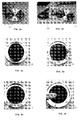
Figures 2a to 2f show the fundamental steps of the method for determining the adaptability of lining materials for automotive vehicle components according to the present invention. - According to
Figures 1a, 1b and 1c , it is observed that thejig 11 used in a preferred embodiment of the present invention is disc-shaped having a centralrecessed area 15 having a circular base, anintermediate area 17 having an annulus-shaped base and anouter area 19 forming a raised edge with respect to the intermediate area. - For its part, in a preferred embodiment, the method for determining the adaptability of lining materials for automotive vehicle components according to the present invention comprises the steps described below.
- The
samples 13 of the material and thejigs 11 are supplied first. Severalcircular samples 13 having different diameters Dmi are provided, which are obtained by cutting a piece of the material the adaptability of which is to be determined with a cutter. - The diameters Dmi of the
samples 13 must be comprised between the diameter Dc of the central recessedarea 15 and the diameter Dz of theintermediate area 17. For its part, the height H of the recess of thecentral area 15 must be slightly greater than the thickness of thesamples 13 of the material. - The following process is used for each sample 13:
- A small amount of adhesive is applied in the
jig 11 and in the sample 13 (on the face which would be adhered to the vehicle component) and the adhesive solvents are allowed to dry slightly without such adhesive being completely dried (Figures 2a and 2b ). - The
sample 13 is placed on thejig 11, making contact at two opposite points, the material being housed against the corresponding walls of the recessed area 15 (Figure 2c ). - The operation is repeated at two opposite points located at 90° from the previous points (
Figure 2d ). - The rest of the
sample 13 is placed on thejig 11, ensuring that the material is well adapted to the recessed area 15 (Figure 2e ). - Since the diameter of the
sample 13 is greater than the diameter Dc of the centralrecessed area 15 of thejig 11, thesample 13 tends to be lifted at the center, therefore it must be pressed at the center, attempting to adapt it to the available surface in the jig, adhering it with the fingers to the centralrecessed area 15 in its entire surface and ensuring that the surface of the material is completely smooth. - After the previous process, it is detected whether or not the
samples 13 have creases and the adaptability of the material is determined according to the difference of the diameter Dmi of thesamples 13 that do not have creases with respect to the diameter Dc of the centralrecessed area 15. - In this sense, a visual acceptance criterion by attributes is established for each type of material (hide or another covering). This criterion is established in early stages by means of verifying correct samples and incorrect samples according to the presence/absence of creases, the correctness of the samples being identified according to the geometry of the component to be lined and the lining material.
- By acknowledging that there is a minimum diameter of the sample for a jig having a certain diameter so that such sample is free of creases upon conducting the test, and that it in reality it produces good parts as regards creases (only a slight grain alteration is admissible), another greater diameter of jig/sample could be established to set a greater margin, which would allow a greater working margin.
- In a preferred embodiment of the invention, a number of
samples 13 comprised between 2 and 5 is used, and the difference between the diameter Dmi of thesamples 13 and the diameter Dc of the central recessedarea 15 is comprised between 0 and 6 mm. - In another preferred embodiment of the invention in relation to lining steering wheels with hides, the
jigs 11 have a diameter Dc of the central recessed area of 70 mm and thesamples 13 have diameters Dmi comprised between 71 and 76 mm. As already stated, the adaptability of the material is determined according to the greatest diameter of the sample which does not have creases. Thus, for example, the material is not considered to be acceptable if only samples having a diameter smaller than 72 mm do not have creases, and it is considered to be acceptable in the opposite case. For its part, the adaptability is better the larger the diameters of the samples without creases, such that if all the samples do not have creases the material would have an "excellent" adaptability, whereas if the sample having a diameter of 73 mm did not have creases but the samples having a diameter of 74 to 76 mm did have creases the material would simply have an "acceptable" adaptability. - An advantage of the method for determining the adaptability of lining materials for automotive vehicle components according to the present invention is that it allows establishing target acceptability criteria for the material, thus facilitating the relationships between the manufacturers and the users of the material.
- Another advantage of the method for determining the adaptability of lining materials for automotive vehicle components according to the present invention is that it allows easily documenting its implementation by photographing the results of the relevant steps thereof for example.
- Although several embodiments of the invention have been described and shown, it is evident that modifications comprised within the scope of the invention can be introduced therein, such invention must not be considered as limited to said embodiments but to the content of the following claims:
Claims (5)
- A method for determining the adaptability of lining materials for automotive vehicle components, which materials are joined thereto by means of an adhesive, characterized in that it comprises the following steps:a) obtaining circular samples (13) of the lining material with several diameters Dmi;b) providing jigs (11) with a central recessed area (15) having a circular base, an intermediate area (17) having an annulus-shaped base and an outer area (19) having a raised edge with respect to the intermediate area (17), the diameter Dz of the intermediate area (17) being greater than the diameters Dmi of said samples (13) and the diameter Dc of the central recessed area (15) being smaller than the diameters Dmi of said samples (13) and the height H of the recess of the central recessed area (15) being slightly greater than the thickness of the samples (13);c) applying said adhesive to the samples (13) and the jigs (1), placing the samples (13) on the jigs (11) such that they are inside the intermediate area (17) and join them to such jigs, firstly pressing on the part located on the intermediate area (17) and secondly on the part located on the central recessed area (15);d) detecting the presence or absence of creases in the samples (13);e) determining the adaptability of the material according to the difference of the diameter Dmi of the samples (13) that do not have creases with respect to the diameter Dc of the central recessed area (15).
- A method for determining the adaptability of lining materials for automotive vehicle components, which materials are joined thereto by means of a certain adhesive according to claim 1, characterized in that a number of samples (13) comprised between 2 and 6 is used, and in that the difference between the diameter Dmi of the samples (13) and the diameter Dc of the central recessed area (15) of the jigs (11) is comprised between 0 and 6 mm.
- A method for determining the adaptability of lining materials for automotive vehicle components, which materials are joined thereto by means of a certain adhesive according to claim 2, characterized in that the diameter Dc of the central recessed area (15) is 70 mm.
- A method for determining the adaptability of lining materials for automotive vehicle components, which materials are joined thereto by means of a certain adhesive according to any of claims 1-3, characterized in that the vehicle component which is lined is the steering wheel.
- A method for determining the adaptability of lining materials for automotive vehicle components, which materials are joined thereto by means of a certain adhesive according to any of claims 1-4, characterized in that the material is leather.
Priority Applications (2)
| Application Number | Priority Date | Filing Date | Title |
|---|---|---|---|
| EP07381047A EP2006159A1 (en) | 2007-06-19 | 2007-06-19 | Method for determining the adaptability of lining materials for vehicle components |
| US12/157,200 US20090000724A1 (en) | 2007-06-19 | 2008-06-06 | Method for determining the adaptability of lining materials for vehicle components |
Applications Claiming Priority (1)
| Application Number | Priority Date | Filing Date | Title |
|---|---|---|---|
| EP07381047A EP2006159A1 (en) | 2007-06-19 | 2007-06-19 | Method for determining the adaptability of lining materials for vehicle components |
Publications (1)
| Publication Number | Publication Date |
|---|---|
| EP2006159A1 true EP2006159A1 (en) | 2008-12-24 |
Family
ID=38511424
Family Applications (1)
| Application Number | Title | Priority Date | Filing Date |
|---|---|---|---|
| EP07381047A Withdrawn EP2006159A1 (en) | 2007-06-19 | 2007-06-19 | Method for determining the adaptability of lining materials for vehicle components |
Country Status (2)
| Country | Link |
|---|---|
| US (1) | US20090000724A1 (en) |
| EP (1) | EP2006159A1 (en) |
Citations (6)
| Publication number | Priority date | Publication date | Assignee | Title |
|---|---|---|---|---|
| US3678738A (en) * | 1970-08-06 | 1972-07-25 | Gen Motors Corp | Test device for trim assemblies |
| JPH05185522A (en) * | 1992-01-13 | 1993-07-27 | Daikyo Inc | Jig for molding skin material and molding method thereof |
| JPH09234784A (en) * | 1996-02-28 | 1997-09-09 | Takashimaya Nippatsu Kogyo Kk | Fitting method for door trim |
| US20020078647A1 (en) * | 2000-12-27 | 2002-06-27 | Yzhak Faigenblat | Steering wheel accent strip |
| JP2003089357A (en) * | 2001-09-17 | 2003-03-25 | T S Tec Kk | Manufacturing method for steering wheel |
| JP2005315684A (en) * | 2004-04-28 | 2005-11-10 | Toppan Printing Co Ltd | Thin film layer adhesion evaluation method |
Family Cites Families (2)
| Publication number | Priority date | Publication date | Assignee | Title |
|---|---|---|---|---|
| US5709469A (en) * | 1995-03-13 | 1998-01-20 | The United States Of America As Represented By The Secretary Of The Air Force | Process for testing integrity of bonds between epoxy patches and aircraft structural materials |
| GB0130853D0 (en) * | 2001-12-22 | 2002-02-06 | Bae Systems Plc | Method of forming a bond on or in an aircraft component |
-
2007
- 2007-06-19 EP EP07381047A patent/EP2006159A1/en not_active Withdrawn
-
2008
- 2008-06-06 US US12/157,200 patent/US20090000724A1/en not_active Abandoned
Patent Citations (6)
| Publication number | Priority date | Publication date | Assignee | Title |
|---|---|---|---|---|
| US3678738A (en) * | 1970-08-06 | 1972-07-25 | Gen Motors Corp | Test device for trim assemblies |
| JPH05185522A (en) * | 1992-01-13 | 1993-07-27 | Daikyo Inc | Jig for molding skin material and molding method thereof |
| JPH09234784A (en) * | 1996-02-28 | 1997-09-09 | Takashimaya Nippatsu Kogyo Kk | Fitting method for door trim |
| US20020078647A1 (en) * | 2000-12-27 | 2002-06-27 | Yzhak Faigenblat | Steering wheel accent strip |
| JP2003089357A (en) * | 2001-09-17 | 2003-03-25 | T S Tec Kk | Manufacturing method for steering wheel |
| JP2005315684A (en) * | 2004-04-28 | 2005-11-10 | Toppan Printing Co Ltd | Thin film layer adhesion evaluation method |
Also Published As
| Publication number | Publication date |
|---|---|
| US20090000724A1 (en) | 2009-01-01 |
Similar Documents
| Publication | Publication Date | Title |
|---|---|---|
| US9089892B2 (en) | Joining method | |
| JP6190965B2 (en) | Method and apparatus for determining the wearability of a coated flat product by bending it | |
| WO2007044432A3 (en) | Automated two-dimensional gel electrophoresis | |
| DE50307698D1 (en) | METHOD AND DEVICE FOR DETERMINING THE WEAR RESISTANCE OF A SURFACE | |
| US11913912B2 (en) | Hole expansion ratio testing device, hole expansion ratio testing method, and operating program | |
| EP4023682A4 (en) | Particles, affinity particles having ligand for target substance, in vitro diagnostic reagent and kit that include same, and method for detecting target substance | |
| EP3842753A3 (en) | Method and apparatus for positioning vehicle, vehicle, storage medium, and computer program product | |
| EP4080211A4 (en) | Automated analysis device for liquid-phase immunoassay, and immunoassay method using same | |
| ATE479101T1 (en) | METHOD FOR QUANTIFYING DENATURATED LIPOPROTEIN | |
| EP2693189A1 (en) | In-line hardness inspection device, in-line hardness inspection method, and robot | |
| WO2020019011A3 (en) | Bending device and method for determining at least one material parameter and/or processing parameter for a workpiece-processing device | |
| CN105916660B (en) | Method for joining a plurality of workpiece parts and joining tool | |
| JP2021514465A5 (en) | ||
| EP2006159A1 (en) | Method for determining the adaptability of lining materials for vehicle components | |
| WO2007035834A3 (en) | Methods and systems for creating a recipe for a defect review process | |
| WO2023235353A3 (en) | Circulating rna biomarkers for preeclampsia | |
| EP1591751A3 (en) | Method and apparatus for measuring micro-structure, and micro-structure analytical system | |
| TW200622235A (en) | Method of applying micro-protection in defect analysis | |
| CA2575672A1 (en) | Data acquisition for classifying slaughtered animal bodies and for their qualitative and quantitative determination | |
| JPH11287745A (en) | Method for evaluating junction state of welded part and method for determining weld condition | |
| EP3115767B1 (en) | Method for the mechanical characterization of a metallic material for wheel disk production | |
| KR20150075134A (en) | Method for checking the welding state and apparatus for the same | |
| WO2022260599A3 (en) | Method of predicting the likelihood of hyperglycemia | |
| CN109643055A (en) | Determination method and manufacturing equipment for metal mask defects | |
| WO2003008938A3 (en) | Method for determining the adhesiveness of a coating on a component |
Legal Events
| Date | Code | Title | Description |
|---|---|---|---|
| PUAI | Public reference made under article 153(3) epc to a published international application that has entered the european phase |
Free format text: ORIGINAL CODE: 0009012 |
|
| AK | Designated contracting states |
Kind code of ref document: A1 Designated state(s): AT BE BG CH CY CZ DE DK EE ES FI FR GB GR HU IE IS IT LI LT LU LV MC MT NL PL PT RO SE SI SK TR |
|
| AX | Request for extension of the european patent |
Extension state: AL BA HR MK RS |
|
| 17P | Request for examination filed |
Effective date: 20090113 |
|
| AKX | Designation fees paid |
Designated state(s): AT BE BG CH CY CZ DE DK EE ES FI FR GB GR HU IE IS IT LI LT LU LV MC MT NL PL PT RO SE SI SK TR |
|
| GRAP | Despatch of communication of intention to grant a patent |
Free format text: ORIGINAL CODE: EPIDOSNIGR1 |
|
| STAA | Information on the status of an ep patent application or granted ep patent |
Free format text: STATUS: THE APPLICATION IS DEEMED TO BE WITHDRAWN |
|
| 18D | Application deemed to be withdrawn |
Effective date: 20100615 |