EP2006153A2 - Structure of coupling portions of exterior parts - Google Patents
Structure of coupling portions of exterior parts Download PDFInfo
- Publication number
- EP2006153A2 EP2006153A2 EP08158531A EP08158531A EP2006153A2 EP 2006153 A2 EP2006153 A2 EP 2006153A2 EP 08158531 A EP08158531 A EP 08158531A EP 08158531 A EP08158531 A EP 08158531A EP 2006153 A2 EP2006153 A2 EP 2006153A2
- Authority
- EP
- European Patent Office
- Prior art keywords
- exterior component
- exterior
- headlight
- protrusion
- elastic member
- Prior art date
- Legal status (The legal status is an assumption and is not a legal conclusion. Google has not performed a legal analysis and makes no representation as to the accuracy of the status listed.)
- Granted
Links
- 230000008878 coupling Effects 0.000 title claims description 9
- 238000010168 coupling process Methods 0.000 title claims description 9
- 238000005859 coupling reaction Methods 0.000 title claims description 9
- 230000002093 peripheral effect Effects 0.000 claims abstract description 40
- 238000000034 method Methods 0.000 claims abstract description 9
- 239000004743 Polypropylene Substances 0.000 claims description 6
- -1 polypropylene Polymers 0.000 claims description 6
- 229920001155 polypropylene Polymers 0.000 claims description 6
- 238000005452 bending Methods 0.000 claims description 2
- 239000011248 coating agent Substances 0.000 description 6
- 238000000576 coating method Methods 0.000 description 6
- 238000010586 diagram Methods 0.000 description 3
- 230000008901 benefit Effects 0.000 description 2
- 230000003247 decreasing effect Effects 0.000 description 2
- 239000000463 material Substances 0.000 description 2
- 239000003973 paint Substances 0.000 description 2
- 239000004417 polycarbonate Substances 0.000 description 2
- 229920000515 polycarbonate Polymers 0.000 description 2
- 230000009471 action Effects 0.000 description 1
- 238000006073 displacement reaction Methods 0.000 description 1
- 230000004048 modification Effects 0.000 description 1
- 238000012986 modification Methods 0.000 description 1
- 230000009467 reduction Effects 0.000 description 1
Images


Classifications
-
- B—PERFORMING OPERATIONS; TRANSPORTING
- B60—VEHICLES IN GENERAL
- B60Q—ARRANGEMENT OF SIGNALLING OR LIGHTING DEVICES, THE MOUNTING OR SUPPORTING THEREOF OR CIRCUITS THEREFOR, FOR VEHICLES IN GENERAL
- B60Q1/00—Arrangement of optical signalling or lighting devices, the mounting or supporting thereof or circuits therefor
- B60Q1/02—Arrangement of optical signalling or lighting devices, the mounting or supporting thereof or circuits therefor the devices being primarily intended to illuminate the way ahead or to illuminate other areas of way or environments
- B60Q1/04—Arrangement of optical signalling or lighting devices, the mounting or supporting thereof or circuits therefor the devices being primarily intended to illuminate the way ahead or to illuminate other areas of way or environments the devices being headlights
- B60Q1/0491—Shock absorbing devices therefor
-
- B—PERFORMING OPERATIONS; TRANSPORTING
- B60—VEHICLES IN GENERAL
- B60Q—ARRANGEMENT OF SIGNALLING OR LIGHTING DEVICES, THE MOUNTING OR SUPPORTING THEREOF OR CIRCUITS THEREFOR, FOR VEHICLES IN GENERAL
- B60Q1/00—Arrangement of optical signalling or lighting devices, the mounting or supporting thereof or circuits therefor
- B60Q1/02—Arrangement of optical signalling or lighting devices, the mounting or supporting thereof or circuits therefor the devices being primarily intended to illuminate the way ahead or to illuminate other areas of way or environments
- B60Q1/04—Arrangement of optical signalling or lighting devices, the mounting or supporting thereof or circuits therefor the devices being primarily intended to illuminate the way ahead or to illuminate other areas of way or environments the devices being headlights
- B60Q1/0408—Arrangement of optical signalling or lighting devices, the mounting or supporting thereof or circuits therefor the devices being primarily intended to illuminate the way ahead or to illuminate other areas of way or environments the devices being headlights built into the vehicle body, e.g. details concerning the mounting of the headlamps on the vehicle body
- B60Q1/0441—Arrangement of optical signalling or lighting devices, the mounting or supporting thereof or circuits therefor the devices being primarily intended to illuminate the way ahead or to illuminate other areas of way or environments the devices being headlights built into the vehicle body, e.g. details concerning the mounting of the headlamps on the vehicle body the housing being fastened onto the vehicle body using means other than screws
-
- B—PERFORMING OPERATIONS; TRANSPORTING
- B62—LAND VEHICLES FOR TRAVELLING OTHERWISE THAN ON RAILS
- B62D—MOTOR VEHICLES; TRAILERS
- B62D25/00—Superstructure or monocoque structure sub-units; Parts or details thereof not otherwise provided for
- B62D25/08—Front or rear portions
- B62D25/16—Mud-guards or wings; Wheel cover panels
- B62D25/163—Mounting devices
Definitions
- the present invention relates to a structure of coupling portions of exterior parts and particularly, but not exclusively, to a structure of coupling portions of a headlight and an edge of a fender provided around the headlight. Aspects of the invention relate to a structure, to a method and to a vehicle.
- a headlight of an automobile has an ear-like portion at the periphery of the headlight.
- the ear-like portion is mounted to a fender edge with a screw, and hence, the headlight is fixed to a front portion of a vehicle body.
- the impact force may break the ear-like portion, and the headlight may be displaced toward the inside of the vehicle body (mainly downward), so as to reduce the impact force against the obstacle.
- a gap is provided between the periphery of the headlight and the fender edge. If the gap is too large and is noticeable, the appearance of the vehicle may be degraded.
- a mounting structure of a headlight in which a peripheral surface portion of the headlight vertically overlaps a fender edge at the boundary of the headlight and the fender, so that a gap between the peripherally surface portion of the headlight and the fender edge is less noticeable.
- the overlap amount is not sufficient, a gap between the peripheral surface of the headlight and the fender edge may still be visible from the outside. Thus, the appearance of the vehicle is not satisfactory.
- a mounting structure of a headlight has been suggested in which a peripheral surface of the headlight vertically overlaps a fender edge, and a gap between the peripheral surface of the headlight and the fender edge is decreased (for example, see Japanese Unexamined Patent Application Publication No. 2005-75337 ).
- the overlap portion of the peripheral surface of the headlight may become hooked onto the fender edge.
- the displacement of the headlight toward the inside of the vehicle body may be prevented, and it may be difficult to sufficiently reduce the impact force against the obstacle.
- the peripheral surface of the headlight may rub on the fender edge when the headlight is displaced toward the inside of the vehicle body, resulting in the coating of the fender edge (e.g., paint, clear coat, etc) possibly being removed, resulting in the rusting of the fender edge.
- the coating of the fender edge e.g., paint, clear coat, etc
- Embodiments of the invention may provide a structure or a method which reduces rubbing and subsequent rusting.
- Other aims and advantages of the invention will become apparent from the following description, claims and drawings.
- a structure to couple exterior components of a vehicle comprising a first exterior component and a second exterior component located apart from the first exterior component, wherein the first exterior component comprises an upper protrusion configured to overlap the second exterior component and wherein the first exterior component comprises a side protrusion configured to overlap the second exterior component.
- the first exterior component comprises a headlight
- the second exterior component comprises a fender
- an end portion of the fender is downwardly bent, and an apex of the bent end portion is located proximal to an end portion of one of the upper protrusion and the side protrusion of the headlight.
- the structure may comprise an elastic member interposed between a peripheral surface of the first exterior component and an edge of the second exterior component, at a position beneath at least one of the side protrusion and the upper protrusion.
- the elastic member comprises a rigidity in a range between about 0.01 GPa to about 2 GPa.
- the elastic member comprises rubber
- the elastic member comprises polypropylene.
- the elastic member comprises a black color.
- the black color may extend in at least a region visible between the first and the second exterior components.
- an overlap over the second exterior component by at least one of the upper protrusion and the side protrusion is about 2 mm or less.
- a method to couple exterior components of a vehicle comprising providing a protrusion about at least a portion of a first exterior component, installing the first exterior component proximal to a second exterior component, overlapping the protrusion of the first exterior component about a at least a portion of the second exterior component, interposing an elastic member between a peripheral surface of the first exterior component and an edge of the second exterior component and positioning the elastic member beneath the protrusion of the first exterior component.
- the method may comprise downwardly bending an end portion of the second vehicle component such that an apex portion of the bent end portion is located proximal to an end portion of the protrusion of the first exterior component.
- an overlap of the second exterior component by the protrusion of the first exterior component is about 2mm or less.
- a structure to couple exterior components of a vehicle comprising a first exterior component provided on the vehicle and a second exterior component located apart from the first exterior component, wherein the first exterior component comprises a protrusion means for overlapping the second exterior component and a gasket means for filling a space located between a peripheral surface of the first exterior component and an edge of the second exterior component, wherein the gasket means is positioned beneath the protrusion means.
- the gasket means comprises an elastic member comprising a rigidity between about 0.01 GPa and about 2 GPa.
- the protrusion means overlaps the second exterior component by about 2 mm or less.
- a structure to couple exterior components of a vehicle may comprise a first exterior component and a second exterior component located apart from the first exterior component, wherein the first exterior component comprises an upper protrusion configured to overlap the second exterior component, and wherein the first exterior component comprises a side protrusion configured to overlap the second exterior component.
- a method to couple exterior components of a vehicle may comprise providing a protrusion about at least a portion of a first exterior component installing the first exterior component proximal to a second exterior component, overlapping the protrusion of the first exterior component about a at least a portion of the second exterior component, interposing an elastic member between a peripheral surface of the first exterior component and an edge of the second exterior component, and positioning the elastic member beneath the protrusion of the first exterior component.
- a structure to couple exterior components of a vehicle may comprise a first exterior component provided on the vehicle, and a second exterior component located apart from the first exterior component, wherein the first exterior component comprises a protrusion means for overlapping the second exterior component, and a gasket means for filling a space located between a peripheral surface of the first exterior component and an edge of the second exterior component, wherein the gasket means is positioned beneath the protrusion means.
- Figures 1 and 2 illustrate a headlight and a peripheral structure of the headlight.
- Figure 1 is a right side view and
- Figure 2 is a perspective view taken along line II-II of Figure 1.
- Figures 1 and 2 show the right-side configuration of a vehicle.
- the left-side configuration of the vehicle may be symmetrical to the configuration showing in Figures 1 and 2 with respect to the center of the vehicle.
- a headlight 2 may be provided at a front end portion of a fender (e.g., a front fender) 1.
- a cut portion 3 may be formed at the fender 1. Cut portion 3 may extend from an upper surface of the front portion to a side surface of the front portion. Headlight 2 may be inserted to cut portion 3.
- headlight 2 may have a peripheral surface including a right peripheral surface 2A (on the left side in Figure 2 ) and a rear peripheral surface 2B.
- the fender 1 has an edge (hereinafter, referred to as a fender edge 1A) arranged near the right peripheral surface 2A.
- the headlight 2 serves as a first exterior part.
- the fender 1 serves as a second exterior part.
- the peripheral surface 2A of the headlight 2 serves as a coupling portion of the first exterior part.
- the fender edge 1A of the fender 1 serves as a coupling portion of the second exterior part.
- an elastic member 4 may be interposed between the fender edge 1A and the peripheral surface 2A of the headlight 2.
- the elastic member 4 may be a narrow band, and, in selected embodiments, may have a substantially inverted L shape when viewed from the above.
- the elastic member 4 may be arranged to be in contact with the right peripheral surface 2A and the rear peripheral surface 2B of the headlight 2.
- Figure 4 is an enlarged view showing view IV in Figure 2 .
- the peripheral surface 2A of the headlight 2 upwardly protrudes with respect to the fender edge 1A of the fender 1.
- the peripheral surface 2A of the headlight 2 has a protruding portion 5 at an upper portion thereof.
- the protruding portion 5 protrudes toward the outside in a vehicle width direction.
- the fender edge 1A may be downwardly bent and arranged below the protruding portion 5. That is, when viewed from the above, the fender edge 1A overlaps the protruding portion 5.
- Item b denotes an amount of overlap of protruding portion 5 over fender edge 1A.
- a gap may be provided between the fender edge 1A and the peripheral surface 2A of the headlight 2. That is, the fender edge 1A may be arranged apart from the peripheral surface 2A.
- the fender 1 may include the downwardly bent fender edge 1A.
- the fender 1 may have an upwardly bent portion which may be located near the fender edge 1A and near the outside in the vehicle width direction with respect to the fender edge 1A.
- the upwardly bent portion defines the highest position of the fender 1, that is, it defines a topmost portion P.
- the topmost portion P may be arranged near the outside in the vehicle width direction with respect to the position of an end portion of the protruding portion 5 provided at the headlight 2.
- a vertical line L passing through the topmost portion P may be located near the outside (in the vehicle width direction with respect to the end portion) of the protruding portion 5.
- the protruding portion 5 may also be provided at an upper portion of the peripheral surface 2B of the headlight 2 (see Figure 3 ).
- the fender edge 1A facing the peripheral surface 2B may be downwardly bent, and this bent fender edge 1A may be arranged below the protruding portion 5.
- a gap may be provided between the fender edge 1A facing the peripheral surface 2B and the peripheral surface 2B. That is, the fender edge 1A may be arranged apart from the peripheral surface 2B.
- a protruding amount of the protruding portion 5 may be referred to as a step width a.
- the step width a may be determined when the headlight 2 is designed.
- a length of the downwardly bent portion of the fender edge 1A which may be a length h2 in the vertical direction from the topmost portion P to a lower tip of the fender edge 1A of the fender 1, may be determined when the headlight 2 is designed.
- the overlap amount b of the protruding portion 5 and the fender edge 1A may be desirably small, more particularly, 2 mm or smaller (in a range of from 0 to 2 mm). If the overlap amount b is above 2 mm, the protruding portion 5 may become hooked onto the fender edge 1A when the headlight 2 collides with an obstacle M (see Figure 6 ) and the headlight 2 is only slightly displaced toward the inside of the vehicle body (downwardly). Thus, it is difficult to sufficiently reduce the impact force.
- the elastic member 4 may be made of rubber, polypropylene, or any other material known to those having ordinary skill in the art.
- the rigidity of the elastic member 4 may be in a range of from 0.01 to 2 GPa.
- the rigidity of rubber may be about 0.01 GPa
- the rigidity of polypropylene may be about 2 GPa.
- at least the surface of the elastic member 4 may be black, so as to be less noticeable when viewed from the outside.
- the protruding portion 5 may be provided at the peripheral surfaces 2A and 2B of the headlight 2, and the fender edge 1A may be arranged below the protruding portion 5 so as to be overlapped by protruding portion 5. Accordingly, when the headlight 2 collides with the obstacle M as shown in Figure 6 , the headlight 2 may be easily displaced toward the inside of the vehicle body until the protruding portion 5 comes into contact with the fender edge 1A. As a result, the impact force against the obstacle M can be sufficiently reduced.
- Figure 6 illustrates a state where the headlight 2 collides with the obstacle M and the headlight 2 may be displaced downward.
- peripheral surfaces 2A and 2B of the headlight 2 may be arranged apart from the fender edge 1A. Accordingly, when the headlight 2 is displaced toward the inside of the vehicle body, the peripheral surfaces 2A and 2B of the headlight 2 would not be rubbed on the fender edge 1A. Hence, the coating of the surface (e.g., paint) of the fender edge 1A may be prevented from being removed.
- Figure 5 illustrates a state where the headlight 2 is downwardly displaced, and thus the elastic member 4 may be deformed. At this time, the overlap amount b of the protruding portion 5 and the fender edge 1A may be smaller than that in Figure 4 .
- the elastic member 4 may have a rectangular cross section. With the rectangular cross section, the headlight 2 may be easily displaced toward the inside of the vehicle body when the headlight 2 collides with the obstacle M.
- An upper surface S1 of the elastic member 4 may be in contact with the protruding portion 5 of the headlight 2, whereas a side surface S2 thereof located near the outside in the vehicle width direction may be in contact with the fender edge 1A.
- a horizontal plane D passing through an intersection C of the upper surface S1 and the side surface S2 may be located at an angle ⁇ from side surface S2.
- angle ⁇ may be greater than or equal to 60 degrees. In embodiments having an angle ⁇ 60 degrees or larger, headlight 2 may be easily displaced toward the inside of the vehicle body when the headlight 2 collides with the obstacle M.
- the elastic member 4 may satisfie the following conditions:
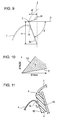
- the cross section of the elastic member 4 does not have to be rectangular, and may be trapezoidal (e.g., Figure 8 ), or triangular (e.g., Figure 9 ). Even with the elastic member 4 having a trapezoidal or triangular cross section, the headlight 2 may be easily displaced toward the inside of the vehicle body when the headlight 2 collides with the obstacle M. As shown in Figure 8 or 9 , the angle ⁇ may still be 60 degrees or larger, d1 ⁇ a, and h1 ⁇ h2.
- FIG 10 illustrates a relationship between stress and strain of the elastic member 4 when an external force is be applied thereto.
- E1 may be set to a value allowing the overlap amount b (see Figure 4 ) to be small when the headlight 2 may be displaced toward the inside of the vehicle body upon collision with the obstacle M and the elastic member 4 interferes with the fender edge 1A.
- E1 shown in Figure 10 may represent an embodiment where the elastic member 4 is made of rubber (e.g., rigidity: about 0.01 GPa), the step width a is 10 mm, and the overlap amount b is 0 mm.
- E2 may represent an embodiment where the stress-strain relationship prevents the coating of the fender edge 1A from being removed due to the contact pressure between the fender edge 1A and the elastic member 4 in a normal state (not in a collision state).
- the material of the elastic member 4 may be polypropylene (rigidity: about 2 GPa) having a rigidity smaller than that of polycarbonate.
- E2 may represent a case where the elastic member 4 is made of polypropylene.
- a region R defined between E1 and E2 may therefore represent a rigidity region for elastic member 4, capable of reducing the impact force against the obstacle M, thereby providing both satisfactory appearance and coating protection.
- the elastic member 4 may be arranged below the protruding portion 5, the gap between the peripheral surfaces 2A, 2B of the headlight 2 and the fender edge 1A may be filled. Thus, the appearance may be satisfactory.
- the fender edge 1A may be rubbed on the elastic member 4 when the headlight 2 is displaced toward the inside of the vehicle body, the object to be rubbed is elastic. Thus, the coating of the fender edge 1A would not be removed.
- the topmost portion P of the fender 1 may be located near the outside in the vehicle width direction with respect to the end portion of the protruding portion 5 of the headlight 2, the protruding portion 5 of the headlight 2 is hardly hooked onto the fender edge 1A upon the collision of the obstacle M. Thus, the topmost portion P would not disturb the reduction of the impact force against the obstacle M.
- the headlight 2 may be displaced toward the inside of the vehicle body upon the collision with the obstacle M without removing the coating of the fender edge 1A.
- fender edge 1A may be shown in selected embodiments in contact with side surface S2 of elastic member 4 in the normal state, it should be understood that a gap S may be provided between the fender edge 1A and the side surface S2 of the elastic member 4 as shown in Figure 11 .
- embodiments in accordance with the present disclosure may be applied not only to the fender and the headlight, but also to combinations of fenders, bumpers, headlights, etc.
- a structure of coupling portions of exterior parts may be capable of reducing an impact force against an obstacle when an exterior part such as a headlight collides with the obstacle. Furthermore, the structure may be capable of preventing the headlight or the like from being rubbed on an edge of a fender or the like which is an exterior part arranged around the headlight or the like when the headlight is displaced toward the inside of a vehicle body to reduce the impact force.
Landscapes
- Engineering & Computer Science (AREA)
- Mechanical Engineering (AREA)
- Chemical & Material Sciences (AREA)
- Combustion & Propulsion (AREA)
- Transportation (AREA)
- Body Structure For Vehicles (AREA)
- Vehicle Interior And Exterior Ornaments, Soundproofing, And Insulation (AREA)
- Lighting Device Outwards From Vehicle And Optical Signal (AREA)
Abstract
Description
- The present invention relates to a structure of coupling portions of exterior parts and particularly, but not exclusively, to a structure of coupling portions of a headlight and an edge of a fender provided around the headlight. Aspects of the invention relate to a structure, to a method and to a vehicle.
- In general, a headlight of an automobile has an ear-like portion at the periphery of the headlight. The ear-like portion is mounted to a fender edge with a screw, and hence, the headlight is fixed to a front portion of a vehicle body. With such a headlight, if the headlight collides with an obstacle, the impact force may break the ear-like portion, and the headlight may be displaced toward the inside of the vehicle body (mainly downward), so as to reduce the impact force against the obstacle.
- When the headlight is mounted to the fender, a gap is provided between the periphery of the headlight and the fender edge. If the gap is too large and is noticeable, the appearance of the vehicle may be degraded.
- To prevent this, a mounting structure of a headlight is known in which a peripheral surface portion of the headlight vertically overlaps a fender edge at the boundary of the headlight and the fender, so that a gap between the peripherally surface portion of the headlight and the fender edge is less noticeable. However, if the overlap amount is not sufficient, a gap between the peripheral surface of the headlight and the fender edge may still be visible from the outside. Thus, the appearance of the vehicle is not satisfactory.
- Therefore, a mounting structure of a headlight has been suggested in which a peripheral surface of the headlight vertically overlaps a fender edge, and a gap between the peripheral surface of the headlight and the fender edge is decreased (for example, see Japanese Unexamined Patent Application Publication No.
2005-75337 - However, with the above structure, if the headlight collides with an obstacle and is displaced toward the inside of a vehicle body, the overlap portion of the peripheral surface of the headlight may become hooked onto the fender edge. As such, the displacement of the headlight toward the inside of the vehicle body may be prevented, and it may be difficult to sufficiently reduce the impact force against the obstacle.
- Also, because the gap between the peripheral surface of the headlight and the fender edge is decreased, the peripheral surface of the headlight may rub on the fender edge when the headlight is displaced toward the inside of the vehicle body, resulting in the coating of the fender edge (e.g., paint, clear coat, etc) possibly being removed, resulting in the rusting of the fender edge.
- It is an aim of the present invention to address this issue. Embodiments of the invention may provide a structure or a method which reduces rubbing and subsequent rusting. Other aims and advantages of the invention will become apparent from the following description, claims and drawings.
- Aspects of the invention therefore provide a structure, a method and a vehicle as claimed in the appended claims.
- According to another aspect of the invention for which protection is sought, there is provided a structure to couple exterior components of a vehicle, comprising a first exterior component and a second exterior component located apart from the first exterior component, wherein the first exterior component comprises an upper protrusion configured to overlap the second exterior component and wherein the first exterior component comprises a side protrusion configured to overlap the second exterior component.
- In an embodiment, the first exterior component comprises a headlight, and the second exterior component comprises a fender.
- In an embodiment, an end portion of the fender is downwardly bent, and an apex of the bent end portion is located proximal to an end portion of one of the upper protrusion and the side protrusion of the headlight.
- The structure may comprise an elastic member interposed between a peripheral surface of the first exterior component and an edge of the second exterior component, at a position beneath at least one of the side protrusion and the upper protrusion.
- In an embodiment, the elastic member comprises a rigidity in a range between about 0.01 GPa to about 2 GPa.
- In an embodiment, the elastic member comprises rubber.
- In an embodiment, the elastic member comprises polypropylene.
- In an embodiment, the elastic member comprises a black color. The black color may extend in at least a region visible between the first and the second exterior components.
- In an embodiment, an overlap over the second exterior component by at least one of the upper protrusion and the side protrusion is about 2 mm or less.
- According to a further aspect of the invention for which protection is sought, there is provided a method to couple exterior components of a vehicle, comprising providing a protrusion about at least a portion of a first exterior component, installing the first exterior component proximal to a second exterior component, overlapping the protrusion of the first exterior component about a at least a portion of the second exterior component, interposing an elastic member between a peripheral surface of the first exterior component and an edge of the second exterior component and positioning the elastic member beneath the protrusion of the first exterior component.
- The method may comprise downwardly bending an end portion of the second vehicle component such that an apex portion of the bent end portion is located proximal to an end portion of the protrusion of the first exterior component.
- In an embodiment, an overlap of the second exterior component by the protrusion of the first exterior component is about 2mm or less.
- According to a still further aspect of the invention for which protection is sought, there is provided a structure to couple exterior components of a vehicle, comprising a first exterior component provided on the vehicle and a second exterior component located apart from the first exterior component, wherein the first exterior component comprises a protrusion means for overlapping the second exterior component and a gasket means for filling a space located between a peripheral surface of the first exterior component and an edge of the second exterior component, wherein the gasket means is positioned beneath the protrusion means.
- In an embodiment, the gasket means comprises an elastic member comprising a rigidity between about 0.01 GPa and about 2 GPa.
- In an embodiment, the protrusion means overlaps the second exterior component by about 2 mm or less.
- For example, a structure to couple exterior components of a vehicle may comprise a first exterior component and a second exterior component located apart from the first exterior component, wherein the first exterior component comprises an upper protrusion configured to overlap the second exterior component, and wherein the first exterior component comprises a side protrusion configured to overlap the second exterior component.
- A method to couple exterior components of a vehicle may comprise providing a protrusion about at least a portion of a first exterior component installing the first exterior component proximal to a second exterior component, overlapping the protrusion of the first exterior component about a at least a portion of the second exterior component, interposing an elastic member between a peripheral surface of the first exterior component and an edge of the second exterior component, and positioning the elastic member beneath the protrusion of the first exterior component.
- In another example, a structure to couple exterior components of a vehicle may comprise a first exterior component provided on the vehicle, and a second exterior component located apart from the first exterior component, wherein the first exterior component comprises a protrusion means for overlapping the second exterior component, and a gasket means for filling a space located between a peripheral surface of the first exterior component and an edge of the second exterior component, wherein the gasket means is positioned beneath the protrusion means.
- Within the scope of this application it is envisaged that the various aspects, embodiments, examples, features and alternatives set out in the preceding paragraphs, in the claims and/or in the following description and drawings may be taken individually or in any combination thereof.
- The present invention will now be described, by way of example only, with reference to the accompanying drawings in which:
-
Figure 1 is a right side view showing a headlight and a peripheral structure of the headlight; -
Figure 2 is a perspective view taken along line II-II inFigure 1 ; -
Figure 3 is an exploded perspective view showing the headlight and the peripheral structure of the headlight; -
Figure 4 is an enlarged view showing part IV inFigure 2 ; -
Figure 5 is an illustration in a state where the headlight is downwardly displaced, and thus an elastic member is deformed; -
Figure 6 is an illustration in a state where the headlight collides with an obstacle, and thus the headlight is downwardly displaced; -
Figure 7 is a diagram showing a relationship between the elastic member and portions around the headlight when the elastic member has a rectangular cross section; -
Figure 8 is a diagram showing a relationship between the elastic member and the portions around the headlight when the elastic member has a trapezoidal cross section; -
Figure 9 is a diagram showing a relationship between the elastic member and the portions around the headlight when the elastic member has a triangular cross section; -
Figure 10 is a graph showing a relationship between a strain of the elastic member and a stress in the elastic member when an external force is applied to the elastic member; and -
Figure 11 is an illustration showing a modification ofFigure 4 . -
Figures 1 and 2 illustrate a headlight and a peripheral structure of the headlight.Figure 1 is a right side view andFigure 2 is a perspective view taken along line II-II ofFigure 1. Figures 1 and 2 show the right-side configuration of a vehicle. The left-side configuration of the vehicle may be symmetrical to the configuration showing inFigures 1 and 2 with respect to the center of the vehicle. - As shown in
Figure 1 , aheadlight 2 may be provided at a front end portion of a fender (e.g., a front fender) 1. In particular, acut portion 3 may be formed at thefender 1. Cutportion 3 may extend from an upper surface of the front portion to a side surface of the front portion.Headlight 2 may be inserted to cutportion 3. As shown inFigure 2 ,headlight 2 may have a peripheral surface including a rightperipheral surface 2A (on the left side inFigure 2 ) and a rearperipheral surface 2B. Thefender 1 has an edge (hereinafter, referred to as afender edge 1A) arranged near the rightperipheral surface 2A. Theheadlight 2 serves as a first exterior part. Thefender 1 serves as a second exterior part. Theperipheral surface 2A of theheadlight 2 serves as a coupling portion of the first exterior part. Thefender edge 1A of thefender 1 serves as a coupling portion of the second exterior part. - As shown in
Figure 3 , anelastic member 4 may be interposed between thefender edge 1A and theperipheral surface 2A of theheadlight 2. Theelastic member 4 may be a narrow band, and, in selected embodiments, may have a substantially inverted L shape when viewed from the above. Theelastic member 4 may be arranged to be in contact with the rightperipheral surface 2A and the rearperipheral surface 2B of theheadlight 2. -
Figure 4 is an enlarged view showing view IV inFigure 2 . As shown inFigure 4 , theperipheral surface 2A of theheadlight 2 upwardly protrudes with respect to thefender edge 1A of thefender 1. Theperipheral surface 2A of theheadlight 2 has a protrudingportion 5 at an upper portion thereof. The protrudingportion 5 protrudes toward the outside in a vehicle width direction. Thefender edge 1A may be downwardly bent and arranged below the protrudingportion 5. That is, when viewed from the above, thefender edge 1A overlaps the protrudingportion 5. Item b denotes an amount of overlap of protrudingportion 5 overfender edge 1A. A gap may be provided between thefender edge 1A and theperipheral surface 2A of theheadlight 2. That is, thefender edge 1A may be arranged apart from theperipheral surface 2A. - As described above, the
fender 1 may include the downwardlybent fender edge 1A. Thefender 1 may have an upwardly bent portion which may be located near thefender edge 1A and near the outside in the vehicle width direction with respect to thefender edge 1A. The upwardly bent portion defines the highest position of thefender 1, that is, it defines a topmost portion P. The topmost portion P may be arranged near the outside in the vehicle width direction with respect to the position of an end portion of the protrudingportion 5 provided at theheadlight 2. In other words, a vertical line L passing through the topmost portion P may be located near the outside (in the vehicle width direction with respect to the end portion) of the protrudingportion 5. - Although not shown, the protruding
portion 5 may also be provided at an upper portion of theperipheral surface 2B of the headlight 2 (seeFigure 3 ). Thefender edge 1A facing theperipheral surface 2B may be downwardly bent, and thisbent fender edge 1A may be arranged below the protrudingportion 5. A gap may be provided between thefender edge 1A facing theperipheral surface 2B and theperipheral surface 2B. That is, thefender edge 1A may be arranged apart from theperipheral surface 2B. - As shown in
Figure 4 , a protruding amount of the protrudingportion 5 may be referred to as a step width a. The step width a may be determined when theheadlight 2 is designed. Also, a length of the downwardly bent portion of thefender edge 1A, which may be a length h2 in the vertical direction from the topmost portion P to a lower tip of thefender edge 1A of thefender 1, may be determined when theheadlight 2 is designed. - The overlap amount b of the protruding
portion 5 and thefender edge 1A may be desirably small, more particularly, 2 mm or smaller (in a range of from 0 to 2 mm). If the overlap amount b is above 2 mm, the protrudingportion 5 may become hooked onto thefender edge 1A when theheadlight 2 collides with an obstacle M (seeFigure 6 ) and theheadlight 2 is only slightly displaced toward the inside of the vehicle body (downwardly). Thus, it is difficult to sufficiently reduce the impact force. - The
elastic member 4 may be made of rubber, polypropylene, or any other material known to those having ordinary skill in the art. In selected embodiments, the rigidity of theelastic member 4 may be in a range of from 0.01 to 2 GPa. In selected embodiments, the rigidity of rubber may be about 0.01 GPa, and the rigidity of polypropylene may be about 2 GPa. Also, at least the surface of theelastic member 4 may be black, so as to be less noticeable when viewed from the outside. - Next, an action of selected embodiments will be described.
- The protruding
portion 5 may be provided at theperipheral surfaces headlight 2, and thefender edge 1A may be arranged below the protrudingportion 5 so as to be overlapped by protrudingportion 5. Accordingly, when theheadlight 2 collides with the obstacle M as shown inFigure 6 , theheadlight 2 may be easily displaced toward the inside of the vehicle body until the protrudingportion 5 comes into contact with thefender edge 1A. As a result, the impact force against the obstacle M can be sufficiently reduced.Figure 6 illustrates a state where theheadlight 2 collides with the obstacle M and theheadlight 2 may be displaced downward. - In addition, the
peripheral surfaces headlight 2 may be arranged apart from thefender edge 1A. Accordingly, when theheadlight 2 is displaced toward the inside of the vehicle body, theperipheral surfaces headlight 2 would not be rubbed on thefender edge 1A. Hence, the coating of the surface (e.g., paint) of thefender edge 1A may be prevented from being removed. -
Figure 5 illustrates a state where theheadlight 2 is downwardly displaced, and thus theelastic member 4 may be deformed. At this time, the overlap amount b of the protrudingportion 5 and thefender edge 1A may be smaller than that inFigure 4 . - As shown in
Figure 7 , theelastic member 4 may have a rectangular cross section. With the rectangular cross section, theheadlight 2 may be easily displaced toward the inside of the vehicle body when theheadlight 2 collides with the obstacle M. An upper surface S1 of theelastic member 4 may be in contact with the protrudingportion 5 of theheadlight 2, whereas a side surface S2 thereof located near the outside in the vehicle width direction may be in contact with thefender edge 1A. A horizontal plane D passing through an intersection C of the upper surface S1 and the side surface S2 may be located at an angle θ from side surface S2. In selected embodiments, angle θ may be greater than or equal to 60 degrees. In embodiments having an angle θ 60 degrees or larger,headlight 2 may be easily displaced toward the inside of the vehicle body when theheadlight 2 collides with the obstacle M. - Furthermore, in selected embodiments, the
elastic member 4 may satisfie the following conditions: - d1 ≈ a (shown in
Figure 4 ); and - h1 ≥ h2 (shown in
Figure 4 ), - The cross section of the
elastic member 4 does not have to be rectangular, and may be trapezoidal (e.g.,Figure 8 ), or triangular (e.g.,Figure 9 ). Even with theelastic member 4 having a trapezoidal or triangular cross section, theheadlight 2 may be easily displaced toward the inside of the vehicle body when theheadlight 2 collides with the obstacle M. As shown inFigure 8 or9 , the angle θ may still be 60 degrees or larger, d1 ≈ a, and h1 ≥ h2. - Next, described here is the setting of the rigidity of the
elastic member 4 in a range of from 0.01 to 2 GPa. -
Figure 10 illustrates a relationship between stress and strain of theelastic member 4 when an external force is be applied thereto. Herein, E1 may be set to a value allowing the overlap amount b (seeFigure 4 ) to be small when theheadlight 2 may be displaced toward the inside of the vehicle body upon collision with the obstacle M and theelastic member 4 interferes with thefender edge 1A. For example, E1 shown inFigure 10 may represent an embodiment where theelastic member 4 is made of rubber (e.g., rigidity: about 0.01 GPa), the step width a is 10 mm, and the overlap amount b is 0 mm. - E2 may represent an embodiment where the stress-strain relationship prevents the coating of the
fender edge 1A from being removed due to the contact pressure between thefender edge 1A and theelastic member 4 in a normal state (not in a collision state). If theheadlight 2 is made of polycarbonate, the material of theelastic member 4 may be polypropylene (rigidity: about 2 GPa) having a rigidity smaller than that of polycarbonate. Thus, E2 may represent a case where theelastic member 4 is made of polypropylene. - A region R defined between E1 and E2 may therefore represent a rigidity region for
elastic member 4, capable of reducing the impact force against the obstacle M, thereby providing both satisfactory appearance and coating protection. - With this embodiment, because the
elastic member 4 may be arranged below the protrudingportion 5, the gap between theperipheral surfaces headlight 2 and thefender edge 1A may be filled. Thus, the appearance may be satisfactory. - Although the
fender edge 1A may be rubbed on theelastic member 4 when theheadlight 2 is displaced toward the inside of the vehicle body, the object to be rubbed is elastic. Thus, the coating of thefender edge 1A would not be removed. - Because the topmost portion P of the
fender 1 may be located near the outside in the vehicle width direction with respect to the end portion of the protrudingportion 5 of theheadlight 2, the protrudingportion 5 of theheadlight 2 is hardly hooked onto thefender edge 1A upon the collision of the obstacle M. Thus, the topmost portion P would not disturb the reduction of the impact force against the obstacle M. - In selected embodiments, as the rigidity of the
elastic member 4 may be in the range of from 0.01 to 2 GPa, theheadlight 2 may be displaced toward the inside of the vehicle body upon the collision with the obstacle M without removing the coating of thefender edge 1A. - Furthermore, while
fender edge 1A may be shown in selected embodiments in contact with side surface S2 ofelastic member 4 in the normal state, it should be understood that a gap S may be provided between thefender edge 1A and the side surface S2 of theelastic member 4 as shown inFigure 11 . Furthermore, embodiments in accordance with the present disclosure may be applied not only to the fender and the headlight, but also to combinations of fenders, bumpers, headlights, etc. - Advantageously, a structure of coupling portions of exterior parts may be capable of reducing an impact force against an obstacle when an exterior part such as a headlight collides with the obstacle. Furthermore, the structure may be capable of preventing the headlight or the like from being rubbed on an edge of a fender or the like which is an exterior part arranged around the headlight or the like when the headlight is displaced toward the inside of a vehicle body to reduce the impact force.
- While the disclosure has been presented with respect to a limited number of embodiments, those skilled in the art, having benefit of this disclosure, will appreciate that other embodiments may be devised which do not depart from the scope of the present disclosure. Accordingly, the scope of the disclosure should be limited only by the attached claims.
- The present application claims priority from Japanese Patent Application Nos.
2007-164701, filed 22nd June 2007 2007-321733, filed 13th December 2007
Claims (15)
- A structure for coupling exterior components of a vehicle, comprising:a first exterior component; anda second exterior component located apart from the first exterior component;wherein the first exterior component comprises an upper protrusion arranged to overlap the second exterior component; and
wherein the first exterior component comprises a side protrusion arranged to overlap the second exterior component. - A structure as claimed in claim 1, wherein the first exterior component comprises a headlight and the second exterior component comprises a fender.
- A structure as claimed in claim 2, wherein an end portion of the fender is downwardly bent and an apex of the bent end portion is located proximal to an end portion of one of the upper protrusion and the side protrusion of the headlight.
- A structure as claimed in any preceding claim, comprising an elastic member interposed between a peripheral surface of the first exterior component and an edge of the second exterior component at a position beneath at least one of the side protrusion and the upper protrusion.
- A structure as claimed in claim 4, wherein the elastic member comprises a rigidity in a range between about 0.01 GPa to about 2 GPa.
- A structure as claimed in claim 4 or claim 5, wherein the elastic member comprises rubber and/or polypropylene.
- A structure as claimed in any of claims 4 to 6, wherein the elastic member comprises a black color in at least a region visible between the first and the second exterior components.
- A structure as claimed in any preceding claim, wherein an overlap over the second exterior component by at least one of the upper protrusion and the side protrusion is about 2 mm or less.
- A method of coupling exterior components of a vehicle, comprising:providing a protrusion about at least a portion of a first exterior component;installing the first exterior component proximal to a second exterior component;overlapping the protrusion of the first exterior component about a at least a portion of the second exterior component;interposing an elastic member between a peripheral surface of the first exterior component and an edge of the second exterior component; andpositioning the elastic member beneath the protrusion of the first exterior component.
- A method as claimed in claim 9, comprising downwardly bending an end portion of the second vehicle component such that an apex portion of the bent end portion is located proximal to an end portion of the protrusion of the first exterior component.
- A structure for coupling exterior components of a vehicle, comprising:a first exterior component provided on the vehicle; anda second exterior component located apart from the first exterior component;wherein the first exterior component comprises a protrusion means for overlapping the second exterior component; and
a gasket means for filling a space located between a peripheral surface of the first exterior component and an edge of the second exterior component, wherein the gasket means is positioned beneath the protrusion means. - A structure as claimed in claim 11, wherein the gasket means comprises an elastic member comprising a rigidity between about 0.01 GPa and about 2 GPa.
- A structure as claimed in claim 11 or claim 12, wherein the first exterior component comprises a headlight and the second exterior component comprises a fender.
- A structure as claimed in any of claims 11 to 13, wherein the protrusion means overlaps the second exterior component by about 2 mm or less.
- A vehicle as claimed in any of claims 1 to 8 or 11 to 14.
Applications Claiming Priority (2)
| Application Number | Priority Date | Filing Date | Title |
|---|---|---|---|
| JP2007164701 | 2007-06-22 | ||
| JP2007321733A JP4900224B2 (en) | 2007-06-22 | 2007-12-13 | Structure of mating part of exterior parts |
Publications (3)
| Publication Number | Publication Date |
|---|---|
| EP2006153A2 true EP2006153A2 (en) | 2008-12-24 |
| EP2006153A3 EP2006153A3 (en) | 2009-07-22 |
| EP2006153B1 EP2006153B1 (en) | 2015-03-25 |
Family
ID=39712671
Family Applications (1)
| Application Number | Title | Priority Date | Filing Date |
|---|---|---|---|
| EP08158531.7A Ceased EP2006153B1 (en) | 2007-06-22 | 2008-06-19 | Structure of coupling portions of exterior parts |
Country Status (2)
| Country | Link |
|---|---|
| US (1) | US7789458B2 (en) |
| EP (1) | EP2006153B1 (en) |
Cited By (1)
| Publication number | Priority date | Publication date | Assignee | Title |
|---|---|---|---|---|
| DE102009041209B4 (en) | 2008-09-16 | 2019-04-11 | GM Global Technology Operations LLC (n. d. Ges. d. Staates Delaware) | Vehicle body and headlight assembly for a vehicle body |
Citations (3)
| Publication number | Priority date | Publication date | Assignee | Title |
|---|---|---|---|---|
| JP2005075337A (en) | 2003-09-01 | 2005-03-24 | Kia Motors Corp | Gap retention structure between automotive headlamp and fender |
| JP2007164701A (en) | 2005-12-16 | 2007-06-28 | Canon Inc | Document creation support method based on remaining ink level |
| JP2007321733A (en) | 2006-06-05 | 2007-12-13 | Kawamoto Pump Mfg Co Ltd | Piping unit for water supply pump |
Family Cites Families (3)
| Publication number | Priority date | Publication date | Assignee | Title |
|---|---|---|---|---|
| FR2754328B1 (en) | 1996-10-07 | 1998-12-31 | Valeo Vision | JOINT, IN PARTICULAR APPEARANCE JOINT, FOR LIGHTING OR SIGNALING DEVICES OF MOTOR VEHICLES, AND LIGHTING OR SIGNALING DEVICE INCORPORATING THE SAME |
| DE19813596B4 (en) | 1998-03-27 | 2007-06-28 | Volkswagen Ag | Fastening device for a vehicle part |
| JP2003341418A (en) | 2002-05-29 | 2003-12-03 | Nishikawa Rubber Co Ltd | Automotive lamp seal |
-
2008
- 2008-06-18 US US12/141,494 patent/US7789458B2/en not_active Expired - Fee Related
- 2008-06-19 EP EP08158531.7A patent/EP2006153B1/en not_active Ceased
Patent Citations (3)
| Publication number | Priority date | Publication date | Assignee | Title |
|---|---|---|---|---|
| JP2005075337A (en) | 2003-09-01 | 2005-03-24 | Kia Motors Corp | Gap retention structure between automotive headlamp and fender |
| JP2007164701A (en) | 2005-12-16 | 2007-06-28 | Canon Inc | Document creation support method based on remaining ink level |
| JP2007321733A (en) | 2006-06-05 | 2007-12-13 | Kawamoto Pump Mfg Co Ltd | Piping unit for water supply pump |
Cited By (1)
| Publication number | Priority date | Publication date | Assignee | Title |
|---|---|---|---|---|
| DE102009041209B4 (en) | 2008-09-16 | 2019-04-11 | GM Global Technology Operations LLC (n. d. Ges. d. Staates Delaware) | Vehicle body and headlight assembly for a vehicle body |
Also Published As
| Publication number | Publication date |
|---|---|
| EP2006153A3 (en) | 2009-07-22 |
| US20080315625A1 (en) | 2008-12-25 |
| EP2006153B1 (en) | 2015-03-25 |
| US7789458B2 (en) | 2010-09-07 |
Similar Documents
| Publication | Publication Date | Title |
|---|---|---|
| CN102791527B (en) | Mounting structure of automotive exterior parts | |
| US6193305B1 (en) | Windshield supporting structure | |
| US9211836B2 (en) | Headlamp assembly of a vehicle with headlamp fastening device | |
| US9630573B2 (en) | Clip mounting seats of interior components or exterior components | |
| WO2014007403A1 (en) | Vehicle body front portion structure | |
| US9365240B2 (en) | Frontal collision impact absorbing device for vehicle | |
| EP2540577B1 (en) | Vehicle front section structure | |
| EP3461692A1 (en) | Sensor protector and vehicle equipped therewith | |
| CN108297655B (en) | Vehicle interior component | |
| US20120319392A1 (en) | Vehicle splash guard | |
| JP5466438B2 (en) | Cowl top cover structure | |
| CN102145715B (en) | Mudguard mounting structure | |
| GB2506206A (en) | Sacrificial bracket and method of supporting a structure for vehicle headlight having sacrificial part | |
| CN104245485B (en) | Webbing retractor mounting structure | |
| US8226154B2 (en) | Vehicle door structure | |
| WO2014048974A1 (en) | Mounting bracket and method of supporting a structure | |
| EP2006153B1 (en) | Structure of coupling portions of exterior parts | |
| JP7743257B2 (en) | Hood inner panel and vehicle hood | |
| CN101327760B (en) | Structure of coupling portions of exterior parts and coupling method | |
| JP2011152870A (en) | Cover member and mounting structure thereof | |
| JP4449523B2 (en) | Resin vehicle parts | |
| GB2506204A (en) | A motor vehicle headlamp support bracket and method of supporting a headlamp assembly | |
| JP6803318B2 (en) | Cowl top garnish | |
| JPH08324462A (en) | Fender protector | |
| CN108216376B (en) | Reinforcing structure for vehicle roof |
Legal Events
| Date | Code | Title | Description |
|---|---|---|---|
| PUAI | Public reference made under article 153(3) epc to a published international application that has entered the european phase |
Free format text: ORIGINAL CODE: 0009012 |
|
| AK | Designated contracting states |
Kind code of ref document: A2 Designated state(s): AT BE BG CH CY CZ DE DK EE ES FI FR GB GR HR HU IE IS IT LI LT LU LV MC MT NL NO PL PT RO SE SI SK TR |
|
| AX | Request for extension of the european patent |
Extension state: AL BA MK RS |
|
| PUAL | Search report despatched |
Free format text: ORIGINAL CODE: 0009013 |
|
| AK | Designated contracting states |
Kind code of ref document: A3 Designated state(s): AT BE BG CH CY CZ DE DK EE ES FI FR GB GR HR HU IE IS IT LI LT LU LV MC MT NL NO PL PT RO SE SI SK TR |
|
| AX | Request for extension of the european patent |
Extension state: AL BA MK RS |
|
| 17P | Request for examination filed |
Effective date: 20100122 |
|
| 17Q | First examination report despatched |
Effective date: 20100212 |
|
| AKX | Designation fees paid |
Designated state(s): DE FR GB |
|
| REG | Reference to a national code |
Ref country code: DE Ref legal event code: R079 Ref document number: 602008037282 Country of ref document: DE Free format text: PREVIOUS MAIN CLASS: B60Q0001040000 Ipc: B62D0025160000 |
|
| RIC1 | Information provided on ipc code assigned before grant |
Ipc: F21S 8/10 20060101ALI20141210BHEP Ipc: B62D 25/16 20060101AFI20141210BHEP Ipc: B60Q 1/04 20060101ALI20141210BHEP |
|
| GRAP | Despatch of communication of intention to grant a patent |
Free format text: ORIGINAL CODE: EPIDOSNIGR1 |
|
| GRAS | Grant fee paid |
Free format text: ORIGINAL CODE: EPIDOSNIGR3 |
|
| INTG | Intention to grant announced |
Effective date: 20150122 |
|
| GRAA | (expected) grant |
Free format text: ORIGINAL CODE: 0009210 |
|
| AK | Designated contracting states |
Kind code of ref document: B1 Designated state(s): DE FR GB |
|
| REG | Reference to a national code |
Ref country code: GB Ref legal event code: FG4D |
|
| REG | Reference to a national code |
Ref country code: FR Ref legal event code: PLFP Year of fee payment: 8 |
|
| REG | Reference to a national code |
Ref country code: DE Ref legal event code: R096 Ref document number: 602008037282 Country of ref document: DE Effective date: 20150507 |
|
| REG | Reference to a national code |
Ref country code: DE Ref legal event code: R097 Ref document number: 602008037282 Country of ref document: DE |
|
| PLBE | No opposition filed within time limit |
Free format text: ORIGINAL CODE: 0009261 |
|
| STAA | Information on the status of an ep patent application or granted ep patent |
Free format text: STATUS: NO OPPOSITION FILED WITHIN TIME LIMIT |
|
| 26N | No opposition filed |
Effective date: 20160105 |
|
| REG | Reference to a national code |
Ref country code: FR Ref legal event code: PLFP Year of fee payment: 9 |
|
| REG | Reference to a national code |
Ref country code: FR Ref legal event code: PLFP Year of fee payment: 10 |
|
| REG | Reference to a national code |
Ref country code: FR Ref legal event code: PLFP Year of fee payment: 11 |
|
| PGFP | Annual fee paid to national office [announced via postgrant information from national office to epo] |
Ref country code: DE Payment date: 20190604 Year of fee payment: 12 |
|
| PGFP | Annual fee paid to national office [announced via postgrant information from national office to epo] |
Ref country code: FR Payment date: 20190510 Year of fee payment: 12 |
|
| PGFP | Annual fee paid to national office [announced via postgrant information from national office to epo] |
Ref country code: GB Payment date: 20190619 Year of fee payment: 12 |
|
| REG | Reference to a national code |
Ref country code: DE Ref legal event code: R119 Ref document number: 602008037282 Country of ref document: DE |
|
| GBPC | Gb: european patent ceased through non-payment of renewal fee |
Effective date: 20200619 |
|
| PG25 | Lapsed in a contracting state [announced via postgrant information from national office to epo] |
Ref country code: GB Free format text: LAPSE BECAUSE OF NON-PAYMENT OF DUE FEES Effective date: 20200619 Ref country code: FR Free format text: LAPSE BECAUSE OF NON-PAYMENT OF DUE FEES Effective date: 20200630 |
|
| PG25 | Lapsed in a contracting state [announced via postgrant information from national office to epo] |
Ref country code: DE Free format text: LAPSE BECAUSE OF NON-PAYMENT OF DUE FEES Effective date: 20210101 |