EP2004404B1 - Copper electroplating of printing cylinders - Google Patents
Copper electroplating of printing cylinders Download PDFInfo
- Publication number
- EP2004404B1 EP2004404B1 EP07709589.1A EP07709589A EP2004404B1 EP 2004404 B1 EP2004404 B1 EP 2004404B1 EP 07709589 A EP07709589 A EP 07709589A EP 2004404 B1 EP2004404 B1 EP 2004404B1
- Authority
- EP
- European Patent Office
- Prior art keywords
- plating bath
- copper
- copper plating
- ions
- source
- Prior art date
- Legal status (The legal status is an assumption and is not a legal conclusion. Google has not performed a legal analysis and makes no representation as to the accuracy of the status listed.)
- Not-in-force
Links
Images
Classifications
-
- C—CHEMISTRY; METALLURGY
- C25—ELECTROLYTIC OR ELECTROPHORETIC PROCESSES; APPARATUS THEREFOR
- C25D—PROCESSES FOR THE ELECTROLYTIC OR ELECTROPHORETIC PRODUCTION OF COATINGS; ELECTROFORMING; APPARATUS THEREFOR
- C25D3/00—Electroplating: Baths therefor
- C25D3/02—Electroplating: Baths therefor from solutions
- C25D3/38—Electroplating: Baths therefor from solutions of copper
-
- B—PERFORMING OPERATIONS; TRANSPORTING
- B41—PRINTING; LINING MACHINES; TYPEWRITERS; STAMPS
- B41N—PRINTING PLATES OR FOILS; MATERIALS FOR SURFACES USED IN PRINTING MACHINES FOR PRINTING, INKING, DAMPING, OR THE LIKE; PREPARING SUCH SURFACES FOR USE AND CONSERVING THEM
- B41N1/00—Printing plates or foils; Materials therefor
- B41N1/04—Printing plates or foils; Materials therefor metallic
- B41N1/06—Printing plates or foils; Materials therefor metallic for relief printing or intaglio printing
-
- B—PERFORMING OPERATIONS; TRANSPORTING
- B41—PRINTING; LINING MACHINES; TYPEWRITERS; STAMPS
- B41N—PRINTING PLATES OR FOILS; MATERIALS FOR SURFACES USED IN PRINTING MACHINES FOR PRINTING, INKING, DAMPING, OR THE LIKE; PREPARING SUCH SURFACES FOR USE AND CONSERVING THEM
- B41N1/00—Printing plates or foils; Materials therefor
- B41N1/16—Curved printing plates, especially cylinders
- B41N1/20—Curved printing plates, especially cylinders made of metal or similar inorganic compounds, e.g. plasma coated ceramics, carbides
-
- C—CHEMISTRY; METALLURGY
- C25—ELECTROLYTIC OR ELECTROPHORETIC PROCESSES; APPARATUS THEREFOR
- C25D—PROCESSES FOR THE ELECTROLYTIC OR ELECTROPHORETIC PRODUCTION OF COATINGS; ELECTROFORMING; APPARATUS THEREFOR
- C25D7/00—Electroplating characterised by the article coated
- C25D7/04—Tubes; Rings; Hollow bodies
-
- B—PERFORMING OPERATIONS; TRANSPORTING
- B41—PRINTING; LINING MACHINES; TYPEWRITERS; STAMPS
- B41N—PRINTING PLATES OR FOILS; MATERIALS FOR SURFACES USED IN PRINTING MACHINES FOR PRINTING, INKING, DAMPING, OR THE LIKE; PREPARING SUCH SURFACES FOR USE AND CONSERVING THEM
- B41N3/00—Preparing for use and conserving printing surfaces
- B41N3/003—Preparing for use and conserving printing surfaces of intaglio formes, e.g. application of a wear-resistant coating, such as chrome, on the already-engraved plate or cylinder; Preparing for reuse, e.g. removing of the Ballard shell; Correction of the engraving
Definitions
- the present invention is directed to an improved method for depositing a copper layer to provide copper layer that has a stable hardness.
- Gravure printing is a method that uses the Intaglio process in which the image to be printed consists of depressions etched or engraved usually to different depths, on an engravable copper plated cylinder. Slightly viscous solvent inks are applied to the entire surface and a metal doctor blade removes the excess ink from the non-printing surface. In a typical process, engraving is performed on the copper plated cylinder, which is subsequently chrome plated to minimize wear.
- the hardness and crystal structure of the plated copper deposit is of paramount importance. Successful engraving is typically only obtained at a copper hardness of more than 200 Vickers Hardness (HV). At lower values, the engraved cell pattern loses definition. In addition, if the hardness of the deposit exceeds 240 HV, the lifetime of the diamond styli used to engrave the cylinders during electronic engraving may be reduced. Because of these factors, it is important to control the hardness of the plated copper deposits to within the desired range (200-240 HV).
- Electronic engraving is a means of transferring an image for printing to a copper electroplated cylinder by directing a diamond-pointed stylus to form as many as 4,000 ink-receiving impressions every second.
- This technique requires copper deposits of very definite properties to prevent engraving defects and costly damage to the expensive equipment. It is essential that the deposited copper have a homogeneous fine-grained crystal structure that is free of nodulations and occlusions with excellent ductility and uniform hardness.
- a critical factor is the control and uniformity of hardness since the stylus pressures are set with references to a given Vickers hardness value and if this is not uniform over the entire surface, it will result in smearing or ripping of the deposit and badly defined impressions for printing. Examples of electronic engraving apparatus are described in U.S. Patent No. 4,450,486 to Buechler and U.S. Patent No. 6,348,979 to Flannery et al.
- gravure printing cylinders may also be plated either partially or fully submerged, wherein the deposition rate is related to the immersion depth.
- An important advantage realized by increasing the immersion depth is a decrease in plating time, which has obvious economic advantages.
- a cylinder When a cylinder is plated partially immersed, i.e. to about 30% of its diameter, as compared to a cylinder that is plated totally submerged, the deposit characteristics are influenced by the fluctuations of the current and composition differences in the cathode film. In any event, plating, baths are known to perform differently with respect to the immersion depth.
- the principal problem in this regard is annealing. This problem of recrystallization (annealing) can be characteristic of totally submerged cylinder operations when using a bath designed for partial immersion.
- Copper sulphate based electrolytes have limitations as to the maximum rate of deposition due to limitations of solubility. Copper methanesulphonate is much more soluble than copper sulphate allowing higher copper concentrations in the electrolyte which in turn allows higher plating rates.
- a further limitation of sulphate based copper electrolytes is the maximum anode current density which may be applied. Above a certain threshold anodic current density, anode polarisation prevents effective operation of the process.
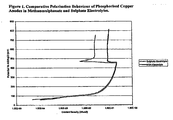
- Methanesulphonate based electrolytes are much less prone to anode polarisation as is shown in Figure 1 . It can be seen from this figure that in static conditions, phosphorised copper anodes will not sustain a continuous current of more than 2.4 A/dm 2 whereas in a methanesulphonate electrolyte, a continuous current of 8.7 A/dm 2 can be sustained.
- plating from a methanesulphonate electrolyte has many advantages in terms of plating speed and resistance to anode polarisation; the problem of deposit self-annealing remains.
- the additive combination disclosed in U.S. Patent No. 5,417,841 to Frisby does not prevent deposit self-annealing in methanesulphonate baths so additional improvements are still needed
- the present invention is directed to a method for producing copper deposits of stable hardness that are free from self-annealing, at high speed.
- the invention is particularly directed to the high speed application of copper to gravure cylinders.
- the invention is also usable in the high speed plating of copper in other applications where a deposit of stable hardness is required.
- the present invention is directed to a copper plating bath for depositing a copper layer onto a printing cylinder, the copper plating bath comprising:
- the present invention is directed to a method of depositing a copper layer onto a printing cylinder at a high speed to produce a copper deposit having a stable hardness, the method comprising the steps of:
- the electroplating bath of the present invention includes copper ions, methanesulphonate ions and chloride ions.
- the inventors of the present invention have discovered that by including a compound having the formula R-S-R'-SO 3 - in combination with polyethers and chloride ion in the bath and, preferably excluding compounds of the formula H-S-R-SO 3 - or R-S-S-R'-SO 3 - , that a deposit of stable hardness can be produced from a methanesulphonate bath.
- the bath may also optionally contain organosulphur hardeners to further increase the hardness.
- the inventors of the present invention have also found that the combination of additives of the invention also works well in traditional sulphate based baths, such as those described in U.S. Patent No. 5,417,841 to Frisby .
- the present invention is directed to an improved method for depositing an electrolytic copper layer at high speed onto a printing cylinder, such as a rotogravure cylinder, the resulting deposit having a stable hardness that is suitable for high speed engraving.
- a printing cylinder such as a rotogravure cylinder
- the present invention is also directed to the use of a unique plating bath formulation, which results in a surface coating that is ideally suited for electronic engraving.
- the present invention is directed to a copper plating bath for depositing a copper layer onto a printing cylinder, the copper plating bath comprising:
- the source of copper ions is copper methane sulphonate although other sources of copper ions are also usable in the practice of the invention and would be known to one skilled in the art.
- the source of copper ions is typically used in the plating bath at a concentration of about 100-400 g/l, more preferably at a concentration of about 200-260 g/l.
- Copper methanesulphonate is easily manufactured by dissolving copper (II) oxide in methanesulphonic acid (although it may be manufactured by other routes - for example dissolving copper metal in methanesulphonic acid using an oxidising agent such as oxygen or hydrogen peroxide).
- An amount of "free" methanesulphonic acid is also necessary for correct operation of the bath. This may be present in the bath at a concentration range of about 5 - 100 g/l, more preferably about 25 - 50 g/l.
- the source of methane sulphonate ions is preferably methane sulphonic acid (or a salt thereof).
- Chloride ions should be present in the plating bath in a concentration range of 10 - 200 mg/l and preferably in the range of 50 - 100 mg/l.
- the source of chloride ions is preferably hydrochloric acid, although other sources of chloride ions are also usable in the practice of the invention and would be known to one skilled in the art.
- the organosulphur compound is typically present in the bath composition at a concentration of about 5-500 mg/l.
- Cation X + is preferably selected from the group consisting of hydrogen, sodium, potassium, lithium, and combinations of one or more of the foregoing, and more preferably, X + is sodium.
- organosulphur compounds include sodium 3-[(2-hydroxypropyl) sulfanyl] propane-1-sulphonate, sodium 3-(ethylsulfanyl) propane-1-sulphonate, sodium 3-[(2-hydroxyethyl) sulfanyl] propane-1-sulphonate, disodium 3,3'-(butane-1,4-diyldisulfanediyl) propane-1-sulphonate, and disodium 3,3-[oxybis(ethane-2,1-diylsulfanediyl)] dipropane-1-sulphonate, by way of example and not limitation.
- the polyether compound is typically present in the bath composition at a concentration of about 5-5000 mg/l, preferably within the range of about 50-500 mg/l.
- the polyether is a block or random copolymer having a molecular weight of at least 1000. More preferably, the compound is a 50/50 random copolymer of ethylene and propylene oxide.
- the copper plating bath may also contain about 0.1 to 10 mg/l of a heterocyclic organosulphur compound.
- the heterocyclic organosulphur compound may be 2-imidazolinethione or 2-mercaptothiazoline, for example, although other heterocyclic organic sulphur compounds would also be known to those skilled in the art and would be usable in the practice of the present invention.
- the present invention is directed to a method of depositing a copper layer onto a printing cylinder at a high speed to produce a copper deposit having a stable hardness, the method comprising the steps of:
- the printing cylinder is fully immersed in the copper plating bath. In an alternate embodiment, the printing cylinder is partially immersed in the copper plating bath to a depth of, for example to a depth of one third the diameter of the printing cylinder.
- the plated deposit has a Vickers hardness of between about 200-240 HV.
- the present method and composition produces copper coatings which have consistent hardness on storage. Furthermore, the plating may be carried out by either partial or complete immersion in the plating bath.
- organosulphur compounds of the invention may be synthesised via different reaction routes.
- the preferred compounds may be prepared as in the following nonlimiting examples:
- reaction flask with mechanical stirrer, reflux condenser and temperature control is required. This preparation is for 100g of a 60% w/w aqueous solution of sodium 3-[(2-hydroxypropyl)suffanyl]propane-1-sulphonate.
- a plating bath is prepared containing 250 g/l of copper methanesulphonate, 30 g/l of methanesulphonic acid and 80 mg/l of chloride ions (added as hydrochloric acid).
- To this bath was added 80 mg/l of an ethoxylated thiodiglycol (Lugalvan HS 1000 from BASF), 20 mg/l of Raschig SPS and 3 mg/l of 2-imidazolinethione.
- This is a combination of additives which produce deposits from a sulphate based electrolyte which do not self anneal (and are covered by USP 5,417,841 ).
- a Hull cell test panel was produced by plating at 2 amps for 15 minutes. After plating, the hardness of the deposit was measured at 220HV using a 50g load. However, after heating the panel to 100C for 1 hour, the deposit was found to have self-annealed to a hardness value of 164HV (which would be too soft for engraving). When the test was repeated using the same concentrations of additives in a sulphate bath (210 g/l copper sulphate pentahydrate, 50 g/l sulphuric acid, 75 mg/l chloride), the hardness of the deposit was stable after heating to 100°C (224 HV in both cases).
- a sulphate bath 210 g/l copper sulphate pentahydrate, 50 g/l sulphuric acid, 75 mg/l chloride
- a plating bath is prepared containing 210 g/l copper sulphate pentahydrate, 50 g/l sulphuric acid, 75 mg/l of chloride ions, 42 mg/l of the product manufactured in method 1 (25 mg/l of active material) and 100 mg/l of Breox 50-A-225 (a 50/50 random copolymer of ethylene oxide and propylene oxide with a molecular weight of approximately 1200).
- a test panel plated in this combination gave a hardness of 165 HV which did not self anneal on heating to 100°C for 1 hour.
- a plating bath is prepared containing 250 g/l of copper methanesulphonate, 30 g/l of methanesulphonic acid and 80 mg/l of chloride ions (added as hydrochloric acid). To this bath was added 42 mg/l of the product manufactured in method 1 (25 mg/l active material) and 100 mg/l ofBreox 50-A-225. A test panel plated in this combination gave a hardness of 165 HV which did not self anneal on heating to 100°C for 1 hour.
- the sodium hydroxide and 3-mercaptopropane-1-sulphonate were dissolved in 40 g of the water and transferred to a reaction flask equipped with heating, stirring and a reflux condenser. The mixture was heated to 60°C. Bromoethane was added dropwise from a dropping funnel over a period of 3 hours whilst maintaining the temperature at 60 - 70°C.
- the crude liquid product of pH 6 was a 25% by weight solution of the target product and contained sodium bromide as a by-product.
- a sample of crude product was purified as follows; the bromide ion was precipitated by the addition of a small excess of silver methanesulphonate and the solution filtered. An excess of sodium chloride was then added to the filtrate to precipitate the excess silver ions before repeating the filtration. The final clear product was a solution containing the product, sodium methanesulphonate and a small amount of sodium chloride.
- the purified product is substantially free of unreacted sodium 3-mercaptopropane-I-sulphonate and bromide ions.
- a plating bath was prepared containing 250 g/l of copper methanesulphonate, 30 g/l of methanesulphonic acid and 80 mg/l of chloride ions (added as hydrochloric acid). To this bath was added 100 mg/l of the product manufactured in method 2 (25 mg/l active material) and 100 mg/l of Pluriol P600 (polypropylene glycol MW 600), and 3 mg/l of 2-mercaptothiazoline. A test panel plated in this combination gave a hardness of 210 HV which did not self anneal on heating to 100°C for 1 hour.
- the sodium hydroxide was dissolved in the water and the thiodiglycol added. The mixture was then transferred to a reaction flask equipped with heating, stirring and a reflux condenser. The mixture was heated to 55°C. Propanesultone was added dropwise from a dropping funnel over a period of 1.5 hours whilst maintaining the temperature at about 60°C.
- the crude product was an approximately 60% by weight solution of the target product.
- a sample of crude product was purified as follows: The majority of water was removed by a rotary evaporator under moderate vacuum at 60°C. The dried product was mashed well in ethanol before filtering. The collected solid was washed again in ethanol and finally diethyl ether before being filtered. The moist powder was then placed in an oven at 110°C for 2 hours before grinding to a fine powder in a pestle and mortar. The dried and isolated product is then substantially free of residual thiodiglycol.
- a plating bath was prepared containing 250 g/l of copper methanesulphonate, 30 g/l of methanesulphonic acid and 80 mg/l of chloride ions (added as hydrochloric acid). To this bath was added 25 mg/l of the purified product manufactured in method 3 and 100 mg/l of Pluriol P600 (polypropylene glycol MW 600), and 3 mg/l of 2-mercaptothiazoline. A test panel plated in this combination gave a hardness of 210 HV which did not self anneal on heating to 100°C for 1 hour.
- the sodium hydroxide and sodium 3-mercaptopropane-1-sulfonate were dissolved in 50.9 of the water and transferred to a reaction flask equipped with heating, stirring and a reflux condenser. The mixture was heated to 90°C. 1,4-dibromobutane was added dropwise from a dropping funnel over a period of 3 hours whilst maintaining the temperature at 90 - 100°C.
- the crude liquid product was adjusted to pH 7 with approximately 0.5 g of 70% methanesulphonic acid.
- the crude product contains approximately 21% by weight of the target product and also contains sodium bromide as a by-product.
- a sample of crude product was purified as follows; the bromide ion was precipitated by the addition of a small excess of silver methanesulphonate and the solution filtered. An excess of sodium chloride was then added to the filtrate to precipitate the excess silver ions before repeating the filtration. The final clear product was a solution containing the product, sodium methanesulphonate and a small amount of sodium chloride.
- the purified product is substantially free of unreacted sodium 3-mercaptopropane-1-sulphonate and bromide ions.
- a plating bath was prepared containing 250 g/l of copper methanesulphonate, 30 g/l of methanesulphonic acid and 80 mg/l of chloride ions (added as hydrochloric acid). To this bath was added 110 mg/l of the purified product manufactured in method 4 (24 mg/l active material) and 100 mg/l of Pluriol P600 (polypropylene glycol MW 600), and 3 mg/l of 2-mercaptothiazoline. A test panel plated in this combination gave a hardness of 210 HV which did not self anneal on heating to 100°C for 1 hour.
- the sodium hydroxide was dissolved in 16 g of the water and the 2-mercaptoethyl ether added. The mixture was then transferred to a reaction flask equipped with heating, stirring and a reflux condenser. The mixture was heated to 50°C. Propanesultone was added dropwise from a dropping funnel over a period of 1.5 hours whilst maintaining the temperature at 60 - 70°C. The product was formed as a precipitate.
- the crude clear reaction product is an approximately 50% by weight solution of the target product and is substantially free of unreacted sodium 3-mercapto-1-propanesulphonate.
- a plating bath was prepared containing 250 g/l of copper methanesulphonate, 30 g/l of methanesulphonic acid and 80 mg/l of chloride ions (added as hydrochloric acid). To this bath was added 50 mg/l of the product manufactured in method 5 (25 mg/l active material) and 100 mg/l of Pluriol P600 (polypropylene glycol MW 600), and 3 mg/l of 2-mercaptothiazoline. A test panel plated in this combination gave a hardness of 210 HV which did not self anneal on heating to 100°C for 1 hour.
Landscapes
- Chemical & Material Sciences (AREA)
- Engineering & Computer Science (AREA)
- Chemical Kinetics & Catalysis (AREA)
- Electrochemistry (AREA)
- Materials Engineering (AREA)
- Metallurgy (AREA)
- Organic Chemistry (AREA)
- Ceramic Engineering (AREA)
- Inorganic Chemistry (AREA)
- Electroplating And Plating Baths Therefor (AREA)
- Electroplating Methods And Accessories (AREA)
- Manufacture Or Reproduction Of Printing Formes (AREA)
Description
- The present invention is directed to an improved method for depositing a copper layer to provide copper layer that has a stable hardness.
- Gravure printing is a method that uses the Intaglio process in which the image to be printed consists of depressions etched or engraved usually to different depths, on an engravable copper plated cylinder. Slightly viscous solvent inks are applied to the entire surface and a metal doctor blade removes the excess ink from the non-printing surface. In a typical process, engraving is performed on the copper plated cylinder, which is subsequently chrome plated to minimize wear.
- In order to obtain a consistent quality of engraving, the hardness and crystal structure of the plated copper deposit is of paramount importance. Successful engraving is typically only obtained at a copper hardness of more than 200 Vickers Hardness (HV). At lower values, the engraved cell pattern loses definition. In addition, if the hardness of the deposit exceeds 240 HV, the lifetime of the diamond styli used to engrave the cylinders during electronic engraving may be reduced. Because of these factors, it is important to control the hardness of the plated copper deposits to within the desired range (200-240 HV).
- By the use of suitable organic additives, it is possible to produce "as plated" copper deposits within this hardness range, but over time, the deposit "self-anneals" at room temperature and the hardness of the copper deposit falls to a value typically of between 140 and 170 HV. Annealing is the tendency of the hardness of the copper deposit to decrease with time as a result of changes in crystalline size, texture, microdeformations and dislocations within the copper deposit. Also, the depth of immersion of the cylinder during plating (i.e., partial immersion or full immersion) can affect the propensity of the deposit towards self-annealing.
- Previously, a combination of organic additives has been used to produce a stable hardness in partially immersed cylinders, as described in
U.S. Patent No. 4,334,966 to Beach et al. and for fully immersed cylinders, the combination of additives described inU.S. Patent No. 4,781,801 to Frisby has been used. Subsequent to these inventions,U.S. Patent No. 5,417,841 to Frisby described a combination of an alkoxythio compound (consisting of alkoxylated thiodiglycol), and a sulphonated sulphurised hydrocarbyl compound to stabilised the hardness of copper deposited from both partially and completely immersed cylinders in copper sulphate based plating electrolytes. However, additional advancements are still needed to provide a copper plating deposit that has a suitable copper deposit. - Electronic engraving is a means of transferring an image for printing to a copper electroplated cylinder by directing a diamond-pointed stylus to form as many as 4,000 ink-receiving impressions every second. This technique requires copper deposits of very definite properties to prevent engraving defects and costly damage to the expensive equipment. It is essential that the deposited copper have a homogeneous fine-grained crystal structure that is free of nodulations and occlusions with excellent ductility and uniform hardness. A critical factor is the control and uniformity of hardness since the stylus pressures are set with references to a given Vickers hardness value and if this is not uniform over the entire surface, it will result in smearing or ripping of the deposit and badly defined impressions for printing. Examples of electronic engraving apparatus are described in
U.S. Patent No. 4,450,486 to Buechler andU.S. Patent No. 6,348,979 to Flannery et al. - Another potential problem in fabricating gravure and other printing cylinders is the difficulty in producing cylinders having surface properties that are identical from cylinder to cylinder. Surface defects such as roughness, pits or spots that are too hard or too soft, result in engraving errors and the subsequent need for repolishing and replating which can be both expensive and time consuming.
- As discussed above, gravure printing cylinders may also be plated either partially or fully submerged, wherein the deposition rate is related to the immersion depth. An important advantage realized by increasing the immersion depth is a decrease in plating time, which has obvious economic advantages.
- When a cylinder is plated partially immersed, i.e. to about 30% of its diameter, as compared to a cylinder that is plated totally submerged, the deposit characteristics are influenced by the fluctuations of the current and composition differences in the cathode film. In any event, plating, baths are known to perform differently with respect to the immersion depth. The principal problem in this regard is annealing. This problem of recrystallization (annealing) can be characteristic of totally submerged cylinder operations when using a bath designed for partial immersion.
- There remains a need in the art for an acid copper plating process which can be used to deposit a copper layer of uniform hardness and stability, which is suitable for electronic engraving, on rolls which are plated while partially submerged or completely or nearly completely submerged in the plating bath.
- In addition to the requirement for stable hardness of copper deposit, it is an important requirement to plate the copper deposits as rapidly as possible. Copper sulphate based electrolytes have limitations as to the maximum rate of deposition due to limitations of solubility. Copper methanesulphonate is much more soluble than copper sulphate allowing higher copper concentrations in the electrolyte which in turn allows higher plating rates. A further limitation of sulphate based copper electrolytes is the maximum anode current density which may be applied. Above a certain threshold anodic current density, anode polarisation prevents effective operation of the process.
- Methanesulphonate based electrolytes are much less prone to anode polarisation as is shown in
Figure 1 . It can be seen from this figure that in static conditions, phosphorised copper anodes will not sustain a continuous current of more than 2.4 A/dm2 whereas in a methanesulphonate electrolyte, a continuous current of 8.7 A/dm2 can be sustained. However, whereas plating from a methanesulphonate electrolyte has many advantages in terms of plating speed and resistance to anode polarisation; the problem of deposit self-annealing remains. In addition, the additive combination disclosed inU.S. Patent No. 5,417,841 to Frisby does not prevent deposit self-annealing in methanesulphonate baths so additional improvements are still needed - The present invention is directed to a method for producing copper deposits of stable hardness that are free from self-annealing, at high speed. The invention is particularly directed to the high speed application of copper to gravure cylinders. The invention is also usable in the high speed plating of copper in other applications where a deposit of stable hardness is required.
- It is an object of the present invention to provide a copper plating bath that is capable of providing a copper plating deposit of stable hardness.
- It is another object of the present invention to provide a copper plating bath that can produce a copper deposit of stable hardness that is free from self-annealing during plating at high speeds.
- It is still another object of the present invention to provide a copper plating bath that can be used to plate both partially and fully immersed printing cylinders with good results.
- To that end, in a first embodiment, the present invention is directed to a copper plating bath for depositing a copper layer onto a printing cylinder, the copper plating bath comprising:
- a) a source of copper ions;
- b) a source of methane sulphonate ions;
- c) a source of chloride ions;
- d) an organosulphur compound having the formula R-S-R'-SO3 -X+ or X+-O3S-R'-S-R-S-R'-SO3-X+, wherein R is alkyl, hydroxyalkyl or alkyl ether, R' is a C2-C4 alkyl group, and X+ is a cation; and
- e) a polyether compound.
- In another embodiment, the present invention is directed to a method of depositing a copper layer onto a printing cylinder at a high speed to produce a copper deposit having a stable hardness, the method comprising the steps of:
- a) providing a copper plating bath comprising:
- i) a source of copper ions;
- ii) a source of methane sulphonate ions;
- iii) a source of chloride ions;
- iv) an organosulphur compound having the formula R-S-R'-SO3 -X+ or X+-O3S-R'-S-R-S-R'-SO3-X+, wherein R is alkyl, hydroxyalkyl or alkyl ether, R' is a C2-C4 alkyl group, and X+ is a cation; and
- v) a polyether compound;
- b) immersing the printing cylinder in the copper plating bath; and
- c) passing an electrical current through the copper plating bath while rotating the printing cylinder in the copper plating bath;
- For a fuller understanding of the figures, reference is had to the following description taken in connection with the accompanying figure, in which:
-
Figure 1 depicts a graph that compares the polarisation behaviour of phosphorised copper anodes in methanesulphonate and sulphate electrolytes - The electroplating bath of the present invention includes copper ions, methanesulphonate ions and chloride ions. The inventors of the present invention have discovered that by including a compound having the formula R-S-R'-SO3 - in combination with polyethers and chloride ion in the bath and, preferably excluding compounds of the formula H-S-R-SO3 - or R-S-S-R'-SO3 -, that a deposit of stable hardness can be produced from a methanesulphonate bath. The bath may also optionally contain organosulphur hardeners to further increase the hardness. The inventors of the present invention have also found that the combination of additives of the invention also works well in traditional sulphate based baths, such as those described in
U.S. Patent No. 5,417,841 to Frisby . - In a first embodiment, the present invention is directed to an improved method for depositing an electrolytic copper layer at high speed onto a printing cylinder, such as a rotogravure cylinder, the resulting deposit having a stable hardness that is suitable for high speed engraving. The present invention is also directed to the use of a unique plating bath formulation, which results in a surface coating that is ideally suited for electronic engraving.
- In one embodiment, the present invention is directed to a copper plating bath for depositing a copper layer onto a printing cylinder, the copper plating bath comprising:
- a) a source of copper ions;
- b) a source of methane sulphonate ions;
- c) a source of chloride ions;
- d) an organosulphur compound having the formula R-S-R-SO3 -X+ or X+-O3S-R'-S-R-S-R'-SO3-X+, wherein R is alkyl, hydroxyalkyl or alkyl ether, R' is a C2-C4 alkyl group, and X+ is a cation; and
- e) a polyether compound.
- Preferably, the source of copper ions is copper methane sulphonate although other sources of copper ions are also usable in the practice of the invention and would be known to one skilled in the art. The source of copper ions is typically used in the plating bath at a concentration of about 100-400 g/l, more preferably at a concentration of about 200-260 g/l. Copper methanesulphonate is easily manufactured by dissolving copper (II) oxide in methanesulphonic acid (although it may be manufactured by other routes - for example dissolving copper metal in methanesulphonic acid using an oxidising agent such as oxygen or hydrogen peroxide).
- An amount of "free" methanesulphonic acid is also necessary for correct operation of the bath. This may be present in the bath at a concentration range of about 5 - 100 g/l, more preferably about 25 - 50 g/l. The source of methane sulphonate ions is preferably methane sulphonic acid (or a salt thereof).
- The presence of chloride ions is also required in the bath. Without wishing to be bound by theory, it is believed that the presence of this ion is necessary to ensure even adsorption of the polyether component of the additive combination. Chloride ions should be present in the plating bath in a concentration range of 10 - 200 mg/l and preferably in the range of 50 - 100 mg/l. The source of chloride ions is preferably hydrochloric acid, although other sources of chloride ions are also usable in the practice of the invention and would be known to one skilled in the art.
- The organosulphur compound is typically present in the bath composition at a concentration of about 5-500 mg/l. Cation X+ is preferably selected from the group consisting of hydrogen, sodium, potassium, lithium, and combinations of one or more of the foregoing, and more preferably, X+ is sodium. Examples of suitable organosulphur compounds include sodium 3-[(2-hydroxypropyl) sulfanyl] propane-1-sulphonate, sodium 3-(ethylsulfanyl) propane-1-sulphonate, sodium 3-[(2-hydroxyethyl) sulfanyl] propane-1-sulphonate, disodium 3,3'-(butane-1,4-diyldisulfanediyl) propane-1-sulphonate, and disodium 3,3-[oxybis(ethane-2,1-diylsulfanediyl)] dipropane-1-sulphonate, by way of example and not limitation.
- The polyether compound is typically present in the bath composition at a concentration of about 5-5000 mg/l, preferably within the range of about 50-500 mg/l. In a preferred embodiment, the polyether has the formula HO(CH2CH2O)x(CH(CH3)CH2O)yH, wherein x is between 0 to 1000 and y is between 0 to 5000, with the proviso that both x and y cannot be 0, and if x = 0, then y is between 3 and 12 and if y = 0, x is between 10 and 1000. Preferably, the polyether is a block or random copolymer having a molecular weight of at least 1000. More preferably, the compound is a 50/50 random copolymer of ethylene and propylene oxide.
- In one embodiment of the invention, the copper plating bath may also contain about 0.1 to 10 mg/l of a heterocyclic organosulphur compound. The heterocyclic organosulphur compound may be 2-imidazolinethione or 2-mercaptothiazoline, for example, although other heterocyclic organic sulphur compounds would also be known to those skilled in the art and would be usable in the practice of the present invention.
- In another embodiment, the present invention is directed to a method of depositing a copper layer onto a printing cylinder at a high speed to produce a copper deposit having a stable hardness, the method comprising the steps of:
- a) providing a copper plating bath comprising:
- i) a source of copper ions;
- ii) a source of methane sulphonate ions;
- iii) a source of chloride ions;
- iv) an organosulphur compound having the formula R-S-R'-SO3 -X+ or X+-O3S-R'-S-R-S-R'-SO3-X+, wherein R is alkyl, hydroxyalkyl or alkyl ether, R' is a C2-C4 alkyl group, and X+ is a cation; and
- v) a polyether compound;
- b) immersing the printing cylinder in the copper plating bath; and
- c) passing an electrical current through the copper plating bath while rotating the printing cylinder in the copper plating bath;
- In one embodiment, the printing cylinder is fully immersed in the copper plating bath. In an alternate embodiment, the printing cylinder is partially immersed in the copper plating bath to a depth of, for example to a depth of one third the diameter of the printing cylinder.
- Preferably the plated deposit has a Vickers hardness of between about 200-240 HV.
- The present method and composition produces copper coatings which have consistent hardness on storage. Furthermore, the plating may be carried out by either partial or complete immersion in the plating bath.
- In order to realise the benefits of high speed deposition and freedom from anode polarisation which are available from methanesulphonate based copper electrolytes, it is necessary to maintain a balance of the additives mentioned above. This is to prevent self-annealing and produce a deposit of appropriate hardness.
- The organosulphur compounds of the invention may be synthesised via different reaction routes. The preferred compounds may be prepared as in the following nonlimiting examples:
- A reaction flask with mechanical stirrer, reflux condenser and temperature control is required. This preparation is for 100g of a 60% w/w aqueous solution of sodium 3-[(2-hydroxypropyl)suffanyl]propane-1-sulphonate.

- 1. Charge the reaction flask with 37.2 g water.
- 2. Commence agitation and add 45.1g of sodium 3-mercaptopropane-1-sulphonate (MPS).
- 3. Add 0.65g 47% w/w sodium hydroxide and stir until the MPS is fully dissolved.
- 4. Heat the mixture to approximately 45°C and turn off the heat.
- 5. Begin slow dropwise addition of 16.2g propylene oxide. There will be an exotherm. Maintain the temperature in the range 50 - 60°C, the exotherm can be used to maintain the temperature but gentle heating may be used if required. Addition of all the propylene oxide may take several hours. Towards the end of the reaction the exotherm will subside and heating will be required.
- 6. When all of the propylene oxide is added, heat the mixture slowly to 65°C and then hold for 1 hour.
- 7. Over 2 - 3 hours, raise the temperature to 100 - 105°C to ensure complete reaction of the propylene oxide. During this time any reflux of propylene oxide should cease and water may begin to reflux. Hold at this temperature for 1 hour (the boiling point of the mixture is about 105°C).
- 8. Cool to room temperature and neutralise the reaction mixture with methanesulphonic acid.
- A plating bath is prepared containing 250 g/l of copper methanesulphonate, 30 g/l of methanesulphonic acid and 80 mg/l of chloride ions (added as hydrochloric acid). To this bath was added 80 mg/l of an ethoxylated thiodiglycol (Lugalvan HS 1000 from BASF), 20 mg/l of Raschig SPS and 3 mg/l of 2-imidazolinethione. This is a combination of additives which produce deposits from a sulphate based electrolyte which do not self anneal (and are covered by
USP 5,417,841 ). - From this electrolyte, a Hull cell test panel was produced by plating at 2 amps for 15 minutes. After plating, the hardness of the deposit was measured at 220HV using a 50g load. However, after heating the panel to 100C for 1 hour, the deposit was found to have self-annealed to a hardness value of 164HV (which would be too soft for engraving). When the test was repeated using the same concentrations of additives in a sulphate bath (210 g/l copper sulphate pentahydrate, 50 g/l sulphuric acid, 75 mg/l chloride), the hardness of the deposit was stable after heating to 100°C (224 HV in both cases).
- This example illustrates that existing additives are not suitable for use in methanesulphonate baths.
- A plating bath is prepared containing 210 g/l copper sulphate pentahydrate, 50 g/l sulphuric acid, 75 mg/l of chloride ions, 42 mg/l of the product manufactured in method 1 (25 mg/l of active material) and 100 mg/l of Breox 50-A-225 (a 50/50 random copolymer of ethylene oxide and propylene oxide with a molecular weight of approximately 1200). A test panel plated in this combination gave a hardness of 165 HV which did not self anneal on heating to 100°C for 1 hour.
- This example illustrates that additives of the invention disclosed in this patent may be used in sulphate electrolytes for the production of Gravure cylinders.
- A plating bath is prepared containing 250 g/l of copper methanesulphonate, 30 g/l of methanesulphonic acid and 80 mg/l of chloride ions (added as hydrochloric acid). To this bath was added 42 mg/l of the product manufactured in method 1 (25 mg/l active material) and 100 mg/l ofBreox 50-A-225. A test panel plated in this combination gave a hardness of 165 HV which did not self anneal on heating to 100°C for 1 hour.
- To the bath of example I was added 3 mg/l of 2-mercaptothiazoline. This gave a deposit with a hardness of 220 HV which did not self-anneal on heating to 100°C for 1 hour.
- A compound having the following structure:
-

-
Sodium 3-mercaptopropane-1-sulphonate 31.67 g Sodium hydroxide 7.25 g Water 86.8 g Bromoethane 19.75 g Methanesulphonic acid 70% w/w 1.10 g - The sodium hydroxide and 3-mercaptopropane-1-sulphonate were dissolved in 40 g of the water and transferred to a reaction flask equipped with heating, stirring and a reflux condenser. The mixture was heated to 60°C. Bromoethane was added dropwise from a dropping funnel over a period of 3 hours whilst maintaining the temperature at 60 - 70°C.
- After complete addition of bromoethane, the temperature was slowly raised to 105°C and maintained for 1 hour before the mixture was allowed to cool, during cooling the remaining water and methanesulphonic acid were added.
- The crude liquid product of pH 6 was a 25% by weight solution of the target product and contained sodium bromide as a by-product.
- A sample of crude product was purified as follows; the bromide ion was precipitated by the addition of a small excess of silver methanesulphonate and the solution filtered. An excess of sodium chloride was then added to the filtrate to precipitate the excess silver ions before repeating the filtration. The final clear product was a solution containing the product, sodium methanesulphonate and a small amount of sodium chloride.
- The purified product is substantially free of unreacted sodium 3-mercaptopropane-I-sulphonate and bromide ions.
- A plating bath was prepared containing 250 g/l of copper methanesulphonate, 30 g/l of methanesulphonic acid and 80 mg/l of chloride ions (added as hydrochloric acid). To this bath was added 100 mg/l of the product manufactured in method 2 (25 mg/l active material) and 100 mg/l of Pluriol P600 (polypropylene glycol MW 600), and 3 mg/l of 2-mercaptothiazoline. A test panel plated in this combination gave a hardness of 210 HV which did not self anneal on heating to 100°C for 1 hour.
- A compound having the following structure:
-

-
thiodiglycol 21.8 g Sodium hydroxide 11.2 g Water 32.9 g Propanesultone 34.1 g - The sodium hydroxide was dissolved in the water and the thiodiglycol added. The mixture was then transferred to a reaction flask equipped with heating, stirring and a reflux condenser. The mixture was heated to 55°C. Propanesultone was added dropwise from a dropping funnel over a period of 1.5 hours whilst maintaining the temperature at about 60°C.
- After complete addition of propanesultone, the temperature was maintained at 60°C for a further 2 hours before allowing to cool.
- The crude product was an approximately 60% by weight solution of the target product.
- A sample of crude product was purified as follows: The majority of water was removed by a rotary evaporator under moderate vacuum at 60°C. The dried product was mashed well in ethanol before filtering. The collected solid was washed again in ethanol and finally diethyl ether before being filtered. The moist powder was then placed in an oven at 110°C for 2 hours before grinding to a fine powder in a pestle and mortar. The dried and isolated product is then substantially free of residual thiodiglycol.
- A plating bath was prepared containing 250 g/l of copper methanesulphonate, 30 g/l of methanesulphonic acid and 80 mg/l of chloride ions (added as hydrochloric acid). To this bath was added 25 mg/l of the purified product manufactured in
method 3 and 100 mg/l of Pluriol P600 (polypropylene glycol MW 600), and 3 mg/l of 2-mercaptothiazoline. A test panel plated in this combination gave a hardness of 210 HV which did not self anneal on heating to 100°C for 1 hour. - A compound having the following structure:
-

-
Sodium 3-mercaptopropane-1-sulphonate 37.8 g Sodium hydroxide 8.6 g Water 102.9 g 1,4-dibromobutane 23.3 g - The sodium hydroxide and sodium 3-mercaptopropane-1-sulfonate were dissolved in 50.9 of the water and transferred to a reaction flask equipped with heating, stirring and a reflux condenser. The mixture was heated to 90°C. 1,4-dibromobutane was added dropwise from a dropping funnel over a period of 3 hours whilst maintaining the temperature at 90 - 100°C.
- After complete addition of 1,4-dibromobutane, the temperature was maintained at 100°C for a further 1 hour before allowing to cool. During cooling a further 52 g of water were added to avoid precipitation of the product.
- The crude liquid product was adjusted to pH 7 with approximately 0.5 g of 70% methanesulphonic acid. The crude product contains approximately 21% by weight of the target product and also contains sodium bromide as a by-product.
- A sample of crude product was purified as follows; the bromide ion was precipitated by the addition of a small excess of silver methanesulphonate and the solution filtered. An excess of sodium chloride was then added to the filtrate to precipitate the excess silver ions before repeating the filtration. The final clear product was a solution containing the product, sodium methanesulphonate and a small amount of sodium chloride.
- The purified product is substantially free of unreacted sodium 3-mercaptopropane-1-sulphonate and bromide ions.
- A plating bath was prepared containing 250 g/l of copper methanesulphonate, 30 g/l of methanesulphonic acid and 80 mg/l of chloride ions (added as hydrochloric acid). To this bath was added 110 mg/l of the purified product manufactured in method 4 (24 mg/l active material) and 100 mg/l of Pluriol P600 (polypropylene glycol MW 600), and 3 mg/l of 2-mercaptothiazoline. A test panel plated in this combination gave a hardness of 210 HV which did not self anneal on heating to 100°C for 1 hour.
- A compound having the following formula:
-

-
2-mercaptoethyl ether 16.2 g Sodium hydroxide 9.6 g Water 43.5 g Propanesultone 30.1 g - The sodium hydroxide was dissolved in 16 g of the water and the 2-mercaptoethyl ether added. The mixture was then transferred to a reaction flask equipped with heating, stirring and a reflux condenser. The mixture was heated to 50°C. Propanesultone was added dropwise from a dropping funnel over a period of 1.5 hours whilst maintaining the temperature at 60 - 70°C. The product was formed as a precipitate.
- After complete addition of propanesultone, the temperature was raised to 100°C for a further 2 hours. At the higher temperature the product fully dissolved to give a clear reaction mixture. A further 27.5 g of water was added and the mixture was allowed to cool.
- The crude clear reaction product is an approximately 50% by weight solution of the target product and is substantially free of unreacted sodium 3-mercapto-1-propanesulphonate.
- A plating bath was prepared containing 250 g/l of copper methanesulphonate, 30 g/l of methanesulphonic acid and 80 mg/l of chloride ions (added as hydrochloric acid). To this bath was added 50 mg/l of the product manufactured in method 5 (25 mg/l active material) and 100 mg/l of Pluriol P600 (polypropylene glycol MW 600), and 3 mg/l of 2-mercaptothiazoline. A test panel plated in this combination gave a hardness of 210 HV which did not self anneal on heating to 100°C for 1 hour.
- It is also to be understood that the following claims are intended to cover all of the generic and specific features of the invention described herein and all statements of the scope of the invention which as a matter of language might fall therebetween.
Claims (20)
- A copper plating bath for depositing a copper layer onto a printing cylinder, the copper plating bath comprising:a) a source of copper ions;b) a source of methane sulphonate ions;c) a source of chloride ions;d) an organosulphur compound having the formula R-S-R'-SO3 -X+ or X+-O3S-R'-S-R-S-R'-SO3-X+, wherein R is alkyl, hydroxyalkyl or alkyl ether, R' is a C2-C4 alkyl group, and X+ is a cation; ande) a polyether compound.
- The copper plating bath according to claim 1, wherein the source of copper ions is copper methane sulphonate.
- The copper plating bath according to claim 1, wherein the source of copper ions is present in the bath composition at a concentration of about 100-400 g/l.
- The copper plating bath according to claim 1, wherein the source of methane sulphonate ions is methane sulphonic acid.
- The copper plating bath according to claim 1, wherein the source of methane sulphonate ions is present in the bath composition at a concentration of about 5-100 g/l.
- The copper plating bath according to claim 1, wherein the source of chloride ions is present in the bath composition at a concentration of about 10-200 mg/l.
- The copper plating bath according to claim 1, wherein the organosulphur compound is present in the bath composition at a concentration of about 5-500 mg/l.
- The copper plating bath according to claim 1, wherein the polyether compound is present in the bath composition at a concentration of about 5-5000 mg/l.
- The copper plating bath according to claim 1, further comprising about 0.1 to 10 mg/l of a heterocyclic organosulphur compound.
- The copper plating bath according to claim 9, wherein the heterocyclic organosulphur compound is 2-imidazolinethione or 2-mercaptothiazoline.
- The copper plating bath according to claim 1, wherein X+ in the organosulphur compound is selected from the group consisting of hydrogen, sodium, potassium, lithium, and combinations of one or more of the foregoing.
- The copper plating bath according to claim 11, wherein X+ is sodium.
- The copper plating bath according to claim 11, wherein the organosulphur compound is selected from the group consisting of sodium 3-[(2-hydroxypropyl) sulfanyl] propane-1-sulphonate, sodium 3-(ethylsulfanyl) propane-1-sulphonate, sodium 3-[(2-hydroxyethyl) sulfanyl] propane-1-sulphonate, disodium 3,3'-(butane-1,4-diyldisulfanediyl) propane-1-sulphonate, and disodium 3,3-[oxybis(ethane-2,1-diylsulfanediyl)] dipropane-1-sulphonate.
- The copper plating bath according to claim 1, wherein the polyether has the formula HO(CH2CH2O)x(CH(CH3)CH2O)yH, wherein x is between 0 to 1000 and y is between 0 to 5000, with the proviso that both x and y cannot be 0, and if x = 0, then y is between 3 and 12 and if y = 0, x is between 10 and 1000.
- The copper plating bath according to claim 14, wherein the polyether is a block or random copolymer having a molecular weight of at least 1000.
- The copper plating bath according to claim 15, wherein the compound is a 50/50 random copolymer of ethylene and propylene oxide.
- A method of depositing a copper layer onto a printing cylinder at a high speed to produce a copper deposit having a stable hardness, the method comprising the steps of:a) providing a copper plating bath comprising:i) a source of copper ions;ii) a source of methane sulphonate ions;iii) a source of chloride ions;iv) an organosulphur compound having the formula R-S-R'-SO3 -X+ or X+-O3S-R'-S-R-S-R'-SO3-X+, wherein R is alkyl, hydroxyalkyl or alkyl ether, R' is a C2-C4 alkyl group, and X+ is a cation; andv) a polyether compound;b) immersing the printing cylinder in the copper plating bath; andc) passing an electrical current through the copper plating bath while rotating the printing cylinder in the copper plating bath;
whereby copper is electrolytically deposited on the printing cylinder, said copper having a stable hardness. - The method according to claim 17, wherein the printing cylinder is fully immersed in the copper plating bath.
- The method according to claim 17, wherein the printing cylinder is partially immersed in the copper plating bath.
- The method according to claim 17, wherein the plated deposit has a Vickers hardness of 200-240 HV.
Applications Claiming Priority (2)
| Application Number | Priority Date | Filing Date | Title |
|---|---|---|---|
| US11/403,628 US7153408B1 (en) | 2006-04-13 | 2006-04-13 | Copper electroplating of printing cylinders |
| PCT/US2007/000395 WO2007120365A2 (en) | 2006-04-13 | 2007-01-05 | Copper electroplating of printing cylinders |
Publications (3)
| Publication Number | Publication Date |
|---|---|
| EP2004404A2 EP2004404A2 (en) | 2008-12-24 |
| EP2004404A4 EP2004404A4 (en) | 2012-06-27 |
| EP2004404B1 true EP2004404B1 (en) | 2013-04-17 |
Family
ID=37569418
Family Applications (1)
| Application Number | Title | Priority Date | Filing Date |
|---|---|---|---|
| EP07709589.1A Not-in-force EP2004404B1 (en) | 2006-04-13 | 2007-01-05 | Copper electroplating of printing cylinders |
Country Status (6)
| Country | Link |
|---|---|
| US (1) | US7153408B1 (en) |
| EP (1) | EP2004404B1 (en) |
| JP (1) | JP4903260B2 (en) |
| CN (1) | CN101421106B (en) |
| ES (1) | ES2408708T3 (en) |
| WO (1) | WO2007120365A2 (en) |
Families Citing this family (9)
| Publication number | Priority date | Publication date | Assignee | Title |
|---|---|---|---|---|
| TWI410529B (en) * | 2008-12-16 | 2013-10-01 | Ind Tech Res Inst | Electrolyte and copper foil fabrication method utilizing the same |
| GR1007354B (en) | 2009-12-15 | 2011-07-20 | Icr Ιωαννου Αβεε, | Manufacture of an aluminium deep-printing cylinder |
| WO2011102276A1 (en) * | 2010-02-22 | 2011-08-25 | Jx日鉱日石金属株式会社 | Aqueous solution of high purity copper sulfonate, and method for producing same |
| JP2011184343A (en) * | 2010-03-08 | 2011-09-22 | Adeka Corp | Method for producing organic copper (ii) sulfonate |
| CN102703939B (en) * | 2012-06-07 | 2014-12-24 | 上海交通大学 | Stress relieving agent for copper methane sulfonate electroplate liquid and use method thereof |
| EP2719544B1 (en) | 2012-10-10 | 2015-12-16 | Artio Sarl | Method of manufacturing rotogravure cylinders |
| PL2943350T3 (en) | 2013-01-08 | 2019-05-31 | Paramount Int Services Ltd | Method of refurbishing rotogravure cylinders, rotogravure cylinders and their use |
| US8945978B2 (en) * | 2013-06-28 | 2015-02-03 | Sunpower Corporation | Formation of metal structures in solar cells |
| EP3038830B1 (en) * | 2013-08-29 | 2017-06-14 | Paramount International Services Ltd | Method of manufacturing rotogravure cylinders |
Family Cites Families (16)
| Publication number | Priority date | Publication date | Assignee | Title |
|---|---|---|---|---|
| DE1075398B (en) * | 1954-03-22 | 1960-02-11 | DEHYDAG Deutsche Hydrierwerke G.m.b.H., Düsseldorf | Bath for the galvanic production of metal coatings |
| JPS5817272B2 (en) * | 1977-08-01 | 1983-04-06 | 日本化学産業株式会社 | Cylinder - rotary copper plating method |
| JPS54119344A (en) * | 1978-03-09 | 1979-09-17 | Nippon Kagaku Sangyo Kk | Forming of hard copper plating layer |
| US4450486A (en) | 1979-07-11 | 1984-05-22 | Ohio Electronic Engravers, Inc. | Engraving apparatus and method |
| DE3046757C2 (en) | 1980-12-12 | 1985-09-12 | W.C. Heraeus Gmbh, 6450 Hanau | Gravure cylinder |
| US4334966A (en) | 1981-05-19 | 1982-06-15 | Mcgean Chemical Company, Inc. | Method of copper plating gravure cylinders |
| DK600285D0 (en) | 1985-12-20 | 1985-12-20 | Jens Erik Sattrup | PROCEDURE FOR MANUFACTURING A DEEP PRESSURE CYLINDER |
| US4781801A (en) | 1987-02-03 | 1988-11-01 | Mcgean-Rohco, Inc. | Method of copper plating gravure rolls |
| DE3721985A1 (en) * | 1987-06-30 | 1989-01-12 | Schering Ag | AQUEOUS ACID BATH FOR GALVANIC DEPOSITION OF GLOSSY AND LEVELED COPPER COATINGS |
| EP0469724B1 (en) * | 1990-08-03 | 1995-06-07 | Mcgean-Rohco, Inc. | Copper plating of gravure rolls |
| US6348979B1 (en) | 1993-02-25 | 2002-02-19 | Mdc Max Daetwyler Ag | Engraving system and method comprising improved imaging |
| US6800188B2 (en) * | 2001-05-09 | 2004-10-05 | Ebara-Udylite Co., Ltd. | Copper plating bath and plating method for substrate using the copper plating bath |
| US6736954B2 (en) * | 2001-10-02 | 2004-05-18 | Shipley Company, L.L.C. | Plating bath and method for depositing a metal layer on a substrate |
| EP1422320A1 (en) * | 2002-11-21 | 2004-05-26 | Shipley Company, L.L.C. | Copper electroplating bath |
| US20050284766A1 (en) * | 2004-06-25 | 2005-12-29 | Herdman Roderick D | Pulse reverse electrolysis of acidic copper electroplating solutions |
| TW200613586A (en) * | 2004-07-22 | 2006-05-01 | Rohm & Haas Elect Mat | Leveler compounds |
-
2006
- 2006-04-13 US US11/403,628 patent/US7153408B1/en not_active Expired - Lifetime
-
2007
- 2007-01-05 CN CN2007800132193A patent/CN101421106B/en not_active Expired - Fee Related
- 2007-01-05 ES ES07709589T patent/ES2408708T3/en active Active
- 2007-01-05 WO PCT/US2007/000395 patent/WO2007120365A2/en not_active Ceased
- 2007-01-05 JP JP2009505355A patent/JP4903260B2/en not_active Expired - Fee Related
- 2007-01-05 EP EP07709589.1A patent/EP2004404B1/en not_active Not-in-force
Also Published As
| Publication number | Publication date |
|---|---|
| WO2007120365A2 (en) | 2007-10-25 |
| EP2004404A4 (en) | 2012-06-27 |
| JP2009533555A (en) | 2009-09-17 |
| CN101421106B (en) | 2010-08-11 |
| US7153408B1 (en) | 2006-12-26 |
| CN101421106A (en) | 2009-04-29 |
| ES2408708T3 (en) | 2013-06-21 |
| JP4903260B2 (en) | 2012-03-28 |
| WO2007120365A3 (en) | 2007-12-13 |
| EP2004404A2 (en) | 2008-12-24 |
Similar Documents
| Publication | Publication Date | Title |
|---|---|---|
| JP2859326B2 (en) | An acidic water bath for electrically depositing a glossy, crack-free copper coating and a method for reinforcing conductive paths in printed circuits. | |
| CA2275214C (en) | Process to electrolytically deposit copper layers | |
| US4781801A (en) | Method of copper plating gravure rolls | |
| EP0952242B1 (en) | Electro deposition chemistry | |
| EP0469724B1 (en) | Copper plating of gravure rolls | |
| US7153408B1 (en) | Copper electroplating of printing cylinders | |
| EP2855738B1 (en) | Additives for producing copper electrodeposits having low oxygen content | |
| JPH06228785A (en) | Functional liquid additive for acid copper electroplating bath | |
| US20090223827A1 (en) | Pulse Reverse Electrolysis of Acidic Copper Electroplating Solutions | |
| JP2006316328A (en) | Method for manufacturing two-layer flexible copper-clad laminate | |
| EP1651801B1 (en) | Aqueous, acidic solution and method for electrolytically depositing copper coatings as well as use of said solution | |
| JP7569788B2 (en) | Electrolyte and method for producing chromium layer | |
| JP7621838B2 (en) | Electronic nickel plating solution and electronic nickel plating method | |
| Abd El Rehim et al. | Thin films of chromium electrodeposition from a trivalent chromium electrolyte | |
| CN111347759A (en) | Gravure printing roller containing electroplated nickel-tungsten-phosphorus layer and manufacturing method thereof | |
| JP2008506841A (en) | Electrolytic plating method for controlling copper plating hardness by varying current profile | |
| JPH03260100A (en) | Production of base for printing plate | |
| FR2547836A1 (en) | PROCESS FOR THE ELECTROLYTIC DEPOSITION OF COPPER USING AN ELECTROLYTE CONTAINING IN PARTICULAR A SUBSTITUTED PHTALOCYANINE COMPOUND AND A REACTIONAL POLYETHYLENEIMINE ALKYL PRODUCT | |
| JP4534460B2 (en) | Copper plating hardness maintenance agent, copper plating method, and gravure plate and lens mold using the same | |
| EP4703500A1 (en) | Trivalent chromium plating bath | |
| SU1236007A1 (en) | Method of treatment of nickel articles | |
| RU2379381C1 (en) | Iron plating electrolyte | |
| RU2354756C1 (en) | Method of galvanic nickel coating application | |
| GB111164A (en) | Method or Art of Reproducing an Engraved Steel or other Intaglio Printing Plate and an Intaglio Printing Plate Produced by said Method or Art. |
Legal Events
| Date | Code | Title | Description |
|---|---|---|---|
| PUAI | Public reference made under article 153(3) epc to a published international application that has entered the european phase |
Free format text: ORIGINAL CODE: 0009012 |
|
| 17P | Request for examination filed |
Effective date: 20081022 |
|
| AK | Designated contracting states |
Kind code of ref document: A2 Designated state(s): DE ES FR GB IT |
|
| DAX | Request for extension of the european patent (deleted) | ||
| RBV | Designated contracting states (corrected) |
Designated state(s): DE ES FR GB IT |
|
| REG | Reference to a national code |
Ref country code: DE Ref legal event code: R079 Ref document number: 602007029805 Country of ref document: DE Free format text: PREVIOUS MAIN CLASS: B41C0001040000 Ipc: B41N0001060000 |
|
| A4 | Supplementary search report drawn up and despatched |
Effective date: 20120530 |
|
| RIC1 | Information provided on ipc code assigned before grant |
Ipc: C25D 7/04 20060101ALI20120523BHEP Ipc: C25D 3/38 20060101ALI20120523BHEP Ipc: B41N 1/06 20060101AFI20120523BHEP Ipc: B41N 1/20 20060101ALI20120523BHEP |
|
| GRAP | Despatch of communication of intention to grant a patent |
Free format text: ORIGINAL CODE: EPIDOSNIGR1 |
|
| GRAS | Grant fee paid |
Free format text: ORIGINAL CODE: EPIDOSNIGR3 |
|
| GRAA | (expected) grant |
Free format text: ORIGINAL CODE: 0009210 |
|
| AK | Designated contracting states |
Kind code of ref document: B1 Designated state(s): DE ES FR GB IT |
|
| REG | Reference to a national code |
Ref country code: GB Ref legal event code: FG4D |
|
| REG | Reference to a national code |
Ref country code: DE Ref legal event code: R096 Ref document number: 602007029805 Country of ref document: DE Effective date: 20130606 |
|
| REG | Reference to a national code |
Ref country code: ES Ref legal event code: FG2A Ref document number: 2408708 Country of ref document: ES Kind code of ref document: T3 Effective date: 20130621 |
|
| PLBE | No opposition filed within time limit |
Free format text: ORIGINAL CODE: 0009261 |
|
| STAA | Information on the status of an ep patent application or granted ep patent |
Free format text: STATUS: NO OPPOSITION FILED WITHIN TIME LIMIT |
|
| 26N | No opposition filed |
Effective date: 20140120 |
|
| REG | Reference to a national code |
Ref country code: DE Ref legal event code: R097 Ref document number: 602007029805 Country of ref document: DE Effective date: 20140120 |
|
| REG | Reference to a national code |
Ref country code: FR Ref legal event code: PLFP Year of fee payment: 10 |
|
| REG | Reference to a national code |
Ref country code: FR Ref legal event code: PLFP Year of fee payment: 11 |
|
| REG | Reference to a national code |
Ref country code: FR Ref legal event code: PLFP Year of fee payment: 12 |
|
| PGFP | Annual fee paid to national office [announced via postgrant information from national office to epo] |
Ref country code: ES Payment date: 20190201 Year of fee payment: 13 Ref country code: IT Payment date: 20190123 Year of fee payment: 13 Ref country code: GB Payment date: 20190128 Year of fee payment: 13 Ref country code: FR Payment date: 20190125 Year of fee payment: 13 Ref country code: DE Payment date: 20190129 Year of fee payment: 13 |
|
| PGFP | Annual fee paid to national office [announced via postgrant information from national office to epo] |
Ref country code: DE Payment date: 20190129 Year of fee payment: 13 |
|
| REG | Reference to a national code |
Ref country code: DE Ref legal event code: R119 Ref document number: 602007029805 Country of ref document: DE |
|
| GBPC | Gb: european patent ceased through non-payment of renewal fee |
Effective date: 20200105 |
|
| PG25 | Lapsed in a contracting state [announced via postgrant information from national office to epo] |
Ref country code: GB Free format text: LAPSE BECAUSE OF NON-PAYMENT OF DUE FEES Effective date: 20200105 Ref country code: FR Free format text: LAPSE BECAUSE OF NON-PAYMENT OF DUE FEES Effective date: 20200131 Ref country code: DE Free format text: LAPSE BECAUSE OF NON-PAYMENT OF DUE FEES Effective date: 20200801 |
|
| PG25 | Lapsed in a contracting state [announced via postgrant information from national office to epo] |
Ref country code: IT Free format text: LAPSE BECAUSE OF NON-PAYMENT OF DUE FEES Effective date: 20200105 |
|
| REG | Reference to a national code |
Ref country code: ES Ref legal event code: FD2A Effective date: 20210602 |
|
| PG25 | Lapsed in a contracting state [announced via postgrant information from national office to epo] |
Ref country code: ES Free format text: LAPSE BECAUSE OF NON-PAYMENT OF DUE FEES Effective date: 20200106 |