EP2002154B1 - Scooter shifter - Google Patents
Scooter shifter Download PDFInfo
- Publication number
- EP2002154B1 EP2002154B1 EP07758548.7A EP07758548A EP2002154B1 EP 2002154 B1 EP2002154 B1 EP 2002154B1 EP 07758548 A EP07758548 A EP 07758548A EP 2002154 B1 EP2002154 B1 EP 2002154B1
- Authority
- EP
- European Patent Office
- Prior art keywords
- vehicle
- cvt
- microprocessor
- motor
- servo motor
- Prior art date
- Legal status (The legal status is an assumption and is not a legal conclusion. Google has not performed a legal analysis and makes no representation as to the accuracy of the status listed.)
- Active
Links
Images

Classifications
-
- F—MECHANICAL ENGINEERING; LIGHTING; HEATING; WEAPONS; BLASTING
- F16—ENGINEERING ELEMENTS AND UNITS; GENERAL MEASURES FOR PRODUCING AND MAINTAINING EFFECTIVE FUNCTIONING OF MACHINES OR INSTALLATIONS; THERMAL INSULATION IN GENERAL
- F16H—GEARING
- F16H61/00—Control functions within control units of change-speed- or reversing-gearings for conveying rotary motion ; Control of exclusively fluid gearing, friction gearing, gearings with endless flexible members or other particular types of gearing
- F16H61/66—Control functions within control units of change-speed- or reversing-gearings for conveying rotary motion ; Control of exclusively fluid gearing, friction gearing, gearings with endless flexible members or other particular types of gearing specially adapted for continuously variable gearings
- F16H61/662—Control functions within control units of change-speed- or reversing-gearings for conveying rotary motion ; Control of exclusively fluid gearing, friction gearing, gearings with endless flexible members or other particular types of gearing specially adapted for continuously variable gearings with endless flexible members
- F16H61/66254—Control functions within control units of change-speed- or reversing-gearings for conveying rotary motion ; Control of exclusively fluid gearing, friction gearing, gearings with endless flexible members or other particular types of gearing specially adapted for continuously variable gearings with endless flexible members controlling of shifting being influenced by a signal derived from the engine and the main coupling
- F16H61/66259—Control functions within control units of change-speed- or reversing-gearings for conveying rotary motion ; Control of exclusively fluid gearing, friction gearing, gearings with endless flexible members or other particular types of gearing specially adapted for continuously variable gearings with endless flexible members controlling of shifting being influenced by a signal derived from the engine and the main coupling using electrical or electronical sensing or control means
-
- F—MECHANICAL ENGINEERING; LIGHTING; HEATING; WEAPONS; BLASTING
- F16—ENGINEERING ELEMENTS AND UNITS; GENERAL MEASURES FOR PRODUCING AND MAINTAINING EFFECTIVE FUNCTIONING OF MACHINES OR INSTALLATIONS; THERMAL INSULATION IN GENERAL
- F16H—GEARING
- F16H59/00—Control inputs to control units of change-speed- or reversing-gearings for conveying rotary motion
- F16H59/50—Inputs being a function of the status of the machine, e.g. position of doors or safety belts
-
- F—MECHANICAL ENGINEERING; LIGHTING; HEATING; WEAPONS; BLASTING
- F16—ENGINEERING ELEMENTS AND UNITS; GENERAL MEASURES FOR PRODUCING AND MAINTAINING EFFECTIVE FUNCTIONING OF MACHINES OR INSTALLATIONS; THERMAL INSULATION IN GENERAL
- F16H—GEARING
- F16H63/00—Control outputs from the control unit to change-speed- or reversing-gearings for conveying rotary motion or to other devices than the final output mechanism
- F16H63/02—Final output mechanisms therefor; Actuating means for the final output mechanisms
- F16H63/04—Final output mechanisms therefor; Actuating means for the final output mechanisms a single final output mechanism being moved by a single final actuating mechanism
- F16H63/06—Final output mechanisms therefor; Actuating means for the final output mechanisms a single final output mechanism being moved by a single final actuating mechanism the final output mechanism having an indefinite number of positions
- F16H63/062—Final output mechanisms therefor; Actuating means for the final output mechanisms a single final output mechanism being moved by a single final actuating mechanism the final output mechanism having an indefinite number of positions electric or electro-mechanical actuating means
-
- F—MECHANICAL ENGINEERING; LIGHTING; HEATING; WEAPONS; BLASTING
- F16—ENGINEERING ELEMENTS AND UNITS; GENERAL MEASURES FOR PRODUCING AND MAINTAINING EFFECTIVE FUNCTIONING OF MACHINES OR INSTALLATIONS; THERMAL INSULATION IN GENERAL
- F16H—GEARING
- F16H61/00—Control functions within control units of change-speed- or reversing-gearings for conveying rotary motion ; Control of exclusively fluid gearing, friction gearing, gearings with endless flexible members or other particular types of gearing
- F16H61/66—Control functions within control units of change-speed- or reversing-gearings for conveying rotary motion ; Control of exclusively fluid gearing, friction gearing, gearings with endless flexible members or other particular types of gearing specially adapted for continuously variable gearings
- F16H61/662—Control functions within control units of change-speed- or reversing-gearings for conveying rotary motion ; Control of exclusively fluid gearing, friction gearing, gearings with endless flexible members or other particular types of gearing specially adapted for continuously variable gearings with endless flexible members
- F16H61/66272—Control functions within control units of change-speed- or reversing-gearings for conveying rotary motion ; Control of exclusively fluid gearing, friction gearing, gearings with endless flexible members or other particular types of gearing specially adapted for continuously variable gearings with endless flexible members characterised by means for controlling the torque transmitting capability of the gearing
Definitions
- the present invention relates generally to a continuously variable transmission (CVT) and specifically to a system and method for providing an automated adjustment to a CVT.
- CVT continuously variable transmission
- a transmission is any mechanical linkage that converts an input torque to an output torque. It usually involves a series of gears that have differing diameters, allowing a first gear at a first rotation rate to link to a second gear rotating at a second rate.
- the most common application for transmissions is in a vehicle. For example, a car may have an automatic transmission or a manual transmission.
- a bicycle has a simple transmission that links the pedals to the hub of the rear wheel.
- Transmissions allow an input force to be converted into a more useful and appropriate output.
- a typical transmission may only have 4 or 5 ratios available.
- a four speed automatic transmission in a car has only 4 sets of output gears to couple to the engine's input.
- a ten speed bike has only ten ratios of input to output.
- a continuously variable transmission is a transmission that eliminates the need for a specified number of gears. Instead it allows an almost limitless number of input to output ratios. This is a benefit because it allows an output to be achieved (i.e. the speed of a vehicle) at an optimal input (i.e. the rpm of the engine). For example, an engine might be most efficient at 1800 rpm. In other words, the peak torque output for the engine might be achieved at this engine rpm, or perhaps the highest fuel economy. Consequently, it may be desirable to run at a specified RPM for an economy mode or a power mode. Yet, in third gear, the car might be going faster at 1800 rpm than the driver desires.
- a continuously variable transmission would allow an intermediate ratio to be achieved that allowed the optimal input to achieve the desired output.
- CVT transmissions have a variator for continuously variable adjustment of the ratio.
- a customary structure is a belt drive variator having two pairs of beveled pulleys and rotating a torque-transmitter element therein, such as a pushing linked band or a chain.
- the beveled pulleys are loaded with pressure from the transmission oil pump in order, on one hand, to actuate the ratio adjustment and, on the other, to ensure a contact pressure needed for transmission of the torque upon the belt drive element.
- Another usual structure is a swash plate variator in semi-toroidal or fully toroidal design.
- CVTs are exemplified by U.S. Pat. Nos. 6,419,608 and 7,011,600 assigned to Fallbrook Technologies of San Diego, California. In each of those applications the axial movement of a rod or an axial force (as indicated by numeral 11 in each reference) is used to vary the input-to-output ratio of such transmissions.
- US 2005/0037876 A discloses a belt CVT wherein the speed ratio is controlled by advancing or retracting a movable sheave by means of a step motor.
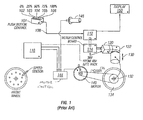
- FIG. 1 is a prior art schematic representation depicting the operation of manually controlled CVT or variator in a light electric vehicle, such as a scooter.
- a manual push button control box 101 has buttons corresponding to a signal output 108 of 0% 102 , 25% 103 , 50% 104 , 75% 105 , and 100% 106 sent to a microprocessor 112 .
- the microprocessor output can be shown on a display 150 .
- the microprocessor 112 interfaces with a motor control board 114 which receives power from a battery pack 118 .
- a servo motor 120 engages a 90-degree gearbox 122 which provides an axial force 130 to a variator (CVT) 132 in contact with the rear wheel 134 .
- the rear wheel 134 is powered by a chain 136 or other equivalent means connected to a drive motor 140 (e.g., Briggs & Stratton ETEK).
- the speed of the drive motor 140 is regulated by a current sent by a motor control device 144.
- the motor control device 144 is regulated by a throttle 146 and is powered by the battery 118 .
- the present invention provides a motorized vehicle and a method for automatically adjusting a continuously variable transmission (CVT) in a motorized vehicle, such as a battery powered scooter.
- CVT continuously variable transmission
- a motorized vehicle as defined in claim 1.
- a method as defined in claim 9 for automatically adjusting a continuously variable transmission (CVT) in a motorized vehicle for automatically adjusting a continuously variable transmission (CVT) in a motorized vehicle.
- CVT continuously variable transmission
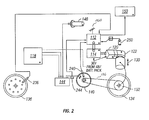
- FIG 2 is a schematic representation depicting the operation of an automatically controlled variator in a light electric vehicle in accordance with one embodiment of the present invention.
- the present invention uses one or more automatically-generated variables to automatically adjust the variator (CVT).
- the amount of current being drawn from the motor control device 144 comprises an automatically generated variable that can be used as an input signal to the microprocessor 112 .
- Motor controllers such as those available from Altrax of Grants Pass, OR can be used. Motor current draw is a function of throttle position and the state of the vehicle. For example:
- Another automatically generated variable supplied to the microprocessor 112 is the speed of the scooter, which is provided by a speed sensor 236 mounted on the front wheel 136 .
- a speed sensor 236 mounted on the front wheel 136 .
- multiple magnets e.g., 16
- the front wheel sensor 236 is mounted in a bracket from the wheel axel and wired into microprocessor 112 .
- the microprocessor 112 counts a pulse when a magnet passes the sensor 236 .
- the number of pulses in a given time period denotes the speed of the wheel, which is used to extrapolate the speed of the vehicle. This input is used in the calculation of optimized shifting to set a ratio in the variator 132 .
- Motor speed data provided by sensor 240 is another automatic variable that might be fed to the microprocessor 112 .
- the motor speed sensor 240 operates on the same principle as the front wheel sensor 236 .
- the signal provided by the sensor 240 gives a motor RPM value, which can be used to verify the transmission ratio using the following calculation:
- the variator gear reduction is derived from the front wheel speed sensor 236 and can be used to validate vehicle speed or transmission ratio to the "set ratio" of the control system.
- automatically generated variables include, but are not limited to:
- External data may also be provided to the microprocessor via a blue tooth antenna 260 .
- the twist throttle 146 gives the motor controller 144 an input signal from the rider. Based on the amount the throttle 146 is twisted, it increases a resistance value to the main motor controller 144 , which then translates this resistance value into voltage and current supplied to the drive motor 140 .
- the throttle is rated for 0 - 5k resistance.
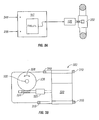
- Figure 3A is a schematic representation of the automatic operation of the shifter in accordance with one embodiment of the present invention.
- the microprocessor 112 comprises a basic stamp board available from Parallax, Inc. of Rocklin, CA.
- the microprocessor 112 can be programmed to generate lookup tables to provide optimum set points for variable inputs (described above) to obtain either the best performance or optimal efficiency of the scooter system.
- the microprocessor 112 receives data from the front wheel speed sensor 236 and current draw sensor 244 .
- the microprocessor 112 then outputs a signal to the servo 120 , which in turn provides an axial force to the variator 332 to shift in an optimal manner that minimizes current draw 244 or power drain so as to provide optimal efficiency.
- the data sampling speed and servo adjustment speed are adjusted to minimize power drain on the system that would otherwise cancel the efficiency gains.
- microprocessor output can be shown on a display 150 .
- This is an "on board" display of inputs and outputs that allows the user to verify settings and measurements during the testing phase. Examples of display readouts include:
- FIG. 3B is a schematic representation of the 90° gearbox in accordance with one embodiment of the present invention.
- the gearbox 322 comprises a servo 320 mounted with bolts 310 to the scooter frame (not shown).
- a coupler 323 is disposed between a threaded (worm) shaft 324 and the servo 320 .
- the wheel 326 rotates as depicted by numeral 328 , causing the shift shaft 330 to rotate.
- Such rotation of the shift shaft 330 is converted into an axial force.
- the 90° gearbox setup is used to provide a mechanical advantage (i.e. 36:1) and to reduce the size of the protrusion from the side of the scooter.
- the servo motor 320 When the system is turned on the servo motor 320 is driven towards home until the shift shaft 330 contacts the home sensor 250 (shown in Figure 2 ). The servo is stopped and the microprocessor 112 sets the internal electronic home position, registering voltage, turns, and rotation direction. In response to inputs from the sensors, based on the last known servo position a comparison is made between the current position and the "called" position. The microprocessor 112 then drives the servo 320 to the "called" position.
- Figure 4A is a simplified schematic representation of a linear actuator in accordance with an alternative embodiment of the present invention.
- This embodiment uses a rack and pinion setup and can be mounted up inside of the scooter.
- the end 416 of the threaded shaft 424 is adapted to couple between a first tooth-like member 412 and a second tooth-like member 414 .
- the first tooth-like member 412 is driven axially and thereby provides an axial force to a member 410 that is in communication with the tooth-like member 412 and a variator (not shown).
- FIG. 4B is a schematic representation of a servo motor mounted on the rear wheel in accordance with an alternate embodiment of the present invention.
- the servo motor 420 is connected to a shaft 430 having a threaded portion 424 adapted to couple with a threaded variator shaft (not shown).
- the internal threaded portion 424 allows space for the variator shaft to be pulled in and out.
- the servo motor 420 turns the shaft 430 thereby causing the threaded portion 424 to move the variator shaft in or out, thus adjusting the variator.
- FIG 4C is a schematic representation of an alternate servo motor design in accordance with another embodiment of the present invention.
- the servo motor 420 in this embodiment is also mounted at the rear wheel of the scooter.
- the servo motor 420 is connected to a shaft 430 having a splined portion 425 adapted to couple with a variator shaft (not shown).
- the servo motor 420 turns the splined shaft 430, thereby creating an axial force on the variator shaft, thus adjusting the variator.
- FIG. 4D is a schematic representation of the servo motor in communication with a hub that contains the variator in accordance with another alternate embodiment of the present invention.
- a hub 1102 containing the variator is mounted at the rear wheel of the scooter (not shown), and the servo motor is mounted up in the scooter.
- the rear hub 1102 includes a housing having an axial force that encloses and protects a pulley system coupled to cables 1012 and 1014 . These cables 1012 , 1014 in turn are connected to the servo motor 420 . which alternately pulls cable 1012 or cable 1014 in order to adjust the variator inside the hub 1102 .
Landscapes
- Engineering & Computer Science (AREA)
- General Engineering & Computer Science (AREA)
- Mechanical Engineering (AREA)
- Control Of Transmission Device (AREA)
- Transmissions By Endless Flexible Members (AREA)
- Electric Propulsion And Braking For Vehicles (AREA)
- Transmission Devices (AREA)
- Friction Gearing (AREA)
Description
- The present invention relates generally to a continuously variable transmission (CVT) and specifically to a system and method for providing an automated adjustment to a CVT.
- A transmission is any mechanical linkage that converts an input torque to an output torque. It usually involves a series of gears that have differing diameters, allowing a first gear at a first rotation rate to link to a second gear rotating at a second rate. The most common application for transmissions is in a vehicle. For example, a car may have an automatic transmission or a manual transmission. A bicycle has a simple transmission that links the pedals to the hub of the rear wheel.
- Transmissions allow an input force to be converted into a more useful and appropriate output. However, by using gears and linkages, a typical transmission may only have 4 or 5 ratios available. For example, a four speed automatic transmission in a car has only 4 sets of output gears to couple to the engine's input. A ten speed bike has only ten ratios of input to output. A need exists for a transmission that is not limited by the number of gears. Yet, to place a larger number of gears into a transmission increases its costs and weight and space requirements.
- A continuously variable transmission (CVT) is a transmission that eliminates the need for a specified number of gears. Instead it allows an almost limitless number of input to output ratios. This is a benefit because it allows an output to be achieved (i.e. the speed of a vehicle) at an optimal input (i.e. the rpm of the engine). For example, an engine might be most efficient at 1800 rpm. In other words, the peak torque output for the engine might be achieved at this engine rpm, or perhaps the highest fuel economy. Consequently, it may be desirable to run at a specified RPM for an economy mode or a power mode. Yet, in third gear, the car might be going faster at 1800 rpm than the driver desires. A continuously variable transmission would allow an intermediate ratio to be achieved that allowed the optimal input to achieve the desired output.
- CVT transmissions have a variator for continuously variable adjustment of the ratio. A customary structure is a belt drive variator having two pairs of beveled pulleys and rotating a torque-transmitter element therein, such as a pushing linked band or a chain. The beveled pulleys are loaded with pressure from the transmission oil pump in order, on one hand, to actuate the ratio adjustment and, on the other, to ensure a contact pressure needed for transmission of the torque upon the belt drive element. Another usual structure is a swash plate variator in semi-toroidal or fully toroidal design.
- Examples of CVTs are exemplified by
U.S. Pat. Nos. 6,419,608 and7,011,600 assigned to Fallbrook Technologies of San Diego, California. In each of those applications the axial movement of a rod or an axial force (as indicated by numeral 11 in each reference) is used to vary the input-to-output ratio of such transmissions. -
US 2005/0037876 A discloses a belt CVT wherein the speed ratio is controlled by advancing or retracting a movable sheave by means of a step motor. -
Figure 1 is a prior art schematic representation depicting the operation of manually controlled CVT or variator in a light electric vehicle, such as a scooter. As shown inFigure 1 , a manual push button control box 101 has buttons corresponding to asignal output 108 of 0% 102, 25% 103, 50% 104, 75% 105, and 100% 106 sent to amicroprocessor 112. The microprocessor output can be shown on adisplay 150. Themicroprocessor 112 interfaces with amotor control board 114 which receives power from abattery pack 118. - A
servo motor 120 engages a 90-degree gearbox 122 which provides anaxial force 130 to a variator (CVT) 132 in contact with therear wheel 134. Therear wheel 134 is powered by achain 136 or other equivalent means connected to a drive motor 140 (e.g., Briggs & Stratton ETEK). - The speed of the
drive motor 140 is regulated by a current sent by amotor control device 144. Themotor control device 144 is regulated by athrottle 146 and is powered by thebattery 118. - While a user of the electric vehicle can manually shift gears using the push button control, it would be desirable to have an automatic shifting transmission to permit an electric scooter to operate in a power mode or an economy mode. Consequently, a need exists to automatically adjust the input to output ratio based upon one or more input variables.
- The present invention provides a motorized vehicle and a method for automatically adjusting a continuously variable transmission (CVT) in a motorized vehicle, such as a battery powered scooter.
- According to a first aspect of the present invention, there is provided a motorized vehicle as defined in claim 1.
- According to a second aspect of the present invention, there is provided a method as defined in claim 9 for automatically adjusting a continuously variable transmission (CVT) in a motorized vehicle.
- The novel features believed characteristic of the invention are set forth in the appended claims. The invention itself, however, as well as a preferred mode of use, further objectives and advantages thereof, will best be understood by reference to the following detailed description of an illustrative embodiment when read in conjunction with the accompanying drawings, wherein:
-
Figure 1 is a prior art schematic representation depicting the operation of a manually controlled variator in a light electric vehicle; -
Figure 2 is a schematic representation depicting the operation of automatically controlled variator in a light electric vehicle in accordance with one embodiment of the present invention; -
Figure 3A is a schematic representation of the automatic operation of the shifter in accordance with one embodiment of the present invention; -
Figure 3B is a schematic representation of the 90° gearbox in accordance with one embodiment of the present invention; -
Figure 4A is a schematic representation of a linear actuator in accordance with an alternative embodiment of the present invention; -
Figure 4B is a schematic representation of a servo motor mounted on the rear wheel in accordance with an alternate embodiment of the present invention; -
Figure 4C is a schematic representation of an alternate servo motor design in accordance with another embodiment of the present invention; and -
Figure 4D is a schematic representation of the servo motor in communication with a hub that contains the variator in accordance with another alternate embodiment of the present invention. -
Figure 2 is a schematic representation depicting the operation of an automatically controlled variator in a light electric vehicle in accordance with one embodiment of the present invention. Instead of a push button control box 101 to manually control the transmission ratio of a CVT as shown inFigure 1 , the present invention uses one or more automatically-generated variables to automatically adjust the variator (CVT). - The amount of current being drawn from the
motor control device 144, as provided bysensor 244, comprises an automatically generated variable that can be used as an input signal to themicroprocessor 112. Motor controllers such as those available from Altrax of Grants Pass, OR can be used. Motor current draw is a function of throttle position and the state of the vehicle. For example: - Full throttle at 0 km/h (0 mph) = full current draw
- Full throttle at 56 km/h (35 mph) down a hill = low current draw
- Another automatically generated variable supplied to the
microprocessor 112 is the speed of the scooter, which is provided by aspeed sensor 236 mounted on thefront wheel 136. In the preferred embodiment, multiple magnets (e.g., 16) are mounted around the rim of thefront wheel 136. All of the magnet poles are arranged in the same direction. Thefront wheel sensor 236 is mounted in a bracket from the wheel axel and wired intomicroprocessor 112. Themicroprocessor 112 counts a pulse when a magnet passes thesensor 236. The number of pulses in a given time period denotes the speed of the wheel, which is used to extrapolate the speed of the vehicle. This input is used in the calculation of optimized shifting to set a ratio in thevariator 132. - Motor speed data provided by
sensor 240 is another automatic variable that might be fed to themicroprocessor 112. Themotor speed sensor 240 operates on the same principle as thefront wheel sensor 236. The signal provided by thesensor 240 gives a motor RPM value, which can be used to verify the transmission ratio using the following calculation: - Motor RPM/fixed gear reduction/variator gear reduction
- The variator gear reduction is derived from the front
wheel speed sensor 236 and can be used to validate vehicle speed or transmission ratio to the "set ratio" of the control system. - Other examples of automatically generated variables include, but are not limited to:
- Position of the throttle
- Current draw from the battery
- Variator setting
- Battery level
- Control settings of the motor control device (e.g., linear or s-curve),
- Wind direction
- Wind speed
- Tire pressure
- External data may also be provided to the microprocessor via a
blue tooth antenna 260. - The
twist throttle 146 gives themotor controller 144 an input signal from the rider. Based on the amount thethrottle 146 is twisted, it increases a resistance value to themain motor controller 144, which then translates this resistance value into voltage and current supplied to thedrive motor 140. In the preferred embodiment the throttle is rated for 0 - 5k resistance. -
Figure 3A is a schematic representation of the automatic operation of the shifter in accordance with one embodiment of the present invention. In one embodiment, themicroprocessor 112 comprises a basic stamp board available from Parallax, Inc. of Rocklin, CA. Themicroprocessor 112 can be programmed to generate lookup tables to provide optimum set points for variable inputs (described above) to obtain either the best performance or optimal efficiency of the scooter system. - In the example depicted in
Figure 3A , themicroprocessor 112 receives data from the frontwheel speed sensor 236 andcurrent draw sensor 244. Themicroprocessor 112 then outputs a signal to theservo 120, which in turn provides an axial force to thevariator 332 to shift in an optimal manner that minimizescurrent draw 244 or power drain so as to provide optimal efficiency. The data sampling speed and servo adjustment speed are adjusted to minimize power drain on the system that would otherwise cancel the efficiency gains. - As shown in
Figure 2 , microprocessor output can be shown on adisplay 150. This is an "on board" display of inputs and outputs that allows the user to verify settings and measurements during the testing phase. Examples of display readouts include: - Wheel count
- Current amps
- Voltage in (current sensor for motor)
- Motor RPM
- Wheel RPM
- Vehicle speed (km/h or MPH)
-
Figure 3B is a schematic representation of the 90° gearbox in accordance with one embodiment of the present invention. Thegearbox 322 comprises aservo 320 mounted withbolts 310 to the scooter frame (not shown). Acoupler 323 is disposed between a threaded (worm)shaft 324 and theservo 320. Upon rotation of the threadedshaft 324, thewheel 326 rotates as depicted bynumeral 328, causing theshift shaft 330 to rotate. Such rotation of theshift shaft 330 is converted into an axial force. - The 90° gearbox setup is used to provide a mechanical advantage (i.e. 36:1) and to reduce the size of the protrusion from the side of the scooter.
- When the system is turned on the
servo motor 320 is driven towards home until theshift shaft 330 contacts the home sensor 250 (shown inFigure 2 ). The servo is stopped and themicroprocessor 112 sets the internal electronic home position, registering voltage, turns, and rotation direction. In response to inputs from the sensors, based on the last known servo position a comparison is made between the current position and the "called" position. Themicroprocessor 112 then drives theservo 320 to the "called" position. -
Figure 4A is a simplified schematic representation of a linear actuator in accordance with an alternative embodiment of the present invention. This embodiment uses a rack and pinion setup and can be mounted up inside of the scooter. Theend 416 of the threadedshaft 424 is adapted to couple between a first tooth-like member 412 and a second tooth-like member 414. As the servo motor rotates theshaft end 416, the first tooth-like member 412 is driven axially and thereby provides an axial force to amember 410 that is in communication with the tooth-like member 412 and a variator (not shown). -
Figure 4B is a schematic representation of a servo motor mounted on the rear wheel in accordance with an alternate embodiment of the present invention. Theservo motor 420 is connected to ashaft 430 having a threadedportion 424 adapted to couple with a threaded variator shaft (not shown). The internal threadedportion 424 allows space for the variator shaft to be pulled in and out. Theservo motor 420 turns theshaft 430 thereby causing the threadedportion 424 to move the variator shaft in or out, thus adjusting the variator. -
Figure 4C is a schematic representation of an alternate servo motor design in accordance with another embodiment of the present invention. Like the embodiment depicted inFigure 4B , theservo motor 420 in this embodiment is also mounted at the rear wheel of the scooter. However, in this embodiment, theservo motor 420 is connected to ashaft 430 having asplined portion 425 adapted to couple with a variator shaft (not shown). Theservo motor 420 turns thesplined shaft 430, thereby creating an axial force on the variator shaft, thus adjusting the variator. -
Figure 4D is a schematic representation of the servo motor in communication with a hub that contains the variator in accordance with another alternate embodiment of the present invention. In this embodiment, ahub 1102 containing the variator is mounted at the rear wheel of the scooter (not shown), and the servo motor is mounted up in the scooter. Therear hub 1102 includes a housing having an axial force that encloses and protects a pulley system coupled tocables cables servo motor 420. which alternately pullscable 1012 orcable 1014 in order to adjust the variator inside thehub 1102. - The description of the present invention has been presented for purposes of illustration and description, and is not intended to be exhaustive or limited to the invention in the form disclosed. Many modifications and variations will be apparent to those of ordinary skill in the art. The embodiment was chosen and described in order to best explain the principles of the invention, the practical application, and to enable others of ordinary skill in the art to understand the invention for various embodiments with various modifications as are suited to the particular use contemplated.
Claims (16)
- A motorized vehicle having a system for automatically adjusting a continuously variable transmission (CVT) (132), the vehicle comprising:a microprocessor (112);a plurality of sensors (236, 240) that provide said microprocessor (112) with data about the operating status of the vehicle; anda servo motor (120) in mechanical communication with the CVT (132), wherein the servo motor (120) provides an axial force to adjust the CVT (132);wherein the microprocessor (112) generates lookup tables of optimum set points for vehicle data to instruct said servo motor (120) to adjust the transmission ratio of the CVT (132) according to the vehicle data provided by said sensors (236, 240), wherein the vehicle data provided to the microprocessor (112) by said sensors (236, 240) comprises a signal from the group consisting of vehicle speed; motor speed; throttle position; current draw from a battery; battery level; CVT setting; control settings of a motor control device; wind direction; wind speed; and tire pressure; anda visual display (150) adapted to display data from the microprocessor (112), wherein the visual display (150) is configured to allow a user to verify settings and measurements, wherein display readouts comprise a signal from the group consisting of:wheel count;current amps;voltage in;current sensor for motor;motor RPM;wheel RPM; andvehicle speed.
- The vehicle according to claim 1, wherein the microprocessor (112) is programmed with lookup tables to provide the optimum set points for vehicle data inputs to obtain the best vehicle performance.
- The vehicle according to claim 1, wherein the microprocessor (112) is programmed with lookup tables to provide the optimum set points for vehicle data inputs to obtain optimal efficiency of the vehicle.
- The vehicle according to claim 1, further comprising a 90° gearbox (122) that provides mechanical communication between the servo motor (120) and the CVT (132).
- The vehicle according to claim 1, further comprising a rack and pinion style linear actuator that provides mechanical communication between the servo motor (120) and the CVT (132).
- The vehicle according to claim 1, wherein the servo motor (120) is mounted on a vehicle wheel, adjacent to the CVT (132).
- The vehicle according to claim 1, further comprising a pulley system and cables that provide mechanical communication between the servo motor (120) and the CVT (132).
- The vehicle according to claim 1, wherein the motor vehicle is a battery powered scooter.
- A method for automatically adjusting a continuously variable transmission (CVT) (132) in a motorized vehicle, the method comprising the steps of:programming a microprocessor (112) in the vehicle to generate lookup tables of optimum set points for vehicle data;providing data about vehicle operating status from a plurality of sensors (236, 240) to said microprocessor (112);sending instructions from said microprocessor (112) to a servo motor (120) in mechanical communication with the CVT (132) to adjust the transmission ratio of the CVT (132) according to the vehicle data provided by said sensors (236, 240), wherein the vehicle data provided to the microprocessor (112) by said sensors (236, 240) comprises a signal from the group consisting of vehicle speed; motor speed; throttle position; current draw from a battery; battery level; CVT setting; control settings of a motor control device; wind direction; wind speed; and tire pressure; andvisually displaying (150) inputs and outputs that allow a user to verify settings and measurements, wherein display readouts comprise a signal from the group consisting of:wheel count;current amps;voltage in;current sensor for motor;motor RPM;wheel RPM; andvehicle speed.
- The method according to claim 9, wherein the microprocessor (112) is programmed with lookup tables to provide the optimum set points for vehicle data inputs to obtain the best vehicle performance.
- The method according to claim 9, wherein the microprocessor (112) is programmed with lookup tables to provide the optimum set points for vehicle data inputs to obtain optimal efficiency of the vehicle.
- The method according to claim 9, further comprising providing mechanical communication between the servo motor (120) and the CVT (132) using a 90° gearbox.
- The method according to claim 9, further comprising providing mechanical communication between the servo motor (120) and the CVT (132) using a rack and pinion style linear actuator.
- The method according to claim 9, further comprising mounting the servo motor (120) on a vehicle wheel, adjacent to the CVT (132).
- The method according to claim 9, further comprising providing mechanical communication between the servo motor (120) and the CVT (132) using a pulley system and cables.
- The method according to claim 9, wherein the motor vehicle is a battery powered scooter.
Priority Applications (2)
| Application Number | Priority Date | Filing Date | Title |
|---|---|---|---|
| PL07758548T PL2002154T3 (en) | 2006-03-14 | 2007-03-14 | Scooter shifter |
| EP13183460.8A EP2674644B1 (en) | 2006-03-14 | 2007-03-14 | Scooter shifter |
Applications Claiming Priority (2)
| Application Number | Priority Date | Filing Date | Title |
|---|---|---|---|
| US78310806P | 2006-03-14 | 2006-03-14 | |
| PCT/US2007/064003 WO2007106870A2 (en) | 2006-03-14 | 2007-03-14 | Scooter shifter |
Related Child Applications (1)
| Application Number | Title | Priority Date | Filing Date |
|---|---|---|---|
| EP13183460.8A Division EP2674644B1 (en) | 2006-03-14 | 2007-03-14 | Scooter shifter |
Publications (3)
| Publication Number | Publication Date |
|---|---|
| EP2002154A2 EP2002154A2 (en) | 2008-12-17 |
| EP2002154A4 EP2002154A4 (en) | 2011-11-30 |
| EP2002154B1 true EP2002154B1 (en) | 2013-10-02 |
Family
ID=38510278
Family Applications (2)
| Application Number | Title | Priority Date | Filing Date |
|---|---|---|---|
| EP07758548.7A Active EP2002154B1 (en) | 2006-03-14 | 2007-03-14 | Scooter shifter |
| EP13183460.8A Active EP2674644B1 (en) | 2006-03-14 | 2007-03-14 | Scooter shifter |
Family Applications After (1)
| Application Number | Title | Priority Date | Filing Date |
|---|---|---|---|
| EP13183460.8A Active EP2674644B1 (en) | 2006-03-14 | 2007-03-14 | Scooter shifter |
Country Status (6)
| Country | Link |
|---|---|
| US (1) | US7885747B2 (en) |
| EP (2) | EP2002154B1 (en) |
| CN (2) | CN101438082B (en) |
| DK (1) | DK2002154T3 (en) |
| PL (1) | PL2002154T3 (en) |
| WO (1) | WO2007106870A2 (en) |
Families Citing this family (45)
| Publication number | Priority date | Publication date | Assignee | Title |
|---|---|---|---|---|
| CN101526127B (en) | 2001-04-26 | 2011-08-17 | 瀑溪技术公司 | A continuously variable transmission and member support, support frame and frame manufacture method |
| US7011600B2 (en) | 2003-02-28 | 2006-03-14 | Fallbrook Technologies Inc. | Continuously variable transmission |
| KR101276082B1 (en) | 2004-10-05 | 2013-06-18 | 폴브룩 테크놀로지즈 인크 | Continuously variable transmission |
| KR101831828B1 (en) | 2005-10-28 | 2018-02-23 | 폴브룩 인텔렉츄얼 프로퍼티 컴퍼니 엘엘씨 | Electromotive drives |
| EP1954959B1 (en) | 2005-11-22 | 2013-05-15 | Fallbrook Intellectual Property Company LLC | Continuously variable transmission |
| CA2976893C (en) * | 2005-12-09 | 2019-03-12 | Fallbrook Intellectual Property Company Llc | Continuously variable transmission |
| EP1811202A1 (en) | 2005-12-30 | 2007-07-25 | Fallbrook Technologies, Inc. | A continuously variable gear transmission |
| US7882762B2 (en) * | 2006-01-30 | 2011-02-08 | Fallbrook Technologies Inc. | System for manipulating a continuously variable transmission |
| WO2007106874A2 (en) * | 2006-03-14 | 2007-09-20 | Autocraft Industries, Inc. | Improved wheelchair |
| CN102278200B (en) | 2006-06-26 | 2014-05-14 | 福博科知识产权有限责任公司 | Continuously variable transmission |
| WO2008057507A1 (en) | 2006-11-08 | 2008-05-15 | Fallbrook Technologies Inc. | Clamping force generator |
| EP2125469A2 (en) | 2007-02-01 | 2009-12-02 | Fallbrook Technologies Inc. | System and methods for control of transmission and/or prime mover |
| CN104121345B (en) | 2007-02-12 | 2017-01-11 | 福博科知识产权有限责任公司 | Continuously variable transmission and method therefor |
| EP2700843A3 (en) | 2007-02-16 | 2017-11-08 | Fallbrook Intellectual Property Company LLC | Infinitely variable transmissions, continuously variable transmissions, methods, assemblies, subassemblies, and components therefor |
| CN102943855B (en) * | 2007-04-24 | 2016-01-27 | 福博科技术公司 | Electric traction drives |
| WO2008154437A1 (en) * | 2007-06-11 | 2008-12-18 | Fallbrook Technologies Inc. | Continuously variable transmission |
| CN103697120B (en) | 2007-07-05 | 2017-04-12 | 福博科技术公司 | Continuously variable transmission |
| US8996263B2 (en) | 2007-11-16 | 2015-03-31 | Fallbrook Intellectual Property Company Llc | Controller for variable transmission |
| JP5783723B2 (en) | 2007-12-21 | 2015-09-24 | フォールブルック インテレクチュアル プロパティー カンパニー エルエルシー | Automatic transmission and method thereof |
| CA2716908C (en) | 2008-02-29 | 2017-06-27 | Fallbrook Technologies Inc. | Continuously and/or infinitely variable transmissions and methods therefor |
| US8317651B2 (en) | 2008-05-07 | 2012-11-27 | Fallbrook Intellectual Property Company Llc | Assemblies and methods for clamping force generation |
| US8535199B2 (en) * | 2008-06-06 | 2013-09-17 | Fallbrook Intellectual Property Company Llc | Infinitely variable transmissions, continuously variable transmissions, methods, assemblies, subassemblies, and components therefor |
| WO2009157920A1 (en) | 2008-06-23 | 2009-12-30 | Fallbrook Technologies Inc. | Continuously variable transmission |
| WO2010017242A1 (en) * | 2008-08-05 | 2010-02-11 | Fallbrook Technologies Inc. | Methods for control of transmission and prime mover |
| US8469856B2 (en) | 2008-08-26 | 2013-06-25 | Fallbrook Intellectual Property Company Llc | Continuously variable transmission |
| US8167759B2 (en) | 2008-10-14 | 2012-05-01 | Fallbrook Technologies Inc. | Continuously variable transmission |
| WO2010120933A1 (en) | 2009-04-16 | 2010-10-21 | Fallbrook Technologies Inc. | Stator assembly and shifting mechanism for a continuously variable transmission |
| US8512195B2 (en) * | 2010-03-03 | 2013-08-20 | Fallbrook Intellectual Property Company Llc | Infinitely variable transmissions, continuously variable transmissions, methods, assemblies, subassemblies, and components therefor |
| US8888643B2 (en) | 2010-11-10 | 2014-11-18 | Fallbrook Intellectual Property Company Llc | Continuously variable transmission |
| US9327792B2 (en) | 2011-01-28 | 2016-05-03 | Paha Designs, Llc | Gear transmission and derailleur system |
| US9033833B2 (en) | 2011-01-28 | 2015-05-19 | Paha Designs, Llc | Gear transmission and derailleur system |
| US10207772B2 (en) | 2011-01-28 | 2019-02-19 | Paha Designs, Llc | Gear transmission and derailleur system |
| WO2012138610A1 (en) | 2011-04-04 | 2012-10-11 | Fallbrook Intellectual Property Company Llc | Auxiliary power unit having a continuously variable transmission |
| CN107061653B (en) | 2012-01-23 | 2020-05-26 | 福博科知识产权有限责任公司 | Infinitely variable transmissions, continuously variable transmissions, methods, assemblies, subassemblies, and components thereof |
| KR102433297B1 (en) | 2013-04-19 | 2022-08-16 | 폴브룩 인텔렉츄얼 프로퍼티 컴퍼니 엘엘씨 | Continuously variable transmission |
| US9285031B1 (en) * | 2014-11-14 | 2016-03-15 | GM Global Technology Operations LLC | Method and apparatus to control a continuously variable transmission |
| US10047861B2 (en) | 2016-01-15 | 2018-08-14 | Fallbrook Intellectual Property Company Llc | Systems and methods for controlling rollback in continuously variable transmissions |
| US10458526B2 (en) | 2016-03-18 | 2019-10-29 | Fallbrook Intellectual Property Company Llc | Continuously variable transmissions, systems and methods |
| BE1023741B1 (en) * | 2016-04-28 | 2017-07-07 | Punch Powertrain Nv | A vehicle, a continuously variable transmission system, a control method and a computer program product |
| US10023266B2 (en) | 2016-05-11 | 2018-07-17 | Fallbrook Intellectual Property Company Llc | Systems and methods for automatic configuration and automatic calibration of continuously variable transmissions and bicycles having continuously variable transmissions |
| US10189543B2 (en) * | 2016-08-03 | 2019-01-29 | Kuo-Hsin Su | Electric motorcycle with improved motor performance |
| CN108578993B (en) * | 2018-07-12 | 2024-07-23 | 郑州航空港区羽丰医疗科技有限公司 | Power vehicle |
| US11215268B2 (en) | 2018-11-06 | 2022-01-04 | Fallbrook Intellectual Property Company Llc | Continuously variable transmissions, synchronous shifting, twin countershafts and methods for control of same |
| US11174922B2 (en) | 2019-02-26 | 2021-11-16 | Fallbrook Intellectual Property Company Llc | Reversible variable drives and systems and methods for control in forward and reverse directions |
| GB2597849B (en) * | 2020-07-20 | 2022-11-02 | Univ Jiangsu | Power-split hydro-mechanical hybrid transmission system with automatic adjustment function |
Family Cites Families (29)
| Publication number | Priority date | Publication date | Assignee | Title |
|---|---|---|---|---|
| US4706518A (en) * | 1984-04-30 | 1987-11-17 | Aisin Warner Kabushiki Kaisha | Automatic transmission having C.V.T. system for a vehicle |
| JPS6444394A (en) | 1987-08-11 | 1989-02-16 | Honda Motor Co Ltd | Controller for non-stage transmission |
| US5269726A (en) | 1991-06-26 | 1993-12-14 | Borg-Warner Automotive, Inc. | Control system and strategies for a double acting secondary sheave servo for a continuously variable transmission |
| DE4223967A1 (en) * | 1992-07-21 | 1994-01-27 | Bosch Gmbh Robert | Device for setting a transmission output torque or a transmission output power in vehicles with continuously variable transmission (CVT) |
| US5514047A (en) * | 1993-03-08 | 1996-05-07 | Ford Motor Company | Continuously variable transmission |
| JP3058005B2 (en) * | 1994-04-28 | 2000-07-04 | 日産自動車株式会社 | Control device for continuously variable transmission |
| JP3450078B2 (en) * | 1995-01-30 | 2003-09-22 | セイコーエプソン株式会社 | Power assist device for electric vehicles |
| DE69618367T2 (en) * | 1995-03-24 | 2002-11-14 | Aisin Aw Co., Ltd. | Continuously variable transmission |
| KR100377658B1 (en) | 1996-01-11 | 2003-07-16 | 지멘스 악티엔게젤샤프트 | Control for a device in a motor vehicle |
| JP3409669B2 (en) * | 1997-03-07 | 2003-05-26 | 日産自動車株式会社 | Transmission control device for continuously variable transmission |
| US6419608B1 (en) * | 1999-10-22 | 2002-07-16 | Motion Technologies, Llc | Continuously variable transmission |
| DE19833699A1 (en) | 1998-07-27 | 2000-02-03 | Zahnradfabrik Friedrichshafen | Method for setting a ratio of a continuously variable automatic transmission with a variator |
| JP3547709B2 (en) | 1998-10-23 | 2004-07-28 | シーメンス アクチエンゲゼルシヤフト | Control method and control device for automatic continuously variable transmission of vehicle |
| DE19851160A1 (en) | 1998-11-06 | 2000-05-18 | Zf Batavia Llc | Arrangement for controlling automatic gearbox has electronic controller of gearbox coupling changing pressure or gearbox variator application pressure as function of engine torque |
| DE19851738A1 (en) * | 1998-11-10 | 2000-05-18 | Getrag Getriebe Zahnrad | Drive train for motor vehicle has input for engine connection, wheel drive output and control element that is axially displaceable on shaft by at least one electromechanical actuator |
| US6520878B1 (en) * | 1999-04-23 | 2003-02-18 | Cvtech R & D Inc. | Driving pulley for scooters and other vehicles |
| US6266931B1 (en) * | 1999-06-10 | 2001-07-31 | Atwood Industries, Inc. | Screw drive room slideout assembly |
| JP3546302B2 (en) * | 1999-08-05 | 2004-07-28 | トヨタ自動車株式会社 | Control device for vehicle with continuously variable transmission |
| US6409625B1 (en) * | 1999-11-10 | 2002-06-25 | Nissan Motor Co., Ltd. | Controller of toroidal continuously variable transmission |
| DE10059450A1 (en) | 2000-11-30 | 2002-06-13 | Zf Batavia Llc | Variator slip detection method for continuously variable transmission uses detection and analysis of vibration noise |
| GB2371839A (en) * | 2001-02-01 | 2002-08-07 | Eaton Corp | Control for selecting automated transmission system shift strategy |
| US7077023B2 (en) | 2001-02-13 | 2006-07-18 | Nissan Motor Co., Ltd. | Toroidal continuously variable transmission |
| TWI268320B (en) * | 2001-12-04 | 2006-12-11 | Yamaha Motor Co Ltd | Continuously variable transmission and method of controlling it allowing for control of the axial position of a movable sheave without a sensor for measuring the axial position of the movable sheave on a rotational shaft and for stable control with the movable sheave being held in position |
| DE10302992A1 (en) | 2002-02-07 | 2003-10-16 | Luk Lamellen & Kupplungsbau | Gear ratio regulation method for motor vehicle power-branched continuously variable transmission has variator regulating range traversed in opposite directions for different gear ratio ranges |
| JP3817516B2 (en) * | 2002-12-26 | 2006-09-06 | 本田技研工業株式会社 | Drive control apparatus for hybrid vehicle |
| US7011600B2 (en) | 2003-02-28 | 2006-03-14 | Fallbrook Technologies Inc. | Continuously variable transmission |
| US7261672B2 (en) * | 2003-03-19 | 2007-08-28 | The Regents Of The University Of California | Method and system for controlling rate of change of ratio in a continuously variable transmission |
| JP4553298B2 (en) * | 2004-08-05 | 2010-09-29 | 本田技研工業株式会社 | Motor cooling structure for electric vehicles |
| JP2006069397A (en) * | 2004-09-02 | 2006-03-16 | Toyota Motor Corp | Vehicle door module structure |
-
2007
- 2007-03-14 EP EP07758548.7A patent/EP2002154B1/en active Active
- 2007-03-14 DK DK07758548.7T patent/DK2002154T3/en active
- 2007-03-14 EP EP13183460.8A patent/EP2674644B1/en active Active
- 2007-03-14 US US11/686,231 patent/US7885747B2/en active Active
- 2007-03-14 CN CN200780016360.9A patent/CN101438082B/en active Active
- 2007-03-14 PL PL07758548T patent/PL2002154T3/en unknown
- 2007-03-14 WO PCT/US2007/064003 patent/WO2007106870A2/en not_active Ceased
- 2007-03-14 CN CN201410305249.3A patent/CN104154203A/en active Pending
Also Published As
| Publication number | Publication date |
|---|---|
| CN101438082B (en) | 2014-07-30 |
| DK2002154T3 (en) | 2014-01-13 |
| EP2002154A4 (en) | 2011-11-30 |
| EP2674644B1 (en) | 2019-07-24 |
| EP2674644A1 (en) | 2013-12-18 |
| CN101438082A (en) | 2009-05-20 |
| WO2007106870A2 (en) | 2007-09-20 |
| WO2007106870A3 (en) | 2007-12-06 |
| PL2002154T3 (en) | 2014-02-28 |
| US20070219696A1 (en) | 2007-09-20 |
| EP2002154A2 (en) | 2008-12-17 |
| US7885747B2 (en) | 2011-02-08 |
| CN104154203A (en) | 2014-11-19 |
Similar Documents
| Publication | Publication Date | Title |
|---|---|---|
| US7885747B2 (en) | Scooter shifter | |
| US8087482B2 (en) | Wheelchair | |
| JP5630718B2 (en) | Power transmission device using planetary gears | |
| KR101132753B1 (en) | Planetary gear set and power transmitting apparatus using the same | |
| CN212290182U (en) | Mid-mounted motor drive system | |
| CN112072846B (en) | Two-axis speed regulating mid-mounted motor | |
| WO2003002890A1 (en) | Multi-speed worm gear reduction assembly | |
| JP4191362B2 (en) | Control method for continuously variable transmission | |
| CN217227830U (en) | Chain wheel speed changing device of middle-placed motor and middle-placed motor thereof | |
| CN101907153A (en) | Intelligent continuously variable transmission of automobile | |
| CN221221396U (en) | Electronic gear shifting mechanism and all-terrain vehicle | |
| HK1192302A (en) | Scooter shifter | |
| CN115571258A (en) | Crank speed change device with middle motor and its middle motor | |
| CN201031948Y (en) | Multistage type motivity automatic speeder | |
| KR100925687B1 (en) | Power transmission structure of four wheel vehicle | |
| CN223120526U (en) | Electronic gear-shifting multi-gear transmission assembly for tricycle | |
| CN2890499Y (en) | Decelerating, gear shifting mechanism of built-in gear reversing engine | |
| EP1604129A1 (en) | Forward-reverse control device | |
| EP4467436B1 (en) | Continuously variable transmission for bicycle | |
| CN216623075U (en) | Remote control operation device | |
| CN217108077U (en) | Rear axle speed changer of electric vehicle | |
| CN219101971U (en) | Continuously variable transmission | |
| CN101038018A (en) | Deceleration and shifting device with built-in peed-changing box | |
| EP1528298A1 (en) | Shift control mechanism for a synchromesh-type transmission | |
| WO2025032456A1 (en) | Improved transmission system for a pedal vehicle and related control method |
Legal Events
| Date | Code | Title | Description |
|---|---|---|---|
| PUAI | Public reference made under article 153(3) epc to a published international application that has entered the european phase |
Free format text: ORIGINAL CODE: 0009012 |
|
| 17P | Request for examination filed |
Effective date: 20081014 |
|
| AK | Designated contracting states |
Kind code of ref document: A2 Designated state(s): AT BE BG CH CY CZ DE DK EE ES FI FR GB GR HU IE IS IT LI LT LU LV MC MT NL PL PT RO SE SI SK TR |
|
| RAP1 | Party data changed (applicant data changed or rights of an application transferred) |
Owner name: FALLBROOK TECHNOLOGIES INC. |
|
| A4 | Supplementary search report drawn up and despatched |
Effective date: 20111028 |
|
| RIC1 | Information provided on ipc code assigned before grant |
Ipc: F16H 61/662 20060101AFI20111024BHEP |
|
| DAX | Request for extension of the european patent (deleted) | ||
| 17Q | First examination report despatched |
Effective date: 20120911 |
|
| RAP1 | Party data changed (applicant data changed or rights of an application transferred) |
Owner name: FALLBROOK INTELLECTUAL PROPERTY COMPANY LLC |
|
| REG | Reference to a national code |
Ref country code: DE Ref legal event code: R079 Ref document number: 602007033135 Country of ref document: DE Free format text: PREVIOUS MAIN CLASS: F16H0047040000 Ipc: F16H0061662000 |
|
| GRAP | Despatch of communication of intention to grant a patent |
Free format text: ORIGINAL CODE: EPIDOSNIGR1 |
|
| RIC1 | Information provided on ipc code assigned before grant |
Ipc: F16H 61/662 20060101AFI20130319BHEP Ipc: F16H 63/06 20060101ALI20130319BHEP |
|
| INTG | Intention to grant announced |
Effective date: 20130418 |
|
| GRAS | Grant fee paid |
Free format text: ORIGINAL CODE: EPIDOSNIGR3 |
|
| GRAA | (expected) grant |
Free format text: ORIGINAL CODE: 0009210 |
|
| AK | Designated contracting states |
Kind code of ref document: B1 Designated state(s): AT BE BG CH CY CZ DE DK EE ES FI FR GB GR HU IE IS IT LI LT LU LV MC MT NL PL PT RO SE SI SK TR |
|
| REG | Reference to a national code |
Ref country code: GB Ref legal event code: FG4D |
|
| REG | Reference to a national code |
Ref country code: CH Ref legal event code: EP Ref country code: AT Ref legal event code: REF Ref document number: 634776 Country of ref document: AT Kind code of ref document: T Effective date: 20131015 |
|
| REG | Reference to a national code |
Ref country code: IE Ref legal event code: FG4D |
|
| REG | Reference to a national code |
Ref country code: DE Ref legal event code: R096 Ref document number: 602007033135 Country of ref document: DE Effective date: 20131205 |
|
| REG | Reference to a national code |
Ref country code: NL Ref legal event code: T3 |
|
| REG | Reference to a national code |
Ref country code: DK Ref legal event code: T3 Effective date: 20140107 |
|
| REG | Reference to a national code |
Ref country code: SE Ref legal event code: TRGR |
|
| REG | Reference to a national code |
Ref country code: AT Ref legal event code: MK05 Ref document number: 634776 Country of ref document: AT Kind code of ref document: T Effective date: 20131002 |
|
| PG25 | Lapsed in a contracting state [announced via postgrant information from national office to epo] |
Ref country code: SI Free format text: LAPSE BECAUSE OF FAILURE TO SUBMIT A TRANSLATION OF THE DESCRIPTION OR TO PAY THE FEE WITHIN THE PRESCRIBED TIME-LIMIT Effective date: 20131002 |
|
| REG | Reference to a national code |
Ref country code: PL Ref legal event code: T3 |
|
| REG | Reference to a national code |
Ref country code: LT Ref legal event code: MG4D |
|
| PG25 | Lapsed in a contracting state [announced via postgrant information from national office to epo] |
Ref country code: FI Free format text: LAPSE BECAUSE OF FAILURE TO SUBMIT A TRANSLATION OF THE DESCRIPTION OR TO PAY THE FEE WITHIN THE PRESCRIBED TIME-LIMIT Effective date: 20131002 Ref country code: BE Free format text: LAPSE BECAUSE OF FAILURE TO SUBMIT A TRANSLATION OF THE DESCRIPTION OR TO PAY THE FEE WITHIN THE PRESCRIBED TIME-LIMIT Effective date: 20131002 Ref country code: LT Free format text: LAPSE BECAUSE OF FAILURE TO SUBMIT A TRANSLATION OF THE DESCRIPTION OR TO PAY THE FEE WITHIN THE PRESCRIBED TIME-LIMIT Effective date: 20131002 Ref country code: IS Free format text: LAPSE BECAUSE OF FAILURE TO SUBMIT A TRANSLATION OF THE DESCRIPTION OR TO PAY THE FEE WITHIN THE PRESCRIBED TIME-LIMIT Effective date: 20140202 |
|
| PG25 | Lapsed in a contracting state [announced via postgrant information from national office to epo] |
Ref country code: LV Free format text: LAPSE BECAUSE OF FAILURE TO SUBMIT A TRANSLATION OF THE DESCRIPTION OR TO PAY THE FEE WITHIN THE PRESCRIBED TIME-LIMIT Effective date: 20131002 Ref country code: AT Free format text: LAPSE BECAUSE OF FAILURE TO SUBMIT A TRANSLATION OF THE DESCRIPTION OR TO PAY THE FEE WITHIN THE PRESCRIBED TIME-LIMIT Effective date: 20131002 Ref country code: CY Free format text: LAPSE BECAUSE OF FAILURE TO SUBMIT A TRANSLATION OF THE DESCRIPTION OR TO PAY THE FEE WITHIN THE PRESCRIBED TIME-LIMIT Effective date: 20131002 Ref country code: ES Free format text: LAPSE BECAUSE OF FAILURE TO SUBMIT A TRANSLATION OF THE DESCRIPTION OR TO PAY THE FEE WITHIN THE PRESCRIBED TIME-LIMIT Effective date: 20131002 |
|
| PG25 | Lapsed in a contracting state [announced via postgrant information from national office to epo] |
Ref country code: PT Free format text: LAPSE BECAUSE OF FAILURE TO SUBMIT A TRANSLATION OF THE DESCRIPTION OR TO PAY THE FEE WITHIN THE PRESCRIBED TIME-LIMIT Effective date: 20140203 |
|
| REG | Reference to a national code |
Ref country code: DE Ref legal event code: R097 Ref document number: 602007033135 Country of ref document: DE |
|
| PG25 | Lapsed in a contracting state [announced via postgrant information from national office to epo] |
Ref country code: EE Free format text: LAPSE BECAUSE OF FAILURE TO SUBMIT A TRANSLATION OF THE DESCRIPTION OR TO PAY THE FEE WITHIN THE PRESCRIBED TIME-LIMIT Effective date: 20131002 |
|
| PLBE | No opposition filed within time limit |
Free format text: ORIGINAL CODE: 0009261 |
|
| STAA | Information on the status of an ep patent application or granted ep patent |
Free format text: STATUS: NO OPPOSITION FILED WITHIN TIME LIMIT |
|
| PG25 | Lapsed in a contracting state [announced via postgrant information from national office to epo] |
Ref country code: SK Free format text: LAPSE BECAUSE OF FAILURE TO SUBMIT A TRANSLATION OF THE DESCRIPTION OR TO PAY THE FEE WITHIN THE PRESCRIBED TIME-LIMIT Effective date: 20131002 Ref country code: RO Free format text: LAPSE BECAUSE OF FAILURE TO SUBMIT A TRANSLATION OF THE DESCRIPTION OR TO PAY THE FEE WITHIN THE PRESCRIBED TIME-LIMIT Effective date: 20131002 |
|
| 26N | No opposition filed |
Effective date: 20140703 |
|
| REG | Reference to a national code |
Ref country code: DE Ref legal event code: R097 Ref document number: 602007033135 Country of ref document: DE Effective date: 20140703 |
|
| REG | Reference to a national code |
Ref country code: FR Ref legal event code: PLFP Year of fee payment: 10 |
|
| PG25 | Lapsed in a contracting state [announced via postgrant information from national office to epo] |
Ref country code: MT Free format text: LAPSE BECAUSE OF FAILURE TO SUBMIT A TRANSLATION OF THE DESCRIPTION OR TO PAY THE FEE WITHIN THE PRESCRIBED TIME-LIMIT Effective date: 20131002 |
|
| PG25 | Lapsed in a contracting state [announced via postgrant information from national office to epo] |
Ref country code: MC Free format text: LAPSE BECAUSE OF FAILURE TO SUBMIT A TRANSLATION OF THE DESCRIPTION OR TO PAY THE FEE WITHIN THE PRESCRIBED TIME-LIMIT Effective date: 20131002 Ref country code: BG Free format text: LAPSE BECAUSE OF FAILURE TO SUBMIT A TRANSLATION OF THE DESCRIPTION OR TO PAY THE FEE WITHIN THE PRESCRIBED TIME-LIMIT Effective date: 20131002 |
|
| PG25 | Lapsed in a contracting state [announced via postgrant information from national office to epo] |
Ref country code: GR Free format text: LAPSE BECAUSE OF FAILURE TO SUBMIT A TRANSLATION OF THE DESCRIPTION OR TO PAY THE FEE WITHIN THE PRESCRIBED TIME-LIMIT Effective date: 20140103 |
|
| PG25 | Lapsed in a contracting state [announced via postgrant information from national office to epo] |
Ref country code: TR Free format text: LAPSE BECAUSE OF FAILURE TO SUBMIT A TRANSLATION OF THE DESCRIPTION OR TO PAY THE FEE WITHIN THE PRESCRIBED TIME-LIMIT Effective date: 20131002 Ref country code: HU Free format text: LAPSE BECAUSE OF FAILURE TO SUBMIT A TRANSLATION OF THE DESCRIPTION OR TO PAY THE FEE WITHIN THE PRESCRIBED TIME-LIMIT; INVALID AB INITIO Effective date: 20070314 |
|
| REG | Reference to a national code |
Ref country code: FR Ref legal event code: PLFP Year of fee payment: 11 |
|
| REG | Reference to a national code |
Ref country code: FR Ref legal event code: PLFP Year of fee payment: 12 |
|
| PGFP | Annual fee paid to national office [announced via postgrant information from national office to epo] |
Ref country code: LU Payment date: 20190222 Year of fee payment: 13 Ref country code: NL Payment date: 20190225 Year of fee payment: 13 |
|
| PGFP | Annual fee paid to national office [announced via postgrant information from national office to epo] |
Ref country code: IE Payment date: 20190221 Year of fee payment: 13 Ref country code: IT Payment date: 20190219 Year of fee payment: 13 Ref country code: CH Payment date: 20190222 Year of fee payment: 13 Ref country code: PL Payment date: 20190304 Year of fee payment: 13 |
|
| PGFP | Annual fee paid to national office [announced via postgrant information from national office to epo] |
Ref country code: SE Payment date: 20190311 Year of fee payment: 18 |
|
| PG25 | Lapsed in a contracting state [announced via postgrant information from national office to epo] |
Ref country code: CZ Free format text: LAPSE BECAUSE OF NON-PAYMENT OF DUE FEES Effective date: 20200314 |
|
| REG | Reference to a national code |
Ref country code: CH Ref legal event code: PL |
|
| REG | Reference to a national code |
Ref country code: DK Ref legal event code: EBP Effective date: 20200331 |
|
| REG | Reference to a national code |
Ref country code: NL Ref legal event code: MM Effective date: 20200401 |
|
| PG25 | Lapsed in a contracting state [announced via postgrant information from national office to epo] |
Ref country code: LU Free format text: LAPSE BECAUSE OF NON-PAYMENT OF DUE FEES Effective date: 20200314 Ref country code: NL Free format text: LAPSE BECAUSE OF NON-PAYMENT OF DUE FEES Effective date: 20200401 |
|
| PG25 | Lapsed in a contracting state [announced via postgrant information from national office to epo] |
Ref country code: CH Free format text: LAPSE BECAUSE OF NON-PAYMENT OF DUE FEES Effective date: 20200331 Ref country code: SE Free format text: LAPSE BECAUSE OF NON-PAYMENT OF DUE FEES Effective date: 20200315 Ref country code: LI Free format text: LAPSE BECAUSE OF NON-PAYMENT OF DUE FEES Effective date: 20200331 Ref country code: IE Free format text: LAPSE BECAUSE OF NON-PAYMENT OF DUE FEES Effective date: 20200314 |
|
| PG25 | Lapsed in a contracting state [announced via postgrant information from national office to epo] |
Ref country code: DK Free format text: LAPSE BECAUSE OF NON-PAYMENT OF DUE FEES Effective date: 20200331 |
|
| PG25 | Lapsed in a contracting state [announced via postgrant information from national office to epo] |
Ref country code: IT Free format text: LAPSE BECAUSE OF NON-PAYMENT OF DUE FEES Effective date: 20200314 |
|
| PG25 | Lapsed in a contracting state [announced via postgrant information from national office to epo] |
Ref country code: PL Free format text: LAPSE BECAUSE OF NON-PAYMENT OF DUE FEES Effective date: 20200314 |
|
| P01 | Opt-out of the competence of the unified patent court (upc) registered |
Effective date: 20230601 |
|
| PGFP | Annual fee paid to national office [announced via postgrant information from national office to epo] |
Ref country code: DE Payment date: 20250327 Year of fee payment: 19 |
|
| PGFP | Annual fee paid to national office [announced via postgrant information from national office to epo] |
Ref country code: FR Payment date: 20250325 Year of fee payment: 19 |
|
| PGFP | Annual fee paid to national office [announced via postgrant information from national office to epo] |
Ref country code: GB Payment date: 20250327 Year of fee payment: 19 |
|
| REG | Reference to a national code |
Ref country code: GB Ref legal event code: 732E Free format text: REGISTERED BETWEEN 20251030 AND 20251105 Ref country code: DE Ref legal event code: R081 Ref document number: 602007033135 Country of ref document: DE Owner name: ENVIOLO B.V., NL Free format text: FORMER OWNER: FALLBROOK INTELLECTUAL PROPERTY COMPANY LLC, SAN DIEGO, CALIF., US |