EP2000913A1 - Method of managing flash memory allocation in an electronic token - Google Patents
Method of managing flash memory allocation in an electronic token Download PDFInfo
- Publication number
- EP2000913A1 EP2000913A1 EP07301094A EP07301094A EP2000913A1 EP 2000913 A1 EP2000913 A1 EP 2000913A1 EP 07301094 A EP07301094 A EP 07301094A EP 07301094 A EP07301094 A EP 07301094A EP 2000913 A1 EP2000913 A1 EP 2000913A1
- Authority
- EP
- European Patent Office
- Prior art keywords
- free memory
- memory chunk
- entry
- chunk
- list area
- Prior art date
- Legal status (The legal status is an assumption and is not a legal conclusion. Google has not performed a legal analysis and makes no representation as to the accuracy of the status listed.)
- Withdrawn
Links
Images
Classifications
-
- G—PHYSICS
- G06—COMPUTING OR CALCULATING; COUNTING
- G06F—ELECTRIC DIGITAL DATA PROCESSING
- G06F12/00—Accessing, addressing or allocating within memory systems or architectures
- G06F12/02—Addressing or allocation; Relocation
- G06F12/0223—User address space allocation, e.g. contiguous or non contiguous base addressing
- G06F12/023—Free address space management
- G06F12/0238—Memory management in non-volatile memory, e.g. resistive RAM or ferroelectric memory
- G06F12/0246—Memory management in non-volatile memory, e.g. resistive RAM or ferroelectric memory in block erasable memory, e.g. flash memory
Definitions
- the present invention relates to methods of managing flash memory allocation in an electronic token. It relates particularly to methods of managing allocation of spaces in flash memory like NOR flash memory.
- NOR flash memory component have the following characteristics.
- a NOR flash is divided into banks having typically a size of 256 Kbytes.
- Each bank is usually divided into sectors having typically a size of 4 Kbytes.
- Each sector is divided into pages, having typically a size of 256 Bytes. Rewriting a byte in page imposes erasing first the complete page containing it.
- the read access to a byte is direct since there is no need to load the whole page to access a byte.
- access granularity is very high since a unique bit can be written.
- a write operation corresponds to turn a bit from 1 to 0.
- a page can be programmed/erased a limited number of time.
- a virgin state i.e. the whole bytes are initialized with a single default value.
- this virgin state corresponds to smallest or the greatest value which a byte can take (0x00h or 0xFFh) .
- Flash memories and EEPROM differ a lot. EEPROM are slow, byte-accessible for reads and writes, types of memories, whereas flash memories can be programmed faster, but can only be erased page by page, and their page size can vary a lot.
- Allocation system designed for EEPROM are not suitable on flash memories, causing a lot of unnecessary erases and leading to low performances for both allocations and frees. Moreover, those allocation systems cannot use the characteristics of the flash memories to achieve faster allocations.
- the invention aims at minimizing the number of erases required for allocation of space in a managed memory.
- the object of the present invention is a method of managing flash memory allocation in an electronic token.
- Said token has a memory comprising a list area and a managed area.
- Said managed area comprises allocated spaces and at least one free memory chunk.
- Said list area comprises at least one valid entry referencing a free memory chunk.
- Said valid entry comprises a state field.
- Said method comprises the following steps:
- the state field of said valid entry is preset with a virgin state, and said method comprises the further step of invalidating the old valid entry referencing the selected free memory chunk.
- the old valid entry referencing the selected free memory chunk may be invalidated by writing a predefined value in the state field of said old valid entry.
- Said method may comprise the further step of requesting a compaction of the list area when said list area contains a predefined number of entries.
- Said entries may be sequentially initialized in the list area.
- Every allocated spaces and every free memory chunks may be defined by their own size.
- An old valid entry may comprise a memory chunk identifier associated to a first free memory chunk.
- Said method may comprise the further step of initializing a new valid entry in the list area if the new allocated space size is smaller than the selected first free memory chunk size. In this case, said new valid entry references a second free memory chunk and has the same memory chunk identifier as the identifier associated to the first free memory chunk.
- the allocation request may be defined by a size.
- Said method may comprise the further step of requesting a compaction of the managed area when the allocation request size is bigger than the size of each free memory chunks.
- Another object of the invention is an electronic token containing a microprocessor and a memory.
- Said memory comprises a list area and a managed area.
- Said managed area comprises allocated spaces and at least one free memory chunk.
- Said list area comprises at least one valid entry referencing a free memory chunk.
- Said valid entry comprises a state field. The state field of said valid entry is preset with a virgin state.
- Said token comprises means for identifying a new allocated space in the managed area, for initializing a new entry in the free memory chunk, and for invalidating the old valid entry referencing the free memory chunk where the new space is allocated.
- a valid entry of the list area may comprise a memory chunk identifier associated to a first free memory chunk.
- a new entry may be initialized in the list area.
- the new entry may reference a second free memory chunk and may have the same memory chunk identifier as the identifier associated to the first free memory chunk.
- Each entry may comprise at least one availability field indicating if said entry is used or unused.
- the unused value may correspond to a virgin state of the availability field.
- the number of entries initialized in the list area may be limited to a preset threshold.
- the memory may be a NOR flash memory.
- the token may be a smart card, a mobile phone, a portable audio device, a portable navigation device or a memory token.
- the invention may apply to any types of electronic token.
- the electronic token is a smart card but it could be any other kind of electronic token or portable device using a flash memory.
- the list area is managed as a journalized list of entry where entries are sequentially initialized in said list.
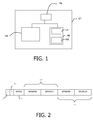
- FIG. 1 shows the architecture of a smart card as an example of an electronic token according to a preferred embodiment of the invention.
- the smart card ET contains a microprocessor MP, a communication interface IN and a flash memory ME.
- the flash memory ME contains a list area LA and a managed area MA.
- the memory ME may consist of a unique circuit or several circuits that may be of different types.
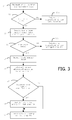
- each entry of the list area may have a structure comprising a state field SF, an availability field AF, a memory chunk identifier ID, a memory chunk length CL and a memory chunk offset CO.
- an entry is coded on five bytes.
- the availability field AF is coded on one bit indicating if the entry is unused or used. For example, 1 means that the entry is unused and 0 means that the entry is used.
- the state field SF may be coded on one bit indicating if the entry is valid or invalid. For example, 1 means that the entry is valid and 0 means that the entry is invalid.
- the memory chunk identifier ID may be coded on six bits. Each valid entry has a unique identifier.
- the memory chunk length CL corresponds to the size of the referenced free memory chunk.
- the memory chunk length CL may be coded on two bytes and the memory chunk offset CO may be coded on two bytes.
- the memory chunk offset CO corresponds to the offset where the referenced free memory chunk is located in the managed area MA.
- Figure 2 shows an example of a valid entry having a memory chunk identifier ID equal to 5, and referring a free memory chunk of 11 bytes at an offset of 38 bytes from the beginning of the managed area MA.
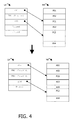
- Figure 3 shows an algorithm for managing allocation of space in flash memory according to the invention.
- a request of allocation is issued. This request contains a requested size.
- a check is done at step S2 to verify if the list area LA is not full and allows initializing a new entry.
- a scan of the list area LA is performed. For each entry, the availability field AF is first checked. If availability field AF is set to "used” value then a check is performed on the state field SF. If the state field SF is set to "valid” value, then a comparison is done between the memory chunk length CL and the requested size. The scan loops on the list area LA until a relevant entry is found or the end of the list area LA is reached.
- step S4 if no free memory chunk has been found then a request of compaction of the managed area MA is issued during step S11.
- the managed area MA may be highly fragmented and potentially contains many small free chunks.
- the found memory chunk is selected at step S5.
- step S6 a new allocated space having the requested size is identified in the selected chunk.
- a check is performed to verify if there is remaining free memory in the selected memory chunk that is not required for the new allocated memory space.
- step S2 may be performed after the step S7 if the size of the select chunk is higher than the requested size.
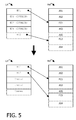
- the list area LA contains two valid entries EN1 and EN3 and one invalid entry EN2.
- the maximum number of entries of the list area is limited to five.
- the managed area MA contains two free memory chunks FC1 and FC2 are and four allocated memory spaces AS1, AS2, AS3 and AS4. If the second free chunk FC2 is selected at step S5, and if the selected free chunk has a size higher than the requested size, the first part of the selected chunk may be dedicated to the newly allocated space AS5 and the last part of the selected chunk remains a free memory chunk FC2.
- the old entry EN3 referencing the selected chunk FC2 is invalidated by changing the bit value of the state field SF to 0.
- a new entry EN4 is initialized in the list area LA by changing the bit value of the availability field AF to 0. This new entry EN4 references the remaining free chunk FC2 with a memory chunk length CL set to old FC2 length - requested size. The new entry EN4 has memory chunk offset CO set to old FC2 offset + requested size.
- Figure 5 shows an example of compaction of the list area LA.
- the list area LA contains two valid entries EN1 and EN5 and three invalid entries EN2, EN4 and EN4.
- the managed area MA contains two free memory chunks FC1 and FC2 are and five allocated memory spaces AS1, AS2, AS3, AS4 and AS5.
- the list area LA compaction may be made in a volatile buffer previously initialized to OxFF. Each valid entry is then loaded into the buffer and collapsed with others if necessary. During the loading operation, entries may be arranged by referenced offset in the ascending order. The free memory chunk identifier ID of each entry is modified to reflect its position in the ordered list. Then the buffer is finally flushed in the list area LA.
- the list area LA contains finally two valid entries EN1 and EN2 and no invalid entry.
- the managed area MA remains unchanged.
- the list area LA compaction avoids saturation problem due to the limited number of entries in the list area LA.
- a new free memory chunk identifier ID is computed so that the new free memory chunk identifier ID is higher than all existing free memory chunk identifiers.
- the new free memory chunk identifier ID is equal to the free memory chunk identifier ID corresponding to the previously existing free memory chunk. In other words, even if the size of a free memory chunk changes, the associated free memory chunk identifier ID remains unchanged.
- the consistency of the list area LA may be checked at the smart card reset or before accessing the list area LA. A scan of all valid entries is performed. If two valid entries own the same free memory chunk identifier ID then the valid entry which was initialized most recently in the list area LA must be considered as invalid. Consequently its validity indicator is cleared to 0. Such a check of the list area LA consistency allows avoiding wrong effects of a tear or a power cut.
- An advantage of the invention is to allow an allocation system that is designed to atomically allocate a new memory space.
- a unique basic programming operation allows validating the allocation of a memory space.
- an allocation system avoids opening a transaction for ensuring the coherence of the allocation system and for avoiding memory leaks in case of tearing.
- Another advantage of the invention is to allow the use of free memory chunks released during the garbage collection without requiring a compaction operation of the managed area.
Landscapes
- Engineering & Computer Science (AREA)
- Theoretical Computer Science (AREA)
- Physics & Mathematics (AREA)
- General Engineering & Computer Science (AREA)
- General Physics & Mathematics (AREA)
- Techniques For Improving Reliability Of Storages (AREA)
- Memory System (AREA)
Priority Applications (6)
| Application Number | Priority Date | Filing Date | Title |
|---|---|---|---|
| EP07301094A EP2000913A1 (en) | 2007-06-08 | 2007-06-08 | Method of managing flash memory allocation in an electronic token |
| PCT/IB2008/001397 WO2008149194A1 (en) | 2007-06-08 | 2008-05-30 | Method of managing flash memory allocation in an electroni token |
| US12/663,014 US8200937B2 (en) | 2007-06-08 | 2008-05-30 | Method of managing flash memory allocation in an electronic token |
| EP08776262.1A EP2156298B1 (en) | 2007-06-08 | 2008-05-30 | Method of managing flash memory allocation in an electroni token |
| NO08776262A NO2156298T3 (es) | 2007-06-08 | 2008-05-30 | |
| ES08776262.1T ES2671336T3 (es) | 2007-06-08 | 2008-05-30 | Método de gestión de la asignación de memoria flash en un token electrónico |
Applications Claiming Priority (1)
| Application Number | Priority Date | Filing Date | Title |
|---|---|---|---|
| EP07301094A EP2000913A1 (en) | 2007-06-08 | 2007-06-08 | Method of managing flash memory allocation in an electronic token |
Publications (1)
| Publication Number | Publication Date |
|---|---|
| EP2000913A1 true EP2000913A1 (en) | 2008-12-10 |
Family
ID=38565543
Family Applications (2)
| Application Number | Title | Priority Date | Filing Date |
|---|---|---|---|
| EP07301094A Withdrawn EP2000913A1 (en) | 2007-06-08 | 2007-06-08 | Method of managing flash memory allocation in an electronic token |
| EP08776262.1A Not-in-force EP2156298B1 (en) | 2007-06-08 | 2008-05-30 | Method of managing flash memory allocation in an electroni token |
Family Applications After (1)
| Application Number | Title | Priority Date | Filing Date |
|---|---|---|---|
| EP08776262.1A Not-in-force EP2156298B1 (en) | 2007-06-08 | 2008-05-30 | Method of managing flash memory allocation in an electroni token |
Country Status (5)
| Country | Link |
|---|---|
| US (1) | US8200937B2 (es) |
| EP (2) | EP2000913A1 (es) |
| ES (1) | ES2671336T3 (es) |
| NO (1) | NO2156298T3 (es) |
| WO (1) | WO2008149194A1 (es) |
Families Citing this family (1)
| Publication number | Priority date | Publication date | Assignee | Title |
|---|---|---|---|---|
| US11797344B2 (en) * | 2020-10-30 | 2023-10-24 | Red Hat, Inc. | Quiescent state-based reclaiming strategy for progressive chunked queue |
Citations (1)
| Publication number | Priority date | Publication date | Assignee | Title |
|---|---|---|---|---|
| WO2000049488A1 (en) * | 1999-02-17 | 2000-08-24 | Memory Corporation Plc | Memory system |
Family Cites Families (8)
| Publication number | Priority date | Publication date | Assignee | Title |
|---|---|---|---|---|
| US6182188B1 (en) * | 1997-04-06 | 2001-01-30 | Intel Corporation | Method of performing reliable updates in a symmetrically blocked nonvolatile memory having a bifurcated storage architecture |
| AUPP638698A0 (en) * | 1998-10-06 | 1998-10-29 | Canon Kabushiki Kaisha | Efficient memory allocator utilising a dual free-list structure |
| US6741593B1 (en) * | 1998-12-18 | 2004-05-25 | Cypress Semiconductor Corporation | Circuit architecture and method for displaying port status in data communications switching system |
| US20040001492A1 (en) * | 2002-07-01 | 2004-01-01 | Johnson Erik J. | Method and system for maintaining a MAC address filtering table |
| KR100725410B1 (ko) * | 2006-01-20 | 2007-06-07 | 삼성전자주식회사 | 전원 상태에 따라 비휘발성 메모리의 블록 회수를 수행하는장치 및 그 방법 |
| KR100706808B1 (ko) * | 2006-02-03 | 2007-04-12 | 삼성전자주식회사 | 쓰기 버퍼로서 동작하는 불 휘발성 메모리를 구비한 데이터저장 장치 및 그것의 블록 회수 방법 |
| US7610468B2 (en) * | 2006-10-26 | 2009-10-27 | Hewlett-Packard Development Company, L.P. | Modified buddy system memory allocation |
| US7716448B2 (en) * | 2007-02-28 | 2010-05-11 | Red Hat, Inc. | Page oriented memory management |
-
2007
- 2007-06-08 EP EP07301094A patent/EP2000913A1/en not_active Withdrawn
-
2008
- 2008-05-30 ES ES08776262.1T patent/ES2671336T3/es active Active
- 2008-05-30 US US12/663,014 patent/US8200937B2/en not_active Expired - Fee Related
- 2008-05-30 EP EP08776262.1A patent/EP2156298B1/en not_active Not-in-force
- 2008-05-30 WO PCT/IB2008/001397 patent/WO2008149194A1/en not_active Ceased
- 2008-05-30 NO NO08776262A patent/NO2156298T3/no unknown
Patent Citations (1)
| Publication number | Priority date | Publication date | Assignee | Title |
|---|---|---|---|---|
| WO2000049488A1 (en) * | 1999-02-17 | 2000-08-24 | Memory Corporation Plc | Memory system |
Also Published As
| Publication number | Publication date |
|---|---|
| US20100199030A1 (en) | 2010-08-05 |
| US8200937B2 (en) | 2012-06-12 |
| WO2008149194A1 (en) | 2008-12-11 |
| EP2156298A1 (en) | 2010-02-24 |
| EP2156298B1 (en) | 2017-12-27 |
| NO2156298T3 (es) | 2018-05-26 |
| ES2671336T3 (es) | 2018-06-06 |
Similar Documents
| Publication | Publication Date | Title |
|---|---|---|
| US7680977B2 (en) | Page and block management algorithm for NAND flash | |
| US7814265B2 (en) | Single sector write operation in flash memory | |
| KR100531192B1 (ko) | 비휘발성 메모리의 제어방법 | |
| US8180955B2 (en) | Computing systems and methods for managing flash memory device | |
| US7711923B2 (en) | Persistent flash memory mapping table | |
| EP2605142B1 (en) | Lba bitmap usage | |
| US7395384B2 (en) | Method and apparatus for maintaining data on non-volatile memory systems | |
| US7818492B2 (en) | Source and shadow wear-leveling method and apparatus | |
| US20110302224A1 (en) | Data storage device with preloaded content | |
| US11199983B2 (en) | Apparatus for obsolete mapping counting in NAND-based storage devices | |
| US20070016721A1 (en) | Flash file system power-up by using sequential sector allocation | |
| US20120246397A1 (en) | Storage device management device and method for managing storage device | |
| US7681008B2 (en) | Systems for managing file allocation table information | |
| US20120095966A1 (en) | Method for using an otp storage device | |
| US20080082774A1 (en) | Methods of Managing File Allocation Table Information | |
| EP2264602A1 (en) | Memory device for managing the recovery of a non volatile memory | |
| US8068363B2 (en) | Flash memory apparatus and read operation control method therefor | |
| US7167964B1 (en) | Memory defragmentation in chipcards | |
| EP2156298B1 (en) | Method of managing flash memory allocation in an electroni token | |
| US8250285B2 (en) | Non-volatile dual memory die for data storage devices | |
| KR100622113B1 (ko) | 데이터베이스 시스템을 위한 플래쉬 메모리 저장 시스템 및그 방법 | |
| KR20260018542A (ko) | 스토리지 시스템 및 그 동작 방법 | |
| US20110173375A1 (en) | Method for enhancing file system performance, and associated memory device and controller thereof | |
| JP2010026794A (ja) | メモリ制御装置及び方法、コンピュータプログラム |
Legal Events
| Date | Code | Title | Description |
|---|---|---|---|
| PUAI | Public reference made under article 153(3) epc to a published international application that has entered the european phase |
Free format text: ORIGINAL CODE: 0009012 |
|
| AK | Designated contracting states |
Kind code of ref document: A1 Designated state(s): AT BE BG CH CY CZ DE DK EE ES FI FR GB GR HU IE IS IT LI LT LU LV MC MT NL PL PT RO SE SI SK TR |
|
| AX | Request for extension of the european patent |
Extension state: AL BA HR MK RS |
|
| AKX | Designation fees paid | ||
| REG | Reference to a national code |
Ref country code: DE Ref legal event code: 8566 |
|
| STAA | Information on the status of an ep patent application or granted ep patent |
Free format text: STATUS: THE APPLICATION IS DEEMED TO BE WITHDRAWN |
|
| 18D | Application deemed to be withdrawn |
Effective date: 20090611 |