EP1999112B1 - Substituierte 2-amino-4-phenyl-dihydrochinoline, verfahren zu ihrer herstellung, ihre verwendung als medikament, sowie sie enthaltendes medikament - Google Patents
Substituierte 2-amino-4-phenyl-dihydrochinoline, verfahren zu ihrer herstellung, ihre verwendung als medikament, sowie sie enthaltendes medikament Download PDFInfo
- Publication number
- EP1999112B1 EP1999112B1 EP07723091.0A EP07723091A EP1999112B1 EP 1999112 B1 EP1999112 B1 EP 1999112B1 EP 07723091 A EP07723091 A EP 07723091A EP 1999112 B1 EP1999112 B1 EP 1999112B1
- Authority
- EP
- European Patent Office
- Prior art keywords
- hydrogen
- atoms
- independently
- formula
- alkyl
- Prior art date
- Legal status (The legal status is an assumption and is not a legal conclusion. Google has not performed a legal analysis and makes no representation as to the accuracy of the status listed.)
- Not-in-force
Links
- 239000003814 drug Substances 0.000 title claims description 57
- 238000004519 manufacturing process Methods 0.000 title claims description 18
- 238000000034 method Methods 0.000 title description 10
- RVPJRPIMNBVXEE-UHFFFAOYSA-N 4-phenyl-1,2-dihydroquinolin-2-amine Chemical class C=1C(N)NC2=CC=CC=C2C=1C1=CC=CC=C1 RVPJRPIMNBVXEE-UHFFFAOYSA-N 0.000 title description 2
- 150000001875 compounds Chemical class 0.000 claims description 131
- 239000001257 hydrogen Substances 0.000 claims description 118
- 229910052739 hydrogen Inorganic materials 0.000 claims description 118
- UFHFLCQGNIYNRP-UHFFFAOYSA-N Hydrogen Chemical compound [H][H] UFHFLCQGNIYNRP-UHFFFAOYSA-N 0.000 claims description 98
- 125000004432 carbon atom Chemical group C* 0.000 claims description 69
- 125000000217 alkyl group Chemical group 0.000 claims description 65
- 238000011282 treatment Methods 0.000 claims description 59
- 125000002496 methyl group Chemical group [H]C([H])([H])* 0.000 claims description 56
- 150000002431 hydrogen Chemical class 0.000 claims description 47
- 239000000460 chlorine Substances 0.000 claims description 46
- 208000037265 diseases, disorders, signs and symptoms Diseases 0.000 claims description 38
- 125000000753 cycloalkyl group Chemical group 0.000 claims description 31
- 150000003839 salts Chemical class 0.000 claims description 31
- 229910052801 chlorine Inorganic materials 0.000 claims description 24
- 125000001495 ethyl group Chemical group [H]C([H])([H])C([H])([H])* 0.000 claims description 24
- -1 CF3-CH2- Chemical group 0.000 claims description 23
- 201000010099 disease Diseases 0.000 claims description 23
- 229910052731 fluorine Inorganic materials 0.000 claims description 23
- 230000000302 ischemic effect Effects 0.000 claims description 17
- 229910052760 oxygen Inorganic materials 0.000 claims description 17
- 229910052794 bromium Inorganic materials 0.000 claims description 16
- 230000001154 acute effect Effects 0.000 claims description 15
- 208000035475 disorder Diseases 0.000 claims description 15
- 206010012601 diabetes mellitus Diseases 0.000 claims description 14
- 229910052757 nitrogen Inorganic materials 0.000 claims description 14
- 125000004433 nitrogen atom Chemical group N* 0.000 claims description 14
- 210000000056 organ Anatomy 0.000 claims description 14
- 125000004214 1-pyrrolidinyl group Chemical group [H]C1([H])N(*)C([H])([H])C([H])([H])C1([H])[H] 0.000 claims description 13
- 230000006378 damage Effects 0.000 claims description 13
- 239000001301 oxygen Substances 0.000 claims description 13
- 125000000587 piperidin-1-yl group Chemical group [H]C1([H])N(*)C([H])([H])C([H])([H])C([H])([H])C1([H])[H] 0.000 claims description 13
- DTQVDTLACAAQTR-UHFFFAOYSA-N Trifluoroacetic acid Chemical class OC(=O)C(F)(F)F DTQVDTLACAAQTR-UHFFFAOYSA-N 0.000 claims description 12
- 201000001320 Atherosclerosis Diseases 0.000 claims description 11
- 208000023504 respiratory system disease Diseases 0.000 claims description 11
- 125000001424 substituent group Chemical group 0.000 claims description 11
- 239000004480 active ingredient Substances 0.000 claims description 10
- 208000020832 chronic kidney disease Diseases 0.000 claims description 10
- 238000011321 prophylaxis Methods 0.000 claims description 10
- 206010048554 Endothelial dysfunction Diseases 0.000 claims description 9
- QVGXLLKOCUKJST-UHFFFAOYSA-N atomic oxygen Chemical compound [O] QVGXLLKOCUKJST-UHFFFAOYSA-N 0.000 claims description 9
- 230000008694 endothelial dysfunction Effects 0.000 claims description 9
- 125000001997 phenyl group Chemical group [H]C1=C([H])C([H])=C(*)C([H])=C1[H] 0.000 claims description 9
- 230000002829 reductive effect Effects 0.000 claims description 9
- XNFKIDRFTVHDDU-UHFFFAOYSA-N 4-(4-aminophenyl)-6-chloro-n,n-diethyl-3,4-dihydroquinolin-2-amine Chemical compound C1C(N(CC)CC)=NC2=CC=C(Cl)C=C2C1C1=CC=C(N)C=C1 XNFKIDRFTVHDDU-UHFFFAOYSA-N 0.000 claims description 8
- 210000003169 central nervous system Anatomy 0.000 claims description 8
- 125000001449 isopropyl group Chemical group [H]C([H])([H])C([H])(*)C([H])([H])[H] 0.000 claims description 8
- 230000010410 reperfusion Effects 0.000 claims description 8
- 230000000241 respiratory effect Effects 0.000 claims description 8
- 206010020772 Hypertension Diseases 0.000 claims description 7
- 206010041235 Snoring Diseases 0.000 claims description 7
- 208000022831 chronic renal failure syndrome Diseases 0.000 claims description 7
- 125000002147 dimethylamino group Chemical group [H]C([H])([H])N(*)C([H])([H])[H] 0.000 claims description 7
- 230000002093 peripheral effect Effects 0.000 claims description 7
- 201000002859 sleep apnea Diseases 0.000 claims description 7
- 208000009304 Acute Kidney Injury Diseases 0.000 claims description 6
- 208000033626 Renal failure acute Diseases 0.000 claims description 6
- NINIDFKCEFEMDL-UHFFFAOYSA-N Sulfur Chemical compound [S] NINIDFKCEFEMDL-UHFFFAOYSA-N 0.000 claims description 6
- 208000007536 Thrombosis Diseases 0.000 claims description 6
- 201000011040 acute kidney failure Diseases 0.000 claims description 6
- 230000001684 chronic effect Effects 0.000 claims description 6
- 230000006870 function Effects 0.000 claims description 6
- 125000000956 methoxy group Chemical group [H]C([H])([H])O* 0.000 claims description 6
- 125000000250 methylamino group Chemical group [H]N(*)C([H])([H])[H] 0.000 claims description 6
- 238000001356 surgical procedure Methods 0.000 claims description 6
- 208000012998 acute renal failure Diseases 0.000 claims description 5
- 230000004663 cell proliferation Effects 0.000 claims description 5
- 208000015114 central nervous system disease Diseases 0.000 claims description 5
- 230000036541 health Effects 0.000 claims description 5
- 125000005322 morpholin-1-yl group Chemical group 0.000 claims description 5
- 230000000144 pharmacologic effect Effects 0.000 claims description 5
- 230000035939 shock Effects 0.000 claims description 5
- JQONDQREBJKNMO-UHFFFAOYSA-N 4-(4-aminophenyl)-6-chloro-3,4-dihydroquinolin-2-amine Chemical compound C1C(N)=NC2=CC=C(Cl)C=C2C1C1=CC=C(N)C=C1 JQONDQREBJKNMO-UHFFFAOYSA-N 0.000 claims description 4
- HBEVCNAMZMUGCG-UHFFFAOYSA-N 4-(4-aminophenyl)-6-chloro-n-ethyl-3,4-dihydroquinolin-2-amine Chemical compound C1C(NCC)=NC2=CC=C(Cl)C=C2C1C1=CC=C(N)C=C1 HBEVCNAMZMUGCG-UHFFFAOYSA-N 0.000 claims description 4
- 208000019901 Anxiety disease Diseases 0.000 claims description 4
- 208000007530 Essential hypertension Diseases 0.000 claims description 4
- PXGOKWXKJXAPGV-UHFFFAOYSA-N Fluorine Chemical compound FF PXGOKWXKJXAPGV-UHFFFAOYSA-N 0.000 claims description 4
- 208000028017 Psychotic disease Diseases 0.000 claims description 4
- 230000009692 acute damage Effects 0.000 claims description 4
- MDFFNEOEWAXZRQ-UHFFFAOYSA-N aminyl Chemical compound [NH2] MDFFNEOEWAXZRQ-UHFFFAOYSA-N 0.000 claims description 4
- 230000009693 chronic damage Effects 0.000 claims description 4
- 239000011737 fluorine Substances 0.000 claims description 4
- 230000003871 intestinal function Effects 0.000 claims description 4
- 229910052740 iodine Inorganic materials 0.000 claims description 4
- 208000017169 kidney disease Diseases 0.000 claims description 4
- 201000004792 malaria Diseases 0.000 claims description 4
- GRVDJDISBSALJP-UHFFFAOYSA-N methyloxidanyl Chemical compound [O]C GRVDJDISBSALJP-UHFFFAOYSA-N 0.000 claims description 4
- 238000003860 storage Methods 0.000 claims description 4
- 229910052717 sulfur Inorganic materials 0.000 claims description 4
- 239000011593 sulfur Substances 0.000 claims description 4
- 208000020401 Depressive disease Diseases 0.000 claims description 3
- 206010061217 Infestation Diseases 0.000 claims description 3
- 208000007101 Muscle Cramp Diseases 0.000 claims description 3
- 208000005392 Spasm Diseases 0.000 claims description 3
- XSQUKJJJFZCRTK-UHFFFAOYSA-N Urea Chemical compound NC(N)=O XSQUKJJJFZCRTK-UHFFFAOYSA-N 0.000 claims description 3
- 244000078703 ectoparasite Species 0.000 claims description 3
- 206010015037 epilepsy Diseases 0.000 claims description 3
- 230000037356 lipid metabolism Effects 0.000 claims description 3
- 210000001428 peripheral nervous system Anatomy 0.000 claims description 3
- 239000000825 pharmaceutical preparation Substances 0.000 claims description 3
- 238000004321 preservation Methods 0.000 claims description 3
- 238000002054 transplantation Methods 0.000 claims description 3
- 230000006735 deficit Effects 0.000 claims 11
- ZAMOUSCENKQFHK-UHFFFAOYSA-N Chlorine atom Chemical compound [Cl] ZAMOUSCENKQFHK-UHFFFAOYSA-N 0.000 claims 2
- 125000002023 trifluoromethyl group Chemical group FC(F)(F)* 0.000 claims 2
- 208000024827 Alzheimer disease Diseases 0.000 claims 1
- 206010012289 Dementia Diseases 0.000 claims 1
- 239000004202 carbamide Substances 0.000 claims 1
- 230000003412 degenerative effect Effects 0.000 claims 1
- XEKOWRVHYACXOJ-UHFFFAOYSA-N Ethyl acetate Chemical compound CCOC(C)=O XEKOWRVHYACXOJ-UHFFFAOYSA-N 0.000 description 57
- 239000003112 inhibitor Substances 0.000 description 52
- 102100022897 Sodium/hydrogen exchanger 10 Human genes 0.000 description 41
- 230000002265 prevention Effects 0.000 description 27
- XLYOFNOQVPJJNP-UHFFFAOYSA-N water Substances O XLYOFNOQVPJJNP-UHFFFAOYSA-N 0.000 description 23
- YMWUJEATGCHHMB-UHFFFAOYSA-N Dichloromethane Chemical compound ClCCl YMWUJEATGCHHMB-UHFFFAOYSA-N 0.000 description 21
- LFQSCWFLJHTTHZ-UHFFFAOYSA-N Ethanol Chemical compound CCO LFQSCWFLJHTTHZ-UHFFFAOYSA-N 0.000 description 21
- HEMHJVSKTPXQMS-UHFFFAOYSA-M Sodium hydroxide Chemical compound [OH-].[Na+] HEMHJVSKTPXQMS-UHFFFAOYSA-M 0.000 description 21
- 239000002904 solvent Substances 0.000 description 21
- 239000000203 mixture Substances 0.000 description 20
- VEXZGXHMUGYJMC-UHFFFAOYSA-N Hydrochloric acid Chemical compound Cl VEXZGXHMUGYJMC-UHFFFAOYSA-N 0.000 description 19
- OKKJLVBELUTLKV-UHFFFAOYSA-N Methanol Chemical compound OC OKKJLVBELUTLKV-UHFFFAOYSA-N 0.000 description 15
- XEEYBQQBJWHFJM-UHFFFAOYSA-N Iron Chemical compound [Fe] XEEYBQQBJWHFJM-UHFFFAOYSA-N 0.000 description 13
- 125000004435 hydrogen atom Chemical group [H]* 0.000 description 13
- 239000000243 solution Substances 0.000 description 13
- RWRDLPDLKQPQOW-UHFFFAOYSA-N Pyrrolidine Chemical compound C1CCNC1 RWRDLPDLKQPQOW-UHFFFAOYSA-N 0.000 description 12
- 210000004027 cell Anatomy 0.000 description 12
- IMNFDUFMRHMDMM-UHFFFAOYSA-N N-Heptane Chemical compound CCCCCCC IMNFDUFMRHMDMM-UHFFFAOYSA-N 0.000 description 11
- 239000000047 product Substances 0.000 description 11
- 108091006649 SLC9A3 Proteins 0.000 description 10
- 102100030375 Sodium/hydrogen exchanger 3 Human genes 0.000 description 10
- 229940079593 drug Drugs 0.000 description 10
- 239000011734 sodium Substances 0.000 description 10
- WFDIJRYMOXRFFG-UHFFFAOYSA-N Acetic anhydride Chemical compound CC(=O)OC(C)=O WFDIJRYMOXRFFG-UHFFFAOYSA-N 0.000 description 9
- WEVYAHXRMPXWCK-UHFFFAOYSA-N Acetonitrile Chemical compound CC#N WEVYAHXRMPXWCK-UHFFFAOYSA-N 0.000 description 9
- 239000000126 substance Substances 0.000 description 9
- QGZKDVFQNNGYKY-UHFFFAOYSA-N Ammonia Chemical compound N QGZKDVFQNNGYKY-UHFFFAOYSA-N 0.000 description 8
- 206010019280 Heart failures Diseases 0.000 description 8
- 238000003820 Medium-pressure liquid chromatography Methods 0.000 description 8
- 239000000872 buffer Substances 0.000 description 8
- WJRBRSLFGCUECM-UHFFFAOYSA-N hydantoin Chemical compound O=C1CNC(=O)N1 WJRBRSLFGCUECM-UHFFFAOYSA-N 0.000 description 8
- 230000001965 increasing effect Effects 0.000 description 8
- 238000002360 preparation method Methods 0.000 description 8
- QTBSBXVTEAMEQO-UHFFFAOYSA-N Acetic acid Chemical compound CC(O)=O QTBSBXVTEAMEQO-UHFFFAOYSA-N 0.000 description 7
- 239000005557 antagonist Substances 0.000 description 7
- 208000028867 ischemia Diseases 0.000 description 7
- 238000011084 recovery Methods 0.000 description 7
- 206010007559 Cardiac failure congestive Diseases 0.000 description 6
- NQRYJNQNLNOLGT-UHFFFAOYSA-N Piperidine Chemical compound C1CCNCC1 NQRYJNQNLNOLGT-UHFFFAOYSA-N 0.000 description 6
- YXFVVABEGXRONW-UHFFFAOYSA-N Toluene Chemical compound CC1=CC=CC=C1 YXFVVABEGXRONW-UHFFFAOYSA-N 0.000 description 6
- DTQVDTLACAAQTR-UHFFFAOYSA-M Trifluoroacetate Chemical compound [O-]C(=O)C(F)(F)F DTQVDTLACAAQTR-UHFFFAOYSA-M 0.000 description 6
- 239000003795 chemical substances by application Substances 0.000 description 6
- 230000009467 reduction Effects 0.000 description 6
- KZNICNPSHKQLFF-UHFFFAOYSA-N succinimide Chemical compound O=C1CCC(=O)N1 KZNICNPSHKQLFF-UHFFFAOYSA-N 0.000 description 6
- WQZGKKKJIJFFOK-GASJEMHNSA-N Glucose Natural products OC[C@H]1OC(O)[C@H](O)[C@@H](O)[C@@H]1O WQZGKKKJIJFFOK-GASJEMHNSA-N 0.000 description 5
- 206010061216 Infarction Diseases 0.000 description 5
- 231100000433 cytotoxic Toxicity 0.000 description 5
- 230000001472 cytotoxic effect Effects 0.000 description 5
- 239000008103 glucose Substances 0.000 description 5
- 230000007574 infarction Effects 0.000 description 5
- 230000004043 responsiveness Effects 0.000 description 5
- 238000003756 stirring Methods 0.000 description 5
- XKRFYHLGVUSROY-UHFFFAOYSA-N Argon Chemical compound [Ar] XKRFYHLGVUSROY-UHFFFAOYSA-N 0.000 description 4
- MYMOFIZGZYHOMD-UHFFFAOYSA-N Dioxygen Chemical compound O=O MYMOFIZGZYHOMD-UHFFFAOYSA-N 0.000 description 4
- 208000035150 Hypercholesterolemia Diseases 0.000 description 4
- DGAQECJNVWCQMB-PUAWFVPOSA-M Ilexoside XXIX Chemical compound C[C@@H]1CC[C@@]2(CC[C@@]3(C(=CC[C@H]4[C@]3(CC[C@@H]5[C@@]4(CC[C@@H](C5(C)C)OS(=O)(=O)[O-])C)C)[C@@H]2[C@]1(C)O)C)C(=O)O[C@H]6[C@@H]([C@H]([C@@H]([C@H](O6)CO)O)O)O.[Na+] DGAQECJNVWCQMB-PUAWFVPOSA-M 0.000 description 4
- AFVFQIVMOAPDHO-UHFFFAOYSA-N Methanesulfonic acid Chemical compound CS(O)(=O)=O AFVFQIVMOAPDHO-UHFFFAOYSA-N 0.000 description 4
- YNAVUWVOSKDBBP-UHFFFAOYSA-N Morpholine Chemical compound C1COCCN1 YNAVUWVOSKDBBP-UHFFFAOYSA-N 0.000 description 4
- RHYBFKMFHLPQPH-UHFFFAOYSA-N N-methylhydantoin Chemical compound CN1CC(=O)NC1=O RHYBFKMFHLPQPH-UHFFFAOYSA-N 0.000 description 4
- GLUUGHFHXGJENI-UHFFFAOYSA-N Piperazine Chemical compound C1CNCCN1 GLUUGHFHXGJENI-UHFFFAOYSA-N 0.000 description 4
- FAPWRFPIFSIZLT-UHFFFAOYSA-M Sodium chloride Chemical compound [Na+].[Cl-] FAPWRFPIFSIZLT-UHFFFAOYSA-M 0.000 description 4
- 208000006011 Stroke Diseases 0.000 description 4
- 239000002253 acid Substances 0.000 description 4
- 230000009471 action Effects 0.000 description 4
- 230000003178 anti-diabetic effect Effects 0.000 description 4
- 229940027991 antiseptic and disinfectant quinoline derivative Drugs 0.000 description 4
- 238000006243 chemical reaction Methods 0.000 description 4
- 230000000694 effects Effects 0.000 description 4
- 230000002349 favourable effect Effects 0.000 description 4
- 230000002401 inhibitory effect Effects 0.000 description 4
- NOESYZHRGYRDHS-UHFFFAOYSA-N insulin Chemical compound N1C(=O)C(NC(=O)C(CCC(N)=O)NC(=O)C(CCC(O)=O)NC(=O)C(C(C)C)NC(=O)C(NC(=O)CN)C(C)CC)CSSCC(C(NC(CO)C(=O)NC(CC(C)C)C(=O)NC(CC=2C=CC(O)=CC=2)C(=O)NC(CCC(N)=O)C(=O)NC(CC(C)C)C(=O)NC(CCC(O)=O)C(=O)NC(CC(N)=O)C(=O)NC(CC=2C=CC(O)=CC=2)C(=O)NC(CSSCC(NC(=O)C(C(C)C)NC(=O)C(CC(C)C)NC(=O)C(CC=2C=CC(O)=CC=2)NC(=O)C(CC(C)C)NC(=O)C(C)NC(=O)C(CCC(O)=O)NC(=O)C(C(C)C)NC(=O)C(CC(C)C)NC(=O)C(CC=2NC=NC=2)NC(=O)C(CO)NC(=O)CNC2=O)C(=O)NCC(=O)NC(CCC(O)=O)C(=O)NC(CCCNC(N)=N)C(=O)NCC(=O)NC(CC=3C=CC=CC=3)C(=O)NC(CC=3C=CC=CC=3)C(=O)NC(CC=3C=CC(O)=CC=3)C(=O)NC(C(C)O)C(=O)N3C(CCC3)C(=O)NC(CCCCN)C(=O)NC(C)C(O)=O)C(=O)NC(CC(N)=O)C(O)=O)=O)NC(=O)C(C(C)CC)NC(=O)C(CO)NC(=O)C(C(C)O)NC(=O)C1CSSCC2NC(=O)C(CC(C)C)NC(=O)C(NC(=O)C(CCC(N)=O)NC(=O)C(CC(N)=O)NC(=O)C(NC(=O)C(N)CC=1C=CC=CC=1)C(C)C)CC1=CN=CN1 NOESYZHRGYRDHS-UHFFFAOYSA-N 0.000 description 4
- 230000000968 intestinal effect Effects 0.000 description 4
- MJGFBOZCAJSGQW-UHFFFAOYSA-N mercury sodium Chemical compound [Na].[Hg] MJGFBOZCAJSGQW-UHFFFAOYSA-N 0.000 description 4
- 239000000546 pharmaceutical excipient Substances 0.000 description 4
- 239000002244 precipitate Substances 0.000 description 4
- 230000001681 protective effect Effects 0.000 description 4
- HNJBEVLQSNELDL-UHFFFAOYSA-N pyrrolidin-2-one Chemical compound O=C1CCCN1 HNJBEVLQSNELDL-UHFFFAOYSA-N 0.000 description 4
- 150000003248 quinolines Chemical class 0.000 description 4
- 229910052708 sodium Inorganic materials 0.000 description 4
- 239000007787 solid Substances 0.000 description 4
- 239000012265 solid product Substances 0.000 description 4
- 239000000725 suspension Substances 0.000 description 4
- 238000002560 therapeutic procedure Methods 0.000 description 4
- 208000001072 type 2 diabetes mellitus Diseases 0.000 description 4
- JKMHFZQWWAIEOD-UHFFFAOYSA-N 2-[4-(2-hydroxyethyl)piperazin-1-yl]ethanesulfonic acid Chemical compound OCC[NH+]1CCN(CCS([O-])(=O)=O)CC1 JKMHFZQWWAIEOD-UHFFFAOYSA-N 0.000 description 3
- DNNVRTZJRKIUFK-UHFFFAOYSA-N 3,4-dihydroquinoline Chemical class C1=CC=C2N=CCCC2=C1 DNNVRTZJRKIUFK-UHFFFAOYSA-N 0.000 description 3
- ISUFXLXYKMWOMM-UHFFFAOYSA-N 6-chloro-n-ethyl-4-(4-nitrophenyl)quinolin-2-amine Chemical compound C=12C=C(Cl)C=CC2=NC(NCC)=CC=1C1=CC=C([N+]([O-])=O)C=C1 ISUFXLXYKMWOMM-UHFFFAOYSA-N 0.000 description 3
- 208000030090 Acute Disease Diseases 0.000 description 3
- PEDCQBHIVMGVHV-UHFFFAOYSA-N Glycerine Chemical compound OCC(O)CO PEDCQBHIVMGVHV-UHFFFAOYSA-N 0.000 description 3
- 206010021143 Hypoxia Diseases 0.000 description 3
- 102000052126 Sodium-Hydrogen Exchangers Human genes 0.000 description 3
- 108091006672 Sodium–hydrogen antiporter Proteins 0.000 description 3
- ZMANZCXQSJIPKH-UHFFFAOYSA-N Triethylamine Chemical compound CCN(CC)CC ZMANZCXQSJIPKH-UHFFFAOYSA-N 0.000 description 3
- BZKPWHYZMXOIDC-UHFFFAOYSA-N acetazolamide Chemical compound CC(=O)NC1=NN=C(S(N)(=O)=O)S1 BZKPWHYZMXOIDC-UHFFFAOYSA-N 0.000 description 3
- 229960000571 acetazolamide Drugs 0.000 description 3
- 229960000583 acetic acid Drugs 0.000 description 3
- 150000001412 amines Chemical class 0.000 description 3
- 125000003277 amino group Chemical group 0.000 description 3
- 229910021529 ammonia Inorganic materials 0.000 description 3
- 239000003472 antidiabetic agent Substances 0.000 description 3
- 210000000941 bile Anatomy 0.000 description 3
- 230000001413 cellular effect Effects 0.000 description 3
- KRKNYBCHXYNGOX-UHFFFAOYSA-N citric acid Chemical compound OC(=O)CC(O)(C(O)=O)CC(O)=O KRKNYBCHXYNGOX-UHFFFAOYSA-N 0.000 description 3
- 238000000354 decomposition reaction Methods 0.000 description 3
- 230000001419 dependent effect Effects 0.000 description 3
- 208000037765 diseases and disorders Diseases 0.000 description 3
- 239000002552 dosage form Substances 0.000 description 3
- 239000003995 emulsifying agent Substances 0.000 description 3
- 230000002757 inflammatory effect Effects 0.000 description 3
- 230000003834 intracellular effect Effects 0.000 description 3
- KJTDXVXGOMJXNQ-UHFFFAOYSA-N n-[6-chloro-4-(4-nitrophenyl)quinolin-2-yl]acetamide Chemical compound C=12C=C(Cl)C=CC2=NC(NC(=O)C)=CC=1C1=CC=C([N+]([O-])=O)C=C1 KJTDXVXGOMJXNQ-UHFFFAOYSA-N 0.000 description 3
- 239000003921 oil Substances 0.000 description 3
- 235000019198 oils Nutrition 0.000 description 3
- 230000001717 pathogenic effect Effects 0.000 description 3
- 238000010992 reflux Methods 0.000 description 3
- 229910001023 sodium amalgam Inorganic materials 0.000 description 3
- 230000001960 triggered effect Effects 0.000 description 3
- PVOAHINGSUIXLS-UHFFFAOYSA-N 1-Methylpiperazine Chemical compound CN1CCNCC1 PVOAHINGSUIXLS-UHFFFAOYSA-N 0.000 description 2
- UUUHXMGGBIUAPW-UHFFFAOYSA-N 1-[1-[2-[[5-amino-2-[[1-[5-(diaminomethylideneamino)-2-[[1-[3-(1h-indol-3-yl)-2-[(5-oxopyrrolidine-2-carbonyl)amino]propanoyl]pyrrolidine-2-carbonyl]amino]pentanoyl]pyrrolidine-2-carbonyl]amino]-5-oxopentanoyl]amino]-3-methylpentanoyl]pyrrolidine-2-carbon Chemical compound C1CCC(C(=O)N2C(CCC2)C(O)=O)N1C(=O)C(C(C)CC)NC(=O)C(CCC(N)=O)NC(=O)C1CCCN1C(=O)C(CCCN=C(N)N)NC(=O)C1CCCN1C(=O)C(CC=1C2=CC=CC=C2NC=1)NC(=O)C1CCC(=O)N1 UUUHXMGGBIUAPW-UHFFFAOYSA-N 0.000 description 2
- JTPZTKBRUCILQD-UHFFFAOYSA-N 1-methylimidazolidin-2-one Chemical compound CN1CCNC1=O JTPZTKBRUCILQD-UHFFFAOYSA-N 0.000 description 2
- VGYLMOJQAHXYCK-UHFFFAOYSA-N 1-methylimidazolidine Chemical compound CN1CCNC1 VGYLMOJQAHXYCK-UHFFFAOYSA-N 0.000 description 2
- 125000003006 2-dimethylaminoethyl group Chemical group [H]C([H])([H])N(C([H])([H])[H])C([H])([H])C([H])([H])* 0.000 description 2
- LXHGBHJNBFMPJK-UHFFFAOYSA-N 4-(4-aminophenyl)-6-chloro-n,n-diethylquinolin-2-amine Chemical compound C=12C=C(Cl)C=CC2=NC(N(CC)CC)=CC=1C1=CC=C(N)C=C1 LXHGBHJNBFMPJK-UHFFFAOYSA-N 0.000 description 2
- ZYJKRLUFEHOYDS-UHFFFAOYSA-N 4-(4-aminophenyl)-6-chloro-n-ethylquinolin-2-amine Chemical compound C=12C=C(Cl)C=CC2=NC(NCC)=CC=1C1=CC=C(N)C=C1 ZYJKRLUFEHOYDS-UHFFFAOYSA-N 0.000 description 2
- HCWQYZDGLQHDPI-UHFFFAOYSA-N 4-(4-aminophenyl)-6-chloroquinolin-2-amine Chemical compound C1=CC(N)=CC=C1C1=CC(N)=NC2=CC=C(Cl)C=C12 HCWQYZDGLQHDPI-UHFFFAOYSA-N 0.000 description 2
- ZAVHPPBSMGSTHT-UHFFFAOYSA-N 6-chloro-4-phenylquinolin-2-amine Chemical compound C=12C=C(Cl)C=CC2=NC(N)=CC=1C1=CC=CC=C1 ZAVHPPBSMGSTHT-UHFFFAOYSA-N 0.000 description 2
- FVPQTVGBXSBNLL-UHFFFAOYSA-N 6-chloro-n,n-diethyl-4-(4-nitrophenyl)quinolin-2-amine Chemical compound C=12C=C(Cl)C=CC2=NC(N(CC)CC)=CC=1C1=CC=C([N+]([O-])=O)C=C1 FVPQTVGBXSBNLL-UHFFFAOYSA-N 0.000 description 2
- 239000005541 ACE inhibitor Substances 0.000 description 2
- 206010001497 Agitation Diseases 0.000 description 2
- NLXLAEXVIDQMFP-UHFFFAOYSA-N Ammonium chloride Substances [NH4+].[Cl-] NLXLAEXVIDQMFP-UHFFFAOYSA-N 0.000 description 2
- VHUUQVKOLVNVRT-UHFFFAOYSA-N Ammonium hydroxide Chemical compound [NH4+].[OH-] VHUUQVKOLVNVRT-UHFFFAOYSA-N 0.000 description 2
- 206010003225 Arteriospasm coronary Diseases 0.000 description 2
- 206010004446 Benign prostatic hyperplasia Diseases 0.000 description 2
- 206010048962 Brain oedema Diseases 0.000 description 2
- 208000024172 Cardiovascular disease Diseases 0.000 description 2
- 102000006786 Chloride-Bicarbonate Antiporters Human genes 0.000 description 2
- 108010086832 Chloride-Bicarbonate Antiporters Proteins 0.000 description 2
- 208000017667 Chronic Disease Diseases 0.000 description 2
- 208000007342 Diabetic Nephropathies Diseases 0.000 description 2
- IAZDPXIOMUYVGZ-WFGJKAKNSA-N Dimethyl sulfoxide Chemical compound [2H]C([2H])([2H])S(=O)C([2H])([2H])[2H] IAZDPXIOMUYVGZ-WFGJKAKNSA-N 0.000 description 2
- VZCYOOQTPOCHFL-OWOJBTEDSA-N Fumaric acid Chemical compound OC(=O)\C=C\C(O)=O VZCYOOQTPOCHFL-OWOJBTEDSA-N 0.000 description 2
- 208000031226 Hyperlipidaemia Diseases 0.000 description 2
- WRYCSMQKUKOKBP-UHFFFAOYSA-N Imidazolidine Chemical compound C1CNCN1 WRYCSMQKUKOKBP-UHFFFAOYSA-N 0.000 description 2
- 102000004877 Insulin Human genes 0.000 description 2
- 108090001061 Insulin Proteins 0.000 description 2
- 206010022562 Intermittent claudication Diseases 0.000 description 2
- CPLXHLVBOLITMK-UHFFFAOYSA-N Magnesium oxide Chemical compound [Mg]=O CPLXHLVBOLITMK-UHFFFAOYSA-N 0.000 description 2
- OFOBLEOULBTSOW-UHFFFAOYSA-N Malonic acid Chemical compound OC(=O)CC(O)=O OFOBLEOULBTSOW-UHFFFAOYSA-N 0.000 description 2
- 206010028980 Neoplasm Diseases 0.000 description 2
- 102000004270 Peptidyl-Dipeptidase A Human genes 0.000 description 2
- 108090000882 Peptidyl-Dipeptidase A Proteins 0.000 description 2
- NBIIXXVUZAFLBC-UHFFFAOYSA-N Phosphoric acid Chemical compound OP(O)(O)=O NBIIXXVUZAFLBC-UHFFFAOYSA-N 0.000 description 2
- 102000004257 Potassium Channel Human genes 0.000 description 2
- 208000004403 Prostatic Hyperplasia Diseases 0.000 description 2
- JUJWROOIHBZHMG-UHFFFAOYSA-N Pyridine Chemical compound C1=CC=NC=C1 JUJWROOIHBZHMG-UHFFFAOYSA-N 0.000 description 2
- YASAKCUCGLMORW-UHFFFAOYSA-N Rosiglitazone Chemical compound C=1C=CC=NC=1N(C)CCOC(C=C1)=CC=C1CC1SC(=O)NC1=O YASAKCUCGLMORW-UHFFFAOYSA-N 0.000 description 2
- UIIMBOGNXHQVGW-UHFFFAOYSA-M Sodium bicarbonate Chemical compound [Na+].OC([O-])=O UIIMBOGNXHQVGW-UHFFFAOYSA-M 0.000 description 2
- QAOWNCQODCNURD-UHFFFAOYSA-N Sulfuric acid Chemical compound OS(O)(=O)=O QAOWNCQODCNURD-UHFFFAOYSA-N 0.000 description 2
- CIUQDSCDWFSTQR-UHFFFAOYSA-N [C]1=CC=CC=C1 Chemical compound [C]1=CC=CC=C1 CIUQDSCDWFSTQR-UHFFFAOYSA-N 0.000 description 2
- 230000002378 acidificating effect Effects 0.000 description 2
- 150000007513 acids Chemical class 0.000 description 2
- 239000012190 activator Substances 0.000 description 2
- 239000013543 active substance Substances 0.000 description 2
- 230000032683 aging Effects 0.000 description 2
- 150000001298 alcohols Chemical class 0.000 description 2
- 229910052783 alkali metal Inorganic materials 0.000 description 2
- 229910045601 alloy Inorganic materials 0.000 description 2
- 239000000956 alloy Substances 0.000 description 2
- 235000011114 ammonium hydroxide Nutrition 0.000 description 2
- 229940127282 angiotensin receptor antagonist Drugs 0.000 description 2
- 229940044094 angiotensin-converting-enzyme inhibitor Drugs 0.000 description 2
- 239000002260 anti-inflammatory agent Substances 0.000 description 2
- 229910052786 argon Inorganic materials 0.000 description 2
- 230000036523 atherogenesis Effects 0.000 description 2
- 230000001580 bacterial effect Effects 0.000 description 2
- 239000002585 base Substances 0.000 description 2
- 230000009286 beneficial effect Effects 0.000 description 2
- WQZGKKKJIJFFOK-VFUOTHLCSA-N beta-D-glucose Chemical compound OC[C@H]1O[C@@H](O)[C@H](O)[C@@H](O)[C@@H]1O WQZGKKKJIJFFOK-VFUOTHLCSA-N 0.000 description 2
- UWTDFICHZKXYAC-UHFFFAOYSA-N boron;oxolane Chemical compound [B].C1CCOC1 UWTDFICHZKXYAC-UHFFFAOYSA-N 0.000 description 2
- 208000006752 brain edema Diseases 0.000 description 2
- 239000000969 carrier Substances 0.000 description 2
- 125000001309 chloro group Chemical group Cl* 0.000 description 2
- HVYWMOMLDIMFJA-DPAQBDIFSA-N cholesterol Chemical compound C1C=C2C[C@@H](O)CC[C@]2(C)[C@@H]2[C@@H]1[C@@H]1CC[C@H]([C@H](C)CCCC(C)C)[C@@]1(C)CC2 HVYWMOMLDIMFJA-DPAQBDIFSA-N 0.000 description 2
- 238000004587 chromatography analysis Methods 0.000 description 2
- 210000004351 coronary vessel Anatomy 0.000 description 2
- 238000002425 crystallisation Methods 0.000 description 2
- 230000008025 crystallization Effects 0.000 description 2
- 238000001212 derivatisation Methods 0.000 description 2
- 238000011161 development Methods 0.000 description 2
- 230000018109 developmental process Effects 0.000 description 2
- 208000033679 diabetic kidney disease Diseases 0.000 description 2
- SBZXBUIDTXKZTM-UHFFFAOYSA-N diglyme Chemical compound COCCOCCOC SBZXBUIDTXKZTM-UHFFFAOYSA-N 0.000 description 2
- 239000000839 emulsion Substances 0.000 description 2
- 230000029142 excretion Effects 0.000 description 2
- 239000003527 fibrinolytic agent Substances 0.000 description 2
- 230000003176 fibrotic effect Effects 0.000 description 2
- 239000012362 glacial acetic acid Substances 0.000 description 2
- 229960004580 glibenclamide Drugs 0.000 description 2
- WIGIZIANZCJQQY-RUCARUNLSA-N glimepiride Chemical compound O=C1C(CC)=C(C)CN1C(=O)NCCC1=CC=C(S(=O)(=O)NC(=O)N[C@@H]2CC[C@@H](C)CC2)C=C1 WIGIZIANZCJQQY-RUCARUNLSA-N 0.000 description 2
- 229960004346 glimepiride Drugs 0.000 description 2
- ZNNLBTZKUZBEKO-UHFFFAOYSA-N glyburide Chemical compound COC1=CC=C(Cl)C=C1C(=O)NCCC1=CC=C(S(=O)(=O)NC(=O)NC2CCCCC2)C=C1 ZNNLBTZKUZBEKO-UHFFFAOYSA-N 0.000 description 2
- 230000000055 hyoplipidemic effect Effects 0.000 description 2
- 230000007954 hypoxia Effects 0.000 description 2
- YAMHXTCMCPHKLN-UHFFFAOYSA-N imidazolidin-2-one Chemical compound O=C1NCCN1 YAMHXTCMCPHKLN-UHFFFAOYSA-N 0.000 description 2
- 230000001939 inductive effect Effects 0.000 description 2
- 230000005764 inhibitory process Effects 0.000 description 2
- 229940125396 insulin Drugs 0.000 description 2
- 125000000959 isobutyl group Chemical group [H]C([H])([H])C([H])(C([H])([H])[H])C([H])([H])* 0.000 description 2
- JVTAAEKCZFNVCJ-UHFFFAOYSA-N lactic acid Chemical compound CC(O)C(O)=O JVTAAEKCZFNVCJ-UHFFFAOYSA-N 0.000 description 2
- 238000012423 maintenance Methods 0.000 description 2
- 230000007246 mechanism Effects 0.000 description 2
- 150000007522 mineralic acids Chemical class 0.000 description 2
- 230000003387 muscular Effects 0.000 description 2
- ITEDKSFQYYJLGA-UHFFFAOYSA-N n-(6-chloro-4-phenylquinolin-2-yl)acetamide Chemical compound C=12C=C(Cl)C=CC2=NC(NC(=O)C)=CC=1C1=CC=CC=C1 ITEDKSFQYYJLGA-UHFFFAOYSA-N 0.000 description 2
- ZAGLLJVXAACXOG-UHFFFAOYSA-N n-[6-chloro-4-(4-nitrophenyl)quinolin-2-yl]-n-ethylacetamide Chemical compound C=12C=C(Cl)C=CC2=NC(N(C(C)=O)CC)=CC=1C1=CC=C([N+]([O-])=O)C=C1 ZAGLLJVXAACXOG-UHFFFAOYSA-N 0.000 description 2
- 125000004108 n-butyl group Chemical group [H]C([H])([H])C([H])([H])C([H])([H])C([H])([H])* 0.000 description 2
- 125000000740 n-pentyl group Chemical group [H]C([H])([H])C([H])([H])C([H])([H])C([H])([H])C([H])([H])* 0.000 description 2
- 125000004123 n-propyl group Chemical group [H]C([H])([H])C([H])([H])C([H])([H])* 0.000 description 2
- 201000008383 nephritis Diseases 0.000 description 2
- 210000000653 nervous system Anatomy 0.000 description 2
- 238000006396 nitration reaction Methods 0.000 description 2
- 244000045947 parasite Species 0.000 description 2
- 230000001575 pathological effect Effects 0.000 description 2
- 239000008194 pharmaceutical composition Substances 0.000 description 2
- XHXFXVLFKHQFAL-UHFFFAOYSA-N phosphoryl trichloride Chemical compound ClP(Cl)(Cl)=O XHXFXVLFKHQFAL-UHFFFAOYSA-N 0.000 description 2
- HYAFETHFCAUJAY-UHFFFAOYSA-N pioglitazone Chemical compound N1=CC(CC)=CC=C1CCOC(C=C1)=CC=C1CC1C(=O)NC(=O)S1 HYAFETHFCAUJAY-UHFFFAOYSA-N 0.000 description 2
- 108020001213 potassium channel Proteins 0.000 description 2
- 230000003389 potentiating effect Effects 0.000 description 2
- 230000008569 process Effects 0.000 description 2
- 230000000750 progressive effect Effects 0.000 description 2
- 230000035755 proliferation Effects 0.000 description 2
- 102000004169 proteins and genes Human genes 0.000 description 2
- 108090000623 proteins and genes Proteins 0.000 description 2
- 239000011541 reaction mixture Substances 0.000 description 2
- 125000002914 sec-butyl group Chemical group [H]C([H])([H])C([H])([H])C([H])(*)C([H])([H])[H] 0.000 description 2
- 239000011780 sodium chloride Substances 0.000 description 2
- 239000003381 stabilizer Substances 0.000 description 2
- 239000003826 tablet Substances 0.000 description 2
- 125000000999 tert-butyl group Chemical group [H]C([H])([H])C(*)(C([H])([H])[H])C([H])([H])[H] 0.000 description 2
- 238000012360 testing method Methods 0.000 description 2
- 230000002885 thrombogenetic effect Effects 0.000 description 2
- 210000001519 tissue Anatomy 0.000 description 2
- JOXIMZWYDAKGHI-UHFFFAOYSA-N toluene-4-sulfonic acid Chemical class CC1=CC=C(S(O)(=O)=O)C=C1 JOXIMZWYDAKGHI-UHFFFAOYSA-N 0.000 description 2
- 231100000331 toxic Toxicity 0.000 description 2
- 230000002588 toxic effect Effects 0.000 description 2
- LWIHDJKSTIGBAC-UHFFFAOYSA-K tripotassium phosphate Chemical compound [K+].[K+].[K+].[O-]P([O-])([O-])=O LWIHDJKSTIGBAC-UHFFFAOYSA-K 0.000 description 2
- 230000002792 vascular Effects 0.000 description 2
- JWZZKOKVBUJMES-UHFFFAOYSA-N (+-)-Isoprenaline Chemical compound CC(C)NCC(O)C1=CC=C(O)C(O)=C1 JWZZKOKVBUJMES-UHFFFAOYSA-N 0.000 description 1
- ZUWXHHBROGLWNH-UHFFFAOYSA-N (2-amino-5-chlorophenyl)-phenylmethanone Chemical compound NC1=CC=C(Cl)C=C1C(=O)C1=CC=CC=C1 ZUWXHHBROGLWNH-UHFFFAOYSA-N 0.000 description 1
- BIDNLKIUORFRQP-XYGFDPSESA-N (2s,4s)-4-cyclohexyl-1-[2-[[(1s)-2-methyl-1-propanoyloxypropoxy]-(4-phenylbutyl)phosphoryl]acetyl]pyrrolidine-2-carboxylic acid Chemical compound C([P@@](=O)(O[C@H](OC(=O)CC)C(C)C)CC(=O)N1[C@@H](C[C@H](C1)C1CCCCC1)C(O)=O)CCCC1=CC=CC=C1 BIDNLKIUORFRQP-XYGFDPSESA-N 0.000 description 1
- PHDIJLFSKNMCMI-ITGJKDDRSA-N (3R,4S,5R,6R)-6-(hydroxymethyl)-4-(8-quinolin-6-yloxyoctoxy)oxane-2,3,5-triol Chemical compound OC[C@@H]1[C@H]([C@@H]([C@H](C(O1)O)O)OCCCCCCCCOC=1C=C2C=CC=NC2=CC=1)O PHDIJLFSKNMCMI-ITGJKDDRSA-N 0.000 description 1
- NXLNNXIXOYSCMB-UHFFFAOYSA-N (4-nitrophenyl) carbonochloridate Chemical compound [O-][N+](=O)C1=CC=C(OC(Cl)=O)C=C1 NXLNNXIXOYSCMB-UHFFFAOYSA-N 0.000 description 1
- UWYZHKAOTLEWKK-UHFFFAOYSA-N 1,2,3,4-tetrahydroisoquinoline Chemical class C1=CC=C2CNCCC2=C1 UWYZHKAOTLEWKK-UHFFFAOYSA-N 0.000 description 1
- IOEPOEDBBPRAEI-UHFFFAOYSA-N 1,2-dihydroisoquinoline Chemical group C1=CC=C2CNC=CC2=C1 IOEPOEDBBPRAEI-UHFFFAOYSA-N 0.000 description 1
- GEDOXVXHHYEWRS-UHFFFAOYSA-N 1-[4-[6-chloro-2-(diethylamino)-3,4-dihydroquinolin-4-yl]phenyl]-3-[2-(dimethylamino)ethyl]urea Chemical compound C1C(N(CC)CC)=NC2=CC=C(Cl)C=C2C1C1=CC=C(NC(=O)NCCN(C)C)C=C1 GEDOXVXHHYEWRS-UHFFFAOYSA-N 0.000 description 1
- 238000005160 1H NMR spectroscopy Methods 0.000 description 1
- KMHSUNDEGHRBNV-UHFFFAOYSA-N 2,4-dichloropyrimidine-5-carbonitrile Chemical compound ClC1=NC=C(C#N)C(Cl)=N1 KMHSUNDEGHRBNV-UHFFFAOYSA-N 0.000 description 1
- SGTNSNPWRIOYBX-UHFFFAOYSA-N 2-(3,4-dimethoxyphenyl)-5-{[2-(3,4-dimethoxyphenyl)ethyl](methyl)amino}-2-(propan-2-yl)pentanenitrile Chemical compound C1=C(OC)C(OC)=CC=C1CCN(C)CCCC(C#N)(C(C)C)C1=CC=C(OC)C(OC)=C1 SGTNSNPWRIOYBX-UHFFFAOYSA-N 0.000 description 1
- LDLCZOVUSADOIV-UHFFFAOYSA-N 2-bromoethanol Chemical compound OCCBr LDLCZOVUSADOIV-UHFFFAOYSA-N 0.000 description 1
- 239000001763 2-hydroxyethyl(trimethyl)azanium Substances 0.000 description 1
- MELYYJJKRWTTNN-UHFFFAOYSA-N 2-quinazolin-2-ylguanidine Chemical compound C1=CC=CC2=NC(NC(=N)N)=NC=C21 MELYYJJKRWTTNN-UHFFFAOYSA-N 0.000 description 1
- XJGLFHLKVFVPGJ-UHFFFAOYSA-N 4-(4-aminophenyl)-6-chloro-3,4-dihydroquinolin-2-amine;hydrochloride Chemical compound Cl.C1C(N)=NC2=CC=C(Cl)C=C2C1C1=CC=C(N)C=C1 XJGLFHLKVFVPGJ-UHFFFAOYSA-N 0.000 description 1
- WBOMSJNNIMJJJM-UHFFFAOYSA-N 4-(4-aminophenyl)-6-chloro-n,n-diethyl-3,4-dihydroquinolin-2-amine;hydrochloride Chemical compound Cl.C1C(N(CC)CC)=NC2=CC=C(Cl)C=C2C1C1=CC=C(N)C=C1 WBOMSJNNIMJJJM-UHFFFAOYSA-N 0.000 description 1
- SFKOBIIDCAGZIF-UHFFFAOYSA-N 4-(4-aminophenyl)-6-chloro-n-ethyl-3,4-dihydroquinolin-2-amine;hydrochloride Chemical compound Cl.C1C(NCC)=NC2=CC=C(Cl)C=C2C1C1=CC=C(N)C=C1 SFKOBIIDCAGZIF-UHFFFAOYSA-N 0.000 description 1
- SWLAMJPTOQZTAE-UHFFFAOYSA-N 4-[2-[(5-chloro-2-methoxybenzoyl)amino]ethyl]benzoic acid Chemical compound COC1=CC=C(Cl)C=C1C(=O)NCCC1=CC=C(C(O)=O)C=C1 SWLAMJPTOQZTAE-UHFFFAOYSA-N 0.000 description 1
- FCSKOFQQCWLGMV-UHFFFAOYSA-N 5-{5-[2-chloro-4-(4,5-dihydro-1,3-oxazol-2-yl)phenoxy]pentyl}-3-methylisoxazole Chemical compound O1N=C(C)C=C1CCCCCOC1=CC=C(C=2OCCN=2)C=C1Cl FCSKOFQQCWLGMV-UHFFFAOYSA-N 0.000 description 1
- BSYNRYMUTXBXSQ-FOQJRBATSA-N 59096-14-9 Chemical compound CC(=O)OC1=CC=CC=C1[14C](O)=O BSYNRYMUTXBXSQ-FOQJRBATSA-N 0.000 description 1
- 244000215068 Acacia senegal Species 0.000 description 1
- 208000010444 Acidosis Diseases 0.000 description 1
- 102000009027 Albumins Human genes 0.000 description 1
- 108010088751 Albumins Proteins 0.000 description 1
- PQSUYGKTWSAVDQ-ZVIOFETBSA-N Aldosterone Chemical compound C([C@@]1([C@@H](C(=O)CO)CC[C@H]1[C@@H]1CC2)C=O)[C@H](O)[C@@H]1[C@]1(C)C2=CC(=O)CC1 PQSUYGKTWSAVDQ-ZVIOFETBSA-N 0.000 description 1
- PQSUYGKTWSAVDQ-UHFFFAOYSA-N Aldosterone Natural products C1CC2C3CCC(C(=O)CO)C3(C=O)CC(O)C2C2(C)C1=CC(=O)CC2 PQSUYGKTWSAVDQ-UHFFFAOYSA-N 0.000 description 1
- GUBGYTABKSRVRQ-XLOQQCSPSA-N Alpha-Lactose Chemical compound O[C@@H]1[C@@H](O)[C@@H](O)[C@@H](CO)O[C@H]1O[C@@H]1[C@@H](CO)O[C@H](O)[C@H](O)[C@H]1O GUBGYTABKSRVRQ-XLOQQCSPSA-N 0.000 description 1
- 229910000497 Amalgam Inorganic materials 0.000 description 1
- 206010002383 Angina Pectoris Diseases 0.000 description 1
- 108050000824 Angiotensin II receptor Proteins 0.000 description 1
- 102000008873 Angiotensin II receptor Human genes 0.000 description 1
- 208000023275 Autoimmune disease Diseases 0.000 description 1
- 239000005552 B01AC04 - Clopidogrel Substances 0.000 description 1
- 239000005528 B01AC05 - Ticlopidine Substances 0.000 description 1
- BVKZGUZCCUSVTD-UHFFFAOYSA-M Bicarbonate Chemical compound OC([O-])=O BVKZGUZCCUSVTD-UHFFFAOYSA-M 0.000 description 1
- 229940123208 Biguanide Drugs 0.000 description 1
- XNCOSPRUTUOJCJ-UHFFFAOYSA-N Biguanide Chemical compound NC(N)=NC(N)=N XNCOSPRUTUOJCJ-UHFFFAOYSA-N 0.000 description 1
- CPELXLSAUQHCOX-UHFFFAOYSA-M Bromide Chemical compound [Br-] CPELXLSAUQHCOX-UHFFFAOYSA-M 0.000 description 1
- 239000002083 C09CA01 - Losartan Substances 0.000 description 1
- 239000004072 C09CA03 - Valsartan Substances 0.000 description 1
- 239000002947 C09CA04 - Irbesartan Substances 0.000 description 1
- 229940127291 Calcium channel antagonist Drugs 0.000 description 1
- 229940122072 Carbonic anhydrase inhibitor Drugs 0.000 description 1
- 108090000209 Carbonic anhydrases Proteins 0.000 description 1
- 102000003846 Carbonic anhydrases Human genes 0.000 description 1
- 206010007572 Cardiac hypertrophy Diseases 0.000 description 1
- 208000006029 Cardiomegaly Diseases 0.000 description 1
- 208000031229 Cardiomyopathies Diseases 0.000 description 1
- 206010048610 Cardiotoxicity Diseases 0.000 description 1
- 101150115876 Ccdc51 gene Proteins 0.000 description 1
- 208000003417 Central Sleep Apnea Diseases 0.000 description 1
- 108091006146 Channels Proteins 0.000 description 1
- VEXZGXHMUGYJMC-UHFFFAOYSA-M Chloride anion Chemical compound [Cl-] VEXZGXHMUGYJMC-UHFFFAOYSA-M 0.000 description 1
- JZUFKLXOESDKRF-UHFFFAOYSA-N Chlorothiazide Chemical compound C1=C(Cl)C(S(=O)(=O)N)=CC2=C1NCNS2(=O)=O JZUFKLXOESDKRF-UHFFFAOYSA-N 0.000 description 1
- 235000019743 Choline chloride Nutrition 0.000 description 1
- 208000003495 Coccidiosis Diseases 0.000 description 1
- 206010056370 Congestive cardiomyopathy Diseases 0.000 description 1
- 206010010774 Constipation Diseases 0.000 description 1
- 206010010904 Convulsion Diseases 0.000 description 1
- OCUCCJIRFHNWBP-IYEMJOQQSA-L Copper gluconate Chemical class [Cu+2].OC[C@@H](O)[C@@H](O)[C@H](O)[C@@H](O)C([O-])=O.OC[C@@H](O)[C@@H](O)[C@H](O)[C@@H](O)C([O-])=O OCUCCJIRFHNWBP-IYEMJOQQSA-L 0.000 description 1
- 229920002261 Corn starch Polymers 0.000 description 1
- 208000003890 Coronary Vasospasm Diseases 0.000 description 1
- FBPFZTCFMRRESA-KVTDHHQDSA-N D-Mannitol Chemical compound OC[C@@H](O)[C@@H](O)[C@H](O)[C@H](O)CO FBPFZTCFMRRESA-KVTDHHQDSA-N 0.000 description 1
- FEWJPZIEWOKRBE-JCYAYHJZSA-N Dextrotartaric acid Chemical compound OC(=O)[C@H](O)[C@@H](O)C(O)=O FEWJPZIEWOKRBE-JCYAYHJZSA-N 0.000 description 1
- 208000032131 Diabetic Neuropathies Diseases 0.000 description 1
- 208000032781 Diabetic cardiomyopathy Diseases 0.000 description 1
- 206010012689 Diabetic retinopathy Diseases 0.000 description 1
- ZAFNJMIOTHYJRJ-UHFFFAOYSA-N Diisopropyl ether Chemical compound CC(C)OC(C)C ZAFNJMIOTHYJRJ-UHFFFAOYSA-N 0.000 description 1
- 201000010046 Dilated cardiomyopathy Diseases 0.000 description 1
- 206010014476 Elevated cholesterol Diseases 0.000 description 1
- 108010061435 Enalapril Proteins 0.000 description 1
- 108050009340 Endothelin Proteins 0.000 description 1
- 102000002045 Endothelin Human genes 0.000 description 1
- 102000004190 Enzymes Human genes 0.000 description 1
- 108090000790 Enzymes Proteins 0.000 description 1
- 108010054265 Factor VIIa Proteins 0.000 description 1
- 108010074860 Factor Xa Proteins 0.000 description 1
- 241000287828 Gallus gallus Species 0.000 description 1
- 206010018367 Glomerulonephritis chronic Diseases 0.000 description 1
- 102000004366 Glucosidases Human genes 0.000 description 1
- 108010056771 Glucosidases Proteins 0.000 description 1
- 229920000084 Gum arabic Polymers 0.000 description 1
- 229940121710 HMGCoA reductase inhibitor Drugs 0.000 description 1
- 208000010496 Heart Arrest Diseases 0.000 description 1
- 206010020591 Hypercapnia Diseases 0.000 description 1
- 206010020880 Hypertrophy Diseases 0.000 description 1
- 208000001953 Hypotension Diseases 0.000 description 1
- 206010021137 Hypovolaemia Diseases 0.000 description 1
- 206010061218 Inflammation Diseases 0.000 description 1
- 206010022489 Insulin Resistance Diseases 0.000 description 1
- 229940122355 Insulin sensitizer Drugs 0.000 description 1
- 206010023076 Isosporiasis Diseases 0.000 description 1
- 102000016924 KATP Channels Human genes 0.000 description 1
- 108010053914 KATP Channels Proteins 0.000 description 1
- GUBGYTABKSRVRQ-QKKXKWKRSA-N Lactose Natural products OC[C@H]1O[C@@H](O[C@H]2[C@H](O)[C@@H](O)C(O)O[C@@H]2CO)[C@H](O)[C@@H](O)[C@H]1O GUBGYTABKSRVRQ-QKKXKWKRSA-N 0.000 description 1
- 208000007177 Left Ventricular Hypertrophy Diseases 0.000 description 1
- 102000004895 Lipoproteins Human genes 0.000 description 1
- 108090001030 Lipoproteins Proteins 0.000 description 1
- 108010007859 Lisinopril Proteins 0.000 description 1
- WHXSMMKQMYFTQS-UHFFFAOYSA-N Lithium Chemical compound [Li] WHXSMMKQMYFTQS-UHFFFAOYSA-N 0.000 description 1
- 208000019693 Lung disease Diseases 0.000 description 1
- 241000124008 Mammalia Species 0.000 description 1
- 229930195725 Mannitol Natural products 0.000 description 1
- 206010027417 Metabolic acidosis Diseases 0.000 description 1
- ZFMITUMMTDLWHR-UHFFFAOYSA-N Minoxidil Chemical compound NC1=[N+]([O-])C(N)=CC(N2CCCCC2)=N1 ZFMITUMMTDLWHR-UHFFFAOYSA-N 0.000 description 1
- PCZOHLXUXFIOCF-UHFFFAOYSA-N Monacolin X Natural products C12C(OC(=O)C(C)CC)CC(C)C=C2C=CC(C)C1CCC1CC(O)CC(=O)O1 PCZOHLXUXFIOCF-UHFFFAOYSA-N 0.000 description 1
- 108091006315 Na+/HCO3 − co-transport proteins Proteins 0.000 description 1
- 229910019142 PO4 Inorganic materials 0.000 description 1
- 229940126033 PPAR agonist Drugs 0.000 description 1
- 208000018262 Peripheral vascular disease Diseases 0.000 description 1
- UJEWTUDSLQGTOA-UHFFFAOYSA-N Piretanide Chemical compound C=1C=CC=CC=1OC=1C(S(=O)(=O)N)=CC(C(O)=O)=CC=1N1CCCC1 UJEWTUDSLQGTOA-UHFFFAOYSA-N 0.000 description 1
- CYLWJCABXYDINA-UHFFFAOYSA-N Polythiazide Polymers ClC1=C(S(N)(=O)=O)C=C2S(=O)(=O)N(C)C(CSCC(F)(F)F)NC2=C1 CYLWJCABXYDINA-UHFFFAOYSA-N 0.000 description 1
- TUZYXOIXSAXUGO-UHFFFAOYSA-N Pravastatin Natural products C1=CC(C)C(CCC(O)CC(O)CC(O)=O)C2C(OC(=O)C(C)CC)CC(O)C=C21 TUZYXOIXSAXUGO-UHFFFAOYSA-N 0.000 description 1
- XBDQKXXYIPTUBI-UHFFFAOYSA-M Propionate Chemical compound CCC([O-])=O XBDQKXXYIPTUBI-UHFFFAOYSA-M 0.000 description 1
- 206010063837 Reperfusion injury Diseases 0.000 description 1
- 108091006647 SLC9A1 Proteins 0.000 description 1
- 108091006650 SLC9A2 Proteins 0.000 description 1
- 102000003800 Selectins Human genes 0.000 description 1
- 108090000184 Selectins Proteins 0.000 description 1
- VYPSYNLAJGMNEJ-UHFFFAOYSA-N Silicium dioxide Chemical compound O=[Si]=O VYPSYNLAJGMNEJ-UHFFFAOYSA-N 0.000 description 1
- 102000006633 Sodium-Bicarbonate Symporters Human genes 0.000 description 1
- 102100030980 Sodium/hydrogen exchanger 1 Human genes 0.000 description 1
- 102100030382 Sodium/hydrogen exchanger 2 Human genes 0.000 description 1
- UIRKNQLZZXALBI-MSVGPLKSSA-N Squalamine Chemical compound C([C@@H]1C[C@H]2O)[C@@H](NCCCNCCCCN)CC[C@]1(C)[C@@H]1[C@@H]2[C@@H]2CC[C@H]([C@H](C)CC[C@H](C(C)C)OS(O)(=O)=O)[C@@]2(C)CC1 UIRKNQLZZXALBI-MSVGPLKSSA-N 0.000 description 1
- UIRKNQLZZXALBI-UHFFFAOYSA-N Squalamine Natural products OC1CC2CC(NCCCNCCCCN)CCC2(C)C2C1C1CCC(C(C)CCC(C(C)C)OS(O)(=O)=O)C1(C)CC2 UIRKNQLZZXALBI-UHFFFAOYSA-N 0.000 description 1
- 229920002472 Starch Polymers 0.000 description 1
- 108010023197 Streptokinase Proteins 0.000 description 1
- 208000034972 Sudden Infant Death Diseases 0.000 description 1
- 206010042440 Sudden infant death syndrome Diseases 0.000 description 1
- 229940100389 Sulfonylurea Drugs 0.000 description 1
- 235000019486 Sunflower oil Nutrition 0.000 description 1
- FEWJPZIEWOKRBE-UHFFFAOYSA-N Tartaric acid Natural products [H+].[H+].[O-]C(=O)C(O)C(O)C([O-])=O FEWJPZIEWOKRBE-UHFFFAOYSA-N 0.000 description 1
- 108090000190 Thrombin Proteins 0.000 description 1
- 102000003938 Thromboxane Receptors Human genes 0.000 description 1
- 108090000300 Thromboxane Receptors Proteins 0.000 description 1
- 108090000373 Tissue Plasminogen Activator Proteins 0.000 description 1
- 102000003978 Tissue Plasminogen Activator Human genes 0.000 description 1
- JLRGJRBPOGGCBT-UHFFFAOYSA-N Tolbutamide Chemical compound CCCCNC(=O)NS(=O)(=O)C1=CC=C(C)C=C1 JLRGJRBPOGGCBT-UHFFFAOYSA-N 0.000 description 1
- NGBFQHCMQULJNZ-UHFFFAOYSA-N Torsemide Chemical compound CC(C)NC(=O)NS(=O)(=O)C1=CN=CC=C1NC1=CC=CC(C)=C1 NGBFQHCMQULJNZ-UHFFFAOYSA-N 0.000 description 1
- FNYLWPVRPXGIIP-UHFFFAOYSA-N Triamterene Chemical compound NC1=NC2=NC(N)=NC(N)=C2N=C1C1=CC=CC=C1 FNYLWPVRPXGIIP-UHFFFAOYSA-N 0.000 description 1
- 108090000435 Urokinase-type plasminogen activator Proteins 0.000 description 1
- 102000003990 Urokinase-type plasminogen activator Human genes 0.000 description 1
- YLEIFZAVNWDOBM-ZTNXSLBXSA-N ac1l9hc7 Chemical compound C([C@H]12)C[C@@H](C([C@@H](O)CC3)(C)C)[C@@]43C[C@@]14CC[C@@]1(C)[C@@]2(C)C[C@@H]2O[C@]3(O)[C@H](O)C(C)(C)O[C@@H]3[C@@H](C)[C@H]12 YLEIFZAVNWDOBM-ZTNXSLBXSA-N 0.000 description 1
- 239000000205 acacia gum Substances 0.000 description 1
- 235000010489 acacia gum Nutrition 0.000 description 1
- 235000011054 acetic acid Nutrition 0.000 description 1
- 150000001242 acetic acid derivatives Chemical class 0.000 description 1
- KXKVLQRXCPHEJC-UHFFFAOYSA-N acetic acid trimethyl ester Natural products COC(C)=O KXKVLQRXCPHEJC-UHFFFAOYSA-N 0.000 description 1
- NTECHUXHORNEGZ-UHFFFAOYSA-N acetyloxymethyl 3',6'-bis(acetyloxymethoxy)-2',7'-bis[3-(acetyloxymethoxy)-3-oxopropyl]-3-oxospiro[2-benzofuran-1,9'-xanthene]-5-carboxylate Chemical compound O1C(=O)C2=CC(C(=O)OCOC(C)=O)=CC=C2C21C1=CC(CCC(=O)OCOC(C)=O)=C(OCOC(C)=O)C=C1OC1=C2C=C(CCC(=O)OCOC(=O)C)C(OCOC(C)=O)=C1 NTECHUXHORNEGZ-UHFFFAOYSA-N 0.000 description 1
- 230000004913 activation Effects 0.000 description 1
- 230000006978 adaptation Effects 0.000 description 1
- 239000000654 additive Substances 0.000 description 1
- WNLRTRBMVRJNCN-UHFFFAOYSA-N adipic acid Chemical class OC(=O)CCCCC(O)=O WNLRTRBMVRJNCN-UHFFFAOYSA-N 0.000 description 1
- 239000000443 aerosol Substances 0.000 description 1
- NDAUXUAQIAJITI-UHFFFAOYSA-N albuterol Chemical compound CC(C)(C)NCC(O)C1=CC=C(O)C(CO)=C1 NDAUXUAQIAJITI-UHFFFAOYSA-N 0.000 description 1
- 230000001476 alcoholic effect Effects 0.000 description 1
- 229960002478 aldosterone Drugs 0.000 description 1
- 150000001340 alkali metals Chemical class 0.000 description 1
- 229910052784 alkaline earth metal Inorganic materials 0.000 description 1
- 150000001342 alkaline earth metals Chemical class 0.000 description 1
- 125000003545 alkoxy group Chemical group 0.000 description 1
- 239000002168 alkylating agent Substances 0.000 description 1
- 229940100198 alkylating agent Drugs 0.000 description 1
- 230000000172 allergic effect Effects 0.000 description 1
- 229910000147 aluminium phosphate Inorganic materials 0.000 description 1
- 229960002576 amiloride Drugs 0.000 description 1
- XSDQTOBWRPYKKA-UHFFFAOYSA-N amiloride Chemical compound NC(=N)NC(=O)C1=NC(Cl)=C(N)N=C1N XSDQTOBWRPYKKA-UHFFFAOYSA-N 0.000 description 1
- 150000001413 amino acids Chemical class 0.000 description 1
- HTIQEAQVCYTUBX-UHFFFAOYSA-N amlodipine Chemical compound CCOC(=O)C1=C(COCCN)NC(C)=C(C(=O)OC)C1C1=CC=CC=C1Cl HTIQEAQVCYTUBX-UHFFFAOYSA-N 0.000 description 1
- 229960000528 amlodipine Drugs 0.000 description 1
- 150000003863 ammonium salts Chemical class 0.000 description 1
- 238000002399 angioplasty Methods 0.000 description 1
- 150000001448 anilines Chemical class 0.000 description 1
- 239000010775 animal oil Substances 0.000 description 1
- 150000001450 anions Chemical class 0.000 description 1
- 230000000879 anti-atherosclerotic effect Effects 0.000 description 1
- 230000003556 anti-epileptic effect Effects 0.000 description 1
- 229940121363 anti-inflammatory agent Drugs 0.000 description 1
- 229940124599 anti-inflammatory drug Drugs 0.000 description 1
- 230000001741 anti-phlogistic effect Effects 0.000 description 1
- 239000003416 antiarrhythmic agent Substances 0.000 description 1
- 239000003146 anticoagulant agent Substances 0.000 description 1
- 229940127090 anticoagulant agent Drugs 0.000 description 1
- 239000001961 anticonvulsive agent Substances 0.000 description 1
- 239000002220 antihypertensive agent Substances 0.000 description 1
- 229940127088 antihypertensive drug Drugs 0.000 description 1
- 239000003963 antioxidant agent Substances 0.000 description 1
- 239000000164 antipsychotic agent Substances 0.000 description 1
- 230000036506 anxiety Effects 0.000 description 1
- 239000008346 aqueous phase Substances 0.000 description 1
- 239000012300 argon atmosphere Substances 0.000 description 1
- 206010003119 arrhythmia Diseases 0.000 description 1
- 125000004104 aryloxy group Chemical group 0.000 description 1
- 230000003143 atherosclerotic effect Effects 0.000 description 1
- 208000010668 atopic eczema Diseases 0.000 description 1
- 230000008901 benefit Effects 0.000 description 1
- PXXJHWLDUBFPOL-UHFFFAOYSA-N benzamidine Chemical compound NC(=N)C1=CC=CC=C1 PXXJHWLDUBFPOL-UHFFFAOYSA-N 0.000 description 1
- 239000002876 beta blocker Substances 0.000 description 1
- 229940097320 beta blocking agent Drugs 0.000 description 1
- JEPPYVOSGKWVSJ-UHFFFAOYSA-N bicyclo[2.2.1]heptan-3-amine Chemical compound C1CC2C(N)CC1C2 JEPPYVOSGKWVSJ-UHFFFAOYSA-N 0.000 description 1
- 230000015572 biosynthetic process Effects 0.000 description 1
- 210000004369 blood Anatomy 0.000 description 1
- 239000008280 blood Substances 0.000 description 1
- 230000017531 blood circulation Effects 0.000 description 1
- 210000001772 blood platelet Anatomy 0.000 description 1
- 210000004204 blood vessel Anatomy 0.000 description 1
- 230000037396 body weight Effects 0.000 description 1
- 238000009835 boiling Methods 0.000 description 1
- 210000004556 brain Anatomy 0.000 description 1
- 229960004064 bumetanide Drugs 0.000 description 1
- MAEIEVLCKWDQJH-UHFFFAOYSA-N bumetanide Chemical compound CCCCNC1=CC(C(O)=O)=CC(S(N)(=O)=O)=C1OC1=CC=CC=C1 MAEIEVLCKWDQJH-UHFFFAOYSA-N 0.000 description 1
- 239000011575 calcium Substances 0.000 description 1
- 238000004364 calculation method Methods 0.000 description 1
- 238000011088 calibration curve Methods 0.000 description 1
- 201000011510 cancer Diseases 0.000 description 1
- 239000002775 capsule Substances 0.000 description 1
- FAKRSMQSSFJEIM-RQJHMYQMSA-N captopril Chemical compound SC[C@@H](C)C(=O)N1CCC[C@H]1C(O)=O FAKRSMQSSFJEIM-RQJHMYQMSA-N 0.000 description 1
- 229960000830 captopril Drugs 0.000 description 1
- 239000003489 carbonate dehydratase inhibitor Substances 0.000 description 1
- 230000009787 cardiac fibrosis Effects 0.000 description 1
- 229940082638 cardiac stimulant phosphodiesterase inhibitors Drugs 0.000 description 1
- 230000001269 cardiogenic effect Effects 0.000 description 1
- 230000003293 cardioprotective effect Effects 0.000 description 1
- 231100000457 cardiotoxic Toxicity 0.000 description 1
- 230000001451 cardiotoxic effect Effects 0.000 description 1
- 231100000259 cardiotoxicity Toxicity 0.000 description 1
- 210000000748 cardiovascular system Anatomy 0.000 description 1
- 238000009903 catalytic hydrogenation reaction Methods 0.000 description 1
- 230000001364 causal effect Effects 0.000 description 1
- 230000005779 cell damage Effects 0.000 description 1
- 208000037887 cell injury Diseases 0.000 description 1
- 239000003153 chemical reaction reagent Substances 0.000 description 1
- 239000003638 chemical reducing agent Substances 0.000 description 1
- 235000012000 cholesterol Nutrition 0.000 description 1
- SGMZJAMFUVOLNK-UHFFFAOYSA-M choline chloride Chemical compound [Cl-].C[N+](C)(C)CCO SGMZJAMFUVOLNK-UHFFFAOYSA-M 0.000 description 1
- 229960003178 choline chloride Drugs 0.000 description 1
- 208000019425 cirrhosis of liver Diseases 0.000 description 1
- 235000015165 citric acid Nutrition 0.000 description 1
- 150000001860 citric acid derivatives Chemical class 0.000 description 1
- 230000002566 clonic effect Effects 0.000 description 1
- GKTWGGQPFAXNFI-HNNXBMFYSA-N clopidogrel Chemical compound C1([C@H](N2CC=3C=CSC=3CC2)C(=O)OC)=CC=CC=C1Cl GKTWGGQPFAXNFI-HNNXBMFYSA-N 0.000 description 1
- 229960003009 clopidogrel Drugs 0.000 description 1
- 230000015271 coagulation Effects 0.000 description 1
- 238000005345 coagulation Methods 0.000 description 1
- 239000003026 cod liver oil Substances 0.000 description 1
- 235000012716 cod liver oil Nutrition 0.000 description 1
- 238000004440 column chromatography Methods 0.000 description 1
- 229940124301 concurrent medication Drugs 0.000 description 1
- 238000009833 condensation Methods 0.000 description 1
- 230000005494 condensation Effects 0.000 description 1
- 230000008602 contraction Effects 0.000 description 1
- 238000001816 cooling Methods 0.000 description 1
- 239000008120 corn starch Substances 0.000 description 1
- 201000011634 coronary artery vasospasm Diseases 0.000 description 1
- 239000013078 crystal Substances 0.000 description 1
- 125000001995 cyclobutyl group Chemical group [H]C1([H])C([H])([H])C([H])(*)C1([H])[H] 0.000 description 1
- 125000000582 cycloheptyl group Chemical group [H]C1([H])C([H])([H])C([H])([H])C([H])([H])C([H])(*)C([H])([H])C1([H])[H] 0.000 description 1
- 125000000113 cyclohexyl group Chemical group [H]C1([H])C([H])([H])C([H])([H])C([H])(*)C([H])([H])C1([H])[H] 0.000 description 1
- 125000000640 cyclooctyl group Chemical group [H]C1([H])C([H])([H])C([H])([H])C([H])([H])C([H])(*)C([H])([H])C([H])([H])C1([H])[H] 0.000 description 1
- 125000001511 cyclopentyl group Chemical group [H]C1([H])C([H])([H])C([H])([H])C([H])(*)C1([H])[H] 0.000 description 1
- 125000001559 cyclopropyl group Chemical group [H]C1([H])C([H])([H])C1([H])* 0.000 description 1
- 230000002950 deficient Effects 0.000 description 1
- 230000006866 deterioration Effects 0.000 description 1
- 229940039227 diagnostic agent Drugs 0.000 description 1
- 239000000032 diagnostic agent Substances 0.000 description 1
- 229960004042 diazoxide Drugs 0.000 description 1
- 230000004069 differentiation Effects 0.000 description 1
- HSUGRBWQSSZJOP-RTWAWAEBSA-N diltiazem Chemical compound C1=CC(OC)=CC=C1[C@H]1[C@@H](OC(C)=O)C(=O)N(CCN(C)C)C2=CC=CC=C2S1 HSUGRBWQSSZJOP-RTWAWAEBSA-N 0.000 description 1
- 229960004166 diltiazem Drugs 0.000 description 1
- 125000000118 dimethyl group Chemical group [H]C([H])([H])* 0.000 description 1
- 230000006806 disease prevention Effects 0.000 description 1
- 239000002270 dispersing agent Substances 0.000 description 1
- 239000002934 diuretic Substances 0.000 description 1
- 229940030606 diuretics Drugs 0.000 description 1
- 239000008298 dragée Substances 0.000 description 1
- 239000003937 drug carrier Substances 0.000 description 1
- 239000013583 drug formulation Substances 0.000 description 1
- 238000001035 drying Methods 0.000 description 1
- 239000000975 dye Substances 0.000 description 1
- 230000004064 dysfunction Effects 0.000 description 1
- 229960000873 enalapril Drugs 0.000 description 1
- GBXSMTUPTTWBMN-XIRDDKMYSA-N enalapril Chemical compound C([C@@H](C(=O)OCC)N[C@@H](C)C(=O)N1[C@@H](CCC1)C(O)=O)CC1=CC=CC=C1 GBXSMTUPTTWBMN-XIRDDKMYSA-N 0.000 description 1
- 230000003511 endothelial effect Effects 0.000 description 1
- ZUBDGKVDJUIMQQ-UBFCDGJISA-N endothelin-1 Chemical compound C([C@@H](C(=O)N[C@@H](CC(C)C)C(=O)N[C@@H](CC(O)=O)C(=O)N[C@@H]([C@@H](C)CC)C(=O)N[C@@H]([C@@H](C)CC)C(=O)N[C@@H](CC=1C2=CC=CC=C2NC=1)C(O)=O)NC(=O)[C@H]1NC(=O)[C@H](CC=2C=CC=CC=2)NC(=O)[C@@H](CC=2C=CC(O)=CC=2)NC(=O)[C@H](C(C)C)NC(=O)[C@H]2CSSC[C@@H](C(N[C@H](CO)C(=O)N[C@@H](CO)C(=O)N[C@H](CC(C)C)C(=O)N[C@@H](CCSC)C(=O)N[C@H](CC(O)=O)C(=O)N[C@@H](CCCCN)C(=O)N[C@@H](CCC(O)=O)C(=O)N2)=O)NC(=O)[C@@H](CO)NC(=O)[C@H](N)CSSC1)C1=CNC=N1 ZUBDGKVDJUIMQQ-UBFCDGJISA-N 0.000 description 1
- 238000005516 engineering process Methods 0.000 description 1
- 229940088598 enzyme Drugs 0.000 description 1
- 230000001037 epileptic effect Effects 0.000 description 1
- 210000003743 erythrocyte Anatomy 0.000 description 1
- 125000001301 ethoxy group Chemical group [H]C([H])([H])C([H])([H])O* 0.000 description 1
- 230000005284 excitation Effects 0.000 description 1
- 238000000605 extraction Methods 0.000 description 1
- 229940012414 factor viia Drugs 0.000 description 1
- 210000002950 fibroblast Anatomy 0.000 description 1
- 239000000706 filtrate Substances 0.000 description 1
- 239000000796 flavoring agent Substances 0.000 description 1
- 239000012530 fluid Substances 0.000 description 1
- 239000007850 fluorescent dye Substances 0.000 description 1
- 238000005187 foaming Methods 0.000 description 1
- 235000013355 food flavoring agent Nutrition 0.000 description 1
- 238000009472 formulation Methods 0.000 description 1
- 229960002490 fosinopril Drugs 0.000 description 1
- VZCYOOQTPOCHFL-OWOJBTEDSA-L fumarate(2-) Chemical class [O-]C(=O)\C=C\C([O-])=O VZCYOOQTPOCHFL-OWOJBTEDSA-L 0.000 description 1
- 239000001530 fumaric acid Substances 0.000 description 1
- 229960003883 furosemide Drugs 0.000 description 1
- ZZUFCTLCJUWOSV-UHFFFAOYSA-N furosemide Chemical compound C1=C(Cl)C(S(=O)(=O)N)=CC(C(O)=O)=C1NCC1=CC=CO1 ZZUFCTLCJUWOSV-UHFFFAOYSA-N 0.000 description 1
- 208000001130 gallstones Diseases 0.000 description 1
- 239000007789 gas Substances 0.000 description 1
- 210000001035 gastrointestinal tract Anatomy 0.000 description 1
- 239000003349 gelling agent Substances 0.000 description 1
- YRSVDSQRGBYVIY-GJZGRUSLSA-N gemopatrilat Chemical compound O=C1N(CC(O)=O)C(C)(C)CCC[C@@H]1NC(=O)[C@@H](S)CC1=CC=CC=C1 YRSVDSQRGBYVIY-GJZGRUSLSA-N 0.000 description 1
- 229950006480 gemopatrilat Drugs 0.000 description 1
- 150000002306 glutamic acid derivatives Chemical class 0.000 description 1
- AWUCVROLDVIAJX-UHFFFAOYSA-N glycerol 1-phosphate Chemical class OCC(O)COP(O)(O)=O AWUCVROLDVIAJX-UHFFFAOYSA-N 0.000 description 1
- 239000008187 granular material Substances 0.000 description 1
- 229940093915 gynecological organic acid Drugs 0.000 description 1
- 150000004820 halides Chemical class 0.000 description 1
- 125000000623 heterocyclic group Chemical group 0.000 description 1
- 125000004051 hexyl group Chemical group [H]C([H])([H])C([H])([H])C([H])([H])C([H])([H])C([H])([H])C([H])([H])* 0.000 description 1
- 150000004677 hydrates Chemical class 0.000 description 1
- 150000003840 hydrochlorides Chemical class 0.000 description 1
- 229960002003 hydrochlorothiazide Drugs 0.000 description 1
- 125000002887 hydroxy group Chemical group [H]O* 0.000 description 1
- 239000002471 hydroxymethylglutaryl coenzyme A reductase inhibitor Substances 0.000 description 1
- 206010020718 hyperplasia Diseases 0.000 description 1
- 239000005555 hypertensive agent Substances 0.000 description 1
- 230000001631 hypertensive effect Effects 0.000 description 1
- 208000021822 hypotensive Diseases 0.000 description 1
- 230000001077 hypotensive effect Effects 0.000 description 1
- 230000001146 hypoxic effect Effects 0.000 description 1
- 239000005457 ice water Substances 0.000 description 1
- NDDAHWYSQHTHNT-UHFFFAOYSA-N indapamide Chemical compound CC1CC2=CC=CC=C2N1NC(=O)C1=CC=C(Cl)C(S(N)(=O)=O)=C1 NDDAHWYSQHTHNT-UHFFFAOYSA-N 0.000 description 1
- 229960004569 indapamide Drugs 0.000 description 1
- 239000003701 inert diluent Substances 0.000 description 1
- 208000027866 inflammatory disease Diseases 0.000 description 1
- 239000000543 intermediate Substances 0.000 description 1
- 210000000936 intestine Anatomy 0.000 description 1
- 230000012105 intracellular pH reduction Effects 0.000 description 1
- 238000001990 intravenous administration Methods 0.000 description 1
- 229960002198 irbesartan Drugs 0.000 description 1
- YCPOHTHPUREGFM-UHFFFAOYSA-N irbesartan Chemical compound O=C1N(CC=2C=CC(=CC=2)C=2C(=CC=CC=2)C=2[N]N=NN=2)C(CCCC)=NC21CCCC2 YCPOHTHPUREGFM-UHFFFAOYSA-N 0.000 description 1
- 239000012948 isocyanate Substances 0.000 description 1
- 150000002513 isocyanates Chemical class 0.000 description 1
- 125000001972 isopentyl group Chemical group [H]C([H])([H])C([H])(C([H])([H])[H])C([H])([H])C([H])([H])* 0.000 description 1
- 210000003734 kidney Anatomy 0.000 description 1
- 150000003893 lactate salts Chemical class 0.000 description 1
- 239000004310 lactic acid Substances 0.000 description 1
- 235000014655 lactic acid Nutrition 0.000 description 1
- 239000008101 lactose Substances 0.000 description 1
- 239000008141 laxative Substances 0.000 description 1
- 229940125722 laxative agent Drugs 0.000 description 1
- 230000002475 laxative effect Effects 0.000 description 1
- 230000003902 lesion Effects 0.000 description 1
- 210000000265 leukocyte Anatomy 0.000 description 1
- 150000002632 lipids Chemical class 0.000 description 1
- 229960002394 lisinopril Drugs 0.000 description 1
- CZRQXSDBMCMPNJ-ZUIPZQNBSA-N lisinopril dihydrate Chemical compound O.O.C([C@H](N[C@@H](CCCCN)C(=O)N1[C@@H](CCC1)C(O)=O)C(O)=O)CC1=CC=CC=C1 CZRQXSDBMCMPNJ-ZUIPZQNBSA-N 0.000 description 1
- 229910052744 lithium Inorganic materials 0.000 description 1
- 238000011068 loading method Methods 0.000 description 1
- 230000007774 longterm Effects 0.000 description 1
- 239000002171 loop diuretic Substances 0.000 description 1
- 229960004773 losartan Drugs 0.000 description 1
- KJJZZJSZUJXYEA-UHFFFAOYSA-N losartan Chemical compound CCCCC1=NC(Cl)=C(CO)N1CC1=CC=C(C=2C(=CC=CC=2)C=2[N]N=NN=2)C=C1 KJJZZJSZUJXYEA-UHFFFAOYSA-N 0.000 description 1
- 229960004844 lovastatin Drugs 0.000 description 1
- PCZOHLXUXFIOCF-BXMDZJJMSA-N lovastatin Chemical compound C([C@H]1[C@@H](C)C=CC2=C[C@H](C)C[C@@H]([C@H]12)OC(=O)[C@@H](C)CC)C[C@@H]1C[C@@H](O)CC(=O)O1 PCZOHLXUXFIOCF-BXMDZJJMSA-N 0.000 description 1
- QLJODMDSTUBWDW-UHFFFAOYSA-N lovastatin hydroxy acid Natural products C1=CC(C)C(CCC(O)CC(O)CC(O)=O)C2C(OC(=O)C(C)CC)CC(C)C=C21 QLJODMDSTUBWDW-UHFFFAOYSA-N 0.000 description 1
- ZLNQQNXFFQJAID-UHFFFAOYSA-L magnesium carbonate Chemical compound [Mg+2].[O-]C([O-])=O ZLNQQNXFFQJAID-UHFFFAOYSA-L 0.000 description 1
- 239000001095 magnesium carbonate Substances 0.000 description 1
- 229910000021 magnesium carbonate Inorganic materials 0.000 description 1
- 235000014380 magnesium carbonate Nutrition 0.000 description 1
- 239000000395 magnesium oxide Substances 0.000 description 1
- 235000012245 magnesium oxide Nutrition 0.000 description 1
- 239000000594 mannitol Substances 0.000 description 1
- 235000010355 mannitol Nutrition 0.000 description 1
- 238000005259 measurement Methods 0.000 description 1
- 229950004994 meglitinide Drugs 0.000 description 1
- 238000002844 melting Methods 0.000 description 1
- 230000008018 melting Effects 0.000 description 1
- 201000003102 mental depression Diseases 0.000 description 1
- 230000006371 metabolic abnormality Effects 0.000 description 1
- 229910052751 metal Inorganic materials 0.000 description 1
- 239000002184 metal Substances 0.000 description 1
- XZWYZXLIPXDOLR-UHFFFAOYSA-N metformin Chemical compound CN(C)C(=N)NC(N)=N XZWYZXLIPXDOLR-UHFFFAOYSA-N 0.000 description 1
- 229960003105 metformin Drugs 0.000 description 1
- 229940098779 methanesulfonic acid Drugs 0.000 description 1
- IUBSYMUCCVWXPE-UHFFFAOYSA-N metoprolol Chemical compound COCCC1=CC=C(OCC(O)CNC(C)C)C=C1 IUBSYMUCCVWXPE-UHFFFAOYSA-N 0.000 description 1
- 229960002237 metoprolol Drugs 0.000 description 1
- 229960003632 minoxidil Drugs 0.000 description 1
- 230000002438 mitochondrial effect Effects 0.000 description 1
- 238000012986 modification Methods 0.000 description 1
- 230000004048 modification Effects 0.000 description 1
- XONPDZSGENTBNJ-UHFFFAOYSA-N molecular hydrogen;sodium Chemical group [Na].[H][H] XONPDZSGENTBNJ-UHFFFAOYSA-N 0.000 description 1
- 238000003541 multi-stage reaction Methods 0.000 description 1
- 210000003205 muscle Anatomy 0.000 description 1
- 208000010125 myocardial infarction Diseases 0.000 description 1
- DILRJUIACXKSQE-UHFFFAOYSA-N n',n'-dimethylethane-1,2-diamine Chemical compound CN(C)CCN DILRJUIACXKSQE-UHFFFAOYSA-N 0.000 description 1
- 125000001280 n-hexyl group Chemical group C(CCCCC)* 0.000 description 1
- 125000001971 neopentyl group Chemical group [H]C([*])([H])C(C([H])([H])[H])(C([H])([H])[H])C([H])([H])[H] 0.000 description 1
- 238000006386 neutralization reaction Methods 0.000 description 1
- HYIMSNHJOBLJNT-UHFFFAOYSA-N nifedipine Chemical compound COC(=O)C1=C(C)NC(C)=C(C(=O)OC)C1C1=CC=CC=C1[N+]([O-])=O HYIMSNHJOBLJNT-UHFFFAOYSA-N 0.000 description 1
- 229960001597 nifedipine Drugs 0.000 description 1
- 150000002828 nitro derivatives Chemical class 0.000 description 1
- 239000000041 non-steroidal anti-inflammatory agent Substances 0.000 description 1
- 229940021182 non-steroidal anti-inflammatory drug Drugs 0.000 description 1
- 230000000269 nucleophilic effect Effects 0.000 description 1
- 230000000414 obstructive effect Effects 0.000 description 1
- LVRLSYPNFFBYCZ-VGWMRTNUSA-N omapatrilat Chemical compound C([C@H](S)C(=O)N[C@H]1CCS[C@H]2CCC[C@H](N2C1=O)C(=O)O)C1=CC=CC=C1 LVRLSYPNFFBYCZ-VGWMRTNUSA-N 0.000 description 1
- 229950000973 omapatrilat Drugs 0.000 description 1
- 238000011275 oncology therapy Methods 0.000 description 1
- 230000003287 optical effect Effects 0.000 description 1
- 150000007524 organic acids Chemical class 0.000 description 1
- 235000005985 organic acids Nutrition 0.000 description 1
- 230000020477 pH reduction Effects 0.000 description 1
- 231100000255 pathogenic effect Toxicity 0.000 description 1
- 230000035778 pathophysiological process Effects 0.000 description 1
- 230000008855 peristalsis Effects 0.000 description 1
- 239000002307 peroxisome proliferator activated receptor agonist Substances 0.000 description 1
- 229940124531 pharmaceutical excipient Drugs 0.000 description 1
- 125000000951 phenoxy group Chemical group [H]C1=C([H])C([H])=C(O*)C([H])=C1[H] 0.000 description 1
- 235000021317 phosphate Nutrition 0.000 description 1
- 239000002571 phosphodiesterase inhibitor Substances 0.000 description 1
- 150000003013 phosphoric acid derivatives Chemical class 0.000 description 1
- UHZYTMXLRWXGPK-UHFFFAOYSA-N phosphorus pentachloride Chemical compound ClP(Cl)(Cl)(Cl)Cl UHZYTMXLRWXGPK-UHFFFAOYSA-N 0.000 description 1
- FAIAAWCVCHQXDN-UHFFFAOYSA-N phosphorus trichloride Chemical compound ClP(Cl)Cl FAIAAWCVCHQXDN-UHFFFAOYSA-N 0.000 description 1
- 239000002504 physiological saline solution Substances 0.000 description 1
- 229960005095 pioglitazone Drugs 0.000 description 1
- 229960001085 piretanide Drugs 0.000 description 1
- 229960005483 polythiazide Drugs 0.000 description 1
- 229920000046 polythiazide Polymers 0.000 description 1
- 230000002980 postoperative effect Effects 0.000 description 1
- 229910000160 potassium phosphate Inorganic materials 0.000 description 1
- 235000011009 potassium phosphates Nutrition 0.000 description 1
- 159000000001 potassium salts Chemical class 0.000 description 1
- TUZYXOIXSAXUGO-PZAWKZKUSA-N pravastatin Chemical compound C1=C[C@H](C)[C@H](CC[C@@H](O)C[C@@H](O)CC(O)=O)[C@H]2[C@@H](OC(=O)[C@@H](C)CC)C[C@H](O)C=C21 TUZYXOIXSAXUGO-PZAWKZKUSA-N 0.000 description 1
- 229960002965 pravastatin Drugs 0.000 description 1
- 239000002243 precursor Substances 0.000 description 1
- 239000003755 preservative agent Substances 0.000 description 1
- 230000002062 proliferating effect Effects 0.000 description 1
- 230000002035 prolonged effect Effects 0.000 description 1
- BDERNNFJNOPAEC-UHFFFAOYSA-N propan-1-ol Chemical compound CCCO BDERNNFJNOPAEC-UHFFFAOYSA-N 0.000 description 1
- 239000003380 propellant Substances 0.000 description 1
- 210000002307 prostate Anatomy 0.000 description 1
- 201000004240 prostatic hypertrophy Diseases 0.000 description 1
- 239000011251 protective drug Substances 0.000 description 1
- 210000000512 proximal kidney tubule Anatomy 0.000 description 1
- 208000005069 pulmonary fibrosis Diseases 0.000 description 1
- 238000000746 purification Methods 0.000 description 1
- 239000003379 purinergic P1 receptor agonist Substances 0.000 description 1
- UMJSCPRVCHMLSP-UHFFFAOYSA-N pyridine Natural products COC1=CC=CN=C1 UMJSCPRVCHMLSP-UHFFFAOYSA-N 0.000 description 1
- 229960003401 ramipril Drugs 0.000 description 1
- HDACQVRGBOVJII-JBDAPHQKSA-N ramipril Chemical compound C([C@@H](C(=O)OCC)N[C@@H](C)C(=O)N1[C@@H](C[C@@H]2CCC[C@@H]21)C(O)=O)CC1=CC=CC=C1 HDACQVRGBOVJII-JBDAPHQKSA-N 0.000 description 1
- 239000002464 receptor antagonist Substances 0.000 description 1
- 229940044551 receptor antagonist Drugs 0.000 description 1
- 102000005962 receptors Human genes 0.000 description 1
- 108020003175 receptors Proteins 0.000 description 1
- 230000002040 relaxant effect Effects 0.000 description 1
- 201000002793 renal fibrosis Diseases 0.000 description 1
- 239000002461 renin inhibitor Substances 0.000 description 1
- 229940086526 renin-inhibitors Drugs 0.000 description 1
- 230000000754 repressing effect Effects 0.000 description 1
- 230000029058 respiratory gaseous exchange Effects 0.000 description 1
- 210000002345 respiratory system Anatomy 0.000 description 1
- 229960004586 rosiglitazone Drugs 0.000 description 1
- 229960002052 salbutamol Drugs 0.000 description 1
- 210000002966 serum Anatomy 0.000 description 1
- 239000000741 silica gel Substances 0.000 description 1
- 229910002027 silica gel Inorganic materials 0.000 description 1
- 235000017557 sodium bicarbonate Nutrition 0.000 description 1
- 229910000030 sodium bicarbonate Inorganic materials 0.000 description 1
- 239000012453 solvate Substances 0.000 description 1
- 241000894007 species Species 0.000 description 1
- LXMSZDCAJNLERA-ZHYRCANASA-N spironolactone Chemical compound C([C@@H]1[C@]2(C)CC[C@@H]3[C@@]4(C)CCC(=O)C=C4C[C@H]([C@@H]13)SC(=O)C)C[C@@]21CCC(=O)O1 LXMSZDCAJNLERA-ZHYRCANASA-N 0.000 description 1
- 229960002256 spironolactone Drugs 0.000 description 1
- 208000010110 spontaneous platelet aggregation Diseases 0.000 description 1
- 239000007921 spray Substances 0.000 description 1
- 229950001248 squalamine Drugs 0.000 description 1
- 239000008107 starch Substances 0.000 description 1
- 235000019698 starch Nutrition 0.000 description 1
- 239000002294 steroidal antiinflammatory agent Substances 0.000 description 1
- 230000003637 steroidlike Effects 0.000 description 1
- 229960005202 streptokinase Drugs 0.000 description 1
- 238000007920 subcutaneous administration Methods 0.000 description 1
- YROXIXLRRCOBKF-UHFFFAOYSA-N sulfonylurea Chemical class OC(=N)N=S(=O)=O YROXIXLRRCOBKF-UHFFFAOYSA-N 0.000 description 1
- 150000003467 sulfuric acid derivatives Chemical class 0.000 description 1
- 239000002600 sunflower oil Substances 0.000 description 1
- 239000002511 suppository base Substances 0.000 description 1
- 239000004094 surface-active agent Substances 0.000 description 1
- 208000024891 symptom Diseases 0.000 description 1
- 208000011580 syndromic disease Diseases 0.000 description 1
- 239000011975 tartaric acid Substances 0.000 description 1
- 235000002906 tartaric acid Nutrition 0.000 description 1
- 150000003892 tartrate salts Chemical class 0.000 description 1
- 125000001973 tert-pentyl group Chemical group [H]C([H])([H])C([H])([H])C(*)(C([H])([H])[H])C([H])([H])[H] 0.000 description 1
- 150000003526 tetrahydroisoquinolines Chemical class 0.000 description 1
- 230000001225 therapeutic effect Effects 0.000 description 1
- 229940124591 thiazide-type diuretic Drugs 0.000 description 1
- 229960004072 thrombin Drugs 0.000 description 1
- 229960000103 thrombolytic agent Drugs 0.000 description 1
- PHWBOXQYWZNQIN-UHFFFAOYSA-N ticlopidine Chemical compound ClC1=CC=CC=C1CN1CC(C=CS2)=C2CC1 PHWBOXQYWZNQIN-UHFFFAOYSA-N 0.000 description 1
- 229960005001 ticlopidine Drugs 0.000 description 1
- 229960000187 tissue plasminogen activator Drugs 0.000 description 1
- 229960005371 tolbutamide Drugs 0.000 description 1
- 230000001256 tonic effect Effects 0.000 description 1
- 229960005461 torasemide Drugs 0.000 description 1
- 239000003440 toxic substance Substances 0.000 description 1
- VZCYOOQTPOCHFL-UHFFFAOYSA-N trans-butenedioic acid Natural products OC(=O)C=CC(O)=O VZCYOOQTPOCHFL-UHFFFAOYSA-N 0.000 description 1
- 238000012546 transfer Methods 0.000 description 1
- 229960001288 triamterene Drugs 0.000 description 1
- ITMCEJHCFYSIIV-UHFFFAOYSA-M triflate Chemical compound [O-]S(=O)(=O)C(F)(F)F ITMCEJHCFYSIIV-UHFFFAOYSA-M 0.000 description 1
- 150000003672 ureas Chemical class 0.000 description 1
- 229960005356 urokinase Drugs 0.000 description 1
- 229960004699 valsartan Drugs 0.000 description 1
- SJSNUMAYCRRIOM-QFIPXVFZSA-N valsartan Chemical compound C1=CC(CN(C(=O)CCCC)[C@@H](C(C)C)C(O)=O)=CC=C1C1=CC=CC=C1C1=NN=N[N]1 SJSNUMAYCRRIOM-QFIPXVFZSA-N 0.000 description 1
- 210000004509 vascular smooth muscle cell Anatomy 0.000 description 1
- 239000008158 vegetable oil Substances 0.000 description 1
- 235000013311 vegetables Nutrition 0.000 description 1
- 238000009423 ventilation Methods 0.000 description 1
- 229960001722 verapamil Drugs 0.000 description 1
- 108010047303 von Willebrand Factor Proteins 0.000 description 1
- 102100036537 von Willebrand factor Human genes 0.000 description 1
- 229960001134 von willebrand factor Drugs 0.000 description 1
- 238000005303 weighing Methods 0.000 description 1
- 238000010626 work up procedure Methods 0.000 description 1
Classifications
-
- C—CHEMISTRY; METALLURGY
- C07—ORGANIC CHEMISTRY
- C07D—HETEROCYCLIC COMPOUNDS
- C07D215/00—Heterocyclic compounds containing quinoline or hydrogenated quinoline ring systems
- C07D215/02—Heterocyclic compounds containing quinoline or hydrogenated quinoline ring systems having no bond between the ring nitrogen atom and a non-ring member or having only hydrogen atoms or carbon atoms directly attached to the ring nitrogen atom
- C07D215/16—Heterocyclic compounds containing quinoline or hydrogenated quinoline ring systems having no bond between the ring nitrogen atom and a non-ring member or having only hydrogen atoms or carbon atoms directly attached to the ring nitrogen atom with hetero atoms or with carbon atoms having three bonds to hetero atoms with at the most one bond to halogen, e.g. ester or nitrile radicals, directly attached to ring carbon atoms
- C07D215/38—Nitrogen atoms
-
- A—HUMAN NECESSITIES
- A61—MEDICAL OR VETERINARY SCIENCE; HYGIENE
- A61K—PREPARATIONS FOR MEDICAL, DENTAL OR TOILETRY PURPOSES
- A61K31/00—Medicinal preparations containing organic active ingredients
- A61K31/33—Heterocyclic compounds
- A61K31/395—Heterocyclic compounds having nitrogen as a ring hetero atom, e.g. guanethidine or rifamycins
- A61K31/435—Heterocyclic compounds having nitrogen as a ring hetero atom, e.g. guanethidine or rifamycins having six-membered rings with one nitrogen as the only ring hetero atom
- A61K31/47—Quinolines; Isoquinolines
-
- A—HUMAN NECESSITIES
- A61—MEDICAL OR VETERINARY SCIENCE; HYGIENE
- A61P—SPECIFIC THERAPEUTIC ACTIVITY OF CHEMICAL COMPOUNDS OR MEDICINAL PREPARATIONS
- A61P1/00—Drugs for disorders of the alimentary tract or the digestive system
-
- A—HUMAN NECESSITIES
- A61—MEDICAL OR VETERINARY SCIENCE; HYGIENE
- A61P—SPECIFIC THERAPEUTIC ACTIVITY OF CHEMICAL COMPOUNDS OR MEDICINAL PREPARATIONS
- A61P1/00—Drugs for disorders of the alimentary tract or the digestive system
- A61P1/04—Drugs for disorders of the alimentary tract or the digestive system for ulcers, gastritis or reflux esophagitis, e.g. antacids, inhibitors of acid secretion, mucosal protectants
-
- A—HUMAN NECESSITIES
- A61—MEDICAL OR VETERINARY SCIENCE; HYGIENE
- A61P—SPECIFIC THERAPEUTIC ACTIVITY OF CHEMICAL COMPOUNDS OR MEDICINAL PREPARATIONS
- A61P1/00—Drugs for disorders of the alimentary tract or the digestive system
- A61P1/16—Drugs for disorders of the alimentary tract or the digestive system for liver or gallbladder disorders, e.g. hepatoprotective agents, cholagogues, litholytics
-
- A—HUMAN NECESSITIES
- A61—MEDICAL OR VETERINARY SCIENCE; HYGIENE
- A61P—SPECIFIC THERAPEUTIC ACTIVITY OF CHEMICAL COMPOUNDS OR MEDICINAL PREPARATIONS
- A61P11/00—Drugs for disorders of the respiratory system
-
- A—HUMAN NECESSITIES
- A61—MEDICAL OR VETERINARY SCIENCE; HYGIENE
- A61P—SPECIFIC THERAPEUTIC ACTIVITY OF CHEMICAL COMPOUNDS OR MEDICINAL PREPARATIONS
- A61P13/00—Drugs for disorders of the urinary system
- A61P13/12—Drugs for disorders of the urinary system of the kidneys
-
- A—HUMAN NECESSITIES
- A61—MEDICAL OR VETERINARY SCIENCE; HYGIENE
- A61P—SPECIFIC THERAPEUTIC ACTIVITY OF CHEMICAL COMPOUNDS OR MEDICINAL PREPARATIONS
- A61P25/00—Drugs for disorders of the nervous system
-
- A—HUMAN NECESSITIES
- A61—MEDICAL OR VETERINARY SCIENCE; HYGIENE
- A61P—SPECIFIC THERAPEUTIC ACTIVITY OF CHEMICAL COMPOUNDS OR MEDICINAL PREPARATIONS
- A61P25/00—Drugs for disorders of the nervous system
- A61P25/08—Antiepileptics; Anticonvulsants
-
- A—HUMAN NECESSITIES
- A61—MEDICAL OR VETERINARY SCIENCE; HYGIENE
- A61P—SPECIFIC THERAPEUTIC ACTIVITY OF CHEMICAL COMPOUNDS OR MEDICINAL PREPARATIONS
- A61P25/00—Drugs for disorders of the nervous system
- A61P25/18—Antipsychotics, i.e. neuroleptics; Drugs for mania or schizophrenia
-
- A—HUMAN NECESSITIES
- A61—MEDICAL OR VETERINARY SCIENCE; HYGIENE
- A61P—SPECIFIC THERAPEUTIC ACTIVITY OF CHEMICAL COMPOUNDS OR MEDICINAL PREPARATIONS
- A61P25/00—Drugs for disorders of the nervous system
- A61P25/20—Hypnotics; Sedatives
-
- A—HUMAN NECESSITIES
- A61—MEDICAL OR VETERINARY SCIENCE; HYGIENE
- A61P—SPECIFIC THERAPEUTIC ACTIVITY OF CHEMICAL COMPOUNDS OR MEDICINAL PREPARATIONS
- A61P25/00—Drugs for disorders of the nervous system
- A61P25/22—Anxiolytics
-
- A—HUMAN NECESSITIES
- A61—MEDICAL OR VETERINARY SCIENCE; HYGIENE
- A61P—SPECIFIC THERAPEUTIC ACTIVITY OF CHEMICAL COMPOUNDS OR MEDICINAL PREPARATIONS
- A61P25/00—Drugs for disorders of the nervous system
- A61P25/24—Antidepressants
-
- A—HUMAN NECESSITIES
- A61—MEDICAL OR VETERINARY SCIENCE; HYGIENE
- A61P—SPECIFIC THERAPEUTIC ACTIVITY OF CHEMICAL COMPOUNDS OR MEDICINAL PREPARATIONS
- A61P25/00—Drugs for disorders of the nervous system
- A61P25/28—Drugs for disorders of the nervous system for treating neurodegenerative disorders of the central nervous system, e.g. nootropic agents, cognition enhancers, drugs for treating Alzheimer's disease or other forms of dementia
-
- A—HUMAN NECESSITIES
- A61—MEDICAL OR VETERINARY SCIENCE; HYGIENE
- A61P—SPECIFIC THERAPEUTIC ACTIVITY OF CHEMICAL COMPOUNDS OR MEDICINAL PREPARATIONS
- A61P3/00—Drugs for disorders of the metabolism
- A61P3/06—Antihyperlipidemics
-
- A—HUMAN NECESSITIES
- A61—MEDICAL OR VETERINARY SCIENCE; HYGIENE
- A61P—SPECIFIC THERAPEUTIC ACTIVITY OF CHEMICAL COMPOUNDS OR MEDICINAL PREPARATIONS
- A61P3/00—Drugs for disorders of the metabolism
- A61P3/08—Drugs for disorders of the metabolism for glucose homeostasis
- A61P3/10—Drugs for disorders of the metabolism for glucose homeostasis for hyperglycaemia, e.g. antidiabetics
-
- A—HUMAN NECESSITIES
- A61—MEDICAL OR VETERINARY SCIENCE; HYGIENE
- A61P—SPECIFIC THERAPEUTIC ACTIVITY OF CHEMICAL COMPOUNDS OR MEDICINAL PREPARATIONS
- A61P31/00—Antiinfectives, i.e. antibiotics, antiseptics, chemotherapeutics
-
- A—HUMAN NECESSITIES
- A61—MEDICAL OR VETERINARY SCIENCE; HYGIENE
- A61P—SPECIFIC THERAPEUTIC ACTIVITY OF CHEMICAL COMPOUNDS OR MEDICINAL PREPARATIONS
- A61P33/00—Antiparasitic agents
- A61P33/02—Antiprotozoals, e.g. for leishmaniasis, trichomoniasis, toxoplasmosis
-
- A—HUMAN NECESSITIES
- A61—MEDICAL OR VETERINARY SCIENCE; HYGIENE
- A61P—SPECIFIC THERAPEUTIC ACTIVITY OF CHEMICAL COMPOUNDS OR MEDICINAL PREPARATIONS
- A61P33/00—Antiparasitic agents
- A61P33/02—Antiprotozoals, e.g. for leishmaniasis, trichomoniasis, toxoplasmosis
- A61P33/06—Antimalarials
-
- A—HUMAN NECESSITIES
- A61—MEDICAL OR VETERINARY SCIENCE; HYGIENE
- A61P—SPECIFIC THERAPEUTIC ACTIVITY OF CHEMICAL COMPOUNDS OR MEDICINAL PREPARATIONS
- A61P37/00—Drugs for immunological or allergic disorders
- A61P37/02—Immunomodulators
- A61P37/06—Immunosuppressants, e.g. drugs for graft rejection
-
- A—HUMAN NECESSITIES
- A61—MEDICAL OR VETERINARY SCIENCE; HYGIENE
- A61P—SPECIFIC THERAPEUTIC ACTIVITY OF CHEMICAL COMPOUNDS OR MEDICINAL PREPARATIONS
- A61P41/00—Drugs used in surgical methods, e.g. surgery adjuvants for preventing adhesion or for vitreum substitution
-
- A—HUMAN NECESSITIES
- A61—MEDICAL OR VETERINARY SCIENCE; HYGIENE
- A61P—SPECIFIC THERAPEUTIC ACTIVITY OF CHEMICAL COMPOUNDS OR MEDICINAL PREPARATIONS
- A61P7/00—Drugs for disorders of the blood or the extracellular fluid
- A61P7/02—Antithrombotic agents; Anticoagulants; Platelet aggregation inhibitors
-
- A—HUMAN NECESSITIES
- A61—MEDICAL OR VETERINARY SCIENCE; HYGIENE
- A61P—SPECIFIC THERAPEUTIC ACTIVITY OF CHEMICAL COMPOUNDS OR MEDICINAL PREPARATIONS
- A61P9/00—Drugs for disorders of the cardiovascular system
-
- A—HUMAN NECESSITIES
- A61—MEDICAL OR VETERINARY SCIENCE; HYGIENE
- A61P—SPECIFIC THERAPEUTIC ACTIVITY OF CHEMICAL COMPOUNDS OR MEDICINAL PREPARATIONS
- A61P9/00—Drugs for disorders of the cardiovascular system
- A61P9/10—Drugs for disorders of the cardiovascular system for treating ischaemic or atherosclerotic diseases, e.g. antianginal drugs, coronary vasodilators, drugs for myocardial infarction, retinopathy, cerebrovascula insufficiency, renal arteriosclerosis
-
- A—HUMAN NECESSITIES
- A61—MEDICAL OR VETERINARY SCIENCE; HYGIENE
- A61P—SPECIFIC THERAPEUTIC ACTIVITY OF CHEMICAL COMPOUNDS OR MEDICINAL PREPARATIONS
- A61P9/00—Drugs for disorders of the cardiovascular system
- A61P9/12—Antihypertensives
Definitions
- the invention relates to compounds of the type of substituted 2-amino-4-phenyldihydroquinolines.
- Drugs containing compounds of this type are useful in the prevention or treatment of various diseases.
- the compounds can be used, inter alia, in kidney diseases such as acute or chronic kidney failure, disorders of the bile function, respiratory disorders such as snoring or sleep apnea or stroke.
- R 5 and R 6 are independently of one another hydrogen, alkyl having 1, 2, 3, 4, 5 or 6 C atoms, CF 3 -CH 2 - or cycloalkyl having 3, 4, 5 or 6 carbon atoms or R5 and R6 together with the nitrogen atom to which they are attached form a 4-, 5-, 6-, 7-, 8-, 9- or 10-membered ring;
- compounds of formula I are preferred in which R5 and R6 are independently hydrogen, methyl, ethyl, isopropyl, CF 3 -CH 2 or cycloalkyl are carbon atoms with 3, 4, 5 or 6, in particular hydrogen, methyl or ethyl, for example hydrogen or ethyl.
- radicals R 8 and R 9 are described independently of one another by hydrogen, F, Cl, OH, alkyl having 1, 2, 3 or 4 C atoms, CH 3 O, CF 3 , or CH 3 SO 2 ;
- R 8 and R 9 are described independently of one another by hydrogen, Cl or methyl, in particular hydrogen or Cl, for example hydrogen.
- the radical NR10R11 on the phenyl ring may be bonded in the ortho, meta or para position to the dihydroisoquinoline group, for example in the ortho or para position, in particular in the para position.
- compounds of the formula I are preferred in which m is zero, 1 or 2, for example zero or 2.
- compounds of formula I are preferred in which n is zero; in a further embodiment, compounds of formula I are preferred in which n is 1.
- the compounds of formula I contain one or more centers of asymmetry, these may be independently configured both S and R.
- the compounds may exist as optical isomers, as diastereomers, as racemates or as mixtures in all ratios thereof.
- the compounds of the formula I can furthermore be in the form of rotational isomers.
- the present invention includes all possible tautomeric forms of the compounds of the formulas I.
- the present invention furthermore comprises derivatives of the compounds of the formula I, for example solvates, such as hydrates and alcohol adducts of the compounds of the formula I.
- the invention likewise encompasses all crystal modifications of the compounds of the formula I.
- Alkyl radicals can be straight-chain or branched. This also applies if they carry substituents or occur as substituents of other radicals, for example in fluoroalkyl radicals or alkoxy radicals.
- Preferred alkyl radicals are methyl, ethyl, n-propyl, isopropyl, n-butyl, tert-butyl, n-pentyl, n-hexyl.
- cycloalkyl radicals are cyclopropyl, cyclobutyl, cyclopentyl, cyclohexyl, cycloheptyl or cyclooctyl.
- one or more CH 2 groups may be replaced by O, NH or N-alkyl, for example NCH 3 . This also applies to cycloalkylmethyl radicals.
- rings of NR5R6 are morpholine, pyrrolidine, piperidine, piperazine, N-methylpiperazine, pyrrolidin-2-one, pyrrolidine-2,5-dione, imidazolidine, 3-methylimidazolidine, imidazolidin-2-one, 3-methyl-imidazolidine 2-one, imidazolidine-2,4-dione and 1-methyl-imidazolidine-2,4-dione, especially pyrrolidine and piperidine, for example pyrrolidine.
- rings of NR10R11 are morpholine, pyrrolidine, piperidine, piperazine, N-methylpiperazine, pyrrolidin-2-one, pyrrolidine-2,5-dione, imidazolidine, 3-methylimidazolidine, imidazolidin-2-one, 3-methyl-imidazolidine 2-one, imidazolidine-2,4-dione and 1-methyl-imidazolidine-2,4-dione, especially pyrrolidine-2,5-dione and imidazolidine-2,4-dione, for example imidazolidine-2,4-dione.
- the CH 2 units also include the CH 3 groups which are terminal in an alkyl radical and are understood in this connection to be CH 2 -H groups.
- variable such as cycloalkyl or R1
- R1 cycloalkyl or R1
- the compounds of the formula I contain one or more acidic or basic groups or one or more basic heterocycles, the corresponding physiologically or toxicologically acceptable salts are also part of the invention, in particular the pharmaceutically acceptable salts.
- the compounds of the formula I can be deprotonated on an acidic group and, for example, as alkali metal salts, preferably sodium or potassium salts, or as ammonium salts, for example, as salts with ammonia or organic amines or amino acids. Since compounds of the formula I always contain at least one basic group, they may also in the form of their physiologically acceptable acid addition salts z. B.
- acids from inorganic acids such as hydrochloric acid, sulfuric acid or phosphoric acid or from organic acids such as acetic acid, citric acid, tartaric acid, lactic acid, malonic acid, methanesulfonic acid, fumaric acid.
- inorganic acids such as hydrochloric acid, sulfuric acid or phosphoric acid
- organic acids such as acetic acid, citric acid, tartaric acid, lactic acid, malonic acid, methanesulfonic acid, fumaric acid.
- Salts of all pharmacologically acceptable acids are suitable as acid addition salts (this group also corresponds to the physiologically acceptable anions), for example halides, in particular hydrochlorides, lactates, sulfates, citrates, tartrates, acetates, phosphates, methylsulfonates, p-toluenesulfonates, adipinates, fumarates, Gluconates, glutamates, glycerol phosphates, maleinates and pamoates; but also trifluoroacetates.
- halides in particular hydrochlorides, lactates, sulfates, citrates, tartrates, acetates, phosphates, methylsulfonates, p-toluenesulfonates, adipinates, fumarates, Gluconates, glutamates, glycerol phosphates, maleinates and pamoates; but also trifluoroacetates
- the invention also provides the process described below for preparing the compounds of the formula I.
- the compounds of the formula I described herein in which R 10 and R 11 are hydrogen can be prepared, for example, starting from the quinoline derivatives of the formula II by reduction to the corresponding 3,4-dihydroquinolines of the formula Ia, wherein the substituents R 1, R 2, R 3, R 4, R 5, R 6, R 8 and R 9 are defined as described above.
- the reduction of quinoline derivatives of the formula II to the corresponding 3,4-dihydroquinolines of the formula Ia can be carried out, for example, with a sodium-amalgam alloy ( US3,538,101 ).
- further compounds of the formula I according to the invention can be prepared, for example, by derivatization of the amino group on the phenyl radical by methods known to the person skilled in the art.
- the amino group of the compounds Ia) is reacted with alkylating agents, acylating agents or sulfonylating reagents of the formula R10-L and / or R11-L advantageously in the presence of an auxiliary base such as pyridine, triethylamine or Hünigscher base in a manner known to those skilled in the art.
- the compounds of the formula II can be converted into compounds of the formula IIIa or IIIb by derivatization of the amino group on the phenyl radical by methods known to the person skilled in the art.
- R 1, R 2, R 3, R 4, R 5, R 6, R 8, R 9, R 10 and R 11 have the abovementioned meaning, but R 10 and R 11 are not hydrogen.
- anilines of the formula II used above are preferably obtained by reduction of the corresponding nitro compounds of the formula IVa, where the substituents R 1, R 2, R 3, R 4, R 5, R 6, R 8, R 9 have the stated meaning.
- the reduction can be carried out by methods known to those skilled in the art, for example by catalytic hydrogenation or with an inorganic reducing agent, such as iron powder and hydrochloric acid in glacial acetic acid.
- the compounds of the formula IVb in which Y is hydrogen can be converted by nitration to nitro-substituted compounds of the formula IVa in which R 5 and R 6 are hydrogen.
- R 5 and R 6 are not both hydrogen
- X represents a nucleophilically substitutable leaving group, such as, for example, chloride, bromide, tosylate, mesylate, Triflate, alkoxy having 1, 2, 3, 4, 5 or 6 C atoms, for example ethoxy, aryloxy, for example phenoxy, or RS (O) n -, where n is 0 or 2 and R 'is an alkyl radical, preferably with 1, 2, 3 or 4 C atoms, for example methyl, and M is either hydrogen or a metal, in particular an alkali metal or an alkaline earth metal equivalent, for example lithium, or the compound VII is a Grignard compound.
- Corresponding compounds of the formula IVb in which R 5 and R 6 are hydrogen can be prepared analogously by reaction with NH 3 and under pressure.
- the compounds of the formula IVc in which Y is hydrogen can be converted by nitration to nitro-substituted compounds of the formula IVa in which R5 and R6 are not both hydrogen.
- Compounds VI can be prepared by a person skilled in the art, for example from compounds of the formula VIII, for example by the action of an inorganic acid chloride, such as phosphorus oxychloride, phosphorus trichloride or phosphorus pentachloride, for compounds of the formula VI, in which X is Cl, wherein R1, R2, R3, R4, R8, R9, Y and X have the meaning indicated and Z is an OH group.
- an inorganic acid chloride such as phosphorus oxychloride, phosphorus trichloride or phosphorus pentachloride
- the workup and, if desired, the purification of the products and / or intermediates is carried out by the customary methods such as extraction, chromatography or crystallization and the usual drying.
- NHE sodium hydrogen exchanger
- NHE3 subtype 3 sodium hydrogen exchanger
- NHE3 inhibitors are derived, for example, from compounds of the acylguanidine type ( EP825178 ), Norbornylamine type ( WO0144164 ), 2-guanidino-quinazoline type ( WO0179186 ) or benzamidine type ( WO0121582 . WO0172742 ).
- the squalamine also described as NHE3 inhibitor ( M. Donowitz et al. At the. J. Physiol. 276 (Cell Physiol. 45): C136 - C144 ) works according to the current state of knowledge not directly as the compounds according to formula I, but via an indirect mechanism and reaches its maximum potency only after one hour.
- Tetrahydroisoquinolines as inhibitors of subtype 3 sodium hydrogen exchange are disclosed, for example, in the patent applications WO03048129 .
- WO03055880 the related class of the tetrahydroisoquinolinium salts is described as NHE3 inhibitors.
- the NHE3 is found in the body of various species, preferably in the bile, intestine and kidney ( Larry Fliegel et al, Biochem. Cell. Biol. 76: 735-741, 1998 ), but could also be detected in the brain ( E. Ma et al. Neuroscience 79: 591-603 ).
- the compounds of formula I are useful in the prevention and treatment of diseases caused by activation or by activated NHE, as well as diseases secondary to the NHE-related lesions.
- the compounds of formula I can also be used for the treatment and prevention of diseases, wherein the NHE is only partially inhibited, for example by using a lower dosage.
- the use of the compounds of the invention relates to the prevention and treatment of acute and chronic diseases in veterinary and human medicine.
- the compounds of the formula I are particularly suitable for improving the respiratory drive. They can therefore be used for the treatment of disturbed respiratory conditions, as may occur, for example, in the following clinical conditions and diseases: disturbed central respiratory drive (eg central sleep apnea, sudden infant death, postoperative hypoxia), muscular respiratory disorders, respiratory disorders after long-term ventilation, Respiratory disorders in high altitude adaptation, obstructive and mixed form of sleep apnea, acute and chronic lung diseases with hypoxia and hypercapnia.
- the connections increase muscle tone of the upper respiratory tract so that snoring is suppressed.
- the compounds mentioned are therefore advantageously used for the preparation of a medicament for the prevention and treatment of sleep apnea and muscular respiratory disorders and for the preparation of a medicament for the prevention and treatment of snoring.
- a combination of a NHE inhibitor of formula I with a carbonic anhydrase inhibitor may prove advantageous, the latter inducing metabolic acidosis and thereby already increasing respiratory activity, thus providing enhanced efficacy and reduced drug usage can.
- the compounds according to the invention protect the cellular energy reserves, which rapidly exhaust themselves under toxic and pathogenic events and thus lead to cell damage or cell destruction.
- the energy-consuming ATP-consuming sodium resorption in the proximal tubule is temporarily silenced under the influence of NHE3 inhibitors and the cell can thus survive an acute pathogenic, ischemic or toxic situation.
- the compounds are therefore useful, for example, as medicaments for the treatment of ischemic noxae, for example acute renal failure.
- the compounds are also suitable for the treatment of all chronic kidney diseases and nephritis forms that lead to chronic renal failure as a result of increased protein excretion.
- the compounds of the formula I are suitable for the preparation of a medicament for the treatment diabetic late damage, diabetic nephropathy and chronic kidney disease, especially of all nephritis (nephritides) associated with increased protein / albumin excretion.
- the compounds according to the invention can advantageously be used for the prevention and treatment of acute and chronic diseases of the intestinal tract, which are triggered, for example, by ischemic conditions in the intestinal area and / or by subsequent reperfusion or by inflammatory states and events.
- Such complications may occur, for example, due to a lack of intestinal peristalsis, such as e.g. often after surgical procedures, constipation or greatly reduced intestinal activity are observed.
- the NHE inhibitors according to the invention are generally suitable for the treatment of diseases caused by ischemia and by reperfusion.
- the compounds of the invention are suitable as antiarrhythmic drugs due to their pharmacological properties.
- the NHE inhibitors are ideal for infarction prophylaxis and infarction treatment and for the treatment of angina pectoris, while they also preventively reduce or greatly reduce the pathophysiological processes in the development of ischemic induced damage, especially in the triggering of ischemic induced cardiac arrhythmias.
- the compounds of the formula I used according to the invention can be used as medicaments owing to inhibition of the cellular Na + / H + exchange mechanism Treatment of all acute or chronic damage caused by ischemia or by primary or secondary induced diseases.
- the compounds of the invention can be used in organ transplants, the compounds both for the protection of the organs in the donor before and during removal, for the protection of organs removed, for example, during treatment with or storage in physiological bath fluids, as well as in the transfer the pretreated with compounds of formula I recipient organism can be used.
- the compounds are also valuable, protective drugs in the conduct of angioplasty surgery, for example, at the heart as well as peripheral organs and vessels.
- the compounds according to the invention can be used in carrying out bypass operations, for example in coronary artery bypass grafting and in Coronary Artery Bypass Graft (CABG).
- CABG Coronary Artery Bypass Graft
- the compounds of the formula I according to the invention can also be used for resuscitation after a cardiac arrest.
- the compounds are also useful as medicaments for the treatment of ischemia of the nervous system, in particular of the CNS, e.g. are suitable for the treatment of stroke or cerebral edema.
- NHE inhibitors not only protect human tissue and organs effectively against damage caused by ischemia and reperfusion, but also against the cytotoxic effects of drugs such as those used in cancer therapy and the treatment of autoimmune diseases their combined administration with compounds of the formula I is suitable for reducing or suppressing the cytotoxic effects of a therapy.
- the cytotoxic effects particularly cardiotoxicity
- the dose of the cytotoxic therapeutics may be increased and / or the medication may be prolonged with such drugs.
- the therapeutic benefit of such cytotoxic therapy can be significantly increased by the combination with NHE inhibitors.
- the compounds of the formula I are particularly suitable for improving the therapy with medicaments which possess an undesired cardiotoxic component.
- the NHE inhibitors described herein can be favorably combined with other compounds which also regulate the intracellular pH, with inhibitors of the enzyme group of the carboanhydratases, inhibitors of the bicarbonate transporting systems such as the sodium bicarbonate cotransporter (NBC) or the sodium bicarbonate.
- dependent chloride-bicarbonate exchanger NCBE
- other NHE inhibitors with inhibitory effect on other NHE subtypes, as combination partners because they enhance or modulate the pharmacologically relevant pH-regulating effects of the NHE inhibitors described herein can.
- the compounds according to the invention are also suitable as medicaments for the treatment of ischemia of the nervous system, in particular of the central nervous system.
- B. are suitable for the treatment of stroke or cerebral edema.
- the compounds of the formula I are also suitable for the therapy and prophylaxis of diseases and disorders which are triggered by hyperexcitability of the central nervous system, in particular for the treatment of epileptic disorders, centrally triggered clonic and tonic spasms, mental depression states, anxiety disorders and psychoses.
- the NHE inhibitors according to the invention can be used alone or in combination with other antiepileptic substances or antipsychotic agents, or carboanhydratase inhibitors, for example with acetazolamide, as well as with other inhibitors of NHE or the sodium-dependent chloride bicarbonate exchanger (NCBE).
- the compounds of formula I of the invention are also useful in the treatment of forms of shock, such as allergic, cardiogenic, hypovolemic and bacterial shock.
- the compounds of the formula I can likewise be used for the prevention and for the treatment of thrombotic disorders since, as NHE inhibitors, they can inhibit both the platelet aggregation itself. In addition, they can inhibit or prevent the excessive release of inflammatory and coagulation mediators, especially von Willebrand factor and thrombogenic selectin proteins, which takes place after ischemia and reperfusion. Thus, the pathogenic effect of thrombogenic and inflammation-relevant factors can be reduced and eliminated.
- the NHE inhibitors of the present invention are combinable with other anticoagulant and / or thrombolytic agents such as recombinant or natural tissue plasminogen activator, streptokinase, urokinase, acetylsalicylic acid, thrombin antagonists, factor Xa antagonists, fibrinolytic drugs, thromboxane receptor antagonists, Phosphodiesterase inhibitors, factor VIIa antagonists, clopidogrel, ticlopidine, etc.
- a combined use of the subject NHE inhibitors with NCBE inhibitors and / or with inhibitors of carbonic anhydrase, such as with acetazolamide, is particularly beneficial.
- CHF heart failure
- NHE inhibitors are further characterized by a delay or prevention of fibrotic diseases. They are thus useful as excellent agents for the treatment of cardiac fibrosis, pulmonary fibrosis, liver fibrosis, renal fibrosis and other fibrotic disorders.
- the compounds of formula I are useful in the prevention and treatment of hypertension and cardiovascular disease. They can be used alone or with a suitable combination partner for hypertension treatment and for the treatment of cardiovascular diseases.
- one or more thiazide-type diuretics, loop diuretics, aldosterone and pseudoaldosterone antagonists such as hydrochlorothiazide, indapamide, polythiazide, furosemide, piretanide, torasemide, bumetanide, amiloride, triamterene, spironolactone or Epleron, with compounds of formula I combined.
- NHE inhibitors of the present invention may be used in combination with calcium antagonists such as verapamil, diltiazem, amlodipine or nifedipine, as well as with ACE inhibitors such as ramipril, enalapril, lisinopril, fosinopril or captopril.
- calcium antagonists such as verapamil, diltiazem, amlodipine or nifedipine
- ACE inhibitors such as ramipril, enalapril, lisinopril, fosinopril or captopril.
- ⁇ -blockers such as metoprolol, albuterol etc., antagonists of the angiotensin receptor and its receptor subtypes such as losartan, irbesartan, valsartan, omapatrilat, gemopatrilat, endothelin antagonists, renin inhibitors, adenosine receptor agonists, inhibitors and Activators of potassium channels such as glibenclamide, glimepiride, diazoxide, cromokalim, minoxidil and their derivatives, activators of the mitochondrial ATP-sensitive potassium channel (mitoK (ATP) channel), inhibitors of other potassium channels such as Kv1.5, etc.
- ATP mitochondrial ATP-sensitive potassium channel
- NHE inhibitors of the invention may be used as anti-inflammatory agents. Mechanistically, the inhibition of the release of inflammatory mediators falls on.
- the compounds can thus be used alone or in combination with an anti-inflammatory drug in the prevention or treatment of chronic and acute inflammatory diseases.
- steroidal and non-steroidal anti-inflammatory agents are advantageously used.
- NHE inhibitors show a favorable effect on the serum lipoproteins. They can therefore be used for the prophylaxis and regression of atherosclerotic changes by eliminating a causal risk factor. These include not only the primary hyperlipidemia, but also certain secondary hyperlipidemia, as they occur for example in diabetes. In addition, NHE inhibitors lead to a marked reduction in metabolic abnormalities induced infarcts and in particular to a significant reduction in the induced infarct size and its severity.
- NHE inhibitors of formula I therefore find advantageous use for the preparation of a medicament for the treatment of hypercholesterolemia; for the manufacture of a medicament for the prevention of atherogenesis; for the manufacture of a medicament for the prevention and treatment of atherosclerosis, for the manufacture of a medicament for the prevention and treatment of diseases caused by elevated cholesterol levels, for the manufacture of a medicament for the prevention and treatment of diseases caused by endothelial dysfunction for the manufacture of a
- a medicament for the prevention and treatment of atherosclerosis-induced hypertension for the manufacture of a medicament for the prevention and treatment of atherosclerosis-induced thrombosis
- for the manufacture of a medicament for the prevention and treatment of hypercholesterolemia and endothelial dysfunction-induced ischemic damage and postischemic reperfusion injury for the manufacture of a medicament for the prevention and treatment of cardiac hypertrophy and cardiomyopathy and congestive heart failure (CHF), for the manufacture of a medicament for the prevention and treatment of hypercholesterolemia and endothelial dysfunction induced coronary
- an HMG-CoA reductase inhibitor eg lovastatin or pravastatin
- NHE inhibitors lead to an effective protection against endothelial damage of different origin.
- NHE inhibitors are valuable drugs for the prevention and treatment of coronary vascular spasms, peripheral vascular diseases, especially claudicatio intermittens, atherogenesis and atherosclerosis, left ventricular hypertrophy and dilated cardiomyopathy, and thrombotic diseases ,
- NHE inhibitors are useful in the treatment of non-insulin-dependent diabetes (NIDDM), for example, by repressing insulin resistance. It may be beneficial to enhance the antidiabetic efficacy and potency of the compounds of the invention, these with a biguanide such as metformin, with an antidiabetic sulfonylurea such as glyburide, glimepiride, tolbutamide, etc., a glucosidase inhibitor, a PPAR agonist such as rosiglitazone, Pioglitazone etc, with an insulin preparation of different administration form, to combine with a DB4 inhibitor, with an insulin sensitizer or with meglitinide.
- a biguanide such as metformin
- an antidiabetic sulfonylurea such as glyburide, glimepiride, tolbutamide, etc.
- a glucosidase inhibitor such as rosiglitazone, Pio
- NHE inhibitors counteract the development of diabetic late complications and can therefore be used as drugs for the prevention and treatment of diabetic late damage such as diabetic nephropathy, diabetic neuropathy, diabetic retinopathy, the diabetic cardiomyopathy and other disorders that occur as a result of diabetes. They may be advantageously combined with the antidiabetic medicines described above under NIDDM treatment. The combination with a favorable dosage form of insulin may be of particular importance.
- NHE inhibitors show in addition to the protective effects against acute ischemic events and the subsequent equally acute reperfusion events, also direct therapeutically useful effects against diseases and disorders of the entire mammalian organism, which are related to the symptoms of the chronic aging process and which also independent of acute deficient blood flow conditions and may also occur in normal, non-ischemic conditions.
- These pathological, age-related phenomena such as illness, infancy, and death, which have recently been made accessible to treatment with NHE inhibitors, are diseases and disorders that are primarily caused by age-related changes in vital organs their function is caused and gain in importance in the aging organism.
- Disorders associated with age-related dysfunction, with age-related signs of organ deterioration, for example, are insufficient responsiveness and responsiveness of the blood vessels to contraction and relaxation reactions.
- NHE inhibitors This age-related decrease in vascular responsiveness to constrictive and relaxing stimuli, which is an essential process of the cardiovascular system and thus of life and health, can be significantly abrogated by NHE inhibitors.
- An important function and measure of the maintenance of vascular responsiveness is the blockade or retardation of age-related progressive endothelial dysfunction, which can be very significantly abrogated by NHE inhibitors.
- NHE inhibitors are thus outstandingly suitable for the treatment and prevention of age-related progressive endothelial dysfunction, in particular claudicatio intermittens.
- NHE inhibitors are thus excellent for Treatment and prevention of heart failure, congestive heart failure (CHF) as well as for the treatment and in particular prevention of age-related forms of cancer.
- CHF congestive heart failure
- a combination with antihypertensive drugs such as with ACE inhibitors, angiotensin receptor antagonists, diuretics, Ca 2+ antagonists, etc., or with metabolism-normalizing drugs, such as cholesterol, into consideration.
- the compounds of the formula I are thus suitable for the prevention of age-related tissue changes and for maintaining health and prolonging life while maintaining a high quality of life.
- the compounds of the present invention are potent inhibitors of the cellular sodium proton antiporter (Na / H exchanger), which in many diseases (essential hypertension, atherosclerosis, diabetes, etc.) is also increased in those cells which are readily accessible to measurements, such as in erythrocytes, platelets or leukocytes.
- Na / H exchanger cellular sodium proton antiporter
- the compounds used in the invention are therefore suitable as excellent and simple scientific tools, for example in their use as diagnostic agents for the determination and differentiation of certain forms of hypertension, but also atherosclerosis, diabetes and diabetic late complications, proliferative diseases, etc.
- NHE inhibitors are suitable for the treatment of bacterial and protozoal-induced diseases (human and veterinary).
- diseases caused by protozoa human malaria and chicken coccidiosis are to be mentioned in particular.
- the compounds are useful as agents for controlling sucking parasites in human and veterinary medicine and in crop protection. The use as agents against blood-sucking parasites in human and veterinary medicine is preferred.
- the compounds mentioned therefore find advantageous use alone or in combination with other medicaments or active ingredients for the manufacture of a medicament for the treatment or prophylaxis of respiratory disorders, of Respiratory disorders, sleep-disordered breathing, sleep apnea, snoring, acute and chronic kidney disease, acute renal failure and chronic renal failure, disorders of bowel function, hypertension, essential hypertension, central nervous system disorders, CNS disorders, Over-excitability, epilepsy and centrally-induced seizures or anxiety, depression and psychosis, ischemic conditions of the peripheral or central nervous system or stroke, acute and chronic damage, and peripheral organ or limb disorders caused by ischemia or by reperfusion events, result in atherosclerosis of disorders of lipid metabolism, of thrombosis, of disorders of the bile function, of infestation by ectoparasites, of diseases due to endothelial dysfunction, of protozoal diseases, of malaria, for the preservation and storage vo n Transplants for surgical procedures, surgical and organ transplantation, or for the treatment of
- the invention further relates to the use of the compounds of the formula I and their pharmaceutically acceptable salts for use as medicaments.
- the invention also relates to medicaments / pharmaceutical preparations for human, veterinary or phytoprotective use containing an effective amount of a compound of formula I and / or a pharmaceutically acceptable salt thereof, as well as pharmaceutical compositions for human, veterinary or phytoprotective use containing an effective amount a compound of formula I and / or a pharmaceutically acceptable salt thereof, alone or in combination with one or more other pharmacologically active substances or medicaments.
- Medicaments containing a compound of the formula I or its pharmaceutically acceptable salts can be administered, for example, orally, parenterally, intramuscularly, intravenously, rectally, nasally, by inhalation, subcutaneously or by a suitable transcutaneous dosage form, with the preferred application of the respective Appearance of the disease is dependent.
- the compounds of the formula I can be used alone or together with pharmaceutical excipients, both in veterinary and in human medicine and in crop protection.
- the medicaments contain active compounds of the formula I and / or pharmaceutically acceptable salts thereof, generally in an amount of 0.01 mg to 1 g per dosage unit.
- excipients are suitable for the desired drug formulation is familiar to the person skilled in the art on the basis of his specialist knowledge.
- solvents for example, antioxidants, dispersants, emulsifiers, defoamers, flavoring agents, preservatives, solubilizers or dyes can be used.
- the active compounds are mixed with the appropriate additives, such as carriers, stabilizers or inert diluents and brought by the usual methods in the appropriate dosage forms, such as tablets, dragees, capsules, aqueous, alcoholic or oily solutions.
- the appropriate additives such as carriers, stabilizers or inert diluents and brought by the usual methods in the appropriate dosage forms, such as tablets, dragees, capsules, aqueous, alcoholic or oily solutions.
- inert carrier can z. Gum arabic, magnesia, magnesium carbonate, potassium phosphate, lactose, glucose or starch, especially corn starch.
- the preparation can be carried out both as a dry and as a wet granules.
- Suitable oily carriers or as solvents are, for example, vegetable or animal oils, such as sunflower oil or cod liver oil.
- the active compounds used for subcutaneous, percutaneous or intravenous administration, the active compounds used, if desired, with the customary substances such as solubilizers, emulsifiers or other excipients in solution, suspension or Brought emulsion.
- a solvent come z. B. in question: water, physiological saline or alcohols, eg. As ethanol, propanol, glycerol, besides sugar solutions such as glucose or mannitol solutions, or a mixture of the various solvents mentioned.
- a pharmaceutical formulation for administration in the form of aerosols or sprays are suitable, for.
- the formulation may also contain other pharmaceutical auxiliaries, such as surfactants, emulsifiers and stabilizers, as well as a propellant gas.
- Such a preparation usually contains the active ingredient in a concentration of about 0.1 to 10, in particular from about 0.3 to 3 wt .-%.
- the dosage of the active ingredient of formula I to be administered and the frequency of administration depend on the potency and duration of action of the compounds used; also the type and strength of the disease to be treated as well as the sex, age, weight and individual responsiveness of the mammal to be treated.
- the daily dose of a compound of formula I in a patient weighing about 75 kg is at least 0.001 mg / kg, preferably 0.1 mg / kg to at most 30 mg / kg, preferably 1 mg / kg of body weight.
- the daily dose may be divided into one or more, for example up to 4 single doses.
- the product was chromatographed by MPLC using an MPRC cartridge with a mixture of 10 volumes of ethyl acetate, 5 volumes of n-heptane, 5 volumes of dichloromethane, 5 volumes of methanol, and 1 volume of concentrated aqueous ammonia solution. A yellow solid product was isolated. Mp .: 133-138 ° C.
- Example 3 62 mg of 4- (4-aminophenyl) -6-chloro-2-diethylamino-3,4-dihydroquinoline (Example 3) was dissolved in 5 ml of dichloromethane and admixed with 46 mg of 4-nitrophenyl chloroformate. After a short time a solid precipitates. After stirring for 3 hours at room temperature, dichloromethane was distilled off. The product was isolated as a light solid.
- the product was chromatographed by MPLC using an MPRC cartridge with a mixture of 10 volumes of ethyl acetate, 5 volumes of n-heptane, 5 volumes of dichloromethane, 5 volumes of methanol, and 1 volume of concentrated aqueous ammonia solution.
- the resulting product was added with water, 2N HCl and 10% HCl, and the clear solution was freeze-dried overnight.
- the product was obtained as a hygroscopic solid product that was dissolved in a little ethyl acetate, acidified with ethereal HCl, stirred at room temperature and filtered with suction.
- pH i the recovery of intracellular pH (pH i ) was determined after acidification, and in functional NHE also under bicarbonate-free Conditions.
- the pH i was determined using the pH-sensitive fluorescent dye BCECF (Calbiochem, the precursor BCECF-AM was used).
- BCECF fluorescence was determined in a Ratio Fluorescence Spectrometer (Photon Technology International, South Brunswick, NJ) at excitation wavelengths of 505 and 440 nm and an emission wavelength of 535 nm and converted to pH i by calibration curves.
- NH 4 Cl buffer pH 7.4
- NH 4 Cl buffer 115 mM NaCl, 20 mM NH 4 Cl, 5 mM KCl, 1 mM CaCl 2 , 1 mM MgSO 4 , 20mM Hepes, 5mM glucose, 1mg / ml BSA, adjusted to pH 7.4 with 1M NaOH.
- the intracellular acidification was induced by addition of 975 ⁇ l of a NH 4 Cl-free buffer (see below) to 25 ⁇ l aliquots of the cells incubated in NH 4 Cl buffer.
- the subsequent rate of pH recovery was recorded at NHE1 for two minutes, at NHE2 for five minutes and at NHE3 for three minutes.
- the cells were first examined in buffers in which complete or no pH recovery took place.
- the cells were incubated in Na + -containing buffer (133.8 mM NaCl, 4.7 mM KCl, 1.25 mM CaCl 2 , 1.25 mM MgCl 2 , 0.97 mM Na 2 HPO 4 , 0.23 mM NaH 2 PO 4 , 5 mM Hepes, 5 mM glucose, with 1 M NaOH was adjusted to a pH of 7.0).
- the cells were incubated in a Na + -free buffer (133.8 mM choline chloride, 4.7 mM KCl, 1.25 mM CaCl 2 , 1.25 mM MgCl 2 , 0.97 mM K 2 HPO 4 , 0.23mM KH 2 PO 4 , 5mM Hepes, 5mM glucose, adjusted to pH 7.0 with 1M NaOH).
- the substances to be tested were prepared in the Na + -containing buffer. Recovery of intracellular pH at each concentration of substance tested was expressed as a percentage of maximum recovery. From the percentage of the pH recovery, the IC 50 value of the respective substance for the individual NHE subtypes was calculated by means of the Sigma-Plot program.
- IC 50 values The inhibitory effect (IC 50 values) of various exemplary compounds on the NHE3 is shown in the following table: example IC 50 [ ⁇ M] 1 4.39 2 10.87 3 9.19 4 13.85
Landscapes
- Health & Medical Sciences (AREA)
- Chemical & Material Sciences (AREA)
- Organic Chemistry (AREA)
- Veterinary Medicine (AREA)
- Life Sciences & Earth Sciences (AREA)
- Engineering & Computer Science (AREA)
- Bioinformatics & Cheminformatics (AREA)
- Public Health (AREA)
- General Health & Medical Sciences (AREA)
- Medicinal Chemistry (AREA)
- Animal Behavior & Ethology (AREA)
- Pharmacology & Pharmacy (AREA)
- Chemical Kinetics & Catalysis (AREA)
- Nuclear Medicine, Radiotherapy & Molecular Imaging (AREA)
- General Chemical & Material Sciences (AREA)
- Biomedical Technology (AREA)
- Neurosurgery (AREA)
- Neurology (AREA)
- Diabetes (AREA)
- Hematology (AREA)
- Immunology (AREA)
- Tropical Medicine & Parasitology (AREA)
- Psychiatry (AREA)
- Cardiology (AREA)
- Heart & Thoracic Surgery (AREA)
- Obesity (AREA)
- Urology & Nephrology (AREA)
- Pain & Pain Management (AREA)
- Hospice & Palliative Care (AREA)
- Communicable Diseases (AREA)
- Anesthesiology (AREA)
- Emergency Medicine (AREA)
- Endocrinology (AREA)
- Transplantation (AREA)
- Vascular Medicine (AREA)
- Surgery (AREA)
- Oncology (AREA)
- Gastroenterology & Hepatology (AREA)
- Pulmonology (AREA)
- Epidemiology (AREA)
Description
- Die Erfindung betrifft Verbindungen vom Typ der substituierten 2-Amino-4-phenyldihydrochinoline. Medikamente, die Verbindungen dieses Typs enthalten, sind nützlich bei der Prävention oder Behandlung diverser Erkrankungen. So lassen sich die Verbindungen unter anderem bei Nierenerkrankungen wie akutem oder chronischem Nierenversagen, bei Störungen der Gallenfunktion, bei Atemstörungen wie Schnarchen oder Schlafapnoen oder bei Schlaganfall einsetzen.
- Die Erfindung betrifft Verbindungen der Formel I
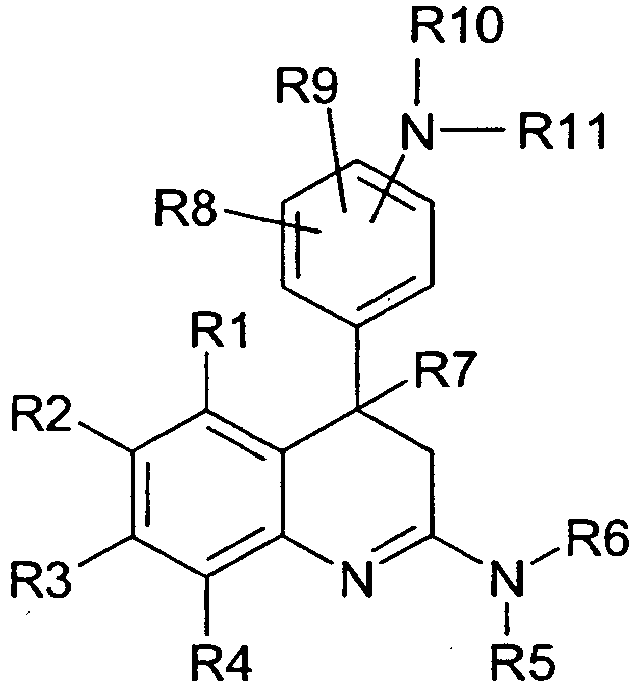
- R1, R2, R3 und R4
unabhängig voneinander Wasserstoff, F, Cl, Br, I, CN, NO2, CF3, CH3-SO2,
Alkyl mit 1, 2, 3 oder 4 C-Atomen, NH2, NH-CH3 oder N(CH3)2; R5 und R6
unabhängig voneinander Wasserstoff, Alkyl mit 1, 2, 3, 4, 5 oder 6 C-Atomen,
CF3-CH2-, Cycloalkyl mit 3, 4, 5 oder 6 C-Atomen oder Cyclopropyl-CH2-, oder - R5 und R6
bilden gemeinsam mit dem Stickstoffatom, an das sie gebunden sind, einen 4-, 5-, 6-, 7-, 8-, 9- oder 10-gliedrigen Ring, in dem ein oder zwei CH2-Gruppen unabhängig voneinander durch NR12, Schwefel, Sauerstoff, C(O) oder SO2 ersetzt sein können;
R12 Wasserstoff, Alkyl mit 1, 2, 3 oder 4 C-Atomen oder Cycloalkyl mit 3, 4, 5 oder 6 C-Atomen; - R7 Wasserstoff oder Alkyl mit 1,2,3 oder 4 C-Atomen;
- R8 und R9
unabhängig voneinander Wasserstoff, F, Cl, Br, OH, Alkyl mit 1, 2, 3 oder 4 C-Atomen, CH3O, CF3, oder CH3SO2; - R10 und R11
unabhängig voneinander R13-(CmH2m)-Bn, wobei- m Null, 1, 2, 3 oder 4;
- n Null oder 1;
- B -CO-, -CONR14- oder -SO2-;
R14 Wasserstoff oder Alkyl mit 1, 2, 3, 4, 5 oder 6 C-Atomen; - R13 Wasserstoff, Alkyl mit 1, 2, 3 oder 4 C-Atomen, Cycloalkyl mit 3, 4, 5 oder 6 C-Atomen, 1-Pyrrolidinyl, 1-Piperidinyl, 1-(4-Methylpiperazinyl), 1-Morpholinyl -COOR15, OR16, NR17R18 oder Phenyl, das unabhängig voneinander 1 oder 2 Substituenten trägt, ausgewählt aus der Gruppe Chlor, Fluor, Methyl und Methoxy;
R15, R16, R17 und R18
unabhängig voneinander Wasserstoff oder Alkyl mit 1, 2, 3, 4, 5 oder 6 C-Atomen;
- R10 und R11
bilden gemeinsam mit dem Stickstoffatom, an das sie gebunden sind, einen 4-, 5-, 6-, 7-, 8-, 9- oder 10-gliedrigen Ring, in dem ein, zwei oder drei CH2-Gruppen unabhängig voneinander durch NR19, Schwefel, Sauerstoff, C(O) oder SO2 ersetzt sein können;
R19 Wasserstoff, Alkyl mit 1, 2, 3 oder 4 C-Atomen oder Cycloalkyl mit 3, 4, 5 oder 6 C-Atomen; - Bevorzugt sind Verbindungen der Formel I, worin bedeuten
- R1, R2, R3 und R4
unabhängig voneinander Wasserstoff, F, Cl, Br, CN, CF3, CH3-SO2, Alkyl mit 1, 2, 3 oder 4 C-Atomen, NH2, NH-CH3 oder N(CH3)2; - R5 und R6
unabhängig voneinander Wasserstoff, Alkyl mit 1, 2, 3, 4, 5 oder 6 C-Atomen,
CF3-CH2-, Cycloalkyl mit 3, 4, 5 oder 6 C-Atomen oder Cyclopropyl-CH2-, oder - R5 und R6
bilden gemeinsam mit dem Stickstoffatom, an das sie gebunden sind, einen 4-, 5-, 6-, 7-, 8-, 9- oder 10-gliedrigen Ring; - R7 Wasserstoff;
- R8 und R9
unabhängig voneinander Wasserstoff, F, Cl, OH, Alkyl mit 1, 2, 3 oder 4 C-Atomen, CH3O, CF3, oder CH3SO2; - R10 und 11
unabhängig voneinander R13-(CmH2m)-Bn, wobei- m Null, 1, 2, 3 oder 4;
- n Null oder 1;
- B -CO-, -CONR14- oder -SO2-;
R14 Wasserstoff oder Alkyl mit 1, 2, 3, 4, 5 oder 6 C-Atomen; - R13 Wasserstoff, Alkyl mit 1, 2, 3 oder 4 C-Atomen, Cycloalkyl mit 3, 4, 5 oder 6 C-Atomen, 1-Pyrrolidinyl, 1-Piperidinyl, 1-(4-Methylpiperazinyl), 1-Morpholinyl, -COOR15, OR16, NR17R18 oder Phenyl, das unabhängig voneinander 1 oder 2 Substituenten trägt, ausgewählt aus der Gruppe Chlor, Fluor, Methyl und Methoxy;
R15, R16, R17 und R18
unabhängig voneinander Wasserstoff oder Alkyl mit 1, 2, 3, 4, 5 oder 6 C-Atomen;
- R10 und R11
bilden gemeinsam mit dem Stickstoffatom, an das sie gebunden sind, einen 4-, 5-, 6-, 7-, 8-, 9- oder 10-gliedrigen Ring, in dem eine CH2-Gruppen durch Sauerstoff oder NR19 ersetzt sein kann;- R19 Wasserstoff oder Alkyl mit 1, 2, 3 oder 4 C-Atomen;
- Besonders bevorzugt sind Verbindungen der Formel I, worin bedeuten
- R1, R2, R3 und R4
unabhängig voneinander Wasserstoff, F, Cl, Br, CN, CF3, CH3-SO2, Methyl, Ethyl, NH2, NH-CH3 oder N(CH3)2; - R5 und R6
unabhängig voneinander Wasserstoff, Methyl, Ethyl, Isopropyl, CF3-CH2 oder Cycloalkyl mit 3, 4, 5 oder 6 C-Atomen; - R7 Wasserstoff;
- R8 und R9
unabhängig voneinander Wasserstoff, Cl oder Methyl; - R10 und 11
unabhängig voneinander R13-(CmH2m)-Bn, wobei- m Null, 1, 2, 3 oder 4;
- n Null oder 1;
- B -CO-, -CONR14- oder -SO2-;
R14 Wasserstoff oder Alkyl mit 1, 2, 3, 4, 5 oder 6 C-Atomen; - R13 Wasserstoff, Methyl, Cycloalkyl mit 3, 4, 5 oder 6 C-Atomen, 1-Pyrrolidinyl, 1-Piperidinyl, 1-(4-Methylpiperazinyl), -COOR15, OR16oder NR17R18;
R15, R16, R17 und R18
unabhängig voneinander Wasserstoff oder Alkyl mit 1, 2, 3, 4, 5 oder 6 C-Atomen;
- R10 und R11
bilden gemeinsam mit dem Stickstoffatom, an das sie gebunden sind, einen 4-, 5-, 6-, 7-, 8-, 9- oder 10-gliedrigen Ring, in dem eine CH2-Gruppen durch Sauerstoff oder NR19 ersetzt sein kann;- R19 Wasserstoff oder Methyl;
- Insbesondere bevorzugt sind Verbindungen der Formel I, worin bedeuten
- R1 und R3
Wasserstoff; - R2 und R4
unabhängig voneinander Wasserstoff oder Cl; - R5 und R6
unabhängig voneinander Wasserstoff, Methyl oder Ethyl; - R7 Wasserstoff;
- R8 und R9
unabhängig voneinander Wasserstoff oder Cl; - R10 und 11
unabhängig voneinander R13-(CmH2m)-Bn, wobei- m Null, 1, 2, 3 oder 4;
- n Null oder 1;
- B -CONR14-;
R14 Wasserstoff oder Methyl; - R13 Wasserstoff, Methyl, Cycloalkyl mit 3, 4, 5 oder 6 C-Atomen, 1-Pyrrolidinyl, 1-Piperidinyl, 1-(4-Methylpiperazinyl), -COOR15, OR16 oder NR17R18;
R15, R16, R17 und R18- unabhängig voneinander Wasserstoff oder Alkyl mit 1, 2, 3, 4, 5 oder 6 C-Atomen;
- R10 und R11
bilden gemeinsam mit dem Stickstoffatom, an das sie gebunden sind, einen 4-, 5-, 6-, 7-, 8-, 9- oder 10-gliedrigen Ring, in dem eine CH2-Gruppen durch NR19 ersetzt sein kann;- R19 Wasserstoff oder Methyl;
- Sehr bevorzugt sind Verbindungen der Formel I, worin bedeuten
- R1 und R3
Wasserstoff; - R2 und R4
unabhängig voneinander Wasserstoff oder Cl; - R5 und R6
unabhängig voneinander Wasserstoff, Methyl oder Ethyl; - R7 Wasserstoff;
- R8 und R9
unabhängig voneinander Wasserstoff oder Cl; - R10 und 11
unabhängig voneinander R13-(CmH2m)-Bn, wobei- m Null, 1, 2, 3 oder 4;
- n Null oder 1;
- B -CONR14-;
R14 Wasserstoff oder Methyl; - R13 Wasserstoff, Methyl, oder NR17R18;
R17 und R18
- Speziell bevorzugt sind Verbindungen der Formel I ausgewählt aus der Gruppe:
- 2-Amino-4-(4-aminophenyl)-6-chlor-3,4-dihydrochinolin,
- 4-(4-Aminophenyl)-6-chlor-2-ethylamino-3,4-dihydrochinolin,
- 4-(4-Aminophenyl)-6-chlor-2-diethylamino-3,4-dihydrochinolin und
- N-(2-Dimethylaminoethyl)-N'-4-[(6-chloro-3,4-dihydro-2-diethylaminoquinolin-4-yl)phenyl]harnstoff,
- In einer Ausführungsform sind Verbindungen der Formel I bevorzugt, in denen die Reste R1, R2, R3 und R4 unabhängig voneinander beschrieben werden durch Wasserstoff, F, Cl, Br, CN, CF3, CH3-SO2, Alkyl mit 1, 2, 3 oder 4 C-Atomen, beispielsweise Methyl oder Ethyl, NH2, NH-CH3 oder N(CH3)2; besonders bevorzugt sind Verbindungen der Formel I, in denen R1 und R3 Wasserstoff sind und R2 und R4 unabhängig voneinander Wasserstoff, F, Cl, Br, CN, CF3, CH3-SO2, Methyl, Ethyl, NH2, NH-CH3 oder N(CH3)2, beispielsweise Wasserstoff oder Cl, sind; in einer weiteren Ausführungsform sind Verbindungen der Formel I bevorzugt, in denen R1, R3 und R4 Wasserstoff sind und R2 F, Cl, Br, CN, CF3, CH3-SO2, Methyl, Ethyl, NH2, NH-CH3 oder N(CH3)2, beispielsweise Cl, ist.
- In einer Ausführungsform sind Verbindungen der Formel I bevorzugt, in denen R5 und R6 unabhängig voneinander durch Wasserstoff, Alkyl mit 1, 2, 3, 4, 5 oder 6 C-Atomen, CF3-CH2- oder Cycloalkyl mit 3, 4, 5 oder 6 C-Atomen beschrieben werden oder R5 und R6 gemeinsam mit dem Stickstoffatom, an das sie gebunden sind, einen 4-, 5-, 6-, 7-, 8-, 9- oder 10-gliedrigen Ring bilden; in einer weiteren Ausführungsform sind Verbindungen der Formel I bevorzugt, in denen R5 und R6 unabhängig voneinander Wasserstoff, Methyl, Ethyl, Isopropyl, CF3-CH2 oder Cycloalkyl mit 3, 4, 5 oder 6 C-Atomen sind, insbesondere Wasserstoff, Methyl oder Ethyl, beispielsweise Wasserstoff oder Ethyl.
- In einer weiteren Ausführungsform sind Verbindungen der Formel I bevorzugt, in denen R7 durch Wasserstoff oder Methyl, beispielsweise Wasserstoff, beschrieben wird.
- In einer Ausführungsform sind Verbindungen der Formel I bevorzugt, in denen die Reste R8 und R9 unabhängig voneinander beschrieben werden durch Wasserstoff, F, Cl, OH, Alkyl mit 1, 2, 3 oder 4 C-Atomen, CH3O, CF3, oder CH3SO2; besonders bevorzugt sind Verbindungen der Formel I, in denen R8 und R9 unabhängig voneinander beschrieben werden durch Wasserstoff, Cl oder Methyl, insbesondere Wasserstoff oder Cl, beispielsweise Wasserstoff.
- Der Rest NR10R11 am Phenylring kann in ortho-, meta- oder para-Position zur Dihydroisochinolingruppe gebunden sein, beispielsweise in ortho- oder para-Position, insbesondere in para-Position.
- In einer Ausführungsform sind Verbindungen der Formel I bevorzugt, in denen die Reste R10 und R11 unabhängig voneinander beschrieben werden durch R13-(CmH2m)-Bn oder R10 und R11 bilden gemeinsam mit dem Stickstoffatom, an das sie gebunden sind, einen 4-, 5-, 6-, 7-, 8-, 9- oder 10-gliedrigen Ring, in dem eine CH2-Gruppen durch Sauerstoff oder NR19 ersetzt sein kann, wobei R19 Wasserstoff oder Alkyl mit 1, 2, 3 oder 4 C-Atomen, insbesondere Wasserstoff oder Methyl, ist; in einer weiteren Ausführungsform sind Verbindungen der Formel I bevorzugt, in denen die Reste R10 und R11 unabhängig voneinander beschrieben werden durch R13-(CmH2m)-Bn.
- In einer Ausführungsform sind Verbindungen der Formel I bevorzugt, in denen m Null, 1 oder 2 ist, beispielsweise Null oder 2.
- In einer Ausführungsform sind Verbindungen der Formel I bevorzugt, in denen n Null ist; in einer weiteren Ausführungsform sind Verbindungen der Formel I bevorzugt, in denen n 1 ist.
- In einer Ausführungsform sind Verbindungen der Formel I bevorzugt, in denen B -CONR14- ist, wobei R14 Wasserstoff oder Alkyl mit 1, 2, 3, 4, 5 oder 6 C-Atomen, insbesondere Wasserstoff oder Methyl, beispielsweise Wasserstoff, ist.
- in einer Ausführungsform sind Verbindungen der Formel i bevorzugt, in denen R13 beschrieben wird durch Wasserstoff, Methyl, Ethyl, Isopropyl, Cycloalkyl mit 3, 4, 5 oder 6 C-Atomen, 1-Pyrrolidinyl, 1-Piperidinyl, 1-(4-Methylpiperazinyl), -COOR15, OR16 oder NR17R18, wobei R15, R16, R17 und R18 unabhängig voneinander Wasserstoff oder Alkyl mit 1, 2, 3, 4, 5 oder 6 C-Atomen sind; in einer weiteren Ausführungsform sind Verbindungen der Formel I bevorzugt, in denen R13 beschrieben wird durch Wasserstoff, Methyl oder NR17R18, wobei R17 und R18 unabhängig voneinander Wasserstoff oder Alkyl mit 1, 2, 3, 4, 5 oder 6 C-Atomen, insbesondere Wasserstoff, Methyl oder Ethyl, beispielsweise Methyl, sind; besonders bevorzugt sind Verbindungen der Formel I, in denen R13 Wasserstoff oder Dimethylamino ist.
- Enthalten die Verbindungen der Formel I ein oder mehrere Asymmetriezentren, so können diese unabhängig voneinander sowohl S als auch R konfiguriert sein. Die Verbindungen können als optische Isomere, als Diastereomere, als Racemate oder als Gemische in allen Verhältnissen derselben vorliegen. Die Verbindungen der Formel I können weiterhin in Form von Rotationsisomeren vorliegen.
- Die vorliegende Erfindung umfasst alle möglichen tautomeren Formen der Verbindungen der Formeln I.
- Die vorliegende Erfindung umfasst weiterhin Derivate der Verbindungen der Formel I, zum Beispiel Solvate, wie Hydrate und Alkoholaddukte der Verbindungen der Formel I. Die Erfindung umfasst ebenfalls alle Kristallmodifikationen der Verbindungen der Formel I.
- Alkylreste können geradkettig oder verzweigt sein. Dies gilt auch, wenn sie Substituenten tragen oder als Substituenten anderer Reste auftreten, beispielsweise in Fluoralkylresten oder Alkoxyresten. Beispiele für Alkylreste sind Methyl, Ethyl, n-Propyl, Isopropyl (= 1-Methylethyl), n-Butyl, Isobutyl (= 2-Methylpropyl), sec-Butyl (= 1-Methylpropyl), tert-Butyl (= 1,1-Dimethylethyl), n-Pentyl, Isopentyl, tert-Pentyl, Neopentyl oder Hexyl. Bevorzugte Alkylreste sind Methyl, Ethyl, n-Propyl, Isopropyl, n-Butyl, tert-Butyl, n-Pentyl, n-Hexyl.
- Beispiele für Cycloalkylreste sind Cyclopropyl, Cyclobutyl, Cyclopentyl, Cyclohexyl, Cycloheptyl oder Cyclooctyl. In den Cycloalkylresten können eine oder mehrere CH2-Gruppen durch O, NH oder N-Alkyl, beispielsweise NCH3, ersetzt sein. Dies gilt auch für Cycloalkylmethylreste.
- Beispiele für Ringe aus NR5R6 sind Morpholin, Pyrrolidin, Piperidin, Piperazin, N-Methylpiperazin, Pyrrolidin-2-on, Pyrrolidin-2,5-dion, Imidazolidin, 3-Methylimidazolidin, Imidazolidin-2-on, 3-Methyl-Imidazolidin-2-on, Imidazolidin-2,4-dion und 1-Methyl-imidazolidine-2,4-dion, insbesondere Pyrrolidin und Piperidin, beispielsweise Pyrrolidin.
- Beispiele für Ringe aus NR10R11 sind Morpholin, Pyrrolidin, Piperidin, Piperazin, N-Methylpiperazin, Pyrrolidin-2-on, Pyrrolidin-2,5-dion, Imidazolidin, 3-Methylimidazolidin, Imidazolidin-2-on, 3-Methyl-Imidazolidin-2-on, Imidazolidin-2,4-dion und 1-Methyl-imidazolidine-2,4-dion, insbesondere Pyrrolidin-2,5-dion und Imidazolidin-2,4-dion, beispielsweise Imidazolidin-2,4-dion.
- Als CH2-Einheiten gelten auch die in einem Alkylrest terminalen CH3-Gruppen, die in diesem Zusammenhang als CH2-H Gruppierungen aufgefasst werden.
- Wenn eine Variable, beispielsweise cycloalkyl oder R1, mehr als einmal als Komponente vorkommt, sind die Definitionen der Variable bei jedem Auftreten unabhängig voneinander.
- Enthalten die Verbindungen der Formel I eine oder mehrere saure oder basische Gruppen bzw. einen oder mehrere basische Heterocyclen, so gehören auch die entsprechenden physiologisch oder toxikologisch verträglichen Salze zur Erfindung, insbesondere die pharmazeutisch verwendbaren Salze. So können die Verbindungen der Formel I an einer sauren Gruppe deprotoniert werden und beispielsweise als Alkalimetallsalze, vorzugsweise Natrium- oder Kaliumsalze, oder als Ammoniumsalze, zum Beispiel als Salze mit Ammoniak oder organischen Aminen oder Aminosäuren, verwendet werden. Da Verbindungen der Formel I stets wenigstens eine basische Gruppe enthalten, können sie auch in Form ihrer physiologisch verträglichen Säureadditionssalze z. B. mit folgenden Säuren hergestellt werden: aus anorganischen Säuren wie Salzsäure, Schwefelsäure oder Phosphorsäure oder aus organischen Säuren wie Essigsäure, Zitronensäure, Weinsäure, Milchsäure, Malonsäure, Methansulfonsäure, Fumarsäure. Als Säureadditionssalze kommen dabei Salze aller pharmakologisch verträglichen Säuren in Frage (diese Gruppe entspricht auch den physiologisch akzeptablen Anionen), beispielsweise Halogenide, insbesondere Hydrochloride, Lactate, Sulfate, Citrate, Tartrate, Acetate, Phosphate, Methylsulfonate, p-Toluolsulfonate, Adipinate, Fumarate, Gluconate, Glutamate, Glycerolphosphate, Maleinate und Pamoate; aber auch Trifluoracetate.
- Gegenstand der Erfindung ist auch das nachfolgend beschriebene Verfahren zur Herstellung der Verbindungen der Formel I.
- Die hier beschriebenen Verbindungen der Formel I, in denen R10 und R11 Wasserstoff sind, lassen sich beispielsweise ausgehend von den Chinolin-Derivaten der Formel II durch Reduktion zu den entsprechenden 3,4-Dihydrochinolinen der Formel la herstellen,

US3,538,101 ). - Aus den erfindungsgemäßen Verbindungen der Formel I a) fassen sich weitere erfindungsgemäßen Verbindungen der Formel I beispielweise durch Derivatisierung der Aminogruppe am Phenylrest nach dem Fachmann bekannten Verfahren darstellen. Dabei wird beispielsweise die Aminogruppe der Verbindungen Ia) mit Alkylierungsmitteln, Acylierungsmitteln bzw. Sulfonylierungs-Reagentien der Formel R10-L und/oder R11-L vorteilhaft in Gegenwart einer Hilfsbase, wie Pyridin, Triethylamin oder Hünigscher Base, in dem Fachmann bekannter Weise umgesetzt. Ebenfalls eignet sich die Verwendung von Isocyanaten der Formeln R10-N=C=O und/oder R11-N=C=O in dem Fachmann bekannter Weise zur Herstellung entsprechender Harnstoffderivate der Formel Ib oder Ic.

- Analog können die Verbindungen der Formel II durch Derivatisierung der Aminogruppe am Phenylrest nach dem Fachmann bekannten Verfahren zu Verbindungen der Formel IIIa oder IIIb umsetzt werden,

- Die auf diese Weise erhaltenen Chinolin-Derivate der Formel IIIa oder IIIb, in denen R10 und R11 nicht in der Bedeutung von Wasserstoff haben, können anschließend in bekannter Weise, beispielsweise mit Natrium-Amalgam-Legierung, zu den erfindungsgemäßen entsprechenden 3,4-Dihydrochinolin-Derivaten der Formel Ib oder Ic reduziert werden,


- Die oben verwendeten Aniline der Formel II werden vorzugsweise durch Reduktion der entsprechenden Nitroverbindungen der Formel IVa gewonnen,

- Zur Herstellung von Verbindungen der Formel IVa, in denen R5 und R6 Wasserstoff bedeuten, kann man beispielsweise Verbindungen der Formel V in einer alkalischen Kondensation mit Acetonitril (I.A.Nicolls et al., Life Sciences 53, 343-347 (1993)) zu Verbindungen der Formel IVb umsetzen,

- Die Verbindungen der Formel IVb, in denen Y Wasserstoff bedeutet, können durch Nitrierung zu Nitro-substituierten Verbindungen der Formel IVa, in denen R5 und R6 Wasserstoff bedeuten, umgesetzt werden.
- Die Verbindungen der Formel IVa, in denen R5 und R6 nicht beide Wasserstoff bedeuten, erhält man beispielsweise durch nucleophile Austauschreaktionen von Chinolin-Derivaten der Formel VI mit einem Amin der Formel VII

- Entsprechende Verbindungen der Formel IVb, in denen R5 und R6 Wasserstoff bedeuten, können analog durch Umsetzung mit NH3 und unter Druck hergestellt werden.
- Die Verbindungen der Formel IVc, in denen Y Wasserstoff bedeutet, können durch Nitrierung zu Nitro-substituierten Verbindungen der Formel IVa, in denen R5 und R6 nicht beide Wasserstoff bedeuten, umgesetzt werden.
- Verbindungen VI kann der Fachmann bekannter Weise hergestellt werden, zum Beispiel aus Verbindungen der Formel VIII beispielsweise durch Einwirkung eines anorganischen Säurechlorides, wie Phosphoroxid-trichlorid, Phosphortrichlorid oder Phosphorpentachlorid' für Verbindungen der Formel VI, in denen X Cl ist,

- Verbindungen der Formel I, in denen R7 nicht Wasserstoff ist, können ausgehend von dem Fachmann bekannten Verbindungen, zum Beispiel Verbindungen wie in Helv. Chim. Act. 1970, 53, 89, nach bekannten Verfahren hergestellt werden.
- Die Verbindungen R10-Hal, R11-Hal, R10-N=C=O, R11-N=C=O und die Verbindungen der Formeln V, VII und VIII sind käuflich erhältlich oder können nach oder analog zu in der Literatur beschriebenen, dem Fachmann bekannten Verfahren hergestellt werden.
- Die Aufarbeitung und gewünschtenfalls die Reinigung der Produkte und/oder Zwischenprodukte erfolgt nach den üblichen Methoden wie Extraktion, Chromatographie oder Kristallisation und den üblichen Trocknungen.
- Es konnte gezeigt werden, dass Verbindungen der Formel I hervorragende Inhibitoren des Natrium-Wasserstoffaustauschers (NHE), insbesondere des Natrium-Wasserstoffaustauschers vom Subtyp 3 (NHE3), darstellen.
- Die bisher bekannten NHE3-Inhibitoren leiten sich beispielsweise von Verbindungen des Acylguanidin-Typs (
EP825178 WO0144164 WO0179186 WO0121582 WO0172742 - Tetrahydroisochinoline als Inhibitoren des Natrium-Wasserstoffaustauschers vom Subtyp 3 (NHE3) werden beispielsweise in den Patentanmeldungen
WO03048129 WO2004085404 und den deutschen Anmeldungen102004046492.8 und102005001411.9 beschrieben. In der PatentanmeldungWO03055880 - Überraschend wurde nun gefunden, dass die hier beschriebenen Verbindungen der Formel I ebenfalls potente Inhibitoren des NHE3 darstellen und dabei vorteilhafte pharmakologische und pharmakokinetische Eigenschaften besitzen.
- Der NHE3 wird im Körper verschiedener Spezies bevorzugt in der Galle, dem Darm und in der Niere gefunden (Larry Fliegel et al, Biochem. Cell. Biol. 76: 735 - 741, 1998), ließ sich aber auch im Gehirn nachweisen (E. Ma et al. Neuroscience 79: 591 - 603).
- Aufgrund ihrer NHE-inhibitorischen Eigenschaften eignen sich die Verbindungen der Formel I zur Prävention und Behandlung von Krankheiten, die durch eine Aktivierung bzw. durch einen aktivierten NHE verursacht werden, sowie von Krankheiten, die sekundär durch die NHE-bedingten Schädigungen verursacht werden.
Die Verbindungen der Formel I können auch zur Behandlung und Prävention von Krankheiten eingesetzt werden, wobei der NHE nur partiell gehemmt wird, beispielsweise durch Verwendung einer niedrigeren Dosierung. - Die Verwendung der erfindungsgemäßen Verbindungen betrifft die Prävention und die Behandlung akuter und chronischer Krankheiten in der Veterinär- und in der Humanmedizin.
- Infolge Ihrer pharmakologische Wirkungen sind die Verbindungen der Formel I insbesondere dazu geeignet, zu einer Verbesserung des Atemantriebes führen. Sie können deshalb zur Behandlung von gestörten Atmungszuständen herangezogen werden, wie sie beispielsweise bei folgenden klinischen Zuständen und Krankheiten auftreten können: Gestörter zentraler Atemantrieb (z. B. zentrale Schlafapnoen, plötzlicher Kindstod, postoperative Hypoxie), muskulär-bedingte Atemstörungen, Atemstörungen nach Langzeitbeatmung, Atemstörungen bei Adaptation im Hochgebirge, obstruktive und gemischte Form der Schlafapnoen, akute und chronische Lungenkrankheiten mit Hypoxie und Hyperkapnie.
Zusätzlich erhöhen die Verbindungen den Muskeltonus der oberen Atemwege, so dass das Schnarchen unterdrückt wird. Die genannten Verbindungen finden deshalb vorteilhaft Verwendung zur Herstellung eines Medikaments zur Prävention und Behandlung von Schlafapnoen und muskulär bedingter Atemstörungen und zur Herstellung eines Medikaments zur Prävention und Behandlung des Schnarchens. - Eine Kombination eines NHE-Inhibitors der Formel I mit einem Carboanhydrase-Hemmer (z. B. Acetazolamid) kann sich als vorteilhaft erweisen, wobei letzterer eine metabolische Azidose herbeiführt und dadurch bereits die Atmungstätigkeit steigert, so dass eine verstärkte Wirkung und verminderter Wirkstoffeinsatz erzielt werden können.
- Die erfindungsgemäßen Verbindungen schonen infolge ihrer NHE3-inhibitorischen Wirkung die zellulären Energiereserven, die sich unter toxischen und pathogenen Ereignissen rasch erschöpfen und so zur Zellschädigung oder zum Zelluntergang führen. Dabei wird die energieaufwendige ATP-verbrauchende Natriumresorption im proximalen Tubulus unter dem Einfluß von NHE3-Inhibitoren vorübergehend still gelegt und die Zelle kann so eine akute pathogene, ischämische oder toxische Situation überleben. Die Verbindungen eignen sich deshalb beispielsweise als Arzneimittel zur Behandlung ischämischer Noxen, zum Beispiel des akuten Nierenversagens. Weiterhin eignen sich die Verbindungen auch zur Behandlung aller chronischen Nierenerkrankungen und Nephritisformen, die infolge vermehrter Proteinausscheidung zum chronischen Nierenversagen führen. Dementsprechend eignen sich die Verbindungen der Formel I zur Herstellung eines Medikaments zur Behandlung diabetischer Spätschäden, der diabetischen Nephropathie und chronischer Nierenerkrankungen, insbesondere von allen Nierenentzündungen (Nephritiden), die mit einer vermehrten Protein-/ Albuminausscheidung verbunden sind.
- Es hat sich gezeigt, dass die erfindungsgemäß verwendeten Verbindungen eine milde abführende Wirkung besitzen und demzufolge auch vorteilhaft als Abführmittel oder bei drohender Darmverstopfung verwendet werden können.
- Weiterhin können die erfindungsgemäßen Verbindungen vorteilhaft zur Prävention und Therapie von akuten und chronischen Erkrankungen des Darmtrakts verwendet werden, die beispielweise durch ischämische Zustände im Intestinalbereich und / oder durch nachfolgende Reperfusion oder durch entzündliche Zustände und Ereignisse ausgelöst werden. Solche Komplikationen können beispielweise durch mangelnde Darmperistaltik auftreten, wie sie z.B. häufig nach chirurgischen Eingriffen, bei Darmverstopfung oder stark verminderter Darmtätigkeit zu beobachten sind.
- Mit den erfindungsgemäßen Verbindungen besteht die Möglichkeit, der Gallenstein-Bildung vorzubeugen.
- Die erfindungsgemäßen NHE-Inhibitoren eignen sich generell zur Behandlung von Krankheiten, die durch Ischämie und durch Reperfusion hervorgerufen werden.
- Die erfindungsgemäßen Verbindungen sind infolge ihrer pharmakologischen Eigenschaften als antiarrhythmische Arzneimittel geeignet.
Durch ihre cardioprotektive Komponente eignen sich die NHE-Inhibitoren hervorragend zur Infarktprophylaxe und der Infarktbehandlung sowie zur Behandlung der angina pectoris, wobei sie auch präventiv die pathophysiologischen Vorgänge beim Entstehen ischämisch induzierter Schäden, insbesondere bei der Auslösung ischämisch induzierter Herzarrhythmien, inhibieren oder stark vermindern. Wegen ihrer schützenden Wirkungen gegen pathologische hypoxische und ischämische Situationen können die erfindungsgemäß verwendeten Verbindungen der Formel I infolge Inhibition des zellulären Na+/H+-Austauschmechanismus als Arzneimittel zur Behandlung aller akuten oder chronischen durch Ischämie ausgelösten Schäden oder dadurch primär oder sekundär induzierten Krankheiten verwendet werden. - Dies betrifft auch ihre Verwendung als Arzneimittel für chirurgische Eingriffe. So können die erfindungsgemäßen Verbindungen bei Organ-Transplantationen verwendet werden, wobei die Verbindungen sowohl für den Schutz der Organe im Spender vor und während der Entnahme, zum Schutz entnommener Organe beispielsweise bei Behandlung mit oder deren Lagerung in physiologischen Badflüssigkeiten, wie auch bei der Überführung in den mit Verbindungen der Formel I vorbehandelten Empfängerorganismus verwendet werden können.
- Die Verbindungen sind ebenfalls wertvolle, protektiv wirkende Arzneimittel bei der Durchführung angioplastischer operativer Eingriffe beispielsweise am Herzen wie auch an peripheren Organen und Gefäßen.
- Weiterhin können die erfindungsgemäßen Verbindungen bei der Durchführung von Bypassoperationen verwendet werden, beispielsweise bei Bypassoperationen an Koronargefäßen und bei Coronary Artery Bypass Graft (CABG).
- Entsprechend ihrer Wirkung gegen ischämisch induzierte Schäden können die erfindungsgemäßen Verbindungen der Formel I auch bei Wiederbelebung nach einem Herzstillstand eingesetzt werden.
- Entsprechend ihrer protektiven Wirkung gegen ischämisch induzierte Schäden sind die Verbindungen auch als Arzneimittel zur Behandlung von Ischämien des Nervensystems, insbesondere des ZNS, geeignet, wobei sie z.B. zur Behandlung des Schlaganfalls oder des Hirnödems geeignet sind.
- Da NHE-Inhibitoren menschliches Gewebe und Organe nicht nur effektiv gegen Schäden schützen, die durch Ischämie und Reperfusion verursacht werden, sondern auch gegen die cytotoxische Wirkung von Arzneimitteln, wie sie insbesondere in der Krebstherapie und der Therapie von Autoimmunerkrankungen Anwendung finden, ist deren kombinierte Verabreichung mit Verbindungen der Formel I geeignet, die cytotoxischen Effekte einer Therapie zu vermindern oder zu unterdrücken. Durch die Verminderung der cytotoxischen Effekte, insbesondere der Cardiotoxizität, infolge Ko-Medikation mit NHE-Inhibitoren kann außerdem die Dosis der cytotoxischen Therapeutika erhöht und / oder die Medikation mit solchen Arzneimitteln verlängert werden. Der therapeutische Nutzen einer solchen cytotoxischen Therapie kann durch die Kombination mit NHE-Inhibitoren erheblich gesteigert werden.
Die Verbindungen der Formel I eignen sich insbesondere zur Verbesserung der Therapie mit Arzneimitteln, die eine unerwünschte cardiotoxische Komponente besitzen. - Generell können die hier beschriebenen NHE Inhibitoren in günstiger Weise mit anderen, den intrazellulären pH-Wert ebenfalls regulierenden Verbindungen kombiniert werden, wobei Inhibitoren der Enzymgruppe der Carboanhydratasen, Inhibitoren der Bicarbonationen transportierenden Systeme wie des Natrium-Bicarbonat-Cotransporters (NBC) oder des Natrium-abhängigen Chlorid-Bicarbonat-Austauschers (NCBE), sowie mit anderen NHE-Inhibitoren mit inhibitorischer Wirkung auf andere NHE-Subtypen, als Kombinationspartner infrage kommen, weil durch sie die pharmakologisch relevanten pH-regulierenden Effekte der hier beschriebenen NHE-Inhibitoren verstärkt oder moduliert werden können.
- Entsprechend ihrer protektiven Wirkung gegen ischämisch induzierte Schäden sind die erfindungsgemäßen Verbindungen auch als Arzneimittel zur Behandlung von Ischämien des Nervensystems, insbesondere des Zentralnervensystems, geeignet, wobei sie z. B. zur Behandlung des Schlaganfalls oder des Hirnödems geeignet sind.
- Die Verbindungen der Formel I eignen sich auch zur Therapie und Prophylaxe von Erkrankungen und Störungen, die durch Übererregbarkeit des Zentralnervensystems ausgelöst werden, insbesondere zur Behandlung von Erkrankungen des epileptischen Formenkreises, zentral ausgelöster klonischer und tonischer Spasmen, psychischer Depressionszustände, Angsterkrankungen und Psychosen. Dabei können die erfindungsgemäßen NHE-Inhibitoren allein angewandt werden oder in Kombination mit anderen antiepileptisch wirkenden Substanzen oder antipsychotischen Wirkstoffen, oder Carboanhydratasehemmern, beispielweise mit Acetazolamid, sowie mit weiteren Inhibitoren des NHE oder des natrium-abhängigen Chlorid-Bicarbonat-Austauschers (NCBE).
- Darüber hinaus eignen sich die erfindungsgemäßen Verbindungen der Formel I ebenfalls zur Behandlung von Formen des Schocks, wie beispielweise des allergischen, cardiogenen, hypovolämischen und des bakteriellen Schocks.
- Die Verbindungen der Formel I können ebenfalls zur Prävention und zur Behandlung thrombotischer Erkrankungen verwendet werden, da sie als NHE-Inhibitoren sowohl die Plättchenaggregation selbst inhibieren können. Darüberhinaus können sie die nach Ischämie und Reperfusion stattfindende überschießende Freisetzung von Entzündungs- und Gerinnungsmediatoren, insbesondere des von Willebrand Faktors und thrombogener Selectin-Proteine, hemmen bzw. verhindern. Damit kann die pathogene Wirkung thrombogener und entzündungsrelevanter Faktoren vermindert und ausgeschaltet werden. Deshalb sind die NHE-Inhibitoren der vorliegenden Erfindung kombinierbar mit weiteren antikoagulativen und/oder thrombolytischen Wirkstoffen wie beispielsweise recombinantem oder natürlichen tissue plasminogen activator, Streptokinase, Urokinase, Acetylsalizylsäure, Thrombinantagonisten, Faktor Xa-Antagonisten, fibrinolytisch wirkenden Arzneistoffen, Thromboxan-Rezeptor-Antagonisten, Phosphodiesterase-Inhibitoren, Faktor-VIIa-Antagonisten, Clopidogrel, Ticlopidin usw. Eine kombinierte Anwendung der vorliegenden NHE-Inhibitoren mit NCBE-Inhibitoren und/oder mit Inhibitoren der Carboanhydratase, wie beispielsweise mit Acetazolamid, ist besonders günstig.
- Darüber hinaus zeichnen sich die erfindungsgemäßen NHE-Inhibitoren durch starke inhibierende Wirkung auf die Proliferationen von Zellen, beispielsweise der Fibroblasten-Zellproliferation und der Proliferation der glatten Gefäßmuskelzellen, aus. Deshalb kommen die Verbindungen der Formel I als wertvolle Therapeutika für Krankheiten in Frage, bei denen die Zellproliferation eine primäre oder sekundäre Ursache darstellt, und können deshalb als Antiatherosklerotika, Mittel gegen das chronische Nierenversagen, Krebserkrankungen, verwendet werden. Sie können somit zur Behandlung von Organhypertrophien und -hyperplasien, beispielsweise des Herzens und der Prostata verwendet werden. Verbindungen der Formel I sind deshalb zur Prävention und zur Behandlung der Herzinsuffizienz (congestive heart failure = CHF) wie auch bei der Behandlung und Prävention der Prostatahyperplasie bzw. Prostatahypertrophie geeignet.
- NHE-Inhibitoren zeichnen sich weiterhin durch eine Verzögerung oder Verhinderung von fibrotischen Erkrankungen aus. Sie eignen sich somit als ausgezeichnete Mittel zur Behandlung von Fibrosen des Herzens, sowie der Lungenfibrose, Leberfibrose, der Nierenfibrose und anderer fibrotischer Erkrankungen.
- Da der NHE bei essentiellen Hypertonikern signifikant erhöht ist, eignen sich die Verbindungen der Formel I zur Prävention und zur Behandlung des Bluthochdrucks und von Herz-Kreislauferkrankungen. Dabei können sie allein oder mit einem geeigneten Kombinationspartner zur Bluthochdruckbehandlung und zur Behandlung von Herz-Kreislauferkrankungen zur Anwendung kommen. So können beispielsweise ein oder mehrere thiazid-artig wirkende Diuretika, Loop-Diuretika, Aldosteron- und Pseudoaldosteron-Antagonisten, wie Hydrochlorothiazid, Indapamid, Polythiazid, Furosemid, Piretanid, Torasemid, Bumetanid, Amilorid, Triamteren, Spironolacton oder Epleron, mit Verbindungen der Formel I kombiniert werden. Weiterhin können die NHE-Inhibitoren der vorliegenden Erfindung in Kombination mit Calcium-Antagonisten, wie Verapamil, Diltiazem, Amlodipin oder Nifedipin, sowie mit ACE-Hemmern, wie beispielsweise Ramipril, Enalapril, Lisinopril, Fosinopril oder Captopril verwendet werden. Weitere günstige Kombinationspartner sind auch ß-Blocker wie Metoprolol, Albuterol usw., Antagonisten des Angiotensin-Rezeptors und seiner Rezeptor-Subtypen wie Losartan, Irbesartan, Valsartan, Omapatrilat, Gemopatrilat, Endothelin-Antagonisten, Renin-Inhibitoren, Adenosin-Rezeptoragonisten, Inhibitoren und Aktivatoren von Kaliumkanälen wie Glibenclamid, Glimepirid, Diazoxid, Cromokalim, Minoxidil und deren Derivate, Aktivatoren des mitochondrialen ATP-sensitiven Kaliumkanals (mitoK(ATP) Kanal), Inhibitoren weiterer Kaliumkanäle, wie des Kv1.5 usw.
- Infolge ihrer antiphlogistischen Wirkung können erfindungsgemäße NHE-Inhibitoren als Antiinflammatorika verwendet werden. Mechanistisch fällt dabei die Inhibition der Freisetzung von Entzündungsmediatoren auf. Die Verbindungen können somit allein oder in Kombination mit einem Antiphlogistikum bei der Prävention oder Behandlung chronischer und akuter inflammatorischer Erkrankungen verwendet werden. Als Kombinationspartner werden vorteilhaft steroidale und nicht-steroidale Antiinflammatorika verwendet.
- Es wurde außerdem gefunden, dass NHE-Inhibitoren eine günstige Beeinflussung der Serumlipoproteine zeigen. Sie können daher zur Prophylaxe und zur Regression von atherosklerotischen Veränderungen herangezogen werden, indem sie einen kausalen Risikofaktor ausschalten. Hierzu zählen nicht nur die primären Hyperlipidämien, sondern auch gewisse sekundäre Hyperlipidämien, wie sie z.B. beim Diabetes vorkommen. Darüber hinaus führen NHE-Inhibitoren zu einer deutlichen Reduktion der durch Stoffwechselanomalien induzierten Infarkte und insbesondere zu einer signifikanten Verminderung der induzierten Infarktgröße und dessen Schweregrades. NHE-Inhibitoren der Formel I finden deshalb vorteilhaft Verwendung zur Herstellung eines Medikaments zur Behandlung von Hypercholesterinämie; zur Herstellung eines Medikaments zur Prävention der Atherogenese; zur Herstellung eines Medikaments zur Prävention und Behandlung der Atherosklerose, zur Herstellung eines Medikaments zur Prävention und Behandlung von Krankheiten, die durch erhöhte Cholesterinspiegel ausgelöst werden, zur Herstellung eines Medikaments zur Prävention und Behandlung von Krankheiten, die durch endotheliale Dysfunktion ausgelöst werden, zur Herstellung eines Medikaments zur Prävention und Behandlung von atherosklerose-induzierter Hypertonie, zur Herstellung eines Medikaments zur Prävention und Behandlung von atherosklerose-induzierter Thrombosen, zur Herstellung eines Medikaments zur Prävention und Behandlung von Hypercholesterinämie- und endothelialer Dysfunktion induzierter ischämischer Schäden und postischämischer Reperfusionsschäden, zur Herstellung eines Medikaments zur Prävention und zur Behandlung kardialer Hypertrophien und Cardiomyopathien und der congestiven Herzinsuffizienz (CHF), zur Herstellung eines Medikaments zur Prävention und Behandlung von Hypercholesterinämie- und endothelialer Dysfunktion induzierter koronarer Gefäßspasmen und myocardialer Infarkte, zur Herstellung eines Medikaments zur Behandlung der genannten Leiden in Kombinationen mit blutdrucksenkenden Stoffen, bevorzugt mit Angiotensin Converting Enzyme (ACE)-Hemmern und Angiotensin-Rezeptorantagonisten. Eine Kombination eines NHE-Inhibitors der Formel I mit einem blutfettspiegelsenkenden Wirkstoff, bevorzugt mit einem HMG-CoA-Reduktaseinhibitor (z.B. Lovastatin oder Pravastatin), wobei letzterer eine hypolipidämische Wirkung herbeiführt und dadurch die hypolipidämischen Eigenschaften des NHE-Inhibitors der Formel I steigert, stellt eine günstige Kombination mit verstärkter Wirkung und vermindertem Wirkstoffeinsatz dar.
- So führen NHE-Inhibitoren zu einen wirksamen Schutz gegen Endothelschädigungen unterschiedlicher Genese. Mit diesem Schutz der Gefäße gegen das Syndrom der endothelialen Dysfunktion sind NHE-Inhibitoren wertvolle Arzneimittel zur Prävention und zur Behandlung koronarer Gefäßspasmen, peripherer Gefäßkrankheiten, insbesondere von claudicatio intermittens, der Atherogenese und der Atherosklerose, der linksventrikulären Hypertrophie und der dilatierten Kardiomyopathie, und thrombotischer Erkrankungen.
- Außerdem eignen sich NHE-Inhibitoren zur Behandlung des nicht-insulinabhängigen Diabetes (NIDDM), wobei beispielweise die Insulinresistenz zurückgedrängt wird. Dabei kann es zur Verstärkung von antidiabetischer Wirksamkeit und Wirkqualität der erfindungsgemäßen Verbindungen günstig sein, diese mit einem Biguanid wie Metformin, mit einem antidiabetischen Sulfonylharnstoff, wie Glyburid, Glimepirid, Tolbutamid usw., einem Glucosidase-Inhibitor, einem PPAR-Agonisten, wie Rosiglitazone, Pioglitazone etc, mit einem Insulinpräparat unterschiedlicher Verabreichungsform, mit einem DB4 Inhibitor, mit einem Insulinsensitizer oder mit Meglitinide zu kombinieren.
- Neben den akuten antidiabetischen Effekten wirken NHE-Inhibitoren der Entstehung diabetischer Spätkomplikation entgegen und können deshalb als Arzneimittel zur Prävention und Behandlung diabetischer Spätschäden, wie der diabetischen Nephropathie, der diabetischen Neuropathie, der diabetischen Retinopathie, der diabetischen Cardiomyopathie und anderen, als Folge des Diabetes auftretenden Erkrankungen verwendet werden. Dabei können sie mit den oben unter NIDDM-Behandlung beschriebenen antidiabetischen Arzneimitteln vorteilhaft kombiniert werden. Der Kombination mit einer günstigen Darreichungsform von Insulin kann dabei eine besondere Bedeutung zukommen.
- NHE-Inhibitoren zeigen neben den protektiven Effekten gegen akute ischämische Ereignisse und die nachfolgenden ebenso akut belastenden Reperfusionsereignisse, auch noch direkte therapeutisch verwertbare Wirkungen gegen Erkrankungen und Störungen des gesamten Säugetierorganismus, die mit den Erscheinungen des chronisch ablaufenden Alterungsprozesses zusammenhängen und die auch unabhängig von akuten Mangeldurchblutungszuständen sind und auch bei normalen, nicht-ischämischen Bedingungen auftreten können. Bei diesen pathologischen, über die lange Zeit des Alterns ausgelösten altersbedingten Erscheinungen wie Krankheit, Siechtum und Tod, die neuerdings mit NHE-Inhibitoren einer Behandlung zugänglich gemacht werden können, handelt es sich um Erkrankungen und Störungen, die maßgeblich durch altersbedingte Veränderungen von lebensnotwendigen Organen und deren Funktion verursacht werden und im alternden Organismus zunehmend an Bedeutung gewinnen.
Erkrankungen, die mit einer altersbedingten Funktionsstörung, mit altersbedingten Verschleißerscheinungen von Organen zusammenhängen, sind beispielsweise die ungenügende Ansprechbarkeit und Reagibilität der Blutgefäße gegenüber Kontraktions- und Relaxationsreaktionen. Diese altersbedingte Abnahme der Gefäßreagibilität auf konstriktorische und relaxierende Reize, die ein essentieller Prozess des Herz-Kreislaufsystems und somit des Lebens und der Gesundheit sind, kann signifikant durch NHE-Inhibitoren aufgehoben bzw. verringert werden. Eine wichtige Funktion und ein Maß für die Aufrechterhaltung der Gefäßreagibilität ist die Blockade bzw. Retardierung der altersbedingt fortschreitenden endothelialen Dysfunktion, die hochsignifikant durch NHE-Inhibitoren aufgehoben werden kann. NHE-Inhibitoren eignen sich somit hervorragend zur Behandlung und Prävention der altersbedingt fortschreitenden endothelialen Dysfunktion, insbesondere von claudicatio intermittens. Außerdem eignen sich NHE-Inhibitoren somit hervorragend zur Behandlung und Prävention der Herzinsuffizienz, des congestive heart failure (CHF) sowie zur Behandlung und insbesondere zur Prävention von altersbedingten Formen von Krebs.
Dabei kommt eine Kombination mit blutdrucksenkenden Medikamenten, wie mit ACE-Hemmern, Angiotensinrezeptorantagonisten, Diuretika, Ca2+-Antagonisten etc. oder mit stoffwechselnormalisierenden Medikamenten, wie Cholesterinsenkern, in Betracht. Die Verbindungen der Formel I eignen sich somit zur Prävention altersbedingter Gewebsveränderungen und zur Gesunderhaltung und Lebensverlängerung unter Erhalt einer hohen Lebensqualität. - Die erfindungsgemäßen Verbindungen sind wirkungsvolle Inhibitoren des zellulären Natrium-Protonen-Antiporters (Na/H-Exchanger), der bei zahlreichen Erkrankungen (Essentielle Hypertonie, Atherosklerose, Diabetes usw.) auch in solchen Zellen erhöht ist, die Messungen leicht zugänglich sind, wie beispielsweise in Erythrocyten, Thrombocyten oder Leukozyten. Die erfindungsgemäß verwendeten Verbindungen eignen sich deshalb als hervorragende und einfache wissenschaftliche Werkzeuge, beispielsweise in ihrer Verwendung als Diagnostika zur Bestimmung und Unterscheidung bestimmter Formen der Hypertonie, aber auch der Atherosklerose, des Diabetes und diabetischer Spätkomplikationen, proliferativer Erkrankungen usw.
- Weiterhin sind NHE-Inhibitoren zur Behandlung von durch Bakterien sowie durch Protozoen ausgelösten Erkrankungen (human und veterinär) geeignet. Bei den durch Protozoen ausgelösten Erkrankungen sind insbesondere Malariaerkrankungen des Menschen und Hühnercoccidiose zu nennen.
Außerdem eignen sich die Verbindungen als Mittel zur Bekämpfung von saugenden Parasiten in der Human- und Veterinärmedizin sowie im Pflanzenschutz. Dabei ist die Verwendung als Mittel gegen blutsaugende Parasiten in der Human- und Veterinärmedizin bevorzugt. - Die genannten Verbindungen finden daher vorteilhaft Verwendung allein oder in Kombination mit anderen Arzneimitteln oder Wirkstoffen zur Herstellung eines Medikaments zur Behandlung oder Prophylaxe von Störungen des Atemantriebs, von Atemstörungen, Schlaf-bedingten Atemstörungen, Schlafapnoen, von Schnarchen, von akuten und chronischen Nierenerkrankungen, des akuten Nierenversagens und des chronischen Nierenversagens, von Störungen der Darmfunktion, des Bluthochdrucks, der essentiellen Hypertonie, von Erkrankungen des Zentralnervensystems, von Erkrankungen, die durch ZNS-Übererregbarkeit resultieren, Epilepsie und zentral ausgelöste Krämpfe oder von Angstzuständen, Depressionen und Psychosen, von ischämischen Zuständen des peripheren oder zentralen Nervensystems oder des Schlaganfalls, von akuten und chronischen Schäden und Erkrankungen peripherer Organe oder Gliedmaßen, die durch Ischämieoder durch Reperfusionsereignisse verursacht werden, von Atherosklerose, von Störungen des Fettstoffwechsels, von Thrombosen, von Störungen der Gallenfunktion, von Befall durch Ektoparasiten, von Erkrankungen infolge endothelialer Dysfunktion, von Protozoen-Erkrankungen, der Malaria, zur Konservierung und Lagerung von Transplantaten für chirurgische Maßnahmen, für den Einsatz bei chirurgischen Operationen und Organtransplantationen oder zur Behandlung von Schockzuständen oder der Zuckerkrankheit und diabetischer Spätschäden oder von Krankheiten, bei denen die Zellproliferation eine primäre oder sekundäre Ursache darstellt und zur Gesunderhaltung und Lebensverlängerung.
- Die Erfindung betrifft weiterhin die Verwendung der Verbindungen der Formel I und deren pharmazeutisch verträgliche Salze zur Verwendung als Medikament.
- Die Erfindung betrifft auch Heilmittel/pharmazeutische Zubereitungen für die humane, veterinäre oder phytoprotektive Anwendung enthaltend eine wirksame Menge einer Verbindung der Formel I und / oder eines pharmazeutisch verträglichen Salzes davon, ebenso wie Pharmazeutische Zubereitungen für die humane, veterinäre oder phytoprotektive Anwendung enthaltend eine wirksame Menge einer Verbindung der Formel I und / oder eines pharmazeutisch verträglichen Salzes davon allein oder in Kombination mit einem oder mehreren anderen pharmakologischen Wirkstoffen oder Arzneimitteln.
- Arzneimittel, die eine Verbindung der Formel i oder deren pharmazeutisch verträgliche Salze enthalten, können zum Beispiel oral, parenteral, intramuskulär, intravenös, rektal, nasal, durch Inhalation, subkutan oder durch eine geeignete transkutane Darreichungsform appliziert werden, wobei die bevorzugte Applikation von dem jeweiligen Erscheinungsbild der Erkrankung abhängig ist. Die Verbindungen der Formel I können dabei allein oder zusammen mit galenischen Hilfsstoffen zur Anwendung kommen, und zwar sowohl in der Veterinär- als auch in der Humanmedizin und im Pflanzenschutz. Die Arzneimittel enthalten Wirkstoffe der Formel I und/oder deren pharmazeutisch verträgliche Salze im allgemeinen in einer Menge von 0.01 mg bis 1 g pro Dosiseinheit.
- Welche Hilfsstoffe für die gewünschte Arzneimittelformulierung geeignet sind, ist dem Fachmann auf Grund seines Fachwissens geläufig. Neben Lösemitteln, Gelbildnern, Suppositorien-Grundlagen, Tablettenhilfsstoffen, und anderen Wirkstoffträgern können beispielsweise Antioxidantien, Dispergiermittel, Emulgatoren, Entschäumer, Geschmackskorrigentien, Konservierungsmittel, Lösungsvermittler oder Farbstoffe verwendet werden.
- Für eine orale Anwendungsform werden die aktiven Verbindungen mit den dafür geeigneten Zusatzstoffen, wie Trägerstoffen, Stabilisatoren oder inerten Verdünnungsmittel vermischt und durch die üblichen Methoden in die geeigneten Darreichungsformen gebracht, wie Tabletten, Dragees, Steckkapseln, wässrige, alkoholische oder ölige Lösungen. Als inerte Träger können z. B. Gummi arabicum, Magnesia, Magnesiumcarbonat, Kaliumphosphat, Milchzucker, Glucose oder Stärke, insbesondere Maisstärke, verwendet werden. Dabei kann die Zubereitung sowohl als Trocken- als auch als Feuchtgranulat erfolgen. Als ölige Trägerstoffe oder als Lösemittel kommen beispielsweise pflanzliche oder tierische Öle in Betracht, wie Sonnenblumenöl oder Lebertran.
- Zur subkutanen, perkutanen oder intravenösen Applikation werden die verwendeten aktiven Verbindungen, gewünschtenfalls mit den dafür üblichen Substanzen wie Lösungsvermittler, Emulgatoren oder weiteren Hilfsstoffen in Lösung, Suspension oder Emulsion gebracht. Als Lösungsmittel kommen z. B. in Frage: Wasser, physiologische Kochsalzlösung oder Alkohole, z. B. Ethanol, Propanol, Glycerin, daneben auch Zuckerlösungen wie Glucose- oder Mannitlösungen, oder auch eine Mischung aus den verschiedenen genannten Lösungsmitteln.
- Als pharmazeutische Formulierung für die Verabreichung in Form von Aerosolen oder Sprays sind geeignet z. B. Lösungen, Suspensionen oder Emulsionen des Wirkstoffes der Formel I in einem pharmazeutisch unbedenklichen Lösungsmittels, wie insbesondere Ethanol oder Wasser, oder einem Gemisch solcher Lösungsmittel. Die Formulierung kann nach Bedarf auch noch andere pharmazeutische Hilfsstoffe wie Tenside, Emulgatoren und Stabilisatoren sowie ein Treibgas enthalten. Eine solche Zubereitung enthält den Wirkstoff üblicherweise in einer Konzentration von etwa 0,1 bis 10, insbesondere von etwa 0,3 bis 3 Gew.-%.
Die Dosierung des zu verabreichenden Wirkstoffs der Formel I und die Häufigkeit der Verabreichung hängen von der Wirkstärke und Wirkdauer der verwendeten Verbindungen ab; außerdem auch von Art und Stärke der zu behandelnden Krankheit sowie von Geschlecht, Alter, Gewicht und individueller Ansprechbarkeit des zu behandelnden Säugers. - Im Durchschnitt beträgt die tägliche Dosis einer Verbindung der Formel I bei einem etwa 75 kg schweren Patienten mindestens 0,001 mg/kg, vorzugsweise 0,1 mg/kg, bis höchstens 30 mg/kg, vorzugsweise 1 mg/kg Körpergewicht. In akuten Situationen, etwa unmittelbar nach Erleiden apnoetischer Zustände im Hochgebirge, können auch noch höhere Dosen notwendig werden. Insbesondere bei i.v.-Anwendung, etwa bei einem Infarktpatienten auf der Intensivstation können bis zu 300 mg/kg pro Tag notwendig werden. Die Tagesdosis kann auf eine oder mehrere, zum Beispiel bis zu 4 Einzeldosen verteilt werden.
-
- Fp.
- schmelzpunkt
- min.
- Minuten
- MPRC
- Cartridge L-026-30; SI60 40-63µm; Super Vario Flash; max.press. 3 bar Götec-Labortechnik GmbH
- MPLC
- Mitteldruck-Flüssigkeitschromatographie
-

- Eine unter Argonathmosphäre gerührte Suspension aus 1,4g gepulvertem KOH in 25ml wasserfreiem Acetonitril wurde 30 Minuten zum Sieden unter Rückflussbedingungen erhitzt und sodann mit einer Lösung aus 1,15 g 2-Amino-5-chlorbenzophenon in 5ml wasserfreiem Acetonitril versetzt. Die Mischung kochte 12 Stunden am Rückflusskühler. Nach dem Abkühlen goss man auf Eis, extrahierte mit Ethylacetat, wusch mit Wasser und destillierte das Lösungsmittel ab.
Fp.: 123-125°C. - Eine Mischung aus 0,1 g 2-Amino-6-chlor-4-phenylchinolin und 8 ml Acetanhydrid wurde 1 Stunde bei 70°C gerührt, das Lösungsmittel abdestilliert, der feste Rückstand mit Wasser verrührt und die kristalline Substanz abfiltriert.
Fp.: 178-182°C. - 200 mg 2-Acetylamino-6-chlor-4-phenylchinolin wurden bei 0°C portionsweise in 4ml 100%ige HNO3 eingetragen, 30 min. bei 0°C bis 5°C gerührt und die Reaktionsmischung auf Eiswasser gegossen. Nach dem Neutralisieren mit 2n NaOH extrahierte man mit Methylacetat und destillierte das Lösungsmittel ab. Der feste Rückstand wurde mehrfach mit Diisopropylether ausgekocht und das Lösungsmittel des Filtrates so weit eingedampft, bis die Substanz sich kristallin abschied.
Fp.: ab 180°C unter Zersetzung. - Zu einer Suspension von 0,59 g 2-Acetylamino-6-chlor-4-(4-nitrophenyl)-chinolin und 0,29 g Eisenpulver tropfte man 1,8 ml konzentrierte Salzsäure, erhitzte sodann 4 Stunden am Rückfluss und filtrierte das heiße Reaktionsgemisch ab. Man destillierte das Lösungsmittel ab, führte eine MPLC auf einer MPRC-Kartusche mit einem Gemisch aus 10 Volumenteilen Dichlormethan und 1 Volumenteil Methanol durch und erhielt die Substanz als gelbes viskoses Öl.
- Zu einer Lösung von 255mg 2-Amino-6-chlor-4-(4-aminophenyl)-chinolin in 3,4 ml Wasser und 22 ml Ethanol gab man im Verlauf einer Stunde unter Rührung 6,76g Natrium-Amalgam. Man rührte über Nacht, dekantierte vom Hg-Niederschlag und destillierte das Lösungsmittel unter vermindertem Druck. Nach Durchführung einer MPLC Säulenchromatographie in einem Gemisch aus 10 Volumenteilen Ethylacetat, 5 Volumenteilen Methanol, 5 Volumenteilen n-Heptan, 5 Volumenteilen Dichlormethan und 1 Volumenteil Ammoniak(konzentriert) stellte man mit wenig konzentrierter Salzsäure sauer, destillierte das Lösungsmittel ab und brachte den Rückstand unter wenig Ethylacetat zur Kristallisation.
Fp.: ab 300°C unter Zersetzung. -

- 500 mg 2-Acetylamino-6-chlor-4-(4-nitrophenyl)-chinolin (Verbindung 1 c) wurden in 10 ml THF suspendiert und unter Argon portionsweise zu 2,9 ml Borane-THF Complex gegeben. Nach Aufschäumen entstand eine gelbe Lösung. Nach 12 Stunde Rühren bei Raumtemperatur, wurde die Lösung mit 5 ml Ethanol und 2 ml konzentrierter HCl versetzt und auf dem Wasserbad erwärmt, abkühlt und Wasser abdestilliert. Der Rückstand wurde mit Wasser versetzt, mit 2N NaOH alkalisch gestellt, mit Essigester extrahiert und mit Wasser gewaschen. Das Produkt wurde durch MPLC unter Verwendung einer MPRC-Kartusche mit einem Gemisch aus 1 Volumenteil Essigester, 2 Volumenteil Toluol chromatographisch gereinigt. Es wurde ein gelbes Festprodukt isoliert.
Fp.: 145-150°C. - 254 mg 6-Chlor-2-ethylamino 4-(4-nitrophenyl)-chinolin wurden in 1.6 ml Diglym suspendiert und mit 9 mg Eisenphthalocyanin und 97 mg 2-Bromethanol versetzt. Die Mischung wurde 3 Minuten bei Raumtemperatur gerührt und dann 3.1 ml NaBH4-Lösung (0.5 M in Diglym) zuspritzt. Es fand eine exotherme Reaktion statt, die mit einem Wasserbad bei Raumtemperatur gehalten wurde. Die grünschwarze Mischung wurde 4 Stunden bei Raumtemperatur gerührt. Man versetzte die Mischung mit Wasser und extrahierte mit Essigester. Durch MPLC unter Verwendung einer MPRC-Kartusche mit einem Gemisch aus 1 Volumenteil Ethylacetat, und 1 Volumenteil Toluol wurde das Produkt chromatographisch gereinigt. Das Produkt wurde in wenig Essigester gelöst, mit etherischer HCl sauer gestellt, bei Raumtemperatur gerührt und abgesaugt.
Fp.: 308-314 °C - 148 mg 4-(4-Aminophenyl)-6-chlor-2-ethylamino-chinolin wurde in 10,3 ml Ethanol und 1,6 ml Wasser gelöst und innerhalb einer Stunde mit 3,6 g Natriumquecksilberamalgam versetzt. Man rührte über Nacht, dekantierte vom Hg-Niederschlag und destillierte das Lösungsmittel unter vermindertem Druck. Man stellte mit wenig konzentrierter Salzsäure sauer, destillierte das Lösungsmittel ab und brachte den Rückstand unter wenig Ethylacetat zur Kristallisation.
Fp.: ab 310°C unter Zersetzung. -

- 600 mg 6-Chlor-2-ethylamino 4-(4-nitrophenyl)-chinolin (Verbindung 2a) wurden zu 0,19 g Acetanhydrid gegeben. Die Mischung wurde bei 70°C 4 Sunden gekocht, abgekühlt, und das Acetanhydrid abdistilliert. Der Rückstand wurde mit Wasser versetzt, mit Essigester extrahiert, Wasser gewaschen und das Produkt als gelbes Öl erhalten.
- 570 mg 6-Chlor-2-(N-acetyl-N-ethylamino)-4-(4-nitrophenyl)-chinolin wurden in 11,4 ml THF suspendiert und unter Argon portionsweise zu 3,1 ml Borane-THF-Komplex gegeben. Die Temperatur steigt auf 30°C. Nach 3 Stunde Rühren bei Raumtemperatur, wurde das Lösungsmittel abdestilliert und der Rückstand mit 50 ml Ethanol und 20 ml konzentrierter HCl versetzt und auf dem Wasserbad erwärmt, abkühlt und das Wasser abdestilliert. Der Rückstand wurde mit Wasser versetzt, mit 2N NaOH alkalisch gestellt, mit Essigester extrahiert und mit Wasser gewaschen. Das Produkt wurde durch MPLC unter Verwendung einer MPRC-Kartusche mit einem Gemisch aus 10 Volumenteilen Essigester, 5 Volumenteilen n-Heptan, 5 Volumenteilen Dichlormethan, 5 Volumenteilen Methanol und 1 Volumenteil konzentrierter wässriger Ammoniaklösung chromatographisch gereinigt. Es wurde ein gelbes Festprodukt isoliert.
Fp.: 133-138°C. - Zu einer Lösung von 380 mg 6-chlor-2-diethylamino-4-(4-nitrophenyl)-chinolin in 12,7 ml Eisessig gab man 179 mg Eisenpulver, tropfte anschließend 3,0 ml konzentrierte Salzsäure zu und kochte 2 Stunden bei 70°C. Man destillierte das Lösungsmittel ab, versetzte den Rückstand mit Wasser und stellte mit 2n NaOH alkalisch. Diese wässrige Phase wurde mit Ethylacetat extrahiert. Das Produkt ist ein dunkelbraunes, zähes Öl.
- Zu einer Lösung von 250 mg 4-(4-Aminophenyl)-6-chlor-2-diethylamino-chinolin in 2,5 ml Wasser und 16 ml Ethanol gab man im Verlauf von 5 Stunden unter Rühren 5,49 g Natriumquecksilberamalgam. Man rührte über Nacht, dekantierte vom Hg-Niederschlag und destillierte das Lösungsmittel unter vermindertem Druck. Der Rückstand wurde mit Wasser versetzt und mit Essigester extrahiert. Das Festprodukt als heller Reststoff wurde in wenig Essigester gelöst, mit etherischer HCl sauer gestellt, bei Raumtemperatur gerührt und abgesaugt.
Fp.: 128-134°C. -
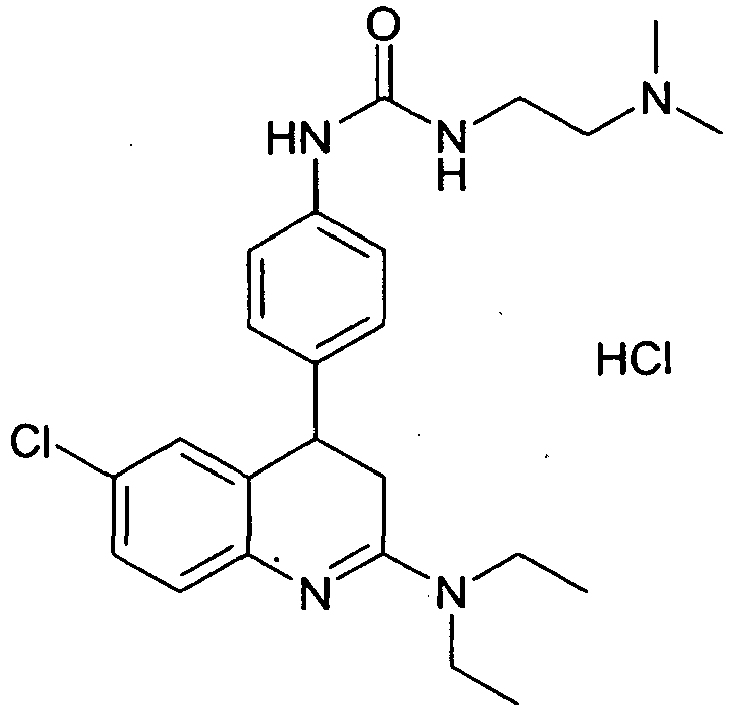
- 62 mg 4-(4-Aminophenyl)-6-chlor-2-diethylamino-3,4-dihydrochinolin (Beispiel 3) wurde in 5 ml Dichlormethan gelöst und mit 46 mg 4-Nitrophenylchloroformat versetzt. Nach kurzer Zeit fällt ein Feststoff aus. Nach 3 Stunden Rühren bei Raumtemperatur destillierte man Dichlormethan ab. Das Produkt wurde isoliert als einen heller Feststoff.
- 105 mg O-(2-Nitrophenyl)-N-[4-(6-chloro-3,4-dihydro-2-diethylaminoquinolin-4-yl)phenyl] carbamate wurden in 5 ml THF gelöst. Man tropfte anschließend 21 mg N,N-Dimethylethylenediamine zu und rührte 4 Stunden bei Raumtemperatur. Das Lösungsmittel wurde abdestilliert und der Rückstand wurde mit Wasser und Essigester extrahiert. Das Produkt wurde durch MPLC unter Verwendung einer MPRC-Kartusche mit einem Gemisch aus 10 Volumenteilen Essigester, 5 Volumenteilen n-Heptan, 5 Volumenteilen Dichlormethan, 5 Volumenteilen Methanol und 1 Volumenteil konzentrierter wässriger Ammoniaklösung chromatographisch gereinigt. Das erhaltene Produkt wurde mit Wasser, 2N HCl und 10% HCl versetzt und die klare Lösung wurde über Nacht gefriergetrocknet. Man erhielt das Produkt als ein hygroskopisches Festprodukt dass in wenig Essigester gelöst wurde, mit etherischer HCl sauer gestellt, bei Raumtemperatur gerührt und abgesaugt.
Rf = 0.57 (silica gel, Essigester/Methanol/Heptan/Dichloromethan/Ammoniak 10:5:5:5:1)
1H-NMR (DMSO-d6): δ = 1.07(t,2H), 1.17(t,2H), 2.50(s,6H), 2.80(d,2H), 3.13(q,2H), 3.30(m,1H), 3.57(m,1H), 3.70(m,1H), 3.83(q,2H), 4.39(m,1H), 6.66(t,1H), 6.99(d,1H), 7.04(d,2H), 7.43(m,3H), 7.70(d,1 H), 9.11 (s, 1 H)
MS: m/z = 441 (m)+ - In diesem Test wurde die Erholung des intrazellulären pHs (pHi) nach einer Ansäuerung ermittelt, die bei funktionsfähigem NHE auch unter bicarbonatfreien Bedingungen einsetzt. Dazu wurde der pHi mit dem pH-sensitiven Fluoreszenzfarbstoff BCECF (Calbiochem, eingesetzt wurde die Vorstufe BCECF-AM) bestimmt. Die Zellen wurden zunächst mit BCECF beladen. Die BCECF-Fluoreszenz wurde in einem "Ratio Fluorescence Spectrometer" (Photon Technology International, South Brunswick, N.J., USA) bei Anregungswellenlängen von 505 und 440 nm und einer Emissionswellenlänge von 535 nm bestimmt und mittels Kalibrierungskurven in den pHi umgerechnet. Die Zellen wurden bereits bei der BCECF-Beladung in NH4Cl-Puffer (pH 7,4) inkubiert (NH4Cl -Puffer: 115 mM NaCl, 20 mM NH4Cl, 5 mM KCl, 1 mM CaCl2, 1 mM MgSO4, 20 mM Hepes, 5 mM Glucose, 1 mg/ml BSA; mit 1 M NaOH wurde ein pH von 7,4 eingestellt). Die intrazelluläre Ansäuerung wurde durch Zugabe von 975 µl eines NH4Cl -freien Puffers (s. u.) zu 25 µl Aliquots der in NH4Cl - Puffer inkubierten Zellen induziert. Die nachfolgende Geschwindigkeit der pH-Erholung wurde bei NHE1 zwei Minuten, bei NHE2 fünf Minuten und bei NHE3 drei Minuten registriert. Für die Berechnung der inhibitorischen Potenz der getesteten Substanzen wurden die Zellen zunächst in Puffern untersucht, bei denen eine vollständige bzw. überhaupt keine pH-Erholung stattfand. Zur vollständigen pH-Erholung (100%) wurden die Zellen in Na+-haltigem Puffer inkubiert (133,8 mM NaCl, 4,7 mM KCl, 1,25 mM CaCl2, 1,25 mM MgCl2, 0,97 mM Na2HPO4, 0,23 mM NaH2PO4, 5 mM Hepes, 5 mM Glucose, mit 1 M NaOH wurde ein pH von 7,0 eingestellt). Für die Bestimmung des 0%-Wertes wurden die Zellen in einem Na+-freien Puffer inkubiert (133,8 mM Cholinchlorid, 4,7 mM KCl, 1,25 mM CaCl2, 1,25 mM MgCl2, 0,97 mM K2HPO4, 0,23 mM KH2PO4, 5 mM Hepes, 5 mM Glucose, mit 1 M NaOH wurde ein pH von 7,0 eingestellt). Die zu testenden Substanzen wurden in dem Na+-haltigem Puffer angesetzt. Die Erholung des intrazellulären pH's bei jeder getesteten Konzentration einer Substanz wurde in Prozent der maximalen Erholung ausgedrückt. Aus den Prozentwerten der pH-Erholung wurde mittels des Programms Sigma-Plot der IC50-Wert der jeweiligen Substanz für die einzelnen NHE-Subtypen berechnet.
- Die inhibitorische Wirkung (IC50-Werte) diverser Beispielverbindungen auf den NHE3 ist in nachfolgender Tabelle aufgeführt:
Beispiel IC50 [µM] 1 4,39 2 10,87 3 9,19 4 13,85
sowie deren pharmazeutisch verträgliche Salze und Trifluoracetate.
Claims (14)
- Verbindungen der Formel I
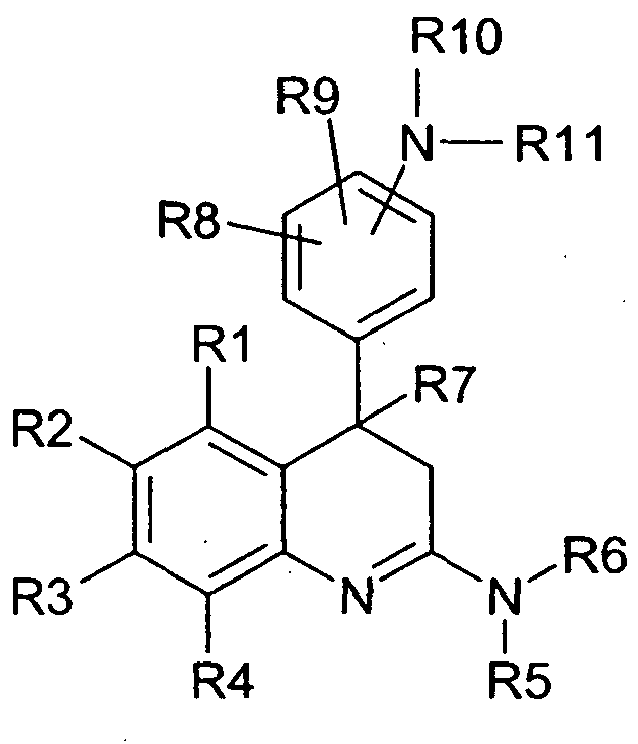 R1, R2, R3 und R4
unabhängig voneinander Wasserstoff, F, Cl, Br, I, CN, NO2, CF3, CH3-SO2, Alkyl mit 1, 2, 3 oder 4 C-Atomen, NH2, NH-CH3 oder N(CH3)2;R5 und R6
unabhängig voneinander Wasserstoff, Alkyl mit 1, 2, 3, 4, 5 oder 6 C-Atomen, CF3-CH2-, Cycloalkyl mit 3, 4, 5 oder 6 C-Atomen oder Cyclopropyl-CH2-,oderR5 und R6
bilden gemeinsam mit dem Stickstoffatom, an das sie gebunden sind, einen 4-, 5-, 6-, 7-, 8-, 9- oder 10-gliedrigen Ring, in dem ein oder zwei CH2-Gruppen unabhängig voneinander durch NR12, Schwefel, Sauerstoff, C(O) oder SO2 ersetzt sein können;
R12 Wasserstoff, Alkyl mit 1,2,3 oder 4 C-Atomen oder Cycloalkyl mit 3, 4, 5 oder 6 C-Atomen;R7 Wasserstoff oder Alkyl mit 1, 2, 3 oder 4 C-Atomen;R8 und R9
unabhängig voneinander Wasserstoff, F, Cl, Br, OH, Alkyl mit 1, 2, 3 oder 4 C-Atomen, CH3O, CF3, oder CH3SO2;R10 und R11
unabhängig voneinander R13-(CmH2m)-Bn, wobeim Null, 1, 2, 3 oder 4;n Null oder 1;B -CO-, -CONR14- oder -SO2-;
R14 Wasserstoff oder Alkyl mit 1, 2, 3, 4, 5 oder 6 C-Atomen;R13 Wasserstoff, Alkyl mit 1, 2, 3 oder 4 C-Atomen, Cycloalkyl mit 3, 4, 5 oder 6 C-Atomen, 1-Pyrrolidinyl, 1-Piperidinyl, 1-(4-Methylpiperazinyl), 1-Morpholinyl -COOR15, OR16, NR17R18 oder Phenyl, das unabhängig voneinander 1 oder 2 Substituenten trägt, ausgewählt aus der Gruppe Chlor, Fluor, Methyl und Methoxy;
R15, R16, R17 und R18
unabhängig voneinander Wasserstoff oder Alkyl mit 1, 2, 3, 4, 5 oder 6 C-Atomen;oderR10 und R11sowie deren pharmazeutisch verträgliche Salze und Trifluoracetate.
bilden gemeinsam mit dem Stickstoffatom, an das sie gebunden sind, einen 4-, 5-, 6-, 7-, 8-, 9- oder 10-gliedrigen Ring, in dem ein, zwei oder drei CH2-Gruppen unabhängig voneinander durch NR19, Schwefel, Sauerstoff, C(O) oder SO2 ersetzt sein können;
R19 Wasserstoff, Alkyl mit 1, 2, 3 oder 4 C-Atomen oder Cycloalkyl mit 3, 4, 5 oder 6 C-Atomen; - Verbindungen der Formel I nach Anspruch 1, worin bedeutenR1, R2, R3 und R4
unabhängig voneinander Wasserstoff, F, Cl, Br, CN, CF3, CH3-SO2, Alkyl mit 1, 2, 3 oder 4 C-Atomen, NH2, NH-CH3 oder N(CH3)2;R5 und R6
unabhängig voneinander Wasserstoff, Alkyl mit 1, 2, 3, 4, 5 oder 6 C-Atomen, CF3-CH2-, Cycloalkyl mit 3, 4, 5 oder 6 C-Atomen oder Cyclopropyl-CH2-,
oderR5 und R6
bilden gemeinsam mit dem Stickstoffatom, an das sie gebunden sind, einen 4-, 5-, 6-, 7-, 8-, 9- oder 10-gliedrigen Ring;R7 Wasserstoff;R8 und R9
unabhängig voneinander Wasserstoff, F, Cl, OH, Alkyl mit 1, 2, 3 oder 4 C-Atomen, CH3O, CF3, oder CH3SO2;R10 und 11
unabhängig voneinander R13-(CmH2m)-Bn, wobeim Null, 1, 2, 3 oder 4;n Null oder 1;B -CO-, -CONR14- oder -SO2-;
R14 Wasserstoff oder Alkyl mit 1, 2, 3, 4, 5 oder 6 C-Atomen;R13 Wasserstoff, Alkyl mit 1, 2, 3 oder 4 C-Atomen, Cycloalkyl mit 3, 4, 5 oder 6 C-Atomen, 1-Pyrrolidinyl, 1-Piperidinyl, 1-(4-Methylpiperazinyl) 1-Morpholinyl, -COOR15, OR16, NR17R18 oder Phenyl, das unabhängig voneinander 1 oder 2 Substituenten trägt, ausgewählt aus der Gruppe Chlor, Fluor, Methyl und Methoxy;oder
R15, R16, R17 und R18
unabhängig voneinander Wasserstoff oder Alkyl mit 1, 2, 3, 4, 5 oder 6 C-Atomen;R10 und R11sowie deren pharmazeutisch verträgliche Salze und Trifluoracetate.
bilden gemeinsam mit dem Stickstoffatom, an das sie gebunden sind, einen 4-, 5-, 6-, 7-, 8-, 9- oder 10-gliedrigen Ring, in dem eine CH2-Gruppen durch Sauerstoff oder NR19 ersetzt sein kann;R19 Wasserstoff oder Alkyl mit 1, 2, 3 oder 4 C-Atomen; - Verbindungen der Formel I nach Anspruch 1 oder 2, worin bedeutenR1, R2, R3 und R4
unabhängig voneinander Wasserstoff, F, Cl, Br, CN, CF3, CH3-SO2, Methyl, Ethyl, NH2, NH-CH3 oder N(CH3)2;R5 und R6
unabhängig voneinander Wasserstoff, Methyl, Ethyl, Isopropyl, CF3-CH2 oder Cycloalkyl mit 3, 4, 5 oder 6 C-Atomen;R7 Wasserstoff;R8 und R9
unabhängig voneinander Wasserstoff, Cl oder Methyl;R10 und 11
unabhängig voneinander R13-(CmH2m)-Bn, wobeim Null, 1, 2, 3 oder 4;n Null oder 1;B -CO-, -CONR14- oder -SO2-;
R14 Wasserstoff oder Alkyl mit 1, 2, 3, 4, 5 oder 6 C-Atomen;R13 Wasserstoff, Methyl, Cycloalkyl mit 3, 4, 5 oder 6 C-Atomen, 1-Pyrrolidinyl, 1-Piperidinyl, 1-(4-Methylpiperazinyl), -COOR15, OR16 oder NR17R18;oder
R15, R16, R17 und R18unabhängig voneinander Wasserstoff oder Alkyl mit 1, 2, 3, 4, 5 oder 6 C-Atomen;R10 und R11sowie deren pharmazeutisch verträgliche Salze und Trifluoracetate.
bilden gemeinsam mit dem Stickstoffatom, an das sie gebunden sind, einen 4-, 5-, 6-, 7-, 8-, 9- oder 10-gliedrigen Ring, in dem eine CH2-Gruppen durch Sauerstoff oder NR19 ersetzt sein kann;
R19 Wasserstoff oder Methyl; - Verbindungen der Formel I nach einem oder mehreren der Ansprüche 1 bis 3, worin bedeutenR1 und R3
Wasserstoff;R2 und R4
unabhängig voneinander Wasserstoff oder Cl;R5 und R6
unabhängig voneinander Wasserstoff, Methyl oder Ethyl;R7 Wasserstoff;R8 und R9
unabhängig voneinander Wasserstoff oder Cl;R10 und 11
unabhängig voneinander R13-(CmH2m)-Bn, wobeim Null, 1, 2, 3 oder 4;n Null oder 1;B -CONR14-;
R14 Wasserstoff oder Methyl;R13 Wasserstoff, Methyl, Cycloalkyl mit 3, 4, 5 oder 6 C-Atomen, 1-Pyrrolidinyl, 1-Piperidinyl, 1-(4-Methylpiperazinyl), -COOR15, OR16 oder NR17R18;oder
R15, R16, R17 und R18unabhängig voneinander Wasserstoff oder Alkyl mit 1, 2, 3, 4, 5 oder 6 C-Atomen;R10 und R11sowie deren pharmazeutisch verträgliche Salze und Trifluoracetate.
bilden gemeinsam mit dem Stickstoffatom, an das sie gebunden sind, einen 4-, 5-, 6-, 7-, 8-, 9- oder 10-gliedrigen Ring, in dem eine CH2-Gruppen durch NR19 ersetzt sein kann;R19 Wasserstoff oder Methyl; - Verbindungen der Formel I nach einem oder mehreren der Ansprüche 1 bis 4, ausgewählt aus der Gruppe:2-Amino-4-(4-aminophenyl)-6-chlor-3,4-dihydrochinolin,4-(4-Aminophenyl)-6-chlor-2-ethylamino-3,4-dihydrochinolin,4-(4-Aminophenyl)-6-chlor-2-diethylamino-3,4-dihydrochinolinundN-(2-Dimethylaminoethyl)-N'-4-[(6-chloro-3,4-dihydro-2-diethylaminoquinolin-4-yl)phenyl]harnstoff,sowie dessen pharmazeutisch verträgliche Salze und Trifluoracetate.
- Verbindungen der Formel I und deren pharmazeutisch verträgliche Salze nach einem oder mehreren der Ansprüche 1 bis 5 zur Verwendung als Medikament.
- Verwendung einer Verbindung der Formel I und/oder dessen pharmazeutisch verträglicher Salze nach einem oder mehreren der Ansprüche 1 bis 5 zur Herstellung eines Medikaments zur Behandlung oder Prophylaxe von Störungen des Atemantriebs, von Atemstörungen, Schlaf-bedingten Atemstörungen, Schlafapnoen, von Schnarchen, von akuten und chronischen Nierenerkrankungen, des akuten Nierenversagens und des chronischen Nierenversagens, von Störungen der Darmfunktion, des Bluthochdrucks, der essentiellen Hypertonie, von Erkrankungen des Zentralnervensystems, von Erkrankungen, die durch ZNS-Übererregbarkeit resultieren, Epilepsie und zentral ausgelöste Krämpfe oder von Angstzuständen, Depressionen und Psychosen, von ischämischen Zuständen des peripheren oder zentralen Nervensystems oder des Schlaganfalls, degenerative Erkrankungen des ZNS, Verminderung der Gedächtnisleistung, Demens und Alzheimersche Erkrankung, und von akuten und chronischen Schäden und Erkrankungen peripherer Organe oder Gliedmaßen, die durch Ischämie- oder durch Reperfusionsereignisse verursacht werden, von Atherosklerose, von Störungen des Fettstoffwechsels, von Thrombosen, von Störungen der Gallenfunktion, von Befall durch Ektoparasiten, von Erkrankungen infolge endothelialer Dysfunktion, von Protozoen-Erkrankungen, der Malaria, von Schockzuständen oder der Zuckerkrankheit und diabetischer Spätschäden oder von Krankheiten, bei denen die Zellproliferation eine primäre oder sekundäre Ursache darstellt, zur Konservierung und Lagerung von Transplantaten für chirurgische Maßnahmen, für den Einsatz bei chirurgischen Operationen und Organtransplantationen und zur Gesunderhaltung und Lebensverlängerung.
- Verwendung einer Verbindung der Formel I und/oder dessen pharmazeutisch verträglicher Salze nach einem oder mehreren der Ansprüche der Ansprüche 1 bis 5 in Kombination mit anderen Arzneimitteln oder Wirkstoffen zur Herstellung eines Medikaments zur Behandlung oder Prophylaxe von Störungen des Atemantriebs, von Atemstörungen, Schlaf-bedingten Atemstörungen, Schlafapnoen, von Schnarchen, von akuten und chronischen Nierenerkrankungen, des akuten Nierenversagens und des chronischen Nierenversagens, von Störungen der Darmfunktion, des Bluthochdrucks, der essentiellen Hypertonie, von Erkrankungen des Zentralnervensystems, von Erkrankungen, die durch ZNS-Übererregbarkeit resultieren, Epilepsie und zentral ausgelöste Krämpfe oder von Angstzuständen, Depressionen und Psychosen, von ischämischen Zuständen des peripheren oder zentralen Nervensystems oder des Schlaganfalls, von akuten und chronischen Schäden und Erkrankungen peripherer Organe oder Gliedmaßen, die durch Ischämie- oder durch Reperfusionsereignisse verursacht werden, von Atherosklerose, von Störungen des Fettstoffwechsels, von Thrombosen, von Störungen der Gallenfunktion, von Befall durch Ektoparasiten, von Erkrankungen infolge endothelialer Dysfunktion, von Protozoen-Erkrankungen, der Malaria, von Schockzuständen oder der Zuckerkrankheit und diabetischer Spätschäden oder von Krankheiten, bei denen die Zellproliferation eine primäre oder sekundäre Ursache darstellt zur Konservierung und Lagerung von Transplantaten für chirurgische Maßnahmen, für den Einsatz bei chirurgischen Operationen und Organtransplantationen und zur Gesunderhaltung und Lebensverlängerung.
- Verwendung einer Verbindung der Formel I und/oder dessen pharmazeutisch verträglicher Salze nach einem oder mehreren der Ansprüche 1 bis 5 allein oder in Kombination mit anderen Arzneimitteln oder Wirkstoffen zur Herstellung eines Medikaments zur Behandlung oder Prophylaxe von Störungen des Atemantriebs und/oder von Schlaf-bedingten Atemstörungen wie Schlafapnoen.
- Verwendung einer Verbindung der Formel I und/oder dessen pharmazeutisch verträglicher Salze nach einem oder mehreren der Ansprüche 1 bis 5 allein oder in Kombination mit anderen Arzneimitteln oder Wirkstoffen zur Herstellung eines Medikaments zur Behandlung oder Prophylaxe des Schnarchens.
- Verwendung einer Verbindung der Formol I und/oder dessen pharmazeutisch verträglicher Salze nach einem oder mehreren der Ansprüche 1 bis 5 allein oder in Kombination mit anderen Arzneimitteln oder Wirkstoffen zur Herstellung eines Medikaments zur Behandlung oder zur Prophylaxe von akuten oder chronischen Nierenerkrankungen, des akuten Nierenversagens oder des chronischen Nierenversagens.
- Verwendung einer Verbindung der Formel I und/oder dessen pharmazeutisch verträglicher Salze nach einem oder mehreren der Ansprüche 1 bis 5 allein oder in Kombination mit anderen Arzneimitteln oder Wirkstoffen zur Herstellung eines Medikaments zur Behandlung oder Prophylaxe von Störungen der Darmfunktion.
- Pharmazeutische Zubereitung für die humane, veterinäre oder phytoprotektive Anwendung enthaltend eine wirksame Menge einer Verbindung der Formel I und/oder eines pharmazeutisch verträglichen Salzes davon nach einem oder mehreren der Ansprüche 1 bis 5.
- Pharmazeutische Zubereitung für die humane, veterinäre oder phytoprotektive Anwendung enthaltend eine wirksame Menge einer Verbindung der Formel I und/oder eines pharmazeutisch verträglichen Salzes davon nach einem oder mehreren der Ansprüche 1 bis 5, in Kombination mit anderen pharmakologischen Wirkstoffen oder Arzneimitteln.
Priority Applications (1)
| Application Number | Priority Date | Filing Date | Title |
|---|---|---|---|
| PL07723091T PL1999112T3 (pl) | 2006-03-18 | 2007-03-08 | Podstawione 2-amino-4-fenylo-dihydrochinoliny, sposób ich wytwarzania, ich zastosowanie jako leku i lek je zawierający |
Applications Claiming Priority (2)
| Application Number | Priority Date | Filing Date | Title |
|---|---|---|---|
| DE102006012545A DE102006012545A1 (de) | 2006-03-18 | 2006-03-18 | Substituierte 2-Amino-4-phenyl-dihydrochinoline, Verfahren zu ihrer Herstellung, ihre Verwendung als Medikament, sowie sie enthaltendes Medikament |
| PCT/EP2007/001983 WO2007107246A2 (de) | 2006-03-18 | 2007-03-08 | Substituierte 2-amino-4-phenyl-dihydrochnoline, verfahren zu ihrer herstellung, ihre verwendung als medikament, sowie sie enthaltendes medikament |
Publications (2)
| Publication Number | Publication Date |
|---|---|
| EP1999112A2 EP1999112A2 (de) | 2008-12-10 |
| EP1999112B1 true EP1999112B1 (de) | 2015-04-22 |
Family
ID=38161982
Family Applications (1)
| Application Number | Title | Priority Date | Filing Date |
|---|---|---|---|
| EP07723091.0A Not-in-force EP1999112B1 (de) | 2006-03-18 | 2007-03-08 | Substituierte 2-amino-4-phenyl-dihydrochinoline, verfahren zu ihrer herstellung, ihre verwendung als medikament, sowie sie enthaltendes medikament |
Country Status (17)
| Country | Link |
|---|---|
| US (1) | US8106204B2 (de) |
| EP (1) | EP1999112B1 (de) |
| JP (1) | JP2009530324A (de) |
| KR (1) | KR20080105090A (de) |
| CN (1) | CN101395137A (de) |
| AR (1) | AR059848A1 (de) |
| AU (1) | AU2007229095A1 (de) |
| BR (1) | BRPI0708816A2 (de) |
| CA (1) | CA2646204A1 (de) |
| DE (1) | DE102006012545A1 (de) |
| ES (1) | ES2543345T3 (de) |
| MX (1) | MX2008011589A (de) |
| NO (1) | NO20084401L (de) |
| PL (1) | PL1999112T3 (de) |
| TW (1) | TW200800903A (de) |
| UY (1) | UY30218A1 (de) |
| WO (1) | WO2007107246A2 (de) |
Families Citing this family (3)
| Publication number | Priority date | Publication date | Assignee | Title |
|---|---|---|---|---|
| US20120088737A2 (en) * | 2009-10-02 | 2012-04-12 | Ajinomoto Co., Inc | Novel acyl guanidine derivatives |
| WO2016013657A1 (ja) | 2014-07-25 | 2016-01-28 | 大正製薬株式会社 | ヘテロアリールで置換されたフェニルテトラヒドロイソキノリン化合物 |
| CN116554211B (zh) * | 2023-04-07 | 2026-06-12 | 东南大学 | 一种基于氟硼二喹啉配合物蓝色荧光材料及其制备方法与应用 |
Family Cites Families (4)
| Publication number | Priority date | Publication date | Assignee | Title |
|---|---|---|---|---|
| US3538101A (en) * | 1967-05-15 | 1970-11-03 | Ciba Geigy Corp | 4 phenol dihydroquinolines |
| PT1140935E (pt) * | 1998-12-23 | 2003-10-31 | Janssen Pharmaceutica Nv | Derivados da quinolina 1,2-ciclizada |
| WO2003000705A1 (en) * | 2001-06-21 | 2003-01-03 | Ariad Pharmaceuticals, Inc. | Novel quinolines and uses thereof |
| DK1453810T3 (da) * | 2001-12-05 | 2009-07-20 | Sanofi Aventis Deutschland | Substituerede 4-phenyltetrahydroisoquinoliner, fremgangsmåde til deres fremstilling, deres anvendelse som medikament indeholdende samme |
-
2006
- 2006-03-18 DE DE102006012545A patent/DE102006012545A1/de not_active Withdrawn
-
2007
- 2007-03-08 KR KR1020087022835A patent/KR20080105090A/ko not_active Withdrawn
- 2007-03-08 BR BRPI0708816-7A patent/BRPI0708816A2/pt not_active IP Right Cessation
- 2007-03-08 PL PL07723091T patent/PL1999112T3/pl unknown
- 2007-03-08 MX MX2008011589A patent/MX2008011589A/es not_active Application Discontinuation
- 2007-03-08 CA CA002646204A patent/CA2646204A1/en not_active Abandoned
- 2007-03-08 ES ES07723091.0T patent/ES2543345T3/es active Active
- 2007-03-08 JP JP2009500731A patent/JP2009530324A/ja not_active Abandoned
- 2007-03-08 CN CNA2007800070553A patent/CN101395137A/zh active Pending
- 2007-03-08 EP EP07723091.0A patent/EP1999112B1/de not_active Not-in-force
- 2007-03-08 AU AU2007229095A patent/AU2007229095A1/en not_active Abandoned
- 2007-03-08 WO PCT/EP2007/001983 patent/WO2007107246A2/de not_active Ceased
- 2007-03-15 TW TW096108850A patent/TW200800903A/zh unknown
- 2007-03-15 AR ARP070101052A patent/AR059848A1/es not_active Application Discontinuation
- 2007-03-16 UY UY30218A patent/UY30218A1/es not_active Application Discontinuation
-
2008
- 2008-09-17 US US12/212,294 patent/US8106204B2/en not_active Expired - Fee Related
- 2008-10-20 NO NO20084401A patent/NO20084401L/no not_active Application Discontinuation
Also Published As
| Publication number | Publication date |
|---|---|
| PL1999112T3 (pl) | 2015-10-30 |
| US20090118329A1 (en) | 2009-05-07 |
| DE102006012545A1 (de) | 2007-09-27 |
| WO2007107246A2 (de) | 2007-09-27 |
| ES2543345T3 (es) | 2015-08-18 |
| UY30218A1 (es) | 2007-10-31 |
| JP2009530324A (ja) | 2009-08-27 |
| MX2008011589A (es) | 2008-09-22 |
| WO2007107246A3 (de) | 2008-06-05 |
| US8106204B2 (en) | 2012-01-31 |
| KR20080105090A (ko) | 2008-12-03 |
| TW200800903A (en) | 2008-01-01 |
| BRPI0708816A2 (pt) | 2011-06-14 |
| CA2646204A1 (en) | 2007-09-27 |
| CN101395137A (zh) | 2009-03-25 |
| NO20084401L (no) | 2008-12-11 |
| AR059848A1 (es) | 2008-04-30 |
| EP1999112A2 (de) | 2008-12-10 |
| AU2007229095A1 (en) | 2007-09-27 |
Similar Documents
| Publication | Publication Date | Title |
|---|---|---|
| EP1794128B1 (de) | Substituierte 4-phenyltetrahydroisochinoline, verfahren zu ihrer herstellung, ihre verwendung als medikament, sowie sie enthaltendes medikament | |
| EP1613600B1 (de) | Substituierte 4-phenyltetrahydroisochinoline, verfahren zu ihrer herstellung, ihre verwendung als medikament, sowie sie enthaltendes medikament | |
| EP1928836A1 (de) | Substituierte 4-phenyltetrahydroisochinoline, verfahren zu ihrer herstellung, ihre verwendung als medikament, sowie sie enthaltendes medikament | |
| EP1838315B1 (de) | Substituierte 4-phenyltetrahydroisochinoline, verfahren zu ihrer herstellung, ihre verwendung als medikament, sowie sie enthaltendes medikament | |
| EP1513834B1 (de) | Substituierte thiophene, verfahren zu ihrer herstellung, ihre verwendung als medikament oder diagnostikum sowie sie enthaltendes medikament | |
| EP1999113B1 (de) | Substituierte 1-amino-4-phenyl-dihydroisochinoline, verfahren zu ihrer herstellung, ihre verwendung als medikament, sowie sie enthaltendes medikament | |
| EP1999112A2 (de) | Substituierte 2-amino-4-phenyl-dihydrochnoline, verfahren zu ihrer herstellung, ihre verwendung als medikament, sowie sie enthaltendes medikament | |
| EP1664058B1 (de) | Substituierte thienoimidazole, verfahren zu ihrer herstellung, ihre verwendung als medikament oder diagnostikum sowie sie enthaltende medikamente | |
| DE10163914A1 (de) | Substituierte 4-Phenyltetrahydroisochinolinium-Salze, Verfahren zu ihrer Herstellung, ihre Verwendung als Medikament, sowie sie enthaltendes Medikament | |
| EP1592671B1 (de) | N-substituierte (benzoimidazol-2-yl)-phenyl-amine, verfahren zu ihrer herstellung, ihre verwendung als medikament oder diagnostikum sowie sie enthaltendes medikament | |
| EP1692105B1 (de) | VERFAHREN ZUR HERSTELLUNG VON (3-OXO-2,3-DIHYDRO-1H-ISOINDOL-1-Yl)-ACETYLGUANIDIN-DERIVATEN | |
| HK1130051A (en) | Substituted 2-amino-4-phenyl-dihydroquinolines, method for the production thereof, use thereof as medicaments, and medicaments containing them |
Legal Events
| Date | Code | Title | Description |
|---|---|---|---|
| PUAI | Public reference made under article 153(3) epc to a published international application that has entered the european phase |
Free format text: ORIGINAL CODE: 0009012 |
|
| AK | Designated contracting states |
Kind code of ref document: A2 Designated state(s): AT BE BG CH CY CZ DE DK EE ES FI FR GB GR HU IE IS IT LI LT LU LV MC MT NL PL PT RO SE SI SK TR |
|
| AX | Request for extension of the european patent |
Extension state: AL BA HR MK RS |
|
| 17P | Request for examination filed |
Effective date: 20081205 |
|
| RBV | Designated contracting states (corrected) |
Designated state(s): AT BE BG CH CY CZ DE DK EE ES FI FR GB GR HU IE IS IT LI LT LU LV MC MT NL PL PT RO SE SI SK TR |
|
| RAP1 | Party data changed (applicant data changed or rights of an application transferred) |
Owner name: SANOFI |
|
| RAP1 | Party data changed (applicant data changed or rights of an application transferred) |
Owner name: SANOFI |
|
| RAP1 | Party data changed (applicant data changed or rights of an application transferred) |
Owner name: SANOFI |
|
| DAX | Request for extension of the european patent (deleted) | ||
| GRAP | Despatch of communication of intention to grant a patent |
Free format text: ORIGINAL CODE: EPIDOSNIGR1 |
|
| INTG | Intention to grant announced |
Effective date: 20140923 |
|
| GRAS | Grant fee paid |
Free format text: ORIGINAL CODE: EPIDOSNIGR3 |
|
| GRAA | (expected) grant |
Free format text: ORIGINAL CODE: 0009210 |
|
| AK | Designated contracting states |
Kind code of ref document: B1 Designated state(s): AT BE BG CH CY CZ DE DK EE ES FI FR GB GR HU IE IS IT LI LT LU LV MC MT NL PL PT RO SE SI SK TR |
|
| REG | Reference to a national code |
Ref country code: GB Ref legal event code: FG4D Free format text: NOT ENGLISH |
|
| REG | Reference to a national code |
Ref country code: CH Ref legal event code: EP |
|
| REG | Reference to a national code |
Ref country code: AT Ref legal event code: REF Ref document number: 723132 Country of ref document: AT Kind code of ref document: T Effective date: 20150515 |
|
| REG | Reference to a national code |
Ref country code: IE Ref legal event code: FG4D Free format text: LANGUAGE OF EP DOCUMENT: GERMAN |
|
| REG | Reference to a national code |
Ref country code: DE Ref legal event code: R096 Ref document number: 502007013884 Country of ref document: DE Effective date: 20150603 |
|
| REG | Reference to a national code |
Ref country code: NL Ref legal event code: T3 |
|
| REG | Reference to a national code |
Ref country code: ES Ref legal event code: FG2A Ref document number: 2543345 Country of ref document: ES Kind code of ref document: T3 Effective date: 20150818 |
|
| REG | Reference to a national code |
Ref country code: LT Ref legal event code: MG4D |
|
| PG25 | Lapsed in a contracting state [announced via postgrant information from national office to epo] |
Ref country code: FI Free format text: LAPSE BECAUSE OF FAILURE TO SUBMIT A TRANSLATION OF THE DESCRIPTION OR TO PAY THE FEE WITHIN THE PRESCRIBED TIME-LIMIT Effective date: 20150422 Ref country code: PT Free format text: LAPSE BECAUSE OF FAILURE TO SUBMIT A TRANSLATION OF THE DESCRIPTION OR TO PAY THE FEE WITHIN THE PRESCRIBED TIME-LIMIT Effective date: 20150824 Ref country code: LT Free format text: LAPSE BECAUSE OF FAILURE TO SUBMIT A TRANSLATION OF THE DESCRIPTION OR TO PAY THE FEE WITHIN THE PRESCRIBED TIME-LIMIT Effective date: 20150422 |
|
| REG | Reference to a national code |
Ref country code: PL Ref legal event code: T3 |
|
| PG25 | Lapsed in a contracting state [announced via postgrant information from national office to epo] |
Ref country code: LV Free format text: LAPSE BECAUSE OF FAILURE TO SUBMIT A TRANSLATION OF THE DESCRIPTION OR TO PAY THE FEE WITHIN THE PRESCRIBED TIME-LIMIT Effective date: 20150422 Ref country code: IS Free format text: LAPSE BECAUSE OF FAILURE TO SUBMIT A TRANSLATION OF THE DESCRIPTION OR TO PAY THE FEE WITHIN THE PRESCRIBED TIME-LIMIT Effective date: 20150822 Ref country code: GR Free format text: LAPSE BECAUSE OF FAILURE TO SUBMIT A TRANSLATION OF THE DESCRIPTION OR TO PAY THE FEE WITHIN THE PRESCRIBED TIME-LIMIT Effective date: 20150723 |
|
| REG | Reference to a national code |
Ref country code: DE Ref legal event code: R097 Ref document number: 502007013884 Country of ref document: DE |
|
| PG25 | Lapsed in a contracting state [announced via postgrant information from national office to epo] |
Ref country code: EE Free format text: LAPSE BECAUSE OF FAILURE TO SUBMIT A TRANSLATION OF THE DESCRIPTION OR TO PAY THE FEE WITHIN THE PRESCRIBED TIME-LIMIT Effective date: 20150422 Ref country code: DK Free format text: LAPSE BECAUSE OF FAILURE TO SUBMIT A TRANSLATION OF THE DESCRIPTION OR TO PAY THE FEE WITHIN THE PRESCRIBED TIME-LIMIT Effective date: 20150422 |
|
| REG | Reference to a national code |
Ref country code: FR Ref legal event code: PLFP Year of fee payment: 10 |
|
| PLBE | No opposition filed within time limit |
Free format text: ORIGINAL CODE: 0009261 |
|
| STAA | Information on the status of an ep patent application or granted ep patent |
Free format text: STATUS: NO OPPOSITION FILED WITHIN TIME LIMIT |
|
| PG25 | Lapsed in a contracting state [announced via postgrant information from national office to epo] |
Ref country code: RO Free format text: LAPSE BECAUSE OF NON-PAYMENT OF DUE FEES Effective date: 20150422 Ref country code: CZ Free format text: LAPSE BECAUSE OF FAILURE TO SUBMIT A TRANSLATION OF THE DESCRIPTION OR TO PAY THE FEE WITHIN THE PRESCRIBED TIME-LIMIT Effective date: 20150422 Ref country code: SK Free format text: LAPSE BECAUSE OF FAILURE TO SUBMIT A TRANSLATION OF THE DESCRIPTION OR TO PAY THE FEE WITHIN THE PRESCRIBED TIME-LIMIT Effective date: 20150422 |
|
| 26N | No opposition filed |
Effective date: 20160125 |
|
| PG25 | Lapsed in a contracting state [announced via postgrant information from national office to epo] |
Ref country code: SI Free format text: LAPSE BECAUSE OF FAILURE TO SUBMIT A TRANSLATION OF THE DESCRIPTION OR TO PAY THE FEE WITHIN THE PRESCRIBED TIME-LIMIT Effective date: 20150422 |
|
| PG25 | Lapsed in a contracting state [announced via postgrant information from national office to epo] |
Ref country code: LU Free format text: LAPSE BECAUSE OF FAILURE TO SUBMIT A TRANSLATION OF THE DESCRIPTION OR TO PAY THE FEE WITHIN THE PRESCRIBED TIME-LIMIT Effective date: 20160308 Ref country code: MC Free format text: LAPSE BECAUSE OF FAILURE TO SUBMIT A TRANSLATION OF THE DESCRIPTION OR TO PAY THE FEE WITHIN THE PRESCRIBED TIME-LIMIT Effective date: 20150422 |
|
| REG | Reference to a national code |
Ref country code: IE Ref legal event code: MM4A |
|
| PG25 | Lapsed in a contracting state [announced via postgrant information from national office to epo] |
Ref country code: IE Free format text: LAPSE BECAUSE OF NON-PAYMENT OF DUE FEES Effective date: 20160308 |
|
| REG | Reference to a national code |
Ref country code: FR Ref legal event code: PLFP Year of fee payment: 11 |
|
| PGFP | Annual fee paid to national office [announced via postgrant information from national office to epo] |
Ref country code: PL Payment date: 20161215 Year of fee payment: 11 |
|
| PGFP | Annual fee paid to national office [announced via postgrant information from national office to epo] |
Ref country code: NL Payment date: 20170320 Year of fee payment: 11 Ref country code: CH Payment date: 20170314 Year of fee payment: 11 |
|
| REG | Reference to a national code |
Ref country code: AT Ref legal event code: MM01 Ref document number: 723132 Country of ref document: AT Kind code of ref document: T Effective date: 20160308 |
|
| PGFP | Annual fee paid to national office [announced via postgrant information from national office to epo] |
Ref country code: BE Payment date: 20170124 Year of fee payment: 11 |
|
| PG25 | Lapsed in a contracting state [announced via postgrant information from national office to epo] |
Ref country code: SE Free format text: LAPSE BECAUSE OF FAILURE TO SUBMIT A TRANSLATION OF THE DESCRIPTION OR TO PAY THE FEE WITHIN THE PRESCRIBED TIME-LIMIT Effective date: 20150422 |
|
| PGFP | Annual fee paid to national office [announced via postgrant information from national office to epo] |
Ref country code: IT Payment date: 20170320 Year of fee payment: 11 Ref country code: TR Payment date: 20170130 Year of fee payment: 11 Ref country code: ES Payment date: 20170214 Year of fee payment: 11 |
|
| PG25 | Lapsed in a contracting state [announced via postgrant information from national office to epo] |
Ref country code: AT Free format text: LAPSE BECAUSE OF NON-PAYMENT OF DUE FEES Effective date: 20160308 Ref country code: MT Free format text: LAPSE BECAUSE OF FAILURE TO SUBMIT A TRANSLATION OF THE DESCRIPTION OR TO PAY THE FEE WITHIN THE PRESCRIBED TIME-LIMIT Effective date: 20150422 |
|
| REG | Reference to a national code |
Ref country code: FR Ref legal event code: PLFP Year of fee payment: 12 |
|
| PG25 | Lapsed in a contracting state [announced via postgrant information from national office to epo] |
Ref country code: HU Free format text: LAPSE BECAUSE OF FAILURE TO SUBMIT A TRANSLATION OF THE DESCRIPTION OR TO PAY THE FEE WITHIN THE PRESCRIBED TIME-LIMIT; INVALID AB INITIO Effective date: 20070308 Ref country code: CY Free format text: LAPSE BECAUSE OF FAILURE TO SUBMIT A TRANSLATION OF THE DESCRIPTION OR TO PAY THE FEE WITHIN THE PRESCRIBED TIME-LIMIT Effective date: 20150422 |
|
| PG25 | Lapsed in a contracting state [announced via postgrant information from national office to epo] |
Ref country code: BG Free format text: LAPSE BECAUSE OF FAILURE TO SUBMIT A TRANSLATION OF THE DESCRIPTION OR TO PAY THE FEE WITHIN THE PRESCRIBED TIME-LIMIT Effective date: 20150422 |
|
| REG | Reference to a national code |
Ref country code: CH Ref legal event code: PL |
|
| REG | Reference to a national code |
Ref country code: NL Ref legal event code: MM Effective date: 20180401 |
|
| REG | Reference to a national code |
Ref country code: BE Ref legal event code: MM Effective date: 20180331 |
|
| PG25 | Lapsed in a contracting state [announced via postgrant information from national office to epo] |
Ref country code: NL Free format text: LAPSE BECAUSE OF NON-PAYMENT OF DUE FEES Effective date: 20180401 |
|
| PG25 | Lapsed in a contracting state [announced via postgrant information from national office to epo] |
Ref country code: CH Free format text: LAPSE BECAUSE OF NON-PAYMENT OF DUE FEES Effective date: 20180331 Ref country code: IT Free format text: LAPSE BECAUSE OF NON-PAYMENT OF DUE FEES Effective date: 20180308 Ref country code: LI Free format text: LAPSE BECAUSE OF NON-PAYMENT OF DUE FEES Effective date: 20180331 Ref country code: BE Free format text: LAPSE BECAUSE OF NON-PAYMENT OF DUE FEES Effective date: 20180331 |
|
| PGFP | Annual fee paid to national office [announced via postgrant information from national office to epo] |
Ref country code: DE Payment date: 20190226 Year of fee payment: 13 Ref country code: GB Payment date: 20190306 Year of fee payment: 13 |
|
| PGFP | Annual fee paid to national office [announced via postgrant information from national office to epo] |
Ref country code: FR Payment date: 20190213 Year of fee payment: 13 |
|
| PG25 | Lapsed in a contracting state [announced via postgrant information from national office to epo] |
Ref country code: PL Free format text: LAPSE BECAUSE OF NON-PAYMENT OF DUE FEES Effective date: 20180308 |
|
| REG | Reference to a national code |
Ref country code: ES Ref legal event code: FD2A Effective date: 20190904 |
|
| PG25 | Lapsed in a contracting state [announced via postgrant information from national office to epo] |
Ref country code: ES Free format text: LAPSE BECAUSE OF NON-PAYMENT OF DUE FEES Effective date: 20180309 |
|
| REG | Reference to a national code |
Ref country code: DE Ref legal event code: R119 Ref document number: 502007013884 Country of ref document: DE |
|
| PG25 | Lapsed in a contracting state [announced via postgrant information from national office to epo] |
Ref country code: DE Free format text: LAPSE BECAUSE OF NON-PAYMENT OF DUE FEES Effective date: 20201001 Ref country code: FR Free format text: LAPSE BECAUSE OF NON-PAYMENT OF DUE FEES Effective date: 20200331 |
|
| GBPC | Gb: european patent ceased through non-payment of renewal fee |
Effective date: 20200308 |
|
| PG25 | Lapsed in a contracting state [announced via postgrant information from national office to epo] |
Ref country code: GB Free format text: LAPSE BECAUSE OF NON-PAYMENT OF DUE FEES Effective date: 20200308 |
|
| PG25 | Lapsed in a contracting state [announced via postgrant information from national office to epo] |
Ref country code: TR Free format text: LAPSE BECAUSE OF NON-PAYMENT OF DUE FEES Effective date: 20180308 |