EP1997738A1 - Packing process and a sorting and distribution system for a packing process - Google Patents
Packing process and a sorting and distribution system for a packing process Download PDFInfo
- Publication number
- EP1997738A1 EP1997738A1 EP07010612A EP07010612A EP1997738A1 EP 1997738 A1 EP1997738 A1 EP 1997738A1 EP 07010612 A EP07010612 A EP 07010612A EP 07010612 A EP07010612 A EP 07010612A EP 1997738 A1 EP1997738 A1 EP 1997738A1
- Authority
- EP
- European Patent Office
- Prior art keywords
- distribution system
- belts
- package
- section
- belt
- Prior art date
- Legal status (The legal status is an assumption and is not a legal conclusion. Google has not performed a legal analysis and makes no representation as to the accuracy of the status listed.)
- Granted
Links
- 238000009826 distribution Methods 0.000 title claims abstract description 53
- 238000012856 packing Methods 0.000 title claims abstract description 34
- 238000000034 method Methods 0.000 title claims abstract description 28
- 230000008569 process Effects 0.000 title claims abstract description 28
- 238000002372 labelling Methods 0.000 claims abstract description 54
- 239000003973 paint Substances 0.000 claims abstract description 13
- 229910000831 Steel Inorganic materials 0.000 claims description 3
- 229920003023 plastic Polymers 0.000 claims description 3
- 239000004033 plastic Substances 0.000 claims description 3
- 239000010959 steel Substances 0.000 claims description 3
- 239000000463 material Substances 0.000 description 8
- 230000032258 transport Effects 0.000 description 6
- 230000008901 benefit Effects 0.000 description 5
- 230000007704 transition Effects 0.000 description 4
- 230000008859 change Effects 0.000 description 3
- 238000004519 manufacturing process Methods 0.000 description 3
- 230000005484 gravity Effects 0.000 description 2
- 229920002635 polyurethane Polymers 0.000 description 2
- 239000004814 polyurethane Substances 0.000 description 2
- 230000008707 rearrangement Effects 0.000 description 2
- 239000000853 adhesive Substances 0.000 description 1
- 230000001070 adhesive effect Effects 0.000 description 1
- 239000012237 artificial material Substances 0.000 description 1
- 235000005911 diet Nutrition 0.000 description 1
- 230000000378 dietary effect Effects 0.000 description 1
- 230000003670 easy-to-clean Effects 0.000 description 1
- 230000014759 maintenance of location Effects 0.000 description 1
- 239000002904 solvent Substances 0.000 description 1
- 238000003860 storage Methods 0.000 description 1
Images



Classifications
-
- B—PERFORMING OPERATIONS; TRANSPORTING
- B65—CONVEYING; PACKING; STORING; HANDLING THIN OR FILAMENTARY MATERIAL
- B65C—LABELLING OR TAGGING MACHINES, APPARATUS, OR PROCESSES
- B65C9/00—Details of labelling machines or apparatus
- B65C9/40—Controls; Safety devices
-
- B—PERFORMING OPERATIONS; TRANSPORTING
- B65—CONVEYING; PACKING; STORING; HANDLING THIN OR FILAMENTARY MATERIAL
- B65G—TRANSPORT OR STORAGE DEVICES, e.g. CONVEYORS FOR LOADING OR TIPPING, SHOP CONVEYOR SYSTEMS OR PNEUMATIC TUBE CONVEYORS
- B65G47/00—Article or material-handling devices associated with conveyors; Methods employing such devices
- B65G47/52—Devices for transferring articles or materials between conveyors i.e. discharging or feeding devices
- B65G47/64—Switching conveyors
- B65G47/644—Switching conveyors by a pivoting displacement of the switching conveyor
- B65G47/645—Switching conveyors by a pivoting displacement of the switching conveyor about a horizontal axis
- B65G47/647—Switching conveyors by a pivoting displacement of the switching conveyor about a horizontal axis the axis being perpendicular to the conveying direction
-
- B—PERFORMING OPERATIONS; TRANSPORTING
- B65—CONVEYING; PACKING; STORING; HANDLING THIN OR FILAMENTARY MATERIAL
- B65C—LABELLING OR TAGGING MACHINES, APPARATUS, OR PROCESSES
- B65C9/00—Details of labelling machines or apparatus
- B65C9/40—Controls; Safety devices
- B65C2009/401—Controls; Safety devices for detecting the height of articles to be labelled
Definitions
- the invention relates to a packing process and a distribution system for a packing process.
- US 4925002 discloses a sorting and distribution system for the handling of packages of documents or other items.
- the system includes an infeed conveyor in tandem with an inclined conveyor and a plurality of vertically adjustable conveyor divider plates positioned above the infeed and inclined conveyors to divide the conveying surfaces into a plurality of individual sorting lanes.
- the infeed and inclined conveyor belts have a plurality of longitudinal grooves therein which may be created by and are aligned with the divider plates which extend into said grooves.
- a conveyor end divider transition section positioned at the end of the inclined conveyor enables the conveyed materials to flow by means by gravity to a distribution transition section that includes a chute for each lane of conveyed materials.
- the distribution transition section provides for the optimum conveying angle for gravity flow of the conveyed materials and also provides the necessary direction changes to distribute the materials to the desired discharge chute.
- a plurality of discharge chutes receive the conveyed materials at the end of the distribution transition section and discharges the conveyed materials into receptacles.
- FR 2548149 discloses a sorting and distribution system having a frame with at least two series of parallel, horizontal, continuous conveyor belts stacked one above the other. Each belt is edged laterally by vertical dividers fixed to the structure. A spring-load lever at the end of each belt retains the products until activated by an electro-magnet. Each belt is also fitted with a product retention roller, spring-loaded on pivots above the belt. Shafts with slightly concave, enlarged diameter sections tension the belts which are motor driven, via a bevelled crown wheel and pinion, either independently or by a common shaft. The system is used in the field of storage and dispensing of pharmaceutical or dietary products.
- paints are filled in cans or bottles by filling machines after production of paints.
- a filling machine fills a paint in a can or a bottle and closes the can or bottle.
- a belt transports the cans or bottles from the filling machine to a labelling machine.
- the function of the labelling machine is to apply labels, e.g., adhesive labels to randomly arriving packages on a conveyor belt.
- the invention refers to a process for packing a product and labelling the package of the product comprising the steps:
- the process comprises at least two packing machines and corresponding infeed belts which connect every packing machine with one section belt of the distribution system for conveying a package from a packing machine, especially from a filling machine to the corresponding section belt whereby every package is transported from every section belt to a corresponding appropriate labelling machine.
- the section belts are arranged one above each other.
- every package is transported from a section belt to an outfeed belt by a connection belt having an adjustable end adjacent to the section belt.
- every package is transported from an infeed belt to a section belt by a connection belt having an adjustable end adjacent to the section belts.
- the packages are cans.
- the packages are filled with paints.
- the invention also refers to a distribution system suitable for carrying out the process comprising at least two section belts which are one above each other and connection belts having adjustable ends adjacent to the section belts for connecting every section belt with one infeed or outfeed belt.
- the section belts are connected with packing machines, especially filling machines on one side and with labelling machines on the other side.
- the distribution system comprises top rails attached to the connection belts.
- the height of a top rail above the corresponding connection belt is adjustable.
- the belts of the connection belts are made of plastic.
- the belts of the section belts are made of steel.
- guiding rails are attached to the section belts.
- the guiding rails are adjustable.
- the section belts are shifted collaterally.
- To rotate a connection belt from a first section belt to a second or third section belt may lead to gap between the connection belt and a section belt, if the section belts are not shifted collaterally.
- the section belts may be shifted collaterally in order to avoid such gaps for example.
- a first labelling machine is able to put a label on a package having a first size.
- a second labelling machine is able to put a label on a package having a second size and so on.
- a first labelling machine is able to put a label on a first package.
- a second labelling machine is able to put a label on a second package whereby the size of the second package differs from the size of the first package and so on.
- distribution system connected with one or more packing machines like filling machines on one side and with the different labelling machines on the other side. Every labelling machine is connected with the distribution system by an own outfeed belt.
- the function of the distribution system is to convey the packed product (for example a can or a bottle filled with a product like a paint) to the appropriate labelling machine which is able to put a label on the package. If the size of a package changes, the distribution system has only to convey the package having a new size to another appropriate labelling machine via the appropriate outfeed belt. For this reason, it is not necessary to stop the process for a lot of hours in order to rearrange a labelling machine.
- a change of a product may be a further reason for conveying a package to another labelling machine in order to save time. If one of the labelling machines is prepared to put the new corresponding label on the package containing a new product (for example a red paint instead of a green paint), it is only necessary to convey the package to the other labelling machine in order to put the appropriate label on the package.
- a new product for example a red paint instead of a green paint
- Every filling respectively packing machine is connected with the distribution system by an own infeed belt.
- the distribution system comprises preferably at least two different sections. There are for example three, four, five, six or ten different sections. The function of every section is to obtain a package from a packing machine, for example from a filling machine and to convey the package to the appropriate labelling machine depending on the size of the package.
- a first section of the distribution system receives a package having a first size from a first filling machine and conveys the package to an appropriate first labelling machine.
- a second section of the distribution system receives a package having a second size from a second filling machine and conveys the package to an appropriate second labelling machine and so on.
- a section may comprise belts in order to transport the packages. However, it is possible to use other transport means.
- sections belts of the sections or other transport means are preferably placed above each other. It is additional possible that the sections are shifted collaterally. Such an embodiment may be of advantage in order to avoid gaps between for example section belts and for example connection belts. However, if there is such a shift, the shift should be small in order to avoid consumption of base.
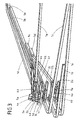
- Fig. 1 is a sectional view of three infeed belts 1 a, 1 band 1 c attached at three different sections of a distribution system 3. Every section comprises a belt 2a, 2b, 2c and a guiding rail 4a, 4b and 4c.
- the section belts 2a, 2b and 2c transport the packages coming from the infeed belts to the outfeed belts.
- the outfeed belts transport the packages to the labelling machines.
- the function of the guiding rails 4a, 4b, 4c is to guide a package coming from an infeed belt to the appropriate outfeed belt.
- the guiding rails are adjustable in an embodiment of the invention preferably by hand in order to avoid an accident.
- Fig. 2 is another sectional view of the embodiment according to fig. 1 showing the three section belts 2a, 2b and 2c as well as the corresponding guiding rails 4a, 4b and 4c.
- Fig. 2 shows one of three outfeed belts 5 leading to one labelling machine.
- connection belts 6 In order to provide a connection to the appropriate section belt 2a, 2b or 2c, there are three connection belts 6.
- Fig. 2 shows one of the three connection belts. It is possible to move one end of every connection belt up and down, namely the end 7 which is next to the section belts 2a, 2b, 2c. Due to the adjustable ends, it is possible to change the connections between the section belts and the outfeed belts in order to convey a package to the appropriate labelling machine.
- top guide 8 attached at the connection belt 6.
- the top guide is situated above the connection belt.
- the height of the top guide is adjustable.
- the function of every top guide belonging to the three different connection belts 6 is to prevent for example a can 9 from falling down, especially when a connection belt 6 is inclined according to the dotted view in fig. 2 .
- Fig. 3 shows a three-dimensional view of a further embodiment comprising five infeed belts 1a, 1b, 1c, 1d, 1e, five section belts 2a, 2b, 2c, 2d, 2e comprising guide rails 4a, 4b, 4c, 4d, 4e, four connection belts 6a, 6b, 6c, 6d and four outfeed belts 5a, 5b, 5c, 5d.
- Such an arrangement is of advantage, if there are four different sizes of cans 9a, 9b, 9c and 9e.
- Fig. 4 shows a top view of the embodiment shown in fig. 3 .
- connection belts are so arranged that the connection belts connects the infeed belts with the section belts, it is not necessary that the guiding rails are adjustable.
- Typical sizes of cans for a paint range from 0,5 litre to five litres. If a belt is not or only hardly inclined, the belts are preferably made of steel for stability and abrasive reasons. Otherwise, it may be preferable that a belt is made of an appropriate artificial material in order to provide a high friction force between a package like a can and the corresponding belt. For this reason, especially the connection belts are made of an appropriate plastic material like polyurethane or PVC. The further advantages of these materials are that polyurethane or PVC are solvent resistant and that they are easy to clean.
- a typical height of the distribution system for cans containing paints is about 2,70 metres. Such a distribution system does not consume a lot of space respectively base in a production hall.
Landscapes
- Engineering & Computer Science (AREA)
- Mechanical Engineering (AREA)
- Labeling Devices (AREA)
- Structure Of Belt Conveyors (AREA)
- Attitude Control For Articles On Conveyors (AREA)
Abstract
Description
- The invention relates to a packing process and a distribution system for a packing process.
-
US 4925002 discloses a sorting and distribution system for the handling of packages of documents or other items. The system includes an infeed conveyor in tandem with an inclined conveyor and a plurality of vertically adjustable conveyor divider plates positioned above the infeed and inclined conveyors to divide the conveying surfaces into a plurality of individual sorting lanes. The infeed and inclined conveyor belts have a plurality of longitudinal grooves therein which may be created by and are aligned with the divider plates which extend into said grooves. A conveyor end divider transition section positioned at the end of the inclined conveyor enables the conveyed materials to flow by means by gravity to a distribution transition section that includes a chute for each lane of conveyed materials. The distribution transition section provides for the optimum conveying angle for gravity flow of the conveyed materials and also provides the necessary direction changes to distribute the materials to the desired discharge chute. A plurality of discharge chutes receive the conveyed materials at the end of the distribution transition section and discharges the conveyed materials into receptacles. -
FR 2548149 - In paint industries paints are filled in cans or bottles by filling machines after production of paints. A filling machine fills a paint in a can or a bottle and closes the can or bottle. A belt transports the cans or bottles from the filling machine to a labelling machine. The function of the labelling machine is to apply labels, e.g., adhesive labels to randomly arriving packages on a conveyor belt.
- If the size of packages like cans or bottles changes, it is necessary to adapt the filling machine and the labelling machine to the new size of the packages. In such cases, it is necessary to stop the process of packing. As a rule, it will take about 15 minutes in order to adapt a conventional filling machine to a new size of a can or a bottle and it will take about four hours in order to adapt a conventional labelling machine to a new can or bottle size. As a result, it is necessary to stop the process of packing for many hours. Due to economical reasons, it is of interest to reduce this time delay during the course of a packing process.
- It is an object of the present invention to reduce the time delay during the process of packing and labelling of products. It is a further object of the invention to provide a sorting and distribution system especially for packing and labelling of products.
- For these reasons, the invention refers to a process for packing a product and labelling the package of the product comprising the steps:
- a) packing a product by a packing machine;
- b) conveying the package containing the product to a distribution system which is connected with different labelling machines;
- c) conveying the package from the distribution system to one of the labelling machines which is appropriate adapted to the size of the package;
- d) putting a label on the package by the appropriate labelling machine.
- In an embodiment, the process comprises at least two packing machines and corresponding infeed belts which connect every packing machine with one section belt of the distribution system for conveying a package from a packing machine, especially from a filling machine to the corresponding section belt whereby every package is transported from every section belt to a corresponding appropriate labelling machine.
- In a further embodiment of the process, the section belts are arranged one above each other.
- In a further embodiment of the process, every package is transported from a section belt to an outfeed belt by a connection belt having an adjustable end adjacent to the section belt.
- In a further embodiment of the process, every package is transported from an infeed belt to a section belt by a connection belt having an adjustable end adjacent to the section belts.
- In a further embodiment of the process, the packages are cans.
- In a further embodiment of the process, the packages are filled with paints.
- The invention also refers to a distribution system suitable for carrying out the process comprising at least two section belts which are one above each other and connection belts having adjustable ends adjacent to the section belts for connecting every section belt with one infeed or outfeed belt.
- In an embodiment of the distribution system, the section belts are connected with packing machines, especially filling machines on one side and with labelling machines on the other side.
- In a further embodiment of the distribution system, the distribution system comprises top rails attached to the connection belts.
- In a further embodiment of the distribution system, the height of a top rail above the corresponding connection belt is adjustable.
- In a further embodiment of the distribution system, the belts of the connection belts are made of plastic.
- In a further embodiment of the distribution system, the belts of the section belts are made of steel.
- In a further embodiment of the distribution system, guiding rails are attached to the section belts.
- In a further embodiment of the distribution system, the guiding rails are adjustable.
- In a further embodiment of the distribution system, the section belts are shifted collaterally. To rotate a connection belt from a first section belt to a second or third section belt may lead to gap between the connection belt and a section belt, if the section belts are not shifted collaterally. Thus, the section belts may be shifted collaterally in order to avoid such gaps for example.
- In order to reduce the time delay during packing and labelling of a product, at least two labelling machines are used, for example three, four five or six labelling machines. Of course, a higher number of labelling machines is possible, for example ten labelling machines are also possible. A first labelling machine is able to put a label on a package having a first size. A second labelling machine is able to put a label on a package having a second size and so on. In other words, a first labelling machine is able to put a label on a first package. A second labelling machine is able to put a label on a second package whereby the size of the second package differs from the size of the first package and so on. Additionally, there is a distribution system connected with one or more packing machines like filling machines on one side and with the different labelling machines on the other side. Every labelling machine is connected with the distribution system by an own outfeed belt. The function of the distribution system is to convey the packed product (for example a can or a bottle filled with a product like a paint) to the appropriate labelling machine which is able to put a label on the package. If the size of a package changes, the distribution system has only to convey the package having a new size to another appropriate labelling machine via the appropriate outfeed belt. For this reason, it is not necessary to stop the process for a lot of hours in order to rearrange a labelling machine.
- A change of a product may be a further reason for conveying a package to another labelling machine in order to save time. If one of the labelling machines is prepared to put the new corresponding label on the package containing a new product (for example a red paint instead of a green paint), it is only necessary to convey the package to the other labelling machine in order to put the appropriate label on the package.
- In an embodiment of the invention, there are at least two packing machines connected with the distribution system. There are for example three, four, five, six or ten packing machines. Every filling respectively packing machine is connected with the distribution system by an own infeed belt. As a consequence, it is possible to convey different packages of different sizes to the distribution system at the same time. As a further consequence, it is possible to use all or at least most of the labelling machines at the same time and as a consequence it is possible to avoid a standstill of some or most of the labelling machines.
- In order to handle packages of different sizes at the same time, the distribution system comprises preferably at least two different sections. There are for example three, four, five, six or ten different sections. The function of every section is to obtain a package from a packing machine, for example from a filling machine and to convey the package to the appropriate labelling machine depending on the size of the package. In other words, a first section of the distribution system receives a package having a first size from a first filling machine and conveys the package to an appropriate first labelling machine. A second section of the distribution system receives a package having a second size from a second filling machine and conveys the package to an appropriate second labelling machine and so on. If the size of the packages coming from the first packing machines changes, it is only necessary to rearrange the corresponding section in order to convey the packages having a new size to another appropriate labelling machine. The necessary rearrangement of a section takes only a few minutes. A section may comprise belts in order to transport the packages. However, it is possible to use other transport means.
- To place at least two sections side by side consumes a great area for example of a production hall. In order to provide a space-saving distribution system, sections belts of the sections or other transport means are preferably placed above each other. It is additional possible that the sections are shifted collaterally. Such an embodiment may be of advantage in order to avoid gaps between for example section belts and for example connection belts. However, if there is such a shift, the shift should be small in order to avoid consumption of base.
- Further embodiments, details and advantages of the invention are explained by the following examples.
-
Fig. 1 is a sectional view of threeinfeed belts 1 a, 1band 1 c attached at three different sections of adistribution system 3. Every section comprises abelt 2a, 2b, 2c and a guidingrail 4a, 4b and 4c. Thesection belts 2a, 2b and 2c transport the packages coming from the infeed belts to the outfeed belts. The outfeed belts transport the packages to the labelling machines. The function of the guidingrails 4a, 4b, 4c is to guide a package coming from an infeed belt to the appropriate outfeed belt. For this reason, the guiding rails are adjustable in an embodiment of the invention preferably by hand in order to avoid an accident. -
Fig. 2 is another sectional view of the embodiment according tofig. 1 showing the threesection belts 2a, 2b and 2c as well as the corresponding guidingrails 4a, 4b and 4c.Fig. 2 shows one of threeoutfeed belts 5 leading to one labelling machine. In order to provide a connection to theappropriate section belt 2a, 2b or 2c, there are threeconnection belts 6.Fig. 2 shows one of the three connection belts. It is possible to move one end of every connection belt up and down, namely theend 7 which is next to thesection belts 2a, 2b, 2c. Due to the adjustable ends, it is possible to change the connections between the section belts and the outfeed belts in order to convey a package to the appropriate labelling machine. For example, if it is necessary to connect the section belt 2c with the shownoutfeed belt 5 due to a new size of packages arriving at section belt 2c, it is only necessary to lower theadjustable end 7 of theconnection belt 6 according to the dotted view shown infig. 2 . If it is necessary to connect the section belt 2a with the shownoutfeed belt 5 due to a new size of packages arriving at section belt 2a, it is only necessary to lift up theadjustable end 7 of theconnection belt 6. - In one preferred embodiment of the invention, there is a
top guide 8 attached at theconnection belt 6. The top guide is situated above the connection belt. The height of the top guide is adjustable. The function of every top guide belonging to the threedifferent connection belts 6 is to prevent for example a can 9 from falling down, especially when aconnection belt 6 is inclined according to the dotted view infig. 2 . In order to prevent a can from falling down, it is necessary to adapt the height of the top rail to the height of thecan 9. -
Fig. 3 shows a three-dimensional view of a further embodiment comprising fiveinfeed belts section belts guide rails connection belts 6a, 6b, 6c, 6d and fouroutfeed belts cans fig. 3 are not shifted collaterally. -
Fig. 4 shows a top view of the embodiment shown infig. 3 . - In the embodiments shown in
figs. 1 to 4 , it is necessary to have adjustable guiding rails in order to lead a can to the appropriate connection belt. If the connection belts are so arranged that the connection belts connects the infeed belts with the section belts, it is not necessary that the guiding rails are adjustable. - Typical sizes of cans for a paint range from 0,5 litre to five litres. If a belt is not or only hardly inclined, the belts are preferably made of steel for stability and abrasive reasons. Otherwise, it may be preferable that a belt is made of an appropriate artificial material in order to provide a high friction force between a package like a can and the corresponding belt. For this reason, especially the connection belts are made of an appropriate plastic material like polyurethane or PVC. The further advantages of these materials are that polyurethane or PVC are solvent resistant and that they are easy to clean.
- If there are five section belts, a typical height of the distribution system for cans containing paints is about 2,70 metres. Such a distribution system does not consume a lot of space respectively base in a production hall.
Claims (16)
- Process for packing a product and labelling the package of the product comprising the steps:α) packing a product by a packing machine;b) conveying the package (9a,9b, 9c, 9e) containing the product to a distribution system (3) which is connected with different labelling machines;c) conveying the package (9a, 9b, 9c, 9e) from the distribution system to one of the labelling machines which is appropriate adapted to the size of the package (9a, 9b, 9c, 9e);d) putting a label on the package (9a, 9b, 9c, 9e) by the appropriate labelling machine.
- Process according to claim 1 comprising at least two packing machines and corresponding infeed belts (1a, 1b, 1c, 1d, 1e) which connect every packing machine with one section belt (2a, 2b, 2c, 2d, 2e) of the distribution system for conveying a package from a packing machine to the corresponding section belt whereby every package is transported from every section belt (2a, 2b, 2c, 2d, 2e) to a corresponding appropriate labelling machine.
- Process according to claim 1 or 2 whereby the section belts (2a, 2b, 2c, 2d, 2e) are arranged one above each other.
- Process according to one of the preceding claims whereby every package is transported from a section belt (2a, 2b, 2c, 2d, 2e) to an outfeed belt (5a, 5b, 5c, 5e) by a connection belt (6, 6a, 6b, 6c, 6d) having an adjustable end (7) adjacent to the section belt.
- Process according to one of the claims 1 to 3 whereby every package is transported from an infeed belt to a section belt by a connection belt having an adjustable end adjacent to the section belts.
- Process according to one of the preceding claims whereby the packages are cans.
- Process according to one of the preceding claims whereby the packages are filled with paints.
- Distribution system suitable for carrying out a process according to one of the preceding claims comprising at least two section belts (2a, 2b, 2c, 2d, 2e) which are one above each other and connection belts (6, 6a, 6b, 6c, 6d) having adjustable ends (7) adjacent to the section belts for connecting every section belt with one infeed or outfeed belt.
- Distribution system according to claim 8, whereby the section belts are connected with packing machines on one side and with labelling machines on the other side.
- Distribution system according to claim 8 or 9, whereby the distribution system comprises top rails (8) attached to the connection belts.
- Distribution system according to claim 10, whereby the height of a top rail above the corresponding connection belt is adjustable.
- Distribution system according to one of the claims 8 to 11, whereby the belts of the connection belts are made of plastic.
- Distribution system according to one of the claims 8 to 12, whereby the belts of the section belts are made of steel.
- Distribution system according to one of the claims 8 to 13, whereby guiding rails (4a, 4b, 4c, 4d, 4e) are attached to the section belts.
- Distribution system according to claim 14, whereby the guiding rails are adjustable.
- Distribution system according to one of the claims 8 to 13, whereby the section belts (2a, 2b, 2c, 2d, 2e) are shifted collaterally.
Priority Applications (3)
| Application Number | Priority Date | Filing Date | Title |
|---|---|---|---|
| EP07010612A EP1997738B1 (en) | 2007-05-29 | 2007-05-29 | Packing and labelling process |
| ES07010612T ES2383911T3 (en) | 2007-05-29 | 2007-05-29 | Packaging and labeling procedure |
| AT07010612T ATE550257T1 (en) | 2007-05-29 | 2007-05-29 | PACKAGING AND LABELING METHODS |
Applications Claiming Priority (1)
| Application Number | Priority Date | Filing Date | Title |
|---|---|---|---|
| EP07010612A EP1997738B1 (en) | 2007-05-29 | 2007-05-29 | Packing and labelling process |
Publications (2)
| Publication Number | Publication Date |
|---|---|
| EP1997738A1 true EP1997738A1 (en) | 2008-12-03 |
| EP1997738B1 EP1997738B1 (en) | 2012-03-21 |
Family
ID=38544158
Family Applications (1)
| Application Number | Title | Priority Date | Filing Date |
|---|---|---|---|
| EP07010612A Not-in-force EP1997738B1 (en) | 2007-05-29 | 2007-05-29 | Packing and labelling process |
Country Status (3)
| Country | Link |
|---|---|
| EP (1) | EP1997738B1 (en) |
| AT (1) | ATE550257T1 (en) |
| ES (1) | ES2383911T3 (en) |
Cited By (2)
| Publication number | Priority date | Publication date | Assignee | Title |
|---|---|---|---|---|
| DE102010018216A1 (en) * | 2010-04-23 | 2011-10-27 | Krones Ag | Device for treating containers, has treating unit which treats containers in predetermined manner and another treating unit that is arranged in transport direction of containers after former treating unit |
| CN117657573A (en) * | 2024-01-12 | 2024-03-08 | 深圳市维密科技有限公司 | Labeling equipment |
Citations (7)
| Publication number | Priority date | Publication date | Assignee | Title |
|---|---|---|---|---|
| US4431104A (en) * | 1979-11-07 | 1984-02-14 | Armour And Company | Indexing conveyor system |
| US5078255A (en) * | 1991-01-14 | 1992-01-07 | Food Machinery Sales, Inc. | Cookie conveying system with diverter |
| US5342461A (en) * | 1992-04-14 | 1994-08-30 | Imtec, Inc. | High speed continuous conveyor printer/applicator |
| US6152284A (en) * | 1996-11-26 | 2000-11-28 | Sandberg; Glenn A. | Conveyor system |
| US6419782B1 (en) * | 1999-12-09 | 2002-07-16 | Dorner Mfg. Corp. | Bar code overlabeling system |
| US20040099379A1 (en) * | 2001-09-14 | 2004-05-27 | Eder Erich | Labelling machine |
| WO2005021410A1 (en) * | 2003-08-29 | 2005-03-10 | Vanderlande Industries Nederland B.V. | Conveyor with two supply conveyors, two discharge coveyors and transfer means therebetween |
-
2007
- 2007-05-29 AT AT07010612T patent/ATE550257T1/en active
- 2007-05-29 ES ES07010612T patent/ES2383911T3/en active Active
- 2007-05-29 EP EP07010612A patent/EP1997738B1/en not_active Not-in-force
Patent Citations (7)
| Publication number | Priority date | Publication date | Assignee | Title |
|---|---|---|---|---|
| US4431104A (en) * | 1979-11-07 | 1984-02-14 | Armour And Company | Indexing conveyor system |
| US5078255A (en) * | 1991-01-14 | 1992-01-07 | Food Machinery Sales, Inc. | Cookie conveying system with diverter |
| US5342461A (en) * | 1992-04-14 | 1994-08-30 | Imtec, Inc. | High speed continuous conveyor printer/applicator |
| US6152284A (en) * | 1996-11-26 | 2000-11-28 | Sandberg; Glenn A. | Conveyor system |
| US6419782B1 (en) * | 1999-12-09 | 2002-07-16 | Dorner Mfg. Corp. | Bar code overlabeling system |
| US20040099379A1 (en) * | 2001-09-14 | 2004-05-27 | Eder Erich | Labelling machine |
| WO2005021410A1 (en) * | 2003-08-29 | 2005-03-10 | Vanderlande Industries Nederland B.V. | Conveyor with two supply conveyors, two discharge coveyors and transfer means therebetween |
Cited By (3)
| Publication number | Priority date | Publication date | Assignee | Title |
|---|---|---|---|---|
| DE102010018216A1 (en) * | 2010-04-23 | 2011-10-27 | Krones Ag | Device for treating containers, has treating unit which treats containers in predetermined manner and another treating unit that is arranged in transport direction of containers after former treating unit |
| DE102010018216B4 (en) * | 2010-04-23 | 2020-12-10 | Krones Aktiengesellschaft | Container treatment system with changeable loading |
| CN117657573A (en) * | 2024-01-12 | 2024-03-08 | 深圳市维密科技有限公司 | Labeling equipment |
Also Published As
| Publication number | Publication date |
|---|---|
| ATE550257T1 (en) | 2012-04-15 |
| ES2383911T3 (en) | 2012-06-27 |
| EP1997738B1 (en) | 2012-03-21 |
Similar Documents
| Publication | Publication Date | Title |
|---|---|---|
| AU737230B2 (en) | A system and method for order packing | |
| CN105102354B (en) | Conveyor and method for delivering parcels | |
| US5903464A (en) | Conveying system and method for mixing stacked articles | |
| CN104781164B (en) | Storage and automatic sorting device for small commercial articles | |
| US10022752B1 (en) | Package sorting module, system, and method of using the same | |
| US8479912B2 (en) | Matrix sorter system with transpositor conveyor | |
| US9073695B2 (en) | Asymmetric article handling and orientation | |
| US6059508A (en) | Commissioning installation | |
| US20080060912A1 (en) | Adjustable transfer unit for transferring upright and aligned articles from a first to a second conveyor | |
| CN101247989A (en) | Method for producing a hybrid bundle and device for carrying out the method | |
| AU2009235831B2 (en) | An apparatus and method for feeding used objects | |
| EP1997738B1 (en) | Packing and labelling process | |
| JPH09507459A (en) | Packing machine with weighing vehicle | |
| US10781055B1 (en) | System and method for separating packages of different sizes | |
| US7795556B1 (en) | Packaging apparatus | |
| US6409007B1 (en) | Mechanism for automatically directing and dispensing parts | |
| US20120055756A1 (en) | Vial sorting apparatus | |
| US7293639B2 (en) | Case rotating system | |
| US8074781B1 (en) | Vial sorting apparatus | |
| CN114435700B (en) | Mixed sorting method and sorting assembly line for cigarettes with various specifications | |
| EP1299304A1 (en) | Method and production system for filling, closing, fitting and/or packing containers | |
| US20110214965A1 (en) | Medical guide leaflet insertion device | |
| CN218907831U (en) | Granule and powder filling production line | |
| EP1179476A8 (en) | Apparatus for filling cylindrical containers with a stack of disc-shaped articles, particularly potato chips | |
| EP1841651B1 (en) | Apparatus and method for sorting and/or automatic packaging of vulnerable fruits |
Legal Events
| Date | Code | Title | Description |
|---|---|---|---|
| PUAI | Public reference made under article 153(3) epc to a published international application that has entered the european phase |
Free format text: ORIGINAL CODE: 0009012 |
|
| AK | Designated contracting states |
Kind code of ref document: A1 Designated state(s): AT BE BG CH CY CZ DE DK EE ES FI FR GB GR HU IE IS IT LI LT LU LV MC MT NL PL PT RO SE SI SK TR |
|
| AX | Request for extension of the european patent |
Extension state: AL BA HR MK RS |
|
| 17P | Request for examination filed |
Effective date: 20081217 |
|
| 17Q | First examination report despatched |
Effective date: 20090203 |
|
| AKX | Designation fees paid |
Designated state(s): AT BE BG CH CY CZ DE DK EE ES FI FR GB GR HU IE IS IT LI LT LU LV MC MT NL PL PT RO SE SI SK TR |
|
| GRAP | Despatch of communication of intention to grant a patent |
Free format text: ORIGINAL CODE: EPIDOSNIGR1 |
|
| RTI1 | Title (correction) |
Free format text: PACKING AND LABELLING PROCESS |
|
| GRAS | Grant fee paid |
Free format text: ORIGINAL CODE: EPIDOSNIGR3 |
|
| GRAA | (expected) grant |
Free format text: ORIGINAL CODE: 0009210 |
|
| AK | Designated contracting states |
Kind code of ref document: B1 Designated state(s): AT BE BG CH CY CZ DE DK EE ES FI FR GB GR HU IE IS IT LI LT LU LV MC MT NL PL PT RO SE SI SK TR |
|
| REG | Reference to a national code |
Ref country code: GB Ref legal event code: FG4D |
|
| REG | Reference to a national code |
Ref country code: CH Ref legal event code: EP |
|
| REG | Reference to a national code |
Ref country code: IE Ref legal event code: FG4D |
|
| REG | Reference to a national code |
Ref country code: AT Ref legal event code: REF Ref document number: 550257 Country of ref document: AT Kind code of ref document: T Effective date: 20120415 |
|
| REG | Reference to a national code |
Ref country code: DE Ref legal event code: R096 Ref document number: 602007021396 Country of ref document: DE Effective date: 20120516 |
|
| REG | Reference to a national code |
Ref country code: NL Ref legal event code: T3 Ref country code: ES Ref legal event code: FG2A Ref document number: 2383911 Country of ref document: ES Kind code of ref document: T3 Effective date: 20120627 |
|
| PG25 | Lapsed in a contracting state [announced via postgrant information from national office to epo] |
Ref country code: LT Free format text: LAPSE BECAUSE OF FAILURE TO SUBMIT A TRANSLATION OF THE DESCRIPTION OR TO PAY THE FEE WITHIN THE PRESCRIBED TIME-LIMIT Effective date: 20120321 |
|
| LTIE | Lt: invalidation of european patent or patent extension |
Effective date: 20120321 |
|
| PG25 | Lapsed in a contracting state [announced via postgrant information from national office to epo] |
Ref country code: LV Free format text: LAPSE BECAUSE OF FAILURE TO SUBMIT A TRANSLATION OF THE DESCRIPTION OR TO PAY THE FEE WITHIN THE PRESCRIBED TIME-LIMIT Effective date: 20120321 Ref country code: FI Free format text: LAPSE BECAUSE OF FAILURE TO SUBMIT A TRANSLATION OF THE DESCRIPTION OR TO PAY THE FEE WITHIN THE PRESCRIBED TIME-LIMIT Effective date: 20120321 Ref country code: GR Free format text: LAPSE BECAUSE OF FAILURE TO SUBMIT A TRANSLATION OF THE DESCRIPTION OR TO PAY THE FEE WITHIN THE PRESCRIBED TIME-LIMIT Effective date: 20120622 |
|
| REG | Reference to a national code |
Ref country code: AT Ref legal event code: MK05 Ref document number: 550257 Country of ref document: AT Kind code of ref document: T Effective date: 20120321 |
|
| PG25 | Lapsed in a contracting state [announced via postgrant information from national office to epo] |
Ref country code: CY Free format text: LAPSE BECAUSE OF FAILURE TO SUBMIT A TRANSLATION OF THE DESCRIPTION OR TO PAY THE FEE WITHIN THE PRESCRIBED TIME-LIMIT Effective date: 20120321 |
|
| PG25 | Lapsed in a contracting state [announced via postgrant information from national office to epo] |
Ref country code: RO Free format text: LAPSE BECAUSE OF FAILURE TO SUBMIT A TRANSLATION OF THE DESCRIPTION OR TO PAY THE FEE WITHIN THE PRESCRIBED TIME-LIMIT Effective date: 20120321 Ref country code: EE Free format text: LAPSE BECAUSE OF FAILURE TO SUBMIT A TRANSLATION OF THE DESCRIPTION OR TO PAY THE FEE WITHIN THE PRESCRIBED TIME-LIMIT Effective date: 20120321 Ref country code: SI Free format text: LAPSE BECAUSE OF FAILURE TO SUBMIT A TRANSLATION OF THE DESCRIPTION OR TO PAY THE FEE WITHIN THE PRESCRIBED TIME-LIMIT Effective date: 20120321 Ref country code: SE Free format text: LAPSE BECAUSE OF FAILURE TO SUBMIT A TRANSLATION OF THE DESCRIPTION OR TO PAY THE FEE WITHIN THE PRESCRIBED TIME-LIMIT Effective date: 20120321 Ref country code: IS Free format text: LAPSE BECAUSE OF FAILURE TO SUBMIT A TRANSLATION OF THE DESCRIPTION OR TO PAY THE FEE WITHIN THE PRESCRIBED TIME-LIMIT Effective date: 20120721 Ref country code: CZ Free format text: LAPSE BECAUSE OF FAILURE TO SUBMIT A TRANSLATION OF THE DESCRIPTION OR TO PAY THE FEE WITHIN THE PRESCRIBED TIME-LIMIT Effective date: 20120321 Ref country code: PL Free format text: LAPSE BECAUSE OF FAILURE TO SUBMIT A TRANSLATION OF THE DESCRIPTION OR TO PAY THE FEE WITHIN THE PRESCRIBED TIME-LIMIT Effective date: 20120321 |
|
| PG25 | Lapsed in a contracting state [announced via postgrant information from national office to epo] |
Ref country code: PT Free format text: LAPSE BECAUSE OF FAILURE TO SUBMIT A TRANSLATION OF THE DESCRIPTION OR TO PAY THE FEE WITHIN THE PRESCRIBED TIME-LIMIT Effective date: 20120723 Ref country code: SK Free format text: LAPSE BECAUSE OF FAILURE TO SUBMIT A TRANSLATION OF THE DESCRIPTION OR TO PAY THE FEE WITHIN THE PRESCRIBED TIME-LIMIT Effective date: 20120321 |
|
| PG25 | Lapsed in a contracting state [announced via postgrant information from national office to epo] |
Ref country code: MC Free format text: LAPSE BECAUSE OF NON-PAYMENT OF DUE FEES Effective date: 20120531 |
|
| REG | Reference to a national code |
Ref country code: CH Ref legal event code: PL |
|
| PLBE | No opposition filed within time limit |
Free format text: ORIGINAL CODE: 0009261 |
|
| STAA | Information on the status of an ep patent application or granted ep patent |
Free format text: STATUS: NO OPPOSITION FILED WITHIN TIME LIMIT |
|
| PG25 | Lapsed in a contracting state [announced via postgrant information from national office to epo] |
Ref country code: LI Free format text: LAPSE BECAUSE OF NON-PAYMENT OF DUE FEES Effective date: 20120531 Ref country code: CH Free format text: LAPSE BECAUSE OF NON-PAYMENT OF DUE FEES Effective date: 20120531 Ref country code: AT Free format text: LAPSE BECAUSE OF FAILURE TO SUBMIT A TRANSLATION OF THE DESCRIPTION OR TO PAY THE FEE WITHIN THE PRESCRIBED TIME-LIMIT Effective date: 20120321 Ref country code: DK Free format text: LAPSE BECAUSE OF FAILURE TO SUBMIT A TRANSLATION OF THE DESCRIPTION OR TO PAY THE FEE WITHIN THE PRESCRIBED TIME-LIMIT Effective date: 20120321 |
|
| 26N | No opposition filed |
Effective date: 20130102 |
|
| REG | Reference to a national code |
Ref country code: IE Ref legal event code: MM4A |
|
| REG | Reference to a national code |
Ref country code: DE Ref legal event code: R097 Ref document number: 602007021396 Country of ref document: DE Effective date: 20130102 |
|
| PG25 | Lapsed in a contracting state [announced via postgrant information from national office to epo] |
Ref country code: IE Free format text: LAPSE BECAUSE OF NON-PAYMENT OF DUE FEES Effective date: 20120529 |
|
| PG25 | Lapsed in a contracting state [announced via postgrant information from national office to epo] |
Ref country code: BG Free format text: LAPSE BECAUSE OF FAILURE TO SUBMIT A TRANSLATION OF THE DESCRIPTION OR TO PAY THE FEE WITHIN THE PRESCRIBED TIME-LIMIT Effective date: 20120621 Ref country code: MT Free format text: LAPSE BECAUSE OF FAILURE TO SUBMIT A TRANSLATION OF THE DESCRIPTION OR TO PAY THE FEE WITHIN THE PRESCRIBED TIME-LIMIT Effective date: 20120321 |
|
| PG25 | Lapsed in a contracting state [announced via postgrant information from national office to epo] |
Ref country code: TR Free format text: LAPSE BECAUSE OF FAILURE TO SUBMIT A TRANSLATION OF THE DESCRIPTION OR TO PAY THE FEE WITHIN THE PRESCRIBED TIME-LIMIT Effective date: 20120321 |
|
| PG25 | Lapsed in a contracting state [announced via postgrant information from national office to epo] |
Ref country code: LU Free format text: LAPSE BECAUSE OF NON-PAYMENT OF DUE FEES Effective date: 20120529 |
|
| PG25 | Lapsed in a contracting state [announced via postgrant information from national office to epo] |
Ref country code: HU Free format text: LAPSE BECAUSE OF FAILURE TO SUBMIT A TRANSLATION OF THE DESCRIPTION OR TO PAY THE FEE WITHIN THE PRESCRIBED TIME-LIMIT Effective date: 20070529 |
|
| PGFP | Annual fee paid to national office [announced via postgrant information from national office to epo] |
Ref country code: GB Payment date: 20140627 Year of fee payment: 8 |
|
| PGFP | Annual fee paid to national office [announced via postgrant information from national office to epo] |
Ref country code: ES Payment date: 20140626 Year of fee payment: 8 Ref country code: IT Payment date: 20140625 Year of fee payment: 8 |
|
| PGFP | Annual fee paid to national office [announced via postgrant information from national office to epo] |
Ref country code: DE Payment date: 20140627 Year of fee payment: 8 Ref country code: BE Payment date: 20140630 Year of fee payment: 8 Ref country code: NL Payment date: 20140626 Year of fee payment: 8 |
|
| PGFP | Annual fee paid to national office [announced via postgrant information from national office to epo] |
Ref country code: FR Payment date: 20140617 Year of fee payment: 8 |
|
| REG | Reference to a national code |
Ref country code: DE Ref legal event code: R119 Ref document number: 602007021396 Country of ref document: DE |
|
| GBPC | Gb: european patent ceased through non-payment of renewal fee |
Effective date: 20150529 |
|
| PG25 | Lapsed in a contracting state [announced via postgrant information from national office to epo] |
Ref country code: IT Free format text: LAPSE BECAUSE OF NON-PAYMENT OF DUE FEES Effective date: 20150529 |
|
| REG | Reference to a national code |
Ref country code: NL Ref legal event code: MM Effective date: 20150601 |
|
| REG | Reference to a national code |
Ref country code: FR Ref legal event code: ST Effective date: 20160129 |
|
| PG25 | Lapsed in a contracting state [announced via postgrant information from national office to epo] |
Ref country code: GB Free format text: LAPSE BECAUSE OF NON-PAYMENT OF DUE FEES Effective date: 20150529 Ref country code: NL Free format text: LAPSE BECAUSE OF NON-PAYMENT OF DUE FEES Effective date: 20150601 Ref country code: DE Free format text: LAPSE BECAUSE OF NON-PAYMENT OF DUE FEES Effective date: 20151201 |
|
| PG25 | Lapsed in a contracting state [announced via postgrant information from national office to epo] |
Ref country code: FR Free format text: LAPSE BECAUSE OF NON-PAYMENT OF DUE FEES Effective date: 20150601 |
|
| REG | Reference to a national code |
Ref country code: ES Ref legal event code: FD2A Effective date: 20161202 |
|
| PG25 | Lapsed in a contracting state [announced via postgrant information from national office to epo] |
Ref country code: ES Free format text: LAPSE BECAUSE OF NON-PAYMENT OF DUE FEES Effective date: 20150530 |
|
| PG25 | Lapsed in a contracting state [announced via postgrant information from national office to epo] |
Ref country code: BE Free format text: LAPSE BECAUSE OF NON-PAYMENT OF DUE FEES Effective date: 20150531 |