EP1997372A2 - A fish-bite detector - Google Patents
A fish-bite detector Download PDFInfo
- Publication number
- EP1997372A2 EP1997372A2 EP08251564A EP08251564A EP1997372A2 EP 1997372 A2 EP1997372 A2 EP 1997372A2 EP 08251564 A EP08251564 A EP 08251564A EP 08251564 A EP08251564 A EP 08251564A EP 1997372 A2 EP1997372 A2 EP 1997372A2
- Authority
- EP
- European Patent Office
- Prior art keywords
- hall effect
- fish
- detector according
- rotary part
- effect devices
- Prior art date
- Legal status (The legal status is an assumption and is not a legal conclusion. Google has not performed a legal analysis and makes no representation as to the accuracy of the status listed.)
- Withdrawn
Links
- 230000005355 Hall effect Effects 0.000 claims abstract description 73
- 230000035945 sensitivity Effects 0.000 claims description 9
- 230000009977 dual effect Effects 0.000 claims description 7
- 230000000737 periodic effect Effects 0.000 claims description 2
- 230000005236 sound signal Effects 0.000 claims description 2
- 235000014676 Phragmites communis Nutrition 0.000 description 8
- 230000001419 dependent effect Effects 0.000 description 4
- 230000001351 cycling effect Effects 0.000 description 3
- 230000015572 biosynthetic process Effects 0.000 description 2
- 238000010276 construction Methods 0.000 description 2
- 238000005755 formation reaction Methods 0.000 description 2
- 241000251468 Actinopterygii Species 0.000 description 1
- 230000003466 anti-cipated effect Effects 0.000 description 1
- 239000003990 capacitor Substances 0.000 description 1
- 230000000295 complement effect Effects 0.000 description 1
- 238000010586 diagram Methods 0.000 description 1
- 238000002347 injection Methods 0.000 description 1
- 239000007924 injection Substances 0.000 description 1
- 239000002184 metal Substances 0.000 description 1
- 238000012986 modification Methods 0.000 description 1
- 230000004048 modification Effects 0.000 description 1
- 229920003023 plastic Polymers 0.000 description 1
- 239000004033 plastic Substances 0.000 description 1
- 239000007787 solid Substances 0.000 description 1
- 230000001960 triggered effect Effects 0.000 description 1
- XLYOFNOQVPJJNP-UHFFFAOYSA-N water Substances O XLYOFNOQVPJJNP-UHFFFAOYSA-N 0.000 description 1
Images




Classifications
-
- A—HUMAN NECESSITIES
- A01—AGRICULTURE; FORESTRY; ANIMAL HUSBANDRY; HUNTING; TRAPPING; FISHING
- A01K—ANIMAL HUSBANDRY; AVICULTURE; APICULTURE; PISCICULTURE; FISHING; REARING OR BREEDING ANIMALS, NOT OTHERWISE PROVIDED FOR; NEW BREEDS OF ANIMALS
- A01K97/00—Accessories for angling
- A01K97/12—Signalling devices, e.g. tip-up devices
- A01K97/125—Signalling devices, e.g. tip-up devices using electronic components
Definitions
- the present invention relates to a fish-bite detector having magnetic means to change the magnetic field in a predetermined region of the detector in dependence upon movement of a fishing line which engages a rotary part of the detector when the latter is in use, and sensor means provided in the said predetermined region to produce a signal indicative of such movement,
- the magnetic means comprise at least one magnet which is mounted to move with the rotary part, the magnetic axis of which magnet is generally parallel to the axis of rotation of the rotary part.
- Such a detector is disclosed in GB-A-2209261 , in which a Hall effect device is used as the sensor means.
- the detector disclosed in that earlier specification does not distinguish between line movement in one longitudinal direction thereof, and line movement in the other direction thereof.
- EP-A-0850562 does disclose a detector which can distinguish between forward and rearward longitudinal line movement, but that uses reed switches as the sensor means.
- Reed switches are fundamentally mechanical devices which can fail, especially if the detector is accidentally dropped or knocked.
- Mere replacement of the reed switches by Hall effect devices is unsatisfactory because if the latter are not precisely matched, one of them may be triggered before the other even if at the time it is in a weaker magnetic field.
- the present invention seeks to provide a remedy.
- the present invention is directed to a fish-bite detector having the construction set out in the opening paragraph of the present invention, in which the sensor means comprise two Hall effect devices, in which the Hall effect devices have their sensitive faces directed towards the magnetic means, and in which the Hall effect devices are located alongside one another on opposite sides of an imaginary plane which passes through the axis of rotation of the rotary part, thereby enabling the Hall effect devices to produce a signal indicative of the direction of longitudinal movement of the line.
- Hall effect devices are solid state they are less susceptible to failure or damage by knocks and jolts. They are also more magnetically sensitive than reed switches. Furthermore, they cause less drag on the rotary part than reed switches. They are less susceptible to drifting in their characteristics with age and over a range of temperatures, nor do they have a finite mechanical life as do reed switches. Finally, they are smaller than reed switches and are therefore more easily accommodated within a housing of the detector.
- the two Hall effect devices have respective magnetic sensitivities, the greater of which is no more than 10% greater than the other, preferably no more than 1% greater.
- the magnetic sensitivities are substantially equal. This enables them to be placed closer together, for example no more than 1.5mm apart, whilst still resolving the direction of longitudinal movement of the line.
- the magnetic means may comprise for example four magnets spaced apart around the axis of the rotary part, although the matching of the Hall effect devices and the positioning of them close together may enable the magnetic means to comprise six or eight equiangularly spaced magnets within the limited space provided.
- Hall effect devices in this manner affords the advantage that a relatively short period of time between successive switching of the Hall effect devices can occur reliably, with consequent reduced likelihood of confusion arising should line movement change direction suddenly. Furthermore, the devices can be incorporated directly in digital electronic circuitry, and are less susceptible to knocks and jolts than reed switches.
- the Hall effect devices are parts of a dual Hall effect device.
- the Hall effect devices are mounted on a printed circuit board of the detector which is generally parallel to the axis of rotation of the said rotary part and which extends to a region alongside the magnetic means, on both sides of the axis of rotation of the said rotary part viewing the detector in a direction generally perpendicularly to the printed circuit board.
- the dual Hall effect device has four connecting pins extending from one side thereof, these may be readily connected to the printed circuit board.
- one of the Hall effect devices is connected to the clock input of a bi-stable flip-flop, and the other is connected to the data input thereof.
- the Hall effect device which is switched first when the fishing line moves in a direction corresponding to a paying out of the line, which is connected to the clock input of the flip-flop.
- the Q and _Q outputs may be connected to both the set and reset inputs of a second bi-stable flip-flop, the clock input of which is connected to receive an output from a trigger pulse generator connection to one of the Hall effect devices to generate pulses in dependence upon closure of that Hall effect device, the _Q output of the second flip-flop being fed back to the data input thereof.
- the trigger pulse generator is connected to receive signals from that Hall effect device which is connected to the clock input of the first-mentioned flip-flop.
- the Q and _Q outputs from the second flip-flop may be connected to a buzzer driver which in turn is connected to a buzzer.
- the _Q output of the second flip-flop may be connected to an LED driver which in turn is connected to drive the LED.
- the buzzer driver may be so constructed as to cause a first audio signal to be issued when the line moves in a longitudinal direction corresponding to a paying-out of the line, and a second audible signal when the line moves in the other longitudinal direction.
- a further disadvantage of the detector disclosed in GB-A-2209261 is the consumption of energy required in having the Hall effect device switched on fully throughout a period in which a signal is anticipated.
- a further aspect of the present invention seeks to remedy this.
- the present invention extends to a fish-bite detector having magnetic means to change the magnetic field in a predetermined region of the detector in dependence upon movement of a fishing line which engages a part of the detector when the latter is in use, and a Hall effect device provided in the predetermined region to produce a signal indicative of such movement, in which the Hall effect device is connected to a periodic timer switch so that it is switched on and off at predetermined intervals, such that the on period in each cycle is significantly shorter than the off period, in which a comparator is also connected to the Hall effect device so that the state of the latter during an on period is compared with the state it had in a previous on period, and if the state has changed, the comparator switches the Hall effect device to a continuously on condition.
- the fish-bite indicator shown in Figure 1 comprises a two-part synthetic plastics injection moulded housing 10 having an external screw-threaded metal shank 12 extending downwardly from its underside.
- a seal is formed between the housing 10 and the shank 12 by means of an O-ring 14 and a tightening nut 16 which urges the O-ring 14 tightly against the housing 10 and inwardly against the shank 12.
- the upper end of the housing 10 is bifurcated, so that it has two generally upwardly extending prongs 18, at the upper end of the left hand of which there is provided a light emitting diode LED 20.
- Inwardly recessed ribs 22 are provided at the base of each prong 18 to reinforce the housing in those regions.
- a slot 24 extends downwardly from the base of the bifurcation to expose a central portion 25 of a rotary part 26 contained within the housing. This central portion is formed with a waist 28, so that it has the form of a pulley-wheel.
- a generally circular part 30 of the housing 10 is provided underneath the bifurcation, slightly off-set from the longitudinal bisecting plane thereof, and is provided with a plurality of apertures 32 to permit sound to travel more readily through the housing 10 from a generally circular electromagnetic buzzer diaphragm 34 positioned immediately inwardly of the diaphragm cover 30. Immediately above and slightly to the left of the diaphragm cover 30 there is an on-off/test switch 36 extending outwardly from the housing 10.
- Three rotary knobs 38, 40 and 42 are provided as a linear array immediately to the right of the diaphragm cover 30, these knobs being, respectively, a volume control, pitch control and sensitivity control for the buzzer.
- the housing wall at each knob 38, 40 and 42 is provided with an aperture 44 through which extends a shaft 46 which is rigidly secured to the knob.
- the wall of the housing 10 is raised at the annulus immediately surrounding the aperture 44.
- the underside of the knob is provided with a skirt portion 48 which surrounds the raised annulus to form a seal between the knob and the surrounding wall.
- Figure 2 shows the interior of that half of the two-part housing 10 which is visible in Figure 1 , with the other half of the housing 10 removed to reveal interior components of the fish-bite indicator. That edge of the housing half which faces the other half of the housing is formed with a longitudinally extending central rib 50. This engages a correspondingly formed longitudinally extending groove formed on the corresponding edge of the other housing part.
- An inner wall 54 is formed in the housing and generally surrounds the slot 24 to form half of an enclosure which contains the rotary part 26.
- the rotary part has a tapering spindle portion 56 extending in an intended horizontal direction away from the central portion 25.
- a second spindle portion 58 of the rotary part 26 extends outwardly away from the central portion 25 in the opposite direction to that of the spindle portion 56.
- Respective recesses are formed in respective vertical parts of the inner wall 54 to provide rotary bearing means 60 and 62 respectively for the two spindle portions 56 and 58 of the rotary part 26.
- each cylindrical block 64 extend generally parallel to the rotary axis of the rotary part 26, spaced apart at 90° intervals therearound, and house respective permanent magnets 66.
- the length of each cylindrical block 64 and permanent magnet 66 is such that, as the rotary part is rotated, the end of each magnet which is further from the rotary part 26, passes adjacent to a side portion of the inner wall 54.
- edges of the inner wall 54 which face the other half of the housing 10 are provided with formations 70 which interengage with corresponding formations formed on corresponding inner edges of the other half of the rotary part enclosure, to form a seal therewith.
- the slot 24 in each half of the housing 10 extends to the upper face of the bottom of the enclosure so that any water which finds its way into the enclosure can readily drain outwardly therefrom.
- the housing together with the inner wall 54, defines a sealed interior.
- the latter contains a printed circuit board 74 which is fixed to the interior of the housing 10.
- the printed circuit board 74 lies in an imaginary plane that includes the axis of rotation of the rotary part. It also extends upwardly to a position alongside the side portion of the wall 54 which is adjacent to the magnets 66, so that it extends on both sides of the axis of rotation of the rotary part 26 viewed as in Figure 2 in a direction generally perpendicular to the printed circuit board.
- a dual Hall effect device constituted by Hall effect devices 76 and 77 of generally matching or equal sensitivity is mounted on the upward extension of the printed circuit board 74, with the sensitive faces of the devices 76 and 77 directed towards the wall 54.
- the mounting of the devices 76 and 77 on the printed circuit board 74 is shown more clearly in Figure 2a .
- the four magnets 66 are spaced apart equiangularly around the spindle portion 58, with the cylindrical blocks 64 touching and secured to one another.
- the dual Hall effect device has four pins 83 extending outwardly from one side thereof, with their ends further from the device connected to the printed circuit board 74. In this way the two Hall effect devices 76 and 77 which are alongside one another are on opposite sides of an imaginary plane which passes through the axis of the spindle 58.
- the distance between the devices 76 and 77 on the one hand and the printed circuit board 74 on the other hand is such as to locate the sensitive parts of the devices 76 and 77 where the strongest magnetic field will pass as the rotary part 28 rotates, and with it the magnets 66.
- the printed circuit board 74 is connected to the LED 20 via leads 78, and power leads 80 extend from the printed circuit board 74 to a 9-volt alkaline battery (not shown).
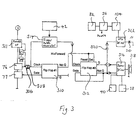
- the on-off/test switch 36, the buzzer having the buzzer diaphragm 34, and each of the three control knobs 38, 40 and 42 shown in Figure 1 are all connected to the circuit board 74 to define circuitry shown in greater detail, and described hereinafter, with reference to Figure 3 .
- Internally screw-threaded horizontally extending portions 88 are formed in the interior of the housing part, and apertures formed in the other housing part in registration with the portions 88 when the two housing parts are brought together, enable screws (not shown) to secure those two housing parts tightly together with the rib 50 engaging the groove.
- the Hall effect devices 76 and 77 are connected respectively to the clock and data inputs of a first bi-stable flip-flop 310.
- the connection between the Hall effect device 76 and the clock input of the flip-flop 310 is via a timer 306 and a latch 308.
- the former inhibits transfer of signals from the device 76 for a predetermined period from power up to enable the device 76 to be fully operational before any signals therefrom are transferred to the flip-flop 310, and the latch 308 holds the condition of the signal from the device 76 upon powering down.
- the Hall effect devices are powered via a power up switch 311. This saves energy by switching on only upon receipt of signals indicative of line movement. It does this by switching on periodically for a brief period only, so that during this sleep mode it is switched on for a much shorter period than it is switched off during each switching cycle.
- it When it switches on, it sends clocking pulses to a memory M and a comparator C. If the comparator C receives a signal from the Hall effect device 76 that is different from that in the memory M, indicative of the last signal received from the Hall effect device 76, in turn indicative of a change in the state thereof, the comparator C issues a triggering signal to the switch 311 to switch it to a continuously on condition. The period of the latter continuously on condition may be limited by a timer (not shown).
- the Hall effect device 76 is the one which is closed first upon movement of one of the magnets 66 as a result of longitudinal movement of a fishing line over the rotary part 26 in a direction corresponding to pay-out of the line.
- the _Q output from the flip-flop 310 is connected to the set and reset inputs of a second bi-stable flip-flop 312.
- This flip-flop 312 is configured as a divide-by-two-counter.
- a trigger pulse generator 314 is connected to receive a signal from the Hall effect device 76 and to forward trigger pulses to the clock input of the flip-flop 312.
- the sensitivity control 42 is connected to the trigger pulse generator 314 so that the rate at which trigger pulses are issued therefrom in dependence upon a given frequency of pulses received from the Hall effect device 76 is dependent upon the setting of the sensitivity control 42.
- the _Q output from the second flip-flop 312 is fed back to the data input thereof.
- Both the Q and _Q outputs from the bi-stable flip-flop 312 are connected to a buzzer driver 316 which in turn is connected to drive a buzzer 318 provided with the diaphragm 34 shown in Figure 1 .
- the _Q output from the bi-stable flip-flop is connected via a capacitor 320 to an LED driver 322 which in turn is connected to the LED 20.
- the volume control 38 and pitch control 40 are both connected to the buzzer driver 316 in such a manner as to control the volume and pitch of the output from the buzzer, respectively.
- the power source 82, the on/off/test switch 36 and the battery test circuit 104 are connected in series in that order, to the LED driver 322 to enable the detector to be switched on and off and also to enable the power source to be tested.
- the fishing line of a fishing rod is passed over the rotary part 26 so that longitudinal movement of the line will rotate that part.
- the Q and _Q outputs from the flip-flop 312 will oscillate in anti-phase, at half the frequency of the clock pulses. As a result, a two-tone audible signal is issued from the buzzer 318 at a frequency which is again dependent upon the speed of movement of the line.
- this is illuminated continuously for a normal bite in which the fishing line is paid out, and intermittently for a drop-back bite.
- the power cycling circuitry C, M and 311 could be used in a single Hall effect detector arrangement which does not indicate direction of line movement, but which does indicate longitudinal line movement nonetheless.
- the power cycling circuitry C, M and 311 may be made integral with the or each Hall effect device.
- the power cycling circuits may be incorporated in a single microcontroller chip which may also incorporate the driver circuitry for the LED 20 and buzzer 318, and the logic circuits may be incorporated in the dual Hall effect device.
- the latter may comprise the device having the product code A 3423xKA available from Allegro Microsystems Inc. which has inbuilt circuitry to provide signals indicative of rotary speed and sense of rotation.
- the illustrated bite detector has been shown as a preferred embodiment of the present invention, it will be appreciated that the invention is not limited to this particular embodiment, and that very many variations and modifications may occur to a reader without taking the resulting detector outside the scope of the present invention.
- the Hall effect devices 76 and 77 could be reversed, or the trigger pulse generator could be connected to the output from the Hall effect device 77 instead of that of the Hall effect device 76.
- the buzzer driver could be connected only to the _Q output of the flip-flop 312 like the LED driver.
Landscapes
- Life Sciences & Earth Sciences (AREA)
- Environmental Sciences (AREA)
- Engineering & Computer Science (AREA)
- Microelectronics & Electronic Packaging (AREA)
- Animal Husbandry (AREA)
- Biodiversity & Conservation Biology (AREA)
- Investigating Or Analyzing Materials By The Use Of Magnetic Means (AREA)
- Switches With Compound Operations (AREA)
- Geophysics And Detection Of Objects (AREA)
Abstract
Description
- The present invention relates to a fish-bite detector having magnetic means to change the magnetic field in a predetermined region of the detector in dependence upon movement of a fishing line which engages a rotary part of the detector when the latter is in use, and sensor means provided in the said predetermined region to produce a signal indicative of such movement, in which the magnetic means comprise at least one magnet which is mounted to move with the rotary part, the magnetic axis of which magnet is generally parallel to the axis of rotation of the rotary part.
- Such a detector is disclosed in
GB-A-2209261 -
EP-A-0850562 does disclose a detector which can distinguish between forward and rearward longitudinal line movement, but that uses reed switches as the sensor means. Reed switches are fundamentally mechanical devices which can fail, especially if the detector is accidentally dropped or knocked. Mere replacement of the reed switches by Hall effect devices is unsatisfactory because if the latter are not precisely matched, one of them may be triggered before the other even if at the time it is in a weaker magnetic field. - The present invention seeks to provide a remedy.
- Accordingly the present invention is directed to a fish-bite detector having the construction set out in the opening paragraph of the present invention, in which the sensor means comprise two Hall effect devices, in which the Hall effect devices have their sensitive faces directed towards the magnetic means, and in which the Hall effect devices are located alongside one another on opposite sides of an imaginary plane which passes through the axis of rotation of the rotary part, thereby enabling the Hall effect devices to produce a signal indicative of the direction of longitudinal movement of the line.
- Since the Hall effect devices are solid state they are less susceptible to failure or damage by knocks and jolts. They are also more magnetically sensitive than reed switches. Furthermore, they cause less drag on the rotary part than reed switches. They are less susceptible to drifting in their characteristics with age and over a range of temperatures, nor do they have a finite mechanical life as do reed switches. Finally, they are smaller than reed switches and are therefore more easily accommodated within a housing of the detector.
- Preferably, the two Hall effect devices have respective magnetic sensitivities, the greater of which is no more than 10% greater than the other, preferably no more than 1% greater. Most preferably, the magnetic sensitivities are substantially equal. This enables them to be placed closer together, for example no more than 1.5mm apart, whilst still resolving the direction of longitudinal movement of the line.
- The magnetic means may comprise for example four magnets spaced apart around the axis of the rotary part, although the matching of the Hall effect devices and the positioning of them close together may enable the magnetic means to comprise six or eight equiangularly spaced magnets within the limited space provided.
- The use of Hall effect devices in this manner affords the advantage that a relatively short period of time between successive switching of the Hall effect devices can occur reliably, with consequent reduced likelihood of confusion arising should line movement change direction suddenly. Furthermore, the devices can be incorporated directly in digital electronic circuitry, and are less susceptible to knocks and jolts than reed switches.
- Preferably, the Hall effect devices are parts of a dual Hall effect device.
- Advantageously, the Hall effect devices are mounted on a printed circuit board of the detector which is generally parallel to the axis of rotation of the said rotary part and which extends to a region alongside the magnetic means, on both sides of the axis of rotation of the said rotary part viewing the detector in a direction generally perpendicularly to the printed circuit board.
- If the dual Hall effect device has four connecting pins extending from one side thereof, these may be readily connected to the printed circuit board.
- In one preferred construction of the present invention, one of the Hall effect devices is connected to the clock input of a bi-stable flip-flop, and the other is connected to the data input thereof.
- Advantageously, it is the Hall effect device which is switched first when the fishing line moves in a direction corresponding to a paying out of the line, which is connected to the clock input of the flip-flop.
- The Q and _Q outputs may be connected to both the set and reset inputs of a second bi-stable flip-flop, the clock input of which is connected to receive an output from a trigger pulse generator connection to one of the Hall effect devices to generate pulses in dependence upon closure of that Hall effect device, the _Q output of the second flip-flop being fed back to the data input thereof.
- Preferably the trigger pulse generator is connected to receive signals from that Hall effect device which is connected to the clock input of the first-mentioned flip-flop.
- The Q and _Q outputs from the second flip-flop may be connected to a buzzer driver which in turn is connected to a buzzer.
- The _Q output of the second flip-flop may be connected to an LED driver which in turn is connected to drive the LED.
- The buzzer driver may be so constructed as to cause a first audio signal to be issued when the line moves in a longitudinal direction corresponding to a paying-out of the line, and a second audible signal when the line moves in the other longitudinal direction.
- A further disadvantage of the detector disclosed in
GB-A-2209261 - Accordingly, the present invention extends to a fish-bite detector having magnetic means to change the magnetic field in a predetermined region of the detector in dependence upon movement of a fishing line which engages a part of the detector when the latter is in use, and a Hall effect device provided in the predetermined region to produce a signal indicative of such movement, in which the Hall effect device is connected to a periodic timer switch so that it is switched on and off at predetermined intervals, such that the on period in each cycle is significantly shorter than the off period, in which a comparator is also connected to the Hall effect device so that the state of the latter during an on period is compared with the state it had in a previous on period, and if the state has changed, the comparator switches the Hall effect device to a continuously on condition.
- An example embodiment of a bite detector made in accordance with the present invention will now be illustrated with reference to the accompanying drawings, in which:
- Figure 1
- shows a front elevation view of the detector;
- Figure 1a
- shows an axial sectional view of a central knob of the detector shown in
Figure 1 ; - Figure 2
- shows an interior of a first half of the detector shown in
Figure 1 ; - Figure 2a
- shows an axial view of parts of the detector shown in
Figures 1 and2 ; - Figure 3
- shows a circuit diagram of electrical circuitry within the interior shown in
Figure 2 ; - Figures 4 and 5
- show respective different graphs of different sets of voltage levels at a first bi-stable flip-flop of the circuitry shown in
Figure 3 for different directions of longitudinal movement of a fishing line; and - Figures 6 and 7
- show respective different sets of voltage levels at a second bi-stable flip-flop of the circuitry shown in
Figure 3 for such different directions of line movement. - The fish-bite indicator shown in
Figure 1 comprises a two-part synthetic plastics injection mouldedhousing 10 having an external screw-threaded metal shank 12 extending downwardly from its underside. A seal is formed between thehousing 10 and the shank 12 by means of an O-ring 14 and a tightening nut 16 which urges the O-ring 14 tightly against thehousing 10 and inwardly against the shank 12. - The upper end of the
housing 10 is bifurcated, so that it has two generally upwardly extendingprongs 18, at the upper end of the left hand of which there is provided a lightemitting diode LED 20. - Inwardly
recessed ribs 22 are provided at the base of eachprong 18 to reinforce the housing in those regions. - A
slot 24 extends downwardly from the base of the bifurcation to expose acentral portion 25 of arotary part 26 contained within the housing. This central portion is formed with awaist 28, so that it has the form of a pulley-wheel. A generallycircular part 30 of thehousing 10 is provided underneath the bifurcation, slightly off-set from the longitudinal bisecting plane thereof, and is provided with a plurality ofapertures 32 to permit sound to travel more readily through thehousing 10 from a generally circular electromagnetic buzzer diaphragm 34 positioned immediately inwardly of thediaphragm cover 30. Immediately above and slightly to the left of thediaphragm cover 30 there is an on-off/test switch 36 extending outwardly from thehousing 10. - Three
rotary knobs diaphragm cover 30, these knobs being, respectively, a volume control, pitch control and sensitivity control for the buzzer. - As shown in Figure la, the housing wall at each
knob aperture 44 through which extends ashaft 46 which is rigidly secured to the knob. The wall of thehousing 10 is raised at the annulus immediately surrounding theaperture 44. The underside of the knob is provided with askirt portion 48 which surrounds the raised annulus to form a seal between the knob and the surrounding wall. -
Figure 2 shows the interior of that half of the two-part housing 10 which is visible inFigure 1 , with the other half of thehousing 10 removed to reveal interior components of the fish-bite indicator. That edge of the housing half which faces the other half of the housing is formed with a longitudinally extending central rib 50. This engages a correspondingly formed longitudinally extending groove formed on the corresponding edge of the other housing part. Aninner wall 54 is formed in the housing and generally surrounds theslot 24 to form half of an enclosure which contains therotary part 26. - The rotary part has a tapering
spindle portion 56 extending in an intended horizontal direction away from thecentral portion 25. Asecond spindle portion 58 of therotary part 26 extends outwardly away from thecentral portion 25 in the opposite direction to that of thespindle portion 56. Respective recesses are formed in respective vertical parts of theinner wall 54 to provide rotary bearing means 60 and 62 respectively for the twospindle portions rotary part 26. - Four cylindrical blocks 64 (only two of which are visible in
Figure 2 ) extend generally parallel to the rotary axis of therotary part 26, spaced apart at 90° intervals therearound, and house respectivepermanent magnets 66. The length of eachcylindrical block 64 andpermanent magnet 66 is such that, as the rotary part is rotated, the end of each magnet which is further from therotary part 26, passes adjacent to a side portion of theinner wall 54. - The edges of the
inner wall 54 which face the other half of thehousing 10, are provided withformations 70 which interengage with corresponding formations formed on corresponding inner edges of the other half of the rotary part enclosure, to form a seal therewith. - The
slot 24 in each half of thehousing 10 extends to the upper face of the bottom of the enclosure so that any water which finds its way into the enclosure can readily drain outwardly therefrom. - From the foregoing description, it will be appreciated that the housing, together with the
inner wall 54, defines a sealed interior. The latter contains a printedcircuit board 74 which is fixed to the interior of thehousing 10. The printedcircuit board 74 lies in an imaginary plane that includes the axis of rotation of the rotary part. It also extends upwardly to a position alongside the side portion of thewall 54 which is adjacent to themagnets 66, so that it extends on both sides of the axis of rotation of therotary part 26 viewed as inFigure 2 in a direction generally perpendicular to the printed circuit board. A dual Hall effect device constituted byHall effect devices circuit board 74, with the sensitive faces of thedevices wall 54. - The mounting of the
devices circuit board 74 is shown more clearly inFigure 2a . The fourmagnets 66 are spaced apart equiangularly around thespindle portion 58, with the cylindrical blocks 64 touching and secured to one another. The dual Hall effect device has fourpins 83 extending outwardly from one side thereof, with their ends further from the device connected to the printedcircuit board 74. In this way the twoHall effect devices spindle 58. The distance between thedevices circuit board 74 on the other hand is such as to locate the sensitive parts of thedevices rotary part 28 rotates, and with it themagnets 66. - Referring again to
Figure 2 , the printedcircuit board 74 is connected to theLED 20 vialeads 78, and power leads 80 extend from the printedcircuit board 74 to a 9-volt alkaline battery (not shown). - The on-off/
test switch 36, the buzzer having the buzzer diaphragm 34, and each of the threecontrol knobs Figure 1 are all connected to thecircuit board 74 to define circuitry shown in greater detail, and described hereinafter, with reference toFigure 3 . - Internally screw-threaded horizontally extending
portions 88 are formed in the interior of the housing part, and apertures formed in the other housing part in registration with theportions 88 when the two housing parts are brought together, enable screws (not shown) to secure those two housing parts tightly together with the rib 50 engaging the groove. - The manner in which the various parts of the indicator are connected together via the
circuit board 74 is shown inFigure 3 . - The
Hall effect devices flop 310. The connection between theHall effect device 76 and the clock input of the flip-flop 310 is via atimer 306 and alatch 308. The former inhibits transfer of signals from thedevice 76 for a predetermined period from power up to enable thedevice 76 to be fully operational before any signals therefrom are transferred to the flip-flop 310, and thelatch 308 holds the condition of the signal from thedevice 76 upon powering down. - The Hall effect devices are powered via a power up
switch 311. This saves energy by switching on only upon receipt of signals indicative of line movement. It does this by switching on periodically for a brief period only, so that during this sleep mode it is switched on for a much shorter period than it is switched off during each switching cycle. When it switches on, it sends clocking pulses to a memory M and a comparator C. If the comparator C receives a signal from theHall effect device 76 that is different from that in the memory M, indicative of the last signal received from theHall effect device 76, in turn indicative of a change in the state thereof, the comparator C issues a triggering signal to theswitch 311 to switch it to a continuously on condition. The period of the latter continuously on condition may be limited by a timer (not shown). - In this particular circuitry, the
Hall effect device 76 is the one which is closed first upon movement of one of themagnets 66 as a result of longitudinal movement of a fishing line over therotary part 26 in a direction corresponding to pay-out of the line. - The _Q output from the flip-
flop 310 is connected to the set and reset inputs of a second bi-stable flip-flop 312. This flip-flop 312 is configured as a divide-by-two-counter. - A
trigger pulse generator 314 is connected to receive a signal from theHall effect device 76 and to forward trigger pulses to the clock input of the flip-flop 312. Thesensitivity control 42 is connected to thetrigger pulse generator 314 so that the rate at which trigger pulses are issued therefrom in dependence upon a given frequency of pulses received from theHall effect device 76 is dependent upon the setting of thesensitivity control 42. - The _Q output from the second flip-
flop 312 is fed back to the data input thereof. - Both the Q and _Q outputs from the bi-stable flip-
flop 312 are connected to abuzzer driver 316 which in turn is connected to drive abuzzer 318 provided with the diaphragm 34 shown inFigure 1 . - The _Q output from the bi-stable flip-flop is connected via a
capacitor 320 to anLED driver 322 which in turn is connected to theLED 20. - The
volume control 38 andpitch control 40 are both connected to thebuzzer driver 316 in such a manner as to control the volume and pitch of the output from the buzzer, respectively. - The
power source 82, the on/off/test switch 36 and thebattery test circuit 104 are connected in series in that order, to theLED driver 322 to enable the detector to be switched on and off and also to enable the power source to be tested. - When the detector is installed for use, the fishing line of a fishing rod is passed over the
rotary part 26 so that longitudinal movement of the line will rotate that part. - In the event that a fish bite causes the fishing line to be paid out, successive movements of the
magnets 66 over theHall effect devices Hall effect device 76 to precede switching of theHall effect device 77 each time amagnet 66 passes over them. - The resulting voltage levels at the clock and data input respectively of the first flip-
flop 310 of the circuitry shown inFigure 3 , are shown inFigure 4 . From this, it will be seen that, at the instant the clock input is pulled high, the data input is still low. As a result, the Q output of the flip-flop 310 goes low, and its complementary output _Q goes high. This occurs at the instant T1 shown inFigure 4 , and at each successive corresponding instant in the cyclically changing wave forms. - Conversely, if the
rotary part 26 is rotated in the opposite sense, corresponding to a drop-back bite, then the clock input of the flip-flop 310 is pulled high while the date input is still high, because in this instant, it is theHall effect device 77 which is switched before theHall effect device 76 for a given passage of one of themagnets 66 over these Hall effect devices. Such an instant is indicated at time T2 inFigure 5 , and at each successive corresponding instant in the cyclically changing voltage levels. - At this instant, therefore, the Q output from the flip-
flop 310 goes high, and its complimentary output _Q goes low. - If the set and re-set inputs of the flip-
flop 312 are held high, as is the case for a normal bite where fishing line is paid out, with the _Q output of the flip-flop 310 being held high, then both of the outputs of the flip-flop 312 will also be held high, as shown inFigure 6 . As a result, a single-tone intermittent audible output is issued from thebuzzer 318, its frequency being dependent upon the speed of movement of the line. Its volume and pitch will be dependent upon the setting of the volume and pitch controls 38 and 40 respectively. - In the event that the set and re-set inputs are held low, the Q and _Q outputs from the flip-
flop 312 will oscillate in anti-phase, at half the frequency of the clock pulses. As a result, a two-tone audible signal is issued from thebuzzer 318 at a frequency which is again dependent upon the speed of movement of the line. - As regards the
LED 20, this is illuminated continuously for a normal bite in which the fishing line is paid out, and intermittently for a drop-back bite. - The power cycling circuitry C, M and 311 could be used in a single Hall effect detector arrangement which does not indicate direction of line movement, but which does indicate longitudinal line movement nonetheless.
- The power cycling circuitry C, M and 311 may be made integral with the or each Hall effect device.
- Alternatively, the power cycling circuits may be incorporated in a single microcontroller chip which may also incorporate the driver circuitry for the
LED 20 andbuzzer 318, and the logic circuits may be incorporated in the dual Hall effect device. The latter may comprise the device having the product code A 3423xKA available from Allegro Microsystems Inc. which has inbuilt circuitry to provide signals indicative of rotary speed and sense of rotation. - Whilst the illustrated bite detector has been shown as a preferred embodiment of the present invention, it will be appreciated that the invention is not limited to this particular embodiment, and that very many variations and modifications may occur to a reader without taking the resulting detector outside the scope of the present invention. To give a few examples only, the
Hall effect devices Hall effect device 77 instead of that of theHall effect device 76. The buzzer driver could be connected only to the _Q output of the flip-flop 312 like the LED driver.
Claims (18)
- A fish-bite detector having magnetic means (66) to change the magnetic field in a predetermined region of the detector in dependence upon movement of a fishing line which engages a rotary part (26) of the detector when the latter is in use, and sensor means (76, 77) provided in the said predetermined region to produce a signal indicative of such movement, in which the magnetic means comprise at least one magnet (66) which is mounted to move with the rotary part (26), the magnetic axis of which magnet (66) is generally parallel to the axis of rotation of the rotary part (26), characterised in that the sensor means (76, 77) comprise two Hall effect devices (76 and 77), in which the Hall effect devices (76 and 77) have their sensitive faces directed towards the magnetic means (66), and in which the Hall effect devices (76 and 77) are located alongside one another on opposite sides of an imaginary plane which passes through the axis of rotation of the rotary part (26), thereby enabling the Hall effect devices (76 and 77) to produce a signal indicative of the direction of longitudinal movement of the line.
- A fish-bite detector according to claim 1, characterised in that the two Hall effect devices (76 and 77) have respective magnetic sensitivities, the greater of which is no more than 10% greater than the other, preferably no more than 1% greater.
- A fish-bite detector according to claim 1, characterised in that the two Hall effect devices (76 and 77) have respective magnetic sensitivities, the greater of which is no more than 1% greater than the other.
- A fish-bite detector according to claim 1, characterised in that the respective magnetic sensitivities of the two Hall effect devices (76 and 77) are substantially equal.
- A fish-bite detector according to any preceding claim, characterised in that the magnetic means (66) comprise at least four magnets (66) spaced apart around the axis of the rotary part (26).
- A fish-bite detector according to claim 5, characterised in that the magnetic means (66) comprise six magnets equiangularly spaced around the axis of the rotary part.
- A fish-bite detector according to claim 5, characterised in that the magnetic means (66) comprise eight magnets equiangularly spaced around the axis of the rotary part.
- A fish-bite detector according to any preceding claim, characterised in that the Hall effect devices (76 and 77) are parts of a dual Hall effect device.
- A fish-bite detector according to any preceding claim, characterised in that the Hall effect devices (76 and 77) are mounted on a printed circuit board (74) of the detector which is generally parallel to the axis of rotation of the said rotary part (26) and which extends to a region alongside the magnetic means (66), on both sides of the axis of rotation of the said rotary part (26) viewing the detector in a direction generally perpendicularly to a printed circuit board (74).
- A fish-bite detector according to claim 9, characterised in that the dual Hall effect device (76, 77) has four connecting pins (83) extending from one side thereof which are connected to the printed circuit board (74).
- A fish-bite detector according to any preceding claim, characterised in that one of the Hall effect devices (76) is connected to the clock input of a bi-stable flip-flop (310), and the other is connected to the data input thereof.
- A fish-bite detector according to claim 11, characterised in that the Hall effect device (76) which is switched first when the fishing line moves in a direction corresponding to a paying out of the line is connected to the clock input of the flip-flop (310).
- A fish-bite detector according to claim 11 or claim 12, characterised in that the Q and _Q outputs of the bi-stable flip-flop (310) are connected to both the set and reset inputs of a second bi-stable flip-flop (312), the clock input of which is connected to receive an output from a trigger pulse generator (314) connection to one of the Hall effect devices (76) to generate pulses in dependence upon closure of that Hall effect device (76), the _Q output of the second flip-flop (312) being fed back to the data input thereof.
- A fish-bite detector according to claim 13, characterised in that the trigger pulse generator (314) is connected to receive signals from that Hall effect device (76) which is connected to the clock input of the first-mentioned flip-flop (310).
- A fish-bite detector according to claim 13 or claim 14, characterised in that the Q and _Q outputs from the second flip-flop (312) are connected to a buzzer driver (316) which in turn is connected to a buzzer (318).
- A fish-bite detector according to claim 13 or claim 14, characterised in that the _Q output of the second flip-flop (312) is connected to an LED driver (322) which in turn is connected to drive an LED (20).
- A fish-bite detector according to claim 15, characterised in that the buzzer driver (316) is so constructed as to cause a first audio signal to be issued when the line moves in a longitudinal direction corresponding to a paying-out of the line, and a second audible signal, which differs from the first, when the line moves in the other longitudinal direction.
- A fish-bite detector having magnetic means (66) to change the magnetic field in a predetermined region of the detector in dependence upon movement of a fishing line which engages a part (26) of the detector when the latter is in use, and a Hall effect device (76 or 77) provided in the predetermined region to produce a signal indicative of such movement, characterised in that the Hall effect device (76 or 77) is connected to a periodic timer switch (311) so that it is switched on and off at predetermined intervals, such that the on period in each cycle is significantly shorter than the off period, and in that a comparator (C) is also connected to the Hall effect device (76 or 77) so that the state of the latter during an on period is compared with the state it had in a previous on period, and if the state has changed, the comparator (C) switches the Hall effect device (76 or 77) to a continuously on condition.
Applications Claiming Priority (1)
| Application Number | Priority Date | Filing Date | Title |
|---|---|---|---|
| GB0710466A GB0710466D0 (en) | 2007-06-01 | 2007-06-01 | A fish-bite detector |
Publications (2)
| Publication Number | Publication Date |
|---|---|
| EP1997372A2 true EP1997372A2 (en) | 2008-12-03 |
| EP1997372A3 EP1997372A3 (en) | 2010-06-02 |
Family
ID=38289664
Family Applications (1)
| Application Number | Title | Priority Date | Filing Date |
|---|---|---|---|
| EP08251564A Withdrawn EP1997372A3 (en) | 2007-06-01 | 2008-04-29 | A fish-bite detector |
Country Status (3)
| Country | Link |
|---|---|
| EP (1) | EP1997372A3 (en) |
| CN (1) | CN101331872A (en) |
| GB (1) | GB0710466D0 (en) |
Cited By (4)
| Publication number | Priority date | Publication date | Assignee | Title |
|---|---|---|---|---|
| WO2014146820A1 (en) * | 2013-03-19 | 2014-09-25 | Henkel Ag & Co. Kgaa | Agent for the temporary shaping of keratin-containing fibres |
| WO2014146819A1 (en) * | 2013-03-19 | 2014-09-25 | Henkel Ag & Co. Kgaa | Agent for the temporary shaping of keratin-containing fibres |
| GB2583016A (en) * | 2019-02-16 | 2020-10-14 | Ispot Ip Ltd | Fishing bite indicator |
| US11278017B2 (en) * | 2017-06-30 | 2022-03-22 | Towa Denki Seisakusyo Co., Ltd. | Automatic fishing system and automatic fishing method |
Families Citing this family (2)
| Publication number | Priority date | Publication date | Assignee | Title |
|---|---|---|---|---|
| JP6151288B2 (en) * | 2015-02-17 | 2017-06-21 | クライムプロダクツ株式会社 | Display panel laminating apparatus and laminating method |
| CN107568175A (en) * | 2017-07-20 | 2018-01-12 | 沈建 | One kind fishing intelligent alarm device |
Citations (2)
| Publication number | Priority date | Publication date | Assignee | Title |
|---|---|---|---|---|
| GB2209261A (en) | 1987-12-16 | 1989-05-10 | Malcolm Keith Wilmot | Magnetic-electronic bite indicator |
| EP0850562A1 (en) | 1996-12-24 | 1998-07-01 | Fox Design International Limited | Fish-bite detector |
Family Cites Families (5)
| Publication number | Priority date | Publication date | Assignee | Title |
|---|---|---|---|---|
| JPS5934832A (en) * | 1982-08-18 | 1984-02-25 | ダイワ精工株式会社 | Line information transmitting system of trawling |
| GB8332191D0 (en) * | 1983-12-02 | 1984-01-11 | Romang D E | Bite indicator |
| GB8813262D0 (en) * | 1988-06-04 | 1988-07-06 | Qualtack Ltd | Bite detector |
| GB2313761A (en) * | 1996-06-06 | 1997-12-10 | Reynolds Hepburn Ltd | Fishing bite detector |
| GB2392599A (en) * | 2002-09-04 | 2004-03-10 | Timothy Allen | Bite Alarm |
-
2007
- 2007-06-01 GB GB0710466A patent/GB0710466D0/en not_active Ceased
-
2008
- 2008-04-29 EP EP08251564A patent/EP1997372A3/en not_active Withdrawn
- 2008-05-30 CN CNA200810108430XA patent/CN101331872A/en active Pending
Patent Citations (2)
| Publication number | Priority date | Publication date | Assignee | Title |
|---|---|---|---|---|
| GB2209261A (en) | 1987-12-16 | 1989-05-10 | Malcolm Keith Wilmot | Magnetic-electronic bite indicator |
| EP0850562A1 (en) | 1996-12-24 | 1998-07-01 | Fox Design International Limited | Fish-bite detector |
Cited By (4)
| Publication number | Priority date | Publication date | Assignee | Title |
|---|---|---|---|---|
| WO2014146820A1 (en) * | 2013-03-19 | 2014-09-25 | Henkel Ag & Co. Kgaa | Agent for the temporary shaping of keratin-containing fibres |
| WO2014146819A1 (en) * | 2013-03-19 | 2014-09-25 | Henkel Ag & Co. Kgaa | Agent for the temporary shaping of keratin-containing fibres |
| US11278017B2 (en) * | 2017-06-30 | 2022-03-22 | Towa Denki Seisakusyo Co., Ltd. | Automatic fishing system and automatic fishing method |
| GB2583016A (en) * | 2019-02-16 | 2020-10-14 | Ispot Ip Ltd | Fishing bite indicator |
Also Published As
| Publication number | Publication date |
|---|---|
| CN101331872A (en) | 2008-12-31 |
| EP1997372A3 (en) | 2010-06-02 |
| GB0710466D0 (en) | 2007-07-11 |
Similar Documents
| Publication | Publication Date | Title |
|---|---|---|
| EP0570117B1 (en) | Fish-bite indicators | |
| CN107110918B (en) | Magnetic field sensor for safety alarm system | |
| JP2683228B2 (en) | Enclosure sealing device | |
| US20090205195A1 (en) | Method of making electronic thermometer with anti-theft feature | |
| EP0749687B1 (en) | A fish-bite indicator | |
| EP0850562B1 (en) | Fish-bite detector | |
| US8525101B2 (en) | Position transmitter having a normal mode and a power saving mode operation for the acquisition of the position of a rotatable shaft | |
| CN101331872A (en) | A fish-bite detector | |
| EP0720813B1 (en) | A fish-bite indicator | |
| KR101078963B1 (en) | Mood light having lactation period timer | |
| GB2150402A (en) | Bite indicator | |
| EP1147704B1 (en) | A fish-bite detector | |
| ES2347826T3 (en) | AUTOMATIC ACTIVATION SYSTEM FOR THERMOMETER. | |
| EP1059029B1 (en) | Light indicator assembly | |
| JP2000174254A (en) | Semiconductor integrated circuit for magnetic detection | |
| US11344014B2 (en) | Method for controlling electronic alarm for a fishing reel and electronic alarm system for a fishing reel | |
| WO2004021777A1 (en) | Improved bite alarm for fishing | |
| EP4056213B1 (en) | Injection device | |
| WO1986004776A1 (en) | Low-power intermittent hanging planter rotator | |
| JP2005050658A (en) | Automatic photoelectric flashing device | |
| KR200364130Y1 (en) | Biting signal apparatus for fishing | |
| GB2296985A (en) | Lost pet alerting device | |
| JP2004028894A (en) | Pulse encoder | |
| GB2551493A (en) | An alarm bell box flasher device | |
| JPS6453114A (en) | Multiple rotation detecting device |
Legal Events
| Date | Code | Title | Description |
|---|---|---|---|
| PUAI | Public reference made under article 153(3) epc to a published international application that has entered the european phase |
Free format text: ORIGINAL CODE: 0009012 |
|
| AK | Designated contracting states |
Kind code of ref document: A2 Designated state(s): AT BE BG CH CY CZ DE DK EE ES FI FR GB GR HR HU IE IS IT LI LT LU LV MC MT NL NO PL PT RO SE SI SK TR |
|
| AX | Request for extension of the european patent |
Extension state: AL BA MK RS |
|
| PUAL | Search report despatched |
Free format text: ORIGINAL CODE: 0009013 |
|
| AK | Designated contracting states |
Kind code of ref document: A3 Designated state(s): AT BE BG CH CY CZ DE DK EE ES FI FR GB GR HR HU IE IS IT LI LT LU LV MC MT NL NO PL PT RO SE SI SK TR |
|
| AX | Request for extension of the european patent |
Extension state: AL BA MK RS |
|
| 17P | Request for examination filed |
Effective date: 20101202 |
|
| AKX | Designation fees paid |
Designated state(s): AT BE BG CH CY CZ DE DK EE ES FI FR GB GR HR HU IE IS IT LI LT LU LV MC MT NL NO PL PT RO SE SI SK TR |
|
| STAA | Information on the status of an ep patent application or granted ep patent |
Free format text: STATUS: THE APPLICATION IS DEEMED TO BE WITHDRAWN |
|
| 18D | Application deemed to be withdrawn |
Effective date: 20101203 |