EP1994780B1 - Acces a distance a une memoire de masse et une memoire de securite dans un objet communicant portable - Google Patents
Acces a distance a une memoire de masse et une memoire de securite dans un objet communicant portable Download PDFInfo
- Publication number
- EP1994780B1 EP1994780B1 EP07704326A EP07704326A EP1994780B1 EP 1994780 B1 EP1994780 B1 EP 1994780B1 EP 07704326 A EP07704326 A EP 07704326A EP 07704326 A EP07704326 A EP 07704326A EP 1994780 B1 EP1994780 B1 EP 1994780B1
- Authority
- EP
- European Patent Office
- Prior art keywords
- server
- data
- terminal
- agent
- communicating object
- Prior art date
- Legal status (The legal status is an assumption and is not a legal conclusion. Google has not performed a legal analysis and makes no representation as to the accuracy of the status listed.)
- Not-in-force
Links
- 238000003860 storage Methods 0.000 title claims abstract description 25
- 238000004891 communication Methods 0.000 claims abstract description 43
- 238000000034 method Methods 0.000 claims abstract description 28
- 230000015654 memory Effects 0.000 claims description 139
- 230000005540 biological transmission Effects 0.000 claims description 30
- 239000013256 coordination polymer Substances 0.000 claims description 22
- 238000012546 transfer Methods 0.000 claims description 14
- 102100039642 Rho-related GTP-binding protein RhoN Human genes 0.000 claims description 7
- 108050007497 Rho-related GTP-binding protein RhoN Proteins 0.000 claims description 7
- 238000012545 processing Methods 0.000 claims description 7
- 102100039643 Rho-related GTP-binding protein Rho6 Human genes 0.000 claims description 6
- 101710199571 Rho-related GTP-binding protein Rho6 Proteins 0.000 claims description 6
- 230000003993 interaction Effects 0.000 claims description 2
- 230000005055 memory storage Effects 0.000 claims 6
- 230000014759 maintenance of location Effects 0.000 claims 4
- 230000008569 process Effects 0.000 abstract description 8
- 238000004422 calculation algorithm Methods 0.000 description 26
- 230000004044 response Effects 0.000 description 11
- 230000006870 function Effects 0.000 description 6
- 238000007726 management method Methods 0.000 description 4
- 230000002457 bidirectional effect Effects 0.000 description 3
- 238000004590 computer program Methods 0.000 description 3
- 230000001419 dependent effect Effects 0.000 description 2
- 238000010586 diagram Methods 0.000 description 2
- 238000005516 engineering process Methods 0.000 description 2
- 230000036541 health Effects 0.000 description 2
- 238000004458 analytical method Methods 0.000 description 1
- 238000012217 deletion Methods 0.000 description 1
- 230000037430 deletion Effects 0.000 description 1
- 238000004519 manufacturing process Methods 0.000 description 1
- 230000004048 modification Effects 0.000 description 1
- 238000012986 modification Methods 0.000 description 1
- 230000000737 periodic effect Effects 0.000 description 1
Images



Classifications
-
- H—ELECTRICITY
- H04—ELECTRIC COMMUNICATION TECHNIQUE
- H04W—WIRELESS COMMUNICATION NETWORKS
- H04W12/00—Security arrangements; Authentication; Protecting privacy or anonymity
- H04W12/06—Authentication
-
- H—ELECTRICITY
- H04—ELECTRIC COMMUNICATION TECHNIQUE
- H04L—TRANSMISSION OF DIGITAL INFORMATION, e.g. TELEGRAPHIC COMMUNICATION
- H04L63/00—Network architectures or network communication protocols for network security
- H04L63/08—Network architectures or network communication protocols for network security for authentication of entities
- H04L63/0853—Network architectures or network communication protocols for network security for authentication of entities using an additional device, e.g. smartcard, SIM or a different communication terminal
-
- H—ELECTRICITY
- H04—ELECTRIC COMMUNICATION TECHNIQUE
- H04W—WIRELESS COMMUNICATION NETWORKS
- H04W12/00—Security arrangements; Authentication; Protecting privacy or anonymity
- H04W12/03—Protecting confidentiality, e.g. by encryption
-
- H—ELECTRICITY
- H04—ELECTRIC COMMUNICATION TECHNIQUE
- H04W—WIRELESS COMMUNICATION NETWORKS
- H04W12/00—Security arrangements; Authentication; Protecting privacy or anonymity
- H04W12/30—Security of mobile devices; Security of mobile applications
- H04W12/35—Protecting application or service provisioning, e.g. securing SIM application provisioning
-
- H—ELECTRICITY
- H04—ELECTRIC COMMUNICATION TECHNIQUE
- H04W—WIRELESS COMMUNICATION NETWORKS
- H04W8/00—Network data management
- H04W8/22—Processing or transfer of terminal data, e.g. status or physical capabilities
- H04W8/24—Transfer of terminal data
Definitions
- the present invention relates to remote access by a single server to a mass memory and a security memory, which are included in a portable communicating object with high memory capacity associated with a terminal.
- the portable communicating object has the particularity of comprising a mass memory unit comprising a memory controller and the mass memory, corresponding for example to a memory of a "Flash-Memory Card” type card, “Secure Digital Card”. "," Multi-Media Card ", and a security unit such as a Subscriber Identity Module (SIM) or Universal Subscriber Identity Module (USIM) application of a Universal Integrated Circuit (s) Card (UICC) card having a controller security and associated security memory.
- SIM Subscriber Identity Module
- USB Universal Subscriber Identity Module
- UICC Universal Integrated Circuit
- This new technology greatly increases the size of the memory in the portable communicating object. It goes from 128 kilobytes to 128 megabytes and could reach several gigabytes.
- the increased size of the mass memory makes it possible to store all the multimedia data specific to a user of the communicating object, such as a multimedia telephone directory with pictures and e-mail addresses, music downloaded remotely photos, presentations for professionals, music.
- Such an architecture that distinctly associates two two-memory controllers implies exclusive access to one of the two memories of the portable communicating object by a remote server.
- These ports are respectively implemented by two communication channels between the server and the portable communicating object.
- a first unsecured communication channel is managed by the terminal and includes two transmission protocols.
- a first type of protocol OTA (Over The Air” in English) relates to a data transmission between the server and the terminal.
- a second type of protocol MMC Multi-Media Card” in English
- a second communication channel comprises a single secure and reliable secure data transmission protocol recognized between a remote server and the security unit of the portable communicating object via the terminal, but with less rapid access than the first protocol. For the second protocol, the terminal is then considered a transparent router.
- a major disadvantage of this technology is that a remote server can access both the mass memory and the security memory of the portable communicating object. To do this, the server must establish two communication channels as previously presented.
- the object of the invention is to remedy the aforementioned problem by facilitating the access of a remote entity, such as a server, to both a mass memory and a security memory of a portable communicating object associated with a terminal.
- the portable communicating object is a multimedia smart card including a security unit comprising the security memory.
- Remote access of the mass memory by the server is then secured by interactions between the security unit and the server through the agent in the terminal, prior to the transmission of data such as multimedia data.
- the server and the security unit of the portable communicating object by exchange of secret data to allow access to the mass memory of the communicating object portable by the server via the agent as soon as authentication is confirmed.
- the method of the invention further comprises a transmission of a request by the agent to the security unit to obtain in response a encryption / decryption key, encryption of the data by one of the two means including the server and the agent, transmission of the encrypted data to the other of said two means, and decryption of the encrypted data by said other of said two means .
- the method of the invention further comprises a transmission of a request by a mass memory controller included in the portable communicating object. to the security unit for obtaining in response an encryption / decryption key, an encryption of the data by one of the two means comprising the server and the mass memory controller, a transmission of the encrypted data to the other of said two means, and a decryption of the data encrypted by said other of said two means.
- the invention also relates to a terminal associated with a portable communicating object for a server remotely accesses one of the mass memory and security memory in the portable communicating object via a communications network.
- the terminal is characterized in that it comprises an agent for routing data transfers between the remote server and one or other of the memories of the object portable communicator, establish a communication channel between the remote server and the terminal, and process data transmitted from one of the two elements comprising the server and one of the memories of the portable communicating object to the agent so that the It transfers the transmitted data in the other of the two elements.
- the invention relates to a program that can be implemented in the terminal according to the invention.
- a preferred embodiment of the invention described hereinafter relates to the field of radio networks in which data can be transmitted between a portable multimedia content server or portable object management server, and a terminal. associated with a portable communicating object.
- the invention is applicable to other fields relating to financial or banking data, medical data, etc.
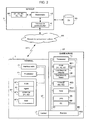
- a communication system comprises a remote server S communicating through at least one radio communication network RR T with a mobile terminal associated with a portable communicating object with a high storage capacity, such as a smart card CP which will be referred to later in the description.
- the RR radio network is of the UMTS type, of the GSM type backed by a GPRS network or of the WIFI, WIMAX, WIBRO type.
- the three entities S, T and CP are represented in the form of functional blocks, most of which provide functions relating to the invention and can correspond to software and / or hardware modules.
- the server S is a server for multimedia content and / or smart card administration managed by a network operator.
- radiocommunications RR and constitutes an OTA platform ("Over The Air" in English).
- the server S comprises a manager GE, a memory ME and a communication interface IC.
- the server S is connected to or comprises a database BD.
- the manager GE manages various operations during a data transmission between the server S and the smart card CP or the terminal T, such as an authentication between the server and the smart card CP, a determination of a key session required for encryption and decryption of data exchanged between the server and the smart card or the terminal.
- the GE manager also allows the operator of the RR radio network to maintain control of the smart card CP associated with the terminal T and to modify the content of the smart card.
- These operations on the initiative of the operator concern for example a file download including multimedia in smart cards, such as the CP card, the park managed by the operator, and downloading or deletion or modification of data of a given file or application in at least the CP card.
- the memory ME comprises an encryption algorithm A1, a decryption algorithm A2, an authentication key KA and a session key determination algorithm A3.
- the algorithm A3 determines a session key KS which is then stored in the memory ME.
- the communication interface IC transmits and receives data at least through the RR radio network.
- the database BD comprises, inter alia, data D, which may be multimedia data, and various parameters and characteristics of the smart card CP.
- the smart card CP is a recent smart card with or without contact with high memory capacity. As represented in figure 1 it has two characteristic logical units.
- a first so-called US security unit unit comprises a first controller, called security controller CS, and a first memory, called security memory MS.
- a second unit called mass memory unit UM comprises a second controller, called mass memory controller CM and a second memory, called mass memory MM, for storing data, such as multimedia data, requiring a large memory space .
- the security controller and the mass memory controller are preferably logical modules in a common physical component. In another example, the controllers are integrated into separate physical components interconnected.
- the accesses to the memories MM and MS are distinct and respectively controlled by the controllers CS and CM.
- the security unit US or more precisely the security controller CS can not write data to the mass memory MM of the unit UM.
- the CM mass memory controller can not write data to the MS security memory of the US unit.
- the mass memory unit UM is entirely controlled by the terminal T which commands the mass memory controller CM to write, read or delete multimedia data in the mass memory MM, which prevents the security controller CS from writing into the mass memory MM.
- the UM mass storage unit has features and structure that can be analogous to those of a Universal Serial Bus (USB) drive, or a flash memory card, or a secure digital card (Secure Digital Card), or a multimedia card type MMC (Multi Media Card).
- the security controller CS of the security unit US is, according to the preferred embodiment of the invention, a Subscriber Identity Module (SIM) application when the associated terminal T is a mobile of the GSM or GPRS type, or a USIM application ( Universal Subscriber Identity Module), the Removable User Identity Module (RUIM), or the IP Subscriber Identity Module (ISIM), associated with a third-generation (3GPP) code-division multiple access CDMA (Code Division Multiple Access) mobile terminal.
- UMTS type Universal Mobile Telecommunications System
- UTRAN UMTS Terrestrial Radio Access Network
- 3GPP2 Third Generation
- the US security unit can establish, in a known manner, a communication channel type OTA with the remote server S to transmit data transparently through the terminal T.
- the security unit US constitutes a "security lock" of the mass memory unit UM and authorizes or forbids access to the mass memory unit UM according to an authentication between the server S and the US security unit using a shared authentication key KA.
- the security unit determines a session key KS necessary for encrypting and decrypting data D transmitted encrypted and thus securely between the server S and the terminal T or the smart card CP.
- a microcontroller of the smart card CP comprises a PC processor, or several processors, and three memories MC1 to MC3.
- the card receives commands or requests from the terminal T, and transmits responses to the terminal T, through a PES input / output port.
- the memory MC1 is of the ROM or Flash type and includes the operating system of the card, the encryption algorithm A1, the decryption algorithm A2 and the algorithm A3 determining the session key KS.
- the memory MC1 also comprises the security controller CS of the security unit US and the mass memory controller CM of the mass memory unit UM.
- the memory MC2 is a non-volatile memory, for example EEPROM or Flash, in particular for storing the authentication key KA, the session key KS once determined, identity numbers and other parameters of the profile of the user having the same value. card, such as PIN code and other security data.
- the memory MC2 is only accessible by the security unit.
- the security memory MS comprises the contents of the memory MC2.
- the memory MC3 is a RAM or SRAM memory used more particularly for data processing.
- the mass memory MM stores multimedia data exchanged with the server S.
- the memory controller CM mass includes the encryption algorithm A1 and the decryption algorithm A2.
- the processor P, the ROM memory, the security controller CS, the memories MC2 and MC3, the security memory MS and the port PES in the card are interconnected by a bidirectional security bus BS.
- the processor P, the ROM memory, the mass memory controller CM, the memory MC3, the mass memory MM and the port PES in the card are interconnected by a bidirectional bus BM.
- the two controllers CS and CM are integrated in one and the same physical component.
- the terminal T comprises a processor PT, memories MT, an IR radio interface and a card reader LT to communicate with the port PES of the smart card CP.
- the various elements of the terminal are interconnected by a bidirectional bus BT.
- the memories MT comprise three memories MT1, MT2 and MT3.
- the memory MT1 is of the ROM or Flash type and includes the operating system of the terminal T.
- the memory MT2 is a nonvolatile memory, for example EEPROM or Flash, and can comprise among others, according to a variant relating to the subsequent description of the figure 5 , the encryption algorithm A1 and the decryption algorithm A2.
- the memory MT3 is a RAM or SRAM memory used more particularly for data processing.
- the terminal T further comprises, in relation to the invention, an agent AG, which may be a software agent, distributed in the memories MT1 and MT2.
- the AG agent is an intermediate computer tool between the S server and the US and UM units of the card CP chip.
- the AG agent is to direct data transmitted either between the server and the CS controller of the US security unit of the card, or between the server and the CM controller of the UM memory unit the card especially for multimedia data.
- the software agent AG establishes a single OTA-type CDC communication channel with the remote server S which advantageously dialogs only with the agent AG to access one of the two US and UM units of the card.
- the server thus manages a single communication protocol with the terminal.
- the AG agent also takes care of authentication issues between the server and the terminal associated with the smart card.
- the terminal T is replaced by any terminal with which can communicate a smart card, and can be a portable device for message transmission, or a personal computer (PC) with a smart card reader or a fixed terminal such as a bank terminal hosting a debit or credit chip card.
- the RR network can then be coupled for example to an intranet, a wireless local area network, or the Internet.
- the AG agent can also be integrated in a personal computer connected to a mobile terminal associated with the smart card.
- the data is transmitted between the AG agent and the US security unit according to a protocol P1 of the HTTP (HyperText Transfer Protocol) type or any other type of protocol based on TCP / IP (Transmission Control Protocol / Internet Protocol) or, in variant, according to the protocol defined by the ISO-7816 specification based on on the Application Protocol Data Unit (APDU) commands.
- the data is transmitted between the AG agent and the mass memory unit UM according to the P2 protocol of the MMC protocol type ("Multi-Media Card").
- the communication protocol between the AG agent and the S server is based on requests and responses.
- the agent AG transmits a request to the server in order to retrieve data stored in the database BD of the server.
- the request relates to a previous request from the security unit or the user of the terminal and contains a Unified Resource Identifier (URI) where the required data are stored in the database BD, and information indicating attributes of the data.
- URI Unified Resource Identifier
- the server transmits the data accompanied by information indicating the attributes of the data and a UI identifier relative to one of the two US and UM units where the data must be stored in the card.
- the AG agent analyzes the information received and specifically processes the data according to the destination unit.
- the agent transmits the data via the P1 protocol to the security controller, which in turn will process them. If the data is intended for the mass memory unit, the agent controls, via the P2 protocol, their writing, reading or erasure in the mass memory MM of the unit UM.
- a request containing the URI address relating to the data is sent in advance by the agent AG and in response to the request, the required data are transmitted by the server S to the AG agent, which directs them to one of the two US and UM units of the card.
- data is downloaded from the server into the AG agent which routes the downloaded data to one of the two US and UM units of the card.
- the agent AG initiates the download by issuing a request to the server indicating whether data is to be downloaded.
- the server S transmits the URI addresses where the data to be stored are stored.
- the AG sends a request containing the URI to the server.
- the server transmits the required data read from the database BD and designated by the transmitted address URI.
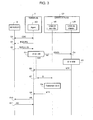
- An example of implementation of the method according to the invention with reference to figures 3 and 4 relates more particularly to a data update D provided according to the first communication mode by the server S to one of the units UM and US of the smart card.
- an embodiment of the method according to the invention comprises steps E0 to E11 for managing data transfers from the remote server S intended for one of the UM and US units.
- the agent AG of the terminal T controls the establishment of a communication channel CDC with the server S through the radio network RR, for example in response to a short SMS message in push mode transmitted by the server S to trigger an update of data D in one of the memories MM and MS of the smart card. All transmissions between the agent AG and the server S are executed via respectively the IR radio interface of the terminal and the communication interface IC of the server S.
- step E1 the agent AG transmits a request RQ to the server containing a URI address identifying the data to be retrieved stored in the database BD of the server.
- step E2 the manager GE of the server S transmits to the agent AG a response containing the data D and an identifier UI indicating the US or UM unit of the destination card of the data D.
- the agent AG compares the UI identifier to the identifiers of US or UM units, in step E3.
- the agent AG processes the data D, in the step E4, in order to transmit them properly with a command CD writing the data D in the memory.
- mass memory MM to the mass memory controller CM of the unit UM.
- the controller CM writes in step E5 the data D in the mass memory MM and then transmits an NTF notification to the agent AG of the terminal acknowledging the correct or incorrect state of the write operation performed.
- the agent AG restores the data in order to ensure consistency between data stored in the database DB and the mass memory, when the server S is a server d card administration.
- step E3 the agent transmits the data D to the security unit US via the protocol P1, at step E7.
- the security controller CS processes the data D in step E8, for example by writing them in the security memory MS.
- the security controller then transmits, in step E9, an NTF notification to the AG agent of the terminal acknowledging the correct or incorrect state of the transmission performed.
- step E10 the agent AG transmits an acknowledgment AR to the server S which responds with an acknowledgment AQ in step E11.
- the method includes an authentication step EA inserted between steps E0 and E1 described above.
- the authentication step concerns an authentication between the server S and the US security unit of the smart card, and comprises the steps EA1 to EA12.
- the access to the UM mass memory unit is locked by the US security unit which authorizes or prohibits the opening of this access according to the result of the authentication.
- This locking or unlocking of access to the mass memory unit by the security unit is possible since the two controllers CS and CM of these two units are part of the same physical component according to the figure 2 , or two separate physical components interconnected.
- step EA1 the agent AG of the terminal T transmits to the security unit US of the smart card a request RQ_RND to obtain a random RND.
- the security unit US generates in stage EA2 a random RND1 and transmits it to the agent AG in step EA3.
- the latter transmits the RND1 hazard to the GE manager of the server S at step EA4.
- the GE manager encrypts the RND1 hazard in him applying an encryption algorithm A1 dependent on the authentication key KA and produces a first encrypted random number RDN1C.
- step EA5 the manager GE generates a second RND2 randomness
- step EA6 the first encrypted random number RND1C and the second random RND2 are sent, optionally, with an identifier UI indicating the security unit, to the AG agent of the terminal which verifies the identifier UI and needle the hazards to the US security unit, in step EA7.
- step EA8 the security unit US decrypts the received RND1C hazard by applying to it an inverse decryption algorithm A2 of the encryption algorithm A1 and dependent on the authentication key KA stored in the security unit . The security unit compares the decrypted hazard with the RND1 hazard generated in step EA2.
- the security controller of the security unit allows access of the server to the UM mass memory unit via the AG software agent. If the two hazards are not identical, the access to the mass memory unit remains locked and the security unit generates a new hazard to be transmitted to the server in order to restart the steps EA2 to EA8.
- step EA8 For a simple authentication of the server by the security unit, the authentication step stops in step EA8 and the process continues in step E1 for the terminal to receive the data D.
- step EA8 continues with the step EA9 in which the US security unit encrypts the second RND2 hazard that had was generated by the GE manager of the server S at step EA5.
- the security unit applies RND2 to the algorithm A1 encryption identical to that in the GE manager and function of the authentication key KA.
- step EA10 the security unit transmits to the agent AG the second encrypted random event RND2C, which it sends to the manager GE in step EA11.
- step EA12 the manager GE decrypts the RND2C hazard by applying the decryption algorithm A2 identical to that in the security unit and function of the authentication key KA.
- the GE manager compares the decrypted hazard with the randomness generated RND2 at step EA5. If the two hazards are identical, the mutual authentication is confirmed and the process continues in step E1 so that the terminal receives the data D. Otherwise the manager generates a new hazard to be transmitted to the security unit to start again. steps EA5 to EA12.
- Step F0 is an initial step analogous to the initial step E0 described with reference to FIG. figure 3 and a step FA succeeding the step F0 is analogous to the authentication step EA described with reference to the figure 4 .
- a key of session KS is determined by applying the random RND1 and RND2 exchanged and the authentication key KA to the algorithm A3.
- the key KS is stored in the memory ME of the server, and in the memory MC2 or MS of the smart card CP.
- step F3 the agent AG transmits a request RQ to the server containing a URI address identifying the data to be retrieved stored in the database BD of the server.
- step F4 the manager GE searches the multimedia data D in the database according to the URI address, and encrypts them by applying an encryption algorithm A1, which may or may not be identical to that used in the steps EA5 and EA9, a function of the session key KS determined in step F1 to produce encrypted multimedia data DC.
- This data is transmitted to the AG agent and included in a REP response also containing an UI identifier indicating the UM unit, in step F5.
- the agent AG receives the encrypted data DC and transmits a request RQ_KS to the security unit US in step F6 in order to obtain the session key KS necessary for the decryption of the data DC.
- the security unit searches the memory MC2 or the security memory MS, the key KS determined in step F2, and transmits it to the agent AG, in step F8.
- step F9 the agent AG decrypts the data DC by application of the decryption algorithm A2 which may or may not be identical to that used in the steps EA8 and EA12 and function of the key KS transmitted in order to produce the multimedia data decrypted D.
- the algorithm A2 is stored in the memory MT2 of the terminal T.
- the method according to the other variant of secure transmission of multimedia data D between the server S and the mass memory unit UM comprises steps G0 to G14.
- Steps G0 to G5 are similar to steps F0 to F5 described above.
- step G6 the agent AG transmits a CD data write command accompanied by the encrypted multimedia data DC to the mass memory unit UM.
- step G7 the mass memory controller CM transmits a request REQ_KS to the security unit to obtain the session key KS.
- the transmission of the request is established in a software way between the CM controller and the CS controller since the two controllers are logical modules in a common physical component or in two separate physical components interconnected.
- step G8 the security unit US searches in the memory MC2 or the security memory MS, the key KS determined in the step G2, and transmits it to the mass memory unit UM, at the same time. step G9.
- step G10 the mass memory controller CM decrypts the data DC by application of the decryption algorithm A2 which may or may not be identical to that used in steps EA8 and EA12 and function of the key KS transmitted to produce the data.
- the decryption algorithm A2 is stored in the mass memory controller CM of the unit UM.
- another embodiment of the method of remote access to the mass memory relates to a multimedia data update in the database DB of the server S, the data coming from the memory of mass of the UM unit.
- it is the AG agent that transmits to the server encrypted data or not to store them in the database BD connected to the server.
- the agent AG transmits a phone book that includes photos and is stored in the mass memory, which allows the user of the smart card to find all his contacts following a renewal or a loss of the smart card.
- the multimedia data are encrypted, instead of being decrypted, either by the agent AG of the terminal, or by the mass memory controller CM according to one of the two variants of secure transmission of data.
- the AG, CM encrypting multimedia data entity transmits a request RQ_KS, REQ_KS to the security unit US in order to obtain the session key KS necessary for the encryption of the data.
- the invention is not limited to the field of telecommunications.
- the portable communicating object may be a USB (Universal Serial Bus) key for exchanging confidential data stored in the mass memory of the key whose secure access is managed by the security unit of the USB key.
- USB Universal Serial Bus
- the portable communicating object may be a health card comprising a mass memory unit which includes digital radiographs or analysis reports of the patient carrying the card, the multimedia data being exchanged between healthcare professionals who access it. after an authentication managed by the security unit of the health card.
- a portable communicating object may contain in its mass memory multimedia data relating to a film, a video clip or a literary work whose access rights are managed by the unit. of security.
- the invention can also be applied to the banking field, for example, for the periodic and secure transmission of transactions previously carried out and recorded in the mass memory.
- a multimedia application is divided into several components. Each application component is stored according to its characteristics. Components that do not require special security are stored in the terminal. Application components that require good security and limited memory space are stored in the security unit. Application components requiring large memory space and security managed by the security unit are stored in the mass memory.
- the portable communicating object is connected to a terminal that does not include an agent allowing access to the mass memory in a secure manner, the user can classically access the names and telephone numbers of the contacts included in the security unit.
- another type of multimedia application may comprise the following components: a management engine managing the presentation of the multimedia application, an application logic which is the core of the application and which requires a controlled access and good security, and multimedia data requiring quick access.
- the management engine is stored in the terminal
- the application logic is stored in the security unit
- the multimedia data are stored in the mass memory of the mass memory unit.
- An example of such an application is a video game.
- the man-machine interface of the game is managed by the terminal.
- the game logic used for example for calculating scores, switching from one wallpaper to another according to scores obtained, etc., is stored in the security unit.
- the multimedia data necessary for the presentation of the wallpapers, characters, etc., are stored in the mass memory.
- a radio network operator controls the end of the multimedia personalization of the portable communicating object according to the profile of the user just before the object is delivered to him.
- This use allows a more precise management of portable communicating object inventory at the operator.
- the server S of the operator transmits via the multimedia content corresponding to the profile of the subscriber to store it in the mass memory.
- the mass memory contains the multimedia contents of the different profiles of the user during the manufacture of the portable communication object in the factory. Before delivery of the portable communicating object, content is selected according to the profile of the user and the other contents are deleted.
- the server S may be a personal computer (PC) connected to the terminal T by a wired connection type serial link or USB link, or a wireless connection type Bluetooth, WIFI , infrared (IrDA: Infrared Data Association) or ZigBee.
- PC personal computer
- WIFI wireless connection type Bluetooth
- IrDA Infrared Data Association
- ZigBee ZigBee
- a personal computer serves as a bridge between the server and the terminal.
- the server S communicates with the computer via a communication network of the internet type, and the computer communicates with the terminal via a wireless link of the Bluetooth, WIFI, infrared (IrDA: Infrared Data Association) or ZigBee type.
- the invention also applies to a computer program, including a computer program on or in an information carrier, adapted to implement the invention.
- This program can use any language of programming, and be in the form of source code, object code, or intermediate code between source code and object code such as in a partially compiled form, or in any other form desirable for implementing the method according to the invention.
Landscapes
- Engineering & Computer Science (AREA)
- Computer Security & Cryptography (AREA)
- Computer Networks & Wireless Communication (AREA)
- Signal Processing (AREA)
- General Engineering & Computer Science (AREA)
- Computing Systems (AREA)
- Computer Hardware Design (AREA)
- Mobile Radio Communication Systems (AREA)
- Storage Device Security (AREA)
- Information Retrieval, Db Structures And Fs Structures Therefor (AREA)
- Devices For Executing Special Programs (AREA)
- Transceivers (AREA)
- Burglar Alarm Systems (AREA)
Applications Claiming Priority (2)
| Application Number | Priority Date | Filing Date | Title |
|---|---|---|---|
| FR0650401A FR2897222A1 (fr) | 2006-02-03 | 2006-02-03 | Acces a distance a une memoire de masse et une memoire de securite dans un objet communicant portable |
| PCT/EP2007/051039 WO2007088203A2 (fr) | 2006-02-03 | 2007-02-02 | Acces a distance a une memoire de masse et une memoire de securite dans un objet communicant portable |
Publications (2)
| Publication Number | Publication Date |
|---|---|
| EP1994780A2 EP1994780A2 (fr) | 2008-11-26 |
| EP1994780B1 true EP1994780B1 (fr) | 2009-08-26 |
Family
ID=37198876
Family Applications (1)
| Application Number | Title | Priority Date | Filing Date |
|---|---|---|---|
| EP07704326A Not-in-force EP1994780B1 (fr) | 2006-02-03 | 2007-02-02 | Acces a distance a une memoire de masse et une memoire de securite dans un objet communicant portable |
Country Status (8)
| Country | Link |
|---|---|
| US (1) | US8819405B2 (ko) |
| EP (1) | EP1994780B1 (ko) |
| KR (1) | KR100996768B1 (ko) |
| CN (1) | CN101379848B (ko) |
| AT (1) | ATE441297T1 (ko) |
| DE (1) | DE602007002173D1 (ko) |
| FR (1) | FR2897222A1 (ko) |
| WO (1) | WO2007088203A2 (ko) |
Families Citing this family (19)
| Publication number | Priority date | Publication date | Assignee | Title |
|---|---|---|---|---|
| US20090042603A1 (en) * | 2007-08-09 | 2009-02-12 | Huveur Technologies Inc. | Wireless network access multi-media apparatus |
| US8098598B1 (en) * | 2007-11-27 | 2012-01-17 | Sprint Communications Company L.P. | Emulating a removable mass storage device |
| US7870274B1 (en) * | 2008-06-05 | 2011-01-11 | Sprint Communications Company L.P. | Plug-in file sharing |
| US8356338B1 (en) | 2008-08-13 | 2013-01-15 | Sprint Communications Company L.P. | Wireless drive file peering |
| US8588418B2 (en) | 2008-09-22 | 2013-11-19 | Sprint Communications Company L.P. | User level security for an emulated removable mass storage device |
| US9547653B1 (en) | 2008-12-23 | 2017-01-17 | Spring Communications Company L.P. | Wireless drive file backup |
| CN101610477B (zh) * | 2009-07-13 | 2012-09-05 | 中兴通讯股份有限公司 | 多媒体消息业务的处理系统和方法 |
| CA2686844A1 (en) * | 2009-12-02 | 2011-06-02 | Yosi Shachar | Remote access procedure for electronic locks |
| WO2012037255A2 (en) | 2010-09-14 | 2012-03-22 | Vivotech Inc. | Methods, systems, and computer readable media for secure near field communication of a non-secure memory element payload |
| KR101722159B1 (ko) * | 2010-09-17 | 2017-04-03 | 주식회사 에스엠이네트웍스 | 보안 메모리 카드 |
| CN102215181A (zh) * | 2011-06-13 | 2011-10-12 | 航天科工深圳(集团)有限公司 | 基于网关的海量数据处理方法 |
| US10771448B2 (en) | 2012-08-10 | 2020-09-08 | Cryptography Research, Inc. | Secure feature and key management in integrated circuits |
| SG10202008740YA (en) | 2013-05-15 | 2020-10-29 | Visa Int Service Ass | Mobile tokenization hub |
| US9501431B1 (en) * | 2013-09-05 | 2016-11-22 | Google Inc. | Remote control monitoring of data center equipment |
| CN103745149B (zh) * | 2013-12-10 | 2019-03-08 | 北京深思数盾科技股份有限公司 | 基于无线通信的信息安全设备、实时保护系统及方法 |
| JP2016001454A (ja) * | 2014-05-20 | 2016-01-07 | 株式会社東芝 | 携帯可能電子装置、プログラム、端末および方法 |
| JP6693417B2 (ja) * | 2014-08-28 | 2020-05-13 | ソニー株式会社 | リーダライタ装置、情報処理装置、およびデータ転送制御方法、並びにプログラム |
| FR3035988B1 (fr) | 2015-05-04 | 2017-05-12 | Morpho | Procede de participation a une loterie mis en oeuvre par un terminal mobile |
| EP3104320B1 (fr) | 2015-06-12 | 2018-08-15 | EM Microelectronic-Marin SA | Procédé de programmation de données bancaires dans un circuit intégré d'une montre |
Family Cites Families (25)
| Publication number | Priority date | Publication date | Assignee | Title |
|---|---|---|---|---|
| US6948070B1 (en) * | 1995-02-13 | 2005-09-20 | Intertrust Technologies Corporation | Systems and methods for secure transaction management and electronic rights protection |
| US5590197A (en) * | 1995-04-04 | 1996-12-31 | V-One Corporation | Electronic payment system and method |
| US6023620A (en) * | 1997-02-26 | 2000-02-08 | Telefonaktiebolaget Lm Ecrisson | Method for downloading control software to a cellular telephone |
| US7272723B1 (en) * | 1999-01-15 | 2007-09-18 | Safenet, Inc. | USB-compliant personal key with integral input and output devices |
| SE518604C2 (sv) * | 2000-06-29 | 2002-10-29 | Wireless Login Ab | Metod och anordning för säker anslutning till ett kommunikationsnätverk |
| US20020073340A1 (en) * | 2000-12-12 | 2002-06-13 | Sreenath Mambakkam | Secure mass storage device with embedded biometri record that blocks access by disabling plug-and-play configuration |
| US20020091573A1 (en) * | 2001-01-05 | 2002-07-11 | Hodes Mark B. | Method and apparatus for point of sale activated delivery of products or services |
| US6948066B2 (en) * | 2001-01-17 | 2005-09-20 | International Business Machines Corporation | Technique for establishing provable chain of evidence |
| EP1253500A1 (en) * | 2001-04-26 | 2002-10-30 | Nokia Corporation | Method and device for authenticating a user on a remote server |
| US7313819B2 (en) * | 2001-07-20 | 2007-12-25 | Intel Corporation | Automated establishment of addressability of a network device for a target network environment |
| US7533271B2 (en) * | 2001-09-05 | 2009-05-12 | Vixs Systems, Inc. | Method and apparatus for remote control and monitoring of a multimedia system |
| US7404202B2 (en) * | 2001-11-21 | 2008-07-22 | Line 6, Inc. | System, device, and method for providing secure electronic commerce transactions |
| US7797546B2 (en) * | 2001-11-22 | 2010-09-14 | Liberate Software Limited | Portable storage device for storing and accessing personal data |
| US8347104B2 (en) * | 2001-12-26 | 2013-01-01 | Research In Motion Limited | Security interface for a mobile device |
| GB2384403B (en) * | 2002-01-17 | 2004-04-28 | Toshiba Res Europ Ltd | Data transmission links |
| US7343619B2 (en) * | 2002-03-16 | 2008-03-11 | Trustedflow Systems, Inc. | Trusted flow and operation control method |
| US7634230B2 (en) * | 2002-11-25 | 2009-12-15 | Fujitsu Limited | Methods and apparatus for secure, portable, wireless and multi-hop data networking |
| US20040123113A1 (en) * | 2002-12-18 | 2004-06-24 | Svein Mathiassen | Portable or embedded access and input devices and methods for giving access to access limited devices, apparatuses, appliances, systems or networks |
| KR100481506B1 (ko) * | 2002-12-31 | 2005-04-07 | 삼성전자주식회사 | 외부 시스템과 정보를 교환할 수 있는 개인 휴대형정보단말기 및 그 정보 교환방법 |
| JP4242682B2 (ja) | 2003-03-26 | 2009-03-25 | パナソニック株式会社 | メモリデバイス |
| TW200513087A (en) * | 2003-09-19 | 2005-04-01 | Hui Lin | Mail server login security authentication system and method, and IC card authentication hardware |
| US7146191B2 (en) * | 2004-01-16 | 2006-12-05 | United States Thermoelectric Consortium | Wireless communications apparatus and method |
| JP3918827B2 (ja) * | 2004-01-21 | 2007-05-23 | 株式会社日立製作所 | セキュアリモートアクセスシステム |
| JP2005269578A (ja) * | 2004-03-22 | 2005-09-29 | Toshiba Solutions Corp | 限定受信端末装置及び方法 |
| US20060253894A1 (en) * | 2004-04-30 | 2006-11-09 | Peter Bookman | Mobility device platform |
-
2006
- 2006-02-03 FR FR0650401A patent/FR2897222A1/fr active Pending
-
2007
- 2007-02-02 EP EP07704326A patent/EP1994780B1/fr not_active Not-in-force
- 2007-02-02 DE DE602007002173T patent/DE602007002173D1/de active Active
- 2007-02-02 KR KR1020087021541A patent/KR100996768B1/ko not_active Expired - Fee Related
- 2007-02-02 CN CN2007800042125A patent/CN101379848B/zh not_active Expired - Fee Related
- 2007-02-02 AT AT07704326T patent/ATE441297T1/de not_active IP Right Cessation
- 2007-02-02 US US12/161,984 patent/US8819405B2/en not_active Expired - Fee Related
- 2007-02-02 WO PCT/EP2007/051039 patent/WO2007088203A2/fr not_active Ceased
Also Published As
| Publication number | Publication date |
|---|---|
| US8819405B2 (en) | 2014-08-26 |
| WO2007088203A2 (fr) | 2007-08-09 |
| DE602007002173D1 (de) | 2009-10-08 |
| EP1994780A2 (fr) | 2008-11-26 |
| FR2897222A1 (fr) | 2007-08-10 |
| CN101379848A (zh) | 2009-03-04 |
| ATE441297T1 (de) | 2009-09-15 |
| US20090222655A1 (en) | 2009-09-03 |
| KR100996768B1 (ko) | 2010-11-25 |
| WO2007088203A3 (fr) | 2007-10-04 |
| CN101379848B (zh) | 2012-08-08 |
| KR20080098640A (ko) | 2008-11-11 |
Similar Documents
| Publication | Publication Date | Title |
|---|---|---|
| EP1994780B1 (fr) | Acces a distance a une memoire de masse et une memoire de securite dans un objet communicant portable | |
| EP2039114B1 (fr) | Procede de controle d'application dans un chipset nfc comprenant plusieurs processeurs hotes | |
| WO2007099062A2 (fr) | Gestion d'acces securise a un contenu numerique securise dans un objet communicant portable | |
| FR2802666A1 (fr) | Systeme informatique pour application a acces par accreditation | |
| KR20020005670A (ko) | 서버와 스마트카드 단말기 사이의 인터넷 타입 네트워크상에서의 고속 데이터 플로우, 특히 멀티미디어 데이터플로우 전송 방법 | |
| WO2007008806A2 (en) | Secure clipboard function | |
| EP1427231A1 (fr) | Procédé d'établissement et de gestion d'un modèle de confiance entre une carte à puce et un terminal radio | |
| BRPI0619801A2 (pt) | cliente de mensagem em cartão sim | |
| EP2041942B1 (fr) | Partage contrôlé de données personnelles | |
| WO2002065254A1 (fr) | Gestion dynamique de listes de droits d'acces dans un objet electronique portable | |
| EP2041686A1 (fr) | Serveur de gestion de donnees confidentielles anonymes | |
| EP3667530B1 (fr) | Accès sécurise à des données chiffrées d'un terminal utilisateur | |
| KR20210116089A (ko) | 메신저 기반의 데이터 자동 분산관리 시스템 및 그 방법 | |
| EP1538857B1 (fr) | Procédé de sauvegarde des données d'un téléphone mobile | |
| WO2002067212A1 (fr) | Procede de stockage securise de donnees personnelles et de consultation, carte a puce, terminal et serveur pour la mise en oeuvre du procede | |
| EP1413158B1 (fr) | Procede d'acces a un service specifique propose par un operateur virtuel et carte a puce d'un dispositif correspondant | |
| FR3114714A1 (fr) | Procédé d’accès à un ensemble de données d’un utilisateur. | |
| WO2007071695A1 (fr) | Exploitation d'informations proprietaires transmises par un reseau de radiocommunications a un terminal mobile sous le controle d'une carte a puce | |
| TWI230533B (en) | Method for protecting private file in smart phone | |
| CN100420323C (zh) | 保护智能型移动电话中私密档案的方法 | |
| EP2911365B1 (fr) | Procédé et système de sécurisation de transactions offertes par une pluralité de services entre un appareil mobile d'un utilisateur et un point d'acceptation | |
| EP2471237A1 (fr) | Dispositif électronique nomade configuré pour établir une communication sans fil sécurisé | |
| CN115766109A (zh) | 用户信息辅助处理方法以及相关装置 | |
| FR2888437A1 (fr) | Procede et systeme de controle d'acces a un service d'un fournisseur d'acces implemente sur un serveur multimedia, module, serveur, terminal et programmes pour ce systeme | |
| EP1933528A1 (fr) | Sécurisation d'accès à des services depuis un équipement communicant avec une entité personnelle |
Legal Events
| Date | Code | Title | Description |
|---|---|---|---|
| PUAI | Public reference made under article 153(3) epc to a published international application that has entered the european phase |
Free format text: ORIGINAL CODE: 0009012 |
|
| 17P | Request for examination filed |
Effective date: 20080903 |
|
| AK | Designated contracting states |
Kind code of ref document: A2 Designated state(s): AT BE BG CH CY CZ DE DK EE ES FI FR GB GR HU IE IS IT LI LT LU LV MC NL PL PT RO SE SI SK TR |
|
| GRAP | Despatch of communication of intention to grant a patent |
Free format text: ORIGINAL CODE: EPIDOSNIGR1 |
|
| DAX | Request for extension of the european patent (deleted) | ||
| RIC1 | Information provided on ipc code assigned before grant |
Ipc: H04L 29/06 20060101ALI20090203BHEP Ipc: H04W 12/06 20090101AFI20090203BHEP |
|
| RAP1 | Party data changed (applicant data changed or rights of an application transferred) |
Owner name: GEMPLUS |
|
| GRAS | Grant fee paid |
Free format text: ORIGINAL CODE: EPIDOSNIGR3 |
|
| GRAA | (expected) grant |
Free format text: ORIGINAL CODE: 0009210 |
|
| RAP1 | Party data changed (applicant data changed or rights of an application transferred) |
Owner name: GEMALTO SA |
|
| AK | Designated contracting states |
Kind code of ref document: B1 Designated state(s): AT BE BG CH CY CZ DE DK EE ES FI FR GB GR HU IE IS IT LI LT LU LV MC NL PL PT RO SE SI SK TR |
|
| REG | Reference to a national code |
Ref country code: GB Ref legal event code: FG4D Free format text: NOT ENGLISH |
|
| REG | Reference to a national code |
Ref country code: CH Ref legal event code: EP |
|
| REG | Reference to a national code |
Ref country code: IE Ref legal event code: FG4D Free format text: LANGUAGE OF EP DOCUMENT: FRENCH |
|
| REF | Corresponds to: |
Ref document number: 602007002173 Country of ref document: DE Date of ref document: 20091008 Kind code of ref document: P |
|
| LTIE | Lt: invalidation of european patent or patent extension |
Effective date: 20090826 |
|
| PG25 | Lapsed in a contracting state [announced via postgrant information from national office to epo] |
Ref country code: LT Free format text: LAPSE BECAUSE OF FAILURE TO SUBMIT A TRANSLATION OF THE DESCRIPTION OR TO PAY THE FEE WITHIN THE PRESCRIBED TIME-LIMIT Effective date: 20090826 Ref country code: SE Free format text: LAPSE BECAUSE OF FAILURE TO SUBMIT A TRANSLATION OF THE DESCRIPTION OR TO PAY THE FEE WITHIN THE PRESCRIBED TIME-LIMIT Effective date: 20090826 Ref country code: IS Free format text: LAPSE BECAUSE OF FAILURE TO SUBMIT A TRANSLATION OF THE DESCRIPTION OR TO PAY THE FEE WITHIN THE PRESCRIBED TIME-LIMIT Effective date: 20091226 Ref country code: AT Free format text: LAPSE BECAUSE OF FAILURE TO SUBMIT A TRANSLATION OF THE DESCRIPTION OR TO PAY THE FEE WITHIN THE PRESCRIBED TIME-LIMIT Effective date: 20090826 |
|
| NLV1 | Nl: lapsed or annulled due to failure to fulfill the requirements of art. 29p and 29m of the patents act | ||
| PG25 | Lapsed in a contracting state [announced via postgrant information from national office to epo] |
Ref country code: NL Free format text: LAPSE BECAUSE OF FAILURE TO SUBMIT A TRANSLATION OF THE DESCRIPTION OR TO PAY THE FEE WITHIN THE PRESCRIBED TIME-LIMIT Effective date: 20090826 Ref country code: PL Free format text: LAPSE BECAUSE OF FAILURE TO SUBMIT A TRANSLATION OF THE DESCRIPTION OR TO PAY THE FEE WITHIN THE PRESCRIBED TIME-LIMIT Effective date: 20090826 Ref country code: LV Free format text: LAPSE BECAUSE OF FAILURE TO SUBMIT A TRANSLATION OF THE DESCRIPTION OR TO PAY THE FEE WITHIN THE PRESCRIBED TIME-LIMIT Effective date: 20090826 Ref country code: SI Free format text: LAPSE BECAUSE OF FAILURE TO SUBMIT A TRANSLATION OF THE DESCRIPTION OR TO PAY THE FEE WITHIN THE PRESCRIBED TIME-LIMIT Effective date: 20090826 |
|
| PG25 | Lapsed in a contracting state [announced via postgrant information from national office to epo] |
Ref country code: CY Free format text: LAPSE BECAUSE OF FAILURE TO SUBMIT A TRANSLATION OF THE DESCRIPTION OR TO PAY THE FEE WITHIN THE PRESCRIBED TIME-LIMIT Effective date: 20090826 Ref country code: BG Free format text: LAPSE BECAUSE OF FAILURE TO SUBMIT A TRANSLATION OF THE DESCRIPTION OR TO PAY THE FEE WITHIN THE PRESCRIBED TIME-LIMIT Effective date: 20091126 Ref country code: PT Free format text: LAPSE BECAUSE OF FAILURE TO SUBMIT A TRANSLATION OF THE DESCRIPTION OR TO PAY THE FEE WITHIN THE PRESCRIBED TIME-LIMIT Effective date: 20091228 |
|
| REG | Reference to a national code |
Ref country code: IE Ref legal event code: FD4D |
|
| PG25 | Lapsed in a contracting state [announced via postgrant information from national office to epo] |
Ref country code: CZ Free format text: LAPSE BECAUSE OF FAILURE TO SUBMIT A TRANSLATION OF THE DESCRIPTION OR TO PAY THE FEE WITHIN THE PRESCRIBED TIME-LIMIT Effective date: 20090826 Ref country code: RO Free format text: LAPSE BECAUSE OF FAILURE TO SUBMIT A TRANSLATION OF THE DESCRIPTION OR TO PAY THE FEE WITHIN THE PRESCRIBED TIME-LIMIT Effective date: 20090826 Ref country code: EE Free format text: LAPSE BECAUSE OF FAILURE TO SUBMIT A TRANSLATION OF THE DESCRIPTION OR TO PAY THE FEE WITHIN THE PRESCRIBED TIME-LIMIT Effective date: 20090826 Ref country code: ES Free format text: LAPSE BECAUSE OF FAILURE TO SUBMIT A TRANSLATION OF THE DESCRIPTION OR TO PAY THE FEE WITHIN THE PRESCRIBED TIME-LIMIT Effective date: 20091207 Ref country code: DK Free format text: LAPSE BECAUSE OF FAILURE TO SUBMIT A TRANSLATION OF THE DESCRIPTION OR TO PAY THE FEE WITHIN THE PRESCRIBED TIME-LIMIT Effective date: 20090826 Ref country code: IE Free format text: LAPSE BECAUSE OF FAILURE TO SUBMIT A TRANSLATION OF THE DESCRIPTION OR TO PAY THE FEE WITHIN THE PRESCRIBED TIME-LIMIT Effective date: 20090826 |
|
| PG25 | Lapsed in a contracting state [announced via postgrant information from national office to epo] |
Ref country code: SK Free format text: LAPSE BECAUSE OF FAILURE TO SUBMIT A TRANSLATION OF THE DESCRIPTION OR TO PAY THE FEE WITHIN THE PRESCRIBED TIME-LIMIT Effective date: 20090826 |
|
| PLBE | No opposition filed within time limit |
Free format text: ORIGINAL CODE: 0009261 |
|
| STAA | Information on the status of an ep patent application or granted ep patent |
Free format text: STATUS: NO OPPOSITION FILED WITHIN TIME LIMIT |
|
| 26N | No opposition filed |
Effective date: 20100527 |
|
| BERE | Be: lapsed |
Owner name: GEMALTO SA Effective date: 20100228 |
|
| PG25 | Lapsed in a contracting state [announced via postgrant information from national office to epo] |
Ref country code: MC Free format text: LAPSE BECAUSE OF NON-PAYMENT OF DUE FEES Effective date: 20100301 Ref country code: GR Free format text: LAPSE BECAUSE OF FAILURE TO SUBMIT A TRANSLATION OF THE DESCRIPTION OR TO PAY THE FEE WITHIN THE PRESCRIBED TIME-LIMIT Effective date: 20091127 |
|
| PG25 | Lapsed in a contracting state [announced via postgrant information from national office to epo] |
Ref country code: BE Free format text: LAPSE BECAUSE OF NON-PAYMENT OF DUE FEES Effective date: 20100228 |
|
| PGRI | Patent reinstated in contracting state [announced from national office to epo] |
Ref country code: IT Effective date: 20110501 |
|
| PGRI | Patent reinstated in contracting state [announced from national office to epo] |
Ref country code: IT Effective date: 20110501 |
|
| REG | Reference to a national code |
Ref country code: CH Ref legal event code: PL |
|
| PG25 | Lapsed in a contracting state [announced via postgrant information from national office to epo] |
Ref country code: LI Free format text: LAPSE BECAUSE OF NON-PAYMENT OF DUE FEES Effective date: 20110228 Ref country code: CH Free format text: LAPSE BECAUSE OF NON-PAYMENT OF DUE FEES Effective date: 20110228 |
|
| PG25 | Lapsed in a contracting state [announced via postgrant information from national office to epo] |
Ref country code: HU Free format text: LAPSE BECAUSE OF FAILURE TO SUBMIT A TRANSLATION OF THE DESCRIPTION OR TO PAY THE FEE WITHIN THE PRESCRIBED TIME-LIMIT Effective date: 20100227 Ref country code: LU Free format text: LAPSE BECAUSE OF NON-PAYMENT OF DUE FEES Effective date: 20100202 |
|
| PG25 | Lapsed in a contracting state [announced via postgrant information from national office to epo] |
Ref country code: TR Free format text: LAPSE BECAUSE OF FAILURE TO SUBMIT A TRANSLATION OF THE DESCRIPTION OR TO PAY THE FEE WITHIN THE PRESCRIBED TIME-LIMIT Effective date: 20090826 |
|
| REG | Reference to a national code |
Ref country code: FR Ref legal event code: PLFP Year of fee payment: 10 |
|
| REG | Reference to a national code |
Ref country code: FR Ref legal event code: PLFP Year of fee payment: 11 |
|
| REG | Reference to a national code |
Ref country code: FR Ref legal event code: PLFP Year of fee payment: 12 |
|
| PGFP | Annual fee paid to national office [announced via postgrant information from national office to epo] |
Ref country code: FI Payment date: 20200123 Year of fee payment: 14 Ref country code: DE Payment date: 20200121 Year of fee payment: 14 Ref country code: GB Payment date: 20200123 Year of fee payment: 14 Ref country code: IT Payment date: 20200121 Year of fee payment: 14 |
|
| PGFP | Annual fee paid to national office [announced via postgrant information from national office to epo] |
Ref country code: FR Payment date: 20200122 Year of fee payment: 14 |
|
| REG | Reference to a national code |
Ref country code: DE Ref legal event code: R119 Ref document number: 602007002173 Country of ref document: DE |
|
| REG | Reference to a national code |
Ref country code: FI Ref legal event code: MAE |
|
| GBPC | Gb: european patent ceased through non-payment of renewal fee |
Effective date: 20210202 |
|
| PG25 | Lapsed in a contracting state [announced via postgrant information from national office to epo] |
Ref country code: FI Free format text: LAPSE BECAUSE OF NON-PAYMENT OF DUE FEES Effective date: 20210202 |
|
| PG25 | Lapsed in a contracting state [announced via postgrant information from national office to epo] |
Ref country code: GB Free format text: LAPSE BECAUSE OF NON-PAYMENT OF DUE FEES Effective date: 20210202 Ref country code: FR Free format text: LAPSE BECAUSE OF NON-PAYMENT OF DUE FEES Effective date: 20210228 Ref country code: DE Free format text: LAPSE BECAUSE OF NON-PAYMENT OF DUE FEES Effective date: 20210901 |
|
| PG25 | Lapsed in a contracting state [announced via postgrant information from national office to epo] |
Ref country code: IT Free format text: LAPSE BECAUSE OF NON-PAYMENT OF DUE FEES Effective date: 20210228 |