EP1993470B2 - Mixing device with drive for the mixing device - Google Patents
Mixing device with drive for the mixing device Download PDFInfo
- Publication number
- EP1993470B2 EP1993470B2 EP07779278.6A EP07779278A EP1993470B2 EP 1993470 B2 EP1993470 B2 EP 1993470B2 EP 07779278 A EP07779278 A EP 07779278A EP 1993470 B2 EP1993470 B2 EP 1993470B2
- Authority
- EP
- European Patent Office
- Prior art keywords
- mixer
- drive shaft
- section
- engagement
- engagement section
- Prior art date
- Legal status (The legal status is an assumption and is not a legal conclusion. Google has not performed a legal analysis and makes no representation as to the accuracy of the status listed.)
- Active
Links
- 230000013011 mating Effects 0.000 claims description 19
- 239000002978 dental impression material Substances 0.000 claims description 15
- 239000000463 material Substances 0.000 description 27
- 238000010168 coupling process Methods 0.000 description 6
- 238000005859 coupling reaction Methods 0.000 description 6
- 230000008878 coupling Effects 0.000 description 5
- 239000005548 dental material Substances 0.000 description 5
- 239000011888 foil Substances 0.000 description 5
- 238000003825 pressing Methods 0.000 description 5
- 230000005540 biological transmission Effects 0.000 description 4
- 230000008901 benefit Effects 0.000 description 2
- 239000000203 mixture Substances 0.000 description 2
- 230000007704 transition Effects 0.000 description 2
- 230000008859 change Effects 0.000 description 1
- 238000006243 chemical reaction Methods 0.000 description 1
- 230000000694 effects Effects 0.000 description 1
- 238000001746 injection moulding Methods 0.000 description 1
- 238000004519 manufacturing process Methods 0.000 description 1
- 239000002184 metal Substances 0.000 description 1
- 238000000034 method Methods 0.000 description 1
- 235000011837 pasties Nutrition 0.000 description 1
- 230000008569 process Effects 0.000 description 1
- 238000007789 sealing Methods 0.000 description 1
- 230000003068 static effect Effects 0.000 description 1
Images



Classifications
-
- A—HUMAN NECESSITIES
- A61—MEDICAL OR VETERINARY SCIENCE; HYGIENE
- A61C—DENTISTRY; APPARATUS OR METHODS FOR ORAL OR DENTAL HYGIENE
- A61C9/00—Impression cups, i.e. impression trays; Impression methods
- A61C9/0026—Syringes or guns for injecting impression material; Mixing impression material for immediate use
-
- A—HUMAN NECESSITIES
- A61—MEDICAL OR VETERINARY SCIENCE; HYGIENE
- A61C—DENTISTRY; APPARATUS OR METHODS FOR ORAL OR DENTAL HYGIENE
- A61C5/00—Filling or capping teeth
- A61C5/60—Devices specially adapted for pressing or mixing capping or filling materials, e.g. amalgam presses
- A61C5/62—Applicators, e.g. syringes or guns
- A61C5/64—Applicators, e.g. syringes or guns for multi-component compositions
-
- B—PERFORMING OPERATIONS; TRANSPORTING
- B01—PHYSICAL OR CHEMICAL PROCESSES OR APPARATUS IN GENERAL
- B01F—MIXING, e.g. DISSOLVING, EMULSIFYING OR DISPERSING
- B01F27/00—Mixers with rotary stirring devices in fixed receptacles; Kneaders
- B01F27/05—Stirrers
- B01F27/09—Stirrers characterised by the mounting of the stirrers with respect to the receptacle
- B01F27/092—Stirrers characterised by the mounting of the stirrers with respect to the receptacle occupying substantially the whole interior space of the receptacle
-
- B—PERFORMING OPERATIONS; TRANSPORTING
- B01—PHYSICAL OR CHEMICAL PROCESSES OR APPARATUS IN GENERAL
- B01F—MIXING, e.g. DISSOLVING, EMULSIFYING OR DISPERSING
- B01F27/00—Mixers with rotary stirring devices in fixed receptacles; Kneaders
- B01F27/21—Mixers with rotary stirring devices in fixed receptacles; Kneaders characterised by their rotating shafts
- B01F27/213—Mixers with rotary stirring devices in fixed receptacles; Kneaders characterised by their rotating shafts characterised by the connection with the drive
-
- B—PERFORMING OPERATIONS; TRANSPORTING
- B01—PHYSICAL OR CHEMICAL PROCESSES OR APPARATUS IN GENERAL
- B01F—MIXING, e.g. DISSOLVING, EMULSIFYING OR DISPERSING
- B01F35/00—Accessories for mixers; Auxiliary operations or auxiliary devices; Parts or details of general application
- B01F35/50—Mixing receptacles
- B01F35/52—Receptacles with two or more compartments
- B01F35/522—Receptacles with two or more compartments comprising compartments keeping the materials to be mixed separated until the mixing is initiated
-
- F—MECHANICAL ENGINEERING; LIGHTING; HEATING; WEAPONS; BLASTING
- F16—ENGINEERING ELEMENTS AND UNITS; GENERAL MEASURES FOR PRODUCING AND MAINTAINING EFFECTIVE FUNCTIONING OF MACHINES OR INSTALLATIONS; THERMAL INSULATION IN GENERAL
- F16D—COUPLINGS FOR TRANSMITTING ROTATION; CLUTCHES; BRAKES
- F16D1/00—Couplings for rigidly connecting two coaxial shafts or other movable machine elements
- F16D1/10—Quick-acting couplings in which the parts are connected by simply bringing them together axially
-
- F—MECHANICAL ENGINEERING; LIGHTING; HEATING; WEAPONS; BLASTING
- F16—ENGINEERING ELEMENTS AND UNITS; GENERAL MEASURES FOR PRODUCING AND MAINTAINING EFFECTIVE FUNCTIONING OF MACHINES OR INSTALLATIONS; THERMAL INSULATION IN GENERAL
- F16D—COUPLINGS FOR TRANSMITTING ROTATION; CLUTCHES; BRAKES
- F16D1/00—Couplings for rigidly connecting two coaxial shafts or other movable machine elements
- F16D1/10—Quick-acting couplings in which the parts are connected by simply bringing them together axially
- F16D1/101—Quick-acting couplings in which the parts are connected by simply bringing them together axially without axial retaining means rotating with the coupling
-
- Y—GENERAL TAGGING OF NEW TECHNOLOGICAL DEVELOPMENTS; GENERAL TAGGING OF CROSS-SECTIONAL TECHNOLOGIES SPANNING OVER SEVERAL SECTIONS OF THE IPC; TECHNICAL SUBJECTS COVERED BY FORMER USPC CROSS-REFERENCE ART COLLECTIONS [XRACs] AND DIGESTS
- Y10—TECHNICAL SUBJECTS COVERED BY FORMER USPC
- Y10T—TECHNICAL SUBJECTS COVERED BY FORMER US CLASSIFICATION
- Y10T29/00—Metal working
- Y10T29/49—Method of mechanical manufacture
- Y10T29/49826—Assembling or joining
Definitions
- the present invention relates to a device for mixing and dispensing dental impression materials.
- Pasty multi-component materials such as dental impression materials, are often stored separately from each other as individual components, because once the components come into contact with each other a chemical reaction is initiated that eventually turns the mixed composition into a hardened mass. For that reason, such materials are widely available in packages that include two compartments or two separate containers that keep the components initially isolated from each other.
- Dental materials as mentioned are generally mixed together shortly prior to use in the dental practice by the dentist or the dentist's assistant.
- devices have been developed which provide for the automatic mixing and dispensing dental impression materials, which provide high precision with regard to the ratio of the two components to be mixed, and the homogeneity of the mixture.
- the dental impression material components are simultaneously supplied from separate material chambers to a mixer, which mixes and dispenses the mixed paste from a front end.
- the mixer may be a static mixer (meaning that the structures that cause mixing do not move relative to the mixing chamber) or a dynamic mixer (meaning that the structures that cause mixing do move relative to the mixing chamber, normally in a rotary manner).
- the paste exiting from the front end of the mixer may be supplied directly onto a dental impression tray that can be placed in a patient's mouth. When the mixed components harden, the tray is removed and the hardened impression material provides an impression of the patient's teeth.
- mixers used with such devices generally can only be used once, and are therefore generally exchangeable and often disposable parts. Dentists and their assistants may have to remove and replace mixers several times each day.
- dynamic mixers are found in, e.g., WO 00/21652 , EP-A-1 149 627 , US-A-5 249 862 , US-A-2003/123323 or DE-U-297 05 741 .
- These known dynamic mixers have at their rear end (the inlet side) a central opening for coupling to a drive shaft of a motorized mixing and dispensing device, and two additional inlet connectors for receiving the material components which are to be mixed.
- the central opening has a hexagonal cross-section for engagement with a corresponding drive shaft also having a hexagonal cross-section, which enables the motor of the mixing and dispensing device to rotate a mixing rotor having mixing paddles.
- the mixer has to be coupled correctly to the drive shaft of the device and the connectors for the material components. If the mixer is improperly coupled to the drive shaft, the motor will not be able to drive the mixing rotor correctly, resulting in unmixed or poorly mixed material components. If the connectors for the material components are improperly aligned and connected, material components can escape from the mixer and make a really big mess.
- a three-way-coupling is thus provided at the device, comprising two material connectors and the drive shaft, which has to be combined with corresponding parts of the mixer.
- the connectors and the drive shaft are linearly arranged side by side, with the drive shaft located in the middle.
- the drive shaft with its hexagonal cross-sectional shape, is oriented by random
- coupling of the mixer to the device normally requires a two-step process.
- the user orients the drive-shaft opening of the mixer with respect to the orientation of the drive shaft, and places the mixer at least partly onto the drive shaft without regard to whether the material component connectors are aligned.
- the user aligns the component connectors on the mixer with the corresponding connectors on the device, and finishes connecting the mixer to the device.
- the drive shaft and the material component connectors are thus all aligned and connected, and the device should operate as expected.
- the mixer is often attached to the dispenser quickly, the two may not be properly engaged or seated, resulting in unsatisfactory performance.
- the present invention is related to a device for mixing and dispensing multi-component materials, such as dental impression materials, as defined in claim 1.
- the first position further represents a position in which the guiding section of the drive shaft is mated with the engagement section of the mixer, meaning that the mixer placed on the drive shaft in its first position is preferably axially guided with radial restraint by the drive shaft but the engagement sections of the mixer and the drive shaft are disengaged.
- the transmittable torque is preferably sufficient for mixing the material when the mixer is placed on the drive shaft in its second position, while when the mixer is placed on the drive shaft in its first position the transmittable torque is lower.
- guiding section encompasses structures serving as radial restraint providing axial guidance of a counterpart mated with the guiding section but rotatability between the mated parts.
- the guiding section allows guided axial movement of a counterpart over a length of the guiding section, preferably a length of at least 2 mm, and more preferably over a length of 3,5 mm of the guiding section.
- the invention allows the mixer to be initially placed on the drive shaft in a first position without the need of aligning the engagement sections, for example sections with hexagonal cross-sectional shapes, for mating with each other.
- the guiding section is adapted such that, when the mixer is placed on the drive shaft in its first position the guiding section is freely rotatable around its longitudinal axis relative to the engagement section of the mixer.
- the guiding section of the drive shaft and the engagement section of the mixer form a loose fit or a force-fit, in any case providing free rotatability of both, the guiding section of the drive shaft and the engagement section of the mixer, relative to each other.
- loose fit and force-fit encompass also a transition fit and a fit providing for very low play between the mating parts but permitting axial guiding with radial restraint of one another.
- the guiding section has a generally circular cross-section.
- the guiding section comprises a cylindrical shape.
- the guiding section is of a generally cylindrical shape having a conical section at its front most end (which is the end corresponding to the front end of the drive shaft).
- the largest diameter of the guiding section is equal to or less than the smallest width of the engagement section of the mixer, in case the guiding section is the male part and the engagement section of the mixer is the female part.
- the dimensions of the guiding section and the corresponding width of the engagement section are in a range of 4 to 6 mm.
- the largest diameter of the guiding section is 5 mm and the smallest width of the engagement section is also 5 mm so that preferably atransition fit is provided.
- the length of guiding section is preferably approximately 5 mm and the length of the engagement section of the driveshaft is preferably approximately 10 mm.
- the transmittable torque between the drive shaft and the mixer having hexagonal engagement sections is approximately 1.5 Nm, when the engagement section of the drive shaft engages with the engagement section of the mixer. Such a torque can be transmitted when the engagements sections are mated properly, meaning when the engagement section of the mixer is engaged over its full length with the engagement section of the drive shaft.
- the engagement section of the drive shaft comprises a non-circular cross-section, preferably a hexagonal cross-section.
- the engagement section of the drive shaft has a generally polygon shaped cross-section.
- the engagement section of the drive shaft comprises a spline or a plurality of splines.
- a drive shaft comprising any kind of splines or detents which allow for engagement with a structure of the mixer and transmission of a torque.
- Such splines or detents may be integrally formed or separate parts.
- the drive shaft comprises the male part of the mating of the corresponding engagement sections of the drive shaft and the mixer.
- the drive shaft comprises the female part of the mating of the corresponding engagement sections of the drive shaft and the mixer.
- the drive shaft further comprises a socket that is preferably arranged concentrically around at least a part of the engagement section of the drive shaft.
- the socket is preferably arranged at the rear end of the engagement section of the drive shaft (which is the end of the engagement section further remote from the front end of the drive shaft).
- the socket is preferably formed as a rim, collar or flange concentrically arranged on the drive shaft comprising a recess extending axially from the front face of the flange toward the rear end of the drive shaft.
- the recess has an outer circular cross-section and the inner cross-section corresponds to the outer size and shape of the mixing shaft (in case the mixing shaft comprises the male part of the mating engagement sections).
- the outer cross-section of the recess is non-circular, for example has a shape as mentioned above for the engagement/guiding sections providing for engagement with a third mating engagement section at the mixer.
- the device of the present invention further comprises a chamber for storing a component of the dental impression material, wherein the chamber opens into an outlet which is connectable with a corresponding inlet of the mixer, when the mixer is placed on the drive shaft in its second position.
- a chamber could for example be a foil bag provided exchangeably within a cartridge, wherein the foil bag has a cap with the outlets.
- the device further comprises a plunger for expelling the component from the chamber into the mixer, so as to mix and dispense the dental impression material.
- the device of the present invention comprises at least two chambers for storing components of the dental impression material and at least two plungers for expelling the components from the chambers into the mixer, so as to mix and dispense the dental impression material.
- each chamber opens into an outlet and the individual outlets are connectable with corresponding inlets of the mixer, when the mixer is placed on the drive shaft in its second position.
- the outlet(s) is/are at least partially connectable with (a) corresponding inlet(s) of a mixer when the mixer is placed on the mixing shaft in its first position.
- the mixer Once the mixer is placed on the guiding section it is easy to connect the inlets of the mixer to the outlets of the chambers because the mixer then is already supported in two dimensions. Thus, the inlets can be aligned to the outlets by just rotating the mixer to the appropriate angular orientation.
- the cross-section of the engagement section of the mixer comprises a polygon shape.
- the cross-section of the engagement section of the mixer comprises a shape selected from among a square, a rectangle, a hexagon, a cross and a star.
- the engagement section of the mixer comprises a cross-section generally corresponding to the cross-sectional shape of the engagement section of the drive shaft.
- the mixer comprises an engagement section having a substantially different cross-section relative to the cross-sectional shape of the engagement section of the drive shaft.
- a device having a drive shaft according to the invention is advantageous because it is generally compatible to conventional mixers as commercially available.
- a device provides the advantages of the invention to a variety of mixers available on the market.
- a mixer of the invention is advantageous because it can be used with devices that are already in use on the market.
- the mixer comprises a mixing rotor having a front end and a rear end, the rear end of the mixing rotor extending from the rear end of the mixer and comprising the engagement section for engagement with the mating engagement section of the drive shaft.
- the rear end of the mixing rotor is adapted to plug into a socket arranged on the drive shaft of the device according to the invention when the mixer is placed on the drive shaft, preferably when it is placed on the drive shaft in its second position.
- the present invention is advantageous because it allows for easy and fast coupling of a mixer to a device for mixing and dispensing dental impression material. Further it reduces the potential of incorrect coupling of the mixer to the drive shaft and therefore helps ensuring that the torque required for mixing can be transmitted from the drive shaft to the mixer.
- the guiding section can also be used to align the mixer coaxially to the mixing shaft during use.
- the guiding section of the drive shaft fits with a blind hole arranged in the mixer adjacent to the engagement section. This prevents the shaft to unintentionally move out of the mixer in an axial direction during mixing.
- Such a gradually axial movement is an effect that generally may occur when a rotating shaft engages an axially disaligned borehole or bearing for torque transmission.
- the invention further provides for transmission of high torques between the drive shaft and the mixer without making coupling of the mixer to the drive shaft complicated.
- the invention is advantageous, as it allows the use of prior art mixers to be used with a device of the invention or prior art devices with a mixer of the invention.
- Fig. 1 is a perspective view of the mixing and dispensing device according to an embodiment of the invention.
- the device 1 receives a cartridge 10 comprising material chambers 11, 12 for storing of two components of a dental impression material.
- the cartridge 10 is exchangeable, e.g. it can be removed from the device and replaced by another cartridge of a similar configuration. This permits a user to change materials easily, and makes the device convenient to use with different dental materials.
- a mixer 20 is placed on a drive shaft 30, and mixer inlets 23, 24 are connected to respective outlets 13, 14 of the material chambers 11, 12.
- the mixer is secured against unintentional detachment by a locking lever 15 (shown in Fig. 1 ).
- the device further comprises plungers 51, 52 which are adapted to be displaced into the cartridge 10 in order to expel the dental material from the material chambers 11, 12 via the outlets 13, 14 into the mixer 20.
- the dental material is stored in foil bags forming the material chambers (not shown), wherein the foil bags carry a rigid cap comprising the outlets. The foil bags are accommodated within channels of the cartridge.
- the plungers at their front end may comprise pressing members that are part of or connected to the plungers.
- Such pressing members may be in the form of pressing plates, pistons or the like, and preferably have cross-sections generally corresponding in size and shape to the channels of the cartridge.
- Preferably such pressing members are adapted to fit snugly into the channels of the cartridge.
- additional pressing members are displaceably accommodated in the channels of the cartridge, and preferably provide sealing with them.
- the channels of the cartridge may form the material chambers for storing the dental material.
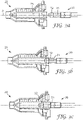
- Fig. 3a to 3c are cross-sectional views of the mixer and the drive shaft, illustrating different stages of placement of the mixer on the drive shaft according to an embodiment of the invention.
- the drive shaft 30 comprises an engagement section 31 and a guiding section 32.
- the guiding section 32 of this embodiment has a cylindrical and an adjacent conical section, as illustrated.
- the mixer 20 is shown in Fig. 3a when it is separated from the drive shaft 30.
- the mixer 20 comprises a blind hole 25 and an engagement section 21.
- the engagement section 21 of the mixer 20 may extend along the whole length of the blind hole 25, or only along a part of it as shown.
- the engagement section 21 of the mixer 20 in the Figures is shown as a cylindrical hole, however the invention encompasses structures having different cross-sectional shapes, for example those shown in Fig. 5 .
- the engagement section 21 of the mixer 20 has a hexagonal cross-section for mating with a hexagonal engagement section 31 of a drive shaft 30 as illustrated at the drive shaft 30.
- the diameter of the blind hole 25 is equal or less than the diameter between the opposed flat sides of the hexagonal engagement section 31 in order to enable manufacturing by injection molding, and optionally to provide a stop at the transition between the engagement section 31 and the blind hole 25, to prevent the engagement section of the drive shaft to enter the blind hole.
- the blind hole may have a diameter substantially smaller than the smallest dimension of the engagement section of the mixer.
- the guiding section of the drive shaft would preferably have a diameter substantially corresponding to the diameter of the blind hole, but a greater length than the engagement section of the mixer so as to be matable with the blind hole for guiding, instead of with the engagement section.
- Fig. 3b shows the mixer 20 being placed on the guiding section 32 of the drive shaft 30, i.e., in the first position.
- the guiding section 32 of the drive shaft 30 is adapted to provide axial guidance with radial restraint within the engagement section 21 of the mixer 20, while the two remain rotatable around the rotation axis A relative to each other.
- a guiding section as referred to can be for example a portion at the front end of the drive shaft having a generally circular shape as shown in Figs. 3a to 3c .
- the guiding section 32 has a cylindrical section of a diameter equal or slightly less than the width between the flats of the hexagonal shape of the engagement section 21 of the mixer 20.
- the guiding section at its front end preferably also comprises a conical section.
- the mixer 20 is placed on the guiding section 32 of the drive shaft 30 - the first position - it is easy to align and then connect the inlets 23, 24 of the mixer 20 to the outlets 13, 14 of the chambers 11, 12, because the mixer 20 can no longer move in two dimensions relative to the drive shaft.
- the inlets 23, 24 can be aligned to the outlets 13, 14 by just rotating the mixer to the appropriate angular orientation. This facilitates the accurate placement of the mixer 20 on the drive shaft 30, thus avoiding mistakes and saving time for the user of the device according to the invention.
- the mixer 20 can be pushed further onto the drive shaft 30. This mates the engagement section 31 of the drive shaft 30 with the engagement section 21 of the mixer 20, and the inlets 23, 24 with the outlets 13, 14 (not shown).
- the engagement sections 31, 21 may not match, because the angular orientation of their hexagonal shapes are randomly positioned relative to each other. This may happen because the engagement section of the mixer is arranged at a part which is rotatable relative to the inlets of the mixer and therefore has a random angular orientation relative to them. In cases the angular orientation of the engagement sections 31, 21 relative to each other do not match, the engagement sections are hindered to mate with one another when the mixer 20 is pushed onto the drive shaft.
- the drive shaft 30 is axially movable against a spring, thus allowing the drive shaft to be displaced backwards (to the right, in Figures 3a-3c ), and causing the engagement sections 31, 21 to remain temporarily disengaged.
- the mixer 20 with its inlets 23, 24 may be connected to the outlets 33, 34 while the engagement sections 21, 31 are still temporarily disengaged.
- mating of the engagement sections 31, 21 happens automatically as soon as the device is activated and the drive shaft starts rotating, because the drive shaft will be pushed forward by the spring and pop into place as soon as the angular orientation of the engagement sections 31, 21 match.
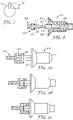
- Figs. 4a to 4c show optional embodiments of the drive shaft 30a to 30c, respectively, with hexagonal engagement sections 31 and different guiding sections 32a to 32c, respectively, the examples in Figs. 4b and 4c not being claimed.
- the guiding section 32a of Fig. 4a is similar to the guiding section 32 of Figs. 3a to 3c having a circular cross-section, but it has a substantially smaller diameter relative to the diameter between the flats of the hexagonal shape of the engagement member 31.
- a further conical section or chamfered radial edge is arranged between the guiding section 32a and the engagement section 31 to facilitate mating of the engagement sections 31 of the drive shaft 30a and engagement section 21 of the mixer 20.
- the guiding section 32b has a generally hexagonal cross-sectional shape but is tapered toward the front end of the drive shaft 30b.
- the guiding section 32c has a generally conical shape.
- Fig. 5 shows different cross-sectional shapes for the engagement section of the drive shaft and/or the mixer according to further embodiments of the invention.
- the shapes (labeled (a) to (e) are: (a) a hexagon, (b) an octagon, (c) across, (d) a first star having a plurality of points, and (e) a second star having less points relative to shape (d).
- Fig. 6a illustrates a cross-sectional view of a guiding section 32d associated with a hexagonal engagement section 21 of the mixer.
- the guiding section 32d has a star shaped cross-section, it guides the hexagonal engagement section 21 axially but restricts radial movement and still allows rotation of both sections relative to each other.
- Fig. 6b shows a corresponding drive shaft 30d according to an alternative embodiment not being claimed, with the guiding section 32d and a hexagonal engagement section 31.
- a guiding section shaped in that manner provides for axial guiding with radial restraint of an engagement section of a mixer when the mixer is placed on the drive shaft in its first position.
- a guiding section as shown can serve as a second engagement section of the drive shaft when engaging with an optional second engagement section of the mixer, i.e. when the mixer is placed on the drive shaft in its second position the engagement sections 31 and21 engage with one another, and the guiding section 32d engages with asecond engaging section of the mixer (not shown).
- the guiding section 32d] ⁇ is preferably shorter than the length of the engagement section 21 of the mixer.
- the engagement sections first engage and establish an angular orientation appropriate for mating of the second engagement sections.
- the hexagon provides a lower degree of freedom for the angular orientation of the parts to be mated relative to each other.
- the star shape can be designed to mate in any of the 6 possible angular orientations the hexagon allows.
- the hexagonal shapes are at least partially mated the star shapes will fit in any of the 6 angular positions, which can be achieved by making the star shaped guiding section shorter then the engagement section of the mixer.
- the star shape would allow for more than 6 possibilities for the angular orientation. This means, that in case the star shaped sections would be mated first, there are some angular orientations which would not allow for subsequently mating the hexagonal shapes. As a consequence a user would have to find an angular orientation by trial and error allowing for mating of both structures, which is not desirable.
- Fig. 7 shows an engagement section 31" of a drive shaft 30" having a spline 35 that fits within a keyway 36 formed in the drive shaft.
- the present invention also includes a drive shaft having multiple splines, as well as embodiments in which each spline is a separate or integral part of the drive shaft.
- Fig. 8 shows a drive shaft 300 and a mixer 200 according to another embodiment of the invention.
- the drive shaft 300 comprises, from the front end towards the rear end of the drive shaft 300: a guiding section 320, an engagement section 310 and a flange 301.
- the flange 301 comprises a recess 302 extending axially from the front surface into the flange 301, both structures forming a socket 303.
- the mixer 200 comprises a mixing rotor 260 having a rear end 201 extending from the rear end 202 of the mixer 200.
- the engagement section 310 of the drive shaft 300 engages with the mating engagement section 210 of the mixer 200, and the rear end 201 of the mixing rotor 260 is inserted in the recess 302 of the drive shaft 300.
- the rear end 201 of the mixing rotor is plugged into the socket 302 of the drive shaft 300.
- the rear end 201 of the mixing rotor which is often made of plastic, is reinforced by the socket 303 of the drive shaft 300, which is commonly made of metal. This enables the maximum torque transmittable from the drive shaft 300 to the mixing rotor 260 to be increased, because deformation of the engagement section 210, due to forces transmitted by the engagement section 310 of the drive shaft 300, is reduced.
- Figs. 9a to 9c show schematic views of alternative embodiments of the mixer and the drive shaft illustrating different stages of placement of the mixer on the drive shaft.
- the mixer 420 is shown in Fig. 9a when it is separated from the drive shaft 430.
- the mixer 420 comprises a male engagement section 421 and the drive shaft 430 comprises female engagement and guiding sections 431, 432 respectively.
- the engagement section 421 of the mixer 420 has a hexagonal cross-section for mating with a hexagonal engagement section 431 of a drive shaft 430.
- other cross-sectional shapes as discussed above are encompassed.
- Fig. 9b shows the mixer 420 being placed on the guiding section 432 of the drive shaft 430.
- the guiding section 432 has a cylindrical section having a diameter equal to or slightly greater than the width between the flats of the hexagonal shape of the engagement section 421 of the mixer 420.
- the guiding section at its front end preferably comprises also a conical section (not shown).
- the mixer 420 is pushed further onto the drive shaft 430 (which may be spring-loaded as described above), so as to mate the engagement section 431 of the drive shaft with the engagement section 421 of the mixer.
- This embodiment may be considered to be the reverse of the embodiments described previously, in that the male and female portions of the various components are generally reversed.
- Fig. 10 shows a mixer of the present invention, including the material inlets.
- the mixer 20 has a front or dispensing end 28 and a rear end 29. Further the mixer comprises inlets 23, 24 and an engagement section 21.
- Fig. 11 shows a schematic view of a mixer 520 having a guiding section 532 and an engagement section 531 and a drive shaft 530 with an engagement section 521 without a guiding section.
- the guiding section of the mixer 532 may be of cylindrical and/or conical shape.
- the guiding section 532 may comprise a non-circular shape, for example as mentioned for the non-circular shapes of the guiding section of the drive shaft above.
- the drive shaft may comprise a second engagement section for engagement with the guiding section of the mixer when the mixer is placed on the drive shaft in its second position.
Landscapes
- Health & Medical Sciences (AREA)
- Engineering & Computer Science (AREA)
- General Engineering & Computer Science (AREA)
- Chemical Kinetics & Catalysis (AREA)
- Chemical & Material Sciences (AREA)
- Epidemiology (AREA)
- General Health & Medical Sciences (AREA)
- Public Health (AREA)
- Veterinary Medicine (AREA)
- Animal Behavior & Ethology (AREA)
- Life Sciences & Earth Sciences (AREA)
- Mechanical Engineering (AREA)
- Dentistry (AREA)
- Oral & Maxillofacial Surgery (AREA)
- Dental Tools And Instruments Or Auxiliary Dental Instruments (AREA)
Description
- The present invention relates to a device for mixing and dispensing dental impression materials.
- Pasty multi-component materials, such as dental impression materials, are often stored separately from each other as individual components, because once the components come into contact with each other a chemical reaction is initiated that eventually turns the mixed composition into a hardened mass. For that reason, such materials are widely available in packages that include two compartments or two separate containers that keep the components initially isolated from each other.
- Dental materials as mentioned are generally mixed together shortly prior to use in the dental practice by the dentist or the dentist's assistant. In recent years, devices have been developed which provide for the automatic mixing and dispensing dental impression materials, which provide high precision with regard to the ratio of the two components to be mixed, and the homogeneity of the mixture. The dental impression material components are simultaneously supplied from separate material chambers to a mixer, which mixes and dispenses the mixed paste from a front end. The mixer may be a static mixer (meaning that the structures that cause mixing do not move relative to the mixing chamber) or a dynamic mixer (meaning that the structures that cause mixing do move relative to the mixing chamber, normally in a rotary manner). The paste exiting from the front end of the mixer may be supplied directly onto a dental impression tray that can be placed in a patient's mouth. When the mixed components harden, the tray is removed and the hardened impression material provides an impression of the patient's teeth.
- Once the material components have come into contact with each other, normally near or within the mixing chamber, the material in the mixing chamber can only be stored for a relatively short time because the mixed material will soon harden inside the mixing chamber if it is not dispensed and used. Therefore mixers used with such devices generally can only be used once, and are therefore generally exchangeable and often disposable parts. Dentists and their assistants may have to remove and replace mixers several times each day.
- Examples of dynamic mixers are found in, e.g.,
WO 00/21652 EP-A-1 149 627 ,US-A-5 249 862 ,US-A-2003/123323 orDE-U-297 05 741 . These known dynamic mixers have at their rear end (the inlet side) a central opening for coupling to a drive shaft of a motorized mixing and dispensing device, and two additional inlet connectors for receiving the material components which are to be mixed. The central opening has a hexagonal cross-section for engagement with a corresponding drive shaft also having a hexagonal cross-section, which enables the motor of the mixing and dispensing device to rotate a mixing rotor having mixing paddles. - To ensure proper mixing and dispensing, the mixer has to be coupled correctly to the drive shaft of the device and the connectors for the material components. If the mixer is improperly coupled to the drive shaft, the motor will not be able to drive the mixing rotor correctly, resulting in unmixed or poorly mixed material components. If the connectors for the material components are improperly aligned and connected, material components can escape from the mixer and make a really big mess. With a device for mixing and dispensing two-component materials, a three-way-coupling is thus provided at the device, comprising two material connectors and the drive shaft, which has to be combined with corresponding parts of the mixer. The connectors and the drive shaft are linearly arranged side by side, with the drive shaft located in the middle.
- Because the drive shaft, with its hexagonal cross-sectional shape, is oriented by random, coupling of the mixer to the device normally requires a two-step process. First, the user orients the drive-shaft opening of the mixer with respect to the orientation of the drive shaft, and places the mixer at least partly onto the drive shaft without regard to whether the material component connectors are aligned. Then the user aligns the component connectors on the mixer with the corresponding connectors on the device, and finishes connecting the mixer to the device. The drive shaft and the material component connectors are thus all aligned and connected, and the device should operate as expected. However, because the mixer is often attached to the dispenser quickly, the two may not be properly engaged or seated, resulting in unsatisfactory performance.
- The present invention is related to a device for mixing and dispensing multi-component materials, such as dental impression materials, as defined in claim 1. The first position further represents a position in which the guiding section of the drive shaft is mated with the engagement section of the mixer, meaning that the mixer placed on the drive shaft in its first position is preferably axially guided with radial restraint by the drive shaft but the engagement sections of the mixer and the drive shaft are disengaged. In contrast, when the mixer is placed on the drive shaft in its second position, i.e. after it has been further pushed or moved towards the device, the engagement sections are engaged and transmission of torque from the drive shaft to the mixer is enabled. In this context it is pointed out that the transmittable torque is preferably sufficient for mixing the material when the mixer is placed on the drive shaft in its second position, while when the mixer is placed on the drive shaft in its first position the transmittable torque is lower.
- The term "guiding section" encompasses structures serving as radial restraint providing axial guidance of a counterpart mated with the guiding section but rotatability between the mated parts. Preferably the guiding section allows guided axial movement of a counterpart over a length of the guiding section, preferably a length of at least 2 mm, and more preferably over a length of 3,5 mm of the guiding section.
- Thus, the invention allows the mixer to be initially placed on the drive shaft in a first position without the need of aligning the engagement sections, for example sections with hexagonal cross-sectional shapes, for mating with each other.
- In a preferred embodiment, the guiding section is adapted such that, when the mixer is placed on the drive shaft in its first position the guiding section is freely rotatable around its longitudinal axis relative to the engagement section of the mixer. Preferably the guiding section of the drive shaft and the engagement section of the mixer form a loose fit or a force-fit, in any case providing free rotatability of both, the guiding section of the drive shaft and the engagement section of the mixer, relative to each other. In this context the terms loose fit and force-fit encompass also a transition fit and a fit providing for very low play between the mating parts but permitting axial guiding with radial restraint of one another. According to the invention, the guiding section has a generally circular cross-section. The guiding section comprises a cylindrical shape. Preferably the guiding section is of a generally cylindrical shape having a conical section at its front most end (which is the end corresponding to the front end of the drive shaft). Preferably the largest diameter of the guiding section is equal to or less than the smallest width of the engagement section of the mixer, in case the guiding section is the male part and the engagement section of the mixer is the female part. Preferably the dimensions of the guiding section and the corresponding width of the engagement section are in a range of 4 to 6 mm. Preferably the largest diameter of the guiding section is 5 mm and the smallest width of the engagement section is also 5 mm so that preferably atransition fit is provided. The length of guiding section is preferably approximately 5 mm and the length of the engagement section of the driveshaft is preferably approximately 10 mm. The transmittable torque between the drive shaft and the mixer having hexagonal engagement sections is approximately 1.5 Nm, when the engagement section of the drive shaft engages with the engagement section of the mixer. Such a torque can be transmitted when the engagements sections are mated properly, meaning when the engagement section of the mixer is engaged over its full length with the engagement section of the drive shaft. According to the present invention the engagement section of the drive shaft comprises a non-circular cross-section, preferably a hexagonal cross-section. Optionally, the engagement section of the drive shaft, has a generally polygon shaped cross-section.
- In a further optional embodiment the engagement section of the drive shaft comprises a spline or a plurality of splines. This encompasses also a drive shaft comprising any kind of splines or detents which allow for engagement with a structure of the mixer and transmission of a torque. Such splines or detents may be integrally formed or separate parts.
- Preferably the drive shaft comprises the male part of the mating of the corresponding engagement sections of the drive shaft and the mixer. Alternatively the drive shaft comprises the female part of the mating of the corresponding engagement sections of the drive shaft and the mixer.
- According to another embodiment the drive shaft further comprises a socket that is preferably arranged concentrically around at least a part of the engagement section of the drive shaft. The socket is preferably arranged at the rear end of the engagement section of the drive shaft (which is the end of the engagement section further remote from the front end of the drive shaft). The socket is preferably formed as a rim, collar or flange concentrically arranged on the drive shaft comprising a recess extending axially from the front face of the flange toward the rear end of the drive shaft. Preferably the recess has an outer circular cross-section and the inner cross-section corresponds to the outer size and shape of the mixing shaft (in case the mixing shaft comprises the male part of the mating engagement sections). In an optional embodiment the outer cross-section of the recess is non-circular, for example has a shape as mentioned above for the engagement/guiding sections providing for engagement with a third mating engagement section at the mixer.
- In a preferred embodiment the device of the present invention further comprises a chamber for storing a component of the dental impression material, wherein the chamber opens into an outlet which is connectable with a corresponding inlet of the mixer, when the mixer is placed on the drive shaft in its second position. Such a chamber could for example be a foil bag provided exchangeably within a cartridge, wherein the foil bag has a cap with the outlets. Preferably the device further comprises a plunger for expelling the component from the chamber into the mixer, so as to mix and dispense the dental impression material.
- Preferably the device of the present invention comprises at least two chambers for storing components of the dental impression material and at least two plungers for expelling the components from the chambers into the mixer, so as to mix and dispense the dental impression material.
- Preferably each chamber opens into an outlet and the individual outlets are connectable with corresponding inlets of the mixer, when the mixer is placed on the drive shaft in its second position. Preferably the outlet(s) is/are at least partially connectable with (a) corresponding inlet(s) of a mixer when the mixer is placed on the mixing shaft in its first position. With this configuration placement of the mixer on the drive shaft and connecting it to the outlets is facilitated, because a user of the device can place the mixer on the drive shaft in a first position without taking care of the angular orientation of the engagement sections of the mating parts relative to each other, as required in the prior art. Once the mixer is placed on the guiding section it is easy to connect the inlets of the mixer to the outlets of the chambers because the mixer then is already supported in two dimensions. Thus, the inlets can be aligned to the outlets by just rotating the mixer to the appropriate angular orientation.
- In a preferred embodiment of the invention the cross-section of the engagement section of the mixer comprises a polygon shape. Preferably the cross-section of the engagement section of the mixer comprises a shape selected from among a square, a rectangle, a hexagon, a cross and a star. Further it is preferred that the engagement section of the mixer comprises a cross-section generally corresponding to the cross-sectional shape of the engagement section of the drive shaft. Alternatively the mixer comprises an engagement section having a substantially different cross-section relative to the cross-sectional shape of the engagement section of the drive shaft.
- A device having a drive shaft according to the invention is advantageous because it is generally compatible to conventional mixers as commercially available. Thus, such a device provides the advantages of the invention to a variety of mixers available on the market. In contrast, a mixer of the invention is advantageous because it can be used with devices that are already in use on the market.
- In a preferred embodiment of the invention the mixer comprises a mixing rotor having a front end and a rear end, the rear end of the mixing rotor extending from the rear end of the mixer and comprising the engagement section for engagement with the mating engagement section of the drive shaft. Preferably the rear end of the mixing rotor is adapted to plug into a socket arranged on the drive shaft of the device according to the invention when the mixer is placed on the drive shaft, preferably when it is placed on the drive shaft in its second position.
- The present invention is advantageous because it allows for easy and fast coupling of a mixer to a device for mixing and dispensing dental impression material. Further it reduces the potential of incorrect coupling of the mixer to the drive shaft and therefore helps ensuring that the torque required for mixing can be transmitted from the drive shaft to the mixer.
- The guiding section can also be used to align the mixer coaxially to the mixing shaft during use. In this case the guiding section of the drive shaft fits with a blind hole arranged in the mixer adjacent to the engagement section. This prevents the shaft to unintentionally move out of the mixer in an axial direction during mixing. Such a gradually axial movement is an effect that generally may occur when a rotating shaft engages an axially disaligned borehole or bearing for torque transmission.
- The invention further provides for transmission of high torques between the drive shaft and the mixer without making coupling of the mixer to the drive shaft complicated.
- Further the invention is advantageous, as it allows the use of prior art mixers to be used with a device of the invention or prior art devices with a mixer of the invention.
- It is pointed out that the discussion of the mating features of the drive shaft as well as of the mixer encompasses that either of them can be considered to be the male or the female part.
- Preferred embodiments of the invention are described in more detail below with reference to the attached drawings, which are by way of example only.
-
Fig. 1 is a perspective view of a device for mixing and dispensing dental impression material according to an embodiment of the invention; -
Fig. 2a is a perspective view showing cross-sections of further details according to an embodiment of the device of the invention; -
Fig. 2b is a magnified view on the details showed inFig. 2a -
Figs. 3a to 3c are cross-sectional views of the mixer and the drive shaft according to an embodiment of the invention, illustrating different stages of placement of the mixer on the drive shaft; -
Fig. 4a is a schematic view of the front end of the drive shaft according to an embodiment of the invention, wherein the guiding section according to the claimed invention only has a circular cross-sectional shape and comprises a cylindrical shape. -
Figs. 4b and 4c are schematic views of the front end of the drive shaft according to different embodiments not being claimed; -
Fig. 5 shows different cross-sectional shapes for the engagement sections and/or the guiding sections of the drive shaft and/or of the mixer according to further embodiments of the invention, wherein the guiding section according to the claimed invention only has a circular cross-sectional shape and comprises a cylindrical shape. -
Fig. 6a is a cross-sectional view of a star-shaped guiding section of the drive shaft associated with a hexagonal engagement section of the mixer not forming part of the invention; -
Fig. 6b shows the drive shaft ofFig. 6a having a hexagonal engagement section and a star-shaped guiding section; -
Fig. 7 is a schematic view on a front of an engagement section comprising a spline, according to another embodiment of the invention; -
Fig. 8 is a cross-sectional view of a mixer and an embodiment of the drive shaft comprising a socket according to an alternative embodiment of the invention; -
Figs. 9a to 9c show a drive shaft comprising the female part and a mixer comprising the male part of the mating of both according to a further embodiment of the invention, at different stages of placement of the mixer on the drive shaft; -
Fig. 10 is a perspective view on a mixer which can be used with a device according to the invention; and -
Fig. 11 shows a schematic view of a mixer having a guiding section and an engagement section, and a drive shaft with an engagement section without a guiding section, the latter not forming part of the claimed invention. -
Fig. 1 is a perspective view of the mixing and dispensing device according to an embodiment of the invention. The device 1 receives acartridge 10 comprisingmaterial chambers cartridge 10 is exchangeable, e.g. it can be removed from the device and replaced by another cartridge of a similar configuration. This permits a user to change materials easily, and makes the device convenient to use with different dental materials. - As can be seen from
Fig. 2a and 2b , amixer 20 is placed on adrive shaft 30, andmixer inlets respective outlets material chambers Fig. 1 ). The device further comprisesplungers cartridge 10 in order to expel the dental material from thematerial chambers outlets mixer 20. In one embodiment of the invention, the dental material is stored in foil bags forming the material chambers (not shown), wherein the foil bags carry a rigid cap comprising the outlets. The foil bags are accommodated within channels of the cartridge. The plungers at their front end (which is the end facing the cartridge/material chambers) may comprise pressing members that are part of or connected to the plungers. Such pressing members may be in the form of pressing plates, pistons or the like, and preferably have cross-sections generally corresponding in size and shape to the channels of the cartridge. Preferably such pressing members are adapted to fit snugly into the channels of the cartridge. Alternatively or additionally, additional pressing members are displaceably accommodated in the channels of the cartridge, and preferably provide sealing with them. In this case the channels of the cartridge may form the material chambers for storing the dental material. -
Fig. 3a to 3c are cross-sectional views of the mixer and the drive shaft, illustrating different stages of placement of the mixer on the drive shaft according to an embodiment of the invention. Thedrive shaft 30 comprises anengagement section 31 and a guidingsection 32. The guidingsection 32 of this embodiment has a cylindrical and an adjacent conical section, as illustrated. Themixer 20 is shown inFig. 3a when it is separated from thedrive shaft 30. As shown, themixer 20 comprises ablind hole 25 and anengagement section 21. Theengagement section 21 of themixer 20 may extend along the whole length of theblind hole 25, or only along a part of it as shown. Theengagement section 21 of themixer 20 in the Figures is shown as a cylindrical hole, however the invention encompasses structures having different cross-sectional shapes, for example those shown inFig. 5 . Preferably theengagement section 21 of themixer 20 has a hexagonal cross-section for mating with ahexagonal engagement section 31 of adrive shaft 30 as illustrated at thedrive shaft 30. Preferably, the diameter of theblind hole 25 is equal or less than the diameter between the opposed flat sides of thehexagonal engagement section 31 in order to enable manufacturing by injection molding, and optionally to provide a stop at the transition between theengagement section 31 and theblind hole 25, to prevent the engagement section of the drive shaft to enter the blind hole. - In an alterative embodiment (not shown), the blind hole may have a diameter substantially smaller than the smallest dimension of the engagement section of the mixer. In this case, the guiding section of the drive shaft would preferably have a diameter substantially corresponding to the diameter of the blind hole, but a greater length than the engagement section of the mixer so as to be matable with the blind hole for guiding, instead of with the engagement section.
-
Fig. 3b shows themixer 20 being placed on the guidingsection 32 of thedrive shaft 30, i.e., in the first position. The guidingsection 32 of thedrive shaft 30 is adapted to provide axial guidance with radial restraint within theengagement section 21 of themixer 20, while the two remain rotatable around the rotation axis A relative to each other. This means that a user of the device can place themixer 20 on the drive shaft in a first position without regard to the angular orientation of theengagement sections drive shaft 30 and themixer 20 relative to each other, as required in the prior art. A guiding section as referred to can be for example a portion at the front end of the drive shaft having a generally circular shape as shown inFigs. 3a to 3c . In this embodiment the guidingsection 32 has a cylindrical section of a diameter equal or slightly less than the width between the flats of the hexagonal shape of theengagement section 21 of themixer 20. To provide easy placement of themixer 20 on thedrive shaft 30, the guiding section at its front end preferably also comprises a conical section. - Once the
mixer 20 is placed on the guidingsection 32 of the drive shaft 30 - the first position - it is easy to align and then connect theinlets mixer 20 to theoutlets chambers mixer 20 can no longer move in two dimensions relative to the drive shaft. Thus, theinlets outlets mixer 20 on thedrive shaft 30, thus avoiding mistakes and saving time for the user of the device according to the invention. - As shown in
Fig. 3c , once the appropriate angular orientation between the drive shaft and the mixer has been found, themixer 20 can be pushed further onto thedrive shaft 30. This mates theengagement section 31 of thedrive shaft 30 with theengagement section 21 of themixer 20, and theinlets outlets 13, 14 (not shown). - Although the
inlets outlets engagement sections engagement sections mixer 20 is pushed onto the drive shaft. For this reason thedrive shaft 30 is axially movable against a spring, thus allowing the drive shaft to be displaced backwards (to the right, inFigures 3a-3c ), and causing theengagement sections mixer 20 with itsinlets engagement sections engagement sections engagement sections -
Figs. 4a to 4c show optional embodiments of thedrive shaft 30a to 30c, respectively, withhexagonal engagement sections 31 anddifferent guiding sections 32a to 32c, respectively, the examples inFigs. 4b and 4c not being claimed. The guidingsection 32a ofFig. 4a is similar to the guidingsection 32 ofFigs. 3a to 3c having a circular cross-section, but it has a substantially smaller diameter relative to the diameter between the flats of the hexagonal shape of theengagement member 31. As illustrated, a further conical section or chamfered radial edge is arranged between the guidingsection 32a and theengagement section 31 to facilitate mating of theengagement sections 31 of thedrive shaft 30a andengagement section 21 of themixer 20. InFig. 4b , the guidingsection 32b has a generally hexagonal cross-sectional shape but is tapered toward the front end of thedrive shaft 30b. InFig. 4c , the guidingsection 32c has a generally conical shape. -
Fig. 5 shows different cross-sectional shapes for the engagement section of the drive shaft and/or the mixer according to further embodiments of the invention. The shapes (labeled (a) to (e) are: (a) a hexagon, (b) an octagon, (c) across, (d) a first star having a plurality of points, and (e) a second star having less points relative to shape (d). -
Fig. 6a illustrates a cross-sectional view of aguiding section 32d associated with ahexagonal engagement section 21 of the mixer. As can be seen, although theguiding section 32d has a star shaped cross-section, it guides thehexagonal engagement section 21 axially but restricts radial movement and still allows rotation of both sections relative to each other.Fig. 6b shows acorresponding drive shaft 30d according to an alternative embodiment not being claimed, with the guidingsection 32d and ahexagonal engagement section 31. A guiding section shaped in that manner provides for axial guiding with radial restraint of an engagement section of a mixer when the mixer is placed on the drive shaft in its first position. Furthermore a guiding section as shown can serve as a second engagement section of the drive shaft when engaging with an optional second engagement section of the mixer, i.e. when the mixer is placed on the drive shaft in its second position theengagement sections 31 and21 engage with one another, and theguiding section 32d engages with asecond engaging section of the mixer (not shown). - In such an embodiment the
guiding section 32d]} is preferably shorter than the length of theengagement section 21 of the mixer. Thus, during placement of the mixer on the drive shaft and movement of the two from the first to the second position, the engagement sections first engage and establish an angular orientation appropriate for mating of the second engagement sections. This is of advantage because compared to the star shape the hexagon provides a lower degree of freedom for the angular orientation of the parts to be mated relative to each other. This means that the star shape can be designed to mate in any of the 6 possible angular orientations the hexagon allows. Thus, if first the hexagonal shapes are at least partially mated the star shapes will fit in any of the 6 angular positions, which can be achieved by making the star shaped guiding section shorter then the engagement section of the mixer. - In contrast, the star shape would allow for more than 6 possibilities for the angular orientation. This means, that in case the star shaped sections would be mated first, there are some angular orientations which would not allow for subsequently mating the hexagonal shapes. As a consequence a user would have to find an angular orientation by trial and error allowing for mating of both structures, which is not desirable.
-
Fig. 7 shows anengagement section 31" of adrive shaft 30" having aspline 35 that fits within akeyway 36 formed in the drive shaft. The present invention also includes a drive shaft having multiple splines, as well as embodiments in which each spline is a separate or integral part of the drive shaft. -
Fig. 8 shows adrive shaft 300 and amixer 200 according to another embodiment of the invention. Thedrive shaft 300 comprises, from the front end towards the rear end of the drive shaft 300: a guidingsection 320, anengagement section 310 and aflange 301. Theflange 301 comprises arecess 302 extending axially from the front surface into theflange 301, both structures forming asocket 303. Themixer 200 comprises a mixingrotor 260 having arear end 201 extending from therear end 202 of themixer 200. When the mixer is placed on the drive shaft in its second position theengagement section 310 of thedrive shaft 300 engages with themating engagement section 210 of themixer 200, and therear end 201 of the mixingrotor 260 is inserted in therecess 302 of thedrive shaft 300. In other words, therear end 201 of the mixing rotor is plugged into thesocket 302 of thedrive shaft 300. As a result therear end 201 of the mixing rotor, which is often made of plastic, is reinforced by thesocket 303 of thedrive shaft 300, which is commonly made of metal. This enables the maximum torque transmittable from thedrive shaft 300 to the mixingrotor 260 to be increased, because deformation of theengagement section 210, due to forces transmitted by theengagement section 310 of thedrive shaft 300, is reduced. -
Figs. 9a to 9c show schematic views of alternative embodiments of the mixer and the drive shaft illustrating different stages of placement of the mixer on the drive shaft. Themixer 420 is shown inFig. 9a when it is separated from thedrive shaft 430. In contrast to the embodiments shown inFigs. 3a to 3c , themixer 420 comprises amale engagement section 421 and thedrive shaft 430 comprises female engagement and guidingsections engagement section 421 of themixer 420 has a hexagonal cross-section for mating with ahexagonal engagement section 431 of adrive shaft 430. However, other cross-sectional shapes as discussed above are encompassed. -
Fig. 9b shows themixer 420 being placed on theguiding section 432 of thedrive shaft 430. In this embodiment the guidingsection 432 has a cylindrical section having a diameter equal to or slightly greater than the width between the flats of the hexagonal shape of theengagement section 421 of themixer 420. To provide easy placement of themixer 420 on thedrive shaft 430 the guiding section at its front end preferably comprises also a conical section (not shown). - As shown in
Fig. 9c , themixer 420 is pushed further onto the drive shaft 430 (which may be spring-loaded as described above), so as to mate theengagement section 431 of the drive shaft with theengagement section 421 of the mixer. This embodiment, may be considered to be the reverse of the embodiments described previously, in that the male and female portions of the various components are generally reversed. -
Fig. 10 shows a mixer of the present invention, including the material inlets. Themixer 20 has a front or dispensingend 28 and arear end 29. Further the mixer comprisesinlets engagement section 21. -
Fig. 11 shows a schematic view of amixer 520 having a guidingsection 532 and anengagement section 531 and adrive shaft 530 with anengagement section 521 without a guiding section. For simplicity, the material connections associated with the mixer and the device are not shown. The guiding section of themixer 532 may be of cylindrical and/or conical shape. Optionally the guidingsection 532 may comprise a non-circular shape, for example as mentioned for the non-circular shapes of the guiding section of the drive shaft above. In this case the drive shaft may comprise a second engagement section for engagement with the guiding section of the mixer when the mixer is placed on the drive shaft in its second position. - It is pointed out that generally all features described for the drive shaft may be considered as features of the mixer, and vice versa, as illustrated in the embodiments shown in
Figures 9a to 9c in comparison to other embodiments. Furthermore combinations of features of the drive shaft and the mixer are explicitly encompassed. - The present invention has now been described with reference to several embodiments thereof. It will be apparent to those skilled in the art that many changes can be made in the embodiments described without departing from the scope of the present invention. Thus the scope of the present invention should not be limited to the structures described in this application, but only by structures as claimed.
Claims (5)
- Device (1) for mixing and dispensing dental impression material, comprising:- a mixer (20) having an engagement section (21);- a drive shaft (30) for driving the mixer (20);- wherein the drive shaft (30) has a front end comprising a guiding section (32) and just to the rear of it separately an engagement section (31) for engagement with the mating engagement section (21) of the mixer (20);- wherein the guiding section (32) of the drive shaft (30) has a generally circular cross-section and comprises a cylindrical shape and the engagement section (31) of the drive shaft (30) has a non-circular cross-section, and the mixer (20) being placeable on the drive shaft (30) in a first and a second position, wherein in the first position the guiding section (32) of the drive shaft (30) is mated with the engagement section (21) of the mixer (20), but the engagement section (31) of the drive shaft (30) is not engaged with the engagement section (21) of the mixer (20), and- in the second position the engagement section (31) of the drive shaft (30) is also engaged with the engagement section (21) of the mixer (20).
- The device (1) of claim 1, wherein the engagement section (31) of the drive shaft (30) has a hexagonal cross-section.
- The device (1) of claim 1 or 2, further comprising a chamber (11, 12) for storing at least one component of the dental impression material, wherein the chamber (11, 12) opens into an outlet (13, 14) which is connectable with a corresponding inlet (23, 24) of the mixer (20), when the mixer (20) is placed on the drive shaft (30) in its second position.
- The device of claim 3, wherein the outlet (13, 14) is at least partially connectable with the corresponding inlet (23, 24) of the mixer (20) when the mixer (20) is placed on the drive shaft (30) in its first position.
- The device of claim 3, further comprising a plunger (51, 52) for expelling the at least one component from the chamber (11, 12) into the mixer (20), so as to mix and dispense the dental impression material.
Applications Claiming Priority (2)
| Application Number | Priority Date | Filing Date | Title |
|---|---|---|---|
| EP06004960A EP1836992A1 (en) | 2006-03-10 | 2006-03-10 | Mixing device and drive for the mixing device |
| PCT/US2007/063526 WO2007106701A2 (en) | 2006-03-10 | 2007-03-08 | Mixing device and drive for the mixing device |
Publications (3)
| Publication Number | Publication Date |
|---|---|
| EP1993470A2 EP1993470A2 (en) | 2008-11-26 |
| EP1993470B1 EP1993470B1 (en) | 2017-06-21 |
| EP1993470B2 true EP1993470B2 (en) | 2022-04-27 |
Family
ID=36754335
Family Applications (2)
| Application Number | Title | Priority Date | Filing Date |
|---|---|---|---|
| EP06004960A Withdrawn EP1836992A1 (en) | 2006-03-10 | 2006-03-10 | Mixing device and drive for the mixing device |
| EP07779278.6A Active EP1993470B2 (en) | 2006-03-10 | 2007-03-08 | Mixing device with drive for the mixing device |
Family Applications Before (1)
| Application Number | Title | Priority Date | Filing Date |
|---|---|---|---|
| EP06004960A Withdrawn EP1836992A1 (en) | 2006-03-10 | 2006-03-10 | Mixing device and drive for the mixing device |
Country Status (3)
| Country | Link |
|---|---|
| US (1) | US8579497B2 (en) |
| EP (2) | EP1836992A1 (en) |
| WO (1) | WO2007106701A2 (en) |
Families Citing this family (23)
| Publication number | Priority date | Publication date | Assignee | Title |
|---|---|---|---|---|
| EP1836992A1 (en) * | 2006-03-10 | 2007-09-26 | 3M Innovative Properties Company | Mixing device and drive for the mixing device |
| DK2315553T3 (en) * | 2008-07-17 | 2015-06-29 | Stéphen Koubi | DEVICE FOR INJECTION OF A FILLING MATERIAL IN FLUID PHASE IN A CHANNEL cavity |
| GB0915007D0 (en) | 2009-08-28 | 2009-09-30 | 3M Innovative Properties Co | Mixer and system for mixing and dispensing material |
| DE102010013750A1 (en) | 2010-03-31 | 2011-07-14 | Heraeus Kulzer GmbH, 63450 | Container for storing e.g. gypsum, for dental medicine, has drive shaft penetrating piston and comprising terminal for external drive outer side of container, and lid comprising membrane for sealing casting mass in container |
| EP2399666B1 (en) * | 2010-06-22 | 2013-02-20 | 3M Innovative Properties Company | Mixer for preparing a dental material, and system comprising the same |
| DE102010045935B4 (en) | 2010-09-21 | 2014-07-17 | Heraeus Kulzer Gmbh | Container, container system, method for applying a pasty mass from this container and method for mixing a plurality of masses from this container |
| EP2441413A1 (en) * | 2010-10-18 | 2012-04-18 | 3M Innovative Properties Company | A mixer for forming a dental material, a system comprising the mixer, and a method of mounting the mixer |
| IN2012DE01330A (en) * | 2011-07-22 | 2015-09-25 | Sulzer Mixpac Ag | |
| WO2013026722A1 (en) * | 2011-08-24 | 2013-02-28 | Kettenbach Gmbh & Co. Kg | Mixer |
| EP2606987A1 (en) * | 2011-12-21 | 2013-06-26 | Sika Technology AG | Application system, battery powered application device and process for bonding |
| JP3183618U (en) * | 2012-03-22 | 2013-05-30 | 三菱化学株式会社 | Rotating member for image forming apparatus, image forming cartridge, and image forming apparatus |
| US9452033B2 (en) * | 2012-08-28 | 2016-09-27 | 3M Innovative Properties Company | Device for dispensing a dental material |
| GB2506261B (en) * | 2013-07-30 | 2015-02-18 | Rolls Royce Plc | A joint |
| US11351512B2 (en) | 2016-07-21 | 2022-06-07 | Siemens Healthcare Diagnostics Inc. | Quick-connect mixer impeller coupling |
| DE102017112440A1 (en) * | 2017-06-06 | 2018-12-06 | Shin-Etsu Silicones Europe B.V. | Container and dosing device for viscous materials |
| AU2018314852B2 (en) * | 2017-08-09 | 2024-04-04 | Sika Technology Ag | Device for applying a building material |
| JP7369130B2 (en) | 2018-02-08 | 2023-10-25 | フィリップ・モーリス・プロダクツ・ソシエテ・アノニム | Pairs of connectable parts for connecting transmission shafts and rollers |
| US20210394137A1 (en) * | 2018-10-02 | 2021-12-23 | Michael Josias CRONJE | Stirrer assembly |
| DE102019108533B4 (en) * | 2019-04-02 | 2020-11-19 | Kulzer Gmbh | Extrusion device for dental materials and a method for driving at least one discharge piston of a cartridge system with an extrusion device |
| DE102019119161A1 (en) * | 2019-07-15 | 2021-01-21 | Kulzer Gmbh | Dynamic mixer for user-friendly insertion into a mixing device |
| KR102456489B1 (en) * | 2020-12-22 | 2022-10-20 | 윤문규 | Electric dispenser for dental impression materials |
| DE102023111263B4 (en) | 2023-05-02 | 2025-01-23 | Kulzer Gmbh | Extrusion device for dental materials with volume flow measuring device |
| DE102023119907A1 (en) | 2023-07-27 | 2025-01-30 | Kulzer Gmbh | Adapter for transferring multi-chamber cartridges |
Citations (3)
| Publication number | Priority date | Publication date | Assignee | Title |
|---|---|---|---|---|
| WO2001031216A1 (en) † | 1999-10-27 | 2001-05-03 | Abbott Laboratories | Universal style coupling |
| DE10316155A1 (en) † | 2002-05-24 | 2003-12-18 | Sew Eurodrive Gmbh & Co | Series of shafts for fixing in a bore of a receiving part for engines has at least two different sizes having different embodiments of shafts |
| WO2004056281A1 (en) † | 2002-12-19 | 2004-07-08 | Ernst Mühlbauer Gmbh & Co. Kg | Device for dispensing a mixed multi-component compound |
Family Cites Families (31)
| Publication number | Priority date | Publication date | Assignee | Title |
|---|---|---|---|---|
| US2833576A (en) * | 1955-11-15 | 1958-05-06 | Cirone Joseph | Connecting means for a mixer and a disposable mixing blade |
| US2893769A (en) | 1956-07-20 | 1959-07-07 | Deliso John | Socket and rod coupling |
| US2869907A (en) * | 1956-07-20 | 1959-01-20 | Deliso John | Socket and rod coupling |
| US3290918A (en) * | 1963-12-06 | 1966-12-13 | Anthony V Weasler | Method of manufacturing a shaft coupling |
| US3485520A (en) * | 1968-05-01 | 1969-12-23 | Rayburn G Alexander | Self-locking connection between rigid members and method of making same |
| CH614620A5 (en) * | 1977-07-05 | 1979-12-14 | Identoflex Ag | |
| US4212546A (en) * | 1978-09-21 | 1980-07-15 | Porteous Don D | Tiltable power blender for dental impression materials |
| DE3233366A1 (en) * | 1982-02-05 | 1983-09-22 | Hans Klaus 8091 Ebrach Schneider | Device for mixing dental compounds |
| US4832637A (en) * | 1987-05-29 | 1989-05-23 | Brunswick Corporation | Marine engine driveshaft coupling |
| US4832573A (en) * | 1987-11-27 | 1989-05-23 | General Motors Corporation | Integral connection for plastic water pump impeller |
| DE9017323U1 (en) | 1990-12-21 | 1992-04-16 | Thera Patent GmbH & Co KG Gesellschaft für industrielle Schutzrechte, 8031 Seefeld | Dynamic mixer |
| DE4301209C2 (en) * | 1993-01-19 | 1995-06-08 | Maweva Holding Ag Ltd Rickenba | Hand mixer |
| US5402710A (en) * | 1994-01-27 | 1995-04-04 | Chen; Shang-Hsien | Mixer mechanism for an automatic baking machine |
| GB9403362D0 (en) | 1994-02-22 | 1994-04-13 | Summit Medical Ltd | Bone cement mixing apparatus |
| DE29705741U1 (en) | 1997-04-01 | 1998-08-06 | Muehlbauer Ernst Kg | Dynamic mixer for dental impression materials |
| US6443612B1 (en) | 1999-12-02 | 2002-09-03 | Wilhelm A. Keller | Dynamic mixer |
| ATE272440T1 (en) | 2000-03-29 | 2004-08-15 | Heraeus Kulzer Gmbh & Co Kg | DYNAMIC MIXER |
| DE10019893C2 (en) | 2000-04-20 | 2003-05-28 | 3M Espe Ag | Device in the form of a dynamic mixer or a cartridge front and their use |
| US7022923B2 (en) | 2000-09-04 | 2006-04-04 | Siemens Aktiengesellschaft | Locking device for withdrawable circuit-breakers |
| US6439760B1 (en) * | 2000-09-29 | 2002-08-27 | Deborah L. Langeloh | Mixer appliance |
| DE50110155D1 (en) | 2001-07-26 | 2006-07-27 | Muehlbauer Ernst Gmbh & Co Kg | Method and device for producing a multicomponent mass |
| DE10164385C1 (en) | 2001-12-28 | 2003-03-06 | Kettenbach Gmbh & Co Kg | Device for mixing two paste-like substances for dental work includes first channel extending through coupling section and having first and second parts with adjoining deflection section inbetween to ensure constant mixing ratio at outlet |
| WO2004080611A1 (en) * | 2003-03-06 | 2004-09-23 | Dentsply International Inc. | Dispensing and mixing tip |
| DE10312843B3 (en) | 2003-03-21 | 2004-11-11 | A. Kettenbach Gmbh & Co. Kg | Device for dispensing single or multi-component masses and valve arrangement therefor |
| DE60300822T2 (en) | 2003-08-14 | 2006-04-13 | 3M Espe Ag | Mixing element for a multi-component paste mixer, and mixer with this mixing element |
| EP1602342A1 (en) * | 2004-06-04 | 2005-12-07 | 3M Espe AG | Locking assembly and dispensing cartridge comprising the same |
| US8322909B2 (en) * | 2004-09-22 | 2012-12-04 | 3M Deutschland Gmbh | Mixer for multi-component pastes, kit, and method of mixing paste components |
| EP1836992A1 (en) * | 2006-03-10 | 2007-09-26 | 3M Innovative Properties Company | Mixing device and drive for the mixing device |
| EP1834603A1 (en) * | 2006-03-10 | 2007-09-19 | 3M Innovative Properties Company | Dispenser and method for dispensing dental material |
| GB0915002D0 (en) * | 2009-08-28 | 2009-09-30 | 3M Innovative Properties Co | Device for dispensing a dental material |
| GB0915007D0 (en) * | 2009-08-28 | 2009-09-30 | 3M Innovative Properties Co | Mixer and system for mixing and dispensing material |
-
2006
- 2006-03-10 EP EP06004960A patent/EP1836992A1/en not_active Withdrawn
-
2007
- 2007-03-08 WO PCT/US2007/063526 patent/WO2007106701A2/en not_active Ceased
- 2007-03-08 US US12/281,999 patent/US8579497B2/en active Active
- 2007-03-08 EP EP07779278.6A patent/EP1993470B2/en active Active
Patent Citations (3)
| Publication number | Priority date | Publication date | Assignee | Title |
|---|---|---|---|---|
| WO2001031216A1 (en) † | 1999-10-27 | 2001-05-03 | Abbott Laboratories | Universal style coupling |
| DE10316155A1 (en) † | 2002-05-24 | 2003-12-18 | Sew Eurodrive Gmbh & Co | Series of shafts for fixing in a bore of a receiving part for engines has at least two different sizes having different embodiments of shafts |
| WO2004056281A1 (en) † | 2002-12-19 | 2004-07-08 | Ernst Mühlbauer Gmbh & Co. Kg | Device for dispensing a mixed multi-component compound |
Also Published As
| Publication number | Publication date |
|---|---|
| US20090279382A1 (en) | 2009-11-12 |
| WO2007106701A3 (en) | 2007-11-29 |
| EP1836992A1 (en) | 2007-09-26 |
| EP1993470B1 (en) | 2017-06-21 |
| US8579497B2 (en) | 2013-11-12 |
| WO2007106701A2 (en) | 2007-09-20 |
| EP1993470A2 (en) | 2008-11-26 |
Similar Documents
| Publication | Publication Date | Title |
|---|---|---|
| EP1993470B1 (en) | Mixing device and drive for the mixing device | |
| US8371744B2 (en) | Mixer and system for mixing and dispensing a material | |
| CN102481177B (en) | Devices for dispensing dental materials | |
| US8074843B2 (en) | Two-part double syringe | |
| CA2763752C (en) | Mixing apparatus | |
| EP2066432B1 (en) | Bone cement mixing and delivery system with automated bone cement transfer between mixer and delivery device | |
| CN102413789B (en) | Dispensing device for dental substance | |
| US20030183653A1 (en) | Two-part composition syringe delivery system | |
| JPH04220259A (en) | Mixer and filler for surgical adhesive | |
| JP6199748B2 (en) | Carpul's actuator and method | |
| CN102946985B (en) | Mixer for preparing dental material and system comprising said mixer | |
| US9486298B2 (en) | Cartridge for dispensing a dental substance and method of assembling the cartridge | |
| EP3815777B1 (en) | Mixing and dispensing system and method of mixing and dispensing material from a mixing and dispensing system | |
| EP3661637B1 (en) | Dynamic mixer, automatic mixing unit and method of installing and driving a dynamic mixer | |
| EP2441413A1 (en) | A mixer for forming a dental material, a system comprising the mixer, and a method of mounting the mixer | |
| EP3815639A1 (en) | Dispensing mechanism and method of dispensing material using a dispensing mechanism |
Legal Events
| Date | Code | Title | Description |
|---|---|---|---|
| PUAI | Public reference made under article 153(3) epc to a published international application that has entered the european phase |
Free format text: ORIGINAL CODE: 0009012 |
|
| 17P | Request for examination filed |
Effective date: 20080916 |
|
| AK | Designated contracting states |
Kind code of ref document: A2 Designated state(s): AT BE BG CH CY CZ DE DK EE ES FI FR GB GR HU IE IS IT LI LT LU LV MC MT NL PL PT RO SE SI SK TR |
|
| RIN1 | Information on inventor provided before grant (corrected) |
Inventor name: HARRE, MANFRED Inventor name: MUELLER-PAUL, DIRK |
|
| DAX | Request for extension of the european patent (deleted) | ||
| 17Q | First examination report despatched |
Effective date: 20140429 |
|
| GRAP | Despatch of communication of intention to grant a patent |
Free format text: ORIGINAL CODE: EPIDOSNIGR1 |
|
| STAA | Information on the status of an ep patent application or granted ep patent |
Free format text: STATUS: GRANT OF PATENT IS INTENDED |
|
| RIC1 | Information provided on ipc code assigned before grant |
Ipc: A61C 9/00 20060101ALI20170116BHEP Ipc: F16D 1/10 20060101ALI20170116BHEP Ipc: B01F 15/00 20060101ALI20170116BHEP Ipc: B01F 7/00 20060101AFI20170116BHEP |
|
| INTG | Intention to grant announced |
Effective date: 20170209 |
|
| GRAS | Grant fee paid |
Free format text: ORIGINAL CODE: EPIDOSNIGR3 |
|
| GRAJ | Information related to disapproval of communication of intention to grant by the applicant or resumption of examination proceedings by the epo deleted |
Free format text: ORIGINAL CODE: EPIDOSDIGR1 |
|
| GRAL | Information related to payment of fee for publishing/printing deleted |
Free format text: ORIGINAL CODE: EPIDOSDIGR3 |
|
| STAA | Information on the status of an ep patent application or granted ep patent |
Free format text: STATUS: EXAMINATION IS IN PROGRESS |
|
| REG | Reference to a national code |
Ref country code: DE Ref legal event code: R079 Ref document number: 602007051415 Country of ref document: DE Free format text: PREVIOUS MAIN CLASS: A61C0009000000 Ipc: A61C0005640000 |
|
| GRAR | Information related to intention to grant a patent recorded |
Free format text: ORIGINAL CODE: EPIDOSNIGR71 |
|
| STAA | Information on the status of an ep patent application or granted ep patent |
Free format text: STATUS: GRANT OF PATENT IS INTENDED |
|
| GRAA | (expected) grant |
Free format text: ORIGINAL CODE: 0009210 |
|
| STAA | Information on the status of an ep patent application or granted ep patent |
Free format text: STATUS: THE PATENT HAS BEEN GRANTED |
|
| INTC | Intention to grant announced (deleted) | ||
| RIC1 | Information provided on ipc code assigned before grant |
Ipc: A61C 9/00 20060101ALI20170420BHEP Ipc: B01F 15/00 20060101ALI20170420BHEP Ipc: B01F 7/00 20060101ALI20170420BHEP Ipc: A61C 5/64 20170101AFI20170420BHEP Ipc: F16D 1/10 20060101ALI20170420BHEP |
|
| AK | Designated contracting states |
Kind code of ref document: B1 Designated state(s): AT BE BG CH CY CZ DE DK EE ES FI FR GB GR HU IE IS IT LI LT LU LV MC MT NL PL PT RO SE SI SK TR |
|
| INTG | Intention to grant announced |
Effective date: 20170512 |
|
| REG | Reference to a national code |
Ref country code: GB Ref legal event code: FG4D |
|
| REG | Reference to a national code |
Ref country code: CH Ref legal event code: EP |
|
| REG | Reference to a national code |
Ref country code: IE Ref legal event code: FG4D |
|
| REG | Reference to a national code |
Ref country code: AT Ref legal event code: REF Ref document number: 902243 Country of ref document: AT Kind code of ref document: T Effective date: 20170715 |
|
| REG | Reference to a national code |
Ref country code: DE Ref legal event code: R096 Ref document number: 602007051415 Country of ref document: DE |
|
| REG | Reference to a national code |
Ref country code: NL Ref legal event code: MP Effective date: 20170621 |
|
| PG25 | Lapsed in a contracting state [announced via postgrant information from national office to epo] |
Ref country code: FI Free format text: LAPSE BECAUSE OF FAILURE TO SUBMIT A TRANSLATION OF THE DESCRIPTION OR TO PAY THE FEE WITHIN THE PRESCRIBED TIME-LIMIT Effective date: 20170621 Ref country code: GR Free format text: LAPSE BECAUSE OF FAILURE TO SUBMIT A TRANSLATION OF THE DESCRIPTION OR TO PAY THE FEE WITHIN THE PRESCRIBED TIME-LIMIT Effective date: 20170922 Ref country code: LT Free format text: LAPSE BECAUSE OF FAILURE TO SUBMIT A TRANSLATION OF THE DESCRIPTION OR TO PAY THE FEE WITHIN THE PRESCRIBED TIME-LIMIT Effective date: 20170621 |
|
| REG | Reference to a national code |
Ref country code: LT Ref legal event code: MG4D |
|
| REG | Reference to a national code |
Ref country code: AT Ref legal event code: MK05 Ref document number: 902243 Country of ref document: AT Kind code of ref document: T Effective date: 20170621 |
|
| PG25 | Lapsed in a contracting state [announced via postgrant information from national office to epo] |
Ref country code: LV Free format text: LAPSE BECAUSE OF FAILURE TO SUBMIT A TRANSLATION OF THE DESCRIPTION OR TO PAY THE FEE WITHIN THE PRESCRIBED TIME-LIMIT Effective date: 20170621 Ref country code: SE Free format text: LAPSE BECAUSE OF FAILURE TO SUBMIT A TRANSLATION OF THE DESCRIPTION OR TO PAY THE FEE WITHIN THE PRESCRIBED TIME-LIMIT Effective date: 20170621 Ref country code: BG Free format text: LAPSE BECAUSE OF FAILURE TO SUBMIT A TRANSLATION OF THE DESCRIPTION OR TO PAY THE FEE WITHIN THE PRESCRIBED TIME-LIMIT Effective date: 20170921 Ref country code: NL Free format text: LAPSE BECAUSE OF FAILURE TO SUBMIT A TRANSLATION OF THE DESCRIPTION OR TO PAY THE FEE WITHIN THE PRESCRIBED TIME-LIMIT Effective date: 20170621 |
|
| PG25 | Lapsed in a contracting state [announced via postgrant information from national office to epo] |
Ref country code: EE Free format text: LAPSE BECAUSE OF FAILURE TO SUBMIT A TRANSLATION OF THE DESCRIPTION OR TO PAY THE FEE WITHIN THE PRESCRIBED TIME-LIMIT Effective date: 20170621 Ref country code: SK Free format text: LAPSE BECAUSE OF FAILURE TO SUBMIT A TRANSLATION OF THE DESCRIPTION OR TO PAY THE FEE WITHIN THE PRESCRIBED TIME-LIMIT Effective date: 20170621 Ref country code: AT Free format text: LAPSE BECAUSE OF FAILURE TO SUBMIT A TRANSLATION OF THE DESCRIPTION OR TO PAY THE FEE WITHIN THE PRESCRIBED TIME-LIMIT Effective date: 20170621 Ref country code: CZ Free format text: LAPSE BECAUSE OF FAILURE TO SUBMIT A TRANSLATION OF THE DESCRIPTION OR TO PAY THE FEE WITHIN THE PRESCRIBED TIME-LIMIT Effective date: 20170621 Ref country code: RO Free format text: LAPSE BECAUSE OF FAILURE TO SUBMIT A TRANSLATION OF THE DESCRIPTION OR TO PAY THE FEE WITHIN THE PRESCRIBED TIME-LIMIT Effective date: 20170621 |
|
| PG25 | Lapsed in a contracting state [announced via postgrant information from national office to epo] |
Ref country code: IS Free format text: LAPSE BECAUSE OF FAILURE TO SUBMIT A TRANSLATION OF THE DESCRIPTION OR TO PAY THE FEE WITHIN THE PRESCRIBED TIME-LIMIT Effective date: 20171021 Ref country code: ES Free format text: LAPSE BECAUSE OF FAILURE TO SUBMIT A TRANSLATION OF THE DESCRIPTION OR TO PAY THE FEE WITHIN THE PRESCRIBED TIME-LIMIT Effective date: 20170621 Ref country code: IT Free format text: LAPSE BECAUSE OF FAILURE TO SUBMIT A TRANSLATION OF THE DESCRIPTION OR TO PAY THE FEE WITHIN THE PRESCRIBED TIME-LIMIT Effective date: 20170621 Ref country code: PL Free format text: LAPSE BECAUSE OF FAILURE TO SUBMIT A TRANSLATION OF THE DESCRIPTION OR TO PAY THE FEE WITHIN THE PRESCRIBED TIME-LIMIT Effective date: 20170621 |
|
| REG | Reference to a national code |
Ref country code: DE Ref legal event code: R026 Ref document number: 602007051415 Country of ref document: DE |
|
| PLBI | Opposition filed |
Free format text: ORIGINAL CODE: 0009260 |
|
| PLAX | Notice of opposition and request to file observation + time limit sent |
Free format text: ORIGINAL CODE: EPIDOSNOBS2 |
|
| 26 | Opposition filed |
Opponent name: KULZER GMBH Effective date: 20180320 Opponent name: RENFERT GMBH Effective date: 20180321 |
|
| PG25 | Lapsed in a contracting state [announced via postgrant information from national office to epo] |
Ref country code: DK Free format text: LAPSE BECAUSE OF FAILURE TO SUBMIT A TRANSLATION OF THE DESCRIPTION OR TO PAY THE FEE WITHIN THE PRESCRIBED TIME-LIMIT Effective date: 20170621 |
|
| PLBB | Reply of patent proprietor to notice(s) of opposition received |
Free format text: ORIGINAL CODE: EPIDOSNOBS3 |
|
| PG25 | Lapsed in a contracting state [announced via postgrant information from national office to epo] |
Ref country code: SI Free format text: LAPSE BECAUSE OF FAILURE TO SUBMIT A TRANSLATION OF THE DESCRIPTION OR TO PAY THE FEE WITHIN THE PRESCRIBED TIME-LIMIT Effective date: 20170621 |
|
| REG | Reference to a national code |
Ref country code: CH Ref legal event code: PL |
|
| GBPC | Gb: european patent ceased through non-payment of renewal fee |
Effective date: 20180308 |
|
| PG25 | Lapsed in a contracting state [announced via postgrant information from national office to epo] |
Ref country code: MC Free format text: LAPSE BECAUSE OF FAILURE TO SUBMIT A TRANSLATION OF THE DESCRIPTION OR TO PAY THE FEE WITHIN THE PRESCRIBED TIME-LIMIT Effective date: 20170621 |
|
| REG | Reference to a national code |
Ref country code: BE Ref legal event code: MM Effective date: 20180331 |
|
| REG | Reference to a national code |
Ref country code: IE Ref legal event code: MM4A |
|
| PG25 | Lapsed in a contracting state [announced via postgrant information from national office to epo] |
Ref country code: LU Free format text: LAPSE BECAUSE OF NON-PAYMENT OF DUE FEES Effective date: 20180308 |
|
| PG25 | Lapsed in a contracting state [announced via postgrant information from national office to epo] |
Ref country code: IE Free format text: LAPSE BECAUSE OF NON-PAYMENT OF DUE FEES Effective date: 20180308 |
|
| PG25 | Lapsed in a contracting state [announced via postgrant information from national office to epo] |
Ref country code: GB Free format text: LAPSE BECAUSE OF NON-PAYMENT OF DUE FEES Effective date: 20180308 Ref country code: BE Free format text: LAPSE BECAUSE OF NON-PAYMENT OF DUE FEES Effective date: 20180331 Ref country code: LI Free format text: LAPSE BECAUSE OF NON-PAYMENT OF DUE FEES Effective date: 20180331 Ref country code: CH Free format text: LAPSE BECAUSE OF NON-PAYMENT OF DUE FEES Effective date: 20180331 |
|
| PG25 | Lapsed in a contracting state [announced via postgrant information from national office to epo] |
Ref country code: FR Free format text: LAPSE BECAUSE OF NON-PAYMENT OF DUE FEES Effective date: 20180331 |
|
| PG25 | Lapsed in a contracting state [announced via postgrant information from national office to epo] |
Ref country code: MT Free format text: LAPSE BECAUSE OF NON-PAYMENT OF DUE FEES Effective date: 20180308 |
|
| PG25 | Lapsed in a contracting state [announced via postgrant information from national office to epo] |
Ref country code: TR Free format text: LAPSE BECAUSE OF FAILURE TO SUBMIT A TRANSLATION OF THE DESCRIPTION OR TO PAY THE FEE WITHIN THE PRESCRIBED TIME-LIMIT Effective date: 20170621 |
|
| PG25 | Lapsed in a contracting state [announced via postgrant information from national office to epo] |
Ref country code: PT Free format text: LAPSE BECAUSE OF FAILURE TO SUBMIT A TRANSLATION OF THE DESCRIPTION OR TO PAY THE FEE WITHIN THE PRESCRIBED TIME-LIMIT Effective date: 20170621 Ref country code: HU Free format text: LAPSE BECAUSE OF FAILURE TO SUBMIT A TRANSLATION OF THE DESCRIPTION OR TO PAY THE FEE WITHIN THE PRESCRIBED TIME-LIMIT; INVALID AB INITIO Effective date: 20070308 |
|
| PG25 | Lapsed in a contracting state [announced via postgrant information from national office to epo] |
Ref country code: CY Free format text: LAPSE BECAUSE OF FAILURE TO SUBMIT A TRANSLATION OF THE DESCRIPTION OR TO PAY THE FEE WITHIN THE PRESCRIBED TIME-LIMIT Effective date: 20170621 |
|
| REG | Reference to a national code |
Ref country code: CH Ref legal event code: PK Free format text: TITEL |
|
| PUAH | Patent maintained in amended form |
Free format text: ORIGINAL CODE: 0009272 |
|
| STAA | Information on the status of an ep patent application or granted ep patent |
Free format text: STATUS: PATENT MAINTAINED AS AMENDED |
|
| 27A | Patent maintained in amended form |
Effective date: 20220427 |
|
| AK | Designated contracting states |
Kind code of ref document: B2 Designated state(s): AT BE BG CH CY CZ DE DK EE ES FI FR GB GR HU IE IS IT LI LT LU LV MC MT NL PL PT RO SE SI SK TR |
|
| REG | Reference to a national code |
Ref country code: DE Ref legal event code: R102 Ref document number: 602007051415 Country of ref document: DE |
|
| P01 | Opt-out of the competence of the unified patent court (upc) registered |
Effective date: 20230530 |
|
| REG | Reference to a national code |
Ref country code: DE Ref legal event code: R081 Ref document number: 602007051415 Country of ref document: DE Owner name: SOLVENTUM INTELLECTUAL PROPERTIES CO. (N.D.GES, US Free format text: FORMER OWNER: 3M INNOVATIVE PROPERTIES COMPANY, SAINT PAUL, MINN., US |
|
| PGFP | Annual fee paid to national office [announced via postgrant information from national office to epo] |
Ref country code: DE Payment date: 20250218 Year of fee payment: 19 |