EP1981892B1 - Thieno-pyridine derivatives as mek inhibitors - Google Patents
Thieno-pyridine derivatives as mek inhibitors Download PDFInfo
- Publication number
- EP1981892B1 EP1981892B1 EP07705076.3A EP07705076A EP1981892B1 EP 1981892 B1 EP1981892 B1 EP 1981892B1 EP 07705076 A EP07705076 A EP 07705076A EP 1981892 B1 EP1981892 B1 EP 1981892B1
- Authority
- EP
- European Patent Office
- Prior art keywords
- amino
- thieno
- iodophenyl
- fluoro
- pyridin
- Prior art date
- Legal status (The legal status is an assumption and is not a legal conclusion. Google has not performed a legal analysis and makes no representation as to the accuracy of the status listed.)
- Active
Links
Classifications
-
- A—HUMAN NECESSITIES
- A61—MEDICAL OR VETERINARY SCIENCE; HYGIENE
- A61K—PREPARATIONS FOR MEDICAL, DENTAL OR TOILETRY PURPOSES
- A61K31/00—Medicinal preparations containing organic active ingredients
- A61K31/33—Heterocyclic compounds
- A61K31/395—Heterocyclic compounds having nitrogen as a ring hetero atom, e.g. guanethidine or rifamycins
- A61K31/435—Heterocyclic compounds having nitrogen as a ring hetero atom, e.g. guanethidine or rifamycins having six-membered rings with one nitrogen as the only ring hetero atom
- A61K31/4353—Heterocyclic compounds having nitrogen as a ring hetero atom, e.g. guanethidine or rifamycins having six-membered rings with one nitrogen as the only ring hetero atom ortho- or peri-condensed with heterocyclic ring systems
- A61K31/4365—Heterocyclic compounds having nitrogen as a ring hetero atom, e.g. guanethidine or rifamycins having six-membered rings with one nitrogen as the only ring hetero atom ortho- or peri-condensed with heterocyclic ring systems the heterocyclic ring system having sulfur as a ring hetero atom, e.g. ticlopidine
-
- C—CHEMISTRY; METALLURGY
- C07—ORGANIC CHEMISTRY
- C07D—HETEROCYCLIC COMPOUNDS
- C07D495/00—Heterocyclic compounds containing in the condensed system at least one hetero ring having sulfur atoms as the only ring hetero atoms
- C07D495/02—Heterocyclic compounds containing in the condensed system at least one hetero ring having sulfur atoms as the only ring hetero atoms in which the condensed system contains two hetero rings
- C07D495/04—Ortho-condensed systems
-
- A—HUMAN NECESSITIES
- A61—MEDICAL OR VETERINARY SCIENCE; HYGIENE
- A61K—PREPARATIONS FOR MEDICAL, DENTAL OR TOILETRY PURPOSES
- A61K31/00—Medicinal preparations containing organic active ingredients
- A61K31/33—Heterocyclic compounds
- A61K31/335—Heterocyclic compounds having oxygen as the only ring hetero atom, e.g. fungichromin
- A61K31/365—Lactones
-
- A—HUMAN NECESSITIES
- A61—MEDICAL OR VETERINARY SCIENCE; HYGIENE
- A61P—SPECIFIC THERAPEUTIC ACTIVITY OF CHEMICAL COMPOUNDS OR MEDICINAL PREPARATIONS
- A61P25/00—Drugs for disorders of the nervous system
-
- A—HUMAN NECESSITIES
- A61—MEDICAL OR VETERINARY SCIENCE; HYGIENE
- A61P—SPECIFIC THERAPEUTIC ACTIVITY OF CHEMICAL COMPOUNDS OR MEDICINAL PREPARATIONS
- A61P25/00—Drugs for disorders of the nervous system
- A61P25/04—Centrally acting analgesics, e.g. opioids
-
- A—HUMAN NECESSITIES
- A61—MEDICAL OR VETERINARY SCIENCE; HYGIENE
- A61P—SPECIFIC THERAPEUTIC ACTIVITY OF CHEMICAL COMPOUNDS OR MEDICINAL PREPARATIONS
- A61P29/00—Non-central analgesic, antipyretic or antiinflammatory agents, e.g. antirheumatic agents; Non-steroidal antiinflammatory drugs [NSAID]
-
- A—HUMAN NECESSITIES
- A61—MEDICAL OR VETERINARY SCIENCE; HYGIENE
- A61P—SPECIFIC THERAPEUTIC ACTIVITY OF CHEMICAL COMPOUNDS OR MEDICINAL PREPARATIONS
- A61P35/00—Antineoplastic agents
-
- A—HUMAN NECESSITIES
- A61—MEDICAL OR VETERINARY SCIENCE; HYGIENE
- A61P—SPECIFIC THERAPEUTIC ACTIVITY OF CHEMICAL COMPOUNDS OR MEDICINAL PREPARATIONS
- A61P35/00—Antineoplastic agents
- A61P35/02—Antineoplastic agents specific for leukemia
-
- A—HUMAN NECESSITIES
- A61—MEDICAL OR VETERINARY SCIENCE; HYGIENE
- A61P—SPECIFIC THERAPEUTIC ACTIVITY OF CHEMICAL COMPOUNDS OR MEDICINAL PREPARATIONS
- A61P37/00—Drugs for immunological or allergic disorders
-
- A—HUMAN NECESSITIES
- A61—MEDICAL OR VETERINARY SCIENCE; HYGIENE
- A61P—SPECIFIC THERAPEUTIC ACTIVITY OF CHEMICAL COMPOUNDS OR MEDICINAL PREPARATIONS
- A61P37/00—Drugs for immunological or allergic disorders
- A61P37/02—Immunomodulators
- A61P37/06—Immunosuppressants, e.g. drugs for graft rejection
-
- A—HUMAN NECESSITIES
- A61—MEDICAL OR VETERINARY SCIENCE; HYGIENE
- A61P—SPECIFIC THERAPEUTIC ACTIVITY OF CHEMICAL COMPOUNDS OR MEDICINAL PREPARATIONS
- A61P9/00—Drugs for disorders of the cardiovascular system
Definitions
- the present invention relates to a class of thieno-pyridine derivatives and to their use in therapy: More particularly, the invention is concerned with thieno[2,3- b ]pyridine derivatives which are substituted in the 2-position by a substituted anilino moiety.
- MAPKK MEK
- These compounds are selective inhibitors of MEK (MAPKK) enzymes, and are accordingly of benefit as pharmaceutical agents, especially in the treatment of adverse inflammatory, autoimmune, cardiovascular, proliferative (including oncological) and nociceptive conditions.
- MEK enzymes are implicated in a variety of physiological and pathological functions that are believed to be operative in a range of human diseases. These functions are summarised in paragraphs [0004] and [0005] of US 2005/0049276 A1 .
- the compounds of use in the present invention are therefore beneficial in the treatment and/or prevention of various human ailments.
- autoimmune and inflammatory disorders such as rheumatoid arthritis, osteoarthritis, multiple sclerosis, asthma, inflammatory bowel disease, psoriasis and transplant rejection; cardiovascular disorders including thrombosis, cardiac hypertrophy, hypertension, and irregular contractility of the heart (e.g.
- proliferative disorders such as restenosis, and oncological conditions including leukaemia, glioblastoma, lymphoma, melanoma, and human cancers of the liver, bone, skin, brain, pancreas, lung, breast, stomach, colon, rectum, prostate, ovary and cervix; and pain and nociceptive disorders, including chronic pain and neuropathic pain.
- the compounds of use in the present invention may be beneficial as pharmacological standards for use in the development of new biological tests and in the search for new pharmacological agents.
- the compounds of use in this invention may be useful as radioligands in assays for detecting compounds capable of binding to human MEK enzymes.
- MEK inhibitors based on a fused bicyclic aromatic ring system attached to a substituted anilino moiety are known from the art. Examples of relevant publications include WO 2005/051906 , WO 2005/023251 , US-A-2005/0049276 , WO 2005/009975 , WO 03/077914 and WO 03/077855 .
- WO 2005/023818 describes a broad-ranging class of compounds based on a fused bicyclic aromatic ring system, which generically encompasses thieno-pyridine derivatives attached to a substituted anilino moiety but nowhere specifically discloses any precise compound of this type. No discrete pharmacological activity, in terms of an identifiable pharmacological mechanism, is ascribed to the compounds described therein, but they are nevertheless stated to be useful inter alia in the treatment of cell proliferative diseases such as cancer. US-A-2003/0220365 is also of relevance in a related context.
- the compounds of the present invention are potent and selective MEK inhibitors having a binding affinity (IC 50 ) for the human MEK1 and/or MEK2 enzyme of 50 ⁇ M or less, generally of 20 ⁇ M or less, usually of 5 ⁇ M or less, typically of 1 ⁇ M or less, suitably of 500 nM or less, ideally of 100 nM or less, and preferably of 20 nM or less (the skilled person will appreciate that a lower IC 50 figure denotes a more active compound).
- IC 50 binding affinity for the human MEK1 and/or MEK2 enzyme of 50 ⁇ M or less, generally of 20 ⁇ M or less, usually of 5 ⁇ M or less, typically of 1 ⁇ M or less, suitably of 500 nM or less, ideally of 100 nM or less, and preferably of 20 nM or less (the skilled person will appreciate that a lower IC 50 figure denotes a more active compound).
- the compounds of the invention may possess at least a 10-fold selective affinity, typically at least a 20-fold selective affinity, suitably at least a 50-fold selective affinity, and ideally at least a 100-fold selective affinity, for the human MEK1 and/or MEK2 enzyme relative to other human kinases.
- the present invention provides a compound of formula (I), or a pharmaceutically acceptable salt, solvate or N -oxide thereof: wherein
- the present invention also provides a compound of formula (I) as depicted above, or a pharmaceutically acceptable salt, solvate or N -oxide thereof, wherein R 1 and R 2 are as defined above; R 3 represents -CONR b R c ; and R b and R c , when taken together with the nitrogen atom to which they are both attached, represent azetidin-1-yl, pyrrolidin-1-yl, piperidin-1-yl, morpholin-4-yl, thiomorpholin-4-yl, piperazin-1-yl, homopiperidin-1-yl or homomorpholin-4-yl, any of which groups may be optionally substituted by one or more substituents as defined above.
- the salts of the compounds of formula (I) will be pharmaceutically acceptable salts.
- Other salts may, however, be useful in the preparation of the compounds of the invention or of their pharmaceutically acceptable salts.
- Suitable pharmaceutically acceptable salts of the compounds of this invention include acid addition salts which may, for example, be formed by mixing a solution of the compound of the invention with a solution of a pharmaceutically acceptable acid such as hydrochloric acid, sulphuric acid, methanesulphonic acid, fumaric acid, maleic acid, succinic acid, acetic acid, benzoic acid, citric acid, tartaric acid or phosphoric acid.
- a pharmaceutically acceptable acid such as hydrochloric acid, sulphuric acid, methanesulphonic acid, fumaric acid, maleic acid, succinic acid, acetic acid, benzoic acid, citric acid, tartaric acid or phosphoric acid.
- the compounds of the invention carry an acidic moiety, e.g.
- suitable pharmaceutically acceptable salts thereof may include alkali metal salts, e.g. sodium or potassium salts; alkaline earth metal salts, e.g. calcium or magnesium salts; and salts formed with suitable organic ligands, e.g. quaternary ammonium salts.
- alkali metal salts e.g. sodium or potassium salts
- alkaline earth metal salts e.g. calcium or magnesium salts
- suitable organic ligands e.g. quaternary ammonium salts.
- solvates of the compounds of formula (I) above include within its scope solvates of the compounds of formula (I) above.
- Such solvates may be formed with common organic solvents, e.g. hydrocarbon solvents such as benzene or toluene; chlorinated solvents such as chloroform or dichloromethane; alcoholic solvents such as methanol, ethanol or isopropanol; ethereal solvents such as diethyl ether or tetrahydrofuran; or ester solvents such as ethyl acetate.
- the solvates of the compounds of formula (I) may be formed with water, in which case they will be hydrates.
- Suitable alkyl groups which may be present on the compounds of the invention include straight-chained and branched C 1-6 alkyl groups, for example C 1-4 alkyl groups. Typical examples include methyl and ethyl groups, and straight-chained or branched propyl, butyl and pentyl groups. Particular alkyl groups include methyl, ethyl, n -propyl, isopropyl, n -butyl, sec -butyl, isobutyl, tert -butyl and 2,2-dimethylpropyl. Derived expressions such as "C 1-6 alkoxy", “C 1-6 alkylthio", "C 1-6 alkylsulphonyl” and "C 1-6 alkylamino" are to be construed accordingly.
- C 3-7 cycloalkyl groups are cyclopropyl, cyclobutyl, cyclopentyl, cyclohexyl and cycloheptyl.
- Suitable aryl groups include phenyl and naphthyl, preferably phenyl.
- Suitable aryl(C 1-6 )alkyl groups include benzyl, phenylethyl, phenylpropyl and naphthylmethyl.
- Suitable heterocycloalkyl groups which may comprise benzo-fused analogues thereof, include azetidinyl, tetrahydrofuranyl, dioxolanyl, pyrrolidinyl, indolinyl, imidazolidinyl, tetrahydropyranyl, piperidinyl, 1,2,3,4-tetrahydroquinolinyl, 1,2,3,4-tetrahydroisoquinolinyl, piperazinyl, morpholinyl and thiomorpholinyl.
- Suitable heteroaryl groups include furyl, benzofuryl, dibenzofuryl, thienyl, benzothienyl, pyrrolyl, indolyl, pyrazolyl, indazolyl, oxazolyl, isoxazolyl, thiazolyl, isothiazolyl, imidazolyl, benzimidazolyl, oxadiazolyl, thiadiazolyl, triazolyl, tetrazolyl, pyridinyl, quinolinyl, isoquinolinyl, pyridazinyl, pyrimidinyl and pyrazinyl groups.
- halogen as used herein is intended to include fluorine, chlorine, bromine and iodine atoms.
- the compounds of formula (I) may accordingly exist as enantiomers. Where the compounds of the invention possess two or more asymmetric centres, they may additionally exist as diastereomers. The invention is to be understood to extend to all such enantiomers and diastereomers, and to mixtures thereof in any proportion, including racemates.
- Formula (I) and the formulae depicted hereinafter are intended to represent all individual stereoisomers and all possible mixtures thereof, unless stated or shown otherwise.
- Formula (I) and the formulae depicted hereinafter are intended to represent all individual tautomers and all possible mixtures thereof, unless stated or shown otherwise.
- R 1 represents hydrogen. In another embodiment, R 1 represents halogen, particularly fluoro or chloro, especially fluoro. In a further embodiment, R 1 represents C 1-6 alkyl, especially methyl.
- R 1 is fluoro
- R 2 represents halogen, especially bromo or iodo. In another embodiment, R 2 represents C 1-6 alkyl, especially methyl.
- R 2 is bromo. In another specific embodiment, R 2 is iodo.
- the cyclic moiety -NR b R c may be unsubstituted, or substituted by one or more substituents, typically by one or two substituents.
- the cyclic moiety -NR b R c is unsubstituted.
- the cyclic moiety -NR b R c is monosubstituted.
- the cyclic moiety -NR b R c is disubstituted.
- Examples of typical substituents on the cyclic moiety -NR b R c include C 1-6 alkyl, C 1-6 alkoxy, hydroxy, hydroxy(C 1-6 )alkyl, amino(C 1-6 )alkyl, (amino)(hydroxy)-(C 1-6 )alkyl, halogen, oxo, C 2-6 alkylcarbonyl, carboxy, C 2-6 alkoxycarbonyl, di(C 1-6 )alkylhydrazinylcarbonyl, amino, C 1-6 alkylamino, di(C 1-6 )alkylamino, C 2-6 alkylcarbonylamino, aminocarbonylamino, aminocarbonyl, C 1-6 alkylaminocarbonyl, di(C 1-6 )alkylaminocarbonyl, aminosulfonyl, C 1-6 alkylsulfonyl and C 1-6 alkylaminocarbonyl(C 1-6 )alkyl.
- C 1-6 alkoxy(C 1-6 )alkyl examples include C 1-6 alkoxy(C 1-6 )alkyl, carboxy(C 1-6 )alkyl, C 2-6 alkoxycarbonyl(C 1-6 )alkyl, C 2-6 alkoxycarbonylamino and C 2-6 alkoxycarbonylamino(C 1-6 )alkyl.
- Examples of particular substituents on the cyclic moiety -NR b R c include methyl, methoxy, hydroxy, hydroxymethyl, 2-hydroxyethyl, aminomethyl, 2-amino-3-hydroxypropyl, fluoro, oxo, acetyl, carboxy, methoxycarbonyl, ethoxycarbonyl, tert-butoxycarbonyl, dimethylhydrazinylcarbonyl, amino, methylamino, 1,3-dimethyl-butylamino, dimethylamino, acetylamino, aminocarbonylamino, aminocarbonyl, ethylaminocarbonyl, diethylaminocarbonyl, aminosulfonyl, methylsulfonyl and methylaminocarbonylmethyl. Further examples include methoxymethyl, carboxymethyl, ethoxycarbonylmethyl, tert -butoxycarbonylamino and tert -butoxycarbonylaminomethyl.
- R c examples include C 1-6 alkyl, C 1-6 alkoxy(C 1-6 )alkyl, hydroxy, hydroxy(C 1-6 )alkyl, amino, amino(C 1-6 )alkyl, carboxymethyl, C 2-6 alkoxycarbonyl, C 2-6 alkoxycarbonyl(C 1-6 )alkyl, di(C 1-6 )alkylamino, C 2-6 alkoxycarbonylamino and C 2-6 alkoxycarbonylamino(C 1-6 )alkyl.
- Examples of specific substituents on the cyclic moiety -NR b R c include methyl, methoxymethyl, hydroxy, hydroxymethyl, 2-hydroxyethyl, amino, aminomethyl, carboxymethyl, tert -butoxycarbonyl, ethoxycarbonylmethyl, dimethylamino, tert- butoxycarbonylamino and tert -butoxycarbonylaminomethyl.
- the moiety -NR b R c may suitably represent azetidin-1-yl, pyrrolidin-1-yl, piperidin-1-yl, morpholin-4-yl, thiomorpholin-4-yl, piperazin-1-yl, homopiperidin-1-yl or homomorpholin-4-yl, any of which groups may be optionally substituted by one or more substituents as defined above.
- the moiety -NR b R c may also represent homopiperazin-1-yl, which group may be optionally substituted by one or more substituents as defined above.
- cyclic moiety -NR b R c include azetidin-1-yl, pyrrolidin-1yl, piperidin-1-yl, morpholin-4-yl, piperazin-1-yl and homopiperazin-1-yl, any of which groups may be optionally substituted by one or more substituents as defined above.
- cyclic moiety -NR b R c include 3-hydroxyazetidin-1-yl, 3-aminoazetidin-1-yl, 3-(aminomethyl)azetidin-1-yl, 3-( tert -butoxycarbonylamino)azetidin-1-yl, 3-( tert -butoxycarbonylaminomethyl)azetidin-1-yl, pyrrolidin-1-yl, 2-(methoxy-methyl)pyrrolidin-1-yl, 3-hydroxypyrrolidin-1-yl, 3-aminopyrrolidin-1-yl, 3-( tert- butoxycarbonylamino)pyrrolidin-1-yl, 2-(hydroxymethyl)piperidin-1-yl, 4-amino-piperidin-1-yl, 4-( tert -butoxycarbonylamino)piperidin-1-yl, morpholin-4-yl, 2-(hydroxy-methyl)morpholin-4-yl, 2-(
- the cyclic moiety -NR b R c may be substituted by C 1-6 alkyl, especially methyl.
- Particular values of -NR b R c include pyrrolidin-1-yl, morpholin-4-yl and 4-methylpiperazin-1-yl.
- R 3 represents -CONR b R c , in which R b and R c are as defined above.
- a particular sub-group of compounds according to the invention is represented by the compounds of formula (II), and pharmaceutically acceptable salts, solvates and N-oxides thereof: wherein
- R 12 is bromo. In another specific embodiment, R 12 is iodo.
- the present invention also provides a pharmaceutical composition which comprises a compound of formula (I) as defined above, or a pharmaceutically acceptable salt, solvate or N -oxide thereof, in association with one or more pharmaceutically acceptable carriers.
- compositions according to the invention may take a form suitable for oral, buccal, parenteral, nasal, topical, ophthalmic or rectal administration, or a form suitable for administration by inhalation or insufflation.
- the pharmaceutical compositions may take the form of, for example, tablets, lozenges or capsules prepared by conventional means with pharmaceutically acceptable excipients such as binding agents (e.g. pregelatinised maize starch, polyvinylpyrrolidone or hydroxypropyl methyl cellulose); fillers (e.g. lactose, microcrystalline cellulose or calcium hydrogenphosphate); lubricants (e.g. magnesium stearate, talc or silica); disintegrants (e.g. potato starch or sodium glycollate); or wetting agents (e.g. sodium lauryl sulphate).
- binding agents e.g. pregelatinised maize starch, polyvinylpyrrolidone or hydroxypropyl methyl cellulose
- fillers e.g. lactose, microcrystalline cellulose or calcium hydrogenphosphate
- lubricants e.g. magnesium stearate, talc or silica
- disintegrants e.g. potato starch or sodium glycollate
- Liquid preparations for oral administration may take the form of, for example, solutions, syrups or suspensions, or they may be presented as a dry product for constitution with water or other suitable vehicle before use.
- Such liquid preparations may be prepared by conventional means with pharmaceutically acceptable additives such as suspending agents, emulsifying agents, non-aqueous vehicles or preservatives.
- the preparations may also contain buffer salts, flavouring agents, colouring agents or sweetening agents, as appropriate.
- Preparations for oral administration may be suitably formulated to give controlled release of the active compound.
- compositions may take the form of tablets or lozenges formulated in conventional manner.
- the compounds of formula (I) may be formulated for parenteral administration by injection, e.g. by bolus injection or infusion.
- Formulations for injection may be presented in unit dosage form, e.g. in glass ampoules or multi-dose containers, e.g. glass vials.
- the compositions for injection may take such forms as suspensions, solutions or emulsions in oily or aqueous vehicles, and may contain formulatory agents such as suspending, stabilising, preserving and/or dispersing agents.
- the active ingredient may be in powder form for constitution with a suitable vehicle, e.g. sterile pyrogen-free water, before use.
- the compounds of formula (I) may also be formulated as a depot preparation. Such long-acting formulations may be administered by implantation or by intramuscular injection.
- the compounds according to the present invention may be conveniently delivered in the form of an aerosol spray presentation for pressurised packs or a nebuliser, with the use of a suitable propellant, e.g. dichlorodifluoromethane, fluorotrichloromethane, dichlorotetrafluoroethane, carbon dioxide or other suitable gas or mixture of gases.
- a suitable propellant e.g. dichlorodifluoromethane, fluorotrichloromethane, dichlorotetrafluoroethane, carbon dioxide or other suitable gas or mixture of gases.
- compositions may, if desired, be presented in a pack or dispenser device which may contain one or more unit dosage forms containing the active ingredient.
- the pack or dispensing device may be accompanied by instructions for administration.
- the compounds according to the present invention may be conveniently formulated in a suitable ointment containing the active component suspended or dissolved in one or more pharmaceutically acceptable carriers.
- Particular carriers include, for example, mineral oil, liquid petroleum, propylene glycol, polyoxyethylene, polyoxypropylene, emulsifying wax and water.
- the compounds according to the present invention may be formulated in a suitable lotion containing the active component suspended or dissolved in one or more pharmaceutically acceptable carriers.
- Particular carriers include, for example, mineral oil, sorbitan monostearate, polysorbate 60, cetyl esters wax, cetearyl alcohol, benzyl alcohol, 2-octyldodecanol and water.
- the compounds according to the present invention may be conveniently formulated as microionized suspensions in isotonic, pH-adjusted sterile saline, either with or without a preservative such as a bactericidal or fungicidal agent, for example phenylmercuric nitrate, benzylalkonium chloride or chlorhexidine acetate.
- a preservative such as a bactericidal or fungicidal agent, for example phenylmercuric nitrate, benzylalkonium chloride or chlorhexidine acetate.
- compounds may be formulated in an ointment such as petrolatum.
- the compounds according to the present invention may be conveniently formulated as suppositories. These can be prepared by mixing the active component with a suitable non-irritating excipient which is solid at room temperature but liquid at rectal temperature and so will melt in the rectum to release the active component.
- suitable non-irritating excipient include, for-example, cocoa butter, beeswax and polyethylene glycols.
- daily dosages may range from around 10 ng/kg to 1000 mg/kg, typically from 100 ng/kg to 100 mg/kg, e.g. around 0.01 mg/kg to 40 mg/kg body weight, for oral or buccal administration, from around 10 ng/kg to 50 mg/kg body weight for parenteral administration, and from around 0.05 mg to around 1000 mg, e.g. from around 0.5 mg to around 1000 mg, for nasal administration or administration by inhalation or insufflation.
- the compounds of formula (I) above, and the N -oxides thereof, may be prepared by a process which comprises reacting a compound of formula (III), or an N -oxide thereof, with a compound of formula (IV): wherein R 1 , R 2 and R 3 are as defined above, and L 1 represents a suitable leaving group.
- the leaving group L 1 is typically a halogen atom, e.g. chloro.
- reaction is conveniently effected, at an elevated temperature if necessary, in a suitable solvent, e.g. dimethylsulphoxide, typically under basic conditions, e.g. in the presence of an inorganic base such as sodium hydride.
- a suitable solvent e.g. dimethylsulphoxide
- an inorganic base such as sodium hydride
- the intermediates of formula (IV) above may be prepared by reacting a compound of formula (V): wherein R 1 and R 2 are as defined above; with thiophosgene.
- reaction is conveniently effected in a suitable solvent, typically a mixture of chloroform and water.
- the compounds of formula (I) above wherein R 3 represents -CONR b R c , and the N -oxides thereof may be prepared by a process which comprises reacting a compound of formula H-NR b R c with a compound of formula (VI), or an N- oxide thereof: wherein R 1 , R 2 , R b and R c are as defined above; in the presence of a condensing agent.
- a suitable condensing agent is 1-(3-dimethylaminopropyl)-3-carbodiimide hydrochloride (EDC), in which case the reaction is conveniently effected in the presence of 1-hydroxybenzotriazole (HOBT) and N -methylmorpholine (NMM).
- EDC 1-(3-dimethylaminopropyl)-3-carbodiimide hydrochloride
- HOBT 1-hydroxybenzotriazole
- NMM N -methylmorpholine
- the compounds of formula (VI) above may be prepared by reacting the compound of formula (VII): with a compound of formula (V) as defined above.
- reaction may conveniently be effected by treating compound (V) with a base, e.g. lithium bis(trimethylsilyl)amide, in a suitable solvent, e.g. tetrahydrofuran, followed by the addition of compound (VII).
- a base e.g. lithium bis(trimethylsilyl)amide
- a suitable solvent e.g. tetrahydrofuran
- the intermediate of formula (VII) above may be prepared from a compound of formula (VIII): wherein R a is as defined above; by saponification of the ester moiety followed by oxidation of the methylsulfanyl group.
- Saponification of the ester moiety -CO 2 R a in compound (VIII) may be effected by treatment with an alkaline base, e.g. sodium hydroxide, in a suitable solvent, e.g. an aqueous mixture of a lower alkanol such as methanol and a cyclic ether such as tetrahydrofuran.
- a suitable oxidising agent e.g. Oxone® (potassium peroxymonosulfate)
- an appropriate solvent e.g. aqueous methanol.
- the intermediates of formula (VIII) above may be prepared by reacting a compound of formula (III), wherein R 3 is -CO 2 R a and R a is C 1-6 alkyl, suitably methyl or ethyl, especially ethyl, with carbon disulfide, followed by treatment with a methyl halide such as iodomethane.
- reaction is conveniently effected in a suitable solvent, e.g. dimethylsulfoxide, in the presence of a base such as sodium hydride.
- a suitable solvent e.g. dimethylsulfoxide
- any compound of formula (I) initially obtained from any of the above processes may, where appropriate, subsequently be elaborated into a further compound of formula (I) by techniques known from the art.
- a compound of formula (I) wherein R 3 represents -CO 2 R a may be converted into the corresponding compound wherein R 3 represents -CONR b R c by treatment with the appropriate amine of formula H-NR b R c in the presence of trimethylaluminium.
- a compound of formula (I) wherein R 3 contains a nitrogen atom to which a tert- butoxycarbonyl (BOC) group is attached may be converted into the corresponding compound wherein R 3 contains an N-H functionality by treatment with an acid, e.g.
- a compound of formula (I) wherein R 3 contains an N-H functionality may be converted into the corresponding compound wherein R 3 contains a nitrogen atom to which an ethoxycarbonylmethyl group is attached by treatment with ethyl chloroacetate, typically in the presence of triethylamine; the resulting compound may then be converted into the corresponding compound wherein R 3 contains a nitrogen atom to which a carboxymethyl group is attached by treatment with an alkaline reagent such as sodium hydroxide, typically in an aqueous solution of a lower alkanol such as ethanol.
- the pyridine- N -oxide derivative of a compound of formula (I) may be converted into the corresponding compound of formula (I) by treatment with triphenyl phosphine and phosphorus trichloride.
- the desired product can be separated therefrom at an appropriate stage by conventional methods such as preparative HPLC; or column chromatography utilising, for example, silica and/or alumina in conjunction with an appropriate solvent system.
- the diastereomers may then be separated by any convenient means, for example by crystallisation, and the desired enantiomer recovered, e.g. by treatment with an acid in the instance where the diastereomer is a salt.
- a racemate of formula (I) may be separated using chiral HPLC.
- a particular enantiomer may be obtained by using an appropriate chiral intermediate in one of the processes described above.
- a particular enantiomer may be obtained by performing an enantiomer-specific enzymatic biotransformation, e.g. an ester hydrolysis using an esterase, and then purifying only the enantiomerically pure hydrolysed acid from the unreacted ester antipode. Chromatography, recrystallisation and other conventional separation procedures may also be used with intermediates or final products where it is desired to obtain a particular geometric isomer of the invention.
- any of the above synthetic sequences it may be necessary and/or desirable to protect sensitive or reactive groups on any of the molecules concerned. This may be achieved by means of conventional protecting groups, such as those described in Protective Groups in Organic Chemistry, ed. J.F.W. McOmie, Plenum Press, 1973 ; and T.W. Greene & P.G.M. Wuts, Protective Groups in Organic Synthesis, John Wiley & Sons, 3rd edition, 1999 .
- the protecting groups may be removed at any convenient subsequent stage utilising methods known from the art.
- the compounds in accordance with this invention potently inhibit the activity of human MEK enzyme.
- MEK1 activity was measured in a cascade assay initiated by active Raf, via activation of MEK, Erk2 and subsequent phosphorylation of fluorescein-labelled Erk-tide substrate in an assay based on fluorescence polarisation (IMAP).
- the assay was carried out in 20m M Tris + 5m M MgCl 2 + 2m M DL-dithiothreitol + 0.01 % Tween 20 pH 7.2, containing 1.5n M unactive MEK, 100n M unactive Erk and 200n M Erk-tide (all concentrations are final concentrations).
- the LC-MS system used comprises a Waters Alliance 2795 HT quaternary HPLC, Waters 996 Photo Diode Array (PDA) detector and Waters ZQ 4000 single quadrupole mass spectrometer.
- the ZQ can acquire data simultaneously in positive and negative electrospray ionisation modes.
- the LC system comprises a Waters 2525 quaternary pump, a Waters 996 Photo Diode Array (PDA) detector, a Waters 2700 sample manager, a Column Fluidics Organiser and a Waters Fraction Collector operating in reverse phase at one of two pH systems.
- PDA Waters 996 Photo Diode Array
- Trimethylaluminium (1.5 mL of a 2 M solution in hexane, 3.0 mmol) was added to a solution of methylamine (1.5 mL of a 2 M solution in THF, 3.0 mmol) in toluene (5 mL). After 5 min Example 1 (250 mg, 0.60 mmol) was added and the mixture heated at 100°C for 4 h. After cooling the reaction was quenched with sat. ammonium chloride solution (75 mL) and HCl (10 mL, 2 M ) then extracted with EtOAc (80 mL). The organic phase was dried (Na 2 SO 4 ) and concentrated in vacuo to give a solid.
- Example 1 Prepared from Example 1 (250 mg, 0.60 mmol) and morpholine (0.26 mL, 3 mmol) by the method of Example 2.
- Title compound obtained as a white solid (215 mg, 78%).
- ⁇ H (DMSO-d 6 ) 9.22 (1H, br s), 8.34 (1H, dd, J 1.4, 4.6 Hz), 7.81 (1H, dd, J 1.4, 8.0 Hz), 7.68 (1H, dd, J 1.9, 10.5 Hz), 7.50-7.46 (1H, m), 7.35 (1H, dd, J 4.6, 8.0 Hz), 7.13 (1H, dd, J 8.6, 8.6 Hz), 3.54-3.48 (4H, m), 3.43-3.39 (4H, m).
- LCMS (ES + ) RT 3.17 minutes, 484 (M+H) + .
- Trimethylaluminium (1.5 mL of a 2M solution in hexane, 3.0 mmol) was added to a solution of 1-methylpiperazine (0.333 mL, 3.0 mmol) in toluene (5 mL). After 10 min Example 1 (250 mg, 0.60 mmol) and toluene (2 mL) were added and the mixture heated at 90°C for 6 h. After cooling the mixture was quenched with NaOH (50 mL, 1M) and extracted with EtOAc (50 mL plus 25 mL). The combined organic extracts were washed with sat. brine (50 mL), dried (Na 2 SO 4 ) and concentrated in vacuo to give a yellow solid.
- Example 1 Prepared from Example 1 (250 mg, 0.60 mmol) and pyrrolidine (0.25 mL, 3 mmol) by the method of Example 2.
- Title compound obtained as a pale yellow solid (136 mg, 51%).
- ⁇ H (DMSO-d 6 ) 9.21 (1H, br s), 8.35 (1H, dd, J 1.6, 4.7 Hz), 7.81 (1H, dd, J 1.6, 8.1 Hz), 7.67 (1H, dd, J 1.9, 10.5 Hz), 7.50-7.46 (1H, m), 7.35 (1H, dd, J 4.7, 8.1 Hz), 7.13 (1H, dd, J 8.6, 8.6 Hz), 3.32-3.30 (4H, m), 1.78-1.73 (4H, m).
- LCMS (ES + ) RT 3.32 minutes, 468 (M+H) + .
- Example 24 A solution of Example 24 (99 mg, 0.17 mmol) in methanol (2 mL) was treated with 4M HCl in 1,4-dioxane (5 mL) and stirred at r.t. for 3 h. The reaction mixture was concentrated in vacuo to give a yellow gum, which was dissolved in water (25 mL). The aqueous solution was washed with ether (2 x 25 mL), and then evaporated in vacuo. The resulting gum was triturated with ether to give the title compound as a yellow powder (89 mg, 94%).
- Example 28 A solution of Example 28 (65 mg, 0.11 mmol) in DCM (7 mL) was treated with trifluoroacetic acid (3 mL) and stirred for 1 h at r.t. The reaction mixture was concentrated in vacuo to give a yellow gum, which was dissolved in water (25 mL) and basified to pH 10 with sodium carbonate. The aqueous solution was extracted with 5% methanol in DCM (4 x 25 mL), and the extracts combined, then dried (Na 2 SO 4 ), filtered and concentrated in vacuo.
- Example 33 120 mg, 0.20 mmol was treated with 4M HCl in 1,4-dioxane (5 mL) and stirred at r.t. for 3 h. The reaction mixture was evaporated in vacuo to give the title compound as a gummy yellow solid, which was triturated from ether to give a yellow powder (112 mg, 98%).
- ⁇ H (DMSO-d 6 ) 10.38 (1H, s), 9.04-8.92 (2H, m), 8.38 (1H, dd, J 1 .
- Example 37 Prepared from Example 37 (100 mg, 0.17 mmol) following the method of Example 35.
- the title compound was obtained as a yellow powder (100 mg, quant.).
- ⁇ H (DMSO-d 6 ) 9.29 (1H, s), 8.36 (1H, dd, J 1.5, 4.7 Hz), 8.29 (3H, s), 7.91-7.89 (1H, m), 7.72 (1H, dd, J 1.8, 10.4 Hz), 7.55-7.52 (1H, m), 7.37 (1H, dd, J 4.7, 8.1 Hz), 7.24-7.19 (1H, m), 3.79-3.72 (1H, m), 3.70-3.58 (2H, m), 3.51-3.38 (2H, m), 2.20-2.13 (1H, m), 2.01-1.97 (1H, m).
- Example 39 Prepared from Example 39 (90 mg, 0.16 mmol) by the method of Example 30.
- the reaction mixture was concentrated in vacuo to give a yellow gum, which was dissolved in methanol (5 mL) and water (5 mL) and basified to pH 10 with 25% aq. ammonium hydroxide.
- the aqueous solution was concentrated in vacuo onto SiO 2 , and the crude product was subjected to column chromatography (SiO 2 , 95:4:1 DCM/ methanol/25% aq. ammonium hydroxide).
- the title compound was freeze-dried overnight from acetonitrile/methanol/water to give a cream-coloured powder (31 mg, 42%).
- Example 1 Prepared from Example 1 (250 mg, 0.56 mmol) and N -(2-hydroxyethyl)piperazine (292 mg, 2.24 mmol) by the method of Example 5. After chromatography (5% methanol, 95% dichloromethane) the title compound was obtained as a white solid (86 mg, 29%).
- Example 1 Prepared from Example 1 (250 mg, 0.56 mmol) and homopiperazine (224 mg, 2.24 mmol) by the method of Example 5. After chromatography (10-15% methanol in dichloromethane) the title compound was obtained as a pale yellow solid (180 mg, 64%).
- Piperazine (3.90 g, 45.2 mmol) was dissolved in dry toluene (100 mL) under nitrogen. The mixture was placed in a water bath at 20°C and trimethylaluminium (2.0M in toluene, 22.6 mL, 45.2 mmol) added slowly. After 10 minutes, Example 1 (4.00 g, 0.56 mmol) was added. The mixture was heated to 100°C under nitrogen for 6 hours. After cooling to room temperature, the mixture was poured onto a slurry of silica (100 g) in chloroform (400 mL) and methanol (200 mL). After agitation for 10 minutes, the mixture was allowed to stand overnight.
- Example 58 (300 mg, 0.62 mmol) was dissolved in dichloromethane (10 mL) and triethylamine (94 ⁇ l, 0.65 mmol) and ethyl chloroacetate (56 ⁇ L, 0.65 mmol) added. The mixture was heated to reflux for 12 hours. After cooling and partitioning between dichloromethane and water (25 mL each), the organic layer was dried (Na 2 SO 4 ) and concentrated in vacuo . Purification by chromatography (silica, 3% methanol, 97% dichloromethane) gave the product as an oil, which was dissolved in diethyl ether (5 mL) and concentrated under high vacuum to give the title compound as a white solid (240 mg, 68%).
- Example 59 (213 mg, 0.375 mmol) was dissolved in ethanol (7 mL) and water (7 mL). Sodium hydroxide (15.0 mg, 0.375 mmol) was added and the mixture stirred at room temperature for 18 hours. Freeze-drying gave the title compound as its sodium salt (200 mg, 99%).
- Example 51 A solution of Example 51 (80 mg, 0.13 mmol) in methanol (2 mL) was treated with 4M HCl in 1,4-dioxane (5 mL) and stirred at r.t. for 3 h. The reaction mixture was concentrated in vacuo to give a yellow gum, which was dissolved in methanol (20 mL) and water (5 mL), then basified to pH 11 with 25% aq. ammonium hydroxide. The aqueous solution was extracted with DCM (3 x 25 mL), and the organic extracts were combined, dried (Na 2 SO 4 ), filtered and concentrated in vacuo.
Landscapes
- Health & Medical Sciences (AREA)
- Chemical & Material Sciences (AREA)
- Organic Chemistry (AREA)
- Veterinary Medicine (AREA)
- Public Health (AREA)
- General Health & Medical Sciences (AREA)
- Animal Behavior & Ethology (AREA)
- Life Sciences & Earth Sciences (AREA)
- Medicinal Chemistry (AREA)
- Pharmacology & Pharmacy (AREA)
- General Chemical & Material Sciences (AREA)
- Chemical Kinetics & Catalysis (AREA)
- Nuclear Medicine, Radiotherapy & Molecular Imaging (AREA)
- Engineering & Computer Science (AREA)
- Bioinformatics & Cheminformatics (AREA)
- Immunology (AREA)
- Biomedical Technology (AREA)
- Pain & Pain Management (AREA)
- Neurology (AREA)
- Neurosurgery (AREA)
- Epidemiology (AREA)
- Cardiology (AREA)
- Transplantation (AREA)
- Hematology (AREA)
- Oncology (AREA)
- Rheumatology (AREA)
- Heart & Thoracic Surgery (AREA)
- Pharmaceuticals Containing Other Organic And Inorganic Compounds (AREA)
- Heterocyclic Carbon Compounds Containing A Hetero Ring Having Oxygen Or Sulfur (AREA)
Description
- The present invention relates to a class of thieno-pyridine derivatives and to their use in therapy: More particularly, the invention is concerned with thieno[2,3-b]pyridine derivatives which are substituted in the 2-position by a substituted anilino moiety. These compounds are selective inhibitors of MEK (MAPKK) enzymes, and are accordingly of benefit as pharmaceutical agents, especially in the treatment of adverse inflammatory, autoimmune, cardiovascular, proliferative (including oncological) and nociceptive conditions.
- MEK enzymes are implicated in a variety of physiological and pathological functions that are believed to be operative in a range of human diseases. These functions are summarised in paragraphs [0004] and [0005] of
US 2005/0049276 A1 . - The compounds of use in the present invention, being potent and selective MEK inhibitors, are therefore beneficial in the treatment and/or prevention of various human ailments. These include autoimmune and inflammatory disorders such as rheumatoid arthritis, osteoarthritis, multiple sclerosis, asthma, inflammatory bowel disease, psoriasis and transplant rejection; cardiovascular disorders including thrombosis, cardiac hypertrophy, hypertension, and irregular contractility of the heart (e.g. during heart failure); proliferative disorders such as restenosis, and oncological conditions including leukaemia, glioblastoma, lymphoma, melanoma, and human cancers of the liver, bone, skin, brain, pancreas, lung, breast, stomach, colon, rectum, prostate, ovary and cervix; and pain and nociceptive disorders, including chronic pain and neuropathic pain.
- In addition, the compounds of use in the present invention may be beneficial as pharmacological standards for use in the development of new biological tests and in the search for new pharmacological agents. Thus, the compounds of use in this invention may be useful as radioligands in assays for detecting compounds capable of binding to human MEK enzymes.
- MEK inhibitors based on a fused bicyclic aromatic ring system attached to a substituted anilino moiety are known from the art. Examples of relevant publications include
WO 2005/051906 ,WO 2005/023251 ,US-A-2005/0049276 ,WO 2005/009975 ,WO 03/077914 WO 03/077855 -
WO 2005/023818 describes a broad-ranging class of compounds based on a fused bicyclic aromatic ring system, which generically encompasses thieno-pyridine derivatives attached to a substituted anilino moiety but nowhere specifically discloses any precise compound of this type. No discrete pharmacological activity, in terms of an identifiable pharmacological mechanism, is ascribed to the compounds described therein, but they are nevertheless stated to be useful inter alia in the treatment of cell proliferative diseases such as cancer.US-A-2003/0220365 is also of relevance in a related context. - Nowhere in the prior art, however, is there the precise disclosure of a class of thieno[2,3-b]pyridine derivatives attached at the 2-position to a substituted anilino moiety. It has now been found that such compounds are particularly valuable as selective inhibitors ofMEK enzymes.
- The compounds of the present invention are potent and selective MEK inhibitors having a binding affinity (IC50) for the human MEK1 and/or MEK2 enzyme of 50 µM or less, generally of 20 µM or less, usually of 5 µM or less, typically of 1 µM or less, suitably of 500 nM or less, ideally of 100 nM or less, and preferably of 20 nM or less (the skilled person will appreciate that a lower IC50 figure denotes a more active compound). The compounds of the invention may possess at least a 10-fold selective affinity, typically at least a 20-fold selective affinity, suitably at least a 50-fold selective affinity, and ideally at least a 100-fold selective affinity, for the human MEK1 and/or MEK2 enzyme relative to other human kinases.
- The present invention provides a compound of formula (I), or a pharmaceutically acceptable salt, solvate or N-oxide thereof:

- R1 represents hydrogen, halogen or C1-6 alkyl;
- R2 represents halogen or C1-6 alkyl;
- R3 represents -CONRbRc; and
- Rb and Rc, when taken together with the nitrogen atom to which they are both attached, represent azetidin-1-yl, pyrrolidin-1-yl, piperidin-1-yl, morpholin-4-yl, thiomorpholin-4-yl, piperazin-1-yl, homopiperidin-1-yl, homomorpholin-4-yl or homopiperazin-1-yl, any of which groups may be optionally substituted by one or more substituents selected from C1-6 alkyl, C1-6 alkoxy, hydroxy, hydroxy(C1-6)alkyl, amino-(C1-6)alkyl, (amino)(hydroxy)(C1-6)alkyl, halogen, oxo, C2-6 alkylcarbonyl, carboxy, C2-6 alkoxycarbonyl, di(C1-6)alkylhydrazinylcarbonyl, amino, C1-6 alkylamino, di(C1-6)alkyl-amino, C2-6 alkylcarbonylamino, aminocarbonylamino, aminocarbonyl, C1-6 alkylaminocarbonyl, di(C1-6)alkylaminocarbonyl, aminosulfonyl, C1-6 alkylsulfonyl, C1-6 alkylaminocarbonyl(C1-6)alkyl, C1-6 alkoxy(C1-6)alkyl, carboxy(C1-6)alkyl, C2-6 alkoxycarbonyl(C1-6)alkyl, C2-6 alkoxycarbonylamino and C2-6 alkoxycarbonylamino-(C1-6)alkyl.
- The present invention also provides a compound of formula (I) as depicted above, or a pharmaceutically acceptable salt, solvate or N-oxide thereof, wherein
R1 and R2 are as defined above;
R3 represents -CONRbRc; and
Rb and Rc, when taken together with the nitrogen atom to which they are both attached, represent azetidin-1-yl, pyrrolidin-1-yl, piperidin-1-yl, morpholin-4-yl, thiomorpholin-4-yl, piperazin-1-yl, homopiperidin-1-yl or homomorpholin-4-yl, any of which groups may be optionally substituted by one or more substituents as defined above. - For use in medicine, the salts of the compounds of formula (I) will be pharmaceutically acceptable salts. Other salts may, however, be useful in the preparation of the compounds of the invention or of their pharmaceutically acceptable salts. Suitable pharmaceutically acceptable salts of the compounds of this invention include acid addition salts which may, for example, be formed by mixing a solution of the compound of the invention with a solution of a pharmaceutically acceptable acid such as hydrochloric acid, sulphuric acid, methanesulphonic acid, fumaric acid, maleic acid, succinic acid, acetic acid, benzoic acid, citric acid, tartaric acid or phosphoric acid. Furthermore, where the compounds of the invention carry an acidic moiety, e.g. carboxy, suitable pharmaceutically acceptable salts thereof may include alkali metal salts, e.g. sodium or potassium salts; alkaline earth metal salts, e.g. calcium or magnesium salts; and salts formed with suitable organic ligands, e.g. quaternary ammonium salts.
- The present invention includes within its scope solvates of the compounds of formula (I) above. Such solvates may be formed with common organic solvents, e.g. hydrocarbon solvents such as benzene or toluene; chlorinated solvents such as chloroform or dichloromethane; alcoholic solvents such as methanol, ethanol or isopropanol; ethereal solvents such as diethyl ether or tetrahydrofuran; or ester solvents such as ethyl acetate. Alternatively, the solvates of the compounds of formula (I) may be formed with water, in which case they will be hydrates.
- Suitable alkyl groups which may be present on the compounds of the invention include straight-chained and branched C1-6 alkyl groups, for example C1-4 alkyl groups. Typical examples include methyl and ethyl groups, and straight-chained or branched propyl, butyl and pentyl groups. Particular alkyl groups include methyl, ethyl, n-propyl, isopropyl, n-butyl, sec-butyl, isobutyl, tert-butyl and 2,2-dimethylpropyl. Derived expressions such as "C1-6 alkoxy", "C1-6 alkylthio", "C1-6 alkylsulphonyl" and "C1-6 alkylamino" are to be construed accordingly.
- Specific C3-7 cycloalkyl groups are cyclopropyl, cyclobutyl, cyclopentyl, cyclohexyl and cycloheptyl.
- Suitable aryl groups include phenyl and naphthyl, preferably phenyl.
- Suitable aryl(C1-6)alkyl groups include benzyl, phenylethyl, phenylpropyl and naphthylmethyl.
- Suitable heterocycloalkyl groups, which may comprise benzo-fused analogues thereof, include azetidinyl, tetrahydrofuranyl, dioxolanyl, pyrrolidinyl, indolinyl, imidazolidinyl, tetrahydropyranyl, piperidinyl, 1,2,3,4-tetrahydroquinolinyl, 1,2,3,4-tetrahydroisoquinolinyl, piperazinyl, morpholinyl and thiomorpholinyl.
- Suitable heteroaryl groups include furyl, benzofuryl, dibenzofuryl, thienyl, benzothienyl, pyrrolyl, indolyl, pyrazolyl, indazolyl, oxazolyl, isoxazolyl, thiazolyl, isothiazolyl, imidazolyl, benzimidazolyl, oxadiazolyl, thiadiazolyl, triazolyl, tetrazolyl, pyridinyl, quinolinyl, isoquinolinyl, pyridazinyl, pyrimidinyl and pyrazinyl groups.
- The term "halogen" as used herein is intended to include fluorine, chlorine, bromine and iodine atoms.
- Where the compounds of formula (I) have one or more asymmetric centres, they may accordingly exist as enantiomers. Where the compounds of the invention possess two or more asymmetric centres, they may additionally exist as diastereomers. The invention is to be understood to extend to all such enantiomers and diastereomers, and to mixtures thereof in any proportion, including racemates. Formula (I) and the formulae depicted hereinafter are intended to represent all individual stereoisomers and all possible mixtures thereof, unless stated or shown otherwise. In addition, compounds of formula (I) may exist as tautomers, for example keto (CH2C=O)-enol (CH=CHOH) tautomers. Formula (I) and the formulae depicted hereinafter are intended to represent all individual tautomers and all possible mixtures thereof, unless stated or shown otherwise.
- In one embodiment, R1 represents hydrogen. In another embodiment, R1 represents halogen, particularly fluoro or chloro, especially fluoro. In a further embodiment, R1 represents C1-6 alkyl, especially methyl.
- Typically, R1 is fluoro.
- In one embodiment, R2 represents halogen, especially bromo or iodo. In another embodiment, R2 represents C1-6 alkyl, especially methyl.
- In one specific embodiment, R2 is bromo. In another specific embodiment, R2 is iodo.
- Suitably, the cyclic moiety -NRbRc may be unsubstituted, or substituted by one or more substituents, typically by one or two substituents. In one embodiment, the cyclic moiety -NRbRc is unsubstituted. In another embodiment, the cyclic moiety -NRbRc is monosubstituted. In a further embodiment, the cyclic moiety -NRbRc is disubstituted.
- Examples of typical substituents on the cyclic moiety -NRbRc include C1-6 alkyl, C1-6 alkoxy, hydroxy, hydroxy(C1-6)alkyl, amino(C1-6)alkyl, (amino)(hydroxy)-(C1-6)alkyl, halogen, oxo, C2-6 alkylcarbonyl, carboxy, C2-6 alkoxycarbonyl, di(C1-6)alkylhydrazinylcarbonyl, amino, C1-6 alkylamino, di(C1-6)alkylamino, C2-6 alkylcarbonylamino, aminocarbonylamino, aminocarbonyl, C1-6 alkylaminocarbonyl, di(C1-6)alkylaminocarbonyl, aminosulfonyl, C1-6 alkylsulfonyl and C1-6 alkylaminocarbonyl(C1-6)alkyl. Further examples include C1-6 alkoxy(C1-6)alkyl, carboxy(C1-6)alkyl, C2-6 alkoxycarbonyl(C1-6)alkyl, C2-6 alkoxycarbonylamino and C2-6 alkoxycarbonylamino(C1-6)alkyl.
- Examples of particular substituents on the cyclic moiety -NRbRc include methyl, methoxy, hydroxy, hydroxymethyl, 2-hydroxyethyl, aminomethyl, 2-amino-3-hydroxypropyl, fluoro, oxo, acetyl, carboxy, methoxycarbonyl, ethoxycarbonyl, tert-butoxycarbonyl, dimethylhydrazinylcarbonyl, amino, methylamino, 1,3-dimethyl-butylamino, dimethylamino, acetylamino, aminocarbonylamino, aminocarbonyl, ethylaminocarbonyl, diethylaminocarbonyl, aminosulfonyl, methylsulfonyl and methylaminocarbonylmethyl. Further examples include methoxymethyl, carboxymethyl, ethoxycarbonylmethyl, tert-butoxycarbonylamino and tert-butoxycarbonylaminomethyl.
- Examples of favoured substituents on the cyclic moiety -NRbRc include C1-6 alkyl, C1-6 alkoxy(C1-6)alkyl, hydroxy, hydroxy(C1-6)alkyl, amino, amino(C1-6)alkyl, carboxymethyl, C2-6 alkoxycarbonyl, C2-6 alkoxycarbonyl(C1-6)alkyl, di(C1-6)alkylamino, C2-6 alkoxycarbonylamino and C2-6 alkoxycarbonylamino(C1-6)alkyl.
- Examples of specific substituents on the cyclic moiety -NRbRc include methyl, methoxymethyl, hydroxy, hydroxymethyl, 2-hydroxyethyl, amino, aminomethyl, carboxymethyl, tert-butoxycarbonyl, ethoxycarbonylmethyl, dimethylamino, tert-butoxycarbonylamino and tert-butoxycarbonylaminomethyl.
- The moiety -NRbRc may suitably represent azetidin-1-yl, pyrrolidin-1-yl, piperidin-1-yl, morpholin-4-yl, thiomorpholin-4-yl, piperazin-1-yl, homopiperidin-1-yl or homomorpholin-4-yl, any of which groups may be optionally substituted by one or more substituents as defined above. The moiety -NRbRc may also represent homopiperazin-1-yl, which group may be optionally substituted by one or more substituents as defined above.
- Particular values for the cyclic moiety -NRbRc include azetidin-1-yl, pyrrolidin-1yl, piperidin-1-yl, morpholin-4-yl, piperazin-1-yl and homopiperazin-1-yl, any of which groups may be optionally substituted by one or more substituents as defined above.
- Specific values of the cyclic moiety -NRbRc include 3-hydroxyazetidin-1-yl, 3-aminoazetidin-1-yl, 3-(aminomethyl)azetidin-1-yl, 3-(tert-butoxycarbonylamino)azetidin-1-yl, 3-(tert-butoxycarbonylaminomethyl)azetidin-1-yl, pyrrolidin-1-yl, 2-(methoxy-methyl)pyrrolidin-1-yl, 3-hydroxypyrrolidin-1-yl, 3-aminopyrrolidin-1-yl, 3-(tert-butoxycarbonylamino)pyrrolidin-1-yl, 2-(hydroxymethyl)piperidin-1-yl, 4-amino-piperidin-1-yl, 4-(tert-butoxycarbonylamino)piperidin-1-yl, morpholin-4-yl, 2-(hydroxy-methyl)morpholin-4-yl, piperazin-1-yl, 4-methylpiperazin-1-yl, 2-(hydroxymethyl)-piperazin-1-yl, 4-(2-hydroxyethyl)piperazin-1-yl, 4-(carboxymethyl)piperazin-1-yl, 4-(tert-butoxycarbonyl)-2-(hydroxymethyl)piperazin-1-yl, 4-(ethoxycarbonylmethyl)-piperazin-1-yl and homopiperazin-1-yl.
- Suitably, the cyclic moiety -NRbRc may be substituted by C1-6 alkyl, especially methyl. Particular values of -NRbRc include pyrrolidin-1-yl, morpholin-4-yl and 4-methylpiperazin-1-yl.
- R3 represents -CONRbRc, in which Rb and Rc are as defined above.
- A particular sub-group of compounds according to the invention is represented by the compounds of formula (II), and pharmaceutically acceptable salts, solvates and N-oxides thereof:

- R12 represents halogen; and
- R3 is as defined above.
- In one specific embodiment, R12 is bromo. In another specific embodiment, R12 is iodo.
- Specific novel compounds in accordance with the present invention include each of the compounds whose preparation is described in the accompanying Examples, and pharmaceutically acceptable salts and solvates thereof.
- The present invention also provides a pharmaceutical composition which comprises a compound of formula (I) as defined above, or a pharmaceutically acceptable salt, solvate or N-oxide thereof, in association with one or more pharmaceutically acceptable carriers.
- Pharmaceutical compositions according to the invention may take a form suitable for oral, buccal, parenteral, nasal, topical, ophthalmic or rectal administration, or a form suitable for administration by inhalation or insufflation.
- For oral administration, the pharmaceutical compositions may take the form of, for example, tablets, lozenges or capsules prepared by conventional means with pharmaceutically acceptable excipients such as binding agents (e.g. pregelatinised maize starch, polyvinylpyrrolidone or hydroxypropyl methyl cellulose); fillers (e.g. lactose, microcrystalline cellulose or calcium hydrogenphosphate); lubricants (e.g. magnesium stearate, talc or silica); disintegrants (e.g. potato starch or sodium glycollate); or wetting agents (e.g. sodium lauryl sulphate). The tablets may be coated by methods well known in the art. Liquid preparations for oral administration may take the form of, for example, solutions, syrups or suspensions, or they may be presented as a dry product for constitution with water or other suitable vehicle before use. Such liquid preparations may be prepared by conventional means with pharmaceutically acceptable additives such as suspending agents, emulsifying agents, non-aqueous vehicles or preservatives. The preparations may also contain buffer salts, flavouring agents, colouring agents or sweetening agents, as appropriate.
- Preparations for oral administration may be suitably formulated to give controlled release of the active compound.
- For buccal administration, the compositions may take the form of tablets or lozenges formulated in conventional manner.
- The compounds of formula (I) may be formulated for parenteral administration by injection, e.g. by bolus injection or infusion. Formulations for injection may be presented in unit dosage form, e.g. in glass ampoules or multi-dose containers, e.g. glass vials. The compositions for injection may take such forms as suspensions, solutions or emulsions in oily or aqueous vehicles, and may contain formulatory agents such as suspending, stabilising, preserving and/or dispersing agents. Alternatively, the active ingredient may be in powder form for constitution with a suitable vehicle, e.g. sterile pyrogen-free water, before use.
- In addition to the formulations described above, the compounds of formula (I) may also be formulated as a depot preparation. Such long-acting formulations may be administered by implantation or by intramuscular injection.
- For nasal administration or administration by inhalation, the compounds according to the present invention may be conveniently delivered in the form of an aerosol spray presentation for pressurised packs or a nebuliser, with the use of a suitable propellant, e.g. dichlorodifluoromethane, fluorotrichloromethane, dichlorotetrafluoroethane, carbon dioxide or other suitable gas or mixture of gases.
- The compositions may, if desired, be presented in a pack or dispenser device which may contain one or more unit dosage forms containing the active ingredient. The pack or dispensing device may be accompanied by instructions for administration.
- For topical administration the compounds according to the present invention may be conveniently formulated in a suitable ointment containing the active component suspended or dissolved in one or more pharmaceutically acceptable carriers. Particular carriers include, for example, mineral oil, liquid petroleum, propylene glycol, polyoxyethylene, polyoxypropylene, emulsifying wax and water. Alternatively, the compounds according to the present invention may be formulated in a suitable lotion containing the active component suspended or dissolved in one or more pharmaceutically acceptable carriers. Particular carriers include, for example, mineral oil, sorbitan monostearate, polysorbate 60, cetyl esters wax, cetearyl alcohol, benzyl alcohol, 2-octyldodecanol and water.
- For ophthalmic administration the compounds according to the present invention may be conveniently formulated as microionized suspensions in isotonic, pH-adjusted sterile saline, either with or without a preservative such as a bactericidal or fungicidal agent, for example phenylmercuric nitrate, benzylalkonium chloride or chlorhexidine acetate. Alternatively, for ophthalmic administration compounds may be formulated in an ointment such as petrolatum.
- For rectal administration the compounds according to the present invention may be conveniently formulated as suppositories. These can be prepared by mixing the active component with a suitable non-irritating excipient which is solid at room temperature but liquid at rectal temperature and so will melt in the rectum to release the active component. Such materials include, for-example, cocoa butter, beeswax and polyethylene glycols.
- The quantity of a compound of the invention required for the prophylaxis or treatment of a particular condition will vary depending on the compound chosen and the condition of the patient to be treated. In general, however, daily dosages may range from around 10 ng/kg to 1000 mg/kg, typically from 100 ng/kg to 100 mg/kg, e.g. around 0.01 mg/kg to 40 mg/kg body weight, for oral or buccal administration, from around 10 ng/kg to 50 mg/kg body weight for parenteral administration, and from around 0.05 mg to around 1000 mg, e.g. from around 0.5 mg to around 1000 mg, for nasal administration or administration by inhalation or insufflation.
- The compounds of formula (I) above, and the N-oxides thereof, may be prepared by a process which comprises reacting a compound of formula (III), or an N-oxide thereof, with a compound of formula (IV):

- The leaving group L1 is typically a halogen atom, e.g. chloro.
- The reaction is conveniently effected, at an elevated temperature if necessary, in a suitable solvent, e.g. dimethylsulphoxide, typically under basic conditions, e.g. in the presence of an inorganic base such as sodium hydride.
- The intermediates of formula (IV) above may be prepared by reacting a compound of formula (V):

- The reaction is conveniently effected in a suitable solvent, typically a mixture of chloroform and water.
- In another procedure, the compounds of formula (I) above wherein R3 represents -CONRbRc, and the N-oxides thereof, may be prepared by a process which comprises reacting a compound of formula H-NRbRc with a compound of formula (VI), or an N-oxide thereof:

- A suitable condensing agent is 1-(3-dimethylaminopropyl)-3-carbodiimide hydrochloride (EDC), in which case the reaction is conveniently effected in the presence of 1-hydroxybenzotriazole (HOBT) and N-methylmorpholine (NMM).
- The compounds of formula (VI) above may be prepared by reacting the compound of formula (VII):

- The reaction may conveniently be effected by treating compound (V) with a base, e.g. lithium bis(trimethylsilyl)amide, in a suitable solvent, e.g. tetrahydrofuran, followed by the addition of compound (VII).
- The intermediate of formula (VII) above may be prepared from a compound of formula (VIII):

- Saponification of the ester moiety -CO2Ra in compound (VIII) may be effected by treatment with an alkaline base, e.g. sodium hydroxide, in a suitable solvent, e.g. an aqueous mixture of a lower alkanol such as methanol and a cyclic ether such as tetrahydrofuran. Oxidation of the methylsulfanyl group in the resulting compound may then be effected by treatment with a suitable oxidising agent, e.g. Oxone® (potassium peroxymonosulfate), in an appropriate solvent, e.g. aqueous methanol.
- The intermediates of formula (VIII) above may be prepared by reacting a compound of formula (III), wherein R3 is -CO2Ra and Ra is C1-6 alkyl, suitably methyl or ethyl, especially ethyl, with carbon disulfide, followed by treatment with a methyl halide such as iodomethane.
- The reaction is conveniently effected in a suitable solvent, e.g. dimethylsulfoxide, in the presence of a base such as sodium hydride.
- Where they are not commercially available, the starting materials of formula (III) and (V) may be prepared by methods analogous to those described in the accompanying Examples, or by standard methods well known from the art.
- It will be understood that any compound of formula (I) initially obtained from any of the above processes may, where appropriate, subsequently be elaborated into a further compound of formula (I) by techniques known from the art. By way of example, a compound of formula (I) wherein R3 represents -CO2Ra may be converted into the corresponding compound wherein R3 represents -CONRbRc by treatment with the appropriate amine of formula H-NRbRc in the presence of trimethylaluminium. A compound of formula (I) wherein R3 contains a nitrogen atom to which a tert-butoxycarbonyl (BOC) group is attached may be converted into the corresponding compound wherein R3 contains an N-H functionality by treatment with an acid, e.g. a mineral acid such as hydrochloric acid, or an organic acid such as trifluoroacetic acid. A compound of formula (I) wherein R3 contains an N-H functionality may be converted into the corresponding compound wherein R3 contains a nitrogen atom to which an ethoxycarbonylmethyl group is attached by treatment with ethyl chloroacetate, typically in the presence of triethylamine; the resulting compound may then be converted into the corresponding compound wherein R3 contains a nitrogen atom to which a carboxymethyl group is attached by treatment with an alkaline reagent such as sodium hydroxide, typically in an aqueous solution of a lower alkanol such as ethanol. The pyridine-N-oxide derivative of a compound of formula (I) may be converted into the corresponding compound of formula (I) by treatment with triphenyl phosphine and phosphorus trichloride.
- Where a mixture of products is obtained from any of the processes described above for the preparation of compounds according to the invention, the desired product can be separated therefrom at an appropriate stage by conventional methods such as preparative HPLC; or column chromatography utilising, for example, silica and/or alumina in conjunction with an appropriate solvent system.
- Where the above-described processes for the preparation of the compounds according to the invention give rise to mixtures of stereoisomers, these isomers may be separated by conventional techniques. In particular, where it is desired to obtain a particular enantiomer of a compound of formula (I) this may be produced from a corresponding mixture of enantiomers using any suitable conventional procedure for resolving enantiomers. Thus, for example, diastereomeric derivatives, e.g. salts, may be produced by reaction of a mixture of enantiomers of formula (I), e.g. a racemate, and an appropriate chiral compound, e.g. a chiral base. The diastereomers may then be separated by any convenient means, for example by crystallisation, and the desired enantiomer recovered, e.g. by treatment with an acid in the instance where the diastereomer is a salt. In another resolution process a racemate of formula (I) may be separated using chiral HPLC. Moreover, if desired, a particular enantiomer may be obtained by using an appropriate chiral intermediate in one of the processes described above. Alternatively, a particular enantiomer may be obtained by performing an enantiomer-specific enzymatic biotransformation, e.g. an ester hydrolysis using an esterase, and then purifying only the enantiomerically pure hydrolysed acid from the unreacted ester antipode. Chromatography, recrystallisation and other conventional separation procedures may also be used with intermediates or final products where it is desired to obtain a particular geometric isomer of the invention.
- During any of the above synthetic sequences it may be necessary and/or desirable to protect sensitive or reactive groups on any of the molecules concerned. This may be achieved by means of conventional protecting groups, such as those described in Protective Groups in Organic Chemistry, ed. J.F.W. McOmie, Plenum Press, 1973; and T.W. Greene & P.G.M. Wuts, Protective Groups in Organic Synthesis, John Wiley & Sons, 3rd edition, 1999. The protecting groups may be removed at any convenient subsequent stage utilising methods known from the art.
- The following Examples illustrate the preparation of compounds according to the invention.
- The compounds in accordance with this invention potently inhibit the activity of human MEK enzyme.
- MEK1 activity was measured in a cascade assay initiated by active Raf, via activation of MEK, Erk2 and subsequent phosphorylation of fluorescein-labelled Erk-tide substrate in an assay based on fluorescence polarisation (IMAP). The assay was carried out in 20mM Tris + 5mM MgCl2 + 2mM DL-dithiothreitol + 0.01 % Tween 20 pH 7.2, containing 1.5nM unactive MEK, 100nM unactive Erk and 200nM Erk-tide (all concentrations are final concentrations). Compounds, or DMSO controls, were tested at a final concentration of 2% DMSO, and the assay initiated in the presence of 5µM ATP by addition of 1.25nM active Raf in assay buffer. After 20 min at r.t., stop solution was added followed by IMAP binding beads, the assay mixture was then incubated for 90 min at r.t. (with shaking) and then read on a Molecular Devices LJL HT reader.
- When tested in the above assay, the compounds of the accompanying Examples were all found to inhibit human MEK enzyme with IC50 values of 10 µM or better.
-
EtOAc - ethyl acetate DMSO - dimethylsulphoxide THF - tetrahydrofuran DCM - dichloromethane ether - diethyl ether CDCl3 - deuterochloroform MeOH - methanol MeCN - acetonitrile EtOH - ethanol ES - electrospray DMF - N,N-dimethylformamide HOBT - 1-hydroxybenzotriazole SiO2 - silica NMM - N-methylmorpholine h - hour(s) min - minute(s) r.t. - room temperature aq - aqueous sat. - saturated RT - retention time BOC - tert-butoxycarbonyl LiHMDS - lithium bis(trimethylsilyl)amide MCPBA - 3-chloroperoxybenzoic acid EDC - 1-(3-dimethylaminopropyl)-3-carbodiimide hydrochloride - All NMR spectra were obtained either at 300 MHz or 400 MHz.
- Compounds were named with the aid of ACD Labs Name (v. 7.0) supplied by Advanced Chemical Development, Toronto, Canada.
- The LC-MS system used comprises a Waters Alliance 2795 HT quaternary HPLC, Waters 996 Photo Diode Array (PDA) detector and Waters ZQ 4000 single quadrupole mass spectrometer. The ZQ can acquire data simultaneously in positive and negative electrospray ionisation modes.
-
Capillary 3.5kV Cone 50V Extractor 2V Source Temp 80°C Desolvation Temp 200°C Cone Gas 150 L/h Desolvation Gas 250 L/h Multiplier 650V - Data were acquired in a full scan from 100 to 1000 m/z.
Scan duration 0.80 s Interscan delay 0.20 s - Analytical reverse phase separation was carried out on a Gemini C18 from Phenomenex 50 x 4.6 mm with 5 µm silica.
Injection Volume 5 µL UV data 240 to 400 nm Sample Temperature 20°C Column Temperature 30°C Flow Rate 0.9 mL/min Split to ZQ ~0.40 mL/min - Solvent A:
- 90% 10mM NH4CO2 in water / 0.1% formic acid / 10% CH3CN
- Solvent B:
- 90% CH3CN / 0.1 % formic acid / 10% 10mM NH4CO2 in water
- Solvent C:
- 90% 10mM NH4CO2 in water / 0.1 % ammonia / 10% CH3CN
- Solvent D:
- 90% CH3CN / 10% 10mM NH4CO2 in water / 0.1% ammonia
-
For method 5_95_pH=3 Time (min) A% B% Flow Curve 0.00 95.0 5.0 0.900 1 2.00 5.0 95.0 0.900 6 4.00 5.0 95.0 0.900 6 5.00 95.0 5.0 0.900 6 For method 5_95_pH=10 Time (min) A% B% Flow Curve 0.00 95.0 5.0 0.900 1 2.00 5.0 95.0 0.900 6 4.00 5.0 95.0 0.900 6 5.00 95.0 5.0 0.900 6 - The LC system comprises a Waters 2525 quaternary pump, a Waters 996 Photo Diode Array (PDA) detector, a Waters 2700 sample manager, a Column Fluidics Organiser and a Waters Fraction Collector operating in reverse phase at one of two pH systems.
- The reverse phase separation was carried out on a Luna C 18 from Phenomenex 100 x 21.2 mm with 5 µm silica.
Injection Volume 500 µL UV data 254 nm Flow Rate 20 mL/min Solvent A 90% water / 10% CH3CN / 0.1% formic acid Solvent B 90% CH3CN / 10% water / 0.1 % formic acid - The reverse phase separation was carried out on a Gemini C18 from Phenomenex 150 x 21.2 mm with 10 µm silica.
Injection Volume 500 µL UV data 254nm Flow Rate 20mL/min Solvent C 90% 10mM NH4HCO2 in water / 0.1% Ammonia / 10% CH3CN Solvent D 90% CH3CN / 10% 10mM NH4HCO2 in water / 0.1% Ammonia - Typical gradient profiles are described below:
Gradient Program for Low pHMethod Time A% B% C% D% Flow Curve 0.00 95.0 5.0 0.0 0.0 20 1 9.00 5.0 95.0 0.0 0.0 20 6 11.00 5.0 95.0 0.0 0.0 20 6 11.50 95.0 5.0 0.0 0.0 20 6 12.00 95.0 5.0 0.0 0.0 20 6 Gradient Program for High pH Method Time A% B% C% D% Flow Curve 0.00 0.0 0.0 95.0 5.0 20 1 9.00 0.0 0.0 5.0 95.0 20 6 11.00 0.0 0.0 5.0 95.0 20 6 11.50 0.0 0.0 95.0 5.0 20 6 12.00 0.0 0.0 95.0 5.0 20 6 - Thiophosgene (3.55 mL, 46.4 mmol) was added to a rapidly-stirred mixture of 2-fluoro-4-iodoaniline (10.0 g, 42.2 mmol) in CHCl3 (200 mL) and water (100 mL). The mixture was stirred at r.t. for 16 h. The organic phase was dried (Na2SO4) and concentrated in vacuo to give the title compound as an off-white crystalline solid (11.8 g, quant.). δH (DMSO-d6) 7.87 (1H, dd, J 1.8, 9.5 Hz), 7.63 (1H, ddd, J 1.0, 1.8, 8.4 Hz), 7.25 (1H, dd, J 8.2, 8.4 Hz).
- To a solution of ethyl (2-chloropyridin-3-yl)acetate (D. H. Bremner et al., Synthesis, 1997, 949) (8.0 g, 40.0 mmol) and carbon disulfide (3.18 g, 42.0 mmol) in DMSO (100 mL) was added sodium hydride portionwise (2.4 g, 60.0 mmol). After 60 minutes stirring at room temperature the mixture was heated at 80°C for 2 hours. After this time the reaction mixture was allowed to cool to room temperature and methyl iodide (7.6 g, 54.0 mmol) added. After 18 hours ice (50 mL) was added and a yellow precipitate formed which was isolated via filtration to give the title compound as a grey solid (7.95 g, 78%). δH (DMSO-d6) 8.60 (1H, dd, J 1.6, 8.2 Hz), 8.46, (1H, dd, J 1.6,4.6 Hz), 7.35 (1H, dd, J4.6, 8.2 Hz), 4.48 (2H, q, J7.1 Hz), 2.71, (3H, s), 1.49 (3H, t, J 7.1 Hz).
- A mixture of Intermediate 4 (12.5 g, 50.0 mmol) in THF (200 mL) and MeOH (50 mL) was treated with sodium hydroxide solution (10% solution in water, 50 mL) and stirred at room temperature for 18 h. After this time the reaction mixture was reduced in vacuo to one third of its volume. Water (50 mL) was then added before 10% HCl was added until a white precipitate formed. This was filtered to give the title compound as a crystalline white solid (10.6 g, 95%). δH (DMSO-d6) 13.50-13.20 (1H br s), 8.55 (1H, dd, J 12, 82 Hz), 8.48 (1H, dd, J 13,4.5 Hz), 7.49 (1H, dd, J4.6, 8.2 Hz), 3.25 (3H, s).
- Oxone (14.5 g, 24.0 mmol) dissolved in water (25 mL) was added to a rapidly stirred mixture of Intermediate 5 (10.6 g, 47 mmol) in MeOH (250 mL). The mixture was stirred at room temperature for 4 h. The reaction mixture was separated between DCM (300 mL) and water (200 mL). The organic layer was dried (Na2SO4) and concentrated in vacuo to give the title compound as a white crystalline solid (10.0 g, 88%). δH (DMSO-d6) 14.20-13.80 (1H, br s), 8.73 (1H, dd, J 1.7, 8.3 Hz), 8.69 (1H, J 1.7, 4.6 Hz), 7.61 (1H, dd, J 4.6, 8.3 Hz), 3.05 (3H, s).
- To a stirred solution of 2-fluoro-4-iodoaniline (6.0 g, 25 mmol) in THF (100 mL) at 0°C (ice bath) was added LiHMDS (1.0 M solution in THF, 20.0 mL, 20.0 mmol) slowly. The mixture was allowed to stir at room temperature for 30 minutes before cooling to 0°C and Intermediate 6 (2.0 g, 8.3 mmol) was added portionwise. The mixture was stirred at room temperature for 1 hour. After this time the reaction mixture was poured onto ice and when at ambient temperature citric acid was added until a precipitate formed. The mixture was filtered to give the title compound as a pale brown crystalline solid (2.9 g, 84%). δH (DMSO-d6) 14.00-13.00 (1H, br s), 10.80 (1H, s), 8.36 (1H, dd, J 1.3, 8.1 Hz), 8.32 (1H, dd, J, 1.3, 4.8 Hz), 7.84 (1H, dd, J 1.8, 10.1 Hz), 7.69 (1H, d, J 8.3 Hz), 7.54 (1H, m), 7.42 (1H, dd, J 8.3, 4.8 Hz).
- 2-Chloro-3-(cyanomethyl)pyridine (D. H. Bremner et al., Synthesis, 1997, 949) (10.3 g, 67.1mmol) in conc. HCl (100 mL) was heated at reflux for 3 h. The reaction mixture was concentrated in vacuo and the residue suspended in water. The white solid was collected by filtration and washed with water, then dried in vacuo yielding the required product (11.15 g). δH (DMSO-d6) 12.60 (1H, br s), 8.32 (1H, dd, J 4.7, 1.9 Hz), 7.86 (1H, dd, J 7. 5, 1.9 Hz), 7.40 (1H, dd, J 7.5, 4.7 Hz), 3.75 (2H, s). LCMS (ES+) RT 1.85 minutes, 174 (M+H)+.
- To a suspension of Intermediate 12 (3.88 g, 22.6 mmol) in methanol was added acetyl chloride (1.8 mL, 24.9 mmol) and the mixture heated at 70°C for 18 hours. The solvents were removed in vacuo to give the title compound as a pale brown oil (4.63 g, quant). δH (DMSO-d6) 8.35 (1H, dd, J 4.7, 1.9 Hz), 7.88 (1H, dd, J 8.5, 1.9 Hz), 7.43 (1H, dd, J 8.5, 4.7 Hz), 3.80 (2H, s), 3.65 (3H, s). LCMS (ES+) RT 2.40 minutes, 186 (M+H)+.
- To a solution of Intermediate 13 (4.1 g, 22.1 mmol) and Intermediate 1 (6.16 g, 22.1 mmol) in dry DMSO under nitrogen was added sodium hydride (1.05 g, 24.3 mmol, 60 wt % dispersion in mineral oil). The mixture was stirred at room temperature for 15 minutes then heated to 90°C for 3 hours. The reaction was cooled, then poured onto iced water (200 mL). The aqueous phase was extracted with EtOAc (3 x 200 mL), the combined organics washed with brine, dried (MgSO4), filtered and the solvents removed in vacuo. The sticky yellow solid was triturated with ethanol to give a fine yellow solid which was collected by filtration, washed with diethyl ether and dried under suction to give the title compound as a pale yellow solid (1.73 g). δH (DMSO-d6) 10.30 (1H, s), 8.36-8.31 (2H, m), 7.87 (1H, dd, J 1.9, 10.0 Hz), 7.70 (1H, d, J6.6 Hz), 7.51 (1H, t, J 8.5 Hz), 7.42 (1H, dd, J 5.7, 8.1 Hz), 3.94 (3H, s). LCMS (ES+) RT 4.00 minutes, 429 (M+H)+.
- Sodium hydride (650 mg of a 60% dispersion in mineral oil, 16.2 mmol) was added portionwise over 10 min to a mixture of Intermediate 1 (3.75 g, 13.5 mmol) and ethyl (2-chloropyridin-3-yl)acetate (D. H. Bremner et al., Synthesis, 1997, 949) (2.7 g, 13.5 mmol) in DMSO (25 mL). When gas evolution had slowed the mixture was heated at 70°C for 3 h then left at r.t. overnight. Water (150 mL) was added and the liquid decanted off from the resulting solid. The solid mass was treated with ethanol (40 mL) to give a fine white suspension which was filtered off, washed with ethanol (10 mL) and ether (2 x 15 mL) and dried in vacuo at 40°C to give the title compound as a white solid (2.90 g, 48%). δH (DMSO-d6) 10.40 (1H, s), 8.40-8.30 (2H, m), 7.85 (1H, dd, J 1.9, 10.1 Hz), 7.70 (1H, d, J 8.5 Hz), 7.55-7.49 (1H, m), 7.43 (1H, dd, J 4.9, 8.0 Hz), 4.43 (2H, q, J 7.9 Hz), 1.41 (3H, t, J7.9 Hz). LCMS (ES+) RT 5.27 minutes, 443 (M+H)+.
- Trimethylaluminium (1.5 mL of a 2M solution in hexane, 3.0 mmol) was added to a solution of methylamine (1.5 mL of a 2M solution in THF, 3.0 mmol) in toluene (5 mL). After 5 min Example 1 (250 mg, 0.60 mmol) was added and the mixture heated at 100°C for 4 h. After cooling the reaction was quenched with sat. ammonium chloride solution (75 mL) and HCl (10 mL, 2M) then extracted with EtOAc (80 mL). The organic phase was dried (Na2SO4) and concentrated in vacuo to give a solid. Trituration with ether (30 mL) and filtration gave the title compound as an off-white solid (138 mg, 57%). δH (CDCl3) 11.13 (1H, br s), 8.25 (1H, dd, J 1.4, 4.7 Hz), 7.80 (1H, dd, J 1.4, 8.2 Hz), 7.46-7.42 (2H, m), 7.33 (1H, dd, J 8.3, 8.3 Hz), 7.21 (1H, dd, J 4.7, 8.2 Hz), 5.82 (1H, br s), 3.00 (3H, d, J 4.8 Hz). LCMS (ES-) RT 3.63 minutes, 426 (M-H)-.
- Prepared from Example 1 (250 mg, 0.60 mmol) and morpholine (0.26 mL, 3 mmol) by the method of Example 2. Title compound obtained as a white solid (215 mg, 78%). δH (DMSO-d6) 9.22 (1H, br s), 8.34 (1H, dd, J 1.4, 4.6 Hz), 7.81 (1H, dd, J 1.4, 8.0 Hz), 7.68 (1H, dd, J 1.9, 10.5 Hz), 7.50-7.46 (1H, m), 7.35 (1H, dd, J 4.6, 8.0 Hz), 7.13 (1H, dd, J8.6, 8.6 Hz), 3.54-3.48 (4H, m), 3.43-3.39 (4H, m). LCMS (ES+) RT 3.17 minutes, 484 (M+H)+.
- Trimethylaluminium (1.5 mL of a 2M solution in hexane, 3.0 mmol) was added to a solution of 1-methylpiperazine (0.333 mL, 3.0 mmol) in toluene (5 mL). After 10 min Example 1 (250 mg, 0.60 mmol) and toluene (2 mL) were added and the mixture heated at 90°C for 6 h. After cooling the mixture was quenched with NaOH (50 mL, 1M) and extracted with EtOAc (50 mL plus 25 mL). The combined organic extracts were washed with sat. brine (50 mL), dried (Na2SO4) and concentrated in vacuo to give a yellow solid. Trituration with hexane/ether (10:1, 30 mL) and filtration gave the title compound as a pale yellow solid (245 mg, 87%). δH (DMSO-d6) 9.13 (1H, br s), 8.37 (1H, br d, J 4.4 Hz), 7.79 (1H, br d, J 7.8 Hz), 7.67 (1H, br d, J 10.4 Hz), 7.47 (1H, br d, J 8.4 Hz), 7.37 (1H, dd, J 4.7, 8.1 Hz), 7.10 (1H, m), 3.30 (4H, br s), 2.21 (4H, br s), 2.14 (3H, s). LCMS (ES+) RT 2.09 minutes, 497 (M+H)+.
- Prepared from Example 1 (250 mg, 0.60 mmol) and pyrrolidine (0.25 mL, 3 mmol) by the method of Example 2. Title compound obtained as a pale yellow solid (136 mg, 51%). δH (DMSO-d6) 9.21 (1H, br s), 8.35 (1H, dd, J 1.6, 4.7 Hz), 7.81 (1H, dd, J 1.6, 8.1 Hz), 7.67 (1H, dd, J 1.9, 10.5 Hz), 7.50-7.46 (1H, m), 7.35 (1H, dd, J 4.7, 8.1 Hz), 7.13 (1H, dd, J 8.6, 8.6 Hz), 3.32-3.30 (4H, m), 1.78-1.73 (4H, m). LCMS (ES+) RT 3.32 minutes, 468 (M+H)+.
- 1-(3-Dimethylaminopropyl)-3-carbodiimide hydrochloride (131 mg, 0.68 mmol) was added to a solution of Intermediate 7 (142 mg, 0.34 mmol), 1-hydroxybenzotriazole (93 mg, 0.68 mmol), N-methylmorpholine (0.10 mL, 0.94 mmol) and (4R)-2,2-dimethyl-[1,3]dioxolan-4-ylmethoxylamine (
WO 02/006213 - Prepared from Intermediate 7 (150 mg, 0.36 mmol), 1-hydroxybenzotriazole (98 mg, 0.72 mmol), N-methylmorpholine (0.11 mL, 0.99 mmol), 1-(3-dimethylaminopropyl)-3-carbodiimide hydrochloride (139 mg, 0.72 mmol) and 4-(BOC-amino)-piperidine (145 mg, 0.72 mmol), by the method of Example 22. The title compound was evaporated from ether to give a colourless hard foam (111 mg, 51%). δH (CDCl3, contains rotamers) 9.17 (0.64H, s), 8.90 (0.36H, s), 8.39-8.37 (1H, m), 7.75-7.73 (0.36H, m), 7.66-7.63 (0.64H, m), 7.53-7.50 (2H, m), 7.44-7.39 (1H, m), 7.31-7.28 (1H, m), 4.57 (0.36H, m), 4.40 (0.64H, m), 4.20-4.15 (1.28H, m), 4.03-3.98 (0.72H, m), 3.72 (1H, m), 3.16-3.08 (2H, m), 2.05-2.00 (2H, m), 1.47 (3.2H, s), 1.44 (5.8H, s), 1.36-1.28 (2H, m). LCMS RT 3.36 minutes, (ES-) 595 (M-H)-, (ES+) 597 (M+H)+.
- A solution of Example 24 (99 mg, 0.17 mmol) in methanol (2 mL) was treated with 4M HCl in 1,4-dioxane (5 mL) and stirred at r.t. for 3 h. The reaction mixture was concentrated in vacuo to give a yellow gum, which was dissolved in water (25 mL). The aqueous solution was washed with ether (2 x 25 mL), and then evaporated in vacuo. The resulting gum was triturated with ether to give the title compound as a yellow powder (89 mg, 94%). δH (DMSO-d6, contains rotamers) 9.24 (0.5H, s), 9.14 (0.5H, s), 8.38-8.37 (1H, m), 8.13 (3H, br s), 7.82-7.75 (1H, m), 7.72-7.66 (1H, m), 7.55-7.47 (1H, m), 7.38 (1H, dd, J4.7, 8.1 Hz), 7.23-7.10 (1H, m), 4.02 (2H, br m), 3.25 (1H, br m), 3.06-2.98 (1H, m), 2.88-2.81 (1H, m), 1.93-1.89 (2H, m), 1.43 (2H, br m). LCMS RT 2.86 minutes, (ES+) 497 (M+H)+.
- Prepared from Intermediate 7 (150 mg, 0.36 mmol), 1-hydroxybenzotriazole (98 mg, 0.72 mmol), N-methylmorpholine (0.11 mL, 0.99 mmol), 1-(3-dimethylaminopropyl)-3-carbodiimide hydrochloride (139 mg, 0.72 mmol) and 3-(BOC-aminomethyl)-azetidine (135 mg, 0.72 mmol), by the method of Example 22. The title compound was evaporated from ether to give a colourless hard foam (75 mg, 36%). δH (CDCl3) 8.25 (1H, dd, J 1.5, 4.7 Hz), 7.67 (1H, dd, J 1.5, 8.1 Hz), 7.46-7.41 (2H, m), 7.38-7.33 (1H, m), 7.22 (1H, dd, J 4.7, 8.1 Hz), 4.59 (1H, br s), 4.15-4.09 (2H, m), 3.80-3.75 (2H, m), 3.32 (2H, m), 2.78-2.74 (1H, m), 1.35 (9H, s). LCMS RT 3.41 minutes, (ES-) 581 (M-H)-, (ES+) 583 (M+H)+.
- A solution of Example 28 (65 mg, 0.11 mmol) in DCM (7 mL) was treated with trifluoroacetic acid (3 mL) and stirred for 1 h at r.t. The reaction mixture was concentrated in vacuo to give a yellow gum, which was dissolved in water (25 mL) and basified to pH 10 with sodium carbonate. The aqueous solution was extracted with 5% methanol in DCM (4 x 25 mL), and the extracts combined, then dried (Na2SO4), filtered and concentrated in vacuo. The crude product was subjected to column chromatography (SiO2, 4:1 DCM/methanol) to give the title compound as a gummy solid, which was triturated from ether to give a cream-coloured powder (34 mg, 63%). δH (DMSO-d6) 8.31 (1H, m), 7.93 (1H, m), 7.72 (1H, dd, J 1.5, 10.5 Hz), 7.55 (1H, m), 7.37 (1H, dd, J 4.6, 8.1 Hz), 7.29-7.24 (1H, m), 4.88 (2H, br s), 4.03-3.97 (2H, m), 3.71-3.67 (2H, m), 2.65 (1H, m), 2.70-2.68 (2H, m). LCMS RT 2.93 minutes, (ES-) 481 (M-H)-, (ES+) 483 (M+H)+.
- Prepared from Intermediate 7 (150 mg, 0.36 mmol), 1-hydroxybenzotriazole (98 mg, 0.72 mmol), N-methylmorpholine (0.11 mL, 0.99 mmol), 1-(3-dimethylaminopropyl)-3-carbodiimide hydrochloride (139 mg, 0.72 mmol) and (S)-1-BOC-3-aminopiperidine (145 mg, 0.72 mmol), by the method of Example 22. The title compound was obtained as a gummy yellow solid (131 mg, 61%). δH (CDCl3) 11.34 (1H, s), 8.36-8.34 (1H, m), 7.90-7.88 (1H, m), 7.55-7.52 (2H, m), 7.45-7.42 (1H, m), 7.32-7.29 (1H, m), 5.32 (1H, br s), 4.31 (1H, m), 3.83-3.78 (2H, m), 3.46-3.42 (1H, m), 3.17 (1H, m), 1.89-1.73 (2H, m), 1.67 (2H, m), 1.47 (9H, s). LCMS RT 4.04 minutes, (ES+) 597 (M+H)+.
- A solution of Example 33 (120 mg, 0.20 mmol) in methanol (2 mL) was treated with 4M HCl in 1,4-dioxane (5 mL) and stirred at r.t. for 3 h. The reaction mixture was evaporated in vacuo to give the title compound as a gummy yellow solid, which was triturated from ether to give a yellow powder (112 mg, 98%). δH (DMSO-d6) 10.38 (1H, s), 9.04-8.92 (2H, m), 8.38 (1H, dd, J 1.3, 4.6 Hz), 8.17-8.14 (2H, m), 7.75 (1H, dd, J 1.8, 10.4 Hz), 7.61-7.58 (1H, m), 7.44 (1H, dd, J 4.6, 8.2 Hz), 7.42-7.36 (1H, m), 4.09 (1H, m), 3.34-3.31 (1H, m), 3.21-3.17 (1H, m), 2.94-2.79 (2H, m), 1.91 (2H, m), 1.74-1.61 (2H, m). LCMS RT 2.38 minutes, (ES+) 497 (M+H)+.
- Prepared from Intermediate 7 (150 mg, 0.36 mmol), 1-hydroxybenzotriazole (98 mg, 0.72 mmol), N-methylmorpholine (0.11 mL, 0.99 mmol), 1-(3-dimethylaminopropyl)-3-carbodiimide hydrochloride (139 mg, 0.72 mmol) and (R)-3-(BOC-amino)-pyrrolidine (186 mg, 0.72 mmol), by the method of Example 22. The crude product was subjected to column chromatography (SiO2, 3:2 hexanes/EtOAc) to give the title compound, which was evaporated from ether to give a colourless hard foam (110 mg, 52%). δH (CDCl3) 9.03 (1H, s), 8.28 (1H, dd, J 1.5, 4.7 Hz), 7.56 (1H, dd, J 1.5, 8.1 Hz), 7.43-7.39 (2H, m), 7.34-7.29 (1H, m), 7.22-7.18 (1H, m), 4.50 (1H, br s), 4.16-4.14 (1H, m), 3.71 (1H, dd, J 6.2, 11.8 Hz), 3.63-3.56 (2H, m), 3.30 (1H, dd, J 5.1, 11,8 Hz), 2.19-2.12 (1H, m), 1.86-1.77 (1H, m), 1.35 (9H, s). LCMS RT 3.33 minutes, (ES-) 581 (M-H)-, (ES+) 583 (M+H)+.
- Prepared from Intermediate 7 (150 mg, 0.36 mmol), 1-hydroxybenzotriazole (98 mg, 0.72 mmol), N-methylmorpholine (0.11 mL, 0.99 mmol), 1-(3-dimethylaminopropyl)-3-carbodiimide hydrochloride (139 mg, 0.72 mmol) and (S)-3-(BOC-amino)-pyrrolidine (186 mg, 0.72 mmol), by the method of Example 37. The title compound was obtained as a colourless hard foam (125 mg, 59%). δH (CDCl3) 9.03 (1H, s), 8.28 (1H, dd, J 1.5, 4.7 Hz), 7.56 (1H, dd, J 1.5, 8.1 Hz), 7.43-7.39 (2H, m), 7.34-7.29 (1H, m), 7.22-7.18 (1H, m), 4.50 (1H, br s), 4.16-4.14 (1H, m), 3.71 (1H, dd, J 6.2, 11.8 Hz), 3.63-3.56 (2H, m), 3.30 (1H, dd, J 5.1, 11.8 Hz), 2.19-2.12 (1H, m), 1.86-1.77 (1H, m), 1.35 (9H, s). LCMS RT 3.33 minutes, (ES-) 581 (M-H)-, (ES+) 583 (M+H)+.
- Prepared from Intermediate 7 (150 mg, 0.36 mmol), 1-hydroxybenzotriazole (98 mg, 0.72 mmol), N-methylmorpholine (0.11 mL, 0.99 mmol), 1-(3-dimethylaminopropyl)-3-carbodiimide hydrochloride (139 mg, 0.72 mmol) and 3-(BOC-amino)azetidine (125 mg, 0.72 mmol), by the method of Example 22. The crude product was subjected to column chromatography (SiO2, 3:1 hexanes/EtOAc) to give the title compound, which was evaporated from ether to a cream-coloured powder (100 mg, 49%). δH (CDCl3) 10.11 (1H, s), 8.35 (1H, dd, J 1.5, 4.7 Hz), 7.76 (1H, dd, J 1.5, 8.1 Hz), 7.55-7.51 (2H, m), 7.47-7.41 (1H, m), 7.31 (1H, dd, J 4.7. 8.1 Hz), 4.95 (1H, br s), 4.52 (1H, br s), 4.46-4.40 (2H, m), 4.01-3.96 (2H, m), 1.45 (9H, s). LCMS RT 3.47 minutes, (ES-) 567 (M-H)-, (ES+) 569 (M+H)+.
- Prepared from Example 37 (100 mg, 0.17 mmol) following the method of Example 35. The title compound was obtained as a yellow powder (100 mg, quant.). δH (DMSO-d6) 9.29 (1H, s), 8.36 (1H, dd, J 1.5, 4.7 Hz), 8.29 (3H, s), 7.91-7.89 (1H, m), 7.72 (1H, dd, J 1.8, 10.4 Hz), 7.55-7.52 (1H, m), 7.37 (1H, dd, J 4.7, 8.1 Hz), 7.24-7.19 (1H, m), 3.79-3.72 (1H, m), 3.70-3.58 (2H, m), 3.51-3.38 (2H, m), 2.20-2.13 (1H, m), 2.01-1.97 (1H, m). LCMS RT 2.24 minutes, (ES-) 481 (M-H)-, (ES+) 483 (M+H)+.
- Prepared from Example 38 (115 mg, 0.20 mmol) following the method of Example 35. The title compound was obtained as a yellow powder (109 mg, 99%). δH (DMSO-d6) 9.29 (1H, s), 8.36 (1H, dd, J 1.5, 4.7 Hz), 8.29 (3H, s), 7.91-7.89 (1H, m), 7.72 (1H, dd, J 1.8, 10.4 Hz), 7.55-7.52 (1H, m), 7.37 (1H, dd, J 4.7, 8.1 Hz), 7.24-7.19 (1H, m), 3.79-3.72 (1H, m), 3.70-3.58 (2H, m), 3.51-3.38 (2H, m), 2.20-2.13 (1H, m), 2.01-1.97 (1H, m). LCMS RT 2.24 minutes, (ES-) 481 (M-H)-, (ES+) 483 (M+H)+.
- Prepared from Example 39 (90 mg, 0.16 mmol) by the method of Example 30. The reaction mixture was concentrated in vacuo to give a yellow gum, which was dissolved in methanol (5 mL) and water (5 mL) and basified to pH 10 with 25% aq. ammonium hydroxide. The aqueous solution was concentrated in vacuo onto SiO2, and the crude product was subjected to column chromatography (SiO2, 95:4:1 DCM/ methanol/25% aq. ammonium hydroxide). The title compound was freeze-dried overnight from acetonitrile/methanol/water to give a cream-coloured powder (31 mg, 42%). δH (DMSO-d6) 8.33 (1H, dd, J 1.5, 4.7 Hz), 7.94 (1H, dd, J 1.5, 8.1 Hz), 7.73 (1H, dd, J 1.9, 10.5 Hz), 7.54 (1H, ddd, J 0.9, 0.9, 8.4 Hz), 7.38 (1H, dd, J 4.7, 8.1 Hz), 7.31-7.26 (1H, m), 4.23-4.11 (2H, m), 3.72-3.59 (3H, m). LCMS RT 3.00 minutes, (ES-) 467 (M-H)-, (ES+) 469 (M+H)+.
- Prepared from Intermediate 7 (225 mg, 0.54 mmol), 1-hydroxybenzotriazole (147 mg, 1.08 mmol), N-methylmorpholine (0.16 mL, 1.48 mmol), 1-(3-dimethylaminopropyl)-3-carbodiimide hydrochloride (208 mg, 1.08 mmol) and 3-hydroxyazetidine hydrochloride (120 mg, 1.08 mmol), by the method of Example 22. After chromatography, the title compound was recrystallised from methanol/ether to give a white powder (125 mg, 49%). δH (DMSO-d6) 9.60 (1H, s), 8.35-8.34 (1H, m), 7.94 (1H, dd, J 1.4, 8.1 Hz), 7.75-7.71 (1H, m), 7.57-7.54 (1H, m), 7.41-7.37 (1H, m), 7.31-7.25 (1H, m), 5.68 (1H, d, J 6.0 Hz), 4.47-4.44 (1H, m), 4.21-4.16 (2H, m), 3.79-3.74 (2H, m). LCMS RT 3.31 minutes, (ES+) 470 (M+H)+.
- Prepared from Intermediate 7 (150 mg, 0.36 mmol), 1-hydroxybenzotriazole (98 mg, 0.72 mmol), N-methylmorpholine (0.11 mL, 0.99 mmol), 1-(3-dimethylaminopropyl)-3-carbodiimide hydrochloride (139 mg, 0.72 mmol) and (R)-3-hydroxypyrrolidine (63 mg, 0.72 mmol), by the method of Example 22. After chromatography, the title compound was freeze-dried overnight from acetonitrile/water to give a cream-coloured powder (116 mg, 66%). δH (DMSO-d6) 9.20 (1H, s), 8.35 (1H, dd, J 1.5, 4.7 Hz), 7.81 (1H, dd, J 1.5, 8.1 Hz), 7.67 (1H, dd, J 1.9, 10.5 Hz), 7.50-7.47 (1H, m), 7.36 (1H, dd, J 4.7, 8.1 Hz), 7.17-7.11 (1H, m), 4.91 (1H, s), 4.22 (1H, s), 3.54-3.30 (3H, m), 3.21-3.17 (1H, m), 1.90-1.74 (2H, m). LCMS RT 3.18 minutes, (ES+) 484 (M+H)+.
- Prepared from Intermediate 7 (150 mg, 0.36 mmol), 1-hydroxybenzotriazole (98 mg, 0.72 mmol), N-methylmorpholine (0.11 mL, 0.99 mmol), 1-(3-dimethylaminopropyl)-3-carbodiimide hydrochloride (139 mg, 0.72 mmol) and (S)-3-hydroxypyrrolidine (63 mg, 0.72 mmol), by the method of Example 47. The title compound was obtained as a cream-coloured powder (105 mg, 60%). δH (DMSO-d6) 9.20 (1H, s), 8.35 (1H, dd, J 1.5, 4.7 Hz), 7.81 (1H, dd, J 1.5, 8.1 Hz), 7.67 (1H, dd, J 1.9, 10.5 Hz), 7.50-7.47 (1H, m), 7.36 (1H, dd, J 4.7, 8.1 Hz), 7.17-7.11 (1H, m), 4.91 (1H, s), 4.22 (1H, s), 3.54-3.30 (3H, m), 3.21-3.17 (1H, m), 1.90-1.74 (2H, m). LCMS RT 3.17 minutes, (ES+) 484 (M+H)+.
- Prepared from Intermediate 7 (150 mg, 0.36 mmol), 1-hydroxybenzotriazole (98 mg, 0.72 mmol), N-methylmorpholine (0.11 mL, 0.99 mmol), 1-(3-dimethylaminopropyl)-3-carbodiimide hydrochloride (139 mg, 0.72 mmol) and 2-piperidinemethanol (83 mg, 0.72 mmol), by the method of Example 22. After chromatography, the title compound was recrystallised from EtOAc/hexanes to give a pale yellow powder (44 mg, 24%). δH (DMSO-d6, 130°C) 8.38 (1H, dd, J 1.5, 4.7 Hz), 7.83 (1H, dd, J 1.5, 8.0 Hz), 7.59 (1H, dd, J 1.9, 10.5 Hz), 7.47 (1H, d, J 8.5 Hz), 7.35 (1H, dd, J 4.7, 8.0 Hz), 7.16 (1H, dd, J 8.8, 8.8 Hz), 4.30 (1H, br s), 4.21 (1H, m), 3.89 (1H, m), 3.65-3.60 (1H, m), 3.51-3.47 (1H, m), 3.03-2.97 (1H, m), 1.74-1.72 (1H, m), 1.65-1.56 (4H, m), 1.37 (1H, m). LCMS RT 2.86 minutes, (ES-) 510 (M-H)-, (ES+) 512 (M+H)+.
- Prepared from Intermediate 7 (150 mg, 0.36 mmol), 1-hydroxybenzotriazole (98 mg, 0.72 mmol), N-methylmorpholine (0.11 mL, 0.99 mmol), 1-(3-dimethylaminopropyl)-3-carbodiimide hydrochloride (139 mg, 0.72 mmol) and (3S)-3-(hydroxymethyl)-morpholine (85 mg, 0.72 mmol), by the method of Example 22. After chromatography, the title compound was freeze-dried overnight from acetonitrile/water to give a cream-coloured powder (81 mg, 44%). δH (DMSO-d6, 120°C) 8.37-8.36 (1H, m), 7.85-7.83 (1H, m), 7.60 (1H, dd, J 1.8, 10.5 Hz), 7.49-7.47 (1H, m), 7.35 (1H, dd, J 4.7, 8.0 Hz), 7.15 (1H, dd, J 8.7, 8.7 Hz), 3.99 (1H, m), 3.85 (1H, d, J 11.6 Hz), 3.80-3.77 (1H, m), 3.70-3.67 (1H, m), 3.65-3.56 (2H, m), 3.48-3.45 (1H, m), 3.34 (1H, m), 3.27-3.21 (1H, m). LCMS RT 2.60 minutes, (ES-) 512 (M-H)-, (ES+) 514 (M+H)+.
- Prepared from Intermediate 7 (150 mg, 0.36 mmol), 1-hydroxybenzotriazole (98 mg, 0.72 mmol), N-methylmorpholine (0.11 mL, 0.99 mmol), 1-(3-dimethylaminopropyl)-3-carbodiimide hydrochloride (139 mg, 0.72 mmol) and (2R)-4-BOC-2-(hydroxymethyl)piperazine (157 mg, 0.72 mmol), by the method of Example 22. The crude product was subjected to column chromatography (SiO2, 1:1 hexanes/EtOAc) to give the title compound, which was evaporated from ether to give a pale pink, hard foam (95 mg, 43%). δH (DMSO-d6, 120°C) 8.53 (1H, br s), 8.38-8.37 (1H, m), 7.86-7.84 (1H, m), 7.60 (1H, dd, J 1.7, 10.5 Hz), 7.49 (1H, d, J 8.5 Hz), 7.36 (1H, dd, J 4.7, 8.0 Hz), 7.19-7.15 (1H, dd, J 8.5, 8.7 Hz), 4.52 (1H, br s), 4.16 (1H, m), 3.95 (1H, d, J 13.5 Hz), 3.88-3.81 (2H, m), 3.49-3.43 (2H, m), 3.14-3.10 (1H, m), 3.02-2.95 (1H, m), 1.43 (9H, s). LCMS RT 2.98 minutes, (ES+) 613 (M+H)+.
- [DELETED]
- Prepared from Example 1 (250 mg, 0.56 mmol) and N-(2-hydroxyethyl)piperazine (292 mg, 2.24 mmol) by the method of Example 5. After chromatography (5% methanol, 95% dichloromethane) the title compound was obtained as a white solid (86 mg, 29%). δH (DMSO-d6) 9.13 (1H, br s), 8.36 (1H, dd, J 1.5, 4.7 Hz), 7.80 (1H, dd, J 1.5, 8.1 Hz), 7.68 (1H, dd, J 1.9, 10.5 Hz), 7.49-7.45 (1H, m), 7.37 (1H, dd, J 4.7, 8.1 Hz), 7.10 (1H, dd, J 8.7, 8.7 Hz), 4.37 (1H, t, J 5.4 Hz), 3.50-3.40 (6H, m), 2.37-2.33 (6H, m). LCMS (ES+) RT 2.16 minutes, 527 (M+H)+.
- Prepared from Example 1 (250 mg, 0.56 mmol) and homopiperazine (224 mg, 2.24 mmol) by the method of Example 5. After chromatography (10-15% methanol in dichloromethane) the title compound was obtained as a pale yellow solid (180 mg, 64%). δH (CDCl3) 8.99 (1H, br s), 8.34 (1H, dd, J 1.6,4.7 Hz), 7.74 (1H, dd, J 1.6, 8.1 Hz), 7.47-7.43 (2H, m), 7.35 (1H, dd, J 8.5, 8.5 Hz), 7.28-7.22 (1H, m), 4.30-4.10 (1H, br m), 3.95-3.80 (1H, br m), 3.39-2.86 (6H, br m), 2.17-1.77 (3H, br m). LCMS (ES+) RT 2.17 minutes, 497 (M+H)+.
- [DELETED]
- Piperazine (3.90 g, 45.2 mmol) was dissolved in dry toluene (100 mL) under nitrogen. The mixture was placed in a water bath at 20°C and trimethylaluminium (2.0M in toluene, 22.6 mL, 45.2 mmol) added slowly. After 10 minutes, Example 1 (4.00 g, 0.56 mmol) was added. The mixture was heated to 100°C under nitrogen for 6 hours. After cooling to room temperature, the mixture was poured onto a slurry of silica (100 g) in chloroform (400 mL) and methanol (200 mL). After agitation for 10 minutes, the mixture was allowed to stand overnight. Filtration, and concentration of the organic solvent in vacuo, gave crude material, which was purified by triturating with diethyl ether (50 mL), filtering and washing with diethyl ether (20 mL). The title compound was isolated as a yellow solid (3.56 g, 82%), which could be used for further chemistry. The dihydrochloride salt of the title compound was prepared by dissolving the free base (1.60 g, 3.32 mmol) in dichloromethane (30 mL) and methanol (5 mL). HCl in ether (2.0M, 3.34 mL, 6.70 mmol) was added and the mixture concentrated in vacuo. Trituration with diethyl ether (40 mL) and filtration gave the dihydrochloride salt of the title compound (1.80 g, 98%). δH (DMSO-d6) 9.75 (0.25H, br s), 9.43 (1.75H, br s), 9.30 (1H, s), 8.36 (1H, dd, J 1.6, 4.7 Hz), 7.87 (1H, dd, J 1.6, 8.1 Hz), 7. 72 (1H, dd, J 1.9, 10.6 Hz), 7.53 (1H, m), 7.39 (1H, dd, J 4.7, 8.1 Hz), 7.22 (1H, dd, J 8.5, 8.5 Hz), 3.75-3.58 (4H, m), 3.17-3.06 (4H, m). LCMS (ES+) RT 2.19 minutes, 483 (M+H)+.
- Example 58 (300 mg, 0.62 mmol) was dissolved in dichloromethane (10 mL) and triethylamine (94 µl, 0.65 mmol) and ethyl chloroacetate (56 µL, 0.65 mmol) added. The mixture was heated to reflux for 12 hours. After cooling and partitioning between dichloromethane and water (25 mL each), the organic layer was dried (Na2SO4) and concentrated in vacuo. Purification by chromatography (silica, 3% methanol, 97% dichloromethane) gave the product as an oil, which was dissolved in diethyl ether (5 mL) and concentrated under high vacuum to give the title compound as a white solid (240 mg, 68%). δH (CDCl3) 9.11 (1H, br s), 8.37 (1H, dd, J 1.5, 4.7 Hz), 7.71 (1H, dd, J 1.5, 8.1 Hz), 7.53-7.49 (2H, m), 7.40 (1H, dd, J 8.4, 8.4 Hz), 7.32-7.28 (1H, m), 4.21 (2H, q, J 7.1 Hz), 3.75-3.61 (4H, m), 3.31 (2H, s), 2.79-2.62 (4H, m), 1.29 (3H, t, J 7.1 Hz). LCMS (ES+) RT 3.26 minutes, 569 (M+H)+.
- Example 59 (213 mg, 0.375 mmol) was dissolved in ethanol (7 mL) and water (7 mL). Sodium hydroxide (15.0 mg, 0.375 mmol) was added and the mixture stirred at room temperature for 18 hours. Freeze-drying gave the title compound as its sodium salt (200 mg, 99%). δH (DMSO-d6) 9.29 (1H, br s), 8.22-8.17 (1H, br m), 7.68 (1H, br d, J 8.0 Hz), 7.56 (1H, br d, J 10.4 Hz), 7.40 (1H, br d, J 8.6 Hz), 7.28-7.20 (1H, br m), 7.07 (1H, dd, J 8.6, 8.6 Hz), 3.42-3.38 (4H, m), 2.65 (2H, s), 2.37-2.35 (4H, m). LCMS (ES+) RT 2.64 minutes, 541 (M+H)+.
- [DELETED]
- From Intermediate 14 (285 mg, 0.66 mmol), 2M trimethylaluminium in hexane (1.6 mL, 3.30 mmol) and (R)-2-(methoxymethyl)pyrrolidine (383 mg, 3.30 mmol) by the method of Example 5, to give the title compound (17 mg). δH (DMSO-d6) 9.17 (1H, br s), 8.37 (1H, dd, J 4.6, 1.3 Hz), 7.78 (1H, d, J 7.7 Hz), 7.76 (1H, dd, J 10.6, 1.8 Hz), 7.46 (1H, d, J 8.5 Hz), 7.37 (1H, d, J 8.0,4.6 Hz), 7.05 (1H, t, J 8.5 Hz), 4.10-4.00 (1H, br m), 3.33-3.01 (7H, br m), 1.90-1.64 (4H, br m). LCMS (ES+) RT 3.27 minutes, 215 (M+H)+.
- [DELETED]
- A solution of Example 51 (80 mg, 0.13 mmol) in methanol (2 mL) was treated with 4M HCl in 1,4-dioxane (5 mL) and stirred at r.t. for 3 h. The reaction mixture was concentrated in vacuo to give a yellow gum, which was dissolved in methanol (20 mL) and water (5 mL), then basified to pH 11 with 25% aq. ammonium hydroxide. The aqueous solution was extracted with DCM (3 x 25 mL), and the organic extracts were combined, dried (Na2SO4), filtered and concentrated in vacuo. The crude product was subjected to column chromatography (SiO2, 95:4:1 DCM/methanol/25% aq. ammonium hydroxide) to give the title compound as a mixture of 2 rotamers, which were freeze-dried overnight from acetonitrile/water to give a cream-coloured powder (63 mg, 94%). δH (DMSO-d6, 120°C, contains rotamers) 8.37-8.36 (1H, m), 8.29-8.28 (0.44H, m), 8.33 (0.56H, dd, J 1.4, 8.0 Hz), 7.75 (0.44H, dd, J 1.8, 10.0 Hz), 7.68-7.66 (0.44H, m), 7.58 (0.56H, dd, J 1.9, 10.5 Hz), 7.48-7.44 (1H, m), 7.39-7.33 (1H, m), 7.17-7.13 (0.56H, m), 4.31-4.29 (1H, m), 4.00 (1H, m), 3.74-3.60 (2H, m), 3.10-2.83 (3H, m), 2.76-2.65 (2H, m), 2.60-2.53 (1H, m). LCMS RT 2.07 and 1.95 minutes, (ES+) 513 (M+H)+.
Claims (16)
- A compound of Formula (I), or a pharmaceutically acceptable salt, solvate or N-oxide thereof:
 R1 represents hydrogen, halogen or C1-6 alkyl;R2 represents halogen or C1-6 alkyl;R3 represents -CONRbRc; andRb and Rc, when taken together with the nitrogen atom to which they are both attached, represent azetidin-1-yl, pyrrolidin-1-yl, piperidin-1-yl, morpholin-4-yl, thiomorpholin-4-yl, piperazin-1-yl, homopiperidin-1-yl, homomorpholin-4-yl or homopiperazin-1-yl, any of which groups may be optionally substituted by one or more substituents selected from C1-6 alkyl, C1-6 alkoxy, hydroxy, hydroxy(C1-6)akyl, amino-(C1-6)alkyl, (amino)(hydroxy)(C1-6)alkyl, halogen, oxo, C2-6 akylcarbonyl, carboxy, C2-6 alkoxycarbonyl, di(C1-6)alhylhydrazinylcarbonyl, amino, C1-6 alkylamino, di(C1-6)alkyl-amino, C2-6 alkylcarbonylamino, aminocarbonylamino, aminocarbonyl, C1-6 alkylaminocarbonyl, di(C1-6)alkylaminocarbonyl, aminosulfonyl, C1-6 alkylsulfonyl, C1-6 alkylaminocarbonyl(C1-6)alkyl, C1-6 alkoxy(C1-6)alkyl, carboxy(C1-6)alkyl, C2-6 alkoxycarbonyl(C1-6)alkyl, C2-6 alkoxycarbonylamino and C2-6 alkoxycarbonylamino-(C1-6)alkyl.
 - A compound as claimed in claim 1 wherein the cyclic moiety -NRbRc represents azetidin-1-yl, pyrrolidin-1-yl, piperidin-1-yl, morpholin-4-yl, piperazin-1-yl or homopiperazin-1-yl, any of which groups may be optionally substituted by one or more substituents as defined in claim 1.
- A compound as claimed in claim 1 or claim 2 wherein the cyclic moiety -NRbRc is unsubstituted, or substituted by one or two substituents as defined in claim 1.
- A compound as claimed in any one of the previous claims wherein the substituents on the cyclic moiety -NRbRc are selected from C1-6 alkyl, C1-6 alkoxy-(C1-6)alkyl, hydroxy, hydroxy(C1-6)alkyl, amino, amino(C1-6)alkyl, carboxymethyl, C2-6 alkoxycarbonyl, C2-6 alkoxycarbonyl(C1-6)alkyl, di(C1-6)alkylamino, C2-6 alkoxycarbonylamino and C2-6 alkoxycarbonylamino(C1-6)alkyl.
- A compound as claimed in claim 4 wherein the substituents on the cyclic moiety -NRbRc are selected from methyl, methoxymethyl, hydroxy, hydroxymethyl, 2-hydroxyethyl, amino, aminomethyl, carboxymethyl, tert-butoxycarbonyl, ethoxycarbonylmethyl, dimethylamino, tert-butoxycarbonylamino and tert-butoxycarbonylaminomethyl.
- A compound as claimed in claim 1 wherein the cyclic moiety -NRbRc represents 3-hydroxyazetidin-1-yl, 3-aminoazetidin-1-yl, 3-(aminomethyl)azetidin-1-yl, 3-(tert-butoxycarbonylamino)azetidin-1-yl, 3-(tert-butoxycarbonylaminomethyl)azetidin-1-yl, pyrrolidin-1-yl, 2-(methoxymethyl)pyrrolidin-1-yl, 3-hydroxypyrrolidin-1-yl, 3-aminopyrrolidin-1-yl, 3-(tert-butoxycarbonylamino)pyrrolidin-1-yl, 2-(hydroxymethyl)-piperidin-1-yl, 4-aminopiperidin-1-yl, 4-(tert-butoxycarbonylamino)piperidin-1-yl, morpholin-4-yl, 2-(hydroxymethyl)morpholin-4-yl, piperazin-1-yl, 4-methylpiperazin-1-yl, 2-(hydroxymethyl)piperazin-1-yl, 4-(2-hydroxyethyl)piperazin-1-yl, 4-(carboxymethyl)piperazin-1-yl, 4-(tert-butoxycarbonyl)-2-(hydroxymethyl)piperazin-1-yl, 4-(ethoxycarbonylmethyl)piperazin-1-yl or homopiperazin-1-yl.
- A compound as claimed in claim 1 represented by formula (II), and pharmaceutically acceptable salts, solvates and N-oxides thereof:
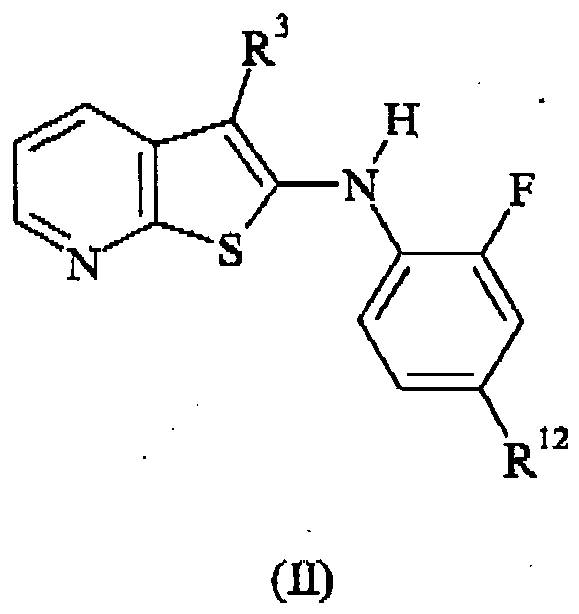 R12 represents halogen; andR3 is as defined in claim 1.
 - A compound as claimed in claim 7 wherein R12 represents bromo or iodo.
- A compound as claimed in claim 8 wherein R12 is iodo.
- A compound as claimed in claim 1 selected from the following:N-(2-fluoro-4-iodophenyl)-3-(morpholin-4-ylcarbonyl)thieno[2,3-b]pyridin-2-amine;N-(2-fluoro-4-iodophenyl)-3-[(4-methylpiperazin-1-yl)carbonyl]thieno[2,3-b]pyridin-2-amine;[2-[((2-fluoro-4-iodophenyl)amino]thieno[2,3-b ]pyridin-3-yl](pyrrolidin-1-yl)methanone;(1-{2-[(2-fluoro-4-iodophenyl)amino]thieno[2,3-b]pyridine-3-carbonyl}piperidin-4-yl)-carbamic acid tert-butyl ester;2-[((2-fluoro-4-iodophenyl)amino]thieno[2,3-b]pyridine-3-carboxylic acid (4-aminopiperidin-1-yl)amide dihydrochloride;(1-{2-[(2-fluoro-4-iodophenyl)amino]thieno[2,3-b]pyridine-3-carbonyl}azetidin-3-ylmethyl)carbamic acid tert-butyl ester;[3-((aminomethyl)azetidin-1-yl]-{2-[(2-fluoro-4-iodophenyl)amino]thieno[2,3-b]pyridin-3-yl}-methanone;(1-{2-[(2-fluoro-4-iodophenyl)amino]thieno[2,3-b]pyridine-3-carbonyl}-(3R)-pyrrolidin-3-yl)carbamic acid tert-butyl ester;(1-{2-[(2-fluoro-4-iodophenyl)amino]thieno[2,3-b]pyridine-3-carbonyl}-(3S)-pyrrolidin-3-yl)carbamic acid tert-butyl ester;(1-{2-[(2-fluoro-4-iodophenyl)amino]thieno[2,3-b]pyridine-3-carbonyl}azetidin-3-yl)-carbamic acid tert-butyl ester;[(3R)-3-aminopyrrolidin-1-yl]-{2-[(2-fluoro-4-iodophenyl)amino]thieno[2,3-b]pyridin-3-yl}-methanone;[(3S)-3-aminopyrrolidin-1-yl]-{2-[(2-fluoro4-iodophenyl)amino]thieno[2,3-b]pyridin-3-yl}-methanone;(3-aminoazetidin-1-yl)-{2-[(2-fluoro-4-iodophenyl)amino]thieno[2,3-b]pyridin-3-yl]-methanone;{2-[((2-fluoro-4-iodophenyl)amino]thieno[2,3-b]pyridin-3-yl}-(3-hydroxyazetidin-1-yl)-methanone;{2-[((2-fluoro-4-iodophenyl)amino]thieno[2,3-b]pyridin-3-yl}-[(3R)-3-hydroxypyrrolidin-1-yl]-methanone;{2-[((2-fluoro-4-iodophenyl)amino]thieno[2,3-b]pyridin-3-yl}-[(3S)-3-hydroxypyrrolidin-1-yl]-methanone;{2-[((2-fluoro-4-iodophenyl)amino]thieno[2,3-b]pyridin-3-yl}-[2-(hydroxymethyl)-piperidin-1-yl]-methanone;{2-[((2-fluoro-4-iodophenyl)amino]thieno[2,3-b]pyridin-3-yl}-[(3S)-3-(hydroxymethyl)-morpholin-4-yl]-methanone;4-{2-[(2-fluoro-4-iodophenyl)amino]thieno[2,3-b]pyridine-3-carbonyl}-(3R)-3-(hydroxymethyl)piperazine-1-carboxylic acid tert-butyl ester;2-[4({2-[(2-fluoro-4-iodophenyl)amino]thieno[2,3-b]pyridin-3-yl}carbonyl)piperazin-1-yl]ethanol;3-((1,4-diazepan-1-ylcarbonyl)-N-(2-fluoro-4-iodophenyl)thieno[2,3-b]pyridin-2-amine;N-(2-fluoro-4-iodophenyl)-3-(piperazin-1-ylcarbonyl)thieno[2,3-b]pyridin-2-amine;ethyl [4-({2-[(2-fluoro-4-iodophenyl)amino]thieno[2,3-b]pyridin-3-yl}carbonyl)-piperazin-1-yl]acetate;[4-({2-[(2-fluoro-4-iodophenyl)amino]thieno[2,3-b]pyridin-3-yl}carbonyl)piperazin-1-yl]acetic acid;{2-[((2-fluoro-4-iodophenyl)amino]thieno[2,3-b]pyridin-3-yl}-[(2R)-2-(methoxymethyl)-pyrrolidin-1-yl]-methanone; and{2-[((2-fluoro-4-iodophenyl)amino]thieno[2,3-b]pyridin-3-yl}-[(2R)-2-(hydroxymethyl)-piperazin-1-yl]-methanone.
- A compound of formula (I) as defined in claim 1, or a pharmaceutically acceptable salt, solvate or N-oxide thereof, for use in therapy.
- A compound of formula (I) as defined in claim 1, or a pharmaceutically acceptable salt, solvate or N-oxide thereof, for use in the treatment and/or prevention of inflammatory, autoimmune, cardiovascular, proliferative and nociceptive conditions.
- A compound of formula (I) as defined in claim 1, or a pharmaceutically acceptable salt, solvate or N-oxide thereof, for use in the treatment and/or prevention of oncological conditions.
- A pharmaceutical composition comprising a compound of formula (I) as defined in claim 1, or a pharmaceutically acceptable salt, solvate or N-oxide thereof, in association with a pharmaceutically acceptable carrier.
- The use of a compound of formula (I) as defined in claim 1, or a pharmaceutically acceptable salt, solvate or N-oxide thereof, for the manufacture of a medicament for the treatment and/or prevention of inflammatory, autoimmune, cardiovascular, proliferative and nociceptive conditions.
- The use of a compound of formula (I) as defined in claim 1, or a pharmaceutically acceptable salt, solvate or N-oxide thereof, for the manufacture of a medicament for the treatment and/or prevention of oncological conditions.
Priority Applications (3)
| Application Number | Priority Date | Filing Date | Title |
|---|---|---|---|
| SI200731467T SI1981892T1 (en) | 2006-01-31 | 2007-01-30 | Thieno-pyridine derivatives as mek inhibitors |
| PL07705076T PL1981892T3 (en) | 2006-01-31 | 2007-01-30 | Thieno-pyridine derivatives as mek inhibitors |
| CY20141100415T CY1115404T1 (en) | 2006-01-31 | 2014-06-11 | THIENO-PYRIDINES PRODUCTION AS ANTOLOSIS MEK |
Applications Claiming Priority (2)
| Application Number | Priority Date | Filing Date | Title |
|---|---|---|---|
| GBGB0601962.4A GB0601962D0 (en) | 2006-01-31 | 2006-01-31 | Therapeutic agents |
| PCT/GB2007/000310 WO2007088345A1 (en) | 2006-01-31 | 2007-01-30 | Thieno-pyridine derivatives as mek inhibitors |
Publications (2)
| Publication Number | Publication Date |
|---|---|
| EP1981892A1 EP1981892A1 (en) | 2008-10-22 |
| EP1981892B1 true EP1981892B1 (en) | 2014-03-12 |
Family
ID=36100789
Family Applications (1)
| Application Number | Title | Priority Date | Filing Date |
|---|---|---|---|
| EP07705076.3A Active EP1981892B1 (en) | 2006-01-31 | 2007-01-30 | Thieno-pyridine derivatives as mek inhibitors |
Country Status (26)
| Country | Link |
|---|---|
| US (3) | US8283359B2 (en) |
| EP (1) | EP1981892B1 (en) |
| JP (1) | JP5249787B2 (en) |
| KR (1) | KR101446919B1 (en) |
| CN (1) | CN101379067B (en) |
| AU (1) | AU2007211377B2 (en) |
| BR (1) | BRPI0708016B1 (en) |
| CA (1) | CA2640594C (en) |
| CY (1) | CY1115404T1 (en) |
| DK (1) | DK1981892T3 (en) |
| EA (1) | EA016128B1 (en) |
| EC (1) | ECSP088704A (en) |
| ES (1) | ES2471970T3 (en) |
| GB (1) | GB0601962D0 (en) |
| HR (1) | HRP20140503T1 (en) |
| IL (1) | IL192603A (en) |
| MY (1) | MY146387A (en) |
| NO (1) | NO341064B1 (en) |
| NZ (1) | NZ569638A (en) |
| PL (1) | PL1981892T3 (en) |
| PT (1) | PT1981892E (en) |
| RS (1) | RS53342B (en) |
| SI (1) | SI1981892T1 (en) |
| UA (1) | UA95939C2 (en) |
| WO (1) | WO2007088345A1 (en) |
| ZA (1) | ZA200807447B (en) |
Families Citing this family (32)
| Publication number | Priority date | Publication date | Assignee | Title |
|---|---|---|---|---|
| GB0601962D0 (en) | 2006-01-31 | 2006-03-15 | Ucb Sa | Therapeutic agents |
| GB0616214D0 (en) * | 2006-08-15 | 2006-09-27 | Ucb Sa | Therapeutic Agents |
| GB0714384D0 (en) | 2007-07-23 | 2007-09-05 | Ucb Pharma Sa | theraputic agents |
| ES2387707T3 (en) * | 2007-12-21 | 2012-09-28 | Genentech, Inc. | Azaindolizines and use procedures |
| EP2240494B1 (en) * | 2008-01-21 | 2016-03-30 | UCB Biopharma SPRL | Thieno-pyridine derivatives as mek inhibitors |
| GB0811304D0 (en) * | 2008-06-19 | 2008-07-30 | Ucb Pharma Sa | Therapeutic agents |
| JP5503930B2 (en) * | 2009-09-18 | 2014-05-28 | 住友化学株式会社 | Method for purifying 3-amino-1-tert-butoxycarbonylpiperidine and citrate salt thereof |
| WO2012018638A2 (en) | 2010-07-26 | 2012-02-09 | Biomatrica, Inc. | Compositions for stabilizing dna, rna and proteins in blood and other biological samples during shipping and storage at ambient temperatures |
| WO2012018639A2 (en) | 2010-07-26 | 2012-02-09 | Biomatrica, Inc. | Compositions for stabilizing dna, rna and proteins in saliva and other biological samples during shipping and storage at ambient temperatures |
| EP3249054A1 (en) | 2012-12-20 | 2017-11-29 | Biomatrica, INC. | Formulations and methods for stabilizing pcr reagents |
| EP3327144B1 (en) | 2013-02-25 | 2020-03-25 | Novartis AG | Novel androgen receptor mutation |
| EA201690089A1 (en) | 2013-06-11 | 2017-04-28 | Латвийский Институт Органического Синтеза | TIENO [2,3-b] Pyridine as modulators of the state of multiple drug resistance |
| JP6604942B2 (en) | 2013-06-13 | 2019-11-13 | バイオマトリカ,インク. | Cell stabilization |
| WO2015191632A1 (en) | 2014-06-10 | 2015-12-17 | Biomatrica, Inc. | Stabilization of thrombocytes at ambient temperatures |
| CN105384754B (en) * | 2014-09-02 | 2018-04-20 | 上海科州药物研发有限公司 | Heterocycle compound as kinases inhibitor and its preparation method and application |
| US20190008859A1 (en) | 2015-08-21 | 2019-01-10 | Acerta Pharma B.V. | Therapeutic Combinations of a MEK Inhibitor and a BTK Inhibitor |
| KR102589056B1 (en) | 2015-12-08 | 2023-10-12 | 바이오매트리카 인코포레이티드 | decreased erythrocyte sedimentation rate |
| CA3063535A1 (en) | 2017-05-19 | 2018-11-22 | Nflection Therapeutics, Inc. | Fused heteroaromatic-aniline compounds for treatment of dermal disorders |
| MA49141A (en) * | 2017-05-19 | 2020-03-25 | Nflection Therapeutics Inc | PYRROLOPYRIDINE-ANILINE COMPOUNDS FOR THE TREATMENT OF SKIN CONDITIONS |
| CN109836434B (en) * | 2017-11-27 | 2020-09-25 | 上海宇耀生物科技有限公司 | Thieno-ring compound and synthesis method and application thereof |
| CA3120351A1 (en) * | 2018-11-20 | 2020-05-28 | Nflection Therapeutics, Inc. | Aryl-aniline and heteroaryl-aniline compounds for treatment of skin cancers |
| MA55141A (en) | 2018-11-20 | 2021-09-29 | Nflection Therapeutics Inc | CYANOARYL-ANILINE COMPOUNDS FOR THE TREATMENT OF SKIN CONDITIONS |
| JP7546297B2 (en) | 2018-11-20 | 2024-09-06 | エヌフレクション セラピューティクス インコーポレイテッド | Thienyl-aniline compounds for the treatment of skin disorders - Patents.com |
| US12378240B2 (en) | 2018-11-20 | 2025-08-05 | Nflection Therapeutics, Inc. | Naphthyridinone-aniline compounds for treatment of dermal disorders |
| EP3942045A1 (en) | 2019-03-21 | 2022-01-26 | Onxeo | A dbait molecule in combination with kinase inhibitor for the treatment of cancer |
| EP4054579A1 (en) | 2019-11-08 | 2022-09-14 | Institut National de la Santé et de la Recherche Médicale (INSERM) | Methods for the treatment of cancers that have acquired resistance to kinase inhibitors |
| CN111138449B (en) * | 2020-01-15 | 2022-11-29 | 四川大学华西医院 | Preparation of dual-targeting ERK1 and ERK5 inhibitors and anti-tumor application thereof |
| WO2021148581A1 (en) | 2020-01-22 | 2021-07-29 | Onxeo | Novel dbait molecule and its use |
| WO2022251193A1 (en) | 2021-05-27 | 2022-12-01 | Mirati Therapeutics, Inc. | Combination therapies |
| IL312977A (en) | 2021-11-23 | 2024-07-01 | Nflection Therapeutics Inc | Formulations of PYRROLOPYRIDINE-ANILINE COMPOUNDS |
| GB202205203D0 (en) | 2022-04-08 | 2022-05-25 | UCB Biopharma SRL | Combination with inhibitor |
| WO2025073765A1 (en) | 2023-10-03 | 2025-04-10 | Institut National de la Santé et de la Recherche Médicale | Methods of prognosis and treatment of patients suffering from melanoma |
Family Cites Families (30)
| Publication number | Priority date | Publication date | Assignee | Title |
|---|---|---|---|---|
| JP2002509536A (en) | 1997-07-01 | 2002-03-26 | ワーナー−ランバート・カンパニー | 2- (4-bromo or 4-iodophenylamino) benzoic acid derivatives and their use as MEK inhibitors |
| US6232320B1 (en) | 1998-06-04 | 2001-05-15 | Abbott Laboratories | Cell adhesion-inhibiting antiinflammatory compounds |
| CA2349180A1 (en) | 1999-01-13 | 2000-07-20 | Stephen Douglas Barrett | Anthranilic acid derivatives |
| IL144214A0 (en) | 1999-01-13 | 2002-05-23 | Warner Lambert Co | Benzoheterocycles and their use as mek inhibitors |
| WO2002006213A2 (en) | 2000-07-19 | 2002-01-24 | Warner-Lambert Company | Oxygenated esters of 4-iodo phenylamino benzhydroxamic acids |
| US7235537B2 (en) | 2002-03-13 | 2007-06-26 | Array Biopharma, Inc. | N3 alkylated benzimidazole derivatives as MEK inhibitors |
| WO2003077855A2 (en) | 2002-03-13 | 2003-09-25 | Array Biopharma, Inc | N3 alkylated benzimidazole derivatives as mek inhibitors |
| TWI343377B (en) | 2002-03-13 | 2011-06-11 | Array Biopharma Inc | N3 alkylated benzimidazole derivatives as mek inhibitors |
| US20030225273A1 (en) * | 2002-03-21 | 2003-12-04 | Michaelides Michael R. | Thiopyrimidine and isothiazolopyrimidine kinase inhibitors |
| GB0214268D0 (en) * | 2002-06-20 | 2002-07-31 | Celltech R&D Ltd | Chemical compounds |
| CL2003002287A1 (en) * | 2002-11-25 | 2005-01-14 | Wyeth Corp | COMPOUNDS DERIVED FROM TIENO [3,2-b] -PIRIDINA-6-CARBONITRILOS AND TIENEO [2,3-b] -PIRIDINA-5-CARBONITRILS, PHARMACEUTICAL COMPOSITION, PROCEDURE OF PREPARATION AND INTERMEDIARY COMPOUNDS, AND THEIR USE IN THE TREATMENT OF CANCER, APOPLEJIA, OSTEOPOROSIS |
| MXPA05006367A (en) * | 2002-12-12 | 2005-08-29 | Pharmacia Corp | Method of using aminocyanopyridine compounds as mitogen activated protein kinase-activated protein kinase-2 inhibitors. |
| JP2007516162A (en) * | 2003-06-20 | 2007-06-21 | セルテック アール アンド ディ リミテッド | Thienopyridone derivatives as kinase inhibitors |
| EP1641804A1 (en) | 2003-06-20 | 2006-04-05 | Celltech R & D Limited | Thienopyridone derivatives as kinase inhibitors |
| US20050049276A1 (en) * | 2003-07-23 | 2005-03-03 | Warner-Lambert Company, Llc | Imidazopyridines and triazolopyridines |
| BRPI0412851A (en) | 2003-07-24 | 2006-10-03 | Warner Lambert Co | n-methyl-substituted benzamidazoles |
| US7144907B2 (en) | 2003-09-03 | 2006-12-05 | Array Biopharma Inc. | Heterocyclic inhibitors of MEK and methods of use thereof |
| WO2005023818A2 (en) * | 2003-09-10 | 2005-03-17 | Gpc Biotech Ag | Heterobicyclic compounds as pharmaceutically active agents |
| NZ547481A (en) | 2003-11-19 | 2009-12-24 | Array Biopharma Inc | Heterocyclic inhibitors of mek and methods of use thereof |
| US7217723B2 (en) * | 2004-02-02 | 2007-05-15 | Eisai Co., Ltd. | Heterocyclic compound having oxime group |
| US20070049603A1 (en) * | 2005-09-01 | 2007-03-01 | Greg Miknis | Raf inhibitor compounds and methods of use thereof |
| CN103524392B (en) | 2005-10-07 | 2018-06-01 | 埃克塞利希斯股份有限公司 | As for treating the azetidine of the MEK inhibitor of proliferative disease |
| GB0601962D0 (en) | 2006-01-31 | 2006-03-15 | Ucb Sa | Therapeutic agents |
| TW200808769A (en) | 2006-04-18 | 2008-02-16 | Astrazeneca Ab | Therapeutic compounds |
| GB0616214D0 (en) | 2006-08-15 | 2006-09-27 | Ucb Sa | Therapeutic Agents |
| CA2658725A1 (en) | 2006-08-16 | 2008-02-21 | Exelixis, Inc. | Using pi3k and mek modulators in treatments of cancer |
| ES2703723T3 (en) | 2006-12-14 | 2019-03-12 | Exelixis Inc | Methods for using MEK inhibitors |
| GB0714384D0 (en) | 2007-07-23 | 2007-09-05 | Ucb Pharma Sa | theraputic agents |
| EP2240494B1 (en) * | 2008-01-21 | 2016-03-30 | UCB Biopharma SPRL | Thieno-pyridine derivatives as mek inhibitors |
| GB0811304D0 (en) * | 2008-06-19 | 2008-07-30 | Ucb Pharma Sa | Therapeutic agents |
-
2006
- 2006-01-31 GB GBGB0601962.4A patent/GB0601962D0/en not_active Ceased
-
2007
- 2007-01-30 DK DK07705076.3T patent/DK1981892T3/en active
- 2007-01-30 EA EA200801684A patent/EA016128B1/en not_active IP Right Cessation
- 2007-01-30 NZ NZ569638A patent/NZ569638A/en not_active IP Right Cessation
- 2007-01-30 RS RS20140304A patent/RS53342B/en unknown
- 2007-01-30 SI SI200731467T patent/SI1981892T1/en unknown
- 2007-01-30 KR KR1020087018972A patent/KR101446919B1/en not_active Expired - Fee Related
- 2007-01-30 ES ES07705076.3T patent/ES2471970T3/en active Active
- 2007-01-30 MY MYPI20082765A patent/MY146387A/en unknown
- 2007-01-30 JP JP2008552878A patent/JP5249787B2/en active Active
- 2007-01-30 HR HRP20140503TT patent/HRP20140503T1/en unknown
- 2007-01-30 WO PCT/GB2007/000310 patent/WO2007088345A1/en not_active Ceased
- 2007-01-30 BR BRPI0708016-6A patent/BRPI0708016B1/en not_active IP Right Cessation
- 2007-01-30 PT PT77050763T patent/PT1981892E/en unknown
- 2007-01-30 ZA ZA200807447A patent/ZA200807447B/en unknown
- 2007-01-30 PL PL07705076T patent/PL1981892T3/en unknown
- 2007-01-30 CN CN2007800040774A patent/CN101379067B/en not_active Expired - Fee Related
- 2007-01-30 AU AU2007211377A patent/AU2007211377B2/en not_active Ceased
- 2007-01-30 CA CA2640594A patent/CA2640594C/en active Active
- 2007-01-30 UA UAA200809945A patent/UA95939C2/en unknown
- 2007-01-30 EP EP07705076.3A patent/EP1981892B1/en active Active
-
2008
- 2008-07-03 IL IL192603A patent/IL192603A/en active IP Right Grant
- 2008-07-30 US US12/182,931 patent/US8283359B2/en active Active
- 2008-08-28 EC EC2008008704A patent/ECSP088704A/en unknown
- 2008-08-29 NO NO20083739A patent/NO341064B1/en unknown
-
2012
- 2012-09-05 US US13/604,282 patent/US8394822B2/en active Active
-
2013
- 2013-02-06 US US13/760,788 patent/US8604051B2/en active Active
-
2014
- 2014-06-11 CY CY20141100415T patent/CY1115404T1/en unknown
Also Published As
Similar Documents
| Publication | Publication Date | Title |
|---|---|---|
| US8604051B2 (en) | Thieno-pyridine derivatives as MEK inhibitors | |
| EP2183253B1 (en) | Thieno-pyridine derivatives as mek inhibitors | |
| EP2240494B1 (en) | Thieno-pyridine derivatives as mek inhibitors | |
| EP2499144B1 (en) | Quinoline and quinoxaline derivatives as kinase inhibitors | |
| EP2499129B1 (en) | Quinoline and quinoxaline derivatives as kinase inhibitors | |
| EP2315768B1 (en) | Thieno-pyridine derivatives as mek inhibitors | |
| EP2170906B1 (en) | Fused thiazole derivatives as kinase inhibitors | |
| HK1125924B (en) | Thieno-pyridine derivatives as mek inhibitors | |
| MX2008009610A (en) | Thieno-pyridine derivatives as mek inhibitors |
Legal Events
| Date | Code | Title | Description |
|---|---|---|---|
| PUAI | Public reference made under article 153(3) epc to a published international application that has entered the european phase |
Free format text: ORIGINAL CODE: 0009012 |
|
| 17P | Request for examination filed |
Effective date: 20080901 |
|
| AK | Designated contracting states |
Kind code of ref document: A1 Designated state(s): AT BE BG CH CY CZ DE DK EE ES FI FR GB GR HU IE IS IT LI LT LU LV MC NL PL PT RO SE SI SK TR |
|
| AX | Request for extension of the european patent |
Extension state: AL BA HR MK RS |
|
| 17Q | First examination report despatched |
Effective date: 20090519 |
|
| REG | Reference to a national code |
Ref country code: HK Ref legal event code: DE Ref document number: 1125924 Country of ref document: HK |
|
| GRAP | Despatch of communication of intention to grant a patent |
Free format text: ORIGINAL CODE: EPIDOSNIGR1 |
|
| INTG | Intention to grant announced |
Effective date: 20130927 |
|
| GRAS | Grant fee paid |
Free format text: ORIGINAL CODE: EPIDOSNIGR3 |
|
| GRAA | (expected) grant |
Free format text: ORIGINAL CODE: 0009210 |
|
| AK | Designated contracting states |
Kind code of ref document: B1 Designated state(s): AT BE BG CH CY CZ DE DK EE ES FI FR GB GR HU IE IS IT LI LT LU LV MC NL PL PT RO SE SI SK TR |
|
| AX | Request for extension of the european patent |
Extension state: AL BA HR MK RS |
|
| REG | Reference to a national code |
Ref country code: GB Ref legal event code: FG4D |
|
| REG | Reference to a national code |
Ref country code: CH Ref legal event code: EP |
|
| REG | Reference to a national code |
Ref country code: AT Ref legal event code: REF Ref document number: 656252 Country of ref document: AT Kind code of ref document: T Effective date: 20140315 |
|
| REG | Reference to a national code |
Ref country code: IE Ref legal event code: FG4D |
|
| REG | Reference to a national code |
Ref country code: DE Ref legal event code: R096 Ref document number: 602007035498 Country of ref document: DE Effective date: 20140424 |
|
| REG | Reference to a national code |
Ref country code: HR Ref legal event code: TUEP Ref document number: P20140503 Country of ref document: HR |
|
| REG | Reference to a national code |
Ref country code: RO Ref legal event code: EPE |
|
| REG | Reference to a national code |
Ref country code: DK Ref legal event code: T3 Effective date: 20140617 Ref country code: PT Ref legal event code: SC4A Free format text: AVAILABILITY OF NATIONAL TRANSLATION Effective date: 20140605 |
|
| REG | Reference to a national code |
Ref country code: SE Ref legal event code: TRGR |
|
| REG | Reference to a national code |
Ref country code: NL Ref legal event code: T3 |
|
| REG | Reference to a national code |
Ref country code: HR Ref legal event code: T1PR Ref document number: P20140503 Country of ref document: HR |
|
| REG | Reference to a national code |
Ref country code: HK Ref legal event code: GR Ref document number: 1125924 Country of ref document: HK |
|
| REG | Reference to a national code |
Ref country code: EE Ref legal event code: FG4A Ref document number: E009334 Country of ref document: EE Effective date: 20140610 |
|
| REG | Reference to a national code |
Ref country code: PL Ref legal event code: T3 |
|
| REG | Reference to a national code |
Ref country code: GR Ref legal event code: EP Ref document number: 20140401129 Country of ref document: GR Effective date: 20140718 |
|
| REG | Reference to a national code |
Ref country code: SK Ref legal event code: T3 Ref document number: E 16633 Country of ref document: SK |
|
| REG | Reference to a national code |
Ref country code: DE Ref legal event code: R097 Ref document number: 602007035498 Country of ref document: DE |
|
| PLBE | No opposition filed within time limit |
Free format text: ORIGINAL CODE: 0009261 |
|
| STAA | Information on the status of an ep patent application or granted ep patent |
Free format text: STATUS: NO OPPOSITION FILED WITHIN TIME LIMIT |
|
| 26N | No opposition filed |
Effective date: 20141215 |
|
| REG | Reference to a national code |
Ref country code: DE Ref legal event code: R097 Ref document number: 602007035498 Country of ref document: DE Effective date: 20141215 |
|
| REG | Reference to a national code |
Ref country code: HU Ref legal event code: AG4A Ref document number: E022652 Country of ref document: HU |
|
| REG | Reference to a national code |
Ref country code: FR Ref legal event code: PLFP Year of fee payment: 10 |
|
| REG | Reference to a national code |
Ref country code: FR Ref legal event code: PLFP Year of fee payment: 11 |
|
| REG | Reference to a national code |
Ref country code: FR Ref legal event code: PLFP Year of fee payment: 12 |
|
| REG | Reference to a national code |
Ref country code: HR Ref legal event code: ODRP Ref document number: P20140503 Country of ref document: HR Payment date: 20181231 Year of fee payment: 13 |
|
| REG | Reference to a national code |
Ref country code: HR Ref legal event code: ODRP Ref document number: P20140503 Country of ref document: HR Payment date: 20191218 Year of fee payment: 14 |
|
| REG | Reference to a national code |
Ref country code: HR Ref legal event code: ODRP Ref document number: P20140503 Country of ref document: HR Payment date: 20210125 Year of fee payment: 15 |
|
| REG | Reference to a national code |
Ref country code: FI Ref legal event code: PCE Owner name: UCB BIOPHARMA SRL |
|
| REG | Reference to a national code |
Ref country code: BE Ref legal event code: PD Owner name: UCB BIOPHARMA SRL; BE Free format text: DETAILS ASSIGNMENT: CHANGE OF OWNER(S), ASSIGNMENT; FORMER OWNER NAME: PLUCKER GUY Effective date: 20210916 |
|
| REG | Reference to a national code |
Ref country code: HU Ref legal event code: FH1C Free format text: FORMER REPRESENTATIVE(S): SZENTPETERI ZSOLT, SBGK SZABADALMI UEGYVIVOEI IRODA, HU Representative=s name: DANUBIA SZABADALMI ES JOGI IRODA KFT., HU |
|
| REG | Reference to a national code |
Ref country code: EE Ref legal event code: GB1A Ref document number: E009334 Country of ref document: EE |
|
| REG | Reference to a national code |
Ref country code: DE Ref legal event code: R081 Ref document number: 602007035498 Country of ref document: DE Owner name: UCB BIOPHARMA SRL, BE Free format text: FORMER OWNER: UCB PHARMA, S.A., BRUXELLES, BE |
|
| REG | Reference to a national code |
Ref country code: ES Ref legal event code: PC2A Owner name: UCB BIOPHARMA SRL Effective date: 20211201 |
|
| REG | Reference to a national code |
Ref country code: HR Ref legal event code: PPPP Ref document number: P20140503 Country of ref document: HR Owner name: UCB BIOPHARMA SRL, BE |
|
| REG | Reference to a national code |
Ref country code: HR Ref legal event code: ODRP Ref document number: P20140503 Country of ref document: HR Payment date: 20220126 Year of fee payment: 16 |
|
| REG | Reference to a national code |
Ref country code: NL Ref legal event code: PD Owner name: UCB BIOPHARMA SRL; BE Free format text: DETAILS ASSIGNMENT: CHANGE OF OWNER(S), ASSIGNMENT; FORMER OWNER NAME: UCB PHARMA, S.A. Effective date: 20220610 |
|
| REG | Reference to a national code |
Ref country code: EE Ref legal event code: HC1A Ref document number: E009334 Country of ref document: EE |
|
| REG | Reference to a national code |
Ref country code: HR Ref legal event code: ODRP Ref document number: P20140503 Country of ref document: HR Payment date: 20230113 Year of fee payment: 17 |
|
| REG | Reference to a national code |
Ref country code: AT Ref legal event code: PC Ref document number: 656252 Country of ref document: AT Kind code of ref document: T Owner name: UCB BIOPHARMA SRL, BE Effective date: 20230131 |
|
| REG | Reference to a national code |
Ref country code: DE Ref legal event code: R082 Ref document number: 602007035498 Country of ref document: DE Representative=s name: KRAUS & LEDERER PARTGMBB, DE |
|
| PGFP | Annual fee paid to national office [announced via postgrant information from national office to epo] |
Ref country code: SK Payment date: 20231227 Year of fee payment: 18 |
|
| PGFP | Annual fee paid to national office [announced via postgrant information from national office to epo] |
Ref country code: GR Payment date: 20231213 Year of fee payment: 18 |
|
| PGFP | Annual fee paid to national office [announced via postgrant information from national office to epo] |
Ref country code: MC Payment date: 20231228 Year of fee payment: 18 |
|
| PGFP | Annual fee paid to national office [announced via postgrant information from national office to epo] |
Ref country code: IS Payment date: 20231218 Year of fee payment: 18 |
|
| PGFP | Annual fee paid to national office [announced via postgrant information from national office to epo] |
Ref country code: SE Payment date: 20231213 Year of fee payment: 18 Ref country code: RO Payment date: 20231227 Year of fee payment: 18 Ref country code: NL Payment date: 20231215 Year of fee payment: 18 Ref country code: LV Payment date: 20231205 Year of fee payment: 18 Ref country code: LT Payment date: 20231222 Year of fee payment: 18 Ref country code: IE Payment date: 20231211 Year of fee payment: 18 Ref country code: FI Payment date: 20231218 Year of fee payment: 18 Ref country code: EE Payment date: 20231219 Year of fee payment: 18 Ref country code: BG Payment date: 20231219 Year of fee payment: 18 |
|
| REG | Reference to a national code |
Ref country code: HR Ref legal event code: ODRP Ref document number: P20140503 Country of ref document: HR Payment date: 20231212 Year of fee payment: 18 |
|
| PGFP | Annual fee paid to national office [announced via postgrant information from national office to epo] |
Ref country code: PL Payment date: 20231213 Year of fee payment: 18 |
|
| PGFP | Annual fee paid to national office [announced via postgrant information from national office to epo] |
Ref country code: LU Payment date: 20240112 Year of fee payment: 18 |
|
| PGFP | Annual fee paid to national office [announced via postgrant information from national office to epo] |
Ref country code: AT Payment date: 20231227 Year of fee payment: 18 |
|
| PGFP | Annual fee paid to national office [announced via postgrant information from national office to epo] |
Ref country code: HU Payment date: 20231213 Year of fee payment: 18 Ref country code: CZ Payment date: 20240118 Year of fee payment: 18 Ref country code: PT Payment date: 20240129 Year of fee payment: 18 |
|
| PGFP | Annual fee paid to national office [announced via postgrant information from national office to epo] |
Ref country code: SI Payment date: 20231221 Year of fee payment: 18 |
|
| PGFP | Annual fee paid to national office [announced via postgrant information from national office to epo] |
Ref country code: TR Payment date: 20240129 Year of fee payment: 18 Ref country code: DK Payment date: 20240111 Year of fee payment: 18 |
|
| PGFP | Annual fee paid to national office [announced via postgrant information from national office to epo] |
Ref country code: CY Payment date: 20240125 Year of fee payment: 18 |
|
| REG | Reference to a national code |
Ref country code: HR Ref legal event code: PBON Ref document number: P20140503 Country of ref document: HR Effective date: 20250130 |
|
| REG | Reference to a national code |
Ref country code: DK Ref legal event code: EBP Effective date: 20250131 Ref country code: LT Ref legal event code: MM4D Effective date: 20250130 |
|
| REG | Reference to a national code |
Ref country code: SE Ref legal event code: EUG |
|
| REG | Reference to a national code |
Ref country code: NL Ref legal event code: MM Effective date: 20250201 |
|
| PG25 | Lapsed in a contracting state [announced via postgrant information from national office to epo] |
Ref country code: MC Free format text: LAPSE BECAUSE OF NON-PAYMENT OF DUE FEES Effective date: 20250131 Ref country code: LU Free format text: LAPSE BECAUSE OF NON-PAYMENT OF DUE FEES Effective date: 20250130 |
|
| REG | Reference to a national code |
Ref country code: AT Ref legal event code: MM01 Ref document number: 656252 Country of ref document: AT Kind code of ref document: T Effective date: 20250130 |
|
| PG25 | Lapsed in a contracting state [announced via postgrant information from national office to epo] |
Ref country code: HU Free format text: LAPSE BECAUSE OF NON-PAYMENT OF DUE FEES Effective date: 20250131 |
|
| REG | Reference to a national code |
Ref country code: SK Ref legal event code: MM4A Ref document number: E 16633 Country of ref document: SK Effective date: 20250130 |
|
| PG25 | Lapsed in a contracting state [announced via postgrant information from national office to epo] |
Ref country code: PT Free format text: LAPSE BECAUSE OF NON-PAYMENT OF DUE FEES Effective date: 20250730 |
|
| PG25 | Lapsed in a contracting state [announced via postgrant information from national office to epo] |
Ref country code: FI Free format text: LAPSE BECAUSE OF NON-PAYMENT OF DUE FEES Effective date: 20250130 Ref country code: LT Free format text: LAPSE BECAUSE OF NON-PAYMENT OF DUE FEES Effective date: 20250130 |
|
| PG25 | Lapsed in a contracting state [announced via postgrant information from national office to epo] |
Ref country code: GR Free format text: LAPSE BECAUSE OF NON-PAYMENT OF DUE FEES Effective date: 20250805 |
|
| PG25 | Lapsed in a contracting state [announced via postgrant information from national office to epo] |
Ref country code: NL Free format text: LAPSE BECAUSE OF NON-PAYMENT OF DUE FEES Effective date: 20250201 |
|
| PG25 | Lapsed in a contracting state [announced via postgrant information from national office to epo] |
Ref country code: BG Free format text: LAPSE BECAUSE OF NON-PAYMENT OF DUE FEES Effective date: 20250130 |
|
| PG25 | Lapsed in a contracting state [announced via postgrant information from national office to epo] |
Ref country code: AT Free format text: LAPSE BECAUSE OF NON-PAYMENT OF DUE FEES Effective date: 20250130 |
|
| PG25 | Lapsed in a contracting state [announced via postgrant information from national office to epo] |
Ref country code: CY Free format text: LAPSE BECAUSE OF NON-PAYMENT OF DUE FEES Effective date: 20250130 |
|
| PG25 | Lapsed in a contracting state [announced via postgrant information from national office to epo] |
Ref country code: CZ Free format text: LAPSE BECAUSE OF NON-PAYMENT OF DUE FEES Effective date: 20250130 Ref country code: EE Free format text: LAPSE BECAUSE OF NON-PAYMENT OF DUE FEES Effective date: 20250131 |
|
| PG25 | Lapsed in a contracting state [announced via postgrant information from national office to epo] |
Ref country code: RO Free format text: LAPSE BECAUSE OF NON-PAYMENT OF DUE FEES Effective date: 20250130 |
|
| PG25 | Lapsed in a contracting state [announced via postgrant information from national office to epo] |
Ref country code: SK Free format text: LAPSE BECAUSE OF NON-PAYMENT OF DUE FEES Effective date: 20250130 |
|
| PG25 | Lapsed in a contracting state [announced via postgrant information from national office to epo] |
Ref country code: LV Free format text: LAPSE BECAUSE OF NON-PAYMENT OF DUE FEES Effective date: 20250130 |
|
| PGFP | Annual fee paid to national office [announced via postgrant information from national office to epo] |
Ref country code: GB Payment date: 20251211 Year of fee payment: 20 |
|
| PG25 | Lapsed in a contracting state [announced via postgrant information from national office to epo] |
Ref country code: DK Free format text: LAPSE BECAUSE OF NON-PAYMENT OF DUE FEES Effective date: 20250131 |
|
| PGFP | Annual fee paid to national office [announced via postgrant information from national office to epo] |
Ref country code: FR Payment date: 20251208 Year of fee payment: 20 |
|
| PG25 | Lapsed in a contracting state [announced via postgrant information from national office to epo] |
Ref country code: IE Free format text: LAPSE BECAUSE OF NON-PAYMENT OF DUE FEES Effective date: 20250130 |
|
| REG | Reference to a national code |
Ref country code: SI Ref legal event code: KO00 Effective date: 20250131 |
|
| REG | Reference to a national code |
Ref country code: CH Ref legal event code: U11 Free format text: ST27 STATUS EVENT CODE: U-0-0-U10-U11 (AS PROVIDED BY THE NATIONAL OFFICE) Effective date: 20260201 |
|
| PGFP | Annual fee paid to national office [announced via postgrant information from national office to epo] |
Ref country code: ES Payment date: 20260209 Year of fee payment: 20 |
|
| PGFP | Annual fee paid to national office [announced via postgrant information from national office to epo] |
Ref country code: DE Payment date: 20251203 Year of fee payment: 20 |
|
| PGFP | Annual fee paid to national office [announced via postgrant information from national office to epo] |
Ref country code: BE Payment date: 20260106 Year of fee payment: 20 Ref country code: IT Payment date: 20251219 Year of fee payment: 20 |
|
| PGFP | Annual fee paid to national office [announced via postgrant information from national office to epo] |
Ref country code: CH Payment date: 20260201 Year of fee payment: 20 |