EP1981309A1 - Prothèse auditive avec compression multicanal - Google Patents
Prothèse auditive avec compression multicanal Download PDFInfo
- Publication number
- EP1981309A1 EP1981309A1 EP07105971A EP07105971A EP1981309A1 EP 1981309 A1 EP1981309 A1 EP 1981309A1 EP 07105971 A EP07105971 A EP 07105971A EP 07105971 A EP07105971 A EP 07105971A EP 1981309 A1 EP1981309 A1 EP 1981309A1
- Authority
- EP
- European Patent Office
- Prior art keywords
- hearing aid
- channels
- level
- signal
- frequency bands
- Prior art date
- Legal status (The legal status is an assumption and is not a legal conclusion. Google has not performed a legal analysis and makes no representation as to the accuracy of the status listed.)
- Granted
Links
Images



Classifications
-
- H—ELECTRICITY
- H04—ELECTRIC COMMUNICATION TECHNIQUE
- H04R—LOUDSPEAKERS, MICROPHONES, GRAMOPHONE PICK-UPS OR LIKE ACOUSTIC ELECTROMECHANICAL TRANSDUCERS; ELECTRIC HEARING AIDS; PUBLIC ADDRESS SYSTEMS
- H04R25/00—Electric hearing aids
- H04R25/55—Electric hearing aids using an external connection, either wireless or wired
- H04R25/552—Binaural
-
- H—ELECTRICITY
- H03—ELECTRONIC CIRCUITRY
- H03G—CONTROL OF AMPLIFICATION
- H03G9/00—Combinations of two or more types of control, e.g. gain control and tone control
- H03G9/02—Combinations of two or more types of control, e.g. gain control and tone control in untuned amplifiers
- H03G9/025—Combinations of two or more types of control, e.g. gain control and tone control in untuned amplifiers frequency-dependent volume compression or expansion, e.g. multiple-band systems
-
- H—ELECTRICITY
- H04—ELECTRIC COMMUNICATION TECHNIQUE
- H04R—LOUDSPEAKERS, MICROPHONES, GRAMOPHONE PICK-UPS OR LIKE ACOUSTIC ELECTROMECHANICAL TRANSDUCERS; ELECTRIC HEARING AIDS; PUBLIC ADDRESS SYSTEMS
- H04R25/00—Electric hearing aids
- H04R25/35—Electric hearing aids using translation techniques
- H04R25/356—Amplitude, e.g. amplitude shift or compression
Definitions
- the invention regards a hearing aid with audio compression means.
- a characteristic of ordinary perceptual hearing loss is that the threshold of hearing is elevated, whereas the discomfort level is almost normal. This corresponds to a reduction in useful input dynamic range, which is also termed 'recruitment'.
- the method for compensation of this deficit is to apply compression in the hearing aid. Compression is the most important signal processing used in modem hearing instruments. It addresses a number of issues such as:
- multi-channel compression in separate frequency bands may reduce interaction between different signals at different frequencies.
- the spectral contrast is also reduced which may reduce speech intelligibility. Furthermore the dynamic changes in timbre are perceived as unstable sound, and thus reduced sound quality.
- a number of solutions to the disadvantages have been proposed and may patents written, e.g. Oticon's OGLE compressor by Neumann ( WO 2003081947 A1 ), Ludvigsen ( US 6,628,795 ), and Salmi & Scheller ( WO 9818294 A1 ).
- a typical solution is to combine fast and slow time constants and possibly make the level dependent, e.g. slow time constants for low levels and fast time constants for high levels.
- a signal processing system such as a hearing aid system is known, adapted to enhance binaural input signals.
- US 2004/0190734 A1 a multi-channel signal processing system adapted to provide binaural compressing of tonal inputs is provided.
- a hearing aid comprising an audio signal input device, a signal processor a signal output device which presents a processed audio signal perceivable as sound to an ear of a user, where the signal processor comprises fast acting level estimators and slow acting level estimators wherein
- the present invention is an extension of the basic compression principle.
- the system combines slow, many-channel compression using high compression ratio with fast, few-channel compression using low compression ratio.
- These multiple compression systems use separate gain tables (unlike previous proposals) and may be combined in either parallel or serial fashion.
- the result for the listener is slow, high-resolution accommodation of the changing sound levels in real world combined with fast, low-resolution accommodation of the speech dynamics in a stable environment.
- the time constants of the level estimators determines whether the compressor is a fast compressor or a slow compressor.
- the fast and slow level estimators are implemented in channels.
- a channel is defined as a part of the input signal comprising at least one frequency range supplied by a band split filter.
- a channel may comprise several frequency ranges, adjacently placed on the frequency axis or from different places on the frequency axis.
- the number of channels with slow acting level estimators may be chosen in the range between 10 and 16, and in a preferred embodiment of the invention 15 channels are used.
- ipse lateral is used to designate that side of the head whereto a hearing aid in question is associated in order to provide amplified sound signals for the ear at this side
- contra lateral designates the opposite side
- contra lateral hearing aid designates the hearing aid placed at the ear on this side.
- a communication link is provided operable to transmit and receive data to/from a second similar contralaterally placed hearing aid providing sound to a contra lateral ear of a user, wherein the binaural link is operative to transmit level estimates from the slow level estimators (4.7) in the two hearing aids to the contralaterally placed hearing aid whereby further a summation point is provided in each hearing aid operative to combine the level estimates of the of the ipse lateral hearing aid with the level estimates of the contra lateral hearing aid, received via the binaural link, according to a summation function, preferably comprising a linear combination.
- a wireless link is established between the two hearing aids.
- a compression system generally comprises the signal processor wherein the following elements are provided:
- channel sets are input to a further block which consists of level estimators and gain lookup tables.
- the two groups of channels will comprise signals which have been treated in one and the same filter, and they are thus aligned in phase and have the same delay.
- the two control path parts are more thoroughly described in the next sections.
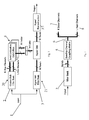
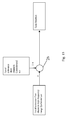
- the input signal 1 is provided from one or more microphones 11 as shown in fig. 13 .
- the signal processor 12 comprises a control path 20 and a signal path 21.
- the control path 20 comprise level estimators 4 working in a number of channels each comprising one or more frequency bands, and the provided levels are used to calculate the desired gain in each channel.
- K so called Slow Channels and L so called Fast Channels whereby the fast and slow refers to the time constants employed by the level estimators of the respective channels.
- the gains are translated into filter coefficients which are served at a filter in the signal path 21 in order to provide the frequency shaped output to aid the user in overcoming his hearing disorder.
- the blocks Control Path Filter Bank 2 and Level Estimation Gain Tables 4 in fig. 1 are described in more detail with reference to fig. 2 and 3 below.
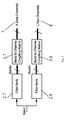
- the control path filter bank 2 can be implemented using one filter bank as shown in fig. 2 or two filter banks 2.7; 2.8 as shown in fig. 3 .
- the system may also have more filter banks producing more channel sets, but in the embodiments here, two channel sets, namely K slow channels and L fast channels are described.
- K and L are integers, and in a preferred embodiment K is set to 16 and L is set to 4, however these numbers may vary according to the actual implementation of the invention in a hearing aid.
- the task of the filter bank(s) 2 is to split the input signal into a set of frequency bands.
- a band-to-channel coupling matrix 5 is used to couple the frequency bands to a set of channels 6. This implies that the number of frequency bands should be at least equal to the number of channels.
- the coupling matrix may be used to obtain channels which overlap in frequency.
- the one filter bank solution can be used when it is desired that there be no difference in filter bank design requirements (for example delay) between the slow channels 7 and the fast channels 8. This solution is illustrated in Fig. 2 .
- the two filter bank solution can be used when there are different design requirements for the slow channels 7 and the fast channels 8.
- the filter bank 2.7 for the slow channels 7 is designed independent from the filter bank 2.8 for the fast channels 8 and they may have different requirements regarding speed and number of bands.
- This solution is illustrated in Fig. 3 .
- the bands from each of the filter banks 2.7 and 2.8 may be coupled in band to channel coupling matrixes 5.7; 5.8 respectively allowing the number of bands from the filter banks 2.7; 2.8 to differ from the number K and L of slow and fast channels 7, 8 respectively.
- the second part in the control path is the level estimation and gain table part assigned reference number 4 in fig. 1 .
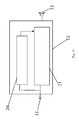
- a general system is illustrated in Fig. 4 displaying one compressor slice with multiple level estimators 4.7, 4.8 and multiple gain tables or gain functions 4.2.
- a unique gain function 4.2 may be used for each level estimator.
- a (non)linear combination 4.3 of level estimates can be used for gain table lookup.
- Single Gain Values are supplied from the Gain Functions 4.2. The Single Gain Values are translated to frequency bands in Cannel to Band coupling block 4.4 and in summation block 4.5, finally the gains for each frequency band are summed up. Examples of such systems are given in the next section.
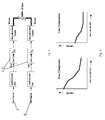
- the first example shows Parallel Double Compression with two sets of level estimators and two gain tables, see Fig. 5 .
- One level estimator set has large time constants corresponding to slow channels and the other level estimator set has small time constants corresponding to fast channels.
- the gain curves 4.2 in fig. 5 shows the two gain function which will be applied to the slow 7 and fast 8 channels respectively and they corresponds to the gain functions 4.2 in fig. 4 .
- the gain tables 4.2 of fig. 5 are set such that that the static curve is still identical.
- both slow and fast gain is expressed at the same kneepoints which correspond to those of the static gain, see Fig. 6 .
- the kneepoints can also differ.
- the sum of the slow and fast gain curves is the static gain curve.
- the slow level estimates are used in the usual way to look up in a gain table, thus specifying the slow gain.
- the slow gain acts as an automatic volume control.
- the compression ratio can be high to match the auditory dynamic range to the range of input levels, e.g. up to 4 for severe hearing losses.
- Slow compression gain is simply the static gain minus the fast gain - at each map specification frequency.
- Fast compression uses few channels e.g. 2-4 channels.
- An example of the fast compression gain table is shown in fig. 6 in the graph marked "Fast Compressor". These broader channels have fast responses to sudden impulses and maintain the spectral cues in the signal.
- the fast level estimates are fed to separate gain tables to look up the fast gain.
- the slow and fast gains are added to form the total gain of the system.
- the resulting steady-state gain curve reflects the total gain and this is expected to match the gain curve specified by the rationale and identical to the traditional 'single' compression.
- Fast compression gain is calculated as 20 - 40% of the static gain in each kneepoint at 50 dB SPL (in the channel) and above, and the percentage is regulated according to the need of the user.
- the fast compression uses the same number of gain tables as filter bands, i.e. 4 tables for 4 level estimators.
- the static gain is averaged within the map specification frequencies that are within the corresponding fast channel.
- the fast and slow gains are added using the same principle.
- the slow compression may also use as many gain tables as channels.
- the gain below 65 dB SPL (broadband speech) is kept constant. This kneepoint is high enough to avoid interference with the anti-feedback system and it corresponds to speech in quiet. Thus, the fast compression will engage when the speech level is raised due to surrounding noise.
- the fast compression kneepoints are identical to the highest 4 of the 6 kneepoints used: 50, 65, 80 and 105 dB SPL.
- the compression ratios typically are 1.5 or less.
- the fast time constants are meant to be fast - similar to or faster than those for fast-type single compression.
- the release time is longer than the attack time. Using only 4 channels and moderate compression ratios will result in very low compression distortion.
- Slow compression The slow compression gain curve in this example is set equal to the static gain curve. Filter bank and time constants are set in a same manner as for the slow part of the parallel double compressor. An example of a slow gain curve is displayed in fig. 8 in the graph marked "Slow Compressor.
- the difference compression gain curve is shown in fig. 8 in the graph marked "Diff Compressor".
- This gain table maps positive level difference to a proportional negative gain and conversely negative level difference to a proportional positive gain.
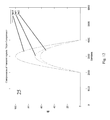
- Fig. 9 An example of slow, fast and difference levels varying as a function of time are illustrated in Fig. 9 , for a speech signal.
- the fast level estimator curve and the slow estimator curve are at the top where the fast level estimator curve fluctuates as predictable and the slow estimator staying steadily at the top part of the fluctuating fast level estimator.
- the difference curve between the two is seen at the lover part of the graph.
- the difference compressor parameters could be made level dependent in order to enhance the performance and provide improved compression with less signal distortion. They could also be made dependent on (non)linear functions of level estimates, such as modulation index.
- Triple compression is basically the same as parallel double compression with its gain curve settings but with a difference level gain table added. This is illustrated in Fig. 10 . This is an example of the use of a (non)linear function of two level estimates (see fig. 4 ).
- the triple compression setup can also be viewed as a serial double compressor where the slow gain curve is split into a fast and slow part.
- the difference level gain curve should be a percentage of the difference level gain curve for the serial double compressor, typically the same percentage as the slow level compressor in the parallel double compressor. For example: when the slow/fast percentages are 60/40 % then the difference level gain curve should be 60% of the gain curve in the case of the serial difference compressor.
- the gain curves for the triple compressor are illustrated in fig. 11 .
- the slow compressor acts as a slowly varying automatic volume control which controls the loudness perception.
- the fast compressor controls instant speech compression, which increases the speech intelligibility.
- the difference compressor positive gain provides the possibility of instant "listening in the dips", while the negative gain controls the protection against transients.
- the effect on transients is illustrated in fig. 12 where the blue line at the top is the input level (Input).
- the green line in the middle is the output level in the case of parallel double compression (Out 1).
- the red line below is the output level in the case of triple compression (Out 2).
- the compressors in each instrument act independently based on the sound level at each ear.
- a sound source to one side of the listener The ipse lateral ear will detect a higher level than the contra lateral ear which is hidden in the 'head shadow'. This is the interaural level difference. Therefore the gain in the two sides will differ, and the original interaural level difference presented to the listener is reduced when each ear is assisted by a hearing aid, due to the compressor scheme in the hearing aids.
- the result is reduced speech understanding in complex environments, e.g. a party situation.
- the invention uses the binaural wireless link to exchange slow RMS level estimates between the two ears such that the slow-acting part of the compression system is synchronized between the two ears.
- the result for the user is a more stable sound image, improved localization and improved speech intelligibility in noise.
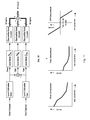
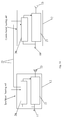
- the slow compression can be synchronized via a binaural wireless link 25 as seen in fig. 14 and thus maintain proper interaural level difference (ILD), which ensures better localization and communication in noisy environments.
- Both instruments receive level estimates from the opposite ear, and a function of both level estimates is used to control the slow gain table.
- weight of own ear value is between 1 ⁇ 2 and 1 and the weight of opposite ear weight is correspondingly between 1 ⁇ 2 and 0.
- Weighting is fully configurable. If the link status changes, the weighting is faded against the new target using a programmable time constant.
- Fig. 15 shows how the level estimates at the ipse lateral ear for the slow channels, but only the high frequency ranges is coupled with the corresponding level estimates from the contra lateral ear, and combined to form an average using a simple function.
- a summation point 26 will be added in the slow channels above 1500Hz for this purpose.
- the resulting level estimate is used to determine the applicable gain according to the gain function as seen in fig. 15 .
Landscapes
- Engineering & Computer Science (AREA)
- Acoustics & Sound (AREA)
- Neurosurgery (AREA)
- Otolaryngology (AREA)
- Physics & Mathematics (AREA)
- General Health & Medical Sciences (AREA)
- Health & Medical Sciences (AREA)
- Signal Processing (AREA)
- Computer Networks & Wireless Communication (AREA)
- Tone Control, Compression And Expansion, Limiting Amplitude (AREA)
- Stereophonic System (AREA)
- Measurement Of The Respiration, Hearing Ability, Form, And Blood Characteristics Of Living Organisms (AREA)
- Stereophonic Arrangements (AREA)
- Reduction Or Emphasis Of Bandwidth Of Signals (AREA)
- Compression, Expansion, Code Conversion, And Decoders (AREA)
Priority Applications (10)
| Application Number | Priority Date | Filing Date | Title |
|---|---|---|---|
| DK11194548.1T DK2445231T3 (da) | 2007-04-11 | 2007-04-11 | Høreapparat med binaural kommunikationsforbindelse |
| EP11194548.1A EP2445231B1 (fr) | 2007-04-11 | 2007-04-11 | Prothèse auditive avec une liaison de communication binaurale |
| AT07105971T ATE542377T1 (de) | 2007-04-11 | 2007-04-11 | Hörhilfe mit mehrkanalkompression |
| EP07105971A EP1981309B1 (fr) | 2007-04-11 | 2007-04-11 | Prothèse auditive avec compression multicanal |
| DK07105971.1T DK1981309T3 (da) | 2007-04-11 | 2007-04-11 | Høreapparat med flerkanalskompression |
| AU2008201145A AU2008201145B8 (en) | 2007-04-11 | 2008-03-11 | Hearing aid |
| US12/076,656 US8165328B2 (en) | 2007-04-11 | 2008-03-20 | Hearing aid |
| CN201210567966.4A CN103209380B (zh) | 2007-04-11 | 2008-04-02 | 助听器 |
| CN200810089520.9A CN101287306B (zh) | 2007-04-11 | 2008-04-02 | 助听器 |
| US13/425,200 US8526624B2 (en) | 2007-04-11 | 2012-03-20 | Hearing aid |
Applications Claiming Priority (1)
| Application Number | Priority Date | Filing Date | Title |
|---|---|---|---|
| EP07105971A EP1981309B1 (fr) | 2007-04-11 | 2007-04-11 | Prothèse auditive avec compression multicanal |
Publications (2)
| Publication Number | Publication Date |
|---|---|
| EP1981309A1 true EP1981309A1 (fr) | 2008-10-15 |
| EP1981309B1 EP1981309B1 (fr) | 2012-01-18 |
Family
ID=38521164
Family Applications (2)
| Application Number | Title | Priority Date | Filing Date |
|---|---|---|---|
| EP11194548.1A Active EP2445231B1 (fr) | 2007-04-11 | 2007-04-11 | Prothèse auditive avec une liaison de communication binaurale |
| EP07105971A Not-in-force EP1981309B1 (fr) | 2007-04-11 | 2007-04-11 | Prothèse auditive avec compression multicanal |
Family Applications Before (1)
| Application Number | Title | Priority Date | Filing Date |
|---|---|---|---|
| EP11194548.1A Active EP2445231B1 (fr) | 2007-04-11 | 2007-04-11 | Prothèse auditive avec une liaison de communication binaurale |
Country Status (6)
| Country | Link |
|---|---|
| US (2) | US8165328B2 (fr) |
| EP (2) | EP2445231B1 (fr) |
| CN (2) | CN101287306B (fr) |
| AT (1) | ATE542377T1 (fr) |
| AU (1) | AU2008201145B8 (fr) |
| DK (2) | DK1981309T3 (fr) |
Cited By (7)
| Publication number | Priority date | Publication date | Assignee | Title |
|---|---|---|---|---|
| WO2011069504A1 (fr) * | 2009-12-09 | 2011-06-16 | Widex A/S | Procédé de traitement d'un signal dans une aide auditive, procédé de mise en place d'une aide auditive et aide auditive |
| EP2544462A1 (fr) * | 2011-07-04 | 2013-01-09 | GN ReSound A/S | Compresseur binaural sans fil |
| US9241222B2 (en) | 2011-07-04 | 2016-01-19 | Gn Resound A/S | Binaural compressor preserving directional cues |
| EP3021600A1 (fr) | 2014-11-13 | 2016-05-18 | Oticon A/s | Procédé de montage d'un dispositif auditif sur un utilisateur, système d'adaptation d'un tel dispositif et ledit dispositif |
| US9997171B2 (en) | 2014-05-01 | 2018-06-12 | Gn Hearing A/S | Multi-band signal processor for digital audio signals |
| CN113993053A (zh) * | 2021-10-27 | 2022-01-28 | 南京工程学院 | 一种通道自适应的数字助听器宽动态范围压缩方法 |
| EP4289066A4 (fr) * | 2021-02-08 | 2025-01-15 | Zoom Video Communications, Inc. | Commande de gain automatique numérique à deux étages |
Families Citing this family (27)
| Publication number | Priority date | Publication date | Assignee | Title |
|---|---|---|---|---|
| US9558732B2 (en) * | 2007-08-15 | 2017-01-31 | Iowa State University Research Foundation, Inc. | Active noise control system |
| WO2009050306A2 (fr) * | 2009-01-30 | 2009-04-23 | Phonak Ag | Système et procédé permettant d'offrir une protection auditive active à un utilisateur |
| US8903116B2 (en) | 2010-06-14 | 2014-12-02 | Turtle Beach Corporation | Parametric transducers and related methods |
| US8953810B2 (en) * | 2011-03-03 | 2015-02-10 | Cochlear Limited | Synchronization in a bilateral auditory prosthesis system |
| US9042996B2 (en) | 2011-03-10 | 2015-05-26 | Cochlear Limited | Wireless communications in medical devices |
| US8965774B2 (en) * | 2011-08-23 | 2015-02-24 | Apple Inc. | Automatic detection of audio compression parameters |
| WO2013067145A1 (fr) * | 2011-11-04 | 2013-05-10 | Northeastern University | Systèmes et procédés d'amélioration des caractéristiques de point d'articulation dans une parole à fréquence diminuée |
| WO2013106596A1 (fr) | 2012-01-10 | 2013-07-18 | Parametric Sound Corporation | Systèmes d'amplification, systèmes de poursuite de porteuse et procédés apparentés à mettre en œuvre dans des systèmes sonores paramétriques |
| CN103325383A (zh) | 2012-03-23 | 2013-09-25 | 杜比实验室特许公司 | 音频处理方法和音频处理设备 |
| US8958580B2 (en) | 2012-04-18 | 2015-02-17 | Turtle Beach Corporation | Parametric transducers and related methods |
| US20130308806A1 (en) * | 2012-05-18 | 2013-11-21 | Samsung Electronics Co., Ltd. | Apparatus and method for compensation of hearing loss based on hearing loss model |
| US8934650B1 (en) | 2012-07-03 | 2015-01-13 | Turtle Beach Corporation | Low profile parametric transducers and related methods |
| US8873782B2 (en) * | 2012-12-20 | 2014-10-28 | Starkey Laboratories, Inc. | Separate inner and outer hair cell loss compensation |
| KR102059341B1 (ko) * | 2013-04-02 | 2019-12-27 | 삼성전자주식회사 | 난청인의 청각 모델을 이용한 파라미터 결정 장치 및 방법 |
| US8903104B2 (en) | 2013-04-16 | 2014-12-02 | Turtle Beach Corporation | Video gaming system with ultrasonic speakers |
| US9332344B2 (en) | 2013-06-13 | 2016-05-03 | Turtle Beach Corporation | Self-bias emitter circuit |
| US8988911B2 (en) | 2013-06-13 | 2015-03-24 | Turtle Beach Corporation | Self-bias emitter circuit |
| US9808623B2 (en) * | 2014-10-07 | 2017-11-07 | Oticon Medical A/S | Hearing system |
| DE102015203855B3 (de) * | 2015-03-04 | 2016-09-01 | Carl Von Ossietzky Universität Oldenburg | Vorrichtung und Verfahren zum Ansteuern des Dynamikkompressors und Verfahren zum Ermitteln von Verstärkungswerten für einen Dynamikkompressor |
| CN107547983B (zh) * | 2016-06-27 | 2021-04-27 | 奥迪康有限公司 | 用于提高目标声音的可分离性的方法和听力装置 |
| CN110140362B (zh) * | 2016-08-24 | 2021-07-06 | 领先仿生公司 | 用于通过增强耳间水平差异来促进耳间水平差异感知的系统和方法 |
| DK179577B1 (en) * | 2016-10-10 | 2019-02-20 | Widex A/S | Binaural hearing aid system and a method of operating a binaural hearing aid system |
| EP4311264B1 (fr) | 2016-12-23 | 2025-07-30 | GN Hearing A/S | Dispositif auditif avec suppression d'impulsion sonore et procédé associé |
| DK3358745T4 (da) * | 2017-02-02 | 2023-01-09 | Oticon As | En adaptiv niveauestimator, en høreanordning, en fremgangsmåde og et binauralt høresystem |
| EP3386216B1 (fr) | 2017-04-06 | 2021-08-25 | Oticon A/s | Système auditif comprenant un estimateur de niveau binaural et/ou de gain, et une méthode correspondante |
| DK3499916T3 (da) * | 2017-12-13 | 2022-07-04 | Oticon As | Audiobehandlingsenhed, system, anvendelse og fremgangsmåde |
| US11374796B2 (en) * | 2020-10-15 | 2022-06-28 | Samsung Electronics Co., Ltd. | Compressive sensing based channel recovery considering time variation of the channel |
Citations (4)
| Publication number | Priority date | Publication date | Assignee | Title |
|---|---|---|---|---|
| US4460871A (en) * | 1979-08-06 | 1984-07-17 | Orban Associates, Inc. | Multiband cross-coupled compressor with overshoot protection circuit |
| US6198830B1 (en) * | 1997-01-29 | 2001-03-06 | Siemens Audiologische Technik Gmbh | Method and circuit for the amplification of input signals of a hearing aid |
| US6628795B1 (en) * | 1997-12-23 | 2003-09-30 | Widex A/S | Dynamic automatic gain control in a hearing aid |
| WO2003081947A1 (fr) * | 2002-03-26 | 2003-10-02 | Oticon A/S | Procede permettant de determiner des constantes des temps de façon dynamique, procede de detection de niveau, procede de compression d'un signal audio electrique, et aide auditive faisant appel au procede de compression |
Family Cites Families (10)
| Publication number | Priority date | Publication date | Assignee | Title |
|---|---|---|---|---|
| US4400590A (en) * | 1980-12-22 | 1983-08-23 | The Regents Of The University Of California | Apparatus for multichannel cochlear implant hearing aid system |
| US5608803A (en) * | 1993-08-05 | 1997-03-04 | The University Of New Mexico | Programmable digital hearing aid |
| US5479522A (en) * | 1993-09-17 | 1995-12-26 | Audiologic, Inc. | Binaural hearing aid |
| US5757932A (en) * | 1993-09-17 | 1998-05-26 | Audiologic, Inc. | Digital hearing aid system |
| US5903655A (en) | 1996-10-23 | 1999-05-11 | Telex Communications, Inc. | Compression systems for hearing aids |
| US6549633B1 (en) * | 1998-02-18 | 2003-04-15 | Widex A/S | Binaural digital hearing aid system |
| US7630507B2 (en) | 2002-01-28 | 2009-12-08 | Gn Resound A/S | Binaural compression system |
| US7330556B2 (en) | 2003-04-03 | 2008-02-12 | Gn Resound A/S | Binaural signal enhancement system |
| EP1675431B1 (fr) * | 2004-12-22 | 2015-11-18 | Bernafon AG | Appareil auditif avec canaux fréquentiels |
| DK2986033T3 (da) * | 2005-03-29 | 2020-11-23 | Oticon As | Høreapparat til registrering af data og læring der fra |
-
2007
- 2007-04-11 EP EP11194548.1A patent/EP2445231B1/fr active Active
- 2007-04-11 EP EP07105971A patent/EP1981309B1/fr not_active Not-in-force
- 2007-04-11 AT AT07105971T patent/ATE542377T1/de active
- 2007-04-11 DK DK07105971.1T patent/DK1981309T3/da active
- 2007-04-11 DK DK11194548.1T patent/DK2445231T3/da active
-
2008
- 2008-03-11 AU AU2008201145A patent/AU2008201145B8/en not_active Ceased
- 2008-03-20 US US12/076,656 patent/US8165328B2/en not_active Expired - Fee Related
- 2008-04-02 CN CN200810089520.9A patent/CN101287306B/zh not_active Expired - Fee Related
- 2008-04-02 CN CN201210567966.4A patent/CN103209380B/zh active Active
-
2012
- 2012-03-20 US US13/425,200 patent/US8526624B2/en active Active
Patent Citations (4)
| Publication number | Priority date | Publication date | Assignee | Title |
|---|---|---|---|---|
| US4460871A (en) * | 1979-08-06 | 1984-07-17 | Orban Associates, Inc. | Multiband cross-coupled compressor with overshoot protection circuit |
| US6198830B1 (en) * | 1997-01-29 | 2001-03-06 | Siemens Audiologische Technik Gmbh | Method and circuit for the amplification of input signals of a hearing aid |
| US6628795B1 (en) * | 1997-12-23 | 2003-09-30 | Widex A/S | Dynamic automatic gain control in a hearing aid |
| WO2003081947A1 (fr) * | 2002-03-26 | 2003-10-02 | Oticon A/S | Procede permettant de determiner des constantes des temps de façon dynamique, procede de detection de niveau, procede de compression d'un signal audio electrique, et aide auditive faisant appel au procede de compression |
Cited By (14)
| Publication number | Priority date | Publication date | Assignee | Title |
|---|---|---|---|---|
| US8885838B2 (en) | 2009-12-09 | 2014-11-11 | Widex A/S | Method of processing a signal in a hearing aid, a method of fitting a hearing aid and a hearing aid |
| WO2011069504A1 (fr) * | 2009-12-09 | 2011-06-16 | Widex A/S | Procédé de traitement d'un signal dans une aide auditive, procédé de mise en place d'une aide auditive et aide auditive |
| AU2009356482B2 (en) * | 2009-12-09 | 2013-08-15 | Widex A/S | Method of processing a signal in a hearing aid, a method of fitting a hearing aid and a hearing aid |
| AU2009356482B9 (en) * | 2009-12-09 | 2014-01-23 | Widex A/S | Method of processing a signal in a hearing aid, a method of fitting a hearing aid and a hearing aid |
| KR101379582B1 (ko) * | 2009-12-09 | 2014-03-31 | 비덱스 에이/에스 | 보청기에서의 신호 처리 방법, 보청기 피팅 방법 및 보청기 |
| US9241222B2 (en) | 2011-07-04 | 2016-01-19 | Gn Resound A/S | Binaural compressor preserving directional cues |
| EP2544462A1 (fr) * | 2011-07-04 | 2013-01-09 | GN ReSound A/S | Compresseur binaural sans fil |
| US9288587B2 (en) | 2011-07-04 | 2016-03-15 | Gn Resound A/S | Wireless binaural compressor |
| US9997171B2 (en) | 2014-05-01 | 2018-06-12 | Gn Hearing A/S | Multi-band signal processor for digital audio signals |
| EP3021600A1 (fr) | 2014-11-13 | 2016-05-18 | Oticon A/s | Procédé de montage d'un dispositif auditif sur un utilisateur, système d'adaptation d'un tel dispositif et ledit dispositif |
| US9936315B2 (en) | 2014-11-13 | 2018-04-03 | Oticon A/S | Method of fitting a hearing device to a user, a fitting system for a hearing device and a hearing device |
| EP4289066A4 (fr) * | 2021-02-08 | 2025-01-15 | Zoom Video Communications, Inc. | Commande de gain automatique numérique à deux étages |
| CN113993053A (zh) * | 2021-10-27 | 2022-01-28 | 南京工程学院 | 一种通道自适应的数字助听器宽动态范围压缩方法 |
| CN113993053B (zh) * | 2021-10-27 | 2022-06-24 | 南京工程学院 | 一种通道自适应的数字助听器宽动态范围压缩方法 |
Also Published As
| Publication number | Publication date |
|---|---|
| AU2008201145A1 (en) | 2008-10-30 |
| EP1981309B1 (fr) | 2012-01-18 |
| DK2445231T3 (da) | 2013-09-16 |
| US20120177205A1 (en) | 2012-07-12 |
| AU2008201145B8 (en) | 2010-10-28 |
| CN101287306B (zh) | 2013-01-02 |
| DK1981309T3 (da) | 2012-04-23 |
| EP2445231A1 (fr) | 2012-04-25 |
| CN103209380A (zh) | 2013-07-17 |
| US8165328B2 (en) | 2012-04-24 |
| AU2008201145B2 (en) | 2010-10-21 |
| EP2445231B1 (fr) | 2013-06-19 |
| US8526624B2 (en) | 2013-09-03 |
| US20080253593A1 (en) | 2008-10-16 |
| CN101287306A (zh) | 2008-10-15 |
| CN103209380B (zh) | 2015-12-02 |
| ATE542377T1 (de) | 2012-02-15 |
Similar Documents
| Publication | Publication Date | Title |
|---|---|---|
| EP1981309B1 (fr) | Prothèse auditive avec compression multicanal | |
| Stone et al. | Tolerable hearing aid delays. V. Estimation of limits for open canal fittings | |
| Laurence et al. | A comparison of behind-the-ear high-fidelity linear hearing aids and two-channel compression aids, in the laboratory and in everyday life | |
| US9451369B2 (en) | Hearing aid with beamforming capability | |
| Hornsby et al. | The effects of hearing loss on the contribution of high-and low-frequency speech information to speech understanding. II. Sloping hearing loss | |
| JP5496271B2 (ja) | 無線バイノーラルコンプレッサ | |
| KR101379582B1 (ko) | 보청기에서의 신호 처리 방법, 보청기 피팅 방법 및 보청기 | |
| Moore | Use of a loudness model for hearing aid fitting. IV. Fitting hearing aids with multi-channel compression so as to restore ‘normal’loudness for speech at different levels | |
| DK2544463T3 (en) | Binaural compressor for directions | |
| Wiggins et al. | Linking dynamic-range compression across the ears can improve speech intelligibility in spatially separated noise | |
| Pavlovic | Articulation index predictions of speech intelligibility in hearing aid selection | |
| US20130044889A1 (en) | Control of output modulation in a hearing instrument | |
| Wiggins et al. | Dynamic-range compression affects the lateral position of sounds | |
| CN107534820A (zh) | 用于驱动动态压缩器的装置和方法以及用于确定动态压缩器的放大值的方法 | |
| Moore et al. | Measurement and modeling of binaural loudness summation for hearing-impaired listeners | |
| Picou et al. | Comparison of wireless and acoustic hearing aid-based telephone listening strategies | |
| Keidser et al. | Effect of low-frequency gain and venting effects on the benefit derived from directionality and noise reduction in hearing aids | |
| Powers et al. | Three-microphone instrument is designed to extend benefits of directionality | |
| Powers et al. | Wireless technology designed to provide true binaural amplification | |
| Trine et al. | Digital hearing aid design: Fact vs. fantasy | |
| Moore et al. | Evaluation of the CAMEQ2-HF method for fitting hearing aids with multichannel amplitude compression | |
| Rana et al. | Effect of improving audibility on better-ear glimpsing using non-linear amplification | |
| Scheller et al. | Open fitting of DSP instruments is not as simple as it may seem | |
| Serman et al. | Signia Xperience Super Power devices-the true heroes | |
| Polat et al. | Effects of Multi-Channel Compression on Speech Intelligibility at the Patients with Loudness-Recruitment |
Legal Events
| Date | Code | Title | Description |
|---|---|---|---|
| PUAI | Public reference made under article 153(3) epc to a published international application that has entered the european phase |
Free format text: ORIGINAL CODE: 0009012 |
|
| AK | Designated contracting states |
Kind code of ref document: A1 Designated state(s): AT BE BG CH CY CZ DE DK EE ES FI FR GB GR HU IE IS IT LI LT LU LV MC MT NL PL PT RO SE SI SK TR |
|
| AX | Request for extension of the european patent |
Extension state: AL BA HR MK RS |
|
| 17P | Request for examination filed |
Effective date: 20090415 |
|
| AKX | Designation fees paid |
Designated state(s): AT BE BG CH CY CZ DE DK EE ES FI FR GB GR HU IE IS IT LI LT LU LV MC MT NL PL PT RO SE SI SK TR |
|
| GRAP | Despatch of communication of intention to grant a patent |
Free format text: ORIGINAL CODE: EPIDOSNIGR1 |
|
| GRAS | Grant fee paid |
Free format text: ORIGINAL CODE: EPIDOSNIGR3 |
|
| GRAA | (expected) grant |
Free format text: ORIGINAL CODE: 0009210 |
|
| AK | Designated contracting states |
Kind code of ref document: B1 Designated state(s): AT BE BG CH CY CZ DE DK EE ES FI FR GB GR HU IE IS IT LI LT LU LV MC MT NL PL PT RO SE SI SK TR |
|
| REG | Reference to a national code |
Ref country code: GB Ref legal event code: FG4D |
|
| REG | Reference to a national code |
Ref country code: CH Ref legal event code: EP |
|
| REG | Reference to a national code |
Ref country code: AT Ref legal event code: REF Ref document number: 542377 Country of ref document: AT Kind code of ref document: T Effective date: 20120215 Ref country code: CH Ref legal event code: NV Representative=s name: FIAMMENGHI-FIAMMENGHI Ref country code: IE Ref legal event code: FG4D |
|
| REG | Reference to a national code |
Ref country code: DE Ref legal event code: R096 Ref document number: 602007020116 Country of ref document: DE Effective date: 20120315 |
|
| REG | Reference to a national code |
Ref country code: DK Ref legal event code: T3 |
|
| REG | Reference to a national code |
Ref country code: NL Ref legal event code: VDEP Effective date: 20120118 |
|
| LTIE | Lt: invalidation of european patent or patent extension |
Effective date: 20120118 |
|
| PG25 | Lapsed in a contracting state [announced via postgrant information from national office to epo] |
Ref country code: BE Free format text: LAPSE BECAUSE OF FAILURE TO SUBMIT A TRANSLATION OF THE DESCRIPTION OR TO PAY THE FEE WITHIN THE PRESCRIBED TIME-LIMIT Effective date: 20120118 Ref country code: IS Free format text: LAPSE BECAUSE OF FAILURE TO SUBMIT A TRANSLATION OF THE DESCRIPTION OR TO PAY THE FEE WITHIN THE PRESCRIBED TIME-LIMIT Effective date: 20120518 Ref country code: BG Free format text: LAPSE BECAUSE OF FAILURE TO SUBMIT A TRANSLATION OF THE DESCRIPTION OR TO PAY THE FEE WITHIN THE PRESCRIBED TIME-LIMIT Effective date: 20120418 Ref country code: LT Free format text: LAPSE BECAUSE OF FAILURE TO SUBMIT A TRANSLATION OF THE DESCRIPTION OR TO PAY THE FEE WITHIN THE PRESCRIBED TIME-LIMIT Effective date: 20120118 Ref country code: NL Free format text: LAPSE BECAUSE OF FAILURE TO SUBMIT A TRANSLATION OF THE DESCRIPTION OR TO PAY THE FEE WITHIN THE PRESCRIBED TIME-LIMIT Effective date: 20120118 |
|
| PG25 | Lapsed in a contracting state [announced via postgrant information from national office to epo] |
Ref country code: PL Free format text: LAPSE BECAUSE OF FAILURE TO SUBMIT A TRANSLATION OF THE DESCRIPTION OR TO PAY THE FEE WITHIN THE PRESCRIBED TIME-LIMIT Effective date: 20120118 Ref country code: LV Free format text: LAPSE BECAUSE OF FAILURE TO SUBMIT A TRANSLATION OF THE DESCRIPTION OR TO PAY THE FEE WITHIN THE PRESCRIBED TIME-LIMIT Effective date: 20120118 Ref country code: GR Free format text: LAPSE BECAUSE OF FAILURE TO SUBMIT A TRANSLATION OF THE DESCRIPTION OR TO PAY THE FEE WITHIN THE PRESCRIBED TIME-LIMIT Effective date: 20120419 Ref country code: FI Free format text: LAPSE BECAUSE OF FAILURE TO SUBMIT A TRANSLATION OF THE DESCRIPTION OR TO PAY THE FEE WITHIN THE PRESCRIBED TIME-LIMIT Effective date: 20120118 Ref country code: PT Free format text: LAPSE BECAUSE OF FAILURE TO SUBMIT A TRANSLATION OF THE DESCRIPTION OR TO PAY THE FEE WITHIN THE PRESCRIBED TIME-LIMIT Effective date: 20120518 |
|
| REG | Reference to a national code |
Ref country code: AT Ref legal event code: MK05 Ref document number: 542377 Country of ref document: AT Kind code of ref document: T Effective date: 20120118 |
|
| PG25 | Lapsed in a contracting state [announced via postgrant information from national office to epo] |
Ref country code: CY Free format text: LAPSE BECAUSE OF FAILURE TO SUBMIT A TRANSLATION OF THE DESCRIPTION OR TO PAY THE FEE WITHIN THE PRESCRIBED TIME-LIMIT Effective date: 20120118 |
|
| PG25 | Lapsed in a contracting state [announced via postgrant information from national office to epo] |
Ref country code: SE Free format text: LAPSE BECAUSE OF FAILURE TO SUBMIT A TRANSLATION OF THE DESCRIPTION OR TO PAY THE FEE WITHIN THE PRESCRIBED TIME-LIMIT Effective date: 20120118 Ref country code: EE Free format text: LAPSE BECAUSE OF FAILURE TO SUBMIT A TRANSLATION OF THE DESCRIPTION OR TO PAY THE FEE WITHIN THE PRESCRIBED TIME-LIMIT Effective date: 20120118 Ref country code: SI Free format text: LAPSE BECAUSE OF FAILURE TO SUBMIT A TRANSLATION OF THE DESCRIPTION OR TO PAY THE FEE WITHIN THE PRESCRIBED TIME-LIMIT Effective date: 20120118 Ref country code: RO Free format text: LAPSE BECAUSE OF FAILURE TO SUBMIT A TRANSLATION OF THE DESCRIPTION OR TO PAY THE FEE WITHIN THE PRESCRIBED TIME-LIMIT Effective date: 20120118 Ref country code: CZ Free format text: LAPSE BECAUSE OF FAILURE TO SUBMIT A TRANSLATION OF THE DESCRIPTION OR TO PAY THE FEE WITHIN THE PRESCRIBED TIME-LIMIT Effective date: 20120118 |
|
| PLBE | No opposition filed within time limit |
Free format text: ORIGINAL CODE: 0009261 |
|
| STAA | Information on the status of an ep patent application or granted ep patent |
Free format text: STATUS: NO OPPOSITION FILED WITHIN TIME LIMIT |
|
| PG25 | Lapsed in a contracting state [announced via postgrant information from national office to epo] |
Ref country code: IT Free format text: LAPSE BECAUSE OF FAILURE TO SUBMIT A TRANSLATION OF THE DESCRIPTION OR TO PAY THE FEE WITHIN THE PRESCRIBED TIME-LIMIT Effective date: 20120118 Ref country code: SK Free format text: LAPSE BECAUSE OF FAILURE TO SUBMIT A TRANSLATION OF THE DESCRIPTION OR TO PAY THE FEE WITHIN THE PRESCRIBED TIME-LIMIT Effective date: 20120118 Ref country code: MC Free format text: LAPSE BECAUSE OF NON-PAYMENT OF DUE FEES Effective date: 20120430 |
|
| 26N | No opposition filed |
Effective date: 20121019 |
|
| REG | Reference to a national code |
Ref country code: IE Ref legal event code: MM4A |
|
| PG25 | Lapsed in a contracting state [announced via postgrant information from national office to epo] |
Ref country code: AT Free format text: LAPSE BECAUSE OF FAILURE TO SUBMIT A TRANSLATION OF THE DESCRIPTION OR TO PAY THE FEE WITHIN THE PRESCRIBED TIME-LIMIT Effective date: 20120118 Ref country code: IE Free format text: LAPSE BECAUSE OF NON-PAYMENT OF DUE FEES Effective date: 20120411 |
|
| REG | Reference to a national code |
Ref country code: DE Ref legal event code: R097 Ref document number: 602007020116 Country of ref document: DE Effective date: 20121019 |
|
| PG25 | Lapsed in a contracting state [announced via postgrant information from national office to epo] |
Ref country code: MT Free format text: LAPSE BECAUSE OF FAILURE TO SUBMIT A TRANSLATION OF THE DESCRIPTION OR TO PAY THE FEE WITHIN THE PRESCRIBED TIME-LIMIT Effective date: 20120118 |
|
| PG25 | Lapsed in a contracting state [announced via postgrant information from national office to epo] |
Ref country code: ES Free format text: LAPSE BECAUSE OF FAILURE TO SUBMIT A TRANSLATION OF THE DESCRIPTION OR TO PAY THE FEE WITHIN THE PRESCRIBED TIME-LIMIT Effective date: 20120429 |
|
| PG25 | Lapsed in a contracting state [announced via postgrant information from national office to epo] |
Ref country code: TR Free format text: LAPSE BECAUSE OF FAILURE TO SUBMIT A TRANSLATION OF THE DESCRIPTION OR TO PAY THE FEE WITHIN THE PRESCRIBED TIME-LIMIT Effective date: 20120118 |
|
| PG25 | Lapsed in a contracting state [announced via postgrant information from national office to epo] |
Ref country code: LU Free format text: LAPSE BECAUSE OF NON-PAYMENT OF DUE FEES Effective date: 20120411 |
|
| PG25 | Lapsed in a contracting state [announced via postgrant information from national office to epo] |
Ref country code: HU Free format text: LAPSE BECAUSE OF FAILURE TO SUBMIT A TRANSLATION OF THE DESCRIPTION OR TO PAY THE FEE WITHIN THE PRESCRIBED TIME-LIMIT Effective date: 20070411 |
|
| REG | Reference to a national code |
Ref country code: FR Ref legal event code: PLFP Year of fee payment: 9 |
|
| PGFP | Annual fee paid to national office [announced via postgrant information from national office to epo] |
Ref country code: DE Payment date: 20150424 Year of fee payment: 9 Ref country code: GB Payment date: 20150408 Year of fee payment: 9 Ref country code: DK Payment date: 20150408 Year of fee payment: 9 Ref country code: CH Payment date: 20150414 Year of fee payment: 9 |
|
| PGFP | Annual fee paid to national office [announced via postgrant information from national office to epo] |
Ref country code: FR Payment date: 20150430 Year of fee payment: 9 |
|
| REG | Reference to a national code |
Ref country code: DE Ref legal event code: R119 Ref document number: 602007020116 Country of ref document: DE |
|
| REG | Reference to a national code |
Ref country code: DK Ref legal event code: EBP Effective date: 20160430 |
|
| REG | Reference to a national code |
Ref country code: CH Ref legal event code: PL |
|
| GBPC | Gb: european patent ceased through non-payment of renewal fee |
Effective date: 20160411 |
|
| REG | Reference to a national code |
Ref country code: FR Ref legal event code: ST Effective date: 20161230 |
|
| PG25 | Lapsed in a contracting state [announced via postgrant information from national office to epo] |
Ref country code: LI Free format text: LAPSE BECAUSE OF NON-PAYMENT OF DUE FEES Effective date: 20160430 Ref country code: CH Free format text: LAPSE BECAUSE OF NON-PAYMENT OF DUE FEES Effective date: 20160430 Ref country code: FR Free format text: LAPSE BECAUSE OF NON-PAYMENT OF DUE FEES Effective date: 20160502 Ref country code: DE Free format text: LAPSE BECAUSE OF NON-PAYMENT OF DUE FEES Effective date: 20161101 Ref country code: GB Free format text: LAPSE BECAUSE OF NON-PAYMENT OF DUE FEES Effective date: 20160411 |
|
| PG25 | Lapsed in a contracting state [announced via postgrant information from national office to epo] |
Ref country code: DK Free format text: LAPSE BECAUSE OF NON-PAYMENT OF DUE FEES Effective date: 20160430 |