EP1981300A1 - A method for mobility management in a system architecture supporting mobility between different access systems - Google Patents
A method for mobility management in a system architecture supporting mobility between different access systems Download PDFInfo
- Publication number
- EP1981300A1 EP1981300A1 EP07290450A EP07290450A EP1981300A1 EP 1981300 A1 EP1981300 A1 EP 1981300A1 EP 07290450 A EP07290450 A EP 07290450A EP 07290450 A EP07290450 A EP 07290450A EP 1981300 A1 EP1981300 A1 EP 1981300A1
- Authority
- EP
- European Patent Office
- Prior art keywords
- level
- entity
- seen
- access
- coverage
- Prior art date
- Legal status (The legal status is an assumption and is not a legal conclusion. Google has not performed a legal analysis and makes no representation as to the accuracy of the status listed.)
- Granted
Links
Images


Classifications
-
- H—ELECTRICITY
- H04—ELECTRIC COMMUNICATION TECHNIQUE
- H04W—WIRELESS COMMUNICATION NETWORKS
- H04W36/00—Hand-off or reselection arrangements
- H04W36/14—Reselecting a network or an air interface
-
- H—ELECTRICITY
- H04—ELECTRIC COMMUNICATION TECHNIQUE
- H04W—WIRELESS COMMUNICATION NETWORKS
- H04W76/00—Connection management
- H04W76/20—Manipulation of established connections
- H04W76/27—Transitions between radio resource control [RRC] states
-
- H—ELECTRICITY
- H04—ELECTRIC COMMUNICATION TECHNIQUE
- H04W—WIRELESS COMMUNICATION NETWORKS
- H04W60/00—Affiliation to network, e.g. registration; Terminating affiliation with the network, e.g. de-registration
- H04W60/04—Affiliation to network, e.g. registration; Terminating affiliation with the network, e.g. de-registration using triggered events
-
- H—ELECTRICITY
- H04—ELECTRIC COMMUNICATION TECHNIQUE
- H04W—WIRELESS COMMUNICATION NETWORKS
- H04W76/00—Connection management
- H04W76/30—Connection release
-
- H—ELECTRICITY
- H04—ELECTRIC COMMUNICATION TECHNIQUE
- H04W—WIRELESS COMMUNICATION NETWORKS
- H04W88/00—Devices specially adapted for wireless communication networks, e.g. terminals, base stations or access point devices
- H04W88/02—Terminal devices
- H04W88/06—Terminal devices adapted for operation in multiple networks or having at least two operational modes, e.g. multi-mode terminals
-
- Y—GENERAL TAGGING OF NEW TECHNOLOGICAL DEVELOPMENTS; GENERAL TAGGING OF CROSS-SECTIONAL TECHNOLOGIES SPANNING OVER SEVERAL SECTIONS OF THE IPC; TECHNICAL SUBJECTS COVERED BY FORMER USPC CROSS-REFERENCE ART COLLECTIONS [XRACs] AND DIGESTS
- Y02—TECHNOLOGIES OR APPLICATIONS FOR MITIGATION OR ADAPTATION AGAINST CLIMATE CHANGE
- Y02D—CLIMATE CHANGE MITIGATION TECHNOLOGIES IN INFORMATION AND COMMUNICATION TECHNOLOGIES [ICT], I.E. INFORMATION AND COMMUNICATION TECHNOLOGIES AIMING AT THE REDUCTION OF THEIR OWN ENERGY USE
- Y02D30/00—Reducing energy consumption in communication networks
- Y02D30/70—Reducing energy consumption in communication networks in wireless communication networks
Definitions
- the present invention generally relates to mobile communication systems.
- a mobile terminal or User Equipment has access to mobile services offered by a Core Network (CN) via an Access Network (AN), such as in particular a Radio Access Network (RAN).
- CN Core Network
- AN Access Network
- RAN Radio Access Network
- the Core Network CN therefore comprises different domains and/or subsystems such as in particular PS domain and operator's IP network.
- UE has access to IP based services offered by an operator's IP network via an Access Network AN comprising: Radio Access Network RAN, and Core Network PS domain providing IP connectivity.
- Existing or Legacy systems include in particular 3G (3 rd Generation) systems.
- 3G 3 rd Generation
- a typical example is UMTS (Universal Mobile Telecommunications System), including RAN called UTRAN (UMTS Terrestrial Radio Access Network), and GPRS Packet Core Network (where GPRS stands for General Packet Radio Service).
- UMTS Universal Mobile Telecommunications System
- UTRAN UMTS Terrestrial Radio Access Network
- GPRS Packet Core Network where GPRS stands for General Packet Radio Service
- 3G LTE Long Term Evolution
- Evolved RAN RAN
- CN Evolved Packet Core Network
- Mobility Management is an important issue in such systems.
- MM functions such as in particular location update functions and paging functions, the aim of such functions being to guarantee that a User Equipment UE can be reached even when there is no active radio connection between the UE and the network.
- MM functions are performed at CN level, between UE and a CN- level MM Entity (MME), such as Legacy MME (for example Serving GPRS Support Node SGSN) in 3G Legacy systems, or LTE MME in 3G LTE systems.
- MME CN- level MM Entity
- MM states have been defined including in particular the following PMM states as defined for Legacy 2,5G GPRS systems for example (where PMM stands for Packet Mobility Management).
- PMM Connected state where a packet signalling connection is established between UE and CN
- CN knows the location of the UE with the accuracy of a cell.
- CN knows the location of the UE with the accuracy of aRouting Area (RA).
- UE performs a RA update when its RA changes.
- UE may move from PMM Connected state to PMM Idle state if there is not enough activity on the packet connection. If there is again some activity on the downlink for UE in PMM Idle state, paging of the UE is required to re-activate the packet connection. Paging is performed over the last Routing Area (RA) where the UE is known to be located, i.e. where it is registered.
- RA Routing Area
- CN is released from some MM functions which can be performed at RAN level, such as in particular at UTRAN level for UMTS (where UTRAN stands for UMTS Terrestrial Radio Access Network).
- UTRAN stands for UMTS Terrestrial Radio Access Network
- different MM states have been defined including in particular the following states as defined for UTRAN-level MM for example.
- Radio Connected state where Radio Bearers are established between UE and UTRAN, UTRAN knows the location of the UE with the accuracy of a cell.
- Non Radio Connected URA- PCH state In a state called hereafter Non Radio Connected URA- PCH state (where URA stands for UTRAN Registration Area and PCH stands for Paging Channel), where no Radio Bearers are established between UE and UTRAN but a signaling connection or Signaling Radio Bearer is established between UE and UTRANUTRAN knows the location of the UE with the accuracy of URA.
- UE performs URA update when its URA changes.
- UE may move from a Radio Connected state to Non Radio Connected URAPCH state if there is not enough activity on this connection and user's mobility is such that cell updates would occur too frequently. If there is again some activity on the downlink to UE in URA-PCH state, paging is required to re-establish the radio connection.
- Non Radio Connected URA-PCH state is seen from CN as PMM Connected state.
- RRC Idle mode where RRC stands for Radio Resource Control
- no Radio Bearers and no Signaling Radio Bearers are established between UE and UTRAN.
- RRC Idle mode as seen from UTRAN is seen fom CN as PMM Idle state.
- the present invention more particularly relates to MM in a system architecture supporting mobility between various access systems such as in particular Legacy and Evolved access systems, enabling in particular to provide IP- based services through various IP connectivity access networks.
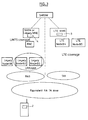
- FIG. 1 An example of system architecture supporting mobility between LTE and Legacy access systems is illustrated in figure 1 .
- the architecture illustrated in figure 1 comprises:
- Legacy MME (respectively LTE MME) knows the location of the UE with the accuracy of a Routing Area (RA) (respectively Tracking Area (TA)).
- RA Routing Area
- TA Tracking Area
- An UE performs a RA (respectively TA) update when its RA (respectively TA) changes.
- Paging is performed over the last RA (respectively TA) where the UE has been registered.
- PA Paging Area
- PA can be a portion of a RA (respectively TA) if sequential paging is used.
- a concept of Equivalent RA(s) or TA(s) can be used to limit the amount of signalling due to Idle mode mobility (in particular to minimize location update messages towards a subscriber database such as Home Location Register (HLR)).
- Equivalent Paging Area is made of a set of RA(s) and a set of TA(s).
- UE When UE moves between LTE Idle state, and RRC Idle mode or URA PCH state, UE does no signaling to the network as long as the new cell is within one of the set of Equivalent RA(s) or TA(s).
- TA1 and RA1 are in the same Equivalent Area.
- the present invention recognizes that problems may arise for paging an UE for incoming downlink traffic in an architecture (such as for example the one illustrated in figure 1 ) supporting mobility between Legacy and LTE systems and using the concept of Equivalent or Common MM Area (in particular a Common Paging Area). Such problems can be explained for example as follows.
- the UE may be in either of the states illustrated in the table below, on both LTE and Legacy coverage (only significant states are shown in this table): Radio State Radio bearers established* State as seen from MME (legacy + LTE MME) State applies to Comments Radio Connected Yes Connected LTE/Legacy When UE is at state radio Connected on one coverage, it is radio Idle on the other one URA-PCH No (page) Connected 3G Legacy UE may be URA-PCH (over Legacy 3G) and Idle on LTE coverage.
- Idle No (page) Idle LTE/Legacy UE may be Idle on both coverage (*) when Radio Bearer connection is not established there is a need to page the UE to deliver incoming traffic (**) When state seen from MME is Connected, a radio signaling connection is established with the UE.
- RA1 URA there is an URA zone inside RA1 URA .
- the problem occurs when the UE roams in non active mode between the UMTS URA zone in Routing Area 1 (RA1) and the LTE Tracking Area 1 (TA1).
- Legacy MME has a bearer connection with the RNC that manages the URA zone (UE state being connected in the Legacy MME) and LTE MME has no bearer connection with any of the LTE NodeBs.
- the paging mechanism must be:
- Legacy-MME entity due to the introduction of LTE (there are only few Legacy-MME entities deployed in networks and these are provided by a very limited number of manufacturers), modification to Legacy radio entities should be envisaged as a last resort solution (much more nodes and manufacturers would be involved).
- a first solution for solving the above-mentioned problems could be as follows.
- SAEGW could systematically broadcast Downlink (DL) traffic towards both LTE-MME and Legacy-MME (regardless of user state).
- DL Downlink
- a second solution for solving the above-mentioned problems could be as follows.
- Traffic could be sent to only the coverage where from CN (SAEGW), the UE is seen as in Connected mode.
- SAEGW SAEGW
- a problem is that when the UE is in URA-PCH state, the CN believes the UE is in Connected mode and listening to Legacy coverage, whereas the UE might actually be camping on a LTE cell.
- an UE in URA_PCH state under Legacy 3G coverage may silently move to LTE coverage (if the RA that contains the URA and the TA are equivalent) and hence camp over LTE.
- the issue stems from the fact that the Core Network (legacy MME + LTE-MME) that is in charge of paging the UE on the whole Equivalent Paging Area believes the mobile is definitively reachable over Legacy coverage whereas UE may be actually camping over LTE coverage.
- a third solution for solving the above-mentioned problems could be as follows.
- Legacy Radio Access Network could warn the Core Network when it has put the UE in URA-PCH state, in which situation the CN would attempt the paging over both coverage. This would optimize the paging but requires modifications from legacy RAN, which is not desirable at all.
- the present invention in particular enables to solve part or all of the above-mentioned problems, or to avoid part or all of the above-mentioned drawbacks. More generally, it is an object of the present invention to improve MM in an architecture supporting mobility between various access systems such as in particular Legacy 3G UMTS and Evolved access systems.
- a method for Mobility Management MM in a system architecture supporting mobility between different access systems having separate Core Network CN-level MM entities while using common MM Area comprising a step of:
- said method comprises:
- said method comprises:
- said first access system corresponds to Legacy 3G system.
- said second access sytem corresponds to LTE system.
- said Non Radio Connected state corresponds to URA_PCH state.
- a mobile terminal or User Equipement UE
- access system entites, for performing a method according to the present invention, in particular entities in charge of Mobility Management MM, such as in particular CN- level Legacy MM Entity (Legacy MME), and CN -level LTE MM Entity (LTE MME).
- CN-level Legacy MM Entity Legacy MME
- LTE MME CN -level LTE MM Entity
- Another aspect of the present invention is therefore a User Equipement UE, for a system architecture supporting mobility between different access systems having separate Core Network CN-level MM entities while using common MM Area, said UE comprising:
- Another aspect of the present invention is therefore a User Equipement UE, for a system architecture supporting mobility between different access systems having separate Core Network CN-level MM entities while using common MM Area, said UE comprising:
- Another aspect of the present invention is therefore a Core Network CN-level Mobility Management MM entity of a first access system in a system architecture supporting mobility between different access systems including a first and a second access system having separate Core Network CN-level MM entities while using common MM Area, said entity comprising:
- Another aspect of the present invention is therefore a Core Network CN-level Mobility Management MM entity associated with a second access system in a system architecture supporting mobility between different access systems including a first and a second access system having separate Core Network CN-level MM entities while using common MM Area, said entity comprising:
- the present invention may also be explained as follows, to simplify based on the example of system architecture illustrated in figure 1 .
- the present invention recognizes that a way to solve the above mentioned problems, is, when an UE leaves the 3G Legacy coverage where it was in URA-PCH state, to have the URA-PCH state been released over Legacy radio for this UE, thus putting this UE into Idle mode from the CN.
- the dual mode (LTE-legacy) UE may only be :
- the present invention also has for its object entities such as a mobile terminal or User Equipement (UE), and access system entites, for performing a method according to the present invention, in particular entities in charge of Mobility Management MM, such as in particular CN- level Legacy MM Entity (Legacy MME), and CN -level LTE MM Entity (LTE MME).
- object entities such as a mobile terminal or User Equipement (UE)
- UE User Equipement
- access system entites for performing a method according to the present invention, in particular entities in charge of Mobility Management MM, such as in particular CN- level Legacy MM Entity (Legacy MME), and CN -level LTE MM Entity (LTE MME).
Landscapes
- Engineering & Computer Science (AREA)
- Computer Networks & Wireless Communication (AREA)
- Signal Processing (AREA)
- Mobile Radio Communication Systems (AREA)
Abstract
- when a User Equipment UE leaves the coverage of a first one of said access systems where it is in a Non Radio Connected state as seen from Radio Access Network RAN, but seen in Connected State from CN-level MM entity, such as in a URA-PCH state of a legacy 3G system, for the coverage of a second one of said access systems where it is in Idle state as seen from CN- level MM entity, putting the UE into Idle state as seen from CN- level MM entity of said first access system.
Description
- The present invention generally relates to mobile communication systems.
- Detailed descriptions of mobile communication systems can be found in the litterature, in particular in Technical Specifications published by standardisation bodies such as in particular 3GPP (3rd Generation Partnership Project).
- In such systems, a mobile terminal or User Equipment (UE) has access to mobile services offered by a Core Network (CN) via an Access Network (AN), such as in particular a Radio Access Network (RAN).
- There are different types of mobile services such as in particular PS- based services (where PS stands for Packet Switched) and IP-based services (where IP stands for Internet Protocol). The Core Network CN therefore comprises different domains and/or subsystems such as in particular PS domain and operator's IP network. In particular UE has access to IP based services offered by an operator's IP network via an Access Network AN comprising: Radio Access Network RAN, and Core Network PS domain providing IP connectivity.
- Existing or Legacy systems include in particular 3G (3rd Generation) systems. A typical example is UMTS (Universal Mobile Telecommunications System), including RAN called UTRAN (UMTS Terrestrial Radio Access Network), and GPRS Packet Core Network (where GPRS stands for General Packet Radio Service).
- Now there is an evolution towards next generation or evolved systems, having enhanced performances. A typical example is 3G LTE (Long Term Evolution), including RAN called Evolved RAN, and CN called Evolved Packet Core Network.
- Mobility Management (MM) is an important issue in such systems. There are different MM functions such as in particular location update functions and paging functions, the aim of such functions being to guarantee that a User Equipment UE can be reached even when there is no active radio connection between the UE and the network.
- In Legacy systems as well as in Evolved systems, MM functions are performed at CN level, between UE and a CN- level MM Entity (MME), such as Legacy MME (for example Serving GPRS Support Node SGSN) in 3G Legacy systems, or LTE MME in 3G LTE systems. For PS connections, different MM states have been defined including in particular the following PMM states as defined for
Legacy 2,5G GPRS systems for example (where PMM stands for Packet Mobility Management). In PMM Connected state (where a packet signalling connection is established between UE and CN), CN knows the location of the UE with the accuracy of a cell. In PMM Idle state (where no packet signalling connection is established between UE and CN), CN knows the location of the UE with the accuracy of aRouting Area (RA). UE performs a RA update when its RA changes. UE may move from PMM Connected state to PMM Idle state if there is not enough activity on the packet connection. If there is again some activity on the downlink for UE in PMM Idle state, paging of the UE is required to re-activate the packet connection. Paging is performed over the last Routing Area (RA) where the UE is known to be located, i.e. where it is registered. - In 3G Legacy systems such as in particular UMTS, CN is released from some MM functions which can be performed at RAN level, such as in particular at UTRAN level for UMTS (where UTRAN stands for UMTS Terrestrial Radio Access Network). For PS connections, different MM states have been defined including in particular the following states as defined for UTRAN-level MM for example. In a state called hereafter Radio Connected state, where Radio Bearers are established between UE and UTRAN, UTRAN knows the location of the UE with the accuracy of a cell. In a state called hereafter Non Radio Connected URA- PCH state (where URA stands for UTRAN Registration Area and PCH stands for Paging Channel), where no Radio Bearers are established between UE and UTRAN but a signaling connection or Signaling Radio Bearer is established between UE and UTRANUTRAN knows the location of the UE with the accuracy of URA. UE performs URA update when its URA changes. UE may move from a Radio Connected state to Non Radio Connected URAPCH state if there is not enough activity on this connection and user's mobility is such that cell updates would occur too frequently. If there is again some activity on the downlink to UE in URA-PCH state, paging is required to re-establish the radio connection. Paging is performed over the last URA where UE is known to be located, i.e. where it is registered. Non Radio Connected URA-PCH state, as seen from UTRAN, is seen from CN as PMM Connected state. In a mode called RRC Idle mode (where RRC stands for Radio Resource Control), no Radio Bearers and no Signaling Radio Bearers are established between UE and UTRAN. RRC Idle mode as seen from UTRAN is seen fom CN as PMM Idle state.
- The present invention more particularly relates to MM in a system architecture supporting mobility between various access systems such as in particular Legacy and Evolved access systems, enabling in particular to provide IP- based services through various IP connectivity access networks.
- An example of system architecture supporting mobility between LTE and Legacy access systems is illustrated in
figure 1 . - The architecture illustrated in
figure 1 comprises: - Multimode (Legacy/LTE) User Equipment (UE),
- Legacy 3G Radio Access Network, such as for example UTRAN (UMTS Terrestrial Access Network), including Radio Network Controller (RNC) and Legacy Base Stations or Legacy Node B (such as in the illustrated example Legacy NodeB 1, Legacy NodeB 2, Legacy NodeB 3),
- LTE Radio Access Network, such as for example E-UTRAN, including LTE Base Stations or LTE Node B (such as in the illustrated
example LTE NodeB 4 and LTE NodeB 5), - Legacy Mobility Management Entity (Legacy MME),
- LTE Mobility Management Entity (LTE MME),
- a Gateway SAEGW providing interconnection between access system (Legacy and/or LTE) on one side, and an external IP network, not illustrated, on the other side.
- In this example of architecture, there is an as loose as possible coupling within the network infrastructure (both Core Network CN and Radio Access Network RAN) between LTE and Legacy technologies. There are separate radio entities and separate entities handling the Core Network- level mobility. The coupling between Legacy and LTE technology is only provided by:
- o a signaling communication channel between the LTE-MME entity handling the Core Network level mobility over LTE coverage and the legacy-MME entity handling the Core Network level mobility over legacy coverage
- o Gateway SAEGW.
- In Idle mode, Legacy MME (respectively LTE MME) knows the location of the UE with the accuracy of a Routing Area (RA) (respectively Tracking Area (TA)). An UE performs a RA (respectively TA) update when its RA (respectively TA) changes. Paging is performed over the last RA (respectively TA) where the UE has been registered.
- The area on which a UE is paged is generally called Paging Area (PA). PA can be a portion of a RA (respectively TA) if sequential paging is used.
- In an architecture supporting mobility between LTE and Legacy access systems, such as the one illustrated in
figure 1 for example, a concept of Equivalent RA(s) or TA(s) (or Equivalent or Common Paging Area) can be used to limit the amount of signalling due to Idle mode mobility (in particular to minimize location update messages towards a subscriber database such as Home Location Register (HLR)). Equivalent Paging Area is made of a set of RA(s) and a set of TA(s). With this concept, an UE is simultaneously attached to each coverage i.e. "attached" (registered) on both legacy-MME and LTE-MME. When UE moves between LTE Idle state, and RRC Idle mode or URA PCH state, UE does no signaling to the network as long as the new cell is within one of the set of Equivalent RA(s) or TA(s). In the example offigure 1 , TA1 and RA1 are in the same Equivalent Area. - The present invention recognizes that problems may arise for paging an UE for incoming downlink traffic in an architecture (such as for example the one illustrated in
figure 1 ) supporting mobility between Legacy and LTE systems and using the concept of Equivalent or Common MM Area (in particular a Common Paging Area). Such problems can be explained for example as follows. - In an architecture such as the one illustrated in
figure 1 for example, the UE may be in either of the states illustrated in the table below, on both LTE and Legacy coverage (only significant states are shown in this table):Radio State Radio bearers established* State as seen from MME (legacy + LTE MME) State applies to Comments Radio Connected Yes Connected LTE/Legacy When UE is at state radio Connected on one coverage, it is radio Idle on the other one URA-PCH No (page) Connected 3G Legacy UE may be URA-PCH (over Legacy 3G) and Idle on LTE coverage. Idle No (page) Idle LTE/Legacy UE may be Idle on both coverage (*) when Radio Bearer connection is not established there is a need to page the UE to deliver incoming traffic
(**) When state seen from MME is Connected, a radio signaling connection is established with the UE. - When the UE is in Radio Connected state on one coverage, there is no problem in preventing the Core Network (SAEGW + MME on the other coverage) from trying to send a packet on the other coverage (preventing from paging on the other radio coverage).
- When the UE is in Idle mode on both coverage, there is no problem: paging needs to be sent over both radio coverage.
- Problems arise when the UE is in Non Radio Connected state such as URA-PCH over legacy 3G coverage, and in Idle mode on LTE coverage.
- In the example illustrated in
figure 1 , there is an URA zone inside RA1 URA . The problem occurs when the UE roams in non active mode between the UMTS URA zone in Routing Area 1 (RA1) and the LTE Tracking Area 1 (TA1). Legacy MME has a bearer connection with the RNC that manages the URA zone (UE state being connected in the Legacy MME) and LTE MME has no bearer connection with any of the LTE NodeBs. - When the UE is in a state such as URA_PCH (aiming at preserving its battery) where Radio Bearers are not established for this UE, there is a need to page the UE in order to (re)-establish the Radio Bearer required to send an incoming packet to the UE over radio.
- In general, the paging mechanism must be:
- o As quick as possible (avoid waiting for a paging failure on one coverage (LTE / Legacy) before initiating the paging on the other coverage (Legacy / LTE))
- o Efficient, i.e. avoiding to page on both coverage (LTE/Legacy) when it can be a priori known that this is useless.
- Also, as a general consideration, while it is possible to modify the Legacy-MME entity due to the introduction of LTE (there are only few Legacy-MME entities deployed in networks and these are provided by a very limited number of manufacturers), modification to Legacy radio entities should be envisaged as a last resort solution (much more nodes and manufacturers would be involved).
- A first solution for solving the above-mentioned problems could be as follows.
- SAEGW could systematically broadcast Downlink (DL) traffic towards both LTE-MME and Legacy-MME (regardless of user state).
- However, when the UE is in Radio Connected state over one coverage (i.e. when there is actual traffic), there are following strong drawbacks that:
- o traffic is duplicated over the CN (consumes unnecessary bandwidth core on the path towards the coverage where UE is not in Radio Connected state) and
- o useless paging occurs over the coverage where the UE is not in Radio Connected state (and where the mobile is definitively not listening).
- As Downlink (DL) traffic is broadcast to both LTE-MME and legacy-MME, also when UE is actually in Radio Connected state, this useless Core Network bandwidth consumption and paging occurs for each user packet which is a waste of resources.
- A second solution for solving the above-mentioned problems could be as follows.
- Traffic could be sent to only the coverage where from CN (SAEGW), the UE is seen as in Connected mode.
- However, a problem is that when the UE is in URA-PCH state, the CN believes the UE is in Connected mode and listening to Legacy coverage, whereas the UE might actually be camping on a LTE cell.
- In other words, an UE in URA_PCH state under Legacy 3G coverage may silently move to LTE coverage (if the RA that contains the URA and the TA are equivalent) and hence camp over LTE. The issue stems from the fact that the Core Network (legacy MME + LTE-MME) that is in charge of paging the UE on the whole Equivalent Paging Area believes the mobile is definitively reachable over Legacy coverage whereas UE may be actually camping over LTE coverage.
- This means that downlink packet is sent from CN to Legacy radio, that pages the UE (with repetition), needs to wait for some time for an answer from UE that does not answer (as the UE has moved to LTE coverage) and then only warns the Legacy-LTE that the UE is not reachable (putting the UE in Idle mode as seen from legacy-MME). Only then in this alternative would it be attempted to page the UE over LTE coverage. This solution works, does not induce too much useless paging (only for the first packet arriving in this situation) but brings an extra delay for the transfer of this first downlink packet that may prove to be not acceptable, as this first packet is likely to be an invitation for a new call.
- A third solution for solving the above-mentioned problems could be as follows.
- Legacy Radio Access Network could warn the Core Network when it has put the UE in URA-PCH state, in which situation the CN would attempt the paging over both coverage. This would optimize the paging but requires modifications from legacy RAN, which is not desirable at all.
- Therefore, none of the above mentioned solutions is satisfactory, and there is a need to efficiently handle paging for downlink incoming traffic towards a UE being in following combination of states: the UE is in URA-PCH state (over Legacy 3G) and is camping over LTE coverage even though it is in Idle mode. The issue stems from the discrepancy between the mobility state seen by the Core Network (UE is in Radio Connected mode over Legacy radio hence reachable via this radio) and the actual state of the UE (camping over LTE coverage).
- The present invention in particular enables to solve part or all of the above-mentioned problems, or to avoid part or all of the above-mentioned drawbacks. More generally, it is an object of the present invention to improve MM in an architecture supporting mobility between various access systems such as in particular Legacy 3G UMTS and Evolved access systems.
- These and other objects are achieved, in one aspect of the present invention, by a method for Mobility Management MM in a system architecture supporting mobility between different access systems having separate Core Network CN-level MM entities while using common MM Area, said method comprising a step of:
- when a User Equipment UE leaves the coverage of a first one of said access systems where it is in a Non Radio Connected state as seen from Radio Access Network RAN, but seen in Connected State from CN-level MM entity, for the coverage of a second one of said access systems where it is in Idle state as seen from CN- level MM entity, putting the UE into Idle state as seen from CN- level MM entity of said first access system.
- In an example, said method comprises:
- a step wherein, when the UE leaves the coverage of the first access system, the UE releases its radio signaling connection over said first access system, thus putting the UE into Idle state as seen from CN- level MM entity of the first access system.
- In another example, said method comprises:
- a step wherein, when the UE leaves the coverage of the first access system, the UE isues a location update towards the CN- level MM entity of the second access system,
- a step wherein, based on this location update, the CN- level MM entity of the second access system updates the CN- level MM entity of the first access system, with the mobility state of the UE,
- a step wherein, based on this update, the CN- level MM entity of the first access system releases the UE signalling radio connection, thus putting the UE into Idle state as seen from CN- level MM entityof the first access system.
- In an example, said first access system corresponds to Legacy 3G system.
- In an example, said second access sytem corresponds to LTE system.
- In an example, said Non Radio Connected state corresponds to URA_PCH state.
- These and other objects are achieved, in another aspect of the present invention, by a mobile terminal or User Equipement (UE), and by access system entites, for performing a method according to the present invention, in particular entities in charge of Mobility Management MM, such as in particular CN- level Legacy MM Entity (Legacy MME), and CN -level LTE MM Entity (LTE MME).
- Another aspect of the present invention is therefore a User Equipement UE, for a system architecture supporting mobility between different access systems having separate Core Network CN-level MM entities while using common MM Area, said UE comprising:
- means for, when the UE leaves the coverage of a first one of said access systems where it is in a Non Radio Connected state as seen from Radio Access Network RAN, but seen in Connected State from CN-level MM entity, for the coverage of a second one of said access systems where it is in Idle state as seen from CN- level MM entity, releasing its radio signaling connection over said first access system, thus putting the UE into Idle state as seen from CN- level MM entity of the first access system.
- Another aspect of the present invention is therefore a User Equipement UE, for a system architecture supporting mobility between different access systems having separate Core Network CN-level MM entities while using common MM Area, said UE comprising:
- means for, when the UE leaves the coverage of a first one of said access systems where it is in a Non Radio Connected state as seen from Radio Access Network RAN, but seen in Connected State from CN-level MM entity, for the coverage of a second one of said access systems where it is in Idle state as seen from CN- level MM entity, issueing a location update towards the CN- level MM entity of the second access system.
- Another aspect of the present invention is therefore a Core Network CN-level Mobility Management MM entity of a first access system in a system architecture supporting mobility between different access systems including a first and a second access system having separate Core Network CN-level MM entities while using common MM Area, said entity comprising:
- means for releasing a UE signalling connection, based on a mobility state update received from the CN- level MM entity associated with the second access system, in turn based on a location update issued by the UE when the UE leaves the coverage of the first access system where it is in a Non Radio Connected state as seen from Radio Access Network RAN, but seen in Connected State from CN-level MM entity, for the coverage of the second access system where it is in Idle state as seen from CN- level MM entity, thus putting the UE into Idle state as seen from CN-level MM entity of the first access system.
- Another aspect of the present invention is therefore a Core Network CN-level Mobility Management MM entity associated with a second access system in a system architecture supporting mobility between different access systems including a first and a second access system having separate Core Network CN-level MM entities while using common MM Area, said entity comprising:
- means for updating the CN- level MM entity associated with the first access system, with the mobility state of an UE, based on a location update issued by the UE when the UE leaves the coverage of the first access system where it is in a Non Radio Connected state as seen from Radio Access Network RAN, but seen in Connected State from CN-level MM entity , for the coverage of the second access system where it is in Idle state as seen from CN- level MM entity of the second access system.
- These and other objects of the present invention will become more apparent from the following description taken in conjunction with the accompanying drawings:
-
figure 1 is intended to illustrate an example of system architecture to which the present invention applies, -
figure 2 is intended to illustrate an example of a method according to the present invention, -
figure 3 is intended to illustrate another example of a method according to the present invention. - The present invention may also be explained as follows, to simplify based on the example of system architecture illustrated in
figure 1 . - In this example, the present invention recognizes that a way to solve the above mentioned problems, is, when an UE leaves the 3G Legacy coverage where it was in URA-PCH state, to have the URA-PCH state been released over Legacy radio for this UE, thus putting this UE into Idle mode from the CN.
- When the UE leaves the 3G Legacy coverage where it was in URA-PCH state to go to LTE coverage, there are two potential situations:
- The UE is still able to contact 3G radio: In this case, a solution is that the UE releases the radio signaling connection over 3G before going to LTE, such as illustrated at 1 in
figure 2 , thus aligning the mobility state over radio and over the CN (both being set to Idle) - There is no more adequate 3G radio coverage: in this case, a solution is that the UE issues a Tracking Area Update towards the LTE-MME, such as illustrated at 2 in
figure 3 . Based on this Tracking Area Update, LTE-MME updates legacy-MME with the mobility state of the UE, such as illustrated at 3 infigure 3 . Receiving a mobility state update from LTE-MME for a UE that it still considers in Connected mode over legacy, the SGSN releases the radio legacy connection for this UE, such as illustrated at 4 infigure 3 , putting the UE into correct state (Idle) for legacy coverage. - Based on this behavior of the UE, the dual mode (LTE-legacy) UE may only be :
- 1. In Connected mode over one single coverage over which it is effectively camping.
- 2. Or in Idle mode over any of both coverage
- When there is a DL incoming packet:
- 1. In the former case, the CN can send the packet (and the potential induced paging if the UE is actually in URA-PCH state) over one single radio coverage
- 2. In the latter case, the CN has to require paging over both coverage.
- There is no excessive paging in this case, as paging over double coverage occurs only when the network needs to wake the UE (i.e. for the very first packet to be sent to the UE).
- In addition to a method for Mobility Management MM in a system architecture supporting mobility between different access systems (for example a method as disclosed above) the present invention also has for its object entities such as a mobile terminal or User Equipement (UE), and access system entites, for performing a method according to the present invention, in particular entities in charge of Mobility Management MM, such as in particular CN- level Legacy MM Entity (Legacy MME), and CN -level LTE MM Entity (LTE MME).
- The detailed implementation of the above-mentioned means does not raise any special problem for a person skilled in the art, and therefore such means do not need to be more fully disclosed than has been made above, by their function, for a person skilled in the art.
Claims (10)
- A method for Mobility Management MM in a a system architecture supporting mobility between different access systems having separate Core Network CN-level MM entities while using common MM Area, said method comprising a step of:- when a User Equipment UE leaves the coverage of a first one of said access systems where it is in a Non Radio Connected state as seen from RAdio Access Network RAN, but seen in Connected State from CN-level MM entity, for the coverage of a second one of said access systems where it is in Idle state as seen from CN- level MM entity, putting the UE into Idle state as seen from CN- level MM entity of said first access system.
- A method according to claim 1, comprising:- a step wherein, when the UE leaves the coverage of the first access system, the UE releases its radio signaling connection over said first access system, thus putting the UE into Idle state as seen from CN- level MM entityof the first access system.
- A method according to claim 1, comprising:- a step wherein, when the UE leaves the coverage of the first access system, the UE isues a location update towards the CN- level MM entity of the second access system,- a step wherein, based on this location update, the CN- level MM entity of the second access system updates the CN- level MM entity of the first access system, with the mobility state of the UE,- a step wherein, based on this update, the CN- level MM entity of the first access system releases the UE signalling radio connection, thus putting the UE into Idle state as seen from CN- level MM entityof the first access system.
- A method according to any of claims 1 to 3, wherein said first access system corresponds to Legacy 3G system.
- A method according to any of claims 1 to 4, wherein said second access sytem corresponds to LTE system.
- A method according to any of claims 1 to 5, wherein said Non Radio Connected state corresponds to URA_PCH state.
- A User Equipement UE, for a system architecture supporting mobility between different access systems having separate Core Network CN-level MM entities while using common MM Area, said UE comprising:- means for, when the UE leaves the coverage of a first one of said access systems where it is in a Non Radio Connected state as seen from Radio Access Network RAN, but seen in Connected State from CN-level MM entity, for the coverage of a second one of said access systems where it is in Idle state as seen from CN- level MM entity, releasing its radio signaling connection over said first access system, thus putting the UE into Idle state as seen from CN- level MM entity of the first access system.
- A User Equipement UE, for a system architecture supporting mobility between different access systems having separate Core Network CN-level MM entities while using common MM Area, said UE comprising:- means for, when the UE leaves the coverage of a first one of said access systems where it is in a Non Radio Connected state as seen from Radio Access Network RAN, but seen in Connected State from CN-level MM entity, for the coverage of a second one of said access systems where it is in Idle state as seen from CN- level MM entity, issueing a location update towards the CN- level MM entity of the second access system.
- A Core Network CN- level Mobility Management MM entity of a first access system in a a system architecture supporting mobility between different access systems including a first and a second access system having separate Core Network CN-level MM entities while using common MM Area, said entity comprising:- means for releasing a UE signalling connection, based on a mobility state update received from the CN- level MM entity associated with the second access system, in turn based on a location update issued by the UE when the UE leaves the coverage of the first access system where it is in a Non Radio Connected state as seen from Radio Access Network RAN, but seen in Connected State from CN-level MM entity, for the coverage of the second access system where it is in Idle state as seen from CN- level MM entity, thus putting the UE into Idle state as seen from CN-level MM entity of the first access system.
- A Core Network CN- level Mobility Management MM entity associated with a second access system in a system architecture supporting mobility between different access systems including a first and a second access system having separate Core Network CN-level MM entities while using common MM Area, said entity comprising:- means for updating the CN- level MM entity associated with the first access system, with the mobility state of an UE, based on a location update issued by the UE when the UE leaves the coverage of the first access system where it is in a Non Radio Connected state as seen from Radio Access Network RAN, but seen in Connected State from CN-level MM entity , for the coverage of the second access system where it is in Idle state as seen from CN- level MM entity of the second access system.
Priority Applications (16)
| Application Number | Priority Date | Filing Date | Title |
|---|---|---|---|
| DK07290450.1T DK1981300T3 (en) | 2007-04-12 | 2007-04-12 | Mobility management approach in a system architecture that supports mobility between different access systems |
| PL07290450T PL1981300T3 (en) | 2007-04-12 | 2007-04-12 | A method for mobility management in a system architecture supporting mobility between different access systems |
| ES07290450T ES2391413T3 (en) | 2007-04-12 | 2007-04-12 | Procedure for mobility management in a system architecture that supports mobility between different access systems |
| EP07290450A EP1981300B1 (en) | 2007-04-12 | 2007-04-12 | A method for mobility management in a system architecture supporting mobility between different access systems |
| BRPI0810194-9A BRPI0810194B1 (en) | 2007-04-12 | 2008-04-08 | METHOD FOR MOBILITY MANAGEMENT IN A SYSTEM ARCHITECTURE THAT SUPPORTS MOBILITY BETWEEN DIFFERENT ACCESS SYSTEMS, USER EQUIPMENT FOR A SYSTEM ARCHITECTURE THAT SUPPORTS MOBILITY BETWEEN DIFFERENT ACCESS SYSTEMS AND MOBILITY MANAGEMENT ENTITY |
| AU2008238037A AU2008238037B2 (en) | 2007-04-12 | 2008-04-08 | A method for mobility management in a system architecture supporting mobility between different access systems |
| PCT/EP2008/054225 WO2008125547A1 (en) | 2007-04-12 | 2008-04-08 | A method for mobility management in a system architecture supporting mobility between different access systems |
| KR1020097021295A KR101558609B1 (en) | 2007-04-12 | 2008-04-08 | Mobility management methods, user equipment and CN level MM objects |
| RU2009141715/08A RU2458472C2 (en) | 2007-04-12 | 2008-04-08 | Method for mobility management in system architecture supporting mobility between different access systems |
| MX2009010885A MX2009010885A (en) | 2007-04-12 | 2008-04-08 | MOBILITY MANAGEMENT METHOD IN SYSTEM ARCHITECTURE THAT SUPPORTS MOBILITY BETWEEN DIFFERENT ACCESS SYSTEMS. |
| JP2010502498A JP5491380B2 (en) | 2007-04-12 | 2008-04-08 | A method for mobility management in a system architecture that supports mobility between different access systems |
| US12/100,835 US8396476B2 (en) | 2007-04-12 | 2008-04-10 | Method for mobility management in a system architecture supporting mobility between different access systems |
| CN2008100916864A CN101287291B (en) | 2007-04-12 | 2008-04-14 | Mobility management method in system architecture supporting mobility between access systems |
| IL201212A IL201212A (en) | 2007-04-12 | 2009-09-29 | Method for mobility management in a system architecture supporting mobility between different access systems |
| US13/675,716 US9408123B2 (en) | 2007-04-12 | 2012-11-13 | Method for mobility management in a system architecture supporting mobility between different access systems |
| JP2013253017A JP5745018B2 (en) | 2007-04-12 | 2013-12-06 | A method for mobility management in a system architecture that supports mobility between different access systems |
Applications Claiming Priority (1)
| Application Number | Priority Date | Filing Date | Title |
|---|---|---|---|
| EP07290450A EP1981300B1 (en) | 2007-04-12 | 2007-04-12 | A method for mobility management in a system architecture supporting mobility between different access systems |
Publications (2)
| Publication Number | Publication Date |
|---|---|
| EP1981300A1 true EP1981300A1 (en) | 2008-10-15 |
| EP1981300B1 EP1981300B1 (en) | 2012-07-25 |
Family
ID=38480582
Family Applications (1)
| Application Number | Title | Priority Date | Filing Date |
|---|---|---|---|
| EP07290450A Active EP1981300B1 (en) | 2007-04-12 | 2007-04-12 | A method for mobility management in a system architecture supporting mobility between different access systems |
Country Status (14)
| Country | Link |
|---|---|
| US (2) | US8396476B2 (en) |
| EP (1) | EP1981300B1 (en) |
| JP (2) | JP5491380B2 (en) |
| KR (1) | KR101558609B1 (en) |
| CN (1) | CN101287291B (en) |
| AU (1) | AU2008238037B2 (en) |
| BR (1) | BRPI0810194B1 (en) |
| DK (1) | DK1981300T3 (en) |
| ES (1) | ES2391413T3 (en) |
| IL (1) | IL201212A (en) |
| MX (1) | MX2009010885A (en) |
| PL (1) | PL1981300T3 (en) |
| RU (1) | RU2458472C2 (en) |
| WO (1) | WO2008125547A1 (en) |
Families Citing this family (20)
| Publication number | Priority date | Publication date | Assignee | Title |
|---|---|---|---|---|
| WO2010005225A2 (en) * | 2008-07-07 | 2010-01-14 | Samsung Electronics Co., Ltd. | Method for handoff during connected mode of a multimode mobile station in a mixed deployment |
| CN102308645B (en) * | 2009-02-06 | 2014-10-15 | 苹果公司 | Tracking area management method and apparatus for long term evolution telecommunication systems |
| US9839001B2 (en) * | 2009-03-23 | 2017-12-05 | Apple Inc. | Methods and apparatus for optimizing paging mechanisms and publication of dynamic paging mechanisms |
| CN101931898B (en) * | 2009-06-26 | 2014-03-05 | 华为技术有限公司 | Method, device and system for transmitting user plane data |
| JP5150601B2 (en) * | 2009-10-20 | 2013-02-20 | 株式会社エヌ・ティ・ティ・ドコモ | Mobile communication terminal, mobile communication control apparatus, mobile communication system, and mobile communication method |
| CN102763455B (en) * | 2009-12-21 | 2016-08-24 | Lg电子株式会社 | The method performing switching by region conversion in BWA |
| CN102164375A (en) | 2010-02-22 | 2011-08-24 | 华为技术有限公司 | Method and system for collecting terminal measurement data |
| US9001784B2 (en) * | 2010-09-09 | 2015-04-07 | Qualcomm Incorporated | Handover of multimode user equipment between radio access technologies for reduced call setup time |
| KR101706955B1 (en) * | 2010-09-14 | 2017-02-15 | 엘지전자 주식회사 | Method and Apparatus for efficient Zone Switch in a Broadband Wireless Access System |
| US20120322489A1 (en) * | 2011-06-15 | 2012-12-20 | Jennifer Liu | Apparatus and method for idle-state signaling reduction control in wireless networks |
| US9247528B2 (en) * | 2012-10-12 | 2016-01-26 | Cisco Technology, Inc. | System and method for reducing paging in UTRAN/GERAN/E-UTRAN networks when idle signaling reduction is active |
| CN109951836A (en) * | 2013-06-19 | 2019-06-28 | 华为技术有限公司 | A kind of co-location update processing method, device and system |
| JP6394325B2 (en) * | 2014-11-26 | 2018-09-26 | 富士通株式会社 | Network control method, communication apparatus, and communication system |
| US10735166B2 (en) | 2015-05-29 | 2020-08-04 | Huawei Technologies Co., Ltd. | System and method of UE-centric radio access procedure |
| WO2017185199A1 (en) * | 2016-04-25 | 2017-11-02 | 华为技术有限公司 | Attachment method, and paging method, apparatus, and device |
| KR102449475B1 (en) | 2016-10-21 | 2022-09-30 | 삼성전자 주식회사 | Network access method and apparatus of a terminal based on network information that the terminal can support in a wireless communication system |
| WO2018227393A1 (en) * | 2017-06-13 | 2018-12-20 | 华为技术有限公司 | Connection establishing method and user equipment |
| EP3782298B1 (en) | 2018-04-20 | 2021-10-20 | Telefonaktiebolaget LM Ericsson (publ) | Cross-carrier spatial relation indication for semi-persistent sounding reference signal (sp-srs) resources |
| CN110636571B (en) * | 2018-06-25 | 2021-03-16 | 电信科学技术研究院有限公司 | Method, device and readable storage medium for determining location service (LCS) of terminal User Equipment (UE) |
| US11165491B2 (en) | 2018-12-31 | 2021-11-02 | Hughes Network Systems, Llc | Location management for satellite systems |
Family Cites Families (17)
| Publication number | Priority date | Publication date | Assignee | Title |
|---|---|---|---|---|
| US5943619A (en) * | 1997-04-29 | 1999-08-24 | Ericsson Inc. | Shared interworking of subscriber features within mobile telecommunications networks |
| FI105763B (en) * | 1997-12-12 | 2000-09-29 | Nokia Networks Oy | Mobility management in a mobile telecommunication system |
| DE69922188T2 (en) * | 1999-08-23 | 2005-12-08 | Lucent Technologies Inc. | Optimization of routing area update in standby mode for multi-system packet radio networks |
| US6320855B1 (en) * | 1999-09-09 | 2001-11-20 | Qualcom Incorporated | Method and system for initiating idle handoff in a wireless communications system |
| US6912214B2 (en) * | 2000-04-07 | 2005-06-28 | Telefonaktiebolaget Lm Ericsson (Publ) | Optimized packet-resource management |
| US7957721B2 (en) * | 2001-02-13 | 2011-06-07 | Telefonaktiebolaget Lm Ericsson (Publ) | Coordinated subscriber access handling for shared network support |
| WO2004002051A2 (en) | 2002-06-21 | 2003-12-31 | Thomson Licensing S.A. | Registration of a wlan as a umts routing area for wlan-umts interworking |
| JP2005532759A (en) * | 2002-07-10 | 2005-10-27 | コーニンクレッカ フィリップス エレクトロニクス エヌ ヴィ | Selecting interfaces from multiple networks |
| FR2845558B1 (en) * | 2002-10-03 | 2004-12-24 | Evolium Sas | METHOD AND DEVICE FOR MANAGING RADIO LINK INTERRUPTION IN A RADIO SHADOW AREA |
| UA87973C2 (en) * | 2002-10-25 | 2009-09-10 | Квелкомм Инкорпорейтед | Multimode terminal in a system of radio communication with multiple input, multiple output and spatial multiplexing, a method and an apparatus for data processing and access point in a radio communications system |
| WO2004043086A2 (en) * | 2002-11-05 | 2004-05-21 | Telefonaktiebolaget Lm Ericsson (Publ) | Collective notification of node reset to subset of connections in radio access network |
| CN1499761A (en) * | 2002-11-05 | 2004-05-26 | 北京三星通信技术研究有限公司 | Method for identifying state of user equipment by core network and user equipment |
| KR100547723B1 (en) * | 2004-01-14 | 2006-01-31 | 삼성전자주식회사 | Apparatus and Method for Recognizing Adjacent Cell Boundaries in Mobile Communication Systems |
| JP2006115354A (en) * | 2004-10-15 | 2006-04-27 | Ntt Docomo Inc | Mobile terminal, control device, and mobile communication method |
| KR101185568B1 (en) * | 2006-03-04 | 2012-09-24 | 삼성전자주식회사 | Resource reservation system in an wireless network and thereof resource reservation method |
| US20070263574A1 (en) * | 2006-05-10 | 2007-11-15 | Interdigital Technology Corporation | Method and apparatus for battery management in a converged wireless transmit/receive unit |
| US7890576B2 (en) * | 2006-11-13 | 2011-02-15 | Microsoft Corporation | Selective communication of targeted information |
-
2007
- 2007-04-12 ES ES07290450T patent/ES2391413T3/en active Active
- 2007-04-12 EP EP07290450A patent/EP1981300B1/en active Active
- 2007-04-12 PL PL07290450T patent/PL1981300T3/en unknown
- 2007-04-12 DK DK07290450.1T patent/DK1981300T3/en active
-
2008
- 2008-04-08 KR KR1020097021295A patent/KR101558609B1/en active Active
- 2008-04-08 RU RU2009141715/08A patent/RU2458472C2/en active
- 2008-04-08 WO PCT/EP2008/054225 patent/WO2008125547A1/en not_active Ceased
- 2008-04-08 AU AU2008238037A patent/AU2008238037B2/en active Active
- 2008-04-08 BR BRPI0810194-9A patent/BRPI0810194B1/en active IP Right Grant
- 2008-04-08 MX MX2009010885A patent/MX2009010885A/en active IP Right Grant
- 2008-04-08 JP JP2010502498A patent/JP5491380B2/en active Active
- 2008-04-10 US US12/100,835 patent/US8396476B2/en active Active
- 2008-04-14 CN CN2008100916864A patent/CN101287291B/en active Active
-
2009
- 2009-09-29 IL IL201212A patent/IL201212A/en active IP Right Grant
-
2012
- 2012-11-13 US US13/675,716 patent/US9408123B2/en active Active
-
2013
- 2013-12-06 JP JP2013253017A patent/JP5745018B2/en active Active
Non-Patent Citations (3)
| Title |
|---|
| "3GPP TR 23.882 v 1.9.0 (2007-03) 3rd Generation Partnership Project; Technical Specification Group Services and System Aspects; 3GPP System Architecture Evolution: Report on technical options and conclusions (Release 7)", 3RD GENERATION PARTNERSHIP PROJECT (3GPP); TECHNICAL REPORT (TR), March 2007 (2007-03-01), pages 1 - 184, XP002451761 * |
| 3GPP TR 23.882 V 1.9.0, March 2007 (2007-03-01), pages 1 - 184 |
| MOTOROLA: "RS-051093 Intra-techniolgy Mobility - Idle Mode", 3GPP TSG RAN2/3#48BIS, 10 October 2005 (2005-10-10) - 14 October 2005 (2005-10-14), pages 1 - 2, XP002451762, Retrieved from the Internet <URL:http://www.3gpp.org/ftp/tsg_ran/WG3_Iu/TSGR3_48bis/joint%20RAN2-RAN3%20docs/> [retrieved on 20070919] * |
Also Published As
| Publication number | Publication date |
|---|---|
| IL201212A0 (en) | 2010-05-31 |
| ES2391413T3 (en) | 2012-11-26 |
| KR20100015525A (en) | 2010-02-12 |
| AU2008238037A1 (en) | 2008-10-23 |
| DK1981300T3 (en) | 2012-10-08 |
| IL201212A (en) | 2017-06-29 |
| US20130183968A1 (en) | 2013-07-18 |
| RU2458472C2 (en) | 2012-08-10 |
| JP2014042362A (en) | 2014-03-06 |
| BRPI0810194A2 (en) | 2014-12-30 |
| CN101287291B (en) | 2012-05-23 |
| RU2009141715A (en) | 2011-05-20 |
| PL1981300T3 (en) | 2012-12-31 |
| EP1981300B1 (en) | 2012-07-25 |
| WO2008125547A1 (en) | 2008-10-23 |
| BRPI0810194B1 (en) | 2020-10-06 |
| US9408123B2 (en) | 2016-08-02 |
| CN101287291A (en) | 2008-10-15 |
| JP5745018B2 (en) | 2015-07-08 |
| JP2010524373A (en) | 2010-07-15 |
| AU2008238037B2 (en) | 2011-09-08 |
| MX2009010885A (en) | 2009-10-26 |
| US8396476B2 (en) | 2013-03-12 |
| JP5491380B2 (en) | 2014-05-14 |
| KR101558609B1 (en) | 2015-10-19 |
| US20080311913A1 (en) | 2008-12-18 |
Similar Documents
| Publication | Publication Date | Title |
|---|---|---|
| EP1981300B1 (en) | A method for mobility management in a system architecture supporting mobility between different access systems | |
| EP3536067B1 (en) | Base station, core network node for session management and methods thereby | |
| FI102234B (en) | Digital mobile telephone system and procedures for processing terminating calls | |
| EP3577964B1 (en) | Methods and apparatuses for paging in a communications network | |
| US8706148B2 (en) | Messaging in mobile telecommunications networks | |
| EP2214440B1 (en) | Reducing signalling loads from a mobile device to a mobile network | |
| US8457659B2 (en) | Telecommunications networks | |
| US8843102B2 (en) | Method and system for paging an emergency service user | |
| EP3496477B1 (en) | Paging method, device and system, and related computer-readable medium | |
| CN101483823B (en) | Method and apparatus for position updating and requesting, method and apparatus for access | |
| CA2869797C (en) | Improved intersystem change between different radio access networks | |
| EP2448326A1 (en) | Business processing method, communication device and communication system | |
| CN101500281A (en) | Method for messaging in routing non-access layer | |
| CN101448305B (en) | A method for circuit domain paging in multiple packet domain networks | |
| CN100488170C (en) | Update method of route trigger area in the packet wireless system | |
| CN101001449B (en) | Paging method between different access systems | |
| CN101166359A (en) | Method for selecting management node in mobile communication system | |
| CN115836555A (en) | Method for efficient paging of mobile UEs using extended DRX and random PTW procedures | |
| KR101973595B1 (en) | Apparatus and communication for controlling paging |
Legal Events
| Date | Code | Title | Description |
|---|---|---|---|
| PUAI | Public reference made under article 153(3) epc to a published international application that has entered the european phase |
Free format text: ORIGINAL CODE: 0009012 |
|
| AK | Designated contracting states |
Kind code of ref document: A1 Designated state(s): AT BE BG CH CY CZ DE DK EE ES FI FR GB GR HU IE IS IT LI LT LU LV MC MT NL PL PT RO SE SI SK TR |
|
| AX | Request for extension of the european patent |
Extension state: AL BA HR MK RS |
|
| 17P | Request for examination filed |
Effective date: 20090415 |
|
| 17Q | First examination report despatched |
Effective date: 20090515 |
|
| AKX | Designation fees paid |
Designated state(s): AT BE BG CH CY CZ DE DK EE ES FI FR GB GR HU IE IS IT LI LT LU LV MC MT NL PL PT RO SE SI SK TR |
|
| REG | Reference to a national code |
Ref country code: DE Ref legal event code: R079 Ref document number: 602007024153 Country of ref document: DE Free format text: PREVIOUS MAIN CLASS: H04Q0007380000 Ipc: H04W0076040000 |
|
| RIC1 | Information provided on ipc code assigned before grant |
Ipc: H04W 76/04 20090101AFI20111128BHEP |
|
| GRAP | Despatch of communication of intention to grant a patent |
Free format text: ORIGINAL CODE: EPIDOSNIGR1 |
|
| RAP1 | Party data changed (applicant data changed or rights of an application transferred) |
Owner name: ALCATEL LUCENT |
|
| GRAS | Grant fee paid |
Free format text: ORIGINAL CODE: EPIDOSNIGR3 |
|
| GRAA | (expected) grant |
Free format text: ORIGINAL CODE: 0009210 |
|
| AK | Designated contracting states |
Kind code of ref document: B1 Designated state(s): AT BE BG CH CY CZ DE DK EE ES FI FR GB GR HU IE IS IT LI LT LU LV MC MT NL PL PT RO SE SI SK TR |
|
| REG | Reference to a national code |
Ref country code: GB Ref legal event code: FG4D |
|
| REG | Reference to a national code |
Ref country code: CH Ref legal event code: EP |
|
| REG | Reference to a national code |
Ref country code: AT Ref legal event code: REF Ref document number: 568145 Country of ref document: AT Kind code of ref document: T Effective date: 20120815 Ref country code: IE Ref legal event code: FG4D |
|
| REG | Reference to a national code |
Ref country code: DE Ref legal event code: R096 Ref document number: 602007024153 Country of ref document: DE Effective date: 20120920 |
|
| REG | Reference to a national code |
Ref country code: DK Ref legal event code: T3 |
|
| REG | Reference to a national code |
Ref country code: CH Ref legal event code: NV Representative=s name: CABINET ROLAND NITHARDT CONSEILS EN PROPRIETE INDU |
|
| REG | Reference to a national code |
Ref country code: SE Ref legal event code: TRGR |
|
| REG | Reference to a national code |
Ref country code: NL Ref legal event code: T3 |
|
| REG | Reference to a national code |
Ref country code: ES Ref legal event code: FG2A Ref document number: 2391413 Country of ref document: ES Kind code of ref document: T3 Effective date: 20121126 |
|
| REG | Reference to a national code |
Ref country code: AT Ref legal event code: MK05 Ref document number: 568145 Country of ref document: AT Kind code of ref document: T Effective date: 20120725 |
|
| REG | Reference to a national code |
Ref country code: LT Ref legal event code: MG4D Effective date: 20120725 |
|
| REG | Reference to a national code |
Ref country code: PL Ref legal event code: T3 |
|
| PG25 | Lapsed in a contracting state [announced via postgrant information from national office to epo] |
Ref country code: IS Free format text: LAPSE BECAUSE OF FAILURE TO SUBMIT A TRANSLATION OF THE DESCRIPTION OR TO PAY THE FEE WITHIN THE PRESCRIBED TIME-LIMIT Effective date: 20121125 Ref country code: LT Free format text: LAPSE BECAUSE OF FAILURE TO SUBMIT A TRANSLATION OF THE DESCRIPTION OR TO PAY THE FEE WITHIN THE PRESCRIBED TIME-LIMIT Effective date: 20120725 Ref country code: BE Free format text: LAPSE BECAUSE OF FAILURE TO SUBMIT A TRANSLATION OF THE DESCRIPTION OR TO PAY THE FEE WITHIN THE PRESCRIBED TIME-LIMIT Effective date: 20120725 Ref country code: CY Free format text: LAPSE BECAUSE OF FAILURE TO SUBMIT A TRANSLATION OF THE DESCRIPTION OR TO PAY THE FEE WITHIN THE PRESCRIBED TIME-LIMIT Effective date: 20120725 Ref country code: AT Free format text: LAPSE BECAUSE OF FAILURE TO SUBMIT A TRANSLATION OF THE DESCRIPTION OR TO PAY THE FEE WITHIN THE PRESCRIBED TIME-LIMIT Effective date: 20120725 |
|
| PG25 | Lapsed in a contracting state [announced via postgrant information from national office to epo] |
Ref country code: PT Free format text: LAPSE BECAUSE OF FAILURE TO SUBMIT A TRANSLATION OF THE DESCRIPTION OR TO PAY THE FEE WITHIN THE PRESCRIBED TIME-LIMIT Effective date: 20121126 Ref country code: LV Free format text: LAPSE BECAUSE OF FAILURE TO SUBMIT A TRANSLATION OF THE DESCRIPTION OR TO PAY THE FEE WITHIN THE PRESCRIBED TIME-LIMIT Effective date: 20120725 Ref country code: SI Free format text: LAPSE BECAUSE OF FAILURE TO SUBMIT A TRANSLATION OF THE DESCRIPTION OR TO PAY THE FEE WITHIN THE PRESCRIBED TIME-LIMIT Effective date: 20120725 Ref country code: GR Free format text: LAPSE BECAUSE OF FAILURE TO SUBMIT A TRANSLATION OF THE DESCRIPTION OR TO PAY THE FEE WITHIN THE PRESCRIBED TIME-LIMIT Effective date: 20121026 |
|
| PG25 | Lapsed in a contracting state [announced via postgrant information from national office to epo] |
Ref country code: EE Free format text: LAPSE BECAUSE OF FAILURE TO SUBMIT A TRANSLATION OF THE DESCRIPTION OR TO PAY THE FEE WITHIN THE PRESCRIBED TIME-LIMIT Effective date: 20120725 Ref country code: RO Free format text: LAPSE BECAUSE OF FAILURE TO SUBMIT A TRANSLATION OF THE DESCRIPTION OR TO PAY THE FEE WITHIN THE PRESCRIBED TIME-LIMIT Effective date: 20120725 |
|
| PG25 | Lapsed in a contracting state [announced via postgrant information from national office to epo] |
Ref country code: SK Free format text: LAPSE BECAUSE OF FAILURE TO SUBMIT A TRANSLATION OF THE DESCRIPTION OR TO PAY THE FEE WITHIN THE PRESCRIBED TIME-LIMIT Effective date: 20120725 |
|
| PLBE | No opposition filed within time limit |
Free format text: ORIGINAL CODE: 0009261 |
|
| STAA | Information on the status of an ep patent application or granted ep patent |
Free format text: STATUS: NO OPPOSITION FILED WITHIN TIME LIMIT |
|
| 26N | No opposition filed |
Effective date: 20130426 |
|
| PG25 | Lapsed in a contracting state [announced via postgrant information from national office to epo] |
Ref country code: BG Free format text: LAPSE BECAUSE OF FAILURE TO SUBMIT A TRANSLATION OF THE DESCRIPTION OR TO PAY THE FEE WITHIN THE PRESCRIBED TIME-LIMIT Effective date: 20121025 |
|
| REG | Reference to a national code |
Ref country code: DE Ref legal event code: R097 Ref document number: 602007024153 Country of ref document: DE Effective date: 20130426 |
|
| REG | Reference to a national code |
Ref country code: GB Ref legal event code: 732E Free format text: REGISTERED BETWEEN 20130926 AND 20131002 |
|
| REG | Reference to a national code |
Ref country code: FR Ref legal event code: GC Effective date: 20131018 |
|
| PG25 | Lapsed in a contracting state [announced via postgrant information from national office to epo] |
Ref country code: MC Free format text: LAPSE BECAUSE OF FAILURE TO SUBMIT A TRANSLATION OF THE DESCRIPTION OR TO PAY THE FEE WITHIN THE PRESCRIBED TIME-LIMIT Effective date: 20120725 |
|
| REG | Reference to a national code |
Ref country code: IE Ref legal event code: MM4A |
|
| PG25 | Lapsed in a contracting state [announced via postgrant information from national office to epo] |
Ref country code: IE Free format text: LAPSE BECAUSE OF NON-PAYMENT OF DUE FEES Effective date: 20130412 |
|
| REG | Reference to a national code |
Ref country code: FR Ref legal event code: RG Effective date: 20141016 |
|
| PG25 | Lapsed in a contracting state [announced via postgrant information from national office to epo] |
Ref country code: MT Free format text: LAPSE BECAUSE OF FAILURE TO SUBMIT A TRANSLATION OF THE DESCRIPTION OR TO PAY THE FEE WITHIN THE PRESCRIBED TIME-LIMIT Effective date: 20120725 |
|
| REG | Reference to a national code |
Ref country code: FR Ref legal event code: PLFP Year of fee payment: 9 |
|
| PG25 | Lapsed in a contracting state [announced via postgrant information from national office to epo] |
Ref country code: TR Free format text: LAPSE BECAUSE OF FAILURE TO SUBMIT A TRANSLATION OF THE DESCRIPTION OR TO PAY THE FEE WITHIN THE PRESCRIBED TIME-LIMIT Effective date: 20120725 |
|
| PG25 | Lapsed in a contracting state [announced via postgrant information from national office to epo] |
Ref country code: LU Free format text: LAPSE BECAUSE OF NON-PAYMENT OF DUE FEES Effective date: 20130412 Ref country code: HU Free format text: LAPSE BECAUSE OF FAILURE TO SUBMIT A TRANSLATION OF THE DESCRIPTION OR TO PAY THE FEE WITHIN THE PRESCRIBED TIME-LIMIT; INVALID AB INITIO Effective date: 20070412 |
|
| REG | Reference to a national code |
Ref country code: FR Ref legal event code: PLFP Year of fee payment: 10 |
|
| REG | Reference to a national code |
Ref country code: CH Ref legal event code: PUE Owner name: NOKIA TECHNOLOGIES OY, FI Free format text: FORMER OWNER: ALCATEL LUCENT, FR |
|
| REG | Reference to a national code |
Ref country code: DE Ref legal event code: R082 Ref document number: 602007024153 Country of ref document: DE Representative=s name: MENZIETTI WETZEL, DE Ref country code: DE Ref legal event code: R082 Ref document number: 602007024153 Country of ref document: DE Representative=s name: KNECHT MENZIETTI WETZEL, DE Ref country code: DE Ref legal event code: R081 Ref document number: 602007024153 Country of ref document: DE Owner name: NOKIA TECHNOLOGIES OY, FI Free format text: FORMER OWNER: ALCATEL LUCENT, PARIS, FR |
|
| REG | Reference to a national code |
Ref country code: FR Ref legal event code: CA Effective date: 20160823 |
|
| REG | Reference to a national code |
Ref country code: ES Ref legal event code: PC2A Owner name: NOKIA TECHNOLOGIES OY Effective date: 20170112 |
|
| REG | Reference to a national code |
Ref country code: FR Ref legal event code: PLFP Year of fee payment: 11 |
|
| REG | Reference to a national code |
Ref country code: FR Ref legal event code: TP Owner name: NOKIA TECHNOLOGIES OY, FI Effective date: 20170307 |
|
| REG | Reference to a national code |
Ref country code: DE Ref legal event code: R079 Ref document number: 602007024153 Country of ref document: DE Free format text: PREVIOUS MAIN CLASS: H04W0076040000 Ipc: H04W0076200000 |
|
| REG | Reference to a national code |
Ref country code: FR Ref legal event code: PLFP Year of fee payment: 12 |
|
| P01 | Opt-out of the competence of the unified patent court (upc) registered |
Effective date: 20230527 |
|
| PGFP | Annual fee paid to national office [announced via postgrant information from national office to epo] |
Ref country code: FI Payment date: 20250421 Year of fee payment: 19 |
|
| PGFP | Annual fee paid to national office [announced via postgrant information from national office to epo] |
Ref country code: DE Payment date: 20250305 Year of fee payment: 19 |
|
| PGFP | Annual fee paid to national office [announced via postgrant information from national office to epo] |
Ref country code: ES Payment date: 20250506 Year of fee payment: 19 Ref country code: DK Payment date: 20250411 Year of fee payment: 19 |
|
| PGFP | Annual fee paid to national office [announced via postgrant information from national office to epo] |
Ref country code: CH Payment date: 20250501 Year of fee payment: 19 |
|
| PGFP | Annual fee paid to national office [announced via postgrant information from national office to epo] |
Ref country code: SE Payment date: 20260312 Year of fee payment: 20 |
|
| PGFP | Annual fee paid to national office [announced via postgrant information from national office to epo] |
Ref country code: GB Payment date: 20260312 Year of fee payment: 20 |
|
| PGFP | Annual fee paid to national office [announced via postgrant information from national office to epo] |
Ref country code: IT Payment date: 20260320 Year of fee payment: 20 |
|
| PGFP | Annual fee paid to national office [announced via postgrant information from national office to epo] |
Ref country code: NL Payment date: 20260317 Year of fee payment: 20 |
|
| PGFP | Annual fee paid to national office [announced via postgrant information from national office to epo] |
Ref country code: FR Payment date: 20260309 Year of fee payment: 20 |
|
| PGFP | Annual fee paid to national office [announced via postgrant information from national office to epo] |
Ref country code: CZ Payment date: 20260324 Year of fee payment: 20 |
|
| PGFP | Annual fee paid to national office [announced via postgrant information from national office to epo] |
Ref country code: PL Payment date: 20260312 Year of fee payment: 20 |