EP1981121B1 - Niedrigprofilantenne - Google Patents
Niedrigprofilantenne Download PDFInfo
- Publication number
- EP1981121B1 EP1981121B1 EP08006242.5A EP08006242A EP1981121B1 EP 1981121 B1 EP1981121 B1 EP 1981121B1 EP 08006242 A EP08006242 A EP 08006242A EP 1981121 B1 EP1981121 B1 EP 1981121B1
- Authority
- EP
- European Patent Office
- Prior art keywords
- antenna
- transmission line
- balanced transmission
- flat plate
- terminating end
- Prior art date
- Legal status (The legal status is an assumption and is not a legal conclusion. Google has not performed a legal analysis and makes no representation as to the accuracy of the status listed.)
- Active
Links
Images

Classifications
-
- H—ELECTRICITY
- H01—ELECTRIC ELEMENTS
- H01Q—ANTENNAS, i.e. RADIO AERIALS
- H01Q9/00—Electrically-short antennas having dimensions not more than twice the operating wavelength and consisting of conductive active radiating elements
- H01Q9/04—Resonant antennas
- H01Q9/0407—Substantially flat resonant element parallel to ground plane, e.g. patch antenna
- H01Q9/045—Substantially flat resonant element parallel to ground plane, e.g. patch antenna with particular feeding means
- H01Q9/0457—Substantially flat resonant element parallel to ground plane, e.g. patch antenna with particular feeding means electromagnetically coupled to the feed line
Definitions
- This disclosure generally relates to antennas, and more particularly, to a low profile antenna and a method of constructing the same.
- An antenna is a type of device that is adapted to transmit and/or receive electro-magnetic energy.
- microwave antenna For electro-magnetic energy in the microwave frequencies, numerous differing types of antenna structures have been developed.
- One particular type of microwave antenna is the microstrip or patch antenna. Characteristic aspects of the patch antenna may include its relatively narrow bandwidth and low physical depth profile.
- Another popular type of microwave antenna is the notch antenna of which the flared notch antenna and cross notch antenna are several variations of the same. The notch antenna possesses a characteristically broader bandwidth than the patch antenna, yet requires a depth profile that is at least approximately 1/4 wavelength at the lowest desired operating frequency.
- antennas fed by a coplanar waveguide to slotlines network can be found in " CPW-Fed Circularly Polarized 2x2 Sequentially Rotated Patch Antenna Array” published by I-Jen Chen, IEEE, vol. 4, 04 December 2005, pages 1-3 ; and " Oscillator-Type Active-Integrated Antenna: The Leaky-Mode Approach” published by Guang-Jong Chou, et al. IEEE Transactions on Microwave Theory and Techniques, vol. 44, no. 12, 01 December 1996, pages 2265-2272 .
- a low profile antenna comprises a balanced transmission line, electronic circuitry, and a flat plate.
- the electronic circuitry is coupled to an interconnecting end of the balanced transmission line and operable to direct electro-magnetic energy through the balanced transmission line to a terminating end thereof.
- the flat plate has a surface that is disposed at a predetermined distance from the terminating end and normal to a central axis of a channel of the balanced transmission line such that the surface of the flat plate covers the channel of the balanced transmission line from the interconnecting end to the terminating end.
- a method for constructing a low profile antenna comprises providing a low profile antenna, determining the desired operating parameters of the antenna, and matching the impedance of the transmission line to free space.
- the low profile antenna generally includes a balanced transmission line, electronic circuitry, and a flat plate.
- the electronic circuitry is coupled to an interconnecting end of the balanced transmission line and operable to direct electro-magnetic energy through the balanced transmission line to a terminating end thereof.
- the flat plate has a surface that is disposed at a predetermined distance from the terminating end and normal to a central axis of a channel of the balanced transmission line such that the surface covers the channel of the balanced transmission line from the interconnecting end to the terminating end.
- a technical advantage of one embodiment may provide an antenna having a relatively low depth profile while having a relatively wide bandwidth of operation. While other prior art implementations such as notch antennas have a relatively wide bandwidth, they require a profile that is generally at least a 1/4 wavelength at the lowest frequency of operation. Certain embodiments may provide an operating bandwidth that is comparable to and yet have a depth profile significantly less than notch antenna designs.
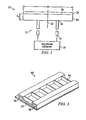
- FIGURE 1 shows one embodiment of a low profile antenna 10.
- the low profile antenna 10 generally comprises a balanced transmission line 12 having an interconnecting end 14, and a terminating end 16, electronic circuitry 18 coupled to the interconnecting end 14, and a parasitic element 26 disposed a predetermined distance from the terminating end 16.
- the balanced transmission line 12 may be made of any electrically conducting material and has a channel defining a central axis 22.
- the electronic circuitry 18 may be operable to manipulate electro-magnetic energy that is directed from the interconnecting end 14 to the terminating end 16 of the balanced transmission line 12 along the direction of the central axis 22.
- the electrical component of the electro-magnetic energy has a direction of polarization that may be generally perpendicular to the balanced transmission line 12 and to the electro-magnetic energy's direction of propagation.
- the electronic circuitry 18 may include any electrical component that is adapted to convert electro-magnetic energy suitable for use by the low profile antenna 10.
- the parasitic element 26 is a flat plate made of a conducting material such as metal.
- the parasitic element 26 has a surface 28 that is generally perpendicular to the central axis such and covers an opening formed by the terminating end.
- the low profile antenna 10 may include a dielectric layer 30 that is disposed in between the terminating end 16 of the balanced transmission line 12 and surface 28 of the parasitic element 26.
- the balanced transmission line 12 may be a slotline, twinline, parallel plate, or other type of balanced structure.
- the transmission line 12 has a length that is significantly shorter than the wavelength ( ⁇ ) of the desired frequency of operation.
- the length of the transmission line 12 is the distance from the interconnecting 14 to the terminating 16 end.
- the length of the transmission line may be less than 1/4 wavelength of the operating frequency of the low profile antenna 10.
- the length of the transmission line may be as low as approximately 1/10 the operating frequency of the low profile antenna 10.
- a low profile antenna 10 may be constructed having a relatively low profile compared to known antenna designs with similar functionality. Therefore, tuning of the low profile antenna 10 is not accomplished by the transmission line 12; rather, tuning of the antenna is accomplished using the one or more parasitic elements 26 as will be described in detail below.
- Certain embodiments may provide coupling of the terminating end 16 of a balanced transmission line 12 to free space using the parasitic element 26.
- the parasitic element 26 may be operable to match the impedance (Z) of the balanced transmission line 12 to free space. It is known that relatively efficient coupling of an antenna to free space occurs when the output impedance of the antenna is approximately 377 ohms, the characteristic impedance of free space.
- particular physical characteristics of the parasitic element 26 or dielectric layer 30 may be selected in order to manipulate the output impedance of the low profile antenna 10.
- a width W of the parasitic element 26 may be selected in order to manipulate the output impedance of the low profile antenna 10.
- the dielectric layer 30 may be selected to have a predetermined depth D 1 . In this manner, the parasitic element 26 may be disposed a predetermined distance from the terminating end 16 that is essentially equal to depth D 1 .
- the dielectric layer 30 may be made of a material having a predetermined dielectric constant selected to manipulate the output impedance of the low profile antenna 10.
- the dielectric layer 30 may be an open gap such that the dielectric layer 30 is made of air. Given the insulative aspects of the dielectric layer 30, the parasitic element 26 has no direct coupling to the electronic circuitry 18 through the transmission line 12. Thus, the dielectric layer 30 may serve a dual purpose of providing structural support for the parasitic element 26 relative to the transmission line 12 as well as to provide another approach of manipulating the output impedance of the low profile antenna 10.
- the parasitic element 26 is shown centrally disposed over the transmission line 12; however, this is not necessary. In fact, the parasitic element 26 may be offset relative to the transmission line 12 in order to further manipulate various operating parameters of the low profile antenna 10.
- offset is referred to as placement of the parasitic element 26 over the transmission line 12 in such a manner that the transmission line 12 does not lie proximate the central portion of the parasitic element 26.
- the parasitic element 26 may be disposed in any manner such that the parasitic element 26 lies over the opening formed by the terminating end 16 of the balanced transmission line 12.
- FIGURE 2 depicts another embodiment of a low profile antenna 40 in which a number of balanced transmission lines 54 and parasitic elements 48 may be configured to transmit or receive electro-magnetic energy.
- Each transmission line 54 and parasitic element 48 functions in a similar manner to the transmission line 12 and parasitic element 26 respectively of FIGURE 1 .
- the embodiment of FIGURE 2 differs in that multiple transmission lines 54 and associated parasitic elements 48 may be used in order to form an array.
- the low profile antenna 40 may be referred to as an array because multiple transmission lines 54 are associated with a corresponding multiple parasitic elements 48.
- the low profile antenna 40 generally comprises a manifold board 42, a plurality of metallic frames 44, one or more dielectric layers 46, and one or more parasitic elements 48.
- the metallic frames 44 may be configured to serve as one or more baluns as well as one or more transmission lines 54 (to be described below).
- the manifold board 42 may include circuitry that may be operable to convey an electrical signal from an unbalanced line to each of the one or more U-shaped members 56 functioning as baluns.
- the unbalanced signal may be provided by any typical unbalanced transmission line (not specifically shown) that may be, for example, a coaxial cable, unbalanced t-line feed, stripline, or a microstrip.
- the low profile antenna 10 has a depth profile D 2 that is relatively short as compared with other known antenna designs.
- FIGURE 3 shows one metallic frame 44 that has been removed from the low profile antenna 40.
- the metallic frame 44 has two inverted U-shaped members 56 and 58 that are interconnected by a cross member 62.
- One or more optional ribs 64 may be included to provide structural rigidity to the dielectric layer 46.
- the plurality of metallic frames 44 may be combined in such a manner to form the one or more transmission lines 54.
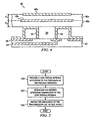
- FIGURE 4 is a partial elevational view of the embodiment of FIGURE 2 .
- a balanced transmission line 54 may be formed by adjacently disposed U-shaped members 56 and 58.
- U-shaped member 56 forms a folded balun that is operable to convert an unbalanced signal comprising electro-magnetic energy to a balanced signal suitable for use by the balanced transmission line 54.
- the U-shaped member 56 is connected to a feed line 64 that may be in turn, connected to an unbalanced line such as a coaxial cable, unbalanced t-line feed, stripline, or a microstrip feed line (not specifically shown).
- U-shaped member 58 may be connected to a ground plane 66.
- the balun which is formed by U-shaped member 56, feed line 64, and ground plane 66 may form a portion of an electronic circuit that is operable to provide a balanced signal comprising electro-magnetic energy to the balanced transmission line 54.
- two parasitic elements 48a and 48b are disposed over each of the U-shaped members 56 and 58.
- the low profile antenna 40 may have multiple parasitic elements 48a and 48b that serve to couple electro-magnetic energy from the transmission line 54 to free space. Neither of the parasitic elements 48a and 48b have any direct coupling to the transmission line 54 or to each other. Isolation of the parasitic elements 48a and 48b is accomplished by two associated dielectric layers 46a and 46b.
- Dielectric layer 46a serves to separate parasitic element 48a from the balanced transmission line 54 by a predetermined distance D 3 .
- the second dielectric layer 46b serves to separate parasitic element 48b from parasitic element 48b by a second predetermined distance D 4 .
- the dimensional qualities of parasitic element 48a and dielectric layer 46a may be selected in order to manipulate the output impedance of the low profile antenna 40. Additionally, the dimensional qualities of the second parasitic element 48b and second dielectric layer 46b may also be selected to further manipulate the output impedance of the low profile antenna 40. Although embodiments are described herein in which a quantity of two parasitic elements 48a and 48b are shown, it should be appreciated that any number of parasitic elements 48 may be used.
- FIGURE 5 shows a series of actions that may be performed in order to construct the low profile antenna 10 or 40.
- a low profile antenna 10 or 40 may be provided according to the embodiments of FIGURE 1 or FIGURES 2 through 4 respectively.
- the desired operating parameters of the low profile antenna 10 or 40 may be established.
- the desired operating parameters of the low profile antenna 10 or 40 may include a frequency of operation, a frequency bandwidth (BW), and a two-dimensional scan capability. For example, it may be desirable to construct a low profile antenna having an operating frequency of 12 Giga-Hertz at an operating bandwidth of 3:1 and a two-dimensional scan capability of 45 degrees.
- BW frequency bandwidth
- These desired operating parameters describe only one example of a low profile antenna 10 or 40 that may be constructed. It should be appreciated that a low profile having operating and physical parameters other than those described above may be constructed according to the
- the impedance of the transmission line 12 or 54 is generally matched to free space over the desired bandwidth of frequencies in act 104. It should be appreciated that the act of matching the transmission line 12 or 54 to free space is not intended to provide a perfect match over the entire range of desired operating bandwidth. However, the terminology "matched" is intended to indicate a level of impedance matching over the desired range of operating frequencies sufficient to allow transmission and/or reception of electro-magnetic energy from free space to the low profile antenna 10 or 40. The act of matching the transmission line 12 or 54 to free space may be accomplished by selecting one or more physical characteristics of the low profile antenna 10 or 40.
- the physical characteristics may include selecting the width of each of the one or more parasitic element 26 or 48, selecting a depth of the dielectric layer 30 or 46, selecting a dielectric constant of the material from which the dielectric layer 30 or 46 is formed, the number of parasitic elements 26 or 48 used, or the level of offset of the parasitic element 26 or 48 relative to the transmission line 12 or 54. It should be understood that other physical characteristics than those disclosed may be operable to modify the operating parameters of the low profile antenna 10 or 40. However, only several key physical characteristics have been disclosed for the purposes of brevity and clarity of disclosure.
- the low profile antenna 40 may be designed having a frequency of operation in the range of 6 to 18 Giga-Hertz having a frequency bandwidth of 3:1. Additionally, the low profile antenna 40 may have an overall depth D 2 of approximately 1/10 wavelength at the lowest operating frequency. The given operating parameters described above may be accomplished by implementing a quantity of two parasitic elements 48. Thus, it may be seen that a low profile antenna 40 may be realized having a relatively wide bandwidth in conjunction with a relatively low depth profile.
Landscapes
- Physics & Mathematics (AREA)
- Electromagnetism (AREA)
- Waveguide Aerials (AREA)
Claims (28)
- Antenne (10), aufweisend:eine symmetrische Übertragungsleitung (12) mit einem Durchschaltungsende (14), einem Abschlussende (16) und einem Kanal, der eine Mittelachse (22) definiert;eine elektronische Schaltung (18), die mit dem Durchschaltungsende (14) verbunden ist und dazu dient, elektromagnetische Energie entlang einer Fortpflanzungsrichtung zum Abschlussende (16) zu leiten, wobei die Fortpflanzungsrichtung im Wesentlichen auf einer Linie mit der Mittelachse (22) liegt; undmindestens eine flache Platte (26) mit einer Oberfläche, die in einem vorgegebenen Abstand vom Abschlussende (16) und senkrecht zur Mittelachse (22) so angeordnet ist, dass die Oberfläche oberhalb einer Öffnung des Kanals liegt, die vom Abschlussende (16) gebildet wird, und dadurch gekennzeichnet, dass die Oberfläche außerdem oberhalb einer Öffnung des Kanals liegt, die vom Durchschaltungsende (14) der symmetrischen Übertragungsleitung (12) gebildet wird.
- Antenne (10) nach Anspruch 1, wobei die flache Platte (26) elektromagnetische Energie aus der symmetrischen Übertragungsleitung (12) mit dem Freiraum koppelt.
- Antenne (10) nach Anspruch 1 oder 2, wobei die elektronische Schaltung (18) einen Balun umfasst.
- Antenne (10) nach Anspruch 3, wobei der Balun ein gefalteter Balun ist.
- Antenne (10) nach einem der vorangehenden Ansprüche, wobei die elektronische Schaltung (18) eine Masseplatte aufweist.
- Antenne (10) nach einem der vorangehenden Ansprüche, wobei die symmetrische Übertragungsleitung (12) ein Paar paralleler Platten aufweist.
- Antenne (10) nach einem der vorangehenden Ansprüche, wobei jede von den parallelen Platten einen Abschnitt eines gefalteten Baluns bildet.
- Antenne (10) nach einem der vorangehenden Ansprüche, wobei die Antenne (10) eine Betriebsbandbreite von etwa 3:1 aufweist.
- Antenne (10) nach einem der vorangehenden Ansprüche, wobei die symmetrische Übertragungsleitung (12) ein Streifenleiter, ein Zweidrahtleiter oder eine parallele Platte ist.
- Antenne (10) nach einem der vorangehenden Ansprüche, ferner eine dielektrische Schicht (30) aufweisend, die zwischen dem Abschlussende (16) der symmetrischen Übertragungsleitung (12) und der Oberfläche der flachen Platte (26) angeordnet ist.
- Antenne (10) nach einem der vorangehenden Ansprüche, wobei es sich bei der mindestens einen flachen Platte (26) um mindestens zwei flache Platten (48) handelt.
- Antenne (10) nach einem der vorangehenden Ansprüche, wobei die symmetrische Übertragungsleitung (12) eine Länge aufweist, die weniger als ¼ der Wellenlänge der Betriebsfrequenz der Antenne (10) beträgt.
- Flache Antenne (10), aufweisend:ein Paar paralleler Platten (56, 58), die eine symmetrische Übertragungsleitung (54) mit einem Durchschaltungsende (14), einem Abschlussende (16) und einem eine Mittelachse (22) definierenden Kanal definieren, wobei eine von den parallelen Platten (56) einen Abschnitt eines gefalteten Baluns bildet und die andere von den parallelen Platten (58) mit einer Masseplatte (66) verkoppelt ist, wobei das Durchschaltungsende (14) mit einer asymmetrischen Übertragungsleitung verbunden ist;mindestens eine im Allgemeinen flache Platte (48) mit einer Oberfläche, die in einem vorgegebenen Abstand vom Abschlussende (16) und senkrecht zur Mittelachse (23) so angeordnet ist, dass die Oberfläche oberhalb einer vom Abschlussende (16) gebildeten Öffnung und einer vom Durchschaltungsende (14) gebildeten Öffnung des Kanals der von den parallelen Platten (56, 58) gebildeten symmetrischen Übertragungsleitung (54) liegt; undeine dielektrische Schicht (46), die zwischen dem Abschlussende (16) der symmetrischen Übertragungsleitung (54) und der Oberfläche der flachen Platte (48) angeordnet ist.
- Flache Antenne (10) nach Anspruch 13, wobei es sich bei der mindestens einen flachen Platte (48) um mindestens zwei flache Platten (48) handelt.
- Flache Antenne (10) nach Anspruch 13 oder 14, wobei die symmetrische Übertragungsleitung (54) eine Länge aufweist, die weniger als ¼ der Wellenlänge der Betriebsfrequenz der flachen Antenne (10) beträgt.
- Verfahren zum Aufbauen einer Antenne (10), umfassend:Bereitstellen einer Antenne (10), die aufweist: eine symmetrische Übertragungsleitung (12) mit einem Durchschaltungsende (14), einem Abschlussende (16) und einem eine Mittelachse (22) definierenden Kanal, eine elektronische Schaltung (18), die mit dem Durchschaltungsende (14) verkoppelt ist und dazu dient, elektromagnetische Energie entlang einer Fortpflanzungsrichtung zum Abschlussende (16) zu leiten, wobei die Fortpflanzungsrichtung im Wesentlichen auf einer Linie mit der Mittelachse (22) liegt; und mindestens eine flache Platte (26) mit einer Oberfläche, die in einem vorgegebenen Abstand vom Abschlussende (16) und senkrecht zur Fortpflanzungsrichtung so angeordnet ist, dass die Oberfläche oberhalb einer Öffnung des Kanals liegt, die vom Abschlussende (16) gebildet wird, und dadurch gekennzeichnet, dass die Oberfläche auch oberhalb einer Öffnung des Kanals liegt, die vom Durchschaltungsende (14) der symmetrischen Übertragungsleitung (12) gebildet wird;Bestimmen der gewünschten Betriebsparameter der Antenne (10); undAnpassen der Impedanz der symmetrischen Übertragungsleitung (12) an den Freiraum.
- Verfahren nach Anspruch 16, wobei das Anpassen der Impedanz der symmetrischen Übertragungsleitung (12) an den Freiraum ferner das Auswählen einer Breite der mindestens einen flachen Platte (26) beinhaltet.
- Verfahren nach Anspruch 16 oder 17, ferner umfassend:Bereitstellen einer dielektrischen Schicht (30) zwischen dem Abschlussende (16) und der mindestens einen flachen Platte (26), wobei das Anpassen der Impedanz der symmetrischen Übertragungsleitung (12) an den Freiraum ferner das Auswählen einer Tiefe der dielektrischen Schicht (30) beinhaltet.
- Verfahren nach einem der vorangehenden Ansprüche 16 bis 18, ferner umfassend:Bereitstellen einer dielektrischen Schicht (30) zwischen dem Abschlussende (16) und der mindestens einen flachen Platte (26), wobei das Anpassen der Impedanz der symmetrischen Übertragungsleitung (12) an den Freiraum ferner das Auswählen einer dielektrischen Konstante des Materials, aus dem die dielektrische Schicht (30) gebildet, beinhaltet.
- Verfahren nach einem der vorangehenden Ansprüche 16 bis 19, wobei das Anpassen der Impedanz der symmetrischen Übertragungsleitung (12) an den Freiraum ferner das Auswählen einer Größe der mindestens einen flachen Platte (26) beinhaltet.
- Antenne (10) nach Anspruch 10, ferner aufweisend:eine zweite flache Platte (48b), die in einem vorgegebenen Abstand von der mindestens einen flachen Platte (48a) angeordnet ist;eine zweite dielektrische Schicht (46b), die zwischen der mindestens einen flachen Platte (48a) und der zweiten flachen Platte (48b) angeordnet ist.
- Antenne (10) nach Anspruch 21, wobei die dimensionalen Eigenschaften der dielektrischen Schichten (46a, 46b) und der flachen Platten (48a, 48b) ausgewählt werden, um eine Ausgangsimpedanz der symmetrischen Übertragungsleitung (54) zu manipulieren.
- Antenne (10) nach Anspruch 22, wobei die dimensionalen Eigenschaften der dielektrischen Schichten (46a, 46b) und der flachen Platten (48a, 48b) ausgewählt werden, um eine Ausgangsimpedanz der symmetrischen Übertragungsleitung (54) an den Freiraum anzupassen.
- Antenne (10) nach Anspruch 13, wobei die mindestens eine flache Platte (26) elektromagnetische Energie von der symmetrischen Übertragungsleitung (12) mit dem Freiraum koppelt.
- Antenne (10) nach Anspruch 13, ferner aufweisend:eine zweite flache Platte (48b), die in einem vorgegebenen Abstand von der mindestens einen flachen Platte (48a) angeordnet ist;eine zweite dielektrische Schicht (46b), die zwischen der mindestens einen flachen Platte (48a) und der zweiten flachen Platte (48b) angeordnet ist.
- Antenne nach Anspruch 25, wobei die dimensionalen Eigenschaften der dielektrischen Schichten (46a, 46b) und der flachen Platten (48a, 48b) ausgewählt werden, um eine Ausgangsimpedanz der symmetrischen Übertragungsleitung (54) zu manipulieren.
- Antenne (10) nach Anspruch 26, wobei die dimensionalen Eigenschaften der dielektrischen Schichten (46a, 46b) und der flachen Platten (48a, 48b) ausgewählt werden, um eine Ausgangsimpedanz der symmetrischen Übertragungsleitung (54) an den Freiraum anzupassen.
- Antenne (10) nach Anspruch 1, wobei die flache Platte (26) dazu dient, die Impedanz der symmetrischen Übertragungsleitung (12) an freien Raum anzupassen.
Applications Claiming Priority (1)
| Application Number | Priority Date | Filing Date | Title |
|---|---|---|---|
| US11/734,517 US7948441B2 (en) | 2007-04-12 | 2007-04-12 | Low profile antenna |
Publications (2)
| Publication Number | Publication Date |
|---|---|
| EP1981121A1 EP1981121A1 (de) | 2008-10-15 |
| EP1981121B1 true EP1981121B1 (de) | 2014-04-23 |
Family
ID=39495228
Family Applications (1)
| Application Number | Title | Priority Date | Filing Date |
|---|---|---|---|
| EP08006242.5A Active EP1981121B1 (de) | 2007-04-12 | 2008-03-31 | Niedrigprofilantenne |
Country Status (2)
| Country | Link |
|---|---|
| US (1) | US7948441B2 (de) |
| EP (1) | EP1981121B1 (de) |
Families Citing this family (15)
| Publication number | Priority date | Publication date | Assignee | Title |
|---|---|---|---|---|
| US9537208B2 (en) | 2012-11-12 | 2017-01-03 | Raytheon Company | Dual polarization current loop radiator with integrated balun |
| US10581177B2 (en) | 2016-12-15 | 2020-03-03 | Raytheon Company | High frequency polymer on metal radiator |
| US11088467B2 (en) | 2016-12-15 | 2021-08-10 | Raytheon Company | Printed wiring board with radiator and feed circuit |
| US10541461B2 (en) | 2016-12-16 | 2020-01-21 | Ratheon Company | Tile for an active electronically scanned array (AESA) |
| JP6597659B2 (ja) * | 2017-02-01 | 2019-10-30 | 株式会社村田製作所 | アンテナ装置及びアンテナ装置の製造方法 |
| US10361485B2 (en) | 2017-08-04 | 2019-07-23 | Raytheon Company | Tripole current loop radiating element with integrated circularly polarized feed |
| US10971806B2 (en) | 2017-08-22 | 2021-04-06 | The Boeing Company | Broadband conformal antenna |
| US10826186B2 (en) | 2017-08-28 | 2020-11-03 | Raytheon Company | Surface mounted notch radiator with folded balun |
| US10424847B2 (en) | 2017-09-08 | 2019-09-24 | Raytheon Company | Wideband dual-polarized current loop antenna element |
| US11233310B2 (en) * | 2018-01-29 | 2022-01-25 | The Boeing Company | Low-profile conformal antenna |
| US10938082B2 (en) | 2018-08-24 | 2021-03-02 | The Boeing Company | Aperture-coupled microstrip-to-waveguide transitions |
| US10923831B2 (en) | 2018-08-24 | 2021-02-16 | The Boeing Company | Waveguide-fed planar antenna array with enhanced circular polarization |
| US10916853B2 (en) | 2018-08-24 | 2021-02-09 | The Boeing Company | Conformal antenna with enhanced circular polarization |
| US11276933B2 (en) | 2019-11-06 | 2022-03-15 | The Boeing Company | High-gain antenna with cavity between feed line and ground plane |
| US11152715B2 (en) | 2020-02-18 | 2021-10-19 | Raytheon Company | Dual differential radiator |
Family Cites Families (25)
| Publication number | Priority date | Publication date | Assignee | Title |
|---|---|---|---|---|
| US3740754A (en) * | 1972-05-24 | 1973-06-19 | Gte Sylvania Inc | Broadband cup-dipole and cup-turnstile antennas |
| US3976959A (en) * | 1974-07-22 | 1976-08-24 | Gaspari Russell A | Planar balun |
| JPH0612852B2 (ja) | 1986-03-18 | 1994-02-16 | 日本無線株式会社 | パラボラアンテナ |
| GB2213996A (en) | 1987-12-22 | 1989-08-23 | Philips Electronic Associated | Coplanar patch antenna |
| FR2654554B1 (fr) * | 1989-11-10 | 1992-07-31 | France Etat | Antenne en helice, quadrifilaire, resonnante bicouche. |
| US5594455A (en) * | 1994-06-13 | 1997-01-14 | Nippon Telegraph & Telephone Corporation | Bidirectional printed antenna |
| US6024812A (en) * | 1996-07-20 | 2000-02-15 | Dynamit Nobel Gmbh Explosivstoff-Und Systemtechnik | Pyrotechnic mixture as propellant or a gas charge with carbon monoxide-reduced vapors |
| US5874924A (en) * | 1997-11-17 | 1999-02-23 | Lockheed Martin Corp. | Spacecraft antenna array with directivity enhancing rings |
| US6097349A (en) * | 1997-11-18 | 2000-08-01 | Ericsson Inc. | Compact antenna feed circuits |
| US6114997A (en) * | 1998-05-27 | 2000-09-05 | Raytheon Company | Low-profile, integrated radiator tiles for wideband, dual-linear and circular-polarized phased array applications |
| US6147653A (en) * | 1998-12-07 | 2000-11-14 | Wallace; Raymond C. | Balanced dipole antenna for mobile phones |
| US6310585B1 (en) * | 1999-09-29 | 2001-10-30 | Radio Frequency Systems, Inc. | Isolation improvement mechanism for dual polarization scanning antennas |
| US6239755B1 (en) * | 1999-10-28 | 2001-05-29 | Qualcomm Incorporated | Balanced, retractable mobile phone antenna |
| US6300906B1 (en) * | 2000-01-05 | 2001-10-09 | Harris Corporation | Wideband phased array antenna employing increased packaging density laminate structure containing feed network, balun and power divider circuitry |
| US6747606B2 (en) | 2002-05-31 | 2004-06-08 | Radio Frequency Systems Inc. | Single or dual polarized molded dipole antenna having integrated feed structure |
| US6891448B2 (en) * | 2002-09-03 | 2005-05-10 | Broadcom Corporation | Compact balun for 802.11a applications |
| US7283101B2 (en) * | 2003-06-26 | 2007-10-16 | Andrew Corporation | Antenna element, feed probe; dielectric spacer, antenna and method of communicating with a plurality of devices |
| US6924776B2 (en) * | 2003-07-03 | 2005-08-02 | Andrew Corporation | Wideband dual polarized base station antenna offering optimized horizontal beam radiation patterns and variable vertical beam tilt |
| DE202004008770U1 (de) | 2004-06-03 | 2004-08-12 | Kathrein-Werke Kg | Dualpolarisierte Antenne |
| US7068235B2 (en) * | 2004-07-26 | 2006-06-27 | Row 44, Llc | Antenna system |
| JP4408405B2 (ja) * | 2004-09-21 | 2010-02-03 | 富士通株式会社 | 平面アンテナおよび無線装置 |
| GB2424765B (en) | 2005-03-29 | 2007-07-25 | Csa Ltd | A dipole antenna |
| MXPA06003617A (es) | 2005-04-25 | 2007-02-02 | Rymsa | Antena de cavidad excitada con uno o varios dipolos. |
| US7388556B2 (en) * | 2005-06-01 | 2008-06-17 | Andrew Corporation | Antenna providing downtilt and preserving half power beam width |
| US7688265B2 (en) * | 2007-09-18 | 2010-03-30 | Raytheon Company | Dual polarized low profile antenna |
-
2007
- 2007-04-12 US US11/734,517 patent/US7948441B2/en active Active
-
2008
- 2008-03-31 EP EP08006242.5A patent/EP1981121B1/de active Active
Also Published As
| Publication number | Publication date |
|---|---|
| US20080252544A1 (en) | 2008-10-16 |
| US7948441B2 (en) | 2011-05-24 |
| EP1981121A1 (de) | 2008-10-15 |
Similar Documents
| Publication | Publication Date | Title |
|---|---|---|
| US7948441B2 (en) | Low profile antenna | |
| CN111525252B (zh) | 一种基于耦合馈电的宽带双极化天线单元 | |
| US7642979B2 (en) | Wave-guide-notch antenna | |
| US7180457B2 (en) | Wideband phased array radiator | |
| US6552691B2 (en) | Broadband dual-polarized microstrip notch antenna | |
| Doane et al. | A wideband, wide scanning tightly coupled dipole array with integrated balun (TCDA-IB) | |
| JP6820135B2 (ja) | 低交差偏波ディケード帯域幅の超広帯域アンテナ素子およびアレイ | |
| US6292153B1 (en) | Antenna comprising two wideband notch regions on one coplanar substrate | |
| US8537068B2 (en) | Method and apparatus for tri-band feed with pseudo-monopulse tracking | |
| US6246377B1 (en) | Antenna comprising two separate wideband notch regions on one coplanar substrate | |
| CN107949954B (zh) | 无源串馈式电子引导电介质行波阵列 | |
| US7688265B2 (en) | Dual polarized low profile antenna | |
| US20060038732A1 (en) | Broadband dual polarized slotline feed circuit | |
| JPH11317615A (ja) | 多周波マイクロストリップアンテナと前記アンテナを備える装置 | |
| US20090033559A1 (en) | Broadband antenna system | |
| CN114725697A (zh) | 一种宽带双极化空心波导缝隙天线 | |
| Wincza et al. | A broadband 4/spl times/4 Butler matrix for modern-day antennas | |
| US20210273339A1 (en) | Wideband Dual-Polarized Four-Quad Loop Antenna | |
| CN108054501B (zh) | 一种具有等波纹轴比响应的宽带圆极化天线 | |
| US9583841B2 (en) | Balun | |
| CN212303901U (zh) | 一种低轮廓微带天线 | |
| CN109509964A (zh) | 一种宽带圆极化阵列天线 | |
| EP4391216A1 (de) | Vorrichtung und system zum teilen und kombinieren von signalen im frequenzbereich | |
| JPH0562481B2 (de) | ||
| JPS60213104A (ja) | マイクロ波アンテナ |
Legal Events
| Date | Code | Title | Description |
|---|---|---|---|
| PUAI | Public reference made under article 153(3) epc to a published international application that has entered the european phase |
Free format text: ORIGINAL CODE: 0009012 |
|
| 17P | Request for examination filed |
Effective date: 20080331 |
|
| AK | Designated contracting states |
Kind code of ref document: A1 Designated state(s): AT BE BG CH CY CZ DE DK EE ES FI FR GB GR HR HU IE IS IT LI LT LU LV MC MT NL NO PL PT RO SE SI SK TR |
|
| AX | Request for extension of the european patent |
Extension state: AL BA MK RS |
|
| 17Q | First examination report despatched |
Effective date: 20090421 |
|
| AKX | Designation fees paid |
Designated state(s): AT BE BG CH CY CZ DE DK EE ES FI FR GB GR HR HU IE IS IT LI LT LU LV MC MT NL NO PL PT RO SE SI SK TR |
|
| GRAP | Despatch of communication of intention to grant a patent |
Free format text: ORIGINAL CODE: EPIDOSNIGR1 |
|
| INTG | Intention to grant announced |
Effective date: 20131128 |
|
| GRAS | Grant fee paid |
Free format text: ORIGINAL CODE: EPIDOSNIGR3 |
|
| GRAA | (expected) grant |
Free format text: ORIGINAL CODE: 0009210 |
|
| AK | Designated contracting states |
Kind code of ref document: B1 Designated state(s): AT BE BG CH CY CZ DE DK EE ES FI FR GB GR HR HU IE IS IT LI LT LU LV MC MT NL NO PL PT RO SE SI SK TR |
|
| REG | Reference to a national code |
Ref country code: GB Ref legal event code: FG4D |
|
| REG | Reference to a national code |
Ref country code: CH Ref legal event code: EP |
|
| REG | Reference to a national code |
Ref country code: AT Ref legal event code: REF Ref document number: 664312 Country of ref document: AT Kind code of ref document: T Effective date: 20140515 |
|
| REG | Reference to a national code |
Ref country code: IE Ref legal event code: FG4D |
|
| REG | Reference to a national code |
Ref country code: DE Ref legal event code: R096 Ref document number: 602008031644 Country of ref document: DE Effective date: 20140605 |
|
| REG | Reference to a national code |
Ref country code: AT Ref legal event code: MK05 Ref document number: 664312 Country of ref document: AT Kind code of ref document: T Effective date: 20140423 |
|
| REG | Reference to a national code |
Ref country code: NL Ref legal event code: VDEP Effective date: 20140423 |
|
| REG | Reference to a national code |
Ref country code: LT Ref legal event code: MG4D |
|
| PG25 | Lapsed in a contracting state [announced via postgrant information from national office to epo] |
Ref country code: FI Free format text: LAPSE BECAUSE OF FAILURE TO SUBMIT A TRANSLATION OF THE DESCRIPTION OR TO PAY THE FEE WITHIN THE PRESCRIBED TIME-LIMIT Effective date: 20140423 Ref country code: CY Free format text: LAPSE BECAUSE OF FAILURE TO SUBMIT A TRANSLATION OF THE DESCRIPTION OR TO PAY THE FEE WITHIN THE PRESCRIBED TIME-LIMIT Effective date: 20140423 Ref country code: IS Free format text: LAPSE BECAUSE OF FAILURE TO SUBMIT A TRANSLATION OF THE DESCRIPTION OR TO PAY THE FEE WITHIN THE PRESCRIBED TIME-LIMIT Effective date: 20140823 Ref country code: NO Free format text: LAPSE BECAUSE OF FAILURE TO SUBMIT A TRANSLATION OF THE DESCRIPTION OR TO PAY THE FEE WITHIN THE PRESCRIBED TIME-LIMIT Effective date: 20140723 Ref country code: GR Free format text: LAPSE BECAUSE OF FAILURE TO SUBMIT A TRANSLATION OF THE DESCRIPTION OR TO PAY THE FEE WITHIN THE PRESCRIBED TIME-LIMIT Effective date: 20140724 Ref country code: BG Free format text: LAPSE BECAUSE OF FAILURE TO SUBMIT A TRANSLATION OF THE DESCRIPTION OR TO PAY THE FEE WITHIN THE PRESCRIBED TIME-LIMIT Effective date: 20140723 Ref country code: NL Free format text: LAPSE BECAUSE OF FAILURE TO SUBMIT A TRANSLATION OF THE DESCRIPTION OR TO PAY THE FEE WITHIN THE PRESCRIBED TIME-LIMIT Effective date: 20140423 Ref country code: LT Free format text: LAPSE BECAUSE OF FAILURE TO SUBMIT A TRANSLATION OF THE DESCRIPTION OR TO PAY THE FEE WITHIN THE PRESCRIBED TIME-LIMIT Effective date: 20140423 |
|
| PG25 | Lapsed in a contracting state [announced via postgrant information from national office to epo] |
Ref country code: SE Free format text: LAPSE BECAUSE OF FAILURE TO SUBMIT A TRANSLATION OF THE DESCRIPTION OR TO PAY THE FEE WITHIN THE PRESCRIBED TIME-LIMIT Effective date: 20140423 Ref country code: LV Free format text: LAPSE BECAUSE OF FAILURE TO SUBMIT A TRANSLATION OF THE DESCRIPTION OR TO PAY THE FEE WITHIN THE PRESCRIBED TIME-LIMIT Effective date: 20140423 Ref country code: ES Free format text: LAPSE BECAUSE OF FAILURE TO SUBMIT A TRANSLATION OF THE DESCRIPTION OR TO PAY THE FEE WITHIN THE PRESCRIBED TIME-LIMIT Effective date: 20140423 Ref country code: PL Free format text: LAPSE BECAUSE OF FAILURE TO SUBMIT A TRANSLATION OF THE DESCRIPTION OR TO PAY THE FEE WITHIN THE PRESCRIBED TIME-LIMIT Effective date: 20140423 Ref country code: HR Free format text: LAPSE BECAUSE OF FAILURE TO SUBMIT A TRANSLATION OF THE DESCRIPTION OR TO PAY THE FEE WITHIN THE PRESCRIBED TIME-LIMIT Effective date: 20140423 Ref country code: AT Free format text: LAPSE BECAUSE OF FAILURE TO SUBMIT A TRANSLATION OF THE DESCRIPTION OR TO PAY THE FEE WITHIN THE PRESCRIBED TIME-LIMIT Effective date: 20140423 |
|
| PG25 | Lapsed in a contracting state [announced via postgrant information from national office to epo] |
Ref country code: PT Free format text: LAPSE BECAUSE OF FAILURE TO SUBMIT A TRANSLATION OF THE DESCRIPTION OR TO PAY THE FEE WITHIN THE PRESCRIBED TIME-LIMIT Effective date: 20140825 |
|
| REG | Reference to a national code |
Ref country code: DE Ref legal event code: R097 Ref document number: 602008031644 Country of ref document: DE |
|
| PG25 | Lapsed in a contracting state [announced via postgrant information from national office to epo] |
Ref country code: SK Free format text: LAPSE BECAUSE OF FAILURE TO SUBMIT A TRANSLATION OF THE DESCRIPTION OR TO PAY THE FEE WITHIN THE PRESCRIBED TIME-LIMIT Effective date: 20140423 Ref country code: RO Free format text: LAPSE BECAUSE OF FAILURE TO SUBMIT A TRANSLATION OF THE DESCRIPTION OR TO PAY THE FEE WITHIN THE PRESCRIBED TIME-LIMIT Effective date: 20140423 Ref country code: CZ Free format text: LAPSE BECAUSE OF FAILURE TO SUBMIT A TRANSLATION OF THE DESCRIPTION OR TO PAY THE FEE WITHIN THE PRESCRIBED TIME-LIMIT Effective date: 20140423 Ref country code: DK Free format text: LAPSE BECAUSE OF FAILURE TO SUBMIT A TRANSLATION OF THE DESCRIPTION OR TO PAY THE FEE WITHIN THE PRESCRIBED TIME-LIMIT Effective date: 20140423 Ref country code: BE Free format text: LAPSE BECAUSE OF FAILURE TO SUBMIT A TRANSLATION OF THE DESCRIPTION OR TO PAY THE FEE WITHIN THE PRESCRIBED TIME-LIMIT Effective date: 20140423 Ref country code: EE Free format text: LAPSE BECAUSE OF FAILURE TO SUBMIT A TRANSLATION OF THE DESCRIPTION OR TO PAY THE FEE WITHIN THE PRESCRIBED TIME-LIMIT Effective date: 20140423 |
|
| PLBE | No opposition filed within time limit |
Free format text: ORIGINAL CODE: 0009261 |
|
| STAA | Information on the status of an ep patent application or granted ep patent |
Free format text: STATUS: NO OPPOSITION FILED WITHIN TIME LIMIT |
|
| PG25 | Lapsed in a contracting state [announced via postgrant information from national office to epo] |
Ref country code: IT Free format text: LAPSE BECAUSE OF FAILURE TO SUBMIT A TRANSLATION OF THE DESCRIPTION OR TO PAY THE FEE WITHIN THE PRESCRIBED TIME-LIMIT Effective date: 20140423 |
|
| 26N | No opposition filed |
Effective date: 20150126 |
|
| REG | Reference to a national code |
Ref country code: DE Ref legal event code: R097 Ref document number: 602008031644 Country of ref document: DE Effective date: 20150126 |
|
| PG25 | Lapsed in a contracting state [announced via postgrant information from national office to epo] |
Ref country code: SI Free format text: LAPSE BECAUSE OF FAILURE TO SUBMIT A TRANSLATION OF THE DESCRIPTION OR TO PAY THE FEE WITHIN THE PRESCRIBED TIME-LIMIT Effective date: 20140423 |
|
| PG25 | Lapsed in a contracting state [announced via postgrant information from national office to epo] |
Ref country code: MC Free format text: LAPSE BECAUSE OF FAILURE TO SUBMIT A TRANSLATION OF THE DESCRIPTION OR TO PAY THE FEE WITHIN THE PRESCRIBED TIME-LIMIT Effective date: 20140423 Ref country code: LU Free format text: LAPSE BECAUSE OF FAILURE TO SUBMIT A TRANSLATION OF THE DESCRIPTION OR TO PAY THE FEE WITHIN THE PRESCRIBED TIME-LIMIT Effective date: 20150331 |
|
| REG | Reference to a national code |
Ref country code: CH Ref legal event code: PL |
|
| REG | Reference to a national code |
Ref country code: IE Ref legal event code: MM4A |
|
| PG25 | Lapsed in a contracting state [announced via postgrant information from national office to epo] |
Ref country code: LI Free format text: LAPSE BECAUSE OF NON-PAYMENT OF DUE FEES Effective date: 20150331 Ref country code: IE Free format text: LAPSE BECAUSE OF NON-PAYMENT OF DUE FEES Effective date: 20150331 Ref country code: CH Free format text: LAPSE BECAUSE OF NON-PAYMENT OF DUE FEES Effective date: 20150331 |
|
| REG | Reference to a national code |
Ref country code: FR Ref legal event code: PLFP Year of fee payment: 9 |
|
| PG25 | Lapsed in a contracting state [announced via postgrant information from national office to epo] |
Ref country code: MT Free format text: LAPSE BECAUSE OF FAILURE TO SUBMIT A TRANSLATION OF THE DESCRIPTION OR TO PAY THE FEE WITHIN THE PRESCRIBED TIME-LIMIT Effective date: 20140423 |
|
| REG | Reference to a national code |
Ref country code: FR Ref legal event code: PLFP Year of fee payment: 10 |
|
| PG25 | Lapsed in a contracting state [announced via postgrant information from national office to epo] |
Ref country code: HU Free format text: LAPSE BECAUSE OF FAILURE TO SUBMIT A TRANSLATION OF THE DESCRIPTION OR TO PAY THE FEE WITHIN THE PRESCRIBED TIME-LIMIT; INVALID AB INITIO Effective date: 20080331 |
|
| PG25 | Lapsed in a contracting state [announced via postgrant information from national office to epo] |
Ref country code: TR Free format text: LAPSE BECAUSE OF FAILURE TO SUBMIT A TRANSLATION OF THE DESCRIPTION OR TO PAY THE FEE WITHIN THE PRESCRIBED TIME-LIMIT Effective date: 20140423 |
|
| REG | Reference to a national code |
Ref country code: FR Ref legal event code: PLFP Year of fee payment: 11 |
|
| P01 | Opt-out of the competence of the unified patent court (upc) registered |
Effective date: 20230530 |
|
| PGFP | Annual fee paid to national office [announced via postgrant information from national office to epo] |
Ref country code: GB Payment date: 20260220 Year of fee payment: 19 |
|
| PGFP | Annual fee paid to national office [announced via postgrant information from national office to epo] |
Ref country code: DE Payment date: 20260219 Year of fee payment: 19 |
|
| PGFP | Annual fee paid to national office [announced via postgrant information from national office to epo] |
Ref country code: FR Payment date: 20260219 Year of fee payment: 19 |