EP1976990B1 - Chimeric, hybrid and tandem polypeptides of meningococcal nmb1870 - Google Patents
Chimeric, hybrid and tandem polypeptides of meningococcal nmb1870 Download PDFInfo
- Publication number
- EP1976990B1 EP1976990B1 EP06831853A EP06831853A EP1976990B1 EP 1976990 B1 EP1976990 B1 EP 1976990B1 EP 06831853 A EP06831853 A EP 06831853A EP 06831853 A EP06831853 A EP 06831853A EP 1976990 B1 EP1976990 B1 EP 1976990B1
- Authority
- EP
- European Patent Office
- Prior art keywords
- seq
- polypeptide
- sequence
- saccharide
- sequences
- Prior art date
- Legal status (The legal status is an assumption and is not a legal conclusion. Google has not performed a legal analysis and makes no representation as to the accuracy of the status listed.)
- Revoked
Links
- 108090000765 processed proteins & peptides Proteins 0.000 title claims description 89
- 102000004196 processed proteins & peptides Human genes 0.000 title claims description 86
- 229920001184 polypeptide Polymers 0.000 title claims description 82
- 101100446533 Neisseria meningitidis serogroup B (strain MC58) fhbP gene Proteins 0.000 claims abstract description 33
- 239000000203 mixture Substances 0.000 claims description 107
- 239000002671 adjuvant Substances 0.000 claims description 43
- 230000000844 anti-bacterial effect Effects 0.000 claims description 29
- 108020004707 nucleic acids Proteins 0.000 claims description 22
- 102000039446 nucleic acids Human genes 0.000 claims description 22
- 150000007523 nucleic acids Chemical class 0.000 claims description 22
- 150000001413 amino acids Chemical class 0.000 claims description 17
- 238000006467 substitution reaction Methods 0.000 claims description 16
- 230000002163 immunogen Effects 0.000 claims description 11
- 125000003275 alpha amino acid group Chemical group 0.000 claims description 8
- 102220480531 GSK3B-interacting protein_K85R_mutation Human genes 0.000 claims description 2
- 102200024053 rs2856597 Human genes 0.000 claims description 2
- 102200028556 rs61754449 Human genes 0.000 claims description 2
- 102200069353 rs8103142 Human genes 0.000 claims description 2
- 102220096728 rs876658680 Human genes 0.000 claims description 2
- 102220237176 rs946543006 Human genes 0.000 claims description 2
- 108090000623 proteins and genes Proteins 0.000 abstract description 46
- 102000004169 proteins and genes Human genes 0.000 abstract description 32
- 241000588650 Neisseria meningitidis Species 0.000 abstract description 14
- 108091007433 antigens Proteins 0.000 description 92
- 102000036639 antigens Human genes 0.000 description 92
- 239000000427 antigen Substances 0.000 description 89
- 150000001720 carbohydrates Chemical class 0.000 description 78
- 229960005486 vaccine Drugs 0.000 description 35
- 235000018102 proteins Nutrition 0.000 description 29
- 229920001282 polysaccharide Polymers 0.000 description 25
- 239000005017 polysaccharide Substances 0.000 description 25
- 150000004676 glycans Chemical class 0.000 description 24
- 102000014914 Carrier Proteins Human genes 0.000 description 21
- 108010078791 Carrier Proteins Proteins 0.000 description 21
- 238000000034 method Methods 0.000 description 21
- -1 Linker amino acid Chemical group 0.000 description 20
- 230000001580 bacterial effect Effects 0.000 description 20
- 235000001014 amino acid Nutrition 0.000 description 19
- 230000014509 gene expression Effects 0.000 description 17
- 229930182490 saponin Natural products 0.000 description 16
- 150000007949 saponins Chemical class 0.000 description 16
- 235000017709 saponins Nutrition 0.000 description 16
- 239000013598 vector Substances 0.000 description 16
- 230000005875 antibody response Effects 0.000 description 15
- 125000005647 linker group Chemical group 0.000 description 15
- 241000588724 Escherichia coli Species 0.000 description 14
- LFQSCWFLJHTTHZ-UHFFFAOYSA-N Ethanol Chemical compound CCO LFQSCWFLJHTTHZ-UHFFFAOYSA-N 0.000 description 14
- 239000001397 quillaja saponaria molina bark Substances 0.000 description 14
- 241000894006 Bacteria Species 0.000 description 13
- 229920001542 oligosaccharide Polymers 0.000 description 13
- 150000002482 oligosaccharides Chemical class 0.000 description 13
- 238000009472 formulation Methods 0.000 description 11
- 241001212279 Neisseriales Species 0.000 description 10
- 239000003814 drug Substances 0.000 description 10
- 230000021615 conjugation Effects 0.000 description 9
- 239000002158 endotoxin Substances 0.000 description 9
- 229920006008 lipopolysaccharide Polymers 0.000 description 9
- 239000002245 particle Substances 0.000 description 9
- 230000035897 transcription Effects 0.000 description 9
- 238000013518 transcription Methods 0.000 description 9
- 108020004414 DNA Proteins 0.000 description 8
- 229940035032 monophosphoryl lipid a Drugs 0.000 description 8
- 230000009466 transformation Effects 0.000 description 8
- 241000606768 Haemophilus influenzae Species 0.000 description 7
- 229910019142 PO4 Inorganic materials 0.000 description 7
- ILRRQNADMUWWFW-UHFFFAOYSA-K aluminium phosphate Chemical class O1[Al]2OP1(=O)O2 ILRRQNADMUWWFW-UHFFFAOYSA-K 0.000 description 7
- 238000010367 cloning Methods 0.000 description 7
- 201000010099 disease Diseases 0.000 description 7
- 208000037265 diseases, disorders, signs and symptoms Diseases 0.000 description 7
- 229940079593 drug Drugs 0.000 description 7
- 239000000839 emulsion Substances 0.000 description 7
- WNLRTRBMVRJNCN-UHFFFAOYSA-N hexanedioic acid Natural products OC(=O)CCCCC(O)=O WNLRTRBMVRJNCN-UHFFFAOYSA-N 0.000 description 7
- 238000002649 immunization Methods 0.000 description 7
- 208000015181 infectious disease Diseases 0.000 description 7
- 229910052500 inorganic mineral Inorganic materials 0.000 description 7
- 239000007788 liquid Substances 0.000 description 7
- 239000012528 membrane Substances 0.000 description 7
- 239000011707 mineral Substances 0.000 description 7
- 230000004048 modification Effects 0.000 description 7
- 238000012986 modification Methods 0.000 description 7
- 231100000252 nontoxic Toxicity 0.000 description 7
- 230000003000 nontoxic effect Effects 0.000 description 7
- 239000013612 plasmid Substances 0.000 description 7
- 230000004044 response Effects 0.000 description 7
- 210000002966 serum Anatomy 0.000 description 7
- 238000003786 synthesis reaction Methods 0.000 description 7
- 229960000814 tetanus toxoid Drugs 0.000 description 7
- 239000003053 toxin Substances 0.000 description 7
- 231100000765 toxin Toxicity 0.000 description 7
- 108700012359 toxins Proteins 0.000 description 7
- FWMNVWWHGCHHJJ-SKKKGAJSSA-N 4-amino-1-[(2r)-6-amino-2-[[(2r)-2-[[(2r)-2-[[(2r)-2-amino-3-phenylpropanoyl]amino]-3-phenylpropanoyl]amino]-4-methylpentanoyl]amino]hexanoyl]piperidine-4-carboxylic acid Chemical compound C([C@H](C(=O)N[C@H](CC(C)C)C(=O)N[C@H](CCCCN)C(=O)N1CCC(N)(CC1)C(O)=O)NC(=O)[C@H](N)CC=1C=CC=CC=1)C1=CC=CC=C1 FWMNVWWHGCHHJJ-SKKKGAJSSA-N 0.000 description 6
- 102000004163 DNA-directed RNA polymerases Human genes 0.000 description 6
- 241000124008 Mammalia Species 0.000 description 6
- 108091034117 Oligonucleotide Proteins 0.000 description 6
- 201000005702 Pertussis Diseases 0.000 description 6
- 159000000013 aluminium salts Chemical class 0.000 description 6
- 238000006243 chemical reaction Methods 0.000 description 6
- 235000021317 phosphate Nutrition 0.000 description 6
- 108091028043 Nucleic acid sequence Proteins 0.000 description 5
- 229940001007 aluminium phosphate Drugs 0.000 description 5
- 229910000147 aluminium phosphate Inorganic materials 0.000 description 5
- 238000013459 approach Methods 0.000 description 5
- 230000015572 biosynthetic process Effects 0.000 description 5
- 239000003599 detergent Substances 0.000 description 5
- HNDVDQJCIGZPNO-UHFFFAOYSA-N histidine Natural products OC(=O)C(N)CC1=CN=CN1 HNDVDQJCIGZPNO-UHFFFAOYSA-N 0.000 description 5
- 230000007062 hydrolysis Effects 0.000 description 5
- 238000006460 hydrolysis reaction Methods 0.000 description 5
- 230000005847 immunogenicity Effects 0.000 description 5
- 239000002773 nucleotide Substances 0.000 description 5
- 125000003729 nucleotide group Chemical group 0.000 description 5
- 239000010452 phosphate Substances 0.000 description 5
- 229920000642 polymer Polymers 0.000 description 5
- 238000002360 preparation method Methods 0.000 description 5
- 238000000746 purification Methods 0.000 description 5
- 230000001105 regulatory effect Effects 0.000 description 5
- 238000011282 treatment Methods 0.000 description 5
- XLYOFNOQVPJJNP-UHFFFAOYSA-N water Substances O XLYOFNOQVPJJNP-UHFFFAOYSA-N 0.000 description 5
- 108091026890 Coding region Proteins 0.000 description 4
- 108090000626 DNA-directed RNA polymerases Proteins 0.000 description 4
- RTZKZFJDLAIYFH-UHFFFAOYSA-N Diethyl ether Chemical compound CCOCC RTZKZFJDLAIYFH-UHFFFAOYSA-N 0.000 description 4
- 102000004190 Enzymes Human genes 0.000 description 4
- 108090000790 Enzymes Proteins 0.000 description 4
- NYHBQMYGNKIUIF-UUOKFMHZSA-N Guanosine Chemical compound C1=NC=2C(=O)NC(N)=NC=2N1[C@@H]1O[C@H](CO)[C@@H](O)[C@H]1O NYHBQMYGNKIUIF-UUOKFMHZSA-N 0.000 description 4
- 101500027983 Rattus norvegicus Octadecaneuropeptide Proteins 0.000 description 4
- 206010043376 Tetanus Diseases 0.000 description 4
- JLCPHMBAVCMARE-UHFFFAOYSA-N [3-[[3-[[3-[[3-[[3-[[3-[[3-[[3-[[3-[[3-[[3-[[5-(2-amino-6-oxo-1H-purin-9-yl)-3-[[3-[[3-[[3-[[3-[[3-[[5-(2-amino-6-oxo-1H-purin-9-yl)-3-[[5-(2-amino-6-oxo-1H-purin-9-yl)-3-hydroxyoxolan-2-yl]methoxy-hydroxyphosphoryl]oxyoxolan-2-yl]methoxy-hydroxyphosphoryl]oxy-5-(5-methyl-2,4-dioxopyrimidin-1-yl)oxolan-2-yl]methoxy-hydroxyphosphoryl]oxy-5-(6-aminopurin-9-yl)oxolan-2-yl]methoxy-hydroxyphosphoryl]oxy-5-(6-aminopurin-9-yl)oxolan-2-yl]methoxy-hydroxyphosphoryl]oxy-5-(6-aminopurin-9-yl)oxolan-2-yl]methoxy-hydroxyphosphoryl]oxy-5-(6-aminopurin-9-yl)oxolan-2-yl]methoxy-hydroxyphosphoryl]oxyoxolan-2-yl]methoxy-hydroxyphosphoryl]oxy-5-(5-methyl-2,4-dioxopyrimidin-1-yl)oxolan-2-yl]methoxy-hydroxyphosphoryl]oxy-5-(4-amino-2-oxopyrimidin-1-yl)oxolan-2-yl]methoxy-hydroxyphosphoryl]oxy-5-(5-methyl-2,4-dioxopyrimidin-1-yl)oxolan-2-yl]methoxy-hydroxyphosphoryl]oxy-5-(5-methyl-2,4-dioxopyrimidin-1-yl)oxolan-2-yl]methoxy-hydroxyphosphoryl]oxy-5-(6-aminopurin-9-yl)oxolan-2-yl]methoxy-hydroxyphosphoryl]oxy-5-(6-aminopurin-9-yl)oxolan-2-yl]methoxy-hydroxyphosphoryl]oxy-5-(4-amino-2-oxopyrimidin-1-yl)oxolan-2-yl]methoxy-hydroxyphosphoryl]oxy-5-(4-amino-2-oxopyrimidin-1-yl)oxolan-2-yl]methoxy-hydroxyphosphoryl]oxy-5-(4-amino-2-oxopyrimidin-1-yl)oxolan-2-yl]methoxy-hydroxyphosphoryl]oxy-5-(6-aminopurin-9-yl)oxolan-2-yl]methoxy-hydroxyphosphoryl]oxy-5-(4-amino-2-oxopyrimidin-1-yl)oxolan-2-yl]methyl [5-(6-aminopurin-9-yl)-2-(hydroxymethyl)oxolan-3-yl] hydrogen phosphate Polymers Cc1cn(C2CC(OP(O)(=O)OCC3OC(CC3OP(O)(=O)OCC3OC(CC3O)n3cnc4c3nc(N)[nH]c4=O)n3cnc4c3nc(N)[nH]c4=O)C(COP(O)(=O)OC3CC(OC3COP(O)(=O)OC3CC(OC3COP(O)(=O)OC3CC(OC3COP(O)(=O)OC3CC(OC3COP(O)(=O)OC3CC(OC3COP(O)(=O)OC3CC(OC3COP(O)(=O)OC3CC(OC3COP(O)(=O)OC3CC(OC3COP(O)(=O)OC3CC(OC3COP(O)(=O)OC3CC(OC3COP(O)(=O)OC3CC(OC3COP(O)(=O)OC3CC(OC3COP(O)(=O)OC3CC(OC3COP(O)(=O)OC3CC(OC3COP(O)(=O)OC3CC(OC3COP(O)(=O)OC3CC(OC3COP(O)(=O)OC3CC(OC3CO)n3cnc4c(N)ncnc34)n3ccc(N)nc3=O)n3cnc4c(N)ncnc34)n3ccc(N)nc3=O)n3ccc(N)nc3=O)n3ccc(N)nc3=O)n3cnc4c(N)ncnc34)n3cnc4c(N)ncnc34)n3cc(C)c(=O)[nH]c3=O)n3cc(C)c(=O)[nH]c3=O)n3ccc(N)nc3=O)n3cc(C)c(=O)[nH]c3=O)n3cnc4c3nc(N)[nH]c4=O)n3cnc4c(N)ncnc34)n3cnc4c(N)ncnc34)n3cnc4c(N)ncnc34)n3cnc4c(N)ncnc34)O2)c(=O)[nH]c1=O JLCPHMBAVCMARE-UHFFFAOYSA-N 0.000 description 4
- 239000002253 acid Substances 0.000 description 4
- 235000011037 adipic acid Nutrition 0.000 description 4
- 239000001361 adipic acid Substances 0.000 description 4
- NWMHDZMRVUOQGL-CZEIJOLGSA-N almurtide Chemical compound OC(=O)CC[C@H](C(N)=O)NC(=O)[C@H](C)NC(=O)CO[C@@H]([C@H](O)[C@H](O)CO)[C@@H](NC(C)=O)C=O NWMHDZMRVUOQGL-CZEIJOLGSA-N 0.000 description 4
- 229910000329 aluminium sulfate Inorganic materials 0.000 description 4
- 125000003178 carboxy group Chemical group [H]OC(*)=O 0.000 description 4
- HVYWMOMLDIMFJA-DPAQBDIFSA-N cholesterol Chemical compound C1C=C2C[C@@H](O)CC[C@]2(C)[C@@H]2[C@@H]1[C@@H]1CC[C@H]([C@H](C)CCCC(C)C)[C@@]1(C)CC2 HVYWMOMLDIMFJA-DPAQBDIFSA-N 0.000 description 4
- 206010013023 diphtheria Diseases 0.000 description 4
- PRAKJMSDJKAYCZ-UHFFFAOYSA-N dodecahydrosqualene Natural products CC(C)CCCC(C)CCCC(C)CCCCC(C)CCCC(C)CCCC(C)C PRAKJMSDJKAYCZ-UHFFFAOYSA-N 0.000 description 4
- 150000002148 esters Chemical class 0.000 description 4
- 230000028993 immune response Effects 0.000 description 4
- 230000003308 immunostimulating effect Effects 0.000 description 4
- 230000001939 inductive effect Effects 0.000 description 4
- 238000002347 injection Methods 0.000 description 4
- 239000007924 injection Substances 0.000 description 4
- GZQKNULLWNGMCW-PWQABINMSA-N lipid A (E. coli) Chemical class O1[C@H](CO)[C@@H](OP(O)(O)=O)[C@H](OC(=O)C[C@@H](CCCCCCCCCCC)OC(=O)CCCCCCCCCCCCC)[C@@H](NC(=O)C[C@@H](CCCCCCCCCCC)OC(=O)CCCCCCCCCCC)[C@@H]1OC[C@@H]1[C@@H](O)[C@H](OC(=O)C[C@H](O)CCCCCCCCCCC)[C@@H](NC(=O)C[C@H](O)CCCCCCCCCCC)[C@@H](OP(O)(O)=O)O1 GZQKNULLWNGMCW-PWQABINMSA-N 0.000 description 4
- 238000004519 manufacturing process Methods 0.000 description 4
- 108020004999 messenger RNA Proteins 0.000 description 4
- 229930182817 methionine Natural products 0.000 description 4
- 125000001360 methionine group Chemical group N[C@@H](CCSC)C(=O)* 0.000 description 4
- 229940046166 oligodeoxynucleotide Drugs 0.000 description 4
- NBIIXXVUZAFLBC-UHFFFAOYSA-K phosphate Chemical compound [O-]P([O-])([O-])=O NBIIXXVUZAFLBC-UHFFFAOYSA-K 0.000 description 4
- 238000012552 review Methods 0.000 description 4
- 150000003839 salts Chemical class 0.000 description 4
- 239000000126 substance Substances 0.000 description 4
- 230000005030 transcription termination Effects 0.000 description 4
- 241001515965 unidentified phage Species 0.000 description 4
- 239000000277 virosome Substances 0.000 description 4
- 108091032973 (ribonucleotides)n+m Proteins 0.000 description 3
- 241000193830 Bacillus <bacterium> Species 0.000 description 3
- 125000001433 C-terminal amino-acid group Chemical group 0.000 description 3
- 108010039939 Cell Wall Skeleton Proteins 0.000 description 3
- LZZYPRNAOMGNLH-UHFFFAOYSA-M Cetrimonium bromide Chemical compound [Br-].CCCCCCCCCCCCCCCC[N+](C)(C)C LZZYPRNAOMGNLH-UHFFFAOYSA-M 0.000 description 3
- 108010060123 Conjugate Vaccines Proteins 0.000 description 3
- IAZDPXIOMUYVGZ-UHFFFAOYSA-N Dimethylsulphoxide Chemical compound CS(C)=O IAZDPXIOMUYVGZ-UHFFFAOYSA-N 0.000 description 3
- PEDCQBHIVMGVHV-UHFFFAOYSA-N Glycerine Chemical compound OCC(O)CO PEDCQBHIVMGVHV-UHFFFAOYSA-N 0.000 description 3
- 102000014150 Interferons Human genes 0.000 description 3
- 108010050904 Interferons Proteins 0.000 description 3
- FFEARJCKVFRZRR-BYPYZUCNSA-N L-methionine Chemical compound CSCC[C@H](N)C(O)=O FFEARJCKVFRZRR-BYPYZUCNSA-N 0.000 description 3
- OKKJLVBELUTLKV-UHFFFAOYSA-N Methanol Chemical compound OC OKKJLVBELUTLKV-UHFFFAOYSA-N 0.000 description 3
- 241000699670 Mus sp. Species 0.000 description 3
- 108700020354 N-acetylmuramyl-threonyl-isoglutamine Proteins 0.000 description 3
- 125000001429 N-terminal alpha-amino-acid group Chemical group 0.000 description 3
- 241000588653 Neisseria Species 0.000 description 3
- 241000921898 Neisseria meningitidis serogroup A Species 0.000 description 3
- 229920003171 Poly (ethylene oxide) Polymers 0.000 description 3
- 108091081024 Start codon Proteins 0.000 description 3
- 229930182558 Sterol Natural products 0.000 description 3
- 241000193998 Streptococcus pneumoniae Species 0.000 description 3
- 241000700605 Viruses Species 0.000 description 3
- 230000004913 activation Effects 0.000 description 3
- WNROFYMDJYEPJX-UHFFFAOYSA-K aluminium hydroxide Chemical compound [OH-].[OH-].[OH-].[Al+3] WNROFYMDJYEPJX-UHFFFAOYSA-K 0.000 description 3
- 230000001948 anti-meningococcal effect Effects 0.000 description 3
- 239000000227 bioadhesive Substances 0.000 description 3
- 230000001851 biosynthetic effect Effects 0.000 description 3
- 125000002091 cationic group Chemical group 0.000 description 3
- 210000004027 cell Anatomy 0.000 description 3
- 210000004520 cell wall skeleton Anatomy 0.000 description 3
- 235000012000 cholesterol Nutrition 0.000 description 3
- 229940031670 conjugate vaccine Drugs 0.000 description 3
- 238000001914 filtration Methods 0.000 description 3
- XLYOFNOQVPJJNP-UHFFFAOYSA-M hydroxide Chemical compound [OH-] XLYOFNOQVPJJNP-UHFFFAOYSA-M 0.000 description 3
- ZXEKIIBDNHEJCQ-UHFFFAOYSA-N isobutanol Chemical compound CC(C)CO ZXEKIIBDNHEJCQ-UHFFFAOYSA-N 0.000 description 3
- 208000037941 meningococcal disease Diseases 0.000 description 3
- 239000011859 microparticle Substances 0.000 description 3
- 230000003232 mucoadhesive effect Effects 0.000 description 3
- 125000001446 muramyl group Chemical group N[C@@H](C=O)[C@@H](O[C@@H](C(=O)*)C)[C@H](O)[C@H](O)CO 0.000 description 3
- 230000001717 pathogenic effect Effects 0.000 description 3
- 229920000056 polyoxyethylene ether Polymers 0.000 description 3
- 238000001556 precipitation Methods 0.000 description 3
- 230000037452 priming Effects 0.000 description 3
- 230000008569 process Effects 0.000 description 3
- 238000006268 reductive amination reaction Methods 0.000 description 3
- 239000000523 sample Substances 0.000 description 3
- 235000003702 sterols Nutrition 0.000 description 3
- 229940031000 streptococcus pneumoniae Drugs 0.000 description 3
- 238000000108 ultra-filtration Methods 0.000 description 3
- YBJHBAHKTGYVGT-ZKWXMUAHSA-N (+)-Biotin Chemical compound N1C(=O)N[C@@H]2[C@H](CCCCC(=O)O)SC[C@@H]21 YBJHBAHKTGYVGT-ZKWXMUAHSA-N 0.000 description 2
- YHQZWWDVLJPRIF-JLHRHDQISA-N (4R)-4-[[(2S,3R)-2-[acetyl-[(3R,4R,5S,6R)-3-amino-4-[(1R)-1-carboxyethoxy]-5-hydroxy-6-(hydroxymethyl)oxan-2-yl]amino]-3-hydroxybutanoyl]amino]-5-amino-5-oxopentanoic acid Chemical compound C(C)(=O)N([C@@H]([C@H](O)C)C(=O)N[C@H](CCC(=O)O)C(N)=O)C1[C@H](N)[C@@H](O[C@@H](C(=O)O)C)[C@H](O)[C@H](O1)CO YHQZWWDVLJPRIF-JLHRHDQISA-N 0.000 description 2
- YYGNTYWPHWGJRM-UHFFFAOYSA-N (6E,10E,14E,18E)-2,6,10,15,19,23-hexamethyltetracosa-2,6,10,14,18,22-hexaene Chemical compound CC(C)=CCCC(C)=CCCC(C)=CCCC=C(C)CCC=C(C)CCC=C(C)C YYGNTYWPHWGJRM-UHFFFAOYSA-N 0.000 description 2
- RHKWIGHJGOEUSM-UHFFFAOYSA-N 3h-imidazo[4,5-h]quinoline Chemical class C1=CN=C2C(N=CN3)=C3C=CC2=C1 RHKWIGHJGOEUSM-UHFFFAOYSA-N 0.000 description 2
- 108020004513 Bacterial RNA Proteins 0.000 description 2
- 241000588832 Bordetella pertussis Species 0.000 description 2
- 101710132601 Capsid protein Proteins 0.000 description 2
- OKTJSMMVPCPJKN-UHFFFAOYSA-N Carbon Chemical compound [C] OKTJSMMVPCPJKN-UHFFFAOYSA-N 0.000 description 2
- MIKUYHXYGGJMLM-GIMIYPNGSA-N Crotonoside Natural products C1=NC2=C(N)NC(=O)N=C2N1[C@H]1O[C@@H](CO)[C@H](O)[C@@H]1O MIKUYHXYGGJMLM-GIMIYPNGSA-N 0.000 description 2
- 102000004127 Cytokines Human genes 0.000 description 2
- 108090000695 Cytokines Proteins 0.000 description 2
- NYHBQMYGNKIUIF-UHFFFAOYSA-N D-guanosine Natural products C1=2NC(N)=NC(=O)C=2N=CN1C1OC(CO)C(O)C1O NYHBQMYGNKIUIF-UHFFFAOYSA-N 0.000 description 2
- 102100037840 Dehydrogenase/reductase SDR family member 2, mitochondrial Human genes 0.000 description 2
- 108010016626 Dipeptides Proteins 0.000 description 2
- ULGZDMOVFRHVEP-RWJQBGPGSA-N Erythromycin Chemical compound O([C@@H]1[C@@H](C)C(=O)O[C@@H]([C@@]([C@H](O)[C@@H](C)C(=O)[C@H](C)C[C@@](C)(O)[C@H](O[C@H]2[C@@H]([C@H](C[C@@H](C)O2)N(C)C)O)[C@H]1C)(C)O)CC)[C@H]1C[C@@](C)(OC)[C@@H](O)[C@H](C)O1 ULGZDMOVFRHVEP-RWJQBGPGSA-N 0.000 description 2
- 241001493149 Gamboa virus Species 0.000 description 2
- BCCRXDTUTZHDEU-VKHMYHEASA-N Gly-Ser Chemical compound NCC(=O)N[C@@H](CO)C(O)=O BCCRXDTUTZHDEU-VKHMYHEASA-N 0.000 description 2
- 241000700721 Hepatitis B virus Species 0.000 description 2
- 241000282412 Homo Species 0.000 description 2
- 108010065805 Interleukin-12 Proteins 0.000 description 2
- QIVBCDIJIAJPQS-VIFPVBQESA-N L-tryptophane Chemical compound C1=CC=C2C(C[C@H](N)C(O)=O)=CNC2=C1 QIVBCDIJIAJPQS-VIFPVBQESA-N 0.000 description 2
- 108090001030 Lipoproteins Proteins 0.000 description 2
- 102000004895 Lipoproteins Human genes 0.000 description 2
- 102000018697 Membrane Proteins Human genes 0.000 description 2
- 108010052285 Membrane Proteins Proteins 0.000 description 2
- 241001465754 Metazoa Species 0.000 description 2
- LRHPLDYGYMQRHN-UHFFFAOYSA-N N-Butanol Chemical compound CCCCO LRHPLDYGYMQRHN-UHFFFAOYSA-N 0.000 description 2
- 108700015872 N-acetyl-nor-muramyl-L-alanyl-D-isoglutamine Proteins 0.000 description 2
- 101710116435 Outer membrane protein Proteins 0.000 description 2
- 102000035195 Peptidases Human genes 0.000 description 2
- 108091005804 Peptidases Proteins 0.000 description 2
- 108091093037 Peptide nucleic acid Proteins 0.000 description 2
- ISWSIDIOOBJBQZ-UHFFFAOYSA-N Phenol Chemical compound OC1=CC=CC=C1 ISWSIDIOOBJBQZ-UHFFFAOYSA-N 0.000 description 2
- 101710188053 Protein D Proteins 0.000 description 2
- 108010076504 Protein Sorting Signals Proteins 0.000 description 2
- 101710132893 Resolvase Proteins 0.000 description 2
- 241000219287 Saponaria Species 0.000 description 2
- 241000194017 Streptococcus Species 0.000 description 2
- 241000193985 Streptococcus agalactiae Species 0.000 description 2
- 241000193990 Streptococcus sp. 'group B' Species 0.000 description 2
- BHEOSNUKNHRBNM-UHFFFAOYSA-N Tetramethylsqualene Natural products CC(=C)C(C)CCC(=C)C(C)CCC(C)=CCCC=C(C)CCC(C)C(=C)CCC(C)C(C)=C BHEOSNUKNHRBNM-UHFFFAOYSA-N 0.000 description 2
- QIVBCDIJIAJPQS-UHFFFAOYSA-N Tryptophan Natural products C1=CC=C2C(CC(N)C(O)=O)=CNC2=C1 QIVBCDIJIAJPQS-UHFFFAOYSA-N 0.000 description 2
- 108010067390 Viral Proteins Proteins 0.000 description 2
- 238000006640 acetylation reaction Methods 0.000 description 2
- 150000007513 acids Chemical class 0.000 description 2
- 108091006088 activator proteins Proteins 0.000 description 2
- 238000012382 advanced drug delivery Methods 0.000 description 2
- 229910052782 aluminium Inorganic materials 0.000 description 2
- 229910021502 aluminium hydroxide Inorganic materials 0.000 description 2
- 125000003277 amino group Chemical group 0.000 description 2
- 230000003321 amplification Effects 0.000 description 2
- 230000000890 antigenic effect Effects 0.000 description 2
- 210000003578 bacterial chromosome Anatomy 0.000 description 2
- BTANRVKWQNVYAZ-UHFFFAOYSA-N butan-2-ol Chemical compound CCC(C)O BTANRVKWQNVYAZ-UHFFFAOYSA-N 0.000 description 2
- 108091006374 cAMP receptor proteins Proteins 0.000 description 2
- 239000000969 carrier Substances 0.000 description 2
- 150000001768 cations Chemical class 0.000 description 2
- 239000003153 chemical reaction reagent Substances 0.000 description 2
- 239000003795 chemical substances by application Substances 0.000 description 2
- 150000001875 compounds Chemical class 0.000 description 2
- 239000000356 contaminant Substances 0.000 description 2
- 230000008878 coupling Effects 0.000 description 2
- 238000010168 coupling process Methods 0.000 description 2
- 238000005859 coupling reaction Methods 0.000 description 2
- 238000011161 development Methods 0.000 description 2
- 150000005690 diesters Chemical class 0.000 description 2
- 229960003983 diphtheria toxoid Drugs 0.000 description 2
- 239000003937 drug carrier Substances 0.000 description 2
- 238000004520 electroporation Methods 0.000 description 2
- 239000013604 expression vector Substances 0.000 description 2
- 239000007850 fluorescent dye Substances 0.000 description 2
- 239000012634 fragment Substances 0.000 description 2
- 238000013467 fragmentation Methods 0.000 description 2
- 238000006062 fragmentation reaction Methods 0.000 description 2
- 230000002068 genetic effect Effects 0.000 description 2
- 238000010353 genetic engineering Methods 0.000 description 2
- 229930182470 glycoside Natural products 0.000 description 2
- 229940029575 guanosine Drugs 0.000 description 2
- 229940045808 haemophilus influenzae type b Drugs 0.000 description 2
- 229930186900 holotoxin Natural products 0.000 description 2
- 230000002209 hydrophobic effect Effects 0.000 description 2
- 150000004679 hydroxides Chemical class 0.000 description 2
- 230000036039 immunity Effects 0.000 description 2
- 239000002955 immunomodulating agent Substances 0.000 description 2
- 229940121354 immunomodulator Drugs 0.000 description 2
- 230000001976 improved effect Effects 0.000 description 2
- 238000000338 in vitro Methods 0.000 description 2
- 238000011534 incubation Methods 0.000 description 2
- 229940079322 interferon Drugs 0.000 description 2
- 238000007918 intramuscular administration Methods 0.000 description 2
- 238000004255 ion exchange chromatography Methods 0.000 description 2
- 239000002502 liposome Substances 0.000 description 2
- 239000000463 material Substances 0.000 description 2
- 230000000813 microbial effect Effects 0.000 description 2
- JMUHBNWAORSSBD-WKYWBUFDSA-N mifamurtide Chemical compound CCCCCCCCCCCCCCCC(=O)OC[C@@H](OC(=O)CCCCCCCCCCCCCCC)COP(O)(=O)OCCNC(=O)[C@H](C)NC(=O)CC[C@H](C(N)=O)NC(=O)[C@H](C)NC(=O)[C@@H](C)O[C@H]1[C@H](O)[C@@H](CO)OC(O)[C@@H]1NC(C)=O JMUHBNWAORSSBD-WKYWBUFDSA-N 0.000 description 2
- 229960005225 mifamurtide Drugs 0.000 description 2
- 238000012544 monitoring process Methods 0.000 description 2
- 238000003199 nucleic acid amplification method Methods 0.000 description 2
- 229920002113 octoxynol Polymers 0.000 description 2
- 229940066429 octoxynol Drugs 0.000 description 2
- UNEIHNMKASENIG-UHFFFAOYSA-N para-chlorophenylpiperazine Chemical compound C1=CC(Cl)=CC=C1N1CCNCC1 UNEIHNMKASENIG-UHFFFAOYSA-N 0.000 description 2
- 239000000546 pharmaceutical excipient Substances 0.000 description 2
- 150000003904 phospholipids Chemical class 0.000 description 2
- 108010094020 polyglycine Proteins 0.000 description 2
- 235000010482 polyoxyethylene sorbitan monooleate Nutrition 0.000 description 2
- 229940031937 polysaccharide vaccine Drugs 0.000 description 2
- 229920000136 polysorbate Polymers 0.000 description 2
- 229920000053 polysorbate 80 Polymers 0.000 description 2
- 239000000843 powder Substances 0.000 description 2
- BDERNNFJNOPAEC-UHFFFAOYSA-N propan-1-ol Chemical compound CCCO BDERNNFJNOPAEC-UHFFFAOYSA-N 0.000 description 2
- 230000002685 pulmonary effect Effects 0.000 description 2
- 230000002285 radioactive effect Effects 0.000 description 2
- 238000011160 research Methods 0.000 description 2
- 239000007787 solid Substances 0.000 description 2
- 238000001179 sorption measurement Methods 0.000 description 2
- 229940031439 squalene Drugs 0.000 description 2
- TUHBEKDERLKLEC-UHFFFAOYSA-N squalene Natural products CC(=CCCC(=CCCC(=CCCC=C(/C)CCC=C(/C)CC=C(C)C)C)C)C TUHBEKDERLKLEC-UHFFFAOYSA-N 0.000 description 2
- 150000003432 sterols Chemical class 0.000 description 2
- 239000004094 surface-active agent Substances 0.000 description 2
- 238000012360 testing method Methods 0.000 description 2
- 230000001225 therapeutic effect Effects 0.000 description 2
- 231100000419 toxicity Toxicity 0.000 description 2
- 230000001988 toxicity Effects 0.000 description 2
- 230000005026 transcription initiation Effects 0.000 description 2
- 238000013519 translation Methods 0.000 description 2
- 230000032258 transport Effects 0.000 description 2
- XETCRXVKJHBPMK-MJSODCSWSA-N trehalose 6,6'-dimycolate Chemical compound C([C@@H]1[C@H]([C@H](O)[C@@H](O)[C@@H](O[C@@H]2[C@@H]([C@@H](O)[C@H](O)[C@@H](COC(=O)C(CCCCCCCCCCC3C(C3)CCCCCCCCCCCCCCCCCC)C(O)CCCCCCCCCCCCCCCCCCCCCCCCC)O2)O)O1)O)OC(=O)C(C(O)CCCCCCCCCCCCCCCCCCCCCCCCC)CCCCCCCCCCC1CC1CCCCCCCCCCCCCCCCCC XETCRXVKJHBPMK-MJSODCSWSA-N 0.000 description 2
- 238000011144 upstream manufacturing Methods 0.000 description 2
- 239000003981 vehicle Substances 0.000 description 2
- KIUKXJAPPMFGSW-DNGZLQJQSA-N (2S,3S,4S,5R,6R)-6-[(2S,3R,4R,5S,6R)-3-Acetamido-2-[(2S,3S,4R,5R,6R)-6-[(2R,3R,4R,5S,6R)-3-acetamido-2,5-dihydroxy-6-(hydroxymethyl)oxan-4-yl]oxy-2-carboxy-4,5-dihydroxyoxan-3-yl]oxy-5-hydroxy-6-(hydroxymethyl)oxan-4-yl]oxy-3,4,5-trihydroxyoxane-2-carboxylic acid Chemical compound CC(=O)N[C@H]1[C@H](O)O[C@H](CO)[C@@H](O)[C@@H]1O[C@H]1[C@H](O)[C@@H](O)[C@H](O[C@H]2[C@@H]([C@@H](O[C@H]3[C@@H]([C@@H](O)[C@H](O)[C@H](O3)C(O)=O)O)[C@H](O)[C@@H](CO)O2)NC(C)=O)[C@@H](C(O)=O)O1 KIUKXJAPPMFGSW-DNGZLQJQSA-N 0.000 description 1
- 102000040650 (ribonucleotides)n+m Human genes 0.000 description 1
- KZKAYEGOIJEWQB-UHFFFAOYSA-N 1,3-dibromopropane;n,n,n',n'-tetramethylhexane-1,6-diamine Chemical compound BrCCCBr.CN(C)CCCCCCN(C)C KZKAYEGOIJEWQB-UHFFFAOYSA-N 0.000 description 1
- OWEGMIWEEQEYGQ-UHFFFAOYSA-N 100676-05-9 Natural products OC1C(O)C(O)C(CO)OC1OCC1C(O)C(O)C(O)C(OC2C(OC(O)C(O)C2O)CO)O1 OWEGMIWEEQEYGQ-UHFFFAOYSA-N 0.000 description 1
- PXFBZOLANLWPMH-UHFFFAOYSA-N 16-Epiaffinine Natural products C1C(C2=CC=CC=C2N2)=C2C(=O)CC2C(=CC)CN(C)C1C2CO PXFBZOLANLWPMH-UHFFFAOYSA-N 0.000 description 1
- 108020004465 16S ribosomal RNA Proteins 0.000 description 1
- PFCLMNDDPTZJHQ-XLPZGREQSA-N 2-amino-7-[(2r,4s,5r)-4-hydroxy-5-(hydroxymethyl)oxolan-2-yl]-1h-pyrrolo[2,3-d]pyrimidin-4-one Chemical compound C1=CC=2C(=O)NC(N)=NC=2N1[C@H]1C[C@H](O)[C@@H](CO)O1 PFCLMNDDPTZJHQ-XLPZGREQSA-N 0.000 description 1
- OTLNPYWUJOZPPA-UHFFFAOYSA-N 4-nitrobenzoic acid Chemical compound OC(=O)C1=CC=C([N+]([O-])=O)C=C1 OTLNPYWUJOZPPA-UHFFFAOYSA-N 0.000 description 1
- SLXKOJJOQWFEFD-UHFFFAOYSA-N 6-aminohexanoic acid Chemical compound NCCCCCC(O)=O SLXKOJJOQWFEFD-UHFFFAOYSA-N 0.000 description 1
- CXISPYVYMQWFLE-VKHMYHEASA-N Ala-Gly Chemical compound C[C@H]([NH3+])C(=O)NCC([O-])=O CXISPYVYMQWFLE-VKHMYHEASA-N 0.000 description 1
- GUBGYTABKSRVRQ-XLOQQCSPSA-N Alpha-Lactose Chemical compound O[C@@H]1[C@@H](O)[C@@H](O)[C@@H](CO)O[C@H]1O[C@@H]1[C@@H](CO)O[C@H](O)[C@H](O)[C@H]1O GUBGYTABKSRVRQ-XLOQQCSPSA-N 0.000 description 1
- 244000063299 Bacillus subtilis Species 0.000 description 1
- 235000014469 Bacillus subtilis Nutrition 0.000 description 1
- 208000031729 Bacteremia Diseases 0.000 description 1
- 231100000699 Bacterial toxin Toxicity 0.000 description 1
- 235000016068 Berberis vulgaris Nutrition 0.000 description 1
- 241000335053 Beta vulgaris Species 0.000 description 1
- 101100453077 Botryococcus braunii HDR gene Proteins 0.000 description 1
- 108010071134 CRM197 (non-toxic variant of diphtheria toxin) Proteins 0.000 description 1
- OYPRJOBELJOOCE-UHFFFAOYSA-N Calcium Chemical compound [Ca] OYPRJOBELJOOCE-UHFFFAOYSA-N 0.000 description 1
- UXVMQQNJUSDDNG-UHFFFAOYSA-L Calcium chloride Chemical compound [Cl-].[Cl-].[Ca+2] UXVMQQNJUSDDNG-UHFFFAOYSA-L 0.000 description 1
- 241000589876 Campylobacter Species 0.000 description 1
- 108090000565 Capsid Proteins Proteins 0.000 description 1
- 229920002134 Carboxymethyl cellulose Polymers 0.000 description 1
- 102100023321 Ceruloplasmin Human genes 0.000 description 1
- 229920001661 Chitosan Polymers 0.000 description 1
- 206010008631 Cholera Diseases 0.000 description 1
- 241000193163 Clostridioides difficile Species 0.000 description 1
- 101710094648 Coat protein Proteins 0.000 description 1
- 108020004705 Codon Proteins 0.000 description 1
- 102000053602 DNA Human genes 0.000 description 1
- 108090000204 Dipeptidase 1 Proteins 0.000 description 1
- 108010053187 Diphtheria Toxin Proteins 0.000 description 1
- 102000016607 Diphtheria Toxin Human genes 0.000 description 1
- 238000002965 ELISA Methods 0.000 description 1
- 241000196324 Embryophyta Species 0.000 description 1
- 241000305071 Enterobacterales Species 0.000 description 1
- 101710146739 Enterotoxin Proteins 0.000 description 1
- 241000588722 Escherichia Species 0.000 description 1
- 101000686777 Escherichia phage T7 T7 RNA polymerase Proteins 0.000 description 1
- 241000701959 Escherichia virus Lambda Species 0.000 description 1
- 108091029865 Exogenous DNA Proteins 0.000 description 1
- 101710186862 Factor H binding protein Proteins 0.000 description 1
- 241000710198 Foot-and-mouth disease virus Species 0.000 description 1
- JZNWSCPGTDBMEW-UHFFFAOYSA-N Glycerophosphorylethanolamin Natural products NCCOP(O)(=O)OCC(O)CO JZNWSCPGTDBMEW-UHFFFAOYSA-N 0.000 description 1
- 102100021181 Golgi phosphoprotein 3 Human genes 0.000 description 1
- 102000002812 Heat-Shock Proteins Human genes 0.000 description 1
- 108010004889 Heat-Shock Proteins Proteins 0.000 description 1
- 241000724675 Hepatitis E virus Species 0.000 description 1
- 241000709721 Hepatovirus A Species 0.000 description 1
- 229920000209 Hexadimethrine bromide Polymers 0.000 description 1
- 108010093488 His-His-His-His-His-His Proteins 0.000 description 1
- 101100005713 Homo sapiens CD4 gene Proteins 0.000 description 1
- 241000701806 Human papillomavirus Species 0.000 description 1
- 102000008070 Interferon-gamma Human genes 0.000 description 1
- 108010074328 Interferon-gamma Proteins 0.000 description 1
- 108010002352 Interleukin-1 Proteins 0.000 description 1
- 108010002350 Interleukin-2 Proteins 0.000 description 1
- 108090000978 Interleukin-4 Proteins 0.000 description 1
- 108010002616 Interleukin-5 Proteins 0.000 description 1
- 108090001005 Interleukin-6 Proteins 0.000 description 1
- 108010002586 Interleukin-7 Proteins 0.000 description 1
- 108010063738 Interleukins Proteins 0.000 description 1
- 102000015696 Interleukins Human genes 0.000 description 1
- KFZMGEQAYNKOFK-UHFFFAOYSA-N Isopropanol Chemical compound CC(C)O KFZMGEQAYNKOFK-UHFFFAOYSA-N 0.000 description 1
- HNDVDQJCIGZPNO-YFKPBYRVSA-N L-histidine Chemical compound OC(=O)[C@@H](N)CC1=CN=CN1 HNDVDQJCIGZPNO-YFKPBYRVSA-N 0.000 description 1
- ROHFNLRQFUQHCH-YFKPBYRVSA-N L-leucine Chemical compound CC(C)C[C@H](N)C(O)=O ROHFNLRQFUQHCH-YFKPBYRVSA-N 0.000 description 1
- 108010054278 Lac Repressors Proteins 0.000 description 1
- 241000186660 Lactobacillus Species 0.000 description 1
- 241000194034 Lactococcus lactis subsp. cremoris Species 0.000 description 1
- GUBGYTABKSRVRQ-QKKXKWKRSA-N Lactose Natural products OC[C@H]1O[C@@H](O[C@H]2[C@H](O)[C@@H](O)C(O)O[C@@H]2CO)[C@H](O)[C@@H](O)[C@H]1O GUBGYTABKSRVRQ-QKKXKWKRSA-N 0.000 description 1
- 229920002884 Laureth 4 Polymers 0.000 description 1
- NFNVDJGXRFEYTK-YUMQZZPRSA-N Leu-Glu Chemical compound CC(C)C[C@H](N)C(=O)N[C@H](C(O)=O)CCC(O)=O NFNVDJGXRFEYTK-YUMQZZPRSA-N 0.000 description 1
- ROHFNLRQFUQHCH-UHFFFAOYSA-N Leucine Natural products CC(C)CC(N)C(O)=O ROHFNLRQFUQHCH-UHFFFAOYSA-N 0.000 description 1
- 102000003960 Ligases Human genes 0.000 description 1
- 108090000364 Ligases Proteins 0.000 description 1
- 108010074338 Lymphokines Proteins 0.000 description 1
- 102000008072 Lymphokines Human genes 0.000 description 1
- 102000007651 Macrophage Colony-Stimulating Factor Human genes 0.000 description 1
- 108010046938 Macrophage Colony-Stimulating Factor Proteins 0.000 description 1
- 101710125418 Major capsid protein Proteins 0.000 description 1
- GUBGYTABKSRVRQ-PICCSMPSSA-N Maltose Natural products O[C@@H]1[C@@H](O)[C@H](O)[C@@H](CO)O[C@@H]1O[C@@H]1[C@@H](CO)OC(O)[C@H](O)[C@H]1O GUBGYTABKSRVRQ-PICCSMPSSA-N 0.000 description 1
- 201000005505 Measles Diseases 0.000 description 1
- 241000712079 Measles morbillivirus Species 0.000 description 1
- 201000009906 Meningitis Diseases 0.000 description 1
- 206010027202 Meningitis bacterial Diseases 0.000 description 1
- 208000034762 Meningococcal Infections Diseases 0.000 description 1
- 241001092142 Molina Species 0.000 description 1
- 241000588655 Moraxella catarrhalis Species 0.000 description 1
- WPNJAUFVNXKLIM-UHFFFAOYSA-N Moxonidine Chemical compound COC1=NC(C)=NC(Cl)=C1NC1=NCCN1 WPNJAUFVNXKLIM-UHFFFAOYSA-N 0.000 description 1
- 208000005647 Mumps Diseases 0.000 description 1
- NQTADLQHYWFPDB-UHFFFAOYSA-N N-Hydroxysuccinimide Chemical compound ON1C(=O)CCC1=O NQTADLQHYWFPDB-UHFFFAOYSA-N 0.000 description 1
- 241001644525 Nastus productus Species 0.000 description 1
- 241000588654 Neisseria cinerea Species 0.000 description 1
- 241001174901 Neisseria meningitidis alpha275 Species 0.000 description 1
- 241000588677 Neisseria meningitidis serogroup B Species 0.000 description 1
- 101100459189 Neisseria meningitidis serogroup B (strain MC58) mutS gene Proteins 0.000 description 1
- 241000947238 Neisseria meningitidis serogroup C Species 0.000 description 1
- 241001573069 Neisseria meningitidis serogroup Y Species 0.000 description 1
- 108700018753 Neisseria porin Proteins 0.000 description 1
- 229930193140 Neomycin Natural products 0.000 description 1
- 102000005348 Neuraminidase Human genes 0.000 description 1
- 108010006232 Neuraminidase Proteins 0.000 description 1
- 238000000636 Northern blotting Methods 0.000 description 1
- 241000714209 Norwalk virus Species 0.000 description 1
- 101710163270 Nuclease Proteins 0.000 description 1
- 101710141454 Nucleoprotein Proteins 0.000 description 1
- 108010081690 Pertussis Toxin Proteins 0.000 description 1
- 208000000474 Poliomyelitis Diseases 0.000 description 1
- 229920002732 Polyanhydride Polymers 0.000 description 1
- 229920001710 Polyorthoester Polymers 0.000 description 1
- 239000004372 Polyvinyl alcohol Substances 0.000 description 1
- 241000288906 Primates Species 0.000 description 1
- JQOHKCDMINQZRV-WDSKDSINSA-N Pro-Asn Chemical compound NC(=O)C[C@@H](C([O-])=O)NC(=O)[C@@H]1CCC[NH2+]1 JQOHKCDMINQZRV-WDSKDSINSA-N 0.000 description 1
- 101710083689 Probable capsid protein Proteins 0.000 description 1
- 239000004365 Protease Substances 0.000 description 1
- 241000589516 Pseudomonas Species 0.000 description 1
- 230000006819 RNA synthesis Effects 0.000 description 1
- 108010034634 Repressor Proteins Proteins 0.000 description 1
- 241000702670 Rotavirus Species 0.000 description 1
- 101710084578 Short neurotoxin 1 Proteins 0.000 description 1
- 241000710960 Sindbis virus Species 0.000 description 1
- 240000002493 Smilax officinalis Species 0.000 description 1
- 235000008981 Smilax officinalis Nutrition 0.000 description 1
- FAPWRFPIFSIZLT-UHFFFAOYSA-M Sodium chloride Chemical compound [Na+].[Cl-] FAPWRFPIFSIZLT-UHFFFAOYSA-M 0.000 description 1
- 229920002125 Sokalan® Polymers 0.000 description 1
- PRXRUNOAOLTIEF-ADSICKODSA-N Sorbitan trioleate Chemical compound CCCCCCCC\C=C/CCCCCCCC(=O)OC[C@@H](OC(=O)CCCCCCC\C=C/CCCCCCCC)[C@H]1OC[C@H](O)[C@H]1OC(=O)CCCCCCC\C=C/CCCCCCCC PRXRUNOAOLTIEF-ADSICKODSA-N 0.000 description 1
- 238000002105 Southern blotting Methods 0.000 description 1
- 241000191940 Staphylococcus Species 0.000 description 1
- 241000191967 Staphylococcus aureus Species 0.000 description 1
- 235000014962 Streptococcus cremoris Nutrition 0.000 description 1
- 244000057717 Streptococcus lactis Species 0.000 description 1
- 235000014897 Streptococcus lactis Nutrition 0.000 description 1
- 241000193996 Streptococcus pyogenes Species 0.000 description 1
- 241001505901 Streptococcus sp. 'group A' Species 0.000 description 1
- 241000187398 Streptomyces lividans Species 0.000 description 1
- 230000029662 T-helper 1 type immune response Effects 0.000 description 1
- 210000001744 T-lymphocyte Anatomy 0.000 description 1
- DKGAVHZHDRPRBM-UHFFFAOYSA-N Tert-Butanol Chemical compound CC(C)(C)O DKGAVHZHDRPRBM-UHFFFAOYSA-N 0.000 description 1
- PPWHTZKZQNXVAE-UHFFFAOYSA-N Tetracaine hydrochloride Chemical compound Cl.CCCCNC1=CC=C(C(=O)OCCN(C)C)C=C1 PPWHTZKZQNXVAE-UHFFFAOYSA-N 0.000 description 1
- 239000004098 Tetracycline Substances 0.000 description 1
- 102000008235 Toll-Like Receptor 9 Human genes 0.000 description 1
- 108010060818 Toll-Like Receptor 9 Proteins 0.000 description 1
- 101710182223 Toxin B Proteins 0.000 description 1
- 101710182532 Toxin a Proteins 0.000 description 1
- 108700009124 Transcription Initiation Site Proteins 0.000 description 1
- 108060008682 Tumor Necrosis Factor Proteins 0.000 description 1
- 230000021736 acetylation Effects 0.000 description 1
- 230000000240 adjuvant effect Effects 0.000 description 1
- 108010047495 alanylglycine Proteins 0.000 description 1
- 150000005215 alkyl ethers Chemical class 0.000 description 1
- WQZGKKKJIJFFOK-PHYPRBDBSA-N alpha-D-galactose Chemical compound OC[C@H]1O[C@H](O)[C@H](O)[C@@H](O)[C@H]1O WQZGKKKJIJFFOK-PHYPRBDBSA-N 0.000 description 1
- 239000004411 aluminium Substances 0.000 description 1
- XAGFODPZIPBFFR-UHFFFAOYSA-N aluminium Chemical compound [Al] XAGFODPZIPBFFR-UHFFFAOYSA-N 0.000 description 1
- 125000000539 amino acid group Chemical group 0.000 description 1
- 229960002684 aminocaproic acid Drugs 0.000 description 1
- 229960000723 ampicillin Drugs 0.000 description 1
- AVKUERGKIZMTKX-NJBDSQKTSA-N ampicillin Chemical compound C1([C@@H](N)C(=O)N[C@H]2[C@H]3SC([C@@H](N3C2=O)C(O)=O)(C)C)=CC=CC=C1 AVKUERGKIZMTKX-NJBDSQKTSA-N 0.000 description 1
- 238000010171 animal model Methods 0.000 description 1
- 230000000692 anti-sense effect Effects 0.000 description 1
- PYMYPHUHKUWMLA-WDCZJNDASA-N arabinose Chemical compound OC[C@@H](O)[C@@H](O)[C@H](O)C=O PYMYPHUHKUWMLA-WDCZJNDASA-N 0.000 description 1
- PYMYPHUHKUWMLA-UHFFFAOYSA-N arabinose Natural products OCC(O)C(O)C(O)C=O PYMYPHUHKUWMLA-UHFFFAOYSA-N 0.000 description 1
- 210000003719 b-lymphocyte Anatomy 0.000 description 1
- 201000009904 bacterial meningitis Diseases 0.000 description 1
- 244000052616 bacterial pathogen Species 0.000 description 1
- 239000000688 bacterial toxin Substances 0.000 description 1
- SRBFZHDQGSBBOR-UHFFFAOYSA-N beta-D-Pyranose-Lyxose Natural products OC1COC(O)C(O)C1O SRBFZHDQGSBBOR-UHFFFAOYSA-N 0.000 description 1
- 102000006635 beta-lactamase Human genes 0.000 description 1
- 239000012620 biological material Substances 0.000 description 1
- 230000033228 biological regulation Effects 0.000 description 1
- 230000006696 biosynthetic metabolic pathway Effects 0.000 description 1
- 238000011138 biotechnological process Methods 0.000 description 1
- 229960002685 biotin Drugs 0.000 description 1
- 235000020958 biotin Nutrition 0.000 description 1
- 239000011616 biotin Substances 0.000 description 1
- 208000002352 blister Diseases 0.000 description 1
- 230000000903 blocking effect Effects 0.000 description 1
- 238000006664 bond formation reaction Methods 0.000 description 1
- 150000003842 bromide salts Chemical class 0.000 description 1
- 239000000872 buffer Substances 0.000 description 1
- 239000011575 calcium Substances 0.000 description 1
- 229910052791 calcium Inorganic materials 0.000 description 1
- 239000001110 calcium chloride Substances 0.000 description 1
- 229910001628 calcium chloride Inorganic materials 0.000 description 1
- 159000000007 calcium salts Chemical class 0.000 description 1
- 239000002775 capsule Substances 0.000 description 1
- 150000001718 carbodiimides Chemical class 0.000 description 1
- 229910052799 carbon Inorganic materials 0.000 description 1
- 239000001768 carboxy methyl cellulose Substances 0.000 description 1
- 235000010948 carboxy methyl cellulose Nutrition 0.000 description 1
- 239000008112 carboxymethyl-cellulose Substances 0.000 description 1
- 238000004113 cell culture Methods 0.000 description 1
- 210000002421 cell wall Anatomy 0.000 description 1
- 230000036755 cellular response Effects 0.000 description 1
- RLGQACBPNDBWTB-UHFFFAOYSA-N cetyltrimethylammonium ion Chemical class CCCCCCCCCCCCCCCC[N+](C)(C)C RLGQACBPNDBWTB-UHFFFAOYSA-N 0.000 description 1
- 229960005091 chloramphenicol Drugs 0.000 description 1
- WIIZWVCIJKGZOK-RKDXNWHRSA-N chloramphenicol Chemical compound ClC(Cl)C(=O)N[C@H](CO)[C@H](O)C1=CC=C([N+]([O-])=O)C=C1 WIIZWVCIJKGZOK-RKDXNWHRSA-N 0.000 description 1
- 150000001841 cholesterols Chemical class 0.000 description 1
- 238000004587 chromatography analysis Methods 0.000 description 1
- 210000000349 chromosome Anatomy 0.000 description 1
- 210000001072 colon Anatomy 0.000 description 1
- 238000007398 colorimetric assay Methods 0.000 description 1
- 230000000295 complement effect Effects 0.000 description 1
- 239000002299 complementary DNA Substances 0.000 description 1
- 238000010276 construction Methods 0.000 description 1
- 238000011109 contamination Methods 0.000 description 1
- 239000006071 cream Substances 0.000 description 1
- 230000009260 cross reactivity Effects 0.000 description 1
- ATDGTVJJHBUTRL-UHFFFAOYSA-N cyanogen bromide Chemical compound BrC#N ATDGTVJJHBUTRL-UHFFFAOYSA-N 0.000 description 1
- 125000000151 cysteine group Chemical group N[C@@H](CS)C(=O)* 0.000 description 1
- OPTASPLRGRRNAP-UHFFFAOYSA-N cytosine Chemical class NC=1C=CNC(=O)N=1 OPTASPLRGRRNAP-UHFFFAOYSA-N 0.000 description 1
- 230000007423 decrease Effects 0.000 description 1
- 230000001419 dependent effect Effects 0.000 description 1
- 238000011118 depth filtration Methods 0.000 description 1
- 238000001212 derivatisation Methods 0.000 description 1
- 238000013461 design Methods 0.000 description 1
- 238000001514 detection method Methods 0.000 description 1
- 238000001784 detoxification Methods 0.000 description 1
- 238000011026 diafiltration Methods 0.000 description 1
- 150000002009 diols Chemical class 0.000 description 1
- 238000012377 drug delivery Methods 0.000 description 1
- 230000000694 effects Effects 0.000 description 1
- 238000001962 electrophoresis Methods 0.000 description 1
- 239000003995 emulsifying agent Substances 0.000 description 1
- 230000002708 enhancing effect Effects 0.000 description 1
- 239000000147 enterotoxin Substances 0.000 description 1
- 231100000655 enterotoxin Toxicity 0.000 description 1
- 229960003276 erythromycin Drugs 0.000 description 1
- 238000000605 extraction Methods 0.000 description 1
- 238000005194 fractionation Methods 0.000 description 1
- 230000006870 function Effects 0.000 description 1
- 230000004927 fusion Effects 0.000 description 1
- 229930182830 galactose Natural products 0.000 description 1
- 230000013595 glycosylation Effects 0.000 description 1
- 238000006206 glycosylation reaction Methods 0.000 description 1
- 108010015792 glycyllysine Proteins 0.000 description 1
- 239000003102 growth factor Substances 0.000 description 1
- 229940047650 haemophilus influenzae Drugs 0.000 description 1
- 230000036541 health Effects 0.000 description 1
- 229950007870 hexadimethrine bromide Drugs 0.000 description 1
- 238000004128 high performance liquid chromatography Methods 0.000 description 1
- 239000005556 hormone Substances 0.000 description 1
- 229940088597 hormone Drugs 0.000 description 1
- 229920002674 hyaluronan Polymers 0.000 description 1
- 229960003160 hyaluronic acid Drugs 0.000 description 1
- 238000009396 hybridization Methods 0.000 description 1
- 229940042795 hydrazides for tuberculosis treatment Drugs 0.000 description 1
- 239000000413 hydrolysate Substances 0.000 description 1
- 125000002887 hydroxy group Chemical group [H]O* 0.000 description 1
- 210000000987 immune system Anatomy 0.000 description 1
- 238000003018 immunoassay Methods 0.000 description 1
- 230000006054 immunological memory Effects 0.000 description 1
- 230000004957 immunoregulator effect Effects 0.000 description 1
- 239000003022 immunostimulating agent Substances 0.000 description 1
- 238000001727 in vivo Methods 0.000 description 1
- 206010022000 influenza Diseases 0.000 description 1
- 230000000977 initiatory effect Effects 0.000 description 1
- 230000010354 integration Effects 0.000 description 1
- 229960003130 interferon gamma Drugs 0.000 description 1
- 229940047124 interferons Drugs 0.000 description 1
- 229940047122 interleukins Drugs 0.000 description 1
- 238000005304 joining Methods 0.000 description 1
- 229960000318 kanamycin Drugs 0.000 description 1
- 229930027917 kanamycin Natural products 0.000 description 1
- SBUJHOSQTJFQJX-NOAMYHISSA-N kanamycin Chemical compound O[C@@H]1[C@@H](O)[C@H](O)[C@@H](CN)O[C@@H]1O[C@H]1[C@H](O)[C@@H](O[C@@H]2[C@@H]([C@@H](N)[C@H](O)[C@@H](CO)O2)O)[C@H](N)C[C@@H]1N SBUJHOSQTJFQJX-NOAMYHISSA-N 0.000 description 1
- 229930182823 kanamycin A Natural products 0.000 description 1
- 238000002372 labelling Methods 0.000 description 1
- 229940039696 lactobacillus Drugs 0.000 description 1
- 239000008101 lactose Substances 0.000 description 1
- 229940062711 laureth-9 Drugs 0.000 description 1
- 230000029226 lipidation Effects 0.000 description 1
- 150000002632 lipids Chemical class 0.000 description 1
- 239000006193 liquid solution Substances 0.000 description 1
- 239000006194 liquid suspension Substances 0.000 description 1
- 238000012423 maintenance Methods 0.000 description 1
- 230000037353 metabolic pathway Effects 0.000 description 1
- 229910052751 metal Inorganic materials 0.000 description 1
- 239000002184 metal Substances 0.000 description 1
- 238000002493 microarray Methods 0.000 description 1
- 239000004005 microsphere Substances 0.000 description 1
- 238000002156 mixing Methods 0.000 description 1
- 238000010369 molecular cloning Methods 0.000 description 1
- 208000010805 mumps infectious disease Diseases 0.000 description 1
- 230000035772 mutation Effects 0.000 description 1
- RYRIMPODRHVEIW-UHFFFAOYSA-N n-(2-phenylethyl)nitramide Chemical compound [O-][N+](=O)NCCC1=CC=CC=C1 RYRIMPODRHVEIW-UHFFFAOYSA-N 0.000 description 1
- JXTPJDDICSTXJX-UHFFFAOYSA-N n-Triacontane Natural products CCCCCCCCCCCCCCCCCCCCCCCCCCCCCC JXTPJDDICSTXJX-UHFFFAOYSA-N 0.000 description 1
- 229960004927 neomycin Drugs 0.000 description 1
- 239000002736 nonionic surfactant Substances 0.000 description 1
- 125000002868 norbornyl group Chemical group C12(CCC(CC1)C2)* 0.000 description 1
- 239000007764 o/w emulsion Substances 0.000 description 1
- 239000002674 ointment Substances 0.000 description 1
- 230000003647 oxidation Effects 0.000 description 1
- 238000007254 oxidation reaction Methods 0.000 description 1
- 239000006179 pH buffering agent Substances 0.000 description 1
- 125000001312 palmitoyl group Chemical group O=C([*])C([H])([H])C([H])([H])C([H])([H])C([H])([H])C([H])([H])C([H])([H])C([H])([H])C([H])([H])C([H])([H])C([H])([H])C([H])([H])C([H])([H])C([H])([H])C([H])([H])C([H])([H])[H] 0.000 description 1
- 244000052769 pathogen Species 0.000 description 1
- 108010021711 pertactin Proteins 0.000 description 1
- WTJKGGKOPKCXLL-RRHRGVEJSA-N phosphatidylcholine Chemical compound CCCCCCCCCCCCCCCC(=O)OC[C@H](COP([O-])(=O)OCC[N+](C)(C)C)OC(=O)CCCCCCCC=CCCCCCCCC WTJKGGKOPKCXLL-RRHRGVEJSA-N 0.000 description 1
- 150000008104 phosphatidylethanolamines Chemical class 0.000 description 1
- 150000008300 phosphoramidites Chemical class 0.000 description 1
- 150000003013 phosphoric acid derivatives Chemical class 0.000 description 1
- 230000026731 phosphorylation Effects 0.000 description 1
- 238000006366 phosphorylation reaction Methods 0.000 description 1
- 238000013081 phylogenetic analysis Methods 0.000 description 1
- ONJQDTZCDSESIW-UHFFFAOYSA-N polidocanol Chemical compound CCCCCCCCCCCCOCCOCCOCCOCCOCCOCCOCCOCCOCCO ONJQDTZCDSESIW-UHFFFAOYSA-N 0.000 description 1
- 229920001606 poly(lactic acid-co-glycolic acid) Polymers 0.000 description 1
- 239000002745 poly(ortho ester) Substances 0.000 description 1
- 229920002627 poly(phosphazenes) Polymers 0.000 description 1
- 229920001610 polycaprolactone Polymers 0.000 description 1
- 239000004632 polycaprolactone Substances 0.000 description 1
- 229940051841 polyoxyethylene ether Drugs 0.000 description 1
- 229920002451 polyvinyl alcohol Polymers 0.000 description 1
- 230000002265 prevention Effects 0.000 description 1
- 239000013615 primer Substances 0.000 description 1
- 239000002987 primer (paints) Substances 0.000 description 1
- 238000012545 processing Methods 0.000 description 1
- 230000000069 prophylactic effect Effects 0.000 description 1
- 238000011321 prophylaxis Methods 0.000 description 1
- 235000019833 protease Nutrition 0.000 description 1
- 230000001681 protective effect Effects 0.000 description 1
- HNJBEVLQSNELDL-UHFFFAOYSA-N pyrrolidin-2-one Chemical compound O=C1CCCN1 HNJBEVLQSNELDL-UHFFFAOYSA-N 0.000 description 1
- 108020003175 receptors Proteins 0.000 description 1
- 102000005962 receptors Human genes 0.000 description 1
- 238000003259 recombinant expression Methods 0.000 description 1
- 230000006798 recombination Effects 0.000 description 1
- 238000005215 recombination Methods 0.000 description 1
- 230000002829 reductive effect Effects 0.000 description 1
- 230000010076 replication Effects 0.000 description 1
- 230000003362 replicative effect Effects 0.000 description 1
- 229950010550 resiquimod Drugs 0.000 description 1
- BXNMTOQRYBFHNZ-UHFFFAOYSA-N resiquimod Chemical compound C1=CC=CC2=C(N(C(COCC)=N3)CC(C)(C)O)C3=C(N)N=C21 BXNMTOQRYBFHNZ-UHFFFAOYSA-N 0.000 description 1
- 210000002345 respiratory system Anatomy 0.000 description 1
- 108091008146 restriction endonucleases Proteins 0.000 description 1
- 238000004007 reversed phase HPLC Methods 0.000 description 1
- 201000005404 rubella Diseases 0.000 description 1
- 238000010845 search algorithm Methods 0.000 description 1
- 238000002864 sequence alignment Methods 0.000 description 1
- 239000000344 soap Substances 0.000 description 1
- 239000011780 sodium chloride Substances 0.000 description 1
- 159000000000 sodium salts Chemical class 0.000 description 1
- 239000000243 solution Substances 0.000 description 1
- 241000894007 species Species 0.000 description 1
- 239000007921 spray Substances 0.000 description 1
- 229940032094 squalane Drugs 0.000 description 1
- 150000003467 sulfuric acid derivatives Chemical class 0.000 description 1
- 239000000829 suppository Substances 0.000 description 1
- 230000001629 suppression Effects 0.000 description 1
- 239000000725 suspension Substances 0.000 description 1
- 239000006188 syrup Substances 0.000 description 1
- 235000020357 syrup Nutrition 0.000 description 1
- 230000009885 systemic effect Effects 0.000 description 1
- DZLFLBLQUQXARW-UHFFFAOYSA-N tetrabutylammonium Chemical compound CCCC[N+](CCCC)(CCCC)CCCC DZLFLBLQUQXARW-UHFFFAOYSA-N 0.000 description 1
- 229960002180 tetracycline Drugs 0.000 description 1
- 229930101283 tetracycline Natural products 0.000 description 1
- 235000019364 tetracycline Nutrition 0.000 description 1
- 150000003522 tetracyclines Chemical class 0.000 description 1
- RYYWUUFWQRZTIU-UHFFFAOYSA-K thiophosphate Chemical compound [O-]P([O-])([O-])=S RYYWUUFWQRZTIU-UHFFFAOYSA-K 0.000 description 1
- 210000001519 tissue Anatomy 0.000 description 1
- 238000011200 topical administration Methods 0.000 description 1
- 230000000699 topical effect Effects 0.000 description 1
- 231100000331 toxic Toxicity 0.000 description 1
- 230000002588 toxic effect Effects 0.000 description 1
- GLFDLEXFOHUASB-UHFFFAOYSA-N trimethyl(tetradecyl)azanium Chemical class CCCCCCCCCCCCCC[N+](C)(C)C GLFDLEXFOHUASB-UHFFFAOYSA-N 0.000 description 1
- 101150035767 trp gene Proteins 0.000 description 1
- 102000003390 tumor necrosis factor Human genes 0.000 description 1
- 238000005199 ultracentrifugation Methods 0.000 description 1
- 241000712461 unidentified influenza virus Species 0.000 description 1
- 241001430294 unidentified retrovirus Species 0.000 description 1
- 210000000689 upper leg Anatomy 0.000 description 1
- 230000003827 upregulation Effects 0.000 description 1
- 229920002554 vinyl polymer Polymers 0.000 description 1
- 230000003612 virological effect Effects 0.000 description 1
- 238000009736 wetting Methods 0.000 description 1
- 239000000080 wetting agent Substances 0.000 description 1
Classifications
-
- C—CHEMISTRY; METALLURGY
- C07—ORGANIC CHEMISTRY
- C07K—PEPTIDES
- C07K14/00—Peptides having more than 20 amino acids; Gastrins; Somatostatins; Melanotropins; Derivatives thereof
- C07K14/195—Peptides having more than 20 amino acids; Gastrins; Somatostatins; Melanotropins; Derivatives thereof from bacteria
- C07K14/22—Peptides having more than 20 amino acids; Gastrins; Somatostatins; Melanotropins; Derivatives thereof from bacteria from Neisseriaceae (F)
-
- A—HUMAN NECESSITIES
- A61—MEDICAL OR VETERINARY SCIENCE; HYGIENE
- A61K—PREPARATIONS FOR MEDICAL, DENTAL OR TOILETRY PURPOSES
- A61K38/00—Medicinal preparations containing peptides
- A61K38/16—Peptides having more than 20 amino acids; Gastrins; Somatostatins; Melanotropins; Derivatives thereof
- A61K38/164—Peptides having more than 20 amino acids; Gastrins; Somatostatins; Melanotropins; Derivatives thereof from bacteria
-
- A—HUMAN NECESSITIES
- A61—MEDICAL OR VETERINARY SCIENCE; HYGIENE
- A61K—PREPARATIONS FOR MEDICAL, DENTAL OR TOILETRY PURPOSES
- A61K39/00—Medicinal preparations containing antigens or antibodies
- A61K39/02—Bacterial antigens
- A61K39/095—Neisseria
-
- A—HUMAN NECESSITIES
- A61—MEDICAL OR VETERINARY SCIENCE; HYGIENE
- A61P—SPECIFIC THERAPEUTIC ACTIVITY OF CHEMICAL COMPOUNDS OR MEDICINAL PREPARATIONS
- A61P31/00—Antiinfectives, i.e. antibiotics, antiseptics, chemotherapeutics
- A61P31/04—Antibacterial agents
-
- A—HUMAN NECESSITIES
- A61—MEDICAL OR VETERINARY SCIENCE; HYGIENE
- A61P—SPECIFIC THERAPEUTIC ACTIVITY OF CHEMICAL COMPOUNDS OR MEDICINAL PREPARATIONS
- A61P37/00—Drugs for immunological or allergic disorders
-
- A—HUMAN NECESSITIES
- A61—MEDICAL OR VETERINARY SCIENCE; HYGIENE
- A61P—SPECIFIC THERAPEUTIC ACTIVITY OF CHEMICAL COMPOUNDS OR MEDICINAL PREPARATIONS
- A61P37/00—Drugs for immunological or allergic disorders
- A61P37/02—Immunomodulators
- A61P37/04—Immunostimulants
-
- C—CHEMISTRY; METALLURGY
- C07—ORGANIC CHEMISTRY
- C07K—PEPTIDES
- C07K2319/00—Fusion polypeptide
Definitions
- This invention is in the field of immunisation and, in particular, immunisation against diseases caused by pathogenic bacteria in the genus Neisseria , such as N.meningitidis (meningococcus).
- Neisseria meningitidis is a Gram-negative encapsulated bacterium which colonises the upper respiratory tract of approximately 10% of human population.
- polysaccharide and conjugate vaccines are available against serogroups A, C, W135 and Y, this approach cannot be applied to serogroup B because the capsular polysaccharide is a polymer of polysialic acid, which is a self antigen in humans.
- OMVs outer membrane vesicles
- 'NMB1870' This protein was originally disclosed as protein '741' from strain MC58 [SEQ IDs 2535 & 2536 in ref. 3; SEQ ID 1 herein], and has also been referred to as 'GNA1870' [refs. 4-6, following ref. 2] and as 'ORF2086' [7-9]. This lipoprotein is expressed across all meningococcal serogroups and has been found in multiple meningococcal strains.
- NMB1870 sequences have been grouped into three families (referred to herein as families I, II & III), and it has been found that serum raised against a given family is bactericidal within the same family, but is not active against strains which express one of the other two families i.e. there is intra-family cross-protection, but not inter-family cross-protection.
- the inventors have substituted sequences from one NMB1870 family into the corresponding position in another family, with the aim of producing a chimeric NMB 1870 that does not have the family specificity of the wild-type polypeptides.
- each individual NMB1870 family can elicit antibodies ( e.g. in mice) that are effective only against strains in the same NMB1870 family
- the chimeric polypeptides of the invention can elicit antibodies that recognise NMB1870 polypeptides from more than one family.
- Reference 13 discloses the substitution of sequences from one NMB 1870 family into another NMB1870 framework, to give chimeric NMB1870 polypeptides.
- the inventors have performed further work on chimeras and have identified a number of key residues for substitution in the family I NMB 1870 sequence. Substitution of these residues can improve the ability of the polypeptide to elicit antibodies that cross-react with family II polypeptides.
- polypeptide comprising an amino acid sequence that has at least 70% identity to SEQ ID NO:57, and wherein one or more of the following residues is substituted with another amino acid : I39; K48; E51; R54; T56; A67; K70; A78; A79; K85; D97; P105; S114; S116; L118; N120; Q121; A122; T147; N149.
- Preferred amino acids for substitution are: K48; E51; R54; A79; K85; P105; L118; N120; Q121; A122; T147; N149.
- Residues are preferably substituted with the corresponding amino acid from NMB 1870 in family II or family III.
- Preferred substitutions are thus: I39L; K48Q; R54K; T56E; K70R; A78T; A79K; K85R; D97E; P105A; S114L; S116D; L118R; N120G; Q121S; A122E; T147I; N149E; All of these have the same amino acid in two of families I, II and III.
- the amino acid sequence has at least 85% identity to SEQ ID NO:57, e.g. ⁇ 90%, ⁇ 95%, ⁇ 96%, ⁇ 97%, ⁇ 98%, ⁇ 99% or more. This sequence may be present as part of a larger polypeptide.
- the polypeptide has the ability to induce bactericidal anti-meningococcal antibodies after administration to a host animal, and can induce antibodies that are bactericidal against strains in each of the three NMB1870 families I to III. Further information on bactericidal responses is given below.
- references 10 to 13 disclose hybrid polypeptides in which a single polypeptide chain includes a NMB1870 sequence and a different meningococcal polypeptide sequence. For instance, hybrids containing NMB1870 and NadA are disclosed in reference 10.
- Reference 12 discloses a specific subset of hybrid polypeptides, referred to as tandem polypeptides, in which a single polypeptide chain includes multiple NMB1870 sequences e.g. one from each family.
- a hybrid polypeptide can be represented by the formula: -A-[-X-L-] n -B- wherein X is an amino acid sequence comprising a Neisserial sequence, L is an optional linker amino acid sequence, A is an optional N-terminal amino acid sequence, B is an optional C-terminal amino acid sequence, and n is an integer greater than 1.
- n can be 2, 3, 4, 5, 6, 7, 8 or more, but is preferably 2 or 3.
- the -A- sequence is preferably at the N-terminus of the polypeptide, and the -B- sequence is preferably at the C-terminus of the polypeptide.
- At least one of the -X- moieties is a NMB1870 sequence of the invention.
- linker amino acid sequence -L- may be present or absent.
- the hybrid may be NH 2 -X 1 -L 1 -X 2 -L 2 -COOH, NH 2 -X 1 -X 2 -COOH, NH 2 -X 1 -L 1 -X 2 -COOH, NH 2 -X 1 -X 2 -L 2 -COOH, etc.
- Linker amino acid sequence(s) -L- will typically be short ( e.g. 20 or fewer amino acids i.e. 19, 18, 17, 16, 15, 14, 13, 12, 11, 10, 9, 8, 7, 6, 5, 4, 3, 2, 1).
- Other suitable linker amino acid sequences will be apparent to those skilled in the art.
- a useful linker is GSGGGG (SEQ ID NO: 15), with the Gly-Ser dipeptide being formed from a Bam HI restriction site, thus aiding cloning and manipulation, and the Gly 4 tetrapeptide (SEQ ID NO: 16) is another typical poly-glycine linker.
- SEQ ID NO: 17 Another useful linker is SEQ ID NO: 17, which can optionally be preceded by a Gly-Ser dipeptide (SEQ ID NO: 18, from Bam HI) or a Gly-Lys dipeptide (SEQ ID NO: 19, from Hin dIII).
- -A- is an optional N-terminal amino acid sequence.
- This will typically be short ( e.g. 40 or fewer amino acids i.e. 39, 38, 37, 36, 35, 34, 33, 32, 31, 30, 29, 28, 27, 26, 25, 24, 23, 22, 21, 20, 19, 18, 17, 16, 15, 14, 13, 12, 11, 10, 9, 8, 7, 6, 5, 4, 3, 2, 1).
- Other suitable N-terminal amino acid sequences will be apparent to those skilled in the art.
- -A- may provide such a methionine residue in the translated polypeptide (e.g. -A- is a single Met residue).
- the Met may be to the N-terminus of a linker sequence such as SEQ ID NO: 17 ( i.e. SEQ ID: 21), or at the N-terminus of a short sequence ( e.g. SEQ ID NO: 26).
- Examples of -A- sequences include SEQ ID NOs: 21, 26 and 43.
- One suitable -B- moiety is SEQ ID NO: 41, in which the Leu-Glu (SEQ ID NO: 44) upstream of SEQ ID NO: 20 arises from a Xho I restriction site.
- one of the X moieties is a 'protein 936' sequence.
- Protein 936 was originally disclosed as SEQ ID NO 2884 in ref. 3 (SEQ ID NO: 14 herein), and a signal-truncated version of this sequence is SEQ ID NO: 25 herein.
- '936' sequences for use with the invention include sequences (i) having at least z% sequence identity to SEQ ID NO: 25, and/or (ii) comprising a fragment of at least f contiguous amino acids from SEQ ID NO: 25.
- the value of z is selected from 50, 60, 70, 75, 80, 85, 90, 92, 94, 95, 96, 97, 98, 99, 99.5, 99.9 or more.
- the value off is selected from 6, 7, 8, 9, 10, 12, 14, 16, 18, 20, 22, 24, 26, 28, 30, 40, 45, 50, 60, 70, 75, 100, 150, 200 or more.
- Some preferred hybrid polypeptides include a 936 sequence and two NMB1870 sequences.
- the 936 is preferably the most N-terminal of these three sequences.
- X 1 may be a '936' sequence and X 2 may be a NMB1870 sequence.
- NMB1870 sequences fall into three families [4,10] that are referred to herein as families I, II and III.
- the prototypic sequences for families I-III are, respectively, SEQ ID NOS: 1-3.
- the phylogenetic and dendrogram methods of reference 4 can be followed in order to readily determine the family for any given NMB1870 sequence, and a pairwise alignment with each of the three prototypic NMB 1870 sequences can also be used to find the closest family match.
- Sequences fall distinctly into the three families, with sequence identity being 74.1% between families I & II, 62.8% between families I & III and 84.7% between families II & III, and with sequence variation within each family being low (e.g.
- a sequence can be placed in family I if it has at least 85% sequence identity to SEQ ID NO: 1, can be placed in family II if it has at least 85% sequence identity to SEQ ID NO: 2, and can be placed in family III if it has at least 85% sequence identity to SEQ ID NO: 3.
- NMB1870 is naturally a lipoprotein in N.meningitidis. It has also been found to be lipidated when expressed in E.coli. Polypeptides of the invention may have a C-terminus cysteine residue, which may be lipidated e.g. comprising a palmitoyl group.
- a characteristic of polypeptides of the invention is the ability to induce bactericidal anti-meningococcal antibodies after administration to a host animal.
- Polypeptides of the invention can be prepared by various means e.g. by chemical synthesis (at least in part), by digesting longer polypeptides using proteases, by translation from RNA, by purification from cell culture ( e.g. from recombinant expression or from N.meningitidis culture). etc.
- Heterologous expression in an E.coli host is a preferred expression route ( e.g. in DH5 ⁇ , BL21(DE 3 ), BLR, etc. ).
- Polypeptides of the invention may be attached or immobilised to a solid support.
- Polypeptides of the invention may comprise a detectable label e.g. a radioactive label, a fluorescent label, or a biotin label. This is particularly useful in immunoassay techniques.
- Polypeptides can take various forms (e.g. native, fusions, glycosylated, non-glycosylated, lipidated, disulfide bridges, etc. ).
- Polypeptides are preferably prepared in substantially pure or substantially isolated form (i.e. substantially free from other Neisserial or host cell polypeptides) or substantially isolated form.
- the polypeptides are provided in a non-naturally occurring environment e.g. they are separated from their naturally-occurring environment.
- the subject polypeptide is present in a composition that is enriched for the polypeptide as compared to a control.
- purified polypeptide is provided, whereby purified is meant that the polypeptide is present in a composition that is substantially free of other expressed polypeptides, where by substantially free is meant that less than 90%, usually less than 60% and more usually less than 50% of the composition is made up of other expressed polypeptides.
- polypeptide refers to amino acid polymers of any length.
- the polymer may be linear or branched, it may comprise modified amino acids, and it may be interrupted by non-amino acids.
- the terms also encompass an amino acid polymer that has been modified naturally or by intervention; for example, disulfide bond formation, glycosylation, lipidation, acetylation, phosphorylation, or any other manipulation or modification, such as conjugation with a labeling component.
- polypeptides containing one or more analogs of an amino acid including, for example, unnatural amino acids, etc.
- Polypeptides can occur as single chains or associated chains.
- the invention provides nucleic acid encoding a polypeptide of the invention as defined above.
- Nucleic acids of the invention can be used in hybridisation reactions (e.g. Northern or Southern blots, or in nucleic acid microarrays or 'gene chips') and amplification reactions (e.g. PCR, SDA, SSSR, LCR, TMA, NASBA, etc. ) and other nucleic acid techniques.
- hybridisation reactions e.g. Northern or Southern blots, or in nucleic acid microarrays or 'gene chips'
- amplification reactions e.g. PCR, SDA, SSSR, LCR, TMA, NASBA, etc.
- Nucleic acids of the invention may be prepared in many ways e.g. by chemical synthesis (e.g. phosphoramidite synthesis of DNA) in whole or in part, by digesting longer nucleic acids using nucleases (e.g. restriction enzymes), by joining shorter nucleic acids or nucleotides ( e.g. using ligases or polymerases), from genomic or cDNA libraries, etc.
- nucleases e.g. restriction enzymes
- ligases or polymerases e.g. using ligases or polymerases
- Nucleic acids of the invention can take various forms e.g. single-stranded, double-stranded, vectors, primers, probes, labelled, unlabelled, etc.
- Nucleic acids of the invention are preferably in isolated or substantially isolated form.
- the invention includes nucleic acid comprising sequences complementary to those described above e.g. for antisense or probing, or for use as primers.
- nucleic acid includes DNA and RNA, and also their analogues, such as those containing modified backbones, and also peptide nucleic acids (PNA), etc.
- Nucleic acid according to the invention may be labelled e.g. with a radioactive or fluorescent label. This is particularly useful where the nucleic acid is to be used in nucleic acid detection techniques e.g. where the nucleic acid is a primer or as a probe for use in techniques such as PCR, LCR, TMA, NASBA, etc.
- the invention also provides vectors comprising nucleotide sequences of the invention (e.g. cloning or expression vectors, such as those suitable for nucleic acid immunisation) and host cells transformed with such vectors.
- nucleotide sequences of the invention e.g. cloning or expression vectors, such as those suitable for nucleic acid immunisation
- Polypeptides of the invention can elicit antibody responses that are bactericidal against meningococci. Bactericidal antibody responses are conveniently measured in mice and are a standard indicator of vaccine efficacy [ e.g. see end-note 14 of reference 2]. Polypeptides of the invention can preferably elicit an antibody response which is bactericidal against at least one N.meningitidis strain from each of at least two of the following three groups of strains:
- a chimeric polypeptide can elicit a bactericidal response effective against two or more of serogroup B N.meningitidis strains MC58, 961-5945 and M1239.
- the polypeptide can preferably elicit an antibody response which is bactericidal against at least 50% of clinically-relevant meningococcal serogroup B strains ( e.g. 60%, 70%, 80%, 90%, 95% or more).
- the polypeptide may elicit an antibody response which is bactericidal against strains of serogroup B N.meningitidis and strains of at least one ( e.g. 1, 2, 3, 4) of serogroups A, C, W135 and Y.
- the polypeptide may elicit an antibody response which is bactericidal against strains of N.gonococcus and/or N.cinerea.
- the polypeptide may elicit a response which is bactericidal against strains from at least two of the three main branches of the dendrogram shown in Figure 5 of reference 4.
- the polypeptide may elicit an antibody response which is bactericidal against N.meningitidis strains in at least 2 (e.g. 2, 3, 4, 5, 6, 7) of hypervirulent lineages ET-37, ET-5, cluster A4, lineage 3, subgroup I, subgroup III, and subgroup IV-1 [16,17].
- Polypeptides may additionally induce bactericidal antibody responses against one or more hyperinvasive lineages.
- Polypeptides may elicit an antibody response which is bactericidal against N.meningitidis strains in at least at least 2 ( e.g. 2, 3, 4, 5, 6, 7) of the following multilocus sequence types: ST1, ST4, ST5, ST8, ST11, ST32 and ST41 [18].
- the polypeptide may also elicit an antibody response which is bactericidal against ST44 strains.
- the polypeptide need not induce bactericidal antibodies against each and every MenB strain within the specified lineages or MLST; rather, for any given group of four of more strains of serogroup B meningococcus within a particular hypervirulent lineage or MLST, the antibodies induced by the composition are preferably bactericidal against at least 50% (e.g. 60%, 70%, 80%, 90% or more) of the group.
- Preferred groups of strains will include strains isolated in at least four of the following countries: GB, AU, CA, NO, IT, US, NZ, NL, BR, and CU.
- the serum preferably has a bactericidal titre of at least 1024 (e.g.
- the serum is able to kill at least 50% of test bacteria of a particular strain when diluted 1:1024 e.g. as described in end-note 14 of reference 2.
- Preferred chimeric polypeptides can elicit an antibody response in mice that remains bactericidal even when the serum is diluted 1:4096 or further.
- Polypeptides of the invention are preferably provided as immunogenic compositions, and the invention provides an immunogenic composition of the invention for use as a medicament.
- the invention is useful for raising an antibody response in a mammal, comprising administering an immunogenic composition of the invention to the mammal.
- the antibody response is preferably a protective and/or bactericidal antibody response.
- the invention is useful for protecting a mammal against a Neisserial (e.g. meningococcal) infection, comprising administering to the mammal an immunogenic composition of the invention.
- a Neisserial e.g. meningococcal
- the invention provides chimeric polypeptides of the invention for use as medicaments ( e.g. as immunogenic compositions or as vaccines) or as diagnostic reagents. It also provides the use of nucleic acid, polypeptide, or antibody of the invention in the manufacture of a medicament for preventing Neisserial (e.g. meningococcal) infection in a mammal.
- Neisserial e.g. meningococcal
- the mammal is preferably a human.
- the human may be an adult or, preferably, a child.
- the vaccine is for prophylactic use, the human is preferably a child ( e.g. a toddler or infant); where the vaccine is for therapeutic use, the human is preferably an adult.
- a vaccine intended for children may also be administered to adults e.g. to assess safety, dosage, immunogenicity, etc.
- the uses and methods are particularly useful for preventing/treating diseases including, but not limited to, meningitis (particularly bacterial meningitis) and bacteremia.
- Efficacy of therapeutic treatment can be tested by monitoring Neisserial infection after administration of the composition of the invention.
- Efficacy of prophylactic treatment can be tested by monitoring immune responses against NMB 1870 after administration of the composition.
- Immunogenicity of compositions of the invention can be determined by administering them to test subjects (e.g. animal models [19]) and then determining standard parameters including serum bactericidal antibodies (SBA) and ELISA titres (GMT). These immune responses will generally be determined around 4 weeks after administration of the composition, and compared to values determined before administration of the composition.
- SBA serum bactericidal antibodies
- GTT ELISA titres
- a SBA increase of at least 4-fold or 8-fold is preferred. Where more than one dose of the composition is administered, more than one post-administration determination may be made.
- compositions of the invention can confer an antibody titre in a patient that is superior to the criterion for seroprotection for each antigenic component for an acceptable percentage of human subjects.
- Antigens with an associated antibody titre above which a host is considered to be seroconverted against the antigen are well known, and such titres are published by organisations such as WHO.
- Preferably more than 80% of a statistically significant sample of subjects is seroconverted, more preferably more than 90%, still more preferably more than 93% and most preferably 96-100%.
- compositions of the invention will generally be administered directly to a patient.
- Direct delivery may be accomplished by parenteral injection (e.g. subcutaneously, intraperitoneally, intravenously, intramuscularly, or to the interstitial space of a tissue), or by rectal, oral, vaginal, topical, transdermal, intranasal, ocular, aural, pulmonary or other mucosal administration.
- Intramuscular administration to the thigh or the upper arm is preferred.
- Injection may be via a needle (e.g. a hypodermic needle), but needle-free injection may alternatively be used.
- a typical intramuscular dose is about 0.5 ml.
- the invention may be used to elicit systemic and/or mucosal immunity.
- Dosage treatment can be a single dose schedule or a multiple dose schedule. Multiple doses may be used in a primary immunisation schedule and/or in a booster immunisation schedule. A primary dose schedule may be followed by a booster dose schedule. Suitable timing between priming doses ( e.g. between 4-16 weeks), and between priming and boosting, can be routinely determined.
- the immunogenic composition of the invention will generally include a pharmaceutically acceptable carrier, which can be any substance that does not itself induce the production of antibodies harmful to the patient receiving the composition, and which can be administered without undue toxicity.
- Pharmaceutically acceptable carriers can include liquids such as water, saline, glycerol and ethanol.
- auxiliary substances such as wetting or emulsifying agents, pH buffering substances, and the like, can also be present in such vehicles. A thorough discussion of suitable carriers is available in ref. 20.
- compositions of the invention may be prepared in various forms.
- the compositions may be prepared as injectables, either as liquid solutions or suspensions. Solid forms suitable for solution in, or suspension in, liquid vehicles prior to injection can also be prepared.
- the composition may be prepared for topical administration e.g. as an ointment, cream or powder.
- the composition be prepared for oral administration e.g. as a tablet or capsule, or as a syrup (optionally flavoured).
- the composition may be prepared for pulmonary administration e.g. as an inhaler, using a fine powder or a spray.
- the composition may be prepared as a suppository or pessary.
- the composition may be prepared for nasal, aural or ocular administration e.g. as drops.
- compositions of the invention may be isotonic with respect to humans.
- Immunogenic compositions comprise an immunologically effective amount of immunogen, as well as any other of other specified components, as needed.
- 'immunologically effective amount' it is meant that the administration of that amount to an individual, either in a single dose or as part of a series, is effective for treatment or prevention. This amount varies depending upon the health and physical condition of the individual to be treated, age, the taxonomic group of individual to be treated ( e.g. non-human primate, primate, etc. ), the capacity of the individual's immune system to synthesise antibodies, the degree of protection desired, the formulation of the vaccine, the treating doctor's assessment of the medical situation, and other relevant factors. It is expected that the amount will fall in a relatively broad range that can be determined through routine trials. Dosage treatment may be a single dose schedule or a multiple dose schedule ( e.g. including booster doses). The composition may be administered in conjunction with other immunoregulatory agents.
- Adjuvants which may be used in compositions of the invention include, but are not limited to:
- Mineral containing compositions suitable for use as adjuvants in the invention include mineral salts, such as aluminium salts and calcium salts.
- the invention includes mineral salts such as hydroxides (e.g. oxyhydroxides), phosphates ( e.g. hydroxyphosphates, orthophosphates), sulphates, etc. [ e.g. see chapters 8 & 9 of ref. 22], or mixtures of different mineral compounds, with the compounds taking any suitable form ( e.g. gel, crystalline, amorphous, etc. ), and with adsorption being preferred.
- the mineral containing compositions may also be formulated as a particle of metal salt [23].
- Aluminium phosphates are particularly preferred, particularly in compositions which include a H.influenzae saccharide antigen, and a typical adjuvant is amorphous aluminium hydroxyphosphate with PO 4 /Al molar ratio between 0.84 and 0.92, included at 0.6mg Al 3+ /ml. Adsorption with a low dose of aluminium phosphate may be used e.g. between 50 and 100 ⁇ g Al 3+ per conjugate per dose. Where there is more than one conjugate in a composition, not all conjugates need to be adsorbed.
- Oil emulsion compositions suitable for use as adjuvants in the invention include squalene-water emulsions, such as MF59 [Chapter 10 of ref. 22; see also ref. 24] (5% Squalene, 0.5% Tween 80, and 0.5% Span 85, formulated into submicron particles using a microfluidizer). Complete Freund's adjuvant (CFA) and incomplete Freund's adjuvant (IFA) may also be used. Oil-in-water emulsions adjuvants are useful with the invention.
- squalene-water emulsions such as MF59 [Chapter 10 of ref. 22; see also ref. 24] (5% Squalene, 0.5% Tween 80, and 0.5% Span 85, formulated into submicron particles using a microfluidizer).
- CFA Complete Freund's adjuvant
- IFA incomplete Freund's adjuvant
- Oil-in-water emulsions adjuvants are useful with the invention.
- Saponin formulations may also be used as adjuvants in the invention.
- Saponins are a heterologous group of sterol glycosides and triterpenoid glycosides that are found in the bark, leaves, stems, roots and even flowers of a wide range of plant species. Saponin from the bark of the Quillaia saponaria Molina tree have been widely studied as adjuvants. Saponin can also be commercially obtained from Smilax ornata (sarsaprilla), Gypsophilla paniculata (brides veil), and Saponaria officianalis (soap root).
- Saponin adjuvant formulations include purified formulations, such as QS21, as well as lipid formulations, such as ISCOMs. QS21 is marketed as StimulonTM.
- Saponin compositions have been purified using HPLC and RP-HPLC. Specific purified fractions using these techniques have been identified, including QS7, QS17, QS18, QS21, QH-A, QH-B and QH-C.
- the saponin is QS21.
- a method of production of QS21 is disclosed in ref. 25.
- Saponin formulations may also comprise a sterol, such as cholesterol [26].
- ISCOMs immunostimulating complexs
- phospholipid such as phosphatidylethanolamine or phosphatidylcholine.
- Any known saponin can be used in ISCOMs.
- the ISCOM includes one or more of QuilA, QHA & QHC. ISCOMs are further described in refs. 26-28.
- the ISCOMS may be devoid of additional detergent [29].
- Virosomes and virus-like particles can also be used as adjuvants in the invention.
- These structures generally contain one or more proteins from a virus optionally combined or formulated with a phospholipid. They are generally non-pathogenic, non-replicating and generally do not contain any of the native viral genome.
- the viral proteins may be recombinantly produced or isolated from whole viruses.
- viral proteins suitable for use in virosomes or VLPs include proteins derived from influenza virus (such as HA or NA), Hepatitis B virus (such as core or capsid proteins), Hepatitis E virus, measles virus, Sindbis virus, Rotavirus, Foot-and-Mouth Disease virus, Retrovirus, Norwalk virus, human Papilloma virus, HTV, RNA-phages, Qß-phage (such as coat proteins), GAphage, fr-phage, AP205 phage, and Ty (such as retrotransposon Ty protein p1).
- VLPs are discussed further in refs. 32-37.
- Virosomes are discussed further in, for example, ref. 38
- Adjuvants suitable for use in the invention include bacterial or microbial derivatives such as non-toxic derivatives of enterobacterial lipopolysaccharide (LPS), Lipid A derivatives, immunostimulatory oligonucleotides and ADP-ribosylating toxins and detoxified derivatives thereof.
- LPS enterobacterial lipopolysaccharide
- Lipid A derivatives Lipid A derivatives
- immunostimulatory oligonucleotides and ADP-ribosylating toxins and detoxified derivatives thereof.
- Non-toxic derivatives of LPS include monophosphoryl lipid A (MPL) and 3-O-deacylated MPL (3dMPL).
- 3dMPL is a mixture of 3 de-O-acylated monophosphoryl lipid A with 4, 5 or 6 acylated chains.
- a preferred "small particle" form of 3 De-O-acylated monophosphoryl lipid A is disclosed in ref. 39. Such "small particles" of 3dMPL are small enough to be sterile filtered through a 0.22 ⁇ m membrane [39].
- Other non-toxic LPS derivatives include monophosphoryl lipid A mimics, such as aminoalkyl glucosaminide phosphate derivatives e.g. RC-529 [40,41].
- Lipid A derivatives include derivatives of lipid A from Escherichia coli such as OM-174.
- OM-174 is described for example in refs. 42 & 43.
- Immunostimulatory oligonucleotides suitable for use as adjuvants in the invention include nucleotide sequences containing a CpG motif (a dinucleotide sequence containing an unmethylated cytosine linked by a phosphate bond to a guanosine). Double-stranded RNAs and oligonucleotides containing palindromic or poly(dG) sequences have also been shown to be immunostimulatory.
- the CpG's can include nucleotide modifications/analogs such as phosphorothioate modifications and can be double-stranded or single-stranded.
- References 44, 45 and 46 disclose possible analog substitutions e.g. replacement of guanosine with 2'-deoxy-7-deazaguanosine.
- the adjuvant effect of CpG oligonucleotides is further discussed in refs. 47-52.
- the CpG sequence may be directed to TLR9, such as the motif GTCGTT or TTCGTT [53].
- the CpG sequence may be specific for inducing a Th1 immune response, such as a CpG-A ODN, or it may be more specific for inducing a B cell response, such a CpG-B ODN.
- CpG-A and CpG-B ODNs are discussed in refs. 54-56.
- the CpG is a CpG-A ODN.
- the CpG oligonucleotide is constructed so that the 5' end is accessible for receptor recognition.
- two CpG oligonucleotide sequences may be attached at their 3' ends to form "immunomers". See, for example, refs. 53 & 57-59.
- Bacterial ADP-ribosylating toxins and detoxified derivatives thereof may be used as adjuvants in the invention.
- the protein is derived from E.coli ( E.coli heat labile enterotoxin "LT"), cholera ("CT"), or pertussis ("PT").
- LT E.coli heat labile enterotoxin
- CT cholera
- PT pertussis
- the use of detoxified ADP-ribosylating toxins as mucosal adjuvants is described in ref. 60 and as parenteral adjuvants in ref. 61.
- the toxin or toxoid is preferably in the form of a holotoxin, comprising both A and B subunits.
- the A subunit contains a detoxifying mutation; preferably the B subunit is not mutated.
- the adjuvant is a detoxified LT mutant such as LT-K63, LT-R72, and LT-G192.
- LT-K63, LT-R72, and LT-G192 are detoxified LT mutants.
- ADP-ribosylating toxins and detoxified derivaties thereof, particularly LT-K63 and LT-R72, as adjuvants can be found in refs. 62-69.
- Numerical reference for amino acid substitutions is preferably based on the alignments of the A and B subunits of ADP-ribosylating toxins set forth in ref. 70, specifically incorporated herein by reference in its entirety.
- Human immunomodulators suitable for use as adjuvants in the invention include cytokines, such as interleukins (e.g. IL-1, IL-2, IL-4, IL-5, IL-6, IL-7, IL-12 [71], etc. ) [72], interferons (e.g. interferon- ⁇ ), macrophage colony stimulating factor, and tumor necrosis factor.
- cytokines such as interleukins (e.g. IL-1, IL-2, IL-4, IL-5, IL-6, IL-7, IL-12 [71], etc. ) [72], interferons (e.g. interferon- ⁇ ), macrophage colony stimulating factor, and tumor necrosis factor.
- Bioadhesives and mucoadhesives may also be used as adjuvants in the invention.
- Suitable bioadhesives include esterified hyaluronic acid microspheres [73] or mucoadhesives such as cross-linked derivatives of poly(acrylic acid), polyvinyl alcohol, polyvinyl pyrollidone, polysaccharides and carboxymethylcellulose. Chitosan and derivatives thereof may also be used as adjuvants in the invention [74].
- Microparticles may also be used as adjuvants in the invention.
- Microparticles i.e. a particle of ⁇ 100nm to ⁇ 150 ⁇ m in diameter, more preferably ⁇ 200nm to ⁇ 30 ⁇ m in diameter, and most preferably ⁇ 500nm to ⁇ 10 ⁇ m in diameter
- materials that are biodegradable and non-toxic e.g. a poly( ⁇ -hydroxy acid), a polyhydroxybutyric acid, a polyorthoester, a polyanhydride, a polycaprolactone, etc.
- a negatively-charged surface e.g. with SDS
- a positively-charged surface e.g. with a cationic detergent, such as CTAB
- liposome formulations suitable for use as adjuvants are described in refs. 75-77.
- Adjuvants suitable for use in the invention include polyoxyethylene ethers and polyoxyethylene esters [78]. Such formulations further include polyoxyethylene sorbitan ester surfactants in combination with an octoxynol [79] as well as polyoxyethylene alkyl ethers or ester surfactants in combination with at least one additional non-ionic surfactant such as an octoxynol [80].
- Preferred polyoxyethylene ethers are selected from the following group: polyoxyethylene-9-lauryl ether (laureth 9), polyoxyethylene-9-steoryl ether, polyoxytheylene-8-steoryl ether, polyoxyethylene-4-lauryl ether, polyoxyethylene-35-lauryl ether, and polyoxyethylene-23-lauryl ether.
- PCPP Polyphosphazene
- PCPP formulations are described, for example, in refs. 81 and 82.
- muramyl peptides suitable for use as adjuvants in the invention include N-acetyl-muramyl-L-threonyl-D-isoglutamine (thr-MDP), N-acetyl-normuramyl-L-alanyl-D-isoglutamine (nor-MDP), and N-acetylmuramyl-L-alanyl-D-isoglutaminyl-L-alanine-2-(1'-2'-dipalmitoyl-sn-glycero-3-hydroxyphosphoryloxy)-ethylamine MTP-PE).
- thr-MDP N-acetyl-muramyl-L-threonyl-D-isoglutamine
- nor-MDP N-acetyl-normuramyl-L-alanyl-D-isoglutaminyl-L-alanine-2-(1'-2'-dipalmitoyl-
- imidazoquinoline compounds suitable for use adjuvants in the invention include Imiquamod and its homologues (e,g. "Resiquimod 3M"), described further in refs. 83 and 84.
- the invention may also comprise combinations of aspects of one or more of the adjuvants identified above.
- the following adjuvant compositions may be used in the invention: (1) a saponin and an oil-in-water emulsion [85]; (2) a saponin (e.g. QS21) + a non-toxic LPS derivative (e.g. 3dMPL) [86]; (3) a saponin ( e.g. QS21) + a non-toxic LPS derivative (e.g. 3dMPL) + a cholesterol; (4) a saponin (e.g.
- Ribi TM adjuvant system (RAS), (Ribi Immunochem) containing 2% squalene, 0.2% Tween 80, and one or more bacterial cell wall components from the group consisting of monophosphorylipid A (MPL), trehalose dimycolate (TDM), and cell wall skeleton (CWS), preferably MPL + CWS (DetoxTM); and (8) one or more mineral salts (such as an aluminum salt) + a non-toxic derivative of LPS (such as 3dMPL).
- MPL monophosphorylipid A
- TDM trehalose dimycolate
- CWS cell wall skeleton
- LPS such as 3dMPL
- Aluminium salts aluminium phosphates and particularly hydroxyphosphates, and/or hydroxides and particularly oxyhydroxide
- MF59 are preferred adjuvants for parenteral immunisation.
- Toxin mutants are preferred mucosal adjuvants.
- QS21 is another useful adjuvant for NMB 1870, which may be used alone or in combination with one or more other adjuvants e.g. with an aluminium salt.
- Muramyl peptides include N-acetyl-muramyl-L-threonyl-D-isoglutamine (thr-MDP), N-acetyl-normuramyl-L-alanyl-D-isoglutamine (nor-MDP), N-acetylmuramyl-L-alanyl-D-isoglutaminyl-L-alanine-2-(1'-2'-dipalmitoyl-sn-glycero-3-hydroxyphosphoryloxy)-ethylamine MTP-PE), etc.
- thr-MDP N-acetyl-muramyl-L-threonyl-D-isoglutamine
- nor-MDP N-acetyl-normuramyl-L-alanyl-D-isoglutaminyl-L-alanine-2-(1'-2'-dipalmitoyl-sn-glycero-3-hydroxy
- compositions of the invention include NMB1870 sequences. It is particularly preferred that the composition should not include complex or undefined mixtures of antigens e.g. it is preferred not to include outer membrane vesicles in the composition. Polypeptides of the invention are preferably expressed recombinantly in a heterologous host and then purified.
- a composition of the invention may also include one or more further neisserial antigen(s), as a vaccine which targets more than one antigen per bacterium decreases the possibility of selecting escape mutants.
- Neisserial antigens for inclusion in the compositions include polypeptides comprising one or more of:
- the composition may include antigens for immunising against other diseases or infections.
- the composition may include one or more of the following further antigens:
- composition may comprise one or more of these further antigens.
- Toxic protein antigens may be detoxified where necessary (e.g. detoxification of pertussis toxin by chemical and/or genetic means [103]).
- diphtheria antigen is included in the composition it is preferred also to include tetanus antigen and pertussis antigens. Similarly, where a tetanus antigen is included it is preferred also to include diphtheria and pertussis antigens. Similarly, where a pertussis antigen is included it is preferred also to include diphtheria and tetanus antigens. DTP combinations are thus preferred.
- Saccharide antigens are preferably in the form of conjugates.
- Carrier proteins for the conjugates are discussed in more detail below.
- Antigens in the composition will typically be present at a concentration of at least 1 ⁇ g/ml each. In general, the concentration of any given antigen will be sufficient to elicit an immune response against that antigen.
- Immunogenic compositions of the invention may be used therapeutically (i.e. to treat an existing infection) or prophylactically (i.e. to prevent future infection).
- nucleic acid preferably DNA e.g. in the form of a plasmid
- encoding the antigen may be used.
- compositions of the invention include one, two or three of: (a) saccharide antigens from meningococcus serogroups Y, W135, C and (optionally) A; (b) a saccharide antigen from Haemophilus influenzae type B; and/or (c) an antigen from Streptococcus pneumoniae.
- the recently-approved serogroup C vaccines include conjugated saccharides. MenjugateTM and MeningitecTM have oligosaccharide antigens conjugated to a CRM 197 carrier, whereas NeisVac-CTM uses the complete polysaccharide (de-O-acetylated) conjugated to a tetanus toxoid carrier.
- the MenactraTM vaccine contains conjugated capsular saccharide antigens from each of serogroups Y, W135, C and A.
- compositions of the present invention preferably include capsular saccharide antigens from one or more of meningococcus serogroups Y, W135, C and (optionally) A, wherein the antigens are conjugated to carrier protein(s) and/or are oligosaccharides.
- the composition may include a capsular saccharide antigen from: serogroup C; serogroups A and C; serogroups A, C and W135; serogroups A, C and Y; serogroups C, W135 and Y; or from all four of serogroups A, C, W135 and Y.
- a typical quantity of each meningococcal saccharide antigen per dose is between 1 ⁇ g and 20 ⁇ g e.g. about 1 ⁇ g, about 2.5 ⁇ g, about 4 ⁇ g, about 5 ⁇ g, or about 10 ⁇ g (expressed as saccharide).
- the ratio (w/w) of MenA saccharide:MenC saccharide may be greater than 1 ( e.g. 2:1, 3:1, 4:1, 5:1, 10:1 or higher).
- the ratio (w/w) of MenY saccharide:MenW135 saccharide may be greater than 1 ( e.g. 2:1, 3:1, 4:1, 5:1, 10:1 or higher) and/or that the ratio (w/w) of MenY saccharide:MenC saccharide may be less than 1 ( e.g.
- Preferred ratios (w/w) for saccharides from serogroups A:C:W135:Y are: 1:1:1:1; 1:1:1:2; 2:1:1:1; 4:2:1:1; 8:4:2:1; 4:2:1:2; 8:4:1:2; 4:2:2:1; 2:2:1:1; 4:4:2:1; 2:2:1:2; 4:4:1:2; and 2:2:2:1.
- Preferred ratios (w/w) for saccharides from serogroups C:W135:Y are: 1:1:1; 1:1:2; 1:1:1; 2:1:1; 4:2:1; 2:1:2; 4:1:2; 2:2:1; and 2:1:1. Using a substantially equal mass of each saccharide is preferred.
- Capsular saccharides will generally be used in the form of oligosaccharides. These are conveniently formed by fragmentation of purified capsular polysaccharide ( e.g. by hydrolysis), which will usually be followed by purification of the fragments of the desired size.
- Fragmentation of polysaccharides is preferably performed to give a final average degree of polymerisation (DP) in the oligosaccharide of less than 30 ( e.g. between 10 and 20, preferably around 10 for serogroup A; between 15 and 25 for serogroups W135 and Y, preferably around 15-20; between 12 and 22 for serogroup C; etc. ).
- DP can conveniently be measured by ion exchange chromatography or by colorimetric assays [113].
- the hydrolysate will generally be sized in order to remove short-length oligosaccharides [92]. This can be achieved in various ways, such as ultrafiltration followed by ion-exchange chromatography. Oligosaccharides with a degree of polymerisation of less than or equal to about 6 are preferably removed for serogroup A, and those less than around 4 are preferably removed for serogroups W 135 and Y.
- MenC saccharide antigens are disclosed in reference 112, as used in MenjugateTM.
- the saccharide antigen may be chemically modified. This is particularly useful for reducing hydrolysis for serogroup A [114; see below]. De-O-acetylation of meningococcal saccharides can be performed. For oligosaccharides, modification may take place before or after depolymerisation.
- composition of the invention includes a MenA saccharide antigen
- the antigen is preferably a modified saccharide in which one or more of the hydroxyl groups on the native saccharide has/have been replaced by a blocking group [114]. This modification improves resistance to hydrolysis.
- Meningococcal capsular polysaccharides are typically prepared by a process comprising the steps of polysaccharide precipitation (e.g. using a cationic detergent), ethanol fractionation, cold phenol extraction (to remove protein) and ultracentrifugation (to remove LPS) [ e.g. ref. 115].
- a more preferred process [93] involves polysaccharide precipitation followed by solubilisation of the precipitated polysaccharide using a lower alcohol.
- Precipitation can be achieved using a cationic detergent such as tetrabutylammonium and cetyltrimethylammonium salts (e.g.
- the polysaccharide may be further treated to remove contaminants. This is particularly important in situations where even minor contamination is not acceptable (e.g. for human vaccine production). This will typically involve one or more steps of filtration e.g. depth filtration, filtration through activated carbon may be used, size filtration and/or ultrafiltration. Once filtered to remove contaminants, the polysaccharide may be precipitated for further treatment and/or processing. This can be conveniently achieved by exchanging cations ( e.g. by the addition of calcium or sodium salts).
- capsular saccharides may be obtained by total or partial synthesis e.g. Hib synthesis is disclosed in ref. 117, and MenA synthesis in ref. 118.
- composition comprises capsular saccharide from serogroup A
- serogroup A saccharide is not combined with the other saccharide(s) until shortly before use, in order to minimise the potential for hydrolysis.
- This can conveniently be achieved by having the serogroup A component (typically together with appropriate excipients) in lyophilised form and the other serogroup component(s) in liquid form (also with appropriate excipients), with the liquid components being used to reconstitute the lyophilised MenA component when ready for use.
- an aluminium salt adjuvant it is preferred to include the adjuvant in the vial containing the liquid vaccine, and to lyophilise the MenA component without adjuvant.
- a composition of the invention may thus be prepared from a kit comprising: (a) capsular saccharide from N.meningitidis serogroup A, in lyophilised form; and (b) the further antigens from the composition, in liquid form.
- the invention also provides a method for preparing a composition of the invention, comprising mixing a lyophilised capsular saccharide from N.meningitidis serogroup A with the further antigens, wherein said further antigens are in liquid form.
- the amount of an individual saccharide antigen will generally be between 1-50 ⁇ g (measured as mass of saccharide), with about 2.5 ⁇ g, 5 ⁇ g or 10 ⁇ g of each being preferred.
- A:C:W135:Y weight ratios of 1:1:1:1; 1:1:1:2; 2:1:1:1; 4:2:1:1; 8:4:2:1; 4:2:1:2; 8:4:1:2; 4:2:2:1; 2:2:1:1; 4:4:2:1; 2:2:1:2; 4:4:1:2; and 2:2:2:1 therefore, the amount represented by the number 1 is preferably about 2.5 ⁇ g, 5 ⁇ g or 10 ⁇ g.
- compositions For a 1:1:1:1 ratio A:C:W:Y composition and a 10 ⁇ g per saccharide, therefore, 40 ⁇ g saccharide is administered per dose.
- Preferred compositions have about the following ⁇ g saccharide per dose: A 10 0 0 0 10 5 2.5 C 10 10 5 2.5 5 5 2.5 W135 10 10 5 2.5 5 5 2.5 Y 10 10 5 2.5 5 5 2.5
- compositions of the invention comprise less than 50 ⁇ g meningococcal saccharide per dose.
- Other preferred compositions comprise ⁇ 40 ⁇ g meningococcal saccharide per dose.
- Other preferred compositions comprise ⁇ 30 ⁇ g meningococcal saccharide per dose.
- Other preferred compositions comprise ⁇ 25 ⁇ g meningococcal saccharide per dose.
- Other preferred compositions comprise ⁇ 20 ⁇ g meningococcal saccharide per dose.
- Other preferred compositions comprise ⁇ 10 ⁇ g meningococcal saccharide per dose but, ideally, compositions of the invention comprise at least 10 ⁇ g meningococcal saccharide per dose.
- MenjugateTM and NeisVacTM MenC conjugates use a hydroxide adjuvant, whereas MeningitecTM uses a phosphate. It is possible in compositions of the invention to adsorb some antigens to an aluminium hydroxide but to have other antigens in association with an aluminium phosphate.
- composition includes a H.influenzae type b antigen
- it will typically be a Hib capsular saccharide antigen. Saccharide antigens from H.influenzae b are well known.
- the Hib saccharide is covalently conjugated to a carrier protein, in order to enhance its immunogenicity, especially in children.
- a carrier protein in order to enhance its immunogenicity, especially in children.
- the invention may use any suitable Hib conjugate.
- Suitable carrier proteins are described below, and preferred carriers for Hib saccharides are Crazy ('HbOC'), tetanus toxoid ( ⁇ PRP-T') and the outer membrane complex of N.meningitidis ('PRP-OMP').
- the saccharide moiety of the conjugate may be a polysaccharide (e.g , full-length polyribosylribitol phosphate (PRP)), but it is preferred to hydrolyse polysaccharides to form oligosaccharides (e.g . MW from ⁇ 1 to ⁇ 5 kDa).
- polysaccharide e.g , full-length polyribosylribitol phosphate (PRP)
- PRP polyribosylribitol phosphate
- a preferred conjugate comprises a Hib oligosaccharide covalently linked to CRM 197 via an adipic acid linker [128, 129]. Tetanus toxoid is also a preferred carrier.
- compositions of the invention may comprise more than one Hib antigen.
- composition includes a Hib saccharide antigen, it is preferred that it does not also include an aluminium hydroxide adjuvant. If the composition includes an aluminium phosphate adjuvant then the Hib antigen may be adsorbed to the adjuvant [130] or it may be non-adsorbed [131].
- Hib antigens may be lyophilised e.g . together with meningococcal antigens.
- composition includes a S.pneumoniae antigen
- a S.pneumoniae antigen it will typically be a capsular saccharide antigen which is preferably conjugated to a carrier protein [ e.g . refs. 94-96]. It is preferred to include saccharides from more than one serotype of S.pneumoniae. For example, mixtures of polysaccharides from 23 different serotype are widely used, as are conjugate vaccines with polysaccharides from between 5 and 11 different serotypes [132].
- PrevNarTM contains antigens from seven serotypes (4, 6B, 9V, 14, 18C, 19F, and 23F) with each saccharide individually conjugated to CRM 197 by reductive amination, with 2 ⁇ g of each saccharide per 0.5ml dose (4 ⁇ g of serotype 6B), and with conjugates adsorbed on an aluminium phosphate adjuvant.
- Compositions of the invention preferably include at least serotypes 6B, 14, 19F and 23F. Conjugates may be adsorbed onto an aluminium phosphate.
- the composition may include one or more polypeptide antigens.
- Genome sequences for several strains of pneumococcus are available [134,135] and can be subjected to reverse vaccinology [136-139] to identify suitable polypeptide antigens [140,141].
- the composition may include one or more of the following antigens: PhtA, PhtD, PhtB, PhtE, SpsA, LytB, LytC, LytA, Sp125, Sp101, Sp128 and Sp130, as defined in reference 142.
- the composition may include both saccharide and polypeptide antigens from pneumococcus. These may be used in simple admixture, or the pneumococcal saccharide antigen may be conjugated to a pneumococcal protein. Suitable carrier proteins for such embodiments include the antigens listed in the previous paragraph [142].
- Pneumococcal antigens may be lyophilised e.g . together with meningococcal and/or Hib antigens.
- Capsular saccharides in compositions of the invention will usually be conjugated to carrier protein(s).
- conjugation enhances the immunogenicity of saccharides as it converts them from T-independent antigens to T-dependent antigens, thus allowing priming for immunological memory.
- Conjugation is particularly useful for paediatric vaccines and is a well known technique [ e.g . reviewed in refs. 143 and 119-127].
- Preferred carrier proteins are bacterial toxins or toxoids, such as diphtheria toxoid or tetanus toxoid.
- the CRM 197 mutant diphtheria toxin [144,145,146] is particularly preferred.
- Other suitable carrier proteins include the N.meningitidis outer membrane protein [147], synthetic peptides [148,149], heat shock proteins [150,151], pertussis proteins [152,153], protein D from H.influenzae [154,155], cytokines [156], lymphokines [156], artificial proteins comprising multiple human CD4 + T cell epitopes from various pathogen-derived antigens [157], streptococcal proteins, hormones [156], growth factors [156], pneumococcal surface protein PspA [158], toxin A or B from C.difficile [159], iron-uptake proteins [160], etc.
- a preferred carrier protein is CRM197.
- composition of the invention it is possible to use more than one carrier protein e.g . to reduce the risk of carrier suppression.
- different carrier proteins can be used for different serogroups e.g . serogroup A saccharides might be conjugated to CRM 197 while serogroup C saccharides might be conjugated to tetanus toxoid.
- more than one carrier protein for a particular saccharide antigen e.g . serogroup A saccharides might be in two groups, with some conjugated to CRM 197 and others conjugated to tetanus toxoid. In general, however, it is preferred to use the same carrier protein for all saccharides.
- a single carrier protein might carry more than one saccharide antigen [161].
- a single carrier protein might have conjugated to it saccharides from serogroups A and C.
- saccharides can be mixed prior to the conjugation reaction. In general, however, it is preferred to have separate conjugates for each serogroup.
- Conjugates with a saccharide:protein ratio (w/w) of between 1:5 (i.e. excess protein) and 5:1 (i.e. excess saccharide) are preferred. Ratios between 1:2 and 5:1 are preferred, as are ratios between 1:1.25 and 1:2.5 are more preferred. Excess carrier protein is preferred for MenA and MenC.
- Conjugates may be used in conjunction with free carrier protein [162].
- the unconjugated form is preferably no more than 5% of the total amount of the carrier protein in the composition as a whole, and more preferably present at less than 2% by weight.
- the saccharide will typically be activated or functionalised prior to conjugation. Activation may involve, for example, cyanylating reagents such as CDAP (e.g . 1-cyano-4-dimethylamino pyridinium tetrafluoroborate [163,164,etc.]).
- CDAP cyanylating reagents
- Other suitable techniques use carbodiimides, hydrazides, active esters, norborane, p-nitrobenzoic acid, N-hydroxysuccinimide, S-NHS, EDC, TSTU; see also the introduction to reference 125).
- Linkages via a linker group may be made using any known procedure, for example, the procedures described in references 165 and 166.
- One type of linkage involves reductive amination of the polysaccharide, coupling the resulting amino group with one end of an adipic acid linker group, and then coupling a protein to the other end of the adipic acid linker group [123,167,168].
- Other linkers include B-propionamido [169], nitrophenyl-ethylamine [170], haloacyl halides [171], glycosidic linkages [172], 6-aminocaproic acid [173], ADH [174], C 4 to C 12 moieties [175] etc.
- direct linkage can be used. Direct linkages to the protein may comprise oxidation of the polysaccharide followed by reductive amination with the protein, as described in, for example, references 176 and 177.
- Another preferred reaction uses CDAP activation with a protein D carrier e.g. for MenA or MenC.
- composition of the invention includes a conjugated oligosaccharide
- oligosaccharide preparation precedes conjugation
- compositions of the invention should not include complex or undefined mixtures of antigens, which are typical characteristics of OMVs.
- the invention can be used in conjunction with OMVs, as NMB 1870 has been found to enhance their efficacy [6], in particular by over-expressing the polypeptides of the invention in the strains used for OMV preparation.
- N.meningitidis serogroup B microvesicles [180], 'native OMVs' [181], blebs or outer membrane vesicles [ e.g . refs. 182 to 187, etc.].
- These may be prepared from bacteria which have been genetically manipulated [188-191] e.g. to increase immunogenicity (e.g . hyper-express immunogens), to reduce toxicity, to inhibit capsular polysaccharide synthesis, to down-regulate PorA expression, etc. They may be prepared from hyperblebbing strains [192-195].
- Vesicles from a non-pathogenic Neisseria may be included [196].
- OMVs may be prepared without the use of detergents [197,198]. They may express non-Neisserial proteins on their surface [199]. They may be LPS-depleted. They may be mixed with recombinant antigens [182,200]. Vesicles from bacteria with different class I outer membrane protein subtypes may be used e.g . six different subtypes [201,202] using two different genetically-engineered vesicle populations each displaying three subtypes, or nine different subtypes using three different genetically-engineered vesicle populations each displaying three subtypes, etc. Useful subtypes include: P1.7,16; P1.5-1,2-2; P1.19,15-1; P1.5-2,10; P1.12-1,13; P1.7-2,4; P1.22,14; P1.7-1,1; P1.18-1,3,6.
- a bacterial promoter is any DNA sequence capable of binding bacterial RNA polymerase and initiating the downstream (3') transcription of a coding sequence (e.g . structural gene) into mRNA.
- a promoter will have a transcription initiation region which is usually placed proximal to the 5' end of the coding sequence. This transcription initiation region usually includes an RNA polymerase binding site and a transcription initiation site.
- a bacterial promoter may also have a second domain called an operator, that may overlap an adjacent RNA polymerase binding site at which RNA synthesis begins. The operator permits negative regulated (inducible) transcription, as a gene repressor protein may bind the operator and thereby inhibit transcription of a specific gene.
- Constitutive expression may occur in the absence of negative regulatory elements, such as the operator.
- positive regulation may be achieved by a gene activator protein binding sequence, which, if present is usually proximal (5') to the RNA polymerase binding sequence.
- An example of a gene activator protein is the catabolite activator protein (CAP), which helps initiate transcription of the lac operon in Escherichia coli (E. coli) [ Raibaud et al. (1984) Annu. Rev. Genet. 18:173 ].
- Regulated expression may therefore be either positive or negative, thereby either enhancing or reducing transcription.
- Sequences encoding metabolic pathway enzymes provide particularly useful promoter sequences. Examples include promoter sequences derived from sugar metabolizing enzymes, such as galactose, lactose (lac) [ Chang et al. (1977) Nature 198:1056 ], and maltose. Additional examples include promoter sequences derived from biosynthetic enzymes such as tryptophan (trp) [ Goeddel et al. (1980) Nuc. Acids Res. 8:4057 ; Yelverton et al. (1981) Nucl. Acids Res. 9:731 ; US patent 4,738,921 ; EP-A-0036776 and EP-A-0121775 ].
- sugar metabolizing enzymes such as galactose, lactose (lac) [ Chang et al. (1977) Nature 198:1056 ]
- maltose additional examples include promoter sequences derived from biosynthetic enzymes such as tryptophan (tr
- ⁇ -lactamase ( bla ) promoter system [ Weissmann (1981) "The cloning of interferon and other mistakes.” In Interferon 3 (ed. I. Gresser )], bacteriophage lambda PL [ Shimatake et al. (1981) Nature 292:128 ] and T5 [ US patent 4,689,406 ] promoter systems also provide useful promoter sequences.
- Another promoter of interest is an inducible arabinose promoter (pBAD).
- synthetic promoters which do not occur in nature also function as bacterial promoters.
- transcription activation sequences of one bacterial or bacteriophage promoter may be joined with the operon sequences of another bacterial or bacteriophage promoter, creating a synthetic hybrid promoter [ US patent 4,551,433 ].
- the tac promoter is a hybrid trp-lac promoter comprised of both trp promoter and lac operon sequences that is regulated by the lac repressor [ Amann et al. (1983) Gene 25:167 ; de Boer et al. (1983) Proc. Natl. Acad. Sci. 80:21 ].
- a bacterial promoter can include naturally occurring promoters of non-bacterial origin that have the ability to bind bacterial RNA polymerase and initiate transcription.
- a naturally occurring promoter of non-bacterial origin can also be coupled with a compatible RNA polymerase to produce high levels of expression of some genes in prokaryotes.
- the bacteriophage T7 RNA polymerase/promoter system is an example of a coupled promoter system [ Studier et al. (1986) J. Mol. Biol. 189:113 ; Tabor et al. (1985) Proc Natl. Acad. Sci. 82:1074 ].
- a hybrid promoter can also be comprised of a bacteriophage promoter,and an E. coli operator region ( EPO-A-0 267 851 ).
- an efficient ribosome binding site is also useful for the expression of foreign genes in prokaryotes.
- the ribosome binding site is called the Shine-Dalgarno (SD) sequence and includes an initiation codon (ATG) and a sequence 3-9 nucleotides in length located 3-11 nucleotides upstream of the initiation codon.
- SD sequence is thought to promote binding of mRNA to the ribosome by the pairing of bases between the SD sequence and the 3' and of E. coli 16S rRNA [ Steitz et al. (1979) "Genetic signals and nucleotide sequences in messenger RNA.” In Biological Regulation and Development: Gene Expression (ed. R.F.
- a promoter sequence may be directly linked with the DNA molecule, in which case the first amino acid at the N-terminus will always be a methionine, which is encoded by the ATG start codon. If desired, methionine at the N-terminus may be cleaved from the protein by in vitro incubation with cyanogen bromide or by either in vivo on in vitro incubation with a bacterial methionine N-terminal peptidase ( EP-A-0219237 ).
- transcription termination sequences recognized by bacteria are regulatory regions located 3' to the translation stop codon, and thus together with the promoter flank the coding sequence. These sequences direct the transcription of an mRNA which can be translated into the polypeptide encoded by the DNA. Transcription termination sequences frequently include DNA sequences of about 50 nucleotides capable of forming stem loop structures that aid in terminating transcription. Examples include transcription termination sequences derived from genes with strong promoters, such as the trp gene in E. coli as well as other biosynthetic genes.
- expression constructs are often maintained in a replicon, such as an extrachromosomal element (e.g . plasmids) capable of stable maintenance in a host, such as bacteria.
- the replicon will have a replication system, thus allowing it to be maintained in a prokaryotic host either for expression or for cloning and amplification.
- a replicon may be either a high or low copy number plasmid.
- a high copy number plasmid will generally have a copy number ranging from about 5 to about 200, and usually about 10 to about 150.
- a host containing a high copy number plasmid will preferably contain at least about 10, and more preferably at least about 20 plasmids. Either a high or low copy number vector may be selected, depending upon the effect of the vector and the foreign protein on the host.
- the expression constructs can be integrated into the bacterial genome with an integrating vector.
- Integrating vectors usually contain at least one sequence homologous to the bacterial chromosome that allows the vector to integrate. Integrations appear to result from recombinations between homologous DNA in the vector and the bacterial chromosome.
- integrating vectors constructed with DNA from various Bacillus strains integrate into the Bacillus chromosome ( EP-A-0127328 ). Integrating vectors may also be comprised of bacteriophage or transposon sequences.
- extrachromosomal and integrating expression constructs may contain selectable markers to allow for the selection of bacterial strains that have been transformed.
- Selectable markers can be expressed in the bacterial host and may include genes which render bacteria resistant to drugs such as ampicillin, chloramphenicol, erythromycin, kanamycin (neomycin), and tetracycline [ Davies et al. (1978) Annu. Rev. Microbiol. 32:469 ].
- Selectable markers may also include biosynthetic genes, such as those in the histidine, tryptophan, and leucine biosynthetic pathways.
- Transformation vectors are usually comprised of a selectable market that is either maintained in a replicon or developed into an integrating vector, as described above.
- Expression and transformation vectors have been developed for transformation into many bacteria.
- expression vectors have been developed for, inter alia, the following bacteria: Bacillus subtilis [ Palva et al. (1982) Proc. Natl. Acad. Sci. USA 79:5582 ; EP-A-0 036 259 and EP-A-0 063 953 ; WO 84/04541 ], Escherichia coli [ Shimatake et al. (1981) Nature 292:128 ; Amann et al. (1985) Gene 40:183 ; Studier et al. (1986) J. Mol. Biol.
- Methods of introducing exogenous DNA into bacterial hosts are well-known in the art, and usually include either the transformation of bacteria treated with CaCl 2 or other agents, such as divalent cations and DMSO.
- DNA can also be introduced into bacterial cells by electroporation. Transformation procedures usually vary with the bacterial species to be transformed. See e.g. [ Masson et al. (1989) FEMS Microbiol. Lett. 60:273 ; Palva et al. (1982) Proc. Nati. Acad. Sci. USA 79:5582 ; EP-A-0 036 259 and EP-A-0 063 953 ; WO 84/04541 , Bacillus], [ Miller et al. (1988) Proc. Natl.
- composition comprising X may consist exclusively of X or may include something additional e.g . X + Y.
- meningococcal classification includes serotype, serosubtype and then immunotype, and the standard nomenclature lists serogroup, serotype, serosubtype, and immunotype, each separated by a colon e.g . B:4:P1.15:L3,7,9.
- serogroup B some lineages cause disease often (hyperinvasive), some lineages cause more severe forms of disease than others (hypervirulent), and others rarely cause disease at all. Seven hypervirulent lineages are recognised, namely subgroups I, III and IV-1, ET-5 complex, ET-37 complex, A4 cluster and lineage 3.
- multilocus enzyme electrophoresis MLEE
- multilocus sequence typing MLST
- ST32, ST44, ST8 and ST11 complexes are ST32, ST44, ST8 and ST11 complexes.
- the invention does not encompass the various NMB1870 sequences specifically disclosed in references 4, 5, 7, 8, 9, 10, 11, 12, 13 and 203, although these NMB1870 sequences may be used according to the invention e.g . for the construction of chimeric sequences, etc.
- SEQ ID NO: 59 is disclosed in reference 13 as a chimera of NMB 1870 from families I, II & III. This polypeptide is derived by substitutions in seven regions of SEQ ID NO:1, identified below:
- SEQ ID NO:57 was altered to give SEQ ID NO: 60, which was present as part of a full-length NMB 1870 sequence.
- the KLPEGGR 7-mer sequence (SEQ ID NO:61) in SEQ ID NO: 57 was replaced with the QLPDGK 6-mer (SEQ ID NO:62).
- the deleted residue can be identified as E51, G52, G53 or R54. The end result does not depend on which residue is nominally said to be deleted but, based on the alignment in reference 4, the deleted residue is best described as E51.
Landscapes
- Health & Medical Sciences (AREA)
- Chemical & Material Sciences (AREA)
- Life Sciences & Earth Sciences (AREA)
- Medicinal Chemistry (AREA)
- General Health & Medical Sciences (AREA)
- Organic Chemistry (AREA)
- Immunology (AREA)
- Veterinary Medicine (AREA)
- Public Health (AREA)
- Pharmacology & Pharmacy (AREA)
- Animal Behavior & Ethology (AREA)
- Gastroenterology & Hepatology (AREA)
- Proteomics, Peptides & Aminoacids (AREA)
- Engineering & Computer Science (AREA)
- Bioinformatics & Cheminformatics (AREA)
- Chemical Kinetics & Catalysis (AREA)
- Nuclear Medicine, Radiotherapy & Molecular Imaging (AREA)
- General Chemical & Material Sciences (AREA)
- Epidemiology (AREA)
- Biochemistry (AREA)
- Biophysics (AREA)
- Genetics & Genomics (AREA)
- Molecular Biology (AREA)
- Microbiology (AREA)
- Mycology (AREA)
- Oncology (AREA)
- Communicable Diseases (AREA)
- Peptides Or Proteins (AREA)
- Medicines Containing Antibodies Or Antigens For Use As Internal Diagnostic Agents (AREA)
- Enzymes And Modification Thereof (AREA)
- Medicines That Contain Protein Lipid Enzymes And Other Medicines (AREA)
- Preparation Of Compounds By Using Micro-Organisms (AREA)
- Pharmaceuticals Containing Other Organic And Inorganic Compounds (AREA)
Abstract
Description
- This invention is in the field of immunisation and, in particular, immunisation against diseases caused by pathogenic bacteria in the genus Neisseria, such as N.meningitidis (meningococcus).
- Neisseria meningitidis is a Gram-negative encapsulated bacterium which colonises the upper respiratory tract of approximately 10% of human population. Although polysaccharide and conjugate vaccines are available against serogroups A, C, W135 and Y, this approach cannot be applied to serogroup B because the capsular polysaccharide is a polymer of polysialic acid, which is a self antigen in humans. To develop a vaccine against serogroup B, surface-exposed proteins contained in outer membrane vesicles (OMVs) have been used. These vaccines elicit serum bactericidal antibody responses and protect against disease, but they fail to induce cross-strain protection [1]. Some workers are therefore focusing on specific meningococcal antigens for use in vaccines [2].
- One such antigen is 'NMB1870'. This protein was originally disclosed as protein '741' from strain MC58 [SEQ IDs 2535 & 2536 in ref. 3; SEQ ID 1 herein], and has also been referred to as 'GNA1870' [refs. 4-6, following ref. 2] and as 'ORF2086' [7-9]. This lipoprotein is expressed across all meningococcal serogroups and has been found in multiple meningococcal strains. NMB1870 sequences have been grouped into three families (referred to herein as families I, II & III), and it has been found that serum raised against a given family is bactericidal within the same family, but is not active against strains which express one of the other two families i.e. there is intra-family cross-protection, but not inter-family cross-protection.
- To achieve cross-strain protection using NMB1870, therefore, more than one family is used. To avoid the need to express and purify separate proteins, it has been proposed to express different families as hybrid proteins [10-12], including two or three of the families in a single polypeptide chain. Several hybrids have been tested and give encouraging anti-meningococcal efficacy.
- It is an object of the invention to provide further and improved approaches for overcoming the family specificity of protection afforded by NMB1870, and to use these approaches for providing immunity against meningococcal disease and/or infection, particularly for serogroup B.
- Complementing the work described in reference 13, the inventors have substituted sequences from one NMB1870 family into the corresponding position in another family, with the aim of producing a chimeric NMB 1870 that does not have the family specificity of the wild-type polypeptides. Whereas each individual NMB1870 family can elicit antibodies (e.g. in mice) that are effective only against strains in the same NMB1870 family, the chimeric polypeptides of the invention can elicit antibodies that recognise NMB1870 polypeptides from more than one family.
- Reference 13 discloses the substitution of sequences from one NMB 1870 family into another NMB1870 framework, to give chimeric NMB1870 polypeptides. The inventors have performed further work on chimeras and have identified a number of key residues for substitution in the family I NMB 1870 sequence. Substitution of these residues can improve the ability of the polypeptide to elicit antibodies that cross-react with family II polypeptides.
- Thus the invention provides a polypeptide comprising an amino acid sequence that has at least 70% identity to SEQ ID NO:57, and wherein one or more of the following residues is substituted with another amino acid : I39; K48; E51; R54; T56; A67; K70; A78; A79; K85; D97; P105; S114; S116; L118; N120; Q121; A122; T147; N149.
- It is preferred that at least one of the following residues is substituted: I39; T56; K70; A78; A79; K85; D97; S114; S 116; L118. None of these residues was selected for substitution in reference 13.
- Preferred amino acids for substitution are: K48; E51; R54; A79; K85; P105; L118; N120; Q121; A122; T147; N149.
- Residues are preferably substituted with the corresponding amino acid from NMB 1870 in family II or family III. Preferred substitutions are thus: I39L; K48Q; R54K; T56E; K70R; A78T; A79K; K85R; D97E; P105A; S114L; S116D; L118R; N120G; Q121S; A122E; T147I; N149E; All of these have the same amino acid in two of families I, II and III.
- The amino acid sequence has at least 85% identity to SEQ ID NO:57, e.g. ≥ 90%, ≥95%, ≥96%, ≥97%, ≥98%, ≥99% or more. This sequence may be present as part of a larger polypeptide.
- The polypeptide has the ability to induce bactericidal anti-meningococcal antibodies after administration to a host animal, and can induce antibodies that are bactericidal against strains in each of the three NMB1870 families I to III. Further information on bactericidal responses is given below.
- References 10 to 13 disclose hybrid polypeptides in which a single polypeptide chain includes a NMB1870 sequence and a different meningococcal polypeptide sequence. For instance, hybrids containing NMB1870 and NadA are disclosed in reference 10. Reference 12 discloses a specific subset of hybrid polypeptides, referred to as tandem polypeptides, in which a single polypeptide chain includes multiple NMB1870 sequences e.g. one from each family.
- In general, a hybrid polypeptide can be represented by the formula:
-A-[-X-L-] n -B-
wherein X is an amino acid sequence comprising a Neisserial sequence, L is an optional linker amino acid sequence, A is an optional N-terminal amino acid sequence, B is an optional C-terminal amino acid sequence, and n is an integer greater than 1. - The value of n can be 2, 3, 4, 5, 6, 7, 8 or more, but is preferably 2 or 3. The -A- sequence is preferably at the N-terminus of the polypeptide, and the -B- sequence is preferably at the C-terminus of the polypeptide.
- At least one of the -X- moieties is a NMB1870 sequence of the invention.
- For each n instances of [-X-L-], linker amino acid sequence -L- may be present or absent. For instance, when n=2 the hybrid may be NH2-X1-L1-X2-L2-COOH, NH2-X1-X2-COOH, NH2-X1-L1-X2-COOH, NH2-X1-X2-L2-COOH, etc. Linker amino acid sequence(s) -L- will typically be short (e.g. 20 or fewer amino acids i.e. 19, 18, 17, 16, 15, 14, 13, 12, 11, 10, 9, 8, 7, 6, 5, 4, 3, 2, 1). Examples include short peptide sequences which facilitate cloning, poly-glycine linkers (i.e. Gly n where n = 2, 3, 4, 5, 6, 7, 8, 9, 10 or more), and histidine tags (i.e. His n where n = 3, 4, 5, 6, 7, 8, 9, 10 or more). Other suitable linker amino acid sequences will be apparent to those skilled in the art. A useful linker is GSGGGG (SEQ ID NO: 15), with the Gly-Ser dipeptide being formed from a BamHI restriction site, thus aiding cloning and manipulation, and the Gly4 tetrapeptide (SEQ ID NO: 16) is another typical poly-glycine linker. Another useful linker is SEQ ID NO: 17, which can optionally be preceded by a Gly-Ser dipeptide (SEQ ID NO: 18, from BamHI) or a Gly-Lys dipeptide (SEQ ID NO: 19, from HindIII).
- -A- is an optional N-terminal amino acid sequence. This will typically be short (e.g. 40 or fewer amino acids i.e. 39, 38, 37, 36, 35, 34, 33, 32, 31, 30, 29, 28, 27, 26, 25, 24, 23, 22, 21, 20, 19, 18, 17, 16, 15, 14, 13, 12, 11, 10, 9, 8, 7, 6, 5, 4, 3, 2, 1). Examples include leader sequences to direct protein trafficking, or short peptide sequences which facilitate cloning or purification (e.g. histidine tags i.e. His n where n = 3, 4, 5, 6, 7, 8, 9, 10 or more). Other suitable N-terminal amino acid sequences will be apparent to those skilled in the art. If X1 lacks its own N-terminus methionine, -A-may provide such a methionine residue in the translated polypeptide (e.g. -A- is a single Met residue). The Met may be to the N-terminus of a linker sequence such as SEQ ID NO: 17 (i.e. SEQ ID: 21), or at the N-terminus of a short sequence (e.g. SEQ ID NO: 26). Examples of -A- sequences include SEQ ID NOs: 21, 26 and 43.
- -B- is an optional C-terminal amino acid sequence. This will typically be short (e.g. 40 or fewer amino acids i.e. 39, 38, 37, 36, 35, 34, 33, 32, 31, 30, 29, 28, 27, 26, 25, 24, 23, 22, 21, 20, 19, 18, 17, 16, 15, 14, 13, 12, 11, 10, 9, 8, 7, 6, 5, 4, 3, 2, 1). Examples include sequences to direct protein trafficking, short peptide sequences which facilitate cloning or purification (e.g. comprising histidine tags i.e. His n where n = 3, 4, 5, 6, 7, 8, 9, 10 or more e.g. SEQ ID NO: 20), or sequences which enhance polypeptide stability. Other suitable C-terminal amino acid sequences will be apparent to those skilled in the art. One suitable -B- moiety is SEQ ID NO: 41, in which the Leu-Glu (SEQ ID NO: 44) upstream of SEQ ID NO: 20 arises from a XhoI restriction site.
- In preferred hybrid polypeptides of the invention, one of the X moieties is a 'protein 936' sequence. Protein 936 was originally disclosed as SEQ ID NO 2884 in ref. 3 (SEQ ID NO: 14 herein), and a signal-truncated version of this sequence is SEQ ID NO: 25 herein. '936' sequences for use with the invention include sequences (i) having at least z% sequence identity to SEQ ID NO: 25, and/or (ii) comprising a fragment of at least f contiguous amino acids from SEQ ID NO: 25. The value of z is selected from 50, 60, 70, 75, 80, 85, 90, 92, 94, 95, 96, 97, 98, 99, 99.5, 99.9 or more. The value off is selected from 6, 7, 8, 9, 10, 12, 14, 16, 18, 20, 22, 24, 26, 28, 30, 40, 45, 50, 60, 70, 75, 100, 150, 200 or more.
- Some preferred hybrid polypeptides include a 936 sequence and two NMB1870 sequences. The 936 is preferably the most N-terminal of these three sequences.
- For example, where n=2 then X1 may be a '936' sequence and X2 may be a NMB1870 sequence.
- NMB1870 sequences fall into three families [4,10] that are referred to herein as families I, II and III. The prototypic sequences for families I-III are, respectively, SEQ ID NOS: 1-3. The phylogenetic and dendrogram methods of reference 4 can be followed in order to readily determine the family for any given NMB1870 sequence, and a pairwise alignment with each of the three prototypic NMB 1870 sequences can also be used to find the closest family match. Sequences fall distinctly into the three families, with sequence identity being 74.1% between families I & II, 62.8% between families I & III and 84.7% between families II & III, and with sequence variation within each family being low (e.g. a minimum of 91.6% identity in family I, 93.4% in family II and 93.2% in family III). As a quick way of determining a sequence's family without requiring a phylogenetic analysis, a sequence can be placed in family I if it has at least 85% sequence identity to SEQ ID NO: 1, can be placed in family II if it has at least 85% sequence identity to SEQ ID NO: 2, and can be placed in family III if it has at least 85% sequence identity to SEQ ID NO: 3.
- NMB1870 is naturally a lipoprotein in N.meningitidis. It has also been found to be lipidated when expressed in E.coli. Polypeptides of the invention may have a C-terminus cysteine residue, which may be lipidated e.g. comprising a palmitoyl group.
- A characteristic of polypeptides of the invention is the ability to induce bactericidal anti-meningococcal antibodies after administration to a host animal.
- Polypeptides of the invention can be prepared by various means e.g. by chemical synthesis (at least in part), by digesting longer polypeptides using proteases, by translation from RNA, by purification from cell culture (e.g. from recombinant expression or from N.meningitidis culture). etc. Heterologous expression in an E.coli host is a preferred expression route (e.g. in DH5α, BL21(DE3), BLR, etc.).
- Polypeptides of the invention may be attached or immobilised to a solid support.
- Polypeptides of the invention may comprise a detectable label e.g. a radioactive label, a fluorescent label, or a biotin label. This is particularly useful in immunoassay techniques.
- Polypeptides can take various forms (e.g. native, fusions, glycosylated, non-glycosylated, lipidated, disulfide bridges, etc.).
- Polypeptides are preferably prepared in substantially pure or substantially isolated form (i.e. substantially free from other Neisserial or host cell polypeptides) or substantially isolated form. In general, the polypeptides are provided in a non-naturally occurring environment e.g. they are separated from their naturally-occurring environment. In certain embodiments, the subject polypeptide is present in a composition that is enriched for the polypeptide as compared to a control. As such, purified polypeptide is provided, whereby purified is meant that the polypeptide is present in a composition that is substantially free of other expressed polypeptides, where by substantially free is meant that less than 90%, usually less than 60% and more usually less than 50% of the composition is made up of other expressed polypeptides.
- The term "polypeptide" refers to amino acid polymers of any length. The polymer may be linear or branched, it may comprise modified amino acids, and it may be interrupted by non-amino acids. The terms also encompass an amino acid polymer that has been modified naturally or by intervention; for example, disulfide bond formation, glycosylation, lipidation, acetylation, phosphorylation, or any other manipulation or modification, such as conjugation with a labeling component. Also included within the definition are, for example, polypeptides containing one or more analogs of an amino acid (including, for example, unnatural amino acids, etc.), as well as other modifications known in the art. Polypeptides can occur as single chains or associated chains.
- The invention provides nucleic acid encoding a polypeptide of the invention as defined above.
- Nucleic acids of the invention can be used in hybridisation reactions (e.g. Northern or Southern blots, or in nucleic acid microarrays or 'gene chips') and amplification reactions (e.g. PCR, SDA, SSSR, LCR, TMA, NASBA, etc.) and other nucleic acid techniques.
- Nucleic acids of the invention may be prepared in many ways e.g. by chemical synthesis (e.g. phosphoramidite synthesis of DNA) in whole or in part, by digesting longer nucleic acids using nucleases (e.g. restriction enzymes), by joining shorter nucleic acids or nucleotides (e.g. using ligases or polymerases), from genomic or cDNA libraries, etc.
- Nucleic acids of the invention can take various forms e.g. single-stranded, double-stranded, vectors, primers, probes, labelled, unlabelled, etc.
- Nucleic acids of the invention are preferably in isolated or substantially isolated form.
- The invention includes nucleic acid comprising sequences complementary to those described above e.g. for antisense or probing, or for use as primers.
- The term "nucleic acid" includes DNA and RNA, and also their analogues, such as those containing modified backbones, and also peptide nucleic acids (PNA), etc.
- Nucleic acid according to the invention may be labelled e.g. with a radioactive or fluorescent label. This is particularly useful where the nucleic acid is to be used in nucleic acid detection techniques e.g. where the nucleic acid is a primer or as a probe for use in techniques such as PCR, LCR, TMA, NASBA, etc.
- The invention also provides vectors comprising nucleotide sequences of the invention (e.g. cloning or expression vectors, such as those suitable for nucleic acid immunisation) and host cells transformed with such vectors.
- Polypeptides of the invention can elicit antibody responses that are bactericidal against meningococci. Bactericidal antibody responses are conveniently measured in mice and are a standard indicator of vaccine efficacy [e.g. see end-note 14 of reference 2]. Polypeptides of the invention can preferably elicit an antibody response which is bactericidal against at least one N.meningitidis strain from each of at least two of the following three groups of strains:
- (I) MC58, gb185 (=M01-240185), m4030, m2197, m2937, iss1001, NZ394/98, 67/00, 93/114, bz198, m1390, nge28, Inp17592, 00-241341, f6124, 205900, m198/172, bz133, gb149 (=M01-240149), nm008, mm092, 30/00, 39/99, 72/00, 95330, bz169, bz83, cu385, h44/76, m1590, m2934, m2969, m3370, m4215, m4318, n44/89, 14847.
- (II) 961-5945, 2996, 96217, 312294, 11327, a22, gb013 (=M01-240013), e32, m1090, m4287, 860800, 599, 95N477, 90-18311, c11, m986, m2671, 1000, m1096, m3279, bz232, dk353, m3697, ngh38, L93/4286.
- (III) M1239, 16889, gb355 (=M01-240355), m3369, m3813, ngp165.
- For example, a chimeric polypeptide can elicit a bactericidal response effective against two or more of serogroup B N.meningitidis strains MC58, 961-5945 and M1239.
- The polypeptide can preferably elicit an antibody response which is bactericidal against at least 50% of clinically-relevant meningococcal serogroup B strains (e.g. 60%, 70%, 80%, 90%, 95% or more). The polypeptide may elicit an antibody response which is bactericidal against strains of serogroup B N.meningitidis and strains of at least one (e.g. 1, 2, 3, 4) of serogroups A, C, W135 and Y. The polypeptide may elicit an antibody response which is bactericidal against strains of N.gonococcus and/or N.cinerea. The polypeptide may elicit a response which is bactericidal against strains from at least two of the three main branches of the dendrogram shown in Figure 5 of reference 4.
- The polypeptide may elicit an antibody response which is bactericidal against N.meningitidis strains in at least 2 (e.g. 2, 3, 4, 5, 6, 7) of hypervirulent lineages ET-37, ET-5, cluster A4, lineage 3, subgroup I, subgroup III, and subgroup IV-1 [16,17]. Polypeptides may additionally induce bactericidal antibody responses against one or more hyperinvasive lineages.
- Polypeptides may elicit an antibody response which is bactericidal against N.meningitidis strains in at least at least 2 (e.g. 2, 3, 4, 5, 6, 7) of the following multilocus sequence types: ST1, ST4, ST5, ST8, ST11, ST32 and ST41 [18]. The polypeptide may also elicit an antibody response which is bactericidal against ST44 strains.
- The polypeptide need not induce bactericidal antibodies against each and every MenB strain within the specified lineages or MLST; rather, for any given group of four of more strains of serogroup B meningococcus within a particular hypervirulent lineage or MLST, the antibodies induced by the composition are preferably bactericidal against at least 50% (e.g. 60%, 70%, 80%, 90% or more) of the group. Preferred groups of strains will include strains isolated in at least four of the following countries: GB, AU, CA, NO, IT, US, NZ, NL, BR, and CU. The serum preferably has a bactericidal titre of at least 1024 (e.g. 210, 211, 212 213, 214, 215, 216, 217, 218 or higher, preferably at least 214) i.e. the serum is able to kill at least 50% of test bacteria of a particular strain when diluted 1:1024 e.g. as described in end-note 14 of reference 2. Preferred chimeric polypeptides can elicit an antibody response in mice that remains bactericidal even when the serum is diluted 1:4096 or further.
- Polypeptides of the invention are preferably provided as immunogenic compositions, and the invention provides an immunogenic composition of the invention for use as a medicament.
- The invention is useful for raising an antibody response in a mammal, comprising administering an immunogenic composition of the invention to the mammal. The antibody response is preferably a protective and/or bactericidal antibody response.
- The invention is useful for protecting a mammal against a Neisserial (e.g. meningococcal) infection, comprising administering to the mammal an immunogenic composition of the invention.
- The invention provides chimeric polypeptides of the invention for use as medicaments (e.g. as immunogenic compositions or as vaccines) or as diagnostic reagents. It also provides the use of nucleic acid, polypeptide, or antibody of the invention in the manufacture of a medicament for preventing Neisserial (e.g. meningococcal) infection in a mammal.
- The mammal is preferably a human. The human may be an adult or, preferably, a child. Where the vaccine is for prophylactic use, the human is preferably a child (e.g. a toddler or infant); where the vaccine is for therapeutic use, the human is preferably an adult. A vaccine intended for children may also be administered to adults e.g. to assess safety, dosage, immunogenicity, etc.
- The uses and methods are particularly useful for preventing/treating diseases including, but not limited to, meningitis (particularly bacterial meningitis) and bacteremia.
- Efficacy of therapeutic treatment can be tested by monitoring Neisserial infection after administration of the composition of the invention. Efficacy of prophylactic treatment can be tested by monitoring immune responses against NMB 1870 after administration of the composition. Immunogenicity of compositions of the invention can be determined by administering them to test subjects (e.g. animal models [19]) and then determining standard parameters including serum bactericidal antibodies (SBA) and ELISA titres (GMT). These immune responses will generally be determined around 4 weeks after administration of the composition, and compared to values determined before administration of the composition. A SBA increase of at least 4-fold or 8-fold is preferred. Where more than one dose of the composition is administered, more than one post-administration determination may be made.
- Preferred compositions of the invention can confer an antibody titre in a patient that is superior to the criterion for seroprotection for each antigenic component for an acceptable percentage of human subjects. Antigens with an associated antibody titre above which a host is considered to be seroconverted against the antigen are well known, and such titres are published by organisations such as WHO. Preferably more than 80% of a statistically significant sample of subjects is seroconverted, more preferably more than 90%, still more preferably more than 93% and most preferably 96-100%.
- Compositions of the invention will generally be administered directly to a patient. Direct delivery may be accomplished by parenteral injection (e.g. subcutaneously, intraperitoneally, intravenously, intramuscularly, or to the interstitial space of a tissue), or by rectal, oral, vaginal, topical, transdermal, intranasal, ocular, aural, pulmonary or other mucosal administration. Intramuscular administration to the thigh or the upper arm is preferred. Injection may be via a needle (e.g. a hypodermic needle), but needle-free injection may alternatively be used. A typical intramuscular dose is about 0.5 ml.
- The invention may be used to elicit systemic and/or mucosal immunity.
- Dosage treatment can be a single dose schedule or a multiple dose schedule. Multiple doses may be used in a primary immunisation schedule and/or in a booster immunisation schedule. A primary dose schedule may be followed by a booster dose schedule. Suitable timing between priming doses (e.g. between 4-16 weeks), and between priming and boosting, can be routinely determined.
- The immunogenic composition of the invention will generally include a pharmaceutically acceptable carrier, which can be any substance that does not itself induce the production of antibodies harmful to the patient receiving the composition, and which can be administered without undue toxicity. Pharmaceutically acceptable carriers can include liquids such as water, saline, glycerol and ethanol. Auxiliary substances, such as wetting or emulsifying agents, pH buffering substances, and the like, can also be present in such vehicles. A thorough discussion of suitable carriers is available in ref. 20.
- Neisserial infections affect various areas of the body and so the compositions of the invention may be prepared in various forms. For example, the compositions may be prepared as injectables, either as liquid solutions or suspensions. Solid forms suitable for solution in, or suspension in, liquid vehicles prior to injection can also be prepared. The composition may be prepared for topical administration e.g. as an ointment, cream or powder. The composition be prepared for oral administration e.g. as a tablet or capsule, or as a syrup (optionally flavoured). The composition may be prepared for pulmonary administration e.g. as an inhaler, using a fine powder or a spray. The composition may be prepared as a suppository or pessary. The composition may be prepared for nasal, aural or ocular administration e.g. as drops.
- The composition is preferably sterile. It is preferably pyrogen-free. It is preferably buffered e.g. at between pH 6 and pH 8, generally around pH 7. Where a composition comprises an aluminium hydroxide salt, it is preferred to use a histidine buffer [21]. Compositions of the invention may be isotonic with respect to humans.
- Immunogenic compositions comprise an immunologically effective amount of immunogen, as well as any other of other specified components, as needed. By 'immunologically effective amount', it is meant that the administration of that amount to an individual, either in a single dose or as part of a series, is effective for treatment or prevention. This amount varies depending upon the health and physical condition of the individual to be treated, age, the taxonomic group of individual to be treated (e.g. non-human primate, primate, etc.), the capacity of the individual's immune system to synthesise antibodies, the degree of protection desired, the formulation of the vaccine, the treating doctor's assessment of the medical situation, and other relevant factors. It is expected that the amount will fall in a relatively broad range that can be determined through routine trials. Dosage treatment may be a single dose schedule or a multiple dose schedule (e.g. including booster doses). The composition may be administered in conjunction with other immunoregulatory agents.
- Adjuvants which may be used in compositions of the invention include, but are not limited to:
- Mineral containing compositions suitable for use as adjuvants in the invention include mineral salts, such as aluminium salts and calcium salts. The invention includes mineral salts such as hydroxides (e.g. oxyhydroxides), phosphates (e.g. hydroxyphosphates, orthophosphates), sulphates, etc. [e.g. see chapters 8 & 9 of ref. 22], or mixtures of different mineral compounds, with the compounds taking any suitable form (e.g. gel, crystalline, amorphous, etc.), and with adsorption being preferred. The mineral containing compositions may also be formulated as a particle of metal salt [23].
- Aluminium phosphates are particularly preferred, particularly in compositions which include a H.influenzae saccharide antigen, and a typical adjuvant is amorphous aluminium hydroxyphosphate with PO4/Al molar ratio between 0.84 and 0.92, included at 0.6mg Al3+/ml. Adsorption with a low dose of aluminium phosphate may be used e.g. between 50 and 100µg Al3+ per conjugate per dose. Where there is more than one conjugate in a composition, not all conjugates need to be adsorbed.
- Oil emulsion compositions suitable for use as adjuvants in the invention include squalene-water emulsions, such as MF59 [Chapter 10 of ref. 22; see also ref. 24] (5% Squalene, 0.5% Tween 80, and 0.5% Span 85, formulated into submicron particles using a microfluidizer). Complete Freund's adjuvant (CFA) and incomplete Freund's adjuvant (IFA) may also be used. Oil-in-water emulsions adjuvants are useful with the invention.
- Saponin formulations may also be used as adjuvants in the invention. Saponins are a heterologous group of sterol glycosides and triterpenoid glycosides that are found in the bark, leaves, stems, roots and even flowers of a wide range of plant species. Saponin from the bark of the Quillaia saponaria Molina tree have been widely studied as adjuvants. Saponin can also be commercially obtained from Smilax ornata (sarsaprilla), Gypsophilla paniculata (brides veil), and Saponaria officianalis (soap root). Saponin adjuvant formulations include purified formulations, such as QS21, as well as lipid formulations, such as ISCOMs. QS21 is marketed as Stimulon™.
- Saponin compositions have been purified using HPLC and RP-HPLC. Specific purified fractions using these techniques have been identified, including QS7, QS17, QS18, QS21, QH-A, QH-B and QH-C. Preferably, the saponin is QS21. A method of production of QS21 is disclosed in ref. 25. Saponin formulations may also comprise a sterol, such as cholesterol [26].
- Combinations of saponins and cholesterols can be used to form unique particles called immunostimulating complexs (ISCOMs) [chapter 23 of ref. 22]. ISCOMs typically also include a phospholipid such as phosphatidylethanolamine or phosphatidylcholine. Any known saponin can be used in ISCOMs. Preferably, the ISCOM includes one or more of QuilA, QHA & QHC. ISCOMs are further described in refs. 26-28. Optionally, the ISCOMS may be devoid of additional detergent [29].
- A review of the development of saponin based adjuvants can be found in refs. 30 & 31.
- Virosomes and virus-like particles (VLPs) can also be used as adjuvants in the invention. These structures generally contain one or more proteins from a virus optionally combined or formulated with a phospholipid. They are generally non-pathogenic, non-replicating and generally do not contain any of the native viral genome. The viral proteins may be recombinantly produced or isolated from whole viruses. These viral proteins suitable for use in virosomes or VLPs include proteins derived from influenza virus (such as HA or NA), Hepatitis B virus (such as core or capsid proteins), Hepatitis E virus, measles virus, Sindbis virus, Rotavirus, Foot-and-Mouth Disease virus, Retrovirus, Norwalk virus, human Papilloma virus, HTV, RNA-phages, Qß-phage (such as coat proteins), GAphage, fr-phage, AP205 phage, and Ty (such as retrotransposon Ty protein p1). VLPs are discussed further in refs. 32-37. Virosomes are discussed further in, for example, ref. 38
- Adjuvants suitable for use in the invention include bacterial or microbial derivatives such as non-toxic derivatives of enterobacterial lipopolysaccharide (LPS), Lipid A derivatives, immunostimulatory oligonucleotides and ADP-ribosylating toxins and detoxified derivatives thereof.
- Non-toxic derivatives of LPS include monophosphoryl lipid A (MPL) and 3-O-deacylated MPL (3dMPL). 3dMPL is a mixture of 3 de-O-acylated monophosphoryl lipid A with 4, 5 or 6 acylated chains. A preferred "small particle" form of 3 De-O-acylated monophosphoryl lipid A is disclosed in ref. 39. Such "small particles" of 3dMPL are small enough to be sterile filtered through a 0.22µm membrane [39]. Other non-toxic LPS derivatives include monophosphoryl lipid A mimics, such as aminoalkyl glucosaminide phosphate derivatives e.g. RC-529 [40,41].
- Lipid A derivatives include derivatives of lipid A from Escherichia coli such as OM-174. OM-174 is described for example in refs. 42 & 43.
- Immunostimulatory oligonucleotides suitable for use as adjuvants in the invention include nucleotide sequences containing a CpG motif (a dinucleotide sequence containing an unmethylated cytosine linked by a phosphate bond to a guanosine). Double-stranded RNAs and oligonucleotides containing palindromic or poly(dG) sequences have also been shown to be immunostimulatory.
- The CpG's can include nucleotide modifications/analogs such as phosphorothioate modifications and can be double-stranded or single-stranded. References 44, 45 and 46 disclose possible analog substitutions e.g. replacement of guanosine with 2'-deoxy-7-deazaguanosine. The adjuvant effect of CpG oligonucleotides is further discussed in refs. 47-52.
- The CpG sequence may be directed to TLR9, such as the motif GTCGTT or TTCGTT [53]. The CpG sequence may be specific for inducing a Th1 immune response, such as a CpG-A ODN, or it may be more specific for inducing a B cell response, such a CpG-B ODN. CpG-A and CpG-B ODNs are discussed in refs. 54-56. Preferably, the CpG is a CpG-A ODN.
- Preferably, the CpG oligonucleotide is constructed so that the 5' end is accessible for receptor recognition. Optionally, two CpG oligonucleotide sequences may be attached at their 3' ends to form "immunomers". See, for example, refs. 53 & 57-59.
- Bacterial ADP-ribosylating toxins and detoxified derivatives thereof may be used as adjuvants in the invention. Preferably, the protein is derived from E.coli (E.coli heat labile enterotoxin "LT"), cholera ("CT"), or pertussis ("PT"). The use of detoxified ADP-ribosylating toxins as mucosal adjuvants is described in ref. 60 and as parenteral adjuvants in ref. 61. The toxin or toxoid is preferably in the form of a holotoxin, comprising both A and B subunits. Preferably, the A subunit contains a detoxifying mutation; preferably the B subunit is not mutated. Preferably, the adjuvant is a detoxified LT mutant such as LT-K63, LT-R72, and LT-G192. The use of ADP-ribosylating toxins and detoxified derivaties thereof, particularly LT-K63 and LT-R72, as adjuvants can be found in refs. 62-69. Numerical reference for amino acid substitutions is preferably based on the alignments of the A and B subunits of ADP-ribosylating toxins set forth in ref. 70, specifically incorporated herein by reference in its entirety.
- Human immunomodulators suitable for use as adjuvants in the invention include cytokines, such as interleukins (e.g. IL-1, IL-2, IL-4, IL-5, IL-6, IL-7, IL-12 [71], etc.) [72], interferons (e.g. interferon-γ), macrophage colony stimulating factor, and tumor necrosis factor.
- Bioadhesives and mucoadhesives may also be used as adjuvants in the invention. Suitable bioadhesives include esterified hyaluronic acid microspheres [73] or mucoadhesives such as cross-linked derivatives of poly(acrylic acid), polyvinyl alcohol, polyvinyl pyrollidone, polysaccharides and carboxymethylcellulose. Chitosan and derivatives thereof may also be used as adjuvants in the invention [74].
- Microparticles may also be used as adjuvants in the invention. Microparticles (i.e. a particle of ∼100nm to ∼150µm in diameter, more preferably ∼200nm to ∼30µm in diameter, and most preferably ∼500nm to ∼10µm in diameter) formed from materials that are biodegradable and non-toxic (e.g. a poly(α-hydroxy acid), a polyhydroxybutyric acid, a polyorthoester, a polyanhydride, a polycaprolactone, etc.), with poly(lactide-co-glycolide) are preferred, optionally treated to have a negatively-charged surface (e.g. with SDS) or a positively-charged surface (e.g. with a cationic detergent, such as CTAB).
- Examples of liposome formulations suitable for use as adjuvants are described in refs. 75-77.
- Adjuvants suitable for use in the invention include polyoxyethylene ethers and polyoxyethylene esters [78]. Such formulations further include polyoxyethylene sorbitan ester surfactants in combination with an octoxynol [79] as well as polyoxyethylene alkyl ethers or ester surfactants in combination with at least one additional non-ionic surfactant such as an octoxynol [80]. Preferred polyoxyethylene ethers are selected from the following group: polyoxyethylene-9-lauryl ether (laureth 9), polyoxyethylene-9-steoryl ether, polyoxytheylene-8-steoryl ether, polyoxyethylene-4-lauryl ether, polyoxyethylene-35-lauryl ether, and polyoxyethylene-23-lauryl ether.
- PCPP formulations are described, for example, in refs. 81 and 82.
- Examples of muramyl peptides suitable for use as adjuvants in the invention include N-acetyl-muramyl-L-threonyl-D-isoglutamine (thr-MDP), N-acetyl-normuramyl-L-alanyl-D-isoglutamine (nor-MDP), and N-acetylmuramyl-L-alanyl-D-isoglutaminyl-L-alanine-2-(1'-2'-dipalmitoyl-sn-glycero-3-hydroxyphosphoryloxy)-ethylamine MTP-PE).
- Examples of imidazoquinoline compounds suitable for use adjuvants in the invention include Imiquamod and its homologues (e,g. "Resiquimod 3M"), described further in refs. 83 and 84.
- The invention may also comprise combinations of aspects of one or more of the adjuvants identified above. For example, the following adjuvant compositions may be used in the invention: (1) a saponin and an oil-in-water emulsion [85]; (2) a saponin (e.g. QS21) + a non-toxic LPS derivative (e.g. 3dMPL) [86]; (3) a saponin (e.g. QS21) + a non-toxic LPS derivative (e.g. 3dMPL) + a cholesterol; (4) a saponin (e.g. QS21) + 3dMPL + IL-12 (optionally + a sterol) [87]; (5) combinations of 3dMPL with, for example, QS21 and/or oil-in-water emulsions [88]; (6) SAF, containing 10% squalane, 0.4% Tween 80™, 5% pluronic-block polymer L121, and thr-MDP, either microfluidized into a submicron emulsion or vortexed to generate a larger particle size emulsion. (7) Ribi™ adjuvant system (RAS), (Ribi Immunochem) containing 2% squalene, 0.2% Tween 80, and one or more bacterial cell wall components from the group consisting of monophosphorylipid A (MPL), trehalose dimycolate (TDM), and cell wall skeleton (CWS), preferably MPL + CWS (Detox™); and (8) one or more mineral salts (such as an aluminum salt) + a non-toxic derivative of LPS (such as 3dMPL).
- Other substances that act as immunostimulating agents are disclosed in chapter 7 of ref. 22.
- Aluminium salts (aluminium phosphates and particularly hydroxyphosphates, and/or hydroxides and particularly oxyhydroxide) and MF59 are preferred adjuvants for parenteral immunisation. Toxin mutants are preferred mucosal adjuvants. QS21 is another useful adjuvant for NMB 1870, which may be used alone or in combination with one or more other adjuvants e.g. with an aluminium salt.
- Muramyl peptides include N-acetyl-muramyl-L-threonyl-D-isoglutamine (thr-MDP), N-acetyl-normuramyl-L-alanyl-D-isoglutamine (nor-MDP), N-acetylmuramyl-L-alanyl-D-isoglutaminyl-L-alanine-2-(1'-2'-dipalmitoyl-sn-glycero-3-hydroxyphosphoryloxy)-ethylamine MTP-PE), etc.
- Compositions of the invention include NMB1870 sequences. It is particularly preferred that the composition should not include complex or undefined mixtures of antigens e.g. it is preferred not to include outer membrane vesicles in the composition. Polypeptides of the invention are preferably expressed recombinantly in a heterologous host and then purified.
- As well as including a NMB1870 sequence, a composition of the invention may also include one or more further neisserial antigen(s), as a vaccine which targets more than one antigen per bacterium decreases the possibility of selecting escape mutants. Neisserial antigens for inclusion in the compositions include polypeptides comprising one or more of:
- (a) the 446 even SEQ IDs (i.e. 2, 4, 6, ... , 890, 892) disclosed in reference 89.
- (b) the 45 even SEQ IDs (i.e. 2, 4, 6, ... , 88, 90) disclosed in reference 90;
- (c) the 1674 even SEQ IDs 2-3020, even SEQ IDs 3040-3114, and all SEQ IDs 3115-3241, disclosed in reference 3;
- (d) the 2160 amino acid sequences NMB0001 to NMB2160 from reference 2;
- (e) a meningococcal PorA protein, of any subtype, preferably recombinantly expressed;
- (f) a variant, homolog, ortholog, paralog, mutant etc. of (a) to (e); or
- (g) an outer membrane vesicle preparation from N.meningitidis [e.g. see ref. 182].
- In addition to Neisserial polypeptide antigens, the composition may include antigens for immunising against other diseases or infections. For example, the composition may include one or more of the following further antigens:
- a saccharide antigen from N.meningitidis serogroup A, C, W135 and/or Y, such as the oligosaccharide disclosed in ref. 91 from serogroup C [see also ref. 92] or the oligosaccharides of ref. 93.
- a saccharide antigen from Streptococcus pneumoniae [e.g. 94, 95, 96].
- an antigen from hepatitis A virus, such as inactivated virus [e.g. 97, 98].
- an antigen from hepatitis B virus, such as the surface and/or core antigens [e.g. 98, 99].
- a diphtheria antigen, such as a diphtheria toxoid [e.g. chapter 3 of ref. 100] e.g. the CRM197 mutant [e.g. 101].
- a tetanus antigen, such as a tetanus toxoid [e.g. chapter 4 of ref. 100].
- an antigen from Bordetella pertussis, such as pertussis holotoxin (PT) and filamentous haemagglutinin (FHA) from B.pertussis, optionally also in combination with pertactin and/or agglutinogens 2 and 3 [e.g. refs. 102 & 103].
- a saccharide antigen from Haemophilus influenzae B [e.g. 92].
- polio antigen(s) [e.g. 104, 105] such as IPV.
- measles, mumps and/or rubella antigens [e.g. chapters 9, 10 & 11 of ref. 100].
- influenza antigen(s) [e.g. chapter 19 of ref. 100], such as the haemagglutinin and/or neuraminidase surface proteins.
- an antigen from Moraxella catarrhalis [e.g. 106].
- an protein antigen from Streptococcus agalactiae (group B streptococcus) [e.g. 107, 108].
- a saccharide antigen from Streptococcus agalactiae (group B streptococcus).
- an antigen from Streptococcus pyogenes (group A streptococcus) [e.g. 108, 109, 110].
- an antigen from Staphylococcus aureus [e.g. 111].
- The composition may comprise one or more of these further antigens.
- Toxic protein antigens may be detoxified where necessary (e.g. detoxification of pertussis toxin by chemical and/or genetic means [103]).
- Where a diphtheria antigen is included in the composition it is preferred also to include tetanus antigen and pertussis antigens. Similarly, where a tetanus antigen is included it is preferred also to include diphtheria and pertussis antigens. Similarly, where a pertussis antigen is included it is preferred also to include diphtheria and tetanus antigens. DTP combinations are thus preferred.
- Saccharide antigens are preferably in the form of conjugates. Carrier proteins for the conjugates are discussed in more detail below.
- Antigens in the composition will typically be present at a concentration of at least 1 µg/ml each. In general, the concentration of any given antigen will be sufficient to elicit an immune response against that antigen.
- Immunogenic compositions of the invention may be used therapeutically (i.e. to treat an existing infection) or prophylactically (i.e. to prevent future infection).
- As an alternative to using proteins antigens in the immunogenic compositions of the invention, nucleic acid (preferably DNA e.g. in the form of a plasmid) encoding the antigen may be used.
- Particularly preferred compositions of the invention include one, two or three of: (a) saccharide antigens from meningococcus serogroups Y, W135, C and (optionally) A; (b) a saccharide antigen from Haemophilus influenzae type B; and/or (c) an antigen from Streptococcus pneumoniae.
- Polysaccharide vaccines against serogroups A, C, W135 & Y have been known for many years. These vaccines (MENCEVAX ACWY™ and MENOMUNE™) are based on the organisms' capsular polysaccharides and, although they are effective in adolescents and adults, they give a poor immune response and short duration of protection, and they cannot be used in infants.
- In contrast to the unconjugated polysaccharide antigens in these vaccines, the recently-approved serogroup C vaccines (Menjugate™ [112,91], Meningitec™ and NeisVac-C™) include conjugated saccharides. Menjugate™ and Meningitec™ have oligosaccharide antigens conjugated to a CRM197 carrier, whereas NeisVac-C™ uses the complete polysaccharide (de-O-acetylated) conjugated to a tetanus toxoid carrier. The Menactra™ vaccine contains conjugated capsular saccharide antigens from each of serogroups Y, W135, C and A.
- Compositions of the present invention preferably include capsular saccharide antigens from one or more of meningococcus serogroups Y, W135, C and (optionally) A, wherein the antigens are conjugated to carrier protein(s) and/or are oligosaccharides. For example, the composition may include a capsular saccharide antigen from: serogroup C; serogroups A and C; serogroups A, C and W135; serogroups A, C and Y; serogroups C, W135 and Y; or from all four of serogroups A, C, W135 and Y.
- A typical quantity of each meningococcal saccharide antigen per dose is between 1µg and 20µg e.g. about 1µg, about 2.5µg, about 4µg, about 5µg, or about 10µg (expressed as saccharide).
- Where a mixture comprises capsular saccharides from both serogroups A and C, the ratio (w/w) of MenA saccharide:MenC saccharide may be greater than 1 (e.g. 2:1, 3:1, 4:1, 5:1, 10:1 or higher). Where a mixture comprises capsular saccharides from serogroup Y and one or both of serogroups C and W135, the ratio (w/w) of MenY saccharide:MenW135 saccharide may be greater than 1 (e.g. 2:1, 3:1, 4:1, 5:1, 10:1 or higher) and/or that the ratio (w/w) of MenY saccharide:MenC saccharide may be less than 1 (e.g. 1:2, 1:3, 1:4, 1:5, or lower). Preferred ratios (w/w) for saccharides from serogroups A:C:W135:Y are: 1:1:1:1; 1:1:1:2; 2:1:1:1; 4:2:1:1; 8:4:2:1; 4:2:1:2; 8:4:1:2; 4:2:2:1; 2:2:1:1; 4:4:2:1; 2:2:1:2; 4:4:1:2; and 2:2:2:1. Preferred ratios (w/w) for saccharides from serogroups C:W135:Y are: 1:1:1; 1:1:2; 1:1:1; 2:1:1; 4:2:1; 2:1:2; 4:1:2; 2:2:1; and 2:1:1. Using a substantially equal mass of each saccharide is preferred.
- Capsular saccharides will generally be used in the form of oligosaccharides. These are conveniently formed by fragmentation of purified capsular polysaccharide (e.g. by hydrolysis), which will usually be followed by purification of the fragments of the desired size.
- Fragmentation of polysaccharides is preferably performed to give a final average degree of polymerisation (DP) in the oligosaccharide of less than 30 (e.g. between 10 and 20, preferably around 10 for serogroup A; between 15 and 25 for serogroups W135 and Y, preferably around 15-20; between 12 and 22 for serogroup C; etc.). DP can conveniently be measured by ion exchange chromatography or by colorimetric assays [113].
- If hydrolysis is performed, the hydrolysate will generally be sized in order to remove short-length oligosaccharides [92]. This can be achieved in various ways, such as ultrafiltration followed by ion-exchange chromatography. Oligosaccharides with a degree of polymerisation of less than or equal to about 6 are preferably removed for serogroup A, and those less than around 4 are preferably removed for serogroups W 135 and Y.
- Preferred MenC saccharide antigens are disclosed in reference 112, as used in Menjugate™.
- The saccharide antigen may be chemically modified. This is particularly useful for reducing hydrolysis for serogroup A [114; see below]. De-O-acetylation of meningococcal saccharides can be performed. For oligosaccharides, modification may take place before or after depolymerisation.
- Where a composition of the invention includes a MenA saccharide antigen, the antigen is preferably a modified saccharide in which one or more of the hydroxyl groups on the native saccharide has/have been replaced by a blocking group [114]. This modification improves resistance to hydrolysis.
- Meningococcal capsular polysaccharides are typically prepared by a process comprising the steps of polysaccharide precipitation (e.g. using a cationic detergent), ethanol fractionation, cold phenol extraction (to remove protein) and ultracentrifugation (to remove LPS) [e.g. ref. 115]. A more preferred process [93], however, involves polysaccharide precipitation followed by solubilisation of the precipitated polysaccharide using a lower alcohol. Precipitation can be achieved using a cationic detergent such as tetrabutylammonium and cetyltrimethylammonium salts (e.g. the bromide salts), or hexadimethrine bromide and myristyltrimethylammonium salts. Cetyltrimethylammonium bromide ('CTAB') is particularly preferred [116]. Solubilisation of the precipitated material can be achieved using a lower alcohol such as methanol, propan-1-ol, propan-2-ol, butan-1-ol, butan-2-ol, 2-methyl-propan-1-ol, 2-methyl-propan-2-ol, diols, etc., but ethanol is particularly suitable for solubilising CTAB-polysaccharide complexes. Ethanol is preferably added to the precipitated polysaccharide to give a final concentration (based on total content of ethanol and water) of between 50% and 95%.
- After re-solubilisation, the polysaccharide may be further treated to remove contaminants. This is particularly important in situations where even minor contamination is not acceptable (e.g. for human vaccine production). This will typically involve one or more steps of filtration e.g. depth filtration, filtration through activated carbon may be used, size filtration and/or ultrafiltration. Once filtered to remove contaminants, the polysaccharide may be precipitated for further treatment and/or processing. This can be conveniently achieved by exchanging cations (e.g. by the addition of calcium or sodium salts).
- As an alternative to purification, capsular saccharides may be obtained by total or partial synthesis e.g. Hib synthesis is disclosed in ref. 117, and MenA synthesis in ref. 118.
- Where the composition comprises capsular saccharide from serogroup A, it is preferred that the serogroup A saccharide is not combined with the other saccharide(s) until shortly before use, in order to minimise the potential for hydrolysis. This can conveniently be achieved by having the serogroup A component (typically together with appropriate excipients) in lyophilised form and the other serogroup component(s) in liquid form (also with appropriate excipients), with the liquid components being used to reconstitute the lyophilised MenA component when ready for use. Where an aluminium salt adjuvant is used, it is preferred to include the adjuvant in the vial containing the liquid vaccine, and to lyophilise the MenA component without adjuvant.
- A composition of the invention may thus be prepared from a kit comprising: (a) capsular saccharide from N.meningitidis serogroup A, in lyophilised form; and (b) the further antigens from the composition, in liquid form. The invention also provides a method for preparing a composition of the invention, comprising mixing a lyophilised capsular saccharide from N.meningitidis serogroup A with the further antigens, wherein said further antigens are in liquid form.
- Within each dose, the amount of an individual saccharide antigen will generally be between 1-50 µg (measured as mass of saccharide), with about 2.5µg, 5µg or 10 µg of each being preferred. With A:C:W135:Y weight ratios of 1:1:1:1; 1:1:1:2; 2:1:1:1; 4:2:1:1; 8:4:2:1; 4:2:1:2; 8:4:1:2; 4:2:2:1; 2:2:1:1; 4:4:2:1; 2:2:1:2; 4:4:1:2; and 2:2:2:1, therefore, the amount represented by the number 1 is preferably about 2.5µg, 5µg or 10µg. For a 1:1:1:1 ratio A:C:W:Y composition and a 10µg per saccharide, therefore, 40 µg saccharide is administered per dose. Preferred compositions have about the following µg saccharide per dose:
A 10 0 0 0 10 5 2.5 C 10 10 5 2.5 5 5 2.5 W135 10 10 5 2.5 5 5 2.5 Y 10 10 5 2.5 5 5 2.5 - Preferred compositions of the invention comprise less than 50 µg meningococcal saccharide per dose. Other preferred compositions comprise ≤40 µg meningococcal saccharide per dose. Other preferred compositions comprise ≤30 µg meningococcal saccharide per dose. Other preferred compositions comprise ≤25 µg meningococcal saccharide per dose. Other preferred compositions comprise ≤20 µg meningococcal saccharide per dose. Other preferred compositions comprise ≤10 µg meningococcal saccharide per dose but, ideally, compositions of the invention comprise at least 10 µg meningococcal saccharide per dose.
- The Menjugate™ and NeisVac™ MenC conjugates use a hydroxide adjuvant, whereas Meningitec™ uses a phosphate. It is possible in compositions of the invention to adsorb some antigens to an aluminium hydroxide but to have other antigens in association with an aluminium phosphate. For tetravalent serogroup combinations, for example, the following permutations are available:
Serogroup Aluminium salt (H = a hydroxide; P = a phosphate) A P H P H H H P P P H H H P P P H C P H H P H H P H H P P H P H P P W135 P H H H P H P H H P P P P P H P Y P H H H H P H H P P H P H P P P Serogroup Aluminium salt (H = a hydroxide; P = a phosphate) C P H H H P P P H W135 P H H P H P H P Y P H P H H H P P - Where the composition includes a H.influenzae type b antigen, it will typically be a Hib capsular saccharide antigen. Saccharide antigens from H.influenzae b are well known.
- Advantageously, the Hib saccharide is covalently conjugated to a carrier protein, in order to enhance its immunogenicity, especially in children. The preparation of polysaccharide conjugates in general, and of the Hib capsular polysaccharide in particular, is well documented [e.g. references 119 to 127 etc.]. The invention may use any suitable Hib conjugate. Suitable carrier proteins are described below, and preferred carriers for Hib saccharides are Crazy ('HbOC'), tetanus toxoid (`PRP-T') and the outer membrane complex of N.meningitidis ('PRP-OMP').
- The saccharide moiety of the conjugate may be a polysaccharide (e.g, full-length polyribosylribitol phosphate (PRP)), but it is preferred to hydrolyse polysaccharides to form oligosaccharides (e.g. MW from ~1 to ~5 kDa).
- A preferred conjugate comprises a Hib oligosaccharide covalently linked to CRM197 via an adipic acid linker [128, 129]. Tetanus toxoid is also a preferred carrier.
- Compositions of the invention may comprise more than one Hib antigen.
- Where a composition includes a Hib saccharide antigen, it is preferred that it does not also include an aluminium hydroxide adjuvant. If the composition includes an aluminium phosphate adjuvant then the Hib antigen may be adsorbed to the adjuvant [130] or it may be non-adsorbed [131].
- Hib antigens may be lyophilised e.g. together with meningococcal antigens.
- Where the composition includes a S.pneumoniae antigen, it will typically be a capsular saccharide antigen which is preferably conjugated to a carrier protein [e.g. refs. 94-96]. It is preferred to include saccharides from more than one serotype of S.pneumoniae. For example, mixtures of polysaccharides from 23 different serotype are widely used, as are conjugate vaccines with polysaccharides from between 5 and 11 different serotypes [132]. For example, PrevNar™ [133] contains antigens from seven serotypes (4, 6B, 9V, 14, 18C, 19F, and 23F) with each saccharide individually conjugated to CRM197 by reductive amination, with 2µg of each saccharide per 0.5ml dose (4µg of serotype 6B), and with conjugates adsorbed on an aluminium phosphate adjuvant. Compositions of the invention preferably include at least serotypes 6B, 14, 19F and 23F. Conjugates may be adsorbed onto an aluminium phosphate.
- As an alternative to using saccharide antigens from pneumococcus, the composition may include one or more polypeptide antigens. Genome sequences for several strains of pneumococcus are available [134,135] and can be subjected to reverse vaccinology [136-139] to identify suitable polypeptide antigens [140,141]. For example, the composition may include one or more of the following antigens: PhtA, PhtD, PhtB, PhtE, SpsA, LytB, LytC, LytA, Sp125, Sp101, Sp128 and Sp130, as defined in reference 142.
- In some embodiments, the composition may include both saccharide and polypeptide antigens from pneumococcus. These may be used in simple admixture, or the pneumococcal saccharide antigen may be conjugated to a pneumococcal protein. Suitable carrier proteins for such embodiments include the antigens listed in the previous paragraph [142].
- Pneumococcal antigens may be lyophilised e.g. together with meningococcal and/or Hib antigens.
- Capsular saccharides in compositions of the invention will usually be conjugated to carrier protein(s). In general, conjugation enhances the immunogenicity of saccharides as it converts them from T-independent antigens to T-dependent antigens, thus allowing priming for immunological memory. Conjugation is particularly useful for paediatric vaccines and is a well known technique [e.g. reviewed in refs. 143 and 119-127].
- Preferred carrier proteins are bacterial toxins or toxoids, such as diphtheria toxoid or tetanus toxoid. The CRM197 mutant diphtheria toxin [144,145,146] is particularly preferred. Other suitable carrier proteins include the N.meningitidis outer membrane protein [147], synthetic peptides [148,149], heat shock proteins [150,151], pertussis proteins [152,153], protein D from H.influenzae [154,155], cytokines [156], lymphokines [156], artificial proteins comprising multiple human CD4+ T cell epitopes from various pathogen-derived antigens [157], streptococcal proteins, hormones [156], growth factors [156], pneumococcal surface protein PspA [158], toxin A or B from C.difficile [159], iron-uptake proteins [160], etc. A preferred carrier protein is CRM197.
- Within a composition of the invention, it is possible to use more than one carrier protein e.g. to reduce the risk of carrier suppression. Thus different carrier proteins can be used for different serogroups e.g. serogroup A saccharides might be conjugated to CRM197 while serogroup C saccharides might be conjugated to tetanus toxoid. It is also possible to use more than one carrier protein for a particular saccharide antigen e.g. serogroup A saccharides might be in two groups, with some conjugated to CRM197 and others conjugated to tetanus toxoid. In general, however, it is preferred to use the same carrier protein for all saccharides.
- A single carrier protein might carry more than one saccharide antigen [161]. For example, a single carrier protein might have conjugated to it saccharides from serogroups A and C. To achieve this goal, saccharides can be mixed prior to the conjugation reaction. In general, however, it is preferred to have separate conjugates for each serogroup.
- Conjugates with a saccharide:protein ratio (w/w) of between 1:5 (i.e. excess protein) and 5:1 (i.e. excess saccharide) are preferred. Ratios between 1:2 and 5:1 are preferred, as are ratios between 1:1.25 and 1:2.5 are more preferred. Excess carrier protein is preferred for MenA and MenC.
- Conjugates may be used in conjunction with free carrier protein [162]. When a given carrier protein is present in both free and conjugated form in a composition of the invention, the unconjugated form is preferably no more than 5% of the total amount of the carrier protein in the composition as a whole, and more preferably present at less than 2% by weight.
- Any suitable conjugation reaction can be used, with any suitable linker where necessary.
- The saccharide will typically be activated or functionalised prior to conjugation. Activation may involve, for example, cyanylating reagents such as CDAP (e.g. 1-cyano-4-dimethylamino pyridinium tetrafluoroborate [163,164,etc.]). Other suitable techniques use carbodiimides, hydrazides, active esters, norborane, p-nitrobenzoic acid, N-hydroxysuccinimide, S-NHS, EDC, TSTU; see also the introduction to reference 125).
- Linkages via a linker group may be made using any known procedure, for example, the procedures described in references 165 and 166. One type of linkage involves reductive amination of the polysaccharide, coupling the resulting amino group with one end of an adipic acid linker group, and then coupling a protein to the other end of the adipic acid linker group [123,167,168]. Other linkers include B-propionamido [169], nitrophenyl-ethylamine [170], haloacyl halides [171], glycosidic linkages [172], 6-aminocaproic acid [173], ADH [174], C4 to C12 moieties [175] etc. As an alternative to using a linker, direct linkage can be used. Direct linkages to the protein may comprise oxidation of the polysaccharide followed by reductive amination with the protein, as described in, for example, references 176 and 177.
- A process involving the introduction of amino groups into the saccharide (e.g. by replacing terminal =0 groups with -NH2) followed by derivatisation with an adipic diester (e.g. adipic acid N-hydroxysuccinimido diester) and reaction with carrier protein is preferred. Another preferred reaction uses CDAP activation with a protein D carrier e.g. for MenA or MenC.
- After conjugation, free and conjugated saccharides can be separated. There are many suitable methods, including hydrophobic chromatography, tangential ultrafiltration, diafiltration etc. [see also refs. 178 & 179, etc.].
- Where the composition of the invention includes a conjugated oligosaccharide, it is preferred that oligosaccharide preparation precedes conjugation.
- It is preferred that compositions of the invention should not include complex or undefined mixtures of antigens, which are typical characteristics of OMVs. However, the invention can be used in conjunction with OMVs, as NMB 1870 has been found to enhance their efficacy [6], in particular by over-expressing the polypeptides of the invention in the strains used for OMV preparation.
- This approach may be used in general to improve preparations of N.meningitidis serogroup B microvesicles [180], 'native OMVs' [181], blebs or outer membrane vesicles [e.g. refs. 182 to 187, etc.]. These may be prepared from bacteria which have been genetically manipulated [188-191] e.g. to increase immunogenicity (e.g. hyper-express immunogens), to reduce toxicity, to inhibit capsular polysaccharide synthesis, to down-regulate PorA expression, etc. They may be prepared from hyperblebbing strains [192-195]. Vesicles from a non-pathogenic Neisseria may be included [196]. OMVs may be prepared without the use of detergents [197,198]. They may express non-Neisserial proteins on their surface [199]. They may be LPS-depleted. They may be mixed with recombinant antigens [182,200]. Vesicles from bacteria with different class I outer membrane protein subtypes may be used e.g. six different subtypes [201,202] using two different genetically-engineered vesicle populations each displaying three subtypes, or nine different subtypes using three different genetically-engineered vesicle populations each displaying three subtypes, etc. Useful subtypes include: P1.7,16; P1.5-1,2-2; P1.19,15-1; P1.5-2,10; P1.12-1,13; P1.7-2,4; P1.22,14; P1.7-1,1; P1.18-1,3,6.
- Bacterial expression techniques are known in the art. A bacterial promoter is any DNA sequence capable of binding bacterial RNA polymerase and initiating the downstream (3') transcription of a coding sequence (e.g. structural gene) into mRNA. A promoter will have a transcription initiation region which is usually placed proximal to the 5' end of the coding sequence. This transcription initiation region usually includes an RNA polymerase binding site and a transcription initiation site. A bacterial promoter may also have a second domain called an operator, that may overlap an adjacent RNA polymerase binding site at which RNA synthesis begins. The operator permits negative regulated (inducible) transcription, as a gene repressor protein may bind the operator and thereby inhibit transcription of a specific gene. Constitutive expression may occur in the absence of negative regulatory elements, such as the operator. In addition, positive regulation may be achieved by a gene activator protein binding sequence, which, if present is usually proximal (5') to the RNA polymerase binding sequence. An example of a gene activator protein is the catabolite activator protein (CAP), which helps initiate transcription of the lac operon in Escherichia coli (E. coli) [Raibaud et al. (1984) Annu. Rev. Genet. 18:173]. Regulated expression may therefore be either positive or negative, thereby either enhancing or reducing transcription.
- Sequences encoding metabolic pathway enzymes provide particularly useful promoter sequences. Examples include promoter sequences derived from sugar metabolizing enzymes, such as galactose, lactose (lac) [Chang et al. (1977) Nature 198:1056], and maltose. Additional examples include promoter sequences derived from biosynthetic enzymes such as tryptophan (trp) [Goeddel et al. (1980) Nuc. Acids Res. 8:4057; Yelverton et al. (1981) Nucl. Acids Res. 9:731;
US patent 4,738,921 ;EP-A-0036776 andEP-A-0121775 ]. The β-lactamase (bla) promoter system [Weissmann (1981) "The cloning of interferon and other mistakes." In Interferon 3 (ed. I. Gresser)], bacteriophage lambda PL [Shimatake et al. (1981) Nature 292:128] and T5 [US patent 4,689,406 ] promoter systems also provide useful promoter sequences. Another promoter of interest is an inducible arabinose promoter (pBAD). - In addition, synthetic promoters which do not occur in nature also function as bacterial promoters. For example, transcription activation sequences of one bacterial or bacteriophage promoter may be joined with the operon sequences of another bacterial or bacteriophage promoter, creating a synthetic hybrid promoter [
US patent 4,551,433 ]. For example, the tac promoter is a hybrid trp-lac promoter comprised of both trp promoter and lac operon sequences that is regulated by the lac repressor [Amann et al. (1983) Gene 25:167; de Boer et al. (1983) Proc. Natl. Acad. Sci. 80:21]. Furthermore, a bacterial promoter can include naturally occurring promoters of non-bacterial origin that have the ability to bind bacterial RNA polymerase and initiate transcription. A naturally occurring promoter of non-bacterial origin can also be coupled with a compatible RNA polymerase to produce high levels of expression of some genes in prokaryotes. The bacteriophage T7 RNA polymerase/promoter system is an example of a coupled promoter system [Studier et al. (1986) J. Mol. Biol. 189:113; Tabor et al. (1985) Proc Natl. Acad. Sci. 82:1074]. In addition, a hybrid promoter can also be comprised of a bacteriophage promoter,and an E. coli operator region (EPO-A-0 267 851 ). - In addition to a functioning promoter sequence, an efficient ribosome binding site is also useful for the expression of foreign genes in prokaryotes. In E. coli, the ribosome binding site is called the Shine-Dalgarno (SD) sequence and includes an initiation codon (ATG) and a sequence 3-9 nucleotides in length located 3-11 nucleotides upstream of the initiation codon. The SD sequence is thought to promote binding of mRNA to the ribosome by the pairing of bases between the SD sequence and the 3' and of E. coli 16S rRNA [Steitz et al. (1979) "Genetic signals and nucleotide sequences in messenger RNA." In Biological Regulation and Development: Gene Expression (ed. R.F. Goldberger)]. To express eukaryotic genes and prokaryotic genes with weak ribosome-binding site [Sambrook et al. (1989) "Expression of cloned genes in Escherichia coli." In Molecular Cloning: A Laboratory Manual].
- A promoter sequence may be directly linked with the DNA molecule, in which case the first amino acid at the N-terminus will always be a methionine, which is encoded by the ATG start codon. If desired, methionine at the N-terminus may be cleaved from the protein by in vitro incubation with cyanogen bromide or by either in vivo on in vitro incubation with a bacterial methionine N-terminal peptidase (
EP-A-0219237 ). - Usually, transcription termination sequences recognized by bacteria are regulatory regions located 3' to the translation stop codon, and thus together with the promoter flank the coding sequence. These sequences direct the transcription of an mRNA which can be translated into the polypeptide encoded by the DNA. Transcription termination sequences frequently include DNA sequences of about 50 nucleotides capable of forming stem loop structures that aid in terminating transcription. Examples include transcription termination sequences derived from genes with strong promoters, such as the trp gene in E. coli as well as other biosynthetic genes.
- Usually, the above described components, comprising a promoter, signal sequence (if desired), coding sequence of interest, and transcription termination sequence, are put together into expression constructs. Expression constructs are often maintained in a replicon, such as an extrachromosomal element (e.g. plasmids) capable of stable maintenance in a host, such as bacteria. The replicon will have a replication system, thus allowing it to be maintained in a prokaryotic host either for expression or for cloning and amplification. In addition, a replicon may be either a high or low copy number plasmid. A high copy number plasmid will generally have a copy number ranging from about 5 to about 200, and usually about 10 to about 150. A host containing a high copy number plasmid will preferably contain at least about 10, and more preferably at least about 20 plasmids. Either a high or low copy number vector may be selected, depending upon the effect of the vector and the foreign protein on the host.
- Alternatively, the expression constructs can be integrated into the bacterial genome with an integrating vector. Integrating vectors usually contain at least one sequence homologous to the bacterial chromosome that allows the vector to integrate. Integrations appear to result from recombinations between homologous DNA in the vector and the bacterial chromosome. For example, integrating vectors constructed with DNA from various Bacillus strains integrate into the Bacillus chromosome (
EP-A-0127328 ). Integrating vectors may also be comprised of bacteriophage or transposon sequences. - Usually, extrachromosomal and integrating expression constructs may contain selectable markers to allow for the selection of bacterial strains that have been transformed. Selectable markers can be expressed in the bacterial host and may include genes which render bacteria resistant to drugs such as ampicillin, chloramphenicol, erythromycin, kanamycin (neomycin), and tetracycline [Davies et al. (1978) Annu. Rev. Microbiol. 32:469]. Selectable markers may also include biosynthetic genes, such as those in the histidine, tryptophan, and leucine biosynthetic pathways.
- Alternatively, some of the above described components can be put together in transformation vectors. Transformation vectors are usually comprised of a selectable market that is either maintained in a replicon or developed into an integrating vector, as described above.
- Expression and transformation vectors, either extra-chromosomal replicons or integrating vectors, have been developed for transformation into many bacteria. For example, expression vectors have been developed for, inter alia, the following bacteria: Bacillus subtilis [Palva et al. (1982) Proc. Natl. Acad. Sci. USA 79:5582;
EP-A-0 036 259 andEP-A-0 063 953 ;WO 84/04541 EP-A-0 036 776 ,EP-A-0 136 829 andEP-A-0 136 907 ], Streptococcus cremoris (Powell et al. (1988) Appl. Environ. Microbiol 54:655]; Streptococcus lividans-[Powell et al. (1988) Appl. Environ. Microbiol. 54:655], Streptomyces lividans [US patent 4,745,056 ]. - Methods of introducing exogenous DNA into bacterial hosts are well-known in the art, and usually include either the transformation of bacteria treated with CaCl2 or other agents, such as divalent cations and DMSO. DNA can also be introduced into bacterial cells by electroporation. Transformation procedures usually vary with the bacterial species to be transformed. See e.g. [Masson et al. (1989) FEMS Microbiol. Lett. 60:273; Palva et al. (1982) Proc. Nati. Acad. Sci. USA 79:5582;
EP-A-0 036 259 andEP-A-0 063 953 ;WO 84/04541 - The term "comprising" encompasses "including" as well as "consisting" e.g. a composition "comprising" X may consist exclusively of X or may include something additional e.g. X + Y.
- The term "about" in relation to a numerical value x means, for example, x±10%..
- The word "substantially" does not exclude "completely" e.g. a composition which is "substantially free" from Y may be completely free from Y. Where necessary, the word "substantially" may be omitted from the definition of the invention.
- "Sequence identity" is preferably determined by the Smith-Waterman homology search algorithm as implemented in the MPSRCH program (Oxford Molecular), using an affine gap search with parameters gap open penalty=12 and gap extension penalty=1.
- After serogroup, meningococcal classification includes serotype, serosubtype and then immunotype, and the standard nomenclature lists serogroup, serotype, serosubtype, and immunotype, each separated by a colon e.g. B:4:P1.15:L3,7,9. Within serogroup B, some lineages cause disease often (hyperinvasive), some lineages cause more severe forms of disease than others (hypervirulent), and others rarely cause disease at all. Seven hypervirulent lineages are recognised, namely subgroups I, III and IV-1, ET-5 complex, ET-37 complex, A4 cluster and lineage 3. These have been defined by multilocus enzyme electrophoresis (MLEE), but multilocus sequence typing (MLST) has also beet used to classify meningococci [ref. 18]. The four main hypervirulent clusters are ST32, ST44, ST8 and ST11 complexes.
- In general, the invention does not encompass the various NMB1870 sequences specifically disclosed in references 4, 5, 7, 8, 9, 10, 11, 12, 13 and 203, although these NMB1870 sequences may be used according to the invention e.g. for the construction of chimeric sequences, etc.
- SEQ ID NO: 59 is disclosed in reference 13 as a chimera of NMB 1870 from families I, II & III. This polypeptide is derived by substitutions in seven regions of SEQ ID NO:1, identified below:

- Although this chimera elicited antibodies that were bactericidal against meningococci from each NMB 1870 family, responses against family II and family III strains were not consistently high.
- By combining various approaches, including a NMR-derived 3D structure of the BC domain of a family I polypeptide, the inventors found that residues 162-168 (second underlined region) are surrounded by a patch of amino acids which are conserved between meningococcal MC58 (family I) and 2996 (family II). Thus the substitution created an extensive 2996-like area on the surface of the MC58 polypeptide, which could explain why chimeras including this substitution could elicit a bactericidal response against family II strains.
- Substitution at the third underlined region (ProAsn instead of AlaGly) likely altered the local backbone conformation, introducing a high degree of rigidity which altered folding of the polypeptide and reduced bactericidal activity.
- Based on a comparison of (i) sequence alignments within family II, and (ii) intra-family serum cross-reactivity, a number of amino acid residues were identified that could improve the ability of a chimera to elicit a good anti-II response. These residues are: (a) surface-exposed, based on the NMR structure, and so are immunoaccessible; (b) conserved within family II strains that were not killed by anti-2996 sera; and (c) not in the protein's hydrophobic pocket. Numbered according to SEQ ID NO:2, these residues were: D121; D165; A180; G181; K183; T185; T187; A191; A192; H196; K198; A213; S234; and G261. Except for D121 and D165, each of these residues was conserved in three strains which were resistant to antisera raised against the 2996 sequence. D121 is N in one of the three strains, and D 165 is S in two of the three strains.
- Thus SEQ ID NO:57 was altered to give SEQ ID NO: 60, which was present as part of a full-length NMB 1870 sequence.
- The KLPEGGR 7-mer sequence (SEQ ID NO:61) in SEQ ID NO: 57 was replaced with the QLPDGK 6-mer (SEQ ID NO:62). Thus one amino acid is deleted. Depending on how these two sequences are aligned then the deleted residue can be identified as E51, G52, G53 or R54. The end result does not depend on which residue is nominally said to be deleted but, based on the alignment in reference 4, the deleted residue is best described as E51.
- It will be understood that the invention is described above by way of example only and modifications may be made whilst remaining within the scope of the invention.
-
- [1] Jodar et al. (2002) Lancet 359(9316):1499-1508.
- [2] Pizza et al. (2000) Science 287:1816-1820.
- [3]
WO99/57280 - [4] Masignani et al. (2003) J Exp Med 197:789-799.
- [5] Welsch et al. (2004) J Immunol 172:5605-15.
- [6] Hou et al. (2005) J Infect Dis 192(4):580-90.
- [7]
WO03/063766 - [8] Fletcher et al. (2004) Infect Immun 72:2088-2100.
- [9] Zhu et al. (2005) Infect Immun 73(10):6838-45.
- [10]
WO01/64920 - [11]
WO03/020756 - [12]
WO2004/048404 . - [13]
WO2006/024954 . - [14] Needleman & Wunsch (1970) J. Mol. Biol. 48, 443-453.
- [15] Rice et al. (2000) Trends Genet 16:276-277.
- [16] Achtman (1995) Global epidemiology of meningococcal disease. Pages 159-175 of Meningococcal disease (ed. Cartwight). ISBN: 0-471-95259-1.
- [17] Caugant (1998) APMIS 106:505-525.
- [18] Maiden et al. (1998) Proc. Natl. Acad Sci. USA 95:3140-3145.
- [19]
WO01/30390 - [20] Gennaro (2000) Remington: The Science and Practice of Pharmacy. 20th edition, ISBN: 0683306472.
- [21]
WO03/009869 - [22] Vaccine Design... (1995) eds. Powell & Newman. ISBN: 030644867X. Plenum.
- [23]
WO00/23105 - [24]
WO90/14837 - [25]
US patent 5,057,540 . - [26]
WO96/33739 - [27]
EP-A-0109942 . - [28]
WO96/11711 - [29]
WO00/07621 - [30] Barr et al. (1998) Advanced Drug Delivery Reviews 32:247-271.
- [31] Sjolanderet et al. (1998) Advanced Drug Delivery Reviews 32:321,-338.
- [32] Niikura et al. (2002) Virology 293:273-280.
- [33] Lenz et al. (2001) J Immunol 166:5346-5355.
- [34] Pinto et al. (2003) J Infect Dis 188:327-338.
- [35] Gerber et al. (2001) Virol 75:4752-4760.
- [36]
WO03/02448 - [37]
WO03/024481 - [38] Gluck et al. (2002) Vaccine 20:B10-B16.
- [39]
EP-A-0689454 . - [40] Johnson et al. (1999) Bioorg Med Chem Lett 9:2273-2278.
- [41] Evans et al. (2003) Expert Rev Vaccines 2:219-229.
- [42] Meraldi et al. (2003) Vaccine 21:2485-2491.
- [43] Pajak et al (2003) Vaccine 21:836-842.
- [44] Kandimalla et al. (2003) Nucleic Acids Research 31:2393-2400.
- [45]
WO02/26757 - [46]
WO99/62923 - [47] Krieg (2003) Nature Medicine 9:831-835.
- [48] McCluskie et al. (2002) FEMS Immunology and Medical Microbiology 32:179-185.
- [49]
WO98/40100 - [50]
US patent 6,207,646 . - [51]
US patent 6,239,116 . - [52]
US patent 6,429,199 . - [53] Kandimalla et al. (2003) Biochemical Society Transactions 31 (part 3):654-65 8.
- [54] Blackwell et al. (2003) J Immunol 170:4061-4068 .
- [55] Krieg (2002) Trends Immunol 23:64-65.
- [56]
WO01/95935 - [57] Kandimalla et al. (2003) BBRC 306:948-953.
- [58] Bhagat et al. (2003) BBRC 300:853-861.
- [59]
WO031035836 - [60]
WO95/17211 - [61]
WO98/42375 - [62] Beignon et al. (2002) Infect Immun 70:3012-3019.
- [63] Pizza et al. (2001) Vaccine 19:2534-2541.
- [64] Pizza et al. (2000) Int J Med Microbiol 290:455-461.
- [65] Scharton-Kersten et al. (2000) Infect Immun 68:5306-5313.
- [66] Ryan et al. (1999) Infect Immun 67:6270-6280.
- [67] Partidos et al. (1999) Immunol Lett 67:209-216.
- [68] Peppoloni et al. (2003) Expert Rev Vaccines 2:285-293.
- [69] Pine et al. (2002) J Control Release 85:263-270.
- [70] Domenighini et al. (1995) Mol Microbiol 15:1165-1167.
- [71]
WO99/40936 - [72]
WO99/44636 - [73] Singh et al] (2001) J Cont Release 70:267-276.
- [74]
WO99/27960 - [75]
US patent 6,090,406 - [76]
US patent 5,916,588 - [77]
EP-A-0626169 . - [78]
WO99/52549 - [79]
WO01/21207 - [80]
WO01/21152 - [81] Andrianov et al. (1998) Biomaterials 19:109-115 .
- [82] Payne et al. (1998) Adv Drug Delivery Review 31:185-196.
- [83] Stanley (2002) Clin Exp Dermatol 27:571-577.
- [84] Jones (2003) Curr Opin Investig Drugs 4:214-218.
- [85]
WO99/11241 - [86]
WO94/00153 - [87]
WO98/57659 - [88] European patent applications
0835318 ,0735898 and0761231 . - [89]
WO99/24578 - [90]
WO99/36544 - [91] Costantino et al. (1992) Vaccine 10:691-698.
- [92] Costantino et al. (1999) Vaccine 17:1251-1263.
- [93]
WO03/007985 - [94] Watson (2000) Pediatr Infect Dis J 19:331-332.
- [95] Rubin (2000) Pediatr Clin North Ain 47:269-285, v.
- [96] Jedrzejas (2001) Microbiol Mol Biol Rev 65:187-207.
- [97] Bell (2000) Pediatr Infect Dis J 19:1187-1188.
- [98] Iwarson (1995) APMIS 103:321-326.
- [99] Gerlich et al. (1990) Vaccine 8 Suppl:S63-68 & 79-80.
- [100] Vaccines (1988) eds. Plotkin & Mortimer. ISBN 0-7216-1946-0.
- [101] Del Guidice et al. (1998) Molecular Aspects of Medicine 19:1-70 .
- [102] Gustafsson et al. (1996) N. Engl. J. Med. 334:349-355.
- [103] Rappuoli et al. (1991) TIBTECH 9:232-238.
- [104] Sutter et al. (2000) Pediah. Clin North Am 47:287-308.
- [105] Zimmerman & Spann (1999) Am Fam Physician 59:113-118, 125-126.
- [106] McMichael (2000) Vaccine 19 Suppl 1:5101-107.
- [107] Schuchat (1999) Lancet 353(9146):51-6.
- [108]
WO02/34771 - [109] Dale (1999) Infect Dis Clin North Am 13:227-43, viii.
- [110] Ferretti et al. (2001) PNAS USA 98: 4658-4663.
- [111] Kuroda et al. (2001) Lancet 357(9264):1225-1240; see also pages 1218-1219.
- [112] Jones (2001) Curr Opin Investig Drugs 2:47-49.
- [113] Ravenscroft et al. (1999) Vaccine 17:2802-2816.
- [114]
WO03/080678 - [115] Frash (1990) p.123-145 of Advances in Biotechnological Processes vol. 13 (eds. Mizrahi & Van Wezel)
- [116] Inzana (1987) Infect. Immun. 55:1573-1579.
- [117] Kandil et al. (1997) Glycoconj J 14:13-17.
- [118] Berkin et al. (2002) Chemistry 8:4424-4433.
- [119] Lindberg (1999) Vaccine 17 Suppl 2:S28-36.
- [120] Buttery & Moxon (2000) JR Coll Physicians Lond 34:163-168.
- [121] Ahmad & Chapnick (1999) Infect Dis Clin North Am 13:113-33, vii.
- [122] Goldblatt (1998) J. Med. Microbiol. 47:563-567.
- [123] European patent
0477508 . - [124]
US patent 5,306,492 . - [125]
WO98/42721 - [126] Dick et al. in Conjugate Vaccines (eds. Cruse et al.) Karger, Basel, 1989, 10:48-114.
- [127] Hermanson Bioconjugate Techniques, Academic Press, San Diego (1996) ISBN: 0123423368.
- [128] Kanra et al. (1999) The Turkish Journal of Paediatrics 42:421-427.
- [129] Ravenscroft et al. (2000) Dev Biol (Basel) 103: 35-47.
- [130]
WO97/00697 - [131]
WO02/00249 - [132] Zielen et al. (2000) Infect. Immun. 68:1435-1440..
- [133] Darkes & Plosker (2002) Paediatr Drugs 4:609-630.
- [134] Tettelin et al. (2001) Science 293:498-506.
- [135] Hoskins et al (2001) J Bacteriol 183:5709-5717.
- [136] Rappuoli (2000) Curr Opin Microbiol 3:445-450
- [137] Rappuoli (2001) Vaccine 19:2688-2691.
- [138] Masignani et al. (2002) Expert Opin Biol Ther 2:895-905.
- [139] Mora et al. (2003) Drug Discov Today 8:459-464.
- [140] Wizemann et al. (2001) Infect Immun 69:1593-1598.
- [141] Rigden et al. (2003) Crit Rev Biochem Mol Biol 38:143-168.
- [142]
WO02/22167 - [143] Ramsay et al. (2001) Lancet 357(9251):195-196.
- [144] Research Disclosure, 453077 (Jan 2002)
- [145] Anderson (1983) Infect Immun 39(1):233-238.
- [146] Anderson et al. (1985) J Clin Invest 76(1):52-59.
- [147]
EP-A-0372501 - [148]
EP-A-0378881 - [149]
EP-A-0427347 - [150]
WO93/17712 - [151]
WO94/03208 - [152]
WO98/58668 - [153]
EP-A-0471177 - [154]
WO00/56360 - [155]
EP-A-0594610 . - [156]
WO91/01146 - [157] Falugi et al. (2001) Eur J Immunol 31 :3816-3824.
- [158]
WO02/09199 - [159]
WO00/61761 - [160]
WO01/72337 - [161]
WO99/42130 - [162]
WO96/40242 - [163] Lees et al. (1996) Vaccine 14:190-198.
- [164]
WO95/0834 - [165]
US patent 4,882,317 - [166]
US patent 4,695,624 - [167] Porro et al. (1985) Mol Immunol 22:907-919.s
- [168]
EP-A-0208375 - [169]
WO00/10599 - [170] Gever et al. Med. Microbiol. Immunol, 165 : 171-288 (1979).
- [171]
US patent 4,057,685 . - [172]
US patents 4,673,574 ;4,761,283 ;4,808,700 . - [173]
US patent 4,459,286 . - [174]
US patent 4,965,338 - [175]
US patent 4,663,160 . - [176]
US patent 4,761,283 - [177]
US patent 4,356,170 - [178] Lei et al. (2000) Dev Biol (Basel) 103:259-264.
- [179]
WO00/38711 US patent 6,146,902 . - [180]
WO02/09643 - [181] Katial et al. (2002) Infect Immun 70:702-707.
- [182]
WO01/52885 - [183] European patent
0301992 . - [184] Bjune et al. (1991) Lancet 338(8775):1093-1096.
- [185] Fukasawa et al. (1999) Vaccine 17:2951-2958.
- [186]
WO02/09746 - [187] Rosenqvist et al. (1998) Dev. Biol. Stand 92:323-333.
- [188]
WO01/09350 - [189] European patent
0449958 . - [190]
EP-A-0996712 . - [191]
EP-A-0680512 . - [192]
WO02/062378 - [193]
WO99/59625 - [194]
US patent 6,180,111 . - [195]
WO01/34642 - [196]
WO03/051379 - [197]
US patent 6,558,677 . - [198]
WO2004/019977 . - [199]
WO02/062380 - [200]
WO00/25811 - [201] Peeters et al. (1996) Vaccine 14:1008-1015.
- [202] Vermont et al. (2003) Infect Immun 71:1650-1655.
- [203]
WO2004/09459 -
SEQ ID NO: Description 1 NMB1870 from strain MC58 - family I 2 NMB 1870 from strains 961-5945 & 2996 - family II 3 NMB1870 from strain M1239-family III 4-6 Domains A to C from SEQ ID NO: 1 7-9 Domains A to C from SEQ ID NO: 2 10-12 Domains A to C from SEQ ID NO: 3 13 mature domain A from SEQ ID NO: 4 14 Protein 936 15-21 Linkers, etc. 22-24 ΔG versions of SEQ ID NOs:1, 2 & 3 25 Truncated SEQ ID NO: 14 26 Linker 27-40 Hybrids & tandems 41-45 Linkers, etc. 46-56 Polymorphic forms of NNW 1870 57 Reference sequence for substitutions 58-60 Chimeric sequences 61-62 Sequences swapped in SEQ ID NO: 57 63-65 NMB 1870 from various strains 66 Linker 67-85 Primers 86-94 NMB 1870 from various strains 95 ΔG form of NMNB 1870 from strain nm117 -

-

-

-

- QSHSALTAFQTEQIQDSEHSGKMVAKRQFRIGDIAGEHTSFDKLPEGGRATYRGTAFGSDDAGG
- KLTYTIDFAAKQGNGKIEHLKSPELNVDLAAADIKPDGKRHAVISGSVLYNQAEKGSYSLGIFGGKAQEVAGSAEVKTVNGIRHIGLAAKQ Q
-

- QDHSAWALQIEKINNPDKIDSLINQRSFLVSGLGGEHTAFNQLPDGKAEYHGKAFSSDDAGG
- KLTYTIDFAAKQGHGKIEHLKTPEQNVELAAAELKADEKSHAVILGDTRYGSEEKGTYHLALFGDRAQEIAGSATVKIGEKVHEIGIAGKQ
-

- QNHSAVVALQIEKINNPDKTDSLINQRSFLVSGLGGEHTAFNQLPGGKAEYHGKAFSSDDPNG
- RLHYSIDFTRKQGYGRIEHLRTLEQNUELAAAELKADEKSHAVILGDTRYGSEEKGTYHLALFGDRAQEIAGSATVKIGEKVHEIGIAGKQ
-

-

- GSGGGG
- GGGG
- GPDSDRLQQRR
- GSGPDSDRLQQRR
- GKGPDSDRLQQRR
- HHHHHH
-

-

-

-

- MAS
-

-

-


-

-

-

-

-

-

-
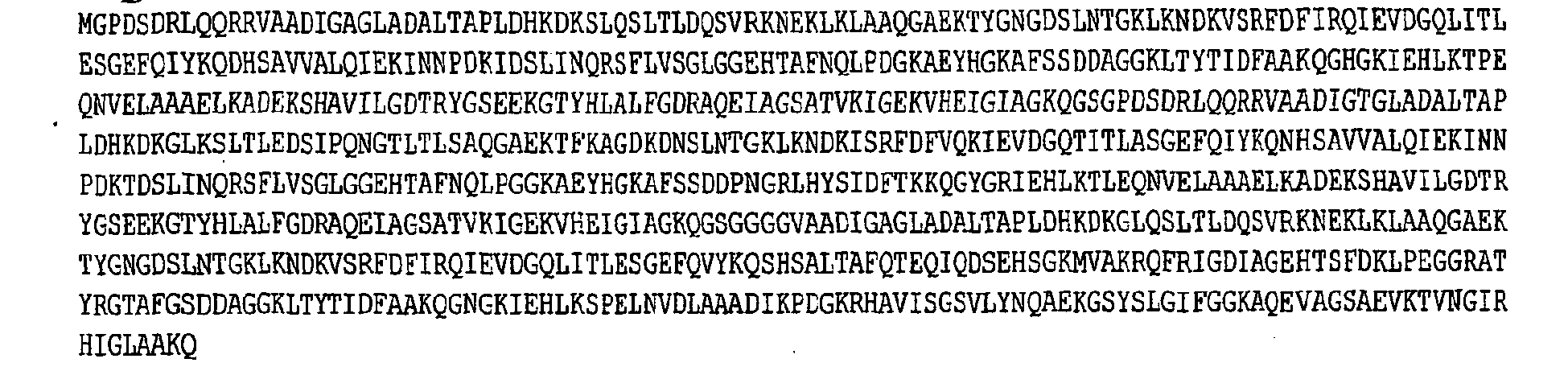
-

-

-

-


- LEHHHHHH
- KL
- M
- LE
- LEGGGG
-

-

-

-

-

-

-

-

-

-

-

-

-

-

-

- KLPEGGR
- QLPDGK
-

-

-

- GPDSDRLQQRRG
- CGCGGATCCCATATGGTCGCCGCCGACATCG
- CCCGCTCGAGCTGTTTGCCGGCGATGCC
- CGCGGATCCCATATGGGCCCTGATTCTGACCGCCTGCAGCAGCGGAGGGTCGCCGCCGACATCGG
- CCCGCTCGAGCTGTTTGCCGGCGATGCC
- CGCGGATCCCATATGGTCGCCGCCGACATCG
- CCCGCTCGAGCTGTTTGCCGGCGATGCC
- CGCGGATCCCATATGGGCCCTGATTCTGACCGCCTGCAGCAGCGGAGGGTCGCCGCCGACATCGG
- CCCGCTCGAGCTGTTTGCCGGCGATGCC
- CGCGGATCCCATATGGTCGCCGCCGACATCG
- CCCGCTCGAGCTGTTTGCCGGCGATGCC
- CGCGGATCCCATATGGGCCCTGATTCTGACCGCCTGCAGCAGCGGAGGGTCGCCGCCGACATCGG
- CCCGCTCGAGCTGTTTGCCGGCGATGCC
- CGCGGATCCCATATGGTCGCCGCCGACATCG
- CCCGCTCGAGCTGTTTGCCGGCGATGCC
- CGCGGATCCCATATGGGCCCTGATTCTGACCGCCTGCAGCAGCGGAGGGTCGCCGCCGACATCGG
- CCCGCTCGAGCTGTTTCCCGGCGATGCC
- CGCGGATCCCATATGGTCGCCGCCGACATCG
- CCCGCTCGAGCTGTTTGCCGGCGATGCC
- CGCGGATCCCATkTGGGCCCTGATTCTGACCGCCTGCAGCAGCGGAGGGTCGCCGCCGACATCGG
-

-

-

-

-

-

-

-

-

-

Claims (8)
- A polypeptide comprising an amino acid sequence that has at least 85% identity to SEQ ID NO:57, and wherein one or more of the following residues, compared to SEQ ID NO: 57, is substituted with another amino acid: A67; K70; K85; T147; N149; I39; K48; E51; R54; T56; A78; A79; D97; P105; S114; S116; L118; N120; Q121; A122; and wherein the polypeptide has the ability to induce antibodies that are bactericidal against strains in each of the three NMB1870 families I to III.
- The polypeptide of claim 1, wherein at least one of the following residues is substituted: K48; E51; R54; A79; K85; P105; L118; N120; Q121; A122; T147; N149.
- The polypeptide of claim 1, wherein at least one of the following residues is substituted: I39; T56; K70; A78; A79; K85; D97; S114; S116; L118.
- The polypeptide of claim 2 or claim 3, comprising a substitution selected from: K70R; K85R; T147I; N149E; I39L; K48Q; R54K; T56E; A78T; A79K; D97E; P105A; S114L; S116D; L118R; N120G; Q121S; A122E;.
- The polypeptide of any preceding claim, wherein the amino acid sequence has at least 90% identity to SEQ ID NO:57.
- An immunogenic composition comprising the polypeptide of any preceding claim.
- The composition of claim 6, including an adjuvant.
- Nucleic acid encoding a polypeptide of any one of claims 1 to 5.
Priority Applications (6)
| Application Number | Priority Date | Filing Date | Title |
|---|---|---|---|
| PL06831853T PL1976990T3 (en) | 2005-11-25 | 2006-11-27 | Chimeric, hybrid and tandem polypeptides of meningococcal nmb1870 |
| EP17205920.6A EP3346009A1 (en) | 2005-11-25 | 2006-11-27 | Chimeric, hybrid and tandem polypeptides of meningococcal nmb1870 |
| SI200631169T SI1976990T1 (en) | 2005-11-25 | 2006-11-27 | Chimeric, hybrid and tandem polypeptides of meningococcal nmb1870 |
| EP11171588A EP2385127A1 (en) | 2005-11-25 | 2006-11-27 | Chimeric, hybrid and tandem polypeptides of meningococcal NMB1870 |
| EP11171587.6A EP2385126B1 (en) | 2005-11-25 | 2006-11-27 | Chimeric, hybrid and tandem polypeptides of meningococcal NMB1870 |
| CY20111101117T CY1112342T1 (en) | 2005-11-25 | 2011-11-18 | CHEMICAL, HYBRID AND SUCCESSFUL POLYPTIPES OF MINING COOK NW1870 |
Applications Claiming Priority (2)
| Application Number | Priority Date | Filing Date | Title |
|---|---|---|---|
| GBGB0524066.8A GB0524066D0 (en) | 2005-11-25 | 2005-11-25 | 741 ii |
| PCT/IB2006/003876 WO2007060548A2 (en) | 2005-11-25 | 2006-11-27 | Chimeric, hybrid and tandem polypeptides of meningococcal nmb1870 |
Related Child Applications (4)
| Application Number | Title | Priority Date | Filing Date |
|---|---|---|---|
| EP11171587.6A Division EP2385126B1 (en) | 2005-11-25 | 2006-11-27 | Chimeric, hybrid and tandem polypeptides of meningococcal NMB1870 |
| EP17205920.6A Division EP3346009A1 (en) | 2005-11-25 | 2006-11-27 | Chimeric, hybrid and tandem polypeptides of meningococcal nmb1870 |
| EP11171588.4 Division-Into | 2011-06-27 | ||
| EP11171587.6 Division-Into | 2011-06-27 |
Publications (2)
| Publication Number | Publication Date |
|---|---|
| EP1976990A2 EP1976990A2 (en) | 2008-10-08 |
| EP1976990B1 true EP1976990B1 (en) | 2011-08-24 |
Family
ID=35601243
Family Applications (4)
| Application Number | Title | Priority Date | Filing Date |
|---|---|---|---|
| EP11171587.6A Active EP2385126B1 (en) | 2005-11-25 | 2006-11-27 | Chimeric, hybrid and tandem polypeptides of meningococcal NMB1870 |
| EP06831853A Revoked EP1976990B1 (en) | 2005-11-25 | 2006-11-27 | Chimeric, hybrid and tandem polypeptides of meningococcal nmb1870 |
| EP17205920.6A Withdrawn EP3346009A1 (en) | 2005-11-25 | 2006-11-27 | Chimeric, hybrid and tandem polypeptides of meningococcal nmb1870 |
| EP11171588A Withdrawn EP2385127A1 (en) | 2005-11-25 | 2006-11-27 | Chimeric, hybrid and tandem polypeptides of meningococcal NMB1870 |
Family Applications Before (1)
| Application Number | Title | Priority Date | Filing Date |
|---|---|---|---|
| EP11171587.6A Active EP2385126B1 (en) | 2005-11-25 | 2006-11-27 | Chimeric, hybrid and tandem polypeptides of meningococcal NMB1870 |
Family Applications After (2)
| Application Number | Title | Priority Date | Filing Date |
|---|---|---|---|
| EP17205920.6A Withdrawn EP3346009A1 (en) | 2005-11-25 | 2006-11-27 | Chimeric, hybrid and tandem polypeptides of meningococcal nmb1870 |
| EP11171588A Withdrawn EP2385127A1 (en) | 2005-11-25 | 2006-11-27 | Chimeric, hybrid and tandem polypeptides of meningococcal NMB1870 |
Country Status (18)
| Country | Link |
|---|---|
| US (3) | US8226960B2 (en) |
| EP (4) | EP2385126B1 (en) |
| JP (4) | JP2009517377A (en) |
| CN (3) | CN102816217A (en) |
| AT (1) | ATE521708T1 (en) |
| AU (1) | AU2006318155B2 (en) |
| BR (1) | BRPI0619024A2 (en) |
| CA (1) | CA2630929A1 (en) |
| CY (1) | CY1112342T1 (en) |
| DK (1) | DK1976990T3 (en) |
| ES (2) | ES2661815T3 (en) |
| GB (1) | GB0524066D0 (en) |
| NZ (2) | NZ594944A (en) |
| PL (1) | PL1976990T3 (en) |
| PT (1) | PT1976990E (en) |
| RU (1) | RU2431671C2 (en) |
| SI (1) | SI1976990T1 (en) |
| WO (1) | WO2007060548A2 (en) |
Families Citing this family (60)
| Publication number | Priority date | Publication date | Assignee | Title |
|---|---|---|---|---|
| EP2261347A3 (en) | 1998-05-01 | 2012-01-11 | Novartis Vaccines and Diagnostics, Inc. | Neisseria meningitidis antigens and compositions |
| AU783894B2 (en) | 1999-05-19 | 2005-12-22 | Novartis Vaccines And Diagnostics S.R.L. | Combination neisserial compositions |
| EP1226253A2 (en) | 1999-10-29 | 2002-07-31 | Chiron S.P.A. | Neisserial antigenic peptides |
| GB9928196D0 (en) | 1999-11-29 | 2000-01-26 | Chiron Spa | Combinations of B, C and other antigens |
| DK1947187T5 (en) | 2000-02-28 | 2011-10-24 | Novartis Vaccines & Diagnostic | Hybrid expression of neisserial proteins |
| GB0118249D0 (en) | 2001-07-26 | 2001-09-19 | Chiron Spa | Histidine vaccines |
| GB0121591D0 (en) | 2001-09-06 | 2001-10-24 | Chiron Spa | Hybrid and tandem expression of neisserial proteins |
| MX339524B (en) | 2001-10-11 | 2016-05-30 | Wyeth Corp | NEW IMMUNOGENIC COMPOSITIONS FOR THE PREVENTION AND TREATMENT OF MENINGOCOCICAL DISEASE. |
| CN1809380B (en) | 2002-10-11 | 2010-05-12 | 启龙有限公司 | Peptide-vaccine for broad protection against highly virulent meningococcal lineages |
| GB0227346D0 (en) | 2002-11-22 | 2002-12-31 | Chiron Spa | 741 |
| GB0408977D0 (en) * | 2004-04-22 | 2004-05-26 | Chiron Srl | Immunising against meningococcal serogroup Y using proteins |
| GB0419408D0 (en) * | 2004-09-01 | 2004-10-06 | Chiron Srl | 741 chimeric polypeptides |
| GB0524066D0 (en) | 2005-11-25 | 2006-01-04 | Chiron Srl | 741 ii |
| AU2016204760A1 (en) * | 2006-04-26 | 2016-07-28 | Wyeth Llc | Novel formulations which stabilize and inhibit precipitation of immunogenic compositions |
| AU2012216628B9 (en) * | 2006-04-26 | 2021-10-21 | Wyeth Llc | Novel Formulations which Stabilize and Inhibit Precipitation of Immunogenic Compositions |
| TW200806315A (en) * | 2006-04-26 | 2008-02-01 | Wyeth Corp | Novel formulations which stabilize and inhibit precipitation of immunogenic compositions |
| AR064642A1 (en) * | 2006-12-22 | 2009-04-15 | Wyeth Corp | POLINUCLEOTIDE VECTOR THAT INCLUDES IT RECOMBINATING CELL THAT UNDERSTANDS THE VECTOR POLYPEPTIDE, ANTIBODY, COMPOSITION THAT UNDERSTANDS THE POLINUCLEOTIDE, VECTOR, RECOMBINATING CELL POLYPEPTIDE OR ANTIBODY, USE OF THE COMPOSITION AND A COMPOSITION AND A METHOD |
| JP5637848B2 (en) * | 2007-06-04 | 2014-12-10 | ノバルティス アーゲー | Formulation of meningitis vaccine |
| EP2886551A3 (en) | 2008-02-21 | 2015-09-23 | Novartis AG | Meningococcal fhbp polypeptides |
| EP2631245A1 (en) * | 2008-03-10 | 2013-08-28 | Children's Hospital & Research Center at Oakland | Chimeric factor H binding proteins (fHBP) containing a heterologous B domain and methods of use |
| AU2015275311B2 (en) * | 2008-10-25 | 2017-07-13 | Imperial Innovations Limited | Vaccine compositions comprising a mutated factor h binding protein |
| GB0819633D0 (en) * | 2008-10-25 | 2008-12-03 | Isis Innovation | Composition |
| US20120064103A1 (en) * | 2009-03-24 | 2012-03-15 | Novartis Ag | Combinations of meningococcal factor h binding protein and pneumococcal saccharide conjugates |
| PL2411048T3 (en) | 2009-03-24 | 2020-11-16 | Glaxosmithkline Biologicals Sa | Adjuvanting meningococcal factor h binding protein |
| JP5883380B2 (en) | 2009-04-30 | 2016-03-15 | チルドレンズ ホスピタル アンド リサーチ センター アット オークランド | Chimeric factor H binding protein (FHBP) and method of use thereof |
| US8858958B2 (en) | 2009-08-27 | 2014-10-14 | Novartis Ag | Adjuvant comprising aluminum, oligonucleotide and polycation |
| JP2013502918A (en) | 2009-08-27 | 2013-01-31 | ノバルティス アーゲー | Hybrid polypeptide comprising Neisseria meningitidis fHBP sequence |
| AU2010290896B2 (en) | 2009-09-02 | 2014-07-03 | Glaxosmithkline Biologicals S.A. | Immunogenic compositions including TLR activity modulators |
| US20130022639A1 (en) | 2009-09-30 | 2013-01-24 | Novartis Ag | Expression of meningococcal fhbp polypeptides |
| BR112012010531A2 (en) * | 2009-10-27 | 2019-09-24 | Novartis Ag | "fhbp meningococcal modification polypeptides" |
| WO2011126863A1 (en) | 2010-03-30 | 2011-10-13 | Children's Hospital & Research Center Oakland | Factor h binding proteins (fhbp) with altered properties and methods of use thereof |
| CA2803239A1 (en) | 2010-06-25 | 2011-12-29 | Novartis Ag | Combinations of meningococcal factor h binding proteins |
| RU2580620C2 (en) | 2010-08-23 | 2016-04-10 | ВАЙЕТ ЭлЭлСи | STABLE COMPOSITIONS OF ANTIGENS Neisseria meningitidis rLP2086 |
| MX343914B (en) | 2010-09-01 | 2016-11-18 | Glaxosmithkline Biologicals Sa | Adsorption of immunopotentiators to insoluble metal salts. |
| WO2012032489A1 (en) * | 2010-09-10 | 2012-03-15 | Wyeth Llc | Non-lipidated variants of neisseria meningitidis orf2086 antigens |
| EP2652511B8 (en) | 2010-12-14 | 2017-06-28 | GlaxoSmithKline Biologicals SA | Flow cytometry analysis of materials adsorbed to metal salts |
| US20140112950A1 (en) | 2011-03-02 | 2014-04-24 | Manmohan Singh | Combination vaccines with lower doses of antigen and/or adjuvant |
| JP5983940B2 (en) * | 2011-06-14 | 2016-09-06 | パナソニックIpマネジメント株式会社 | Information processing apparatus, information processing method, program, integrated circuit |
| AU2011384634A1 (en) | 2011-12-29 | 2014-06-19 | Novartis Ag | Adjuvanted combinations of meningococcal factor H binding proteins |
| DK2822947T3 (en) | 2012-03-07 | 2016-09-19 | Glaxosmithkline Biologicals Sa | ARGINAL SALTS OF A TLR-7 AGONIST |
| JP6345603B2 (en) | 2012-03-08 | 2018-06-20 | ノバルティス アーゲー | Adjuvanted formulation of booster vaccine |
| CA2865745C (en) | 2012-03-09 | 2018-01-09 | Pfizer Inc. | Neisseria meningitidis compositions and methods thereof |
| SA115360586B1 (en) | 2012-03-09 | 2017-04-12 | فايزر انك | Neisseria meningitidis compositions and methods thereof |
| WO2013151706A2 (en) | 2012-04-06 | 2013-10-10 | Cornell University | Subunit vaccine delivery platform for robust humoral and cellular immune responses |
| MX357538B (en) | 2012-06-14 | 2018-07-13 | Novartis Ag | Vaccines for serogroup x meningococcus. |
| HK1205138A1 (en) | 2012-07-27 | 2015-12-11 | Institut National De La Santé Et De La Recherche Médicale (Inserm) | Cd147 as receptor for pilus-mediated adhesion of meningococci to vascular endothelia |
| US9802987B2 (en) | 2013-03-08 | 2017-10-31 | Pfizer Inc. | Immunogenic fusion polypeptides |
| US9914756B2 (en) | 2013-08-02 | 2018-03-13 | Children's Hospital & Research Center At Oakland | Non-naturally occurring factor H binding proteins (fHbp) and methods of use thereof |
| RU2662968C2 (en) | 2013-09-08 | 2018-07-31 | Пфайзер Инк. | Immunogenic composition for neisseria meningitidis (options) |
| CA2940447C (en) | 2014-02-28 | 2023-07-11 | Glaxosmithkline Biologicals Sa | Modified meningococcal fhbp polypeptides |
| US11707513B2 (en) * | 2014-07-17 | 2023-07-25 | Glaxosmithkline Biologicals Sa | Meningococcus vaccines |
| SG11201610945PA (en) | 2014-07-17 | 2017-01-27 | Glaxosmithkline Biolog Sa | Modified meningococcal fhbp polypeptides |
| CN119613509A (en) | 2014-07-23 | 2025-03-14 | 奥克兰儿童医院及研究中心 | Factor H binding protein variants and methods of use thereof |
| AU2016221318B2 (en) | 2015-02-19 | 2020-06-25 | Pfizer Inc. | Neisseria meningitidis compositions and methods thereof |
| GB201614687D0 (en) * | 2016-08-31 | 2016-10-12 | Univ Oxford Innovation Ltd | fHbp scaffold |
| US10183070B2 (en) | 2017-01-31 | 2019-01-22 | Pfizer Inc. | Neisseria meningitidis compositions and methods thereof |
| EP4034157A1 (en) | 2019-09-27 | 2022-08-03 | Pfizer Inc. | Neisseria meningitidis compositions and methods thereof |
| CN110903400A (en) * | 2019-11-08 | 2020-03-24 | 苏州微超生物科技有限公司 | Group B meningococcal fHBP multi-variant fusion protein and preparation method and application thereof |
| CN110859954B (en) * | 2019-11-08 | 2023-10-13 | 苏州聚微生物科技有限公司 | A composition containing meningococcal group B fHBP antigen and its preparation method and application |
| GB202115151D0 (en) | 2021-10-21 | 2021-12-08 | Glaxosmithkline Biologicals Sa | Methods |
Citations (1)
| Publication number | Priority date | Publication date | Assignee | Title |
|---|---|---|---|---|
| WO2009104097A2 (en) * | 2008-02-21 | 2009-08-27 | Novartis Ag | Meningococcal fhbp polypeptides |
Family Cites Families (141)
| Publication number | Priority date | Publication date | Assignee | Title |
|---|---|---|---|---|
| US4057685A (en) | 1972-02-02 | 1977-11-08 | Abbott Laboratories | Chemically modified endotoxin immunizing agent |
| AU545912B2 (en) | 1980-03-10 | 1985-08-08 | Cetus Corporation | Cloned heterologous jive products in bacillies |
| ZA811368B (en) | 1980-03-24 | 1982-04-28 | Genentech Inc | Bacterial polypedtide expression employing tryptophan promoter-operator |
| FI821466A7 (en) | 1981-04-29 | 1982-10-30 | Biogen Nv | Bacillus cloning vectors, recombinant DNA molecules, Bacillus hosts transformed by them, and methods for expressing foreign DNA sequences and producing polypeptides encoded by them. |
| US4551433A (en) | 1981-05-18 | 1985-11-05 | Genentech, Inc. | Microbial hybrid promoters |
| US4356170A (en) | 1981-05-27 | 1982-10-26 | Canadian Patents & Development Ltd. | Immunogenic polysaccharide-protein conjugates |
| US4673574A (en) | 1981-08-31 | 1987-06-16 | Anderson Porter W | Immunogenic conjugates |
| SE8205892D0 (en) | 1982-10-18 | 1982-10-18 | Bror Morein | IMMUNOGENT MEMBRANE PROTEIN COMPLEX, SET FOR PREPARATION AND USE THEREOF |
| US4459286A (en) | 1983-01-31 | 1984-07-10 | Merck & Co., Inc. | Coupled H. influenzae type B vaccine |
| JPS59166086A (en) | 1983-03-09 | 1984-09-19 | Teruhiko Beppu | Novel development type plasmid and development of vitular prochymosin gene in escherichia coli using it |
| US4663160A (en) | 1983-03-14 | 1987-05-05 | Miles Laboratories, Inc. | Vaccines for gram-negative bacteria |
| JPS59205983A (en) | 1983-04-28 | 1984-11-21 | ジエネツクス・コ−ポレイシヨン | Development of different kind gene by procaryotic microorganism |
| US4663280A (en) | 1983-05-19 | 1987-05-05 | Public Health Research Institute Of The City Of New York | Expression and secretion vectors and method of constructing vectors |
| US4761283A (en) | 1983-07-05 | 1988-08-02 | The University Of Rochester | Immunogenic conjugates |
| US4689406A (en) | 1983-08-10 | 1987-08-25 | Amgen | Enhancement of microbial expression of polypeptides |
| JPS6054685A (en) | 1983-09-02 | 1985-03-29 | Suntory Ltd | Improved manifestation vector and its use |
| EP0136907A3 (en) | 1983-10-03 | 1986-12-30 | Genentech, Inc. | A xenogeneic expression control system, a method of using it, expression vectors containing it, cells transformed thereby and heterologous proteins produced therefrom |
| US5916588A (en) | 1984-04-12 | 1999-06-29 | The Liposome Company, Inc. | Peptide-containing liposomes, immunogenic liposomes and methods of preparation and use |
| US6090406A (en) | 1984-04-12 | 2000-07-18 | The Liposome Company, Inc. | Potentiation of immune responses with liposomal adjuvants |
| US4882317A (en) | 1984-05-10 | 1989-11-21 | Merck & Co., Inc. | Covalently-modified bacterial polysaccharides, stable covalent conjugates of such polysaccharides and immunogenic proteins with bigeneric spacers and methods of preparing such polysaccharides and conjugataes and of confirming covalency |
| US4695624A (en) | 1984-05-10 | 1987-09-22 | Merck & Co., Inc. | Covalently-modified polyanionic bacterial polysaccharides, stable covalent conjugates of such polysaccharides and immunogenic proteins with bigeneric spacers, and methods of preparing such polysaccharides and conjugates and of confirming covalency |
| US4808700A (en) | 1984-07-09 | 1989-02-28 | Praxis Biologics, Inc. | Immunogenic conjugates of non-toxic E. coli LT-B enterotoxin subunit and capsular polymers |
| US4738921A (en) | 1984-09-27 | 1988-04-19 | Eli Lilly And Company | Derivative of the tryptophan operon for expression of fused gene products |
| US4745056A (en) | 1984-10-23 | 1988-05-17 | Biotechnica International, Inc. | Streptomyces secretion vector |
| IT1187753B (en) | 1985-07-05 | 1987-12-23 | Sclavo Spa | GLYCOPROTEIC CONJUGATES WITH TRIVALENT IMMUNOGENIC ACTIVITY |
| US4865974A (en) | 1985-09-20 | 1989-09-12 | Cetus Corporation | Bacterial methionine N-terminal peptidase |
| JPS63123383A (en) | 1986-11-11 | 1988-05-27 | Mitsubishi Kasei Corp | Hybrid promoter, expression control DNA sequence and expression vector |
| US5057540A (en) | 1987-05-29 | 1991-10-15 | Cambridge Biotech Corporation | Saponin adjuvant |
| JPH01125328A (en) | 1987-07-30 | 1989-05-17 | Centro Natl De Biopreparados | Meningococcus vaccine |
| NL8802046A (en) | 1988-08-18 | 1990-03-16 | Gen Electric | POLYMER MIXTURE WITH POLYESTER AND ALKANE SULFONATE, OBJECTS THEREFORE. |
| AU627226B2 (en) | 1988-08-25 | 1992-08-20 | Liposome Company, Inc., The | Influenza vaccine and novel adjuvants |
| DE3841091A1 (en) | 1988-12-07 | 1990-06-13 | Behringwerke Ag | SYNTHETIC ANTIGENS, METHOD FOR THEIR PRODUCTION AND THEIR USE |
| EP0449958B9 (en) | 1988-12-19 | 2003-05-28 | American Cyanamid Company | Meningococcal class 1 outer-membrane protein vaccine |
| DE68907045T2 (en) | 1989-01-17 | 1993-12-02 | Eniricerche Spa | Synthetic peptides and their use as general carriers for the preparation of immunogenic conjugates suitable for the development of synthetic vaccines. |
| WO1990014837A1 (en) | 1989-05-25 | 1990-12-13 | Chiron Corporation | Adjuvant formulation comprising a submicron oil droplet emulsion |
| JPH04506662A (en) | 1989-07-14 | 1992-11-19 | アメリカン・サイアナミド・カンパニー | Cytokinin and hormone carriers for conjugate vaccines |
| IT1237764B (en) | 1989-11-10 | 1993-06-17 | Eniricerche Spa | SYNTHETIC PEPTIDES USEFUL AS UNIVERSAL CARRIERS FOR THE PREPARATION OF IMMUNOGENIC CONJUGATES AND THEIR USE FOR THE DEVELOPMENT OF SYNTHETIC VACCINES. |
| SE466259B (en) | 1990-05-31 | 1992-01-20 | Arne Forsgren | PROTEIN D - AN IGD BINDING PROTEIN FROM HAEMOPHILUS INFLUENZAE, AND THE USE OF THIS FOR ANALYSIS, VACCINES AND PURPOSE |
| EP0467714A1 (en) | 1990-07-19 | 1992-01-22 | Merck & Co. Inc. | The class II protein of the outer membrane of neisseria meningitidis |
| DE69113564T2 (en) | 1990-08-13 | 1996-05-30 | American Cyanamid Co | Bordetella pertussis fiber hemagglutinin as a carrier for conjugated vaccine. |
| US5153312A (en) | 1990-09-28 | 1992-10-06 | American Cyanamid Company | Oligosaccharide conjugate vaccines |
| DE69232859T2 (en) * | 1991-09-13 | 2003-04-10 | Chiron Corp. (N.D.Ges.D. Staates Delaware), Emeryville | COMPOSITION OF SEVERAL IMMUNE REACTIVE HEPATITIS C VIRUS POLYPEPTIDES |
| IT1262896B (en) | 1992-03-06 | 1996-07-22 | CONJUGATE COMPOUNDS FORMED FROM HEAT SHOCK PROTEIN (HSP) AND OLIGO-POLY-SACCHARIDES, THEIR USE FOR THE PRODUCTION OF VACCINES. | |
| CA2138997C (en) | 1992-06-25 | 2003-06-03 | Jean-Paul Prieels | Vaccine composition containing adjuvants |
| IL102687A (en) | 1992-07-30 | 1997-06-10 | Yeda Res & Dev | Conjugates of poorly immunogenic antigens and synthetic pepide carriers and vaccines comprising them |
| NL9201716A (en) | 1992-10-02 | 1994-05-02 | Nederlanden Staat | Outer membrane vesicle comprising a group of polypeptides which have at least the immune function of membrane bound outer membrane proteins (OMPs), method of preparation thereof and a vaccine comprising such an outer membrane vesicle. |
| SG48309A1 (en) | 1993-03-23 | 1998-04-17 | Smithkline Beecham Biolog | Vaccine compositions containing 3-0 deacylated monophosphoryl lipid a |
| ES2210262T3 (en) | 1993-09-22 | 2004-07-01 | Henry M. Jackson Foundation For The Advancement Of Military Medicine | PROCEDURE THAT ALLOWS THE ACTIVATION OF A SOLUBLE GLUCIDE WITH THE HELP OF NEW CIANILANT REAGENTS TO PRODUCE IMMUNOGEN STRUCTURES. |
| GB9326174D0 (en) | 1993-12-22 | 1994-02-23 | Biocine Sclavo | Mucosal adjuvant |
| GB9326253D0 (en) | 1993-12-23 | 1994-02-23 | Smithkline Beecham Biolog | Vaccines |
| US6429199B1 (en) | 1994-07-15 | 2002-08-06 | University Of Iowa Research Foundation | Immunostimulatory nucleic acid molecules for activating dendritic cells |
| US6207646B1 (en) | 1994-07-15 | 2001-03-27 | University Of Iowa Research Foundation | Immunostimulatory nucleic acid molecules |
| US6239116B1 (en) | 1994-07-15 | 2001-05-29 | University Of Iowa Research Foundation | Immunostimulatory nucleic acid molecules |
| AUPM873294A0 (en) | 1994-10-12 | 1994-11-03 | Csl Limited | Saponin preparations and use thereof in iscoms |
| IL117483A (en) | 1995-03-17 | 2008-03-20 | Bernard Brodeur | Proteinase k resistant surface protein of neisseria meningitidis |
| UA56132C2 (en) | 1995-04-25 | 2003-05-15 | Смітклайн Бічем Байолоджікалс С.А. | Vaccine composition (variants), method for stabilizing qs21 providing resistance against hydrolysis (variants), method for manufacturing vaccine |
| US6180111B1 (en) | 1995-05-18 | 2001-01-30 | University Of Maryland | Vaccine delivery system |
| NZ311000A (en) | 1995-06-07 | 1999-04-29 | Smithkline Beecham Biolog | Vaccine comprising a polysaccharide antigen-carrier protein conjugate and a free carrier protein |
| IL122588A (en) | 1995-06-23 | 2001-12-23 | Smithkline Beecham Biolog | Combination vaccine comprising a polysaccharide conjugate antigen adsorbed onto aluminium phosphate and one or more other antigens |
| GB9513261D0 (en) | 1995-06-29 | 1995-09-06 | Smithkline Beecham Biolog | Vaccines |
| US6558677B2 (en) | 1996-10-15 | 2003-05-06 | Wendell D. Zollinger | Vaccine against gram negative bacteria |
| US6472518B1 (en) | 1996-10-24 | 2002-10-29 | Centers For Disease Control And Prevention, As Represented By The Secretary, Department Of Health And Human Services | Invasion associated genes from Neisseria meningitidis serogroup B |
| AU753688B2 (en) | 1997-03-10 | 2002-10-24 | Ottawa Civic Loeb Research Institute | Use of nucleic acids containing unmethylated CpG dinucleotide as an adjuvant |
| US6818222B1 (en) | 1997-03-21 | 2004-11-16 | Chiron Corporation | Detoxified mutants of bacterial ADP-ribosylating toxins as parenteral adjuvants |
| US6299881B1 (en) | 1997-03-24 | 2001-10-09 | Henry M. Jackson Foundation For The Advancement Of Military Medicine | Uronium salts for activating hydroxyls, carboxyls, and polysaccharides, and conjugate vaccines, immunogens, and other useful immunological reagents produced using uronium salts |
| GB9711964D0 (en) | 1997-06-09 | 1997-08-06 | Medical Res Council | Live attenuated vaccines |
| GB9712347D0 (en) | 1997-06-14 | 1997-08-13 | Smithkline Beecham Biolog | Vaccine |
| GB9713156D0 (en) | 1997-06-20 | 1997-08-27 | Microbiological Res Authority | Vaccines |
| AU1145699A (en) | 1997-09-05 | 1999-03-22 | Smithkline Beecham Biologicals (Sa) | Oil in water emulsions containing saponins |
| EP1900818A3 (en) | 1997-11-06 | 2008-06-11 | Novartis Vaccines and Diagnostics S.r.l. | Neisserial antigens |
| US6914131B1 (en) | 1998-10-09 | 2005-07-05 | Chiron S.R.L. | Neisserial antigens |
| GB9725084D0 (en) | 1997-11-28 | 1998-01-28 | Medeva Europ Ltd | Vaccine compositions |
| WO1999036544A2 (en) | 1998-01-14 | 1999-07-22 | Chiron S.P.A. | Neisseria meningitidis antigens |
| EP1053015A2 (en) | 1998-02-12 | 2000-11-22 | American Cyanamid Company | Pneumococcal and meningococcal vaccines formulated with interleukin-12 |
| US7018637B2 (en) | 1998-02-23 | 2006-03-28 | Aventis Pasteur, Inc | Multi-oligosaccharide glycoconjugate bacterial meningitis vaccines |
| US6303114B1 (en) | 1998-03-05 | 2001-10-16 | The Medical College Of Ohio | IL-12 enhancement of immune responses to T-independent antigens |
| WO1999052549A1 (en) | 1998-04-09 | 1999-10-21 | Smithkline Beecham Biologicals S.A. | Adjuvant compositions |
| US20070026021A1 (en) | 1998-05-01 | 2007-02-01 | Chiron S.R.I. | Neisseria meningitidis antigens and compositions |
| EP2261347A3 (en) | 1998-05-01 | 2012-01-11 | Novartis Vaccines and Diagnostics, Inc. | Neisseria meningitidis antigens and compositions |
| US6562798B1 (en) | 1998-06-05 | 2003-05-13 | Dynavax Technologies Corp. | Immunostimulatory oligonucleotides with modified bases and methods of use thereof |
| GB9817052D0 (en) | 1998-08-05 | 1998-09-30 | Smithkline Beecham Biolog | Vaccine |
| CN1263510C (en) | 1998-08-19 | 2006-07-12 | 巴克斯特健康护理股份有限公司 | Polysaccharide-protein conjugate or oligosaccharide-protein conjugate, preparation method and application thereof |
| MXPA01003557A (en) | 1998-10-09 | 2004-04-05 | Chiron Corp | Neisseria genomic sequences and methods of their use. |
| AU750587B2 (en) | 1998-10-16 | 2002-07-25 | Smithkline Beecham Biologicals (Sa) | Adjuvant systems and vaccines |
| GB9823978D0 (en) | 1998-11-02 | 1998-12-30 | Microbiological Res Authority | Multicomponent meningococcal vaccine |
| US6146902A (en) | 1998-12-29 | 2000-11-14 | Aventis Pasteur, Inc. | Purification of polysaccharide-protein conjugate vaccines by ultrafiltration with ammonium sulfate solutions |
| JP2002539273A (en) | 1999-03-19 | 2002-11-19 | スミスクライン ビーチャム バイオロジカルズ ソシエテ アノニム | vaccine |
| CA2365914A1 (en) | 1999-04-09 | 2000-10-19 | Techlab, Inc. | Recombinant clostridium toxin a protein carrier for polysaccharide conjugate vaccines |
| CA2371032A1 (en) | 1999-04-30 | 2000-11-09 | Chiron Corporation | Neisseria genomic sequences and methods of their use |
| AU783894B2 (en) | 1999-05-19 | 2005-12-22 | Novartis Vaccines And Diagnostics S.R.L. | Combination neisserial compositions |
| GB9918319D0 (en) | 1999-08-03 | 1999-10-06 | Smithkline Beecham Biolog | Vaccine composition |
| JP2003509473A (en) | 1999-09-24 | 2003-03-11 | スミスクライン ビーチャム バイオロジカルズ ソシエテ アノニム | vaccine |
| CO5200838A1 (en) | 1999-09-24 | 2002-09-27 | Smithkline Beecham Corp | VACCINES |
| GB9925559D0 (en) | 1999-10-28 | 1999-12-29 | Smithkline Beecham Biolog | Novel method |
| EP1226253A2 (en) | 1999-10-29 | 2002-07-31 | Chiron S.P.A. | Neisserial antigenic peptides |
| AU1917501A (en) | 1999-11-12 | 2001-06-06 | University Of Iowa Research Foundation, The | Control of neisserial membrane synthesis |
| CA2871789C (en) | 2000-01-17 | 2017-04-04 | Novartis Vaccines And Diagnostics S.R.L. | Outer membrane vesicle (omv) vaccine comprising n. meningitidis serogroup b outer membrane proteins |
| US20010044416A1 (en) | 2000-01-20 | 2001-11-22 | Mccluskie Michael J. | Immunostimulatory nucleic acids for inducing a Th2 immune response |
| DK1947187T5 (en) | 2000-02-28 | 2011-10-24 | Novartis Vaccines & Diagnostic | Hybrid expression of neisserial proteins |
| GB0007432D0 (en) | 2000-03-27 | 2000-05-17 | Microbiological Res Authority | Proteins for use as carriers in conjugate vaccines |
| DK1296715T4 (en) | 2000-06-29 | 2016-03-07 | Smithkline Beecham Biolog | Multivalent vaccine composition. |
| KR20030024811A (en) | 2000-07-27 | 2003-03-26 | 칠드런즈 하스피틀 앤드 리써치 센터 앳 오클랜드 | Vaccines for broad spectrum protection against diseases caused by neisseria meningitidis |
| GB0103170D0 (en) | 2001-02-08 | 2001-03-28 | Smithkline Beecham Biolog | Vaccine composition |
| GB0022742D0 (en) | 2000-09-15 | 2000-11-01 | Smithkline Beecham Biolog | Vaccine |
| ATE384072T1 (en) | 2000-09-26 | 2008-02-15 | Idera Pharmaceuticals Inc | MODULATION OF THE IMMUNOSTIMULATIVE ACTIVITY OF IMMUNOSTIMULATIVE OLIGONUCLEOTIDE ANALOGS THROUGH POSITIONAL CHEMICAL CHANGES |
| ATE439372T1 (en) | 2000-10-27 | 2009-08-15 | Novartis Vaccines & Diagnostic | NUCLEIC ACIDS AND PROTEINS OF GROUP A AND B STREPTOCOCICS |
| GB0103169D0 (en) | 2001-02-08 | 2001-03-28 | Smithkline Beecham Biolog | Vaccine composition |
| GB0103171D0 (en) | 2001-02-08 | 2001-03-28 | Smithkline Beecham Biolog | Vaccine composition |
| US20030035806A1 (en) | 2001-05-11 | 2003-02-20 | D'ambra Anello J. | Novel meningitis conjugate vaccine |
| GB0115176D0 (en) | 2001-06-20 | 2001-08-15 | Chiron Spa | Capular polysaccharide solubilisation and combination vaccines |
| EP1409013B1 (en) | 2001-07-26 | 2009-11-18 | Novartis Vaccines and Diagnostics S.r.l. | Vaccines comprising aluminium adjuvants and histidine |
| GB0118249D0 (en) | 2001-07-26 | 2001-09-19 | Chiron Spa | Histidine vaccines |
| GB0121591D0 (en) | 2001-09-06 | 2001-10-24 | Chiron Spa | Hybrid and tandem expression of neisserial proteins |
| EP1450856B1 (en) | 2001-09-14 | 2009-11-11 | Cytos Biotechnology AG | Packaging of immunostimulatory cpg into virus-like particles: method of preparation and use |
| CA2492823A1 (en) | 2001-09-14 | 2003-03-27 | Cytos Biotechnology Ag | In vivo activation of antigen presenting cells for enhancement of immune responses induced by virus like particles |
| MX339524B (en) | 2001-10-11 | 2016-05-30 | Wyeth Corp | NEW IMMUNOGENIC COMPOSITIONS FOR THE PREVENTION AND TREATMENT OF MENINGOCOCICAL DISEASE. |
| WO2003035836A2 (en) | 2001-10-24 | 2003-05-01 | Hybridon Inc. | Modulation of immunostimulatory properties of oligonucleotide-based compounds by optimal presentation of 5' ends |
| DE10160504C2 (en) * | 2001-11-30 | 2003-11-13 | Hahn Meitner Inst Berlin Gmbh | Process for the production of thin, poorly soluble coatings |
| GB0130123D0 (en) | 2001-12-17 | 2002-02-06 | Microbiological Res Agency | Outer membrane vesicle vaccine and its preparation |
| DK1777236T3 (en) | 2002-03-26 | 2017-02-27 | Glaxosmithkline Biologicals Sa | MODIFIED SUCCARIDES WHICH IMPROVED WATER STABILITY FOR USE AS A MEDICINE |
| CA2493124C (en) | 2002-08-02 | 2014-04-29 | Glaxosmithkline Biologicals S.A. | Vaccine |
| GB0220194D0 (en) | 2002-08-30 | 2002-10-09 | Chiron Spa | Improved vesicles |
| US7785608B2 (en) * | 2002-08-30 | 2010-08-31 | Wyeth Holdings Corporation | Immunogenic compositions for the prevention and treatment of meningococcal disease |
| CN1809380B (en) | 2002-10-11 | 2010-05-12 | 启龙有限公司 | Peptide-vaccine for broad protection against highly virulent meningococcal lineages |
| GB0227346D0 (en) * | 2002-11-22 | 2002-12-31 | Chiron Spa | 741 |
| EP1590459A2 (en) | 2003-01-15 | 2005-11-02 | Wyeth Holdings Corporation | Methods for increasing neisseria protein expression and compositions thereof |
| ES2461350T3 (en) | 2003-01-30 | 2014-05-19 | Novartis Ag | Injectable vaccines against multiple serogroups of meningococci |
| BRPI0409459A (en) | 2003-04-16 | 2006-05-02 | Wyeth Corp | New Immunogenic Compositions for the Prevention and Treatment of Meningococcal Disease |
| NZ546430A (en) | 2003-10-02 | 2009-04-30 | Novartis Vaccines & Diagnostic | Liquid vaccines for multiple meningococcal serogroups |
| GB0408977D0 (en) * | 2004-04-22 | 2004-05-26 | Chiron Srl | Immunising against meningococcal serogroup Y using proteins |
| GB0419408D0 (en) | 2004-09-01 | 2004-10-06 | Chiron Srl | 741 chimeric polypeptides |
| LT2682126T (en) | 2005-01-27 | 2017-02-27 | Children`s Hospital & Research Center at Oakland | GNA1870-based vesicle vaccines for broad spectrum protection against diseases caused by Neisseria meningitidis |
| GB0524066D0 (en) | 2005-11-25 | 2006-01-04 | Chiron Srl | 741 ii |
| TW200806315A (en) | 2006-04-26 | 2008-02-01 | Wyeth Corp | Novel formulations which stabilize and inhibit precipitation of immunogenic compositions |
| AR064642A1 (en) | 2006-12-22 | 2009-04-15 | Wyeth Corp | POLINUCLEOTIDE VECTOR THAT INCLUDES IT RECOMBINATING CELL THAT UNDERSTANDS THE VECTOR POLYPEPTIDE, ANTIBODY, COMPOSITION THAT UNDERSTANDS THE POLINUCLEOTIDE, VECTOR, RECOMBINATING CELL POLYPEPTIDE OR ANTIBODY, USE OF THE COMPOSITION AND A COMPOSITION AND A METHOD |
| WO2008125985A2 (en) | 2007-04-11 | 2008-10-23 | Novartis Ag | Blocking interaction between pathogen factors and factor h to inhibit hemorrhagic syndromes |
| JP5637848B2 (en) | 2007-06-04 | 2014-12-10 | ノバルティス アーゲー | Formulation of meningitis vaccine |
| EP2631245A1 (en) | 2008-03-10 | 2013-08-28 | Children's Hospital & Research Center at Oakland | Chimeric factor H binding proteins (fHBP) containing a heterologous B domain and methods of use |
| IT1394288B1 (en) | 2008-09-12 | 2012-06-06 | Novartis Vaccines & Diagnostic | PROTEIN IMMUNOGENES THAT LINK THE FACTOR H. |
| GB0819633D0 (en) | 2008-10-25 | 2008-12-03 | Isis Innovation | Composition |
| PL2411048T3 (en) | 2009-03-24 | 2020-11-16 | Glaxosmithkline Biologicals Sa | Adjuvanting meningococcal factor h binding protein |
-
2005
- 2005-11-25 GB GBGB0524066.8A patent/GB0524066D0/en not_active Ceased
-
2006
- 2006-11-27 PL PL06831853T patent/PL1976990T3/en unknown
- 2006-11-27 EP EP11171587.6A patent/EP2385126B1/en active Active
- 2006-11-27 SI SI200631169T patent/SI1976990T1/en unknown
- 2006-11-27 EP EP06831853A patent/EP1976990B1/en not_active Revoked
- 2006-11-27 PT PT06831853T patent/PT1976990E/en unknown
- 2006-11-27 ES ES11171587.6T patent/ES2661815T3/en active Active
- 2006-11-27 CN CN2012102235784A patent/CN102816217A/en active Pending
- 2006-11-27 US US12/085,413 patent/US8226960B2/en not_active Expired - Fee Related
- 2006-11-27 WO PCT/IB2006/003876 patent/WO2007060548A2/en not_active Ceased
- 2006-11-27 DK DK06831853.4T patent/DK1976990T3/en active
- 2006-11-27 CN CN201410386472.5A patent/CN104497145A/en active Pending
- 2006-11-27 NZ NZ594944A patent/NZ594944A/en not_active IP Right Cessation
- 2006-11-27 JP JP2008541847A patent/JP2009517377A/en not_active Withdrawn
- 2006-11-27 RU RU2008125838/10A patent/RU2431671C2/en not_active IP Right Cessation
- 2006-11-27 AU AU2006318155A patent/AU2006318155B2/en not_active Ceased
- 2006-11-27 CA CA002630929A patent/CA2630929A1/en active Pending
- 2006-11-27 CN CN200680050927XA patent/CN101356274B/en not_active Expired - Fee Related
- 2006-11-27 AT AT06831853T patent/ATE521708T1/en active
- 2006-11-27 NZ NZ568577A patent/NZ568577A/en not_active IP Right Cessation
- 2006-11-27 EP EP17205920.6A patent/EP3346009A1/en not_active Withdrawn
- 2006-11-27 EP EP11171588A patent/EP2385127A1/en not_active Withdrawn
- 2006-11-27 BR BRPI0619024-3A patent/BRPI0619024A2/en not_active Application Discontinuation
- 2006-11-27 ES ES06831853T patent/ES2369937T3/en active Active
-
2011
- 2011-11-18 CY CY20111101117T patent/CY1112342T1/en unknown
-
2012
- 2012-07-23 US US13/556,139 patent/US8398999B2/en not_active Expired - Fee Related
-
2013
- 2013-03-18 US US13/845,305 patent/US9156894B2/en active Active
- 2013-04-19 JP JP2013088124A patent/JP2013139481A/en not_active Withdrawn
-
2014
- 2014-09-17 JP JP2014188863A patent/JP2014237721A/en not_active Withdrawn
-
2016
- 2016-11-11 JP JP2016220293A patent/JP2017031221A/en active Pending
Patent Citations (1)
| Publication number | Priority date | Publication date | Assignee | Title |
|---|---|---|---|---|
| WO2009104097A2 (en) * | 2008-02-21 | 2009-08-27 | Novartis Ag | Meningococcal fhbp polypeptides |
Also Published As
Similar Documents
| Publication | Publication Date | Title |
|---|---|---|
| EP2385126B1 (en) | Chimeric, hybrid and tandem polypeptides of meningococcal NMB1870 | |
| US10668142B2 (en) | Injectable vaccines against multiple meningococcal serogroups | |
| EP1784419B1 (en) | Domains and epitopes of meningococcal protein nmb1870 | |
| AU2013201318B2 (en) | Chimeric, hybrid and tandem polypeptides of meningococcal NMB 1870 | |
| MX2008006719A (en) | Chimeric, hybrid and tandem polypeptides of meningococcal nmb1870 | |
| HK1141999B (en) | Injectable vaccines against multiple meningococcal serogroups |
Legal Events
| Date | Code | Title | Description |
|---|---|---|---|
| PUAI | Public reference made under article 153(3) epc to a published international application that has entered the european phase |
Free format text: ORIGINAL CODE: 0009012 |
|
| 17P | Request for examination filed |
Effective date: 20080619 |
|
| AK | Designated contracting states |
Kind code of ref document: A2 Designated state(s): AT BE BG CH CY CZ DE DK EE ES FI FR GB GR HU IE IS IT LI LT LU LV MC NL PL PT RO SE SI SK TR |
|
| 17Q | First examination report despatched |
Effective date: 20090617 |
|
| GRAP | Despatch of communication of intention to grant a patent |
Free format text: ORIGINAL CODE: EPIDOSNIGR1 |
|
| DAX | Request for extension of the european patent (deleted) | ||
| GRAS | Grant fee paid |
Free format text: ORIGINAL CODE: EPIDOSNIGR3 |
|
| GRAA | (expected) grant |
Free format text: ORIGINAL CODE: 0009210 |
|
| DAC | Divisional application: reference to earlier application (deleted) | ||
| AK | Designated contracting states |
Kind code of ref document: B1 Designated state(s): AT BE BG CH CY CZ DE DK EE ES FI FR GB GR HU IE IS IT LI LT LU LV MC NL PL PT RO SE SI SK TR |
|
| REG | Reference to a national code |
Ref country code: GB Ref legal event code: FG4D |
|
| REG | Reference to a national code |
Ref country code: CH Ref legal event code: NV Representative=s name: E. BLUM & CO. AG PATENT- UND MARKENANWAELTE VSP Ref country code: CH Ref legal event code: EP |
|
| REG | Reference to a national code |
Ref country code: IE Ref legal event code: FG4D |
|
| REG | Reference to a national code |
Ref country code: PT Ref legal event code: SC4A Free format text: AVAILABILITY OF NATIONAL TRANSLATION Effective date: 20111017 |
|
| REG | Reference to a national code |
Ref country code: NL Ref legal event code: T3 |
|
| REG | Reference to a national code |
Ref country code: DE Ref legal event code: R096 Ref document number: 602006024079 Country of ref document: DE Effective date: 20111027 |
|
| REG | Reference to a national code |
Ref country code: RO Ref legal event code: EPE |
|
| REG | Reference to a national code |
Ref country code: SE Ref legal event code: TRGR |
|
| REG | Reference to a national code |
Ref country code: ES Ref legal event code: FG2A Ref document number: 2369937 Country of ref document: ES Kind code of ref document: T3 Effective date: 20111209 |
|
| REG | Reference to a national code |
Ref country code: DK Ref legal event code: T3 |
|
| REG | Reference to a national code |
Ref country code: GR Ref legal event code: EP Ref document number: 20110402391 Country of ref document: GR Effective date: 20111117 |
|
| REG | Reference to a national code |
Ref country code: PL Ref legal event code: T3 |
|
| REG | Reference to a national code |
Ref country code: EE Ref legal event code: FG4A Ref document number: E006350 Country of ref document: EE Effective date: 20111124 |
|
| REG | Reference to a national code |
Ref country code: SK Ref legal event code: T3 Ref document number: E 11089 Country of ref document: SK |
|
| PLBI | Opposition filed |
Free format text: ORIGINAL CODE: 0009260 |
|
| 26 | Opposition filed |
Opponent name: PFIZER, INC. Effective date: 20120524 |
|
| PLAX | Notice of opposition and request to file observation + time limit sent |
Free format text: ORIGINAL CODE: EPIDOSNOBS2 |
|
| REG | Reference to a national code |
Ref country code: HU Ref legal event code: AG4A Ref document number: E013140 Country of ref document: HU |
|
| PLAB | Opposition data, opponent's data or that of the opponent's representative modified |
Free format text: ORIGINAL CODE: 0009299OPPO |
|
| R26 | Opposition filed (corrected) |
Opponent name: PFIZER, INC. Effective date: 20120524 |
|
| REG | Reference to a national code |
Ref country code: DE Ref legal event code: R026 Ref document number: 602006024079 Country of ref document: DE Effective date: 20120524 |
|
| PLAF | Information modified related to communication of a notice of opposition and request to file observations + time limit |
Free format text: ORIGINAL CODE: EPIDOSCOBS2 |
|
| PGFP | Annual fee paid to national office [announced via postgrant information from national office to epo] |
Ref country code: DK Payment date: 20121112 Year of fee payment: 7 Ref country code: LU Payment date: 20121130 Year of fee payment: 7 |
|
| PLBB | Reply of patent proprietor to notice(s) of opposition received |
Free format text: ORIGINAL CODE: EPIDOSNOBS3 |
|
| PGFP | Annual fee paid to national office [announced via postgrant information from national office to epo] |
Ref country code: FR Payment date: 20121130 Year of fee payment: 7 Ref country code: HU Payment date: 20121112 Year of fee payment: 7 Ref country code: FI Payment date: 20121112 Year of fee payment: 7 Ref country code: IE Payment date: 20121112 Year of fee payment: 7 Ref country code: DE Payment date: 20121121 Year of fee payment: 7 Ref country code: CZ Payment date: 20121107 Year of fee payment: 7 Ref country code: MC Payment date: 20121026 Year of fee payment: 7 Ref country code: IS Payment date: 20121005 Year of fee payment: 7 Ref country code: CH Payment date: 20121113 Year of fee payment: 7 |
|
| PGFP | Annual fee paid to national office [announced via postgrant information from national office to epo] |
Ref country code: GB Payment date: 20121121 Year of fee payment: 7 Ref country code: SE Payment date: 20121113 Year of fee payment: 7 Ref country code: BE Payment date: 20121113 Year of fee payment: 7 Ref country code: SK Payment date: 20121102 Year of fee payment: 7 |
|
| PGFP | Annual fee paid to national office [announced via postgrant information from national office to epo] |
Ref country code: NL Payment date: 20121110 Year of fee payment: 7 Ref country code: AT Payment date: 20121029 Year of fee payment: 7 |
|
| REG | Reference to a national code |
Ref country code: DE Ref legal event code: R103 Ref document number: 602006024079 Country of ref document: DE Ref country code: DE Ref legal event code: R064 Ref document number: 602006024079 Country of ref document: DE |
|
| RDAF | Communication despatched that patent is revoked |
Free format text: ORIGINAL CODE: EPIDOSNREV1 |
|
| PGFP | Annual fee paid to national office [announced via postgrant information from national office to epo] |
Ref country code: EE Payment date: 20131017 Year of fee payment: 8 Ref country code: LT Payment date: 20131025 Year of fee payment: 8 Ref country code: BG Payment date: 20131004 Year of fee payment: 8 Ref country code: PT Payment date: 20130527 Year of fee payment: 8 |
|
| RDAG | Patent revoked |
Free format text: ORIGINAL CODE: 0009271 |
|
| STAA | Information on the status of an ep patent application or granted ep patent |
Free format text: STATUS: PATENT REVOKED |
|
| PGFP | Annual fee paid to national office [announced via postgrant information from national office to epo] |
Ref country code: PL Payment date: 20131007 Year of fee payment: 8 Ref country code: GR Payment date: 20131021 Year of fee payment: 8 Ref country code: ES Payment date: 20131011 Year of fee payment: 8 Ref country code: SI Payment date: 20131022 Year of fee payment: 8 Ref country code: TR Payment date: 20131024 Year of fee payment: 8 Ref country code: LV Payment date: 20131024 Year of fee payment: 8 |
|
| REG | Reference to a national code |
Ref country code: CH Ref legal event code: PL |
|
| REG | Reference to a national code |
Ref country code: PT Ref legal event code: MP4A Effective date: 20140319 |
|
| 27W | Patent revoked |
Effective date: 20130924 |
|
| GBPR | Gb: patent revoked under art. 102 of the ep convention designating the uk as contracting state |
Effective date: 20130924 |
|
| PG25 | Lapsed in a contracting state [announced via postgrant information from national office to epo] |
Ref country code: CH Free format text: LAPSE BECAUSE OF THE APPLICANT RENOUNCES Effective date: 20110824 Ref country code: LI Free format text: LAPSE BECAUSE OF THE APPLICANT RENOUNCES Effective date: 20110824 |
|
| REG | Reference to a national code |
Ref country code: DE Ref legal event code: R107 Ref document number: 602006024079 Country of ref document: DE Effective date: 20140430 |
|
| REG | Reference to a national code |
Ref country code: AT Ref legal event code: MA03 Ref document number: 521708 Country of ref document: AT Kind code of ref document: T Effective date: 20130924 |
|
| PGFP | Annual fee paid to national office [announced via postgrant information from national office to epo] |
Ref country code: CY Payment date: 20131106 Year of fee payment: 8 |
|
| REG | Reference to a national code |
Ref country code: SK Ref legal event code: MC4A Ref document number: E 11089 Country of ref document: SK Effective date: 20130924 |
|
| REG | Reference to a national code |
Ref country code: EE Ref legal event code: MF4A Ref document number: E006350 Country of ref document: EE Effective date: 20140325 |
|
| REG | Reference to a national code |
Ref country code: SE Ref legal event code: ECNC |
|
| PGFP | Annual fee paid to national office [announced via postgrant information from national office to epo] |
Ref country code: IT Payment date: 20140416 Year of fee payment: 8 |
|
| REG | Reference to a national code |
Ref country code: SE Ref legal event code: ECNC |
|
| REG | Reference to a national code |
Ref country code: SI Ref legal event code: KO00 Effective date: 20150720 |