EP1975204A2 - Azo dye and azo compound - Google Patents
Azo dye and azo compound Download PDFInfo
- Publication number
- EP1975204A2 EP1975204A2 EP08005815A EP08005815A EP1975204A2 EP 1975204 A2 EP1975204 A2 EP 1975204A2 EP 08005815 A EP08005815 A EP 08005815A EP 08005815 A EP08005815 A EP 08005815A EP 1975204 A2 EP1975204 A2 EP 1975204A2
- Authority
- EP
- European Patent Office
- Prior art keywords
- group
- atom
- aliphatic
- compound
- carbon atoms
- Prior art date
- Legal status (The legal status is an assumption and is not a legal conclusion. Google has not performed a legal analysis and makes no representation as to the accuracy of the status listed.)
- Granted
Links
- 239000000987 azo dye Substances 0.000 title claims abstract description 24
- -1 azo compound Chemical class 0.000 title description 90
- 125000004432 carbon atom Chemical group C* 0.000 claims abstract description 86
- 150000001875 compounds Chemical class 0.000 claims abstract description 82
- 125000001931 aliphatic group Chemical group 0.000 claims abstract description 69
- 125000001424 substituent group Chemical group 0.000 claims abstract description 38
- 229910052757 nitrogen Inorganic materials 0.000 claims abstract description 24
- 125000004433 nitrogen atom Chemical group N* 0.000 claims abstract description 24
- 125000003118 aryl group Chemical group 0.000 claims abstract description 16
- 125000006296 sulfonyl amino group Chemical group [H]N(*)S(*)(=O)=O 0.000 claims abstract description 16
- 125000004429 atom Chemical group 0.000 claims abstract description 14
- 125000001820 oxy group Chemical group [*:1]O[*:2] 0.000 claims abstract description 14
- 125000004657 aryl sulfonyl amino group Chemical group 0.000 claims abstract description 13
- 229910052799 carbon Inorganic materials 0.000 claims abstract description 13
- 125000004104 aryloxy group Chemical group 0.000 claims abstract description 11
- 229910052717 sulfur Inorganic materials 0.000 claims abstract description 10
- 125000004435 hydrogen atom Chemical group [H]* 0.000 claims abstract description 9
- 125000002887 hydroxy group Chemical group [H]O* 0.000 claims abstract description 8
- 125000004434 sulfur atom Chemical group 0.000 claims abstract description 8
- 125000001072 heteroaryl group Chemical group 0.000 claims abstract description 6
- 230000015572 biosynthetic process Effects 0.000 claims description 6
- 239000000975 dye Substances 0.000 description 48
- 239000000463 material Substances 0.000 description 29
- 238000002360 preparation method Methods 0.000 description 17
- XEKOWRVHYACXOJ-UHFFFAOYSA-N Ethyl acetate Chemical compound CCOC(C)=O XEKOWRVHYACXOJ-UHFFFAOYSA-N 0.000 description 15
- XLYOFNOQVPJJNP-UHFFFAOYSA-N water Substances O XLYOFNOQVPJJNP-UHFFFAOYSA-N 0.000 description 15
- 238000006243 chemical reaction Methods 0.000 description 14
- 239000013078 crystal Substances 0.000 description 14
- 238000000034 method Methods 0.000 description 13
- OKKJLVBELUTLKV-UHFFFAOYSA-N Methanol Chemical compound OC OKKJLVBELUTLKV-UHFFFAOYSA-N 0.000 description 12
- 125000000623 heterocyclic group Chemical group 0.000 description 12
- 239000000203 mixture Substances 0.000 description 12
- 239000000243 solution Substances 0.000 description 12
- ZMXDDKWLCZADIW-UHFFFAOYSA-N N,N-Dimethylformamide Chemical compound CN(C)C=O ZMXDDKWLCZADIW-UHFFFAOYSA-N 0.000 description 11
- 0 C[n]1c(N=Nc2nnc[s]2)c(*)nc1C(C#N)C#N Chemical compound C[n]1c(N=Nc2nnc[s]2)c(*)nc1C(C#N)C#N 0.000 description 10
- 238000000862 absorption spectrum Methods 0.000 description 10
- 238000012546 transfer Methods 0.000 description 10
- ZMANZCXQSJIPKH-UHFFFAOYSA-N Triethylamine Chemical compound CCN(CC)CC ZMANZCXQSJIPKH-UHFFFAOYSA-N 0.000 description 9
- 125000003917 carbamoyl group Chemical group [H]N([H])C(*)=O 0.000 description 8
- 125000004149 thio group Chemical group *S* 0.000 description 8
- 125000004093 cyano group Chemical group *C#N 0.000 description 7
- 230000000694 effects Effects 0.000 description 7
- ZWEHNKRNPOVVGH-UHFFFAOYSA-N 2-Butanone Chemical compound CCC(C)=O ZWEHNKRNPOVVGH-UHFFFAOYSA-N 0.000 description 6
- LFQSCWFLJHTTHZ-UHFFFAOYSA-N Ethanol Chemical compound CCO LFQSCWFLJHTTHZ-UHFFFAOYSA-N 0.000 description 6
- KFZMGEQAYNKOFK-UHFFFAOYSA-N Isopropanol Chemical compound CC(C)O KFZMGEQAYNKOFK-UHFFFAOYSA-N 0.000 description 6
- YXFVVABEGXRONW-UHFFFAOYSA-N Toluene Chemical compound CC1=CC=CC=C1 YXFVVABEGXRONW-UHFFFAOYSA-N 0.000 description 6
- 238000010521 absorption reaction Methods 0.000 description 6
- 125000003277 amino group Chemical group 0.000 description 5
- 125000004397 aminosulfonyl group Chemical group NS(=O)(=O)* 0.000 description 5
- 125000005161 aryl oxy carbonyl group Chemical group 0.000 description 5
- 239000008199 coating composition Substances 0.000 description 5
- 238000001035 drying Methods 0.000 description 5
- 238000004043 dyeing Methods 0.000 description 5
- 125000002252 acyl group Chemical group 0.000 description 4
- 125000004391 aryl sulfonyl group Chemical group 0.000 description 4
- 125000005110 aryl thio group Chemical group 0.000 description 4
- 238000002844 melting Methods 0.000 description 4
- 230000008018 melting Effects 0.000 description 4
- 125000002496 methyl group Chemical group [H]C([H])([H])* 0.000 description 4
- 238000007639 printing Methods 0.000 description 4
- 230000008569 process Effects 0.000 description 4
- 229920006395 saturated elastomer Polymers 0.000 description 4
- 239000000126 substance Substances 0.000 description 4
- 125000000472 sulfonyl group Chemical group *S(*)(=O)=O 0.000 description 4
- QTBSBXVTEAMEQO-UHFFFAOYSA-N Acetic acid Chemical compound CC(O)=O QTBSBXVTEAMEQO-UHFFFAOYSA-N 0.000 description 3
- CSNNHWWHGAXBCP-UHFFFAOYSA-L Magnesium sulfate Chemical compound [Mg+2].[O-][S+2]([O-])([O-])[O-] CSNNHWWHGAXBCP-UHFFFAOYSA-L 0.000 description 3
- KWYUFKZDYYNOTN-UHFFFAOYSA-M Potassium hydroxide Chemical compound [OH-].[K+] KWYUFKZDYYNOTN-UHFFFAOYSA-M 0.000 description 3
- 125000004442 acylamino group Chemical group 0.000 description 3
- 125000004423 acyloxy group Chemical group 0.000 description 3
- 125000006598 aminocarbonylamino group Chemical group 0.000 description 3
- 125000005162 aryl oxy carbonyl amino group Chemical group 0.000 description 3
- 125000005200 aryloxy carbonyloxy group Chemical group 0.000 description 3
- 230000008859 change Effects 0.000 description 3
- 239000003086 colorant Substances 0.000 description 3
- 238000001816 cooling Methods 0.000 description 3
- 125000001495 ethyl group Chemical group [H]C([H])([H])C([H])([H])* 0.000 description 3
- 238000003384 imaging method Methods 0.000 description 3
- 125000000449 nitro group Chemical group [O-][N+](*)=O 0.000 description 3
- 125000005740 oxycarbonyl group Chemical group [*:1]OC([*:2])=O 0.000 description 3
- 239000012071 phase Substances 0.000 description 3
- 229910052709 silver Inorganic materials 0.000 description 3
- 239000004332 silver Substances 0.000 description 3
- 238000012360 testing method Methods 0.000 description 3
- 229940086542 triethylamine Drugs 0.000 description 3
- WKBOTKDWSSQWDR-UHFFFAOYSA-N Bromine atom Chemical group [Br] WKBOTKDWSSQWDR-UHFFFAOYSA-N 0.000 description 2
- VEXZGXHMUGYJMC-UHFFFAOYSA-N Hydrochloric acid Chemical compound Cl VEXZGXHMUGYJMC-UHFFFAOYSA-N 0.000 description 2
- NBIIXXVUZAFLBC-UHFFFAOYSA-N Phosphoric acid Chemical compound OP(O)(O)=O NBIIXXVUZAFLBC-UHFFFAOYSA-N 0.000 description 2
- UIIMBOGNXHQVGW-UHFFFAOYSA-M Sodium bicarbonate Chemical compound [Na+].OC([O-])=O UIIMBOGNXHQVGW-UHFFFAOYSA-M 0.000 description 2
- NINIDFKCEFEMDL-UHFFFAOYSA-N Sulfur Chemical compound [S] NINIDFKCEFEMDL-UHFFFAOYSA-N 0.000 description 2
- WYURNTSHIVDZCO-UHFFFAOYSA-N Tetrahydrofuran Chemical compound C1CCOC1 WYURNTSHIVDZCO-UHFFFAOYSA-N 0.000 description 2
- 125000002490 anilino group Chemical group [H]N(*)C1=C([H])C([H])=C([H])C([H])=C1[H] 0.000 description 2
- 239000008346 aqueous phase Substances 0.000 description 2
- 230000008033 biological extinction Effects 0.000 description 2
- 125000006297 carbonyl amino group Chemical group [H]N([*:2])C([*:1])=O 0.000 description 2
- 238000001444 catalytic combustion detection Methods 0.000 description 2
- 229910052801 chlorine Inorganic materials 0.000 description 2
- 125000001309 chloro group Chemical group Cl* 0.000 description 2
- 238000004040 coloring Methods 0.000 description 2
- 125000005843 halogen group Chemical group 0.000 description 2
- 125000001449 isopropyl group Chemical group [H]C([H])([H])C([H])(*)C([H])([H])[H] 0.000 description 2
- 238000004519 manufacturing process Methods 0.000 description 2
- 125000001160 methoxycarbonyl group Chemical group [H]C([H])([H])OC(*)=O 0.000 description 2
- 238000013508 migration Methods 0.000 description 2
- 230000005012 migration Effects 0.000 description 2
- 229920001228 polyisocyanate Polymers 0.000 description 2
- 239000005056 polyisocyanate Substances 0.000 description 2
- 239000012266 salt solution Substances 0.000 description 2
- 238000010898 silica gel chromatography Methods 0.000 description 2
- 229920002545 silicone oil Polymers 0.000 description 2
- 125000004469 siloxy group Chemical group [SiH3]O* 0.000 description 2
- LPXPTNMVRIOKMN-UHFFFAOYSA-M sodium nitrite Chemical compound [Na+].[O-]N=O LPXPTNMVRIOKMN-UHFFFAOYSA-M 0.000 description 2
- VGTPCRGMBIAPIM-UHFFFAOYSA-M sodium thiocyanate Chemical compound [Na+].[S-]C#N VGTPCRGMBIAPIM-UHFFFAOYSA-M 0.000 description 2
- 238000003756 stirring Methods 0.000 description 2
- 238000003860 storage Methods 0.000 description 2
- 239000011593 sulfur Substances 0.000 description 2
- QIVUCLWGARAQIO-OLIXTKCUSA-N (3s)-n-[(3s,5s,6r)-6-methyl-2-oxo-1-(2,2,2-trifluoroethyl)-5-(2,3,6-trifluorophenyl)piperidin-3-yl]-2-oxospiro[1h-pyrrolo[2,3-b]pyridine-3,6'-5,7-dihydrocyclopenta[b]pyridine]-3'-carboxamide Chemical compound C1([C@H]2[C@H](N(C(=O)[C@@H](NC(=O)C=3C=C4C[C@]5(CC4=NC=3)C3=CC=CN=C3NC5=O)C2)CC(F)(F)F)C)=C(F)C=CC(F)=C1F QIVUCLWGARAQIO-OLIXTKCUSA-N 0.000 description 1
- RTTZISZSHSCFRH-UHFFFAOYSA-N 1,3-bis(isocyanatomethyl)benzene Chemical compound O=C=NCC1=CC=CC(CN=C=O)=C1 RTTZISZSHSCFRH-UHFFFAOYSA-N 0.000 description 1
- YQTCQNIPQMJNTI-UHFFFAOYSA-N 2,2-dimethylpropan-1-one Chemical group CC(C)(C)[C]=O YQTCQNIPQMJNTI-UHFFFAOYSA-N 0.000 description 1
- 125000001340 2-chloroethyl group Chemical group [H]C([H])(Cl)C([H])([H])* 0.000 description 1
- 125000002941 2-furyl group Chemical group O1C([*])=C([H])C([H])=C1[H] 0.000 description 1
- 125000000954 2-hydroxyethyl group Chemical group [H]C([*])([H])C([H])([H])O[H] 0.000 description 1
- 125000000175 2-thienyl group Chemical group S1C([*])=C([H])C([H])=C1[H] 0.000 description 1
- 125000004179 3-chlorophenyl group Chemical group [H]C1=C([H])C(*)=C([H])C(Cl)=C1[H] 0.000 description 1
- ZCYVEMRRCGMTRW-UHFFFAOYSA-N 7553-56-2 Chemical group [I] ZCYVEMRRCGMTRW-UHFFFAOYSA-N 0.000 description 1
- ZTQSAGDEMFDKMZ-UHFFFAOYSA-N Butyraldehyde Chemical compound CCCC=O ZTQSAGDEMFDKMZ-UHFFFAOYSA-N 0.000 description 1
- HQKQSHMJHHADQB-UHFFFAOYSA-N CSc1n[s]c(N)n1 Chemical compound CSc1n[s]c(N)n1 HQKQSHMJHHADQB-UHFFFAOYSA-N 0.000 description 1
- UPBUPAUIVDKJAF-QZQOTICOSA-N C[n]1c(O)nc(-c2ccccc2)c1/N=N/c1c(cnc(SC)n2)c2n[s]1 Chemical compound C[n]1c(O)nc(-c2ccccc2)c1/N=N/c1c(cnc(SC)n2)c2n[s]1 UPBUPAUIVDKJAF-QZQOTICOSA-N 0.000 description 1
- IXDIFXJSSDPLPD-BMRADRMJSA-M C[n]1c([O-])nc(C2C=CC=CC2)c1/N=N/c1nnc[s]1 Chemical compound C[n]1c([O-])nc(C2C=CC=CC2)c1/N=N/c1nnc[s]1 IXDIFXJSSDPLPD-BMRADRMJSA-M 0.000 description 1
- 239000012359 Methanesulfonyl chloride Substances 0.000 description 1
- FXHOOIRPVKKKFG-UHFFFAOYSA-N N,N-Dimethylacetamide Chemical compound CN(C)C(C)=O FXHOOIRPVKKKFG-UHFFFAOYSA-N 0.000 description 1
- KEAYESYHFKHZAL-UHFFFAOYSA-N Sodium Chemical compound [Na] KEAYESYHFKHZAL-UHFFFAOYSA-N 0.000 description 1
- 238000002835 absorbance Methods 0.000 description 1
- 125000002777 acetyl group Chemical group [H]C([H])([H])C(*)=O 0.000 description 1
- 239000000654 additive Substances 0.000 description 1
- 230000000996 additive effect Effects 0.000 description 1
- 125000003342 alkenyl group Chemical group 0.000 description 1
- 125000000217 alkyl group Chemical group 0.000 description 1
- 229910000147 aluminium phosphate Inorganic materials 0.000 description 1
- 125000004658 aryl carbonyl amino group Chemical group 0.000 description 1
- 125000005129 aryl carbonyl group Chemical group 0.000 description 1
- 150000001555 benzenes Chemical class 0.000 description 1
- 125000003236 benzoyl group Chemical group [H]C1=C([H])C([H])=C(C([H])=C1[H])C(*)=O 0.000 description 1
- GDTBXPJZTBHREO-UHFFFAOYSA-N bromine Substances BrBr GDTBXPJZTBHREO-UHFFFAOYSA-N 0.000 description 1
- 229910052794 bromium Inorganic materials 0.000 description 1
- 125000001951 carbamoylamino group Chemical group C(N)(=O)N* 0.000 description 1
- 125000002915 carbonyl group Chemical group [*:2]C([*:1])=O 0.000 description 1
- 239000003795 chemical substances by application Substances 0.000 description 1
- 125000004122 cyclic group Chemical group 0.000 description 1
- 238000001739 density measurement Methods 0.000 description 1
- 125000006575 electron-withdrawing group Chemical group 0.000 description 1
- 230000007613 environmental effect Effects 0.000 description 1
- 125000003754 ethoxycarbonyl group Chemical group C(=O)(OCC)* 0.000 description 1
- 125000006125 ethylsulfonyl group Chemical group 0.000 description 1
- 238000002474 experimental method Methods 0.000 description 1
- 230000002349 favourable effect Effects 0.000 description 1
- 239000000706 filtrate Substances 0.000 description 1
- 238000001914 filtration Methods 0.000 description 1
- 125000002485 formyl group Chemical group [H]C(*)=O 0.000 description 1
- 239000007789 gas Substances 0.000 description 1
- 239000000118 hair dye Substances 0.000 description 1
- 238000010438 heat treatment Methods 0.000 description 1
- 150000002391 heterocyclic compounds Chemical class 0.000 description 1
- 229910052740 iodine Inorganic materials 0.000 description 1
- HVTICUPFWKNHNG-UHFFFAOYSA-N iodoethane Chemical compound CCI HVTICUPFWKNHNG-UHFFFAOYSA-N 0.000 description 1
- 125000005929 isobutyloxycarbonyl group Chemical group [H]C([H])([H])C([H])(C([H])([H])[H])C([H])([H])OC(*)=O 0.000 description 1
- 230000031700 light absorption Effects 0.000 description 1
- 229910052943 magnesium sulfate Inorganic materials 0.000 description 1
- 235000019341 magnesium sulphate Nutrition 0.000 description 1
- CUONGYYJJVDODC-UHFFFAOYSA-N malononitrile Chemical compound N#CCC#N CUONGYYJJVDODC-UHFFFAOYSA-N 0.000 description 1
- 238000005259 measurement Methods 0.000 description 1
- QARBMVPHQWIHKH-UHFFFAOYSA-N methanesulfonyl chloride Chemical compound CS(Cl)(=O)=O QARBMVPHQWIHKH-UHFFFAOYSA-N 0.000 description 1
- 125000004170 methylsulfonyl group Chemical group [H]C([H])([H])S(*)(=O)=O 0.000 description 1
- 125000004123 n-propyl group Chemical group [H]C([H])([H])C([H])([H])C([H])([H])* 0.000 description 1
- 125000001624 naphthyl group Chemical group 0.000 description 1
- 125000001037 p-tolyl group Chemical group [H]C1=C([H])C(=C([H])C([H])=C1*)C([H])([H])[H] 0.000 description 1
- 230000002688 persistence Effects 0.000 description 1
- 125000006678 phenoxycarbonyl group Chemical group 0.000 description 1
- 125000001997 phenyl group Chemical group [H]C1=C([H])C([H])=C(*)C([H])=C1[H] 0.000 description 1
- 125000003170 phenylsulfonyl group Chemical group C1(=CC=CC=C1)S(=O)(=O)* 0.000 description 1
- 230000000704 physical effect Effects 0.000 description 1
- 239000000049 pigment Substances 0.000 description 1
- 229920002037 poly(vinyl butyral) polymer Polymers 0.000 description 1
- 229920000139 polyethylene terephthalate Polymers 0.000 description 1
- 239000005020 polyethylene terephthalate Substances 0.000 description 1
- 229920001296 polysiloxane Polymers 0.000 description 1
- 239000000047 product Substances 0.000 description 1
- 125000004527 pyrimidin-4-yl group Chemical group N1=CN=C(C=C1)* 0.000 description 1
- 238000012552 review Methods 0.000 description 1
- 230000035807 sensation Effects 0.000 description 1
- 238000000926 separation method Methods 0.000 description 1
- 235000017557 sodium bicarbonate Nutrition 0.000 description 1
- 229910000030 sodium bicarbonate Inorganic materials 0.000 description 1
- 239000012312 sodium hydride Substances 0.000 description 1
- 229910000104 sodium hydride Inorganic materials 0.000 description 1
- 235000010288 sodium nitrite Nutrition 0.000 description 1
- 239000007787 solid Substances 0.000 description 1
- 239000002904 solvent Substances 0.000 description 1
- 239000000725 suspension Substances 0.000 description 1
- 229920003002 synthetic resin Polymers 0.000 description 1
- 239000000057 synthetic resin Substances 0.000 description 1
- 125000000999 tert-butyl group Chemical group [H]C([H])([H])C(*)(C([H])([H])[H])C([H])([H])[H] 0.000 description 1
- YLQBMQCUIZJEEH-UHFFFAOYSA-N tetrahydrofuran Natural products C=1C=COC=1 YLQBMQCUIZJEEH-UHFFFAOYSA-N 0.000 description 1
- 238000010023 transfer printing Methods 0.000 description 1
- 230000000007 visual effect Effects 0.000 description 1
Images
Classifications
-
- C—CHEMISTRY; METALLURGY
- C09—DYES; PAINTS; POLISHES; NATURAL RESINS; ADHESIVES; COMPOSITIONS NOT OTHERWISE PROVIDED FOR; APPLICATIONS OF MATERIALS NOT OTHERWISE PROVIDED FOR
- C09B—ORGANIC DYES OR CLOSELY-RELATED COMPOUNDS FOR PRODUCING DYES, e.g. PIGMENTS; MORDANTS; LAKES
- C09B29/00—Monoazo dyes prepared by diazotising and coupling
- C09B29/34—Monoazo dyes prepared by diazotising and coupling from other coupling components
- C09B29/36—Monoazo dyes prepared by diazotising and coupling from other coupling components from heterocyclic compounds
- C09B29/3691—Monoazo dyes prepared by diazotising and coupling from other coupling components from heterocyclic compounds containing nitrogen and sulfur as heteroatom
-
- C—CHEMISTRY; METALLURGY
- C09—DYES; PAINTS; POLISHES; NATURAL RESINS; ADHESIVES; COMPOSITIONS NOT OTHERWISE PROVIDED FOR; APPLICATIONS OF MATERIALS NOT OTHERWISE PROVIDED FOR
- C09B—ORGANIC DYES OR CLOSELY-RELATED COMPOUNDS FOR PRODUCING DYES, e.g. PIGMENTS; MORDANTS; LAKES
- C09B29/00—Monoazo dyes prepared by diazotising and coupling
- C09B29/0025—Monoazo dyes prepared by diazotising and coupling from diazotized amino heterocyclic compounds
-
- C—CHEMISTRY; METALLURGY
- C09—DYES; PAINTS; POLISHES; NATURAL RESINS; ADHESIVES; COMPOSITIONS NOT OTHERWISE PROVIDED FOR; APPLICATIONS OF MATERIALS NOT OTHERWISE PROVIDED FOR
- C09B—ORGANIC DYES OR CLOSELY-RELATED COMPOUNDS FOR PRODUCING DYES, e.g. PIGMENTS; MORDANTS; LAKES
- C09B29/00—Monoazo dyes prepared by diazotising and coupling
- C09B29/0025—Monoazo dyes prepared by diazotising and coupling from diazotized amino heterocyclic compounds
- C09B29/0074—Monoazo dyes prepared by diazotising and coupling from diazotized amino heterocyclic compounds the heterocyclic ring containing nitrogen and sulfur as heteroatoms
- C09B29/0077—Monoazo dyes prepared by diazotising and coupling from diazotized amino heterocyclic compounds the heterocyclic ring containing nitrogen and sulfur as heteroatoms containing a five-membered heterocyclic ring with one nitrogen and one sulfur as heteroatoms
- C09B29/0081—Isothiazoles or condensed isothiazoles
-
- C—CHEMISTRY; METALLURGY
- C09—DYES; PAINTS; POLISHES; NATURAL RESINS; ADHESIVES; COMPOSITIONS NOT OTHERWISE PROVIDED FOR; APPLICATIONS OF MATERIALS NOT OTHERWISE PROVIDED FOR
- C09B—ORGANIC DYES OR CLOSELY-RELATED COMPOUNDS FOR PRODUCING DYES, e.g. PIGMENTS; MORDANTS; LAKES
- C09B29/00—Monoazo dyes prepared by diazotising and coupling
- C09B29/0025—Monoazo dyes prepared by diazotising and coupling from diazotized amino heterocyclic compounds
- C09B29/0074—Monoazo dyes prepared by diazotising and coupling from diazotized amino heterocyclic compounds the heterocyclic ring containing nitrogen and sulfur as heteroatoms
- C09B29/0092—Monoazo dyes prepared by diazotising and coupling from diazotized amino heterocyclic compounds the heterocyclic ring containing nitrogen and sulfur as heteroatoms containing a five-membered heterocyclic ring with two nitrogen and one sulfur as heteroatoms
-
- C—CHEMISTRY; METALLURGY
- C09—DYES; PAINTS; POLISHES; NATURAL RESINS; ADHESIVES; COMPOSITIONS NOT OTHERWISE PROVIDED FOR; APPLICATIONS OF MATERIALS NOT OTHERWISE PROVIDED FOR
- C09B—ORGANIC DYES OR CLOSELY-RELATED COMPOUNDS FOR PRODUCING DYES, e.g. PIGMENTS; MORDANTS; LAKES
- C09B29/00—Monoazo dyes prepared by diazotising and coupling
- C09B29/34—Monoazo dyes prepared by diazotising and coupling from other coupling components
- C09B29/36—Monoazo dyes prepared by diazotising and coupling from other coupling components from heterocyclic compounds
- C09B29/3604—Monoazo dyes prepared by diazotising and coupling from other coupling components from heterocyclic compounds containing only a nitrogen as heteroatom
- C09B29/3647—Monoazo dyes prepared by diazotising and coupling from other coupling components from heterocyclic compounds containing only a nitrogen as heteroatom containing a five-membered ring with two nitrogen atoms as heteroatoms
Definitions
- the present invention relates to a sulfur-containing/nitrogen-containins heterocyclic azo dye and azo compound. More specifically, the present invention relates to a sulfur-containing/nitrogen-containing heterocyclic azo dye and azo compound of novel structure having good hue and fastness properties and also having a high molecular extinction coefficient.
- azo dyes have various kinds of visible light absorption, and they have been used as dyes in various fields.
- the azo dyes have been used in various fields of synthetic-resin coloring, printing ink, dyes for thermal sublimination transfer printing materials, inkjet-ink dyes, and color-filter dyes.
- the hue of a dye has much effect on the tint (shade), texture, and the like of a substance colored by the dye and thus significantly influences visual sensation. Therefore, absorption spectra of dyes have been studied for a long time.
- dyes have been actively used in inkjet recording materials, thermal-transfer recording materials, electrophotographic recording materials, transfer-type silver halide photosensitive materials, printing ink, and the like.
- the azo dyes have been used in color filters for recording and reproducing color images in imaging devices such as CCDs in imaging apparatuses and LCDs and PDPs in displays. Further, the azo dyes have been used for dyes and hair dyes.
- three primary-color coloring agents dyes or pigments
- additive color mixture method or subtractive color mixture method are used for reproducing or recording full color images in a so-called additive color mixture method or subtractive color mixture method.
- JP-A-2001-207092 JP-A means unexamined published Japanese patent application
- JP-A-2001-207093 JP-A-2001-207093
- An object of the present invention is to provide an azo dye and azo compound of novel structure which has good hue and fastness properties and also has a high molecular extinction coefficient.
- aliphatic group used herein means any of aliphatic groups in which an aliphatic moiety thereof may be a linear or branched chain being saturated or unsaturated, including an alkyl group and an alkenyl group, those of which may be unsubstituted or substituted.
- aryl may have a single ring or a condensed ring, and may be unsubstituted or substituted.
- R 1 represents a hydroxyl group, an aliphatic sulfonyl amino group, an aryl sulfonyl amino group, an aliphatic oxy group, an aryloxy group, or - CH(R 2 )(R 3 );
- R 2 and R 3 each represent a substituent with a ⁇ value of the Hammett's rule in the range of 0.2 or more and less than 1.4, and may be identical to or different from each other;
- W represents a sulfur atom or -N-(-R 4 )-;
- R 4 represents a substituent;
- R 5 represents a substituent;
- X, Y, and Z each represent an atom required for the formation of a five-membered aromatic heterocycle, where at least one atom of X, Y, and Z represents a nitrogen atom but both X and Y do not represent a carbon atom when Z represents a nitrogen atom; and
- R 6 represents a hydrogen atom or a substitu
- substituents represented by R 4 to R 6 include a halogen atom, an aliphatic group, an aryl group, a cyano group, a nitro group, an aliphatic oxy group, an aryloxy group, a heterocyclic oxy group, an acyloxy group, a carbamoyloxy group, an aliphaticoxycarbonyloxy group, an aryloxycarbonyloxy group, an amino group (including an anilino group), an acylamino group, an aminocarbonylamino group, an aliphaticoxycarbonylamino group, an aryloxycarbonylamino group, a sulfamoyl amino group, an aliphatic sulfonylamino group, an aryl sulfonylamino group, an aliphatic thio group, an arylthio group, a heterocyclic thio group, a sulfamoyl group, an aliphatic
- examples of the substituent include a halogen atom (e.g., a chlorine atom, a bromine atom, an iodine atom); an aliphatic group (a straight- or branched-chain or cyclic aliphatic group having 1 to 10 carbon atoms, preferably having 1 to 6 carbon atoms, e.g., methyl, ethyl, n-propyl, isopropyl, t-butyl, n-octyl, 2-chloroethyl, 2-cyanocthyl, 2-ethylhexyl, 2-hydroxyethyl); an aryl group (an aryl group having 6 to 12 carbon atoms, preferably having 6 to 8 carbon atoms, e.g., phenyl, p-tolyl, naphthyl, 3-chlorophenyl); a heterocyclic group (a monovalent group having 1 to 12 carbon atoms, preferably 2 to
- R 4 is preferably an aliphatic group, an acyl group, or an aryl group, more preferably an aliphatic group or an aryl group, most preferably an aliphatic group having 1 to 6 carbon atoms.
- R 4 may be a methyl group, an ethyl group, or the like.
- R 5 is preferably an aliphatic group, an acylamino group, an aryl group, an amino group, an aliphatic oxycarbonylamino group, or an aliphatic aminocarbonyloxy group, more preferably an aliphatic group or an aryl group, most preferably an aliphatic group having 1 to 4 carbon atoms.
- R 5 may be a methyl group, an ethyl group, an isopropyl group, or the like.
- R 6 is preferably a hydrogen atom, an aliphatic group, an aryl group, an aliphatic thio group, an arylthio group, or an aliphatic oxy group, more preferably an aliphatic group or an aliphatic thio group, most preferably an aliphatic group having 1 to 3 carbon atoms.
- R 6 may be a methyl group, or the like.
- R 1 represents a hydroxyl group, an aliphatic sulfonyl amino group, an aryl sulfonyl amino group, an aliphatic oxy group, an aryl oxy group, or -CH(R 2 )(R 3 ).
- the number of carbon atoms in the aliphatic sulfonyl amino group, the aryl sulfonyl amino group, the aliphatic oxy group, or the aryl oxy group represented by R 1 and preferred specific examples thereof are the same as those in the description of the substituents represented by R 4 to R 6 .
- R 1 is preferably a hydroxyl group, an aliphatic sulfonyl amino group, an aryl sulfonyl amino group, or -CH(R 2 )(R 3 ), more preferably an aliphatic sulfonyl amino group, an aryl sulfonyl amino group, or - CH(R 2 )(R 3 ), most preferably an aliphatic sulfonyl amino group or -CH(R 2 )(R 3 ).
- R 2 and R 3 each are an electron attractive group of which the Hammett's substituent constant ⁇ p value (hereinafter, simply referred to as ⁇ p value) is 0.20 or more and less than 1.4 (preferably 0.35 to 1.0).
- the Hammett rule is an empirical rule proposed by L. P. Hammett in 1935 to discuss quantitatively the influence of substituents on the reaction or equilibrium of benzene derivatives, and its validity is approved widely nowadays.
- the substituent constant determined with the Hammett rule includes ⁇ p value and ⁇ m value, and these values can be found in many general literatures. For example, such values are described in detail in e.g. " Lange's Handbook of Chemistry", 12th edition, (1979), edited by J. A. Dean (McGraw-Hill), "Kagaku No Ryoiki” (Region of Chemistry), extra edition, No. 122, pp. 96-103, (1979) (Nankodo ), and " Chemical Reviews", Vol. 91, pp. 165-195, (1991 ).
- R 2 and R 3 are defined by the substituent constant of the Hammett's rule. However, it does not mean that R 2 and R 3 are limited to substituents with wirelessily known values described in published documents. In other words, R 2 and R 3 may be any group which has any wirelessily unknown value as far as such a value can fall within the specifically defined range when measured according to the Hammett's rule.
- an electron withdrawing group whose substituent constant ( ⁇ value) is 0.2 to 1.4 include a chlorine atom, an acyl group, an aliphatic oxycarbonyl group, an aryl oxycarbonyl group, a carbamoyl group, a cyano group, a nitro group, an aliphatic sulfonyl group, an aryl sulfonyl group, and a sulfamoyl group.
- the number of carbon atoms in any of those and specific examples thereof are the same as those in the description of the substituents represented by R 4 to R 6 .
- Examples of the ⁇ value of the Hammett's rule arc -CN group: 0.66 and -COOCH 3 group: 0.45.
- R 2 and R 3 are preferably identical to each other, and preferably a carbamoyl, an aliphatic oxy carbonyl, an aryl oxy carbonyl, or a cyano group, more preferably a carbamoyl, an aliphatic oxy carbonyl, or a cyano group, and most preferably a carbamoyl, an aliphatic oxy carbonyl or a cyano group.
- X, Y, and Z each represent an atom required for the formation of a five-membered aromatic heterocycle, where at least one atom of X, Y, and Z represents a nitrogen atom but both X and Y do not represent a carbon atom when Z represents a nitrogen atom.
- Examples of a heterocycle with a combination of X, Y, and Z include Het-1 to Het-13 as described below.
- R 7 to R 18 each represent a hydrogen atom or a substituent.
- the number of carbon atoms of the substituents represented by R 7 to R 18 and specific examples thereof are preferably the same as those in the description of substituents represented by R 4 to R 6 .
- the heterocycle with the combination of X, Y, and Z is preferably Het-1, Hct-2, Het-3, or Het-7, more preferably Het-1, Het-2, or Het-3, most preferably Hct-2 in which X is a carbon atom, Y is a nitrogen atom, and Z is a nitrogen atom.
- the compound represented by formula (I) can be prepared with reference to, for example, a method described in JP-A-2003-342139 .
- the compound represented by formula (I) can be preferably used as an azo dye.
- the azo dyc of the compound represented by formula (I) has the absorption maximum at a wavelength region of preferably 500 to 650 nm, more preferably 530 to 580 nm or 620 to 650 nm.
- such an azo dye preferably has a molar absorbance coefficient ⁇ of 40,000 to 70,000, more preferably 55,000 to 70,000.
- Examples of applications of the azo dye of the compound represented by formula (I) include: solid-state imaging device such as CCD and CMOS; color filters for recording and reproducing color images used in displays such as LCD and PDP; curable compositions for preparing such color filters; color image recording materials for forming color images; and coloring.
- the applications of the compound include color filters and curable compositions for preparing such color filters, inkjet recording materials, thermal recording materials, pressure-sensitive recording materials, electrophotographic recording materials, transfer-type silver halide photosensitive materials, printing ink, recording pens, fiber-dyeing, hair-dyeing, and the like, preferably inkjet recording materials, transfer-type silver halide photosensitive materials, printing ink, hair-dyeing, and the like.
- the dye (dyestuff) of the present invention can be used after being optimized to the intended application by modifying a substituent thereon to adjust the physical properties thereof, such as solubility and dispersibility. Further, the dyc (dyestuff) of the present invention can be also used in dissolved state, emulsified state, or solidified state, depending on a system where the dye (dyestuff) will be applied.
- the azo dye of the present invention is a dye having a high molecular absorption coefficient as well as having excellent hue and sufficient fastness properties to light, heat, humidity, and active gas in the environment. Further, the azo compound of the present invention can be favorably used as such an azo dye.
- a dye (Exemplified compound D-23) was prepared by the following process.
- the melting point of the thus-prepared dye was 257 to 258°C.
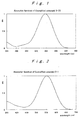
- an absorption spectrum of the dye in N,N-dimethylformamide (DMF) was determined. The results arc shown in FIG. 1 .
- pKa was 2.91.
- the dye had good hue.
- a dye (Exemplified compound D-1) was prepared by the following process.
- the exemplified compound (D-1) of the present invention was prepared in a manner similar to the method described in Example 1, except that Compound (G) was replaced with Compound (1).
- the melting point of the prepared dye was 242 to 244°C.
- an absorption spectrum of the dye in DMF was determined. The results are shown in FIG. 2 . As is evident from FIG. 2 , the maximum absorption wavelength ⁇ max was 533 nm. The dye had good hue.
- a dye (Exemplified compound D-21) was prepared by the following process.
- the exemplified compound (N) was prepared in a manner similar to the method described in Example 2, except that Compound (H) was replaced with Compound (M).
- the exemplified compound (D-21) of the present invention was prepared in a manner similar to the method described in Example 1, except that Compound (G) was replaced with Compound (N) and Compound (E) was replaced with Compound (L).
- the melting point of the prepared dye was 262 to 266°C.
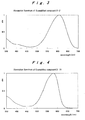
- an absorption spectrum of the dye in DMF was determined. The results are shown in FIG. 3 . As is evident from FIG. 3 , the maximum absorption wavelength ⁇ max was 606 nm. The dye had good hue.
- a dye (Exemplified compound D-15) was prepared by the following process.
- the Compound (P) was prepared in a manner similar to the method described in Example 3, except that Compound (J) was replaced with Compound (O).
- the Compound (Q) was prepared in a manner similar to the method described in Example 3, except that Compound (K) was replaced with Compound (P).
- the exemplified compound (D-15) of the present invention was prepared in a manner similar to the method described in Example 3, except that Compound (E) was replaced with Compound (Q).
- the melting point of the prepared dye was 235 to 237°C.
- an absorption spectrum of the dye in DMF was determined. The results are shown in FIG. 4 . As is evident from FIG. 4 , the maximum absorption wavelength ⁇ max was 580 nm. The dye had good hue.
- the exemplified compounds D-23, D-1, D-21, and D-15 prepared in Examples 1 to 4 were subjected to the experiment described in Example 1 of JP-A-2000-280630 to investigate the fastness properties of images. Specifically, the light fastness properties of images were investigated as follows.
- a heat-resistant slipping layer was formed on one surface of a polyethylene terephthalate film with a thickness of 5 ⁇ m, and the film was being served as a support.
- a coating composition (1) of a dye-providing layer with a composition as described below was applied by a gravure coaler so as to be 0.6 ⁇ m in thickness after drying, to give a heat-sensitive transfer dye-providing material (P-1) (hereinafter, also simply referred to as dye-providing material).
- a sheet of laminating-type synthetic paper with a thickness of 150 ⁇ m was used as a support.
- a coating composition (1) of a receptive layer as shown in the below was applied on one surface of the support using a wire bar coater so as to be 5 ⁇ m in thickness after drying. Consequently, a heat-sensitive transfer image-receiving material (1) (hereinafter, also simply referred to as image-receiving material) was obtained.
- the drying was carried out in an oven at 80°C for 1 hour, after pre-drying with a dryer.
- Dye-fixing agent A-9 (trade name: AEA, manufactured by Sankyo Co., Ltd.) 26g Polyisocyanate (trade name: KP-90, manufactured by Dainippon Ink and Chemicals, Incorporated) 4 g Amino-modified silicone oil (trade name: KP-857, manufactured by Shin-Etsu Silicone Co., Ltd.) 0.5 g Methyl ethyl ketone 100 ml Toluene 50 ml Cyclobexanone 10 ml
- the heat-sensitive transfer dye-providing material (D-1) obtained as described above was used to laminate the dye-providing layer and a receptive layer of the heat-sensitive transfer image-receiving material (1), to bring those in contact with each other. Subsequently, from the side of the support of the heat-sensitive transfer dye-providing material, heating was performed using a thermal head under the conditions in which the thermal head had an output of 0.25 W/dot, a pulse width of 0.1 to 10 msec, and a dot density of 6 dots/mm 2 , to place the dye on the receptive layer of the image-receiving material to make an image-like pattern thereon. Consequently, clear image recording without the transferal irregularity was obtained.
- a portion (Dmax portion) where the density of the recorded image-receiving material obtained at this time was saturated was subjected to a measurement with a reflecting densitometer (status-A filter built-in type, manufactured by X Rite Inc.) and the maximum transfer density of the image was measured.
- a reflecting densitometer status-A filter built-in type, manufactured by X Rite Inc.
- the recorded image-receiving material was irradiated for 7 days with light at 17,000 lx from a fluorescent lamp, and the light-fastness properties of the image were then investigated.
- the portion showing a reflection density of 1.0 was subjected to a reflection density measurement after the test, and the stability thereof was evaluated by the persistence (%) of the reflection density after the test to the refection density 1.0 before the test.
- the thermal stability of the image was evaluated after storing in an oven at 60°C for 1 week.
- the material using the compound D-23 of the present invention was stable because no decrease in density and no color change were observed.
- the recorded image-receiving material was stored in an oven at 60°C for 2 weeks and the degree of image-bleeding was then observed. The determination was performed on the basis of the following criteria: good (o): no substantial change of an image from one before the storage; allowable ( ⁇ ): slightly bled; ( ⁇ ): extremely bled and blurred. Any image formed with the compound D-23 of the present invention did not show any substantial change, compared with one before the storage (o).
- the azo compound of the present invention provides an image with high transfer density (with sufficient dyeing properties and migration properties) and a clear image with excellent fastness properties to light and heat, as well as no substantial image blur with the lapse of time.
- Coating compositions P-2 to P-4 of dye-providing layers were prepared in the same manner as one described above, except that any of the compounds D-1, D-21, and D-15 was used instead of the compound D-23, and then each of those was examined as described above. As a result, all of the compounds D-1, D-21, and D-15 showed good dyeing properties, migration properties, fastness properties just as in the case of the compound D-23.
Landscapes
- Chemical & Material Sciences (AREA)
- Organic Chemistry (AREA)
- Thermal Transfer Or Thermal Recording In General (AREA)
- Plural Heterocyclic Compounds (AREA)
- Nitrogen And Oxygen Or Sulfur-Condensed Heterocyclic Ring Systems (AREA)
Abstract

Description
- The present invention relates to a sulfur-containing/nitrogen-containins heterocyclic azo dye and azo compound. More specifically, the present invention relates to a sulfur-containing/nitrogen-containing heterocyclic azo dye and azo compound of novel structure having good hue and fastness properties and also having a high molecular extinction coefficient.
- Conventionally, many azo dyes have various kinds of visible light absorption, and they have been used as dyes in various fields. For instance, the azo dyes have been used in various fields of synthetic-resin coloring, printing ink, dyes for thermal sublimination transfer printing materials, inkjet-ink dyes, and color-filter dyes. The significant performance demanded for azo dyes to be used as proper dyes, include absorption spectrum. The hue of a dye has much effect on the tint (shade), texture, and the like of a substance colored by the dye and thus significantly influences visual sensation. Therefore, absorption spectra of dyes have been studied for a long time.
- Recently, the fields of dye application have been diversified, because color images have become the mainstream of image-recording materials. Specifically, dyes have been actively used in inkjet recording materials, thermal-transfer recording materials, electrophotographic recording materials, transfer-type silver halide photosensitive materials, printing ink, and the like. Also, the azo dyes have been used in color filters for recording and reproducing color images in imaging devices such as CCDs in imaging apparatuses and LCDs and PDPs in displays. Further, the azo dyes have been used for dyes and hair dyes. In the case of these color image recording materials and color filters, three primary-color coloring agents (dyes or pigments) are used for reproducing or recording full color images in a so-called additive color mixture method or subtractive color mixture method.
- However, at present, there is no fast coloring agent having absorbing properties that realize a favorable color-reproducing region and having good color hue, while being sustainable to various usage conditions and environmental conditions. Therefore, improvements in coloring agents have been demanded in the art.
- Conventionally, azo dyes including five-membered heterocyles as coupler components are disclosed in
JP-A-2001-207092 JP-A-2001-207093 - An object of the present invention is to provide an azo dye and azo compound of novel structure which has good hue and fastness properties and also has a high molecular extinction coefficient.
- As a result of intensive studies, the inventor of the present invention has found that a specific nitrogen-containing heterocyclic azo dye has good hue and good fastness properties to light and heat. Then, the inventor has completed the present invention on the basis of such a finding.
- According to the present invention, there is provided the following means:
- (1) An azo dye composed of a compound represented by formula (1):

- (2) The azo dye according to (1), wherein X represents a carbon atom, Y represents a nitrogen atom, and Z represents a nitrogen atom, in the formula (I).
- (3) The azo dye according to (1) or (2), wherein R5 represents an aliphatic group, in the formula (I).
- (4) The azo dye according to any one of (1) to (3), wherein R1 represents an aliphatic sulfonyl amino group, W represents a sulfur atom, R5 represents an aliphatic group, R6 represents an aliphatic group, n represents 1, X represents a carbon atom, Y represents a nitrogen atom, and Z represents a nitrogen atom, in the formula (I).
- (5) A compound represented by formula (I):

- Other and further objects, features and advantages of the invention will appear more fully from the following description, appropriately referring to the accompanying drawings.
-
-
Fig. 1 is an absorption spectrum of a dye (Exemplified compound D-23) prepared in the working example. -
Fig. 2 is an absorption spectrum of a dye (Exemplified compound D-1) prepared in the working example. -
Fig. 3 is an absorption spectrum of a dye (Exemplified compound D-21) prepared in the working example. -
Fig. 4 is an absorption spectrum of a dye (Exemplified compound D-15) prepared in the working example. - The present invention will be described in detail below.
- The term "aliphatic group" used herein means any of aliphatic groups in which an aliphatic moiety thereof may be a linear or branched chain being saturated or unsaturated, including an alkyl group and an alkenyl group, those of which may be unsubstituted or substituted. In addition, the "aryl" may have a single ring or a condensed ring, and may be unsubstituted or substituted.
- Hereinafter, the compound represented by formula (I) will be described in detail.

- In the formula, R1 represents a hydroxyl group, an aliphatic sulfonyl amino group, an aryl sulfonyl amino group, an aliphatic oxy group, an aryloxy group, or - CH(R2)(R3); R2 and R3 each represent a substituent with a σ value of the Hammett's rule in the range of 0.2 or more and less than 1.4, and may be identical to or different from each other; W represents a sulfur atom or -N-(-R4)-; R4 represents a substituent; R5 represents a substituent; X, Y, and Z each represent an atom required for the formation of a five-membered aromatic heterocycle, where at least one atom of X, Y, and Z represents a nitrogen atom but both X and Y do not represent a carbon atom when Z represents a nitrogen atom; and R6 represents a hydrogen atom or a substituent, n represents 1 or 2, and two R6s may be coupled together to form an aromatic ring or a heteroaromatic ring when n represents 2.
- Examples of substituents represented by R4 to R6 include a halogen atom, an aliphatic group, an aryl group, a cyano group, a nitro group, an aliphatic oxy group, an aryloxy group, a heterocyclic oxy group, an acyloxy group, a carbamoyloxy group, an aliphaticoxycarbonyloxy group, an aryloxycarbonyloxy group, an amino group (including an anilino group), an acylamino group, an aminocarbonylamino group, an aliphaticoxycarbonylamino group, an aryloxycarbonylamino group, a sulfamoyl amino group, an aliphatic sulfonylamino group, an aryl sulfonylamino group, an aliphatic thio group, an arylthio group, a heterocyclic thio group, a sulfamoyl group, an aliphatic sulfonyl group, an aryl sulfonyl group, an acyl group, an aliphaticoxycarbonyl group, an aryloxycarbonyl group, and a carbamoyl group.
- For more detail, examples of the substituent include a halogen atom (e.g., a chlorine atom, a bromine atom, an iodine atom); an aliphatic group (a straight- or branched-chain or cyclic aliphatic group having 1 to 10 carbon atoms, preferably having 1 to 6 carbon atoms, e.g., methyl, ethyl, n-propyl, isopropyl, t-butyl, n-octyl, 2-chloroethyl, 2-cyanocthyl, 2-ethylhexyl, 2-hydroxyethyl); an aryl group (an aryl group having 6 to 12 carbon atoms, preferably having 6 to 8 carbon atoms, e.g., phenyl, p-tolyl, naphthyl, 3-chlorophenyl); a heterocyclic group (a monovalent group having 1 to 12 carbon atoms, preferably 2 to 6 carbon atoms, which is obtained by removing one hydrogen atom from a 5-membered or 6-membered aromatic or nonraomatic heterocyclic compound; e.g., 1-pyrazolyl, 1-imidazolyl, 2-furyl, 2-thienyl, 4-pyrimidinyl, 2-benzothiazolyl); a cyano group; a nitro group; an aliphatic oxy group (a straight- or branched-chain or cyclic aliphatic oxy group having 1 to 10 carbon atoms, preferably having 1 to 6 carbon atoms, e.g., methoxy, ethoxy, isopropoxy, t-butoxy, cyclopentyloxy, 2-butene-1-yl oxy, 2-metboxyethoxy); an aryloxy group (an aryloxy group having 6 to 12 carbon atoms, preferably 6 to 8 carbon atoms, e.g., phenoxy, 2-methylphenoxy, 4-t-butylphenoxy, 3-nitrophenoxy); a silyloxy group (a silyloxy group having 3 to 10 carbon atoms, preferably 3 to 6 carbon atoms, e.g., trimethylsilyloxy, t-butyldimethylsilyloxy); a heterocyclic oxy group (a heterocyclic oxy group having 1 to 12 carbon atoms, preferably having 2 to 6 carbon atoms, e.g., 1-phenyltctrazole-5-oxy, 2-tetrahydropyranyloxy); an acyloxy group (an acyloxy group having 1 to 12 carbon atoms, preferably having 1 to 8 carbon atoms, e.g., formyloxy, acetyloxy, pivaloyloxy, benzoyloxy, p-methoxyphenylcarbonytoxy); a carbamoyloxy group (a carbamoyloxy group having 1 to 10 carbon atoms, preferably having 1 to 6 carbon atoms, e.g., N,N-dimethylcarbamoyloxy, N,N-diethylcarbarnoyloxy, morpholino carbonyloxy, N,N-octylcarbamoyloxy); an aliphatic oxycarbonyloxy group (an aliphatic oxycarbonyloxy group having 2 to 10 carbon atoms, preferably 2 to 6 carbon atoms, e.g., methoxycarbonyloxy, ethoxycarbonyloxy, t-butoxy carbonyloxy, n-octyloxycarbonyloxy); an aryloxycarbonyloxy group (an aryloxycarbonyloxy group having 7 to 12 carbon atoms, preferably 7 to 10 carbon atoms, e.g., phenoxycarbonyloxy, p-methoxyphenoxycarbonyloxy); an amino group (an aliphatic amino group having 1 to 10 carbon atoms, preferably 1 to 6 carbon atoms, an anilino group having 6 to 12 carbon atoms, preferably having 6 to 8 carbon atoms, and a heterocyclic amino group having 1 to 12 carbon atoms, preferably 2 to 6 carbon atoms, e.g., amino, methylamino, dimethylamino, anilino, N-methyl-anilino, diphenylamino, imidazole-2-yl amino, pyrazole-3-yl amino), an acylamino group (an aliphatic carbonylamino group having 1 to 10 carbon atoms, preferably 1 to 6 carbon atoms, an arylcarbonylamino group having 6 to 12 carbon atoms, preferably 6 to 8 carbon atoms, a heterocyclic carbonylamino group having 2 to 12 carbon atoms, preferably 2 to 6 carbon atoms, e.g., formylamino, acctylamino, pivaloylamino, benzoylamino, pyridine-4-carbonylamino, thiophene-2-carbonylamino), an aminocarbonylamino group (an aminocarbonylamino group having 1 to 12 carbon atoms, preferably 1 to 6 carbon atoms, e.g., carbamoylamino, N,N-dimcthylaminocarbonylamino, N,N-diethylamino carbonylamino, morpholine-4-yl carbonylamino); an aliphatic oxycarbonylamino group (an aliphatic oxycarbonylamino group having 2 to 10 carbon atoms, preferably 2 to 6 carbon atoms, e.g., methoxycarbonylamino, ethoxycarbonylamino, t-butoxycarbonylamino); an aryloxycarbonylamino group (an aryloxycarbonylamino group having 7 to 12 carbon atoms, preferably 7 to 9 carbon atoms, e.g., phenoxycarbonylamino, p-chlorophenoxycarbonylamino, 4-methoxyphenoxycarbonylamino); a sulfamoyl amino group (a sulfamoylamino group having 0 to 10 carbon atoms, preferably 0 to 6 carbon atoms, e.g., sulfamoylamino, N,N-dimethylaminosulfonylamino, N-(2-hydroxyethyl)sulfamoylamino); an aliphatic sulfonylamino group (an aliphatic sulfonylamino group having 1 to 10 carbon atoms, preferably 1 to 6 carbon atoms, e.g., methylsulfonylamino, butylsulfonylamino); an arylsulfonylamino group (an arylsulfonylamino group having 6 to 12 carbon atoms, preferably 6 to 8 carbon atoms, e.g., phenylsulfonylamino, 2,3,5-trichlorophenylsulfonylamino, p-methylphenylsulfonylamino); an aliphatic thio group (an aliphatic thio group having 1 to 10 carbon atoms, preferably 1 to 6 carbon atoms, e.g., methylthio, ethylthio, butylthio), an arylthio group (an arylthio group having 6 to 12 carbon atoms, preferably 6 to 8 carbon atoms, e.g., phenylthio, p-chlorophenylthio, m-methoxyphenylthio); a heterocyclic thio group (a heterocyclic thio group having 1 to 10 carbon atoms, preferably 1 to 6 carbon atoms, e.g., 2-benzothiazolylthio, 1-phenyltetrazol-5-ylthio); a sulfamoyl group (a sulfamoyl group having 0 to 10 carbon atoms, preferably 0 to 6 carbon atoms, e.g., sulfamoyl, N-cthylsulfamoyl, N,N-dimethyl sulfamoyl, N-acctylsulfamoyl, N-benzoylsulfamoyl); an aliphatic sulfonyl group (an aliphatic sulfonyl group having 1 to 10 carbon atoms, preferably 1 to 6 carbon atoms, e.g., methylsulfonyl, ethylsulfonyl); an arylsulfonyl group (an arylsulfonyl group having 6 to 12 carbon atoms, preferably 6 to 8 carbon atoms, e.g., phenylsulfonyl, p-chlorophenylsulfonyl); an acyl group (a formyl group, an aliphatic carbonyl group having 2 to 10 carbon atoms (preferably 2 to 6 carbon atoms) and an arylcarbonyl group having 7 to 12 carbon atoms (preferably 7 to 9 carbon atom), e.g., acetyl, pivaloyl, 2-chloroacetyl, benzoyl, 2,4-dichlorobenzoyl); an aliphatic oxycarbonyl group (an aliphatic oxycarbonyl group having 2 to 10 carbon atoms, preferably 2 to 6 carbon atoms, e.g., methoxycarbonyl, ethoxycarbonyl, t-butoxycarbonyl, isobutyloxycarbonyl); an aryloxycarbonyl group (an aryloxycarbonyl group having 7 to 12 carbon atoms, preferably 7 to 9 carbon atoms, e.g., phenoxycarbonyl, 2-chlorophenoxycarbonyl, 3-nitrophenoxy carbonyl, 4-t-butylphenoxycarbonyl); a carbamoyl group (a carbamoyl group having 1 to 10 carbon atoms, preferably 1 to 6 carbon atoms, e.g., carbamoyl, N-methylcarbamoyl, N,N-dimethylcarbamoyl, N-(2-hydroxyethyl)carbamoyl, N-(methylsulfonyl)carbamoyl).
- In terms of the effects of the present invention, R4 is preferably an aliphatic group, an acyl group, or an aryl group, more preferably an aliphatic group or an aryl group, most preferably an aliphatic group having 1 to 6 carbon atoms. Specifically, R4 may be a methyl group, an ethyl group, or the like.
- In terms of the effects of the present invention, R5 is preferably an aliphatic group, an acylamino group, an aryl group, an amino group, an aliphatic oxycarbonylamino group, or an aliphatic aminocarbonyloxy group, more preferably an aliphatic group or an aryl group, most preferably an aliphatic group having 1 to 4 carbon atoms. Specifically, R5 may be a methyl group, an ethyl group, an isopropyl group, or the like.
- In terms of the effects of the present invention, R6 is preferably a hydrogen atom, an aliphatic group, an aryl group, an aliphatic thio group, an arylthio group, or an aliphatic oxy group, more preferably an aliphatic group or an aliphatic thio group, most preferably an aliphatic group having 1 to 3 carbon atoms. Specifically, R6 may be a methyl group, or the like.
- R1 represents a hydroxyl group, an aliphatic sulfonyl amino group, an aryl sulfonyl amino group, an aliphatic oxy group, an aryl oxy group, or -CH(R2)(R3). The number of carbon atoms in the aliphatic sulfonyl amino group, the aryl sulfonyl amino group, the aliphatic oxy group, or the aryl oxy group represented by R1 and preferred specific examples thereof are the same as those in the description of the substituents represented by R4 to R6.
- In terms of the effects of the present invention, R1 is preferably a hydroxyl group, an aliphatic sulfonyl amino group, an aryl sulfonyl amino group, or -CH(R2)(R3), more preferably an aliphatic sulfonyl amino group, an aryl sulfonyl amino group, or - CH(R2)(R3), most preferably an aliphatic sulfonyl amino group or -CH(R2)(R3).
- R2 and R3 each are an electron attractive group of which the Hammett's substituent constant σp value (hereinafter, simply referred to as σp value) is 0.20 or more and less than 1.4 (preferably 0.35 to 1.0).
- The Hammett rule is an empirical rule proposed by L. P. Hammett in 1935 to discuss quantitatively the influence of substituents on the reaction or equilibrium of benzene derivatives, and its validity is approved widely nowadays. The substituent constant determined with the Hammett rule includes σp value and σm value, and these values can be found in many general literatures. For example, such values are described in detail in e.g. "Lange's Handbook of Chemistry", 12th edition, (1979), edited by J. A. Dean (McGraw-Hill), "Kagaku No Ryoiki" (Region of Chemistry), extra edition, No. 122, pp. 96-103, (1979) (Nankodo), and "Chemical Reviews", Vol. 91, pp. 165-195, (1991).
- R2 and R3 are defined by the substituent constant of the Hammett's rule. However, it does not mean that R2 and R3 are limited to substituents with literarily known values described in published documents. In other words, R2 and R3 may be any group which has any literarily unknown value as far as such a value can fall within the specifically defined range when measured according to the Hammett's rule. Specific examples of an electron withdrawing group whose substituent constant (σ value) is 0.2 to 1.4 include a chlorine atom, an acyl group, an aliphatic oxycarbonyl group, an aryl oxycarbonyl group, a carbamoyl group, a cyano group, a nitro group, an aliphatic sulfonyl group, an aryl sulfonyl group, and a sulfamoyl group. The number of carbon atoms in any of those and specific examples thereof are the same as those in the description of the substituents represented by R4 to R6. Examples of the σ value of the Hammett's rule arc -CN group: 0.66 and -COOCH3 group: 0.45.
- In terms of the effects of the present invention, R2 and R3 are preferably identical to each other, and preferably a carbamoyl, an aliphatic oxy carbonyl, an aryl oxy carbonyl, or a cyano group, more preferably a carbamoyl, an aliphatic oxy carbonyl, or a cyano group, and most preferably a carbamoyl, an aliphatic oxy carbonyl or a cyano group.
- X, Y, and Z each represent an atom required for the formation of a five-membered aromatic heterocycle, where at least one atom of X, Y, and Z represents a nitrogen atom but both X and Y do not represent a carbon atom when Z represents a nitrogen atom.
- Examples of a heterocycle with a combination of X, Y, and Z include Het-1 to Het-13 as described below. In the following formulae, R7 to R18 each represent a hydrogen atom or a substituent. The number of carbon atoms of the substituents represented by R7 to R18 and specific examples thereof are preferably the same as those in the description of substituents represented by R4 to R6.


- In terms of the effects of the present invention, the heterocycle with the combination of X, Y, and Z is preferably Het-1, Hct-2, Het-3, or Het-7, more preferably Het-1, Het-2, or Het-3, most preferably Hct-2 in which X is a carbon atom, Y is a nitrogen atom, and Z is a nitrogen atom.
- Specific examples of the compounds represented by formula (1) are shown below. However, the present invention should not be construed as being limited to these compounds.


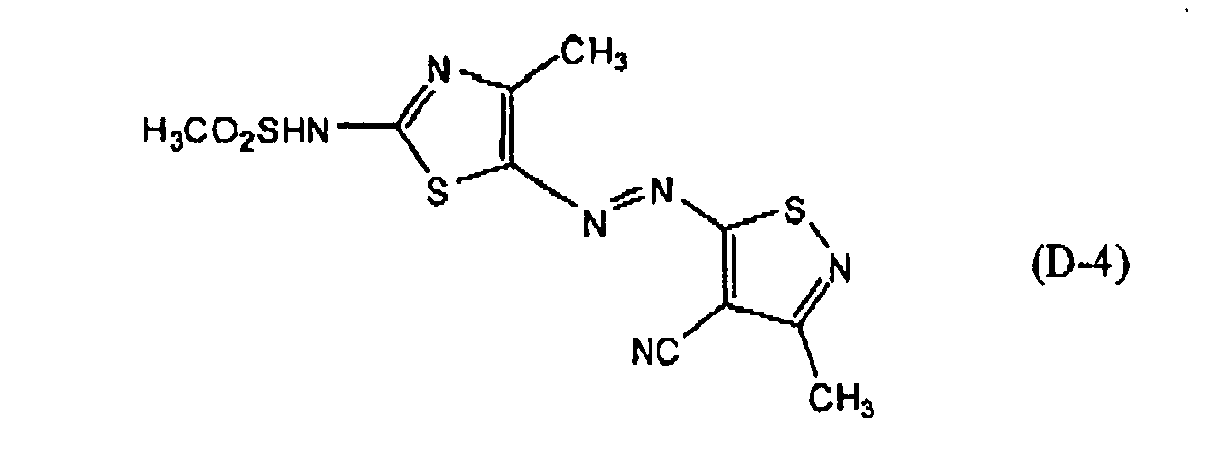


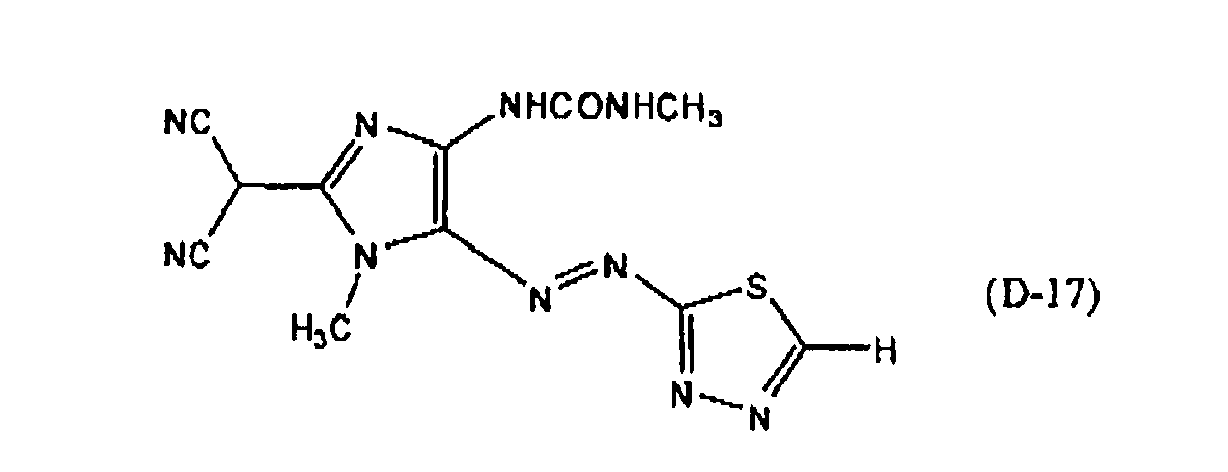


- The compound represented by formula (I) can be prepared with reference to, for example, a method described in
JP-A-2003-342139 - The compound represented by formula (I) can be preferably used as an azo dye. The azo dyc of the compound represented by formula (I) has the absorption maximum at a wavelength region of preferably 500 to 650 nm, more preferably 530 to 580 nm or 620 to 650 nm. In addition, such an azo dye preferably has a molar absorbance coefficient ε of 40,000 to 70,000, more preferably 55,000 to 70,000.
- Examples of applications of the azo dye of the compound represented by formula (I) include: solid-state imaging device such as CCD and CMOS; color filters for recording and reproducing color images used in displays such as LCD and PDP; curable compositions for preparing such color filters; color image recording materials for forming color images; and coloring. Specifically, the applications of the compound include color filters and curable compositions for preparing such color filters, inkjet recording materials, thermal recording materials, pressure-sensitive recording materials, electrophotographic recording materials, transfer-type silver halide photosensitive materials, printing ink, recording pens, fiber-dyeing, hair-dyeing, and the like, preferably inkjet recording materials, transfer-type silver halide photosensitive materials, printing ink, hair-dyeing, and the like.
- The dye (dyestuff) of the present invention can be used after being optimized to the intended application by modifying a substituent thereon to adjust the physical properties thereof, such as solubility and dispersibility. Further, the dyc (dyestuff) of the present invention can be also used in dissolved state, emulsified state, or solidified state, depending on a system where the dye (dyestuff) will be applied.
- The azo dye of the present invention is a dye having a high molecular absorption coefficient as well as having excellent hue and sufficient fastness properties to light, heat, humidity, and active gas in the environment. Further, the azo compound of the present invention can be favorably used as such an azo dye.
- The present invention will be described in more detail based on the following examples, but the invention is not intended to be limited thereto.
- Example-1
- A dye (Exemplified compound D-23) was prepared by the following process.


- First, 16.2 g of Compound (A) (0.08 mol) and 6.2 g of Compound (B) (0.08 mol) were suspended in 80 ml of isopropyl alcohol and then stirred for 3 hours at an inner temperature of 25°C. Subsequently, 6.9 g of sodium hydrogen carbonate (0.082 mol) was dissolved in 200 ml of water, and the resultant solution was added to the above suspension. A precipitated crystal was filtrated, washed sufficiently with water, and dried. Consequently, 14.0 g of a white crystal was obtained as Compound (C) (99.3% in yield).
- First, 10.0 g of Compound (C) (0.055 mol) was dissolved in 100 ml of tetrahydrofuran and then added with 18.9 g of methanesulfonyl chloride (0.165 mol). Subsequently, 8.9 g of sodium hydride (oiliness, 50 to 72% in content) was added to the mixture and then stirred for 5 hours at a reaction temperature of 65°C. The reaction solution was left standing after the addition of 10 ml of methanol, 1,000 ml of ethyl acetate, and 500 ml of a saturated salt solution. An aqueous phase was removed and an ethyl acetate phase was then washed with 500 ml of a saturated salt solution, followed by drying water with an anhydrous magnesium sulfate. After that, the filtrate obtained from the filtration of the magnesium sulfate was distilled off under reduced pressure and the resulting residue was then purified through a silica gel chromatography. Consequently, 5.5 g of a white solid substance was obtained as Compound (E) (39.3% in yield).
- First, 13.3 g of Compound (F) (0.1 mol) and 20 ml of isopropyl alcohol were suspended in 15 ml of water and then dissolved with the addition of 6.6 g of 85% potassium hydroxide. Subsequently, 16.4 g of ethyl iodide (0.105 mol) was kept at a reaction temperature of 25°C or less and dropped into the solution under ice-cooling. After that, the reaction solution was stirred for 2 hours at a reaction temperature of 60°C and then added to 400 ml of cold water, followed by stirring for 30 minutes. A deposited crystal was filtrated, washed sufficiently with water, and then dried. Consequently, 15.2 g of a pale yellow crystal was obtained as Compound (G) (94.4% in yield).
- First, 2.8 g of Compound (G) (0.017 mol) was dissolved in 350 ml of phosphoric acid and then gradually added with 1.3 g of sodium nitrite (0.19 mol) while being kept at an inner temperature of 5°C or less and stirred for 30 minutes. Subsequently, 4.8 g of Compound (E) (0.19 mol) was dissolved in 50 ml of acetic acid and then added to the reaction solution, followed by stirring at 10°C for 5 hours. The reaction solution was added with 2 liters of water and then stirred for 1 hour. A deposited crystal was filtrated and then washed sufficiently with water. After that, the resulting crystal was dried and then purified through silica gel column chromatography. The resulting product was crystallized with 150 ml of methanol/water = 1/1 (mixture ratio, ml) and then filtrated. The crystal thus obtained was washed with 50 ml of the above mixture solvent and then dried. Consequently, 2.8 g of an orange-yellow crystal was obtained as the exemplified compound (D-23) of the present invention (38.6% in yield).
- The melting point of the thus-prepared dye was 257 to 258°C. In addition, an absorption spectrum of the dye in N,N-dimethylformamide (DMF) was determined. The results arc shown in
FIG. 1 . As is evident fromFIG 1 , the maximum absorption wavelength λ max was 546.1 nm (ε = 41,200). In addition, in I7MP/water = 1/1 (mixture ratio, ml), pKa was 2.91. The dye had good hue. - A dye (Exemplified compound D-1) was prepared by the following process.


- After dissolving 10.5 g of sodium thiocyanate (0.13 mol) in 100 ml of methanol, 13.9 g of Compound (H) (0.05 mol) was added to the reaction solution under ice/methanol cooling. Subsequently, 15.4 ml of triethyl amine (0.11 mol) was added to the reaction solution. After that, 14 ml of triethyl amine (0.1 mol) and 16.3 g of bromine (0.102 mol) were simultaneously dropped into the reaction solution while being kept at an inner temperature of 5°C or less. After reacting at room temperature for 2 hours, the reaction solution was added to 1,000 ml of cold water and then stirred for 30 minutes. A deposited crystal was filtrated, washed sufficiently with water, and then dried. Consequently, 10.0 g of a pale yellow crystal was obtained as Compound (I) (68% in yield).
- The exemplified compound (D-1) of the present invention was prepared in a manner similar to the method described in Example 1, except that Compound (G) was replaced with Compound (1).
- The melting point of the prepared dye was 242 to 244°C. In addition, an absorption spectrum of the dye in DMF was determined. The results are shown in
FIG. 2 . As is evident fromFIG. 2 , the maximum absorption wavelength λ max was 533 nm. The dye had good hue. - A dye (Exemplified compound D-21) was prepared by the following process.


- After adding 24.4 g of sodium thiocyanate (0.3 mol) to 200 ml of ethanol, the reaction solution was refluxed under heat and then added with 39.8 g of Compound (J) (0.2 mol) to react for 1 hour. After cooling down the mixture to room temperature, 400 ml of ethyl acetate and 400 ml of water were added to the mixture. Subsequently, an ethyl acetate phase and an aqueous phase were separated by a separation operation. After that, the ethyl acetate phase was distilled off under reduced pressure and 80 ml of ethanol was then added to a concentrated residue. A deposited crystal was filtrated, washed with ethanol, and then dried. Consequently, 27 g of a white crystal was obtained as Compound (K) (76% in yield).
- First, 7.4 g of malononitrile (0.11 mol) and 19.9 g of Compound (K) (0.11 mol) were dissolved in 100 ml ofN,N-dimethyl acetamide, and 47 ml of triethyl amine (0.34 mol) was then dropped into the mixture at room temperature. After reacting for 1 hour at room temperature, the reaction solution was added with 300 ml of cold water and then dropped with 43 ml of 35% hydrochloric acid (0.5 mol). A deposited crystal was filtrated, washed sufficiently with water, and then dried. Consequently, 22.1 g of a pale ocher crystal was obtained as Compound (L) (87% in yield).
- The exemplified compound (N) was prepared in a manner similar to the method described in Example 2, except that Compound (H) was replaced with Compound (M).
- The exemplified compound (D-21) of the present invention was prepared in a manner similar to the method described in Example 1, except that Compound (G) was replaced with Compound (N) and Compound (E) was replaced with Compound (L).
- The melting point of the prepared dye was 262 to 266°C. In addition, an absorption spectrum of the dye in DMF was determined. The results are shown in
FIG. 3 . As is evident fromFIG. 3 , the maximum absorption wavelength λ max was 606 nm. The dye had good hue. - A dye (Exemplified compound D-15) was prepared by the following process.


- The Compound (P) was prepared in a manner similar to the method described in Example 3, except that Compound (J) was replaced with Compound (O).
- The Compound (Q) was prepared in a manner similar to the method described in Example 3, except that Compound (K) was replaced with Compound (P).
- The exemplified compound (D-15) of the present invention was prepared in a manner similar to the method described in Example 3, except that Compound (E) was replaced with Compound (Q).
- The melting point of the prepared dye was 235 to 237°C. In addition, an absorption spectrum of the dye in DMF was determined. The results are shown in
FIG. 4 . As is evident fromFIG. 4 , the maximum absorption wavelength λ max was 580 nm. The dye had good hue. - The exemplified compounds D-23, D-1, D-21, and D-15 prepared in Examples 1 to 4 were subjected to the experiment described in Example 1 of
JP-A-2000-280630 - A heat-resistant slipping layer was formed on one surface of a polyethylene terephthalate film with a thickness of 5 µm, and the film was being served as a support. On the side of the support opposite to the heat-resistant slipping layer side, a coating composition (1) of a dye-providing layer with a composition as described below was applied by a gravure coaler so as to be 0.6 µm in thickness after drying, to give a heat-sensitive transfer dye-providing material (P-1) (hereinafter, also simply referred to as dye-providing material).
-
Compound D-23 10 g Polyvinyl butyral (trade name: DENKA BUTYRAL 5000A, manufactured by Denki Kagaku Kogyo Kabushiki Kaisha) 10 g Silicone oil (trade name: KF-96, manufactured by Shin-Etsu Chemical Co., Ltd.) 0.2 g Polyisocyanate (trade name: TAKENATE D110N, manufactured by Takeda Pharmaceutical Company Limited.) 0.5 g Methyl ethyl ketone 100 ml Toluene 80 ml - A sheet of laminating-type synthetic paper with a thickness of 150 µm was used as a support. A coating composition (1) of a receptive layer as shown in the below was applied on one surface of the support using a wire bar coater so as to be 5 µm in thickness after drying. Consequently, a heat-sensitive transfer image-receiving material (1) (hereinafter, also simply referred to as image-receiving material) was obtained. The drying was carried out in an oven at 80°C for 1 hour, after pre-drying with a dryer.
-
Dye-fixing agent: A-9 (trade name: AEA, manufactured by Sankyo Co., Ltd.) 26g Polyisocyanate (trade name: KP-90, manufactured by Dainippon Ink and Chemicals, Incorporated) 4 g Amino-modified silicone oil (trade name: KP-857, manufactured by Shin-Etsu Silicone Co., Ltd.) 0.5 g Methyl ethyl ketone 100 ml Toluene 50 ml Cyclobexanone 10 ml 
- The heat-sensitive transfer dye-providing material (D-1) obtained as described above was used to laminate the dye-providing layer and a receptive layer of the heat-sensitive transfer image-receiving material (1), to bring those in contact with each other. Subsequently, from the side of the support of the heat-sensitive transfer dye-providing material, heating was performed using a thermal head under the conditions in which the thermal head had an output of 0.25 W/dot, a pulse width of 0.1 to 10 msec, and a dot density of 6 dots/mm2, to place the dye on the receptive layer of the image-receiving material to make an image-like pattern thereon. Consequently, clear image recording without the transferal irregularity was obtained.
- A portion (Dmax portion) where the density of the recorded image-receiving material obtained at this time was saturated was subjected to a measurement with a reflecting densitometer (status-A filter built-in type, manufactured by X Rite Inc.) and the maximum transfer density of the image was measured.
- Subsequently, the recorded image-receiving material was irradiated for 7 days with light at 17,000 lx from a fluorescent lamp, and the light-fastness properties of the image were then investigated. The portion showing a reflection density of 1.0 was subjected to a reflection density measurement after the test, and the stability thereof was evaluated by the persistence (%) of the reflection density after the test to the refection density 1.0 before the test.
- In addition, the thermal stability of the image was evaluated after storing in an oven at 60°C for 1 week. As a result, the material using the compound D-23 of the present invention was stable because no decrease in density and no color change were observed.
- Further, the recorded image-receiving material was stored in an oven at 60°C for 2 weeks and the degree of image-bleeding was then observed. The determination was performed on the basis of the following criteria: good (o): no substantial change of an image from one before the storage; allowable (Δ): slightly bled; (×): extremely bled and blurred. Any image formed with the compound D-23 of the present invention did not show any substantial change, compared with one before the storage (o).
- As is evident from the above results, the azo compound of the present invention provides an image with high transfer density (with sufficient dyeing properties and migration properties) and a clear image with excellent fastness properties to light and heat, as well as no substantial image blur with the lapse of time.
- Coating compositions P-2 to P-4 of dye-providing layers were prepared in the same manner as one described above, except that any of the compounds D-1, D-21, and D-15 was used instead of the compound D-23, and then each of those was examined as described above. As a result, all of the compounds D-1, D-21, and D-15 showed good dyeing properties, migration properties, fastness properties just as in the case of the compound D-23.
- Having described our invention as related to the present embodiments, it is our intention that the invention not be limited by any of the details of the description, unless otherwise specified, but rather be construed broadly within its spirit and scope as set out in the accompanying claims.
Claims (5)
- An azo dye composed of a compound represented by formula (I):

- The azo dye as claimed in claim 1, wherein X represents a carbon atom, Y represents a nitrogen atom, and Z represents a nitrogen atom, in the formula (I).
- The azo as claimed in claim 1 or 2, wherein R5 represents an aliphatic group, in the formula (I).
- The azo dye as claimed in any one of claims 1 to 3, wherein R1 represents an aliphatic sulfonyl amino group, W represents a sulfur atom, R5 represents an aliphatic group, R6 represents an aliphatic group, n represents 1, X represents a carbon atom, Y represents a nitrogen atom, and Z represents a nitrogen atom, in the formula (I).
- A compound represented by formula (I):

Applications Claiming Priority (2)
| Application Number | Priority Date | Filing Date | Title |
|---|---|---|---|
| JP2007080771 | 2007-03-27 | ||
| JP2007134741A JP5192727B2 (en) | 2007-03-27 | 2007-05-21 | Azo dyes and azo compounds |
Publications (3)
| Publication Number | Publication Date |
|---|---|
| EP1975204A2 true EP1975204A2 (en) | 2008-10-01 |
| EP1975204A3 EP1975204A3 (en) | 2009-07-22 |
| EP1975204B1 EP1975204B1 (en) | 2013-10-02 |
Family
ID=39699474
Family Applications (1)
| Application Number | Title | Priority Date | Filing Date |
|---|---|---|---|
| EP20080005815 Not-in-force EP1975204B1 (en) | 2007-03-27 | 2008-03-27 | Azo dye and azo compound |
Country Status (1)
| Country | Link |
|---|---|
| EP (1) | EP1975204B1 (en) |
Cited By (4)
| Publication number | Priority date | Publication date | Assignee | Title |
|---|---|---|---|---|
| EP2388253A4 (en) * | 2009-03-10 | 2012-08-08 | Univ Gifu | THIAZOLE DERIVATIVE AND METHOD FOR PRODUCING THE SAME |
| EP2440618A4 (en) * | 2009-06-10 | 2014-01-01 | Fujifilm Corp | Colored curable composition, color resist, ink-jet ink, color filter and method for producing the same, solid-state image pickup device, image display device, liquid crystal display, organic el display, and colorant compound and tautomer thereof |
| CN107074792A (en) * | 2014-10-02 | 2017-08-18 | 富士胶片株式会社 | 5 amino 3 replace the manufacture method of 1,2,4 thiadiazoles |
| WO2020128003A1 (en) * | 2018-12-21 | 2020-06-25 | Ogeda Sa | SYNTHESIS OF 3-METHYL-1,2,4-THIADIAZOLE-5-CARBOHYDRAZIDE OR OF THE METHYL-d3 DEUTERATED FORM THEREOF |
Citations (4)
| Publication number | Priority date | Publication date | Assignee | Title |
|---|---|---|---|---|
| JP2000280630A (en) | 1999-03-30 | 2000-10-10 | Fuji Photo Film Co Ltd | Thermal transfer recording material |
| JP2001207092A (en) | 2000-01-28 | 2001-07-31 | Fuji Photo Film Co Ltd | Oil based ink composition |
| JP2001207093A (en) | 2000-01-28 | 2001-07-31 | Fuji Photo Film Co Ltd | Ink-jet recording ink and image recording method using the same |
| JP2003342139A (en) | 2002-05-28 | 2003-12-03 | Kao Corp | Hair dye composition |
Family Cites Families (6)
| Publication number | Priority date | Publication date | Assignee | Title |
|---|---|---|---|---|
| DE3409243A1 (en) * | 1984-03-14 | 1985-09-19 | Basf Ag, 6700 Ludwigshafen | ISOTHIAZOLAZO DYES |
| DE4426023A1 (en) * | 1994-07-22 | 1996-01-25 | Basf Ag | Azo dyes with a coupling component from the aminothiazole series |
| DE4437166A1 (en) * | 1994-10-18 | 1996-04-25 | Basf Ag | Dye mixtures containing methine and azo dyes |
| DE19611351A1 (en) * | 1996-03-22 | 1997-09-25 | Basf Ag | Dye mixtures containing thienyl and / or thiazole azo dyes |
| JP2004523396A (en) * | 2001-03-28 | 2004-08-05 | バイエル アクチェンゲゼルシャフト | Optical data recording medium containing heterocyclic azo dye as light absorbing compound in information layer |
| JP2005255868A (en) * | 2004-03-12 | 2005-09-22 | Fuji Photo Film Co Ltd | Monoazo dye, image-forming coloring composition, ink, inkjet recording method, heat-sensitive recording material, color toner, and color filter |
-
2008
- 2008-03-27 EP EP20080005815 patent/EP1975204B1/en not_active Not-in-force
Patent Citations (4)
| Publication number | Priority date | Publication date | Assignee | Title |
|---|---|---|---|---|
| JP2000280630A (en) | 1999-03-30 | 2000-10-10 | Fuji Photo Film Co Ltd | Thermal transfer recording material |
| JP2001207092A (en) | 2000-01-28 | 2001-07-31 | Fuji Photo Film Co Ltd | Oil based ink composition |
| JP2001207093A (en) | 2000-01-28 | 2001-07-31 | Fuji Photo Film Co Ltd | Ink-jet recording ink and image recording method using the same |
| JP2003342139A (en) | 2002-05-28 | 2003-12-03 | Kao Corp | Hair dye composition |
Non-Patent Citations (2)
| Title |
|---|
| "Lange's Handbook of Chemistry", 1979, MCGRAW-HILL, pages: 96 - 103 |
| CHEMICAL REVIEWS, vol. 91, 1991, pages 165 - 195 |
Cited By (10)
| Publication number | Priority date | Publication date | Assignee | Title |
|---|---|---|---|---|
| EP2388253A4 (en) * | 2009-03-10 | 2012-08-08 | Univ Gifu | THIAZOLE DERIVATIVE AND METHOD FOR PRODUCING THE SAME |
| EP2440618A4 (en) * | 2009-06-10 | 2014-01-01 | Fujifilm Corp | Colored curable composition, color resist, ink-jet ink, color filter and method for producing the same, solid-state image pickup device, image display device, liquid crystal display, organic el display, and colorant compound and tautomer thereof |
| US8741508B2 (en) | 2009-06-10 | 2014-06-03 | Fujifilm Corporation | Colored curable composition, color resist, ink-jet ink, color filter and method for producing the same, solid-state image pickup device, image display device, liquid crystal display, organic el display, and colorant compound and tautomer thereof |
| CN107074792A (en) * | 2014-10-02 | 2017-08-18 | 富士胶片株式会社 | 5 amino 3 replace the manufacture method of 1,2,4 thiadiazoles |
| CN107074792B (en) * | 2014-10-02 | 2020-01-03 | 富士胶片株式会社 | Process for producing 5-amino-3-substituted-1, 2, 4-thiadiazole |
| WO2020128003A1 (en) * | 2018-12-21 | 2020-06-25 | Ogeda Sa | SYNTHESIS OF 3-METHYL-1,2,4-THIADIAZOLE-5-CARBOHYDRAZIDE OR OF THE METHYL-d3 DEUTERATED FORM THEREOF |
| CN113767094A (en) * | 2018-12-21 | 2021-12-07 | 奥格达股份有限公司 | Synthesis of 3-methyl-1, 2, 4-thiadiazole-5-carbohydrazide and methyl-d 3 deuterated form thereof |
| US12162849B2 (en) | 2018-12-21 | 2024-12-10 | Ogeda Sa | Synthesis of 3-methyl-1,2,4-thiadiazole-5-carbohydrazide or of the methyl-d3 deuterated form thereof |
| CN113767094B (en) * | 2018-12-21 | 2025-05-09 | 奥格达股份有限公司 | Synthesis of 3-methyl-1,2,4-thiadiazole-5-carbohydrazide and its methyl-d3 deuterated form |
| AU2019410716B2 (en) * | 2018-12-21 | 2025-05-22 | Ogeda Sa | Synthesis of 3-methyl-1,2,4-thiadiazole-5-carbohydrazide or of the methyl-d3 deuterated form thereof |
Also Published As
| Publication number | Publication date |
|---|---|
| EP1975204A3 (en) | 2009-07-22 |
| EP1975204B1 (en) | 2013-10-02 |
Similar Documents
| Publication | Publication Date | Title |
|---|---|---|
| WO2006082669A1 (en) | Colorant, ink, ink-jet ink, method of ink-jet recording, color toner, and color filter | |
| EP0903350B1 (en) | Pyrrolotriazole derivative | |
| EP1975204B1 (en) | Azo dye and azo compound | |
| KR970007419B1 (en) | Subliming type dye for thermal transfer printing | |
| JP5192727B2 (en) | Azo dyes and azo compounds | |
| CN103492500A (en) | Ink composition, ink for inkjet recording, and inkjet recording method | |
| JPH06199053A (en) | Color element for heat transfer recording | |
| US6458194B1 (en) | Azo dye compound having 1,2,4-triazole as the azo component | |
| JPH04178646A (en) | Pyrazoloazole azomethine dyestuff | |
| JP5192728B2 (en) | Novel azo compounds and azo dyes | |
| JP2008248212A (en) | Azo dyes and azo compounds | |
| JP2009263517A (en) | Arylidene isoxazolone dye, coloring composition, ink sheet for thermal transfer recording, and thermal transfer recording method | |
| US5214141A (en) | Azomethine compound and photographic dye comprising the azomethine compound | |
| US20090029050A1 (en) | Arylidenepyrazolone dye, heat-sensitive transfer recording ink sheet and heat-sensitive transfer recording method | |
| EP1772493B1 (en) | Azo dye | |
| JP2929386B2 (en) | Dye for thermal transfer recording | |
| JP2008248211A (en) | Azo dyes and azo compounds | |
| JPH10264541A (en) | Heat-sensitive transfer recording material | |
| JP2010064363A (en) | Ink sheet for thermal transfer recording, and thermal transfer recording method using the same | |
| JPH07276823A (en) | Dye for thermal transfer recording | |
| JPH04180968A (en) | Pyridone dye excellent in spectral absorption characteristics | |
| JPH03210368A (en) | New quinoxalone dye | |
| JPH07268224A (en) | Dye for thermal transfer recording | |
| JP2006008905A (en) | Azo dye | |
| JP2008246906A (en) | Aminopyrazolomethine dye, thermal transfer recording ink sheet, ink cartridge, and thermal transfer recording method |
Legal Events
| Date | Code | Title | Description |
|---|---|---|---|
| PUAI | Public reference made under article 153(3) epc to a published international application that has entered the european phase |
Free format text: ORIGINAL CODE: 0009012 |
|
| AK | Designated contracting states |
Kind code of ref document: A2 Designated state(s): AT BE BG CH CY CZ DE DK EE ES FI FR GB GR HR HU IE IS IT LI LT LU LV MC MT NL NO PL PT RO SE SI SK TR |
|
| AX | Request for extension of the european patent |
Extension state: AL BA MK RS |
|
| PUAL | Search report despatched |
Free format text: ORIGINAL CODE: 0009013 |
|
| AK | Designated contracting states |
Kind code of ref document: A3 Designated state(s): AT BE BG CH CY CZ DE DK EE ES FI FR GB GR HR HU IE IS IT LI LT LU LV MC MT NL NO PL PT RO SE SI SK TR |
|
| AX | Request for extension of the european patent |
Extension state: AL BA MK RS |
|
| 17P | Request for examination filed |
Effective date: 20091120 |
|
| AKX | Designation fees paid |
Designated state(s): AT BE BG CH CY CZ DE DK EE ES FI FR GB GR HR HU IE IS IT LI LT LU LV MC MT NL NO PL PT RO SE SI SK TR |
|
| 17Q | First examination report despatched |
Effective date: 20100701 |
|
| GRAP | Despatch of communication of intention to grant a patent |
Free format text: ORIGINAL CODE: EPIDOSNIGR1 |
|
| INTG | Intention to grant announced |
Effective date: 20130426 |
|
| RIN1 | Information on inventor provided before grant (corrected) |
Inventor name: ISHIWATA, YASUHIRO |
|
| GRAS | Grant fee paid |
Free format text: ORIGINAL CODE: EPIDOSNIGR3 |
|
| GRAA | (expected) grant |
Free format text: ORIGINAL CODE: 0009210 |
|
| AK | Designated contracting states |
Kind code of ref document: B1 Designated state(s): AT BE BG CH CY CZ DE DK EE ES FI FR GB GR HR HU IE IS IT LI LT LU LV MC MT NL NO PL PT RO SE SI SK TR |
|
| REG | Reference to a national code |
Ref country code: GB Ref legal event code: FG4D |
|
| REG | Reference to a national code |
Ref country code: CH Ref legal event code: EP Ref country code: AT Ref legal event code: REF Ref document number: 634619 Country of ref document: AT Kind code of ref document: T Effective date: 20131015 |
|
| REG | Reference to a national code |
Ref country code: IE Ref legal event code: FG4D |
|
| REG | Reference to a national code |
Ref country code: DE Ref legal event code: R096 Ref document number: 602008027856 Country of ref document: DE Effective date: 20131128 |
|
| REG | Reference to a national code |
Ref country code: AT Ref legal event code: MK05 Ref document number: 634619 Country of ref document: AT Kind code of ref document: T Effective date: 20131002 |
|
| REG | Reference to a national code |
Ref country code: NL Ref legal event code: VDEP Effective date: 20131002 |
|
| PG25 | Lapsed in a contracting state [announced via postgrant information from national office to epo] |
Ref country code: SI Free format text: LAPSE BECAUSE OF FAILURE TO SUBMIT A TRANSLATION OF THE DESCRIPTION OR TO PAY THE FEE WITHIN THE PRESCRIBED TIME-LIMIT Effective date: 20131002 |
|
| REG | Reference to a national code |
Ref country code: LT Ref legal event code: MG4D |
|
| PG25 | Lapsed in a contracting state [announced via postgrant information from national office to epo] |
Ref country code: SE Free format text: LAPSE BECAUSE OF FAILURE TO SUBMIT A TRANSLATION OF THE DESCRIPTION OR TO PAY THE FEE WITHIN THE PRESCRIBED TIME-LIMIT Effective date: 20131002 Ref country code: CZ Free format text: LAPSE BECAUSE OF FAILURE TO SUBMIT A TRANSLATION OF THE DESCRIPTION OR TO PAY THE FEE WITHIN THE PRESCRIBED TIME-LIMIT Effective date: 20131002 Ref country code: HR Free format text: LAPSE BECAUSE OF FAILURE TO SUBMIT A TRANSLATION OF THE DESCRIPTION OR TO PAY THE FEE WITHIN THE PRESCRIBED TIME-LIMIT Effective date: 20131002 Ref country code: FI Free format text: LAPSE BECAUSE OF FAILURE TO SUBMIT A TRANSLATION OF THE DESCRIPTION OR TO PAY THE FEE WITHIN THE PRESCRIBED TIME-LIMIT Effective date: 20131002 Ref country code: LT Free format text: LAPSE BECAUSE OF FAILURE TO SUBMIT A TRANSLATION OF THE DESCRIPTION OR TO PAY THE FEE WITHIN THE PRESCRIBED TIME-LIMIT Effective date: 20131002 Ref country code: NL Free format text: LAPSE BECAUSE OF FAILURE TO SUBMIT A TRANSLATION OF THE DESCRIPTION OR TO PAY THE FEE WITHIN THE PRESCRIBED TIME-LIMIT Effective date: 20131002 Ref country code: NO Free format text: LAPSE BECAUSE OF FAILURE TO SUBMIT A TRANSLATION OF THE DESCRIPTION OR TO PAY THE FEE WITHIN THE PRESCRIBED TIME-LIMIT Effective date: 20140102 Ref country code: BE Free format text: LAPSE BECAUSE OF FAILURE TO SUBMIT A TRANSLATION OF THE DESCRIPTION OR TO PAY THE FEE WITHIN THE PRESCRIBED TIME-LIMIT Effective date: 20131002 Ref country code: IS Free format text: LAPSE BECAUSE OF FAILURE TO SUBMIT A TRANSLATION OF THE DESCRIPTION OR TO PAY THE FEE WITHIN THE PRESCRIBED TIME-LIMIT Effective date: 20140202 |
|
| PG25 | Lapsed in a contracting state [announced via postgrant information from national office to epo] |
Ref country code: PL Free format text: LAPSE BECAUSE OF FAILURE TO SUBMIT A TRANSLATION OF THE DESCRIPTION OR TO PAY THE FEE WITHIN THE PRESCRIBED TIME-LIMIT Effective date: 20131002 Ref country code: ES Free format text: LAPSE BECAUSE OF FAILURE TO SUBMIT A TRANSLATION OF THE DESCRIPTION OR TO PAY THE FEE WITHIN THE PRESCRIBED TIME-LIMIT Effective date: 20131002 Ref country code: AT Free format text: LAPSE BECAUSE OF FAILURE TO SUBMIT A TRANSLATION OF THE DESCRIPTION OR TO PAY THE FEE WITHIN THE PRESCRIBED TIME-LIMIT Effective date: 20131002 Ref country code: CY Free format text: LAPSE BECAUSE OF FAILURE TO SUBMIT A TRANSLATION OF THE DESCRIPTION OR TO PAY THE FEE WITHIN THE PRESCRIBED TIME-LIMIT Effective date: 20131002 Ref country code: LV Free format text: LAPSE BECAUSE OF FAILURE TO SUBMIT A TRANSLATION OF THE DESCRIPTION OR TO PAY THE FEE WITHIN THE PRESCRIBED TIME-LIMIT Effective date: 20131002 |
|
| PG25 | Lapsed in a contracting state [announced via postgrant information from national office to epo] |
Ref country code: PT Free format text: LAPSE BECAUSE OF FAILURE TO SUBMIT A TRANSLATION OF THE DESCRIPTION OR TO PAY THE FEE WITHIN THE PRESCRIBED TIME-LIMIT Effective date: 20140203 |
|
| REG | Reference to a national code |
Ref country code: DE Ref legal event code: R097 Ref document number: 602008027856 Country of ref document: DE |
|
| PG25 | Lapsed in a contracting state [announced via postgrant information from national office to epo] |
Ref country code: EE Free format text: LAPSE BECAUSE OF FAILURE TO SUBMIT A TRANSLATION OF THE DESCRIPTION OR TO PAY THE FEE WITHIN THE PRESCRIBED TIME-LIMIT Effective date: 20131002 |
|
| PLBE | No opposition filed within time limit |
Free format text: ORIGINAL CODE: 0009261 |
|
| STAA | Information on the status of an ep patent application or granted ep patent |
Free format text: STATUS: NO OPPOSITION FILED WITHIN TIME LIMIT |
|
| PG25 | Lapsed in a contracting state [announced via postgrant information from national office to epo] |
Ref country code: RO Free format text: LAPSE BECAUSE OF FAILURE TO SUBMIT A TRANSLATION OF THE DESCRIPTION OR TO PAY THE FEE WITHIN THE PRESCRIBED TIME-LIMIT Effective date: 20131002 Ref country code: IT Free format text: LAPSE BECAUSE OF FAILURE TO SUBMIT A TRANSLATION OF THE DESCRIPTION OR TO PAY THE FEE WITHIN THE PRESCRIBED TIME-LIMIT Effective date: 20131002 Ref country code: SK Free format text: LAPSE BECAUSE OF FAILURE TO SUBMIT A TRANSLATION OF THE DESCRIPTION OR TO PAY THE FEE WITHIN THE PRESCRIBED TIME-LIMIT Effective date: 20131002 |
|
| 26N | No opposition filed |
Effective date: 20140703 |
|
| PG25 | Lapsed in a contracting state [announced via postgrant information from national office to epo] |
Ref country code: DK Free format text: LAPSE BECAUSE OF FAILURE TO SUBMIT A TRANSLATION OF THE DESCRIPTION OR TO PAY THE FEE WITHIN THE PRESCRIBED TIME-LIMIT Effective date: 20131002 |
|
| REG | Reference to a national code |
Ref country code: DE Ref legal event code: R097 Ref document number: 602008027856 Country of ref document: DE Effective date: 20140703 |
|
| PG25 | Lapsed in a contracting state [announced via postgrant information from national office to epo] |
Ref country code: LU Free format text: LAPSE BECAUSE OF FAILURE TO SUBMIT A TRANSLATION OF THE DESCRIPTION OR TO PAY THE FEE WITHIN THE PRESCRIBED TIME-LIMIT Effective date: 20140327 |
|
| REG | Reference to a national code |
Ref country code: CH Ref legal event code: PL |
|
| GBPC | Gb: european patent ceased through non-payment of renewal fee |
Effective date: 20140327 |
|
| REG | Reference to a national code |
Ref country code: IE Ref legal event code: MM4A |
|
| PG25 | Lapsed in a contracting state [announced via postgrant information from national office to epo] |
Ref country code: LI Free format text: LAPSE BECAUSE OF NON-PAYMENT OF DUE FEES Effective date: 20140331 Ref country code: IE Free format text: LAPSE BECAUSE OF NON-PAYMENT OF DUE FEES Effective date: 20140327 Ref country code: GB Free format text: LAPSE BECAUSE OF NON-PAYMENT OF DUE FEES Effective date: 20140327 Ref country code: CH Free format text: LAPSE BECAUSE OF NON-PAYMENT OF DUE FEES Effective date: 20140331 |
|
| REG | Reference to a national code |
Ref country code: FR Ref legal event code: PLFP Year of fee payment: 9 |
|
| PG25 | Lapsed in a contracting state [announced via postgrant information from national office to epo] |
Ref country code: MT Free format text: LAPSE BECAUSE OF FAILURE TO SUBMIT A TRANSLATION OF THE DESCRIPTION OR TO PAY THE FEE WITHIN THE PRESCRIBED TIME-LIMIT Effective date: 20131002 |
|
| PG25 | Lapsed in a contracting state [announced via postgrant information from national office to epo] |
Ref country code: NO Free format text: LAPSE BECAUSE OF FAILURE TO SUBMIT A TRANSLATION OF THE DESCRIPTION OR TO PAY THE FEE WITHIN THE PRESCRIBED TIME-LIMIT Effective date: 20140101 |
|
| PG25 | Lapsed in a contracting state [announced via postgrant information from national office to epo] |
Ref country code: BG Free format text: LAPSE BECAUSE OF FAILURE TO SUBMIT A TRANSLATION OF THE DESCRIPTION OR TO PAY THE FEE WITHIN THE PRESCRIBED TIME-LIMIT Effective date: 20131002 Ref country code: MC Free format text: LAPSE BECAUSE OF FAILURE TO SUBMIT A TRANSLATION OF THE DESCRIPTION OR TO PAY THE FEE WITHIN THE PRESCRIBED TIME-LIMIT Effective date: 20131002 |
|
| PG25 | Lapsed in a contracting state [announced via postgrant information from national office to epo] |
Ref country code: GR Free format text: LAPSE BECAUSE OF FAILURE TO SUBMIT A TRANSLATION OF THE DESCRIPTION OR TO PAY THE FEE WITHIN THE PRESCRIBED TIME-LIMIT Effective date: 20140103 |
|
| PG25 | Lapsed in a contracting state [announced via postgrant information from national office to epo] |
Ref country code: HU Free format text: LAPSE BECAUSE OF FAILURE TO SUBMIT A TRANSLATION OF THE DESCRIPTION OR TO PAY THE FEE WITHIN THE PRESCRIBED TIME-LIMIT; INVALID AB INITIO Effective date: 20080327 Ref country code: TR Free format text: LAPSE BECAUSE OF FAILURE TO SUBMIT A TRANSLATION OF THE DESCRIPTION OR TO PAY THE FEE WITHIN THE PRESCRIBED TIME-LIMIT Effective date: 20131002 |
|
| REG | Reference to a national code |
Ref country code: FR Ref legal event code: PLFP Year of fee payment: 10 |
|
| REG | Reference to a national code |
Ref country code: FR Ref legal event code: PLFP Year of fee payment: 11 |
|
| PGFP | Annual fee paid to national office [announced via postgrant information from national office to epo] |
Ref country code: DE Payment date: 20200317 Year of fee payment: 13 |
|
| PGFP | Annual fee paid to national office [announced via postgrant information from national office to epo] |
Ref country code: FR Payment date: 20210210 Year of fee payment: 14 |
|
| REG | Reference to a national code |
Ref country code: DE Ref legal event code: R119 Ref document number: 602008027856 Country of ref document: DE |
|
| PG25 | Lapsed in a contracting state [announced via postgrant information from national office to epo] |
Ref country code: DE Free format text: LAPSE BECAUSE OF NON-PAYMENT OF DUE FEES Effective date: 20211001 |
|
| PG25 | Lapsed in a contracting state [announced via postgrant information from national office to epo] |
Ref country code: FR Free format text: LAPSE BECAUSE OF NON-PAYMENT OF DUE FEES Effective date: 20220331 |