EP1975014A2 - Airbag-releasing portion structure, inner case, and airbag apparatus - Google Patents
Airbag-releasing portion structure, inner case, and airbag apparatus Download PDFInfo
- Publication number
- EP1975014A2 EP1975014A2 EP08153130A EP08153130A EP1975014A2 EP 1975014 A2 EP1975014 A2 EP 1975014A2 EP 08153130 A EP08153130 A EP 08153130A EP 08153130 A EP08153130 A EP 08153130A EP 1975014 A2 EP1975014 A2 EP 1975014A2
- Authority
- EP
- European Patent Office
- Prior art keywords
- airbag
- outer panel
- hinge
- releasing
- opening
- Prior art date
- Legal status (The legal status is an assumption and is not a legal conclusion. Google has not performed a legal analysis and makes no representation as to the accuracy of the status listed.)
- Granted
Links
- 238000004513 sizing Methods 0.000 abstract description 3
- 238000005304 joining Methods 0.000 description 3
- 239000000463 material Substances 0.000 description 2
- 238000003466 welding Methods 0.000 description 2
- 239000000853 adhesive Substances 0.000 description 1
- 230000001070 adhesive effect Effects 0.000 description 1
- 230000009172 bursting Effects 0.000 description 1
- 230000000694 effects Effects 0.000 description 1
- 238000004519 manufacturing process Methods 0.000 description 1
- 238000000034 method Methods 0.000 description 1
- 230000003014 reinforcing effect Effects 0.000 description 1
- 239000011347 resin Substances 0.000 description 1
- 229920005989 resin Polymers 0.000 description 1
- 230000000452 restraining effect Effects 0.000 description 1
- 230000000717 retained effect Effects 0.000 description 1
Images


Classifications
-
- B—PERFORMING OPERATIONS; TRANSPORTING
- B60—VEHICLES IN GENERAL
- B60R—VEHICLES, VEHICLE FITTINGS, OR VEHICLE PARTS, NOT OTHERWISE PROVIDED FOR
- B60R21/00—Arrangements or fittings on vehicles for protecting or preventing injuries to occupants or pedestrians in case of accidents or other traffic risks
- B60R21/02—Occupant safety arrangements or fittings, e.g. crash pads
- B60R21/16—Inflatable occupant restraints or confinements designed to inflate upon impact or impending impact, e.g. air bags
- B60R21/20—Arrangements for storing inflatable members in their non-use or deflated condition; Arrangement or mounting of air bag modules or components
- B60R21/215—Arrangements for storing inflatable members in their non-use or deflated condition; Arrangement or mounting of air bag modules or components characterised by the covers for the inflatable member
- B60R21/2165—Arrangements for storing inflatable members in their non-use or deflated condition; Arrangement or mounting of air bag modules or components characterised by the covers for the inflatable member characterised by a tear line for defining a deployment opening
-
- B—PERFORMING OPERATIONS; TRANSPORTING
- B60—VEHICLES IN GENERAL
- B60R—VEHICLES, VEHICLE FITTINGS, OR VEHICLE PARTS, NOT OTHERWISE PROVIDED FOR
- B60R21/00—Arrangements or fittings on vehicles for protecting or preventing injuries to occupants or pedestrians in case of accidents or other traffic risks
- B60R21/02—Occupant safety arrangements or fittings, e.g. crash pads
- B60R21/16—Inflatable occupant restraints or confinements designed to inflate upon impact or impending impact, e.g. air bags
- B60R21/20—Arrangements for storing inflatable members in their non-use or deflated condition; Arrangement or mounting of air bag modules or components
- B60R21/215—Arrangements for storing inflatable members in their non-use or deflated condition; Arrangement or mounting of air bag modules or components characterised by the covers for the inflatable member
- B60R2021/21537—Arrangements for storing inflatable members in their non-use or deflated condition; Arrangement or mounting of air bag modules or components characterised by the covers for the inflatable member characterised by hinges
-
- B—PERFORMING OPERATIONS; TRANSPORTING
- B60—VEHICLES IN GENERAL
- B60R—VEHICLES, VEHICLE FITTINGS, OR VEHICLE PARTS, NOT OTHERWISE PROVIDED FOR
- B60R21/00—Arrangements or fittings on vehicles for protecting or preventing injuries to occupants or pedestrians in case of accidents or other traffic risks
- B60R21/02—Occupant safety arrangements or fittings, e.g. crash pads
- B60R21/16—Inflatable occupant restraints or confinements designed to inflate upon impact or impending impact, e.g. air bags
- B60R21/20—Arrangements for storing inflatable members in their non-use or deflated condition; Arrangement or mounting of air bag modules or components
- B60R21/205—Arrangements for storing inflatable members in their non-use or deflated condition; Arrangement or mounting of air bag modules or components in dashboards
Definitions
- the present invention relates to an airbag-releasing portion structure for an airbag mounted on a vehicle such as an automobile or the like, an inner case, and an airbag apparatus, and more specifically, it relates to an airbag-releasing portion structure capable of smoothly releasing an airbag to a vehicle interior when an airbag apparatus is operated, an inner case, and an airbag apparatus.
- an airbag apparatus for restraining an occupant by expanding and extending an airbag to a vehicle interior in collision or the like is mounted on a vehicle such as an automobile or the like.
- various types of airbag apparatuses such as an airbag apparatus for use in a driver's seat internally installed in a steering wheel, a passenger airbag apparatus internally installed in an instrument panel, a side airbag apparatus internally installed in a side surface portion of a vehicle or a seat, a curtain airbag apparatus internally installed in an upper portion of a door, and so forth are developed and adopted.
- airbag apparatuses are housed in a vehicle structure at a normal time such that the existence thereof cannot be recognized, and in an emergency such as a collision of the vehicle or the like, the airbag apparatuses are configured to expand and extend an airbag upon bursting through the vehicle structure.
- an airbag releasing portion of the airbag apparatus has to be configured to be able to smoothly and rapidly release the airbag in an emergency, whereas the same has to be configured to be covered so as to be assimilated to a vehicle interior component at a normal time.
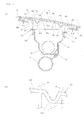
- FIG. 4 is a view illustrating a passenger airbag apparatus in which Fig. 4(A) is a cross-sectional view and Fig. 4(B) is an enlarged view of B-portion in Fig. 4(A) .
- the passenger airbag apparatus is internally installed at a vehicle body side of an instrument panel 41 disposed at a front face of a passenger seat. Further, as illustrated in Fig.
- the passenger airbag apparatus is provided with an airbag (not shown) that is folded back in the normal time and is expanded and extended in the emergency, an inflator 42 for supplying a gas into the airbag, a retainer 43 for housing the airbag and the inflator 42, an outer panel 44 mounted in the instrument panel 41, and an inner case 45 that is connected to an inside of the outer panel 44 and that latches the retainer 43.
- the retainer 43 is coupled with a fixing member 47 via a joining member 46 and fixed thereto.
- an opening portion 41a is formed so as to be able to release the airbag.
- the outer panel 44 is mounted using a clip 44a or the like and the surface thereof is processed so as to be assimilated to the instrument panel 41.
- a plurality of notches 44b for allowing the outer panel 44 to easily crack at a time when the airbag is expanded is formed.
- the outer panel 44 is sectionalized into a fixing portion 44c and a door portion 44d.
- the aforementioned inner case 45 is composed of an inner panel 45a connected to an inside of the outer panel 44, and side walls 45b that form a space for housing the retainer 43.
- a plurality of latching holes 45c is formed in the side walls 45b, and hooks 43a connected to the retainer 43 are configured to be latched with the latching holes 45c.
- the inner panel 45a is divided into two parts at a center portion and each of the inner panels 45a is composed of a supporting portion 451 connected to the fixing portion 44c of the outer panel 44, a flap portion 452 connected to the door portion 44d, and a hinge portion 453 formed between the supporting portion 451 and the flap portion 452.
- the hinge portion 453 is substantially U-shaped as illustrated in Fig. 4(B) , and normally, thicknesses of t1 through t4 are uniformly formed.
- the gas is supplied into the airbag (not shown) by operating the inflator 42 in an emergency such as a collision of the vehicle or the like.
- the airbag is expanded in the retainer 3 and the inner case 45, and presses the inner panel 45a and the outer panel 44.
- the outer panel 44 is divided at the notch 44b between the door portions 44d and releases the airbag to the vehicle interior.
- the door portion 44d of the outer panel 44 is rotated toward an instrument panel 41 side, and is further divided at the notch 44b between the fixing portion 44c and the door portion 44d.
- the fixing portion 44c and the door portion 44d of the outer panel 44 are respectively connected to the inner panels 45a, there is no possibility that the door portion 44d is broken up even when the outer panel 44 is divided at the notch 44b. Further, the door portions 44d are further rotated toward the instrument panel 41 side and are opened in a double door-like manner by means of the operation of a hinge portion 48 of the inner panel 45a.
- the inner case 45 is formed of resin in general, and is susceptible to a surrounding temperature and is hardened or softened. Accordingly, a devisal is necessary for forming a shape of the hinge portion 453 so as to appropriately open the outer panel 44 in the double door-like manner.
- a hinge portion described in the Patent Document 1 is formed so as to expand out in a direction being spaced apart from an outer panel, and to be gradually thin-walled from a fixing portion side to a door-reinforcing portion side (refer to Fig. 4 in JP-A-2006-96267 (Patent Document 1)).
- a hinge portion described in the Patent Document 2 is formed such that a top of a bent portion has a thinner wall than the other portion of a curved hinge portion (refer to Fig. 4 in JP-Transl.(PCT) 2003-137057 (Patent Document 2)).
- the fixing portion side is formed to be entirely thick in the hinge portion described in the Patent Document 1
- a stretching up amount of the hinge portion at a time of opening the outer panel in the double door-like manner is small. Therefore, the lack of the stretching up amount has to be compensated by largely forming an entire hinge portion (namely, a diameter of a U-shaped portion).
- a diameter of a U-shaped portion is enlarged, a non-welded portion between the outer panel and an inner panel increases, and an effect for reinforcing the outer panel is reduced.
- the U-shape is longitudinally formed so as to avoid such problems, a problem occurs in which a manufacture for the hinge portion becomes difficult and it becomes a factor of cost up.
- a portion (a top of a bent portion) that is easiest to be stretched at a time when the outer panel is opened in the double door-like manner is formed of a thin wall.
- a problem occurs in which an excessive stress is concentrated on the top of the bent portion.
- the present invention is that originated in consideration of the above-described problems and the object is to provide an airbag-releasing portion structure, an inner case, and an airbag apparatus that are unsusceptible to a surrounding temperature, and capable of small-sizing for a hinge portion and smoothly releasing an airbag to a vehicle interior.
- an airbag-releasing portion structure characterized in including an opening portion for use in releasing an airbag, formed in a vehicle structure, an outer panel covering the opening portion, and an inner panel connected to an inside of the outer panel, in which the aforementioned outer panel includes a door portion for opening the aforementioned opening portion when the airbag is expanded, and a fixing portion connected to the aforementioned vehicle structure, in which the aforementioned inner panel includes a flap portion connected to the aforementioned door portion, a supporting portion connected to the aforementioned fixing portion, and a hinge portion that is substantially U-shaped, formed between the aforementioned flap portion and the aforementioned supporting portion, and in which in the aforementioned hinge portion, a low rigidity portion having lower rigidity than the other portion of the aforementioned hinge portion is formed between a top portion of the hinge portion and the aforementioned supporting portion, is provided.
- a low rigidity portion having lower rigidity than the other portion of the aforementioned hinge portion may be formed between the aforementioned top portion and the aforementioned flap portion. Furthermore, it is preferable that the low rigidity portion is a thin-walled portion formed to have a smaller wall thickness than the other portion in the aforementioned hinge portion. Moreover, it is preferable that the aforementioned thin-walled portion is smoothly connected to adjoining thick-walled portions.
- an inner case characterized in being connected to an inside of an outer panel covering an opening portion for releasing an airbag formed in a vehicle structure, and housed in the aforementioned opening portion, in which the aforementioned outer panel includes a door portion for opening the aforementioned opening portion when the airbag is expanded, and a fixing portion connected to the aforementioned vehicle structure, in which the aforementioned inner case includes an inner panel connected to the aforementioned outer panel, and a side wall forming a space for housing a retainer where the airbag is housed, in which the aforementioned inner panel includes a flap portion connected to the aforementioned door portion, a supporting portion connected to the aforementioned fixing portion, and a hinge portion that is substantially U-shaped, formed between the aforementioned flap portion and the aforementioned supporting portion, and in which in the aforementioned hinge portion, a low rigidity portion having lower rigidity than the other portion of the hinge portion is formed between a top portion of the hinge portion and the aforementioned supporting portion, is provided.
- a low rigidity portion having lower rigidity than the other portion of the aforementioned hinge portion may be formed between the aforementioned top portion and the aforementioned flap portion.
- the aforementioned low rigidity portion is a thin-walled portion formed to have a smaller wall thickness than the other portion of the aforementioned hinge portion. Further, it is preferable that the aforementioned thin-walled portion is smoothly connected to adjoining thick-walled portions.
- an airbag apparatus characterized in including an airbag that is in a folded state during a normal time and expanded and extended in an emergency, an inflator for supplying a gas into the airbag, a retainer at least housing the airbag, an outer panel covering an opening portion for use in releasing the airbag, formed in a vehicle structure, and an inner case connected to an inside of the outer panel and latching the retainer, in which the aforementioned outer panel includes a door portion for opening the aforementioned opening portion when the airbag is expanded, and a fixing portion connected to the aforementioned vehicle structure, in which the aforementioned inner case includes an inner panel connected to the aforementioned outer panel, and a side wall forming a space for housing the retainer where the airbag is housed, in which the aforementioned inner panel includes a flap portion connected to the aforementioned door portion, a supporting portion connected to the aforementioned fixing portion, and a hinge portion that is substantially U-shaped formed between the aforementioned flap portion and the aforementioned supporting portion,
- a low rigidity portion having lower rigidity than the other portion of the aforementioned hinge portion may be formed between the aforementioned top portion and the aforementioned flap portion.
- the aforementioned low rigidity portion is a thin-walled portion formed to have a smaller wall thickness than the other portion of the aforementioned hinge portion.
- the aforementioned thin-walled portion is smoothly connected to adjoining thick-walled portions.
- a low rigidity portion can be caused to operate as a starting point when a door portion of an outer panel is rotated, while retaining the rigidity of a supporting portion and a top portion requiring the rigidity as a hinge portion by forming a low rigidity portion between the top portion and the supporting portion of the hinge portion.
- This enables the low rigidity portion to be unsusceptible to a surrounding temperature, and the hinge portion to be small-sized. Hence, the airbag can smoothly be released to a vehicle interior.
- the low rigidity portion is formed between the top portion and the flap portion of the hinge portion, the number of the starting points when the door portion of the outer panel is rotated can be increased. This enables the low rigidity portion to be further unsusceptible to a surrounding temperature, and the hinge portion to be small-sized.
- the low rigidity portion can be formed with ease and at a low cost by forming the aforementioned low rigidity portion to be a thin-walled portion having a smaller wall thickness than the other portion of the hinge portion. Moreover, a stress concentration occurring at the hinge portion can be eased by smoothly connecting the thin-walled portion to adjoining thick-walled portions.
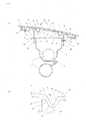
- the passenger airbag apparatus illustrated in Fig. 1 is internally installed in a vehicle body side of an instrument panel 1 disposed at a front face of the passenger seat. Further, as illustrated in Fig. 1(A) , the passenger airbag apparatus is provided with an airbag (not shown) that is folded back at a normal time and is expanded and extended in an emergency, an inflator 2 for supplying a gas into the airbag, a retainer 3 for housing the airbag and the inflator 2, an outer panel 4 mounted in the instrument panel 1, and an inner case 5 that is connected to an inside of the outer panel 4 and that latches the retainer 3. Further, the retainer 3 is coupled with a fixing member 7 via a joining member 6 and fixed thereto. Incidentally, the inflator 2 may be externally attached to the retainer 3 not being housed in the retainer 3.
- an opening portion 1a for use in releasing the airbag is formed in a substantially rectangular manner and is configured to be able to release the airbag.
- the outer panel 4 is mounted on the opening portion 1a with a plurality of clips 4a, and a surface thereof is processed so as to be assimilated to the instrument panel 1.
- the outer panel 4 may be integrally formed with the instrument panel 1.
- a plurality of notches 4b for allowing the outer panel 4 to easily crack at a time when the airbag is expanded is formed in an inside of the outer panel 4.
- the outer panel 4 is sectionalized into a pair of fixing portions 4c and 4c, and a pair of door portions 4d and 4d by means of the notches 4b.
- the notches 4b, 4b, and 4b at three places illustrated in Fig. 1(A) may be formed with a series of linear grooves.
- the aforementioned inner case 5 is composed of an inner panel 5a connected to the inside of the outer panel 4 and a side wall 5b forming a space for housing the retainer 3.
- various joining methods such as a vibration welding, a supersonic welding, a volt fastening, a rivet fastening, an adhesive fastening, a heat swaging, or the like can be applied here.
- a plurality of latching holes 5c is formed in the side wall 5b, and hooks 3a connected to the retainer 3 are configured to be latched thereto.
- each inner panel 5a is divided into two parts at a center portion, and each inner panels 5a is composed of a supporting portion 51 connected to a fixing portion 4c of the outer panel 4, a flap portion 52 connected to a door portion 4d, and a hinge portion 53 formed between the supporting portion 51 and the flap portion 52.
- the hinge portion 53 is substantially U-shaped so as to have a convex shape toward a side of an opposite direction relative to an airbag releasing direction.
- an airbag-releasing portion structure is composed of the opening portion 1a, the outer panel 4, and the inner panel 5a.
- the aforementioned hinge portion 53 is provided with a top portion 53a, a supporting portion side connecting portion 53b that connects the supporting portion 51 and the top portion 53a, and a flap side connecting portion 53c that connects the flap portion 52 and the top portion 53a as illustrated in Fig. 1(B) , and a thin-walled portion 54 whose wall thickness is formed to be thinner than that of the other portion of the hinge portion 53 is provided at the supporting portion side connecting portion 53b. Further, the thin-walled portion 54 is smoothly connected to adjoining thick-walled portions. A stress concentration occurring in the hinge portion 53 can be eased by smoothly forming the thin-walled portion 54.
- a thickness of the thick-walled portion of the supporting portion side connecting portion 53b is defined as t1
- a thickness of the thin-walled portion 54 is defined as t2
- a thickness of the top portion 53a is defined as t3
- a thickness of the flap side connecting portion 53c is defined as t4
- the thickness t1, the thickness t3, and the thickness t4 are approximately the same thickness
- the thickness t2 of the thin-walled portion 54 is formed to be thinner than that of the other thicknesses t1, t3, and t4.
- the thickness t2 of the thinnest portion is preferable to have a thickness in an extent of 75 to 95% of the other thicknesses t1, t3, and t4, and is more preferable to have a thickness in an extent of 80 to 90% thereof.
- the wall thickness is reduced by caving an inside of the supporting portion side connecting portion 53b (airbag side) in Fig. 1
- the wall thickness may be reduced by caving the opposite side (the side of the outer panel 4), or the wall thickness may be reduced by caving both sides.
- the thickness t1, the thickness t3, and the thickness t4 are approximately the same thickness is illustrated, as long as the rigidity is guaranteed, these thicknesses t1, t3, and t4 are not necessary to be approximately the same thickness.
- the thin-walled portion 54 when the thin-walled portion 54 is formed at the supporting portion side connecting portion 53b of the hinge portion 53, the thin-walled portion 54 becomes a portion having a lower rigidity than the other portion of the hinge portion 53 (low rigidity portion). Hence, the thin-walled portion 54 becomes a starting point for rotating the hinge portion 53 when the airbag is released. That is, even when the rigidity of the supporting portion 51 for fixing and supporting the hinge portion 53, and that of the top portion 53a that is stretched at a time of the rotation of the hinge portion 53 are retained to be the required rigidity, the hinge portion 53 can be rotated at the thin-walled portion 54. Thereby, a shape of the hinge portion 53 can be designed to be small compared to the case with no thin-walled portion 54.
- the aforementioned thin-walled portion 54 is absolutely an example of a low rigidity portion, and various configurations such as forming a plurality of punched holes, forming a plurality of small concavities and convexities, forming a plurality of notches on a surface, forming a plurality of slits in the supporting portion side connecting portion 53b, changing a material of the supporting portion side connecting portion 53b to that having low rigidity, or the like can be adopted other than the aforementioned.
- FIG. 2 is a view illustrating an operation of the passenger airbag apparatus illustrated in Fig. 1 when the airbag is expanded
- Fig. 2(A) illustrates an initial phase of expansion of the airbag
- Fig. 2(B) illustrates a dividing phase of the outer panel
- Fig. 2(C) illustrates a rotating phase of the door portion
- Fig. 2(D) illustrates a rotation completion phase of the door portion.
- the initial phase of expansion of the airbag illustrated in Fig. 2(A) is a phase in which an airbag 8 expands in an inside of the inner case 5 and presses the inner panel 5a.
- an ECU Electronic Control Unit
- a gas is supplied from the inflator 2 to the airbag 8.
- the airbag 8 expands in a direction indicated by an arrow in the drawing, comes in contact with the inner panel 5a, and presses the same.
- the hinge portion 53 can be small-sized, the hinge portion 53 causes less obstruction at the expansion phase of the airbag 8, and the airbag 8 can smoothly be released to the vehicle interior.
- the dividing phase of the outer panel illustrated in Fig. 2(B) is a phase when the airbag 8 presses the outer panel 4, and divides the outer panel 4 into the fixing portions 4c and 4c, and the door portions 4d and 4d.
- a depth of the notch 4b and a thickness of the outer panel 4 are appropriately set so that the notch 4b between the door portion 4d and the door portion 4d becomes easy to be divided earlier than the notch 4b between the fixing portion 4c and the door portion 4d.
- the door portion 4d of the outer panel 4 is separated from the fixing portion 4c, there is no possibility that the door portion 4d is broken up because the inner panel 5a is connected to the inside thereof.
- the fixing portion 4c is fixed to the instrument panel 1 with the clips 4a, and is configured not to be removed by the expansion of the airbag 8.
- the rotating phase of the door portion illustrated in Fig. 2(C) is a phase when the door portion 4d is rotated toward the fixing portion 4c side around the hinge portion 53 as a center along with the proceeding of expansion of the airbag 8.
- the hinge portion 53 is to be pressed up and stretched upward by the expansion of the airbag 8
- the hinge portion 53 becomes easy to be rotated from the thin-walled portion 54 as a starting point because the thin-walled portion 54 is formed.
- the top portion 53a of the hinge portion 53 becomes easiest to be stretched by being stretched by the rotation of the door portion 4d
- the top portion 53a is formed to have a thickness capable of withstanding such tension force.
- the rotation completion phase of the door portion illustrated in Fig. 2(D) is a phase when the door portion 4d is folded back toward the fixing portion 4c side.
- the hinge portion 53 is configured to function by existence of the thin-walled portion 54 formed in the hinge portion 53 even in a condition where the door portion 4d is thus completely folded back.
- FIG. 3 is a view illustrating other embodiments of the hinge portion, in which Fig. 3(A) illustrates a second embodiment, Fig. 3(B) illustrates a third embodiment, Fig. 3(C) illustrates a fourth embodiment, and Fig. 3(D) illustrates a fifth embodiment.
- the thin-walled portion 54 is formed such that a wall thickness of the supporting portion side connecting portion 53b is formed to be gradually thinner from the thickness t1 of the supporting portion 51 side, and when the wall thickness reaches a predetermined thickness t2, the same is smoothly connected to the top portion 53a having the thickness t3 that is approximately the same as the thickness t1.
- the thin-walled portion 54 is formed to have a groove shape.
- the thin-walled portion 54 is constructed with two slanting surfaces. As illustrated in these embodiments, various shapes can be adopted into the thin-walled portion 54.
- a thin-walled portion 55 having low rigidity is formed also in the flap side connecting portion 53c.
- the thickness t1 and the thickness t3 are formed to be approximately the same thickness
- the thickness t2 and the thickness t4 are formed to be approximately the same thickness
- the thicknesses t2 and t4 are formed to be thinner than the thicknesses t1 and t3.
- the number of the rotation starting points of the hinge portion 53 can be increased by forming the thin-walled portion 55 also in the flap side connecting portion 53c in addition to the supporting portion side connecting portion 53b, and thereby the hinge portion 53 can be aimed at small-sizing.
- the rate for thinning the thickness t2 and the thickness t4 may be designed to be different. Further, as long as the rigidity is guaranteed, the thickness t1 and the thickness t3 are also not necessary to be approximately the same thickness.
- the aforementioned thin-walled portion 55 is also absolutely an example of a low rigidity portion, and various configurations such as forming a plurality of punched holes, forming a plurality of small concavities and convexities, forming a plurality of notches on a surface, forming a plurality of slits in the flap side connecting portion 53c, changing a material of the flap side connecting portion 53c to that having low rigidity, or the like can be adopted other than the aforementioned. Furthermore, as for the shape of the thin-walled portion 55, various shapes such as that illustrated in Figs. 3(A) through 3(C) can be adopted similarly to the thin-walled portion 54.
- the present invention is not limited to the passenger airbag apparatus, and the present invention can be applied to an airbag apparatus installed in any portion, as long as the airbag-releasing portion structure is provided with an opening portion for use in releasing an airbag formed in a vehicle structure, an outer panel covering the opening portion, and an inner panel connected to an inside of the outer panel, in which the outer panel includes a door portion for opening the aforementioned opening portion at a time when the airbag is expanded and a fixing portion connected to the vehicle structure, and which the inner panel includes a flap portion connected to the door portion, a supporting portion connected to the fixing portion, and a hinge portion that is substantially U-shaped, formed between the flap portion and the supporting portion.
- the present invention is not limited to the above-described embodiments and it will be understood by those skilled in the art that various changes may be made without departing from the spirit and scope of the present invention and it is applicable that, for example, the number of the door portion and that of the hinge portion may be singular number or more than two, the vehicle structure may be a door portion, a ceiling portion, a steering portion, or the like other than the instrument panel, and so forth.
Landscapes
- Engineering & Computer Science (AREA)
- Mechanical Engineering (AREA)
- Air Bags (AREA)
Abstract
Description
- The present invention relates to an airbag-releasing portion structure for an airbag mounted on a vehicle such as an automobile or the like, an inner case, and an airbag apparatus, and more specifically, it relates to an airbag-releasing portion structure capable of smoothly releasing an airbag to a vehicle interior when an airbag apparatus is operated, an inner case, and an airbag apparatus.
- In general, an airbag apparatus for restraining an occupant by expanding and extending an airbag to a vehicle interior in collision or the like is mounted on a vehicle such as an automobile or the like. In such airbag apparatuses, various types of airbag apparatuses such as an airbag apparatus for use in a driver's seat internally installed in a steering wheel, a passenger airbag apparatus internally installed in an instrument panel, a side airbag apparatus internally installed in a side surface portion of a vehicle or a seat, a curtain airbag apparatus internally installed in an upper portion of a door, and so forth are developed and adopted. These airbag apparatuses are housed in a vehicle structure at a normal time such that the existence thereof cannot be recognized, and in an emergency such as a collision of the vehicle or the like, the airbag apparatuses are configured to expand and extend an airbag upon bursting through the vehicle structure. Hence, an airbag releasing portion of the airbag apparatus has to be configured to be able to smoothly and rapidly release the airbag in an emergency, whereas the same has to be configured to be covered so as to be assimilated to a vehicle interior component at a normal time.
- Currently,
Fig. 4 is a view illustrating a passenger airbag apparatus in whichFig. 4(A) is a cross-sectional view andFig. 4(B) is an enlarged view of B-portion inFig. 4(A) . The passenger airbag apparatus is internally installed at a vehicle body side of aninstrument panel 41 disposed at a front face of a passenger seat. Further, as illustrated inFig. 4(A) , the passenger airbag apparatus is provided with an airbag (not shown) that is folded back in the normal time and is expanded and extended in the emergency, aninflator 42 for supplying a gas into the airbag, aretainer 43 for housing the airbag and theinflator 42, anouter panel 44 mounted in theinstrument panel 41, and aninner case 45 that is connected to an inside of theouter panel 44 and that latches theretainer 43. Incidentally, theretainer 43 is coupled with afixing member 47 via a joiningmember 46 and fixed thereto. - In the
aforementioned instrument panel 41, anopening portion 41a is formed so as to be able to release the airbag. In theopening portion 41a, theouter panel 44 is mounted using aclip 44a or the like and the surface thereof is processed so as to be assimilated to theinstrument panel 41. Further, in an inside of theouter panel 44, a plurality ofnotches 44b for allowing theouter panel 44 to easily crack at a time when the airbag is expanded is formed. By means of thenotches 44b, theouter panel 44 is sectionalized into a fixing portion 44c and adoor portion 44d. - The aforementioned
inner case 45 is composed of aninner panel 45a connected to an inside of theouter panel 44, andside walls 45b that form a space for housing theretainer 43. In addition, a plurality oflatching holes 45c is formed in theside walls 45b, andhooks 43a connected to theretainer 43 are configured to be latched with thelatching holes 45c. Further, theinner panel 45a is divided into two parts at a center portion and each of theinner panels 45a is composed of a supportingportion 451 connected to the fixing portion 44c of theouter panel 44, aflap portion 452 connected to thedoor portion 44d, and ahinge portion 453 formed between the supportingportion 451 and theflap portion 452. Thehinge portion 453 is substantially U-shaped as illustrated inFig. 4(B) , and normally, thicknesses of t1 through t4 are uniformly formed. - In the above-described passenger airbag apparatus, the gas is supplied into the airbag (not shown) by operating the
inflator 42 in an emergency such as a collision of the vehicle or the like. The airbag is expanded in the retainer 3 and theinner case 45, and presses theinner panel 45a and theouter panel 44. Theouter panel 44 is divided at thenotch 44b between thedoor portions 44d and releases the airbag to the vehicle interior. As an expanding and extending operation of the airbag proceeds, thedoor portion 44d of theouter panel 44 is rotated toward aninstrument panel 41 side, and is further divided at thenotch 44b between the fixing portion 44c and thedoor portion 44d. Currently, since the fixing portion 44c and thedoor portion 44d of theouter panel 44 are respectively connected to theinner panels 45a, there is no possibility that thedoor portion 44d is broken up even when theouter panel 44 is divided at thenotch 44b. Further, thedoor portions 44d are further rotated toward theinstrument panel 41 side and are opened in a double door-like manner by means of the operation of a hinge portion 48 of theinner panel 45a. - Here, the
inner case 45 is formed of resin in general, and is susceptible to a surrounding temperature and is hardened or softened. Accordingly, a devisal is necessary for forming a shape of thehinge portion 453 so as to appropriately open theouter panel 44 in the double door-like manner. For example, a hinge portion described in thePatent Document 1 is formed so as to expand out in a direction being spaced apart from an outer panel, and to be gradually thin-walled from a fixing portion side to a door-reinforcing portion side (refer toFig. 4 inJP-A-2006-96267 Patent Document 2 is formed such that a top of a bent portion has a thinner wall than the other portion of a curved hinge portion (refer toFig. 4 inJP-Transl.(PCT) 2003-137057 - However, since the fixing portion side is formed to be entirely thick in the hinge portion described in the
Patent Document 1, a stretching up amount of the hinge portion at a time of opening the outer panel in the double door-like manner is small. Therefore, the lack of the stretching up amount has to be compensated by largely forming an entire hinge portion (namely, a diameter of a U-shaped portion). However, if the diameter of the U-shaped portion is enlarged, a non-welded portion between the outer panel and an inner panel increases, and an effect for reinforcing the outer panel is reduced. Furthermore, in the case that the U-shape is longitudinally formed so as to avoid such problems, a problem occurs in which a manufacture for the hinge portion becomes difficult and it becomes a factor of cost up. - Moreover, in a hinge structure described in the
Patent Document 2, a portion (a top of a bent portion) that is easiest to be stretched at a time when the outer panel is opened in the double door-like manner is formed of a thin wall. Hence, a problem occurs in which an excessive stress is concentrated on the top of the bent portion. - The present invention is that originated in consideration of the above-described problems and the object is to provide an airbag-releasing portion structure, an inner case, and an airbag apparatus that are unsusceptible to a surrounding temperature, and capable of small-sizing for a hinge portion and smoothly releasing an airbag to a vehicle interior.
- According to the present invention, an airbag-releasing portion structure characterized in including an opening portion for use in releasing an airbag, formed in a vehicle structure, an outer panel covering the opening portion, and an inner panel connected to an inside of the outer panel, in which the aforementioned outer panel includes a door portion for opening the aforementioned opening portion when the airbag is expanded, and a fixing portion connected to the aforementioned vehicle structure, in which the aforementioned inner panel includes a flap portion connected to the aforementioned door portion, a supporting portion connected to the aforementioned fixing portion, and a hinge portion that is substantially U-shaped, formed between the aforementioned flap portion and the aforementioned supporting portion, and in which in the aforementioned hinge portion, a low rigidity portion having lower rigidity than the other portion of the aforementioned hinge portion is formed between a top portion of the hinge portion and the aforementioned supporting portion, is provided. Further, in the aforementioned hinge portion, a low rigidity portion having lower rigidity than the other portion of the aforementioned hinge portion may be formed between the aforementioned top portion and the aforementioned flap portion. Furthermore, it is preferable that the low rigidity portion is a thin-walled portion formed to have a smaller wall thickness than the other portion in the aforementioned hinge portion. Moreover, it is preferable that the aforementioned thin-walled portion is smoothly connected to adjoining thick-walled portions.
- Further, according to the present invention, an inner case characterized in being connected to an inside of an outer panel covering an opening portion for releasing an airbag formed in a vehicle structure, and housed in the aforementioned opening portion, in which the aforementioned outer panel includes a door portion for opening the aforementioned opening portion when the airbag is expanded, and a fixing portion connected to the aforementioned vehicle structure, in which the aforementioned inner case includes an inner panel connected to the aforementioned outer panel, and a side wall forming a space for housing a retainer where the airbag is housed, in which the aforementioned inner panel includes a flap portion connected to the aforementioned door portion, a supporting portion connected to the aforementioned fixing portion, and a hinge portion that is substantially U-shaped, formed between the aforementioned flap portion and the aforementioned supporting portion, and in which in the aforementioned hinge portion, a low rigidity portion having lower rigidity than the other portion of the hinge portion is formed between a top portion of the hinge portion and the aforementioned supporting portion, is provided. Furthermore, in the aforementioned hinge portion, a low rigidity portion having lower rigidity than the other portion of the aforementioned hinge portion may be formed between the aforementioned top portion and the aforementioned flap portion. Moreover, it is preferable that the aforementioned low rigidity portion is a thin-walled portion formed to have a smaller wall thickness than the other portion of the aforementioned hinge portion. Further, it is preferable that the aforementioned thin-walled portion is smoothly connected to adjoining thick-walled portions.
- Furthermore, according to the present invention, an airbag apparatus characterized in including an airbag that is in a folded state during a normal time and expanded and extended in an emergency, an inflator for supplying a gas into the airbag, a retainer at least housing the airbag, an outer panel covering an opening portion for use in releasing the airbag, formed in a vehicle structure, and an inner case connected to an inside of the outer panel and latching the retainer, in which the aforementioned outer panel includes a door portion for opening the aforementioned opening portion when the airbag is expanded, and a fixing portion connected to the aforementioned vehicle structure, in which the aforementioned inner case includes an inner panel connected to the aforementioned outer panel, and a side wall forming a space for housing the retainer where the airbag is housed, in which the aforementioned inner panel includes a flap portion connected to the aforementioned door portion, a supporting portion connected to the aforementioned fixing portion, and a hinge portion that is substantially U-shaped formed between the aforementioned flap portion and the aforementioned supporting portion, and in which in the aforementioned hinge portion, a low rigidity portion having lower rigidity than the other portion of the aforementioned hinge portion is formed between the top portion of the hinge portion and the aforementioned supporting portion, is provided. Moreover, in the aforementioned hinge portion, a low rigidity portion having lower rigidity than the other portion of the aforementioned hinge portion may be formed between the aforementioned top portion and the aforementioned flap portion. Further, it is preferable that the aforementioned low rigidity portion is a thin-walled portion formed to have a smaller wall thickness than the other portion of the aforementioned hinge portion. Furthermore, it is preferable that the aforementioned thin-walled portion is smoothly connected to adjoining thick-walled portions.
- According to an airbag-releasing portion structure, an inner case, and an airbag apparatus of the above-described present invention, a low rigidity portion can be caused to operate as a starting point when a door portion of an outer panel is rotated, while retaining the rigidity of a supporting portion and a top portion requiring the rigidity as a hinge portion by forming a low rigidity portion between the top portion and the supporting portion of the hinge portion. This enables the low rigidity portion to be unsusceptible to a surrounding temperature, and the hinge portion to be small-sized. Hence, the airbag can smoothly be released to a vehicle interior.
- Further, when the low rigidity portion is formed between the top portion and the flap portion of the hinge portion, the number of the starting points when the door portion of the outer panel is rotated can be increased.
This enables the low rigidity portion to be further unsusceptible to a surrounding temperature, and the hinge portion to be small-sized. - Furthermore, the low rigidity portion can be formed with ease and at a low cost by forming the aforementioned low rigidity portion to be a thin-walled portion having a smaller wall thickness than the other portion of the hinge portion. Moreover, a stress concentration occurring at the hinge portion can be eased by smoothly connecting the thin-walled portion to adjoining thick-walled portions.
- Hereinbelow, embodiments of the present invention will be explained:
-
Fig. 1 is a view illustrating a passenger airbag apparatus in whichFig. 1(A) is a cross-sectional view, andFig. 1(B) is an enlarged view of B portion inFig. 1(A) ; -
Fig. 2 is a view illustrating an operation of the passenger airbag apparatus illustrated inFig. 1 when an airbag is expanded, in whichFig. 1(A) illustrates an initial phase of expansion of the airbag,Fig. 2(B) illustrates a dividing phase of an outer panel,Fig. 2(C) illustrates a rotating phase of a door portion, andFig. 2(D) illustrates a rotation completion phase of the door portion; -
Fig. 3 is a view illustrating other embodiments of a hinge portion, in whichFig. 3(A) illustrates a second embodiment,Fig. 3(B) illustrates a third embodiment,Fig. 3(C) illustrates a fourth embodiment, andFig. 3(D) illustrates a fifth embodiment; and -
Fig. 4 is a view illustrating the passenger airbag apparatus, in whichFig. 4(A) is a cross-sectional view, andFig. 4(B) is an enlarged view of B portion inFig. 4(A) . - The passenger airbag apparatus illustrated in
Fig. 1 is internally installed in a vehicle body side of aninstrument panel 1 disposed at a front face of the passenger seat. Further, as illustrated inFig. 1(A) , the passenger airbag apparatus is provided with an airbag (not shown) that is folded back at a normal time and is expanded and extended in an emergency, aninflator 2 for supplying a gas into the airbag, a retainer 3 for housing the airbag and theinflator 2, anouter panel 4 mounted in theinstrument panel 1, and aninner case 5 that is connected to an inside of theouter panel 4 and that latches the retainer 3. Further, the retainer 3 is coupled with afixing member 7 via a joining member 6 and fixed thereto. Incidentally, theinflator 2 may be externally attached to the retainer 3 not being housed in the retainer 3. - In the
aforementioned instrument panel 1, anopening portion 1a for use in releasing the airbag is formed in a substantially rectangular manner and is configured to be able to release the airbag. Theouter panel 4 is mounted on theopening portion 1a with a plurality ofclips 4a, and a surface thereof is processed so as to be assimilated to theinstrument panel 1. Although a case in which theouter panel 4 and theinstrument panel 1 are formed from separate members is explained here, theouter panel 4 may be integrally formed with theinstrument panel 1. Furthermore, a plurality ofnotches 4b for allowing theouter panel 4 to easily crack at a time when the airbag is expanded is formed in an inside of theouter panel 4. Theouter panel 4 is sectionalized into a pair of fixingportions door portions notches 4b. Incidentally, thenotches Fig. 1(A) may be formed with a series of linear grooves. - The aforementioned
inner case 5 is composed of aninner panel 5a connected to the inside of theouter panel 4 and aside wall 5b forming a space for housing the retainer 3. In order to connect theouter panel 4 and theinner panel 5a, various joining methods, such as a vibration welding, a supersonic welding, a volt fastening, a rivet fastening, an adhesive fastening, a heat swaging, or the like can be applied here. Moreover, a plurality of latchingholes 5c is formed in theside wall 5b, and hooks 3a connected to the retainer 3 are configured to be latched thereto. Further, theinner panel 5a is divided into two parts at a center portion, and eachinner panels 5a is composed of a supportingportion 51 connected to a fixingportion 4c of theouter panel 4, aflap portion 52 connected to adoor portion 4d, and ahinge portion 53 formed between the supportingportion 51 and theflap portion 52. Thehinge portion 53 is substantially U-shaped so as to have a convex shape toward a side of an opposite direction relative to an airbag releasing direction. Incidentally, an airbag-releasing portion structure is composed of theopening portion 1a, theouter panel 4, and theinner panel 5a. - The
aforementioned hinge portion 53 is provided with atop portion 53a, a supporting portionside connecting portion 53b that connects the supportingportion 51 and thetop portion 53a, and a flapside connecting portion 53c that connects theflap portion 52 and thetop portion 53a as illustrated inFig. 1(B) , and a thin-walled portion 54 whose wall thickness is formed to be thinner than that of the other portion of thehinge portion 53 is provided at the supporting portionside connecting portion 53b. Further, the thin-walled portion 54 is smoothly connected to adjoining thick-walled portions. A stress concentration occurring in thehinge portion 53 can be eased by smoothly forming the thin-walled portion 54. Currently, when a thickness of the thick-walled portion of the supporting portionside connecting portion 53b is defined as t1, a thickness of the thin-walled portion 54 is defined as t2, a thickness of thetop portion 53a is defined as t3, and a thickness of the flapside connecting portion 53c is defined as t4, the thickness t1, the thickness t3, and the thickness t4 are approximately the same thickness, and the thickness t2 of the thin-walled portion 54 is formed to be thinner than that of the other thicknesses t1, t3, and t4. However, in order to guarantee the rigidity required as a hinge of thehinge portion 53, the thickness t2 of the thinnest portion is preferable to have a thickness in an extent of 75 to 95% of the other thicknesses t1, t3, and t4, and is more preferable to have a thickness in an extent of 80 to 90% thereof. Incidentally, although the wall thickness is reduced by caving an inside of the supporting portionside connecting portion 53b (airbag side) inFig. 1 , the wall thickness may be reduced by caving the opposite side (the side of the outer panel 4), or the wall thickness may be reduced by caving both sides. Furthermore, although the case in which the thickness t1, the thickness t3, and the thickness t4 are approximately the same thickness is illustrated, as long as the rigidity is guaranteed, these thicknesses t1, t3, and t4 are not necessary to be approximately the same thickness. - As described above, when the thin-
walled portion 54 is formed at the supporting portionside connecting portion 53b of thehinge portion 53, the thin-walled portion 54 becomes a portion having a lower rigidity than the other portion of the hinge portion 53 (low rigidity portion). Hence, the thin-walled portion 54 becomes a starting point for rotating thehinge portion 53 when the airbag is released. That is, even when the rigidity of the supportingportion 51 for fixing and supporting thehinge portion 53, and that of thetop portion 53a that is stretched at a time of the rotation of thehinge portion 53 are retained to be the required rigidity, thehinge portion 53 can be rotated at the thin-walled portion 54. Thereby, a shape of thehinge portion 53 can be designed to be small compared to the case with no thin-walled portion 54. - The aforementioned thin-
walled portion 54 is absolutely an example of a low rigidity portion, and various configurations such as forming a plurality of punched holes, forming a plurality of small concavities and convexities, forming a plurality of notches on a surface, forming a plurality of slits in the supporting portionside connecting portion 53b, changing a material of the supporting portionside connecting portion 53b to that having low rigidity, or the like can be adopted other than the aforementioned. - Next, an operation of the passenger airbag apparatus illustrated in
Fig. 1 when the airbag is expanded will be explained referring toFig. 2 . Here,Fig. 2 is a view illustrating an operation of the passenger airbag apparatus illustrated inFig. 1 when the airbag is expanded,Fig. 2(A) illustrates an initial phase of expansion of the airbag,Fig. 2(B) illustrates a dividing phase of the outer panel,Fig. 2(C) illustrates a rotating phase of the door portion, andFig. 2(D) illustrates a rotation completion phase of the door portion. - The initial phase of expansion of the airbag illustrated in
Fig. 2(A) is a phase in which an airbag 8 expands in an inside of theinner case 5 and presses theinner panel 5a. In the airbag apparatus, when a predetermined signal is received from an ECU (Electronic Control Unit) that has sensed or detected a collision of a vehicle or the like, a gas is supplied from theinflator 2 to the airbag 8. The airbag 8 expands in a direction indicated by an arrow in the drawing, comes in contact with theinner panel 5a, and presses the same. Currently, in the present invention, since thehinge portion 53 can be small-sized, thehinge portion 53 causes less obstruction at the expansion phase of the airbag 8, and the airbag 8 can smoothly be released to the vehicle interior. - The dividing phase of the outer panel illustrated in
Fig. 2(B) is a phase when the airbag 8 presses theouter panel 4, and divides theouter panel 4 into the fixingportions door portions notch 4b and a thickness of theouter panel 4 are appropriately set so that thenotch 4b between thedoor portion 4d and thedoor portion 4d becomes easy to be divided earlier than thenotch 4b between the fixingportion 4c and thedoor portion 4d. Further, although thedoor portion 4d of theouter panel 4 is separated from the fixingportion 4c, there is no possibility that thedoor portion 4d is broken up because theinner panel 5a is connected to the inside thereof. Incidentally, the fixingportion 4c is fixed to theinstrument panel 1 with theclips 4a, and is configured not to be removed by the expansion of the airbag 8. - The rotating phase of the door portion illustrated in
Fig. 2(C) is a phase when thedoor portion 4d is rotated toward the fixingportion 4c side around thehinge portion 53 as a center along with the proceeding of expansion of the airbag 8. Currently, although thehinge portion 53 is to be pressed up and stretched upward by the expansion of the airbag 8, thehinge portion 53 becomes easy to be rotated from the thin-walled portion 54 as a starting point because the thin-walled portion 54 is formed. Furthermore, although thetop portion 53a of thehinge portion 53 becomes easiest to be stretched by being stretched by the rotation of thedoor portion 4d, thetop portion 53a is formed to have a thickness capable of withstanding such tension force. That is, even when the wall thickness of thehinge portion 53 is increased so as to increase the rigidity thereof, a rotation starting point can be provided by forming the thin-walled portion 54 in the present invention. Thereby, a sufficient stretching amount of thedoor portion 4d can be secured. Hence, there is no necessity for enlarging the shape of thehinge portion 53 and the same can be small-sized. - The rotation completion phase of the door portion illustrated in
Fig. 2(D) is a phase when thedoor portion 4d is folded back toward the fixingportion 4c side. Although the condition illustrated inFig. 2(D) is not always realized depending on a shape of the airbag 8 or a situation of the vehicle interior, thehinge portion 53 is configured to function by existence of the thin-walled portion 54 formed in thehinge portion 53 even in a condition where thedoor portion 4d is thus completely folded back. - Next, other embodiments of the hinge portion will be explained. Here,
Fig. 3 is a view illustrating other embodiments of the hinge portion, in whichFig. 3(A) illustrates a second embodiment,Fig. 3(B) illustrates a third embodiment,Fig. 3(C) illustrates a fourth embodiment, andFig. 3(D) illustrates a fifth embodiment. - In the second embodiment illustrated in
Fig. 3(A) , the thin-walled portion 54 is formed such that a wall thickness of the supporting portionside connecting portion 53b is formed to be gradually thinner from the thickness t1 of the supportingportion 51 side, and when the wall thickness reaches a predetermined thickness t2, the same is smoothly connected to thetop portion 53a having the thickness t3 that is approximately the same as the thickness t1. Further, in the third embodiment illustrated inFig. 3 (B) , the thin-walled portion 54 is formed to have a groove shape. Furthermore, in the fourth embodiment illustrated inFig. 3(C) , the thin-walled portion 54 is constructed with two slanting surfaces. As illustrated in these embodiments, various shapes can be adopted into the thin-walled portion 54. - Moreover, in the fifth embodiment illustrated in
Fig. 3(D) , a thin-walled portion 55 having low rigidity is formed also in the flapside connecting portion 53c. For example, the thickness t1 and the thickness t3 are formed to be approximately the same thickness, the thickness t2 and the thickness t4 are formed to be approximately the same thickness, and the thicknesses t2 and t4 are formed to be thinner than the thicknesses t1 and t3. Thus, the number of the rotation starting points of thehinge portion 53 can be increased by forming the thin-walled portion 55 also in the flapside connecting portion 53c in addition to the supporting portionside connecting portion 53b, and thereby thehinge portion 53 can be aimed at small-sizing. Incidentally, although the case where the thickness t2 and the thickness t4 are thinned to be approximately the same thickness is explained here, the rate for thinning the thickness t2 and the thickness t4 may be designed to be different. Further, as long as the rigidity is guaranteed, the thickness t1 and the thickness t3 are also not necessary to be approximately the same thickness. - The aforementioned thin-
walled portion 55 is also absolutely an example of a low rigidity portion, and various configurations such as forming a plurality of punched holes, forming a plurality of small concavities and convexities, forming a plurality of notches on a surface, forming a plurality of slits in the flapside connecting portion 53c, changing a material of the flapside connecting portion 53c to that having low rigidity, or the like can be adopted other than the aforementioned. Furthermore, as for the shape of the thin-walled portion 55, various shapes such as that illustrated inFigs. 3(A) through 3(C) can be adopted similarly to the thin-walled portion 54. - Although the above-described embodiments are explained on the basis of a passenger airbag apparatus, the present invention is not limited to the passenger airbag apparatus, and the present invention can be applied to an airbag apparatus installed in any portion, as long as the airbag-releasing portion structure is provided with an opening portion for use in releasing an airbag formed in a vehicle structure, an outer panel covering the opening portion, and an inner panel connected to an inside of the outer panel, in which the outer panel includes a door portion for opening the aforementioned opening portion at a time when the airbag is expanded and a fixing portion connected to the vehicle structure, and which the inner panel includes a flap portion connected to the door portion, a supporting portion connected to the fixing portion, and a hinge portion that is substantially U-shaped, formed between the flap portion and the supporting portion.
- Moreover, the present invention is not limited to the above-described embodiments and it will be understood by those skilled in the art that various changes may be made without departing from the spirit and scope of the present invention and it is applicable that, for example, the number of the door portion and that of the hinge portion may be singular number or more than two, the vehicle structure may be a door portion, a ceiling portion, a steering portion, or the like other than the instrument panel, and so forth.
Claims (6)
- An airbag-releasing portion structure comprising:an opening portion for use in releasing an airbag, formed in a vehicle structure;an outer panel covering the opening portion; andan inner panel connected to an inside of the outer panel,wherein the outer panel comprises:a door portion for opening the opening portion when the airbag is expanded; anda fixing portion connected to the vehicle structure,wherein the inner panel comprises:a flap portion connected to the door portion;a supporting portion connected to the fixing portion; anda hinge portion that is substantially U-shaped, formed between the flap portion and the supporting portion, andwherein in the hinge portion, a low rigidity portion having lower rigidity than the other portion of the hinge portion is formed between a top portion of the hinge portion and the supporting portion.
- The airbag-releasing portion structure according to Claim 1, wherein in the hinge portion, a low rigidity portion having lower rigidity than the other portion of the hinge portion is formed between the top portion and the flap portion.
- The airbag-releasing portion structure according to Claim 1 or 2, wherein the low rigidity portion is a thin-walled portion formed to have a smaller wall thickness than the other portion of the hinge portion.
- The airbag-releasing portion structure according to any one of Claims 1 through 3, wherein the thin-walled portion is smoothly connected to adjoining thick-walled portions.
- An inner case connected to an inside of an outer panel covering an opening portion for releasing an airbag formed in a vehicle structure, and housed in the opening portion,
wherein the outer panel comprises:a door portion for opening the opening portion when the airbag is expanded; anda fixing portion connected to the vehicle structure,wherein the inner case comprises:an inner panel connected to the outer panel; anda side wall forming a space for housing a retainer where the airbag is housed,wherein the inner panel comprises:a flap portion connected to the door portion;a supporting portion connected to the fixing portion; anda hinge portion that is substantially U-shaped, formed between the flap portion and the supporting portion, andwherein the airbag-releasing portion structure according to any one of Claims 1 through 4 is adopted into the airbag-releasing portion structure composed of the opening portion, the outer panel, and the inner panel. - An airbag apparatus comprising:an airbag that is in a folded state during a normal time and expanded and extended in an emergency;an inflator for supplying a gas into the airbag;a retainer at least housing the airbag;an outer panel covering an opening portion for use in releasing the airbag, formed in a vehicle structure; andan inner case connected to an inside of the outer panel and latching the retainer,wherein the outer panel comprises a door portion for opening the opening portion when the airbag is expanded; and a fixing portion connected to the vehicle structure,
wherein the inner case comprises:an inner panel connected to the outer panel; anda side wall forming a space for housing the retainer where the airbag is housed,wherein the inner panel comprises:a flap portion connected to the door portion;a supporting portion connected to the fixing portion; anda hinge portion that is substantially U-shaped formed between the flap portion and the supporting portion, andwherein the airbag-releasing portion structure according to any one of Claims 1 through 4 is adopted into the airbag-releasing portion structure composed of the opening portion, the outer panel, and the inner panel.
Applications Claiming Priority (1)
| Application Number | Priority Date | Filing Date | Title |
|---|---|---|---|
| JP2007090706A JP5046708B2 (en) | 2007-03-30 | 2007-03-30 | Airbag opening structure, inner case and airbag device |
Publications (3)
| Publication Number | Publication Date |
|---|---|
| EP1975014A2 true EP1975014A2 (en) | 2008-10-01 |
| EP1975014A3 EP1975014A3 (en) | 2012-02-29 |
| EP1975014B1 EP1975014B1 (en) | 2013-07-03 |
Family
ID=39535279
Family Applications (1)
| Application Number | Title | Priority Date | Filing Date |
|---|---|---|---|
| EP08153130.3A Ceased EP1975014B1 (en) | 2007-03-30 | 2008-03-20 | Airbag-releasing portion structure, inner case, and airbag apparatus |
Country Status (4)
| Country | Link |
|---|---|
| US (1) | US7490850B2 (en) |
| EP (1) | EP1975014B1 (en) |
| JP (1) | JP5046708B2 (en) |
| CN (1) | CN101274613A (en) |
Cited By (1)
| Publication number | Priority date | Publication date | Assignee | Title |
|---|---|---|---|---|
| US12485845B1 (en) | 2024-05-29 | 2025-12-02 | Faurecia Interior Systems, Inc. | Vehicle interior panel for use over a deployable airbag |
Families Citing this family (13)
| Publication number | Priority date | Publication date | Assignee | Title |
|---|---|---|---|---|
| US7887087B2 (en) * | 2008-11-04 | 2011-02-15 | Automotive Components Holdings, Llc | Energy absorbent hinge for an air bag deployment door |
| KR101071733B1 (en) * | 2008-12-01 | 2011-10-11 | 기아자동차주식회사 | Air-bag apparatus for vehicles |
| KR20100127982A (en) * | 2009-05-27 | 2010-12-07 | 현대자동차주식회사 | Roof airbag device with limited door rotation |
| KR101606477B1 (en) | 2009-10-22 | 2016-03-25 | 현대모비스 주식회사 | Air bag door for vehicles |
| JP5611619B2 (en) * | 2010-03-04 | 2014-10-22 | タカタ株式会社 | Vehicle interior panel and airbag device |
| CN102555972B (en) * | 2011-08-31 | 2014-04-16 | 延锋伟世通汽车饰件系统有限公司 | Automobile air bag fixing and reinforcing structure |
| JP6217213B2 (en) * | 2013-07-29 | 2017-10-25 | スズキ株式会社 | Airbag door structure |
| JP6167954B2 (en) * | 2014-03-19 | 2017-07-26 | 豊田合成株式会社 | Airbag device |
| CN104071116A (en) * | 2014-07-07 | 2014-10-01 | 宁波井上华翔汽车零部件有限公司 | Novel safety air bag cover |
| KR101651793B1 (en) * | 2015-12-17 | 2016-08-26 | (주) 대력에프에이에스 | Tube floodgate module |
| JP2017114441A (en) * | 2015-12-25 | 2017-06-29 | 本田技研工業株式会社 | Airbag device |
| JP6798954B2 (en) * | 2017-09-14 | 2020-12-09 | 本田技研工業株式会社 | Airbag device |
| DE102021113280A1 (en) * | 2021-05-21 | 2022-11-24 | International Automotive Components Group Gmbh | Cover for an airbag device, interior trim part and method for producing a cover |
Citations (2)
| Publication number | Priority date | Publication date | Assignee | Title |
|---|---|---|---|---|
| JP2003137057A (en) | 2001-11-07 | 2003-05-14 | Toyoda Gosei Co Ltd | Automobile interior part |
| JP2006096267A (en) | 2004-09-30 | 2006-04-13 | Nippon Plast Co Ltd | Cover of airbag apparatus |
Family Cites Families (15)
| Publication number | Priority date | Publication date | Assignee | Title |
|---|---|---|---|---|
| DE19715032B4 (en) * | 1997-04-11 | 2008-04-03 | Adam Opel Ag | Cover for an airbag module |
| US6076851A (en) * | 1998-05-01 | 2000-06-20 | Lear Corporation | Airbag surround for seamless instrument panel |
| JP2001088646A (en) * | 1999-09-22 | 2001-04-03 | Mitsuboshi Belting Ltd | Air bag door structure |
| EP1151898B1 (en) * | 2000-04-28 | 2004-02-25 | Inoac Corporation | Tear structure of air bag door |
| JP2002012116A (en) | 2000-06-29 | 2002-01-15 | Mitsuboshi Belting Ltd | Instrument panel integrated with air bag door and method of manufacture |
| FR2811952B1 (en) * | 2000-07-18 | 2003-01-31 | Ecia Equip Composants Ind Auto | MOTOR VEHICLE EQUIPMENT FOR INFLATABLE BAG, ASSEMBLY THEREOF AND MANUFACTURING METHOD THEREOF |
| JP2003137055A (en) | 2001-11-02 | 2003-05-14 | Nishikawa Kasei Co Ltd | Interior parts for vehicles with airbag doors |
| JP3926624B2 (en) * | 2001-12-28 | 2007-06-06 | 日本プラスト株式会社 | Cover body of airbag device |
| US7093849B2 (en) * | 2002-09-24 | 2006-08-22 | Nihon Plast Co., Ltd. | Cover body for air bag apparatus |
| EP1705077B1 (en) * | 2002-10-15 | 2008-02-13 | DaikyoNishikawa Corporation | Vehicle air bag door |
| JP4147465B2 (en) * | 2002-11-14 | 2008-09-10 | 株式会社イノアックコーポレーション | Airbag door support structure |
| GB2414449B (en) * | 2004-05-27 | 2008-01-16 | Nihon Plast Co Ltd | Cover of air bag apparatus and manufacturing method thereof |
| US7210700B2 (en) * | 2004-08-24 | 2007-05-01 | Visteon Global Technologies, Inc | Hinge mechanism for inflatable restraint apparatus |
| JP2006248073A (en) | 2005-03-11 | 2006-09-21 | Nishikawa Kasei Co Ltd | Molding method for interior parts with airbag door |
| JP4659589B2 (en) * | 2005-10-24 | 2011-03-30 | 株式会社イノアックコーポレーション | Airbag door hinge structure |
-
2007
- 2007-03-30 JP JP2007090706A patent/JP5046708B2/en not_active Expired - Fee Related
-
2008
- 2008-01-29 CN CNA2008100086083A patent/CN101274613A/en active Pending
- 2008-03-14 US US12/048,455 patent/US7490850B2/en not_active Expired - Fee Related
- 2008-03-20 EP EP08153130.3A patent/EP1975014B1/en not_active Ceased
Patent Citations (2)
| Publication number | Priority date | Publication date | Assignee | Title |
|---|---|---|---|---|
| JP2003137057A (en) | 2001-11-07 | 2003-05-14 | Toyoda Gosei Co Ltd | Automobile interior part |
| JP2006096267A (en) | 2004-09-30 | 2006-04-13 | Nippon Plast Co Ltd | Cover of airbag apparatus |
Cited By (1)
| Publication number | Priority date | Publication date | Assignee | Title |
|---|---|---|---|---|
| US12485845B1 (en) | 2024-05-29 | 2025-12-02 | Faurecia Interior Systems, Inc. | Vehicle interior panel for use over a deployable airbag |
Also Published As
| Publication number | Publication date |
|---|---|
| EP1975014A3 (en) | 2012-02-29 |
| US7490850B2 (en) | 2009-02-17 |
| US20080238051A1 (en) | 2008-10-02 |
| EP1975014B1 (en) | 2013-07-03 |
| CN101274613A (en) | 2008-10-01 |
| JP5046708B2 (en) | 2012-10-10 |
| JP2008247191A (en) | 2008-10-16 |
Similar Documents
| Publication | Publication Date | Title |
|---|---|---|
| EP1975014A2 (en) | Airbag-releasing portion structure, inner case, and airbag apparatus | |
| JP5046777B2 (en) | Airbag device | |
| EP2230136B1 (en) | Member for restricting expansion of curtain airbag and structure of portion where curtain airbag is mounted | |
| US7862075B2 (en) | Bracket for use in curtain airbag and curtain airbag apparatus | |
| US8562016B2 (en) | Curtain airbag device and method of manufacturing the same | |
| US20070262569A1 (en) | Air bag device | |
| EP1627781A1 (en) | Vehicle airbag system | |
| JP2009113714A (en) | Car interior trim mounting structure | |
| EP2050635B1 (en) | Airbag apparatus | |
| EP1431134A2 (en) | Door of Airbag apparatus for vehicle | |
| JP4478830B2 (en) | Airbag door | |
| JP4177003B2 (en) | clip | |
| JP2006096267A (en) | Cover of airbag apparatus | |
| EP2703233B1 (en) | Airbag device | |
| US12337789B1 (en) | Support mechanism for curtain shield airbag | |
| JP2009051433A (en) | Interior panel for vehicle, airbag release part structure, and airbag device | |
| JP5337591B2 (en) | Airbag device | |
| JP7569711B2 (en) | Vehicle interior structure | |
| JP7616912B2 (en) | Vehicle interior structure | |
| JP4252421B2 (en) | Pillar garnish mounting structure for curtain airbag | |
| JP5215247B2 (en) | Bag cover for airbag device | |
| JP3375219B2 (en) | Airbag device | |
| JP2011000997A (en) | Bag cover of airbag device | |
| JP4672633B2 (en) | Airbag device | |
| JP6143543B2 (en) | Airbag device |
Legal Events
| Date | Code | Title | Description |
|---|---|---|---|
| PUAI | Public reference made under article 153(3) epc to a published international application that has entered the european phase |
Free format text: ORIGINAL CODE: 0009012 |
|
| AK | Designated contracting states |
Kind code of ref document: A2 Designated state(s): AT BE BG CH CY CZ DE DK EE ES FI FR GB GR HR HU IE IS IT LI LT LU LV MC MT NL NO PL PT RO SE SI SK TR |
|
| AX | Request for extension of the european patent |
Extension state: AL BA MK RS |
|
| PUAL | Search report despatched |
Free format text: ORIGINAL CODE: 0009013 |
|
| AK | Designated contracting states |
Kind code of ref document: A3 Designated state(s): AT BE BG CH CY CZ DE DK EE ES FI FR GB GR HR HU IE IS IT LI LT LU LV MC MT NL NO PL PT RO SE SI SK TR |
|
| AX | Request for extension of the european patent |
Extension state: AL BA MK RS |
|
| RIC1 | Information provided on ipc code assigned before grant |
Ipc: B60R 21/215 20110101AFI20120120BHEP |
|
| 17P | Request for examination filed |
Effective date: 20120824 |
|
| AKX | Designation fees paid |
Designated state(s): DE GB |
|
| REG | Reference to a national code |
Ref country code: DE Ref legal event code: R079 Ref document number: 602008025681 Country of ref document: DE Free format text: PREVIOUS MAIN CLASS: B60R0021215000 Ipc: B60R0021216500 |
|
| GRAP | Despatch of communication of intention to grant a patent |
Free format text: ORIGINAL CODE: EPIDOSNIGR1 |
|
| RIC1 | Information provided on ipc code assigned before grant |
Ipc: B60R 21/2165 20110101AFI20130128BHEP |
|
| GRAS | Grant fee paid |
Free format text: ORIGINAL CODE: EPIDOSNIGR3 |
|
| GRAA | (expected) grant |
Free format text: ORIGINAL CODE: 0009210 |
|
| AK | Designated contracting states |
Kind code of ref document: B1 Designated state(s): DE GB |
|
| REG | Reference to a national code |
Ref country code: GB Ref legal event code: FG4D |
|
| RIN1 | Information on inventor provided before grant (corrected) |
Inventor name: KANNO, YUKI |
|
| REG | Reference to a national code |
Ref country code: DE Ref legal event code: R096 Ref document number: 602008025681 Country of ref document: DE Effective date: 20130829 |
|
| PLBE | No opposition filed within time limit |
Free format text: ORIGINAL CODE: 0009261 |
|
| STAA | Information on the status of an ep patent application or granted ep patent |
Free format text: STATUS: NO OPPOSITION FILED WITHIN TIME LIMIT |
|
| 26N | No opposition filed |
Effective date: 20140404 |
|
| PGFP | Annual fee paid to national office [announced via postgrant information from national office to epo] |
Ref country code: GB Payment date: 20140328 Year of fee payment: 7 |
|
| REG | Reference to a national code |
Ref country code: DE Ref legal event code: R097 Ref document number: 602008025681 Country of ref document: DE Effective date: 20140404 |
|
| GBPC | Gb: european patent ceased through non-payment of renewal fee |
Effective date: 20150320 |
|
| PG25 | Lapsed in a contracting state [announced via postgrant information from national office to epo] |
Ref country code: GB Free format text: LAPSE BECAUSE OF NON-PAYMENT OF DUE FEES Effective date: 20150320 |
|
| REG | Reference to a national code |
Ref country code: DE Ref legal event code: R082 Ref document number: 602008025681 Country of ref document: DE Representative=s name: VOSSIUS & PARTNER PATENTANWAELTE RECHTSANWAELT, DE Ref country code: DE Ref legal event code: R081 Ref document number: 602008025681 Country of ref document: DE Owner name: JOYSON SAFETY SYSTEMS JAPAN K.K., JP Free format text: FORMER OWNER: TAKATA CORP., TOKIO/TOKYO, JP |
|
| PGFP | Annual fee paid to national office [announced via postgrant information from national office to epo] |
Ref country code: DE Payment date: 20200320 Year of fee payment: 13 |
|
| REG | Reference to a national code |
Ref country code: DE Ref legal event code: R119 Ref document number: 602008025681 Country of ref document: DE |
|
| PG25 | Lapsed in a contracting state [announced via postgrant information from national office to epo] |
Ref country code: DE Free format text: LAPSE BECAUSE OF NON-PAYMENT OF DUE FEES Effective date: 20211001 |