EP1972466B1 - Rubber composition for tires - Google Patents
Rubber composition for tires Download PDFInfo
- Publication number
- EP1972466B1 EP1972466B1 EP08003573A EP08003573A EP1972466B1 EP 1972466 B1 EP1972466 B1 EP 1972466B1 EP 08003573 A EP08003573 A EP 08003573A EP 08003573 A EP08003573 A EP 08003573A EP 1972466 B1 EP1972466 B1 EP 1972466B1
- Authority
- EP
- European Patent Office
- Prior art keywords
- rubber
- layered silicate
- functional group
- reactive
- reactive functional
- Prior art date
- Legal status (The legal status is an assumption and is not a legal conclusion. Google has not performed a legal analysis and makes no representation as to the accuracy of the status listed.)
- Expired - Fee Related
Links
- 229920001971 elastomer Polymers 0.000 title claims description 172
- 239000005060 rubber Substances 0.000 title claims description 172
- 239000000203 mixture Substances 0.000 title claims description 76
- BPQQTUXANYXVAA-UHFFFAOYSA-N Orthosilicate Chemical compound [O-][Si]([O-])([O-])[O-] BPQQTUXANYXVAA-UHFFFAOYSA-N 0.000 claims description 128
- 125000000524 functional group Chemical group 0.000 claims description 74
- 229920000642 polymer Polymers 0.000 claims description 51
- 239000002994 raw material Substances 0.000 claims description 48
- 239000000463 material Substances 0.000 claims description 28
- VYPSYNLAJGMNEJ-UHFFFAOYSA-N Silicium dioxide Chemical compound O=[Si]=O VYPSYNLAJGMNEJ-UHFFFAOYSA-N 0.000 claims description 27
- 150000001412 amines Chemical class 0.000 claims description 21
- 239000002245 particle Substances 0.000 claims description 17
- -1 benzyl halide Chemical class 0.000 claims description 12
- 239000000377 silicon dioxide Substances 0.000 claims description 12
- 239000006229 carbon black Substances 0.000 claims description 11
- 229920003048 styrene butadiene rubber Polymers 0.000 claims description 8
- VTYYLEPIZMXCLO-UHFFFAOYSA-L Calcium carbonate Chemical compound [Ca+2].[O-]C([O-])=O VTYYLEPIZMXCLO-UHFFFAOYSA-L 0.000 claims description 6
- 150000001350 alkyl halides Chemical class 0.000 claims description 6
- 229920000459 Nitrile rubber Polymers 0.000 claims description 5
- 239000000835 fiber Substances 0.000 claims description 5
- 150000001502 aryl halides Chemical class 0.000 claims description 4
- 125000002887 hydroxy group Chemical group [H]O* 0.000 claims description 4
- ISWSIDIOOBJBQZ-UHFFFAOYSA-N phenol group Chemical group C1(=CC=CC=C1)O ISWSIDIOOBJBQZ-UHFFFAOYSA-N 0.000 claims description 4
- 239000000443 aerosol Substances 0.000 claims description 3
- 229920005549 butyl rubber Polymers 0.000 claims description 3
- 229910000019 calcium carbonate Inorganic materials 0.000 claims description 3
- 229910021485 fumed silica Inorganic materials 0.000 claims description 3
- BHEPBYXIRTUNPN-UHFFFAOYSA-N hydridophosphorus(.) (triplet) Chemical group [PH] BHEPBYXIRTUNPN-UHFFFAOYSA-N 0.000 claims description 3
- 230000008961 swelling Effects 0.000 claims description 3
- FSSPGSAQUIYDCN-UHFFFAOYSA-N 1,3-Propane sultone Chemical compound O=S1(=O)CCCO1 FSSPGSAQUIYDCN-UHFFFAOYSA-N 0.000 claims description 2
- 229920002943 EPDM rubber Polymers 0.000 claims description 2
- 229920000181 Ethylene propylene rubber Polymers 0.000 claims description 2
- 244000043261 Hevea brasiliensis Species 0.000 claims description 2
- 239000005062 Polybutadiene Substances 0.000 claims description 2
- OFOBLEOULBTSOW-UHFFFAOYSA-N Propanedioic acid Chemical group OC(=O)CC(O)=O OFOBLEOULBTSOW-UHFFFAOYSA-N 0.000 claims description 2
- 229920006311 Urethane elastomer Polymers 0.000 claims description 2
- 229920005557 bromobutyl Polymers 0.000 claims description 2
- WOCBZOXCXLJREM-UHFFFAOYSA-N buta-1,3-diene;1-chloroprop-2-enylbenzene;styrene Chemical compound C=CC=C.C=CC1=CC=CC=C1.C=CC(Cl)C1=CC=CC=C1 WOCBZOXCXLJREM-UHFFFAOYSA-N 0.000 claims description 2
- 125000003178 carboxy group Chemical group [H]OC(*)=O 0.000 claims description 2
- 229920005556 chlorobutyl Polymers 0.000 claims description 2
- YACLQRRMGMJLJV-UHFFFAOYSA-N chloroprene Chemical compound ClC(=C)C=C YACLQRRMGMJLJV-UHFFFAOYSA-N 0.000 claims description 2
- 229920005558 epichlorohydrin rubber Polymers 0.000 claims description 2
- 239000000945 filler Substances 0.000 claims description 2
- 229920002681 hypalon Polymers 0.000 claims description 2
- VZCYOOQTPOCHFL-UPHRSURJSA-N maleic acid Chemical group OC(=O)\C=C/C(O)=O VZCYOOQTPOCHFL-UPHRSURJSA-N 0.000 claims description 2
- 239000011976 maleic acid Chemical group 0.000 claims description 2
- FPYJFEHAWHCUMM-UHFFFAOYSA-N maleic anhydride Chemical group O=C1OC(=O)C=C1 FPYJFEHAWHCUMM-UHFFFAOYSA-N 0.000 claims description 2
- 229920003052 natural elastomer Polymers 0.000 claims description 2
- 229920001194 natural rubber Polymers 0.000 claims description 2
- 229920001200 poly(ethylene-vinyl acetate) Polymers 0.000 claims description 2
- 229920002857 polybutadiene Polymers 0.000 claims description 2
- 229920002379 silicone rubber Polymers 0.000 claims description 2
- VZCYOOQTPOCHFL-UHFFFAOYSA-N trans-butenedioic acid Chemical group OC(=O)C=CC(O)=O VZCYOOQTPOCHFL-UHFFFAOYSA-N 0.000 claims description 2
- 239000010410 layer Substances 0.000 description 38
- 230000000052 comparative effect Effects 0.000 description 34
- 238000002360 preparation method Methods 0.000 description 24
- 239000000047 product Substances 0.000 description 22
- XLOMVQKBTHCTTD-UHFFFAOYSA-N Zinc monoxide Chemical compound [Zn]=O XLOMVQKBTHCTTD-UHFFFAOYSA-N 0.000 description 17
- 239000004615 ingredient Substances 0.000 description 17
- 150000004760 silicates Chemical class 0.000 description 16
- 239000004636 vulcanized rubber Substances 0.000 description 14
- 230000032798 delamination Effects 0.000 description 10
- 238000000034 method Methods 0.000 description 10
- 239000003921 oil Substances 0.000 description 9
- 230000000704 physical effect Effects 0.000 description 9
- NINIDFKCEFEMDL-UHFFFAOYSA-N Sulfur Chemical compound [S] NINIDFKCEFEMDL-UHFFFAOYSA-N 0.000 description 8
- 238000005470 impregnation Methods 0.000 description 8
- 238000004519 manufacturing process Methods 0.000 description 8
- 239000011593 sulfur Substances 0.000 description 8
- 229910052717 sulfur Inorganic materials 0.000 description 8
- 239000011787 zinc oxide Substances 0.000 description 8
- 238000006243 chemical reaction Methods 0.000 description 7
- 230000008569 process Effects 0.000 description 7
- SLBOQBILGNEPEB-UHFFFAOYSA-N 1-chloroprop-2-enylbenzene Chemical compound C=CC(Cl)C1=CC=CC=C1 SLBOQBILGNEPEB-UHFFFAOYSA-N 0.000 description 6
- 235000021355 Stearic acid Nutrition 0.000 description 6
- 239000003795 chemical substances by application Substances 0.000 description 6
- QIQXTHQIDYTFRH-UHFFFAOYSA-N octadecanoic acid Chemical compound CCCCCCCCCCCCCCCCCC(O)=O QIQXTHQIDYTFRH-UHFFFAOYSA-N 0.000 description 6
- OQCDKBAXFALNLD-UHFFFAOYSA-N octadecanoic acid Natural products CCCCCCCC(C)CCCCCCCCC(O)=O OQCDKBAXFALNLD-UHFFFAOYSA-N 0.000 description 6
- 230000035699 permeability Effects 0.000 description 6
- 239000008117 stearic acid Substances 0.000 description 6
- 238000004627 transmission electron microscopy Methods 0.000 description 6
- 125000002091 cationic group Chemical group 0.000 description 5
- NAPSCFZYZVSQHF-UHFFFAOYSA-N dimantine Chemical compound CCCCCCCCCCCCCCCCCCN(C)C NAPSCFZYZVSQHF-UHFFFAOYSA-N 0.000 description 5
- 229950010007 dimantine Drugs 0.000 description 5
- 239000000126 substance Substances 0.000 description 5
- KAKZBPTYRLMSJV-UHFFFAOYSA-N Butadiene Chemical compound C=CC=C KAKZBPTYRLMSJV-UHFFFAOYSA-N 0.000 description 4
- PPBRXRYQALVLMV-UHFFFAOYSA-N Styrene Chemical compound C=CC1=CC=CC=C1 PPBRXRYQALVLMV-UHFFFAOYSA-N 0.000 description 4
- 239000002174 Styrene-butadiene Substances 0.000 description 4
- 150000001875 compounds Chemical class 0.000 description 4
- 239000007822 coupling agent Substances 0.000 description 4
- 239000006185 dispersion Substances 0.000 description 4
- 125000000129 anionic group Chemical group 0.000 description 3
- 125000000484 butyl group Chemical group [H]C([*])([H])C([H])([H])C([H])([H])C([H])([H])[H] 0.000 description 3
- 150000001768 cations Chemical class 0.000 description 3
- 230000003247 decreasing effect Effects 0.000 description 3
- GUJOJGAPFQRJSV-UHFFFAOYSA-N dialuminum;dioxosilane;oxygen(2-);hydrate Chemical compound O.[O-2].[O-2].[O-2].[Al+3].[Al+3].O=[Si]=O.O=[Si]=O.O=[Si]=O.O=[Si]=O GUJOJGAPFQRJSV-UHFFFAOYSA-N 0.000 description 3
- 239000011368 organic material Substances 0.000 description 3
- 238000004073 vulcanization Methods 0.000 description 3
- OVSKIKFHRZPJSS-UHFFFAOYSA-N 2,4-D Chemical compound OC(=O)COC1=CC=C(Cl)C=C1Cl OVSKIKFHRZPJSS-UHFFFAOYSA-N 0.000 description 2
- OKTJSMMVPCPJKN-UHFFFAOYSA-N Carbon Chemical compound [C] OKTJSMMVPCPJKN-UHFFFAOYSA-N 0.000 description 2
- 239000004594 Masterbatch (MB) Substances 0.000 description 2
- 239000006087 Silane Coupling Agent Substances 0.000 description 2
- 125000000217 alkyl group Chemical group 0.000 description 2
- 230000001419 dependent effect Effects 0.000 description 2
- AFZSMODLJJCVPP-UHFFFAOYSA-N dibenzothiazol-2-yl disulfide Chemical compound C1=CC=C2SC(SSC=3SC4=CC=CC=C4N=3)=NC2=C1 AFZSMODLJJCVPP-UHFFFAOYSA-N 0.000 description 2
- 230000002349 favourable effect Effects 0.000 description 2
- 150000002366 halogen compounds Chemical class 0.000 description 2
- 230000006872 improvement Effects 0.000 description 2
- 229910052901 montmorillonite Inorganic materials 0.000 description 2
- IUJLOAKJZQBENM-UHFFFAOYSA-N n-(1,3-benzothiazol-2-ylsulfanyl)-2-methylpropan-2-amine Chemical compound C1=CC=C2SC(SNC(C)(C)C)=NC2=C1 IUJLOAKJZQBENM-UHFFFAOYSA-N 0.000 description 2
- 239000002114 nanocomposite Substances 0.000 description 2
- 239000012188 paraffin wax Substances 0.000 description 2
- 150000003839 salts Chemical class 0.000 description 2
- XOOUIPVCVHRTMJ-UHFFFAOYSA-L zinc stearate Chemical compound [Zn+2].CCCCCCCCCCCCCCCCCC([O-])=O.CCCCCCCCCCCCCCCCCC([O-])=O XOOUIPVCVHRTMJ-UHFFFAOYSA-L 0.000 description 2
- BRLQWZUYTZBJKN-UHFFFAOYSA-N Epichlorohydrin Chemical compound ClCC1CO1 BRLQWZUYTZBJKN-UHFFFAOYSA-N 0.000 description 1
- 229910019142 PO4 Inorganic materials 0.000 description 1
- OAICVXFJPJFONN-UHFFFAOYSA-N Phosphorus Chemical compound [P] OAICVXFJPJFONN-UHFFFAOYSA-N 0.000 description 1
- 230000003213 activating effect Effects 0.000 description 1
- 239000000654 additive Substances 0.000 description 1
- 150000001450 anions Chemical class 0.000 description 1
- 230000003712 anti-aging effect Effects 0.000 description 1
- 125000004432 carbon atom Chemical group C* 0.000 description 1
- 239000007795 chemical reaction product Substances 0.000 description 1
- 239000004927 clay Substances 0.000 description 1
- 239000002734 clay mineral Substances 0.000 description 1
- GDVKFRBCXAPAQJ-UHFFFAOYSA-A dialuminum;hexamagnesium;carbonate;hexadecahydroxide Chemical compound [OH-].[OH-].[OH-].[OH-].[OH-].[OH-].[OH-].[OH-].[OH-].[OH-].[OH-].[OH-].[OH-].[OH-].[OH-].[OH-].[Mg+2].[Mg+2].[Mg+2].[Mg+2].[Mg+2].[Mg+2].[Al+3].[Al+3].[O-]C([O-])=O GDVKFRBCXAPAQJ-UHFFFAOYSA-A 0.000 description 1
- 238000005516 engineering process Methods 0.000 description 1
- 230000001747 exhibiting effect Effects 0.000 description 1
- 230000005484 gravity Effects 0.000 description 1
- 229910000271 hectorite Inorganic materials 0.000 description 1
- KWLMIXQRALPRBC-UHFFFAOYSA-L hectorite Chemical compound [Li+].[OH-].[OH-].[Na+].[Mg+2].O1[Si]2([O-])O[Si]1([O-])O[Si]([O-])(O1)O[Si]1([O-])O2 KWLMIXQRALPRBC-UHFFFAOYSA-L 0.000 description 1
- 229910001701 hydrotalcite Inorganic materials 0.000 description 1
- 229960001545 hydrotalcite Drugs 0.000 description 1
- 229910052900 illite Inorganic materials 0.000 description 1
- 150000004693 imidazolium salts Chemical class 0.000 description 1
- 239000011229 interlayer Substances 0.000 description 1
- 239000007788 liquid Substances 0.000 description 1
- 239000010445 mica Substances 0.000 description 1
- 229910052618 mica group Inorganic materials 0.000 description 1
- 230000004048 modification Effects 0.000 description 1
- 238000012986 modification Methods 0.000 description 1
- HNWAHFPYJHAAJE-UHFFFAOYSA-N n-tert-butyl-1,3-benzothiazole-2-sulfonamide Chemical compound C1=CC=C2SC(S(=O)(=O)NC(C)(C)C)=NC2=C1 HNWAHFPYJHAAJE-UHFFFAOYSA-N 0.000 description 1
- 239000012802 nanoclay Substances 0.000 description 1
- VGIBGUSAECPPNB-UHFFFAOYSA-L nonaaluminum;magnesium;tripotassium;1,3-dioxido-2,4,5-trioxa-1,3-disilabicyclo[1.1.1]pentane;iron(2+);oxygen(2-);fluoride;hydroxide Chemical compound [OH-].[O-2].[O-2].[O-2].[O-2].[O-2].[F-].[Mg+2].[Al+3].[Al+3].[Al+3].[Al+3].[Al+3].[Al+3].[Al+3].[Al+3].[Al+3].[K+].[K+].[K+].[Fe+2].O1[Si]2([O-])O[Si]1([O-])O2.O1[Si]2([O-])O[Si]1([O-])O2.O1[Si]2([O-])O[Si]1([O-])O2.O1[Si]2([O-])O[Si]1([O-])O2.O1[Si]2([O-])O[Si]1([O-])O2.O1[Si]2([O-])O[Si]1([O-])O2.O1[Si]2([O-])O[Si]1([O-])O2 VGIBGUSAECPPNB-UHFFFAOYSA-L 0.000 description 1
- 230000035515 penetration Effects 0.000 description 1
- 235000021317 phosphate Nutrition 0.000 description 1
- 150000003013 phosphoric acid derivatives Chemical group 0.000 description 1
- 239000011574 phosphorus Substances 0.000 description 1
- 229910052698 phosphorus Inorganic materials 0.000 description 1
- 230000002250 progressing effect Effects 0.000 description 1
- 150000003242 quaternary ammonium salts Chemical class 0.000 description 1
- 239000000376 reactant Substances 0.000 description 1
- 230000009467 reduction Effects 0.000 description 1
- 230000002787 reinforcement Effects 0.000 description 1
- 229910000275 saponite Inorganic materials 0.000 description 1
- 238000007789 sealing Methods 0.000 description 1
- 239000000454 talc Substances 0.000 description 1
- 229910052623 talc Inorganic materials 0.000 description 1
- 229910052902 vermiculite Inorganic materials 0.000 description 1
- 239000010455 vermiculite Substances 0.000 description 1
- 235000019354 vermiculite Nutrition 0.000 description 1
Images


Classifications
-
- C—CHEMISTRY; METALLURGY
- C08—ORGANIC MACROMOLECULAR COMPOUNDS; THEIR PREPARATION OR CHEMICAL WORKING-UP; COMPOSITIONS BASED THEREON
- C08K—Use of inorganic or non-macromolecular organic substances as compounding ingredients
- C08K3/00—Use of inorganic substances as compounding ingredients
- C08K3/34—Silicon-containing compounds
- C08K3/346—Clay
-
- C—CHEMISTRY; METALLURGY
- C08—ORGANIC MACROMOLECULAR COMPOUNDS; THEIR PREPARATION OR CHEMICAL WORKING-UP; COMPOSITIONS BASED THEREON
- C08L—COMPOSITIONS OF MACROMOLECULAR COMPOUNDS
- C08L21/00—Compositions of unspecified rubbers
-
- B—PERFORMING OPERATIONS; TRANSPORTING
- B60—VEHICLES IN GENERAL
- B60C—VEHICLE TYRES; TYRE INFLATION; TYRE CHANGING; CONNECTING VALVES TO INFLATABLE ELASTIC BODIES IN GENERAL; DEVICES OR ARRANGEMENTS RELATED TO TYRES
- B60C1/00—Tyres characterised by the chemical composition or the physical arrangement or mixture of the composition
- B60C1/0008—Compositions of the inner liner
-
- B—PERFORMING OPERATIONS; TRANSPORTING
- B60—VEHICLES IN GENERAL
- B60C—VEHICLE TYRES; TYRE INFLATION; TYRE CHANGING; CONNECTING VALVES TO INFLATABLE ELASTIC BODIES IN GENERAL; DEVICES OR ARRANGEMENTS RELATED TO TYRES
- B60C1/00—Tyres characterised by the chemical composition or the physical arrangement or mixture of the composition
- B60C1/0016—Compositions of the tread
-
- B—PERFORMING OPERATIONS; TRANSPORTING
- B60—VEHICLES IN GENERAL
- B60C—VEHICLE TYRES; TYRE INFLATION; TYRE CHANGING; CONNECTING VALVES TO INFLATABLE ELASTIC BODIES IN GENERAL; DEVICES OR ARRANGEMENTS RELATED TO TYRES
- B60C1/00—Tyres characterised by the chemical composition or the physical arrangement or mixture of the composition
- B60C1/0025—Compositions of the sidewalls
-
- B—PERFORMING OPERATIONS; TRANSPORTING
- B60—VEHICLES IN GENERAL
- B60C—VEHICLE TYRES; TYRE INFLATION; TYRE CHANGING; CONNECTING VALVES TO INFLATABLE ELASTIC BODIES IN GENERAL; DEVICES OR ARRANGEMENTS RELATED TO TYRES
- B60C1/00—Tyres characterised by the chemical composition or the physical arrangement or mixture of the composition
- B60C1/0041—Compositions of the carcass layers
-
- C—CHEMISTRY; METALLURGY
- C08—ORGANIC MACROMOLECULAR COMPOUNDS; THEIR PREPARATION OR CHEMICAL WORKING-UP; COMPOSITIONS BASED THEREON
- C08K—Use of inorganic or non-macromolecular organic substances as compounding ingredients
- C08K3/00—Use of inorganic substances as compounding ingredients
- C08K3/34—Silicon-containing compounds
-
- C—CHEMISTRY; METALLURGY
- C08—ORGANIC MACROMOLECULAR COMPOUNDS; THEIR PREPARATION OR CHEMICAL WORKING-UP; COMPOSITIONS BASED THEREON
- C08K—Use of inorganic or non-macromolecular organic substances as compounding ingredients
- C08K9/00—Use of pretreated ingredients
- C08K9/04—Ingredients treated with organic substances
-
- C—CHEMISTRY; METALLURGY
- C08—ORGANIC MACROMOLECULAR COMPOUNDS; THEIR PREPARATION OR CHEMICAL WORKING-UP; COMPOSITIONS BASED THEREON
- C08L—COMPOSITIONS OF MACROMOLECULAR COMPOUNDS
- C08L19/00—Compositions of rubbers not provided for in groups C08L7/00 - C08L17/00
- C08L19/006—Rubber characterised by functional groups, e.g. telechelic diene polymers
-
- B—PERFORMING OPERATIONS; TRANSPORTING
- B60—VEHICLES IN GENERAL
- B60C—VEHICLE TYRES; TYRE INFLATION; TYRE CHANGING; CONNECTING VALVES TO INFLATABLE ELASTIC BODIES IN GENERAL; DEVICES OR ARRANGEMENTS RELATED TO TYRES
- B60C1/00—Tyres characterised by the chemical composition or the physical arrangement or mixture of the composition
- B60C2001/0066—Compositions of the belt layers
-
- C—CHEMISTRY; METALLURGY
- C08—ORGANIC MACROMOLECULAR COMPOUNDS; THEIR PREPARATION OR CHEMICAL WORKING-UP; COMPOSITIONS BASED THEREON
- C08L—COMPOSITIONS OF MACROMOLECULAR COMPOUNDS
- C08L13/00—Compositions of rubbers containing carboxyl groups
-
- C—CHEMISTRY; METALLURGY
- C08—ORGANIC MACROMOLECULAR COMPOUNDS; THEIR PREPARATION OR CHEMICAL WORKING-UP; COMPOSITIONS BASED THEREON
- C08L—COMPOSITIONS OF MACROMOLECULAR COMPOUNDS
- C08L15/00—Compositions of rubber derivatives
Definitions
- the present invention relates to a rubber composition for tires, more particularly, to a rubber composition for tires which comprises polymer having reactive functional group (1) in a rubber raw material, and reactive layered silicate having reactive functional group (2) potentially reacting with the above polymer.
- Layered silicates have organic material inserted between layers of silicates or can be layer delaminated.
- the layered silicates show varied degrees of layer delamination based on chemical properties or processing conditions of rubber and/or polymer compounds, and kinds of materials inserted between layers thereof.
- nano dispersion of layered silicate is induced by inserting cationic organic materials such as quaternary ammonium salts, imidazolium salts, and quaternary phosphates between layers by a variety of processes to increase affinity to rubber and/or polymer compounds.
- cationic organic materials such as quaternary ammonium salts, imidazolium salts, and quaternary phosphates between layers by a variety of processes to increase affinity to rubber and/or polymer compounds.
- Layered silicate products containing cationic organic materials between layers are produced and commercially available by layered silicate manufacturers.
- Rubber and/or polymer compositions comprising layered silicates are in general known in the prior art.
- US 2005/0020753 A1 discloses a rubber composition comprising chemically modified layered silicates, which can be used for the manufacture of tires.
- Other examples of compositions comprising layered silicates for tires, or parts of them, are disclosed in EP 1 364 987 , as well as in WO 2005/118695 and US 2004/0194863 .
- a nitrile rubber compound comprising a chemically modified nanoclay suitable for the manufacture of shaped bodies is disclosed in US 2005/0065264 .
- a sealing comprising a vulcanizable rubber mixture with chemically modified layered silicates is disclosed.
- nanocomposites of a polymer system containing a swellable, chemically modified clay are disclosed in US 2003/0144401 , WO 02/100936 , KR 2003 0089589 and EP 1 029 823 .
- the later one teaches to employ guest molecules to be incorporated in an interlayer section of the clay mineral for expanding the structure.
- a process for the preparation of nanocomposites is disclosed in example in WO 2007/011456 .
- layers of the layered silicate are partially delaminated by adding organically modified layered silicate (abbrev. to "organo-layered silicate”) containing cationic organic compound, which is commercially available in markets, to a rubber composition and performing layer delamination of the layered silicate by a melt-admixing process, the layer delamination is restricted by kinds of rubber and/or polymer compounds, and layered silicates to be used.
- organically modified layered silicate abbrev. to "organo-layered silicate” containing cationic organic compound, which is commercially available in markets
- an object of the present invention is to provide a rubber composition for tires which includes polymer having reactive functional group (1) in a rubber raw material, and reactive layered silicate prepared by inserting a material having reactive functional group (2) potentially reacting with the above polymer, between layers of the layered silicate so as to noticeably increase dispersion of the rubber raw material thereby improving tensile strength of un-vulcanized rubber, and so as to enhance dispersibility of the layered silicate thereby exhibiting excellent wear resistance, tear resistance, and air permeation resistance of the rubber composition.
- the present invention provides a rubber composition for tires.
- the rubber composition for tires of the present invention comprises polymer having reactive functional group (1) in a rubber raw material, and reactive layered silicate prepared by inserting a material having reactive functional group (2) potentially reacting with the above polymer, between layers or particles of the layered silicate.
- the said polymer has at least one reactive functional group (1) selected from the group consisting of aryl halide, alkyl halide, hydroxyl group, benzyl halide, amine and phenol group
- the reactive functional group (2) of the material inserted between layers or particles of the layered silicate is at least one selected from the group consisting of aryl halide, alkyl halide, 1,3-propane sultone, hydroxyl group, benzyl halide, amine, tertiary phosphorous, carboxyl group, phenol group, maleic acid and maleic anhydride.
- the present inventive rubber composition for tires comprises polymer having the reactive functional group (1) in a rubber raw material, and 0.5 to 100 parts by weight (“wt. parts") of reactive layered silicate relative to 100wt. parts of the rubber raw material, which is prepared by inserting the material having the reactive functional group (2) potentially reacting with the above polymer, between layers or particles of the layered silicate.
- the rubber raw material may comprise polymer having the reactive functional group (1) alone.
- the rubber raw material may comprise polymer having the reactive functional group (1) in combination with general rubber.
- the raw material includes 10 to 90wt. parts of polymer having the reactive functional group (1) in combination with 10 to 90wt. parts of general rubber.
- the general rubber includes at least one selected from the group consisting of natural rubber, general butyl rubber, epichlorohydrin rubber, nitrile rubber, hydrogenated nitrile rubber, styrene-butadiene rubber, urethane rubber, fluorinated rubber, silicon rubber, styrene-ethylene-butylene-styrene (SEBS) rubber, ethylene-propylene rubber, ethylene-propylene-diene (EPDM) rubber, butadiene rubber, hypalon, chloroprene, ethylene vinyl acetate rubber and acryl rubber.
- SEBS styrene-ethylene-butylene-styrene
- EPDM ethylene-propylene-diene
- butadiene rubber butadiene rubber, hypalon, chloroprene, ethylene vinyl acetate rubber and acryl rubber.
- the rubber raw material and/or the polymer as one of ingredients contained in the rubber raw material has the reactive functional group (1) at at least one site selected from main chain, side chain and terminal of the polymer, and the amount of the reactive functional group (1) contained in the rubber raw material and/or in the polymer as one of ingredients in the rubber raw material is at least 0.01 (mole/kg of polymer).
- the amount of the reactive functional group (1) contained in the rubber raw material and/or in the polymer as one of ingredients in the rubber raw material ranges from 0.01 to 10 (mole/kg of polymer).
- alkyl group is any one selected from alkyl groups having 5 to 30 carbon atoms.
- Examples of the rubber raw material and/or the polymer having the reactive functional group (1), as one of ingredients contained in the rubber raw material, include hydrin rubber, vinylbenzyl chloride styrene-butadiene rubber, chlorobutyl rubber, bromobutyl rubber.
- the reactive layered silicate used in the rubber composition for tires according to the present invention may be prepared by the steps of: swelling, impregnating and/or mixing layered silicate with a material having the reactive functional group (2) which potentially reacts with the rubber raw material and/or the polymer having the reactive functional group (1), as one of ingredients in the rubber raw material, in relative ratio by weight ranging from 1:99 to 99:1; and inserting the material having the reactive functional group (2) potentially reacting with the polymer having the reactive functional group (1), between layers or particles of the layered silicate.
- the reactive layered silicate may have a spacing between layers in the range of 0.1 to 10nm.
- the reactive layered silicate may have a ratio of flat width (1) to thickness (d), called aspect ratio (1/d) of at least 5.
- the reactive layered silicate may have an aspect ratio ranging from 5 to 900.
- the reactive layered silicate may comprise natural layered silicate that can possibly undergo cationic exchange and/or anionic exchange reactions.
- the reactive layered silicate may comprise synthetic layered silicate that can possibly undergo cationic exchange and/or anionic exchange reactions.
- the reactive layered silicate may comprise organo-layered silicate which was organically modified by cationic group or anionic group containing materials.
- the layered silicate can be any one selected from a group consisting of montmorillonite, saponite, hectorite, rectorite, vermiculite, mica, illite, talc, kolinite, hydrotalcite, sodium montmorillonite (Na-MMT) and Cloisite 15A.
- the layered silicate is montmorillonite.
- the reactive functional group (2) which potentially reacts with the polymer having the reactive functional group (1) contained in the rubber raw material and which is inserted between layers or particles of the reactive layered silicate, may have molecular weight of not more than 5000.
- the reactive functional group (2) which potentially reacts with the polymer having the reactive functional group (1) contained in the rubber raw material and which is inserted between layers or particles of the reactive layered silicate, may have molecular weight of not more than 1500.
- the reactive functional group (2) which potentially reacts with the polymer having the reactive functional group (1) contained in the rubber raw material and which is inserted between layers or particles of the reactive layered silicate, may have molecular weight of not more than 400.
- the reactive functional group (2) which is inserted between layers or particles of the reactive layered silicate may have molecular weight ranging from 100 to 5000.
- the reactive functional group (2) which is inserted between layers or particles of the reactive layered silicate, may be in liquid state.
- the reactive layered silicate is cation-exchangeable reactive layered silicate
- a rubber composition with more excellent layer delamination can be obtained by chemically reacting the reactive layered silicate with a rubber raw material that contains polymer having the reactive functional group (1), to form cation containing materials between layers or particles of the layered silicate.
- the reactive layered silicate is anion-exchangeable reactive layered silicate
- a rubber composition with more excellent layer delamination can be obtained by chemically reacting the layered silicate with a rubber raw material that contains polymer having the reactive functional group (1), to form anion containing materials between layers or particles of the layered silicate.
- a layered silicate product with more stable and excellent layer delamination can be produced by reacting the rubber raw material that contains the polymer having a reactive halogen compound, as the reactive functional group (1), with the reactive layered silicate that contains amine, as the reactive functional group (2) potentially reacting with the functional group (1) inserted between layers of the layered silicate, while melt-admixing the above materials to form cation containing salts as the final reaction material between the layers.
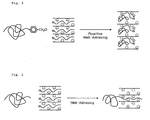
- Fig. 1 is a flow chart illustrating conditions of reaction melt-admixing polymer having reactive functional group (1) with layered silicate containing amine as reactive functional group (2) inserted between layers of the layered silicate through impregnation.
- Fig. 2 is a flow chart illustrating conditions of melt-admixing general rubber with layered silicate. Comparison of Fig. 1 and Fig. 2 represents that the layered silicate product of the present invention shown in Fig. 1 has more superior layer delamination than that of the layered silicate product obtained by melt-admixing of general rubber with layered silicate shown in Fig. 2 .
- Another preferred embodiment of the present invention is the layered silicate product with more stable and excellent layer delamination formed by reacting the rubber raw material that contains the polymer having reactive amine and/or phosphorus as the reactive functional group (1) wherein only phosphorous is not according to the present invention with the reactive layered silicate that contains halogen compound as the reactive functional group (2) inserted between layers of the layered silicate while melt-admixing the above materials to form cation containing salts as the final reaction material between the layers of the layered silicate.
- the rubber composition for tires of the present invention may further include at least one selected from the group consisting of carbon black, precipitated silica, silica aerosol, fumed silica, calcium carbonate, organic staple fibers and inorganic staple fibers, other than the reactive layered silicate.
- the rubber composition for tires of the present invention includes 10 to 80wt. parts of any one selected from a group consisting of carbon black, precipitated silica, silica aerosol, fumed silica, calcium carbonate, organic staple fibers and inorganic staple fibers relative to 100wt. parts of the rubber raw material, other than the reactive layered silicate.
- a method of preparing a rubber composition for tires comprises melt-admixing a rubber raw material that contains polymer having the reactive functional group (1) and reactive layered silicate having the reactive functional group (2) inserted between layers of the layered silicate, which is potentially reacted with the reactive functional group (1), to allow chemical reaction of the rubber raw material with the reactive layered silicate, so as to delaminate layers of the layered silicate and disperse the silicate in the rubber composition.
- the above preparation method further includes a process of forming a reactive layered silicate product that contains a material having the reactive functional group (2) inserted between layers or particles of the layered silicate, which swells, impregnates and/or mixes the material having the reactive functional group (2) with the layered silicate.
- a preferred example of the reactive layered silicate product that contains the material having the reactive functional group (2) is a mixture of the reactive layered silicate and amine as the reactive functional group (2) in varied relative ratios by weight.
- the varied relative ratios by weight (abbrev. to "weight ratio") of amine to the reactive layered silicate ranges from 0.1:1 to 10:1 to form the reactive layered silicate mixture.
- the weight ratio of amine to the reactive layered silicate ranges from 0.5:1 to 5:1.
- the weight ratio of amine to the reactive layered silicate is less than 0.1, there are problems including: difficulties in preparation processes due to lower specific gravity of the layered silicate; and/or reduction of production efficiency of the layered silicate to cause insufficient performance thereof during introduction of the layered silicate into the rubber composition, so that the layered silicate is poorly dispersed and weakly reacted with rubber having reactive functional group.
- un-vulcanized rubber has reduced tensile strength after final mixing of the materials to cause rubber sheets to be broken or torn during processing.
- the weight ratio of amine to the reactive layered silicate exceeds 10, manufacturing workability is decreased due to excess supply of amine and physical properties of the rubber composition are significantly reduced by amine residue.
- the processing time possibly ranges from 1 to 72 hours and, more preferably, from 6 to 24 hours.
- the processing time is less than 1 hour, penetration of amine into the layered silicate is insufficient to improve dispersion and physical properties of a mixture of the layered silicate and amine. Whereas, for more than 72 hours, the dispersion and physical properties of the mixture are not remarkably enhanced, compared to the mixture processed for 24 hours.
- the preparation method of the rubber composition for tires according to the present invention may comprise the steps of: melt-admixing a rubber raw material that contains polymer having the reactive functional group (1) with reactive layered silicate that contains a material having the reactive functional group (2) to allow chemical reaction thereof, wherein the functional group (1) can react with the functional group (2); using the reaction product as a master batch; and mixing the master batch with other additional ingredients typically used in manufacturing the rubber composition for tires.
- the above melt-admixing process is normally performed by means of mixing roll, Banbury mixer and/or twinextruder and at desired temperature to flow or melt ingredients of the rubber composition.
- the rubber composition for tires of the present invention may optionally include additives such as reinforcement filler, anti-aging agent, activating agent, processing oil, vulcanizing agent and the like commonly used in the rubber composition in desired amounts, if necessary.
- additives such as reinforcement filler, anti-aging agent, activating agent, processing oil, vulcanizing agent and the like commonly used in the rubber composition in desired amounts, if necessary.
- the present invention does not include numerous specific details for general ingredients described above used in the rubber composition which are well known in the related arts and not essential for the present invention, in order to avoid unnecessarily obscuring the present invention.
- the present invention provides a rubber comprising the rubber composition for tires of the present invention.
- the present invention provides tire products comprising the rubber which includes the rubber composition for tires of the present invention.
- the rubber including the rubber composition of the present invention can be used in manufacturing tire products, especially, any one selected from tread, side wall, inner liner, carcass and belt used for tires.
- Such tire products comprising the rubber prepared with the rubber composition for tires of the present invention include, for example, any one selected from passenger car tire, truck tire, bus tire, motorcycle tire and air craft tire.
- Reactive layered silicate mixtures including layered silicate and amine as a material having the reactive functional group (2) were prepared under conditions for weight ratios and impregnation times as shown in Table 1.
- polymer having reactive functional group (1) was used as a rubber raw material.
- 10wt. parts of each of the reactive layered silicate mixtures prepared as shown in the above Table 1 15wt. parts of zinc stearate and 3wt. parts of zinc oxide (ZnO) were added to 100wt. parts of the rubber raw material in a Banbury mixer and blended at 130°C and 40rpm for 10 minutes to prepare a rubber mixture.
- ZnO and zinc stearate were added to the rubber raw material and mixed together for 1 minute, followed by addition of the layered silicate and admixing the mixture for 9 minutes.
- the rubber raw material used in each of these examples was a mixture of epichlorohydrin containing alkyl halide available from Zeon Corp. and Exxpro containing benzyl halide available from Exxon Mobile Corp. in weight ratio of 50 to 50.
- a rubber specimen was prepared in the same manner as in Example 1, except that 60wt. parts of carbon black N550 was added and 5wt. parts of Cloisite 15A available from SCP Corp. was used instead of the reactive layered silicate.
- TABLE 2 Compositions of rubber specimens prepared in Comparative Example 1 and Examples 1 to 9 Sorts Comparative Ex. 1 Ex. 1 Ex. 2 Ex. 3 Ex. 4 Ex. 5 Ex. 6 Ex. 7 Ex. 8 Ex. 9 Rubber raw material 100 100 100 100 100 100 100 100 100 100 100 100 100 100 100 100 100 100 100 100 100 100 100 100 100 100 100 100 100 100 100 100 100 100 100 100 100 100 100 100 100 100 100 100 100 Reactive laye red silicate - 5.5 (preparation Ex. 1) 5.5 (preparation Ex. 2) 5.5 (preparation Ex. 3) 10 (preparation Ex. 4) 10 (preparation Ex. 5) 10 (preparation Ex.
- Air permeation resistance index represented by [air permeability measured in each of Examples 1 to 9/air permeability measured in Comparative Example 1] ⁇ 100, wherein air permeability measured in Comparative Example 1 is 9.21E - 18m4/sec.N and air permeation improves as the air permeation resistance index is decreased.
- Wear resistance index shows each of wear resistance values of the rubber specimens prepared in Examples 1 to 9 relative to a wear resistance value of 100 for a specimen prepared in Comparative Example 1, and means that wear resistance is improved as the wear resistance index becomes higher.
- Tensile strength index of un-vulcanized rubber shows each of tensile strength values of the un-vulcanized rubber specimens in Examples 1 to 9 relative to a tensile strength value of 100 for the un-vulcanized specimen in Comparative Example 1, and means that tensile strength of the un-vulcanized rubber is improved as the tensile strength index becomes higher.
- standards of dispersibility are ⁇ - poor; ⁇ - good; and 0 - very good.
- Tensile strength of un-vulcanized rubber was sufficiently increased by introduction of a material having the reactive functional group (2), that is, dimethylstearylamine in a desired amount.
- Polymer having reactive functional group (1) (often abbrev. to "reactive rubber”) was used as a rubber raw material. 80wt. parts of carbon black N375, 1wt. part of silane coupling agent, 1wt. part of stearic acid, 5wt. parts of processing oil P#2, 5wt. parts of silica and 3wt. parts of ZnO were added to 100wt. parts of the rubber raw material in a Banbury mixer and blended at 130°C and 40rpm for 10 minutes to prepare a rubber mixture.
- reactive rubber 80wt. parts of carbon black N375, 1wt. part of silane coupling agent, 1wt. part of stearic acid, 5wt. parts of processing oil P#2, 5wt. parts of silica and 3wt. parts of ZnO were added to 100wt. parts of the rubber raw material in a Banbury mixer and blended at 130°C and 40rpm for 10 minutes to prepare a rubber mixture.
- a mixing roll 1.7wt. parts of sulfur and 1.5wt. parts of vulcanizing agent (NS) were fed together with the prepared rubber mixture to obtain a sheet form product.
- the obtained sheet form product was subjected to vulcanization in a hot press at 160°C for 20 minutes after processing, resulting in a rubber specimen.
- the reactive rubber used in this example was VBC_SBR containing vinylbenzyl chloride (VBC) available from Kumho Petrochemical Co. Ltd.
- Table 4-1 shows constitutional ingredients of the specimen in Comparative Example 2.
- a rubber specimen was prepared in the same manner as in Comparative Example 2, except that 5wt. parts of Cloisite 15 available from SCP Corp. was further added to prepare the rubber mixture.
- Polymer having reactive functional group (1) was used as a rubber raw material. 5wt. parts of reactive layered silicate, 80wt. parts of carbon black N375, 1wt. part of silane coupling agent, 1wt. part of stearic acid, 5wt. parts of processing oil P#2, 5wt. parts of silica and 3wt. parts of ZnO were added to 100wt. parts of the rubber raw material in a Banbury mixer and blended at 130°C and 40rpm for 10 minutes to prepare a rubber mixture.
- a mixing roll 1.70wt. parts of sulfur and 1.50wt. parts of vulcanizing agent (NS) were fed together with the prepared rubber mixture to obtain a sheet form product.
- the obtained sheet form product was subjected to vulcanization in a hot press at 160°C for 20 minutes after processing, resulting in a rubber specimen.
- the reactive rubber used in this example was VBC_SBR containing vinylbenzyl chloride (VBC) available from Kumho Petrochemical Co. Ltd.
- Table 4-1 shows constitutional ingredients of the specimen in Example 10.
- a rubber specimen was prepared in the same manner as in Example 10, except that 7wt. parts of the reactive layered silicate was used to prepare the rubber mixture.
- Table 4-1 shows constitutional ingredients of the specimen in Example 11.
- a rubber specimens was prepared in the same manner as in Example 10, except that 10wt. parts of the reactive layered silicates was used to prepare the rubber mixture.
- Table 4-1 shows constitutional ingredients of the specimen in Example 12.
- a rubber specimens was prepared in the same manner as in Example 10, except that 15wt. parts of the reactive layered silicates was used to prepare the rubber mixture.
- Table 4-2 shows constitutional ingredients of the specimen in Examples 13.
- a rubber specimens was prepared in the same manner as in Example 10, except that 20wt. parts of the reactive layered silicates was used to prepare the rubber mixture.
- Table 4-2 shows constitutional ingredients of the specimen in Examples 14.
- a rubber specimens was prepared in the same manner as in Example 10, except that 30wt. parts of the reactive layered silicates was used to prepare the rubber mixture.
- Table 4-2 shows constitutional ingredients of the specimen in Examples 15.
- a rubber specimen was prepared in the same manner as in Example 10, except that the rubber raw material was prepared by comprising 80wt. parts of polymer having reactive functional group (1) (that is, reactive rubber) and 20wt. parts of Butyl Rubber (Butyl 0268), and 100wt. parts of the rubber raw material, 10wt. parts of the reactive layered silicate and 1wt. part of DM were used to prepare the rubber mixture.
- the rubber raw material was prepared by comprising 80wt. parts of polymer having reactive functional group (1) (that is, reactive rubber) and 20wt. parts of Butyl Rubber (Butyl 0268), and 100wt. parts of the rubber raw material, 10wt. parts of the reactive layered silicate and 1wt. part of DM were used to prepare the rubber mixture.
- Reactive rubber 100 100 100
- General rubber - - - 20 Cloisite 15A - - - - Reactive layered silicate 15 20 30 10 Carbon black 80
- 80 80 80
- Coupling agent 1 1 1 1 1
- Stearic acid 1 1 1 1 1 1 DM - - - 1 P#2 oil
- 5 5 5
- Silica 5 5
- NS 1.50 1.50 1.50 1.50
- GPT index 65 45
- 110 90 Reactive rubber: VBC_SBR available from Kumho Petrochemical Co.
- Each of the rubber specimens has thickness of 0.2mm.
- TABLE 5 Physical properties of specimens prepared in Comparative Examples 2 and 3, and Examples 10 to 16 Items Air permeation resistance index Dispersibility Wear strength resistance index
- Tensile index of un-vulcanized rubber Comparative Ex. 2 100 ⁇ 100 100 Comparative Ex. 3 100 ⁇ 92 84 Ex. 10 75 0 115 104 Ex. 11 74 0 110 115 Ex. 12 52 0 105 129 Ex. 13 65 0 105 134 Ex. 14 45 0 110 139 Ex. 15 10 0 110 144 Ex.
- Air permeation resistance index represented by [air permeability measured in each of Comparative Example 3, Examples 10 to 16/air permeability measured in Comparative Example 2] ⁇ 100, wherein air permeability measured in Comparative Example 2 is 9.98E - 16m4/sec.N and air permeation improves as the air permeation resistance index is decreased.
- Wear resistance index shows each of wear resistance values of the rubber specimens prepared in Comparative Example 3 and Examples 10 to 16 relative to a wear resistance value of 100 for a specimen prepared in Comparative Example 2, and means that wear resistance is improved as the wear resistance index becomes higher.
- Tensile strength index of un-vulcanized rubber shows each of tensile strength values of the un-vulcanized rubber specimens in Comparative Example 3 and Examples 10 to 16 relative to a tensile strength value of 100 for the un-vulcanized rubber specimen in Comparative Example 2, and means that tensile strength of the un-vulcanized rubber is increased as the tensile strength index becomes higher.
- standards of dispersibility are ⁇ - poor; ⁇ - good; and 0 - very good.
- the rubber specimen comprising the rubber composition of the present invention has favorable dispersibility of layered silicate, wear resistance, air permeation resistance and tensile strength of un-vulcanized rubber compared to rubber specimens made of well known rubber compositions, thereby being efficiently used in manufacturing rubber products with excellent dispersibility, wear resistance, air permeation resistance and tensile strength of un-vulcanized rubber.
Landscapes
- Chemical & Material Sciences (AREA)
- Health & Medical Sciences (AREA)
- Chemical Kinetics & Catalysis (AREA)
- Medicinal Chemistry (AREA)
- Polymers & Plastics (AREA)
- Organic Chemistry (AREA)
- Engineering & Computer Science (AREA)
- Mechanical Engineering (AREA)
- Dispersion Chemistry (AREA)
- Compositions Of Macromolecular Compounds (AREA)
Description
- This application claims priority to Korean Patent Application No.
2007-0021644, filed on March 5, 2007 - The present invention relates to a rubber composition for tires, more particularly, to a rubber composition for tires which comprises polymer having reactive functional group (1) in a rubber raw material, and reactive layered silicate having reactive functional group (2) potentially reacting with the above polymer.
- Layered silicates have organic material inserted between layers of silicates or can be layer delaminated. The layered silicates show varied degrees of layer delamination based on chemical properties or processing conditions of rubber and/or polymer compounds, and kinds of materials inserted between layers thereof.
- Dependent on degree of layer delamination of layered silicates in a rubber composition comprising the layered silicates, various properties including mechanical strength, tear strength, wear resistance and/or gas permeation resistance and the like can be improved.
- A number of techniques and/or processes using layered silicates have been proposed to improve mechanical strength, flame retardance, gas permeation resistance, etc. and these technologies are continuously progressing to make improvements of various physical properties in related arts.
- As one of conventionally known methods utilizing layered silicates, nano dispersion of layered silicate is induced by inserting cationic organic materials such as quaternary ammonium salts, imidazolium salts, and quaternary phosphates between layers by a variety of processes to increase affinity to rubber and/or polymer compounds. Layered silicate products containing cationic organic materials between layers are produced and commercially available by layered silicate manufacturers.
- Rubber and/or polymer compositions comprising layered silicates are in general known in the prior art. In example,
US 2005/0020753 A1 discloses a rubber composition comprising chemically modified layered silicates, which can be used for the manufacture of tires. Other examples of compositions comprising layered silicates for tires, or parts of them, are disclosed inEP 1 364 987 , as well as inWO 2005/118695 andUS 2004/0194863 . - A nitrile rubber compound comprising a chemically modified nanoclay suitable for the manufacture of shaped bodies is disclosed in
US 2005/0065264 . InDE 100 59 237 a sealing comprising a vulcanizable rubber mixture with chemically modified layered silicates is disclosed. - In addition, nanocomposites of a polymer system containing a swellable, chemically modified clay are disclosed in
US 2003/0144401 ,WO 02/100936 KR 2003 0089589 EP 1 029 823 . The later one teaches to employ guest molecules to be incorporated in an interlayer section of the clay mineral for expanding the structure. - A process for the preparation of nanocomposites is disclosed in example in
WO 2007/011456 . - Although layers of the layered silicate are partially delaminated by adding organically modified layered silicate (abbrev. to "organo-layered silicate") containing cationic organic compound, which is commercially available in markets, to a rubber composition and performing layer delamination of the layered silicate by a melt-admixing process, the layer delamination is restricted by kinds of rubber and/or polymer compounds, and layered silicates to be used.
- Accordingly, the present invention is directed to solve the problem of conventional proposes as described above and, an object of the present invention is to provide a rubber composition for tires which includes polymer having reactive functional group (1) in a rubber raw material, and reactive layered silicate prepared by inserting a material having reactive functional group (2) potentially reacting with the above polymer, between layers of the layered silicate so as to noticeably increase dispersion of the rubber raw material thereby improving tensile strength of un-vulcanized rubber, and so as to enhance dispersibility of the layered silicate thereby exhibiting excellent wear resistance, tear resistance, and air permeation resistance of the rubber composition.
- In order to achieve the object described above, the present invention provides a rubber composition for tires.
- More particularly, the rubber composition for tires of the present invention comprises polymer having reactive functional group (1) in a rubber raw material, and reactive layered silicate prepared by inserting a material having reactive functional group (2) potentially reacting with the above polymer, between layers or particles of the layered silicate.
- According to the present invention the said polymer has at least one reactive functional group (1) selected from the group consisting of aryl halide, alkyl halide, hydroxyl group, benzyl halide, amine and phenol group, and the reactive functional group (2) of the material inserted between layers or particles of the layered silicate is at least one selected from the group consisting of aryl halide, alkyl halide, 1,3-propane sultone, hydroxyl group, benzyl halide, amine, tertiary phosphorous, carboxyl group, phenol group, maleic acid and maleic anhydride.
- Preferably, the present inventive rubber composition for tires comprises polymer having the reactive functional group (1) in a rubber raw material, and 0.5 to 100 parts by weight ("wt. parts") of reactive layered silicate relative to 100wt. parts of the rubber raw material, which is prepared by inserting the material having the reactive functional group (2) potentially reacting with the above polymer, between layers or particles of the layered silicate.
- With regard to the rubber composition for tires according to the present invention, the rubber raw material may comprise polymer having the reactive functional group (1) alone.
- With regard to the rubber composition for tires according to the present invention, the rubber raw material may comprise polymer having the reactive functional group (1) in combination with general rubber. For 100wt. parts of the rubber raw material, the raw material includes 10 to 90wt. parts of polymer having the reactive functional group (1) in combination with 10 to 90wt. parts of general rubber.
- Preferably, the general rubber includes at least one selected from the group consisting of natural rubber, general butyl rubber, epichlorohydrin rubber, nitrile rubber, hydrogenated nitrile rubber, styrene-butadiene rubber, urethane rubber, fluorinated rubber, silicon rubber, styrene-ethylene-butylene-styrene (SEBS) rubber, ethylene-propylene rubber, ethylene-propylene-diene (EPDM) rubber, butadiene rubber, hypalon, chloroprene, ethylene vinyl acetate rubber and acryl rubber.
- Preferably, the rubber raw material and/or the polymer as one of ingredients contained in the rubber raw material, has the reactive functional group (1) at at least one site selected from main chain, side chain and terminal of the polymer, and
the amount of the reactive functional group (1) contained in the rubber raw material and/or in the polymer as one of ingredients in the rubber raw material is at least 0.01 (mole/kg of polymer). - Preferably, the amount of the reactive functional group (1) contained in the rubber raw material and/or in the polymer as one of ingredients in the rubber raw material ranges from 0.01 to 10 (mole/kg of polymer).
- Among alkyl halide for the reactive functional group (1), alkyl group is any one selected from alkyl groups having 5 to 30 carbon atoms.
- Examples of the rubber raw material and/or the polymer having the reactive functional group (1), as one of ingredients contained in the rubber raw material, include hydrin rubber, vinylbenzyl chloride styrene-butadiene rubber, chlorobutyl rubber, bromobutyl rubber.
- The reactive layered silicate used in the rubber composition for tires according to the present invention may be prepared by the steps of: swelling, impregnating and/or mixing layered silicate with a material having the reactive functional group (2) which potentially reacts with the rubber raw material and/or the polymer having the reactive functional group (1), as one of ingredients in the rubber raw material, in relative ratio by weight ranging from 1:99 to 99:1; and inserting the material having the reactive functional group (2) potentially reacting with the polymer having the reactive functional group (1), between layers or particles of the layered silicate.
- The reactive layered silicate may have a spacing between layers in the range of 0.1 to 10nm.
- The reactive layered silicate may have a ratio of flat width (1) to thickness (d), called aspect ratio (1/d) of at least 5.
- The reactive layered silicate may have an aspect ratio ranging from 5 to 900.
- The reactive layered silicate may comprise natural layered silicate that can possibly undergo cationic exchange and/or anionic exchange reactions.
- The reactive layered silicate may comprise synthetic layered silicate that can possibly undergo cationic exchange and/or anionic exchange reactions.
- The reactive layered silicate may comprise organo-layered silicate which was organically modified by cationic group or anionic group containing materials.
- The layered silicate can be any one selected from a group consisting of montmorillonite, saponite, hectorite, rectorite, vermiculite, mica, illite, talc, kolinite, hydrotalcite, sodium montmorillonite (Na-MMT) and Cloisite 15A.
- Preferably, the layered silicate is montmorillonite.
- The reactive functional group (2) which potentially reacts with the polymer having the reactive functional group (1) contained in the rubber raw material and which is inserted between layers or particles of the reactive layered silicate, may have molecular weight of not more than 5000.
- The reactive functional group (2) which potentially reacts with the polymer having the reactive functional group (1) contained in the rubber raw material and which is inserted between layers or particles of the reactive layered silicate, may have molecular weight of not more than 1500.
- The reactive functional group (2) which potentially reacts with the polymer having the reactive functional group (1) contained in the rubber raw material and which is inserted between layers or particles of the reactive layered silicate, may have molecular weight of not more than 400.
- The reactive functional group (2) which is inserted between layers or particles of the reactive layered silicate, may have molecular weight ranging from 100 to 5000.
- The reactive functional group (2) which is inserted between layers or particles of the reactive layered silicate, may be in liquid state.
- If the reactive layered silicate is cation-exchangeable reactive layered silicate, a rubber composition with more excellent layer delamination can be obtained by chemically reacting the reactive layered silicate with a rubber raw material that contains polymer having the reactive functional group (1), to form cation containing materials between layers or particles of the layered silicate.
- If the reactive layered silicate is anion-exchangeable reactive layered silicate, a rubber composition with more excellent layer delamination can be obtained by chemically reacting the layered silicate with a rubber raw material that contains polymer having the reactive functional group (1), to form anion containing materials between layers or particles of the layered silicate.
- As a preferred embodiment of the present invention, a layered silicate product with more stable and excellent layer delamination can be produced by reacting the rubber raw material that contains the polymer having a reactive halogen compound, as the reactive functional group (1), with the reactive layered silicate that contains amine, as the reactive functional group (2) potentially reacting with the functional group (1) inserted between layers of the layered silicate, while melt-admixing the above materials to form cation containing salts as the final reaction material between the layers.
-
Fig. 1 is a flow chart illustrating conditions of reaction melt-admixing polymer having reactive functional group (1) with layered silicate containing amine as reactive functional group (2) inserted between layers of the layered silicate through impregnation.Fig. 2 is a flow chart illustrating conditions of melt-admixing general rubber with layered silicate. Comparison ofFig. 1 and Fig. 2 represents that the layered silicate product of the present invention shown inFig. 1 has more superior layer delamination than that of the layered silicate product obtained by melt-admixing of general rubber with layered silicate shown inFig. 2 . - Another preferred embodiment of the present invention is the layered silicate product with more stable and excellent layer delamination formed by reacting the rubber raw material that contains the polymer having reactive amine and/or phosphorus as the reactive functional group (1) wherein only phosphorous is not according to the present invention with the reactive layered silicate that contains halogen compound as the reactive functional group (2) inserted between layers of the layered silicate while melt-admixing the above materials to form cation containing salts as the final reaction material between the layers of the layered silicate.
- The rubber composition for tires of the present invention may further include at least one selected from the group consisting of carbon black, precipitated silica, silica aerosol, fumed silica, calcium carbonate, organic staple fibers and inorganic staple fibers, other than the reactive layered silicate.
- Preferably, the rubber composition for tires of the present invention includes 10 to 80wt. parts of any one selected from a group consisting of carbon black, precipitated silica, silica aerosol, fumed silica, calcium carbonate, organic staple fibers and inorganic staple fibers relative to 100wt. parts of the rubber raw material, other than the reactive layered silicate.
- A method of preparing a rubber composition for tires comprises melt-admixing a rubber raw material that contains polymer having the reactive functional group (1) and reactive layered silicate having the reactive functional group (2) inserted between layers of the layered silicate, which is potentially reacted with the reactive functional group (1), to allow chemical reaction of the rubber raw material with the reactive layered silicate, so as to delaminate layers of the layered silicate and disperse the silicate in the rubber composition.
- The above preparation method further includes a process of forming a reactive layered silicate product that contains a material having the reactive functional group (2) inserted between layers or particles of the layered silicate, which swells, impregnates and/or mixes the material having the reactive functional group (2) with the layered silicate.
- A preferred example of the reactive layered silicate product that contains the material having the reactive functional group (2), is a mixture of the reactive layered silicate and amine as the reactive functional group (2) in varied relative ratios by weight. The varied relative ratios by weight (abbrev. to "weight ratio") of amine to the reactive layered silicate ranges from 0.1:1 to 10:1 to form the reactive layered silicate mixture. Preferably, the weight ratio of amine to the reactive layered silicate ranges from 0.5:1 to 5:1. If the weight ratio of amine to the reactive layered silicate is less than 0.1, there are problems including: difficulties in preparation processes due to lower specific gravity of the layered silicate; and/or reduction of production efficiency of the layered silicate to cause insufficient performance thereof during introduction of the layered silicate into the rubber composition, so that the layered silicate is poorly dispersed and weakly reacted with rubber having reactive functional group. As a result, un-vulcanized rubber has reduced tensile strength after final mixing of the materials to cause rubber sheets to be broken or torn during processing. On the other hand, if the weight ratio of amine to the reactive layered silicate exceeds 10, manufacturing workability is decreased due to excess supply of amine and physical properties of the rubber composition are significantly reduced by amine residue.
- After mixing amine with the layered silicate in the desired weight ratio, swelling, impregnation and/or mixing process needs a desired period of time to obtain the reactive layered silicate product with high production yield. The processing time possibly ranges from 1 to 72 hours and, more preferably, from 6 to 24 hours.
- If the processing time is less than 1 hour, penetration of amine into the layered silicate is insufficient to improve dispersion and physical properties of a mixture of the layered silicate and amine. Whereas, for more than 72 hours, the dispersion and physical properties of the mixture are not remarkably enhanced, compared to the mixture processed for 24 hours.
- Alternatively, the preparation method of the rubber composition for tires according to the present invention may comprise the steps of: melt-admixing a rubber raw material that contains polymer having the reactive functional group (1) with reactive layered silicate that contains a material having the reactive functional group (2) to allow chemical reaction thereof, wherein the functional group (1) can react with the functional group (2); using the reaction product as a master batch; and mixing the master batch with other additional ingredients typically used in manufacturing the rubber composition for tires.
- The above melt-admixing process is normally performed by means of mixing roll, Banbury mixer and/or twinextruder and at desired temperature to flow or melt ingredients of the rubber composition.
- Other than the rubber raw material and the reactive layered silicate described above, the rubber composition for tires of the present invention may optionally include additives such as reinforcement filler, anti-aging agent, activating agent, processing oil, vulcanizing agent and the like commonly used in the rubber composition in desired amounts, if necessary. However, the present invention does not include numerous specific details for general ingredients described above used in the rubber composition which are well known in the related arts and not essential for the present invention, in order to avoid unnecessarily obscuring the present invention.
- The present invention provides a rubber comprising the rubber composition for tires of the present invention.
- Furthermore, the present invention provides tire products comprising the rubber which includes the rubber composition for tires of the present invention.
- The rubber including the rubber composition of the present invention can be used in manufacturing tire products, especially, any one selected from tread, side wall, inner liner, carcass and belt used for tires.
- Such tire products comprising the rubber prepared with the rubber composition for tires of the present invention include, for example, any one selected from passenger car tire, truck tire, bus tire, motorcycle tire and air craft tire.
- These and other objects, features, aspects, and advantages of preferred embodiments of the present invention will be more fully described in the following detailed description, taken in conjunction with the accompanying drawings. In the drawings:
-
Fig. 1 is a flow chart illustrating conditions of melt-admixing polymer having reactive functional group (1) with layered silicate that contains reactive amine inserted between layers of the layered silicate through impregnation; -
Fig. 2 is a flow chart illustrating conditions of melt-admixing general rubber with layered silicate; -
Fig. 3 is TEM photograph illustrating a rubber specimen prepared in Comparative Example 1; and -
Fig. 4 is TEM photograph illustrating a rubber specimen prepared in Example 5. - Hereinafter, the present invention will become apparent from the following comparative examples, examples and experimental examples with reference to the accompanying drawings. However, these are intended to illustrate the invention as preferred embodiments of the present invention and do not limit the scope of the present invention.
- Reactive layered silicate mixtures including layered silicate and amine as a material having the reactive functional group (2) were prepared under conditions for weight ratios and impregnation times as shown in Table 1.
- Amine having the reactive functional group (2) contained in each of the mixtures was dimethylstearylamine, while the layered silicate was Cloisite 15A available from SCP Corp.
TABLE 1: Conditions for preparation of reactive layered silicate mixture Sorts Preparation Ex. 1 Preparation Ex. 2 Preparation Ex. 3 Preparation Ex. 4 Preparation Ex. 5 Preparation Ex. 6 Preparation Ex. 7 Preparation Ex. 8 Preparation Ex. 9 Weight of layered silicate 1 1 1 1 1 1 1 1 1 Weight of amine 0.1 0.1 0.1 1 1 1 2 2 2 Impreg nation time (hr) 1 24 72 1 24 72 1 24 72 - As listed in the following Table 2, polymer having reactive functional group (1) was used as a rubber raw material. 10wt. parts of each of the reactive layered silicate mixtures prepared as shown in the above Table 1, 15wt. parts of zinc stearate and 3wt. parts of zinc oxide (ZnO) were added to 100wt. parts of the rubber raw material in a Banbury mixer and blended at 130°C and 40rpm for 10 minutes to prepare a rubber mixture. Herein, ZnO and zinc stearate were added to the rubber raw material and mixed together for 1 minute, followed by addition of the layered silicate and admixing the mixture for 9 minutes.
- In a mixing roll, 0.6wt. parts of sulfur and 0.7wt. parts of N-t-butylbenzothiazole sulfonamide (NS) were fed together with the prepared rubber mixture to obtain a sheet form product. The obtained sheet form product was subjected to vulcanization in a hot press at 160°C for 20 minutes after processing, resulting in a rubber specimen.
- The rubber raw material used in each of these examples was a mixture of epichlorohydrin containing alkyl halide available from Zeon Corp. and Exxpro containing benzyl halide available from Exxon Mobile Corp. in weight ratio of 50 to 50.
- A rubber specimen was prepared in the same manner as in Example 1, except that 60wt. parts of carbon black N550 was added and 5wt. parts of Cloisite 15A available from SCP Corp. was used instead of the reactive layered silicate.
TABLE 2: Compositions of rubber specimens prepared in Comparative Example 1 and Examples 1 to 9 Sorts Comparative Ex. 1 Ex. 1 Ex. 2 Ex. 3 Ex. 4 Ex. 5 Ex. 6 Ex. 7 Ex. 8 Ex. 9 Rubber raw material 100 100 100 100 100 100 100 100 100 100 Reactive laye red silicate - 5.5 (preparation Ex. 1) 5.5 (preparation Ex. 2) 5.5 (preparation Ex. 3) 10 (preparation Ex. 4) 10 (preparation Ex. 5) 10 (preparation Ex. 6) 15 (preparation Ex. 7) 15 (preparation Ex. 8) 15 (preparation Ex. 9) Laye red silicate (Cloisite 15A) 5 - - - - - - - - - Carbon black N-550 60 - - - - - - - - - Zinc stearate 15 15 15 15 15 15 15 15 15 15 ZnO 3 3 3 3 3 3 3 3 3 3 Sulfur 0.6 0.6 0.6 0.6 0.6 0.6 0.6 0.6 0.6 0.6 Vulcanizing agent (NS) 0.7 0.7 0.7 0.7 0.7 0.7 0.7 0.7 0.7 0.7 - For the rubber specimens prepared in Comparative Example 1 and Examples 1 to 9, various properties including air permeation resistance, dispersibility, tensile strength of un-vulcanized rubber and wear resistance index were measured according to ASTM standards and the results are listed in the following Table 3.
TABLE 3: Results obtained by Experimental Example 1 for specimens prepared in Comparative Example 1 and Examples 1 to 9 Items Air permeation resistance index Dispersibility Tensile strength index of Unvulcanized rubber Wear resistance index Comparative Ex. 1 100 × 100 100 Ex. 1 99 × 102 101 Ex. 2 91 × 108 107 Ex. 3 90 × 109 108 Ex. 4 81 × 110 109 Ex. 5 42 ⓪ 131 130 Ex. 6 41 ⓪ 133 132 Ex. 7 63 ○ 120 100 Ex. 8 58 ○ 136 107 Ex. 9 57 ○ 138 108 * Air permeation resistance index: represented by [air permeability measured in each of Examples 1 to 9/air permeability measured in Comparative Example 1] × 100, wherein air permeability measured in Comparative Example 1 is 9.21E - 18m4/sec.N and air permeation improves as the air permeation resistance index is decreased.
* Wear resistance index shows each of wear resistance values of the rubber specimens prepared in Examples 1 to 9 relative to a wear resistance value of 100 for a specimen prepared in Comparative Example 1, and means that wear resistance is improved as the wear resistance index becomes higher.
* Tensile strength index of un-vulcanized rubber shows each of tensile strength values of the un-vulcanized rubber specimens in Examples 1 to 9 relative to a tensile strength value of 100 for the un-vulcanized specimen in Comparative Example 1, and means that tensile strength of the un-vulcanized rubber is improved as the tensile strength index becomes higher.
* standards of dispersibility are ×- poor; ○ - good; and ⓪ - very good. - From results of Experimental Example 1, the material having the reactive functional group (2) and Cloisite 15A were admixed together in the most preferable weight ratio of 1:1 to prepare the reactive layered silicate. For Examples 7 to 9 in which weight ratio of the material having the reactive functional group (2) was relatively increased, dispersibility of the reactive layered silicate was a little increased but physical properties thereof were substantially not improved. In contrast, Examples 1 to 3 which used the material having the reactive functional group (2) with relatively reduced weight ratio, represented that neither of dispersibility nor physical properties of the reactive layered silicate were increased. Likewise, Examples 1, 4 and 7 which adopted impregnation for 1 hour showed no improvement of dispersibility and physical properties of the silicate. However, for Examples 2, 3, 5, 6, 8 and 9 with impregnation for 24 hours or more, it was demonstrated that both of dispersibility and physical properties of the reactive layered silicate were noticeably enhanced.
- Tensile strength of un-vulcanized rubber was sufficiently increased by introduction of a material having the reactive functional group (2), that is, dimethylstearylamine in a desired amount.
- Also, it was found that air permeation resistance was closely dependent on dispersibility of the reactive layered silicate.
- From TEM (transmission electron microscopy) photographs of specimens prepared in Comparative Example 1 and Examples 1 to 9, dispersibility of the layered silicate in each of the specimens was determined.
Figs. 3 and4 demonstrated results of Comparative Example 1 and Example 5, respectively. - In comparison of TEM photograph in
Fig. 3 for the rubber specimen in Comparative Example 1 with TEM photograph inFig. 4 for the rubber specimen in Example 5, it is obviously represented that the layered silicate shown inFig. 4 has more favorable layer delamination and excellent dispersibility than those of the layered silicate shown inFig. 3 . - From results of the above Experimental Examples 1 and 2, the weight ratio of dimethylstearylamine as the reactant material to silicate 15A was 1:1 in the reactive layered silicate of the present invention. Examples 10 to 16 used the reactive layered silicate mixture prepared with impregnation for 24 hours.
- Polymer having reactive functional group (1) (often abbrev. to "reactive rubber") was used as a rubber raw material. 80wt. parts of carbon black N375, 1wt. part of silane coupling agent, 1wt. part of stearic acid, 5wt. parts of processing oil P#2, 5wt. parts of silica and 3wt. parts of ZnO were added to 100wt. parts of the rubber raw material in a Banbury mixer and blended at 130°C and 40rpm for 10 minutes to prepare a rubber mixture.
- In a mixing roll, 1.7wt. parts of sulfur and 1.5wt. parts of vulcanizing agent (NS) were fed together with the prepared rubber mixture to obtain a sheet form product. The obtained sheet form product was subjected to vulcanization in a hot press at 160°C for 20 minutes after processing, resulting in a rubber specimen.
- The reactive rubber used in this example was VBC_SBR containing vinylbenzyl chloride (VBC) available from Kumho Petrochemical Co. Ltd.
- The following Table 4-1 shows constitutional ingredients of the specimen in Comparative Example 2.
- A rubber specimen was prepared in the same manner as in Comparative Example 2, except that 5wt. parts of Cloisite 15 available from SCP Corp. was further added to prepare the rubber mixture.
- The following Table 4-1 shows constitutional ingredients of the specimen in Comparative Example 3.
- Polymer having reactive functional group (1) was used as a rubber raw material. 5wt. parts of reactive layered silicate, 80wt. parts of carbon black N375, 1wt. part of silane coupling agent, 1wt. part of stearic acid, 5wt. parts of processing oil P#2, 5wt. parts of silica and 3wt. parts of ZnO were added to 100wt. parts of the rubber raw material in a Banbury mixer and blended at 130°C and 40rpm for 10 minutes to prepare a rubber mixture.
- In a mixing roll, 1.70wt. parts of sulfur and 1.50wt. parts of vulcanizing agent (NS) were fed together with the prepared rubber mixture to obtain a sheet form product. The obtained sheet form product was subjected to vulcanization in a hot press at 160°C for 20 minutes after processing, resulting in a rubber specimen.
- The reactive rubber used in this example was VBC_SBR containing vinylbenzyl chloride (VBC) available from Kumho Petrochemical Co. Ltd.
- The following Table 4-1 shows constitutional ingredients of the specimen in Example 10.
- A rubber specimen was prepared in the same manner as in Example 10, except that 7wt. parts of the reactive layered silicate was used to prepare the rubber mixture.
- The following Table 4-1 shows constitutional ingredients of the specimen in Example 11.
- A rubber specimens was prepared in the same manner as in Example 10, except that 10wt. parts of the reactive layered silicates was used to prepare the rubber mixture.
- The following Table 4-1 shows constitutional ingredients of the specimen in Example 12.
- A rubber specimens was prepared in the same manner as in Example 10, except that 15wt. parts of the reactive layered silicates was used to prepare the rubber mixture.
- The following Table 4-2 shows constitutional ingredients of the specimen in Examples 13.
- A rubber specimens was prepared in the same manner as in Example 10, except that 20wt. parts of the reactive layered silicates was used to prepare the rubber mixture.
- The following Table 4-2 shows constitutional ingredients of the specimen in Examples 14.
- A rubber specimens was prepared in the same manner as in Example 10, except that 30wt. parts of the reactive layered silicates was used to prepare the rubber mixture.
- The following Table 4-2 shows constitutional ingredients of the specimen in Examples 15.
- A rubber specimen was prepared in the same manner as in Example 10, except that the rubber raw material was prepared by comprising 80wt. parts of polymer having reactive functional group (1) (that is, reactive rubber) and 20wt. parts of Butyl Rubber (Butyl 0268), and 100wt. parts of the rubber raw material, 10wt. parts of the reactive layered silicate and 1wt. part of DM were used to prepare the rubber mixture.
- The following Table 4-2 shows constitutional ingredients of the specimen in Example 16.
TABLE 4-1: Compositions of rubber specimens prepared by Comparative Examples 2 and 3, and Examples 10, 11 and 12 Sorts Comparative Ex. 2 Comparative Ex. 3 Ex. 10 Ex. 11 Ex. 12 Reactive rubber 100 100 100 100 100 General rubber - - - - - Cloisite 15A - 5 - - - Reactive layered silicate - - 5 7 10 Carbon black 80 80 80 80 80 Coupling agent 1 1 1 1 1 Stearic acid 1 1 1 1 1 DM - - - - - P#2 oil 5 5 5 5 5 Silica 5 5 5 5 5 Sulfur 1.70 1.70 1.70 1.70 1.70 NS 1.50 1.50 1.50 1.50 1.50 ZnO 3.0 3.0 3.0 3.0 3.0 GPT index 100 100 75 74 52 Dispersibil ity ○ × ⓪ ⓪ ⓪ Wear resistance 100 92 115 110 105 Reactive rubber: VBC_SBR available from Kumho Petrochemical Co. Ltd., which comprises 18.5% of styrene, 5% of VBC and 76.5% of butadiene;
General rubber: Butyl 0268 available from Exxon Mobile;
P# Oil: paraffin #2 oil;
Carbon black: N375 available from KCB Corp.;
Layered silicate: Cloisite 15A available from SCP Corp.;
Reactive layered silicate: Cloisite 15A/dimethylstearylamine = 50/50 ratio by weight;
Coupling agent: S1-69 available from Degussa Corp.;
Stearic acid: product available from LG Chemical;
DM: Vulkacit DM;
Silica: Z-115, Rhodia;
Sulfur: product available from Miwon Commercial Co. Ltd.;
NS: Santocure NS;
ZnO: KS-2 Special available from Hanil Chemical Ind. Co. Ltd.TABLE 4-2: Compositions of rubber specimens prepared by Examples 13 to 16 Sorts Ex. 13 Ex. 14 Ex. 15 Ex. 16 Reactive rubber 100 100 100 80 General rubber - - - 20 Cloisite 15A - - - - Reactive layered silicate 15 20 30 10 Carbon black 80 80 80 80 Coupling agent 1 1 1 1 Stearic acid 1 1 1 1 DM - - - 1 P#2 oil 5 5 5 5 Silica 5 5 5 5 Sulfur 1.70 1.70 1.70 1.70 NS 1.50 1.50 1.50 1.50 ZnO 3.0 3.0 3.0 3.0 GPT index 65 45 10 41 Dispersibility ⓪ ⓪ ⓪ ⓪ Wear resistance 105 110 110 90 Reactive rubber: VBC_SBR available from Kumho Petrochemical Co. Ltd., which comprises 18.5% of styrene, 5% of VBC and 76.5% of butadiene;
General rubber: Butyl 0268 available from Exxon Mobile;
P# Oil: paraffin #2 oil;
Carbon black: N375 available from KCB Corp.;
Layered silicate: Cloisite 15A available from SCP Corp.;
Reactive layered silicate: Cloisite 15A/dimethylstearylamine = 50/50 ratio by weight;
Coupling agent: S1-69 available from Degussa Corp.;
Stearic acid: product available from LG Chemical;
DM: Vulkacit DM;
Silica: Z-115, Rhodia;
Sulfur: product available from Miwon Commercial Co. Ltd.;
NS: Santocure NS;
ZnO: KS-2 Special available from Hanil Chemical Ind. Co. Ltd. - For the rubber specimens prepared in Comparative Examples 2 and 3, and Examples 10 to 16, various properties including air permeation resistance, dispersibility and wear resistance index were measured according to ASTM standards and the results are listed in the following Table 5.
- Each of the rubber specimens has thickness of 0.2mm.
TABLE 5: Physical properties of specimens prepared in Comparative Examples 2 and 3, and Examples 10 to 16 Items Air permeation resistance index Dispersibility Wear strength resistance index Tensile index of un-vulcanized rubber Comparative Ex. 2 100 ○ 100 100 Comparative Ex. 3 100 × 92 84 Ex. 10 75 ⓪ 115 104 Ex. 11 74 ⓪ 110 115 Ex. 12 52 ⓪ 105 129 Ex. 13 65 ⓪ 105 134 Ex. 14 45 ⓪ 110 139 Ex. 15 10 ⓪ 110 144 Ex. 16 41 ⓪ 102 146 * Air permeation resistance index: represented by [air permeability measured in each of Comparative Example 3, Examples 10 to 16/air permeability measured in Comparative Example 2] × 100, wherein air permeability measured in Comparative Example 2 is 9.98E - 16m4/sec.N and air permeation improves as the air permeation resistance index is decreased.
* Wear resistance index shows each of wear resistance values of the rubber specimens prepared in Comparative Example 3 and Examples 10 to 16 relative to a wear resistance value of 100 for a specimen prepared in Comparative Example 2, and means that wear resistance is improved as the wear resistance index becomes higher.
* Tensile strength index of un-vulcanized rubber shows each of tensile strength values of the un-vulcanized rubber specimens in Comparative Example 3 and Examples 10 to 16 relative to a tensile strength value of 100 for the un-vulcanized rubber specimen in Comparative Example 2, and means that tensile strength of the un-vulcanized rubber is increased as the tensile strength index becomes higher.
* standards of dispersibility are ×- poor; ○ - good; and ⓪ - very good. - From results of Experimental Examples 1 to 3 described above, it is clearly understood that the rubber specimen comprising the rubber composition of the present invention has favorable dispersibility of layered silicate, wear resistance, air permeation resistance and tensile strength of un-vulcanized rubber compared to rubber specimens made of well known rubber compositions, thereby being efficiently used in manufacturing rubber products with excellent dispersibility, wear resistance, air permeation resistance and tensile strength of un-vulcanized rubber.
- While the present invention has been described with reference to the preferred embodiments and examples, it will be understood by those skilled in the art that various modifications and variations may be made therein without departing from the scope of the present invention as defined by the appended claims.
Claims (10)
- A rubber composition for tires, comprising polymer having reactive functional group (1) in a rubber raw material, and reactive layered silicate prepared by inserting a material having reactive functional group (2) potentially reacting with the above polymer, between layers or particles of the layered silicate,
wherein the polymer has at least one reactive functional group (1) selected from the group consisting of aryl halide, alkyl halide, hydroxyl group, benzyl halide, amine and phenol group, and
wherein the reactive functional group (2) of the material inserted between layers or particles of the layered silicate is at least one selected from the group consisting of aryl halide, alkyl halide, 1,3-propane sultone, hydroxyl group, benzyl halide, amine, tertiary phosphorous, carboxyl group, phenol group, maleic acid and maleic anhydride. - The rubber composition according to claim 1, wherein the composition comprises the polymer having reactive functional group (1) in a rubber raw material, and 0.5 to 100 parts by weight of the reactive layered silicate relative to 100 parts by weight of the rubber raw material, which is prepared by inserting the material having reactive functional group (2) potentially reacting with the above polymer, between layers or particles of the layered silicate.
- The rubber composition according to any one of the preceding claims, wherein the rubber raw material includes 10 to 90 parts by weight of the polymer having reactive functional group (1) in combination with 10 to 90 parts by weight of general rubber, relative to total 100 parts by weight of the rubber raw material.
- The rubber composition according to any one of the preceding claims, wherein the polymer has the reactive functional group (1) at at least one site selected from main chain, side chain and terminal of the polymer in an amount of more than 0.01 (mole/kg of polymer).
- The rubber composition according to any one of the preceding claims, wherein the polymer having the reactive functional group (1) is at least one selected from the group consisting of hydrin rubber, vinylbenzyl chloride styrene-butadiene rubber, chlorobutyl rubber, bromobutyl rubber.
- The rubber composition according to claim 3, wherein the general rubber is at least one selected from the group consisting of natural rubber, butyl rubber, epichlorohydrin rubber, nitrile rubber, hydrogenated nitrile rubber, styrene-butadiene rubber, urethane rubber, fluorinated rubber, silicon rubber, styrene-ethylene-butylene-styrene (SEBS) rubber, ethylene-propylene rubber, ethylene-propylene-diene (EPDM) rubber, butadiene rubber, hypalon, chloroprene, ethylene vinyl acetate rubber and acryl rubber.
- The rubber composition according to any one of the preceding claims, wherein the reactive layered silicate is prepared by swelling, impregnating and/or mixing the reactive functional group (2) with the layered silicate in weight ratio of 1:99 to 99:1 to insert the reactive functional group (2) between layers or particles of the layered silicate.
- The rubber composition according to any one of the preceding claims, wherein the reactive functional group (2) inserted between layers or particles of the reactive layered silicate has molecular weight ranging from 100 to 5000.
- The rubber composition according to any one of the preceding claims, wherein the layered silicate has a spacing between layers in the range of 0.1 to 10 nm.
- The rubber composition according to claim 1, further comprising at least one selected from the group consisting of carbon black, precipitated silica, silica aerosol, fumed silica or calcium carbonate filler, and organic or inorganic staple fibers.
Applications Claiming Priority (1)
| Application Number | Priority Date | Filing Date | Title |
|---|---|---|---|
| KR1020070021644A KR100837863B1 (en) | 2007-03-05 | 2007-03-05 | Rubber composition for tire |
Publications (2)
| Publication Number | Publication Date |
|---|---|
| EP1972466A1 EP1972466A1 (en) | 2008-09-24 |
| EP1972466B1 true EP1972466B1 (en) | 2010-04-21 |
Family
ID=39672682
Family Applications (1)
| Application Number | Title | Priority Date | Filing Date |
|---|---|---|---|
| EP08003573A Expired - Fee Related EP1972466B1 (en) | 2007-03-05 | 2008-02-27 | Rubber composition for tires |
Country Status (5)
| Country | Link |
|---|---|
| US (1) | US20080221252A1 (en) |
| EP (1) | EP1972466B1 (en) |
| KR (1) | KR100837863B1 (en) |
| CN (1) | CN101260206B (en) |
| DE (1) | DE602008001014D1 (en) |
Families Citing this family (7)
| Publication number | Priority date | Publication date | Assignee | Title |
|---|---|---|---|---|
| US8397776B2 (en) * | 2008-12-10 | 2013-03-19 | The Goodyear Tire & Rubber Company | Tire with innerliner containing talc and epichlorohydrin rubber |
| KR101335962B1 (en) * | 2011-12-28 | 2013-12-03 | 한국타이어 주식회사 | Rubber composition for tire cord topping and tire manufactured by using the same |
| JP6018951B2 (en) | 2013-02-28 | 2016-11-02 | 株式会社ブリヂストン | Rubber composition, inner liner material, and pneumatic tire |
| US20160237257A1 (en) * | 2015-02-12 | 2016-08-18 | Eastman Chemical Company | Elastomeric compositions comprising ionomers |
| CN104829881A (en) * | 2015-05-19 | 2015-08-12 | 大陆马牌轮胎(中国)有限公司 | Rubber for wear-resistant tread of tire |
| CN106279847A (en) * | 2016-08-15 | 2017-01-04 | 赵俊 | A kind of low smoke and zero halogen rat-and-ant proof low temperature resistant cable used for wind power generation |
| CN106633245A (en) * | 2016-12-28 | 2017-05-10 | 德轮橡胶股份有限公司 | Good-airtightness anti-aging tire rubber material |
Family Cites Families (16)
| Publication number | Priority date | Publication date | Assignee | Title |
|---|---|---|---|---|
| EP0695239B1 (en) | 1993-04-05 | 1998-06-17 | Exxon Chemical Patents Inc. | Composite tire inner-liners and inner tubes |
| DE69615090T2 (en) * | 1995-06-05 | 2002-06-06 | Kabushiki Kaisha Toyota Chuo Kenkyusho, Aichi | Composite clay material and process for its manufacture, compound material and composite clay rubber using it, and process for their manufacture |
| BR0105083A (en) * | 2000-11-17 | 2002-06-25 | Goodyear Tire & Rubber | Light rubber composition containing clay |
| DE10059237A1 (en) * | 2000-11-29 | 2002-06-20 | Contitech Vibration Control | A seal based on a rubber mixture containing silicate layers, useful in automobile manufacture, domestic appliance industry and in control technology, has long life because of its high tearing resistance and high tensile elongation |
| EP1401933B1 (en) * | 2001-06-13 | 2006-08-09 | Exxonmobil Chemical Patents Inc. | Low permeability nanocomposites |
| US20040194863A1 (en) * | 2001-06-14 | 2004-10-07 | Grah Michael D. | Tire with improved inner liner |
| US6759464B2 (en) * | 2001-12-21 | 2004-07-06 | The Goodyear Tire & Rubber Company | Process for preparing nanocomposite, composition and article thereof |
| KR100533937B1 (en) * | 2002-05-16 | 2005-12-07 | 한국타이어 주식회사 | Inner-liner rubber compositions for tire |
| DE50211831D1 (en) * | 2002-05-24 | 2008-04-17 | Continental Ag | rubber compound |
| AU2003245373A1 (en) * | 2002-07-05 | 2004-01-23 | Exxonmobil Chemical Patents Inc. | Functionalized elastomer nanocomposite |
| JP2004137430A (en) | 2002-10-21 | 2004-05-13 | Sumitomo Rubber Ind Ltd | Rubber composition and pneumatic tire using the same |
| CA2428222A1 (en) * | 2003-05-08 | 2004-11-08 | Bayer Inc. | Rubber compound comprising nitrile rubbers |
| ATE402219T1 (en) * | 2004-05-26 | 2008-08-15 | Pirelli | TIRE COMPRISING AN ELASTOMERIC POLYMER HAVING A FUNCTIONAL GROUP AND CROSS-LINKABLE ELASTOMERIC COMPOSITION |
| KR100635599B1 (en) * | 2004-10-29 | 2006-10-18 | 금호타이어 주식회사 | Inner liner composition for pneumatic tire with excellent gas permeability |
| US7501460B1 (en) * | 2005-07-18 | 2009-03-10 | Exxonmobile Chemical Patents Inc. | Split-stream process for making nanocomposites |
| US8048947B2 (en) * | 2005-11-08 | 2011-11-01 | Exxonmobil Chemical Patents Inc. | Nanocomposites and methods for making the same |
-
2007
- 2007-03-05 KR KR1020070021644A patent/KR100837863B1/en not_active Expired - Fee Related
-
2008
- 2008-02-27 DE DE602008001014T patent/DE602008001014D1/en active Active
- 2008-02-27 EP EP08003573A patent/EP1972466B1/en not_active Expired - Fee Related
- 2008-03-03 US US12/073,270 patent/US20080221252A1/en not_active Abandoned
- 2008-03-05 CN CN200810081696XA patent/CN101260206B/en not_active Expired - Fee Related
Also Published As
| Publication number | Publication date |
|---|---|
| US20080221252A1 (en) | 2008-09-11 |
| EP1972466A1 (en) | 2008-09-24 |
| KR100837863B1 (en) | 2008-06-13 |
| CN101260206B (en) | 2010-12-29 |
| DE602008001014D1 (en) | 2010-06-02 |
| CN101260206A (en) | 2008-09-10 |
Similar Documents
| Publication | Publication Date | Title |
|---|---|---|
| JP4162519B2 (en) | Organized layered clay mineral, organic polymer composition containing the same and tire inner liner | |
| EP1972466A1 (en) | Rubber composition for tires | |
| EP0890602B1 (en) | Addition of salts to improve the interaction of silica with rubber | |
| CN1215108C (en) | High elastomer composite whose high elastomer main body interior contains insertion and delamination clay reinforcing agent | |
| US6759464B2 (en) | Process for preparing nanocomposite, composition and article thereof | |
| WO1994022680A1 (en) | Composite tire inner-liners and inner tubes | |
| EP1587863B1 (en) | Network silica for enhancing tensile strength of rubber compound | |
| CN1141313A (en) | Silica reinforced rubber prepn. and tire with tread thereof | |
| EP1561779B1 (en) | Rubber composition, method of producing the same and tire using the same | |
| JP4043283B2 (en) | Rubber composition for pneumatic tire | |
| CN1134434A (en) | Silica reinforced rubber composition and use in tires | |
| CN101360782A (en) | Nanocomposite material comprising rubber and modified layered double hydroxide, process for its preparation and use thereof | |
| US20080293849A1 (en) | Nanocomposite Material Comprising Rubber and Modified Layered Double Hydroxide, Process for Its Preparation and Use Thereof | |
| KR100837864B1 (en) | Rubber composition for tire | |
| WO2009015453A2 (en) | Process for obtaining a solid nanocomposite | |
| Srivastava et al. | 2 Rubber Nanocomposites for Tyre Tread Applications | |
| CN117247639B (en) | A tire inner liner rubber composition containing bio-based modified pyrolysis carbon black, a mixing method, and a tire | |
| KR101196308B1 (en) | Tire inner liner rubber composition comprising liquid phase polybutene for improving anti-air permeability | |
| KR101268378B1 (en) | Manufacturing method for coated silica on surface of carbon nano tube and application thereof | |
| KR20040087705A (en) | Inner-liner Rubber Compound for Tire Comprising Polymer Nano-Composite | |
| JP2005029584A (en) | Low-molecular weight organic polymer-modified layered clay mineral and rubber composition comprising the same | |
| KR101370564B1 (en) | Tire tread rubber composition comprising porous silica | |
| KR100788043B1 (en) | Tire Inner Liner Rubber Composition | |
| KR100738830B1 (en) | Nanocomposite of styrene-butadiene copolymer and its preparation method | |
| JP2012153786A (en) | Rubber composition for tire, and pneumatic tire |
Legal Events
| Date | Code | Title | Description |
|---|---|---|---|
| PUAI | Public reference made under article 153(3) epc to a published international application that has entered the european phase |
Free format text: ORIGINAL CODE: 0009012 |
|
| 17P | Request for examination filed |
Effective date: 20080227 |
|
| AK | Designated contracting states |
Kind code of ref document: A1 Designated state(s): AT BE BG CH CY CZ DE DK EE ES FI FR GB GR HR HU IE IS IT LI LT LU LV MC MT NL NO PL PT RO SE SI SK TR |
|
| AX | Request for extension of the european patent |
Extension state: AL BA MK RS |
|
| AKX | Designation fees paid |
Designated state(s): DE FR GB |
|
| 17Q | First examination report despatched |
Effective date: 20090515 |
|
| GRAP | Despatch of communication of intention to grant a patent |
Free format text: ORIGINAL CODE: EPIDOSNIGR1 |
|
| GRAS | Grant fee paid |
Free format text: ORIGINAL CODE: EPIDOSNIGR3 |
|
| GRAA | (expected) grant |
Free format text: ORIGINAL CODE: 0009210 |
|
| AK | Designated contracting states |
Kind code of ref document: B1 Designated state(s): DE FR GB |
|
| REG | Reference to a national code |
Ref country code: GB Ref legal event code: FG4D |
|
| REF | Corresponds to: |
Ref document number: 602008001014 Country of ref document: DE Date of ref document: 20100602 Kind code of ref document: P |
|
| PLBE | No opposition filed within time limit |
Free format text: ORIGINAL CODE: 0009261 |
|
| STAA | Information on the status of an ep patent application or granted ep patent |
Free format text: STATUS: NO OPPOSITION FILED WITHIN TIME LIMIT |
|
| 26N | No opposition filed |
Effective date: 20110124 |
|
| REG | Reference to a national code |
Ref country code: FR Ref legal event code: PLFP Year of fee payment: 8 |
|
| PGFP | Annual fee paid to national office [announced via postgrant information from national office to epo] |
Ref country code: DE Payment date: 20150226 Year of fee payment: 8 |
|
| PGFP | Annual fee paid to national office [announced via postgrant information from national office to epo] |
Ref country code: FR Payment date: 20150217 Year of fee payment: 8 Ref country code: GB Payment date: 20150223 Year of fee payment: 8 |
|
| REG | Reference to a national code |
Ref country code: DE Ref legal event code: R119 Ref document number: 602008001014 Country of ref document: DE |
|
| GBPC | Gb: european patent ceased through non-payment of renewal fee |
Effective date: 20160227 |
|
| REG | Reference to a national code |
Ref country code: FR Ref legal event code: ST Effective date: 20161028 |
|
| PG25 | Lapsed in a contracting state [announced via postgrant information from national office to epo] |
Ref country code: GB Free format text: LAPSE BECAUSE OF NON-PAYMENT OF DUE FEES Effective date: 20160227 Ref country code: DE Free format text: LAPSE BECAUSE OF NON-PAYMENT OF DUE FEES Effective date: 20160901 Ref country code: FR Free format text: LAPSE BECAUSE OF NON-PAYMENT OF DUE FEES Effective date: 20160229 |