EP1972231A1 - Seat structure - Google Patents
Seat structure Download PDFInfo
- Publication number
- EP1972231A1 EP1972231A1 EP06781887A EP06781887A EP1972231A1 EP 1972231 A1 EP1972231 A1 EP 1972231A1 EP 06781887 A EP06781887 A EP 06781887A EP 06781887 A EP06781887 A EP 06781887A EP 1972231 A1 EP1972231 A1 EP 1972231A1
- Authority
- EP
- European Patent Office
- Prior art keywords
- gear
- frame
- seat structure
- support
- support member
- Prior art date
- Legal status (The legal status is an assumption and is not a legal conclusion. Google has not performed a legal analysis and makes no representation as to the accuracy of the status listed.)
- Withdrawn
Links
Images

Classifications
-
- B—PERFORMING OPERATIONS; TRANSPORTING
- B64—AIRCRAFT; AVIATION; COSMONAUTICS
- B64D—EQUIPMENT FOR FITTING IN OR TO AIRCRAFT; FLIGHT SUITS; PARACHUTES; ARRANGEMENT OR MOUNTING OF POWER PLANTS OR PROPULSION TRANSMISSIONS IN AIRCRAFT
- B64D11/00—Passenger or crew accommodation; Flight-deck installations not otherwise provided for
- B64D11/06—Arrangements of seats, or adaptations or details specially adapted for aircraft seats
- B64D11/0639—Arrangements of seats, or adaptations or details specially adapted for aircraft seats with features for adjustment or converting of seats
- B64D11/064—Adjustable inclination or position of seats
-
- A—HUMAN NECESSITIES
- A47—FURNITURE; DOMESTIC ARTICLES OR APPLIANCES; COFFEE MILLS; SPICE MILLS; SUCTION CLEANERS IN GENERAL
- A47C—CHAIRS; SOFAS; BEDS
- A47C1/00—Chairs adapted for special purposes
- A47C1/02—Reclining or easy chairs
- A47C1/022—Reclining or easy chairs having independently-adjustable supporting parts
- A47C1/023—Reclining or easy chairs having independently-adjustable supporting parts the parts being horizontally-adjustable seats
-
- A—HUMAN NECESSITIES
- A47—FURNITURE; DOMESTIC ARTICLES OR APPLIANCES; COFFEE MILLS; SPICE MILLS; SUCTION CLEANERS IN GENERAL
- A47C—CHAIRS; SOFAS; BEDS
- A47C7/00—Parts, details, or accessories of chairs or stools
- A47C7/02—Seat parts
-
- B—PERFORMING OPERATIONS; TRANSPORTING
- B60—VEHICLES IN GENERAL
- B60N—SEATS SPECIALLY ADAPTED FOR VEHICLES; VEHICLE PASSENGER ACCOMMODATION NOT OTHERWISE PROVIDED FOR
- B60N2/00—Seats specially adapted for vehicles; Arrangement or mounting of seats in vehicles
- B60N2/02—Seats specially adapted for vehicles; Arrangement or mounting of seats in vehicles the seat or part thereof being movable, e.g. adjustable
- B60N2/04—Seats specially adapted for vehicles; Arrangement or mounting of seats in vehicles the seat or part thereof being movable, e.g. adjustable the whole seat being movable
- B60N2/16—Seats specially adapted for vehicles; Arrangement or mounting of seats in vehicles the seat or part thereof being movable, e.g. adjustable the whole seat being movable height-adjustable
- B60N2/18—Seats specially adapted for vehicles; Arrangement or mounting of seats in vehicles the seat or part thereof being movable, e.g. adjustable the whole seat being movable height-adjustable the front or the rear portion of the seat being adjustable, e.g. independently of each other
- B60N2/1807—Seats specially adapted for vehicles; Arrangement or mounting of seats in vehicles the seat or part thereof being movable, e.g. adjustable the whole seat being movable height-adjustable the front or the rear portion of the seat being adjustable, e.g. independently of each other characterised by the cinematic
- B60N2/181—Rods
- B60N2/1814—Parallelogram-like structure
-
- B—PERFORMING OPERATIONS; TRANSPORTING
- B60—VEHICLES IN GENERAL
- B60N—SEATS SPECIALLY ADAPTED FOR VEHICLES; VEHICLE PASSENGER ACCOMMODATION NOT OTHERWISE PROVIDED FOR
- B60N2/00—Seats specially adapted for vehicles; Arrangement or mounting of seats in vehicles
- B60N2/02—Seats specially adapted for vehicles; Arrangement or mounting of seats in vehicles the seat or part thereof being movable, e.g. adjustable
- B60N2/04—Seats specially adapted for vehicles; Arrangement or mounting of seats in vehicles the seat or part thereof being movable, e.g. adjustable the whole seat being movable
- B60N2/16—Seats specially adapted for vehicles; Arrangement or mounting of seats in vehicles the seat or part thereof being movable, e.g. adjustable the whole seat being movable height-adjustable
- B60N2/18—Seats specially adapted for vehicles; Arrangement or mounting of seats in vehicles the seat or part thereof being movable, e.g. adjustable the whole seat being movable height-adjustable the front or the rear portion of the seat being adjustable, e.g. independently of each other
- B60N2/1807—Seats specially adapted for vehicles; Arrangement or mounting of seats in vehicles the seat or part thereof being movable, e.g. adjustable the whole seat being movable height-adjustable the front or the rear portion of the seat being adjustable, e.g. independently of each other characterised by the cinematic
- B60N2/1839—Seats specially adapted for vehicles; Arrangement or mounting of seats in vehicles the seat or part thereof being movable, e.g. adjustable the whole seat being movable height-adjustable the front or the rear portion of the seat being adjustable, e.g. independently of each other characterised by the cinematic pivoting about an axis located in an intermediate position
-
- B—PERFORMING OPERATIONS; TRANSPORTING
- B60—VEHICLES IN GENERAL
- B60N—SEATS SPECIALLY ADAPTED FOR VEHICLES; VEHICLE PASSENGER ACCOMMODATION NOT OTHERWISE PROVIDED FOR
- B60N2/00—Seats specially adapted for vehicles; Arrangement or mounting of seats in vehicles
- B60N2/02—Seats specially adapted for vehicles; Arrangement or mounting of seats in vehicles the seat or part thereof being movable, e.g. adjustable
- B60N2/04—Seats specially adapted for vehicles; Arrangement or mounting of seats in vehicles the seat or part thereof being movable, e.g. adjustable the whole seat being movable
- B60N2/16—Seats specially adapted for vehicles; Arrangement or mounting of seats in vehicles the seat or part thereof being movable, e.g. adjustable the whole seat being movable height-adjustable
- B60N2/18—Seats specially adapted for vehicles; Arrangement or mounting of seats in vehicles the seat or part thereof being movable, e.g. adjustable the whole seat being movable height-adjustable the front or the rear portion of the seat being adjustable, e.g. independently of each other
- B60N2/185—Seats specially adapted for vehicles; Arrangement or mounting of seats in vehicles the seat or part thereof being movable, e.g. adjustable the whole seat being movable height-adjustable the front or the rear portion of the seat being adjustable, e.g. independently of each other characterised by the drive mechanism
- B60N2/1853—Linear actuator, e.g. screw mechanism
-
- B—PERFORMING OPERATIONS; TRANSPORTING
- B60—VEHICLES IN GENERAL
- B60N—SEATS SPECIALLY ADAPTED FOR VEHICLES; VEHICLE PASSENGER ACCOMMODATION NOT OTHERWISE PROVIDED FOR
- B60N2/00—Seats specially adapted for vehicles; Arrangement or mounting of seats in vehicles
- B60N2/68—Seat frames
-
- B—PERFORMING OPERATIONS; TRANSPORTING
- B60—VEHICLES IN GENERAL
- B60N—SEATS SPECIALLY ADAPTED FOR VEHICLES; VEHICLE PASSENGER ACCOMMODATION NOT OTHERWISE PROVIDED FOR
- B60N2/00—Seats specially adapted for vehicles; Arrangement or mounting of seats in vehicles
- B60N2/70—Upholstery springs ; Upholstery
- B60N2/7023—Coach-like constructions
- B60N2/7035—Cushions
Definitions
- the present invention relates to a seat structure applicable to transportation devices such as aircrafts, trains, ships, forklifts and vehicles, particularly to a seat structure of aircrafts and trains in which plural seats are aligned in a longitudinal direction to provide seating space (leg room space) wider and improve the comfort of the seats.
- a number of seats are continuously provided in a longitudinal direction to arrange a predetermined number of seats in a limited space.
- the seating space of each passenger is thus limited to be a predetermined size.
- an effort has been required to maintain a wider seating space including the leg room (footrest) space between the front seat and the rear seat to improve passengers' comfort.
- the present invention has been made in view of the above problems and has an object to provide a seat structure applicable to both a normal posture and a resting posture, in which a sufficiently relaxed resting posture is available, an excellent comfort is obtained while seated, and, even in the resting posture, it does not limit a seating space including a leg room space of a seat provided in back of the seat.
- the present invention provides a seat structure comprising a frame support having a rear support member supporting a back frame and a rear portion of a cushion frame and a front support member supporting a front portion of the cushion frame.
- the rear support member is provided near a rear portion of a side plate of the frame support and has a portion connected to a rear portion of the frame, the portion being rotatable about a rotary base between a first position that is in a relatively rear and upper position and a second position that is in a relatively front and lower position with respect to the first position.
- the front support member is provided near a front portion of the side plate of the frame support and has a portion connected to a front portion of the frame, the portion being rotatable between a first position that is in a relatively rear and upper position and a second position that is in a relatively lower and front position with respect to the first position.
- a control member controls the rotation of the rear support member and the front support member so that a seating surface angle when placing both of the rear support member and the front support member in the second positions is greater than a seating surface angle when placing the rear support member and the front support member in the first positions.
- the present invention according to claim 2 provides the seat structure according to claim 1.
- the cushion frame has a pelvis support, at an rear end, that projects upward and disposed in back of an occupant's pelvis, and is formed in a substantially L-shape as seen from a side view.
- the rear support member and the front support member rotates, an inclination angle of the pelvis support of the cushion frame in the second position becomes greater than that in the first position.
- the present invention according to claim 3 provides the seat structure according to any one of claims 1 and 2.
- One of the rear support member and the front support member is formed of a gear member that rotates according to a control of the control member and the other of the rear support member and the front support member is formed of a rotary member that rotates according to the rotation of the gear member.
- the present invention according to claim 4 provides the seat structure according to claim 3.
- the rear support member is the gear member and the front support member is the rotary member.
- the present invention according to claim 5 provides the seat structure according to any one of claims 3 and 4.
- the gear member is formed in a sectoral shape with respect to the rotary base as a center and a gear tooth is formed at its arc-shaped end face.
- the control member comprises a pinion gear engaging with the gear tooth of the gear member and a clutch member restricting a rotation of the pinion gear.
- the present invention according to claim 6 provides the seat structure according to any one of claims 3 to 5.
- the side plate of the frame support comprises a stopper member stopping the rotation of the gear member by contacting with a front end of the gear member when the gear member is shifted from the first position to the second position.
- the present invention according to claim 7 provides the seat structure according to claim 6.
- the stopper member is made of an elastic member.
- the gear member has a cut-out portion, which is not engaged with the pinion gear, at an region corresponding to an elastically variable angle from a position that the front end of the gear member starts to contact with the stopper member. While the gear member and the rotary member are in the second position, the cushion frame is variable within the range of the elastically variable angle of the stopper member to adjust the seating surface angle.
- the present invention according to claim 8 provides the seat structure according to any one of claims 3 to 7.
- the frame support comprises an elastic member applying force to return the gear member and the rotary member to the first position.
- the present invention according to claim 9 provides The seat structure according to claim 8.
- One end of the elastic member is fixed to an upper portion of the frame support and the other end of the elastic member is connected near the rear portion of the cushion frame.
- the present invention according to claim 10 provides the seat structure according to any one of claims 5 to 9.
- the control member comprises an operation member operating to connect or disconnect the clutch member from or with the pinion gear.
- the present invention according to claim 11 provides the seat structure according to any one of claims 1 to 10.
- the seating surface angle in the second position is set in a range from 22 to 28 degrees and the seating surface angle in the first position is set in a range from 12 to 15 degrees.
- the present invention according to claim 12 provides the seat structure according to claim 7.
- An adjustable angle of the seating surface angle in the second position using the elastic deformation of the stopper member is in a range from 1 to 4 degrees.
- a seat structure of the present invention has a rear support member and a front support member and rotations of the members are controlled by a control member.
- a control member When the rear support member and the front support member are shifted to a second position that is in a relatively front and lower position with respect to the first position, a gap between the height of the frame rear portion and the height of the frame front portion becomes greater compared to a case of the first position.
- the seating surface angle of a cushioning member supported by the cushion frame becomes greater in the second position than that in the first position.
- the inclination angle of a pelvis support of the cushion frame becomes greater in the second position than the first position.
- the back frame itself is fixed to the frame support but the cushion frame is shifted from the first position to the second position according to an occupant's movement and the seating surface angle increases.
- the inclination angle of the pelvis support increases, occupant's pelvis portion and a portion lower than the pelvis portion is moved forward but a part of his or her back above his or her breast is not varied.
- the same effect of the resting posture that is, the posture in which the back frame is reclined in a conventional seat structure, can be obtained.
- the position of the back frame supported by the frame support is not varied, the leg room space in a rear seat is not limited even when a resting posture is taken in a front seat within a same space as conventional.
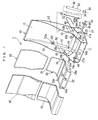
- Fig. 1 is an exploded perspective view of a seat structure 1 according to an embodiment of the present invention.
- the seat structure 1 of the present embodiment has a frame support 10.
- the frame support 10 of the present embodiment has a bottom plate 11 and a back plate 12.
- the frame support 10 also has side plates 13 which are provided to both sides of the bottom plate 11 and back plate 12 and extend forward.
- the frame support 10 is configured to support a back frame 20 and movably support a cushion frame 30 as described below but the shape and structure of the frame support 10 are not limited to what is shown in Fig. 1 .
- the bottom plate 11 and the back plate 12 are integrally formed; however, they can separately be provided and one of the bottom plate 11 and the back plate 12 can be omitted if the side plates 13 are capable of supporting the back frame 20 and the like.
- the back frame 20 is, for example, formed in a substantially square shape as shown in Fig. 1 and fixed to an upper portion of the back plate 12 of the frame support 10 (see Figs. 2A and 2B ).
- the back frame 20 can be formed in a U-shape having no bottom line for example, and the shape of the back frame 20 can be determined arbitrarily.
- the cushion frame 30 naturally has portions for supporting occupant's femoral region and haunch and further has a rear end 31 that is formed in a substantially L-shape as seen from a side view and bent to extend upward. Since the rear end 31 is bent upward, this portion is placed in back of occupant's pelvis and the function of supporting the pelvis improves. Further, according to the present embodiment, a front end 32 is also formed to slightly hang downward as seen from a side view. With this structure, backs of occupant's knees are fit to the seat in an improved function.
- a first supported portion (supported portion near the frame rear portion) 33 that is supported by the frame support 10 is provided at a portion which is near a rear portion of the cushion frame 30 and anterior to the rear end 31.
- a second supported portion (supported portion near the frame front portion) 34 that is supported by the frame support 10 is provided at a portion which is near a front portion of the cushion frame 30 and placed in back of the front end 32 and anterior to the first supported portion 33 near the frame rear portion.
- the first and second supported portions 33, 34 are supported by a rear support member (gear members 15) and front support member (rotary member 16), which are respectively provided to the side plates 13 of the frame support 10.
- the first and second supported portions 33, 34 are long in a width direction of the cushion frame 30 and have end faces 33a, 34a connected to the rear support member (gear members 15) and the front support member (rotary member 16) using frame members that have a U-shaped section along the width direction.
- the rear support member provided to the frame support 10 has sectoral shaped gear members 15.
- the gear member 15 has a rotary base 15a at a center area of the fan-shape.
- the rotary base 15a is rotatably supported on an inner face of the side plate 13 of the frame support 10 and the gear member 15 is rotatable about the rotary base 15a.
- the gear members 15 are provided on the respective inner surfaces of two side plate 13 which are facing to each other and can fix respective end faces 33a of the first supported portion 33 to connection holes 15b formed near the respective arc-shaped portions of the two gear members 15.
- the arc-shaped end face of the gear member 15 has a gear tooth and the gear tooth and a pinion gear 41, which constitute a later described control member, are engaged to rotate.
- a cut-out portion 15c having no gear tooth is formed in a predetermined length.
- stopper members 17 is provided on the respective inner surfaces of the side plates 13 to contact with the front ends of the gear members 15 when the gear members 15 rotate in a predetermined angle.
- the stopper member 17 is preferably made of an elastic member such as rubber. The gear member 15 rotates forward until the front end of the gear member 15 contacts with the stopper member 17.
- the cushion frame 30 shifts at a predetermined angle because of the elastic deformation of the stopper member 17.
- the variable angle can arbitrarily be set by adjusting the elasticity of the stopper member 17; however, in order to reduce user's discomfort, the angle as a seating surface angle of the cushion frame 30 is preferably set in a range from 1 to 4 degrees, more preferably 2 degrees.
- the stopper member 17 is fixed to the side plate 13 using a U-shaped metallic plate member 17a and the gear member 15 can elastically deform the stopper member 17 until the gear member 15 contacts with the plate member 17a.
- the front support member is formed of the thin plate-like rotary members 16 having a predetermined length.
- the rotary members 16 are attached to the respective inner surfaces of the pair of side plates 13 of the frame support 10 and have one end serving as the rotary bases 16a.
- the other end of the rotary bases 16a has a connecting shaft 16b to which the respective end faces 34a of the second supported portion 34 are connected.
- the gear member 15 and rotary member 16 respectively rotate in range from a first position A (see Fig. 2A ) that is in a relatively rear and upper position to a second position B (see Fig. 2B ) that is in a relatively front and lower position.
- the posture of the cushion frame 30 supported by the gear members 15 and the rotary members 16 is also shifted between the first position A and the second position B.
- a gap between the height of the frame front portion of the cushion frame 30 and the height of the frame rear portion are small and the frame front portion is slightly higher than the frame rear portion.
- the gap between the heights becomes large and the height of the frame front portion is much greater than the height of the frame rear portion.
- the seating surface angle defined by the height of the frame front portion of the cushion frame 30 and the height of the frame rear portion is small in the case of the first position A and becomes large in the case of the second position B.
- the seating surface angle is preferably in a range from 12 to 15 degrees, more preferably 13 degrees, in the case of the first position A (see Fig. 3A ) and is preferably in a range from 22 to 28 degrees, more preferably, 25 degrees, in the case of the second position B (see Fig. 3B ).
- the height of attachment of the rotary base 16a of the rotary member 16 to the side plate 13 is lower than the height of attachment of the rotary base 15a of the gear member 15 so that the radius of gyration of the rotary member 16 is smaller than the radius of gyration of the gear member 15; however, the attachment positions of the rotary bases 15a, 16a can be adjusted in consideration of the shape of the first and second supported portions 33, 34, the sizes of the respective end face 33a, 34a and the like.
- the control member for controlling an operation of the gear member 15 has a pinion gear 41, a clutch member 42 and an operation member 43.
- the pinion gear 41 is provided to penetrate an arrangement hole 13a formed on one of the side plate 13 (see Fig. 1 ) so that a gear tooth 41a of the pinion gear 41 projects inside the side plate 13 to engage with a gear tooth of one of the gear members 15 arranged inside the side plate 13.
- the pinion gear 41 is connected to the clutch member 42 via an attachment plate 44 in outside of the side plate 13.
- the clutch member 42 is operated by the operation member 43 to be connected with or disconnected from the pinion gear 41.
- the operation member 43 has a wire member 43a having an end connected to the clutch member 42 and an operation lever 43b connected to the wire member 43a and attached to any position of the frame support 10, that is, outside of the side plate 13 in the present embodiment. According to the operation of the operation lever 43b, the clutch member 42 is connected to the pinion gear 41 via the wire member 43a or the connection is released.
- the frame support 10 also has an elastic member 50 for applying force to return the gear member 15 and the rotary member 16 to the first position A.
- the elastic member 50 can be made of anything if it has the above function and the attached position and structure are not limited; however, according to the present embodiment, the elastic member 50 is attached to a rear portion of the frame support 10.
- the elastic member 50 has a cylindrical casing 51 and a rod member 52 disposed in the casing 51, and a coil spring 53 is provided between the rod member 52 and the casing 51 and is connected to the rod member 52 and the casing 51.
- An end of the rod member 52 is connected to a side portion of the back frame 20, which is an upper portion of the frame support 10, via an attachment member 52a and a lid member 54 mounted to a bottom end of the casing 51 is connected to a connection frame 35 provided near a rear portion of the cushion frame 30 so that the rear portion of the cushion frame 30 is being pulled upward in a normal state.
- cushioning members 60, 70 are provided to cover their surfaces.
- the cushioning members 60, 70 can have any structure and an urethane member and the like can be used.
- the cushioning members 60, 70 are preferably made of a three-dimensional solid knitted fabric, which is thin but provides a proper cushioning characteristics when supported and stretched by the frames 20, 30 with a small tension.
- the three-dimensional solid knitted fabric or the urethane member can be used by laying two or more members, which are the same or different types, or can be formed with different members, which are partially provided in a planar direction and integrally sewn.
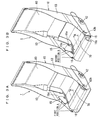
- Figs. 2A and 3A show the condition and the seating surface angle of the cushioning member 60 covering the cushion frame 30 is in 13 degrees, for example. In other words, when an occupant is seated in this condition, he or she is in an upright posture (normal posture) which is suitable for some light work.
- Figs. 2B and 3B show the condition that the front end of the gear member 15 contacts with the stopper member 17, that is, in the second position B.
- the gear tooth of the pinion gear 41 is released from the gear tooth of the gear member 15 and placed at a position corresponding to the cut-out portion 15c. As shown in Fig.
- the seating surface angle in which the gear member 15 starts to contact with the stopper member 17 is set to 23 degrees and the seating surface angle varies up to 2 degrees because of the elasticity of the stopper member 17, since the gear tooth of the pinion gear 41 is not engaged with the gear tooth of the gear member 15 in this condition, the seating surface angle can be varied by shifting the weight without operating the operation lever 43b, within a range of the seating surface angle, that is, from 23 to 25 degrees.
- the pelvis support 31 of the cushion frame 30 accordingly is shifted from an upright state to a reclined state.
- the occupant can take a relaxing posture similarly to the case that the cushion frame 30 is fixed and the back frame 20 is reclined since the cushion frame 30 is shifted as described above even with the structure that the back frame 20 does not recline backward.
- the cushion frame 30 is fixed and the back frame 20 is reclined since the cushion frame 30 is shifted as described above even with the structure that the back frame 20 does not recline backward.
- plural seat structures 1 of the present embodiment are provided in plural rows, leg room spaces of occupants in rear seats are fixedly maintained regardless of that the occupant in a front seat is in an upright posture (normal posture) or a relaxing posture (resting posture).
- the gear member 15 is used as a rear support member
- the rotary member 16 is used as a front support member
- the control member controls the gear member formed of the rear support member using 15; however, the gear member can be used as the front support member and the rotary member can be used as the rear support member.
Landscapes
- Engineering & Computer Science (AREA)
- Aviation & Aerospace Engineering (AREA)
- Transportation (AREA)
- Mechanical Engineering (AREA)
- Health & Medical Sciences (AREA)
- Dentistry (AREA)
- General Health & Medical Sciences (AREA)
- Chairs For Special Purposes, Such As Reclining Chairs (AREA)
- Seats For Vehicles (AREA)
Abstract
Description
- The present invention relates to a seat structure applicable to transportation devices such as aircrafts, trains, ships, forklifts and vehicles, particularly to a seat structure of aircrafts and trains in which plural seats are aligned in a longitudinal direction to provide seating space (leg room space) wider and improve the comfort of the seats.
- In an aircraft, for example, a number of seats are continuously provided in a longitudinal direction to arrange a predetermined number of seats in a limited space. The seating space of each passenger is thus limited to be a predetermined size. In particular, there has been a problem that, when a passenger in a front seat reclines a seat backward to take a resting posture, the leg room (footrest) space of a passenger in a rear seat is significantly limited and this causes deterioration in comfort. In view of this problem, regarding such an aircraft, an effort has been required to maintain a wider seating space including the leg room (footrest) space between the front seat and the rear seat to improve passengers' comfort.
- The present invention has been made in view of the above problems and has an object to provide a seat structure applicable to both a normal posture and a resting posture, in which a sufficiently relaxed resting posture is available, an excellent comfort is obtained while seated, and, even in the resting posture, it does not limit a seating space including a leg room space of a seat provided in back of the seat.
- In order to solve the problem, the present invention according to
claim 1 provides a seat structure comprising a frame support having a rear support member supporting a back frame and a rear portion of a cushion frame and a front support member supporting a front portion of the cushion frame. The rear support member is provided near a rear portion of a side plate of the frame support and has a portion connected to a rear portion of the frame, the portion being rotatable about a rotary base between a first position that is in a relatively rear and upper position and a second position that is in a relatively front and lower position with respect to the first position. The front support member is provided near a front portion of the side plate of the frame support and has a portion connected to a front portion of the frame, the portion being rotatable between a first position that is in a relatively rear and upper position and a second position that is in a relatively lower and front position with respect to the first position. A control member controls the rotation of the rear support member and the front support member so that a seating surface angle when placing both of the rear support member and the front support member in the second positions is greater than a seating surface angle when placing the rear support member and the front support member in the first positions.
The present invention according to claim 2 provides the seat structure according toclaim 1. The cushion frame has a pelvis support, at an rear end, that projects upward and disposed in back of an occupant's pelvis, and is formed in a substantially L-shape as seen from a side view. The rear support member and the front support member rotates, an inclination angle of the pelvis support of the cushion frame in the second position becomes greater than that in the first position.
The present invention according to claim 3 provides the seat structure according to any one ofclaims 1 and 2. One of the rear support member and the front support member is formed of a gear member that rotates according to a control of the control member and the other of the rear support member and the front support member is formed of a rotary member that rotates according to the rotation of the gear member.
The present invention according to claim 4 provides the seat structure according to claim 3. The rear support member is the gear member and the front support member is the rotary member.
The present invention according to claim 5 provides the seat structure according to any one of claims 3 and 4. The gear member is formed in a sectoral shape with respect to the rotary base as a center and a gear tooth is formed at its arc-shaped end face. The control member comprises a pinion gear engaging with the gear tooth of the gear member and a clutch member restricting a rotation of the pinion gear. When the clutch member and the pinion gear are disconnected, the gear member and the rotary member become rotatable between the first position and the second position about the rotary base, and, when the clutch member and the pinion gear are connected, the rotation of the gear member engaged with the pinion gear stops and the cushion frame can be fixed in a preferable seating surface angle.
The present invention according to claim 6 provides the seat structure according to any one of claims 3 to 5. The side plate of the frame support comprises a stopper member stopping the rotation of the gear member by contacting with a front end of the gear member when the gear member is shifted from the first position to the second position.
The present invention according toclaim 7 provides the seat structure according to claim 6. The stopper member is made of an elastic member. The gear member has a cut-out portion, which is not engaged with the pinion gear, at an region corresponding to an elastically variable angle from a position that the front end of the gear member starts to contact with the stopper member. While the gear member and the rotary member are in the second position, the cushion frame is variable within the range of the elastically variable angle of the stopper member to adjust the seating surface angle.
The present invention according to claim 8 provides the seat structure according to any one of claims 3 to 7. The frame support comprises an elastic member applying force to return the gear member and the rotary member to the first position.
The present invention according to claim 9 provides The seat structure according to claim 8. One end of the elastic member is fixed to an upper portion of the frame support and the other end of the elastic member is connected near the rear portion of the cushion frame.
The present invention according toclaim 10 provides the seat structure according to any one of claims 5 to 9. The control member comprises an operation member operating to connect or disconnect the clutch member from or with the pinion gear.
The present invention according toclaim 11 provides the seat structure according to any one ofclaims 1 to 10. The seating surface angle in the second position is set in a range from 22 to 28 degrees and the seating surface angle in the first position is set in a range from 12 to 15 degrees.
The present invention according toclaim 12 provides the seat structure according toclaim 7. An adjustable angle of the seating surface angle in the second position using the elastic deformation of the stopper member is in a range from 1 to 4 degrees. - A seat structure of the present invention has a rear support member and a front support member and rotations of the members are controlled by a control member. When the rear support member and the front support member are shifted to a second position that is in a relatively front and lower position with respect to the first position, a gap between the height of the frame rear portion and the height of the frame front portion becomes greater compared to a case of the first position. As a result, the seating surface angle of a cushioning member supported by the cushion frame becomes greater in the second position than that in the first position. Further, the inclination angle of a pelvis support of the cushion frame becomes greater in the second position than the first position. In other words, according to the present invention, the back frame itself is fixed to the frame support but the cushion frame is shifted from the first position to the second position according to an occupant's movement and the seating surface angle increases. Further, since the inclination angle of the pelvis support increases, occupant's pelvis portion and a portion lower than the pelvis portion is moved forward but a part of his or her back above his or her breast is not varied. With this structure, the same effect of the resting posture, that is, the posture in which the back frame is reclined in a conventional seat structure, can be obtained. In addition, since the position of the back frame supported by the frame support is not varied, the leg room space in a rear seat is not limited even when a resting posture is taken in a front seat within a same space as conventional.
-
-
Fig. 1 is an exploded perspective view showing a seat structure according to an embodiment of the present invention; -
Figs. 2A and 2B show the seat structure according to the embodiment in which a cushioning member is removed in,Fig. 2A is a diagram showing a gear member, a rotary member and a cushion frame placed in a first position, andFig. 2B is a diagram showing the gear member, rotary member and cushion frame placed in a second position; and -
Figs. 3A and 3B show the seat structure according to the embodiment in which the cushioning member is mounted,Fig. 3A is a diagram showing the gear member, rotary member and cushion frame placed in the first position, andFig. 3B is a diagram showing the gear member, rotary member and cushion frame placed in the second position. -
- 1
- seat structure
- 10
- frame support
- 13
- side plate
- 15
- gear member
- 15a
- rotary base
- 15c
- cut-out portion
- 16
- rotary member
- 16a
- rotary base
- 17
- stopper member
- 20
- back frame
- 30
- cushion frame
- 31
- pelvis support
- 41
- pinion gear
- 42
- clutch member
- 43
- operation member
- 50
- elastic member
- 60, 70
- cushioning member
- The present invention will be described in detail with reference to the drawings.
Fig. 1 is an exploded perspective view of aseat structure 1 according to an embodiment of the present invention. As shown inFig. 1 , theseat structure 1 of the present embodiment has aframe support 10. Theframe support 10 of the present embodiment has abottom plate 11 and aback plate 12. Theframe support 10 also hasside plates 13 which are provided to both sides of thebottom plate 11 and backplate 12 and extend forward. Theframe support 10 is configured to support aback frame 20 and movably support acushion frame 30 as described below but the shape and structure of theframe support 10 are not limited to what is shown inFig. 1 . For example, inFig. 1 , thebottom plate 11 and theback plate 12 are integrally formed; however, they can separately be provided and one of thebottom plate 11 and theback plate 12 can be omitted if theside plates 13 are capable of supporting theback frame 20 and the like. - The
back frame 20 is, for example, formed in a substantially square shape as shown inFig. 1 and fixed to an upper portion of theback plate 12 of the frame support 10 (seeFigs. 2A and 2B ). Theback frame 20 can be formed in a U-shape having no bottom line for example, and the shape of theback frame 20 can be determined arbitrarily. - According to the present embodiment, the
cushion frame 30 naturally has portions for supporting occupant's femoral region and haunch and further has arear end 31 that is formed in a substantially L-shape as seen from a side view and bent to extend upward. Since therear end 31 is bent upward, this portion is placed in back of occupant's pelvis and the function of supporting the pelvis improves. Further, according to the present embodiment, afront end 32 is also formed to slightly hang downward as seen from a side view. With this structure, backs of occupant's knees are fit to the seat in an improved function. A first supported portion (supported portion near the frame rear portion) 33 that is supported by theframe support 10 is provided at a portion which is near a rear portion of thecushion frame 30 and anterior to therear end 31. A second supported portion (supported portion near the frame front portion) 34 that is supported by theframe support 10 is provided at a portion which is near a front portion of thecushion frame 30 and placed in back of thefront end 32 and anterior to the first supportedportion 33 near the frame rear portion. - The first and second supported
portions side plates 13 of theframe support 10. According to the present embodiment, the first and second supportedportions cushion frame 30 and have end faces 33a, 34a connected to the rear support member (gear members 15) and the front support member (rotary member 16) using frame members that have a U-shaped section along the width direction. - The rear support member provided to the
frame support 10 has sectoral shapedgear members 15. Thegear member 15 has arotary base 15a at a center area of the fan-shape. Therotary base 15a is rotatably supported on an inner face of theside plate 13 of theframe support 10 and thegear member 15 is rotatable about therotary base 15a. Thegear members 15 are provided on the respective inner surfaces of twoside plate 13 which are facing to each other and can fix respective end faces 33a of the first supportedportion 33 toconnection holes 15b formed near the respective arc-shaped portions of the twogear members 15. The arc-shaped end face of thegear member 15 has a gear tooth and the gear tooth and a pinion gear 41, which constitute a later described control member, are engaged to rotate. Here, at an area nearest to the rear end along the arc-shaped end face of thegear member 15, a cut-outportion 15c having no gear tooth is formed in a predetermined length. Further,stopper members 17 is provided on the respective inner surfaces of theside plates 13 to contact with the front ends of thegear members 15 when thegear members 15 rotate in a predetermined angle. Thestopper member 17 is preferably made of an elastic member such as rubber. Thegear member 15 rotates forward until the front end of thegear member 15 contacts with thestopper member 17. Since the pinion gear 41 is provided to be placed at the cut-outportion 15c when contacting with thestopper member 17, the position of the first supportedportion 33 is variable forward and backward because of the elastic deformation amount of thestopper member 17 and the position of the second supportedportion 34 is variable forward and backward accordingly. Thus, thecushion frame 30 shifts at a predetermined angle because of the elastic deformation of thestopper member 17. The variable angle can arbitrarily be set by adjusting the elasticity of thestopper member 17; however, in order to reduce user's discomfort, the angle as a seating surface angle of thecushion frame 30 is preferably set in a range from 1 to 4 degrees, more preferably 2 degrees. According to the present embodiment, thestopper member 17 is fixed to theside plate 13 using a U-shapedmetallic plate member 17a and thegear member 15 can elastically deform thestopper member 17 until thegear member 15 contacts with theplate member 17a. - The front support member is formed of the thin plate-
like rotary members 16 having a predetermined length. Similarly to thegear members 15, therotary members 16 are attached to the respective inner surfaces of the pair ofside plates 13 of theframe support 10 and have one end serving as therotary bases 16a. The other end of therotary bases 16a has a connectingshaft 16b to which the respective end faces 34a of the second supportedportion 34 are connected. - The
gear member 15 androtary member 16 respectively rotate in range from a first position A (seeFig. 2A ) that is in a relatively rear and upper position to a second position B (seeFig. 2B ) that is in a relatively front and lower position. The posture of thecushion frame 30 supported by thegear members 15 and therotary members 16 is also shifted between the first position A and the second position B. In other words, in a case of the first position A, a gap between the height of the frame front portion of thecushion frame 30 and the height of the frame rear portion are small and the frame front portion is slightly higher than the frame rear portion. In contrast, in a case of the second position B, the gap between the heights becomes large and the height of the frame front portion is much greater than the height of the frame rear portion. With this structure, the seating surface angle defined by the height of the frame front portion of thecushion frame 30 and the height of the frame rear portion is small in the case of the first position A and becomes large in the case of the second position B. The seating surface angle is preferably in a range from 12 to 15 degrees, more preferably 13 degrees, in the case of the first position A (seeFig. 3A ) and is preferably in a range from 22 to 28 degrees, more preferably, 25 degrees, in the case of the second position B (seeFig. 3B ). In order to provide such seating surface angles using thegear member 15 and therotary member 16 to in the respective cases of the first position A and second position B, it is required to adjust the radius of gyration (the distance between therotary base 15a and theconnection hole 15b regarding thegear member 15, and the distance between therotary base 16a and the connectingshaft 16b regarding the rotary member 16). According to the present embodiment, the height of attachment of therotary base 16a of therotary member 16 to theside plate 13 is lower than the height of attachment of therotary base 15a of thegear member 15 so that the radius of gyration of therotary member 16 is smaller than the radius of gyration of thegear member 15; however, the attachment positions of therotary bases portions respective end face - The control member for controlling an operation of the
gear member 15 has a pinion gear 41, aclutch member 42 and anoperation member 43. The pinion gear 41 is provided to penetrate anarrangement hole 13a formed on one of the side plate 13 (seeFig. 1 ) so that agear tooth 41a of the pinion gear 41 projects inside theside plate 13 to engage with a gear tooth of one of thegear members 15 arranged inside theside plate 13. The pinion gear 41 is connected to theclutch member 42 via anattachment plate 44 in outside of theside plate 13. Theclutch member 42 is operated by theoperation member 43 to be connected with or disconnected from the pinion gear 41. Theoperation member 43 has awire member 43a having an end connected to theclutch member 42 and anoperation lever 43b connected to thewire member 43a and attached to any position of theframe support 10, that is, outside of theside plate 13 in the present embodiment. According to the operation of theoperation lever 43b, theclutch member 42 is connected to the pinion gear 41 via thewire member 43a or the connection is released. - The
frame support 10 also has anelastic member 50 for applying force to return thegear member 15 and therotary member 16 to the first position A. Theelastic member 50 can be made of anything if it has the above function and the attached position and structure are not limited; however, according to the present embodiment, theelastic member 50 is attached to a rear portion of theframe support 10. Theelastic member 50 has acylindrical casing 51 and arod member 52 disposed in thecasing 51, and acoil spring 53 is provided between therod member 52 and thecasing 51 and is connected to therod member 52 and thecasing 51. An end of therod member 52 is connected to a side portion of theback frame 20, which is an upper portion of theframe support 10, via anattachment member 52a and alid member 54 mounted to a bottom end of thecasing 51 is connected to aconnection frame 35 provided near a rear portion of thecushion frame 30 so that the rear portion of thecushion frame 30 is being pulled upward in a normal state. - Here, to the
back frame 20 and thecushion frame 30,cushioning members cushioning members cushioning members frames - According to the
seat structure 1 of the present embodiment, when theclutch member 42 and the pinion gear 41 are disconnected using theoperation lever 43b in an unloaded state, thegear member 15 and therotary member 16 are set in the first position A because of the elasticity of thecoil spring 53 of theelastic member 50. When theoperation lever 43b is released, theclutch member 42 and the pinion gear 41 are connected and the gear teeth of the pinion gear 41 and thegear member 15 are engaged with each other and locked.Figs. 2A and3A show the condition and the seating surface angle of the cushioningmember 60 covering thecushion frame 30 is in 13 degrees, for example. In other words, when an occupant is seated in this condition, he or she is in an upright posture (normal posture) which is suitable for some light work. - On the other hand, when a relaxing posture (resting posture) is taken, the
clutch member 42 and the pinion gear 41 are disconnected using theoperation lever 43b. Then, the occupant applies force as pushing forward his or her femur and haunch. As a result, the pinion gear 41 rotates and thegear member 15 rotates from the first position A that is in a rear and upper position to the second position B that is in a front and lower position. Therotary member 16 simultaneously rotates in the same direction, accordingly. As a result, the height of the frame rear portion of thecushion frame 30 is relatively lower than the height of the frame front portion and thecushion frame 30 is shifted forward as being pushed. When theclutch member 42 and the pinion gear 41 are reconnected using theoperation lever 43b, the pinion gear 41 and thegear member 15 are engaged and fixed at an arbitrary position. In contrast, when they are pushed forward, the front end of thegear member 15 rotates until contacting with thestopper member 17.Figs. 2B and3B show the condition that the front end of thegear member 15 contacts with thestopper member 17, that is, in the second position B. The gear tooth of the pinion gear 41 is released from the gear tooth of thegear member 15 and placed at a position corresponding to the cut-outportion 15c. As shown inFig. 3B , for example, when the seating surface angle in which thegear member 15 starts to contact with thestopper member 17 is set to 23 degrees and the seating surface angle varies up to 2 degrees because of the elasticity of thestopper member 17, since the gear tooth of the pinion gear 41 is not engaged with the gear tooth of thegear member 15 in this condition, the seating surface angle can be varied by shifting the weight without operating theoperation lever 43b, within a range of the seating surface angle, that is, from 23 to 25 degrees. - Further, when the seating surface angle of the
cushion frame 30 is changed by thegear member 15 and therotary member 16, thepelvis support 31 of thecushion frame 30 accordingly is shifted from an upright state to a reclined state. - Thus, the occupant can take a relaxing posture similarly to the case that the
cushion frame 30 is fixed and theback frame 20 is reclined since thecushion frame 30 is shifted as described above even with the structure that theback frame 20 does not recline backward. With this structure, even whenplural seat structures 1 of the present embodiment are provided in plural rows, leg room spaces of occupants in rear seats are fixedly maintained regardless of that the occupant in a front seat is in an upright posture (normal posture) or a relaxing posture (resting posture). - According to the above embodiment, the
gear member 15 is used as a rear support member, therotary member 16 is used as a front support member, and the control member controls the gear member formed of the rear support member using 15; however, the gear member can be used as the front support member and the rotary member can be used as the rear support member.
Claims (12)
- A seat structure comprising a frame support having a rear support member supporting a back frame and a rear portion of a cushion frame and a front support member supporting a front portion of the cushion frame,
wherein the rear support member is provided near a rear portion of a side plate of the frame support and has a portion connected to a rear portion of the frame, the portion being rotatable about a rotary base between a first position that is in a relatively rear and upper position and a second position that is in a relatively front and lower position with respect to the first position;
wherein the front support member is provided near a front portion of the side plate of the frame support and has a portion connected to a front portion of the frame, the portion being rotatable between a first position that is in a relatively rear and upper position and a second position that is in a relatively lower and front position with respect to the first position; and
wherein a control member controls the rotation of the rear support member and the front support member so that a seating surface angle when placing both of the rear support member and the front support member in the second positions is greater than a seating surface angle when placing the rear support member and the front support member in the first positions. - The seat structure according to claim 1,
wherein the cushion frame has a pelvis support, at an rear end, that projects upward and disposed in back of an occupant's pelvis, and is formed in a substantially L-shape as seen from a side view; and
wherein, when the rear support member and the front support member rotates, an inclination angle of the pelvis support of the cushion frame in the second position becomes greater than that in the first position. - The seat structure according to any one of claims 1 and 2,
wherein one of the rear support member and the front support member is formed of a gear member that rotates according to a control of the control member and the other of the rear support member and the front support member is formed of a rotary member that rotates according to the rotation of the gear member. - The seat structure according to claim 3,
wherein the rear support member is the gear member and the front support member is the rotary member. - The seat structure according to any one of claims 3 and 4,
wherein the gear member is formed in a sectoral shape with respect to the rotary base as a center and a gear tooth is formed at its arc-shaped end face;
wherein the control member comprises a pinion gear engaging with the gear tooth of the gear member and a clutch member restricting a rotation of the pinion gear; and
wherein, when the clutch member and the pinion gear are disconnected, the gear member and the rotary member become rotatable between the first position and the second position about the rotary base, and, when the clutch member and the pinion gear are connected, the rotation of the gear member engaged with the pinion gear stops and the cushion frame can be fixed in a preferable seating surface angle. - The seat structure according to any one of claims 3 to 5,
wherein the side plate of the frame support comprises a stopper member stopping the rotation of the gear member by contacting with a front end of the gear member when the gear member is shifted from the first position to the second position. - The seat structure according to claim 6,
wherein the stopper member is made of an elastic member;
wherein the gear member has a cut-out portion, which is not engaged with the pinion gear, at an region corresponding to an elastically variable angle from a position that the front end of the gear member starts to contact with the stopper member; and
wherein, while the gear member and the rotary member are in the second position, the cushion frame is variable within the range of the elastically variable angle of the stopper member to adjust the seating surface angle. - The seat structure according to any one of claims 3 to 7,
wherein the frame support comprises an elastic member applying force to return the gear member and the rotary member to the first position. - The seat structure according to claim 8,
wherein one end of the elastic member is fixed to an upper portion of the frame support and the other end of the elastic member is connected near the rear portion of the cushion frame. - The seat structure according to any one of claims 5 to 9,
wherein the control member comprises an operation member operating to connect or disconnect the clutch member from or with the pinion gear. - The seat structure according to any one of claims 1 to 10,
wherein the seating surface angle in the second position is set in a range from 22 to 28 degrees and the seating surface angle in the first position is set in a range from 12 to 15 degrees. - The seat structure according to claim 7,
wherein an adjustable angle of the seating surface angle in the second position using the elastic deformation of the stopper member is in a range from 1 to 4 degrees.
Applications Claiming Priority (2)
| Application Number | Priority Date | Filing Date | Title |
|---|---|---|---|
| JP2006002761A JP4931421B2 (en) | 2006-01-10 | 2006-01-10 | Seat structure |
| PCT/JP2006/314977 WO2007080667A1 (en) | 2006-01-10 | 2006-07-28 | Seat structure |
Publications (2)
| Publication Number | Publication Date |
|---|---|
| EP1972231A1 true EP1972231A1 (en) | 2008-09-24 |
| EP1972231A4 EP1972231A4 (en) | 2017-01-25 |
Family
ID=38256082
Family Applications (1)
| Application Number | Title | Priority Date | Filing Date |
|---|---|---|---|
| EP06781887.2A Withdrawn EP1972231A4 (en) | 2006-01-10 | 2006-07-28 | Seat structure |
Country Status (4)
| Country | Link |
|---|---|
| US (1) | US8052214B2 (en) |
| EP (1) | EP1972231A4 (en) |
| JP (1) | JP4931421B2 (en) |
| WO (1) | WO2007080667A1 (en) |
Families Citing this family (7)
| Publication number | Priority date | Publication date | Assignee | Title |
|---|---|---|---|---|
| JP5396978B2 (en) * | 2009-04-10 | 2014-01-22 | トヨタ紡織株式会社 | Vehicle seat |
| US8827365B2 (en) * | 2010-02-10 | 2014-09-09 | Zodiac Seats Us Llc | Passenger seat |
| JP2012041031A (en) * | 2010-07-18 | 2012-03-01 | Delta Tooling Co Ltd | Cushion-material support mechanism and seat |
| EP2729365B1 (en) | 2011-07-06 | 2016-11-30 | Zodiac Seats US LLC | Seat pan assembly |
| US10314400B2 (en) * | 2015-06-23 | 2019-06-11 | Simtec, Llc | Rotatable seat cradle |
| JP6583106B2 (en) * | 2016-04-08 | 2019-10-02 | トヨタ紡織株式会社 | Vehicle seat |
| JP6614003B2 (en) * | 2016-04-15 | 2019-12-04 | トヨタ紡織株式会社 | Vehicle seat |
Family Cites Families (11)
| Publication number | Priority date | Publication date | Assignee | Title |
|---|---|---|---|---|
| US4327633A (en) * | 1979-09-10 | 1982-05-04 | Geo. A. Hormel & Co. | Ham skinning apparatus |
| JPS6235625Y2 (en) * | 1981-05-14 | 1987-09-10 | ||
| JPH01143949A (en) * | 1987-11-30 | 1989-06-06 | Fujikura Ltd | Snow cover detecting device |
| JPH0542772Y2 (en) * | 1988-03-26 | 1993-10-27 | ||
| DE4003776C2 (en) * | 1990-02-08 | 2000-06-21 | Lear Corp | Vehicle seat |
| AU8946491A (en) * | 1990-10-29 | 1992-05-26 | Hector Serber | Seat assembly and method |
| DE29824882U1 (en) * | 1998-10-23 | 2003-03-06 | Faurecia Autositze Gmbh & Co. Kg, 31655 Stadthagen | Height adjustable motor vehicle seat has flat spring arrangement attached to seat part frame, cross-piece rotated by drive to adjust inclination of linkages and hence seat height |
| IT1306152B1 (en) * | 1999-06-02 | 2001-05-30 | Aviointeriors Spa | ARMCHAIR WITH PERFECTED CRADLE MOVEMENT, IN PARTICULAR AIRCRAFT. |
| FR2820400B1 (en) * | 2001-02-05 | 2003-04-11 | Sicma Aero Seat | MULTI-POSITION SEAT FOR AIRPLANE |
| US6742840B2 (en) * | 2001-05-25 | 2004-06-01 | Weber Aircraft Lp | Adjustable seats |
| CA2581738C (en) * | 2001-08-09 | 2009-04-14 | Virgin Atlantic Airways Limited | A seating system and a passenger accomodation unit for a vehicle |
-
2006
- 2006-01-10 JP JP2006002761A patent/JP4931421B2/en not_active Expired - Fee Related
- 2006-07-28 WO PCT/JP2006/314977 patent/WO2007080667A1/en not_active Ceased
- 2006-07-28 US US12/160,341 patent/US8052214B2/en not_active Expired - Fee Related
- 2006-07-28 EP EP06781887.2A patent/EP1972231A4/en not_active Withdrawn
Non-Patent Citations (1)
| Title |
|---|
| See references of WO2007080667A1 * |
Also Published As
| Publication number | Publication date |
|---|---|
| US20100253122A1 (en) | 2010-10-07 |
| EP1972231A4 (en) | 2017-01-25 |
| WO2007080667A1 (en) | 2007-07-19 |
| JP2007181617A (en) | 2007-07-19 |
| US8052214B2 (en) | 2011-11-08 |
| JP4931421B2 (en) | 2012-05-16 |
Similar Documents
| Publication | Publication Date | Title |
|---|---|---|
| JP6803599B2 (en) | Seat structure | |
| RU2662092C2 (en) | Vehicle seating assembly (versions) | |
| CN106965727B (en) | Personified pivotable upper seat back support | |
| EP2709873B1 (en) | Kinematic seat with elastic pivot | |
| JP5375240B2 (en) | Seat device | |
| RU2684959C2 (en) | Vehicle seat assembly (versions) | |
| CN107920667A (en) | Back support | |
| EP3593675A1 (en) | Dual motion sloped floor recline mechanism for a theater | |
| CN112272628A (en) | seat tilt system | |
| US20250269774A1 (en) | Vehicle seat | |
| US8052214B2 (en) | Seat structure | |
| EP4292932A1 (en) | Reclining seat | |
| RU2136517C1 (en) | Seat | |
| JP3012765B2 (en) | Seat equipment | |
| US20100102608A1 (en) | Seat structure | |
| JP2633780B2 (en) | Seat equipment | |
| JP4624689B2 (en) | Seat device | |
| US20110031792A1 (en) | Lower pelvic corner support device for automotive recliner seat | |
| JP4570121B2 (en) | seat | |
| KR100946664B1 (en) | Chair with a reclinable back support | |
| KR101679688B1 (en) | Arm-rest tilting apparatus for vehicle | |
| JP2007210391A (en) | Vehicle seat arrangement structure | |
| JPH0690836A (en) | Seat device | |
| JP6584077B2 (en) | Bucket seat structure and passenger seat with adjustable position | |
| WO2005002913A1 (en) | Seat with lumbar support |
Legal Events
| Date | Code | Title | Description |
|---|---|---|---|
| PUAI | Public reference made under article 153(3) epc to a published international application that has entered the european phase |
Free format text: ORIGINAL CODE: 0009012 |
|
| 17P | Request for examination filed |
Effective date: 20080724 |
|
| AK | Designated contracting states |
Kind code of ref document: A1 Designated state(s): AT BE BG CH CY CZ DE DK EE ES FI FR GB GR HU IE IS IT LI LT LU LV MC NL PL PT RO SE SI SK TR |
|
| DAX | Request for extension of the european patent (deleted) | ||
| RA4 | Supplementary search report drawn up and despatched (corrected) |
Effective date: 20170103 |
|
| RIC1 | Information provided on ipc code assigned before grant |
Ipc: A47C 7/02 20060101ALI20161221BHEP Ipc: A47C 1/023 20060101AFI20161221BHEP Ipc: B60N 2/70 20060101ALI20161221BHEP Ipc: B60N 2/02 20060101ALI20161221BHEP Ipc: B60N 2/18 20060101ALI20161221BHEP Ipc: B64D 11/06 20060101ALI20161221BHEP Ipc: B60N 2/68 20060101ALI20161221BHEP |
|
| STAA | Information on the status of an ep patent application or granted ep patent |
Free format text: STATUS: THE APPLICATION IS DEEMED TO BE WITHDRAWN |
|
| 18D | Application deemed to be withdrawn |
Effective date: 20170801 |