EP1968448B1 - Selbstkalibrierendes echtzeit-sensorsystem und verfahren - Google Patents
Selbstkalibrierendes echtzeit-sensorsystem und verfahren Download PDFInfo
- Publication number
- EP1968448B1 EP1968448B1 EP06846003A EP06846003A EP1968448B1 EP 1968448 B1 EP1968448 B1 EP 1968448B1 EP 06846003 A EP06846003 A EP 06846003A EP 06846003 A EP06846003 A EP 06846003A EP 1968448 B1 EP1968448 B1 EP 1968448B1
- Authority
- EP
- European Patent Office
- Prior art keywords
- voltage
- sensor
- vset
- switch
- time
- Prior art date
- Legal status (The legal status is an assumption and is not a legal conclusion. Google has not performed a legal analysis and makes no representation as to the accuracy of the status listed.)
- Not-in-force
Links
Images



Classifications
-
- A—HUMAN NECESSITIES
- A61—MEDICAL OR VETERINARY SCIENCE; HYGIENE
- A61B—DIAGNOSIS; SURGERY; IDENTIFICATION
- A61B5/00—Measuring for diagnostic purposes; Identification of persons
- A61B5/145—Measuring characteristics of blood in vivo, e.g. gas concentration or pH-value ; Measuring characteristics of body fluids or tissues, e.g. interstitial fluid or cerebral tissue
- A61B5/1495—Calibrating or testing of in-vivo probes
-
- A—HUMAN NECESSITIES
- A61—MEDICAL OR VETERINARY SCIENCE; HYGIENE
- A61B—DIAGNOSIS; SURGERY; IDENTIFICATION
- A61B5/00—Measuring for diagnostic purposes; Identification of persons
- A61B5/145—Measuring characteristics of blood in vivo, e.g. gas concentration or pH-value ; Measuring characteristics of body fluids or tissues, e.g. interstitial fluid or cerebral tissue
- A61B5/1468—Measuring characteristics of blood in vivo, e.g. gas concentration or pH-value ; Measuring characteristics of body fluids or tissues, e.g. interstitial fluid or cerebral tissue using chemical or electrochemical methods, e.g. by polarographic means
-
- A—HUMAN NECESSITIES
- A61—MEDICAL OR VETERINARY SCIENCE; HYGIENE
- A61B—DIAGNOSIS; SURGERY; IDENTIFICATION
- A61B5/00—Measuring for diagnostic purposes; Identification of persons
- A61B5/145—Measuring characteristics of blood in vivo, e.g. gas concentration or pH-value ; Measuring characteristics of body fluids or tissues, e.g. interstitial fluid or cerebral tissue
- A61B5/1468—Measuring characteristics of blood in vivo, e.g. gas concentration or pH-value ; Measuring characteristics of body fluids or tissues, e.g. interstitial fluid or cerebral tissue using chemical or electrochemical methods, e.g. by polarographic means
- A61B5/1473—Measuring characteristics of blood in vivo, e.g. gas concentration or pH-value ; Measuring characteristics of body fluids or tissues, e.g. interstitial fluid or cerebral tissue using chemical or electrochemical methods, e.g. by polarographic means invasive, e.g. introduced into the body by a catheter
-
- A—HUMAN NECESSITIES
- A61—MEDICAL OR VETERINARY SCIENCE; HYGIENE
- A61B—DIAGNOSIS; SURGERY; IDENTIFICATION
- A61B5/00—Measuring for diagnostic purposes; Identification of persons
- A61B5/145—Measuring characteristics of blood in vivo, e.g. gas concentration or pH-value ; Measuring characteristics of body fluids or tissues, e.g. interstitial fluid or cerebral tissue
- A61B5/1468—Measuring characteristics of blood in vivo, e.g. gas concentration or pH-value ; Measuring characteristics of body fluids or tissues, e.g. interstitial fluid or cerebral tissue using chemical or electrochemical methods, e.g. by polarographic means
- A61B5/1486—Measuring characteristics of blood in vivo, e.g. gas concentration or pH-value ; Measuring characteristics of body fluids or tissues, e.g. interstitial fluid or cerebral tissue using chemical or electrochemical methods, e.g. by polarographic means using enzyme electrodes, e.g. with immobilised oxidase
- A61B5/14865—Measuring characteristics of blood in vivo, e.g. gas concentration or pH-value ; Measuring characteristics of body fluids or tissues, e.g. interstitial fluid or cerebral tissue using chemical or electrochemical methods, e.g. by polarographic means using enzyme electrodes, e.g. with immobilised oxidase invasive, e.g. introduced into the body by a catheter or needle or using implanted sensors
-
- A—HUMAN NECESSITIES
- A61—MEDICAL OR VETERINARY SCIENCE; HYGIENE
- A61B—DIAGNOSIS; SURGERY; IDENTIFICATION
- A61B2560/00—Constructional details of operational features of apparatus; Accessories for medical measuring apparatus
- A61B2560/02—Operational features
- A61B2560/0223—Operational features of calibration, e.g. protocols for calibrating sensors
-
- A—HUMAN NECESSITIES
- A61—MEDICAL OR VETERINARY SCIENCE; HYGIENE
- A61B—DIAGNOSIS; SURGERY; IDENTIFICATION
- A61B5/00—Measuring for diagnostic purposes; Identification of persons
- A61B5/0002—Remote monitoring of patients using telemetry, e.g. transmission of vital signals via a communication network
- A61B5/0031—Implanted circuitry
-
- A—HUMAN NECESSITIES
- A61—MEDICAL OR VETERINARY SCIENCE; HYGIENE
- A61B—DIAGNOSIS; SURGERY; IDENTIFICATION
- A61B5/00—Measuring for diagnostic purposes; Identification of persons
- A61B5/145—Measuring characteristics of blood in vivo, e.g. gas concentration or pH-value ; Measuring characteristics of body fluids or tissues, e.g. interstitial fluid or cerebral tissue
- A61B5/14532—Measuring characteristics of blood in vivo, e.g. gas concentration or pH-value ; Measuring characteristics of body fluids or tissues, e.g. interstitial fluid or cerebral tissue for measuring glucose, e.g. by tissue impedance measurement
-
- A—HUMAN NECESSITIES
- A61—MEDICAL OR VETERINARY SCIENCE; HYGIENE
- A61M—DEVICES FOR INTRODUCING MEDIA INTO, OR ONTO, THE BODY; DEVICES FOR TRANSDUCING BODY MEDIA OR FOR TAKING MEDIA FROM THE BODY; DEVICES FOR PRODUCING OR ENDING SLEEP OR STUPOR
- A61M5/00—Devices for bringing media into the body in a subcutaneous, intra-vascular or intramuscular way; Accessories therefor, e.g. filling or cleaning devices, arm-rests
- A61M5/14—Infusion devices, e.g. infusing by gravity; Blood infusion; Accessories therefor
- A61M5/168—Means for controlling media flow to the body or for metering media to the body, e.g. drip meters, counters ; Monitoring media flow to the body
- A61M5/172—Means for controlling media flow to the body or for metering media to the body, e.g. drip meters, counters ; Monitoring media flow to the body electrical or electronic
- A61M5/1723—Means for controlling media flow to the body or for metering media to the body, e.g. drip meters, counters ; Monitoring media flow to the body electrical or electronic using feedback of body parameters, e.g. blood-sugar, pressure
- A61M2005/1726—Means for controlling media flow to the body or for metering media to the body, e.g. drip meters, counters ; Monitoring media flow to the body electrical or electronic using feedback of body parameters, e.g. blood-sugar, pressure the body parameters being measured at, or proximate to, the infusion site
Definitions
- This invention relates generally to subcutaneous and implantable sensor devices and, in particular embodiments, to methods and systems for providing real-time self-calibrating sensor devices.
- glucose sensors have been developed for use in obtaining an indication of blood glucose levels in a diabetic patient. Such readings are useful in monitoring and/or adjusting a treatment regimen which typically includes the regular administration of insulin to the patient.
- flexible subcutaneous sensors are constructed in accordance with thin film mask techniques in which an elongated sensor includes thin film conductive elements encased between flexible insulative layers of polyimide sheets or similar material.
- Such thin film sensors typically include a plurality of exposed electrodes at one end for subcutaneous placement with a user's interstitial fluid, blood, or the like, and a corresponding exposed plurality of conductive contacts at another end for convenient external electrical connection with a suitable monitoring device through a wire or cable.
- Typical thin film sensors are described in commonly assigned U.S. Pat. Nos. 5,390,671 ; 5,391,250 ; 5,482,473 ; and 5,586,553 . See also U.S. Pat. No. 5,299,571 .
- the telemetered system includes a remotely located data receiving device, a sensor for producing signals indicative of a characteristic of a user, and a transmitter device for processing signals received from the sensor and for wirelessly transmitting the processed signals to the remotely located data receiving device.
- the data receiving device may be a characteristic monitor, a data receiver that provides data to another device, an RF programmer, a medication delivery device (such as an infusion pump), or the like.
- a characteristic monitoring system of the type described above is of practical use only after it has been calibrate based on the unique characteristics of the individual user.
- the user is required to externally calibrate the sensor. More specifically, and in connection with the illustrative example of a diabetic patient, the latter is required to utilize a: finger-stick blood glucose meter reading an average of two - four times per day for the duration that the characteristic monitor system is used.
- blood is drawn from the user's finger and analyzed by the blood glucose meter to provide a real-time blood sugar level for the user.
- the user then inputs this data into the glucose monitor as the user's current blood sugar level which is used to calibrate the glucose monitoring system.
- a system for calibrating a sensor of a characteristic monitoring system in real time utilizes a self-calibration module for periodic determination of, and compensation for, the IR drop across unwanted resistances in a cell.
- the self-calibration module includes a first control unit having a potentiostat, a second control unit, and a current-interrupt switch connected between the potentiostat and the sensor's counter electrode.
- the first control unit uses the potentiostat to ensure that a measured voltage across the sensor's working and reference electrodes (Vmeasured) is substantially equal to an input voltage (Vactual) of the potentiostat.
- the second control unit aims to ensure that the overpotential (Vimportant) in the cell is substantially equal to an optimally desired voltage across the sensor's working and reference, electrodes (Vset), where the "overpotential" may be defined as the effective amount of potential that is not consumed by the unwanted resistances and; as such drives the electrochemical reaction at the working electrode.
- the second control unit may employ a PID controller to calculate Vactual based on Vimportant.
- a method of calibrating the serisor in real time includes obtaining a value for Vmeasured, determining the magnitude of the IR drop, calculating the value of Vimportant by subtracting the magnitude of the IR drop from Vmeasured, and then using the first and second controllers, on a periodic basis, to determine Vactual based on Vset and Vimportant (i.e., the IR-compensated value of Vmeasured).
- Vimportant may be measured or approximated directly as the value of Vmeasured at the time the current-interrupt switch is opened.
- the IR drop may be measured by using a high-frequency (i.e., in the MHz range) ADC data-acquisition module to pinpoint the value of Vmeasured at the point in time when the current-interrupt switch was opened, and then subtracting this value from Vmeasured for the closed circuit.
- the magnitude of the IR drop may be estimated through linear regression of acquired samples of Vmeasured over time, where the samples are acquired at a lower rate.
- Vimportant may be optimized by also subtracting (from Vmeasured) the value of the open-circuit voltage (Voc) across the sensor's working and reference electrodes to account for the inherent potential that exists across these electrodes.
- the above-described steps may be repeated on a periodic basis, such that the sensor is self-calibrating, without the need for eternal calibration by the user.
- the repetition period may coincide, for example, with the delay time between successive samplings of the user characteristic being monitored by the characteristic monitoring system.
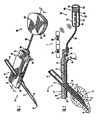
- FIG. 1 is a perspective view illustrating a subcutaneous sensor insertion set, a telemetered characteristic monitor transmitter device, and a data receiving device embodying features of the invention
- FIG. 2 is an enlarged longitudinal vertical section taken generally on the line 2-2 of FIG. 1 ;
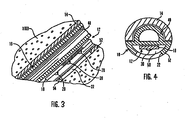
- FIG. 3 is an enlarged fragmented sectional view corresponding generally with the encircled region 3 of FIG. 2 ;
- FIG. 4 is an enlarged transverse section taken generally on the line 4-4 of FIG. 2 ;
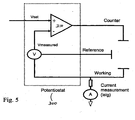
- FIG. 5 shows a potentiostat used in implementing a sensor-calibration method according to an embodiment of the invention
- FIG. 6A shows circuitry, components, and modules for implementing a sensor-calibration method according to an embodiment of the invention
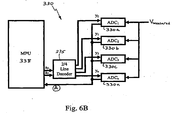
- FIG. 6B is block diagram of an ADC data-acquisition module in accordance with an embodiment of the present invention.
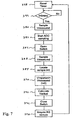
- FIG. 7 is a flow chart of the steps taken in implementing a sensor-calibration method according to an embodiment of the invention.
- FIG. 8 is a flow chart of the steps taken in implementing a sensor-calibration method according to an alternative embodiment of the invention.
- FIG. 9 is a plot diagram showing the exponential decay of a measured voltage over time.
- FIG. 10 is an enlarged view of the portion of the plot shown in FIG. 9 that corresponds to -0.1 msec. ⁇ t ⁇ +0.6 msec.
- These computer program instructions may also be stored in a computer-readable memory or medium that can direct a computer or other programmable data processing device to function in a particular manner, such that the instructions stored in the computer-readable memory or medium produce an article of manufacture including instructions which implement the function specified in the flowchart block or blocks.
- the computer program instructions may also be loaded onto a computer or other programmable data processing device to cause a series of operational steps to be performed on the computer or other programmable device to produce a computer-implemented process such that the instructions which execute on the computer or other programmable device provide steps for implementing the functions specified in the flowchart block or blocks presented herein.
- a telemetered characteristic monitor transmitter that is coupled to a sensor set and transmits data from the sensor set to a characteristic monitor for determining body characteristics.
- the sensor set may be implanted in and/or through subcutaneous, dermal, sub-dermal, inter-peritoneal or peritoneal tissue.
- the sensor set and monitor are for determining glucose levels in the blood and/or body fluids of the user without the use, or necessity, of a wire or cable connection between the transmitter and the monitor and, in certain embodiments, between the transmitter and sensor set.
- telemetered characteristic monitor system is primarily adapted for use in subcutaneous human tissue.
- still further embodiments may be placed in other types of tissue, such as muscle, lymph, organ tissue, veins, arteries or the like, and used in animal tissue Embodiments may provide sensor readings on an intermittent or continuous basis.
- the telemetered characteristic monitor system 1, in accordance with a preferred embodiment of the present invention includes a percutaneous sensor set 10, 200.
- the percutaneous sensor, set 10 utilizes an electrode-type sensor as described in more detail below.
- the system may use other types of sensors, such as chemical based, optimal based, or the like.
- the sensor may be of a type that is used on the external surface of the skin or placed below the skin layer of the user. Preferred embodiments of a surface-mounted sensor would utilize interstitial fluid harvested from underneath the skin.
- the telemetered characteristic monitor transmitter 100 generally includes the capability to transmit data.
- the telemetered characteristic monitor transmitter 100 may include a receiver, or the like, to facilitate two-way communication between the sensor set 10 and the characteristic monitor 200.
- the characteristic monitor 200 utilizes the transmitted data to determine the characteristic reading.
- the characteristic monitor 200 may be replaced with a data receiver, storage and/or transmitting device for later processing of the transmitted data or programming of the telemetered characteristic monitor transmitter 100.
- the telemetered characteristic monitor transmitter 100 transmits to an RF programmer, which acts as a relay, or shuttle, for data transmission between the sensor set 10 and a PC, laptop, Comrnunication-station, a data processor, or the like.
- Still further embodiments of the telemetered characteristic monitor transmitter 100 may have and use an input port for direct (e.g., wired) connection to a programming or data readout device.
- the telemetered characteristic monitor transmitter 100 takes characteristic information, such as glucose data or the like, from the percutaneous sensor set 10 and transmits it via wireless telemetry to the characteristic monitor 200, which displays and logs the received glucose readings. Logged data can be downloaded from the characteristic monitor 200 to a personal computer, laptop, or the like, for detailed data analysis.
- the telemetered characteristic monitor system 1 may be used in a hospital environment or the like.
- the telemetered characteristic monitor transmitter 100 an characteristic monitor 200 may also be combined with other medical devices to combine other patient data through a common data network and telemetry system.
- Fig. 1 is a perspective view of a subcutaneous sensor set 10 provided for subcutaneous placement of an active, portion of a flexible sensor 12 (see. Fig. 2 ), or the like, at a selected site in the body of a user.
- the subcutaneous or percutaneous portion of the sensor set 10 includes a hollow, slotted insertion needle 14, and a cannula 16.
- the needle 14 is used to facilitate quick and easy subcutaneous placement of the cannula 16 at the subcutaneous insertion site.
- a sensing portion 18 of the sensor 12 is used to expose one or more sensor electrodes 20 to the user's bodily fluids through a window 22 formed in the cannula 16.
- the one or more sensor electrodes 20 may include a counter electrode, a working electrode, and a reference electrode. See, e.g., Fig. 6A .
- the insertion needle 14 is withdrawn to leave the cannula 16 with the sensing portion 18 and the sensor electrodes 20 in place at the selected insertion site.
- the subcutaneous sensor set 10 facilitates accurate placement of a flexible thin film electrochemical sensor 12 of the type used for monitoring specific blood parameters representative of a user's condition.
- the sensor 12 may monitor glucose levels in the body, and may be used in conjunction with automated or semi-automated medication infusion pumps of the external or implantable type as described in U.S. Pat. Nos. 4,562,751 ; 4,678,408 ; 4,685,903 ; or 4,573,994 , to control delivery of insulin to a diabetic patient.
- Preferred embodiments of the flexible electrochemical sensor 12 are constructed in accordance with thin film mask techniques to include elongated thin film conductors embedded or encased between layers of a selected insulative material such as polyimide film or sheet, and membranes.
- the sensor electrodes 20 at a tip end of the sensing portion 18 are exposed through one of the insulative layers for direct contact with patient blood or other body fluids, when the sensing portion 18 (or active portion) of the sensor 12 is subcutaneously placed at an insertion site.
- the sensing portion 18 is joined to a connection portion 24 that terminates in conductive contact pads, or the like, which are also exposed through one of the insulative layers.
- other types of implantable sensors such as chemical based, optical based, or the like, may be used.
- connection portion 24 and the contact pads are generally adapted for a direct .wired electrical connection to a suitable monitor 200 for monitoring a user's condition in response to signals derived from the sensor electrodes 20.
- a suitable monitor 200 for monitoring a user's condition in response to signals derived from the sensor electrodes 20.
- the connection portion 24 may be conveniently connected electrically to the monitor 200 or a characteristic monitor transmitter 100 by a connector block 28 (or the like) as shown and described in U.S. Pat. No. 5,482,473 , entitled FLEX CIRCUIT CONNECTOR, which is also herein incorporated by reference.
- subcutaneous sensor set 10 may be configured or formed to work with either a wired or a wireless characteristic monitor system.
- the sensor electrodes 20 may be used in a variety of sensing applications and may be configured in a variety of ways.
- the sensor electrodes 20 may be used in physiological parameter sensing applications in which a biomolecule is used as a catalytic agent.
- the sensor electrodes 20 may be used in a glucose and oxygen sensor having a glucose oxidase enzyme catalyzing a reaction with the sensor electrodes 20.
- the sensor electrodes 20, along with a biomolecule or some other catalytic agent, may be placed in a human body in a vascular or non-vascular environment.
- the sensor electrodes 20 and biomolecule may be placed in a vein and subjected to a blood stream, or they may be placed in a subcutaneous or peritoneal region of the human body.
- the proximal part of the sensor 12 is mounted in a mounting base 30 adapted for placement onto the skin of a user.
- the mounting base 30 is a pad having an underside surface coated with a suitable pressure sensitive adhesive layer 32, with a peel-off paper strip 34 normally provided to cover and protect the adhesive layer 32, until the sensor set 10 is ready for use.
- the mounting base 30 includes upper and lower layers 36 and 38, with the connection portion 24 of the flexible sensor 12 being sandwiched between the layers 36 and 38.
- the connection portion 24 has a forward section joined to the active sensing portion 18 of the sensor 12, which is folded angularly to extend downwardly through a bore 40 formed in the lower base layer 38.
- the adhesive layer 32 includes an anti-bacterial agent to reduce the chance of infection; however, alternative embodiments may omit the agent.
- the mounting base is generally rectangular, but alternative embodiments may be other shapes, such as circular, oval, hour-glass, butterfly, irregular, or the like.
- the insertion needle 14 is adapted for slide-fit reception through a needle port 42 formed in the upper base layer 36 and further through the lower bore 40 in the lower base layer 38. As shown, the insertion needle 14 has a sharpened tip 44 and an open slot 46 which extends longitudinally from the tip 44 at the underside of the needle 14 to a position at least within the bore 40 in the lower base layer 36. Above the mounting base 30, the insertion needle 14 may have a full round cross-sectional shape, and may be closed off at a rear end of the needle 14. Further descriptions of the needle 14 and the sensor set 10 are found in U.S. Pat. Nos. 5,586,553 and 5,954,643 , which are herein incorporated by reference.
- the cannula 16 is best shown in Figs. 3 and 4 , and includes a first portion 48 having partly-circular cross-section to fit within the insertion needle 14 that extends downwardly from the mounting base 30.
- the first portion 48 may be formed with a solid core, rather than a hollow core.
- the cannula 16 is constructed from a suitable medical grade plastic or elastomer, such as polytetrafluoroethylene, silicone, or the like.
- the cannula 16 also defines an open lumen 50 in a second portion 52 for receiving, protecting and guideably supporting the sensing portion 18 of the sensor 12.
- the cannula 16 has one end fitted into the bore 40 formed in the lower layer 38 of the mounting base 30, and the cannula 16 is secured to the mounting base 30 by a suitable adhesive, ultrasonic welding, snap fit or other selected attachment method. From the mounting base 30, the cannula 16 extends angularly downwardly with the first portion 48 nested within the insertion needle 14, and terminates before the needle tip 44. At least one window 22 is formed in the lumen 50 near the implanted end 54, in general alignment with the sensor electrodes 20, to permit direct electrode exposure to the user's bodily fluid when the sensor 12 is subcutaneously placed. Alternatively, a membrane can cover this area with a porosity that controls rapid diffusion of glucose through the membrane.
- the telemetered characteristic monitor transmitter 100 is coupled to a sensor set 10 by a cable 102 through a connector 104 that is electrically coupled to the connector block 28 of the connector portion 24 of the sensor set 10.
- the cable 102 may be omitted, and the telemetered characteristic monitor transmitter 100 may include an appropriate connector (not shown) for direct to the connector portion 24 of the sensor set 10 or the sensor set 10 may be modified to have the connector portion 24 positioned at a different location, such as, for example, on the top of the sensor set 10 to facilitate placement of the telemetered characteristic monitor transmitter over the subcutaneous sensor set 10.
- the monitor transmitter 1.00 may be combined with the sensor set 10 (or sensor 12) as a single unit.
- the telemetered characteristic monitor transmitter 100 may omit the cable 102 and connector 104 and is instead optically coupled with an implanted sensor, in the subcutaneous, dermal, sub-dermal, inter-peritoneal or peritoneal tissue, to interrogate the implanted sensor using visible, and/or IR frequencies, either transmitting to, and receiving a signal from, the implanted sensor, or receiving a signal from the implanted sensor.
- the telemetered characteristic monitor transmitter 100 and the sensor set 10 may communicate wirelessly.
- the telemetered characteristic monitor 100 includes a housing 106 that supports a printed circuit board 108, batteries 110, antenna 112, and the cable 102 with the connector 104.
- the housing 106 is formed from an upper case 114 and a lower case 116 that are sealed with an ultrasonic weld to form a waterproof (or resistant) seal to permit cleaning by immersion (or swabbing) with water, cleaners, alcohol or the like.
- the upper and lower case 114 and 116 are formed from a medical grade plastic.
- the upper case 114 and lower case 116 may be connected together by other methods, such as snap fits, sealing rings, RTV (silicone sealant) and bonded together, or the like, or formed from other materials, such as metal, composites, ceramics, or the like.
- the separate case can be eliminated and the assembly is simply potted in epoxy or other moldable materials that is compatible with the electronics and reasonably moisture resistant.
- the lower case 116 may have an underside surface coated with a suitable pressure sensitive adhesive layer 118, with a peel-off paper strip 120 normally provided to cover and protect the adhesive layer 118, until the sensor set telemetered characteristic monitor transmitter 100 is ready for use.
- the monitor transmitter 100 may include a sensor interface (which connects with the cable 102), processing electronics, and data formatting electronics (not shown).
- the sensor interface, the processing electronics, and the data formatting electronics may be formed as separate semiconductor chips However, alternative embodiments may combine the various semiconductor chips into a single or multiple customized semiconductor chips.
- the telemetered characteristic monitor transmitter 100 provides power to the sensor set 10 through the cable 102 and cable connector 104.
- the power is used to monitor and drive the sensor set 10.
- the power connection is also used to speed the initialization of the sensor 12, when it is first placed under the skin. The use of an initialization process can reduce the time for sensor 12 stabilization from several hours to an hour or less.
- a reading may be transmitted from the sensor set 10 and the telemetered characteristic monitor transmitter 100 to the characteristic monitor 200, and then the user will input a calibrating glucose reading (e.g., by performing a finger stick) into characteristic monitor 200.
- a fluid containing a known value of glucose may be injected into the site around the sensor set 10, and then the reading is sent to the characteristic monitor 200 and the user inputs the known concentration value, presses a button (not shown) or otherwise instructs the monitor to calibrate using the known value.
- the telemetered characteristic monitor transmitter 100 checks to determine if the sensor set 10 is still connected. If the sensor set 10 is no longer connected, the telemetered characteristic monitor transmitter 100 will abort the stabilization process and sound an alarm (or send a signal to the characteristic monitor 200 to sound an alarm).
- the characteristic monitor 200 includes a telemetry receiver, a Telemetry Decoder (TD), and a host micro-controller (Host)--not shown--for communication with the telemetered characteristic monitor transmitter 100.
- the TD is used to decode a received telemetry signal from the transmitter device and forward the decoded signal to the Host, which may be a microprocessor for data reduction, data storage, user interface, or the like.
- the telemetry receiver receives the characteristic data (e.g., glucose data) from the telemetered characteristic monitor transmitter, and passes it to the TD for decoding and formatting.
- characteristic data e.g., glucose data
- the data is transferred to the Host for processing, where calibration information, based upon user entered characteristic readings (e.g., finger stick blood glucose readings); is performed to determine the corresponding characteristic level (e.g., glucose level) from measurement in the characteristic data (e.g., glucose data).
- the Host also provides for storage of historical characteristic data, and can download the data to a personal computer, lap-top, or the like, via a com-station, wireless connection, modem or the like.
- the counter electrode voltage is include in the message from the telemetered characteristic monitor transmitter 100 and is used as a diagnostic signal.
- the raw current signal values generally range from 0 to 999, which represents sensor electrode current in the range between 0.0 to 99.9 nanoAmperes, and is converted to characteristic values, such as glucose values in the range of 40 to 400 mg/dl. However, in alternative embodiments, larger or smaller ranges may be used.
- characteristic values such as glucose values in the range of 40 to 400 mg/dl. However, in alternative embodiments, larger or smaller ranges may be used.
- the values are then displayed on the characteristic monitor 200 or stored in data memory for later recall.
- the characteristic monitor 200 may be replaced by a different device.
- the telemetered characteristic monitor transmitter 100 communicates with an RF programmer (not shown) that is also used to program and obtain data from an infusion pump or the like.
- the RF programmer may also be used to update and program the transmitter 100, if the transmitter 100 includes a receiver for remote programming, calibration or data receipt.
- the RF programmer can be used to store data obtained from the sensor 12 and then provide it to either an infusion pump, characteristic monitor, computer or the like for analysis.
- the transmitter 100 may transmit the data to a medication delivery device, such as an infusion pump or the like, as part of a closed loop system.
- the transmitter 100 would include a transmitter to receive updates or requests for additional sensor data.
- An example of one type of RF programmer can be found in U.S. Patent No. 6,554,798 , which is herein incorporated by reference.
- the user programs the characteristic monitor (or it learns) the identification of the transmitter 100 and verifies proper operation and calibration of the transmitter 100.
- the characteristic monitor 200 and transmitter 100 then work to transmit and receive sensor data to determine characteristic levels.
- the sensor 12 is automatically initialized and readings are periodically transmitted, together with other information, to the characteristic monitor 200.
- sensor sensitivity may decrease as a direct result of an increase in additional resistances that tend to build up between the working and reference electrodes.
- This drift in sensitivity has an adverse effect on sensor stability, which necessitates more frequent sensor calibrations. Therefore, in order to more accurately control and measure the voltage across the electrochemical reaction being analyzed with a given sensor, and thereby reduce the necessity and frequency of external calibrations, it is important to remove (i.e., account for) any unwanted potentials which might exist across resistances in the vicinity of the electrodes. Once such unwanted potentials are accounted for, the sensor can be calibrated more accurately, in real time, and with little or no need for continual external calibrations by the user.
- a first level of sensor calibration may be implemented with standard potentiostat hardware.
- a potentiostat 300 may include an op amp 310 .that is connected in an electrical circuit so as to have two inputs: Vset and Vmeasured.
- Vmeasured is the measured value of the voltage between a reference electrode and a working electrode.
- Vset is the optimally desired voltage across the working and reference electrodes.
- the voltage between the working and reference electrodes is controlled by providing a current to the counter electrode.
- the current supply to the counter electrode is adjusted to return the potential to the set potential, thereby re-calibrating the sensor.
- the feed-back system of Fig. 5 addresses the build-up of additional resistances between the working and reference electrodes, it does so indirectly by measuring voltages at the various electrodes, as opposed to accounting more directly for the potential (i.e., IR) drop across any such additional resistances.
- the inherent voltage between the working and reference electrodes i.e., the "open-circuit" voltage
- the system depicted in Fig. 5 allows for a calibration process that is less-than-optimal and, as such, may require that a number of re-calibrations, including external inputs by the user, be performed on a frequent basis.
- Fig. 6A shows a sensor self-calibration module, including an electrical circuit, components, modules, etc., for implementing a self-calibration method according to an embodiment of the present invention.
- the self-calibration module includes a potentiostat 300 having an op amp 310.
- the op amp 310 is connected so as to have two inputs: Vactual and Vmeasured.
- Vmeasured is the measured value of the voltage between a working electrode 320c and a reference electrode 320b.
- the output of the op amp 310 is electrically connected to a counter electrode 320a via a current-interrupt switch 315.
- a real-time self-calibration method is initiated at step 380 with acquiring a sample measurement for Vmeasured while the current interrupt switch 315 is closed. Then, in step 382, with the switch 315 still closed, a sampling sub-routine is started wherein an analog-to-digital converter (ADC) module 330 having a plurality of ADCs is used to obtain a multiplicity of measurements for Vmeasured.
- ADC analog-to-digital converter
- the Vmeasured samples are obtained by said ADCs at a sample rate of about 1 MHz.
- the switch 315 is opened (step 384).
- the sampling of Vmeasured continues for a period of time after the switch 315 has been opened (step 386).
- a multiplicity of successive measurements are obtained for Vmeasured during a pre-determined time period that starts prior to, and ends after, the opening of the switch 315.
- the pre-determined time period may be about 100 ⁇ secs, and the time delay between successive ADC measurements may be about 1 ⁇ sec.
- the multiplicity of measurements for Vmeasured may be obtained for the range -1.0V ⁇ Vmeasured ⁇ +1.0V.
- Fig. 6B shows, for illustrative purposes, an example of how the multiplicity of Vmeasured samples may be obtained by high-frequency (i.e., in the MHz range) sampling.
- a plurality of ADCs 330a - 330n are connected in a circuit such that each ADC receives, successively, a respective sampled value for Vmeasured
- ADC 1 may receive the first sample, followed by ADC 2 receiving the second sample, ADC 3 receiving the third sample, and so on, until each one of the respective Vmeasured samples has been received by a different (succeeding) ADC.
- ADC 1 may receive the first sample, followed by ADC 2 receiving the second sample, ADC 3 receiving the third sample, and so on, until each one of the respective Vmeasured samples has been received by a different (succeeding) ADC.
- microprocessor unit (MPU) 338 transmits a signal through a line decoder 335 to request the sample obtained by a specific ADC.
- a signal with a value of a 0 -a 0 would notify ADC 1 that it should transmit its acquired sample to the MBU 338, while a signal with a value of a 0 -a 1 would notify ADC 2 to transmit its sample to the MPU 338, etc.
- ADC microprocessor unit
- the IR Calculation module 340 can then calculate the magnitude of the IR drop.
- the latter serves primarily as an intermediate vehicle through which the magnitude of another variable of utmost importance, i.e., Vimportant in Fig. 6A , is determined.
- Vimportant is indicative of the voltage that exists across the electrochemical reaction point.
- Vimportant is the "over potential" (i.e., the effective amount of potential that is not consumed by the unwanted resistances) that drives the electrochemical reaction at the working electrode 320c.
- the block diagram of Fig. 6A shows the circuitry, components, and modules that drive a sensor-calibration module in accordance with embodiments of the present invention (and in conjunction with a sensor of the type shown, e.g., in Figs. 1 and 2 ), to implement an IR compensation technique.
- the potentiostat 300 acts, essentially, as a first control unit (or sub-module) which is operative to ensure that Vmeasured is substantially equal to Vactual, wherein the latter is the second input to the comparator op amp 310.
- the sensor-calibration module may also include a second control unit (or sub-module) which is operative to ensure that Vimportant is substantially equal to Vset.
- Vset is the optimally desired voltage between the working electrode 320c and the reference electrode 320b; and may be pre-determined based on the value of current measurement(s) taken at node "A". in Fig. 6A . (see also step 396 in Fig. 7 ).
- the second control unit is a proportional-integral-derivative (PID) controller 350.
- the IR compensator portion of the circuit comprises a PID control loop, whereby Vimportant is driven to equal Vset in such a way as to ensure that Vmeasured equals Vactual.
- the PID controller may be implemented digitally in software, such that the PID control algorithm may be run on, e.g., a microprocessor within the second control unit. Depending on the specific sensor type and related circuitry, the control algorithm may also be run on the MPU 338, or other computer/processor within the sensor-calibration module. It is also noted that a digital-to-analog converter (DAC) module 360 may be employed to convert the outputted digital signal into an analog input signal to the op amp 310.
- DAC digital-to-analog converter
- the current interrupt switch 315 is closed (step 394), and the sensor is used to obtain a sample of the user characteristic that is being monitored by the characteristic monitoring system.
- BG blood glucose
- a current measurement is taken at point "A” and converted into a blood glucose level (by using, e.g., a single finger stick to calibrate current measurements for the specific user).
- the algorithm then loops back and resets the sensor-calibration module's timer (step 398).
- a typical delay time between successive BG samples may be about five minutes.
- a determination is made at step 399 as to whether five minutes have elapsed since the previous calibration of the sensor.
- step 396 If five minutes have passed; then the above-described process is repeated, except that, when step 396 is performed; there is no need for another finger stick, since a correlation between the user's BG level and the sensor's readings has been previously established. If, on the other hand, it is determined at step 399 that less than five minutes have passed since the immediately-previous calibration the algorithm loop back and retries until the elapsed time is equal to five minutes.
- Vimportant is indicative of the "over potential” that is available to drive the electrochemical reaction at the working electrode 320c.
- the more precise the measurement(s) of Vimportant the more precise and effective the sensor-calibration process described above.
- the working and reference electrodes have an inherent voltage between them. A more precise determination of Vimportant, therefore, would attempt to account for this inherent voltage.
- Fig. 8 shows a flow chart that depicts a self-calibration process in accordance with a more preferred embodiment of the invention. As shown, the process includes the same steps 380, 382, 384, 386, and 388 as those described in connection with Fig. 7 .
- the inherent voltage noted above is also measured.
- the inherent voltage is also called the open-circuit voltage (Voc) because its magnitude is obtained by leaving the switch 315 open long enough (e.g., less than 1 msec.) for the voltage between the working electrode 320c and the reference electrode 320b to stabilize to its steady-state, open-circuit value.
- Vmeasured the sample value obtained at step 380.
- Equation 1 differs from Equation 3 only by the additional term Voc.
- Vactual is computed in accordance with Equation 2 (step 392), where Vset is now defined as the optimally desired overpotential in the cell. Having the value for Vactual, the same steps 394, 396, 398, and 399 as in Fig. 7 are then followed to calibrate the sensor on a real-time basis.
- a sampling rate may be unachievable and/or impractical.
- the magnitude of the IR drop may be estimated at a lower sampling rate by backwards extrapolation.
- a multiplicity of measurements for Vmeasured are still obtained during a time period that starts prior to, and ends after, the opening of the switch 315. These measurements are then plotted against time. As shown in Fig. 9 , the voltage decays in a generally exponential manner. However, experiments have shown that the decay can be approximated as linear for about the first 0.5 milliseconds after the switch has been opened (i.e., until about t ⁇ 0.5 msec.). As such, an estimate of the decaying gradient can allow for a backwards-in-time extrapolation (to the point in time when the switch was opened) with generally as few as two or three sample points.
- Fig. 10 depicts an enlarged view of the first 0.5 msec. of the Vmeasured-vs.-time plot of Fig. 9 .
- a Vmeasured of 0.525V was observed with the current interrupt switch 315 closed.
- Vmeasured dropped to 0.5V before decaying exponentially. Therefore, Vmeasured at time t 0 is 0.5V, with an IR drop of 0.025V.
- the current-interrupt switch 315 may not be necessary at all.
- the IR drop may be measured by applying AC signals to the cell and analyzing the effect. More specifically, it is known that two resistances exist in series between the working and reference electrodes: The unwanted resistance across which the IR drop is observed, and the faradaic resistance whose potential is equal to Vimportant. In parallel with the faradic resistance is a capacitance that does not exist across the unwanted resistance. With this configuration, high-frequency signals passed between the working and reference electrodes would pass through the above-mentioned capacitance with no voltage drop, such that the capacitance behaves essentially as a short circuit.
- the capacitance behaves as an open circuit. Therefore, at high frequencies, where the faradic capacitance is effectively a short circuit, the unwanted resistance would be equal to the applied voltage divided by the cell current. With the unwanted resistance known, the IR drop may be calculated at a later time by multiplying the magnitude of the resistance by the cell current.
- the various alternative embodiments of the present invention are not necessarily mutually exclusive, and two or more self-calibration processes may be carried out together, wherein one approach may be used to verify the efficacy of another, or a primary and a secondary approach may be used to provide a redundancy in the system.
- one approach e.g., that depicted in Fig. 7
- a second approach e.g., that depicted in Fig. 8
- diagnostic purposes i.e., to check the status of a sensor, where an excessive IR drop, for example, would indicate a sensor malfunction
- the sensor-calibration module (including any microprocessors, controllers, and associated electronics), may be contained within the housing 106 of the transmitter device 100.
- the sensor-calibration module may be contained within the same housing as that of the sensor 12.
- the sensor-calibration module may be contained within the same housing as that of the data receiving device 200.
- the sensor, the transmitter device, and the data receiving device may communicate with one another either through an electrical cable or wirelessly.
- the electronic circuit has included an operational amplifier for measuring and controlling the voltage between the working and reference electrodes.
- any comparator circuit or differential amplifier may be used in place of the op amp.
- low current transistors such as, e.g., Field effect transistors (FET) and the like may be utilized to perform these functions.
Landscapes
- Life Sciences & Earth Sciences (AREA)
- Health & Medical Sciences (AREA)
- Physics & Mathematics (AREA)
- Biomedical Technology (AREA)
- Medical Informatics (AREA)
- Veterinary Medicine (AREA)
- Public Health (AREA)
- Biophysics (AREA)
- Pathology (AREA)
- Engineering & Computer Science (AREA)
- General Health & Medical Sciences (AREA)
- Heart & Thoracic Surgery (AREA)
- Optics & Photonics (AREA)
- Molecular Biology (AREA)
- Surgery (AREA)
- Animal Behavior & Ethology (AREA)
- Chemical & Material Sciences (AREA)
- Chemical Kinetics & Catalysis (AREA)
- General Chemical & Material Sciences (AREA)
- Measurement Of The Respiration, Hearing Ability, Form, And Blood Characteristics Of Living Organisms (AREA)
- Measurement Of Resistance Or Impedance (AREA)
- Investigating Or Analyzing Materials By The Use Of Electric Means (AREA)
Claims (9)
- Selbstkalibrierendes System zur Überwachung einer Eigenschaft des Bluts oder einer interstitiellen Flüssigkeit eines Benutzers mit:einem Sensor, der ein die Eigenschaft anzeigendes Signal abgibt und der eine Gegenelektrode (320a), eine Referenzelektrode (320b) und eine Arbeitselektrode (320c) in Strömungsverbindung mit dem Blut oder den interstitiellen Flüssigkeiten des Benutzers aufweist;einem Sensorkalibriermodul mit einer ersten Steuereinheit, die einen ersten Operationsverstärker (310), der elektrisch so verschaltet ist, dass eine erste Spannung V1 gleich der gemessenen Differenz zwischen der Spannung an der Arbeitselektrode und der Spannung an der Referenzelektrode als erste Eingangsspannung des Operationsverstärkers (310) und eine zweite Spannung V2 als zweite Eingangsspannung des Operationsverstärkers (310) dienen und der Ausgang des Operationsverstärkers (310) über einen stromunterbrechenden Schalter (315) an die Gegenelektrode (320a) gelegt ist, wobei das Sensorkalibriermodul ausgeführt ist, den Sensor auf Grund des Werts der ersten Spannung V1 und der Größe eines IR-Spannungsabfalls an einem Widerstand zwischen der Referenz- und der Arbeitselektrode zu kalibrieren; undeiner abgesetzt angeordneten Datenempfangseinrichtung zur Aufnahme von Daten, die die Eigenschaft auf dem Signal basierend anzeigen;wobei das Sensorkalibriermodul weiterhin eine zweite Steuereinheit mit einem Mikroprozessor (338) und einem maschinenlesbaren Medium aufweist, das mit Befehlen kodiert ist, die, wenn ausgeführt, bewirken, dass der Mikroprozessor (338) einen Kalibrierprozess abarbeitet, der beinhaltet:a. Aufnehmen eines Messwerts für die erste Spannung V1 bei geschlossenem stromunterbrechendem Schalter (315);b. Aussenden eines Befehls, den Schalter (315) zu öffnen, während eine Vielzahl aufeinanderfolgender Messwerte für die erste Spannung V1 innerhalb eines vorbestimmten Zeitintervalls aufgenommen werden, das vor dem Öffnen des Schalters (315) beginnt und nach ihm endet;c. Ermitteln der Größe einer dritten Spannung V3 = V1t=0, wobei V3 ein Überpotenzial an der Arbeitselektrode anzeigt und V1t=0 die Größe von V1 im Zeitpunkt des Öffnens des Schalters (315) angibt;d. basierend auf dem ermittelten Wert der dritten Spannung V3 und einer Spannung Vset: Berechnen der zweiten Spannung V2 so, dass die dritte Spannung V3 im Wesentlichen gleich Vset wird, wobei Vset die optimal erwünschte Spannung zwischen der Arbeits- und der Referenzelektrode ist; unde. Aussenden eines Befehls, den stromunterbrechenden Schalter (315) zu schließen und den berechneten Wert der zweiten Spannung V2 als zweite Eingangsspannung an den Operationsverstärker der ersten Steuereinheit zu legen;wobei im Schritt (d) des Kalibrierprozesses die zweite Spannung V2 an Hand der Beziehung

- System nach Anspruch 1, bei dem die Eigenschaft das Glucose-Niveau im Körper des Benutzers und die Daten aufnehmende Einrichtung eine Insulinpumpe sind.
- System nach Anspruch 1 weiterhin mit einer Sendeeinrichtung in Übertragungsverbindung mit dem Sensor zum Empfang von Signalen aus diesem, wobei die Sendeeinrichtung einen Prozessor, mit dem Signale aus dem Sensor bearbeitbar sind, und einen Sender aufweist, mit dem die bearbeiteten Signale sich an die Daten empfangende Einrichtung senden lassen.
- System nach Anspruch 1, dessen zweite Steuereinrichtung weiterhin eine Vielzahl von Analog-Digital-Wandlern (ADCs) aufweist, die elektrisch an die erste Steuereinrichtung angeschlossen sind, um die Vielzahl von Messwerten der ersten Spannung V1 aufzunehmen, wobei die ADCs jeweils eine Umsetzzeit größer als 1 µs aufweisen.
- System nach Anspruch 1, bei dem die Vielzahl von Messwerte der ersten Spannung V1 von den ADCs an den Mikroprozessor gesandt werden und im Schritt (c) des Kalibrierprozesses der Mikroprozessor die Größe der dritten Spannung V3 als Messwerte der ersten Spannung V1 zur Zeit t = 0 innerhalb des vorbestimmten Zeitintervalls bei geöffnetem Schalter bestimmt.
- System nach Anspruch 1, bei dem das vorbestimmte Zeitintervall bis mindestens 0,5 ms nach dem Öffnen des Schalters (315) andauert, wobei die Vielzahl von Messwerten für die erste Spannung V1 über der Zeit aufgetragen werden und ein Näherungswert der dritten Spannung V3 durch lineare Regression ermittelt wird.
- Verfahren zum Kalibrieren eines Sensors, der ausgeführt ist, ein Signal abzugeben, mittels dessen sich eine Eigenschaft des Bluts oder der interstitiellen Flüssigkeit eines Benutzers anzeigen lässt, wobei der Sensor eine Gegenelektrode (320a), eine Referenzelektrode (320b) und eine Arbeitselektrode (320c) aufweist und die Elektroden in Verbindung mit dem Blut oder den interstitiellen Flüssigkeiten des Benutzers stehen und elektrisch so verschaltet sind, dass eine erste Spannung V1 gleich der Differenz zwischen der Spannung an der Arbeitselektrode und der an der Referenzelektrode eine erste Eingangsspannung für einen Komparator und eine zweite Spannung V2 eine zweite Eingangsspannung für den Komparator darstellen und die Ausgangsspannung des Komparators elektrisch an die Gegenelektrode gelegt ist, wobei das Verfahren beinhaltet:a. Messen der ersten Spannung V1 zwischen der Arbeits- und der Referenzelektrode;b. Ermitteln der Größe einer dritten Spannung V3, wobei die dritte Spannung V3 ein Überpotenzial an der Arbeitselektrode anzeigt;c. basierend auf dem ermittelten Wert der dritten Spannung V3 und einer Spannung Vset: Berechnen der zweiten Spannung V2 so, dass die dritte Spannung V3 im Wesentlichen gleich Vset wird, wobei Vset die optimal erwünschte Spannung zwischen der Arbeits- und der Referenzelektrode ist; undd. Anlegen des berechneten Werts der zweiten Spannung V2 als zweite Eingangsspannung an den Komparator;wobei die zweite Spannung V2 an Hand der Beziehung

- Verfahren nach Anspruch 7, bei dem der Komparator ein Operationsverstärker ist.
- Maschinenlesbares Medium für die Verwendung mit einem System nach einem der Ansprüche 1-6, wobei das Medium mit Befehlen kodiert ist, die, wenn ausgeführt, einen Computer veranlassen, einen Sensorkalibrierprozess abzuarbeiten, der beinhaltet:a. Aufnehmen eines Messwerts für die erste Spannung V1 bei geschlossenem stromunterbrechendem Schalter (315);b. Aussenden eines Befehls, den Schalter (315) zu öffnen, während eine Vielzahl aufeinanderfolgender Messwerte für die erste Spannung V1 innerhalb eines vorbestimmten Zeitintervalls aufgenommen werden, das vor dem Öffnen des Schalters (315) beginnt und nach ihm endet;c. Ermitteln der Größe einer dritten Spannung V3 = V1t=0, wobei V3 ein Überpotenzial an der Arbeitselektrode anzeigt und V1t=0 die Größe von V1 im Zeitpunkt des Öffnens des Schalters (315) anzeigt;d. basierend auf dem ermittelten Wert der dritten Spannung V3 und einer Spannung Vset: Berechnen der zweiten Spannung V2 so, dass die dritte Spannung V3 im Wesentlichen gleich Vset wird, wobei Vset die optimal erwünschte Spannung zwischen der Arbeitselektrode (320c) und der Referenzelektrode (320b) ist; unde. Aussenden eines Befehls, den stromunterbrechenden Schalter (315) zu schließen und den berechneten Wert der zweiten Spannung V2 als zweite Eingangsspannung an den Operationsverstärker der ersten Steuereinheit zu legen;wobei die zweite Spannung V2 an Hand der Beziehung

Priority Applications (1)
| Application Number | Priority Date | Filing Date | Title |
|---|---|---|---|
| EP11188435A EP2442101A1 (de) | 2005-12-30 | 2006-12-21 | In Echtzeit selbstkalibrierendes Sensorsystem und Verfahren |
Applications Claiming Priority (2)
| Application Number | Priority Date | Filing Date | Title |
|---|---|---|---|
| US11/323,216 US7774038B2 (en) | 2005-12-30 | 2005-12-30 | Real-time self-calibrating sensor system and method |
| PCT/US2006/049015 WO2007079025A2 (en) | 2005-12-30 | 2006-12-21 | Real-time self-calibrating sensor system and method |
Related Child Applications (1)
| Application Number | Title | Priority Date | Filing Date |
|---|---|---|---|
| EP11188435A Division-Into EP2442101A1 (de) | 2005-12-30 | 2006-12-21 | In Echtzeit selbstkalibrierendes Sensorsystem und Verfahren |
Publications (2)
| Publication Number | Publication Date |
|---|---|
| EP1968448A2 EP1968448A2 (de) | 2008-09-17 |
| EP1968448B1 true EP1968448B1 (de) | 2012-10-03 |
Family
ID=38228792
Family Applications (2)
| Application Number | Title | Priority Date | Filing Date |
|---|---|---|---|
| EP06846003A Not-in-force EP1968448B1 (de) | 2005-12-30 | 2006-12-21 | Selbstkalibrierendes echtzeit-sensorsystem und verfahren |
| EP11188435A Withdrawn EP2442101A1 (de) | 2005-12-30 | 2006-12-21 | In Echtzeit selbstkalibrierendes Sensorsystem und Verfahren |
Family Applications After (1)
| Application Number | Title | Priority Date | Filing Date |
|---|---|---|---|
| EP11188435A Withdrawn EP2442101A1 (de) | 2005-12-30 | 2006-12-21 | In Echtzeit selbstkalibrierendes Sensorsystem und Verfahren |
Country Status (6)
| Country | Link |
|---|---|
| US (4) | US7774038B2 (de) |
| EP (2) | EP1968448B1 (de) |
| JP (1) | JP2009521999A (de) |
| CA (2) | CA2882514C (de) |
| DK (1) | DK1968448T3 (de) |
| WO (1) | WO2007079025A2 (de) |
Families Citing this family (89)
| Publication number | Priority date | Publication date | Assignee | Title |
|---|---|---|---|---|
| US10022078B2 (en) | 2004-07-13 | 2018-07-17 | Dexcom, Inc. | Analyte sensor |
| US20190357827A1 (en) | 2003-08-01 | 2019-11-28 | Dexcom, Inc. | Analyte sensor |
| US7920906B2 (en) | 2005-03-10 | 2011-04-05 | Dexcom, Inc. | System and methods for processing analyte sensor data for sensor calibration |
| US7299082B2 (en) * | 2003-10-31 | 2007-11-20 | Abbott Diabetes Care, Inc. | Method of calibrating an analyte-measurement device, and associated methods, devices and systems |
| US9247900B2 (en) | 2004-07-13 | 2016-02-02 | Dexcom, Inc. | Analyte sensor |
| US8170803B2 (en) | 2004-07-13 | 2012-05-01 | Dexcom, Inc. | Transcutaneous analyte sensor |
| US7545272B2 (en) | 2005-02-08 | 2009-06-09 | Therasense, Inc. | RF tag on test strips, test strip vials and boxes |
| US7774038B2 (en) * | 2005-12-30 | 2010-08-10 | Medtronic Minimed, Inc. | Real-time self-calibrating sensor system and method |
| US8114269B2 (en) | 2005-12-30 | 2012-02-14 | Medtronic Minimed, Inc. | System and method for determining the point of hydration and proper time to apply potential to a glucose sensor |
| US7885698B2 (en) | 2006-02-28 | 2011-02-08 | Abbott Diabetes Care Inc. | Method and system for providing continuous calibration of implantable analyte sensors |
| EP2153224B1 (de) | 2007-05-04 | 2012-12-19 | Tecella, LLC | Teilsystem und verfahren zur verwendung in patch-clamp-systemen |
| US8103471B2 (en) * | 2007-05-14 | 2012-01-24 | Abbott Diabetes Care Inc. | Method and apparatus for providing data processing and control in a medical communication system |
| ES2374168T3 (es) * | 2007-09-01 | 2012-02-14 | F. Hoffmann-La Roche Ag | Sistema de medición para controlar una concentración de analito in vivo y método para detectar un funcionamiento erróneo de tal sistema de medición. |
| US20090085768A1 (en) * | 2007-10-02 | 2009-04-02 | Medtronic Minimed, Inc. | Glucose sensor transceiver |
| US20090177147A1 (en) | 2008-01-07 | 2009-07-09 | Michael Blomquist | Insulin pump with insulin therapy coaching |
| WO2009105709A1 (en) | 2008-02-21 | 2009-08-27 | Dexcom, Inc. | Systems and methods for processing, transmitting and displaying sensor data |
| US8682408B2 (en) | 2008-03-28 | 2014-03-25 | Dexcom, Inc. | Polymer membranes for continuous analyte sensors |
| US11730407B2 (en) | 2008-03-28 | 2023-08-22 | Dexcom, Inc. | Polymer membranes for continuous analyte sensors |
| US8583204B2 (en) | 2008-03-28 | 2013-11-12 | Dexcom, Inc. | Polymer membranes for continuous analyte sensors |
| CA2724017C (en) * | 2008-04-15 | 2017-03-14 | Nonin Medical, Inc. | Non-invasive optical sensor |
| US20100169035A1 (en) * | 2008-12-29 | 2010-07-01 | Medtronic Minimed, Inc. | Methods and systems for observing sensor parameters |
| GR1007310B (el) | 2009-03-09 | 2011-06-10 | Αχιλλεας Τσουκαλης | Εμφυτευσιμος βιοαισθητηρας με αυτοματη βαθμονομηση |
| US20110024043A1 (en) | 2009-07-02 | 2011-02-03 | Dexcom, Inc. | Continuous analyte sensors and methods of making same |
| US9351677B2 (en) | 2009-07-02 | 2016-05-31 | Dexcom, Inc. | Analyte sensor with increased reference capacity |
| US20110152770A1 (en) | 2009-07-30 | 2011-06-23 | Tandem Diabetes Care, Inc. | Infusion pump system with disposable cartridge having pressure venting and pressure feedback |
| US20110288388A1 (en) | 2009-11-20 | 2011-11-24 | Medtronic Minimed, Inc. | Multi-conductor lead configurations useful with medical device systems and methods for making and using them |
| US20110199094A1 (en) * | 2010-02-16 | 2011-08-18 | Hamilton Sundstrand Corporation | Gas Sensor Age Compensation and Failure Detection |
| US10448872B2 (en) | 2010-03-16 | 2019-10-22 | Medtronic Minimed, Inc. | Analyte sensor apparatuses having improved electrode configurations and methods for making and using them |
| JP2012032206A (ja) * | 2010-07-29 | 2012-02-16 | National Institute Of Advanced Industrial & Technology | 電気化学分析装置 |
| DK3575796T3 (da) | 2011-04-15 | 2021-01-18 | Dexcom Inc | Avanceret analytsensorkalibrering og fejldetektion |
| US9008744B2 (en) | 2011-05-06 | 2015-04-14 | Medtronic Minimed, Inc. | Method and apparatus for continuous analyte monitoring |
| US10010274B2 (en) | 2011-12-16 | 2018-07-03 | James Winkelman | Systems, devices and methods for in situ calibration of implantable sensors |
| US9700253B2 (en) | 2012-03-16 | 2017-07-11 | Dexcom, Inc. | Systems and methods for processing analyte sensor data |
| US9180242B2 (en) | 2012-05-17 | 2015-11-10 | Tandem Diabetes Care, Inc. | Methods and devices for multiple fluid transfer |
| US9493807B2 (en) | 2012-05-25 | 2016-11-15 | Medtronic Minimed, Inc. | Foldover sensors and methods for making and using them |
| US9238100B2 (en) | 2012-06-07 | 2016-01-19 | Tandem Diabetes Care, Inc. | Device and method for training users of ambulatory medical devices |
| US9970894B2 (en) | 2012-06-21 | 2018-05-15 | Sunvou Medical Electronics Co., Ltd. | Method and device for measuring concentration of substance in fluid |
| US20140012115A1 (en) | 2012-07-03 | 2014-01-09 | Medtronic Minimed, Inc. | Plasma deposited adhesion promoter layers for use with analyte sensors |
| US9119529B2 (en) | 2012-10-30 | 2015-09-01 | Dexcom, Inc. | Systems and methods for dynamically and intelligently monitoring a host's glycemic condition after an alert is triggered |
| US10194840B2 (en) | 2012-12-06 | 2019-02-05 | Medtronic Minimed, Inc. | Microarray electrodes useful with analyte sensors and methods for making and using them |
| US10426383B2 (en) | 2013-01-22 | 2019-10-01 | Medtronic Minimed, Inc. | Muting glucose sensor oxygen response and reducing electrode edge growth with pulsed current plating |
| US9173998B2 (en) | 2013-03-14 | 2015-11-03 | Tandem Diabetes Care, Inc. | System and method for detecting occlusions in an infusion pump |
| US9242043B2 (en) | 2013-03-15 | 2016-01-26 | Tandem Diabetes Care, Inc. | Field update of an ambulatory infusion pump system |
| ES2647815T3 (es) * | 2013-06-20 | 2017-12-26 | Siemens Schweiz Ag | Control funcional de un sensor de gas electrolítico con tres electrodos, así como alarma de peligro y medidor de gas |
| TWI510877B (zh) | 2013-10-23 | 2015-12-01 | Ind Tech Res Inst | 電壓補償電路及其控制方法 |
| US20150122647A1 (en) | 2013-11-07 | 2015-05-07 | Medtronic Minimed, Inc. | Enzyme matrices for use with ethylene oxide sterilization |
| US11229382B2 (en) | 2013-12-31 | 2022-01-25 | Abbott Diabetes Care Inc. | Self-powered analyte sensor and devices using the same |
| WO2016070083A2 (en) * | 2014-10-31 | 2016-05-06 | Zansors, Llc | Multichannel potentiostat analyzer system and methods |
| TWI533319B (zh) | 2014-11-20 | 2016-05-11 | 財團法人工業技術研究院 | 非揮發性記憶體裝置及其控制方法 |
| US9798886B2 (en) | 2015-07-08 | 2017-10-24 | International Business Machines Corporation | Bio-medical sensing platform |
| US11298059B2 (en) | 2016-05-13 | 2022-04-12 | PercuSense, Inc. | Analyte sensor |
| US11134868B2 (en) | 2017-03-17 | 2021-10-05 | Medtronic Minimed, Inc. | Metal pillar device structures and methods for making and using them in electrochemical and/or electrocatalytic applications |
| US10856784B2 (en) | 2017-06-30 | 2020-12-08 | Medtronic Minimed, Inc. | Sensor initialization methods for faster body sensor response |
| CN107561147B (zh) * | 2017-08-31 | 2020-02-04 | 三诺生物传感股份有限公司 | 一种血糖仪电流的检测电路、校准方法及装置 |
| CN212438615U (zh) | 2017-10-24 | 2021-02-02 | 德克斯康公司 | 可穿戴设备 |
| US11331022B2 (en) | 2017-10-24 | 2022-05-17 | Dexcom, Inc. | Pre-connected analyte sensors |
| WO2019089465A1 (en) * | 2017-10-30 | 2019-05-09 | The Regents Of The University Of California | Calibration free in-vivo measurement of analytes using electrochemical sensors |
| US11471082B2 (en) * | 2017-12-13 | 2022-10-18 | Medtronic Minimed, Inc. | Complex redundancy in continuous glucose monitoring |
| US12042284B2 (en) | 2018-01-23 | 2024-07-23 | Medtronic Minimed, Inc. | Implantable polymer surfaces exhibiting reduced in vivo inflammatory responses |
| US11186859B2 (en) | 2018-02-07 | 2021-11-30 | Medtronic Minimed, Inc. | Multilayer electrochemical analyte sensors and methods for making and using them |
| US11583213B2 (en) | 2018-02-08 | 2023-02-21 | Medtronic Minimed, Inc. | Glucose sensor electrode design |
| US11220735B2 (en) | 2018-02-08 | 2022-01-11 | Medtronic Minimed, Inc. | Methods for controlling physical vapor deposition metal film adhesion to substrates and surfaces |
| CN110554792B (zh) * | 2018-06-04 | 2021-10-19 | 北京钛方科技有限责任公司 | 传感器校准调节装置及方法 |
| JP7288181B2 (ja) * | 2019-03-14 | 2023-06-07 | 東亜ディーケーケー株式会社 | データ処理機能付きケーブル、測定システム及び制御システム |
| US11718865B2 (en) | 2019-07-26 | 2023-08-08 | Medtronic Minimed, Inc. | Methods to improve oxygen delivery to implantable sensors |
| US11523757B2 (en) | 2019-08-01 | 2022-12-13 | Medtronic Minimed, Inc. | Micro-pillar working electrodes design to reduce backflow of hydrogen peroxide in glucose sensor |
| US12082924B2 (en) | 2020-07-31 | 2024-09-10 | Medtronic Minimed, Inc. | Sensor identification and integrity check design |
| US11932080B2 (en) | 2020-08-20 | 2024-03-19 | Denso International America, Inc. | Diagnostic and recirculation control systems and methods |
| US11760170B2 (en) | 2020-08-20 | 2023-09-19 | Denso International America, Inc. | Olfaction sensor preservation systems and methods |
| US11828210B2 (en) | 2020-08-20 | 2023-11-28 | Denso International America, Inc. | Diagnostic systems and methods of vehicles using olfaction |
| US11881093B2 (en) | 2020-08-20 | 2024-01-23 | Denso International America, Inc. | Systems and methods for identifying smoking in vehicles |
| US12017506B2 (en) | 2020-08-20 | 2024-06-25 | Denso International America, Inc. | Passenger cabin air control systems and methods |
| US12251991B2 (en) | 2020-08-20 | 2025-03-18 | Denso International America, Inc. | Humidity control for olfaction sensors |
| US11813926B2 (en) | 2020-08-20 | 2023-11-14 | Denso International America, Inc. | Binding agent and olfaction sensor |
| US12377711B2 (en) | 2020-08-20 | 2025-08-05 | Denso International America, Inc. | Vehicle feature control systems and methods based on smoking |
| US12269315B2 (en) | 2020-08-20 | 2025-04-08 | Denso International America, Inc. | Systems and methods for measuring and managing odor brought into rental vehicles |
| US11636870B2 (en) | 2020-08-20 | 2023-04-25 | Denso International America, Inc. | Smoking cessation systems and methods |
| US11760169B2 (en) | 2020-08-20 | 2023-09-19 | Denso International America, Inc. | Particulate control systems and methods for olfaction sensors |
| US20220133190A1 (en) | 2020-10-29 | 2022-05-05 | Medtronic Minimed, Inc. | Glucose biosensors comprising direct electron transfer enzymes and methods of making and using them |
| US20220338768A1 (en) | 2021-04-09 | 2022-10-27 | Medtronic Minimed, Inc. | Hexamethyldisiloxane membranes for analyte sensors |
| US12433515B2 (en) | 2021-08-13 | 2025-10-07 | Medtronic Minimed, Inc. | Dry electrochemical impedance spectroscopy metrology for conductive chemical layers |
| US11846600B2 (en) * | 2021-09-01 | 2023-12-19 | Cirrus Logic Inc. | Circuitry for analyte measurement |
| US12442786B2 (en) | 2021-10-14 | 2025-10-14 | Medtronic Minimed, Inc. | Sensors for 3-hydroxybutyrate detection |
| US12527500B2 (en) | 2021-12-02 | 2026-01-20 | Medtronic Minimed, Inc. | Ketone limiting membrane and dual layer membrane approach for ketone sensing |
| US12287227B2 (en) * | 2022-08-10 | 2025-04-29 | Ford Global Technologies, Llc | Systems, apparatus, and related methods for vehicle sensor calibration |
| EP4382611A1 (de) | 2022-08-31 | 2024-06-12 | Medtronic MiniMed, Inc. | Sensoren zur 3-hydroxybutyrat-detektion |
| US20240122505A1 (en) * | 2022-10-12 | 2024-04-18 | Medtronic, Inc. | Stable reference for sensor apparatus |
| US12522853B2 (en) | 2022-10-28 | 2026-01-13 | Medtronic Minimed, Inc. | Enzyme mediator functionalized polymers for use with analyte sensors |
| US20240335147A1 (en) | 2023-04-05 | 2024-10-10 | Medtronic Minimed, Inc. | Analyte transporting membranes for use with analyte sensors |
Family Cites Families (127)
| Publication number | Priority date | Publication date | Assignee | Title |
|---|---|---|---|---|
| US4168212A (en) * | 1974-05-16 | 1979-09-18 | The Post Office | Determining semiconductor characteristic |
| FR2444064A1 (fr) * | 1978-12-15 | 1980-07-11 | Sodip Sa | Melange de polymere du chlorure de vinyle et de polyetherurethane a groupe amine tertiaire et/ou ammonium, notamment pour objet conforme a usage medical |
| US4227988A (en) * | 1979-03-30 | 1980-10-14 | International Business Machines Corporation | Potentiostat for use with electrochemical cells |
| US4573994A (en) | 1979-04-27 | 1986-03-04 | The Johns Hopkins University | Refillable medication infusion apparatus |
| US4494950A (en) * | 1982-01-19 | 1985-01-22 | The Johns Hopkins University | Plural module medication delivery system |
| US4685903A (en) * | 1984-01-06 | 1987-08-11 | Pacesetter Infusion, Ltd. | External infusion pump apparatus |
| US4678408A (en) * | 1984-01-06 | 1987-07-07 | Pacesetter Infusion, Ltd. | Solenoid drive apparatus for an external infusion pump |
| US4562751A (en) * | 1984-01-06 | 1986-01-07 | Nason Clyde K | Solenoid drive apparatus for an external infusion pump |
| CA1254091A (en) * | 1984-09-28 | 1989-05-16 | Vladimir Feingold | Implantable medication infusion system |
| US4781798A (en) | 1985-04-19 | 1988-11-01 | The Regents Of The University Of California | Transparent multi-oxygen sensor array and method of using same |
| US4671288A (en) * | 1985-06-13 | 1987-06-09 | The Regents Of The University Of California | Electrochemical cell sensor for continuous short-term use in tissues and blood |
| US4703756A (en) * | 1986-05-06 | 1987-11-03 | The Regents Of The University Of California | Complete glucose monitoring system with an implantable, telemetered sensor module |
| US4731726A (en) * | 1986-05-19 | 1988-03-15 | Healthware Corporation | Patient-operated glucose monitor and diabetes management system |
| GB8907564D0 (en) * | 1989-04-04 | 1989-05-17 | Neotronics Technology Plc | Fault detection in electrochemical gas sensing equipment |
| US5264104A (en) | 1989-08-02 | 1993-11-23 | Gregg Brian A | Enzyme electrodes |
| US5262035A (en) | 1989-08-02 | 1993-11-16 | E. Heller And Company | Enzyme electrodes |
| US5264105A (en) | 1989-08-02 | 1993-11-23 | Gregg Brian A | Enzyme electrodes |
| US5320725A (en) * | 1989-08-02 | 1994-06-14 | E. Heller & Company | Electrode and method for the detection of hydrogen peroxide |
| US5101814A (en) * | 1989-08-11 | 1992-04-07 | Palti Yoram Prof | System for monitoring and controlling blood glucose |
| US5108819A (en) * | 1990-02-14 | 1992-04-28 | Eli Lilly And Company | Thin film electrical component |
| US5097122A (en) * | 1990-04-16 | 1992-03-17 | Pacesetter Infusion, Ltd. | Medication infusion system having optical motion sensor to detect drive mechanism malfunction |
| US5080653A (en) * | 1990-04-16 | 1992-01-14 | Pacesetter Infusion, Ltd. | Infusion pump with dual position syringe locator |
| US5165407A (en) | 1990-04-19 | 1992-11-24 | The University Of Kansas | Implantable glucose sensor |
| JPH0820412B2 (ja) * | 1990-07-20 | 1996-03-04 | 松下電器産業株式会社 | 使い捨てセンサを用いた定量分析方法、及び装置 |
| DE4025088A1 (de) * | 1990-08-08 | 1992-02-13 | Vaw Ver Aluminium Werke Ag | Kathodischer korrosionsschutz fuer ein aluminium enthaltendes substrat |
| US5593852A (en) * | 1993-12-02 | 1997-01-14 | Heller; Adam | Subcutaneous glucose electrode |
| US5262305A (en) | 1991-03-04 | 1993-11-16 | E. Heller & Company | Interferant eliminating biosensors |
| CA2050057A1 (en) * | 1991-03-04 | 1992-09-05 | Adam Heller | Interferant eliminating biosensors |
| DE4123348A1 (de) * | 1991-07-15 | 1993-01-21 | Boehringer Mannheim Gmbh | Elektrochemisches analysesystem |
| US5322063A (en) * | 1991-10-04 | 1994-06-21 | Eli Lilly And Company | Hydrophilic polyurethane membranes for electrochemical glucose sensors |
| US5284140A (en) * | 1992-02-11 | 1994-02-08 | Eli Lilly And Company | Acrylic copolymer membranes for biosensors |
| US5376070A (en) | 1992-09-29 | 1994-12-27 | Minimed Inc. | Data transfer system for an infusion pump |
| US5371687A (en) | 1992-11-20 | 1994-12-06 | Boehringer Mannheim Corporation | Glucose test data acquisition and management system |
| ZA938555B (en) * | 1992-11-23 | 1994-08-02 | Lilly Co Eli | Technique to improve the performance of electrochemical sensors |
| US5299571A (en) * | 1993-01-22 | 1994-04-05 | Eli Lilly And Company | Apparatus and method for implantation of sensors |
| US5791344A (en) * | 1993-11-19 | 1998-08-11 | Alfred E. Mann Foundation For Scientific Research | Patient monitoring system |
| US5497772A (en) * | 1993-11-19 | 1996-03-12 | Alfred E. Mann Foundation For Scientific Research | Glucose monitoring system |
| US5543326A (en) * | 1994-03-04 | 1996-08-06 | Heller; Adam | Biosensor including chemically modified enzymes |
| US5390671A (en) * | 1994-03-15 | 1995-02-21 | Minimed Inc. | Transcutaneous sensor insertion set |
| US5391250A (en) * | 1994-03-15 | 1995-02-21 | Minimed Inc. | Method of fabricating thin film sensors |
| US5569186A (en) * | 1994-04-25 | 1996-10-29 | Minimed Inc. | Closed loop infusion pump system with removable glucose sensor |
| US5370622A (en) | 1994-04-28 | 1994-12-06 | Minimed Inc. | Proctective case for a medication infusion pump |
| US5466356A (en) * | 1994-04-29 | 1995-11-14 | Mine Safety Appliances Company | Potentiostat circuit for electrochemical cells |
| US5482473A (en) * | 1994-05-09 | 1996-01-09 | Minimed Inc. | Flex circuit connector |
| IE72524B1 (en) * | 1994-11-04 | 1997-04-23 | Elan Med Tech | Analyte-controlled liquid delivery device and analyte monitor |
| US5586553A (en) | 1995-02-16 | 1996-12-24 | Minimed Inc. | Transcutaneous sensor insertion set |
| US5665065A (en) * | 1995-05-26 | 1997-09-09 | Minimed Inc. | Medication infusion device with blood glucose data input |
| US5750926A (en) * | 1995-08-16 | 1998-05-12 | Alfred E. Mann Foundation For Scientific Research | Hermetically sealed electrical feedthrough for use with implantable electronic devices |
| US5665222A (en) * | 1995-10-11 | 1997-09-09 | E. Heller & Company | Soybean peroxidase electrochemical sensor |
| US6689265B2 (en) * | 1995-10-11 | 2004-02-10 | Therasense, Inc. | Electrochemical analyte sensors using thermostable soybean peroxidase |
| US5972199A (en) * | 1995-10-11 | 1999-10-26 | E. Heller & Company | Electrochemical analyte sensors using thermostable peroxidase |
| US6043437A (en) | 1996-12-20 | 2000-03-28 | Alfred E. Mann Foundation | Alumina insulation for coating implantable components and other microminiature devices |
| DK0958495T3 (da) * | 1997-02-06 | 2003-03-10 | Therasense Inc | In vitro analysand sensor med lille volumen |
| US5779665A (en) * | 1997-05-08 | 1998-07-14 | Minimed Inc. | Transdermal introducer assembly |
| US5954643A (en) | 1997-06-09 | 1999-09-21 | Minimid Inc. | Insertion set for a transcutaneous sensor |
| US7267665B2 (en) | 1999-06-03 | 2007-09-11 | Medtronic Minimed, Inc. | Closed loop system for controlling insulin infusion |
| IE970443A1 (en) * | 1997-06-16 | 1998-12-16 | Elan Corp Plc | Methods of calibrating and testing a sensor for in vivo¹measurement of an analyte and devices for use in such¹methods |
| JP2002505008A (ja) * | 1997-06-16 | 2002-02-12 | エラン コーポレーション ピーエルシー | 分析物のin vivo測定のためのセンサーをキャリブレートし、試験する方法と、このような方法に用いるためのデバイス |
| US6259937B1 (en) * | 1997-09-12 | 2001-07-10 | Alfred E. Mann Foundation | Implantable substrate sensor |
| US5917346A (en) * | 1997-09-12 | 1999-06-29 | Alfred E. Mann Foundation | Low power current to frequency converter circuit for use in implantable sensors |
| US6071391A (en) * | 1997-09-12 | 2000-06-06 | Nok Corporation | Enzyme electrode structure |
| US5999849A (en) | 1997-09-12 | 1999-12-07 | Alfred E. Mann Foundation | Low power rectifier circuit for implantable medical device |
| US5999848A (en) | 1997-09-12 | 1999-12-07 | Alfred E. Mann Foundation | Daisy chainable sensors and stimulators for implantation in living tissue |
| US6088608A (en) * | 1997-10-20 | 2000-07-11 | Alfred E. Mann Foundation | Electrochemical sensor and integrity tests therefor |
| US6119028A (en) * | 1997-10-20 | 2000-09-12 | Alfred E. Mann Foundation | Implantable enzyme-based monitoring systems having improved longevity due to improved exterior surfaces |
| US6081736A (en) * | 1997-10-20 | 2000-06-27 | Alfred E. Mann Foundation | Implantable enzyme-based monitoring systems adapted for long term use |
| US6579690B1 (en) * | 1997-12-05 | 2003-06-17 | Therasense, Inc. | Blood analyte monitoring through subcutaneous measurement |
| US6134461A (en) * | 1998-03-04 | 2000-10-17 | E. Heller & Company | Electrochemical analyte |
| US6103033A (en) * | 1998-03-04 | 2000-08-15 | Therasense, Inc. | Process for producing an electrochemical biosensor |
| EP1061972A1 (de) * | 1998-03-16 | 2000-12-27 | Medtronic, Inc. | Hämostatisches system und komponenten für einen extrakorporalen kreislauf |
| US5904708A (en) * | 1998-03-19 | 1999-05-18 | Medtronic, Inc. | System and method for deriving relative physiologic signals |
| US6175752B1 (en) * | 1998-04-30 | 2001-01-16 | Therasense, Inc. | Analyte monitoring device and methods of use |
| US6294281B1 (en) * | 1998-06-17 | 2001-09-25 | Therasense, Inc. | Biological fuel cell and method |
| US6558320B1 (en) * | 2000-01-20 | 2003-05-06 | Medtronic Minimed, Inc. | Handheld personal data assistant (PDA) with a medical device and method of using the same |
| US6554798B1 (en) * | 1998-08-18 | 2003-04-29 | Medtronic Minimed, Inc. | External infusion device with remote programming, bolus estimator and/or vibration alarm capabilities |
| US6591125B1 (en) * | 2000-06-27 | 2003-07-08 | Therasense, Inc. | Small volume in vitro analyte sensor with diffusible or non-leachable redox mediator |
| US6338790B1 (en) * | 1998-10-08 | 2002-01-15 | Therasense, Inc. | Small volume in vitro analyte sensor with diffusible or non-leachable redox mediator |
| EP2229879A1 (de) | 1998-10-08 | 2010-09-22 | Medtronic MiniMed, Inc. | Kennzeichenmonitoringsystem mit Fernmessung |
| US6560741B1 (en) * | 1999-02-24 | 2003-05-06 | Datastrip (Iom) Limited | Two-dimensional printed code for storing biometric information and integrated off-line apparatus for reading same |
| US6424847B1 (en) * | 1999-02-25 | 2002-07-23 | Medtronic Minimed, Inc. | Glucose monitor calibration methods |
| US6248224B1 (en) * | 1999-05-12 | 2001-06-19 | Mst Analytics Inc. | Toxic sensor and method of manufacture |
| US6193873B1 (en) * | 1999-06-15 | 2001-02-27 | Lifescan, Inc. | Sample detection to initiate timing of an electrochemical assay |
| EP2322645A1 (de) | 1999-06-18 | 2011-05-18 | Abbott Diabetes Care Inc. | Stofftransportbegrenzter in Vivo-sensor |
| US7247138B2 (en) | 1999-07-01 | 2007-07-24 | Medtronic Minimed, Inc. | Reusable analyte sensor site and method of using the same |
| US6804558B2 (en) * | 1999-07-07 | 2004-10-12 | Medtronic, Inc. | System and method of communicating between an implantable medical device and a remote computer system or health care provider |
| US6616819B1 (en) * | 1999-11-04 | 2003-09-09 | Therasense, Inc. | Small volume in vitro analyte sensor and methods |
| ATE364046T1 (de) * | 1999-11-15 | 2007-06-15 | Therasense Inc | Übergangsmetallkomplexe, die über ein bewegliches zwischenglied an ein polymer gebunden sind |
| US6895263B2 (en) | 2000-02-23 | 2005-05-17 | Medtronic Minimed, Inc. | Real time self-adjusting calibration algorithm |
| US6623501B2 (en) * | 2000-04-05 | 2003-09-23 | Therasense, Inc. | Reusable ceramic skin-piercing device |
| AU2001263022A1 (en) * | 2000-05-12 | 2001-11-26 | Therasense, Inc. | Electrodes with multilayer membranes and methods of using and making the electrodes |
| US6428684B1 (en) * | 2000-08-02 | 2002-08-06 | Industrial Scientific Corporation | Method and apparatus for diagnosing the condition of a gas sensor |
| US6560471B1 (en) | 2001-01-02 | 2003-05-06 | Therasense, Inc. | Analyte monitoring device and methods of use |
| WO2002078512A2 (en) * | 2001-04-02 | 2002-10-10 | Therasense, Inc. | Blood glucose tracking apparatus and methods |
| US6676816B2 (en) * | 2001-05-11 | 2004-01-13 | Therasense, Inc. | Transition metal complexes with (pyridyl)imidazole ligands and sensors using said complexes |
| US6932894B2 (en) * | 2001-05-15 | 2005-08-23 | Therasense, Inc. | Biosensor membranes composed of polymers containing heterocyclic nitrogens |
| US7025760B2 (en) * | 2001-09-07 | 2006-04-11 | Medtronic Minimed, Inc. | Method and system for non-vascular sensor implantation |
| US8152789B2 (en) * | 2001-10-23 | 2012-04-10 | Medtronic Minimed, Inc. | System and method for providing closed loop infusion formulation delivery |
| US6671554B2 (en) | 2001-09-07 | 2003-12-30 | Medtronic Minimed, Inc. | Electronic lead for a medical implant device, method of making same, and method and apparatus for inserting same |
| US20030061232A1 (en) * | 2001-09-21 | 2003-03-27 | Dun & Bradstreet Inc. | Method and system for processing business data |
| US7052591B2 (en) * | 2001-09-21 | 2006-05-30 | Therasense, Inc. | Electrodeposition of redox polymers and co-electrodeposition of enzymes by coordinative crosslinking |
| US20030061234A1 (en) * | 2001-09-25 | 2003-03-27 | Ali Mohammed Zamshed | Application location register routing |
| US6809507B2 (en) * | 2001-10-23 | 2004-10-26 | Medtronic Minimed, Inc. | Implantable sensor electrodes and electronic circuitry |
| US6952604B2 (en) * | 2001-12-21 | 2005-10-04 | Becton, Dickinson And Company | Minimally-invasive system and method for monitoring analyte levels |
| US8010174B2 (en) * | 2003-08-22 | 2011-08-30 | Dexcom, Inc. | Systems and methods for replacing signal artifacts in a glucose sensor data stream |
| US20030212379A1 (en) | 2002-02-26 | 2003-11-13 | Bylund Adam David | Systems and methods for remotely controlling medication infusion and analyte monitoring |
| US7162289B2 (en) * | 2002-09-27 | 2007-01-09 | Medtronic Minimed, Inc. | Method and apparatus for enhancing the integrity of an implantable sensor device |
| US7138330B2 (en) | 2002-09-27 | 2006-11-21 | Medtronic Minimed, Inc. | High reliability multilayer circuit substrates and methods for their formation |
| US7736309B2 (en) * | 2002-09-27 | 2010-06-15 | Medtronic Minimed, Inc. | Implantable sensor method and system |
| US20040061232A1 (en) | 2002-09-27 | 2004-04-01 | Medtronic Minimed, Inc. | Multilayer substrate |
| EP1552146B1 (de) * | 2002-10-09 | 2011-04-20 | Abbott Diabetes Care Inc. | Kraftstoffzufuhrvorrichtung, system und verfahren |
| US20040074785A1 (en) * | 2002-10-18 | 2004-04-22 | Holker James D. | Analyte sensors and methods for making them |
| US6931328B2 (en) * | 2002-11-08 | 2005-08-16 | Optiscan Biomedical Corp. | Analyte detection system with software download capabilities |
| US20040118704A1 (en) * | 2002-12-19 | 2004-06-24 | Yi Wang | Analyte test intrument having improved versatility |
| JP3917595B2 (ja) * | 2003-02-26 | 2007-05-23 | 株式会社東芝 | 核酸濃度定量分析チップ、核酸濃度定量分析装置および核酸濃度定量分析方法 |
| JP4367904B2 (ja) * | 2003-07-08 | 2009-11-18 | 根本特殊化学株式会社 | 電気化学式ガスセンサ装置 |
| US20050244811A1 (en) * | 2003-12-15 | 2005-11-03 | Nano-Proprietary, Inc. | Matrix array nanobiosensor |
| US20060086623A1 (en) * | 2004-02-19 | 2006-04-27 | Narula Harpreet S | Time-based integrated potentiostat |
| US7201977B2 (en) * | 2004-03-23 | 2007-04-10 | Seagate Technology Llc | Anti-ferromagnetically coupled granular-continuous magnetic recording media |
| US7125382B2 (en) * | 2004-05-20 | 2006-10-24 | Digital Angel Corporation | Embedded bio-sensor system |
| US7964146B2 (en) * | 2004-05-30 | 2011-06-21 | Agamatrix, Inc. | Measuring device and methods for use therewith |
| DE102004031371A1 (de) * | 2004-06-29 | 2006-01-26 | Infineon Technologies Ag | Monolithisch integrierte Sensor-Anordnung, Sensor-Array und Verfahren zum Herstellen einer monolithisch integrierten Sensor-Anordnung |
| US8114269B2 (en) * | 2005-12-30 | 2012-02-14 | Medtronic Minimed, Inc. | System and method for determining the point of hydration and proper time to apply potential to a glucose sensor |
| US8114268B2 (en) * | 2005-12-30 | 2012-02-14 | Medtronic Minimed, Inc. | Method and system for remedying sensor malfunctions detected by electrochemical impedance spectroscopy |
| US20070169533A1 (en) * | 2005-12-30 | 2007-07-26 | Medtronic Minimed, Inc. | Methods and systems for detecting the hydration of sensors |
| US20070173712A1 (en) * | 2005-12-30 | 2007-07-26 | Medtronic Minimed, Inc. | Method of and system for stabilization of sensors |
| US7985330B2 (en) * | 2005-12-30 | 2011-07-26 | Medtronic Minimed, Inc. | Method and system for detecting age, hydration, and functional states of sensors using electrochemical impedance spectroscopy |
| US7774038B2 (en) * | 2005-12-30 | 2010-08-10 | Medtronic Minimed, Inc. | Real-time self-calibrating sensor system and method |
-
2005
- 2005-12-30 US US11/323,216 patent/US7774038B2/en active Active
-
2006
- 2006-12-21 JP JP2008548649A patent/JP2009521999A/ja active Pending
- 2006-12-21 WO PCT/US2006/049015 patent/WO2007079025A2/en not_active Ceased
- 2006-12-21 CA CA2882514A patent/CA2882514C/en active Active
- 2006-12-21 EP EP06846003A patent/EP1968448B1/de not_active Not-in-force
- 2006-12-21 DK DK06846003.9T patent/DK1968448T3/da active
- 2006-12-21 CA CA2633326A patent/CA2633326C/en active Active
- 2006-12-21 EP EP11188435A patent/EP2442101A1/de not_active Withdrawn
-
2010
- 2010-06-29 US US12/826,497 patent/US8249683B2/en not_active Expired - Fee Related
-
2011
- 2011-12-29 US US13/340,562 patent/US9125607B2/en active Active
-
2012
- 2012-07-16 US US13/550,508 patent/US9125608B2/en active Active
Also Published As
| Publication number | Publication date |
|---|---|
| JP2009521999A (ja) | 2009-06-11 |
| CA2633326A1 (en) | 2007-07-12 |
| DK1968448T3 (da) | 2013-01-21 |
| WO2007079025A3 (en) | 2008-05-02 |
| US20100324853A1 (en) | 2010-12-23 |
| CA2633326C (en) | 2015-05-12 |
| US8249683B2 (en) | 2012-08-21 |
| US9125608B2 (en) | 2015-09-08 |
| CA2882514C (en) | 2019-05-07 |
| US9125607B2 (en) | 2015-09-08 |
| CA2882514A1 (en) | 2007-07-12 |
| US20070163894A1 (en) | 2007-07-19 |
| EP1968448A2 (de) | 2008-09-17 |
| US7774038B2 (en) | 2010-08-10 |
| US20120123690A1 (en) | 2012-05-17 |
| US20120310063A1 (en) | 2012-12-06 |
| WO2007079025A2 (en) | 2007-07-12 |
| EP2442101A1 (de) | 2012-04-18 |
Similar Documents
| Publication | Publication Date | Title |
|---|---|---|
| EP1968448B1 (de) | Selbstkalibrierendes echtzeit-sensorsystem und verfahren | |
| US20240382113A1 (en) | Method and system for providing an integrated analyte sensor insertion device and data processing unit | |
| US6424847B1 (en) | Glucose monitor calibration methods | |
| US6248067B1 (en) | Analyte sensor and holter-type monitor system and method of using the same | |
| US6895263B2 (en) | Real time self-adjusting calibration algorithm | |
| US6360888B1 (en) | Glucose sensor package system | |
| US6558320B1 (en) | Handheld personal data assistant (PDA) with a medical device and method of using the same | |
| WO2000078210A9 (en) | Characteristic monitor system for use with analyte sensor | |
| US20100168539A1 (en) | Method and/or system for estimating glycation of hemoglobin |
Legal Events
| Date | Code | Title | Description |
|---|---|---|---|
| PUAI | Public reference made under article 153(3) epc to a published international application that has entered the european phase |
Free format text: ORIGINAL CODE: 0009012 |
|
| 17P | Request for examination filed |
Effective date: 20080721 |
|
| AK | Designated contracting states |
Kind code of ref document: A2 Designated state(s): AT BE BG CH CY CZ DE DK EE ES FI FR GB GR HU IE IS IT LI LT LU LV MC NL PL PT RO SE SI SK TR |
|
| AX | Request for extension of the european patent |
Extension state: AL BA HR MK RS |
|
| RIC1 | Information provided on ipc code assigned before grant |
Ipc: A61B 5/00 20060101ALI20080827BHEP Ipc: G01N 27/416 20060101AFI20080827BHEP |
|
| 17Q | First examination report despatched |
Effective date: 20091124 |
|
| DAX | Request for extension of the european patent (deleted) | ||
| GRAP | Despatch of communication of intention to grant a patent |
Free format text: ORIGINAL CODE: EPIDOSNIGR1 |
|
| RIC1 | Information provided on ipc code assigned before grant |
Ipc: A61B 5/1495 20060101AFI20120402BHEP |
|
| GRAS | Grant fee paid |
Free format text: ORIGINAL CODE: EPIDOSNIGR3 |
|
| GRAA | (expected) grant |
Free format text: ORIGINAL CODE: 0009210 |
|
| AK | Designated contracting states |
Kind code of ref document: B1 Designated state(s): AT BE BG CH CY CZ DE DK EE ES FI FR GB GR HU IE IS IT LI LT LU LV MC NL PL PT RO SE SI SK TR |
|
| REG | Reference to a national code |
Ref country code: GB Ref legal event code: FG4D |
|
| REG | Reference to a national code |
Ref country code: CH Ref legal event code: EP Ref country code: AT Ref legal event code: REF Ref document number: 577599 Country of ref document: AT Kind code of ref document: T Effective date: 20121015 |
|
| REG | Reference to a national code |
Ref country code: IE Ref legal event code: FG4D |
|
| REG | Reference to a national code |
Ref country code: DE Ref legal event code: R096 Ref document number: 602006032322 Country of ref document: DE Effective date: 20121129 |
|
| REG | Reference to a national code |
Ref country code: DK Ref legal event code: T3 |
|
| REG | Reference to a national code |
Ref country code: AT Ref legal event code: MK05 Ref document number: 577599 Country of ref document: AT Kind code of ref document: T Effective date: 20121003 |
|
| PG25 | Lapsed in a contracting state [announced via postgrant information from national office to epo] |
Ref country code: SI Free format text: LAPSE BECAUSE OF FAILURE TO SUBMIT A TRANSLATION OF THE DESCRIPTION OR TO PAY THE FEE WITHIN THE PRESCRIBED TIME-LIMIT Effective date: 20121003 |
|
| REG | Reference to a national code |
Ref country code: NL Ref legal event code: VDEP Effective date: 20121003 |
|
| REG | Reference to a national code |
Ref country code: LT Ref legal event code: MG4D |
|
| PG25 | Lapsed in a contracting state [announced via postgrant information from national office to epo] |
Ref country code: ES Free format text: LAPSE BECAUSE OF FAILURE TO SUBMIT A TRANSLATION OF THE DESCRIPTION OR TO PAY THE FEE WITHIN THE PRESCRIBED TIME-LIMIT Effective date: 20130114 Ref country code: NL Free format text: LAPSE BECAUSE OF FAILURE TO SUBMIT A TRANSLATION OF THE DESCRIPTION OR TO PAY THE FEE WITHIN THE PRESCRIBED TIME-LIMIT Effective date: 20121003 Ref country code: SE Free format text: LAPSE BECAUSE OF FAILURE TO SUBMIT A TRANSLATION OF THE DESCRIPTION OR TO PAY THE FEE WITHIN THE PRESCRIBED TIME-LIMIT Effective date: 20121003 Ref country code: LT Free format text: LAPSE BECAUSE OF FAILURE TO SUBMIT A TRANSLATION OF THE DESCRIPTION OR TO PAY THE FEE WITHIN THE PRESCRIBED TIME-LIMIT Effective date: 20121003 Ref country code: IS Free format text: LAPSE BECAUSE OF FAILURE TO SUBMIT A TRANSLATION OF THE DESCRIPTION OR TO PAY THE FEE WITHIN THE PRESCRIBED TIME-LIMIT Effective date: 20130203 Ref country code: FI Free format text: LAPSE BECAUSE OF FAILURE TO SUBMIT A TRANSLATION OF THE DESCRIPTION OR TO PAY THE FEE WITHIN THE PRESCRIBED TIME-LIMIT Effective date: 20121003 |
|
| PG25 | Lapsed in a contracting state [announced via postgrant information from national office to epo] |
Ref country code: CY Free format text: LAPSE BECAUSE OF FAILURE TO SUBMIT A TRANSLATION OF THE DESCRIPTION OR TO PAY THE FEE WITHIN THE PRESCRIBED TIME-LIMIT Effective date: 20121003 Ref country code: BE Free format text: LAPSE BECAUSE OF FAILURE TO SUBMIT A TRANSLATION OF THE DESCRIPTION OR TO PAY THE FEE WITHIN THE PRESCRIBED TIME-LIMIT Effective date: 20121003 Ref country code: LV Free format text: LAPSE BECAUSE OF FAILURE TO SUBMIT A TRANSLATION OF THE DESCRIPTION OR TO PAY THE FEE WITHIN THE PRESCRIBED TIME-LIMIT Effective date: 20121003 Ref country code: GR Free format text: LAPSE BECAUSE OF FAILURE TO SUBMIT A TRANSLATION OF THE DESCRIPTION OR TO PAY THE FEE WITHIN THE PRESCRIBED TIME-LIMIT Effective date: 20130104 Ref country code: PL Free format text: LAPSE BECAUSE OF FAILURE TO SUBMIT A TRANSLATION OF THE DESCRIPTION OR TO PAY THE FEE WITHIN THE PRESCRIBED TIME-LIMIT Effective date: 20121003 Ref country code: PT Free format text: LAPSE BECAUSE OF FAILURE TO SUBMIT A TRANSLATION OF THE DESCRIPTION OR TO PAY THE FEE WITHIN THE PRESCRIBED TIME-LIMIT Effective date: 20130204 |
|
| PG25 | Lapsed in a contracting state [announced via postgrant information from national office to epo] |
Ref country code: AT Free format text: LAPSE BECAUSE OF FAILURE TO SUBMIT A TRANSLATION OF THE DESCRIPTION OR TO PAY THE FEE WITHIN THE PRESCRIBED TIME-LIMIT Effective date: 20121003 |
|
| PG25 | Lapsed in a contracting state [announced via postgrant information from national office to epo] |
Ref country code: MC Free format text: LAPSE BECAUSE OF NON-PAYMENT OF DUE FEES Effective date: 20121231 Ref country code: CZ Free format text: LAPSE BECAUSE OF FAILURE TO SUBMIT A TRANSLATION OF THE DESCRIPTION OR TO PAY THE FEE WITHIN THE PRESCRIBED TIME-LIMIT Effective date: 20121003 Ref country code: BG Free format text: LAPSE BECAUSE OF FAILURE TO SUBMIT A TRANSLATION OF THE DESCRIPTION OR TO PAY THE FEE WITHIN THE PRESCRIBED TIME-LIMIT Effective date: 20130103 Ref country code: EE Free format text: LAPSE BECAUSE OF FAILURE TO SUBMIT A TRANSLATION OF THE DESCRIPTION OR TO PAY THE FEE WITHIN THE PRESCRIBED TIME-LIMIT Effective date: 20121003 Ref country code: SK Free format text: LAPSE BECAUSE OF FAILURE TO SUBMIT A TRANSLATION OF THE DESCRIPTION OR TO PAY THE FEE WITHIN THE PRESCRIBED TIME-LIMIT Effective date: 20121003 |
|
| REG | Reference to a national code |
Ref country code: CH Ref legal event code: PL |
|
| PLBE | No opposition filed within time limit |
Free format text: ORIGINAL CODE: 0009261 |
|
| STAA | Information on the status of an ep patent application or granted ep patent |
Free format text: STATUS: NO OPPOSITION FILED WITHIN TIME LIMIT |
|
| PG25 | Lapsed in a contracting state [announced via postgrant information from national office to epo] |
Ref country code: RO Free format text: LAPSE BECAUSE OF FAILURE TO SUBMIT A TRANSLATION OF THE DESCRIPTION OR TO PAY THE FEE WITHIN THE PRESCRIBED TIME-LIMIT Effective date: 20121003 Ref country code: IT Free format text: LAPSE BECAUSE OF FAILURE TO SUBMIT A TRANSLATION OF THE DESCRIPTION OR TO PAY THE FEE WITHIN THE PRESCRIBED TIME-LIMIT Effective date: 20121003 |
|
| 26N | No opposition filed |
Effective date: 20130704 |
|
| REG | Reference to a national code |
Ref country code: IE Ref legal event code: MM4A |
|
| PG25 | Lapsed in a contracting state [announced via postgrant information from national office to epo] |
Ref country code: LI Free format text: LAPSE BECAUSE OF NON-PAYMENT OF DUE FEES Effective date: 20121231 Ref country code: IE Free format text: LAPSE BECAUSE OF NON-PAYMENT OF DUE FEES Effective date: 20121221 Ref country code: CH Free format text: LAPSE BECAUSE OF NON-PAYMENT OF DUE FEES Effective date: 20121231 |
|
| REG | Reference to a national code |
Ref country code: DE Ref legal event code: R097 Ref document number: 602006032322 Country of ref document: DE Effective date: 20130704 |
|
| PG25 | Lapsed in a contracting state [announced via postgrant information from national office to epo] |
Ref country code: TR Free format text: LAPSE BECAUSE OF FAILURE TO SUBMIT A TRANSLATION OF THE DESCRIPTION OR TO PAY THE FEE WITHIN THE PRESCRIBED TIME-LIMIT Effective date: 20121003 |
|
| PG25 | Lapsed in a contracting state [announced via postgrant information from national office to epo] |
Ref country code: LU Free format text: LAPSE BECAUSE OF NON-PAYMENT OF DUE FEES Effective date: 20121221 |
|
| PG25 | Lapsed in a contracting state [announced via postgrant information from national office to epo] |
Ref country code: HU Free format text: LAPSE BECAUSE OF FAILURE TO SUBMIT A TRANSLATION OF THE DESCRIPTION OR TO PAY THE FEE WITHIN THE PRESCRIBED TIME-LIMIT Effective date: 20061221 |
|
| REG | Reference to a national code |
Ref country code: FR Ref legal event code: PLFP Year of fee payment: 10 |
|
| REG | Reference to a national code |
Ref country code: FR Ref legal event code: PLFP Year of fee payment: 11 |
|
| REG | Reference to a national code |
Ref country code: FR Ref legal event code: PLFP Year of fee payment: 12 |
|
| PGFP | Annual fee paid to national office [announced via postgrant information from national office to epo] |
Ref country code: DK Payment date: 20201123 Year of fee payment: 15 |
|
| REG | Reference to a national code |
Ref country code: DK Ref legal event code: EBP Effective date: 20211231 |
|
| PG25 | Lapsed in a contracting state [announced via postgrant information from national office to epo] |
Ref country code: DK Free format text: LAPSE BECAUSE OF NON-PAYMENT OF DUE FEES Effective date: 20211231 |
|
| PGFP | Annual fee paid to national office [announced via postgrant information from national office to epo] |
Ref country code: GB Payment date: 20221116 Year of fee payment: 17 Ref country code: FR Payment date: 20221123 Year of fee payment: 17 Ref country code: DE Payment date: 20221122 Year of fee payment: 17 |
|
| REG | Reference to a national code |
Ref country code: DE Ref legal event code: R082 Ref document number: 602006032322 Country of ref document: DE Representative=s name: MEISSNER BOLTE PATENTANWAELTE RECHTSANWAELTE P, DE |
|
| REG | Reference to a national code |
Ref country code: DE Ref legal event code: R119 Ref document number: 602006032322 Country of ref document: DE |
|
| GBPC | Gb: european patent ceased through non-payment of renewal fee |
Effective date: 20231221 |
|
| PG25 | Lapsed in a contracting state [announced via postgrant information from national office to epo] |
Ref country code: DE Free format text: LAPSE BECAUSE OF NON-PAYMENT OF DUE FEES Effective date: 20240702 |
|
| PG25 | Lapsed in a contracting state [announced via postgrant information from national office to epo] |
Ref country code: GB Free format text: LAPSE BECAUSE OF NON-PAYMENT OF DUE FEES Effective date: 20231221 |
|
| PG25 | Lapsed in a contracting state [announced via postgrant information from national office to epo] |
Ref country code: FR Free format text: LAPSE BECAUSE OF NON-PAYMENT OF DUE FEES Effective date: 20231231 |
|
| PG25 | Lapsed in a contracting state [announced via postgrant information from national office to epo] |
Ref country code: GB Free format text: LAPSE BECAUSE OF NON-PAYMENT OF DUE FEES Effective date: 20231221 Ref country code: FR Free format text: LAPSE BECAUSE OF NON-PAYMENT OF DUE FEES Effective date: 20231231 Ref country code: DE Free format text: LAPSE BECAUSE OF NON-PAYMENT OF DUE FEES Effective date: 20240702 |