EP1968010B1 - Programm und Verfahren zur Bildverarbeitung - Google Patents
Programm und Verfahren zur Bildverarbeitung Download PDFInfo
- Publication number
- EP1968010B1 EP1968010B1 EP08250685A EP08250685A EP1968010B1 EP 1968010 B1 EP1968010 B1 EP 1968010B1 EP 08250685 A EP08250685 A EP 08250685A EP 08250685 A EP08250685 A EP 08250685A EP 1968010 B1 EP1968010 B1 EP 1968010B1
- Authority
- EP
- European Patent Office
- Prior art keywords
- image
- image processing
- component
- component image
- cpu
- Prior art date
- Legal status (The legal status is an assumption and is not a legal conclusion. Google has not performed a legal analysis and makes no representation as to the accuracy of the status listed.)
- Not-in-force
Links
Images

Classifications
-
- G—PHYSICS
- G06—COMPUTING OR CALCULATING; COUNTING
- G06T—IMAGE DATA PROCESSING OR GENERATION, IN GENERAL
- G06T5/00—Image enhancement or restoration
- G06T5/50—Image enhancement or restoration using two or more images, e.g. averaging or subtraction
Definitions
- the present invention relates to an image processing program and an image processing method for performing image processing using plural images having different specular reflection components.
- Japanese Unexamined Patent Application Publication No. 2005-4468 discloses a method for generating a simulation image in which the texture of a subject is changed.
- the present invention has been made to solve the above problems, and an object of the invention is therefore to provide means capable of adjusting visual impressions of an object as typified by glossiness and texture relatively easily by image processing.
- Fig. 1 is a block diagram outlining an image processing system according to an embodiment.
- the image processing system is composed of an electronic camera 1 and an image processing apparatus 2.
- the electronic camera 1 takes images to become subjects of image processing.
- the electronic camera 1 is equipped with an imaging lens 11, a polarizing filter 12, an imaging section 13, a recording I/F 14, a communication I/F 15, and a controlling section 16.
- the imaging section 13, the recording I/F 14, and the communication I/F 15 are connected to the controlling section 16, respectively.
- the imaging lens 11 forms an object image on an imaging device (not shown) of the imaging section 13.
- the polarizing filter 12 is attached detachably. A user can adjust the polarization component of a light flux passing through the polarizing filter 12 by rotating the polarizing filter 12 which is attached to the imaging lens 11.
- the imaging section 13 images an object based on a light flux that has passed through the imaging lens 11 and the polarizing filter 12, and generates image data.
- the imaging section 13 has the imaging device for performing photoelectric conversion on the object image, an A/D conversion section for A/D-converting the output of the imaging device, and an image processing section for performing predetermined image processing on data of the captured image.
- the individual components of the imaging section 13 are omitted and not shown in Fig. 1 .
- the recording I/F 14 writes image data to a recording medium 3 (e.g., memory card) which is connected to a connector.
- the communication I/F 15 controls data transmission/reception to/from the image processing apparatus 2 which is connected via a known communication line 4 according to a predetermined communication standard.
- the controlling section 16 is a processor that controls the electronic camera 1 as a whole.
- the controlling section 16 controls operation of each section of the electronic camera 1 according to a sequence program and performs various computations (e.g., AF computation and AE computation) that are necessary at the time of shooting.
- the image processing section 2 performs image processing on image data acquired from the electronic camera 1.
- the image processing section 2 has a data reading section 21, a communication section 22, a recording section 23, a CPU 24, an operation section 25, and a monitor 26.
- the data reading section 21, the communication section 22, the recording section 23, the operation section 25, and the monitor 26 are connected to the CPU 24, respectively.
- the image processing apparatus 2 according to the embodiment may be, for example, a personal computer.
- the data reading section 21 has a connector to which the recording medium 3 is to be connected.
- the data reading section 21 reads image data from the recording medium 3 that is connected to the connector.
- the communication section 22 controls, according to a predetermined communication standard, data transmission/reception to/from the electronic camera 1 which is connected via the communication line 4.
- An image processing program and data groups (e.g., a coefficient table shown in Fig. 5 ) which are necessary during execution of the program are recorded in the recording section 23. Also, image data that has been subjected to image processing can be recorded in the recording section 23.
- the CPU 24 executes the image processing program and thereby performs various computations relating to image processing on image data.
- the operation section 25 receives, from a user, various manipulation inputs relating to the image processing program.
- a manipulation screen of the image processing program, a display screen for display of an image that has or has not been subjected to image processing, and other screens are displayed on the monitor 26.
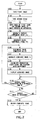
- Step S101 A user takes a first image with the electronic camera 1. More specifically, the first image is taken in the following manner.
- the user fixes the positions of an object and the electronic camera 1 under natural light (i.e., light from which no polarization features are detected).
- the user adjusts the orientation of the polarizing filter 12 which is attached to the electronic camera 1 to a predetermined azimuth angle.
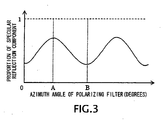
- Fig. 3 shows how the proportion of a specular reflection component varies with the azimuth angle of the polarizing filter 12.
- the user rotates the polarizing filter 12 so that the image becomes brightest and thereby establishes a state that the p-polarized component is blocked most whereas the s-polarized component passes through the polarizing filter 12 most (position A in Fig. 3 ).
- the s-polarized light refers to light whose polarization direction of the incoming light polarizes parallel to the reflection surface and perpendicular to the incidence plane (i.e., the plane formed by incident light and reflection light).
- the p-polarized light refers to light whose polarization direction of the incoming light is included in the above-mentioned incidence plane and polarizes perpendicular to the s-polarized light.
- light reflected from the surface of a substance is the sum of two components, that is, an internal reflection component and a specular reflection component.
- s-polarized light is enhanced in the reflection light. That is, an s-polarized component is dominant in a specular reflection component produced by a substance.
- a p-polarized component is dominant in an internal reflection component produced by a substance.
- the user shoots the object with the electronic camera 1.
- the electronic camera 1 generates data of a first image (s-polarized component image Is) which contains a more specular reflection component.
- Step S102 The user takes a second image with the electronic camera 1.
- the user shoots, under natural light, the same object as was shot to take the first image while changing only the orientation of the polarizing filter 12.
- the resolution (image size) of the second image is set the same as that of the first image which was taken at step S101.
- the orientation of the polarizing filter 12 is set so that at least the s-polarized component is different in magnitude than in step S101.
- the user rotates the polarizing filter 12 by 90° from the state of step S101 so that the p-polarized component passes through the polarizing filter 12 most whereas the s-polarized component is blocked most (position B in Fig. 3 ).
- the electronic camera 1 can generate data of the second image (p-polarized component image Ip) in which the composition is the same as in the first image and the specular reflection component is blocked.
- Step S103 The user inputs the data of the first image (generated at step S101) and the data of the second image (generated at step S102) to the image processing apparatus 2.
- the transfer of the image data from the electronic camera 1 to the image processing apparatus 2 is realized via the recording medium 3 or by a data communication over the communication line 4.
- the CPU 24 causes the data of the first image and the data of the second image to be read into the image processing apparatus 2.
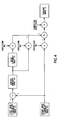
- Fig. 4 outlines image processing (the following steps S104-S108) which is performed according to the image processing program.
- a surface component image (Isr) is a difference image of the first image and the second image. More specifically, the CPU 24 subtracts the signal level of pixel of the second image from that of the corresponding pixel of the first image, respectively.
- Step S105 The CPU 24 generates data of a gloss component image (Ihl) based on the data of the surface component image (Isr). First, the CPU 24 generates a luminance histogram of the surface component image (Isr). Then, the CPU 24 generates data of a gloss component image (Ihl) by extracting a higher component of the luminance histogram of the surface component image (i.e., pixels of the surface component image whose luminance values are greater than or equal to a threshold value).
- Step S 106 The CPU 24 determines a combining ratio of the gloss component image, the surface component image, and the p-polarized component image according to a coefficient table which is recorded in the recording section 23.
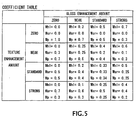
- Fig. 5 schematically shows an exemplary coefficient table.
- the coefficient table records a corresponding relationship between combinations of a gloss enhancement amount and a texture enhancement amount and image combining ratios.
- Each of the gloss enhancement amount and the texture enhancement amount is selected from four stages, that is, "zero,” “weak,” “standard,” and “strong” (the degree of enhancement increases in this order). Therefore, in this embodiment, the number of combinations of the gloss enhancement amount and the texture enhancement amount is 16 (4 stages ⁇ 4 stages). If the gloss enhancement amount is set stronger, the gloss component image is assigned a heavier weight, whereby the glossiness of the object is more enhanced by the image processing. If the texture enhancement amount is set stronger, the surface component image is assigned a heavier weight, whereby the texture of the object is more enhanced by the image processing.
- the image combining ratio is a ratio among a coefficient value (Whl) for a gloss component image, a coefficient value (Wsr) for a surface component image, and a coefficient value (Wp) for a p-polarized component image.
- the CPU 24 receives, through the operation section 25, the user's inputs which specify a gloss enhancement amount and a texture enhancement amount.
- the CPU 24 refers to an entry of the coefficient table that corresponds to the combination of the input gloss enhancement amount and texture enhancement amount and acquires a coefficient value (Whl) for a gloss component image, a coefficient value (Wsr) for a surface component image, and a coefficient value (Wp) for a p-polarized component image.
- Step S107 The CPU 24 combines the gloss component image, the surface component image, and the p-polarized component image according to the combining ratio which was determined at step S106 and thereby generates data of a combined image.
- the CPU 24 performs a gain adjustment by multiplying the entire combined image It generated at step S107 by the above correction coefficient. As a result, the glossiness of the combined component image is more enhanced.
- Step S109 The CPU 24 displays the combined image on the monitor 26. As a result, the user can judge the quality of the image as well as whether to perform image processing again.
- Step S110 The CPU 24 judges whether or not the operation section 25 has received, from the user, an input as an instruction to perform image processing again. If such an input has been received (S110: yes), the CPU 24 returns to step S106 and performs image processing again while altering the gloss enhancement amount and the texture enhancement amount. On the other hand, if no such input has been received (S110: no), the CPU 14 moves to step S111.
- Step S111 The CPU 24 judges whether or not the operation section 25 has received, from the user, an input as an instruction to record the image. If such an input has been received (S111: yes), the CPU 24 moves to step S112. On the other hand, if no such input has been received (S111: no), the CPU 14 returns to step S110 to repeat the above operation.
- Step S112 The CPU 24 records the data of the combined image in the recording section 23.
- a surface component of an image and a gloss component of an image are extracted from the difference between a first image and a second image, each with different content ratio of a specular reflection component.
- a combined image is generated by recombining these components after multiplying them by weighting coefficients. Therefore, in the embodiment, the visual impressions of an object as typified by the glossiness and the texture can be adjusted easily by image processing. Furthermore, in the embodiment, since the first image and the second image can be taken under natural light merely by changing the orientation of the polarizing filter 12, no special illumination, special imaging apparatus, or the like is necessary at the time of shooting.
Landscapes
- Physics & Mathematics (AREA)
- General Physics & Mathematics (AREA)
- Engineering & Computer Science (AREA)
- Theoretical Computer Science (AREA)
- Image Processing (AREA)
Claims (5)
- Bildverarbeitungsverfahren, das Folgendes umfasst:einen ersten Schritt (S103) des Lesens von Daten eines ersten Bildes und von Daten eines zweiten Bildes, die jeweils durch Abbilden eines gemeinsamen Gegenstands unter natürlichem Licht mit unterschiedlichen Ausrichtungen eines Polarisationsfilters erzeugt werden;gekennzeichnet durch:einen zweiten Schritt (S104) des Erzeugens eines Oberflächenkomponentenbilds durch Subtrahieren der Signalpegel des zweiten Bilds von den Signalpegeln des ersten Bilds;Erzeugen (S105) eines Glanzkomponentenbilds auf der Grundlage des Oberflächenkomponentenbilds durch Gewinnen von Komponenten des Oberflächenkomponentenbilds, wenn die Helligkeitswerte des Oberflächenkomponentenbilds größer als oder gleich einem Schwellenwert sind; undErzeugen (S107) eines kombinierten Bilds durch Durchführen einer gewichteten Addition des Oberflächenkomponentenbilds, des Glanzkomponentenbilds und des zweiten Bilds.
- Bildverarbeitungsprogramm, das bewirkt, dass ein Rechner das Verfahren nach Anspruch 1 ausführt.
- Computerlesbares Speichermedium (3), das durch Computer ausführbare verfahrensschritte zum Durchführen des Verfahrens nach Anspruch 1 speichert.
- Bildverarbeitungsvorrichtung (1), die Mittel zum Ausführen des Verfahrens nach Anspruch 1 umfasst.
- vorrichtung nach Anspruch 4, die einen Abbildungsabschnitt (13) und einen Steuerungsabschnitt (16) umfasst, die eingerichtet sind, um das Verfahren nach Anspruch 1 durchzuführen.
Applications Claiming Priority (1)
| Application Number | Priority Date | Filing Date | Title |
|---|---|---|---|
| JP2007059960A JP4924114B2 (ja) | 2007-03-09 | 2007-03-09 | 画像処理プログラムおよび画像処理方法 |
Publications (2)
| Publication Number | Publication Date |
|---|---|
| EP1968010A1 EP1968010A1 (de) | 2008-09-10 |
| EP1968010B1 true EP1968010B1 (de) | 2011-10-05 |
Family
ID=39367004
Family Applications (1)
| Application Number | Title | Priority Date | Filing Date |
|---|---|---|---|
| EP08250685A Not-in-force EP1968010B1 (de) | 2007-03-09 | 2008-02-28 | Programm und Verfahren zur Bildverarbeitung |
Country Status (4)
| Country | Link |
|---|---|
| US (1) | US8041148B2 (de) |
| EP (1) | EP1968010B1 (de) |
| JP (1) | JP4924114B2 (de) |
| CN (1) | CN101262548A (de) |
Families Citing this family (9)
| Publication number | Priority date | Publication date | Assignee | Title |
|---|---|---|---|---|
| JP4911191B2 (ja) * | 2009-04-08 | 2012-04-04 | 株式会社ニコン | 画像処理装置および画像処理プログラム |
| US8610976B1 (en) | 2012-06-27 | 2013-12-17 | 3M Innovative Properties Company | Image enhancement methods |
| US8743426B2 (en) | 2012-06-27 | 2014-06-03 | 3M Innovative Properties Company | Image enhancement methods |
| CN104376545B (zh) * | 2013-08-16 | 2018-12-14 | 联想(北京)有限公司 | 一种信息处理的方法及一种电子设备 |
| JP6447121B2 (ja) * | 2014-12-26 | 2019-01-09 | 株式会社リコー | 画像処理装置、画像処理方法、撮像システム、画像処理システム、およびプログラム |
| CN107637064A (zh) | 2015-06-08 | 2018-01-26 | 深圳市大疆创新科技有限公司 | 用于图像处理的方法和设备 |
| CN105100616B (zh) * | 2015-07-27 | 2021-02-19 | 联想(北京)有限公司 | 一种图像处理方法及电子设备 |
| US11056518B2 (en) * | 2016-08-18 | 2021-07-06 | Sony Corporation | Imaging apparatus and imaging method |
| JP7153280B2 (ja) * | 2020-10-30 | 2022-10-14 | 株式会社オーリュクス | メイクアップシミュレーションシステム、メイクアップシミュレーション方法及びプログラム |
Family Cites Families (11)
| Publication number | Priority date | Publication date | Assignee | Title |
|---|---|---|---|---|
| US4931657A (en) * | 1989-04-13 | 1990-06-05 | Macmillan Bloedel Limited | On-line texture sensing |
| JP2000090233A (ja) * | 1998-09-08 | 2000-03-31 | Olympus Optical Co Ltd | 画像処理装置 |
| GB2375676A (en) * | 2001-05-17 | 2002-11-20 | Hewlett Packard Co | Reducing the effects of specular reflections appearing in an image |
| JP3857157B2 (ja) * | 2002-02-26 | 2006-12-13 | 花王株式会社 | 化粧シミュレーション装置および方法 |
| US7830522B2 (en) * | 2002-09-25 | 2010-11-09 | New York University | Method and apparatus for determining reflectance data of a subject |
| JP3870145B2 (ja) * | 2002-09-30 | 2007-01-17 | キヤノン株式会社 | 画像形成装置及び画像形成装置制御用プログラム |
| US7522762B2 (en) * | 2003-04-16 | 2009-04-21 | Inverness Medical-Biostar, Inc. | Detection, resolution, and identification of arrayed elements |
| JP4347615B2 (ja) | 2003-06-11 | 2009-10-21 | 株式会社コーセー | 画像のシミュレーション方法 |
| US7457477B2 (en) * | 2004-07-06 | 2008-11-25 | Microsoft Corporation | Digital photography with flash/no flash extension |
| US7356229B2 (en) * | 2005-02-28 | 2008-04-08 | 3M Innovative Properties Company | Reflective polarizers containing polymer fibers |
| US7689035B2 (en) * | 2005-06-17 | 2010-03-30 | The Regents Of The University Of California | Methods for identifying, separating and editing reflection components in multi-channel images and videos |
-
2007
- 2007-03-09 JP JP2007059960A patent/JP4924114B2/ja not_active Expired - Fee Related
-
2008
- 2008-02-06 US US12/068,433 patent/US8041148B2/en not_active Expired - Fee Related
- 2008-02-28 EP EP08250685A patent/EP1968010B1/de not_active Not-in-force
- 2008-03-06 CN CNA200810082467XA patent/CN101262548A/zh active Pending
Non-Patent Citations (1)
| Title |
|---|
| BENDER E J ET AL: "Comparison of additive image fusion vs. feature-level image fusion techniques for enhanced night driving", PROCEEDINGS OF THE SPIE - THE INTERNATIONAL SOCIETY FOR OPTICAL ENGINEERING SPIE-INT. SOC. OPT. ENG USA, vol. 4796, 2003, pages 140 - 151, ISSN: 0277-786X * |
Also Published As
| Publication number | Publication date |
|---|---|
| EP1968010A1 (de) | 2008-09-10 |
| US8041148B2 (en) | 2011-10-18 |
| JP4924114B2 (ja) | 2012-04-25 |
| CN101262548A (zh) | 2008-09-10 |
| US20080219591A1 (en) | 2008-09-11 |
| JP2008225628A (ja) | 2008-09-25 |
Similar Documents
| Publication | Publication Date | Title |
|---|---|---|
| EP1968010B1 (de) | Programm und Verfahren zur Bildverarbeitung | |
| CN101394460B (zh) | 图像处理设备、方法以及图像捕获设备 | |
| Ramanath et al. | Color image processing pipeline | |
| CN103765276B (zh) | 对焦评价装置、摄像装置及程序 | |
| US8929683B2 (en) | Techniques for registering and warping image stacks | |
| EP2091260A2 (de) | Bildverarbeitungsvorrichtung, Abbildungsvorrichtung und Bildverarbeitungsprogramm | |
| US8923652B2 (en) | Methods and apparatus for registering and warping image stacks | |
| EP2461576A1 (de) | Bildverarbeitungsvorrichtung und Bildverarbeitungsprogramm | |
| CN107465903B (zh) | 图像白平衡方法、装置和计算机可读存储介质 | |
| US8369654B2 (en) | Developing apparatus, developing method and computer program for developing processing for an undeveloped image | |
| US10999526B2 (en) | Image acquisition method and apparatus | |
| CN108230407B (zh) | 一种图像的处理方法和装置 | |
| CN102082912A (zh) | 图像拍摄装置及图像处理方法 | |
| CN102223480A (zh) | 图像处理装置及图像处理方法 | |
| JP2022014125A (ja) | 画像処理装置、撮像装置および画像処理方法 | |
| US8570407B2 (en) | Imaging apparatus, image processing program, image processing apparatus, and image processing method | |
| EP1991008A1 (de) | Bildverarbeitungseinrichtung zur korrektur des massiven gefühls eines bildes, bildverarbeitungsprogramm, bildverarbeitungsverfahren und elektronische kamera | |
| JP2020182163A (ja) | 画像処理装置、画像処理方法およびプログラム | |
| Sie et al. | Alignment-free exposure fusion of image pairs | |
| JP5561389B2 (ja) | 画像処理プログラム、画像処理装置、電子カメラ、および画像処理方法 | |
| JP5810593B2 (ja) | 画像処理装置、撮像装置およびプログラム | |
| JP2004247872A (ja) | デジタル撮像装置 | |
| JP2012044551A (ja) | 画像処理装置、画像処理方法、画像処理プログラム及び記憶媒体 | |
| JP4549012B2 (ja) | 画像信号処理装置 | |
| Pamornnak et al. | Color correction scheme for different illumination and camera device conditions |
Legal Events
| Date | Code | Title | Description |
|---|---|---|---|
| PUAI | Public reference made under article 153(3) epc to a published international application that has entered the european phase |
Free format text: ORIGINAL CODE: 0009012 |
|
| AK | Designated contracting states |
Kind code of ref document: A1 Designated state(s): AT BE BG CH CY CZ DE DK EE ES FI FR GB GR HR HU IE IS IT LI LT LU LV MC MT NL NO PL PT RO SE SI SK TR |
|
| AX | Request for extension of the european patent |
Extension state: AL BA MK RS |
|
| 17P | Request for examination filed |
Effective date: 20090310 |
|
| 17Q | First examination report despatched |
Effective date: 20090408 |
|
| AKX | Designation fees paid |
Designated state(s): DE FR GB |
|
| RAP1 | Party data changed (applicant data changed or rights of an application transferred) |
Owner name: NIKON CORPORATION |
|
| GRAP | Despatch of communication of intention to grant a patent |
Free format text: ORIGINAL CODE: EPIDOSNIGR1 |
|
| GRAS | Grant fee paid |
Free format text: ORIGINAL CODE: EPIDOSNIGR3 |
|
| GRAA | (expected) grant |
Free format text: ORIGINAL CODE: 0009210 |
|
| AK | Designated contracting states |
Kind code of ref document: B1 Designated state(s): DE FR GB |
|
| REG | Reference to a national code |
Ref country code: GB Ref legal event code: FG4D |
|
| REG | Reference to a national code |
Ref country code: DE Ref legal event code: R096 Ref document number: 602008010228 Country of ref document: DE Effective date: 20120112 |
|
| PLBE | No opposition filed within time limit |
Free format text: ORIGINAL CODE: 0009261 |
|
| STAA | Information on the status of an ep patent application or granted ep patent |
Free format text: STATUS: NO OPPOSITION FILED WITHIN TIME LIMIT |
|
| 26N | No opposition filed |
Effective date: 20120706 |
|
| REG | Reference to a national code |
Ref country code: DE Ref legal event code: R097 Ref document number: 602008010228 Country of ref document: DE Effective date: 20120706 |
|
| PGFP | Annual fee paid to national office [announced via postgrant information from national office to epo] |
Ref country code: GB Payment date: 20140226 Year of fee payment: 7 |
|
| PGFP | Annual fee paid to national office [announced via postgrant information from national office to epo] |
Ref country code: DE Payment date: 20140417 Year of fee payment: 7 |
|
| REG | Reference to a national code |
Ref country code: FR Ref legal event code: PLFP Year of fee payment: 8 |
|
| PGFP | Annual fee paid to national office [announced via postgrant information from national office to epo] |
Ref country code: FR Payment date: 20150210 Year of fee payment: 8 |
|
| REG | Reference to a national code |
Ref country code: DE Ref legal event code: R119 Ref document number: 602008010228 Country of ref document: DE |
|
| GBPC | Gb: european patent ceased through non-payment of renewal fee |
Effective date: 20150228 |
|
| PG25 | Lapsed in a contracting state [announced via postgrant information from national office to epo] |
Ref country code: DE Free format text: LAPSE BECAUSE OF NON-PAYMENT OF DUE FEES Effective date: 20150901 Ref country code: GB Free format text: LAPSE BECAUSE OF NON-PAYMENT OF DUE FEES Effective date: 20150228 |
|
| REG | Reference to a national code |
Ref country code: FR Ref legal event code: ST Effective date: 20161028 |
|
| PG25 | Lapsed in a contracting state [announced via postgrant information from national office to epo] |
Ref country code: FR Free format text: LAPSE BECAUSE OF NON-PAYMENT OF DUE FEES Effective date: 20160229 |