EP1962149A1 - Image developer and image forming apparatus - Google Patents
Image developer and image forming apparatus Download PDFInfo
- Publication number
- EP1962149A1 EP1962149A1 EP08250342A EP08250342A EP1962149A1 EP 1962149 A1 EP1962149 A1 EP 1962149A1 EP 08250342 A EP08250342 A EP 08250342A EP 08250342 A EP08250342 A EP 08250342A EP 1962149 A1 EP1962149 A1 EP 1962149A1
- Authority
- EP
- European Patent Office
- Prior art keywords
- developer
- image
- toner
- bearer
- feeder
- Prior art date
- Legal status (The legal status is an assumption and is not a legal conclusion. Google has not performed a legal analysis and makes no representation as to the accuracy of the status listed.)
- Granted
Links
- 239000002245 particle Substances 0.000 claims abstract description 60
- 238000003756 stirring Methods 0.000 claims abstract description 23
- 229920000728 polyester Polymers 0.000 claims description 55
- 238000012546 transfer Methods 0.000 claims description 35
- 238000000034 method Methods 0.000 claims description 18
- 239000003795 chemical substances by application Substances 0.000 claims description 16
- 239000000470 constituent Substances 0.000 claims description 11
- 239000003960 organic solvent Substances 0.000 claims description 10
- 239000012736 aqueous medium Substances 0.000 claims description 6
- 239000003086 colorant Substances 0.000 claims description 6
- 238000004132 cross linking Methods 0.000 claims description 4
- 229910052757 nitrogen Inorganic materials 0.000 claims description 4
- 125000004433 nitrogen atom Chemical group N* 0.000 claims description 4
- 229920001225 polyester resin Polymers 0.000 claims description 4
- 239000004645 polyester resin Substances 0.000 claims description 4
- 238000011144 upstream manufacturing Methods 0.000 claims description 4
- 125000000524 functional group Chemical group 0.000 claims description 3
- -1 alkylbenzene sulfonate Chemical class 0.000 description 49
- 229920005989 resin Polymers 0.000 description 17
- 239000011347 resin Substances 0.000 description 17
- 239000001993 wax Substances 0.000 description 16
- 239000002253 acid Substances 0.000 description 15
- 150000001412 amines Chemical class 0.000 description 14
- ZWEHNKRNPOVVGH-UHFFFAOYSA-N 2-Butanone Chemical compound CCC(C)=O ZWEHNKRNPOVVGH-UHFFFAOYSA-N 0.000 description 12
- VYPSYNLAJGMNEJ-UHFFFAOYSA-N Silicium dioxide Chemical compound O=[Si]=O VYPSYNLAJGMNEJ-UHFFFAOYSA-N 0.000 description 12
- 239000006185 dispersion Substances 0.000 description 11
- LYCAIKOWRPUZTN-UHFFFAOYSA-N ethylene glycol Natural products OCCO LYCAIKOWRPUZTN-UHFFFAOYSA-N 0.000 description 10
- 239000000203 mixture Substances 0.000 description 10
- 108091008695 photoreceptors Proteins 0.000 description 10
- CSCPPACGZOOCGX-UHFFFAOYSA-N Acetone Chemical compound CC(C)=O CSCPPACGZOOCGX-UHFFFAOYSA-N 0.000 description 9
- YXFVVABEGXRONW-UHFFFAOYSA-N Toluene Chemical compound CC1=CC=CC=C1 YXFVVABEGXRONW-UHFFFAOYSA-N 0.000 description 9
- 150000001875 compounds Chemical class 0.000 description 9
- IQPQWNKOIGAROB-UHFFFAOYSA-N isocyanate group Chemical group [N-]=C=O IQPQWNKOIGAROB-UHFFFAOYSA-N 0.000 description 9
- 239000000049 pigment Substances 0.000 description 9
- OFOBLEOULBTSOW-UHFFFAOYSA-N Malonic acid Chemical compound OC(=O)CC(O)=O OFOBLEOULBTSOW-UHFFFAOYSA-N 0.000 description 8
- 239000000654 additive Substances 0.000 description 8
- 238000006243 chemical reaction Methods 0.000 description 8
- 239000004417 polycarbonate Substances 0.000 description 8
- 229920000515 polycarbonate Polymers 0.000 description 8
- 229920005862 polyol Polymers 0.000 description 8
- OGIDPMRJRNCKJF-UHFFFAOYSA-N titanium oxide Inorganic materials [Ti]=O OGIDPMRJRNCKJF-UHFFFAOYSA-N 0.000 description 8
- XLYOFNOQVPJJNP-UHFFFAOYSA-N water Substances O XLYOFNOQVPJJNP-UHFFFAOYSA-N 0.000 description 8
- GWEVSGVZZGPLCZ-UHFFFAOYSA-N Titan oxide Chemical compound O=[Ti]=O GWEVSGVZZGPLCZ-UHFFFAOYSA-N 0.000 description 7
- XSQUKJJJFZCRTK-UHFFFAOYSA-N Urea Chemical compound NC(N)=O XSQUKJJJFZCRTK-UHFFFAOYSA-N 0.000 description 7
- 230000000996 additive effect Effects 0.000 description 7
- 238000009826 distribution Methods 0.000 description 7
- 150000002148 esters Chemical class 0.000 description 7
- 125000002887 hydroxy group Chemical group [H]O* 0.000 description 7
- 239000007788 liquid Substances 0.000 description 7
- 150000003077 polyols Chemical class 0.000 description 7
- 150000003242 quaternary ammonium salts Chemical class 0.000 description 7
- 150000003839 salts Chemical class 0.000 description 7
- YMWUJEATGCHHMB-UHFFFAOYSA-N Dichloromethane Chemical compound ClCCl YMWUJEATGCHHMB-UHFFFAOYSA-N 0.000 description 6
- XEKOWRVHYACXOJ-UHFFFAOYSA-N Ethyl acetate Chemical compound CCOC(C)=O XEKOWRVHYACXOJ-UHFFFAOYSA-N 0.000 description 6
- ZMXDDKWLCZADIW-UHFFFAOYSA-N N,N-Dimethylformamide Chemical compound CN(C)C=O ZMXDDKWLCZADIW-UHFFFAOYSA-N 0.000 description 6
- WYURNTSHIVDZCO-UHFFFAOYSA-N Tetrahydrofuran Chemical compound C1CCOC1 WYURNTSHIVDZCO-UHFFFAOYSA-N 0.000 description 6
- IISBACLAFKSPIT-UHFFFAOYSA-N bisphenol A Chemical class C=1C=C(O)C=CC=1C(C)(C)C1=CC=C(O)C=C1 IISBACLAFKSPIT-UHFFFAOYSA-N 0.000 description 6
- 150000004985 diamines Chemical class 0.000 description 6
- 239000002270 dispersing agent Substances 0.000 description 6
- 229910052751 metal Inorganic materials 0.000 description 6
- 239000002184 metal Substances 0.000 description 6
- 239000005056 polyisocyanate Substances 0.000 description 6
- 229920001228 polyisocyanate Polymers 0.000 description 6
- 229920000642 polymer Polymers 0.000 description 6
- 239000004094 surface-active agent Substances 0.000 description 6
- XSTXAVWGXDQKEL-UHFFFAOYSA-N Trichloroethylene Chemical compound ClC=C(Cl)Cl XSTXAVWGXDQKEL-UHFFFAOYSA-N 0.000 description 5
- 125000002947 alkylene group Chemical group 0.000 description 5
- 150000001408 amides Chemical class 0.000 description 5
- 239000011230 binding agent Substances 0.000 description 5
- 239000004202 carbamide Substances 0.000 description 5
- 125000004432 carbon atom Chemical group C* 0.000 description 5
- 230000006866 deterioration Effects 0.000 description 5
- 150000002009 diols Chemical class 0.000 description 5
- 239000000975 dye Substances 0.000 description 5
- 125000003709 fluoroalkyl group Chemical group 0.000 description 5
- 238000002156 mixing Methods 0.000 description 5
- 239000003921 oil Substances 0.000 description 5
- 239000011236 particulate material Substances 0.000 description 5
- 239000000377 silicon dioxide Substances 0.000 description 5
- 239000002904 solvent Substances 0.000 description 5
- 239000000126 substance Substances 0.000 description 5
- VTYYLEPIZMXCLO-UHFFFAOYSA-L Calcium carbonate Chemical compound [Ca+2].[O-]C([O-])=O VTYYLEPIZMXCLO-UHFFFAOYSA-L 0.000 description 4
- HEDRZPFGACZZDS-UHFFFAOYSA-N Chloroform Chemical compound ClC(Cl)Cl HEDRZPFGACZZDS-UHFFFAOYSA-N 0.000 description 4
- RTZKZFJDLAIYFH-UHFFFAOYSA-N Diethyl ether Chemical compound CCOCC RTZKZFJDLAIYFH-UHFFFAOYSA-N 0.000 description 4
- VZCYOOQTPOCHFL-OWOJBTEDSA-N Fumaric acid Chemical compound OC(=O)\C=C\C(O)=O VZCYOOQTPOCHFL-OWOJBTEDSA-N 0.000 description 4
- OKKJLVBELUTLKV-UHFFFAOYSA-N Methanol Chemical compound OC OKKJLVBELUTLKV-UHFFFAOYSA-N 0.000 description 4
- 229920003171 Poly (ethylene oxide) Polymers 0.000 description 4
- XLOMVQKBTHCTTD-UHFFFAOYSA-N Zinc monoxide Chemical compound [Zn]=O XLOMVQKBTHCTTD-UHFFFAOYSA-N 0.000 description 4
- 150000001413 amino acids Chemical class 0.000 description 4
- 239000001506 calcium phosphate Substances 0.000 description 4
- 229920001577 copolymer Polymers 0.000 description 4
- 230000007423 decrease Effects 0.000 description 4
- 230000002209 hydrophobic effect Effects 0.000 description 4
- 150000002576 ketones Chemical class 0.000 description 4
- 239000000463 material Substances 0.000 description 4
- 229940032007 methylethyl ketone Drugs 0.000 description 4
- 229920000768 polyamine Polymers 0.000 description 4
- YGSDEFSMJLZEOE-UHFFFAOYSA-N salicylic acid Chemical class OC(=O)C1=CC=CC=C1O YGSDEFSMJLZEOE-UHFFFAOYSA-N 0.000 description 4
- 238000010008 shearing Methods 0.000 description 4
- VZGDMQKNWNREIO-UHFFFAOYSA-N tetrachloromethane Chemical compound ClC(Cl)(Cl)Cl VZGDMQKNWNREIO-UHFFFAOYSA-N 0.000 description 4
- VZCYOOQTPOCHFL-UHFFFAOYSA-N trans-butenedioic acid Natural products OC(=O)C=CC(O)=O VZCYOOQTPOCHFL-UHFFFAOYSA-N 0.000 description 4
- QORWJWZARLRLPR-UHFFFAOYSA-H tricalcium bis(phosphate) Chemical compound [Ca+2].[Ca+2].[Ca+2].[O-]P([O-])([O-])=O.[O-]P([O-])([O-])=O QORWJWZARLRLPR-UHFFFAOYSA-H 0.000 description 4
- 150000003628 tricarboxylic acids Chemical class 0.000 description 4
- UBOXGVDOUJQMTN-UHFFFAOYSA-N 1,1,2-trichloroethane Chemical compound ClCC(Cl)Cl UBOXGVDOUJQMTN-UHFFFAOYSA-N 0.000 description 3
- UHOVQNZJYSORNB-UHFFFAOYSA-N Benzene Chemical compound C1=CC=CC=C1 UHOVQNZJYSORNB-UHFFFAOYSA-N 0.000 description 3
- 229930185605 Bisphenol Natural products 0.000 description 3
- NTIZESTWPVYFNL-UHFFFAOYSA-N Methyl isobutyl ketone Chemical compound CC(C)CC(C)=O NTIZESTWPVYFNL-UHFFFAOYSA-N 0.000 description 3
- UIHCLUNTQKBZGK-UHFFFAOYSA-N Methyl isobutyl ketone Natural products CCC(C)C(C)=O UIHCLUNTQKBZGK-UHFFFAOYSA-N 0.000 description 3
- CTQNGGLPUBDAKN-UHFFFAOYSA-N O-Xylene Chemical compound CC1=CC=CC=C1C CTQNGGLPUBDAKN-UHFFFAOYSA-N 0.000 description 3
- ISWSIDIOOBJBQZ-UHFFFAOYSA-N Phenol Chemical compound OC1=CC=CC=C1 ISWSIDIOOBJBQZ-UHFFFAOYSA-N 0.000 description 3
- PPBRXRYQALVLMV-UHFFFAOYSA-N Styrene Chemical compound C=CC1=CC=CC=C1 PPBRXRYQALVLMV-UHFFFAOYSA-N 0.000 description 3
- 150000007513 acids Chemical class 0.000 description 3
- NIXOWILDQLNWCW-UHFFFAOYSA-N acrylic acid group Chemical group C(C=C)(=O)O NIXOWILDQLNWCW-UHFFFAOYSA-N 0.000 description 3
- 125000002723 alicyclic group Chemical group 0.000 description 3
- 150000001414 amino alcohols Chemical class 0.000 description 3
- 125000003118 aryl group Chemical group 0.000 description 3
- 229910000389 calcium phosphate Inorganic materials 0.000 description 3
- 235000011010 calcium phosphates Nutrition 0.000 description 3
- 125000003178 carboxy group Chemical group [H]OC(*)=O 0.000 description 3
- 239000003054 catalyst Substances 0.000 description 3
- 239000000084 colloidal system Substances 0.000 description 3
- MTHSVFCYNBDYFN-UHFFFAOYSA-N diethylene glycol Chemical compound OCCOCCO MTHSVFCYNBDYFN-UHFFFAOYSA-N 0.000 description 3
- 230000009477 glass transition Effects 0.000 description 3
- WGCNASOHLSPBMP-UHFFFAOYSA-N hydroxyacetaldehyde Natural products OCC=O WGCNASOHLSPBMP-UHFFFAOYSA-N 0.000 description 3
- 239000000696 magnetic material Substances 0.000 description 3
- 229940043265 methyl isobutyl ketone Drugs 0.000 description 3
- 239000000178 monomer Substances 0.000 description 3
- 239000012188 paraffin wax Substances 0.000 description 3
- 125000005010 perfluoroalkyl group Chemical group 0.000 description 3
- 235000019271 petrolatum Nutrition 0.000 description 3
- 238000006068 polycondensation reaction Methods 0.000 description 3
- 238000006116 polymerization reaction Methods 0.000 description 3
- 230000008569 process Effects 0.000 description 3
- 239000000047 product Substances 0.000 description 3
- RSPCKAHMRANGJZ-UHFFFAOYSA-N thiohydroxylamine Chemical class SN RSPCKAHMRANGJZ-UHFFFAOYSA-N 0.000 description 3
- 239000008096 xylene Substances 0.000 description 3
- WSLDOOZREJYCGB-UHFFFAOYSA-N 1,2-Dichloroethane Chemical compound ClCCCl WSLDOOZREJYCGB-UHFFFAOYSA-N 0.000 description 2
- HZAXFHJVJLSVMW-UHFFFAOYSA-N 2-Aminoethan-1-ol Chemical compound NCCO HZAXFHJVJLSVMW-UHFFFAOYSA-N 0.000 description 2
- MFYSUUPKMDJYPF-UHFFFAOYSA-N 2-[(4-methyl-2-nitrophenyl)diazenyl]-3-oxo-n-phenylbutanamide Chemical compound C=1C=CC=CC=1NC(=O)C(C(=O)C)N=NC1=CC=C(C)C=C1[N+]([O-])=O MFYSUUPKMDJYPF-UHFFFAOYSA-N 0.000 description 2
- HRPVXLWXLXDGHG-UHFFFAOYSA-N Acrylamide Chemical class NC(=O)C=C HRPVXLWXLXDGHG-UHFFFAOYSA-N 0.000 description 2
- IMROMDMJAWUWLK-UHFFFAOYSA-N Ethenol Chemical compound OC=C IMROMDMJAWUWLK-UHFFFAOYSA-N 0.000 description 2
- IAYPIBMASNFSPL-UHFFFAOYSA-N Ethylene oxide Chemical compound C1CO1 IAYPIBMASNFSPL-UHFFFAOYSA-N 0.000 description 2
- PEDCQBHIVMGVHV-UHFFFAOYSA-N Glycerine Chemical compound OCC(O)CO PEDCQBHIVMGVHV-UHFFFAOYSA-N 0.000 description 2
- DHMQDGOQFOQNFH-UHFFFAOYSA-N Glycine Chemical compound NCC(O)=O DHMQDGOQFOQNFH-UHFFFAOYSA-N 0.000 description 2
- VEXZGXHMUGYJMC-UHFFFAOYSA-N Hydrochloric acid Chemical compound Cl VEXZGXHMUGYJMC-UHFFFAOYSA-N 0.000 description 2
- DGAQECJNVWCQMB-PUAWFVPOSA-M Ilexoside XXIX Chemical compound C[C@@H]1CC[C@@]2(CC[C@@]3(C(=CC[C@H]4[C@]3(CC[C@@H]5[C@@]4(CC[C@@H](C5(C)C)OS(=O)(=O)[O-])C)C)[C@@H]2[C@]1(C)O)C)C(=O)O[C@H]6[C@@H]([C@H]([C@@H]([C@H](O6)CO)O)O)O.[Na+] DGAQECJNVWCQMB-PUAWFVPOSA-M 0.000 description 2
- UQSXHKLRYXJYBZ-UHFFFAOYSA-N Iron oxide Chemical compound [Fe]=O UQSXHKLRYXJYBZ-UHFFFAOYSA-N 0.000 description 2
- KFZMGEQAYNKOFK-UHFFFAOYSA-N Isopropanol Chemical compound CC(C)O KFZMGEQAYNKOFK-UHFFFAOYSA-N 0.000 description 2
- 239000004594 Masterbatch (MB) Substances 0.000 description 2
- OAICVXFJPJFONN-UHFFFAOYSA-N Phosphorus Chemical compound [P] OAICVXFJPJFONN-UHFFFAOYSA-N 0.000 description 2
- 239000004698 Polyethylene Substances 0.000 description 2
- 239000004793 Polystyrene Substances 0.000 description 2
- DNIAPMSPPWPWGF-UHFFFAOYSA-N Propylene glycol Chemical compound CC(O)CO DNIAPMSPPWPWGF-UHFFFAOYSA-N 0.000 description 2
- GOOHAUXETOMSMM-UHFFFAOYSA-N Propylene oxide Chemical compound CC1CO1 GOOHAUXETOMSMM-UHFFFAOYSA-N 0.000 description 2
- JUJWROOIHBZHMG-UHFFFAOYSA-N Pyridine Chemical class C1=CC=NC=C1 JUJWROOIHBZHMG-UHFFFAOYSA-N 0.000 description 2
- NRCMAYZCPIVABH-UHFFFAOYSA-N Quinacridone Chemical compound N1C2=CC=CC=C2C(=O)C2=C1C=C1C(=O)C3=CC=CC=C3NC1=C2 NRCMAYZCPIVABH-UHFFFAOYSA-N 0.000 description 2
- FAPWRFPIFSIZLT-UHFFFAOYSA-M Sodium chloride Chemical compound [Na+].[Cl-] FAPWRFPIFSIZLT-UHFFFAOYSA-M 0.000 description 2
- KKEYFWRCBNTPAC-UHFFFAOYSA-N Terephthalic acid Chemical compound OC(=O)C1=CC=C(C(O)=O)C=C1 KKEYFWRCBNTPAC-UHFFFAOYSA-N 0.000 description 2
- WGLPBDUCMAPZCE-UHFFFAOYSA-N Trioxochromium Chemical compound O=[Cr](=O)=O WGLPBDUCMAPZCE-UHFFFAOYSA-N 0.000 description 2
- WNLRTRBMVRJNCN-UHFFFAOYSA-N adipic acid Chemical compound OC(=O)CCCCC(O)=O WNLRTRBMVRJNCN-UHFFFAOYSA-N 0.000 description 2
- 125000001931 aliphatic group Chemical group 0.000 description 2
- 235000001014 amino acid Nutrition 0.000 description 2
- 125000003277 amino group Chemical group 0.000 description 2
- 239000003945 anionic surfactant Substances 0.000 description 2
- 229940053200 antiepileptics fatty acid derivative Drugs 0.000 description 2
- ADCOVFLJGNWWNZ-UHFFFAOYSA-N antimony trioxide Chemical compound O=[Sb]O[Sb]=O ADCOVFLJGNWWNZ-UHFFFAOYSA-N 0.000 description 2
- 239000003849 aromatic solvent Substances 0.000 description 2
- TZCXTZWJZNENPQ-UHFFFAOYSA-L barium sulfate Chemical compound [Ba+2].[O-]S([O-])(=O)=O TZCXTZWJZNENPQ-UHFFFAOYSA-L 0.000 description 2
- UREZNYTWGJKWBI-UHFFFAOYSA-M benzethonium chloride Chemical compound [Cl-].C1=CC(C(C)(C)CC(C)(C)C)=CC=C1OCCOCC[N+](C)(C)CC1=CC=CC=C1 UREZNYTWGJKWBI-UHFFFAOYSA-M 0.000 description 2
- PXKLMJQFEQBVLD-UHFFFAOYSA-N bisphenol F Chemical compound C1=CC(O)=CC=C1CC1=CC=C(O)C=C1 PXKLMJQFEQBVLD-UHFFFAOYSA-N 0.000 description 2
- HQABUPZFAYXKJW-UHFFFAOYSA-N butan-1-amine Chemical compound CCCCN HQABUPZFAYXKJW-UHFFFAOYSA-N 0.000 description 2
- WERYXYBDKMZEQL-UHFFFAOYSA-N butane-1,4-diol Chemical compound OCCCCO WERYXYBDKMZEQL-UHFFFAOYSA-N 0.000 description 2
- 229910000019 calcium carbonate Inorganic materials 0.000 description 2
- 239000003093 cationic surfactant Substances 0.000 description 2
- 229940035427 chromium oxide Drugs 0.000 description 2
- 229910000423 chromium oxide Inorganic materials 0.000 description 2
- 150000004696 coordination complex Chemical class 0.000 description 2
- XCJYREBRNVKWGJ-UHFFFAOYSA-N copper(II) phthalocyanine Chemical compound [Cu+2].C12=CC=CC=C2C(N=C2[N-]C(C3=CC=CC=C32)=N2)=NC1=NC([C]1C=CC=CC1=1)=NC=1N=C1[C]3C=CC=CC3=C2[N-]1 XCJYREBRNVKWGJ-UHFFFAOYSA-N 0.000 description 2
- 238000000151 deposition Methods 0.000 description 2
- JGFBRKRYDCGYKD-UHFFFAOYSA-N dibutyl(oxo)tin Chemical compound CCCC[Sn](=O)CCCC JGFBRKRYDCGYKD-UHFFFAOYSA-N 0.000 description 2
- JQVDAXLFBXTEQA-UHFFFAOYSA-N dibutylamine Chemical compound CCCCNCCCC JQVDAXLFBXTEQA-UHFFFAOYSA-N 0.000 description 2
- QDOXWKRWXJOMAK-UHFFFAOYSA-N dichromium trioxide Chemical compound O=[Cr]O[Cr]=O QDOXWKRWXJOMAK-UHFFFAOYSA-N 0.000 description 2
- 235000014113 dietary fatty acids Nutrition 0.000 description 2
- 239000003792 electrolyte Substances 0.000 description 2
- 230000007613 environmental effect Effects 0.000 description 2
- JBKVHLHDHHXQEQ-UHFFFAOYSA-N epsilon-caprolactam Chemical compound O=C1CCCCCN1 JBKVHLHDHHXQEQ-UHFFFAOYSA-N 0.000 description 2
- 230000032050 esterification Effects 0.000 description 2
- 238000005886 esterification reaction Methods 0.000 description 2
- FJKIXWOMBXYWOQ-UHFFFAOYSA-N ethenoxyethane Chemical compound CCOC=C FJKIXWOMBXYWOQ-UHFFFAOYSA-N 0.000 description 2
- 150000002170 ethers Chemical class 0.000 description 2
- 229940093499 ethyl acetate Drugs 0.000 description 2
- 235000019439 ethyl acetate Nutrition 0.000 description 2
- 239000000194 fatty acid Substances 0.000 description 2
- 229930195729 fatty acid Natural products 0.000 description 2
- 150000004665 fatty acids Chemical class 0.000 description 2
- 239000001530 fumaric acid Substances 0.000 description 2
- KWIUHFFTVRNATP-UHFFFAOYSA-N glycine betaine Chemical compound C[N+](C)(C)CC([O-])=O KWIUHFFTVRNATP-UHFFFAOYSA-N 0.000 description 2
- NAQMVNRVTILPCV-UHFFFAOYSA-N hexane-1,6-diamine Chemical compound NCCCCCCN NAQMVNRVTILPCV-UHFFFAOYSA-N 0.000 description 2
- MTNDZQHUAFNZQY-UHFFFAOYSA-N imidazoline Chemical compound C1CN=CN1 MTNDZQHUAFNZQY-UHFFFAOYSA-N 0.000 description 2
- UHOKSCJSTAHBSO-UHFFFAOYSA-N indanthrone blue Chemical compound C1=CC=C2C(=O)C3=CC=C4NC5=C6C(=O)C7=CC=CC=C7C(=O)C6=CC=C5NC4=C3C(=O)C2=C1 UHOKSCJSTAHBSO-UHFFFAOYSA-N 0.000 description 2
- 229910010272 inorganic material Inorganic materials 0.000 description 2
- 239000011147 inorganic material Substances 0.000 description 2
- JEIPFZHSYJVQDO-UHFFFAOYSA-N iron(III) oxide Inorganic materials O=[Fe]O[Fe]=O JEIPFZHSYJVQDO-UHFFFAOYSA-N 0.000 description 2
- QQVIHTHCMHWDBS-UHFFFAOYSA-N isophthalic acid Chemical compound OC(=O)C1=CC=CC(C(O)=O)=C1 QQVIHTHCMHWDBS-UHFFFAOYSA-N 0.000 description 2
- 235000010187 litholrubine BK Nutrition 0.000 description 2
- VZCYOOQTPOCHFL-UPHRSURJSA-N maleic acid Chemical compound OC(=O)\C=C/C(O)=O VZCYOOQTPOCHFL-UPHRSURJSA-N 0.000 description 2
- 239000011976 maleic acid Substances 0.000 description 2
- 238000004519 manufacturing process Methods 0.000 description 2
- 229940073584 methylene chloride Drugs 0.000 description 2
- 125000000896 monocarboxylic acid group Chemical group 0.000 description 2
- FJKROLUGYXJWQN-UHFFFAOYSA-N papa-hydroxy-benzoic acid Natural products OC(=O)C1=CC=C(O)C=C1 FJKROLUGYXJWQN-UHFFFAOYSA-N 0.000 description 2
- 235000019809 paraffin wax Nutrition 0.000 description 2
- XNGIFLGASWRNHJ-UHFFFAOYSA-N phthalic acid Chemical compound OC(=O)C1=CC=CC=C1C(O)=O XNGIFLGASWRNHJ-UHFFFAOYSA-N 0.000 description 2
- 229920003023 plastic Polymers 0.000 description 2
- 229920003229 poly(methyl methacrylate) Polymers 0.000 description 2
- 229920000573 polyethylene Polymers 0.000 description 2
- 239000004926 polymethyl methacrylate Substances 0.000 description 2
- 235000013824 polyphenols Nutrition 0.000 description 2
- 229920001451 polypropylene glycol Polymers 0.000 description 2
- 229920002223 polystyrene Polymers 0.000 description 2
- YPFDHNVEDLHUCE-UHFFFAOYSA-N propane-1,3-diol Chemical compound OCCCO YPFDHNVEDLHUCE-UHFFFAOYSA-N 0.000 description 2
- KIDHWZJUCRJVML-UHFFFAOYSA-N putrescine Chemical compound NCCCCN KIDHWZJUCRJVML-UHFFFAOYSA-N 0.000 description 2
- CYIDZMCFTVVTJO-UHFFFAOYSA-N pyromellitic acid Chemical compound OC(=O)C1=CC(C(O)=O)=C(C(O)=O)C=C1C(O)=O CYIDZMCFTVVTJO-UHFFFAOYSA-N 0.000 description 2
- 239000000376 reactant Substances 0.000 description 2
- PYWVYCXTNDRMGF-UHFFFAOYSA-N rhodamine B Chemical compound [Cl-].C=12C=CC(=[N+](CC)CC)C=C2OC2=CC(N(CC)CC)=CC=C2C=1C1=CC=CC=C1C(O)=O PYWVYCXTNDRMGF-UHFFFAOYSA-N 0.000 description 2
- 230000000630 rising effect Effects 0.000 description 2
- 229960004889 salicylic acid Drugs 0.000 description 2
- CXMXRPHRNRROMY-UHFFFAOYSA-N sebacic acid Chemical compound OC(=O)CCCCCCCCC(O)=O CXMXRPHRNRROMY-UHFFFAOYSA-N 0.000 description 2
- 239000011734 sodium Substances 0.000 description 2
- 229910052708 sodium Inorganic materials 0.000 description 2
- BDHFUVZGWQCTTF-UHFFFAOYSA-M sulfonate Chemical compound [O-]S(=O)=O BDHFUVZGWQCTTF-UHFFFAOYSA-M 0.000 description 2
- YLQBMQCUIZJEEH-UHFFFAOYSA-N tetrahydrofuran Natural products C=1C=COC=1 YLQBMQCUIZJEEH-UHFFFAOYSA-N 0.000 description 2
- JOUDBUYBGJYFFP-FOCLMDBBSA-N thioindigo Chemical compound S\1C2=CC=CC=C2C(=O)C/1=C1/C(=O)C2=CC=CC=C2S1 JOUDBUYBGJYFFP-FOCLMDBBSA-N 0.000 description 2
- ARCGXLSVLAOJQL-UHFFFAOYSA-N trimellitic acid Chemical compound OC(=O)C1=CC=C(C(O)=O)C(C(O)=O)=C1 ARCGXLSVLAOJQL-UHFFFAOYSA-N 0.000 description 2
- AAAQKTZKLRYKHR-UHFFFAOYSA-N triphenylmethane Chemical compound C1=CC=CC=C1C(C=1C=CC=CC=1)C1=CC=CC=C1 AAAQKTZKLRYKHR-UHFFFAOYSA-N 0.000 description 2
- WFKWXMTUELFFGS-UHFFFAOYSA-N tungsten Chemical compound [W] WFKWXMTUELFFGS-UHFFFAOYSA-N 0.000 description 2
- 229910052721 tungsten Inorganic materials 0.000 description 2
- 239000010937 tungsten Substances 0.000 description 2
- 239000011787 zinc oxide Substances 0.000 description 2
- DSEKYWAQQVUQTP-XEWMWGOFSA-N (2r,4r,4as,6as,6as,6br,8ar,12ar,14as,14bs)-2-hydroxy-4,4a,6a,6b,8a,11,11,14a-octamethyl-2,4,5,6,6a,7,8,9,10,12,12a,13,14,14b-tetradecahydro-1h-picen-3-one Chemical compound C([C@H]1[C@]2(C)CC[C@@]34C)C(C)(C)CC[C@]1(C)CC[C@]2(C)[C@H]4CC[C@@]1(C)[C@H]3C[C@@H](O)C(=O)[C@@H]1C DSEKYWAQQVUQTP-XEWMWGOFSA-N 0.000 description 1
- DDKMFQGAZVMXQV-UHFFFAOYSA-N (3-chloro-2-hydroxypropyl) 2-methylprop-2-enoate Chemical compound CC(=C)C(=O)OCC(O)CCl DDKMFQGAZVMXQV-UHFFFAOYSA-N 0.000 description 1
- POTYORUTRLSAGZ-UHFFFAOYSA-N (3-chloro-2-hydroxypropyl) prop-2-enoate Chemical compound ClCC(O)COC(=O)C=C POTYORUTRLSAGZ-UHFFFAOYSA-N 0.000 description 1
- HFLXWLZPQHZKJR-SCSAIBSYSA-N (4S)-2,2,3,3,4-pentafluoro-4-[fluoro(1,1,2,2,3,3,4,4,5,5,6,6,7,7,8,8,8-heptadecafluorooctylsulfonyl)amino]pentanedioic acid Chemical compound OC(=O)C(F)(F)C(F)(F)[C@@](F)(C(O)=O)N(F)S(=O)(=O)C(F)(F)C(F)(F)C(F)(F)C(F)(F)C(F)(F)C(F)(F)C(F)(F)C(F)(F)F HFLXWLZPQHZKJR-SCSAIBSYSA-N 0.000 description 1
- QBZIEGUIYWGBMY-FUZXWUMZSA-N (5Z)-5-hydroxyimino-6-oxonaphthalene-2-sulfonic acid iron Chemical compound [Fe].O\N=C1/C(=O)C=Cc2cc(ccc12)S(O)(=O)=O.O\N=C1/C(=O)C=Cc2cc(ccc12)S(O)(=O)=O.O\N=C1/C(=O)C=Cc2cc(ccc12)S(O)(=O)=O QBZIEGUIYWGBMY-FUZXWUMZSA-N 0.000 description 1
- DNIAPMSPPWPWGF-GSVOUGTGSA-N (R)-(-)-Propylene glycol Chemical compound C[C@@H](O)CO DNIAPMSPPWPWGF-GSVOUGTGSA-N 0.000 description 1
- RYHBNJHYFVUHQT-UHFFFAOYSA-N 1,4-Dioxane Chemical compound C1COCCO1 RYHBNJHYFVUHQT-UHFFFAOYSA-N 0.000 description 1
- OVBFMUAFNIIQAL-UHFFFAOYSA-N 1,4-diisocyanatobutane Chemical compound O=C=NCCCCN=C=O OVBFMUAFNIIQAL-UHFFFAOYSA-N 0.000 description 1
- OSNILPMOSNGHLC-UHFFFAOYSA-N 1-[4-methoxy-3-(piperidin-1-ylmethyl)phenyl]ethanone Chemical compound COC1=CC=C(C(C)=O)C=C1CN1CCCCC1 OSNILPMOSNGHLC-UHFFFAOYSA-N 0.000 description 1
- KTZVZZJJVJQZHV-UHFFFAOYSA-N 1-chloro-4-ethenylbenzene Chemical compound ClC1=CC=C(C=C)C=C1 KTZVZZJJVJQZHV-UHFFFAOYSA-N 0.000 description 1
- OVGRCEFMXPHEBL-UHFFFAOYSA-N 1-ethenoxypropane Chemical compound CCCOC=C OVGRCEFMXPHEBL-UHFFFAOYSA-N 0.000 description 1
- OSSNTDFYBPYIEC-UHFFFAOYSA-N 1-ethenylimidazole Chemical compound C=CN1C=CN=C1 OSSNTDFYBPYIEC-UHFFFAOYSA-N 0.000 description 1
- VILCJCGEZXAXTO-UHFFFAOYSA-N 2,2,2-tetramine Chemical compound NCCNCCNCCN VILCJCGEZXAXTO-UHFFFAOYSA-N 0.000 description 1
- PISLZQACAJMAIO-UHFFFAOYSA-N 2,4-diethyl-6-methylbenzene-1,3-diamine Chemical compound CCC1=CC(C)=C(N)C(CC)=C1N PISLZQACAJMAIO-UHFFFAOYSA-N 0.000 description 1
- SMZOUWXMTYCWNB-UHFFFAOYSA-N 2-(2-methoxy-5-methylphenyl)ethanamine Chemical compound COC1=CC=C(C)C=C1CCN SMZOUWXMTYCWNB-UHFFFAOYSA-N 0.000 description 1
- JAHNSTQSQJOJLO-UHFFFAOYSA-N 2-(3-fluorophenyl)-1h-imidazole Chemical compound FC1=CC=CC(C=2NC=CN=2)=C1 JAHNSTQSQJOJLO-UHFFFAOYSA-N 0.000 description 1
- XNWFRZJHXBZDAG-UHFFFAOYSA-N 2-METHOXYETHANOL Chemical compound COCCO XNWFRZJHXBZDAG-UHFFFAOYSA-N 0.000 description 1
- PTFSLTXIXFNFSI-UHFFFAOYSA-N 2-[bis(2-aminoethyl)amino]tetradecanoic acid Chemical compound CCCCCCCCCCCCC(C(O)=O)N(CCN)CCN PTFSLTXIXFNFSI-UHFFFAOYSA-N 0.000 description 1
- MWGATWIBSKHFMR-UHFFFAOYSA-N 2-anilinoethanol Chemical compound OCCNC1=CC=CC=C1 MWGATWIBSKHFMR-UHFFFAOYSA-N 0.000 description 1
- IJVRPNIWWODHHA-UHFFFAOYSA-N 2-cyanoprop-2-enoic acid Chemical compound OC(=O)C(=C)C#N IJVRPNIWWODHHA-UHFFFAOYSA-N 0.000 description 1
- OMIGHNLMNHATMP-UHFFFAOYSA-N 2-hydroxyethyl prop-2-enoate Chemical compound OCCOC(=O)C=C OMIGHNLMNHATMP-UHFFFAOYSA-N 0.000 description 1
- VHSHLMUCYSAUQU-UHFFFAOYSA-N 2-hydroxypropyl methacrylate Chemical compound CC(O)COC(=O)C(C)=C VHSHLMUCYSAUQU-UHFFFAOYSA-N 0.000 description 1
- GWZMWHWAWHPNHN-UHFFFAOYSA-N 2-hydroxypropyl prop-2-enoate Chemical compound CC(O)COC(=O)C=C GWZMWHWAWHPNHN-UHFFFAOYSA-N 0.000 description 1
- 125000003504 2-oxazolinyl group Chemical class O1C(=NCC1)* 0.000 description 1
- KGIGUEBEKRSTEW-UHFFFAOYSA-N 2-vinylpyridine Chemical compound C=CC1=CC=CC=N1 KGIGUEBEKRSTEW-UHFFFAOYSA-N 0.000 description 1
- RNLHGQLZWXBQNY-UHFFFAOYSA-N 3-(aminomethyl)-3,5,5-trimethylcyclohexan-1-amine Chemical compound CC1(C)CC(N)CC(C)(CN)C1 RNLHGQLZWXBQNY-UHFFFAOYSA-N 0.000 description 1
- IYGAMTQMILRCCI-UHFFFAOYSA-N 3-aminopropane-1-thiol Chemical compound NCCCS IYGAMTQMILRCCI-UHFFFAOYSA-N 0.000 description 1
- GNSFRPWPOGYVLO-UHFFFAOYSA-N 3-hydroxypropyl 2-methylprop-2-enoate Chemical compound CC(=C)C(=O)OCCCO GNSFRPWPOGYVLO-UHFFFAOYSA-N 0.000 description 1
- QZPSOSOOLFHYRR-UHFFFAOYSA-N 3-hydroxypropyl prop-2-enoate Chemical compound OCCCOC(=O)C=C QZPSOSOOLFHYRR-UHFFFAOYSA-N 0.000 description 1
- UPMLOUAZCHDJJD-UHFFFAOYSA-N 4,4'-Diphenylmethane Diisocyanate Chemical compound C1=CC(N=C=O)=CC=C1CC1=CC=C(N=C=O)C=C1 UPMLOUAZCHDJJD-UHFFFAOYSA-N 0.000 description 1
- YBRVSVVVWCFQMG-UHFFFAOYSA-N 4,4'-diaminodiphenylmethane Chemical compound C1=CC(N)=CC=C1CC1=CC=C(N)C=C1 YBRVSVVVWCFQMG-UHFFFAOYSA-N 0.000 description 1
- VPWNQTHUCYMVMZ-UHFFFAOYSA-N 4,4'-sulfonyldiphenol Chemical compound C1=CC(O)=CC=C1S(=O)(=O)C1=CC=C(O)C=C1 VPWNQTHUCYMVMZ-UHFFFAOYSA-N 0.000 description 1
- DVBFXQLPQRMDKU-UHFFFAOYSA-N 4,4-dichloro-2-methylbut-2-enoic acid Chemical compound CC(=CC(Cl)Cl)C(=O)O DVBFXQLPQRMDKU-UHFFFAOYSA-N 0.000 description 1
- WZSFTHVIIGGDOI-UHFFFAOYSA-N 4,5,6,7-tetrachloro-3-[2-methyl-3-[(4,5,6,7-tetrachloro-3-oxoisoindol-1-yl)amino]anilino]isoindol-1-one Chemical compound ClC1=C(Cl)C(Cl)=C(Cl)C2=C1C(NC1=CC=CC(NC=3C4=C(C(=C(Cl)C(Cl)=C4Cl)Cl)C(=O)N=3)=C1C)=NC2=O WZSFTHVIIGGDOI-UHFFFAOYSA-N 0.000 description 1
- IGSBHTZEJMPDSZ-UHFFFAOYSA-N 4-[(4-amino-3-methylcyclohexyl)methyl]-2-methylcyclohexan-1-amine Chemical compound C1CC(N)C(C)CC1CC1CC(C)C(N)CC1 IGSBHTZEJMPDSZ-UHFFFAOYSA-N 0.000 description 1
- DWDURZSYQTXVIN-UHFFFAOYSA-N 4-[(4-aminophenyl)-(4-methyliminocyclohexa-2,5-dien-1-ylidene)methyl]aniline Chemical compound C1=CC(=NC)C=CC1=C(C=1C=CC(N)=CC=1)C1=CC=C(N)C=C1 DWDURZSYQTXVIN-UHFFFAOYSA-N 0.000 description 1
- LVOJOIBIVGEQBP-UHFFFAOYSA-N 4-[[2-chloro-4-[3-chloro-4-[(5-hydroxy-3-methyl-1-phenylpyrazol-4-yl)diazenyl]phenyl]phenyl]diazenyl]-5-methyl-2-phenylpyrazol-3-ol Chemical compound CC1=NN(C(O)=C1N=NC1=CC=C(C=C1Cl)C1=CC(Cl)=C(C=C1)N=NC1=C(O)N(N=C1C)C1=CC=CC=C1)C1=CC=CC=C1 LVOJOIBIVGEQBP-UHFFFAOYSA-N 0.000 description 1
- PBGKNXWGYQPUJK-UHFFFAOYSA-N 4-chloro-2-nitroaniline Chemical compound NC1=CC=C(Cl)C=C1[N+]([O-])=O PBGKNXWGYQPUJK-UHFFFAOYSA-N 0.000 description 1
- DSBIJCMXAIKKKI-UHFFFAOYSA-N 5-nitro-o-toluidine Chemical compound CC1=CC=C([N+]([O-])=O)C=C1N DSBIJCMXAIKKKI-UHFFFAOYSA-N 0.000 description 1
- SLXKOJJOQWFEFD-UHFFFAOYSA-N 6-aminohexanoic acid Chemical compound NCCCCCC(O)=O SLXKOJJOQWFEFD-UHFFFAOYSA-N 0.000 description 1
- RSWGJHLUYNHPMX-UHFFFAOYSA-N Abietic-Saeure Natural products C12CCC(C(C)C)=CC2=CCC2C1(C)CCCC2(C)C(O)=O RSWGJHLUYNHPMX-UHFFFAOYSA-N 0.000 description 1
- 229920000178 Acrylic resin Polymers 0.000 description 1
- 239000004925 Acrylic resin Substances 0.000 description 1
- 238000012935 Averaging Methods 0.000 description 1
- NOWKCMXCCJGMRR-UHFFFAOYSA-N Aziridine Chemical compound C1CN1 NOWKCMXCCJGMRR-UHFFFAOYSA-N 0.000 description 1
- 238000004438 BET method Methods 0.000 description 1
- VVAVKBBTPWYADW-UHFFFAOYSA-L Biebrich scarlet Chemical compound [Na+].[Na+].OC1=CC=C2C=CC=CC2=C1N=NC(C(=C1)S([O-])(=O)=O)=CC=C1N=NC1=CC=C(S([O-])(=O)=O)C=C1 VVAVKBBTPWYADW-UHFFFAOYSA-L 0.000 description 1
- ZOXJGFHDIHLPTG-UHFFFAOYSA-N Boron Chemical compound [B] ZOXJGFHDIHLPTG-UHFFFAOYSA-N 0.000 description 1
- 239000004215 Carbon black (E152) Substances 0.000 description 1
- 108091005944 Cerulean Proteins 0.000 description 1
- VYZAMTAEIAYCRO-UHFFFAOYSA-N Chromium Chemical compound [Cr] VYZAMTAEIAYCRO-UHFFFAOYSA-N 0.000 description 1
- 229920000742 Cotton Polymers 0.000 description 1
- FBPFZTCFMRRESA-FSIIMWSLSA-N D-Glucitol Natural products OC[C@H](O)[C@H](O)[C@@H](O)[C@H](O)CO FBPFZTCFMRRESA-FSIIMWSLSA-N 0.000 description 1
- FBPFZTCFMRRESA-JGWLITMVSA-N D-glucitol Chemical compound OC[C@H](O)[C@@H](O)[C@H](O)[C@H](O)CO FBPFZTCFMRRESA-JGWLITMVSA-N 0.000 description 1
- RPNUMPOLZDHAAY-UHFFFAOYSA-N Diethylenetriamine Chemical compound NCCNCCN RPNUMPOLZDHAAY-UHFFFAOYSA-N 0.000 description 1
- QXNVGIXVLWOKEQ-UHFFFAOYSA-N Disodium Chemical compound [Na][Na] QXNVGIXVLWOKEQ-UHFFFAOYSA-N 0.000 description 1
- 239000004593 Epoxy Substances 0.000 description 1
- JOYRKODLDBILNP-UHFFFAOYSA-N Ethyl urethane Chemical compound CCOC(N)=O JOYRKODLDBILNP-UHFFFAOYSA-N 0.000 description 1
- PIICEJLVQHRZGT-UHFFFAOYSA-N Ethylenediamine Chemical compound NCCN PIICEJLVQHRZGT-UHFFFAOYSA-N 0.000 description 1
- YCKRFDGAMUMZLT-UHFFFAOYSA-N Fluorine atom Chemical compound [F] YCKRFDGAMUMZLT-UHFFFAOYSA-N 0.000 description 1
- 239000005057 Hexamethylene diisocyanate Substances 0.000 description 1
- 239000013032 Hydrocarbon resin Substances 0.000 description 1
- 239000004354 Hydroxyethyl cellulose Substances 0.000 description 1
- WOBHKFSMXKNTIM-UHFFFAOYSA-N Hydroxyethyl methacrylate Chemical compound CC(=C)C(=O)OCCO WOBHKFSMXKNTIM-UHFFFAOYSA-N 0.000 description 1
- 229920001479 Hydroxyethyl methyl cellulose Polymers 0.000 description 1
- AVXURJPOCDRRFD-UHFFFAOYSA-N Hydroxylamine Chemical compound ON AVXURJPOCDRRFD-UHFFFAOYSA-N 0.000 description 1
- 229920002153 Hydroxypropyl cellulose Polymers 0.000 description 1
- 235000000177 Indigofera tinctoria Nutrition 0.000 description 1
- 239000005058 Isophorone diisocyanate Substances 0.000 description 1
- QNAYBMKLOCPYGJ-REOHCLBHSA-N L-alanine Chemical compound C[C@H](N)C(O)=O QNAYBMKLOCPYGJ-REOHCLBHSA-N 0.000 description 1
- 239000004166 Lanolin Substances 0.000 description 1
- VPWFPZBFBFHIIL-UHFFFAOYSA-L Lithol Rubine Chemical compound OC=1C(=CC2=CC=CC=C2C1N=NC1=C(C=C(C=C1)C)S(=O)(=O)[O-])C(=O)[O-].[Na+].[Na+] VPWFPZBFBFHIIL-UHFFFAOYSA-L 0.000 description 1
- FYYHWMGAXLPEAU-UHFFFAOYSA-N Magnesium Chemical compound [Mg] FYYHWMGAXLPEAU-UHFFFAOYSA-N 0.000 description 1
- CERQOIWHTDAKMF-UHFFFAOYSA-N Methacrylic acid Chemical compound CC(=C)C(O)=O CERQOIWHTDAKMF-UHFFFAOYSA-N 0.000 description 1
- ZOKXTWBITQBERF-UHFFFAOYSA-N Molybdenum Chemical compound [Mo] ZOKXTWBITQBERF-UHFFFAOYSA-N 0.000 description 1
- FXHOOIRPVKKKFG-UHFFFAOYSA-N N,N-Dimethylacetamide Chemical compound CN(C)C(C)=O FXHOOIRPVKKKFG-UHFFFAOYSA-N 0.000 description 1
- CNCOEDDPFOAUMB-UHFFFAOYSA-N N-Methylolacrylamide Chemical compound OCNC(=O)C=C CNCOEDDPFOAUMB-UHFFFAOYSA-N 0.000 description 1
- WHNWPMSKXPGLAX-UHFFFAOYSA-N N-Vinyl-2-pyrrolidone Chemical compound C=CN1CCCC1=O WHNWPMSKXPGLAX-UHFFFAOYSA-N 0.000 description 1
- GSBKRFGXEJLVMI-UHFFFAOYSA-N Nervonyl carnitine Chemical class CCC[N+](C)(C)C GSBKRFGXEJLVMI-UHFFFAOYSA-N 0.000 description 1
- 240000007594 Oryza sativa Species 0.000 description 1
- 235000007164 Oryza sativa Nutrition 0.000 description 1
- 101000987580 Periplaneta americana Periplanetasin-2 Proteins 0.000 description 1
- 239000004264 Petrolatum Substances 0.000 description 1
- LGRFSURHDFAFJT-UHFFFAOYSA-N Phthalic anhydride Natural products C1=CC=C2C(=O)OC(=O)C2=C1 LGRFSURHDFAFJT-UHFFFAOYSA-N 0.000 description 1
- 239000002202 Polyethylene glycol Substances 0.000 description 1
- 239000004743 Polypropylene Substances 0.000 description 1
- 239000006004 Quartz sand Substances 0.000 description 1
- KHPCPRHQVVSZAH-HUOMCSJISA-N Rosin Natural products O(C/C=C/c1ccccc1)[C@H]1[C@H](O)[C@@H](O)[C@@H](O)[C@@H](CO)O1 KHPCPRHQVVSZAH-HUOMCSJISA-N 0.000 description 1
- 229910052581 Si3N4 Inorganic materials 0.000 description 1
- 241000519995 Stachys sylvatica Species 0.000 description 1
- KDYFGRWQOYBRFD-UHFFFAOYSA-N Succinic acid Natural products OC(=O)CCC(O)=O KDYFGRWQOYBRFD-UHFFFAOYSA-N 0.000 description 1
- RTAQQCXQSZGOHL-UHFFFAOYSA-N Titanium Chemical compound [Ti] RTAQQCXQSZGOHL-UHFFFAOYSA-N 0.000 description 1
- ZJCCRDAZUWHFQH-UHFFFAOYSA-N Trimethylolpropane Chemical compound CCC(CO)(CO)CO ZJCCRDAZUWHFQH-UHFFFAOYSA-N 0.000 description 1
- XTXRWKRVRITETP-UHFFFAOYSA-N Vinyl acetate Chemical compound CC(=O)OC=C XTXRWKRVRITETP-UHFFFAOYSA-N 0.000 description 1
- YIMQCDZDWXUDCA-UHFFFAOYSA-N [4-(hydroxymethyl)cyclohexyl]methanol Chemical compound OCC1CCC(CO)CC1 YIMQCDZDWXUDCA-UHFFFAOYSA-N 0.000 description 1
- AUNAPVYQLLNFOI-UHFFFAOYSA-L [Pb++].[Pb++].[Pb++].[O-]S([O-])(=O)=O.[O-][Cr]([O-])(=O)=O.[O-][Mo]([O-])(=O)=O Chemical compound [Pb++].[Pb++].[Pb++].[O-]S([O-])(=O)=O.[O-][Cr]([O-])(=O)=O.[O-][Mo]([O-])(=O)=O AUNAPVYQLLNFOI-UHFFFAOYSA-L 0.000 description 1
- UKLDJPRMSDWDSL-UHFFFAOYSA-L [dibutyl(dodecanoyloxy)stannyl] dodecanoate Chemical compound CCCCCCCCCCCC(=O)O[Sn](CCCC)(CCCC)OC(=O)CCCCCCCCCCC UKLDJPRMSDWDSL-UHFFFAOYSA-L 0.000 description 1
- XQBCVRSTVUHIGH-UHFFFAOYSA-L [dodecanoyloxy(dioctyl)stannyl] dodecanoate Chemical compound CCCCCCCCCCCC(=O)O[Sn](CCCCCCCC)(CCCCCCCC)OC(=O)CCCCCCCCCCC XQBCVRSTVUHIGH-UHFFFAOYSA-L 0.000 description 1
- DGOBMKYRQHEFGQ-UHFFFAOYSA-L acid green 5 Chemical compound [Na+].[Na+].C=1C=C(C(=C2C=CC(C=C2)=[N+](CC)CC=2C=C(C=CC=2)S([O-])(=O)=O)C=2C=CC(=CC=2)S([O-])(=O)=O)C=CC=1N(CC)CC1=CC=CC(S([O-])(=O)=O)=C1 DGOBMKYRQHEFGQ-UHFFFAOYSA-L 0.000 description 1
- HFBMWMNUJJDEQZ-UHFFFAOYSA-N acryloyl chloride Chemical compound ClC(=O)C=C HFBMWMNUJJDEQZ-UHFFFAOYSA-N 0.000 description 1
- 239000012190 activator Substances 0.000 description 1
- 239000001361 adipic acid Substances 0.000 description 1
- 235000011037 adipic acid Nutrition 0.000 description 1
- 238000013019 agitation Methods 0.000 description 1
- 235000004279 alanine Nutrition 0.000 description 1
- 150000001298 alcohols Chemical class 0.000 description 1
- 125000005262 alkoxyamine group Chemical group 0.000 description 1
- 125000005907 alkyl ester group Chemical group 0.000 description 1
- 125000000217 alkyl group Chemical group 0.000 description 1
- 125000005211 alkyl trimethyl ammonium group Chemical group 0.000 description 1
- PNEYBMLMFCGWSK-UHFFFAOYSA-N aluminium oxide Inorganic materials [O-2].[O-2].[O-2].[Al+3].[Al+3] PNEYBMLMFCGWSK-UHFFFAOYSA-N 0.000 description 1
- 229960002684 aminocaproic acid Drugs 0.000 description 1
- 150000003863 ammonium salts Chemical class 0.000 description 1
- 239000012164 animal wax Substances 0.000 description 1
- PYKYMHQGRFAEBM-UHFFFAOYSA-N anthraquinone Natural products CCC(=O)c1c(O)c2C(=O)C3C(C=CC=C3O)C(=O)c2cc1CC(=O)OC PYKYMHQGRFAEBM-UHFFFAOYSA-N 0.000 description 1
- 150000004056 anthraquinones Chemical class 0.000 description 1
- 239000007864 aqueous solution Substances 0.000 description 1
- 150000004984 aromatic diamines Chemical class 0.000 description 1
- YOALFLHFSFEMLP-UHFFFAOYSA-N azane;2,2,3,3,4,4,5,5,6,6,7,7,8,8,8-pentadecafluorooctanoic acid Chemical compound [NH4+].[O-]C(=O)C(F)(F)C(F)(F)C(F)(F)C(F)(F)C(F)(F)C(F)(F)C(F)(F)F YOALFLHFSFEMLP-UHFFFAOYSA-N 0.000 description 1
- UHHXUPJJDHEMGX-UHFFFAOYSA-K azanium;manganese(3+);phosphonato phosphate Chemical compound [NH4+].[Mn+3].[O-]P([O-])(=O)OP([O-])([O-])=O UHHXUPJJDHEMGX-UHFFFAOYSA-K 0.000 description 1
- 239000000987 azo dye Substances 0.000 description 1
- 125000000751 azo group Chemical group [*]N=N[*] 0.000 description 1
- IRERQBUNZFJFGC-UHFFFAOYSA-L azure blue Chemical compound [Na+].[Na+].[Na+].[Na+].[Na+].[Na+].[Na+].[Na+].[Al+3].[Al+3].[Al+3].[Al+3].[Al+3].[Al+3].[S-]S[S-].[O-][Si]([O-])([O-])[O-].[O-][Si]([O-])([O-])[O-].[O-][Si]([O-])([O-])[O-].[O-][Si]([O-])([O-])[O-].[O-][Si]([O-])([O-])[O-].[O-][Si]([O-])([O-])[O-] IRERQBUNZFJFGC-UHFFFAOYSA-L 0.000 description 1
- QFFVPLLCYGOFPU-UHFFFAOYSA-N barium chromate Chemical compound [Ba+2].[O-][Cr]([O-])(=O)=O QFFVPLLCYGOFPU-UHFFFAOYSA-N 0.000 description 1
- JRPBQTZRNDNNOP-UHFFFAOYSA-N barium titanate Chemical compound [Ba+2].[Ba+2].[O-][Ti]([O-])([O-])[O-] JRPBQTZRNDNNOP-UHFFFAOYSA-N 0.000 description 1
- 229910002113 barium titanate Inorganic materials 0.000 description 1
- AYJRCSIUFZENHW-DEQYMQKBSA-L barium(2+);oxomethanediolate Chemical compound [Ba+2].[O-][14C]([O-])=O AYJRCSIUFZENHW-DEQYMQKBSA-L 0.000 description 1
- 235000013871 bee wax Nutrition 0.000 description 1
- 229940092738 beeswax Drugs 0.000 description 1
- 239000012166 beeswax Substances 0.000 description 1
- 125000005501 benzalkonium group Chemical class 0.000 description 1
- 229960003872 benzethonium Drugs 0.000 description 1
- 229960001950 benzethonium chloride Drugs 0.000 description 1
- WGQKYBSKWIADBV-UHFFFAOYSA-N benzylamine Chemical class NCC1=CC=CC=C1 WGQKYBSKWIADBV-UHFFFAOYSA-N 0.000 description 1
- UCMIRNVEIXFBKS-UHFFFAOYSA-N beta-alanine Chemical compound NCCC(O)=O UCMIRNVEIXFBKS-UHFFFAOYSA-N 0.000 description 1
- 229960003237 betaine Drugs 0.000 description 1
- 238000009835 boiling Methods 0.000 description 1
- 229910052796 boron Inorganic materials 0.000 description 1
- NNBFNNNWANBMTI-UHFFFAOYSA-M brilliant green Chemical compound OS([O-])(=O)=O.C1=CC(N(CC)CC)=CC=C1C(C=1C=CC=CC=1)=C1C=CC(=[N+](CC)CC)C=C1 NNBFNNNWANBMTI-UHFFFAOYSA-M 0.000 description 1
- KDYFGRWQOYBRFD-NUQCWPJISA-N butanedioic acid Chemical compound O[14C](=O)CC[14C](O)=O KDYFGRWQOYBRFD-NUQCWPJISA-N 0.000 description 1
- QHIWVLPBUQWDMQ-UHFFFAOYSA-N butyl prop-2-enoate;methyl 2-methylprop-2-enoate;prop-2-enoic acid Chemical compound OC(=O)C=C.COC(=O)C(C)=C.CCCCOC(=O)C=C QHIWVLPBUQWDMQ-UHFFFAOYSA-N 0.000 description 1
- 229910052793 cadmium Inorganic materials 0.000 description 1
- BDOSMKKIYDKNTQ-UHFFFAOYSA-N cadmium atom Chemical compound [Cd] BDOSMKKIYDKNTQ-UHFFFAOYSA-N 0.000 description 1
- CJOBVZJTOIVNNF-UHFFFAOYSA-N cadmium sulfide Chemical compound [Cd]=S CJOBVZJTOIVNNF-UHFFFAOYSA-N 0.000 description 1
- ZYCAIJWJKAGBLN-UHFFFAOYSA-N cadmium(2+);mercury(2+);disulfide Chemical compound [S-2].[S-2].[Cd+2].[Hg+2] ZYCAIJWJKAGBLN-UHFFFAOYSA-N 0.000 description 1
- AOWKSNWVBZGMTJ-UHFFFAOYSA-N calcium titanate Chemical compound [Ca+2].[O-][Ti]([O-])=O AOWKSNWVBZGMTJ-UHFFFAOYSA-N 0.000 description 1
- 239000006229 carbon black Substances 0.000 description 1
- 150000001735 carboxylic acids Chemical class 0.000 description 1
- 239000004203 carnauba wax Substances 0.000 description 1
- 235000013869 carnauba wax Nutrition 0.000 description 1
- 239000001913 cellulose Substances 0.000 description 1
- 229920002678 cellulose Polymers 0.000 description 1
- 229910000420 cerium oxide Inorganic materials 0.000 description 1
- 239000013522 chelant Substances 0.000 description 1
- PZTQVMXMKVTIRC-UHFFFAOYSA-L chembl2028348 Chemical compound [Ca+2].[O-]S(=O)(=O)C1=CC(C)=CC=C1N=NC1=C(O)C(C([O-])=O)=CC2=CC=CC=C12 PZTQVMXMKVTIRC-UHFFFAOYSA-L 0.000 description 1
- ZLFVRXUOSPRRKQ-UHFFFAOYSA-N chembl2138372 Chemical compound [O-][N+](=O)C1=CC(C)=CC=C1N=NC1=C(O)C=CC2=CC=CC=C12 ZLFVRXUOSPRRKQ-UHFFFAOYSA-N 0.000 description 1
- 150000001805 chlorine compounds Chemical class 0.000 description 1
- MVPPADPHJFYWMZ-UHFFFAOYSA-N chlorobenzene Chemical compound ClC1=CC=CC=C1 MVPPADPHJFYWMZ-UHFFFAOYSA-N 0.000 description 1
- 229910052804 chromium Inorganic materials 0.000 description 1
- 239000011651 chromium Substances 0.000 description 1
- 239000004927 clay Substances 0.000 description 1
- 239000010941 cobalt Substances 0.000 description 1
- 229910017052 cobalt Inorganic materials 0.000 description 1
- GUTLYIVDDKVIGB-UHFFFAOYSA-N cobalt atom Chemical compound [Co] GUTLYIVDDKVIGB-UHFFFAOYSA-N 0.000 description 1
- 229910000152 cobalt phosphate Inorganic materials 0.000 description 1
- 239000008119 colloidal silica Substances 0.000 description 1
- 239000007859 condensation product Substances 0.000 description 1
- LDHQCZJRKDOVOX-NSCUHMNNSA-N crotonic acid Chemical compound C\C=C\C(O)=O LDHQCZJRKDOVOX-NSCUHMNNSA-N 0.000 description 1
- YMHQVDAATAEZLO-UHFFFAOYSA-N cyclohexane-1,1-diamine Chemical compound NC1(N)CCCCC1 YMHQVDAATAEZLO-UHFFFAOYSA-N 0.000 description 1
- UFULAYFCSOUIOV-UHFFFAOYSA-N cysteamine Chemical compound NCCS UFULAYFCSOUIOV-UHFFFAOYSA-N 0.000 description 1
- 230000007547 defect Effects 0.000 description 1
- 230000007812 deficiency Effects 0.000 description 1
- 238000001514 detection method Methods 0.000 description 1
- 239000003599 detergent Substances 0.000 description 1
- 238000011161 development Methods 0.000 description 1
- 229960005215 dichloroacetic acid Drugs 0.000 description 1
- HPNMFZURTQLUMO-UHFFFAOYSA-N diethylamine Chemical compound CCNCC HPNMFZURTQLUMO-UHFFFAOYSA-N 0.000 description 1
- GKGXKPRVOZNVPQ-UHFFFAOYSA-N diisocyanatomethylcyclohexane Chemical compound O=C=NC(N=C=O)C1CCCCC1 GKGXKPRVOZNVPQ-UHFFFAOYSA-N 0.000 description 1
- SZXQTJUDPRGNJN-UHFFFAOYSA-N dipropylene glycol Chemical compound OCCCOCCCO SZXQTJUDPRGNJN-UHFFFAOYSA-N 0.000 description 1
- FBNCDTLHQPLASV-UHFFFAOYSA-L disodium;5-methyl-2-[[5-(4-methyl-2-sulfonatoanilino)-9,10-dioxoanthracen-1-yl]amino]benzenesulfonate Chemical compound [Na+].[Na+].[O-]S(=O)(=O)C1=CC(C)=CC=C1NC1=CC=CC2=C1C(=O)C1=CC=CC(NC=3C(=CC(C)=CC=3)S([O-])(=O)=O)=C1C2=O FBNCDTLHQPLASV-UHFFFAOYSA-L 0.000 description 1
- GMSCBRSQMRDRCD-UHFFFAOYSA-N dodecyl 2-methylprop-2-enoate Chemical compound CCCCCCCCCCCCOC(=O)C(C)=C GMSCBRSQMRDRCD-UHFFFAOYSA-N 0.000 description 1
- JRBPAEWTRLWTQC-UHFFFAOYSA-N dodecylamine Chemical compound CCCCCCCCCCCCN JRBPAEWTRLWTQC-UHFFFAOYSA-N 0.000 description 1
- 230000001804 emulsifying effect Effects 0.000 description 1
- 239000000839 emulsion Substances 0.000 description 1
- 230000007071 enzymatic hydrolysis Effects 0.000 description 1
- 238000006047 enzymatic hydrolysis reaction Methods 0.000 description 1
- YQGOJNYOYNNSMM-UHFFFAOYSA-N eosin Chemical compound [Na+].OC(=O)C1=CC=CC=C1C1=C2C=C(Br)C(=O)C(Br)=C2OC2=C(Br)C(O)=C(Br)C=C21 YQGOJNYOYNNSMM-UHFFFAOYSA-N 0.000 description 1
- 239000003822 epoxy resin Substances 0.000 description 1
- 229940031098 ethanolamine Drugs 0.000 description 1
- MEGHWIAOTJPCHQ-UHFFFAOYSA-N ethenyl butanoate Chemical compound CCCC(=O)OC=C MEGHWIAOTJPCHQ-UHFFFAOYSA-N 0.000 description 1
- UIWXSTHGICQLQT-UHFFFAOYSA-N ethenyl propanoate Chemical compound CCC(=O)OC=C UIWXSTHGICQLQT-UHFFFAOYSA-N 0.000 description 1
- PLYDMIIYRWUYBP-UHFFFAOYSA-N ethyl 4-[[2-chloro-4-[3-chloro-4-[(3-ethoxycarbonyl-5-oxo-1-phenyl-4h-pyrazol-4-yl)diazenyl]phenyl]phenyl]diazenyl]-5-oxo-1-phenyl-4h-pyrazole-3-carboxylate Chemical compound CCOC(=O)C1=NN(C=2C=CC=CC=2)C(=O)C1N=NC(C(=C1)Cl)=CC=C1C(C=C1Cl)=CC=C1N=NC(C(=N1)C(=O)OCC)C(=O)N1C1=CC=CC=C1 PLYDMIIYRWUYBP-UHFFFAOYSA-N 0.000 description 1
- 125000004494 ethyl ester group Chemical group 0.000 description 1
- FPVGTPBMTFTMRT-NSKUCRDLSA-L fast yellow Chemical compound [Na+].[Na+].C1=C(S([O-])(=O)=O)C(N)=CC=C1\N=N\C1=CC=C(S([O-])(=O)=O)C=C1 FPVGTPBMTFTMRT-NSKUCRDLSA-L 0.000 description 1
- 235000019233 fast yellow AB Nutrition 0.000 description 1
- 229910052731 fluorine Inorganic materials 0.000 description 1
- 239000011737 fluorine Substances 0.000 description 1
- 235000011187 glycerol Nutrition 0.000 description 1
- 150000008282 halocarbons Chemical class 0.000 description 1
- LNEPOXFFQSENCJ-UHFFFAOYSA-N haloperidol Chemical compound C1CC(O)(C=2C=CC(Cl)=CC=2)CCN1CCCC(=O)C1=CC=C(F)C=C1 LNEPOXFFQSENCJ-UHFFFAOYSA-N 0.000 description 1
- 238000010438 heat treatment Methods 0.000 description 1
- RBTKNAXYKSUFRK-UHFFFAOYSA-N heliogen blue Chemical compound [Cu].[N-]1C2=C(C=CC=C3)C3=C1N=C([N-]1)C3=CC=CC=C3C1=NC([N-]1)=C(C=CC=C3)C3=C1N=C([N-]1)C3=CC=CC=C3C1=N2 RBTKNAXYKSUFRK-UHFFFAOYSA-N 0.000 description 1
- RRAMGCGOFNQTLD-UHFFFAOYSA-N hexamethylene diisocyanate Chemical compound O=C=NCCCCCCN=C=O RRAMGCGOFNQTLD-UHFFFAOYSA-N 0.000 description 1
- XXMIOPMDWAUFGU-UHFFFAOYSA-N hexane-1,6-diol Chemical compound OCCCCCCO XXMIOPMDWAUFGU-UHFFFAOYSA-N 0.000 description 1
- 229920001519 homopolymer Polymers 0.000 description 1
- 229930195733 hydrocarbon Natural products 0.000 description 1
- 229920006270 hydrocarbon resin Polymers 0.000 description 1
- 150000002430 hydrocarbons Chemical class 0.000 description 1
- 235000019447 hydroxyethyl cellulose Nutrition 0.000 description 1
- 229910052588 hydroxylapatite Inorganic materials 0.000 description 1
- 239000001863 hydroxypropyl cellulose Substances 0.000 description 1
- 235000010977 hydroxypropyl cellulose Nutrition 0.000 description 1
- KQSBZNJFKWOQQK-UHFFFAOYSA-N hystazarin Natural products O=C1C2=CC=CC=C2C(=O)C2=C1C=C(O)C(O)=C2 KQSBZNJFKWOQQK-UHFFFAOYSA-N 0.000 description 1
- 229940097275 indigo Drugs 0.000 description 1
- COHYTHOBJLSHDF-UHFFFAOYSA-N indigo powder Natural products N1C2=CC=CC=C2C(=O)C1=C1C(=O)C2=CC=CC=C2N1 COHYTHOBJLSHDF-UHFFFAOYSA-N 0.000 description 1
- 239000002563 ionic surfactant Substances 0.000 description 1
- DCYOBGZUOMKFPA-UHFFFAOYSA-N iron(2+);iron(3+);octadecacyanide Chemical compound [Fe+2].[Fe+2].[Fe+2].[Fe+3].[Fe+3].[Fe+3].[Fe+3].N#[C-].N#[C-].N#[C-].N#[C-].N#[C-].N#[C-].N#[C-].N#[C-].N#[C-].N#[C-].N#[C-].N#[C-].N#[C-].N#[C-].N#[C-].N#[C-].N#[C-].N#[C-] DCYOBGZUOMKFPA-UHFFFAOYSA-N 0.000 description 1
- WTFXARWRTYJXII-UHFFFAOYSA-N iron(2+);iron(3+);oxygen(2-) Chemical compound [O-2].[O-2].[O-2].[O-2].[Fe+2].[Fe+3].[Fe+3] WTFXARWRTYJXII-UHFFFAOYSA-N 0.000 description 1
- SZVJSHCCFOBDDC-UHFFFAOYSA-N iron(II,III) oxide Inorganic materials O=[Fe]O[Fe]O[Fe]=O SZVJSHCCFOBDDC-UHFFFAOYSA-N 0.000 description 1
- ZFSLODLOARCGLH-UHFFFAOYSA-N isocyanuric acid Chemical compound OC1=NC(O)=NC(O)=N1 ZFSLODLOARCGLH-UHFFFAOYSA-N 0.000 description 1
- NIMLQBUJDJZYEJ-UHFFFAOYSA-N isophorone diisocyanate Chemical compound CC1(C)CC(N=C=O)CC(C)(CN=C=O)C1 NIMLQBUJDJZYEJ-UHFFFAOYSA-N 0.000 description 1
- 239000012182 japan wax Substances 0.000 description 1
- 235000019388 lanolin Nutrition 0.000 description 1
- 229940039717 lanolin Drugs 0.000 description 1
- MOUPNEIJQCETIW-UHFFFAOYSA-N lead chromate Chemical compound [Pb+2].[O-][Cr]([O-])(=O)=O MOUPNEIJQCETIW-UHFFFAOYSA-N 0.000 description 1
- XMFOQHDPRMAJNU-UHFFFAOYSA-N lead(ii,iv) oxide Chemical compound O1[Pb]O[Pb]11O[Pb]O1 XMFOQHDPRMAJNU-UHFFFAOYSA-N 0.000 description 1
- 239000004571 lime Substances 0.000 description 1
- 229910052749 magnesium Inorganic materials 0.000 description 1
- 239000011777 magnesium Substances 0.000 description 1
- 239000000395 magnesium oxide Substances 0.000 description 1
- CPLXHLVBOLITMK-UHFFFAOYSA-N magnesium oxide Inorganic materials [Mg]=O CPLXHLVBOLITMK-UHFFFAOYSA-N 0.000 description 1
- AXZKOIWUVFPNLO-UHFFFAOYSA-N magnesium;oxygen(2-) Chemical compound [O-2].[Mg+2] AXZKOIWUVFPNLO-UHFFFAOYSA-N 0.000 description 1
- 229940107698 malachite green Drugs 0.000 description 1
- FDZZZRQASAIRJF-UHFFFAOYSA-M malachite green Chemical compound [Cl-].C1=CC(N(C)C)=CC=C1C(C=1C=CC=CC=1)=C1C=CC(=[N+](C)C)C=C1 FDZZZRQASAIRJF-UHFFFAOYSA-M 0.000 description 1
- FPYJFEHAWHCUMM-UHFFFAOYSA-N maleic anhydride Chemical compound O=C1OC(=O)C=C1 FPYJFEHAWHCUMM-UHFFFAOYSA-N 0.000 description 1
- 239000002609 medium Substances 0.000 description 1
- 238000002844 melting Methods 0.000 description 1
- 230000008018 melting Effects 0.000 description 1
- 239000000434 metal complex dye Substances 0.000 description 1
- FQPSGWSUVKBHSU-UHFFFAOYSA-N methacrylamide Chemical compound CC(=C)C(N)=O FQPSGWSUVKBHSU-UHFFFAOYSA-N 0.000 description 1
- VHRYZQNGTZXDNX-UHFFFAOYSA-N methacryloyl chloride Chemical compound CC(=C)C(Cl)=O VHRYZQNGTZXDNX-UHFFFAOYSA-N 0.000 description 1
- 229920000609 methyl cellulose Polymers 0.000 description 1
- 150000004702 methyl esters Chemical class 0.000 description 1
- XJRBAMWJDBPFIM-UHFFFAOYSA-N methyl vinyl ether Chemical compound COC=C XJRBAMWJDBPFIM-UHFFFAOYSA-N 0.000 description 1
- 239000001923 methylcellulose Substances 0.000 description 1
- 235000010981 methylcellulose Nutrition 0.000 description 1
- LVHBHZANLOWSRM-UHFFFAOYSA-N methylenebutanedioic acid Natural products OC(=O)CC(=C)C(O)=O LVHBHZANLOWSRM-UHFFFAOYSA-N 0.000 description 1
- 239000010445 mica Substances 0.000 description 1
- 229910052618 mica group Inorganic materials 0.000 description 1
- 239000004200 microcrystalline wax Substances 0.000 description 1
- 235000019808 microcrystalline wax Nutrition 0.000 description 1
- 239000012184 mineral wax Substances 0.000 description 1
- 230000004048 modification Effects 0.000 description 1
- 238000012986 modification Methods 0.000 description 1
- 229910052750 molybdenum Inorganic materials 0.000 description 1
- 239000011733 molybdenum Substances 0.000 description 1
- VLAPMBHFAWRUQP-UHFFFAOYSA-L molybdic acid Chemical compound O[Mo](O)(=O)=O VLAPMBHFAWRUQP-UHFFFAOYSA-L 0.000 description 1
- OMNKZBIFPJNNIO-UHFFFAOYSA-N n-(2-methyl-4-oxopentan-2-yl)prop-2-enamide Chemical compound CC(=O)CC(C)(C)NC(=O)C=C OMNKZBIFPJNNIO-UHFFFAOYSA-N 0.000 description 1
- VENDXQNWODZJGB-UHFFFAOYSA-N n-(4-amino-5-methoxy-2-methylphenyl)benzamide Chemical compound C1=C(N)C(OC)=CC(NC(=O)C=2C=CC=CC=2)=C1C VENDXQNWODZJGB-UHFFFAOYSA-N 0.000 description 1
- DNTMQTKDNSEIFO-UHFFFAOYSA-N n-(hydroxymethyl)-2-methylprop-2-enamide Chemical compound CC(=C)C(=O)NCO DNTMQTKDNSEIFO-UHFFFAOYSA-N 0.000 description 1
- KYTZHLUVELPASH-UHFFFAOYSA-N naphthalene-1,2-dicarboxylic acid Chemical compound C1=CC=CC2=C(C(O)=O)C(C(=O)O)=CC=C21 KYTZHLUVELPASH-UHFFFAOYSA-N 0.000 description 1
- CTIQLGJVGNGFEW-UHFFFAOYSA-L naphthol yellow S Chemical compound [Na+].[Na+].C1=C(S([O-])(=O)=O)C=C2C([O-])=C([N+]([O-])=O)C=C([N+]([O-])=O)C2=C1 CTIQLGJVGNGFEW-UHFFFAOYSA-L 0.000 description 1
- 239000002736 nonionic surfactant Substances 0.000 description 1
- LYRFLYHAGKPMFH-UHFFFAOYSA-N octadecanamide Chemical compound CCCCCCCCCCCCCCCCCC(N)=O LYRFLYHAGKPMFH-UHFFFAOYSA-N 0.000 description 1
- 150000002923 oximes Chemical class 0.000 description 1
- BMMGVYCKOGBVEV-UHFFFAOYSA-N oxo(oxoceriooxy)cerium Chemical compound [Ce]=O.O=[Ce]=O BMMGVYCKOGBVEV-UHFFFAOYSA-N 0.000 description 1
- SOQBVABWOPYFQZ-UHFFFAOYSA-N oxygen(2-);titanium(4+) Chemical class [O-2].[O-2].[Ti+4] SOQBVABWOPYFQZ-UHFFFAOYSA-N 0.000 description 1
- RVTZCBVAJQQJTK-UHFFFAOYSA-N oxygen(2-);zirconium(4+) Chemical compound [O-2].[O-2].[Zr+4] RVTZCBVAJQQJTK-UHFFFAOYSA-N 0.000 description 1
- WOTPFVNWMLFMFW-ISLYRVAYSA-N para red Chemical compound OC1=CC=C2C=CC=CC2=C1\N=N\C1=CC=C(N(=O)=O)C=C1 WOTPFVNWMLFMFW-ISLYRVAYSA-N 0.000 description 1
- XYJRXVWERLGGKC-UHFFFAOYSA-D pentacalcium;hydroxide;triphosphate Chemical compound [OH-].[Ca+2].[Ca+2].[Ca+2].[Ca+2].[Ca+2].[O-]P([O-])([O-])=O.[O-]P([O-])([O-])=O.[O-]P([O-])([O-])=O XYJRXVWERLGGKC-UHFFFAOYSA-D 0.000 description 1
- WXZMFSXDPGVJKK-UHFFFAOYSA-N pentaerythritol Chemical compound OCC(CO)(CO)CO WXZMFSXDPGVJKK-UHFFFAOYSA-N 0.000 description 1
- 230000002093 peripheral effect Effects 0.000 description 1
- 230000035699 permeability Effects 0.000 description 1
- 125000002080 perylenyl group Chemical group C1(=CC=C2C=CC=C3C4=CC=CC5=CC=CC(C1=C23)=C45)* 0.000 description 1
- CSHWQDPOILHKBI-UHFFFAOYSA-N peryrene Natural products C1=CC(C2=CC=CC=3C2=C2C=CC=3)=C3C2=CC=CC3=C1 CSHWQDPOILHKBI-UHFFFAOYSA-N 0.000 description 1
- 229940066842 petrolatum Drugs 0.000 description 1
- 239000003208 petroleum Substances 0.000 description 1
- 239000012169 petroleum derived wax Substances 0.000 description 1
- 235000019381 petroleum wax Nutrition 0.000 description 1
- 150000002989 phenols Chemical class 0.000 description 1
- 150000004986 phenylenediamines Chemical class 0.000 description 1
- 150000003016 phosphoric acids Chemical class 0.000 description 1
- IEQIEDJGQAUEQZ-UHFFFAOYSA-N phthalocyanine Chemical compound N1C(N=C2C3=CC=CC=C3C(N=C3C4=CC=CC=C4C(=N4)N3)=N2)=C(C=CC=C2)C2=C1N=C1C2=CC=CC=C2C4=N1 IEQIEDJGQAUEQZ-UHFFFAOYSA-N 0.000 description 1
- 229920001490 poly(butyl methacrylate) polymer Polymers 0.000 description 1
- 229920002037 poly(vinyl butyral) polymer Polymers 0.000 description 1
- 229920006122 polyamide resin Polymers 0.000 description 1
- 229920000647 polyepoxide Polymers 0.000 description 1
- 229920001223 polyethylene glycol Polymers 0.000 description 1
- 150000008442 polyphenolic compounds Chemical class 0.000 description 1
- 229920001155 polypropylene Polymers 0.000 description 1
- 229920000909 polytetrahydrofuran Polymers 0.000 description 1
- 229920005749 polyurethane resin Polymers 0.000 description 1
- 229920002689 polyvinyl acetate Polymers 0.000 description 1
- 239000011118 polyvinyl acetate Substances 0.000 description 1
- 229920000915 polyvinyl chloride Polymers 0.000 description 1
- 239000004800 polyvinyl chloride Substances 0.000 description 1
- 229920002102 polyvinyl toluene Polymers 0.000 description 1
- OSIVISXRDMXJQR-UHFFFAOYSA-M potassium;2-[ethyl(1,1,2,2,3,3,4,4,5,5,6,6,7,7,8,8,8-heptadecafluorooctylsulfonyl)amino]acetate Chemical compound [K+].[O-]C(=O)CN(CC)S(=O)(=O)C(F)(F)C(F)(F)C(F)(F)C(F)(F)C(F)(F)C(F)(F)C(F)(F)C(F)(F)F OSIVISXRDMXJQR-UHFFFAOYSA-M 0.000 description 1
- 150000003139 primary aliphatic amines Chemical class 0.000 description 1
- 239000011164 primary particle Substances 0.000 description 1
- 230000001681 protective effect Effects 0.000 description 1
- 229960003351 prussian blue Drugs 0.000 description 1
- 239000013225 prussian blue Substances 0.000 description 1
- 238000010298 pulverizing process Methods 0.000 description 1
- 125000001453 quaternary ammonium group Chemical group 0.000 description 1
- 235000012752 quinoline yellow Nutrition 0.000 description 1
- 229940051201 quinoline yellow Drugs 0.000 description 1
- 239000004172 quinoline yellow Substances 0.000 description 1
- IZMJMCDDWKSTTK-UHFFFAOYSA-N quinoline yellow Chemical compound C1=CC=CC2=NC(C3C(C4=CC=CC=C4C3=O)=O)=CC=C21 IZMJMCDDWKSTTK-UHFFFAOYSA-N 0.000 description 1
- 230000035484 reaction time Effects 0.000 description 1
- 230000009257 reactivity Effects 0.000 description 1
- 239000001022 rhodamine dye Substances 0.000 description 1
- 235000009566 rice Nutrition 0.000 description 1
- 229940058287 salicylic acid derivative anticestodals Drugs 0.000 description 1
- 150000003872 salicylic acid derivatives Chemical class 0.000 description 1
- 238000001507 sample dispersion Methods 0.000 description 1
- 150000005619 secondary aliphatic amines Chemical class 0.000 description 1
- HBMJWWWQQXIZIP-UHFFFAOYSA-N silicon carbide Chemical compound [Si+]#[C-] HBMJWWWQQXIZIP-UHFFFAOYSA-N 0.000 description 1
- 229910010271 silicon carbide Inorganic materials 0.000 description 1
- HQVNEWCFYHHQES-UHFFFAOYSA-N silicon nitride Chemical compound N12[Si]34N5[Si]62N3[Si]51N64 HQVNEWCFYHHQES-UHFFFAOYSA-N 0.000 description 1
- IDVNZMQMDGSYNQ-UHFFFAOYSA-M sodium 2-(naphthalen-1-yldiazenyl)-5-sulfonaphthalen-1-olate Chemical compound [Na+].Oc1c(ccc2c(cccc12)S([O-])(=O)=O)N=Nc1cccc2ccccc12 IDVNZMQMDGSYNQ-UHFFFAOYSA-M 0.000 description 1
- 239000011780 sodium chloride Substances 0.000 description 1
- LUPNKHXLFSSUGS-UHFFFAOYSA-M sodium;2,2-dichloroacetate Chemical compound [Na+].[O-]C(=O)C(Cl)Cl LUPNKHXLFSSUGS-UHFFFAOYSA-M 0.000 description 1
- 239000000600 sorbitol Substances 0.000 description 1
- 241000894007 species Species 0.000 description 1
- 229910001220 stainless steel Inorganic materials 0.000 description 1
- 239000010935 stainless steel Substances 0.000 description 1
- VEALVRVVWBQVSL-UHFFFAOYSA-N strontium titanate Chemical compound [Sr+2].[O-][Ti]([O-])=O VEALVRVVWBQVSL-UHFFFAOYSA-N 0.000 description 1
- 150000003440 styrenes Chemical class 0.000 description 1
- 150000005846 sugar alcohols Polymers 0.000 description 1
- IHBMMJGTJFPEQY-UHFFFAOYSA-N sulfanylidene(sulfanylidenestibanylsulfanyl)stibane Chemical compound S=[Sb]S[Sb]=S IHBMMJGTJFPEQY-UHFFFAOYSA-N 0.000 description 1
- 125000001273 sulfonato group Chemical group [O-]S(*)(=O)=O 0.000 description 1
- 150000003460 sulfonic acids Chemical class 0.000 description 1
- 150000003505 terpenes Chemical class 0.000 description 1
- 235000007586 terpenes Nutrition 0.000 description 1
- 150000003510 tertiary aliphatic amines Chemical class 0.000 description 1
- XOLBLPGZBRYERU-UHFFFAOYSA-N tin dioxide Chemical compound O=[Sn]=O XOLBLPGZBRYERU-UHFFFAOYSA-N 0.000 description 1
- 229910001887 tin oxide Inorganic materials 0.000 description 1
- 150000004992 toluidines Chemical class 0.000 description 1
- KHPCPRHQVVSZAH-UHFFFAOYSA-N trans-cinnamyl beta-D-glucopyranoside Natural products OC1C(O)C(O)C(CO)OC1OCC=CC1=CC=CC=C1 KHPCPRHQVVSZAH-UHFFFAOYSA-N 0.000 description 1
- LDHQCZJRKDOVOX-UHFFFAOYSA-N trans-crotonic acid Natural products CC=CC(O)=O LDHQCZJRKDOVOX-UHFFFAOYSA-N 0.000 description 1
- 229940078499 tricalcium phosphate Drugs 0.000 description 1
- 229910000391 tricalcium phosphate Inorganic materials 0.000 description 1
- 235000019731 tricalcium phosphate Nutrition 0.000 description 1
- 229960001124 trientine Drugs 0.000 description 1
- ZIBGPFATKBEMQZ-UHFFFAOYSA-N triethylene glycol Chemical compound OCCOCCOCCO ZIBGPFATKBEMQZ-UHFFFAOYSA-N 0.000 description 1
- QXJQHYBHAIHNGG-UHFFFAOYSA-N trimethylolethane Chemical compound OCC(C)(CO)CO QXJQHYBHAIHNGG-UHFFFAOYSA-N 0.000 description 1
- UJMBCXLDXJUMFB-UHFFFAOYSA-K trisodium;5-oxo-1-(4-sulfonatophenyl)-4-[(4-sulfonatophenyl)diazenyl]-4h-pyrazole-3-carboxylate Chemical compound [Na+].[Na+].[Na+].[O-]C(=O)C1=NN(C=2C=CC(=CC=2)S([O-])(=O)=O)C(=O)C1N=NC1=CC=C(S([O-])(=O)=O)C=C1 UJMBCXLDXJUMFB-UHFFFAOYSA-K 0.000 description 1
- 239000012178 vegetable wax Substances 0.000 description 1
- 125000000391 vinyl group Chemical group [H]C([*])=C([H])[H] 0.000 description 1
- 229910001928 zirconium oxide Inorganic materials 0.000 description 1
- 239000004711 α-olefin Substances 0.000 description 1
Images




Classifications
-
- G—PHYSICS
- G03—PHOTOGRAPHY; CINEMATOGRAPHY; ANALOGOUS TECHNIQUES USING WAVES OTHER THAN OPTICAL WAVES; ELECTROGRAPHY; HOLOGRAPHY
- G03G—ELECTROGRAPHY; ELECTROPHOTOGRAPHY; MAGNETOGRAPHY
- G03G9/00—Developers
- G03G9/08—Developers with toner particles
- G03G9/087—Binders for toner particles
- G03G9/08742—Binders for toner particles comprising macromolecular compounds obtained otherwise than by reactions only involving carbon-to-carbon unsaturated bonds
- G03G9/08755—Polyesters
-
- G—PHYSICS
- G03—PHOTOGRAPHY; CINEMATOGRAPHY; ANALOGOUS TECHNIQUES USING WAVES OTHER THAN OPTICAL WAVES; ELECTROGRAPHY; HOLOGRAPHY
- G03G—ELECTROGRAPHY; ELECTROPHOTOGRAPHY; MAGNETOGRAPHY
- G03G15/00—Apparatus for electrographic processes using a charge pattern
- G03G15/06—Apparatus for electrographic processes using a charge pattern for developing
- G03G15/08—Apparatus for electrographic processes using a charge pattern for developing using a solid developer, e.g. powder developer
- G03G15/0822—Arrangements for preparing, mixing, supplying or dispensing developer
- G03G15/0848—Arrangements for testing or measuring developer properties or quality, e.g. charge, size, flowability
- G03G15/0849—Detection or control means for the developer concentration
-
- G—PHYSICS
- G03—PHOTOGRAPHY; CINEMATOGRAPHY; ANALOGOUS TECHNIQUES USING WAVES OTHER THAN OPTICAL WAVES; ELECTROGRAPHY; HOLOGRAPHY
- G03G—ELECTROGRAPHY; ELECTROPHOTOGRAPHY; MAGNETOGRAPHY
- G03G15/00—Apparatus for electrographic processes using a charge pattern
- G03G15/06—Apparatus for electrographic processes using a charge pattern for developing
- G03G15/08—Apparatus for electrographic processes using a charge pattern for developing using a solid developer, e.g. powder developer
- G03G15/0822—Arrangements for preparing, mixing, supplying or dispensing developer
- G03G15/0865—Arrangements for supplying new developer
- G03G15/0867—Arrangements for supplying new developer cylindrical developer cartridges, e.g. toner bottles for the developer replenishing opening
- G03G15/0868—Toner cartridges fulfilling a continuous function within the electrographic apparatus during the use of the supplied developer material, e.g. toner discharge on demand, storing residual toner, acting as an active closure for the developer replenishing opening
-
- G—PHYSICS
- G03—PHOTOGRAPHY; CINEMATOGRAPHY; ANALOGOUS TECHNIQUES USING WAVES OTHER THAN OPTICAL WAVES; ELECTROGRAPHY; HOLOGRAPHY
- G03G—ELECTROGRAPHY; ELECTROPHOTOGRAPHY; MAGNETOGRAPHY
- G03G15/00—Apparatus for electrographic processes using a charge pattern
- G03G15/06—Apparatus for electrographic processes using a charge pattern for developing
- G03G15/08—Apparatus for electrographic processes using a charge pattern for developing using a solid developer, e.g. powder developer
- G03G15/0822—Arrangements for preparing, mixing, supplying or dispensing developer
- G03G15/0887—Arrangements for conveying and conditioning developer in the developing unit, e.g. agitating, removing impurities or humidity
- G03G15/0891—Arrangements for conveying and conditioning developer in the developing unit, e.g. agitating, removing impurities or humidity for conveying or circulating developer, e.g. augers
- G03G15/0893—Arrangements for conveying and conditioning developer in the developing unit, e.g. agitating, removing impurities or humidity for conveying or circulating developer, e.g. augers in a closed loop within the sump of the developing device
-
- G—PHYSICS
- G03—PHOTOGRAPHY; CINEMATOGRAPHY; ANALOGOUS TECHNIQUES USING WAVES OTHER THAN OPTICAL WAVES; ELECTROGRAPHY; HOLOGRAPHY
- G03G—ELECTROGRAPHY; ELECTROPHOTOGRAPHY; MAGNETOGRAPHY
- G03G9/00—Developers
- G03G9/08—Developers with toner particles
- G03G9/0802—Preparation methods
- G03G9/0804—Preparation methods whereby the components are brought together in a liquid dispersing medium
- G03G9/0806—Preparation methods whereby the components are brought together in a liquid dispersing medium whereby chemical synthesis of at least one of the toner components takes place
-
- G—PHYSICS
- G03—PHOTOGRAPHY; CINEMATOGRAPHY; ANALOGOUS TECHNIQUES USING WAVES OTHER THAN OPTICAL WAVES; ELECTROGRAPHY; HOLOGRAPHY
- G03G—ELECTROGRAPHY; ELECTROPHOTOGRAPHY; MAGNETOGRAPHY
- G03G9/00—Developers
- G03G9/08—Developers with toner particles
- G03G9/0819—Developers with toner particles characterised by the dimensions of the particles
-
- G—PHYSICS
- G03—PHOTOGRAPHY; CINEMATOGRAPHY; ANALOGOUS TECHNIQUES USING WAVES OTHER THAN OPTICAL WAVES; ELECTROGRAPHY; HOLOGRAPHY
- G03G—ELECTROGRAPHY; ELECTROPHOTOGRAPHY; MAGNETOGRAPHY
- G03G9/00—Developers
- G03G9/08—Developers with toner particles
- G03G9/0827—Developers with toner particles characterised by their shape, e.g. degree of sphericity
-
- G—PHYSICS
- G03—PHOTOGRAPHY; CINEMATOGRAPHY; ANALOGOUS TECHNIQUES USING WAVES OTHER THAN OPTICAL WAVES; ELECTROGRAPHY; HOLOGRAPHY
- G03G—ELECTROGRAPHY; ELECTROPHOTOGRAPHY; MAGNETOGRAPHY
- G03G2215/00—Apparatus for electrophotographic processes
- G03G2215/08—Details of powder developing device not concerning the development directly
- G03G2215/0802—Arrangements for agitating or circulating developer material
- G03G2215/0836—Way of functioning of agitator means
Definitions
- the present invention relates to an image developer and to image forming apparatuses, particularly to copiers, facsimiles, printers and complex machines having these functions using electrophotographic processes.
- the image developer needs to separate and collect the developer from the developer bearer (herein after referred to as a developing sleeve) after producing images having a large image area consuming a large amount of the toner, feed the toner to the developer and uniformly disperse the toner therein to resume the original toner concentration, and quickly feed the developer to the developing sleeve.
- a developing sleeve the developer bearer
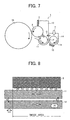
- the developer is difficult to have a uniform toner concentration between upstream and downstream sides of the screw 11 in Fig. 8 .
- the developer has less toner concentration downstream and images having uneven image density in the longitudinal direction of the developing sleeve 2 are likely to be produced.
- Japanese published unexamined patent application No. 5-333691 discloses a marketed functionally-separated image developer in which a screw and a feed route having been laterally located are vertically located to separate sections of feeding and collecting the developer, i.e., the developer is separated and collected by a lower screw 5 at a section 8 and the developer is fed by an upper screw 4 at a section 7.
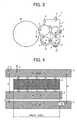
- Japanese published unexamined patent application No. 11-167260 discloses an image developer as shown in Figs. 3 and 4 , further including a section 9 besides the sections 7 and 8, having a stirrer 6 mixing and dispersing the collected developer and a toner fed from T to improve uniformity of the image density.
- the two screws vertically located in Figs. 5 and 6 save space more than the conventional two screws laterally located.
- the developer deposited is fed to the developing sleeve again or is not well mixed with a newly-fed toner, i.e., the developer is not fully stirred, resulting in uneven image density and deterioration of image density.
- Fig. 3 In order to solve this problem, three screws are effectively located as shown in Fig. 3 .
- the developer needs to be deposited at a stirring detour 9 apart from the developing sleeve, the low-concentration developer just after being collected not being fed to the developing sleeve again. Further, the collected developer and a newly-fed toner are sufficiently stirred at the stirring detour 9, which improves uneven image density.
- the image developer has a toner concentration sensor detecting a concentration of the developer.
- This is typically a sensor detecting a magnetic permeability of the developer and detects a toner concentration of a specific amount of the developer close thereto.
- the sensor power and the toner concentration have a linear relationship each other, and the sensor detects excess and deficiency of the toner to drive or stop a feeder of the developer.
- the developer has a part having a high toner concentration and a part having a low toner concentration while being stirred and transferred, resulting in uneven image density after all.
- polymerization toners frequently used lately are difficult to mix and disperse in image developers due to their shapes. This is because the polymerized toner having the shape of almost a sphere and a small particle diameter takes more time to mix with a developer in the image developer than conventional pulverization toners having a large particle diameter.
- the toner concentration detector typically measures the concentration of the toner in a developer fully mixed. However, when the developer insufficiently mixed is detected, excessive toner feeding is repeated, resulting in toner scattering, background fouling and uneven image density.
- an object of the present invention is to provide an image developer capable of improving the dispersibility of a developer even including a toner having poor mixability and dispersibility, and precisely detecting the toner concentration to prevent uneven toner concentration of the developer and uneven image density.
- Another object of the present invention is to provide an image forming apparatus using the image developer.
- the present invention provides an image developer capable of improving the dispersibility of a developer even including a toner having poor mixability and dispersibility, and precisely detecting the toner concentration to prevent uneven toner concentration of the developer and uneven image density. More particularly, the present invention relates to an image developer, comprising:
- Fig. 1 is a schematic view illustrating a cross-section of the image developer of the present invention, and of a photoreceptor.
- the surface of a rotatable photoreceptor 10 is uniformly charged with a charger (not shown).
- information based on an original read with an image reader (not shown) or information from a host PC is written thereon with a laser beam from a laser writer (not shown) to form an electrostatic latent image thereon.
- An image developer 1 includes a rotatable developing sleeve 2 including a magnetic material (not shown) and uniformly feeding a toner to the photoreceptor 10 to visualize the electrostatic latent image.
- the magnetic material holds a developer on the developing sleeve 2, and a doctor blade 3 regulates an amount thereof to be held.
- the doctor blade 3 is mostly a plate such as a stainless steel plate leaving from the developing sleeve 2 at a distance of 0.2 to 1.2 mm to form a uniform thin layer of the developer thereon and uniformly feed the developer to the electrostatic latent image on the photoreceptor 10 without irregularities.
- the image developer 1 is filled with a developer, and a consumed developer is replaced with a new developer in many cases.
- a feeder feeding a new developer and a collector separating and collecting a consumed developer are required close to the doctor blade.
- the magnetic material in the developing sleeve 2 is partially demagnetized.
- the feeder feeding the developer close to the developing sleeve 2 and doctor blade 3 may have the shape of a paddle capable of boosting and flipping up, and has the shape of a screw laterally transferring the developer as shown in Fig. 2 in the present invention.
- the collector collecting a separated developer also may have the shape of a paddle to quickly scrape up the developer, and preferably has the shape of a screw to transfer the developer in the axial direction of the developing sleeve 2.
- a developer is fed from a feeding screw 4 to the developing sleeve 2, the developer after being used for developing separates and leaves therefrom and is collected by a collection screw 5 as indicated by an arrow.
- the developer separated from the developing sleeve 2 is preferably collected quickly.
- a difference with a conventional image developer is using screws independently for feeding and collecting the developer.
- Figs. 7 and 8 only a single screw 11 transfers the developer to a developing sleeve 2.
- an excessive developer from a first transfer (feeding) route and a collection developer from a second transfer (collection) route are united, stirred and circulated to the first transfer (feeding) route through a third transfer (stirring detour) route.
- the developer circulated to the first transfer (feeding) route has a more uniform concentration of the toner, and high-quality images having a constant image density without uneven image density can be produced even when having a high image area.
- the conventional image developer has the same structures as the present invention in respect of a first transfer (feeding) route, a second transfer (collection) route and a third transfer (stirring detour) route.
- Three openings located on a downstream side of the feeding route to the stirring detour, from the collection route to the stirring detour, and from the stirring detour to the feeding route respectively are same as well.
- the conventional image developer has a toner concentration detector at the third transfer (stirring detour) route, different from the preferred downstream side of the second transfer (collection) route of the present invention.
- the conventional image developer has an opening for feeding toner on a downstream side of the first transfer (feeding) route and a toner concentration sensor detects the concentration of the developer after the toner is fed to, which is largely different from detecting the concentration of the developer before the toner is fed to of the present invention.
- the feeding screw 4 and collection screw 5 are separately located to perform independent functions.
- a housing of the image developer is located surrounding the feeding screw 4 and has a slit-shaped opening accommodating the doctor blade 3 and the developing sleeve 2 to form a section 7 therein.
- the housing is located surrounding the collection screw 5 and has a slit-shaped opening to the surface of the developing sleeve 2 to form a section 8 therein.
- the developer present at the sections 7 and 8 needs replacing in use.
- the conventional image developer in Figs. 5 and 6 has communicating openings of D and E through which the developer directly comes in and out.
- the developer needs depositing at the section 8.
- the developer is deposited at the opening D in Fig. 6 , i.e., on a lowermost downstream side of the collection screw 5 and is transferred to the feeding screw 4.
- the collection section 8 shown in Fig. 5 is filled with the developer and the developer directly enters the feeding section 7 along the surface of the developing sleeve 2 without passing the opening D. Most of the developer passes through the doctor blade, resulting in uneven image density.
- the detour transfer section 9 is located between the collection section 8 and the feeding section 7, in which the developer deposits to prevent the deposited developer from being fed to the developing sleeve 2 again.
- a stirring screw 6 is located in the detour transfer section to lengthen a stirring distance as long as possible because of preventing uneven image density due to insufficient mixing of the toner with the collected developer.
- the stirring distance is further extended with four screws in order to improve stirring performance.
- a feeding opening T of the toner fed from a feeder is located at the farthest distance from an opening B just before feeding the developer to the developing sleeve, and a toner concentration sensor 15 is preferably located at the farthest distance from the feeding opening where the developer deposits, i.e., close to the opening B where the developer is lifted up to the screw above.
- the toner sensor 15 is preferably located close to the opening B to detect the developer sufficiently stirred.
- the toner concentration sensor 15 is preferably located on a downstream side of the developer collection screw 5, which detects the developer before a new toner is fed thereto and an amount of the toner consumed, to feed just a necessary amount thereof to the image developer through the feeding opening T. Therefore, in the present invention, the toner concentration before the toner is fed to the developer is preferably detected, which is largely different from the conventional detection of the toner concentration after the toner is fed to the developer. It is not necessary to detect the toner concentration after the toner is fed thereto and it is necessary to precisely detect the toner concentration before the toner is fed thereto without delay.
- the image developer 1 includes three screws.
- the developer used for developing is mixed with the other developer just after separating and leaving from the developing sleeve 2. Therefore, it is impossible to detect the toner concentration before the toner is fed to the developer, and the toner feeding is controlled with the concentration thereof when the developer is mixed as above. For example, when images have a low image area, the toner is consumed less and the image density varies less. However, images having a large image area consume the toner more and the toner concentration in the image developer 1 partially differentiates, resulting in uneven image density. Conventionally, the toner consumption is forecasted from an image area and the toner is fed to the image developer to prevent uneven image density. However, it is complicated to control feeding the toner thereby.
- a toner feeding opening T is located at a downstream and of the developer feeding screw 4, as shown in Fig. 6 .
- the new developer is mixed with the collected developer, and the toner concentration of the developer before the toner is fed thereto is difficult to detect. Therefore, the toner concentration of the developer after the toner is fed thereto is detected, which is different from the present invention.
- the image developer 1 using three screws will be explained. As shown in Fig. 2 , the feeding screw 4 and collection screw 5 are located parallel to the developing sleeve 2, and the screws 4 and 5 transfer the developer in the axial direction of the developing sleeve 2.
- the detour transfer screw 6 transfers the developer in the direction opposite to those of the feeding screw 4 and collection screw 5. On the lowermost downstream side of the detour transfer screw 6, the developer needs transferring to the feeding section 7 where the feeding screw 4 is located through an opening B after depositing in the detour transfer section 9.
- a space between the detour transfer screw 6 and a developer container is preferably as small as possible, i.e., the detour transfer section 9 is preferably so formed as to surround the outer circumference of the screw, which effectively transfer the deposited developer.
- the toner concentration sensor 15 detects the toner consumption, i.e., an amount of the toner required on a downstream side of the collection screw 5 to drive a toner feeder in real time. Therefore, the developer in the stirring transfer section 9 and the stirring transfer screw 6 has a stable toner concentration.
- the present invention largely improves uneven image density without using the complicated forecast of the toner consumption based on the image area.
- the toner preferably has a volume-average particle diameter of from 3 to 8 ⁇ m to produce an image of 600 dpi.
- the toner preferably has a ratio (Dv/Dn) of the volume-average particle diameter thereof to a number-average particle diameter thereof of from 1.00 to 1.40. The closer to 1.00, the sharper the particle diameter distribution.
- Coulter Counter TA-II and Coulter Multisizer II from Beckman Coulter Inc. are used for measuring the particle diameter distribution as follows:
- the toner preferably has a shape factor SF-1 of from 100 to 180, and a shape factor SF-2 of from 100 to 180.
- Figs. 9 and 10 are schematic views illustrating shapes of toners for explaining shape factors SF-1 and SF-2.
- the toner When the SF-1 is 100, the toner has the shape of a complete sphere. As SF-1 becomes greater, the toner becomes more amorphous.
- SF-2 represents the concavity and convexity of the shape of the toner, and specifically a square of the peripheral length of an image projected on a two-dimensional flat surface (PERI) is divided by an area of the image (AREA) and multiplied by 100 ⁇ /4 to determine SF-2 as the following formula (2) shows.
- SF - 2 PERI 2 / AREA ⁇ 100 ⁇ ⁇ / 4
- the shape factors are measured by photographing the toner with a scanning electron microscope (S-800) from Hitachi, Ltd. and analyzing the photographed image of the toner with an image analyzer Luzex III from NIRECO Corp.
- the toner When the shape of a toner is close to a sphere, the toner contacts the other toner or a photoreceptor at a point. Therefore, the toners adhere less each other and have higher fluidity. In addition, the toner and the photoreceptor adhere less to each other, and transferability of the toner improves. When SF-1 or SF-2 is more than 180, the transferability thereof deteriorates.
- the toner preferably used for the image forming apparatus of the present invention is formed by a crosslinking and/or an elongation reaction of a toner constituent liquid including at least polyester prepolymer having a functional group including a nitrogen atom, polyester, a colorant, a charge controlling agent and a release agent dispersed in an organic solvent in an aqueous medium.
- a toner constituent liquid including at least polyester prepolymer having a functional group including a nitrogen atom, polyester, a colorant, a charge controlling agent and a release agent dispersed in an organic solvent in an aqueous medium.
- the polyester is formed by polycondensating a polyol compound and a polycarboxylic compound.
- the polyol (PO), diol (DIO) and triol (TO) can be used, and the DIO alone or a mixture of the DIO and a small amount of the TO is preferably used.
- the DIO include alkylene glycol such as ethylene glycol, 1,2-propylene glycol, 1,3-propylene glycol, 1,4-butanediol, and 1,6 -hexanediol; alkylene ether glycol such as diethylene glycol, triethylene glycol, dipropylene glycol, polyethylene glycol, polypropylene glycol and polytetramethylene ether glycol; alicyclic diol such as 1,4-cyclohexanedimethanol and hydrogenated bisphenol A; bisphenol such as bisphenol A, bisphenol F and bisphenol S; adducts of the above-mentioned alicyclic diol with an alkylene oxide such as ethylene oxide, propylene oxide and butylene oxide; and adducts of the D
- alkylene glycol having 2 to 12 carbon atoms and adducts of bisphenol with an alkylene oxide are preferably used, and a mixture thereof is more preferably used.
- the TO include multivalent aliphatic alcohol having 3 to 8 or more valences such as glycerin, trimethylolethane, trimethylolpropane, pentaerythritol and sorbitol; phenol having 3 or more valences such as trisphenol PA, phenolnovolak, cresolnovolak; and adducts of the above-mentioned polyphenol having 3 or more valences with an alkylene oxide.
- dicarboxylic acid DIC
- tricarboxylic acid TC
- the DIC alone, or a mixture of the DIC and a small amount of the TC are preferably used.
- Specific examples of the DIC include alkylene dicarboxylic acids such as succinic acid, adipic acid and sebacic acid; alkenylene dicarboxylic acid such as maleic acid and fumaric acid; and aromatic dicarboxylic acids such as phthalic acid, isophthalic acid, terephthalic acid and naphthalene dicarboxylic acid.
- alkenylene dicarboxylic acid having 4 to 20 carbon atoms and aromatic dicarboxylic acid having 8 to 20 carbon atoms are preferably used.
- Specific examples of the TC include aromatic polycarboxylic acids having 9 to 20 carbon atoms such as trimellitic acid and pyromellitic acid.
- PC can be formed from a reaction between the PO and the above-mentioned acids anhydride or lower alkyl ester such as methyl ester, ethyl ester and isopropyl ester.
- the PO and PC are mixed such that an equivalent ratio ( [OH] / [COOH] ) between a hydroxyl group [OH] and a carboxylic group [COOH] is typically from 2/1 to 1/1, preferably from 1.5/1 to 1/1, and more preferably from 1.3/1 to 1.02/1.
- the polycondensation reaction between the PO and PC is performed by heating the Po and PC at from 150 to 280°C in the presence of a known esterification catalyst such as tetrabutoxytitanate and dibutyltinoxide and removing produced water while optionally depressurizing to prepare polyester having a hydroxyl group.
- the polyester preferably has a hydroxyl value not less than 5, and an acid value of from 1 to 30 and more preferably from 5 to 20.
- the polyester When the polyester has an acid value within the range, the resultant toner tends to be negatively charged to have good affinity with a recording paper and low-temperature fixability of the toner on the recording paper improves. However, when the acid value is greater than 30, the resultant toner is not stably charged and the stability becomes worse by environmental variations.
- the polyester preferably has a weight-average molecular weight of from 10, 000 to 400, 000, and more preferably from 20,000 to 200,000. When the weight-average molecular weight is less than 10,000, offset resistance of the resultant toner deteriorates. When greater than 400,000, low-temperature fixability thereof deteriorates.
- the polyester preferably includes a urea-modified polyester besides an unmodified polyester formed by the above-mentioned polycondensation reaction.
- the urea-modified polyester is formed by reacting a polyisocyanate compound (PIC) with a carboxyl group or a hydroxyl group at the end of the polyester formed by the above-mentioned polycondensation reaction to form a polyester prepolymer (A) having an isocyanate group, and reacting amine with the polyester prepolymer (A) to crosslink and/or elongate a molecular chain thereof.
- PIC polyisocyanate compound
- the PIC include aliphatic polyisocyanate such as tetramethylenediisocyanate, hexamethylenediisocyanate and 2,6-diisocyanatemethylcaproate; alicyclic polyisocyanate such as isophoronediisocyanate and cyclohexylmethanediisocyanate; aromatic diisocyanate such as tolylenedisocyanate and diphenylmethanediisocyanate; aromatic aliphatic diisocyanate such as ⁇ , ⁇ , ⁇ ', ⁇ '-tetramethylxylylenediisocyanate; isocyanurate; the above-mentioned polyisocyanate blocked with phenol derivatives, oxime and caprolactam; and their combinations.
- aliphatic polyisocyanate such as tetramethylenediisocyanate, hexamethylenediisocyanate and 2,6-diisocyanatemethylcaproate
- the PIC is mixed with polyester such that an equivalent ratio ( [NCO] / [OH] ) between an isocyanate group [NCO] and polyester having a hydroxyl group [OH] is typically from 5/1 to 1/1, preferably from 4/1 to 1.2/1 and more preferably from 2.5/1 to 1.5/1.
- [NCO] / [OH] is greater than 5
- low temperature fixability of the resultant toner deteriorates.
- [NCO] has a molar ratio less than 1
- a urea content in ester of the modified polyester decreases and hot offset resistance of the resultant toner deteriorates.
- the polyester prepolymer (A) preferably includes a polyisocyanate group of from 0.5 to 40% by weight, more preferably from 1 to 30% by weight, and furthermore preferably from 2 to 20% by weight.
- a polyisocyanate group of from 0.5 to 40% by weight, more preferably from 1 to 30% by weight, and furthermore preferably from 2 to 20% by weight.
- the number of the isocyanate groups included in a molecule of the polyester prepolymer (A) is at least 1, preferably from 1. 5 to 3 on average, and more preferably from 1.8 to 2.5 on average.
- the number of the isocyanate group is less than 1 per 1 molecule, the molecular weight of the urea-modified polyester decreases and hot offset resistance of the resultant toner deteriorates.
- amines (B) reacted with the polyester prepolymer (A) include diamines (B1), polyamines (B2) having three or more amino groups, amino alcohols (B3), amino mercaptans (B4), amino acids (B5) and blocked amines (B6) in which the amines (B1-B5) mentioned above are blocked.
- diamines (B1) include aromatic diamines (e.g., phenylene diamine, diethyltoluene diamine and 4,4' -diaminodiphenyl methane); alicyclic diamines (e.g., 4,4'-diamino-3,3'-dimethyldicyclohexyl methane, diaminocyclohexane and isophoronediamine); aliphatic diamines (e.g., ethylene diamine, tetramethylene diamine and hexamethylene diamine); etc.
- polyamines (B2) having three or more amino groups include diethylene triamine,triethylene tetramine.
- amino alcohols (B3) include ethanol amine and hydroxyethyl aniline.
- amino mercaptan (B4) include aminoethyl mercaptan and aminopropyl mercaptan.
- amino acids (B5) include amino propionic acid and amino caproic acid.
- Specific examples of the blocked amines (B6) include ketimine compounds which are prepared by reacting one of the amines B1-B5 mentioned above with a ketone such as acetone, methyl ethyl ketone and methyl isobutyl ketone; oxazoline compounds, etc.
- diamines (B1) and mixtures in which a diamine is mixed with a small amount of a polyamine (B2) are preferably used.
- a mixing ratio (i.e., a ratio [ NCO] /[ NHx] ) of the content of the prepolymer (A) having an isocyanate group to the amine (B) is from 1/2 to 2/1, preferably from 1. 5/1 to 1/1.5 and more preferably from 1.2/1 to 1/1.2.
- the mixing ratio is greater than 2 or less than 1/2, molecular weight of the urea-modified polyester decreases, resulting in deterioration of hot offset resistance of the toner.
- the urea-modified polyester may include a urethane bonding as well as a urea bonding.
- the molar ratio (urea/urethane) of the urea bonding to the urethane bonding is from 100/0 to 10/90, preferably from 80/20 to 20/80 and more preferably from 60/40 to 30/70.
- the urea-modified polyester can be prepared by a method such as a one-shot method.
- the PO and PC are heated at from 150 to 280°C in the presence of a known esterification catalyst such as tetrabutoxytitanate and dibutyltinoxide and removing produced water while optionally depressurizing to prepare polyester having a hydroxyl group.
- a known esterification catalyst such as tetrabutoxytitanate and dibutyltinoxide
- the polyisocyanate is reacted with the polyester at from 40 to 140°C to form a polyester prepolymer (A) having an isocyanate group.
- the amines (B) are reacted with the (A) at from 0 to 140°C to form a urea-modified polyester.
- a solvent may optionally be used.
- the solvents include inactive solvents with the PIC such as aromatic solvents such as toluene and xylene; ketones such as acetone, methyl ethyl ketone and methyl isobutyl ketone; esters such as ethyl acetate; amides such as dimethylformamide and dimethylacetamide; and ethers such as tetrahydrofuran.
- a reaction terminator can optionally be used in the crosslinking and/or elongation reaction between the (A) and (B) to control a molecular weight of the resultant urea-modified polyester.
- reaction terminators include monoamines such as diethylamine, dibutylamine, butylamine and laurylamine; and their blocked compounds such as ketimine compounds.
- the weight-average molecular weight of the urea-modified polyester is not less than 10,000, preferably from 20,000 to 10, 000, 000 and more preferably from 30, 000 to 1, 000, 000. When the weight-average molecular weight is less than 10,000, hot offset resistance of the resultant toner deteriorates.
- the number-average molecular weight of the urea-modified polyester is not particularly limited when the after-mentioned unmodified polyester resin is used in combination. Namely, the weight-average molecular weight of the urea-modified polyester resins has priority over the number-average molecular weight thereof.
- the number-average molecular weight is from 2,000 to 15, 000, preferably from 2, 000 to 10,000 and more preferably from 2,000 to 8,000.
- the number-average molecular weight is greater than 20,000, the low temperature fixability of the resultant toner deteriorates, and in addition the glossiness of full color images deteriorates.
- a combination of the urea-modified polyester and the unmodified polyester improves low temperature fixability of the resultant toner and glossiness of color images produced thereby, and is more preferably used than using the urea-modified polyester alone.
- the unmodified polyester may include modified polyester except for the urea-modified polyester.
- the urea-modified polyester at least partially mixes with the unmodified polyester to improve the low temperature fixability and hot offset resistance of the resultant toner. Therefore, the urea-modified polyester preferably has a structure similar to that of the unmodified polyester.
- a mixing ratio between the unmodified polyester and urea-modified polyester is from 20/80 to 95/5, preferably from 70/30 to 95/5, more preferably from 75/25 to 95/5, and even more preferably from 80/20 to 93/7.
- the urea-modified polyester is less than 5%, the hot offset resistance deteriorates, and in addition, it is disadvantageous to have both high temperature preservability and low temperature fixability.
- the binder resin including the unmodified polyester and urea-modified polyester preferably has a glass transition temperature (Tg) of from 45 to 65°C, and preferably from 45 to 60°C.
- Tg glass transition temperature
- the glass transition temperature is less than 45°C, the high temperature preservability of the toner deteriorates.
- higher than 65°C the low temperature fixability deteriorates.
- the resultant toner has better heat resistance preservability than known polyester toners even though the glass transition temperature of the urea-modified polyester is low.
- colorants for use in the present invention include any known dyes and pigments such as carbon black, Nigrosine dyes, black iron oxide, NAPHTHOL YELLOW S, HANSA YELLOW (10G, 5G and G), Cadmium Yellow, yellow iron oxide, loess, chrome yellow, Titan Yellow, polyazo yellow, Oil Yellow, HANSA YELLOW (GR, A, RN and R), Pigment Yellow L, BENZIDINE YELLOW (G and GR), PERMANENT YELLOW (NCG), VULCAN FAST YELLOW (5G and R), Tartrazine Lake, Quinoline Yellow Lake, ANTHRAZANE YELLOW BGL, isoindolinone yellow, red iron oxide, red lead, orange lead, cadmium red, cadmium mercury red, antimony orange, Permanent Red 4R, Para Red, Fire Red, p-chloro-o-nitroaniline red, Lithol Fast Scarlet G, Brilliant Fast Scarlet, Brilliant Carmine BS,
- the colorant for use in the present invention can be used as a masterbatch pigment when combined with a resin.
- the resin for use in the masterbacth pigment or for use in combination with masterbacth pigment include the modified and unmodified polyester resins mentioned above; styrene polymers and substituted styrene polymers such as polystyrene, poly-p-chlorostyrene and polyvinyltoluene; or their copolymers with vinyl compounds; polymethyl methacrylate, polybutylmethacrylate, polyvinyl chloride, polyvinyl acetate, polyethylene, polypropylene, polyesters, epoxy resins, epoxy polyol resins, polyurethane resins, polyamide resins, polyvinyl butyral resins, acrylic resins, rosin, modified rosins, terpene resins, aliphatic or alicyclic hydrocarbon resins, aromatic petroleum resins, chlorinated paraffin, paraffin waxes, etc. These resins are used
- charge controlling agent examples include known charge controlling agents such as Nigrosine dyes, triphenylmethane dyes, metal complex dyes including chromium, chelate compounds of molybdic acid, Rhodamine dyes, alkoxyamines, quaternary ammonium salts (including fluorine-modified quaternary ammonium salts), alkylamides, phosphor and compounds including phosphor, tungsten and compounds including tungsten, fluorine-containing activators, metal salts of salicylic acid, salicylic acid derivatives, etc.
- charge controlling agents such as Nigrosine dyes, triphenylmethane dyes, metal complex dyes including chromium, chelate compounds of molybdic acid, Rhodamine dyes, alkoxyamines, quaternary ammonium salts (including fluorine-modified quaternary ammonium salts), alkylamides, phosphor and compounds including phosphor, tungsten and compounds including tungsten, fluor
- the content of the charge controlling agent is determined depending on the species of the binder resin used, whether or not an additive is added and toner manufacturing method (such as dispersion method) used, and is not particularly limited.
- the content of the charge controlling agent is typically from 0.1 to 10 parts by weight, and preferably from 0.2 to 5 parts by weight, per 100 parts by weight of the binder resin included in the toner.
- the content is too high, the toner has too large charge quantity, and thereby the electrostatic force of a developing roller attracting the toner increases, resulting in deterioration of the fluidity of the toner and decrease of the image density of toner images.
- a wax for use in the toner of the present invention as a release agent has a low melting point of from 50 to 120°C.
- the wax is dispersed in the binder resin and serves as a release agent at a location between a fixing roller and the toner particles.
- the release agent include natural waxes such as vegetable waxes, e.g., carnauba wax, cotton wax, Japan wax and rice wax; animal waxes, e.g., bees wax and lanolin; mineral waxes, e.g., ozokerite and ceresine; and petroleum waxes, e.g., paraffin waxes, microcrystalline waxes and petrolatum.
- synthesized waxes can also be used.
- Specific examples of the synthesized waxes include synthesized hydrocarbon waxes such as Fischer-Tropsch waxes and polyethylene waxes; and synthesized waxes such as ester waxes, ketone waxes and ether waxes.
- fatty acid amides such as 1,2-hydroxylstearic acid amide, stearic acid amide and phthalic anhydride imide
- low molecular weight crystalline polymers such as acrylic homopolymer and copolymers having a long alkyl group in their side chain, e.g., poly-n-stearyl methacrylate, poly-n-laurylmethacrylate and n-stearyl acrylate-ethyl methacrylate copolymers, can also be used.
- charge controlling agent and release agents can be dissolved and dispersed after kneaded upon application of heat together with a master batch pigment and a binder resin, and can be added when directly dissolved or dispersed in an organic solvent.
- the toner particles are preferably mixed with an external additive to assist in improving the fluidity, developing property and charging ability of the toner particles.
- Suitable external additives include inorganic particulate materials. It is preferable for the inorganic particulate materials to have a primary particle diameter of from 5 nm to 2 ⁇ m, and more preferably from 5 nm to 500 nm. In addition, it is preferable that the specific surface area of such particulate inorganic materials measured by a BET method is from 20 to 500 m 2 /g.
- the content of the external additive is preferably from 0.01 to 5% by weight, and more preferably from 0.01 to 2.0% by weight, based on total weight of the toner composition.
- inorganic particulate materials include silica, alumina, titanium oxide, barium titanate, magnesium titanate, calcium titanate, strontiumtitanate, zinc oxide, tin oxide, quartz sand, clay, mica, sand-lime, diatomearth, chromiumoxide, ceriumoxide, red iron oxide, antimony trioxide, magnesium oxide, zirconium oxide, barium sulfate, barium carbonate, calcium carbonate, silicon carbide, silicon nitride, etc.
- a combination of a hydrophobic silica and a hydrophobic titanium oxide is preferably used.
- the electrostatic force and van der Waals' force between the external additive and the toner particles are improved, and thereby the resultant toner composition has a proper charge quantity.
- the external additive is hardly released from the toner particles, and thereby image defects such as white spots and image omissions are hardly produced. Further, the quantity of particles of the toner composition remaining on image bearing members can be reduced.
- the resultant toner composition can stably produce toner images having a proper image density even when environmental conditions are changed.
- the charge rising properties of the resultant toner tend to deteriorate. Therefore the addition quantity of a particulate titanium oxide is preferably smaller than that of a particulate silica, and in addition the total addition amount thereof is preferably from 0.3 to 1.5% by weight based on weight of the toner particles not to deteriorate the charge rising properties and to stably produce good images.
- a method of preparing the toner of the present invention is explained, but is not limited thereto.
- a toner having a small particle diameter and a sharp particle diameter distribution can be obtained.
- the strong agitation in the process of removing the organic solvent can control the shape of a toner from a sphere to a rugby ball, and the surface morphology thereof from being smooth to a pickled plum.
- the toner for use in the present invention has the shape of almost a sphere, which can be specified as follows.
- Fig. 11A is an external view of the toner
- Figs. 11B and 11C are cross sections of the toner, wherein the toner preferably satisfies the following relationship: 0.5 ⁇ ( R 2 / R 1 ) ⁇ 1.0 and 0.7 ⁇ r 3 / r 2 ⁇ 1.0 wherein r 1 , r 2 and r 3 represent the average major axis particle diameter, the average minor axis particle diameter and the average thickness of particles of the toner respectively, and wherein r 3 ⁇ r 2 ⁇ r 1 .
- the toner When the ratio (r 2 /r 1 ) is too small, the toner has a form far away from the spherical form, and therefore the toner has poor dot reproducibility and transferability, resulting in deterioration of the image quality. When the ratio (r 3 /r 2 ) is too small, the toner has a form far away from the spherical form, and therefore the toner has poor transferability. When the ratio (r 3 /r 2 ) is 1.0, the toner has a form similar to the spherical form, and therefore the toner has good fluidity.
- r 1 , r 2 and r 3 size factors (i.e., r 1 , r 2 and r 3 ) of toner particles can be determined as follows:
- the toner prepared by polymerization methods has the shape of almost a sphere and a small particle diameter, but has lightly poor mixability and dispersibility with a developer in an image developer.
- the image developer having three screws, i.e., the feeding screw 4, the collection screw 5 and the stirring transfer screw 6 which are functionally-independent largely improves the mixability and dispersibility of a toner having the shape of almost a sphere and a small particle diameter.
- the toner concentration sensor 15 detects the toner consumption, i.e., an amount of the toner required on a downstream side of the collection screw 5 to drive a toner feeder in real time. Therefore, the developer including even the toner prepared by polymerization methods, which is likely to be insufficiently mixed in the stirring transfer section 9 and the stirring transfer screw 6 has a stable toner concentration. As a result, the image developer produces images without uneven image density.
- the present invention provides an image developer and an image forming apparatus capable of improving the dispersibility of a developer even including a toner having poor mixability and dispersibility, and precisely detecting the toner concentration to prevent uneven toner concentration of the developer and uneven image density.
- the image developer and image forming apparatus produce images without toner scattering or background fouling due to repeated excessive supplies of a toner, using a wide range of toners.
- the developer for use in the present invention is typically a two-component developer including a magnetic carrier and a non-magnetic toner.
- the developer is not limited thereto and other two-component developers, e.g., including a magnetic carrier and a magnetic toner can be used therein.
Landscapes
- Physics & Mathematics (AREA)
- General Physics & Mathematics (AREA)
- Chemical & Material Sciences (AREA)
- Chemical Kinetics & Catalysis (AREA)
- Spectroscopy & Molecular Physics (AREA)
- Developing Agents For Electrophotography (AREA)
- Dry Development In Electrophotography (AREA)
Abstract
Description
- The present invention relates to an image developer and to image forming apparatuses, particularly to copiers, facsimiles, printers and complex machines having these functions using electrophotographic processes.
- Recently, stable image quality which is free from uneven image density even when high-density or full-color images having a large image area are continuously produced is demanded.
- Therefore, the image developer needs to separate and collect the developer from the developer bearer (herein after referred to as a developing sleeve) after producing images having a large image area consuming a large amount of the toner, feed the toner to the developer and uniformly disperse the toner therein to resume the original toner concentration, and quickly feed the developer to the developing sleeve.
- However, in a conventional image developer as shown in
Fig. 7 , since a part separating the developer used for the development from the developingsleeve 2 and collecting the developer to a developer feeder 11 (hereinafter referred to as a screw) is close to a part feeding the new developer to the developing sleeve, the used developer is fed to the developingsleeve 2 again without a new toner, resulting in uneven image density. - In addition, since the collected developer and the developer being fed are mixed in a
same section 13, the developer is difficult to have a uniform toner concentration between upstream and downstream sides of thescrew 11 inFig. 8 . The developer has less toner concentration downstream and images having uneven image density in the longitudinal direction of the developingsleeve 2 are likely to be produced. - As shown in
Figs. 5 and 6 , Japanese published unexamined patent application No.5-333691 lower screw 5 at asection 8 and the developer is fed by anupper screw 4 at asection 7. - However, at a communicating route D where the
lower screw 5 transfers the developer to thescrew 4, the developer needs to be deposited and the developer is fed from thesection 8 to thesection 7, i.e., the used developer is directly fed to the developingsleeve 2 again, resulting in uneven image density. - In addition, only the lower and upper screws do not fully stir the developer, resulting in uneven image density and deterioration of image density. Japanese published unexamined patent application No.
11-167260 Figs. 3 and 4 , further including asection 9 besides thesections stirrer 6 mixing and dispersing the collected developer and a toner fed from T to improve uniformity of the image density. - The two screws vertically located in
Figs. 5 and 6 save space more than the conventional two screws laterally located. However, as mentioned above, the developer deposited is fed to the developing sleeve again or is not well mixed with a newly-fed toner, i.e., the developer is not fully stirred, resulting in uneven image density and deterioration of image density. - In order to solve this problem, three screws are effectively located as shown in
Fig. 3 . The developer needs to be deposited at a stirringdetour 9 apart from the developing sleeve, the low-concentration developer just after being collected not being fed to the developing sleeve again. Further, the collected developer and a newly-fed toner are sufficiently stirred at the stirringdetour 9, which improves uneven image density. - On the other hand, the image developer has a toner concentration sensor detecting a concentration of the developer. This is typically a sensor detecting a magnetic permeability of the developer and detects a toner concentration of a specific amount of the developer close thereto. The sensor power and the toner concentration have a linear relationship each other, and the sensor detects excess and deficiency of the toner to drive or stop a feeder of the developer.
- In order to detect whether a proper amount of the toner is fed, it is necessary to detect the developer fully dispersed and mixed and a specific distance is required between a position from which the toner is fed and a position where the toner concentration is detected.
- However, it is impossible to reduce the toner from or add the toner to the developer between these positions even when the toner is excessively or insufficiently fed from the position from which the toner is fed. Therefore, the developer has a part having a high toner concentration and a part having a low toner concentration while being stirred and transferred, resulting in uneven image density after all.
- In addition, polymerization toners frequently used lately are difficult to mix and disperse in image developers due to their shapes. This is because the polymerized toner having the shape of almost a sphere and a small particle diameter takes more time to mix with a developer in the image developer than conventional pulverization toners having a large particle diameter.
- The toner concentration detector typically measures the concentration of the toner in a developer fully mixed. However, when the developer insufficiently mixed is detected, excessive toner feeding is repeated, resulting in toner scattering, background fouling and uneven image density.
- Because of these reasons, a need exists for an image developer and an image forming apparatus capable of improving the dispersibility of a developer even including a toner having poor mixability and dispersibility, and precisely detecting the toner concentration to prevent uneven toner concentration of the developer and uneven image density.
- Accordingly, an object of the present invention is to provide an image developer capable of improving the dispersibility of a developer even including a toner having poor mixability and dispersibility, and precisely detecting the toner concentration to prevent uneven toner concentration of the developer and uneven image density.
- Another object of the present invention is to provide an image forming apparatus using the image developer. These objects and other objects of the present invention, either individually or collectively, have been satisfied by the discovery of an image developer, comprising:
- a developer bearer configured to be rotatable facing an electrostatic latent image bearer;
- a developer feeder configured to feed a developer comprising a toner to the developer bearer;
- a developer collector configured to collect the developer which is left on the developer bearer after the developer is fed to the electrostatic latent image bearer and which is often separated from the developer bearer;
- a detour route configured to stir the developer and transfer the developer from the developer collector to the developer feeder;
- a first opening configured to connect the developer feeder with the detour route;
- a second opening configured to connect the detour route with the developer collector; and
- a third opening configured to connect to a developer supplier, configured to supply the developer to the image developer
- These and other objects, features and advantages of the present invention will become apparent upon consideration of the following description of the preferred embodiments of the present invention taken in conjunction with the accompanying drawings.
- Various other objects, features and attendant advantages of the present invention will be more fully appreciated as the same becomes better understood from the detailed description when considered in connection with the accompanying drawings in which like reference characters designate like corresponding parts throughout and wherein:
-
Fig. 1 is a schematic view illustrating a cross-section of the image developer of the present invention, and of a photoreceptor; -
Fig. 2 is an explanatory drawing of the developer circulation of the present invention; -
Fig. 3 is a schematic view illustrating a cross-section of an image developer having a detour transfer route, and of a photoreceptor, which may be used in the invention; -
Fig. 4 is an explanatory drawing of the developer circulation inFig. 3 ; -
Fig. 5 is a schematic view illustrating a cross-section of a conventional image developer having vertically-located two screws, and of a photoreceptor; -
Fig. 6 is an explanatory drawing of the developer circulation inFig. 5 ; -
Fig. 7 is a schematic view illustrating a cross-section of a conventional image developer, and of a photoreceptor; -
Fig. 8 is an explanatory drawing of the developer circulation inFig. 7 ; -
Fig. 9 is a schematic view for explaining a shape of the toner of the present invention; -
Fig. 10 is a schematic view for explaining a shape of the toner of the present invention; and -
Figs. 11A to 11C are schematic views for explaining a shape of the toner of the present invention; - The present invention provides an image developer capable of improving the dispersibility of a developer even including a toner having poor mixability and dispersibility, and precisely detecting the toner concentration to prevent uneven toner concentration of the developer and uneven image density. More particularly, the present invention relates to an image developer, comprising:
- a developer bearer configured to be rotatable facing an electrostatic latent image bearer;
- a developer feeder configured to feed a developer comprising a toner to the developer bearer;
- a developer collector configured to collect the developer which is left on the developer bearer after the developer is fed to the electrostatic latent image bearer and which is then separated from the developer bearer;
- a detour route configured to stir the developer and transfer the developer from the developer feeder to the developer collector;
- a first opening configured to connect the developer feeder with the detour route;
- a second opening configured to connect the detour route with the developer collector; and
- a third opening configured to connect to a developer supplier, configured to supply the developer to the image developer
- An embodiment of the present invention will be explained, referring to
Figs. 1 and 2 . -
Fig. 1 is a schematic view illustrating a cross-section of the image developer of the present invention, and of a photoreceptor. First, the surface of arotatable photoreceptor 10 is uniformly charged with a charger (not shown). Next, information based on an original read with an image reader (not shown) or information from a host PC is written thereon with a laser beam from a laser writer (not shown) to form an electrostatic latent image thereon. - An
image developer 1 includes a rotatable developingsleeve 2 including a magnetic material (not shown) and uniformly feeding a toner to thephotoreceptor 10 to visualize the electrostatic latent image. The magnetic material holds a developer on the developingsleeve 2, and adoctor blade 3 regulates an amount thereof to be held. - The
doctor blade 3 is mostly a plate such as a stainless steel plate leaving from the developingsleeve 2 at a distance of 0.2 to 1.2 mm to form a uniform thin layer of the developer thereon and uniformly feed the developer to the electrostatic latent image on thephotoreceptor 10 without irregularities. - The
image developer 1 is filled with a developer, and a consumed developer is replaced with a new developer in many cases. A feeder feeding a new developer and a collector separating and collecting a consumed developer are required close to the doctor blade. In order to separate a consumed developer, the magnetic material in the developingsleeve 2 is partially demagnetized. - Next, the developer movement in the
image developer 1 will be explained. The feeder feeding the developer close to the developingsleeve 2 anddoctor blade 3 may have the shape of a paddle capable of boosting and flipping up, and has the shape of a screw laterally transferring the developer as shown inFig. 2 in the present invention. - The collector collecting a separated developer also may have the shape of a paddle to quickly scrape up the developer, and preferably has the shape of a screw to transfer the developer in the axial direction of the developing
sleeve 2. - In
Fig. 2 ,a developer is fed from a feedingscrew 4 to the developingsleeve 2, the developer after being used for developing separates and leaves therefrom and is collected by acollection screw 5 as indicated by an arrow. The developer separated from the developingsleeve 2 is preferably collected quickly. - A difference with a conventional image developer is using screws independently for feeding and collecting the developer. In
Figs. 7 and 8 , only asingle screw 11 transfers the developer to a developingsleeve 2. InFigs. 7 and 8 , an excessive developer from a first transfer (feeding) route and a collection developer from a second transfer (collection) route are united, stirred and circulated to the first transfer (feeding) route through a third transfer (stirring detour) route. The developer circulated to the first transfer (feeding) route has a more uniform concentration of the toner, and high-quality images having a constant image density without uneven image density can be produced even when having a high image area. The conventional image developer has the same structures as the present invention in respect of a first transfer (feeding) route, a second transfer (collection) route and a third transfer (stirring detour) route. Three openings located on a downstream side of the feeding route to the stirring detour, from the collection route to the stirring detour, and from the stirring detour to the feeding route respectively are same as well. However, the conventional image developer has a toner concentration detector at the third transfer (stirring detour) route, different from the preferred downstream side of the second transfer (collection) route of the present invention. - The conventional image developer has an opening for feeding toner on a downstream side of the first transfer (feeding) route and a toner concentration sensor detects the concentration of the developer after the toner is fed to, which is largely different from detecting the concentration of the developer before the toner is fed to of the present invention.
- In the
image developer 1 inFigs. 1 and 2 , the feedingscrew 4 andcollection screw 5 are separately located to perform independent functions. A housing of the image developer is located surrounding the feedingscrew 4 and has a slit-shaped opening accommodating thedoctor blade 3 and the developingsleeve 2 to form asection 7 therein. Similarly, the housing is located surrounding thecollection screw 5 and has a slit-shaped opening to the surface of the developingsleeve 2 to form asection 8 therein. - The developer present at the
sections Figs. 5 and 6 has communicating openings of D and E through which the developer directly comes in and out. In order to transfer the developer from thesection 8 to thesection 7, the developer needs depositing at thesection 8. The developer is deposited at the opening D inFig. 6 , i.e., on a lowermost downstream side of thecollection screw 5 and is transferred to thefeeding screw 4. - However, when the deposited developer reaches the inside of the axial direction of the developing
sleeve 2 shown inFig. 6 , i.e., an image area, thecollection section 8 shown inFig. 5 is filled with the developer and the developer directly enters thefeeding section 7 along the surface of the developingsleeve 2 without passing the opening D. Most of the developer passes through the doctor blade, resulting in uneven image density. As shown inFigs. 3 and 4 , thedetour transfer section 9 is located between thecollection section 8 and thefeeding section 7, in which the developer deposits to prevent the deposited developer from being fed to the developingsleeve 2 again. InFigs. 3 and 4 , a stirringscrew 6 is located in the detour transfer section to lengthen a stirring distance as long as possible because of preventing uneven image density due to insufficient mixing of the toner with the collected developer. In addition, it is suggested that the stirring distance is further extended with four screws in order to improve stirring performance. - In
Figs. 3 and 4 , a feeding opening T of the toner fed from a feeder (not shown) is located at the farthest distance from an opening B just before feeding the developer to the developing sleeve, and atoner concentration sensor 15 is preferably located at the farthest distance from the feeding opening where the developer deposits, i.e., close to the opening B where the developer is lifted up to the screw above. - This is because the
toner sensor 15 is preferably located close to the opening B to detect the developer sufficiently stirred. In the present invention, as shown inFig. 1 , thetoner concentration sensor 15 is preferably located on a downstream side of thedeveloper collection screw 5, which detects the developer before a new toner is fed thereto and an amount of the toner consumed, to feed just a necessary amount thereof to the image developer through the feeding opening T. Therefore, in the present invention, the toner concentration before the toner is fed to the developer is preferably detected, which is largely different from the conventional detection of the toner concentration after the toner is fed to the developer. It is not necessary to detect the toner concentration after the toner is fed thereto and it is necessary to precisely detect the toner concentration before the toner is fed thereto without delay. In addition, in the present invention, theimage developer 1 includes three screws.
In the conventional image developer inFig. 7 , the developer used for developing is mixed with the other developer just after separating and leaving from the developingsleeve 2. Therefore, it is impossible to detect the toner concentration before the toner is fed to the developer, and the toner feeding is controlled with the concentration thereof when the developer is mixed as above. For example, when images have a low image area, the toner is consumed less and the image density varies less. However, images having a large image area consume the toner more and the toner concentration in theimage developer 1 partially differentiates, resulting in uneven image density. Conventionally, the toner consumption is forecasted from an image area and the toner is fed to the image developer to prevent uneven image density. However, it is complicated to control feeding the toner thereby. In the image developer vertically including two screws, a toner feeding opening T is located at a downstream and of thedeveloper feeding screw 4, as shown inFig. 6 . - However, the new developer is mixed with the collected developer, and the toner concentration of the developer before the toner is fed thereto is difficult to detect. Therefore, the toner concentration of the developer after the toner is fed thereto is detected, which is different from the present invention.
- The
image developer 1 using three screws will be explained. As shown inFig. 2 , the feedingscrew 4 andcollection screw 5 are located parallel to the developingsleeve 2, and thescrews sleeve 2. - The
detour transfer screw 6 transfers the developer in the direction opposite to those of the feedingscrew 4 andcollection screw 5. On the lowermost downstream side of thedetour transfer screw 6, the developer needs transferring to thefeeding section 7 where the feedingscrew 4 is located through an opening B after depositing in thedetour transfer section 9. A space between thedetour transfer screw 6 and a developer container is preferably as small as possible, i.e., thedetour transfer section 9 is preferably so formed as to surround the outer circumference of the screw, which effectively transfer the deposited developer. - In the image developer including three functionally-independent screws, i.e., the feeding
screw 4, thecollection screw 5 and the stirringtransfer screw 6, thetoner concentration sensor 15 detects the toner consumption, i.e., an amount of the toner required on a downstream side of thecollection screw 5 to drive a toner feeder in real time. Therefore, the developer in the stirringtransfer section 9 and the stirringtransfer screw 6 has a stable toner concentration. - In combination with the conventional art of the location of the toner concentration sensor, the present invention largely improves uneven image density without using the complicated forecast of the toner consumption based on the image area.
- This is not only the case where the feeding screw is above the collection screw, but also the case where the collection screw is above the feeding screw.
- Next, a toner preferably used in the present invention will be explained. The toner preferably has a volume-average particle diameter of from 3 to 8 µm to produce an image of 600 dpi. The toner preferably has a ratio (Dv/Dn) of the volume-average particle diameter thereof to a number-average particle diameter thereof of from 1.00 to 1.40. The closer to 1.00, the sharper the particle diameter distribution.
- Although such a toner having a small particle diameter and a sharp particle diameter distribution has uniform charge quantity distribution and high transferability, and produces high-quality images with less background fouling, the toner has slightly poor mixability and dispersibility with a developer in an image developer and is likely to produce images having uneven image density.
- Coulter Counter TA-II and Coulter Multisizer II from Beckman Coulter Inc. are used for measuring the particle diameter distribution as follows:
- 0.1 to 5 ml of a detergent, preferably alkylbenzene sulfonate is included as a dispersant in 100 to 150 ml of the electrolyte ISOTON R-II from Coulter Scientific Japan, Ltd., which is a NaCl aqueous solution including an elemental sodium content of 1%;
- 2 to 20 mg of a toner sample is included in the electrolyte to be suspended therein, and the suspended toner is dispersed by an ultrasonic disperser for about 1 to 3 min to prepare a sample dispersion liquid; and
- a volume and a number of the toner particles for each of the following channels are measured by the above-mentioned measurer using an aperture of 100 µm to determine a weight distribution and a number distribution:
- 2.00 to 2.52 µm; 2.52 to 3.17 µm; 3.17 to 4.00 µm; 4.00 to 5.04 µm; 5.04 to 6.35 µm; 6.35 to 8.00 µm; 8.00 to 10.08 µm; 10.08 to 12.70 µm; 12.70 to 16.00 µm; 16.00 to 20.20 µm; 20.20 to 25.40 µm; 25.40 to 32.00 µm; and 32.00 to 40.30 µm.
- The toner preferably has a shape factor SF-1 of from 100 to 180, and a shape factor SF-2 of from 100 to 180.
-
Figs. 9 and 10 are schematic views illustrating shapes of toners for explaining shape factors SF-1 and SF-2. The shape factor SF-1 represents a degree of roundness of a toner, and is determined in accordance with the following formula (1):
wherein MXLNG represents an absolute maximum length of a particle and AREA represents a projected area thereof. - When the SF-1 is 100, the toner has the shape of a complete sphere. As SF-1 becomes greater, the toner becomes more amorphous.
- SF-2 represents the concavity and convexity of the shape of the toner, and specifically a square of the peripheral length of an image projected on a two-dimensional flat surface (PERI) is divided by an area of the image (AREA) and multiplied by 100 π/4 to determine SF-2 as the following formula (2) shows.

- When SF-2 is 100, the surface of the toner has less concavities and convexities. As SF-2 becomes greater, the concavities and convexities thereon become more noticeable.
- The shape factors are measured by photographing the toner with a scanning electron microscope (S-800) from Hitachi, Ltd. and analyzing the photographed image of the toner with an image analyzer Luzex III from NIRECO Corp.
- When the shape of a toner is close to a sphere, the toner contacts the other toner or a photoreceptor at a point. Therefore, the toners adhere less each other and have higher fluidity. In addition, the toner and the photoreceptor adhere less to each other, and transferability of the toner improves. When SF-1 or SF-2 is more than 180, the transferability thereof deteriorates.
- The toner preferably used for the image forming apparatus of the present invention is formed by a crosslinking and/or an elongation reaction of a toner constituent liquid including at least polyester prepolymer having a functional group including a nitrogen atom, polyester, a colorant, a charge controlling agent and a release agent dispersed in an organic solvent in an aqueous medium. Hereinafter, the toner constituents will be explained.
- The polyester is formed by polycondensating a polyol compound and a polycarboxylic compound.
- As the polyol (PO), diol (DIO) and triol (TO) can be used, and the DIO alone or a mixture of the DIO and a small amount of the TO is preferably used. Specific examples of the DIO include alkylene glycol such as ethylene glycol, 1,2-propylene glycol, 1,3-propylene glycol, 1,4-butanediol, and 1,6 -hexanediol; alkylene ether glycol such as diethylene glycol, triethylene glycol, dipropylene glycol, polyethylene glycol, polypropylene glycol and polytetramethylene ether glycol; alicyclic diol such as 1,4-cyclohexanedimethanol and hydrogenated bisphenol A; bisphenol such as bisphenol A, bisphenol F and bisphenol S; adducts of the above-mentioned alicyclic diol with an alkylene oxide such as ethylene oxide, propylene oxide and butylene oxide; and adducts of the above-mentioned bisphenol with an alkylene oxide such as ethylene oxide, propylene oxide and butylene oxide. In particular, alkylene glycol having 2 to 12 carbon atoms and adducts of bisphenol with an alkylene oxide are preferably used, and a mixture thereof is more preferably used. Specific examples of the TO include multivalent aliphatic alcohol having 3 to 8 or more valences such as glycerin, trimethylolethane, trimethylolpropane, pentaerythritol and sorbitol; phenol having 3 or more valences such as trisphenol PA, phenolnovolak, cresolnovolak; and adducts of the above-mentioned polyphenol having 3 or more valences with an alkylene oxide. As the polycarbonate (PC), dicarboxylic acid (DIC) and tricarboxylic acid (TC) can be used. The DIC alone, or a mixture of the DIC and a small amount of the TC are preferably used. Specific examples of the DIC include alkylene dicarboxylic acids such as succinic acid, adipic acid and sebacic acid; alkenylene dicarboxylic acid such as maleic acid and fumaric acid; and aromatic dicarboxylic acids such as phthalic acid, isophthalic acid, terephthalic acid and naphthalene dicarboxylic acid.
- In particular, alkenylene dicarboxylic acid having 4 to 20 carbon atoms and aromatic dicarboxylic acid having 8 to 20 carbon atoms are preferably used. Specific examples of the TC include aromatic polycarboxylic acids having 9 to 20 carbon atoms such as trimellitic acid and pyromellitic acid. PC can be formed from a reaction between the PO and the above-mentioned acids anhydride or lower alkyl ester such as methyl ester, ethyl ester and isopropyl ester. The PO and PC are mixed such that an equivalent ratio ( [OH] / [COOH] ) between a hydroxyl group [OH] and a carboxylic group [COOH] is typically from 2/1 to 1/1, preferably from 1.5/1 to 1/1, and more preferably from 1.3/1 to 1.02/1. The polycondensation reaction between the PO and PC is performed by heating the Po and PC at from 150 to 280°C in the presence of a known esterification catalyst such as tetrabutoxytitanate and dibutyltinoxide and removing produced water while optionally depressurizing to prepare polyester having a hydroxyl group. The polyester preferably has a hydroxyl value not less than 5, and an acid value of from 1 to 30 and more preferably from 5 to 20.
- When the polyester has an acid value within the range, the resultant toner tends to be negatively charged to have good affinity with a recording paper and low-temperature fixability of the toner on the recording paper improves. However, when the acid value is greater than 30, the resultant toner is not stably charged and the stability becomes worse by environmental variations. The polyester preferably has a weight-average molecular weight of from 10, 000 to 400, 000, and more preferably from 20,000 to 200,000. When the weight-average molecular weight is less than 10,000, offset resistance of the resultant toner deteriorates. When greater than 400,000, low-temperature fixability thereof deteriorates. The polyester preferably includes a urea-modified polyester besides an unmodified polyester formed by the above-mentioned polycondensation reaction. The urea-modified polyester is formed by reacting a polyisocyanate compound (PIC) with a carboxyl group or a hydroxyl group at the end of the polyester formed by the above-mentioned polycondensation reaction to form a polyester prepolymer (A) having an isocyanate group, and reacting amine with the polyester prepolymer (A) to crosslink and/or elongate a molecular chain thereof.
- Specific examples of the PIC include aliphatic polyisocyanate such as tetramethylenediisocyanate, hexamethylenediisocyanate and 2,6-diisocyanatemethylcaproate; alicyclic polyisocyanate such as isophoronediisocyanate and cyclohexylmethanediisocyanate; aromatic diisocyanate such as tolylenedisocyanate and diphenylmethanediisocyanate; aromatic aliphatic diisocyanate such as α, α, α', α'-tetramethylxylylenediisocyanate; isocyanurate; the above-mentioned polyisocyanate blocked with phenol derivatives, oxime and caprolactam; and their combinations.
- The PIC is mixed with polyester such that an equivalent ratio ( [NCO] / [OH] ) between an isocyanate group [NCO] and polyester having a hydroxyl group [OH] is typically from 5/1 to 1/1, preferably from 4/1 to 1.2/1 and more preferably from 2.5/1 to 1.5/1. When [NCO] / [OH] is greater than 5, low temperature fixability of the resultant toner deteriorates. When [NCO] has a molar ratio less than 1, a urea content in ester of the modified polyester decreases and hot offset resistance of the resultant toner deteriorates.
- The polyester prepolymer (A) preferably includes a polyisocyanate group of from 0.5 to 40% by weight, more preferably from 1 to 30% by weight, and furthermore preferably from 2 to 20% by weight. When the content is less than 0.5% by weight, hot offset resistance of the resultant toner deteriorates, and in addition, the heat resistance and low temperature fixability of the toner also deteriorate. In contrast, when the content is greater than 40% by weight, low temperature fixability of the resultant toner deteriorates.
- The number of the isocyanate groups included in a molecule of the polyester prepolymer (A) is at least 1, preferably from 1. 5 to 3 on average, and more preferably from 1.8 to 2.5 on average. When the number of the isocyanate group is less than 1 per 1 molecule, the molecular weight of the urea-modified polyester decreases and hot offset resistance of the resultant toner deteriorates.
- Specific examples of the amines (B) reacted with the polyester prepolymer (A) include diamines (B1), polyamines (B2) having three or more amino groups, amino alcohols (B3), amino mercaptans (B4), amino acids (B5) and blocked amines (B6) in which the amines (B1-B5) mentioned above are blocked.
- Specific examples of the diamines (B1) include aromatic diamines (e.g., phenylene diamine, diethyltoluene diamine and 4,4' -diaminodiphenyl methane); alicyclic diamines (e.g., 4,4'-diamino-3,3'-dimethyldicyclohexyl methane, diaminocyclohexane and isophoronediamine); aliphatic diamines (e.g., ethylene diamine, tetramethylene diamine and hexamethylene diamine); etc. Specific examples of the polyamines (B2) having three or more amino groups include diethylene triamine,triethylene tetramine. Specific examples of the amino alcohols (B3) include ethanol amine and hydroxyethyl aniline. Specific examples of the amino mercaptan (B4) include aminoethyl mercaptan and aminopropyl mercaptan. Specific examples of the amino acids (B5) include amino propionic acid and amino caproic acid. Specific examples of the blocked amines (B6) include ketimine compounds which are prepared by reacting one of the amines B1-B5 mentioned above with a ketone such as acetone, methyl ethyl ketone and methyl isobutyl ketone; oxazoline compounds, etc. Among these amines (B), diamines (B1) and mixtures in which a diamine is mixed with a small amount of a polyamine (B2) are preferably used.
- A mixing ratio (i.e., a ratio [ NCO] /[ NHx] ) of the content of the prepolymer (A) having an isocyanate group to the amine (B) is from 1/2 to 2/1, preferably from 1. 5/1 to 1/1.5 and more preferably from 1.2/1 to 1/1.2. When the mixing ratio is greater than 2 or less than 1/2, molecular weight of the urea-modified polyester decreases, resulting in deterioration of hot offset resistance of the toner.
- The urea-modified polyester may include a urethane bonding as well as a urea bonding. The molar ratio (urea/urethane) of the urea bonding to the urethane bonding is from 100/0 to 10/90, preferably from 80/20 to 20/80 and more preferably from 60/40 to 30/70. When the content of the urea bonding is less than 10%, hot offset resistance of the resultant toner deteriorates. The urea-modified polyester can be prepared by a method such as a one-shot method. The PO and PC are heated at from 150 to 280°C in the presence of a known esterification catalyst such as tetrabutoxytitanate and dibutyltinoxide and removing produced water while optionally depressurizing to prepare polyester having a hydroxyl group. Next, the polyisocyanate is reacted with the polyester at from 40 to 140°C to form a polyester prepolymer (A) having an isocyanate group. Further, the amines (B) are reacted with the (A) at from 0 to 140°C to form a urea-modified polyester.
- When the PIC, and (A) and (B) are reacted, a solvent may optionally be used. Specific examples of the solvents include inactive solvents with the PIC such as aromatic solvents such as toluene and xylene; ketones such as acetone, methyl ethyl ketone and methyl isobutyl ketone; esters such as ethyl acetate; amides such as dimethylformamide and dimethylacetamide; and ethers such as tetrahydrofuran.
- A reaction terminator can optionally be used in the crosslinking and/or elongation reaction between the (A) and (B) to control a molecular weight of the resultant urea-modified polyester. Specific examples of the reaction terminators include monoamines such as diethylamine, dibutylamine, butylamine and laurylamine; and their blocked compounds such as ketimine compounds.
- The weight-average molecular weight of the urea-modified polyester is not less than 10,000, preferably from 20,000 to 10, 000, 000 and more preferably from 30, 000 to 1, 000, 000. When the weight-average molecular weight is less than 10,000, hot offset resistance of the resultant toner deteriorates. The number-average molecular weight of the urea-modified polyester is not particularly limited when the after-mentioned unmodified polyester resin is used in combination. Namely, the weight-average molecular weight of the urea-modified polyester resins has priority over the number-average molecular weight thereof. However, when the urea-modified polyester is used alone, the number-average molecular weight is from 2,000 to 15, 000, preferably from 2, 000 to 10,000 and more preferably from 2,000 to 8,000. When the number-average molecular weight is greater than 20,000, the low temperature fixability of the resultant toner deteriorates, and in addition the glossiness of full color images deteriorates.
- A combination of the urea-modified polyester and the unmodified polyester improves low temperature fixability of the resultant toner and glossiness of color images produced thereby, and is more preferably used than using the urea-modified polyester alone. Further, the unmodified polyester may include modified polyester except for the urea-modified polyester.
- It is preferable that the urea-modified polyester at least partially mixes with the unmodified polyester to improve the low temperature fixability and hot offset resistance of the resultant toner. Therefore, the urea-modified polyester preferably has a structure similar to that of the unmodified polyester.
- A mixing ratio between the unmodified polyester and urea-modified polyester is from 20/80 to 95/5, preferably from 70/30 to 95/5, more preferably from 75/25 to 95/5, and even more preferably from 80/20 to 93/7. When the urea-modified polyester is less than 5%, the hot offset resistance deteriorates, and in addition, it is disadvantageous to have both high temperature preservability and low temperature fixability.
- The binder resin including the unmodified polyester and urea-modified polyester preferably has a glass transition temperature (Tg) of from 45 to 65°C, and preferably from 45 to 60°C. When the glass transition temperature is less than 45°C, the high temperature preservability of the toner deteriorates. When higher than 65°C, the low temperature fixability deteriorates.
- As the urea-modified polyester is likely to be present on a surface of the parent toner, the resultant toner has better heat resistance preservability than known polyester toners even though the glass transition temperature of the urea-modified polyester is low.
- Specific examples of the colorants for use in the present invention include any known dyes and pigments such as carbon black, Nigrosine dyes, black iron oxide, NAPHTHOL YELLOW S, HANSA YELLOW (10G, 5G and G), Cadmium Yellow, yellow iron oxide, loess, chrome yellow, Titan Yellow, polyazo yellow, Oil Yellow, HANSA YELLOW (GR, A, RN and R), Pigment Yellow L, BENZIDINE YELLOW (G and GR), PERMANENT YELLOW (NCG), VULCAN FAST YELLOW (5G and R), Tartrazine Lake, Quinoline Yellow Lake, ANTHRAZANE YELLOW BGL, isoindolinone yellow, red iron oxide, red lead, orange lead, cadmium red, cadmium mercury red, antimony orange, Permanent Red 4R, Para Red, Fire Red, p-chloro-o-nitroaniline red, Lithol Fast Scarlet G, Brilliant Fast Scarlet, Brilliant Carmine BS, PERMANENT RED (F2R, F4R, FRL, FRLL and F4RH), Fast Scarlet VD, VULCAN FAST RUBINE B, Brilliant Scarlet G, LITHOL RUBINE GX, Permanent Red F5R, Brilliant Carmine 6B, Pigment Scarlet 3B, Bordeaux 5B, Toluidine Maroon, PERMANENT BORDEAUX F2K, HELIO BORDEAUX BL, Bordeaux 10B, BON MAROON LIGHT, BON MAROON MEDIUM, Eosin Lake, Rhodamine Lake B, Rhodamine Lake Y, Alizarine Lake, Thioindigo Red B, Thioindigo Maroon, Oil Red, Quinacridone Red, Pyrazolone Red,polyazored, Chrome Vermilion, Benzidine Orange, perynone orange, Oil Orange, cobalt blue, cerulean blue, Alkali Blue Lake, Peacock Blue Lake, Victoria Blue Lake, metal-free Phthalocyanine Blue, Phthalocyanine Blue, Fast Sky Blue, INDANTHRENEBLUE (RS and BC), Indigo, ultramarine, Prussianblue, Anthraquinone Blue, Fast Violet B, Methyl Violet Lake, cobalt violet, manganese violet, dioxane violet, Anthraquinone Violet, ChromeGreen, zincgreen, chromiumoxide, viridian, emeraldgreen, Pigment Green B, Naphthol Green B, Green Gold, Acid Green Lake, Malachite Green Lake, Phthalocyanine Green, Anthraquinone Green, titanium oxide, zinc oxide, lithopone and the like. These materials are used alone or in combination. The toner particles preferably include the colorant in an amount of from 1 to 15% by weight, and more preferably from 3 to 10% by weight.
- The colorant for use in the present invention can be used as a masterbatch pigment when combined with a resin. Specific examples of the resin for use in the masterbacth pigment or for use in combination with masterbacth pigment include the modified and unmodified polyester resins mentioned above; styrene polymers and substituted styrene polymers such as polystyrene, poly-p-chlorostyrene and polyvinyltoluene; or their copolymers with vinyl compounds; polymethyl methacrylate, polybutylmethacrylate, polyvinyl chloride, polyvinyl acetate, polyethylene, polypropylene, polyesters, epoxy resins, epoxy polyol resins, polyurethane resins, polyamide resins, polyvinyl butyral resins, acrylic resins, rosin, modified rosins, terpene resins, aliphatic or alicyclic hydrocarbon resins, aromatic petroleum resins, chlorinated paraffin, paraffin waxes, etc. These resins are used alone or in combination.
- Specific examples of the charge controlling agent include known charge controlling agents such as Nigrosine dyes, triphenylmethane dyes, metal complex dyes including chromium, chelate compounds of molybdic acid, Rhodamine dyes, alkoxyamines, quaternary ammonium salts (including fluorine-modified quaternary ammonium salts), alkylamides, phosphor and compounds including phosphor, tungsten and compounds including tungsten, fluorine-containing activators, metal salts of salicylic acid, salicylic acid derivatives, etc. Specific examples of the marketed products of the charge controlling agents include BONTRON 03 (Nigrosine dyes), BONTRON P-51 (quaternary ammonium salt), BONTRON S-34 (metal-containing azo dye), E-82 (metal complex of oxynaphthoic acid), E-84 (metal complex of salicylic acid), and E-89 (phenolic condensation product), which are manufactured by Orient Chemical Industries Co., Ltd.; TP-302 and TP-415 (molybdenum complex of quaternary ammonium salt), which are manufactured by Hodogaya Chemical Co., Ltd.; COPY CHARGE PSY VP2038 (quaternary ammonium salt), COPY BLUE (triphenyl methane derivative), COPY CHARGE NEG VP2036 and NX VP434 (quaternary ammonium salt), which are manufactured by Hoechst AG; LRA-901, and LR-147 (boron complex), which are manufactured by Japan Carlit Co., Ltd.; copper phthalocyanine, perylene, quinacridone, azo pigments and polymers having a functional group such as a sulfonate group, a carboxyl group, a quaternary ammonium group, etc. Among these materials, materials negatively charging a toner are preferably used.
- The content of the charge controlling agent is determined depending on the species of the binder resin used, whether or not an additive is added and toner manufacturing method (such as dispersion method) used, and is not particularly limited. However, the content of the charge controlling agent is typically from 0.1 to 10 parts by weight, and preferably from 0.2 to 5 parts by weight, per 100 parts by weight of the binder resin included in the toner. When the content is too high, the toner has too large charge quantity, and thereby the electrostatic force of a developing roller attracting the toner increases, resulting in deterioration of the fluidity of the toner and decrease of the image density of toner images.
- A wax for use in the toner of the present invention as a release agent has a low melting point of from 50 to 120°C. When such a wax is included in the toner, the wax is dispersed in the binder resin and serves as a release agent at a location between a fixing roller and the toner particles. Thereby, hot offset resistance can be improved without applying an oil to the fixing roller used. Specific examples of the release agent include natural waxes such as vegetable waxes, e.g., carnauba wax, cotton wax, Japan wax and rice wax; animal waxes, e.g., bees wax and lanolin; mineral waxes, e.g., ozokerite and ceresine; and petroleum waxes, e.g., paraffin waxes, microcrystalline waxes and petrolatum. In addition, synthesized waxes can also be used. Specific examples of the synthesized waxes include synthesized hydrocarbon waxes such as Fischer-Tropsch waxes and polyethylene waxes; and synthesized waxes such as ester waxes, ketone waxes and ether waxes. In addition, fatty acid amides such as 1,2-hydroxylstearic acid amide, stearic acid amide and phthalic anhydride imide; and low molecular weight crystalline polymers such as acrylic homopolymer and copolymers having a long alkyl group in their side chain, e.g., poly-n-stearyl methacrylate, poly-n-laurylmethacrylate and n-stearyl acrylate-ethyl methacrylate copolymers, can also be used. These charge controlling agent and release agents can be dissolved and dispersed after kneaded upon application of heat together with a master batch pigment and a binder resin, and can be added when directly dissolved or dispersed in an organic solvent.
- The toner particles are preferably mixed with an external additive to assist in improving the fluidity, developing property and charging ability of the toner particles. Suitable external additives include inorganic particulate materials. It is preferable for the inorganic particulate materials to have a primary particle diameter of from 5 nm to 2 µm, and more preferably from 5 nm to 500 nm. In addition, it is preferable that the specific surface area of such particulate inorganic materials measured by a BET method is from 20 to 500 m2/g. The content of the external additive is preferably from 0.01 to 5% by weight, and more preferably from 0.01 to 2.0% by weight, based on total weight of the toner composition. Specific examples of such inorganic particulate materials include silica, alumina, titanium oxide, barium titanate, magnesium titanate, calcium titanate, strontiumtitanate, zinc oxide, tin oxide, quartz sand, clay, mica, sand-lime, diatomearth, chromiumoxide, ceriumoxide, red iron oxide, antimony trioxide, magnesium oxide, zirconium oxide, barium sulfate, barium carbonate, calcium carbonate, silicon carbide, silicon nitride, etc. Among these particulate inorganic materials, a combination of a hydrophobic silica and a hydrophobic titanium oxide is preferably used. In particular, when a hydrophobic silica and a hydrophobic titanium oxide each having an average particle diameter not greater than 50 nm are used as an external additive, the electrostatic force and van der Waals' force between the external additive and the toner particles are improved, and thereby the resultant toner composition has a proper charge quantity. In addition, even when the toner composition is agitated in a developing device, the external additive is hardly released from the toner particles, and thereby image defects such as white spots and image omissions are hardly produced. Further, the quantity of particles of the toner composition remaining on image bearing members can be reduced.
- When particulate titanium oxides are used as an external additive, the resultant toner composition can stably produce toner images having a proper image density even when environmental conditions are changed. However, the charge rising properties of the resultant toner tend to deteriorate. Therefore the addition quantity of a particulate titanium oxide is preferably smaller than that of a particulate silica, and in addition the total addition amount thereof is preferably from 0.3 to 1.5% by weight based on weight of the toner particles not to deteriorate the charge rising properties and to stably produce good images.
- A method of preparing the toner of the present invention is explained, but is not limited thereto.
- (1) Dispersing a colorant, an unmodified polyester, a polyester prepolymer having an isocyanate group and a wax in an organic solvent to prepare a toner constituents liquid.
The organic solvent is preferably volatile, having a boiling point less than 100°C because of being easily removed after parent toner particles are formed. Specific examples of the organic solvent include toluene, xylene, benzene, carbon tetrachloride, methylenechloride, 1,2-dichloroethane, 1,1,2-trichloroethane, trichloroethylene, chloroform, monochlorobenzene, dichloroethylidene, methylacetate, ethylacetate, methyl ethyl ketone, methylisobutylketone, etc. These can be used alone or in combination. Particularly, aromatic solvents such as toluene and xylene and halogenated hydrocarbons such as methylenechloride, 1,2-dichloroethane, chloroform and carbon tetrachloride are preferably used. The toner constituents liquidpreferably includes an organic solvent in an amount of from 0 to 300 parts by weight, more preferably from 0 to 100 parts by weight, and furthermore preferably from 25 to 70 parts by weight per 100 parts by weight of the prepolymer. - (2) Emulsifying the toner constituents liquid in an aqueous mediumunder the presence of a surfactant and a particulate resin. The aqueous medium may include water alone and mixtures of water with a solvent which can be mixed with water. Specific examples of the solvent include alcohols such as methanol, isopropanol and ethylene glycol; dimethylformamide; tetrahydrofuran; cellosolves such as methyl cellosolve; and lower ketones such as acetone and methyl ethyl ketone.
The toner constituents liquid preferably includes the aqueous medium is typically from 50 to 2,000 parts by weight, and preferably from 100 to 1,000 parts by weight. When less than 50 parts by weight, the toner constituents liquid is not well dispersed and toner particles having a predetermined particle diameter cannot be formed. When greater than 2,000 parts by weight, the production cost increases.
A dispersant such as a surfactant or an organic particulate resin is optionally included in the aqueous medium to improve the dispersion therein.
Specific examples of the surfactants include anionic surfactants such as alkylbenzene sulfonic acid salts, α-olefin sulfonic acid salts, and phosphoric acid salts; cationic surfactants such as amine salts (e.g., alkyl amine salts, aminoalcohol fatty acid derivatives, polyamine fatty acid derivatives and imidazoline), and quaternary ammonium salts (e.g., alkyltrimethyl ammonium salts, dialkyldimethyl ammonium salts, alkyldimethyl benzyl ammonium salts, pyridinium salts, alkylisoquinolinium salts and benzethonium chloride);nonionic surfactants such as fatty acid amide derivatives, polyhydric alcohol derivatives; and ampholytic surfactants such as alanine, dodecyldi(aminoethyl)glycin, di(octylaminoethyle) glycin, and N-alkyl-N,N-dimethylammonium betaine.
A surfactant having a fluoroalkyl group can prepare a dispersion having good dispersibility even when a small amount of the surfactant is used. Specific examples of anionic surfactants having a fluoroalkyl group include fluoroalkyl carboxylic acids having from 2 to 10 carbon atoms and their metal salts, disodium perfluorooctanesulfonylglutamate, sodium 3-{omega-fluoroalkyl(C6-C11)oxy}-1-alkyl(C3-C4) sulfonate, sodium-{omega-fluoroalkanoyl(C6-C8)-N-ethylamino}-1-propane sulfonate, fluoroalkyl(C11-C20) carboxylic acids and their metal salts, perfluoroalkylcarboxylic acids and their metal salts, perfluoroalkyl(C4-C12)sulfonate and their metal salts, perfluorooctanesulfonic acid diethanol amides, N-propyl-N-(2-hydroxyethyl)perfluorooctanesulfone amide, perfluoroalkyl(C6-C10)sulfone amide propyltrimethylammonium salts, salts of perfluoroalkyl(C6-C10)-N-ethylsulfonylglycin, monoperfluoroalkyl(C6-C16)ethylphosphates, etc.
Specific examples of the marketed products of such surfactants having a fluoroalkyl group include SURFLON S-111, S-112 and S-113, which are manufactured by Asahi Glass Co., Ltd. ; FRORARD FC-93, FC-95, FC-98 and FC-129, which are manufactured by Sumitomo 3M Ltd.; UNIDYNE DS-101 and DS-102, which are manufactured by Daikin Industries, Ltd.; MEGAFACE F-110, F-120, F-113, F-191, F-812 and F-833 which are manufactured by Dainippon Ink and Chemicals, Inc.; ECTOP EF-102, 103, 104, 105, 112, 123A, 306A, 501, 201 and 204, which are manufactured by Tohchem Products Co., Ltd.; FUTARGENT F-100 and F150 manufactured by Neos; etc.
Specific examples of cationic surfactants, which can disperse an oil phase including toner constituents in water, include primary, secondary and tertiary aliphatic amines having a fluoroalkyl group, aliphatic quaternary ammonium salts such as erfluoroalkyl(C6-C10)sulfoneamide propyl trimethylammonium salts, benzalkonium salts, benzetonium chloride, pyridinium salts, imidazolinium salts, etc. Specific examples of the marketed products thereof include SURFLON S-121 (from Asahi Glass Co., Ltd.); FRORARD FC-135 (from Sumitomo 3M Ltd.); UNIDYNE DS-202 (from Daikin Industries, Ltd.) ; MEGAFACE F-150 and F-824 (from Dainippon Ink and Chemicals, Inc.); ECTOP EF-132 (from Tohchem Products Co., Ltd.); FUTARGENT F-300 (from Neos); etc.
The particulate resin is included to stabilize a parent toner particles formed in the aqueous medium. Therefore, the particulate resin is preferably included so as to have a coverage of from 10 to 90% over a surface of the toner particle. Specific examples of the particulate resins include particulate polymethylmethacrylate having a particle diameter of 1 µm and 3 µm, particulate polystyrene having a particle diameter of 0.5 µm and 2 µm and a particulate polystyrene-acrylonitrile having a particle diameter of 1 µm. These are marketed as PB-200 from Kao Corporation, SGP from Soken Chemical & Engineering Co., Ltd. , Technopolymer SB from Sekisui Plastics Co., Ltd., SGP-3G from Soken Chemical & Engineering Co., Ltd. and Micro Pearl from Sekisui Chemical Co., Ltd.
In addition, inorganic dispersants such as tricalcium phosphate, calcium carbonate, titanium oxide, colloidal silica and hydroxy apatite can also be used.
As dispersants which can be used in combination with the above-mentioned particulate resin and inorganic dispersants, it is possible to stably disperse toner constituents in water using a polymeric protection colloid. Specific examples of such protection colloids include polymers and copolymers prepared using monomers such as acids (e.g., acrylic acid, methacrylic acid, α-cyanoacrylic acid, α-cyanomethacrylic acid, itaconic acid, crotonic acid, fumaric acid, maleic acid and maleic anhydride), acrylic monomers having a hydroxyl group (e.g., β-hydroxyethyl acrylate, β-hydroxyethyl methacrylate, β-hydroxypropyl acrylate, β-hydroxypropyl methacrylate, γ-hydroxypropyl acrylate, γ-hydroxypropyl methacrylate, 3-chloro-2-hydroxypropyl acrylate, 3-chloro-2-hydroxypropyl methacrylate, diethyleneglycolmonoacrylic acid esters, diethyleneglycolmonomethacrylic acid esters, glycerinmonoacrylic acid esters, N-methylolacrylamide and N-methylolmethacrylamide), vinyl alcohol and its ethers (e.g., vinyl methyl ether, vinyl ethyl ether and vinyl propyl ether), esters of vinyl alcohol with a compound having a carboxyl group (i.e., vinyl acetate, vinyl propionate and vinyl butyrate); acrylic amides (e.g, acrylamide, methacrylamide and diacetoneacrylamide) and their methylol compounds, acid chlorides (e.g., acrylic acid chloride and methacrylic acid chloride), and monomers having a nitrogen atom or an alicyclic ring having a nitrogen atom (e.g., vinyl pyridine, vinyl pyrrolidone, vinyl imidazole and ethyleneimine). In addition, polymers such as polyoxyethylene compounds (e.g., polyoxyethylene, polyoxypropylene, polyoxyethylenealkyl amines, polyoxypropylenealkyl amines, polyoxyethylenealkyl amides, polyoxypropylenealkyl amides, polyoxyethylene nonylphenyl ethers, polyoxyethylene laurylphenyl ethers, polyoxyethylene stearylphenyl esters, and polyoxyethylene nonylphenyl esters); and cellulose compounds such as methyl cellulose, hydroxyethyl cellulose and hydroxypropyl cellulose, can also be used as the polymeric protective colloid.
The dispersion method is not particularly limited, and low speed shearing methods, high-speed shearing methods, frictionmethods, high-pressure jetmethods, ultrasonic methods, etc. can be used. Among these methods, high-speed shearing methods are preferably used because particles having a particle diameter of from 2 to 20 µm can be easily prepared. At this point, the particle diameter (2 to 20 µm) means a particle diameter of particles including a liquid). When a high-speed shearing type dispersion machine is used, the rotation speed is not particularly limited, but the rotation speed is typically from 1,000 to 30,000 rpm, and preferably from 5,000 to 20,000 rpm. The dispersion time is not also particularly limited, but is typically from 0.1 to 5 minutes. The temperature in the dispersion process is typically from 0 to 150°C (under pressure), and preferably from 40 to 98°C. - 3) While an emulsion is prepared, amines (B) are included therein to be reacted with the polyester prepolymer (A) having an isocyanate group.
This reaction is accompanied by a crosslinking and/or a elongation of a molecular chain. The reaction time depends on reactivity of an isocyanate structure of the prepolymer (A) and amines (B), but is typically from 10 min to 40 hrs, and preferably from 2 to 24 hrs. The reaction temperature is typically from 0 to 150°C, and preferably from 40 to 98°C. In addition, a known catalyst such as dibutyltinlaurate and dioctyltinlaurate can be used.
After the reaction is terminated, an organic solvent is removed from an emulsified dispersion (a reactant), which is washed and dried to form a parent toner particle.
The prepared emulsified dispersion (reactant) is gradually heated while stirred in a laminar flow, and an organic solvent is removed from the dispersion after stirred strongly when the dispersion has a specific temperature to form a parent toner particle having the shape of a spindle. When an acid such as calcium phosphate or a material soluble in alkaline is used as a dispersant, the calcium phosphate is dissolved with an acid such as a hydrochloric acid and washed with water to remove the calcium phosphate from the toner particle. Besides this method, it can also be removed by an enzymatic hydrolysis. - 5) A charge controlling agent is beaten in the parent toner particle, and inorganic particulate materials such as particulate silica and particulate titanium oxide are externally added thereto to form a toner.
- Known methods using a mixer, etc. are used to beat in the charge controlling agent and to externally add the inorganic particulate materials.
- Thus, a toner having a small particle diameter and a sharp particle diameter distribution can be obtained. Further, the strong agitation in the process of removing the organic solvent can control the shape of a toner from a sphere to a rugby ball, and the surface morphology thereof from being smooth to a pickled plum.
- The toner for use in the present invention has the shape of almost a sphere, which can be specified as follows.
Fig. 11A is an external view of the toner, andFigs. 11B and 11C are cross sections of the toner, wherein the toner preferably satisfies the following relationship:
wherein r1, r2 and r3 represent the average major axis particle diameter, the average minor axis particle diameter and the average thickness of particles of the toner respectively, and wherein r3 ≤ r2 ≤ r1. - When the ratio (r2/r1) is too small, the toner has a form far away from the spherical form, and therefore the toner has poor dot reproducibility and transferability, resulting in deterioration of the image quality. When the ratio (r3/r2) is too small, the toner has a form far away from the spherical form, and therefore the toner has poor transferability. When the ratio (r3/r2) is 1.0, the toner has a form similar to the spherical form, and therefore the toner has good fluidity.
- The above-mentioned size factors (i.e., r1, r2 and r3) of toner particles can be determined as follows:
- uniformly dispersing the toner on a smooth measuring surface;
- observing 100 toners with a color laser microscope VK-8500 from Keyence Corp. at 500 magnifications to measure r1, r2 and r3 thereof; and
- averaging them.
- The toner prepared by polymerization methods has the shape of almost a sphere and a small particle diameter, but has lightly poor mixability and dispersibility with a developer in an image developer.
- However, as shown in
Figs. 1 and 2 , the image developer having three screws, i.e., the feedingscrew 4, thecollection screw 5 and the stirringtransfer screw 6 which are functionally-independent largely improves the mixability and dispersibility of a toner having the shape of almost a sphere and a small particle diameter. - Further, the
toner concentration sensor 15 detects the toner consumption, i.e., an amount of the toner required on a downstream side of thecollection screw 5 to drive a toner feeder in real time. Therefore, the developer including even the toner prepared by polymerization methods, which is likely to be insufficiently mixed in the stirringtransfer section 9 and the stirringtransfer screw 6 has a stable toner concentration. As a result, the image developer produces images without uneven image density. - The present invention provides an image developer and an image forming apparatus capable of improving the dispersibility of a developer even including a toner having poor mixability and dispersibility, and precisely detecting the toner concentration to prevent uneven toner concentration of the developer and uneven image density. In addition, the image developer and image forming apparatus produce images without toner scattering or background fouling due to repeated excessive supplies of a toner, using a wide range of toners.
- This is not only the case where the feeding screw is above the collection screw in
Fig. 1 , but also the case where the collection screw with a toner concentration sensor on a downstream side thereof is above the feeding screw. - The developer for use in the present invention is typically a two-component developer including a magnetic carrier and a non-magnetic toner. However, the developer is not limited thereto and other two-component developers, e.g., including a magnetic carrier and a magnetic toner can be used therein.
- This application claims priority and contains subject matter related to Japanese Patent Application No.
2007-041737, filed on February 22, 2007 - Having now fully described the invention, it will be apparent to one of ordinary skill in the art that many changes and modifications can be made thereto without departing from the spirit and scope of the invention as set forth therein.
Claims (16)
- An image developer (1), comprising:a developer bearer (2)configured to be rotatable facing an electrostatic latent image bearer (10);a developer feeder (4)configured to feed a developer comprising a toner to the developer bearer (2);a developer collector (5)configured to collect the developer which is left on the developer bearer (2) after the developer is fed to the electrostatic latent image bearer (10) and which is then separated from the developer bearer (2);a detour route (9) comprising a developer stirrer and transferer (6) configured to stir the developer and transfer the developer from the developer collector (5) to the developer feeder (4);a first opening (B) configured to connect the developer feeder (4)with the detour route (9);a second opening (A)configured to connect the detour route (9) with the developer collector (5); anda third opening (T) configured to connect to a developer supplier configured to supply the developer to the image developer;characterised in that the image developer contains toner having a volume-average particle diameter of from 3 to 8 µm and
a ratio (Dv/Dn) of the volume-average particle diameter (Dv) to a number-average particle diameter (Dn) thereof of from 1.00 to 1.40. - The image developer of Claim 1, further comprising a detector (15) configured to detect a toner concentration of the developer, wherein the detector (15) is located on a downstream side of the developer collector (5) and on an upstream side of the second opening (A).
- The image developer of Claim 1 or 2, wherein the toner has a shape factor SF-1 of from 100 to 180 and a shape factor SF-2 of from 100 to 180.
- The image developer of any one of Claims 1 to 3, wherein the toner is prepared by a method comprising:dispersing at least a polyester prepolymer having a functional group including a nitrogen atom, a polyester resin, a colorant and a release agent in an organic solvent to prepare a toner constituents solution; andcrosslinking or elongating the toner constituents solution in an aqueous medium.
- The image developer of any one of Claims 1 to 4, wherein the toner has the shape of almost a sphere.
- The image developer of any one of Claims 1 to 5, wherein the toner satisfies the following relationship:

wherein r1, r2 and r3 represent the average major axis particle diameter, the average minor axis particle diameter and the average thickness of particles of the toner respectively, and wherein r3 ≤ r2 ≤ r1. - The image developer of any one of Claims 1 to 6, wherein the third opening (T) is located on a downstream side of the developer feeder (4) or on an upstream side of the detour route (9).
- The image developer of any one of Claims 1 to 7, wherein the first opening (B) is located on an upstream side of the detour route (9) and on a downstream side of the developer feeder.
- The image developer of any one of Claims 1 to 8, wherein the developer bearer (10) comprises a magnetic field generator comprising plural magnetic poles and the image developer comprises a developer regulator (3) configured to regulate an amount of the developer so as to be constant in the neighborhood of the surface of the developer bearer (10).
- The image developer of any one of Claims 1 to 9, wherein the developer feeder (4) is located at a slit between the developer regulator (3) and the neighborhood of the surface of the developer bearer (10), and the developer collector (5) is located at the slit.
- The image developer of any one of Claims 1 to 10, wherein the developer feeder (4) and the developer collector (5) are spiral screws located in parallel with the developer bearer (2).
- The image developer of any one of Claims 1 to 11, wherein the developer stirrer and transferer (6) is a spiral screw located in parallel with the developer bearer (10).
- The image developer of any one of Claims 1 to 12, wherein the developer is transferred in the same axial direction of the developer bearer (10) at the developer feeder (4) and the developer collector (5), and in the reverse direction at the developer stirrer and transferer (6) in the detour route (9).
- The image developer of any one of Claims 1 to 13, wherein a part of the image developer covering the developer stirrer and transferer (6) in the detour route (9) is so formed as to surround an outer circumference of the spiral screw.
- The image developer of any one of Claims 1 to 14, wherein the developer is a two-component developer comprising a carrier and a toner.
- An image forming apparatus, comprising:an image bearer (10)configured to bear an image;an electrostatic latent image former configured to form an electrostatic latent image on the image bearer (10); andan image developer (1) configured to develop the electrostatic latent image with a toner to form a visible toner image on the image bearer (10),wherein the image developer (1) is the image developer according to any one of Claims 1 to 15.
Applications Claiming Priority (1)
| Application Number | Priority Date | Filing Date | Title |
|---|---|---|---|
| JP2007041737A JP4859702B2 (en) | 2007-02-22 | 2007-02-22 | Developing device, image forming apparatus |
Publications (2)
| Publication Number | Publication Date |
|---|---|
| EP1962149A1 true EP1962149A1 (en) | 2008-08-27 |
| EP1962149B1 EP1962149B1 (en) | 2009-11-18 |
Family
ID=39321538
Family Applications (1)
| Application Number | Title | Priority Date | Filing Date |
|---|---|---|---|
| EP08250342A Ceased EP1962149B1 (en) | 2007-02-22 | 2008-01-29 | Image developer and image forming apparatus |
Country Status (4)
| Country | Link |
|---|---|
| US (1) | US7725059B2 (en) |
| EP (1) | EP1962149B1 (en) |
| JP (1) | JP4859702B2 (en) |
| DE (1) | DE602008000269D1 (en) |
Cited By (1)
| Publication number | Priority date | Publication date | Assignee | Title |
|---|---|---|---|---|
| CN102645873A (en) * | 2011-02-21 | 2012-08-22 | 夏普株式会社 | Developing device and image forming apparatus |
Families Citing this family (9)
| Publication number | Priority date | Publication date | Assignee | Title |
|---|---|---|---|---|
| JP2008249835A (en) * | 2007-03-29 | 2008-10-16 | Ricoh Co Ltd | Developing device, image forming apparatus |
| US7881641B2 (en) * | 2008-03-31 | 2011-02-01 | Seiko Epson Corporation | Developing cartridge, developing device, and image forming apparatus |
| JP5040872B2 (en) * | 2008-09-19 | 2012-10-03 | コニカミノルタビジネステクノロジーズ株式会社 | Developing device and image forming apparatus |
| JP5622076B2 (en) * | 2010-03-10 | 2014-11-12 | 株式会社リコー | Image forming apparatus |
| KR101236911B1 (en) | 2010-08-23 | 2013-02-25 | 삼성전자주식회사 | developing device and image forming apparatus using the same |
| KR101236912B1 (en) * | 2010-12-09 | 2013-02-25 | 삼성전자주식회사 | Developing device and image forming apparatus using the same |
| JP2014149334A (en) * | 2013-01-31 | 2014-08-21 | Ricoh Co Ltd | Developing device, toner, and image forming apparatus |
| JP6981171B2 (en) * | 2017-10-23 | 2021-12-15 | 京セラドキュメントソリューションズ株式会社 | A developing device and an image forming device equipped with the developing device. |
| JP7287021B2 (en) * | 2019-03-15 | 2023-06-06 | 富士フイルムビジネスイノベーション株式会社 | Developing device and image forming device |
Citations (4)
| Publication number | Priority date | Publication date | Assignee | Title |
|---|---|---|---|---|
| JPH11167260A (en) * | 1997-12-03 | 1999-06-22 | Toshiba Corp | Developing device |
| EP1293839A2 (en) * | 2001-09-17 | 2003-03-19 | Ricoh Company, Ltd. | Dry toner |
| US20050025518A1 (en) * | 2003-06-23 | 2005-02-03 | Daisuke Saito | Image forming device |
| JP2007041737A (en) | 2005-08-02 | 2007-02-15 | Oki Electric Ind Co Ltd | Card unitary management system |
Family Cites Families (21)
| Publication number | Priority date | Publication date | Assignee | Title |
|---|---|---|---|---|
| JPH04168457A (en) * | 1990-11-01 | 1992-06-16 | Canon Inc | developing device |
| JP3104722B2 (en) | 1992-05-28 | 2000-10-30 | 富士ゼロックス株式会社 | Developer circulating device and developer circulating method for magnetic brush developing device |
| JPH11231625A (en) * | 1998-02-12 | 1999-08-27 | Minolta Co Ltd | Developing device |
| JP4137319B2 (en) * | 1998-11-16 | 2008-08-20 | コニカミノルタホールディングス株式会社 | Toner for developing electrostatic image and image forming method |
| JP2001290369A (en) * | 2000-04-05 | 2001-10-19 | Konica Corp | Developing device and image forming device |
| JP2002251070A (en) | 2001-02-23 | 2002-09-06 | Ricoh Co Ltd | Developing device / image forming device |
| JP2003263012A (en) | 2002-03-11 | 2003-09-19 | Ricoh Co Ltd | Developing device and image forming device |
| JP4167002B2 (en) | 2002-04-17 | 2008-10-15 | 株式会社リコー | Developing device and image forming apparatus |
| JP2004077587A (en) * | 2002-08-12 | 2004-03-11 | Konica Minolta Holdings Inc | Developing device and image forming apparatus |
| CN1315013C (en) | 2002-09-24 | 2007-05-09 | 株式会社理光 | Cleaner, topping case, imager and toner |
| US20060115286A1 (en) * | 2004-11-30 | 2006-06-01 | Takeshi Uchitani | Electrophotographic image forming apparatus, and toner, process cartridge and image forming method therefor |
| JP2007025041A (en) * | 2005-07-13 | 2007-02-01 | Ricoh Co Ltd | Developing device, process cartridge, and image forming apparatus |
| JP4646728B2 (en) * | 2005-07-28 | 2011-03-09 | 株式会社リコー | Developing device and image forming apparatus having the same |
| JP2007047392A (en) * | 2005-08-09 | 2007-02-22 | Ricoh Co Ltd | Image forming apparatus |
| JP4764743B2 (en) | 2005-12-20 | 2011-09-07 | 株式会社リコー | Developing device, image forming apparatus |
| JP4953634B2 (en) | 2006-01-05 | 2012-06-13 | 株式会社リコー | Developing device and image forming apparatus |
| JP4862419B2 (en) * | 2006-02-14 | 2012-01-25 | 富士ゼロックス株式会社 | Developer |
| JP4820689B2 (en) | 2006-05-15 | 2011-11-24 | 株式会社リコー | Developing device, process cartridge, and image forming apparatus |
| JP4884245B2 (en) | 2006-05-19 | 2012-02-29 | 株式会社リコー | Developing device and image forming apparatus |
| JP2008033089A (en) * | 2006-07-31 | 2008-02-14 | Ricoh Co Ltd | Developing device, process cartridge, and image forming apparatus |
| JP4342572B2 (en) | 2007-05-21 | 2009-10-14 | 株式会社リコー | Information input / output device, information input / output control method, recording medium, and program |
-
2007
- 2007-02-22 JP JP2007041737A patent/JP4859702B2/en not_active Expired - Fee Related
-
2008
- 2008-01-17 US US12/015,803 patent/US7725059B2/en not_active Expired - Fee Related
- 2008-01-29 DE DE602008000269T patent/DE602008000269D1/en active Active
- 2008-01-29 EP EP08250342A patent/EP1962149B1/en not_active Ceased
Patent Citations (4)
| Publication number | Priority date | Publication date | Assignee | Title |
|---|---|---|---|---|
| JPH11167260A (en) * | 1997-12-03 | 1999-06-22 | Toshiba Corp | Developing device |
| EP1293839A2 (en) * | 2001-09-17 | 2003-03-19 | Ricoh Company, Ltd. | Dry toner |
| US20050025518A1 (en) * | 2003-06-23 | 2005-02-03 | Daisuke Saito | Image forming device |
| JP2007041737A (en) | 2005-08-02 | 2007-02-15 | Oki Electric Ind Co Ltd | Card unitary management system |
Cited By (1)
| Publication number | Priority date | Publication date | Assignee | Title |
|---|---|---|---|---|
| CN102645873A (en) * | 2011-02-21 | 2012-08-22 | 夏普株式会社 | Developing device and image forming apparatus |
Also Published As
| Publication number | Publication date |
|---|---|
| DE602008000269D1 (en) | 2009-12-31 |
| JP4859702B2 (en) | 2012-01-25 |
| US7725059B2 (en) | 2010-05-25 |
| US20080205938A1 (en) | 2008-08-28 |
| JP2008203705A (en) | 2008-09-04 |
| EP1962149B1 (en) | 2009-11-18 |
Similar Documents
| Publication | Publication Date | Title |
|---|---|---|
| EP1962149B1 (en) | Image developer and image forming apparatus | |
| US7867685B2 (en) | Image forming method and apparatus | |
| US7429442B2 (en) | Toner, and two component developer and image forming apparatus using the toner | |
| US7635549B2 (en) | Toner and developer, toner container, process cartridge, image forming method and image forming apparatus | |
| EP1477867B1 (en) | Cleaner, and process cartridge and image forming apparatus including the cleaner | |
| EP1455242B1 (en) | Charging device, and process cartridge and image forming apparatus using the charging device | |
| EP1439429B1 (en) | Toner and developer | |
| US7899382B2 (en) | Lubricant supplier, process cartridge including same, and image forming apparatus including same | |
| US7693462B2 (en) | Process cartridge and image forming apparatus using image developer providing reduced toner cohesion | |
| US6947692B2 (en) | Image forming method and apparatus | |
| EP1491970A1 (en) | Image forming apparatus and process cartridge | |
| EP1424603B1 (en) | Toner and image forming apparatus using the toner | |
| US20130071148A1 (en) | Development device and image forming apparatus incorporating same | |
| US20130216250A1 (en) | Development device and image forming apparatus incorporating same | |
| US9158228B2 (en) | Development device and image forming apparatus incorporating same | |
| US8929782B2 (en) | Development device, and image forming apparatus and process cartridge incorporating same | |
| US8335463B2 (en) | Cleaning device, process cartridge, and image forming apparatus | |
| US7890031B2 (en) | Developing device and process cartridge used in image forming apparatus | |
| US8965254B2 (en) | Development device, and image forming apparatus and process cartridge incorporating same | |
| JP5240551B2 (en) | Developing device, process cartridge, image forming apparatus | |
| US8190067B2 (en) | Developing device, toner cartridge, process cartridge, and image forming apparatus including a developer guide member | |
| JP4933350B2 (en) | Developing device, process cartridge, and image forming apparatus |
Legal Events
| Date | Code | Title | Description |
|---|---|---|---|
| PUAI | Public reference made under article 153(3) epc to a published international application that has entered the european phase |
Free format text: ORIGINAL CODE: 0009012 |
|
| 17P | Request for examination filed |
Effective date: 20080213 |
|
| AK | Designated contracting states |
Kind code of ref document: A1 Designated state(s): AT BE BG CH CY CZ DE DK EE ES FI FR GB GR HR HU IE IS IT LI LT LU LV MC MT NL NO PL PT RO SE SI SK TR |
|
| AX | Request for extension of the european patent |
Extension state: AL BA MK RS |
|
| 17Q | First examination report despatched |
Effective date: 20081118 |
|
| AKX | Designation fees paid |
Designated state(s): DE FR GB |
|
| GRAP | Despatch of communication of intention to grant a patent |
Free format text: ORIGINAL CODE: EPIDOSNIGR1 |
|
| GRAS | Grant fee paid |
Free format text: ORIGINAL CODE: EPIDOSNIGR3 |
|
| GRAA | (expected) grant |
Free format text: ORIGINAL CODE: 0009210 |
|
| AK | Designated contracting states |
Kind code of ref document: B1 Designated state(s): DE FR GB |
|
| REG | Reference to a national code |
Ref country code: GB Ref legal event code: FG4D |
|
| REF | Corresponds to: |
Ref document number: 602008000269 Country of ref document: DE Date of ref document: 20091231 Kind code of ref document: P |
|
| PLBE | No opposition filed within time limit |
Free format text: ORIGINAL CODE: 0009261 |
|
| STAA | Information on the status of an ep patent application or granted ep patent |
Free format text: STATUS: NO OPPOSITION FILED WITHIN TIME LIMIT |
|
| 26N | No opposition filed |
Effective date: 20100819 |
|
| REG | Reference to a national code |
Ref country code: DE Ref legal event code: R082 Ref document number: 602008000269 Country of ref document: DE Representative=s name: MEISSNER BOLTE PATENTANWAELTE RECHTSANWAELTE P, DE Ref country code: DE Ref legal event code: R082 Ref document number: 602008000269 Country of ref document: DE Representative=s name: MEISSNER, BOLTE & PARTNER GBR, DE |
|
| REG | Reference to a national code |
Ref country code: DE Ref legal event code: R082 Ref document number: 602008000269 Country of ref document: DE Representative=s name: MEISSNER, BOLTE & PARTNER GBR, DE |
|
| REG | Reference to a national code |
Ref country code: FR Ref legal event code: PLFP Year of fee payment: 9 |
|
| REG | Reference to a national code |
Ref country code: FR Ref legal event code: PLFP Year of fee payment: 10 |
|
| REG | Reference to a national code |
Ref country code: FR Ref legal event code: PLFP Year of fee payment: 11 |
|
| PGFP | Annual fee paid to national office [announced via postgrant information from national office to epo] |
Ref country code: GB Payment date: 20180119 Year of fee payment: 11 Ref country code: DE Payment date: 20180122 Year of fee payment: 11 |
|
| PGFP | Annual fee paid to national office [announced via postgrant information from national office to epo] |
Ref country code: FR Payment date: 20180119 Year of fee payment: 11 |
|
| REG | Reference to a national code |
Ref country code: DE Ref legal event code: R119 Ref document number: 602008000269 Country of ref document: DE |
|
| GBPC | Gb: european patent ceased through non-payment of renewal fee |
Effective date: 20190129 |
|
| PG25 | Lapsed in a contracting state [announced via postgrant information from national office to epo] |
Ref country code: DE Free format text: LAPSE BECAUSE OF NON-PAYMENT OF DUE FEES Effective date: 20190801 Ref country code: FR Free format text: LAPSE BECAUSE OF NON-PAYMENT OF DUE FEES Effective date: 20190131 |
|
| PG25 | Lapsed in a contracting state [announced via postgrant information from national office to epo] |
Ref country code: GB Free format text: LAPSE BECAUSE OF NON-PAYMENT OF DUE FEES Effective date: 20190129 |