EP1960352B1 - 2-adamantylurea derivatives as selective 11beta-hsd1 inhibitors - Google Patents
2-adamantylurea derivatives as selective 11beta-hsd1 inhibitors Download PDFInfo
- Publication number
- EP1960352B1 EP1960352B1 EP06818709.5A EP06818709A EP1960352B1 EP 1960352 B1 EP1960352 B1 EP 1960352B1 EP 06818709 A EP06818709 A EP 06818709A EP 1960352 B1 EP1960352 B1 EP 1960352B1
- Authority
- EP
- European Patent Office
- Prior art keywords
- adamantan
- urea
- phenyl
- methyl
- acid
- Prior art date
- Legal status (The legal status is an assumption and is not a legal conclusion. Google has not performed a legal analysis and makes no representation as to the accuracy of the status listed.)
- Active
Links
- HDLFKJKNXISKAS-HKUAFEEUSA-N C[C@H](c1ccccc1)NC(NC1C2CC(C3)CC1CC3C2)=O Chemical compound C[C@H](c1ccccc1)NC(NC1C2CC(C3)CC1CC3C2)=O HDLFKJKNXISKAS-HKUAFEEUSA-N 0.000 description 1
- 0 OC=N[C@@](C(C1)C2)C3C(*4)C24C1C3 Chemical compound OC=N[C@@](C(C1)C2)C3C(*4)C24C1C3 0.000 description 1
Classifications
-
- C—CHEMISTRY; METALLURGY
- C07—ORGANIC CHEMISTRY
- C07D—HETEROCYCLIC COMPOUNDS
- C07D261/00—Heterocyclic compounds containing 1,2-oxazole or hydrogenated 1,2-oxazole rings
- C07D261/02—Heterocyclic compounds containing 1,2-oxazole or hydrogenated 1,2-oxazole rings not condensed with other rings
- C07D261/06—Heterocyclic compounds containing 1,2-oxazole or hydrogenated 1,2-oxazole rings not condensed with other rings having two or more double bonds between ring members or between ring members and non-ring members
- C07D261/10—Heterocyclic compounds containing 1,2-oxazole or hydrogenated 1,2-oxazole rings not condensed with other rings having two or more double bonds between ring members or between ring members and non-ring members with hetero atoms or with carbon atoms having three bonds to hetero atoms with at the most one bond to halogen, e.g. ester or nitrile radicals, directly attached to ring carbon atoms
- C07D261/14—Nitrogen atoms
-
- A—HUMAN NECESSITIES
- A61—MEDICAL OR VETERINARY SCIENCE; HYGIENE
- A61K—PREPARATIONS FOR MEDICAL, DENTAL OR TOILETRY PURPOSES
- A61K31/00—Medicinal preparations containing organic active ingredients
- A61K31/16—Amides, e.g. hydroxamic acids
- A61K31/17—Amides, e.g. hydroxamic acids having the group >N—C(O)—N< or >N—C(S)—N<, e.g. urea, thiourea, carmustine
-
- A—HUMAN NECESSITIES
- A61—MEDICAL OR VETERINARY SCIENCE; HYGIENE
- A61K—PREPARATIONS FOR MEDICAL, DENTAL OR TOILETRY PURPOSES
- A61K31/00—Medicinal preparations containing organic active ingredients
- A61K31/21—Esters, e.g. nitroglycerine, selenocyanates
- A61K31/215—Esters, e.g. nitroglycerine, selenocyanates of carboxylic acids
- A61K31/235—Esters, e.g. nitroglycerine, selenocyanates of carboxylic acids having an aromatic ring attached to a carboxyl group
- A61K31/24—Esters, e.g. nitroglycerine, selenocyanates of carboxylic acids having an aromatic ring attached to a carboxyl group having an amino or nitro group
-
- A—HUMAN NECESSITIES
- A61—MEDICAL OR VETERINARY SCIENCE; HYGIENE
- A61P—SPECIFIC THERAPEUTIC ACTIVITY OF CHEMICAL COMPOUNDS OR MEDICINAL PREPARATIONS
- A61P1/00—Drugs for disorders of the alimentary tract or the digestive system
- A61P1/18—Drugs for disorders of the alimentary tract or the digestive system for pancreatic disorders, e.g. pancreatic enzymes
-
- A—HUMAN NECESSITIES
- A61—MEDICAL OR VETERINARY SCIENCE; HYGIENE
- A61P—SPECIFIC THERAPEUTIC ACTIVITY OF CHEMICAL COMPOUNDS OR MEDICINAL PREPARATIONS
- A61P13/00—Drugs for disorders of the urinary system
- A61P13/12—Drugs for disorders of the urinary system of the kidneys
-
- A—HUMAN NECESSITIES
- A61—MEDICAL OR VETERINARY SCIENCE; HYGIENE
- A61P—SPECIFIC THERAPEUTIC ACTIVITY OF CHEMICAL COMPOUNDS OR MEDICINAL PREPARATIONS
- A61P17/00—Drugs for dermatological disorders
- A61P17/06—Antipsoriatics
-
- A—HUMAN NECESSITIES
- A61—MEDICAL OR VETERINARY SCIENCE; HYGIENE
- A61P—SPECIFIC THERAPEUTIC ACTIVITY OF CHEMICAL COMPOUNDS OR MEDICINAL PREPARATIONS
- A61P19/00—Drugs for skeletal disorders
- A61P19/08—Drugs for skeletal disorders for bone diseases, e.g. rachitism, Paget's disease
- A61P19/10—Drugs for skeletal disorders for bone diseases, e.g. rachitism, Paget's disease for osteoporosis
-
- A—HUMAN NECESSITIES
- A61—MEDICAL OR VETERINARY SCIENCE; HYGIENE
- A61P—SPECIFIC THERAPEUTIC ACTIVITY OF CHEMICAL COMPOUNDS OR MEDICINAL PREPARATIONS
- A61P25/00—Drugs for disorders of the nervous system
-
- A—HUMAN NECESSITIES
- A61—MEDICAL OR VETERINARY SCIENCE; HYGIENE
- A61P—SPECIFIC THERAPEUTIC ACTIVITY OF CHEMICAL COMPOUNDS OR MEDICINAL PREPARATIONS
- A61P25/00—Drugs for disorders of the nervous system
- A61P25/22—Anxiolytics
-
- A—HUMAN NECESSITIES
- A61—MEDICAL OR VETERINARY SCIENCE; HYGIENE
- A61P—SPECIFIC THERAPEUTIC ACTIVITY OF CHEMICAL COMPOUNDS OR MEDICINAL PREPARATIONS
- A61P25/00—Drugs for disorders of the nervous system
- A61P25/24—Antidepressants
-
- A—HUMAN NECESSITIES
- A61—MEDICAL OR VETERINARY SCIENCE; HYGIENE
- A61P—SPECIFIC THERAPEUTIC ACTIVITY OF CHEMICAL COMPOUNDS OR MEDICINAL PREPARATIONS
- A61P25/00—Drugs for disorders of the nervous system
- A61P25/28—Drugs for disorders of the nervous system for treating neurodegenerative disorders of the central nervous system, e.g. nootropic agents, cognition enhancers, drugs for treating Alzheimer's disease or other forms of dementia
-
- A—HUMAN NECESSITIES
- A61—MEDICAL OR VETERINARY SCIENCE; HYGIENE
- A61P—SPECIFIC THERAPEUTIC ACTIVITY OF CHEMICAL COMPOUNDS OR MEDICINAL PREPARATIONS
- A61P27/00—Drugs for disorders of the senses
- A61P27/02—Ophthalmic agents
-
- A—HUMAN NECESSITIES
- A61—MEDICAL OR VETERINARY SCIENCE; HYGIENE
- A61P—SPECIFIC THERAPEUTIC ACTIVITY OF CHEMICAL COMPOUNDS OR MEDICINAL PREPARATIONS
- A61P27/00—Drugs for disorders of the senses
- A61P27/02—Ophthalmic agents
- A61P27/06—Antiglaucoma agents or miotics
-
- A—HUMAN NECESSITIES
- A61—MEDICAL OR VETERINARY SCIENCE; HYGIENE
- A61P—SPECIFIC THERAPEUTIC ACTIVITY OF CHEMICAL COMPOUNDS OR MEDICINAL PREPARATIONS
- A61P3/00—Drugs for disorders of the metabolism
-
- A—HUMAN NECESSITIES
- A61—MEDICAL OR VETERINARY SCIENCE; HYGIENE
- A61P—SPECIFIC THERAPEUTIC ACTIVITY OF CHEMICAL COMPOUNDS OR MEDICINAL PREPARATIONS
- A61P3/00—Drugs for disorders of the metabolism
- A61P3/04—Anorexiants; Antiobesity agents
-
- A—HUMAN NECESSITIES
- A61—MEDICAL OR VETERINARY SCIENCE; HYGIENE
- A61P—SPECIFIC THERAPEUTIC ACTIVITY OF CHEMICAL COMPOUNDS OR MEDICINAL PREPARATIONS
- A61P3/00—Drugs for disorders of the metabolism
- A61P3/06—Antihyperlipidemics
-
- A—HUMAN NECESSITIES
- A61—MEDICAL OR VETERINARY SCIENCE; HYGIENE
- A61P—SPECIFIC THERAPEUTIC ACTIVITY OF CHEMICAL COMPOUNDS OR MEDICINAL PREPARATIONS
- A61P3/00—Drugs for disorders of the metabolism
- A61P3/08—Drugs for disorders of the metabolism for glucose homeostasis
-
- A—HUMAN NECESSITIES
- A61—MEDICAL OR VETERINARY SCIENCE; HYGIENE
- A61P—SPECIFIC THERAPEUTIC ACTIVITY OF CHEMICAL COMPOUNDS OR MEDICINAL PREPARATIONS
- A61P3/00—Drugs for disorders of the metabolism
- A61P3/08—Drugs for disorders of the metabolism for glucose homeostasis
- A61P3/10—Drugs for disorders of the metabolism for glucose homeostasis for hyperglycaemia, e.g. antidiabetics
-
- A—HUMAN NECESSITIES
- A61—MEDICAL OR VETERINARY SCIENCE; HYGIENE
- A61P—SPECIFIC THERAPEUTIC ACTIVITY OF CHEMICAL COMPOUNDS OR MEDICINAL PREPARATIONS
- A61P31/00—Antiinfectives, i.e. antibiotics, antiseptics, chemotherapeutics
- A61P31/04—Antibacterial agents
-
- A—HUMAN NECESSITIES
- A61—MEDICAL OR VETERINARY SCIENCE; HYGIENE
- A61P—SPECIFIC THERAPEUTIC ACTIVITY OF CHEMICAL COMPOUNDS OR MEDICINAL PREPARATIONS
- A61P31/00—Antiinfectives, i.e. antibiotics, antiseptics, chemotherapeutics
- A61P31/04—Antibacterial agents
- A61P31/06—Antibacterial agents for tuberculosis
-
- A—HUMAN NECESSITIES
- A61—MEDICAL OR VETERINARY SCIENCE; HYGIENE
- A61P—SPECIFIC THERAPEUTIC ACTIVITY OF CHEMICAL COMPOUNDS OR MEDICINAL PREPARATIONS
- A61P31/00—Antiinfectives, i.e. antibiotics, antiseptics, chemotherapeutics
- A61P31/04—Antibacterial agents
- A61P31/08—Antibacterial agents for leprosy
-
- A—HUMAN NECESSITIES
- A61—MEDICAL OR VETERINARY SCIENCE; HYGIENE
- A61P—SPECIFIC THERAPEUTIC ACTIVITY OF CHEMICAL COMPOUNDS OR MEDICINAL PREPARATIONS
- A61P37/00—Drugs for immunological or allergic disorders
-
- A—HUMAN NECESSITIES
- A61—MEDICAL OR VETERINARY SCIENCE; HYGIENE
- A61P—SPECIFIC THERAPEUTIC ACTIVITY OF CHEMICAL COMPOUNDS OR MEDICINAL PREPARATIONS
- A61P37/00—Drugs for immunological or allergic disorders
- A61P37/02—Immunomodulators
-
- A—HUMAN NECESSITIES
- A61—MEDICAL OR VETERINARY SCIENCE; HYGIENE
- A61P—SPECIFIC THERAPEUTIC ACTIVITY OF CHEMICAL COMPOUNDS OR MEDICINAL PREPARATIONS
- A61P43/00—Drugs for specific purposes, not provided for in groups A61P1/00-A61P41/00
-
- A—HUMAN NECESSITIES
- A61—MEDICAL OR VETERINARY SCIENCE; HYGIENE
- A61P—SPECIFIC THERAPEUTIC ACTIVITY OF CHEMICAL COMPOUNDS OR MEDICINAL PREPARATIONS
- A61P5/00—Drugs for disorders of the endocrine system
- A61P5/38—Drugs for disorders of the endocrine system of the suprarenal hormones
- A61P5/46—Drugs for disorders of the endocrine system of the suprarenal hormones for decreasing, blocking or antagonising the activity of glucocorticosteroids
-
- A—HUMAN NECESSITIES
- A61—MEDICAL OR VETERINARY SCIENCE; HYGIENE
- A61P—SPECIFIC THERAPEUTIC ACTIVITY OF CHEMICAL COMPOUNDS OR MEDICINAL PREPARATIONS
- A61P5/00—Drugs for disorders of the endocrine system
- A61P5/48—Drugs for disorders of the endocrine system of the pancreatic hormones
-
- A—HUMAN NECESSITIES
- A61—MEDICAL OR VETERINARY SCIENCE; HYGIENE
- A61P—SPECIFIC THERAPEUTIC ACTIVITY OF CHEMICAL COMPOUNDS OR MEDICINAL PREPARATIONS
- A61P7/00—Drugs for disorders of the blood or the extracellular fluid
-
- A—HUMAN NECESSITIES
- A61—MEDICAL OR VETERINARY SCIENCE; HYGIENE
- A61P—SPECIFIC THERAPEUTIC ACTIVITY OF CHEMICAL COMPOUNDS OR MEDICINAL PREPARATIONS
- A61P9/00—Drugs for disorders of the cardiovascular system
-
- A—HUMAN NECESSITIES
- A61—MEDICAL OR VETERINARY SCIENCE; HYGIENE
- A61P—SPECIFIC THERAPEUTIC ACTIVITY OF CHEMICAL COMPOUNDS OR MEDICINAL PREPARATIONS
- A61P9/00—Drugs for disorders of the cardiovascular system
- A61P9/10—Drugs for disorders of the cardiovascular system for treating ischaemic or atherosclerotic diseases, e.g. antianginal drugs, coronary vasodilators, drugs for myocardial infarction, retinopathy, cerebrovascula insufficiency, renal arteriosclerosis
-
- A—HUMAN NECESSITIES
- A61—MEDICAL OR VETERINARY SCIENCE; HYGIENE
- A61P—SPECIFIC THERAPEUTIC ACTIVITY OF CHEMICAL COMPOUNDS OR MEDICINAL PREPARATIONS
- A61P9/00—Drugs for disorders of the cardiovascular system
- A61P9/12—Antihypertensives
-
- C—CHEMISTRY; METALLURGY
- C07—ORGANIC CHEMISTRY
- C07C—ACYCLIC OR CARBOCYCLIC COMPOUNDS
- C07C275/00—Derivatives of urea, i.e. compounds containing any of the groups, the nitrogen atoms not being part of nitro or nitroso groups
- C07C275/26—Derivatives of urea, i.e. compounds containing any of the groups, the nitrogen atoms not being part of nitro or nitroso groups having nitrogen atoms of urea groups bound to carbon atoms of rings other than six-membered aromatic rings
-
- C—CHEMISTRY; METALLURGY
- C07—ORGANIC CHEMISTRY
- C07C—ACYCLIC OR CARBOCYCLIC COMPOUNDS
- C07C275/00—Derivatives of urea, i.e. compounds containing any of the groups, the nitrogen atoms not being part of nitro or nitroso groups
- C07C275/28—Derivatives of urea, i.e. compounds containing any of the groups, the nitrogen atoms not being part of nitro or nitroso groups having nitrogen atoms of urea groups bound to carbon atoms of six-membered aromatic rings of a carbon skeleton
-
- C—CHEMISTRY; METALLURGY
- C07—ORGANIC CHEMISTRY
- C07C—ACYCLIC OR CARBOCYCLIC COMPOUNDS
- C07C275/00—Derivatives of urea, i.e. compounds containing any of the groups, the nitrogen atoms not being part of nitro or nitroso groups
- C07C275/28—Derivatives of urea, i.e. compounds containing any of the groups, the nitrogen atoms not being part of nitro or nitroso groups having nitrogen atoms of urea groups bound to carbon atoms of six-membered aromatic rings of a carbon skeleton
- C07C275/30—Derivatives of urea, i.e. compounds containing any of the groups, the nitrogen atoms not being part of nitro or nitroso groups having nitrogen atoms of urea groups bound to carbon atoms of six-membered aromatic rings of a carbon skeleton being further substituted by halogen atoms, or by nitro or nitroso groups
-
- C—CHEMISTRY; METALLURGY
- C07—ORGANIC CHEMISTRY
- C07C—ACYCLIC OR CARBOCYCLIC COMPOUNDS
- C07C275/00—Derivatives of urea, i.e. compounds containing any of the groups, the nitrogen atoms not being part of nitro or nitroso groups
- C07C275/28—Derivatives of urea, i.e. compounds containing any of the groups, the nitrogen atoms not being part of nitro or nitroso groups having nitrogen atoms of urea groups bound to carbon atoms of six-membered aromatic rings of a carbon skeleton
- C07C275/32—Derivatives of urea, i.e. compounds containing any of the groups, the nitrogen atoms not being part of nitro or nitroso groups having nitrogen atoms of urea groups bound to carbon atoms of six-membered aromatic rings of a carbon skeleton being further substituted by singly-bound oxygen atoms
- C07C275/34—Derivatives of urea, i.e. compounds containing any of the groups, the nitrogen atoms not being part of nitro or nitroso groups having nitrogen atoms of urea groups bound to carbon atoms of six-membered aromatic rings of a carbon skeleton being further substituted by singly-bound oxygen atoms having nitrogen atoms of urea groups and singly-bound oxygen atoms bound to carbon atoms of the same non-condensed six-membered aromatic ring
-
- C—CHEMISTRY; METALLURGY
- C07—ORGANIC CHEMISTRY
- C07C—ACYCLIC OR CARBOCYCLIC COMPOUNDS
- C07C323/00—Thiols, sulfides, hydropolysulfides or polysulfides substituted by halogen, oxygen or nitrogen atoms, or by sulfur atoms not being part of thio groups
- C07C323/23—Thiols, sulfides, hydropolysulfides or polysulfides substituted by halogen, oxygen or nitrogen atoms, or by sulfur atoms not being part of thio groups containing thio groups and nitrogen atoms, not being part of nitro or nitroso groups, bound to the same carbon skeleton
- C07C323/39—Thiols, sulfides, hydropolysulfides or polysulfides substituted by halogen, oxygen or nitrogen atoms, or by sulfur atoms not being part of thio groups containing thio groups and nitrogen atoms, not being part of nitro or nitroso groups, bound to the same carbon skeleton at least one of the nitrogen atoms being part of any of the groups, X being a hetero atom, Y being any atom
- C07C323/43—Y being a hetero atom
- C07C323/44—X or Y being nitrogen atoms
-
- C—CHEMISTRY; METALLURGY
- C07—ORGANIC CHEMISTRY
- C07D—HETEROCYCLIC COMPOUNDS
- C07D213/00—Heterocyclic compounds containing six-membered rings, not condensed with other rings, with one nitrogen atom as the only ring hetero atom and three or more double bonds between ring members or between ring members and non-ring members
- C07D213/02—Heterocyclic compounds containing six-membered rings, not condensed with other rings, with one nitrogen atom as the only ring hetero atom and three or more double bonds between ring members or between ring members and non-ring members having three double bonds between ring members or between ring members and non-ring members
- C07D213/04—Heterocyclic compounds containing six-membered rings, not condensed with other rings, with one nitrogen atom as the only ring hetero atom and three or more double bonds between ring members or between ring members and non-ring members having three double bonds between ring members or between ring members and non-ring members having no bond between the ring nitrogen atom and a non-ring member or having only hydrogen or carbon atoms directly attached to the ring nitrogen atom
- C07D213/24—Heterocyclic compounds containing six-membered rings, not condensed with other rings, with one nitrogen atom as the only ring hetero atom and three or more double bonds between ring members or between ring members and non-ring members having three double bonds between ring members or between ring members and non-ring members having no bond between the ring nitrogen atom and a non-ring member or having only hydrogen or carbon atoms directly attached to the ring nitrogen atom with substituted hydrocarbon radicals attached to ring carbon atoms
- C07D213/36—Radicals substituted by singly-bound nitrogen atoms
- C07D213/40—Acylated substituent nitrogen atom
-
- C—CHEMISTRY; METALLURGY
- C07—ORGANIC CHEMISTRY
- C07D—HETEROCYCLIC COMPOUNDS
- C07D213/00—Heterocyclic compounds containing six-membered rings, not condensed with other rings, with one nitrogen atom as the only ring hetero atom and three or more double bonds between ring members or between ring members and non-ring members
- C07D213/02—Heterocyclic compounds containing six-membered rings, not condensed with other rings, with one nitrogen atom as the only ring hetero atom and three or more double bonds between ring members or between ring members and non-ring members having three double bonds between ring members or between ring members and non-ring members
- C07D213/04—Heterocyclic compounds containing six-membered rings, not condensed with other rings, with one nitrogen atom as the only ring hetero atom and three or more double bonds between ring members or between ring members and non-ring members having three double bonds between ring members or between ring members and non-ring members having no bond between the ring nitrogen atom and a non-ring member or having only hydrogen or carbon atoms directly attached to the ring nitrogen atom
- C07D213/60—Heterocyclic compounds containing six-membered rings, not condensed with other rings, with one nitrogen atom as the only ring hetero atom and three or more double bonds between ring members or between ring members and non-ring members having three double bonds between ring members or between ring members and non-ring members having no bond between the ring nitrogen atom and a non-ring member or having only hydrogen or carbon atoms directly attached to the ring nitrogen atom with hetero atoms or with carbon atoms having three bonds to hetero atoms with at the most one bond to halogen, e.g. ester or nitrile radicals, directly attached to ring carbon atoms
- C07D213/72—Nitrogen atoms
- C07D213/75—Amino or imino radicals, acylated by carboxylic or carbonic acids, or by sulfur or nitrogen analogues thereof, e.g. carbamates
-
- C—CHEMISTRY; METALLURGY
- C07—ORGANIC CHEMISTRY
- C07D—HETEROCYCLIC COMPOUNDS
- C07D233/00—Heterocyclic compounds containing 1,3-diazole or hydrogenated 1,3-diazole rings, not condensed with other rings
- C07D233/54—Heterocyclic compounds containing 1,3-diazole or hydrogenated 1,3-diazole rings, not condensed with other rings having two double bonds between ring members or between ring members and non-ring members
-
- C—CHEMISTRY; METALLURGY
- C07—ORGANIC CHEMISTRY
- C07D—HETEROCYCLIC COMPOUNDS
- C07D249/00—Heterocyclic compounds containing five-membered rings having three nitrogen atoms as the only ring hetero atoms
- C07D249/02—Heterocyclic compounds containing five-membered rings having three nitrogen atoms as the only ring hetero atoms not condensed with other rings
- C07D249/08—1,2,4-Triazoles; Hydrogenated 1,2,4-triazoles
- C07D249/10—1,2,4-Triazoles; Hydrogenated 1,2,4-triazoles with hetero atoms or with carbon atoms having three bonds to hetero atoms with at the most one bond to halogen, e.g. ester or nitrile radicals, directly attached to ring carbon atoms
- C07D249/14—Nitrogen atoms
-
- C—CHEMISTRY; METALLURGY
- C07—ORGANIC CHEMISTRY
- C07D—HETEROCYCLIC COMPOUNDS
- C07D295/00—Heterocyclic compounds containing polymethylene-imine rings with at least five ring members, 3-azabicyclo [3.2.2] nonane, piperazine, morpholine or thiomorpholine rings, having only hydrogen atoms directly attached to the ring carbon atoms
- C07D295/04—Heterocyclic compounds containing polymethylene-imine rings with at least five ring members, 3-azabicyclo [3.2.2] nonane, piperazine, morpholine or thiomorpholine rings, having only hydrogen atoms directly attached to the ring carbon atoms with substituted hydrocarbon radicals attached to ring nitrogen atoms
- C07D295/08—Heterocyclic compounds containing polymethylene-imine rings with at least five ring members, 3-azabicyclo [3.2.2] nonane, piperazine, morpholine or thiomorpholine rings, having only hydrogen atoms directly attached to the ring carbon atoms with substituted hydrocarbon radicals attached to ring nitrogen atoms substituted by singly bound oxygen or sulfur atoms
- C07D295/084—Heterocyclic compounds containing polymethylene-imine rings with at least five ring members, 3-azabicyclo [3.2.2] nonane, piperazine, morpholine or thiomorpholine rings, having only hydrogen atoms directly attached to the ring carbon atoms with substituted hydrocarbon radicals attached to ring nitrogen atoms substituted by singly bound oxygen or sulfur atoms with the ring nitrogen atoms and the oxygen or sulfur atoms attached to the same carbon chain, which is not interrupted by carbocyclic rings
- C07D295/088—Heterocyclic compounds containing polymethylene-imine rings with at least five ring members, 3-azabicyclo [3.2.2] nonane, piperazine, morpholine or thiomorpholine rings, having only hydrogen atoms directly attached to the ring carbon atoms with substituted hydrocarbon radicals attached to ring nitrogen atoms substituted by singly bound oxygen or sulfur atoms with the ring nitrogen atoms and the oxygen or sulfur atoms attached to the same carbon chain, which is not interrupted by carbocyclic rings to an acyclic saturated chain
-
- C—CHEMISTRY; METALLURGY
- C07—ORGANIC CHEMISTRY
- C07D—HETEROCYCLIC COMPOUNDS
- C07D295/00—Heterocyclic compounds containing polymethylene-imine rings with at least five ring members, 3-azabicyclo [3.2.2] nonane, piperazine, morpholine or thiomorpholine rings, having only hydrogen atoms directly attached to the ring carbon atoms
- C07D295/16—Heterocyclic compounds containing polymethylene-imine rings with at least five ring members, 3-azabicyclo [3.2.2] nonane, piperazine, morpholine or thiomorpholine rings, having only hydrogen atoms directly attached to the ring carbon atoms acylated on ring nitrogen atoms
- C07D295/20—Heterocyclic compounds containing polymethylene-imine rings with at least five ring members, 3-azabicyclo [3.2.2] nonane, piperazine, morpholine or thiomorpholine rings, having only hydrogen atoms directly attached to the ring carbon atoms acylated on ring nitrogen atoms by radicals derived from carbonic acid, or sulfur or nitrogen analogues thereof
- C07D295/215—Radicals derived from nitrogen analogues of carbonic acid
-
- C—CHEMISTRY; METALLURGY
- C07—ORGANIC CHEMISTRY
- C07D—HETEROCYCLIC COMPOUNDS
- C07D307/00—Heterocyclic compounds containing five-membered rings having one oxygen atom as the only ring hetero atom
- C07D307/02—Heterocyclic compounds containing five-membered rings having one oxygen atom as the only ring hetero atom not condensed with other rings
- C07D307/34—Heterocyclic compounds containing five-membered rings having one oxygen atom as the only ring hetero atom not condensed with other rings having two or three double bonds between ring members or between ring members and non-ring members
- C07D307/38—Heterocyclic compounds containing five-membered rings having one oxygen atom as the only ring hetero atom not condensed with other rings having two or three double bonds between ring members or between ring members and non-ring members with substituted hydrocarbon radicals attached to ring carbon atoms
- C07D307/52—Radicals substituted by nitrogen atoms not forming part of a nitro radical
-
- C—CHEMISTRY; METALLURGY
- C07—ORGANIC CHEMISTRY
- C07D—HETEROCYCLIC COMPOUNDS
- C07D319/00—Heterocyclic compounds containing six-membered rings having two oxygen atoms as the only ring hetero atoms
- C07D319/04—1,3-Dioxanes; Hydrogenated 1,3-dioxanes
- C07D319/08—1,3-Dioxanes; Hydrogenated 1,3-dioxanes condensed with carbocyclic rings or ring systems
-
- C—CHEMISTRY; METALLURGY
- C07—ORGANIC CHEMISTRY
- C07D—HETEROCYCLIC COMPOUNDS
- C07D333/00—Heterocyclic compounds containing five-membered rings having one sulfur atom as the only ring hetero atom
- C07D333/02—Heterocyclic compounds containing five-membered rings having one sulfur atom as the only ring hetero atom not condensed with other rings
- C07D333/04—Heterocyclic compounds containing five-membered rings having one sulfur atom as the only ring hetero atom not condensed with other rings not substituted on the ring sulphur atom
- C07D333/06—Heterocyclic compounds containing five-membered rings having one sulfur atom as the only ring hetero atom not condensed with other rings not substituted on the ring sulphur atom with only hydrogen atoms, hydrocarbon or substituted hydrocarbon radicals, directly attached to the ring carbon atoms
- C07D333/14—Radicals substituted by singly bound hetero atoms other than halogen
- C07D333/20—Radicals substituted by singly bound hetero atoms other than halogen by nitrogen atoms
-
- C—CHEMISTRY; METALLURGY
- C07—ORGANIC CHEMISTRY
- C07D—HETEROCYCLIC COMPOUNDS
- C07D333/00—Heterocyclic compounds containing five-membered rings having one sulfur atom as the only ring hetero atom
- C07D333/02—Heterocyclic compounds containing five-membered rings having one sulfur atom as the only ring hetero atom not condensed with other rings
- C07D333/04—Heterocyclic compounds containing five-membered rings having one sulfur atom as the only ring hetero atom not condensed with other rings not substituted on the ring sulphur atom
- C07D333/26—Heterocyclic compounds containing five-membered rings having one sulfur atom as the only ring hetero atom not condensed with other rings not substituted on the ring sulphur atom with hetero atoms or with carbon atoms having three bonds to hetero atoms with at the most one bond to halogen, e.g. ester or nitrile radicals, directly attached to ring carbon atoms
- C07D333/30—Hetero atoms other than halogen
- C07D333/36—Nitrogen atoms
-
- C—CHEMISTRY; METALLURGY
- C07—ORGANIC CHEMISTRY
- C07C—ACYCLIC OR CARBOCYCLIC COMPOUNDS
- C07C2601/00—Systems containing only non-condensed rings
- C07C2601/06—Systems containing only non-condensed rings with a five-membered ring
- C07C2601/08—Systems containing only non-condensed rings with a five-membered ring the ring being saturated
-
- C—CHEMISTRY; METALLURGY
- C07—ORGANIC CHEMISTRY
- C07C—ACYCLIC OR CARBOCYCLIC COMPOUNDS
- C07C2602/00—Systems containing two condensed rings
- C07C2602/02—Systems containing two condensed rings the rings having only two atoms in common
- C07C2602/04—One of the condensed rings being a six-membered aromatic ring
- C07C2602/08—One of the condensed rings being a six-membered aromatic ring the other ring being five-membered, e.g. indane
-
- C—CHEMISTRY; METALLURGY
- C07—ORGANIC CHEMISTRY
- C07C—ACYCLIC OR CARBOCYCLIC COMPOUNDS
- C07C2603/00—Systems containing at least three condensed rings
- C07C2603/56—Ring systems containing bridged rings
- C07C2603/58—Ring systems containing bridged rings containing three rings
- C07C2603/70—Ring systems containing bridged rings containing three rings containing only six-membered rings
- C07C2603/74—Adamantanes
Definitions
- the present invention relates to 2-adamantylurea derivatives as selective inhibitors of the enzyme 11-beta-hydroxysteroid dehydrogenase type 1 (11 ⁇ -HSD1) and the use of such compounds for the treatment and prevention of metabolic syndrome, diabetes, insulin resistance, obesity, lipid disorders, glaucoma, osteoporosis, cognitive disorders, anxiety, depression, immune disorders, hypertension and other diseases and conditions.
- 11 ⁇ -HSD1 11-beta-hydroxysteroid dehydrogenase type 1
- HSDs Hydroxysteroid dehydrogenases
- the 11-beta-hydroxysteroid dehydrogenases catalyze the interconversion of active glucocorticoids (such as cortisol and corticosterone), and their inert forms (such as cortisone and 11-dehydrocorticosterone).
- the isoform 11-beta-hydroxysteroid dehydrogenase type 1 (11 ⁇ -HSD1) is widely expressed in liver, adipose tissue, brain, lung and other glucocorticoid tissue, while the isoform 2 (11 ⁇ -HSD2) expression is limited to tissues that express the mineralocorticoid receptor, such as kidney, gut and placenta. Then the inhibition of 11 ⁇ -HSD2 is associated with serious side effects, such as hypertension.
- Excess cortisol is associated with numerous disorders, including diabetes, obesity, dyslipidemia, insulin resistance and hypertension.
- the administration of 11 ⁇ -HSD1 inhibitors decreases the level of cortisol and other 11 ⁇ -hydroxysteroids in target tissues, thereby reducing the effects of excessive amounts of cortisol and other 11 ⁇ -hydroxysteroids.
- 11 ⁇ -HSD1 is a potential target for therapy associated with numerous disorders that may be ameliorated by reduction of glucocorticoid action. Therefore, the inhibition of 11 ⁇ -HSD1 can be used to prevent, treat or control diseases mediated by abnormally high levels of cortisol and other 11 ⁇ -hydroxysteroids, such as diabetes, obesity, hypertension or dyslipidemia.
- Inhibition of 11 ⁇ -HSD1 activity in the brain such as to lower cortisol levels may also be useful to treat or reduce anxiety, depression, cognitive impairment or age-related cognitive dysfunction ( Seckl, et al., Endocrinology, 2001, 142: 1371-1376 ).
- Cortisol is an important and well recognized anti-inflammatory hormone, which also acts as an antagonist to the action of insulin in the liver, such that insulin sensitivity is reduced, resulting in increased gluconeogenesis and elevated levels of glucose in the liver.
- Patients who already have impaired glucose tolerance have a greater probability of developing type 2 diabetes in the presence of abnormally high levels of cortisol ( Long et al., J. Exp. Med. 1936, 63: 465-490 ; Houssay, Endocrinology 1942, 30: 884-892 ).
- 11 ⁇ -HSD1 plays an important role in the regulation of local glucocorticoid effect and of glucose production in the liver ( Jamieson et al., J.
- the administration of a therapeutically effective amount of an 11 ⁇ -HSD1 inhibitor is effective in treating, controlling and ameliorating the symptoms of diabetes, especially non-insulin dependent diabetes (NIDDM, type 2 diabetes mellitus) and administration of a therapeutically effective amount of an 11 ⁇ -HSD1 inhibitor on a regular basis delays or prevents the onset of diabetes, particularly in humans.
- NIDDM non-insulin dependent diabetes
- an effective amount of an 11 ⁇ -HSD1 inhibitor is useful in the treatment or control of obesity.
- Long-term treatment with an 11 ⁇ -HSD1 inhibitor is also useful in delaying or preventing the onset of obesity, especially if the patient uses an 11 ⁇ -HSD1 inhibitor in combination with controlled diet end exercise.
- compounds of the present invention By reducing insulin resistance and maintaining serum glucose at normal concentrations, compounds of the present invention also have utility in the treatment and prevention of conditions that accompany type 2 diabetes and insulin resistance, including the Metabolic Syndrome, obesity, reactive hypoglycemia and diabetic dyslipidemia.
- Inhibition of 11 ⁇ -HSD1 in mature adipocytes is expected to attenuate secretion of the plasminogen activator inhibitor 1 (PAI-1), which is an independent cardiovascular risk factor, as reported in Halleux et al., J; Clin. Endocrinol. Metab. 1999, 84: 4097-4105 .
- PAI-1 plasminogen activator inhibitor 1
- a correlation has been shown to exist between glucocorticoid activity and certain cardiovascular risk factors. This suggests that a reduction of the glucocorticoid effects would be beneficial in the treatment or prevention of certain cardiovascular diseases ( Walker et al., Hypertension 1998, 31: 891-895 ; and Fraser et al., Hypertension 1999, 33: 1364 1368 ).
- administration of a therapeutically effective amount of an 11 ⁇ -HSD1 inhibitor of the present invention may also be especially beneficial in treating, controlling or delaying the onset of or preventing atherosclerosis.
- 11 ⁇ -HSD1 has also been implicated in the process of appetite control and therefore is believed to play an additional role in weight-related disorders. It is known that adrenalectomy attenuates the effect of fasting to increase both food intake and hypothalamic neuropeptide Y expression. This suggests that glucocorticoids play a role in promoting food intake and that inhibition of 11 ⁇ -HSD1 in the brain may increase satiety, thus resulting in a decreased food intake ( Woods et al., Science 1998, 280: 1378-1383 ).
- Another possible therapeutic effect associated with modulation of 11 ⁇ -HSD1 is that which is related to various pancreatic aliments. It is reported that inhibition of 11 ⁇ -HSD1 in murine pancreatic ⁇ -cells increases glucose stimulated insulin secretion ( Davani et al., J. Biol. Chem. 2000, 275: 34841-34844 ). This follows from the preceding discovery that glucocorticoids were previously found to be responsible for reduced pancreatic insulin release in vivo ( Billaudel et al., Horm. Metab. Res. 1979, 11: 555-560 ). Thus, it is suggested that inhibition of 11 ⁇ -HSD1 would yield other beneficial effects in the treatment of diabetes other than the predicted effects on the liver and of fat reduction.
- Excessive levels of cortisol in the brain may also result in neuronal loss or dysfunction through the potentiation of neurotoxins.
- Administration of an effective amount of an 11 ⁇ -HSD1 inhibitor results in the reduction, amelioration, control or prevention of cognitive impairment associated with aging and of neuronal dysfunction.
- Cognitive impairment has been associated with aging, and excess levels of cortisol in the brain (see J. R. Seckl and B. R. Walker, Endocrinology, 2001, 142: 1371 1376 , and references cited therein).
- 11 ⁇ -HSD1 also regulates glucocorticoid activity in the brain and thus contributes to neurotoxicity ( Rajan et al., Neuroscience 1996, 16: 65- 70 ; Seckl et al., Necroendocrinol. 2000, 18: 49-99 ). Stress and/or glucocorticoids are known to influence cognitive function ( de Quervain et al., Nature 1998, 394: 787-790 ), and unpublished results indicate significant memory improvement in rats treated with a non-specific 11 ⁇ -HSD1 inhibitor.
- 11 ⁇ -HSD1 is believed to play a role in immunomodulation based on the general perception that glucocorticoids suppress the immune system.
- HPA hypothalamic-pituitary-adrenal
- glucocorticoids help balance between cell-mediated responses and humoral responses.
- Increased glucocorticoid activity which may be induced by stress, is associated with a humoral response and as such, the inhibition of 11 ⁇ -HSD1 may result in shifting the response towards a cell-based reaction.
- 11 ⁇ -HSD1 is expressed exclusively in the basal cells of the corneal epithelium, the non-pigmented epithelium of the cornea (the site of aqueous production), ciliary muscle, and the sphincter and dilator muscles of the iris.
- the distant isoenzyme 11-hydroxysteroid dehydrogenase type 2 (“11 ⁇ -HSD2") is highly expressed in the non-pigmented ciliary epithelium and corneal endothelium.
- No HSDs have been found at the trabecular meshwork, which is the site of drainage. Therefore, 11 ⁇ -HSD1 is suggested to have a role in aqueous production and inhibition of 11 ⁇ -HSD1 activity is useful in reducing intraocular pressure in the treatment of glaucoma.
- Glucocorticoids also play an essential role in skeletal development and function but are detrimental to such development and function when present in excess.
- Glucocorticoid-induced bone loss is partially derived from suppression of osteoblast proliferation and collagen synthesis, as reported in C. H. Kim et al., J. Endocrinol. 1999, 162: 371 379. It has been reported that the detrimental effects of glucocorticoids on bone nodule formation can be lessened by administration of carbenoxolone, which is a non-specific 11 ⁇ -HSD1 inhibitor ( C. G. Bellows et al., Bone 1998, 23: 119-125 ).
- 11 ⁇ -HSD1 maybe responsible for providing increased levels of active glucocorticoid in osteoclasts, and thus in augmenting bone resorption ( M. S. Cooper et al., Bone 2000, 27: 375-381 ). This data suggests that inhibition of 11 ⁇ -HSD1 may have beneficial effects against osteoporosis via one or more mechanisms which may act in parallel.
- 11 ⁇ -HSD1 inhibitors are known e.g. from the WO03065983 , WO04089896 , WO04089380 , WO04065351 , WO04033427 or W004041264 .
- 2-adamantylurea derivatives are not disclosed as active 11 ⁇ -HSD1 inhibitors.
- Adamantyl acetamides as hydroxysteroid dehydrogenase inhibitors are disclosed in WO04056744 .
- Adamantylurea derivatives are disclosed for example in US4349552 or WO03078400 . The disclosure of these publications, however, does not encompass the 2-adamantylurea derivatives of the present invention nor the use of the disclosed compounds as 11 ⁇ -HSD1 inhibitors.
- a preferred object of the present invention was to provide new pharmaceutically active compounds for the treatment of diseases such as diabetes, obesity, glaucoma, osteoporosis, cognitive disorders, immune disorders, depression, hypertension, and others.
- an embodiment of the present invention are compounds of the formula I wherein
- a preferred embodiment of the present invention are compounds according to formula I, wherein
- a further preferred embodiment of the present invention are compounds according to formula I, wherein
- a further preferred embodiment of the present invention are compounds according to formula I, wherein
- a further preferred embodiment of the present invention are compounds according to formula I, wherein W is C 4 -C 8 cycloalkyl or aryl, optionally substituted by R 3 , R 4 and/or R 5 ; and the physiologically acceptable salts, solvates and stereoisomers thereof, including mixtures thereof in all ratios.
- Another preferred embodiment of the present invention are compounds according to formula I, wherein W is cyclopentyl, phenyl, naphthyl or indanyl, and the physiologically acceptable salts, solvates and stereoisomers thereof, including mixtures thereof in all ratios.
- Another especially preferred embodiment of the present invention are compounds according to formula I, wherein W is phenyl, and the physiologically acceptable salts, solvates and stereoisomers thereof, including mixtures thereof in all ratios.
- a further preferred embodiment of the present invention are compounds according to formula I, wherein Y is a direct bond, and the physiologically acceptable salts, solvates and stereoisomers thereof, including mixtures thereof in all ratios.
- a further preferred embodiment of the present invention are compounds according to formula I, wherein W is heterocyclyl or heteroaryl, optionally substituted by R 3 , R 4 and/or R 5 ; and the physiologically acceptable salts, solvates and stereoisomers thereof, including mixtures thereof in all ratios.
- Another preferred embodiment of the present invention are compounds according to formula I, wherein W is piperidinyl, pyrrolidinyl, furanyl, imidazolyl, pyridinyl, thiophenyl, triazolyl, benzdioxinyl or isoxazolyl, and the physiologically acceptable salts, solvates and stereoisomers thereof, including mixtures thereof in all ratios.
- Another preferred embodiment of the present invention are compounds according to formula I, wherein Y is a direct bond, and the physiologically acceptable salts, solvates and stereoisomers thereof, including mixtures thereof in all ratios.
- Another especially preferred embodiment of the present invention are compounds according to formula I, selected from the group consisting of
- Alkyl as well as other groups having the prefix “alk”, such as alkoxy and alkanoyl, means carbon chains which may be linear or branched, and combinations thereof, unless the carbon chain is defined otherwise.
- alkyl groups include methyl, ethyl, propyl, isopropyl, butyl, sec- and tert-butyl, pentyl, hexyl, heptyl, octyl, nonyl, and the like.
- alkyl also includes cycloalkyl groups, and combinations of linear or; branched alkyl chains combined with cycloalkyl structures.
- C 1 -C 6 is intended.
- a C 1 -C 4 alkyl radical is for example a methyl, ethyl, propyl, isopropyl, butyl, isobutyl, tert-butyl.
- C 4 -C 8 cycloalkyl is a subset of alkyl and is understood as meaning a saturated monocyclic hydrocarbon having 4 to 8 carbon atoms.
- Examples of cycloalkyl include cyclopropyl, cyclobutyl, cyclopentyl, cyclohexyl, cycloheptyl, cyclooctyl, and the like.
- a cycloalkyl group generally is monocyclic unless stated otherwise. Cycloalkyl groups are saturated unless otherwise defined.
- a C 4 -C 8 cycloalkyl radical is for example a cyclobutyl, cyclopentyl, cyclohexyl, cycloheptyl, cyclooctyl.
- C 1 -C 4 alkyloxy means alkoxy groups of a straight or branched configuration having the indicated number of carbon atoms.
- C 1 -C 4 alkyloxy is for example a methoxy, ethoxy, propoxy, isopropoxy and the like.
- C 1 -C 4 alkyloxycarbonyl refers to straight or branched chain esters of a carboxylic acid derivative of the present invention with 1-4 C atoms, i.e. methyloxycarbonyl (MeOCO-), ethyloxycarbonyl, or butyloxycarbonyl.
- C 1 -C 4 alkylcarbonyl refers to straight or branched chain alkyl with 1-4 C atoms and a carboxylic acid group.
- Aryl means a mono- or polycyclic aromatic ring system containing carbon ring atoms.
- the preferred aryls are monocyclic or bicyclic 6-10 membered aromatic ring systems.
- Examples of “aryl” groups include, but are not limited to Phenyl, 2-naphthyl, 1-naphthyl, biphenyl, indanyl as well as substituted derivatives thereof. The most preferred aryl is phenyl.
- Heterocycle and “heterocyclyl” refer to saturated or unsaturated nonaromatic rings or ring systems containing at least one heteroatom selected from O. S and N. further including the oxidized forms of sulfur, namely SO and SO 2 .
- heterocycles include tetrahydrofuran (THF), dihydrofuran, 1,4-dioxane, morpholine, 1,4-dithiane, piperazine, piperidine, 1,3-dioxolane, imidazolidine, imidazoline, pyrroline, pyrrolidine, tetrahydropyran, dihydropyran, oxathiolane, dithiolane, 1,3-dioxane, 1,3-dithiane, oxathiane, thiomorpholine, and the like.
- THF tetrahydrofuran
- dihydrofuran 1,4-dioxane
- morpholine 1,4-dithiane
- 1,4-dithiane piperazine
- piperidine 1,3-dioxolane
- imidazolidine imidazoline
- pyrroline pyrrolidine
- tetrahydropyran dihydropyran
- Heteroaryl means an aromatic or partially aromatic heterocycle that contains at least one ring heteroatom selected from O. S and N.
- Heteroaryls thus includes heteroaryls fused to other kinds of rings, such as aryls, cycloalkyls and heterocycles that are not aromatic.
- heteroaryl groups include: pyrrolyl, isoxazolyl, isothiazolyl, pyrazolyl, pyridyl, oxazolyl, oxadiazolyl, thiadiazolyl, thiazolyl, imidazolyl, triazolyl, tetrazolyl, furanyl, triazinyl, thienyl, pyrimidyl, benzisoxazolyl, benzoxazolyl, benzothiazolyl, benzothiadiazolyl, dihydrobenzofuranyl, indolinyl, pyridazinyl, indazolyl, isoxazolyl, isoindolyl, dihydrobenzothienyl, indolizinyl, cinnolinyl
- Hal refers to fluorine, chlorine, bromine and iodine. Chlorine and fluorine are generally preferred. Fluorine is most preferred, when the halogens are substituted on an alkyl or alkoxy group (e.g. CF 3 and CF 3 O).
- alkylsulfonyl refers to straight or branched chain alkylsulfones of the number of carbon atoms specified (e.g., C1-6 alkylsulfonyl), or any number within this range [i.e., methylsulfonyl (MeSO-), ethylsulfonyl, isopropylsulfonyl, etc.].
- composition as in pharmaceutical composition, is intended to encompass a product comprising the active ingredient(s), and the inert ingredient(s) that make up the carrier, as well as any product which results, directly or indirectly, from combination, complexation or aggregation of any two or more of the ingredients, or from dissociation of one or more of the ingredients, or from other types of reactions or interactions of one or more of the ingredients.
- pharmaceutical compositions of the present invention encompass any composition made by admixing a compound of the present invention and a pharmaceutically acceptable carrier.
- administering should be understood to mean providing a compound of the invention to the individualist need.
- the term "effective amount” means that amount of a drug or pharmaceutical agent that will elicit the biological or medical response of a tissue, system, animal or human that is being sought, for instance, by a researcher or clinician.
- therapeutically effective amount means any amount which, as compared to a corresponding subject who has not received such amount, results in improved treatment, healing, prevention, or amelioration of a disease, disorder, or side effect, or a decrease in the rate of advancement of a disease or disorder.
- the term also includes within its scope amounts effective to enhance normal physiological function.
- Compounds of structural formula I may contain one or more asymmetric centers and can thus occur as racemates and racemic mixtures, single enantiomers, diastereomeric mixtures and individual diastereomers.
- the present invention is meant to comprehend all such isomeric forms of the compounds of structural formula I.
- Some of the compounds described herein contain olefinic double bonds, and unless specified otherwise, are meant to include both E and Z geometric isomers.
- Some of the compounds described herein may exist as tautomers such as keto-enol tautomers. The individual tautomers, as well as mixtures thereof, are encompassed within the compounds of structural formula I.
- Compounds of structural formula I may be separated into the individual diastereoisomers by, for example, fractional crystallization from a suitable solvent, for example methanol; or ethyl acetate or a mixture thereof, or via chiral chromatography using an optically active stationary phase.
- Absolute stereochemistry may be determined by X-ray crystallography of crystalline products or crystalline intermediates which are derivatized, if necessary, with a reagent containing an asymmetric center of known absolute configuration.
- any stereoisomer of a compound of the general structural formula I may be obtained by stereospecific synthesis using optically pure starting materials or reagents of known absolute configuration.
- a pharmaceutical composition is addressed I comprising a compound in accordance with structural formula I, or a pharmaceutically acceptable salt or solvate thereof, in combination with a pharmaceutically acceptable carrier.
- solvate is meant a hydrate, an alcoholate, or other solvate of crystallization.
- a further embodiment of the present invention is a method for the preparation of the compounds of the present invention, characterized in that
- a physiologically acceptable salt of a compound according to formula I can also be obtained by isolating and/or treating the compound of formula I obtained by the described reaction with an acid or a base.
- the compounds of the formula I and also the starting materials for their preparation are, are prepared by methods as described in the examples or by methods known per se, as described in the literature (for example in standard works, such as Houben-Weyl, Methoden der Organischen Chemie [Methods of Organic Chemistry], Georg Thieme Verlag, Stuttgart ; Organic Reactions, John Wiley & Sons, Inc., New York ), to be precise under reaction conditions which are known and suitable for the said reactions. Use can also be made here of variants which are known per se, but are not mentioned here in greater detail.
- the starting materials for the claimed process may, if desired, also be formed in situ by not isolating them from the reaction mixture, but instead immediately converting them further into the compounds of the formula I. On the other hand, it is possible to carry out the reaction stepwise.
- the reaction of the compounds is carried out in the presence of a suitable solvent, which is preferably inert under the respective reaction conditions.
- suitable solvents are hydrocarbons, such as hexane, petroleum ether, benzene, toluene or xylene; chlorinated hydrocarbons, such as trichlorethylene, 1,2-dichloroethane, tetrachloromethane, chloroform or dichloromethane; alcohols, such as methanol, ethanol, isopropanol, n-propanol, n-butanol or tert-butanol; ethers, such as diethyl ether, diisopropyl ether, tetrahydrofuran (THF) or dioxane; glycol ethers, such as ethylene glycol monomethyl or monoethyl ether or ethylene glycol dimethyl ether (diglyme); ketones, such as acetone or butanone; amides,
- Polar solvents are in general preferred.
- suitable polar solvents are chlorinated hydrocarbons, alcohols, glycol ethers, nitriles, amides and sulfoxides or mixtures thereof. More preferred are amides, especially dimethylformamide (DMF).
- the reaction temperature is between about -100°C and 300°C, depending on the reaction step and the conditions used.
- Reaction times are generally in the range between some minutes and several days, depending on the reactivity of the respective compounds and the respective reaction conditions. Suitable reaction times are readily determinable by methods known in the art, for example reaction monitoring. Based on the reaction temperatures given above, suitable reaction times generally lie in the range between 10 min and 48 hrs.
- a base of the formula I can be converted into the associated acid-addition salt using an acid, for example by reaction of equivalent amounts of the base and the acid in a preferably inert solvent, such as ethanol, followed by evaporation.
- Suitable acids for this reaction are, in particular, those which give physiologically acceptable salts.
- inorganic acids for example sulfuric acid, sulfurous acid, dithionic acid, nitric acid, hydrohalic acids, such as hydrochloric acid or hydrobromic acid, phosphoric acids, such as, for example, orthophosphoric acid, sulfamic acid, furthermore organic acids, in particular aliphatic, alicyclic, araliphatic, aromatic or heterocyclic monobasic or polybasic carboxylic, sulfonic or sulfuric acids, for example formic acid, acetic acid, propionic acid, hexanoic acid, octanoic acid, decanoic acid, hexadecanoic acid, octadecanoic acid, pivalic acid, diethylacetic acid, malonic acid, succinic acid, pimelic acid, fumaric acid, maleic acid, lactic acid, tartaric acid, malic acid, citric acid, gluconic acid, ascorbic acid, nicotinic acid,
- inorganic acids for
- Salts with physiologically unacceptable acids for example picrates, can be used to isolate and/or purify the compounds of the formula I.
- compounds of the formula I can be converted into the corresponding metal salts, in particular alkali metal salts or alkaline earth metal salts, or into the corresponding ammonium salts, using bases (for example sodium hydroxide, potassium hydroxide, sodium carbonate or potassium carbonate).
- bases for example sodium hydroxide, potassium hydroxide, sodium carbonate or potassium carbonate.
- Suitable salts are furthermore substituted ammonium salts, for example the dimethyl-, diethyl- and diisopropylammonium salts, monoethanol-, diethanol- and diisopropanolammonium salts, cyclohexyl- and dicyclohexylammonium salts, dibenzylethylenediammonium salts, furthermore, for example, salts with arginine or lysine.
- the free bases of the formula I can be liberated from their salts by treatment with strong bases, such as sodium hydroxide, potassium hydroxide, sodium carbonate or potassium carbonate, so long as no further acidic groups are present in the molecule.
- strong bases such as sodium hydroxide, potassium hydroxide, sodium carbonate or potassium carbonate
- salt formation can likewise be achieved by treatment with bases.
- bases are alkali metal hydroxides, alkaline earth metal hydroxides or organic bases in the form of primary, secondary or tertiary amines.
- Every reaction step described herein can optionally be followed by one or more working up procedures and/or isolating procedures.
- Suitable such procedures are known in the art, for example from standard works, such as Houben-Weyl, Methoden der organischen Chemie [Methods of Organic Chemistry], Georg-Thieme-Verlag, Stuttgart).
- Examples for such procedures include, but are not limited to evaporating a solvent, distilling, crystallization, fractionised crystallization, extraction procedures, washing procedures, digesting procedures, filtration procedures, chromatography, chromatography by HPLC and drying procedures, especially drying procedures in vacuo and/or elevated temperature.
- the compounds described herein are selective inhibitors of the 11 ⁇ -HSD1 enzyme.
- the present invention relates to the use of the compounds of the present invention as for inhibiting the reductase activity of 11 ⁇ -hydroxysteroid dehydrogenase 1, which is responsible for the conversion of cortisone to cortisol.
- the 11 ⁇ -HSD1 inhibitors of structural formula I generally have an inhibition constant IC50 of less than about 500 nM, and preferably less than about 100 nM.
- the IC50 ratio 11 ⁇ -HSD2 to 11 ⁇ -HSD1 of a compound is at least about two or more, and preferably about ten or greater. Even more preferred are compounds with an IC50 ratio for 11 ⁇ -HSD2 to 11 ⁇ -HSD1 of about 20 or greater.
- compounds of the present invention ideally demonstrate an inhibition constant IC50 against 11 ⁇ -HSD2 greater than about 1000 nM, and preferably greater than 5000 nM.
- the present invention includes the use of an 11 ⁇ -HSD1 inhibitor for the treatment, control, amelioration, prevention, delaying the onset of or reducing the risk of developing the diseases and conditions that are described herein, as mediated by excess or uncontrolled amounts of cortisol and/or other corticosteroids in a mammalian patient, particularly a human, by the administration of an effective amount of a compound of structural formula I or a pharmaceutically acceptable salt or solvate thereof.
- Inhibition of the 11 ⁇ -HSD1 enzyme limits the conversion of cortisone, which is normally inert, to cortisol, which can cause or contribute to the symptoms of these diseases and conditions if present in excessive amounts.
- a preferred embodiment of the present invention is the use of a compound of the present invention as 11 ⁇ -HSD1 inhibitor.
- a further preferred embodiment of the present invention is the use of a compound of the present invention for the preparation of a medicament.
- a further preferred embodiment of the present invention is the use of a compound of the present invention for the preparation of a medicament for the treatment and/or prevention of diseases, which are caused, mediated and/or propagated by high cortisol levels.
- a further preferred embodiment of the present invention is the use of a compound of the present invention for the preparation of a medicament for the treatment and/or prevention of one ore more disease or condition selected from the group consisting of metabolic syndrome, diabetes, especially non-insulin dependent diabetes mellitus, prediabetes, insulin resistance, low glucose tolerance, hyperglycemia, obesity and weight-related disorders, lipid disorders such as dyslipidemia, hyperlipidemia, hypertriglyceridemia, hypercholesterolemia, low HDL levels or high LDL levels, glaucoma, osteoporosis, glucocorticoid-mediated effects on neuronal function, such as cognitive impairment, anxiety or depression, neurodegenerative disease, immune disorders such as tuberculosis, leprosy or psoriasis, hypertension, atherosclerosis and its sequelae, vascular restenosis, cardiovascular diseases, pancreatitis, retinopathy, neuropathy and nephropathy.
- lipid disorders such as dyslipidemia, hyperlipidemia, hypertrig
- a method of treating a condition selected from the; group consisting of: hyperglycemia, low glucose tolerance, insulin resistance, obesity, lipid disorders, dyslipidemia, hyperlipidemia, hypertriglyceridemia, hypercholesterolemia, low MEL levels, high LDL levels, atherosclerosis and its sequelae, vascular restenosis, pancreatitis, abdominal obesity, neurodegenerative disease, retinopathy, nephropathy, neuropathy, Metabolic Syndrome, hypertension and other conditions and disorders where insulin resistance is a component, in a mammalian patient in need of such treatment comprising administering to the patient a compound in accordance with structural formula I in an amount that is effective to treat said condition.
- a method of delaying the onset of a condition selected from the group consisting of hyperglycemia, low glucose tolerance, insulin resistance, obesity, lipid disorders, dyslipidemia, hyperlipidemia, hypertriglyceridemia, hypercholesterolemia, low EMIL levels, high LDL levels, atherosclerosis and its sequelae, vascular restenosis, pancreatitis, abdominal obesity, neurodegenerative disease, retinopathy, nephropathy, neuropathy, Metabolic Syndrome, hypertension and other conditions and disorders where insulin resistance is a component in a mammalian patient in need of such treatment comprising administering to the patient a compound in accordance with structural formula I in an amount that is effective to delay the onset of said condition.
- a further preferred embodiment of the present invention is a pharmaceutical composition, characterized in that it contains a therapeutically effective amount of one or more compounds according to the invention.
- a further embodiment of the present invention is a pharmaceutical composition, characterized in that it further contains one or more additional compounds, selected from the group consisting of physiologically acceptable excipients, auxiliaries, adjuvants, diluents, carriers and pharmaceutically active agents other than the compounds according to the invention.
- An additional preferred embodiment of the present invention is a set (kit) consisting of separate packets of
- Compounds of structural formula I may be used in combination with one or more other drugs in the treatment, prevention, suppression or amelioration of diseases or conditions for which compounds of structural formula I or the other drugs have utility.
- the combination of the drugs is safer or more effective than either drug alone, or the combination is safer or more effective than would it be expected based on the additive properties of the individual drugs.
- Such other drug(s) may be administered, by a route and in an amount commonly used contemporaneously or sequentially with a compound of structural formula I.
- a combination product containing such other drug(s) and the compound of structural formula I is preferred.
- combination therapy also includes therapies in which the compound of structural formula I and one or more other drugs are administered on different overlapping schedules. It is contemplated that when used in combination with other active ingredients, the compound of the present invention or the other active ingredient or both may be used effectively in lower doses than when each is used alone. Accordingly, the pharmaceutical compositions of the present invention include those that contain one or more other active ingredients, in addition to a compound of structural formula I. Examples of other active ingredients that may be administered in combination with a compound of structural formula I, and either administered separately or in the same pharmaceutical composition, include, but are not limited to: dipeptidyl peptidase IV (DP-IV) inhibitors; insulin sensitizing agents including PPAR ⁇ agonists such as the glitazones (e.g.
- the above combinations include a compound of structural formula I, or a pharmaceutically acceptable salt or solvate thereof, with one or more other active compounds.
- Non limiting examples include combinations of compounds of structural formula I with two or more active compounds selected from biguanides, sulfonylureas, HMG- CoA reductase inhibitors, PPAR agonists, PTP-1B inhibitors, DP-IV inhibitors, and anti-obesity compounds.
- a method of reducing the risk of developing a condition selected from the group consisting of hyperglycemia, low glucose tolerance, insulin resistance, obesity, lipid disorders, dyslipidemia, hyperlipidemia, hypertriglyceridemia, hypercholesterolemia, low HDL levels, high LDL levels, atherosclerosis and its sequelae, vascular restenosis, pancreatitis, abdominal obesity, neurodegenerative disease, retinopathy, nephropathy, neuropathy, Metabolic Syndrome, hypertension and other conditions and disorders where insulin resistance is a component in a mammalian patient in need of such treatment comprising administering to the patient a compound in accordance with structural formula I in an amount that is effective to reduce the risk of developing said condition.
- Dipeptidyl peptidase-IV inhibitors that can be combined with compounds of structural formula I include those disclosed in WO 03/004498 , WO 03/004496 ; EP 1 258 476 ; WO 02/083128 ; WO 02/062764 ; WO 03/00025 ; WO 03/002530 ; WO 03/002531 ; WO 03/002553 ; WO 03/002593 ; WO 03/000180 ; and WO 03/000181 .
- Specific DP-IV inhibitor compounds include isoleucine thiazolidide; NVP-DPP728; P32/98; and LAF 237.
- Antiobesity compounds that can be combined with compounds of structural formula I include fenfluramine, dexfenfluramine, phentermine, sibutramine, orlistat, neuropeptide Y1 or Y5 antagonists, cannabinoid CB 1 receptor antagonists or inverse agonists, melanocortin receptor agonists, in particular, melanocortin-4 receptor agonists, ghrelin antagonists, and melanin-concentrating hormone (MCH) receptor antagonists.
- MCH melanin-concentrating hormone
- Neuropeptide Y5 antagonists that can be combined with compounds of structural formula I include those disclosed in U.S. Patent No. 6,335,345 and WO 01/14376 ; and specific compounds identified as GW59884A; GW569180A; LY366377; and COP-71683A.
- Cannabinoid CB 1 receptor antagonists that can be combined with compounds of formula I include those disclosed in PCT Publication WO 03/007887 ; U.S. Patent No. 5,624,941 , such as rimonabant; PCT Publication WO 02/076949 , such as SLV-319; U.S. Patent No. 6,028,084 ; PCT Publication WO 98/41519 ; PCT Publication WO 00/10968 ; PCT Publication WO 99/02499 ; U.S. Patent No. 5,532,237 ; and U.S. Patent No. 5,292,736 .
- Melanocortin receptor agonists that can be combined with compounds of formula I include those disclosed in WO 03/009847 ; WO 02/068388 ; WO 99/64002 ; WO 00/74679 ; WO 01/70708 ; and WO 01/70337 as well as those disclosed in J.D. Speake et al., "Recent advances in the development of melanocortin-4 receptor agonists, Expert Opin. Ther. Patents, 12: 1631-1638 (2002 ).
- a method of treating a condition selected from the group consisting of hypercholesterolemia, atherosclerosis, low HDL levels, high LDL levels, hyperlipidemia, hypertriglyceridemia, and dyslipidemia, in a mammalian patient in need of such treatment comprising administering to the patient a therapeutically effective amount of a compound as defined in structural formula I and an HMG-CoA reductase inhibitor.
- a method of treating a condition selected from the group consisting of hypercholesterolemia, atherosclerosis, low HDL levels, high LDL levels, hyperlipidemia, hypertriglyceridemia and dyslipidemia, in a mammalian patient in need of such treatment is disclosed, wherein the HMG-CoA reductase inhibitor is a statin.
- a method of treating a condition selected from the group consisting of hypercholesterolemia, atherosclerosis, low HAL levels, high LDL levels, hyperlipidemia, hypertriglyceridemia and dyslipidemia, in a mammalian patient in need of such treatment is disclosed, wherein the HMG-CoA reductase inhibitor is a statin selected from the group consisting of lovastatin, simvastatin, pravastatin, cerivastatin, fluvastatin, atorvastatin, itavastatin and rosuvastatin.
- a method of reducing the risk of developing a condition selected from the group consisting of hypercholesterolemia, atherosclerosis, low HDL levels, high LDL levels, hyperlipidemia, hypertriglyceridemia and dyslipidemia, and the sequelae of such conditions comprising administering to a mammalian patient in need of such treatment a therapeutically effective amount of a compound as defined in structural formula I and an HMG-CoA reductase inhibitor.
- a method for delaying the onset or reducing the risk of; developing atherosclerosis in a human patient in need of such treatment comprising administering to said patient an effective amount of a compound as defined in structural formula I and an HMG-CoA reductase inhibitor.
- HMG-CoA reductase inhibitor is a statin.
- the HMG-CoA reductase inhibitor is a statin selected from the group consisting of: lovastatin, simvastatin, pravastatin, cerivastatin, fluvastatin, atorvastatin, itavastatin, and rosuvastatin.
- statin is simvastatin.
- a method for delaying the onset or reducing the risk of developing atherosclerosis in a human patient in need of such treatment is disclosed, wherein the HMG-CoA reductase inhibitor is a statin and further comprising administering a cholesterol absorption inhibitor.
- a method for delaying the onset or reducing the risk of developing atherosclerosis in a human patient in need of such treatment is disclosed, wherein the HMG-CoA reductase inhibitor is a statin and the cholesterol absorption inhibitor is ezetimibe.
- a pharmaceutical composition which comprises a compound according to structural formula I, a compound selected from the group consisting of: DP-IV inhibitors; insulin I sensitizing agents selected from the group consisting of PPAR ⁇ agonists; PPAR ⁇ agonists, PPAR ⁇ / ⁇ dual agonists, and biguanides; insulin and insulin mimetics; sulfonylureas and other insulin secretagogues; ocglucosidase inhibitors; glucagon receptor antagonists; GLP-1, GLP-1 analogs, and GLP-1 receptor agonists; GIP, GIP mimetics, and GIP receptor agonists; PACAP, PACAP mimetics, and PACAP receptor 3 agonists; cholesterol lowering agents selected from the group consisting of HMG-CoA reductase inhibitors, sequestrants, (nicotinyl alcohol, nicotinic acid or a salt thereof, inhibitors of cholesterol absorption, acyl CoA:cholesterol
- a further embodiment of the present invention is a process for the manufacture of said pharmaceutical compositions, characterized in that one or more compounds according to the invention and one or more compounds selected from the group consisting of solid, liquid or semiliquid excipients, auxiliaries, adjuvants, diluents, carriers and pharmaceutically active agents other than the compounds according to the invention, are converted in a suitable dosage form.
- compositions of the present invention may be administered by any means that achieve their intended purpose.
- administration may be by oral, parenteral, topical, enteral, intravenous, intramuscular, inhalant, nasal, intraarticular, intraspinal, transtracheal, transocular, subcutaneous, intraperitoneal, transdermal, or buccal routes.
- administration may be by the oral route.
- the dosage administered will be dependent upon the age, health, and weight of the recipient, kind of concurrent treatment, if any, frequency of treatment, and the nature of the effect desired. Parenteral administration is preferred. Oral administration is especially preferred.
- Suitable dosage forms include, but are not limited to capsules, tablets, pellets, dragees, semi-solids, powders, granules, suppositories, ointments, creams, lotions, inhalants, injections, cataplasms, gels, tapes, eye drops, solution, syrups, aerosols, suspension, emulsion, which can be produced according to methods known in the art, for example as described below:
- non-chemical routes for the production of pharmaceutical compositions and/or pharmaceutical preparations comprise processing steps on suitable mechanical means known in the art that transfer one or more compounds according to the invention into a dosage form suitable for administration to a patient in need of such a treatment.
- the transfer of one or more compounds according to the invention into such a dosage form comprises the addition of one or more compounds, selected from the group consisting of carriers, excipients, auxiliaries and pharmaceutical active ingredients other than the compounds according to the invention.
- Suitable processing steps include, but are not limited to combining, milling, mixing, granulating, dissolving, dispersing, homogenizing, casting and/or compressing the respective active and non-active ingredients.
- active ingredients are preferably at least one compound according to this invention and one or more additional compounds other than the compounds according to the invention, which show valuable pharmaceutical properties, preferably those pharmaceutical active agents other than the compounds according to the invention, which are disclosed herein.
- Particularly suitable for oral use are tablets, pills, coated tablets, capsules, powders, granules, syrups, juices or drops, suitable for rectal use are suppositories, suitable for parenteral use are solutions, preferably oil-based or aqueous solutions, furthermore suspensions, emulsions or implants, and suitable for topical use are ointments, creams or powders.
- the novel compounds may also be lyophilised and the resultant lyophilisates used, for example, for the preparation of injection preparations.
- the preparations indicated may be sterilised and/or comprise assistants, such as lubricants, preservatives, stabilisers and/or wetting agents, emulsifiers, salts for modifying the osmotic pressure, buffer substances, dyes, flavours and/or a plurality of further active ingredients, for example one or more vitamins.
- assistants such as lubricants, preservatives, stabilisers and/or wetting agents, emulsifiers, salts for modifying the osmotic pressure, buffer substances, dyes, flavours and/or a plurality of further active ingredients, for example one or more vitamins.
- Suitable excipients are organic or inorganic substances, which are suitable for enteral (for example oral), parenteral or topical administration and do not react with the novel compounds, for example water, vegetable oils, benzyl alcohols, alkylene glycols, polyethylene glycols, glycerol triacetate, gelatine, carbohydrates, such as lactose, sucrose, mannitol, sorbitol or starch (maize starch, wheat starch, rice starch, potato starch), cellulose preparations and/or calcium phosphates, for example tricalcium phosphate or calcium hydrogen phosphate, magnesium stearate, talc, gelatine, tragacanth, methyl cellulose, hydroxypropylmethylcellulose, sodium carboxymethylcellulose, polyvinyl pyrrolidone and/or Vaseline.
- enteral for example oral
- parenteral or topical administration do not react with the novel compounds
- the novel compounds for example water, vegetable oils, benzyl alcohols, alky
- disintegrating agents may be added such as the above-mentioned starches and also carboxymethyl-starch, cross-linked polyvinyl pyrrolidone, agar, or alginic acid or a salt thereof, such as sodium alginate.
- Auxiliaries include, without limitation, flow-regulating agents and lubricants, for example, silica, talc, stearic acid or salts thereof, such as magnesium stearate or calcium stearate, and/or polyethylene glycol.
- Dragee cores are provided with suitable coatings, which, if desired, are resistant to gastric juices.
- concentrated saccharide solutions may be used, which may optionally contain gum arabic, talc, polyvinyl pyrrolidone, polyethylene glycol and/or titanium dioxide, lacquer solutions and suitable organic solvents or solvent mixtures.
- the tablet, dragee or pill can comprise an inner dosage and an outer dosage component me latter being in the form of an envelope over the former.
- the two components can be separated by an enteric layer, which serves to resist disintegration in the stomach and permits the inner component to pass intact into the duodenum or to be delayed in release.
- enteric layers or coatings such materials including a number of polymeric acids and mixtures of polymeric acids with such materials as shellac, acetyl alcohol, solutions of suitable cellulose preparations such as acetyl-cellulose phthalate, cellulose acetate or hydroxypropymethyl-cellulose phthalate, are used.
- Dye stuffs or pigments may be added to the tablets or dragee coatings, for example, for identification or in order to characterize combinations of active compound doses.
- Suitable carrier substances are organic or inorganic substances which are suitable for enteral (e.g. oral) or parenteral administration or topical application and do not react with the novel compounds, for example water, vegetable oils, benzyl alcohols, polyethylene glycols, gelatin, carbohydrates such as lactose or starch, magnesium stearate, talc and petroleum jelly.
- tablets, coated tablets, capsules, syrups, suspensions, drops or suppositories are used for enteral administration, solutions, preferably oily or aqueous solutions, furthermore suspensions, emulsions or implants, are used for parenteral administration, and ointments, creams or powders are used for topical application.
- the novel compounds can also be lyophilized and the lyophilizates obtained can be used, for example, for the production of injection preparations.
- the preparations indicated can be sterilized and/or can contain excipients such as lubricants, preservatives, stabilizers and/or wetting agents, emulsifiers, salts for affecting the osmotic pressure, buffer substances, colorants, flavourings and/or aromatizers. They can, if desired, also contain one or more further active compounds, e.g. one or more vitamins.
- Other pharmaceutical preparations which can be used orally include push-fit capsules made of gelatine, as well as soft, sealed capsules made of gelatine and a plasticizer such as glycerol or sorbitol.
- the push-fit capsules can contain the active compounds in the form of granules, which may be mixed with fillers such as lactose, binders such as starches, and/or lubricants such as talc or magnesium stearate and, optionally, stabilizers.
- the active compounds are preferably dissolved or suspended in suitable liquids, such as fatty oils, or liquid paraffin.
- suitable liquids such as fatty oils, or liquid paraffin.
- stabilizers may be added.
- liquid forms in which the novel compositions of the present invention may be incorporated for administration orally include aqueous solutions, suitably flavoured syrups, aqueous or oil suspensions, and flavoured emulsions with edible oils such as cottonseed oil, sesame oil, coconut oil or peanut oil, as well as elixirs and similar pharmaceutical vehicles.
- Suitable dispersing or suspending agents for aqueous suspensions include synthetic and natural gums such as tragacanth, acacia, alginate, dextran, sodium carboxymethylcellulose, methylcellulose, polyvinyl-pyrrolidone or gelatine.
- Suitable formulations for parenteral administration include aqueous solutions of the active compounds in water-soluble form, for example, water-soluble salts and alkaline solutions.
- suspensions of the active compounds as appropriate oily injection suspensions may be administered.
- Suitable lipophilic solvents or vehicles include fatty oils, for example, sesame oil, or synthetic fatty acid esters, for example, ethyl oleate or triglycerides or polyethylene glycol-400 (the compounds are soluble in PEG-400).
- Aqueous injection suspensions may contain substances, which increase the viscosity of the suspension, including, for example, sodium carboxymethyl cellulose, sorbitol, and/or dextran, optionally, the suspension may also contain stabilizers.
- inhalation sprays for administration as an inhalation spray, it is possible to use sprays in which the active ingredient is either dissolved or suspended in a propellant gas or propellant gas mixture (for example CO 2 or chlorofluorocarbons).
- a propellant gas or propellant gas mixture for example CO 2 or chlorofluorocarbons.
- the active ingredient is advantageously used here in micronized form, in which case one or more additional physiologically acceptable solvents may be present, for example ethanol.
- Inhalation solutions can be administered with the aid of conventional inhalers.
- Possible pharmaceutical preparations which can be used rectally include, for example, suppositories, which consist of a combination of one or more of the active compounds with a suppository base.
- Suitable suppository bases are, for example, natural or synthetic triglycerides, or paraffin hydrocarbons.
- gelatine rectal capsules which consist of a combination of the active compounds with a base.
- Possible base materials include, for example, liquid triglycerides, polyethylene glycols, or paraffin hydrocarbons.
- the compounds of the present invention will be in the form of pharmaceutically acceptable salts.
- Other salts may, however, be useful in the preparation of the compounds according to the invention or of their pharmaceutically acceptable salts.
- Suitable pharmaceutically acceptable salts of the compounds of this invention include acid addition salts which may, for example be formed by mixing a solution of the compound according to the invention with a solution of a pharmaceutically acceptable acid such as hydrochloric acid, sulphuric acid, methanesulphonic acid, fumaric acid, maleic acid, succinic acid, acetic acid, benzoic acid, oxalic acid, citric acid, tartaric acid, carbonic acid or phosphoric acid.
- a pharmaceutically acceptable acid such as hydrochloric acid, sulphuric acid, methanesulphonic acid, fumaric acid, maleic acid, succinic acid, acetic acid, benzoic acid, oxalic acid, citric acid, tartaric acid, carbonic acid or phosphoric acid.
- suitable pharmaceutically acceptable salts thereof may include alkali metal salts, e.g. sodium or potassium salts; alkaline earth metal salts, e.g. calcium or magnesium salts; and salts formed with suitable organic bases, e.g. quaternary ammonium salts.
- the pharmaceutical preparations can be employed as medicaments in human and veterinary medicine.
- the term "effective amount” means that amount of a drug or pharmaceutical agent that will elicit the biological or medical response of a tissue, system, animal or human that is being sought, for instance, by a researcher or clinician.
- therapeutically effective amount means any amount which, as compared to a corresponding subject who has not received such amount, results in improved treatment, healing, prevention, or amelioration of a disease, disorder, or side effect, or a decrease in the rate of advancement of a disease or disorder.
- the term also includes within its scope amounts effective to enhance normal physiological function. Said therapeutic effective amount of one or more of the compounds according to the invention is known to the skilled artisan or can be easily determined by standard methods known in the art.
- the substances according to the invention are generally administered analogously to commercial preparations.
- suitable doses that are therapeutically effective lie in the range between 0.0005 mg and 1000 mg, preferably between 0.005 mg and 500 mg and especially between 0.5 and 100 mg per dose unit.
- the daily dose is preferably between about 0.001 and 10 mg/kg of body weight.
- dose levels can vary as a function of the specific compound, the severity of the symptoms and the susceptibility of the subject to side effects. Some of the specific compounds are more potent than others. Preferred dosages for a given compound are readily determinable by those of skill in the art by a variety of means. A preferred means is to measure the physiological potency of a given compound.
- the host, or patient may be from any mammalian species, e.g., primate sp., particularly human; rodents, including mice, rats and hamsters; rabbits; equines, bovines, canines, felines; etc. Animal models are of interest for experimental investigations, providing a model for treatment of human disease.
- mammalian species e.g., primate sp., particularly human; rodents, including mice, rats and hamsters; rabbits; equines, bovines, canines, felines; etc.
- Animal models are of interest for experimental investigations, providing a model for treatment of human disease.
- the specific dose for the individual patient depends, however, on the multitude of factors, for example on the efficacy of the specific compounds employed, on the age, body weight, general state of health, the sex, the kind of diet, on the time and route of administration, on the excretion rate, the kind of administration and the dosage form to be administered, the pharmaceutical combination and severity of the particular disorder to which the therapy relates.
- the specific therapeutic effective dose for the individual patient can readily be determined by routine experimentation, for example by the doctor or physician, which advises or attends the therapeutic treatment.
- the susceptibility of a particular cell to treatment with the subject compounds may be determined by in vitro testing.
- a culture of the cell is combined with a subject compound at varying concentrations for a period of time sufficient to allow the active agents to show a relevant reaction, usually between about one hour and one week.
- cultured cells from a biopsy sample may be used.
- the compounds of the present invention can be prepared by the general methods A, B, C and D shown below. In all preparative methods, all starting material is known or may easily be prepared from known starting materials.
- Example 3 Compounds 2-1, 2-2, 2-3, 2-4 and 2-5
- Example 7 Compounds 6-1 and 6-2
- 11 beta-hydroxysteroid dehydrogenase type 1 (11 beta-HSD1) and type 2 (11beta-HSD2) enzymes were expressed in E. coli.
- Rat and mice liver microsome fractions were purchased from TEBU.
- the 11 beta-HSD1 enzyme assay was carried out in 96 well microtiter plates in a total volume of 100 ⁇ l containing 30mM HEPES buffer, pH 7,4 with 1mM EDTA, substrate mixture cortisone / NADPH (200nM / 200 ⁇ M), G-6-P (1 mM) and inhibitors in serial dilutions. Reactions were initiated by addition of 10 ⁇ l 11beta-HSD1 (3 ⁇ g) from E. coli, either as microsome fractions from rat or mice liver (2,5 ⁇ g). Following mixing, the plates were shaken for 150 minutes at 37°C. The reactions were terminated with 10 ⁇ l Acid-18beta glycyrrhetinic stop solution. Determinations of cortisol levels in 11 beta-HSD1 preparations were monitored by HTRF (HTRF cortisol assay from Cis bio international).
- HTRF HTRF cortisol assay from Cis bio international
- Activity is expressed in % of control or concentration to inhibit 50% of the enzyme activity (IC50).
- a solution of 100 g of an active compound of the present invention and 5 g of disodium hydrogenphosphate is adjusted to pH 6.5 in 3 I of double-distilled water using 2N hydrochloric acid, sterile-filtered, dispensed into injection vials, lyophilized under sterile conditions and aseptically sealed. Each injection vial contains 5 mg of active compound.
- a mixture of 20 g of an active compound of the present invention is fused with 100 g of soya lecithin and 1400 g of cocoa butter, poured into moulds and allowed to cool.
- Each suppository contains 20 mg of active compound.
- a solution of 1 g of an active compound of the present invention, 9.38 g of NaH 2 PO 4 ⁇ 2 H 2 O, 28.48 g of Na 2 HPO 4 ⁇ 12 H 2 O and 0.1 g of benzalkonium chloride in 940 ml of double-distilled water is prepared. It is adjusted to pH 6.8, made up to 1 l and sterilized by irradiation. This solution can be used in the form of eye drops.
- 500 mg of an active compound of the present invention is mixed with 99.5 g of petroleum jelly under aseptic conditions.
- a mixture of 1 kg of an active compound of the present invention, 4 kg of lactose, 1.2 kg of potato starch, 0.2 kg of talc and 0.1 kg of magnesium stearate is compressed to give tablets in a customary manner such that each tablet contains 10 mg of active compound.
- tablets are pressed and are then coated in a customary manner using a coating of sucrose, potato starch, talc, tragacanth and colourant.
Landscapes
- Chemical & Material Sciences (AREA)
- Organic Chemistry (AREA)
- Health & Medical Sciences (AREA)
- Animal Behavior & Ethology (AREA)
- Medicinal Chemistry (AREA)
- Veterinary Medicine (AREA)
- Public Health (AREA)
- General Health & Medical Sciences (AREA)
- Life Sciences & Earth Sciences (AREA)
- Pharmacology & Pharmacy (AREA)
- Chemical Kinetics & Catalysis (AREA)
- Nuclear Medicine, Radiotherapy & Molecular Imaging (AREA)
- General Chemical & Material Sciences (AREA)
- Bioinformatics & Cheminformatics (AREA)
- Engineering & Computer Science (AREA)
- Diabetes (AREA)
- Hematology (AREA)
- Neurology (AREA)
- Neurosurgery (AREA)
- Obesity (AREA)
- Biomedical Technology (AREA)
- Endocrinology (AREA)
- Ophthalmology & Optometry (AREA)
- Emergency Medicine (AREA)
- Communicable Diseases (AREA)
- Physical Education & Sports Medicine (AREA)
- Heart & Thoracic Surgery (AREA)
- Immunology (AREA)
- Oncology (AREA)
- Cardiology (AREA)
- Orthopedic Medicine & Surgery (AREA)
- Rheumatology (AREA)
- Epidemiology (AREA)
- Psychiatry (AREA)
- Urology & Nephrology (AREA)
- Dermatology (AREA)
- Child & Adolescent Psychology (AREA)
- Pulmonology (AREA)
- Hospice & Palliative Care (AREA)
- Vascular Medicine (AREA)
Description
- The present invention relates to 2-adamantylurea derivatives as selective inhibitors of the enzyme 11-beta-hydroxysteroid dehydrogenase type 1 (11β-HSD1) and the use of such compounds for the treatment and prevention of metabolic syndrome, diabetes, insulin resistance, obesity, lipid disorders, glaucoma, osteoporosis, cognitive disorders, anxiety, depression, immune disorders, hypertension and other diseases and conditions.
- Hydroxysteroid dehydrogenases (HSDs) regulate the occupancy and activation of steroid hormone receptors by converting steroid hormones into their inactive metabolites. For a recent review, see Nobel et al., Eur. J. Biochem. 2001, 268: 4113-4125.
- There exist numerous classes of HSDs. The 11-beta-hydroxysteroid dehydrogenases (11β-HSDs) catalyze the interconversion of active glucocorticoids (such as cortisol and corticosterone), and their inert forms (such as cortisone and 11-dehydrocorticosterone). The isoform 11-beta-hydroxysteroid dehydrogenase type 1 (11β-HSD1) is widely expressed in liver, adipose tissue, brain, lung and other glucocorticoid tissue, while the isoform 2 (11β-HSD2) expression is limited to tissues that express the mineralocorticoid receptor, such as kidney, gut and placenta. Then the inhibition of 11β-HSD2 is associated with serious side effects, such as hypertension.
- Excess cortisol is associated with numerous disorders, including diabetes, obesity, dyslipidemia, insulin resistance and hypertension. The administration of 11β-HSD1 inhibitors decreases the level of cortisol and other 11β-hydroxysteroids in target tissues, thereby reducing the effects of excessive amounts of cortisol and other 11β-hydroxysteroids. Thus, 11β-HSD1 is a potential target for therapy associated with numerous disorders that may be ameliorated by reduction of glucocorticoid action. Therefore, the inhibition of 11β-HSD1 can be used to prevent, treat or control diseases mediated by abnormally high levels of cortisol and other 11β-hydroxysteroids, such as diabetes, obesity, hypertension or dyslipidemia. Inhibition of 11β-HSD1 activity in the brain such as to lower cortisol levels may also be useful to treat or reduce anxiety, depression, cognitive impairment or age-related cognitive dysfunction (Seckl, et al., Endocrinology, 2001, 142: 1371-1376).
- Cortisol is an important and well recognized anti-inflammatory hormone, which also acts as an antagonist to the action of insulin in the liver, such that insulin sensitivity is reduced, resulting in increased gluconeogenesis and elevated levels of glucose in the liver. Patients who already have impaired glucose tolerance have a greater probability of developing type 2 diabetes in the presence of abnormally high levels of cortisol (Long et al., J. Exp. Med. 1936, 63: 465-490; Houssay, Endocrinology 1942, 30: 884-892). In addition, it has been well substantiated that 11β-HSD1 plays an important role in the regulation of local glucocorticoid effect and of glucose production in the liver (Jamieson et al., J. Endocrinol. 2000, 165: 685-692). In Walker, et al., J. Clin. Endocrinol. Metab. 1995, 80: 3155-3159, it was reported that the administration of the non-specific 11β-HSD1 inhibitor carbenoxolone resulted in improved hepatic insulin sensitivity in humans.
- Furthermore, the hypothesized mechanism of action of 11β-HSD1 in the treatment of diabetes has been supported by various experiments conducted in mice and rats. These studies showed that the mRNA levels and activities of two key enzymes in hepatic glucose production, phosphoenolpyruvate carboxykinase (PEPCK) and glucose-6-phosphatase (G6Pase) were reduced upon administration of 11β-HSD1 inhibitors. In addition, blood glucose levels and hepatic glucose production were shown to be reduced in 11β-HSD1 knockout mice. Additional data gathered using this murine knockout model also confirm that inhibition of 11β-HSD1 will not cause hypoglycemia, since the basal levels of PEPCK and G6Pase are regulated independently of glucocorticoids (Kotelevtsev et al., Proc. Natl. Acad. Sci. USA 1997, 94: 14924-14929).
- Therefore, the administration of a therapeutically effective amount of an 11β-HSD1 inhibitor is effective in treating, controlling and ameliorating the symptoms of diabetes, especially non-insulin dependent diabetes (NIDDM, type 2 diabetes mellitus) and administration of a therapeutically effective amount of an 11β-HSD1 inhibitor on a regular basis delays or prevents the onset of diabetes, particularly in humans.
- The effect of elevated levels of cortisol is also observed in patients who have Cushing's Syndrome, which is a metabolic disease characterized by high levels of cortisol in the blood stream. Patients with Cushing's Syndrome often develop NIDDM.
- Excessive levels of cortisol have been associated with obesity, perhaps due to increased hepatic gluconeogenesis. Abdominal obesity is closely associated with glucose intolerance, diabetes, hyperinsulinemia, hypertriglyceridemia and other factors of Metabolic Syndrome, such as high blood pressure, elevated VLDL and reduced HDL (Montague et al., Diabetes, 2000, 49: 883-888). It has also been reported that inhibition of the 11β-HSD1 in pre-adipocytes (stromal cells) resulted in a decreased rate of differentiation into adipocytes. This is predicted to result in diminished expansion (possibly reduction) of the omental fat depot, which may lead to reduced central obesity (Bujalska et al., Lancet 1997, 349: 1210-1213).
- Thus, the administration of an effective amount of an 11β-HSD1 inhibitor is useful in the treatment or control of obesity. Long-term treatment with an 11 β-HSD1 inhibitor is also useful in delaying or preventing the onset of obesity, especially if the patient uses an 11β-HSD1 inhibitor in combination with controlled diet end exercise.
- By reducing insulin resistance and maintaining serum glucose at normal concentrations, compounds of the present invention also have utility in the treatment and prevention of conditions that accompany type 2 diabetes and insulin resistance, including the Metabolic Syndrome, obesity, reactive hypoglycemia and diabetic dyslipidemia.
- Inhibition of 11 β-HSD1 in mature adipocytes is expected to attenuate secretion of the plasminogen activator inhibitor 1 (PAI-1), which is an independent cardiovascular risk factor, as reported in Halleux et al., J; Clin. Endocrinol. Metab. 1999, 84: 4097-4105. In addition, a correlation has been shown to exist between glucocorticoid activity and certain cardiovascular risk factors. This suggests that a reduction of the glucocorticoid effects would be beneficial in the treatment or prevention of certain cardiovascular diseases (Walker et al., Hypertension 1998, 31: 891-895; and Fraser et al., Hypertension 1999, 33: 1364 1368).
- Since hypertension and dyslipidemia contribute to the development of atherosclerosis and inhibition of 11β-HSD1 activity and a reduction in the amount of cortisol are beneficial in treating or controlling hypertension, administration of a therapeutically effective amount of an 11 β-HSD1 inhibitor of the present invention may also be especially beneficial in treating, controlling or delaying the onset of or preventing atherosclerosis.
- 11β-HSD1 has also been implicated in the process of appetite control and therefore is believed to play an additional role in weight-related disorders. It is known that adrenalectomy attenuates the effect of fasting to increase both food intake and hypothalamic neuropeptide Y expression. This suggests that glucocorticoids play a role in promoting food intake and that inhibition of 11 β-HSD1 in the brain may increase satiety, thus resulting in a decreased food intake (Woods et al., Science 1998, 280: 1378-1383).
- Another possible therapeutic effect associated with modulation of 11β-HSD1 is that which is related to various pancreatic aliments. It is reported that inhibition of 11 β-HSD1 in murine pancreatic β-cells increases glucose stimulated insulin secretion (Davani et al., J. Biol. Chem. 2000, 275: 34841-34844). This follows from the preceding discovery that glucocorticoids were previously found to be responsible for reduced pancreatic insulin release in vivo (Billaudel et al., Horm. Metab. Res. 1979, 11: 555-560). Thus, it is suggested that inhibition of 11 β-HSD1 would yield other beneficial effects in the treatment of diabetes other than the predicted effects on the liver and of fat reduction.
- Excessive levels of cortisol in the brain may also result in neuronal loss or dysfunction through the potentiation of neurotoxins. Administration of an effective amount of an 11β-HSD1 inhibitor results in the reduction, amelioration, control or prevention of cognitive impairment associated with aging and of neuronal dysfunction. Cognitive impairment has been associated with aging, and excess levels of cortisol in the brain (see J. R. Seckl and B. R. Walker, Endocrinology, 2001, 142: 1371 1376, and references cited therein). 11β-HSD1 also regulates glucocorticoid activity in the brain and thus contributes to neurotoxicity (Rajan et al., Neuroscience 1996, 16: 65- 70; Seckl et al., Necroendocrinol. 2000, 18: 49-99). Stress and/or glucocorticoids are known to influence cognitive function (de Quervain et al., Nature 1998, 394: 787-790), and unpublished results indicate significant memory improvement in rats treated with a non-specific 11β-HSD1 inhibitor. These reports, in addition to the known effects of glucocorticoids in the brain, suggest that inhibiting 11β-HSD1 in the brain may have a positive therapeutic effect against anxiety, depression and related conditions (Tronche et al., Nature Genetics 1999, 23: 99-103). 11β-HSD1 reactivates 11-dehydrocorticosterone to corticosterone in hippocampal cells and can potentiate kinase neurotoxicity, resulting in age-related learning impairments. Therefore, selective inhibitors of 11β-HSD1 are believed to protect against hippocampal function decline with age (Yau et al., Proc Natl. Acad. Sci. USA 2001, 98: 4716-4721). Thus, it has been hypothesized that inhibition of 11 β-HSD1 in the human brain would protect against deleterious glucocorticoid-mediated effects on neuronal function, such as cognitive impairment, depression, and increased appetite.
- Furthermore, 11β-HSD1 is believed to play a role in immunomodulation based on the general perception that glucocorticoids suppress the immune system. There is known to be a dynamic interaction between the immune system and the HPA (hypothalamic-pituitary-adrenal) axis (Rook, Baillier's Clin. Endocrinol. Metab. 2000, 13: 576-581), and glucocorticoids help balance between cell-mediated responses and humoral responses. Increased glucocorticoid activity, which may be induced by stress, is associated with a humoral response and as such, the inhibition of 11β-HSD1 may result in shifting the response towards a cell-based reaction. In certain disease states, such as tuberculosis, leprosy and psoriasis, and even under conditions of excessive stress, high glucocorticoid activity shifts the immune response to a humoral response, when in fact a cell based response may be more beneficial to the patient. Inhibition of 11β-HSD1 activity and the attendant reduction in glucocorticoid levels on the other hand shifts the immune response toward a cell based response (D. Mason, Immunology Today, 1991, 12: 57-60, and G.A.Vt. Rook, Baillier's Clin. Endocrinol. Metab., 1999, 13: 576-581). It follows then, that an alternative utility of 11β-HSD1 inhibition would be to bolster a temporal immune response in association with immunization to ensure that a cell based response would be obtained.
- Recent reports suggest that the levels of glucocorticoid target receptors and of HSDs are connected with the susceptibility to glaucoma (J. Stokes et al., Invest. Ophthalmol. 2000, 41: 1629-1638). Further, a connection between inhibition of 11β-HSD1 and a lowering of the intraocular pressure was recently reported (Walker et al., poster P3-698 at the Endocrine society meeting June 12-15, 1999, San Diego). It was shown that administration of the nonspecific 11 β-HSD1 inhibitor carbenoxolone resulted in the reduction of the intraocular pressure by 20% in normal patients. In the eye, 11 β-HSD1 is expressed exclusively in the basal cells of the corneal epithelium, the non-pigmented epithelium of the cornea (the site of aqueous production), ciliary muscle, and the sphincter and dilator muscles of the iris. In contrast, the distant isoenzyme 11-hydroxysteroid dehydrogenase type 2 ("11β-HSD2") is highly expressed in the non-pigmented ciliary epithelium and corneal endothelium. No HSDs have been found at the trabecular meshwork, which is the site of drainage. Therefore, 11β-HSD1 is suggested to have a role in aqueous production and inhibition of 11β-HSD1 activity is useful in reducing intraocular pressure in the treatment of glaucoma.
- Glucocorticoids also play an essential role in skeletal development and function but are detrimental to such development and function when present in excess. Glucocorticoid-induced bone loss is partially derived from suppression of osteoblast proliferation and collagen synthesis, as reported in C. H. Kim et al., J. Endocrinol. 1999, 162: 371 379. It has been reported that the detrimental effects of glucocorticoids on bone nodule formation can be lessened by administration of carbenoxolone, which is a non-specific 11β-HSD1 inhibitor (C. G. Bellows et al., Bone 1998, 23: 119-125). Additional reports suggest that 11β-HSD1 maybe responsible for providing increased levels of active glucocorticoid in osteoclasts, and thus in augmenting bone resorption (M. S. Cooper et al., Bone 2000, 27: 375-381). This data suggests that inhibition of 11β-HSD1 may have beneficial effects against osteoporosis via one or more mechanisms which may act in parallel.
- 11β-HSD1 inhibitors are known e.g. from the
WO03065983 WO04089896 WO04089380 WO04065351 WO04033427 W004041264 WO04056744
Adamantylurea derivatives are disclosed for example inUS4349552 orWO03078400 - Thus, as there remains a continuing need in advantageous therapeutics, a preferred object of the present invention was to provide new pharmaceutically active compounds for the treatment of diseases such as diabetes, obesity, glaucoma, osteoporosis, cognitive disorders, immune disorders, depression, hypertension, and others.
- The citation of any reference in this application is not an admission that the reference is prior art to this application.
- Surprisingly, it was found that the compounds of the present invention are very active 11β-HSD1 inhibitors. Therefore, an embodiment of the present invention are compounds of the formula I

- R1
- is H, OH, F, Br, or OR8,
- Z
- is O,
- R2
- is H, methyl, ethyl or isopropyl, or R2, Y and the N to which they are attached form a saturated C5-C8 ring, optionally substituted by R3, R4 and/or R5;
- Y
- is a direct bond or C1-C4alkyl or C1-C4alkyloxy,
- W
- is C4-C8cycloalkyl, aryl, heterocyclyl or heteroaryl, optionally substituted by R3, R4 and/or R5;
- R3, R4, R5
- are independently from each other H, Hal, OH, alkyl, C1-C4alkyloxy, benzyloxy, phenoxy, phenyl, trifluoromethyl, difluoromethoxy, trifluoromethoxy, trifluoromethylsulfanyl, dimethylamino, S(O)n(CH2)mCH3, C1-C4alkyloxycarbonyl, C1-C4alkylcarbonyl or R6R7NC1-C4alkyloxy,
- n
- is 0-2,
- m
- is 1-3,
- R6, R7
- are independently from each other C1-C4alkyl or form together with the N atom a saturated heterocyclic ring with 4-8 C atoms,
- R8
- is alkyl, C(O)R9, C(O)NH2 or C(O)NR9R10,
- R9
- is H, C1-C8alkyl or C1-C8cycloalkyl,
- R10
- is alkyl or the group NR9R10 in C(O)NR9R10 is heterocyclyl,
- A preferred embodiment of the present invention are compounds according to formula I, wherein
- R1
- is H,
- R2
- is H or methyl,
- A further preferred embodiment of the present invention are compounds according to formula I, wherein
- R1
- is OH or F,
- R2
- is H or methyl,
- A further preferred embodiment of the present invention are compounds according to formula I, wherein
- R1
- is OR8
- A further preferred embodiment of the present invention are compounds according to formula I, wherein W is C4-C8cycloalkyl or aryl, optionally substituted by R3, R4 and/or R5; and the physiologically acceptable salts, solvates and stereoisomers thereof, including mixtures thereof in all ratios.
- Another preferred embodiment of the present invention are compounds according to formula I, wherein W is cyclopentyl, phenyl, naphthyl or indanyl, and the physiologically acceptable salts, solvates and stereoisomers thereof, including mixtures thereof in all ratios.
- Another especially preferred embodiment of the present invention are compounds according to formula I, wherein W is phenyl, and the physiologically acceptable salts, solvates and stereoisomers thereof, including mixtures thereof in all ratios.
- A further preferred embodiment of the present invention are compounds according to formula I, wherein Y is a direct bond, and the physiologically acceptable salts, solvates and stereoisomers thereof, including mixtures thereof in all ratios.
- A further preferred embodiment of the present invention are compounds according to formula I, wherein W is heterocyclyl or heteroaryl, optionally substituted by R3, R4 and/or R5; and the physiologically acceptable salts, solvates and stereoisomers thereof, including mixtures thereof in all ratios.
- Another preferred embodiment of the present invention are compounds according to formula I, wherein W is piperidinyl, pyrrolidinyl, furanyl, imidazolyl, pyridinyl, thiophenyl, triazolyl, benzdioxinyl or isoxazolyl, and the physiologically acceptable salts, solvates and stereoisomers thereof, including mixtures thereof in all ratios.
- Another preferred embodiment of the present invention are compounds according to formula I, wherein Y is a direct bond, and the physiologically acceptable salts, solvates and stereoisomers thereof, including mixtures thereof in all ratios.
- Another especially preferred embodiment of the present invention are compounds according to formula I, selected from the group consisting of
- a) 1-Adamantan-2-yl-3-(4-methoxy-2-methyl-phenyl)-urea
- b) 1-Adamantan-2-yl-3-(3-trifluoromethyl-phenyl)-urea
- c) 1-Adamantan-2-yl-3-(3-chloro-phenyl)-urea
- d) 1-Adamantan-2-yl-3-(2-trifluoromethyl-phenyl)-urea
- e) 1-Adamantan-2-yl-3-(2,3-dichloro-phenyl)-urea
- f) 1-Adamantan-2-yl-3-(3,5-bis-trifluoromethyl-phenyl)-urea
- g) 2-(3-Adamantan-2-yl-ureido)-benzoic acid ethyl ester
- h) 1-Adamantan-2-yl-3-(3,5-dimethoxy-phenyl)-urea
- i) 1-Adamantan-2-yl-3-(4-chloro-2-trifluoromethyl-phenyl)-urea
- j) 1-Adamantan-2-yl-3-(2,4,5-trimethyl-phenyl)-urea
- k) 1-Adamantan-2-yl-3-(4-butoxy-phenyl)-urea
- l) 4-(3-Adamantan-2-yl-ureido)-benzoic acid butyl ester
- m) 1-Adamantan-2-yl-3-phenethyl-urea
- n) 5-(3-Adamantan-2-yl-ureido)-isophthalic acid dimethyl ester
- o) 1-Adamantan-2-yl-3-(2-methylsulfanyl-phenyl)-urea
- p) 1-Adamantan-2-yl-3-biphenyl-4-yl-urea
- q) 1-Adamantan-2-yl-3-(2-thiophen-2-yl-ethyl)-urea
- r) 1-Adamantan-2-yl-3-(4-bromo-phenyl)-urea
- s) 1-Adamantan-2-yl-3-(3-chloro-4-methyl-phenyl)-urea
- t) 1-Adamantan-2-yl-3-(3,4-dimethyl-phenyl)-urea
- u) 1-Adamantan-2-yl-3-(3-ethyl-phenyl)-urea
- v) 1-Adamantan-2-yl-3-(4-chloro-3-trifluoromethyl-phenyl)-urea
- w) 1-Adamantan-2-yl-3-(4-iodo-phenyl)-urea
- x) 1-Adamantan-2-yl-3-naphthalen-2-yl-urea
- y) 1-Adamantan-2-yl-3-(3-fluoro-4-methyl-phenyl)-urea
- z) 1-Adamantan-2-yl-3-(5-fluoro-2-methyl-phenyl)-urea
- aa) 1-Adamantan-2-yl-3-(2,6-dichloro-pyridin-4-yl)-urea
- bb) 1-Adamantan-2-yl-3-(3,4-difluoro-phenyl)-urea
- cc) 1-Adamantan-2-yl-3-(4-benzyloxy-phenyl)-urea
- dd) 1-Adamantan-2-yl-3-(2-phenoxy-phenyl)-urea
- ee) 1-Adamantan-2-yl-3-(4-bromo-2-fluoro-phenyl)-urea
- ff) 1-Adamantan-2-yl-3-(2,3,4-trifluoro-phenyl)-urea
- gg) 1-Adamantan-2-yl-3-(4-dimethylamino-phenyl)-urea
- hh) 1-Adamantan-2-yl-3-(3-trifluoromethylsulfanyl-phenyl)-urea
- ii) 1-Adamantan-2-yl-3-(3-methyl-benzyl)-urea
- jj) 1-Adamantan-2-yl-3-(2-fluoro-3-trifluoromethyl-phenyl)-urea
- kk) 1-Adamantan-2-yl-3-(2,4-dibromo-phenyl)-urea
- ll) 1-Adamantan-2-yl-3-(3,5-dichloro-2-hydroxy-4-methyl-phenyl)-urea
- mm) 2-(3-Adamantan-2-yl-ureido)-benzoic acid methyl ester
- nn) 1-Adamantan-2-yl-3-cyclopentyl-urea
- oo) 1-Adamantan-2-yl-3-(2-methoxy-phenyl)-urea
- pp) 1-Adamantan-2-yl-3-(3-methylsulfanyl-phenyl)-urea
- qq) 1-Adamantan-2-yl-3-(5-chloro-2-methoxy-phenyl)-urea
- rr) 1-(4-Acetyl-phenyl)-3-adamantan-2-yl-urea
- ss) 1-Adamantan-2-yl-3-furan-2-ylmethyl-urea
- tt) 1-Adamantan-2-yl-3-(4-methoxy-benzyl)-urea
- uu) 1-Adamantan-2-yl-3-(4-chloro-phenyl)-urea
- vv) 1-Adamantan-2-yl-3-(4-methoxy-phenyl)-urea
- ww) 1-Adamantan-2-yl-3-(2-fluoro-5-methyl-phenyl)-urea
- xx) 1-Adamantan-2-yl-3-(2,4-difluoro-phenyl)-urea
- yy) 1-(3-Acetyl-phenyl)-3-adamantan-2-yl-urea
- zz) 1-Adamantan-2-yl-3-(2-ethoxy-phenyl)-urea
- aaa) 4-(3-Adamantan-2-yl-ureido)-benzoic acid methyl ester
- bbb) 1-Adamantan-2-yl-3-(2,4-dimethoxy-phenyl)-urea
- ccc) 1-Adamantan-2-yl-3-(2,5-dimethoxy-phenyl)-urea
- ddd) 1-Adamantan-2-yl-3-(3,4-dimethoxy-phenyl)-urea
- eee) 1-Adamantan-2-yl-3-(3-chloro-4-methoxy-phenyl)-urea
- fff) 3-(3-Adamantan-2-yl-ureido)-2-methyl-benzoic acid methyl ester
- ggg) 1-Adamantan-2-yl-3-[2-(2,3-dimethoxy-phenyl)-ethyl]-urea
- hhh) 1-Adamantan-2-yl-3-[2-(3,5-dimethoxy-phenyl)-ethyl]-urea
- iii) 1-Adamantan-2-yl-3-(5-chloro-2,4-dimethoxy-phenyl)-urea
- jjj) 1-Adamantan-2-yl-3-((R)-1-phenyl-ethyl)-urea
- kkk) 1-Adamantan-2-yl-3-(2-difluoromethoxy-phenyl)-urea
- lll) 1-Adamantan-2-yl-3-(4-difluoromethoxy-phenyl)-urea
- mmm) 1-Adamantan-2-yl-3-(6-fluoro-4H-benzo[1,3]dioxin-8-yl)-urea
- nnn) 1-Adamantan-2-yl-3-thiophen-3-yl-urea
- ooo) 1-Adamantan-2-yl-3-(4-fluoro-phenyl)-urea
- ppp) 1-Adamantan-2-yl-3-(3-methoxy-phenyl)-urea
- qqq) 1-Adamantan-2-yl-3-(4-fluoro-3-methyl-phenyl)-urea
- rrr) 1-Adamantan-2-yl-3-(4-methylsulfanyl-phenyl)-urea
- sss) 1-Adamantan-2-yl-3-(4-ethoxy-phenyl)-urea
- ttt) 3-(3-Adamantan-2-yl-ureido)-benzoic acid methyl ester
- uuu) 1-Adamantan-2-yl-3-(3-methyl-5-phenyl-isoxazol-4-yl)-urea
- vvv) 1-Adamantan-2-yl-3-(1-phenyl-ethyl)-urea
- www) 1-Adamantan-2-yl-3-[1-(4-methoxy-phenyl)-ethyl]-urea
- xxx) 1-(5-Hydroxy-adamantan-2-yl)-3-(4-methoxy-2-methyl-phenyl)-urea
- yyy) 1-Adamantan-2-yl-3-(2-hydroxy-1-phenyl-ethyl)-urea
- zzz) 1-Adamantan-2-yl-3-indan-1-yl-urea
- aaaa) Pyrrolidine-1-carboxylic acid adamantan-2-ylamide
- bbbb) Piperidine-1-carboxylic acid adamantan-2-ylamide
- cccc) 3-Methyl-piperidine-1-carboxylic acid adamantan-2-ylamide
- dddd) 1-Adamantan-2-yl-3-(1H-[1,2,4]triazol-3-yl)-urea
- eeee) 3-Adamantan-2-yl-1-methyl-1-(2-pyridin-2-yl-ethyl)-urea
- ffff) 4-[2-(3-Adamantan-2-yl-1-methyl-ureido)-ethoxy]-benzoic acid
- gggg) 4-[2-(3-Adamantan-2-yl-1-methyl-ureido)-ethoxy]-benzoic acid methyl ester
- hhhh) 3-(3-Adamantan-2-yl-ureido)-2-methyl-benzoic acid
- iiii) 2-(3-Adamantan-2-yl-ureido)-benzoic acid
- jjjj) 4-(3-Adamantan-2-yl-ureido)-benzoic acid
- kkkk) 1-Adamantan-2-yl-3-(4-hydroxy-2-methyl-phenyl)-urea
- llll) 1-Adamantan-2-yl-3-(2-methyl-4-(2-piperidin-1-yl-ethoxyl)phenyl)-urea
- mmmm) Acetic acid 4-[((S)-3-methyl-piperidine-1-carbonyl)-amino]-adamantan-1-yl ester
- nnnn) Cyclohexanecarboxylic acid 4-[((S)-3-methy)-piperidine-1-carbonyl)-amino]-adamantan-1-yl ester
- oooo) 2,2-dimethyl-propionic acid 4-[((S)-3-methyl-piperidine-1-carbonyl)-amino]-adamantan-1-yl ester
- The nomenclature as used herein for defining compounds, especially the compounds according to the invention, is in general based on the rules of the IUPAC-organisation for chemical compounds and especially organic compounds.
- "Alkyl", as well as other groups having the prefix "alk", such as alkoxy and alkanoyl, means carbon chains which may be linear or branched, and combinations thereof, unless the carbon chain is defined otherwise. Examples of alkyl groups include methyl, ethyl, propyl, isopropyl, butyl, sec- and tert-butyl, pentyl, hexyl, heptyl, octyl, nonyl, and the like. Where the specified number of carbon atoms permits, e.g., from C3-C10, the term alkyl also includes cycloalkyl groups, and combinations of linear or; branched alkyl chains combined with cycloalkyl structures. When no number of carbon atoms is specified, C1-C6 is intended. Especially preferred C1-C4alkyl. A C1-C4alkyl radical is for example a methyl, ethyl, propyl, isopropyl, butyl, isobutyl, tert-butyl.
- C4-C8cycloalkyl is a subset of alkyl and is understood as meaning a saturated monocyclic hydrocarbon having 4 to 8 carbon atoms. Examples of cycloalkyl include cyclopropyl, cyclobutyl, cyclopentyl, cyclohexyl, cycloheptyl, cyclooctyl, and the like. A cycloalkyl group generally is monocyclic unless stated otherwise. Cycloalkyl groups are saturated unless otherwise defined. A C4-C8cycloalkyl radical is for example a cyclobutyl, cyclopentyl, cyclohexyl, cycloheptyl, cyclooctyl.
- The tern "C1-C4alkyloxy" means alkoxy groups of a straight or branched configuration having the indicated number of carbon atoms. C1-C4alkyloxy is for example a methoxy, ethoxy, propoxy, isopropoxy and the like.
- The term " C1-C4alkyloxycarbonyl" refers to straight or branched chain esters of a carboxylic acid derivative of the present invention with 1-4 C atoms, i.e. methyloxycarbonyl (MeOCO-), ethyloxycarbonyl, or butyloxycarbonyl.
- The term " C1-C4alkylcarbonyl" refers to straight or branched chain alkyl with 1-4 C atoms and a carboxylic acid group.
- "Aryl" means a mono- or polycyclic aromatic ring system containing carbon ring atoms.The preferred aryls are monocyclic or bicyclic 6-10 membered aromatic ring systems. Examples of "aryl" groups include, but are not limited to Phenyl, 2-naphthyl, 1-naphthyl, biphenyl, indanyl as well as substituted derivatives thereof. The most preferred aryl is phenyl.
- "Heterocycle" and "heterocyclyl" refer to saturated or unsaturated nonaromatic rings or ring systems containing at least one heteroatom selected from O. S and N. further including the oxidized forms of sulfur, namely SO and SO2. Examples of heterocycles include tetrahydrofuran (THF), dihydrofuran, 1,4-dioxane, morpholine, 1,4-dithiane, piperazine, piperidine, 1,3-dioxolane, imidazolidine, imidazoline, pyrroline, pyrrolidine, tetrahydropyran, dihydropyran, oxathiolane, dithiolane, 1,3-dioxane, 1,3-dithiane, oxathiane, thiomorpholine, and the like.
- "Heteroaryl" means an aromatic or partially aromatic heterocycle that contains at least one ring heteroatom selected from O. S and N.
- Heteroaryls thus includes heteroaryls fused to other kinds of rings, such as aryls, cycloalkyls and heterocycles that are not aromatic. Examples of heteroaryl groups include: pyrrolyl, isoxazolyl, isothiazolyl, pyrazolyl, pyridyl, oxazolyl, oxadiazolyl, thiadiazolyl, thiazolyl, imidazolyl, triazolyl, tetrazolyl, furanyl, triazinyl, thienyl, pyrimidyl, benzisoxazolyl, benzoxazolyl, benzothiazolyl, benzothiadiazolyl, dihydrobenzofuranyl, indolinyl, pyridazinyl, indazolyl, isoxazolyl, isoindolyl, dihydrobenzothienyl, indolizinyl, cinnolinyl, phthalazinyl, quinazolinyl, naphthyridinyl, carbazolyl, benzdioxinyl, benzodioxolyl, quinoxalinyl, purinyl, furazanyl, thiophenyl, isobenzylfuranyl, benzimidazolyl, benzofuranyl, benzothienyl, quinolyl, indolyl, isoquinolyl, dibenzofuranyl, and the like. For heterocyclyl and heteroaryl groups, rings and ring systems containing from 3-15 atoms are included, forming 1-3 rings.
- The term "Hal" refers to fluorine, chlorine, bromine and iodine. Chlorine and fluorine are generally preferred. Fluorine is most preferred, when the halogens are substituted on an alkyl or alkoxy group (e.g. CF3 and CF3O).
- The term "alkylsulfonyl" refers to straight or branched chain alkylsulfones of the number of carbon atoms specified (e.g., C1-6 alkylsulfonyl), or any number within this range [i.e., methylsulfonyl (MeSO-), ethylsulfonyl, isopropylsulfonyl, etc.].
- The term "composition", as in pharmaceutical composition, is intended to encompass a product comprising the active ingredient(s), and the inert ingredient(s) that make up the carrier, as well as any product which results, directly or indirectly, from combination, complexation or aggregation of any two or more of the ingredients, or from dissociation of one or more of the ingredients, or from other types of reactions or interactions of one or more of the ingredients. Accordingly, the pharmaceutical compositions of the present invention encompass any composition made by admixing a compound of the present invention and a pharmaceutically acceptable carrier.
- The terms "administration of" and "administering a" compound should be understood to mean providing a compound of the invention to the individualist need.
- As used herein, the term "effective amount" means that amount of a drug or pharmaceutical agent that will elicit the biological or medical response of a tissue, system, animal or human that is being sought, for instance, by a researcher or clinician. Furthermore, the term "therapeutically effective amount" means any amount which, as compared to a corresponding subject who has not received such amount, results in improved treatment, healing, prevention, or amelioration of a disease, disorder, or side effect, or a decrease in the rate of advancement of a disease or disorder. The term also includes within its scope amounts effective to enhance normal physiological function.
- Compounds of structural formula I may contain one or more asymmetric centers and can thus occur as racemates and racemic mixtures, single enantiomers, diastereomeric mixtures and individual diastereomers. The present invention is meant to comprehend all such isomeric forms of the compounds of structural formula I. Some of the compounds described herein contain olefinic double bonds, and unless specified otherwise, are meant to include both E and Z geometric isomers.
Some of the compounds described herein may exist as tautomers such as keto-enol tautomers. The individual tautomers, as well as mixtures thereof, are encompassed within the compounds of structural formula I. Compounds of structural formula I may be separated into the individual diastereoisomers by, for example, fractional crystallization from a suitable solvent, for example methanol; or ethyl acetate or a mixture thereof, or via chiral chromatography using an optically active stationary phase. Absolute stereochemistry may be determined by X-ray crystallography of crystalline products or crystalline intermediates which are derivatized, if necessary, with a reagent containing an asymmetric center of known absolute configuration. - Alternatively, any stereoisomer of a compound of the general structural formula I may be obtained by stereospecific synthesis using optically pure starting materials or reagents of known absolute configuration.
In a different aspect of the invention, a pharmaceutical composition is addressed I comprising a compound in accordance with structural formula I, or a pharmaceutically acceptable salt or solvate thereof, in combination with a pharmaceutically acceptable carrier. - By the term "solvate" is meant a hydrate, an alcoholate, or other solvate of crystallization.
- A further embodiment of the present invention is a method for the preparation of the compounds of the present invention, characterized in that
- a) an adamantylamine according to formula II, wherein R1 is as defined above, is reacted with an isocyante according to formula III, wherein Y, R3, R4 and R5 are as above, or

- b) an adamantylisocyante according to formula IV, wherein R1 is as defined above, is reacted with an amine according to formula V, wherein Y, R2, R3, R4 and R5 are as defined above, or

- c) an adamantylamine according to formula II, wherein R1 is as defined above, is reacted with a carbonyldiimidazole to give the corresponding acylimidazole according to formula VI and the acylimidazole is reacted with an amine according to formula V, wherein Y, R2, R3, R4 and R5 are as defined above, or
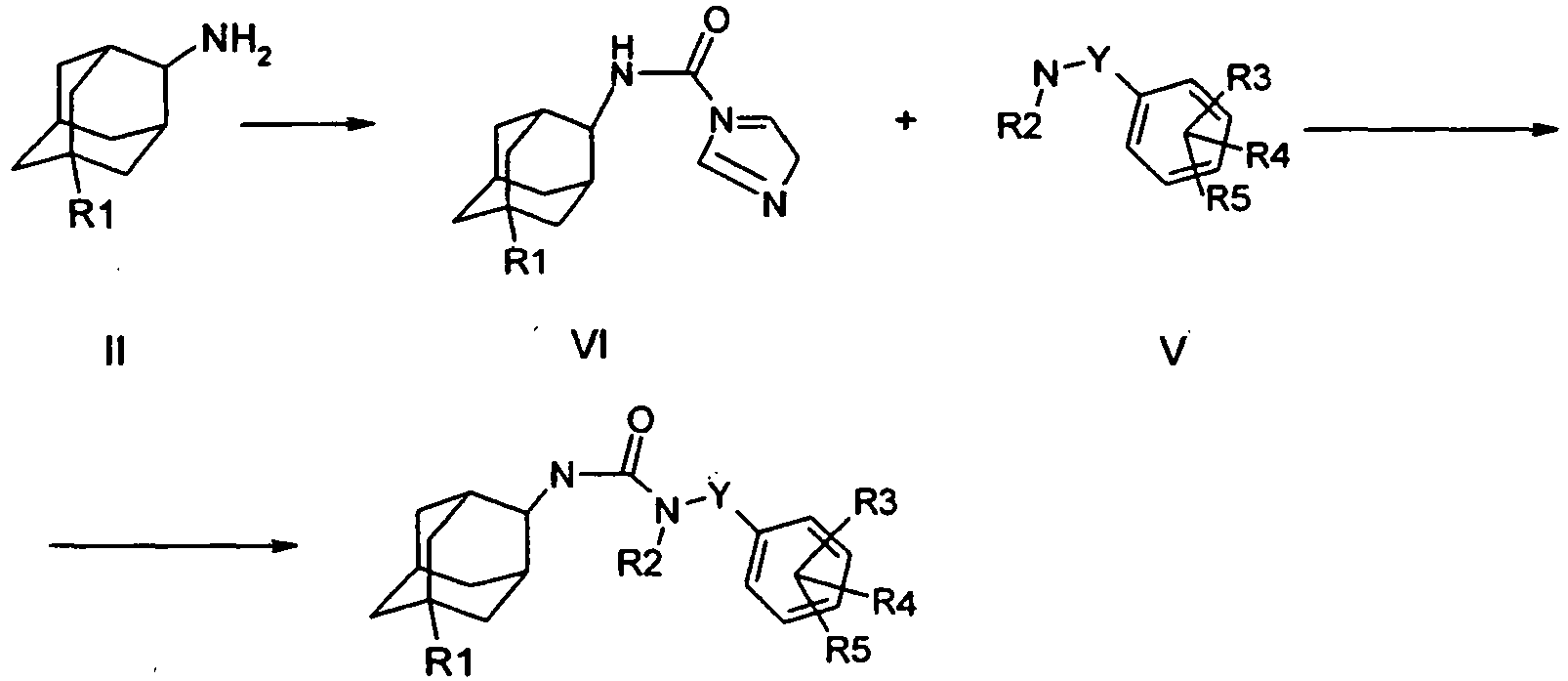
- d) an adamantyurea derivative according to formula VII, wherein Y, R1, R2, R3, R4 and R5 are as defined above, is reacted with to give the corresponding phenol and the phenol is the alkylated with a dialkylaminoethyl chloride, wherein R6 and R7 are as defined above, or

- e) a residue R1, R2, R3, R4, R5, R6 and/or R7, as defined above, is converted in another residue R1, R2, R3, R4, R5, R6 and/or R7 by e.g. introducing an alkyl group, or
- f) a compound of formula I is isolated and/or treated with an acid or a base, to obtain the salt thereof.
- All crude products were subjected to standard chromatography using solvent mixtures containing methanol, ethanol, isopropanol, n-hexane, cyclohexane or petrol ether, respectively.
- For a further detailed description of the manufacturing processes, please see also the examples and the following general description of the preferred conditions.
- A physiologically acceptable salt of a compound according to formula I can also be obtained by isolating and/or treating the compound of formula I obtained by the described reaction with an acid or a base.
- The compounds of the formula I and also the starting materials for their preparation are, are prepared by methods as described in the examples or by methods known per se, as described in the literature (for example in standard works, such as Houben-Weyl, Methoden der Organischen Chemie [Methods of Organic Chemistry], Georg Thieme Verlag, Stuttgart; Organic Reactions, John Wiley & Sons, Inc., New York), to be precise under reaction conditions which are known and suitable for the said reactions. Use can also be made here of variants which are known per se, but are not mentioned here in greater detail.
- The starting materials for the claimed process may, if desired, also be formed in situ by not isolating them from the reaction mixture, but instead immediately converting them further into the compounds of the formula I. On the other hand, it is possible to carry out the reaction stepwise.
- Preferably, the reaction of the compounds is carried out in the presence of a suitable solvent, which is preferably inert under the respective reaction conditions. Examples of suitable solvents are hydrocarbons, such as hexane, petroleum ether, benzene, toluene or xylene; chlorinated hydrocarbons, such as trichlorethylene, 1,2-dichloroethane, tetrachloromethane, chloroform or dichloromethane; alcohols, such as methanol, ethanol, isopropanol, n-propanol, n-butanol or tert-butanol; ethers, such as diethyl ether, diisopropyl ether, tetrahydrofuran (THF) or dioxane; glycol ethers, such as ethylene glycol monomethyl or monoethyl ether or ethylene glycol dimethyl ether (diglyme); ketones, such as acetone or butanone; amides, such as acetamide, dimethylacetamide, dimethylformamide (DMF) or N-methyl pyrrolidinone (NMP); nitriles, such as acetonitrile; sulfoxides, such as dimethyl sulfoxide (DMSO); nitro compounds, such as nitromethane or nitrobenzene; esters, such as ethyl acetate, or mixtures of the said solvents or mixtures with water. Polar solvents are in general preferred. Examples for suitable polar solvents are chlorinated hydrocarbons, alcohols, glycol ethers, nitriles, amides and sulfoxides or mixtures thereof. More preferred are amides, especially dimethylformamide (DMF).
- As stated above, the reaction temperature is between about -100°C and 300°C, depending on the reaction step and the conditions used.
- Reaction times are generally in the range between some minutes and several days, depending on the reactivity of the respective compounds and the respective reaction conditions. Suitable reaction times are readily determinable by methods known in the art, for example reaction monitoring. Based on the reaction temperatures given above, suitable reaction times generally lie in the range between 10 min and 48 hrs.
- A base of the formula I can be converted into the associated acid-addition salt using an acid, for example by reaction of equivalent amounts of the base and the acid in a preferably inert solvent, such as ethanol, followed by evaporation. Suitable acids for this reaction are, in particular, those which give physiologically acceptable salts. Thus, it is possible to use inorganic acids, for example sulfuric acid, sulfurous acid, dithionic acid, nitric acid, hydrohalic acids, such as hydrochloric acid or hydrobromic acid, phosphoric acids, such as, for example, orthophosphoric acid, sulfamic acid, furthermore organic acids, in particular aliphatic, alicyclic, araliphatic, aromatic or heterocyclic monobasic or polybasic carboxylic, sulfonic or sulfuric acids, for example formic acid, acetic acid, propionic acid, hexanoic acid, octanoic acid, decanoic acid, hexadecanoic acid, octadecanoic acid, pivalic acid, diethylacetic acid, malonic acid, succinic acid, pimelic acid, fumaric acid, maleic acid, lactic acid, tartaric acid, malic acid, citric acid, gluconic acid, ascorbic acid, nicotinic acid, isonicotinic acid, methane- or ethanesulfonic acid, ethanedisulfonic acid, 2-hydroxyethanesulfonic acid, benzenesulfonic acid, trimethoxybenzoic acid, adamantanecarboxylic acid, p-toluenesulfonic acid, glycolic acid, embonic acid, chlorophenoxyacetic acid, aspartic acid, glutamic acid, proline, glyoxylic acid, palmitic acid, parachlorophenoxyisobutyric acid, cyclohexanecarboxylic acid, glucose 1-phosphate, naphthalenemono- and -disulfonic acids or laurylsulfuric acid.
- Salts with physiologically unacceptable acids, for example picrates, can be used to isolate and/or purify the compounds of the formula I.
- On the other hand, compounds of the formula I can be converted into the corresponding metal salts, in particular alkali metal salts or alkaline earth metal salts, or into the corresponding ammonium salts, using bases (for example sodium hydroxide, potassium hydroxide, sodium carbonate or potassium carbonate). Suitable salts are furthermore substituted ammonium salts, for example the dimethyl-, diethyl- and diisopropylammonium salts, monoethanol-, diethanol- and diisopropanolammonium salts, cyclohexyl- and dicyclohexylammonium salts, dibenzylethylenediammonium salts, furthermore, for example, salts with arginine or lysine.
- If desired, the free bases of the formula I can be liberated from their salts by treatment with strong bases, such as sodium hydroxide, potassium hydroxide, sodium carbonate or potassium carbonate, so long as no further acidic groups are present in the molecule. In the cases where the compounds of the formula I have free acid groups, salt formation can likewise be achieved by treatment with bases. Suitable bases are alkali metal hydroxides, alkaline earth metal hydroxides or organic bases in the form of primary, secondary or tertiary amines.
- Every reaction step described herein can optionally be followed by one or more working up procedures and/or isolating procedures. Suitable such procedures are known in the art, for example from standard works, such as Houben-Weyl, Methoden der organischen Chemie [Methods of Organic Chemistry], Georg-Thieme-Verlag, Stuttgart). Examples for such procedures include, but are not limited to evaporating a solvent, distilling, crystallization, fractionised crystallization, extraction procedures, washing procedures, digesting procedures, filtration procedures, chromatography, chromatography by HPLC and drying procedures, especially drying procedures in vacuo and/or elevated temperature.
- The compounds described herein are selective inhibitors of the 11β-HSD1 enzyme. Thus, the present invention relates to the use of the compounds of the present invention as for inhibiting the reductase activity of 11β-hydroxysteroid dehydrogenase 1, which is responsible for the conversion of cortisone to cortisol.
- The 11 β-HSD1 inhibitors of structural formula I generally have an inhibition constant IC50 of less than about 500 nM, and preferably less than about 100 nM. Generally, the IC50 ratio 11β-HSD2 to 11 β-HSD1 of a compound is at least about two or more, and preferably about ten or greater. Even more preferred are compounds with an IC50 ratio for 11β-HSD2 to 11β-HSD1 of about 20 or greater. For example, compounds of the present invention ideally demonstrate an inhibition constant IC50 against 11β-HSD2 greater than about 1000 nM, and preferably greater than 5000 nM.
- The present invention includes the use of an 11β-HSD1 inhibitor for the treatment, control, amelioration, prevention, delaying the onset of or reducing the risk of developing the diseases and conditions that are described herein, as mediated by excess or uncontrolled amounts of cortisol and/or other corticosteroids in a mammalian patient, particularly a human, by the administration of an effective amount of a compound of structural formula I or a pharmaceutically acceptable salt or solvate thereof. Inhibition of the 11 β-HSD1 enzyme limits the conversion of cortisone, which is normally inert, to cortisol, which can cause or contribute to the symptoms of these diseases and conditions if present in excessive amounts.
- Therefore, a preferred embodiment of the present invention is the use of a compound of the present invention as 11 β-HSD1 inhibitor.
- A further preferred embodiment of the present invention is the use of a compound of the present invention for the preparation of a medicament.
- A further preferred embodiment of the present invention is the use of a compound of the present invention for the preparation of a medicament for the treatment and/or prevention of diseases, which are caused, mediated and/or propagated by high cortisol levels.
- A further preferred embodiment of the present invention is the use of a compound of the present invention for the preparation of a medicament for the treatment and/or prevention of one ore more disease or condition selected from the group consisting of metabolic syndrome, diabetes, especially non-insulin dependent diabetes mellitus, prediabetes, insulin resistance, low glucose tolerance, hyperglycemia, obesity and weight-related disorders, lipid disorders such as dyslipidemia, hyperlipidemia, hypertriglyceridemia, hypercholesterolemia, low HDL levels or high LDL levels, glaucoma, osteoporosis, glucocorticoid-mediated effects on neuronal function, such as cognitive impairment, anxiety or depression, neurodegenerative disease, immune disorders such as tuberculosis, leprosy or psoriasis, hypertension, atherosclerosis and its sequelae, vascular restenosis, cardiovascular diseases, pancreatitis, retinopathy, neuropathy and nephropathy.
- In another aspect of the invention, a method of treating a condition selected from the; group consisting of: hyperglycemia, low glucose tolerance, insulin resistance, obesity, lipid disorders, dyslipidemia, hyperlipidemia, hypertriglyceridemia, hypercholesterolemia, low MEL levels, high LDL levels, atherosclerosis and its sequelae, vascular restenosis, pancreatitis, abdominal obesity, neurodegenerative disease, retinopathy, nephropathy, neuropathy, Metabolic Syndrome, hypertension and other conditions and disorders where insulin resistance is a component, in a mammalian patient in need of such treatment is disclosed, comprising administering to the patient a compound in accordance with structural formula I in an amount that is effective to treat said condition.
- In another aspect of the invention, a method of delaying the onset of a condition selected from the group consisting of hyperglycemia, low glucose tolerance, insulin resistance, obesity, lipid disorders, dyslipidemia, hyperlipidemia, hypertriglyceridemia, hypercholesterolemia, low EMIL levels, high LDL levels, atherosclerosis and its sequelae, vascular restenosis, pancreatitis, abdominal obesity, neurodegenerative disease, retinopathy, nephropathy, neuropathy, Metabolic Syndrome, hypertension and other conditions and disorders where insulin resistance is a component in a mammalian patient in need of such treatment is disclosed, comprising administering to the patient a compound in accordance with structural formula I in an amount that is effective to delay the onset of said condition.
- A further preferred embodiment of the present invention is a pharmaceutical composition, characterized in that it contains a therapeutically effective amount of one or more compounds according to the invention.
- A further embodiment of the present invention is a pharmaceutical composition, characterized in that it further contains one or more additional compounds, selected from the group consisting of physiologically acceptable excipients, auxiliaries, adjuvants, diluents, carriers and pharmaceutically active agents other than the compounds according to the invention.
- An additional preferred embodiment of the present invention is a set (kit) consisting of separate packets of
- a) a therapeutically effective amount of one or more compounds according to the invention and
- b) a therapeutically effective amount one ore more further pharmaceutically active agents other than the compounds according to the invention.
- Compounds of structural formula I may be used in combination with one or more other drugs in the treatment, prevention, suppression or amelioration of diseases or conditions for which compounds of structural formula I or the other drugs have utility. Typically the combination of the drugs is safer or more effective than either drug alone, or the combination is safer or more effective than would it be expected based on the additive properties of the individual drugs. Such other drug(s) may be administered, by a route and in an amount commonly used contemporaneously or sequentially with a compound of structural formula I. When a compound of structural formula I is used contemporaneously with one or more other drugs, a combination product containing such other drug(s) and the compound of structural formula I is preferred. However, combination therapy also includes therapies in which the compound of structural formula I and one or more other drugs are administered on different overlapping schedules. It is contemplated that when used in combination with other active ingredients, the compound of the present invention or the other active ingredient or both may be used effectively in lower doses than when each is used alone. Accordingly, the pharmaceutical compositions of the present invention include those that contain one or more other active ingredients, in addition to a compound of structural formula I. Examples of other active ingredients that may be administered in combination with a compound of structural formula I, and either administered separately or in the same pharmaceutical composition, include, but are not limited to: dipeptidyl peptidase IV (DP-IV) inhibitors; insulin sensitizing agents including PPARγ agonists such as the glitazones (e.g. troglitazone, pioglitazone, englitazone, MCC-555, rosiglitazone, and the like) and other PPAR ligands, including PPARα/γ dual agonists, such as KRP-297, and PPARα agonists such as gemfibrozil, clofibrate, fenofibrate and bezafibrate, and biguanides, such as metformin and phenformin; insulin or insulin mimetics; sulfonylureas and other insulin secretagogues such as tolbutamide, glipizide, meglitinide and related materials; α-glucosidase inhibitors, such as acarbose; glucagon receptor antagonists such as those disclosed in
WO 98/04528 WO 99/01423 WO 00/39088 WO 00/69810 WOOO/42026 WOOO/59887 WOOO/58360 WO 01/23420 WO97/28149 - In another aspect of the invention, a method of reducing the risk of developing a condition selected from the group consisting of hyperglycemia, low glucose tolerance, insulin resistance, obesity, lipid disorders, dyslipidemia, hyperlipidemia, hypertriglyceridemia, hypercholesterolemia, low HDL levels, high LDL levels, atherosclerosis and its sequelae, vascular restenosis, pancreatitis, abdominal obesity, neurodegenerative disease, retinopathy, nephropathy, neuropathy, Metabolic Syndrome, hypertension and other conditions and disorders where insulin resistance is a component in a mammalian patient in need of such treatment is disclosed, comprising administering to the patient a compound in accordance with structural formula I in an amount that is effective to reduce the risk of developing said condition.
- In another aspect of the invention, a method of treating a condition selected from the group consisting of hyperglycemia, low glucose tolerance, insulin resistance, obesity, lipid disorders, dyslipidemia, hyperlipidemia, hypertriglyceridemia, hypercholesterolemia, low HDL levels, high LDL levels, atherosclerosis and its sequelae, vascular restenosis, pancreatitis, abdominal obesity, neurodegenerative disease, retinopathy, nephropathy, neuropathy, Metabolic Syndrome, hypertension and other conditions and disorders where insulin resistance is a component, in a mammalian patient in need of such treatment, comprising administering to the patient an effective amount of a compound as defined in structural; formula I and a compound selected from the group consisting of: dipeptidyl peptidase-IV (DP-IV) ; inhibitors; insulin sensitizing agents selected from the group consisting of PPARγ agonists, PPARα agonists, PPARα/γ dual agonists, and biguanides; insulin and insulin mimetics; sulfonylureas and other insulin secretagogues; α-glucosidase inhibitors; glucagon receptor antagonists; GLP-1, GLP-1 analogs, and GLP-1 receptor agonists; GIP,GIP mimetics, and GIP receptor agonists; PACAP, PACAP mimetics, and PACAP receptor 3 agonists; cholesterol lowering agents selected from the group consisting of HMG-CoA reductase inhibitors, sequestrants, nicotinyl alcohol, nicotinic acid and salts thereof, inhibitors of cholesterol absorption, acyl CoA:cholesterol acyltransferase inhibitors, and anti-oxidants; PPARδ agonists; antiobesity compounds; ileal bile acid transporter inhibitors; anti-inflammatory agents, excluding glucocorticoids; protein tyrosine phosphatase 1 B (PTP-1B) inhibitors; and antihypertensives including those acting on the angiotensin or renin systems, such as angiotensin converting enzyme inhibitors, angiotensin II receptor antagonists or renin inhibitors, such as captopril, cilazapril, enalapril, fosinopril, lisinopril, quinapril, ramapril, zofenopril, candesartan, cilexetil, eprosartan, irbesartan, losartan, tasosartan, telmisartan, and valsartan; said compounds being administered to the patient in an amount that is effective to treat said condition. : Dipeptidyl peptidase-IV inhibitors that can be combined with compounds of structural formula I include those disclosed in
WO 03/004498 WO 03/004496 EP 1 258 476 ;WO 02/083128 WO 02/062764 WO 03/00025 WO 03/002530 WO 03/002531 WO 03/002553 WO 03/002593 WO 03/000180 WO 03/000181 - Antiobesity compounds that can be combined with compounds of structural formula I include fenfluramine, dexfenfluramine, phentermine, sibutramine, orlistat, neuropeptide Y1 or Y5 antagonists, cannabinoid CB 1 receptor antagonists or inverse agonists, melanocortin receptor agonists, in particular, melanocortin-4 receptor agonists, ghrelin antagonists, and melanin-concentrating hormone (MCH) receptor antagonists. For a review of anti-obesity compounds that can be combined with compounds of structural formula I, see S. Chaki et al., "Recent advances in feeding suppressing agents: potential therapeutic strategy for the treatment of obesity," Expert Opin. Ther. Patents, 11: 1677-1692 (2001) and D. Spanswick and K. Lee, "Emerging antiobesity drugs," Expert Opin. Emerging Drugs, 8: 217- 237 (2003).
- Neuropeptide Y5 antagonists that can be combined with compounds of structural formula I include those disclosed in
U.S. Patent No. 6,335,345 andWO 01/14376 - Cannabinoid CB 1 receptor antagonists that can be combined with compounds of formula I include those disclosed in
PCT Publication WO 03/007887 U.S. Patent No. 5,624,941 , such as rimonabant;PCT Publication WO 02/076949 U.S. Patent No. 6,028,084 ;PCT Publication WO 98/41519 PCT Publication WO 00/10968 PCT Publication WO 99/02499 U.S. Patent No. 5,532,237 ; andU.S. Patent No. 5,292,736 . - Melanocortin receptor agonists that can be combined with compounds of formula I include those disclosed in
WO 03/009847 WO 02/068388 WO 99/64002 WO 00/74679 WO 01/70708 WO 01/70337 - In another aspect of the invention, a method of treating a condition selected from the group consisting of hypercholesterolemia, atherosclerosis, low HDL levels, high LDL levels, hyperlipidemia, hypertriglyceridemia, and dyslipidemia, in a mammalian patient in need of such treatment is disclosed, comprising administering to the patient a therapeutically effective amount of a compound as defined in structural formula I and an HMG-CoA reductase inhibitor.
- More particularly, in another aspect of the invention, a method of treating a condition selected from the group consisting of hypercholesterolemia, atherosclerosis, low HDL levels, high LDL levels, hyperlipidemia, hypertriglyceridemia and dyslipidemia, in a mammalian patient in need of such treatment is disclosed, wherein the HMG-CoA reductase inhibitor is a statin.
- Even more particularly, in another aspect of the invention, a method of treating a condition selected from the group consisting of hypercholesterolemia, atherosclerosis, low HAL levels, high LDL levels, hyperlipidemia, hypertriglyceridemia and dyslipidemia, in a mammalian patient in need of such treatment is disclosed, wherein the HMG-CoA reductase inhibitor is a statin selected from the group consisting of lovastatin, simvastatin, pravastatin, cerivastatin, fluvastatin, atorvastatin, itavastatin and rosuvastatin.
- In another aspect of the invention, a method of reducing the risk of developing a condition selected from the group consisting of hypercholesterolemia, atherosclerosis, low HDL levels, high LDL levels, hyperlipidemia, hypertriglyceridemia and dyslipidemia, and the sequelae of such conditions is disclosed comprising administering to a mammalian patient in need of such treatment a therapeutically effective amount of a compound as defined in structural formula I and an HMG-CoA reductase inhibitor.
- In another aspect of the invention, a method for delaying the onset or reducing the risk of; developing atherosclerosis in a human patient in need of such treatment is disclosed comprising administering to said patient an effective amount of a compound as defined in structural formula I and an HMG-CoA reductase inhibitor.
- More particularly, a method for delaying the onset or reducing the risk of developing atherosclerosis in a human patient in need of such treatment is disclosed, wherein the HMG-CoA reductase inhibitor is a statin.
- Even more particularly, a method for delaying the onset or reducing the risk of I developing atherosclerosis in a human patient in need of such treatment is disclosed, wherein the HMG-CoA reductase inhibitor is a statin selected from the group consisting of: lovastatin, simvastatin, pravastatin, cerivastatin, fluvastatin, atorvastatin, itavastatin, and rosuvastatin.
- Even more particularly, a method for delaying the onset or reducing the risk of developing atherosclerosis in a human patient in need of such treatment is disclosed, wherein the statin is simvastatin.
- In another aspect of the invention, a method for delaying the onset or reducing the risk of developing atherosclerosis in a human patient in need of such treatment is disclosed, wherein the HMG-CoA reductase inhibitor is a statin and further comprising administering a cholesterol absorption inhibitor.
- More particularly, in another aspect of the invention, a method for delaying the onset or reducing the risk of developing atherosclerosis in a human patient in need of such treatment is disclosed, wherein the HMG-CoA reductase inhibitor is a statin and the cholesterol absorption inhibitor is ezetimibe.
- In another aspect of the invention, a pharmaceutical composition is disclosed which comprises a compound according to structural formula I, a compound selected from the group consisting of: DP-IV inhibitors; insulin I sensitizing agents selected from the group consisting of PPARα agonists; PPARγ agonists, PPARα/γ dual agonists, and biguanides; insulin and insulin mimetics; sulfonylureas and other insulin secretagogues; ocglucosidase inhibitors; glucagon receptor antagonists; GLP-1, GLP-1 analogs, and GLP-1 receptor agonists; GIP, GIP mimetics, and GIP receptor agonists; PACAP, PACAP mimetics, and PACAP receptor 3 agonists; cholesterol lowering agents selected from the group consisting of HMG-CoA reductase inhibitors, sequestrants, (nicotinyl alcohol, nicotinic acid or a salt thereof, inhibitors of cholesterol absorption, acyl CoA:cholesterol acyltransferase inhibitors, and anti-oxidants; PPARδ agonists; antiobesity compounds; ileal bile acid transporter inhibitors; anti-inflammatory agents other than glucocorticoids; protein tyrosine phosphatase 1 B (PTP-1B) inhibitors; and antihypertensives including those acting on the angiotensin or renin systems, such as angiotensin converting enzyme inhibitors, angiotensin II receptor antagonists or renin inhibitors, such as captopril, cilazapril, enalapril, fosinopril, lisinopril, quinapril, ramapril, zofenopril, candesartan, cilexetil, eprosartan, irbesartan, losartan, tasosartan, telmisartan, and valsartan; inhibitors of cholesteryl ester transfer protein (CETP); and a pharmaceutically acceptable carrier.
- A further embodiment of the present invention is a process for the manufacture of said pharmaceutical compositions, characterized in that one or more compounds according to the invention and one or more compounds selected from the group consisting of solid, liquid or semiliquid excipients, auxiliaries, adjuvants, diluents, carriers and pharmaceutically active agents other than the compounds according to the invention, are converted in a suitable dosage form.
- The pharmaceutical compositions of the present invention may be administered by any means that achieve their intended purpose. For example, administration may be by oral, parenteral, topical, enteral, intravenous, intramuscular, inhalant, nasal, intraarticular, intraspinal, transtracheal, transocular, subcutaneous, intraperitoneal, transdermal, or buccal routes. Alternatively, or concurrently, administration may be by the oral route. The dosage administered will be dependent upon the age, health, and weight of the recipient, kind of concurrent treatment, if any, frequency of treatment, and the nature of the effect desired. Parenteral administration is preferred. Oral administration is especially preferred.
- Suitable dosage forms include, but are not limited to capsules, tablets, pellets, dragees, semi-solids, powders, granules, suppositories, ointments, creams, lotions, inhalants, injections, cataplasms, gels, tapes, eye drops, solution, syrups, aerosols, suspension, emulsion, which can be produced according to methods known in the art, for example as described below:
- tablets:
- mixing of active ingredient/s and auxiliaries, compression of said mixture into tablets (direct compression), optionally granulation of part of mixture before compression.
- capsules:
- mixing of active ingredient/s and auxiliaries to obtain a flowable powder, optionally granulating powder, filling powders/granulate into opened capsules, capping of capsules.
- semi-solids (ointments, gels, creams):
- dissolving/dispersing active ingredient/s in an aqueous or fatty carrier; subsequent mixing of aqueous/fatty phase with complementary fatty/ aqueous phase, homogenization (creams only).
- suppositories (rectal and vaginal):
- dissolving/dispersing active ingredient/s in carrier material liquified by heat (rectal: carrier material normally a wax; vaginal: carrier normally a heated solution of a gelling agent), casting said mixture into suppository forms, annealing and withdrawal suppositories from the forms.
- aerosols:
- dispersing/dissolving active agent/s in a propellant, bottling said mixture into an atomizer.
- In general, non-chemical routes for the production of pharmaceutical compositions and/or pharmaceutical preparations comprise processing steps on suitable mechanical means known in the art that transfer one or more compounds according to the invention into a dosage form suitable for administration to a patient in need of such a treatment. Usually, the transfer of one or more compounds according to the invention into such a dosage form comprises the addition of one or more compounds, selected from the group consisting of carriers, excipients, auxiliaries and pharmaceutical active ingredients other than the compounds according to the invention. Suitable processing steps include, but are not limited to combining, milling, mixing, granulating, dissolving, dispersing, homogenizing, casting and/or compressing the respective active and non-active ingredients. Mechanical means for performing said processing steps are known in the art, for example from Ullmann's Encyclopedia of Industrial Chemistry, 5th Edition. In this respect, active ingredients are preferably at least one compound according to this invention and one or more additional compounds other than the compounds according to the invention, which show valuable pharmaceutical properties, preferably those pharmaceutical active agents other than the compounds according to the invention, which are disclosed herein.
- Particularly suitable for oral use are tablets, pills, coated tablets, capsules, powders, granules, syrups, juices or drops, suitable for rectal use are suppositories, suitable for parenteral use are solutions, preferably oil-based or aqueous solutions, furthermore suspensions, emulsions or implants, and suitable for topical use are ointments, creams or powders. The novel compounds may also be lyophilised and the resultant lyophilisates used, for example, for the preparation of injection preparations. The preparations indicated may be sterilised and/or comprise assistants, such as lubricants, preservatives, stabilisers and/or wetting agents, emulsifiers, salts for modifying the osmotic pressure, buffer substances, dyes, flavours and/or a plurality of further active ingredients, for example one or more vitamins.
- Suitable excipients are organic or inorganic substances, which are suitable for enteral (for example oral), parenteral or topical administration and do not react with the novel compounds, for example water, vegetable oils, benzyl alcohols, alkylene glycols, polyethylene glycols, glycerol triacetate, gelatine, carbohydrates, such as lactose, sucrose, mannitol, sorbitol or starch (maize starch, wheat starch, rice starch, potato starch), cellulose preparations and/or calcium phosphates, for example tricalcium phosphate or calcium hydrogen phosphate, magnesium stearate, talc, gelatine, tragacanth, methyl cellulose, hydroxypropylmethylcellulose, sodium carboxymethylcellulose, polyvinyl pyrrolidone and/or Vaseline.
- If desired, disintegrating agents may be added such as the above-mentioned starches and also carboxymethyl-starch, cross-linked polyvinyl pyrrolidone, agar, or alginic acid or a salt thereof, such as sodium alginate. Auxiliaries include, without limitation, flow-regulating agents and lubricants, for example, silica, talc, stearic acid or salts thereof, such as magnesium stearate or calcium stearate, and/or polyethylene glycol. Dragee cores are provided with suitable coatings, which, if desired, are resistant to gastric juices. For this purpose, concentrated saccharide solutions may be used, which may optionally contain gum arabic, talc, polyvinyl pyrrolidone, polyethylene glycol and/or titanium dioxide, lacquer solutions and suitable organic solvents or solvent mixtures. In order to produce coatings resistant to gastric juices or to provide a dosage form affording the advantage of prolonged action, the tablet, dragee or pill can comprise an inner dosage and an outer dosage component me latter being in the form of an envelope over the former. The two components can be separated by an enteric layer, which serves to resist disintegration in the stomach and permits the inner component to pass intact into the duodenum or to be delayed in release. A variety of materials can be used for such enteric layers or coatings, such materials including a number of polymeric acids and mixtures of polymeric acids with such materials as shellac, acetyl alcohol, solutions of suitable cellulose preparations such as acetyl-cellulose phthalate, cellulose acetate or hydroxypropymethyl-cellulose phthalate, are used. Dye stuffs or pigments may be added to the tablets or dragee coatings, for example, for identification or in order to characterize combinations of active compound doses.
- Suitable carrier substances are organic or inorganic substances which are suitable for enteral (e.g. oral) or parenteral administration or topical application and do not react with the novel compounds, for example water, vegetable oils, benzyl alcohols, polyethylene glycols, gelatin, carbohydrates such as lactose or starch, magnesium stearate, talc and petroleum jelly. In particular, tablets, coated tablets, capsules, syrups, suspensions, drops or suppositories are used for enteral administration, solutions, preferably oily or aqueous solutions, furthermore suspensions, emulsions or implants, are used for parenteral administration, and ointments, creams or powders are used for topical application. The novel compounds can also be lyophilized and the lyophilizates obtained can be used, for example, for the production of injection preparations.
- The preparations indicated can be sterilized and/or can contain excipients such as lubricants, preservatives, stabilizers and/or wetting agents, emulsifiers, salts for affecting the osmotic pressure, buffer substances, colorants, flavourings and/or aromatizers. They can, if desired, also contain one or more further active compounds, e.g. one or more vitamins.
- Other pharmaceutical preparations, which can be used orally include push-fit capsules made of gelatine, as well as soft, sealed capsules made of gelatine and a plasticizer such as glycerol or sorbitol. The push-fit capsules can contain the active compounds in the form of granules, which may be mixed with fillers such as lactose, binders such as starches, and/or lubricants such as talc or magnesium stearate and, optionally, stabilizers. In soft capsules, the active compounds are preferably dissolved or suspended in suitable liquids, such as fatty oils, or liquid paraffin. In addition, stabilizers may be added.
- The liquid forms in which the novel compositions of the present invention may be incorporated for administration orally include aqueous solutions, suitably flavoured syrups, aqueous or oil suspensions, and flavoured emulsions with edible oils such as cottonseed oil, sesame oil, coconut oil or peanut oil, as well as elixirs and similar pharmaceutical vehicles. Suitable dispersing or suspending agents for aqueous suspensions include synthetic and natural gums such as tragacanth, acacia, alginate, dextran, sodium carboxymethylcellulose, methylcellulose, polyvinyl-pyrrolidone or gelatine.
- Suitable formulations for parenteral administration include aqueous solutions of the active compounds in water-soluble form, for example, water-soluble salts and alkaline solutions. In addition, suspensions of the active compounds as appropriate oily injection suspensions may be administered. Suitable lipophilic solvents or vehicles include fatty oils, for example, sesame oil, or synthetic fatty acid esters, for example, ethyl oleate or triglycerides or polyethylene glycol-400 (the compounds are soluble in PEG-400).
- Aqueous injection suspensions may contain substances, which increase the viscosity of the suspension, including, for example, sodium carboxymethyl cellulose, sorbitol, and/or dextran, optionally, the suspension may also contain stabilizers.
- For administration as an inhalation spray, it is possible to use sprays in which the active ingredient is either dissolved or suspended in a propellant gas or propellant gas mixture (for example CO2 or chlorofluorocarbons). The active ingredient is advantageously used here in micronized form, in which case one or more additional physiologically acceptable solvents may be present, for example ethanol. Inhalation solutions can be administered with the aid of conventional inhalers.
- Possible pharmaceutical preparations, which can be used rectally include, for example, suppositories, which consist of a combination of one or more of the active compounds with a suppository base. Suitable suppository bases are, for example, natural or synthetic triglycerides, or paraffin hydrocarbons. In addition, it is also possible to use gelatine rectal capsules, which consist of a combination of the active compounds with a base. Possible base materials include, for example, liquid triglycerides, polyethylene glycols, or paraffin hydrocarbons.
- For use in medicine, the compounds of the present invention will be in the form of pharmaceutically acceptable salts. Other salts may, however, be useful in the preparation of the compounds according to the invention or of their pharmaceutically acceptable salts. Suitable pharmaceutically acceptable salts of the compounds of this invention include acid addition salts which may, for example be formed by mixing a solution of the compound according to the invention with a solution of a pharmaceutically acceptable acid such as hydrochloric acid, sulphuric acid, methanesulphonic acid, fumaric acid, maleic acid, succinic acid, acetic acid, benzoic acid, oxalic acid, citric acid, tartaric acid, carbonic acid or phosphoric acid. Furthermore, where the compounds of the invention carry an acidic moiety, suitable pharmaceutically acceptable salts thereof may include alkali metal salts, e.g. sodium or potassium salts; alkaline earth metal salts, e.g. calcium or magnesium salts; and salts formed with suitable organic bases, e.g. quaternary ammonium salts.
- The pharmaceutical preparations can be employed as medicaments in human and veterinary medicine. As used herein, the term "effective amount" means that amount of a drug or pharmaceutical agent that will elicit the biological or medical response of a tissue, system, animal or human that is being sought, for instance, by a researcher or clinician. Furthermore, the term "therapeutically effective amount" means any amount which, as compared to a corresponding subject who has not received such amount, results in improved treatment, healing, prevention, or amelioration of a disease, disorder, or side effect, or a decrease in the rate of advancement of a disease or disorder. The term also includes within its scope amounts effective to enhance normal physiological function. Said therapeutic effective amount of one or more of the compounds according to the invention is known to the skilled artisan or can be easily determined by standard methods known in the art.
- The substances according to the invention are generally administered analogously to commercial preparations. Usually, suitable doses that are therapeutically effective lie in the range between 0.0005 mg and 1000 mg, preferably between 0.005 mg and 500 mg and especially between 0.5 and 100 mg per dose unit. The daily dose is preferably between about 0.001 and 10 mg/kg of body weight.
- Those of skill will readily appreciate that dose levels can vary as a function of the specific compound, the severity of the symptoms and the susceptibility of the subject to side effects. Some of the specific compounds are more potent than others. Preferred dosages for a given compound are readily determinable by those of skill in the art by a variety of means. A preferred means is to measure the physiological potency of a given compound.
- The host, or patient, may be from any mammalian species, e.g., primate sp., particularly human; rodents, including mice, rats and hamsters; rabbits; equines, bovines, canines, felines; etc. Animal models are of interest for experimental investigations, providing a model for treatment of human disease.
- The specific dose for the individual patient depends, however, on the multitude of factors, for example on the efficacy of the specific compounds employed, on the age, body weight, general state of health, the sex, the kind of diet, on the time and route of administration, on the excretion rate, the kind of administration and the dosage form to be administered, the pharmaceutical combination and severity of the particular disorder to which the therapy relates. The specific therapeutic effective dose for the individual patient can readily be determined by routine experimentation, for example by the doctor or physician, which advises or attends the therapeutic treatment.
- In the case of many disorders, the susceptibility of a particular cell to treatment with the subject compounds may be determined by in vitro testing. Typically a culture of the cell is combined with a subject compound at varying concentrations for a period of time sufficient to allow the active agents to show a relevant reaction, usually between about one hour and one week. For in vitro testing, cultured cells from a biopsy sample may be used.
- Above and below, all temperatures are indicated in °C. In the following examples, "conventional work-up" means that, if necessary, the solvent is removed, water is added if necessary, the pH is adjusted, if necessary, to between 2 and 10, depending on the constitution of the end product, the mixture is extracted with ethyl acetate or dichloromethane, the phases are separated, the organic phase is washed with saturated NaHCO3 solution, if desired with water and saturated NaCl solution, is dried over sodium sulfate, filtered and evaporated, and the product is purified by chromatography on silica gel, by preparative HPLC and/or by crystallisation. The purified compounds are, if desired, freeze-dried.
Mass spectrometry (MS): ESI (electrospray ionisation) (M+H)+ - AcOH acetic acid, anh anhydrous, atm atmosphere(s), BOC tert-butoxycarbonyl CDI 1,1'-carbonyl diimidazole, conc concentrated, d day(s), dec decomposition, DMAC NN-dimethylacetamide, DMPU 1,3-dimethyl-3,4,5,6-tetrahydro-2(IH)-pyrimidinone, DMF NN-dimethylformamide, DMSO dimethylsulfoxide, DPPA diphenylphosphoryl azide, EDCI 1-(3-dimethylaminopropyl)-3-ethylcarbodiimide, EtOAc ethyl acetate, EtOH ethanol (100%), Et2O diethyl ether, Et3N triethylamine, h hour(s), MeOH methanol, pet. ether petroleum ether (boiling range 30-60°C), temp. temperature, THF tetrahydrofuran, TFA trifluoroAcOH, Tf trifluoromethanesulfonyl.
- The compounds of the present invention can be prepared by the general methods A, B, C and D shown below. In all preparative methods, all starting material is known or may easily be prepared from known starting materials.
-

- By coupling an adamantylamine, wherein R1 is defined as above, with an isocyanate, wherein Y, R3, R4 and R5 are defined as above, under standard conditions (e.g. using ethanol or dimethylformamide as solvent and in presence of a tertiary base when the adamantylamine hydrochloride is used).
- For example:

-

- By reacting an adamantylisocyanate wherein, wherein R1 is defined as above and which can be prepared from the adamantylamine according to Angew. Chem. Itn; Ed. Engl. 1995, 34, 2497-2500, with an amine, wherein Y, R2, R3, R4 and R5 are defined as above, under standard conditions.
-

- By coupling an adamantylamine, wherein R1 is defined as above, with carbonyldiimidazole in an inert solvent like DCM to give the corresponding acylimidazole and by reacting this later with an amine, wherein Y, R2, R3, R4 and R5 are defined as above, under standard conditions (e.g. DCM as solvent and in presence of a tertiary base when the amine hydrochloride is used).
- For example:

-
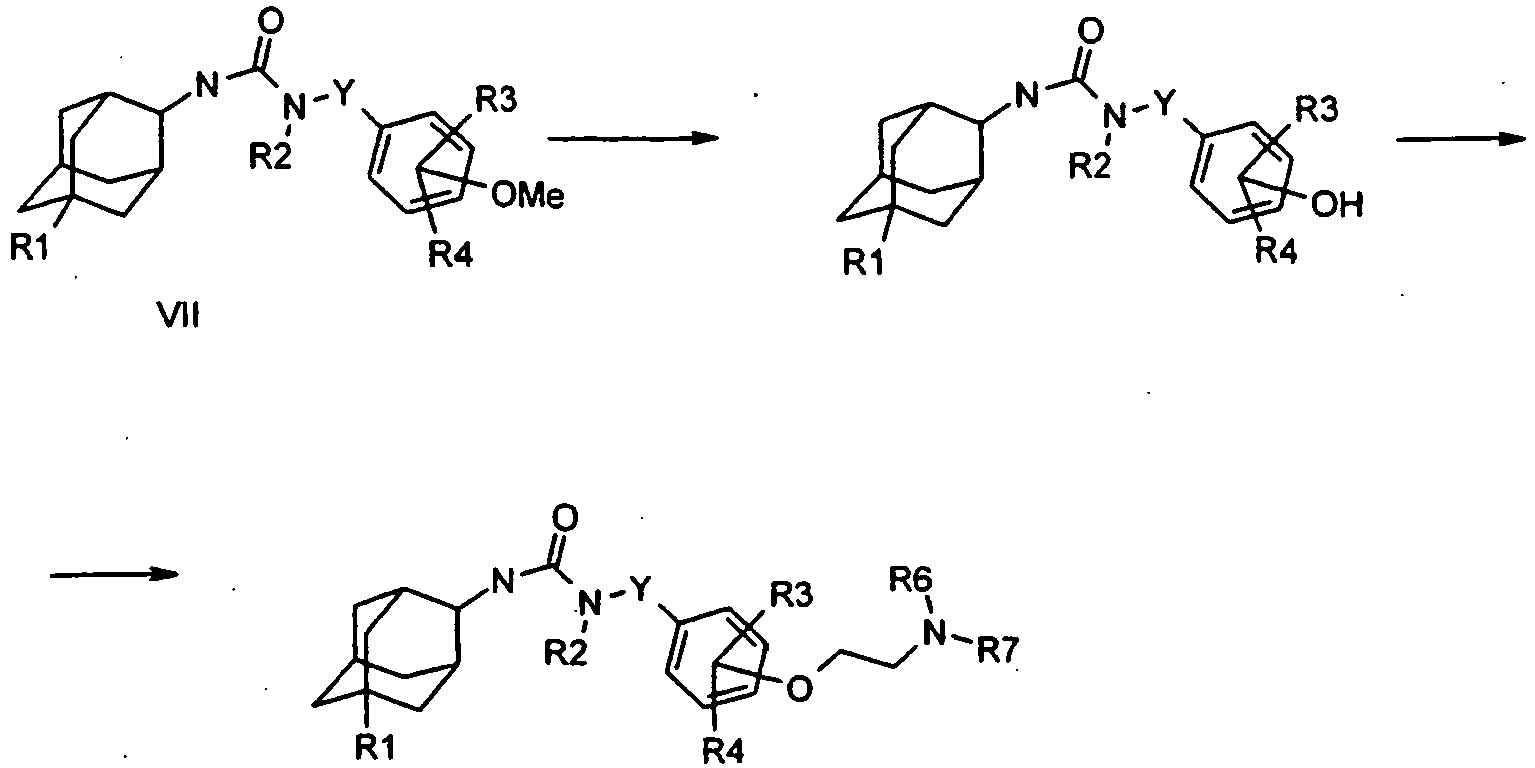
- By reacting an anisole group by an agent like pyridinium hydrochloride or boron tribromide to give the corresponding phenol and by alkylating this phenol with a dialkylaminoethyl chloride, wherein R6 and R7 are defined as above, in a presence of base like potassium carbonate in a polar solvent like dimethylformamide.
- A mixture of 2,5 g (13,3 mmol) of 2-adamantylamine hydrochloride, 1,84 ml (13,3 mmol) of triethylamine in 50 ml of ethanol was heated under reflux. Then 1,94 ml (13,3 mmol) of 4-methoxy-2-methylphenylisocyanate was added and the mixture was stirred under reflux for 2 h. After cooling at room temperature the precipitate was filtered, washed with ethanol and dried under vacuum to give 4,2 g (61 %) a white solid.
mp 186°C
HPLC-MS (M+H+) 315.2
H1NMR (DMSO d6) 1.5-1.9 (m, 14H), 2.15 (s, 3H), 3.39-3.47 (m, 1H), 3.67 (s, 3H), 6.59-6.71 (m, 3H), 7.51 (s, 1H), 7.6 (d, 1 H) - The following compounds were made in a similar way as described in example 1
Ex 1-1 1-Adamantan-2-yl-3-(3-trifluoromethyl-phenyl)-urea M+H = 339 Ex 1-2 1-Adamantan-2-yl-3-(3-chloro-phenyl)-urea M+H = 305 Ex 1-3 1-Adamantan-2-yl-3-(2-trifluoromethyl-phenyl)-urea M+H = 339 Ex 1-4 1-Adamantan-2-yl-3-(2,3-dichloro-phenyl)-urea M+H = 340 Ex 1-5 1-Adamantan-2-yl-3-(3,5-bis-trifluoromethylphenyl)-urea M+H = 407 Ex 1-6 2-(3-Adamantan-2-yl-ureido)-benzoic acid ethyl ester M+H = 343 Ex 1-7 1-Adamantan-2-yl-3-(3,5-dimethoxy-phenyl)-urea M+H = 331 Ex 1-8 1-Adamantan-2-yl-3-(4-chloro-2-trifluoromethylphenyl)-urea M+H = 373 Ex 1-9 1-Adamantan-2-yl-3-(2,4,5-trimethyl-phenyl)-urea M+H = 313 Ex 1-10 1-Adamantan-2-yl-3-(4-butoxy-phenyl)-urea M+H = 343 Ex 1-11 4-(3-Adamantan-2-yl-ureido)-benzoic acid butyl ester M+H = 371 Ex 1-12 1-Adamantan-2-yl-3-phenethyl-urea M+H = 299 Ex 1-13 5-(3-Adamantan-2-yl-ureido)-isophthalic acid dimethyl ester M+H = 387 Ex 1-14 1-Adamantan-2-yl-3-(2-methylsulfanyl-phenyl)-urea M+H = 317 Ex 1-15 1-Adamantan-2-yl-3-biphenyl-4-yl-urea M+H = 347 Ex 1-16 1-Adamantan-2-yl-3-(2-thiophen-2-yl-ethyl)-urea M+H = 305 Ex 1-17 1-Adamantan-2-yl-3-(4-bromo-phenyl)-urea M+H = 350 Ex 1-18 1-Adamantan-2-yl-3-(3-chloro-4-methyl-phenyl)-urea M+H = 319 Ex 1-19 1-Adamantan-2-yl-3-(3,4-dimethyl-phenyl)-urea M+H = 299 Ex 1-20 1-Adamantan-2-yl-3-(3-ethyl-phenyl)-urea M+H = 299 Ex 1-21 1-Adamantan-2-yl-3-(4-chloro-3-trifluoromethylphenyl)-urea M+H = 373 Ex 1-22 1-Adamantan-2-yl-3-(4-iodo-phenyl)-urea M+H = 397 Ex 1-23 1-Adamantan-2-yl-3-naphthalen-2-yl-urea M+H = 321 Ex 1-24 1-Adamantan-2-yl-3-(3-fluoro-4-methyl-phenyl)-urea M+H = 303 Ex 1-25 1-Adamantan-2-yl-3-(5-fluoro-2-methyl-phenyl)-urea M+H = 303 Ex 1-26 1-Adamantan-2-yl-3-(2,6-dichloro-pyridin-4-yl)-urea M+H = 341 Ex 1-27 1-Adamantan-2-yl-3-(3,4-difluoro-phenyl)-urea M+H = 307 Ex 1-28 1-Adamantan-2-yl-3-(4-benzyloxy-phenyl)-urea M+H = 377 Ex 1-29 1-Adamantan-2-yl-3-(2-phenoxy-phenyl)-urea M+H = 363 Ex 1-30 1-Adamantan-2-yl-3-(4-bromo-2-fluoro-phenyl)-urea M+H = 368 Ex 1-31 1-Adamantan-2-yl-3-(2,3,4-trifluoro-phenyl)-urea M+H = 325 Ex 1-32 1-Adamantan-2-yl-3-(4-dimethylamino-phenyl)-urea M+H = 314 Ex 1-33 1-Adamantan-2-yl-3-(3-trifluoromethylsulfanylphenyl)-urea M+H = 371 Ex 1-34 1-Adamantan-2-yl-3-(3-methyl-benzyl)-urea M+H = 299 Ex 1-35 1-Adamantan-2-yl-3-(2-fluoro-3-trifluoromethylphenyl)-urea M+H = 357 Ex 1-36 1-Adamantan-2-yl-3-(2,4-dibromo-phenyl)-urea M+H = 429 Ex 1-37 1-Adamantan-2-yl-3-(3,5-dichloro-2-hydroxy-4-methyl-phenyl)-urea M+H = 370 Ex 1-38 2-(3-Adamantan-2-yl-ureido)-benzoic acid methyl ester M+H = 329 Ex 1-39 1-Adamantan-2-yl-3-cyclopentyl-urea M+H = 263 Ex 1-40 1-Adamantan-2-yl-3-(2-methoxy-phenyl)-urea M+H = 301 Ex 1-41 1-Adamantan-2-yl-3-(3-methylsulfanyl-phenyl)-urea M+H = 317 Ex 1-42 1-Adamantan-2-yl-3-(5-chloro-2-methoxy-phenyl)-urea M+H = 335 Ex 1-43 1-(4-Acetyl-phenyl)-3-adamantan-2-yl-urea M+H = 313 Ex 1-44 1-Adamantan-2-yl-3-furan-2-ylmethyl-urea M+H = 275 Ex 1-45 1-Adamantan-2-yl-3-(4-methoxy-benzyl)-urea M+H = 315 Ex 1-46 1-Adamantan-2-yl-3-(4-chloro-phenyl)-urea M+H = 305 Ex 1-47 1-Adamantan-2-yl-3-(4-methoxy-phenyl)-urea M+H = 301 Ex 1-48 1-Adamantan-2-yl-3-(2-fluoro-5-methyl-phenyl)-urea M+H = 303 Ex 1-49 1-Adamantan-2-yl-3-(2,4-difluoro-phenyl)-urea M+H = 307 Ex 1-50 1-(3-Acetyl-phenyl)-3-adamantan-2-yl-urea M+H = 313 Ex 1-51 1-Adamantan-2-yl-3-(2-ethoxy-phenyl)-urea M+H = 315 Ex 1-52 4-(3-Adamantan-2-yl-ureido)-benzoic acid methyl ester M+H = 329 Ex 1-53 1-Adamantan-2-yl-3-(2,4-dimethoxy-phenyl)-urea M+H = 331 Ex 1-54 1-Adamantan-2-yl-3-(2,5-dimethoxy-phenyl)-urea M+H = 331 Ex 1-55 1-Adamantan-2-yl-3-(3,4-dimethoxy-phenyl)-urea M+H = 331 Ex 1-56 1-Adamantan-2-yl-3-(3-chloro-4-methoxy-phenyl)-urea M+H = 335 Ex 1-57 3-(3-Adamantan-2-yl-ureido)-2-methyl-benzoic acid methyl ester M+H = 343 Ex 1-58 1-Adamantan-2-yl-3-[2-(2,3-dimethoxy-phenyl)-ethyl]-urea M+H = 359 Ex 1-59 1-Adamantan-2-yl-3-[2-(3,5-dimethoxy-phenyl)-ethyl]-urea M+H = 359 Ex 1-60 1-Adamantan-2-yl-3-(5-chloro-2,4-dimethoxy-phenyl)-urea M+H = 365 Ex 1-61 1-Adamantan-2-yl-3-((R)-1-phenyl-ethyl)-urea M+H = 299 Ex 1-62 1-Adamantan-2-yl-3-(2-difluoromethoxy-phenyl)-urea M+H = 337 Ex 1-63 1-Adamantan-2-yl-3-(4-difluoromethoxy-phenyl)-urea M+H = 337 Ex 1-64 1-Adamantan-2-yl-3-(6-fluoro-4H-benzo[1,3]dioxin-8-yl)-urea M+H = 347 Ex 1-65 1-Adamantan-2-yl-3-thiophen-3-yl-urea M+H = 277 Ex 1-66 1-Adamantan-2-yl-3-(4-fluoro-phenyl)-urea M+H = 289 Ex 1-67 1-Adamantan-2-yl-3-(3-methoxy-phenyl)-urea M+H = 301 Ex 1-68 1-Adamantan-2-yl-3-(4-fluoro-3-methyl-phenyl)-urea M+H = 303 Ex 1-69 1-Adamantan-2-yl-3-(4-methylsulfanyl-phenyl)-urea M+H = 317 Ex 1-70 1-Adamantan-2-yl-3-(4-ethoxy-phenyl)-urea M+H = 315 Ex 1-71 3-(3-Adamantan-2-yl-ureido)-benzoic acid methyl ester M+H = 329 Ex 1-72 1-Adamantan-2-yl-3-(3-methyl-5-phenyl-isoxazol-4-yl)-urea M+H = 352 Ex 1-73 1-Adamantan-2-yl-3-((S)-1-phenyl-ethyl)-urea M+H = 299 Ex 1-74 1-Adamantan-2-yl-3-[(R)-1-(4-methoxy-phenyl)-ethyl]-urea M+H = 329 - A mixture of 1-hydroxy-4-aminoadamantane 669 mg (4 mmol), prepared as described by L.N.Lavrova & Coll. Khim.Farm.Z.;24(1), 29-31,1990, in 20 ml of ethanol was heated under reflux. Then 0,594 ml (4 mmol) of 4-methoxy-2-methylphenylisocyanate was added and the mixture was stirred under reflux for 2 h then overnight at room temperature. The precipitate was filtered washed with diethylether and dried under vacuum to give 0.566 g as white solid. The diethylether washing solution was concentrated to dryness to furnish 0.800 g as beige solid. Purification of each solid was done by silica gel flash chromatography (eluents: 3-5% MeOH in CH2Cl2) yielding the title compounds.
- mp 231-232°C
M+H = 331
1H-NMR (200 MHz, DMSOd6) δ 1.4-2.05 (m, 13H), 2.17 (s, 3H), 3.64 (d, 1 H), 3.70 (s, 3H), 4.48 (s, 1 H), 6.6-6.8 (m, 3H), 7.55 (s, 1 H), 7.65 (d, 1 H) - mp 244-245°C
M+H = 331
1H-NMR (200 MHz, DMSOd6) δ 1.35-2.1 (m, 13H), 2.19 (s, 3H), 3.72 (s, 4H), 4.45 (s, 1 H), 6.55-6.80 (m, 3H), 7.55 (s, 1 H), 7.62 (d, 1 H) - A mixture of (S)-3-Methyl-piperidine-1-carboxylic acid (5-hydroxyadamantan-2-yl)-amide 0.15g (0.51 mmol), 0.109 ml of acetyl chloride, 3 ml of pyridine in 1.5 ml of methylene chloride was stirred at room temperature overnight. A saturated NaHCO3 solution was added, the organic phase extracted with methylene chloride, washed with HCl 1 N solution and dried over sodium sulphate. Flash chromatography on silica gel (eluant CH2Cl2/MeOH: 95/05) yielded 75 mg of the title compound
M+H = 335.2
1H NMR (300 MHz, DMSO-D6) □ 0.69 (d, 3H), 0.85 - 2.25 (m, 22H), 2.53 (td, 1 H), 3.47 (sl, 1 H), 3.6-3.9 (m, 2H), 5.75 (d, 1 H) - The following compounds were made in a similar way as described in example2-3
- 1H NMR (300 MHz, DMSO-D6) □ 0.85 (d, 3H), 0.91 - 2.37 (m, 30H), 2.53 (td, 1 H), 3.55 (sl, 1H), 3.8-3.97 (m, 2H), 5.75 (d, 1H)
- 1H NMR (300 MHz, DMSO-D6) □ 0.84 (d, 3H), 0.88 - 2.39 (m, 28H), 2.56 (td, 1 H), 3.55 (sl, 1 H), 3.8-3.97 (m, 2H), 5.75 (d, 1 H)
- A solution of 2-adamantylamine hydrochloride 0,4 g (2.1 mmol), triethylamine 0,324 ml (2.3 mmol), 4-dimethylaminopyridine 0.286 g (2.3 mmol) in 4 ml of DMF was cooled at -15°C. Then a solution of (Boc)2O 511.5 mg (2.3 mmol) in DMF was added, the reaction mixture was stirred at -15°C for 45 min and allowed to room temperature. Amine 0.321 g (2.3 mmol) was added and the mixture was heated at 55°C overnight. After cooling water (15 ml) was added, the precipitate filtered, washed with water, diethylether and dried under vacuum to give 350 mg (52%) as white solid.
M+H = 315 - The following compounds were made in a similar way as described in example 3
Ex 3-1 1-Adamantan-2-yl-3-((S)-2-hydroxy-1-phenyl-ethyl)-urea M+H = 315 Ex 3-2 1-Adamantan-2-yl-3-indan-1-yl-urea M+H = 311 Ex 3-3 Pyrrolidine-1-carboxylic acid adamantan-2-ylamide M+H = 249 Ex 3-4 Piperidine-1-carboxylic acid adamantan-2-ylamide M+H = 263 Ex 3-5 3-Methyl-piperidine-1-carboxylic acid adamantan-2-ylamide M+H = 277 Ex 3-6 1-Adamantan-2-yl-3-(1H-[1,2,4]triazol-3-yl)-urea M+H = 262 - A solution of 2-adamantylamine hydrochloride 3 g (15.98 mmol), carbonyldiimidazole 2.59 g (15.98 mmol), triethylamine 2.215 ml (15.98 mmol) in CH2Cl2 100 ml was stirred overnight at room temperature. Water was added, the organic phase separated, dried and concentrated to dryness yielding the title crude product 3.69 g (94 %) as white solid.
1H-NMR (200 MHz, CDCl3) δ 1.6-2.1 (m, 14H), 4.05 (d, 1 H), 6.0 (s, 1 H), 7.01 (s, 1 H), 7.28 (s, 1H), 8.04 (s, 1 H) - A solution of 4H-Imidazole-1-carboxylic acid adamantan-2-ylamide 1g (4.08 mmol) and 2-(N-methylamino-ethyl)pyridine 0.567 ml (4.08 mmol) in methylene chloride 10 ml was stirred at room temperature for 2 days. Water was added, the organic phase extracted, dried and concentrated to dryness. The residue was purified by flash chromatography on silica gel (eluant DCM/MeOH: 95/05) yielding 1.13 g of the title compound as free base.
M+H = 314
1H-NMR (200 MHz, CDCl3) δ 1.45-1.9 (m, 14H), 2.8 (s, 3H), 2.97 (t, 2H), 3.61 (t, 2H), 3.77 (d, 1H), 5.3 (d, 1 H), 7.05-7.15 (m, 2H), 7.528 (t, 1H), 8.42 (d, 1 H) - By trituring the previous base 255 mg (0.81 mmol) with a solution of HCl 2M in diethylether were obtained 22.3 mg of the title hydrochloride salt 1H-NMR (200 MHz, DMSOd6) δ 1.35-2. (m, 14H), 2.52 (s, 2H), 2.93 (s, 3H), 3.26 (m, 2H), 5.5 (sl, 1 H), 7.95 (dl, 2H), 8.5 (t, 1H), 8.78 (d, 1 H)
- A solution of 4H-Imidazole-1-carboxylic acid adamantan-2-ylamide 0.5 g (2.04 mmol) and 4-(2-Methylamino-ethoxy)-benzoic acid methyl ester 426.8 mg (2.04 mmol) in methylene chloride 10 ml was stirred at room temperature for 2 days. Water was added, the organic phase extracted, dried and concentrated to dryness. The residue was purified by flash chromatography on silica gel (eluant DCM/MeOH: 100/0 to 95/05) yielding 596 mg as white solid.
mp 126°C
M+H = 387
1H-NMR (200 MHz, CDCl3) δ 1.5-1.9 (m, 14H), 2.93 (s, 3H), 3.62 (t, 2H), 3.79 (s, 3H), 3.86 (d, 1H), 4.1 (t, 2H), 5 (d, 1H), 6.84 (d, 2H), 7.89 (d, 2H) - A solution of 4-[2-(3-Adamantan-2-yl-1-methyl-ureido)-ethoxy]-benzoic acid methyl ester 562 mg (1.45 mmol), NaOH 1 N 3 ml in THF 5ml was stirred at RT overnight. Then NaOH 1 N 4ml was added and the reaction mixture stirred overnight. Water was added and the mixture acidified until pH = 2.
- The precipitate was filtered and dried under vacuum to give the title compound 305 mg (51%) as white solid.
mp 207°C
M+H = 373
1H-NMR (200 MHz, CDCl3) δ 1.2-2.1 (m, 14H), 2.96 (s, 3H), 3.72 (t, 2H), 3.8 (d, 1 H), 4.14 (sl, 2H), 5 (sl, 1H), 6.88 (d, 2H), 7.99 (d, 2H) - A solution of 3-(3-Adamantan-2-yl-ureido)-2-methyl-benzoic acid methyl ester 70 mg (0.204 mmol), 0.408 ml NaOH 1 N in 2 ml methanol was stirred overnight at 55°C. The mixture was concentrated, diluted with water and extracted with ethyl acetate. The aqueous phase was acidified to pH 1 and the precipitate was filtered and dried under vacuum to give 53 mg (79%) as white solid.
M+H = 329 - The following compounds were made in a similar way as described in example 5
Ex 6-1 2-(3-Adamantan-2-yl-ureido)-benzoic acid M+H = 315 Ex 6-2 4-(3-Adamantan-2-yl-ureido)-benzoic acid M+H = 315 - To a suspension of 1-adamantan-2-yl-3-(4-methoxy-2-methyl-phenyl)-urea 1.56 g (4.88 mmol) in DCM 20 ml was added at -78°C under argon a solution of boron tribromide 1 M in DCM 14.67 ml (14.67 mmol). The reaction mixture was stirred at -78°C for 1 h then allowed to reach room temperature. Water 60 ml was added, the precipitate was filtered, washed with water and dried under vacuum to give 1.36 g (92%) a white solid.
mp 212-214°C
M+H = 301
1H-NMR (200 MHz, DMSOd6) δ 1.5-1.95 (m, 14H), 2.08 (s, 3H), 3.71 (s, 1H), 6.4-6.55 (m, 3H), 7.37 (m, 2H) - A suspension of compound example 8 (700 mg, 2.33 mmol), potassium carbonate (966 mg 6.9 mmol), 2-chloroethylpiperidine hydrochloride (643 mg, 3.49 mmol) in acetonitrile 20 ml was heated at reflux overnight. The reaction mixture was filtered washed with acetolnitrile. To the organic solution water was added and the precipitate filtered and dried to afford the title compound 120 mg as white solid.
mp 196°C
M+H = 412
1H-NMR (200 MHz, DMSOd6) δ 1.5-2.15 (m, 20H), 2.36 (s, 3H), 2.62 (sl, 4H), 2.81 (t, 2H), 3.95 (d, 1 H), 4.19 (t, 2H), 6.85 (t, 2H), 6.93 (s, 1 H), 7.75 (s, 1 H), 7.79 (d, 1 H) -
Compound Inhibition of human 11-beta HSD1 IC50 (nM) Inhibition of human 11-beta HSD2 IC50 (nM) 
12 nM > 10 000 nM 
370 nM > 10 000 nM 
16 nM > 10 000 nM - We have found that compounds with such structure are potent and selective inhibitors of the human 11-beta-HSD-1.
- Human recombinant 11 beta-hydroxysteroid dehydrogenase type 1 (11 beta-HSD1) and type 2 (11beta-HSD2) enzymes were expressed in E. coli. Rat and mice liver microsome fractions were purchased from TEBU.
- The 11 beta-HSD1 enzyme assay was carried out in 96 well microtiter plates in a total volume of 100µl containing 30mM HEPES buffer, pH 7,4 with 1mM EDTA, substrate mixture cortisone / NADPH (200nM / 200µM), G-6-P (1 mM) and inhibitors in serial dilutions. Reactions were initiated by addition of 10µl 11beta-HSD1 (3µg) from E. coli, either as microsome fractions from rat or mice liver (2,5µg). Following mixing, the plates were shaken for 150 minutes at 37°C. The reactions were terminated with 10µl Acid-18beta glycyrrhetinic stop solution. Determinations of cortisol levels in 11 beta-HSD1 preparations were monitored by HTRF (HTRF cortisol assay from Cis bio international).
- Activity is expressed in % of control or concentration to inhibit 50% of the enzyme activity (IC50).
- This assay was similarly applied to 11beta-HSD2, whereby cortisol, NAD, and carbenoxolon were used as the substrate, cofactor and stopping agent, respectively.
Ex n° Inhibition of human 11-beta HSD1 IC50 (µM) or % of control at 1 µM Inhibition of rat 11-beta HSD1 IC50 (µM) or % of control at 1 µM Inhibition of mouse 11-beta HSD1 IC50 (µM) or % of control at 1 µM Ex 1-3 0.34 µM - - Ex 1-7 0.27 µM Ex 1-12 0.43 µM 0.008 µM 0.44 µM Ex 1-16 0.043 µM - - Ex 1 0.015 µM 0.19 µM 0.097 µM Ex 1-20 0.067 µM - - Ex 1-23 0.057 µM - - Ex 1-26 0.67 µM - - Ex 1-34 0.74 µM - - Ex 1-39 0.37 µM 0.047 µM 0.355 µM Ex 1-44 2.1 µM - 3.44 µM Ex 1-52 - 44% 36% Ex 1-61 0.016 µM - - Ex 3-3 0.72 µM 1.32 µM - Ex 3-4 2.06 µM - 0.3 µM Ex 6 0.55 µM - - Ex 8 - 1.46 µM 1.24 µM - A solution of 100 g of an active compound of the present invention and 5 g of disodium hydrogenphosphate is adjusted to pH 6.5 in 3 I of double-distilled water using 2N hydrochloric acid, sterile-filtered, dispensed into injection vials, lyophilized under sterile conditions and aseptically sealed. Each injection vial contains 5 mg of active compound.
- A mixture of 20 g of an active compound of the present invention is fused with 100 g of soya lecithin and 1400 g of cocoa butter, poured into moulds and allowed to cool. Each suppository contains 20 mg of active compound.
- A solution of 1 g of an active compound of the present invention, 9.38 g of NaH2PO4 · 2 H2O, 28.48 g of Na2HPO4 ·12 H2O and 0.1 g of benzalkonium chloride in 940 ml of double-distilled water is prepared. It is adjusted to pH 6.8, made up to 1 l and sterilized by irradiation. This solution can be used in the form of eye drops.
- 500 mg of an active compound of the present invention is mixed with 99.5 g of petroleum jelly under aseptic conditions.
- A mixture of 1 kg of an active compound of the present invention, 4 kg of lactose, 1.2 kg of potato starch, 0.2 kg of talc and 0.1 kg of magnesium stearate is compressed to give tablets in a customary manner such that each tablet contains 10 mg of active compound.
- Analogously to the previous example, tablets are pressed and are then coated in a customary manner using a coating of sucrose, potato starch, talc, tragacanth and colourant.
- 2 kg of an active compound of the present invention are dispensed into hard gelatin capsules in a customary manner such that each capsule contains 20 mg of the active compound.
Claims (13)
- Compound of the formula I
 R1 is H, OH, F, Br, or OR8,Z is O,R2 is H, methyl, ethyl or isopropyl, or R2, Y and the N to which they are attached form a saturated C5-C8 ring, optionally substituted by R3, R4 and/or R5;Y is a direct bond or C1-C4alkyl or C1-C4alkyloxy,W is cyclopentyl, phenyl, naphthyl, indanyl, piperidinyl, pyrrolidinyl, furanyl, imidazolyl, pyridinyl, thiophenyl, triazolyl, benzdioxinyl or isoxazolyl, optionally substituted by R3, R4 and/or R5;R3, R4, R5 are independently from each other H, Hal, OH, alkyl, C1-C4alkyloxy, benzyloxy, phenoxy, phenyl, trifluoromethyl, difluoromethoxy, trifluoromethoxy, trifluoromethylsulfanyl, dimethylamino, S(O)n(CH2)mCH3, C1-C4alkyloxycarbonyl, C1-C4alkylcarbonyl or R6R7NC1-C4alkyloxy,n is 0-2,m is 1-3,R6, R7 are independently from each other C1-C4alkyl or form together with the N atom a saturated heterocyclic ring with 4-8 C atoms,R8 is alkyl, C(O)R9, C(O)NH2 or C(O)NR9R10,R9 is H, C1-C8alkyl or C1-C8cycloalkyl,R10 is alkyl or the group NR9R10 in C(O)NR9R10 is heterocyclyl,and the physiologically acceptable salts, solvates and stereoisomers thereof, including mixtures thereof in all ratios and the provisio that the compound of formula I is not 1-adamantyl-2-yl-3-(3,5-dichloro-4-hydroxyphenyl)-urea or N-(2-adamantyl)-N'-2(fluorophenyl)-urea.
 - Compound according to claim 1, whereinR1 is H,R2 is H or methyl,and the physiologically acceptable salts, solvates and stereoisomers thereof, including mixtures thereof in all ratios.
- Compound according to claim 1, whereinR1 is OH or F,R2 is H or methyl,and the physiologically acceptable salts, solvates and stereoisomers thereof, including mixtures thereof in all ratios.
- Compound according to claim 1, whereinR1 is OR8and the physiologically acceptable salts, solvates and stereoisomers thereof, including mixtures thereof in all ratios.
- Compound according to one of the claims 1 to 4, wherein Y is a direct bond, and the physiologically acceptable salts, solvates and stereoisomers thereof, including mixtures thereof in all ratios.
- Compound selected from the group consisting ofa) 1-Adamantan-2-yl-3-(4-methoxy-2-methyl-phenyl)-ureab) 1-Adamantan-2-yl-3-(3-trifluoromethyl-phenyl)-ureac) 1-Adamantan-2-yl-3-(3-chloro-phenyl)-uread) 1-Adamantan-2-yl-3-(2-trifluoromethyl-phenyl)-ureae) 1-Adamantan-2-yl-3-(2,3-dichloro-phenyl)-ureaf) 1-Adamantan-2-yl-3-(3,5-bis-trifluoromethyl-phenyl)-ureag) 2-(3-Adamantan-2-yl-ureido)-benzoic acid ethyl esterh) 1-Adamantan-2-yl-3-(3,5-dimethoxy-phenyl)-ureai) 1-Adamantan-2-yl-3-(4-chloro-2-trifluoromethyl-phenyl)-ureaj) 1-Adamantan-2-yl-3-(2,4,5-trimethyl-phenyl)-ureak) 1-Adamantan-2-yl-3-(4-butoxy-phenyl)-ureal) 4-(3-Adamantan-2-yl-ureido)-benzoic acid butyl esterm) 1-Adamantan-2-yl-3-phenethyl-urean) 5-(3-Adamantan-2-yl-ureido)-isophthalic acid dimethyl estero) 1-Adamantan-2-yl-3-(2-methylsulfanyl-phenyl)-ureap) 1-Adamantan-2-yl-3-biphenyl-4-yl-ureaq) 1-Adamantan-2-yl-3-(2-thiophen-2-yl-ethyl)-urear) 1-Adamantan-2-yl-3-(4-bromo-phenyl)-ureas) 1-Adamantan-2-yl-3-(3-chloro-4-methyl-phenyl)-ureat) 1-Adamantan-2-yl-3-(3,4-dimethyl-phenyl)-ureau) 1-Adamantan-2-yl-3-(3-ethyl-phenyl)-ureav) 1-Adamantan-2-yl-3-(4-chloro-3-trifluoromethyl-phenyl)-ureaw) 1-Adamantan-2-yl-3-(4-iodo-phenyl)-ureax) 1-Adamantan-2-yl-3-naphthalen-2-yl-ureay) 1-Adamantan-2-yl-3-(3-fluoro-4-methyl-phenyl)-ureaz) 1-Adamantan-2-yl-3-(5-fluoro-2-methyl-phenyl)-ureaaa) 1-Adamantan-2-yl-3-(2,6-dichloro-pyridin-4-yl)-ureabb) 1-Adamantan-2-yl-3-(3,4-difluoro-phenyl)-ureacc) 1-Adamantan-2-yl-3-(4-benzyloxy-phenyl)-ureadd) 1-Adamantan-2-yl-3-(2-phenoxy-phenyl)-ureaee) 1-Adamantan-2-yl-3-(4-bromo-2-fluoro-phenyl)-ureaff) 1-Adamantan-2-yl-3-(2,3,4-trifluoro-phenyl)-ureagg) 1-Adamantan-2-yl-3-(4-dimethylamino-phenyl)-ureahh) 1-Adamantan-2-yl-3-(3-trifluoromethylsulfanyl-phenyl)-ureaii) 1-Adamantan-2-yl-3-(3-methyl-benzyl)-ureajj) 1-Adamantan-2-yl-3-(2-fluoro-3-trifluoromethyl-phenyl)-ureakk) 1-Adamantan-2-yl-3-(2,4-dibromo-phenyl)-ureaII) 1-Adamantan-2-yl-3-(3,5-dichloro-2-hydroxy-4-methyl-phenyl)-u reamm) 2-(3-Adamantan-2-yl-ureido)-benzoic acid methyl esternn) 1-Adamantan-2-yl-3-cyclopentyl-ureaoo) 1-Adamantan-2-yl-3-(2-methoxy-phenyl)-ureapp) 1-Adamantan-2-yl-3-(3-methylsulfanyl-phenyl)-ureaqq) 1-Adamantan-2-yl-3-(5-chloro-2-methoxy-phenyl)-urearr) 1-(4-Acetyl-phenyl)-3-adamantan-2-yl-ureass) 1-Adamantan-2-yl-3-furan-2-ylmethyl-ureatt) 1-Adamantan-2-yl-3-(4-methoxy-benzyl)-ureauu) 1 -Adamantan-2-yl-3-(4-chloro-phenyl)-ureaw) 1-Adamantan-2-yl-3-(4-methoxy-phenyl)-ureaww) 1-Adamantan-2-yl-3-(2-fluoro-5-methyl-phenyl)-ureaxx) 1-Adamantan-2-yl-3-(2,4-difluoro-phenyl)-ureayy) 1-(3-Acetyl-phenyl)-3-adamantan-2-yl-ureazz) 1-Adamantan-2-yl-3-(2-ethoxy-phenyl)-ureaaaa) 4-(3-Adamantan-2-yl-ureido)-benzoic acid methyl esterbbb) 1-Adamantan-2-yl-3-(2,4-dimethoxy-phenyl)-ureaccc) 1-Adamantan-2-yl-3-(2,5-dimethoxy-phenyl)-ureaddd) 1-Adamantan-2-yl-3-(3,4-dimethoxy-phenyl)-ureaeee) 1-Adamantan-2-yl-3-(3-chloro-4-methoxy-phenyl)-ureafff) 3-(3-Adamantan-2-yl-ureido)-2-methyl-benzoic acid methyl esterggg) 1-Adamantan-2-yl-3-[2-(2,3-dimethoxy-phenyl)-ethyl]-ureahhh) 1-Adamantan-2-yl-3-[2-(3,5-dimethoxy-phenyl)-ethyl]-ureaiii) 1-Adamantan-2-yl-3-(5-chloro-2,4-dimethoxy-phenyl)-ureajjj) 1-Adamantan-2-yl-3-((R)-1-phenyl-ethyl)-ureakkk) 1-Adamantan-2-yl-3-(2-difluoromethoxy-phenyl)-ureaIII) 1-Adamantan-2-yl-3-(4-difluoromethoxy-phenyl)-ureammm) 1-Adamantan-2-yl-3-(6-fluoro-4H-benzo[1,3]dioxin-8-yl)-ureannn) 1-Adamantan-2-yl-3-thiophen-3-yl-ureaooo) 1-Adamantan-2-yl-3-(4-fluoro-phenyl)-ureappp) 1-Adamantan-2-yl-3-(3-methoxy-phenyl)-ureaqqq) 1-Adamantan-2-yl-3-(4-fluoro-3-methyl-phenyl)-urearrr) 1-Adamantan-2-yl-3-(4-methylsulfanyl-phenyl)-ureasss) 1-Adamantan-2-yl-3-(4-ethoxy-phenyl)-ureattt) 3-(3-Adamantan-2-yl-ureido)-benzoic acid methyl esteruuu) 1-Adamantan-2-yl-3-(3-methyl-5-phenyl-isoxazol-4-yl)-ureavvv) 1-Adamantan-2-yl-3-(1-phenyl-ethyl)-ureawww) 1-Adamantan-2-yl-3-[1-(4-methoxy-phenyl)-ethyl]-ureaxxx) 1-(5-Hydroxy-adamantan-2-yl)-3-(4-methoxy-2-methyl-phenyl)-ureayyy) 1-Adamantan-2-yl-3-(2-hydroxy-1-phenyl-ethyl)-ureazzz) 1-Adamantan-2-yl-3-indan-1-yl-ureaaaaa) Pyrrolidine-1-carboxylic acid adamantan-2-ylamidebbbb) Piperidine-1-carboxylic acid adamantan-2-ylamidecccc) 3-Methyl-piperidine-1-carboxylic acid adamantan-2-ylamidedddd) 1-Adamantan-2-yl-3-(1H-[1,2,4]triazol-3-yl)-ureaeeee) 3-Adamantan-2-yl-1-methyl-1-(2-pyridin-2-yl-ethyl)-ureaffff) 4-[2-(3-Adamantan-2-yl-1-methyl-ureido)-ethoxy]-benzoic acidgggg) 4-[2-(3-Adamantan-2-yl-1-methyl-ureido)-ethoxy]-benzoic acid methyl esterhhhh) 3-(3-Adamantan-2-yl-ureido)-2-methyl-benzoic acidiiii) 2-(3-Adamantan-2-yl-ureido)-benzoic acidjjjj) 4-(3-Adamantan-2-yl-ureido)-benzoic acidkkkk) 1-Adamantan-2-yl-3-(4-hydroxy-2-methyl-phenyl)-ureallll) 1-Adamantan-2-yl-3-(2-methyl-4-(2-piperidin-1-yl-ethoxyl)phenyl)-ureammmm) Acetic acid 4-[((S)-3-methyl-piperidine-1-carbonyl)-amino]-adamantan-1-yl esternnnn) Cyclohexanecarboxylic acid 4-[((S)-3-methyl-piperidine-1-carbonyl)-amino]-adamantan-1-yl esteroooo) 2,2-dimethyl-propionic acid 4-[((S)-3-methyl-piperidine-1-carbonyl)-amino]-adamantan-1-yl esterand the physiologically acceptable salts, solvates and stereoisomers thereof, including mixtures thereof in all ratios.
- Method for the preparation of a compound according to one of the claims 1 to 6, characterized in thata) an adamantylamine according to formula II, wherein R1 is as defined in claim 1, is reacted with an isocyante according to formula III, wherein Y, R3, R4 and R5 are as defined in claim 1, or
 b) an adamantylisocyante according to formula IV, wherein R1 is as defined in claim 1, is reacted with an amine according to formula V, wherein Y, R2, R3, R4 and R5 are as defined in claim 1, or
 c) an adamantylamine according to formula II, wherein R1 is as defined in claim 1, is reacted with a carbonyldiimidazole to give the corresponding acylimidazole according to formula VI and the acylimidazole is reacted with an amine according to formula V, wherein Y, R2, R3, R4 and R5 are as defined in claim 1, or
 d) an adamantyurea derivative according to formula VII, wherein Y, R1, R2, R3, R4 and R5 are as defined in claim 1, is reacted with to give the corresponding phenol and the phenol is the alkylated with a dialkylaminoethyl chloride, wherein R6 and R7 are as defined in claim 1, or
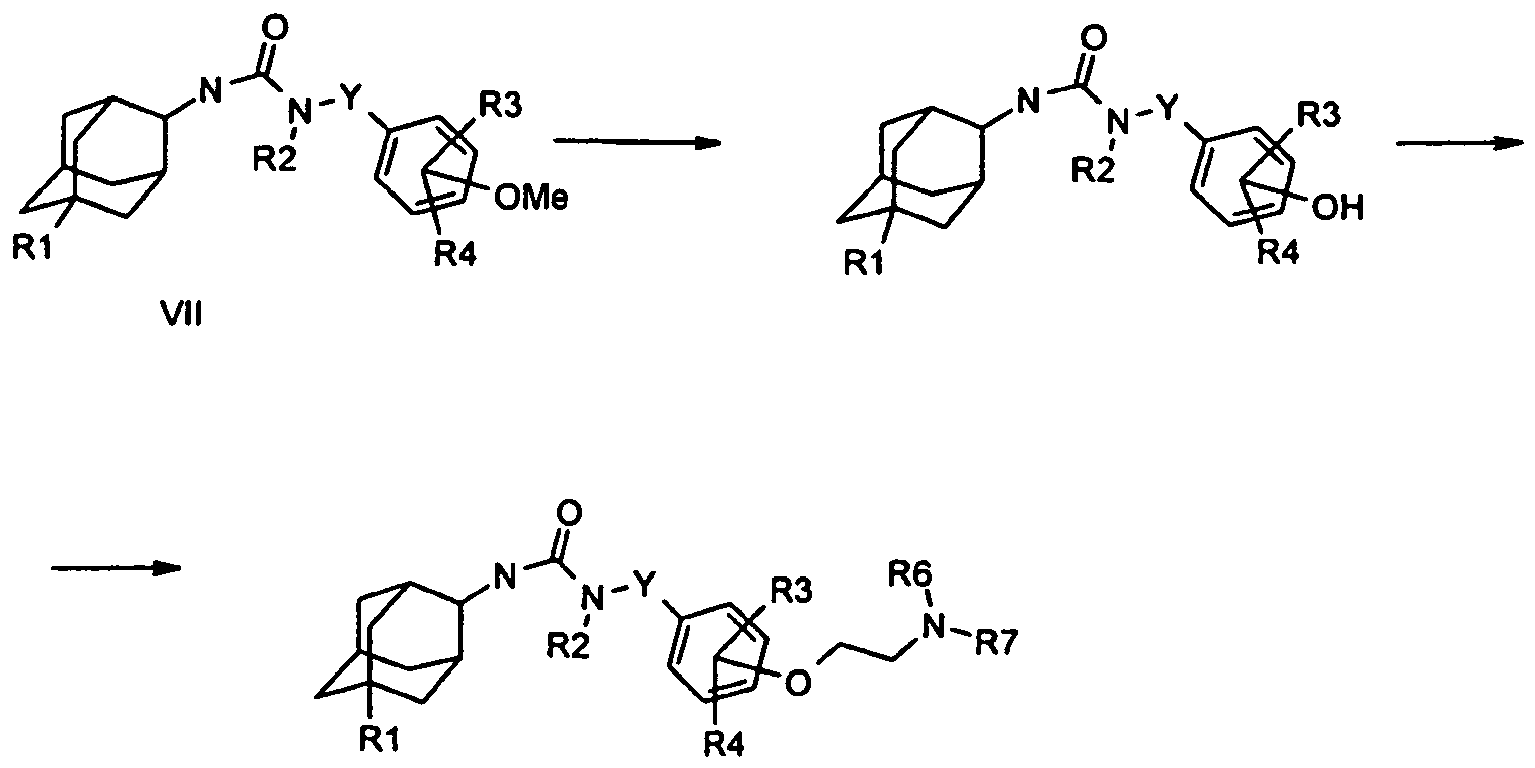 e) a residue R1, R2, R3, R4, R5, R6 and/or R7, as defined in claim 1, is converted in another residue R1, R2, R3, R4, R5, R6 and/or R7 by e.g. introducing an alkyl group, orf) a compound of formula I is isolated and/or treated with an acid or a base, to obtain the salt thereof.
 - Use of a compound according to one of the claims 1 to 6 for the preparation of a medicament.
- Use of a compound according to one of the claims 1 to 6 for the preparation of a medicament for the treatment and/or prevention of one ore more disease or condition selected from the group consisting of metabolic syndrome, diabetes, especially non-insulin dependent diabetes mellitus, prediabetes, insulin resistance, low glucose tolerance, hyperglycemia, obesity and weight-related disorders, lipid disorders such as dyslipidemia, hyperlipidemia, hypertriglyceridemia,
hypercholesterolemia, low HDL levels or high LDL levels, glaucoma, osteoporosis, glucocorticoid-mediated effects on neuronal function, such as cognitive impairment, anxiety or depression, neurodegenerative disease, immune disorders such as tuberculosis, leprosy or psoriasis, hypertension, atherosclerosis and its sequelae, vascular restenosis, cardiovascular diseases, pancreatitis, retinopathy, neuropathy and nephropathy. - Pharmaceutical composition, characterized in that it contains a therapeutically effective amount of one or more compounds according to one of the claims 1 to 6.
- Pharmaceutical composition according to claim 10, characterized in that it contains one or more additional compounds, selected from the group consisting of physiologically acceptable excipients, auxiliaries, adjuvants, diluents, carriers and pharmaceutically active agents other than the compounds according to one of the claims 1 to 6.
- Set (kit) consisting of separate packets ofa) a therapeutically effective amount of one or more compounds according to one of the claims 1 to 6 andb) a therapeutically effective amount of one or more further pharmaceutically active agents other than the compounds according to one of the claims 1 to 6.
- Process for the manufacture of a pharmaceutical composition, characterized in that one or more compounds according to one of the claims 1 to 6 and one or more compounds selected from the group consisting of solid, liquid or semiliquid excipients, auxiliaries, adjuvants, diluents, carriers and pharmaceutically active agents other than the compounds according to one of the claims 1 to 6, are converted in a suitable dosage form.
Priority Applications (4)
| Application Number | Priority Date | Filing Date | Title |
|---|---|---|---|
| SI200631675T SI1960352T1 (en) | 2005-12-16 | 2006-11-22 | 2-adamantylurea derivatives as selective 11beta-hsd1 inhibitors |
| PL06818709T PL1960352T3 (en) | 2005-12-16 | 2006-11-22 | 2-adamantylurea derivatives as selective 11beta-hsd1 inhibitors |
| EP06818709.5A EP1960352B1 (en) | 2005-12-16 | 2006-11-22 | 2-adamantylurea derivatives as selective 11beta-hsd1 inhibitors |
| CY20131100992T CY1114660T1 (en) | 2005-12-16 | 2013-11-07 | 2-DIAMONDERY PRODUCTION AS ECLECTIVE INGREDIENTS 11b-HSD1 |
Applications Claiming Priority (3)
| Application Number | Priority Date | Filing Date | Title |
|---|---|---|---|
| EP05292724A EP1801098A1 (en) | 2005-12-16 | 2005-12-16 | 2-Adamantylurea derivatives as selective 11B-HSD1 inhibitors |
| PCT/EP2006/011156 WO2007068330A1 (en) | 2005-12-16 | 2006-11-22 | 2-ADAMANTYLUREA DERIVATIVES AS SELECTIVE 11β-HSD1 INHIBITORS |
| EP06818709.5A EP1960352B1 (en) | 2005-12-16 | 2006-11-22 | 2-adamantylurea derivatives as selective 11beta-hsd1 inhibitors |
Publications (2)
| Publication Number | Publication Date |
|---|---|
| EP1960352A1 EP1960352A1 (en) | 2008-08-27 |
| EP1960352B1 true EP1960352B1 (en) | 2013-08-07 |
Family
ID=36123301
Family Applications (2)
| Application Number | Title | Priority Date | Filing Date |
|---|---|---|---|
| EP05292724A Withdrawn EP1801098A1 (en) | 2005-12-16 | 2005-12-16 | 2-Adamantylurea derivatives as selective 11B-HSD1 inhibitors |
| EP06818709.5A Active EP1960352B1 (en) | 2005-12-16 | 2006-11-22 | 2-adamantylurea derivatives as selective 11beta-hsd1 inhibitors |
Family Applications Before (1)
| Application Number | Title | Priority Date | Filing Date |
|---|---|---|---|
| EP05292724A Withdrawn EP1801098A1 (en) | 2005-12-16 | 2005-12-16 | 2-Adamantylurea derivatives as selective 11B-HSD1 inhibitors |
Country Status (19)
| Country | Link |
|---|---|
| US (2) | US8188288B2 (en) |
| EP (2) | EP1801098A1 (en) |
| JP (1) | JP5356825B2 (en) |
| KR (1) | KR101394586B1 (en) |
| CN (1) | CN101331114B (en) |
| AR (1) | AR058546A1 (en) |
| AU (1) | AU2006326703B2 (en) |
| BR (1) | BRPI0619839B8 (en) |
| CA (1) | CA2633186C (en) |
| CY (1) | CY1114660T1 (en) |
| DK (1) | DK1960352T3 (en) |
| EA (1) | EA017923B1 (en) |
| ES (1) | ES2434077T3 (en) |
| IL (1) | IL192053A (en) |
| PL (1) | PL1960352T3 (en) |
| PT (1) | PT1960352E (en) |
| SI (1) | SI1960352T1 (en) |
| WO (1) | WO2007068330A1 (en) |
| ZA (1) | ZA200806148B (en) |
Families Citing this family (58)
| Publication number | Priority date | Publication date | Assignee | Title |
|---|---|---|---|---|
| US7727978B2 (en) | 2006-08-24 | 2010-06-01 | Bristol-Myers Squibb Company | Cyclic 11-beta hydroxysteroid dehydrogenase type I inhibitors |
| US8835426B2 (en) | 2007-02-26 | 2014-09-16 | Vitae Pharmaceuticals, Inc. | Cyclic urea and carbamate inhibitors of 11β-hydroxysteroid dehydrogenase 1 |
| JP5223864B2 (en) * | 2007-06-27 | 2013-06-26 | 大正製薬株式会社 | Compound having 11β-HSD1 inhibitory activity |
| JP5451611B2 (en) | 2007-07-26 | 2014-03-26 | ヴァイティー ファーマシューティカルズ,インコーポレイテッド | Cyclic inhibitor of 11β-hydroxysteroid dehydrogenase 1 |
| WO2009020140A1 (en) * | 2007-08-06 | 2009-02-12 | Dainippon Sumitomo Pharma Co., Ltd. | Adamantylurea derivative |
| EP2025674A1 (en) | 2007-08-15 | 2009-02-18 | sanofi-aventis | Substituted tetra hydro naphthalines, method for their manufacture and their use as drugs |
| AR069207A1 (en) | 2007-11-07 | 2010-01-06 | Vitae Pharmaceuticals Inc | CYCLIC UREAS AS INHIBITORS OF THE 11 BETA - HIDROXI-ESTEROIDE DESHIDROGENASA 1 |
| CA2708303A1 (en) | 2007-12-11 | 2009-06-18 | Vitae Pharmaceuticals, Inc. | Cyclic urea inhibitors of 11.beta.-hydroxysteroid dehydrogenase 1 |
| TW200934490A (en) | 2008-01-07 | 2009-08-16 | Vitae Pharmaceuticals Inc | Lactam inhibitors of 11 &abgr;-hydroxysteroid dehydrogenase 1 |
| WO2009094169A1 (en) | 2008-01-24 | 2009-07-30 | Vitae Pharmaceuticals, Inc. | Cyclic carbazate and semicarbazide inhibitors of 11beta-hydroxysteroid dehydrogenase 1 |
| CA2714532A1 (en) | 2008-02-11 | 2009-08-20 | Vitae Pharmaceuticals, Inc. | 1,3-oxazepan-2-one and 1,3-diazepan-2-one inhibitors of 11.beta.-hydroxysteroid dehydrogenase 1 |
| US8598160B2 (en) | 2008-02-15 | 2013-12-03 | Vitae Pharmaceuticals, Inc. | Cycloalkyl lactame derivatives as inhibitors of 11-beta-hydroxysteroid dehydrogenase 1 |
| TW200944526A (en) * | 2008-04-22 | 2009-11-01 | Vitae Pharmaceuticals Inc | Carbamate and urea inhibitors of 11β-hydroxysteroid dehydrogenase 1 |
| TW201004945A (en) | 2008-05-01 | 2010-02-01 | Vitae Pharmaceuticals Inc | Cyclic inhibitors of 11beta-hydroxysteroid dehydrogenase 1 |
| CA2723032A1 (en) | 2008-05-01 | 2009-11-05 | Vitae Pharmaceuticals, Inc. | Cyclic inhibitors of 11beta-hydroxysteroid dehydrogenase 1 |
| EP2291370B1 (en) | 2008-05-01 | 2013-11-27 | Vitae Pharmaceuticals, Inc. | Cyclic inhibitors of 11beta-hydroxysteroid dehydrogenase 1 |
| KR20110002492A (en) | 2008-05-01 | 2011-01-07 | 비타이 파마슈티컬즈, 인코포레이티드 | Cyclic Inhibitor of 11beta-hydroxysteroid Dehydrogenase 1 |
| US7863533B2 (en) * | 2008-06-07 | 2011-01-04 | Apple Inc. | Cantilevered push button having multiple contacts and fulcrums |
| WO2010011314A1 (en) | 2008-07-25 | 2010-01-28 | Boehringer Ingelheim International Gmbh | Cyclic inhibitors of 11 beta-hydroxysteroid dehydrogenase 1 |
| US8846668B2 (en) | 2008-07-25 | 2014-09-30 | Vitae Pharmaceuticals, Inc. | Inhibitors of 11beta-hydroxysteroid dehydrogenase 1 |
| CA2729993A1 (en) | 2008-07-25 | 2010-01-28 | Boehringer Ingelheim International Gmbh | Synthesis of inhibitors of 11beta-hydroxysteroid dehydrogenase type 1 |
| EP2322505A4 (en) * | 2008-08-29 | 2011-10-19 | Kowa Co | 1-ADAMANTYLAZETIDINE-2-ONE DERIVATIVE AND PHARMACEUTICAL PREPARATION COMPRISING THE DERIVATIVE |
| JP5679997B2 (en) | 2009-02-04 | 2015-03-04 | ベーリンガー インゲルハイム インターナショナル ゲゼルシャフト ミット ベシュレンクテル ハフツング | Cyclic inhibitor of 11β-hydroxysteroid dehydrogenase 1 |
| CN103772239B (en) * | 2009-04-20 | 2017-04-12 | Abbvie 公司 | amide and amidine derivatives and uses thereof |
| UA109255C2 (en) | 2009-04-30 | 2015-08-10 | Берінгер Інгельхайм Інтернешнл Гмбх | Cyclic inhibitors of 11beta-hydroxysteroid dehydrogenase 1 |
| ES2350077B1 (en) | 2009-06-04 | 2011-11-04 | Laboratorios Salvat, S.A. | INHIBITING COMPOUNDS OF 11BETA-HYDROXIESTEROID DEHYDROGENASE TYPE 1. |
| WO2011011123A1 (en) | 2009-06-11 | 2011-01-27 | Vitae Pharmaceuticals, Inc. | Cyclic inhibitors of 11beta-hydroxysteroid dehydrogenase 1 based on the 1,3 -oxazinan- 2 -one structure |
| WO2011002910A1 (en) | 2009-07-01 | 2011-01-06 | Vitae Pharmaceuticals, Inc. | Cyclic inhibitors of 11beta-hydroxysteroid dehydrogenase 1 |
| EP2496589B1 (en) | 2009-11-05 | 2014-03-05 | Boehringer Ingelheim International GmbH | Novel chiral phosphorus ligands |
| WO2011059021A1 (en) * | 2009-11-11 | 2011-05-19 | 大日本住友製薬株式会社 | 8-azabicyclo[3.2.1]octane-8-carboxamide derivative |
| WO2011107494A1 (en) | 2010-03-03 | 2011-09-09 | Sanofi | Novel aromatic glycoside derivatives, medicaments containing said compounds, and the use thereof |
| EP2576570A1 (en) | 2010-05-26 | 2013-04-10 | Boehringer Ingelheim International GmbH | 2-oxo-1,2-dihydropyridin-4-ylboronic acid derivatives |
| EP2582698B1 (en) | 2010-06-16 | 2016-09-14 | Vitae Pharmaceuticals, Inc. | Substituted 5-,6- and 7-membered heterocycles, medicaments containing such compounds, and their use |
| EP2582709B1 (en) | 2010-06-18 | 2018-01-24 | Sanofi | Azolopyridin-3-one derivatives as inhibitors of lipases and phospholipases |
| US8530413B2 (en) | 2010-06-21 | 2013-09-10 | Sanofi | Heterocyclically substituted methoxyphenyl derivatives with an oxo group, processes for preparation thereof and use thereof as medicaments |
| WO2011161128A1 (en) | 2010-06-25 | 2011-12-29 | Boehringer Ingelheim International Gmbh | Azaspirohexanones as inhibitors of 11-beta-hsd1 for the treatment of metabolic disorders |
| TW201221505A (en) | 2010-07-05 | 2012-06-01 | Sanofi Sa | Aryloxyalkylene-substituted hydroxyphenylhexynoic acids, process for preparation thereof and use thereof as a medicament |
| TW201215388A (en) | 2010-07-05 | 2012-04-16 | Sanofi Sa | (2-aryloxyacetylamino)phenylpropionic acid derivatives, processes for preparation thereof and use thereof as medicaments |
| TW201215387A (en) | 2010-07-05 | 2012-04-16 | Sanofi Aventis | Spirocyclically substituted 1,3-propane dioxide derivatives, processes for preparation thereof and use thereof as a medicament |
| AU2011296926C1 (en) | 2010-09-03 | 2015-04-02 | Sumitomo Dainippon Pharma Co., Ltd. | Cyclic amide derivative |
| CA2813671A1 (en) | 2010-11-02 | 2012-05-10 | Boehringer Ingelheim International Gmbh | Pharmaceutical combinations for the treatment of metabolic disorders |
| WO2012120056A1 (en) | 2011-03-08 | 2012-09-13 | Sanofi | Tetrasubstituted oxathiazine derivatives, method for producing them, their use as medicine and drug containing said derivatives and the use thereof |
| EP2766349B1 (en) | 2011-03-08 | 2016-06-01 | Sanofi | Oxathiazine derivatives substituted with carbocycles or heterocycles, method for producing same, drugs containing said compounds, and use thereof |
| EP2683704B1 (en) | 2011-03-08 | 2014-12-17 | Sanofi | Branched oxathiazine derivatives, method for the production thereof, use thereof as medicine and drug containing said derivatives and use thereof |
| WO2012120055A1 (en) | 2011-03-08 | 2012-09-13 | Sanofi | Di- and tri-substituted oxathiazine derivates, method for the production thereof, use thereof as medicine and drug containing said derivatives and use thereof |
| WO2012120054A1 (en) | 2011-03-08 | 2012-09-13 | Sanofi | Di- and tri-substituted oxathiazine derivates, method for the production thereof, use thereof as medicine and drug containing said derivatives and use thereof |
| KR101332805B1 (en) | 2011-03-31 | 2013-11-27 | 한국화학연구원 | Derivatives Having Adamantyl Group and Pharmaceutical Acceptable Salts Thereof |
| WO2013037390A1 (en) | 2011-09-12 | 2013-03-21 | Sanofi | 6-(4-hydroxy-phenyl)-3-styryl-1h-pyrazolo[3,4-b]pyridine-4-carboxylic acid amide derivatives as kinase inhibitors |
| EP2760862B1 (en) | 2011-09-27 | 2015-10-21 | Sanofi | 6-(4-hydroxy-phenyl)-3-alkyl-1h-pyrazolo[3,4-b]pyridine-4-carboxylic acid amide derivatives as kinase inhibitors |
| RU2486893C1 (en) * | 2012-06-13 | 2013-07-10 | Федеральное государственное бюджетное образовательное учреждение высшего профессионального образования "Волгоградский государственный технический университет" (ВолгГТУ) | Method of obtaining bis[3-methyl(adamant-1-yl)]urea |
| JP6980534B2 (en) | 2015-06-25 | 2021-12-15 | ザ チルドレンズ メディカル センター コーポレーション | Methods and Compositions for Enlargement, Enrichment, and Maintenance of Hematopoietic Stem Cells |
| CN104974084A (en) * | 2015-07-19 | 2015-10-14 | 佛山市赛维斯医药科技有限公司 | 11beta-HSD1 (11-beta-hydroxysteroid dehydrogenase 1) inhibitor containing aminobipyridine tertiary alcohol structure and application thereof |
| CN105085346B (en) * | 2015-08-14 | 2017-03-29 | 天津小新医药科技有限公司 | MENTHOL class P2Y12 receptor antagonist of amino-contained and application thereof |
| CN105085345B (en) * | 2015-08-14 | 2016-09-14 | 天津小新医药科技有限公司 | MENTHOL class P2Y12 receptor antagonist containing nitro and application thereof |
| WO2017161001A1 (en) | 2016-03-15 | 2017-09-21 | Children's Medical Center Corporation | Methods and compositions relating to hematopoietic stem cell expansion |
| EP3235813A1 (en) | 2016-04-19 | 2017-10-25 | Cidqo 2012, S.L. | Aza-tetra-cyclo derivatives |
| CN112823151B (en) * | 2018-07-03 | 2024-11-15 | 艾福姆德尤股份有限公司 | Compounds and compositions for treating diseases associated with STING activity |
| RU2697409C1 (en) * | 2019-04-30 | 2019-08-14 | Федеральное государственное бюджетное учреждение науки Новосибирский институт органической химии им. Н.Н. Ворожцова Сибирского отделения Российской академии наук (НИОХ СО РАН) | 1-adamantyl-3-(((1r,4as,10ar)-7-isopropyl-1,4a-dimethyl-1,2,3,4,4a,9,10,10a-octahydrophenanthren-1-yl)methyl)urea, which exhibits inhibiting action on human tyrosyl-dna-phosphodiesterase 1 enzyme and increases activity of temozolomide against glioblastoma cells |
Family Cites Families (50)
| Publication number | Priority date | Publication date | Assignee | Title |
|---|---|---|---|---|
| US3621100A (en) * | 1965-11-18 | 1971-11-16 | Geigy Chem Corp | Composition and method for producing a tuberculostatic effect |
| CA1060899A (en) * | 1974-01-25 | 1979-08-21 | Goro Asato | Substituted tetrahydrobenzothiophenes |
| US4036979A (en) * | 1974-01-25 | 1977-07-19 | American Cyanamid Company | Compositions containing 4,5,6,7-tetrahydrobenz[b]thien-4-yl-ureas or derivatives and methods of enhancing growth rate |
| US4156670A (en) * | 1976-03-23 | 1979-05-29 | American Cyanamid Company | Substituted tetrahydrobenzothiophenes and method of preparation thereof |
| US4349552A (en) | 1978-10-30 | 1982-09-14 | Fujisawa Pharmaceutical Company, Ltd. | 5-Fluorouracil derivatives, and their pharmaceutical compositions |
| FR2692575B1 (en) | 1992-06-23 | 1995-06-30 | Sanofi Elf | NOVEL PYRAZOLE DERIVATIVES, PROCESS FOR THEIR PREPARATION AND PHARMACEUTICAL COMPOSITIONS CONTAINING THEM. |
| US5292736A (en) | 1993-02-26 | 1994-03-08 | Sterling Winthrop Inc. | Morpholinoalkylindenes as antiglaucoma agents |
| US5532237A (en) | 1995-02-15 | 1996-07-02 | Merck Frosst Canada, Inc. | Indole derivatives with affinity for the cannabinoid receptor |
| FR2741621B1 (en) | 1995-11-23 | 1998-02-13 | Sanofi Sa | NOVEL PYRAZOLE DERIVATIVES, PROCESS FOR THEIR PREPARATION AND PHARMACEUTICAL COMPOSITIONS CONTAINING THE SAME |
| AU1856997A (en) | 1996-02-02 | 1997-08-22 | Merck & Co., Inc. | Method for raising hdl cholesterol levels |
| AR008789A1 (en) | 1996-07-31 | 2000-02-23 | Bayer Corp | PIRIDINES AND SUBSTITUTED BIPHENYLS |
| EP0979228A4 (en) | 1997-03-18 | 2000-05-03 | Smithkline Beecham Corp | Novel cannabinoid receptor agonists |
| WO1999001423A1 (en) | 1997-07-01 | 1999-01-14 | Novo Nordisk A/S | Glucagon antagonists/inverse agonists |
| US6613942B1 (en) | 1997-07-01 | 2003-09-02 | Novo Nordisk A/S | Glucagon antagonists/inverse agonists |
| KR20010021696A (en) | 1997-07-11 | 2001-03-15 | 미즈노 마사루 | Quinoline compounds and medicinal uses thereof |
| JP2001517617A (en) * | 1997-09-24 | 2001-10-09 | ノヴァ モレキュラー インク. | Methods for increasing APOE levels for the treatment of neurodegenerative diseases |
| AU742425B2 (en) | 1998-06-11 | 2002-01-03 | Merck & Co., Inc. | Spiropiperidine derivatives as melanocortin receptor agonists |
| DE19837627A1 (en) | 1998-08-19 | 2000-02-24 | Bayer Ag | New aminoacid esters of arylsulfonamides are useful for e.g. treating neurodegenerative diseases, pain, convulsions or bacterial or viral infections |
| AU4537900A (en) | 1999-05-17 | 2000-12-05 | Agouron Pharmaceuticals, Inc. | Glucagon antagonists/inverse agonists |
| WO2000074679A1 (en) | 1999-06-04 | 2000-12-14 | Merck & Co., Inc. | Substituted piperidines as melanocortin-4 receptor agonists |
| TWI279402B (en) | 1999-08-20 | 2007-04-21 | Banyu Pharma Co Ltd | Spiro compounds having NPY antagonistic activities and agents containing the same |
| DE60039111D1 (en) | 1999-09-28 | 2008-07-17 | Bayer Corp | AGONISTS OF RECEPTOR 3 (R3) OF PITUITARY ADENYLATE CYCLASE-ACTIVATING PEPTIDE (PACAP) AND ITS PHARMACOLOGICAL USE |
| JP2003527444A (en) | 2000-03-23 | 2003-09-16 | メルク エンド カムパニー インコーポレーテッド | Spiropiperidine derivatives acting as melanocortin receptor agonists |
| CA2403686C (en) | 2000-03-23 | 2010-01-26 | Merck & Co., Inc. | Substituted piperidines as melanocortin receptor agonists |
| BR0206831A (en) | 2001-02-02 | 2004-07-06 | Takeda Chemical Industries Ltd | Compound, crystal, pharmaceutical agent, agents for the prophylaxis or treatment of diabetes, diabetic complications, impaired glucose tolerance and obesity, peptidase inhibitor, use of a compound, and method of producing a compound |
| CA2439152C (en) | 2001-02-28 | 2008-06-17 | Merck & Co., Inc. | Acylated piperidine derivatives as melanocortin-4 receptor agonists |
| CZ2003698A3 (en) | 2001-03-22 | 2003-06-18 | Solvay Pharmaceuticals B. V. | 4,5-Dihydro-1H-pyrazole derivatives having CB1-antagonistic activity |
| US6573287B2 (en) | 2001-04-12 | 2003-06-03 | Bristo-Myers Squibb Company | 2,1-oxazoline and 1,2-pyrazoline-based inhibitors of dipeptidyl peptidase IV and method |
| FR2824825B1 (en) | 2001-05-15 | 2005-05-06 | Servier Lab | NOVEL ALPHA-AMINOACID DERIVATIVES, PROCESS FOR THEIR PREPARATION AND PHARMACEUTICAL COMPOSITIONS CONTAINING THEM |
| CA2450475A1 (en) | 2001-06-20 | 2003-01-03 | Linda Brockunier | Dipeptidyl peptidase inhibitors for the treatment of diabetes |
| AU2002344820B2 (en) | 2001-06-20 | 2006-12-14 | Merck & Co., Inc. | Dipeptidyl peptidase inhibitors for the treatment of diabetes |
| AU2002322418A1 (en) | 2001-06-21 | 2003-01-08 | Champion Microelectronic Corp. | Current inrush limiting and bleed resistor current inhibiting in a switching power converter |
| RU2299066C2 (en) | 2001-06-27 | 2007-05-20 | Пробиодруг Аг | Novel inhibitors of dipeptidyl peptidase iv and their using as anticancer agents |
| ATE370943T1 (en) | 2001-06-27 | 2007-09-15 | Smithkline Beecham Corp | FLUOROPYRROLIDINE AS DIPEPTIDYL-PEPTIDASE INHIBITORS |
| JP3909056B2 (en) | 2001-06-27 | 2007-04-25 | スミスクライン ビーチャム コーポレーション | Fluoropyrrolidines as dipeptidyl peptidase inhibitors |
| ATE380175T1 (en) | 2001-06-27 | 2007-12-15 | Smithkline Beecham Corp | PYRROLIDINE AS DIPEPTIDYL PEPTIDASE INHIBITORS |
| EP1404675B1 (en) | 2001-07-03 | 2008-03-12 | Novo Nordisk A/S | Dpp-iv-inhibiting purine derivatives for the treatment of diabetes |
| UA74912C2 (en) | 2001-07-06 | 2006-02-15 | Merck & Co Inc | Beta-aminotetrahydroimidazo-(1,2-a)-pyrazines and tetratriazolo-(4,3-a)-pyrazines as inhibitors of dipeptylpeptidase for the treatment or prevention of diabetes |
| AU2002319627A1 (en) | 2001-07-20 | 2003-03-03 | Merck And Co., Inc. | Substituted imidazoles as cannabinoid receptor modulators |
| US6977264B2 (en) | 2001-07-25 | 2005-12-20 | Amgen Inc. | Substituted piperidines and methods of use |
| WO2003065983A2 (en) | 2002-02-01 | 2003-08-14 | Merck & Co., Inc. | 11-beta-hydroxysteroid dehydrogenase 1 inhibitors useful for the treatment of diabetes, obesity and dyslipidemia |
| AR038967A1 (en) | 2002-03-18 | 2005-02-02 | Solvay Pharm Bv | DERIVATIVES OF 2,3 - DIARIL - PIRAZOLIDINAS AS INHIBITORS OF ENZYMES THAT DEGRADE THE NEUROTENSIN |
| US20040014422A1 (en) | 2002-07-19 | 2004-01-22 | Nokia Corporation | Method and system for handovers using service description data |
| EP1402887A1 (en) * | 2002-09-18 | 2004-03-31 | Jerini AG | New compounds for the inhibition of undesired cell proliferation and use thereof |
| KR20050051691A (en) | 2002-10-11 | 2005-06-01 | 아스트라제네카 아베 | 1,4-disubstituted piperidine derivatives and their use as 11-betahsd1 inhibitors |
| JP2006514102A (en) | 2002-11-07 | 2006-04-27 | アストラゼネカ アクチボラグ | 2-Oxo-ethanesulfonamide derivatives |
| WO2004056744A1 (en) * | 2002-12-23 | 2004-07-08 | Janssen Pharmaceutica N.V. | Adamantyl acetamides as hydroxysteroid dehydrogenase inhibitors |
| TW200503994A (en) | 2003-01-24 | 2005-02-01 | Novartis Ag | Organic compounds |
| ATE455547T1 (en) | 2003-04-11 | 2010-02-15 | High Point Pharmaceuticals Llc | PHARMACEUTICAL USES OF CONDENSED 1,2,4-TRIAZOLES |
| DE602004027171D1 (en) | 2003-04-11 | 2010-06-24 | High Point Pharmaceuticals Llc | Compounds with activity on 11Beta hydroxasteroid dehydrogenase |
-
2005
- 2005-12-16 EP EP05292724A patent/EP1801098A1/en not_active Withdrawn
-
2006
- 2006-11-22 PL PL06818709T patent/PL1960352T3/en unknown
- 2006-11-22 KR KR1020087017137A patent/KR101394586B1/en not_active Expired - Fee Related
- 2006-11-22 DK DK06818709.5T patent/DK1960352T3/en active
- 2006-11-22 SI SI200631675T patent/SI1960352T1/en unknown
- 2006-11-22 JP JP2008544787A patent/JP5356825B2/en not_active Expired - Fee Related
- 2006-11-22 PT PT68187095T patent/PT1960352E/en unknown
- 2006-11-22 EA EA200801426A patent/EA017923B1/en not_active IP Right Cessation
- 2006-11-22 AU AU2006326703A patent/AU2006326703B2/en not_active Ceased
- 2006-11-22 WO PCT/EP2006/011156 patent/WO2007068330A1/en not_active Ceased
- 2006-11-22 ES ES06818709T patent/ES2434077T3/en active Active
- 2006-11-22 BR BRPI0619839A patent/BRPI0619839B8/en not_active IP Right Cessation
- 2006-11-22 US US12/097,643 patent/US8188288B2/en not_active Expired - Fee Related
- 2006-11-22 CN CN2006800471499A patent/CN101331114B/en not_active Expired - Fee Related
- 2006-11-22 CA CA2633186A patent/CA2633186C/en active Active
- 2006-11-22 EP EP06818709.5A patent/EP1960352B1/en active Active
- 2006-12-15 AR ARP060105538A patent/AR058546A1/en unknown
-
2008
- 2008-06-11 IL IL192053A patent/IL192053A/en active IP Right Grant
- 2008-07-15 ZA ZA200806148A patent/ZA200806148B/en unknown
-
2012
- 2012-02-07 US US13/367,947 patent/US8466200B2/en not_active Expired - Fee Related
-
2013
- 2013-11-07 CY CY20131100992T patent/CY1114660T1/en unknown
Also Published As
| Publication number | Publication date |
|---|---|
| CA2633186A1 (en) | 2007-06-21 |
| US8188288B2 (en) | 2012-05-29 |
| IL192053A0 (en) | 2008-12-29 |
| BRPI0619839B1 (en) | 2021-01-12 |
| SI1960352T1 (en) | 2013-12-31 |
| ES2434077T3 (en) | 2013-12-13 |
| CY1114660T1 (en) | 2016-10-05 |
| CN101331114A (en) | 2008-12-24 |
| PL1960352T3 (en) | 2013-12-31 |
| AR058546A1 (en) | 2008-02-13 |
| CN101331114B (en) | 2013-08-07 |
| WO2007068330A1 (en) | 2007-06-21 |
| AU2006326703B2 (en) | 2012-02-23 |
| BRPI0619839B8 (en) | 2021-05-25 |
| EA017923B1 (en) | 2013-04-30 |
| AU2006326703A1 (en) | 2007-06-21 |
| KR101394586B1 (en) | 2014-05-12 |
| IL192053A (en) | 2014-01-30 |
| JP2009525262A (en) | 2009-07-09 |
| PT1960352E (en) | 2013-10-31 |
| ZA200806148B (en) | 2009-06-24 |
| BRPI0619839A2 (en) | 2011-10-18 |
| EP1801098A1 (en) | 2007-06-27 |
| EA200801426A1 (en) | 2008-10-30 |
| JP5356825B2 (en) | 2013-12-04 |
| DK1960352T3 (en) | 2013-10-28 |
| EP1960352A1 (en) | 2008-08-27 |
| US8466200B2 (en) | 2013-06-18 |
| KR20080079317A (en) | 2008-08-29 |
| US20120172396A1 (en) | 2012-07-05 |
| US20090227631A1 (en) | 2009-09-10 |
| CA2633186C (en) | 2014-08-12 |
Similar Documents
| Publication | Publication Date | Title |
|---|---|---|
| US8466200B2 (en) | 2-adamantylurea derivatives as selective 11β-HSD1 inhibitors | |
| US8586577B2 (en) | Diazepane acetamide derivatives as selective 11B-HSD1 inhibitors | |
| EP2094263B1 (en) | 2-adamantyl-butyramide derivatives as selective 11 beta-hsd1 inhibitors | |
| EP2247589B1 (en) | 7-azaindole derivatives as selective 11-beta-hydroxysteroid dehydrogenase type 1 inhibitors | |
| MX2008007554A (en) | 2-adamantylurea derivatives as selective 11î²-hsd1 inhibitors | |
| HK1127947A (en) | 2-ADAMANTYLUREA DERIVATIVES AS SELECTIVE 11β-HSD1 INHIBITORS |
Legal Events
| Date | Code | Title | Description |
|---|---|---|---|
| PUAI | Public reference made under article 153(3) epc to a published international application that has entered the european phase |
Free format text: ORIGINAL CODE: 0009012 |
|
| 17P | Request for examination filed |
Effective date: 20080320 |
|
| AK | Designated contracting states |
Kind code of ref document: A1 Designated state(s): AT BE BG CH CY CZ DE DK EE ES FI FR GB GR HU IE IS IT LI LT LU LV MC NL PL PT RO SE SI SK TR |
|
| 17Q | First examination report despatched |
Effective date: 20081010 |
|
| DAX | Request for extension of the european patent (deleted) | ||
| REG | Reference to a national code |
Ref country code: DE Ref legal event code: R079 Ref document number: 602006037770 Country of ref document: DE Free format text: PREVIOUS MAIN CLASS: C07C0275280000 Ipc: C07D0261140000 |
|
| GRAP | Despatch of communication of intention to grant a patent |
Free format text: ORIGINAL CODE: EPIDOSNIGR1 |
|
| RIC1 | Information provided on ipc code assigned before grant |
Ipc: C07D 295/215 20060101ALI20130214BHEP Ipc: C07D 249/14 20060101ALI20130214BHEP Ipc: C07D 261/14 20060101AFI20130214BHEP Ipc: C07D 333/20 20060101ALI20130214BHEP Ipc: C07D 213/75 20060101ALI20130214BHEP Ipc: C07C 323/44 20060101ALI20130214BHEP Ipc: C07D 319/08 20060101ALI20130214BHEP Ipc: C07C 275/34 20060101ALI20130214BHEP Ipc: C07D 213/40 20060101ALI20130214BHEP Ipc: C07D 307/52 20060101ALI20130214BHEP Ipc: C07C 275/26 20060101ALI20130214BHEP Ipc: C07D 295/088 20060101ALI20130214BHEP Ipc: C07C 275/30 20060101ALI20130214BHEP Ipc: C07D 233/54 20060101ALI20130214BHEP Ipc: C07D 333/36 20060101ALI20130214BHEP |
|
| GRAS | Grant fee paid |
Free format text: ORIGINAL CODE: EPIDOSNIGR3 |
|
| GRAA | (expected) grant |
Free format text: ORIGINAL CODE: 0009210 |
|
| AK | Designated contracting states |
Kind code of ref document: B1 Designated state(s): AT BE BG CH CY CZ DE DK EE ES FI FR GB GR HU IE IS IT LI LT LU LV MC NL PL PT RO SE SI SK TR |
|
| REG | Reference to a national code |
Ref country code: GB Ref legal event code: FG4D |
|
| REG | Reference to a national code |
Ref country code: AT Ref legal event code: REF Ref document number: 625719 Country of ref document: AT Kind code of ref document: T Effective date: 20130815 Ref country code: CH Ref legal event code: EP |
|
| REG | Reference to a national code |
Ref country code: IE Ref legal event code: FG4D |
|
| REG | Reference to a national code |
Ref country code: DE Ref legal event code: R096 Ref document number: 602006037770 Country of ref document: DE Effective date: 20131002 |
|
| REG | Reference to a national code |
Ref country code: DK Ref legal event code: T3 Effective date: 20131025 Ref country code: DK Ref legal event code: T3 |
|
| REG | Reference to a national code |
Ref country code: PT Ref legal event code: SC4A Free format text: AVAILABILITY OF NATIONAL TRANSLATION Effective date: 20131025 |
|
| REG | Reference to a national code |
Ref country code: SE Ref legal event code: TRGR |
|
| REG | Reference to a national code |
Ref country code: RO Ref legal event code: EPE |
|
| REG | Reference to a national code |
Ref country code: NL Ref legal event code: T3 |
|
| REG | Reference to a national code |
Ref country code: ES Ref legal event code: FG2A Ref document number: 2434077 Country of ref document: ES Kind code of ref document: T3 Effective date: 20131213 |
|
| REG | Reference to a national code |
Ref country code: EE Ref legal event code: FG4A Ref document number: E008482 Country of ref document: EE Effective date: 20131023 |
|
| REG | Reference to a national code |
Ref country code: PL Ref legal event code: T3 |
|
| REG | Reference to a national code |
Ref country code: GR Ref legal event code: EP Ref document number: 20130402217 Country of ref document: GR Effective date: 20131118 |
|
| REG | Reference to a national code |
Ref country code: SK Ref legal event code: T3 Ref document number: E 15186 Country of ref document: SK |
|
| REG | Reference to a national code |
Ref country code: HU Ref legal event code: AG4A Ref document number: E018479 Country of ref document: HU |
|
| PLBE | No opposition filed within time limit |
Free format text: ORIGINAL CODE: 0009261 |
|
| STAA | Information on the status of an ep patent application or granted ep patent |
Free format text: STATUS: NO OPPOSITION FILED WITHIN TIME LIMIT |
|
| 26N | No opposition filed |
Effective date: 20140508 |
|
| REG | Reference to a national code |
Ref country code: DE Ref legal event code: R097 Ref document number: 602006037770 Country of ref document: DE Effective date: 20140508 |
|
| REG | Reference to a national code |
Ref country code: FR Ref legal event code: PLFP Year of fee payment: 10 |
|
| REG | Reference to a national code |
Ref country code: FR Ref legal event code: PLFP Year of fee payment: 11 |
|
| REG | Reference to a national code |
Ref country code: FR Ref legal event code: PLFP Year of fee payment: 12 |
|
| REG | Reference to a national code |
Ref country code: FR Ref legal event code: PLFP Year of fee payment: 13 |
|
| PGFP | Annual fee paid to national office [announced via postgrant information from national office to epo] |
Ref country code: SE Payment date: 20220912 Year of fee payment: 17 Ref country code: IE Payment date: 20220912 Year of fee payment: 17 Ref country code: GB Payment date: 20220930 Year of fee payment: 17 Ref country code: BG Payment date: 20220923 Year of fee payment: 17 |
|
| PGFP | Annual fee paid to national office [announced via postgrant information from national office to epo] |
Ref country code: PL Payment date: 20220906 Year of fee payment: 17 Ref country code: LV Payment date: 20220921 Year of fee payment: 17 |
|
| PGFP | Annual fee paid to national office [announced via postgrant information from national office to epo] |
Ref country code: NL Payment date: 20221019 Year of fee payment: 17 Ref country code: FR Payment date: 20221010 Year of fee payment: 17 |
|
| PGFP | Annual fee paid to national office [announced via postgrant information from national office to epo] |
Ref country code: TR Payment date: 20221121 Year of fee payment: 17 Ref country code: SK Payment date: 20221013 Year of fee payment: 17 Ref country code: RO Payment date: 20221013 Year of fee payment: 17 Ref country code: PT Payment date: 20221122 Year of fee payment: 17 Ref country code: MC Payment date: 20221026 Year of fee payment: 17 Ref country code: LU Payment date: 20221114 Year of fee payment: 17 Ref country code: LT Payment date: 20221117 Year of fee payment: 17 Ref country code: IT Payment date: 20221011 Year of fee payment: 17 Ref country code: FI Payment date: 20221109 Year of fee payment: 17 Ref country code: ES Payment date: 20221206 Year of fee payment: 17 Ref country code: EE Payment date: 20221004 Year of fee payment: 17 Ref country code: DK Payment date: 20221111 Year of fee payment: 17 Ref country code: DE Payment date: 20220930 Year of fee payment: 17 Ref country code: CZ Payment date: 20221027 Year of fee payment: 17 Ref country code: CY Payment date: 20221006 Year of fee payment: 17 Ref country code: AT Payment date: 20221025 Year of fee payment: 17 |
|
| PGFP | Annual fee paid to national office [announced via postgrant information from national office to epo] |
Ref country code: SI Payment date: 20221005 Year of fee payment: 17 Ref country code: IS Payment date: 20221006 Year of fee payment: 17 Ref country code: HU Payment date: 20221022 Year of fee payment: 17 Ref country code: GR Payment date: 20221013 Year of fee payment: 17 Ref country code: CH Payment date: 20221201 Year of fee payment: 17 Ref country code: BE Payment date: 20221019 Year of fee payment: 17 |
|
| P01 | Opt-out of the competence of the unified patent court (upc) registered |
Effective date: 20230518 |
|
| REG | Reference to a national code |
Ref country code: DE Ref legal event code: R119 Ref document number: 602006037770 Country of ref document: DE |
|
| REG | Reference to a national code |
Ref country code: LT Ref legal event code: MM4D Effective date: 20231122 |
|
| REG | Reference to a national code |
Ref country code: EE Ref legal event code: MM4A Ref document number: E008482 Country of ref document: EE Effective date: 20231130 |
|
| REG | Reference to a national code |
Ref country code: DK Ref legal event code: EBP Effective date: 20231130 |
|
| REG | Reference to a national code |
Ref country code: CH Ref legal event code: PL |
|
| PG25 | Lapsed in a contracting state [announced via postgrant information from national office to epo] |
Ref country code: MC Free format text: LAPSE BECAUSE OF NON-PAYMENT OF DUE FEES Effective date: 20231130 |
|
| REG | Reference to a national code |
Ref country code: SE Ref legal event code: EUG |
|
| REG | Reference to a national code |
Ref country code: NL Ref legal event code: MM Effective date: 20231201 |
|
| PG25 | Lapsed in a contracting state [announced via postgrant information from national office to epo] |
Ref country code: LT Free format text: LAPSE BECAUSE OF NON-PAYMENT OF DUE FEES Effective date: 20231122 |
|
| PG25 | Lapsed in a contracting state [announced via postgrant information from national office to epo] |
Ref country code: LU Free format text: LAPSE BECAUSE OF NON-PAYMENT OF DUE FEES Effective date: 20231122 Ref country code: GR Free format text: LAPSE BECAUSE OF NON-PAYMENT OF DUE FEES Effective date: 20240610 |
|
| REG | Reference to a national code |
Ref country code: AT Ref legal event code: MM01 Ref document number: 625719 Country of ref document: AT Kind code of ref document: T Effective date: 20231122 |
|
| PG25 | Lapsed in a contracting state [announced via postgrant information from national office to epo] |
Ref country code: CH Free format text: LAPSE BECAUSE OF NON-PAYMENT OF DUE FEES Effective date: 20231130 |
|
| PG25 | Lapsed in a contracting state [announced via postgrant information from national office to epo] |
Ref country code: AT Free format text: LAPSE BECAUSE OF NON-PAYMENT OF DUE FEES Effective date: 20231122 Ref country code: CZ Free format text: LAPSE BECAUSE OF NON-PAYMENT OF DUE FEES Effective date: 20231122 |
|
| GBPC | Gb: european patent ceased through non-payment of renewal fee |
Effective date: 20231122 |
|
| PG25 | Lapsed in a contracting state [announced via postgrant information from national office to epo] |
Ref country code: SK Free format text: LAPSE BECAUSE OF NON-PAYMENT OF DUE FEES Effective date: 20231122 |
|
| PG25 | Lapsed in a contracting state [announced via postgrant information from national office to epo] |
Ref country code: SK Free format text: LAPSE BECAUSE OF NON-PAYMENT OF DUE FEES Effective date: 20231122 Ref country code: RO Free format text: LAPSE BECAUSE OF NON-PAYMENT OF DUE FEES Effective date: 20231122 Ref country code: MC Free format text: LAPSE BECAUSE OF NON-PAYMENT OF DUE FEES Effective date: 20231130 Ref country code: LU Free format text: LAPSE BECAUSE OF NON-PAYMENT OF DUE FEES Effective date: 20231122 Ref country code: LT Free format text: LAPSE BECAUSE OF NON-PAYMENT OF DUE FEES Effective date: 20231122 Ref country code: GR Free format text: LAPSE BECAUSE OF NON-PAYMENT OF DUE FEES Effective date: 20240610 Ref country code: FI Free format text: LAPSE BECAUSE OF NON-PAYMENT OF DUE FEES Effective date: 20231122 Ref country code: EE Free format text: LAPSE BECAUSE OF NON-PAYMENT OF DUE FEES Effective date: 20231130 Ref country code: CZ Free format text: LAPSE BECAUSE OF NON-PAYMENT OF DUE FEES Effective date: 20231122 Ref country code: CY Free format text: LAPSE BECAUSE OF NON-PAYMENT OF DUE FEES Effective date: 20231122 Ref country code: CH Free format text: LAPSE BECAUSE OF NON-PAYMENT OF DUE FEES Effective date: 20231130 Ref country code: BG Free format text: LAPSE BECAUSE OF NON-PAYMENT OF DUE FEES Effective date: 20231122 Ref country code: AT Free format text: LAPSE BECAUSE OF NON-PAYMENT OF DUE FEES Effective date: 20231122 Ref country code: SI Free format text: LAPSE BECAUSE OF NON-PAYMENT OF DUE FEES Effective date: 20231123 |
|
| PG25 | Lapsed in a contracting state [announced via postgrant information from national office to epo] |
Ref country code: PT Free format text: LAPSE BECAUSE OF NON-PAYMENT OF DUE FEES Effective date: 20240522 |
|
| REG | Reference to a national code |
Ref country code: BE Ref legal event code: MM Effective date: 20231130 |
|
| PG25 | Lapsed in a contracting state [announced via postgrant information from national office to epo] |
Ref country code: SE Free format text: LAPSE BECAUSE OF NON-PAYMENT OF DUE FEES Effective date: 20231123 Ref country code: PT Free format text: LAPSE BECAUSE OF NON-PAYMENT OF DUE FEES Effective date: 20240522 Ref country code: LV Free format text: LAPSE BECAUSE OF NON-PAYMENT OF DUE FEES Effective date: 20231122 Ref country code: HU Free format text: LAPSE BECAUSE OF NON-PAYMENT OF DUE FEES Effective date: 20231123 |
|
| PG25 | Lapsed in a contracting state [announced via postgrant information from national office to epo] |
Ref country code: NL Free format text: LAPSE BECAUSE OF NON-PAYMENT OF DUE FEES Effective date: 20231201 |
|
| PG25 | Lapsed in a contracting state [announced via postgrant information from national office to epo] |
Ref country code: NL Free format text: LAPSE BECAUSE OF NON-PAYMENT OF DUE FEES Effective date: 20231201 |
|
| REG | Reference to a national code |
Ref country code: SI Ref legal event code: KO00 Effective date: 20240819 |
|
| PG25 | Lapsed in a contracting state [announced via postgrant information from national office to epo] |
Ref country code: DE Free format text: LAPSE BECAUSE OF NON-PAYMENT OF DUE FEES Effective date: 20240601 Ref country code: IE Free format text: LAPSE BECAUSE OF NON-PAYMENT OF DUE FEES Effective date: 20231122 |
|
| PG25 | Lapsed in a contracting state [announced via postgrant information from national office to epo] |
Ref country code: DK Free format text: LAPSE BECAUSE OF NON-PAYMENT OF DUE FEES Effective date: 20231130 |
|
| PG25 | Lapsed in a contracting state [announced via postgrant information from national office to epo] |
Ref country code: GB Free format text: LAPSE BECAUSE OF NON-PAYMENT OF DUE FEES Effective date: 20231122 |
|
| PG25 | Lapsed in a contracting state [announced via postgrant information from national office to epo] |
Ref country code: BE Free format text: LAPSE BECAUSE OF NON-PAYMENT OF DUE FEES Effective date: 20231130 |
|
| PG25 | Lapsed in a contracting state [announced via postgrant information from national office to epo] |
Ref country code: FR Free format text: LAPSE BECAUSE OF NON-PAYMENT OF DUE FEES Effective date: 20231130 |
|
| PG25 | Lapsed in a contracting state [announced via postgrant information from national office to epo] |
Ref country code: IE Free format text: LAPSE BECAUSE OF NON-PAYMENT OF DUE FEES Effective date: 20231122 Ref country code: GB Free format text: LAPSE BECAUSE OF NON-PAYMENT OF DUE FEES Effective date: 20231122 Ref country code: FR Free format text: LAPSE BECAUSE OF NON-PAYMENT OF DUE FEES Effective date: 20231130 Ref country code: DK Free format text: LAPSE BECAUSE OF NON-PAYMENT OF DUE FEES Effective date: 20231130 Ref country code: DE Free format text: LAPSE BECAUSE OF NON-PAYMENT OF DUE FEES Effective date: 20240601 Ref country code: BE Free format text: LAPSE BECAUSE OF NON-PAYMENT OF DUE FEES Effective date: 20231130 |
|
| PG25 | Lapsed in a contracting state [announced via postgrant information from national office to epo] |
Ref country code: IT Free format text: LAPSE BECAUSE OF NON-PAYMENT OF DUE FEES Effective date: 20231122 |
|
| PG25 | Lapsed in a contracting state [announced via postgrant information from national office to epo] |
Ref country code: IT Free format text: LAPSE BECAUSE OF NON-PAYMENT OF DUE FEES Effective date: 20231122 |
|
| REG | Reference to a national code |
Ref country code: ES Ref legal event code: FD2A Effective date: 20250102 |
|
| PG25 | Lapsed in a contracting state [announced via postgrant information from national office to epo] |
Ref country code: ES Free format text: LAPSE BECAUSE OF NON-PAYMENT OF DUE FEES Effective date: 20231123 |
|
| PG25 | Lapsed in a contracting state [announced via postgrant information from national office to epo] |
Ref country code: ES Free format text: LAPSE BECAUSE OF NON-PAYMENT OF DUE FEES Effective date: 20231123 |
|
| PG25 | Lapsed in a contracting state [announced via postgrant information from national office to epo] |
Ref country code: PL Free format text: LAPSE BECAUSE OF NON-PAYMENT OF DUE FEES Effective date: 20231122 |
|
| PG25 | Lapsed in a contracting state [announced via postgrant information from national office to epo] |
Ref country code: IS Free format text: LAPSE BECAUSE OF NON-PAYMENT OF DUE FEES Effective date: 20240607 |
|
| PG25 | Lapsed in a contracting state [announced via postgrant information from national office to epo] |
Ref country code: TR Free format text: LAPSE BECAUSE OF NON-PAYMENT OF DUE FEES Effective date: 20231122 |