EP1959015A2 - Secreted streptococcus pneumoniae proteins - Google Patents
Secreted streptococcus pneumoniae proteins Download PDFInfo
- Publication number
- EP1959015A2 EP1959015A2 EP08005558A EP08005558A EP1959015A2 EP 1959015 A2 EP1959015 A2 EP 1959015A2 EP 08005558 A EP08005558 A EP 08005558A EP 08005558 A EP08005558 A EP 08005558A EP 1959015 A2 EP1959015 A2 EP 1959015A2
- Authority
- EP
- European Patent Office
- Prior art keywords
- protein
- polypeptide
- sequence
- pneumoniae
- tables
- Prior art date
- Legal status (The legal status is an assumption and is not a legal conclusion. Google has not performed a legal analysis and makes no representation as to the accuracy of the status listed.)
- Withdrawn
Links
Images




Classifications
-
- C—CHEMISTRY; METALLURGY
- C07—ORGANIC CHEMISTRY
- C07K—PEPTIDES
- C07K14/00—Peptides having more than 20 amino acids; Gastrins; Somatostatins; Melanotropins; Derivatives thereof
- C07K14/195—Peptides having more than 20 amino acids; Gastrins; Somatostatins; Melanotropins; Derivatives thereof from bacteria
- C07K14/315—Peptides having more than 20 amino acids; Gastrins; Somatostatins; Melanotropins; Derivatives thereof from bacteria from Streptococcus (G), e.g. Enterococci
- C07K14/3156—Peptides having more than 20 amino acids; Gastrins; Somatostatins; Melanotropins; Derivatives thereof from bacteria from Streptococcus (G), e.g. Enterococci from Streptococcus pneumoniae (Pneumococcus)
-
- A—HUMAN NECESSITIES
- A61—MEDICAL OR VETERINARY SCIENCE; HYGIENE
- A61P—SPECIFIC THERAPEUTIC ACTIVITY OF CHEMICAL COMPOUNDS OR MEDICINAL PREPARATIONS
- A61P31/00—Antiinfectives, i.e. antibiotics, antiseptics, chemotherapeutics
- A61P31/04—Antibacterial agents
-
- A—HUMAN NECESSITIES
- A61—MEDICAL OR VETERINARY SCIENCE; HYGIENE
- A61K—PREPARATIONS FOR MEDICAL, DENTAL OR TOILETRY PURPOSES
- A61K39/00—Medicinal preparations containing antigens or antibodies
Definitions
- the present invention relates to proteins derived from Streptococcus pneumoniae, nucleic acid molecules encoding such proteins, the use of the nucleic acid and/or proteins as antigens/immunogens and in detection/diagnosis, as well as methods for screening the proteins/nucleic acid sequences as potential anti-microbial targets.
- Streptococcus pneumoniae commonly referred to as the pneumococcus
- pneumococcus is an important pathogenic organism.
- the continuing significance of Streptoccocus pneumoniae infections in relation to human disease in developing and developed countries has been authoritatively reviewed ( Fiber, G.R., Science, 265: 1385-1387 (1994 )). That indicates that on a global scale this organism is believed to be the most common bacterial cause of acute respiratory infections, and is estimated to result in one million childhood deaths each year, mostly in developing countries ( Stansfield, S.K., Pediatr. Infect. Dis., 6: 622 (1987 )). In the USA it has been suggested ( Breiman et al, Arch. Intern.
- pneumococcus is still the most common cause of bacterial pneumonia, and that disease rates are particularly high in young children, in the elderly, and in patients with predisposing conditions such as asplenia, heart, lung and kidney disease, diabetes, alcoholism, or with immunosupressive disorders, especially AIDS.
- predisposing conditions such as asplenia, heart, lung and kidney disease, diabetes, alcoholism, or with immunosupressive disorders, especially AIDS.
- These groups are at higher risk of pneumococcal septicaemia and hence meningitis and therefore have a greater risk of dying from pneumococcal infection.
- Over 50,000 cases of invasive pneumococcal disease meningitis and bacteraemia are believed to occur annually in the United States.
- the pneumococcus is also the leading cause of otitis media and sinusitis, which remain prevalent infections in children in developed countries, and which incur substantial costs.
- S . pneumoniae is responsible for approximately seven million cases of middle ear infections in children under two years of age in the United States alone.
- capsular polysaccharides each of which determines the serotype and is the major protective antigen
- the capsular polysaccharides do not reliably induce protective antibody responses in children under two years of age, the age group which suffers the highest incidence of invasive pneumococcal infection and meningitis.
- a modification of the approach using capsule antigens relies on conjugating the polysaccharide to a protein in order to derive an enhanced immune response, particularly by giving the response T-cell dependent characteristics.
- This approach has been used in the development of a vaccine against Haemophilus influenzae, for instance.
- the composition of the conjugate vaccines preferably requires to be varied to accommodate different geographical and demographical populations as the serotype coverage that they offer is limited.
- conjugate carrier-induced suppression or overload due to the relatively large total dose of carrier protein administered.
- a third approach is to look for other antigenic components which offer the potential to be vaccine candidates. This is the basis of the present invention. Using a specially developed bacterial expression system, we have been able to identify a group of protein antigens from pneomococcus which are associated with the bacterial envelope or which are secreted.
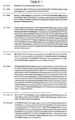
- the present invention provides a Streptococcus pneumoniae protein or polypeptide having a sequence selected from those shown in Table 1.
- a protein or polypeptide of the present invention may be provided in substantially pure form.
- it may be provided in a form which is substantially free of other proteins.
- the proteins and polypeptides of the invention are useful as antigenic material.
- Such material can be "antigenic” and/or “immunogenic”.
- antigenic is taken to mean that the protein or polypeptide is capable of being used to raise antibodies or indeed is capable of inducing an antibody response in a subject.
- immunogenic is taken to mean that the protein or polypeptide is capable of eliciting a protective immune response in a subject.
- the protein or polypeptide may be capable of not only generating an antibody response but, in addition, a non-antibody based immune response.
- proteins or polypeptides of the invention will also find use in the context of the present invention, ie as antigenic/immunogenic material.
- proteins or polypeptides which include one or more additions, deletions, substitutions or the like are encompassed by the present invention.
- a program like BLASTx will align the longest stretch of similar sequences and assign a value to the fit. It is thus possible to obtain a comparison where several regions of similarity are found, each having a different score. Both types of identity analysis are contemplated in the present invention.
- homologues or derivatives the degree of identity with a protein or polypeptide as described herein is less important than that the homologue or derivative should retain the antigenicity or immunogenicity of the original protein or polypeptide.
- homologues or derivatives having at least 60% similarity (as discussed above) with the proteins or polypeptides described herein are provided.
- homologues or derivatives having at least 70% similarity, more preferably at least 80% similarity are provided.
- homologues or derivatives having at least 90% or even 95% similarity are provided.
- the homologues or derivatives could be fusion proteins, incorporating moieties which render purification easier, for example by effectively tagging the desired protein or polypeptide. It may be necessary to remove the "tag” or it may be the case that the fusion protein itself retains sufficient antigenicity to be useful.
- antigenic/immunogenic fragments of the proteins or polypeptides of the invention or of homologues or derivatives thereof.
- fragments of the proteins or polypeptides described herein, or of homologues or derivatives thereof the situation is slightly different. It is well known that is possible to screen an antigenic protein or polypeptide to identify epitopic regions, ie those regions which are responsible for the protein or polypeptide's antigenicity or immunogenicity. Methods for carrying out such screening are well known in the art.
- the fragments of the present invention should include one or more such epitopic regions or be sufficiently similar to such regions to retain their antigenic/immunogenic properties.
- the degree of identity is perhaps irrelevant, since they may be 100% identical to a particular part of a protein or polypeptide, homologue or derivative as described herein. The key issue, once again, is that the fragment retains the antigenic/immunogenic properties.
- homologues, derivatives and fragments possess at least a degree of the antigenicity/immunogenicity of the protein or polypeptide from which they are derived.
- nucleic acid molecule comprising or consisting of a sequence which is:
- the nucleic acid molecules of the invention may include a plurality of such sequences, and/or fragments.
- the skilled person will appreciate that the present invention can include novel variants of those particular novel nucleic acid molecules which are exemplified herein. Such variants are encompassed by the present invention. These may occur in nature, for example because of strain variation. For example, additions, substitutions and/or deletions are included.
- one may wish to engineer the nucleic acid sequence by making use of known preferred codon usage in the particular organism being used for expression.
- synthetic or non-naturally occurring variants are also included within the scope of the invention.
- RNA equivalent when used above indicates that a given RNA molecule has a sequence which is complementary to that of a given DNA molecule (allowing for the fact that in RNA "U” replaces "T” in the genetic code).
- BESTFIT When comparing nucleic acid sequences for the purposes of determining the degree of homology or identity one can use programs such as BESTFIT and GAP (both from the Wisconsin Genetics Computer Group (GCG) software package) BESTFIT, for example, compares two sequences and produces an optimal alignment of the most similar segments. GAP enables sequences to be aligned along their whole length and finds the optimal alignment by inserting spaces in either sequence as appropriate. Suitably, in the context of the present invention when discussing identity of nucleic acid sequences, the comparison is made by alignment of the sequences along their whole length.
- GCG Wisconsin Genetics Computer Group
- sequences which have substantial identity have at least 50% sequence identity, desirably at least 75 % sequence identity and more desirably at least 90 or at least 95 % sequence identity with said sequences.
- sequence identity may be 99% or above.
- the term "substantial identity” indicates that said sequence has a greater degree of identity with any of the sequences described herein than with prior art nucleic acid sequences.
- nucleic acid sequence of the present invention codes for at least part of a novel gene product
- the present invention includes within its scope all possible sequence coding for the gene product or for a novel part thereof.
- the nucleic acid molecule may be in isolated or recombinant form. It may be incorporated into a vector and the vector may be incorporated into a host. Such vectors and suitable hosts form yet further aspects of the present invention.
- genes in Streptococcus pneumoniae can be identified. They can then be excised using restriction enzymes and cloned into a vector. The vector can be introduced into a suitable host for expression.
- Nucleic acid molecules of the present invention may be obtained from S.pneumoniae by the use of appropriate probes complementary to part of the sequences of the nucleic acid molecules. Restriction enzymes or sonication techniques can be used to obtain appropriately sized fragments for probing.
- PCR techniques may be used to amplify a desired nucleic acid sequence.
- sequence data provided herein can be used to design two primers for use in PCR so that a desired sequence, including whole genes or fragments thereof, can be targeted and then amplified to a high degree.
- primers will be at least 15-25 nucleotides long.
- chemical synthesis may be used. This may be automated. Relatively short sequences may be chemically synthesised and ligated together to provide a longer sequence.
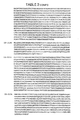
- proteins from S.pneumoniae which have been identified using the bacterial expression system described herein. These are known proteins from S.pneumoniae, which have not previously been identified as antigenic proteins. The amino acid sequences of this group of proteins, together with DNA sequences coding for them are shown in Table 2. These proteins, or homologues, derivatives and/or fragments thereof also find use as antigens/immunogens.
- the present invention provides a Streptococcus pneumoniae protein which has the N terminal sequence MELVLPNNYVV(D,A)I(L)D(E)E(Q)EEMMYLDGG(E) or fragment or homologue or derivative thereof.
- the present invention provides the use of a protein or polypeptide having a sequence selected from those shown in Tables 1 to 3, or homologues, derivatives and/or fragments thereof, as an immunogen/andgen.
- the present invention provides an immunogenic/antigenic composition
- an immunogenic/antigenic composition comprising one or more proteins or polypeptides selected from those whose sequences are shown in Tables 1 to 3, or homologues or derivatives thereof, and/or fragments of any of these.
- the immunogenic/antigenic composition is a vaccine or is for use in a diagnostic assay.
- suitable additional excipients may be included. Numerous examples of these are well known in the art.
- the invention also provides a vaccine composition comprising one or more nucleic acid sequences as defined herein.
- DNA vaccines are described in the art (see for instance, Donnelly et al .Ann. Rev. Immunol., 15:617-648 (1997 )) and the skilled person can use such art described techniques to produce and use DNA vaccines according to the present invention.
- the proteins or polypeptides described herein, their homologues or derivatives, and/or fragments of any of these can be used in methods of detecting/diagnosing S.pneumoniae. Such methods can be based on the detection of antibodies against such proteins which may be present in a subject. Therefore the present invention provides a method for the detection/diagnosis of S.pneumoniae which comprises the step of bringing into contact a sample to be tested with at least one protein, or homologue, derivative or fragment thereof, as described herein.
- the sample is a biological sample, such as a tissue sample or a sample of blood or saliva obtained from a subject to be tested.
- proteins described herein, or homologues, derivatives and/or fragments thereof can be used to raise antibodies, which in turn can be used to detect the antigens, and hence S.pneumoniae.
- Such antibodies form another aspect of the invention.
- Antibodies within the scope of the present invention may be monoclonal or polyclonal.
- the present invention includes derivatives thereof which are capable of binding to proteins etc as described herein.
- the present invention includes antibody fragments and synthetic constructs. Examples of antibody fragments and synthetic constructs are given by Dougall et al in Tibtec, 12: 372-379 (September 1994 ).
- Antibody fragments include, for example, Fab, F(ab') 2 and Fv fragments. Fab fragments are discussed in Roitt et at [ supra ] .
- Fv fragments can be modified to produce a synthetic construct known as a single chain Fv (scFv) molecule. This includes a peptide linker covalently joining V h and V l regions, which contributes to the stability of the molecule.
- Other synthetic constructs that can be used include Complementarity Determining Regions (CDR) peptides. These are synthetic peptides comprising antigen-binding determinants. Peptide mimetics may also be used. These molecules are usually conformationally restricted organic rings that mimic the structure of a CDR loop and that include antigen-interactive side chains.
- Synthetic constructs also include molecules comprising an additional moiety that provides the molecule with some desirable property in addition to antigen binding.
- the moiety may be a label (e.g. a fluorescent or radioactive label).
- it may be a pharmaceutically active agent.
- Antibodies, or derivatives thereof find use in detection/diagnosis of S.pneumoniae.
- the present invention provides a method for the detection/diagnosis of S.pneumoniae which comprises the step of bringing into contact a sample to be tested and antibodies capable of binding to one or more proteins described herein, or to homologues, derivatives and/or fragments thereof.
- Affibodies may be utilised. These are binding proteins selected from combinatorial libraries of an alpha-helical bacterial receptor domain ( Nord et al in Nature Biotechnology, 15: 772-7 (1997 )). Thus, small protein domains, capable of specific binding to different target proteins can be selected using combinatorial approaches.
- the present invention provides a method for the detection/diagnosis of S.pneumoniae which comprises the step of bringing into contact a sample to be tested with at least one nucleic acid sequence as described herein.
- the sample is a biological sample, such as a tissue sample or a sample of blood or saliva obtained from a subject to be tested.
- samples may be pre-treated before being used in the methods of the invention.
- a sample may be treated to extract DNA.
- DNA probes based on the nucleic acid sequences described herein ie usually fragments of such sequences
- the present invention provides:
- the present invention also provides a method of determining whether a protein or polypeptide as described herein represents a potential anti-microbial target which comprises antagonising, inhibiting or otherwise interfering with the function or expression of said protein and determining whether S.pneumoniae is still viable.
- a suitable method for inactivating the protein is to effect selected gene knockouts, ie prevent expression of the protein and determine whether this results in a lethal change. Suitable methods for carrying out such gene knockouts are described in Li et al, P.N.A.S., 94:13251-13256 (1997 ) and Kolkman et al, J. Bacteriol., 178:3736-3741 (1996 ).
- the present invention provides the use of an agent capable of antagonising, inhibiting or otherwise interfering with the function or expression of a protein or polypeptide of the invention in the manufacture of a medicament for use in the treatment or prophylaxis of S.pneumoniae infection.
- protein export requires a signal peptide to be present at the N-terminus of the precursor protein so that it becomes directed to the translocation machinery on the cytoplasmic membrane. During or after translocation, the signal peptide is removed by a membrane associated signal peptidase. Ultimately the localization of the protein (i.e. whether it be secreted, an integral membrane protein or attached to the cell wall) is determined by sequences other than the leader peptide itself.
- Staphylococcal nuclease is a naturally secreted heat-stable, monomeric enzyme which has been efficiently expressed and secreted in a range of Gram positive bacteria ( Shortle, Gene, 22:181-189 (1983 ); Kovacevic et al., J. Bacteriol., 162:521-528 (1985 ); Miller et al., J. Bacteriol., 169:3508-3514 (1987 ); Liebl et al., J. Bacteriol.,174:1854-1861 (1992 ); Le Loir et al., J. Bacteriol., 176:5135-5139 (1994 ); Poquet et al., J. Bacteriol., 180:1904-1912 (1998 )).
- This vector contains the pAM ⁇ 1 replicon which functions in a broad host range of Gram-positive bacteria in addition to the ColE1 replicon that promotes replication in Escherichia coli and certain other Gram negative bacteria.
- Unique cloning sites present in the vector can be used to generate transcriptional and translational fusions between cloned genomic DNA fragments and the open reading frame of the truncated nuc gene devoid of its own signal secretion leader.
- the nuc gene makes an ideal reporter gene because the secretion of nuclease can readily be detected using a simple and sensitive plate test; recombinant colonies secreting the nuclease develop a pink halo whereas control colonies remain white (Shortle, (1983), supra; Le Loir et al., (1994), supra ).
- the pTREP1 plasmid is a high-copy number (40-80 per cell) theta-replicating gram positive plasmid, which is a derivative of the pYREX plasmid which is itself a derivative of the previously published pIL253 plasmid.
- pIL253 incorporates the broad Gram-positive host range replicon of pAM ⁇ 1 ( Simon and Chopin, Biochimie, 70:559-567 (1988 )) and is non-mobilisable by the L lactis sex-factor.
- pIL253 also lacks the tra function which is necessary for transfer or efficient mobilisation by conjugative parent plasmids exemplified by pIL501.
- the Enterococcal pAM ⁇ 1 replicon has previously been transferred to various species including Streptococcus, Lactobacillus and Bacillus species as well as Clostridium acetobutylicum, ( Oultram and Klaenhammer, FEMS Microbiological Letters, 27:129-134 (1985) ; Gibson et al., (1979); LeBlanc et al., Proceedings of the National Academy of Science USA, 75:3484-3487 (1978) ) indicating the potential broad host range utility.
- the pTREP1 plasmid represents a constitutive transcription vector.
- the pTREX vector was constructed as follows. An artificial DNA fragment containing a putative RNA stabilising sequence, a translation initiation region (TIR), a multiple cloning site for insertion of the target genes and a transcription terminator was created by annealing two complementary oligonucleotides and extending with Tfl DNA polymerase. The sense and anti-sense oligonucleotides contained the recognition sites for NheI and BamHI at their 5' ends respectively to facilitate cloning. This fragment was cloned between the XbaI and BamHI sites in pUC19NT7, a derivative of pUC19 which contains the T7 expression cassette from pLET1 ( Wells et al, J. Appl.
- the putative RNA stabilising sequence and TIR are derived from the Escherichia coli T7 bacteriophage sequence and modified at one nucleotide position to enhance the complementarity of the Shine Dalgarno (SD) motif to the ribosomal 16s RNA of Lactococcus lactis (Schofield et al. pers. coms. University of Cambridge Dept. Pathology.).
- a Lactococcus lactis MG1363 chromosomal DNA fragment exhibiting promoter activity which was subsequently designated P7 was cloned between the EcoRI and BglII sites present in the expression cassette, creating pTREX7.
- This active promoter region had been previously isolated using the promoter probe vector pSB292 ( Waterfield et al, Gene, 165:9-15 (1995 )).
- the promoter fragment was amplified by PCR using the Vent DNA polymerase according to the manufacturer.
- the pTREP1 vector was then constructed as follows. An artificial DNA fragment which included a transcription terminator, the forward pUC sequencing primer, a promoter multiple -cloning site region and a universal translation stop sequence was created by annealing two overlapping partially complementary synthetic oligonucleotides together and extending with sequenase according to manufacturers instructions.
- the sense and anti-sense (pTREP F and pTREP R ) oligonucleotides contained the recognition sites for EcoRV and BamHI at their 5' ends respectively to facilitate cloning into pTREX7.
- the nucleotide sequence of the S. aureus nuc gene (EMBL database accession number V01281) was used to design synthetic oligonucleotide primers for PCR amplification.
- the primers were designed to amplify the mature form of the nuc gene designated nucA which is generated by proteolytic cleavage of the N-terminal 19 to 21 amino acids of the secreted propeptide designated Snase B (Shortle, (1983), supra).
- Three sense primers (nucS1, nucS2 and nucS3, Appendix 1) were designed, each one having a blunt-ended restriction endonuclease cleavage site for EcoRV or SmaI in a different reading frame with respect to the nuc gene.
- BglII and BamHI were incorporated at the 5' ends of the sense and anti-sense primers respectively to facilitate cloning into BamHI and BglII cut pTREP1.
- the sequences of all the primers are given in Appendix 1.
- Three nuc gene DNA fragments encoding the mature form of the nuclease gene (NucA) were amplified by PCR using each of the sense primers combined with the anti-sense primer described above.
- the nuc gene fragments were amplified by PCR using S . aureus genomic DNA template, Vent DNA Polymerase (NEB) and the conditions recommended by the manufacturer.
- the purified nuc gene fragments described in section (b) were digested with Bgl II and BamHI using standard conditions and ligated to BamHI and BglII cut and dephosphorylated pTREP1 to generate the pTREP1-nuc1, pTREP1-nuc2 and pTREP1-nuc3 series of reporter vectors.
- General molecular biology techniques were carried out using the reagents and buffer supplied by the manufacturer or using standard conditions(Sambrook and Maniatis, (1989), supra ).
- the expression cassette comprises a transcription terminator, lactococcal promoter P1, unique cloning sites (BglII, EcoRV or SmaI) followed by the mature form of the nuc gene and a second transcription terminator.
- unique cloning sites BglII, EcoRV or SmaI
- sequences required for translation and secretion of the nuc gene were deliberately excluded in this construction.
- Such elements can only be provided by appropriately digested foreign DNA fragments (representing the target bacterium) which can be cloned into the unique restriction sites present immediately upstream of the nuc gene.
- the pTREP1-nuc vectors differ from the pFUN vector described by Poquet et al. (1998), supra, which was used to identify L. lactis exported proteins by screening directly for Nuc activity directly in L. lactis.
- the pFUN vector does not contain a promoter upstream of the nuc open reading frame the cloned genomic DNA fragment must also provide the signals for transcription in addition to those elements required for translation initiation and secretion of Nuc. This limitation may prevent the isolation of genes that are distant from a promoter, for example genes which are within polycistronic operons. Additionally there can be no guarantee that promoters derived from other species of bacteria will be recognised and functional in L. lactis.
- promoters may be under stringent regulation in the natural host but not in L . lactis.
- the presence of the P1 promoter in the pTREPI-nuc series of vectors ensures that promoterless DNA fragments (or DNA fragments containing promoter sequences not active in L. lactis ) will still be transcribed.
- Genomic DNA isolated from S. pneumoniae was digested with the restriction enzyme Tru9I.
- This enzyme which recognises the sequence 5'- TTAA -3' was used because it cuts A/T rich genomes efficiently and can generate random genomic DNA fragments within the preferred size range (usually averaging 0.5 - 1.0 kb).
- This size range was preferred because there is an increased probability that the P1 promoter can be utilised to transcribe a novel gene sequence.
- the P1 promoter may not be necessary in all cases as it is possible that many Streptococcal promoters are recognised in L. lactis.
- DNA fragments of different size ranges were purified from partial Tru9I digests of S. pneumoniae genomic DNA.
- the gene cloning site of the pTREP-nuc vectors also contains a BglII site which can be used to clone for example Sau3AI digested genomic DNA fragments.
- L. lactis transformant colonies were grown on brain heart infusion agar and nuclease secreting (Nuc + ) clones were detected by a toluidine blue-DNA-agar overlay (0.05 M Tris pH 9.0, 10 g of agar per litre, 10 g of NaCI per liter, 0.1 mM CaCl2, 0.03% wt/vol.
- Oligonucleotide primers were designed to amplify corresponding gene-specific DNA probes (Appendix 2).
- Specific gene targets (ID304L1 and ID305) were amplified by PCR using Pfu Turbo DNA polymerase (Stratagene) according to the manufacturer's instructions.
- Typical reactions were carried out in a 50 ⁇ l volume containing 100 ng of template DNA, a one tenth volume of enzyme reaction buffer, 100ng of each primer, 200 ⁇ M of each dNTP and 1.25 Units of Pfu Turbo DNA polymerase.
- a typical reaction contained an initial 3 minute denaturation at 95C, followed by a single 60 second cycle at 94C, followed by 30 cycles at 50C for 60 seconds. A single cycle of 2 minutes at 72C was then followed with a final extension period of 10 minutes at 72C.
- PCR amplified products were purified using the QIAquick PCR Purification Kit (Qiagen). The presence of homologues to ID304L1 and ID305 in strain ATCC49619 was thereby confirmed.
- purified amplified gene DNA fragments from ID304L1 were labelled with digoxygenin using the DIG Nucleic Acid High Prime Labelling Kit (Roche) according to the manufacturer's instructions.
- Genomic DNA isolated from strains of Streptococcus pneumoniae were investigated for conservation of ID 304L1 derived gene targets. Appropriate DNA concentrations were digested using Hin DIII restriction enzymes (Roche) according to the manufacturer's instructions and analysed by agarose gel electrophoresis. Following agarose gel electrophoresis of DNA samples, the gel was denatured in 0.5M NaOH-1.5M NaCI for 20 minutes, neutralised in 0.5M Tris.HCI (pH 7.5)-1.5M NaCI for 40 minutes and DNA was transferred onto HybondTM N+ membrane (Amersham) by overnight capillary blotting.
- Hin DIII restriction enzymes Roche
- the method is essentially as described in "The DIG System User's Guide for Filter Hybridization” (Boehringer Mannheim, 1995) using Whatman 3MM wicks on a platform over a reservoir of 20x SSC (salt sodium citrate). After transfer, the filter was washed briefly in 2x SSC and stored at -20C.
- Filters were pre-hybridised, hybridised with the digoxygenin labelled DNA probes and washed using conditions recommended by Boehringer Mannheim when using their DIG Nucleic Acid Detection Kit. Filters were pre-hybridised at 42C for one hour in DIG "EasyHyb” .
- the digoxygenin labelled DNA probe was denatured at 100C for 10 minutes and chilled on ice before being added to the hybridisation buffer (DIG "EasyHyb"). Hybridisation was allowed to proceed overnight in a rotating Hybaid tube in a Hybaid Mini-hybridisation oven. Unbound probe was removed by washing the filter twice with 2x SSC- 0.1% SDS for 5 minutes at room temperature.
- the Southern blot hybridisation demonstrates the presence of an ID-304L1 homologue in the majority of the strains analysed.
- Lane 12 from which the probe was amplified, has only a very faint band, but this is due to a low level of DNA being applied to the gel in this case. This may also explain the absence of a band in Lane 5, where the background is significantly fainter than for the other lanes. In some strains two bands are observed which suggests that there may be more than one homologue present (as found in the G54 and R6 strains). The presence of genes for this protein in a wide number of clinically relevant strains indicates that this is a conserved protein that is a good vaccine candidate.
Landscapes
- Health & Medical Sciences (AREA)
- Chemical & Material Sciences (AREA)
- Organic Chemistry (AREA)
- Medicinal Chemistry (AREA)
- Life Sciences & Earth Sciences (AREA)
- General Health & Medical Sciences (AREA)
- Biophysics (AREA)
- Biochemistry (AREA)
- Genetics & Genomics (AREA)
- Gastroenterology & Hepatology (AREA)
- Molecular Biology (AREA)
- Proteomics, Peptides & Aminoacids (AREA)
- Pulmonology (AREA)
- Chemical Kinetics & Catalysis (AREA)
- Oncology (AREA)
- Communicable Diseases (AREA)
- General Chemical & Material Sciences (AREA)
- Nuclear Medicine, Radiotherapy & Molecular Imaging (AREA)
- Pharmacology & Pharmacy (AREA)
- Animal Behavior & Ethology (AREA)
- Public Health (AREA)
- Veterinary Medicine (AREA)
- Medicines Containing Antibodies Or Antigens For Use As Internal Diagnostic Agents (AREA)
- Peptides Or Proteins (AREA)
- Micro-Organisms Or Cultivation Processes Thereof (AREA)
Abstract
Description
- The present invention relates to proteins derived from Streptococcus pneumoniae, nucleic acid molecules encoding such proteins, the use of the nucleic acid and/or proteins as antigens/immunogens and in detection/diagnosis, as well as methods for screening the proteins/nucleic acid sequences as potential anti-microbial targets.
- Streptococcus pneumoniae, commonly referred to as the pneumococcus, is an important pathogenic organism. The continuing significance of Streptoccocus pneumoniae infections in relation to human disease in developing and developed countries has been authoritatively reviewed (Fiber, G.R., Science, 265: 1385-1387 (1994)). That indicates that on a global scale this organism is believed to be the most common bacterial cause of acute respiratory infections, and is estimated to result in one million childhood deaths each year, mostly in developing countries (Stansfield, S.K., Pediatr. Infect. Dis., 6: 622 (1987)). In the USA it has been suggested (Breiman et al, Arch. Intern. Med., 150: 1401 (1990)) that the pneumococcus is still the most common cause of bacterial pneumonia, and that disease rates are particularly high in young children, in the elderly, and in patients with predisposing conditions such as asplenia, heart, lung and kidney disease, diabetes, alcoholism, or with immunosupressive disorders, especially AIDS. These groups are at higher risk of pneumococcal septicaemia and hence meningitis and therefore have a greater risk of dying from pneumococcal infection. Over 50,000 cases of invasive pneumococcal disease (meningitis and bacteraemia) are believed to occur annually in the United States. The pneumococcus is also the leading cause of otitis media and sinusitis, which remain prevalent infections in children in developed countries, and which incur substantial costs. S. pneumoniae is responsible for approximately seven million cases of middle ear infections in children under two years of age in the United States alone.
- The need for effective preventative strategies against pneumococcal infection is highlighted by the recent emergence of penicillin-resistant pneumococci. It has been reported that 6.6% of pneumoccal isolates in 13 US hospitals in 12 states were found to be resistant to penicillin and some isolates were also resistant to other antibiotics including third generation cyclosporins (Schappert, S.M., Vital and Health Statistics of the Centres for Disease Control/National Centre for Health Statistics, 214:1 (1992)). The rates of penicillin resistance can be higher (up to 20%) in some hospitals (Breiman et al, J. Am. Med. Assoc., 271: 1831 (1994)). Since the development of penicillin resistance among pneumococci is both recent and sudden, coming after decades during which penicillin remained an effective treatment, these findings are regarded as alarming.
- For the reasons given above, there are therefore compelling grounds for considering improvements in the means of preventing, controlling, diagnosing or treating pneumococcal diseases.
- Various approaches have been taken in order to provide vaccines for the prevention of pneumococcal infections. Difficulties arise for instance in view of the variety of serotypes (at least 90) based on the structure of the polysaccharide capsule surrounding the organism. Vaccines against individual serotypes are not effective against other serotypes and this means that vaccines must include polysaccharide antigens from a whole range of serotypes in order to be effective in a majority of cases. An additional problem arises because it has been found that the capsular polysaccharides (each of which determines the serotype and is the major protective antigen) when purified and used as a vaccine do not reliably induce protective antibody responses in children under two years of age, the age group which suffers the highest incidence of invasive pneumococcal infection and meningitis.
- A modification of the approach using capsule antigens relies on conjugating the polysaccharide to a protein in order to derive an enhanced immune response, particularly by giving the response T-cell dependent characteristics. This approach has been used in the development of a vaccine against Haemophilus influenzae, for instance. There are, however, issues of cost concerning both the multi-polysaccharide vaccines and those based on conjugates. In addition, the composition of the conjugate vaccines preferably requires to be varied to accommodate different geographical and demographical populations as the serotype coverage that they offer is limited. There may also be a problems with conjugate carrier-induced suppression or overload due to the relatively large total dose of carrier protein administered.
- A third approach is to look for other antigenic components which offer the potential to be vaccine candidates. This is the basis of the present invention. Using a specially developed bacterial expression system, we have been able to identify a group of protein antigens from pneomococcus which are associated with the bacterial envelope or which are secreted.
- Thus, in a first aspect the present invention provides a Streptococcus pneumoniae protein or polypeptide having a sequence selected from those shown in Table 1.
- A protein or polypeptide of the present invention may be provided in substantially pure form. For example, it may be provided in a form which is substantially free of other proteins.
- As discussed herein, the proteins and polypeptides of the invention are useful as antigenic material. Such material can be "antigenic" and/or "immunogenic". Generally, "antigenic" is taken to mean that the protein or polypeptide is capable of being used to raise antibodies or indeed is capable of inducing an antibody response in a subject. "Immunogenic" is taken to mean that the protein or polypeptide is capable of eliciting a protective immune response in a subject. Thus, in the latter case, the protein or polypeptide may be capable of not only generating an antibody response but, in addition, a non-antibody based immune response.
- The skilled person will appreciate that homologues or derivatives of the proteins or polypeptides of the invention will also find use in the context of the present invention, ie as antigenic/immunogenic material. Thus, for instance proteins or polypeptides which include one or more additions, deletions, substitutions or the like are encompassed by the present invention. In addition, it may be possible to replace one amino acid with another of similar "type". For instance replacing one hydrophobic amino acid with another.
One can use a program such as the CLUSTAL™ program to compare amino acid sequences. This program compares amino acid sequences and finds the optimal alignment by inserting spaces in either sequence as appropriate. It is possible to calculate amino acid identity or similarity (identity plus conservation of amino acid type) for an optimal alignment. A program like BLASTx will align the longest stretch of similar sequences and assign a value to the fit. It is thus possible to obtain a comparison where several regions of similarity are found, each having a different score. Both types of identity analysis are contemplated in the present invention. - In the case of homologues and derivatives, the degree of identity with a protein or polypeptide as described herein is less important than that the homologue or derivative should retain the antigenicity or immunogenicity of the original protein or polypeptide. However, suitably, homologues or derivatives having at least 60% similarity (as discussed above) with the proteins or polypeptides described herein are provided. Preferably, homologues or derivatives having at least 70% similarity, more preferably at least 80% similarity are provided. Most preferably, homologues or derivatives having at least 90% or even 95% similarity are provided.
- In an alternative approach, the homologues or derivatives could be fusion proteins, incorporating moieties which render purification easier, for example by effectively tagging the desired protein or polypeptide. It may be necessary to remove the "tag" or it may be the case that the fusion protein itself retains sufficient antigenicity to be useful.
- In an additional aspect of the invention there are provided antigenic/immunogenic fragments of the proteins or polypeptides of the invention, or of homologues or derivatives thereof.
- For fragments of the proteins or polypeptides described herein, or of homologues or derivatives thereof, the situation is slightly different. It is well known that is possible to screen an antigenic protein or polypeptide to identify epitopic regions, ie those regions which are responsible for the protein or polypeptide's antigenicity or immunogenicity. Methods for carrying out such screening are well known in the art. Thus, the fragments of the present invention should include one or more such epitopic regions or be sufficiently similar to such regions to retain their antigenic/immunogenic properties. Thus, for fragments according to the present invention the degree of identity is perhaps irrelevant, since they may be 100% identical to a particular part of a protein or polypeptide, homologue or derivative as described herein. The key issue, once again, is that the fragment retains the antigenic/immunogenic properties.
- Thus, what is important for homologues, derivatives and fragments is that they possess at least a degree of the antigenicity/immunogenicity of the protein or polypeptide from which they are derived.
- Gene cloning techniques may be used to provide a protein of the invention in substantially pure form. These techniques are disclosed, for example, in J. Sambrook et al Molecular Cloning 2nd Edition, Cold Spring Harbor Laboratory Press (1989). Thus, in a second aspect, the present invention provides a nucleic acid molecule comprising or consisting of a sequence which is:
- (i) any of the DNA sequences set out in Table 1 or their RNA equivalents;
- (ii) a sequence which is complementary to any of the sequences of (i);
- (iii) a sequence which codes for the same protein or polypeptide, as those sequences of (i) or (ii);
- (iv) a sequence which has substantial identity with any of those of (i), (ii) and (iii);
- (v) a sequence which codes for a homologue, derivative or fragment of a protein as defined in Table 1.
- The nucleic acid molecules of the invention may include a plurality of such sequences, and/or fragments. The skilled person will appreciate that the present invention can include novel variants of those particular novel nucleic acid molecules which are exemplified herein. Such variants are encompassed by the present invention. These may occur in nature, for example because of strain variation. For example, additions, substitutions and/or deletions are included. In addition, and particularly when utilising microbial expression systems, one may wish to engineer the nucleic acid sequence by making use of known preferred codon usage in the particular organism being used for expression. Thus, synthetic or non-naturally occurring variants are also included within the scope of the invention.
- The term "RNA equivalent" when used above indicates that a given RNA molecule has a sequence which is complementary to that of a given DNA molecule (allowing for the fact that in RNA "U" replaces "T" in the genetic code).
- When comparing nucleic acid sequences for the purposes of determining the degree of homology or identity one can use programs such as BESTFIT and GAP (both from the Wisconsin Genetics Computer Group (GCG) software package) BESTFIT, for example, compares two sequences and produces an optimal alignment of the most similar segments. GAP enables sequences to be aligned along their whole length and finds the optimal alignment by inserting spaces in either sequence as appropriate. Suitably, in the context of the present invention when discussing identity of nucleic acid sequences, the comparison is made by alignment of the sequences along their whole length.
- Preferably, sequences which have substantial identity have at least 50% sequence identity, desirably at least 75 % sequence identity and more desirably at least 90 or at least 95 % sequence identity with said sequences. In some cases the sequence identity may be 99% or above.
- Desirably, the term "substantial identity" indicates that said sequence has a greater degree of identity with any of the sequences described herein than with prior art nucleic acid sequences.
- It should however be noted that where a nucleic acid sequence of the present invention codes for at least part of a novel gene product the present invention includes within its scope all possible sequence coding for the gene product or for a novel part thereof.
- The nucleic acid molecule may be in isolated or recombinant form. It may be incorporated into a vector and the vector may be incorporated into a host. Such vectors and suitable hosts form yet further aspects of the present invention.
- Therefore, for example, by using probes based upon the nucleic acid sequences provided herein, genes in Streptococcus pneumoniae can be identified. They can then be excised using restriction enzymes and cloned into a vector. The vector can be introduced into a suitable host for expression.
- Nucleic acid molecules of the present invention may be obtained from S.pneumoniae by the use of appropriate probes complementary to part of the sequences of the nucleic acid molecules. Restriction enzymes or sonication techniques can be used to obtain appropriately sized fragments for probing.
- Alternatively PCR techniques may be used to amplify a desired nucleic acid sequence. Thus the sequence data provided herein can be used to design two primers for use in PCR so that a desired sequence, including whole genes or fragments thereof, can be targeted and then amplified to a high degree.
- Typically primers will be at least 15-25 nucleotides long.
- As a further alternative chemical synthesis may be used. This may be automated. Relatively short sequences may be chemically synthesised and ligated together to provide a longer sequence.
- There is another group of proteins from S.pneumoniae which have been identified using the bacterial expression system described herein. These are known proteins from S.pneumoniae, which have not previously been identified as antigenic proteins. The amino acid sequences of this group of proteins, together with DNA sequences coding for them are shown in Table 2. These proteins, or homologues, derivatives and/or fragments thereof also find use as antigens/immunogens.
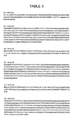
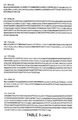
- A further group of proteins have been identified from recently published S. pnuemoniae genomes that have.a degreeof homology with ID-304L1 which all possess the following highly conserved sequence of 23 amino acids either at or near the N-terminus:
MELVLPNNYVV(D,A)I (L)D(E)E(Q)EEMMYLDGG(E)
where the bracketed residues represent alternatives to the preceding amino acid. Amino acid sequences for these homologues, and the DNA sequences encoding them are given in Table 3. - Thus, in a further aspect the present invention provides a Streptococcus pneumoniae protein which has the N terminal sequence
MELVLPNNYVV(D,A)I(L)D(E)E(Q)EEMMYLDGG(E)
or fragment or homologue or derivative thereof. - In another aspect the present invention provides the use of a protein or polypeptide having a sequence selected from those shown in Tables 1 to 3, or homologues, derivatives and/or fragments thereof, as an immunogen/andgen.
- In yet a further aspect the present invention provides an immunogenic/antigenic composition comprising one or more proteins or polypeptides selected from those whose sequences are shown in Tables 1 to 3, or homologues or derivatives thereof, and/or fragments of any of these. In preferred embodiments, the immunogenic/antigenic composition is a vaccine or is for use in a diagnostic assay.
- In the case of vaccines, suitable additional excipients, diluents, adjuvants or the like may be included. Numerous examples of these are well known in the art.
- It is also possible to utilise the nucleic acid sequences shown in Tables 1 and 2 in the preparation of so-called DNA vaccines. Thus, the invention also provides a vaccine composition comprising one or more nucleic acid sequences as defined herein. DNA vaccines are described in the art (see for instance, Donnelly et al .Ann. Rev. Immunol., 15:617-648 (1997)) and the skilled person can use such art described techniques to produce and use DNA vaccines according to the present invention.
- As already discussed herein the proteins or polypeptides described herein, their homologues or derivatives, and/or fragments of any of these, can be used in methods of detecting/diagnosing S.pneumoniae. Such methods can be based on the detection of antibodies against such proteins which may be present in a subject. Therefore the present invention provides a method for the detection/diagnosis of S.pneumoniae which comprises the step of bringing into contact a sample to be tested with at least one protein, or homologue, derivative or fragment thereof, as described herein. Suitably, the sample is a biological sample, such as a tissue sample or a sample of blood or saliva obtained from a subject to be tested.
- In an alternative approach, the proteins described herein, or homologues, derivatives and/or fragments thereof, can be used to raise antibodies, which in turn can be used to detect the antigens, and hence S.pneumoniae. Such antibodies form another aspect of the invention. Antibodies within the scope of the present invention may be monoclonal or polyclonal.
- Polyclonal antibodies can be raised by stimulating their production in a suitable animal host (e.g. a mouse, rat, guinea pig, rabbit, sheep, goat or monkey) when a protein as described herein, or a homologue, derivative or fragment thereof, is injected into the animal. If desired, an adjuvant may be administered together with the protein. Well-known adjuvants include Freund's adjuvant (complete and incomplete) and aluminium hydroxide. The antibodies can then be purified by virtue of their binding to a protein as described herein.
- Monoclonal antibodies can be produced from hybridomas. These can be formed by fusing myeloma cells and spleen cells which produce the desired antibody in order to form an immortal cell line. Thus the well-known Kohler & Milstein technique (Nature 256 (1975)) or subsequent variations upon this technique can be used.
- Techniques for producing monoclonal and polyclonal antibodies that bind to a particular polypeptide/protein are now well developed in the art. They are discussed in standard immunology textbooks, for example in Roitt et al, Immunology second edition (1989), Churchill Livingstone, London.
- In addition to whole antibodies, the present invention includes derivatives thereof which are capable of binding to proteins etc as described herein. Thus the present invention includes antibody fragments and synthetic constructs. Examples of antibody fragments and synthetic constructs are given by Dougall et al in Tibtec, 12: 372-379 (September 1994).
- Antibody fragments include, for example, Fab, F(ab')2 and Fv fragments. Fab fragments are discussed in Roitt et at [supra]. Fv fragments can be modified to produce a synthetic construct known as a single chain Fv (scFv) molecule. This includes a peptide linker covalently joining Vh and Vl regions, which contributes to the stability of the molecule. Other synthetic constructs that can be used include Complementarity Determining Regions (CDR) peptides. These are synthetic peptides comprising antigen-binding determinants. Peptide mimetics may also be used. These molecules are usually conformationally restricted organic rings that mimic the structure of a CDR loop and that include antigen-interactive side chains.
- Synthetic constructs include chimaeric molecules. Thus, for example, humanised (or primatised) antibodies or derivatives thereof are within the scope of the present invention. An example of a humanised antibody is an antibody having human framework regions, but rodent hypervariable regions. Ways of producing chimaeric antibodies are discussed for example by Morrison et al in PNAS, 81: 6851-6855 (1984) and by Takeda et al in Nature. 314: 452-454 (1985).
- Synthetic constructs also include molecules comprising an additional moiety that provides the molecule with some desirable property in addition to antigen binding. For example the moiety may be a label (e.g. a fluorescent or radioactive label). Alternatively, it may be a pharmaceutically active agent.
- Antibodies, or derivatives thereof, find use in detection/diagnosis of S.pneumoniae. Thus, in another aspect the present invention provides a method for the detection/diagnosis of S.pneumoniae which comprises the step of bringing into contact a sample to be tested and antibodies capable of binding to one or more proteins described herein, or to homologues, derivatives and/or fragments thereof.
- In addition, so-called "Affibodies" may be utilised. These are binding proteins selected from combinatorial libraries of an alpha-helical bacterial receptor domain (Nord et al in Nature Biotechnology, 15: 772-7 (1997)). Thus, small protein domains, capable of specific binding to different target proteins can be selected using combinatorial approaches.
- It will also be clear that the nucleic acid sequences described herein may be used to detect/diagnose S.pneumoniae. Thus, in yet a further aspect, the present invention provides a method for the detection/diagnosis of S.pneumoniae which comprises the step of bringing into contact a sample to be tested with at least one nucleic acid sequence as described herein. Suitably, the sample is a biological sample, such as a tissue sample or a sample of blood or saliva obtained from a subject to be tested. Such samples may be pre-treated before being used in the methods of the invention. Thus, for example, a sample may be treated to extract DNA. Then, DNA probes based on the nucleic acid sequences described herein (ie usually fragments of such sequences) may be used to detect nucleic acid from S.pneumoniae.
- In additional aspects, the present invention provides:
- (a) a method of vaccinating a subject against S.pneumoniae which comprises the step of administering to a subject a protein or polypeptide of the invention, or a derivative, homologue or fragment thereof, or an immunogenic composition of the invention;
- (b) a method of vaccinating a subject against S.pneumoniae which comprises the step of administering to a subject a nucleic acid molecule as defined herein;
- (c) a method for the prophylaxis or treatment of S.pneumoniae infection which comprises the step of administering to a subject a protein or polypeptide of the invention, or a derivative, homologue or fragment thereof, or an immunogenic composition of the invention;
- (d) a method for the prophylaxis or treatment of S.pneumoniae infection which comprises the step of administering to a subject a nucleic acid molecule as defined herein;
- (e) a kit for use in detecting/diagnosing S.pneumoniae infection comprising one or more proteins or polypeptides of the invention, or homologues, derivatives or fragments thereof, or an antigenic composition of the invention; and
- (f) a kit for use in detecting/diagnosing S.pneumoniae infection comprising one or more nucleic acid molecules as defined herein.
- Given that we have identified a group of important proteins, such proteins are potential targets for anti-microbial therapy. It is necessary, however, to determine whether each individual protein is essential for the organism's viability. Thus, the present invention also provides a method of determining whether a protein or polypeptide as described herein represents a potential anti-microbial target which comprises antagonising, inhibiting or otherwise interfering with the function or expression of said protein and determining whether S.pneumoniae is still viable.
- A suitable method for inactivating the protein is to effect selected gene knockouts, ie prevent expression of the protein and determine whether this results in a lethal change. Suitable methods for carrying out such gene knockouts are described in Li et al, P.N.A.S., 94:13251-13256 (1997) and Kolkman et al, J. Bacteriol., 178:3736-3741 (1996).
- In a final aspect the present invention provides the use of an agent capable of antagonising, inhibiting or otherwise interfering with the function or expression of a protein or polypeptide of the invention in the manufacture of a medicament for use in the treatment or prophylaxis of S.pneumoniae infection.
- As mentioned above, we have used a bacterial expression system as a means of identifying those proteins which are surface associated, secreted or exported and thus, would find use as antigens or antimicrobial targets.
- The information necessary for the secretion/export of proteins has been extensively studied in bacteria. In the majority of cases, protein export requires a signal peptide to be present at the N-terminus of the precursor protein so that it becomes directed to the translocation machinery on the cytoplasmic membrane. During or after translocation, the signal peptide is removed by a membrane associated signal peptidase. Ultimately the localization of the protein (i.e. whether it be secreted, an integral membrane protein or attached to the cell wall) is determined by sequences other than the leader peptide itself.
- We are specifically interested in surface located or exported proteins as these are likely to be antigens for use in vaccines, as diagnostic reagents or as targets for therapy with novel chemical entities. We have therefore developed a screening vector-system in Lactococcus lactis that permits genes encoding exported proteins to be identified and isolated. We provide below a representative example showing how given novel surface associated proteins from Streptococcus pneumoniae have been identified and characterized. The screening vector incorporates the staphylococcal nuclease gene nuc lacking its own export signal as a secretion reporter. Staphylococcal nuclease is a naturally secreted heat-stable, monomeric enzyme which has been efficiently expressed and secreted in a range of Gram positive bacteria (Shortle, Gene, 22:181-189 (1983); Kovacevic et al., J. Bacteriol., 162:521-528 (1985); Miller et al., J. Bacteriol., 169:3508-3514 (1987); Liebl et al., J. Bacteriol.,174:1854-1861 (1992); Le Loir et al., J. Bacteriol., 176:5135-5139 (1994); Poquet et al., J. Bacteriol., 180:1904-1912 (1998)).
- Recently, Poquet et al. ((1998), supra) have described a screening vector incorporating the nuc gene lacking its own signal leader as a reporter to identify exported proteins in Gram positive bacteria, and have applied it to L. lactis. This vector (pFUN) contains the pAMβ1 replicon which functions in a broad host range of Gram-positive bacteria in addition to the ColE1 replicon that promotes replication in Escherichia coli and certain other Gram negative bacteria. Unique cloning sites present in the vector can be used to generate transcriptional and translational fusions between cloned genomic DNA fragments and the open reading frame of the truncated nuc gene devoid of its own signal secretion leader. The nuc gene makes an ideal reporter gene because the secretion of nuclease can readily be detected using a simple and sensitive plate test; recombinant colonies secreting the nuclease develop a pink halo whereas control colonies remain white (Shortle, (1983), supra; Le Loir et al., (1994), supra).
- Thus, the invention will now be described with reference to the following representative example, which provides details of how the proteins, polypeptides and nucleic acid sequences described herein identified as antigenic targets.
- We describe herein the construction of three reporter vectors and their use in L. lactis to identify and isolate genomic DNA fragments from Streptococcus pneumoniae encoding secreted or surface associated proteins. Furthermore, Southern blot hybridisation experiments have been conducted to demonstrate the presence of a vaccine candidate gene in a range of Streptococcus pneumoniae strains.
The invention will now be described with reference to the examples, which should not be construed as in any way limiting the invention. - The pTREP1 plasmid is a high-copy number (40-80 per cell) theta-replicating gram positive plasmid, which is a derivative of the pYREX plasmid which is itself a derivative of the previously published pIL253 plasmid. pIL253 incorporates the broad Gram-positive host range replicon of pAMβ1 (Simon and Chopin, Biochimie, 70:559-567 (1988)) and is non-mobilisable by the L lactis sex-factor. pIL253 also lacks the tra function which is necessary for transfer or efficient mobilisation by conjugative parent plasmids exemplified by pIL501. The Enterococcal pAMβ1 replicon has previously been transferred to various species including Streptococcus, Lactobacillus and Bacillus species as well as Clostridium acetobutylicum, (Oultram and Klaenhammer, FEMS Microbiological Letters, 27:129-134 (1985); Gibson et al., (1979); LeBlanc et al., Proceedings of the National Academy of Science USA, 75:3484-3487 (1978)) indicating the potential broad host range utility. The pTREP1 plasmid represents a constitutive transcription vector.
- The pTREX vector was constructed as follows. An artificial DNA fragment containing a putative RNA stabilising sequence, a translation initiation region (TIR), a multiple cloning site for insertion of the target genes and a transcription terminator was created by annealing two complementary oligonucleotides and extending with Tfl DNA polymerase. The sense and anti-sense oligonucleotides contained the recognition sites for NheI and BamHI at their 5' ends respectively to facilitate cloning. This fragment was cloned between the XbaI and BamHI sites in pUC19NT7, a derivative of pUC19 which contains the T7 expression cassette from pLET1 (Wells et al, J. Appl. Bacteriol., 74:629-636 (1993)) cloned between the EcoRI and HindIII sites. The resulting construct was designated pUCLEX. The complete expression cassette of pUCLEX was then removed by cutting with HindIII and blunting followed by cutting with EcoRI before cloning into EcoRI and SacI (blunted) sites of pIL253 to generate the vector pTREX (Wells and Schofield, In Current advances in metabolism, genetics and applications-NATO ASI Series, H 98:37-62 (1996)). The putative RNA stabilising sequence and TIR are derived from the Escherichia coli T7 bacteriophage sequence and modified at one nucleotide position to enhance the complementarity of the Shine Dalgarno (SD) motif to the ribosomal 16s RNA of Lactococcus lactis (Schofield et al. pers. coms. University of Cambridge Dept. Pathology.).
- A Lactococcus lactis MG1363 chromosomal DNA fragment exhibiting promoter activity which was subsequently designated P7 was cloned between the EcoRI and BglII sites present in the expression cassette, creating pTREX7. This active promoter region had been previously isolated using the promoter probe vector pSB292 (Waterfield et al, Gene, 165:9-15 (1995)). The promoter fragment was amplified by PCR using the Vent DNA polymerase according to the manufacturer.
- The pTREP1 vector was then constructed as follows. An artificial DNA fragment which included a transcription terminator, the forward pUC sequencing primer, a promoter multiple -cloning site region and a universal translation stop sequence was created by annealing two overlapping partially complementary synthetic oligonucleotides together and extending with sequenase according to manufacturers instructions. The sense and anti-sense (pTREPF and pTREPR) oligonucleotides contained the recognition sites for EcoRV and BamHI at their 5' ends respectively to facilitate cloning into pTREX7. The transcription terminator was that of the Bacillus penicillinase gene, which has been shown to be effective in Lactococcus (Jos et al., Applied and Environmental Microbiology, 50:540-542 (1985)). This was considered necessary as expression of target genes in the pTREX vectors was observed to be leaky and is thought to be the result of cryptic promoter activity in the origin region (Schofield et al. pers. coms. University of Cambridge Dept. Pathology.). The forward pUC primer sequencing was included to enable direct sequencing of cloned DNA fragments. The translation stop sequence which encodes a stop codon in 3 different frames was included to prevent translational fusions between vector genes and cloned DNA fragments. The pTREX7 vector was first digested with EcoRI and blunted using the 5' - 3' polymerase activity of T4 DNA polymerase (NEB) according to manufacturer's instructions. The EcoRI digested and blunt ended pTREX7 vector was then digested with Bgl II thus removing the P7 promoter. The artificial DNA fragment derived from the annealed synthetic oligonucleotides was then digested with EcoRV and Barn HI and cloned into the EcoRI(blunted)-Bgl II digested pTREX7 vector to generate pTREP. A Lactococcus lactis MG1363 chromosomal promoter designated P1 was then cloned between the EcoRI and BglII sites present in the pTREP expression cassette forming pTREP1. This promoter was also isolated using the promoter probe vector pSB292 and characterised by Waterfield et al., (1995), supra. The P1 promoter fragment was originally amplified by PCR using vent DNA polymerase according to manufacturers instructions and cloned into the pTREX as an EcoRI-BglII DNA fragment. The EcoRI-BglII P1 promoter containing fragment was removed from pTREX1 by restriction enzyme digestion and used for cloning into pTREP (Schofield et al. pers. coms. University of Cambridge, Dept. Pathology.).
- The nucleotide sequence of the S. aureus nuc gene (EMBL database accession number V01281) was used to design synthetic oligonucleotide primers for PCR amplification. The primers were designed to amplify the mature form of the nuc gene designated nucA which is generated by proteolytic cleavage of the N-terminal 19 to 21 amino acids of the secreted propeptide designated Snase B (Shortle, (1983), supra). Three sense primers (nucS1, nucS2 and nucS3, Appendix 1) were designed, each one having a blunt-ended restriction endonuclease cleavage site for EcoRV or SmaI in a different reading frame with respect to the nuc gene. Additionally BglII and BamHI were incorporated at the 5' ends of the sense and anti-sense primers respectively to facilitate cloning into BamHI and BglII cut pTREP1. The sequences of all the primers are given in
Appendix 1. Three nuc gene DNA fragments encoding the mature form of the nuclease gene (NucA) were amplified by PCR using each of the sense primers combined with the anti-sense primer described above. The nuc gene fragments were amplified by PCR using S. aureus genomic DNA template, Vent DNA Polymerase (NEB) and the conditions recommended by the manufacturer. An initial denaturation step at 93°C for 2 min was followed by 30 cycles of denaturation at 93°C for 45 sec, annealing at 50°C for 45 seconds, and extension at 73°C for 1 minute and then a final 5 min extension step at 73°C. The PCR amplified products were purified using a Wizard clean up column (Promega) to remove unincorporated nucleotides and primers. - The purified nuc gene fragments described in section (b) were digested with Bgl II and BamHI using standard conditions and ligated to BamHI and BglII cut and dephosphorylated pTREP1 to generate the pTREP1-nuc1, pTREP1-nuc2 and pTREP1-nuc3 series of reporter vectors. General molecular biology techniques were carried out using the reagents and buffer supplied by the manufacturer or using standard conditions(Sambrook and Maniatis, (1989), supra). In each of the pTREPI-nuc vectors the expression cassette comprises a transcription terminator, lactococcal promoter P1, unique cloning sites (BglII, EcoRV or SmaI) followed by the mature form of the nuc gene and a second transcription terminator. Note that the sequences required for translation and secretion of the nuc gene were deliberately excluded in this construction. Such elements can only be provided by appropriately digested foreign DNA fragments (representing the target bacterium) which can be cloned into the unique restriction sites present immediately upstream of the nuc gene.
- In possessing a promoter, the pTREP1-nuc vectors differ from the pFUN vector described by Poquet et al. (1998), supra, which was used to identify L. lactis exported proteins by screening directly for Nuc activity directly in L. lactis. As the pFUN vector does not contain a promoter upstream of the nuc open reading frame the cloned genomic DNA fragment must also provide the signals for transcription in addition to those elements required for translation initiation and secretion of Nuc. This limitation may prevent the isolation of genes that are distant from a promoter, for example genes which are within polycistronic operons. Additionally there can be no guarantee that promoters derived from other species of bacteria will be recognised and functional in L. lactis. Certain promoters may be under stringent regulation in the natural host but not in L. lactis. In contrast, the presence of the P1 promoter in the pTREPI-nuc series of vectors ensures that promoterless DNA fragments (or DNA fragments containing promoter sequences not active in L. lactis) will still be transcribed.
- Genomic DNA isolated from S. pneumoniae was digested with the restriction enzyme Tru9I. This enzyme which recognises the sequence 5'- TTAA -3' was used because it cuts A/T rich genomes efficiently and can generate random genomic DNA fragments within the preferred size range (usually averaging 0.5 - 1.0 kb). This size range was preferred because there is an increased probability that the P1 promoter can be utilised to transcribe a novel gene sequence. However, the P1 promoter may not be necessary in all cases as it is possible that many Streptococcal promoters are recognised in L. lactis. DNA fragments of different size ranges were purified from partial Tru9I digests of S. pneumoniae genomic DNA. As the Tru 9I restriction enzyme generates staggered ends the DNA fragments had to be made blunt ended before ligation to the EcoRV or SmaI cut pTREPI-nuc vectors. This was achieved by the partial fill-in enzyme reaction using the 5'-3' polymerase activity of Klenow enzyme. Briefly Tru9I digested DNA was dissolved in a solution (usually between 10-20 µl in total) supplemented with T4 DNA ligase buffer (New England Biolabs; NEB) (1X) and 33 µM of each of the required dNTPs, in this case dATP and dTTP. Klenow enzyme was added (1 unit Klenow enzyme (NEB) per µg of DNA) and the reaction incubated at 25°C for 15 minutes. The reaction was stopped by incubating the mix at 75°C for 20 minutes. EcoRV or SmaI digested pTREP-nuc plasmid DNA was then added (usually between 200-400 ng). The mix was then supplemented with 400 units of T4 DNA ligase (NEB) and T4 DNA ligase buffer (IX) and incubated overnight at 16°C. The ligation mix was precipitated directly in 100% Ethanol and 1/10 volume of 3M sodium acetate (pH 5.2) and used to transform L. lactis MG1363 (Gasson, 1983). Alternatively, the gene cloning site of the pTREP-nuc vectors also contains a BglII site which can be used to clone for example Sau3AI digested genomic DNA fragments.
L. lactis transformant colonies were grown on brain heart infusion agar and nuclease secreting (Nuc+) clones were detected by a toluidine blue-DNA-agar overlay (0.05 M Tris pH 9.0, 10 g of agar per litre, 10 g of NaCI per liter, 0.1 mM CaCl2, 0.03% wt/vol. salmon sperm DNA and 90 mg of Toluidine blue O dye) essentially as described by Shortle, 1983, supra and Le Loir et al., 1994, supra). The plates were then incubated at 37°C for up to 2 hours. Nuclease secreting clones develop an easily identifiable pink halo. Plasmid DNA was isolated from Nuc+ recombinant L. lactis clones and DNA inserts were sequenced on one strand using the NucSeq sequencing primer described inAppendix 1, which sequences directly through the DNA insert. - A large number of gene sequences putatively encoding exported proteins in S. pneumoniae have been identified using the nuclease screening system. These have now been further analysed to remove artefacts. The sequences identified using the screening system have been analysed using a number of parameters.
- 1. All putative surface proteins were analysed for leader/signal peptide sequences using the software programs Sequencher (Gene Codes Corporation) and DNA Strider (Marck, Nucleic Acids Res., 16:1829-1836 (1988)). Bacterial signal peptide sequences share a common design. They are characterised by a short positively charged N-terminus (N region) immediately preceding a stretch of hydrophobic residues (central portion-h region) followed by a more polar C-terminal portion which contains the cleavage site (c-region). Computer software is available which allows hydropathy profiling of putative proteins and which can readily identify the very distinctive hydrophobic portion (h-region) typical of leader peptide sequences. In addition, the sequences were checked for the presence of or absence of a potential ribosomal binding site (Shine-Dalgarno motif) required for translation initiation of the putative nuc reporter fusion protein.
- 2. All putative surface protein sequences were also matched with all of the protein/DNA sequences using the publicly available databases [OWL-proteins inclusive of SwissProt and GenBank translations]. This allows us to identify sequences similar to known genes or homologues of genes for which some function has been ascribed. Hence it has been possible to predict a function for some of the genes identified using the LEEP system and to unequivocally establish that the system can be used to identify and isolate gene sequences of surface associated proteins. We should also be able to confirm that these proteins are indeed surface related and not artifacts. The LEEP system has been used to identify novel gene targets for vaccine and therapy.
- 3. Some of the genes identified proteins did not possess a typical leader peptide sequence and did not show homology with any DNA/protein sequences in the database. Indeed these proteins may indicate the primary advantage of our screening method, i.e. the isolation of atypical surface-related proteins, which may have been missed in all previously described screening protocols or approaches based on sequence homology searches.
- In all cases, only partial gene sequences were initially obtained. Full length genes given in Table 2 were obtained in all cases by reference to the TIGR S.pneumoniae database (www@tigr.org). Thus, by matching the originally obtained partial sequences with the database, we were able to identify the full length gene sequences. Hence, as described herein, two groups of genes were clearly identified, ie a group of genes encoding previously unidentified S.pneumoniae proteins (Table 1), and a second group which encoded known S.pneumoniae proteins, which were, however, not known as antigens (Table 2).
- Two further S. pneumoniae genomes have been recently sequenced and the information published and subsequently made available on the NCBI database. The "Annotated Draft Genomic Sequence from a Streptococcus pneumoniae Type 19F Clinical Isolate" was published in July 2001 by Dopazo et al. (Microbial Drug Resistance, ). The "Genome of the Bacterium Streptococcus pneumoniae Strain R6 was published in October 2001 by Hoskins et al. (Journal of Bacteriology, Volume 183, pp 5709-5717). Through BLAST analysis, homologues of ID-304L1 have been identified in these genomes which all possess a highly conserved sequence of 23 amino acids either at or near their N-terminus:
- MELVLPNNYVV(D,A)I (L)D(E)E(Q)EEMMYLDGG(E), where the bracketed residues represent alternatives to the preceding amino acid. Sequences for these homologues are given in Table 3.
- The presence of genes ID304L1 and ID305 in the
S . pneumoniae serotype 3 strain ATCC 49619 was investigated. Oligonucleotide primers were designed based upon the known nucleic acid sequences given in Table 1 and these gene targets were amplified by PCR - Oligonucleotide primers were designed to amplify corresponding gene-specific DNA probes (Appendix 2). Specific gene targets (ID304L1 and ID305) were amplified by PCR using Pfu Turbo DNA polymerase (Stratagene) according to the manufacturer's instructions. Typical reactions were carried out in a 50 µl volume containing 100 ng of template DNA, a one tenth volume of enzyme reaction buffer, 100ng of each primer, 200 µM of each dNTP and 1.25 Units of Pfu Turbo DNA polymerase. A typical reaction contained an initial 3 minute denaturation at 95C, followed by a single 60 second cycle at 94C, followed by 30 cycles at 50C for 60 seconds. A single cycle of 2 minutes at 72C was then followed with a final extension period of 10 minutes at 72C.
- All PCR amplified products were purified using the QIAquick PCR Purification Kit (Qiagen). The presence of homologues to ID304L1 and ID305 in strain ATCC49619 was thereby confirmed.
For use as DNA probes, purified amplified gene DNA fragments from ID304L1 were labelled with digoxygenin using the DIG Nucleic Acid High Prime Labelling Kit (Roche) according to the manufacturer's instructions. - A Southern blot analysis was carried out to determine cross-serotype conservation of novel Streptococcus pneumoniae genes isolated using the LEEP system. The Streptococcus pneumoniae strains used in this analysis are given in the legend to
Figure 1 . - Genomic DNA isolated from strains of Streptococcus pneumoniae were investigated for conservation of ID 304L1 derived gene targets. Appropriate DNA concentrations were digested using Hin DIII restriction enzymes (Roche) according to the manufacturer's instructions and analysed by agarose gel electrophoresis. Following agarose gel electrophoresis of DNA samples, the gel was denatured in 0.5M NaOH-1.5M NaCI for 20 minutes, neutralised in 0.5M Tris.HCI (pH 7.5)-1.5M NaCI for 40 minutes and DNA was transferred onto HybondTM N+ membrane (Amersham) by overnight capillary blotting. The method is essentially as described in "The DIG System User's Guide for Filter Hybridization" (Boehringer Mannheim, 1995) using Whatman 3MM wicks on a platform over a reservoir of 20x SSC (salt sodium citrate). After transfer, the filter was washed briefly in 2x SSC and stored at -20C.
- Filters were pre-hybridised, hybridised with the digoxygenin labelled DNA probes and washed using conditions recommended by Boehringer Mannheim when using their DIG Nucleic Acid Detection Kit. Filters were pre-hybridised at 42C for one hour in DIG "EasyHyb" . The digoxygenin labelled DNA probe was denatured at 100C for 10 minutes and chilled on ice before being added to the hybridisation buffer (DIG "EasyHyb"). Hybridisation was allowed to proceed overnight in a rotating Hybaid tube in a Hybaid Mini-hybridisation oven. Unbound probe was removed by washing the filter twice with 2x SSC- 0.1% SDS for 5 minutes at room temperature. For increased stringency, filters were then washed twice with 0.5x SSC-0.1 % SDS for 15 minutes at 68C. The DIG Nucleic Acid Detection Kit (Roche) was used to detect specifically bound digoxygenin labelled DNA probes immunologically.
- The Southern blot hybridisation demonstrates the presence of an ID-304L1 homologue in the majority of the strains analysed.
Lane 12, from which the probe was amplified, has only a very faint band, but this is due to a low level of DNA being applied to the gel in this case. This may also explain the absence of a band inLane 5, where the background is significantly fainter than for the other lanes. In some strains two bands are observed which suggests that there may be more than one homologue present (as found in the G54 and R6 strains). The presence of genes for this protein in a wide number of clinically relevant strains indicates that this is a conserved protein that is a good vaccine candidate.


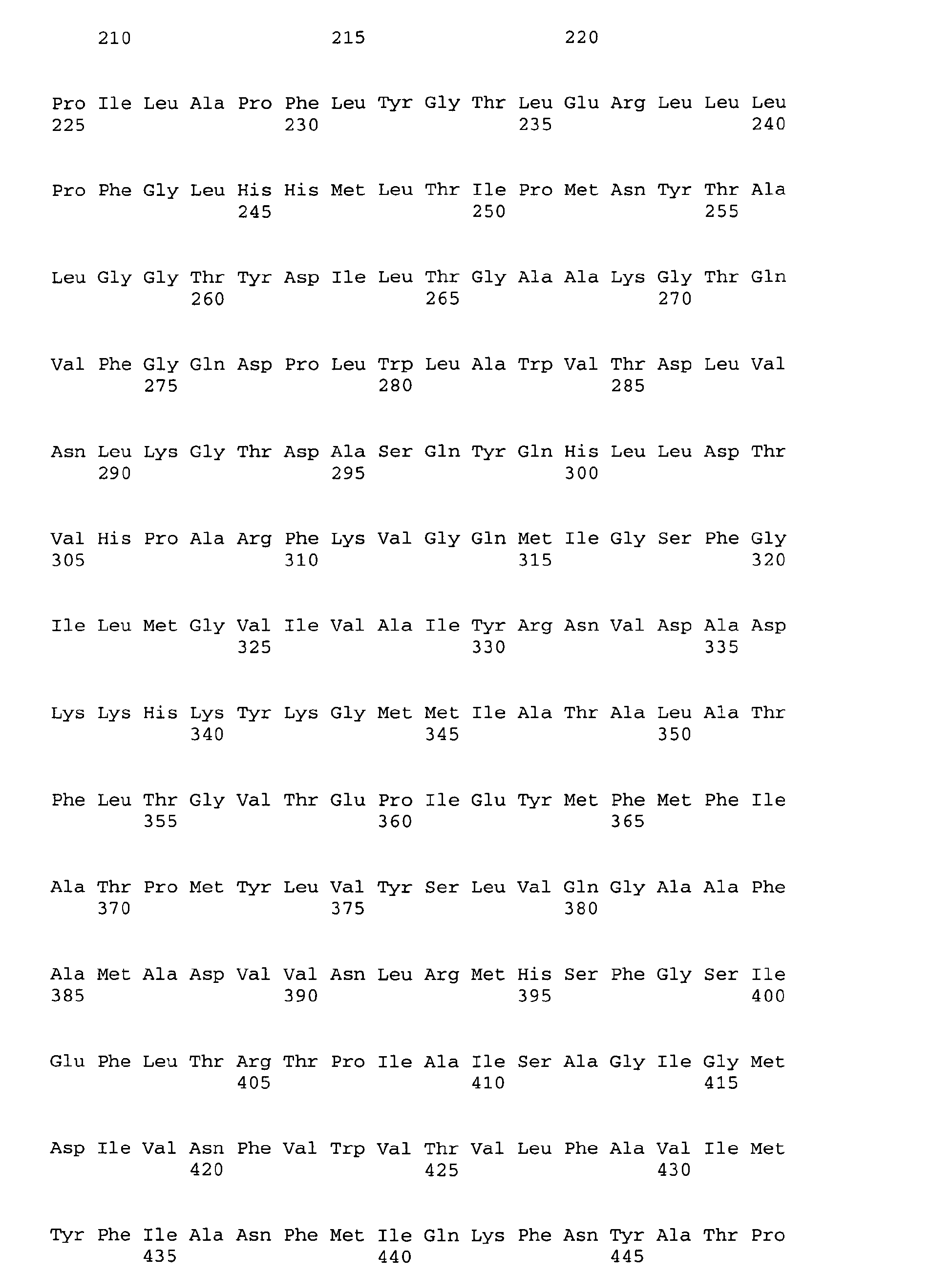


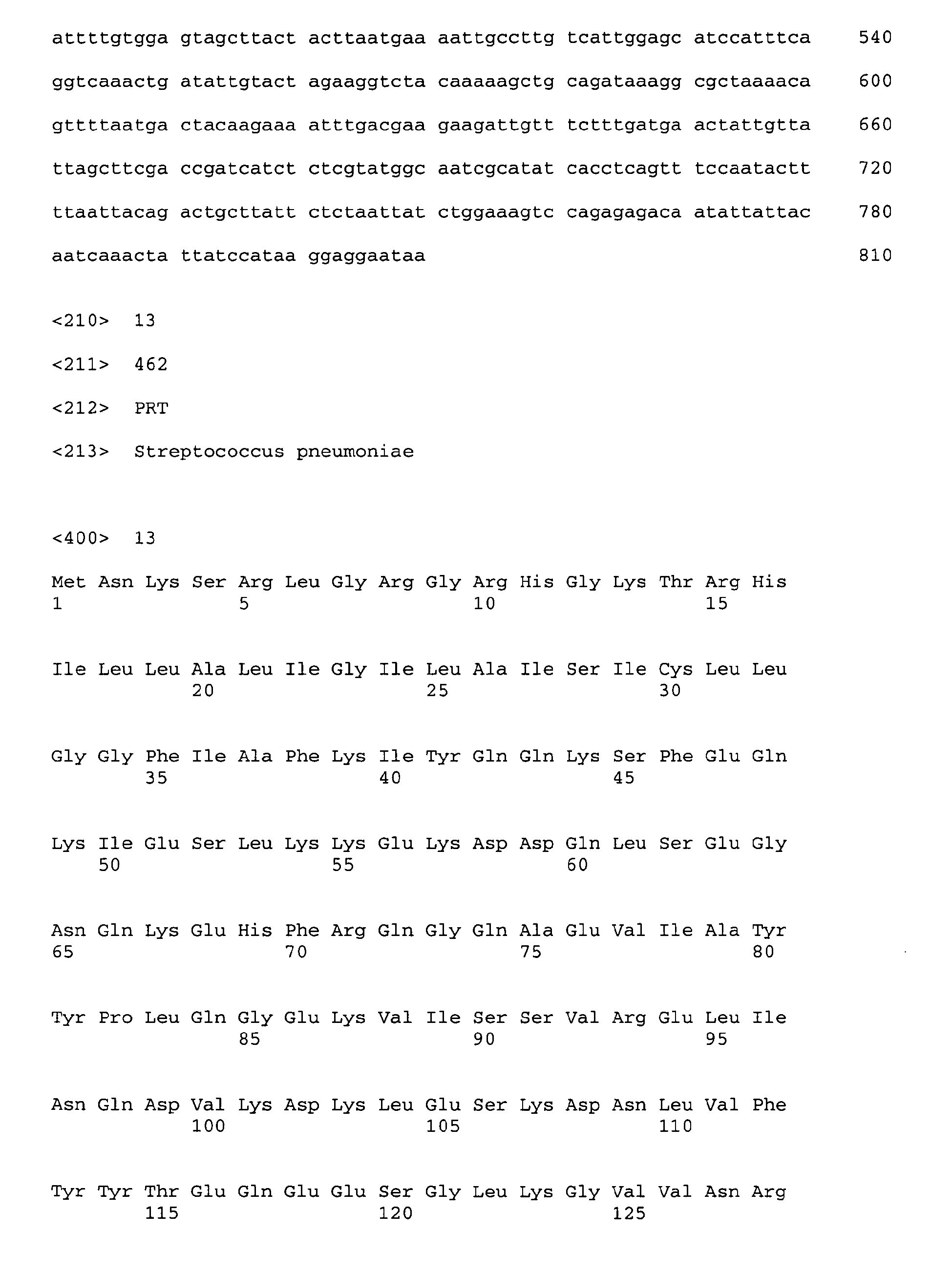


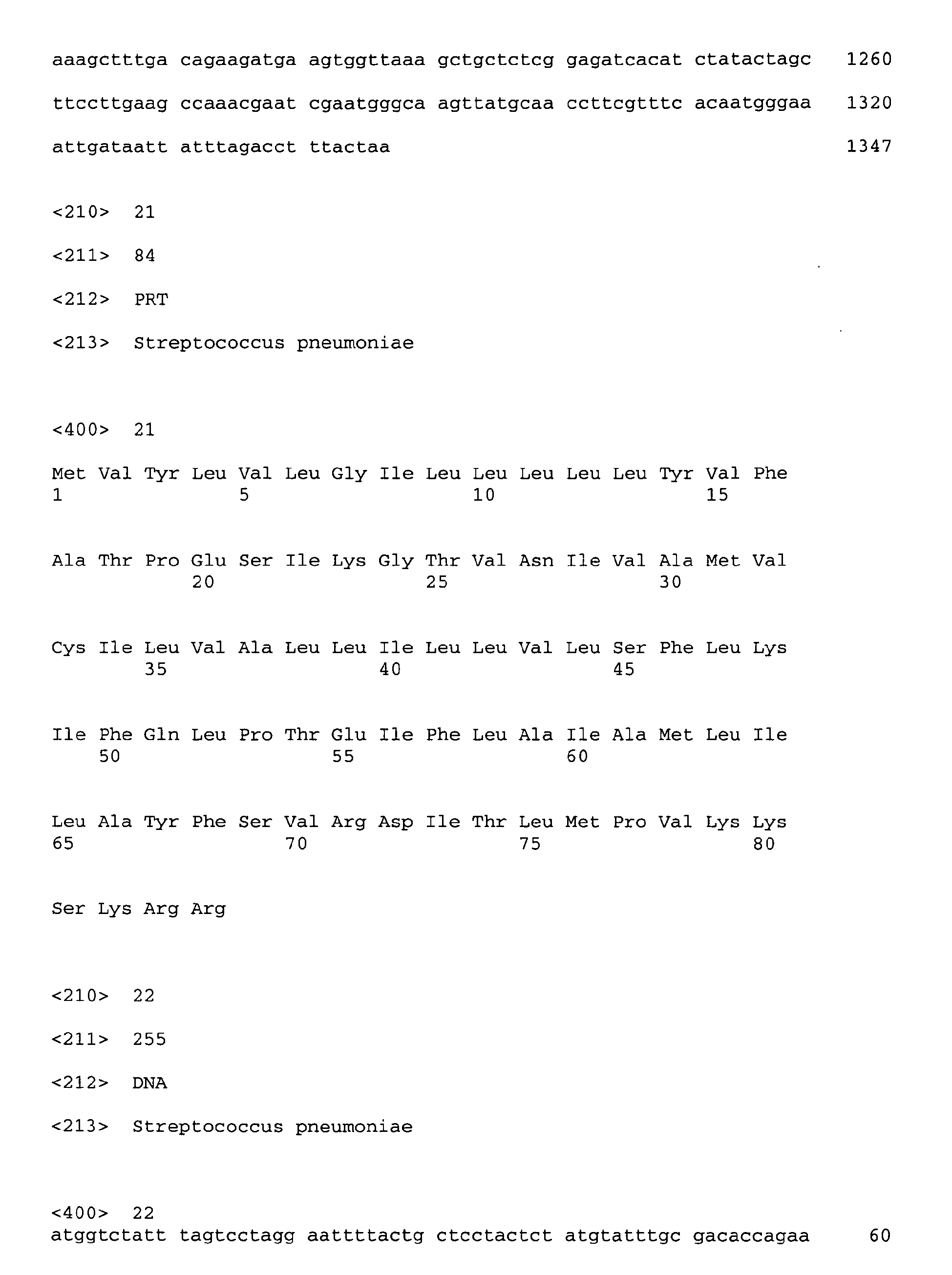


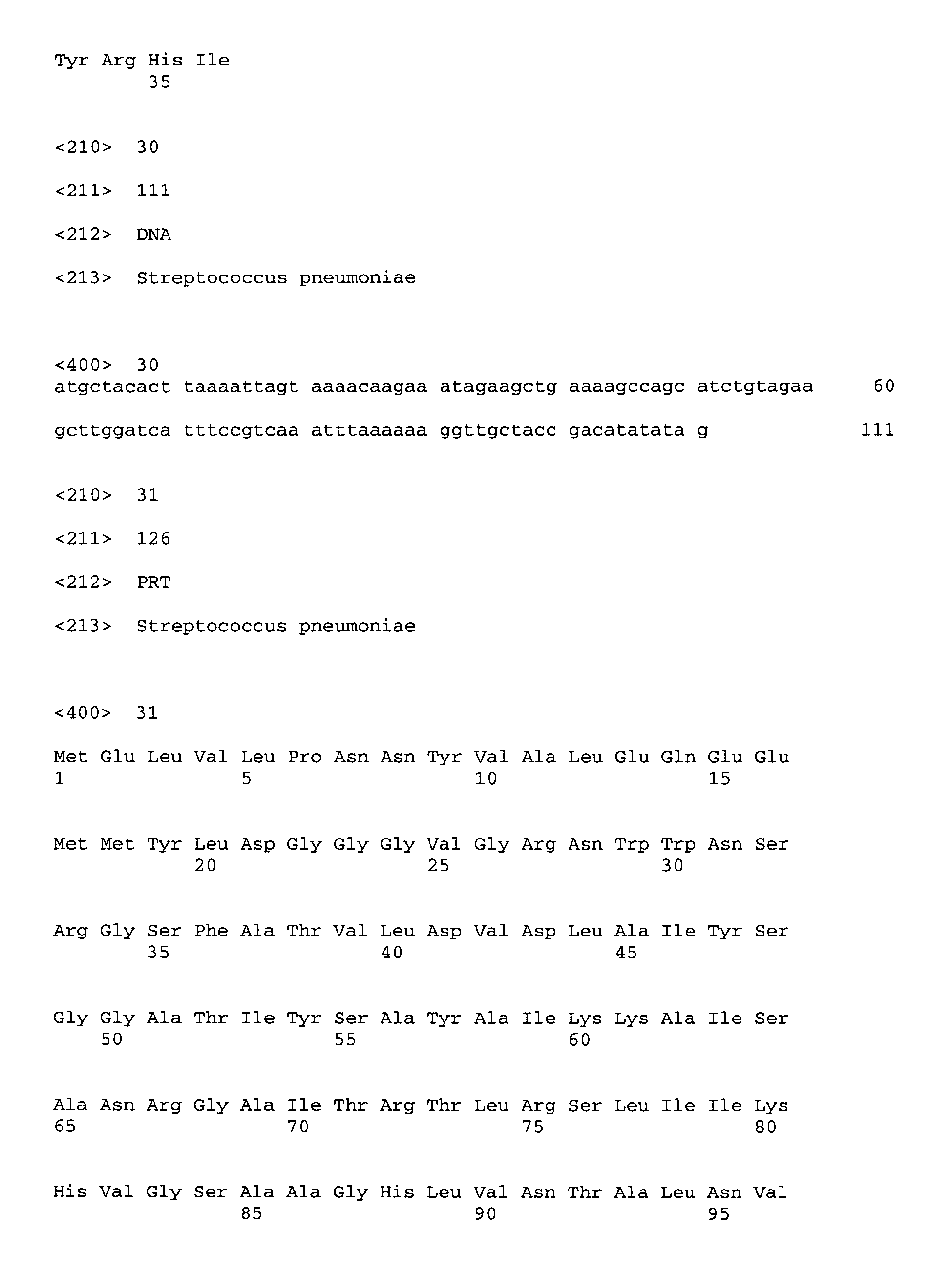
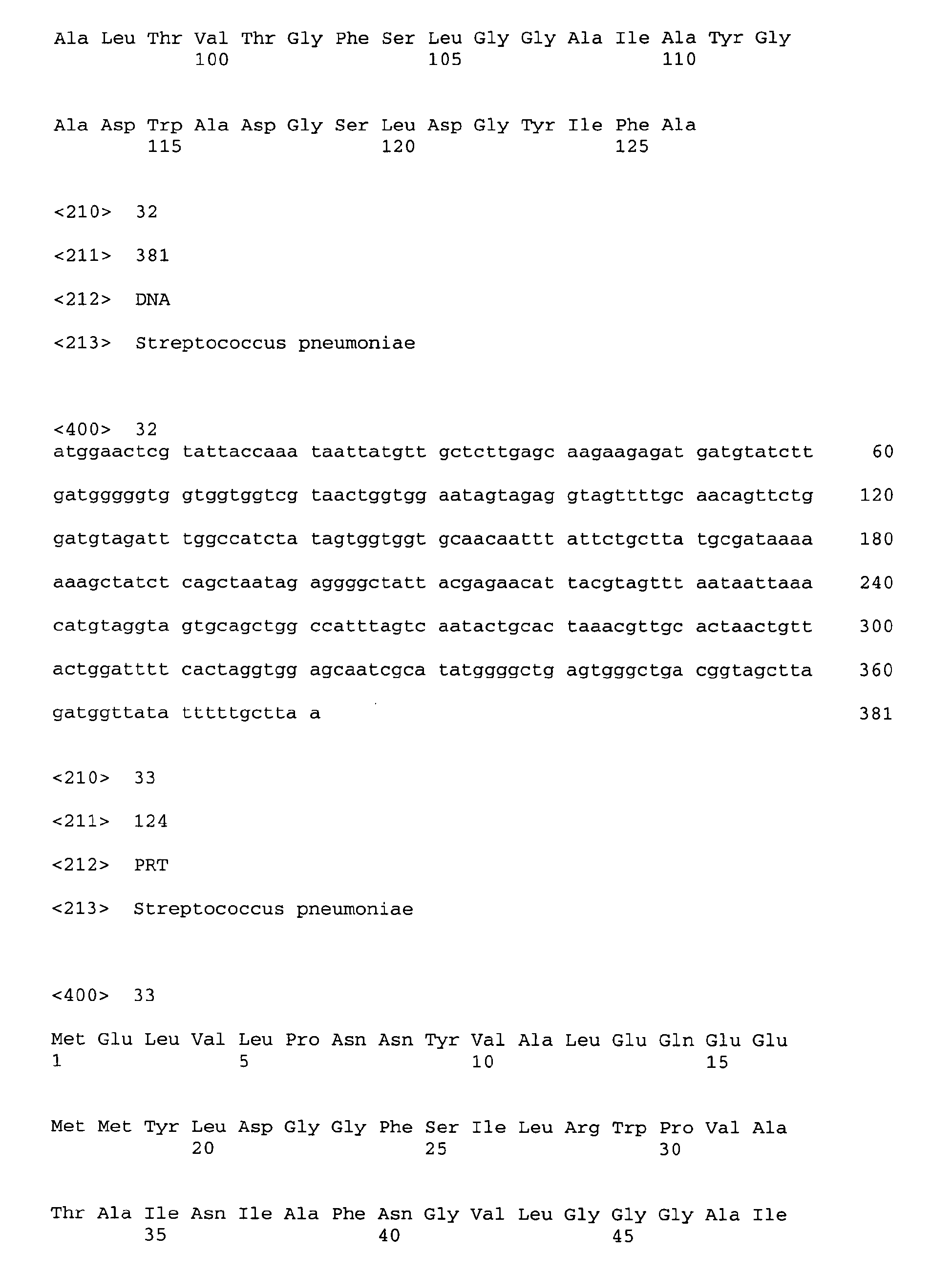


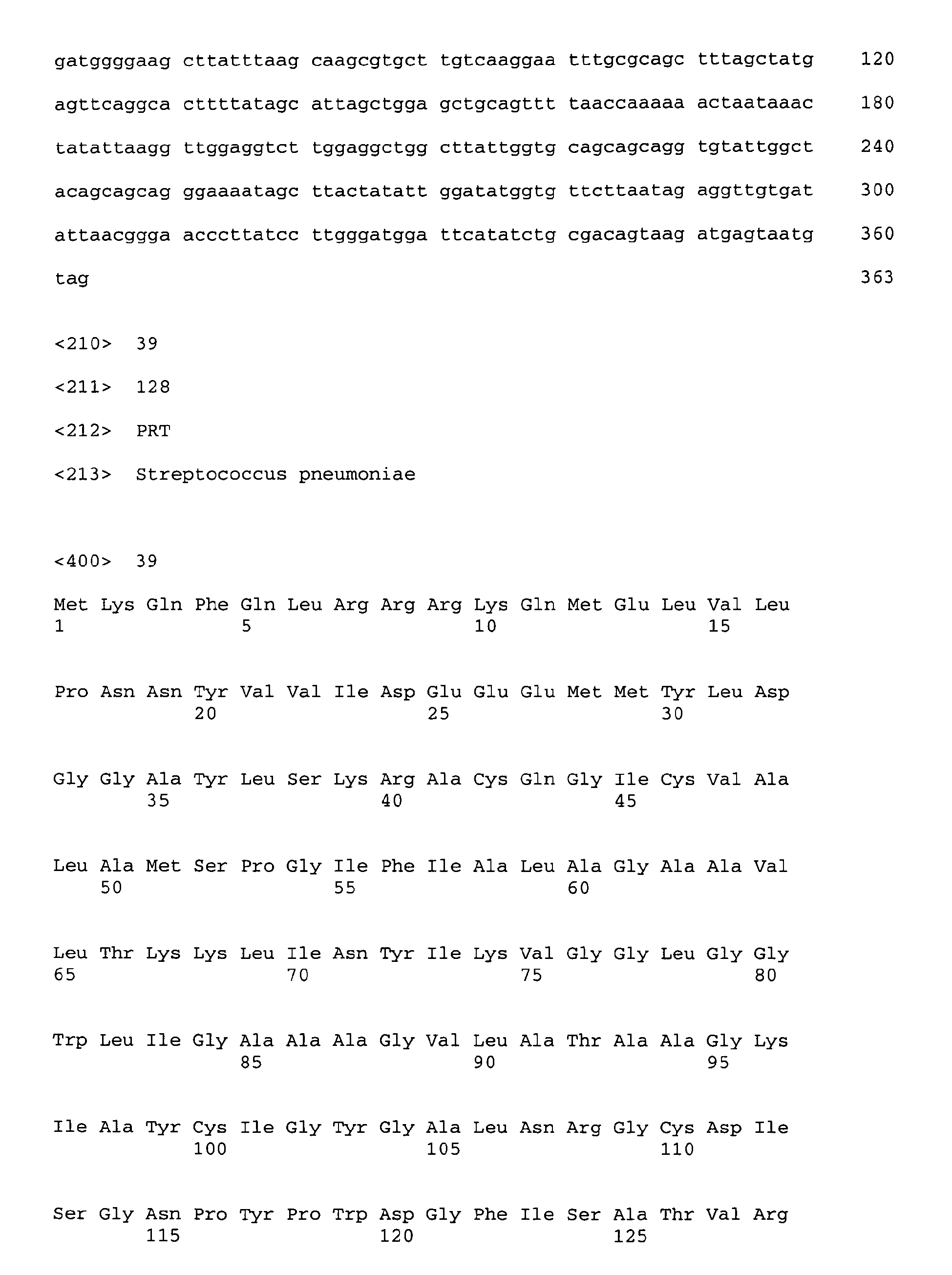


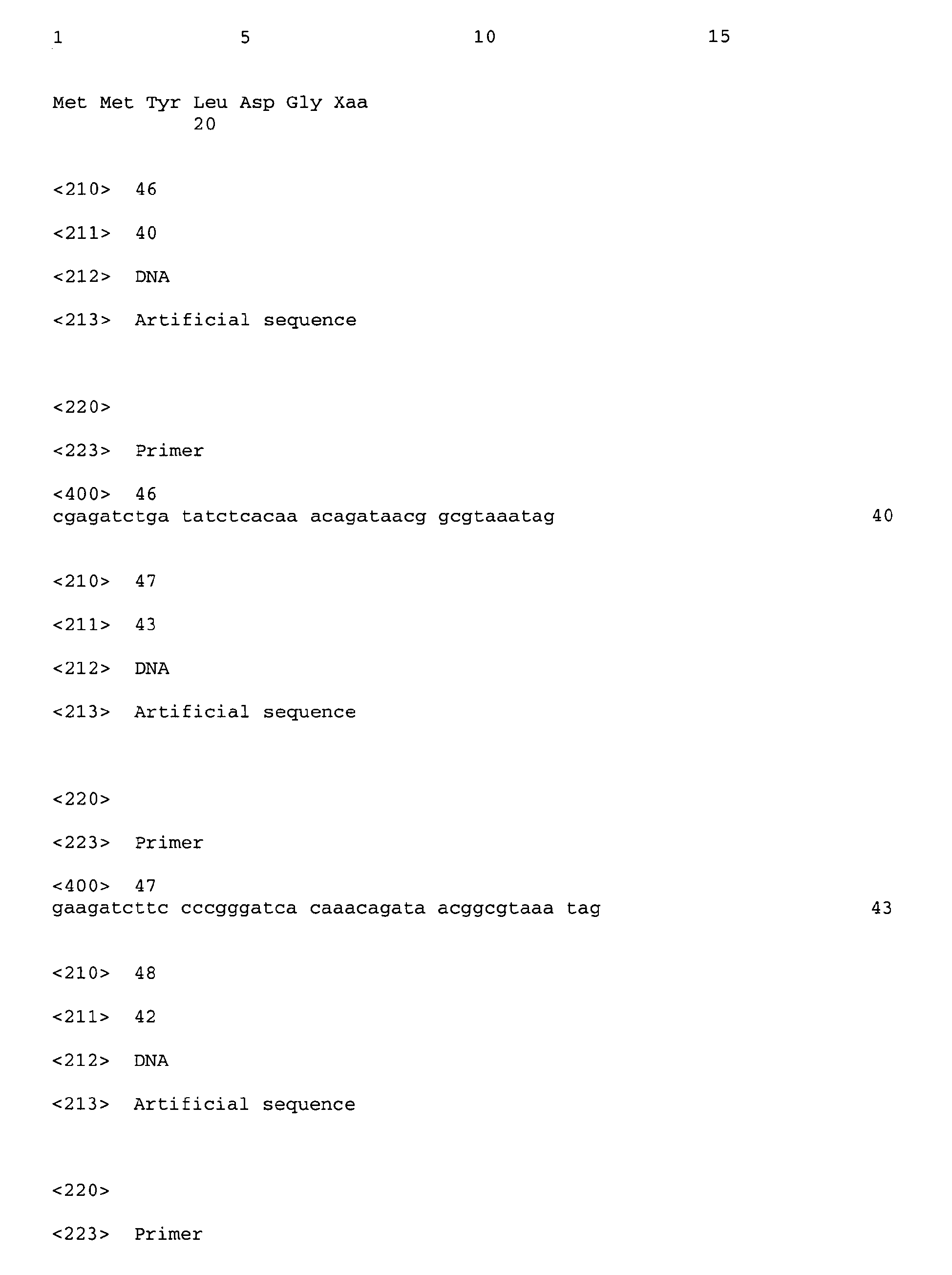


Claims (19)
- A Streptococcus pneumoniae protein or polypeptide having a sequence selected from
ID-304L1 having the sequenceor any other protein or polypeptide shown in Table 1.
- A protein or polypeptide as claimed in claim 1 provided in substantially pure form.
- A protein or polypeptide which is substantially identical to one defined in claims 1 or 2.
- A homologue or derivative of a protein or polypeptide as defined in any one of claims 1 to 3.
- An antigenic and/or immunogenic fragment of a protein or polypeptide as defined in Tables 1 and 3.
- A Streptococcus pneumoniae protein which has the N terminal sequence MELVLPNNYVV(D,A)I(L)D(E)E(Q)EEMMYLDGG(E) where the bracketed residues represent alternatives to the preceding amino acid, or a fragment or homologue or derivative thereof.
- A nucleic acid molecule comprising or consisting of a sequence which is:(i) ID-304L1B having the sequence

 (ii) any of the DNA sequences set out in Tables 1 to 3 or their RNA equivalents;(iii) a sequence which is complementary to any of the sequences of (i) or (i);(iv) a sequence which codes for the same protein or polypeptide, as those sequences of (i), (ii) or (iii);(v) a sequence which is substantially identical with any of those of (i), (ii), (iii) and (iv);(vi) a sequence which codes for a homologue, derivative or fragment of a protein as defined in Table 1.
 - The use of a protein or polypeptide having a sequence selected from those shown in Tables 1 to 3, or homologues, derivatives and/or fragments thereof, as an immunogen and/or antigen.
- An immunogenic and/or antigenic composition comprising one or more proteins or polypeptides selected from those whose sequences are shown in Tables 1 to 3, or homologues or derivatives thereof, and/or fragments of any of these.
- The use as claimed in claim 8 wherein the immunogen and/or antigen is used in a vaccine or diagnostic assay.
- A vaccine as claimed in claim 10 which comprises one or more additional components selected from excipients, diluents, adjuvants or the like.
- A vaccine composition comprising one or more nucleic acid sequences as defined in Tables 1 to 3.
- A method for the detection/diagnosis of S.pneumoniae which comprises the step of bringing into contact a sample to be tested with at least one protein or polypeptide as defined in Tables 1 to 3, or homologue, derivative or fragment thereof.
- An antibody capable of binding to a protein or polypeptide as defined in Tables 1 to 3, or for a homologue, derivative or fragment thereof.
- An antibody as defined in claim 14 which is a monoclonal antibody.
- A method for the detection/diagnosis of S.pneumoniae which comprises the step of bringing into contact a sample to be tested and at least one antibody as defined in claim 14 or claim 15.
- A method for the detection/diagnosis of S.pneumoniae which comprises the step of bringing into contact a sample to be tested with at least one nucleic acid sequence as defined in claim 7.
- A method of determining whether a protein or polypeptide as defined in Tables 1 to 3 represents a potential anti-microbial target which comprises inactivating said protein or polypeptide and determining whether S.pneumoniae is still viable.
- The use of an agent capable of antagonising, inhibiting or otherwise interfering with the function or expression of a protein or polypeptide as defined in Tables 1 to 3 in the manufacture of a medicament for use in the treatment or prophylaxis of S.pneumoniae infection.
Applications Claiming Priority (2)
| Application Number | Priority Date | Filing Date | Title |
|---|---|---|---|
| GBGB0108079.5A GB0108079D0 (en) | 2001-03-30 | 2001-03-30 | Protein |
| EP02708512A EP1377605A2 (en) | 2001-03-30 | 2002-03-28 | Secreted streptococcus pneumoniae proteins |
Related Parent Applications (1)
| Application Number | Title | Priority Date | Filing Date |
|---|---|---|---|
| EP02708512A Division EP1377605A2 (en) | 2001-03-30 | 2002-03-28 | Secreted streptococcus pneumoniae proteins |
Publications (2)
| Publication Number | Publication Date |
|---|---|
| EP1959015A2 true EP1959015A2 (en) | 2008-08-20 |
| EP1959015A3 EP1959015A3 (en) | 2008-12-03 |
Family
ID=9911963
Family Applications (2)
| Application Number | Title | Priority Date | Filing Date |
|---|---|---|---|
| EP08005558A Withdrawn EP1959015A3 (en) | 2001-03-30 | 2002-03-28 | Secreted streptococcus pneumoniae proteins |
| EP02708512A Withdrawn EP1377605A2 (en) | 2001-03-30 | 2002-03-28 | Secreted streptococcus pneumoniae proteins |
Family Applications After (1)
| Application Number | Title | Priority Date | Filing Date |
|---|---|---|---|
| EP02708512A Withdrawn EP1377605A2 (en) | 2001-03-30 | 2002-03-28 | Secreted streptococcus pneumoniae proteins |
Country Status (7)
| Country | Link |
|---|---|
| US (2) | US20040265933A1 (en) |
| EP (2) | EP1959015A3 (en) |
| CN (2) | CN1513058A (en) |
| AU (1) | AU2002242873A1 (en) |
| CA (1) | CA2446804A1 (en) |
| GB (1) | GB0108079D0 (en) |
| WO (1) | WO2002079241A2 (en) |
Families Citing this family (18)
| Publication number | Priority date | Publication date | Assignee | Title |
|---|---|---|---|---|
| US6800744B1 (en) * | 1997-07-02 | 2004-10-05 | Genome Therapeutics Corporation | Nucleic acid and amino acid sequences relating to Streptococcus pneumoniae for diagnostics and therapeutics |
| GB0108079D0 (en) * | 2001-03-30 | 2001-05-23 | Microbial Technics Ltd | Protein |
| CN1636062A (en) | 2001-04-16 | 2005-07-06 | 惠氏控股公司 | Streptococcus neopneumoniae open reading frame encoding polypeptide antigen and its application |
| DK2129693T3 (en) * | 2007-03-23 | 2017-02-13 | Wyeth Llc | BRIEF PURIFICATION PROCEDURE FOR THE PREPARATION OF STREPTOCOCCUS PNEUMONIAE-Capsule POLYACCHARIDES |
| GB0714963D0 (en) | 2007-08-01 | 2007-09-12 | Novartis Ag | Compositions comprising antigens |
| ES2546213T3 (en) | 2008-03-03 | 2015-09-21 | Novartis Ag | Compounds and compositions as modulators of TLR activity |
| CA2765112A1 (en) | 2009-06-10 | 2010-12-16 | Novartis Ag | Benzonaphthyridine-containing vaccines |
| JO3257B1 (en) | 2009-09-02 | 2018-09-16 | Novartis Ag | Vehicles and installations as TLR |
| AU2010290896B2 (en) | 2009-09-02 | 2014-07-03 | Glaxosmithkline Biologicals S.A. | Immunogenic compositions including TLR activity modulators |
| WO2011057148A1 (en) | 2009-11-05 | 2011-05-12 | Irm Llc | Compounds and compositions as tlr-7 activity modulators |
| US9408907B2 (en) | 2009-12-15 | 2016-08-09 | Glaxosmithkline Biologicals Sa | Homogenous suspension of immunopotentiating compounds and uses thereof |
| AU2011232421B2 (en) | 2010-03-23 | 2015-08-13 | Novartis Ag | Compounds (cystein based lipopeptides) and compositions as TLR2 agonists used for treating infections, inflammations, respiratory diseases etc. |
| US8182842B1 (en) | 2010-11-10 | 2012-05-22 | The United States Of America As Represented By The Administrator Of The National Aeronautics And Space Administration | Physico-chemical-managed killing of penicillin-resistant static and growing gram-positive and gram-negative vegetative bacteria |
| CN104519910B (en) | 2012-03-07 | 2017-05-03 | 诺华股份有限公司 | Adjuvanted formulations of streptococcus pneumoniae antigens |
| TR201807340T4 (en) | 2013-02-01 | 2018-06-21 | Glaxosmithkline Biologicals Sa | Intradermal administration of immunological compositions comprising bell-like receptor agonists. |
| CN103834667B (en) * | 2013-12-31 | 2016-08-17 | 李越希 | The streptococcus pneumoniae PspA protein extracellular genetic fragment of chemosynthesis and expression, application |
| PL3752182T3 (en) | 2018-02-12 | 2024-11-25 | Inimmune Corporation | Toll-like receptor ligands |
| CA3198876A1 (en) | 2020-11-04 | 2022-05-12 | Eligo Bioscience | Cutibacterium acnes recombinant phages, method of production and uses thereof |
Family Cites Families (23)
| Publication number | Priority date | Publication date | Assignee | Title |
|---|---|---|---|---|
| GB2293100A (en) * | 1994-09-15 | 1996-03-20 | Medeva Europ Ltd | Pharmaceutical compositions with deuterium oxide |
| US6800744B1 (en) * | 1997-07-02 | 2004-10-05 | Genome Therapeutics Corporation | Nucleic acid and amino acid sequences relating to Streptococcus pneumoniae for diagnostics and therapeutics |
| US7129340B1 (en) * | 1997-07-02 | 2006-10-31 | sanofi pasteur limited/sanofi pasteur limitée | Nucleic acid and amino acid sequences relating to streptococcus pneumoniae for diagnostics and therapeutics |
| US6248329B1 (en) * | 1998-06-01 | 2001-06-19 | Ramaswamy Chandrashekar | Parasitic helminth cuticlin nucleic acid molecules and uses thereof |
| EP1100920A2 (en) | 1998-07-27 | 2001-05-23 | Microbial Technics Limited | Nucleic acids and proteins from group b streptococcus |
| WO2000006738A2 (en) * | 1998-07-27 | 2000-02-10 | Microbial Technics Limited | NUCLEIC ACIDS AND PROTEINS FROM $i(STREPTOCOCCUS PNEUMONIAE) |
| US20030134407A1 (en) * | 1998-07-27 | 2003-07-17 | Le Page Richard William Falla | Nucleic acids and proteins from Streptococcus pneumoniae |
| EP1624064A3 (en) * | 1998-07-27 | 2006-05-10 | Microbial Technics Limited | Nucleic acids and proteins from streptococcus pneumoniae |
| EP1801218A3 (en) * | 1998-07-27 | 2007-10-10 | Sanofi Pasteur Limited | Nucleic acids and proteins from streptococcus pneumoniae |
| US6936252B2 (en) * | 1998-07-27 | 2005-08-30 | Microbial Technics Limited | Streptococcus pneumoniae proteins and nucleic acid molecules |
| US7098182B2 (en) * | 1998-07-27 | 2006-08-29 | Microbial Technics Limited | Nucleic acids and proteins from group B streptococcus |
| US7128918B1 (en) * | 1998-12-23 | 2006-10-31 | Id Biomedical Corporation | Streptococcus antigens |
| EP1165795A2 (en) * | 1999-03-26 | 2002-01-02 | Provalis UK Limited | Streptococcus pneumoniae antigens |
| GB9921125D0 (en) * | 1999-09-07 | 1999-11-10 | Microbial Technics Limited | Proteins |
| US7074415B2 (en) * | 2000-06-20 | 2006-07-11 | Id Biomedical Corporation | Streptococcus antigens |
| GB0108079D0 (en) | 2001-03-30 | 2001-05-23 | Microbial Technics Ltd | Protein |
| CN1636062A (en) * | 2001-04-16 | 2005-07-06 | 惠氏控股公司 | Streptococcus neopneumoniae open reading frame encoding polypeptide antigen and its application |
| CA2445073C (en) * | 2001-04-24 | 2010-02-16 | Anthony Joseph Cesaroni | Lead-free projectiles |
| GB0118249D0 (en) * | 2001-07-26 | 2001-09-19 | Chiron Spa | Histidine vaccines |
| EP1456231A2 (en) * | 2001-12-20 | 2004-09-15 | Shire Biochem Inc. | Streptococcus antigens |
| EP1703887A4 (en) * | 2003-12-31 | 2009-10-21 | Univ Rochester | IMMUNOGENIC POLYPEPTIDES AND CONJUGATES THAT CAN INDUCE ANTIBODIES AGAINST PATHOGENIC AGENTS AND USES THEREOF |
| WO2009033742A2 (en) * | 2007-09-14 | 2009-03-19 | Katholieke Universiteit Leuven | Streptococcus pneumoniae vaccines |
| WO2009094730A1 (en) * | 2008-02-01 | 2009-08-06 | Newcastle Innovation Limited | Vaccine compositions |
-
2001
- 2001-03-30 GB GBGB0108079.5A patent/GB0108079D0/en not_active Ceased
-
2002
- 2002-03-28 EP EP08005558A patent/EP1959015A3/en not_active Withdrawn
- 2002-03-28 CN CNA02810868XA patent/CN1513058A/en active Pending
- 2002-03-28 CN CN2009102656599A patent/CN102286083A/en active Pending
- 2002-03-28 EP EP02708512A patent/EP1377605A2/en not_active Withdrawn
- 2002-03-28 WO PCT/GB2002/001480 patent/WO2002079241A2/en not_active Ceased
- 2002-03-28 US US10/476,460 patent/US20040265933A1/en not_active Abandoned
- 2002-03-28 CA CA002446804A patent/CA2446804A1/en not_active Abandoned
- 2002-03-28 AU AU2002242873A patent/AU2002242873A1/en not_active Abandoned
-
2008
- 2008-07-28 US US12/180,896 patent/US8101187B2/en not_active Expired - Fee Related
Non-Patent Citations (30)
| Title |
|---|
| BREIMAN ET AL., J. AM. MED. ASSOC., vol. 271, 1994, pages 1831 |
| DONNELLY ET AL., ANN. REV. IMMUNOL., vol. 15, 1997, pages 617 - 648 |
| DOPAZO ET AL.: "Annotated Draft Genomic Sequence from a Streptococcus pneumoniae Type 19F Clinical Isolate", MICROBIAL DRUG RESISTANCE, vol. 7, July 2001 (2001-07-01), pages 99 - 125 |
| DOUGALL ET AL., TIBTAC, BTEC, vol. 12, September 1994 (1994-09-01), pages 372 - 379 |
| FIBER, G.R., SCIENCE, vol. 265, 1994, pages 1385 - 1387 |
| HOSKINS ET AL.: "Genome of the Bacterium Streptococcus pneumoniae Strain R6 was published", JOURNAL OF BACTERIOLOGY, vol. 183, October 2001 (2001-10-01), pages 5709 - 5717 |
| J. SAMBROOK ET AL.: "Molecular Cloning", 1989, COLD SPRING HARBOR LABORATORY PRESS |
| JOS ET AL., APPLIED AND ENVIRONMENTAL MICROBIOLOGY, vol. 50, 1985, pages 540 - 542 |
| KOHLER; MILSTEIN TECHNIQUE, NATURE, vol. 256, 1975 |
| KOLKMAN ET AL., J. BACTERIOL., vol. 178, 1996, pages 3736 - 3741 |
| KOVACEVIC ET AL., J. BACTERIOL., vol. 162, 1985, pages 521 - 528 |
| LE LOIR ET AL., J. BACTERIOL., vol. 176, 1994, pages 5135 - 5139 |
| LEBLANC ET AL., PROCEEDINGS OF THE NATIONAL ACADEMY OF SCIENCE USA, vol. 75, 1978, pages 3484 - 3487 |
| LI ET AL., P.N.A.S., vol. 94, 1997, pages 13251 - 13256 |
| LIEBL ET AL., J. BACTERIOL., vol. 174, 1992, pages 1854 - 1861 |
| MARCK, NUCLEIC ACIDS RES., vol. 16, 1988, pages 1829 - 1836 |
| MILLER, J. BADERIOL., vol. 169, 1987, pages 3508 - 3514 |
| MORRISON ET AL., PNAS, vol. 81, 1984, pages 6851 - 6855 |
| NORD ET AL., NATURE BIOTECHNOLOGY, vol. 15, 1997, pages 772 - 7 |
| OULTRAM; KLAENHAMMER, FEMS MICROBIOLOGICAL LETTERS, vol. 27, 1985, pages 129 - 134 |
| POQUET ET AL., J. BACTERIOL., vol. 180, 1998, pages 1904 - 1912 |
| ROITT ET AL.: "Immunology", 1989 |
| SCHAPPERT, S.M., VITAL AND HEALTH STATISTICS OF THE CENTRES FOR DISEASE CONTROL/NATIONAL CENTRE FOR HEALTH STATISTICS, vol. 214, 1992, pages 1 |
| SHORTLE, GENE, vol. 22, 1983, pages 181 - 189 |
| SIMON; CHOPIN, BIOCIEIMIE, vol. 70, 1988, pages 559 - 567 |
| STANSFIELD, S.K., PEDIATR. INFECT. DIS., vol. 6, 1987, pages 622 |
| TAKEDA ET AL., NATURE, vol. 314, 1985, pages 452 - 454 |
| WATERFIELD ET AL., GENE, vol. 165, 1995, pages 9 - 15 |
| WELLS ET AL., J. APPL. BACTERIOL., vol. 74, 1993, pages 629 - 636 |
| WELLS; SCHOFIELD, CURRENT ADVANCES IN METABOLISM, GENETICS AND APPLICATIONS-NATO ASI SERIES, vol. 98, 1996, pages 37 - 62 |
Also Published As
| Publication number | Publication date |
|---|---|
| EP1959015A3 (en) | 2008-12-03 |
| WO2002079241A3 (en) | 2003-08-14 |
| CN102286083A (en) | 2011-12-21 |
| US20040265933A1 (en) | 2004-12-30 |
| CN1513058A (en) | 2004-07-14 |
| US20090074808A1 (en) | 2009-03-19 |
| EP1377605A2 (en) | 2004-01-07 |
| GB0108079D0 (en) | 2001-05-23 |
| AU2002242873A1 (en) | 2002-10-15 |
| CA2446804A1 (en) | 2002-10-10 |
| WO2002079241A2 (en) | 2002-10-10 |
| US8101187B2 (en) | 2012-01-24 |
Similar Documents
| Publication | Publication Date | Title |
|---|---|---|
| US8101187B2 (en) | Secreted Streptococcus pneumoniae proteins | |
| WO2000006738A2 (en) | NUCLEIC ACIDS AND PROTEINS FROM $i(STREPTOCOCCUS PNEUMONIAE) | |
| Berry et al. | Additive attenuation of virulence of Streptococcus pneumoniae by mutation of the genes encoding pneumolysin and other putative pneumococcal virulence proteins | |
| Brodeur et al. | Identification of group B streptococcal Sip protein, which elicits cross-protective immunity | |
| Briles et al. | Pneumococcal diversity: considerations for new vaccine strategies with emphasis on pneumococcal surface protein A (PspA) | |
| EP2053126A1 (en) | Streptococcus pneumoniae proteins and nucleic acid molecules | |
| US6936252B2 (en) | Streptococcus pneumoniae proteins and nucleic acid molecules | |
| JPH09224680A (en) | Streptococcus pneumoniae protein structural gene | |
| US7098182B2 (en) | Nucleic acids and proteins from group B streptococcus | |
| WO2000006736A2 (en) | Nucleic acids and proteins from group b streptococcus | |
| EP1141308B1 (en) | Group b streptococcus proteins, and their use | |
| CA2382455A1 (en) | Nucleic acids and proteins from group b streptococcus | |
| Erdogan et al. | Molecular analysis of group B protective surface protein, a new cell surface protective antigen of group B streptococci | |
| US8632784B2 (en) | Nucleic acids and proteins from Streptococcus pneumoniae | |
| Roche et al. | Identification of the targets of cross-reactive antibodies induced by Streptococcus pneumoniae colonization | |
| Kolberg et al. | Monoclonal antibodies that recognize a common pneumococcal protein with similarities to streptococcal group A surface glyceraldehyde-3-phosphate dehydrogenase | |
| EP1624064A2 (en) | Nucleic acids and proteins from streptococcus pneumoniae | |
| EP1801218A2 (en) | Nucleic acids and proteins from streptococcus pneumoniae | |
| CN101565459A (en) | Streptococcus pneumoniae proteins and nucleic acid molecules | |
| EP1785486A2 (en) | Streptococcus pneumoniae proteins and nucleic acid molecules | |
| CN101108877A (en) | Nucleic acids and proteins of Streptococcus pneumoniae | |
| Vidyasanker | The rpsL gene and streptomycin resistance in Streptococcus gordonii and Streptococcus pyogenes | |
| Lindahl et al. | Enterococcus faecalis Infection-Derived | |
| NZ543923A (en) | Pho3-18 for a theraputic use, particulary in bacterial infection. |
Legal Events
| Date | Code | Title | Description |
|---|---|---|---|
| PUAI | Public reference made under article 153(3) epc to a published international application that has entered the european phase |
Free format text: ORIGINAL CODE: 0009012 |
|
| 17P | Request for examination filed |
Effective date: 20080326 |
|
| AC | Divisional application: reference to earlier application |
Ref document number: 1377605 Country of ref document: EP Kind code of ref document: P |
|
| AK | Designated contracting states |
Kind code of ref document: A2 Designated state(s): AT BE CH CY DE DK ES FI FR GB GR IE IT LI LU MC NL PT SE TR |
|
| RAP1 | Party data changed (applicant data changed or rights of an application transferred) |
Owner name: SANOFI PASTEUR LIMITED |
|
| PUAL | Search report despatched |
Free format text: ORIGINAL CODE: 0009013 |
|
| AK | Designated contracting states |
Kind code of ref document: A3 Designated state(s): AT BE CH CY DE DK ES FI FR GB GR IE IT LI LU MC NL PT SE TR |
|
| AKX | Designation fees paid |
Designated state(s): AT BE CH CY DE DK ES FI FR GB GR IE IT LI LU MC NL PT SE TR |
|
| 17Q | First examination report despatched |
Effective date: 20090724 |
|
| STAA | Information on the status of an ep patent application or granted ep patent |
Free format text: STATUS: THE APPLICATION HAS BEEN WITHDRAWN |
|
| 18W | Application withdrawn |
Effective date: 20131104 |