EP1958834A1 - Procédé de montage/démontage d'un maître-cylindre de frein - Google Patents
Procédé de montage/démontage d'un maître-cylindre de frein Download PDFInfo
- Publication number
- EP1958834A1 EP1958834A1 EP08101480A EP08101480A EP1958834A1 EP 1958834 A1 EP1958834 A1 EP 1958834A1 EP 08101480 A EP08101480 A EP 08101480A EP 08101480 A EP08101480 A EP 08101480A EP 1958834 A1 EP1958834 A1 EP 1958834A1
- Authority
- EP
- European Patent Office
- Prior art keywords
- master cylinder
- pin
- bore
- disassembling
- hole
- Prior art date
- Legal status (The legal status is an assumption and is not a legal conclusion. Google has not performed a legal analysis and makes no representation as to the accuracy of the status listed.)
- Granted
Links
- 238000000034 method Methods 0.000 title claims abstract description 28
- 238000004891 communication Methods 0.000 claims abstract description 8
- 239000000463 material Substances 0.000 claims abstract description 3
- 238000003780 insertion Methods 0.000 claims description 7
- 230000037431 insertion Effects 0.000 claims description 7
- 239000012530 fluid Substances 0.000 claims description 6
- 230000006835 compression Effects 0.000 claims description 5
- 238000007906 compression Methods 0.000 claims description 5
- 238000012423 maintenance Methods 0.000 abstract description 2
- 239000007788 liquid Substances 0.000 abstract 1
- 241001080024 Telles Species 0.000 description 2
- 235000021183 entrée Nutrition 0.000 description 2
- 230000002093 peripheral effect Effects 0.000 description 2
- 238000009434 installation Methods 0.000 description 1
Images


Classifications
-
- B—PERFORMING OPERATIONS; TRANSPORTING
- B60—VEHICLES IN GENERAL
- B60T—VEHICLE BRAKE CONTROL SYSTEMS OR PARTS THEREOF; BRAKE CONTROL SYSTEMS OR PARTS THEREOF, IN GENERAL; ARRANGEMENT OF BRAKING ELEMENTS ON VEHICLES IN GENERAL; PORTABLE DEVICES FOR PREVENTING UNWANTED MOVEMENT OF VEHICLES; VEHICLE MODIFICATIONS TO FACILITATE COOLING OF BRAKES
- B60T11/00—Transmitting braking action from initiating means to ultimate brake actuator without power assistance or drive or where such assistance or drive is irrelevant
- B60T11/10—Transmitting braking action from initiating means to ultimate brake actuator without power assistance or drive or where such assistance or drive is irrelevant transmitting by fluid means, e.g. hydraulic
- B60T11/16—Master control, e.g. master cylinders
- B60T11/20—Tandem, side-by-side, or other multiple master cylinder units
-
- Y—GENERAL TAGGING OF NEW TECHNOLOGICAL DEVELOPMENTS; GENERAL TAGGING OF CROSS-SECTIONAL TECHNOLOGIES SPANNING OVER SEVERAL SECTIONS OF THE IPC; TECHNICAL SUBJECTS COVERED BY FORMER USPC CROSS-REFERENCE ART COLLECTIONS [XRACs] AND DIGESTS
- Y10—TECHNICAL SUBJECTS COVERED BY FORMER USPC
- Y10T—TECHNICAL SUBJECTS COVERED BY FORMER US CLASSIFICATION
- Y10T29/00—Metal working
- Y10T29/49—Method of mechanical manufacture
- Y10T29/49826—Assembling or joining
- Y10T29/49895—Associating parts by use of aligning means [e.g., use of a drift pin or a "fixture"]
- Y10T29/49902—Associating parts by use of aligning means [e.g., use of a drift pin or a "fixture"] by manipulating aligning means
-
- Y—GENERAL TAGGING OF NEW TECHNOLOGICAL DEVELOPMENTS; GENERAL TAGGING OF CROSS-SECTIONAL TECHNOLOGIES SPANNING OVER SEVERAL SECTIONS OF THE IPC; TECHNICAL SUBJECTS COVERED BY FORMER USPC CROSS-REFERENCE ART COLLECTIONS [XRACs] AND DIGESTS
- Y10—TECHNICAL SUBJECTS COVERED BY FORMER USPC
- Y10T—TECHNICAL SUBJECTS COVERED BY FORMER US CLASSIFICATION
- Y10T29/00—Metal working
- Y10T29/53—Means to assemble or disassemble
Definitions
- the invention relates to a method for mounting and dismounting a vehicle brake master cylinder and in particular a master cylinder intended to be mounted on a servomotor for braking assistance of a motor vehicle.
- Master cylinders known in the art have a spring, called secondary spring, located in the bore between the bottom of the bore and the secondary piston. This spring has the role of pushing the secondary piston to the primary piston and thus to push the secondary piston / primary piston assembly to the inlet of the bore.
- this spring therefore has a tendency to push the primary piston / secondary piston assembly towards the outside of the bore of the master cylinder.
- the secondary spring is provided with a mechanism for limiting its stroke.
- the figure 1 represents an example of such a device.
- the axial bore of the master cylinder contains the primary pistons pp and secondary ps so known in the art.
- a primary spring r1 is interposed between the two pistons.
- a secondary spring r2 is interposed between the secondary piston ps and the bottom MCf of the bore of the master cylinder.
- the assembly is inserted into the bore of the master cylinder through the inlet MCe of the bore.
- the spring rs2 presses against the bottom MCf of the bore and tends to push the pistons out of the bore.
- the stroke of the secondary spring r2 is limited by two cups c1 and c2 which slide on a rod t1.
- the rod t1 is provided with two shoulders e1 and e2 which prevent the cups to deviate from each other by a maximum distance. This system thus makes it possible to limit the stroke of the secondary spring r2.
- the invention relates to a system for dispensing with such a device for limiting the stroke of the secondary spring.
- said retaining pin is placed temporarily in said access hole during the mounting time of the master cylinder on a brake booster.
- said access hole is a communication hole of the brake pressure between the master cylinder and a hydraulic braking circuit, or a braking fluid supply hole of the master cylinder.
- said access hole is a communication hole of the brake pressure between the master cylinder and a hydraulic braking circuit.
- said access hole is located between the secondary piston and the inlet of the bore so that the pin emerges inside the bore between the inlet of the bore. the bore and the secondary piston.
- the pin is made of rigid plastic material.
- the diameter of a part of the pin is substantially equal to the diameter of a portion of the access hole so as to allow the insertion of the pin in said hole with friction on this part of the access hole.
- the diameter of a portion of the pin is smaller than that of a portion of the access hole and comprises, on its periphery, elements in the form of protuberances allowing friction on the inner walls of this part of the hole. 'access.
- the pin has a conical end for insertion into the access hole.
- the access hole has a thread and the pin has a threaded portion for screwing the pin into the thread of said access hole.
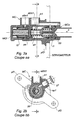
- the figure 2a represents in section aa a master cylinder to which the method of the invention applies and the figure 2b represents a view in section bb.
- the figure 2a represents in section aa a master cylinder to which the method of the invention applies
- the figure 2b represents a view in section bb.
- FIG. 2a there is a brake master cylinder MC having a bore A1 in which the primary pistons pp and secondary ps have been placed with the primary springs r1 and secondary r2.
- a communication hole tr1 for communicating the brake pressure exerted by the primary piston in the master cylinder to a hydraulic braking circuit.
- fixing lugs pf1 and pf2 make it possible to fix the master cylinder MC on a braking assistance servomotor represented in dotted line on the figure 2a .
- the figure 2b represents a section bb made along the axis of this hole tr1.
- This hole tr1 communicates with access ap1 intended to be connected to a braking circuit.
- a pin g1 was placed in hole tr1 and opens into bore A11.
- the pin g1 thus opens into the bore between the two pistons pp and ps.
- the pin g1 therefore prohibits the secondary piston from move back, beyond the pin g1, towards the inlet MCe of the bore of the master cylinder.
- the method of the invention therefore consists, when disassembling or mounting the master cylinder on the servomotor, to place a temporary pin g1 in the access hole tr1 to prevent the pistons pp and ps out of the bore of the master cylinder.
- the master cylinder is thus mounted on the servomotor. Before the attachment on the servomotor, the handling carried out between step 3 and step 4 was done safely without the risk that the pistons come out of the bore of the master cylinder. After removing the pin, all that remains is to connect the hydraulic braking circuits to the pressure ports such as access ap1 and to mount the brake fluid reservoir on the accesses alim1 et alim2.
- the disassembly method of the master cylinder is, after disconnecting the hydraulic circuit access ap1, to introduce the pin g1 in the hole tr1. The end of the pin emerges in the bore A1, the pistons can no longer leave the bore A1.
- the master cylinder MC can be safely disengaged from the brake booster.
- the pin is inserted into a hole specially provided for this purpose. In this case we will be able to plug this hole, with a screw cap, for example, when we have removed the pin and before putting the master cylinder into service.
- This pin has a rod gf intended to be inserted into the hole tr1 of the master cylinder and whose end ge must emerge inside the bore A1.
- the diameter of the rod g1 is smaller than the diameter of the hole tr1.
- the rod gf is extended by a holding portion gg of the pin and intended to enter the access ap1 of the master cylinder.
- this holding portion gg has a diameter substantially equal to or slightly smaller than the diameter of the access ap1 so that it penetrates with friction in the access ap1 and that the pin is held in place in the master cylinder because of this friction.
- the diameter of the holding portion gg is smaller than the diameter of the access ap1
- the peripheral surface of this portion gg has protuberances which will be in contact with the inner surface of the access ap1 and will frictionally maintain the pin in the master cylinder.
- the figure 3c represents an alternative embodiment in which the gg portion comprises flexible peripheral strips Gk intended to exert a friction on the inner wall of the ap1 access.
- the figure 3d represents another embodiment of the pin in which the part of maintenance gg comprises a thread intended to be screwed into an internal thread of access ap1.
- the end ge rod gf can be tapered as shown on the figure 3d . This arrangement will facilitate insertion of the pin into hole tr1.
- the holding portion gg may include a shoulder gm for controlling the insertion depth of the rod gf in the hole tr1 of the master cylinder.
- the holding portion is extended by a handling handle gh having an end boss which facilitates insertion and removal of the pin into the hole tr1.
Landscapes
- Engineering & Computer Science (AREA)
- Transportation (AREA)
- Mechanical Engineering (AREA)
- Transmission Of Braking Force In Braking Systems (AREA)
- Braking Arrangements (AREA)
- Automobile Manufacture Line, Endless Track Vehicle, Trailer (AREA)
Abstract
Description
- L'invention concerne un procédé de montage et de démontage d'un maître cylindre de frein de véhicule et notamment de maître cylindre destiné à être monté sur un servomoteur d'assistance au freinage d'un véhicule automobile.
- Les maîtres cylindres connus dans la technique comportent un ressort, appelé ressort secondaire, situé dans l'alésage entre le fond de l'alésage et le piston secondaire. Ce ressort a pour rôle de repousser le piston secondaire vers le piston primaire et donc de repousser l'ensemble piston secondaire/piston primaire vers l'entrée de l'alésage.
- Lorsque le maître cylindre n'est pas monté sur le servomoteur d'assistance au freinage, ce ressort a donc tendance à repousser l'ensemble piston primaire/piston secondaire vers l'extérieur de l'alésage du maître cylindre.
- Lorsqu'on démonte le maître cylindre, il y a un risque que ce ressort éjecte l'ensemble du mécanisme du maître cylindre vers l'extérieur de celui-ci. Il y a donc un risque de détérioration des pièces intérieures du maître cylindre ou de la perte de certaines d'entre-elles.
- Pour éviter cela, selon une technique connue, le ressort secondaire est muni d'un mécanisme de limitation de sa course. La
figure 1 représente un exemple d'un tel dispositif. L'alésage axial du maître cylindre contient les pistons primaire pp et secondaire ps de manière connue dans la technique. Un ressort primaire r1 est intercalé entre les deux pistons. Un ressort secondaire r2 est intercalé entre le piston secondaire ps et le fond MCf de l'alésage du maître cylindre. L'ensemble est inséré dans l'alésage du maître cylindre par l'entrée MCe de l'alésage. Le ressort rs2 prend appuie sur le fond MCf de l'alésage et tend à repousser les pistons vers l'extérieur de l'alésage. - Dans le système de la
figure 1 , la course du ressort secondaire r2 est limitée par deux coupelles c1 et c2 qui coulissent sur une tige t1. La tige t1 est munie de deux épaulements e1 et e2 qui empêchent les coupelles de s'écarter l'une de l'autre d'une distance maximale. Ce système permet ainsi de limiter la course du ressort secondaire r2. - L'invention concerne un système permettant de s'affranchir d'un tel dispositif de limitation de la course du ressort secondaire.
- Elle fournit donc un maître cylindre simplifié par rapport aux maîtres cylindres de l'art antérieur.
- L'invention concerne un procédé de montage et de démontage d'un maître cylindre lequel comprend un piston primaire et un piston secondaire montés dans un alésage du maître cylindre avec au moins un ressort placé entre le fond de l'alésage et le piston secondaire et ayant pour rôle de repousser le piston secondaire et le piston primaire vers l'entrée de l'alésage. Selon l'invention, le ressort secondaire est libre et le procédé comprend au moins l'étape suivante:
- mise en place d'une goupille de maintien temporaire dans un trou d'accès situé sur la périphérie du maître cylindre de telle façon que la goupille émerge à l'intérieur de l'alésage entre l'entrée de l'alésage et l'un des pistons primaire ou secondaire. Avantageusement, cette goupille est mise en place temporairement.
- Avantageusement, selon le procédé de l'invention ladite goupille de maintien est mise en place temporairement dans ledit trou d'accès durant le temps de montage du maître cylindre sur un servomoteur d'assistance au freinage.
- De préférence, ledit trou d'accès est un trou de communication de la pression de freinage entre le maître cylindre et un circuit hydraulique de freinage, ou un trou d'alimentation en liquide de freinage du maître cylindre.
- Avantageusement, ledit trou d'accès est un trou de communication de la pression de freinage entre le maître cylindre et un circuit hydraulique de freinage.
- Selon une forme de réalisation préférée de l'invention, ledit trou d'accès est situé entre le piston secondaire et l'entrée de l'alésage de telle façon que la goupille émerge à l'intérieur de l'alésage entre l'entrée de l'alésage et le piston secondaire.
- Selon une forme de réalisation la goupille est en matériau plastique rigide.
- En ce qui concerne la réalisation de la goupille, on pourra prévoir que le diamètre d'une partie de la goupille soit sensiblement égal au diamètre d'une partie du trou d'accès de façon à permettre l'insertion de la goupille dans ledit trou avec frottement sur cette partie du trou d'accès.
- Avantageusement, le diamètre d'une partie de la goupille est inférieur à celui d'une partie du trou d'accès et comporte, sur sa périphérie, des éléments en forme de protubérances permettant un frottement sur les parois intérieures de cette partie du trou d'accès.
- On pourra prévoir également que la goupille comporte une extrémité conique permettant son insertion dans le trou d'accès.
- Selon une autre forme de réalisation de l'invention, le trou d'accès possède un filetage et la goupille comporte une partie filetée permettant le vissage de la goupille dans le filetage dudit trou d'accès.
- Selon le procédé de l'invention, lors d'un montage d'un maître cylindre sur un servomoteur d'assistance au freinage, on peut prévoir les étapes suivantes:
- mise en place des pistons primaire et secondaire ainsi que de leurs ressorts associés dans l'alésage du maître cylindre,
- compression des ressorts,
- mise en place de la goupille de maintien,
- montage du maître cylindre sur un servomoteur d'assistance au freinage,
- retrait de la goupille de maintien.
- Lors d'un démontage d'un maître cylindre on peut prévoir les étapes suivantes:
- mise en place de la goupille de maintien,
- démontage du maître cylindre du servomoteur d'assistance au freinage sur lequel il est fixé.
- Les différents objets et caractéristiques de l'invention apparaîtront plus clairement dans la description et dans les figures annexées qui représentent:
- la
figure 1 , une coupe longitudinale d'un maître cylindre connu dans la technique et décrit précédemment, - la
figure 2a , une coupe longitudinale d'un exemple de réalisation d'un système permettant de mettre en oeuvre le procédé de l'invention, - la
figure 2b , une coupe transversale de l'exemple de réalisation de lafigure 2a , - la
figures 3a , une vue de côté d'un exemple de réalisation de la goupille permettant de mettre en oeuvre le procédé de l'invention, - la
figure 3b , une vue en coupe de la goupille de lafigure 3a , - les
figures 3c et 3d , des vues de côté de variantes de réalisations de la goupille selon l'invention. - La
figure 2a représente en coupe aa un maître cylindre auquel s'applique le procédé de l'invention et lafigure 2b en représente une vue en coupe bb. Pour simplifier, on a référencé sur ces figures, de la même façon que sur lafigure 1 , les mêmes éléments qu'on trouve à la fois sur lafigure 1 et sur lesfigures 2a et 2b . - Sur la
figure 2a , on retrouve donc un maître cylindre de frein MC possédant un alésage al1 dans lequel ont été placés les pistons primaire pp et secondaire ps avec les ressorts primaire r1 et secondaire r2. On trouve deux accès d'alimentation en liquide de frein alim1 et alim2 auxquels doit être raccordé un réservoir de liquide de frein. On trouve également un trou de communication tr1 destiné à communiquer la pression de freinage exercée, par le piston primaire, dans le maître cylindre vers un circuit hydraulique de freinage. - Par ailleurs, des pattes de fixation pf1 et pf2 permettent de fixer le maître cylindre MC sur un servomoteur d'assistance au freinage représenté en pointillés sur la
figure 2a . - La
figure 2b représente une coupe bb réalisée selon l'axe de ce trou tr1. Ce trou tr1 communique avec un accès ap1 destiné à être connecté à un circuit de freinage. - Sur cette
figure 2b , une goupille g1 a été placée dans le trou tr1 et débouche dans l'alésage al1. Lorsque les deux pistons sont montés dans l'alésage dans la position représentée sur lafigure 2b , la goupille g1 débouche donc dans l'alésage entre les deux pistons pp et ps. La goupille g1 interdit donc au piston secondaire de reculer, au-delà de la goupille g1, vers l'entrée MCe de l'alésage du maître cylindre. - Le procédé de l'invention consiste donc, lors du démontage ou du montage du maître cylindre sur le servomoteur, à placer une goupille temporaire g1 dans le trou d'accès tr1 pour empêcher les pistons pp et ps de ressortir de l'alésage du maître cylindre.
- Le procédé de montage du maître cylindre comporte donc les étapes suivantes:
- étape 1: mise en place des pistons primaire et secondaire pp et ps ainsi que des ressorts r1 et r2 dans l'alésage al1 du maître cylindre,
- étape 2: compression des ressorts r1 et r2 par pression sur le piston primaire selon la flèche F de façon à mettre les piston dans une position sensiblement telle que le piston secondaire ps soit au-delà du trou tr1 par rapport à l'entrée de l'alésage al1 comme cela est représenté sur la
figure 2b , - étape 3: mise en place de la goupille de maintien temporaire g1 dans le trou tr1,
- étape 4: montage du maître cylindre sur un servomoteur d'assistance au freinage et fixation à l'aide des pattes pf1 et pf2,
- étape 5: retrait de la goupille de maintien temporaire g1.
- Le maître cylindre se trouve ainsi monté sur le servomoteur. Avant la fixation sur le servomoteur, la manutention réalisée entre l'étape 3 et l'étape 4 s'est donc faite en toute sécurité sans le risque que les pistons sortent de l'alésage du maître cylindre. Après avoir retiré la goupille, il ne reste plus qu'à connecter les circuits hydrauliques de freinage aux accès de pression tel que l'accès ap1 et à monter le réservoir de liquide de freins sur les accès alim1 et alim2.
- Le procédé de démontage du maître cylindre consiste, après avoir déconnecté le circuit hydraulique de l'accès ap1, à introduire la goupille g1 dans le trou tr1. L'extrémité de la goupille émerge dans l'alésage al1, les pistons ne peuvent donc plus sortir de l'alésage al1. Le maître cylindre MC peut être désolidarisé en tout sécurité du servomoteur d'assistance au freinage.
- Dans la description qui précède on a considéré le cas où la goupille est insérée dans un trou (tr1) du maître cylindre permettant de faire communiquer l'intérieur de l'alésage du maître cylindre avec un circuit hydraulique de freinage. Sans sortir du cadre de l'invention, on peut prévoir que cette goupille est insérée dans un trou de communication (alim1 ou alim2) avec le réservoir de liquide de frein dans la mesure où un tel trou de communication débouche dans l'alésage du maître cylindre dans une zone qui permette à la goupille d'empêcher aux pistons de sortir de l'alésage du maître cylindre.
- On peut également prévoir que la goupille est insérée dans un trou spécialement prévu à cet usage. Dans ce cas on prévoira de pouvoir boucher ce trou, avec un bouchon fileté, par exemple, lorsqu'on aura enlevé la goupille et avant de mettre le maître cylindre en service.
- En se reportant aux
figures 3a à 3d on va maintenant décrire différentes formes de réalisation possibles de la goupille g1. - Cette goupille comporte une tige gf destinée à être insérée dans le trou tr1 du maître cylindre et dont l'extrémité ge doit émerger à l'intérieur de l'alésage al1. Le diamètre de la tige g1 est inférieur au diamètre du trou tr1. La tige gf est prolongée par une partie de maintien gg de la goupille et destinée à pénétrer dans l'accès ap1 du maître cylindre.
- Selon un premier mode de réalisation, cette partie de maintien gg possède un diamètre sensiblement égal ou très légèrement inférieur au diamètre de l'accès ap1 de façon qu'elle pénètre avec frottement dans l'accès ap1 et que la goupille se maintienne en place dans le maître cylindre en raison de ce frottement.
- Selon un autre mode de réalisation représenté par la coupe cc de la
figure 2b , le diamètre de la partie de maintien gg est inférieure au diamètre de l'accès ap1, et la surface périphérique de cette partie gg comporte des protubérance qui seront en contact avec la surface intérieure de l'accès ap1 et maintiendront par frottement la goupille dans le maître cylindre. - La
figure 3c représente une variante de réalisation dans laquelle la partie gg comporte des lamelles périphériques gk souples destinées à exercer un frottement sur la paroi intérieur de l'accès ap1. - La
figure 3d représente une autre forme de réalisation de la goupille dans la quelle la partie de maintien gg comporte un filetage destinée à être vissée dans un filetage intérieur de l'accès ap1. - Par ailleurs, dans ces différentes formes de réalisations, l'extrémité ge de la tige gf peut être conique comme cela est représenté sur la
figure 3d . Cette disposition facilitera l'insertion de la goupille dans le trou tr1. - De plus, la partie de maintien gg peut comporter un épaulement gm permettant de contrôler la profondeur d'insertion de la tige gf dans le trou tr1 du maître cylindre.
- La partie de maintien est prolongée par une manette de manutention gh comportant un bossage d'extrémité gi facilitant l'insertion et le retrait de la goupille dans le trou tr1.
Claims (12)
- Procédé de montage/démontage d'un maître cylindre de frein (MC) lequel comprend un piston primaire (pp) et un piston secondaire (ps) montés dans un alésage (al1) du maître cylindre avec au moins un ressort (r2) placé entre le fond (MCf) de l'alésage et le piston secondaire (ps) et ayant pour rôle de repousser le piston secondaire (ps) et le piston primaire (pp) vers l'entrée (MCe) de l'alésage, caractérisé en ce que le ressort secondaire (r2) est libre et en ce que le procédé comprend au moins l'étape suivante:- mise en place d'une goupille de maintien temporaire (g1) dans un trou d'accès (tr1) situé sur la périphérie du maître cylindre (MC) de telle façon que la goupille (g1) émerge à l'intérieur de l'alésage (al1) entre l'entrée (MCe) de l'alésage et l'un des pistons primaire ou secondaire (pp ou ps).
- Procédé de montage/démontage d'un maître cylindre selon la revendication 1, caractérisé en ce que ladite goupille de maintien (g1) est mise en place temporairement dans ledit trou d'accès (tr1) durant le temps de montage du maître cylindre sur un servomoteur d'assistance au freinage.
- Procédé de montage/démontage d'un maître cylindre selon l'une des revendications 1 ou 2, caractérisé en ce que ledit trou d'accès est un trou de communication de la pression de freinage entre le maître cylindre et un circuit hydraulique de freinage, ou un trou d'alimentation en liquide de freinage du maître cylindre.
- Procédé de montage/démontage d'un maître cylindre selon la revendication 3, caractérisé en ce que ledit trou d'accès est un trou de communication de la pression de freinage entre le maître cylindre et un circuit hydraulique de freinage.
- Procédé de montage/démontage d'un maître cylindre selon la revendication 4, caractérisé en ce que ledit trou d'accès est situé entre le piston secondaire (ps) et l'entrée (MCe) de l'alésage, de telle façon que la goupille (g1) émerge à l'intérieur de l'alésage (al1) entre l'entrée (MCe) de l'alésage et le piston secondaire (ps).
- Procédé de montage/démontage d'un maître cylindre selon l'une des revendications précédentes, caractérisé en ce que la goupille est en matériau plastique rigide.
- Procédé de montage/démontage d'un maître cylindre selon l'une des revendications précédentes, caractérisé en ce que le diamètre d'une partie (gg) de la goupille est sensiblement égal au diamètre d'une partie du trou d'accès (ap1) de façon à permettre son insertion dans ledit trou avec frottement sur cette partie (ap1) du trou d'accès.
- Procédé de montage/démontage d'un maître cylindre selon l'une des revendications 1 à 6, caractérisé en ce que le diamètre d'une partie (gg) de la goupille est inférieur à celui d'une partie (ap1) du trou d'accès et comporte, sur sa périphérie, des éléments en forme de protubérances permettant un frottement sur les parois intérieures de cette partie (ap1) du trou d'accès.
- Procédé de montage/démontage d'un maître cylindre selon l'une des revendications 1 à 6, caractérisé en ce que le trou d'accès possède un filetage et en ce que la goupille (g1) comporte une partie filetée permettant le vissage de la goupille dans le filetage dudit trou d'accès.
- Procédé de montage/démontage d'un maître cylindre selon l'une des revendications précédentes, caractérisé en ce que la goupille (g1) comporte une extrémité conique (ge) permettant son insertion dans le trou d'accès.
- Procédé de montage/démontage d'un maître cylindre selon l'une quelconque des revendication précédentes, caractérisé en ce qu'il comporte, lors d'un montage d'un maître cylindre sur un servomoteur d'assistance au freinage, les étapes suivantes:- la mise en place des pistons primaire et secondaire ainsi que de leurs ressorts associés dans l'alésage du maître cylindre,- la compression des ressorts,- la mise en place de la goupille de maintien,- le montage du maître cylindre sur un servomoteur d'assistance au freinage,- le retrait de la goupille de maintien.
- Procédé de montage/démontage d'un maître cylindre selon l'une quelconque des revendication 1 à 10, caractérisé en ce qu'il comporte, lors d'un démontage d'un maître cylindre, les étapes suivantes:- la mise en place de la goupille de maintien,- le démontage du maître cylindre du servomoteur d'assistance au freinage sur lequel il est fixé.
Applications Claiming Priority (1)
| Application Number | Priority Date | Filing Date | Title |
|---|---|---|---|
| FR0701188A FR2912712B1 (fr) | 2007-02-16 | 2007-02-16 | Procede de montage-demontage d'un maitre cylindre de frein |
Publications (2)
| Publication Number | Publication Date |
|---|---|
| EP1958834A1 true EP1958834A1 (fr) | 2008-08-20 |
| EP1958834B1 EP1958834B1 (fr) | 2010-04-21 |
Family
ID=38658535
Family Applications (1)
| Application Number | Title | Priority Date | Filing Date |
|---|---|---|---|
| EP08101480A Not-in-force EP1958834B1 (fr) | 2007-02-16 | 2008-02-11 | Procédé de montage/démontage d'un maître-cylindre de frein |
Country Status (6)
| Country | Link |
|---|---|
| US (1) | US8146232B2 (fr) |
| EP (1) | EP1958834B1 (fr) |
| JP (1) | JP2008201408A (fr) |
| AT (1) | ATE465057T1 (fr) |
| DE (1) | DE602008000995D1 (fr) |
| FR (1) | FR2912712B1 (fr) |
Cited By (1)
| Publication number | Priority date | Publication date | Assignee | Title |
|---|---|---|---|---|
| CN114302835A (zh) * | 2019-09-27 | 2022-04-08 | 大陆-特韦斯贸易合伙股份公司及两合公司 | 用于为液压制动系统产生制动压力的液压单元的生产优化的壳体 |
Citations (3)
| Publication number | Priority date | Publication date | Assignee | Title |
|---|---|---|---|---|
| WO1997022505A1 (fr) | 1995-12-20 | 1997-06-26 | Kelsey Hayes Company | Maitre-cylindre possedant des tampons d'extremite radiaux et un axe d'ensemble ressort de tete bloque a ajustage serre |
| DE10005743A1 (de) | 2000-02-09 | 2001-08-16 | Continental Teves Ag & Co Ohg | Geberzylinder |
| JP2004291933A (ja) * | 2003-03-28 | 2004-10-21 | Tokico Ltd | マスタシリンダおよびマスタシリンダの組立方法 |
Family Cites Families (1)
| Publication number | Priority date | Publication date | Assignee | Title |
|---|---|---|---|---|
| DE10212539A1 (de) * | 2002-03-20 | 2003-10-23 | Continental Teves Ag & Co Ohg | Kolbeneinheit mit gefesselter Feder |
-
2007
- 2007-02-16 FR FR0701188A patent/FR2912712B1/fr not_active Expired - Fee Related
-
2008
- 2008-02-11 DE DE602008000995T patent/DE602008000995D1/de active Active
- 2008-02-11 AT AT08101480T patent/ATE465057T1/de not_active IP Right Cessation
- 2008-02-11 EP EP08101480A patent/EP1958834B1/fr not_active Not-in-force
- 2008-02-13 US US12/030,602 patent/US8146232B2/en not_active Expired - Fee Related
- 2008-02-15 JP JP2008034068A patent/JP2008201408A/ja not_active Withdrawn
Patent Citations (3)
| Publication number | Priority date | Publication date | Assignee | Title |
|---|---|---|---|---|
| WO1997022505A1 (fr) | 1995-12-20 | 1997-06-26 | Kelsey Hayes Company | Maitre-cylindre possedant des tampons d'extremite radiaux et un axe d'ensemble ressort de tete bloque a ajustage serre |
| DE10005743A1 (de) | 2000-02-09 | 2001-08-16 | Continental Teves Ag & Co Ohg | Geberzylinder |
| JP2004291933A (ja) * | 2003-03-28 | 2004-10-21 | Tokico Ltd | マスタシリンダおよびマスタシリンダの組立方法 |
Cited By (3)
| Publication number | Priority date | Publication date | Assignee | Title |
|---|---|---|---|---|
| CN114302835A (zh) * | 2019-09-27 | 2022-04-08 | 大陆-特韦斯贸易合伙股份公司及两合公司 | 用于为液压制动系统产生制动压力的液压单元的生产优化的壳体 |
| CN114302835B (zh) * | 2019-09-27 | 2024-01-02 | 大陆汽车科技有限公司 | 用于为液压制动系统产生制动压力的液压单元的生产优化的壳体 |
| US12559075B2 (en) | 2019-09-27 | 2026-02-24 | Continental Automotive Technologies GmbH | Production-optimized housing for a hydraulic unit for producing brake pressure for a hydraulic brake system |
Also Published As
| Publication number | Publication date |
|---|---|
| EP1958834B1 (fr) | 2010-04-21 |
| JP2008201408A (ja) | 2008-09-04 |
| US20080196242A1 (en) | 2008-08-21 |
| FR2912712B1 (fr) | 2009-04-17 |
| DE602008000995D1 (de) | 2010-06-02 |
| ATE465057T1 (de) | 2010-05-15 |
| US8146232B2 (en) | 2012-04-03 |
| FR2912712A1 (fr) | 2008-08-22 |
Similar Documents
| Publication | Publication Date | Title |
|---|---|---|
| EP1294602B1 (fr) | Reservoir et systeme d'alimentation comportant un tel reservoir | |
| FR3011216A1 (fr) | Dispositif de rattrapage de jeu entre deux plaques | |
| EP2655147B1 (fr) | Piston primaire plastique a insert pour maître-cylindre tandem a penetration et maître-cylindre muni d'un tel piston | |
| FR2543501A1 (fr) | Maitre-cylindre de freinage | |
| EP2655145A1 (fr) | Piston primaire plastique a insert fonctionnel pour maître-cylindre tandem a penetration et maître-cylindre muni d'un tel piston | |
| EP1958834B1 (fr) | Procédé de montage/démontage d'un maître-cylindre de frein | |
| FR3052694A1 (fr) | Outil de pose a demontage rapide pour element a sertir | |
| EP1565367B1 (fr) | Procede de reglage d un dispositif de freinage | |
| FR2493939A1 (fr) | Frein a disque | |
| FR2509805A1 (fr) | Amplificateur de force hydraulique | |
| FR2912713A1 (fr) | Maitre cylindre comportant des moyens de liberation de pression | |
| FR2908096A1 (fr) | Maitre cylindre de frein | |
| EP2193964B1 (fr) | Maitre cylindre de frein | |
| FR2989046A1 (fr) | Piston de maitre-cylindre | |
| EP1349760B1 (fr) | Piston de maitre-cylindre et dispositif de montage d'un clapet dans ce piston | |
| FR2860203A1 (fr) | Maitre cylindre pour dispositif de freinage de vehicule automobile assurant une purge complete des fluides pneumatiq ues | |
| FR2851215A1 (fr) | Dispositif d'alimentation pour systeme de freinage, notamment pour vehicule automobile et procede de montage d'un tel systeme | |
| EP2804793B1 (fr) | Maitre-cylindre avec systeme de limitation de flux. | |
| FR2459746A1 (fr) | Maitre-cylindre pour installation de freinage de vehicule | |
| FR2565646A1 (fr) | Frein a disque | |
| EP1518771B1 (fr) | Maître-cylindre pour circuit de freinage | |
| FR2859964A1 (fr) | Maitre-cylindre a securite accrue et piston pour un tel maitre-cylindre | |
| FR2874363A1 (fr) | Systeme de montage d'un ensemble servomoteur d'assistance au freinage et d'un maitre cylindre dans un vehicule | |
| EP1338491B1 (fr) | Maître-cylindre hydraulique à masquage de course morte | |
| FR2891790A1 (fr) | Maitre cylindre tandem |
Legal Events
| Date | Code | Title | Description |
|---|---|---|---|
| PUAI | Public reference made under article 153(3) epc to a published international application that has entered the european phase |
Free format text: ORIGINAL CODE: 0009012 |
|
| AK | Designated contracting states |
Kind code of ref document: A1 Designated state(s): AT BE BG CH CY CZ DE DK EE ES FI FR GB GR HR HU IE IS IT LI LT LU LV MC MT NL NO PL PT RO SE SI SK TR |
|
| AX | Request for extension of the european patent |
Extension state: AL BA MK RS |
|
| 17P | Request for examination filed |
Effective date: 20090220 |
|
| 17Q | First examination report despatched |
Effective date: 20090318 |
|
| AKX | Designation fees paid |
Designated state(s): AT BE BG CH CY CZ DE DK EE ES FI FR GB GR HR HU IE IS IT LI LT LU LV MC MT NL NO PL PT RO SE SI SK TR |
|
| GRAP | Despatch of communication of intention to grant a patent |
Free format text: ORIGINAL CODE: EPIDOSNIGR1 |
|
| GRAS | Grant fee paid |
Free format text: ORIGINAL CODE: EPIDOSNIGR3 |
|
| GRAA | (expected) grant |
Free format text: ORIGINAL CODE: 0009210 |
|
| AK | Designated contracting states |
Kind code of ref document: B1 Designated state(s): AT BE BG CH CY CZ DE DK EE ES FI FR GB GR HR HU IE IS IT LI LT LU LV MC MT NL NO PL PT RO SE SI SK TR |
|
| REG | Reference to a national code |
Ref country code: GB Ref legal event code: FG4D Free format text: NOT ENGLISH |
|
| REG | Reference to a national code |
Ref country code: CH Ref legal event code: EP |
|
| REG | Reference to a national code |
Ref country code: IE Ref legal event code: FG4D Free format text: LANGUAGE OF EP DOCUMENT: FRENCH |
|
| REF | Corresponds to: |
Ref document number: 602008000995 Country of ref document: DE Date of ref document: 20100602 Kind code of ref document: P |
|
| REG | Reference to a national code |
Ref country code: NL Ref legal event code: VDEP Effective date: 20100421 |
|
| LTIE | Lt: invalidation of european patent or patent extension |
Effective date: 20100421 |
|
| PG25 | Lapsed in a contracting state [announced via postgrant information from national office to epo] |
Ref country code: NO Free format text: LAPSE BECAUSE OF FAILURE TO SUBMIT A TRANSLATION OF THE DESCRIPTION OR TO PAY THE FEE WITHIN THE PRESCRIBED TIME-LIMIT Effective date: 20100721 Ref country code: SE Free format text: LAPSE BECAUSE OF FAILURE TO SUBMIT A TRANSLATION OF THE DESCRIPTION OR TO PAY THE FEE WITHIN THE PRESCRIBED TIME-LIMIT Effective date: 20100421 Ref country code: NL Free format text: LAPSE BECAUSE OF FAILURE TO SUBMIT A TRANSLATION OF THE DESCRIPTION OR TO PAY THE FEE WITHIN THE PRESCRIBED TIME-LIMIT Effective date: 20100421 Ref country code: LT Free format text: LAPSE BECAUSE OF FAILURE TO SUBMIT A TRANSLATION OF THE DESCRIPTION OR TO PAY THE FEE WITHIN THE PRESCRIBED TIME-LIMIT Effective date: 20100421 Ref country code: ES Free format text: LAPSE BECAUSE OF FAILURE TO SUBMIT A TRANSLATION OF THE DESCRIPTION OR TO PAY THE FEE WITHIN THE PRESCRIBED TIME-LIMIT Effective date: 20100801 |
|
| REG | Reference to a national code |
Ref country code: IE Ref legal event code: FD4D |
|
| PG25 | Lapsed in a contracting state [announced via postgrant information from national office to epo] |
Ref country code: SI Free format text: LAPSE BECAUSE OF FAILURE TO SUBMIT A TRANSLATION OF THE DESCRIPTION OR TO PAY THE FEE WITHIN THE PRESCRIBED TIME-LIMIT Effective date: 20100421 Ref country code: AT Free format text: LAPSE BECAUSE OF FAILURE TO SUBMIT A TRANSLATION OF THE DESCRIPTION OR TO PAY THE FEE WITHIN THE PRESCRIBED TIME-LIMIT Effective date: 20100421 Ref country code: FI Free format text: LAPSE BECAUSE OF FAILURE TO SUBMIT A TRANSLATION OF THE DESCRIPTION OR TO PAY THE FEE WITHIN THE PRESCRIBED TIME-LIMIT Effective date: 20100421 Ref country code: HR Free format text: LAPSE BECAUSE OF FAILURE TO SUBMIT A TRANSLATION OF THE DESCRIPTION OR TO PAY THE FEE WITHIN THE PRESCRIBED TIME-LIMIT Effective date: 20100421 Ref country code: IS Free format text: LAPSE BECAUSE OF FAILURE TO SUBMIT A TRANSLATION OF THE DESCRIPTION OR TO PAY THE FEE WITHIN THE PRESCRIBED TIME-LIMIT Effective date: 20100821 Ref country code: LV Free format text: LAPSE BECAUSE OF FAILURE TO SUBMIT A TRANSLATION OF THE DESCRIPTION OR TO PAY THE FEE WITHIN THE PRESCRIBED TIME-LIMIT Effective date: 20100421 |
|
| PG25 | Lapsed in a contracting state [announced via postgrant information from national office to epo] |
Ref country code: CY Free format text: LAPSE BECAUSE OF FAILURE TO SUBMIT A TRANSLATION OF THE DESCRIPTION OR TO PAY THE FEE WITHIN THE PRESCRIBED TIME-LIMIT Effective date: 20100602 Ref country code: PL Free format text: LAPSE BECAUSE OF FAILURE TO SUBMIT A TRANSLATION OF THE DESCRIPTION OR TO PAY THE FEE WITHIN THE PRESCRIBED TIME-LIMIT Effective date: 20100421 |
|
| PG25 | Lapsed in a contracting state [announced via postgrant information from national office to epo] |
Ref country code: IE Free format text: LAPSE BECAUSE OF FAILURE TO SUBMIT A TRANSLATION OF THE DESCRIPTION OR TO PAY THE FEE WITHIN THE PRESCRIBED TIME-LIMIT Effective date: 20100421 Ref country code: EE Free format text: LAPSE BECAUSE OF FAILURE TO SUBMIT A TRANSLATION OF THE DESCRIPTION OR TO PAY THE FEE WITHIN THE PRESCRIBED TIME-LIMIT Effective date: 20100421 Ref country code: DK Free format text: LAPSE BECAUSE OF FAILURE TO SUBMIT A TRANSLATION OF THE DESCRIPTION OR TO PAY THE FEE WITHIN THE PRESCRIBED TIME-LIMIT Effective date: 20100421 |
|
| PLBE | No opposition filed within time limit |
Free format text: ORIGINAL CODE: 0009261 |
|
| STAA | Information on the status of an ep patent application or granted ep patent |
Free format text: STATUS: NO OPPOSITION FILED WITHIN TIME LIMIT |
|
| PG25 | Lapsed in a contracting state [announced via postgrant information from national office to epo] |
Ref country code: RO Free format text: LAPSE BECAUSE OF FAILURE TO SUBMIT A TRANSLATION OF THE DESCRIPTION OR TO PAY THE FEE WITHIN THE PRESCRIBED TIME-LIMIT Effective date: 20100421 Ref country code: SK Free format text: LAPSE BECAUSE OF FAILURE TO SUBMIT A TRANSLATION OF THE DESCRIPTION OR TO PAY THE FEE WITHIN THE PRESCRIBED TIME-LIMIT Effective date: 20100421 Ref country code: CZ Free format text: LAPSE BECAUSE OF FAILURE TO SUBMIT A TRANSLATION OF THE DESCRIPTION OR TO PAY THE FEE WITHIN THE PRESCRIBED TIME-LIMIT Effective date: 20100421 |
|
| 26N | No opposition filed |
Effective date: 20110124 |
|
| PG25 | Lapsed in a contracting state [announced via postgrant information from national office to epo] |
Ref country code: IT Free format text: LAPSE BECAUSE OF FAILURE TO SUBMIT A TRANSLATION OF THE DESCRIPTION OR TO PAY THE FEE WITHIN THE PRESCRIBED TIME-LIMIT Effective date: 20100421 |
|
| PG25 | Lapsed in a contracting state [announced via postgrant information from national office to epo] |
Ref country code: GR Free format text: LAPSE BECAUSE OF FAILURE TO SUBMIT A TRANSLATION OF THE DESCRIPTION OR TO PAY THE FEE WITHIN THE PRESCRIBED TIME-LIMIT Effective date: 20100722 |
|
| BERE | Be: lapsed |
Owner name: ROBERT BOSCH G.M.B.H. Effective date: 20110228 |
|
| PG25 | Lapsed in a contracting state [announced via postgrant information from national office to epo] |
Ref country code: MC Free format text: LAPSE BECAUSE OF NON-PAYMENT OF DUE FEES Effective date: 20110228 |
|
| PG25 | Lapsed in a contracting state [announced via postgrant information from national office to epo] |
Ref country code: BE Free format text: LAPSE BECAUSE OF NON-PAYMENT OF DUE FEES Effective date: 20110228 |
|
| PG25 | Lapsed in a contracting state [announced via postgrant information from national office to epo] |
Ref country code: MT Free format text: LAPSE BECAUSE OF FAILURE TO SUBMIT A TRANSLATION OF THE DESCRIPTION OR TO PAY THE FEE WITHIN THE PRESCRIBED TIME-LIMIT Effective date: 20100421 |
|
| REG | Reference to a national code |
Ref country code: CH Ref legal event code: PL |
|
| PG25 | Lapsed in a contracting state [announced via postgrant information from national office to epo] |
Ref country code: LI Free format text: LAPSE BECAUSE OF NON-PAYMENT OF DUE FEES Effective date: 20120229 Ref country code: CH Free format text: LAPSE BECAUSE OF NON-PAYMENT OF DUE FEES Effective date: 20120229 |
|
| PG25 | Lapsed in a contracting state [announced via postgrant information from national office to epo] |
Ref country code: LU Free format text: LAPSE BECAUSE OF NON-PAYMENT OF DUE FEES Effective date: 20110211 |
|
| PG25 | Lapsed in a contracting state [announced via postgrant information from national office to epo] |
Ref country code: PT Free format text: LAPSE BECAUSE OF NON-PAYMENT OF DUE FEES Effective date: 20100421 |
|
| PG25 | Lapsed in a contracting state [announced via postgrant information from national office to epo] |
Ref country code: BG Free format text: LAPSE BECAUSE OF FAILURE TO SUBMIT A TRANSLATION OF THE DESCRIPTION OR TO PAY THE FEE WITHIN THE PRESCRIBED TIME-LIMIT Effective date: 20100721 Ref country code: TR Free format text: LAPSE BECAUSE OF FAILURE TO SUBMIT A TRANSLATION OF THE DESCRIPTION OR TO PAY THE FEE WITHIN THE PRESCRIBED TIME-LIMIT Effective date: 20100421 |
|
| PG25 | Lapsed in a contracting state [announced via postgrant information from national office to epo] |
Ref country code: HU Free format text: LAPSE BECAUSE OF FAILURE TO SUBMIT A TRANSLATION OF THE DESCRIPTION OR TO PAY THE FEE WITHIN THE PRESCRIBED TIME-LIMIT Effective date: 20100421 |
|
| PGFP | Annual fee paid to national office [announced via postgrant information from national office to epo] |
Ref country code: FR Payment date: 20140218 Year of fee payment: 7 |
|
| REG | Reference to a national code |
Ref country code: FR Ref legal event code: ST Effective date: 20151030 |
|
| PG25 | Lapsed in a contracting state [announced via postgrant information from national office to epo] |
Ref country code: FR Free format text: LAPSE BECAUSE OF NON-PAYMENT OF DUE FEES Effective date: 20150302 |
|
| PGFP | Annual fee paid to national office [announced via postgrant information from national office to epo] |
Ref country code: GB Payment date: 20160222 Year of fee payment: 9 |
|
| PGFP | Annual fee paid to national office [announced via postgrant information from national office to epo] |
Ref country code: DE Payment date: 20160426 Year of fee payment: 9 |
|
| REG | Reference to a national code |
Ref country code: DE Ref legal event code: R119 Ref document number: 602008000995 Country of ref document: DE |
|
| GBPC | Gb: european patent ceased through non-payment of renewal fee |
Effective date: 20170211 |
|
| PG25 | Lapsed in a contracting state [announced via postgrant information from national office to epo] |
Ref country code: DE Free format text: LAPSE BECAUSE OF NON-PAYMENT OF DUE FEES Effective date: 20170901 |
|
| PG25 | Lapsed in a contracting state [announced via postgrant information from national office to epo] |
Ref country code: GB Free format text: LAPSE BECAUSE OF NON-PAYMENT OF DUE FEES Effective date: 20170211 |