EP1956672A1 - Fuel cell electric generator having an integrated metal hydride storage system - Google Patents
Fuel cell electric generator having an integrated metal hydride storage system Download PDFInfo
- Publication number
- EP1956672A1 EP1956672A1 EP07425058A EP07425058A EP1956672A1 EP 1956672 A1 EP1956672 A1 EP 1956672A1 EP 07425058 A EP07425058 A EP 07425058A EP 07425058 A EP07425058 A EP 07425058A EP 1956672 A1 EP1956672 A1 EP 1956672A1
- Authority
- EP
- European Patent Office
- Prior art keywords
- hydrogen
- storage unit
- stack
- mhu
- electric generator
- Prior art date
- Legal status (The legal status is an assumption and is not a legal conclusion. Google has not performed a legal analysis and makes no representation as to the accuracy of the status listed.)
- Withdrawn
Links
- 238000003860 storage Methods 0.000 title claims abstract description 63
- 239000000446 fuel Substances 0.000 title claims abstract description 43
- 150000004681 metal hydrides Chemical class 0.000 title claims abstract description 20
- 229910052987 metal hydride Inorganic materials 0.000 title claims abstract description 19
- 229910052739 hydrogen Inorganic materials 0.000 claims abstract description 86
- 239000001257 hydrogen Substances 0.000 claims abstract description 85
- UFHFLCQGNIYNRP-UHFFFAOYSA-N Hydrogen Chemical compound [H][H] UFHFLCQGNIYNRP-UHFFFAOYSA-N 0.000 claims abstract description 75
- 239000012530 fluid Substances 0.000 claims abstract description 18
- 238000001816 cooling Methods 0.000 claims abstract description 17
- 238000011144 upstream manufacturing Methods 0.000 claims description 9
- 238000010521 absorption reaction Methods 0.000 claims description 7
- 238000000034 method Methods 0.000 claims description 7
- 150000002431 hydrogen Chemical class 0.000 claims description 6
- 239000012528 membrane Substances 0.000 claims description 4
- XLYOFNOQVPJJNP-UHFFFAOYSA-N water Substances O XLYOFNOQVPJJNP-UHFFFAOYSA-N 0.000 description 16
- 238000006243 chemical reaction Methods 0.000 description 6
- 238000003487 electrochemical reaction Methods 0.000 description 4
- 230000021715 photosynthesis, light harvesting Effects 0.000 description 4
- 239000003792 electrolyte Substances 0.000 description 3
- -1 hydrogen ions Chemical class 0.000 description 3
- 238000004519 manufacturing process Methods 0.000 description 3
- 229910001092 metal group alloy Inorganic materials 0.000 description 3
- QVGXLLKOCUKJST-UHFFFAOYSA-N atomic oxygen Chemical compound [O] QVGXLLKOCUKJST-UHFFFAOYSA-N 0.000 description 2
- 230000003197 catalytic effect Effects 0.000 description 2
- 239000007789 gas Substances 0.000 description 2
- 230000017525 heat dissipation Effects 0.000 description 2
- XLYOFNOQVPJJNP-ZSJDYOACSA-N heavy water Substances [2H]O[2H] XLYOFNOQVPJJNP-ZSJDYOACSA-N 0.000 description 2
- 239000001301 oxygen Substances 0.000 description 2
- 229910052760 oxygen Inorganic materials 0.000 description 2
- 238000010248 power generation Methods 0.000 description 2
- 238000003795 desorption Methods 0.000 description 1
- 230000005611 electricity Effects 0.000 description 1
- 230000007613 environmental effect Effects 0.000 description 1
- 239000008246 gaseous mixture Substances 0.000 description 1
- 150000004678 hydrides Chemical class 0.000 description 1
- 238000009413 insulation Methods 0.000 description 1
- 230000010354 integration Effects 0.000 description 1
- 239000007788 liquid Substances 0.000 description 1
- 239000002184 metal Substances 0.000 description 1
- 239000000203 mixture Substances 0.000 description 1
- 239000007800 oxidant agent Substances 0.000 description 1
- 230000003647 oxidation Effects 0.000 description 1
- 238000007254 oxidation reaction Methods 0.000 description 1
- 230000001590 oxidative effect Effects 0.000 description 1
- 229920000642 polymer Polymers 0.000 description 1
- 238000009877 rendering Methods 0.000 description 1
- 229920006395 saturated elastomer Polymers 0.000 description 1
- 238000004513 sizing Methods 0.000 description 1
- 239000000126 substance Substances 0.000 description 1
Images

Classifications
-
- H—ELECTRICITY
- H01—ELECTRIC ELEMENTS
- H01M—PROCESSES OR MEANS, e.g. BATTERIES, FOR THE DIRECT CONVERSION OF CHEMICAL ENERGY INTO ELECTRICAL ENERGY
- H01M8/00—Fuel cells; Manufacture thereof
- H01M8/04—Auxiliary arrangements, e.g. for control of pressure or for circulation of fluids
- H01M8/04007—Auxiliary arrangements, e.g. for control of pressure or for circulation of fluids related to heat exchange
- H01M8/04029—Heat exchange using liquids
-
- H—ELECTRICITY
- H01—ELECTRIC ELEMENTS
- H01M—PROCESSES OR MEANS, e.g. BATTERIES, FOR THE DIRECT CONVERSION OF CHEMICAL ENERGY INTO ELECTRICAL ENERGY
- H01M8/00—Fuel cells; Manufacture thereof
- H01M8/04—Auxiliary arrangements, e.g. for control of pressure or for circulation of fluids
- H01M8/04007—Auxiliary arrangements, e.g. for control of pressure or for circulation of fluids related to heat exchange
- H01M8/04067—Heat exchange or temperature measuring elements, thermal insulation, e.g. heat pipes, heat pumps, fins
-
- H—ELECTRICITY
- H01—ELECTRIC ELEMENTS
- H01M—PROCESSES OR MEANS, e.g. BATTERIES, FOR THE DIRECT CONVERSION OF CHEMICAL ENERGY INTO ELECTRICAL ENERGY
- H01M8/00—Fuel cells; Manufacture thereof
- H01M8/04—Auxiliary arrangements, e.g. for control of pressure or for circulation of fluids
- H01M8/04082—Arrangements for control of reactant parameters, e.g. pressure or concentration
- H01M8/04201—Reactant storage and supply, e.g. means for feeding, pipes
-
- H—ELECTRICITY
- H01—ELECTRIC ELEMENTS
- H01M—PROCESSES OR MEANS, e.g. BATTERIES, FOR THE DIRECT CONVERSION OF CHEMICAL ENERGY INTO ELECTRICAL ENERGY
- H01M8/00—Fuel cells; Manufacture thereof
- H01M8/04—Auxiliary arrangements, e.g. for control of pressure or for circulation of fluids
- H01M8/04082—Arrangements for control of reactant parameters, e.g. pressure or concentration
- H01M8/04201—Reactant storage and supply, e.g. means for feeding, pipes
- H01M8/04216—Reactant storage and supply, e.g. means for feeding, pipes characterised by the choice for a specific material, e.g. carbon, hydride, absorbent
-
- H—ELECTRICITY
- H01—ELECTRIC ELEMENTS
- H01M—PROCESSES OR MEANS, e.g. BATTERIES, FOR THE DIRECT CONVERSION OF CHEMICAL ENERGY INTO ELECTRICAL ENERGY
- H01M8/00—Fuel cells; Manufacture thereof
- H01M8/06—Combination of fuel cells with means for production of reactants or for treatment of residues
- H01M8/0606—Combination of fuel cells with means for production of reactants or for treatment of residues with means for production of gaseous reactants
- H01M8/065—Combination of fuel cells with means for production of reactants or for treatment of residues with means for production of gaseous reactants by dissolution of metals or alloys; by dehydriding metallic substances
-
- Y—GENERAL TAGGING OF NEW TECHNOLOGICAL DEVELOPMENTS; GENERAL TAGGING OF CROSS-SECTIONAL TECHNOLOGIES SPANNING OVER SEVERAL SECTIONS OF THE IPC; TECHNICAL SUBJECTS COVERED BY FORMER USPC CROSS-REFERENCE ART COLLECTIONS [XRACs] AND DIGESTS
- Y02—TECHNOLOGIES OR APPLICATIONS FOR MITIGATION OR ADAPTATION AGAINST CLIMATE CHANGE
- Y02E—REDUCTION OF GREENHOUSE GAS [GHG] EMISSIONS, RELATED TO ENERGY GENERATION, TRANSMISSION OR DISTRIBUTION
- Y02E60/00—Enabling technologies; Technologies with a potential or indirect contribution to GHG emissions mitigation
- Y02E60/30—Hydrogen technology
- Y02E60/50—Fuel cells
Definitions
- the present invention refers to a fuel cell electric generator wherein a plurality of fuel cells are piled into a stack to generate electricity by being supplied a combustible gas and an oxidising gas, on a fuel electrode (anode) and an oxidation electrode (cathode) respectively.
- the present invention refers to a fuel cell electric generator wherein the hydrogen to be fed to fuel cells is stored in the shape of metal hydrides.
- Fuel cells represent one of the most technologically promising solutions for the use of hydrogen as an energy vector. They are devices capable of converting chemical energy into electric energy, by taking advantage of an electrochemical reaction whose product is non polluting; e.g., in the case of hydrogen-supplied fuel cells, it is water.
- Certain aspects of the present invention are particularly, but not exclusively, referred to a fuel cell electric generator which employs proton exchange membrane (PEM) cells and which utilises hydrogen as the fuel.
- PEM proton exchange membrane
- Anode and cathode of a PEM fuel cell are separated by an electrolyte, typically consisting of a membrane of a sulphonated polymer capable of conducting protons, whose opposite sides are coated with a layer of a suitable catalytic mixture (e.g. Pt-based).
- an electrolyte typically consisting of a membrane of a sulphonated polymer capable of conducting protons, whose opposite sides are coated with a layer of a suitable catalytic mixture (e.g. Pt-based).
- the electrolyte is generally saturated with a ionic transportation fluid (e.g. water) so that hydrogen ions can travel thereacross from anode to cathode.
- a ionic transportation fluid e.g. water
- an oxidant generally oxygen or a gaseous mixture containing oxygen (e.g. air) which reacts with the hydrogen ions which have travelled across the electrolyte and the electrons coming from the external electric circuit to form water, according to the hemi-reaction equation: (2) O 2 + 4H + + 4e - ⁇ 2H 2 O
- This reaction is generally also catalytically assisted, e.g. by Pt.
- a well defined maximum voltage is associated with this electrochemical reaction.
- a plurality of elements are connected in series to form a stack. It is also possible to use different stacks connected in series.
- a fuel cell electric generator of the above type needs a source of hydrogen; the latter is generally stored in pressurised vessels, or in the liquid form.
- metal hydrides which is advantageous because hydrogen can be stored at room temperature, in a smaller volume and at significantly lower pressures. Therefore, they constitute a safer and more compact storage form. Further, the hydrogen they release has high purity and it can be supplied directly to fuel cells.
- the release of hydrogen is an endothermic reaction, according to the following equation: (4) MH + heat ⁇ M + H wherein with M reference is made to a generic metal or metallic alloy, and therefore it demands a suppli of energy in the shape of a thermal flow at a well defined temperature.
- M reference is made to a generic metal or metallic alloy, and therefore it demands a suppli of energy in the shape of a thermal flow at a well defined temperature.
- the absorption of hydrogen is an exothermic phenomenon, therefore in the phase of recharging a unit for the storage of hydrogen in the shape of metallic hydrides, heat must be removed from the above unit so as to favour absorption.
- the amount of heat to supply and remove, during desorption and absorption respectively, depends upon the type of metallic alloy employed.
- Figure 1 shows a schematic view describing the integration of the hydraulic circuit of the fuel cell stack (FC) and the metal hydride storage unit (MHU), whilst the stack FC is being operated, in a fuel cell electric generator according to the prior art.
- a hydrogen supply line also connects the MHU to the stack FC.
- Hydrogen coming from the metal hydride unit is supplied to the stack FC while in operation.
- Stack FC beside electric power, generates heat that is removed by means of a water cooling circuit so as to maintain the FC temperature approximately constant and comprised in the range 65 ⁇ 85°C.
- the heat removed from the stack can be used to favour the release of hydrogen from the MHU. Therefore, water coming from the stack FC is sent to the MHU, wherein it yields to the metal hydrides the heat necessary to release hydrogen, so that the temperature of water is lowered. Next, water is sent back to the stack FC.
- auxiliary means R of heat dissipation of a known type that may be used to remove the excess heat.
- BoP BoP (i.e. "Balance of Plant”
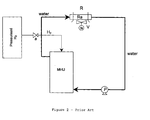
- FIG. 2 shows a schematic view describing a possible mode of cooling the MHU during the recharge phase, according to the prior art.
- a source of pressurised hydrogen e.g. a 200 bar cylinder
- pressurised hydrogen e.g. a 200 bar cylinder
- a flow of cold water moved by means of a pump P, is sent to the MHU, from which it removes the heat developed whilst hydrogen is being absorbed.
- a dissipator R optionally provided with a fan V, wherein it is cooled to be sent again to the MHU.
- the fuel cell generator is used as a back-up system in case of power failure.
- the time autonomy of the generator depends in fact upon the load capacity of the hydrogen storage unit, which can contain an amount of hydrogen sufficient e.g. for 4 hours of steady operation of the stack. In the absence of other interventions, at the end of that period of time, the generator can no longer work and it is necessary to recharge the storage unit. As a consequence, if the damage that has caused the failure has not been repaired, the back-up generator has as a matter of fact served its function only partially and in a non-efficient manner.
- the invention refers therefore to a fuel cell electric generator according to claim 1.
- a fuel cell electric generator comprising:
- a method of managing an electric generator of the type comprising a unit for the storage of hydrogen in the shape of metal hydrides and a stack of fuel cells supplied with the hydrogen of the storage unit, comprising:
- the method further comprises a step of cooling consisting of circulating a thermo-carrier fluid in a hydraulic circuit that travels in series across the stack and the storage unit, so as to remove thermal energy from the storage unit and the stack and to dissipate it.
- thermo-carrier fluid is advantageously circulated through means of thermal energy dissipation arranged in series along said cooling circuit immediately downstream or upstream with respect to said stack, with reference to a direction of circulation of said thermo-carrier fluid in said hydraulic circuit.
- the stack is arranged upstream with respect to the dissipation means, which, in their turn, are preferably arranged upstream with respect to the storage unit MHU.
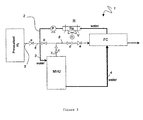
- a fuel cell electric generator comprising a stack FC that can be fed with hydrogen and a metal hydride storage unit MHU connected by a hydraulic circuit 2 for the circulation, in the way that will be described, of a thermo-carrier fluid between the stack FC and the storage unit MHU.
- a hydrogen feed circuit 5 suitable for connecting, in the way that will be described, an external source of pressurised hydrogen to the storage unit MHU and/or to the generator stack FC.
- the hydrogen feed circuit 5 comprises:
- Valve means a and e may be e.g. pressure reducing valves, while b and d may be e.g. valves of the manually activated type or controlled by an adequate control system (obvious for the skilled in the art and therefore not shown for the sake of conciseness).
- Valve b on branch 6 may also be a check valve.
- branches 7 and 8 of the hydrogen feed circuit together with valve means c , d , e , come to constitute first means for hydraulically connecting the storage unit MHU and the FC.
- branch 6 of the hydrogen feed circuit 5 and valve means a and b come to constitute second means for hydraulically connecting an external source of hydrogen to, selectively, the storage unit only, and the above first means.
- the hydraulic circuit 2 comprises: a first branch 3 hydraulically connecting in series first means R of thermal energy dissipation, of a known type (e.g. a dissipator Ra, optionally provided with a fan V operated by an engine M) to the storage unit, in the following referred to for the sake of conciseness also by its acronym MHU; and a second branch 4, hydraulically connecting in series the MHU to the stack FC (referred to for the sake of conciseness also by its acronym FC) and to the first dissipation means R.
- first means R of thermal energy dissipation of a known type (e.g. a dissipator Ra, optionally provided with a fan V operated by an engine M)
- MHU e.g. a dissipator Ra, optionally provided with a fan V operated by an engine M
- FC first dissipation means
- upstream ed "downstream” must be intended to be referred to the direction of circulation of the thermo-carrier fluid in the hydraulic circuit 2, shown by the arrows in figure 3 .
- FC produces electric power by receiving hydrogen from the MHU through branches 7 and 8 of the hydrogen feed circuit 5.
- a thermo-carrier fluid e.g. water
- said water exits the FC heated by the heat developed in association with the electrochemical reaction described above.
- water yields the heat accumulated partly to first means R of thermal energy dissipation and partly to the MHU, thus favouring in the latter the release of hydrogen to be fed to FC.
- step of recharging the MHU only - i.e. without simultaneous generation of electric power - hydrogen is normally fed from the external source to the MHU through branches 6 and 7 of the hydrogen feed circuit 5, and the cooling circuit 2 is used in such a way that water fed to the MHU exits from the latter heated only by the heat developed by hydrogen absorption (which is e.g. of the order of 100 W every 150 1 of hydrogen absorbed/desorbed).
- water is sent, in series, to the dissipation means R and to the stack FC.
- water yields the heat accumulated to the first dissipation means R and to the stack FC, thereby being cooled.
- the stack FC which is not working to produce electric power, is used as an ensemble of means of thermal energy dissipation, in aid of dissipation means R.
- a flow of hydrogen from the source of pressurised hydrogen is sent to both MHU (through branches 6 and 7 of the hydrogen feed circuit 5) and to FC (through branches 6 and 8 of the hydrogen feed circuit 5).
- water removes both the hydrogen absorption heat from the MHU and the heat associated with the electrochemical reaction from FC.
- this operation mode generally is associated with the maximum thermal load to be dissipated through the dissipation means R. That must be accounted for when designing and sizing dissipator Ra and fan V.
- thermo-carrier fluid removes the heat produced by the stack during electric power generation, while the storage unit MHU acts basically as dissipation means.
- an adequate safety system may set the fuel cell generator to work in the first operation mode described, wherein hydrogen is fed to FC from the MHU.
- An operator has then a time equivalent to that needed for the content of the MHU to be consumed to take action.
- the operator may connect to the system a cylinder of pressurised hydrogen, the content of which is fed simultaneously to the MHU to recharge it without removing it from the system and to FC for the production of electric power to supply the user with during the emergency.
Landscapes
- Life Sciences & Earth Sciences (AREA)
- Engineering & Computer Science (AREA)
- Manufacturing & Machinery (AREA)
- Sustainable Development (AREA)
- Sustainable Energy (AREA)
- Chemical & Material Sciences (AREA)
- Chemical Kinetics & Catalysis (AREA)
- Electrochemistry (AREA)
- General Chemical & Material Sciences (AREA)
- Fuel Cell (AREA)
Abstract
Hydrogen-fed fuel cells electric generator (1) having an integrated system for the storage of hydrogen in the shape of metal hydrides, comprising a stack (FC) of hydrogen-feedable fuel cells, a unit (MHU) for the storage of hydrogen in the shape of metal hydrides, a cooling circuit (2) flown across by a thermo-carrier fluid and hydraulically provided in series with means (R) of dissipation of thermal energy carried by the thermo-carrier fluid, at least a first branch (3) of which is hydraulically connected in series with the storage unit. The electric generator further comprises means for hydraulically connecting in series the stack with at least a second branch (4) of the cooling circuit; and a hydrogen feed circuit (5) comprising first means for hydraulically connecting said storage unit and said stack, and second means for hydraulically connecting an external source of hydrogen to, selectively, said storage unit only, and said first means.
Description
- The present invention refers to a fuel cell electric generator wherein a plurality of fuel cells are piled into a stack to generate electricity by being supplied a combustible gas and an oxidising gas, on a fuel electrode (anode) and an oxidation electrode (cathode) respectively.
- In particular, the present invention refers to a fuel cell electric generator wherein the hydrogen to be fed to fuel cells is stored in the shape of metal hydrides.
- Fuel cells represent one of the most technologically promising solutions for the use of hydrogen as an energy vector. They are devices capable of converting chemical energy into electric energy, by taking advantage of an electrochemical reaction whose product is non polluting; e.g., in the case of hydrogen-supplied fuel cells, it is water.
- The use of fuel cells is characterized by high efficiency, versatility and virtually null environmental impact.
- Certain aspects of the present invention are particularly, but not exclusively, referred to a fuel cell electric generator which employs proton exchange membrane (PEM) cells and which utilises hydrogen as the fuel.
- In a single PEM cell there take place simultaneously two hemi-reactions, at the anode and at the cathode respectively. Anode and cathode of a PEM fuel cell are separated by an electrolyte, typically consisting of a membrane of a sulphonated polymer capable of conducting protons, whose opposite sides are coated with a layer of a suitable catalytic mixture (e.g. Pt-based).
- The electrolyte is generally saturated with a ionic transportation fluid (e.g. water) so that hydrogen ions can travel thereacross from anode to cathode.
- At the anode, then, there is supplied hydrogen which diffuses within the catalytic layer and there dissociates into hydrogen ions and electrons, according to the hemi-reaction equation:
(1) 2H2 → 4H+ + 4e-
- Electrons, to which the membrane is impermeable, travel along an external electric circuit towards the cathode, thereby generating an electric current and the corresponding voltage.
- At the cathode there is supplied an oxidant, generally oxygen or a gaseous mixture containing oxygen (e.g. air) which reacts with the hydrogen ions which have travelled across the electrolyte and the electrons coming from the external electric circuit to form water, according to the hemi-reaction equation:
(2) O2 + 4H+ + 4e- → 2H2O
- This reaction is generally also catalytically assisted, e.g. by Pt.
- The resulting overall reaction is consequently:
(3) 2H2 + O2 → 2H2O
which comes with the development of heat and electric energy. - A well defined maximum voltage is associated with this electrochemical reaction. In order to achieve higher voltages, a plurality of elements are connected in series to form a stack. It is also possible to use different stacks connected in series.
- A fuel cell electric generator of the above type needs a source of hydrogen; the latter is generally stored in pressurised vessels, or in the liquid form. Recently, as an alternative to conventional storage methodologies, there has been catching on the use of metal hydrides, which is advantageous because hydrogen can be stored at room temperature, in a smaller volume and at significantly lower pressures. Therefore, they constitute a safer and more compact storage form. Further, the hydrogen they release has high purity and it can be supplied directly to fuel cells.
- The release of hydrogen is an endothermic reaction, according to the following equation:
(4) MH + heat → M + H
wherein with M reference is made to a generic metal or metallic alloy, and therefore it demands a suppli of energy in the shape of a thermal flow at a well defined temperature. On the other hand, the absorption of hydrogen is an exothermic phenomenon, therefore in the phase of recharging a unit for the storage of hydrogen in the shape of metallic hydrides, heat must be removed from the above unit so as to favour absorption. - The amount of heat to supply and remove, during desorption and absorption respectively, depends upon the type of metallic alloy employed.
- It is known to use the heat developed by the fuel cell stack to heat up the metal hydride storage unit to favour the release of hydrogen.
-
Figure 1 shows a schematic view describing the integration of the hydraulic circuit of the fuel cell stack (FC) and the metal hydride storage unit (MHU), whilst the stack FC is being operated, in a fuel cell electric generator according to the prior art. A hydrogen supply line also connects the MHU to the stack FC. - Hydrogen coming from the metal hydride unit is supplied to the stack FC while in operation. Stack FC, beside electric power, generates heat that is removed by means of a water cooling circuit so as to maintain the FC temperature approximately constant and comprised in the range 65÷85°C. The heat removed from the stack can be used to favour the release of hydrogen from the MHU. Therefore, water coming from the stack FC is sent to the MHU, wherein it yields to the metal hydrides the heat necessary to release hydrogen, so that the temperature of water is lowered. Next, water is sent back to the stack FC. In case the heat yielded to the MHU is not enough to balance the heat generated within the stack FC, there can be provided auxiliary means R of heat dissipation of a known type that may be used to remove the excess heat.
- The ensemble of hydraulic circuit (pump, piping, dissipators, etc.), gaseous currents feed and discharge circuit (hydrogen feed piping, air feed piping, etc.), control system (control unit, temperature, flow and pressure gauges, actuators, etc.) constitute the remaining part of the fuel cell generator, to which reference will be made in the following as BoP (i.e. "Balance of Plant").
- In order to cool the metal hydride storage unit during recharge, it is generally necessary that it be removed from the system and/or that a specific cooling system be provided, or however that the BoP of the system be conveniently modified.
-
Figure 2 shows a schematic view describing a possible mode of cooling the MHU during the recharge phase, according to the prior art. From a source of pressurised hydrogen (e.g. a 200 bar cylinder) there is supplied hydrogen to the MHU. A flow of cold water, moved by means of a pump P, is sent to the MHU, from which it removes the heat developed whilst hydrogen is being absorbed. Next, it is sent to a dissipator R, optionally provided with a fan V, wherein it is cooled to be sent again to the MHU. - The removal of the storage unit for the recharge phase is a lengthy and complex operation, which becomes particularly disadvantageous if such an operation needs to be repeated often. On the other hand, to provide for the possibility of modifying the BoP of the entire generator every time recharging the metal hydride storage unit becomes necessary involves a significant complication of the apparatus and higher costs.
- Further, interrupting the stack operation to carry out the recharge of the storage unit proves disadvantageous, particularly when the fuel cell generator is used as a back-up system in case of power failure. The time autonomy of the generator depends in fact upon the load capacity of the hydrogen storage unit, which can contain an amount of hydrogen sufficient e.g. for 4 hours of steady operation of the stack. In the absence of other interventions, at the end of that period of time, the generator can no longer work and it is necessary to recharge the storage unit. As a consequence, if the damage that has caused the failure has not been repaired, the back-up generator has as a matter of fact served its function only partially and in a non-efficient manner.
- It is possible to increase the time autonomy of the fuel cell generator used as a back-up system e.g. by employing a hydrogen storage unit with a lager capacity. However, this solution entails an undesired and disadvantageous of the overall volume of the generator and of manufacturing costs. Further, it represents only a temporary solution of the issue or, in other words, it is tantamount to postponing the problem.
- It is an object of the present invention to provide a fuel cell electric generator having an integrated metal hydride storage unit that can overcome the drawbacks described above. More particularly, it is an object of the present invention to provide a fuel cell electric generator wherein the recharge of the metal hydride storage unit can be performed without necessarily interrupting the stack operation. Further, it is an object of the present invention to provide a fuel cell electric generator wherein during a phase of recharging the storage unit it is not necessary to remove the latter, nor to modify the BoP of the system.
- The invention refers therefore to a fuel cell electric generator according to
claim 1. - In particular, according to the present invention, there is provided a fuel cell electric generator comprising:
- a stack of fuel cells that can be supplied with hydrogen;
- a unit for the storage of hydrogen in the shape of metal hydrides;
- a cooling circuit flown across by a thermo-carrier fluid and hydraulically provided in series with means of dissipation of thermal energy carried by the thermo-carrier fluid, at least a first branch of which is hydraulically connected in series with the storage unit;
- means for hydraulically connecting in series the stack with at least a second branch of the cooling circuit; and
- a hydrogen feed circuit comprising first means for hydraulically connecting the storage unit to the stack, and second means for hydraulically connecting an external source of hydrogen to, selectively, said storage unit only, and said first means.
- According to another aspect of the present invention, there is provided a method of managing an electric generator of the type comprising a unit for the storage of hydrogen in the shape of metal hydrides and a stack of fuel cells supplied with the hydrogen of the storage unit, comprising:
- a step of producing electric energy by means of the stack through supply to the latter of a flow of hydrogen;
- a step of recharging the storage unit during which the content in hydrogen of the storage unit that might have been consumed during the step of producing electric power is restored through absorption from an external source of pressurised hydrogen;
- said step of recharging comprising the step of hydraulically connecting, in an adjustable manner, said external source of pressurised hydrogen, selectively, to the storage unit only and to both said storage unit and said stack, without removing the storage unit itself from the generator, to supply the storage unit, in a controlled manner, with at least a first portion of said flow of hydrogen taken from the external source and, if that is the case, to feed, simultaneously with the recharge step, a second portion of the flow of hydrogen from the external source to the stack, so that said recharge step can be carried out simultaneously with the step of producing electric power.
- During the step of producing electric power, the method further comprises a step of cooling consisting of circulating a thermo-carrier fluid in a hydraulic circuit that travels in series across the stack and the storage unit, so as to remove thermal energy from the storage unit and the stack and to dissipate it.
- To this end, the thermo-carrier fluid is advantageously circulated through means of thermal energy dissipation arranged in series along said cooling circuit immediately downstream or upstream with respect to said stack, with reference to a direction of circulation of said thermo-carrier fluid in said hydraulic circuit. Preferably, the stack is arranged upstream with respect to the dissipation means, which, in their turn, are preferably arranged upstream with respect to the storage unit MHU.
- Further characteristics and advantages of the present invention will become apparent from the following description of an embodiment thereof given with reference to the figures of the attached drawings, wherein:
-
Figure 1 is a schematic view showing a stack of fuel cells and its metal hydride storage unit whilst the FC is being operated, in a fuel cell electric generator according to the prior art; -
Figure 2 is a schematic view showing one possible mode of cooling the metal hydride storage unit of a fuel cell generator according to the prior art during the recharge step; and -
Figure 3 is a schematic view showing the general lay-out of a fuel cell electric generator manufactured according to the present invention. - With reference to
figure 3 there is indicated in its entirety with 1 a fuel cell electric generator comprising a stack FC that can be fed with hydrogen and a metal hydride storage unit MHU connected by ahydraulic circuit 2 for the circulation, in the way that will be described, of a thermo-carrier fluid between the stack FC and the storage unit MHU. There is further provided according to the present invention ahydrogen feed circuit 5 suitable for connecting, in the way that will be described, an external source of pressurised hydrogen to the storage unit MHU and/or to the generator stack FC. - According to the present invention, the
hydrogen feed circuit 5 comprises: - a
first branch 6 on which there are provided valve means a , b suitable for adjusting the flow exiting the source of pressurised hydrogen; - a second branch 7 suitable for hydraulically connecting the MHU to the source of pressurised hydrogen through the
first branch 6, and to athird branch 8 in its turn hydraulically connected in series to the stack FC; thethird branch 8 is provided with valve means d, e suitable for adjusting the flow entering the stack FC. - Valve means a and e may be e.g. pressure reducing valves, while b and d may be e.g. valves of the manually activated type or controlled by an adequate control system (obvious for the skilled in the art and therefore not shown for the sake of conciseness). On the branch 7 there can be optionally provided a further valve c e.g. in case the MHU is not provided per se with its own insulation valve. Valve b on
branch 6 may also be a check valve. - Thus
branches 7 and 8 of the hydrogen feed circuit, together with valve means c, d, e, come to constitute first means for hydraulically connecting the storage unit MHU and the FC. Similarly,branch 6 of thehydrogen feed circuit 5 and valve means a and b come to constitute second means for hydraulically connecting an external source of hydrogen to, selectively, the storage unit only, and the above first means. - The
hydraulic circuit 2 comprises: afirst branch 3 hydraulically connecting in series first means R of thermal energy dissipation, of a known type (e.g. a dissipator Ra, optionally provided with a fan V operated by an engine M) to the storage unit, in the following referred to for the sake of conciseness also by its acronym MHU; and asecond branch 4, hydraulically connecting in series the MHU to the stack FC (referred to for the sake of conciseness also by its acronym FC) and to the first dissipation means R. - In the following, the terms "upstream" ed "downstream" must be intended to be referred to the direction of circulation of the thermo-carrier fluid in the
hydraulic circuit 2, shown by the arrows infigure 3 . - In a first operation mode of the fuel cell electric generator according to the present invention, FC produces electric power by receiving hydrogen from the MHU through
branches 7 and 8 of thehydrogen feed circuit 5. In the meantime, along thecooling circuit 2 there is circulated a thermo-carrier fluid, e.g. water; consequently, said water, during this operation mode, exits the FC heated by the heat developed in association with the electrochemical reaction described above. Next, water yields the heat accumulated partly to first means R of thermal energy dissipation and partly to the MHU, thus favouring in the latter the release of hydrogen to be fed to FC. - During of step of recharging the MHU only - i.e. without simultaneous generation of electric power - hydrogen is normally fed from the external source to the MHU through
branches 6 and 7 of thehydrogen feed circuit 5, and thecooling circuit 2 is used in such a way that water fed to the MHU exits from the latter heated only by the heat developed by hydrogen absorption (which is e.g. of the order of 100 W every 150 1 of hydrogen absorbed/desorbed). Subsequently, water is sent, in series, to the dissipation means R and to the stack FC. Thus water yields the heat accumulated to the first dissipation means R and to the stack FC, thereby being cooled. Water, whose initial temperature is thus substantially restored, can be fed back to the MHU for the cooling of the latter. In this step, therefore, the stack FC, which is not working to produce electric power, is used as an ensemble of means of thermal energy dissipation, in aid of dissipation means R. - In a second operation mode of the fuel cell electric generator according to the present invention, instead, the MHU is recharged while the FC is working, that is without interrupting the electric power generation. Therefore, a flow of hydrogen from the source of pressurised hydrogen is sent to both MHU (through
branches 6 and 7 of the hydrogen feed circuit 5) and to FC (throughbranches hydraulic circuit 2, consequently, water removes both the hydrogen absorption heat from the MHU and the heat associated with the electrochemical reaction from FC. This accumulated heat, the entity of which depends upon the overall hydrogen flow fed from the source of pressurised hydrogen and upon how it is split between MHU and FC, is then globally yielded to the dissipation means R: in this operation mode also fan V is preferably activated, so as to maximise the heat dissipation. - It will appear to the skilled in the art that this operation mode generally is associated with the maximum thermal load to be dissipated through the dissipation means R. That must be accounted for when designing and sizing dissipator Ra and fan V.
- In a further operation mode of the fuel cell electric generator according to the present invention, hydrogen is fed to the stack only from the external source of pressurised hydrogen, through
branches hydrogen feed circuit 5. Under these conditions, consequently, in thehydraulic circuit 2, the thermo-carrier fluid removes the heat produced by the stack during electric power generation, while the storage unit MHU acts basically as dissipation means. - According to the present invention it is therefore possible to not remove the MHU from the system during the recharge-only step, thus rendering the procedure simpler and reducing the time needed for the operation. Above all, though, by operating in the second mode described above, it is possible to recharge the MHU without removing it from the system and to maintain at the same time the stack FC in operation, so that the production of electric power is not interrupted.
- Advantageously, this allows a more efficient management of a fuel cell generator as a back-up electric power generator. If e.g. a failure interrupts the electric power supply to any user, an adequate safety system may set the fuel cell generator to work in the first operation mode described, wherein hydrogen is fed to FC from the MHU. An operator has then a time equivalent to that needed for the content of the MHU to be consumed to take action. In particular, the operator may connect to the system a cylinder of pressurised hydrogen, the content of which is fed simultaneously to the MHU to recharge it without removing it from the system and to FC for the production of electric power to supply the user with during the emergency.
- Once the damage that caused the interruption of electric power supply to the user is repaired, it is possible e.g. to complete the MHU recharge with the stack non-working and subsequently to disconnect the cylinder of pressurised hydrogen.
Claims (9)
- Fuel cell electric generator (1) comprising:- a stack (FC) of hydrogen-feedable fuel cells;- a unit (MHU) for the storage of hydrogen in the shape of metal hydrides;- a cooling circuit (2) flown across by a thermo-carrier fluid and hydraulically provided in series with means (R) of dissipation of thermal energy carried by the thermo-carrier fluid, at least a first branch (3) of which is hydraulically connected in series with the storage unit (MHU);characterised in that it further comprises:- means for hydraulically connecting in series said stack with at least a second branch (4) of said cooling circuit; and- a hydrogen feed circuit (5) comprising first means for hydraulically connecting the storage unit to the stack, and second means for hydraulically connecting an external source of hydrogen to, selectively, said storage unit only, and said first means.
- Electric generator (1) according to claim 1, characterised in that said dissipation means (R) comprise a dissipator (Ra) and a fan (V).
- Electric generator (1) according to any of the foregoing claims, characterised in that said fuel cells are of the proton-exchange membrane (PEM) type.
- Electric generator (1) according to any of the foregoing claims, characterised in that said first means for hydraulically connecting said storage unit and said stack in said hydrogen feed circuit (5) comprise a first branch (7) and a second branch (8) of the hydrogen feed circuit (5) and first valve means ( c , d , e ) assembled along said first and second branches (7,8).
- Electric generator (1) according to any of the foregoing claims, characterised in that said second means for hydraulically connecting said external source of hydrogen to, selectively, said storage unit (MHU) only, and said first means comprise a third branch (6) of said hydrogen feed circuit (5) and second valve means ( a , b ) assembled along said third branch (6).
- Electric generator (1) according to claim 1, characterised in that, with respect to the direction of circulation of the thermo-carrier fluid, the stack (FC) is arranged upstream with respect to the first dissipation means, which, in their turn, are arranged upstream with respect to the storage unit (MHU).
- A method of managing an electric generator of the type comprising a unit (MHU) for the storage of hydrogen in the shape of metal hydrides and a stack (FC) of fuel cells feedable with the hydrogen of the storage unit, comprising a step of producing electric power by means of the stack through supply to the latter of a flow of hydrogen, and a step of recharging the storage unit during which the content in hydrogen of the storage unit that might have been consumed during the step of producing electric power is restored through absorption from an external source of pressurised hydrogen; characterised in that said recharge step comprises the step hydraulically connecting, in an adjustable manner, said external source of pressurised hydrogen, selectively, to the storage unit only and to both said storage unit and said stack, without removing the storage unit itself from the generator, to supply the storage unit, in a controlled manner, with at least a first portion of said flow of hydrogen taken from the external source and, if that is the case, to feed, simultaneously with the recharge step, a second portion of the flow of hydrogen from the external source to the stack, so that said recharge step can be carried out simultaneously with the step of producing electric power.
- A method according to claim 7, characterised in that it comprises, during the step of producing electric power and simultaneous recharge, a cooling step consisting of circulating a thermo-carrier fluid in a hydraulic circuit that flows across the stack and the storage unit, so as to remove thermal energy from the storage unit and the stack and to dissipate it.
- A method according to claim 8, characterised in that, during said cooling step, said thermo-carrier fluid is circulated across means (R) of dissipation of thermal energy arranged in series along said hydraulic circuit immediately upstream or downstream with respect to said stack (FC), with reference to a direction of circulation of said thermo-carrier fluid in said hydraulic circuit; circuit; said stack (FC) being arranged upstream with respect to the dissipation means, which, in their turn, are arranged upstream with respect to the storage unit (MHU).
Priority Applications (1)
| Application Number | Priority Date | Filing Date | Title |
|---|---|---|---|
| EP07425058A EP1956672A1 (en) | 2007-02-02 | 2007-02-02 | Fuel cell electric generator having an integrated metal hydride storage system |
Applications Claiming Priority (1)
| Application Number | Priority Date | Filing Date | Title |
|---|---|---|---|
| EP07425058A EP1956672A1 (en) | 2007-02-02 | 2007-02-02 | Fuel cell electric generator having an integrated metal hydride storage system |
Publications (1)
| Publication Number | Publication Date |
|---|---|
| EP1956672A1 true EP1956672A1 (en) | 2008-08-13 |
Family
ID=38198569
Family Applications (1)
| Application Number | Title | Priority Date | Filing Date |
|---|---|---|---|
| EP07425058A Withdrawn EP1956672A1 (en) | 2007-02-02 | 2007-02-02 | Fuel cell electric generator having an integrated metal hydride storage system |
Country Status (1)
| Country | Link |
|---|---|
| EP (1) | EP1956672A1 (en) |
Cited By (5)
| Publication number | Priority date | Publication date | Assignee | Title |
|---|---|---|---|---|
| GB2510676A (en) * | 2012-12-10 | 2014-08-13 | Snecma | Fuel cell system for production of electricity on an aircraft |
| JP2016105381A (en) * | 2014-12-01 | 2016-06-09 | 株式会社豊田自動織機 | Hydrogen gas supply device |
| JP2017059454A (en) * | 2015-09-17 | 2017-03-23 | ブラザー工業株式会社 | Fuel cell, operation method, and program |
| CN109216726A (en) * | 2017-07-03 | 2019-01-15 | 自动化机器人公司 | Fuel cell electric power system for unpiloted water vehicle |
| WO2025124808A1 (en) * | 2023-12-12 | 2025-06-19 | Siemens Energy Global GmbH & Co. KG | Combination of h2 storage methods |
Citations (3)
| Publication number | Priority date | Publication date | Assignee | Title |
|---|---|---|---|---|
| JPS6169993A (en) * | 1984-09-14 | 1986-04-10 | Toshiba Corp | Electrolytic manufacturing equipment of caustic soda utilizing by-product hydrogen |
| WO2000063993A1 (en) * | 1999-04-20 | 2000-10-26 | Zentrum Für Sonnenenergie- Und Wasserstoff-Forschung Baden-Württemberg, Gemeinnützige Stiftung | Mains-independent portable power generation system without pollutant emission, and method for producing electric current using same |
| US20050130002A1 (en) * | 2003-12-11 | 2005-06-16 | Honda Motor Co., Ltd. | Fuel cell system |
-
2007
- 2007-02-02 EP EP07425058A patent/EP1956672A1/en not_active Withdrawn
Patent Citations (3)
| Publication number | Priority date | Publication date | Assignee | Title |
|---|---|---|---|---|
| JPS6169993A (en) * | 1984-09-14 | 1986-04-10 | Toshiba Corp | Electrolytic manufacturing equipment of caustic soda utilizing by-product hydrogen |
| WO2000063993A1 (en) * | 1999-04-20 | 2000-10-26 | Zentrum Für Sonnenenergie- Und Wasserstoff-Forschung Baden-Württemberg, Gemeinnützige Stiftung | Mains-independent portable power generation system without pollutant emission, and method for producing electric current using same |
| US20050130002A1 (en) * | 2003-12-11 | 2005-06-16 | Honda Motor Co., Ltd. | Fuel cell system |
Cited By (9)
| Publication number | Priority date | Publication date | Assignee | Title |
|---|---|---|---|---|
| GB2510676A (en) * | 2012-12-10 | 2014-08-13 | Snecma | Fuel cell system for production of electricity on an aircraft |
| GB2510676B (en) * | 2012-12-10 | 2015-04-29 | Snecma | An on-board electricity production system using a fuel cell |
| JP2016105381A (en) * | 2014-12-01 | 2016-06-09 | 株式会社豊田自動織機 | Hydrogen gas supply device |
| JP2017059454A (en) * | 2015-09-17 | 2017-03-23 | ブラザー工業株式会社 | Fuel cell, operation method, and program |
| CN109216726A (en) * | 2017-07-03 | 2019-01-15 | 自动化机器人公司 | Fuel cell electric power system for unpiloted water vehicle |
| EP3425713A3 (en) * | 2017-07-03 | 2019-03-20 | Liquid Robotics | Fuel cell power system for an unmanned surface vehicle |
| US11742502B2 (en) | 2017-07-03 | 2023-08-29 | The Boeing Company | Fuel cell power system for an unmanned surface vehicle |
| CN109216726B (en) * | 2017-07-03 | 2024-02-09 | 自动化机器人公司 | Fuel cell power system for unmanned surface vehicle |
| WO2025124808A1 (en) * | 2023-12-12 | 2025-06-19 | Siemens Energy Global GmbH & Co. KG | Combination of h2 storage methods |
Similar Documents
| Publication | Publication Date | Title |
|---|---|---|
| CN101325263A (en) | Recovery of inert gas from a fuel cell exhaust stream | |
| EP1962358A2 (en) | Fuel cell stack and fuel cell system having the same | |
| AU2011244435A1 (en) | Device for storing and restoring electrical energy | |
| EP1956672A1 (en) | Fuel cell electric generator having an integrated metal hydride storage system | |
| WO2017087413A1 (en) | Energy storage using an rep with an engine | |
| JP2005129525A (en) | Direct methanol fuel cell and portable computer equipped with the same | |
| JP2009048854A (en) | Fuel cell power generator and control method thereof | |
| JP5538192B2 (en) | Fuel cell system | |
| JP4887639B2 (en) | Separator unit and fuel cell stack | |
| JPH11329457A (en) | Fuel cell system | |
| EP1956671A1 (en) | Fuel cell electric generator having an integrated metal hydride storage system | |
| US20050042488A1 (en) | Transportable solid oxide fuel cell generator | |
| CN100361337C (en) | A fuel cell that responds quickly to sudden increases in output power | |
| JP2004281072A (en) | Fuel cell generator | |
| JP7575643B1 (en) | Ammonia-based solid oxide fuel cell (SOFC) system with heating element heating and method of operation thereof - Patents.com | |
| EP1995811A1 (en) | Method for purging pem-type fuel cells | |
| WO2009082368A1 (en) | Rapid start-up and operating system for a fuel cell power plant utilizing a reformate fuel | |
| KR101777956B1 (en) | Fuel cell system and the control method thereof | |
| JP2006236599A (en) | Water recovery method for fuel cell power generator | |
| JP4992187B2 (en) | Fuel cell stack and fuel cell system | |
| JP5134309B2 (en) | Fuel cell power generator and control method thereof | |
| JP2010062127A (en) | Fuel cell system | |
| JP2005085598A (en) | Chemical heat storage hydrogen storage device | |
| JP4704733B2 (en) | Fuel cell system | |
| KR101409180B1 (en) | Air-breathing fuel cell system |
Legal Events
| Date | Code | Title | Description |
|---|---|---|---|
| PUAI | Public reference made under article 153(3) epc to a published international application that has entered the european phase |
Free format text: ORIGINAL CODE: 0009012 |
|
| AK | Designated contracting states |
Kind code of ref document: A1 Designated state(s): AT BE BG CH CY CZ DE DK EE ES FI FR GB GR HU IE IS IT LI LT LU LV MC NL PL PT RO SE SI SK TR |
|
| AX | Request for extension of the european patent |
Extension state: AL BA HR MK RS |
|
| AKX | Designation fees paid | ||
| REG | Reference to a national code |
Ref country code: DE Ref legal event code: 8566 |
|
| STAA | Information on the status of an ep patent application or granted ep patent |
Free format text: STATUS: THE APPLICATION IS DEEMED TO BE WITHDRAWN |
|
| 18D | Application deemed to be withdrawn |
Effective date: 20090214 |