EP1956027A1 - Carbapenem compound - Google Patents
Carbapenem compound Download PDFInfo
- Publication number
- EP1956027A1 EP1956027A1 EP06822651A EP06822651A EP1956027A1 EP 1956027 A1 EP1956027 A1 EP 1956027A1 EP 06822651 A EP06822651 A EP 06822651A EP 06822651 A EP06822651 A EP 06822651A EP 1956027 A1 EP1956027 A1 EP 1956027A1
- Authority
- EP
- European Patent Office
- Prior art keywords
- compound
- carbapenem
- formula
- present
- crystalline form
- Prior art date
- Legal status (The legal status is an assumption and is not a legal conclusion. Google has not performed a legal analysis and makes no representation as to the accuracy of the status listed.)
- Granted
Links
- 0 C[C@]([C@@]1[C@@]2[C@@](*)O)C(S[C@@]3CN[C@](C*)C3)=C(C(O)=O)N1C2=O Chemical compound C[C@]([C@@]1[C@@]2[C@@](*)O)C(S[C@@]3CN[C@](C*)C3)=C(C(O)=O)N1C2=O 0.000 description 1
Classifications
-
- C—CHEMISTRY; METALLURGY
- C07—ORGANIC CHEMISTRY
- C07F—ACYCLIC, CARBOCYCLIC OR HETEROCYCLIC COMPOUNDS CONTAINING ELEMENTS OTHER THAN CARBON, HYDROGEN, HALOGEN, OXYGEN, NITROGEN, SULFUR, SELENIUM OR TELLURIUM
- C07F9/00—Compounds containing elements of Groups 5 or 15 of the Periodic Table
- C07F9/02—Phosphorus compounds
- C07F9/547—Heterocyclic compounds, e.g. containing phosphorus as a ring hetero atom
- C07F9/6561—Heterocyclic compounds, e.g. containing phosphorus as a ring hetero atom containing systems of two or more relevant hetero rings condensed among themselves or condensed with a common carbocyclic ring or ring system, with or without other non-condensed hetero rings
-
- C—CHEMISTRY; METALLURGY
- C07—ORGANIC CHEMISTRY
- C07F—ACYCLIC, CARBOCYCLIC OR HETEROCYCLIC COMPOUNDS CONTAINING ELEMENTS OTHER THAN CARBON, HYDROGEN, HALOGEN, OXYGEN, NITROGEN, SULFUR, SELENIUM OR TELLURIUM
- C07F9/00—Compounds containing elements of Groups 5 or 15 of the Periodic Table
- C07F9/02—Phosphorus compounds
- C07F9/547—Heterocyclic compounds, e.g. containing phosphorus as a ring hetero atom
- C07F9/6561—Heterocyclic compounds, e.g. containing phosphorus as a ring hetero atom containing systems of two or more relevant hetero rings condensed among themselves or condensed with a common carbocyclic ring or ring system, with or without other non-condensed hetero rings
- C07F9/65611—Heterocyclic compounds, e.g. containing phosphorus as a ring hetero atom containing systems of two or more relevant hetero rings condensed among themselves or condensed with a common carbocyclic ring or ring system, with or without other non-condensed hetero rings containing the ring system (X = CH2, O, S, NH) optionally with an additional double bond and/or substituents, e.g. penicillins and analogs
Definitions
- the present invention relates to a novel carbapenem compound which is a production intermediate of 2-(substituted mercapto)-1 ⁇ -methyl-carbapenem antibiotics.
- L-627 (biapenem) represented by formula shown below:
- R 1 represents a pharmaceutically-acceptable ester group or a carboxyl group protective group that can be easily removed
- R 2 and R 3 each represents, independently, a phenyl group that may be substituted with a halogen atom, an alkyl group, a cyano group, a nitro group, or the like, a C 1 to C 6 alkyl group that may be substituted with a halogen atom, or the like
- X represents a halogen atom such as chlorine and bromine.
- R 1 represents a pharmaceutically-acceptable ester group or a carboxyl group protective group that can be easily removed
- R 2 and R 3 each represents, independently, a phenyl group that may be substituted with a halogen atom, an alkyl group, a cyano group, a nitro group, or the like, a C 1 to C 6 alkyl group that may be substituted with a halogen atom, or the like
- X represents a halogen atom such as chlorine and bromine.
- the compound represented by formula (I) is an important production intermediate in the production of 2-(substituted mercapto)-1 ⁇ -methyl-carbapenem antibiotics. It is preferable that this compound, particularly in situations where industrial-scale production is assumed, has high purity, is easily handable, and is in a crystalline form.
- Patent Document 1 discloses that the compound represented by formula (Ib) (hereinafter referred to as a "compound (Ib)”) can be isolated in a crystalline form, for example. Also, this document discloses that the compound has excellent stability in the crystalline form and that it is useful as a bulk raw material.
- the reacted substrate the reactivity of the diphenyl phosphoric acid part of the compound (Ib) is relatively poor and the ability to remove phosphoric acid is low.
- a p-nitrobenzyl group is used as the carboxyl group protective group in the compound (Ib).
- This group can be generally easily removed by a normal catalytic hydrogen reduction method using palladium carbon as the catalyst.
- the danger of fire from the filtration of palladium carbon and the use of hydrogen in an industrial process is high and thus the use of a p-nitrobenzyl group is unpreferable.
- production costs are relatively high when a p-nitrobenzyl group is used.
- a cheaper, more efficient, and stably-removable protective group is thus desired as the carboxyl group protective group instead of a p-nitrobenzyl group.
- Patent Document 2 discloses an example where R 1 is an alkyl group in formula (I) shown above, a specific synthesis example is hardly disclosed therein.
- Patent Document 1 Japanese Unexamined Patent Application, First Publication No. Hei 4-330085
- Patent Document 2 Japanese Unexamined Patent Application, First Publication No. Hei 4-217985
- the problem of the present invention is to provide a novel carbapenem compound which is a production intermediate of 2-(substituted mercapto)-1 ⁇ -methyl-carbapenem antibiotics and which is easily handable, cheap, has high reactivity of the phosphoric acid ester part, and can easily remove the phosphoric acid ester part.
- the present inventors have extensively studied about useful intermediates of 2-(substituted mercapto)-1 ⁇ -methyl-carbapenem antibiotics in order to solve the above problem, and found that the compound represented by formula (Ia) shown below specifically crystallizes, that, by the reacted substrate, the reactivity of the phosphoric acid ester part of the compound represented by formula (Ia) is high and thus the phosphoric acid ester can be easily removed, and that, by the reacted substrate, the carboxyl group protective group of the compound represented by formula (Ia) can be easily removed, thus leading to completion of the present invention.
- the carbapenem compound of the present invention has a crystalline form and it is more preferable that the crystalline form has a powder X-ray diffraction pattern with peaks at 15.64, 9.93, 6.83, 6.52, 5.44, 5.01, 4.72, 4.50, 4.33, 4.24, 3.98, 3.85, 3.57, 3.41, 3.31, 3.10 2.76, and 2.67 as d-spacings (A).
- the compound of the present invention is similarly stable to the compound (Ib), which is a crystalline form bulk raw material that has heretofore been known as a production intermediate having a carbapenem skeleton. Also, compared to the compound (Ib), the compound of the present invention, by the reacted substrate, has high reactivity of the phosphoric acid ester part and is a compound having an allyl group, which is comparatively cheap and easily removable, as a carboxyl group protective group. The present invention is thus a further superior production intermediate of antibiotics having a carbapenem skeleton.
- the present invention is the carbapenem compound represented by formula (Ia) shown above (compound name: allyl-(1R,SR,6S)-2-[bis(2,2,2-trichloroethyl)phosphoryloxy]-6-[(R)-1-hydroxyethyl]-1-methyl-carbapenem-3-carboxylate, hereinafter referred to as "compound of the present invention” or “compound (Ia)”).
- This compound is a novel substance.
- the carbapenem compound of the present invention preferably has a crystalline form, and more preferably, the powder X-ray diffraction pattern has characteristic peaks at 15.64, 9.93, 6.83, 6.52, 5.44, 5.01, 4.72, 4.50, 4.33, 4.24, 3.98, 3.85, 3.57, 3.41, 3.31, 3.10 2.76, and 2.67 as d-spacings (A).
- the compound of the present invention can be prepared similarly to a method for preparing a well-known compound having a skeleton similar to that of the compound of the present invention.
- the compound of the present invention can be prepared by reacting the compound represented by formula (IIa) (compound name: allyl-(1R,5R,6S)-[(R)-1-hydroxyethyl]-2-oxo-carbapenem-3-carboxylate, hereinafter referred to as a "compound (IIa)”) with a bis(2,2,2-trichloroethyl)phosphoryl halide represented by formula (IV) (hereinafter referred to as "bis(2,2,2-trichloroethyl)phosphoryl halide (IV)" in a suitable organic solvent in the presence of a base.
- formula (IIa) compound name: allyl-(1R,5R,6S)-[(R)-1-hydroxyethyl]-2-oxo-carbapenem-3
- bis(2,2,2-trichloroethyl)phosphoryl halide (IV) used here bis(2,2,2-trichloroethyl)phosphoryl chloride and bis(2,2,2-trichloroethyl)phosphoryl bromide can be given as examples.
- the amount of the bis(2,2,2-trichloroethyl) phosphoryl halide (IV) used is normally 1 to 5 times the number of moles of the compound represented by formula (IIa).
- metal hydroxides such as sodium hydroxide and potassium hydroxide
- metal alkoxides such as sodium methoxide, sodium ethoxide, magnesium ethoxide, and potassium t-butoxide
- metal hydrides such as sodium hydride, potassium hydride, and calcium hydride
- tertiary amines such as diisopropylethylamine and triethylamine
- aromatic amines such as pyridine, 4-dimethylaminopyridine, picoline, and lutidine
- aliphatic cyclic amines such as 1,8-diazabicyclo[5.4.0]undec-7-ene (DBU) and 1,4-diazabicyclo[2.2.0]octane (Dabco)
- DBU 1,8-diazabicyclo[5.4.0]undec-7-ene
- Dabco 1,4-diazabicyclo[2.2.0]octane
- the organic solvent there are no particular limitations as long as the organic solvent is inactive to the reaction.
- Halogenated hydrocarbons such as methylene chloride and chloroform; amides such as N,N-dimethylformamide and N,N-dimethylacetamide; ether solvents such as tetrahydrofuran and 1,2-dimethoxyethane; esters such as ethyl acetate and propyl acetate; and nitriles such as acetonitrile can be given as examples.
- the amount of the organic solvent used is normally 0.1 to 100 g based on 1 g of the compound represented by formula (IIa).
- the reaction smoothly progresses in a temperature range from -50°C to the boiling point of the solvent used, and preferably in a temperature range from -20°C to +40°C.
- the reaction time which is dependent on the reaction scale, is usually from several minutes to several-tens hours.
- the target compound (Ia) can be isolated by carrying out separation and purification operations.
- the structure of the target compound can be confirmed by a well-known analytical means such as IR spectroscopy, NMR spectroscopy, and mass spectroscopy.
- the compound (Ia) is obtained in a crystalline form.
- a method shown by (i) or (ii) shown below, for example, can be used.
- the compound (IIa), which is a starting material, is a well-known compound and can be obtained by a well-known preparation method.
- the compound (IIa) can be prepared by subjecting the compound represented by the below-mentioned formula (Va) (hereinafter referred to as a "compound (Va)") to ring closure in the presence of rhodium octanoate.
- the target compound (Ia) can be obtained by, after carrying out the ring-closing reaction of the compound (Va), reacting the obtained reaction solution by adding a base and a bis(trichloroethyl)phosphoryl halide (IV).
- crystals of the compound represented by formula (Ia) can be isolated by the method disclosed in (i) or (ii) shown above.
- the compound of the present invention can be used in a next step as is.
- the compound represented by formula (Ia) obtained in a crystalline form as disclosed above has a powder X-ray diffraction pattern with peaks at 15.64, 9.93, 6.83, 6.52, 5.44, 5.01, 4.72, 4.50, 4.33, 4.24, 3.98, 3.85, 3.57, 3.41, 3.31, 3.10 2.76, and 2.67 as d-spacings (A) and is very stable in this crystalline form.
- the compound of the present invention is similarly stable to a crystalline form bulk raw material which has heretofore been known as a production intermediate having a carbapenem skeleton (compound (Ib)).
- compound (Ib) a production intermediate having a carbapenem skeleton
- the compound of the present invention by the reacted substrate, has high reactivity of the phosphoric acid ester part and is a compound having an allyl group, which is comparatively cheap and easily removable, as a carboxyl group protective group.
- the present invention is thus a further superior production intermediate of antibiotics having a carbapenem skeleton.
- the reaction solution was washed twice with 10 ml of water and once with 10 ml of a 10% brine, and after drying over anhydrous magnesium sulfate, was concentrated under reduced pressure.
- the obtained brown oily residue was dissolved in 15 ml of ethyl acetate and 40 ml of n-hexane was added thereto by dropping at room temperature.
- the light brown powdery solid which precipitated after stirring the mixture for 1 hour at 0°C was filtered and about 6.0 g of crude crystals was obtained by vacuum drying the filtered brown powdery solid.
- Example 2 About 2 g of the compound (Ia) in a crystalline form which was obtained in the same way as Example 1 was placed in sample bottles, and the sample bottles were stored at room temperature (about 20°C) and in a room maintained at a temperature of about 40°C. Taking the original purity as 100%, after every several number of days, the purity of the compound (Ia) was measured using high-performance liquid chromatography (HPLC). The HPLC measurement conditions are shown below. Also, the measurement results are shown in Table 2
- Solvent delivery system LC-10A (manufactured by Shimadzu Corporation) UV, VIS detector: SPD-10A (manufactured by Shimadzu Corporation) Detection wavelength: 215 nm
- a novel carbapenem compound which is a production intermediate of 2-(substituted mercapto)-1 ⁇ -methyl-carbapenem antibiotics and which is easily handable, cheap, has high reactivity of the phosphoric acid ester part, and can easily remove the phosphoric acid ester part can be provided.
Landscapes
- Chemical & Material Sciences (AREA)
- Organic Chemistry (AREA)
- Health & Medical Sciences (AREA)
- Life Sciences & Earth Sciences (AREA)
- Biochemistry (AREA)
- General Health & Medical Sciences (AREA)
- Molecular Biology (AREA)
- Nitrogen Condensed Heterocyclic Rings (AREA)
Abstract
Description
- The present invention relates to a novel carbapenem compound which is a production intermediate of 2-(substituted mercapto)-1β-methyl-carbapenem antibiotics.
Priority is claimed on Japanese Patent Application No.2005-319343, filed November 2, 2005 - Since the discovery of thienamycin in 1976, research on the synthesis of carbapenem antibiotics has been vigorously carried out. Many carbapenem compounds which have excellent antibacterial activity, such as imipenum, have been discovered. However, many of these carbapenem compounds have the drawback that they are easily metabolized by renal dehydropeptidase-I (DHP-I)
- Thus, research for improving stability against DHP-I has been vigorously carried and in 1984, the research group at Merck and Company Incorporated developed a 1 β-methyl carbapenem compound that, while maintaining excellent antibacterial activity, was also chemically and physically stable as well as having excellent resistance against DHP-I.
- Many research groups have since developed 2-(substituted mercapto)-1β-methyl-carbapenem antibiotics in which a substituted mercapto is introduced at the 2-position of the carbapenem skeleton and some of these are in practical use.
As such compounds, L-627 (biapenem) represented by formula shown below: -

- S4661 (doripenem) represented by formula shown below:
-

- and SM7338 (meropenem) represented by formula shown below:
-

- have been developed, for example.
Conventionally, these 2-(substituted mercapto)-1β-methyl-carbapenem antibiotics are produced by the generally known method represented by reaction scheme shown below:. -
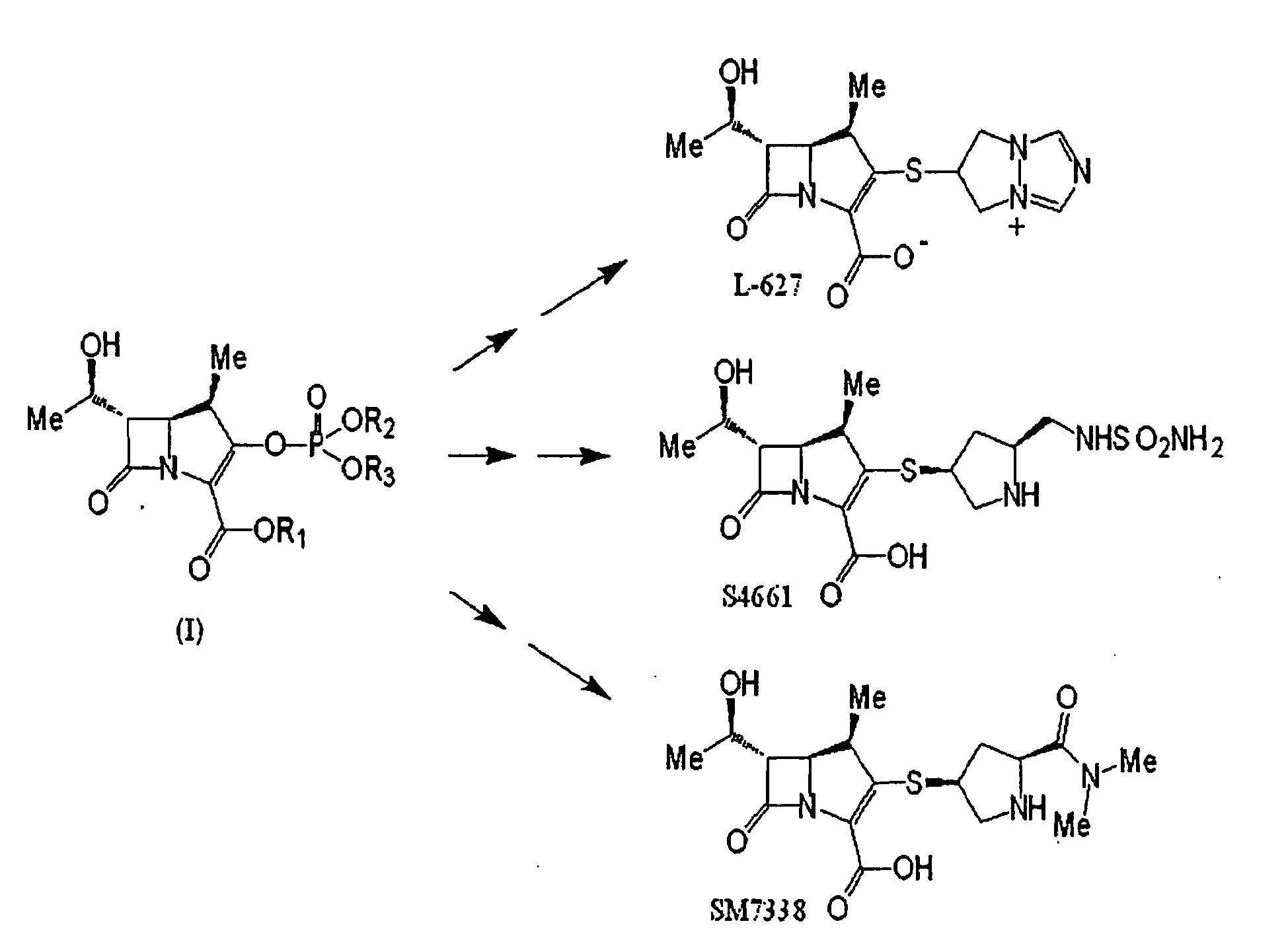
- In formula, R1 represents a pharmaceutically-acceptable ester group or a carboxyl group protective group that can be easily removed; R2 and R3 each represents, independently, a phenyl group that may be substituted with a halogen atom, an alkyl group, a cyano group, a nitro group, or the like, a C1 to C6 alkyl group that may be substituted with a halogen atom, or the like; and X represents a halogen atom such as chlorine and bromine.
- In other words, after deriving the phosphoric acid ester compound represented by formula (I) by reacting the compound represented by formula (II) with the compound represented by formula (III) in a suitable solvent such as acetonitrile in the presence of a base such as diisopropylethylamine, the final product is obtained by further reacting with mercaptans.
-

-

- In above formulas, R1 represents a pharmaceutically-acceptable ester group or a carboxyl group protective group that can be easily removed; R2 and R3 each represents, independently, a phenyl group that may be substituted with a halogen atom, an alkyl group, a cyano group, a nitro group, or the like, a C1 to C6 alkyl group that may be substituted with a halogen atom, or the like; and X represents a halogen atom such as chlorine and bromine.
- In the above production method, the compound represented by formula (I) is an important production intermediate in the production of 2-(substituted mercapto)-1β-methyl-carbapenem antibiotics. It is preferable that this compound, particularly in situations where industrial-scale production is assumed, has high purity, is easily handable, and is in a crystalline form.
-

- With respect to the compound represented by formula (I) shown above, Patent Document 1 discloses that the compound represented by formula (Ib) (hereinafter referred to as a "compound (Ib)") can be isolated in a crystalline form, for example. Also, this document discloses that the compound has excellent stability in the crystalline form and that it is useful as a bulk raw material. However, there are the problems that, by the reacted substrate, the reactivity of the diphenyl phosphoric acid part of the compound (Ib) is relatively poor and the ability to remove phosphoric acid is low.
- Also, a p-nitrobenzyl group is used as the carboxyl group protective group in the compound (Ib). This group can be generally easily removed by a normal catalytic hydrogen reduction method using palladium carbon as the catalyst. However, the danger of fire from the filtration of palladium carbon and the use of hydrogen in an industrial process is high and thus the use of a p-nitrobenzyl group is unpreferable. Furthermore, production costs are relatively high when a p-nitrobenzyl group is used. A cheaper, more efficient, and stably-removable protective group is thus desired as the carboxyl group protective group instead of a p-nitrobenzyl group.
- Related to the present invention, although Patent Document 2 discloses an example where R1 is an alkyl group in formula (I) shown above, a specific synthesis example is hardly disclosed therein.
Patent Document 1:Japanese Unexamined Patent Application, First Publication No.Hei 4-330085
Patent Document 2:Japanese Unexamined Patent Application, First Publication No.Hei 4-217985 - In consideration of the above circumstances of the prior art, the problem of the present invention is to provide a novel carbapenem compound which is a production intermediate of 2-(substituted mercapto)-1β-methyl-carbapenem antibiotics and which is easily handable, cheap, has high reactivity of the phosphoric acid ester part, and can easily remove the phosphoric acid ester part.
- The present inventors have extensively studied about useful intermediates of 2-(substituted mercapto)-1β-methyl-carbapenem antibiotics in order to solve the above problem, and found that the compound represented by formula (Ia) shown below specifically crystallizes, that, by the reacted substrate, the reactivity of the phosphoric acid ester part of the compound represented by formula (Ia) is high and thus the phosphoric acid ester can be easily removed, and that, by the reacted substrate, the carboxyl group protective group of the compound represented by formula (Ia) can be easily removed, thus leading to completion of the present invention.
According to the present invention, a carbapenem compound represented by formula (Ia) shown below: -

- is provided.
It is preferable that the carbapenem compound of the present invention has a crystalline form and it is more preferable that the crystalline form has a powder X-ray diffraction pattern with peaks at 15.64, 9.93, 6.83, 6.52, 5.44, 5.01, 4.72, 4.50, 4.33, 4.24, 3.98, 3.85, 3.57, 3.41, 3.31, 3.10 2.76, and 2.67 as d-spacings (A). - The compound of the present invention is similarly stable to the compound (Ib), which is a crystalline form bulk raw material that has heretofore been known as a production intermediate having a carbapenem skeleton.
Also, compared to the compound (Ib), the compound of the present invention, by the reacted substrate, has high reactivity of the phosphoric acid ester part and is a compound having an allyl group, which is comparatively cheap and easily removable, as a carboxyl group protective group.
The present invention is thus a further superior production intermediate of antibiotics having a carbapenem skeleton. - The present invention will now be described in detail.
The present invention is the carbapenem compound represented by formula (Ia) shown above (compound name: allyl-(1R,SR,6S)-2-[bis(2,2,2-trichloroethyl)phosphoryloxy]-6-[(R)-1-hydroxyethyl]-1-methyl-carbapenem-3-carboxylate, hereinafter referred to as "compound of the present invention" or "compound (Ia)").
This compound is a novel substance. - The carbapenem compound of the present invention preferably has a crystalline form, and more preferably, the powder X-ray diffraction pattern has characteristic peaks at 15.64, 9.93, 6.83, 6.52, 5.44, 5.01, 4.72, 4.50, 4.33, 4.24, 3.98, 3.85, 3.57, 3.41, 3.31, 3.10 2.76, and 2.67 as d-spacings (A).
- The compound of the present invention can be prepared similarly to a method for preparing a well-known compound having a skeleton similar to that of the compound of the present invention.
For example, as disclosed in formula shown below, the compound of the present invention can be prepared by reacting the compound represented by formula (IIa) (compound name: allyl-(1R,5R,6S)-[(R)-1-hydroxyethyl]-2-oxo-carbapenem-3-carboxylate, hereinafter referred to as a "compound (IIa)") with a bis(2,2,2-trichloroethyl)phosphoryl halide represented by formula (IV) (hereinafter referred to as "bis(2,2,2-trichloroethyl)phosphoryl halide (IV)" in a suitable organic solvent in the presence of a base. -

- As the bis(2,2,2-trichloroethyl)phosphoryl halide (IV) used here, bis(2,2,2-trichloroethyl)phosphoryl chloride and bis(2,2,2-trichloroethyl)phosphoryl bromide can be given as examples.
The amount of the bis(2,2,2-trichloroethyl) phosphoryl halide (IV) used is normally 1 to 5 times the number of moles of the compound represented by formula (IIa). - As used bases, metal hydroxides such as sodium hydroxide and potassium hydroxide; metal alkoxides such as sodium methoxide, sodium ethoxide, magnesium ethoxide, and potassium t-butoxide; metal hydrides such as sodium hydride, potassium hydride, and calcium hydride; tertiary amines such as diisopropylethylamine and triethylamine; aromatic amines such as pyridine, 4-dimethylaminopyridine, picoline, and lutidine; and aliphatic cyclic amines such as 1,8-diazabicyclo[5.4.0]undec-7-ene (DBU) and 1,4-diazabicyclo[2.2.0]octane (Dabco) can be given as examples.
These bases may be used alone, or two or more thereof may be used in combination.
The amount of the base used is normally 1 to 5 times the number of moles of the bis(2,2,2-trichloroethyl)phosphoryl halide (IV). - As the used organic solvent, there are no particular limitations as long as the organic solvent is inactive to the reaction. Halogenated hydrocarbons such as methylene chloride and chloroform; amides such as N,N-dimethylformamide and N,N-dimethylacetamide; ether solvents such as tetrahydrofuran and 1,2-dimethoxyethane; esters such as ethyl acetate and propyl acetate; and nitriles such as acetonitrile can be given as examples.
The amount of the organic solvent used is normally 0.1 to 100 g based on 1 g of the compound represented by formula (IIa). - The reaction smoothly progresses in a temperature range from -50°C to the boiling point of the solvent used, and preferably in a temperature range from -20°C to +40°C.
The reaction time, which is dependent on the reaction scale, is usually from several minutes to several-tens hours. - After the reaction has been completed, normal aftertreatment operations and the like in organic synthetic chemistry are carried out. According to necessity, the target compound (Ia) can be isolated by carrying out separation and purification operations.
The structure of the target compound can be confirmed by a well-known analytical means such as IR spectroscopy, NMR spectroscopy, and mass spectroscopy. - In the present invention, it is preferred that the compound (Ia) is obtained in a crystalline form. In order to obtain the compound (Ia) in a crystalline form, a method shown by (i) or (ii) shown below, for example, can be used.
-
- (i) A method in which the reaction mixture obtained by the carrying out of normal aftertreatment operations in organic synthetic chemistry on the above reaction solution is separated and purified by silica gel column chromatography, the fraction including the target product is concentrated, the concentrated product is dissolved in ethyl acetate, n-hexane is added thereto, and then cooled.
- (ii) A method in which the organic layer is separated by adding water to the reaction solution, the separated organic layer is concentrated after drying the same over anhydrous magnesium sulfate, a mixed solvent of ethyl acetate and n-hexane is added thereto, and then the entirety is cooled.
- The compound (IIa), which is a starting material, is a well-known compound and can be obtained by a well-known preparation method. For example, the compound (IIa) can be prepared by subjecting the compound represented by the below-mentioned formula (Va) (hereinafter referred to as a "compound (Va)") to ring closure in the presence of rhodium octanoate.
- Also, in this situation, the target compound (Ia) can be obtained by, after carrying out the ring-closing reaction of the compound (Va), reacting the obtained reaction solution by adding a base and a bis(trichloroethyl)phosphoryl halide (IV).
When this method is used, crystals of the compound represented by formula (Ia) can be isolated by the method disclosed in (i) or (ii) shown above. -

- Although it is preferable to separate and use the compound of the present invention as crystals as disclosed above, the compound of the present invention can be used in a next step as is.
- As is clear from the after-mentioned examples, the compound represented by formula (Ia) obtained in a crystalline form as disclosed above has a powder X-ray diffraction pattern with peaks at 15.64, 9.93, 6.83, 6.52, 5.44, 5.01, 4.72, 4.50, 4.33, 4.24, 3.98, 3.85, 3.57, 3.41, 3.31, 3.10 2.76, and 2.67 as d-spacings (A) and is very stable in this crystalline form.
- The compound of the present invention is similarly stable to a crystalline form bulk raw material which has heretofore been known as a production intermediate having a carbapenem skeleton (compound (Ib)). Compared to the compound (Ib), the compound of the present invention, by the reacted substrate, has high reactivity of the phosphoric acid ester part and is a compound having an allyl group, which is comparatively cheap and easily removable, as a carboxyl group protective group.
Compared to the compound (Ib), the present invention is thus a further superior production intermediate of antibiotics having a carbapenem skeleton. - The present invention will now be described in detail by way of examples.
- 3.11 g of the compound (Va) was dissolved in 20 ml of ethyl acetate and 40.3 mg of rhodium octanoate dimer was added thereto at 40°C. This solution was heated to from 50°C to 54°C and after stirring for 40 minutes at this temperature, 4.07 g of bis(2,2,2-trichloroethyl)phosphoryl chloride and 13.7 mg of 4-(dimethylamino)pyridine were added under ice cooling. 1.45 g of diisopropylethylamine was added by dropping over 15 minutes at from -5°C to 0°C and after the completion of dropwise addition, the reaction solution was stirred for 30 minutes at from -5°C to -3°C.
- The reaction solution was washed twice with 10 ml of water and once with 10 ml of a 10% brine, and after drying over anhydrous magnesium sulfate, was concentrated under reduced pressure. The obtained brown oily residue was dissolved in 15 ml of ethyl acetate and 40 ml of n-hexane was added thereto by dropping at room temperature. The light brown powdery solid which precipitated after stirring the mixture for 1 hour at 0°C was filtered and about 6.0 g of crude crystals was obtained by vacuum drying the filtered brown powdery solid.
- After the obtained crude crystals were dissolved in 25 ml of ethyl acetate by heating, 25 ml of n-hexane was added thereto by dropping and white powdery crystals precipitated after stirring for 2 hours at room temperature. This white powder was filtered, and 2.81 g (45%) of needle crystals of the compound (Ia) was obtained by carrying out recrystallization again of the filtered white powder from 25 ml of ethyl acetate and 25 ml of n-hexane. The boiling point was 121 to 123°C.
- 1H-NMR (CDCl3, TMS) δ: 1.33 (3H, d), 1.34 (3H, d), 2.00 (1H, br), 3.35 (1H, dd), 3.45 (1H, m), 4.25 (2H, m), 4.6-4.9 (6H, m), 5.2-5.5 (2H, dd), 5.9-6.0 (1H, m)
- 13C-NMR (CDCl3, TMS) δ: 14.5, 21.8, 39.5. 54.2. 60.8, 65.5, 66.0, 77.6, 94.1, 118.9, 119.5, 131.0, 154.6, 158.8, 175.0
- Measurement of the powder X-ray diffraction of the compound (Ia) as obtained above was carried out. The measurement was carried out using an X-ray diffractomter (X'Pert PRO manufactured by Koninklijke Philips Electronics N.V.) The measurement results are shown in Table 1.
-
Table 1 Powder X-ray diffraction pattern Peak position Relative intensity Peak position Relative intensity 2θ (CuKα) d-spacings [Å] [%] 2θ (CuKα) d-spacings [Å] [%] 5.65 15.64 77.2 20.95 4.24 40.3 8.90 9.93 100.0 22.35 3.98 53.4 12.96 6.83 9.6 23.08 3.85 15.0 13.58 6.52 43.5 24.88 3.57 73.4 16.28 5.44 19.9 26.09 3.41 17.5 17.68 5.01 10.0 26.91 3.31 20.2 18.80 4.72 85.5 28.79 3.10 10.9 19.74 4.50 39.4 32.40 2.76 12.6 20.50 4.33 15.1 33.51 2.67 11.0 - About 2 g of the compound (Ia) in a crystalline form which was obtained in the same way as Example 1 was placed in sample bottles, and the sample bottles were stored at room temperature (about 20°C) and in a room maintained at a temperature of about 40°C. Taking the original purity as 100%, after every several number of days, the purity of the compound (Ia) was measured using high-performance liquid chromatography (HPLC). The HPLC measurement conditions are shown below. Also, the measurement results are shown in Table 2
- Solvent delivery system: LC-10A (manufactured by Shimadzu Corporation)
UV, VIS detector: SPD-10A (manufactured by Shimadzu Corporation)
Detection wavelength: 215 nm
Column heater: Sugai U-620 (used at 40°C, Sugai Chemical Industry Co., Ltd.)
Column: Inertsil ODS-2 (4.6 mm diameter X 250 mm length, GL Sciences, Inc.) -
Table 2 Temperature Initial purity 6 days 17 days 21 days 31 days 20°C 100% 100% 100% 100% 100% 40°C 100% 100% 100% 100% 100% - As shown in Table 2, from measuring the purity at 20°C and 40°C after 6 days, after 17 days, after 21 days, and after 31 days, the compound (Ia) in the crystalline form was very stable without a decrease in purity.
-

- 3.12 g of the compound (Va) was dissolved in 20 ml of ethyl acetate and 40.3 mg of rhodium octanoate dimer was added thereto at room temperature. This solution was heated to from 50°C to 53°C and after stirring for 45 minutes at this temperature, 3.00 g of diphenylphosphoryl chloride and 13.5 mg of N,N-(dimethyl)aminopyridine were added at -3°C. 1.43 g of diisopropylethylamine was added thereto by dropping over 5 minutes at from -3°C to -2°C. After the reaction solution was stirred for 30 minutes at from -5°C to -3°C, the reaction solution was washed twice with 10 ml of water and once with 10 ml of a 10% brine solution, and after drying over anhydrous magnesium sulfate, was concentrated under reduced pressure. The obtained brown oily residue was dissolved in 10 ml of ethyl acetate and 15 ml of n-hexane was added thereto by dropping at room temperature. Although the mixture was stirred for 3 hours at from -5°C to 0°C, crystals of the compound (Ic) were not obtained.
- As disclosed above, according to the present invention, a novel carbapenem compound which is a production intermediate of 2-(substituted mercapto)-1 β-methyl-carbapenem antibiotics and which is easily handable, cheap, has high reactivity of the phosphoric acid ester part, and can easily remove the phosphoric acid ester part can be provided.
Claims (3)
- A carbapenem compound represented by formula (Ia) shown below:

- The carbapenem compound according to claim 1, wherein the carbapenem compound has a crystalline form.
- The carbapenem compound according to claim 2, wherein the crystalline form has a powder X-ray diffraction pattern with peaks at 15.64, 9.93, 6.83, 6.52, 5.44, 5.01, 4.72, 4.50, 4.33, 4.24, 3.98, 3.85, 3.57, 3.41, 3.31, 3.10 2.76, and 2.67 as d-spacings (A).
Priority Applications (1)
| Application Number | Priority Date | Filing Date | Title |
|---|---|---|---|
| PL06822651T PL1956027T3 (en) | 2005-11-02 | 2006-10-31 | Carbapenem compound |
Applications Claiming Priority (2)
| Application Number | Priority Date | Filing Date | Title |
|---|---|---|---|
| JP2005319343 | 2005-11-02 | ||
| PCT/JP2006/321722 WO2007052642A1 (en) | 2005-11-02 | 2006-10-31 | Carbapenem compound |
Publications (3)
| Publication Number | Publication Date |
|---|---|
| EP1956027A1 true EP1956027A1 (en) | 2008-08-13 |
| EP1956027A4 EP1956027A4 (en) | 2009-02-18 |
| EP1956027B1 EP1956027B1 (en) | 2010-07-07 |
Family
ID=38005795
Family Applications (1)
| Application Number | Title | Priority Date | Filing Date |
|---|---|---|---|
| EP06822651A Active EP1956027B1 (en) | 2005-11-02 | 2006-10-31 | Carbapenem compound |
Country Status (9)
| Country | Link |
|---|---|
| US (1) | US7919616B2 (en) |
| EP (1) | EP1956027B1 (en) |
| JP (1) | JP4804475B2 (en) |
| KR (1) | KR100904975B1 (en) |
| CN (1) | CN101296933B (en) |
| DE (1) | DE602006015347D1 (en) |
| ES (1) | ES2346150T3 (en) |
| PL (1) | PL1956027T3 (en) |
| WO (1) | WO2007052642A1 (en) |
Family Cites Families (7)
| Publication number | Priority date | Publication date | Assignee | Title |
|---|---|---|---|---|
| US4382949A (en) * | 1980-07-31 | 1983-05-10 | Schering Corporation | 2-(Amino acid-thio)-1-carbapen-2-em-3-carboxylic acids and congeners |
| US4350631A (en) | 1980-12-18 | 1982-09-21 | Merck & Co., Inc. | 6- and 4-Substituted-1-azabicyclo[3.2.0]heptan-3,7-dione-2-carboxylates |
| JP3080417B2 (en) | 1991-02-28 | 2000-08-28 | 日本ワイスレダリー株式会社 | 1-methyl-2-diphenylphosphoryloxy-carbapenem compounds in crystalline form |
| JPH0841063A (en) * | 1994-08-01 | 1996-02-13 | Yamanouchi Pharmaceut Co Ltd | Carbapenem derivative |
| JP2002179679A (en) * | 2000-12-08 | 2002-06-26 | Banyu Pharmaceut Co Ltd | New carbapenem derivatives |
| JP2005319343A (en) | 2004-04-05 | 2005-11-17 | Misuo Fujiwara | Interior material, coating method and coating material for the same |
| TW200815442A (en) * | 2006-04-28 | 2008-04-01 | Kaneka Corp | Improved method for the crystallization of intermediates of carbapenem antibiotics |
-
2006
- 2006-10-31 KR KR1020087010369A patent/KR100904975B1/en not_active Expired - Fee Related
- 2006-10-31 JP JP2007542751A patent/JP4804475B2/en not_active Expired - Fee Related
- 2006-10-31 PL PL06822651T patent/PL1956027T3/en unknown
- 2006-10-31 DE DE602006015347T patent/DE602006015347D1/en active Active
- 2006-10-31 EP EP06822651A patent/EP1956027B1/en active Active
- 2006-10-31 CN CN2006800403754A patent/CN101296933B/en not_active Expired - Fee Related
- 2006-10-31 US US12/084,351 patent/US7919616B2/en not_active Expired - Fee Related
- 2006-10-31 ES ES06822651T patent/ES2346150T3/en active Active
- 2006-10-31 WO PCT/JP2006/321722 patent/WO2007052642A1/en not_active Ceased
Also Published As
| Publication number | Publication date |
|---|---|
| KR100904975B1 (en) | 2009-06-26 |
| EP1956027A4 (en) | 2009-02-18 |
| JP4804475B2 (en) | 2011-11-02 |
| DE602006015347D1 (en) | 2010-08-19 |
| CN101296933B (en) | 2011-10-26 |
| ES2346150T3 (en) | 2010-10-11 |
| US20090143574A1 (en) | 2009-06-04 |
| US7919616B2 (en) | 2011-04-05 |
| CN101296933A (en) | 2008-10-29 |
| JPWO2007052642A1 (en) | 2009-04-30 |
| EP1956027B1 (en) | 2010-07-07 |
| KR20080055970A (en) | 2008-06-19 |
| PL1956027T3 (en) | 2010-12-31 |
| WO2007052642A1 (en) | 2007-05-10 |
Similar Documents
| Publication | Publication Date | Title |
|---|---|---|
| SU826954A3 (en) | Method of preparing indole deriwatives | |
| EP0030031B1 (en) | 6-(1-hydroxyethyl)-2-(2-aminoethylthio)-1,1-disubstituted-1-carbadethiapen-2-em-3-carboxylic acids, a process for preparing the same, an antibiotic pharmaceutical composition comprising the same, intermediates useful in a synthesis of that kind and processes for preparing intermediates suitable for the synthesis of that kind | |
| US5539102A (en) | Production method for sulfamide | |
| EP1956027B1 (en) | Carbapenem compound | |
| US6037341A (en) | Carbapenem derivatives | |
| JP4481829B2 (en) | Novel synthetic intermediate of carbapenem compound for oral administration and process for producing the same | |
| US20040198973A1 (en) | Process for preparation of carbapenem antibiotics | |
| KR101299162B1 (en) | Method for preparing intermediates of imipenem | |
| KR101059339B1 (en) | Method for preparing carbapenem compound for oral administration | |
| JP3080417B2 (en) | 1-methyl-2-diphenylphosphoryloxy-carbapenem compounds in crystalline form | |
| JP2003012670A (en) | 4-oxoquinolizine-based compound having antimicrobial activity | |
| JPWO2004035539A1 (en) | Process for producing carbapenems and intermediates used for the production | |
| KR100959027B1 (en) | Method for preparing penem intermediate using zinc compound as cocatalyst | |
| JPS6363681A (en) | (1r)-1-methylcarbapenem-3-carboxylic acid derivative | |
| KR100848751B1 (en) | Method of making imipenem | |
| EP2938617B1 (en) | Process for preparing meropenem trihydrate | |
| KR100476672B1 (en) | THIOL DERIVATIVES AND 1-β-METHYL-CARBAPENEM DERIVATIVES WITH THE SAME | |
| JP2003128674A (en) | NEW PRODUCTION METHOD OF CARBAPENEM ANTIBIOTIC BY OnePot REACTION AND RECRYSTALLIZATION | |
| HK1013986B (en) | Carbapenem derivative | |
| JPH06100565A (en) | Carbapenem derivative and its salt | |
| JPH08283267A (en) | Carbapenem-based compound and its production | |
| KR20080042460A (en) | Thienamycin Solvent Compound and Manufacturing Method Thereof | |
| HU192431B (en) | Process for producing carbapeneme antibiotics | |
| JP2006176418A (en) | Process for producing carbapenem compounds for oral administration and novel β-lactam compounds | |
| JPH0717980A (en) | Carbapenem derivative or salt thereof |
Legal Events
| Date | Code | Title | Description |
|---|---|---|---|
| PUAI | Public reference made under article 153(3) epc to a published international application that has entered the european phase |
Free format text: ORIGINAL CODE: 0009012 |
|
| 17P | Request for examination filed |
Effective date: 20080430 |
|
| AK | Designated contracting states |
Kind code of ref document: A1 Designated state(s): AT BE BG CH CY CZ DE DK EE ES FI FR GB GR HU IE IS IT LI LT LU LV MC NL PL PT RO SE SI SK TR |
|
| AX | Request for extension of the european patent |
Extension state: AL BA HR MK RS |
|
| A4 | Supplementary search report drawn up and despatched |
Effective date: 20090120 |
|
| GRAP | Despatch of communication of intention to grant a patent |
Free format text: ORIGINAL CODE: EPIDOSNIGR1 |
|
| GRAS | Grant fee paid |
Free format text: ORIGINAL CODE: EPIDOSNIGR3 |
|
| GRAA | (expected) grant |
Free format text: ORIGINAL CODE: 0009210 |
|
| AK | Designated contracting states |
Kind code of ref document: B1 Designated state(s): AT BE BG CH CY CZ DE DK EE ES FI FR GB GR HU IE IS IT LI LT LU LV MC NL PL PT RO SE SI SK TR |
|
| AX | Request for extension of the european patent |
Extension state: AL BA HR MK RS |
|
| REG | Reference to a national code |
Ref country code: GB Ref legal event code: FG4D |
|
| REG | Reference to a national code |
Ref country code: CH Ref legal event code: EP Ref country code: CH Ref legal event code: NV Representative=s name: MICHELI & CIE SA |
|
| REG | Reference to a national code |
Ref country code: IE Ref legal event code: FG4D |
|
| REF | Corresponds to: |
Ref document number: 602006015347 Country of ref document: DE Date of ref document: 20100819 Kind code of ref document: P |
|
| REG | Reference to a national code |
Ref country code: SE Ref legal event code: TRGR |
|
| REG | Reference to a national code |
Ref country code: ES Ref legal event code: FG2A Ref document number: 2346150 Country of ref document: ES Kind code of ref document: T3 |
|
| REG | Reference to a national code |
Ref country code: NL Ref legal event code: VDEP Effective date: 20100707 |
|
| PG25 | Lapsed in a contracting state [announced via postgrant information from national office to epo] |
Ref country code: SI Free format text: LAPSE BECAUSE OF FAILURE TO SUBMIT A TRANSLATION OF THE DESCRIPTION OR TO PAY THE FEE WITHIN THE PRESCRIBED TIME-LIMIT Effective date: 20100707 |
|
| LTIE | Lt: invalidation of european patent or patent extension |
Effective date: 20100707 |
|
| REG | Reference to a national code |
Ref country code: PL Ref legal event code: T3 |
|
| REG | Reference to a national code |
Ref country code: HU Ref legal event code: AG4A Ref document number: E008812 Country of ref document: HU |
|
| PG25 | Lapsed in a contracting state [announced via postgrant information from national office to epo] |
Ref country code: NL Free format text: LAPSE BECAUSE OF FAILURE TO SUBMIT A TRANSLATION OF THE DESCRIPTION OR TO PAY THE FEE WITHIN THE PRESCRIBED TIME-LIMIT Effective date: 20100707 Ref country code: LT Free format text: LAPSE BECAUSE OF FAILURE TO SUBMIT A TRANSLATION OF THE DESCRIPTION OR TO PAY THE FEE WITHIN THE PRESCRIBED TIME-LIMIT Effective date: 20100707 Ref country code: FI Free format text: LAPSE BECAUSE OF FAILURE TO SUBMIT A TRANSLATION OF THE DESCRIPTION OR TO PAY THE FEE WITHIN THE PRESCRIBED TIME-LIMIT Effective date: 20100707 Ref country code: AT Free format text: LAPSE BECAUSE OF FAILURE TO SUBMIT A TRANSLATION OF THE DESCRIPTION OR TO PAY THE FEE WITHIN THE PRESCRIBED TIME-LIMIT Effective date: 20100707 |
|
| PG25 | Lapsed in a contracting state [announced via postgrant information from national office to epo] |
Ref country code: PT Free format text: LAPSE BECAUSE OF FAILURE TO SUBMIT A TRANSLATION OF THE DESCRIPTION OR TO PAY THE FEE WITHIN THE PRESCRIBED TIME-LIMIT Effective date: 20101108 Ref country code: BG Free format text: LAPSE BECAUSE OF FAILURE TO SUBMIT A TRANSLATION OF THE DESCRIPTION OR TO PAY THE FEE WITHIN THE PRESCRIBED TIME-LIMIT Effective date: 20101007 Ref country code: CY Free format text: LAPSE BECAUSE OF FAILURE TO SUBMIT A TRANSLATION OF THE DESCRIPTION OR TO PAY THE FEE WITHIN THE PRESCRIBED TIME-LIMIT Effective date: 20100707 Ref country code: IS Free format text: LAPSE BECAUSE OF FAILURE TO SUBMIT A TRANSLATION OF THE DESCRIPTION OR TO PAY THE FEE WITHIN THE PRESCRIBED TIME-LIMIT Effective date: 20101107 |
|
| PG25 | Lapsed in a contracting state [announced via postgrant information from national office to epo] |
Ref country code: LV Free format text: LAPSE BECAUSE OF FAILURE TO SUBMIT A TRANSLATION OF THE DESCRIPTION OR TO PAY THE FEE WITHIN THE PRESCRIBED TIME-LIMIT Effective date: 20100707 Ref country code: BE Free format text: LAPSE BECAUSE OF FAILURE TO SUBMIT A TRANSLATION OF THE DESCRIPTION OR TO PAY THE FEE WITHIN THE PRESCRIBED TIME-LIMIT Effective date: 20100707 Ref country code: GR Free format text: LAPSE BECAUSE OF FAILURE TO SUBMIT A TRANSLATION OF THE DESCRIPTION OR TO PAY THE FEE WITHIN THE PRESCRIBED TIME-LIMIT Effective date: 20101008 |
|
| PG25 | Lapsed in a contracting state [announced via postgrant information from national office to epo] |
Ref country code: DK Free format text: LAPSE BECAUSE OF FAILURE TO SUBMIT A TRANSLATION OF THE DESCRIPTION OR TO PAY THE FEE WITHIN THE PRESCRIBED TIME-LIMIT Effective date: 20100707 |
|
| PLBE | No opposition filed within time limit |
Free format text: ORIGINAL CODE: 0009261 |
|
| STAA | Information on the status of an ep patent application or granted ep patent |
Free format text: STATUS: NO OPPOSITION FILED WITHIN TIME LIMIT |
|
| PG25 | Lapsed in a contracting state [announced via postgrant information from national office to epo] |
Ref country code: EE Free format text: LAPSE BECAUSE OF FAILURE TO SUBMIT A TRANSLATION OF THE DESCRIPTION OR TO PAY THE FEE WITHIN THE PRESCRIBED TIME-LIMIT Effective date: 20100707 Ref country code: MC Free format text: LAPSE BECAUSE OF NON-PAYMENT OF DUE FEES Effective date: 20101031 Ref country code: SK Free format text: LAPSE BECAUSE OF FAILURE TO SUBMIT A TRANSLATION OF THE DESCRIPTION OR TO PAY THE FEE WITHIN THE PRESCRIBED TIME-LIMIT Effective date: 20100707 Ref country code: RO Free format text: LAPSE BECAUSE OF FAILURE TO SUBMIT A TRANSLATION OF THE DESCRIPTION OR TO PAY THE FEE WITHIN THE PRESCRIBED TIME-LIMIT Effective date: 20100707 |
|
| 26N | No opposition filed |
Effective date: 20110408 |
|
| REG | Reference to a national code |
Ref country code: DE Ref legal event code: R097 Ref document number: 602006015347 Country of ref document: DE Effective date: 20110408 |
|
| PG25 | Lapsed in a contracting state [announced via postgrant information from national office to epo] |
Ref country code: LU Free format text: LAPSE BECAUSE OF NON-PAYMENT OF DUE FEES Effective date: 20101031 |
|
| PG25 | Lapsed in a contracting state [announced via postgrant information from national office to epo] |
Ref country code: TR Free format text: LAPSE BECAUSE OF FAILURE TO SUBMIT A TRANSLATION OF THE DESCRIPTION OR TO PAY THE FEE WITHIN THE PRESCRIBED TIME-LIMIT Effective date: 20100707 |
|
| PGFP | Annual fee paid to national office [announced via postgrant information from national office to epo] |
Ref country code: CH Payment date: 20121023 Year of fee payment: 7 Ref country code: DE Payment date: 20121023 Year of fee payment: 7 Ref country code: CZ Payment date: 20121025 Year of fee payment: 7 Ref country code: FR Payment date: 20121031 Year of fee payment: 7 Ref country code: HU Payment date: 20121029 Year of fee payment: 7 Ref country code: IE Payment date: 20121019 Year of fee payment: 7 |
|
| PGFP | Annual fee paid to national office [announced via postgrant information from national office to epo] |
Ref country code: SE Payment date: 20121019 Year of fee payment: 7 Ref country code: PL Payment date: 20120928 Year of fee payment: 7 Ref country code: ES Payment date: 20121026 Year of fee payment: 7 Ref country code: IT Payment date: 20121024 Year of fee payment: 7 Ref country code: GB Payment date: 20121019 Year of fee payment: 7 |
|
| REG | Reference to a national code |
Ref country code: CH Ref legal event code: PL |
|
| GBPC | Gb: european patent ceased through non-payment of renewal fee |
Effective date: 20131031 |
|
| REG | Reference to a national code |
Ref country code: SE Ref legal event code: EUG |
|
| REG | Reference to a national code |
Ref country code: IE Ref legal event code: MM4A |
|
| PG25 | Lapsed in a contracting state [announced via postgrant information from national office to epo] |
Ref country code: CH Free format text: LAPSE BECAUSE OF NON-PAYMENT OF DUE FEES Effective date: 20131031 Ref country code: LI Free format text: LAPSE BECAUSE OF NON-PAYMENT OF DUE FEES Effective date: 20131031 Ref country code: GB Free format text: LAPSE BECAUSE OF NON-PAYMENT OF DUE FEES Effective date: 20131031 |
|
| REG | Reference to a national code |
Ref country code: DE Ref legal event code: R119 Ref document number: 602006015347 Country of ref document: DE Effective date: 20140501 |
|
| REG | Reference to a national code |
Ref country code: FR Ref legal event code: ST Effective date: 20140630 |
|
| PG25 | Lapsed in a contracting state [announced via postgrant information from national office to epo] |
Ref country code: DE Free format text: LAPSE BECAUSE OF NON-PAYMENT OF DUE FEES Effective date: 20140501 Ref country code: SE Free format text: LAPSE BECAUSE OF NON-PAYMENT OF DUE FEES Effective date: 20131101 Ref country code: FR Free format text: LAPSE BECAUSE OF NON-PAYMENT OF DUE FEES Effective date: 20131031 Ref country code: IT Free format text: LAPSE BECAUSE OF NON-PAYMENT OF DUE FEES Effective date: 20131031 Ref country code: CZ Free format text: LAPSE BECAUSE OF NON-PAYMENT OF DUE FEES Effective date: 20131031 |
|
| PG25 | Lapsed in a contracting state [announced via postgrant information from national office to epo] |
Ref country code: HU Free format text: LAPSE BECAUSE OF NON-PAYMENT OF DUE FEES Effective date: 20131101 |
|
| PG25 | Lapsed in a contracting state [announced via postgrant information from national office to epo] |
Ref country code: IE Free format text: LAPSE BECAUSE OF NON-PAYMENT OF DUE FEES Effective date: 20131031 |
|
| REG | Reference to a national code |
Ref country code: ES Ref legal event code: FD2A Effective date: 20141107 |
|
| PG25 | Lapsed in a contracting state [announced via postgrant information from national office to epo] |
Ref country code: ES Free format text: LAPSE BECAUSE OF NON-PAYMENT OF DUE FEES Effective date: 20131101 |
|
| REG | Reference to a national code |
Ref country code: PL Ref legal event code: LAPE |
|
| PG25 | Lapsed in a contracting state [announced via postgrant information from national office to epo] |
Ref country code: PL Free format text: LAPSE BECAUSE OF NON-PAYMENT OF DUE FEES Effective date: 20131031 |