EP1955472B1 - Schlüsselverwaltung - Google Patents
Schlüsselverwaltung Download PDFInfo
- Publication number
- EP1955472B1 EP1955472B1 EP05817043.2A EP05817043A EP1955472B1 EP 1955472 B1 EP1955472 B1 EP 1955472B1 EP 05817043 A EP05817043 A EP 05817043A EP 1955472 B1 EP1955472 B1 EP 1955472B1
- Authority
- EP
- European Patent Office
- Prior art keywords
- communication unit
- function
- secret
- receiving
- transmitting
- Prior art date
- Legal status (The legal status is an assumption and is not a legal conclusion. Google has not performed a legal analysis and makes no representation as to the accuracy of the status listed.)
- Expired - Lifetime
Links
Images


Classifications
-
- H—ELECTRICITY
- H04—ELECTRIC COMMUNICATION TECHNIQUE
- H04L—TRANSMISSION OF DIGITAL INFORMATION, e.g. TELEGRAPHIC COMMUNICATION
- H04L9/00—Cryptographic mechanisms or cryptographic arrangements for secret or secure communications; Network security protocols
- H04L9/08—Key distribution or management, e.g. generation, sharing or updating, of cryptographic keys or passwords
- H04L9/0891—Revocation or update of secret information, e.g. encryption key update or rekeying
-
- H—ELECTRICITY
- H04—ELECTRIC COMMUNICATION TECHNIQUE
- H04L—TRANSMISSION OF DIGITAL INFORMATION, e.g. TELEGRAPHIC COMMUNICATION
- H04L63/00—Network architectures or network communication protocols for network security
- H04L63/06—Network architectures or network communication protocols for network security for supporting key management in a packet data network
-
- H—ELECTRICITY
- H04—ELECTRIC COMMUNICATION TECHNIQUE
- H04L—TRANSMISSION OF DIGITAL INFORMATION, e.g. TELEGRAPHIC COMMUNICATION
- H04L9/00—Cryptographic mechanisms or cryptographic arrangements for secret or secure communications; Network security protocols
- H04L9/08—Key distribution or management, e.g. generation, sharing or updating, of cryptographic keys or passwords
-
- H—ELECTRICITY
- H04—ELECTRIC COMMUNICATION TECHNIQUE
- H04L—TRANSMISSION OF DIGITAL INFORMATION, e.g. TELEGRAPHIC COMMUNICATION
- H04L9/00—Cryptographic mechanisms or cryptographic arrangements for secret or secure communications; Network security protocols
- H04L9/14—Cryptographic mechanisms or cryptographic arrangements for secret or secure communications; Network security protocols using a plurality of keys or algorithms
-
- H—ELECTRICITY
- H04—ELECTRIC COMMUNICATION TECHNIQUE
- H04W—WIRELESS COMMUNICATION NETWORKS
- H04W12/00—Security arrangements; Authentication; Protecting privacy or anonymity
- H04W12/04—Key management, e.g. using generic bootstrapping architecture [GBA]
- H04W12/041—Key generation or derivation
-
- H—ELECTRICITY
- H04—ELECTRIC COMMUNICATION TECHNIQUE
- H04L—TRANSMISSION OF DIGITAL INFORMATION, e.g. TELEGRAPHIC COMMUNICATION
- H04L2209/00—Additional information or applications relating to cryptographic mechanisms or cryptographic arrangements for secret or secure communication H04L9/00
- H04L2209/80—Wireless
- H04L2209/805—Lightweight hardware, e.g. radio-frequency identification [RFID] or sensor
-
- H—ELECTRICITY
- H04—ELECTRIC COMMUNICATION TECHNIQUE
- H04W—WIRELESS COMMUNICATION NETWORKS
- H04W84/00—Network topologies
- H04W84/18—Self-organising networks, e.g. ad-hoc networks or sensor networks
Definitions
- the present invention relates to key management, e.g. for encryption or integrity protection, and in particular to generation of keys.
- the keys e.g. for encryption or integrity protection that are generated by the present invention are suitable for sensor networks.
- An example of such a sensor network is illustrated in figure 1 . Further information of sensor networks can be found in "Protocols and Architectures for wireless sensor networks", Holger Karl and Andreas Willig.
- the sensors of figure 1 are e.g. geographically distributed by an aircraft and form a network.
- the sensor network comprises a plurality of sensors comprising means for collecting and exchanging data.
- the data collection typically implies gathering of environmental information such as temperature, air pressure, sound, video, still picture, and vibrations.
- the collected data may be exchanged between the sensors and is typically processed at a central point, wherein at least one of the sensors is required to have direct connectivity to that central point. Therefore, at least one of the sensors comprise relay means.
- a sensor comprising relay means is also denoted relay sensor.
- the relay sensors are indicated with crosses and non-relay sensors are indicated with circles in figure 1 .
- the relay sensors are able to transmit and receive information to/from non-relay sensors and they are also able to communicate with a central point in the sensor network.
- the relay sensor receives measurement reports from a plurality of non-relay sensors and forward this received information, in addition to its own measurement reports, to a central point in the network.
- the central point may be a base station of a cellular network, or a vehicle with an antenna that may forward the reports to a central unit for processing the information of the reports.
- Sensors are in some cases, as illustrated in figure 1 , randomly distributed in a geographical area, e.g. dropped from an aircraft.
- a "discovery" protocol is first run to determine the nearby sensors having relay capability and/or which sensors that should take the role of the relay sensor. Examples of discovery protocols may be found in the reference Karl and Willig above. This phase may also contain initial security handshakes, where non-relay sensors create secure connections to other (relay) sensors.
- the sensors may be distributed in a more orderly fashion, in which case relay sensors are configured as appropriate.
- relay sensors are configured as appropriate.
- a typical example of this is in an apartment building where each apartment could be given a number of associated sensors, wherein at least one of the sensors is a relay sensor communicating with a central point e.g. associated with the building.
- the security requirement for the communication in the sensor network depends on the type of sensor application, and the security requirement for the communication between the relay sensors and the non relay sensors requires typically less security than the communication between the relay sensors and the central point in the sensor network due to the short-range characteristics of transmissions from non-relay sensors.
- many applications require that the communication between the relay sensors and the central point be performed in a highly secure way.
- the present invention is best suited for the protection of communication between relay sensors and the central point (e.g. a base station), but does not exclude use also for the above mentioned inter-sensor communication.
- a common technique for secure communication is to start a communication session by a "handshake" that negotiates or generates keys.
- a sensor may also want to limit the amount of signaling to conserve energy; transmitting one bit on the radio interface consumes as much energy as executing roughly 800-1000 local CPU instructions. Likewise, also listening consumes power.
- a specific recipient of the data may be unknown to the sensor, e.g., in broadcast scenarios.
- the sensor needs to be able to produce the key on its own, and also somehow "hint" to authorized receivers which key it used in a secure and simple way. Therefore, the basis for the key material needs to be stored in the sensor from the beginning, e.g. during manufacture or configuration prior to deployment.
- a first problem with this is that a small sensor may have no sufficiently good source of random data, and the RANDOM will in practice be a "counter" value or similar so that session keys are distinct. However, this degrades the quality of the keys.
- common to both of the above approaches is that certain applications with very high security requirements simply forbid the cryptographic generation of keys in end-devices as inappropriate/not allowed.
- f is a function like the SHA1 hash or the AES algorithm
- security of the above approaches relies on cryptographic assumptions, which may turn out to be false, i.e., security is purely heuristic.
- Applications with high requirements may in fact require a formal, mathematical proof of certain properties such as exact statistical distribution of the keys, which cannot be obtained by the methods just discussed.
- the sensor may need to store a relatively large amount of pre-installed keys that were generated by high-security key generation device, which in turn is problematic due to the constrained environment of the sensor.
- Patent publication WO03/077470 discloses a method for generating keys for cryptographic processing of communication between a transmitting communication unit (a prover P) and a receiving communication unit (a verifier V) of a sensor network, wherein both units are adapted to obtain knowledge about a secret function.
- the method comprises selecting a value at the transmitting communication unit and calculating a secret function from said selected value. Subsequently, a secret key is generated with which data are processed, that are transmitted to the receiving communication unit.
- the object with the present invention is to provide improved key generating method and arrangement suitable for high security sensors.
- the basic idea of the present invention is to use a k-wise independent function p as a secret function for calculating a key e.g. for encryption purposes. It is shown that it is possible to calculate k-1 statistically independent keys from the k-wise independent function p. It should be noted that it is not required that the secret function is fully k-wise independent, the secret function p may be also be almost k-wise independent.
- a copy of p is stored in or communicated to the communicating communication units. When the transmitting communication unit is to communicate, it selects a value z ⁇ GF(2 n ) not used before, it uses the selected z to calculate p(z) and uses p(z) to process the data to be sent. The processed data is sent together with z.
- the receivers On reception of the processed data and the selected z, the receivers obtains z from the data, apply p(z) thus arriving at the same key, which is used to process (e.g. encrypt) the data and "de-process” (e.g. decrypt) the data.
- process e.g. encrypt
- decrypt e.g. decrypt
- Advantages with the present invention is that the amount of stored keys is limited and new keys from stored keys are provided without relying on cryptography; in particular, the security should not need to rest on a cryptographic assumption.
- a further advantage is that forward/backward security is achieved; a successful hostile attack on individual session keys or even sets of such keys does not affect previous or later keys.
- a further advantage is that the method according to the present invention is computationally effective and energy efficient.
- the invention provides simple means for trusted counterparts to tell which key the sensor uses.
- S is a set
- #S is used to denote the size i.e. the number of elements of S.
- S is a set and g is some function
- g(S) is the set ⁇ g(s)
- GF(2 n ) denote the finite field of 2 n elements.
- the present invention concerns methods and arrangements for generating a security key in a communication unit.
- the communication unit is preferably associated with a sensor network and the communication unit may be located in a sensor, or in at least another unit, adapted for communication with the sensor.
- the sensor comprising the communication unit may be a relay sensor and the another unit may be a central point as described above.
- the communication unit is provided, at manufacturing or at an initial set-up, with a function, p, from a set of almost k-wise independent functions according to the present invention.
- the information on which p is given to which communication unit is preferably stored in a central data-base by associating p with the identity of the communication unit.
- a set of functions, F, wherein each function in F is mapping from a set A to a set B, is said to be k-wise independent, if for any distinct k input values from A, the k output values are, over random choices of functions f from F, uniformly distributed in B x B x ... x B (k copies, which is usually also denoted B ⁇ k).
- k-wise independent set of functions is exemplified with a polynomial of degree k-1. It should however be noted that other functions than polynomials of degree k-1 may be k-wise independent and used in the present invention.
- Another example of such k-wise independent set of functions is the set of all functions between A and B, wherein A and B are any finite sets.
- the present invention requires that the secret function p, is selected from a set of almost k-wise independent functions.
- the term "almost” implies here that p is a function from a set of k-wise d-independent functions.
- the d-independence is described below.
- the set of functions, F is said to be k-wise d-independent, if the deviation from uniform distribution is no more than d.
- This can be measured in several ways. For instance the max-norm can be used.
- the transmitting communication unit selects a z and calculates p(z).
- the calculated p(z) is used as key material, directly or after additional processing, to process the data to be transmitted, e.g. to encrypt the data.
- the processed data and the selected z are transmitted to at least one receiving communication unit. If the identity of the sender cannot be assumed known by the receiver, the sender must also send his identity in order for the receiver to retrieve the correct p, corresponding to the sender.
- the transmission of the z is preferably authenticated and may also be transmitted in a secure way, however the security is not a requirement. In particular, z itself need not be encrypted.
- the at least one receiving party is already aware of the secret function p or is adapted to retrieve it from a database using the identity of the sender, and by receiving z it is now able to calculate p(z) and in the case of encryption, decrypt the received encrypted data.
- the calculated key p(z) may be used in both directions, or alternatively a first key p(z1) is used in a first direction and a second key p(z2) is used in a second direction.
- Another option is that the above-mentioned additional processing "splits" the key into two keys, one for each direction.
- one key may be used for one transmission/ session, a new key is generated periodically, e.g. every hour or day, a new key is generated when a predefined number of transmissions are performed, or after a pre-defined transferred amount of data, or when the communication unit receives an order to generate a new key.
- the selected value z (wherein z ⁇ GF(2 n )) may be included in the transmitted data, or transmitted in a separate message.
- the sensor preferably avoids re-using the same z twice as that may degrade security. How to achieve this without storing all old z-values will be discussed below.
- the communication unit is provided with the secret function p.
- p is preferably provided at the manufacturing of the communication unit.
- the k-wise independent function p(z) is a randomly chosen polynomial of degree k-1 over GF(2 n ):
- p x c k ⁇ 1 x k ⁇ 1 + c k ⁇ 2 x k ⁇ 2 + ... + c 1 x + c 0 , where each c j ⁇ GF(2 n ).
- the possibility c k-1 0 is not excluded, though strictly speaking, that would be a polynomial of lower degree.
- Such p can thus describe a mapping of any z ⁇ GF(2 n ) to an element p(z) ⁇ GF(2 n ) by evaluating p at z, i.e. p(z).
- the value "k” will also define security properties, which are further, discussed below, but practical values of k may be of roughly the same size as n, leading to a memory consumption of just over 1kB.
- a copy of p needs to be stored in or communicated to the communicating communication units, e.g. the communication unit of the sensor and the communication unit of the device that is to communicate with the sensor.
- the communication unit of the sensor selects a value z ⁇ GF(2 n ) that is not used before e.g. by picking z-values in lexicographic order to avoid the need to "remember" all previous values, it uses the selected z to calculate p(z) and uses p(z) to process, e.g. encrypt, the data to be transmitted, and e.g. includes the selected z in the data sent.
- z requires n bits for the representation.
- the receivers On reception, the receivers obtains z from the data, apply p(z) thus arriving at the same key, which is used to process the data.
- the sender may also include its identity in order for the receiver to retrieve the correct p before calculating p(z).
- the evaluation of p(z) is efficient, since it can be performed by additions and multiplications in GF(2 n ) in the order of d, using the so-called Horner's rule which is an efficient method to evaluate a polynomial, e.g. further explained in D. Knuth, "The art of computer programming", vol2, 2nd ed., Addison-Wesley, 1981 .
- the method of the present invention in cases where cryptography is acceptable, is combined with conventional cryptography. This will provide additional damage control as was mentioned above. As mentioned, if k session keys are compromised, the security of the above-mentioned methods according to prior art is lost, since the polynomial p can then be interpolated and reconstructed.
- k 11 , k 12 , ..., k 1k-1 are generated using a first (random) polynomial p 1 .
- the present invention relates to a method for generating keys for cryptographic processing of communication between a transmitting communication unit and a receiving communication unit, wherein the transmitting communication unit and the receiving communication unit are adapted to obtain knowledge about a secret function.
- the method illustrated in figure 3a comprises the steps of:
- the present invention relates further to method for generating keys for security processing of communication between a transmitting communication unit and a receiving communication unit.
- the transmitting communication unit and the receiving communication unit are adapted to obtain knowledge about a secret function.
- the method is illustrated in the flowchart of figure 3b and comprises the steps of:
- the methods may be implemented by a computer program product.
- the computer program product may be stored on a computer usable medium, comprising readable program for causing a processing means in the communication unit, to control the execution of the steps of the methods of the present invention. It should be noted that the methods might also be implemented by hardware or a combination of hardware and software.
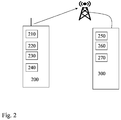
- FIG 2 showing two communicating communication units, wherein a transmitting communication unit (200) is implemented in a sensor and a receiving communication unit (300) is implemented in a central point associated with a base station.
- the transmitting communication unit (200) also denoted the first communication unit, comprises means for generating a key for cryptographic processing of communication between the transmitting communication unit and the receiving communication unit, also denoted the second communication unit.
- Both communication units are adapted to obtain knowledge about a secret function, e.g. by retrieving the secret function from a database or the secret function may be stored in the communication units at the manufacturing.
- the transmitting communication unit comprises means for: selecting a value z (210), calculating the secret function as a function of the selected value z (220), processing data with the calculated secret function (230), transmitting z together with the processed data to the second communication unit (240).
- the receiving communication unit comprises means for receiving a value z together with cryptographically processed data (250), means for calculating the secret function as a function of the received number z at the receiving unit (260), and means for processing data the received data with the calculated secret function (270).
- the secret function is selected from a set of almost k-wise independent functions.
- the present invention also concerns a pre-configuring device adapted to pre-configure the communication units according to the invention with the secret function that is selected from a set of functions that are almost k-wise independent.
Landscapes
- Engineering & Computer Science (AREA)
- Computer Security & Cryptography (AREA)
- Computer Networks & Wireless Communication (AREA)
- Signal Processing (AREA)
- Computer Hardware Design (AREA)
- Computing Systems (AREA)
- General Engineering & Computer Science (AREA)
- Mobile Radio Communication Systems (AREA)
- Storage Device Security (AREA)
- Arrangements For Transmission Of Measured Signals (AREA)
- Communication Control (AREA)
Claims (19)
- Verfahren zum Generieren von Schlüsseln für die kryptographische Verarbeitung von Kommunikationen zwischen einer sendenden Kommunikationseinheit und einer empfangenden Kommunikationseinheit eines Sensornetzwerks, wobei die sendende Kommunikationseinheit und die empfangende Kommunikationseinheit zum Erhalten von Kenntnissen über eine geheime Funktion ausgebildet sind, dadurch gekennzeichnet, dass das Verfahren folgende Schritte umfasst:- Auswählen (301), in der sendenden Kommunikationseinheit, eines Werts z,- Berechnen (302), in der sendenden Kommunikationseinheit, einer Funktion des ausgewählten Werts z, durch Verwenden der geheimen Funktion, sodass ein Schlüssel generiert wird,- Verarbeiten (303) von Daten mit dem generierten Schlüssel, und- Übertragen (304) der verarbeiteten Daten in Zusammenhang mit dem ausgewählten z an die empfangende Kommunikationseinheit,wobei die geheime Funktion zufällig aus einem Satz von Funktionen ausgewählt wird, welche fast k-weise unabhängig sind, dadurch gekennzeichnet, dass die geheime Funktion der sendenden Kommunikationseinheit und der empfangenden Kommunikationseinheit bekannt ist, und geheime Funktionen für die sendende und empfangende Kommunikationseinheit unabhängig vorkonfiguriert sind und dass der generierte Schlüssel auf Informationen der sendenden Kommunikationseinheit basiert ist und dass eine zwischen der sendenden und empfangenden Kommunikationseinheit ein zentraler Punkt in dem Sensornetzwerk ist und die andere ein Sensor ist, wobei der Schlüssel zur sicheren Kommunikation zwischen der sendenden und empfangenden Kommunikationseinheit generiert wird, obwohl k von der Anzahl von Sensoren im Sensornetzwerk unabhängig ist.
- Verfahren zum Generieren von Schlüsseln für die Sicherheitsverarbeitung von Kommunikationen zwischen einer sendenden Kommunikationseinheit und einer empfangenden Kommunikationseinheit eines Sensornetzwerks, wobei die sendende Kommunikationseinheit und die empfangende Kommunikationseinheit zum Erhalten von Kenntnissen über eine geheime Funktion ausgebildet sind, dadurch gekennzeichnet, dass das Verfahren folgende Schritte umfasst:- Empfangen (305) eines Werts z im Zusammenhang mit kryptographisch verarbeiteten Daten,- Berechnen (306) einer Funktion des empfangenen z, durch Verwendung der geheimen Funktion in der Empfangseinheit, sodass der Schlüssel generiert wird, und- Verarbeiten (307) der empfangenen Daten mit dem generierten Schlüssel,wobei die geheime Funktion zufällig aus einem Satz von Funktionen ausgewählt wird, welche fast k-weise unabhängig sind, dadurch gekennzeichnet, dass die geheime Funktion der sendenden Kommunikationseinheit und der empfangenden Kommunikationseinheit bekannt ist, und geheime Funktionen für die sendende und empfangende Kommunikationseinheit unabhängig vorkonfiguriert sind und dass der generierte Schlüssel auf Informationen der sendenden Kommunikationseinheit basiert ist und dass eine zwischen der sendenden und empfangenden Kommunikationseinheit ein zentraler Punkt in dem Sensornetzwerk ist und die andere ein Sensor ist, wobei der Schlüssel zur sicheren Kommunikation zwischen der sendenden und empfangenden Kommunikationseinheit generiert wird, obwohl k von der Anzahl von Sensoren im Sensornetzwerk unabhängig ist.
- Verfahren nach einem der Ansprüche 1 oder 2, dadurch gekennzeichnet, dass die geheime Funktion aus einem Satz von Funktionen ausgewählt wird, welche vollkommen k-weise unabhängig sind.
- Verfahren nach einem der Ansprüche 1-3, dadurch gekennzeichnet, dass der Satz von k-weise unabhängigen Funktionen Polynome vom Grad k-1 umfasst, welche über einem endlichen Feld definiert sind.
- Verfahren nach einem der vorhergehenden Ansprüche, dadurch gekennzeichnet, dass es folgende weitere Schritte umfasst:- Ersetzen der geheimen Funktion p mit einer Funktion p_new, wenn p für die Generierung von höchstens k-1 Schlüssel verwendet wurde, und- Generieren von p_new auf der Basis einer kryptographischen Verarbeitung der Funktion p.
- Verfahren nach dem vorhergehenden Anspruch, dadurch gekennzeichnet, dass das Generieren von p_new auf einer Einweg-Hash-Funktion basiert ist.
- Verfahren nach einem der vorhergehenden Ansprüche 1, 3-6, dadurch gekennzeichnet, dass es folgenden weiteren Schritt umfasst:- Einbeziehen einer Identität der sendenden Kommunikationseinheit, damit die empfangende Kommunikationseinheit eine ordnungsgemäße geheime Funktion p vor dem Berechnen von p(z) abruft.
- Verfahren nach einem der vorhergehenden Ansprüche 2-6, dadurch gekennzeichnet, dass es folgenden weiteren Schritt umfasst:- Empfangen einer Identität der sendenden Kommunikationseinheit, damit die empfangende Kommunikationseinheit eine ordnungsgemäße Funktion p vor dem Berechnen von p(z) abruft.
- Computerprogrammprodukt, welches unmittelbar in dem internen Speicher eines Computers in einer Kommunikationseinheit ladbar ist, umfassend die Softwarecodeteile zum Ausführen der Schritte nach einem der Ansprüche 1-8.
- Computerprogrammprodukt, welches auf einem computerverwendbaren Medium gespeichert ist, umfassend ein lesbares Programm, zum Veranlassen eines Computers, innerhalb einer Kommunikationseinheit, zum Steuern der Ausführung der Schritte nach einem der Ansprüche 1-8.
- Erste Kommunikationseinheit (200), umfassend ein Mittel zum Generieren von Schlüsseln zur kryptographischen Verarbeitung einer Kommunikation zwischen der ersten Kommunikationseinheit (200) und einer zweiten Kommunikationseinheit (300), in einem Sensornetzwerk, wobei die erste Kommunikationseinheit (200) und die zweite Kommunikationseinheit (300) zum Erhalten von Kenntnissen über eine geheime Funktion ausgebildet sind, dadurch gekennzeichnet, dass die erste Kommunikationseinheit umfasst:- ein Mittel zum Auswählen eines Werts z (210),- ein Mittel zum Berechnen einer Funktion des ausgewählten Werts z (220), durch Verwenden der geheimen Funktion, zum Generieren eines Schlüssels,- ein Mittel zur Verarbeitung von Daten mit dem generierten Schlüssel, und- ein Mittel zur Übertragung (240) der verarbeiteten Daten im Zusammenhang mit dem ausgewählten z an die zweite Kommunikationseinheit (300),wobei die geheime Funktion zufällig aus einem Satz von Funktionen ausgewählt wird, welche fast k-weise unabhängig sind, dadurch gekennzeichnet, dass die geheime Funktion der ersten Kommunikationseinheit (200) und der zweiten Kommunikationseinheit (300) bekannt ist, und geheime Funktionen unabhängig für die erste Kommunikationseinheit (200) und die zweite Kommunikationseinheit (300) vorkonfiguriert sind, und dass der generierte Schlüssel auf Informationen der ersten Kommunikationseinheit (200) basiert ist, und dass eine zwischen der ersten Kommunikationseinheit (200) und der zweiten Kommunikationseinheit (300) ein zentraler Punkt im Sensornetzwerk ist und die andere ein Sensor ist, wobei der Schlüssel zur sicheren Kommunikation zwischen der ersten Kommunikationseinheit (200) und der zweiten Kommunikationseinheit (300) generiert ist, obwohl k von der Anzahl von Sensoren im Sensornetzwerk unabhängig ist.
- Zweite Kommunikationseinheit (300), umfassend ein Mittel zum Generieren von Schlüsseln zur Sicherheitsverarbeitung einer Kommunikation zwischen einer ersten Kommunikationseinheit (200) und der zweiten Kommunikationseinheit (300) eines Sensornetzwerks, wobei die erste Kommunikationseinheit (200) und die zweite Kommunikationseinheit (300) zum Erhalten von Kenntnissen über eine geheime Funktion ausgebildet sind, dadurch gekennzeichnet, dass die zweite Kommunikationseinheit (300) umfasst:ein Mittel zum Empfangen eines Werts z im Zusammenhang mit kryptographisch verarbeiteten Daten (250),ein Mittel zum Berechnen (260) einer Funktion des empfangenen z, durch Verwendung der geheimen Funktion in der zweiten Kommunikationseinheit (300), um einen Schlüssel zu generieren, undein Mittel zum Verarbeiten der empfangenen Daten mit dem generierten Schlüssel,wobei die geheime Funktion zufällig aus einem Satz von Funktionen ausgewählt wird, welche fast k-weise unabhängig sind, dadurch gekennzeichnet, dass die geheime Funktion der ersten Kommunikationseinheit (200) und der zweiten Kommunikationseinheit (300) bekannt ist, und geheime Funktionen unabhängig für die erste Kommunikationseinheit (200) und die zweite Kommunikationseinheit (300) vorkonfiguriert sind, und dass der generierte Schlüssel auf Informationen der ersten Kommunikationseinheit (200) basiert ist, und dass eine zwischen der ersten Kommunikationseinheit (200) und der zweiten Kommunikationseinheit (300) ein zentraler Punkt im Sensornetzwerk ist und die andere ein Sensor ist, wobei der Schlüssel zur sicheren Kommunikation zwischen der ersten Kommunikationseinheit (200) und der zweiten Kommunikationseinheit (300) generiert ist, obwohl k von der Anzahl von Sensoren im Sensornetzwerk unabhängig ist.
- Kommunikationseinheit (200, 300), nach einem der Ansprüche 11 oder 12, dadurch gekennzeichnet, dass die geheime Funktion aus einem Satz von Funktionen ausgewählt wird, welche vollkommen k-weise unabhängig sind.
- Kommunikationseinheit (200, 300) nach einem der Ansprüche 11-13, dadurch gekennzeichnet, dass der Satz von k-weise unabhängigen Funktionen Polynome vom Grad k-1 umfasst, welche über einem endlichen Feld definiert sind.
- Kommunikationseinheit (200, 300) nach einem der vorhergehenden Ansprüche 11-14, dadurch gekennzeichnet, dass sie umfasst:- ein Mittel zum Ersetzen der geheimen Funktion p mit einer Funktion p_new, wenn p für die Generierung von maximal k-1 Schlüsseln verwendet wurde, und- ein Mittel zum Generieren von p_new, auf der Basis einer kryptographischen Verarbeitung der Funktion p.
- Kommunikationseinheit (200, 300) nach dem vorhergehenden Anspruch, dadurch gekennzeichnet, dass sie ein Mittel zum Generieren von p_new auf der Basis einer Einweg-Hash-Funktion umfasst.
- Kommunikationseinheit (200, 300) nach einem der vorhergehenden Ansprüche 11, 13-16, dadurch gekennzeichnet, dass sie ein Mittel zum Einbeziehen einer Identität der ersten Kommunikationseinheit umfasst, damit die zweite Einheit eine ordnungsgemäße geheime Funktion p vor dem Berechnen von p(z) abruft.
- Kommunikationseinheit (200, 300) nach einem der vorhergehenden Ansprüche 12-16, dadurch gekennzeichnet, dass sie ein Mittel zum Empfangen einer Identität der ersten Kommunikationseinheit umfasst, damit die zweite Kommunikationseinheit eine ordnungsgemäße geheime Funktion p vor dem Berechnen von p(z) abruft.
- Vorkonfigurierende Vorrichtung, welche zum Vorkonfigurieren der ersten Kommunikationseinheit (200) und der zweiten Kommunikationseinheit (300) nach Anspruch 11 und 12 mit einer geheimen Funktion ausgebildet ist, dadurch gekennzeichnet, dass die geheime Funktion aus einem Satz von Funktionen ausgewählt wird, welche fast k-weise unabhängig sind.
Applications Claiming Priority (1)
| Application Number | Priority Date | Filing Date | Title |
|---|---|---|---|
| PCT/EP2005/056381 WO2007062688A1 (en) | 2005-12-01 | 2005-12-01 | Key management |
Publications (2)
| Publication Number | Publication Date |
|---|---|
| EP1955472A1 EP1955472A1 (de) | 2008-08-13 |
| EP1955472B1 true EP1955472B1 (de) | 2016-06-29 |
Family
ID=36589029
Family Applications (1)
| Application Number | Title | Priority Date | Filing Date |
|---|---|---|---|
| EP05817043.2A Expired - Lifetime EP1955472B1 (de) | 2005-12-01 | 2005-12-01 | Schlüsselverwaltung |
Country Status (8)
| Country | Link |
|---|---|
| US (1) | US8014523B2 (de) |
| EP (1) | EP1955472B1 (de) |
| JP (1) | JP2009517703A (de) |
| KR (1) | KR101078915B1 (de) |
| CN (1) | CN101317357B (de) |
| BR (1) | BRPI0520676A2 (de) |
| CA (1) | CA2629370A1 (de) |
| WO (1) | WO2007062688A1 (de) |
Families Citing this family (10)
| Publication number | Priority date | Publication date | Assignee | Title |
|---|---|---|---|---|
| US8670564B1 (en) * | 2006-08-14 | 2014-03-11 | Key Holdings, LLC | Data encryption system and method |
| US7817802B2 (en) * | 2006-10-10 | 2010-10-19 | General Dynamics C4 Systems, Inc. | Cryptographic key management in a communication network |
| TWI361610B (en) * | 2007-12-03 | 2012-04-01 | Ind Tech Res Inst | Key establishing and event processing method and system for dual-mode wireless sensor network |
| US8837737B2 (en) * | 2008-09-16 | 2014-09-16 | Telefonaktiebolaget Lm Ericsson (Publ) | Key management in a communication network |
| KR101594553B1 (ko) * | 2008-10-20 | 2016-02-18 | 코닌클리케 필립스 엔.브이. | 암호화 키를 생성하는 방법, 이를 위한 네트워크 및 컴퓨터 프로그램 |
| ES2737426T3 (es) * | 2010-12-03 | 2020-01-14 | Novomatic Ag | Dispositivo y método de manejo de datos confidenciales |
| US8423064B2 (en) * | 2011-05-20 | 2013-04-16 | Google Inc. | Distributed blind source separation |
| US9629684B2 (en) | 2013-03-15 | 2017-04-25 | Acclarent, Inc. | Apparatus and method for treatment of ethmoid sinusitis |
| DE102016223695A1 (de) * | 2016-11-29 | 2018-05-30 | Continental Teves Ag & Co. Ohg | Verfahren zur Bereitstellung von Zufallszahlen für Steuereinheiten eines Fahrzeugnetzwerks sowie Fahrzeugnetzwerk zur Durchführung dieses Verfahrens |
| US11057209B2 (en) * | 2018-02-28 | 2021-07-06 | Vmware, Inc. | Methods and systems that efficiently and securely store data |
Family Cites Families (14)
| Publication number | Priority date | Publication date | Assignee | Title |
|---|---|---|---|---|
| JPS61141231A (ja) | 1984-12-13 | 1986-06-28 | Sony Corp | 送信方式 |
| US5515307A (en) * | 1994-08-04 | 1996-05-07 | Bell Communications Research, Inc. | Pseudo-random generator |
| JP3620138B2 (ja) | 1996-02-05 | 2005-02-16 | 松下電器産業株式会社 | 鍵共有システム |
| JP3864675B2 (ja) * | 2000-03-09 | 2007-01-10 | 株式会社日立製作所 | 共通鍵暗号装置 |
| TW532025B (en) * | 2001-09-25 | 2003-05-11 | Admtek Inc | Data encryption and decryption method and apparatus therefor |
| EP1486027B1 (de) | 2002-03-13 | 2005-12-28 | Koninklijke Philips Electronics N.V. | Mehrbenutzerschlüsselerzeugung auf polynombasis und Authentisierungsverfahren uns System |
| US7346167B2 (en) * | 2002-05-10 | 2008-03-18 | Harris Corporation | Secure mobile ad-hoc network and related methods |
| US6965674B2 (en) | 2002-05-21 | 2005-11-15 | Wavelink Corporation | System and method for providing WLAN security through synchronized update and rotation of WEP keys |
| US6948067B2 (en) | 2002-07-24 | 2005-09-20 | Qualcomm, Inc. | Efficient encryption and authentication for data processing systems |
| JP3775365B2 (ja) | 2002-08-12 | 2006-05-17 | 株式会社デンソー | データ圧縮装置 |
| JP3895243B2 (ja) * | 2002-09-19 | 2007-03-22 | 株式会社エヌ・ティ・ティ・ドコモ | 鍵の更新が可能な利用者の識別情報に基づく鍵配送方法及び鍵配送システム |
| JP3989364B2 (ja) * | 2002-11-28 | 2007-10-10 | 株式会社エヌ・ティ・ティ・ドコモ | データ復号端末、秘密鍵提供端末、データ暗号化端末、暗号データ復号システム、及び復号鍵更新方法 |
| US7308100B2 (en) * | 2003-08-18 | 2007-12-11 | Qualcomm Incorporated | Method and apparatus for time-based charging for broadcast-multicast services (BCMCS) in a wireless communication system |
| US20050210260A1 (en) | 2004-03-17 | 2005-09-22 | Ramarathnam Venkatesan | Unimodular matrix-based message authentication codes (MAC) |
-
2005
- 2005-12-01 EP EP05817043.2A patent/EP1955472B1/de not_active Expired - Lifetime
- 2005-12-01 US US12/090,185 patent/US8014523B2/en not_active Expired - Fee Related
- 2005-12-01 CA CA002629370A patent/CA2629370A1/en not_active Abandoned
- 2005-12-01 CN CN2005800521775A patent/CN101317357B/zh not_active Expired - Fee Related
- 2005-12-01 WO PCT/EP2005/056381 patent/WO2007062688A1/en not_active Ceased
- 2005-12-01 KR KR1020087013173A patent/KR101078915B1/ko not_active Expired - Fee Related
- 2005-12-01 JP JP2008542612A patent/JP2009517703A/ja active Pending
- 2005-12-01 BR BRPI0520676-6A patent/BRPI0520676A2/pt not_active IP Right Cessation
Also Published As
| Publication number | Publication date |
|---|---|
| KR101078915B1 (ko) | 2011-11-01 |
| CN101317357B (zh) | 2011-05-18 |
| BRPI0520676A2 (pt) | 2009-10-06 |
| CA2629370A1 (en) | 2007-06-07 |
| EP1955472A1 (de) | 2008-08-13 |
| CN101317357A (zh) | 2008-12-03 |
| JP2009517703A (ja) | 2009-04-30 |
| US20080240427A1 (en) | 2008-10-02 |
| KR20080073315A (ko) | 2008-08-08 |
| US8014523B2 (en) | 2011-09-06 |
| WO2007062688A1 (en) | 2007-06-07 |
Similar Documents
| Publication | Publication Date | Title |
|---|---|---|
| Zhang et al. | LVPDA: A lightweight and verifiable privacy-preserving data aggregation scheme for edge-enabled IoT | |
| EP2409453B1 (de) | Verfahren für die sichere kommunikation in einem netzwerk, kommunikationsvorrichtung, netzwerk und computerprogramm dafür | |
| US20040250073A1 (en) | Protocol for hybrid authenticated key establishment | |
| US20030099360A1 (en) | Time-based encryption key | |
| EP1955472B1 (de) | Schlüsselverwaltung | |
| Rüsch et al. | Forward secure delay-tolerant networking | |
| Hayouni et al. | A novel energy-efficient encryption algorithm for secure data in WSNs: H. Hayouni, M. Hamdi | |
| WO2018213875A1 (en) | Asymmetric cryptography and authentication | |
| Sengupta et al. | End to end secure anonymous communication for secure directed diffusion in IoT | |
| Zhang et al. | A review on body area networks security for healthcare | |
| CN115225257B (zh) | 一种接收方身份隐私保护与追踪方法和系统 | |
| Sojka-Piotrowska et al. | Shortening the security parameters in lightweight WSN applications for IoT-lessons learned | |
| Lara-Nino et al. | Key-establishment protocols for constrained cyber-physical systems | |
| Haque et al. | An asymmetric key-based security architecture for wireless sensor networks. | |
| Miri et al. | Certificateless based quantum cryptosystem for Ad-Hoc UWB-IR | |
| Resner et al. | Key establishment and trustful communication for the internet of things | |
| KR20030047148A (ko) | Rsa를 이용한 클라이언트/서버 기반의 메신저 보안 방법 | |
| Chen et al. | Cryptography in WSNs | |
| Ahmed et al. | ANEL: a novel efficient and lightweight authentication scheme for enhancing security in Vehicular Ad Hoc Networks (VANETs) using elliptic curve cryptography | |
| Xu et al. | The public key encryption to improve the security on wireless sensor networks | |
| Haque et al. | An efficient pkc-based security architecture for wireless sensor networks | |
| Yang et al. | RPIDA: Recoverable Privacy-preserving Integrity-assured Data Aggregation Scheme for Wireless Sensor Networks. | |
| Chuchaisri et al. | Multi-resolution elliptic curve digital signature | |
| Singh et al. | A minimal protocol for authenticated key distribution in wireless sensor networks | |
| Tiwari et al. | Data Integrity and Authentication in WSNs |
Legal Events
| Date | Code | Title | Description |
|---|---|---|---|
| PUAI | Public reference made under article 153(3) epc to a published international application that has entered the european phase |
Free format text: ORIGINAL CODE: 0009012 |
|
| 17P | Request for examination filed |
Effective date: 20080407 |
|
| AK | Designated contracting states |
Kind code of ref document: A1 Designated state(s): AT BE BG CH CY CZ DE DK EE ES FI FR GB GR HU IE IS IT LI LT LU LV MC NL PL PT RO SE SI SK TR |
|
| DAX | Request for extension of the european patent (deleted) | ||
| 17Q | First examination report despatched |
Effective date: 20150708 |
|
| GRAP | Despatch of communication of intention to grant a patent |
Free format text: ORIGINAL CODE: EPIDOSNIGR1 |
|
| INTG | Intention to grant announced |
Effective date: 20160120 |
|
| RIC1 | Information provided on ipc code assigned before grant |
Ipc: H04W 12/02 20090101ALI20160111BHEP Ipc: H04L 9/14 20060101ALI20160111BHEP Ipc: H04L 9/08 20060101AFI20160111BHEP Ipc: H04L 29/06 20060101ALI20160111BHEP |
|
| GRAS | Grant fee paid |
Free format text: ORIGINAL CODE: EPIDOSNIGR3 |
|
| GRAA | (expected) grant |
Free format text: ORIGINAL CODE: 0009210 |
|
| AK | Designated contracting states |
Kind code of ref document: B1 Designated state(s): AT BE BG CH CY CZ DE DK EE ES FI FR GB GR HU IE IS IT LI LT LU LV MC NL PL PT RO SE SI SK TR |
|
| REG | Reference to a national code |
Ref country code: GB Ref legal event code: FG4D |
|
| REG | Reference to a national code |
Ref country code: CH Ref legal event code: EP |
|
| REG | Reference to a national code |
Ref country code: AT Ref legal event code: REF Ref document number: 809845 Country of ref document: AT Kind code of ref document: T Effective date: 20160715 |
|
| REG | Reference to a national code |
Ref country code: IE Ref legal event code: FG4D |
|
| REG | Reference to a national code |
Ref country code: DE Ref legal event code: R096 Ref document number: 602005049650 Country of ref document: DE |
|
| REG | Reference to a national code |
Ref country code: NL Ref legal event code: FP |
|
| REG | Reference to a national code |
Ref country code: LT Ref legal event code: MG4D |
|
| PG25 | Lapsed in a contracting state [announced via postgrant information from national office to epo] |
Ref country code: FI Free format text: LAPSE BECAUSE OF FAILURE TO SUBMIT A TRANSLATION OF THE DESCRIPTION OR TO PAY THE FEE WITHIN THE PRESCRIBED TIME-LIMIT Effective date: 20160629 Ref country code: LT Free format text: LAPSE BECAUSE OF FAILURE TO SUBMIT A TRANSLATION OF THE DESCRIPTION OR TO PAY THE FEE WITHIN THE PRESCRIBED TIME-LIMIT Effective date: 20160629 |
|
| PG25 | Lapsed in a contracting state [announced via postgrant information from national office to epo] |
Ref country code: SE Free format text: LAPSE BECAUSE OF FAILURE TO SUBMIT A TRANSLATION OF THE DESCRIPTION OR TO PAY THE FEE WITHIN THE PRESCRIBED TIME-LIMIT Effective date: 20160629 Ref country code: GR Free format text: LAPSE BECAUSE OF FAILURE TO SUBMIT A TRANSLATION OF THE DESCRIPTION OR TO PAY THE FEE WITHIN THE PRESCRIBED TIME-LIMIT Effective date: 20160930 Ref country code: LV Free format text: LAPSE BECAUSE OF FAILURE TO SUBMIT A TRANSLATION OF THE DESCRIPTION OR TO PAY THE FEE WITHIN THE PRESCRIBED TIME-LIMIT Effective date: 20160629 |
|
| REG | Reference to a national code |
Ref country code: AT Ref legal event code: MK05 Ref document number: 809845 Country of ref document: AT Kind code of ref document: T Effective date: 20160629 |
|
| REG | Reference to a national code |
Ref country code: FR Ref legal event code: PLFP Year of fee payment: 12 |
|
| PG25 | Lapsed in a contracting state [announced via postgrant information from national office to epo] |
Ref country code: SK Free format text: LAPSE BECAUSE OF FAILURE TO SUBMIT A TRANSLATION OF THE DESCRIPTION OR TO PAY THE FEE WITHIN THE PRESCRIBED TIME-LIMIT Effective date: 20160629 Ref country code: CZ Free format text: LAPSE BECAUSE OF FAILURE TO SUBMIT A TRANSLATION OF THE DESCRIPTION OR TO PAY THE FEE WITHIN THE PRESCRIBED TIME-LIMIT Effective date: 20160629 Ref country code: EE Free format text: LAPSE BECAUSE OF FAILURE TO SUBMIT A TRANSLATION OF THE DESCRIPTION OR TO PAY THE FEE WITHIN THE PRESCRIBED TIME-LIMIT Effective date: 20160629 Ref country code: RO Free format text: LAPSE BECAUSE OF FAILURE TO SUBMIT A TRANSLATION OF THE DESCRIPTION OR TO PAY THE FEE WITHIN THE PRESCRIBED TIME-LIMIT Effective date: 20160629 Ref country code: IS Free format text: LAPSE BECAUSE OF FAILURE TO SUBMIT A TRANSLATION OF THE DESCRIPTION OR TO PAY THE FEE WITHIN THE PRESCRIBED TIME-LIMIT Effective date: 20161029 Ref country code: IT Free format text: LAPSE BECAUSE OF FAILURE TO SUBMIT A TRANSLATION OF THE DESCRIPTION OR TO PAY THE FEE WITHIN THE PRESCRIBED TIME-LIMIT Effective date: 20160629 |
|
| PG25 | Lapsed in a contracting state [announced via postgrant information from national office to epo] |
Ref country code: PL Free format text: LAPSE BECAUSE OF FAILURE TO SUBMIT A TRANSLATION OF THE DESCRIPTION OR TO PAY THE FEE WITHIN THE PRESCRIBED TIME-LIMIT Effective date: 20160629 Ref country code: PT Free format text: LAPSE BECAUSE OF FAILURE TO SUBMIT A TRANSLATION OF THE DESCRIPTION OR TO PAY THE FEE WITHIN THE PRESCRIBED TIME-LIMIT Effective date: 20161031 Ref country code: BE Free format text: LAPSE BECAUSE OF FAILURE TO SUBMIT A TRANSLATION OF THE DESCRIPTION OR TO PAY THE FEE WITHIN THE PRESCRIBED TIME-LIMIT Effective date: 20160629 Ref country code: AT Free format text: LAPSE BECAUSE OF FAILURE TO SUBMIT A TRANSLATION OF THE DESCRIPTION OR TO PAY THE FEE WITHIN THE PRESCRIBED TIME-LIMIT Effective date: 20160629 Ref country code: ES Free format text: LAPSE BECAUSE OF FAILURE TO SUBMIT A TRANSLATION OF THE DESCRIPTION OR TO PAY THE FEE WITHIN THE PRESCRIBED TIME-LIMIT Effective date: 20160629 |
|
| REG | Reference to a national code |
Ref country code: DE Ref legal event code: R097 Ref document number: 602005049650 Country of ref document: DE |
|
| PLBE | No opposition filed within time limit |
Free format text: ORIGINAL CODE: 0009261 |
|
| STAA | Information on the status of an ep patent application or granted ep patent |
Free format text: STATUS: NO OPPOSITION FILED WITHIN TIME LIMIT |
|
| PG25 | Lapsed in a contracting state [announced via postgrant information from national office to epo] |
Ref country code: DK Free format text: LAPSE BECAUSE OF FAILURE TO SUBMIT A TRANSLATION OF THE DESCRIPTION OR TO PAY THE FEE WITHIN THE PRESCRIBED TIME-LIMIT Effective date: 20160629 |
|
| 26N | No opposition filed |
Effective date: 20170330 |
|
| REG | Reference to a national code |
Ref country code: CH Ref legal event code: PL |
|
| GBPC | Gb: european patent ceased through non-payment of renewal fee |
Effective date: 20161201 |
|
| PG25 | Lapsed in a contracting state [announced via postgrant information from national office to epo] |
Ref country code: SI Free format text: LAPSE BECAUSE OF FAILURE TO SUBMIT A TRANSLATION OF THE DESCRIPTION OR TO PAY THE FEE WITHIN THE PRESCRIBED TIME-LIMIT Effective date: 20160629 Ref country code: BG Free format text: LAPSE BECAUSE OF FAILURE TO SUBMIT A TRANSLATION OF THE DESCRIPTION OR TO PAY THE FEE WITHIN THE PRESCRIBED TIME-LIMIT Effective date: 20160929 |
|
| PG25 | Lapsed in a contracting state [announced via postgrant information from national office to epo] |
Ref country code: MC Free format text: LAPSE BECAUSE OF FAILURE TO SUBMIT A TRANSLATION OF THE DESCRIPTION OR TO PAY THE FEE WITHIN THE PRESCRIBED TIME-LIMIT Effective date: 20160629 |
|
| REG | Reference to a national code |
Ref country code: IE Ref legal event code: MM4A |
|
| PG25 | Lapsed in a contracting state [announced via postgrant information from national office to epo] |
Ref country code: LI Free format text: LAPSE BECAUSE OF NON-PAYMENT OF DUE FEES Effective date: 20161231 Ref country code: CH Free format text: LAPSE BECAUSE OF NON-PAYMENT OF DUE FEES Effective date: 20161231 Ref country code: LU Free format text: LAPSE BECAUSE OF NON-PAYMENT OF DUE FEES Effective date: 20161201 |
|
| PG25 | Lapsed in a contracting state [announced via postgrant information from national office to epo] |
Ref country code: GB Free format text: LAPSE BECAUSE OF NON-PAYMENT OF DUE FEES Effective date: 20161201 Ref country code: IE Free format text: LAPSE BECAUSE OF NON-PAYMENT OF DUE FEES Effective date: 20161201 |
|
| REG | Reference to a national code |
Ref country code: FR Ref legal event code: PLFP Year of fee payment: 13 |
|
| PG25 | Lapsed in a contracting state [announced via postgrant information from national office to epo] |
Ref country code: HU Free format text: LAPSE BECAUSE OF FAILURE TO SUBMIT A TRANSLATION OF THE DESCRIPTION OR TO PAY THE FEE WITHIN THE PRESCRIBED TIME-LIMIT; INVALID AB INITIO Effective date: 20051201 Ref country code: CY Free format text: LAPSE BECAUSE OF FAILURE TO SUBMIT A TRANSLATION OF THE DESCRIPTION OR TO PAY THE FEE WITHIN THE PRESCRIBED TIME-LIMIT Effective date: 20160629 |
|
| PG25 | Lapsed in a contracting state [announced via postgrant information from national office to epo] |
Ref country code: TR Free format text: LAPSE BECAUSE OF FAILURE TO SUBMIT A TRANSLATION OF THE DESCRIPTION OR TO PAY THE FEE WITHIN THE PRESCRIBED TIME-LIMIT Effective date: 20160629 |
|
| PGFP | Annual fee paid to national office [announced via postgrant information from national office to epo] |
Ref country code: FR Payment date: 20181226 Year of fee payment: 14 |
|
| PGFP | Annual fee paid to national office [announced via postgrant information from national office to epo] |
Ref country code: DE Payment date: 20181231 Year of fee payment: 14 Ref country code: NL Payment date: 20181226 Year of fee payment: 14 |
|
| REG | Reference to a national code |
Ref country code: DE Ref legal event code: R119 Ref document number: 602005049650 Country of ref document: DE |
|
| REG | Reference to a national code |
Ref country code: NL Ref legal event code: MM Effective date: 20200101 |
|
| PG25 | Lapsed in a contracting state [announced via postgrant information from national office to epo] |
Ref country code: NL Free format text: LAPSE BECAUSE OF NON-PAYMENT OF DUE FEES Effective date: 20200101 |
|
| PG25 | Lapsed in a contracting state [announced via postgrant information from national office to epo] |
Ref country code: DE Free format text: LAPSE BECAUSE OF NON-PAYMENT OF DUE FEES Effective date: 20200701 Ref country code: FR Free format text: LAPSE BECAUSE OF NON-PAYMENT OF DUE FEES Effective date: 20191231 |