EP1953192A1 - Resin compact, casing and production method of resin compact - Google Patents
Resin compact, casing and production method of resin compact Download PDFInfo
- Publication number
- EP1953192A1 EP1953192A1 EP07019165A EP07019165A EP1953192A1 EP 1953192 A1 EP1953192 A1 EP 1953192A1 EP 07019165 A EP07019165 A EP 07019165A EP 07019165 A EP07019165 A EP 07019165A EP 1953192 A1 EP1953192 A1 EP 1953192A1
- Authority
- EP
- European Patent Office
- Prior art keywords
- resin
- polycarbonate
- based resin
- compact
- resin composition
- Prior art date
- Legal status (The legal status is an assumption and is not a legal conclusion. Google has not performed a legal analysis and makes no representation as to the accuracy of the status listed.)
- Granted
Links
- 239000011347 resin Substances 0.000 title claims abstract description 313
- 229920005989 resin Polymers 0.000 title claims abstract description 313
- 238000004519 manufacturing process Methods 0.000 title claims description 22
- 238000007493 shaping process Methods 0.000 claims abstract description 35
- 239000011342 resin composition Substances 0.000 claims description 97
- 239000004417 polycarbonate Substances 0.000 claims description 76
- 239000000463 material Substances 0.000 claims description 67
- 229920000515 polycarbonate Polymers 0.000 claims description 64
- 239000000956 alloy Substances 0.000 claims description 41
- 229910045601 alloy Inorganic materials 0.000 claims description 41
- 229920000122 acrylonitrile butadiene styrene Polymers 0.000 claims description 23
- 238000000034 method Methods 0.000 claims description 23
- 239000000203 mixture Substances 0.000 claims description 22
- PPBRXRYQALVLMV-UHFFFAOYSA-N Styrene Chemical compound C=CC1=CC=CC=C1 PPBRXRYQALVLMV-UHFFFAOYSA-N 0.000 claims description 20
- 239000004676 acrylonitrile butadiene styrene Substances 0.000 claims description 20
- -1 p-cumylphenoxy group Chemical group 0.000 claims description 20
- XECAHXYUAAWDEL-UHFFFAOYSA-N acrylonitrile butadiene styrene Chemical compound C=CC=C.C=CC#N.C=CC1=CC=CC=C1 XECAHXYUAAWDEL-UHFFFAOYSA-N 0.000 claims description 19
- 238000000465 moulding Methods 0.000 claims description 6
- 230000000694 effects Effects 0.000 description 18
- 229920003023 plastic Polymers 0.000 description 15
- 238000001746 injection moulding Methods 0.000 description 14
- 239000003063 flame retardant Substances 0.000 description 13
- 238000002347 injection Methods 0.000 description 13
- 239000007924 injection Substances 0.000 description 13
- RNFJDJUURJAICM-UHFFFAOYSA-N 2,2,4,4,6,6-hexaphenoxy-1,3,5-triaza-2$l^{5},4$l^{5},6$l^{5}-triphosphacyclohexa-1,3,5-triene Chemical compound N=1P(OC=2C=CC=CC=2)(OC=2C=CC=CC=2)=NP(OC=2C=CC=CC=2)(OC=2C=CC=CC=2)=NP=1(OC=1C=CC=CC=1)OC1=CC=CC=C1 RNFJDJUURJAICM-UHFFFAOYSA-N 0.000 description 12
- 238000010438 heat treatment Methods 0.000 description 12
- 239000004033 plastic Substances 0.000 description 12
- 239000004793 Polystyrene Substances 0.000 description 10
- 239000000654 additive Substances 0.000 description 9
- 230000000052 comparative effect Effects 0.000 description 7
- 229920007019 PC/ABS Polymers 0.000 description 6
- 230000000996 additive effect Effects 0.000 description 6
- 150000001875 compounds Chemical class 0.000 description 6
- 239000003112 inhibitor Substances 0.000 description 6
- 230000008569 process Effects 0.000 description 6
- 238000004064 recycling Methods 0.000 description 5
- 239000000126 substance Substances 0.000 description 5
- 101100323621 Drosophila melanogaster Drip gene Proteins 0.000 description 4
- 229920004320 LEXAN™ RESIN 221R Polymers 0.000 description 4
- 238000005259 measurement Methods 0.000 description 4
- 238000002156 mixing Methods 0.000 description 4
- 239000008188 pellet Substances 0.000 description 4
- 239000004427 Tarflon Substances 0.000 description 3
- 230000002708 enhancing effect Effects 0.000 description 3
- 239000011521 glass Substances 0.000 description 3
- 238000000227 grinding Methods 0.000 description 3
- 230000001965 increasing effect Effects 0.000 description 3
- 239000004431 polycarbonate resin Substances 0.000 description 3
- 229920005668 polycarbonate resin Polymers 0.000 description 3
- BGGGMYCMZTXZBY-UHFFFAOYSA-N (3-hydroxyphenyl) phosphono hydrogen phosphate Chemical compound OC1=CC=CC(OP(O)(=O)OP(O)(O)=O)=C1 BGGGMYCMZTXZBY-UHFFFAOYSA-N 0.000 description 2
- DSOGKXIUGZJHPI-UHFFFAOYSA-N [2-phenyl-4-(2-phenylpropan-2-yl)phenyl] hydrogen carbonate Chemical compound C=1C=C(OC(O)=O)C(C=2C=CC=CC=2)=CC=1C(C)(C)C1=CC=CC=C1 DSOGKXIUGZJHPI-UHFFFAOYSA-N 0.000 description 2
- UGKSTGOPBDJAGS-UHFFFAOYSA-N [4-(2-phenylpropan-2-yl)phenyl] hydrogen carbonate Chemical compound C=1C=C(OC(O)=O)C=CC=1C(C)(C)C1=CC=CC=C1 UGKSTGOPBDJAGS-UHFFFAOYSA-N 0.000 description 2
- 239000003963 antioxidant agent Substances 0.000 description 2
- 230000003078 antioxidant effect Effects 0.000 description 2
- 239000002216 antistatic agent Substances 0.000 description 2
- 125000003118 aryl group Chemical group 0.000 description 2
- 230000015572 biosynthetic process Effects 0.000 description 2
- 239000002981 blocking agent Substances 0.000 description 2
- 150000004650 carbonic acid diesters Chemical class 0.000 description 2
- 239000003795 chemical substances by application Substances 0.000 description 2
- 238000000748 compression moulding Methods 0.000 description 2
- 238000010276 construction Methods 0.000 description 2
- 239000011162 core material Substances 0.000 description 2
- 238000001125 extrusion Methods 0.000 description 2
- 229910052736 halogen Inorganic materials 0.000 description 2
- 150000002367 halogens Chemical class 0.000 description 2
- 230000007062 hydrolysis Effects 0.000 description 2
- 238000006460 hydrolysis reaction Methods 0.000 description 2
- 238000012986 modification Methods 0.000 description 2
- 230000004048 modification Effects 0.000 description 2
- QBDSZLJBMIMQRS-UHFFFAOYSA-N p-Cumylphenol Chemical compound C=1C=C(O)C=CC=1C(C)(C)C1=CC=CC=C1 QBDSZLJBMIMQRS-UHFFFAOYSA-N 0.000 description 2
- NKTOLZVEWDHZMU-UHFFFAOYSA-N p-cumyl phenol Natural products CC1=CC=C(C)C(O)=C1 NKTOLZVEWDHZMU-UHFFFAOYSA-N 0.000 description 2
- 150000003014 phosphoric acid esters Chemical class 0.000 description 2
- 229920001343 polytetrafluoroethylene Polymers 0.000 description 2
- 239000004810 polytetrafluoroethylene Substances 0.000 description 2
- 238000012360 testing method Methods 0.000 description 2
- 239000012745 toughening agent Substances 0.000 description 2
- HGUFODBRKLSHSI-UHFFFAOYSA-N 2,3,7,8-tetrachloro-dibenzo-p-dioxin Chemical compound O1C2=CC(Cl)=C(Cl)C=C2OC2=C1C=C(Cl)C(Cl)=C2 HGUFODBRKLSHSI-UHFFFAOYSA-N 0.000 description 1
- 239000004114 Ammonium polyphosphate Substances 0.000 description 1
- WKBOTKDWSSQWDR-UHFFFAOYSA-N Bromine atom Chemical compound [Br] WKBOTKDWSSQWDR-UHFFFAOYSA-N 0.000 description 1
- ZAMOUSCENKQFHK-UHFFFAOYSA-N Chlorine atom Chemical compound [Cl] ZAMOUSCENKQFHK-UHFFFAOYSA-N 0.000 description 1
- 239000004420 Iupilon Substances 0.000 description 1
- 229920000877 Melamine resin Polymers 0.000 description 1
- OAICVXFJPJFONN-UHFFFAOYSA-N Phosphorus Chemical compound [P] OAICVXFJPJFONN-UHFFFAOYSA-N 0.000 description 1
- 229920000388 Polyphosphate Polymers 0.000 description 1
- 229920000297 Rayon Polymers 0.000 description 1
- 235000019826 ammonium polyphosphate Nutrition 0.000 description 1
- 229920001276 ammonium polyphosphate Polymers 0.000 description 1
- 230000003796 beauty Effects 0.000 description 1
- GDTBXPJZTBHREO-UHFFFAOYSA-N bromine Substances BrBr GDTBXPJZTBHREO-UHFFFAOYSA-N 0.000 description 1
- 229910052794 bromium Inorganic materials 0.000 description 1
- 229910052801 chlorine Inorganic materials 0.000 description 1
- 239000000460 chlorine Substances 0.000 description 1
- 238000002485 combustion reaction Methods 0.000 description 1
- 238000013329 compounding Methods 0.000 description 1
- 230000003750 conditioning effect Effects 0.000 description 1
- 230000006866 deterioration Effects 0.000 description 1
- 229920006351 engineering plastic Polymers 0.000 description 1
- 230000007613 environmental effect Effects 0.000 description 1
- 238000011156 evaluation Methods 0.000 description 1
- 230000001747 exhibiting effect Effects 0.000 description 1
- 238000004898 kneading Methods 0.000 description 1
- 230000007246 mechanism Effects 0.000 description 1
- JDSHMPZPIAZGSV-UHFFFAOYSA-N melamine Chemical compound NC1=NC(N)=NC(N)=N1 JDSHMPZPIAZGSV-UHFFFAOYSA-N 0.000 description 1
- 238000002844 melting Methods 0.000 description 1
- 230000008018 melting Effects 0.000 description 1
- 229910000000 metal hydroxide Inorganic materials 0.000 description 1
- 150000004692 metal hydroxides Chemical class 0.000 description 1
- 239000003607 modifier Substances 0.000 description 1
- 239000002245 particle Substances 0.000 description 1
- 238000005453 pelletization Methods 0.000 description 1
- 229910052698 phosphorus Inorganic materials 0.000 description 1
- 239000011574 phosphorus Substances 0.000 description 1
- 239000001205 polyphosphate Substances 0.000 description 1
- 235000011176 polyphosphates Nutrition 0.000 description 1
- 229920001296 polysiloxane Polymers 0.000 description 1
- 229920002223 polystyrene Polymers 0.000 description 1
- 238000002360 preparation method Methods 0.000 description 1
- 230000009467 reduction Effects 0.000 description 1
Images
Classifications
-
- C—CHEMISTRY; METALLURGY
- C08—ORGANIC MACROMOLECULAR COMPOUNDS; THEIR PREPARATION OR CHEMICAL WORKING-UP; COMPOSITIONS BASED THEREON
- C08L—COMPOSITIONS OF MACROMOLECULAR COMPOUNDS
- C08L69/00—Compositions of polycarbonates; Compositions of derivatives of polycarbonates
-
- C—CHEMISTRY; METALLURGY
- C08—ORGANIC MACROMOLECULAR COMPOUNDS; THEIR PREPARATION OR CHEMICAL WORKING-UP; COMPOSITIONS BASED THEREON
- C08L—COMPOSITIONS OF MACROMOLECULAR COMPOUNDS
- C08L25/00—Compositions of, homopolymers or copolymers of compounds having one or more unsaturated aliphatic radicals, each having only one carbon-to-carbon double bond, and at least one being terminated by an aromatic carbocyclic ring; Compositions of derivatives of such polymers
- C08L25/02—Homopolymers or copolymers of hydrocarbons
- C08L25/04—Homopolymers or copolymers of styrene
- C08L25/08—Copolymers of styrene
-
- C—CHEMISTRY; METALLURGY
- C08—ORGANIC MACROMOLECULAR COMPOUNDS; THEIR PREPARATION OR CHEMICAL WORKING-UP; COMPOSITIONS BASED THEREON
- C08L—COMPOSITIONS OF MACROMOLECULAR COMPOUNDS
- C08L55/00—Compositions of homopolymers or copolymers, obtained by polymerisation reactions only involving carbon-to-carbon unsaturated bonds, not provided for in groups C08L23/00 - C08L53/00
- C08L55/02—ABS [Acrylonitrile-Butadiene-Styrene] polymers
Definitions
- the present invention relates to a resin compact, a casing and a production method of a resin compact.
- a resin compact comprising a resin composition prepared by blending a styrene-based resin such as polystyrene-based resin (hereinafter sometimes referred to as a "PS-based resin") or acrylonitrile-butadiene-styrene-based resin (hereinafter sometimes referred to as an "ABS-based resin”) with a polycarbonate-based resin (hereinafter sometimes referred to as a "PC-based resin”) is increasingly used for a part such as casing of office equipment or electronic/electric devices.
- PS-based resin polystyrene-based resin
- ABS-based resin acrylonitrile-butadiene-styrene-based resin
- PC-based resin polycarbonate-based resin
- high mechanical property is required of the resin compact used for a casing or the like of office equipment.
- the invention of (1) above contains a plurality of resins and has an effect that the mechanical property is excellent as compared with the case where S MD /S TD is not in the range of 3.5 to 5.0. Also, the invention of (1) above has an effect that the mechanical property is excellent even when a recycled material is contained as the resin. This makes it easy to enhance the utilization ratio of the recycled material.
- the invention of (2) above achieves a resin compact that is excellent in mechanical property compared with a resin compact in which kinds of resin materials are not considered.
- the invention of (3) above achieves a resin compact that attains high levels of Charpy impact strength and tensile property compared with a resin compact in which kinds of resin materials are not considered.
- the invention of (4) above has an effect that when a polycarbonate-based resin is contained, both the Charpy impact strength and the tensile property can be satisfied at a high level.
- a resin compact is suitable as a part of office equipment and electronic/electric devices, which is required to have high mechanical property.
- the invention of (4) above has the above-described effect even when a recycled material is contained as the resin. This makes it easy to enhance the utilization ratio of the recycled material particularly in the office equipment field.
- the invention of (5) above has an effect that when an alloy resin of PC-based resin/ABS-based resin and/or an alloy resin of PC-based resin/PS-based resin is contained, both the Charpy impact strength and the tensile property can be satisfied at a high level.
- Such a resin compact is suitable as a part of office equipment and electronic/electric devices, which is required to have high mechanical property.
- the invention of (6) above has an effect that when a plurality of compositions are used, excellent mechanical property is obtained. Also, the invention of (6) above has an effect that a Charpy impact strength equal to or greater than that of the first resin composition can be obtained without impairing the tensile strength. Furthermore, the invention of (6) above has an effect that excellent mechanical property is obtained even when a recycled material is used as the resin composition. This makes it easy to enhance the utilization ratio of the recycled material particularly in the office equipment field.
- the invention of (7) above has an effect that when a PC-based resin and an ABS-based resin are used, excellent mechanical property is obtained. This makes it easy to obtain a resin compact suitable as a part of office equipment and electronic/electric devices, which is required to have high mechanical property. Also, the invention of (7) above has an effect that both the Charpy impact strength and the tensile property of the resin compact can be satisfied at a high level even when a recycled material is used as the resin composition. This makes it possible to incorporate a recycled material into the resin compact at a higher ratio than ever and makes it easy to enhance the utilization ratio of the recycled material particularly in the office equipment field.
- the invention of (8) above has an effect that as compared with the case of not having such a construction, both the Charpy impact strength and the tensile property can be easily satisfied at a high level. This makes it more easy to obtain a resin compact suitable as a part of office equipment and electronic/electric devices, which is required to have high mechanical property. Also, the invention of (8) above has the above-described effect even when a recycled material is used as the resin composition. This makes it more easy to enhance the utilization ratio of the recycled material particularly in the office equipment field.
- the invention of (9) above has an effect that as compared with a production method passing through heat history a plurality of times, the mechanical strength (particularly, Charpy impact strength) can be achieved at a higher level.
- this effect of the invention of (9) above is an unexpected effect in view of the fact that for increasing the mechanical strength of a resin compact, melt mixing is generally performed while taking into consideration the compatibility of resin compositions with each other.
- the invention of (9) above is advantageous also in terms of workability, productivity and cost, because a step of adding a compatibilizer or kneading resin compositions with each other can be dispensed with.
- the invention of (10) above has an effect that the mechanical strength is excellent even when the casing contains a recycled material. This makes it more easy to enhance the utilization ratio of the recycled material.
- the resin compact of this exemplary embodiment comprises two or more kinds of resins and assuming that the Charpy impact strength in the resin flow direction (hereinafter sometimes referred to as the "MD direction") at the shaping is S MD and the Charpy impact strength in the direction crossing the resin flow direction (hereinafter sometimes referred to as the "TD direction") at the shaping is S TD , S MD /S TD is from 3.5 to 5.0.
- MD direction Charpy impact strength in the resin flow direction
- TD direction Charpy impact strength in the direction crossing the resin flow direction
- the "Charpy impact strength (S MD ) in the resin flow direction” as used herein means a Charpy impact strength obtained by measuring a specimen produced from a resin compact such that all tangential directions drawn with respect to the resin flow direction at the shaping make an angular difference of 45° or less from the longitudinal direction of an ISO multipurpose specimen.
- the "Charpy impact strength (S TD ) in the direction crossing the resin flow direction at the shaping” means a Charpy impact strength obtained by measuring a specimen produced from a resin compact such that all tangential directions drawn with respect to the resin flow direction at the shaping make an angular difference of 45° or less from the crosswise direction of an ISO multipurpose specimen.
- the Charpy impact strength in the TD direction is preferably 7 kJ/m 2 or more, more preferably 10 kJ/m 2 or more.
- one or more kinds of resins selected from the following group (A) and one or more kinds of resins selected from the group (B) are preferably contained as the two or more kinds of resins.
- a polycarbonate-based resin, an alloy resin of polycarbonate-based resin and acrylonitrile-butadiene-styrene-based resin hereinafter simply referred to as a "PC/ABS alloy resin"
- a polycarbonate-based resin having at least partially a siloxane bond hereinafter simply referred to as a "PC/ABS alloy resin”
- an alloy resin thereof hereinafter simply referred to as a "PC/ABS alloy resin”
- PC/ABS alloy resin different from that in the group (A), an alloy resin of polycarbonate-based resin and styrene-based resin (hereinafter simply referred to as a "PC/PS alloy resin"), a recycled material of polycarbonate-based resin, a recycled material of PC/ABS alloy resin, a recycled material of PC/PS alloy resin, a recycled material of polycarbonate-based resin having at least partially a siloxane bond, and a recycled material of alloy resin of polycarbonate-based resin having at least partially a siloxane bond.
- PC/PS alloy resin an alloy resin of polycarbonate-based resin and styrene-based resin
- polycarbonate-based resin examples include "Iupilon FPR3000” (trade name, produced by Mitsubishi Engineering-Plastics Corp.).
- PC/ABS alloy resin examples include "Multilon TN7300” (trade name, produced by Teijin Chemicals Ltd.).
- PC/PS alloy resin examples include "PC/PS Alloy Resin TARFLON NN2710AS" (trade name, produced by Idemitsu Kosan Co., Ltd.).
- the resin (A) and the resin (B) contained in the resin compact of this exemplary embodiment are preferably incompatible. More specifically, a combination of a polycarbonate-based resin as the resin (A) and a styrene-based resin-containing alloy resin as the resin (B) is preferred. Incidentally, whether the resins contained in the resin compact are incompatible or not can be confirmed, for example, by observing the fracture cross-section.
- the resin compact of this exemplary embodiment preferably contains a polycarbonate-based resin having a p-cumylphenoxy group represented by the following formula (1) :
- the p-cumylphenoxy group represented by formula (1) may be present at least at one terminal out of two terminals of the molecular chain of the polycarbonate-based resin or may be present in the side chain of the molecular chain.
- Such a polycarbonate-based resin can be produced, for example, by melt-polycondensing an aromatic dihydroxy compound and a carbonic acid diester in the presence of a terminal blocking agent containing a compound capable of introducing a p-cumylphenoxy group.
- a terminal blocking agent containing a compound capable of introducing a p-cumylphenoxy group examples include p-cumylphenol, p-cumylphenylphenyl carbonate and p-cumylphenyl carbonate.
- the polycarbonate-based resin having a p-cumylphenoxy group represented by formula (1) is commercially available, for example, as "LEXAN 221R” (trade name, produced by Nippon GE Plastics Co.).
- the content of this polycarbonate-based resin is preferably from 10 to 90 mass%, more preferably from 15 to 86 mass%, still more preferably from 20 to 80 mass%, based on the entire amount of the resin compact.
- the polycarbonate-based resin having a p-cumylphenoxy group represented by formula (1) may be contained as an alloy resin alloyed with another resin.
- another resin an ABS-based resin is preferred in view of flowability and shaping processability.
- the resin compact of this exemplary embodiment preferably contains a polycarbonate-based resin allowing the Charpy impact strength in the resin flow direction at the shaping to become from 0.9 to 3.4 times the Charpy impact strength in the direction crossing the resin flow direction at the shaping.
- Such a polycarbonate-based resin can be produced, for example, by melt-polycondensing an aromatic dihydroxy compound and a carbonic acid diester in the presence of a terminal blocking agent containing a compound capable of introducing a p-cumylphenoxy group.
- a compound capable of introducing a p-cumylphenoxy group include p-cumylphenol, p-cumylphenylphenyl carbonate and p-cumylphenyl carbonate.
- Examples of the commercially available product include "LEXAN 221R" (trade name, produced by Nippon GE Plastics).
- the content of this polycarbonate-based resin is preferably from 10 to 90 mass%, more preferably from 15 to 86 mass%, still more preferably from 20 to 80 mass%, based on the entire amount of the resin compact.
- the resin compact of this exemplary embodiment preferably contains, as the one or more kinds of resins selected from the group (B), one or more kinds of resins selected from an alloy resin of polycarbonate-based resin and acrylonitrile-butadiene-styrene-based resin, and an alloy resin of polycarbonate-based resin and styrene-based resin.
- the recycled material is preferably contained in an amount of 5 to 20 mass%, more preferably from 10 to 15 mass%, based on the entire amount of the resin compact.
- Preferred examples of the recycled material include a recycled material of the above-described polycarbonate-based resin, a recycled material of PC-ABS alloy resin, and a recycled material of PC/PS alloy resin.
- the compact surface preferably has a glossiness of 50 to 100 by taking into consideration the use for a product which is often publicly exposed in an office or the like, such as exterior cover of a copying machine.
- the glossiness can be measured, for example, using a handy-type glossmeter, "Gloss Checker IG-331" (manufactured by Tsuyagen Co., Ltd.).
- Such a resin compact with excellent beauty can be obtained, for example, by the production method of a resin compact according to the present invention, where a direct molding method described later is used.
- the resin compact of this exemplary embodiment can be obtained, for example, by a known shaping method such as injection molding, injection compression molding and extrusion molding.
- the resin compact of this exemplary embodiment preferably contains a flame retardant.
- the flame retardant include a halogen-based flame retardant such as bromine and chlorine, a phosphorus-based flame retardant such as melamine polyphosphate, condensed phosphoric acid ester and ammonium polyphosphate, a silicone-based flame retardant, and a metal hydroxide.
- flame retardants except for the halogen-based flame retardant are preferred because of fear of dioxin generated when burned.
- the content of the flame retardant is preferably from 0.1 to 200 parts by mass, more preferably from 0.1 to 50 parts by mass. If the content of the flame retardant is less than 0.1 part by mass, it tends to be difficult to obtain sufficiently high flame retardance, whereas if it exceeds 200 parts by mass, the mechanical strength of the compact is liable to decrease.
- the resin compact of this exemplary embodiment may further contain other additives in addition to those components described above.
- additives include a drip inhibitor, a compatibilizer, a toughening agent, an antistatic agent, an antioxidant, a weathering agent and a hydrolysis inhibitor.
- the content of such an additive is not particularly limited as long as it is in the range of not impairing the mechanical strength of the compact, but the content of each additive is preferably 2 mass% or less based on the entire amount of the resin compact.
- the usage of the resin compact of this exemplary embodiment is not particularly limited, but specific examples thereof include a casing or various parts of electronic/electric devices and office equipment, and a part of home electric appliances such as audio equipment and electronic musical instrument, and various vehicles. Among these, a casing of electronic/electric devices, office equipment or the like is preferred.
- the method for producing a resin compact of this exemplary embodiment comprises shaping a mixture comprising a first resin composition allowing the Charpy impact strength in the direction parallel to the resin flow direction at the shaping to become from 1.5 to 8.0 times the Charpy impact strength in the direction crossing the resin flow direction at the shaping, and one or more resin compositions different from the first resin composition, with the content of the first resin composition being from 50 to 95 mass%.
- the first resin composition may be sufficient if when such a resin composition is shaped, the Charpy impact strength in the MD direction becomes from 1.5 to 8.0 times, preferably from 3.0 to 5.5 times, the Charpy impact strength in the TD direction.
- the first resin composition preferably contains a polycarbonate-based resin and an acrylonitrile-butadiene-styrene-based resin.
- a polycarbonate-based resin and an acrylonitrile-butadiene-styrene-based resin include those described above.
- the first resin composition preferably contains a polycarbonate-based resin having a p-cumylphenoxy group represented by formula (1) and ensures that the content of the polycarbonate-based resin becomes from 10 to 90 mass% based on the entire amount of the resin compact.
- the content of the polycarbonate-based resin is more preferably from 15 to 86 mass%, still more preferably from 20 to 80 mass%, based on the entire amount of the resin compact.
- the first resin composition may contain an additive such as flame retardant, drip inhibitor, compatibilizer, toughening agent, antistatic agent, antioxidant, weathering agent and hydrolysis inhibitor.
- the amount blended of such an additive is appropriately set to account for a predetermined amount in the resin compact by taking into consideration the amount of the additive contained in a resin composition different from the first resin composition.
- the first resin composition is preferably mixed in the granulated form (as pellets) with a resin composition different from the first resin composition.
- the resin composition different from the first resin composition includes those containing one or more kinds of resins in the group (B).
- the resin composition different from the first resin composition preferably contains the above-described recycled material of polycarbonate-based resin, recycled material of PC/ABS alloy resin or recycled material of PC/PS alloy resin. Also, the resin composition different from the first resin may contain a recycled material of the resin compact of the present invention.
- the content of the recycled material in the resin composition different from the first resin composition is preferably set to become from 5 to 15 mass%, more preferably from 10 to 15 mass%, based on the entire amount of the resin compact.
- the resin composition different from the first resin composition may contain two or more kinds of resins.
- a recycled material obtained by grinding a member which is obtained by sandwich molding and in which a skin material and a core material are mixed may be contained.
- the first resin composition and two or more kinds of resin compositions different from the first resin composition may be mixed.
- the ratio S1 MD /S1 TD of the Charpy impact strength S1 MD in the MD direction to the Charpy impact strength S1 TD in the TD direction when the first resin composition is shaped preferably satisfy the following relationship: 0.2 ⁇ S ⁇ 1 MD / S ⁇ 1 TD ) / ( S ⁇ 2 MD / S ⁇ 2 TD ⁇ 8
- the first resin composition, a resin composition different from the first resin composition and if desired, additives may be melt-mixed under heating and thereby shaped into a particle form, but in this exemplary embodiment, without such shaping, the components are preferably mixed under no heating. In this case, the mechanical properties (Charpy impact strength and tensile property) of the resin compact can be more enhanced.
- a known shaping method such as injection molding, injection compression molding and extrusion molding may be used.
- the shaping temperature is preferably set to 235 to 245°C. If the shaping temperature is less than 235°C, insufficient melting of the resin composition tends to result, whereas if it exceeds 245°C, the Charpy impact strength is liable to decrease due to heat deterioration.
- the mixture is preferably shaped by a direct molding method. More specifically, a method of charging the first resin composition, a resin composition different from the first resin composition and, if desired, additives into an injection molding machine, and continuously performing the mixing and the shaping of the resin compact is preferably employed. That is, direct shaping without melt-mixing the resin compositions under heating and once pelletizing the mixture, is preferred in view of mechanical property of the obtained resin compact, workability, power consumption and production efficiency.
- a resin compact excellent in the mechanical property can be produced from a plurality of resin compositions.
- the production method of a resin compact of this exemplary embodiment can be utilized as a method of enhancing the Charpy impact strength of the first resin composition without impairing the tensile property.
- the production method of a resin compact of this exemplary embodiment enables to produce a resin compact excellent in the mechanical property even when a recycled material is used as the resin composition different from the first resin composition and therefore, can be utilized as a recycling method for used resins or a recycling method for resin compacts.
- the first resin composition functions as a material for recycling the used resin.
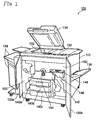
- Fig. 1 is an outer appearance perspective view when an image forming apparatus comprising a casing and office equipment parts according to one exemplary embodiment of the resin compact of the present invention is seen from the front side.
- the image forming apparatus 100 comprises front covers 120a and 120b at the front of a main body apparatus 110. These front covers 120a and 120b are open/closable so that an operator can operate the inside of the apparatus. By virtue of this construction, the operator can replenish a toner when a toner is consumed, replace the wasted process cartridge, or remove the jammed paper on occurrence of paper jamming in the apparatus.
- Fig. 1 shows the apparatus in the state of the front covers 120a and 120b being opened.
- the main body apparatus 110 On the top of the main body apparatus 110, an operation panel 130 into which various conditions concerning the image formation, such as paper size and number of sheets, are input through the operation by an operator, and a copy glass 132 on which the original to be read is placed, are provided.
- the main body apparatus 110 also comprises, at the upper part thereof, an automatic original conveying device 134 capable of automatically conveying the original onto the copy glass 132.
- the main body apparatus 110 comprises an image reading device for scanning the original image disposed on the copy glass 132 and obtaining image data representing the original image. The image data obtained by this image reading device are sent to an image forming unit through a control part.
- the image reading device and the control part are housed inside a casing 150 constituting a part of the main body apparatus 110.
- the image forming unit is provided in the casing 150 as a removable process cartridge 142.
- the process cartridge 142 can be loaded or removed by turning an operation lever 144.
- a toner housing part 146 is fixed, and a toner can be replenished from a toner supply port 148.
- the toner housed in the toner housing part 146 is fed to a developing device.
- paper housing cassettes 140a, 140b and 140c are provided in the lower part of the main body apparatus 110. Also, in the main body apparatus 110, a plurality of conveying rollers each composed of a pair of rollers are arrayed in the apparatus, whereby a conveying path allowing the paper in the paper housing cassette to be conveyed to the image forming unit located above the cassette is formed. The paper in each paper housing cassette is taken out one by one by a paper take-out mechanism disposed near the end of the conveying path and delivered to the conveying path.
- a paper tray 136 for manual feeding is provided on the side surface of the main body apparatus 110, and the paper can be fed also from this tray.
- the paper on which an image is formed by the image forming unit is sequentially transferred between two fixing rolls abutting against each other and being supported by a casing 152 constituting a part of the main body apparatus 110 and then discharged outside the main body apparatus 110.
- a plurality of discharge trays 138 are provided on the side opposite the side where the paper tray 136 is provided, and the paper after image formation is discharged to these trays.
- the resin compact of the present invention can satisfactorily maintain excellent mechanical property even when containing a recycled material (particularly, when the content of the recycled material is from 5 to 95 mass%) and therefore, is suitable as the exterior casing (housing), members (e.g., front cover, rear cover) constituting the casing, toner cartridge or paper feed tray of the above-described electrophotographic apparatus. In this case, the amount used of the recycled material in the electrophotographic apparatus can be more increased.
- Resin Compositions A to F and Recycled Materials A and B shown below are prepared.
- the Charpy impact strength in the MD direction at the shaping of the resin composition is expressed as MD (kJ/m 2 )
- the Charpy impact strength in the TD direction at the shaping of the resin composition is expressed as TD (kJ/m 2 ).
- Resin Composition A is a composition of Resin Composition A:
- Resin Composition B is a composition of Resin Composition B:
- Resin Composition C is a composition of Resin Composition C:
- Resin Composition D is a composition of Resin Composition D:
- Resin Composition E is a composition of Resin Composition E:
- Resin Composition D A resin composition after allowing Resin Composition D to stay in a cylinder of a 360 ton molding machine at 260°C for 15 minutes.
- Resin Composition F is a thermoplastic resin
- Resin Composition A 90 Parts by mass of Resin Composition A and 10 parts by mass of Resin Composition D are simply mixed in a 50 kg tumbler under no heating for 15 minutes.
- the obtained mixture is charged into the injection molding machine "NEX500" (manufactured by Nissei Plastic Industrial Co., Ltd.) and injection molded under the conditions of a cylinder temperature of 235°C and a die temperature of 60°C, whereby an ISO multipurpose specimen and a UL specimen (thickness: 2 mm) are obtained as the resin compact.
- NEX500 manufactured by Nissei Plastic Industrial Co., Ltd.
- Resin Composition A 90 Parts by mass of Resin Composition A and 10 parts by mass of Resin Composition E are simply mixed in a 50 kg tumbler under no heating for 15 minutes.
- the obtained mixture is charged into the injection molding machine "NEX500" (manufactured by Nissei Plastic Industrial Co., Ltd.) and injection molded under the conditions of a cylinder temperature of 235°C and a die temperature of 60°C, whereby an ISO multipurpose specimen and a UL specimen (thickness: 2 mm) are obtained as the resin compact.
- NEX500 manufactured by Nissei Plastic Industrial Co., Ltd.
- Resin Composition A 90 Parts by mass of Resin Composition A and 10 parts by mass of Resin Composition F are simply mixed in a 50 kg tumbler under no heating for 15 minutes.
- the obtained mixture is charged into the injection molding machine "NEX500" (manufactured by Nissei Plastic Industrial Co., Ltd.) and injection molded under the conditions of a cylinder temperature of 235°C and a die temperature of 60°C, whereby an ISO multipurpose specimen and a UL specimen (thickness: 2 mm) are obtained as the resin compact.
- NEX500 manufactured by Nissei Plastic Industrial Co., Ltd.
- Resin Composition A 90 Parts by mass of Resin Composition A and 10 parts by mass of Resin Composition D are simply mixed in a 50 kg tumbler under no heating for 15 minutes.
- the obtained mixture is charged into the injection molding machine "NEX500" (manufactured by Nissei Plastic Industrial Co., Ltd.) and injection molded under the conditions of a cylinder temperature of 255°C and a die temperature of 60°C, whereby an ISO multipurpose specimen and a UL specimen (thickness: 2 mm) are obtained as the resin compact.
- NEX500 manufactured by Nissei Plastic Industrial Co., Ltd.
- Resin Composition A is charged into the injection molding machine "NEX500" (manufactured by Nissei Plastic Industrial Co., Ltd.) and injection molded under the conditions of a cylinder temperature of 235°C and a die temperature of 60°C, whereby an ISO multipurpose specimen and a UL specimen (thickness: 2 mm) are obtained as the resin compact.
- NEX500 manufactured by Nissei Plastic Industrial Co., Ltd.
- Resin Composition A is charged into the injection molding machine "NEX500" (manufactured by Nissei Plastic Industrial Co., Ltd.) and injection molded under the conditions of a cylinder temperature of 255°C and a die temperature of 60°C, whereby an ISO multipurpose specimen and a UL specimen (thickness: 2 mm) are obtained as the resin compact.
- NEX500 manufactured by Nissei Plastic Industrial Co., Ltd.
- Resin Composition B 90 Parts by mass of Resin Composition B and 10 parts by mass of Resin Composition D are simply mixed in a 50 kg tumbler under no heating for 15 minutes.
- the obtained mixture is charged into the injection molding machine "NEX500" (manufactured by Nissei Plastic Industrial Co., Ltd.) and injection molded under the conditions of a cylinder temperature of 235°C and a die temperature of 60°C, whereby an ISO multipurpose specimen and a UL specimen (thickness: 2 mm) are obtained as the resin compact.
- NEX500 manufactured by Nissei Plastic Industrial Co., Ltd.
- the flame retardance is evaluated according to UL94V.
- the conditioning is performed under the conditions of 23°C ⁇ 2°C and 50 ⁇ 5% RH for 48 hours.
- "Not V” indicates that the flame retardance did not reach the V level in the UL combustion test.
- Example 1 Charpy Impact Strength Ratio MD/TD of Resin Compact Charpy Impact Strength (MD direction) (kJ/m 2 ) Tensile Yielding Point Strength (MPa) Tensile Yielding Point Elongation (%) Tensile Modulus (MPa) UL94V Flammability (thickness of specimen: 2 mm)
- Example 1 3.5 41 62 4.8 2232 V-0
- Example 2 3.5 31 60 4.3 2430 V-0
- Example 3 4.0 46 61 4.3 2500 V-0
- Example 4 5.0 34 60 4.2 2540 V-1
- Example 5 3.5 34 63 4.3 2392 V-0
- Example 6 3.5 17 59 4.0 2200 V-1
- Example 7 3.5 31 61 4.5 2364 V-0 Reference Example 1 5.4 28 61 4.6 2320 V-1 Reference Example 2 3.0 20 59 4.0 2222 Not V
- Comparative Example 1 1.0 26 62 4.3 2440 V-0 Comparative Example 2 6.0 50 55 6.0 2100 V-
- the Charpy impact strength of Recycled Material A is 23 kJ/m 2
- the Charpy impact strength of the new material of Resin Composition B is 29 kJ/m 2
- the Charpy impact strength of the new material of Resin Composition C is 75 kJ/m 2 .
Landscapes
- Chemical & Material Sciences (AREA)
- Health & Medical Sciences (AREA)
- Chemical Kinetics & Catalysis (AREA)
- Medicinal Chemistry (AREA)
- Polymers & Plastics (AREA)
- Organic Chemistry (AREA)
- Compositions Of Macromolecular Compounds (AREA)
- Separation, Recovery Or Treatment Of Waste Materials Containing Plastics (AREA)
- Manufacture Of Macromolecular Shaped Articles (AREA)
Abstract
Description
- The present invention relates to a resin compact, a casing and a production method of a resin compact.
- In the fields such as office equipment field, electric/electronic device field and automobile field, a resin compact is being widely used. Above all, in recent years, a resin compact comprising a resin composition prepared by blending a styrene-based resin such as polystyrene-based resin (hereinafter sometimes referred to as a "PS-based resin") or acrylonitrile-butadiene-styrene-based resin (hereinafter sometimes referred to as an "ABS-based resin") with a polycarbonate-based resin (hereinafter sometimes referred to as a "PC-based resin") is increasingly used for a part such as casing of office equipment or electronic/electric devices. In particular, high mechanical property is required of the resin compact used for a casing or the like of office equipment.
- On the other hand, in view of recycling of resources and environmental protection, particularly in the field of office equipment such as computer, printer and copying machine, the demand for recycling of reusing the product recovered from the market is more and more increasing.
- In order to increase the content ratio of a material used on the market (hereinafter sometimes referred to as a "recycled material"), studies have been heretofore made on the technique of suppressing the reduction in the mechanical strength when a recycled material is used. Specifically, methods such as specific compounding process or use of a specific compatibilizer are being studied (see, for example,
JP-A-2001-26719 JP-A-2001-279114 JP-A-2002-265798 - An object of the present invention is to provide a resin compact comprising two or more kinds of resins and exhibiting excellent mechanical property even when a recycled material is contained as the resin. Another object of the present invention is to provide a production method of the resin compact.
- For attaining these objects, the following invention is provided.
- (1) A resin compact, comprising:
- two or more kinds of resins,
- (2) The resin compact as described in (1) above,
wherein the two or more kinds of resins comprise at least one resin selected from the group (A) consisting of a polycarbonate-based resin, an alloy resin of a polycarbonate-based resin and an acrylonitrile-butadiene-styrene-based resin, a polycarbonate-based resin having at least partially a siloxane bond, and an alloy resin of a polycarbonate-based resin having at least partially a siloxane bond. - (3) The resin compact as described in (2) above,
wherein the two or more kinds of resins comprise at least one resin selected from the group (B) consisting of an alloy resin of a polycarbonate-based resin and an acrylonitrile-butadiene-styrene-based resin different from that in the group (A), an alloy resin of a polycarbonate-based resin and a styrene-based resin, a recycled material of a polycarbonate-based resin, a recycled material of an alloy resin of a polycarbonate-based resin and an acrylonitrile-butadiene-styrene-based resin, a recycled material of an alloy resin of a polycarbonate-based resin and a styrene-based resin, a recycled material of a polycarbonate-based resin having at least partially a siloxane bond, and a recycled material of an alloy resin of a polycarbonate-based resin having at least partially a siloxane bond. - (4) The resin compact as described in any one of (1) to (3) above, which comprises a polycarbonate-based resin having a p-cumylphenoxy group represented by formula (1).

- (5) The resin compact as described in any one of (1) or (4) above, which comprises one or more members selected from the group consisting of: an alloy resin of a polycarbonate-based resin and an acrylonitrile-butadiene-styrene-based resin; and an alloy resin of a polycarbonate-based resin and a styrene-based resin.
- (6) A method for producing a resin compact, comprising:
- shaping a mixture that comprises:
- a first resin composition allowing a Charpy impact strength in a resin flow direction at shaping to become from 1.5 to 8.0 times a Charpy impact strength in a direction crossing the resin flow direction at shaping; and
- one or more resin compositions different from the first resin composition,
- with a content of the first resin composition being from 50 to 95 mass%.
- shaping a mixture that comprises:
- (7) The method for producing a resin compact as described in (6) above,
wherein the first resin composition comprises a polycarbonate-based resin and an acrylonitrile-butadiene-styrene-based resin. - (8) The method for producing a resin compact as described in (6) or (7) above,
wherein the first resin composition comprises a polycarbonate-based resin having a p-cumylphenoxy group represented by formula (1), and
wherein a content of the polycarbonate-based resin is from 10 to 90 mass% based on the entire amount of the resin compact.
- (9) The method for producing a resin compact as described in any one of (6) to (8) above,
wherein the mixture is shaped by a direct molding method. - (10) A casing, comprising the resin compact as described in any one of (1) to (5) above.
- The invention of (1) above contains a plurality of resins and has an effect that the mechanical property is excellent as compared with the case where SMD/STD is not in the range of 3.5 to 5.0. Also, the invention of (1) above has an effect that the mechanical property is excellent even when a recycled material is contained as the resin. This makes it easy to enhance the utilization ratio of the recycled material.
- The invention of (2) above achieves a resin compact that is excellent in mechanical property compared with a resin compact in which kinds of resin materials are not considered.
- The invention of (3) above achieves a resin compact that attains high levels of Charpy impact strength and tensile property compared with a resin compact in which kinds of resin materials are not considered.
- The invention of (4) above has an effect that when a polycarbonate-based resin is contained, both the Charpy impact strength and the tensile property can be satisfied at a high level. Such a resin compact is suitable as a part of office equipment and electronic/electric devices, which is required to have high mechanical property. Also, the invention of (4) above has the above-described effect even when a recycled material is contained as the resin. This makes it easy to enhance the utilization ratio of the recycled material particularly in the office equipment field.
- The invention of (5) above has an effect that when an alloy resin of PC-based resin/ABS-based resin and/or an alloy resin of PC-based resin/PS-based resin is contained, both the Charpy impact strength and the tensile property can be satisfied at a high level. Such a resin compact is suitable as a part of office equipment and electronic/electric devices, which is required to have high mechanical property.
- The invention of (6) above has an effect that when a plurality of compositions are used, excellent mechanical property is obtained. Also, the invention of (6) above has an effect that a Charpy impact strength equal to or greater than that of the first resin composition can be obtained without impairing the tensile strength. Furthermore, the invention of (6) above has an effect that excellent mechanical property is obtained even when a recycled material is used as the resin composition. This makes it easy to enhance the utilization ratio of the recycled material particularly in the office equipment field.
- The invention of (7) above has an effect that when a PC-based resin and an ABS-based resin are used, excellent mechanical property is obtained. This makes it easy to obtain a resin compact suitable as a part of office equipment and electronic/electric devices, which is required to have high mechanical property. Also, the invention of (7) above has an effect that both the Charpy impact strength and the tensile property of the resin compact can be satisfied at a high level even when a recycled material is used as the resin composition. This makes it possible to incorporate a recycled material into the resin compact at a higher ratio than ever and makes it easy to enhance the utilization ratio of the recycled material particularly in the office equipment field.
- The invention of (8) above has an effect that as compared with the case of not having such a construction, both the Charpy impact strength and the tensile property can be easily satisfied at a high level. This makes it more easy to obtain a resin compact suitable as a part of office equipment and electronic/electric devices, which is required to have high mechanical property. Also, the invention of (8) above has the above-described effect even when a recycled material is used as the resin composition. This makes it more easy to enhance the utilization ratio of the recycled material particularly in the office equipment field.
- The invention of (9) above has an effect that as compared with a production method passing through heat history a plurality of times, the mechanical strength (particularly, Charpy impact strength) can be achieved at a higher level. Incidentally, this effect of the invention of (9) above is an unexpected effect in view of the fact that for increasing the mechanical strength of a resin compact, melt mixing is generally performed while taking into consideration the compatibility of resin compositions with each other. Furthermore, the invention of (9) above is advantageous also in terms of workability, productivity and cost, because a step of adding a compatibilizer or kneading resin compositions with each other can be dispensed with.
- The invention of (10) above has an effect that the mechanical strength is excellent even when the casing contains a recycled material. This makes it more easy to enhance the utilization ratio of the recycled material.
- Exemplary embodiments of the present invention will be described in detail based on the following figures, wherein:
-
Fig. 1 illustrates an outer appearance perspective view of an image forming apparatus comprising a casing and office equipment parts according to one exemplary embodiment of the resin compact of the present invention. - Preferred exemplary embodiments of the resin compact, the production method of the resin compact, and the casing of the present invention are described below.
- The resin compact of this exemplary embodiment comprises two or more kinds of resins and assuming that the Charpy impact strength in the resin flow direction (hereinafter sometimes referred to as the "MD direction") at the shaping is SMD and the Charpy impact strength in the direction crossing the resin flow direction (hereinafter sometimes referred to as the "TD direction") at the shaping is STD, SMD/STD is from 3.5 to 5.0.
- The "Charpy impact strength (SMD) in the resin flow direction" as used herein means a Charpy impact strength obtained by measuring a specimen produced from a resin compact such that all tangential directions drawn with respect to the resin flow direction at the shaping make an angular difference of 45° or less from the longitudinal direction of an ISO multipurpose specimen. Also, the "Charpy impact strength (STD) in the direction crossing the resin flow direction at the shaping" means a Charpy impact strength obtained by measuring a specimen produced from a resin compact such that all tangential directions drawn with respect to the resin flow direction at the shaping make an angular difference of 45° or less from the crosswise direction of an ISO multipurpose specimen.
- Also, in the present invention, the Charpy impact strength means a value measured using an impact tester according to JIS K7111 under the conditions such that the lifting angle is 150°, the hammer used is 2.0 J and the number of measurements is n=10.
- If SMD/STD is less than 3.5, the anisotropy is small and the effect of maintaining or enhancing the mechanical strength of each resin contained cannot be satisfactorily obtained, whereas if SMD/STD exceeds 5.0, since the Charpy impact strength of even a resin compact having a high Charpy impact strength is approximately from 60 to 70 kJ/m2, sufficiently high Charpy impact strength in the TD direction cannot be obtained and the resin compact comes to have poor mechanical strength. In the resin compact of this exemplary embodiment, the Charpy impact strength in the TD direction is preferably 7 kJ/m2 or more, more preferably 10 kJ/m2 or more.
- In the resin compact of this exemplary embodiment, one or more kinds of resins selected from the following group (A) and one or more kinds of resins selected from the group (B) are preferably contained as the two or more kinds of resins.
- A polycarbonate-based resin, an alloy resin of polycarbonate-based resin and acrylonitrile-butadiene-styrene-based resin (hereinafter simply referred to as a "PC/ABS alloy resin"), a polycarbonate-based resin having at least partially a siloxane bond, and an alloy resin thereof.
- A PC/ABS alloy resin different from that in the group (A), an alloy resin of polycarbonate-based resin and styrene-based resin (hereinafter simply referred to as a "PC/PS alloy resin"), a recycled material of polycarbonate-based resin, a recycled material of PC/ABS alloy resin, a recycled material of PC/PS alloy resin, a recycled material of polycarbonate-based resin having at least partially a siloxane bond, and a recycled material of alloy resin of polycarbonate-based resin having at least partially a siloxane bond.
- Examples of the polycarbonate-based resin include "Iupilon FPR3000" (trade name, produced by Mitsubishi Engineering-Plastics Corp.).
- Examples of the PC/ABS alloy resin include "Multilon TN7300" (trade name, produced by Teijin Chemicals Ltd.).
- Examples of the PC/PS alloy resin include "PC/PS Alloy Resin TARFLON NN2710AS" (trade name, produced by Idemitsu Kosan Co., Ltd.).
- The resin (A) and the resin (B) contained in the resin compact of this exemplary embodiment are preferably incompatible. More specifically, a combination of a polycarbonate-based resin as the resin (A) and a styrene-based resin-containing alloy resin as the resin (B) is preferred. Incidentally, whether the resins contained in the resin compact are incompatible or not can be confirmed, for example, by observing the fracture cross-section.
- The resin compact of this exemplary embodiment preferably contains a polycarbonate-based resin having a p-cumylphenoxy group represented by the following formula (1) :

- The p-cumylphenoxy group represented by formula (1) may be present at least at one terminal out of two terminals of the molecular chain of the polycarbonate-based resin or may be present in the side chain of the molecular chain.
- Such a polycarbonate-based resin can be produced, for example, by melt-polycondensing an aromatic dihydroxy compound and a carbonic acid diester in the presence of a terminal blocking agent containing a compound capable of introducing a p-cumylphenoxy group. Examples of the compound capable of introducing a p-cumylphenoxy group include p-cumylphenol, p-cumylphenylphenyl carbonate and p-cumylphenyl carbonate.
- The polycarbonate-based resin having a p-cumylphenoxy group represented by formula (1) is commercially available, for example, as "LEXAN 221R" (trade name, produced by Nippon GE Plastics Co.).
- From the standpoint of ensuring the mechanical strength and effectively utilizing the recycled material, the content of this polycarbonate-based resin is preferably from 10 to 90 mass%, more preferably from 15 to 86 mass%, still more preferably from 20 to 80 mass%, based on the entire amount of the resin compact.
- The polycarbonate-based resin having a p-cumylphenoxy group represented by formula (1) may be contained as an alloy resin alloyed with another resin. As for the another resin, an ABS-based resin is preferred in view of flowability and shaping processability.
- The resin compact of this exemplary embodiment preferably contains a polycarbonate-based resin allowing the Charpy impact strength in the resin flow direction at the shaping to become from 0.9 to 3.4 times the Charpy impact strength in the direction crossing the resin flow direction at the shaping.
- Such a polycarbonate-based resin can be produced, for example, by melt-polycondensing an aromatic dihydroxy compound and a carbonic acid diester in the presence of a terminal blocking agent containing a compound capable of introducing a p-cumylphenoxy group. Examples of the compound capable of introducing a p-cumylphenoxy group include p-cumylphenol, p-cumylphenylphenyl carbonate and p-cumylphenyl carbonate. Examples of the commercially available product include "LEXAN 221R" (trade name, produced by Nippon GE Plastics).
- From the standpoint of ensuring the mechanical strength and effectively utilizing the recycled material, the content of this polycarbonate-based resin is preferably from 10 to 90 mass%, more preferably from 15 to 86 mass%, still more preferably from 20 to 80 mass%, based on the entire amount of the resin compact.
- The resin compact of this exemplary embodiment preferably contains, as the one or more kinds of resins selected from the group (B), one or more kinds of resins selected from an alloy resin of polycarbonate-based resin and acrylonitrile-butadiene-styrene-based resin, and an alloy resin of polycarbonate-based resin and styrene-based resin.
- In the resin compact of this exemplary embodiment, from the standpoint of ensuring the mechanical strength and effectively utilizing the recycled material, the recycled material is preferably contained in an amount of 5 to 20 mass%, more preferably from 10 to 15 mass%, based on the entire amount of the resin compact.
- Preferred examples of the recycled material include a recycled material of the above-described polycarbonate-based resin, a recycled material of PC-ABS alloy resin, and a recycled material of PC/PS alloy resin.
- In the resin compact of this exemplary embodiment, the compact surface preferably has a glossiness of 50 to 100 by taking into consideration the use for a product which is often publicly exposed in an office or the like, such as exterior cover of a copying machine. The glossiness can be measured, for example, using a handy-type glossmeter, "Gloss Checker IG-331" (manufactured by Tsuyagen Co., Ltd.). Such a resin compact with excellent beauty can be obtained, for example, by the production method of a resin compact according to the present invention, where a direct molding method described later is used.
- The resin compact of this exemplary embodiment can be obtained, for example, by a known shaping method such as injection molding, injection compression molding and extrusion molding.
- The resin compact of this exemplary embodiment preferably contains a flame retardant. Examples of the flame retardant include a halogen-based flame retardant such as bromine and chlorine, a phosphorus-based flame retardant such as melamine polyphosphate, condensed phosphoric acid ester and ammonium polyphosphate, a silicone-based flame retardant, and a metal hydroxide. Among these, flame retardants except for the halogen-based flame retardant are preferred because of fear of dioxin generated when burned.
- In the resin compact of this exemplary embodiment, assuming that the entire amount of the resin compact is 100 parts by mass, the content of the flame retardant is preferably from 0.1 to 200 parts by mass, more preferably from 0.1 to 50 parts by mass. If the content of the flame retardant is less than 0.1 part by mass, it tends to be difficult to obtain sufficiently high flame retardance, whereas if it exceeds 200 parts by mass, the mechanical strength of the compact is liable to decrease.
- The resin compact of this exemplary embodiment may further contain other additives in addition to those components described above. Examples of such an additive include a drip inhibitor, a compatibilizer, a toughening agent, an antistatic agent, an antioxidant, a weathering agent and a hydrolysis inhibitor. The content of such an additive is not particularly limited as long as it is in the range of not impairing the mechanical strength of the compact, but the content of each additive is preferably 2 mass% or less based on the entire amount of the resin compact.
- The usage of the resin compact of this exemplary embodiment is not particularly limited, but specific examples thereof include a casing or various parts of electronic/electric devices and office equipment, and a part of home electric appliances such as audio equipment and electronic musical instrument, and various vehicles. Among these, a casing of electronic/electric devices, office equipment or the like is preferred.
- The preferred exemplary embodiment of the method for producing a resin compact of the present invention is described below.
- The method for producing a resin compact of this exemplary embodiment comprises shaping a mixture comprising a first resin composition allowing the Charpy impact strength in the direction parallel to the resin flow direction at the shaping to become from 1.5 to 8.0 times the Charpy impact strength in the direction crossing the resin flow direction at the shaping, and one or more resin compositions different from the first resin composition, with the content of the first resin composition being from 50 to 95 mass%.
- By this method, a resin compact comprising two or more kinds of resins is obtained, wherein assuming that the Charpy impact strength in the resin flow direction at the shaping is SMD and the Charpy impact strength in the direction crossing the resin flow direction at the shaping is STD, SMD/STD is from 3.5 to 5.0.
- The first resin composition may be sufficient if when such a resin composition is shaped, the Charpy impact strength in the MD direction becomes from 1.5 to 8.0 times, preferably from 3.0 to 5.5 times, the Charpy impact strength in the TD direction.
- In this exemplary embodiment, the first resin composition preferably contains a polycarbonate-based resin and an acrylonitrile-butadiene-styrene-based resin. Examples of the polycarbonate-based resin and acrylonitrile-butadiene-styrene-based resin include those described above.
- The first resin composition preferably contains a polycarbonate-based resin having a p-cumylphenoxy group represented by formula (1) and ensures that the content of the polycarbonate-based resin becomes from 10 to 90 mass% based on the entire amount of the resin compact. From the standpoint of ensuring the mechanical strength and effectively utilizing the recycled material, the content of the polycarbonate-based resin is more preferably from 15 to 86 mass%, still more preferably from 20 to 80 mass%, based on the entire amount of the resin compact.
- The first resin composition may contain an additive such as flame retardant, drip inhibitor, compatibilizer, toughening agent, antistatic agent, antioxidant, weathering agent and hydrolysis inhibitor. The amount blended of such an additive is appropriately set to account for a predetermined amount in the resin compact by taking into consideration the amount of the additive contained in a resin composition different from the first resin composition.
- The first resin composition is preferably mixed in the granulated form (as pellets) with a resin composition different from the first resin composition.
- The resin composition different from the first resin composition includes those containing one or more kinds of resins in the group (B).
- In this exemplary embodiment, from the standpoint of ensuring the mechanical strength and effectively utilizing the recycled material, the resin composition different from the first resin composition preferably contains the above-described recycled material of polycarbonate-based resin, recycled material of PC/ABS alloy resin or recycled material of PC/PS alloy resin. Also, the resin composition different from the first resin may contain a recycled material of the resin compact of the present invention.
- The content of the recycled material in the resin composition different from the first resin composition is preferably set to become from 5 to 15 mass%, more preferably from 10 to 15 mass%, based on the entire amount of the resin compact.
- The resin composition different from the first resin composition may contain two or more kinds of resins. For example, a recycled material obtained by grinding a member which is obtained by sandwich molding and in which a skin material and a core material are mixed, may be contained.
- In this exemplary embodiment, the first resin composition and two or more kinds of resin compositions different from the first resin composition may be mixed.
- Also, in this exemplary embodiment, the ratio S1MD/S1TD of the Charpy impact strength S1MD in the MD direction to the Charpy impact strength S1TD in the TD direction when the first resin composition is shaped, and the ratio S2MD/S2TD of the Charpy impact strength S2MD in the MD direction to the Charpy impact strength S2TD in the TD direction when the resin composition different from the first resin composition is shaped, preferably satisfy the following relationship:

- If [(S1MD/S1TD)/(S2MD/S2TD)] exceeds 8, SMD/STD of the obtained resin compact is liable to exceed 5.0 and the Charpy impact strength tends to decrease, whereas if [(S1MD/S1TD) / (S2MD/S2TD)] is less than 0.2, the effect of maintaining or enhancing the Charpy impact strength of the first resin composition can be hardly obtained.
- In the case of obtaining the above-described mixture, the first resin composition, a resin composition different from the first resin composition and if desired, additives may be melt-mixed under heating and thereby shaped into a particle form, but in this exemplary embodiment, without such shaping, the components are preferably mixed under no heating. In this case, the mechanical properties (Charpy impact strength and tensile property) of the resin compact can be more enhanced.
- As regards the method of shaping the mixture above, for example, a known shaping method such as injection molding, injection compression molding and extrusion molding may be used.
- In this exemplary embodiment, when the first resin composition contains a polycarbonate-based resin, the shaping temperature is preferably set to 235 to 245°C. If the shaping temperature is less than 235°C, insufficient melting of the resin composition tends to result, whereas if it exceeds 245°C, the Charpy impact strength is liable to decrease due to heat deterioration.
- In this exemplary embodiment, as described above, the mixture is preferably shaped by a direct molding method. More specifically, a method of charging the first resin composition, a resin composition different from the first resin composition and, if desired, additives into an injection molding machine, and continuously performing the mixing and the shaping of the resin compact is preferably employed. That is, direct shaping without melt-mixing the resin compositions under heating and once pelletizing the mixture, is preferred in view of mechanical property of the obtained resin compact, workability, power consumption and production efficiency.
- According to the production method of a resin compact of this exemplary embodiment, a resin compact excellent in the mechanical property can be produced from a plurality of resin compositions.
- Also, the production method of a resin compact of this exemplary embodiment can be utilized as a method of enhancing the Charpy impact strength of the first resin composition without impairing the tensile property.
- Furthermore, the production method of a resin compact of this exemplary embodiment enables to produce a resin compact excellent in the mechanical property even when a recycled material is used as the resin composition different from the first resin composition and therefore, can be utilized as a recycling method for used resins or a recycling method for resin compacts. In this case, the first resin composition functions as a material for recycling the used resin.
-
Fig. 1 is an outer appearance perspective view when an image forming apparatus comprising a casing and office equipment parts according to one exemplary embodiment of the resin compact of the present invention is seen from the front side. InFig. 1 , theimage forming apparatus 100 comprisesfront covers main body apparatus 110. Thesefront covers Fig. 1 shows the apparatus in the state of thefront covers - On the top of the
main body apparatus 110, anoperation panel 130 into which various conditions concerning the image formation, such as paper size and number of sheets, are input through the operation by an operator, and acopy glass 132 on which the original to be read is placed, are provided. Themain body apparatus 110 also comprises, at the upper part thereof, an automatic original conveyingdevice 134 capable of automatically conveying the original onto thecopy glass 132. Furthermore, themain body apparatus 110 comprises an image reading device for scanning the original image disposed on thecopy glass 132 and obtaining image data representing the original image. The image data obtained by this image reading device are sent to an image forming unit through a control part. The image reading device and the control part are housed inside acasing 150 constituting a part of themain body apparatus 110. Also, the image forming unit is provided in thecasing 150 as aremovable process cartridge 142. Theprocess cartridge 142 can be loaded or removed by turning anoperation lever 144. - In the
casing 150 of themain body apparatus 110, atoner housing part 146 is fixed, and a toner can be replenished from atoner supply port 148. The toner housed in thetoner housing part 146 is fed to a developing device. - In the lower part of the
main body apparatus 110,paper housing cassettes main body apparatus 110, a plurality of conveying rollers each composed of a pair of rollers are arrayed in the apparatus, whereby a conveying path allowing the paper in the paper housing cassette to be conveyed to the image forming unit located above the cassette is formed. The paper in each paper housing cassette is taken out one by one by a paper take-out mechanism disposed near the end of the conveying path and delivered to the conveying path. Apaper tray 136 for manual feeding is provided on the side surface of themain body apparatus 110, and the paper can be fed also from this tray. - The paper on which an image is formed by the image forming unit is sequentially transferred between two fixing rolls abutting against each other and being supported by a
casing 152 constituting a part of themain body apparatus 110 and then discharged outside themain body apparatus 110. In themain body apparatus 110, a plurality ofdischarge trays 138 are provided on the side opposite the side where thepaper tray 136 is provided, and the paper after image formation is discharged to these trays. - The resin compact of the present invention can satisfactorily maintain excellent mechanical property even when containing a recycled material (particularly, when the content of the recycled material is from 5 to 95 mass%) and therefore, is suitable as the exterior casing (housing), members (e.g., front cover, rear cover) constituting the casing, toner cartridge or paper feed tray of the above-described electrophotographic apparatus. In this case, the amount used of the recycled material in the electrophotographic apparatus can be more increased.
- The present invention is described in greater detail below by referring to Examples, but the present invention is not limited to these Examples.
- Resin Compositions A to F and Recycled Materials A and B shown below are prepared. In this Example, the Charpy impact strength in the MD direction at the shaping of the resin composition is expressed as MD (kJ/m2), and the Charpy impact strength in the TD direction at the shaping of the resin composition is expressed as TD (kJ/m2).
- A mixture (pellet) of 75 parts by mass of polycarbonate resin "LEXAN 221R" (trade name, produced by Nippon GE Plastics Co.) having p-cumylphenoxy group represented by the following formula (1) as the terminal group, 25 parts by mass of ABS resin "SANTAC AT07" (trade name, produced by Nippon A&L Inc.), 10 parts by mass of "CR741" (resorcinol diphosphate, produced by Daihachi Chemical Industry Co., Ltd.) as the flame retardant, and 0.5 parts by mass of polytetrafluoroethylene (produced by Shanghai/Sun Chemical Co., Ltd.) as the drip inhibitor, MD:TD = 48.4:9.0, MD/TD = 5.4.

- PC/ABS Alloy resin "Multilon TN7300" (trade name, produced by Teijin Chemicals Ltd.), MD:TD = 15:12, MD/TD<1.5.
- A mixture (pellet) of 75 parts by mass of polycarbonate resin "LEXAN 221R" (trade name, produced by Nippon GE Plastics Co.) having p-cumylphenoxy group represented by formula (1) as the terminal group, 25 parts by mass of ABS resin "SANTAC AT07" (trade name, produced by Nippon A&L Inc.), 10 parts by mass of "METABLEN S2001" (trade name, produced by Mitsubishi Rayon Co., Ltd.) as the impact strength modifier, 10 parts by mass of "CR741" (resorcinol diphosphate, produced by Daihachi Chemical Industry Co., Ltd.) as the flame retardant, and 0.5 parts by mass of polytetrafluoroethylene (produced by Shanghai/Sun Chemical Co., Ltd.) as the drip inhibitor, MD:TD = 42.0:4.9, MD/TD = 8.6.
- A mixture of 70 parts by mass of polycarbonate resin "FC1700" (trade name, produced by Idemitsu Petro-Chemical Co., Ltd.) having p-tert-butylphenoxy group represented by the following formula (2) as the terminal group, 30 parts by mass of ABS resin "B600N" (trade name, produced by Ube Cycon Ltd.), and 15 parts by mass of "PX200" (condensed phosphoric acid ester, produced by Daihachi Chemical Industry Co., Ltd.) as the flame retardant, MD:TD = 33.0:26.0, MD/TD = 1.3.

- A resin composition after allowing Resin Composition D to stay in a cylinder of a 360 ton molding machine at 260°C for 15 minutes.
- PC/PS Alloy resin "TARFLON NN2710AS" (produced by Idemitsu Kosan Co., Ltd.).
- A material obtained by recovering a molded article comprising PC/PS alloy resin "TARFLON NN2710AS" (produced by Idemitsu Kosan Co., Ltd.), which had been used in the market for 1 to 3 years, and grinding it to a size of 12 mm mesh.
- A material obtained by grinding a sandwich molded article of 80 parts by mass of a skin material comprising Resin Composition A and 20 parts by mass of a core material comprising Resin Composition D, to a size of 12 mm mesh.
- 90 Parts by mass of Resin Composition A and 10 parts by mass of Resin Composition D are simply mixed in a 50 kg tumbler under no heating for 15 minutes. The obtained mixture is charged into the injection molding machine "NEX500" (manufactured by Nissei Plastic Industrial Co., Ltd.) and injection molded under the conditions of a cylinder temperature of 235°C and a die temperature of 60°C, whereby an ISO multipurpose specimen and a UL specimen (thickness: 2 mm) are obtained as the resin compact.
- 90 Parts by mass of Resin Composition A and 10 parts by mass of Resin Composition E are simply mixed in a 50 kg tumbler under no heating for 15 minutes. The obtained mixture is charged into the injection molding machine "NEX500" (manufactured by Nissei Plastic Industrial Co., Ltd.) and injection molded under the conditions of a cylinder temperature of 235°C and a die temperature of 60°C, whereby an ISO multipurpose specimen and a UL specimen (thickness: 2 mm) are obtained as the resin compact.
- 90 Parts by mass of Resin Composition A and 10 parts by mass of Resin Composition F are simply mixed in a 50 kg tumbler under no heating for 15 minutes. The obtained mixture is charged into the injection molding machine "NEX500" (manufactured by Nissei Plastic Industrial Co., Ltd.) and injection molded under the conditions of a cylinder temperature of 235°C and a die temperature of 60°C, whereby an ISO multipurpose specimen and a UL specimen (thickness: 2 mm) are obtained as the resin compact.
- 90 Parts by mass of Resin Composition A and 10 parts by mass of Recycled Material A are simply mixed in a 50 kg tumbler under no heating for 15 minutes. The obtained mixture is charged into the injection molding machine "NEX500" (manufactured by Nissei Plastic Industrial Co., Ltd.) and injection molded under the conditions of a cylinder temperature of 235°C and a die temperature of 60°C, whereby an ISO multipurpose specimen and a UL specimen (thickness: 2 mm) are obtained as the resin compact.
- 90 Parts by mass of Resin Composition A and 10 parts by mass of Recycled Material B are simply mixed in a 50 kg tumbler under no heating for 15 minutes. The obtained mixture is charged into the injection molding machine "NEX500" (manufactured by Nissei Plastic Industrial Co., Ltd.) and injection molded under the conditions of a cylinder temperature of 235°C and a die temperature of 60°C, whereby an ISO multipurpose specimen and a UL specimen (thickness: 2 mm) are obtained as the resin compact.
- 90 Parts by mass of Resin Composition A and 10 parts by mass of Resin Composition D are simply mixed in a 50 kg tumbler under no heating for 15 minutes. The obtained mixture is charged into the injection molding machine "NEX500" (manufactured by Nissei Plastic Industrial Co., Ltd.) and injection molded under the conditions of a cylinder temperature of 255°C and a die temperature of 60°C, whereby an ISO multipurpose specimen and a UL specimen (thickness: 2 mm) are obtained as the resin compact.
- 90 Parts by mass of Resin Composition A and 10 parts by mass of Resin Composition D are melt-mixed under heating and thereby pelletized. The obtained mixture (pellet) is charged into the injection molding machine "NEX500" (manufactured by Nissei Plastic Industrial Co., Ltd.) and injection molded under the conditions of a cylinder temperature of 235°C and a die temperature of 60°C, whereby an ISO multipurpose specimen and a UL specimen (thickness: 2 mm) are obtained as the resin compact.
- Only Resin Composition A is charged into the injection molding machine "NEX500" (manufactured by Nissei Plastic Industrial Co., Ltd.) and injection molded under the conditions of a cylinder temperature of 235°C and a die temperature of 60°C, whereby an ISO multipurpose specimen and a UL specimen (thickness: 2 mm) are obtained as the resin compact.
- Only Resin Composition A is charged into the injection molding machine "NEX500" (manufactured by Nissei Plastic Industrial Co., Ltd.) and injection molded under the conditions of a cylinder temperature of 255°C and a die temperature of 60°C, whereby an ISO multipurpose specimen and a UL specimen (thickness: 2 mm) are obtained as the resin compact.
- 90 Parts by mass of Resin Composition B and 10 parts by mass of Resin Composition D are simply mixed in a 50 kg tumbler under no heating for 15 minutes. The obtained mixture is charged into the injection molding machine "NEX500" (manufactured by Nissei Plastic Industrial Co., Ltd.) and injection molded under the conditions of a cylinder temperature of 235°C and a die temperature of 60°C, whereby an ISO multipurpose specimen and a UL specimen (thickness: 2 mm) are obtained as the resin compact.
- 90 Parts by mass of Resin Composition C and 10 parts by mass of Resin Composition D are simply mixed in a 50 kg tumbler under no heating for 15 minutes. The obtained mixture is charged into the injection molding machine "NEX500" (manufactured by Nissei Plastic Industrial Co., Ltd.) and injection molded under the conditions of a cylinder temperature of 235°C and a die temperature of 60°C, whereby an ISO multipurpose specimen and a UL specimen (thickness: 2 mm) are obtained as the resin compact.
- With respect to the resin compacts (ISO multipurpose specimens) obtained above in Examples 1 to 7, Reference Examples 1 and 2, and Comparative Examples 1 and 2, the Charpy impact resistant strength ratio MD/TD is determined according to the following method. The results obtained are shown in Table 1.
- Using an ISO multipurpose dumbbell specimen subjected to a notching process, the Charpy impact resistant strength MD in the MD direction and the Charpy impact resistant strength TD in the TD direction each is measured by a digital impact tester (manufactured by Toyo Seiki Seisaku-Sho, Ltd.) according to JIS K7111 under the conditions such that the lifting angle is 150°, the hammer used is 2.0 J and the number of measurements is n=10, and the Charpy impact resistant strength ratio MD/TD is determined.
- Also, with respect to the resin compacts (ISO multipurpose specimens) obtained above in Examples 1 to 7, Reference Examples 1 and 2, and Comparative Examples 1 and 2, the Charpy impact resistant strength, tensile yielding point strength, tensile yielding point elongation and tensile modulus are measured according to the following methods. Furthermore, with respect to the resin compacts (UL specimens) obtained above in Examples 1 to 7, Reference Examples 1 and 2, and Comparative Examples 1 and 2, the flame retardance is evaluated according to the following method. The results obtained are shown together in Table 1.
- Using the ISO multipurpose dumbbell specimen subjected to a notching process, the Charpy impact resistant strength (kJ/m2) in the MD direction is measured by a digital impact tester (manufactured by Toyo Seiki Seisaku-Sho, Ltd.) according to JIS K7111 under the conditions such that the lifting angle is 150°, the hammer used is 2.0 J and the number of measurements is n=10.
- With respect to the ISO multipurpose dumbbell specimen, the tensile yielding point strength (MPa), tensile yielding point elongation (%) and tensile modulus (MPa) each is measured by Instron 5566 (manufactured by Toyo Seiki Seisaku-Sho, Ltd.) according to JIS K7161 under the conditions such that the test speed is 50 mm/min, the chuck-to-chuck distance is 115 mm and the number of measurements is n=5.
- With respect to the UL specimen (thickness: 2 mm), the flame retardance is evaluated according to UL94V. Incidentally, the conditioning is performed under the conditions of 23°C±2°C and 50±5% RH for 48 hours. In the column of flammability in Table 1, "Not V" indicates that the flame retardance did not reach the V level in the UL combustion test.
Table 1 Charpy Impact Strength Ratio MD/TD of Resin Compact Charpy Impact Strength (MD direction) (kJ/m2) Tensile Yielding Point Strength (MPa) Tensile Yielding Point Elongation (%) Tensile Modulus (MPa) UL94V Flammability (thickness of specimen: 2 mm) Example 1 3.5 41 62 4.8 2232 V-0 Example 2 3.5 31 60 4.3 2430 V-0 Example 3 4.0 46 61 4.3 2500 V-0 Example 4 5.0 34 60 4.2 2540 V-1 Example 5 3.5 34 63 4.3 2392 V-0 Example 6 3.5 17 59 4.0 2200 V-1 Example 7 3.5 31 61 4.5 2364 V-0 Reference Example 1 5.4 28 61 4.6 2320 V-1 Reference Example 2 3.0 20 59 4.0 2222 Not V Comparative Example 1 1.0 26 62 4.3 2440 V-0 Comparative Example 2 6.0 50 55 6.0 2100 V-0 - Incidentally, the Charpy impact strength of Recycled Material A is 23 kJ/m2, the Charpy impact strength of the new material of Resin Composition B is 29 kJ/m2, and the Charpy impact strength of the new material of Resin Composition C is 75 kJ/m2.
- The foregoing description of the exemplary embodiments of the present invention has been provided for the purpose of illustration and description. It is not intended to be exhaustive or to limit the invention to the precise forms disclosed. Obviously, many modifications and variations will be apparent to practitioners skilled in the art. The exemplary embodiments are chosen and described in order to best explain the principles of the invention and its practical applications, thereby enabling others skilled in the art to understand the invention for various exemplary embodiments and with the various modifications as are suited to the particular use contemplated. It is intended that the scope of the invention be defined by the following claims and their equivalents.
Claims (10)
- A resin compact, comprising:two or more kinds of resins,wherein when a Charpy impact strength in a resin flow direction at shaping is SMD and a Charpy impact strength in a direction crossing the resin flow direction at shaping is STD, SMD/STD is from 3.5 to 5.0.
- The resin compact according to claim 1,
wherein the two or more kinds of resins comprise at least one resin selected from the group (A) consisting of a polycarbonate-based resin, an alloy resin of a polycarbonate-based resin and an acrylonitrile-butadiene-styrene-based resin, a polycarbonate-based resin having at least partially a siloxane bond, and an alloy resin of a polycarbonate-based resin having at least partially a siloxane bond. - The resin compact according to claim 2,
wherein the two or more kinds of resins comprise at least one resin selected from the group (B) consisting of an alloy resin of a polycarbonate-based resin and an acrylonitrile-butadiene-styrene-based resin different from that in the group (A), an alloy resin of a polycarbonate-based resin and a styrene-based resin, a recycled material of a polycarbonate-based resin, a recycled material of an alloy resin of a polycarbonate-based resin and an acrylonitrile-butadiene-styrene-based resin, a recycled material of an alloy resin of a polycarbonate-based resin and a styrene-based resin, a recycled material of a polycarbonate-based resin having at least partially a siloxane bond, and a recycled material of an alloy resin of a polycarbonate-based resin having at least partially a siloxane bond. - The resin compact according to any one of claims 1 to 3, which comprises a polycarbonate-based resin having a p-cumylphenoxy group represented by formula (1).

- The resin compact according to any one of claims 1 to 4, which comprises one or more members selected from the group consisting of: an alloy resin of a polycarbonate-based resin and an acrylonitrile-butadiene-styrene-based resin; and an alloy resin of a polycarbonate-based resin and a styrene-based resin.
- A method for producing a resin compact, comprising:shaping a mixture that comprises:a first resin composition allowing a Charpy impact strength in a resin flow direction at shaping to become from 1.5 to 8.0 times a Charpy impact strength in a direction crossing the resin flow direction at shaping; andone or more resin compositions different from the first resin composition,with a content of the first resin composition being from 50 to 95 mass%.
- The method for producing a resin compact according to claim 6,
wherein the first resin composition comprises a polycarbonate-based resin and an acrylonitrile-butadiene-styrene-based resin. - The method for producing a resin compact according to claim 6 or 7,
wherein the first resin composition comprises a polycarbonate-based resin having a p-cumylphenoxy group represented by formula (1), and
wherein a content of the polycarbonate-based resin is from 10 to 90 mass% based on the entire amount of the resin compact.
- The method for producing a resin compact according to any one of claims 6 to 8,
wherein the mixture is shaped by a direct molding method. - A casing, comprising the resin compact according to any one of claims 1 to 5.
Applications Claiming Priority (1)
| Application Number | Priority Date | Filing Date | Title |
|---|---|---|---|
| JP2007024488A JP2008189767A (en) | 2007-02-02 | 2007-02-02 | Resin molded item, casing and manufacturing method of resin molded item |
Publications (2)
| Publication Number | Publication Date |
|---|---|
| EP1953192A1 true EP1953192A1 (en) | 2008-08-06 |
| EP1953192B1 EP1953192B1 (en) | 2012-06-27 |
Family
ID=39060236
Family Applications (1)
| Application Number | Title | Priority Date | Filing Date |
|---|---|---|---|
| EP07019165A Not-in-force EP1953192B1 (en) | 2007-02-02 | 2007-09-28 | Resin compact, casing and production method of resin compact |
Country Status (4)
| Country | Link |
|---|---|
| US (1) | US7947780B2 (en) |
| EP (1) | EP1953192B1 (en) |
| JP (1) | JP2008189767A (en) |
| CN (1) | CN101235151B (en) |
Cited By (1)
| Publication number | Priority date | Publication date | Assignee | Title |
|---|---|---|---|---|
| CN109135154A (en) * | 2018-06-21 | 2019-01-04 | 四川塑金科技有限公司 | A kind of recycling modified technique of waste and old ABS composite plastic |
Families Citing this family (3)
| Publication number | Priority date | Publication date | Assignee | Title |
|---|---|---|---|---|
| JP2009255274A (en) * | 2008-03-26 | 2009-11-05 | Fuji Xerox Co Ltd | Method of renewing surface of resin-made exterior finishing material, and business equipment having resin-made exterior finishing material with surface renewed by the method |
| US9416269B2 (en) * | 2013-01-11 | 2016-08-16 | Sabic Global Technologies B.V. | Polycarbonate blend compositions containing recycle for improvement in surface aesthetics |
| JP2016079334A (en) * | 2014-10-20 | 2016-05-16 | 出光興産株式会社 | Polycarbonate resin composition containing polycarbonate-polyorganosiloxane copolymer and a molded article thereof |
Citations (3)
| Publication number | Priority date | Publication date | Assignee | Title |
|---|---|---|---|---|
| JP2002265798A (en) * | 2001-03-09 | 2002-09-18 | Teijin Chem Ltd | Recycled resin composition |
| JP2005162819A (en) * | 2003-12-01 | 2005-06-23 | Ge Plastics Japan Ltd | Polycarbonate resin composition and molded article |
| US20050179153A1 (en) * | 2002-04-12 | 2005-08-18 | Riise Brian L. | Compositions of materials containing recycled plastics |
Family Cites Families (6)
| Publication number | Priority date | Publication date | Assignee | Title |
|---|---|---|---|---|
| US5045596A (en) * | 1988-10-12 | 1991-09-03 | The Dow Chemical Company | Impact resistant polycarbonate blend |
| JP2001026719A (en) | 1999-05-07 | 2001-01-30 | Mitsubishi Engineering Plastics Corp | Recycled resin composition and method for producing the same |
| DE19959420A1 (en) * | 1999-12-09 | 2001-06-13 | Basf Ag | Isotropic thermoplastic molding compounds based on polycarbonate and styrene copolymers |
| JP2001279114A (en) | 2000-03-31 | 2001-10-10 | Mitsubishi Electric Corp | Recycled resin composition, method for producing the same, and recycled resin molded product |
| JP2003160724A (en) | 2001-09-11 | 2003-06-06 | Ge Plastics Japan Ltd | Polycarbonate resin-based composition |
| CN101316894A (en) | 2005-11-28 | 2008-12-03 | 三菱工程塑料株式会社 | Aromatic polycarbonate resin composition and molded article thereof |
-
2007
- 2007-02-02 JP JP2007024488A patent/JP2008189767A/en not_active Withdrawn
- 2007-09-11 US US11/898,330 patent/US7947780B2/en not_active Expired - Fee Related
- 2007-09-28 EP EP07019165A patent/EP1953192B1/en not_active Not-in-force
- 2007-10-16 CN CN2007101625236A patent/CN101235151B/en not_active Expired - Fee Related
Patent Citations (3)
| Publication number | Priority date | Publication date | Assignee | Title |
|---|---|---|---|---|
| JP2002265798A (en) * | 2001-03-09 | 2002-09-18 | Teijin Chem Ltd | Recycled resin composition |
| US20050179153A1 (en) * | 2002-04-12 | 2005-08-18 | Riise Brian L. | Compositions of materials containing recycled plastics |
| JP2005162819A (en) * | 2003-12-01 | 2005-06-23 | Ge Plastics Japan Ltd | Polycarbonate resin composition and molded article |
Non-Patent Citations (2)
| Title |
|---|
| DATABASE WPI Week 200354, Derwent World Patents Index; AN 2003-572196, XP002470149 * |
| DATABASE WPI Week 200547, Derwent World Patents Index; AN 2005-462029, XP002470148 * |
Cited By (1)
| Publication number | Priority date | Publication date | Assignee | Title |
|---|---|---|---|---|
| CN109135154A (en) * | 2018-06-21 | 2019-01-04 | 四川塑金科技有限公司 | A kind of recycling modified technique of waste and old ABS composite plastic |
Also Published As
| Publication number | Publication date |
|---|---|
| US7947780B2 (en) | 2011-05-24 |
| JP2008189767A (en) | 2008-08-21 |
| EP1953192B1 (en) | 2012-06-27 |
| US20080188620A1 (en) | 2008-08-07 |
| CN101235151B (en) | 2013-06-19 |
| CN101235151A (en) | 2008-08-06 |
Similar Documents
| Publication | Publication Date | Title |
|---|---|---|
| KR101577381B1 (en) | Resin composition and resin molded article | |
| CN1216940C (en) | Aromatic polycarbonate resin composition | |
| US7683117B2 (en) | Resin composition, resin mold and method for producing the same | |
| US7598305B2 (en) | Resin composition, resin molding, package, production method of resin molding and recycling method of resin molding | |
| JP6229749B2 (en) | Resin composition and resin molded body | |
| EP1953192B1 (en) | Resin compact, casing and production method of resin compact | |
| WO2000058402A1 (en) | Polycarbonate-base flame-retardant resin composition | |
| JP2003160724A (en) | Polycarbonate resin-based composition | |
| JP5278046B2 (en) | Recycled resin composition, method for producing the same, and resin molded body | |
| JP5644362B2 (en) | Resin composition and resin molded body | |
| JP5736223B2 (en) | Aromatic polycarbonate resin composition | |
| US11618815B2 (en) | Resin composition, molded body, electronic part, and electronic device | |
| JP5480071B2 (en) | Resin composition | |
| JP5204472B2 (en) | Resin composition, resin molded body and method for producing the same | |
| US7767744B2 (en) | Resin composition, resin compact, production method of resin compact and recycling method of resin compact | |
| JP2011195721A (en) | Modifier, resin composition and resin molded product | |
| JP2011046843A (en) | Composite rubber-based graft copolymer, thermoplastic resin composition, and resin molded product | |
| JP2012092156A (en) | Resin composition, and resin molded article | |
| JP3613911B2 (en) | Flame retardant resin composition | |
| JP4860804B2 (en) | Flame retardant styrene resin composition | |
| JPH10147701A (en) | Flame-retardant resin composition | |
| EP3572463B1 (en) | Thermoplastic resin composition and article produced therefrom | |
| US20080287579A1 (en) | Resin composition and resin mold | |
| JP2007217572A (en) | Method for producing flame-retardant resin molding material having excellent thermal stability | |
| EP4729578A1 (en) | Recycled resin composition, resin molded product, resin housing, and electronic device |
Legal Events
| Date | Code | Title | Description |
|---|---|---|---|
| PUAI | Public reference made under article 153(3) epc to a published international application that has entered the european phase |
Free format text: ORIGINAL CODE: 0009012 |
|
| AK | Designated contracting states |
Kind code of ref document: A1 Designated state(s): AT BE BG CH CY CZ DE DK EE ES FI FR GB GR HU IE IS IT LI LT LU LV MC MT NL PL PT RO SE SI SK TR |
|
| AX | Request for extension of the european patent |
Extension state: AL BA HR MK RS |
|
| 17P | Request for examination filed |
Effective date: 20090113 |
|
| AKX | Designation fees paid |
Designated state(s): DE FR GB NL |
|
| 17Q | First examination report despatched |
Effective date: 20100723 |
|
| GRAP | Despatch of communication of intention to grant a patent |
Free format text: ORIGINAL CODE: EPIDOSNIGR1 |
|
| GRAS | Grant fee paid |
Free format text: ORIGINAL CODE: EPIDOSNIGR3 |
|
| GRAA | (expected) grant |
Free format text: ORIGINAL CODE: 0009210 |
|
| AK | Designated contracting states |
Kind code of ref document: B1 Designated state(s): DE FR GB NL |
|
| REG | Reference to a national code |
Ref country code: GB Ref legal event code: FG4D |
|
| REG | Reference to a national code |
Ref country code: DE Ref legal event code: R096 Ref document number: 602007023525 Country of ref document: DE Effective date: 20120823 |
|
| REG | Reference to a national code |
Ref country code: NL Ref legal event code: T3 |
|
| PLBE | No opposition filed within time limit |
Free format text: ORIGINAL CODE: 0009261 |
|
| STAA | Information on the status of an ep patent application or granted ep patent |
Free format text: STATUS: NO OPPOSITION FILED WITHIN TIME LIMIT |
|
| 26N | No opposition filed |
Effective date: 20130328 |
|
| REG | Reference to a national code |
Ref country code: DE Ref legal event code: R097 Ref document number: 602007023525 Country of ref document: DE Effective date: 20130328 |
|
| PGFP | Annual fee paid to national office [announced via postgrant information from national office to epo] |
Ref country code: NL Payment date: 20130810 Year of fee payment: 7 Ref country code: DE Payment date: 20130925 Year of fee payment: 7 |
|
| PGFP | Annual fee paid to national office [announced via postgrant information from national office to epo] |
Ref country code: FR Payment date: 20130910 Year of fee payment: 7 Ref country code: GB Payment date: 20130925 Year of fee payment: 7 |
|
| REG | Reference to a national code |
Ref country code: DE Ref legal event code: R119 Ref document number: 602007023525 Country of ref document: DE |
|
| GBPC | Gb: european patent ceased through non-payment of renewal fee |
Effective date: 20140928 |
|
| REG | Reference to a national code |
Ref country code: FR Ref legal event code: ST Effective date: 20150529 |
|
| PG25 | Lapsed in a contracting state [announced via postgrant information from national office to epo] |
Ref country code: NL Free format text: LAPSE BECAUSE OF NON-PAYMENT OF DUE FEES Effective date: 20150401 |
|
| PG25 | Lapsed in a contracting state [announced via postgrant information from national office to epo] |
Ref country code: GB Free format text: LAPSE BECAUSE OF NON-PAYMENT OF DUE FEES Effective date: 20140928 Ref country code: DE Free format text: LAPSE BECAUSE OF NON-PAYMENT OF DUE FEES Effective date: 20150401 |
|
| PG25 | Lapsed in a contracting state [announced via postgrant information from national office to epo] |
Ref country code: FR Free format text: LAPSE BECAUSE OF NON-PAYMENT OF DUE FEES Effective date: 20140930 |