EP1950515A2 - Coating film drying method - Google Patents
Coating film drying method Download PDFInfo
- Publication number
- EP1950515A2 EP1950515A2 EP07150144A EP07150144A EP1950515A2 EP 1950515 A2 EP1950515 A2 EP 1950515A2 EP 07150144 A EP07150144 A EP 07150144A EP 07150144 A EP07150144 A EP 07150144A EP 1950515 A2 EP1950515 A2 EP 1950515A2
- Authority
- EP
- European Patent Office
- Prior art keywords
- coated member
- coating film
- coating
- coated
- drying
- Prior art date
- Legal status (The legal status is an assumption and is not a legal conclusion. Google has not performed a legal analysis and makes no representation as to the accuracy of the status listed.)
- Pending
Links
- 238000000576 coating method Methods 0.000 title claims abstract description 213
- 239000011248 coating agent Substances 0.000 title claims abstract description 196
- 238000001035 drying Methods 0.000 title claims abstract description 145
- 238000010438 heat treatment Methods 0.000 claims abstract description 76
- 238000001816 cooling Methods 0.000 claims abstract description 29
- 238000000034 method Methods 0.000 claims abstract description 29
- 230000003247 decreasing effect Effects 0.000 claims abstract description 9
- 230000007547 defect Effects 0.000 description 23
- XLYOFNOQVPJJNP-UHFFFAOYSA-N water Substances O XLYOFNOQVPJJNP-UHFFFAOYSA-N 0.000 description 17
- 238000004519 manufacturing process Methods 0.000 description 12
- 239000000463 material Substances 0.000 description 10
- 230000002093 peripheral effect Effects 0.000 description 10
- 239000007788 liquid Substances 0.000 description 9
- 239000002904 solvent Substances 0.000 description 9
- NIXOWILDQLNWCW-UHFFFAOYSA-N acrylic acid group Chemical group C(C=C)(=O)O NIXOWILDQLNWCW-UHFFFAOYSA-N 0.000 description 6
- 239000003795 chemical substances by application Substances 0.000 description 6
- 239000002184 metal Substances 0.000 description 4
- JOYRKODLDBILNP-UHFFFAOYSA-N Ethyl urethane Chemical compound CCOC(N)=O JOYRKODLDBILNP-UHFFFAOYSA-N 0.000 description 3
- 238000007664 blowing Methods 0.000 description 3
- 239000000839 emulsion Substances 0.000 description 3
- 239000012948 isocyanate Substances 0.000 description 3
- 150000002513 isocyanates Chemical class 0.000 description 3
- 238000004904 shortening Methods 0.000 description 3
- 238000010586 diagram Methods 0.000 description 2
- 238000007605 air drying Methods 0.000 description 1
- 238000009835 boiling Methods 0.000 description 1
- 230000007423 decrease Effects 0.000 description 1
- 230000007613 environmental effect Effects 0.000 description 1
- 238000007602 hot air drying Methods 0.000 description 1
- 230000001678 irradiating effect Effects 0.000 description 1
- 230000005855 radiation Effects 0.000 description 1
- 238000005507 spraying Methods 0.000 description 1
- 230000007704 transition Effects 0.000 description 1
Images
Classifications
-
- F—MECHANICAL ENGINEERING; LIGHTING; HEATING; WEAPONS; BLASTING
- F26—DRYING
- F26B—DRYING SOLID MATERIALS OR OBJECTS BY REMOVING LIQUID THEREFROM
- F26B3/00—Drying solid materials or objects by processes involving the application of heat
- F26B3/28—Drying solid materials or objects by processes involving the application of heat by radiation, e.g. from the sun
- F26B3/30—Drying solid materials or objects by processes involving the application of heat by radiation, e.g. from the sun from infrared-emitting elements
-
- F—MECHANICAL ENGINEERING; LIGHTING; HEATING; WEAPONS; BLASTING
- F26—DRYING
- F26B—DRYING SOLID MATERIALS OR OBJECTS BY REMOVING LIQUID THEREFROM
- F26B11/00—Machines or apparatus for drying solid materials or objects with movement which is non-progressive
- F26B11/18—Machines or apparatus for drying solid materials or objects with movement which is non-progressive on or in moving dishes, trays, pans, or other mainly-open receptacles
Definitions
- the present invention relates to a coating film drying method by use of waterborne coatings, and more particularly to a coating film drying method, which includes a process for preliminarily drying a coating film.
- a waterborne coating is dried by use of hot air, a heater, or the like in a drying process.
- a coating film formed of the waterborne coating is dried by externally applying heat.
- a surface of the coating film is firstly solidified.
- water in the coating film evaporates, leading to appearance defects referred to as popping defects.
- the popping defects are the appearance defects in which crater-like openings are formed on the surface of the coating film. It is necessary to heat the entire coating film as slowly as possible so as to be warmed as uniformly as possible in order to solve such popping defects. Accordingly, the drying time of the coating film disadvantageously takes longer compared to a coating film drying process by use of a solventborne coating.
- Patent Document 1 a coating film drying method described in JP 2003-340361A (hereinafter referred to as Patent Document 1) includes a coating process for applying an air-drying waterborne coating or a forced-drying waterborne coating to a surface of a subject work, a setting process for exposing the coated work directly at room temperature, a preliminary heating process for heating the coated work until a surface temperature of the coated work reaches a temperature ranging from 35 degrees Celsius to 60 degrees Celsius, and a drying process for heating the coated work until a nonvolatile content of a coating film of the coated work reaches a percentage of 97 percent or more.
- ⁇ NV variations in a nonvolatile content during the preliminary heating process
- ⁇ t period of the preliminary heating process
- Patent Document 2 Another coating film drying method disclosed in JP 2004-344860A (hereinafter referred to as Patent Document 2) is conducted by preliminarily drying a coating film by irradiating microwaves to a coating film, thereby shortening the drying time.
- a coating film drying method disclosed in JP 2006-26547A includes a coating process for applying a waterborne coating to a subject work and forming a wet coating film with the waterborne coating on the work.
- the coating film drying method further includes a microwave exposure process for exposing the wet coating film to microwaves while controlling outputs of the microwaves within the range from 100W to 500W.
- the wet coating film is exposed to the microwaves by controlling the outputs from the microwaves in a stepped manner, thereby shortening the drying time as well as preventing occurrence of popping defects.
- the coated work is put into a drying furnace and is heated by use of a heating method such as air blowing, hot-air drying, and infrared heating.
- the coated work is directly set and not moved in the drying furnace. Accordingly, when the coated work is made of plastic material or the like being thermally deformed easily, deformation of the coated work is of concern. Further, a predetermined distance between a heating device and the coated work is required in order to prevent thermal deformation of the coated work due to spot heating thereon and in order to uniformly heat the coated work, leading to an increase of a size of the drying furnace or the like.
- a coating film drying method includes a coating process for applying a waterborne coating to a work and forming a coating film on the work, so that a coated member is produced from the work having the coating film.
- the coating film drying method further includes a preliminary drying process for heating the coated member and preliminarily drying the coated member until a nonvolatile content of the coating film reaches a percentage ranging from 70% to 90%, a final drying process for heating and drying the coated member until the nonvolatile content of the coating film reaches a percentage of 97% or more, and a cooling process for cooling the coated member until a surface temperature of the coated member is decreased to a temperature at which the coated member is touchable by hand, whereby the preliminary drying process is carried out by repeatedly heating and cooling the coated member at a predetermined frequency to preliminarily dry the coating film.
- the coated film is preliminarily dried by repeatedly heating and cooling the coated member in the preliminarily drying process while rotated by the rotary device at a predetermined frequency (for example a frequency raging from 0.1Hz to 20Hz). Consequently, drying of the coating film is facilitated without occurrence of popping defects and the drying time is shortened.
- a predetermined frequency for example a frequency raging from 0.1Hz to 20Hz.
- a temperature amplitude (a higher temperature side) in the case of the coating film drying method of the embodiment where the coated member is repeatedly heated and cooled and then dried while being rotated, is 5 degrees Celsius higher (a higher temperature side) than a temperature amplitude (a higher temperature side) in the case of the conventional coating film drying method where the coated member is dried while being fixed.
- a maximum water vapor pressure in the coating film drying method of the embodiment is increased approximately by 25%. Drying of water contained in the coating film is in correlation with the maximum water vapor pressure.
- the coating film is heated with a heating device such as infrared waves, the temperature of the water contained in the coated film increases. As the temperature increases, the maximum water vapor pressure increases.
- the temperature of the plastic material or the like included in the work for the coated member is controlled to be lower than a higher temperature in the temperature amplitude by repeatedly heating and cooling. Accordingly, the temperature of the coated member is controlled so as not to increase while the coating film are dried without occurrence of popping defects, so that thermal deformation of the coated member and the work due to high temperatures is prevented and dimensional defects are also prevented.
- a preliminary drying device is used in the coating film drying method, the preliminary drying device includes a rotary device for rotating the coated member and a preliminary heating device for heating the coating film of the coated member, wherein a distance between the coated member and the preliminary heating device is varied when the coated member is rotated by the rotary device at the predetermined frequency, whereby the coated member is repeatedly heated and cooled.
- a required distance between the coated member and the heating device for uniformly heating the coating film is shortened from a length ranging from 300mm to 500mm when the coated member is not rotated to a length ranging from 30mm to 100mm when the coated member is rotated. Consequently, when the coated member is rotated by the rotary device, the coated member is approximated to the preliminary heating device in the range from 300 mm to 500 mm, thereby minimizing the preliminary drying device.
- expensive equipment for covering the coated member with an airtight metal container and required when microwaves are applied is not required.
- the rotary device rotates so that the coated member is rotated at a speed ranging from 40 mm per second to 400 mm per second relative to the preliminary heating device.
- the rotary device rotates so that the coated member is rotated at a speed ranging from 40 mm per second to 400 mm per second relative to the preliminary heating device.
- the coated member is rotated at the speed ranging from 40 mm per second to 400 mm per second relative to the preliminary heating device, cooling is lightly affected by convection created by rotation of the coated member and the nonvolatile content (NV: nonvolatile content during a preliminary heating process) of the coating film is maintained to 70 percent or more.
- the nonvolatile content of 70% is generally a suitable percentage for a preliminary drying process.
- the coated member is heated by the preliminary heating device with mid-infrared rays or near infrared rays and is preliminarily dried.
- mid-infrared rays or near infrared rays are easily absorbed in waterborne coatings, it is possible to heat water in the coating film. Consequently, drying of the coating film is facilitated without occurrence of popping defects and the drying time is shortened.
- the coated member is heated by radiant heat of the mid-infrared rays, the temperature of the coated member increases from the surface in comparison to the conventional coating film drying method in which water in the coating film is totally heated from within. Accordingly, the temperature of the plastic material included in the work for the coated member is prevented from increasing. Consequently, thermal deformation of the work is prevented, thereby preventing dimensional defects.
- a plurality of the coated members is attached to the rotary device on the same track, the plurality of the coated members is heated by a plurality of the preliminary heating devices and is preliminarily dried.
- the coated members Since the plurality of the coated members is attached to the rotary device on the same track and heated by the plurality of the preliminary heating devices, the coated members are repeatedly heated and cooled several times while the rotary device makes one rotation. Accordingly, drying of the coating film of each of the coated members is facilitated as well as the drying time is shortened. In addition, since the plurality of the coated members is attached to the rotary device on the same track, higher productivity is achieved compared to the conventional coating film drying method. Further, production costs are reduced because expensive equipments are not required.
- an odd number of the coated members is attached to the rotary device.
- the coating film that appears at the outer peripheral side of the rotary device is radiated by the preliminary heating device while the coated members attached to the rotary device are rotated once. Accordingly, the coating film is dried without reversing the coating films appear at the outer and inner peripheral sides of the rotary device, therefore improving productivity.
- the waterborne coating is a cold-setting waterborne coating.
- the waterborne coating consisting primarily of acrylic emulsion and forming one-liquid type cold-setting waterborne coating which hardens at a temperature ranging from 70 degrees Celsius to 90 degrees Celsius, so that the drying time is shortened.
- the coating film drying method further includes a clear-coating application process for applying the cold-setting waterborne coating to the coated member between the preliminary drying process and the final drying process.
- the curing agent consisting primarily of isocyanate is blended in a main agent consisting primarily of acrylic urethane, thereby forming a two-liquid type cold-setting solvent coating hardening at a temperature ranging from 70 degrees Celsius to 90 degrees Celsius.
- the two-liquid type cold setting solvent coating is applied to the coated member. Since the coating film drying method includes the clear-coating application process between the preliminary drying process and the final drying process, a clear coating of the cold-setting solvent coating is applied to coating film formed of the waterborne coating.
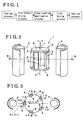
- Fig. 1 is a process flow chart describing a coating film drying method by use of a waterborne coating according to an embodiment of the present invention
- Fig. 2 illustrates a preliminary drying device being used in a preliminary drying process according to the embodiment of the present invention
- Fig. 3 is a pattern diagram illustrating an III-III cross-section of the preliminary drying device
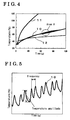
- Fig. 4 is a graph indicating variations in surface temperatures of coated members
- Fig. 5 describes details of Area A indicating variations in the surface temperature of the coated member in Fig. 4 when the coated member is rotated and exposed to mid-infrared rays according to the embodiment of the present invention.
- a coating film drying method for drying a coating film formed of a waterborne coating will be described below based on Figs. 1 to 6 .
- a subject work 13 Fig. 3
- coating films 8 and 9 Fig. 3
- the coating film drying method provides a technique for drying the coating films 8 and 9, which enables the coated member 2 to be treated in a short period of time after the coating films 8 and 9 are formed on the surfaces of the work 13.
- the waterborne coating applied in the technique consists primarily of acrylic emulsion and is one-liquid type cold-setting waterborne coating hardening at a temperature ranging from 70 degrees Celsius to 90 degrees Celsius.
- the work 13 is an automotive exterior part such as a spoiler or the like of made of plastic for a vehicle used in the automobile industry.
- Fig. 1 illustrates a process flow chart of the coating film drying method by use of the waterborne coating according to the embodiment.
- the process flow chart includes the following five processes: a coating process, a preliminary drying process, a clear-coating application process, a final drying process, and a cooling process.
- the coating films 8 and 9 are formed on the work 13 by applying the cold-setting waterborne coating to the work 13 of an automotive exterior part such as a spoiler for a vehicle by use of a spray coating method.
- the coated member 2 formed by applying the coating films 8 and 9 to the work 13 is dried while being repeatedly heated and cooled.
- the coated member 2 is preliminarily dried until a nonvolatile content (hereinafter referred to as a NV) in each of the coating films 8 and 9 reaches a percentage ranging from 70 percent to 90 percent.
- a NV nonvolatile content
- the percentage indication of this invention means the weight ratio.
- the coating film drying method includes the clear-coating application process between the preliminary drying process and a final drying process. Accordingly, a clear coating of the cold-setting solvent coating is applied to coating films formed of the waterborne coating.
- the coated member 2 is heated and dried until the NV of each of the coating films 8 and 9 reaches 97 percent or more. Since the drying time is shortened as the result of heating at high temperatures, it is preferably that heating is conducted at high temperatures unless the work 13 and the coating films 8 and 9 deteriorate. Heating by air blowing and infrared rays may be simultaneously used in order to facilitate drying.
- the coated member 2 is cooled until a surface temperature of the coated member 2 is decreased to a temperature at which the coated member 2 is touchable by hand.
- the coated member 2 may be naturally cooled but may be forcibly cooled in order to cool the coated member 2 in a short period of time.
- the coated member 2 is cooled until the surface temperature of the coated member 2 is decreased to a temperature at which drying properties do not substantially matter. For example, until the surface temperature of the coated member 2 is decreased to a temperature ranging from 30 degrees Celsius to 60 degrees Celsius, cooling is continued.
- air blowing, cold-air cooling, or the like is conducted in order to shorten the cooling time.
- Fig. 2 illustrates a preliminary drying device 1 applied in the preliminary drying process according to the embodiment.
- the preliminary drying device 1 includes a rotary device 3 for rotating the coated member 2 and a preliminary heating device 4 as heating means.
- the rotary device 3 includes an upper plate 5 and a lower plate 6.
- the coated members 2 are supported between an outer peripheral side of the upper plate 5 and an outer peripheral side of the lower plate 6 and extend in up and down directions in Fig. 2 .
- the upper plate 5 and the lower plate 6 are rotatably operated simultaneously with a shaft 7 in the range from 100 mm to 600 mm of the outer peripheral diameters respectively.
- the rotary device 3 is driven to rotate by driving means such as a motor (not shown).
- driving means such as a motor (not shown).
- the rotary device 3 rotates in the range from 5 rpm to 50 rpm in the embodiment.
- five of the coated materials 2 may be interposed between the upper plate 5 and the lower plate 6 and equally spaced with each other on the same track on the outer peripheries of the upper plate 5 and the lower plate 6.
- the preliminary heating device 4 is structured with two of 550 W to 1200 W mid-infrared heaters. Although a mid-infrared heater is applied in the embodiment, radiation type heaters other than the mid-infrared heater may be applied. In addition, the number of the preliminary heating devices 4 is not limited to two, and three or more of the preliminary heating devices 4 may be applied. When the number of the preliminary heating devices 4 is increased, the number of frequencies for heating and cooling the coated member 2 is increased.
- Fig. 3 is a pattern diagram illustrating an III-III cross-section of the preliminary drying device 1 applied in the preliminary drying process according to the embodiment.
- a distance between the coated member 2 and the preliminary heating device 4 is varied when the coated member 2 is rotated by the rotary device 3 at a predetermined frequency raging from 0.1 Hz to 2.0Hz, thereby repeatedly heating and cooling the coating film 8, which appears at the outer peripheral side of the rotary device 3, and the coating film 9, which appears at the inner peripheral side of the rotary device 3 as seen in Fig. 3 .
- the coated member 2 is approximated to the preliminary heating device 4 in the range from 30 mm to 100 mm by repeatedly heating and cooling the coated member 2 at the predetermined frequency.
- the above table 1 indicates the NV of the coating film of the coated member 2 and the surface temperature of the coating film of the coated member 2 one minute after a speed of the coated member 2 in a rotation direction varied.
- a speed ranging from 40 mm per second to 400 mm per second is generally a speed in a low-speed rotation region.
- the cooling time elongates and the surface temperature of the coated member 2 increases slowly.
- a speed of the coated member 2 reaches 400 mm per second or higher, the coated member 2 is cooled due to influence of convection between the rotating coated member 2 and atmospheric air, thereby increasing the surface temperature of the coated member 2 slowly.
- the speed of the coated member 2 ranging from 40 mm per second to 400 mm per second in the rotational direction is provided, thereby achieving the NV of the coating film of 70 percent or more one minute after the speed of the coated member 2 in the rotation direction varied.
- the NV of 70 percent or more is a required percentage for the preliminary heating process.
- Fig. 4 is a graph indicating variations in surface temperatures of coated members, and specially indicates variations 10 (according to the embodiment) in the temperature of the coated member 2 rotated by the rotary device 3 and exposed to mid-infrared rays, variations 11 in the temperature of the coated member 2 fixed, and not rotated, and exposed to mid-infrared rays, and variations 12 in the temperature of the coated member 2 fixed, and not rotated, and exposed to hot air.
- the coating films 8 and 9 are dried while the temperature of the coated member 2 is controlled so as not to increase in order to prevent occurrence of popping defects and deformation of the work 13 are prevented.
- the coated member 2 is fixed, not rotated, and exposed to mid-infrared rays
- the surface temperature of the coated member 2 rapidly increases and immediately exceeds the water boiling point of 100 degrees Celsius.
- the popping defects and deformation of the work 13 may be caused.
- the coated member 2 is fixed, not rotated, and exposed to hot air, heat is transferred to the coated member 2 due to hot air convection.
- the surface temperature of the coated member 2 slowly increases and preliminarily drying of the coating films 8 and 9 requires time.
- Fig. 5 describes details of Area A indicating the variations 10 in the temperature of the coated member 2 rotated by the rotary device 3 and exposed to mid-infrared rays.
- the surface temperature of the coated member 2 repeatedly increases and decreases at the frequency ranging from 0.1 Hz to 2.0 Hz and a temperature amplitude is between 3 degrees Celsius and 20 degrees Celsius.
- the coating films 8 and 9 of the coated member 2 are dried by repeatedly heating and cooling the coated member 2 at the predetermined frequency (for example at the frequency ranging from 0.1 Hz to 2.0 Hz) in the preliminary drying process, thereby facilitating drying of the coating films 8 and 9 without occurrence of popping defects. Accordingly, the preliminary drying time is reduced to a period of time between 40 seconds and 150 seconds, which is below half of the drying time when an air-heating furnace is used. Moreover, a temperature of plastic material or the like included in the work 13 for the coated member 2, is controlled to be lower than momentary high temperatures of the coating films 8 and 9 by repeatedly heating and cooling the coated member 2. Accordingly, the temperature of the coated member 2 is controlled to be low while drying of the coating films 8 and 9 is facilitated without occurrence of popping defects. Consequently, thermal deformation of the work 13 due to high temperatures is prevented, thereby preventing dimensional defects.
- the predetermined frequency for example at the frequency ranging from 0.1 Hz to 2.0 Hz
- a required distance between the coated member 2 and the preliminary heating device 4 for uniformly heating the coating films 8 and 9 by repeatedly heating and cooling the coated member 2 while the coated member is not rotated by the rotary device 3, is between 300 mm and 500 mm. Meanwhile, when the coated member 2 is rotated by the rotary device 3, the required distance is shortened to a length ranging from 30 mm to 100 mm, thereby downsizing the preliminary drying device 1.
- expensive equipment for covering the coated member 2 with an airtight metal container required when microwaves are applied is not required.
- the coated member 2 is processed in the coating line operated by the conveyor manufacturing system, it is possible to process the coated member 2 in the line without taking out the coated member 2 from the line, therefore securing higher productivity compared to the conventional coating film drying method.
- expensive equipments are not required compared to the conventional coating film drying method, thereby reducing production costs.
- the rotary device 3 rotates so that the coated member 2 is rotated at a speed ranging from 40 mm per second to 400 mm per second relative to the preliminary heating device 4.
- the coated member 2 is rotated at the speed ranging from 40 mm per second to 400 mm per second relative to the preliminary heating device 4
- cooling is lightly affected by convection created by rotation of the coated member 2 and the NV (NV: nonvolatile content during a preliminary heating process) of each of the coating films 8 and 9 is maintained to 70 percent or more, which is generally suitable for preliminary drying.
- mid-infrared rays are easily absorbed in waterborne coatings, it is possible to heat water in the coating films 8 and 9. Accordingly, drying of the coating films 8 and 9 is facilitated without occurrence of popping defects and the drying time is shortened.
- the coated member 2 is heated by radiant heat of mid-infrared rays, the temperature of the coated member 2 increases from the surface in comparison to the conventional coating film drying method in which water in the coating films 8 and 9 is totally heated from within. Accordingly, the temperature of the plastic material included in the work 13 for the coated member 2 is prevented from increasing. Consequently, thermal deformation of the work 13 is prevented, thereby preventing dimensional defects.
- the coated members 2 are repeatedly heated and cooled several timed while the rotary device 3 makes one rotation, so that drying of the coating films 8 and 9 is facilitated as well as the drying time is shortened.
- higher productivity is achieved compared to the conventional coating film drying method. Further, production costs are reduced because expensive equipments are not required.
- the coating film 9 that appears at the inner peripheral side of the rotary device 3 is also radiated by the preliminary heating device 4 while the coated members 2 attached to the rotary device 3 are rotated once. Accordingly, the coating film 8 that appears at the outer peripheral side of the rotary device 3 is dried without reversing the coating films 8 and 9, thereby improving productivity.
- Drying is facilitated by applying the waterborne coating consisting primarily of acrylic emulsion and forming one-liquid type cold-setting waterborne coating hardening at a temperature ranging from 70 degrees Celsius to 90 degrees Celsius and by radiating mid-infrared rays or near infrared rays while the coated member 2 is rotated, so that the drying time is shortened.
- the waterborne coating consisting primarily of acrylic emulsion and forming one-liquid type cold-setting waterborne coating hardening at a temperature ranging from 70 degrees Celsius to 90 degrees Celsius and by radiating mid-infrared rays or near infrared rays while the coated member 2 is rotated, so that the drying time is shortened.
- the curing agent consisting primarily of isocyanate is blended in the main agent consisting primarily of acrylic urethane, thereby forming a two-liquid type cold-setting solvent coating hardening at a temperature ranging from 70 degrees Celsius to 90 degrees Celsius.
- the two-liquid type cold-setting solvent coating is applied to the coated member 2. Since the coating film drying method includes the clear-coating application process provided between the preliminary drying process and the final drying process, a clear coating of the cold-setting solvent coating is applied to coating films formed of the waterborne coating.
- a coating film drying method includes a coating process for applying a waterborne coating to a work (13) and forming a coating film (8, 9) on the work (13), so that a coated member (2) is produced, a preliminary drying process for heating the coated member (2) and preliminarily drying the coated member (2) until a nonvolatile content of the coating film (8, 9) reaches a percentage ranging from 70% to 90%, a final drying process for heating and drying the coated member (2) until the nonvolatile content reaches 97% or more, and a cooling process for cooling the coated member (2) until a surface temperature of the coated member (2) is decreased to a temperature at which the coated member (2) is touchable by hand, whereby the preliminary drying process is carried out by repeatedly heating and cooling the coated member (2) at a predetermined frequency.
Landscapes
- Engineering & Computer Science (AREA)
- Mechanical Engineering (AREA)
- General Engineering & Computer Science (AREA)
- Chemical & Material Sciences (AREA)
- Combustion & Propulsion (AREA)
- Life Sciences & Earth Sciences (AREA)
- Microbiology (AREA)
- Application Of Or Painting With Fluid Materials (AREA)
- Drying Of Solid Materials (AREA)
Abstract
A coating film drying method includes a coating process for applying a waterborne coating to a work (13) and forming a coating film (8, 9) on the work (13), so that a coated member (2) is produced, a preliminary drying process for heating the coated member (2) and preliminarily drying the coated member (2) until a nonvolatile content of the coating film (8, 9) reaches a percentage ranging from 70% to 90%, a final drying process for heating and drying the coated member (2) until the nonvolatile content reaches 97% or more, and a cooling process for cooling the coated member (2) until a surface temperature of the coated member (2) is decreased to a temperature at which the coated member (2) is touchable by hand, whereby the preliminary drying process is carried out by repeatedly heating and cooling the coated member (2) at a predetermined frequency.
Description
- The present invention relates to a coating film drying method by use of waterborne coatings, and more particularly to a coating film drying method, which includes a process for preliminarily drying a coating film.
- In recent years, a transition of coatings from solvent-borne coatings to waterborne coatings has been required due to global environmental issues. For example, the automobile industry has proceeded with replacement of coatings for vehicle bodies or bumpers from solventborne coatings to waterborne coatings.
- A waterborne coating is dried by use of hot air, a heater, or the like in a drying process. A coating film formed of the waterborne coating is dried by externally applying heat. At this time, when the coating film is rapidly heated to be dried quickly for shortening processes, a surface of the coating film is firstly solidified. Thereafter, water in the coating film evaporates, leading to appearance defects referred to as popping defects. The popping defects are the appearance defects in which crater-like openings are formed on the surface of the coating film. It is necessary to heat the entire coating film as slowly as possible so as to be warmed as uniformly as possible in order to solve such popping defects. Accordingly, the drying time of the coating film disadvantageously takes longer compared to a coating film drying process by use of a solventborne coating.
- Meanwhile, a coating film drying method described in
JP 2003-340361A Patent Document 1, popping defects do not occur and the drying time is shortened. - Furthermore, another coating film drying method disclosed in
JP 2004-344860A - Moreover, a coating film drying method disclosed in
JP 2006-26547A - However, conventionally, according to the coating film drying method described in
Patent Document 1, the coated work is put into a drying furnace and is heated by use of a heating method such as air blowing, hot-air drying, and infrared heating. The coated work is directly set and not moved in the drying furnace. Accordingly, when the coated work is made of plastic material or the like being thermally deformed easily, deformation of the coated work is of concern. Further, a predetermined distance between a heating device and the coated work is required in order to prevent thermal deformation of the coated work due to spot heating thereon and in order to uniformly heat the coated work, leading to an increase of a size of the drying furnace or the like. - Moreover, conventionally, according to the coating film drying method described in
Patent Document 2, when the microwaves rapidly develop heat by vibrating water molecules, water in the coating film is boiled, resulting in occurrence of popping defects. In addition, when a coating is applied to a subject work made of plastic material, the subject work generally absorbs water existing in working surroundings. Accordingly, the coated work is rapidly heated and deformed by heating with the microwaves, resulting in dimensional defects. Further, equipment for covering the coated work with an airtight metal container is required when the microwaves are applied. In the case of a coating line operated by conveyor manufacturing system, it is necessary to take out the coated work from the production line once for treatment, resulting in decreased productivity and causing a steep rise in production costs due to the requirement of expensive equipments. - Furthermore, conventionally, according to the coating film drying method described in
Patent Document 3, occurrence of popping defects and deformation of the subject work are prevented by controlling the outputs from the microwaves. However, since the microwaves are applied, equipment for covering the coated work with an airtight metal container is required. In the case of a coating line operated by conveyor manufacturing system, it is necessary to take out the coated work from the production line once for treatment, resulting in decreased productivity and causing a steep rise in production costs due to the requirement of expensive equipments including the control of the outputs from the microwaves. - A need thus exists for a coating film drying method, which shortens the drying time without occurrence of popping defects, prevents deformation of a subject work, increases productivity, and preliminarily dries the coating film with more compact and inexpensive equipment compared to equipment for the conventional coating film drying methods.
- According to an aspect of the present invention, a coating film drying method includes a coating process for applying a waterborne coating to a work and forming a coating film on the work, so that a coated member is produced from the work having the coating film. The coating film drying method further includes a preliminary drying process for heating the coated member and preliminarily drying the coated member until a nonvolatile content of the coating film reaches a percentage ranging from 70% to 90%, a final drying process for heating and drying the coated member until the nonvolatile content of the coating film reaches a percentage of 97% or more, and a cooling process for cooling the coated member until a surface temperature of the coated member is decreased to a temperature at which the coated member is touchable by hand, whereby the preliminary drying process is carried out by repeatedly heating and cooling the coated member at a predetermined frequency to preliminarily dry the coating film.
- In the coating film drying method according to the present invention, the coated film is preliminarily dried by repeatedly heating and cooling the coated member in the preliminarily drying process while rotated by the rotary device at a predetermined frequency (for example a frequency raging from 0.1Hz to 20Hz). Consequently, drying of the coating film is facilitated without occurrence of popping defects and the drying time is shortened. The reason why the drying time of the coating film is shortened by repeatedly heating and cooling the coated member will be explained as follows. A temperature amplitude (a higher temperature side) in the case of the coating film drying method of the embodiment where the coated member is repeatedly heated and cooled and then dried while being rotated, is 5 degrees Celsius higher (a higher temperature side) than a temperature amplitude (a higher temperature side) in the case of the conventional coating film drying method where the coated member is dried while being fixed. In this case, a maximum water vapor pressure in the coating film drying method of the embodiment is increased approximately by 25%. Drying of water contained in the coating film is in correlation with the maximum water vapor pressure. When the coating film is heated with a heating device such as infrared waves, the temperature of the water contained in the coated film increases. As the temperature increases, the maximum water vapor pressure increases. When the maximum water vapor pressure is high, pressure applied to the water contained in the coated film increases, so that volatilization of the water contained in the coated film is facilitated and so that the coating film is dried. At this time, the temperature of the plastic material or the like included in the work for the coated member is controlled to be lower than a higher temperature in the temperature amplitude by repeatedly heating and cooling. Accordingly, the temperature of the coated member is controlled so as not to increase while the coating film are dried without occurrence of popping defects, so that thermal deformation of the coated member and the work due to high temperatures is prevented and dimensional defects are also prevented.
- According to the present invention, a preliminary drying device is used in the coating film drying method, the preliminary drying device includes a rotary device for rotating the coated member and a preliminary heating device for heating the coating film of the coated member, wherein a distance between the coated member and the preliminary heating device is varied when the coated member is rotated by the rotary device at the predetermined frequency, whereby the coated member is repeatedly heated and cooled.
- Accordingly, when the coated member is rotated by the rotary device in the preliminary drying process, a required distance between the coated member and the heating device for uniformly heating the coating film is shortened from a length ranging from 300mm to 500mm when the coated member is not rotated to a length ranging from 30mm to 100mm when the coated member is rotated. Consequently, when the coated member is rotated by the rotary device, the coated member is approximated to the preliminary heating device in the range from 300 mm to 500 mm, thereby minimizing the preliminary drying device. In addition, expensive equipment for covering the coated member with an airtight metal container and required when microwaves are applied, is not required. Moreover in the coating line operated by the conveyor manufacturing system, it is possible to process the coated member in the line without taking out the coated member from the line, therefore securing higher productivity compared to the conventional coating film drying method. Further, expensive equipment is not required compared to the conventional coating film drying method, so that production costs are reduced.
- In the coating film drying method according to the present invention, the rotary device rotates so that the coated member is rotated at a speed ranging from 40 mm per second to 400 mm per second relative to the preliminary heating device.
- Accordingly, the rotary device rotates so that the coated member is rotated at a speed ranging from 40 mm per second to 400 mm per second relative to the preliminary heating device. When the coated member is rotated at the speed ranging from 40 mm per second to 400 mm per second relative to the preliminary heating device, cooling is lightly affected by convection created by rotation of the coated member and the nonvolatile content (NV: nonvolatile content during a preliminary heating process) of the coating film is maintained to 70 percent or more. The nonvolatile content of 70% is generally a suitable percentage for a preliminary drying process.
- In the coating film drying method according to the present invention, the coated member is heated by the preliminary heating device with mid-infrared rays or near infrared rays and is preliminarily dried.
- Accordingly, since mid-infrared rays or near infrared rays are easily absorbed in waterborne coatings, it is possible to heat water in the coating film. Consequently, drying of the coating film is facilitated without occurrence of popping defects and the drying time is shortened. Moreover, since the coated member is heated by radiant heat of the mid-infrared rays, the temperature of the coated member increases from the surface in comparison to the conventional coating film drying method in which water in the coating film is totally heated from within. Accordingly, the temperature of the plastic material included in the work for the coated member is prevented from increasing. Consequently, thermal deformation of the work is prevented, thereby preventing dimensional defects.
- In the coating film drying method according to the present invention, a plurality of the coated members is attached to the rotary device on the same track, the plurality of the coated members is heated by a plurality of the preliminary heating devices and is preliminarily dried.
- Since the plurality of the coated members is attached to the rotary device on the same track and heated by the plurality of the preliminary heating devices, the coated members are repeatedly heated and cooled several times while the rotary device makes one rotation. Accordingly, drying of the coating film of each of the coated members is facilitated as well as the drying time is shortened. In addition, since the plurality of the coated members is attached to the rotary device on the same track, higher productivity is achieved compared to the conventional coating film drying method. Further, production costs are reduced because expensive equipments are not required.
- In the coating film drying method according to the present invention, an odd number of the coated members is attached to the rotary device.
- Since the odd number of the coated members is attached to the rotary device, the coating film that appears at the outer peripheral side of the rotary device is radiated by the preliminary heating device while the coated members attached to the rotary device are rotated once. Accordingly, the coating film is dried without reversing the coating films appear at the outer and inner peripheral sides of the rotary device, therefore improving productivity.
- In the coating film drying method according to the present invention, the waterborne coating is a cold-setting waterborne coating.
- Accordingly, drying with mid-infrared rays or near infrared rays is facilitated by applying the waterborne coating consisting primarily of acrylic emulsion and forming one-liquid type cold-setting waterborne coating which hardens at a temperature ranging from 70 degrees Celsius to 90 degrees Celsius, so that the drying time is shortened.
- According to the present invention, the coating film drying method further includes a clear-coating application process for applying the cold-setting waterborne coating to the coated member between the preliminary drying process and the final drying process.
- In the clear-coating application process, the curing agent consisting primarily of isocyanate is blended in a main agent consisting primarily of acrylic urethane, thereby forming a two-liquid type cold-setting solvent coating hardening at a temperature ranging from 70 degrees Celsius to 90 degrees Celsius. Afterwards, the two-liquid type cold setting solvent coating is applied to the coated member. Since the coating film drying method includes the clear-coating application process between the preliminary drying process and the final drying process, a clear coating of the cold-setting solvent coating is applied to coating film formed of the waterborne coating.
- The foregoing and additional features and characteristics of the present invention will become more apparent from the following detailed description considered with reference to the accompanying drawings, wherein:
-
Fig. 1 is a process flow chart describing a coating film drying method by use of a waterborne coating according to an embodiment of the present invention; -
Fig. 2 illustrates a preliminary drying device being used in a preliminary drying process according to the embodiment of the present invention; -
Fig. 3 is a pattern diagram illustrating an III-III cross-section of the preliminary drying device; -
Fig. 4 is a graph indicating variations in surface temperatures of coated members; -
Fig. 5 describes details of Area A indicating variations in the surface temperature of the coated member inFig. 4 when the coated member is rotated and exposed to mid-infrared rays according to the embodiment of the present invention. - An embodiment of the present invention will be explained with reference to the illustrations of the drawing figures as follows.
- A coating film drying method for drying a coating film formed of a waterborne coating according to the embodiment will be described below based on
Figs. 1 to 6 . When a subject work 13 (Fig. 3 ) is coated with the waterborne coating,coating films 8 and 9 (Fig. 3 ) are formed on surfaces of thework 13, so that a coated member 2 (Fig. 2 ) is produced from thework 13 having thecoating films coating films coated member 2 to be treated in a short period of time after thecoating films work 13. The waterborne coating applied in the technique consists primarily of acrylic emulsion and is one-liquid type cold-setting waterborne coating hardening at a temperature ranging from 70 degrees Celsius to 90 degrees Celsius. In addition, thework 13 is an automotive exterior part such as a spoiler or the like of made of plastic for a vehicle used in the automobile industry. -
Fig. 1 illustrates a process flow chart of the coating film drying method by use of the waterborne coating according to the embodiment. The process flow chart includes the following five processes: a coating process, a preliminary drying process, a clear-coating application process, a final drying process, and a cooling process. - In the coating process, the
coating films work 13 by applying the cold-setting waterborne coating to thework 13 of an automotive exterior part such as a spoiler for a vehicle by use of a spray coating method. - In the preliminary drying process, the
coated member 2 formed by applying thecoating films work 13 is dried while being repeatedly heated and cooled. Thecoated member 2 is preliminarily dried until a nonvolatile content (hereinafter referred to as a NV) in each of thecoating films - In the clear-coating application process, a curing agent consisting primarily of isocyanate is blended in a main agent consisting primarily of acrylic urethane, thereby forming a two-liquid type cold-setting solvent coating hardening at a temperature ranging from 70 degrees Celsius to 90 degrees Celsius. Afterwards, the two-liquid type cold-setting solvent coating is applied to the
coated member 2. Since design properties are required for automotive parts or the like attached to exterior surfaces for a vehicle, the coating film drying method includes the clear-coating application process between the preliminary drying process and a final drying process. Accordingly, a clear coating of the cold-setting solvent coating is applied to coating films formed of the waterborne coating. - In the final drying process, the
coated member 2 is heated and dried until the NV of each of thecoating films work 13 and thecoating films - In the cooling process, the
coated member 2 is cooled until a surface temperature of thecoated member 2 is decreased to a temperature at which thecoated member 2 is touchable by hand. Thecoated member 2 may be naturally cooled but may be forcibly cooled in order to cool thecoated member 2 in a short period of time. Thecoated member 2 is cooled until the surface temperature of thecoated member 2 is decreased to a temperature at which drying properties do not substantially matter. For example, until the surface temperature of thecoated member 2 is decreased to a temperature ranging from 30 degrees Celsius to 60 degrees Celsius, cooling is continued. Preferably, air blowing, cold-air cooling, or the like is conducted in order to shorten the cooling time. -
Fig. 2 illustrates apreliminary drying device 1 applied in the preliminary drying process according to the embodiment. Thepreliminary drying device 1 includes arotary device 3 for rotating thecoated member 2 and apreliminary heating device 4 as heating means. - The
rotary device 3 includes an upper plate 5 and alower plate 6. Thecoated members 2 are supported between an outer peripheral side of the upper plate 5 and an outer peripheral side of thelower plate 6 and extend in up and down directions inFig. 2 . The upper plate 5 and thelower plate 6 are rotatably operated simultaneously with a shaft 7 in the range from 100 mm to 600 mm of the outer peripheral diameters respectively. Therotary device 3 is driven to rotate by driving means such as a motor (not shown). When the shaft 7 rotates, thecoated members 2 supported by the upper plate 5 and thelower plate 6 are rotated at the same time. Therotary device 3 rotates in the range from 5 rpm to 50 rpm in the embodiment. In addition, five of thecoated materials 2 may be interposed between the upper plate 5 and thelower plate 6 and equally spaced with each other on the same track on the outer peripheries of the upper plate 5 and thelower plate 6. - The
preliminary heating device 4 is structured with two of 550 W to 1200 W mid-infrared heaters. Although a mid-infrared heater is applied in the embodiment, radiation type heaters other than the mid-infrared heater may be applied. In addition, the number of thepreliminary heating devices 4 is not limited to two, and three or more of thepreliminary heating devices 4 may be applied. When the number of thepreliminary heating devices 4 is increased, the number of frequencies for heating and cooling thecoated member 2 is increased. -
Fig. 3 is a pattern diagram illustrating an III-III cross-section of thepreliminary drying device 1 applied in the preliminary drying process according to the embodiment. A distance between thecoated member 2 and thepreliminary heating device 4 is varied when thecoated member 2 is rotated by therotary device 3 at a predetermined frequency raging from 0.1 Hz to 2.0Hz, thereby repeatedly heating and cooling thecoating film 8, which appears at the outer peripheral side of therotary device 3, and thecoating film 9, which appears at the inner peripheral side of therotary device 3 as seen inFig. 3 . Accordingly, thecoated member 2 is approximated to thepreliminary heating device 4 in the range from 30 mm to 100 mm by repeatedly heating and cooling thecoated member 2 at the predetermined frequency. Since an odd number (five) of thecoated members 2 are interposed between the upper plate 5 and thelower plate 6 and equally spaced with each other on the same track on the outer peripheries of the upper plate 5 and thelower plate 6 of therotary device 3, mid-infrared rays from thepreliminary heating device 4 to the right side inFig. 3 are irradiated to thecoating film 9 that appears at the inner peripheral side of therotary device 3 when radiant heat of the mid-infrared rays from thepreliminary heating device 4 positioned to the right side inFig. 3 is transferred straight to thecoating film 9 through a space between the adjacentcoated members 2.<Table 1> A NV of a coating film and a surface temperature of the coating film when a speed of the coated member 2 in a rotation direction varies.Speed (mm per second) NV of the coating film (%) Surface temperature of the coating film (degrees Celsius) 30 69 34 40 71 36 80 75 40 160 79 42 200 80 43 250 80 43 330 77 41 400 70 38 420 68 37 500 58 33 - The above table 1 indicates the NV of the coating film of the
coated member 2 and the surface temperature of the coating film of thecoated member 2 one minute after a speed of thecoated member 2 in a rotation direction varied. A speed ranging from 40 mm per second to 400 mm per second is generally a speed in a low-speed rotation region. When a speed of thecoated member 2 is lower than 40 mm per second, the cooling time elongates and the surface temperature of thecoated member 2 increases slowly. When a speed of thecoated member 2 reaches 400 mm per second or higher, thecoated member 2 is cooled due to influence of convection between the rotatingcoated member 2 and atmospheric air, thereby increasing the surface temperature of thecoated member 2 slowly. The speed of thecoated member 2 ranging from 40 mm per second to 400 mm per second in the rotational direction is provided, thereby achieving the NV of the coating film of 70 percent or more one minute after the speed of thecoated member 2 in the rotation direction varied. The NV of 70 percent or more is a required percentage for the preliminary heating process. -
Fig. 4 is a graph indicating variations in surface temperatures of coated members, and specially indicates variations 10 (according to the embodiment) in the temperature of thecoated member 2 rotated by therotary device 3 and exposed to mid-infrared rays, variations 11 in the temperature of thecoated member 2 fixed, and not rotated, and exposed to mid-infrared rays, and variations 12 in the temperature of thecoated member 2 fixed, and not rotated, and exposed to hot air. - According to the embodiment, when the
coated member 2 is rotated by therotary device 3 and exposed mid-infrared rays, thecoating films coated member 2 is controlled so as not to increase in order to prevent occurrence of popping defects and deformation of thework 13 are prevented. Meanwhile, when thecoated member 2 is fixed, not rotated, and exposed to mid-infrared rays, the surface temperature of thecoated member 2 rapidly increases and immediately exceeds the water boiling point of 100 degrees Celsius. When the surface temperature of thecoated member 2 exceeds 100 degrees Celsius, the popping defects and deformation of thework 13 may be caused. In addition, when thecoated member 2 is fixed, not rotated, and exposed to hot air, heat is transferred to thecoated member 2 due to hot air convection. However, the surface temperature of thecoated member 2 slowly increases and preliminarily drying of thecoating films -
Fig. 5 describes details of Area A indicating thevariations 10 in the temperature of thecoated member 2 rotated by therotary device 3 and exposed to mid-infrared rays. The surface temperature of thecoated member 2 repeatedly increases and decreases at the frequency ranging from 0.1 Hz to 2.0 Hz and a temperature amplitude is between 3 degrees Celsius and 20 degrees Celsius. - In the embodiment, the
coating films coated member 2 are dried by repeatedly heating and cooling thecoated member 2 at the predetermined frequency (for example at the frequency ranging from 0.1 Hz to 2.0 Hz) in the preliminary drying process, thereby facilitating drying of thecoating films work 13 for thecoated member 2, is controlled to be lower than momentary high temperatures of thecoating films coated member 2. Accordingly, the temperature of thecoated member 2 is controlled to be low while drying of thecoating films work 13 due to high temperatures is prevented, thereby preventing dimensional defects. - Furthermore, a required distance between the
coated member 2 and thepreliminary heating device 4 for uniformly heating thecoating films coated member 2 while the coated member is not rotated by therotary device 3, is between 300 mm and 500 mm. Meanwhile, when thecoated member 2 is rotated by therotary device 3, the required distance is shortened to a length ranging from 30 mm to 100 mm, thereby downsizing thepreliminary drying device 1. In addition, expensive equipment for covering thecoated member 2 with an airtight metal container required when microwaves are applied is not required. When thecoated member 2 is processed in the coating line operated by the conveyor manufacturing system, it is possible to process thecoated member 2 in the line without taking out thecoated member 2 from the line, therefore securing higher productivity compared to the conventional coating film drying method. In addition, expensive equipments are not required compared to the conventional coating film drying method, thereby reducing production costs. - Moreover, the
rotary device 3 rotates so that thecoated member 2 is rotated at a speed ranging from 40 mm per second to 400 mm per second relative to thepreliminary heating device 4. When thecoated member 2 is rotated at the speed ranging from 40 mm per second to 400 mm per second relative to thepreliminary heating device 4, cooling is lightly affected by convection created by rotation of thecoated member 2 and the NV (NV: nonvolatile content during a preliminary heating process) of each of thecoating films - In addition, since mid-infrared rays are easily absorbed in waterborne coatings, it is possible to heat water in the
coating films coating films coated member 2 is heated by radiant heat of mid-infrared rays, the temperature of thecoated member 2 increases from the surface in comparison to the conventional coating film drying method in which water in thecoating films work 13 for thecoated member 2 is prevented from increasing. Consequently, thermal deformation of thework 13 is prevented, thereby preventing dimensional defects. - Since a plurality of the
coated materials 2 is attached to therotary device 3 on the same track and heated by two of thepreliminary heating devices 4, thecoated members 2 are repeatedly heated and cooled several timed while therotary device 3 makes one rotation, so that drying of thecoating films coated materials 2 are attached to therotary device 3 on the same track, higher productivity is achieved compared to the conventional coating film drying method. Further, production costs are reduced because expensive equipments are not required. - Since an odd number of the
coated materials 2 is attached to therotary device 3, thecoating film 9 that appears at the inner peripheral side of therotary device 3 is also radiated by thepreliminary heating device 4 while thecoated members 2 attached to therotary device 3 are rotated once. Accordingly, thecoating film 8 that appears at the outer peripheral side of therotary device 3 is dried without reversing thecoating films - Drying is facilitated by applying the waterborne coating consisting primarily of acrylic emulsion and forming one-liquid type cold-setting waterborne coating hardening at a temperature ranging from 70 degrees Celsius to 90 degrees Celsius and by radiating mid-infrared rays or near infrared rays while the
coated member 2 is rotated, so that the drying time is shortened. - Moreover, in the clear-coating application process, the curing agent consisting primarily of isocyanate is blended in the main agent consisting primarily of acrylic urethane, thereby forming a two-liquid type cold-setting solvent coating hardening at a temperature ranging from 70 degrees Celsius to 90 degrees Celsius. Afterwards, the two-liquid type cold-setting solvent coating is applied to the
coated member 2. Since the coating film drying method includes the clear-coating application process provided between the preliminary drying process and the final drying process, a clear coating of the cold-setting solvent coating is applied to coating films formed of the waterborne coating. - A coating film drying method includes a coating process for applying a waterborne coating to a work (13) and forming a coating film (8, 9) on the work (13), so that a coated member (2) is produced, a preliminary drying process for heating the coated member (2) and preliminarily drying the coated member (2) until a nonvolatile content of the coating film (8, 9) reaches a percentage ranging from 70% to 90%, a final drying process for heating and drying the coated member (2) until the nonvolatile content reaches 97% or more, and a cooling process for cooling the coated member (2) until a surface temperature of the coated member (2) is decreased to a temperature at which the coated member (2) is touchable by hand, whereby the preliminary drying process is carried out by repeatedly heating and cooling the coated member (2) at a predetermined frequency.
Claims (8)
- A coating film drying method comprising:a coating process for applying a waterborne coating to a work (13) and forming a coating film (8, 9) on the work (13), so that a coated member (2) is produced from the work (13) having the coating film (8, 9);a preliminary drying process for heating the coated member (2) and preliminarily drying the coated member (2) until a nonvolatile content of the coating film (8, 9) reaches a percentage ranging from 70% to 90%;a final drying process for heating and drying the coated member (2) until the nonvolatile content of the coating film (8, 9) reaches a percentage of 97% or more; anda cooling process for cooling the coated member (2) until a surface temperature of the coated member (2) is decreased to a temperature at which the coated member (2) is touchable by hand, whereby the preliminary drying process is carried out by repeatedly heating and cooling the coated member (2) at a predetermined frequency to preliminarily dry the coating film (8, 9).
- The coating film drying method according to Claim 1, wherein a preliminary drying device (1) is used in the coating film drying method, the preliminary drying device (1) includes a rotary device (3) for rotating the coated member (2) and a preliminary heating device (4) for heating the coating film (8, 9) of the coated member (2), wherein a distance between the coated member (2) and the preliminary heating device (4) is varied when the coated member (2) is rotated by the rotary device (3) at the predetermined frequency, whereby the coated member (2) is repeatedly heated and cooled.
- The coating film drying method according to Claim 2, wherein the rotary device (3) rotates so that the coated member (2) is rotated at a speed ranging from 40 mm per second to 400 mm per second relative to the preliminary heating device (4).
- The coating film drying method according to Claim 2, wherein the coated member (2) is heated by the preliminary heating device (4) with mid-infrared rays or near infrared rays and is preliminarily dried.
- The coating film drying method according to Claim 2, wherein a plurality of the coated members (2) is attached to the rotary device (3) on the same track, the plurality of the coated members (2) is heated by a plurality of the preliminary heating devices (4) and is preliminarily dried.
- The coating film drying method according to Claim 5, wherein an odd number of the coated members (2) is attached to the rotary device (3).
- The coating film drying method according to Claim 1, wherein the waterborne coating is a cold-setting waterborne coating.
- The coating film drying method according to Claim 1, further comprises a clear-coating application process for applying the cold-setting waterborne coating to the coated member (2) between the preliminary drying process and the final drying process.
Applications Claiming Priority (1)
| Application Number | Priority Date | Filing Date | Title |
|---|---|---|---|
| JP2007012794A JP5157177B2 (en) | 2007-01-23 | 2007-01-23 | Coating film drying method |
Publications (1)
| Publication Number | Publication Date |
|---|---|
| EP1950515A2 true EP1950515A2 (en) | 2008-07-30 |
Family
ID=39345424
Family Applications (1)
| Application Number | Title | Priority Date | Filing Date |
|---|---|---|---|
| EP07150144A Pending EP1950515A2 (en) | 2007-01-23 | 2007-12-19 | Coating film drying method |
Country Status (4)
| Country | Link |
|---|---|
| US (1) | US20080176006A1 (en) |
| EP (1) | EP1950515A2 (en) |
| JP (1) | JP5157177B2 (en) |
| CN (1) | CN101229544A (en) |
Cited By (1)
| Publication number | Priority date | Publication date | Assignee | Title |
|---|---|---|---|---|
| RU2393397C2 (en) * | 2009-05-26 | 2010-06-27 | Иван Владимирович Григорьев | Method of impulse infrared drying of thermolabile materials |
Families Citing this family (9)
| Publication number | Priority date | Publication date | Assignee | Title |
|---|---|---|---|---|
| KR101007682B1 (en) | 2008-11-18 | 2011-01-13 | 세메스 주식회사 | Method and apparatus for forming coated thin film in flat panel display device manufacturing |
| US9945610B2 (en) | 2012-10-19 | 2018-04-17 | Nike, Inc. | Energy efficient infrared oven |
| CN103779484A (en) * | 2014-01-24 | 2014-05-07 | 南通苏禾车灯配件有限公司 | Dispensing and curing method in packaging process of LED lamp |
| CN104174570B (en) * | 2014-07-18 | 2016-04-13 | 福建力宝动力机械有限公司 | A kind of surface of internal cavity treatment process of cylinder cover |
| CN106938061B (en) * | 2017-04-17 | 2020-10-16 | 科睿驰(深圳)医疗科技发展有限公司 | Coating method for improving surface of interventional instrument |
| CN109855413B (en) * | 2019-01-29 | 2021-05-11 | 婺源县万和茶业有限公司 | Circulating drying device for tea leaves |
| CN112414051A (en) * | 2020-11-13 | 2021-02-26 | 刘年平 | A Grain Dryer Using Rotary Cycle |
| CN112794315B (en) * | 2021-04-07 | 2021-07-13 | 山东海科创新研究院有限公司 | Preparation method of high-flux and high-density graphene thermally conductive film and product obtained therefrom |
| CN114798372A (en) * | 2022-04-15 | 2022-07-29 | 浙江菱格木业有限公司 | Color-change-resistant paint coating pretreatment process |
Citations (3)
| Publication number | Priority date | Publication date | Assignee | Title |
|---|---|---|---|---|
| JP2003340361A (en) | 2002-05-29 | 2003-12-02 | Nippon Paint Co Ltd | Coating drying method |
| JP2004344860A (en) | 2003-03-25 | 2004-12-09 | Kansai Paint Co Ltd | Method for forming coating film |
| JP2006026547A (en) | 2004-07-16 | 2006-02-02 | Toyota Motor Corp | Paint drying method |
Family Cites Families (1)
| Publication number | Priority date | Publication date | Assignee | Title |
|---|---|---|---|---|
| JP2006226629A (en) * | 2005-02-18 | 2006-08-31 | Negishi Seisakusho:Kk | Radiation drying equipment |
-
2007
- 2007-01-23 JP JP2007012794A patent/JP5157177B2/en not_active Expired - Fee Related
- 2007-12-13 US US11/955,848 patent/US20080176006A1/en not_active Abandoned
- 2007-12-19 EP EP07150144A patent/EP1950515A2/en active Pending
-
2008
- 2008-01-22 CN CNA2008100008012A patent/CN101229544A/en active Pending
Patent Citations (3)
| Publication number | Priority date | Publication date | Assignee | Title |
|---|---|---|---|---|
| JP2003340361A (en) | 2002-05-29 | 2003-12-02 | Nippon Paint Co Ltd | Coating drying method |
| JP2004344860A (en) | 2003-03-25 | 2004-12-09 | Kansai Paint Co Ltd | Method for forming coating film |
| JP2006026547A (en) | 2004-07-16 | 2006-02-02 | Toyota Motor Corp | Paint drying method |
Cited By (1)
| Publication number | Priority date | Publication date | Assignee | Title |
|---|---|---|---|---|
| RU2393397C2 (en) * | 2009-05-26 | 2010-06-27 | Иван Владимирович Григорьев | Method of impulse infrared drying of thermolabile materials |
Also Published As
| Publication number | Publication date |
|---|---|
| US20080176006A1 (en) | 2008-07-24 |
| JP2008178773A (en) | 2008-08-07 |
| JP5157177B2 (en) | 2013-03-06 |
| CN101229544A (en) | 2008-07-30 |
Similar Documents
| Publication | Publication Date | Title |
|---|---|---|
| US20080176006A1 (en) | Coating film drying method | |
| JP5568377B2 (en) | Drying method | |
| EP2060863B2 (en) | Coating film drying method and coating film drying apparatus | |
| EP0486036B1 (en) | Drying method and device for coated layer | |
| JP2005532153A5 (en) | ||
| CA2627228A1 (en) | Method & apparatus for sublimation printing | |
| CN102341189B (en) | Method and apparatus for paint curing | |
| CN100577383C (en) | Drying method and drying device for honeycomb formed body | |
| JP2006130384A (en) | Coating and drying method of aqueous paint and apparatus therefor | |
| JP2018509583A (en) | Instrument for controlled degassing and curing operations | |
| US20100086669A1 (en) | Method for accelerated drying of polymers and device | |
| US20150276311A1 (en) | Finish curing method and system for leather-based substrates | |
| US20070022624A1 (en) | Paint-drying system and method | |
| US20060127616A1 (en) | Controlled infrared/fluid coating cure process | |
| JP2005177632A (en) | Coating method and flash-off device | |
| JP6644893B2 (en) | Powder slush molding machine and powder slush molding method | |
| KR20190042125A (en) | A moveable drying apparatus | |
| JP2712944B2 (en) | Drying oven for painting | |
| JP2514179B2 (en) | Gas discharge device in furnace | |
| US6288377B1 (en) | Varnish oven for manufacturing process | |
| JP3094451U (en) | Infrared heater for paint drying | |
| JP5067633B2 (en) | Method for drying coating film of water-based paint | |
| CN204693175U (en) | The automotive infrared baking lamp of Wavelength tunable formula | |
| JPH10189220A (en) | Infrared heating device | |
| CN108212712A (en) | Multistage dual temperature area electromagnetism baker |
Legal Events
| Date | Code | Title | Description |
|---|---|---|---|
| PUAI | Public reference made under article 153(3) epc to a published international application that has entered the european phase |
Free format text: ORIGINAL CODE: 0009012 |
|
| STAA | Information on the status of an ep patent application or granted ep patent |
Free format text: STATUS: THE APPLICATION HAS BEEN PUBLISHED |
|
| AK | Designated contracting states |
Kind code of ref document: A2 Designated state(s): AT BE BG CH CY CZ DE DK EE ES FI FR GB GR HU IE IS IT LI LT LU LV MC MT NL PL PT RO SE SI SK TR |
|
| AX | Request for extension of the european patent |
Extension state: AL BA HR MK RS |