EP1947456A1 - Method of confirming probe-loading position in nucleic acid array - Google Patents
Method of confirming probe-loading position in nucleic acid array Download PDFInfo
- Publication number
- EP1947456A1 EP1947456A1 EP06832420A EP06832420A EP1947456A1 EP 1947456 A1 EP1947456 A1 EP 1947456A1 EP 06832420 A EP06832420 A EP 06832420A EP 06832420 A EP06832420 A EP 06832420A EP 1947456 A1 EP1947456 A1 EP 1947456A1
- Authority
- EP
- European Patent Office
- Prior art keywords
- nucleic acid
- probes
- complementary
- arrays
- array
- Prior art date
- Legal status (The legal status is an assumption and is not a legal conclusion. Google has not performed a legal analysis and makes no representation as to the accuracy of the status listed.)
- Granted
Links
Images


Classifications
-
- C—CHEMISTRY; METALLURGY
- C12—BIOCHEMISTRY; BEER; SPIRITS; WINE; VINEGAR; MICROBIOLOGY; ENZYMOLOGY; MUTATION OR GENETIC ENGINEERING
- C12Q—MEASURING OR TESTING PROCESSES INVOLVING ENZYMES, NUCLEIC ACIDS OR MICROORGANISMS; COMPOSITIONS OR TEST PAPERS THEREFOR; PROCESSES OF PREPARING SUCH COMPOSITIONS; CONDITION-RESPONSIVE CONTROL IN MICROBIOLOGICAL OR ENZYMOLOGICAL PROCESSES
- C12Q1/00—Measuring or testing processes involving enzymes, nucleic acids or microorganisms; Compositions therefor; Processes of preparing such compositions
- C12Q1/68—Measuring or testing processes involving enzymes, nucleic acids or microorganisms; Compositions therefor; Processes of preparing such compositions involving nucleic acids
- C12Q1/6813—Hybridisation assays
- C12Q1/6834—Enzymatic or biochemical coupling of nucleic acids to a solid phase
- C12Q1/6837—Enzymatic or biochemical coupling of nucleic acids to a solid phase using probe arrays or probe chips
Definitions
- the present invention relates to quality control of a nucleic acid array. Specifically, the present invention relates to a method for confirming types and positions of nucleic acid probes on a nucleic acid array utilizing hybridization reaction of the nucleic acid probes with nucleic acid molecules.
- a nucleic acid array consists of a carrier on which many nucleic acid probes (hereinafter sometimes referred to as "probes”) are independently immobilized at high density without being mixed.
- a probe immobilized on a nucleic acid array functions as a sensor for capturing a nucleic acid molecule consisting of a sequence complementary to the nucleotide sequence of the probe by means of hybridization.
- a product consisting of a carrier made of surface-treated glass, silicone or the like on which probes are immobilized is utilized as a nucleic acid array.
- a carrier made of surface-treated glass, silicone or the like on which probes are immobilized.
- Such carriers have been modified using other techniques such as a gel carrier.
- nucleic acid array As methods for producing a nucleic acid array, a method in which nucleic acid probes prepared in advance are immobilized on a substrate such as slide glass and silicone, and a method in which nucleic acid probes are directly synthesized on a substrate are known.
- a nucleic acid array can be prepared by using a substance having a protective group which is selectively removed by light irradiation, combining the photolithography technique with the solid-phase synthesis technique, and by selectively synthesizing (masking) DNA on a predetermined region (reaction site) of a tiny matrix ( Science 251, 767-773 (1991 )).
- a typical example of a method for immobilizing probes prepared in advance is a spotting method ( Science 270, 467-470 (1995 )). According to this method, drops of a solution comprising probes prepared by PCR or artificial synthesis in advance, which have a tiny volume of several n1 to several p1, are arrayed on the surface of a chip using a particular apparatus (a spotter or an arrayer), and thereby the probes are immobilized on a specific region of the substrate.
- a method for producing a microarray using a hollow-fiber-arranged body has been developed.
- a base having through-holes is produced using a hollow-fiber-arranged body in which a plurality of hollow fibers made of synthetic polymer are regularly arrayed in the direction of the fiber axis.
- One of the features of this production method is that a lot of microarray products having the same specification can be produced from the same rod by immobilizing probes in the hollow portion of each of the hollow fibers in the hollow-fiber-arranged body and by slicing the hollow-fiber-arranged body in the direction perpendicular to the direction of the fiber axis (Japanese Patent No. 3488456 ).
- nucleic acid samples targeted for a test are sequence-specifically hybridized to probes immobilized on the nucleic acid array, and sequence-specifically formed hybrids are detected using a fluorescent substance or the like.
- nucleic acid molecules comprising nucleotide sequences in the samples, which correspond to a plurality of probes can be examined quantitatively or qualitatively. Therefore, the method is used for analyzing the expression amount of a plurality of nucleotide sequences or the sequence itself of a specific nucleotide sequence.
- nucleic acid detection a hybridization reaction is caused under appropriate preset conditions, and nucleic acid samples and other unnecessary substances remaining on the surface of the array are removed by washing to detect nucleic acid samples forming specific hybrids with probes.
- a probe is often designed to be complementary or identical to a nucleotide sequence desired to be detected and used for the purpose of sequence analysis, function analysis or the like.
- a nucleic acid having a relatively long chain such as cDNA or the like, a synthetic oligonucleic acid having a relatively short chain, or the like is used.
- nucleotide sequence information thereof is usable. Using such nucleotide sequence information, and in consideration of the homology, function and the like of each of such sequences, the sequence of a synthetic oligonucleic acid is designed. Thus, a probe can be produced.
- nucleic acid arrays can be provided for gene analysis (gene expression, gene polymorphism and the like), can be utilized for research applications such as the discovery of the mechanism of life phenomenon, diagnosis/therapy of diseases and the like, and are further expected to be applied to industrial applications such as breed classification made by differentiating the gene type and the like.
- gene analysis gene expression, gene polymorphism and the like
- industrial applications such as breed classification made by differentiating the gene type and the like.
- it is essential to maintain the quality thereof. Therefore, one urgent need is to establish a quality control method for guarantee of quality.
- the most important task is to examine whether or not probes immobilized on a nucleic acid array produced are accurately immobilized on predetermined positions.
- a method of the above-described examination a method, in which a nucleic acid array is immersed in a nucleic acid staining agent such as ethidium bromide to stain a probe or a predetermined position on which a probe is immobilized, is known.
- a nucleic acid staining agent such as ethidium bromide
- the staining agent is a noise in the detection. Therefore, in order to provide nucleic acid arrays as products, it is necessary to conduct an operation, in which stain (ethidium bromide) which stains probes or predetermined positions on which probes are immobilized is washed again to completely wash away the stain on a product-by-product basis. Therefore, processing steps to be performed until products are completed are very complicated.
- the problem of the present invention is to provide a method for accurately and easily confirming that probes immobilized on a nucleic acid array are correctly arrayed on predetermined positions.
- the present inventors made keen examination, focusing on the advantage that, in the case of one type of arrays which can be produced from the identical rod, all the array products obtained from the rod can be confirmed by examining a certain number of the arrays.
- the present invention was completed.
- the present invention is as follows:
- a method for confirming types and positions of individual nucleic acid probes immobilized on the nucleic acid arrays by hybridization between the nucleic acid probes and nucleic acids comprising their complementary sequences is provided.
- the positions on which the probes are arrayed can be accurately and easily examined. Therefore, conventionally-used complicated examination steps are no longer required.
- the present invention relates to a method for confirming immobilization conditions of nucleic acid probes immobilized on a nucleic acid array, comprising the steps of:
- a sample whose sequence is unknown is hybridized to a nucleic acid probe having a predetermined sequence. If a nucleic acid molecule having a nucleotide sequence complementary to the nucleotide sequence of the nucleic acid probe is present in the sample, a hybrid is formed between the nucleic acid probe and the nucleic acid molecule.
- the presence of the complementary nucleic acid molecule corresponding to the pertinent nucleic acid probe can be confirmed.
- a signal derived from a substance by which the sample is labeled in advance e.g., fluorescence, chemiluminescence, radioisotope, etc.
- the arrangement of a probe immobilized on a nucleic acid array can also be examined.
- the position of the probe to be present on the nucleic acid array can be identified by means of hybridization.
- a sample comprising a nucleic acid molecule having a nucleotide sequence complementary to the nucleic acid probe (complementary nucleic acid molecule) is hybridized to the nucleic acid array, and a hybrid formed between the nucleic acid probe and the complementary nucleic acid molecule is detected by a signal sent from a labeling substance (e.g., a fluorescent substance, an enzyme, etc.) by which the complementary nucleic acid molecule is labeled.
- a labeling substance e.g., a fluorescent substance, an enzyme, etc.
- each of nucleic acid molecules complementary to the respective nucleic acid probes is hybridized to each of nucleic acid arrays, and signals derived from hybridization are read, and thereby the relative positions of the nucleic acid probes and nucleotide sequences of the nucleic acid probes immobilized on the positions can be identified.
- the required number of the nucleic acid arrays to be used is 5, corresponding to the number of the nucleic acid probes.
- signals by which 5 types of complementary nucleic acid molecules corresponding to 5 types of nucleic acid probes can be recognized independently (e.g., 5 types of fluorescent substances having different wavelength), can be read, by hybridizing 5 types of the complementary nucleic acid molecules to one nucleic acid array, the relative positions of the nucleic acid probes immobilized and the nucleotide sequences of the nucleic acid probes immobilized on the positions can be confirmed independently.
- complementary nucleic acid sample refers to a sample which comprises a molecule comprising a nucleotide sequence complementary to at least a part of a nucleotide sequence of a nucleic acid probe (complementary nucleic acid molecule) following definite laws.
- the population of a plurality of complementary nucleic acid samples is referred to as “the group of complementary nucleic acid samples” (also referred to as “the group of nucleic acid samples”). It is preferred to prepare nucleic acid samples as many as nucleic acid arrays to be used for confirmation.
- prepared following definite laws means that a nucleic acid sample included in a complementary nucleic acid sample is prepared so that respective probes show different patterns at the time of hybridization detection depending on the type of labeling or the presence or absence of the nucleic acid sample.
- the detailed method will be exemplified below.
- nucleic acid probes immobilized on a nucleic acid array are positioned within certain zones. Therefore, the number of zones on which nucleic acid probes are immobilized means the number of the nucleic acid probes (the number of the types of probes). In the present invention, the above-described number of zones is defined as the number of probes. However, the number of zones on which probes are not immobilized can be included in the number of probes, for example, as negative control. "The number of probes" does not mean the number of respective probes included in zones, but refers to the number of populations of probes in zones.
- sequence information, concentration, the type of labeling and the like of complementary nucleic acid molecules constituting the (groups of) samples are recorded in advance. These pieces of information are used as pieces of "identification information" for evaluating conditions of hybrids formed between probes and complementary nucleic acid molecules after hybridization. Further, complementary nucleic acid molecules, nucleic acid samples and groups of nucleic acid samples are identified (defined) by number allocation or the like. For example, the presence or absence of a certain nucleic acid sample in a group of nucleic acid samples is represented by a piece of identification information, "the presence or absence of hybridization signal", at the time of detection after hybridization.
- the type of hybridization signal is utilized as a piece of identification information in the sense that the difference between labels can be distinguished.
- change in the concentration of nucleic acid sample can also be employed as identification information from the viewpoint of "the strength of hybridization signal".
- pieces of identification information are used as parameters indicating differences in information obtained after hybridization and causes thereof.
- the number of arrays required for confirming immobilized nucleic acid probes is determined by the number of types of nucleic acid probes and the number of pieces of identification information.
- the more pieces of identification information the smaller the number of complementary nucleic acid samples to be prepared. Therefore, the number of nucleic acid arrays to be used can be reduced, and as a result, confirmation can be efficiently made.
- the number of pieces of identification information required, the number of arrays to be used and the number of complementary nucleic acid samples are represented by conditions satisfying the following formula: M ⁇ ( N + 1 ⁇ ) x - 1 wherein:
- X log N + 1 ⁇ M + 1 (wherein N represents the number of the pieces of identification information, and M represents the number of the zones to which the nucleic acid probes immobilized on the nucleic acid array belong), and X can be calculated using this formula.
- the calculated X is represented by a number of the integer portion and a number of the fractional portion.
- the number of the integer portion of X is defined as the number of nucleic acid arrays required for confirmation of immobilization conditions (X a ).
- the number of pieces of identification information (N) is 1.
- the number of the probes (M) are applied to the above-described formula, the number of arrays required for confirmation is 5.
- Complementary nucleic acid samples which are to be hybridized to 5 arrays, respectively, are designated as Sample A, Sample B, Sample C, Sample D and Sample E, respectively.
- the numerical value allocated to probe 1 (designated as Y 1 ) is "10000", and the numerical value allocated to probe 2 (designated as Y 2 ) is " 10001 ".
- Numerical values allocated to probes 1-24 do not overlap each other and are different.
- complementary nucleic acid molecules comprising a nucleotide sequence complementary to all or a part of nucleotide sequences of the aforementioned nucleic acid probes are prepared; complementary nucleic acid molecules are mixed based on each numerical value in 5 digits of the allocated numerical values (Y) to prepare groups of nucleic acid samples whose number corresponds to the number of nucleic acid arrays (X a ); and the nucleic acid arrays (the number thereof: X a ) are prepared.
- samples A, B, C, D and E groups of complementary nucleic acid samples to be independently hybridized to 5 arrays are prepared and designated as samples A, B, C, D and E (Table 1).
- Nucleic acids can be synthesized using a chemical synthesis apparatus based on sequence information of probes.
- sample A includes complementary chains corresponding to probes 1-16
- sample B includes complementary chains corresponding to probes 9-24.
- “Complementary chains” are not required to be complementary to all nucleic acid probes, and may be complementary to a part of them.
- complementary nucleic acid molecules When complementary nucleic acid molecules are labeled to give identification information, such complementary nucleic acid molecules are confirmed with single labeling, or they are independently detected with single labeling, and it is required that differences can be confirmed simultaneously or with time intervals at the time of detection. That is, regarding labeling, there is a case where single labeling is conducted and confirmation is made by one detection, and there is a case where single labeling is conducted but complementary nucleic acid molecules are independently confirmed by a plurality of detections. Specifically, the following cases are included:
- detection can be performed using the combination of Cy5 direct labeling and biotin direct labeling-streptavidin-Cy5 indirect labeling.
- labeling is not particularly limited as long as hybridization of nucleic acid can be detected.
- labeling substances to be used for labeling include: fluorescent substances such as Cy3, Cy5, Alexa Fluor and the like; enzymes or proteins for utilizing chemiluminescence associated with substrate degradation using alkaline phosphatase, horseradish peroxidase or the like; and radioisotopes such as ⁇ - 32 P, ⁇ - 32 P, etc. From the viewpoint of convenience, use of fluorescent substances is preferable.
- any method associated with direct, indirect, physical, or chemical binding
- methods of chemical modification include a method, in which an analog base modified by biotin or an aminoaryl group is introduced at the time of reaction, and a labeling substance is introduced via the modified analog base.
- a method for intercalating a labeling substance into a complementary nucleic acid molecule using SYBR Green, acridine orange, SYBR Gold or the like, a method for binding a labeling substance such as ULYSIS to a complementary nucleic acid molecule via platinum and the like can also be employed.
- a common nucleotide sequence (tag) is added to the 3'- or 5'-terminus of each complementary nucleic acid molecule, and then, a labeled nucleic acid molecule complementary to the tag sequence can be used.
- any labeling method can be employed as long as signals can be independently detected.
- a plurality of types of tag sequences themselves can also be used.
- each of the nucleic acid arrays (the number thereof: X a ) prepared as described above is contacted with the aforementioned corresponding group of the nucleic acid samples, and signals derived from hybrids between the nucleic acid probes immobilized on the nucleic acid array and the aforementioned complementary nucleic acid molecules are detected.
- hybridization When contact of probes with complementary nucleic acids (hybridization) is performed by adding the samples A-E to the nucleic acid arrays A-E, respectively, in the case of the nucleic acid array A, fluorescence signal is detected with respect to the probes 1-16, and in the case of the nucleic acid array B, fluorescence signal is detected with respect to the probes 9-24. Similarly, in the cases of the nucleic acid arrays C-E, fluorescence signal is detected with respect to probes to which the numerical value "1" is allocated.
- each complementary nucleic acid array When detection results of each nucleic acid array are examined with respect to each complementary nucleic acid, for example, in the case of the complementary nucleic acid corresponding to probe 1 in Table 1, since it is included only in nucleic acid sample A, the combination of pieces of identification information among nucleic acid samples A-E (the numerical value Y 1 ) is "10000". Further, in the case of the complementary nucleic acid corresponding to probe 16, since it is included in all the nucleic acid samples A-E, the combination of pieces of identification information among nucleic acid samples A-E is " 11111". Each complementary nucleic acid has a different combination of pieces of identification information.
- the pattern of numerical value allocated to each of the probes is matched to the pattern of detection result, and the obtained detection result corresponds to the combination, i.e., the pattern of value Y, it can be judged that the type and the position of the nucleic acid probe immobilized on the nucleic acid array are correct.
- the above-described detection results can be represented by numerical values.
- the detection results correspond to the allocated numerical value Y 1 ("10000"). Therefore, it can be judged that the nucleic acid is immobilized on the correct position.
- Sample A Complementary nucleic acid samples, which are to be hybridized to 3 arrays, respectively, are prepared and designated as Sample A, Sample B and Sample C, respectively (Table 2).
- Sample B As pieces of identification information, "0” represents a green fluorescent label, "1” represents a yellow fluorescent label, and “2” represents a red fluorescent label. "0”, "1” or “2” is applied to column of Samples A-C in Table 2.
- nucleic acid sample probe A C 1 0 0 0 2 0 0 1 3 0 0 2 4 0 1 0 5 0 1 1 6 0 1 2 7 0 2 0 8 0 2 1 9 0 2 2 10 1 0 0 11 1 0 1 12 1 0 2 13 1 1 0 14 1 1 1 15 1 1 2 16 1 2 0 17 1 2 1 18 1 2 2 19 2 0 0 20 2 0 1 21 2 0 2 22 2 1 0 23 2 1 1 24 2 1 2
- each nucleic acid array When detection results of each nucleic acid array are examined with respect to each complementary nucleic acid, for example, in the case of the complementary nucleic acid corresponding to probe 1, since all the nucleic acid samples A-C are labeled with the green fluorescent label, the combination of pieces of identification information among the nucleic acid samples A-C is "000". In the case of the complementary nucleic acid corresponding to probe 6, the combination of pieces of identification information among the nucleic acid samples A-C is "012". Each complementary nucleic acid has a different combination of pieces of identification information. Therefore, if detection results associated with the pieces of identification information corresponded to the combination, it can be judged that the type and the position of the nucleic acid probe immobilized on the nucleic acid array are correct.
- one rod of the nucleic acid array is examined before shipment of the nucleic acid array, and it can be utilized as one of the quality control standard thereof.
- Nucleic acid arrays to be used for quality examination for confirmation of positions of probes immobilized are desirably prepared from nucleic acid arrays mass-produced from the same rod.
- any nucleic acid array is applicable, but a nucleic acid microarray, which can be produced in a manner in which respective probe spot positions are not physically mixed, is preferred.
- Such a nucleic acid microarray can be obtained by immobilizing probes to hollow fibers or the like, bundling them together and slicing the bundle. Immobilization of probes to hollow fibers can be evenly performed. Therefore, when determining immobilization positions of nucleic acid probes using microarrays obtained by slicing as described above, examination of the microarrays from the same rod can be conducted with high accuracy and without variation of quality.
- nucleic acid array which was used for hybridization once, can be reutilized.
- hybrids between nucleic acid probes and complementary nucleic acid samples are dissociated from each other.
- Hybrids can be dissociated by immersing the nucleic acid array in water or the like and heating it to a given temperature or higher.
- the dissociated nucleic acid array can be reutilized depending on the immobilization conditions of probes or conditions of remaining signals. In the case of nucleic acid arrays prepared on a dried substrate, reutilization is often not recommended.
- a hollow-fiber bundle was produced utilizing an arrangement fixing tool shown in Figure 1 .
- x, y and z are axes which are at right angles to one another and constitute three-dimensional coordinate.
- the direction of axis x corresponds to the longitudinal direction of fibers.
- polycarbonate manufactured by Mitsubishi Engineering-Plastics Corporation
- the positions of 2 porous plates were moved under the conditions where 0.1 N of tensile force was applied to each fiber in the direction of axis X, and the porous plates were fixed to the positions at 20 mm and 100 mm from one end portion of the hollow fibers, respectively. That is, the distance between the porous plates was 80 mm.
- a resign material was poured into the container from the upper side thereof.
- the resin used was prepared by adding 2.5 % by mass of carbon black to the total weight of polyurethane resin adhesive (Nippon Polyurethane Industry, Co., Ltd., NIPPOLAN 4276, CORONATE 4403).
- the resin was cured by being allowed to stand at 25°C for one week. After that, the porous plates and the plate-like bodies were removed to obtain a hollow-fiber bundle.
- gel precursor polymerizable solutions comprising a monomer and an initiator mixed in the mass ratio shown in Table 4 were prepared for respective nucleic acid probes to be immobilized on the array.
- Table 4 Composition Mass Ratio (Nucleic acid probe; Concentration) N,N-dimethylacrylamide 3.42 % N,N-methylenebisacrylamide 0.38 % 2,2'-azobis[2-(2-imidazoline-2-yl) propane] dihydrochloride (VA-044) 0.1 % Water 96.2 % Solution of Nucleic acid probe 5 pmol/l
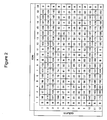
- containers containing the gel precursor polymerizable solutions and the hollow-fiber bundle prepared above were placed in a desiccator in order to fill hollow portions of the hollow fibers of the bundle corresponding to the positions shown in Figure 2 with the respective gel precursor polymerizable solutions comprising the respective nucleic acid probes as prepared above.
- the end portion of the hollow-fiber bundle in which each fiber is not sealed was immersed in the predetermined gel precursor polymerizable solutions in the containers.
- the desiccator was filled with nitrogen gas, and the gel precursor polymerizable solutions comprising capture probes were introduced into the hollow portions of the hollow fibers.
- the container was heated to 70°C to perform polymerization reaction for 3 hours.
- the hollow-fiber bundle in which the nucleic acid probes were held in the hollow portions of the hollow fibers via the gel-like material, was obtained.
- the obtained hollow-fiber bundle was sliced in the direction perpendicular to the longitudinal direction of the fibers using a microtome to obtain 300 thin sheets (nucleic acid arrays) having the thickness of 0.25 mm.
- the nucleic acid arrays were prepared to have probe positions shown in Figure 2 .
- the numbers represent SEQ ID NOs of probes, and probes having nucleotide sequences set forth in respective SEQ ID NOs are arrayed on the nucleic acid arrays.
- B represents a spot where no nucleic acid probe is present.
- Nucleic acid samples (oligo DNAs) for identification of probe positions on the nucleic acid array prepared above were prepared as follows. These nucleic acid samples comprise a portion complementary to a part of 3' terminal side of each corresponding probe, and 5' terminal side of the nucleic acid samples comprises a nucleotide sequence consisting of the GT repeat sequence, which is complementary to SEQ ID NO: 385. SEQ ID NO: 385 was prepared with oligo DNA whose 5' terminal side is Cy5-labeled in the concentration of 100pmol/ ⁇ l.
- SEQ ID NOs: 1, 2, ??and 192 correspond to SEQ ID NOs: 193, 194, Vietnamese and 384, respectively (Tables 3 and 5).
- a part of each sequence in the table of probes above is complementary to a part of each corresponding sequence in Table 5.
- Each analyte has a sequence which forms a double strand with a corresponding sequence of a probe.
- a sequence represented by small letters in the nucleotide sequence of SEQ ID NO: 193 in Table 5 is complementary to the underlined part of the nucleotide sequence set forth in SEQ ID NO: 1 in Table 3 (positions 33-65 of the sequence), and can form a double strand therewith.
- Samples 1-8 were prepared by mixing each model analyte indicated by SEQ ID NO: shown as "1" in an amount of 500pmol/5 ⁇ l, and adding pure water so that the final liquid volume was adjusted to 500 ⁇ l. That is, Samples 1-8 were prepared so that the concentration of each of the model analytes contained was adjusted to 1pmol/ ⁇ l. Further, patterns of the presence/absence of input of all the analytes represented by SEQ ID NOs: 193-384 in Samples 1-8 were different from each other.
- 0.2 ⁇ l (20pmol) of Cy5-labeled analyte represented by SEQ ID NO: 385 was added to 0.2 ⁇ l of each of 8 samples prepared according to the above table (0.2pmol each), and hybridization was performed under the following conditions.
- One hybridization reaction was performed for each nucleic acid array, i.e., a hybridization was performed 8 times.
- the nucleic acid samples prepared above were contacted with the nucleic acid arrays prepared above, and hybridization was conducted in a temperature-controlled bath at 65°C for 1 hour.
- a nucleic acid probe which has a sequence complementary to SEQ ID NO: 288, i.e., a nucleic acid probe set forth in SEQ ID NO: 96, is surely immobilized.
- ONs/OFFs of signals from the positions of respective nucleic acid probes obtained this time were compared and the results are described in Table 7.
- "Presence or absence of analyte input (predetermined)" is expressed by numerical values allocated to probes set forth in respective SEQ ID NOs.
- Patterns of signals for all the nucleic acid probes immobilized on the array are different from each other. Further, patterns of signals expected from the complementary nucleic acid molecules included in Samples 1-8 corresponded to the actual patterns of signals. Accordingly, it was confirmed that these nucleic acid probes are present on predetermined positions. It became clear that immobilization positions of nucleic acid probes can be confirmed by using this technique.
- a method for confirming the types and positions of respective nucleic acid probes immobilized on a nucleic acid array by means of hybridization between the nucleic acid probes and nucleic acids comprising a complementary sequence thereof is provided.
- the positions on which the probes are arrayed can be accurately and easily examined.
Landscapes
- Chemical & Material Sciences (AREA)
- Organic Chemistry (AREA)
- Life Sciences & Earth Sciences (AREA)
- Zoology (AREA)
- Wood Science & Technology (AREA)
- Proteomics, Peptides & Aminoacids (AREA)
- Health & Medical Sciences (AREA)
- Engineering & Computer Science (AREA)
- Microbiology (AREA)
- Biochemistry (AREA)
- Physics & Mathematics (AREA)
- Molecular Biology (AREA)
- Biotechnology (AREA)
- Biophysics (AREA)
- Analytical Chemistry (AREA)
- Immunology (AREA)
- Bioinformatics & Cheminformatics (AREA)
- General Engineering & Computer Science (AREA)
- General Health & Medical Sciences (AREA)
- Genetics & Genomics (AREA)
- Measuring Or Testing Involving Enzymes Or Micro-Organisms (AREA)
- Automatic Analysis And Handling Materials Therefor (AREA)
- Apparatus Associated With Microorganisms And Enzymes (AREA)
Abstract
(a) defining the number of zones to which the nucleic acid probes immobilized on the nucleic acid array belong and one or more given pieces of identification information;
(b) calculating X using the following formula:

(wherein N represents the number of the pieces of identification information, and M represents the number of the zones to which the nucleic acid probes immobilized on the nucleic acid array belong),
defining a number of the integer portion of X as the number of nucleic acid arrays required for confirming the immobilization conditions, Xa, and allocating non-overlapping numerical values (Y), which are expressed by notation system of base N+1, and which have the same digit number as Xa, to the respective nucleic acid probes belonging to the zones;
(c) preparing complementary nucleic acid molecules comprising nucleotide sequences complementary to all or a part of nucleotide sequences of the nucleic acid probes, preparing groups of nucleic acid samples corresponding to the number of nucleic acid arrays (Xa) by mixing the complementary nucleic acid molecules based on the number of every digit of each of the allocated numerical values (Y), and preparing nucleic acid arrays (the number: Xa);
(d) contacting each of the nucleic acid arrays (the number: Xa) prepared in the step (c) with the corresponding group of the nucleic acid samples to detect signals derived from hybrids between the nucleic acid probes immobilized on the nucleic acid arrays and the complementary nucleic acid molecules; and
(e) matching patterns of expression of the signals detected to patterns of the numerical values (Y) allocated.
Description
- The present invention relates to quality control of a nucleic acid array. Specifically, the present invention relates to a method for confirming types and positions of nucleic acid probes on a nucleic acid array utilizing hybridization reaction of the nucleic acid probes with nucleic acid molecules.
- A nucleic acid array consists of a carrier on which many nucleic acid probes (hereinafter sometimes referred to as "probes") are independently immobilized at high density without being mixed. A probe immobilized on a nucleic acid array functions as a sensor for capturing a nucleic acid molecule consisting of a sequence complementary to the nucleotide sequence of the probe by means of hybridization.
- Conventionally, a product consisting of a carrier made of surface-treated glass, silicone or the like on which probes are immobilized is utilized as a nucleic acid array. Recently, such carriers have been modified using other techniques such as a gel carrier.
- As methods for producing a nucleic acid array, a method in which nucleic acid probes prepared in advance are immobilized on a substrate such as slide glass and silicone, and a method in which nucleic acid probes are directly synthesized on a substrate are known.
- For example, according to the optical lithography method in which probes are directly synthesized on a substrate, a nucleic acid array can be prepared by using a substance having a protective group which is selectively removed by light irradiation, combining the photolithography technique with the solid-phase synthesis technique, and by selectively synthesizing (masking) DNA on a predetermined region (reaction site) of a tiny matrix (Science 251, 767-773 (1991)).
- A typical example of a method for immobilizing probes prepared in advance is a spotting method (Science 270, 467-470 (1995)). According to this method, drops of a solution comprising probes prepared by PCR or artificial synthesis in advance, which have a tiny volume of several n1 to several p1, are arrayed on the surface of a chip using a particular apparatus (a spotter or an arrayer), and thereby the probes are immobilized on a specific region of the substrate. In addition to the above-described method, a method for producing a microarray using a hollow-fiber-arranged body has been developed. According to this method, a base having through-holes is produced using a hollow-fiber-arranged body in which a plurality of hollow fibers made of synthetic polymer are regularly arrayed in the direction of the fiber axis. One of the features of this production method is that a lot of microarray products having the same specification can be produced from the same rod by immobilizing probes in the hollow portion of each of the hollow fibers in the hollow-fiber-arranged body and by slicing the hollow-fiber-arranged body in the direction perpendicular to the direction of the fiber axis (Japanese Patent No.
3488456 - In a nucleic acid detection method utilizing a nucleic acid array, nucleic acid samples targeted for a test are sequence-specifically hybridized to probes immobilized on the nucleic acid array, and sequence-specifically formed hybrids are detected using a fluorescent substance or the like. According to this method, nucleic acid molecules comprising nucleotide sequences in the samples, which correspond to a plurality of probes, can be examined quantitatively or qualitatively. Therefore, the method is used for analyzing the expression amount of a plurality of nucleotide sequences or the sequence itself of a specific nucleotide sequence.
- Usually, in the above-described nucleic acid detection, a hybridization reaction is caused under appropriate preset conditions, and nucleic acid samples and other unnecessary substances remaining on the surface of the array are removed by washing to detect nucleic acid samples forming specific hybrids with probes. A probe is often designed to be complementary or identical to a nucleotide sequence desired to be detected and used for the purpose of sequence analysis, function analysis or the like. As a probe, a nucleic acid having a relatively long chain such as cDNA or the like, a synthetic oligonucleic acid having a relatively short chain, or the like is used. In the case where a synthetic oligonucleic acid is used as the probe for detecting a nucleic acid of human, mouse or other biological organisms, for which the findings of gene information are accumulated, the nucleotide sequence information thereof is usable. Using such nucleotide sequence information, and in consideration of the homology, function and the like of each of such sequences, the sequence of a synthetic oligonucleic acid is designed. Thus, a probe can be produced.
- Such nucleic acid arrays can be provided for gene analysis (gene expression, gene polymorphism and the like), can be utilized for research applications such as the discovery of the mechanism of life phenomenon, diagnosis/therapy of diseases and the like, and are further expected to be applied to industrial applications such as breed classification made by differentiating the gene type and the like. In the meantime, in order to apply such nucleic acid arrays to industrial applications, it is essential to maintain the quality thereof. Therefore, one urgent need is to establish a quality control method for guarantee of quality.
- Among quality control items, the most important task is to examine whether or not probes immobilized on a nucleic acid array produced are accurately immobilized on predetermined positions. As an example of a method of the above-described examination, a method, in which a nucleic acid array is immersed in a nucleic acid staining agent such as ethidium bromide to stain a probe or a predetermined position on which a probe is immobilized, is known. According to this method, the presence or absence of the probe on (in) the nucleic acid array can be known, but it cannot be examined whether or not the probe is immobilized on the predetermined position. Moreover, when utilizing the stained nucleic acid array as it is for a test or the like, the staining agent is a noise in the detection. Therefore, in order to provide nucleic acid arrays as products, it is necessary to conduct an operation, in which stain (ethidium bromide) which stains probes or predetermined positions on which probes are immobilized is washed again to completely wash away the stain on a product-by-product basis. Therefore, processing steps to be performed until products are completed are very complicated.
- Moreover, in order to confirm spot positions, it is necessary to prepare labeled nucleic acids, which correspond to all probes immobilized on an array, as complementary chains of the probes, and to conduct a detection operation by means of hybridization on a probe to probe basis. When a large number of probes are immobilized, operations are more complicated and unpractical.
- Thus, it is very important to easily confirm "what kind of sequence a probe has and on which position of a nucleic acid array the probe is immobilized" to guarantee the quality of the nucleic acid array.
- However, in the present circumstances, almost no operation for confirmation is performed. That is because, as described above, since a nucleic acid array has a lot of probes immobilized on a carrier, operations for confirmation are complicated. Moreover, that is because it is difficult to easily differentiate sequences of probes themselves.
- That is, in order to confirm what kind of probe is present on which position of a nucleic acid array once prepared, only the information obtained from the production process of the nucleic acid array can be relied on. It is extremely difficult to determine each position on which each probe is immobilized after the production.
- If unexpected probes are immobilized on unexpected positions of a nucleic acid array, with respect to probes whose immobilized positions are wrong, wrong data may be submitted without even noticing. Moreover, particularly in the case where a nucleic acid array in which the types of probes are narrowed is prepared, the level of importance of every probe is higher compared to a nucleic acid array on which a wide variety of probes are immobilized in an all-encompassing manner. Therefore, when statistically treating and interpreting the data of every probe obtained from the entire nucleic acid array, there is a high possibility that it will lead to radically wrong conclusions.
- Therefore, the problem of the present invention is to provide a method for accurately and easily confirming that probes immobilized on a nucleic acid array are correctly arrayed on predetermined positions.
- In order to solve the above-described problem, the present inventors made keen examination, focusing on the advantage that, in the case of one type of arrays which can be produced from the identical rod, all the array products obtained from the rod can be confirmed by examining a certain number of the arrays. As a result, it was found that, by giving predetermined pieces of identification information to nucleic acid samples to be hybridized to an array, and by effectively combining signals obtained by hybridization with pieces of identification information obtained from individual probes to apply the combination to the test, the positions of the probes can be confirmed individually. Thus, the present invention was completed.
- More specifically, the present invention is as follows:
- (1) A method for confirming immobilization conditions of nucleic acid probes immobilized on a nucleic acid array, comprising the steps of:
- (a) defining the number of zones to which the nucleic acid probes immobilized on the nucleic acid array belong and one or more given pieces of identification information;
- (b) calculating X using the following formula:

(wherein N represents the number of the pieces of identification information, and M represents the number of the zones to which the nucleic acid probes immobilized on the nucleic acid array belong), defining a number of the integer portion of X as the number of nucleic acid arrays required for confirming the immobilization conditions, Xa, and allocating non-overlapping numerical values (Y), which are expressed by notation system of base N+1, and which have the same digit number as Xa, to the respective nucleic acid probes belonging to the zones; - (c) preparing complementary nucleic acid molecules comprising nucleotide sequences complementary to all or a part of nucleotide sequences of the nucleic acid probes, preparing groups of nucleic acid samples corresponding to the number of nucleic acid arrays (Xa) by mixing the complementary nucleic acid molecules based on the number of every digit of each of the allocated numerical values (Y), and preparing nucleic acid arrays (the number: Xa);
- (d) contacting each of the nucleic acid arrays (the number: Xa) prepared in the step (c) with the corresponding group of the nucleic acid samples to detect signals derived from hybrids between the nucleic acid probes immobilized on the nucleic acid arrays and the complementary nucleic acid molecules; and
- (e) matching patterns of expression of the signals detected to patterns of the numerical values (Y) allocated.
In the present invention, examples of the immobilization conditions of the nucleic acid probes include those related to types and/or positions of the nucleic acid probes. The identification information is, for example, at least one selected from the group consisting of: a presence or an absence of a signal; the strength of the signal; and the type of labeling. In the present invention, patterns of expression of the detected signals can be quantified by notation system of base N+1 based on the above-described identification information. - (2) A method for examining a quality of a nucleic acid array, wherein the quality of the nucleic acid array is examined based on results obtained according to the method described in item (1) above.
- According to the present invention, a method for confirming types and positions of individual nucleic acid probes immobilized on the nucleic acid arrays by hybridization between the nucleic acid probes and nucleic acids comprising their complementary sequences is provided.
- To confirm whether or not individual probes on a nucleic acid array are arrayed on predetermined positions is the most important examination item in terms of the quality control of DNA microarrays. According to the present invention, the positions on which the probes are arrayed can be accurately and easily examined. Therefore, conventionally-used complicated examination steps are no longer required.
-
-
FIG. 1 shows an arrangement fixing tool for producing a fiber-arranged body. -
FIG. 2 shows a design of a nucleic acid array. Numbers represent SEQ ID NOs, and B represents a spot on which no probe is immobilized. -
FIG. 3 shows images of detection in which hybridization was performed using Samples 1-8. -
- 11 ..... pore
- 21 ..... porous plate
- 31 ..... hollow fiber
- 41 ..... plate-like body
- Hereinafter, the present invention will be described in detail. The documents, laid-open publications, patents and other patent documents cited in this specification are incorporated herein by reference.
- The present invention relates to a method for confirming immobilization conditions of nucleic acid probes immobilized on a nucleic acid array, comprising the steps of:
- (a) defining the number of zones to which the nucleic acid probes immobilized on the nucleic acid array belong and one or more given pieces of identification information;
- (b) calculating X using the following formula:

(wherein N represents the number of the pieces of identification information, and M represents the number of the zones to which the nucleic acid probes immobilized on the nucleic acid array belong),
defining a number of the integer portion of X as the number of nucleic acid arrays required for confirming the immobilization conditions, Xa, and allocating non-overlapping numerical values (Y), which are expressed by notation system of base N+1, and which have the same digit number as Xa, to the respective nucleic acid probes belonging to the zones; - (c) preparing complementary nucleic acid molecules comprising nucleotide sequences complementary to all or a part of nucleotide sequences of the nucleic acid probes, preparing groups of nucleic acid samples corresponding to the number of nucleic acid arrays (Xa) by mixing the complementary nucleic acid molecules based on the number of every digit of each of the allocated numerical values (Y), and preparing nucleic acid arrays (the number: Xa);
- (d) contacting each of the nucleic acid arrays (the number: Xa) prepared in the step (c) with the corresponding group of the nucleic acid samples to detect signals derived from hybrids between the nucleic acid probes immobilized on the nucleic acid arrays and the complementary nucleic acid molecules; and
- (e) matching patterns of expression of the signals detected to patterns of the numerical values (Y) allocated.
- In a general method of using a nucleic acid array, firstly, a sample whose sequence is unknown is hybridized to a nucleic acid probe having a predetermined sequence. If a nucleic acid molecule having a nucleotide sequence complementary to the nucleotide sequence of the nucleic acid probe is present in the sample, a hybrid is formed between the nucleic acid probe and the nucleic acid molecule.
- Next, by quantifying or qualifying the hybrid formation using a signal derived from a substance by which the sample is labeled in advance (e.g., fluorescence, chemiluminescence, radioisotope, etc.), the presence of the complementary nucleic acid molecule corresponding to the pertinent nucleic acid probe can be confirmed.
- Further, by utilizing the above-described method, the arrangement of a probe immobilized on a nucleic acid array can also be examined. By using a nucleic acid molecule complementary to the probe as a sample, the position of the probe to be present on the nucleic acid array can be identified by means of hybridization.
- As described above, in order to confirm on which portion of a nucleic acid array a specific nucleic acid probe is immobilized, a sample comprising a nucleic acid molecule having a nucleotide sequence complementary to the nucleic acid probe (complementary nucleic acid molecule) is hybridized to the nucleic acid array, and a hybrid formed between the nucleic acid probe and the complementary nucleic acid molecule is detected by a signal sent from a labeling substance (e.g., a fluorescent substance, an enzyme, etc.) by which the complementary nucleic acid molecule is labeled. For example, in the case of a nucleic acid array in which nucleic acid probes with 5 different nucleotide sequences are independently immobilized on a substrate, in order to examine the presence or absence of the 5 nucleic acid probes and the positions on which they are present, each of nucleic acid molecules complementary to the respective nucleic acid probes (complementary nucleic acid molecules) is hybridized to each of nucleic acid arrays, and signals derived from hybridization are read, and thereby the relative positions of the nucleic acid probes and nucleotide sequences of the nucleic acid probes immobilized on the positions can be identified.
- In this case, the required number of the nucleic acid arrays to be used is 5, corresponding to the number of the nucleic acid probes. Further, if signals, by which 5 types of complementary nucleic acid molecules corresponding to 5 types of nucleic acid probes can be recognized independently (e.g., 5 types of fluorescent substances having different wavelength), can be read, by hybridizing 5 types of the complementary nucleic acid molecules to one nucleic acid array, the relative positions of the nucleic acid probes immobilized and the nucleotide sequences of the nucleic acid probes immobilized on the positions can be confirmed independently.
- However, many types of probes are immobilized on a nucleic acid array. At least several tens to several hundreds of types of nucleic acid probes are immobilized. In such a case, it is extremely complicated to confirm the position of each of the nucleic acid probes immobilized by preparing complementary nucleic acid molecules whose number corresponds to the number of the nucleic acid probes and using nucleic acid arrays whose number is the same as that of the immobilized probes. Moreover, such a process cannot be substantially practiced since the number of nucleic acid arrays to be used is excessive. Under present circumstances, it is difficult to provide signal molecules, by which several tens to several hundreds of types of probes can be independently recognized, to respective complementary nucleic acid molecules.
- According to the present invention, in order to efficiently identify the positions of nucleic acid probes immobilized, (groups of) complementary nucleic acid samples prepared following definite laws are hybridized to a nucleic acid array, and signals obtained therefrom are matched to the presence or absence of complementary nucleic acid molecules in the nucleic acid samples or the type of labeling.
- In this regard, the term "complementary nucleic acid sample" (also referred to as "nucleic acid sample") refers to a sample which comprises a molecule comprising a nucleotide sequence complementary to at least a part of a nucleotide sequence of a nucleic acid probe (complementary nucleic acid molecule) following definite laws. The population of a plurality of complementary nucleic acid samples is referred to as "the group of complementary nucleic acid samples" (also referred to as "the group of nucleic acid samples"). It is preferred to prepare nucleic acid samples as many as nucleic acid arrays to be used for confirmation. The phrase "prepared following definite laws" means that a nucleic acid sample included in a complementary nucleic acid sample is prepared so that respective probes show different patterns at the time of hybridization detection depending on the type of labeling or the presence or absence of the nucleic acid sample. The detailed method will be exemplified below.
- Nucleic acid probes immobilized on a nucleic acid array are positioned within certain zones. Therefore, the number of zones on which nucleic acid probes are immobilized means the number of the nucleic acid probes (the number of the types of probes). In the present invention, the above-described number of zones is defined as the number of probes. However, the number of zones on which probes are not immobilized can be included in the number of probes, for example, as negative control. "The number of probes" does not mean the number of respective probes included in zones, but refers to the number of populations of probes in zones.
- When preparing (groups of) complementary nucleic acid samples, sequence information, concentration, the type of labeling and the like of complementary nucleic acid molecules constituting the (groups of) samples are recorded in advance. These pieces of information are used as pieces of "identification information" for evaluating conditions of hybrids formed between probes and complementary nucleic acid molecules after hybridization. Further, complementary nucleic acid molecules, nucleic acid samples and groups of nucleic acid samples are identified (defined) by number allocation or the like. For example, the presence or absence of a certain nucleic acid sample in a group of nucleic acid samples is represented by a piece of identification information, "the presence or absence of hybridization signal", at the time of detection after hybridization. Further, when using a group of nucleic acid samples including nucleic acid samples labeled with different types of labels (for example, Cy3 and Cy5), "the type of hybridization signal" is utilized as a piece of identification information in the sense that the difference between labels can be distinguished. Moreover, change in the concentration of nucleic acid sample can also be employed as identification information from the viewpoint of "the strength of hybridization signal". Thus, pieces of identification information are used as parameters indicating differences in information obtained after hybridization and causes thereof.
- Specifically, when a probe A is immobilized on a nucleic acid array, at the time of putting its complementary chain A' into respective complementary nucleic acid samples of a group of complementary nucleic acid samples, already-known pieces of information such as "whether or not A' is put", "the type of label applied to A"' and "the amount of A' put" can be identified by pieces of information obtained after hybridization such as "whether or not signal was obtained", "the type of fluorescence obtained" and "the degree of signal obtained". Therefore, conditions of input of the complementary nucleic acid molecule A' into respective complementary nucleic acid samples can be easily judged based on results of hybridization.
- The number of arrays required for confirming immobilized nucleic acid probes is determined by the number of types of nucleic acid probes and the number of pieces of identification information. When confirming positions of nucleic acid probes immobilized on a nucleic acid array, the more pieces of identification information, the smaller the number of complementary nucleic acid samples to be prepared. Therefore, the number of nucleic acid arrays to be used can be reduced, and as a result, confirmation can be efficiently made.
- When confirming positions of all nucleic acid probes immobilized on a nucleic acid array, the number of pieces of identification information required, the number of arrays to be used and the number of complementary nucleic acid samples are represented by conditions satisfying the following formula:

wherein: - M: the number of types of nucleic acid probes;
- N: the number of pieces of identification information; and
- X: the number of arrays to be used.
- The equality portion of the above-described formula can be represented by the following formula:

(wherein N represents the number of the pieces of identification information, and M represents the number of the zones to which the nucleic acid probes immobilized on the nucleic acid array belong), and X can be calculated using this formula. The calculated X is represented by a number of the integer portion and a number of the fractional portion. In the present invention, the number of the integer portion of X is defined as the number of nucleic acid arrays required for confirmation of immobilization conditions (Xa). - For example, when judging a nucleic acid array, wherein the number of probes (M) is 250 and the number of pieces of identification information is 1 (the presence or absence of signal), since the number of pieces of identification information by which hybridization can be confirmed is 1 (N=1), X = log2 250 + 1 = 8.9657.... Since the integer portion of X is "8", the number of arrays required for confirmation (Xa) is 8. By using 8 arrays (Xa=8), the relative positions of all the probes immobilized on the array can be confirmed.
- Further, in another embodiment of the present invention, when judgment is made using the following pieces of identification information: 2 types of fluorescence (Cy3 and Cy5); and 2 concentrations of complementary nucleic acid molecule, the number of pieces of identification information by which hybridization can be confirmed is 4 (N=4). Therefore, by using 4 arrays (Xa=4), the relative positions of all the probes immobilized on the array can be confirmed.
- Hereinafter, an embodiment of the present invention in which a nucleic acid array on which 24 types of nucleic acid probes are immobilized is examined by the presence or absence of fluorescence signal will be considered.
- Since the presence or absence of fluorescence signal can be confirmed by one fluorescent label, the number of pieces of identification information (N) is 1. When this number and the number of the probes (M) are applied to the above-described formula, the number of arrays required for confirmation is 5.
- Complementary nucleic acid samples, which are to be hybridized to 5 arrays, respectively, are designated as Sample A, Sample B, Sample C, Sample D and Sample E, respectively. Non-overlapping numerical values (Y), which are represented by notation system of base N+1, and which have the same digit number as Xa (Samples A to E = 5 types of samples, that is, 5-digit), are allocated to the respective nucleic acid probes belonging to the aforementioned zones. In the above-described example, Xa=5, and N+1=2, and therefore, numerical values (Y), which are allocated to
probes 1 to 24 in Table 1, can be represented by 5-digit numbers in binary notation, using "1" and "0" as shown in columns A-E therein. In columns of samples A-E, "1" indicates that a fluorescently-labeled complementary nucleic acid is included, and "0" indicates that no complementary nucleic acid is included. - As shown in Table 1, the numerical value allocated to probe 1 (designated as Y1) is "10000", and the numerical value allocated to probe 2 (designated as Y2) is " 10001 ". Numerical values allocated to probes 1-24 do not overlap each other and are different.
Table 1 nucleic acid sample probe A B C D D 1 1 0 0 0 0 2 1 0 0 0 1 3 1 0 0 1 0 4 1 0 0 1 1 5 1 0 1 0 0 6 1 0 1 0 1 7 1 0 1 1 0 8 1 0 1 1 1 9 1 1 0 0 0 10 1 1 0 0 1 11 1 1 0 1 0 12 1 1 0 1 1 13 1 1 1 0 0 14 1 1 1 0 1 15 1 1 1 1 0 16 1 1 1 1 1 17 0 1 0 0 0 18 0 1 0 0 1 19 0 1 0 1 0 20 0 1 0 1 1 21 0 1 1 0 0 22 0 1 1 0 1 23 0 1 1 1 0 24 0 1 1 1 1 - In this step: complementary nucleic acid molecules comprising a nucleotide sequence complementary to all or a part of nucleotide sequences of the aforementioned nucleic acid probes are prepared; complementary nucleic acid molecules are mixed based on each numerical value in 5 digits of the allocated numerical values (Y) to prepare groups of nucleic acid samples whose number corresponds to the number of nucleic acid arrays (Xa); and the nucleic acid arrays (the number thereof: Xa) are prepared.
- After allocating the above-described numerical values (Y), groups of complementary nucleic acid samples to be independently hybridized to 5 arrays are prepared and designated as samples A, B, C, D and E (Table 1). Nucleic acids can be synthesized using a chemical synthesis apparatus based on sequence information of probes.
- Each sample is a mixture obtained by mixing complementary chains of probes, to which the numerical value "1" is allocated. For example, sample A includes complementary chains corresponding to probes 1-16, and sample B includes complementary chains corresponding to probes 9-24. "Complementary chains" are not required to be complementary to all nucleic acid probes, and may be complementary to a part of them.
- When complementary nucleic acid molecules are labeled to give identification information, such complementary nucleic acid molecules are confirmed with single labeling, or they are independently detected with single labeling, and it is required that differences can be confirmed simultaneously or with time intervals at the time of detection. That is, regarding labeling, there is a case where single labeling is conducted and confirmation is made by one detection, and there is a case where single labeling is conducted but complementary nucleic acid molecules are independently confirmed by a plurality of detections. Specifically, the following cases are included:
- (i) the case where difference in labels is confirmed simultaneously at the time of detection (e.g., combination of Cy3 and Cy5, etc.); and
- (ii) the case where difference in labels is confirmed with time intervals at the time of detection (e.g., the case where using an identical labeling substance, detection is performed with direct labeling, and thereafter detection is performed with indirect labeling).
- In the case of item (2) above, detection can be performed using the combination of Cy5 direct labeling and biotin direct labeling-streptavidin-Cy5 indirect labeling.
- The above-described method of "labeling" is not particularly limited as long as hybridization of nucleic acid can be detected. Examples of labeling substances to be used for labeling include: fluorescent substances such as Cy3, Cy5, Alexa Fluor and the like; enzymes or proteins for utilizing chemiluminescence associated with substrate degradation using alkaline phosphatase, horseradish peroxidase or the like; and radioisotopes such as γ-32P, α-32P, etc. From the viewpoint of convenience, use of fluorescent substances is preferable.
- When these labeling substances are introduced into complementary nucleic acid molecules, any method (associated with direct, indirect, physical, or chemical binding) can be used as long as it is stable and does not inhibit specific hybridization to probe nucleic acids. Examples of methods of chemical modification include a method, in which an analog base modified by biotin or an aminoaryl group is introduced at the time of reaction, and a labeling substance is introduced via the modified analog base. Moreover, a method for intercalating a labeling substance into a complementary nucleic acid molecule using SYBR Green, acridine orange, SYBR Gold or the like, a method for binding a labeling substance such as ULYSIS to a complementary nucleic acid molecule via platinum and the like can also be employed.
- However, preparation of many complementary nucleic acid molecules labeled with a labeling molecule may lead to high costs. In order to avoid this, aside from a portion of each complementary nucleic acid molecule complementary to a corresponding nucleic acid probe, a common nucleotide sequence (tag) is added to the 3'- or 5'-terminus of each complementary nucleic acid molecule, and then, a labeled nucleic acid molecule complementary to the tag sequence can be used. In this case, any labeling method can be employed as long as signals can be independently detected. Moreover, a plurality of types of tag sequences themselves can also be used.
- In this step, each of the nucleic acid arrays (the number thereof: Xa) prepared as described above is contacted with the aforementioned corresponding group of the nucleic acid samples, and signals derived from hybrids between the nucleic acid probes immobilized on the nucleic acid array and the aforementioned complementary nucleic acid molecules are detected.
- When contact of probes with complementary nucleic acids (hybridization) is performed by adding the samples A-E to the nucleic acid arrays A-E, respectively, in the case of the nucleic acid array A, fluorescence signal is detected with respect to the probes 1-16, and in the case of the nucleic acid array B, fluorescence signal is detected with respect to the probes 9-24. Similarly, in the cases of the nucleic acid arrays C-E, fluorescence signal is detected with respect to probes to which the numerical value "1" is allocated.
- According to the above-described method, by matching the combination of complementary nucleic acid molecules included in the complementary nucleic acid sample, position information of probes at each position of the nucleic acid array and signals actually obtained by hybridization to identification information, it can be confirmed to which position on the nucleic acid array each nucleic acid probe corresponding to each complementary nucleic acid sample is spotted.
- When detection results of each nucleic acid array are examined with respect to each complementary nucleic acid, for example, in the case of the complementary nucleic acid corresponding to probe 1 in Table 1, since it is included only in nucleic acid sample A, the combination of pieces of identification information among nucleic acid samples A-E (the numerical value Y1) is "10000". Further, in the case of the complementary nucleic acid corresponding to probe 16, since it is included in all the nucleic acid samples A-E, the combination of pieces of identification information among nucleic acid samples A-E is " 11111". Each complementary nucleic acid has a different combination of pieces of identification information. Therefore, when the pattern of numerical value allocated to each of the probes is matched to the pattern of detection result, and the obtained detection result corresponds to the combination, i.e., the pattern of value Y, it can be judged that the type and the position of the nucleic acid probe immobilized on the nucleic acid array are correct.
For example, when the presence of signal is represented by "+" and the absence of signal is represented by "-", and given that the results "+, -, -, -, -" were obtained in the order of samples A-E as detection results ofprobe 1, the detection results correspond to Y1 = "10000". The above-described detection results ("+" and "-") can be represented by numerical values. When the detection results are represented by "1" and "0" (binary notation), the detection results correspond to the allocated numerical value Y1 ("10000"). Therefore, it can be judged that the nucleic acid is immobilized on the correct position. - Next, an embodiment, in which a nucleic acid array on which 24 types of nucleic acid probes are immobilized is examined with 3 types of fluorescence signals, will be considered. Since 3 types of fluorescent labels are used, the number of pieces of identification information (N) is 3. When this number and the number of the probes (M) are applied to the above-described formula, the number of arrays required for confirmation (Xa) is 3.
- Complementary nucleic acid samples, which are to be hybridized to 3 arrays, respectively, are prepared and designated as Sample A, Sample B and Sample C, respectively (Table 2). As pieces of identification information, "0" represents a green fluorescent label, "1" represents a yellow fluorescent label, and "2" represents a red fluorescent label. "0", "1" or "2" is applied to column of Samples A-C in Table 2.
- In this case, since Xa = 3 and N+1=3, numerical values (Y), which are allocated to
probes 1 to 24 in Table 2, can be represented by 3-digit numbers in ternary notation, using "0", "1" and "0" as shown in columns A-C therein.Table 2 nucleic acid sample probe A B C 1 0 0 0 2 0 0 1 3 0 0 2 4 0 1 0 5 0 1 1 6 0 1 2 7 0 2 0 8 0 2 1 9 0 2 2 10 1 0 0 11 1 0 1 12 1 0 2 13 1 1 0 14 1 1 1 15 1 1 2 16 1 2 0 17 1 2 1 18 1 2 2 19 2 0 0 20 2 0 1 21 2 0 2 22 2 1 0 23 2 1 1 24 2 1 2 - When detection results of each nucleic acid array are examined with respect to each complementary nucleic acid, for example, in the case of the complementary nucleic acid corresponding to probe 1, since all the nucleic acid samples A-C are labeled with the green fluorescent label, the combination of pieces of identification information among the nucleic acid samples A-C is "000". In the case of the complementary nucleic acid corresponding to probe 6, the combination of pieces of identification information among the nucleic acid samples A-C is "012". Each complementary nucleic acid has a different combination of pieces of identification information. Therefore, if detection results associated with the pieces of identification information corresponded to the combination, it can be judged that the type and the position of the nucleic acid probe immobilized on the nucleic acid array are correct.
- Based on the above-described method, one rod of the nucleic acid array is examined before shipment of the nucleic acid array, and it can be utilized as one of the quality control standard thereof.
- Nucleic acid arrays to be used for quality examination for confirmation of positions of probes immobilized are desirably prepared from nucleic acid arrays mass-produced from the same rod. In the present method, any nucleic acid array is applicable, but a nucleic acid microarray, which can be produced in a manner in which respective probe spot positions are not physically mixed, is preferred. Such a nucleic acid microarray can be obtained by immobilizing probes to hollow fibers or the like, bundling them together and slicing the bundle. Immobilization of probes to hollow fibers can be evenly performed. Therefore, when determining immobilization positions of nucleic acid probes using microarrays obtained by slicing as described above, examination of the microarrays from the same rod can be conducted with high accuracy and without variation of quality.
- Further, when a plurality of nucleic acid arrays cannot be used for confirmation of immobilization positions of probes, a nucleic acid array, which was used for hybridization once, can be reutilized. Specifically, after hybridization, hybrids between nucleic acid probes and complementary nucleic acid samples are dissociated from each other. Hybrids can be dissociated by immersing the nucleic acid array in water or the like and heating it to a given temperature or higher. The dissociated nucleic acid array can be reutilized depending on the immobilization conditions of probes or conditions of remaining signals. In the case of nucleic acid arrays prepared on a dried substrate, reutilization is often not recommended. However, in the case of nucleic acid arrays utilized in the state of constant moistness, since hybrids can be easily dissociated and it is more difficult to remove immobilized probes compared to the case of dried substrates, there is no particular false recognition with respect to, for example, just a piece of identification information regarding the presence or absence of signals.
- Hereinafter, the present invention will be described in more detail with reference to working examples. The present invention, however, is not limited to the examples described below.
- In order to prepare a nucleic acid array, oligo DNAs set forth in SEQ ID NOs: 1-192 in Table 3 below were synthesized.
Table 3 SEQ ID NO: Sequence 1 actgttgacaccataaaagattctgacgaagagctggacaacaatcagatagaagtactggacca 2 gatcgtcagccaatggatcgtgggcaatggacacgcaactgatctctggcagaactgtagcacct 3 tcatggcccctctgacctgcactggggagcccgtctcagtgttgagccttttccctctttggctc 4 cgccatctccactgcatccgatctcattatttcggtggttgcttgggggtgaacaattttgtggc 5 tatgaagtcatgcgtttaatcacattcgagtgtttcagtgcttcgcagatgtccttgatgctcat 6 gatattgtggacacggccatgcctatcaccatttgtatagcttattttaacaattgcctgaatcc 7 gctaaagtccaagagaggatccgagaacgctctaagcctgtccacgagctcaatagggaagcctg 8 agcctatggtcccggatgacatctgtttaaaaacaagcacaacctgcaacatactttgattacct 9 tatttggtttcacaatggaggagcgctcatgggggccctatatcacctgtattcagggcctatgt 10 taatggtgcccatgatgagtttgcatcacctgactataccttacttccgggacgaggagctgtcc 11 cacaagacacagaatagtttacacactgtgtgggggacggcttctcacgctttgtttactctctt 12 caaggctaagtttgccggcaggaacttcagaaaccccttggccaagtaagctgtgggcaggcaag 13 taatacagtgcttcatatcagctctcttcttgcatggacactactgctgaccatatgcccaatca 14 ctctagttttcagccttgggaggttttattctgacttcctctgattttggcatgtggagacactc 15 ttcccctgtgagtgaaatgccttctagtagtgaaccgtcctcgggagccgactatgactactcag 16 ggagaatgcaaatatatagagcacctggaagcagtaacatgcaaatgtcagcaagaatatttcgg 17 gatatacatgctcaaccttcatcggcccacgtgtattgtccgggctcagaatgggaggactccag 18 gctcaatatgccccaggctatgacaaagtcaaggacatctcagaggtggtcacccctcggttcct 19 caaacagttcgacactgaccgatcagggaccatttgcagtagtgaactcccaggtgcctttgagg 20 caactggactatgttgacctctatcttcttcatttcccaatggctctcaagccaggtgagacgcc 21 aggagagcttctccaaaggctgagggacatttccacagtcaagagcctctttgccaagcgacaac 22 gaaagggccttgacatcagttcctttgtgtgtactcactgaagcctgcgttggtccagagcggag 23 ggtggtgatcggcatggatgtggcagcatctgagttctatcgcaatgggaagtacgatcttgact 24 agcccgttccgcagggactagaggctttcggctttttgggacagcaactaccttgcttttggaaa 25 tcttacttctacaggttccttgagcaccaaagatgattcataactctgtataggtgacagctgct 26 tacgttaaaagctgtgctggatattgcgtgatcacctatatacttggagttggagacaggcacct 27 tggcttgcttggtgggacctgacgagttggtggcatgggaaggatgtgggtctctagtgccttgc 28 agatcttgatccttgtcctcgtccaaaaagacgtcagccttacaacgcaatattttctccaaaag 29 catctccttgtctgaaaacatttcccctgctgttctctttctaacatgttgtggtaaatctgttc 30 cctttaattccttactttggctatgggtggagggtgagtttgaagaggttctgattttcttgtaa 31 ggttgagacaactgtcacaagcctcaagacgaaagtaggcggtacgaaccctaatggaggcagtt 32 cttgtgggcttcaggtgttttcaagcacaacccaccacaacaagcaagtgcattttcagtcgttg 33 aggagtgaatgtaaaaataaatatcgcttagaatgcaggagaagggtggagaggaggcaggggcc 34 gtgaaattgtgccttgcctgagtgagcttcataaagcgtaccttgatataccccatcgacctcag 35 acctgaggcagtatgacatctctgacccacagagaccccgcctcacaggacagctcttcctcgga 36 ttctcccagcgttaacacaaaatccatgggcagcatgatggcaggtcctctgttgcaaactcagt 37 cccagaccaaaatgagtgccagcgacccaaactcctccatcttcctcaccgacacggccaagcag 38 ccaaattgccaaaactcaagtcacctcagtaccatccaggaggctgggtattgtcctgcctctgc 39 gcttgcagcatggtcttgactgaatgtactgttcctgttagcgttacttctcctgtggtcagtaa 40 gctgggaactgacataggcttcaattggtggaattcctctttaacaagggctgcaatgccctcat 41 aggaaggagccttggatctcagcggcctcagagctatagacaccactcagctgttctccctcccc 42 aagggtgccatggcagctacatattctgctttgaaccgtaatcagtcaccagttttggaaccagt 43 gctttatgtaaatattctgcagttgttacttaggaagcctggggagggcaggggtgccccatggc 44 gttgatgcaatcggtttaaacatggctgaacgcgtgtgtacacgggactgacgcaacccacgtgt 45 cttcagagagctggtagttagtagcatgttgagccaggcctgggtctgtgtctcttttctctttc 46 gcttaaggactcagaaacaagtcagcgtctggccaacctcaggcaacgggtggagcagtttgcca 47 acttcaagatcaccctctacgggagaaccaaggagctgacttcggaactaaaggagaacttcatc 48 cactggtttcaagaatatggaggctggaaggaaataaacattacggtacagacatggagatgtaa 49 tgccgtggataaattgctcaaggacctggacgccaatggagatgcccaggtggacttcagtgagl 50 tgctcctattccggactcagacctctgaccctgcaatgctgcctaccatgattggcctcctggca 51 aaaacaaacttggcttgataatcatttgggcagcttgggtaagtacgcaacttacttttccacca 52 cccaaaatgctctgtcttgagtcatgagaaccatcagttcttgatatlgtctagacttgcatcta 53 gaatactttggcttgaagccggcacacccagggttactgaggacttatgctgcctgacctggtta 54 cccagatcttcaatgaggagcagtactgtggggattttgactctttcttctctgcaaaagaagag 55 gaccccctaagttagtcagattactagacagatataaacagatcccctgctgaacagatatacag 56 ccaaggagaaaggcatgaatcttccctgtcaggctcttacagccacaggcactgtgtctactgtc 57 ggaggcagccatcataaccattgaatagcatgcaagggtaagaatgagtttttaactgctttgta 58 gcacaccttggaattcgctttctaaaggaaatcaaatgaatggaggaactttccaaacaccactt 59 gccactgcagctaccgtagaatggcattttatatgtaccttgtcacccacttctgtttacttttt 60 ggcctcctcaatttgcagatcccccaagtacaggcgctaattgttgtgataatttgtaattgtga 61 tcagcggctgttgattcaaggtcaacattgaccattggaggagtggtttaagagtgccaggcgaa 62 gaaggatattactaccgtcaagtctttgaacgccattacccaggccgggctgactggctgagcca 63 ctacattataactcacagcattgttccattgcaggttttgcaatgtttgggggtaaagacagtag 64 cttttatttaagttgtgattacctgctgcatgaaaagtggcatgggggaccctgtgcatctgtgc 65 gatatcgaagagcagggggttgtgaatttccaggtacttggactttttgtagaaggagagagaag 66 ccagaatcgctagactaagaattaggtggctacagatggtagaactaaacaataagcaagagaca 67 gaaatggcttctatgatcagaactgggaaaacagtgaatcttatggtggaagaggttctcagcaa 68 gcaatcacaatgccagatggtgtttatgggctatttgtgtaagtaagtggtaagatgctatgaag 69 ggaagattcccggagggaaactgtgaatgcttctgatttagcaatgctgtgaataaaaagaaaga 70 acctacggcaacagatacaagaacgtgaagctccctgacgcctacgagcgcctcatcctggacgt 71 gcttctaggcggactatgacttagttgcgttacaccctttcttgacaaaacctaacttgcgcaga 72 acggaggagcatgcccgacagcagcacaatgagaggctacgcaagcagtttggagcccaggccaa 73 agagtgccttttcgagactggcagggacgaggacaaatatggatgaggtggagagtgggaagcag 74 acactgttgccctggctgtattcataagattccagctccttcaggtgtttgattccagcatgtag 75 attgaggctcttggaaggagtcaggcaaggattgtgcttcccccattatacaggtgacaaaactg 76 attcaagcgcacgagtgggtgccgctgtggctactgcggtattcggtcattgtgaaaagtagagg 77 tgtgactttcaagctactcaccctgtaatggatcttaaagcattccccaaagataacatgctttg 78 attcatcaattatgtgaagaattgcttccggatgactgaccaagaggctattcaagatctctggc 79 tatccaagttgtccttgaattgtctaaccatggacataaacagttgtctcccttctactgtgtag 80 ggaaaacagccagaagccaccttgacacttttgaacatttccagttctgtagagtttattgtcaa 81 ggtgggaggtgggatttagccaggaaaggggtgagagtgattgtgttgtgggcgaggaggcgttt 82 attgtgggggtcgatcatgaatgtccgaagagtggccttttcccgtagccctgcgccccctttct 83 ttgtgcagcaatggccaagatcaaggctcgagatcttcgcgggaagaagaaggaggagctgctga 84 aagcaaagagaagactttgtacacactgtcaccagggttatttgcatccaagggagctggaattg 85 cgtgcccgaaatcaggtggtgataagagcagagccccaactctgtgccttgtgtgcggatctctg 86 tctagaactgacctaccacaagcatccaccaaaggagtttgggattgagttttgctgctgtgcag 87 ggtctcttccagattgctcttctgccgaattatttgtatctattccgagctgattatgtaatagg 88 gctcttgatgagaggctcgctttaaagaagcccaaagcgtgtgcttatccaaggggttcagctat 89 ctgcttcataggtgttctgcatttgaggtgtagtgaaatctttgctgttcaccagatgtaatgtt 90 tgaagtagtagccacagtacaacactgactgctcagacacatttaggttcagggtggacctttat 91 ttgtggtgagacgtcatagtcttcatgagaacgtgggggtgaatttcatgaaggggaactatagt 92 gactctatcgtggtttatctcttaattacattcgctgtattccctctcaagcagtggcttttaca 93 gaagtcgagatgactttgatcattggtaacttgggcctgggccagacaaagtataaaacttacaa 94 tctgtctatacctgccccatctgagcacccattgctcaccatcagatcaacctttgattttacat 95 ccagtttctgtatagaatcgcacaagtggtttatggagtgtttggattgtaattataaatggttc 96 ctagcctgcattgagcttgcatgcttgcataagagcttaagaaccattgatttaatgtaataggg 97 gcctgcatccggagaattgcctctacctggaccttttgtctcacacagcagtaccctgacctgct 98 cctcacacccacccccatgcactcaaagattggattttacagctacttgcaattcaaaattcaga 99 gggccatctcttggagtgacaaagctgggatcaaggatagggagttgtaacagagcagtgccaga 100 gcctgaactagccaatcagatcaactctgtcttgggcgtttgaactcagggagggaggcccttgg 101 ctgacaagtcttaatcaactaggcgagaggcaacttctttcagtagtcaagtggtctaaatcatt 102 caagttcagctccacgtgtgccatcagtggatccgatccgtccagccatggcttcctattccaag 103 gcaagtgtacagatctgtgtagaggaatgtgtgtatatttacctcttcgtttgctcaaacatgag 104 ctgaccctgaagttttcctaccccaaggagagttactcgacagtccataagtcaactgttgtgtg 105 tcacttgctgaacgccgtgaccgatgctttggtttgggtgattgccaagagcggcatctcctccc 106 ctgttgtcctccccttgggcggctgagagccccagctgacatggaaatacagttgttggcctccg 107 caaaaatgacccccatttgtgtgacttcattgagacacattacctgaatgagcaggtgaaagcca 108 ggcctgggtaggatcatgtatacggtatttgaacatacattccatgtacgagaaggagatgaaca 109 gctattattttctttaaagaatgctgggtgttgcatttctggaccctccacttcaatctgagaag 110 ctctttctgcatggttgtgtccctagtcctaagctttggttctttagggtgactgtggtaagaag 111 attgcgaagaacctgctctccgcgcctctcggtgctccaaatggacatcacgaagccagtgcaga 112 tcatgctaacgcagcagttgcaaacattttgaagagagaccgtcgggggctgaggggcaacgaag 113 gacacgtgatgggaagctggtgtctgagtcctctgacgtcctgcccaagtgaacagctgcggcag 114 tctgtatgacaacccgggatcgtttgcaagtaactgaatccattgcgacattgtgaaggcttaaa 115 tgctgtgtttactctcccgtgtgccttcgcgtccgggttgggagcttgctgtgtctaacctccaa 116 ttgtatcacggattacaatgaacgcagtgcagagccccaaagctcaggctattgttaaatcaata 117 gcctacatgacacagttggatttattctgccaaacctgtgtaggcattttataagctacatgttc 118 tagtggggactagtgaatgacttgacctgtgacctcaatacaataaatgtgatcccccacccaaa 119 cagcacaaggaggatgtgatatgtgggggagtgagcactgggttgggagccgggtcctggtttcc 120 cactgttagatagttggaaaggggaaattctgtttaagcgaaagtggtatcatcctaggtaagct 121 cttccaagctctgcttcctcagtttccaaaatggaaccacctcacctccgcagcacccgacttac 122 cccctttgccattgatcaagccatattcaggtcctaggttgccacctgatagatactgcttaaca 123 cgacgacaccgttcgtggggtcccctggtgcttctatcctaataccatcgacgtccctccagaag 124 tttgggagagacttgttttggatgccccctaatccccttctcccctgcactgtaaaatgtgggat 125 gcctcccttggtctgcccagccctcggttagccctgcctgaatcagtagatacttgaacgagtcc 126 ctgcgcccctagctgggatctggtacctggactaggctaattacagcttctccccaacaggaaac 127 aactcctgtacttgaagctgagacctcatatgacgtggccttcgtgttgtcagagagtgtctgga 128 ctgagaggggaagcggccctaagggagtgtctaagaacaaaagcgacccattcagagactgtccc 129 tgcatgaatgaagaccctgcaaagcgacccaaatttgacatgattgtgcctatccttgagaagat 130 acagctgtagcaactttgtgtctgaagatgactcggaaacccagtccgtgtccagctttagttca 131 tgccctgtggaatgggctcaaggttcctgagacacccgattcctgcccaaacagctgtatttata 132 gcagaagcagacctagaccctagcgttcccccttatgactctcttcagacttatgcctatgaggg 133 ccagacaaaatttgagaatacataaacaacgcattgccacggaaacatacagaggatgccttttc 134 cagctctagaggtcacagtatcctcgtttgaaagataattaagatcccccgtggagaaagcagtg 135 tccaaggctcaccgcagaagcagtagcagcggggaccaatcatcagactccttgaactcccccac 136 ccacatgttaaccctctagctgataatgcaaacactaactgggggattttatttataagggctct 137 gggcctttccaagattgctgtttttgttttggagcttcaagactttgcatttcctagtatttctg 138 aaactgctatagcctaagcggctgtttactgcttttcattagcagttgctcacatgtctttgggt 139 tgaatgagatgcgtgaccagtacgagcagatggcagagaaaaaccgcagagacgctgagacctgg 140 tgatgctctgcgaagggctcttcgtggcagacgtcaccgatttcgagggctggaaggctgcgatt 141 gggggtgctctttggacactggattatgaggaatggataaatggatgagctagggctctgggggt 142 tgctgtggcttcaccaactatacggattttgaggactcaccctacttcaaagagaacagtgcctt 143 gaggataacattggcgggaggggagttaactggcaggcatggcaaggttgcatatgtaataaagt 144 tgatgatgaggaagaagaagaagaagggggctcatggggccgtgggaacccaaggttccatagtc 145 ccaggacaaaggccgctttgaactctaccgtgccacgttttatgccgctgagataatgtgtggac 146 tccatttctctgagggacctttagttggctctgtgggactgttccggatgggcctctgggtcact 147 agcagctgcctagggggtgtccaaggagcagagaaaactactagatgtgaacttgaagaaggttg 148 gtggttggtgtcctgctcatcatcctgattgtgctgctggtcgtctttctccctcagagcagtga 149 aatctgcattctgtcaggcacccgtagaaagacctcagtacatgctttgcactctcctttgctcc 150 tacatccagtaccaaggcttccgggtccagctggaatccatgaagaagctgagtgacctggaggc 151 ccaaattcaagatacaggtatccccgtttttacaacagatgttcatgcccctgcttcatgcaatt 152 gaattggatttgaagaactcgactttatgtgatcatggtattggtatacatgtggggtggagaac 153 acgattttcttctgtagaatgtttgacttcgtattgacccttatctgtaaaacacctatttggga 154 gcacgcatttttgttgccttggttttacctgtagactgtggaactattttaccttaagacctgaa 155 gtggaaggactgattgagaatgttccaatccaaatgaatgcatcacaacttacaatgctgctcat 156 gctgctctcattggaattgcaggatctggctactgtgtcattgtggcagcccttggcttagcaga 157 caaatttaataaggaaccatgtaatggtagcagtacctccctaaagcattttgaggtaggggagg 158 aacaaaaatctgggaatggtctgccgaaaaccgaccgacccggttgattggccaccgcttgtcct 159 tcctaacctgccggggtcattccccaccaaacaccccatactaaggagccatgagccacctggac 160 cggagggaactgcagggagaccaacttatttagagcgaattggacatggataaaaaccccagtgg 161 tgctgggtaccaggactcacctctgacaagcaggagaaggtaagggcccggtcagctccaaggag 162 gccaaaggaagtctaaggaattagtagtgttcccatcacttgtttggagtgtgctattctaaaag 163 cataaagttgctggccagcttttacctcttgcatataatctgttgaagaggaatctgtttgcaga 164 gcaaactcatggatggctcttataccaggagaagataaggtatgccagagtgtatttgagagaaa 165 ctgttcagatgatctttcattcaatgtgttcctgttgggcgttactagaaactatggaaaactgg 166 tgggtacactttgtaccagtgtcggcctccactgatgctggtgctcaggcacctctgtccaagga 167 accagggtaccctgtcttggtggttaggggccacttttcctttgaggctctagtggaggtggatg 168 ggttgagaagagcttttcggacctgttactaccccaagctgtgtaatatacttgtataacagaaa 169 ctaaggccattgacgtggcctgcgatctcagtgacaatgatctgcttctggatctcactgttgcc 170 tgacagccaccgggtcatcaccttcgcaaaccaggacgactacatatcattccggcaccatgtgt 171 ctccagcatctcaactccgtctgtctactgtgtgagacttcggcggaccattaggaatgagatcc 172 cgattacagggacaacagcagttgatacaccaaaatcggcaagctatcttaaaccagtttgcagc 173 agaaggagcaatggtacgctggcatcaacccctcggacggtatcaactcagaggtcctggaagcc 174 ccccaaaggatggtcacacaccagcactttatacacttctggctcacaggaaagtgtctgcagta 175 atgccttgtacccccaccgtgcaggttgtggccggttttctccgcaggttgaacatggaaataaa 176 ttggtgcaagtcttgggagcgtgatctagattacactgcaccattcccaagttaatcccctgaaa 177 ttccatccactgcccatgaccctgttccctgtctataaatccccagttttccatggtatattcag 178 gtatattaaagcaccaaattcatgtacagcatgcatcacggatcaatagactgtacttattttcc 179 ggcttcggacaaaatatctctgagttctgtgtattttcagtcaaaactttaaacctgtagaatca 180 agtggagctgtttgacttggagaataacccagagtacgtgtccagcggagggggctttggaccgg 181 tgagaactcgtggtacttcagtgtccctccccctgtattgtgacaaggtaattctgtggtatcag 182 ctaatacgatgcatatactgaagggcaaggactttgaccatgtcaattttcagccgagaatggtc 183 accaccatggttacagcggatgccccgagactctgcttggtaaacgtggcagagcagaatgggag 184 aaggcagagagtcagacccttcaatggaaggagagtgcttgggatcgattatgtgacttaaagtc 185 gtctgagcttctttagctaggctaaaacaccttggcttgttattgcctctactttgattctgata 186 gcatttaattcaaagagaggggagcatccattattggtacatgtgggcttttaaaaactccatcc 187 gcaccaacatgtaaccggcatgtttccagcagaagacaaaaagacaaacatgaaagtctagaaat 188 atgcctgcccagttccctttttatttgcagaagctgtgagttttgttcacaattaggttcctagg 189 gtgccactagttaaatgccgaattctcatctggatgttaccatcaaacatcagtacacttgtcat 190 cagctgcctgttttgcatggtatttgcaaaaatgcctcttgcgtgaggaaatcttttaccatttt 191 gacaatgctgatggaagaccagactggaaagtggatcgactcctccttcattgattctaaattca 192 ggttagttgatcaagaattttggggtgggggttgcggagaaatcaagtttaaaattccttctgat - A hollow-fiber bundle was produced utilizing an arrangement fixing tool shown in
Figure 1 . InFigure 1 , x, y and z are axes which are at right angles to one another and constitute three-dimensional coordinate. The direction of axis x corresponds to the longitudinal direction of fibers. - Firstly, 2 porous plates (21) having the thickness of 0.1 mm, in which 228 pores (11) (12 (vertical rows) x 19 (horizontal rows)) having the diameter of 0.32 mm were provided with the center-to-center spacing of the pores of 0.42 mm, were prepared. These porous plates were overlapped with each other, and through each of the pores, one hollow fiber (31) made of polycarbonate (manufactured by Mitsubishi Engineering-Plastics Corporation; 1 % by mass of carbon black was added) was passed.
- The positions of 2 porous plates were moved under the conditions where 0.1 N of tensile force was applied to each fiber in the direction of axis X, and the porous plates were fixed to the positions at 20 mm and 100 mm from one end portion of the hollow fibers, respectively. That is, the distance between the porous plates was 80 mm.
- Next, three faces surrounding the open space between the porous plates were surrounded by plate-like bodies (41). Thus, a container with only the upper side thereof being open was obtained.
- Next, a resign material was poured into the container from the upper side thereof. The resin used was prepared by adding 2.5 % by mass of carbon black to the total weight of polyurethane resin adhesive (Nippon Polyurethane Industry, Co., Ltd., NIPPOLAN 4276, CORONATE 4403). The resin was cured by being allowed to stand at 25°C for one week. After that, the porous plates and the plate-like bodies were removed to obtain a hollow-fiber bundle.
- Next, gel precursor polymerizable solutions comprising a monomer and an initiator mixed in the mass ratio shown in Table 4 were prepared for respective nucleic acid probes to be immobilized on the array.
Table 4 Composition Mass Ratio (Nucleic acid probe; Concentration) N,N-dimethylacrylamide 3.42 % N,N-methylenebisacrylamide 0.38 % 2,2'-azobis[2-(2-imidazoline-2-yl) propane] dihydrochloride (VA-044) 0.1 % Water 96.2 % Solution of Nucleic acid probe 5 pmol/l - Next, containers containing the gel precursor polymerizable solutions and the hollow-fiber bundle prepared above were placed in a desiccator in order to fill hollow portions of the hollow fibers of the bundle corresponding to the positions shown in
Figure 2 with the respective gel precursor polymerizable solutions comprising the respective nucleic acid probes as prepared above. After the pressure in the desiccator was reduced, the end portion of the hollow-fiber bundle in which each fiber is not sealed was immersed in the predetermined gel precursor polymerizable solutions in the containers. The desiccator was filled with nitrogen gas, and the gel precursor polymerizable solutions comprising capture probes were introduced into the hollow portions of the hollow fibers. Next, the container was heated to 70°C to perform polymerization reaction for 3 hours. - In this way, the hollow-fiber bundle, in which the nucleic acid probes were held in the hollow portions of the hollow fibers via the gel-like material, was obtained.
- Next, the obtained hollow-fiber bundle was sliced in the direction perpendicular to the longitudinal direction of the fibers using a microtome to obtain 300 thin sheets (nucleic acid arrays) having the thickness of 0.25 mm.
- The nucleic acid arrays were prepared to have probe positions shown in
Figure 2 . InFigure 2 , the numbers represent SEQ ID NOs of probes, and probes having nucleotide sequences set forth in respective SEQ ID NOs are arrayed on the nucleic acid arrays. B represents a spot where no nucleic acid probe is present. - Nucleic acid samples (oligo DNAs) for identification of probe positions on the nucleic acid array prepared above were prepared as follows. These nucleic acid samples comprise a portion complementary to a part of 3' terminal side of each corresponding probe, and 5' terminal side of the nucleic acid samples comprises a nucleotide sequence consisting of the GT repeat sequence, which is complementary to SEQ ID NO: 385. SEQ ID NO: 385 was prepared with oligo DNA whose 5' terminal side is Cy5-labeled in the concentration of 100pmol/µl.
- Regarding the correspondence relationship between the probe sequences and the sequences of the nucleic acid samples for confirmation of probe immobilization positions comprising complementary chains thereof, SEQ ID NOs: 1, 2, ......and 192 correspond to SEQ ID NOs: 193, 194, ..... and 384, respectively (Tables 3 and 5). A part of each sequence in the table of probes above is complementary to a part of each corresponding sequence in Table 5. Each analyte has a sequence which forms a double strand with a corresponding sequence of a probe. For example, a sequence represented by small letters in the nucleotide sequence of SEQ ID NO: 193 in Table 5 is complementary to the underlined part of the nucleotide sequence set forth in SEQ ID NO: 1 in Table 3 (positions 33-65 of the sequence), and can form a double strand therewith.
Table 5 SEQ ID NO: Sequence 193 CTCTCTCTCTCTCTCTCTCTCTCTCTCTCtggtccagtacttctatctgattgttgtccagc 194 CTCTCTCTCTCTCTCTCTCTCTCTCTCTCaggtgctacagttctgccagagatcagttg 195 CTCTCTCTCTCTCTCTCTCTCTCTCTCTCgagccaaagagggaaaaggctcaacactg 196 CTCTCTCTCTCTCTCTCTCTCTCTCTCTCgccacaaaattgttcacccccaagcaacc 197 CTCTCTCTCTCTCTCTCTCTCTCTCTCTCatgagcatcaaggacatctgcgaagcactg 198 CTCTCTCTCTCTCTCTCTCTCTCTCTCTCggattcaggcaattgttaaaataagctatacaaatggtgatagg 199 CTCTCTCTCTCTCTCTCTCTCTCTCTCTCcaggcttccctattgagctcgtggac 200 CTCTCTCTCTCTCTCTCTCTCTCTCTCTCaggtaatcaaagtatgttgcaggttgtgcttgtttttaaacag 201 CTCTCTCTCTCTCTCTCTCTCTCTCTCTCacataggccctgaatacaggtgatatagggc 202 CTCTCTCTCTCTCTCTCTCTCTCTCTCTCggacagctcctcgtcccggaag 203 CTCTCTCTCTCTCTCTCTCTCTCTCTCTCaagagagtaaacaaagcgtgagaagccgtcc 204 CTCTCTCTCTCTCTCTCTCTCTCTCTCTCcttgcctgcccacagcttacttggc 205 CTCTCTCTCTCTCTCTCTCTCTCTCTCTCtgattgggcatatggtcagcagtagtgtcc 206 CTCTCTCTCTCTCTCTCTCTCTCTCTCTCgagtgtctccacatgccaaaatcagaggaag 207 CTCTCTCTCTCTCTCTCTCTCTCTCTCTCctgagtagtcatagtcggctcccgag 208 CTCTCTCTCTCTCTCTCTCTCTCTCTCTCccgaaatattcttgctgacatttgcatgttactgcttc 209 CTCTCTCTCTCTCTCTCTCTCTCTCTCTCctggagtcctcccattctgagccc 210 CTCTCTCTCTCTCTCTCTCTCTCTCTCTCaggaaccgaggggtgaccacctc 211 CTCTCTCTCTCTCTCTCTCTCTCTCTCTCcctcaaaggcacctgggagttcactac 212 CTCTCTCTCTCTCTCTCTCTCTCTCTCTCggcgtctcacctggcttgagagc 213 CTCTCTCTCTCTCTCTCTCTCTCTCTCTCgttgtcgcttggcaaagaggctcttgac 214 CTCTCTCTCTCTCTCTCTCTCTCTCTCTCctccgctctggaccaacgcagg 215 CTCTCTCTCTCTCTCTCTCTCTCTCTCTCagtcaagatcgtacttcccattgcgatagaactc 216 CTCTCTCTCTCTCTCTCTCTCTCTCTCTCtttccaaaagcaaggtagttgctgtcccaaaaagc 217 CTCTCTCTCTCTCTCTCTCTCTCTCTCTCagcagctgtcacctatacagagttatgaatcatctttg 218 CTCTCTCTCTCTCTCTCTCTCTCTCTCTCaggtgcctgtctccaactccaagtatatagg 219 CTCTCTCTCTCTCTCTCTCTCTCTCTCTCgcaaggcactagagacccacatccttc 220 CTCTCTCTCTCTCTCTCTCTCTCTCTCTCcttttggagaaaatattgcgttgtaaggctgacgtc 221 CTCTCTCTCTCTCTCTCTCTCTCTCTCTCgaacagatttaccacaacatgttagaaagagaacagcag 222 CTCTCTCTCTCTCTCTCTCTCTCTCTCTCttacaagaaaatcagaacctcttcaaactcaccctcc 223 CTCTCTCTCTCTCTCTCTCTCTCTCTCTCaactgcctccattagggttcgtaccgc 224 CTCTCTCTCTCTCTCTCTCTCTCTCTCTCcaacgactgaaaatgcacttgcttgttgtggtg 225 CTCTCTCTCTCTCTCTCTCTCTCTCTCTCggcccctgcctcctctccac 226 CTCTCTCTCTCTCTCTCTCTCTCTCTCTCctgaggtcgatggggtatatcaaggtacg 227 CTCTCTCTCTCTCTCTCTCTCTCTCTCTCtccgaggaagagctgtcctgtgagg 228 CTCTCTCTCTCTCTCTCTCTCTCTCTCTCactgagtttgcaacagaggacctgccatc 229 CTCTCTCTCTCTCTCTCTCTCTCTCTCTCctgcttggccgtgtcggtgagg 230 CTCTCTCTCTCTCTCTCTCTCTCTCTCTCgcagaggcaggacaatacccagcc 231 CTCTCTCTCTCTCTCTCTCTCTCTCTCTCttactgaccacaggagaagtaacgctaacagg 232 CTCTCTCTCTCTCTCTCTCTCTCTCTCTCatgagggcattgcagcccttgttaaagagg 233 CTCTCTCTCTCTCTCTCTCTCTCTCTCTCggggagggagaacagctgagtgg 234 CTCTCTCTCTCTCTCTCTCTCTCTCTCTCactggttccaaaactggtgactgattacggttc 235 CTCTCTCTCTCTCTCTCTCTCTCTCTCTCgccatggggcacccctgccc 236 CTCTCTCTCTCTCTCTCTCTCTCTCTCTCacacgtgggttgcgtcagtcccg 237 CTCTCTCTCTCTCTCTCTCTCTCTCTCTCgaaagagaaaagagacacagacccaggcc 238 CTCTCTCTCTCTCTCTCTCTCTCTCTCTCtggcaaactgctccacccgttgcc 239 CTCTCTCTCTCTCTCTCTCTCTCTCTCTCgatgaagttctcctttagttccgaagtcagctc 240 CTCTCTCTCTCTCTCTCTCTCTCTCTCTCttacatctccatgtctgtaccgtaatgtttatttccttcc 241 CTCTCTCTCTCTCTCTCTCTCTCTCTCTCactcactgaagtccacctgggcatctc 242 CTCTCTCTCTCTCTCTCTCTCTCTCTCTCtgccaggaggccaatcatggtaggc 243 CTCTCTCTCTCTCTCTCTCTCTCTCTCTCtggtggaaaagtaagttgcgtacttacccaagc 244 CTCTCTCTCTCTCTCTCTCTCTCTCTCTCtagatgcaagtctagacaatatcaagaactgatggttctc 245 CTCTCTCTCTCTCTCTCTCTCTCTCTCTCtaaccaggtcaggcagcataagtcctcag 246 CTCTCTCTCTCTCTCTCTCTCTCTCTCTCctcttcttttgcagagaagaaagagtcaaaatcccc 247 CTCTCTCTCTCTCTCTCTCTCTCTCTCTCctgtatatctgttcagcaggggatctgtttatatctg 248 CTCTCTCTCTCTCTCTCTCTCTCTCTCTCgacagtagacacagtgcctgtggctg 249 CTCTCTCTCTCTCTCTCTCTCTCTCTCTCtacaaagcagttaaaaactcattcttacccttgcatgctattc 250 CTCTCTCTCTCTCTCTCTCTCTCTCTCTCaagtggtgtttggaaagttcctccattcatttgatttcc 251 CTCTCTCTCTCTCTCTCTCTCTCTCTCTCaaaaagtaaacagaagtgggtgacaaggtacatataaaatgcc 252 CTCTCTCTCTCTCTCTCTCTCTCTCTCTCtcacaattacaaattatcacaacaattagcgcctgtacttgg 253 CTCTCTCTCTCTCTCTCTCTCTCTCTCTCttcgcctggcactcttaaaccactcctc 254 CTCTCTCTCTCTCTCTCTCTCTCTCTCTCtggctcagccagtcagcccgg 255 CTCTCTCTCTCTCTCTCTCTCTCTCTCTCctactgtctttacccccaaacattgcaaaacctg 256 CTCTCTCTCTCTCTCTCTCTCTCTCTCTCgcacagatgcacagggtccccc 257 CTCTCTCTCTCTCTCTCTCTCTCTCTCTCcttctctctccttctacaaaaagtccaagtacctg 258 CTCTCTCTCTCTCTCTCTCTCTCTCTCTCtgtctcttgcttattgtttagttctaccatctgtagcc 259 CTCTCTCTCTCTCTCTCTCTCTCTCTCTCttgctgagaacctcttccaccataagattcactg 260 CTCTCTCTCTCTCTCTCTCTCTCTCTCTCcttcatagcatcttaccacttacttacacaaatagccc 261 CTCTCTCTCTCTCTCTCTCTCTCTCTCTCtctttctttttattcacagcattgctaaatcagaagcattcacag 262 CTCTCTCTCTCTCTCTCTCTCTCTCTCTCacgtccaggatgaggcgctcgtag 263 CTCTCTCTCTCTCTCTCTCTCTCTCTCTCtctgcgcaagttaggttttgtcaagaaagggtg 264 CTCTCTCTCTCTCTCTCTCTCTCTCTCTCttggcctgggctccaaactgcttgc 265 CTCTCTCTCTCTCTCTCTCTCTCTCTCTCctgcttcccactctccacctcatcc 266 CTCTCTCTCTCTCTCTCTCTCTCTCTCTCctacatgctggaatcaaacacctgaaggagc 267 CTCTCTCTCTCTCTCTCTCTCTCTCTCTCcagttttgtcacctgtataatgggggaagcac 268 CTCTCTCTCTCTCTCTCTCTCTCTCTCTCcctctacttttcacaatgaccgaataccgcag 269 CTCTCTCTCTCTCTCTCTCTCTCTCTCTCcaaagcatgttatctttggggaatgctttaagatccattac 270 CTCTCTCTCTCTCTCTCTCTCTCTCTCTCgccagagatcttgaatagcctcttggtcag 271 CTCTCTCTCTCTCTCTCTCTCTCTCTCTCctacacagtagaagggagacaactgtttatgtcc 272 CTCTCTCTCTCTCTCTCTCTCTCTCTCTCttgacaataaactctacagaactggaaatgttcaaaagtgtcaag 273 CTCTCTCTCTCTCTCTCTCTCTCTCTCTCaaacgcctcctcgcccacaacacaatc 274 CTCTCTCTCTCTCTCTCTCTCTCTCTCTCagaaagggggcgcagggctacg 275 CTCTCTCTCTCTCTCTCTCTCTCTCTCTCtcagcagctcctccttcttcttcccg 276 CTCTCTCTCTCTCTCTCTCTCTCTCTCTCcaattccagctcccttggatgcaaataaccc 277 CTCTCTCTCTCTCTCTCTCTCTCTCTCTCcagagatccgcacacaaggcacagag 278 CTCTCTCTCTCTCTCTCTCTCTCTCTCTCctgcacagcagcaaaactcaatcccaaactc 279 CTCTCTCTCTCTCTCTCTCTCTCTCTCTCcctattacataatcagctcggaatagatacaaataattcggc 280 CTCTCTCTCTCTCTCTCTCTCTCTCTCTCatagctgaaccccttggataagcacacgc 281 CTCTCTCTCTCTCTCTCTCTCTCTCTCTCaacattacatctggtgaacagcaaagatttcactacacc 282 CTCTCTCTCTCTCTCTCTCTCTCTCTCTCataaaggtccaccctgaacctaaatgtgtctgag 283 CTCTCTCTCTCTCTCTCTCTCTCTCTCTCactatagttccccttcatgaaattcacccccac 284 CTCTCTCTCTCTCTCTCTCTCTCTCTCTCtgtaaaagccactgcttgagagggaatacagc 285 CTCTCTCTCTCTCTCTCTCTCTCTCTCTCttgtaagttttatactttgtctggcccaggccc 286 CTCTCTCTCTCTCTCTCTCTCTCTCTCTCatgtaaaatcaaaggttgatctgatggtgagcaatggg 287 CTCTCTCTCTCTCTCTCTCTCTCTCTCTCgaaccatttataattacaatccaaacactccataaaccacttgtg 288 CTCTCTCTCTCTCTCTCTCTCTCTCTCTCccctattacattaaatcaatggttcttaagctcttatgcaagc 289 CTCTCTCTCTCTCTCTCTCTCTCTCTCTCagcaggtcagggtactgctgtgtgag 290 CTCTCTCTCTCTCTCTCTCTCTCTCTCTCtctgaattttgaattgcaagtagctgtaaaatccaatctttgagt 291 CTCTCTCTCTCTCTCTCTCTCTCTCTCTCtctggcactgctctgttacaactccctatc 292 CTCTCTCTCTCTCTCTCTCTCTCTCTCTCccaagggcctccctccctgag 293 CTCTCTCTCTCTCTCTCTCTCTCTCTCTCaatgatttagaccacttgactactgaaagaagttgcctc 294 CTCTCTCTCTCTCTCTCTCTCTCTCTCTCcttggaataggaagccatggctggacg 295 CTCTCTCTCTCTCTCTCTCTCTCTCTCTCctcatgtttgagcaaacgaagaggtaaatatacacacattc 296 CTCTCTCTCTCTCTCTCTCTCTCTCTCTCcacacaacagttgacttatggactgtcgagtaac 297 CTCTCTCTCTCTCTCTCTCTCTCTCTCTCgggaggagatgccgctcttggc 298 CTCTCTCTCTCTCTCTCTCTCTCTCTCTCcggaggccaacaactgtatttccatgtcag 299 CTCTCTCTCTCTCTCTCTCTCTCTCTCTCtggctttcacctgctcattcaggtaatgtgtc 300 CTCTCTCTCTCTCTCTCTCTCTCTCTCTCtgttcatctccttctcgtacatggaatgtatgttcaaatac 301 CTCTCTCTCTCTCTCTCTCTCTCTCTCTCcttctcagattgaagtggagggtccagaaatg 302 CTCTCTCTCTCTCTCTCTCTCTCTCTCTCcttcttaccacagtcaccctaaagaaccaaagc 303 CTCTCTCTCTCTCTCTCTCTCTCTCTCTCtctgcactggcttcgtgatgtccatttgg 304 CTCTCTCTCTCTCTCTCTCTCTCTCTCTCcttcgttgcccctcagccccc 305 CTCTCTCTCTCTCTCTCTCTCTCTCTCTCctgccgcagctgttcacttgggc 306 CTCTCTCTCTCTCTCTCTCTCTCTCTCTCtttaagccttcacaatgtcgcaatggattcagttacttg 307 CTCTCTCTCTCTCTCTCTCTCTCTCTCTCttggaggttagacacagcaagctcccaac 308 CTCTCTCTCTCTCTCTCTCTCTCTCTCTCtattgatttaacaatagcctgagctttggggctctg 309 CTCTCTCTCTCTCTCTCTCTCTCTCTCTCgaacatgtagcttataaaatgcctacacaggtttggc 310 CTCTCTCTCTCTCTCTCTCTCTCTCTCTCtttgggtgggggatcacatttattgtattgaggtc 311 CTCTCTCTCTCTCTCTCTCTCTCTCTCTCggaaaccaggacccggctccc 312 CTCTCTCTCTCTCTCTCTCTCTCTCTCTCagcttacctaggatgataccactttcgcttaaacag 313 CTCTCTCTCTCTCTCTCTCTCTCTCTCTCgtaagtcgggtgctgcggaggtg 314 CTCTCTCTCTCTCTCTCTCTCTCTCTCTCtgttaagcagtatctatcaggtggcaacctagg 315 CTCTCTCTCTCTCTCTCTCTCTCTCTCTCcttctggagggacgtcgatggtattagg 316 CTCTCTCTCTCTCTCTCTCTCTCTCTCTCatcccacattttacagtgcaggggagaagg 317 CTCTCTCTCTCTCTCTCTCTCTCTCTCTCggactcgttcaagtatctactgattcaggcag 318 CTCTCTCTCTCTCTCTCTCTCTCTCTCTCgtttcctgttggggagaagctgtaattagcc 319 CTCTCTCTCTCTCTCTCTCTCTCTCTCTCtccagacactctctgacaacacgaaggc 320 CTCTCTCTCTCTCTCTCTCTCTCTCTCTCgggacagtctctgaatgggtcgcttttg 321 CTCTCTCTCTCTCTCTCTCTCTCTCTCTCatcttctcaaggataggcacaatcatgtcaaatttggg 322 CTCTCTCTCTCTCTCTCTCTCTCTCTCTCtgaactaaagctggacacggactgggtttc 323 CTCTCTCTCTCTCTCTCTCTCTCTCTCTCtataaatacagctgtttgggcaggaatcgggtg 324 CTCTCTCTCTCTCTCTCTCTCTCTCTCTCccctcataggcataagtctgaagagagtcataag 325 CTCTCTCTCTCTCTCTCTCTCTCTCTCTCgaaaaggcatcctctgtatgtttccgtggc 326 CTCTCTCTCTCTCTCTCTCTCTCTCTCTCcactgctttctccacgggggatcttaattatc 327 CTCTCTCTCTCTCTCTCTCTCTCTCTCTCgtgggggagttcaaggagtctgatgattg 328 CTCTCTCTCTCTCTCTCTCTCTCTCTCTCagagcccttataaataaaatcccccagttagtgtttgc 329 CTCTCTCTCTCTCTCTCTCTCTCTCTCTCcagaaatactaggaaatgcaaagtcttgaagctccaaaac 330 CTCTCTCTCTCTCTCTCTCTCTCTCTCTCacccaaagacatgtgagcaactgctaatgaaaagc 331 CTCTCTCTCTCTCTCTCTCTCTCTCTCTCccaggtctcagcgtctctgcgg 332 CTCTCTCTCTCTCTCTCTCTCTCTCTCTCaatcgcagccttccagccctcgaaatc 333 CTCTCTCTCTCTCTCTCTCTCTCTCTCTCacccccagagccctagctcatcc 334 CTCTCTCTCTCTCTCTCTCTCTCTCTCTCaaggcactgttctctttgaagtagggtgagtc 335 CTCTCTCTCTCTCTCTCTCTCTCTCTCTCactttattacatatgcaaccttgccatgcctgcc 336 CTCTCTCTCTCTCTCTCTCTCTCTCTCTCgactatggaaccttgggttcccacgg 337 CTCTCTCTCTCTCTCTCTCTCTCTCTCTCgtccacacattatctcagcggcataaaacgtg 338 CTCTCTCTCTCTCTCTCTCTCTCTCTCTCagtgacccagaggcccatccgg 339 CTCTCTCTCTCTCTCTCTCTCTCTCTCTCcaaccttcttcaagttcacatctagtagttttctctgc 340 CTCTCTCTCTCTCTCTCTCTCTCTCTCTCtcactgctctgagggagaaagacgacc 341 CTCTCTCTCTCTCTCTCTCTCTCTCTCTCggagcaaaggagagtgcaaagcatgtactg 342 CTCTCTCTCTCTCTCTCTCTCTCTCTCTCgcctccaggtcactcagcttcttcatg 343 CTCTCTCTCTCTCTCTCTCTCTCTCTCTCaattgcatgaagcaggggcatgaacatctgttg 344 CTCTCTCTCTCTCTCTCTCTCTCTCTCTCgttctccaccccacatgtataccaataccatg 345 CTCTCTCTCTCTCTCTCTCTCTCTCTCTCtcccaaataggtgttttacagataagggtcaatacgaag 346 CTCTCTCTCTCTCTCTCTCTCTCTCTCTCttcaggtcttaaggtaaaatagttccacagtctacagg 347 CTCTCTCTCTCTCTCTCTCTCTCTCTCTCatgagcagcattgtaagttgtgatgcattcatttggattg 348 CTCTCTCTCTCTCTCTCTCTCTCTCTCTCtctgctaagccaagggctgccacaatg 349 CTCTCTCTCTCTCTCTCTCTCTCTCTCTCcctcccctacctcaaaatgctttagggag 350 CTCTCTCTCTCTCTCTCTCTCTCTCTCTCaggacaagcggtggccaatcaaccg 351 CTCTCTCTCTCTCTCTCTCTCTCTCTCTCgtccaggtggctcatggctccttag 352 CTCTCTCTCTCTCTCTCTCTCTCTCTCTCccactggggtttttatccatgtccaattcgc 353 CTCTCTCTCTCTCTCTCTCTCTCTCTCTCctccttggagctgaccgggcc 354 CTCTCTCTCTCTCTCTCTCTCTCTCTCTCcttttagaatagcacactccaaacaagtgatgggaac 355 CTCTCTCTCTCTCTCTCTCTCTCTCTCTCtctgcaaacagattcctcttcaacagattatatgcaagag 356 CTCTCTCTCTCTCTCTCTCTCTCTCTCTCtttctctcaaatacactctggcataccttatcttctcc 357 CTCTCTCTCTCTCTCTCTCTCTCTCTCTCccagttttccatagtttctagtaacgcccaacag 358 CTCTCTCTCTCTCTCTCTCTCTCTCTCTCtccttggacagaggtgcctgagcac 359 CTCTCTCTCTCTCTCTCTCTCTCTCTCTCcatccacctccactagagcctcaaagg 360 CTCTCTCTCTCTCTCTCTCTCTCTCTCTCtttctgttatacaagtatattacacagcttggggtagtaacag 361 CTCTCTCTCTCTCTCTCTCTCTCTCTCTCggcaacagtgagatccagaagcagatcattg 362 CTCTCTCTCTCTCTCTCTCTCTCTCTCTCacacatggtgccggaatgatatgtagtcgtc 363 CTCTCTCTCTCTCTCTCTCTCTCTCTCTCggatctcattcctaatggtccgccgaag 364 CTCTCTCTCTCTCTCTCTCTCTCTCTCTCgctgcaaactggtttaagatagcttgccgattttg 365 CTCTCTCTCTCTCTCTCTCTCTCTCTCTCggcttccaggacctctgagttgatacc 366 CTCTCTCTCTCTCTCTCTCTCTCTCTCTCtactgcagacactttcctgtgagccagaag 367 CTCTCTCTCTCTCTCTCTCTCTCTCTCTCtttatttccatgttcaacctgcggagaaaaccgg 368 CTCTCTCTCTCTCTCTCTCTCTCTCTCTCtttcaggggattaacttgggaatggtgcagtg 369 CTCTCTCTCTCTCTCTCTCTCTCTCTCTCctgaatataccatggaaaactggggatttatagacagg 370 CTCTCTCTCTCTCTCTCTCTCTCTCTCTCggaaaataagtacagtctattgatccgtgatgcatgc 371 CTCTCTCTCTCTCTCTCTCTCTCTCTCTCtgattctacaggtttaaagttttgactgaaaatacacagaactca 372 CTCTCTCTCTCTCTCTCTCTCTCTCTCTCccggtccaaagccccctccg 373 CTCTCTCTCTCTCTCTCTCTCTCTCTCTCctgataccacagaattaccttgtcacaatacaggg 374 CTCTCTCTCTCTCTCTCTCTCTCTCTCTCgaccattctcggctgaaaattgacatggtcaaag 375 CTCTCTCTCTCTCTCTCTCTCTCTCTCTCctcccattctgctctgccacgtttacc 376 CTCTCTCTCTCTCTCTCTCTCTCTCTCTCgactttaagtcacataatcgatcccaagcactctc 377 CTCTCTCTCTCTCTCTCTCTCTCTCTCTCtatcagaatcaaagtagaggcaataacaagccaaggtg 378 CTCTCTCTCTCTCTCTCTCTCTCTCTCTCggatggagtttttaaaagcccacatgtaccaataatgg 379 CTCTCTCTCTCTCTCTCTCTCTCTCTCTCatttctagactttcatgtttgtctttttgtcttctgctggaaac 380 CTCTCTCTCTCTCTCTCTCTCTCTCTCTCcctaggaacctaattgtgaacaaaactcacagcttc 381 CTCTCTCTCTCTCTCTCTCTCTCTCTCTCatgacaagtgtactgatgtttgatggtaacatccagatg 382 CTCTCTCTCTCTCTCTCTCTCTCTCTCTCaaaatggtaaaagatttcctcacgcaagaggcatttttgc 383 CTCTCTCTCTCTCTCTCTCTCTCTCTCTCtgaatttagaatcaatgaaggaggagtcgatccactttc 384 CTCTCTCTCTCTCTCTCTCTCTCTCTCTCatcagaaggaattttaaacttgatttctccgcaacccc 385 Cy5-GAGAGAGAGAGAGAGAGAGAGAGAGAGAG - These nucleic acid samples were mixed according to Table 6 to prepare 8 samples for identification of probe positions.
Table 6 SEQ ID NO: Sample 1 Sample 2 Sample 3 Sample 4 Sample 5 Sample 6 Sample 7 Sample 8 193 0 0 0 0 0 0 0 1 194 0 0 0 0 0 0 1 0 195 0 0 0 0 0 0 1 1 196 0 0 0 0 0 1 0 0 197 0 0 0 0 0 1 0 1 198 0 0 0 0 0 1 1 0 199 0 0 0 0 0 1 1 1 200 0 0 0 0 1 0 0 0 201 0 0 0 0 1 0 0 1 202 0 0 0 0 1 0 1 0 203 0 0 0 0 1 0 1 1 204 0 0 0 0 1 1 0 0 205 0 0 0 0 1 1 0 1 206 0 0 0 0 1 1 1 0 207 0 0 0 0 1 1 1 1 208 0 0 0 1 0 0 0 0 209 0 0 0 1 0 0 0 1 210 0 0 0 1 0 0 1 0 211 0 0 0 1 0 0 1 1 212 0 0 0 1 0 1 0 0 213 0 0 0 1 0 1 0 1 214 0 0 0 1 0 1 1 0 215 0 0 0 1 0 1 1 1 216 0 0 0 1 1 0 0 0 217 0 0 0 1 1 0 0 1 218 0 0 0 1 1 0 1 0 219 0 0 0 1 1 0 1 1 220 0 0 0 1 1 1 0 0 221 0 0 0 1 1 1 0 1 222 0 0 0 1 1 1 1 0 223 0 0 0 1 1 1 1 1 224 0 0 1 0 0 0 0 0 225 0 0 1 0 0 0 0 1 226 0 0 1 0 0 0 1 0 227 0 0 1 0 0 0 1 1 228 0 0 1 0 0 1 0 0 229 0 0 1 0 0 1 0 1 230 0 0 1 0 0 1 1 0 231 0 0 1 0 0 1 1 1 232 0 0 1 0 1 0 0 0 233 0 0 1 0 1 0 0 1 234 0 0 1 0 1 0 1 0 235 0 0 1 0 1 0 1 1 236 0 0 1 0 1 1 0 0 237 0 0 1 0 1 1 0 1 238 0 0 1 0 1 1 1 0 239 0 0 1 0 1 1 1 1 240 0 0 1 1 0 0 0 0 241 0 0 1 1 0 0 0 1 242 0 0 1 1 0 0 1 0 243 0 0 1 1 0 0 1 1 244 0 0 1 1 0 1 0 0 245 0 0 1 1 0 1 0 1 246 0 0 1 1 0 1 1 0 247 0 0 1 1 0 1 1 1 248 0 0 1 1 1 0 0 0 249 0 0 1 1 1 0 0 1 250 0 0 1 1 1 0 1 0 251 0 0 1 1 1 0 1 1 252 0 0 1 1 1 1 0 0 253 0 0 1 1 1 1 0 1 254 0 0 1 1 1 1 1 0 255 0 0 1 1 1 1 1 1 256 0 1 0 0 0 0 0 0 257 0 1 0 0 0 0 0 1 258 0 1 0 0 0 0 1 0 259 0 1 0 0 0 0 1 1 260 0 1 0 0 0 1 0 0 261 0 1 0 0 0 1 0 1 262 0 1 0 0 0 1 1 0 263 0 1 0 0 0 1 1 1 264 0 1 0 0 1 0 0 0 265 0 1 0 0 1 0 0 1 266 0 1 0 0 1 0 1 0 267 0 1 0 0 1 0 1 1 268 0 1 0 0 1 1 0 0 269 0 1 0 0 1 1 0 1 270 0 1 0 0 1 1 1 0 271 0 1 0 0 1 1 1 1 272 0 1 0 1 0 0 0 0 273 0 1 0 1 0 0 0 1 274 0 1 0 1 0 0 1 0 275 0 1 0 1 0 0 1 1 276 0 1 0 1 0 1 0 0 277 0 1 0 1 0 1 0 1 278 0 1 0 1 0 1 1 0 279 0 1 0 1 0 1 1 1 280 0 1 0 1 1 0 0 0 281 0 1 0 1 1 0 0 1 282 0 1 0 1 1 0 1 0 283 0 1 0 1 1 0 1 1 284 0 1 0 1 1 1 0 0 285 0 1 0 1 1 1 0 1 286 0 1 0 1 1 1 1 0 287 0 1 0 1 1 1 1 1 288 0 1 1 0 0 0 0 0 289 0 1 1 0 0 0 0 1 290 0 1 1 0 0 0 1 0 291 0 1 1 0 0 0 1 1 292 0 1 1 0 0 1 0 0 293 0 1 1 0 0 1 0 1 294 0 1 1 0 0 1 1 0 295 0 1 1 0 0 1 1 1 296 0 1 1 0 1 0 0 0 297 0 1 1 0 1 0 0 1 298 0 1 1 0 1 0 1 0 299 0 1 1 0 1 0 1 300 0 1 1 0 1 1 0 0 301 0 1 1 0 1 1 0 1 302 0 1 1 0 1 1 1 0 303 0 1 1 0 1 1 1 1 304 0 1 1 1 0 0 0 0 305 0 1 1 1 0 0 0 1 306 0 1 1 1 0 0 1 0 307 0 1 1 1 0 0 1 1 308 0 1 1 1 0 1 0 0 309 0 1 1 1 0 1 0 1 310 0 1 1 1 0 1 1 0 311 0 1 1 1 0 1 1 1 312 0 1 1 1 1 0 0 0 313 0 1 1 1 1 0 0 1 314 0 1 1 1 1 0 1 0 315 0 1 1 1 1 0 1 1 316 0 1 1 1 1 1 0 0 317 0 1 1 1 1 1 0 1 318 0 1 1 1 1 1 1 0 319 0 1 1 1 1 1 1 1 320 1 0 0 0 0 0 0 0 321 1 0 0 0 0 0 0 1 322 1 0 0 0 0 0 1 0 323 1 0 0 0 0 0 1 1 324 1 0 0 0 0 1 0 0 325 1 0 0 0 0 1 0 1 326 1 0 0 0 0 1 1 0 327 1 0 0 0 0 1 1 1 328 1 0 0 0 1 0 0 0 329 1 0 0 0 1 0 0 1 330 1 0 0 0 1 0 1 0 331 1 0 0 0 1 0 1 1 332 1 0 0 0 1 1 0 0 333 1 0 0 0 1 1 0 1 334 1 0 0 0 1 1 1 0 335 1 0 0 0 1 1 1 1 336 1 0 0 1 0 0 0 0 337 1 0 0 1 0 0 0 1 338 1 0 0 1 0 0 1 0 339 1 0 0 1 0 0 1 1 340 1 0 0 1 0 1 0 0 341 1 0 0 1 0 1 0 1 342 1 0 0 1 0 1 1 0 343 1 0 0 1 0 1 1 1 344 1 0 0 1 1 0 0 0 345 1 0 0 1 1 0 0 1 346 1 0 0 1 1 0 1 0 347 1 0 0 1 1 0 1 1 348 1 0 0 1 1 1 0 0 349 1 0 0 1 1 1 0 1 350 1 0 0 1 1 1 1 0 351 1 0 0 1 1 1 1 1 352 1 0 1 0 0 0 0 0 353 1 0 1 0 0 0 0 1 354 1 0 1 0 0 0 1 0 355 1 0 1 0 0 0 1 1 356 1 0 1 0 0 1 0 0 357 1 0 1 0 0 1 0 1 358 1 0 1 0 0 1 1 0 359 1 0 1 0 0 1 1 1 360 1 0 1 0 1 0 0 0 361 1 0 1 0 1 0 0 1 362 1 0 1 0 1 0 1 0 363 1 0 1 0 1 0 1 1 364 1 0 1 0 1 1 0 0 365 1 0 1 0 1 1 0 1 366 1 0 1 0 1 1 1 0 367 1 0 1 0 1 1 1 1 368 1 0 1 1 0 0 0 0 369 1 0 1 1 0 0 0 1 370 1 0 1 1 0 0 1 0 371 1 0 1 1 0 0 1 1 372 1 0 1 1 0 1 0 0 373 1 0 1 1 0 1 0 1 374 1 0 1 1 0 1 1 0 375 1 0 1 1 0 1 1 1 376 1 0 1 1 1 0 0 0 377 1 0 1 1 1 0 0 1 378 1 0 1 1 1 0 1 0 379 1 0 1 1 1 0 1 1 380 1 0 1 1 1 1 0 0 381 1 0 1 1 1 1 0 1 382 1 0 1 1 1 1 1 0 383 1 0 1 1 1 1 1 1 384 1 1 0 0 0 0 0 0 - In Table 6, "1" means that a complementary nucleic acid having a nucleotide sequence represented by SEQ ID NO: described in the leftmost column in Table 6 is included in a sample. "0" means that a complementary nucleic acid having a nucleotide sequence represented by SEQ ID NO: described in the leftmost column in Table 6 is not included in a sample. Samples 1-8 were prepared by mixing each model analyte indicated by SEQ ID NO: shown as "1" in an amount of 500pmol/5µl, and adding pure water so that the final liquid volume was adjusted to 500µl. That is, Samples 1-8 were prepared so that the concentration of each of the model analytes contained was adjusted to 1pmol/µl. Further, patterns of the presence/absence of input of all the analytes represented by SEQ ID NOs: 193-384 in Samples 1-8 were different from each other.
- 0.2µl (20pmol) of Cy5-labeled analyte represented by SEQ ID NO: 385 was added to 0.2µl of each of 8 samples prepared according to the above table (0.2pmol each), and hybridization was performed under the following conditions. One hybridization reaction was performed for each nucleic acid array, i.e., a hybridization was performed 8 times.
- Labeled oligonucleotide
(Combination of those selected from SEQ ID NOs: 193-384) 0.2pmol each - Cy5-labeled oligonucleotide (SEQ ID NO: 385) 20pmol
- 2×SSC (300mM of sodium chloride, 30mM of sodium citrate, pH 7.0)
- 0.2% SDS (sodium dodecyl sulfate)
- The nucleic acid samples prepared above were contacted with the nucleic acid arrays prepared above, and hybridization was conducted in a temperature-controlled bath at 65°C for 1 hour.
- After hybridization, washing was conducted using a mixed solution of 2×SSC and 0.2% SDS and 2×SSC, and subsequently detection was conducted. In the detection operation: a cooled CCD camera-type automatic detection apparatus for nucleic acid array was used; arrays were immersed in 2×SSC; a cover glass was applied thereto; and subsequently the fluorescence signal strength of labeled nucleic acid sample molecules was measured.
- Images of detection of Samples 1-8 are shown in
Figure 3 . In the case where the types and immobilization positions of the nucleic acid probes are confirmed based on the results inFigure 3 , for example, ON/OFF of signal from the position identified by column (R)=1 and row (C)=2 (SEQ ID NO: 96) inFigure 2 is expressed as "OFF, ON, ON, OFF, OFF, OFF, OFF, OFF" in the order of Samples 1-8. In Table 6, only SEQ ID NO: 288, which is an analyte corresponding to SEQ ID NO: 96, has this combination of ON and OFF. Therefore, it was confirmed that on the position identified by R=1 and C=2, a nucleic acid probe, which has a sequence complementary to SEQ ID NO: 288, i.e., a nucleic acid probe set forth in SEQ ID NO: 96, is surely immobilized. Similarly, ONs/OFFs of signals from the positions of respective nucleic acid probes obtained this time were compared and the results are described in Table 7. In Table 7, "Presence or absence of analyte input (predetermined)" is expressed by numerical values allocated to probes set forth in respective SEQ ID NOs. "0" means that a complementary nucleic acid with respect to a corresponding probe is not included, and "1" means that a complementary nucleic acid with respect to a corresponding probe is included. Regarding ON/OFF of signal, when the ratio of S/N is 5 or higher, it is defined as ON, and when the ratio is less than 5, it is defined as OFF. "ON" and "OFF" in Table 7 can be replaced by "1" and "0" in binary notation, respectively.Table 7 *a Presence or absence of analyte input (predetermined) Position on array ON/OFF of signal (Result) *d Sample No. *b *c Nucleic acid array (chip) 1 2 3 4 5 6 7 8 1 2 3 4 5 6 7 8 193 0 0 0 0 0 0 0 1 5 15 OFF OFF OFF OFF OFF OFF OFF ON 1 194 0 0 0 0 0 0 1 0 5 16 OFF OFF OFF OFF OFF OFF ON OFF 2 195 0 0 0 0 0 0 1 1 5 17 OFF OFF OFF OFF OFF OFF ON ON 3 196 0 0 0 0 0 1 0 0 5 18 OFF OFF OFF OFF OFF ON OFF OFF 4 197 0 0 0 0 0 1 0 1 6 2 OFF OFF OFF OFF OFF ON OFF 0N 5 198 0 0 0 0 0 1 1 0 6 3 OFF OFF OFF OFF OFF ON ON OFF 6 199 0 0 0 0 0 1 1 1 6 4 OFF OFF OFF OFF OFF ON ON ON 7 200 0 0 0 0 1 0 0 0 6 5 OFF OFF OFF OFF ON OFF OFF OFF 8 201 0 0 0 0 1 0 0 1 6 6 OFF OFF OFF OFF ON OFF OFF ON 9 202 0 0 0 0 1 0 1 0 6 7 OFF OFF OFF OFF ON OFF ON OFF 10 203 0 0 0 0 1 0 1 1 6 8 OFF OFF OFF OFF ON OFF ON ON 11 204 0 0 0 0 1 1 0 0 6 9 OFF OFF OFF OFF ON ON OFF OFF 12 205 0 0 0 0 1 1 0 1 6 10 OFF OFF OFF OFF ON ON OFF ON 13 206 0 0 0 0 1 1 1 0 6 11 OFF OFF OFF OFF ON ON ON OFF 14 207 0 0 0 0 1 1 1 1 6 12 OFF OFF OFF OFF ON ON ON ON 15 208 0 0 0 1 0 0 0 0 6 13 OFF OFF OFF ON OFF OFF OFF OFF 16 209 0 0 0 1 0 0 0 1 6 14 OFF OFF OFF ON OFF OFF OFF ON 17 210 0 0 0 1 0 0 1 0 6 15 OFF OFF OFF ON OFF OFF ON OFF 18 211 0 0 0 1 0 0 1 1 6 16 OFF OFF OFF ON OFF OFF ON ON 19 212 0 0 0 1 0 1 0 0 6 17 OFF OFF OFF ON OFF ON OFF OFF 20 213 0 0 0 1 0 1 0 1 6 18 OFF OFF OFF ON OFF ON OFF ON 21 214 0 0 0 1 0 1 1 0 7 2 OFF OFF OFF ON OFF ON ON OFF 22 215 0 0 0 1 0 1 1 1 7 3 OFF OFF OFF ON OFF ON ON ON 23 216 0 0 0 1 1 0 0 0 7 4 OFF OFF OFF ON ON OFF OFF OFF 24 217 0 0 0 1 1 0 0 1 7 5 OFF OFF OFF ON ON OFF OFF ON 25 218 0 0 0 1 1 0 1 0 7 6 OFF OFF OFF ON ON OFF ON OFF 26 219 0 0 0 1 1 0 1 1 7 7 OFF OFF OFF ON ON OFF ON ON 27 220 0 0 0 1 1 1 0 0 7 8 OFF OFF OFF ON ON ON OFF OFF 28 221 0 0 0 1 1 1 0 1 7 9 OFF OFF OFF ON ON ON OFF ON 29 222 0 0 0 1 1 1 1 0 7 10 OFF OFF OFF ON ON ON ON OFF 30 223 0 0 0 1 1 1 1 1 7 11 OFF OFF OFF ON ON ON ON ON 31 224 0 0 1 0 0 0 0 0 7 12 OFF OFF ON OFF OFF OFF OFF OFF 32 225 0 0 1 0 0 0 0 1 7 13 OFF OFF ON OFF OFF OFF OFF ON 33 226 0 0 1 0 0 0 1 0 7 14 OFF OFF ON OFF OFF OFF ON OFF 34 227 0 0 1 0 0 0 1 1 7 15 OFF OFF ON OFF OFF OFF ON ON 35 228 0 0 1 0 0 1 0 0 7 16 OFF OFF ON OFF OFF ON OFF OFF 36 229 0 0 1 0 0 1 0 1 7 17 OFF OFF ON OFF OFF ON OFF ON 37 230 0 0 1 0 0 1 1 0 7 18 OFF OFF ON OFF OFF ON ON OFF 38 231 0 0 1 0 0 1 1 1 8 2 OFF OFF ON OFF OFF ON ON ON 39 232 0 0 1 0 1 0 0 0 8 3 OFF OFF ON OFF ON OFF OFF OFF 40 233 0 0 1 0 1 0 0 1 8 4 OFF OFF ON OFF ON OFF OFF ON 41 234 0 0 1 0 1 0 1 0 8 5 OFF OFF ON OFF ON OFF ON OFF 42 235 0 0 1 0 1 0 1 1 8 6 OFF OFF ON OFF ON OFF ON ON 43 236 0 0 1 0 1 1 0 0 8 7 OFF OFF ON OFF ON ON OFF OFF 44 237 0 0 1 0 1 1 0 1 8 8 OFF OFF ON OFF ON ON OFF ON 45 238 0 0 1 0 1 1 1 0 8 12 OFF OFF ON OFF ON ON ON OFF 46 239 0 0 1 0 1 1 1 1 8 13 OFF OFF ON OFF ON ON ON ON 47 240 0 0 1 1 0 0 0 0 8 14 OFF OFF ON ON OFF OFF OFF OFF 48 241 0 0 1 1 0 0 0 1 8 15 OFF OFF ON ON OFF OFF OFF ON 49 242 0 0 1 1 0 0 1 0 8 16 OFF OFF ON ON OFF OFF ON OFF 50 243 0 0 1 1 0 0 1 1 8 17 OFF OFF ON ON OFF OFF ON ON 51 244 0 0 1 1 0 1 0 0 8 18 OFF OFF ON ON OFF ON OFF OFF 52 245 0 0 1 1 0 1 0 1 9 2 OFF OFF ON ON OFF ON OFF ON 53 246 0 0 1 1 0 1 1 0 9 3 OFF OFF ON ON OFF ON ON OFF 54 247 0 0 1 1 0 1 1 1 9 4 OFF OFF ON ON OFF ON ON ON 55 248 0 0 1 1 1 0 0 0 9 5 OFF OFF ON ON ON OFF OFF OFF 56 249 0 0 1 1 1 0 0 1 9 6 OFF OFF ON ON ON OFF OFF ON 57 250 0 0 1 1 1 0 1 0 9 7 OFF OFF ON ON ON OFF ON OFF 58 251 0 0 1 1 1 0 1 1 9 8 OFF OFF ON ON ON OFF ON ON 59 252 0 0 1 1 1 1 0 0 9 9 OFF OFF ON ON ON ON OFF OFF 60 253 0 0 1 1 1 1 0 1 9 10 OFF OFF ON ON ON ON OFF ON 61 254 0 0 1 1 1 1 1 0 9 11 OFF OFF ON ON ON ON ON OFF 62 255 0 0 1 1 1 1 1 1 9 12 OFF OFF ON ON ON ON ON ON 63 256 0 1 0 0 0 0 0 0 9 13 OFF ON OFF OFF OFF OFF OFF OFF 64 257 0 1 0 0 0 0 0 1 9 14 OFF ON OFF OFF OFF OFF OFF ON 65 258 0 1 0 0 0 0 1 0 9 15 OFF ON OFF OFF OFF OFF ON OFF 66 259 0 1 0 0 0 0 1 1 9 16 OFF ON OFF OFF OFF OFF ON ON 67 260 0 1 0 0 0 1 0 0 9 17 OFF ON OFF OFF OFF ON OFF OFF 68 261 0 1 0 0 0 1 0 1 9 18 OFF ON OFF OFF OFF ON OFF ON 69 262 0 1 0 0 0 1 1 0 4 3 OFF ON OFF OFF OFF ON ON OFF 70 263 0 1 0 0 0 1 1 1 4 4 OFF ON OFF OFF OFF ON ON ON 71 264 0 1 0 0 1 0 0 0 4 5 OFF ON OFF OFF ON OFF OFF OFF 72 265 0 1 0 0 1 0 0 1 4 6 OFF ON OFF OFF ON OFF OFF ON 73 266 0 1 0 0 1 0 1 0 4 7 OFF ON OFF OFF ON OFF ON OFF 74 267 0 1 0 0 1 0 1 1 4 8 OFF ON OFF OFF ON OFF ON ON 75 268 0 1 0 0 1 1 0 0 4 9 OFF ON OFF OFF ON ON OFF OFF 76 269 0 1 0 0 1 1 0 1 4 10 OFF ON OFF OFF ON ON OFF ON 77 270 0 1 0 0 1 1 1 0 4 11 OFF ON OFF OFF ON ON ON OFF 78 271 0 1 0 0 1 1 1 1 4 12 OFF ON OFF OFF ON ON ON ON 79 272 0 1 0 1 0 0 0 0 4 13 OFF ON OFF ON OFF OFF OFF OFF 80 273 0 1 0 1 0 0 0 1 4 14 OFF ON OFF ON OFF OFF OFF ON 81 274 0 1 0 1 0 0 1 0 4 15 OFF ON OFF ON OFF OFF ON OFF 82 275 0 1 0 1 0 0 1 1 4 16 OFF ON OFF ON OFF OFF ON ON 83 276 0 1 0 1 0 1 0 0 4 17 OFF ON OFF ON OFF ON OFF OFF 84 277 0 1 0 1 0 1 0 1 4 18 OFF ON OFF ON OFF ON OFF ON 85 278 0 1 0 1 0 1 1 0 5 2 OFF ON OFF ON OFF ON ON OFF 86 279 0 1 0 1 0 1 1 1 5 3 OFF ON OFF ON OFF ON ON ON 87 280 0 1 0 1 1 0 0 0 5 4 OFF ON OFF ON ON OFF OFF OFF 88 281 0 1 0 1 1 0 0 1 5 5 OFF ON OFF ON ON OFF OFF ON 89 282 0 1 0 1 1 0 1 0 5 6 OFF ON OFF ON ON OFF ON OFF 90 283 0 1 0 1 1 0 1 1 5 7 OFF ON OFF ON ON OFF ON ON 91 284 0 1 0 1 1 1 0 0 5 8 OFF ON OFF ON ON ON OFF OFF 92 285 0 1 0 1 1 1 0 1 5 12 OFF ON OFF ON ON ON OFF ON 93 286 0 1 0 1 1 1 1 1 5 13 OFF ON OFF ON ON ON ON OFF 94 287 0 1 0 1 1 1 1 1 5 14 OFF 0N OFF ON ON ON ON ON 95 288 0 1 1 0 0 0 0 0 1 2 OFF 0N ON OFF OFF OFF OFF OFF 96 289 0 1 1 0 0 0 0 1 1 3 OFF 0N ON OFF OFF OFF OFF ON 97 290 0 1 1 0 0 0 1 0 1 4 OFF ON ON OFF OFF OFF ON OFF 98 291 0 1 1 0 0 0 1 1 1 5 OFF ON ON OFF OFF OFF ON ON 99 292 0 1 1 0 0 1 0 0 1 6 OFF ON ON OFF OFF ON OFF OFF 100 293 0 1 1 0 0 1 0 1 1 7 OFF ON ON OFF OFF ON OFF ON 101 294 0 1 1 0 0 1 1 0 1 8 OFF ON ON OFF OFF ON ON OFF 102 295 0 1 1 0 0 1 1 1 1 12 OFF ON ON OFF OFF ON ON ON 103 296 0 1 1 0 1 0 0 0 1 13 OFF ON ON OFF ON OFF OFF OFF 104 297 0 1 1 0 1 0 0 1 1 14 OFF ON ON OFF ON OFF OFF ON 105 298 0 1 1 0 1 0 1 0 1 15 OFF ON ON OFF ON OFF ON OFF 106 299 0 1 1 0 1 0 1 1 1 16 OFF ON ON OFF ON OFF ON ON 107 300 0 1 1 0 1 1 0 0 1 17 OFF ON ON OFF ON ON OFF OFF 108 301 0 1 1 0 1 1 0 1 1 18 OFF ON ON OFF ON ON OFF ON 109 302 0 1 1 0 1 1 1 0 2 2 OFF ON ON OFF ON ON ON OFF I10 303 0 1 1 0 1 1 1 1 2 3 OFF ON ON OFF ON ON ON ON 111 304 0 1 1 1 0 0 0 0 2 4 OFF ON ON ON OFF OFF OFF OFF 112 305 0 1 1 1 0 0 0 1 2 5 OFF ON ON ON OFF OFF OFF ON 113 306 0 1 1 1 0 0 1 0 2 6 OFF ON ON ON OFF OFF ON OFF 114 307 0 1 1 1 0 0 1 1 2 7 OFF ON ON ON OFF OFF ON ON 115 308 0 1 1 1 0 1 0 0 2 8 OFF ON ON ON OFF ON OFF OFF 116 309 0 1 1 1 0 1 0 1 2 9 OFF ON ON ON OFF ON OFF ON 117 310 0 1 1 1 0 1 1 0 2 10 OFF ON ON ON OFF ON ON OFF 118 311 0 1 1 1 0 1 1 1 2 11 OFF ON ON ON OFF ON ON ON 119 312 0 1 1 1 1 0 0 0 2 12 OFF ON ON ON ON OFF OFF OFF 120 313 0 1 1 1 1 0 0 1 2 13 OFF ON ON ON ON OFF OFF ON 121 314 0 1 1 1 1 0 1 0 2 14 OFF ON ON ON ON OFF ON OFF 122 315 0 1 1 1 1 0 1 1 2 15 OFF ON ON ON ON OFF ON ON 123 316 0 1 1 1 1 1 0 0 2 16 OFF ON ON ON ON ON OFF OFF 124 317 0 1 1 1 1 1 0 1 2 17 OFF 0N ON ON ON ON OFF ON 125 318 0 1 1 1 1 1 1 0 2 18 OFF ON ON ON ON ON ON OFF 126 319 0 1 1 1 1 1 1 1 3 2 OFF ON ON ON ON ON ON ON 127 320 1 0 0 0 0 0 0 0 3 3 ON OFF OFF OFF OFF OFF OFF OFF 128 321 1 0 0 0 0 0 0 1 3 4 ON OFF OFF OFF OFF OFF OFF ON 129 322 1 0 0 0 0 0 1 0 3 5 ON OFF OFF OFF OFF OFF ON OFF 130 323 1 0 0 0 0 0 1 1 3 6 ON OFF OFF OFF OFF OFF ON ON 131 324 1 0 0 0 0 1 0 0 3 7 ON OFF OFF OFF OFF ON OFF OFF 132 325 1 0 0 0 0 1 0 1 3 8 ON OFF OFF OFF OFF ON OFF ON 133 326 1 0 0 0 0 1 1 0 3 9 ON OFF OFF OFF OFF ON ON OFF 134 327 1 0 0 0 0 1 1 1 3 10 ON OFF OFF OFF OFF ON ON ON 135 328 1 0 0 0 1 0 0 0 3 11 ON OFF OFF OFF ON OFF OFF OFF 136 329 1 0 0 0 1 0 0 1 3 12 ON OFF OFF OFF ON OFF OFF ON 137 330 1 0 0 0 1 0 1 0 3 13 ON OFF OFF OFF ON OFF ON OFF 138 331 1 0 0 0 1 0 1 1 3 14 ON OFF OFF OFF ON OFF ON ON 139 332 1 0 0 0 1 1 0 0 3 15 ON OFF OFF OFF ON ON OFF OFF 140 333 1 0 0 0 1 1 0 1 3 16 ON OFF OFF OFF ON ON OFF ON 141 334 1 0 0 0 1 1 1 0 3 17 ON OFF OFF OFF ON ON ON OFF 142 335 1 0 0 0 1 1 1 1 3 18 ON OFF OFF OFF ON ON ON ON 143 336 1 0 0 1 0 0 0 0 4 2 ON OFF OFF ON OFF OFF OFF OFF 144 337 1 0 0 1 0 0 0 1 10 2 ON OFF OFF ON OFF OFF OFF 0N 145 338 1 0 0 1 0 0 1 0 10 3 ON OFF OFF ON OFF OFF ON OFF 146 339 1 0 0 1 0 0 1 1 10 4 ON OFF OFF ON OFF OFF ON ON 147 340 1 0 0 1 0 1 0 0 10 5 ON OFF OFF ON OFF ON OFF OFF 148 341 1 0 0 1 0 1 0 1 10 6 ON OFF OFF ON OFF ON OFF ON 149 342 1 0 0 1 0 1 1 0 10 7 ON OFF OFF ON OFF ON ON OFF 150 343 1 0 0 1 0 1 1 1 10 8 ON OFF OFF ON OFF ON ON ON 151 344 1 0 0 1 1 0 0 0 10 9 ON OFF OFF ON ON OFF OFF OFF 152 345 1 0 0 1 1 0 0 1 10 10 ON OFF OFF ON ON OFF OFF ON 153 346 1 0 0 1 1 0 1 0 10 11 ON OFF OFF ON ON OFF ON OFF 154 347 1 0 0 1 1 0 1 1 10 12 ON OFF OFF ON ON OFF ON ON 155 348 1 0 0 1 1 1 0 0 10 13 ON OFF OFF ON ON ON OFF OFF 156 349 1 0 0 1 1 1 0 1 10 14 ON OFF OFF ON ON ON OFF ON 157 350 1 0 0 1 1 1 1 0 10 15 ON OFF OFF ON ON ON ON OFF 158 351 1 0 0 1 1 1 1 1 10 16 ON OFF OFF ON ON ON ON ON 159 352 1 0 1 0 0 0 0 0 10 17 ON OFF ON OFF OFF OFF OFF OFF 160 353 1 0 1 0 0 0 0 1 10 18 ON OFF ON OFF OFF OFF OFF ON 161 354 1 0 1 0 0 0 1 0 11 2 ON OFF ON OFF OFF OFF ON OFF 162 355 1 0 1 0 0 0 1 1 11 3 ON OFF ON OFF OFF OFF ON ON 163 356 1 0 1 0 0 1 0 0 11 4 ON OFF ON OFF OFF ON OFF OFF 164 357 1 0 1 0 0 1 0 1 11 5 ON OFF ON OFF OFF ON OFF ON 165 358 1 0 1 0 0 1 1 0 11 6 ON OFF ON OFF OFF ON ON OFF 166 359 1 0 1 0 0 1 1 1 11 7 ON OFF ON OFF OFF ON ON ON 167 360 1 0 1 0 1 0 0 0 11 8 ON OFF ON OFF ON OFF OFF OFF 168 361 1 0 1 0 1 0 0 1 11 9 ON OFF ON OFF ON OFF OFF ON 169 362 1 0 1 0 1 0 1 0 11 10 ON OFF ON OFF ON OFF ON OFF 170 363 1 0 1 0 1 0 1 1 11 11 ON OFF ON OFF ON OFF ON ON 171 364 1 0 1 0 1 1 0 0 11 12 ON OFF ON OFF ON ON OFF OFF 172 365 1 0 1 0 1 1 0 1 11 13 ON OFF ON OFF ON ON OFF ON 173 366 1 0 1 0 1 1 1 0 11 14 ON OFF ON OFF ON ON ON OFF 174 367 1 0 1 0 1 1 1 1 11 15 ON OFF ON OFF ON ON ON ON 175 368 1 0 1 1 0 0 0 0 11 16 ON OFF ON ON OFF OFF OFF OFF 176 369 1 0 1 1 0 0 0 1 11 17 ON OFF ON ON OFF OFF OFF ON 177 370 1 0 1 1 0 0 1 0 11 18 ON OFF ON ON OFF OFF ON OFF 178 371 1 0 1 1 0 0 1 1 12 2 ON OFF ON ON OFF OFF ON ON 179 372 1 0 1 1 0 1 0 0 12 3 ON OFF ON ON OFF ON OFF OFF 180 373 1 0 1 1 0 1 0 1 12 4 ON OFF ON ON OFF ON OFF ON 181 374 1 0 1 1 0 1 1 0 12 5 ON OFF ON ON OFF ON ON OFF 182 375 1 0 1 1 0 1 1 1 12 6 ON OFF ON ON OFF ON ON ON 183 376 1 0 1 1 1 0 0 0 12 7 ON OFF ON ON ON OFF OFF OFF 184 377 1 0 1 1 1 0 0 1 12 8 ON OFF ON ON ON OFF OFF ON 185 378 1 0 1 1 1 0 1 0 12 12 ON OFF ON ON ON OFF ON OFF 186 379 1 0 1 1 1 0 1 1 12 13 ON OFF ON ON ON OFF ON ON 187 380 1 0 1 1 1 1 0 0 12 14 ON OFF ON ON ON ON OFF OFF 188 381 1 0 1 1 1 1 0 1 12 15 ON OFF ON ON ON ON OFF ON 189 382 1 0 1 1 1 1 1 0 12 16 ON OFF ON ON ON ON ON OFF 190 383 1 0 1 1 1 1 1 1 12 17 ON OFF ON ON ON ON ON ON 191 384 1 1 0 0 0 0 0 0 12 18 ON ON OFF OFF OFF OFF OFF OFF 192 *a: SEQ ID NO:, *b: Column, *c: Row, *d: Corresponding SEQ ID NO: - Patterns of signals for all the nucleic acid probes immobilized on the array are different from each other. Further, patterns of signals expected from the complementary nucleic acid molecules included in Samples 1-8 corresponded to the actual patterns of signals. Accordingly, it was confirmed that these nucleic acid probes are present on predetermined positions. It became clear that immobilization positions of nucleic acid probes can be confirmed by using this technique.
- SEQ ID NOs: 1-385: synthetic DNA
- According to the present invention, a method for confirming the types and positions of respective nucleic acid probes immobilized on a nucleic acid array by means of hybridization between the nucleic acid probes and nucleic acids comprising a complementary sequence thereof is provided.
- To confirm whether or not individual probes on a nucleic acid array are arrayed on predetermined positions is the most important examination item in terms of the quality control of DNA microarrays. According to the present invention, the positions on which the probes are arrayed can be accurately and easily examined.







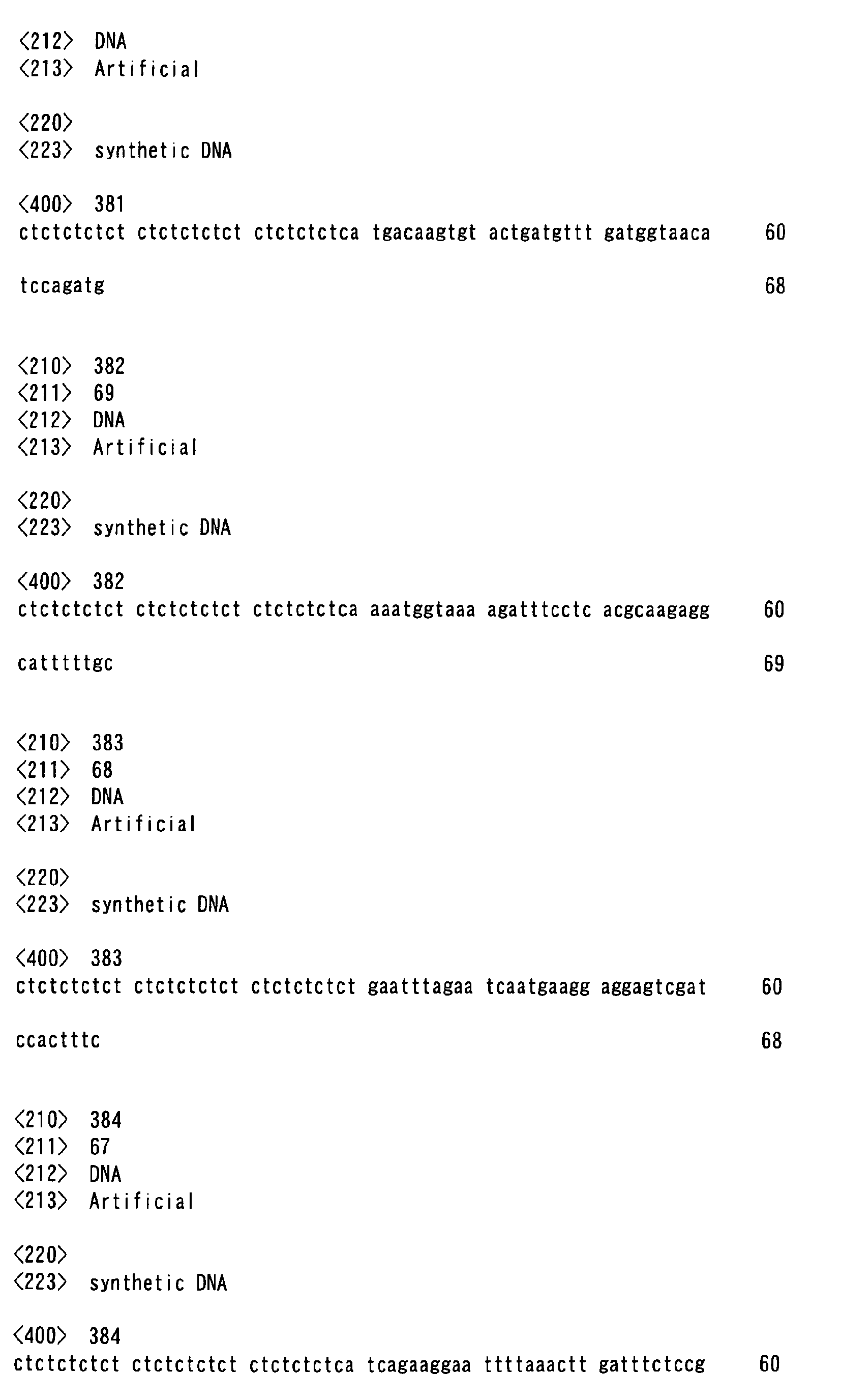

Claims (5)
- A method for confirming immobilization conditions of nucleic acid probes immobilized on a nucleic acid array, comprising the steps of:(a) defining the number of zones to which the nucleic acid probes immobilized on the nucleic acid array belong and one or more given pieces of identification information;(b) calculating X using the following formula:

(wherein N represents the number of the pieces of identification information, and M represents the number of the zones to which the nucleic acid probes immobilized on the nucleic acid array belong),
defining a number of the integer portion of X as the number of nucleic acid arrays required for confirming the immobilization conditions, Xa, and allocating non-overlapping numerical values (Y), which are expressed by notation system of base N+1, and which have the same digit number as Xa, to the respective nucleic acid probes belonging to the zones;(c) preparing complementary nucleic acid molecules comprising nucleotide sequences complementary to all or a part of nucleotide sequences of the nucleic acid probes, preparing groups of nucleic acid samples corresponding to the number of nucleic acid arrays (Xa) by mixing the complementary nucleic acid molecules based on the number of every digit of each of the allocated numerical values (Y), and preparing nucleic acid arrays (the number: Xa);(d) contacting each of the nucleic acid arrays (the number: Xa) prepared in the step (c) with the corresponding group of the nucleic acid samples to detect signals derived from hybrids between the nucleic acid probes immobilized on the nucleic acid arrays and the complementary nucleic acid molecules; and(e) matching patterns of expression of the signals detected to patterns of the numerical values (Y) allocated. - The method according to claim 1, wherein the immobilization conditions of the nucleic acid probes are related to types and/or positions of the nucleic acid probes.
- The method according to claim 1, wherein the identification information is at least one selected from the group consisting of: a presence or an absence of the signal; a strength of the signal; and a type of labeling.
- The method according to claim 1, wherein the patterns of expression of the signals detected are quantified by notation system of base N+1 based on the identification information.
- A method for examining a quality of nucleic acid arrays, wherein the quality of the nucleic acid arrays is examined based on results obtained according to the method according to any one of claims 1 to 4.
Applications Claiming Priority (2)
| Application Number | Priority Date | Filing Date | Title |
|---|---|---|---|
| JP2005315190 | 2005-10-28 | ||
| PCT/JP2006/322063 WO2007049827A1 (en) | 2005-10-28 | 2006-10-30 | Method of confirming probe-loading position in nucleic acid array |
Publications (3)
| Publication Number | Publication Date |
|---|---|
| EP1947456A1 true EP1947456A1 (en) | 2008-07-23 |
| EP1947456A4 EP1947456A4 (en) | 2012-10-31 |
| EP1947456B1 EP1947456B1 (en) | 2015-08-12 |
Family
ID=37967925
Family Applications (1)
| Application Number | Title | Priority Date | Filing Date |
|---|---|---|---|
| EP06832420.1A Not-in-force EP1947456B1 (en) | 2005-10-28 | 2006-10-30 | Method of confirming probe-loading position in nucleic acid array |
Country Status (5)
| Country | Link |
|---|---|
| US (1) | US8014958B2 (en) |
| EP (1) | EP1947456B1 (en) |
| JP (1) | JP4009311B2 (en) |
| CN (1) | CN101297199B (en) |
| WO (1) | WO2007049827A1 (en) |
Families Citing this family (1)
| Publication number | Priority date | Publication date | Assignee | Title |
|---|---|---|---|---|
| JP6230091B2 (en) * | 2013-03-13 | 2017-11-15 | 国立研究開発法人産業技術総合研究所 | Microarray, manufacturing method thereof, and use thereof |
Family Cites Families (8)
| Publication number | Priority date | Publication date | Assignee | Title |
|---|---|---|---|---|
| CN1147590C (en) * | 1999-08-13 | 2004-04-28 | 杨梦甦 | Method for detecting fluorescence signal of DNA chip based on ratio method |
| CN1111735C (en) * | 2000-02-19 | 2003-06-18 | 吴昌 | Colour point test method for discriminating quality of biochip |
| CN1314587A (en) * | 2000-03-20 | 2001-09-26 | 上海博道基因开发有限公司 | Method for detecting fluorescent label efficiency |
| US20030211496A1 (en) * | 2000-03-29 | 2003-11-13 | Getts Robert C | Quality control reagents for nucleic acid microarrays |
| FR2808268B1 (en) * | 2000-04-26 | 2002-08-30 | Atofina | IONIC LIQUIDS DERIVED FROM TITANIUM, NIOBIUM, TANTALUM, TIN OR ANTIMONY LEWIS ACIDS AND THEIR APPLICATIONS |
| AU2001286929A1 (en) * | 2000-09-01 | 2002-03-13 | Board Of Regents, The University Of Texas System | Compositions and methods for the generation of single stranded cdna microarrays with accurate universal quantitation reference |
| KR100450817B1 (en) * | 2002-03-07 | 2004-10-01 | 삼성전자주식회사 | Quality control method of DNA microarray spots |
| EP1552003A4 (en) * | 2002-06-28 | 2007-06-13 | Rosetta Inpharmatics Llc | METHODS OF ASSESSING THE QUALITY OF MICROARRAY |
-
2006
- 2006-10-30 JP JP2006547644A patent/JP4009311B2/en not_active Expired - Fee Related
- 2006-10-30 EP EP06832420.1A patent/EP1947456B1/en not_active Not-in-force
- 2006-10-30 CN CN2006800397611A patent/CN101297199B/en not_active Expired - Fee Related
- 2006-10-30 US US12/091,522 patent/US8014958B2/en not_active Expired - Fee Related
- 2006-10-30 WO PCT/JP2006/322063 patent/WO2007049827A1/en not_active Ceased
Also Published As
| Publication number | Publication date |
|---|---|
| US20090247419A1 (en) | 2009-10-01 |
| JP4009311B2 (en) | 2007-11-14 |
| WO2007049827A1 (en) | 2007-05-03 |
| EP1947456B1 (en) | 2015-08-12 |
| CN101297199B (en) | 2011-12-28 |
| EP1947456A4 (en) | 2012-10-31 |
| JPWO2007049827A1 (en) | 2009-04-30 |
| CN101297199A (en) | 2008-10-29 |
| US8014958B2 (en) | 2011-09-06 |
Similar Documents
| Publication | Publication Date | Title |
|---|---|---|
| EP2674492B1 (en) | Method for detecting nucleic acid | |
| US7879541B2 (en) | Apparatus and methods of detecting features on a microarray | |
| EP1373566B1 (en) | Polynucleotide analysis using combinatorial pcr | |
| CN113604547B (en) | High-resolution space histology detection method for tissue sample | |
| EP4455260A1 (en) | Biochip for spatial transcriptomic analysis, and preparation method and application thereof | |
| CN117327565A (en) | Biochip for space transcriptomics analysis and application thereof | |
| EP1947456B1 (en) | Method of confirming probe-loading position in nucleic acid array | |
| KR20030049802A (en) | Discrimination method of hybridization between probes and nucleotides in sample on the bio chip using enzyme reaction | |
| AU1424600A (en) | Microarray system and process for performing biochemical reactions | |
| US7824917B2 (en) | Method of detecting nucleic acid by using nucleic acid microarray | |
| CA2330478A1 (en) | Support for the parallel identification and establishment of transcription profiles of polynucleic acids | |
| JP2003322650A (en) | High sensitivity detection technology using concentration | |
| EP1645639A2 (en) | Multiple array substrates containing control probes | |
| JP2003329678A (en) | Test substrate and solid support for biochemical testing | |
| CN114231607B (en) | Micro-lattice chip and preparation method and application thereof | |
| JP3843134B2 (en) | Method and apparatus for processing by combining liquid media | |
| JPWO2003083474A1 (en) | Test piece for analyzing biological material, method for producing the same, and test method for biological material | |
| JP5294963B2 (en) | Method for processing target substance and method for determining total amount of target substance | |
| JP2004337064A (en) | Gene detection chip | |
| JP5394045B2 (en) | Method for detecting mouse Acidicribosomal Phosphoprotein P0 gene | |
| JP2003247990A (en) | Inspection substrate for biochemical inspection and micro substrate used for it | |
| Southern | DNA microarrays-the how and the why. | |
| Kallioniemi | Spyro Mousses, Natasha Caplen, Mark Basik, Anne Kallioniemi, and | |
| Kozonova | BIOCHIPS IN FOOD TECHNOLOGIES | |
| JP2006197836A (en) | DNA microarray regeneration method and use thereof |
Legal Events
| Date | Code | Title | Description |
|---|---|---|---|
| PUAI | Public reference made under article 153(3) epc to a published international application that has entered the european phase |
Free format text: ORIGINAL CODE: 0009012 |
|
| 17P | Request for examination filed |
Effective date: 20080514 |
|
| AK | Designated contracting states |
Kind code of ref document: A1 Designated state(s): AT BE BG CH CY CZ DE DK EE ES FI FR GB GR HU IE IS IT LI LT LU LV MC NL PL PT RO SE SI SK TR |
|
| DAX | Request for extension of the european patent (deleted) | ||
| A4 | Supplementary search report drawn up and despatched |
Effective date: 20120927 |
|
| RIC1 | Information provided on ipc code assigned before grant |
Ipc: C12Q 1/68 20060101ALI20120921BHEP Ipc: G01N 33/53 20060101AFI20120921BHEP Ipc: C12N 15/09 20060101ALI20120921BHEP Ipc: C12M 1/00 20060101ALI20120921BHEP |
|
| 17Q | First examination report despatched |
Effective date: 20130614 |
|
| GRAP | Despatch of communication of intention to grant a patent |
Free format text: ORIGINAL CODE: EPIDOSNIGR1 |
|
| INTG | Intention to grant announced |
Effective date: 20150326 |
|
| GRAS | Grant fee paid |
Free format text: ORIGINAL CODE: EPIDOSNIGR3 |
|
| GRAA | (expected) grant |
Free format text: ORIGINAL CODE: 0009210 |
|
| AK | Designated contracting states |
Kind code of ref document: B1 Designated state(s): AT BE BG CH CY CZ DE DK EE ES FI FR GB GR HU IE IS IT LI LT LU LV MC NL PL PT RO SE SI SK TR |
|
| REG | Reference to a national code |
Ref country code: GB Ref legal event code: FG4D |
|
| REG | Reference to a national code |
Ref country code: CH Ref legal event code: EP |
|
| REG | Reference to a national code |
Ref country code: AT Ref legal event code: REF Ref document number: 742618 Country of ref document: AT Kind code of ref document: T Effective date: 20150815 |
|
| REG | Reference to a national code |
Ref country code: IE Ref legal event code: FG4D |
|
| REG | Reference to a national code |
Ref country code: DE Ref legal event code: R096 Ref document number: 602006046289 Country of ref document: DE |
|
| REG | Reference to a national code |
Ref country code: FR Ref legal event code: PLFP Year of fee payment: 10 |
|
| REG | Reference to a national code |
Ref country code: LT Ref legal event code: MG4D |
|
| REG | Reference to a national code |
Ref country code: AT Ref legal event code: MK05 Ref document number: 742618 Country of ref document: AT Kind code of ref document: T Effective date: 20150812 |
|
| REG | Reference to a national code |
Ref country code: NL Ref legal event code: MP Effective date: 20150812 |
|
| PG25 | Lapsed in a contracting state [announced via postgrant information from national office to epo] |
Ref country code: LV Free format text: LAPSE BECAUSE OF FAILURE TO SUBMIT A TRANSLATION OF THE DESCRIPTION OR TO PAY THE FEE WITHIN THE PRESCRIBED TIME-LIMIT Effective date: 20150812 Ref country code: FI Free format text: LAPSE BECAUSE OF FAILURE TO SUBMIT A TRANSLATION OF THE DESCRIPTION OR TO PAY THE FEE WITHIN THE PRESCRIBED TIME-LIMIT Effective date: 20150812 Ref country code: GR Free format text: LAPSE BECAUSE OF FAILURE TO SUBMIT A TRANSLATION OF THE DESCRIPTION OR TO PAY THE FEE WITHIN THE PRESCRIBED TIME-LIMIT Effective date: 20151113 Ref country code: LT Free format text: LAPSE BECAUSE OF FAILURE TO SUBMIT A TRANSLATION OF THE DESCRIPTION OR TO PAY THE FEE WITHIN THE PRESCRIBED TIME-LIMIT Effective date: 20150812 |
|
| PG25 | Lapsed in a contracting state [announced via postgrant information from national office to epo] |
Ref country code: ES Free format text: LAPSE BECAUSE OF FAILURE TO SUBMIT A TRANSLATION OF THE DESCRIPTION OR TO PAY THE FEE WITHIN THE PRESCRIBED TIME-LIMIT Effective date: 20150812 Ref country code: PT Free format text: LAPSE BECAUSE OF FAILURE TO SUBMIT A TRANSLATION OF THE DESCRIPTION OR TO PAY THE FEE WITHIN THE PRESCRIBED TIME-LIMIT Effective date: 20151214 Ref country code: PL Free format text: LAPSE BECAUSE OF FAILURE TO SUBMIT A TRANSLATION OF THE DESCRIPTION OR TO PAY THE FEE WITHIN THE PRESCRIBED TIME-LIMIT Effective date: 20150812 Ref country code: IS Free format text: LAPSE BECAUSE OF FAILURE TO SUBMIT A TRANSLATION OF THE DESCRIPTION OR TO PAY THE FEE WITHIN THE PRESCRIBED TIME-LIMIT Effective date: 20151212 Ref country code: AT Free format text: LAPSE BECAUSE OF FAILURE TO SUBMIT A TRANSLATION OF THE DESCRIPTION OR TO PAY THE FEE WITHIN THE PRESCRIBED TIME-LIMIT Effective date: 20150812 Ref country code: SE Free format text: LAPSE BECAUSE OF FAILURE TO SUBMIT A TRANSLATION OF THE DESCRIPTION OR TO PAY THE FEE WITHIN THE PRESCRIBED TIME-LIMIT Effective date: 20150812 |
|
| PG25 | Lapsed in a contracting state [announced via postgrant information from national office to epo] |
Ref country code: NL Free format text: LAPSE BECAUSE OF FAILURE TO SUBMIT A TRANSLATION OF THE DESCRIPTION OR TO PAY THE FEE WITHIN THE PRESCRIBED TIME-LIMIT Effective date: 20150812 |
|
| PG25 | Lapsed in a contracting state [announced via postgrant information from national office to epo] |
Ref country code: SK Free format text: LAPSE BECAUSE OF FAILURE TO SUBMIT A TRANSLATION OF THE DESCRIPTION OR TO PAY THE FEE WITHIN THE PRESCRIBED TIME-LIMIT Effective date: 20150812 Ref country code: EE Free format text: LAPSE BECAUSE OF FAILURE TO SUBMIT A TRANSLATION OF THE DESCRIPTION OR TO PAY THE FEE WITHIN THE PRESCRIBED TIME-LIMIT Effective date: 20150812 Ref country code: IT Free format text: LAPSE BECAUSE OF FAILURE TO SUBMIT A TRANSLATION OF THE DESCRIPTION OR TO PAY THE FEE WITHIN THE PRESCRIBED TIME-LIMIT Effective date: 20150812 Ref country code: DK Free format text: LAPSE BECAUSE OF FAILURE TO SUBMIT A TRANSLATION OF THE DESCRIPTION OR TO PAY THE FEE WITHIN THE PRESCRIBED TIME-LIMIT Effective date: 20150812 Ref country code: CZ Free format text: LAPSE BECAUSE OF FAILURE TO SUBMIT A TRANSLATION OF THE DESCRIPTION OR TO PAY THE FEE WITHIN THE PRESCRIBED TIME-LIMIT Effective date: 20150812 |
|
| REG | Reference to a national code |
Ref country code: DE Ref legal event code: R097 Ref document number: 602006046289 Country of ref document: DE |
|
| PG25 | Lapsed in a contracting state [announced via postgrant information from national office to epo] |
Ref country code: LU Free format text: LAPSE BECAUSE OF FAILURE TO SUBMIT A TRANSLATION OF THE DESCRIPTION OR TO PAY THE FEE WITHIN THE PRESCRIBED TIME-LIMIT Effective date: 20151030 Ref country code: RO Free format text: LAPSE BECAUSE OF FAILURE TO SUBMIT A TRANSLATION OF THE DESCRIPTION OR TO PAY THE FEE WITHIN THE PRESCRIBED TIME-LIMIT Effective date: 20150812 |
|
| REG | Reference to a national code |
Ref country code: CH Ref legal event code: PL |
|
| PLBE | No opposition filed within time limit |
Free format text: ORIGINAL CODE: 0009261 |
|
| STAA | Information on the status of an ep patent application or granted ep patent |
Free format text: STATUS: NO OPPOSITION FILED WITHIN TIME LIMIT |
|
| PG25 | Lapsed in a contracting state [announced via postgrant information from national office to epo] |
Ref country code: MC Free format text: LAPSE BECAUSE OF FAILURE TO SUBMIT A TRANSLATION OF THE DESCRIPTION OR TO PAY THE FEE WITHIN THE PRESCRIBED TIME-LIMIT Effective date: 20150812 |
|
| 26N | No opposition filed |
Effective date: 20160513 |
|
| REG | Reference to a national code |
Ref country code: IE Ref legal event code: MM4A |
|
| PG25 | Lapsed in a contracting state [announced via postgrant information from national office to epo] |
Ref country code: CH Free format text: LAPSE BECAUSE OF NON-PAYMENT OF DUE FEES Effective date: 20151031 Ref country code: LI Free format text: LAPSE BECAUSE OF NON-PAYMENT OF DUE FEES Effective date: 20151031 |
|
| PG25 | Lapsed in a contracting state [announced via postgrant information from national office to epo] |
Ref country code: SI Free format text: LAPSE BECAUSE OF FAILURE TO SUBMIT A TRANSLATION OF THE DESCRIPTION OR TO PAY THE FEE WITHIN THE PRESCRIBED TIME-LIMIT Effective date: 20150812 |
|
| REG | Reference to a national code |
Ref country code: FR Ref legal event code: PLFP Year of fee payment: 11 |
|
| PG25 | Lapsed in a contracting state [announced via postgrant information from national office to epo] |
Ref country code: IE Free format text: LAPSE BECAUSE OF NON-PAYMENT OF DUE FEES Effective date: 20151030 |
|
| PG25 | Lapsed in a contracting state [announced via postgrant information from national office to epo] |
Ref country code: BE Free format text: LAPSE BECAUSE OF FAILURE TO SUBMIT A TRANSLATION OF THE DESCRIPTION OR TO PAY THE FEE WITHIN THE PRESCRIBED TIME-LIMIT Effective date: 20150812 |
|
| PG25 | Lapsed in a contracting state [announced via postgrant information from national office to epo] |
Ref country code: HU Free format text: LAPSE BECAUSE OF FAILURE TO SUBMIT A TRANSLATION OF THE DESCRIPTION OR TO PAY THE FEE WITHIN THE PRESCRIBED TIME-LIMIT; INVALID AB INITIO Effective date: 20061030 Ref country code: BG Free format text: LAPSE BECAUSE OF FAILURE TO SUBMIT A TRANSLATION OF THE DESCRIPTION OR TO PAY THE FEE WITHIN THE PRESCRIBED TIME-LIMIT Effective date: 20150812 |
|
| PG25 | Lapsed in a contracting state [announced via postgrant information from national office to epo] |
Ref country code: CY Free format text: LAPSE BECAUSE OF FAILURE TO SUBMIT A TRANSLATION OF THE DESCRIPTION OR TO PAY THE FEE WITHIN THE PRESCRIBED TIME-LIMIT Effective date: 20150812 |
|
| PG25 | Lapsed in a contracting state [announced via postgrant information from national office to epo] |
Ref country code: TR Free format text: LAPSE BECAUSE OF FAILURE TO SUBMIT A TRANSLATION OF THE DESCRIPTION OR TO PAY THE FEE WITHIN THE PRESCRIBED TIME-LIMIT Effective date: 20150812 |
|
| REG | Reference to a national code |
Ref country code: FR Ref legal event code: PLFP Year of fee payment: 12 |
|
| REG | Reference to a national code |
Ref country code: DE Ref legal event code: R082 Ref document number: 602006046289 Country of ref document: DE Representative=s name: HOFFMANN - EITLE PATENT- UND RECHTSANWAELTE PA, DE Ref country code: DE Ref legal event code: R081 Ref document number: 602006046289 Country of ref document: DE Owner name: MITSUBISHI CHEMICAL CORPORATION, JP Free format text: FORMER OWNER: MITSUBISHI RAYON CO., LTD., TOKIO/TOKYO, JP |
|
| REG | Reference to a national code |
Ref country code: FR Ref legal event code: CA Effective date: 20180515 Ref country code: FR Ref legal event code: CD Owner name: MITSUBISHI CHEMICAL CORPORATION, JP Effective date: 20180515 |
|
| REG | Reference to a national code |
Ref country code: FR Ref legal event code: PLFP Year of fee payment: 13 |
|
| PGFP | Annual fee paid to national office [announced via postgrant information from national office to epo] |
Ref country code: FR Payment date: 20190913 Year of fee payment: 14 |
|
| PGFP | Annual fee paid to national office [announced via postgrant information from national office to epo] |
Ref country code: DE Payment date: 20191015 Year of fee payment: 14 |
|
| PGFP | Annual fee paid to national office [announced via postgrant information from national office to epo] |
Ref country code: GB Payment date: 20191031 Year of fee payment: 14 |
|
| REG | Reference to a national code |
Ref country code: DE Ref legal event code: R119 Ref document number: 602006046289 Country of ref document: DE |
|
| GBPC | Gb: european patent ceased through non-payment of renewal fee |
Effective date: 20201030 |
|
| PG25 | Lapsed in a contracting state [announced via postgrant information from national office to epo] |
Ref country code: DE Free format text: LAPSE BECAUSE OF NON-PAYMENT OF DUE FEES Effective date: 20210501 Ref country code: FR Free format text: LAPSE BECAUSE OF NON-PAYMENT OF DUE FEES Effective date: 20201031 |
|
| PG25 | Lapsed in a contracting state [announced via postgrant information from national office to epo] |
Ref country code: GB Free format text: LAPSE BECAUSE OF NON-PAYMENT OF DUE FEES Effective date: 20201030 |