EP1944978A1 - Method and system for encoding a video signal. encoded video signal, method and system for decoding a video signal - Google Patents
Method and system for encoding a video signal. encoded video signal, method and system for decoding a video signal Download PDFInfo
- Publication number
- EP1944978A1 EP1944978A1 EP07100470A EP07100470A EP1944978A1 EP 1944978 A1 EP1944978 A1 EP 1944978A1 EP 07100470 A EP07100470 A EP 07100470A EP 07100470 A EP07100470 A EP 07100470A EP 1944978 A1 EP1944978 A1 EP 1944978A1
- Authority
- EP
- European Patent Office
- Prior art keywords
- frame
- encoder
- memory
- prediction
- decoder
- Prior art date
- Legal status (The legal status is an assumption and is not a legal conclusion. Google has not performed a legal analysis and makes no representation as to the accuracy of the status listed.)
- Ceased
Links
- 238000000034 method Methods 0.000 title claims description 59
- 230000002123 temporal effect Effects 0.000 claims abstract description 43
- 230000006835 compression Effects 0.000 claims abstract description 26
- 238000007906 compression Methods 0.000 claims abstract description 26
- 230000015654 memory Effects 0.000 claims description 58
- 238000004590 computer program Methods 0.000 claims description 6
- 238000012545 processing Methods 0.000 description 5
- 239000013598 vector Substances 0.000 description 5
- 230000008859 change Effects 0.000 description 4
- 230000009466 transformation Effects 0.000 description 4
- 244000025254 Cannabis sativa Species 0.000 description 3
- 230000006872 improvement Effects 0.000 description 3
- 238000013139 quantization Methods 0.000 description 3
- 230000001419 dependent effect Effects 0.000 description 2
- 238000013461 design Methods 0.000 description 2
- 238000009877 rendering Methods 0.000 description 2
- 230000002441 reversible effect Effects 0.000 description 2
- 230000000153 supplemental effect Effects 0.000 description 2
- 102000009913 Peroxisomal Targeting Signal 2 Receptor Human genes 0.000 description 1
- 108010077056 Peroxisomal Targeting Signal 2 Receptor Proteins 0.000 description 1
- 101100465559 Saccharomyces cerevisiae (strain ATCC 204508 / S288c) PRE7 gene Proteins 0.000 description 1
- XUIMIQQOPSSXEZ-UHFFFAOYSA-N Silicon Chemical compound [Si] XUIMIQQOPSSXEZ-UHFFFAOYSA-N 0.000 description 1
- 230000003044 adaptive effect Effects 0.000 description 1
- 230000005540 biological transmission Effects 0.000 description 1
- 230000015572 biosynthetic process Effects 0.000 description 1
- 238000006243 chemical reaction Methods 0.000 description 1
- 230000002860 competitive effect Effects 0.000 description 1
- 230000021615 conjugation Effects 0.000 description 1
- 238000010586 diagram Methods 0.000 description 1
- 238000001914 filtration Methods 0.000 description 1
- 230000006870 function Effects 0.000 description 1
- 238000009499 grossing Methods 0.000 description 1
- 230000007774 longterm Effects 0.000 description 1
- 230000004048 modification Effects 0.000 description 1
- 238000012986 modification Methods 0.000 description 1
- 238000012805 post-processing Methods 0.000 description 1
- 230000008569 process Effects 0.000 description 1
- 230000001681 protective effect Effects 0.000 description 1
- 101150076896 pts1 gene Proteins 0.000 description 1
- 229910052710 silicon Inorganic materials 0.000 description 1
- 239000010703 silicon Substances 0.000 description 1
- GUGNSJAORJLKGP-UHFFFAOYSA-K sodium 8-methoxypyrene-1,3,6-trisulfonate Chemical compound [Na+].[Na+].[Na+].C1=C2C(OC)=CC(S([O-])(=O)=O)=C(C=C3)C2=C2C3=C(S([O-])(=O)=O)C=C(S([O-])(=O)=O)C2=C1 GUGNSJAORJLKGP-UHFFFAOYSA-K 0.000 description 1
- 238000010561 standard procedure Methods 0.000 description 1
- 208000031509 superficial epidermolytic ichthyosis Diseases 0.000 description 1
- 238000003786 synthesis reaction Methods 0.000 description 1
- 238000013519 translation Methods 0.000 description 1
Images




Classifications
-
- H—ELECTRICITY
- H04—ELECTRIC COMMUNICATION TECHNIQUE
- H04N—PICTORIAL COMMUNICATION, e.g. TELEVISION
- H04N19/00—Methods or arrangements for coding, decoding, compressing or decompressing digital video signals
- H04N19/50—Methods or arrangements for coding, decoding, compressing or decompressing digital video signals using predictive coding
- H04N19/503—Methods or arrangements for coding, decoding, compressing or decompressing digital video signals using predictive coding involving temporal prediction
- H04N19/51—Motion estimation or motion compensation
- H04N19/573—Motion compensation with multiple frame prediction using two or more reference frames in a given prediction direction
-
- H—ELECTRICITY
- H04—ELECTRIC COMMUNICATION TECHNIQUE
- H04N—PICTORIAL COMMUNICATION, e.g. TELEVISION
- H04N19/00—Methods or arrangements for coding, decoding, compressing or decompressing digital video signals
- H04N19/10—Methods or arrangements for coding, decoding, compressing or decompressing digital video signals using adaptive coding
- H04N19/102—Methods or arrangements for coding, decoding, compressing or decompressing digital video signals using adaptive coding characterised by the element, parameter or selection affected or controlled by the adaptive coding
- H04N19/103—Selection of coding mode or of prediction mode
- H04N19/105—Selection of the reference unit for prediction within a chosen coding or prediction mode, e.g. adaptive choice of position and number of pixels used for prediction
-
- H—ELECTRICITY
- H04—ELECTRIC COMMUNICATION TECHNIQUE
- H04N—PICTORIAL COMMUNICATION, e.g. TELEVISION
- H04N19/00—Methods or arrangements for coding, decoding, compressing or decompressing digital video signals
- H04N19/10—Methods or arrangements for coding, decoding, compressing or decompressing digital video signals using adaptive coding
- H04N19/134—Methods or arrangements for coding, decoding, compressing or decompressing digital video signals using adaptive coding characterised by the element, parameter or criterion affecting or controlling the adaptive coding
- H04N19/136—Incoming video signal characteristics or properties
-
- H—ELECTRICITY
- H04—ELECTRIC COMMUNICATION TECHNIQUE
- H04N—PICTORIAL COMMUNICATION, e.g. TELEVISION
- H04N19/00—Methods or arrangements for coding, decoding, compressing or decompressing digital video signals
- H04N19/10—Methods or arrangements for coding, decoding, compressing or decompressing digital video signals using adaptive coding
- H04N19/169—Methods or arrangements for coding, decoding, compressing or decompressing digital video signals using adaptive coding characterised by the coding unit, i.e. the structural portion or semantic portion of the video signal being the object or the subject of the adaptive coding
- H04N19/17—Methods or arrangements for coding, decoding, compressing or decompressing digital video signals using adaptive coding characterised by the coding unit, i.e. the structural portion or semantic portion of the video signal being the object or the subject of the adaptive coding the unit being an image region, e.g. an object
-
- H—ELECTRICITY
- H04—ELECTRIC COMMUNICATION TECHNIQUE
- H04N—PICTORIAL COMMUNICATION, e.g. TELEVISION
- H04N19/00—Methods or arrangements for coding, decoding, compressing or decompressing digital video signals
- H04N19/30—Methods or arrangements for coding, decoding, compressing or decompressing digital video signals using hierarchical techniques, e.g. scalability
-
- H—ELECTRICITY
- H04—ELECTRIC COMMUNICATION TECHNIQUE
- H04N—PICTORIAL COMMUNICATION, e.g. TELEVISION
- H04N19/00—Methods or arrangements for coding, decoding, compressing or decompressing digital video signals
- H04N19/42—Methods or arrangements for coding, decoding, compressing or decompressing digital video signals characterised by implementation details or hardware specially adapted for video compression or decompression, e.g. dedicated software implementation
- H04N19/423—Methods or arrangements for coding, decoding, compressing or decompressing digital video signals characterised by implementation details or hardware specially adapted for video compression or decompression, e.g. dedicated software implementation characterised by memory arrangements
Definitions
- the invention relates to the general field of video coding (or video compression), and in embodiments to so-called scalable video coding. It presents a method and system for encoding a video signal wherein, image compression, for instance scalable image compression is performed and multiple temporal predictions are used wherein multiple frames are stored in a memory.
- the invention also relates to the encoded, e.g. scalable video signal and to a method and system for decoding a video signal.
- Image display systems often receive compressed data streams.
- a variety of image compression techniques are known to reduce the amount of image data that must to be stored or transmitted.
- video compression use is made of prediction, wherein the content of a frame or part of a frame is predicted from the content of one or more previous received or generated frames.
- video signal processing the signal is comprised of intracoded and intercoded frames, for instance I-frames, P-frames and B-frames.
- the I-frames are intra-coded.
- the P- and B-frames are referred to as intercoded frames.
- Intra-code frames can be reconstructed without any reference to other frames; intercoded frames are reconstructed using data of other frames (forward or backward prediction).
- the P-and B-frames only contain information or changes between the 1-frames, often expressed in motion vectors for macroblocks.
- the referral is relatively simple, and at most two frames are referred to, the P frames are forwardly predicted from I frames and the B frames are forwardly and backwardly predicted from I and P-frames.
- motion estimation motion vectors can be found which are used for motion estimation of parts (macroblocks) of a frame.
- Some more complex video compression standards such as the AVC compression standard have a possibility of many multiple predictions.
- a relatively large number of temporal (i.e. forward or backward) predictions are made. Not just the nearest frames in time are considered for making the predictions, but also frames further removed in time.
- In a buffer several frames are stored in a memory to be used for temporal prediction. As time progresses the frames are shifted through a buffer in the memory and the oldest are bumped out of the buffer as a new 'fresh' frame is stored.
- the method in accordance with the invention is characterized in that a prediction frame in memory is overwritten with a separately produced prediction frame.
- “Separately produced” means within the framework of the invention from outside the normal (temporal) procedure for generating a prediction frame.
- Prediction frames are for instant e.g. produced in an enhancement encoding part of an encoder, prediction frames that are produced in a base stream encoding part are produced separately from the enhancement part of the encoder (although still within the encoder, when seen in a larger sense).
- a prediction frame longest in memory the oldest of the prediction frames in memory, or one of a subset of oldest prediction frames.
- the invention is based on the following insight:
- the overwritten prediction is one of the oldest predictions.
- the oldest (longest in memory) predictions usually are the least important.
- the method may comprise an algorithm to select the least important prediction(s) prior to overwriting.
- the method in accordance with the invention does not require more bits or major changes to the existing AVC standard.
- the memory is a memory in an enhancement encoder/decoder and the separately produced frame is an upscaled/de-interlaced frame from a base encoder/decoder. This enables, without any syntax change, to use the standard AVC for scalable compression.
- the external frame comprises depth views.
- the enhancement stream provides a higher frame rate, with a ratio different from 2.
- a envisioned application for such a case is a base layer at 50Hz intended for television sets, and an enhancement layer at 75Hz intended for computer LCD panels (or any other advanced display).
- 75Hz is the native refresh rate of many displays (mainly in the computer world).
- a 50/60Hz solution compatible with 75/90Hz enhancement is to be preferred, but can be realized neither with MPEG2 nor with SVC.
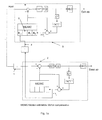
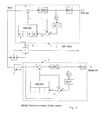
- Figs. 1a to 1c show the processing flow of a post-processing method, including a method for encoding ( Fig. 1a ) and decoding ( Fig. 1b ) according to an embodiment of the invention, wherein Fig. 1c illustrates a more complex embodiment.
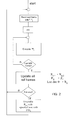
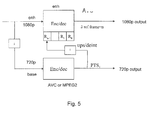
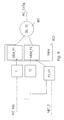
- Figs. 2 to 5 further illustrate the embodiment of the invention as shown in Figs. 1a to 1c .
- Fig. 6 illustrates a second embodiment of the invention.
- Fig. 7 illustrates a further embodiment of the invention wherein the base stream and the enhancement stream have different frame rates.
- Fig. 8 shows the basic principle of a video compression apparatus having prediction memories (typically for temporal prediction) wherein at least one of the less usuable ones is used for storing a prediction of an alternative predicting means.
- Some video compressions standards have a possibility of using a multitude of predictions for e.g. motion estimation/motion compensation.
- the inventors have realized that some of these predictions are more redundant or less useful, e.g. when using AVC multiple temporal predictions are use and the IC is predesigned to be able to deal with this.
- the dogma of temporal prediction is bypassed by overwriting a last of these predictions (i.e. usually the least accurate, especially for wild motion) to encode another prediction.
- the decoder behaves similarly.
- FIG. 1 shows a processing flow of an embodiment of our invention used an encoding and decoding method. This is illustrated in the following:
- FIG. 1a illustrates an embodiment of the method and system in accordance with the invention.
- Figure 1a illustrates a method in which use is made of a base stream and an enhancement stream.
- the massive amounts of data inherent in many image transmission method pose significant problems. More particularly, each digital image frame is a still image formed from an array of pixels according to the display resolution of a particular system. As a result, the amounts of raw digital information included are often massive.
- compression schemes are used to compress the data.
- Various video compression standards or processes have been established, including, MPEG-2, MPEG-4, and H.263.
- scalability techniques There are three axes on which one can deploy scalability. The first is scalability on the time axis, often referred to as temporal scalability. Secondly, there is scalability on the quality axis, often referred to as signal-to-noise scalability or fine-grain scalability. The third axis is the resolution axis (number of pixels in image) often referred to as spatial scalability or layered coding. In layered coding, the bitstream is divided into two or more bitstreams, or layers.
- each layer can be combined to form a single high quality signal.
- the base layer may provide a lower quality video signal
- the enhancement layer provides additional information that can enhance the base layer image.
- Figure 1a illustrates a method and system for providing a layered signal, in this case have a base stream (base str) and an enhancement stream (base str), sometimes also called an enhancement layer.
- the input is split and sent to a base encoder 2 after having passed a low pass filter 1, for instance a nyquist filter.
- the signal undergoes in the base encoder a disctret cosine transformation (DCT), or any other similar transformation, such as for instance using wavelets, and is quantized (Q; on the resulting data stream variable length coding is performed providing the base stream to be sent and/or stored.
- DCT disctret cosine transformation
- Q on the resulting data stream variable length coding is performed providing the base stream to be sent and/or stored.
- the signal is often comprised of intracoded and intercoded frames, for instance I-frames, P-frames and B-frames.
- the I-frames are intra-coded.
- the P- and B-frames are referred to as intercoded frames.
- Intra-code frames can be reconstructed without any reference to other frames; intercoded frames are reconstructed using data of other frames (forward or backward prediction).
- the P-and B-frames only contain information or changes between the I-frames, often expressed in motion vectors for macroblocks.
- the original signal has to be reconstructed inside the encoder. This is done by a reverse quantization (Q -1 ) and a reverse Discrete Cosine Transform (DCT -1 ).
- the resulting reconstructed frames are used inside the encoder for estimating motion vectors. In a simple arrangement only one reconstructed frame is used for motion estimation and motion compensation. However, in more complex methods and systems a number of reconstructed frames are used.
- the encoder comprises a shift register wherein for comparison the data of a number of reconmstructed frames are stored in a shift register for use in the motion estimation and/or motion estimation, i.e. in prediction.
- Some more complex video compression standards such as the AVC compression standard have a possibility of many multiple predictions.
- a relatively large number of temporal (i.e. forward or backward) predictions are made. Not just the nearest frames in time are considered for making the predictions, but also frames further removed in time.
- a buffer several frame are stored in a buffer to be used for temporal prediction. As time progresses the frames are shifted through the buffer and the oldest are bumped out of the buffer as a new 'fresh' frame is stored.
- the resulting base stream can be broadcasted, received and via a decoder, displayed as is, although the base stream does not provide a resolution which would be considered as high-definition.
- the system comprises also an enhancement encoder 3.
- the enhancement encoder 3 a similar method is performed as in the base stream encoder 2, with only this difference that the enhancement stream (i.e. the difference between the original signal and the base stream) is treated.
- the enhancement decoder comprises a means for Discrete Consien Transform and qunatization of the enhanced layer signal, and for reconstructing (DCT -1 , Q -1 ).
- a person skilled in the art will be familiar with these methods.
- the inventors have realized that the stored frames do not all have the same relevance, in particular, but not exclusively the least longest remaining frames may well be less important.
- the longer a frame is in store the lower on average the importance of the temporal prediction based on that frame.
- the dogma of temporal prediction is bypassed by using the space reserved for the last of the temporal predictions (i.e. the 'oldest frames') for a separate prediction. This will decrease slightly the accuracy of the temporal prediction.
- the overwritten information is relatively redundant/less useful. Overwriting the information therefore very often does not seriously decrease image quality.
- the information that can be written in the overwritten slots opens up possibilities that are, with the present standards, not achievable, or only with very complex changes to existing procedures so that they are no longer compatible to existing standards and/or necessitate a large increase in bits in the video signal.
- the invention could be used by overwriting one or more of the oldest frames.
- Figure 1a illustrates an embodiment of the method and system of the invention.
- the oldest data in the memory in the enhancement encoder is overwritten by an upscaled/interlaced frame produced in the base encoder.
- reference frame R n/1 in the enhancement encoder 3 is overwritten with an upscaled/de-interlaced frame 4 from the base encoder/decoder 2 with also PTSi (Presentation Time Stamp i).
- PTSi Presentation Time Stamp i
- the frame longest in memory in the memory 5 of the enhancement encoder 3 is thus overwritten by a separately produced frame, namely an upscaled/de-interlaced frame 4 from the base stream encoder 2.
- FIG. 1a shows a scalable encoder. Because resources are limited to 180i, the scheme according to the invention enables with only minor modification to a silicon 1080p.
- the last prediction R n-1 now e.g. contains a smart content adaptive upscaling candidate.
- the last two 'normal' temporal predictions (R n-1 , R n-2 ) could be overwritten be e.g. the predictions (frames) produced by using two different de-interlacing algorithms.
- the oldest frame in memory in the enhancement encoder is overwritten.
- the oldest frame is overwritten.
- one of the last n frames could be overwritten wherein a choice is made which one is overwritten on basis of an estimation of the importance (ranking) of the set of oldest to be overwritten frames, the overwritten frames than need not necessarily be the very oldest frame, but could be the next to oldest frame.
- FIG. 1b shows the decoder side.
- VLD stands for variable length decoding.
- a frame 4 produced in the base stream decoder 2' is used to overwrite frame prediction frame R n-1 in memory 5' of the enhancement decoder.
- Figure 1c illustrates for a more complex embodiment of the design shown in Figure 1a .
- the difference is that a filter is used and furthermore that the data relating to the filter and the upscaling are inserted into SEI (Supplemental Enhancement Information).
- SEI Supplemental Enhancement Information
- Figure 2 illustrates in a flow diagram the different steps within the enhancement to ensure that the external frame (upscaled base with PTS j ) does overwrite frame R n-1 in the memory.
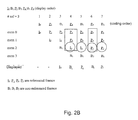
- FIG 2b Another option is given in Figure 2b ; it gives an example when it is safe to overwrite a reference frame in memory.
- a frame is only overwritten when it already has been sent to the output (display).
- the frame As the frame come in the memory is filled with the frame (memory 0, memory 1 etc).
- the number of reference frames is three. This means that the first three frames it is impossible to overwrite frames, since we need three frames.
- a frame has been displayed, that frame can be overwritten in the memory.
- these frames are oldest frames, but not necessarily the oldest frame in memory.
- the already displayed I 0 _frame can be overwritten, but not the as yet not displayed B 1 frame.
- the rectangle denote frames used for reference for B 3 and P 6 - (first rectangle) and B 5 and P 7 (last rectangle).
- Figure 3 illustrates an embodiment wherein an upscaled decoded I 0 base stream frame overwrites in the memory (buffer) of the enhancement encoder/decoder the last reference prediction frame (R 2 ) in the enhancement encoder/decoder, which in this example is P -6 .
- Figure 4 illustrates an embodiment wherein an upscaled decoded P 2 , with time stamp PTS2; base stream frame overwrites in the memory (buffer) of the enhancement encoder/decoder the last reference prediction frame (R 2 ) in the enhancement encoder/decoder, which in this example is P -4 .
- Figure 5 illustrates an embodiment in which the base stream has a 720p output and the enhancement stream a 1080p output.
- An upscaled/deinterlaced base stream frame with time stamp PTS1 overwrites frame R n-1 in the memory of the AVC enhancement encoder. This allows to introduce 1080p HDTV at full frame rate in a backwards compatible way (to 720p or 1080i HDTV), which is not possible or at much greater costs with known methods.
- center view C center view
- L left
- R right
- center view C left
- L left
- R right
- center view C left
- L & R views would be hierarchical B frames.
- the inventors have however realized that the basic concept of the invention, i.e. principle of overwriting one of more reference frames to the multiview case, can be used, so that we also don't have to change any syntax, and basically can use regular AVC also for this application.
- a third application enabled by this invention is creating an enhancement stream for a higher frame rate with a different ratio then power of 2.
- Some video compression standards use multiple temporal predictions. One or more of the oldest temporal predictions are overwritten with another prediction.
- a prediction used in an anhancement encoder is in embodiment overwritten by a prediction produced in a base stream encoder. In another embodiment a temporal prediction is overwritten by a 3D view.
- the invention relates to a method and system of encoding, as well as to a method and system of decoding, as described above by way of example.
- the invention is also embodied in a video signal comprising encoded video signals and control information comprising e.g. functional parameters for use in the method of decoding.
- the control information may comprise data in accordance with any, or any combination, of the embodiments described above.
- control information enclosed in the video signal according to the present invention may comprise one or more of the following information:
- A general information, i.e. applicable for the whole of the video signal
- the choices made in the encoder may be included into the encoded video signal.
- the encoding method comprises an algorithm to make a decision as to which one of the prediction is to be overwritten for instance by estimating the importance of the to be overwritten prediction possibly in comparison to the prediction that will overwrite, there is a choice of including the details of said selection algorithm(s) into the video signal (and thus including general information into the video signal).
- the decoder comprises said algorithm. If the decoder does not, the particular dynamic information may be sent, i.e. it is specified for a particular part of the video signal (for instance by a flag) that a particular prediction is to be overwritten.
- the video signal may comprise general information as well as dynamic information. All of the above types of information, as well as any other type of information relating to the use of the method according to the invention are called within the framework of the application a parameter. Parameters may thus be simple yes/no parameters (point A1 above), parameters indicating a choice within a set of possibilities (point A2 above for instance), or a parameter for control of a step within the method (point A3 above) or dynamic parameters (point B above) in any shape or form.
- Figure 8 specifies again the most generic apparatus (corresponding to most generic method) of the invention.
- a prediction unit 801 to apply a criterion SEL_F() upon several predictions generated by similar prediction units T, T2, which do e.g. a lossy transformation and motion compensation (e.g. in AVC, the temporal prediction can result from a combination of several previous images)
- one of these "standard” modes may be "re-used” by storing data from a separate prediction from another prediction unit PR_UN (i.e. in the sub-memory MEM_P2, a coarsely quantized first prediction, e.g. a wavelet approximation, is overwritten by another predicted region, by another algorithm from PR_UN).
- This new prediction mode can then be easily be introduced in an existing standard (whatever one likes).
- the selection criterion SEL_F() may also be changed.
- the other prediction unit may e.g. use a texture synthesis. If the encoder side recognizes there are e.g. patches (e.g. blocks) of grass, a comparison criterion or prediction may be used which just uses synthetically generated grass (e.g. typically with no residue update). This may then be selected as the best quality/compressed region compared to e.g. the temporal prediction. The decoder will then also apply the grass generation (it need not even receive temporal predictive information for that region). All kinds of improved predictions can be generated by prediction unit PR_UN, e.g.
- synchromization data may also be transmitted via the standardized compressed image signal, e.g. in SEIs.
- the invention is also embodied in any computer program product for a method or device in accordance with the invention.
- computer program product should be understood any physical realization of a collection of commands enabling a processor - generic or special purpose-, after a series of loading steps (which may include intermediate conversion steps, like translation to an intermediate language, and a final processor language) to get the commands into the processor, to execute any of the characteristic functions of an invention.
- the computer program product may be realized as data on a carrier such as e.g. a disk or tape, data present in a memory, data travelling over a network connection -wired or wireless- , or program code on paper.
- characteristic data required for the program may also be embodied as a computer program product.
- the method may de used for only a part of the image, or different embodiments of the method of the invention may be used for different parts of the image, for instance using one embodiment for the center of the image, while using another for the edges of the image.
- frame could be a part of a frame if for instance the method in accordance with the invention is done on a part of the frame, for instance only the middle part of the video or only foreground parts of a video.
Landscapes
- Engineering & Computer Science (AREA)
- Multimedia (AREA)
- Signal Processing (AREA)
- Compression Or Coding Systems Of Tv Signals (AREA)
- Compression, Expansion, Code Conversion, And Decoders (AREA)
Priority Applications (8)
| Application Number | Priority Date | Filing Date | Title |
|---|---|---|---|
| EP07100470A EP1944978A1 (en) | 2007-01-12 | 2007-01-12 | Method and system for encoding a video signal. encoded video signal, method and system for decoding a video signal |
| PL08700197.0T PL2105028T3 (pl) | 2007-01-12 | 2008-01-04 | Sposób i system do kodowania sygnału wideo, zakodowany sygnał wideo, sposób i system do dekodowania sygnału wideo |
| EP08700197.0A EP2105028B1 (en) | 2007-01-12 | 2008-01-04 | Method and system for encoding a video signal, encoded video signal, method and system for decoding a video signal |
| CN200880002202.2A CN101584220B (zh) | 2007-01-12 | 2008-01-04 | 对视频信号进行编码的方法和系统、编码的视频信号、对视频信号进行解码的方法和系统 |
| JP2009545257A JP5508024B2 (ja) | 2007-01-12 | 2008-01-04 | ビデオ信号を符号化するための方法及びシステム、符号化されたビデオ信号、並びに、ビデオ信号を復号するための方法及びシステム |
| PCT/IB2008/050014 WO2008084417A2 (en) | 2007-01-12 | 2008-01-04 | Method and system for encoding a video signal, encoded video signal, method and system for decoding a video signal |
| ES08700197.0T ES2572885T3 (es) | 2007-01-12 | 2008-01-04 | Método y sistema para codificar una señal de vídeo, señal de vídeo codificada, método y sistema para decodificar una señal de vídeo |
| US12/521,886 US8571101B2 (en) | 2007-01-12 | 2008-01-04 | Method and system for encoding a video signal, encoded video signal, method and system for decoding a video signal |
Applications Claiming Priority (1)
| Application Number | Priority Date | Filing Date | Title |
|---|---|---|---|
| EP07100470A EP1944978A1 (en) | 2007-01-12 | 2007-01-12 | Method and system for encoding a video signal. encoded video signal, method and system for decoding a video signal |
Publications (1)
| Publication Number | Publication Date |
|---|---|
| EP1944978A1 true EP1944978A1 (en) | 2008-07-16 |
Family
ID=38091743
Family Applications (2)
| Application Number | Title | Priority Date | Filing Date |
|---|---|---|---|
| EP07100470A Ceased EP1944978A1 (en) | 2007-01-12 | 2007-01-12 | Method and system for encoding a video signal. encoded video signal, method and system for decoding a video signal |
| EP08700197.0A Active EP2105028B1 (en) | 2007-01-12 | 2008-01-04 | Method and system for encoding a video signal, encoded video signal, method and system for decoding a video signal |
Family Applications After (1)
| Application Number | Title | Priority Date | Filing Date |
|---|---|---|---|
| EP08700197.0A Active EP2105028B1 (en) | 2007-01-12 | 2008-01-04 | Method and system for encoding a video signal, encoded video signal, method and system for decoding a video signal |
Country Status (7)
| Country | Link |
|---|---|
| US (1) | US8571101B2 (enExample) |
| EP (2) | EP1944978A1 (enExample) |
| JP (1) | JP5508024B2 (enExample) |
| CN (1) | CN101584220B (enExample) |
| ES (1) | ES2572885T3 (enExample) |
| PL (1) | PL2105028T3 (enExample) |
| WO (1) | WO2008084417A2 (enExample) |
Families Citing this family (8)
| Publication number | Priority date | Publication date | Assignee | Title |
|---|---|---|---|---|
| WO2011091301A1 (en) * | 2010-01-21 | 2011-07-28 | General Instrument Corporation | Full resolution stereoscopic video with 2d backward compatible signal |
| EP2591602A1 (en) | 2010-07-06 | 2013-05-15 | Koninklijke Philips Electronics N.V. | Generation of high dynamic range images from low dynamic range images |
| US20130222377A1 (en) | 2010-11-04 | 2013-08-29 | Koninklijke Philips Electronics N.V. | Generation of depth indication maps |
| CN104185993B (zh) * | 2012-03-30 | 2019-02-12 | 索尼公司 | 图像处理设备和方法以及记录介质 |
| US10085017B2 (en) * | 2012-11-29 | 2018-09-25 | Advanced Micro Devices, Inc. | Bandwidth saving architecture for scalable video coding spatial mode |
| EP2772189A1 (en) * | 2013-02-28 | 2014-09-03 | Koninklijke Philips N.V. | Apparatus and method for determining vital sign information from a subject |
| MX382207B (es) | 2015-08-19 | 2025-03-13 | Sony Corp | Dispositivo de transmision, metodo de transmision, dispositivo de recepcion y metodo de recepcion. |
| JP6157548B2 (ja) | 2015-09-25 | 2017-07-05 | 株式会社コンテック | 監視画像の作成装置、作成プログラムおよび作成方法 |
Family Cites Families (16)
| Publication number | Priority date | Publication date | Assignee | Title |
|---|---|---|---|---|
| JP3501521B2 (ja) * | 1994-11-07 | 2004-03-02 | 三菱電機株式会社 | ディジタル映像信号再生装置および再生方法 |
| JP3347954B2 (ja) * | 1995-11-02 | 2002-11-20 | 三菱電機株式会社 | 動画像符号化装置及び動画像復号化装置 |
| US5909224A (en) * | 1996-10-18 | 1999-06-01 | Samsung Electronics Company, Ltd. | Apparatus and method for managing a frame buffer for MPEG video decoding in a PC environment |
| US6731811B1 (en) * | 1997-12-19 | 2004-05-04 | Voicecraft, Inc. | Scalable predictive coding method and apparatus |
| GB2362532B (en) * | 2000-05-15 | 2004-05-05 | Nokia Mobile Phones Ltd | Video coding |
| US7266150B2 (en) * | 2001-07-11 | 2007-09-04 | Dolby Laboratories, Inc. | Interpolation of video compression frames |
| EP1442601A1 (en) * | 2001-10-26 | 2004-08-04 | Koninklijke Philips Electronics N.V. | Method and appartus for spatial scalable compression |
| JP2003299103A (ja) * | 2002-03-29 | 2003-10-17 | Toshiba Corp | 動画像符号化方法と装置及び動画像復号化方法と装置 |
| US7145948B2 (en) * | 2002-05-29 | 2006-12-05 | Koninklijke Philips Electronics N.V. | Entropy constrained scalar quantizer for a Laplace-Markov source |
| JP4562999B2 (ja) * | 2002-07-11 | 2010-10-13 | パナソニック株式会社 | 画像復号化方法および画像復号化装置 |
| CN1685731A (zh) * | 2002-09-27 | 2005-10-19 | 皇家飞利浦电子股份有限公司 | 可分级视频编码 |
| TWI268715B (en) * | 2004-08-16 | 2006-12-11 | Nippon Telegraph & Telephone | Picture encoding method, picture decoding method, picture encoding apparatus, and picture decoding apparatus |
| US7728878B2 (en) * | 2004-12-17 | 2010-06-01 | Mitsubishi Electric Research Labortories, Inc. | Method and system for processing multiview videos for view synthesis using side information |
| US7995656B2 (en) * | 2005-03-10 | 2011-08-09 | Qualcomm Incorporated | Scalable video coding with two layer encoding and single layer decoding |
| US8208564B2 (en) * | 2005-06-24 | 2012-06-26 | Ntt Docomo, Inc. | Method and apparatus for video encoding and decoding using adaptive interpolation |
| US20070230564A1 (en) * | 2006-03-29 | 2007-10-04 | Qualcomm Incorporated | Video processing with scalability |
-
2007
- 2007-01-12 EP EP07100470A patent/EP1944978A1/en not_active Ceased
-
2008
- 2008-01-04 CN CN200880002202.2A patent/CN101584220B/zh active Active
- 2008-01-04 WO PCT/IB2008/050014 patent/WO2008084417A2/en not_active Ceased
- 2008-01-04 ES ES08700197.0T patent/ES2572885T3/es active Active
- 2008-01-04 JP JP2009545257A patent/JP5508024B2/ja active Active
- 2008-01-04 PL PL08700197.0T patent/PL2105028T3/pl unknown
- 2008-01-04 US US12/521,886 patent/US8571101B2/en active Active
- 2008-01-04 EP EP08700197.0A patent/EP2105028B1/en active Active
Non-Patent Citations (2)
| Title |
|---|
| "Advanced video coding for generic audiovisual services", ITU-T STANDARD SUPERSEDED (S), INTERNATIONAL TELECOMMUNICATION UNION, GENEVA,, CH, no. H264 5/3, 30 May 2003 (2003-05-30), XP017401452 * |
| OHM J-R: "Advances in Scalable Video Coding", PROCEEDINGS OF THE IEEE, IEEE. NEW YORK, US, vol. 93, no. 1, January 2005 (2005-01-01), pages 42 - 56, XP011123852, ISSN: 0018-9219 * |
Also Published As
| Publication number | Publication date |
|---|---|
| PL2105028T3 (pl) | 2016-09-30 |
| EP2105028A2 (en) | 2009-09-30 |
| JP5508024B2 (ja) | 2014-05-28 |
| EP2105028B1 (en) | 2016-03-30 |
| WO2008084417A3 (en) | 2008-09-04 |
| CN101584220A (zh) | 2009-11-18 |
| WO2008084417A2 (en) | 2008-07-17 |
| ES2572885T3 (es) | 2016-06-02 |
| US20100014585A1 (en) | 2010-01-21 |
| JP2010516138A (ja) | 2010-05-13 |
| CN101584220B (zh) | 2014-09-17 |
| US8571101B2 (en) | 2013-10-29 |
Similar Documents
| Publication | Publication Date | Title |
|---|---|---|
| EP1878260B1 (en) | Method for scalably encoding and decoding video signal | |
| US9288497B2 (en) | Advanced video coding to multiview video coding transcoder | |
| US6996174B2 (en) | MPEG video decoder with integrated scaling and display functions | |
| EP2105028B1 (en) | Method and system for encoding a video signal, encoded video signal, method and system for decoding a video signal | |
| RU2573257C2 (ru) | Устройство декодирования сигнала изображения, способ декодирования сигнала изображения, устройство кодирования сигнала изображения, способ кодирования сигнала изображения и программа | |
| US6983017B2 (en) | Method and apparatus for implementing reduced memory mode for high-definition television | |
| US10165293B2 (en) | Method and apparatus for processing video | |
| US6198773B1 (en) | Video memory management for MPEG video decode and display system | |
| EP2538674A1 (en) | Apparatus for universal coding for multi-view video | |
| JP2007525907A (ja) | 立体3dビデオイメージディジタルデコーディングのシステムおよび方法 | |
| US8532187B2 (en) | Method and apparatus for scalably encoding/decoding video signal | |
| EP3043560A1 (en) | Video encoding device, video transcoding device, video encoding method, video transcoding method and video stream transmission system | |
| CA2726480A1 (en) | Fragmented reference in temporal compression for video coding | |
| JP2007525906A (ja) | 立体3dビデオイメージディジタルコーディングのシステムおよび方法 | |
| US20120008677A1 (en) | H.264/avc based approach to scalable video compression | |
| Sikora et al. | MPEG digital video coding standards | |
| CN116134821A (zh) | 用于在图像/视频编码系统中处理高级语法的方法和设备 | |
| MX2008002391A (es) | Metodo y aparato para codificar video de vistas multiples. | |
| US8098946B2 (en) | Apparatus and method for image encoding and decoding using prediction | |
| CN116134816A (zh) | 在图像/视频编码系统中处理一般约束信息的方法和设备 | |
| Haskell et al. | Mpeg video compression basics | |
| DeSchrijver et al. | Exploitation of Interactive Region of Interest Scalability in Scalable Video Coding by Using an XML-driven Adaotation Framework | |
| JP5228077B2 (ja) | 立体3dビデオイメージディジタルデコーディングのシステムおよび方法 | |
| EP1142345A1 (en) | Video memory management for mpeg video decode and display system | |
| CN101322414A (zh) | 预测运动和纹理数据的方法 |
Legal Events
| Date | Code | Title | Description |
|---|---|---|---|
| PUAI | Public reference made under article 153(3) epc to a published international application that has entered the european phase |
Free format text: ORIGINAL CODE: 0009012 |
|
| AK | Designated contracting states |
Kind code of ref document: A1 Designated state(s): AT BE BG CH CY CZ DE DK EE ES FI FR GB GR HU IE IS IT LI LT LU LV MC NL PL PT RO SE SI SK TR |
|
| AX | Request for extension of the european patent |
Extension state: AL BA HR MK RS |
|
| 17P | Request for examination filed |
Effective date: 20070112 |
|
| STAA | Information on the status of an ep patent application or granted ep patent |
Free format text: STATUS: THE APPLICATION HAS BEEN REFUSED |
|
| 18R | Application refused |
Effective date: 20081006 |