EP1944715A2 - Inhaltsverteilungssystem und -verfolgungssystem - Google Patents
Inhaltsverteilungssystem und -verfolgungssystem Download PDFInfo
- Publication number
- EP1944715A2 EP1944715A2 EP07024310A EP07024310A EP1944715A2 EP 1944715 A2 EP1944715 A2 EP 1944715A2 EP 07024310 A EP07024310 A EP 07024310A EP 07024310 A EP07024310 A EP 07024310A EP 1944715 A2 EP1944715 A2 EP 1944715A2
- Authority
- EP
- European Patent Office
- Prior art keywords
- user
- identification information
- key
- session keys
- group
- Prior art date
- Legal status (The legal status is an assumption and is not a legal conclusion. Google has not performed a legal analysis and makes no representation as to the accuracy of the status listed.)
- Withdrawn
Links
Images






Classifications
-
- H—ELECTRICITY
- H04—ELECTRIC COMMUNICATION TECHNIQUE
- H04L—TRANSMISSION OF DIGITAL INFORMATION, e.g. TELEGRAPHIC COMMUNICATION
- H04L63/00—Network architectures or network communication protocols for network security
- H04L63/04—Network architectures or network communication protocols for network security for providing a confidential data exchange among entities communicating through data packet networks
- H04L63/0428—Network architectures or network communication protocols for network security for providing a confidential data exchange among entities communicating through data packet networks wherein the data content is protected, e.g. by encrypting or encapsulating the payload
- H04L63/045—Network architectures or network communication protocols for network security for providing a confidential data exchange among entities communicating through data packet networks wherein the data content is protected, e.g. by encrypting or encapsulating the payload wherein the sending and receiving network entities apply hybrid encryption, i.e. combination of symmetric and asymmetric encryption
-
- G—PHYSICS
- G06—COMPUTING OR CALCULATING; COUNTING
- G06F—ELECTRIC DIGITAL DATA PROCESSING
- G06F21/00—Security arrangements for protecting computers, components thereof, programs or data against unauthorised activity
- G06F21/10—Protecting distributed programs or content, e.g. vending or licensing of copyrighted material ; Digital rights management [DRM]
-
- H—ELECTRICITY
- H04—ELECTRIC COMMUNICATION TECHNIQUE
- H04L—TRANSMISSION OF DIGITAL INFORMATION, e.g. TELEGRAPHIC COMMUNICATION
- H04L9/00—Cryptographic mechanisms or cryptographic arrangements for secret or secure communications; Network security protocols
- H04L9/08—Key distribution or management, e.g. generation, sharing or updating, of cryptographic keys or passwords
- H04L9/0816—Key establishment, i.e. cryptographic processes or cryptographic protocols whereby a shared secret becomes available to two or more parties, for subsequent use
- H04L9/0819—Key transport or distribution, i.e. key establishment techniques where one party creates or otherwise obtains a secret value, and securely transfers it to the other(s)
- H04L9/083—Key transport or distribution, i.e. key establishment techniques where one party creates or otherwise obtains a secret value, and securely transfers it to the other(s) involving central third party, e.g. key distribution center [KDC] or trusted third party [TTP]
- H04L9/0833—Key transport or distribution, i.e. key establishment techniques where one party creates or otherwise obtains a secret value, and securely transfers it to the other(s) involving central third party, e.g. key distribution center [KDC] or trusted third party [TTP] involving conference or group key
- H04L9/0836—Key transport or distribution, i.e. key establishment techniques where one party creates or otherwise obtains a secret value, and securely transfers it to the other(s) involving central third party, e.g. key distribution center [KDC] or trusted third party [TTP] involving conference or group key using tree structure or hierarchical structure
-
- H—ELECTRICITY
- H04—ELECTRIC COMMUNICATION TECHNIQUE
- H04L—TRANSMISSION OF DIGITAL INFORMATION, e.g. TELEGRAPHIC COMMUNICATION
- H04L9/00—Cryptographic mechanisms or cryptographic arrangements for secret or secure communications; Network security protocols
- H04L9/08—Key distribution or management, e.g. generation, sharing or updating, of cryptographic keys or passwords
- H04L9/0891—Revocation or update of secret information, e.g. encryption key update or rekeying
-
- H—ELECTRICITY
- H04—ELECTRIC COMMUNICATION TECHNIQUE
- H04L—TRANSMISSION OF DIGITAL INFORMATION, e.g. TELEGRAPHIC COMMUNICATION
- H04L2209/00—Additional information or applications relating to cryptographic mechanisms or cryptographic arrangements for secret or secure communication H04L9/00
- H04L2209/60—Digital content management, e.g. content distribution
Definitions
- the present invention relates to a data communication system which transmits encrypted contents and header information for decrypting the encrypted contents from a content distribution system to a plurality of user systems.
- broadcast program content is encrypted, and the encrypted content is distributed to users.
- a user decrypts encrypted content by using an authorized decryption unit leased by a distributor, and views/listens to the broadcast program through the obtained content.
- broadcast-type content distribution business there are unauthorized users who produce pirate decryption units (unauthorized decryption units) by copying internal information (decryption key or the like) of an authorized decryption unit, and can illegally decrypt encrypted content.
- unauthorized user specifying methods which can specify such an unauthorized user.
- Such unauthorized user specifying methods are classified into three types according to decryption key generation methods for users.
- the first type is a method based on a combinatorial arrangement.
- the second type is a method based on a tree structure.
- the third type is a method based on an algebraic arrangement.
- the first unauthorized user specifying method has a problem that a very large transmission overhead is required to sufficiently decrease the probability at which an authorized user who is not concerned in the generation of an unauthorized decryption unit is erroneously detected as an unauthorized user.
- the second and third unauthorized user specifying methods solve this problem and achieve efficient transmission overhead.
- An unauthorized decryption unit may store a plurality of decryption keys or data having functions equivalent to decryption keys in a conspiracy involving a plurality of unauthorized users.
- Black box tracking is sometimes performed for this unauthorized decryption unit to specify an unauthorized user by observing only the input/output of the unit without breaking it open. More specifically, a tracker who performs black box tracking assumes a candidate for an unauthorized user (to be referred to as a suspect hereinafter) and checks whether the decryption key of the suspect is held by an unauthorized decryption unit, by only observing the input/output of the unauthorized decryption unit.
- reference 1 T. Matsushita and H. Imai, "Hierarchical Key Assignment for Efficient Public-key Black-Box Tracing against Self-Defensive Pirates", IEICE Information Security Research, ISEC 2006-52, pp. 91 - 98, July 2006 ) discloses an unauthorized user specifying method which can reliably execute black box tracking even with respect to a smart unauthorized decryption unit without allowing it to know the intention of an input.
- the unauthorized user specifying method disclosed in reference 1 has achieved a more efficient transmission overhead. However, this method is not aimed at a smarter unauthorized decryption unit which can store past inputs. Using a smarter decryption unit which can store past inputs may make it possible to guess the intention of a current input. That is, it is necessary for the unauthorized user specifying method disclosed in reference 1 to assume that no unauthorized decryption units store any past inputs. Assume that an unauthorized decryption unit is implemented by software (a program). In this case, copies of the program are generated in a number corresponding to the number of tests conducted, and the different (copied) programs are used for the respective tests. In addition, the number of inputs to be supplied to one program is limited to one. This prevents the unauthorized decryption unit from storing past inputs, and hence can specify an unauthorized user under the above assumption.
- Reference 2 ( A. Kiayias and M. Yung, "On Crafty Pirates and Foxy Tracers", Security and Privacy in Digital Rights Management, Revised Papers from the ACM CCS-8 Workshop DRM 2001, LNCS 2320, pp. 22 - 39, Springer-Verlag, 2002 ) discloses an unauthorized user specifying method against unauthorized decryption units which store past inputs.
- this method is of the first type described above, and hence it is necessary to greatly increase the transmission overhead. Even in this unauthorized user specifying method aimed at such unauthorized decryption units, it is preferable to reduce the transmission overhead.
- the decryption key can be updated to completely exclude the unauthorized user from the system.
- the conventional unauthorized user specifying method cannot specify an unauthorized user with a small transmission overhead from a smart unauthorized decryption unit which stores input data, which is input to the unauthorized decryption unit to specify the unauthorized user, and hinders the specification of the unauthorized user on the basis of the stored input data.
- a content distribution system includes:
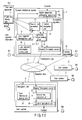
- a content distribution system 1 including an encryption apparatus 10 and a digital watermark embedding apparatus 101 connects to n user systems 2 each having a content distribution system 1 and a decryption unit 20 through a network 3.
- a tracking apparatus 30 connects to the network 3.
- the content distribution system 1 encrypts a content and broadcasts or multicasts the content through the network 3.
- the n user systems 2 receive and decrypt the encrypted contents broadcast or multicast by the content distribution system 1 through the network 3.
- FIG. 1 shows only one content distribution system 1, it suffices if there are a plurality of content distribution systems 1.
- one node may have both the function of the content distribution system 1 and the function of the user system 2. Furthermore, it suffices to allow all nodes to perform cipher communication with each other by letting them have both the function of the content distribution system 1 and the function of the user system 2.
- the digital watermark embedding apparatus 101 may exist in the content distribution system 1, and the encryption apparatus 10 may have a digital watermark embedding function.
- the digital watermark embedding function exists as long as a content encryption unit 14 is configured to encrypt a content embedded with digital watermark information.
- a third party apparatus may supply a content embedded with digital watermark information to the content distribution system.
- the network 3 may be a wired network or a wireless network. Alternatively, the network 3 may use both a networked network and a wireless network. In addition, the network 3 may be a bidirectional or unidirectional network. The network 3 may be offline. That is, the network 3 may be implemented by using a medium such as a DVD.
- the digital watermark embedding apparatus 101 and the encryption apparatus 10 will be described next.
- the digital watermark embedding apparatus 101 embeds pieces of digital watermark information respectively in input contents on the basis of information (indicating, for example, how many pieces of digital watermark information are required) from a user segment management unit 12, and outputs a plurality of digitally watermarked contents embedded with different pieces of digital watermark information.
- the digital watermark embedding apparatus 101 embeds digital watermark information in an input content within a range outside human perception. Once digital watermark information is embedded in a content, it is very difficult to eliminate or tamper with the digital watermark information.
- the digital watermark embedding apparatus 101 performs digital watermark embedding by using a known method like that disclosed in reference 3 ( I. Cox, J. Kilian, T. Leighton, and T. Shamoon, "A Secure, Robust Watermark for Multimedia", Proc. Information Hiding, LNCS 1174, pp. 185 - 206, Springer-Verlag, 1996 ).
- the digital watermark embedding apparatus 101 When embedding different pieces of digital watermark information A and B in input contents, the digital watermark embedding apparatus 101 outputs the first content embedded with the digital watermark information A and the second content embedded with the digital watermark information B. Note that it suffices to output a plurality of (three or more) contents respectively embedded with three different pieces of digital watermark information. As shown in FIG. 15(a), it suffices to embed pieces of digital watermark information in a plurality of portions of a content and output the overall content embedded with the pieces of digital watermark information. Alternatively, as shown in FIG.
- the encryption apparatus 10 comprises a public key storing unit 11, the user segment management unit 12, a session key generation unit 13, the content encryption unit 14, a header generation unit 15, and user segment information storing unit 16.
- the public key storing unit 11 is a memory storing a public key, which the session key generation unit 13 and the header generation unit 15 can read out.
- the user segment information storing unit 16 is a memory which stores, for each of a plurality of pieces of user identification information for respectively identifying the plurality of user systems 2, information indicating a session key, of a plurality of session keys, which can be decrypted by a user system corresponding to the user identification information, and information indicating whether the corresponding user is an invalidation object user.
- This embodiment divides a plurality of pieces of user identification information into a plurality of user segments and respectively associates a plurality of different session keys with the plurality of user segments.
- the plurality of session keys respectively correspond to a plurality of contents embedded with different pieces of digital watermark information.
- the user segment management unit 12 Upon externally receiving user segment information containing information concerning the above user segments and information concerning invalidation object users, the user segment management unit 12 stores the user segment information in the user segment information storing unit 16. The user segment management unit 12 also outputs necessary information to the header generation unit 15, session key generation unit 13, and digital watermark embedding apparatus 101 on the basis of the information stored in the user segment information storing unit 16.
- the session key generation unit 13 generates a plurality of session keys on the basis of the public key in the public key storing unit 11.
- the content encryption unit 14 generates a plurality of encrypted contents by encrypting a plurality of contents respectively embedded with different pieces of digital watermark information, which are obtained from the digital watermark embedding apparatus 101, on the basis of the session keys generated by the session key generation unit 13. Note that each encrypted content can be decrypted on the basis of a corresponding session key.
- the header generation unit 15 generates header information on the basis of a public key, a session key (information on which it is based), invalidation object user information (if there is an invalidation object user), other necessary parameters (parameters p , q , k, and T in the case to be described later), and the like.
- the header generation unit 15 generates an encrypted session key and two kinds of header information.
- the header generation unit 15 generates an encrypted session key by encrypting a session key with a public key.
- the first header information corresponds to a group including user systems belonging to a plurality of user segments to which different session keys are made to respectively correspond. That is, the group includes both a user system (having user identification information) from which a content embedded with one of a plurality of different pieces of digital watermark information can be obtained and a user system (having user identification information) from which a content embedded with another piece of digital watermark information can be obtained, and further includes a user system (having user identification information) from which a content embedded with still another piece of digital watermark information can be obtained.
- the first header information includes (a) a plurality of encrypted session keys obtained by encrypting the respective session keys and (b) a first vector (L 0 , L 1 , L 2 ,..., L k ) corresponding to a session key assigned to arbitrary user identification information u in the group.
- the first vector is set to make the inner product of the first vector and a second vector (1, u, u 2 ,..., u k ) associated with the user identification information u become equal to z j u v , where k is a predetermined positive integer, z j is a constant value, of a plurality of constant values corresponding to a plurality of session keys, which corresponds to a session key s j assigned to the user identification information u , and v is group identification information to the group and is an integer equal to or more than "0" and equal to or less than k .
- an encrypted session key can be decrypted on the basis of a decryption key unique to each user system, and a session key that can be decrypted differs depending on to which user segment the user system belongs (which session key assigned to the user segment to which the user system belongs).
- the second header information corresponds to a group including only user systems belonging to a user segment assigned with a given session key. That is, the user systems belonging to the group obtain contents embedded with the same digital watermark information.
- the second header information includes an encrypted session key obtained by encrypting the session key with a public key. Note that the second header information does not include any value based on a value L i described above. Note however that the second header information may include a value based on the value L i described above.
- the content distribution system 1 comprises various units as needed, e.g., a communication interface for header information and encrypted contents, a unit which stores contents, a unit which inputs contents, and a decryption key generation unit (not shown).
- the content distribution system 1 preferably transmits the respective pieces of header information while sharing a common portion from the viewpoint of a reduction in data amount.
- the present invention is not limited to this. A common portion need not be shared.
- the decryption key generation apparatus generates a decryption key unique to each user system and has a function of forming a tree structure by dividing a plurality of pieces of user identification information for respectively identifying a plurality of user systems into subgroups, a function of assigning different key generation polynomials and a common key generation polynomial to the respective subgroups, and a function of substituting user identification information for each user system into the key generation polynomial assigned to a subgroup to which the user identification information belongs and setting the obtained value as a decryption key unique to the corresponding user system.
- the decryption key generation apparatus generates a decryption key for a given user by substituting user identification information, i.e., a user ID (positive integers selected from a predetermined range (e.g., serial numbers from 1 to n )), into a key generation polynomial.
- user identification information i.e., a user ID (positive integers selected from a predetermined range (e.g., serial numbers from 1 to n )
- the apparatus divides a user set U into a plurality of subgroups, and assigns the respective subgroups to the leaves of a tree structure.
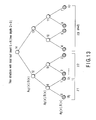
- FIG. 13 shows an example of a complete binary tree having eight leaves. Assume L to be the total number of leaves, D to be the depth of the tree, and T to be a tree structure including each node ID and information indicating to which leaf each subgroup is assigned.
- the tree structure T has IDs ("0", “1", “2”,..., “13” in this case) allocated to the respective nodes.
- U v to be a user set allocated to leaves having a given node v as an ancestor.
- the word "ancestor” means a parent node, parent's parent node, parent's parent's parent node,... as well as a root node.
- U 8 U 0 + U 1 , where + represents a sum set.
- the apparatus divides an entire user set U into subgroups U 0 ,..., U 7 .
- FIG. 2 shows an example of subgroups U 1 , U 2 , and U 3 .
- this apparatus divides a user set into a plurality of subgroups, and assigns key generation polynomials to the respective subgroups in the following manner.
- this apparatus assigns the subgroup U 1 A 1 (x) and B(x), assigns the subgroup U 2 A 2 (x) and B(x), and assigns the subgroup U 3 A 3 (x) and B(x).
- the apparatus assigns the subgroup U i A i (x) and B(x) in the same manner.
- a i (x) represents a key generation polynomial (individual key generation polynomial) unique to the subgroup U i (in other words, a node i ), and B(x) represents a key generation polynomial (common key generation polynomial) common to the respective subgroups (in other words, the respective nodes).
- key generation polynomials A i (x) may be randomly and uniquely assigned without any correspondence to subgroup numbers i , or there may exist a key generation polynomial A j (x) which is not assigned to any subgroup.
- this apparatus assigns the respective subgroups different key generation polynomials and a key generation polynomial common to the respective subgroups, and generates decryption keys for the user IDs by using the key generation polynomials assigned to the subgroups to which the user IDs belong.
- D represents the number of subgroups (excluding the root) to which the user IDs belong.
- the user assigned to leaf 0 also belongs to the subgroups U 8 and U 12 .
- a decryption key for the user ID is generated by using the key generation polynomials assigned to the respective subgroups.
- the present invention introduces a key generation polynomial which allows black box tracking with respect to a smart unauthorized decryption unit even if the other key generation polynomial B(x) is made common to nodes, thereby reducing the size of decryption key data which the decryption unit should hold by about a little less than half.
- the decryption keys obtained by substituting the user IDs assigned to the user system 2 into the key generation polynomials assigned to the subgroups to which the user IDs belong are supplied from the content distribution system 1 or a reliable third party to the user system 2 to be held in advance.
- FIGS. 13 , 2, and 3 the grouping method exemplified by FIGS. 13 , 2, and 3 is an example, and the present invention can use various grouping methods besides this method.
- user IDs and node IDs are positive integers (e.g., serial numbers from 1 to n ) selected from a predetermined range.
- each user ID is not limited to positive integers (may be alphanumeric characters). That is, positive integers selected from a predetermined range may be uniquely assigned to a user ID comprising alphanumeric characters or the like, and a decryption key may be calculated on the basis of the positive integers uniquely assigned to the user ID and the corresponding key generation polynomial.
- node IDs may be positive integers (e.g., serial numbers from 1 to n ) selected from a predetermined range.
- each user ID is not limited to positive integers (may be alphanumeric characters). That is, positive integers selected from a predetermined range may be uniquely assigned to a user ID comprising alphanumeric characters or the like, and a decryption key may be calculated on the basis of the positive integers uniquely assigned to the user ID and the corresponding key generation polynomial.
- the decryption unit 20 mounted in the user system 2 will be described next.
- the decryption unit 20 comprises a user information storing unit 21, session key decryption unit 22, and content decryption unit 23.
- the user information storing unit 21 is a memory which stores parameters necessary for decryption (parameters p , q , and k in the following case), a subgroup ID to which the self system 2 belongs, the user ID assigned to the self system 2, and a decryption key corresponding to the user ID, which the session key decryption unit 22 can read out.
- the decryption key is the value obtained by substituting the user ID into a key generation polynomial assigned to the subgroup to which the user ID belongs.
- the session key decryption unit 22 Upon receiving an encrypted content and header information from the content distribution system 1, the session key decryption unit 22 acquires (decrypts) a session key from the header information on the basis of the decryption key in the user information storing unit 21.
- the content decryption unit 23 decrypts the encrypted content received from the content distribution system 1 on the basis of the session key acquired (decrypted) from the session key decryption unit 22.
- the user system 2 comprises various devices as needed, e.g., a communication interface which receives an encrypted content and header information from the content distribution system 1, a device which stores the content, and a device which displays the content.
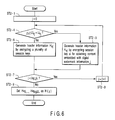
- the tracking apparatus 30 will be described next with reference to FIG. 4 .
- the tracking apparatus 30 comprises a public key storing unit 31, a header generation unit 32, a digital watermark embedding unit 34, a content decryption unit 35, and the control unit 33.
- the digital watermark embedding unit 34 need not always be included in the tracking apparatus 30, and the digital watermark embedding function may exist anywhere as long as the content decryption unit 35 is configured to encrypt a content embedded with digital watermark information.
- This system may be configured such that the content decryption unit 35 receives a content embedded with digital watermark information from an apparatus located outside the tracking apparatus 30.
- the content decryption unit 35 also receives a plurality of types of contents respectively embedded with different pieces of digital watermark information.
- the content decryption unit 35 has a function of generating a plurality of encrypted contents by encrypting the plurality of types of contents by using session keys corresponding to the respective contents and a function of inputting the plurality of types of encrypted contents to a test object.
- a plurality of different session keys are associated with the plurality of types of contents.
- a plurality of session keys are respectively assigned to a plurality of user segments.
- the public key storing unit 31 is a memory which stores a public key, which the header generation unit 32 can read out.
- the header generation unit 32 has a function of generating header information in accordance with the user segment to which each user identification information (each user system) belongs, which is designated by the control unit 33, on the basis of the public key and other necessary parameters (for example, parameters p , q , k , and T in this case) and a function of inputting the header information to a test object.
- a session key (information on which it is based) may be generated by the control unit 33 and designated for the header generation unit 32, or may be generated by the header generation unit 32 and notified to the control unit 33.
- header information is generated so as to contain a value based on the above value L i .
- the control unit (specifying means) 33 controls the overall tracking apparatus 30, and has a function of specifying, for example, with respect to a given user segment of a plurality of user segments, the unauthorized user or users (user identification information) of one or a plurality of user systems, based on which the test object user systems are designated, on the basis of the relationship between a plurality of pieces of header information generated while the number of user systems belonging to the user segment is increased from "0" one by one and the decryption result acquired when each piece of header information is input.
- control unit 33 has a function of designating, to the header generation unit 32, a set (first user segment ⁇ 1) of pieces of user identification information (user systems) which can decrypt the first content embedded with digital watermark information A and a set (second user segment ⁇ 2) of pieces of user identification information (user systems) which can decrypt the second content embedded with digital watermark information B, a function of receiving the content decrypted by a test object decryption unit 20x and checking whether the content is the first or second content, and a function of specifying the user identification information of an unauthorized user on the basis of the overall determination results obtained by repeating similar processing while increasing the number of pieces of user identification information belonging to the first user segment ⁇ 1 one by one.
- the control unit 33 specifies the user identification information of an unauthorized user on the basis of which one of a plurality of types of encrypted contents input to the test object decryption unit 20 ⁇ is decrypted (e.g., which one of the pieces of digital watermark information A and B is embedded in a decrypted content).
- the operation of the control unit 33 is not limited to this case. In a case wherein a session key itself is a content, the control unit 33 may input only the session key to the test object decryption unit 20x and determine the decryption result on the session key which is obtained by the test object decryption unit 20x (determine which digital watermark information is embedded).
- the tracking apparatus 30 may be included in, for example, the content distribution system 1, or may be an apparatus independent of the content distribution system 1 and have a function of connecting to the network 3.
- the tracking apparatus 30 needs not always have a function of connecting to the network 3.
- FIG. 5 is a flowchart for explaining the overall operation of the system.
- unique user identification information (user ID) is assigned to each user system 2.
- the content distribution system 1 then encrypts a content embedded with the digital watermark information i by using the session key si (step ST3), and broadcasts or multicasts the obtained encrypted content upon adding the above header information to it (step ST4).
- step ST2 and ST3 it suffices to execute steps ST2 and ST3 in the reverse order to that described above or simultaneously execute them.
- step ST1 is sometimes omitted (the previous session key is used).
- each user system 2 Upon receiving the header information/encrypted content, on the basis of the self user ID and the subgroup ID, each user system 2 decrypts the header information in accordance with a relationship with the user segment ⁇ i which obtains the content embedded with the digital watermark information i (step ST5). That is, if the user system 2 belongs to the user segment ⁇ i which obtains the content embedded with the digital watermark information i , the user system 2 acquires the session key si in the decryption processing in step ST5 (step ST6), and decrypts the encrypted content by using the session key si (step ST7).
- the content distribution system 1 generates header information in accordance with the user segment ⁇ i which obtains the content embedded with the digital watermark information i, and hence can perform flexible control as to which user obtains a content embedded with which digital watermark information.
- a key generation phase to be executed in advance, an encryption phase in step ST2, and a decryption phase in steps ST5 and ST6 will be described in detail next.
- n be the total number of users, and k is the maximum number of conspirators in a coalition.
- p and q represent prime numbers
- p - 1 is divisible by q
- q is equal to or more than n + 2k - 1.
- Gq to be a subgroup of Zp* and a multiplicative group having an order q
- g to be a generator of Gq.
- U (U ⁇ Zq - ⁇ 0 ⁇ ) to be a set (to be referred to as a user set hereinafter) of the user IDs (user identification information) of all users.
- Zq - ⁇ 0 ⁇ indicates the value obtained by removing ⁇ 0 ⁇ from Zq.
- Gq is not limited to the above and may be an additive group of points of an elliptic curve over a finite field. This applies to each of the following embodiments.
- This embodiment divides the user set U (user group) including a plurality of user IDs for respectively identifying a plurality of user systems into a plurality of subgroups.
- the embodiment uses a binary tree structure with the respective subgroups being assigned to leaves. More specifically, key generation polynomials are assigned to the respective nodes through which paths extend from the root of the binary tree to a plurality of leaves. This hierarchizes the key generation polynomials into multiple levels. The following exemplifies the case using the binary tree structure. However, the present invention is not limited to this.
- the number of branches may not be specifically limited, and one tree structure may include nodes with different numbers of branches.
- the numbers of nodes (the numbers of levels) through which paths extend from the root to all the leaves need not be the same, and leaves may exist at different levels.
- Decryption key generation processing for a user system corresponding to public key and each user ID will be described below. Note that the flowchart shown in FIG. 14 shows decryption key generation processing for user systems corresponding to the respective user IDs.
- the content distribution system 1 divides the user set U into L or less subsets (subgroups) having no common element (ST 101). For the sake of simplicity, assume that the number of subgroups is L, and L is the number expressed by the power of 2.
- T represents a tree structure including information indicating which subgroups are assigned to which leaves and the respective node IDs. T is disclosed.
- the content distribution system 1 randomly selects parameters a 0 ,..., a 2k-1 , b 0 ,..., b 2k-1 on which a public key is based from Zq.
- the content distribution system 1 also randomly selects c i and ⁇ i from Zq with respect to each element i belonging to N.
- N is defined by equation (1) given below.
- the content distribution system 1 then calculates a public key e .
- N be a set of IDs of nodes and leaves, excluding the root, in the tree structure T.
- N ⁇ 0,..., 13 ⁇ .
- the content distribution system 1 assigns the nodes and leaves (v) of the tree structure T individual key generation polynomials Av(x) which differ for the respective root, nodes, and leaves and a common key generation polynomial B(x) common to the respective root, nodes, and leaves (ST103). Note that there is no need to take the trouble of assigning the common key generation polynomial B(x) common to the respective root, nodes, and leaves to the respective root, nodes, and leaves.
- the content distribution system 1 further assigns the respective subgroups the individual key generation polynomials assigned to the leaves and their ancestor nodes which are assigned to the respective subgroups (ST104).
- U v be a user set allocated to leaves having a given node v as an ancestor.
- U 8 U 0 + U 1 , where + represents a sum set.
- the key generation polynomials A v (x) and B(x) are assigned to the subset U v to which a user u belongs, and is represented by equations (2), where ⁇ v is a constant value which is unique and assigned to the node v .
- the coefficients of the same order terms are constant regardless of i and j except for one or a plurality of coefficients (e.g., c i and c j in this case) unique to the root, nodes, and leaves on the tree structure.
- At least one of the linear sums of the coefficients of the same order terms is a coefficient unique to the root, nodes, and leaves on the tree structure, and other coefficients, i.e., "mth-order coefficient of Ai(x)" + "mth-order coefficient of ⁇ i B(x)" are constant regardless of i and j .
- a decryption key for user ID u belonging to the user set U i allocated to the leaves having the node i as an ancestor is obtained by substituting "u” into “x" of the decryption key generation polynomial A i (x) + ⁇ i B(x).
- the order of a key generation polynomial is preferably set to 2k - 1 or more from the viewpoint of safety and hence is set to 2k - 1.
- the present invention is not limited to this, and the order of the key generation polynomial can be set to an arbitrary value.
- the order of the key generation polynomial A i (x) assigned to the node i may differ from that of the key generation polynomial A j (x) assigned to the node j
- the orders of the key generation polynomials A i (x) and B(x) may differ from each other. This applies to other embodiments to be described later.
- d u u , v , A v u , B u
- a reliable third party apparatus 10b other than the content distribution system 1 may perform the above processing in the key generation phase.
- the individual key generation polynomial assigned to the root node 0
- the session key generation unit 13 of the content distribution system 1 randomly selects information s on which a session key is based from Gq and zi from Zq on the basis of information (information indicating how many pieces of digital watermark information are required) from the user segment management unit 12.
- a set of pieces of user identification information (user systems) which obtains contents embedded with the digital watermark information i is defined as a user segment xi.
- the operator (or an external third party) of the content distribution system 1 divides the user set U into a plurality of user segments, and inputs information concerning the user segments to the user segment management unit 12.
- the user segment information management unit stores the input information.
- the session key generation unit 13 generates pieces of information which are assigned to the respective user segments and on which a plurality of session keys are based on the basis of inputs from the user segment management unit 12, and supplies the generated pieces of information to the header generation unit 15.
- the header generation unit 15 respectively assigns the different session keys to the user segments. For example, the header generation unit 15 assigns the session key s 1 to the first user segment ⁇ 1, and the session key s 2 to the second user segment x2.
- the session key generation unit 13 may perform this assignment. For the sake of simplicity, assume that in the following description, the header generation unit 15 will mainly perform the above processing.
- the header generation unit 15 determines a plurality of user segments ⁇ 1, ⁇ 2,..., ⁇ j from the user segment U, and selects log 2 L + 1 node IDs including at least one leaf ID and satisfying the following two conditions.
- log 2 L is sometimes expressed as ⁇ .
- Equation E1 is not satisfy for any i(1 ⁇ i ⁇ m), and Uv j ⁇ Vv j ⁇ 2 ⁇ k
- Vv j ⁇ 1 ⁇ ⁇ ⁇ log 2 L + 1 , ⁇ ⁇ j Uv ⁇
- the header generation unit 15 determines whether a product set of sets xi and Uv j is Uv j (ST2-4).
- processing processing
- step ST2-4 it suffices to perform only the determination in step ST2-4 and in step ST2-6 in advance. If it is clear that there is no chance that the result in step ST2-4 is otherwise (ST2-4; NO), it suffices to substitute either r 0 or r 1 into r . Otherwise, r 0 is substituted into r .
- step ST2-4 A case wherein the result in step ST2-4 is otherwise will be described (ST2-4; NO).
- at least one of the users belonging to Uv j does not belong to the set ⁇ i, and at least one of them belongs to the set ⁇ i.
- this case corresponds to U 2 in FIG. 2 .
- Vv j Vv j
- FIG. 13 if k users belonging to U 1 belong to ⁇ 1 and the remaining k users belong to ⁇ 2, for example, nodes 0, 1, 9, and 13 can be selected. Instead of this, nodes 0, 8, 9, and 13 can be selected.
- Vv j is defined to handle the case wherein two sets Uv j have a common element.
- the header generation unit 15 then randomly selects ⁇ m+1 , ⁇ , ⁇ 2k from Zq - (U + ⁇ 0 ⁇ ). Note that Zq - (U + ⁇ 0 ⁇ ) indicates the value obtained by removing a sum set of U and ⁇ 0 ⁇ from Zq.
- the header generation unit 15 obtains elements L 0 ,..., L 2k-1 of Zq which satisfy equation (8a) with respect to 1 ⁇ t ⁇ 2k. If a number M of elements ⁇ t satisfying ⁇ t ⁇ xi in equation (8a) is less than 2k, conditional expressions may be added to equation (8a) to make the number of conditional expressions become equal to 2k (the number of elements Li) as indicated by equation (8b), or the number conditional expressions may be decreased as indicated by equation (8c). Alternatively, as will be described in the second embodiment, the number of conditional expressions may be larger than 2k.
- the header generation unit 15 then calculates Hv j by substituting r 1 into r according to equation (9) (ST2-6).
- a value ⁇ L 0 ,..., L 2k-1 ⁇ concerning the user segment ⁇ i is the first vector
- a user ID(x w ) belonging to the user segment ⁇ i is set as a variable of a (2k - 1)th-order polynomial
- the resultant value is the second vector (1, x w , x w 2 ,..., x w 2k-1 )
- the value ⁇ L 0 ,..., L 2k-1 ⁇ is the first vector satisfying the relationship represented by the following equation, that is, the inner product of the first and second vectors is equal to the product of the value obtained by exponentiating the user ID by a value v j mod 2k based on group identification information (node ID) v j of a group (selected node) belonging to the user ID and a constant zi which differs for each user segment.
- the value of m can be allowed within the range of m ⁇ (the order of the key generation polynomial + 1) by increasing the order of the key generation polynomial.
- v j mod 2k a value based on the group identification information (node ID) of the group (selected node) to which the user ID belongs.
- the present invention is not limited to this, and it is possible to use the value obtained by substituting v j into a function of uniquely mapping v j to a value equal to or more than 0 and equal to or less than the order of the key generation polynomial.
- r r 1 even when the result obtained in step ST2-4 becomes otherwise (ST2-4; NO) twice or more.
- the present invention is not limited to this, and it suffices to prepare three or more random numbers to be substituted into r and substitute one of the different random numbers into r every time the result in step ST-4 becomes otherwise. It also suffices to introduce, in addition to the above two conditions (conditions 1 and 2), a condition that at least one node satisfying condition 2 is selected. In this case, the result in step ST2-4 becomes otherwise at least once.
- Hv j is calculated according to equation (9) (ST2-6).
- the present invention is not limited to this, and it suffices to calculate Hv j according to equation (9) even if a product set of xi and Uv j is Uv j (ST2-4; YES), as long as the number of elements of Uv j is equal to or less than 2k (equal to or less than 2(d + 1)k in the second embodiment to be described later). All those described above apply to the other embodiments to be described later.
- Hv 0 ,..., Hv ⁇ obtained by the above repetitive processing are set as a header H( ⁇ ) (ST2-9).
- a header can be calculated by using the public key e , anyone can manage the content distribution system 1.
- the transmission overhead can be further reduced by grouping identical elements of the respective elements constituting Hv 0 ,..., Hv ⁇ obtained by the above repetitive processing into a shared element in the header H( ⁇ ). This applies to each of the following embodiments.
- ⁇ may be a value other than log 2 L.
- no leaf may be selected as long as the above two conditions (conditions 1 and 2) are satisfied.
- the content encryption unit 14 encrypts the content embedded with the digital watermark information i by using the session key si, and broadcasts or multicasts the content.
- the decryption result obtained by the session key decryption unit 22 of the user system 2 is selectively processed depending on whether a product set of the user segments ⁇ i and Uv j is Uv j (ST5-4). Note that the session key decryption unit 22 of the user system 2 does not perform this determination, and calculates equation (10) by using Hv j without changing the decryption procedure in any case.
- a case wherein a product set of ⁇ i and Uv j is Uv j (ST5-2; YES) will be described first. This is a case wherein all the users belonging to Uv j obtain contents embedded with the same digital watermark information i .
- the session key decryption unit 22 performs calculation according to equation (10) (ST5-5) to obtain the session key si corresponding to the digital watermark information i (ST-8). All the users belonging to Uv j obtain contents embedded with the digital watermark information i , which are encrypted with the session key si, by using the session key si (ST-9).
- the user systems belonging to each user segment xi obtain the session key si corresponding to the user segment ⁇ i (ST8), and obtain contents embedded with the digital watermark information i , which are encrypted with the session key si, by using the session key si (ST-9).
- a pirate decryption unit is generated either on the basis of only one authorized decryption unit or on the basis of a plurality of authorized decryption units. In the latter case, the unauthorized users of decryption units will be referred to as conspirators.
- a pirate decryption unit generated on the basis of only one decryption unit can use the same decryption key as that used by the decryption unit.
- a pirate decryption unit generated on the basis of a plurality of decryption units can use any one of the same decryption keys as those used by the plurality of decryption units. In the latter case, a session key can be obtained unless all the decryption keys corresponding to the conspirators are invalidated.
- the tracking apparatus 30 can quickly execute a test and specify one or more unauthorized users as compared with the conventional method of performing nCk tests.
- a tracking algorithm can be executed in various procedures.
- the present invention is not limited to the following procedure shown in FIG. 9 .
- each leaf is assigned with a subgroup comprising 2k users.
- the respective leaf IDs are sequentially represented by 1,..., t from the leftmost leaf, and the elements (user IDs) of subgroups U 1 ,..., U t are labeled as indicated by equation (13):
- U 1 u 1 ... u 2 ⁇ k
- U 2 u 2 ⁇ k + 1 ... u 4 ⁇ k ⁇
- U t u n - 2 ⁇ k + 1 ... u n
- the numbers of elements (the numbers of users belonging to the respective leaves) of the subgroups U 1 ,..., U t need not all be 2k.
- the number of elements of the subgroup U 1 may differ from that of the subgroup U 2 . This applies to each of the following embodiments.
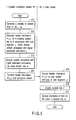
- the tracking apparatus 30 sets the number of tests conducted with respect to the same user segments ⁇ A and ⁇ B to "1", and repeats the following processing m times (until the number of tests conducted becomes m ) (ST12). Assume that the first content embedded with the digital watermark information A is encrypted with a session key s A , and the second content embedded with the digital watermark information B is encrypted with a session key s B .
- the control unit 33 sets user IDs belonging to the user segment ⁇ B as ⁇ u 1 ,..., u j ⁇ , and other user IDs as the user segment ⁇ B (ST13). Therefore, the user ID belonging to the initial user segment ⁇ B is ⁇ u 1 ⁇ , and the user ID belonging to the initial user segment ⁇ A is ⁇ u 2 ,..., u n ⁇ .
- the control unit 33 controls the header generation unit 32 to generate a header H( ⁇ ) by setting the number of session keys to be encrypted to "2", i.e., s A and s B as session keys (ST14). Note that the header generation method is the same as that in the encryption phase, and a random number is selected for every operation.
- the control unit 33 observes an output from the unauthorized decryption unit D.
- the control unit 33 detects whether the unauthorized decryption unit D has output the first or second content (ST16). If the unauthorized decryption unit D has output the first content (ST16; YES), the control unit 33 increments C j by "1" (ST17). If the unauthorized decryption unit D has output the second content (ST16; NO), the control unit 33 does not change the value of Cj.
- session keys themselves are contents i.e., the session key s A is embedded with the digital watermark information A
- the session key s B is embedded with the digital watermark information B.
- the control unit 33 determines whether a test count z is less than m (ST18). If the test count z is less than m , the control unit 33 increments z by "1" (ST19). The process returns to step ST14 to repeat the test.
- the control unit 33 determines whether a user number j belonging to the user segment ⁇ B is less than a total user count n (ST20). If the user number j is less than n , the control unit 33 increments j by "1" (ST21). The process then returns to step ST12 to repeat the test.
- step ST20 Upon determining in step ST20 that the user number j of the user u j belonging to the user segment ⁇ B coincides with the total user count n , the control unit 33 finishes the test.
- this tracking method increases the number of unauthorized user candidates belonging to the user segment ⁇ B one by one, and tests whether each unauthorized user candidate outputs the second content embedded with the digital watermark information B when being included in the user segment.
- ⁇ B (in other words, whether each candidate does not output the second content embedded with the digital watermark information A).
- This method can specify one or more unauthorized users by repeating this test a total of mn times. Note that mn tests may be performed in a random order instead of the above order. This applies to the following embodiments.
- C 3 - C 4 provides the maximum value m , it can be known that the user ID of one of the conspirators of the test object decryption unit 20 X is u 4 . In addition, changing the labeling order of the users makes it possible to specify the user IDs of all the conspirators.
- both the first and second contents embedded with the pieces of digital watermark information A and B are normal contents, even if the test object decryption unit stores past inputs, the unit cannot perform black box tracking and hence always outputs a content embedded with either of the pieces of digital watermark information A and B. Therefore, the above method allows to reliably specify unauthorized users.
- a header can be calculated by using the public key e , anyone can track an unauthorized user by using the tracking apparatus 30.
- this method divides a user set into two subsets, generates header information and an encrypted content with the first subset being a user segment ⁇ A and the second subset being a user segment ⁇ B , and inputs them to a test object decryption unit. If an output from the test object decryption unit outputs is the content embedded with digital watermark information A, the user segment ⁇ A is divided into two subsets. One of the two obtained subsets is removed from the user segment ⁇ A and is added to the user segment ⁇ B .
- an output from the test object decryption unit is the content embedded with the digital watermark information B
- the user segment ⁇ B is divided into two subsets. One of the two obtained subsets is removed from the user segment ⁇ B and is added to the user segment ⁇ A .
- the above test is performed for the newly set user segments ⁇ A and ⁇ B . This processing is repeated for up to one suspect. Finally, the users belonging to the user segment ⁇ A (or the user segment ⁇ B ) are narrowed down to one. If the test object decryption unit outputs the content embedded with the digital watermark information A (or the digital watermark information B), the one user is specified as an unauthorized user.
- the header generation unit 15 obtains a plurality of encrypted session keys by encrypting a plurality of session keys by using a public key corresponding to a decryption key unique to each user system.
- the header generation unit 15 further generates, for the group, generates header information including (a) the plurality of encrypted session keys and (b) the first vector (L 0 , L 1 , L 2 ,..., L 2k-1 ) corresponding to a session key assigned to arbitrary user identification information u in the group which is set such that the inner product of the first vector and the second vector (1, u, u 2 ,..., u 2k-1 ) concerning the user identification information u becomes equal to z j u v mod 2k (where z j is a constant value, of a plurality of different constant values corresponding to the plurality of session keys, which corresponds to the session key s j assigned to the user identification information u , v is group identification information, and K is a predetermined positive integral value).
- the header generation unit 15 then transmits at least one of the plurality of encrypted contents and the header information to a plurality of user systems.
- Header information includes a plurality of correct session keys, and a user system always obtains one of these corrected session keys.
- this method prevents any unauthorized decryption unit from knowing the intention of an input and can reliably execute tracking even with respect to a smart unauthorized decryption unit which tries to inhibit the specification of an unauthorized user by storing past inputs and reading the intention of an input by using the stored inputs.
- forming a user set into a tree structure and introducing key generation polynomials based on the formed tree structure can reduce the transmission overhead as compared with the conventional method which can perform similar black box tracking.
- only a specific user such as an unauthorized user can be excluded from the system and the decryption keys for the other users can be updated by temporarily invalidating the specific user such as an unauthorized user and updating key generation polynomials without changing the formed tree structure.
- header information includes a plurality of encrypted session keys, and a plurality of contents embedded with different pieces of digital watermark information are encrypted by using the session keys.
- Black box tracking is performed by testing each piece of embedded digital watermark information. It is therefore impossible to identify header information (and an encrypted content) at the time of black box tracking and header information (and an encrypted content) for a normal broadcast. This makes it possible to reliably execute black box tracking with respect to even a smart unauthorized decryption unit which tries to prevent specification of an unauthorized user by reading the intention of an input, because the unauthorized decryption unit cannot know the intention of each input, even if the unauthorized decryption unit stores past inputs.
- the conventional black box tracking method having a similar tracking performance is of the first type (its scheme is based on a combinational logic arrangement), and hence needs to greatly increase the transmission overhead.
- this embodiment generates a header based on an algebraic arrangement by forming a user set into a tree structure and assigning key generation polynomials to the respective nodes, and hence can reduce the transmission overhead.
- the above embodiment can reliably execute black box tracking with respect to even a smart decryption unit which stores past inputs and operates to prevent the specification of an unauthorized user on the basis of the inputs, without making the unauthorized decryption unit know the intention of an input.
- This embodiment can also reduce the transmission overhead.
- the embodiment upon specifying an unauthorized user, the embodiment can exclude the unauthorized user from the system.
- the second embodiment will be described next.
- the second embodiment will exemplify a method of eliminating the restriction of m ⁇ 2k without increasing the order of a key generation polynomial when at least one of the users belonging to Uv j does not belong to a set ⁇ i and at least one of them belongs to the set ⁇ i (ST2-4; NO) in step S2-4 in FIG. 6 in the encryption phase in the first embodiment.
- the second embodiment differs from the first embodiment only in an encryption method and a decryption method to be used when it is determined in step ST2-4 that at least one of the users belonging to Uv j does not belong to the set ⁇ i and at least one of them belongs to the set xi. Therefore, only these methods will be described.
- q is a prime
- p - 1 is divisible by q
- q is equal to or more than n + 2k.
- step ST2-4 determines whether at least one of the users belonging to Uv j does not belong to the set ⁇ i and at least one of them belongs to the set ⁇ i (ST2-4; NO).
- a header generation unit 15 obtains a subset ⁇ x 1 ,..., x m ⁇ by removing a set Vv j from Uv j .
- m is the total number of users, of a user set belonging to Uv j , which do not belong to the set Vv j .
- the header generation unit 15 searches for an integer d which satisfies 2dk + 1 ⁇ m ⁇ 2(d + 1)k, and randomly selects x m+1 ,..., x 2(d+1)k from Zq - (U + ⁇ 0 ⁇ ) if 2(d + 1)k - m > 0. Note that Zq - (U + ⁇ 0 ⁇ ) indicates the value obtained by removing a sum set of U and ⁇ 0 ⁇ from Zq.
- the header generation unit 15 obtains elements L 0 ,..., L 2(d+1)k-1 of Zq which satisfy equation (14) with respect to 1 ⁇ t ⁇ 2(d + 1)k.
- ⁇ l 0 2 ⁇ d + 1 ⁇ k - 1
- z t ' is an arbitrary value on Zq.
- step ST2-4 it suffices to prepare three or more random numbers to be substituted into r and substitute one of the different random numbers into r every time the result in step ST2-4 becomes otherwise.
- equation (16) is calculated by using Hv j .
- the session key si is obtained according to equation (14) (ST8).
- the second embodiment can increase the number of users belonging to the set Uv j - Vv j by 2dk as compared with the first embodiment (the order of x t of equation (14) increases from "2k - 1" of equation (8) to "2(d + 1)k - 1", and as a result, the number of elements of the header information Hv j increases from "2k + 2" of equation (9) to "2(d + 1)k + 2").
- the second embodiment can cope with a case wherein when the result in step ST2-4 becomes otherwise (ST2-4; NO), the number of users belonging to the set Uv j - Vv j exceeds the restriction described in the first embodiment.
- the second embodiment can obtain the same effects as those of the first embodiment.
- the third embodiment will be described next.
- the third embodiment will exemplify the case of updating decryption keys in the first and second embodiments.
- a decryption key updating method according to the third embodiment is used to update decryption keys for authorized user systems other than unauthorized user systems so as to inhibit the unauthorized user systems having user IDs from decrypting contents, for all the user systems, when the respective decryption keys are to be updated or the user ID of each unauthorized user is specified by a tracking apparatus 30.
- a decryption key for user ID u belonging to a user set Uv allocated to a leaf having a node v as an ancestor or a leaf v is obtained by using key generation polynomials A v (x) and B(x) as indicated by equation (2) and substituting "u” into "x" of a decryption key generation polynomial A v (x) + ⁇ v B(x).
- a decryption key for each user system is updated by updating a coefficient group a v,i , ⁇ v , and b i of the key generation polynomials A v (x) and B(x) of equation (2) with a v,i + a' v,i , ⁇ v + ⁇ ' v , and b i + b' i (by updating the key generation polynomial itself).
- contents comprising key update information including pieces of information a' v,i , ⁇ ' v , and b'i required to update the coefficient group are encrypted by using the session key assigned to the user segment, thereby generating encrypted key update information.
- this embodiment generates encrypted key update information and header information for decrypting the encrypted key update information and transmits them.
- the key update information encrypted with the session key assigned to the user segment is not transmitted.
- the user system of the user ID belonging to the former user segment can acquire the above key update information, and can update the decryption key.
- the user system of the user ID belonging to the latter user segment cannot acquire the above key update information and cannot update the decryption key.
- the processing operation of the content distribution system is almost the same as that shown in FIG. 5 except that the system encrypts key update information with a session key instead of encrypting a content with a session key.
- the content distribution system transmits key update start information indicating that key update processing starts to the user system (ST201).
- the content distribution system may transmit information to a user system on a one-to-one basis or may broadcast or multicast information to a plurality of user systems. This applies to the following operation.
- the system encrypts the random numbers s 1 ,..., s L with the public key stored in a public key storing unit 11, and calculates Hv j with respect to each leaf v j according to equation (5) (ST202).
- header information generation processing by a header generation unit 15 in step ST202 is the same as that in the first embodiment except for the following two points (see FIG. 6 and the like).
- the content distribution system randomly selects random numbers a' 0 ,..., a' 2k-1 , b' 0 ,..., b' 2k-1 , c' 0,..., c' 2L-3 , ⁇ ' 0 ,..., ⁇ ' 2L-3 from Zq and repeats the following processing with respect to 1 ⁇ j ⁇ L.
- the content distribution system generates key update information Mv j and performs secret-key encryption which encrypts the key update information Mv j by using the random number corresponding to the leaf v j , i.e., the session key s j (ST203).
- the encrypted key update information is represented by M'v j .
- the key update information Mv j contains information for updating a coefficient group of the key generation polynomials A v (B) and B(x), i.e., the selected random numbers a' 0 ,..., a' 2k-1 , b' 0 ,..., b' 2k-1 , C'0,..., c' 2L-3 , ⁇ ' 0 ,..., ⁇ ' 2L-3 .
- the information M'v 1 ,..., M'v L obtained by the above repetitive processing is set as encrypted key update information M'.
- the content distribution system transmits the encrypted key update information M' to the user system (ST204). If it is known that a user system as a transmission destination belongs to Uv j , it suffices to transmit only M'v j .
- the content distribution system transmits header information H to the user system (ST204). If it is known that a user system as a transmission destination is Uv j , it suffices to transmit only Hv j .
- the content distribution system calculates a new public key e new according to the following equation (ST205).
- e new g ⁇ g ⁇ 0 + ⁇ 0 ⁇ ⁇ g ⁇ 2 ⁇ L - 3 + ⁇ 2 ⁇ L - 3 ⁇ ⁇ g a 0 + a 0 ⁇ ⁇ g a 2 ⁇ k - 1 + a 2 ⁇ k - 1 ⁇ ⁇ g c 0 + c 0 ⁇ ⁇ g c 2 ⁇ L - 3 + c 2 ⁇ L - 3 ⁇
- the user system Upon receiving key update start information (ST206), the user system decrypts header information H (or Hv j ) transmitted from the content distribution system and acquires s j (ST207).
- the decryption method for the header information H in this case is the same as that described in the first embodiment.
- the user system selects M'v j which the user system can decrypt with the encrypted key update information M' transmitted from the content distribution system (or receives only M'v j ), decrypts M'v j by using s j , and acquires Mv j (ST208).
- the user system calculates new decryption keys A new and B new with respect to 1 ⁇ i ⁇ log2 L according to the following equation (ST 209).
- the content distribution system starts key update processing by transmitting key update start information to the user system.
- the content distribution system may generate header information, encrypted key update information, and a new public key in any order instead of the above order, or may generate header information, encrypted key update information, and a new public key before transmitting key update start information to the user system.
- the content distribution system randomly selects s from Gq in addition to the above header information H, encrypts s by using the encryption method disclosed in reference 5, generates header information H', and transmits the information to the user system. Only a user system which is permitted to decrypt s can acquire s in the header information H', but a user system which is inhibited from decrypting s (invalidation object user system) cannot acquire s .
- the following is an example of the function F: F s j ⁇ s s j ⁇ s where ⁇ represents exclusive OR for each bit.
- the user system decrypts the pieces of header information H and H' and acquires s j and s .
- the user system decrypts encrypted key update information by using s' j and updates the decryption key. This inhibits the invalidation object user system from acquiring s and hence inhibits the system from updating the decryption key.
- key updating processing is performed between the content distribution system and the user system.
- the content distribution system and tracking system can reliably specify an unauthorized user even from a smarter unauthorized decryption unit with a small transmission overhead.
- encryption units, decryption units, and tracking apparatuses in all the embodiments described above can be implemented as hardware such as semiconductor integrated devices or software (programs for causing a computer to execute predetermined means, causing the computer to function as predetermined means, or causing the computer to implement predetermined functions).
- programs for causing a computer to execute predetermined means, causing the computer to function as predetermined means, or causing the computer to implement predetermined functions can be implemented by both hardware and software.
- the programs can be distributed by being stored in storage media such as magnetic disks (floppy (registered trademark) disks, hard disks, and the like), optical disks (CD-ROMs, DVDs, and the like), and semiconductor memories.
- storage media such as magnetic disks (floppy (registered trademark) disks, hard disks, and the like), optical disks (CD-ROMs, DVDs, and the like), and semiconductor memories.
- such storage media can take any storage form as long as they are computer-readable storage media capable of storing the programs.
- an OS Operating System
- MW middleware
- database management software such as database management software or network software, or the like
- the storage medium in the present invention includes not only a medium independent of the computer but also a storage medium which downloads and stores or temporarily stores a program sent through a LAN, Internet, or the like.
- the number of storage media is not limited to one, and the storage medium of the present invention also includes a plurality of media used to execute the processes in the above embodiments. That is, the present invention is not limited to any specific storage arrangement.
- the computer in the present invention executes the respective processes in the above embodiments on the basis of the programs stored in the storage medium, and the present invention may take any arrangement, e.g., an apparatus comprising a single device such as a personal computer or a system comprising a plurality of devices connected to each other through a network.
- the computer of the present invention is not limited to a personal computer, and is a generic name for devices and apparatuses capable of implementing the functions of the present invention on the basis of programs, including processing units, microcomputers, and the like contained in data processing devices.
Landscapes
- Engineering & Computer Science (AREA)
- Computer Security & Cryptography (AREA)
- Computer Networks & Wireless Communication (AREA)
- Signal Processing (AREA)
- General Engineering & Computer Science (AREA)
- Computer Hardware Design (AREA)
- Software Systems (AREA)
- Theoretical Computer Science (AREA)
- Computing Systems (AREA)
- Multimedia (AREA)
- Technology Law (AREA)
- Physics & Mathematics (AREA)
- General Physics & Mathematics (AREA)
- Storage Device Security (AREA)
- Two-Way Televisions, Distribution Of Moving Picture Or The Like (AREA)
Applications Claiming Priority (1)
| Application Number | Priority Date | Filing Date | Title |
|---|---|---|---|
| JP2007002658A JP4358239B2 (ja) | 2007-01-10 | 2007-01-10 | コンテンツ提供システム、追跡システム、コンテンツ提供方法及び不正ユーザ特定方法 |
Publications (2)
| Publication Number | Publication Date |
|---|---|
| EP1944715A2 true EP1944715A2 (de) | 2008-07-16 |
| EP1944715A3 EP1944715A3 (de) | 2010-03-24 |
Family
ID=39247125
Family Applications (1)
| Application Number | Title | Priority Date | Filing Date |
|---|---|---|---|
| EP07024310A Withdrawn EP1944715A3 (de) | 2007-01-10 | 2007-12-14 | Inhaltsverteilungssystem und -verfolgungssystem |
Country Status (4)
| Country | Link |
|---|---|
| US (1) | US7961887B2 (de) |
| EP (1) | EP1944715A3 (de) |
| JP (1) | JP4358239B2 (de) |
| CN (1) | CN101222321A (de) |
Cited By (1)
| Publication number | Priority date | Publication date | Assignee | Title |
|---|---|---|---|---|
| EP2903322A4 (de) * | 2012-09-27 | 2016-06-22 | Samsung Electronics Co Ltd | Sicherheitsverwaltungsverfahren und vorrichtung zur gruppenkommunikation in einem mobilen kommunikationssystem |
Families Citing this family (26)
| Publication number | Priority date | Publication date | Assignee | Title |
|---|---|---|---|---|
| US8412926B1 (en) * | 2007-04-11 | 2013-04-02 | Juniper Networks, Inc. | Using file metadata for data obfuscation |
| US8396222B2 (en) * | 2008-03-10 | 2013-03-12 | Nds Limited | Key distribution system |
| CN102171968A (zh) * | 2008-10-10 | 2011-08-31 | 松下电器产业株式会社 | 信息处理装置、方法、程序及集成电路 |
| US8989383B2 (en) | 2009-01-05 | 2015-03-24 | Imation Corp. | Data authentication using plural electronic keys |
| JP2010220019A (ja) * | 2009-03-18 | 2010-09-30 | Panasonic Corp | 鍵管理方法および鍵管理装置 |
| CN102439941A (zh) * | 2009-03-24 | 2012-05-02 | 法国电信公司 | 用于处理指示要参与到至少一个用户应用会话中的期望的信息条的方法和装置 |
| JP5285778B2 (ja) * | 2009-08-03 | 2013-09-11 | 日本電信電話株式会社 | 関数暗号応用システム及び方法 |
| US20100185868A1 (en) * | 2010-03-21 | 2010-07-22 | William Grecia | Personilized digital media access system |
| JP5676331B2 (ja) * | 2011-03-24 | 2015-02-25 | 株式会社東芝 | ルートノード及びプログラム |
| US10033713B2 (en) * | 2012-06-21 | 2018-07-24 | Oracle International Corporation | System and method for managing keys for use in encrypting and decrypting data in a technology stack |
| JP5813872B2 (ja) * | 2012-07-13 | 2015-11-17 | 株式会社東芝 | 通信制御装置、通信装置およびプログラム |
| US9990478B2 (en) * | 2012-11-30 | 2018-06-05 | The Nielsen Company (Us), Llc | Methods, apparatus, and articles of manufacture to encode auxiliary data into relational database keys and methods, apparatus, and articles of manufacture to obtain encoded data from relational database keys |
| JP2014121076A (ja) | 2012-12-19 | 2014-06-30 | Toshiba Corp | 鍵管理装置、通信装置、通信システムおよびプログラム |
| US9467425B2 (en) * | 2013-03-18 | 2016-10-11 | Intel Corporation | Key refresh between trusted units |
| US9454787B1 (en) * | 2014-03-04 | 2016-09-27 | Stephen M. Dorr | Secure membership data sharing system and associated methods |
| US10410643B2 (en) * | 2014-07-15 | 2019-09-10 | The Nielson Company (Us), Llc | Audio watermarking for people monitoring |
| CA3003407C (en) * | 2015-10-30 | 2020-08-18 | Intuit Inc. | Selective encryption of profile fields for multiple consumers |
| US10419511B1 (en) * | 2016-10-04 | 2019-09-17 | Zoom Video Communications, Inc. | Unique watermark generation and detection during a conference |
| US10068099B1 (en) * | 2018-01-19 | 2018-09-04 | Griffin Group Global, LLC | System and method for providing a data structure having different-scheme-derived portions |
| US10078759B1 (en) * | 2018-01-19 | 2018-09-18 | Griffin Group Global, LLC | System and method for data sharing via a data structure having different-scheme-derived portions |
| US11133932B2 (en) * | 2018-12-20 | 2021-09-28 | Sony Interactive Entertainment LLC | Secure data channel in a networked gaming system |
| GB2593772A (en) * | 2020-04-03 | 2021-10-06 | Sky Cp Ltd | Digital Watermarking in a content Delivery Network |
| US10817961B1 (en) | 2020-06-10 | 2020-10-27 | Coupang Corp. | Computerized systems and methods for tracking dynamic communities |
| US11196728B1 (en) * | 2021-03-29 | 2021-12-07 | Fmr Llc | Caching login sessions to access a software testing environment |
| US20240421991A1 (en) * | 2021-09-14 | 2024-12-19 | Sony Semiconductor Solutions Corporation | Information processing device, information processing method, information processing system, and computer program |
| US12556547B2 (en) * | 2022-05-02 | 2026-02-17 | Synamedia Limited | Anti-piracy methods, devices, and systems |
Family Cites Families (6)
| Publication number | Priority date | Publication date | Assignee | Title |
|---|---|---|---|---|
| JP2000253459A (ja) | 1999-03-02 | 2000-09-14 | Kodo Ido Tsushin Security Gijutsu Kenkyusho:Kk | 暗号無線通信装置 |
| JP3651777B2 (ja) | 2000-11-28 | 2005-05-25 | 株式会社東芝 | 電子透かしシステム、電子透かし解析装置、電子透かし解析方法及び記録媒体 |
| JP3917507B2 (ja) | 2002-01-28 | 2007-05-23 | 株式会社東芝 | コンテンツ提供側システム、ユーザ側システム、追跡システム、コンテンツ提供方法、暗号化コンテンツ復号方法、不正ユーザ特定方法、暗号化装置、復号装置及びプログラム |
| JP4434969B2 (ja) | 2004-01-21 | 2010-03-17 | 株式会社東芝 | コンテンツ提供側システム、ユーザ側システム、追跡システム、装置、方法及びプログラム |
| JP2006019975A (ja) | 2004-06-30 | 2006-01-19 | Matsushita Electric Ind Co Ltd | 暗号パケット通信システム、これに備えられる受信装置、送信装置、及びこれらに適用される暗号パケット通信方法、受信方法、送信方法、受信プログラム、送信プログラム |
| JP4630826B2 (ja) | 2006-01-27 | 2011-02-09 | 株式会社東芝 | 復号鍵生成方法、コンテンツ提供側システム、ユーザ側システム、追跡システム、コンテンツ提供方法、暗号化コンテンツ復号方法、プログラム、暗号化装置及び復号装置 |
-
2007
- 2007-01-10 JP JP2007002658A patent/JP4358239B2/ja not_active Expired - Fee Related
- 2007-12-14 EP EP07024310A patent/EP1944715A3/de not_active Withdrawn
-
2008
- 2008-01-08 US US11/970,666 patent/US7961887B2/en not_active Expired - Fee Related
- 2008-01-09 CN CN200810002833.6A patent/CN101222321A/zh active Pending
Cited By (2)
| Publication number | Priority date | Publication date | Assignee | Title |
|---|---|---|---|---|
| EP2903322A4 (de) * | 2012-09-27 | 2016-06-22 | Samsung Electronics Co Ltd | Sicherheitsverwaltungsverfahren und vorrichtung zur gruppenkommunikation in einem mobilen kommunikationssystem |
| US9894065B2 (en) | 2012-09-27 | 2018-02-13 | Samsung Electronics Co., Ltd. | Security management method and apparatus for group communication in mobile communication system |
Also Published As
| Publication number | Publication date |
|---|---|
| JP4358239B2 (ja) | 2009-11-04 |
| JP2008172433A (ja) | 2008-07-24 |
| US20080165958A1 (en) | 2008-07-10 |
| CN101222321A (zh) | 2008-07-16 |
| EP1944715A3 (de) | 2010-03-24 |
| US7961887B2 (en) | 2011-06-14 |
Similar Documents
| Publication | Publication Date | Title |
|---|---|---|
| US7961887B2 (en) | Content distribution system and tracking system | |
| EP1331751B1 (de) | Verfahren zur Erzeugung eines Schlüssels, Inhaltsbereitstellungsverfahren, Entschlüsselungsverfahren für verschlüsselte Inhalte, Verfahren zur Erkennung von illegalen Benutzern, System zum Bereitstellen von Inhalten, Benutzersystem, Verfahren zur Ablaufverfolgung, Verschlüsselungsgerät, Entschlüsselungsgerät, und Computerprogramm | |
| JP3749884B2 (ja) | 電子透かし埋め込み装置、電子透かし解析装置、電子透かし埋め込み方法、電子透かし解析方法及びプログラム | |
| US5268962A (en) | Computer network with modified host-to-host encryption keys | |
| EP1354444B1 (de) | Verfahren zur verfolgung von verräterempfängern in einem verschlüsselten verteilungssystem | |
| EP1569378A1 (de) | System zum gemeinsamen benutzen von schlüsseln,erzeugungseinrichtung für gemeinsam benutzte schlüssel und wiederherstelleinrichtung für gemeinsam benutzte schlüssel | |
| JP4434969B2 (ja) | コンテンツ提供側システム、ユーザ側システム、追跡システム、装置、方法及びプログラム | |
| US8122246B2 (en) | Method for generating decryption key, apparatus and method using decryption key | |
| US10797867B2 (en) | System and method for electronic bidding | |
| EP3843319B1 (de) | Vorrichtung und verfahren für operation mit festgelegtem schnittpunkt | |
| US7499552B2 (en) | Cipher method and system for verifying a decryption of an encrypted user data key | |
| CN118013595A (zh) | 一种主控芯片随机缓存保密方法及系统 | |
| US6760445B1 (en) | Method for identifying betrayers of proprietary data | |
| JP2010124071A (ja) | 通信装置、通信方法及びプログラム | |
| US8862893B2 (en) | Techniques for performing symmetric cryptography | |
| JP2007114494A (ja) | 秘匿計算方法及び装置 | |
| JP5436257B2 (ja) | 配信システム及び配信・受信方法及び配信装置及び受信装置及び配信プログラム及び受信プログラム | |
| JP4758110B2 (ja) | 通信システム、暗号化装置、鍵生成装置、鍵生成方法、復元装置、通信方法、暗号化方法、暗号復元方法 | |
| JP5142361B2 (ja) | 正当性検証装置 | |
| JP4748663B2 (ja) | 秘密計算方法及びシステム、並びにプログラム | |
| JP2005321719A (ja) | 通信システム、復号装置、復元装置、鍵生成装置及び通信方法 | |
| EP1067476A2 (de) | Informationsverarbeitungsgerät und -verfahren und Informationsverteilungssystem | |
| WO2002089398A1 (en) | Communication apparatus |
Legal Events
| Date | Code | Title | Description |
|---|---|---|---|
| PUAI | Public reference made under article 153(3) epc to a published international application that has entered the european phase |
Free format text: ORIGINAL CODE: 0009012 |
|
| 17P | Request for examination filed |
Effective date: 20071214 |
|
| AK | Designated contracting states |
Kind code of ref document: A2 Designated state(s): AT BE BG CH CY CZ DE DK EE ES FI FR GB GR HU IE IS IT LI LT LU LV MC MT NL PL PT RO SE SI SK TR |
|
| AX | Request for extension of the european patent |
Extension state: AL BA HR MK RS |
|
| PUAL | Search report despatched |
Free format text: ORIGINAL CODE: 0009013 |
|
| AK | Designated contracting states |
Kind code of ref document: A3 Designated state(s): AT BE BG CH CY CZ DE DK EE ES FI FR GB GR HU IE IS IT LI LT LU LV MC MT NL PL PT RO SE SI SK TR |
|
| AX | Request for extension of the european patent |
Extension state: AL BA HR MK RS |
|
| 17Q | First examination report despatched |
Effective date: 20100622 |
|
| AKX | Designation fees paid |
Designated state(s): DE FR GB |
|
| STAA | Information on the status of an ep patent application or granted ep patent |
Free format text: STATUS: THE APPLICATION IS DEEMED TO BE WITHDRAWN |
|
| 18D | Application deemed to be withdrawn |
Effective date: 20101103 |