EP1942240A2 - Verfahren zur Behandlung einer Betonstruktur und entsprechende Vorrichtung - Google Patents
Verfahren zur Behandlung einer Betonstruktur und entsprechende Vorrichtung Download PDFInfo
- Publication number
- EP1942240A2 EP1942240A2 EP07290018A EP07290018A EP1942240A2 EP 1942240 A2 EP1942240 A2 EP 1942240A2 EP 07290018 A EP07290018 A EP 07290018A EP 07290018 A EP07290018 A EP 07290018A EP 1942240 A2 EP1942240 A2 EP 1942240A2
- Authority
- EP
- European Patent Office
- Prior art keywords
- concrete structure
- accessible surface
- concrete
- steel
- steel reinforcement
- Prior art date
- Legal status (The legal status is an assumption and is not a legal conclusion. Google has not performed a legal analysis and makes no representation as to the accuracy of the status listed.)
- Withdrawn
Links
- 239000004567 concrete Substances 0.000 title claims abstract description 116
- 238000000034 method Methods 0.000 title claims abstract description 29
- 229910000831 Steel Inorganic materials 0.000 claims abstract description 85
- 239000010959 steel Substances 0.000 claims abstract description 85
- 230000002787 reinforcement Effects 0.000 claims abstract description 48
- 150000001768 cations Chemical class 0.000 claims abstract description 34
- 150000001450 anions Chemical class 0.000 claims abstract description 24
- 239000003792 electrolyte Substances 0.000 claims abstract description 20
- 230000005012 migration Effects 0.000 claims abstract description 13
- 238000013508 migration Methods 0.000 claims abstract description 13
- 230000005684 electric field Effects 0.000 claims abstract description 9
- 238000005260 corrosion Methods 0.000 claims description 13
- 230000007797 corrosion Effects 0.000 claims description 12
- 229910052751 metal Inorganic materials 0.000 claims description 6
- 239000002184 metal Substances 0.000 claims description 6
- 230000008569 process Effects 0.000 claims description 6
- 239000002344 surface layer Substances 0.000 claims description 6
- 229910001294 Reinforcing steel Inorganic materials 0.000 claims description 3
- 230000009471 action Effects 0.000 claims description 2
- 230000000149 penetrating effect Effects 0.000 claims description 2
- 239000011248 coating agent Substances 0.000 description 11
- 238000000576 coating method Methods 0.000 description 11
- 239000010410 layer Substances 0.000 description 5
- 238000010276 construction Methods 0.000 description 4
- 230000000670 limiting effect Effects 0.000 description 4
- 230000035515 penetration Effects 0.000 description 4
- 239000011150 reinforced concrete Substances 0.000 description 4
- 239000000243 solution Substances 0.000 description 4
- 125000002091 cationic group Chemical group 0.000 description 3
- 239000000356 contaminant Substances 0.000 description 3
- 230000000694 effects Effects 0.000 description 3
- 238000000605 extraction Methods 0.000 description 3
- JEIPFZHSYJVQDO-UHFFFAOYSA-N iron(III) oxide Inorganic materials O=[Fe]O[Fe]=O JEIPFZHSYJVQDO-UHFFFAOYSA-N 0.000 description 3
- 239000000463 material Substances 0.000 description 3
- 230000008439 repair process Effects 0.000 description 3
- 230000002441 reversible effect Effects 0.000 description 3
- CURLTUGMZLYLDI-UHFFFAOYSA-N Carbon dioxide Chemical compound O=C=O CURLTUGMZLYLDI-UHFFFAOYSA-N 0.000 description 2
- XEEYBQQBJWHFJM-UHFFFAOYSA-N Iron Chemical compound [Fe] XEEYBQQBJWHFJM-UHFFFAOYSA-N 0.000 description 2
- FAPWRFPIFSIZLT-UHFFFAOYSA-M Sodium chloride Chemical compound [Na+].[Cl-] FAPWRFPIFSIZLT-UHFFFAOYSA-M 0.000 description 2
- 230000015572 biosynthetic process Effects 0.000 description 2
- 230000015556 catabolic process Effects 0.000 description 2
- 239000004568 cement Substances 0.000 description 2
- 239000003795 chemical substances by application Substances 0.000 description 2
- -1 chloride anions Chemical class 0.000 description 2
- 238000006731 degradation reaction Methods 0.000 description 2
- 239000007788 liquid Substances 0.000 description 2
- 239000011513 prestressed concrete Substances 0.000 description 2
- VWDWKYIASSYTQR-UHFFFAOYSA-N sodium nitrate Chemical compound [Na+].[O-][N+]([O-])=O VWDWKYIASSYTQR-UHFFFAOYSA-N 0.000 description 2
- 239000000126 substance Substances 0.000 description 2
- YZCKVEUIGOORGS-UHFFFAOYSA-N Hydrogen atom Chemical compound [H] YZCKVEUIGOORGS-UHFFFAOYSA-N 0.000 description 1
- 239000007864 aqueous solution Substances 0.000 description 1
- 230000004888 barrier function Effects 0.000 description 1
- 239000001569 carbon dioxide Substances 0.000 description 1
- 229910002092 carbon dioxide Inorganic materials 0.000 description 1
- 239000001913 cellulose Substances 0.000 description 1
- 229920002678 cellulose Polymers 0.000 description 1
- 230000008859 change Effects 0.000 description 1
- 238000006243 chemical reaction Methods 0.000 description 1
- 239000004927 clay Substances 0.000 description 1
- 238000004140 cleaning Methods 0.000 description 1
- 230000006835 compression Effects 0.000 description 1
- 238000007906 compression Methods 0.000 description 1
- 239000012141 concentrate Substances 0.000 description 1
- 239000004020 conductor Substances 0.000 description 1
- 230000000593 degrading effect Effects 0.000 description 1
- 230000006866 deterioration Effects 0.000 description 1
- 238000005370 electroosmosis Methods 0.000 description 1
- 230000008030 elimination Effects 0.000 description 1
- 238000003379 elimination reaction Methods 0.000 description 1
- 239000000835 fiber Substances 0.000 description 1
- 230000002452 interceptive effect Effects 0.000 description 1
- 150000002500 ions Chemical class 0.000 description 1
- 229910052742 iron Inorganic materials 0.000 description 1
- 230000014759 maintenance of location Effects 0.000 description 1
- 239000011490 mineral wool Substances 0.000 description 1
- 239000004570 mortar (masonry) Substances 0.000 description 1
- 230000036961 partial effect Effects 0.000 description 1
- 238000009527 percussion Methods 0.000 description 1
- 239000004033 plastic Substances 0.000 description 1
- 229920003023 plastic Polymers 0.000 description 1
- 239000011148 porous material Substances 0.000 description 1
- 239000004576 sand Substances 0.000 description 1
- 239000011780 sodium chloride Substances 0.000 description 1
- 239000004317 sodium nitrate Substances 0.000 description 1
- 235000010344 sodium nitrate Nutrition 0.000 description 1
- XLYOFNOQVPJJNP-UHFFFAOYSA-N water Substances O XLYOFNOQVPJJNP-UHFFFAOYSA-N 0.000 description 1
- 230000003313 weakening effect Effects 0.000 description 1
Images




Classifications
-
- E—FIXED CONSTRUCTIONS
- E04—BUILDING
- E04G—SCAFFOLDING; FORMS; SHUTTERING; BUILDING IMPLEMENTS OR AIDS, OR THEIR USE; HANDLING BUILDING MATERIALS ON THE SITE; REPAIRING, BREAKING-UP OR OTHER WORK ON EXISTING BUILDINGS
- E04G23/00—Working measures on existing buildings
- E04G23/02—Repairing, e.g. filling cracks; Restoring; Altering; Enlarging
-
- E—FIXED CONSTRUCTIONS
- E04—BUILDING
- E04G—SCAFFOLDING; FORMS; SHUTTERING; BUILDING IMPLEMENTS OR AIDS, OR THEIR USE; HANDLING BUILDING MATERIALS ON THE SITE; REPAIRING, BREAKING-UP OR OTHER WORK ON EXISTING BUILDINGS
- E04G23/00—Working measures on existing buildings
- E04G23/08—Wrecking of buildings
Definitions
- the present invention relates to a method of treating a concrete structure, as well as the associated device.
- the invention particularly relates to a method for extracting contaminant ions contained in the concrete and / or removing the contaminated concrete from the concrete structure.
- steel is used to increase the tensile strength of the construction.
- Concrete is not only resistant to compression but also protects the steel against corrosion thanks to the strongly alkaline environment that prevails in the concrete.
- the alkalinity of the water contained in the pores of the concrete allows the formation of an oxide layer on the steel, the oxide layer constituting a barrier against corrosion.
- the concrete coating that is to say the area between the surface in contact with the atmosphere and the first layer of reinforcement, can be degraded either by fire or any other physical cause, or by penetration of aggressive agents such as carbon dioxide which reduces the pH of the concrete, by a carbonation reaction. This has the effect of weakening the concrete construction and entails a risk of accident, especially in the case of buildings.
- a first method of treating concrete consists in realcalinizing the carbonated zone, namely the coating and a small portion of the concrete located beyond the reinforcement, using an external electrolytic medium and a current electric capable of extracting anions from the carbonated zone.
- the object of the invention is to improve the treatment of concrete, especially in terms of cost, nuisance and efficiency.
- a method of treating a concrete structure comprising at least one accessible surface and at least one steel frame.
- an electric field is applied between the steel frame and the accessible surface so as to cause migration of cations to the accessible surface and migration of anions to the steel frame.
- the method uses a current flowing in the opposite direction to that used in the prior art.
- the methods according to the prior art treat the concrete structures by migrating the anions to an external electrolytic medium and the cations to a steel frame.
- the anions migrating towards the steel reinforcement increase the volume of the surface layer of the steel of the reinforcement, making it possible to detach at least a portion of the concrete structure situated between the accessible surface and steel frame, the rest of the concrete structure.
- surface layer of the steel reinforcement is meant here the layer of material surrounding the steel of the reinforcement and comprising iron coming from said steel, for example rust.
- the purpose of the method is to improve existing processes in which the degraded concrete coating in a reinforced concrete structure is removed and replaced with new concrete.
- the method aims to improve the step of removing degraded concrete by exploiting the low tensile strength of concrete.
- the increase in the volume of the surface layer of the steel reinforcement makes it possible to exert a tensile force on the embedding concrete, and thus to detach the part of the concrete situated between the surface of the concrete structure armed and steel frame.
- the method allows in particular to detach the degraded concrete coating by limiting noise and damage to the rest of the concrete structure. Indeed, eliminations of concrete by percussion (jackhammer, chisel, ...) may cause more or less fine cracks in the rest of the concrete structure, which may weaken or require additional repair.
- anions migrating to the steel frame can cause corrosion of the steel of the frame.
- cations migrating to the accessible surface no longer have any effect limiting corrosion of the reinforcing steel.
- Corrosion of a steel reinforcement can be achieved by circulating an electric current between this steel frame and an external electrode placed in electrical continuity with the surface of the concrete structure.
- the direction of the current that allows this corrosion is such that the metal cations migrate to the surface of the concrete structure and the penetration of a liquid to the surface of the concrete is favored by electro-osmosis.
- an external electrode is provided in electrical continuity with the accessible surface of the concrete structure and a tension is imposed between the steel reinforcement and the external electrode so as to circulate between the steel reinforcement and the electrode.
- a current of value greater than 2 A / m 2 of steel reinforcement.
- the reinforced concrete structure After detachment of the degraded coating, the reinforced concrete structure is treated by affixing a new coating. The structure can then recover its original geometric, mechanical and / or chemical characteristics.
- the cations migrating towards the accessible surface comprise metal cations.
- the metal cations may be cations degrading and / or contaminating the concrete structure.
- the anions migrating to the steel reinforcement may be anions having an ability to limit the degradation of the concrete structure.
- the method takes into account the contaminating cationic species.
- a reverse current is applied here, in particular allowing extract the contaminating cations.
- an external electrode is provided in electrical continuity with the accessible surface of the concrete structure and a tension is imposed between the steel reinforcement and the external electrode so as to circulate between the steel reinforcement and the electrode.
- external a current value of less than 1 A / m 2 of steel reinforcement.
- the method comprises a subsequent step during which the sign of the electric field between the steel reinforcement and the accessible surface is modified so as to cause a migration of cations towards the steel reinforcement.
- the invention also relates to a treatment device of a concrete structure comprising at least one surface and at least one steel frame.
- the device comprises a means for applying a potential intended to be arranged in electrical continuity with the accessible surface of the concrete structure and a power supply capable of circulating a current in the thickness of the concrete situated between the means of application of a potential and the steel frame, the negative terminal of the power supply being connected to the application means of a potential.
- the means for applying a potential may comprise an external electrode and an electrolyte in contact with the external electrode and the accessible surface of the concrete structure so as to achieve electrical continuity between the external electrode and the surface. accessible from the concrete structure.
- the external electrode plays the role of the cathode while the steel armature plays the role of the anode.
- the electric field thus created between the external electrode and the steel frame makes it possible to migrate the cations towards the external electrode.
- the electrolyte may comprise a solution containing anions that are corrosive with respect to the material of the steel reinforcement and capable of penetrating the concrete structure under the action of an electric field.
- the solution may contain chloride anions that migrate to the reinforcement and promote corrosion of the steel.
- the solution may also contain other anions.
- the electrolyte may comprise a solution capable of collecting cations extracted from the concrete structure.
- This embodiment relates to the extraction of contaminating cations from the concrete structure, but can also be applied to the first embodiment in which cations contained in the concrete structure are also extracted from the structure during processing.
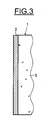
- the concrete structure 1 comprises concrete, a steel reinforcement 2 embedded in the concrete and an accessible surface 3.
- a concrete region 4, called a coating situated between the accessible surface 3 and the steel reinforcement 2
- a concrete region 5 situated on the opposite side to the concrete region 4 with respect to the steel reinforcement 2.
- the concrete region 4 which may be partially or completely degraded, must be detached from the concrete structure 1 in order to replace it with a new concrete, or else to start the demolition of the structure 1.
- the concrete structure 1 may be reinforced concrete, or even prestressed concrete.
- the method is particularly applicable to prestressed concrete in which the steel with high mechanical strength and subjected to tensile stress, is insensitive to embrittlement by the nascent hydrogen.
- an external electrode 6 is disposed on a portion of the accessible surface 3.
- the external electrode 6 may consist of wires, cables, braids, trellis, plates, sheets, conductive plastics or all other conductive materials.
- the external electrode 6 is placed in an electrolyte allowing making the electrical contact between the external electrode 6 and the accessible surface 3.
- the electrolyte may comprise an aqueous solution of sodium nitrate, sodium chloride or the like.
- the electrolyte will preferably be chosen so as to promote corrosion of the steel and to migrate easily under the effect of an electric field.
- the electrolyte may be in liquid form, in the form of a gel, or even adsorbed in a porous medium such as rockwool, cellulose, sawdust, sand, clay or similar material.
- the electrolyte can also be a concrete, a mortar, or a cement-based paste, provided that the setting of the cement is strongly retarded by a substance such as sugar.
- the porous medium is chosen so as to allow the retention of the electrolyte without interfering with the operation of the treatment device of the concrete structure.
- the external electrode 6 must be able to remain in contact with the accessible surface 3 even if parts of the concrete region 4 have already detached from the concrete structure 1.
- the porous medium is for example a poultice 7 of plant fibers applied by projection.
- the poultice 7 may in particular remain on the accessible surface 3 as a large part of the concrete region 4 remains attached to the concrete region 5 or to the steel frame 2. When the substantial portion of the concrete region 4 is detached, the poultice 7 comes off with it.
- the external electrode 6 is placed in the poultice 7, so as to be electrically continuous with the accessible surface 3 via the electrolyte.
- a power supply 8 (battery, generator or transformer connected to the general power grid) is used to circulate an electric current between the outer electrode 6 and the steel armature 2 which acts as an internal electrode.
- the electrical supply 8 can be for example a current generator which circulates a current corresponding to a set value, by applying a sufficient voltage U between the external electrode 6 and the steel frame 2.
- the current value may, for example, be greater than 2 A / m 2 of steel reinforcement.
- “Steel reinforcement m 2” means the total area of the steel reinforcement in the treated zone, that is to say in the thickness of the concrete structure located opposite the external electrode .
- the value of the current is chosen so as to favor the migration, toward said reinforcement, corroding species vis-à-vis the armature.
- the power supply 8 may also be able to circulate, during the treatment time of the concrete structure, a modulated intensity current between the external electrode and the steel frame.
- the external electrode 6 is electrically connected to the negative terminal of the power supply 8 and therefore constitutes the cathode, while the steel armature 2 is connected to the positive terminal of the power supply 8 and therefore constitutes the anode .
- the anions migrate towards the steel reinforcement 2, the steel corrodes, and the cations contained in the concrete region 4 migrate towards the electrode 6. It is thus possible to concentrate near the steel reinforcement 2, the contaminating species likely to cause its corrosion.
- the corroding steel of the reinforcement can increase the volume of its surface layer, for example rust, which causes stress in the concrete structure 1. These constraints are represented by arrows on the section top view of the concrete structure 1 shown in the figure 2 . The overall resultant of these stresses exerts a tensile force on the concrete regions 4 and 5.
- the concrete region 4 may be partially contaminated with cations and possibly with anions, and must be treated.
- the poultice 70 and the electrolyte used to collect the metal cations extracted from the concrete region 4 can be adapted to the types of metal cations; likewise, the value of the current flowing between the external electrode 6 and the steel frame 2 will be adapted according to the use.
- the device for extracting the contaminating cations it is possible to apply, in a first step, the device for extracting the contaminating cations, then, in a second step, to reverse the direction of the current and to change the electrolyte used to treat the concrete structure by anion extraction 1 .
- the device is first applied for a limited time to extract contaminating cations. It is possible to use a current generator 8 which, during the first step, circulates a current of value, for example less than 1 A / m 2 of steel reinforcement.
- the aim here is to extract, during the first step, the contaminating cations while limiting the migration of the contaminating anions towards the steel reinforcement 2 in order to limit the duration of the second step.
- the device facilitates the extraction of cations and / or the removal of a portion of a concrete structure, including a degraded concrete part.
Landscapes
- Engineering & Computer Science (AREA)
- Architecture (AREA)
- Chemical & Material Sciences (AREA)
- Chemical Kinetics & Catalysis (AREA)
- Electrochemistry (AREA)
- Mechanical Engineering (AREA)
- Civil Engineering (AREA)
- Structural Engineering (AREA)
- Working Measures On Existing Buildindgs (AREA)
Applications Claiming Priority (1)
| Application Number | Priority Date | Filing Date | Title |
|---|---|---|---|
| FR0752543 | 2007-01-05 |
Publications (2)
| Publication Number | Publication Date |
|---|---|
| EP1942240A2 true EP1942240A2 (de) | 2008-07-09 |
| EP1942240A3 EP1942240A3 (de) | 2009-04-22 |
Family
ID=38268851
Family Applications (1)
| Application Number | Title | Priority Date | Filing Date |
|---|---|---|---|
| EP07290018A Withdrawn EP1942240A3 (de) | 2007-01-05 | 2007-01-08 | Verfahren zur Behandlung einer Betonstruktur und entsprechende Vorrichtung |
Country Status (2)
| Country | Link |
|---|---|
| EP (1) | EP1942240A3 (de) |
| MA (1) | MA29656B1 (de) |
Family Cites Families (3)
| Publication number | Priority date | Publication date | Assignee | Title |
|---|---|---|---|---|
| FR2239133A5 (en) * | 1973-07-27 | 1975-02-21 | Anvar | Electrolytic concrete component demolition - by overlaying steel reinforcement with electrolysis products to cause swelling and split concrete |
| FR2588597B1 (fr) * | 1985-10-10 | 1989-09-08 | Quille Entreprise | Procede et dispositif pour la demolition d'une paroi en beton contaminee et son application aux installations nucleaires |
| US6916411B2 (en) * | 2002-02-22 | 2005-07-12 | Lynntech, Inc. | Method for electrically controlled demolition of concrete |
-
2007
- 2007-01-08 EP EP07290018A patent/EP1942240A3/de not_active Withdrawn
- 2007-01-10 MA MA29611A patent/MA29656B1/fr unknown
Non-Patent Citations (1)
| Title |
|---|
| "Corrosion of Steel in Concrete", 17 December 2003, WILEY-VCH VERLAG GMBH & CO. KGAA, Weinheim, FRG, ISBN: 978-3-52-730800-2, article LUCA BERTOLINI ET AL: "Corrosion of steel in concrete", pages: 329 - 343, XP055110177 * |
Also Published As
| Publication number | Publication date |
|---|---|
| EP1942240A3 (de) | 2009-04-22 |
| MA29656B1 (fr) | 2008-08-01 |
Similar Documents
| Publication | Publication Date | Title |
|---|---|---|
| EP2839057B1 (de) | Verfahren zum galvanischen schutz einer verstärkten betonstruktur | |
| TW200634119A (en) | Method and composition for polishing a substrate | |
| FR2936720A1 (fr) | Procede de decontamination electrocinetique d'un milieu solide poreux. | |
| FR2691649A1 (fr) | Procédé de décontamination des terres polluées par des métaux. | |
| CN103619481A (zh) | 具有嵌入到表面中的硬质体的磨辊 | |
| EP1942240A2 (de) | Verfahren zur Behandlung einer Betonstruktur und entsprechende Vorrichtung | |
| FR2984583A1 (fr) | Traitement de dechets radioactifs carbones comportant du chlore. | |
| WO2019239067A1 (fr) | Procede de traitement pour le recyclage des dechets de decoupe de lingots de silicium | |
| WO2000014361A1 (fr) | Fourniture de courant electrique a du beton precontraint | |
| WO2012052532A1 (fr) | Organe de frottement pour l'assemblage de deux pièces | |
| EP0723947B1 (de) | Verfahren zur Regenerierung und Schutz von bewehrtem Beton | |
| EP0843741B1 (de) | Verfahren zur verwertung von abfallstoffen bestehend aus mit zink beschichtetem blechschrott | |
| FR3060430B1 (fr) | Procede de traitement mecanique d'une paroi reduisant la formation de coke. | |
| EP0638661A1 (de) | Verfahren zur Verbesserung des Verschleissfestigkeit und Korrosionswiderstand von Eisenmetalgegenständen | |
| FR2993902A1 (fr) | Cellule d'electrolyse | |
| EP3559321B1 (de) | Verfahren zur chemischen wandbehandlung zur verringerung von koksbildung | |
| FR2728946A1 (fr) | Ressort belleville | |
| LU88716A1 (fr) | Procédé pour protéger des armamtures en acier de structures en béton armé | |
| Polder et al. | Electro Active Repair of concrete for improved durability of conventional repair | |
| FR2936824A1 (fr) | Materiau composite pour le renforcement d'une structure de genie civil, procede et ouvrage associes. | |
| FR2770839A1 (fr) | Procede maac mortier actif anti corrosion procede de regeneration des betons hydrauliques armes degrades | |
| EP1942085B1 (de) | Vorrichtung zur Sanierung einer Betonstruktur und entsprechendes Verfahren | |
| JPH10317682A (ja) | プレストレストコンクリートの再生方法 | |
| FR3101005A1 (fr) | Procédé de traitement de fûts en bois à l’aide d’un abrasif à base de grenaille et dispositif de traitement pour sa mise en œuvre | |
| FR3059681A1 (fr) | Procede de decontamination d'une surface a decontaminer par electrolyse |
Legal Events
| Date | Code | Title | Description |
|---|---|---|---|
| PUAI | Public reference made under article 153(3) epc to a published international application that has entered the european phase |
Free format text: ORIGINAL CODE: 0009012 |
|
| AK | Designated contracting states |
Kind code of ref document: A2 Designated state(s): AT BE BG CH CY CZ DE DK EE ES FI FR GB GR HU IE IS IT LI LT LU LV MC NL PL PT RO SE SI SK TR |
|
| AX | Request for extension of the european patent |
Extension state: AL BA HR MK RS |
|
| PUAL | Search report despatched |
Free format text: ORIGINAL CODE: 0009013 |
|
| AK | Designated contracting states |
Kind code of ref document: A3 Designated state(s): AT BE BG CH CY CZ DE DK EE ES FI FR GB GR HU IE IS IT LI LT LU LV MC NL PL PT RO SE SI SK TR |
|
| AX | Request for extension of the european patent |
Extension state: AL BA HR MK RS |
|
| 17P | Request for examination filed |
Effective date: 20090727 |
|
| AKX | Designation fees paid |
Designated state(s): AT BE BG CH CY CZ DE DK EE ES FI FR GB GR HU IE IS IT LI LT LU LV MC NL PL PT RO SE SI SK TR |
|
| 17Q | First examination report despatched |
Effective date: 20160204 |
|
| STAA | Information on the status of an ep patent application or granted ep patent |
Free format text: STATUS: THE APPLICATION IS DEEMED TO BE WITHDRAWN |
|
| 18D | Application deemed to be withdrawn |
Effective date: 20180801 |