EP1940786B1 - Biphenyl derivatives and their use in treating hepatitis c - Google Patents
Biphenyl derivatives and their use in treating hepatitis c Download PDFInfo
- Publication number
- EP1940786B1 EP1940786B1 EP06779478A EP06779478A EP1940786B1 EP 1940786 B1 EP1940786 B1 EP 1940786B1 EP 06779478 A EP06779478 A EP 06779478A EP 06779478 A EP06779478 A EP 06779478A EP 1940786 B1 EP1940786 B1 EP 1940786B1
- Authority
- EP
- European Patent Office
- Prior art keywords
- phenyl
- biphenyl
- amide
- methyl
- carboxylic acid
- Prior art date
- Legal status (The legal status is an assumption and is not a legal conclusion. Google has not performed a legal analysis and makes no representation as to the accuracy of the status listed.)
- Active
Links
Classifications
-
- C—CHEMISTRY; METALLURGY
- C07—ORGANIC CHEMISTRY
- C07D—HETEROCYCLIC COMPOUNDS
- C07D213/00—Heterocyclic compounds containing six-membered rings, not condensed with other rings, with one nitrogen atom as the only ring hetero atom and three or more double bonds between ring members or between ring members and non-ring members
- C07D213/02—Heterocyclic compounds containing six-membered rings, not condensed with other rings, with one nitrogen atom as the only ring hetero atom and three or more double bonds between ring members or between ring members and non-ring members having three double bonds between ring members or between ring members and non-ring members
- C07D213/04—Heterocyclic compounds containing six-membered rings, not condensed with other rings, with one nitrogen atom as the only ring hetero atom and three or more double bonds between ring members or between ring members and non-ring members having three double bonds between ring members or between ring members and non-ring members having no bond between the ring nitrogen atom and a non-ring member or having only hydrogen or carbon atoms directly attached to the ring nitrogen atom
- C07D213/60—Heterocyclic compounds containing six-membered rings, not condensed with other rings, with one nitrogen atom as the only ring hetero atom and three or more double bonds between ring members or between ring members and non-ring members having three double bonds between ring members or between ring members and non-ring members having no bond between the ring nitrogen atom and a non-ring member or having only hydrogen or carbon atoms directly attached to the ring nitrogen atom with hetero atoms or with carbon atoms having three bonds to hetero atoms with at the most one bond to halogen, e.g. ester or nitrile radicals, directly attached to ring carbon atoms
- C07D213/72—Nitrogen atoms
- C07D213/75—Amino or imino radicals, acylated by carboxylic or carbonic acids, or by sulfur or nitrogen analogues thereof, e.g. carbamates
-
- A—HUMAN NECESSITIES
- A61—MEDICAL OR VETERINARY SCIENCE; HYGIENE
- A61K—PREPARATIONS FOR MEDICAL, DENTAL OR TOILETRY PURPOSES
- A61K31/00—Medicinal preparations containing organic active ingredients
- A61K31/33—Heterocyclic compounds
- A61K31/38—Heterocyclic compounds having sulfur as a ring hetero atom
- A61K31/381—Heterocyclic compounds having sulfur as a ring hetero atom having five-membered rings
-
- A—HUMAN NECESSITIES
- A61—MEDICAL OR VETERINARY SCIENCE; HYGIENE
- A61P—SPECIFIC THERAPEUTIC ACTIVITY OF CHEMICAL COMPOUNDS OR MEDICINAL PREPARATIONS
- A61P31/00—Antiinfectives, i.e. antibiotics, antiseptics, chemotherapeutics
-
- A—HUMAN NECESSITIES
- A61—MEDICAL OR VETERINARY SCIENCE; HYGIENE
- A61P—SPECIFIC THERAPEUTIC ACTIVITY OF CHEMICAL COMPOUNDS OR MEDICINAL PREPARATIONS
- A61P31/00—Antiinfectives, i.e. antibiotics, antiseptics, chemotherapeutics
- A61P31/12—Antivirals
-
- A—HUMAN NECESSITIES
- A61—MEDICAL OR VETERINARY SCIENCE; HYGIENE
- A61P—SPECIFIC THERAPEUTIC ACTIVITY OF CHEMICAL COMPOUNDS OR MEDICINAL PREPARATIONS
- A61P31/00—Antiinfectives, i.e. antibiotics, antiseptics, chemotherapeutics
- A61P31/12—Antivirals
- A61P31/14—Antivirals for RNA viruses
-
- C—CHEMISTRY; METALLURGY
- C07—ORGANIC CHEMISTRY
- C07D—HETEROCYCLIC COMPOUNDS
- C07D205/00—Heterocyclic compounds containing four-membered rings with one nitrogen atom as the only ring hetero atom
- C07D205/02—Heterocyclic compounds containing four-membered rings with one nitrogen atom as the only ring hetero atom not condensed with other rings
- C07D205/04—Heterocyclic compounds containing four-membered rings with one nitrogen atom as the only ring hetero atom not condensed with other rings having no double bonds between ring members or between ring members and non-ring members
-
- C—CHEMISTRY; METALLURGY
- C07—ORGANIC CHEMISTRY
- C07D—HETEROCYCLIC COMPOUNDS
- C07D233/00—Heterocyclic compounds containing 1,3-diazole or hydrogenated 1,3-diazole rings, not condensed with other rings
- C07D233/54—Heterocyclic compounds containing 1,3-diazole or hydrogenated 1,3-diazole rings, not condensed with other rings having two double bonds between ring members or between ring members and non-ring members
-
- C—CHEMISTRY; METALLURGY
- C07—ORGANIC CHEMISTRY
- C07D—HETEROCYCLIC COMPOUNDS
- C07D233/00—Heterocyclic compounds containing 1,3-diazole or hydrogenated 1,3-diazole rings, not condensed with other rings
- C07D233/54—Heterocyclic compounds containing 1,3-diazole or hydrogenated 1,3-diazole rings, not condensed with other rings having two double bonds between ring members or between ring members and non-ring members
- C07D233/64—Heterocyclic compounds containing 1,3-diazole or hydrogenated 1,3-diazole rings, not condensed with other rings having two double bonds between ring members or between ring members and non-ring members with substituted hydrocarbon radicals attached to ring carbon atoms, e.g. histidine
-
- C—CHEMISTRY; METALLURGY
- C07—ORGANIC CHEMISTRY
- C07D—HETEROCYCLIC COMPOUNDS
- C07D237/00—Heterocyclic compounds containing 1,2-diazine or hydrogenated 1,2-diazine rings
- C07D237/26—Heterocyclic compounds containing 1,2-diazine or hydrogenated 1,2-diazine rings condensed with carbocyclic rings or ring systems
- C07D237/28—Cinnolines
-
- C—CHEMISTRY; METALLURGY
- C07—ORGANIC CHEMISTRY
- C07D—HETEROCYCLIC COMPOUNDS
- C07D279/00—Heterocyclic compounds containing six-membered rings having one nitrogen atom and one sulfur atom as the only ring hetero atoms
- C07D279/10—1,4-Thiazines; Hydrogenated 1,4-thiazines
- C07D279/12—1,4-Thiazines; Hydrogenated 1,4-thiazines not condensed with other rings
-
- C—CHEMISTRY; METALLURGY
- C07—ORGANIC CHEMISTRY
- C07D—HETEROCYCLIC COMPOUNDS
- C07D295/00—Heterocyclic compounds containing polymethylene-imine rings with at least five ring members, 3-azabicyclo [3.2.2] nonane, piperazine, morpholine or thiomorpholine rings, having only hydrogen atoms directly attached to the ring carbon atoms
- C07D295/04—Heterocyclic compounds containing polymethylene-imine rings with at least five ring members, 3-azabicyclo [3.2.2] nonane, piperazine, morpholine or thiomorpholine rings, having only hydrogen atoms directly attached to the ring carbon atoms with substituted hydrocarbon radicals attached to ring nitrogen atoms
- C07D295/12—Heterocyclic compounds containing polymethylene-imine rings with at least five ring members, 3-azabicyclo [3.2.2] nonane, piperazine, morpholine or thiomorpholine rings, having only hydrogen atoms directly attached to the ring carbon atoms with substituted hydrocarbon radicals attached to ring nitrogen atoms substituted by singly or doubly bound nitrogen atoms
- C07D295/135—Heterocyclic compounds containing polymethylene-imine rings with at least five ring members, 3-azabicyclo [3.2.2] nonane, piperazine, morpholine or thiomorpholine rings, having only hydrogen atoms directly attached to the ring carbon atoms with substituted hydrocarbon radicals attached to ring nitrogen atoms substituted by singly or doubly bound nitrogen atoms with the ring nitrogen atoms and the substituent nitrogen atoms separated by carbocyclic rings or by carbon chains interrupted by carbocyclic rings
-
- C—CHEMISTRY; METALLURGY
- C07—ORGANIC CHEMISTRY
- C07D—HETEROCYCLIC COMPOUNDS
- C07D295/00—Heterocyclic compounds containing polymethylene-imine rings with at least five ring members, 3-azabicyclo [3.2.2] nonane, piperazine, morpholine or thiomorpholine rings, having only hydrogen atoms directly attached to the ring carbon atoms
- C07D295/22—Heterocyclic compounds containing polymethylene-imine rings with at least five ring members, 3-azabicyclo [3.2.2] nonane, piperazine, morpholine or thiomorpholine rings, having only hydrogen atoms directly attached to the ring carbon atoms with hetero atoms directly attached to ring nitrogen atoms
- C07D295/26—Sulfur atoms
-
- C—CHEMISTRY; METALLURGY
- C07—ORGANIC CHEMISTRY
- C07D—HETEROCYCLIC COMPOUNDS
- C07D307/00—Heterocyclic compounds containing five-membered rings having one oxygen atom as the only ring hetero atom
- C07D307/02—Heterocyclic compounds containing five-membered rings having one oxygen atom as the only ring hetero atom not condensed with other rings
- C07D307/34—Heterocyclic compounds containing five-membered rings having one oxygen atom as the only ring hetero atom not condensed with other rings having two or three double bonds between ring members or between ring members and non-ring members
- C07D307/38—Heterocyclic compounds containing five-membered rings having one oxygen atom as the only ring hetero atom not condensed with other rings having two or three double bonds between ring members or between ring members and non-ring members with substituted hydrocarbon radicals attached to ring carbon atoms
-
- C—CHEMISTRY; METALLURGY
- C07—ORGANIC CHEMISTRY
- C07D—HETEROCYCLIC COMPOUNDS
- C07D333/00—Heterocyclic compounds containing five-membered rings having one sulfur atom as the only ring hetero atom
- C07D333/02—Heterocyclic compounds containing five-membered rings having one sulfur atom as the only ring hetero atom not condensed with other rings
- C07D333/04—Heterocyclic compounds containing five-membered rings having one sulfur atom as the only ring hetero atom not condensed with other rings not substituted on the ring sulphur atom
- C07D333/06—Heterocyclic compounds containing five-membered rings having one sulfur atom as the only ring hetero atom not condensed with other rings not substituted on the ring sulphur atom with only hydrogen atoms, hydrocarbon or substituted hydrocarbon radicals, directly attached to the ring carbon atoms
- C07D333/14—Radicals substituted by singly bound hetero atoms other than halogen
- C07D333/20—Radicals substituted by singly bound hetero atoms other than halogen by nitrogen atoms
-
- C—CHEMISTRY; METALLURGY
- C07—ORGANIC CHEMISTRY
- C07D—HETEROCYCLIC COMPOUNDS
- C07D417/00—Heterocyclic compounds containing two or more hetero rings, at least one ring having nitrogen and sulfur atoms as the only ring hetero atoms, not provided for by group C07D415/00
- C07D417/02—Heterocyclic compounds containing two or more hetero rings, at least one ring having nitrogen and sulfur atoms as the only ring hetero atoms, not provided for by group C07D415/00 containing two hetero rings
- C07D417/12—Heterocyclic compounds containing two or more hetero rings, at least one ring having nitrogen and sulfur atoms as the only ring hetero atoms, not provided for by group C07D415/00 containing two hetero rings linked by a chain containing hetero atoms as chain links
Definitions
- the present invention relates to a series of biphenyl derivatives which are useful in treating or preventing a hepatitis C viral (HCV) infection.
- HCV hepatitis C viral
- WO 01/03443 describes a process for the production of 4,4'-dialkylated biphenyl compounds.
- WO 04/089876 describes biphenylcarboxylic amide derivatives and their use as p38 kinase inhibitors.
- WO 03/032980 and WO 03/032972 describe 5'-carbamoyl-1,1'-biphenyl-4-carboxamide derivatives and their use as p38 kinase inhibitors.
- WO 03/032970 describes 5' carbamoyl-2'-memyl-1,1'-biphenyl-4-carboxamide derivatives and their use as p38 kinase inhibitors.
- WO 04/089874 describes biphenyl carboxylic amide derivatives and their use as p38 kinase inhibitors.
- WO 06/083271 describes substituted aryl acylthioureas and related compounds and their use as inhibitors of viral replication.
- WO 06/091858 describes benzisothiazoles useful for treating or preventing HCV infection.
- EP 1295867 describes biphenyl compounds having GPR 14 antagonistic activity.
- the present invention provides, a compound which is a biphenyl derivative of formula (I), or a pharmaceutically acceptable salt thereof wherein:
- Het 4 represents -O- or -NH-.
- a C 1 -C 6 alkyl moiety is a linear or branched alkyl moiety containing from 1 to 6 carbon atoms, such as a C 1 -C 5 or C 1 -C 4 alkyl moiety.
- Examples of C 1 -C 6 alkyl moieties include methyl, ethyl, n-propyl, i-propyl, n-butyl, t-butyl, -CH(Et) 2 and -CH 2 -CH 2 -CH(CH 3 ) 2 .
- the alkyl moieties may be the same or different.
- a C 1 -C 4 alkylene or C 1 -C 2 alkylene group is any divalent linear or branched C 1 -C 4 or C 1 -C 2 alkyl moiety.
- Linear C 1 -C 4 alkylene groups are methylene, ethylene, n-propylene and n-butylene groups. Methylene, ethylene and n-propylene groups are preferred.
- Branched C 1 -C 4 alkylene groups include -CH(CH 3 )- -CH(CH 3 )-CH 2 - and -CH 2 -CH(CH 3 )-.
- a C 1 -C 4 hydroxyalkylene or C 1 -C 2 hydroxyalkylene group is a said C 1 -C 4 alkylene or C 1 -C 2 alkylene group which is substituted by a single hydroxy group.
- Particularly preferred C 1 -C 4 hydroxyalkylene groups are branched C 1 -C 4 alkylene groups carrying a hydroxy substituent, which is preferably located on a terminal carbon atom.
- a halogen is chlorine, fluorine, bromine or iodine.
- a halogen is typically fluorine, chlorine or bromine.
- a C 1 -C 4 alkoxy moiety is a said C 1 -C 4 alkyl moiety attached to an oxygen atom.
- a preferred C 1 -C 4 alkoxy moiety is methoxy.
- a C 1 -C 4 hydroxyalkyl moiety is a said C 1 -C 4 alkyl moiety substituted by a single hydroxyl moiety.
- Preferred hydroxyalkyl moieties are C 1 -C 2 hydroxyalkyl moieties, for example -C(OH)-CH 3 and -CH 2 OH.
- a C 1 -C 4 haloalkyl or C 1 -C 4 haloalkoxy moiety is typically a said C 1 -C 4 alkyl or C 1 -C 4 alkoxy moiety substituted by one or more said halogen atoms. Typically, it is substituted by 1, 2 or 3 said halogen atoms.
- Preferred haloalkyl and haloalkoxy moieties are perhaloalkyl and perhaloalkoxy moieties such as -CX 3 and -OCX 3 wherein X is a said halogen atom, for example chlorine and fluorine.
- a particularly preferred haloalkyl moiety is -CF 3 .
- a particularly preferred haloalkoxy moiety is -OCF 3 .
- the phenyl, heteroaryl, heterocyclyl and carbocyclyl moieties in R 1 and R 4 are unsubstituted or substituted by (a) a single unsubstituted substituent selected from -(C 1 -C 2 alkyl)-X 1 , -CO 2 R"', -SO 2 R"', -SO 2 NR'R"', -CONR'R'", -NR'-CO-R"', -NR'-SO 2 -R"' and -CO-NR-(C 1 -C 2 alkyl)-NR'R"', and/or (b) 1,2 or 3 unsubstituted substituents selected from -(C 1 -C 2 alkyl)-X 2 , halogen, C 1 -C 4 alkyl, C 1 -C 4 alkoxy, C 1 -C 4 haloalkyl, C 1 -C 4 haloalkoxy, C 1 -C
- the phenyl, heteroaryl, heterocyclyl and carbocyclyl moieties in R 1 and R 4 are unsubstituted or substituted by (a) a single unsubstituted substituent selected from -CH 2 -X 1 , -CO 2 -R"', -SO 2 R"', -SO 2 NR'R"', -CONR'R"', -NR'-CO-R"', -NR-SO 2 -R"' and -CO-NR'-(C 1 -C 2 alkyl)-NR'R"' and/or (b) 1 or 2 unsubstituted substituents selected from -CH 2 -X 2 , halogen, C 1 -C 4 alkyl, C 1 -C 4 alkoxy, C 1 -C 2 haloalkyl, C 1 -C 2 haloalkoxy, C 1 -C 4 hydroxyalkyl, hydroxy, cyano and -
- the phenyl, heteroaryl, heterocyclyl and carbocyclyl moieties in R 1 and R 4 are unsubstituted or substituted by (a) a single unsubstituted substituent selected from -CH 2 -X 1 , -CO 2 -R"', -SO 2 NR'R"', -CONR'R", NR'-CO-R"' -NR'-SO 2 -R"' and -CO-NR'-(C 1 -C 2 alkyl)-NR'R"' and/or (b) 1 or 2 unsubstituted substituents selected from -CH 2 -X 2 , halogen, C 1 -C 4 alkyl, C 1 -C 4 alkoxy, C 1 -C 2 haloalkyl, C 1 -C 2 haloalkoxy, C 1 -C 4 hydroxyalkyl, hydroxy, cyano and -NR'R", wherein X 1 is a single
- a 5- to 10-membered heteroaryl moiety is a monocyclic 5- to 10-membered aromatic ring, containing at least one heteroatom, for example 1, 2 or 3 heteroatoms, selected from O, S and N.
- a 5- to 10-membered heteroaryl moiety is a 5- to 6-membered heteroaryl moiety.
- Examples include imidazolyl, isoxazolyl, pyrrolyl, thienyl, thiazolyl, furanyl, pyridyl, pyrazinyl, pyrimidinyl, pyridazinyl, oxadiazolyl, oxazolyl, isoxazolyl, thiazolyl, isothiazolyl, thiadiazolyl, pyrazolyl and triazolyl moieties.
- Imidazolyl, isoxazolyl, pyrrolyl, thienyl, thiazolyl, furanyl, pyridyl, pyrazinyl, oxadiazolyl, oxazolyl, isoxazolyl, thiazolyl, isothiazolyl, thiadiazolyl, pyrazolyl and triazolyl moieties are preferred.
- a 5- to 10- membered heteroaryl moiety is optionally fused to a phenyl, 5- to 10- membered heteroaryl or 5- to 10- membered heterocyclyl ring.
- it is non-fused or fused to a phenyl, 5- to 6- membered heteroaryl or 5- to 6- membered heterocyclyl ring. More preferably, it is non-fused or fused to a phenyl ring.
- it is a non-fused 5- to 6- membered ring as defined above, or is a quinoxalinyl moiety.
- a said fused or non-fused heteroaryl moiety is unsubstituted or substituted as set out above.
- it is unsubstituted or substituted by 1 or 2 unsubstituted substituents selected from -CH 2 -X 2 , halogen, C 1 -C 4 alkyl, C 1 -C 4 alkoxy, C 1 -C 2 haloalkyl, C 1 -C 2 haloalkoxy, C 1 -C 4 hydroxyalkyl, hydroxy, cyano and -NR'R", wherein each X 2 is the same or different and is cyano or -NR'R", and each R' and R" is the same or different and represents hydrogen or C 1 -C 4 alkyl.
- it is unsubstituted or substituted by 1 or 2 unsubstituted substituents selected from halogen, C 1 -C 4 alkyl, C 1 -C 4 alkoxy, C 1 -C 2 haloalkyl, C 1 -C 2 haloalkoxy and hydroxy.
- substituents selected from halogen, C 1 -C 4 alkyl, C 1 -C 4 alkoxy, C 1 -C 2 haloalkyl, C 1 -C 2 haloalkoxy and hydroxy.
- a 5- to 10-membered heterocyclyl moiety is a monocyclic non-aromatic, saturated or unsaturated C 5 -C 10 carbocyclic ring, in which at least one, for example 1, 2 or 3, carbon atoms in the ring are replaced with a moiety selected from O, S, SO, SO 2 , CO and N.
- it is a saturated C 5 -C 10 ring (preferably a C 5 -C 6 ring) in which 1, 2 or 3 of the carbon atoms in the ring are replaced with a moiety selected from O, S, SO 2 , CO and NH.
- a heterocyclyl moiety contains up to two CO moieties.
- a heterocyclyl moiety is a 5- to 6- membered ring.
- examples include azetidinyl, pyrazolidinyl, piperidyl, piperidin-2,6-dionyl, piperidin-2-onyl, piperazinyl, morpholinyl, thiomorpholinyl, S-oxothiomorpholinyl, S,S-dioxothiomorpholinyl, 1,3-dioxolanyl, 1,4-dioxanyl, pyrrolidinyl, imidazolidinyl, imidazol-2-onyl, pyrrolidin-2-onyl, tetrahydrofuranyl, tetrahydrothienyl, dithiolanyl, thiazolidinyl, oxazolidinyl, tetrahydropyranyl and pyrazolinyl moieties.
- heterocyclyl moieties are selected from pyrazolidinyl, piperidyl, piperidin-2,6-dionyl, piperidin-2-onyl, piperazinyl, morpholinyl, thiomorpholinyl, S-oxothiomorpholinyl, S,S-dioxothiomorpholinyl, 1,3-dioxolanyl, 1,4-dioxanyl, pyrrolidinyl, imidazolidinyl, imidazol-2-onyl, pyrrolidin-2-onyl, tetrahydrofuranyl, tetrahydrothienyl, dithiolanyl, thiazolidinyl, oxazolidinyl, tetrahydropyranyl and pyrazolinyl moieties
- Piperidyl, piperidin-2,6-dionyl, piperidin-2-onyl, azetidinyl, piperazinyl, morpholinyl, thiomorpholinyl, S,S-dioxothiomorpholinyl, 1,3-dioxolanyl, pyrrolidinyl, imidazol-2-onyl, pyrrolidin-2-onyl, tetrahydrofuranyl and tetrahydropyranyl moieties are preferred heterocyclyl moieties.
- these preferred moieties are selected from piperidyl, piperidin-2,6-dionyl, piperidin-2-onyl, piperazinyl, morpholinyl, thiomorpholinyl, S,S-dioxothiomorpholinyl, 1,3-dioxolanyl, pyrrolidinyl, imidazol-2-onyl, pyrrolidin-2-onyl, tetrahydrofuranyl and tetrahydropyranyl moieties.
- a 5- to 10- membered heterocyclyl moiety is optionally fused to a phenyl, 5- to 10- membered heteroaryl or 5- to 10- membered heterocyclyl ring.
- it is non-fused or fused to a phenyl, 5- to 6- membered heteroaryl or 5- to 6- membered heterocyclyl ring. More preferably, it is non-fused or fused to a phenyl ring.
- it is a non-fused 5- to 6- membered ring as defined above.
- a said fused or non-fused heterocyclyl moiety is unsubstituted or substituted as set out above. Typically, it is unsubstituted or substituted by (a) an unsubstituted -SO 2 R"' or -SO 2 -NR'R" substituent and/or (b) 1 or 2 unsubstituted substituents selected from -CH 2 -X 2 , halogen, C 1 -C 4 alkyl, C 1 -C 4 alkoxy, C 1 -C 2 haloalkyl, C 1 -C 2 haloalkoxy, C 1 -C 4 hydroxyalkyl, hydroxy, cyano and -NR'R", wherein each X 2 is the same or different and is cyano or -NR'R", each R' and R" is the same or different and represents hydrogen or C 1 -C 4 alkyl and each R"' is C 1 -C 4 alkyl.
- R' and R" are the same or different and each represent hydrogen or C 1 -C 4 alkyl and/or (b) 1 or 2 unsubstituted substituents selected from halogen, C 1 -C 4 alkyl, C 1 -C 4 alkoxy, C 1 -C 2 haloalkyl, C 1 -C 2 haloalkoxy and hydroxy.
- a said fused or non-fused heterocyclyl moiety is unsubstituted or substituted by (a) an unsubstituted -SO 2 R"' substituent and/or (b) 1 or 2 unsubstituted substituents selected from -CH 2 -X 2 , halogen, C 1 -C 4 alkyl, C 1 -C 4 alkoxy, C 1 -C 2 haloalkyl, C 1 -C 2 haloalkoxy, C 1 -C 4 hydroxyalkyl, hydroxy, cyano and -NR'R", wherein each X 2 is the same or different and is cyano or -NR'R", each R' and R" is the same or different and represents hydrogen or C 1 -C 4 alkyl and each R"' is C 1 -C 4 alkyl.
- it is unsubstituted or substituted by (a) an unsubstituted -SO 2 -(C 1 -C 4 alkyl) substituent and/or (b) 1 or 2 unsubstituted substituents selected from halogen, C 1 -C 4 alkyl, C 1 -C 4 alkoxy, C 1 -C 2 haloalkyl, C 1 -C 2 haloalkoxy and hydroxy.
- a said fused or non-fused heterocyclyl moiety is unsubstituted or substituted by 1 or 2 unsubstituted substituents selected from -CH 2 -X 2 , halogen, C 1 -C 4 alkyl, C 1 -C 4 alkoxy, C 1 -C 2 haloalkyl, C 1 -C 2 haloalkoxy, C 1 -C 4 hydroxyalkyl, hydroxy, cyano and -NR'R", wherein each X 2 is the same or different and is cyano or -NR'R", and each R' and R" is the same or different and represents hydrogen or C 1 -C 4 alkyl.
- substituents selected from halogen, C 1 -C 4 alkyl, C 1 -C 4 alkoxy, C 1 -C 2 haloalkyl, C 1 -C 2 haloalkoxy and hydroxy.
- said preferred substituents are selected from C 1 -C 4 alkyl and hydroxy substituents.
- heteroaryl and heterocyclyl groups refer to an "N" moiety which can be present in the ring, as will be evident to a skilled chemist the N atom will be protonated (or will carry a substituent as defined above) if it is attached to each of the adjacent ring atoms via a single bond.
- a said phenyl group is optionally fused to a phenyl, 5- to 10- membered heteroaryl or 5- to 10- membered heterocyclyl ring.
- it is non-fused or fused to a phenyl, 5- to 6- membered heteroaryl or 5- to 6- membered heterocyclyl ring. More preferably, it is non-fused or fused to a 5- to 6- membered heteroaryl or heterocyclyl ring.
- it is non-fused or is a fused ring system which is an indazolyl, indolyl, benzimidazolyl, benzo[1,3]dioxolanyl, benzothiazolyl or 1H-benzo[d]imidazol-2(3H)-onyl moiety.
- a said fused or non-fused phenyl group is unsubstituted or substituted as set out above.
- the fused moiety is typically unsubstituted or substituted by 1 or 2 unsubstituted substituents selected from halogen, C 1 -C 2 haloallcyl, C 1 -C 2 alkyl and hydroxy groups.
- the fused moiety is unsubstituted or substituted by a halogen or C 1 -C 2 haloalkyl substituent.
- a C 3 -C 8 carbocyclic moiety is a monocyclic non-aromatic saturated or unsaturated hydrocarbon ring having from 3 to 8 carbon atoms.
- a saturated hydrocarbon ring i.e. a cycloalkyl moiety
- Examples include cyclopropyl, cyclobutyl, cyclopentyl, cyclohexyl and cycloheptyl.
- a C 3 -C 8 carbocyclyl group is optionally fused to a phenyl, 5- to 10- membered heteroaryl or 5- to 10- membered heterocyclyl group. Preferably, it is non-fused or fused to a phenyl, 5- to 6- membered heteroaryl or 5- to 6- membered heterocyclyl ring. More preferably, it is non-fused.
- a said fused or non-fused carbocyclyl moiety is unsubstituted or substituted as set out above.
- it is unsubstituted or substituted by 1 or 2 unsubstituted substituents selected from -CH 2 -X 2 , halogen, C 1 -C 4 alkyl, C 1 -C 4 alkoxy, C 1 -C 2 haloalkyl, C 1 -C 2 haloalkoxy, C 1 -C 4 hydroxyalkyl, hydroxy, cyano and -NR'R", wherein each X 2 is the same or different and is cyano or -NR'R", and each R' and R" is the same or different and represents hydrogen or C 1 -C 4 alkyl. More preferably, it is unsubstituted or substituted by 1 or 2 unsubstituted substituents selected from C 1 -C 4 alkyl, cyano and C 1 -C 2 haloalltyl substituents
- each A 1 moiety is the same or different and represents a non-fused 5-to 6- membered heterocyclyl or C 3 -C 8 carbocyclyl group, or a phenyl or 5- to 6-membered heteroaryl group which is optionally fused to a phenyl ring or to a 5- to 6-membered heteroaryl or 5- to 6- membered heterocyclyl group. More preferably, it is a non-fused group or an indazolyl, indolyl, benzimidazolyl, benzo[1,3]dioxolanyl, 1H-benzo[d]imidazol-2(3H)-onyl, benzothiazolyl or quinoxalinyl group.
- it is a phenyl, pyrrolidinyl, indazolyl, pyridyl, indolyl, benzimidazolyl, piperidinyl, thienyl, imidazolyl, furanyl, benzo[1,3]dioxolanyl, piperazinyl, benzothiazolyl, S,S-dioxo-thiomorpholinyl, 1H-benzo[d]imidazol-2(3H)-onyl, cyclopropyl or quinoxalinyl group.
- a 1 is substituted or unsubstituted as set out above. However, when A 1 is other than a non-fused phenyl ring, it is typically unsubstituted or substituted by 1 or 2 unsubstituted substituents selected from -CH 2 -X 2 , halogen, C 1 -C 4 alkyl, C 1 -C 4 alkoxy, C 1 -C 2 haloalkyl, C 1 -C 2 haloalkoxy, C 1 -C 4 hydroxyalkyl, hydroxy, cyano and -NR'R", wherein each X 2 is the same or different and is cyano or -NR'R", and each R' and R" is the same or different and represents hydrogen or C 1 -C 4 alkyl.
- it is unsubstituted or substituted by 1 or 2 unsubstituted substituents selected from halogen, C 1 -C 4 alkyl, C 1 -C 4 alkoxy, C 1 -C 2 haloalkyl, C 1 -C 2 haloalkoxy and hydroxy.
- substituents selected from halogen, C 1 -C 4 alkyl, C 1 -C 4 alkoxy, C 1 -C 2 haloalkyl, C 1 -C 2 haloalkoxy and hydroxy.
- each A 1 ' moiety is the same or different and represents a non-fused phenyl, C 3 -C 8 carbocyclyl, 5- to 6- membered heteroaryl or 5- to 6- membered heterocyclyl group. More preferably, each A 1 ' moiety is the same or different and represents a phenyl, oxazolyl, piperazinyl, triazolyl, piperidinyl, piperidin-2-onyl, piperidin-2,6-dionyl, morpholinyl, pyrrolidinyl, pyrazolyl, isoxazolyl, cyclohexyl, thiomorpholinyl or S,S-dioxothiomorpholinyl group.
- each A 1 moiety is the same or different and represents a morpholino, piperazinyl or S,S-dioxothiomorpholinyl group. Most preferably, each A 1 ' is a piperazinyl moiety.
- each A 1 ' moiety is unsubstituted or substituted by (a) an unsubstituted -SO 2 -R"' or -SO 2 NR'R" substitutent and/or (b) 1 or 2 unsubstituted substituents selected from halogen, C 1 -C 4 alkyl, C 1 -C 4 alkoxy, C 1 -C 2 haloalkyl, C 1 -C 2 haloalkoxy, C 1 -C 4 hydroxyalkyl, hydroxy and -NR'R", wherein each R' and R" are the same or different and are selected from hydrogen and C 1 -C 4 alkyl and R"' represents Ci-C 4 alkyl.
- each A 1 ' moiety is unsubstituted or substituted by (a) an unsubstituted -SO 2 -(C 1 -C 4 alkyl) or -SO 2 -NR'R" substituent, wherein R' and R" are the same or different and each represent hydrogen or C 1 -C 4 alkyl, and/or (b) 1 or 2 unsubstituted substituents selected from chlorine, fluorine, bromine, hydroxy, C 1 -C 2 alkyl, C 1 -C 2 haloalkyl and C 1 -C 2 hydroxyalkyl.
- each A 1 ' moiety is unsubstituted or substituted by (a) an unsubstituted -SO 2 -R"' substitutent and/or (b) 1 or 2 unsubstituted substituents selected from halogen, C 1 -C 4 alkyl, C 1- C 4 alkoxy, C 1 -C 2 haloalkyl, C 1 -C 2 haloalkoxy, C 1 -C 4 hydroxyalkyl, hydroxy and -NR'R", wherein each R' and R" are the same or different and are selected from hydrogen and C 1 -C 4 alkyl and each R"' represents C 1 -C 4 alkyl.
- each A 1 ' moiety is unsubstituted or substituted by (a) an unsubstituted -SO 2 -(C 1 -C 4 alkyl) substituent and/or (b) 1 or 2 unsubstituted substituents selected from chlorine, fluorine, bromine, hydroxy, C 1 -C 2 alkyl, C 1 -C 2 haloalkyl and C 1 -C 2 hydroxyalkyl.
- each A 1 ' moiety is unsubstituted or substituted by 1 or 2 unsubstituted substituents selected from halogen, C 1 -C 4 alkyl, C 1 -C 4 alkoxy, C 1 -C 2 haloalkyl, C 1 -C 2 haloalkoxy, C 1 -C 4 hydroxyalkyl, hydroxy and - NR'R", wherein each R' and R" are the same or different and are selected from hydrogen and C 1 -C 4 alkyl.
- each A 1 ' moiety is unsubstituted or substituted by 1 or 2 unsubstituted substituents selected from chlorine, fluorine, bromine, hydroxy, C 1 -C 2 alkyl, C 1 -C 2 haloalkyl and C 1 -C 2 hydroxyalkyl.
- each A 1 ' moiety is the same or different and represents a group wherein R is C 1 -C 4 alkyl, -S(O) 2 -R' or -S(O) 2 -NR'R" wherein R' and R" are the same or different and each represent hydrogen or C 1 -C 4 alkyl.
- R is C 1 -C 4 alkyl or -SO 2 -(C 1 -C 4 alkyl).
- each A 4 moiety is the same or different and is a non-fused 5- to 6-membered heterocyclyl or C 3 -C 8 carbocyclyl group, or a phenyl or 5- to 6- membered heteroaryl group which is optionally fused to a phenyl ring or to a 5- to 6- membered heteroaryl or 5- to 6- membered heterocyclyl group.
- each A 4 moiety is the same or different and represents a non-fused 5- to 6- membered heteroaryl, 5- to 6-membered heterocyclyl or C 3 -C 8 carbocyclyl group, or a phenyl group which is optionally fused to a 5- to 6- membered heteroaryl group.
- each A 4 moiety is the same or different and represents phenyl, furanyl, imidazolyl, pyrazolyl, tetrahydrofuranyl, pyrrolidinyl, azetidinyl, piperazinyl, piperidinyl, pyrrolidin-2-onyl, thiadiazolyl, isothiazolyl, C 3 -C 8 cycloalkyl, morpholinyl, thienyl, pyridyl, pyrrolyl, S,S-dioxo-thiomopholinyl, tetrahydropyranyl, thiazolyl, oxadiazolyl or indazolyl.
- each A 4 moiety is the same or different and represents phenyl, furanyl, imidazolyl, pyrazolyl, tetrahydrofuranyl, piperazinyl, piperidinyl, pyrrolidin-2-onyl, thiadiazolyl, isothiazolyl, C 3 -C 8 cycloalkyl, morpholinyl, thienyl, pyridyl, pyrrolyl, S,S-dioxo-thiomopholinyl, tetrahydropyranyl, thiazolyl, oxadiazolyl or indazolyl.
- each A 4 moiety is unsubstituted or substituted by (a) a single unsubstituted substituent selected from -CO 2 R"' and -CONR'R'" and/or (b) 1, 2 or 3 unsubstituted substituents selected from halogen, C 1 -C 4 alkyl, C 1 -C 4 alkoxy, -NR'R"', C 1 -C 4 haloalkyl, C 1 -C 4 haloalkoxy and cyano, wherein R' represents hydrogen or C 1 -C 4 alkyl and R"' represents C 1 -C 4 alkyl.
- each A 4 moiety is unsubstituted or substituted by (a) a single unsubstituted -CONR'R"' substituent and/or (b) 1 or 2 unsubstituted substituents selected from fluorine, chlorine, bromine, -NR'R"', C 1 -C 4 alkyl, C 1 -C 2 alkoxy, C 1 -C 2 haloalkyl and cyano, wherein R' is hydrogen or C 1 -C 4 alkyl and R"' represents C 1 -C 4 alkyl.
- each A 4 ' moiety is the same or different and represents a non-fused phenyl, 5- to 6- membered heteroaryl, 5- to 6- membered heterocyclyl or C 3 -C 6 carbocyclyl group.
- each A 4 ' moiety is the same or different and represents a non-fused 5- to 6- membered heteroaryl, 5- to 6- membered heterocyclyl or C 3 -C 6 cycloalkyl group.
- each A 4 ' moiety is the same or different and is a morpholinyl, piperazinyl, isoxazolyl, pyrrolidinyl, S,S-dioxothiomorpholinyl, 2,6-dioxo-piperidinyl, triazolyl, piperidinyl, cyclopropyl or cyclohexyl group.
- each A 4 ' moiety is the same or different and is a morpholinyl, isoxazolyl, pyrrolidinyl, S,S-dioxothiomorpholinyl, 2,6-dioxo-piperidinyl, triazolyl, piperidinyl, cyclopropyl or cyclohexyl group.
- each A 4 ' moiety is unsubstituted or substituted by (a) an unsubstituted -SO 2 -(C 1 -C 4 alkyl) substituent and/or (b) 1 or 2 unsubstituted substituents selected from halogen, C 1 -C 4 alkyl, C 1 -C 4 alkoxy, C 1 -C 2 haloalkyl, C 1 -C 2 haloalkoxy, C 1 -C 4 hydroxyalkyl, hydroxy and -NR'R", wherein each R' and R" are the same or different and are selected from hydrogen and C 1 -C 4 alkyl.
- each A 4 ' moiety is unsubstituted or substituted by (a) an unsubstituted -SO 2 -(C 1 -C 2 alkyl) substituent and/or (b) 1 or 2 unsubstituted substituents selected from chlorine, fluorine, bromine, C 1 -C 2 alkyl and C 1 -C 2 haloalkyl.
- each A 4 ' moiety is unsubstituted or substituted by (a) an unsubstituted -SO 2 -(C 1 -C 2 alkyl) substituent and/or (b) 1 or 2 unsubstituted C 1 -C 2 alkyl groups.
- each A 4 ' moiety is unsubstituted or substituted by 1 or 2 unsubstituted substituents selected from halogen, C 1 -C 4 alkyl, C 1 -C 4 alkoxy, C 1 -C 2 haloalkyl, C 1 -C 2 haloalkoxy, C 1 -C 4 hydroxyalkyl, hydroxy and -NR'R", wherein each R' and R" are the same or different and are selected from hydrogen and C 1 -C 4 alkyl.
- each A 4 ' moiety is unsubstituted or substituted by 1 or 2 unsubstituted substituents selected from chlorine, fluorine, bromine, C 1 -C 2 alkyl and C 1 -C 2 haloalkyl. Most preferably, each A 4 ' moiety is unsubstituted or substituted by 1 or 2 unsubstituted C 1 -C 2 alkyl groups.
- L 1 is a C 1 -C 3 alkylene group or a C 1 -C 3 hydroxyalkylene group.
- L 4 is a C 1 -C 3 alkylene group or a C 1 -C 3 hydroxyalkylene group.
- Y 1 and Y 4 are each -CO-.
- each L 1 ' and L 4 ' are the same or different and represent hydrogen or a C 1 -C 2 alkyl group.
- L 1 ' is as defined above and L 4 ' represents a C 1 -C 2 alkyl group.
- each Het 1 and Het 4 are the same or different and represent -O-, -NR'- or -S-, wherein R' is hydrogen or C 1 -C 2 alkyl. More preferably, Het 1 is as defined above and Het 4 represents -O- or -NH-. Most preferably, Het 1 is as defined above and Het 4 represents -O-.
- R 1 is a C 1 -C 6 alkyl group or a moiety -A 1 ,-L 1 -A 1 , -A 1 -A 1 ', -L 1 -A 1 -A 1 ', -A 1 -L 1 -A 1 ', -A 1 -Y 1 -A 1 ', -A 1 -Het 1 -A 1 ', -L 1 -A 1 -Het 1 -A 1 ', -L 1 -Y 1 -Het 1 -A 1 ', -L 1 -Het 1 -Y 1 -A 1 ', -L 1 -Y 1 -Het 1 -L 1 ', -A 1 Het 1 -L 1 ', -A 1 -L 1 -A 1 ', -A 1 -L 1 -Het 1 -A 1 ' or -L 1 -Het 1 -L 1 ', wherein
- R 1 is a C 2 -C 6 alkyl group or a moiety -A 1 , -L 1 -A 1 , -A 1 -A 1 ', -L 1 -A 1 -A 1 ', -A 1 -L 1 -A 1 ', -A 1 -Y 1 -A 1 ', -L 1 -A 1 -Het 1 -A 1 ', -L 1 -Het 1 -Y 1 -A 1 ', -L 1 -Y 1 -Het 1 -L 1 ', -A 1 -Het 1 -L 1 ', -A 1 -Het 1 -L 1 -A 1 ', -A 1 -L 1 -Het 1 -A 1 ' or -L 1 -Het 1 -L 1 ', wherein A 1 , Het 1 , L 1 , Y 1 , A 1 ' and L 1 ' are
- a 1 is preferably a non-fused unsubstituted phenyl or piperazinyl group and A 1 ' is preferably a non-fused morpholinyl, S,S-dioxothiomorpholinyl, pyrazolyl, isoxazolyl, triazolyl, piperidin-2-onyl or phenyl group, which is unsubstituted or substituted with 1 or 2 unsubstituted substituents selected from halogen, hydroxy, C 1 -C 2 alkyl and C 1 -C 2 haloalkyl groups.
- a 1 ' is a non-fused morpholinyl, pyrazolyl, isoxazolyl, triazolyl, piperidin-2-onyl or phenyl group, which is unsubstituted or substituted with 1 or 2 unsubstituted substituents selected from halogen, hydroxy, C 1 -C 2 alkyl and C 1 -C 2 haloalkyl groups.
- R 1 is -A 1 -A 1 ' it is an unsubstituted non-fused -phenyl-morpholino group.
- R 1 is -A 1 -L 1 -A 1 '.
- a 1 is typically a non-fused unsubstituted phenyl group.
- L 1 is typically -CH 2 - or -CH 2 -CH 2 -, more typically -CH 2 -.
- a 1 ' is typically a non-fused 5- to 6- membered heterocyclyl group which is unsubstituted or substituted by (a) an unsubstituted -SO 2 -(C 1 -C 4 alkyl) or -SO 2 -NR'R" group, wherein R' and R" are the same or different and each represent hydrogen or C 1 -C 4 alkyl and/or (b) 1 or 2 unsubstituted substituents selected from halogen, hydroxy, C 1 -C 2 alkyl and C 1 -C 2 alkoxy groups.
- a 1 ' is a non-fused unsubstituted morpholinyl, thiomorpholinyl, S,S-dioxo-thiomorpholinyl, piperidinyl, pyrrolidinyl or piperazinyl group or A 1 ' is a piperazinyl group which is unsubstituted or substituted by (a) an unsubstituted -SO 2 -(C 1 -C 4 alkyl) or -SO 2 -NR'R" substituent, wherein R' and R" are the same or different and each represent hydrogen or C 1 -C 4 alkyl, and/or (b) 1 or 2 unsubstituted C 1 -C 2 alkyl groups.
- A' is a piperazinyl group which is unsubstituted or substituted by (a) an unsubstituted -SO 2 -(C 1 -C 4 alkyl) or -SO 2 -NR'R" substituent, wherein R' and R" are the same or different and each represent hydrogen or C 1 -C 4 alkyl, and/or (b) 1 or 2 unsubstituted C 1 -C 2 alkyl groups.
- a 1 is typically a non-fused unsubstituted phenyl group.
- L 1 is typically -CH 2 -.
- a 1 ' is typically a non-fused 5- to 6- membered heterocyclyl group which is unsubstituted or substituted by (a) an unsubstituted -SO 2 -(C 1 -C 4 alkyl) group and/or (b) 1 or 2 unsubstituted substituents selected from halogen, hydroxy, C 1 -C 2 alkyl and C 1 -C 2 alkoxy groups.
- a 1 ' is a non-fused unsubstituted morpholinyl, thiomorpholinyl, S,S-dioxo-thiomorpholinyl, piperidinyl, pyrrolidinyl or piperazinyl group or A 1 ' is a piperazinyl group which carries a single unsubstituted -S(O) 2 -(C 1 -C 4 alkyl) substituent.
- a 1 is typically a non-fused unsubstituted phenyl group.
- L 1 is typically -CH 2 -.
- a 1 ' is typically a non-fused 5- to 6- membered heterocyclyl group which is unsubstituted or substituted by 1 or 2 unsubstituted substituents selected from halogen, hydroxy, C 1 -C 2 alkyl and C 1 -C 2 alkoxy groups.
- a 1 ' is a non-fused unsubstituted morpholinyl, thiomorpholinyl, S,S-dioxo-thiomorpholinyl, piperidinyl, pyrrolidinyl or piperazinyl group.
- R 1 is -L 1 -A 1 -Het 1 -A 1 '
- L 1 is typically -CH 2 -.
- a 1 is typically a non-fused unsubstituted phenyl group.
- Het 1 is typically -O- or -S-, more typically -S-.
- a 1 ' is typically a non-fused phenyl group which is unsubstituted or substituted by 1 or 2 unsubstituted substituents selected from C 1 -C 2 alkyl and C 1 -C 2 hydroxyalkyl groups.
- R 1 is -L 1 -A 1 -Het 1 -A 1 '
- it is -CH 2 -(phenyl)-S-(4-hydroxymethylphenyl).
- L 1 is typically -CH 2 -.
- a 1 is typically a non-fused unsubstituted phenyl group.
- a 1 ' is typically a non-fused 5- to 6- membered heterocyclyl group which is unsubstituted or substituted by 1 or 2 unsubstituted substituents selected from C 1 -C 2 alkyl groups.
- a 1 ' is a morpholinyl or piperazinyl group which is unsubstituted or substituted by 1 or 2 unsubstituted substituents selected from C 1 -C 2 alkyl groups.
- L 1 is typically -CH 2 -.
- a 1 is typically a non-fused unsubstituted phenyl group.
- Het 1 is typically -O- or -NR'-, wherein R' is hydrogen or C 1 -C 2 alkyl.
- a 1 ' is typically a non-fused phenyl or cyclohexyl group which is unsubstituted or substituted by 1 or 2 unsubstituted substituents selected from C 1 -C 2 alkyl groups.
- a 1 is typically a non-fused unsubstituted phenyl group.
- Y 1 is typically -CO-.
- a 1 ' is typically a non-fused phenyl or 5- to 6- membered heteroaryl group which is unsubstituted or substituted with 1 or 2 C 1 -C 2 alkyl groups.
- a 1 ' is an unsubstituted phenyl or pyridyl group.
- R 1 is -L 1 -Y 1 -Het 1 -L 1 ', it is typically a moiety -L 1 -Y 1 -Het 1 -H, wherein L 1 , Y 1 and Het 1 are as defined above. Preferably, it is a moiety -CH(CH 2 OH)-CO 2 H.
- R 1 is -L 1 -Het 1 -Y 1 -A 1 , it is typically -CH 2 -NH-CO-A 1 ', wherein A 1 ' is as defined above.
- a 1 ' is a non-fused unsubstituted phenyl group.
- L 1 ' is typically C 1 -C 4 alkyl.
- R 1 is a moiety -(C 1 -C 4 alkyl)-NR'-(C 1 -C 4 alkyl), wherein R' is hydrogen or C 1 -C 2 alkyl.
- the left hand side of the A and B moieties depicted above are attached to the central biphenyl core.
- the right hand side of the depicted moieties are attached to R 1 or R 4 .
- A represents a -(C 1 -C 2 alkylene)-NR'-, -CO-NR'-, -NR'-CO-, -CO-, -CO-O- or -O-CO- group, in which R' is hydrogen or C 1 -C 2 alkyl, preferably hydrogen.
- B represents a direct bond, -CO-NR'-, -NR'-CO-, -NR'-CO 2 -, NR'-S(O) 2 -, -S(O) 2 -NR'-, -CO-, -NR'-, -(C 1 -C 2 alkylene)-NR'-, -NR'-CO-NR"- or -NR'-CO-CO-, wherein R' and R" are the same or different and represent hydrogen or C 1 -C 2 alkyl, provided that when B represents a direct bond, R 4 is -A 4 or -A 4 -A 4 ', wherein A 4 and A 4 ' are as defined above.
- B represents a direct bond, -CO-NR'-, -NR'-CO-, -NR'-CO 2 -, -NR'-S(O) 2 -, -CO-, -NR'-, -(C 1 -C 2 alkylene)-NR'-, -NR'-CO-NR"- or -NR'-CO-CO-, wherein R' and R" are the same or different and represent hydrogen or C 1 -C 2 alkyl, provided that when B represents a direct bond, R 4 is -A 4 or - A 4 -A 4 ', wherein A 4 and A 4 ' are as defined above.
- B represents -CO-NH-, -NH-CO-, -NH-CO 2 -, -NH-, -CO-, -NH-S(O) 2 -, -S(O) 2 -NH-, -(C 1 -C 2 alkylene)-NH-, -NH-CO-NH-, -N(CH 3 )-CO-, -NH-CO-CO- or a direct bond, provided that when B represents a direct bond, R 4 is -A 4 or -A 4 -A 4 ', wherein A 4 and A 4 ' are as defined above.
- B represents -CO-NH-, -NH-CO-, -NH-CO 2 -, -NH-, -CO-, -NH-S(O) 2 -, -(C 1 -C 2 alkylene)-NH-, -NH-CO-NH-, -N(CH 3 )-CO-, -NH-CO-CO- or a direct bond, provided that when B represents a direct bond, R 4 is -A 4 or -A 4 -A 4 ', wherein A 4 and A 4 ' are as defined above.
- B represents -NH-CO-NH- or -(C 1 -C 2 alkylene)-NH-.
- R 2 and R 3 are the same or different and represent halogen, C 1 -C 4 alkyl, C 1 -C 4 alkoxy, C 1 -G 2 haloalkyl, C 1 -C 2 haloalkoxy or halogen.
- R 2 is present on a carbon atom ortho to the phenyl ring of the central biphenyl moiety.
- R 3 is as defined above and R 2 is chlorine, trifluoromethoxy or C 1 -C 4 alkyl, more preferably C 1 -C 4 alkyl, most preferably methyl.
- R 3 is present on a carbon atom ortho to the phenyl ring of the central biphenyl moiety (i.e is present at the 2- position).
- R 2 is halogen, C 1 -C 4 alkyl, C 1 -C 4 alkoxy, C 1 -C 2 haloalkyl, C 1 -C 2 haloalkoxy or halogen and R 3 is chlorine, trifluoromethoxy or C 1 -C 4 alkyl, more preferably C 1 -C 4 alkyl, most preferably methyl.
- R 4 is a C 1 -C 6 alkyl group or a moiety -A 4 , -A 4 -A 4 ', -L 4 -A 4 , -A 4 -L 4 -A 4 ', -A 4 -Y 4 -A 4 ', -A 4 -Het 4 -A 4 ', -L 4 -A 4 -A 4 ', -L 4 -Het 4 -A 4 ' or -L 4 -Het 4 -L 4 ', wherein A 4 , A 4 ', L 4 , Y 4 , Het 4 and L 4 ' are as defined above.
- R 4 is a C 1 -C 5 alkyl group or a moiety -A 4 , -A 4 -A 4 ', -L 4 -A 4 , -A 4 -L 4 -A 4 ', -A 4 -Y 4 -A 4 ' or -L 4 -Het 4 -L 4 ' wherein A 4 , A 4 ', L 4 , Y 4 and L 4 ' are as defined above.
- R 4 is -A 4 or -A 4 -L 4 -A 4 '.
- a 4 is typically a non-fused phenyl or 5- to 6- membered heteroaryl moiety which is unsubstituted or substituted by 1 or 2 unsubstituted substituents selected from C 1 -C 2 alkyl, halogen and C 1 -C 2 haloalkyl substituents.
- a 4 is a non-fused phenyl, pyridyl or oxadiazolyl group which is unsubstituted or substituted by 1 or 2 unsubstituted substituents selected from C 1 -C 2 alkyl, halogen and C 1 -C 2 haloalkyl substituents.
- a 4 ' is typically a non-fused 5- to 6-membered heteroaryl or heterocyclyl group, or a non-fused C 3 -C 6 cycloalkyl group, and is unsubstituted or substituted by 1 or 2 unsubstituted C 1 -C 2 alkyl groups.
- a 4 ' is a non-fused morpholinyl, piperazinyl, isoxazolyl, triazolyl, piperidin-2,2-dionyl, cyclopropyl or cyclohexyl group, which is unsubstituted or substituted by an unsubstituted C 1 -C 2 alkyl group.
- a 4 is typically a non-fused unsubstituted phenyl or 5- to 6- membered heteroaryl moiety.
- a 4 is a non-fused unsubstituted phenyl, pyridyl or oxadiazolyl group.
- a 4 ' is typically a non-fused 5- to 6- membered heteroaryl or heterocyclyl group; or a non-fused C 3 -C 6 cycloalkyl group, and is unsubstituted or substituted by 1 or 2 unsubstituted C 1 -C 2 alkyl groups.
- a 4 ' is a non-fused morpholinyl, isoxazolyl, triazolyl, piperidin-2,2-dionyl, cyclopropyl or cyclohexyl group, which is unsubstituted or substituted by an unsubstituted C 1 -C 2 alkyl group.
- R 4 is -A 4 -A 4 ', it is a non-fused unsubstituted -phenyl-morpholino group.
- a 4 is typically a non-fused unsubstituted phenyl group.
- L 4 is typically -CH 2 -.
- a 4 ' is typically a non-fused 5- to 6- membered heterocyclyl group, preferably a piperazinyl group or a S,S-dioxo-thiomorpholinyl group, which is unsubstituted or substituted by an unsubstituted -SO 2 -(C 1 -C 2 alkyl) substituent. More typically, A 4 ' is a non-fused unsubstituted 5- to 6- membered heterocyclyl group, preferably a S,S-dioxo-thiomorpholinyl group.
- R 4 is -A 4 -L 4 -A 4 ' it is -phenyl-CH 2 -(S,S-dioxothiomorpholino), wherein the cyclic moieties are non-fused and unsubstituted, or -phenyl-CH 2 -piperazinyl-SO 2 -(C 1 -C 2 alkyl).
- a 4 is typically a non-fused unsubstituted phenyl group.
- Y 4 is typically -CO-.
- a 4 ' is typically a non-fused 5- to 6- membered heterocyclyl group which is unsubstituted or substituted by 1 or 2 unsubstituted C 1 -C 2 alkyl groups.
- a 4 ' is a non-fused unsubstituted morpholinyl or piperidinyl group.
- L 4 is typically C 1 -C 2 alkylene.
- Het 4 is typically -O- or -NR'-, wherein R' is hydrogen or C 1 -C 2 alkyl.
- L 4 ' is typically C 1 -C 2 alkyl, more preferably methyl.
- R 4 is -L 4 -Het 4 -L 4 ', it is a -(CH 2 ) 2 -O-CH 3 or -(C 1 -C 2 alkylene)-NR'R", wherein R' and R" are the same or different and each represent hydrogen or C 1 -C 4 alkyl.
- R 1 is other than -A 1 -L 1 -A 1 '.
- B typically represents -NR'-CO-CO- or -(C 1 -C 2 alkylene)-NR'-, wherein R 1 is hydrogen or C 1 -C 4 alkyl. More preferably, B represents -(C 1 -C 2 alkylene)-NR'-.
- R 4 typically represents -L 4 -A 4 or -A 4 -Y 4 -A 4 '.
- R 1 is other than -A 1 -L 1 -A 1 '.
- Preferred compounds of formula (I) are those wherein:
- each A 1 ' moiety is the same or different and represents a non-fused phenyl, C 3 -C 8 carbocyclyl; 5-to 6- membered heteroaryl or 5- to 6- membered heterocyclyl group which is unsubstituted or substituted by 1 or 2 unsubstituted substituents selected from chlorine, fluorine, bromine, hydroxy, C 1 -C 2 alkyl, C 1 -C 2 haloalkyl and C 1 -C 2 hydroxyalkyl.
- each A 1 ' moiety is unsubstituted or substituted by 1 or 2 unsubstituted substituents selected from chlorine, fluorine; bromine, hydroxy, C 1 -C 2 alkyl, C 1 -C 2 haloalkyl and C 1 -C 2 hydroxyalkyl.
- the medicaments of the present invention are for use in treating or preventing a a hepatitis C viral infection in the human or animal body.
- the medicaments are for use in humans.
- Compounds of formula (I) containing one or more chiral centre may be used in enantiomerically or diastereoisomerically pure form, or in the form of a mixture of isomers.
- the compounds of formula (I) can, if desired, be used in the form of solvates. Further, for the avoidance of doubt, the compounds of the invention may be used in any tautomeric form.
- a pharmaceutically acceptable salt is a salt with a pharmaceutically acceptable acid or base.
- Pharmaceutically acceptable acids include both inorganic acids such as hydrochloric, sulphuric, phosphoric, diphosphoric, hydrobromic or nitric acid and organic acids such as citric, fumaric, maleic, malic, ascorbic, succinic, tartaric, benzoic, acetic, methanesulphonic, ethanesulphonic, benzenesulphonic or p -toluenesulphonic acid.
- Pharmaceutically acceptable bases include alkali metal (e.g. sodium or potassium) and alkali earth metal (e.g. calcium or magnesium) hydroxides and organic bases such as alkyl amines, aralkyl amines and heterocyclic amines.
- Especially preferred compounds of the invention include:
- the compounds of formula (I) may be prepared by analogy with known methods. For example, they can be prepared by the following reactions: wherein R 2 , R 3 , n and m are as defined above, and either X and Y are, respectively, -A-R 1 or -B-R 4 , wherein A, B, R 1 and R 4 are as defined above, or X and Y represent groups which can be further reacted by standard techniques to yield the moieties -A-R 1 or -B-R 4 , for example amino groups or carbocyclic acid groups.
- schemes (1) and (2) can be effected by known methods, for example cesium carbonate and palladium catalyst in aqueous DMF at reflux.
- the starting materials used in schemes (1) and (2) are known compounds or can be prepared by analogy with known methods.
- aryl bromides and boronic acids/esters can be coupled under standard conditions (cesium carbonate and palladium catalyst in aqueous DME at reflux) to provide a number of diverse biphenyl cores. These may have two carbonyl functionalities, two amino functionalities or one of both types. Some products from these reactions are shown below (for the sake of brevity, a substituent on the aromatic ring is either shown as "C” or "N” and the R 2 and R 3 substituents are simply shown as 'R').
- amide and reverse amide groups may be placed selectively at either end of the biphenyl core.
- the initial amide coupling reactions may be carried out by reaction of amines with acid chlorides, or by reaction with carboxylic acids and a suitable coupling reagent e.g. HBTU or EDAC/HOBT.
- a hydrolysis of an ester, a deprotection of a protected amine, or a hydrogenation of a nitro-group will then furnish intermediates which are readily coupled as described above to give the final compounds shown below.
- Analogues in which one of the amides has been replaced by a ring structure may be prepared, for example, via dehydration of a primary amide into a nitrile. Suitable adaptation of the nitrile furnishes compounds with heteroaromatic rings, e.g. 1,2,4-oxadiazoles or 1,2,4-triazoles. Replacement of the amide with aryl, carbocyclyl and heterocyclyl groups may be performed by analogy.
- one of the amide groups is reduced to the amine.
- These compounds can be prepared via reduction of an acid, usually with an organometallic reagent such as lithium borohydride, followed by oxidation to the aldehyde with manganese dioxide and then subsequent reductive amination. This final step is routinely carried out in the presence of a mild reducing agent such as sodium tri(acetoxy) borohydride:
- the compounds of the invention are active against hepatitis C virus.
- a method for treating a patient suffering from or susceptible to a hepatitis C infection comprises administering to said patient an effective amount of a biphenyl derivatives of formula (1), as defined above, or a pharmaceutically acceptable salt thereof.
- a method for alleviating or reducing the incidence of a hepatitis C infection in a patient comprises administering to said patient an effective amount of a compound of formula (I), as defined above, or a pharmaceutically acceptable salt thereof.
- the present invention further provides a biphenyl derivative of formula (I), as defined above, or a pharmaceutically acceptable salt thereof, for the treatment of the human or animal body.
- the present invention provides a pharmaceutical composition
- a pharmaceutical composition comprising a biphenyl derivative of formula (1) or a phamiaceutically acceptable salt thereof, and a pharmaceutically acceptable diluent or carrier.
- Said pharmaceutical composition typically contains up to 85 wt% of a compound of the invention. More typically, it contains up to 50 wt% of a compound of the invention.
- Preferred pharmaceutical compositions are sterile and pyrogen free.
- the pharmaceutical compositions of the invention typically contain a compound of the invention which is a substantially pure optical isomer.
- the compounds of the invention may be administered in a variety of dosage forms. Thus, they can be administered orally, for example as tablets, troches, lozenges, aqueous or oily suspensions, dispersible powders or granules.
- the compounds of the invention may also be administered parenterally, whether subcutarieously, intravenously, intramuscularly, intrasternally, transdermally or by infusion techniques.
- the compounds may also be administered as suppositories.
- solid oral forms may contain, together with the active compound, diluents, e.g. lactose, dextrose, saccharose, cellulose, corn starch or potato starch; lubricants, e.g. silica, talc, stearic acid, magnesium or calcium stearate, and/or polyethylene glycols; binding agents; e.g. starches, arabic gums, gelatin, methylcellulose, carboxymethylcellulose or polyvinyl pyrrolidone; disaggregating agents, e.g.
- diluents e.g. lactose, dextrose, saccharose, cellulose, corn starch or potato starch
- lubricants e.g. silica, talc, stearic acid, magnesium or calcium stearate, and/or polyethylene glycols
- binding agents e.g. starches, arabic gums, gelatin, methylcellulose, carboxymethylcellulose or polyvinyl pyrroli
- Such pharmaceutical preparations may be manufactured in known manner, for example, by means of mixing, granulating, tableting, sugar coating, or film coating processes.
- Liquid dispersions for oral administration may be syrups, emulsions and suspensions.
- the syrups may contain as carriers, for example, saccharose or saccharose with glycerine and/or mannitol and/or sorbitol.
- Suspensions and emulsions may contain as carrier, for example a natural gum, agar, sodium alginate, pectin, methylcellulose, carboxymethylcellulose, or polyvinyl alcohol.
- the suspension or solutions for intramuscular injections may contain, together with the active compound, a pharmaceutically acceptable carrier, e.g. sterile water, olive oil, ethyl oleate, glycols, e.g. propylene glycol, and if desired, a suitable amount of lidocaine hydrochloride.
- Solutions for injection or infusion may contain as carrier, for example, sterile water or preferably they may be in the form of sterile, aqueous, isotonic saline solutions.
- Compounds of the present invention may be used in conjunction with known anti-viral agents.
- Preferred known anti-viral agents in this regard are interferon and ribavirin, which are known for the treatment of hepatitis C ( Clinical Microbiology Reviews, Jan. 2000, 67-82 ).
- the said medicament therefore typically further comprises interferon and/or ribavirin.
- the present invention provides a pharmaceutical composition comprising:
- Also provided is a product comprising:
- a therapeutically effective amount of a compound of the invention is administered to a patient.
- a typical dose is from about 0.01 to 100 mg per kg of body weight, according to the activity af the specific compound, the age, weight and conditions of the subject to be treated, the type and severity of the disease and the frequency and route of administration,
- daily dosage levels are from 0.05 to 15 mg per kg of body weight, more preferably, from 0.05 to 1.25 mg per kg of body weight.
- 6-Methyl-biphenyl-3, 4'-dicarboxylic acid 4'-ethyl ester (3.54g) in toluene (70ml) was treated with oxalyl chloride (4ml) followed by DMF (3 drops).
- the reaction was stirred at room temperature for 2 hours and then evaporated to dryness.
- the resulting residue was redissolved in toluene (30ml) and evaporated to dryness twice to yield the acid chloride.
- 6-Methyl-biphenyl 3,4'-dicarboxylic acid 4'-[(3-methyl-butyl)-amide] 3-[(4-morpholin-4-yl-phenyl)-amide]
- Examples 10-16 were prepared in an analogous fashion to Example 1.
- Examples 19-59 were prepared in an analogous fashion to Example 1.
- 6-Methyl-biphenyl-3,4'-dicarboxylic acid 4'-[(3-butylsulfamoyl-phenyl)-amide] 3-[(4-morpholin-4-yl-phenyl)-amide]
- Examples 62 to 66 were prepared from Intermediates generated from the coupling reaction F4 and are prepared in an analogous fashion to Example 1.
- Examples 67 to 84 were prepared in an analogous fashion to Example 1.
- Examples 95 to 102 are prepared by a reductive amination procedure, via an aldehyde intermediate, generated in analogous procedures to Intermediate 42 and Example 197
- Examples 103 to 112 were prepared from intermediates produced from coupling A/B1 and are synthesized in an analogous fashion to Example 114.
- Furan-2-carboxylic acid [2-methyl-3'-(4-morphoiin-4-yl-phenylcarbamoyl)-biphenyl-4-yl]-amide
- Examples 115 and 116 were prepared in an analogous fasion to Example 114
- Examples 117 to 119 were prepared from intermediates produced from coupling A/B1 and are synthesised in an analogous fashion to Example 114.
- Examples 124 to 128 were prepared by an analogous method to Example 121
- the following compound was prepared in an analogous fashion to Example 123 except that 4-(1,1-dioxo-1lambda*6*-thiomorpholin-4-ylmethyl)-phenylamine was used.
- the title compound was isolated as a colourless solid (21mg).
- Examples 133 to 135 were prepared from intermediates generated from coupling A/B1 and synthesised in an analogous fashion to example 114.
- Examples 136 to 148 were prepared by an analogous method to Example 121
- Examples 150 and 151 were prepared by analogous methods to Example 149
- Morpholine-4-carboxylic acid ⁇ 4'-[4-(1,1-dioxo-1lambda*6*-thiomorpholin-4-ylmethyl)-phenylcarbamoyl]-6-methyl-biphenyl-3-yl ⁇ -amide
- Examples 153 and 154 were prepared by analogous methods to Example 155.
- This material was prepared as described for Example 15.5 via the intermediates 2'-methyl-5'-(4-methyl-benzoylamino)-biphenyl-4-carboxylic acid ethyl ester and 2'-methyl-5'-(4-methyl-benzoylamino)-biphenyl-4-carboxylic acid.
- Examples 160 and 162 were prepared by an analogous method to compound 160
- This material was prepared as described for Example 155 via the intermediates 5'-(3-cyclohexyl-propionylamino)-2'-methyl-biphenyl-4-carboxylic acid ethyl ester and 5'-(3-cyclohexyl-propionylamino)-2'-methyl-biphenyl-4-carboxylic acid.
- Examples 164 to 167 were prepared by analogous methods to Example 163
- Examples 168 and 169 were prepared in an analogous fashion to Example 60 using an intermediate analogous to the Intermediate 6.
- Examples 170 and 171 were prepared by an analogous method to example 163
- example 180 and 181 were prepared by analogous methods to example 182
- Examples 183 and 184 were prepared by analogous methods to Example 182
- Examples 199 to 201 were prepared by analogous methods to Example 198
- This compound was prepared by an analogous method to Example 203.
- This compound was prepared by an analogous method to Example 203
- Examples 208 to 233 can be prepared in an analogous fashion to Examples 1 or 87.
- Furan-2-carboxylic acid [4'-(3-chloro-benzylcarbamoyl)-6-methyl-biphenyl-3-yl]-amide
- Furan-2-carboxylic acid [4'-(1H-indol-6-ylcarbamoyl)-6-methyl-biphenyl-3-yl]-amide
- 6-Methoxy-biphenyl-3,4'-dicarboxylic acid 4'- ⁇ [4-(1,1-dioxo-1lambda*6*-thiomorpholin-4-ylmethyl)-phenyl]-amide ⁇ 4' ⁇ [4-(4-methanesulfonyl-piperazin-1-ylmethyl)-phenyl]-amide ⁇
Landscapes
- Chemical & Material Sciences (AREA)
- Organic Chemistry (AREA)
- Health & Medical Sciences (AREA)
- Life Sciences & Earth Sciences (AREA)
- Veterinary Medicine (AREA)
- Public Health (AREA)
- General Health & Medical Sciences (AREA)
- Animal Behavior & Ethology (AREA)
- Medicinal Chemistry (AREA)
- Pharmacology & Pharmacy (AREA)
- General Chemical & Material Sciences (AREA)
- Nuclear Medicine, Radiotherapy & Molecular Imaging (AREA)
- Chemical Kinetics & Catalysis (AREA)
- Oncology (AREA)
- Communicable Diseases (AREA)
- Virology (AREA)
- Molecular Biology (AREA)
- Epidemiology (AREA)
- Pharmaceuticals Containing Other Organic And Inorganic Compounds (AREA)
- Organic Low-Molecular-Weight Compounds And Preparation Thereof (AREA)
- Acyclic And Carbocyclic Compounds In Medicinal Compositions (AREA)
- Heterocyclic Carbon Compounds Containing A Hetero Ring Having Nitrogen And Oxygen As The Only Ring Hetero Atoms (AREA)
- Plural Heterocyclic Compounds (AREA)
- Hydrogenated Pyridines (AREA)
- Pyridine Compounds (AREA)
- Heterocyclic Compounds Containing Sulfur Atoms (AREA)
- Thiazole And Isothizaole Compounds (AREA)
- Nitrogen- Or Sulfur-Containing Heterocyclic Ring Compounds With Rings Of Six Or More Members (AREA)
- Medicines That Contain Protein Lipid Enzymes And Other Medicines (AREA)
- Indole Compounds (AREA)
- Furan Compounds (AREA)
Abstract
Description
- The present invention relates to a series of biphenyl derivatives which are useful in treating or preventing a hepatitis C viral (HCV) infection.
-
WO 01/03443 -
US 6,433,236 describes an acid catalysed isomerization of substituted diaryls. -
WO 04/089876 -
WO 03/032980 WO 03/032972 -
WO 03/032970 -
WO 04/089874 -
WO 06/083271 -
WO 06/091858 -
US 2005/020590 describes certain biphenyl derivatives for modulating the activity of p38 kinases. -
EP 1295867 describes biphenyl compounds having GPR 14 antagonistic activity. - The present invention provides, a compound which is a biphenyl derivative of formula (I), or a pharmaceutically acceptable salt thereof

- R1 is a moiety-A1-L1-A1' wherein A1 is phenyl, L1 is -CH2- and A1' is 4-[(C1-C4 alkyl)sulfonyl]piperazin-1-yl;
- A is -CO-NH-;
- B is -NH-CO-NH-, -NH-CO- or -CO-NH-;
- R2 is C1-C4 alkyl;
- R3 is C1-C4 alkyl, C1-C4 alkoxy, C1-C2 haloalkyl, C1-C2 haloalkoxy or halogen;
- n and m are the same or different and each represent 0 or 1;
- R4 is a C1-C5 alkyl group or a moiety -A4, -A4-A4', -T4-A4, -A4-L4-A4',
- A4-CO-A4' or -L4-Het4-L4';
- each A4 moiety is the same or different and is phenyl, furanyl, imidazolyl, pyrazolyl, pyrrolidinyl, azetidinyl, tetrahydrofuranyl, piperazinyl, piperidinyl, pyrrolidin-2-onyl, thiadiazolyl, isothiazolyl, C3-C8 cycloalkyl, morpholinyl, thienyl, pyridyl, pyrrolyl, S,S-dioxox-thomopholinyl, tetrahydropyranyl, thiazolyl, oxadiazolyl or indazolyl group, each A4 moiety being unsubstituted or substituted by (a) a single unsubstitued -CONR'R"' substituent and/or (b) 1 or 2 unsubstituted substituents selected from fluorine, chlorine, bromine, -NR'R"', C1-C4 alkyl, C1-C2 alkoxy, C1-C2 haloalkyl and cyano, wherein R' is hydrogen or C1-C4 alkyl and R"' represents C1-C4 alkyl;
- each A4' moiety is the same or different and represents a morpholinyl, piperazinyl, isoxazolyl, pyrrolidinyl, S,S-dioxothiomoxpholinyl, 2,6-dioxo-piperidinyl, triazolyl, piperidinyl, cyclopropyl or cyclohexyl group which is unsubstituted or substituted by (a) a single unsubstituted -SO2-(C1-C4 alkyl) substituent and/or (b) 1 or 2 unsubstituted substituents selected from chlorine, fluorine, bromine, C1-C2 alkyl and C1-C2 haloalkyl;
- L4 represents a C1-C3 alkylene group or a C1-C3 hydroxyalkylene group;
- L4' represents a C1-C2 alkyl group; and
- Het4 represents -O- or -NH-.
- As used herein, a C1-C6 alkyl moiety is a linear or branched alkyl moiety containing from 1 to 6 carbon atoms, such as a C1-C5 or C1-C4 alkyl moiety. Examples of C1-C6 alkyl moieties include methyl, ethyl, n-propyl, i-propyl, n-butyl, t-butyl, -CH(Et)2 and -CH2-CH2-CH(CH3)2. For the avoidance of doubt, where two alkyl moieties are present in a substituent, the alkyl moieties may be the same or different. As used herein, a C1-C4 alkylene or C1-C2 alkylene group is any divalent linear or branched C1-C4 or C1-C2 alkyl moiety. Linear C1-C4 alkylene groups are methylene, ethylene, n-propylene and n-butylene groups. Methylene, ethylene and n-propylene groups are preferred. Branched C1-C4 alkylene groups include -CH(CH3)- -CH(CH3)-CH2- and -CH2-CH(CH3)-.
- As used herein, a C1-C4 hydroxyalkylene or C1-C2 hydroxyalkylene group is a said C1-C4 alkylene or C1-C2 alkylene group which is substituted by a single hydroxy group. Particularly preferred C1-C4 hydroxyalkylene groups are branched C1-C4 alkylene groups carrying a hydroxy substituent, which is preferably located on a terminal carbon atom.
- As used herein, a halogen is chlorine, fluorine, bromine or iodine. A halogen is typically fluorine, chlorine or bromine.
- As used herein, a C1-C4 alkoxy moiety is a said C1-C4 alkyl moiety attached to an oxygen atom. A preferred C1-C4 alkoxy moiety is methoxy. A C1-C4 hydroxyalkyl moiety is a said C1-C4 alkyl moiety substituted by a single hydroxyl moiety. Preferred hydroxyalkyl moieties are C1-C2 hydroxyalkyl moieties, for example -C(OH)-CH3 and -CH2OH.
- A C1-C4 haloalkyl or C1-C4 haloalkoxy moiety is typically a said C1-C4 alkyl or C1-C4 alkoxy moiety substituted by one or more said halogen atoms. Typically, it is substituted by 1, 2 or 3 said halogen atoms. Preferred haloalkyl and haloalkoxy moieties are perhaloalkyl and perhaloalkoxy moieties such as -CX3 and -OCX3 wherein X is a said halogen atom, for example chlorine and fluorine. A particularly preferred haloalkyl moiety is -CF3. A particularly preferred haloalkoxy moiety is -OCF3.
- Preferably, the phenyl, heteroaryl, heterocyclyl and carbocyclyl moieties in R1 and R4 are unsubstituted or substituted by (a) a single unsubstituted substituent selected from -(C1-C2 alkyl)-X1, -CO2R"', -SO2R"', -SO2NR'R"', -CONR'R'", -NR'-CO-R"', -NR'-SO2-R"' and -CO-NR-(C1-C2 alkyl)-NR'R"', and/or (b) 1,2 or 3 unsubstituted substituents selected from -(C1-C2 alkyl)-X2, halogen, C1-C4 alkyl, C1-C4 alkoxy, C1-C4 haloalkyl, C1-C4 haloalkoxy, C1-C4 hydroxyalkyl, hydroxy, cyano and -NR'R", wherein X1 is -CO2R"', -NR'-CO2-R"', -NR'-S(O)2-R"' or -SO2NR'R"', each X2 is the same or different and is cyano or -NR'R", each R' and R" are the same or different and represent hydrogen or C1-C4 alkyl and each R"' is the same or different and represents C1-C4 alkyl.
- More preferably the phenyl, heteroaryl, heterocyclyl and carbocyclyl moieties in R1 and R4 are unsubstituted or substituted by (a) a single unsubstituted substituent selected from -CH2-X1, -CO2-R"', -SO2R"', -SO2NR'R"', -CONR'R"', -NR'-CO-R"', -NR-SO2-R"' and -CO-NR'-(C1-C2 alkyl)-NR'R"' and/or (b) 1 or 2 unsubstituted substituents selected from -CH2-X2, halogen, C1-C4 alkyl, C1-C4 alkoxy, C1-C2 haloalkyl, C1-C2 haloalkoxy, C1-C4 hydroxyalkyl, hydroxy, cyano and -NR'R", wherein X1 is -CO2R"', -NR'-CO2-R"' or -SO2NR'R"', each X2 is the same or different and is cyano or -NR'R", each R' and R" are the same or different and represent hydrogen or C1-C4 alkyl and each R"' is the same or different and represents C1-C4 alkyl.
- More typically, the phenyl, heteroaryl, heterocyclyl and carbocyclyl moieties in R1 and R4 are unsubstituted or substituted by (a) a single unsubstituted substituent selected from -CH2-X1, -CO2-R"', -SO2NR'R"', -CONR'R", NR'-CO-R"' -NR'-SO2-R"' and -CO-NR'-(C1-C2 alkyl)-NR'R"' and/or (b) 1 or 2 unsubstituted substituents selected from -CH2-X2, halogen, C1-C4 alkyl, C1-C4 alkoxy, C1-C2 haloalkyl, C1-C2 haloalkoxy, C1-C4 hydroxyalkyl, hydroxy, cyano and -NR'R", wherein X1 is -CO2R"', -NR'-CO2-R"' or -SO2NR'R"', each X2 is the same or different and is cyano or -NR'R", each R' and R" are the same or different and represent hydrogen or C1-C4 alkyl and each R"' is the same or different and represents C1-C4 alkyl.
- As used herein, a 5- to 10-membered heteroaryl moiety is a monocyclic 5- to 10-membered aromatic ring, containing at least one heteroatom, for example 1, 2 or 3 heteroatoms, selected from O, S and N. Typically a 5- to 10-membered heteroaryl moiety is a 5- to 6-membered heteroaryl moiety. Examples include imidazolyl, isoxazolyl, pyrrolyl, thienyl, thiazolyl, furanyl, pyridyl, pyrazinyl, pyrimidinyl, pyridazinyl, oxadiazolyl, oxazolyl, isoxazolyl, thiazolyl, isothiazolyl, thiadiazolyl, pyrazolyl and triazolyl moieties. Imidazolyl, isoxazolyl, pyrrolyl, thienyl, thiazolyl, furanyl, pyridyl, pyrazinyl, oxadiazolyl, oxazolyl, isoxazolyl, thiazolyl, isothiazolyl, thiadiazolyl, pyrazolyl and triazolyl moieties are preferred.
- A 5- to 10- membered heteroaryl moiety is optionally fused to a phenyl, 5- to 10- membered heteroaryl or 5- to 10- membered heterocyclyl ring. Preferably, it is non-fused or fused to a phenyl, 5- to 6- membered heteroaryl or 5- to 6- membered heterocyclyl ring. More preferably, it is non-fused or fused to a phenyl ring. Most preferably, it is a non-fused 5- to 6- membered ring as defined above, or is a quinoxalinyl moiety.
- A said fused or non-fused heteroaryl moiety is unsubstituted or substituted as set out above. Preferably, it is unsubstituted or substituted by 1 or 2 unsubstituted substituents selected from -CH2-X2, halogen, C1-C4 alkyl, C1-C4 alkoxy, C1-C2 haloalkyl, C1-C2 haloalkoxy, C1-C4 hydroxyalkyl, hydroxy, cyano and -NR'R", wherein each X2 is the same or different and is cyano or -NR'R", and each R' and R" is the same or different and represents hydrogen or C1-C4 alkyl. Preferably, it is unsubstituted or substituted by 1 or 2 unsubstituted substituents selected from halogen, C1-C4 alkyl, C1-C4 alkoxy, C1-C2 haloalkyl, C1-C2 haloalkoxy and hydroxy.
- As used herein, a 5- to 10-membered heterocyclyl moiety is a monocyclic non-aromatic, saturated or unsaturated C5-C10 carbocyclic ring, in which at least one, for example 1, 2 or 3, carbon atoms in the ring are replaced with a moiety selected from O, S, SO, SO2, CO and N. Typically, it is a saturated C5-C10 ring (preferably a C5-C6 ring) in which 1, 2 or 3 of the carbon atoms in the ring are replaced with a moiety selected from O, S, SO2, CO and NH. Preferably, a heterocyclyl moiety contains up to two CO moieties.
- Preferably, a heterocyclyl moiety is a 5- to 6- membered ring. Examples include azetidinyl, pyrazolidinyl, piperidyl, piperidin-2,6-dionyl, piperidin-2-onyl, piperazinyl, morpholinyl, thiomorpholinyl, S-oxothiomorpholinyl, S,S-dioxothiomorpholinyl, 1,3-dioxolanyl, 1,4-dioxanyl, pyrrolidinyl, imidazolidinyl, imidazol-2-onyl, pyrrolidin-2-onyl, tetrahydrofuranyl, tetrahydrothienyl, dithiolanyl, thiazolidinyl, oxazolidinyl, tetrahydropyranyl and pyrazolinyl moieties. Typically, these examples of heterocyclyl moieties are selected from pyrazolidinyl, piperidyl, piperidin-2,6-dionyl, piperidin-2-onyl, piperazinyl, morpholinyl, thiomorpholinyl, S-oxothiomorpholinyl, S,S-dioxothiomorpholinyl, 1,3-dioxolanyl, 1,4-dioxanyl, pyrrolidinyl, imidazolidinyl, imidazol-2-onyl, pyrrolidin-2-onyl, tetrahydrofuranyl, tetrahydrothienyl, dithiolanyl, thiazolidinyl, oxazolidinyl, tetrahydropyranyl and pyrazolinyl moieties
- Piperidyl, piperidin-2,6-dionyl, piperidin-2-onyl, azetidinyl, piperazinyl, morpholinyl, thiomorpholinyl, S,S-dioxothiomorpholinyl, 1,3-dioxolanyl, pyrrolidinyl, imidazol-2-onyl, pyrrolidin-2-onyl, tetrahydrofuranyl and tetrahydropyranyl moieties are preferred heterocyclyl moieties. Typically, these preferred moieties are selected from piperidyl, piperidin-2,6-dionyl, piperidin-2-onyl, piperazinyl, morpholinyl, thiomorpholinyl, S,S-dioxothiomorpholinyl, 1,3-dioxolanyl, pyrrolidinyl, imidazol-2-onyl, pyrrolidin-2-onyl, tetrahydrofuranyl and tetrahydropyranyl moieties.
- A 5- to 10- membered heterocyclyl moiety is optionally fused to a phenyl, 5- to 10- membered heteroaryl or 5- to 10- membered heterocyclyl ring. Preferably, it is non-fused or fused to a phenyl, 5- to 6- membered heteroaryl or 5- to 6- membered heterocyclyl ring. More preferably, it is non-fused or fused to a phenyl ring. Most preferably, it is a non-fused 5- to 6- membered ring as defined above.
- A said fused or non-fused heterocyclyl moiety is unsubstituted or substituted as set out above. Typically, it is unsubstituted or substituted by (a) an unsubstituted -SO2R"' or -SO2-NR'R" substituent and/or (b) 1 or 2 unsubstituted substituents selected from -CH2-X2, halogen, C1-C4 alkyl, C1-C4 alkoxy, C1-C2 haloalkyl, C1-C2 haloalkoxy, C1-C4 hydroxyalkyl, hydroxy, cyano and -NR'R", wherein each X2 is the same or different and is cyano or -NR'R", each R' and R" is the same or different and represents hydrogen or C1-C4 alkyl and each R"' is C1-C4 alkyl. More typically, it is unsubstituted or substituted by (a) an unsubstituted -SO2-(C1-C4 alkyl) or -SO2-NR'R" substituent, wherein R' and R" are the same or different and each represent hydrogen or C1-C4 alkyl and/or (b) 1 or 2 unsubstituted substituents selected from halogen, C1-C4 alkyl, C1-C4 alkoxy, C1-C2 haloalkyl, C1-C2 haloalkoxy and hydroxy. Most typically, it is unsubstituted or substituted by (a) an unsubstituted -SO2-(C1-C4 alkyl) or -SO2-N(C1-C4 alkyl)2 substituent and/or (b) 1 or 2 unsubstituted substituents selected from C1-C4 alkyl and hydroxy substituents.
- In a further embodiment of the invention, a said fused or non-fused heterocyclyl moiety is unsubstituted or substituted by (a) an unsubstituted -SO2R"' substituent and/or (b) 1 or 2 unsubstituted substituents selected from -CH2-X2, halogen, C1-C4 alkyl, C1-C4 alkoxy, C1-C2 haloalkyl, C1-C2 haloalkoxy, C1-C4 hydroxyalkyl, hydroxy, cyano and -NR'R", wherein each X2 is the same or different and is cyano or -NR'R", each R' and R" is the same or different and represents hydrogen or C1-C4 alkyl and each R"' is C1-C4 alkyl. More typically, it is unsubstituted or substituted by (a) an unsubstituted -SO2-(C1-C4 alkyl) substituent and/or (b) 1 or 2 unsubstituted substituents selected from halogen, C1-C4 alkyl, C1-C4 alkoxy, C1-C2 haloalkyl, C1-C2 haloalkoxy and hydroxy. Most typically, it is unsubstituted or substituted by (a) an unsubstituted -SO2-(C1-C4 alkyl) substituent and/or (b) 1 or 2 unsubstituted substituents selected from C1-C4 alkyl and hydroxy substituents.
- In a further embodiment of the invention, a said fused or non-fused heterocyclyl moiety is unsubstituted or substituted by 1 or 2 unsubstituted substituents selected from -CH2-X2, halogen, C1-C4 alkyl, C1-C4 alkoxy, C1-C2 haloalkyl, C1-C2 haloalkoxy, C1-C4 hydroxyalkyl, hydroxy, cyano and -NR'R", wherein each X2 is the same or different and is cyano or -NR'R", and each R' and R" is the same or different and represents hydrogen or C1-C4 alkyl. Preferably, it is unsubstituted or substituted by 1 or 2 unsubstitued substituents selected from halogen, C1-C4 alkyl, C1-C4 alkoxy, C1-C2 haloalkyl, C1-C2 haloalkoxy and hydroxy. Most preferably, said preferred substituents are selected from C1-C4 alkyl and hydroxy substituents.
- For the avoidance of doubt, although the above definitions of heteroaryl and heterocyclyl groups refer to an "N" moiety which can be present in the ring, as will be evident to a skilled chemist the N atom will be protonated (or will carry a substituent as defined above) if it is attached to each of the adjacent ring atoms via a single bond.
- A said phenyl group is optionally fused to a phenyl, 5- to 10- membered heteroaryl or 5- to 10- membered heterocyclyl ring. Preferably, it is non-fused or fused to a phenyl, 5- to 6- membered heteroaryl or 5- to 6- membered heterocyclyl ring. More preferably, it is non-fused or fused to a 5- to 6- membered heteroaryl or heterocyclyl ring. Most preferably, it is non-fused or is a fused ring system which is an indazolyl, indolyl, benzimidazolyl, benzo[1,3]dioxolanyl, benzothiazolyl or 1H-benzo[d]imidazol-2(3H)-onyl moiety.
- A said fused or non-fused phenyl group is unsubstituted or substituted as set out above. When a said phenyl group is fused to a phenyl, heteroaryl or heterocyclyl ring, the fused moiety is typically unsubstituted or substituted by 1 or 2 unsubstituted substituents selected from halogen, C1-C2 haloallcyl, C1-C2 alkyl and hydroxy groups. Most preferably, the fused moiety is unsubstituted or substituted by a halogen or C1-C2 haloalkyl substituent.
- As used herein, a C3-C8 carbocyclic moiety is a monocyclic non-aromatic saturated or unsaturated hydrocarbon ring having from 3 to 8 carbon atoms. Preferably it is a saturated hydrocarbon ring (i.e. a cycloalkyl moiety) having from 3 to 7 carbon atoms. Examples include cyclopropyl, cyclobutyl, cyclopentyl, cyclohexyl and cycloheptyl.
- A C3-C8 carbocyclyl group is optionally fused to a phenyl, 5- to 10- membered heteroaryl or 5- to 10- membered heterocyclyl group. Preferably, it is non-fused or fused to a phenyl, 5- to 6- membered heteroaryl or 5- to 6- membered heterocyclyl ring. More preferably, it is non-fused.
- A said fused or non-fused carbocyclyl moiety is unsubstituted or substituted as set out above. Preferably, it is unsubstituted or substituted by 1 or 2 unsubstituted substituents selected from -CH2-X2, halogen, C1-C4 alkyl, C1-C4 alkoxy, C1-C2 haloalkyl, C1-C2 haloalkoxy, C1-C4 hydroxyalkyl, hydroxy, cyano and -NR'R", wherein each X2 is the same or different and is cyano or -NR'R", and each R' and R" is the same or different and represents hydrogen or C1-C4 alkyl. More preferably, it is unsubstituted or substituted by 1 or 2 unsubstituted substituents selected from C1-C4 alkyl, cyano and C1-C2 haloalltyl substituents.
- Typically, each A1 moiety is the same or different and represents a non-fused 5-to 6- membered heterocyclyl or C3-C8 carbocyclyl group, or a phenyl or 5- to 6-membered heteroaryl group which is optionally fused to a phenyl ring or to a 5- to 6-membered heteroaryl or 5- to 6- membered heterocyclyl group. More preferably, it is a non-fused group or an indazolyl, indolyl, benzimidazolyl, benzo[1,3]dioxolanyl, 1H-benzo[d]imidazol-2(3H)-onyl, benzothiazolyl or quinoxalinyl group. Most, preferably, it is a phenyl, pyrrolidinyl, indazolyl, pyridyl, indolyl, benzimidazolyl, piperidinyl, thienyl, imidazolyl, furanyl, benzo[1,3]dioxolanyl, piperazinyl, benzothiazolyl, S,S-dioxo-thiomorpholinyl, 1H-benzo[d]imidazol-2(3H)-onyl, cyclopropyl or quinoxalinyl group.
- A1 is substituted or unsubstituted as set out above. However, when A1 is other than a non-fused phenyl ring, it is typically unsubstituted or substituted by 1 or 2 unsubstituted substituents selected from -CH2-X2, halogen, C1-C4 alkyl, C1-C4 alkoxy, C1-C2 haloalkyl, C1-C2 haloalkoxy, C1-C4 hydroxyalkyl, hydroxy, cyano and -NR'R", wherein each X2 is the same or different and is cyano or -NR'R", and each R' and R" is the same or different and represents hydrogen or C1-C4 alkyl. Preferably, it is unsubstituted or substituted by 1 or 2 unsubstituted substituents selected from halogen, C1-C4 alkyl, C1-C4 alkoxy, C1-C2 haloalkyl, C1-C2 haloalkoxy and hydroxy.
- Typically, each A1' moiety is the same or different and represents a non-fused phenyl, C3-C8 carbocyclyl, 5- to 6- membered heteroaryl or 5- to 6- membered heterocyclyl group. More preferably, each A1' moiety is the same or different and represents a phenyl, oxazolyl, piperazinyl, triazolyl, piperidinyl, piperidin-2-onyl, piperidin-2,6-dionyl, morpholinyl, pyrrolidinyl, pyrazolyl, isoxazolyl, cyclohexyl, thiomorpholinyl or S,S-dioxothiomorpholinyl group. More preferably, each A1 moiety is the same or different and represents a morpholino, piperazinyl or S,S-dioxothiomorpholinyl group. Most preferably, each A1' is a piperazinyl moiety.
- Preferably, each A1' moiety is unsubstituted or substituted by (a) an unsubstituted -SO2-R"' or -SO2NR'R" substitutent and/or (b) 1 or 2 unsubstituted substituents selected from halogen, C1-C4 alkyl, C1-C4 alkoxy, C1-C2 haloalkyl, C1-C2 haloalkoxy, C1-C4 hydroxyalkyl, hydroxy and -NR'R", wherein each R' and R" are the same or different and are selected from hydrogen and C1-C4 alkyl and R"' represents Ci-C4 alkyl. More preferably, each A1' moiety is unsubstituted or substituted by (a) an unsubstituted -SO2-(C1-C4 alkyl) or -SO2-NR'R" substituent, wherein R' and R" are the same or different and each represent hydrogen or C1-C4 alkyl, and/or (b) 1 or 2 unsubstituted substituents selected from chlorine, fluorine, bromine, hydroxy, C1-C2 alkyl, C1-C2 haloalkyl and C1-C2 hydroxyalkyl.
- In a further embodiment of the invention, each A1' moiety is unsubstituted or substituted by (a) an unsubstituted -SO2-R"' substitutent and/or (b) 1 or 2 unsubstituted substituents selected from halogen, C1-C4 alkyl, C1-C4 alkoxy, C1-C2 haloalkyl, C1-C2 haloalkoxy, C1-C4 hydroxyalkyl, hydroxy and -NR'R", wherein each R' and R" are the same or different and are selected from hydrogen and C1-C4 alkyl and each R"' represents C1-C4 alkyl. More preferably, each A1' moiety is unsubstituted or substituted by (a) an unsubstituted -SO2-(C1-C4 alkyl) substituent and/or (b) 1 or 2 unsubstituted substituents selected from chlorine, fluorine, bromine, hydroxy, C1-C2 alkyl, C1-C2 haloalkyl and C1-C2 hydroxyalkyl.
- In a further embodiment of the invention each A1' moiety is unsubstituted or substituted by 1 or 2 unsubstituted substituents selected from halogen, C1-C4 alkyl, C1-C4 alkoxy, C1-C2 haloalkyl, C1-C2 haloalkoxy, C1-C4 hydroxyalkyl, hydroxy and - NR'R", wherein each R' and R" are the same or different and are selected from hydrogen and C1-C4 alkyl. More preferably, each A1' moiety is unsubstituted or substituted by 1 or 2 unsubstituted substituents selected from chlorine, fluorine, bromine, hydroxy, C1-C2 alkyl, C1-C2 haloalkyl and C1-C2 hydroxyalkyl.
- It is particularly preferred that each A1' moiety is the same or different and represents a group

- Typically, each A4 moiety is the same or different and is a non-fused 5- to 6-membered heterocyclyl or C3-C8 carbocyclyl group, or a phenyl or 5- to 6- membered heteroaryl group which is optionally fused to a phenyl ring or to a 5- to 6- membered heteroaryl or 5- to 6- membered heterocyclyl group. Preferably, each A4 moiety is the same or different and represents a non-fused 5- to 6- membered heteroaryl, 5- to 6-membered heterocyclyl or C3-C8 carbocyclyl group, or a phenyl group which is optionally fused to a 5- to 6- membered heteroaryl group. More preferably, each A4 moiety is the same or different and represents phenyl, furanyl, imidazolyl, pyrazolyl, tetrahydrofuranyl, pyrrolidinyl, azetidinyl, piperazinyl, piperidinyl, pyrrolidin-2-onyl, thiadiazolyl, isothiazolyl, C3-C8 cycloalkyl, morpholinyl, thienyl, pyridyl, pyrrolyl, S,S-dioxo-thiomopholinyl, tetrahydropyranyl, thiazolyl, oxadiazolyl or indazolyl. Most preferably, each A4 moiety is the same or different and represents phenyl, furanyl, imidazolyl, pyrazolyl, tetrahydrofuranyl, piperazinyl, piperidinyl, pyrrolidin-2-onyl, thiadiazolyl, isothiazolyl, C3-C8 cycloalkyl, morpholinyl, thienyl, pyridyl, pyrrolyl, S,S-dioxo-thiomopholinyl, tetrahydropyranyl, thiazolyl, oxadiazolyl or indazolyl.
- Preferably, each A4 moiety is unsubstituted or substituted by (a) a single unsubstituted substituent selected from -CO2R"' and -CONR'R'" and/or (b) 1, 2 or 3 unsubstituted substituents selected from halogen, C1-C4 alkyl, C1-C4 alkoxy, -NR'R"', C1-C4 haloalkyl, C1-C4 haloalkoxy and cyano, wherein R' represents hydrogen or C1-C4 alkyl and R"' represents C1-C4 alkyl. More preferably, each A4 moiety is unsubstituted or substituted by (a) a single unsubstituted -CONR'R"' substituent and/or (b) 1 or 2 unsubstituted substituents selected from fluorine, chlorine, bromine, -NR'R"', C1-C4 alkyl, C1-C2 alkoxy, C1-C2 haloalkyl and cyano, wherein R' is hydrogen or C1-C4 alkyl and R"' represents C1-C4 alkyl.
- Typically, each A4' moiety is the same or different and represents a non-fused phenyl, 5- to 6- membered heteroaryl, 5- to 6- membered heterocyclyl or C3-C6 carbocyclyl group. Preferably, each A4' moiety is the same or different and represents a non-fused 5- to 6- membered heteroaryl, 5- to 6- membered heterocyclyl or C3-C6 cycloalkyl group. More preferably, each A4' moiety is the same or different and is a morpholinyl, piperazinyl, isoxazolyl, pyrrolidinyl, S,S-dioxothiomorpholinyl, 2,6-dioxo-piperidinyl, triazolyl, piperidinyl, cyclopropyl or cyclohexyl group. Most preferably, each A4' moiety is the same or different and is a morpholinyl, isoxazolyl, pyrrolidinyl, S,S-dioxothiomorpholinyl, 2,6-dioxo-piperidinyl, triazolyl, piperidinyl, cyclopropyl or cyclohexyl group.
- Preferably, each A4' moiety is unsubstituted or substituted by (a) an unsubstituted -SO2-(C1-C4 alkyl) substituent and/or (b) 1 or 2 unsubstituted substituents selected from halogen, C1-C4 alkyl, C1-C4 alkoxy, C1-C2 haloalkyl, C1-C2 haloalkoxy, C1-C4 hydroxyalkyl, hydroxy and -NR'R", wherein each R' and R" are the same or different and are selected from hydrogen and C1-C4 alkyl. More preferably, each A4' moiety is unsubstituted or substituted by (a) an unsubstituted -SO2-(C1-C2 alkyl) substituent and/or (b) 1 or 2 unsubstituted substituents selected from chlorine, fluorine, bromine, C1-C2 alkyl and C1-C2 haloalkyl. Most preferably, each A4' moiety is unsubstituted or substituted by (a) an unsubstituted -SO2-(C1-C2 alkyl) substituent and/or (b) 1 or 2 unsubstituted C1-C2 alkyl groups.
- In a further embodiment of the invention, each A4' moiety is unsubstituted or substituted by 1 or 2 unsubstituted substituents selected from halogen, C1-C4 alkyl, C1-C4 alkoxy, C1-C2 haloalkyl, C1-C2 haloalkoxy, C1-C4 hydroxyalkyl, hydroxy and -NR'R", wherein each R' and R" are the same or different and are selected from hydrogen and C1-C4 alkyl. More preferably, each A4' moiety is unsubstituted or substituted by 1 or 2 unsubstituted substituents selected from chlorine, fluorine, bromine, C1-C2 alkyl and C1-C2 haloalkyl. Most preferably, each A4' moiety is unsubstituted or substituted by 1 or 2 unsubstituted C1-C2 alkyl groups.
- Preferably, L1 is a C1-C3 alkylene group or a C1-C3 hydroxyalkylene group. Preferably, L4 is a C1-C3 alkylene group or a C1-C3 hydroxyalkylene group.
- Preferably, Y1 and Y4 are each -CO-.
- Preferably, each L1' and L4' are the same or different and represent hydrogen or a C1-C2 alkyl group. Preferably L1' is as defined above and L4' represents a C1-C2 alkyl group.
- Preferably, each Het1 and Het4 are the same or different and represent -O-, -NR'- or -S-, wherein R' is hydrogen or C1-C2 alkyl. More preferably, Het1 is as defined above and Het4 represents -O- or -NH-. Most preferably, Het1 is as defined above and Het4 represents -O-.
- Typically, R1 is a C1-C6 alkyl group or a moiety -A1,-L1-A1, -A1-A1', -L1-A1-A1', -A1-L1-A1', -A1-Y1-A1', -A1-Het1-A1', -L1-A1-Het1-A1', -L1-Y1-Het1-A1', -L1-Het1-Y1-A1', -L1-Y1-Het1-L1', -A1Het1-L1-A1', -A1-L1-Het1-A1' or -L1-Het1-L1', wherein A1, Het1, L1, Y1, A1' and L1' are as defined above. Preferably, R1 is a C2-C6 alkyl group or a moiety -A1, -L1-A1, -A1-A1', -L1-A1-A1', -A1-L1-A1', -A1-Y1-A1', -L1-A1-Het1-A1', -L1-Het1-Y1-A1', -L1-Y1-Het1-L1', -A1-Het1-L1-A1', -A1-L1-Het1-A1' or -L1-Het1-L1', wherein A1, Het1, L1, Y1, A1' and L1' are as defined above.
- When R1 is -A1-A1', A1 is preferably a non-fused unsubstituted phenyl or piperazinyl group and A1' is preferably a non-fused morpholinyl, S,S-dioxothiomorpholinyl, pyrazolyl, isoxazolyl, triazolyl, piperidin-2-onyl or phenyl group, which is unsubstituted or substituted with 1 or 2 unsubstituted substituents selected from halogen, hydroxy, C1-C2 alkyl and C1-C2 haloalkyl groups. More preferably, A1' is a non-fused morpholinyl, pyrazolyl, isoxazolyl, triazolyl, piperidin-2-onyl or phenyl group, which is unsubstituted or substituted with 1 or 2 unsubstituted substituents selected from halogen, hydroxy, C1-C2 alkyl and C1-C2 haloalkyl groups.
- Most preferably, when R1 is -A1-A1' it is an unsubstituted non-fused -phenyl-morpholino group.
- In a preferred embodiment of the invention, R1 is -A1-L1-A1'.
- When R1 is -A1-L1-A1', A1 is typically a non-fused unsubstituted phenyl group.
- L1 is typically -CH2- or -CH2-CH2-, more typically -CH2-. A1' is typically a non-fused 5- to 6- membered heterocyclyl group which is unsubstituted or substituted by (a) an unsubstituted -SO2-(C1-C4 alkyl) or -SO2-NR'R" group, wherein R' and R" are the same or different and each represent hydrogen or C1-C4 alkyl and/or (b) 1 or 2 unsubstituted substituents selected from halogen, hydroxy, C1-C2 alkyl and C1-C2 alkoxy groups. More preferably, A1' is a non-fused unsubstituted morpholinyl, thiomorpholinyl, S,S-dioxo-thiomorpholinyl, piperidinyl, pyrrolidinyl or piperazinyl group or A1' is a piperazinyl group which is unsubstituted or substituted by (a) an unsubstituted -SO2-(C1-C4 alkyl) or -SO2-NR'R" substituent, wherein R' and R" are the same or different and each represent hydrogen or C1-C4 alkyl, and/or (b) 1 or 2 unsubstituted C1-C2 alkyl groups. More preferably still, A' is a piperazinyl group which is unsubstituted or substituted by (a) an unsubstituted -SO2-(C1-C4 alkyl) or -SO2-NR'R" substituent, wherein R' and R" are the same or different and each represent hydrogen or C1-C4 alkyl, and/or (b) 1 or 2 unsubstituted C1-C2 alkyl groups.
- In a further embodiment of the invention, when R1 is -A1-L1-A1', A1 is typically a non-fused unsubstituted phenyl group. L1 is typically -CH2-. A1' is typically a non-fused 5- to 6- membered heterocyclyl group which is unsubstituted or substituted by (a) an unsubstituted -SO2-(C1-C4 alkyl) group and/or (b) 1 or 2 unsubstituted substituents selected from halogen, hydroxy, C1-C2 alkyl and C1-C2 alkoxy groups. More preferably, A1' is a non-fused unsubstituted morpholinyl, thiomorpholinyl, S,S-dioxo-thiomorpholinyl, piperidinyl, pyrrolidinyl or piperazinyl group or A1' is a piperazinyl group which carries a single unsubstituted -S(O)2-(C1-C4 alkyl) substituent.
- In a further embodiment of the invention, when R1 is -A1-L1-A1', A1 is typically a non-fused unsubstituted phenyl group. L1 is typically -CH2-. A1' is typically a non-fused 5- to 6- membered heterocyclyl group which is unsubstituted or substituted by 1 or 2 unsubstituted substituents selected from halogen, hydroxy, C1-C2 alkyl and C1-C2 alkoxy groups. More preferably, A1' is a non-fused unsubstituted morpholinyl, thiomorpholinyl, S,S-dioxo-thiomorpholinyl, piperidinyl, pyrrolidinyl or piperazinyl group.
- When R1 is -L1-A1-Het1-A1', L1 is typically -CH2-. A1 is typically a non-fused unsubstituted phenyl group. Het1 is typically -O- or -S-, more typically -S-. A1' is typically a non-fused phenyl group which is unsubstituted or substituted by 1 or 2 unsubstituted substituents selected from C1-C2 alkyl and C1-C2 hydroxyalkyl groups. Preferably, when R1 is -L1-A1-Het1-A1', it is -CH2-(phenyl)-S-(4-hydroxymethylphenyl).
- When R1 is -L1-A1-A1', L1 is typically -CH2-. A1 is typically a non-fused unsubstituted phenyl group. A1' is typically a non-fused 5- to 6- membered heterocyclyl group which is unsubstituted or substituted by 1 or 2 unsubstituted substituents selected from C1-C2 alkyl groups. Preferably, A1' is a morpholinyl or piperazinyl group which is unsubstituted or substituted by 1 or 2 unsubstituted substituents selected from C1-C2 alkyl groups.
- When R1 is -A1-Het1-L1-A1 or -A1-L1-Het1-A1', L1 is typically -CH2-. A1 is typically a non-fused unsubstituted phenyl group. Het1 is typically -O- or -NR'-, wherein R' is hydrogen or C1-C2 alkyl. A1' is typically a non-fused phenyl or cyclohexyl group which is unsubstituted or substituted by 1 or 2 unsubstituted substituents selected from C1-C2 alkyl groups.
- When R1 is -A1-Y1-A1', A1 is typically a non-fused unsubstituted phenyl group. Y1 is typically -CO-. A1' is typically a non-fused phenyl or 5- to 6- membered heteroaryl group which is unsubstituted or substituted with 1 or 2 C1-C2 alkyl groups. Preferably, A1' is an unsubstituted phenyl or pyridyl group.
- When R1 is -L1-Y1-Het1-L1', it is typically a moiety -L1-Y1-Het1-H, wherein L1, Y1 and Het1 are as defined above. Preferably, it is a moiety -CH(CH2OH)-CO2H.
- When R1 is -L1-Het1-Y1-A1, it is typically -CH2-NH-CO-A1', wherein A1' is as defined above. Preferably, A1' is a non-fused unsubstituted phenyl group.
- When R1 is -L1-Het1-L1', L1' is typically C1-C4 alkyl. Preferably, when R1 is -L1-Het1-L1', R1 is a moiety -(C1-C4 alkyl)-NR'-(C1-C4 alkyl), wherein R' is hydrogen or C1-C2 alkyl.
- For the avoidance of doubt, the left hand side of the A and B moieties depicted above are attached to the central biphenyl core. Thus, the right hand side of the depicted moieties are attached to R1 or R4.
- Typically, A represents a -(C1-C2 alkylene)-NR'-, -CO-NR'-, -NR'-CO-, -CO-, -CO-O- or -O-CO- group, in which R' is hydrogen or C1-C2 alkyl, preferably hydrogen.
- Typically, B represents a direct bond, -CO-NR'-, -NR'-CO-, -NR'-CO2-, NR'-S(O)2-, -S(O)2-NR'-, -CO-, -NR'-, -(C1-C2 alkylene)-NR'-, -NR'-CO-NR"- or -NR'-CO-CO-, wherein R' and R" are the same or different and represent hydrogen or C1-C2 alkyl, provided that when B represents a direct bond, R4 is -A4 or -A4-A4', wherein A4 and A4' are as defined above. More typically, B represents a direct bond, -CO-NR'-, -NR'-CO-, -NR'-CO2-, -NR'-S(O)2-, -CO-, -NR'-, -(C1-C2 alkylene)-NR'-, -NR'-CO-NR"- or -NR'-CO-CO-, wherein R' and R" are the same or different and represent hydrogen or C1-C2 alkyl, provided that when B represents a direct bond, R4 is -A4 or - A4-A4', wherein A4 and A4' are as defined above.
- Preferably, B represents -CO-NH-, -NH-CO-, -NH-CO2-, -NH-, -CO-, -NH-S(O)2-, -S(O)2-NH-, -(C1-C2 alkylene)-NH-, -NH-CO-NH-, -N(CH3)-CO-, -NH-CO-CO- or a direct bond, provided that when B represents a direct bond, R4 is -A4 or -A4-A4', wherein A4 and A4' are as defined above. More preferably, B represents -CO-NH-, -NH-CO-, -NH-CO2-, -NH-, -CO-, -NH-S(O)2-, -(C1-C2 alkylene)-NH-, -NH-CO-NH-, -N(CH3)-CO-, -NH-CO-CO- or a direct bond, provided that when B represents a direct bond, R4 is -A4 or -A4-A4', wherein A4 and A4' are as defined above. Most preferably, B represents -NH-CO-NH- or -(C1-C2 alkylene)-NH-.
- Typically, R2 and R3 are the same or different and represent halogen, C1-C4 alkyl, C1-C4 alkoxy, C1-G2 haloalkyl, C1-C2 haloalkoxy or halogen. Preferably, R2 is present on a carbon atom ortho to the phenyl ring of the central biphenyl moiety.
- Preferably, R3 is as defined above and R2 is chlorine, trifluoromethoxy or C1-C4 alkyl, more preferably C1-C4 alkyl, most preferably methyl. Typically, R3 is present on a carbon atom ortho to the phenyl ring of the central biphenyl moiety (i.e is present at the 2- position).
- In a further embodiment of the invention, R2 is halogen, C1-C4 alkyl, C1-C4 alkoxy, C1-C2 haloalkyl, C1-C2 haloalkoxy or halogen and R3 is chlorine, trifluoromethoxy or C1-C4 alkyl, more preferably C1-C4 alkyl, most preferably methyl.
- Typically, R4 is a C1-C6 alkyl group or a moiety -A4, -A4-A4', -L4-A4, -A4-L4-A4', -A4-Y4-A4', -A4-Het4-A4', -L4-A4-A4', -L4-Het4-A4' or -L4-Het4-L4', wherein A4, A4', L4, Y4, Het4 and L4' are as defined above.
- Preferably, R4 is a C1-C5 alkyl group or a moiety -A4, -A4-A4', -L4-A4, -A4-L4-A4', -A4-Y4-A4' or -L4-Het4-L4' wherein A4, A4', L4, Y4 and L4' are as defined above.
- In a preferred embodiment of the inventon, R4 is -A4 or -A4-L4-A4'.
- When R4 is -A4-A4', A4 is typically a non-fused phenyl or 5- to 6- membered heteroaryl moiety which is unsubstituted or substituted by 1 or 2 unsubstituted substituents selected from C1-C2 alkyl, halogen and C1-C2 haloalkyl substituents. Preferably, A4 is a non-fused phenyl, pyridyl or oxadiazolyl group which is unsubstituted or substituted by 1 or 2 unsubstituted substituents selected from C1-C2 alkyl, halogen and C1-C2 haloalkyl substituents. A4' is typically a non-fused 5- to 6-membered heteroaryl or heterocyclyl group, or a non-fused C3-C6 cycloalkyl group, and is unsubstituted or substituted by 1 or 2 unsubstituted C1-C2 alkyl groups. Preferably, A4' is a non-fused morpholinyl, piperazinyl, isoxazolyl, triazolyl, piperidin-2,2-dionyl, cyclopropyl or cyclohexyl group, which is unsubstituted or substituted by an unsubstituted C1-C2 alkyl group.
- In a further embodiment of the invention, when R4 is -A4-A4', A4 is typically a non-fused unsubstituted phenyl or 5- to 6- membered heteroaryl moiety. Preferably, A4 is a non-fused unsubstituted phenyl, pyridyl or oxadiazolyl group. A4' is typically a non-fused 5- to 6- membered heteroaryl or heterocyclyl group; or a non-fused C3-C6 cycloalkyl group, and is unsubstituted or substituted by 1 or 2 unsubstituted C1-C2 alkyl groups. Preferably, A4' is a non-fused morpholinyl, isoxazolyl, triazolyl, piperidin-2,2-dionyl, cyclopropyl or cyclohexyl group, which is unsubstituted or substituted by an unsubstituted C1-C2 alkyl group.
- Most preferably, when R4 is -A4-A4', it is a non-fused unsubstituted -phenyl-morpholino group.
- When R4 is -A4-L4-A4', A4 is typically a non-fused unsubstituted phenyl group. L4 is typically -CH2-. A4' is typically a non-fused 5- to 6- membered heterocyclyl group, preferably a piperazinyl group or a S,S-dioxo-thiomorpholinyl group, which is unsubstituted or substituted by an unsubstituted -SO2-(C1-C2 alkyl) substituent. More typically, A4' is a non-fused unsubstituted 5- to 6- membered heterocyclyl group, preferably a S,S-dioxo-thiomorpholinyl group.
- Preferably, when R4 is -A4-L4-A4' it is -phenyl-CH2-(S,S-dioxothiomorpholino), wherein the cyclic moieties are non-fused and unsubstituted, or -phenyl-CH2-piperazinyl-SO2-(C1-C2 alkyl).
- When R4 is -A4-Y4-A4', A4 is typically a non-fused unsubstituted phenyl group. Y4 is typically -CO-. A4' is typically a non-fused 5- to 6- membered heterocyclyl group which is unsubstituted or substituted by 1 or 2 unsubstituted C1-C2 alkyl groups. Preferably, A4' is a non-fused unsubstituted morpholinyl or piperidinyl group.
- When R4 is -L4-Het4-L4', L4 is typically C1-C2 alkylene. Het4 is typically -O- or -NR'-, wherein R' is hydrogen or C1-C2 alkyl. L4' is typically C1-C2 alkyl, more preferably methyl. Preferably, when R4 is -L4-Het4-L4', it is a -(CH2)2-O-CH3 or -(C1-C2 alkylene)-NR'R", wherein R' and R" are the same or different and each represent hydrogen or C1-C4 alkyl.
- In one embodiment of the invention, either:
- (a) R1 is a C1-C6 alkyl group or a moiety -A1, -L1-A1, -A1-A1', -L1-A1-A1', -A1-Y1-A1', -A1-Het1-A1', -L1-A1-Y1-A1', -L1-A1-Het1-A1', -L1-Het1-A1, -L1-Y1-A1, -L1-Y1-Het1-A1, -L1-Het1-Y1-A1, -L1-Y1-Het1-L1', -A1-Y1-Het1-A1', -A1-Het1-Y1-A1', -A1-Het1-L1-A1', -A1-L1-Het1-A1' or -L1-Het1-L1', wherein A1, L1, A1', Y1, Het1 and L1' are as defined above; or
- (b) A represents -NR'-CO2-, -CO-, -SO2-, -NR'-CO-CO-, -CO-O-, -O-CO-, -(C1-C2 alkylene)-NR'- or -(C1-C2 hydroxyalkylene)-NR'-, wherein R' represents hydrogen or C1-C4 alkyl; or
- (c) B represents -NR'-CO2-, -CO-, -SO2-, -NR'-CO-CO-, -CO-O-, -O-CO-, -(C1-C2 alkylene)-NR'- or -(C1-C2 hydroxyalkylene)-NR'-, wherein R' represents hydrogen or C1-C4 alkyl; or
- (d) R4 represents -L4-A4, -L4-A4-A4', -A4-Y4-A4', -A4-Het4-A4', -L4-A4-Y4-A4', -L4-A4-Het4-A4', -L4-Het4-A4, -L4-Y4-A4, -L4-Y4-Het4-A4, -L4-Het4-Y4-A4, -L4-Y4-Het4-L4', -A4-Y4-Het4-A4', -A4-Het4-Y4-A4', -A4-Het4-L4-A4' or -A4-L4-Het4-A4', wherein L4, A4, A4', Y4, Het4 and L4' are as defined above.
- In option (a), R1 is other than -A1-L1-A1'.
- In option (c), B typically represents -NR'-CO-CO- or -(C1-C2 alkylene)-NR'-, wherein R1 is hydrogen or C1-C4 alkyl. More preferably, B represents -(C1-C2 alkylene)-NR'-.
- In option (c), R4 typically represents -L4-A4 or -A4-Y4-A4'.
- Preferably, in this embodiment, either:
- R1 is other than -A1-L1-A1', wherein A1, L1 and A1' are as defined above;
or - B represents -NR'-CO-CO- or -(C1-C2 alkylene)-NR'-; or
- R4 represents -L4-A4 or -A4-Y4-A4', wherein L4, A4, Y4 and A4' are as defined above.
- More preferably, in this embodiment, R1 is other than -A1-L1-A1'.
- Preferred compounds of formula (I) are those wherein:
- R1 is a C2-C6 alkyl group or a moiety -A1, -L1-A1, -A1-A1', -L1-A1-A1', -A1-L1-A1', -A1-Y1-A1', -L-A1-Het1-A1', -L1-Het1-Y1-A1', -L1-Y1-Het1-L1', -A1-Het1-L1-A1', -A1-L1-Het1-A1' or -L1-Het1-L1';
- A represents a -(C1-C2 alkylene)-NR'-, -CO-NR'-, -NR'-CO-, -CO-, -CO-O- or
- O-CO- group, in which R' is hydrogen or C1-C2 alkyl;
- B represents a direct bond, -CO-NR'-, NR'-CO-, -NR'-CO2-, NR'-S(O)2,
- S(O)2-NR'-, -CO-, -NR'-, -(C1-C2 alkylene)-NR'-, -NR'-CO-NR"- or -NR'-CO-CO-, wherein R' and R" are the same or different and represent hydrogen or C1-C2 alkyl, provided that when B represents a direct bond, R4 is -A4 or -A4-A4';
- R2 and R3 are the same or different and each represents C1-C4 alkyl, C1-C4 alkoxy, C1-C2 haloalkyl, C1-C2 haloalkoxy or halogen;
- n and m are the same or different and each represent 0 or 1;
- R4 is a C1-C5 alkyl group or a moiety -A4, -A4-A4', -L4-A4, -A4-L4-A4', -A4-Y4-A4' or -L4-Het4-L4';
- each A1, A4, A1' and A4' are the same or different and represent a phenyl, 5- to 6-membered heteroaryl, 5- to 6- membered heterocyclyl or C3-C8 carbocyclyl moiety;
- each L1 and L4 is the same or different and represents a C1-C4 alkylene or a C1-C4 hydroxyalkylene group;
- each Y1 and Y4 is the same or different and represents -CO-;
- each L1' and L4' is the same or different and represents hydrogen or a C1-C2 alkyl group; and
- each Het1 and Het4 is the same or different and represents -O-, -NR'- or -S-, wherein R' is hydrogen or C1-C2 alkyl,
the phenyl, heteroaryl, heterocyclyl and carbocyclyl moieties in R1 and R4 being optionally fused to a phenyl, 5- to 6- membered heteroaryl or 5- to 6- membered heterocyclyl ring; and
the phenyl, heteroaryl, heterocyclyl and carbocyclyl moieties in R1 and R4 being unsubstituted or substituted by (a) a single unsubstituted substituent selected from -CH2-X1, -CO2-R"', -SO2R"', -SO2NR'R"', -CONR'R"', -NR'-CO-R"', -NR'-SO2-R"' and -CO-NR'-(C1-C2 alkyl)-NR'R"', and/or (b) 1 or 2 unsubstituted substituents selected from - CH2-X2, halogen, C1-C4 alkyl, C1-C4 alkoxy, C1-C2 haloalkyl, C1-C2 haloalkoxy, C1-C4 hydroxyalkyl, hydroxy, cyano and -NR'R", wherein X1 is -CO2R"', -NR'-CO2-R"' or
- SO2NR'R"', each X2 is the same or different and is cyano or -NR'R", each R' and R" are the same or different and represent hydrogen or C1-C4 alkyl and each R"' is the same or different and represents C1-C4 alkyl.
Typically, in these preferred compounds of formula (I), B represents a direct bond, -CO-NR'-, -NR'-CO-, -NR'-CO2-, -NR'-S(O)2-, -CO-, -NR' -(C1-C2 alkylene)-NR' -NR'-CO-NR"- or -NR'-CO-CO-, wherein R' and R" are the same or different and represent hydrogen or C1-C2 alkyl, provided that when B represents a direct bond, R4 is-A4 or -A4-A4';
Typically, in these preferred compounds of formula (I), the phenyl, heteroaryl, heterocyclyl and carbocyclyl moieties in R1 and R4 are unsubstituted or substituted by (a) an unsubstituted substituent selected from -CH2-X1, -CO2-R"', -SO2NR'R"', - CONR'R"', -NR'-CO-R"', -NR'-SO2-R"' and -CO-NR'-(C1-C2 alkyl)-NR'R"', and/or (b) 1 or 2 unsubstituted substituents selected from -CH2-X2, halogen, C1-C4 alkyl, C1-C4 alkoxy, C1-C2 haloalkyl, C1-C2 haloalkoxy, C1-C4 hydroxyalkyl, hydroxy, cyano and NR'R", wherein X1 is -CO2R"', -NR'-CO2-R"' or -SO2NR'R"', each X2 is the same or different and is cyano or -NR'R", each R' and R" are the same or different and represent hydrogen or C1-C4 alkyl and each R"' is the same or different and represents C1-C4 alkyl.
- Typically, in these preferred compounds of the invention, either:
- (a) R1 is a C2-C6 alkyl group or a moiety -A1, -L1-A1, -A1-A1', -L1-A1-A1', -A1-Y1-A1', -L-A1-Het1-A1', -L1-Het1-Y1-A1', -L1-Y1-Het1-L1', -A1-Het1-L1-A1', -A1-L1-Het1-A1' or -L1-Het1-L1', wherein A1, L1, A1', Y1, Het1 and L1' are as defined above; or
- (b) A is -CO-, -CO-O, -O-CO- or -(C1-C2 alkylene)-NR'-, wherein R' is hydrogen or C1-C2 alkyl; or
- (c) B is -NR'-CO2-, -CO-, -NR'-CO-CO- or -(C1-C2 alkylene)-NR'-, wherein R' is hydrogen or C1-C2 alkyl; or
- (d) R4 is -L4-A4 or -A4-Y4-A4', wherein L4, A4, Y4 and A4' are as defined above.
- Further preferred compounds of formula (I) are those wherein:
- R1 is a C2-C6 alkyl group or a moiety -A1, -L1-A1, -A1-A1', -L1-A1-A1', -A1-L1-A1' -A1-CO-A1', -L1-A1-Het1-A1', -L1-Het1-CO-A1', -L1-CO-Het1-L1', -A1-Het1-L1-A1',
- A1-L1-Het1-A1' or -L1-Het1-L1';
- A represents a -(C1-C2 alkylene)-NH-, -CO-NH-, -NH-CO-, -CO-, -CO-O- or
- O-CO group;
- B represents -CO-NH-, -NH-CO-, -NH-CO2-, -NH-, -CO-, -NH-S(O)2-, -S(O)2-NH-, -(C1-C2 alkylene)-NH-, -NH-CO-NH-, -N(CH3)-CO-, -NH-CO-CO- or a direct bond, provided that when B represents a direct bond, R4 is -A4 or -A4-A4';
- R2 is C1-C4 alkyl;
- R3 is C1-C4 alkyl, C1-C4 alkoxy, C1-C2 haloalkyl, C1-C2 haloalkoxy or halogen;
- n and m are the same or different and each represent 0 or 1;
- R4 is a C1-C5 alkyl group or a moiety -A4, -A4-A4', -L4-A4, -A4-L4-A4',
- A4-CO-A4' or -L4-Het4-L4';
- each A1 moiety is the same or different and represents a non-fused 5- to 6-membered hetercyclyl or C3-C8 carbocyclyl group, or a phenyl or 5- to 6- membered heteroaryl group which is optionally fused to a phenyl ring or to a 5- to 6- membered heteroaryl or 5- to 6- membered heterocyclyl group, wherein (i) when A1 is a non-fused phenyl ring it is unsubstituted or substituted by (a) a single unsubstituted substituent selected from -CH2-X1, -CO2-R"', -SO2NR'R"', -CONR'R"', -NR'-CO-R"', -NR-SO2-R"' and -CO-NR'-(C1-C2 alkyl)-NR'R"', and/or (b) 1 or 2 unsubstituted substituents selected from -CH2-X2, halogen, C1-C4 alkyl, C1-C4 alkoxy, C1-C2 haloalkyl, C1-C2 haloalkoxy, C1-C4 hydroxyalkyl, hydroxy, cyano and -NR'R", wherein X1 is -CO2R"', -NR'-CO2-R"' or -SO2-NR'R"', each X2 is the same or different and is cyano or -NR'R", each R' and R" are the same or different and represent hydrogen or C1-C4 alkyl and each R"' is the same or different and represents C1-C4 alkyl and (ii) when A1 is other than a non-fused phenyl group it is unsubstituted or substituted by 1 or 2 unsubstituted substituents selected from halogen, C1-C4 alkyl, C1-C4 alkoxy, C1-C2 haloalkyl, C1-C2 haloalkoxy and hydroxy;
- each A1' moiety is the same or different and represents a non-fused phenyl, C3-C8 carbocyclyl, 5- to 6- membered heteroaryl or 5- to 6- membered heterocyclyl group which is unsubstituted or substituted by (a) an unsubstituted -SO2-(C1-C4 alkyl) or -SO2-NR'R" substituent, wherein R' and R" are the same or different and each represent hydrogen or C1-C4 alkyl, and/or (b) 1 or 2 unsubstituted substituents selected from chlorine, fluorine, bromine, hydroxy, C1-C2 alkyl, C1-C2 haloalkyl and C1-C2 hydroxyalkyl;
- each A4 moiety is the same or different and is a non-fused 5- to 6- membered heterocyclyl or C3-C8 carbocyclyl group, or a phenyl or 5- to 6- membered heteroaryl group which is optionally fused to a phenyl ring or to a 5- to 6- membered heteroaryl or 5- to 6- membered heterocyclyl group, each A4 moiety being unsubstituted or substituted by (a) a single unsubstitued -CONR'R"' substituent and/or (b) 1 or 2 unsubstituted substituents selected from fluorine, chlorine, bromine, -NR"R"', C1-C4 alkyl, C1-C2 alkoxy, C1-C2 haloalkyl and cyano, wherein R' is hydrogen or C1-C4 alkyl and R"' represents C1-C4 alkyl;
- each A4' moiety is the same or different and represents a non-fused 5- to 6-membered heteroaryl, 5- to 6- membered heterocyclyl or C3-C6 cycloalkyl group which is unsubstituted or substituted by (a) an unsubstiuted -SO2-(C1-C2 alkyl) substituent and/or (b) 1 or 2 unsubstituted substituents selected from chlorine, fluorine, bromine, C1-C2 alkyl and C1-C2 haloalkyl;
- each L1 and L4 are the same or different and represent a C1-C3 alkylene group or a C1-C3 hydroxyalkylene group
- L1' represents hydrogen or a C1-C2 alkyl group;
- L4' represents a C1-C2 alkyl group;
- Het1 represents -O-, -NR'- or -S-, wherein R' is hydrogen or C1-C2 alkyl; and
- Het4 represents -O- or -NH-.
- Additional preferred compounds of the formula (I) are those wherein:
- R1 is a C2-C6 alkyl group or a moiety -A1, -L1-A1, -A1-A1', -L1-A1-A1', -A1-L1-A1', -A1-CO-A1', -L1-A1-Het1-A1', -L1-Het1-CO-A1', -L1-CO-Het1-L1', -A1-Het1-L1-A1', -A1-L1-Het1-A1' or -L1-Het1-L1';
- A represents a -(C1-C2 alkylene)-NH-, -CO-NH-, -NH-CO-, -CO-, -CO-O- or -O-CO group;
- B represents -CO-NH-, -NH-CO-, -NH-CO2-, -NH-, -CO-, -NH-S(O)2-, -(C1-C2 alkylene)-NH-, -NH-CO-NH-, -N(CH3)-CO-, -NH-CO-CO- or a direct bond, provided that when B represents a direct bond, R4 is -A4 or -A4-A4';
- R2 is C1-C4 alkyl;
- R3 is C1-C4 alkyl, C1-C4 alkoxy, C1-C2 haloalkyl, C1-C2 haloalkoxy or halogen;
- n and m are the same or different and each represent 0 or 1;
- R4 is a C1-C5 alkyl group or a moiety -A4, -A4-A4', -L4-A4, -A4-L4-A4',
- A4-CO-A4' or -L4-O-L4';
- each A1 moiety is the same or different and represents a non-fused 5- to 6-membered hetercyclyl or C3-C8 carbocyclyl group, or a phenyl or 5- to 6- membered heteroaryl group which is optionally fused to a phenyl ring or to a 5- to 6- membered heteroaryl or 5- to 6- membered heterocyclyl group, wherein (i) when A1 is a non-fused phenyl ring it is unsubstituted or substituted by (a) a single unsubstituted substituent selected from -CH2-X1, -CO2-R"', -SO2NR'R"', -CONR'R"', -NR'-CO-R"', -NR'-SO2-R"' and -CO-NR'-(C1-C2 alkyl)-NR'R"', and/or (b) 1 or 2 unsubstituted substituents selected from -CH2-X2, halogen, C1-C4 alkyl, C1-C4 alkoxy, C1-C2 haloalkyl, C1-C2 haloalkoxy, C1-C4 hydroxyalkyl, hydroxy, cyano and -NR'R", wherein X1 is -CO2R"', -NR'-CO2-R"' or -SO2-NR'R"', each X2 is the same or different and is cyano or -NR'R", each R' and R" are the same or different and represent hydrogen or C1-C4 alkyl and each R"' is the same or different and represents C1-C4 alkyl and (ii) when A1 is other than a non-fused phenyl group it is unsubstituted or substituted by 1 or 2 unsubstituted substituents selected from halogen, C1-C4 alkyl, C1-C4 alkoxy, C1-C2 haloalkyl, C1-C2 haloalkoxy and hydroxy;
- each A1' moiety is the same or different and represents a non-fused phenyl, C3-C8 carbocyclyl, 5- to 6- membered heteroaryl or 5- to 6- membered heterocyclyl group which is unsubstituted or substituted by (a) a single unsubstituted -SO2-R"' substituent and/or (b) 1 or 2 unsubstituted substituents selected from chlorine, fluorine, bromine, hydroxy, C1-C2 alkyl, C1-C2 haloalkyl and C1-C2 hydroxyalkyl;
- each A4 moiety is the same or different and is a non-fused 5- to 6- membered heterocyclyl or C3-C8 carbocyclyl group, or a phenyl or 5- to 6- membered heteroaryl group which is optionally fused to a phenyl ring or to a 5- to 6- membered heteroaryl or 5- to 6- membered heterocyclyl group, each A4 moiety being unsubstituted or substituted by (a) a single unsubstitued -CONR'R"' substituent and/or (b) 1 or 2 unsubstituted substituents selected from fluorine, chlorine, bromine, -NR'R"', C1-C4 alkyl, C1-C2 alkoxy, C1-C2 haloalkyl and cyano, wherein R' is hydrogen or C1-C4 alkyl and R"' represents C1-C4 alkyl;
- each A4' moiety is the same or different and represents a non-fused 5- to 6-membered heteroaryl, 5- to 6- membered heterocyclyl or C3-C6 cycloalkyl group which is unsubstituted or substituted by 1 or 2 unsubstituted substituents selected from chlorine, fluorine, bromine, C1-C2 alkyl and C1-C2 haloalkyl;
- each L1 and L4 are the same or different and represent a C1-C3 alkylene group or a C1-C3 hydroxyalkylene group
- L1' represents hydrogen or a C1-C2 alkyl group;
- L4' represents a C1-C2 alkyl group; and
- Het1 represents -O-, -NR'- or -S-, wherein R' is hydrogen or C1-C2 alkyl.
- Typically, in these additional preferred compounds of formula (I), each A1' moiety is the same or different and represents a non-fused phenyl, C3-C8 carbocyclyl; 5-to 6- membered heteroaryl or 5- to 6- membered heterocyclyl group which is unsubstituted or substituted by 1 or 2 unsubstituted substituents selected from chlorine, fluorine, bromine, hydroxy, C1-C2 alkyl, C1-C2 haloalkyl and C1-C2 hydroxyalkyl.
- Typically, in these additional preferred compounds of the invention, either:
- (a) R1 is a C2-C6 alkyl group or a moiety -A1, -L1-A1, -A1-A1', -L1-A1-A1', -A1-CO-A1', -L1-A1-Het1-A1', -L1-Het1-CO-A1', -L1-CO-Het1-L1', -A1-Het1-L1-A1', -A1-L1-Het1-A1' or -L1-Het1-L1', wherein A1, L1, A1', Het1 and L1' are as defined above; or (b) A is -(C1-C2 alkylene)-NH-, -CO-, -CO-O- or -O-CO-; or
- (c) B is -NH-CO2-, -CO-, -NH-CO-CO- or -(C1-C2 alkylene)-NH-; or
- (d) R4 is -L4-A4 or -A4-CO-A4', wherein L4, A4 and A4' are as defined above.
- Particularly preferred compounds of formula (I) are those wherein:
- R1 is a C2-C6 alkyl group or a moiety -A1, -L1-A1, -A1-A1', -L1-A1-A1', -A1-L1-A1', -A1-CO-A1', -L1-A1-Het1-A1', -L1-Het1-CO-A1', -L1-CO-Het1-L1', -A1-Het1-L1-A1',
- A1-L1-Het1-A1' or -L1-Het1-L1';
- A represents a -(C1-C2 alkylene)-NH-, -CO-NH-, -NH-CO-, -CO-, -CO-O- or -O-CO group;
- B represents -CO-NH-, -NH-CO-, -NH-CO2-, -NH-, -CO-, -NH-S(O)2-, -S(O)2-NH-, -(C1-C2 alkylene)-NH-, -NH-CO-NH-, -N(CH3)-CO-, -NH-CO-CO- or a direct bond, provided that when B represents a direct bond, R4 is -A4 or -A4-A4';
- R2 is C1-C4 alkyl;
- R3 is C1-C4 alkyl, C1-C4 alkoxy, C1-C2 haloalkyl, C1-C2 haloalkoxy or halogen;
- n and m are the same or different and each represent 0 or 1;
- R4 is a C1-C5 alkyl group or a moiety -A4, -A4-A4', -L4-A4, -A4-L4-A4',
- A4-CO-A4' or -L4-Het4-L4';
- each A1 moiety is the same or different and represents a phenyl, pyrrolidinyl, indazolyl, pyridyl, indolyl, benzimidazolyl, piperidinyl, thienyl, imidazolyl, furanyl, benzo[1,3]dioxolanyl, piperazinyl, benzothiazolyl, S,S-dioxo-thiomorpholinyl, 1H-benzo[d]imidazol-2(3H)-onyl, cyclopropyl or quinoxalinyl group, wherein (i) when A1 is a phenyl ring it is unsubstituted or substituted by (a) a single unsubstituted substituent selected from -CH2-X1, -CO2-R"', -SO2NR'R"', -CONR'R"', -NR'-CO-R"', -NR'-SO2-R"' and -CO-NR'-(C1-C2 alkyl)-NR'R"', and/or (b) 1 or 2 unsubstituted substituents selected from -CH2-X2, halogen, C1-C4 alkyl, C1-C4 alkoxy, C1-C2 haloalkyl, C1-C2 haloalkoxy, C1-C4 hydroxyalkyl, hydroxy, cyano and -NR'R", wherein X1 is -CO2R"', -NR'-CO2-R"' or -SO2-NR'R"', each X2 is the same or different and is cyano or -NR'R", each R' and R" are the same or different and represent hydrogen or C1-C4 alkyl and each R"' is the same or different and represents C1-C4 alkyl and (ii) when A1 is other than a phenyl group it is unsubstituted or substituted by 1 or 2 unsubstituted substituents selected from halogen, C1-C4 alkyl, C1-C4 alkoxy, C1-C2 haloalkyl, C1-C2 haloalkoxy and hydroxy;
- each A1' moiety is the same or different and represents a phenyl, oxazolyl, piperazinyl, triazolyl, piperidinyl, piperidin-2-onyl, piperidin-2,6-dionyl, morpholinyl, pyrrolidinyl, pyrazolyl, isoxazolyl, cyclohexyl, thiomorpholinyl or S,S-dioxothiomorpholinyl group which is unsubstituted or substituted by (a) a single unsubstituted -SO2-(C1-C4 alkyl) or -SO2-NR'R" substituent, wherein R' and R" are the same or different and each represent hydrogen or C1-C4 alkyl and/or (b) 1 or 2 unsubstituted substituents selected from chlorine, fluorine, bromine, hydroxy, C1-C2 alkyl, C1-C2 haloalkyl and C1-C2 hydroxyalkyl;
- each A4 moiety is the same or different and is phenyl, furanyl, imidazolyl, pyrazolyl, pyrrolidinyl, azetidinyl, tetrahydrofuranyl, piperazinyl, piperidinyl, pyrrolidin-2-onyl, thiadiazolyl, isothiazolyl, C3-C8 cycloalkyl, morpholinyl, thienyl, pyridyl, pyrrolyl, S,S-dioxo-thiomopholinyl, tetrahydropyranyl, thiazolyl, oxadiazolyl or indazolyl group, each A4 moiety being unsubstituted or substituted by (a) a single unsubstitued -CONR'R"' substituent and/or (b) 1 or 2 unsubstituted substituents selected from fluorine, chlorine, bromine, -NR'R"', C1-C4 alkyl, C1-C2 alkoxy, C1-C2 haloalkyl and cyano, wherein R' is hydrogen or C1-C4 alkyl and R"' represents C1-C4 alkyl;
- each A4' moiety is the same or different and represents a morpholinyl, piperazinyl, isoxazolyl, pyrrolidinyl, S,S-dioxothiomorpholinyl, 2,6-dioxo-piperidinyl, triazolyl, piperidinyl, cyclopropyl or cyclohexyl group which is unsubstituted or substituted by (a) an unsubstituted -S(O)2-(C1-C2 alkyl) substituent and/or (b) 1 or 2 unsubstituted substituents selected from chlorine, fluorine, bromine, C1-C2 alkyl and C1-C2 haloalkyl;
- each L1 and L4 are the same or different and represent a C1-C3 alkylene group or a C1-C3 hydroxyalkylene group
- L1' represents hydrogen or a C1-C2 alkyl group;
- L4' represents a C1-C2 alkyl group;
- Het1 represents -O-, -NR'- or -S-, wherein R' is hydrogen or C1-C2 alkyl; and
- Het4 represents -O- or -NH- Additional particularly preferred compounds of formula (I) are those wherein
- R1 is a C2-C6 alkyl group or a moiety -A1, -L1-A1, -A1-A1', -L1-A1-A1', -A1-L1-A1', -A1-CO-A1', -L1-A1-Het1-A1', -L1-Het1-CO-A1', -L1-CO-Het1-L1',-A1-Het1-L1-A1', -A1-L1-Het1-A1' or -L1-Het1-L1';
- A represents a -(C1-C2 alkylene)-NH-, -CO-NH-, -NH-CO-, -CO-, -CO-O- or -O-CO group;
- B represents -CO-NH-, -NH-CO-, -NH-CO2-, -NH-, -CO-, -NH-S(O)2-, -(C1-C2 alkylene)-NH-, -NH-CO-NH-, -N(CH3)-CO-, -NH-CO-CO- or a direct bond, provided that when B represents a direct bond, R4 is -A4 or -A4-A4';
- R2 is C1-C4 alkyl;
- R3 is C1-C4 alkyl, C1-C4 alkoxy, C1-C2 haloalkyl, C1-C2 haloalkoxy or halogen;
- n and m are the same or different and each represent 0 or 1;
- R4 is a C1-C5 alkyl group or a moiety -A4, -A4-A4', -L4-A4, -A4-L4-A4',
- A4-CO-A4' or -L4-O-L4';
- each A1 moiety is the same or different and represents a phenyl, pyrrolidinyl, indazolyl, pyridyl, indolyl, benzimidazolyl, piperidinyl, thienyl, imidazolyl, furanyl, benzo[1,3]dioxolanyl, piperazinyl, benzothiazolyl, S,S-dioxo-thiomorpholinyl, 1H-benzo[d]imidazol-2(3H)-onyl, cyclopropyl or quinoxalinyl group, wherein (i) when A1 is a phenyl ring it is unsubstituted or substituted by (a) a single unsubstituted substituent selected from -CH2-X1, -CO2-R"', -SO2NR'R"', -CONR'R"', -NR'-CO-R"', -NR'-SO2-R"' and -CO-NR'-(C1-C2 alkyl)-NR'R"', and/or (b) 1 or 2 unsubstituted substituents selected from -CH2-X2, halogen, C1-C4 alkyl, C1-C4 alkoxy, C1-C2 haloalkyl, C1-C2 haloalkoxy, C1-C4hydroxyalkyl, hydroxy, cyano and -NR'R", wherein X1 is -CO2R"', -NR'-CO2-R"' or -SO2-NR'R"', each X2 is the same or different and is cyano or -NR'R", each R' and R" are the same or different and represent hydrogen or C1-C4 alkyl and each R"' is the same or different and represents C1-C4 alkyl and (ii) when A1 is other than a phenyl group it is unsubstituted or substituted by 1 or 2 unsubstituted substituents selected from halogen, C1-C4 alkyl, C1-C4 alkoxy, C1-C2 haloalkyl, C1-C2 haloalkoxy and hydroxy;
- each A1' moiety is the same or different and represents a phenyl, oxazolyl, piperazinyl, triazolyl, piperidinyl, piperidin-2-onyl, piperidin-2,6-dionyl; morpholinyl, pyrrolidinyl, pyrazolyl, isoxazolyl, cyclohexyl, thiomorpholinyl or S,S-dioxothiomorpholinyl group which is unsubstituted or substituted by (a) a single unsubstituted -SO2-(C1-C4 alkyl) substituent and/or (b) 1 or 2 unsubstituted substituents selected from chlorine, fluorine, bromine, hydroxy, C1-C2 alkyl, C1-C2 haloalkyl and C1-C2hydroxyalkyl;
- each A4 moiety is the same or different and is phenyl, furanyl, inidazolyl, pyrazolyl, tetrahydrofuranyl, piperazinyl, piperidinyl, pyrrolidin-2-onyl, thiadiazolyl, isothiazolyl, C3-C8 cycloalkyl, morpholinyl, thienyl, pyridyl, pyrrolyl, S,S-dioxothiomopholinyl, tetrahydropyranyl, thiazolyl, oxadiazolyl or indazolyl group, each A4 moiety being unsubstituted or substituted by (a) a single unsubstitued -CONR'R"' substituent and/or (b) 1 or 2 unsubstituted substituents selected from fluorine, chlorine, bromine, -NR'R"', C1-C4 alkyl, C1-C2 alkoxy, C1-C2haloalkyl and cyano, wherein R' is hydrogen or C1-C4 alkyl and R"' represents C1-C4 alkyl;
- each A4 / moiety is the same or different and represents a morpholinyl, isoxazolyl, pyrrolidinyl, S,S-dioxothiomorpholinyl, 2,6-dioxo-piperidinyl, triazolyl, piperidinyl, cyclopropyl or cyclohexyl group group which is unsubstituted or substituted by 1 or 2 unsubstituted substituents selected from chlorine, fluorine, bromine, C1-C2 alkyl and C1-C2 haloalkyl;
- each L1 and L4 are the same or different and represent a C1-C3 alkylene group or a C1-C3 hydroxyalkylene group
- L1' represents hydrogen or a C1-C2 alkyl group;
- L4' represents a C1-C2 alkyl group; and
- Het1 represents -O-, -NR'- or -S-, wherein R' is hydrogen or C1-C2 alkyl.
- Typically, in these additional particularly preferred compounds of formula (I), each A1' moiety is unsubstituted or substituted by 1 or 2 unsubstituted substituents selected from chlorine, fluorine; bromine, hydroxy, C1-C2 alkyl, C1-C2 haloalkyl and C1-C2 hydroxyalkyl.
- Typically, in these additional particularly preferred compounds of the invention, either:
- (a) R1 is a C2-C6 alkyl group or a moiety -A1, -L1-A1, -A1-A1', -L1-A1-A1', -A1-CO-A1', -L1-A1-Het1-A1', -L1-Het1-CO-A1', -L1-CO-Het1-L1', -A1-Het1-L1-A1', -A1-L1-Het1-A1' or -L1-Het1-L1', wherein A1, L1, A1', Het1 and L1' are as defined above; or (b) A is -(C1-C2 alkylene)-NH-, -CO-, -CO-O- or -O-CO-; or
- (c) B is -NH-CO2-, -CO-, -NH-CO-CO- or -(C1-C2 alkylerie)-NH-; or
- (d) R4 is -L4-A4 or -A4-CO-A4', wherein L4, A4 and A4' are as defined above.
- The medicaments of the present invention are for use in treating or preventing a a hepatitis C viral infection in the human or animal body. Preferably, the medicaments are for use in humans.
- Compounds of formula (I) containing one or more chiral centre may be used in enantiomerically or diastereoisomerically pure form, or in the form of a mixture of isomers. For the avoidance of doubt, the compounds of formula (I) can, if desired, be used in the form of solvates. Further, for the avoidance of doubt, the compounds of the invention may be used in any tautomeric form.
- As used herein, a pharmaceutically acceptable salt is a salt with a pharmaceutically acceptable acid or base. Pharmaceutically acceptable acids include both inorganic acids such as hydrochloric, sulphuric, phosphoric, diphosphoric, hydrobromic or nitric acid and organic acids such as citric, fumaric, maleic, malic, ascorbic, succinic, tartaric, benzoic, acetic, methanesulphonic, ethanesulphonic, benzenesulphonic or p-toluenesulphonic acid. Pharmaceutically acceptable bases include alkali metal (e.g. sodium or potassium) and alkali earth metal (e.g. calcium or magnesium) hydroxides and organic bases such as alkyl amines, aralkyl amines and heterocyclic amines.
- Especially preferred compounds of the invention include:
- 1 6-Methyl-biphenyl-3,4'-dicarboxylic acid 4'-[(3-bromo-phenyl)-amide] 3-[(4-morpholin-4-yl-phenyl)-amide]
- 2 6-Methyl-biphenyl-3,4'-dicarboxylic acid 4'-[(6-methoxy-pyridin-3-yl)-amide] 3-[(4-morpholin-4-yl-phenyl)-amide]
- 3 6-Methyl-biphenyl-3,4'-dicarboxylic acid 4'-(3-methyl-benzylamide) 3-[(4-morpholin-4-yl-phenyl)-amide]
- 4 6-Methyl-bipheriyl-3,4'-dicarboxylic acid 4'-[(3-methyl-butyl)-amide] 3-[(4-morpholin-4-yl-phenyl)-amide]
- 5 6-Methyl-biphenyl-3,4'-dicarboxylic acid 4'-(3-fluoro-benzylamide) 3-[(4-morpholin-4-yl-phenyl)-amide]
- 6 6-Methyl-biphenyl-3,4'-dicarboxylic acid 3-[(4-morpholin-4-yl-phenyl)-amide] 4'-[(2-piperidin-1-yl-ethyl)-amide]
- 7 6-Methyl-biphenyl-3,4'-dicarboxylic acid 4'-[(4-bromo-phenyl)-amide] 3-[(4-morpholin-4-yl-phenyl)-amide]
- 8 6-Methyl-biphenyl-3,4'-dicarboxylic acid 4'-[(3-benzyloxy-phenyl)-amide] 3-[(4-morpholin-4-yl-phenyl)-amide]
- 9 6-Methyl-biphenyl-3,4'-dicarboxylic acid 3-{[3-(4-methyl-piperazin-1-yl)-propyl]-amide} 4'-[(4-morpholin-4-yl-phenyl)-amide]
- 10 6-Methyl-biphenyl-3,4'-dicarboxylic acid 3-[(4-morpholin-4-yl-phenyl)-amide] 4'-(3-trifluoromethyl-benzylamide)
- 11 6-Methyl-biphenyl-3,4'-dicarboxylic acid 3-[(4-morpholin-4-yl-phenyl)-amide] 4'-[(2-thiophen-2-yl-ethyl)-amide]
- 12 6-Methyl-biphenyl-3,4'-dicarboxylic acid 4'-[(1H-indazol-6-yl)-amide] 3-[(4-morpholin-4-yl-phenyl)-amide]
- 13 6-Methyl-biphenyl-3,4'-dicarboxylic acid 4'-{[2-(3H-imidazol-4-yl)-ethyl]-amide} 3-[(4-morpholin-4-yl-phenyl)-amide]
- 14 6-Methyl-biphenyl-3,4'-dicarboxylic acid 4'-[(5-methyl-furan-2-ylmethyl)-amide] 3-[(4-morpholin-4-yl-phenyl)-amide]
- 15 6-Methyl-4'-(pyrrolidine-1-carbonyl)-biphenyl-3-carboxylic acid (4-morpholin-4-yl-phenyl)-amide
- 16 6-Methyl-biphenyl-3,4'-dicarboxylic acid 4'-benzo[1,3]dioxol-5-ylamide 3-[(4-morpholin-4-yl-phenyl)-amide]
- 17 6-Methyl-biphenyl-3,4'-dicarboxylic acid 3-cyclopropylamide 4'-[(4-morpholin-4-yl-phenyl)-amide]
- 18 Furan-2-carboxylic acid [6-methyl-4'-(4-morpholin-4-yl-phenylcarbamoyl)-biphenyl-3-yl]-amide
- 19 6-Methyl-biphenyl-3,4'-dicarboxylic acid 4'-[(3-benzoyl-phenyl)-amide] 3-[(4-morpholin-4-yl-phenyl)-amide]
- 20 6-Methyl-biphenyl-3,4'-dicarboxylic acid 4'-(4-morpholin-4-yl-benzylamide) 3-[(4-morpholin-4-yl-phenyl)-amide]
- 21 6-Methyl-biphenyl-3,4'-dicarboxylic acid 4'-[(3-butylsulfamoyl-phenyl)-amide] 3-[(4-morpholin-4-yl-phenyl)-amide]
- 22 6-Methyl-biphenyl-3,4'-dicarboxylic acid 4'-[(3,4-dichloro-phenyl)-amide] 3-[(4-morpholin-4-yl-phenyl)-amide]
- 23 6-Methyl-biphenyl-3,4'-dicarboxylic acid 3-[(4-morpholin-4-yl-phenyl)-amide] 4'-[(3-trifluoromethyl-phenyl)-amide]
- 24 6-Methyl-biphenyl-3,4'-dicarboxylic acid 4'-[(4-cyano-phenyl)-amide] 3-[(4-morpholin-4-yl-phenyl)-amide]
- 25 6-Methyl-biphenyl-3,4'-dicarboxylic acid 3-[(4-morpholin-4-yl-phenyl)-amide] 4'-[(3-trifluoromethoxy-phenyl)-amide]
- 26 6-Methyl-biphenyl-3,4'-dicarboxylic acid 4'-{[3-(1-methyl-1H-pyrazol-3-yl)-phenyl]-amide} 3-[(4-morpholin-4-yl-phenyl)-amide]
- 27 6-Methyl-biphenyl-3,4'-dicarboxylic acid 4'-[(3-fluoro-phenyl)-amide] 3-[(4-morpholin-4-yl-phenyl)-amide]
- 28 6-Methyl-biphenyl-3,4'-dicarboxylic acid 4'-[(4-isoxazol-5-yl-phenyl)-amide] 3-[(4-morpholin-4-yl-phenyl)-amide]
- 29 6-Methyl-biphenyl-3,4'-dicarboxylic acid 4'-[(4-methylsulfamoyl-phenyl)-amide] 3-[(4-morpholin-4-yl-phenyl)-amide]
- 30 6-Methyl-biphenyl-3,4'-dicarboxylic acid 4'-[(4-bromo-3-chloro-phenyl)-amide] 3-[(4-morpholin-4-yl-phenyl)-amide]
- 31 6-Methyl-biphenyl-3,4'-dicarboxylic acid 4'-{[3-(1-hydroxy-ethyl)-phenyl]-amide} 3-[(4-morpholin-4-yl-phenyl)-amide]
- 32 3-{[2'-Methyl-5'-(4-morpholin-4-yl-phenylcarbamoyl)-biphenyl-4-carbonyl]-amino}-benzoic acid ethyl ester
- 33 6-Methyl-biphenyl-3,4'-dicarboxylic acid 4'-[(3-methoxy-phenyl)-amide] 3-[(4-morpholin-4-yl-phenyl)-amide]
- 34 6-Methyl-biphenyl-3,4'-dicarboxylic acid 4'-[(3,4-dimethoxy-phenyl)-amide] 3-[(4-morpholin-4-yl-phenyl)-amide]
- 35 6-Methyl-biphenyl-3,4'-dicarboxylic acid 4'-({2-[(cyclohexyl-methyl-amino)-methyl]-phenyl}-amide) 3-[(4-morpholin-4-yl-phenyl)-amide]
- 36 6-Methyl-biphenyl-3,4'-dicarboxylic acid 3-[(4-morpholin-4-yl-phenyl)-amide] 4'-pyridin-3-ylamide
- 37 4'-[4-(2,3-Dichloro-phenyl)-piperazine-1-carbonyl]-6-methyl-biphenyl-3-carboxylic acid (4-morpholin-4-yl-phenyl)-amide
- 38 6-Methyl-biphenyl-3,4'-dicarboxylic acid 3-[(4-morpholin-4-yl-phenyl)-amide] 4'-[(2-trifluoromethyl-1H-benzoimidazol-5-yl)-amide]
- 39 6-Methyl-biphenyl-3,4'-dicarboxylic acid 4'-[(4-cyanomethyl-phenyl)-amide] 3-[(4-morpholm-4-yl-phenyl)-amide]
- 40 6-Methyl-biphenyl-3,4'-dicarboxylic acid 3-[(4-morpholin-4-yl-phenyl)-amide] 4'-[(thiophen-3-ylinethyl)-amide]
- 41 6-Methyl-biphenyl-3,4'-dicarboxylic acid 3-[(4-morpholin-4-yl-phenyl)-amide] 4'-(3-trifluoromethoxy-benzylamide)
- 42 6-Methyl-biphenyl-3,4'-dicarboxylic acid 4'-(4-chloro-3-trifluoromethyl-benzylamide) 3-[(4-morpholin-4-yl-phenyl)-amide]
- 43 6-Methyl-biphenyl-3,4'-dicarboxylic acid 4'-(3-chloro-4-methyl-benzylamide) 3-[(4-morpholin-4-yl-phenyl)-amide]
- 44 6-Methyl-biphenyl-3,4'-dicarboxylic acid 4'-[(1H-indol-6-yl)-amide] 3-[(4-morpholin-4-yl-phenyl)-amide]
- 45 6-Methyl-biphenyl-3,4'-dicarboxylic acid 4'-[(1H-indol-5-yl)-amide] 3-[(4-morpholin-4-yl-phenyl)-amide]
- 46 6-Methyl-biphenyl-3,4'-dicarboxylic acid 4'-benzothiazol-6-ylamide 3-[(4-morpholin-4-yl-phenyl)-amide]
- 47 [3-({[2'-Methyl-5'-(4-morpholin-4-yl-phenylcarbamoyl)-biphenyl-4-carbonyl]-amino}-methyl)-benzyl]-carbamic acid tert-butyl ester
- 48 6-Methyl-biphenyl-3,4'-dicarboxylic acid 4'-[(1H-indol-7-yl)-amide] 3-[(4-morpholin-4-yl-phenyl)-amide]
- 49 6-Methyl-biphenyl-3,4'-dicarboxylic acid 4'-[2-(2-hydroxymethyl-phenylsulfanyl)-benzylamide] 3-[(4-morpholin-4-yl-phenyl)-amide]
- 50 6-Methyl-biphenyl-3,4'-dicarboxylic acid 4'- {[4-(1,1-dioxo-1lambda*6*-thiomorpholin-4-ylmethyl)-phenyl]-amide} 3-[(4-morpholin-4-yl-phenyl)-amide]
- 51 6-Methyl-biphenyl-3,4'-dicarboxylic acid 4'-{[(S)-1-hydroxymethyl-2-(1H-indol-3-yl)-ethyl]-amide} 3-[(4-morpholin-4-yl-phenyl)-amide]
- 52 6-Methyl-biphenyl-3,4'-dicarboxylic acid 4'-(3-bromo-benzylamide) 3-[(4-morpholin-4-yl-phenyl)-amide]
- 53 6-Methyl-biphenyl-3,4'-dicarboxylic acid 4'-[(4-amino-phenyl)-amide] 3-[(4-morpholin-4-yl-phenyl)-amide]
- 54 6-Methyl-biphenyl-3,4'-dicarboxylic acid 4'-[(4-methylsulfamoylmethyl-phenyl)-amide] 3-[(4-morpholin-4-yl-phenyl)-amide]
- 55 6-Methyl-biphenyl-3,4'-dicarboxylic acid 4'-[(5-bromo-1H-indol-7-yl)-amide] 3-[(4-morpholin-4-yl-phenyl)-amide]
- 56 6-Methyl-biphenyl-3,4'-dicarboxylic acid 3-[(4-morpholin-4-yl-phenyl)-amide] 4'-{[4-(1H-pyrazol-3-yl)-phenyl]-amide}
- 57 6-Methyl-biphenyl-3,4'-dicarboxylic acid 4'-(3-chloro-2-fluoro-benzylamide) 3-[(4-morpholin-4-yl-phenyl)-amide]
- 58 6-Methyl-biphenyl-3,4'-dicarboxylic acid 3-[(4-morpholin-4-yl-phenyl)-amide] 4'-{[4-(piperidine-1-carbonyl)-phenyl]-amide}
- 59 Biphenyl-3,4'-dicarboxylic acid 4'-[(1H-indol-5-yl)-amide] 3-[(4-morpholin-4-yl-phenyl)-amide]
- 60 Biphenyl-3,4'-dicarboxylic acid 4'-[(1H-mdol-6-yl)-amide] 3-[(4-morpholin-4-yl-phenyl)-amide]
- 61 6-Methyl-biphenyl-3,4'-dicarboxylic acid 4'-[(3-acetylamino-phenyl)-amide] 3-[(4-morpholin-4-yl-phenyl)-amide]
- 62 2'-Methyl-biphenyl-3,4'-dicarboxylic acid 3-[(3-methoxy-phenyl)-amide] 4'-[(4-morpholin-4-yl-phenyl)-amide]
- 63 2'-Methyl-biphenyl-3,4'-dicarboxylic acid 3-[(1H-indazol-6-yl)-amide] 4'-[(4-morpholin-4-yl-phenyl)-amide]
- 64 2'-Methyl-biphenyl-3,4'-dicarboxylic acid 3-[(3-bromo-phenyl)-amide] 4'-[(4-morpholin-4-yl-phenyl)-amide]
- 65 2'-Methyl-biphenyl-3,4'-dicarboxylic acid 3-[(4-isoxazol-5-yl-phenyl)-amide] 4'-[(4-morpholin-4-yl-phenyl)-amide]
- 66 2'-Methyl-biphenyl-3,4'-dicarboxylic acid 3-(3-chloro-benzylamide) 4'-[(4-morpholin-4-yl-phenyl)-amide]
- 67 6-Methyl-biphenyl-3,4'-dicarboxylic acid 4'-[(1H-indazol-6-yl)-amide] 3-[(4-morpholin-4-yl-phenyl)-amide]
- 68 2'-Methyl-5'-(4-morpholin-4-yl-benzoylamino)-biphenyl-4-carboxylic acid (3-trifluoromethoxy-phenyl)-amide
- 69 6-Methyl-biphenyl-3,4'-dicarboxylic acid 3-[(4-morpholin-4-yl-phenyl)-amide] 4'-[(3-thiomorpholin-4-ylmethyl-phenyl)-amide]
- 70 6-Methyl-biphenyl-3,4'-dicarboxylic acid 4'-[(4-dimethylcarbamoyl-phenyl)-amide] 3-[(4-morpholin-4-yl-phenyl)-amide]
- 71 6-Methyl-biphenyl-3,4'-dicarboxylic acid 4'-{[4-(3-ethyl-6-hydroxy-2-oxo-piperidin-3-yl)-phenyl]-amide} 3-[(4-morpholin-4-yl-phenyl)-amide]
- 72 6-Methyl-biphenyl-3,4'-dicarboxylic acid 4'-[(3-acetylamino-phenyl)-amide] 3-[(4-morpholin-4-yl-phenyl)-amide]
- 73 6-Methyl-biphenyl-3,4'-dicarboxylic acid 3-[(4-morpholin-4-yl-phenyl)-amide] 4'-[(4-piperidin-1-ylmethyl-phenyl)-amide]
- 74 6-Methyl-biphenyl-3,4'-dicarboxylic acid 4'-[(4-morpholin-4-ylmethyl-phenyl)-amide] 3-[(4-morpholin-4-yl-phenyl)-amide]
- 75 6-Methyl-biphenyl-3,4'-dicarboxylic acid 3-[(4-morpholin-4-yl-phenyl)-amide] 4'-[(4-pyrrolidin-1-ylmethyl-phenyl)-amide]
- 76 6-Methyl-biphenyl-3,4'-dicarboxylic acid 4'-({4-[(methyl-propyl-amino)-methyl]-phenyl}-amide) 3-[(4-morpholin-4-yl-phenyl)-amide]
- 77 6-Methyl-biphenyl-3,4'-dicarboxylic acid 4'-[(3-acetylamino-4-methyl-phenyl)-amide] 3-[(4-morpholm-4-yl-phenyl)-amide]
- 78 6-Methyl-biphenyl-3,4'-dicarboxylic acid 4'-[(3-methanesulfonylamino-phenyl)-amide] 3-[(4-morpholin-4-yl-phenyl)-amide]
- 79 6-Methyl-biphenyl-3,4'-dicarboxylic acid 3-[(4-morpholin-4-yl-phenyl)-amide] 4'-[(2-oxo-2,3-dihydro-1H-benzoimidazol-5-yl)-amide]
- 80 6-Methyl-biphenyl-3,4'-dicarboxylic acid 3-[(4-morpholin-4-yl-phenyl)-amide] 4'-[(2-piperidin-1-ylmethyl-phenyl)-amide]
- 81 6-Methyl-biphenyl-3,4'-dicarboxylic acid 4'-[(4-hydroxymethyl-phenyl)-amide] 3-[(4-morpholin-4-yl-phenyl)-amide]
- 82 6-Methyl-biphenyl-3,4'-dicarboxylic acid 3-[(4-morpholin-4-yl-phenyl)-amide] 4'-[(4-piperazin-1-ylmethyl-phenyl)-amide]
- 83 6-Methyl-biphenyl-3,4'-dicarboxylic acid 4'-(3-chloro-benzylamide) 3-[(4-morpholin-4-yl-phenyl)-amide]
- 84 2'-Methyl-5'-(4-morpholin-4-yl-phenylcarbamoyl)-biphenyl-4-carboxylic acid ethyl ester
- 85 2'-Methyl-5'-(4-morpholin-4-yl-benzoylamino)-biphenyl-4-carboxylic acid (2-trifluoromethyl-1H-benzoimidazol-5-yl)-amide
- 86 2'-Methyl-5'-(4-morpholin-4-yl-benzoylamino)-biphenyl-4-carboxylic acid (4-acetylamino-phenyl)-amide
- 87 2'-Methyl-5'-(4-morpholin-4-yl-benzoylamino)-biphenyl-4-carboxylic acid [4-(1,1-dioxo-1lambda*6*-thiomorpholin-4-ylmethyl)-phenyl]-amide
- 88 2'-Methyl-5'-(4-morpholin-4-yl-benzoylamino)-biphenyl-4-carboxylic acid 3-bromo-benzylamide
- 89 2'-Methyl-5'-(4-morpholin-4-yl-benzoylamino)-biphenyl-4-carboxylic acid 3-methyl-benzylamide
- 90 2'-Methyl-5'-(4-morpholin-4-yl-benzoylamino)-biphenyl-4-carboxylic acid (4-bromo-3-chloro-phenyl)-amide
- 91 2'-Methyl-5'-(4-morpholin-4-yl-benzoylamino)-biphenyl-4-carboxylic acid (3-methoxy-phenyl)-amide
- 92 2'-Methyl-5'-(4-morpholin-4-yl-benzoylamino)-biphenyl-4-carboxylic acid 3-trifluoromethoxy-benzylamide
- 93 2'-Methyl-5'-(4-morpholin-4-yl-benzoylamino)-biphenyl-4-carboxylic acid (1H-indol-6-yl)-amide
- 94 2'-Methyl-5'-(4-morpholin-4-yl-benzoylamino)-biphenyl-4-carboxylic acid 3-chloro-benzylamide
- 95 5'-{[1-Hydroxymethyl-2-(3H-imidazol-4-yl)-ethylamino]-methyl}-2'-methyl-biphenyl-4-carboxylic acid (4-morpholin-4-yl-phenyl)-amide
- 96 4'-[(3-Chloro-benzylamino)-methyl]-6-methyl-biphenyl-3-carboxylic acid (4-morpholin-4-yl-phenyl)-amide
- 97 4'-[(1H-Indazol-6-ylamino)-methyl]-6-methyl-biphenyl-3-carboxylic acid (4-morpholin-4-yl-phenyl)-amide
- 98 4'-Cyclopropylaminomethyl-6-methyl-biphenyl-3-carboxylic acid (4-morpholin-4-yl-phenyl)-amide
- 99 (S)-3-Hydroxy-2-{[2'-methyl-5'-(4-morpholin-4-yl-phenylcarbamoyl)-biphenyl-4-ylmethyl]-amino}-propionic acid
- 100 4'-{[2-(3H-Imidazol-4-yl)-ethylamino]-methyl}-6-methyl-biphenyl-3-carboxylic acid (4-morpholin-4-yl-phenyl)-amide
- 101 4'-{[1-Hydroxymethyl-2-(3H-imidazol-4-yl)-ethylamino]-methyl}-6-methyl-biphenyl-3-carboxylic acid (4-morpholin-4-yl-phenyl)-amide
- 102 4'-[(2-Dimethylamino-ethylamino)-methyl]-6-methyl-biphenyl-3-carboxylic acid (4-morpholin-4-yl-phenyl)-amide
- 103 4'-(3-Bromo-benzoylamino)-6-methyl-biphenyl-3-carboxylic acid (4-morpholin-4-yl-phenyl)-amide
- 104 3-Hydroxy-quinoxaline-2-carboxylic acid [2'-methyl-5'-(4-morpholin-4-yl-phenylcarbamoyl)-biphenyl-4-yl]-amide
- 105 4'-(2-Benzoylamino-acetylamino)-6-methyl-biphenyl-3-carboxylic acid (4-morpholin-4-yl-phenyl)-amide
- 106 4'-[2-(3-Chloro-phenyl)-acetylamino]-6-methyl-biphenyl-3-carboxylic acid (4-morpholin-4-yl-phenyl)-amide
- 107 4'-(3-Methoxy-benzoylamino)-6-methyl-biphenyl-3-carboxylic acid (4-morpholin-4-yl-phenyl)-amide
- 108 1H-Pyrazole-4-carboxylic acid [6-methyl-4'-(4-morpholin-4-yl-phenylcarbamoyl)-biphenyl-3-yl]-amide
- 109 4'-(2-Hydroxy-benzoylamino)-6-methyl-biphenyl-3-carboxylic acid (4-morpholin-4-yl-phenyl)-amide
- 110 4'-(3,4-Dimethoxy-benzoylamino)-6-methyl-biphenyl-3-carboxylic acid (4-morpholin-4-yl-phenyl)-amide
- 111 N-[2'-Methyl-5'-(4-morpholin-4-yl-phenylcarbamoyl)-biphenyl-4-yl]-4-trifluoromethyl-nicotinamide
- 112 4'-(3-Methoxy-benzoylamino)-6-methyl-biphenyl-3-carboxylic acid (4-morpholin-4-yl-phenyl)-amide
- 113 4'-(Cyclopropanecarbonyl-amino)-2'-methyl-biphenyl-3-carboxylic acid (4-morpholin-4-yl-phenyl)-amide
- 114 Furan-2-carboxylic acid [2-methyl-3'-(4-morpholin-4-yl-phenylcarbamoyl)-biphenyl-4-yl]-amide
- 115 4'-(2-Methoxy-benzoylamino)-2'-methyl-biphenyl-3-carboxylic acid (4-morpholin-4-yl-phenyl)-amide
- 116 4'-(3-Methoxy-benzoylamino)-2'-methyl-biphenyl-3-carboxylic acid (4-morpholin-4-yl-phenyl)-amide
- 117 4'-(4-Dimethylaminomethyl-benzoylamino)-6-methyl-biphenyl-3-carboxylic acid (4-morpholin-4-yl-phenyl)-amide
- 118 6-Methyl-4'-(4-morpholin-4-ylmethyl-benzoylamino)-biphenyl-3-carboxylic acid (4-morpholin-4-yl-phenyl)-amide
- 119 6-Methyl-4'-(4-morpholin-4-yl-benzoylamino)-biphenyl-3-carboxylic acid (4-morpholin-4-yl-phenyl)-amide
- 120 Biphenyl-3,4'-dicarboxylic acid 4'-{[4-(1,1-dioxo-1lambda*6*-thiomorpholin-4-ylmethyl)-phenyl]-amide} 3-[(4-morpholin-4-yl-phenyl)-amide]
- 121 6-Methyl-biphenyl-3,4'-dicarboxylic acid 3-cyclopropylamide 4'-{[4-(1,1-dioxo-1lambda*6*-thiomorpholin-4-ylmethyl)-phenyl]-amide}
- 122 6-Methyl-biphenyl-3,4'-dicarboxylic acid 4'-{[4-(1,1-dioxo-1lambda*6*-thiomorpholin-4-ylmethyl)-phenyl]-amide} 3-[(3-methyl-butyl)-amide]
- 123 6-Methyl-biphenyl-3,4'-dicarboxylic acid 4'-{[4-(1,1-dioxo-1lambda*6*-thiomorpholin-4-ylmethyl)-phenyl]-amide} 3-(3-fluoro-benzylamide)
- 124 6-Methyl-biphenyl-3,4'-dicarboxylic acid 4'-{[4-(1,1-dioxo-llambda*6*-thiomorpholin-4-ylmethyl)-phenyl]-amide} 3-[(tetrahydro-furan-2-ylmethyl)-amide]
- 125 6-Methyl-biphenyl-3,4'-dicarboxylic acid 4'-{[4-(1,1-dioxo-1lambda*6*-thiomorpholin-4-ylmethyl)-phenyl]-amide} 3-[(2-piperidin-1-yl-ethyl)-amide]
- 126 6-Methyl-biphenyl-3,4'-dicarboxylic acid 4'-{[4-(1,1-dioxo-1lambda*6*-thiomorpholin-4-ylmethyl)-phenyl]-amide} 3-[(2-methoxy-ethyl)-amide]
- 127 6-Methyl-biphenyl-3,4'-dicarboxylic acid 4'-{[4-(1,1-dioxo-1lambda*6*-thiomorpholin-4-ylmethyl)-phenyl]-amide} 3-{[2-(3H-imidazol-4-yl)-ethyl]-amide}
- 128 2'-Methyl-5'-(4-pyrrolidin-1-yl-piperidine-1-carbonyl)-biphenyl-4-carboxylic acid [4-(1,1-dioxo-1lambda*6*-thiomorpholin-4-ylmethyl)-phenyl]-amide
- 129 6-Methyl-biphenyl-3,4'-dicarboxylic acid bis-{[4-(1,1-dioxo-1lambda*6*-thiomorpholin-4-ylmethyl)-phenyl]-amide}
- 130 6-Methyl-biphenyl-3,4'-dicarboxylic acid 3-[(4-dimethylamino-phenyl)-amide] 4'-{[4-(1,1-dioxo-1lambda*6*-thiomorpholin-4-ylmethyl)-phenyl]-amide}
- 131 4'-(Cyclopropanecarbonyl-amino)-2'-methyl-biphenyl-3-carboxylic acid [4-(1,1-dioxo-1lambda*6*-thiomorpholin-4-ylmethyl)-phenyl]-amide
- 132 5'-(Cyclopropanecarbonyl-amino)-2'-methyl-biphenyl-4-carboxylic acid [4-(1,1-dioxo-1lambda*6*-thiomorpholin-4-ylmethyl)-phenyl]-amide
- 133 Furan-2-carboxylic acid {3'-[4-(1,1-dioxo-1lambda*6*-thiomorpholin-4-ylmethyl)-phenylcarbamoyl]-2-methyl-biphenyl-4-yl}-amide
- 134 4'-(2-Methoxy-benzoylamino)-2'-methyl-biphenyl-3-carboxylic acid [4-(1,1-dioxo-1lambda*6*-thiomorpholin-4-ylmethyl)-phenyl]-amide
- 135 2'-Methyl-biphenyl-3,4'-dicarboxylic acid 3-{[4-(1,1-dioxo-1lambda*6*-thiomorpholin-4-ylmethyl)-phenyl]-amide} 4'-[(4-morpholin-4-yl-phenyl)-amide]
- 136 6-Methyl-biphenyl-3,4'-dicarboxylic acid 4'-{[3-(1,1-dioxo-1lambda*6*-thiomorpholin-4-ylmethyl)-phenyl]-amide} 3-[(4-morpholin-4-yl-phenyl)-amide]
- 137 6-Methyl-biphenyl-3,4'-dicarboxylic acid 4'-{[4-(1,1-dioxo-1lambda*6*-thiomorpholin-4-ylmethyl)-phenyl]-amide} 3-{[3-(2-oxo-pyrrolidin-1-yl)-propyl]-amide}
- 138 6-Methyl-biphenyl-3,4'-dicarboxylic acid 4'-{[4-(1,1-dioxo-1lambda*6*-thiomorpholin-4-ylmethyl)-phenyl]-amide} 3-{[4-(3-ethyl-2,6-dioxo-piperidin-3-yl)-phenyl]-amide}
- 139 6-Methyl-biphenyl-3,4'-dicarboxylic acid 4'-{[4-(1,1-dioxo-1lambda*6*-thiomorpholin-4-ylinethyl)-phenyl]-amide} 3-[(4-[1,2,4]triazol-1-yl-phenyl)-amide]
- 140 6-Methyl-biphenyl-3,4'-dicarboxylic acid 4'-{[4-(1,1-dioxo-1lambda*6*-thiomorpholin-4-ylinethyl)-phenyl]-amide} 3-{[4-(morpholine-4-carbonyl)-phenyl]-amide}
- 141 6-Methyl-biphenyl-3,4'-dicarboxylic acid 4'-{[4-(1,1-dioxo-1lambda*6*-thiomorpholin-4-ylmethyl)-phenyl]-amide} 3-[(4-methylcarbamoyl-phenyl)-amide]
- 142 6-Methyl-biphenyl-3,4'-dicarboxylic acid 3-[(4-dimethylcarbamoyl-phenyl)-amide] 4'-{[4-(1,1-dioxo-1lambda*6*-thiomorpholin-4-ylmethyl)-phenyl]-amide}
- 143 6-Methyl-biphenyl-3,4'-dicarboxylic acid 4'-{[4-(1,1-dioxo-1lambda*6*-thiomorpholin-4-ylmethyl)-phenyl]-amide} 3-[(5-ethyl-[1,3,4]thiadiazol-2-yl)-amide]
- 144 6-Methyl-biphenyl-3,4'-dicarboxylic acid 4'-{[4-(1,1-dioxo-1lambda*6*-thiomorpholin-4-ylmethyl)-phenyl]-amide} 3-{[4-(piperidine-1-carbonyl)-phenyl]-amide}
- 145 6-Methyl-biphenyl-3,4'-dicarboxylic acid 4'-{[4-(1,1-dioxo-1l1ambda*6*-thiomorpholin-4-ylmethyl)-phenyl]-amide} 3-[(3-methyl-isothiazol-5-yl)-amide]
- 146 6-Methyl-biphenyl-3,4'-dicarboxylic acid 3-cyclohexylinethyl-amide 4'-{[4-(1,1-dioxo-1lambda*6*-thiomorpholin-4-ylmethyl)-phenyl]-amide}
- 147 6-Methyl-biphenyl-3,4'-dicarboxylic acid 3-cycloheptylamide 4'-{[4-(1,1-dioxo-1lambda*6*-thiomorpholin-4-ylmethyl)-phenyl]-amide}
- 148 6-Methyl-biphenyl-3,4'-dicarboxylic acid 3-cyclopentylamide 4'-{[4-(1,1-dioxo-1lambda*6*-thiomorpholin-4-ylmethyl)-phenyl]-amide}
- 149 N-[5'-(Cyclopropanecarbonyl-amino)-2'-methyl-biphenyl-4-yl]-4-(1,1-dioxo-1lambda*6*-thiomorpholin-4-ylinethyl)-benzamide
- 150 N-[5'-(Cyclohexanecarbonyl-amino)-2'-methyl-biphenyl-4-yl]-4-(1,1-dioxo-1lambda*6*-thiomorpholin-4-ylmethyl)-benzamide
- 151 4'-[4-(1,1-Dioxo-11ambda*6*-thiomorpholin-4-ylmethyl)-benzoylamino]-6-methyl-biphenyl-3-carboxylic acid (4-morpholin-4-yl-phenyl)-amide
- 152 Morpholine-4-carboxylic acid {4'-[4-(1,1-dioxo-1lambda*6*-thiomorpholin-4-ylmethyl)-phenylcarbamoyl]-6-methyl-biphenyl-3-yl}-amide
- 153 Furan-2-carboxylic acid {4'-[4-(1,1-dioxo-1lambda*6*-thiomorpholin-4-ylmethyl)-phenylcarbamoyl]-6-methyl-biphenyl-3-yl}-amide
- 154 5'-(4-Bromo-benzoylamino)-2'-methyl-biphenyl-4-carboxylic acid [4-(1,1-dioxo-1lambda*6*-thiomorpholin-4-ylmethyl)-phenyl]-amide
- 155 Thiophene-2-carboxylic acid {4'-[4-(1,1=dioxo-1lambda*6*-thiomorpholin-4-ylmethyl)-phenylcarbamoyl]-6-methyl-biphenyl-3-yl}-amide
- 156 N-{4'-[4-(1,1-Dioxo-1lambda*6*-thiomorpholin-4-ylmethyl)-phenylcarbamoyl]-6-methyl-biphenyl-3-yl}-nicotinamide
- 157 1-Methyl-1H-pyrrole-2-carboxylic acid {4'-[4-(1,1-dioxo-1lambda*6*-thiomorpholin-4-ylmethyl)-phenylcarbamoyl]-6-methyl-biphenyl-3-yl}-amide
- 158 5'-(Cyclohexanecarbonyl-amino)-2'-methyl-biphenyl-4-carboxylic acid [4-(1,1-dioxo-1lambda*6*-thiomorpholin-4-ylmethyl)-phenyl]-amide
- 159 7,7'-Dimethyl-N*4*-(4-morpholin-4-yl-phenyl)-N*4'*-(4-[1,2,4]triazol-1-yl-phenyl)-[6,6']biquinazolinyl-4,4'-diamine
- 160 2'-Methyl-5'-(4-methyl-benzoylamino)-biphenyl-4-carboxylic acid [4-(1,1-dioxo-1lambda*6*-thiomorpholin-4-ylmethyl)-phenyl]-amide
- 161 5'-[4-(1,1-Dioxo-11ambda*6*-thiomorpholin-4-ylmethyl)-benzoylamino]-2'-methyl-biphenyl-4-carboxylic acid [4-(1,1-dioxo-1lambda*6*-thiomorpholin-4-ylmethyl)-phenyl]-amide
- 162 5'-[4-(1,1-Dioxo-1lambda*6*-thiomorpholin-4-ylmethyl)-benzoylamino]-2'-methyl-biphenyl-4-carboxylic acid 3-chloro-benzylamide
- 163 5'-(3-Cyclohexyl-propionylamino)-2'-methyl-biphenyl-4-carboxylic acid [4-(1,1-dioxo-1lambda*6*-thiomorpholin-4-ylmethyl)-phenyl]-amide
- 164 5'-(Cycloheptanecarbonyl-amino)-2'-methyl-biphenyl-4-carboxylic acid [4-(1,1-dioxo-1lambda*6*-thiomorpholin-4-ylmethyl)-phenyl]-amide
- 165 5'-(2-Cyclohexyl-acetylamino)-2'-methyl-biphenyl-4-carboxylic acid [4-(1,1-dioxo-1lambda*6*-thiomorpholin-4-ylmethyl)-phenyl]-amide
- 166 5'-(2-Cyclopentyl-acetylamino)-2'-methyl-biphenyl-4-carboxylic acid [4-(1,1-dioxo-1lambda*6*-thiomorpholin-4-ylmethyl)-phenyl]-amide
- 167 5'-(Cyclopentanecarbonyl-amino)-2'-methyl-biphenyl-4-carboxylic acid [4-(1,1-dioxo-1lambda*6*-thiomorpholin-4-ylmethyl)-phenyl]-amide
- 168 3'-(Cyclopropanecarbonyl-amino)-biphenyl-4-carboxylic acid [4-(1,1-dioxo-1lambda*6*-thiomorpholin-4-ylmethyl)-phenyl]-amide
- 169 3'-(Cyclobutanecarbonyl-amino)-biphenyl-4-carboxylic acid [4-(1,1-dioxo-1lambda*6*-thiomorpholin-4-ylmethyl)-phenyl]-amide
- 170 Tetrahydro-pyran-4-carboxylic acid {4'-[4-(1,1-dioxo-11ambda*6*-thiomorpholin-4-ylmethyl)-phenylcarbamoyl]-6-methyl-biphenyl-3-yl}-amide
- 171 2'-Methyl-5'-(2-tetrahydro-pyran-4-yl-acetylamino)-biphenyl-4-carboxylic acid [4-(1,1-dioxo-1lambda*6*-thiomorpholin-4-ylmethyl)-phenyl]-amide
- 172 3'-(Cyclopropanecarbonyl-amino)-2,4'-dimethyl-biphenyl-4-carboxylic acid [4-(1,1-dioxo-1lambda*6*-thiomorpholin-4-ylmethyl)-phenyl]-amide
- 173 2'-Methyl-5'-[(1-trifluoromethyl-cyclopropanecarbonyl)-amino]-biphenyl-4-carboxylic acid [4-(1,1-dioxo-1lambda*6*-thiomorpholin-4-ylmethyl)-phenyl]-amide
- 174 5'-[(1-Cyano-cyclopropanecarbonyl)-amino]-2'-methyl-biphenyl-4-carboxylic acid [4-(1,1-dioxo-1lambda*6*-thiomorpholin-4-ylmethyl)-phenyl]-amide
- 175 2'-Methyl-5'-[(1-methyl-cyclopropanecarbonyl)-amino]-biphenyl-4-carboxylic acid [4-(1,1-dioxo-1lambda*6*-thioniorpholin-4-ylmethyl)-phenyl]-amide
- 176 5'-(Cyclopropanecarbonyl-amino)-2'-methyl-biphenyl-4-carboxylic acid [4-(1,1-dioxo-1lambda*6*-thiomorpholin-4-ylmethyl)-phenyl]-amide
- 177 Thiazole-4-carboxylic acid {4'-[4-(1,1-dioxo-11ambda*6*-thiomorpholin-4-ylmethyl)-phenylcarbamoyl]-6-methyl-biphenyl-3-yl}-amide
- 178 5'-(2-Cyclopropyl-acetylamino)-2'-methyl-biphenyl-4-carboxylic acid [4-(1,1-dioxo-1lambda*6*-thiomorpholin-4-ylmethyl)-phenyl]-amide
- 179 Thiazole-5-carboxylic acid {4'-[4-(1,1-dioxo-11ambda*6*-thiomorpholin-4-ylmethyl)-phenylcarbamoyl]-6-methyl-biphenyl-3-yl}-amide
- 180 5'-Acetylamino-2'-methyl-biphenyl-4-carboxylic acid [4-(1,1-dioxo-11ambda*6*-thiomorpholin-4-ylmethyl)-phenyl]-amide
- 181 5'-(2-Ethyl-butyrylamino)-2'-methyl-biphenyl-4-carboxylic acid [4-(1,1-dioxo-1lambda*6*-thiomorpholim-4-ylmethyl)-phenyl]-amide
- 182 5'-Butyrylamino-2'-methyl-biphenyl-4-carboxylic acid [4-(1,1-dioxo-11ambda*6*-thiomorpholin-4-ylmethyl)-phenyl]-amide
- 183 5'-Isobutyrylamino-2'-methyl-biphenyl-4-carboxylic acid [4-(1,1-dioxo-1lambda*6*-thiomorpholin-4-ylinethyl)-phenyl]-amide
- 184 5'-(2,2-Dimethyl-propionylamino)-2'-methyl-biphenyl-4-carboxylic acid [4-(1,1-dioxo-1lambda*6*-thiomorpholin-4-ylmethyl)-phenyl]-amide
- 185 5'-(Cyclopropanecarbonyl-amino)-2'-trifluoromethoxy-biphenyl-4-carboxylic acid [4-(1,1-dioxo-1lambda*6*-thiomorpholin-4-ylmethyl)-phenyl]-amide
- 186 5'-(Cyclopropanecarbonyl-amino)-2'-methoxy-biphenyl-4-carboxylic acid [4-(1,1-dioxo-1lambda*6*-thiomorpholin-4-ylmethyl)-phenyl]-amide
- 187 5'-(Cyclohexanecarbonyl-amino)-2'-methoxy-biphenyl-4-carboxylic acid [4-(1,1-dioxo-1lambda*6*-thiomorpholin-4-yhnethyl)-phenyl]-amide
- 188 5'-(3-Ethyl-ureido)-2'-methyl-biphenyl-4-carboxylic acid [4-(1,1-dioxo-1lambda*6*-thiomorpholin-4-ylmethyl)-phenyl]-amide
- 189 5'-(3-Cyclohexyl-ureido)-2'-methyl-biphenyl-4-carboxylic acid [4-(1,1-dioxo-1lambda*6*-thiomorpholin-4-ylmethyl)-phenyl]-amide
- 190 2'-Methyl-5'-(2-oxo-propionylamino)-biphenyl-4-carboxylic acid [4-(1,1-dioxo-1lambda*6*-thiomorpholin-4-ylmethyl)-phenyl]-amide
- 191 5'-(Cyclohexanecarbomyl-ammo)-2'-fluoro-biphenyl-4-carboxylic acid [4-(1,1-dioxo-1lambda*6*-thiomorpholin-4-ylmethyl)-phenyl]-amide
- 192 5'-(Cyclohexanecarbonyl-amino)-2'-trifluoromethoxy-biphenyl-4-carboxylic acid [4-(1,1-dioxo-1lambda*6*-thiomorpholin-4-ylmethyl)-phenyl]-amide
- 193 2'-Chloro-5'-(cyclohexanecarbonyl-ainino)-biphenyl-4-carboxylic acid [4-(1,1-dioxo-1lambda*6*-thiomorpholin-4-ylmethyl)-phenyl]-amide
- 194 2'-Chloro-5'-(cyclopropanecarbonyl-amino)-biphenyl-4-carboxylic acid [4-(1,1-dioxo-1lambda*6*-thiomorpholin-4-ylmethyl)-phenyl]-amide
- 195 5'-(Cyclobutanecarbonyl-amino)-2'-methyl-biphenyl-4-carboxylic acid [4-(1,1-dioxo-1lambda*6*-thiomorpholin-4-yhnethyl)-phenyl]-amide
- 196 3'-(Cyclohexanecarbonyl-amino)-biphenyl-4-carboxylic acid [4-(1,1-dioxo-1lambda*6*-thiomorpholin-4-ylmethyl)-phenyl]-amide
- 197 5'-[(1H-Indazol-6-ylamino)-methyl]-2'-methyl-biphenyl-4-carboxylic acid [4-(1,1-dioxo-1lambda*6*-thiomorpholin-4-yhnethyl)-phenyl]-amide
- 198 5'-[(3-Bromo-phenylamino)-methyl]-2'-methyl-biphenyl-4-carboxylic acid [4-(1,1-dioxo-1lambda*6*-thiomorpholin-4-ylmethyl)-phenyl]-amide
- 199 5'-[(3-Chloro-benzylamino)-methyl]-2'-methyl-biphenyl-4-carboxylic acid [4-(1,1-dioxo-1lambda*6*-thiomorpholin-4-ylmethyl)-phenyl]-amide
- 200 5'-{[1-Hydroxymethyl-2-(3H-imidazdl-4-yl)-ethylamino]-methyl}-2'-methyl-biphenyl-4-carboxylic acid [4-(1,1-dioxo-11ambda*6*-thiomorpholin-4-ylmethyl)-phenyl]-amide
- 201 5'-[(1H-Indazol-6-ylamino)-methyl]-2'-methyl-biphenyl-4-carboxylic acid [4-(1,1-dioxo-1lambda*6*-thiomorpholin-4-ylmethyl)-phenyl]-amide
- 202 5'-(4-Chloro-benzenesulfonylamino)-2'-methyl-biphenyl-4-carboxylic acid [4-(1,1-dioxo-1lambda*6*-thiomorpholin-4-ylinethyl)-phenyl]-amide
- 203 2'-Methyl-5'-(6-morpholin-4-yl-pyridine-3-sulfonylamino)-biphenyl-4-carboxylic acid [4-(1,1-dioxo-1lambda*6*-thiomorpholin-4-yhnethyl)-phenyl]-amide
- 204 5'-(5-Chloro-thiophene-2-sulfonylamino)-2'-methyl-biphenyl-4-carboxylic acid [4-(1,1-dioxo-1lambda*6*-thiomorpholm-4-ylmethyl)-phenyl]-amide
- 205 5'-(5-Cyclopropyl-[1,2,4]oxadiazol-3-yl)-2'-methyl-biphenyl-4-carboxylic acid [4-(1,1-dioxo-1lambda*6*-thiomorpholin-4-ylmethyl)-phenyl]-amide
- 206 5'-(5-Cyclohexyl-[1,2,4]oxadiazol-3-yl)-2'-methyl-biphenyl-4-carboxylic acid [4-(1,1-dioxo-1lambda*6*-thiomorpholin-4-ylmethyl)-phenyl]-amide
- 207 5'-(5-Isopropyl-[1,2,4]oxadiazol-3-yl)-2'-methyl-biphenyl-4-carboxylic acid [4-(1,1-dioxo-1lambda*6*-thiomorpholin-4-ylmethyl)-phenyl]-amide
- 208 6-Methyl-biphenyl-3,4'-dicarboxylic acid 3-cyclopropylamide 4'-{[4-(2-diethylamino-ethylcarbamoyl)-phenyl]-amide}
- 209 Furan-2-carboxylic acid [4'-(3-chloro-benzylcarbamoyl)-6-methyl-biphenyl-3-yl]-amide
- 210 5'-tert-Butoxycarbonylamino-2'-methyl-biphenyl-4-carboxylic acid ethyl ester
- 211 5'-(4-Bromo-benzoylanlino)-2'-methyl-biphenyl-4-carboxylic acid (1H-indazol-6-yl)-amide
- 212 5'-(4-Bromo-benzoylamino)-2'-methyl-biphenyl-4-carboxylic acid (4-oxazol-5-yl-phenyl)-amide
- 213 Thiophene-2-carboxylic acid [4'-(1H-indazol-6-ylcalbalnoyl)-6-methyl-biphenyl-3-yl]-amide
- 214 1H-Pyrazole-4-carboxylic acid [6-methyl-4'-(3-methyl-benzylcarbamoyl)-biphenyl-3-yl]-amide
- 215 N-[6-Methyl-4'-(3-methyl-benzylcarbamoyl)-biphenyl-3-yl]-isonicotinamide
- 216 5'-(Cyclopropanecarbonyl-amino)-2'-methyl-biphenyl-4-carboxylic acid 3-chloro-benzylamide
- 217 5'-(Cyclopropanecarbonyl-amino)-2'-methyl-biphenyl-4-carboxylic acid 4-(4-methyl-piperazin-1-yl)-benzylamide
- 218 5'-(Cyclopropanecarbonyl-amino)-2'-methyl-biphenyl-4-carboxylic acid (4-[1,2,4]triazol-1-yl-phenyl)-amide
- 219 5'-(Cyclohexanecarbonyl-amino)-2'-methyl-biphenyl-4-carboxylic acid (4-[1,2,4]triazol-1-yl-phenyl)-amide
- 220 S'-(Cyclopropanecarbonyl-amino)-2'-methyl-biphenyl-4-carboxylic acid [4-(3-ethyl-2,6-dioxo-piperidin-3-yl)-phenyl]-amide
- 221 5'-(Cyclohexanecarbonyl-amino)-2'-methyl-biphenyl-4-carboxylic acid [4-(3-ethyl-2,6-dioxo-piperidin-3-yl)-phenyl]-amide
- 222 5'-(Cyclohexanecarbonyl-ainino)-2'-methyl-biphenyl-4-carboxylic acid (4-dimethylaminomethyl-phenyl)-amide
- 223 5'-(Cyclopropanecarbonyl-amino)-2'-methyl-biphenyl-4-carboxylic acid (4-dimethylaminomethyl-phenyl)-amide
- 224 S'-(Cyclopropanecarbonyl-amino)-2'-methyl-biphenyl-4-carboxylic acid (2-piperidin-1-ylmethyl-phenyl)-amide
- 225 5'-(Cyclopropanecarbonyl-amino)-2'-methyl-biphenyl-4-carboxylic acid (3-dimethylaminomethyl-phenyl)-amide
- 226 5'-(Cyclohexanecarbonyl-amino)-2'-methyl-biphenyl-4-carboxylic acid (4-morpholin-4-ylmethyl-phenyl)-amide
- 227 S'-(Cyclohexanecarbonyl-amino)-2'-methyl-biphenyl-4-carboxylic acid (4-pyrrolidin-1-ylmethyl-phenyl)-amide
- 228 5'-(Cyclopropanecarbonyl-amino)-2'-methyl-biphenyl-4-carboxylic acid (4-piperidin-1-ylmethyl-phenyl)-amide
- 229 5'-(Cyclopropanecarbonyl-amino)-2'-methyl-biphenyl-4-carboxylic acid (4-piperidin-1-ylmethyl-phenyl)-amide
- 230 5'-(Cyclopropanecarbonyl-amino)-2'-methyl-biphenyl-4-carboxylic acid (4-pyrrolidin-1-ylmethyl-phenyl)-amide
- 231 5'-(Cyclohexanecarbonyl-amino)-2'-methyl-biphenyl-4-carboxylic acid (4-isoxazol-5-yl-phenyl)-amide
- 232 5'-(Cyclohexanecarbonyl-amino)-2'-methyl-biphenyl-4-carboxylic acid (4-hydroxymethyl-phenyl)-amide
- 233 Furan-2-carboxylic acid [4'-(1H-indol-6-ylcarbamoyl)-6-methyl-biphenyl-3-yl]-amide,
- 234 (R)-Piperidine-2-carboxylic acid (4'-{4-[4-(propane-1-sulfonyl)-piperazin-1-ylmethyl]-phenylcarbamoyl}-6-trifluoromethoxy-biphenyl-3-yl)-amide,
- 235 5'-(3-Cyclohexyl-ureido)-2'-trifluoromethoxy-biphenyl-4-carboxylic acid [4-(4-methanesulfonyl-piperazin-1-ylmethyl)-phenyl]-amide
- 236 (S)-Pyrrolidine-2-carboxylic acid (4'-{4-[4-(propane-1-sulfonyl)-piperazin-1-ylmethyl]-phenylcarbamoyl}-6-trifluoromethoxy-biphenyl-3-yl)-amide
- 237 5'-(Cyclopropanecarbonyl-amino)-2'-trifluoromethoxy-biphenyl-4-carboxylic acid {4-[4-(propane-1-sulfonyl)-piperazin-1-ylmethyl]-phenyl}-amide.
- 238 (S)-Piperidine-2-carboxylic acid (4'-{4-[4-(propane-1-sulfonyl)-piperazin-1-ylmethyl]-phenylcarbamoyl}-6-trifluoromethoxy-biphenyl-3-yl)-amide.
- 239 4-Methyl-piperazine-1-carboxylic acid {4'-[4-(4-methanesulfonyl-piperazin-1-ylmethyl)-phenylcarbamoyl]-6-trifluoromethoxy-biphenyl-3-yl} -amide
- 240 5'-(2-Methylamino-acetylamino)-2'-trifluoromethoxy-biphenyl-4-carboxylic acid [4-(4-dimethylsulfamoyl-piperazin-1-ylmethyl)-phenyl]-amide
- 241 (S)-2-{4'-[4-(4-Methanesulfonyl-piperazin-1-ylmethyl)-phenylcarbamoyl]-6-trifluoromethoxy-biphenyl-3-ylcarbamoyl}-azetidine-1-carboxylic acid
- 242 5'-(Cyclohexanecarbonyl-amino)-2'-methyl-biphenyl-4-carboxylic acid {4-[2-(1,1-dioxo-1lambda*6*-thiomorpholin-4-yl)-ethyl]-phenyl}-amide
- 243 5'-(Cyclopropanecarbonyl-amino)-2'-methyl-biphenyl-4-carboxylic acid [4-(4-propane-1-sulfonyl-piperazin-1-ylmethyl)-phenyl]-amide
- 244 2'-Methoxy-5'-(4-morpholin-4-y1-phenylsulfamoyl)-biphenyl-4-carboxylic acid [4-(1,1-dioxo-1lambda*6*-thiomorpholin-4-ylmethyl)-phenyl]-amide
- 245 2'-Methoxy-5'-(4-morpholin-4-yl-phenylsulfamoyl)-biphenyl-4-carboxylic acid [4-(4-methanesulfonyl-piperazin-1-ylmethyl)-phenyl]-amide
- 246 2'-Methoxy-5'-(4-morpholin-4-yl-phenylsulfamoyl)-biphenyl-4-carboxylic acid [4-(4-propane-2-sulfonyl-piperazin-1-ylmethyl)-phenyl]-amide
- 247 2'-Methoxy-5'-(4-morpholin-4-yl-phenylsulfamoyl)-biphenyl-4-carboxylic acid [4-(4-dimethylsulfamoyl-piperazin-1-yhnethyl)-phenyl]-amide
- 248 2'-Methoxy-5'-(4-morpholin-4-yl-phenylsulfamoyl)-biphenyl-4-carboxylic acid [4-(4-propane-1-sulfonyl-piperazin-1-ylmethyl)-phenyl]-amide
- 249 2'-Chloro-5'-(cyclohexanecarbonyl-amino)-biphenyl-4-carboxylic acid [4-(4-methyl-piperazin-1-ylmethyl)-phenyl]-amide
- 250 (R)-Pyrrolidine-2-carboxylic acid {6-chloro-4'-[4-(4-methanesulfonyl-piperazin-1-ylmethyl)-phenylcarbamoyl]-biphenyl-3-yl}-amide
- 251 (R)-Piperidine-2-carboxylic acid {6-chloro-4'-[4-(4-(propane-1-sulfonyl)-piperazin-1-ylmethyl)-phenylcarbamoyl]-biphenyl-3-yl} -amide
- 252 2'-Chloro-5'-(2-methylamino-acetylamino)-biphenyl-4-carboxylic acid [4-(4-methanesulfonyl-piperazin-1-ylmethyl)-phenyl]-amide
- 253 2'-Chloro-5'-(3-cyclohexyl-ureido)-biphenyl-4-carboxylic acid {4-[4-(propane-1-sulfonyl)-piperazin-1-ylmethyl]-phenyl}-amide
- 254 2'-Chloro-5'-(3-cyclohexyl-ureido)-biphenyl-4-carboxylic acid {4-[4-(propane-2-sulfonyl)-piperazin-1-ylmethyl]-phenyl}-amide
- 255 2'-Chloro-5'-(3-cyclohexyl-ureido)-biphenyl-4-carboxylic acid [4-(4dimethylsulfamoyl-piperazin-1-ylmethyl]-phenyl}-amide
- 256 6-Trifluoromethoxy-biphenyl-3,4'-dicarboxylic acid 4'-{[4-(4-methanesulfonyl-piperazin-1-ylmethyl)-phenyl]-amide} 3-[(4-morpholin-4-yl-phenyl)-amide]
- 257 6-Methoxy-biphenyl-3,4'-dicarboxylic acid 3-[(4-morpholin-4-yl-phenyl)-amide] 4'-((4-[4-(propane-1-sulfonyl)-piperazin-1-ylmethyl]-phenyl)-amide)
- 258 6-Methoxy-biphenyl-3,4'-dicarboxylic acid 3-[(4-morpholin-4-yl-phenyl)-amide] 4'-({4-[4-(propane-2-sulfonyl)-piperazin-1-ylmethyl]-phenyl}-amide)
- 259 6-Methoxy-biphenyl-3,4'-dicarboxylic acid 4'-{[4-(4-dimethylsulfamoyl-piperazin-1- ylmethyl)-phenyl)-amide}, 3-[(4-morpholin-4-yl-phenyl)-amide]
- 260 6-Methoxy-biphenyl-3,4'-dicarboxylic acid 3-[(2-methyl-4-morpholin-4-yl-phenyl)-amide] 4'-({4-[4-(propane-1-sulfonyl)-piperazin-1-ylmethyl]-phenyl}-amide)
- 261 6-Methoxy-biphenyl-3,4'-dicarboxylic acid 3-{[4-(4-(1,1-dioxo-1lambda*6*-thiomorpholin-4-yl)-phenyl]-amide} 4'-{[4-(4-methyl-piperazin-1-yl)-phenyl]-amide}
- 262 6-Methoxy-biphenyl-3,4'-dicarboxylic acid 4'-{[4-(1,1-dioxo-1lambda*6*-thiomorpholin-4-ylmethyl)-phenyl]-amide} 4' {[4-(4-methanesulfonyl-piperazin-1-ylmethyl)-phenyl]-amide}
- 263 6-Chloro-biphenyl-3,4'-dicarboxylic acid 4'-({4-[4-(butane-l-sulfonyl)piperazin-1-ylmethyl]-phenyl}-amide) 3-[(4-morpholin-4-yl-phenyl)-amide]
- 264 6-Chloro-biphenyl-3,4'-dicarboxylic acid 3-[(3-fluoro-4-morpholin-4-yl-phenyl)-amide] 4'- {4-[4-(propane-1-sulfonyl)-piperazin-1-ylmethyl]-phenyl}-amide)
- 265 6-Chloro-biphenyl-3,4'-dicarboxylic acid 3-{[4-(4-methanesulfonyl-piperazin-1-ylmethyl)-phenyl]-amide} 4'-[(4-morpholin-4-yl-phenyl)-amide] and pharmaceutically acceptable salts thereof.
- The compounds of formula (I) may be prepared by analogy with known methods. For example, they can be prepared by the following reactions:


- The coupling reactions shown in schemes (1) and (2) can be effected by known methods, for example cesium carbonate and palladium catalyst in aqueous DMF at reflux. The starting materials used in schemes (1) and (2) are known compounds or can be prepared by analogy with known methods.
- Methods for converting the moieties X and Y into moieties -A-R1 and -B-R4, and for converting moieties -A-R1 and -B-R4 into other moieties set out in the definitions of -A-R1 and -B-R4, are known to those of skill in the art. By way of example, some representative techniques are set out below.
-


- The above aryl bromides and boronic acids/esters can be coupled under standard conditions (cesium carbonate and palladium catalyst in aqueous DME at reflux) to provide a number of diverse biphenyl cores. These may have two carbonyl functionalities, two amino functionalities or one of both types. Some products from these reactions are shown below (for the sake of brevity, a substituent on the aromatic ring is either shown as "C" or "N" and the R2 and R3 substituents are simply shown as 'R').


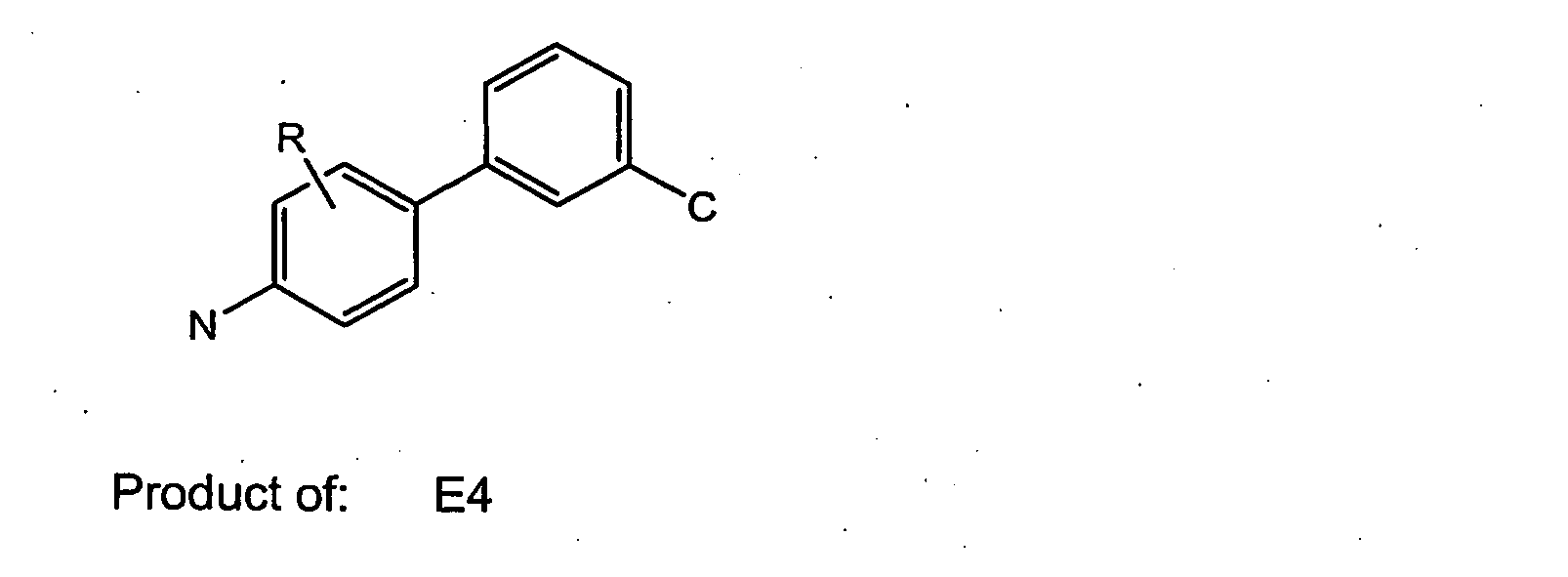
- By careful usage of monomers i.e. esters vs. acids and nitro groups vs. protected amines it can be seen that amide and reverse amide groups may be placed selectively at either end of the biphenyl core. The initial amide coupling reactions may be carried out by reaction of amines with acid chlorides, or by reaction with carboxylic acids and a suitable coupling reagent e.g. HBTU or EDAC/HOBT. Subsequent to this and dependent on the second functionality to be converted to the second amide, a hydrolysis of an ester, a deprotection of a protected amine, or a hydrogenation of a nitro-group will then furnish intermediates which are readily coupled as described above to give the final compounds shown below.


- Analogues in which one of the amides has been replaced by a ring structure may be prepared, for example, via dehydration of a primary amide into a nitrile. Suitable adaptation of the nitrile furnishes compounds with heteroaromatic rings, e.g. 1,2,4-oxadiazoles or 1,2,4-triazoles. Replacement of the amide with aryl, carbocyclyl and heterocyclyl groups may be performed by analogy.

- In some analogues one of the amide groups is reduced to the amine. These compounds can be prepared via reduction of an acid, usually with an organometallic reagent such as lithium borohydride, followed by oxidation to the aldehyde with manganese dioxide and then subsequent reductive amination. This final step is routinely carried out in the presence of a mild reducing agent such as sodium tri(acetoxy) borohydride:

- As explained above, the compounds of the invention are active against hepatitis C virus. There is therefore provided a method for treating a patient suffering from or susceptible to a hepatitis C infection, which method comprises administering to said patient an effective amount of a biphenyl derivatives of formula (1), as defined above, or a pharmaceutically acceptable salt thereof. Also provided is a method for alleviating or reducing the incidence of a hepatitis C infection in a patient, which method comprises administering to said patient an effective amount of a compound of formula (I), as defined above, or a pharmaceutically acceptable salt thereof.
- The present invention further provides a biphenyl derivative of formula (I), as defined above, or a pharmaceutically acceptable salt thereof, for the treatment of the human or animal body.
- Yet further the present invention provides a pharmaceutical composition comprising a biphenyl derivative of formula (1) or a phamiaceutically acceptable salt thereof, and a pharmaceutically acceptable diluent or carrier. Said pharmaceutical composition typically contains up to 85 wt% of a compound of the invention. More typically, it contains up to 50 wt% of a compound of the invention. Preferred pharmaceutical compositions are sterile and pyrogen free. Further, the pharmaceutical compositions of the invention typically contain a compound of the invention which is a substantially pure optical isomer.
- The compounds of the invention may be administered in a variety of dosage forms. Thus, they can be administered orally, for example as tablets, troches, lozenges, aqueous or oily suspensions, dispersible powders or granules. The compounds of the invention may also be administered parenterally, whether subcutarieously, intravenously, intramuscularly, intrasternally, transdermally or by infusion techniques. The compounds may also be administered as suppositories.
- The compounds of the invention are typically formulated for administration with a pharmaceutically acceptable carrier or diluent. For example, solid oral forms may contain, together with the active compound, diluents, e.g. lactose, dextrose, saccharose, cellulose, corn starch or potato starch; lubricants, e.g. silica, talc, stearic acid, magnesium or calcium stearate, and/or polyethylene glycols; binding agents; e.g. starches, arabic gums, gelatin, methylcellulose, carboxymethylcellulose or polyvinyl pyrrolidone; disaggregating agents, e.g. starch, alginic acid, alginates or sodium starch glycolate; effervescing mixtures; dyestuffs; sweeteners; wetting agents, such as lecithin, polysorbates, laurylsulphates; and, in general, non toxic and pharmacologically inactive substances used in pharmaceutical formulations. Such pharmaceutical preparations may be manufactured in known manner, for example, by means of mixing, granulating, tableting, sugar coating, or film coating processes.
- Liquid dispersions for oral administration may be syrups, emulsions and suspensions. The syrups may contain as carriers, for example, saccharose or saccharose with glycerine and/or mannitol and/or sorbitol.
- Suspensions and emulsions may contain as carrier, for example a natural gum, agar, sodium alginate, pectin, methylcellulose, carboxymethylcellulose, or polyvinyl alcohol. The suspension or solutions for intramuscular injections may contain, together with the active compound, a pharmaceutically acceptable carrier, e.g. sterile water, olive oil, ethyl oleate, glycols, e.g. propylene glycol, and if desired, a suitable amount of lidocaine hydrochloride.
- Solutions for injection or infusion may contain as carrier, for example, sterile water or preferably they may be in the form of sterile, aqueous, isotonic saline solutions. Compounds of the present invention may be used in conjunction with known anti-viral agents. Preferred known anti-viral agents in this regard are interferon and ribavirin, which are known for the treatment of hepatitis C (Clinical Microbiology Reviews, Jan. 2000, 67-82). The said medicament therefore typically further comprises interferon and/or ribavirin. Further, the present invention provides a pharmaceutical composition comprising:
- (a) a biphenyl derivative of the formula (I), as defined above, or a pharmaceutically acceptable salt thereof
- (b) interferon and/or ribavirin; and
- (c) a pharmaceutically acceptable carrier or diluent.
- Also provided is a product comprising:
- (a) a biphenyl derivative of the formula (I), as defined above, or a pharmaceutically acceptable salt thereof; and
- (b) interferon and/or ribavirin,
- A therapeutically effective amount of a compound of the invention is administered to a patient. A typical dose is from about 0.01 to 100 mg per kg of body weight, according to the activity af the specific compound, the age, weight and conditions of the subject to be treated, the type and severity of the disease and the frequency and route of administration, Preferably, daily dosage levels are from 0.05 to 15 mg per kg of body weight, more preferably, from 0.05 to 1.25 mg per kg of body weight.
- The following Examples illustrate the invention. In this regard, it is important to understand that the particular assay used in the Examples section is designed only to provide an indication of anti-hepatitis C activity. There are many assays available to determine such activity, and a negative result in any one particular assay is therefore not determinative.
-

- A mixture of 3-bromo-4-methyl benzoic acid (7.50g), 4-(ethoxycarbonylphenyl) boronic acid (6.82g), cesium carbonate (11.34g) and tetrakis(triphenylphosphine) palladium (0), 5 mol% (2.01g) was heated to reflux under nitrogen in DME (150 ml) for 18 h. The reaction mixture was then cooled to room temperature and filtered. The resulting filtrate was then evaporated and purified on silica gel, eluting with 0-30% 20:8:1 CH2Cl2 / EtOH / NH3 in CH2Cl2 gave the title compound as a white solid 2.5g.
- 6-Methyl-biphenyl-3, 4'-dicarboxylic acid 4'-ethyl ester (3.54g) in toluene (70ml) was treated with oxalyl chloride (4ml) followed by DMF (3 drops). The reaction was stirred at room temperature for 2 hours and then evaporated to dryness. The resulting residue was redissolved in toluene (30ml) and evaporated to dryness twice to yield the acid chloride.
- A solution of triethylamine (0.25g) in dichloromethane (5ml) was added to 4-morpholin-4-yl-phenylamine (0.44g). Then a solution of the above acid chloride (0.75g) in dichloromethane (7ml) was added and the reaction mixture stirred for 18 h. The mixture was then partitioned between 1M HCl and dichloromethane. The dried extracts were evaporated giving a colourless solid, used without further purification in the next synthetic step
- 2'-Methyl-5'-(4-morpholin-4-yl-phenylcarbatnoyl)-biphenyl-4-carboxylic acid 2'-Methyl-5'-(4-morpholin-4-yl-phenylcarbamoyl)-biphenyl-4-carboxylic acid ethyl ester (0.89g) in THF (10ml) and 0.5M NaOH (15m) was heated to 100°C for 3 hours then cooled to room temperature. THF was evaporated and the residue extracted with dichloromethane. The aqueous layer was acidified to pH 1 and a grey solid precipitated which was collected by filtration and dried (0.74g).
1H NMR (DMSO, δ) 2.33 (s, 3H) 3.26 (br s, 4H) 3.87 (br s, 4H) 7.26 (br d, 2H) 7.50 (d, 1H) 7.58 (d, 2H) 7.75 (d, 2H) 7.89 (s, 1H) 7.94 (d, 1H) 8.06 (d, 2H) 10.23 (s, 1H) . - 6-Methyl-biphenyl-3, 4'-dicarboxylic acid 4'-[(3-bronio-phenyl)-amide]-[(4 morpholin-4-yl-phenyl)-amide]
2'-Methyl-5'-(4-morpholin-4-yl-phenylcarbamoyl)-biphenyl-4-carboxylic acid (Intermediate 3)(54mg), EDAC.HCl (25mg), HOBT.H2O (17mg) and N-methylmorpholine (26mg) were stirred in DMF (1ml). The mixture was then treated with 3-bromo-phenylamine (22mg) and the whole reaction mixture was stirred at 20C overnight. The reaction mixture was evaporated to dryness. The residue was redissolved in acetonitrile (0.5ml) and water (3mL) was added. The resulting brown solid was filtered and dried (55mg).
1H NMR (DMSO, δ) 2.35 (s, 3H) 3.10-3.06 (m, 4H) 3.73-3.77 (m, 4H) 6.95 (d, 2H) 7.33-7.39 (m, 2H) 7.50 (d, 1H) 7.62-7.66 (m, 4H) 7.81 (dd, 1H) 7.89 (s, 1H) 7.93 (d, 1H) 8.09 (d, 2H) 8.17 (s, 1H) 10.08 (s, 1H) 10.49 (s, 1H)
LC-MS ES+ = 570 - 6-Methyl-biphenyl-3,4'-dicarboxylic acid 4'-[(6-methoxy-pyridin-3-yl)-amide] 3-[(4-morpholin-4-yl-phenyl)-amide]
- 1H NMR (DMSO, δ) 2.35 (s, 3H) 3.06-3.10 (m, 4H) 3.77-3.73 (m, 4H) 3.86 (s, 3H) 6.88 (d, 1H) 6.95 (d, 2H) 7.50 (d, 1H) 7.61-7.66 (m, 4H) 7.89 (s, 1H) 7.93 (d, 1H) 8.09 (d, 3H) 8.57 (d, 1H) 10.09 (s, 1H) 10.40 (s, 1H)
LC-MS ES+ = 523 - 6-Methyl-biphenyl-3,4'-dicarboxylic acid 4'-(3-methyl-benzylamide) 3-[(4-morpholin-4-yl-phenyl)-amide]
- 6-Methyl-biphenyl=3,4'-dicarboxylic acid 4'-[(3-methyl-butyl)-amide] 3-[(4-morpholin-4-yl-phenyl)-amide]
- 1H NMR (DMSO, δ) 0.93 (d, 6H) 1.47 (dt, 2H) 1.66 (septet, 1H) 2.32 (s, 3H) 3.08 (m, 4H) 3.34 (m ,2H) 3.75 (m, 4H) 6.94 (d, 2H) 7.46-7.51 (m, 3H) 7.63 (d, 2H) 7.86-7.97 (m, 4H) 8.51 (t, 1H) 10.06 (s, 1H)
LC-MS ES+ = 486 - 6-Methyl-biphenyl-3,4'-dicarboxylic acid 4'-(3-fluoro-benzylamide) 3-[(4-morpholin-4-yl-phenyl)-amide]
- 6-Methyl-biphenyl-3,4'-dicarboxylic acid 3-[(4-morpholin-4-yl-phenyl)-amide] 4'-[(2-piperidin-1-yl-ethyl)-amide]
- 6-Methyl-biphenyl-3,4'-dicarboxylic acid 4'-[(4-bromo-phenyl)-amide] 3-[(4-morpholin-4-yl-phenyl)-amide]
- 6-Methyl-biphenyl-3,4'-dicarboxylic acid 4'-[(3-benzyloxy-phenyl)-amide] 3-[(4-morpholin-4-yl-phenyl)-amide]
- 6-Methyl-biphenyl-3,4'-dicarboxylic acid 3- {[3-(4-methyl-piperazin-1-yl)-propyl]-amide} 4'-[(4-morpholin-4-yl-phenyl)-amide]
This compound was prepared in by analogous methods from Intermediate 1. - 6-Methyl-biphenyl-3,4'-dicarboxylic acid 3-[(4-morpholin-4-yl-phenyl)-amide] 4'-(3-trifluoromethyl-benzylamide)
1H NMR (DMSO, δ) 2.33 (s, 3H) 3.06-3.1 (m, 4H) 3.73-3.77 (m, 4H) 4.61 (d, 2H) 6.94 (d, 2H) 7.48 (d, 1H) 7.60 (d, 1H) 7.63-7.67 (m, 5H) 7.71 (s, 1H) 7.86 (m, 1H) 7.91 (dd, 1H) 8.03 (d, 2H) 8.25 (m, 1H) 9.27(t, 1H) 10.08 (s, 1H)
LC-MS ES+ = 574 - 6-Methyl-biphenyl-3,4'-dicarboxylic acid 3-[(4-morpholin-4-yl-phenyl)-amide] 4'-[(2-thiophen-2-yl-ethyl)-amide]
- 6-Methyl-biphenyl-3,4'-dicarboxylic acid 4'-[(1H-indazol-6-yl)-amide] 3-[(4-morpholin-4-yl-phenyl)-amide]
- 6-Methyl-biphenyl-3,4'-dicarboxylic acid 4'-{[2-(3H-imidazol-4-yl)-ethyl]-amide} 3-[(4-morpholin-4-yl-phenyl)-amide]
- 6-Methyl-biphenyl-3,4'-dicarboxylic acid 4'-[(5-methyl-furan-2-yhnethyl)-amide] 3-[(4-morpholin-4-yl-phenyl)-amide]
- 6-Methyl-4'-(pyrrolidine-1-carbonyl)-biphenyl-3-carboxylic acid (4-morpholin-4-yl-phenyl)-amide
- 6-Methyl-biphenyl-3,4'-dicarboxylic acid 4'-benzo[1,3]dioxol-5-ylamide 3-[(4-morpholin-4-yl-phenyl)-amide]
- 6-Methyl-biphenyl-3,4'-dicarboxylic acid 3-cyclopropylamide 4'-[(4-morpholin-4-yl-phenyl)-amide]
This compound was prepared by analogous methods using Intermediate 1. - Furan-2-carboxylic acid [6-methyl-4'-(4-morpholin=4-yl-phenylcarbamoyl)-biphenyl-3-yl]-amide
This compound was prepared by analogous methods using Intermediate 23 - 6-Methyl-biphenyl-3,4'-dicarboxylic acid 4'-[(3-benzoyl-phenyl)-amide] 3-[(4-morpholin-4-yl-phenyl)-amide]
- 6-Methyl-biphenyl-3,4'-dicarboxylic acid 4'-(4-morpholin-4-yl-benzylamide) 3-[(4-morpholin-4-yl-phenyl)-amide]
- 6-Methyl-biphenyl-3,4'-dicarboxylic acid 4'-[(3-butylsulfamoyl-phenyl)-amide] 3-[(4-morpholin-4-yl-phenyl)-amide]
- 6-Methyl-biphenyl-3,4'-dicarboxylic acid 4'-[(3,4-dichloro-phenyl)-amide] 3-[(4-morpholin-4-yl-phenyl)-amide]
- 6-Methyl-biphenyl-3,4'-dicarboxylic acid 3-[(4-morpholin-4-yl-phenyl)-amide] 4'-[(3-trifluoromethyl-phenyl)-amide]
- 6-Methyl-biphenyl-3,4'-dicarboxylic acid 4'-[(4-cyano-phenyl)-amide] 3-[(4-morpholin-4-yl-phenyl)-amide]
- 6-Methyl-biphenyl-3,4'-dicarboxylic acid 3-[(4-morpholin-4-yl-phenyl)-amide] 4'-[(3-trifluoromethoxy-phenyl)-amide]
- 6-Methyl-biphenyl-3,4'-dicarboxylic acid 3-[(4-morpholin-4-yl-phenyl)-amide] 4'-[(3-trifluoromethoxy-phenyl)-amide]
- 6-Methyl-biphenyl-3,4'-dicarboxylic acid 3-[(4-morpholin-4-yl-phenyl)-amide] 4'-[(3-trifluoromethoxy-phenyl)-amide]
- 6-Methyl-biphenyl-3,4'-dicarboxylic acid 4'-[(4-isoxazol-5-yl-phenyl)-amide] 3-[(4-morpholin-4-yl-phenyl)-amide]
1H NMR (DMSO, δ) 2.36 (s, 3H) 3.06-3.1 (m, 4H) 3.73-3.77 (m, 4H) 6.96-6.98 (m, 3H) 7.50 (d, 2H) 7.64 (d, 4H) 7.92 (dd, 4H) 8.11 (d, 2H, d) 8.65 (d, 1H, d) 10.1 (s, 1H) 10.61 (s, 1H)
LC-MS ES+ = 559 - 6-Methyl-biphenyl-3,4'-dicarboxylic acid 4'-[(4-methylsulfamoyl-phenyl)-amide] 3-[(4-morpholin-4-yl-phenyl)-amide]
1H NMR (DMSO, δ) 2.49 (s, 3H) 2.57 (d, 3H) 3.20-3.24 (m, 4H) 3.87- 3.91 (m, 4H) 7.09 (d, 2H) 7.52 (q, 1H) 7.64 (d, 1H) 7.78 (d, 4H) 7.93 (d, 2H) 8.03-8.08 (m, 2H) 8.22 (dd, 4H) 10.23 (s, 1H) 10.86 (s, 1H)
LC-MS ES+ = 585 - 6-Methyl-biphenyl-3,4'-dicarboxylic acid 4'-[(4-bromo-3-chloro-phenyl)-amide] 3-[(4-morpholin-4-yl-phenyl)-amide]
- 6-Methyl-biphenyl-3,4'-dicarboxylic acid 4'-{[3-(1-hydroxy-ethyl)-phenyl]-amide} 3-[(4-morpholin-4-yl-phenyl)-amide]
- 3- {[2'-Methyl-5'-(4-morpholin-4-yl-phenylcarbamoyl)-biphenyl-4-carbonyl]-amino}-benzoic acid ethyl ester
- 6-Methyl-biphenyl-3,4'-dicarboxylic acid 4'-[(3-methoxy-phenyl)-amide] 3-[(4-morpholin-4-yl-phenyl)-amide]
- 6-Methyl-biphenyl-3,4'-dicarboxylic acid 4'-[(3,4-dimethoxy-phenyl)-amide] 3-[(4-morpholin-4-yl-phenyl)-amide]
- 6-Methyl-biphenyl-3,4'-dicarboxylic acid 4'-({2-[(cyclohexyl-methyl-amino)-methyl]-phenyl}-amide) 3-[(4-morpholin-4-yl-phenyl)-amide]
- 6-Methyl-biphenyl-3,4'-dicarboxylic acid 3-[(4-morpholin-4-yl-phenyl)-amide] 4'-pyridin-3-ylamide
- 4'-[4-(2,3-Dichloro-phenyl)-piperazine-1-carbonyl]-6-methyl-biphenyl-3-carboxylic acid (4-morpholin-4-yl-phenyl)-amide.
- 6-Methyl-biphenyl-3,4'-dicarboxylicacid 3-[(4-morpholin-4-yl-phenyl)-amide] 4'-[(2-trifluoromethyl-1H-berrzoimidazol-5-yl)-amide]
1H NMR (DMSO, δ) 2.36 (s, 3H) 3.06-3.1 (m, 4H) 3.73-3.77 (m, 4H) 6.95 (d, 2H) 7.50 (d, 1H) 7.62-7.66 (m, 4H) 7.74 (s, 2H) 7.90 (d, 1H) 7.95 (d, 1H) 8.12 (d, 2H) 8.39 (s, 1H) 10.1 (s, 1H) 10.52 (s, 1H) 13.85 (br s, 1H) - LC-MS ES+ = 600
- 6-Methyl-biphenyl-3,4'-dicarboxylic acid 4'-[(4-cyanomethyl-phenyl)-amide] 3-[(4-morpholin-4-yl-phenyl)-amide]
- 6-Methyl-biphenyl-3,4'-dicarboxylic acid 3-[(4-morpholin-4-yl-phenyl)-amide] 4'-[(thiophen-3-ylmethyl)-amide]
- 6-Methyl-biphenyl-3,4'-dicarboxylic acid 3-[(4-morpholin-4-yl-phenyl)-amide] trifluoromethoxy-benzylamide)
- 6-Methyl-biphenyl-3,4'-dicarboxylic acid 4'-(4-chloro-3-trifluoromethyl-benzylamide) 3-[(4-morpholin-4-yl-phenyl)-amide]
- 6-Methyl-biphenyl-3,4'-dicarboxylic acid 4'-(3-chloro-4-methyl-benzylamide) 3-[(4-morpholin-4-yl-phenyl)-amide]
- 6-Methyl-biphenyl-3,4'-dicarboxylic acid 4'-[(1H-indol-6-yl)-amide] 3-[(4-morpholin-4-yl-phenyl)-amide]
1H NMR (DMSO, δ) 2.36 (s, 3H) 3.06-3.08 (m, 4H) 3.73-3.77 (m, 4H) 6.40 (br s, 1H) 6.95 (d, 2H) 7.31-7.35 (m, 2H) 7.50 (d, 2H) 7.60-7.66 (m, 4H) 7.90-7.97 (m, 2H) 8.09-8.13 (m, 3H) 10.1 (s, 1H) 10.27 (s, 1H) 11.1 (s, 1H)
LC-MS ES+ = 53 - 6-Methyl-biphenyl-3,4'-dicarboxylic acid 4'-[(1H-indol-5-yl)-amide] 3-[(4-morpholin-4-yl-phenyl)-amide]
- 6-Methyl-biphenyl-3,4'-dicarboxylic acid 4'-benzothiazol-6-ylamide 3-[(4-morpholin-4-yl-phenyl)-amide]
- [3-({[2'-Methyl-5'-(4-morpholin-4-yl-phenylcarbamoyl)-biphenyl-4-carbonyl]-amino}-methyl)-benzyl]-carbamic acid tert-butyl ester
- 6-Methyl-biphenyl-3,4'-dicarboxylic acid 4'-[(1H-indol-7-yl)-amide] 3-[(4-morpholin-4-yl-phenyl)-amide]
- 6-Methyl-biphenyl-3,4'-dicarboxylic acid 4'-[2-(2-hydroxymethyl-phenylsulfanyl)-benzylamide] 3-[(4-moipholin-4-yl-phenyl)-amide]
- 6-Methyl-biphenyl-3,4'-dicarboxylic acid 4'-{[4-(1,1-dioxo-llambda*6*-thiomorpholin-4-yhnethyl)-phenyl]-amide} 3-[(4-morpholin-4-yl-phenyl)-amide].
- 6-Methyl-biphenyl-3,4'-dicarboxylic acid 4'- {[(S)-1-hydroxymethyl-2-(1H-indol-3-yl)-ethyl]-amide} 3-[(4-morpholin-4-yl-phenyl)-amide]
- 6-Methyl-biphenyl-3,4'-dicarboxylic acid 4'-(3-bromo-benzylamide) 3-[(4-morpholin-4-yl-phenyl)-amide]
- 6-Methyl-biphenyl-3,4'-dicarboxylic acid 4'-[(4-amino-phenyl)-amide] 3-[(4-morpholin-4-yl-phenyl)-amide]
- 6-Methyl-biphenyl-3,4'-dicarboxylic acid 4'-[(4-methylsulfamoylmethyl-phenyl)-amide] 3-[(4-morpholin-4-yl-phenyl)-amide]
- 6-Methyl-biphenyl-3,4'-dicarboxylic acid 4'-[(5-bromo-1H-indol-7-yl)-amide] 3-[(4-morpholin-4-yl-phenyl)-anude]
- 6-Methyl-biphenyl-3,4'-dicarboxylic acid 3-[(4-morpholin-4-yl-phenyl)-amide] 4'-{[4-(1H-pyrazol-3-yl)-phenyl]-amide}
- 6-Methyl-biphenyl-3,4'-dicarboxylic acid 4'-(3-chloro-2-fluoro-benzylamide) 3-[(4-morpholin-4-yl-phenyl)-amide]
- 6-Methyl-biphenyl-3,4'-dicarboxylic acid 3-[(4-morpholin-4-yl-phenyl)-amide] 4'-{[4-(piperidine-1-carbonyl)-phenyl]-amide}
- Biphenyl-3,4'-dicarboxylic acid 4'-[(1H-indol-5-yl)-amide] 3-[(4-morpholin-4-yl-phenyl)-amide]

- A mixture of 3-bromo-benzoic acid (4.02g) and 4-ethoxycarbonyl-phenyl boronic acid (3.88g) in DME (100ml) containing cesium carbonate (6.5g) and tetrakis(triphenylphosphine) palladium (0) (1.15g) was heated to reflux for 24h. The cooled mixture was then filtered through celite and evaporated giving the crude title compound as a white solid which was used without purification in the next synthetic step.
- 3'-(4-Morpholin-4-yl-phenylcarbamoyl)-biphenyl-4-carboxylic acid ethyl ester Biphenyl-3, 4'-dicarboxylic acid 4'-ethyl ester (660mg) in toluene (10ml) was treated with oxalyl chloride (1ml) followed by DMF (2 drops). The reaction was stirred at room temperature for 2 hours and then evaporated to dryness. The resulting residue was redissolved in toluene (30ml) and evaporated to dryness twice to yield the acid chloride.
- A solution of triethylamine (494mg) in dichloromethane (10ml) was added to 4-morpholin-4-yl-phenylamine (435mg). Then a solution of the above acid chloride in dichloromethane (7ml) was added and the reaction mixture stirred for 18 h. The mixture was then partitioned between 1M HCl and dichloromethane. The dried extracts were evaporated giving a colourless solid, used without further purification in the next synthetic step
- 3'-(4-Morpholin-4-yl-phenylcarbamoyl)-biphenyl-4-carboxylic acid 3'-(4-Morpholin-4-yl-phenylcarbamoyl)-biphenyl-4-carboxylic acid ethyl ester (850mg) in THF (12ml) and 1M NaOH (25m) was heated to 100°C for 3 hours then cooled to room temperature. THF was evaporated and the residue extracted with dichloromethane. The aqueous layer was acidified to pH 1 and a grey solid precipitated which was collected by filtration and dried (793mg)
- Biphenyl-3,4'-dicarboxylic acid 4'-[(1H-indol-6-yl)-amide] 3-[(4-morpholin-4-yl-phenyl)-amide]
- 3'-(4-Morpholin-4-yl-phenylcarbamoyl)-biphenyl-4-carboxylic acid (30mg) ((Intermediate 6), EDAC.HCl (14mag), HOBT.H2O (10mg) and N-methylmorpholine (15mg) were stirred in DMF (0.5ml). The mixture was then treated with 1H-indol-6-ylamine (10mg) and the whole reaction mixture was stirred at 20C overnight. The reaction mixture was diluted with water and the solid collected by filtration. This was then recrystallised from 3:1 EtOH:H20 at 140C (in microwave) giving the title compound as an off-white solid (5mg).
1H NMR (DMSO, δ) 3.10 (t, 4H) 3.76 (t, 4H) 6.41 (s, 1H) 6.98 (d, 2H) 7.31-7.35 (m, 2H) 7.51 (m, 1H) 7.63-7.72 (m, 3H) 7.95-8.00 (m, 4H) 8.13-8.17 (m, 3H) 8.32-8.35 (m, 1H) 10.24 (s, 1H) 10.26 (s, 1H) 11.10 (s, 1H)
LC-MS ES+ = 517. - 6-Methyl-biphenyl-3,4'-dicarboxylic acid 4'-[(3-acetylamino-phenyl)-amide] 3-[(4-morpholin-4-yl-phenyl)-amide]
This compound was prepared in an analogous fashion to Example 1. - 2'-Methyl-biphenyl-3,4'-dicarboxylic acid 3-[(3-methoxy-phenyl)-amide] 4'-[(4-morpholin-4-yl-phenyl)-amide]
- 2'-Methyl-biphenyl-3,4'-dicarboxylic acid 3-[(1H-indazol-6-yl)-amide] 4'-[(4-morpholin-4-yl-phenyl)-amide]
- 2'-Methyl-biphenyl-3,4'-dicarboxylic acid 3-[(3-bromo-phenyl)-amide] 4'-[(4-morpholin-4-yl-phenyl)-amide]
- 2'-Methyl-biphenyl-3,4'-dicarboxylic acid 3-[(4-isoxazol-5-yl-phenyl)-amide] 4'-[(4-morpholin-4-yl-phenyl)-amide]
- 2'-Methyl-biphenyl-3,4'-dicarboxylic acid 3-(3-chloro-benzylamide) 4'-[(4-morpholin-4-yl-phenyl)-amide]
- 6-Methyl-biphenyl-3,4'-dicarboxylic acid 4'-[(1H-indazol-6-yl)-amide] 3-[(4-morpholin-4-yl-phenyl)-amide]
- 2'-Methyl-5'-(4-morpholin-4-yl-benzoylamino)-biphenyl-4-carboxylic acid (3-trifluoromethoxy-phenyl)-amide
- 6-Methyl-biphenyl-3,4'-dicarboxylic acid 3-[(4-morpholin-4-yl-phenyl)-amide] 4'-[(3-thiomorpholin-4-ylmethyl-phenyl)-amide]
- 6-Methyl-biphenyl-3,4'-dicarboxylic acid 4'-[(4-dimethylcarbamoyl-phenyl)-amide] 3-[(4-morpholin-4-yl-phenyl)-amide]
- 6-Methyl-biphenyl-3,4'-dicarboxylic acid 4'- {[4-(3-ethyl-6-hydroxy-2-oxo-piperidm-3-yl)-phenyl]-amide} 3-[(4-morpholin-4-yl-phcnyl)-amide]
- 6-Methyl-biphenyl-3,4'-dicarboxylic acid 4'-[(3-acetylamino-phenyl)-amide] 3-[(4-morpholin-4-yl-phenyl)-amide]
- 6-Methyl-biphenyl-3,4'-dicarboxylic acid 3-[(4-morpholin-4-yl-phenyl)-amide] 4'-[(4-piperidin-1-ylmethyl-phenyl)-amide]
- 6-Methyl-biphenyl-3,4'-dicarboxylic acid 4'-[(4-morpholin-4-ylmethyl-phenyl)-amide] 3-[(4-morpholin-4-yl-phenyl)-amide]
- 6-Methyl-biphenyl-3,4'-dicarboxylic acid 3-[(4-morpholin-4-yl-phenyl)-amide] 4'-[(4-pyrrolidin-1-ylmethyl-phenyl)-amide]
- 6-Methyl-biphenyl-3,4'-dicarboxylic acid 4'-({4-[(methyl-propyl-amino)-methyl]-phenyl}-amide) 3-[(4-morpholin-4-yl-phenyl)-amide]
- 6-Methyl-biphenyl-3,4'-dicarboxylic acid 4'-[(3-acetylamino-4-methyl-phenyl)-amide] 3-[(4-morpholin-4-yl-phenyl)-amide]
- 6-Methyl-biphenyl-3,4'-dicarboxylic acid 4'-[(3-methanesulfonylamino-phenyl)-amide] 3-[(4-morpholin-4-yl-phenyl)-amide]
- 6-Methyl-biphenyl-3,4'-dicarboxylic acid 3-[(4-morpholin-4-yl-phenyl)-amide] 4'-[(2-oxo-2,3-dihydro-1H-benzoimidazol-5-yl)-amide]
- 6-Methyl-biphenyl-3,4'-dicarboxylic acid 3-[(4-morpholin-4-yl-phenyl)-amide] 4'-[(2-piperidin-1-ylmethyl-phenyl)-amide]
- 6-Methyl-biphenyl-3,4'-dicarboxylic acid 4'-[(4-hydroxymethyl-phenyl)-amide] 3-[(4-morpholin-4-yl-phenyl)-amide]
- 6-Methyl-biphenyl-3,4'-dicarboxylic acid 3-[(4-morpholin-4-yl-phenyl)-amide] 4'-[(4-piperazin-1-ylmethyl-phenyl)-amide]
- 6-Methyl-biphenyl-3,4'-dicarboxylic acid 4'-(3-chloro-benzylamide) 3-[(4-morpholin-4-yl-phenyl)-amide]
- 2'-Methyl-5'-(4-morpholin-4-yl-phenylcarbamoyl)-biphenyl-4-carboxylic acid ethyl ester
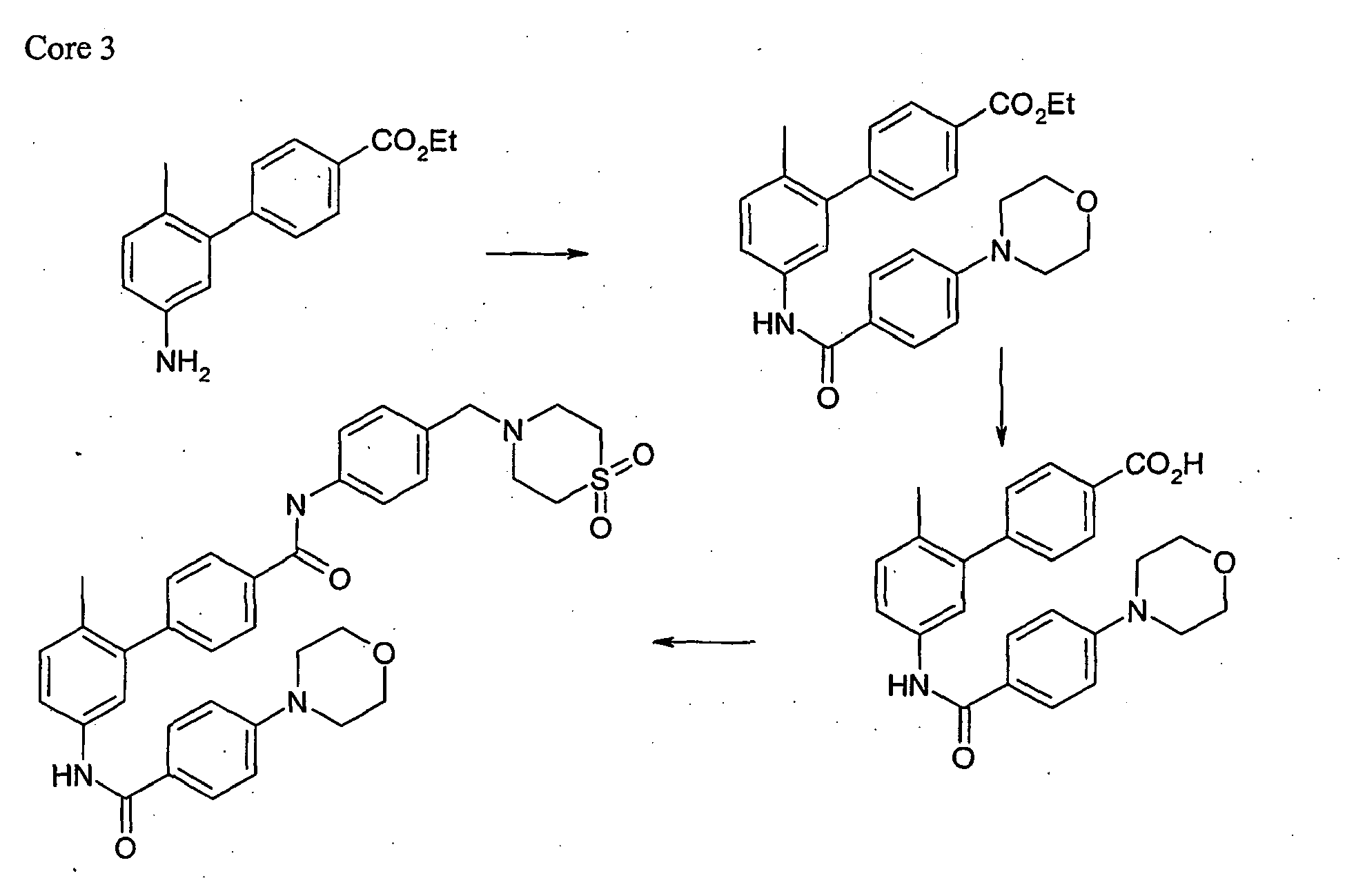
- 5'-Amino-2'-methyl-biphenyl-4-carboxylic acid ethyl ester (2.15g), 4-morpholin-4-yl benzoic acid (1.27g), N-methylmorpholine (2.05ml), 1-hydroxybenzotriazole (826mg) and 1-ethyl-3-(3-(dimethylaminopropyl)carbodiimide hydrochloride (1.17g) in dry DMF (30ml) was stirred at 20C for 18h. Then the DMF was evaporated and the residue partitioned between water and dichloromethane. The dried extracts were evaporated and the residue purified on silica gel. Elution with 1-2% methanol in dichloromethane gave a colourless solid (2.4g)
- 2'-Methyl-5'-(4-morpholin-4-yl-benzoylamino)-biphenyl-4-carboxylic acid ethyl ester (2.4g) was stirred in a mixture of THF (25ml) and 1M sodium hydroxide (50ml) at 100C for 4h. The mixture was allowed to cool and the THF was evaporated. The residue was acidified and the resultant colourless precipitate collected by filtration and dried (1.98g).
- 2'-Methyl-5'-(4-morpholin-4-yl-benzoylamino)-biphenyl-4-carboxylic acid (2-trifluoromethyl-1H-benzoimidazol-5-yl)-amide
- 2'-Methyl-5'-(4-morpholin-4-yl-benzoylamino)-biphenyl-4-carboxylic acid (4-acetylamino-phenyl)-amide
- 2'-Methyl-5'-(4-morpholin-4-yl-benzoylamino)-biphenyl-4-carboxylic acid [4-(1,1-dioxo-llambda*6*-thiomorpholin-4-ylmethyl)-phenyl]-amide
- 2'-Methyl-5'-(4-morpholin-4-yl-benzoylamino)-biphenyl-4-carboxylic acid (60mg) 4-(1,1-dioxo-llambda*6*-thiomorpholin-4-ylmethyl)-phenylamine (35mg), N-methylmorpholine (0.035ml), 1-hydroxybenzotriazole (20mg) and 1-ethyl-3-(3-(dimethylaminopropyl)carbodiimide hydrochloride (29mg) in dry DMF (2ml) was stirred at 20C for 18h. Water was then added and the resultant precipitate collected by filtration and dried (44mg).
- 1H NMR (DMSO, δ) 2.24 (s, 3H) 2.88 (m, 4H) 3.12 (m, 4H) 3.27 (m, 4H) 3.66 (s, 2H) 3.76 (m, 4H) 6.95 (d, 2H) 7.28-7.7.42 (m, 3H) 7.52 (d, 2H) 7.74-7.78 (m, 4H) 7.91 (d, 2H) 8.05 (d, 2H) 10.05 (s, 1H) 10.39 (s, 1H).
LC-MS ES+ = 639. - 2'-Methyl-5'-(4-morpholin-4-yl-benzoylamino)-biphenyl-4-carboxylic acid 3-bromo-benzylamide
- 2'-Methyl-5'-(4-morpholin-4-yl-benzoylamino)-biphenyl-4-carboxylic acid 3-methyl-benzylamide
- 2'-Methyl-5'-(4-morpholin-4-yl-benzoylamino)-biphenyl-4-carboxylic acid (4-bromo-3-chloro-phenyl)-amide
- 2'-Methyl-5'-(4-morpholin-4-yl-benzoylamino)-biphenyl-4-carboxylic acid (3-methoxyphenyl)-amide
- 2'-Methyl-5'-(4-morpholin-4-yl-benzoylamino)-biphenyl-4-carboxylic acid 3-trifluoromethoxy-benzylamide
- 2'-Methyl-5'-(4-morpholin-4-yl-benzoylamino)-biphenyl-4-carboxylic acid (1H-indol-6-yl)-amide
- 2'-Methyl-5'-(4-morpholin-4-yl-benzoylamino)-biphenyl-4-carboxylic acid 3-chloro-benzylamide
- Examples 95 to 102 are prepared by a reductive amination procedure, via an aldehyde intermediate, generated in analogous procedures to Intermediate 42 and Example 197 Example 95
5'- {[1-Hydroxymethyl-2-(3H-imidazol-4-yl)-ethylamino]-methyl}-2'-methyl-biphenyl-4-carboxylic acid (4-morpholin-4-yl-phenyl)-amide - 4'-[(3-Chloro-benzylamino)-methyl]-6-methyl-biphenyl-3-carboxylic acid (4-morpholin-4-yl-phenyl)-amide
- 4'-[(1H-Indazol-6-ylammo)-methyl]-6-methyl-biphenyl-3-carboxylic acid (4-morpholin-4-yl-phenyl)-amide
- 4'-Cyclopropylaminomethyl-6-methyl-biphenyl-3-carboxylic acid (4-morpholin-4-yl-phenyl)-amide
- (S)-3-Hydroxy-2-{[2'-methyl-5'-(4-morpholin-4-yl-phenylcarbamoyl)-biphenyl-4-ylmethyl]-ammo}-propionic acid
- 4'- {[2-(3H-Imidazol-4-yl)-ethylamino]-methyl} -6-methyl-biphenyl-3-carboxylic acid (4-morpholin-4-yl-phenyl)-amide
- 4'-{[1-Hydroxymethyl-2-(3H-imidazol-4-yl)-ethylamino]-methyl}-6-mcthyl-biphenyl-3-carboxylic acid (4-morpholin-4-yl-phenyl)-amide
- 4'-[(2-Dimethylamino-ethylamino)-methyl]-6-methyl-biphenyl-3-carboxylic acid (4-morpholin-4-yl-phenyl)-amide

- A solution of 4-bromo-3-methyl aniline (500mg) in methanol (20ml) was treated with triethylamine (0.75ml) and Boc anhydride (1.18g) and was stirred at 20C for 18h. The solvent was then evaporated and the residue partitioned between water and dichloromethane. The dried extracts were then evaporated giving the title compound as a pale brown solid (770mg).
- A mixture of (4-bromo-3-methyl-phenyl)-carbamic acid tert-butyl ester (765mg), 3-carboxyphenyl boronic acid (446mg), cesium carbonate (875mg) and tetrakis(triphenylphosphine)palladium0 (catalytic quantity), in 1:2 aqueous DME (30ml) was heated to reflux for 18h. The mixture was then allowed to cool and was then partitioned between 1M HCl and dichloromethane. The dried extracts were then evaporated giving the title compound as a pale brown foam (785mg).
- A mixture of 4'-tert-butoxycarbonylamino-2'-methyl-biphenyl-3-carboxylic acid (436mg), 4-morpholin-4-yl aniline (238mg), triethylamine (0.55ml) and O-benzotriazol-1-yl-N,N,N',N'-tetramethyluronium hexafluorophosphate (757mg) in dry DMF (15ml) was stirred at 20C for 18h. Water (50ml) was then added and the resulting colourless precipitate was collected by filtration and dried (680mg)
- [2-Methyl-3'-(4-mbrpholin-4-yl-phenylcarbamoyl)-biphenyl-4-yl]-carbamic acid tert-butyl ester (670mg) was stirred in methanol (15ml) and 5M HCl (5ml) at 20C for 2 days. TLC indicated that the reaction was progressing slowly and so the mixture was heated to reflux for 6h. The reaction was allowed to cool and was then basified and extracted with dichloromethane. The dried extract was evaporated and the residue purified on silica gel. Elution with dichloromethane:ethano1:0.880 ammonia; 400:8:1 gave a colourless foam which crystallized on standing (354mg).
- Examples 103 to 112 were prepared from intermediates produced from coupling A/B1 and are synthesized in an analogous fashion to Example 114.
- 4'-(Cyclopropanecarbonyl-aznino)-2'-methyl-biphenyl-3-carboxylic acid (4-morpholin-4-yl-phenyl)-amide
This was prepared in an analogous fashion to Example 114 - A solution of 4'-amino-2'-methyl-biphenyl-3-.carboxylic acid (4-morpholin-4-yl-phenyl)-amide (40mg) and triethylamine(0.4ml) in dry DMF (3ml) was treated with furan-2-carbonyl chloride (0.015ml) and the mixture stirred at 20C for 18h. The mixture was then partitioned between water and dichloromethane. The dried extract was then evaporated and the residue purified on silica gel. Elution with dichloromethane:ethanol:0.880 ammonia; 400:8:1 gave a colourless foam (46mg).
1H NMR (DMSO,δ) 2.28 (s, 3H) 3.09 (t, 4H) 3.74 (t, 4H) 6.74 (m, 1H) 6.93 (d, 2H) 7.30-7.38 (m, 2H) 7.56-7.76 (m, 6H) 7.93-7.99 (m, 3H) 10.12 (s, 1H) 10.24 (s, 1H). - 4'-(2-Methoxy-benzoylamino)-2'-methyl-biphenyl-3-carboxylic acid (4-morpholin-4-yl-phenyl)-amide
- 4'-(3-Methoxy-benzoylamino)-2'-methyl-biphenyl-3-carboxylic acid (4-morpholin-4-yl-phenyl)-amide
- Examples 117 to 119 were prepared from intermediates produced from coupling A/B1 and are synthesised in an analogous fashion to Example 114.

- A mixture of 3-bromo-4-methyl-benzoic acid methyl ester (3g), 4-hydroxycarbonyl-phenyl boronic acid (2.21g), cesium carbonate (4.26g) and tetrakis(triphenylphosphine)palladium0 (catalytic quantity), in 1:2 aqueous DME (75ml) was heated to reflux for 18h. The cooled reaction was then evaporated to dryness and the residue purified on silica gel. Elution with dichloromethane:ethano1:0.880 ammonia; 800:8:1 to 100:8:1 gave a yellow crystalline solid (3.4g)
- 4'-[4-(1,1-Dioxo-1lambda*6*-thiomorpholin-4-ylmethyl)-phenylcarbamoyl]-6-methyl-biphenyl-3-carboxylic acid methyl ester 6-Methyl-biphenyl-3,4'-dicarboxylic acid 3-methyl ester (1.59g) in toluene (50ml) was treated with oxalyl chloride (8ml) and DMF (6 drops). The mixture was stirred at 20C for 2h. and then was evaporated to dryness. The residue was then dissolved in dichloromethane (50ml) containing triethylamine (0.85ml) and was treated with 4-(1,1-dioxo-llambda*6*-thiomorpholin-4-ylmethyl)-phenylamine (1.4g). This mixture was stirred at 20C for 18h. and was then partitioned between 1M sodium hydroxide and dichloromethane. The dried extracts were evaporated giving the title compound as a colourless foam (2.72g).
- 4'-[4-(1,1-Dioxo-1lambda*6*-thiomorpholin-4-ylmethyl)-phenylcarbamoyl]-6-methyl-biphenyl-3-carboxylic acid
4'-[4-(1,1-Dioxo-1lwnbda*6*-thiomorpholin-4-ylmethyl)-phenylcarbamoyl]-6-methyl-biphenyl-3-carboxylic acid methyl ester (1.09g) was heated to reflux in 1M sodium hydroxide (20ml) and THF (20ml) for 3h. The mixture was then allowed to cool, and the THF evaporated. The aqueous residue was extracted with dichloromethane, and was then acidified. The resultant white solid was collected by filtration and dried (950mg). - Biphenyl-3,4'-dicarboxylic acid 4'-{[4-(1,1-dioxo-1lambda*6*-thiomorpholin-4-ylmethyl)-phenyl]-amide} 3-[(4-morpholin-4-yl-phenyl)-amide] This compound was prepared by an analogous method to Example 121
- 6-Methyl-biphenyl-3,4'-dicarboxylic acid 4'-cyclopropylamide 3-{[4-(1,1-dioxo-1lambda*6*-thiomorpholin-4-ylmethyl)-phenyl]-amide}
- 4'-[4-(1,1-Dioxo-1lanibda*6*-thiomorpholin-4-ylmethyl)-phenylcarbamoyl]-6-methyl-biphenyl-3-carboxylic acid (35mg) N-methylmorpholine (0.01ml), 1-hydroxybenzotriazole (10mg) cyclopropylamine (5mg) and 1-methyl-3-(3-(dimethylaminopropyl)carbodiimide hydrochloride (14mg) in dry DMF (0.5ml) was stirred at 20C for 18h. The mixture was then added to water (6ml) and after a further 15mins stirring, the solid was collected by filtration, washed (water 2x1ml and pet ether 2x1ml) and dried giving the title compound as a colourless solid (27mg).
1H NMR (DMSO,δ) 0.57-0.60 (m, 2H) 0.66-0.71 (m, 2H) 2.31 (s, 3H) 2.88-3.00 (m, 5H) 3.13 (m ,4H) 3.66 (s, 2H) 7.33 (d, 2H) 7.41-7.43 (m, 1H) 7.54-7.58 (d, 2H) 7.74-7.81 (m, 4H) 8.04 (d, 2H) 8.46 (d, 1H) 10.34 (s, 1H).
LC-MS ES+ = 518 - 6-Methyl-biphenyl-3,4'-dicarboxylic acid 4'- {[4-(1,1-dioxo-1lambda*6*-thiomorpholin-4-ylmethyl)-phenyl]-amide} 3-[(3-methyl-butyl)-amide]
This compound was prepared by an analogous method to Example 121 - 6-Methyl-biphenyl-3,4'-dicaxboxylic acid 3-{[4-(1,1-dioxo-1lambda*6*-thiomorpholin-4-ylmethyl)-phenyl]-amide} 4'-(3-fluoro-benzylamide)
The following compound was prepared in an analogous fashion to Example 121 except that 3-fluorobenzylamine was used. The title compound was isolated as a colourless solid (11mg)
1H NMR (DMSO,δ) 2.33 (s, 3H) 2.90 (m ,4H) 3.12 (m,4H) 3.66 (s, 2H) 4.51 (d, 2H) 7.05-7.19 (m, 4H) 7.32-7.48 (m, 3H) 7.58 (d, 2H) 7.78-7.88 (m, 4H) 8.06 (d, 2H) 9.14 (t, 1H) 10.35 (s, 1H)
LC-MS ES+ = 586 - 6-Methyl-biphenyl-3,4'-dicarboxylic acid 4'-{[4-(1,1-dioxo-1lambda*6*-thiomorpholin-4-ylmethyl)-phenyl]-amide} 3-[(tetrahydro-furan-2-ylmethyl)-amide]
- 6-Methyl-biphenyl-3,4'-dicarboxylic acid 4'-{[4-(1,1-dioxo-1lambda*6*-thiomorpholin-4-ylmethyl)-phenyl]-amide} 3-[(2-piperidin-1-yl-ethyl)-amide]
- 6-Methyl-biphenyl-3,4'-dicarboxylic acid 4'-{[4-(1,1-dioxo-1lambda*6*-thiomorpholin-4-ylmethyl)-phenyl]-amide} 3-[(2-methoxy-ethyl)-amide]
- 6-Methyl-biphenyl-3,4'-dicarboxylic acid 4'- {[4-(1,1-dioxo-llambda*6*-thiomorpholin-4-ylmethyl)-phenyl]-amide} 3-{[2-(3H-imidazol-4-yl)-ethyl]-amide}
- 2'-Methyl-5'-(4-pyrrolidin-1-yl-piperidine-1-carbonyl)-biphenyl-4-carboxylic acid [4-(1,1-dioxo-1lambda*6*-thiomorpholin-4-ylmethyl)-phenyl]-amide
- 6-Methyl-biphenyl-3,4'-dicarboxylic acid bis-{[4-(1,1-dioxo-1lambda*6*-thiomorpholin-4-ylmethyl)-phenyl]-amide} The following compound was prepared in an analogous fashion to Example 123 except that 4-(1,1-dioxo-1lambda*6*-thiomorpholin-4-ylmethyl)-phenylamine was used. The title compound was isolated as a colourless solid (21mg).
1H NMR (DMSO,δ) 2.36 (s, 3H) 2.88 (m, 8H) 3.12 (m, 8H) 3.65 (m, 4H) 7.30-7.35 (m, 4H) 7.55 (d, 1H) 7.61 (d, 2H) 7.75-7.82 (m, 4H) 7.92-7.95 (m, 2H) 8.08 (d, 2H) 10.28 (s, 1H) 10.38 (s,1H).
LC-MS ES+ = 701 - 6-Methyl-biphenyl-3,4'-dicarboxylic acid 3-[(4-dimethylamino-phenyl)-amide] 4'-{[4-(1,1-dioxo-1lambda*6*-thiomorpholin-4-ylmethyl)-phenyl]-amide}
This compound was prepared by an analogous method to Example 121 - 4'-(Cyclopropanecarbonyl-amino)-2'-methyl-biphenyl-3-carboxylic acid [4-(1,1-dioxo-1lambda*6*-thiomorpholin-4-ylmethyl)-phenyl]-amide
This compound was prepared from intermediates generated from coupling A/B1 and synthesised in an analogous fashion to example 114.

- 5'-tert-Butoxycarbonylamino-2'-methyl-biphenyl-4-carboxylic acid ethyl ester (6.3g) was stirred in ethanol (75ml) and 1M sodium hydroxide (30ml) at 20C for 18h. The mixture was then acidified and the ethanol evaporated. The pale beige solid thus formed was collected by filtration and dried (4.26g)
- A mixture of 5'-tert-butoxycarbonylamino-2'-methyl-biphenyl-4-carboxylic acid (500mg), 4-(1,1-dioxo-1lambda*6*-thiomorpholin-4-ylmethyl)-phenylamine (367mg), triethylamine (0.64ml) and O-benzotriazol-1-yl-N,N,N',N'-tetramethyluronium hexafluorophosphate (869mg) in dry DMF (20ml) was stirred at 20C for 18h. The mixture was then partitioned between water and dichloromethane. The dried extracts were evaporated and the residue purified on silica gel. Elution with ethyl acetate:petrol; 1:1 removed high Rf impurities and further elution with ethyl acetate gave the title compound as a pale yellow solid (693mg).
- A solution of {4'-[4-(1,1-dioxo-1lambda*6*-thiomorpholin-4-ylmethyl)-phenylcarbamoyl]-6-methyl-biphenyl-3-yl}-carbamic acid tert-butyl ester (685mg) in ethanol (25ml) and 6M HCl (25ml) was stirred at 20C for 18h. The mixture was then basified and the ethanol evaporated. The colourless solid thus formed was collected by filtration and dried (434mg).
- A mixture of 5'-amino-2'-methyl-biphenyl-4-carboxylic acid [4-(1,1-dioxo-1lambda*6*-thiomorpholin-4-ylmethyl)-phenyl]-amide (Intermediate 13)(50mg) and triethylamine (11mg) in dry dichloromethane (1ml) was treated with cyclopropanecarbonyl chloride (12mg) with stirring for 2h. The mixture was then partitioned between water and dichloromethane. The dried extracts were then evaporated giving the title compound as a colourless solid (44mg)
1H NMR (DMSO, δ) 0.77-.80 (m, 4H) 1.74-1.79 (m, 1H) 2.20 (s, 3H) 2.88 (m, 4H) 3.11 (m, 4H) 3.65 (s; 2H) 7.24 (d, 1H) 7.33 (d, 2H) 7.48-7.55 (m, 4H) 7.77 (d, 2H) 8.02 (d, 2H) 10.22 (s, 1H) 10.32 (s, 1H). LC-MS ES+ = 518. - Furan-2-carboxylic acid {3'-[4-(1,1-dioxo-1lambda*6*-thiomorpholin-4-ylmethyl)-phenylcarbamoyl]-2-methyl-biphenyl-4-yl}-amide
- 4'-(2-Methoxy-benzoylamino)-2'-methyl-biphenyl-3-carboxylic acid [4-(1,1-dioxo-1lambda*6*-thiomorpholin-4-ylmethyl)-phenyl]-amide
- 2'-Methyl-biphenyl-3,4'-dicarboxylic acid 3-{[4-(1,1-dioxo-llambda*6*-thiomorpholin-4-ylmethyl)-phenyl]-amide} 4'-[(4-morpholin-4-yl-phenyl)-amide]
- 6-Methyl-biphenyl-3,4'-dicarboxylic acid 4'-{[3-(1,1-dioxo-1lambda*6*-thiomorpholin-4-ylmethyl)-phenyl]-amide} 3-[(4-morpholin-4-yl-phenyl)-amide]
- 6-Methyl-biphenyl-3,4'-dicarboxylic acid 4'- {[4-(1,1-dioxo-1lambda*6*-thiomorpholin-4-ylmethyl)-phenyl]-amide} 3-([3-(2-oxo-pyrrolidin-1-yl)-propyl]-amide)
- 6-Methyl-biphenyl-3,4'-dicarboxylic acid 4'-{[4-(1,1-dioxo-1lambda*6*-thiomorpholin-4-ylmethyl)-phenyl]-amide} 3-{[4-(3-ethyl-2,6-dioxo-piperidin-3-yl)-phenyl]-amide}
- 6-Methyl-biphenyl-3,4'-dicarboxylic acid 4'-{[4-(1,1-dioxo-1lambda*6*-thiomorpholin-4-ylmethyl)-phenyl]-amide} 3-[(4-[1,2,4]triazol-1-yl-phenyl)-amide]
- 6-Methyl-biphenyl-3,4'-dicarboxylic acid 4'-{[4-(1,1-dioxo-llambda*6*-thiomoxpholin-4-ylmethyl)-phenyl]-amide} 3-{[4-(morpholine-4-carbonyl)-phenyl]-amide}
- 6-Methyl-biphenyl-3,4'-dicarboxylic acid 4'-{[4-(1,1-dioxo-1lambda*6*-thiomorpholin-4-ylmethyl)-phenyl]-amide} 3-[(4-methylcarbamoyl-phenyl)-amide]
- 6-Methyl-biphenyl-3,4'-dicarboxylic acid 3-[(4-dimethylcarbamoyl-phenyl)-amide] 4'-{[4-(1,1-dioxo-1lambda*6*-thiomorpholin-4-ylmethyl)-phenyl]-amide}
- 6-Methyl-biphenyl-3,4'-dicarboxylic acid 4'- {[4-(1,1-dioxo-1lambda*6*-thiomorpholin-4-ylmethyl)-phenyl]-amide} 3-[(5-ethyl-[1,3,4]thiadiazol-2-yl)-amide]
- 6-Methyl-biphenyl-3,4'-dicarboxylic acid 4'-{[4-(1,1-dioxo-1lambda*6*-thiomorpholin-4-ylmethyl)-phenyl]-amide} 3-{[4-(piperidine-1-carbonyl)-phenyl]-amide}
- 6-Methyl-biphenyl-3,4'-dicarboxylic acid 4'-{[4-(1,1-dioxo-1lambda*6*-thiomorpholin-4-ylmethyl)-phenyl]-amide} 3-[(3-methyl-isothiazol-5-yl)-amide]
- 6-Methyl-biphenyl-3,4'-dicarboxylic acid 3-cyclohexylmethyl-amide 4'-{[4-(1,1-dioxo-1lambda*6*-thiomorpholin-4-ylmethyl)-phenyl]-amide}
- 6-Methyl-biphenyl-3,4'-dicarboxylic acid 3-cycloheptylamide 4'-{[4-(1,1-dioxo-1lambda*6*-thiomorpholin-4-ylmethyl)-phenyl]-amide}
- 6-Methyl-biphenyl-3,4'-dicarboxylic acid 3-cyclopentylamide 4'-{[4-(1,1-dioxo-1lambda*6*-thiomorpholin-4-ylmethyl)-phenyl]-amide}

- 4-(1,1-Dioxo-1lambda*6*-thiomorpholin-4-ylmethyl)-N-[4-(4,4,5,5-tetramethyl-[1,3,2]dioxaborolan-2-yl)-phenyl]-benzamide
- A mixture of 4-(4,4,5,5-tetramethyl-[1,3,2]dioxaboroloan-2-yl)-phenylamine (60mg), 4-(1,1-dioxo-1lambda*6*-thiomorpholin-4-ylmethyl)-benzoic acid (73mg), EDAC (53mg), HOBT (37mg) and N-methylmorpholine (0.06ml) in dry DMF (2ml) was stirred at 20C for 18h. The mixture was then diluted with water (6ml) and the resulting colourless solid collected by filtration and dried (130mg).
- Cylopropanecarboxylic acid (3-bromo-4-methyl-phenyl)-amide
- A mixture of 3-bromo-4-methylaniline (100mg), cyclopropanecarbonyl chloride (98mg) and N-methylmorpholine (0.12ml) in dry dichloromethane (2ml) was stirred at 20C for 18h. The mixture was then partitioned between saturated sodium bicarbonate solution and dichloromethane. The dried extracts were evaporated giving a solid which was used without purification in the next synthetic step (120mg).
- N-[5'-(Cyclopropanecarbonyl-amino)-2'methyl-biphenyl-4-yl]-4-(1,1-dioxo-1lambda*6*-thiomorpholin-4-ylmethyl)-benzamide
- A mixture of 4-(1,1-dioxo-1lambda*6*-thiomorpholin-4-ylmethyl)-N-[4-(4,4,5,5-tetramethyl-[1,3,2]dioxaborolan-2-yl)-phenyl]-benzamide (70mg), cyclopropanecarboxylic acid (3-bromo-4-methyl-phenyl)-amide (38mg) in DME (4ml) and water (1.5ml) containing cesium carbonate (50mg) and tetrakis(triphenylphosphine) palladium (0) (10mg) was heated to reflux for 18h. The cooled mixture was then partitioned between water and ethyl acetate. The dried extracts were evaporated and the residue purified on silica gel. Elution with 0-30% DCM:EtOH:NH3; 20:8:1 in DCM gave the title compound as a tan solid (6mg)
- 1H NMR (DMSO, δ) 0.60-0.72 (m, 4H) 1.64-1.74 (m, 1H) 2.13 (s, 3H) 2.83 (m, 4H) 3.06 (m, 4H) 3.71 (s, 2H) 7.12 (d, 1H) 7.24 (d, 2H) 7.38-7.56 (m, 4H) 7.78 (d, 2H) 7.88 (d, 2H) 10.09 (s, 1H) 10.25 (s, 1H).
LC-MS ES+ = 518. - N-[5'-(Cyclohexanecarbonyl-amino)-2'-methyl-biphenyl-4-yl]-4-(1,1-dioxo-1lambda*6*-thiomorpholin-4-ylmethyl)-benzamide
- 4'-[4-(1,1-Dioxo-1lambda*6*-thiomorpholin-4-ylmethyl)-benzoylamino]-6-methyl-biphenyl-3-carboxylic acid (4-morpholin-4-yl-phenyl)-amide

- A solution of 3-bromo-4-methyl aniline (3.4g) in methanol (100ml) was treated with triethylamine (5.1ml) and Boc anhydride (6.6g) and was stirred at 20C for 18h. The solvent was then evaporated and the residue partitioned between water and dichloromethane. The dried extracts were then evaporated giving the title compound as a brown oil (5.47g).
- A mixture of (3-bromo-4-methyl-phenyl)-carbamic acid tert-butyl ester (5.3g) 4-ethoxycarbonyl-phenyl boronic acid (3.54g), cesium carbonate (5.95g) and tetrakis(triphenylphosphine)palladium0 (catalytic quantity), in 1:2 aqueous DME (120ml) was heated to reflux for 18h. The mixture was then allowed to cool and was then partitioned between 1M HCl and dichloromethane. The dried extracts were then evaporated giving the title compound as a yellow/orange foam (6.63g).
- 5'-tert-Butoxycarbonylamino-2'-methyl-biphenyl-4-carboxylic acid ethyl ester (6.6g) was stirred in ethanol (120ml) and 6M HCl (50ml) at 20C for 2 days. The ethanol was evaporated and the residue basified and then extracted with dichloromethane. The dried extracts were evaporated giving the title compound as a pale brown crystalline solid (4g).
- A stirred solution of 5'-amino-2'-methyl-biphenyl-4-carboxylic acid ethyl ester (520mg) in dry THF (25ml) containing triethylamine (0.57ml) was treated with 4-morpholine-carbonyl chloride (0.26ml). After 18h. the mixture was partitioned between water and dichloromethane. The dried extracts were evaporated and the residue purified on silica gel. Elution with ethyl acetate:petrol 1:1 gave the title compound as a yellow oil (416mg).
1H NMR (CDCl3,δ) 1.39 (t, 3H) 2.18 (s, 3H) 3.46 (t, 4H) 3.73 (t, 4H) 4.38 (q, 2H) 6.28 (s, 1H) 7.17-7.31 (m, 3H) 7.36 (d, 2H) 8.04 (d, 2H). - 2'-Methyl-5'-[(morpholine-4-carbonyl)-amino]-biphenyl-4-carboxylic acid ethyl ester (416mg) was stirred in ethanol (15ml) and 1M sodium hydroxide (4ml) at 20C for 18h. The mixture was then acidified and extracted with dichloromethane. The dried extracts were then evaporated giving the title compound as a beige solid (295mg).
1H NMR (DMSO,δ) 2.23 (s, 3H) 3.49 (m, 4H) 3.67 (m, 4H) 7.24 (d, 1H) 7.45-7.84 (m, 4H) 8.07 (d, 2H) 8.62 (s, 1H). - A mixture of 2'-methyl-5'-[(morpholine-4-carbonyl)-amino]-biphenyl-4-carboxylic acid (40mg), 4-(1,1-Dioxo-1lambda*6*-thiomorpholin-4-ylmethyl)-phenylamine (28mg), triethylamine (0:033ml) and O-benzotriazol-1-yl-N,N,N',N'-tetramethyluronium hexafluorophosphate (67mg) in dry DMF (3ml) was stirred at 20C for 18h. The mixture was then partitioned between water and dichloromethane. The dried extracts were evaporated and the residue purified on silica gel. Elution with dichloromethane:ethano1:0.880 ammonia; 200:8:1 gave an off-white solid (32mg).
1H NMR (DMSO,δ) 2.20 (s, 3H) 2.88 (m, 4H) 3.13 (m, 4H) 3.43 (m, 4H) 3.60-3.66 (m+s, 6H) 7.18 (d, 1H) 7.22 (d, 2H) 7.38-7.52 (m, 4H) 7.78 (d, 2H) 8.02 (d, 2H) 8.57 (s, 1H) 10.33 (s, 1H). - Furan-2-carboxylic acid {4'-[4-(1,1-dioxo-1lambda*6*-thiomorpholin-4-ylmethyl)-phenylcarbamoyl]-6-methyl-biphenyl-3-yl}-amide
- 5'-(4-Bromo-benzoylamino)-2'-methyl-biphenyl-4-carboxylic acid [4-(1,1-dioxo-1lambda*6*-thiomorpholin-4-ylmethyl)-phenyl]-amide
- 2'-Methyl-5'-[(thiophene-2-carbonyl)-amino]-biphenyl-4-carboxylic acid ethyl ester A mixture of 5'-amino-2'-methyl-biphenyl-4-carboxylic acid ethyl ester (280mg) and thiophene-2-carbonyl chloride (161mg) in dichloromethane (5ml) containing triethylamine (222mg) was stirred at 20C for 18h. The mixture was then partitioned between water and dichloromethane. The dried extracts were then evaporated giving the title compound as a colourless solid (425mg)
- 2'-Methyl-5'-[(thiophene-2-carbonyl)-amino]-biphenyl-4-carboxylic acid 2'-Methyl-5'-[(thiophene-2-carbonyl)-amino]-biphenyl-4-carboxylic acid ethyl ester (425mg) in THF (10ml) and sodium hydroxide (1M, 20ml) was heated to reflux for 4h. The solvent was then evaporated and the residue acidified. The resulting precipitate was collected by filtration and dried (321mg).
- 2'-Methyl-5'-[(thiophene-2-carbonyl)-amino]-biphenyl-4-carboxylic acid (45mg), 4-(1,1-dioxo-1lambda*6*-thiomorpholin-4-yhnethyl)-phenylamine (32mg), EDAC (25mg), HOBT (18mg) and N-methylmorpholine (27mg) in dry DMF (0.5ml) was stirred at 20C for 18h. The mixture was then diluted with water (6ml) and the resulting colourless solid collected by filtration and dried (62mg).
1H NMR (DMSO, δ) 2.25 (s, 3H) 2.90 (m, 4H) 3.13 (m, 4H) 3.66 (s, 2H) 7.24 (m, 1H) 7.26-7.35 (m, 3H) 7.54 (d, 2H) 7.68-7.88 (m, 6H) 8.05 (d, 2H) 10.27 (s, 1H) 10.34 (s, 1H).
LC-MS ES+ = 560. - N- {4'-[4-(1,1-Dioxo-1lambda*6*-thiomorpholin-4-ylmethyl)-phenylcarbamoyl]-6-methyl-biphenyl-3-yl}-nicotinamide
This compound was prepared by an analogous method to Example 155. - 1-Methyl-1H-pyrrole-2-carboxylic acid {4'-[4-(1,1-dioxo-1lambda*6*-thiomorpholin-4-ylmethyl)-phenylcarbamoyl]-6-methyl-biphenyl-3-yl}-amide (Route B)
This material was prepared as described for Example 155 via the intermediates 2'-methyl-5'-[(1-methyl-1H-pyrrole-2-carbonyl)-amino]-biphenyl-4-carboxylic acid ethyl ester and 2'-methyl-5'-[(1-methyl-1H-pyrrole-2-carbonyl)-amino]-biphenyl-4-carboxylic acid. The title compound was isolated as a white solid (49mg) - 1H NMR (DMSO, δ) 2.24 (s, 3H) 2.90 (m, 4H) 3.13 (m, 4H) 3.66 (s, 2H) 3.88 (s, 3H) 6.10 (dd, 1H) 7.01-7.05 (m, 2H) 7.25-7.35 (m, 3H) 7.53 (d, 2H) 7.67 (m, 2H) 7.79 (d, 2H) 8.04 (d, 2H) 9.78 (s, 1H) 10.34 (s, 1H).
LC-MS ES+ = 557. - 5'-(Cyclohexanecarbonyl-amino)-2'-methyl-biphenyl-4-carboxylic acid [4-(1,1-dioxo-1lambda*6*-thiomorpholin-4-ylmethyl)-phenyl]-amide (Route A)
This material was prepared as described for Example 132 except that cyclohexanecarbonyl chloride was used. The title compound was obtained as a colourless solid (35mg) - 1H NMR (DMSO, δ) 1.15-1.4 (m, 6H) 1.65-1.85 (m, 4H) 2.20 (s, 3H) 2.28-2.32 (m, 1H) 2.74 (m, 4H) 3.13 (m, 4H) 3.66 (s, 2H) 7.24 (d, 1H) 7.33 (d, 2H) 7.48-7.55 (m, 4H) 7.78 (d, 2H) 8.03 (d, 2H) 9.84 (s, 1H) 10.34 (s, 1H).
LC-MS ES+ = 560. - 5'-(4-Fluoro-benzoylamino)-2'-methyl-biphenyl-4-carboxylic acid [4-(1,1=dioxo-1lambda*6*-thiomorpholin-4-ylmethyl)-phenyl]-amide
This compound was prepared by an analogous method to compound 160 - 2'-Methyl-5'-(4-methyl-benzoylamino)-biphenyl-4-carboxylic acid [4-(1,1-dioxo-1lambda*6*-thiomorpholin-4-ylmethyl)-phenyl]-amide (Route B)
- This material was prepared as described for Example 15.5 via the intermediates 2'-methyl-5'-(4-methyl-benzoylamino)-biphenyl-4-carboxylic acid ethyl ester and 2'-methyl-5'-(4-methyl-benzoylamino)-biphenyl-4-carboxylic acid. The title compound was isolated as a white solid (15mg)
1H NMR (DMSO, δ)2.25 (s, 3H) 2.40 (s, 3H) 2.88 (m, 4H) 3.13 (m, 4H) 3.66 (s, 2H) 7.30-7.36 (m, 5H) 7.54 (d, 2H) 7.74-7.91 (m, 6H) 8.04 (d, 2H) 10.21 (s, 1H) 10.35 (s, 1H).
LC-MS ES+ = 568. - 5'-[4-(1,1-Dioxo-1lambda*6*-thiomorpholin-4-ylmethyl)-benzoylamino]-2'-methyl-biphenyl-4-carboxylic acid [4-(1,1-dioxo-1lambda*6*-thiomorpholin-4-ylmethyl)-phenyl]-amide
- 5'-[4-(1,1-Dioxo-1lambda*6*-thiomorpholin-4-ylmethyl)-benzoylamino]-2'-methyl-biphenyl-4-carboxylic acid 3-chloro-benzylamide
- 5'-(3-Cyclohexyl-propionylamino)-2'-methyl-biphenyl-4-carboxylic acid [4-(1,1-dioxo-1lambda*6*-thiomorpholin-4-ylmethyl)-phenyl]-amide (Route B)
- This material was prepared as described for Example 155 via the intermediates 5'-(3-cyclohexyl-propionylamino)-2'-methyl-biphenyl-4-carboxylic acid ethyl ester and 5'-(3-cyclohexyl-propionylamino)-2'-methyl-biphenyl-4-carboxylic acid. The title compound was isolated as a white solid (55mg)
1H NMR (DMSO, δ) 0.80-0.91 (m, 2H) 1.05-1.26 (m, 6H) 1.46 (q, 2H) 1.61-1.69 (m, 4H) 2.16 (s, 3H) 2.20-2.27 (m, 1H) 2.85 (m, 4H) 3.08 (m, 4H) 3.62 (s, 2H) 7.20 (d, 1H) 7.23 (d, 2H) 7.44-7.51 (m, 4H) 7.74 (d, 2H) 7.98 (d, 2H) 9.88 (s, 1H) 10.31 (s, 1H). LC-MS ES+ = 588. - 5'-(Cycloheptanecarbonyl-amino)-2'-methyl-biphenyl-4-carboxylic acid [4-(1,1-dioxo-1lambda*6*-thiomorpholin-4-ylmethyl)-phenyl]-amide
- 5'-(2-Cyclohexyl-acetylamino)-2'-methyl-biphenyl-4-carboxylic acid [4-(1,1-dioxo-1lambda*6*-thiomorpholin-4-ylmethyl)-phenyl]-amide
- 5'-(2-Cyclopentyl-acetylamino)-2'-methyl-biphenyl-4-carboxylic acid [4-(1,1-dioxo-1lambda*6*-thiomorpholin-4-ylmethyl)-phenyl]-amide
- 5'-(Cyclopentanecarbonyl-amino)-2'-methyl-biphenyl-4-carboxylic acid [4-(1,1-dioxo-1lambda*6*-thiomorpholin-4-ylmethyl)-phenyl]-amide
- Examples 168 and 169 were prepared in an analogous fashion to Example 60 using an intermediate analogous to the Intermediate 6.
- 3'-(Cyclopropanecarbonyl-amino)-biphenyl-4-carboxylic acid [4-(1,1-dioxo-1lambda*6*-thiomorpholin-4-ylmethyl)-phenyl]-amide
- 3'-(Cyclobutanecarbonyl-amino)-biphenyl-4-carboxylic acid [4-(1,1-dioxo-1lambda*6*-thiomorpholin-4-ylmethyl)-phenyl]-amide
- Tetrahydro-pyran-4-carboxylic acid {4'-[4-(1,1-dioxo-1lambda*6*-thiomorpholin-4-ylmethyl)-phenylcarbamoyl]-6-methyl-biphenyl-3-yl}-amide
- 2'-Methyl-5'-(2-tetrahydro-pyran-4-yl-acetylamino)-biphenyl-4-carboxylic acid [4-(1,1-dioxo-1lambda*6*-thiomorpholin-4-ylmethyl)-phenyl]-amide
- 3'-(Cyclopropanecarbonyl-amino)-2,4'-dimethyl-biphenyl-4-carboxylic acid [4-(1,1-dioxo-1lambda*6*-thiomorpholin-4-ylmethyl)-phenyl]-amide Check
- 2'-Methyl-5'-[(1-trifluoromethyl-cyclopropanecarbonyl)-amino]-biphenyl-4-carboxylic acid [4-(1,1-dioxo-1lambda*6*-thiomorpholin-4-ylmethyl)-phenyl]-amide
- 5'-[(1-Cyano-cyclopropanecarbonyl)-amino]-2'-methyl-biphenyl-4-carboxylic acid [4-(1,1-dioxo-1lambda*6*-thiomorpholin-4-ylmethyl)-phenyl]-amide
- 2'-Methyl-5'-[(1-methyl-cyclopropanecarbonyl)-amino]-biphenyl-4-carboxylic acid [4-(1,1-dioxo-1lambda*6*-thiomorpholin-4-ylmethyl)-phenyl]-amide
- 5'-(Cyclopropanecarbonyl-amino)-2'-methyl-biphenyl-4-carboxylic acid [4-(1,1-dioxo-1lambda*6*-thiomorpholin-4-ylmethyl)-phenyl]-amide
- Thiazole-4-carboxylic acid {4'-[4-(1,1-dioxo-1lambda*6*-thiomorpholin-4-ylmethyl)-phenylcarbamoyl]-6-methyl-biphenyl-3-yl}-amide
- 5'-(2-Cyclopropyl-acetylamino)-2'-methyl-biphenyl-4-carboxylic acid [4-(1,1-dioxo-1lambda*6*-thiomorpholin-4-ylmethyl)-phenyl]-amide
- Thiazole-5-carboxylic acid {4'-[4-(1,1-dioxo-1lambda*6*-thiomorpholin-4-ylmethyl)-phenylcarbamoyl]-6-methyl-biphenyl-3-yl}-amide
- 5'-Acetylamino-2'-methyl-biphenyl-4-carboxylic acid [4-(1,1-dioxo-1lambda*6*-thiomorpholin-4-ylmethyl)-phenyl]-amide
- 5'-(2-Ethyl-butyrylamino)-2'-methyl-biphenyl-4-carboxylic acid [4-(1,1-dioxo-1lambda*6*-thiomorpholin-4-ylmethyl)-phenyl]-amide
- 5'-Butyrylamino-2'-methyl-biphenyl-4-carboxylic acid [4-(1,1-dioxo-1lambda*6*-thiomorpholin-4-ylmethyl)-phenyl]-amide (Route A)
A mixture of 5'-amino-2'-methyl-biphenyl-4-carboxylic acid [4-(1,1-dioxo-1lambda*6*-thiomorpholin-4-ylmethyl)-phenyl]-amide (54mg),butyric acid (11mg), EDAC (24mg), HOBT (16mg) and N-methylmorpholine (24mg) in dry DMF (1ml) was stirred at 20C for 18h. The mixture was then diluted with water (6ml) and the resulting colourless solid collected by filtration and dried (42mg).
1H NMR (DMSO, δ) 0.92 (t, 3H) 1.61 (q, 2H) 2.21 (s, 3H) 2.29 (t, 2H) 2.90 (m, 4H) 3.13 (m, 4H) 3.66 (s, 2H) 7.25 (d, 1H) 7.33 (d, 2H) 7.48-7.56 (m, 4H) 7.78 (d, 2H) 8.03 (d, 2H) 9.89 (s, 1H) 10.32 (s, 1H)
LC-MS ES+ = 520 - 5'-Isobutyrylamino-2'-methyl-biphenyl-4-carboxylic acid [4-(1,1-dioxo-1lambda*6*-thiomorpholin-4-ylmethyl)-phenyl]-amide
- 5'-(2,2-Dimethyl-propionylamino)-2'-methyl-biphenyl-4-carboxylic acid [4-(1,1-dioxo-1lambda*6*-thiomorpholin-4-ylmethyl)-phenyl]-amide

- A mixture of 3-bromo-4-trifluoromethoxy-phenylamine (250mg) and Boc anhydride (430mg) in methanol (4ml) containing triethylamine (0.26ml) was stirred at 20C for 18h. The mixture was then partitioned between 1M HCL and ethyl acetate. The dried extracts were then evaporated giving the title compound as an off-white solid (250mg).
- 5'-tert-Butoxycarbonylamino-2'-trifluoromethoxy-biphenyl-4-carboxylic acid ethyl ester
- A mixture of (3-bromo-4-trifluoromethoxy-phenyl)-carbamic acid tert-butyl ester (250mg), 4-ethoxycarbonyl-phenyl boronic acid (136mg), cesium carbonate (228mg) and tetrakis(triphenylphosphine)palladium0 (catalytic quantity), in 1:2 aqueous DME (15ml) was heated to reflux for 18h. The mixture was then cooled and partitioned between water and ethyl acetate. The dried extracts were evaporated and the residue purified on silica gel. Elution with 5-40% ethyl acetate:petrol gave a pale yellow solid (217mg)
- 5'-tert-Butoxycarbonylamino-2'-trifluoromethoxy-biphenyl-4-carboxylic acid ethyl ester (200mg) in ethanol (7ml) and 2M sodium hydroxide (4ml) was stirred at 20C for 18h. The ethanol was then evaporated and the residue acidified. The solid thus formed was collected by filtration and dried (128mg)
- A mixture of 5'-tert-butoxycarbonylamino-2'-trifluoromethoxy-biphenyl-4-carboxylic acid (100mg) 4-(1,1-dioxo-1lambda*6*-thiomorpholin-4-ylmethyl)-phenylamine (61mag), N-methylmorpholine (0.06ml), 1-hydroxybenzotriazole (34mg) and 1-ethyl-3-(3-(dimethylaminopropyl)carbodiimide hydrochloride (48mg) in dry DMF (2ml) was stirred at 20C for 18h. The mixture was then added to water and the resulting colourless precipitate collected by filtration and dried (140mg).
- {4'-[4-(1,1-Dioxo-1lambda*6*-thiomorpholin-4-ylmethyl)-phenylcarbamoyl]-6-trifluoromethoxy-biphenyl-3-yl}-carbamic acid tert-butyl ester (140mg) was stirred in 1:1 trifluoroacetic acid:dichloromethane (6ml) at 20C for 1h. The mixture was then basified and extracted with ethyl acetate. The dried extracts were then evaporated giving a dark gum (105mg).
- 5'-(Cyclopropanecarbonyl-amino)-2'-trifluoromethoxy-biphenyl-4-carboxylic acid [4-(1,1-dioxo-1lambda*6*-thiomorpholin-4-ylmethyl)-phenyl]-amide
- 5'-Amino-2'-trifluoromethoxy-biphenyl-4-carboxylic acid [4-(1,1-dioxo-1lambda*6*-thiomorpholin-4-ylmethyl)-phenyl]-amide (50mg) in dichloromethane (1ml) containing N-methylmorpholine (0.03ml) was treated with cyclopropanecarbonyl chloride (9mg), the mixture being stirred for 18h. The solvent was then evaporated and the residue purified on silica gel. Elution with dichloromethane:ethano1:0.880 ammonia; 800:8:1 to 100:8:1 gave a colourless solid (46mg).
1H NMR (DMSO,δ) 0.84 (d, 4H) 1.80-1.85 (m, 1H) 2.89 (m, 4H) 3.13 (m, 4H) 3.66 (s, 2H) 7.33 (d, 2H) 7.38 (m, 1H) 7.47 (d, 2H) 7.60-7.81 (m, 4H) 8.06 (d, 2H) 10.37 (s, 1H) 10.57 (s, 1H).
LC-MS ES+ = 588
- tetrakis(triphenylphosphine)palladium0 (catalytic quantity), in 1:2 aqueous DME (45ml) was heated to reflux for 18h. The mixture was then cooled and partitioned between water and ethyl acetate. The dried extracts were evaporated and the residue purified on silica gel. Elution with 5-40% ethyl acetate:petrol gave a yellow solid (997mg).
- 2'-Methoxy-5'-nitro-biphenyl-4-carboxylic acid ethyl ester (600mg) in ethanol 90ml) and 2M HCl (2.5ml) was hydrogenated at RTP for 3h. The mixture was then filtered through celite and the solvent evaporated. The dark solid residue was dissolved in 1:1 aqueous acetonitrile, filtered through celite again and evaporated giving the title compound as a red solid (595mg).
- A mixture of 5'-amino-2'methoxy-biphenyl-4-carboxylic acid ethyl ester hydrochloride (100mg), N-methylmorpholine (0.1ml) and cyclopropanecarbonyl chloride (29mg) in dry THF (3ml) was stirred at 20C for 18h. The mixture was then evaporated and the residue partitioned between sodium bicarbonate solution and ethyl acetate. The dried extracts were then evaporated giving the title compound as a dark oil (88mg)
- A mixture of 5'-(cyclopropanecarbonyl-amino)-2'-methoxy-biphenyl-4-carboxylic acid ethyl ester (88mg) in ethanol (7ml) and 2M sodium hydroxide (4ml) was stirred at 20C for 18h. The ethanol was then evaporated and the residue acidified. The solid thus formed was collected by filtration and dried (55mg)
- A mixture of 5'-(cyclopropanecarbonyl-amino)-2'-methoxy-biphenyl-4-carboxylic acid (50mg), 4-(1,1-dioxo-1lambda*6*-thiomorpholin-4-ylmethyl)-phenylamine (38mg), N-methylmorpholine (0.03ml), 1-hydroxybenzotriazole (21mg) and 1-ethyl-3-(3-(dimethylaminopropyl)carbodiimide hydrochloride (30mg) in dry DMF (1ml) was stirred at 20C for 18h. The mixture was then added to water and the resulting colourless precipitate collected by filtration and dried (38mg).
1H NMR (DMSO,δ) 0.74-0.81 (m, 4H) 1.70-1.80 (m, 1H) 2.88 (m, 4H) 3.13 (m, 4H) 3.36 (s, 3H) 3.66 (s, 2H) 7.10 (d, 1H) 7.36 (d, 2H) 7.56-7.65 (m, 4H) 7.70 (d, 2H) 8.00 (d, 2H) 10.16 (s, 1H) 10.29 (s, 1H). LC-MS ES+ = 534 - 5'-(Cyclohexanecarbonyl-amino)-2'-methoxy-biphenyl-4-carboxylic acid [4-(1,1-dioxo-1lambda*6*-thiomorpholin-4-ylmethyl)-phenyl]-amide
This compound was prepared by an analogous method to Example 186 - 5'-(3-Ethyl-ureido)-2'-methyl-biphenyl-4-carboxylic acid [4-(1,1-dioxo-1lambda*6*-thiomorpholin-4-ylmethyl)-phenyl]-amide
This compound was prepared by an analogous method to Example 189 - 5'-(3-Cyclohexyl-ureido)-2'-methyl-biphenyl-4-carboxylic acid [4-(1,1-dioxo-1lambda*6*-thiomorpholin-4-ylmethyl)-phenyl]-amide (Route A)
This material was prepared as described for Example 132 except that isocyanatocyclohexane was used. The title compound was obtained as a colourless solid (40mg) - 1H NMR (DMSO, δ) 1.15-1.34 (m, 4H) 1.64-1.83 (m, 6H) 2.18 (s, 3H) 2.90 (m, 4H) 3.12 (m, 4H) 3.33 (m, 1H) 3.66 (s, 2H) 6.04 (d, 1H) 7.17 (d, 1H) 7.24-7.35 (m, 4H) 7.48 (d, 2H) 7.78 (d, 2H) 7.97-8.04 (2H) 8.30 (s, 1H) 10.30 (s, 1H)
LC-MS ES+ = 575. - 2'-Methyl-5'-(2-oxo-propionylamino)-biphenyl-4-carboxylic acid [4-(1,1-dioxo-1lambda*6*-thiomorpholin-4-ylmethyl)-phenyl]-amide
This compound was prepared by an analogous method to Example 189 - 5'-(Cyclohexanecarbonyl-amino)-2'-fluoro-biphenyl-4-carboxylic acid [4-(1,1-dioxo-1lambda*6*-thiomorpholin-4-ylinethyl)-phenyl]-amide
This compound was prepared by an analogous method to Example 194 except that a fluorinated core was used. - 5'-(Cyclohexanecarbonyl-amino)-2'-trifluoromethoxy-biphenyl-4-carboxylic acid [4-(1,1-dioxo-1lambda*6*-thiomorpholin-4-ylmethyl)-phenyl]-amide This compound was prepared by an analogous method to Example 185.

- A mixture of 2-bromo-1-chloro-4-nitro-benzene (2.5g), 4-ethoxycarbonyl-phenyl boronic acid (2.05g), cesium carbonate (3.44g) and tetrakis(triphenylphosphine)palladium0 (catalytic quantity), in 1:2 aqueous DME (45ml) was heated to reflux for 18h. The mixture was then cooled and partitioned between water and ethyl acetate. The dried extracts were evaporated to give the product as a white solid (3.01g). This material was used in the next stage without further purification.
- 2'-Chloro-5'-nitro-biphenyl-4-carboxylic acid ethyl ester (1.04g) in ethanol 30ml) and 2M HCl (5.0ml) was hydrogenated at RTP for 3h. The mixture was then filtered through celite and the solvent evaporated to give the title compound as a dark red solid (1.02g) which was used in the next stage without further purification.
- A mixture of 5'-amino-2'-chloro-biphenyl-4-carboxylic acid ethyl ester hydrochloride (521mg), triethylamine (0.49ml) and cyclohexanecarbonyl chloride (0.26ml) in dry THF (25ml) was stirred at 20C for 18h. The mixture was then evaporated and the residue partitioned between water and dichloromethane. The organic layer was washed with water, dried (MgSO4), filtered and evaporated under reduced pressure to give the product (714mg) as a yellow oil.
- A mixture of 5'-(cyclohexanecarbonyl-amino)-2'-chloro-biphenyl-4-carboxylic acid ethyl ester (200mg) in ethanol (15ml) and 1M sodium hydroxide (7.5ml) was stirred at 20C for 18h. The ethanol was then evaporated and the residue acidified. The solid thus formed was collected by filtration and dried (176mg).
- A mixture of 5'-(cyclohexanecarbonyl-amino)-2'-chloro-biphenyl-4-carboxylic acid (100mg), 4-(1,1-dioxo-1lambda*6*-thiomorpholin-4-ylmethyl)-phenylamine (67mg), triethylamine (0.098ml) and HBTU (159mg) in dry DMF (5ml) was stirred at 20C for 18h. The mixture was then evaporated to dryness and purified via reversed-phase preparative HPLC (eluting with acetonitrile/water) to afford the title compound as an orange solid (35mg).
- 1H NMR (DMSO,δ) 0.90-1.40 (m, 6H), 1.42-1.73 (m, 4H), 2.09-2.24 (m, 1H), 2.65-2.78 (m, 4H), 2.90-3.00 (m, 4H), 3.49 (s, 1H), 7.18 (d, 2H), 7.30-7.54 (m, 5H), 7.58-7.69 (m, 2H), 7.88 (d, 2H), 9.89 (s, 1H), 10.19 (s, 1H).
- 2'-Chloro-5'-(cyclopropanecarbonyl-amino)-biphenyl-4-carboxylic acid [4-(1,1-dioxo-1lambda*6*-thiomorpholin-4-ylmethyl)-phenyl]-amide
This compound was prepared by an analogous method to Example 193. - 5'-(Cyclobutanecarbonyl-amino)-2'-methyl-biphenyl-4-carboxylic acid [4-(1,1-dioxo-1lambda*6*-thiomorpholin-4-ylmethyl)-phenyl]-amide
This compound was prepared by an analogous method to Example 165 - 3'-(Cyclohexanecarbonyl-amino)-biphenyl-4-carboxylic acid [4-(1,1-dioxo-1lambda*6*-thiomorpholin-4-ylmethyl)-phenyl]-amide
This compound was prepared by an analogous method to Example 60 using an intermediate analogous to Intermediate 6.
- 4'-[4-(1,1-Dioxo-1lambda*6*-thiomorpholin-4-ylmethyl)-phenylcarbamoyl]-6-methyl-biphenyl-3-carboxylic acid methyl ester (565mg) in dry THF (6ml) was treated with a solution of lithium borohydride (2M in THP, 3.5ml). The mixture was stirred at 20C for 18h. and was then treated with methanol (5ml). The mixture was then evaporated and the residue partitioned between water and ethyl acetate. The dried extracts were evaporated giving the title compound as a colourless crystalline solid (505mg).
- 5'-Formyl-2'-methyl-biphenyl-4-carboxylic acid [4-(1,1-dioxo-1lambda*6*-thiomorpholin-4-ylmethyl)-phenyl]-amide
- 5'-Hydroxymethyl-2'-methyl-biphenyl-4-carboxylic acid [4-(1,1-dioxo-1lambda*6*-thiomorpholin-4-ylmethyl)-phenyl]-amide (500mg) in dichloromethane (30ml) was treated with manganese dioxide (3g) and the mixture stirred at 20C for 18h. The suspension was then filtered through celite and the mother liquor evaporated giving the title compound as a colourless oil (480mg)
- 5'-[(3-Bromo-phenylamino)-methyl]-2'-methyl-biphenyl-4-carboxylic acid [4-(1,1-dioxo-1lambda*6*-thiomorpholin-4-ylmethyl)-phenyl]-amide This compound was prepared by an analogous method to Example 198.
- 5'-[(3-Bromo-phenylamino)-methyl]-2'methyl-biphenyl-4-carboxylic acid [4-(1,1-dioxo-1lambda*6*-thiomorpholin-4-ylmethyl)-phenyl]-amide
- 5'-Formyl-2'-methyl-biphenyl-4-carboxylic acid [4-(1,1-dioxo-1lambda*6*-thiomorpholin-4-ylmethyl)-phenyl]-amide (40mg) and 3-bromo-aniline (18mg) were stirred together in dry dichloromethane (10ml) containing 3A molecular sieves. The mixture was then heated to 40C for 4h. Sodium (triacetoxy)borohydride (50mg) and glacial acetic acid (1ml) were then added and stirring continued at 20C for 18h. The sieves were then removed by filtration and the mother liquor evaporated. The residue was purified on silica gel.. Elution with dichloromethane:ethanol:0.880 ammonia; 200:8:1 gave the title compound as a pale yellow solid (32mg).
1H NMR (DMSO,δ) 2.25 (s, 3H) 2.88 (m, 4H) 3.13-3.18 (m, 4H) 3.66 (s, 2H) 4.29 (d, 2H) 6.57-6.67 (m, 3H) 6.76 (s, 1H) 6.96 (t, 1H) 7.25-7.35 (m, 5H) 7.49 (d, 2H) 7.78 (d, 2H) 8.02 (d, 2H) 10.33 (s, 1H)
LC-MS ES+ = 618 - 5'-[(3-Chloro-benzylamino)-methyl]-2'-methyl-biphenyl-4-carboxylic acid [4-(1,1-dioxo-1lambda*6*-thiomorpholin-4-ylmethyl)-phenyl]-amide
- 5'-{[1-Hydroxymethyl-2-(3H-imidazol-4-yl)-ethylamino]-methyl}-2'-methyl-biphenyl-4-carboxylic acid [4-(1,1-dioxo-1lambda*6*-thiomorpholin-4-ylmethyl)-phenyl]-amide
- 5'-[(1H-Indazol-6-ylamino)-methyl]-2'-methyl-biphenyl-4-carboxylic acid [4-(1,1-dioxo-1lambda*6*-thiomorpholin-4-ylmethyl)-phenyl]-amide
- 5'-(4-Chloro-benzenesulfonylamino)-2'-methyl-biphenyl-4-carboxylic acid [4-(1,1-dioxo-1lambda*6*-thiomorpholm-4-ylmethyl)-phenyl]-amide
- This compound was prepared by an analogous method to Example 203.
- 2'-Methyl-5'-(6-morpholin-4-yl-pyridine-3-sulfonylamino)-biphenyl-4-carboxylic acid [4-(1,1-dioxo-1lambda*6*-thiomorpholin-4-ylmethyl)-phenyl]-amide (RouteB)
- This material was prepared as described for Example 155. The title compound was isolated as a colourless solid (31mg).
- 1H NMR (DMSO, δ) 2.16 (s, 3H) 2.90 (m, 4H) 3.13 (m, 4H) 3.58-3.66 (m, 10H) 6.91-6.98 (m, 2H) 7.05-7.10 (m, 1H) 7.22 (d, 1H) 7.33 (d, 2H) 7.40 (d, 2H) 7.75-7.79 (m, 3H) 8.01 (d, 2H) 8.38 (dd, 1H) 10.14 (s, 1H) 10.33 (s, 1H). LC-MS ES+ = 676
- 5'-(5-Chloro-thiophene-2-sulfonylamino)-2'-methyl-biphenyl-4-carboxylic acid [4-(1,1-dioxo-1lambda*6*-thiomorpholin-4-ylmethyl)-phenyl]-amide
- This compound was prepared by an analogous method to Example 203

- 3-Bromo-4-methyl-benzoic acid (3g) in toluene (75ml) was treated with oxalyl chloride (10ml) and DMF (4 drops). The mixture was then stirred at 20C for 3h. and then the solvent evaporated giving a yellow solid. This in turn was dissolved in THF (30ml) containing N-methyl-morpholine (1.5ml). Aqueous ammonia (0.880, 40ml) was then added and the mixture stirred for 18h. The THF was then evaporated and the resulting amide intermediate collected by filtration as a colourless solid (2.9g). This material was then suspended in thionyl chloride (35ml) and was heated to 85C for 6h. The excess reagent was then evaporated and the residue purified on silica gel. Elution with 5-50% ethyl acetate in hexane gave the title compound as a white solid (1.4g)
- A mixture of 3-bromo-4-methyl-benzonitrile (600mg), 4-(ethoxycarbonylphenyl) boronic acid (594mg), cesium carbonate (995mg) and tetrakis(triphenylphosphine) palladium (0), 5 mol% (180mg) was heated to reflux under nitrogen in DME (30 ml) and water (15ml) for 18 h. The reaction mixture was then cooled to room temperature and filtered. The resulting filtrate was then evaporated and purified on silica gel, gradient elution with 10-20% ethyl acetate in petrol gave the title compound as a pale yellow solid (867mg).
- A mixture of 5'-Cyano-2'-methyl-biphenyl-4-carboxylic acid ethyl ester (850mg) and sodium hydroxide (2M, 15ml) in ethanol (30ml) was stirred at 20C for 18h. The ethanol was then evaporated and the residue acidified. The resulting solid was collected by filtration and was then purified on silica gel. Gradient elution with 0-30% 20:8:1 CH2Cl2 / EtOH / NH3 in CH2Cl2 gave the title compound as a white solid (665mg).
- 5'-Cyano-2'-methyl-biphenyl-4-carboxylic acid [4-(1,1-dioxo-1lambda*6*-thiomorpholin-4-ylmethyl)-phenyl]-amide
- A mixture of 5'-cyano-2'-methyl-biphenyl-4-carboxylic acid (100mg), 4-(1,1-dioxo-1lambda*6*-thiomorpholin-4-ylmethyl)-phenylamine (101mg), EDAC (81mg), HOBT (57mg) and N-methylmorpholine (0.09ml) in dry DMF (2ml) was stirred at 20C for 18h. Water (8ml) was then added and the resulting solid collected by filtration and dried (160mg).
- 5'-(N-Hydroxycarbamimidoyl)-2'-methyl-biphenyl-4-carboxylic acid [4-(1,1-dioxo-1lambda*6*-thiomorpholin-4-ylmethyl)-phenyl]-amide
- Hydroxylamine hydrochloride (47mg) and sodium methoxide (37mg) were stirred in methanol (5ml) for 1h. The mixture was filtered and the mother liquor treated with 5'-Cyano-2'-methyl-biphenyl-4-carboxylic acid [4-(1,1-dioxo-1lambda*6*-thiomorpholin-4-ylmethyl)-phenyl]-amide (155mg). The mixture was then heated to reflux for 18h. On cooling a colourless solid was formed which was collected by filtration and dried (138mg).
- 5'-(5-Cyclopropyl-[1,2,4]oxadiazol-3-yl)-2'-methyl-biphenyl-4-carboxylic acid [4-(1,1-dioxo-1lambda*6*-thiomorpholin-4-ylmethyl)-phenyl]-amide
- 5'-(N-Hydroxycarbamimidoyl)-2'-methyl-biphenyl-4-carboxylic acid [4-(1,1-dioxo-1lambda*6*-thiomorpholin-4-ylmethyl)-phenyl]-amide (50mg) and cyclopropylcarbonyl chloride (0.02ml) was heated in a microwave at 150C for 40min. The solvent was then evaporated and the residue purified on silica gel. Gradient elution with 0-30% 20:8:1 CH2Cl2 / EtOH / NH3 in CH2Cl2 gave the title compound as a white solid (24mg).
- 1H NMR (DMSO, δ) 1.18-1.32 (m, 4H) 2.34 (s, 3H) 2.34-2.43 (m, 1H) 2.89 (m,4H) 3.12 (m, 4H) 3.66 (s, 2H) 7.33 (d, 2H) 7.52-7.60 (m, 3H) 7.78-7.81 (m, 3H) 7.92 (dd, 1H) 8.07 (d, 2H) 10.35 (s, 1H).
LC-MS ES+ = 543
Example 206
5'-(5-Cyclohexyl-[1,2,4]oxadiazol-3-yl)-2'-methyl-biphenyl-4-carboxylic acid [4-(1,1-dioxo-1lambda*6*-thiomorpholin-4-ylmethyl)-phenyl]-amide
This material was prepared as described for Example 209 except that cyclohexanecarbonyl chloride was used. The title compound was obtained as a white solid (15mg). - 1H NMR (DMSO, δ) 1.20-1.45 (m, 6H) 1.60-1.80 (m, 4H) 2.05-2.12 (m, 1H) 2.35 (s, 3H) 2.89 (m, 4H) 3.10 (m, 4H) 3.66 (s, 2H) 7.33 (d, 2H) 7.52-7.60 (m, 3H) 7.78-7.81 (m, 3H) 7.92 (dd, 1H) 8.07 (d, 2H) 10.35 (s, 1H).
LC-MS ES+ = 585. - 5'-(5-Isopropyl-[1,2,4]oxadiazol-3-yl)-2'-methyl-biphenyl-4-carboxylic acid [4-(1,1-dioxo-1lambda*6*-thiomorpholin-4-ylmethyl)-phenyl]-amide
- This material was prepared as described for Example 205 except that isobutyryl chloride was used. The title compound was obtained as a white solid (14mg).
- 1H NMR (DMSO, δ) 1.39 (d, 6H) 2.35 (s, 1H) 2.89 (m, 4H) 3.12 (m, 4H) 3.66 (s, 2H) 7.33 (d, 2H) 7.52-7.60 (m, 3H) 7.78-7.81 (m, 3H) 7.92 (dd, 1H) 8.07 (d, 2H) 10.35 (s, 1H).
- Examples 208 to 233 can be prepared in an analogous fashion to Examples 1 or 87.
- 6-Methyl-biphenyl-3,4'-dicarboxylic acid 3-cyclopropylamide 4'-{[4-(2-diethylamino-ethylcarbamoyl)-phenyl]-amide}
- Furan-2-carboxylic acid [4'-(3-chloro-benzylcarbamoyl)-6-methyl-biphenyl-3-yl]-amide
- 5'-tert-Butoxycarbonylamino-2'-methyl-biphenyl-4'-carboxylic acid ethyl ester
- 5'-(4-Bromo-benzoylamino)-2'-methyl-biphenyl-4-carboxylic acid (1H-indazol-6-yl)-amide
- 5'-(4-Bromo-benzoylamino)-2'-methyl-biphenyl-4-carboxylic acid (4-oxazol-5-yl-phenyl)-amide
- Thiophene-2-carboxylic acid [4'-(1H-indazol-6-ylcarbamoyl)-6-methyl-biphenyl-3-yl]-amide
- 1H-Pyrazole-4-carboxylic acid [6-methyl-4'-(3-methyl-benzylcarbamoyl)-biphenyl-3-yl]-amide
- N-[6-Methyl-4'-(3-methyl-benzylcarbamoyl)-biphenyl-3-yl]-isonicotinamide
- 5'-(Cyclopropanecarbonyl-amino)-2'-methyl-biphenyl-4-carboxylic acid 3-chloro-benzylamide
- 5'-(Cyclopropanecarbonyl-amino)-2'-methyl-biphenyl-4-carboxylic acid 4-(4-methyl-piperazin-1-yl)-benzylamide
- 5'-(Cyclopropanecarbonyl-amino)-2'-methyl-biphenyl-4-carboxylic acid (4-[1,2,4]triazol-1-yl-phenyl)-amide
- 5'-(Cyclohexanecarbonyl-amino)-2'-methyl-biphenyl-4-carboxylic acid (4-[1,2,4]triazol-1-yl-phenyl)-amide
- 5'-(Cyclopropanecarbonyl-amino)-2'-methyl-biphenyl-4-carboxylic acid [4-(3-ethyl-2,6-dioxo-piperidin-3-yl)-phenyl]-amide
- 5'-(Cyclohexanecarbonyl-amino)-2'-methyl-biphenyl-4-carboxylic acid [4-(3-ethyl-2,6-dioxo-piperidin-3-yl)-phenyl]-amide
- 5'-(Cyclohexanecarbonyl-amino)-2'-methyl-biphenyl-4-carboxylic acid (4-dimethylaminomethyl-phenyl)-amide
- 5'-(Cyclopropanecarbonyl-amino)-2'-methyl-biphenyl-4-carboxylic acid (4-dimethylaminomethyl-phenyl)-amide
- 5'-(Cyclopropanecarbonyl-amino)-2'-methyl-biphenyl-4-carboxylic acid (2-piperidin-1-ylmethyl-phenyl)-amide
- 5'-(Cyclopropanecarbonyl-amino)-2'-methyl-biphenyl-4-carboxylic acid (3-dimethylaminomethyl-phenyl)-amide
- 5'-(Cyclohexanecarbonyl-amino)-2'-methyl-biphenyl-4-carboxylic acid (4-morpholin-4-ylmethyl-phenyl)-amide
- 5'-(Cyclohexanecarbonyl-amino)-2'-methyl-biphenyl-4-carboxylic acid (4-pyrrolidin-1-ylmethyl-phenyl)-amide
- 5'-(Cyclopropanecarbonyl-amino)-2'-methyl-biphenyl-4-carboxylic acid (4-piperidin-1-ylmethyl-phenyl)-amide
- 5'-(Cyclopropanecarbonyl-amino)-2'-methyl-biphenyl-4-carboxylic acid (4-piperidin-1-ylmethyl-phenyl)-amide
- 5'-(Cyclopropanecarbonyl-amino)-2'-methyl-biphenyl-4-carboxylic acid (4-pyrrolidin-1-ylmethyl-phenyl)-amide
- 5'-(Cyclohexanecarbonyl-amino)-2'-methyl-biphenyl-4-carboxylic acid (4-isoxazol-5-yl-phenyl)-amide
- 5'-(Cyclohexanecarbonyl-amino)-2'-methyl-biphenyl-4-carboxylic acid (4-hydroxymethyl-phenyl)-amide
- Furan-2-carboxylic acid [4'-(1H-indol-6-ylcarbamoyl)-6-methyl-biphenyl-3-yl]-amide

- A mixture of 5'-tert-butoxycarbonylamino-2'-trifluoromethoxy-biphenyl-4-carboxylic acid (300mg), 4-[4-(propane-1-sulfonyl)-piperazin-1-ylmethyl]-phenylamine (224mg), EDAC (144mg), HOBT (102mg) and N-Methylmorpholine (166ul) in dry DMF (3ml) was stirred for 16hrs.
This mixture was the diluted with water (12ml) and the tan solid produced collected and dried (459mg).
LCMS- ES+ = 677
5'-Amino-2'-trifluoromethoxy-biphenyl-4-carboxylic acid {4-[4-(propane-1-sulfonyl)-piperazin-1-ylmethyl]-phenyl}-amide - (4'-{4-[4-(propane-1-sulfonyl)-piperazin-1-ylmethyl]-phenylcarbamoyl}-6-trifluoromethoxy-biphenyl-3-yl)-carbamic acid tert-butyl ester (459mg) in DCM (4ml) and Trifluoroacetic Acid (4ml) was stirred for 2hrs. The mixture was evaporated and the residue partitioned between EtOAc and saturated potassium carbonate. The dried extracts were then evaporated giving the title compound as a tan foam (374mg). LCMS- ES+ = 577
- (R)-Piperidine-2-carboxylic acid (4'-{4-[4-(propane-1-sulfonyl)-piperazin-1-ylmethyl]-phenylcarbamoyl}-6-trifluoromethoxy-biphenyl-3-yl)-amide.
- A cold (-10) stirred solution of (R)a-N-Boc-2-piperidinecarboxylic acid (39.7mg) in dry THF (4ml) and N,N-Diisopropylethylamine (60.4ul) was treated dropwise with isobutylchloroformate (22.5ul) for 10 minutes. 5'-Amino-2'-trifluoromethoxy-biphenyl-4-carboxylic acid {4-[4-(propane-1-sulfonyl)-piperazin-1-ylmethyl]-phenyl}-amide (50mg) in dry THF (1ml) was then added and the reaction mixture allowed to warm to room temperature, stirring under nitrogen for 16 hours.
The mixture was then evaporated and the residue purified on silica gel. Gradient elution with 0%-20% 20DCM:8EtOH:1NH3 in DCM over 35 mins gave a tan solid (45mg).
LCMS- ES+ = 788 - The above material (45mg) was dissolved in DCM (2ml) and was then treated with trifluoroacetic acid (2ml) and the mixture stirred for 2 hours. The mixture was evaporated and the residue partitioned between EtOAc and saturated potassium carbonate. The dried extracts were then evaporated and the residue purified on silica gel. Gradient elution with 0%-35% 20DCM:8EtOH:1NH3 in DCM over 30 mins. Gave the title compound as an off-white solid (35mg).
LCMS- ES+ = 688 - 1H NMR (DMSO, δ) 0.97-1.03 (t,3H) 1.38-1.48 (m,4H) 1.66-1.78 (m,4H) 2.45 (m,4H) 2.52-2.63 (m,1H) 2.99-3.01 (m,2H) 3.18 (m,4H) 3.26 (m,2H) 3.51 (m,2H) 7.29-7.32 (d,2H) 7.45-7.49 (d,1H) 7.60-7.64 (d,2H) 7.76-7.87 (m,3H) 7.93-7.94 (m,1H) 8.05-8.08 (d,2H) 9.95 (s,1H) 10.35 (s,1H)

- A mixture of 5'-tert-butoxycarbonylamino-2'-trifluoromethoxy-biphenyl-4-carboxylic acid (50mg), 4-(4'-methanesulfonyl-piperazin-1-ylmethyl)-phenylamine (35.2mg), HBTU (49.6mg) and N-Methylmorpholine (30ul) in dry DMF (3ml) was stirred for 16hrs.
The reaction mixture was then diluted with water (6ml) and the resulting solid collected by filtration and dried to giving a tan solid (80mg).
LCMS- ES+ = 649 - 5'-(3-Cyclohexyl-ureido)-2'-trifluoromethoxy-biphenyl-4-carboxylic acid [4-(4-methanesulfonyl-piperazin-1-ylmethyl)-phenyl]-amide
- {4'-[4-(4-Methanesulfonyl-piperazin-1-ylmethyl)-phenylcarbamoyl]-6-trifluoromethoxy-biphenyl-3-yl}-carbamic acid tert-butyl ester (80mg) in DCM (3ml) and trifluoroacetic acid (3ml) was stirred for 2hrs. The reaction mixture was then evaporated giving a brown oil which was used without further purification in the next step.
LCMS- ES+ = 549 - The crude amine (95mg), cylcohexylisocyanate (62mg) and N-Methylmorpholine (60ul) in dry DMF (3ml) was stirred at room temperature for 48 hours. The reaction mixture was then diluted with water (6ml) and the solid formed collected by filtration. This material was then purified on silica gel. Gradient elution with 0%-30% 20DCM:8EtOH:1NH3 in DCM over 35 mins gave the title compound as an off-white solid (26mg).
LCMS- ES+ = 674
1H NMR (DMSO, δ) 1.16-1.34 (m,6H) 1.55-1.83 (m,5H) 2.47-2.51 (m,4H) 2.89 (s,3H) 3.13 (m,4H) 3.51 (m,2H) 6.21-6.24 (d,1H) 7.29-7.75 (m,4H) 7.59-7.66 (m,3H) 7.76-7.79 (m,2H) 8.03-8.66 (d,2H) 8.66 (s,1H) 10.37 (s,1H) - A cold (-10) stirred solution of (S)-N-Boc-2-pyrrolidinecarboxylic acid (30mg) in dry THF (4ml) and N,N-diisopropylethylamine (36µl) was treated dropwise with isobutylchloroformate (18µl) for 10 minutes. 5'-Amino-2'-trifluoromethoxy-biphenyl-4-carboxylic acid {4-[4-(propane-1-sulfonyl)-piperazin-1-ylmethyl]-phenyl}-amide (40mg) in dry THF (1ml) was then added and the reaction mixture allowed to warm to room temperature, stirring under nitrogen for 16 hours.
The mixture was then evaporated and the residue partitioned between EtOAc and 0.5M HCl. The dried extracts were evaporated and the residue used without further purification.
LCMS- ES+ = 774 - The above material was dissolved in DCM (2ml) and treated with trifluoroacetic acid (2ml) for 2h. The mixture was evaporated and the residue partitioned between satd. potassium carbonate solution and EtOAc. The dried extracts were evaporated giving the title compound as a tan solid (47mg)
1H NMR (DMSO, δ) 0.87-0.93 (t,3H) 1.56-1.63 (m,4H) 1.65-1.68 (m,1H) 2.36 (m,4H) 2.84-2.96 (m,4H) 3.09 (m,4H) 3.41 (m,2H) 3.69-3.73 (m,1H) 7.19-7.22 (d,2H) 7.37-7.40 (d,1H) 7.52-7.55 (d, 2H) 7.66-7.74 (d,2H) 7.76-7.78 (d,1H) 7.83-7.84 (m,1H) 7.96-7.99 (d,2H) 10.25-10.27 (m,2H)
LCMS- ES+ = 674 - 5'-(Cyclopropanecarbonyl-amino)-2'-trifluoromethoxy-biphenyl-4-carboxylic acid {4-[4-(propane-1-sulfonyl)-piperazin-1-ylmethyl]-phenyl}-amide.
- A stirred solution of 5'-amino-2'-trifluoromethoxy-biphenyl-4-carboxylic acid {4-[4-(propane-1-sulfonyl)-piperazin-1-ylmethyl]-phenyl}-amide (50mg) in dry THF (lml) was treated with N,N-diisopropylethylamine (60µl) followed by cyclopropane carbonyl chloride (18mg). After 16h the mixture was evaporated and the residue purified by chromatography. Gradient elution with 0%-30% 20DCM:8EtOH:1NH3 in DCM over 35 mins gave the title compound as an off-white solid (18mg).
- 1H NMR (DMSO, δ) 0.65-0.70 (d,4H) 0.82-0.88 (t,3H) 1.51-1.67 (m,3H) 2.30 (m,4H) 2.84-2.90 (m,2H) 3.03 (m,4H) 3.35 (m,2H) 7.14-7.17 (d,2H) 7.30-7.34 (m,1H) 7.45-7.48 (d, 2H) 7.55-7.63 (m,3H) 7.70-7.71 (m,1H) 7.89-7.92 (d,2H) 10.19 (s,1H) 10.36 (s,1H)
LCMS- ES+ = 645. - A cold (-10) stirred solution of (S)-N-Boc-2-piperidinecarboxylic acid (39.7mg) in dry THF (4ml) and N,N-diisopropylethylamine (60.4µl) was treated dropwise with isobutylchloroformate (22.5µl) for 10 minutes. 5'-Amino-2'-trifluoromethoxy-biphenyl-4-carboxylic acid {4-[4-(propane-1-sulfonyl)-piperazin-1-ylmethyl]-phenyl}-amide
- (50mg) in dry THF (1ml) was then added and the reaction mixture allowed to warm to room temperature, stirring under nitrogen for 16 hours.
- The mixture was then evaporated and the residue purified on silica gel. Gradient elution with 0%-20% 20DCM:8EtOH:1NH3 in DCM over 35 mins gave a tan solid (83mg). LCMS- ES+ = 788
- The above material (78mg) was dissolved in DCM (2ml) and was then treated with trifluoroacetic acid (2ml) and the mixture stirred for 2 hours. The mixture was evaporated and the residue partitioned between EtOAc and saturated potassium carbonate. The dried extracts were then evaporated and the residue purified on silica gel. Gradient elution with 0%-35% 20DCM:8EtOH:1NH3 in DCM over 30 mins gave the title compound as a tan solid (69mg).
- 1H NMR (DMSO, δ) 1.01-1.07 (t,3H) 1.49-1.60 (m,4H) 1.70-1.96 (m,4H) 2.49 (m,4H) 2.73 (m,1H) 3.04-3.07 (m,2H) 3.13 (m,4H) 3.55 (m,2H) 7.33-7.37 (d,2H) 7.52-7.56 (d,1H) 7.65-7.68 (d, 2H) 7.80-7.95 (m,4H) 8.09-8.13 (d,2H) 10.15 (s,1H) 10.40 (s,1H) LCMS- ES+ = 688
- The product of the initial deprotection step described in Example 235 (50mg) in DCM (4ml) was treated with triphosgene (15mg) and N-methyl morpholine (20 µl). The mixture was then heated to 50C for 30mins. After cooling to room temperature N-methylpiperazine (11 µl) was added and stirring continued for 16h. The mixture was then evaporated and the residue purified on silica gel. Gradient elution with 0%-35% 20DCM:8EtOH:1NH3 in DCM over 30 mins gave the title compound as an off-white solid (4mg).
1H NMR (DMSO, µ) 2.00 (s,3H) 2.12 (m,4H) 2.30 (m,4H) 2.67 (s,3H) 2.91 (m,4H) 3.26 (m,4H) 3.30 (m,2H) 7.08-7.11 (d,2H) 7.11-7.21 (d,1H) 7.38-7.58 (m, 6H) 7.83-7.86 (d,2H) 8.93 (s,1H) 10.15 (s,1H) - LCMS- ES+ = 676

- A mixture of 5'-tert-butoxycarbonylamino-2'-trifluoromethoxy-biphenyl-4-carboxylic acid (300mg), 4-(4-amino-benzyl)-piperazine-1-sulfonic acid dimethylamide (226mg), EDAC (144mg) and HOBT (103mg) in dry DMF (3ml) containing N-methyl morpholine (0.166ml) was stirred for 16h. The mixture was then added to water (12ml) and the resulting solid collected by filtration and dried and used in the following step without purification (558mg)
LCMS- ES+ = 678. - 5'-Amino-2'-trifluoromethoxy-biphenyl-4-caeboxylic acid [4-(4-dimethylsulfamoyl-piperazin-1-ylmethyl)-phenyl]-amide
- {4'-[4-(4-Dimethylsulfamoyl-piperazin-1-ylmethyl)-phenylcarbamoyl]-6-trifluoromethoxy-biphenyl-3-yl}-carboxylic acid tert-butyl ester (555mg) was dissolved in DCM (4ml) and was then treated with trifluoroacetic acid (4ml) and the mixture stirred for 2 hours. The mixture was then evaporated and the residue purified by chromatography. Gradient elution with 0%-40% 20DCM:8EtOH:1NH3 in DCM over 40 mins gave an off-white solid (327mg). LCMS- ES+ = 578.
- A mixture of (tert-butoxycarbonyl-methyl-amino)-acetic acid (33mg), 5'-amino-2'-trifluoromethoxy-biphenyl-4-carboxylic acid [4-(4-dimethylsulfamoyl-piperazin-1-ylmethyl)-phenyl]-amide (50mg) and EEDQ (43mg) in dry THF (1ml) was stirred at room temp for 48h. The mixture was then evaporated and the residue purified by chromatography. Gradient elution with 0%-30% 20DCM:8EtOH:1NH3 in DCM over 30 mins gave an off-white solid (63mg).
- This material was dissolved in DCM (2ml) and was then treated with trifluoroacetic acid (2ml) and the mixture stirred for 2 hours. The mixture was evaporated and the residue partitioned between satd. potassium carbonate solution and EtOAc. The dried extracts were evaporated giving the title compound as a tan solid (49mg).
1H NMR (DMSO, δ) 2.18 (s,3H) 2.24-2.34 (m,4H) 2.41-2.42 (s,6H) 3.06-3.08 (m,4H) 3.20 (m,2H) 3.40 (m,2H) 3.50 (t,1H) 7.19-7.22 (d,2H) 7.39-7.51 (d,1H) 7.54-7.66 (d, 2H) 7.69-7.81 (m,4H) 7.95-7.99 (d,2H) 10.26 (s,1H)
LCMS- ES+ = 649.
- A mixture of 5'-amino-2'-trifluoromethoxy-biphenyl-4-carboxylic acid (150mg), (S)-azetidine-1,2-dicarboxylic acid 1-tert-butyl ester (93mg), HBTU (262mg) and N-methyl morpholine (0.14ml) in dry DMF (3ml) was stirred at room temp for 18h. The mixture was then partitioned between water and DCM. The dried organic layer was evaporated and the residue purified on silica gel. Elution with ethyl acetate:petrol 1:1 gave a pale orange oil (188mg).
- A mixture of (S)-2-(4'-Ethoxycarbonyl-6-trifluoromethoxy-biphenyl-3-ylcarbamoyl)-azetidine-1-carboxylic acid tert-butyl ester (188mg) in ethanol (15ml) and sodium hydroxide (2M, 5ml) was stirred at room temp for 18h. The mixture was acidified and the ethanol evaporated. The residue was extracted with DCM and the dried extracts evaporated giving the crude acid as a pale orange gum (154mg).
- A mixture of (S)-2-(4'-Carboxy-6-trifluoromethoxy-biphenyl-3-ylcarbamoyl)-azetidine-1-carboxylic acid tert-butyl ester (50mg), 4-(4-methanesulfonyl-piperazin-1-ylmethyl)-phenylamine (29mg), HBTU (61mg) and N-methyl morpholine (0.033ml) in dry DMF (3ml) was stirred at room temp for 18h. Water (10ml) was then added and the cream solid collected by filtration and used without purification or characterisation.
- (S)-2-{4'-[4-(4-Methanesulfonyl-piperazin-1-ylmethyl)-phenylcarbamoyl]-6-trifluoromethoxy-biphenyl-3-ylcarbamoyl}-azetidine-1-carboxylic acid
- A mixture of (S)-2-{4'-[4-(4-Methanesulfonyl-piperazin-1-ylmethyl)-phenylcarbamoyl]-6-trifluoromethoxy-biphenyl-3-ylcarbamoyl}-azetidine-1-carboxylic acid tert-butyl ester in dioxan (5ml) was treated with conc. hydrochloric acid (3ml) and the mixture stirred at room temp for 18h. The mixture was then carefully basified with solid potassium carbonate and the mixture then was extracted with DCM. The residue was then purified on silica gel. Elution initially with DCM:EtOH:ammonia; 200:8:1 gave a colourless foam (impure). Further purification eluting with DCM:MeOH:AcOH:water; 90:10:1:1 gave a colourless gum (nmr suggests probably acetate salt of desired product). This material was then dissolved in DCM:EtOH:ammonia;25:8:1 and then passed down an SCX cartridge giving the title compound as a colourless solid (14mg). This material is still not entirely pure as shown by 1H NMR. No further purification of this material was carried out.

- 4-[2-(1,1-dioxo-1lambda*6*-thiomorpholin-4-yl)-ethyl]-phenylamine A mixture of 4-(2-amino-ethyl)-phenylamine (1g) and ethenesulfonyl-ethene (0.74ml) in NMP (2.5ml) containing triethylamine (1.02ml) was heated to 110C for 30mins. The mixture was then allowed to cool and the solid produced was collected by filtration, washed with ether, and dried, giving the title compound as a pale yellow solid (1.59g).
- A mixture of 5'-(Cyclohexanecarbonyl-amino)-2'-methyl-biphenyl-4-carboxylic acid (40mg), 4-[2-(1,1-dioxo-1lambda*6*-thiomorpholin-4-yl)-ethyl]-phenylamine (30mg), EDAC (23mg), HOBT (16mg) and N-Methylmorpholine (26µl) in dry DMF (1ml) was stirred for 16hrs. This mixture was then diluted with water (8ml) and the tan solid produced collected and dried (45mg).
- 1H NMR (DMSO, δ) 1.18-1.43 (m,6H) 1.68-1.82 (m,6H) 2.20 (s,3H) 2.32 (m,1H) 2.73 (m,2H) 2.98-3.09 (m,4H) 3.09-3.11 (m,4H) 3.59-3.64 (m,2H) 7.22-7.26 (d,3H) 7.47-7.58 (m,4H) 7.70-7.73 (d,2H) 8.01-8.04 (d,2H) 9.82 (s,1H) 10.25 (s,1H).
- LCMS- ES+ = 574.

- A mixture of 5'-(Cyclopropanecarbonyl-amino)-2'-methyl-biphenyl-4-carboxylic acid (50mg), 4-(4-propane-1-sulfonyl-piperazin-1-ylmethyl)-phenylamine (50mg), HBTU (64mg) and N-methyl morpholine (0.04ml) in dry DMF (3ml) was stirred at room temp for 18h. Water (6ml) was added and the resulting solid collected by filtration. This material was then purified on silica gel. Gradient elution with 0%-30% 20DCM:8EtOH:1NH3 in DCM over 30 mins gave the title compound as an yellow solid (43mg).
- 1H NMR (DMSO, δ) 0.63-0.66 (d,4H) 0.81-0.87 (t,3H) 1.50-1.65 (m,4H) 2.06 (s,3H) 2.29-2.63 (m,4H) 3.02 (m,4H) 3.35 (m,2H) 7.12-7.17 (d,2H) 7.33-7.38 (m,3H) 7.41 (s, 1H) 7.61-7.64 (d,2H) 7.86-7.89 (d,2H) 10.08 (s,1H) 10.18 (s,1H) LCMS- ES+ = 575.

- 3-Bromo-4-methoxy-N-(4-morpholin-4-yl-phenyl)-benzenesulfonamide To stirred, cold (0C) chlorosulfonic acid was added 1-bromo-2-methoxy-benzene (1g) dropwise. The mixture was then allowed to warm to room temp and was stirred for 1h. The mixture was then cooled again (0C) and ice was added carefully until no further effervescence was seen. This was further diluted with water and extracted with DCM. The dried extracts were evaporated giving a pale yellow gum. This material was then dissolved in DCM (15ml) and was treated with 4-morpholin-4-yl-phenylamine (1.43g) and was stirred for 18h. The mixture was then evaporated and the residue purified by chromatography. Gradient elution with DCM then DCM:EtOH:NH3; 800:8:1 and finally 400:8:1 gave an off-white solid (1.4g).
1H NMR (DMSO, δ) 3.06 (t, 4H), 3.75 (t, 4H), 3.95 (s, 3H), 6.88 (d, 2H), 6.98 (d, 2H), 7.28 (d, 1H), 7.69 (dd, 1H), 7.88 (d, 1H), 9.84 (br. s, 1H). - A mixture of 3-bromo-4-methoxy-N-(4-morpholin-4-yl-phenyl)-benzenesulfonamide (460mg) and 4-carboxy-phenyl boronic acid (196mg) in saturated sodium bicarbonate solution (4ml) and DME (8ml) was heated to reflux in the presence of tetrakis(triphenylphosphine)palladium0 for 16h. The mixture was allowed to cool and was evaporated. The residue was then suspended in water and 2M HCl added until the effervescence ceased. The resulting light grey solid was collected and dried (490mg) 1H NMR (DMSO, δ) 2.93 (t, 4H), 3.61 (t, 4H), 3.75 (s, 3H), 6.75 (d, 2H), 6.87 (d, 2H), 7.17 (d, 1H), 7.40 (d, 2H), 7.52 (d, 2H), 7.60 (dd, 1H), 7.90 (d, 1H), 9.62 (br. s, 1H).
- 2'-Methoxy-5'-(4-morpholin-4-yl-phenylsulfamoyl)-biphenyl-4-carboxylic acid (80mg), 4-(1,1-dioxo-1lambda*6*-thiomorpholin-4-ylmethyl)-phenylamine (41mg), EDAC (65mg) and HOBT (46mg) were stirred in dry DMF (1ml) containing N-methylmorpholine (56µl) for 18h. Water (10ml) was then added and the solid collected by filtration. This material was purified by chromatography. Elution with DCM:EtOH:NH3; 400:8:1 gave the title compound as an off-white solid (31mg).
1H NMR (DMSO, δ) 2.89 (m, 4H), 3.03 (t, 4H), 3.12 (m, 4H), 3.66 (s, 2H), 3.71 (t, 4H), 3.85 (s, 3H), 6.85 (d, 2H), 6.98 (d, 2H), 7.31 (m, 3H), 7.54 (m, 3H), 7.71 (dd, 1H), 7.78 (d, 2H), 8.00 (d, 2H), 9.72 (br. s, 1H), 10.33 (br. s, 1H)
LCMS- ES+ = 692. - This compound was prepared as described for Example 244 except that 4-(4-methanesulfonyl-piperazin-1-ylmethyl)-phenylamine (46mg) was used. The title compound was an off-white solid (35mg)
1H NMR (DMSO, δ) 2.47 (m, 4H), 2.89 (s, 3H), 3.03 (t, 4H), 3.13 (m, 4H), 3.51 (s, 2H), 3.71 (t, 4H), 3.85 (s, 3H), 6.86 (d, 2H), 6.98 (d, 2H), 7.30 (m, 3H), 7.55 (m, 3H), 7.69 (dd, 1H), 7.77 (d, 2H), 8.01 (d, 2H), 9.82 (br. s, 1H), 10.32 (br. s, 1H) LCMS- ES+ = 721 - This compound was prepared as described for Example 244 except that 4-(4-propane-2-sulfonyl-piperazin-1-ylmethyl)-phenylamine (51mg) was used. The title compound was an off-white solid (34mg)
1H NMR (DMSO, δ) 1.23 (d, 6H), 2.41 (m, 4H), 3.03 (t, 4H), 3.26 (m, 4H), 3.42 (m, 1H), 3.50 (s, 2H), 3.73 (t, 4H), 3.85 (s, 3H), 6.85 (d, 2H), 6.98 (d, 2H), 7.30 (m, 3H), 7.55 (m, 3H), 7.71 (dd, 1H), 7.77 (d, 2H), 8.00 (d, 2H), 9.72 (br. s, 1H), 10.32 (br. s, 1H)
LCMS- ES+ = 749 - This compound was prepared as described for Example 244 except that 4-(4-amino-benzyl)-piperazine-1-sulfonic acid dimethylamide (51mg) was used. The title compound was an off-white solid (49mg)
1H NMR (DMSO, δ) 2.43 (m, 4H), 2.77 (s, 6H), 3.03 (t, 4H), 3.17 (m, 4H), 3.50 (s, 2H), 3.71 (t, 4H), 3.85 (s, 3H), 6.85 (d, 2H), 6.98 (d, 2H), 7.29 (m, 3H), 7.55 (m, 3H), 7.71 (dd, 1H), 7.77 (d, 2H), 8.01 (d, 2H), 9.72 (br. s, 1H), 10.32 (br. s, 1H).
LCMS- ES+ = 750. - This compound was prepared as described for Example 244 except that 4-(4-propane-1-sulfonyl-piperazin-1-ylmethyl)-phenylamine (36mg) was used. The title compound was a pale orange solid (20mg)
1H NMR (DMSO, δ) 1.00 (t, 3H), 1.71 (m, 2H), 2.45 (m, 4H), 3.02 (m, 6H), 3.18 (m, 4H), 3.51 (s, 2H), 3.70 (m, 4H), 3.86 (s, 3H), 6.85 (d, 2H), 6.98 (d, 2H), 7.29 (m, 3H),
7.55 (m, 3H), 7.71 (dd, 1H), 7.77 (d, 2H), 8.01 (d, 2H), 9.71 (br. s, 1H), 10.30 (br. s, 1H).
LCMS- ES+ = 749
- A mixture of 2'-Chloro-5'-(cyclohexanecarbonyl-amino)-biphenyl-4-carboxylic acid (103mg), 4-(4-methyl-piperazin-1-ylmethyl)-phenylamine (59mg) and HBTU (148mg) in dry DMF (10ml) containing triethylamine (362µl) was stirred at room temp for 18h. Most of the DMF was evaporated and the residue diluted with water. The resulting solid was collected by filtration. This material was then purified by reverse phase Prep HPLC giving the title compound as a yellow solid (51mg) 1H NMR (DMSO, δ) 1.10-1.81 (10H, m), 2.17 (3H, s), 2.24-2.28 (9H, m), 3.43 (2H, s), 7.29 (2H, d), 7.41-7.61 (2H, m), 7.67 (1H, dd), 7.71-7.81 (2H, m), 8.05 (2H, d,), 8.83 (2H, m), 10.13 (1H, s), 10.36 (1H, s).
LCMS- ES+ = 544,546. - A mixture of 5'-amino-2'-chloro-biphenyl-4-carboxylic acid ethyl ester (800mg), (R)-N-Boc-2-pyrrolidinecarboxylic acid (608mg) and HBTU (1.46g) in dry DMF (30ml) containing N-methylmorpholine (1.26ml) was stirred at room temp for 18h. Silica gel (5g) was then added and the mixture evaporated. The residue was purified by chromatography. Elution with 12:1 petrol:ethyl acetate gave a viscous brown gum (987mg)
1H NMR (DMSO, δ) 1.14-1.43 (12H, m), 1.66-1.99 (2H, m), 2.10-2.30 (1H, m), 3.32-3.57 (3H, m), 4.14-4.45 (3H, m), 7.39-7.41 (2H, m), 7.72-7.82 (2H, d), 8.02-8.11 (3H, m), 10.15 (1H, s). - (R)-2-(6-Chloro-4'-ethoxycarbonyl-biphenyl-3-ylcarbamoyl)-pyrrolidine-1-carboxylic acid tert-butyl ester (985mg) in 2M NaOH (5ml) and ethanol (7ml) was stirred at room temp for 18h. The ethanol was then evaporated and the residue acidified with HCl. The resulting yellow solid was collected by filtration and dried (672mg). Material used without purification in next step.
- A mixture of (R)-2-(4'-Carboxy-6-chloro-biphenyl-3-ylcarbamoyl)-pyrrolidine-1-carboxylic acid tert-butyl ester (100mg), 4-(4-methanesulfonyl-piperazin-1-ylmethyl)-phenylamine (86mg) and HBTU (121mg) in dry DMF (4ml) containing N-methylmorpholine (69µl) was stirred at room temp for 18h.
The mixture was then evaporated and the residue purified by chromatography. Elution DCM:EtOH:NH3; 300:8:1 gave a light brown oil (118mg). - The above Boc-protected amine (112mg) was stirred in THF (3ml) and TFA (5ml) for 18h. The mixture was then evaporated and the residue purified by chromatography. Elution DCM:EtOH:NH3; 150:8:1 gave an off-white solid (12mg).
1H NMR (DMSO, δ) 1.58-1.92 (3H, m), 1.96-2.16 (1H, m), 2.47-2.52 (4H, m), 2.88 (3H, s), 3.05-3.19 (4H, m), 3.31-3.49 (2H, m), 3.51 (2H, s), 3.73 (1H, dd), 7.32 (2H, d), 7.42-7.49 (2H, m), 7.72-7.83 (4H, m), 8.01-8.12 (3H, m), 10.10 (1H, s), 10.31 (1H, s). - A mixture of 5'-amino-2'-chloro-biphenyl-4-carboxylic acid ethyl ester (750mg), (R)-N-Boc-2-piperidinecarboxylic acid (664mg) and HBTU (1.37g) in dry DMF (40ml) containing N-methylmorpholine (1.2ml) was stirred at room temp for 18h. The mixture was then evaporated and the residue was purified by chromatography. Elution with 5:1 petrol: ethyl acetate gave a yellow oil (310mg)
- (R)-2-(6-Chloro-4'-ethoxycarbonyl-biphenyl-3-ylcarbamoyl)-piperidine-1-carboxylic acid tert-butyl ester (306mg) in 2M NaOH (6ml) and ethanol (10ml) was stirred at room temp for 18h. The ethanol was then evaporated and the residue acidified with HCl. The resulting off-white solid was collected by filtration and dried (143mg). Material used without purification in next step.
- A mixture of (R)-2-(4'-Carboxy-6-chloro-biphenyl-3-ylcarbamoyl)-piperidine-1-carboxylic acid tert-butyl ester (73mg), 4-(4-(propane-1-sulfonyl)-piperazin-1-ylmethyl)-phenylamine (118mg) and HBTU (91mg) in dry DMF (4ml) containing N-methylmorpholine (52µl) was stirred at room temp for 18h.
The mixture was then evaporated and the residue used crude in the next step (130mg). - The above Boc-protected amine (130mg) was stirred in THF (3ml) and TFA (5ml) for 18h. The mixture was then evaporated and the residue purified by chromatography. Elution DCM:EtOH:NH3; 250:8:1 gave a brown solid (15mg).
1H NMR (DMSO, δ) 1.03 (3H, t), 1.22-1.88 (10H, m), 2.35-2.48 (4H, m), 2.91-3.09 (3H, m), 3.11-3.25 (4H, m), 3.50 (2H, s), 7.30 (2H, d), 7.47-7.63 (3H, m), 7.69-7.82 (3H, m), 7.82 (1H, d), 8.06 (2H, d), 9.89 (1H, brs), 10.34 (1H, s). - A mixture of 5'-amino-2'-chloro-biphenyl-4-carboxylic acid ethyl ester (750mg), (tert-butoxycarbonyl-methyl-amino)-acetic acid (589mg) and HBTU (1.37g) in dry DMF (40ml) containing N-methylmorpholine (0.79ml) was stirred at room temp for 18h. The mixture was then evaporated and the residue was purified by chromatography. Elution with 4:1 petrol:ethyl acetate gave a pale brown oil (494mg)
- 5'-[2-(tert-Butoxycarbonyl-methyl-amino)-acetylamino]-2'-chloro-biphenyl-4-carboxylic acid ethyl ester (494mg) in 2M NaOH (10ml) and ethanol (15ml) was stirred at room temp for 18h. The ethanol was then evaporated and the residue acidified with HCl. The colourless solid formed was collected by filtration and dried (420mg). 1H NMR (DMSO, δ) 1.25-1.47 (9H, m), 2.87 (3H, m), 3.98 (2H, m), 7.45-7.81 (5H, m), 8.05 (2H, d), 10.26 (1H, m).
- A mixture of 5'-[2-(tert-Butoxycarbonyl-methyl-amino)-acetylamino]-2'-chloro-biphenyl-4-carboxylic acid (85mg), 4-(4-methanesulfonyl-piperazin-1-ylmethyl)-phenylamine (81mg) and HBTU (120mg) in dry DMF (4ml) containing N-methylmorpholine (65µl) was stirred at room temp for 18h.
The mixture was then evaporated and the residue used crude in the next step (161mg). LCMS- ES+ = 669 - The above Boc-protected amine (160mg) was stirred in THF (2ml) and TFA (4ml) at 45C for 18h. The mixture was then evaporated and the residue purified by chromatography. Gradient elution with 3%-20% 20DCM:8EtOH:1NH3 in DCM over 30 mins gave material which appeared pure by TLC but was multi-peak by HPLC. This material was then purified by reverse phase Prep HPLC giving the title compound as a yellow solid (28mg)
1H NMR (DMSO, δ) 2.36 (3H, s), 2.42-2.5 1 (4H, m), 2.88 (3H, s), 3.05-3.17 (4H, m), 4.14 (2H, d), 7.30 (2H, d), 7.49-7.65 (3H, m), 7.68 -7.86 (4H, m), 8.05 (2H, d), 8.31 (1H, s), 10.37 (1H, s).
LCMS- ES- = 569 - 2'-Chloro-5'-(3-cyclohexyl-ureido)-biphenyl-4-carboxylic acid ethyl ester A mixture of 5'-amino-2'-chloro-biphenyl-4-carboxylic acid ethyl ester (350mg) and cyclohexyl isocyanate (0.32ml) in dry THF(15ml) containing triethylamine (0.62ml) was stirred at room temp for 48h. The mixture was then evaporated and the residue partitioned between water and DCM. The dried extracts were evaporated giving the crude title compound as a white solid (616mg, >100%, contaminated with dicyclohexyl-urea)
- The above ester (600mg) in 2M NaOH (12ml) and ethanol (20ml) was stirred at room temp for 18h. The ethanol was then evaporated and the residue acidified with HCl. The colourless solid formed was collected by filtration and dried (500mg).
- A mixture of 2'-Chloro-5'-(3-cyclohexyl-ureido)-biphenyl-4-carboxylic acid (150mg), 4-(4-(propane-1-sulfonyl)-piperazin-1-ylmethyl)-phenylamine (236mg) and HBTU (228mg) in dry DMF (5ml) containing N-methylmorpholine (0.13ml) was stirred at room temp for 18h. The mixture was then evaporated and the residue purified by chromatography. Gradient elution with 3%-20% 20DCM:8EtOH:1NH3 in DCM over 30 mins gave a white solid (38mg)
1H NMR (DMSO, δ) 0.91-1.89 (16H, m), 2.37-2.49 (4H, m), 2.97-3.10 (2H, m), 3.11-3.22 (4H, m), 3.50 (2H, m), 7.23-7.46 (4H, m), 7.52-7.61 (3H, m), 7.78 (2H, d), 8.04 (2H, d), 8.55 (1H, s), 10.33 (1H, s). - This material was prepared as described for Example 253 except that 4-(4-(propane-2-sulfonyl)-piperazin-1-ylmethyl)-phenylamine was used. The title compound was isolated as a white solid (21mg)
1H NMR (DMSO, δ) 0.91-0.96 (12H, m), 1.44-1.93 (5H, m), 2.32-2.46 (4H, m), 2.94-3.05 (1H, m), 3.19-3.29 (4H, m), 3.50 (2H, s), 7.21-7.66 (7H, m), 7.74 (2H, d), 8.05 (2H, d), 8.56 (1H, s), 10.34 (1H, s). - This material was prepared as described for Example 253 except that 4-(4-amino-benzyl)-piperazine-1-sulfonic acid dimethylamide was used. The title compound was isolated as a white solid (27mg).
1H NMR (DMSO, δ) 1.06-1.43 (6H, m), 1.45-1.89 (5H, m), 2.35-2.51 (4H, m), 2.78 (6H, s), 3.08-3.25 (4H, m), 3.40-3.56 (2H, m), 6.20 (1H, d), 7.20-7.49 (4H, m), 7.51-7.64 (3H, m), 7.76 (2H, d), 8.04 (2H, d), 8.61 (1H, s), 10.34 (1H, s).
- To a stirred solution of 4-trifluoromethoxybenzoic acid (2.96g) in concentrated sulphuric acid (19ml) at room temperature was added a mixture of concentrated nitric acid (8.5ml) and concentrated sulphuric acid (8.5ml) drop-wise. After 15 min a white precipitate had formed. The reaction was slowly poured onto ice (approx. 100ml). Once the ice had melted the resulting suspension was filtered, and the residue washed with water (3 x 10ml) and then dried in vacuo to give the title compound as a white solid (3.41g).
1H NMR (DMSO, δ) 7.87 (dd, 1H), 8.36 (dd, 1H), 8.59 (d, 1H), 14.05 (br. s). LCMS- ES- = 250 - A solution of 3-nitro-4-trifluoromethoxybenzoic acid (3g) in methanol (240ml) was hydrogenated at 50°C and 50 bar using H-cube apparatus. The methanol solution was evaporated giving the title compound as a white solid (2.58g).
1H NMR (DMSO, δ) 5.63 (br. s, 2H), 7.13 (dd, 1H), 7.20 (dd, 1H), 7.42 (d, 1H), 12.85 (br. s). - To a stirred solution of 3-amino-4-trifluoromethoxybenzoic acid (2g) in a mixture of water (16ml) and 48% HBr (12ml) at 0°C was added a solution of sodium nitrite (0.64g) in water (8ml) drop-wise. After 15 min at 0°C the reaction mixture was diluted with water (12ml) and carefully poured onto a stirred solution of copper (I) bromide (1.32g) in 48% HBr (8ml) at room temperature. The resulting suspension was filtered, and the residue washed with water (3 x 5ml) and dried in vacuo to give the title compound as a beige solid (2.08g).
1H NMR (DMSO, δ) 7.87 (dd, 1H), 8.26 (dd, 1H), 8.46 (d, 1H), 13.70 (br. s, 1H). LCMS- ES- = 284. - A solution of 3-bromo-4-trifluoromethoxybenzoic acid (515mg), N-(4-aminophenyl)morpholine (323mg), EDAC (763mg), HOBT (538mg) and N-methylmorpholine (597µl) in DMF (5ml) was stirred at room temperature. After 1h, water (10ml) was added and the resulting suspension filtered. The residue was dried in vacuo and then purified by flash column chromatography, eluting with 2 : 1 petroleum ether : ethyl acetate. The title compound was isolated as an off-white solid (532mg). 1H NMR (DMSO, δ) 3.07 (t, 4H), 3.80 (t, 4H), 6.84 (d, 2H), 7.31 (dd, 1H), 7.42 (d, 2H), 7.68 (s, 1H), 7.76 (dd, 1H), 8.07 (s, 1H).
LCMS- ES+ = 446. - A mixture of 3-bromo-N-(4-morpholin-4-ylphenyl)-4-trifluoromethoxybenzamide (505mg), 4-carboxyphenylboronic acid (207mg) and tetrakis(triphenylphosphine)palladium (65mg) in DME (5ml) and a saturated aqueous solution of Na2CO3 (2.5ml) was heated to reflux. After 16h the reaction was allowed to cool to room temperature and then concentrated to dryness to yield a brown residue. The residue was taken up in water (10ml) and treated with a 2M aqueous solution of HCl until no further effervescence occurred. The resulting suspension was filtered and the residue washed with water (3 x 3ml) and dried in vacuo to give the title compound as a light brown solid (565mg).
1H NMR (DMSO, δ) 3.14 (t, 4H), 3.80 (t, 4H), 7.01 (d, 2H), 7.68 (m, 6H), 8.12 (d, 2H), 8.21 (s, 1H). LCMS- ES+ = 487. - A mixture of 5'-(4-Morpholino-4-ylphenylcarbamoyl)-2'-trifluoromethoxy-biphenyl-4-carboxylic acid (100mg), 4-(4-methanesulfonyl-piperazin-1-ylmethyl)-phenylamine (57mg) EDAC (86mg) and HOBT (61mg) in dry DMF (1ml) containing N-methylmorpholine (68µl) was stirred at room temp for 18h.
The mixture was then evaporated and the residue purified by chromatography. Elution DCM:EtOH:NH3; 200:8:1 gave a white solid (54mg).
1H NMR (DMSO, δ) 2.55 (m, 4H), 2.89 (s, 3H), 3.09 (m, 8H), 3.52 (s, 2H), 3.76 (t, 4H), 6.97 (d, 2H), 7.32 (d, 2H), 7.67 (m, 3H), 7.77 (m, 4H), 8.15 (m, 4H), 10.26 (br. s, 1H), 10.37 (br. s, 1H).
- A mixture of 3-bromo-4-methoxy-benzoic acid (500mg), N-(4-aminophenyl)morpholine (385mg), EDAC (828mg), HOBT (583mg) and N-methylmorpholine (714µl) in DMF (5ml) was stirred at room temperature for 18h. The mixture was then diluted with water (30ml) and the resulting solid collected by filtration and dried (818mg)
- A mixture of 3-Bromo-4-methoxy-N-(4-morpholin-4-yl-phenyl)-benzamide (788mg) and 4-(ethoxycarbonyl)-phenyl boronic acid (564mg) in 2:1 DME:water (15ml) containing cesium carbonate (1.31g) and tetrakis(triphenylphosphine)palladium0 (232mg) was heated to reflux for 18h.
- The mixture was cooled and then evaporated. The residue was then stirred in ethanol (10ml) and 2M NaOH (5ml) at room temp for 16h. The ethanol was then evaporated and the residue acidified with 2M HCl. The resulting solid was collected by filtration and dried (1.19g)
LCMS- ES+ = 461. - A mixture of 2'-Methoxy-5'-(4-morpholin-4-yl-phenylcarbamoyl)-biphenyl-4-carboxylic acid (100mg), 4-(4-(propane-1-sulfonyl)-piperazin-1-ylmethyl)-phenylamine (68mg), EDAC (48mg), HOBT (34mg) and N-methylmorpholine (56µl) in DMF (1ml) was stirred at room temperature for 18h. The mixture was then evaporated and the residue purified by reverse phase preparative HPLC giving the title compound as an off-white solid (42mg).
1H NMR (DMSO, δ) 1.00 (t, 3H), 1.71 (m, 2H), 2.46 (m, 4H), 3.01 (m, 2H), 3.06 (m, 4H), 3.18 (m, 4H), 3.51 (s, 2H), 3.75 (t, 4H), 3.89 (s, 3H), 6.95 (d, 2H), 7.30 (m, 3H), 7.64 (d, 2H), 7.73 (d, 2H), 7.79 (d, 2H), 8.04 (m, 4H), 10.02 (br. S, 1H), 10.30 (br. S, 1H). - This material was prepared as described for Example 257 except that 4-(4-(propane-2-sulfonyl)-piperazin-1-ylmethyl)-phenylamine was used. The title compound was isolated as a white solid (31mg)
1H NMR (DMSO, δ) 1.28 (d, 6H), 2.46 (m, 4H), 3.05 (m, 1H), 3.13 (t, 4H), 3.30 (t, 4H), 3.55 (s, 2H), 3.80 (t, 4H), 3.94 (s, 3H), 6.99 (d, 2H), 7.35 (m, 3H), 7.68 (d, 2H), 7.80 (m, 4H), 8.08 (m, 4H), 10.06 (br. s, 1H), 10.34 (br. s, 1H). - This material was prepared as described for Example 257 except that 4-(4-amino-benzyl)-piperazine-1-sulfonic acid dimethylamide was used. The title compound was isolated as a white solid (28mg) 1H NMR (DMSO, δ) 2.44 (m, 4H), 2.77 (s, 6H), 3.08 (t, 4H), 3.18 (t, 4H), 3.50 (s, 2H), 3.75 (t, 4H), 3.89 (s, 3H), 6.95 (d, 2H), 7.30 (m, 3H), 7.63 (d, 2H), 7.75 (m, 4H), 8.04 (m, 4H), 10.01 (br. s, 1H), 10.29 (br. s, 1H).
- A mixture of 3-bromo-4-methoxy-benzoic acid (247mg), 2-methyl-4-morpholin-4-yl-phenylamine (205mg), EDAC (410mg), HOBT (289mg) and N-methylmorpholine (353µl) in DMF (5ml) was stirred at room temperature for 18h. The mixture was then diluted with water (30ml) and the resulting solid collected by filtration and dried (464mg)
1H NMR (DMSO, δ) 2.22 (s, 3H), 3.07 (t, 4H), 3.79 (t, 4H), 3.90 (s, 3H), 6.72 (m, 2H), 6.,89 (d, 1H), 7.19 (br. s, 1H), 7.38 (d, 1H), 7.75 (dd, 1H), 8.00 (d, 1H). - A mixture of 3-Bromo-4-methoxy-N-(2-methyl-4-morpholin-4-yl-phenyl)-benzamide (432mg) and 4-(ethoxycarbonyl)-phenyl boronic acid (311mg) in 2:1 DME:water (15ml) containing cesium carbonate (697mg) and tetrakis(triphenylphosphine)palladium0 (127mg) was heated to reflux for 18h. The mixture was cooled and then evaporated. The residue was then stirred in ethanol (10ml) and 2M NaOH (5ml) at room temp for 16h. The ethanol was then evaporated and the residue acidified with 2M HCl. The resulting solid was collected by filtration and dried (561mg)
1H NMR (DMSO, δ) □̃1□s□□3.11 (t, 4H), 3.76 (t, 4H), 3.88 (s, 3H), 6.87 (m, 2H), 7.16 (d, 1H), 7.28 (d, 1H), 7.63 (m, 3H), 8.04 (m, 3H), 9.73 (br. s, 1H) - A mixture of 2'-Methoxy-5'-(2-methyl-4-morpholin-4-yl-phenylcarbamoyl)-biphenyl-4-carboxylic acid (60mg), 4-(4-(propane-1-sulfonyl)-piperazin-1-ylmethyl)-phenylamine (39mg), EDAC (50mg), HOBT (35mg) and N-methylmorpholine (43µl) in DMF (1ml) was stirred at room temperature for 18h. The mixture was then evaporated and the residue purified by chromatography. Elution DCM:EtOH:NH3; 400:8:1 gave a white solid (53mg).
1H NMR (DMSO, δ) ĩt, 3H), 1.71 (m, 2H), 2.19 (s, 3H), 2.45 (m, 4H), 3.01 (m, 4H), 3.13 (t, 2H), 3.18 (m, 4H), 3.51 (s, 2H), 3.76 (t, 4H), 3.89 (s, 3H), 6.84 (m, 2H), 7.15 (d, 1H), 7.30 (m, 3H), 7.75 (m, 4H), 8.05 (m, 4H), 9.70 (br. s, 1H), 10.33 (br. s, 1H) - A mixture of 3-bromo-4-methlxy-benzoic acid (500mg), 4-(4-methyl-piperazin-1-yl)-phenylamine (413mg), EDAC (828mg), HOBT (534mg) and N-methylmorpholine (712µl) in DMF (3ml) was stirred at room temperature for 18h. The mixture was then diluted with water (30ml) and the resulting solid collected by filtration and dried (840mg)
1H NMR (DMSO, δ) 2.78 (s, 3H), 3.27 (m, 4H), 3.41 (m, 4H, merged with water peak), 3.94 (s, 3H), 7.00 (d, 2H), 7.25 (d, 1H), 7.67 (d, 2H), 8.03 (dd, 1H), 8.24 (d, 1H), 10.11 (br. s, 1H). - A mixture of 3-Bromo-4-methoxy-N-[4-(4-methyl-piperazin-1-yl)-phenyl]-benzamide (748mg) and 4-(ethoxycarbonyl)-phenyl boronic acid (538mg) in 2:1 DME:water (15ml) containing cesium carbonate (1.21mg) and tetrakis(triphenylphosphine)palladium0 (220mg) was heated to reflux for 18h. The mixture was cooled and then evaporated. The residue was then stirred in ethanol (8ml) and 2M NaOH (4ml) at room temp for 16h. The ethanol was then evaporated and the residue acidified with 2M HCl. The resulting solid was collected by filtration and dried (528mg)
1H NMR (DMSO, δ) 2.69 (s, 3H), 3.16 (m, 4H), 3.38 (m, 4H, merged with water peak), 3.88 (s, 3H), 6.99 (d, 2H), 7.28 (d, 1H), 7.69 (m, 4H), 8.03 (m, 4H). - A mixture of 2'-Methoxy-5'-[4-(4-methyl-piperazin-1-yl)-phenylcarbamoyl]-biphenyl-4-carboxylic acid (100mg), 4-(1,1-dioxo-1lambda*6*-thiomorpholin-4-yl)-phenylamine (50mg), EDAC (84mg), HOBT (59mg) and N-methylmorpholine (73µl) in DMF (1ml) was stirred at room temperature for 18h. The mixture was then evaporated and the residue purified by chromatography. Elution DCM:EtOH:NH3; 200:8:1 gave an off-white solid (61mg).
1H NMR (DMSO, δ) 2.23 (s, 3H), 2.48 (t, 4H), 3.12 (m, 8H), 3.78 (m, 4H), 3.89 (s, 3H), 6.93 (d, 2H), 7.06 (d, 2H), 7.29 (d, 1H), 7.61 (d, 2H), 7.72 (m, 4H), 8.03 (m, 4H), 9.99 (br. s, 1H), 10.16 (br. s, 1H). - A mixture of 3-bromo-4-methoxy-benzoic acid (500mg), 4-(1,1-dioxo-1lambda*6*-thiomorpholin-4-ylmethyl)-phenylamine (519mg), EDAC (830mg), HOBT (585mg) and N-methylmorpholine (712µl) in DMF (3ml) was stirred at room temperature for 18h. The mixture was then diluted with water (30ml) and the resulting solid collected by filtration and dried (882mg)
1H NMR (DMSO, δ) 3.02 (m, 4H), 3.26 (m, 4H), 3.80 (s, 2H), 4.10 (s, 2H), 7.42 (d, 1H), 7.47 (d, 2H), 7.89 (d, 2H), 8.17 (dd, 1H), 8.39 (d, 1H), 10.35 (br. s, 1H). - A mixture of 3-Bromo-N-[4-(1,1-dioxo-1lambda*6*-thiomorpholin-4-ylmethyl)-phenyl]-4-methoxy-benzamide (930mg) and 4-carboxyphenyl boronic acid (408mg) in 2:1 DME:satd.sodium bicarbonate solution (7.5ml) containing tetrakis(triphenylphosphine)palladium0 (116mg) was heated to reflux for 18h.
The reaction was allowed to cool to room temperature and then concentrated to dryness to yield a dark residue. The residue was taken up in water (10ml) and treated with 2M HCl until no further effervescence occurred. The resulting suspension was filtered and the residue washed with water (3 x 3ml) and dried in vacuo to give the title compound as a light grey solid (989mg).
1H NMR (DMSO, δ) 2.877 (m, 4H), 3.12 (m, 4H), 3.64 (s, 2H), 3.88 (s, 3H), 7.29 (m, 2H), 7.60 (m, 3H), 7.76 (m, 2H), 8.00 (m, 4H), 10.23 (br. s, 1H). - A mixture of 5'-[4-(1,1-Dioxo-1lambda*6*-thiomorpholin-4-ylmethyl)-phenylcarbamoyl]-2'-methoxy-biphenyl-4-carboxylic acid (100mg), 4-(4-methanesulfonyl-piperazin-1-ylmethyl)-phenylamine (54mg) EDAC (77mg) and HOBT (54mg) in dry DMF (1ml) containing N-methylmorpholine (66µl) was stirred at room temp for 18h. The mixture was then evaporated and the residue purified by chromatography. Elution DCM:EtOH:NH3; 200:8:1 gave an off-white solid (59mg). 1H NMR (DMSO, δ) 2.53 (m, 4H), 2.94 (m, 7H), 3.18 (m, 8H), 3.57 (s, 2H), 3.71 (s, 2H), 3.96 (s, 3H), 7.37 (m, 5H), 7.82 (m, 6H), 8.11 (m, 4H), 10.25 (br. s, 1H), 10.37 (br. s, 1H).
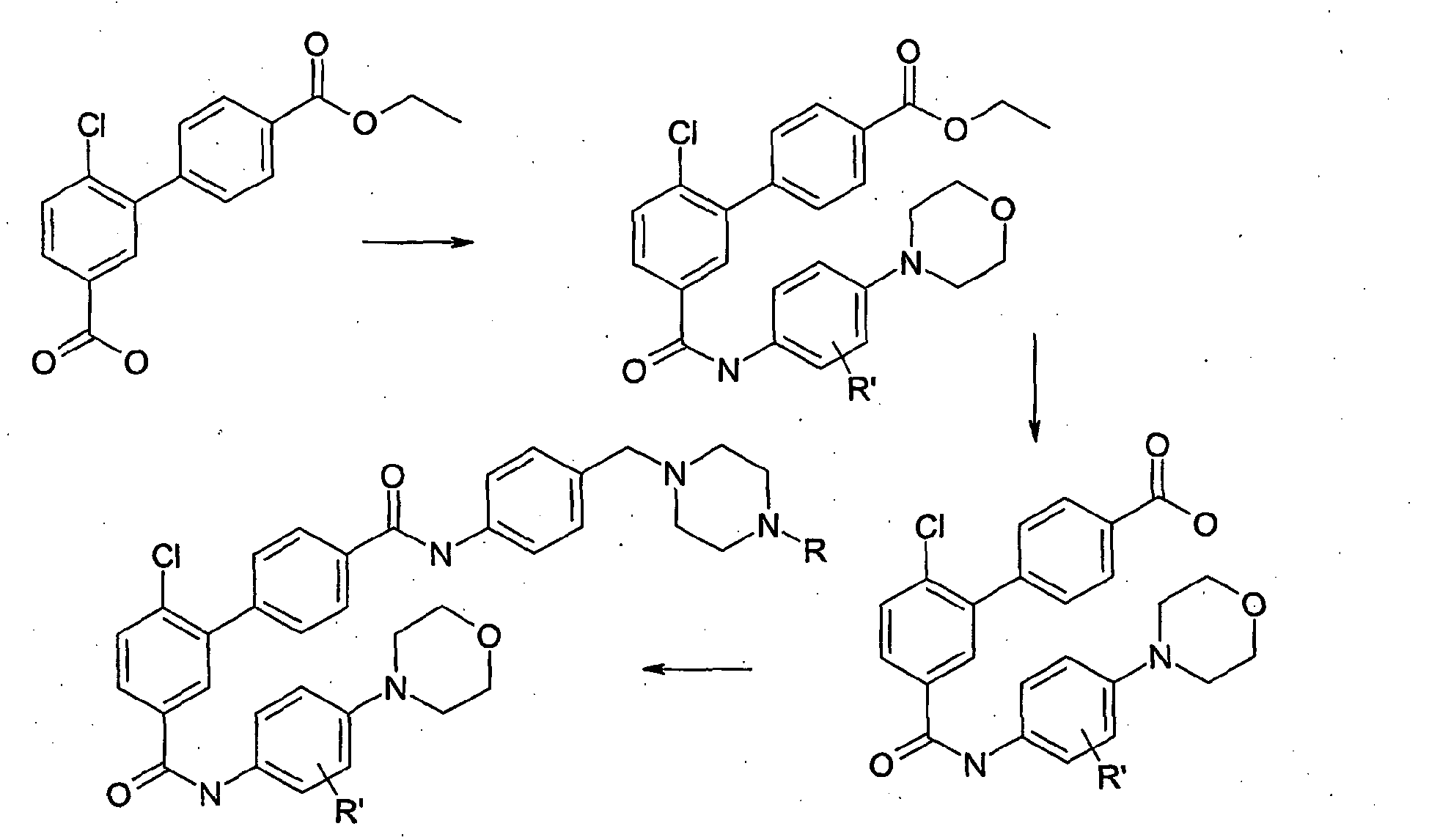
- A mixture of 6-chloro-biphenyl-3,4'-dicarboxylic acid 4'-ethyl ester (800mg), N-(4-aminophenyl)morpholine (469mg), EDAC (504mg), HOBT (355mg) and N-methylmorpholine (578µl) in DMF (10ml) was stirred at room temperature. After 1h, water (80ml) was added and the resulting suspension filtered. The residue was then purified by chromatography. Elution with 1:1 ethyl acetate:petrol gave a yellow crystalline solid (437mg).
- 2'-Chloro-5'-(4-morpholin-4-yl-phenylcarbamoyl)-biphenyl-4-carboxylic acid The above ester (778mg) was stirred in ethanol (20ml) and 2M NaOH (10ml) at room temp for 18h. The ethanol was then evaporated and the residue acidified with 2M HCl. The resulting pale pink solid was collected by filtration and dried (740mg)
- A mixture of 2'-chloro-5'-(4-morpholin-4-yl-phenylcarbamoyl)-biphenyl-4-carboxylic acid (57mg), 4[-4-(butane-1-sulfonyl)-piperazin-1-ylmethyl]-phenylamine (53mg), EDAC (33mg), HOBT (23mg) and N-methylmorpholine (37µl) in DMF (1ml) was stirred at room temperature. After 18h, water (10ml) was added and the resulting suspension filtered and dried giving the title compound as an off-white solid (31mg) 1H NMR (DMSO, δ) 0.91 (t, 3H), 1.39 (q, 2H), 1.65 (m, 2H), 2.47 (m, 4H), 3.07 (m, 4H), 3.19 (brs, 4H), 3.33 (s, 2H), 3.75 (m, 4H), 6.98 (d, 2H), 7.34 (d, 2H), 7.62 (d, 2H), 7.72 (d, 2H), 7.78 (m, 3H), 8.09 (m, 4H), 10.21 (s, 1H), 10.37 (s, 1H)
LCMS- ES+ = 730, 732. - A mixture of 6-chloro-biphenyl-3,4'-dicarboxylic acid 4'-ethyl ester (213mg), 3-fluoro-4-morpholin-4-yl-phenylamine (179mg), EDAC (174mg), HOBT (123mg) and N-methylmorpholine (200µl) in DMF (3ml) was stirred at room temperature. After 18h, water (30ml) was added and the resulting suspension filtered. The residue was then purified by chromatography. Elution with 1:1 ethyl acetate:petrol gave a brown oil (235mg).
- The above ester (233mg) was stirred in ethanol (4ml) and 2M NaOH (2ml) at room temp for 18h. The ethanol was then evaporated and the residue acidified with 2M HCl. The resulting colourless solid was collected by filtration and dried (198mg)
- A mixture of 2'-chloro-5'-(2-fluoro-4-morpholin-4-yl-phenylcarbamoyl)-biphenyl-4-carboxylic acid (45mg), 4-(4-(propane-1-sulfonyl)-piperazin-1-ylmethyl)-phenylamine (39mg), EDAC (25mg), HOBT (18mg) and N-methylmorpholine (43µl) in DMF (1ml) was stirred at room temperature for 18h. Water (10ml) was added and the resulting suspension filtered and dried giving the title compound as an off-white solid (57mg) 1H NMR (DMSO, δ) 1.00 (t, 3H), 1.69 (q, 2H), 2.45 (bs, 2H), 2.99 (m, 8H), 3.18 (m, 4H), 3.51 (s, 2H), 3.75 (m, 4H), 7.06 (t, 1H), 7.33 (d, 2H), 7.46 (d, 1H), 7.72 (d, 2H), 7.77 (m, 4H), 8.08 (m, 4H), 10.38 (s, 1H0, 10.42 (s, 1H)
LCMS- ES+ = 735, 737. - A mixture of 6-chloro-biphenyl-3,4'-dicarboxylic acid 4'-ethyl ester (152mg), 4-(4-methanesulfonyl-piperazin-1-ylmethyl)-phenylamine (175mg), EDAC (125mg), HOBT (88mg) and N-methylmorpholine (143µl) in DMF (3ml) was stirred at room temperature. After 1h, water (30ml) was added and the resulting suspension filtered. The residue was then purified by chromatography. Gradient elution with 30-100% ethyl acetate in petrol gave a beige solid (240mg).
- The above ester (237mg) was stirred in ethanol (4ml) and 2M NaOH (2ml) at room temp for 18h. The ethanol was then evaporated and the residue acidified with 2M HCl. The resulting colourless solid was collected by filtration and dried (229mg)
- A mixture of 2'-chloro-5'-[4-(4-methanesulfonyl-piperazin-1-ylmethyl)-phenylcarbamoyl]-biphenyl-4-carboxylic acid (53mg), N-(4-aminophenyl)morpholine (23mg), EDAC (25mg), HOBT (18mg) and N-methylmorpholine (43µl) in DMF (1ml) was stirred at room temperature. After 18h, water (10ml) was added and the resulting suspension filtered. This material was then purified by reverse phase Prep HPLC giving the title compound as an off-white solid (39mg)
1H NMR (DMSO, δ) 2.47 (m, 4H), 2.88 (s, 3H), 3.10 (m, 8H), 3.51 (s, 2H), 3.76 (m, 4H), 6.99 (d, 2H), 7.32 (d, 2H), 7.71 (m, 7H), 8.07 (m, 4H), 10.21 (s, 1H), 10.40 (s, 1H) LCMS- ES+ = 689, 691. - Cells used:
- HCV replicon cells Huh 9B (ReBlikon), containing the firefly luciferase - ubiquitin - neomycin phosphotransferase fusion protein and EMCV-IRES driven HCV polyprotein with cell culture adaptive mutations.
- Cell culture conditions:
- Cells were cultured at 37°C in a 5% CO2 environment and split twice a week on seeding at 2 x 10⁶ cells/flask on day 1 and 1 x 10⁶ 3 days later. G418 at 0.5mg/ml was added to the culture medium but not the assay medium.
- The culture medium consisted of DMEM with 4500g/l glucose and glutamax (Gibco 61965-026) supplemented with 1 x non-essential amino acids (Invitrogen 11140-035), penicillin (100 IU/ml) / streptomycin (100 µg/ml) (Invitrogen 15140-122), FCS (10%, 50ml) and 1 mg/ml G418 (Invitrogen 10131-027) & 10 % Australian foetal calf serum (Invitrogen 10099-141).
- Assay procedure:
- A flask of cells was trypsinised and a cell count carried out. Cells were diluted to 100,000 cells/ml and 100 µl of this used to seed one opaque white 96-well plate (for the replicon assay) and one flat-bottomed clear plate (for the tox assay) for every seven compounds to be tested for IC50, Wells G12 and H12 were left empty in the clear plate as the blank. Plates were then incubated at 37°C in a 5% CO2 environment for 24 h.
- On the following day compound dilutions are made up in medium at twice their desired final concentration in a clear round bottomed plate. All dilutions have a final DMSO concentration of 1%.
- Once the dilution plate had been made up, controls and compounds were transferred to the assay plate (containing the cells) at 100 µl /well in duplicate plates. Exception: no compound was added to wells A1 and A2 of either plate and 100 µl of 1% DMSO was added to these instead. Plates were then incubated at 37°C with 5% CO2 for 72h.
- At the end of the incubation time, the cells in the white plate were harvested by washing 23.5mM beetle luciferin (Promega E1603), 26mM ATP-(Sigma O-2060) in 100nM Tris buffer pH 7.8 aliquoted and stored at -80C was thawed and diluted 1:50 in luciferase assay buffer (20mM Tricine (Sigma T-0377), 1.07mM magnesium carbonate hydroxide (Sigma M-5671), 0.1mM EDTA (Sigma E-5134), 2.67mM MgSO4 (BDH 101514Y), 33.3mM dithiothreitol (Sigma 150460) pH 7.8).
- The M injector of the microplate luminometer (Lmax, Molecular Devices) was primed with 5 x 300 µl injections of the diluted substrate. After 5-60 min incubation in lysis buffer at room temperature, a plate was inserted into the luminometer and 100 µl luciferase assay reagent was added by the injector on the luminometer. The signal was measured using a 1 second delay followed by a 4 second measurement programme. The IC50, the concentration of the drug required for reducing the replicon level by 50% in relation to the untreated cell control value, can be calculated from the plot of the percentage reduction of the luciferase activity vs. drug concentration.
- The clear plate was stained with 100 µl 0.5% methylene blue in 50% ethanol at room temperature for 1h, followed by solvation of the absorbed methylene blue in 100µl per well of 1% lauroylsarcosine. Absorbance of the plate was measured on a microplate spectrophotometer (Molecular Devices) and the absorbance for each concentration of compound expressed as a proportion of the relative DMSO control. The TD50, the concentration of drug required to reduce the total cell area by 50% relative to the DMSO controls, can be calculated by plotting the absorbance at 620 nm minus background against drug concentration.


Claims (9)
- A compound which is a biphenyl derivative of formula (I), or a pharmaceutically acceptable salt thereof
 R1 is a moiety-A1-L1-A1' wherein A1 is phenyl, L1 is -CH2- and A1' is 4-[(C1-C4 alkyl)sulfonyl]piperazin-1-yl;A is -CO-NH-;B is -NH-CO-NH-, -NH-CO- or -CO-NH-;- R2 is C1-C4 alkyl;- R3 is C1-C4 alkyl, C1-C4 alkoxy, C1-C2 haloalkyl, C1-C2 haloalkoxy or halogen;- n and m are the same or different and each represent 0 or 1;- R4 is a C1-C5 alkyl group or a moiety -A4, -A4-A4', -L4-A4, -A4-L4-A4',- A4-CO-A4' or -L4-Het4-L4';- each A4 moiety is the same or different and is phenyl, furanyl, imidazolyl, pyrazolyl, pyrrolidinyl, azetidinyl, tetrahydrofuranyl, piperazinyl, piperidinyl,pyrrolidin-2-onyl, thiadiazolyl, isothiazolyl, C3-C8 cycloalkyl, morpholinyl, thienyl, pyridyl, pyrrolyl, S,S-dioxo-thiomopholinyl, tetrahydropyranyl, thiazolyl, oxadiazolyl or indazolyl group, each A4 moiety being unsubstituted or substituted by (a) a single unsubstitued -CONR'R"' substituent and/or (b) 1 or 2 unsubstituted substituents selected from fluorine, chlorine, bromine, -NR'R"', C1-C4 alkyl, C1-C2 alkoxy, C1-C2 haloalkyl and cyano, wherein R' is hydrogen or C1-C4 alkyl and R"' represents C1-C4 alkyl;- each A4' moiety is the same or different and represents a morpholinyl, piperazinyl, isoxazolyl, pyrrolidinyl, S,S-dioxothiomorpholinyl, 2,6-dioxopiperidinyl, triazolyl, piperidinyl, cyclopropyl or cyclohexyl group which is unsubstituted or substituted by (a) a single unsubstituted -SO2-(C1-C4 alkyl) substituent and/or (b) 1 or 2 unsubstituted substituents selected from chlorine,fluorine, bromine, C1-C2 alkyl and C1-C2 haloalkyl;- L4 represents a C1-C3 alkylene group or a C1-C3 hydroxyalkylene group;- L4' represents a C1-C2 alkyl group; and- Het4 represents -O- or -NH-.
 - A compound according to claim 1, wherein R4 is -A4 or -A4-L4-A4 '.
- A compound according to claim 2, wherein when R4 is A4 it is C3-C6 cycloalkyl and/or when R4 is -A4-L4-A4 ', A4 is phenyl, L4 is -CH2- and A4 '. is a group

- A compound according to any one of the preceding claims, which is 5'-(cyclopropanecarbonyl-amino)-2'-trifluoromethoxy-biphenyl-4-carboxylic acid {4-[4-(propane-1-sulfonyl)-piperazin-1-ylmethyl]-phenyl}-amide, or a pharmaceutically acceptable salt thereof.
- A biphenyl derivative of the formula (I), as defined in any preceding claim, or a pharmaceutically acceptable salt thereof, for the treatment of the human or animal body.
- Use of a biphenyl derivative of the formula (I), as defined in any one of claims 1 to 4, or a pharmaceutically acceptable salt thereof, in the manufacture of a medicament for use in treating or alleviating HCV.
- A pharmaceutical composition comprising a biphenyl derivative of formula (I), as defined in any one of claims 1 to 4, or a pharmaceutically acceptable salt thereof, and a pharmaceutical acceptable diluent or carrier.
- A pharmaceutical composition according to claim 7, which further comprises interferon and/or ribavirin.
- A product containing:a. biphenyl derivative of formula (I), as defined in any one of claims 1 to 4, or a pharmaceutically acceptable salt thereof;b. interferon and/or ribavirin; andc. a pharmaceutically acceptable carrier or diluent;
for simultaneous separate or sequential use in the treatment of the human or animal body.
Priority Applications (3)
| Application Number | Priority Date | Filing Date | Title |
|---|---|---|---|
| PL06779478T PL1940786T3 (en) | 2005-09-16 | 2006-09-18 | Biphenyl derivatives and their use in treating hepatitis c |
| SI200630798T SI1940786T1 (en) | 2005-09-16 | 2006-09-18 | Biphenyl derivatives and their use in treating hepatitis c |
| CY20101100915T CY1110835T1 (en) | 2005-09-16 | 2010-10-14 | DIFFINYL PRODUCTS AND THEIR USE IN THE TREATMENT OF USITIS C |
Applications Claiming Priority (4)
| Application Number | Priority Date | Filing Date | Title |
|---|---|---|---|
| GBGB0518971.7A GB0518971D0 (en) | 2005-09-16 | 2005-09-16 | Chemical compounds |
| GB0610663A GB0610663D0 (en) | 2006-05-30 | 2006-05-30 | Chemical compounds |
| GB0610664A GB0610664D0 (en) | 2006-05-30 | 2006-05-30 | Chemical compounds |
| PCT/GB2006/003469 WO2007031791A1 (en) | 2005-09-16 | 2006-09-18 | Biphenyl derivatives and their use in treating hepatitis c |
Publications (2)
| Publication Number | Publication Date |
|---|---|
| EP1940786A1 EP1940786A1 (en) | 2008-07-09 |
| EP1940786B1 true EP1940786B1 (en) | 2010-08-18 |
Family
ID=37398704
Family Applications (1)
| Application Number | Title | Priority Date | Filing Date |
|---|---|---|---|
| EP06779478A Active EP1940786B1 (en) | 2005-09-16 | 2006-09-18 | Biphenyl derivatives and their use in treating hepatitis c |
Country Status (22)
| Country | Link |
|---|---|
| US (1) | US8008303B2 (en) |
| EP (1) | EP1940786B1 (en) |
| JP (1) | JP2009508835A (en) |
| KR (1) | KR20080050490A (en) |
| AT (1) | ATE478044T1 (en) |
| AU (2) | AU2006290442B2 (en) |
| BR (1) | BRPI0615934A2 (en) |
| CA (1) | CA2621364A1 (en) |
| CY (1) | CY1110835T1 (en) |
| DE (1) | DE602006016313D1 (en) |
| DK (1) | DK1940786T3 (en) |
| EC (1) | ECSP088367A (en) |
| ES (1) | ES2348332T3 (en) |
| HR (1) | HRP20100542T1 (en) |
| IL (1) | IL189694A0 (en) |
| NO (1) | NO20081846L (en) |
| NZ (1) | NZ566276A (en) |
| PL (1) | PL1940786T3 (en) |
| PT (1) | PT1940786E (en) |
| RS (1) | RS51470B (en) |
| SI (1) | SI1940786T1 (en) |
| WO (1) | WO2007031791A1 (en) |
Families Citing this family (95)
| Publication number | Priority date | Publication date | Assignee | Title |
|---|---|---|---|---|
| UA93548C2 (en) * | 2006-05-05 | 2011-02-25 | Айерем Елелсі | Compounds and compositions as hedgehog pathway modulators |
| CN101522614B (en) | 2006-08-09 | 2014-06-25 | 史密丝克莱恩比彻姆公司 | Compounds that are antagonists or inverse agonists of opioid receptors |
| US7659270B2 (en) * | 2006-08-11 | 2010-02-09 | Bristol-Myers Squibb Company | Hepatitis C virus inhibitors |
| US7759495B2 (en) | 2006-08-11 | 2010-07-20 | Bristol-Myers Squibb Company | Hepatitis C virus inhibitors |
| US8329159B2 (en) | 2006-08-11 | 2012-12-11 | Bristol-Myers Squibb Company | Hepatitis C virus inhibitors |
| US8303944B2 (en) | 2006-08-11 | 2012-11-06 | Bristol-Myers Squibb Company | Hepatitis C virus inhibitors |
| US7745636B2 (en) | 2006-08-11 | 2010-06-29 | Bristol-Myers Squibb Company | Hepatitis C virus inhibitors |
| CA2662091A1 (en) * | 2006-09-08 | 2008-03-13 | Novartis Ag | N-biaryl (hetero) arylsulphonamide derivatives useful in the treatment of diseases mediated by lymphocytes interactions |
| US7741347B2 (en) * | 2007-05-17 | 2010-06-22 | Bristol-Myers Squibb Company | Hepatitis C virus inhibitors |
| US8629171B2 (en) | 2007-08-08 | 2014-01-14 | Bristol-Myers Squibb Company | Crystalline form of methyl ((1S)-1-((25)-2-(5-(4'-(2-((25)-1((2S)-2-((methoxycarbonyl)amino)-3-methylbutanoyl)-2-pyrrolidinyl)-1H-imidazol-2-yl)-1-pyrrolidinyl)carbonyl)-2-methylpropyl)carbamate dihydrochloride salt |
| US7728027B2 (en) | 2007-08-08 | 2010-06-01 | Bristol-Myers Squibb Company | Process for synthesizing compounds useful for treating hepatitis C |
| WO2009034390A1 (en) * | 2007-09-14 | 2009-03-19 | Arrow Therapeutics Limited | Heterocyclic derivatives and their use in treating hepatitis c |
| KR20100123717A (en) | 2008-02-12 | 2010-11-24 | 브리스톨-마이어스 스큅 컴퍼니 | Heterocyclic derivatives as hepatitis c virus inhibitors |
| US8147818B2 (en) | 2008-02-13 | 2012-04-03 | Bristol-Myers Squibb Company | Hepatitis C virus inhibitors |
| US7704992B2 (en) | 2008-02-13 | 2010-04-27 | Bristol-Myers Squibb Company | Hepatitis C virus inhibitors |
| US7906655B2 (en) | 2008-08-07 | 2011-03-15 | Bristol-Myers Squibb Company | Hepatitis C virus inhibitors |
| DE102008049675A1 (en) | 2008-09-30 | 2010-04-01 | Markus Dr. Heinrich | Process for the preparation of 3-aminobiphenyls |
| US8383094B2 (en) | 2008-10-01 | 2013-02-26 | Bristol-Myers Squibb Company | Hepatitis C virus inhibitors |
| TWI438200B (en) | 2009-02-17 | 2014-05-21 | 必治妥美雅史谷比公司 | Hepatitis c virus inhibitors |
| US8394968B2 (en) | 2009-02-17 | 2013-03-12 | Bristol-Myers Squibb Company | Hepatitis C virus inhibitors |
| WO2010094977A1 (en) * | 2009-02-23 | 2010-08-26 | Arrow Therapeutics Limited | Novel biphenyl compounds useful for the treatment of hepatitis c |
| ES2606717T3 (en) | 2009-02-27 | 2017-03-27 | Enanta Pharmaceuticals, Inc. | Hepatitis C virus inhibitors |
| US8796466B2 (en) | 2009-03-30 | 2014-08-05 | Bristol-Myers Squibb Company | Hepatitis C virus inhibitors |
| TW201038559A (en) | 2009-04-09 | 2010-11-01 | Bristol Myers Squibb Co | Hepatitis C virus inhibitors |
| US8143414B2 (en) | 2009-04-13 | 2012-03-27 | Bristol-Myers Squibb Company | Hepatitis C virus inhibitors |
| US8138215B2 (en) | 2009-05-29 | 2012-03-20 | Bristol-Myers Squibb Company | Hepatitis C virus inhibitors |
| US8211928B2 (en) | 2009-05-29 | 2012-07-03 | Bristol-Myers Squibb Company | Hepatitis C virus inhibitors |
| EP2475254A4 (en) * | 2009-09-11 | 2013-05-22 | Enanta Pharm Inc | INHIBITORS OF HEPATITIS C VIRUS |
| US20110274648A1 (en) | 2009-11-11 | 2011-11-10 | Bristol-Myers Squibb Company | Hepatitis C Virus Inhibitors |
| US20110269956A1 (en) | 2009-11-11 | 2011-11-03 | Bristol-Myers Squibb Company | Hepatitis C Virus Inhibitors |
| US20110281910A1 (en) | 2009-11-12 | 2011-11-17 | Bristol-Myers Squibb Company | Hepatitis C Virus Inhibitors |
| US8653070B2 (en) | 2009-12-14 | 2014-02-18 | Enanta Pharmaceuticals, Inc. | Hepatitis C virus inhibitors |
| US8377980B2 (en) | 2009-12-16 | 2013-02-19 | Bristol-Myers Squibb Company | Hepatitis C virus inhibitors |
| US9452980B2 (en) | 2009-12-22 | 2016-09-27 | Hoffmann-La Roche Inc. | Substituted benzamides |
| US8362020B2 (en) | 2009-12-30 | 2013-01-29 | Bristol-Myers Squibb Company | Hepatitis C virus inhibitors |
| EP2563759B1 (en) * | 2010-04-27 | 2022-04-06 | Calcimedica, Inc. | Compounds that modulate intracellular calcium |
| TW201216957A (en) * | 2010-07-13 | 2012-05-01 | Dainippon Sumitomo Pharma Co | Biarylamide derivative or a pharmaceutically acceptable salt thereof |
| US8921372B2 (en) * | 2010-11-04 | 2014-12-30 | Theravance Biopharma R&D Ip, Llc | Inhibitors of hepatitis C virus |
| US8552047B2 (en) | 2011-02-07 | 2013-10-08 | Bristol-Myers Squibb Company | Hepatitis C virus inhibitors |
| RU2456266C1 (en) * | 2011-04-06 | 2012-07-20 | Максим Эдуардович Запольский | 4,4'-biphenylamide derivatives showing pharmacological activity, and based drug preparations |
| US9546160B2 (en) | 2011-05-12 | 2017-01-17 | Bristol-Myers Squibb Company | Hepatitis C virus inhibitors |
| US9079858B2 (en) * | 2011-08-31 | 2015-07-14 | Amakem Nv | Rock kinase inhibitors |
| WO2013030750A1 (en) | 2011-09-01 | 2013-03-07 | Lupin Limited | Antiviral compounds |
| KR20140091036A (en) | 2011-11-03 | 2014-07-18 | 세라밴스 인코포레이티드 | Rod-like hepatitis c virus inhibitors containing the fragement [2-[4-(bi phenyl-4-yl)-1h-imidazo-2-yl]pyrrolidine-1-carbonlymethyl]amine |
| KR101939710B1 (en) | 2011-12-21 | 2019-01-17 | 노비라 테라퓨틱스, 인코포레이티드 | Hepatitis b antiviral agents |
| US9326973B2 (en) | 2012-01-13 | 2016-05-03 | Bristol-Myers Squibb Company | Hepatitis C virus inhibitors |
| IN2014MN01547A (en) | 2012-02-10 | 2015-05-08 | Lupin Ltd | |
| EP3441390A1 (en) | 2012-03-02 | 2019-02-13 | Ralexar Therapeutics, Inc. | Liver x receptor (lxr) modulators for the treatment of dermal diseases, disorders and conditions |
| WO2014008214A1 (en) * | 2012-07-02 | 2014-01-09 | Biogen Idec Ma Inc. | Biaryl-containing compounds as inverse agonists of ror-gamma receptors |
| UY34993A (en) | 2012-08-28 | 2014-02-28 | Janssen R & D Ireland | SULFAMOILARILAMIDAS AND ITS USE AS MEDICINES FOR THE TREATMENT OF HEPATITIS B |
| WO2014131847A1 (en) | 2013-02-28 | 2014-09-04 | Janssen R&D Ireland | Sulfamoyl-arylamides and the use thereof as medicaments for the treatment of hepatitis b |
| US8993771B2 (en) | 2013-03-12 | 2015-03-31 | Novira Therapeutics, Inc. | Hepatitis B antiviral agents |
| JP2016521259A (en) | 2013-03-20 | 2016-07-21 | バイエル・ファルマ・アクティエンゲゼルシャフト | Substituted N-biphenyl-3-acetylamino-benzamide and N- [3- (acetylamino) phenyl] -biphenyl-carboxamide and their use as inhibitors of the Wnt signaling pathway |
| JP6419155B2 (en) | 2013-04-03 | 2018-11-07 | ヤンセン・サイエンシズ・アイルランド・ユーシー | N-phenyl-carboxamide derivatives and their use as pharmaceuticals for treating hepatitis B |
| JO3583B1 (en) | 2013-05-17 | 2020-07-05 | Janssen Sciences Ireland Uc | Sulphamoylpyrrolamide derivatives and the use thereof as medicaments for the treatment of hepatitis b |
| US20150023913A1 (en) | 2013-07-02 | 2015-01-22 | Bristol-Myers Squibb Company | Hepatitis C Virus Inhibitors |
| US9717712B2 (en) | 2013-07-02 | 2017-08-01 | Bristol-Myers Squibb Company | Combinations comprising tricyclohexadecahexaene derivatives for use in the treatment of hepatitis C virus |
| CN105530933B (en) | 2013-07-17 | 2018-12-11 | 百时美施贵宝公司 | For treating the combination product comprising biphenyl derivatives of HCV |
| NO3024819T3 (en) | 2013-07-25 | 2018-07-21 | ||
| AU2014315280B2 (en) | 2013-09-04 | 2019-01-24 | Ellora Therapeutics, Inc. | Liver X receptor (LXR) modulators |
| SG11201601644RA (en) | 2013-09-04 | 2016-04-28 | Alexar Therapeutics Inc | Liver x receptor (lxr) modulators |
| MX368158B (en) | 2013-10-23 | 2019-09-20 | Janssen Sciences Ireland Uc | Carboxamide derivatives and the use thereof as medicaments for the treatment of hepatitis b. |
| CN104725365B (en) * | 2013-12-23 | 2019-02-26 | 南京圣和药业股份有限公司 | Hepatitis C virus inhibitor and its application |
| US10392349B2 (en) | 2014-01-16 | 2019-08-27 | Novira Therapeutics, Inc. | Azepane derivatives and methods of treating hepatitis B infections |
| US9181288B2 (en) | 2014-01-16 | 2015-11-10 | Novira Therapeutics, Inc. | Azepane derivatives and methods of treating hepatitis B infections |
| US9169212B2 (en) | 2014-01-16 | 2015-10-27 | Novira Therapeutics, Inc. | Azepane derivatives and methods of treating hepatitis B infections |
| WO2015120178A1 (en) | 2014-02-05 | 2015-08-13 | Novira Therapeutics, Inc. | Combination therapy for treatment of hbv infections |
| DK3102572T3 (en) | 2014-02-06 | 2019-02-04 | Janssen Sciences Ireland Uc | SULFAMOYLPYRROLAMIDE DERIVATIVES AND THEIR USE AS MEDICINES TO TREAT HEPATITIS B |
| US9400280B2 (en) | 2014-03-27 | 2016-07-26 | Novira Therapeutics, Inc. | Piperidine derivatives and methods of treating hepatitis B infections |
| JP2018507212A (en) | 2015-02-20 | 2018-03-15 | バイエル・ファルマ・アクティエンゲゼルシャフト | N-phenyl- (morpholin-4-yl or piperazinyl) acetamide derivatives and their use as inhibitors of the WNT signaling pathway |
| HK1247147A1 (en) | 2015-03-19 | 2018-09-21 | 诺维拉治疗公司 | Azocane and azonane derivatives and methods of treating hepatitis b infections |
| US10875876B2 (en) | 2015-07-02 | 2020-12-29 | Janssen Sciences Ireland Uc | Cyclized sulfamoylarylamide derivatives and the use thereof as medicaments for the treatment of hepatitis B |
| WO2017023631A1 (en) | 2015-08-06 | 2017-02-09 | Bristol-Myers Squibb Company | Hepatitis c virus inhibitors |
| CN108430971A (en) | 2015-09-29 | 2018-08-21 | 诺维拉治疗公司 | The crystal form of B type hepatitis antivirus agent |
| MY195528A (en) | 2016-03-17 | 2023-01-30 | Hoffmann La Roche | 5-Ethyl-4-Methyl-Pyrazole-3-Carboxamide Derivative Having Activity as Agonist of Taar |
| KR20180129943A (en) | 2016-04-15 | 2018-12-05 | 노비라 테라퓨틱스, 인코포레이티드 | Formulations and methods involving capsid assembly inhibitors |
| CN109641874A (en) | 2016-05-10 | 2019-04-16 | C4医药公司 | C for target protein degradation3The glutarimide degron body of carbon connection |
| EP3455219A4 (en) | 2016-05-10 | 2019-12-18 | C4 Therapeutics, Inc. | AMINE-LINKED C3-GLUTARIMIDE DEGRONIMERS FOR THE DEGRADATION OF TARGET PROTEINS |
| JOP20190024A1 (en) | 2016-08-26 | 2019-02-19 | Gilead Sciences Inc | Substituted pyrrolizine compounds and uses thereof |
| EP3641762B1 (en) | 2017-06-20 | 2026-02-18 | C4 Therapeutics, Inc. | N/o-linked degrons and degronimers for protein degradation |
| CN111372585A (en) | 2017-11-16 | 2020-07-03 | C4医药公司 | Degradants and degrons for target protein degradation |
| KR102526964B1 (en) | 2018-02-26 | 2023-04-28 | 길리애드 사이언시즈, 인코포레이티드 | Substituted pyrrolizine compounds as HBV replication inhibitors |
| JP2021515769A (en) | 2018-03-14 | 2021-06-24 | ヤンセン・サイエンシズ・アイルランド・アンリミテッド・カンパニー | Capsid aggregation regulator dosing regimen |
| US20220099637A1 (en) | 2018-12-04 | 2022-03-31 | Bristol-Myers Squibb Company | Methods of analysis using in-sample calibration curve by multiple isotopologue reaction monitoring |
| CN120698983A (en) | 2018-12-20 | 2025-09-26 | C4医药公司 | Targeted protein degradation |
| US11096931B2 (en) | 2019-02-22 | 2021-08-24 | Janssen Sciences Ireland Unlimited Company | Amide derivatives useful in the treatment of HBV infection or HBV-induced diseases |
| US11491148B2 (en) | 2019-05-06 | 2022-11-08 | Janssen Sciences Ireland Unlimited Company | Amide derivatives useful in the treatment of HBV infection or HBV-induced diseases |
| PE20221040A1 (en) | 2019-10-25 | 2022-06-17 | Gilead Sciences Inc | GLP-1R MODULATING COMPOUNDS |
| CA3168543A1 (en) | 2020-01-29 | 2021-08-05 | Gilead Sciences, Inc. | Glp-1r modulating compounds |
| WO2022109182A1 (en) | 2020-11-20 | 2022-05-27 | Gilead Sciences, Inc. | Polyheterocyclic glp-1 r modulating compounds |
| WO2022192430A1 (en) | 2021-03-11 | 2022-09-15 | Gilead Sciences, Inc. | Glp-1r modulating compounds |
| EP4304711A1 (en) | 2021-03-11 | 2024-01-17 | Gilead Sciences, Inc. | Glp-1r modulating compounds |
| PL4271672T3 (en) | 2021-04-21 | 2026-04-20 | Gilead Sciences, Inc. | Carboxy-benzimidazole glp-1r modulating compounds |
| WO2023158795A1 (en) * | 2022-02-18 | 2023-08-24 | Accent Therapeutics, Inc. | Inhibitors of rna helicase dhx9 and uses thereof |
| US20250288577A1 (en) * | 2022-04-29 | 2025-09-18 | Cornell University | Methods of treating a virus infection and methods of inhibiting viral replication |
Family Cites Families (63)
| Publication number | Priority date | Publication date | Assignee | Title |
|---|---|---|---|---|
| US5026940A (en) * | 1989-09-08 | 1991-06-25 | Catalytica, Inc. | Manufacture of 4,4'-diisopropylbiphenyl |
| GB9119920D0 (en) * | 1991-09-18 | 1991-10-30 | Glaxo Group Ltd | Chemical compounds |
| JP2787539B2 (en) | 1993-02-26 | 1998-08-20 | 松森 昭 | Agent for preventing or treating viral diseases |
| JP3894949B2 (en) | 1993-06-30 | 2007-03-22 | ザ、ウェルカム、ファンデーション、リミテッド | Anti-atherosclerotic diaryl compounds |
| IL117580A0 (en) | 1995-03-29 | 1996-07-23 | Merck & Co Inc | Inhibitors of farnesyl-protein transferase and pharmaceutical compositions containing them |
| WO1997036591A1 (en) | 1996-04-03 | 1997-10-09 | Merck & Co., Inc. | Inhibitors of farnesyl-protein transferase |
| US6297239B1 (en) | 1997-10-08 | 2001-10-02 | Merck & Co., Inc. | Inhibitors of prenyl-protein transferase |
| US6403595B1 (en) | 1998-02-05 | 2002-06-11 | Takeda Chemical Industries, Ltd. | Sulfonamide derivatives, processes for producing the same and utilization thereof |
| US6586475B1 (en) | 1998-11-20 | 2003-07-01 | Takeda Chemical Industries, Ltd. | β-amyloid protein production/secretion inhibitors |
| AUPP818099A0 (en) | 1999-01-14 | 1999-02-11 | Fujisawa Pharmaceutical Co., Ltd. | New n-containing heterocyclic compounds |
| DE60040676D1 (en) | 1999-09-17 | 2008-12-11 | Millennium Pharm Inc | BENZAMIDES AND SIMILAR INHIBITORS OF FACTOR Xa |
| US7115750B1 (en) | 1999-09-20 | 2006-10-03 | Takeda Pharmaceutical Company Limited | Melanin concentrating hormone antagonist |
| ES2254385T3 (en) | 2000-02-29 | 2006-06-16 | Millennium Pharmaceuticals, Inc. | RELATED BENZAMIDS AND INHIBITORS OF FACTOR XA. |
| US6433236B1 (en) * | 2000-03-21 | 2002-08-13 | Arteva North America S.A.R.L. | Acid catalyzed isomerization of substituted diaryls |
| EP1295867A4 (en) * | 2000-06-28 | 2005-03-30 | Takeda Pharmaceutical | biphenyl |
| DE60229059D1 (en) | 2001-05-08 | 2008-11-06 | Univ Yale | PROTEOMIMETIC COMPOUNDS AND METHOD |
| JP2005509594A (en) | 2001-07-13 | 2005-04-14 | バーチャル ドラッグ ディヴェロップメント、インコーポレイティッド | NAD synthetase inhibitors and uses thereof |
| WO2004043335A2 (en) | 2001-09-13 | 2004-05-27 | Genesoft, Inc. | Methods of treating infection by drug resistant bacteria |
| GB0124941D0 (en) * | 2001-10-17 | 2001-12-05 | Glaxo Group Ltd | Chemical compounds |
| GB0124931D0 (en) * | 2001-10-17 | 2001-12-05 | Glaxo Group Ltd | Chemical compounds |
| GB0124934D0 (en) * | 2001-10-17 | 2001-12-05 | Glaxo Group Ltd | Chemical compounds |
| GB0124938D0 (en) * | 2001-10-17 | 2001-12-05 | Glaxo Group Ltd | Chemical compounds |
| GB0124933D0 (en) * | 2001-10-17 | 2001-12-05 | Glaxo Group Ltd | Chemical compounds |
| GB0124932D0 (en) * | 2001-10-17 | 2001-12-05 | Glaxo Group Ltd | Chemical compounds |
| GB0124928D0 (en) * | 2001-10-17 | 2001-12-05 | Glaxo Group Ltd | Chemical compounds |
| JP2005519915A (en) | 2002-01-18 | 2005-07-07 | セレテック・リミテッド・ライアビリティ・カンパニー | Method for treating symptoms associated with Edg receptors |
| BRPI0307351B8 (en) | 2002-02-12 | 2021-05-25 | Smithkline Beecham Corp | compound, pharmaceutical composition, use of a compound, and, process for preparing a compound |
| GB0209891D0 (en) * | 2002-04-30 | 2002-06-05 | Glaxo Group Ltd | Novel compounds |
| EP1511751B1 (en) * | 2002-06-04 | 2008-03-19 | Neogenesis Pharmaceuticals, Inc. | Pyrazolo[1,5-a]pyrimidine compounds as antiviral agents |
| AU2003252478A1 (en) * | 2002-07-10 | 2004-02-02 | Ono Pharmaceutical Co., Ltd. | Ccr4 antagonist and medicinal use thereof |
| EP2172460A1 (en) | 2002-11-01 | 2010-04-07 | Vertex Pharmaceuticals Incorporated | Compositions useful as inhibitors of JAK and other protein kinases |
| US7122557B2 (en) | 2003-03-18 | 2006-10-17 | Bristol-Myers Squibb Company | Sulfonyl-amidino-containing and tetrahydropyrimidino-containing compounds as factor Xa inhibitors |
| EP1608319A4 (en) | 2003-04-03 | 2007-02-28 | Univ California | IMPROVED INHIBITORS FOR SOLUBLE EPOXY HYDROLASE |
| PL1611088T3 (en) * | 2003-04-07 | 2009-11-30 | Pharmacyclics Inc | Hydroxamates as therapeutic agents |
| GB0308186D0 (en) * | 2003-04-09 | 2003-05-14 | Smithkline Beecham Corp | Novel compounds |
| GB0308185D0 (en) | 2003-04-09 | 2003-05-14 | Smithkline Beecham Corp | Novel compounds |
| EP1653968A4 (en) * | 2003-07-23 | 2006-09-06 | Synta Pharmaceuticals Corp | Method for modulating calcium ion-release-activated calcium ion channels |
| DE602004017494D1 (en) * | 2003-07-25 | 2008-12-11 | Novartis Ag | INHIBITORS OF P-38 KINASE |
| US20050054691A1 (en) | 2003-08-29 | 2005-03-10 | St. Jude Children's Research Hospital | Carboxylesterase inhibitors |
| MXPA06002853A (en) | 2003-09-11 | 2006-06-14 | Kemia Inc | Cytokine inhibitors. |
| JPWO2005040135A1 (en) * | 2003-10-24 | 2007-03-08 | 小野薬品工業株式会社 | Anti-stress drugs and their medicinal uses |
| WO2005065361A2 (en) | 2003-12-31 | 2005-07-21 | Khosrow Kashfi | Compounds and compositions for treating dysproliferative diseases, and methods of use thereof |
| EA011010B1 (en) | 2004-02-27 | 2008-12-30 | Эмджен, Инк. | Compounds modulating of gpr40 receptor, pharmaceutical composition, method for treating diseases responsive to the modulation of gpr40 receptor (embodiments), method for modulating gpr40 function (embodiments) and method for modulating circulating insulin concentration |
| TW200600492A (en) | 2004-05-18 | 2006-01-01 | Achillion Pharmaceuticals Inc | Substituted aryl acylthioureas and related compounds; inhibitors of viral replication |
| US20100234409A1 (en) | 2004-05-21 | 2010-09-16 | Lihu Yang | Amino cyclopentyl heterocyclic and carbocyclic modulators of chemokine receptor activity |
| AU2005266448A1 (en) * | 2004-07-28 | 2006-02-02 | Glaxo Group Limited | Piperazine derivatives useful for the treatment of gastrointestinal disorders |
| RU2416608C2 (en) | 2004-08-06 | 2011-04-20 | Оцука Фармасьютикал Ко., Лтд. | Aromatic compound |
| EP1809381A2 (en) | 2004-10-06 | 2007-07-25 | Recepticon ApS | Use of compounds for the prevention of drug-induced cell toxicity |
| US7381732B2 (en) | 2004-10-26 | 2008-06-03 | Bristol-Myers Squibb Company | Pyrazolobenzamides and derivatives as factor Xa inhibitors |
| MX2007008290A (en) * | 2005-01-07 | 2008-02-15 | Synta Pharmaceuticals Corp | Compounds for inflammation and immune-related uses. |
| JP2008531596A (en) * | 2005-02-25 | 2008-08-14 | ライジェル ファーマシューティカルズ, インコーポレイテッド | Benzisothiazole useful for treating or preventing HCV infection |
| EP1863804A1 (en) | 2005-04-01 | 2007-12-12 | Methylgene, Inc. | Inhibitors of histone deacetylase |
| JP2009501721A (en) | 2005-07-12 | 2009-01-22 | アカディア ファーマシューティカルズ インコーポレイテッド | Compounds with activity at the retinoic acid receptor |
| CA2640090A1 (en) | 2006-01-25 | 2007-08-02 | Synta Pharmaceuticals Corp. | Substituted aromatic compounds for inflammation and immune-related uses |
| UY30117A1 (en) | 2006-01-31 | 2007-06-29 | Tanabe Seiyaku Co | AMIS TRISUSTITUDED COMPOUND |
| WO2007103162A2 (en) | 2006-03-01 | 2007-09-13 | Samaritan Pharmaceuticals, Inc. | Structure based drug design of steroidogenesis inhibitors |
| EP2038253A1 (en) | 2006-05-30 | 2009-03-25 | Arrow Therapeutics Limited | Biphenyl derivatives and their use in treating hepatitis c |
| UA95978C2 (en) | 2006-10-02 | 2011-09-26 | Оцука Фармас'Ютікел Ко., Лтд. | Stat3/5 activation inhibitor |
| WO2008046216A1 (en) | 2006-10-18 | 2008-04-24 | Methylgene, Inc. | Kinase inhibitors and uses thereof |
| NZ578180A (en) | 2006-12-08 | 2012-02-24 | Millennium Pharm Inc | Unit dose formulations and methods of treating thrombosis with an oral factor xa inhibitor |
| WO2008092006A2 (en) | 2007-01-24 | 2008-07-31 | Cernofina, Llc | Antimicrobial compositions |
| WO2008147864A2 (en) | 2007-05-22 | 2008-12-04 | Xenon Pharmaceuticals Inc. | Methods of using piperazine compounds in treating sodium channel-mediated diseases or conditions |
| WO2009034390A1 (en) | 2007-09-14 | 2009-03-19 | Arrow Therapeutics Limited | Heterocyclic derivatives and their use in treating hepatitis c |
-
2006
- 2006-09-18 AU AU2006290442A patent/AU2006290442B2/en not_active Ceased
- 2006-09-18 WO PCT/GB2006/003469 patent/WO2007031791A1/en not_active Ceased
- 2006-09-18 ES ES06779478T patent/ES2348332T3/en active Active
- 2006-09-18 KR KR1020087008964A patent/KR20080050490A/en not_active Ceased
- 2006-09-18 JP JP2008530624A patent/JP2009508835A/en active Pending
- 2006-09-18 US US12/066,983 patent/US8008303B2/en not_active Expired - Fee Related
- 2006-09-18 EP EP06779478A patent/EP1940786B1/en active Active
- 2006-09-18 RS RSP-2010/0437A patent/RS51470B/en unknown
- 2006-09-18 PT PT06779478T patent/PT1940786E/en unknown
- 2006-09-18 PL PL06779478T patent/PL1940786T3/en unknown
- 2006-09-18 DK DK06779478.4T patent/DK1940786T3/en active
- 2006-09-18 BR BRPI0615934-6A patent/BRPI0615934A2/en not_active IP Right Cessation
- 2006-09-18 HR HR20100542T patent/HRP20100542T1/en unknown
- 2006-09-18 CA CA002621364A patent/CA2621364A1/en not_active Abandoned
- 2006-09-18 AT AT06779478T patent/ATE478044T1/en active
- 2006-09-18 DE DE602006016313T patent/DE602006016313D1/en active Active
- 2006-09-18 NZ NZ566276A patent/NZ566276A/en unknown
- 2006-09-18 SI SI200630798T patent/SI1940786T1/en unknown
-
2008
- 2008-02-21 IL IL189694A patent/IL189694A0/en unknown
- 2008-04-14 EC EC2008008367A patent/ECSP088367A/en unknown
- 2008-04-16 NO NO20081846A patent/NO20081846L/en not_active Application Discontinuation
-
2010
- 2010-10-14 CY CY20101100915T patent/CY1110835T1/en unknown
- 2010-10-29 AU AU2010238549A patent/AU2010238549A1/en not_active Ceased
Also Published As
| Publication number | Publication date |
|---|---|
| NO20081846L (en) | 2008-06-04 |
| JP2009508835A (en) | 2009-03-05 |
| RS51470B (en) | 2011-04-30 |
| IL189694A0 (en) | 2008-06-05 |
| ATE478044T1 (en) | 2010-09-15 |
| AU2006290442B2 (en) | 2010-07-29 |
| NZ566276A (en) | 2011-03-31 |
| HRP20100542T1 (en) | 2010-11-30 |
| AU2006290442A1 (en) | 2007-03-22 |
| PL1940786T3 (en) | 2010-12-31 |
| KR20080050490A (en) | 2008-06-05 |
| AU2010238549A1 (en) | 2010-11-18 |
| BRPI0615934A2 (en) | 2011-05-31 |
| DE602006016313D1 (en) | 2010-09-30 |
| WO2007031791A1 (en) | 2007-03-22 |
| PT1940786E (en) | 2010-10-04 |
| DK1940786T3 (en) | 2010-11-08 |
| ECSP088367A (en) | 2008-06-30 |
| HK1121440A1 (en) | 2009-04-24 |
| EP1940786A1 (en) | 2008-07-09 |
| CY1110835T1 (en) | 2015-06-10 |
| US8008303B2 (en) | 2011-08-30 |
| US20080255105A1 (en) | 2008-10-16 |
| ES2348332T3 (en) | 2010-12-02 |
| CA2621364A1 (en) | 2007-03-22 |
| SI1940786T1 (en) | 2010-11-30 |
Similar Documents
| Publication | Publication Date | Title |
|---|---|---|
| AU2006290442B2 (en) | Biphenyl derivatives and their use in treating hepatitis C | |
| DE69737605T2 (en) | Sulphonated Amino Acid Derivatives and Metalloproteinase Inhibitors Containing Them | |
| EP1334085B1 (en) | Sulfamides as gamma-secretase inhibitors | |
| CA2653924A1 (en) | Biphenyl derivatives and their use in treating hepatitis c | |
| EP1692124B1 (en) | Biaryl sulfonamides as mmp inhibitors | |
| WO2002046129A2 (en) | Inhibitors of histone deacetylase | |
| CN103242192A (en) | Inhibitors of the 11-beta-hydroxysteroid dehydrogenase Type 1 enzyme | |
| KR20170013836A (en) | 1,3,4-Oxadiazole Sulfonamide Derivative Compounds as Histone Deacetylase 6 Inhibitor, and the Pharmaceutical Composition Comprising the same | |
| AU2003267587A1 (en) | Benzodiazepine derivatives and pharmaceutical compositions containing them | |
| SK279807B6 (en) | AROMATIC AMIDINE DERIVATIVES AND ANTIQAGULATION PRO | |
| CN101146769A (en) | Azolylacylguanidines as β-secretase inhibitors | |
| JP2001508811A (en) | Anthranilic acid derivatives as cGMP-phosphodiesterase inhibitors | |
| WO2003029200A2 (en) | Compounds useful as reversible inhibitors of cysteine proteases | |
| CZ187397A3 (en) | Derivative of arylsulfonamide and heteroarylsulfonamide, process of its preparation and use | |
| EP1159263A1 (en) | Novel sulfonamide compounds and uses thereof | |
| CN101646460A (en) | Ocular hypotensive agent comprising compound capable of inhibiting histone deacetylase as active ingredient | |
| CA2448418A1 (en) | Chemical compounds and pharmaceutical compositions as cathepsin s inhibitors | |
| KR100956703B1 (en) | Sulfonamide derivatives useful as hepatic carnitine palmitoyl transferase (L-CPT1) inhibitors | |
| US6258851B1 (en) | Metalloproteinase inhibitors | |
| HK1121440B (en) | Biphenyl derivatives and their use in treating hepatitis c | |
| EP1660471A1 (en) | Derivatives of hydroxamic acid as metalloproteinase inhibitors | |
| US3378586A (en) | Phenyl lower alkylthio-alkylamino acetanilide derivatives | |
| CN101309902A (en) | Biphenyl derivatives and their use in the treatment of hepatitis c | |
| MXPA06001865A (en) | Derivatives of hydroxamic acid as metalloproteinase inhibitors | |
| HK1104925B (en) | Derivatives of hydroxamic acid as metalloproteinase inhibitors |
Legal Events
| Date | Code | Title | Description |
|---|---|---|---|
| PUAI | Public reference made under article 153(3) epc to a published international application that has entered the european phase |
Free format text: ORIGINAL CODE: 0009012 |
|
| 17P | Request for examination filed |
Effective date: 20080327 |
|
| AK | Designated contracting states |
Kind code of ref document: A1 Designated state(s): AT BE BG CH CY CZ DE DK EE ES FI FR GB GR HU IE IS IT LI LT LU LV MC NL PL PT RO SE SI SK TR |
|
| AX | Request for extension of the european patent |
Extension state: AL BA HR MK RS |
|
| 17Q | First examination report despatched |
Effective date: 20081107 |
|
| REG | Reference to a national code |
Ref country code: HK Ref legal event code: DE Ref document number: 1121440 Country of ref document: HK |
|
| GRAP | Despatch of communication of intention to grant a patent |
Free format text: ORIGINAL CODE: EPIDOSNIGR1 |
|
| GRAS | Grant fee paid |
Free format text: ORIGINAL CODE: EPIDOSNIGR3 |
|
| GRAA | (expected) grant |
Free format text: ORIGINAL CODE: 0009210 |
|
| RAP1 | Party data changed (applicant data changed or rights of an application transferred) |
Owner name: ARROW THERAPEUTICS LIMITED |
|
| AK | Designated contracting states |
Kind code of ref document: B1 Designated state(s): AT BE BG CH CY CZ DE DK EE ES FI FR GB GR HU IE IS IT LI LT LU LV MC NL PL PT RO SE SI SK TR |
|
| AX | Request for extension of the european patent |
Extension state: AL BA HR MK RS |
|
| REG | Reference to a national code |
Ref country code: GB Ref legal event code: FG4D |
|
| REG | Reference to a national code |
Ref country code: CH Ref legal event code: EP |
|
| REG | Reference to a national code |
Ref country code: IE Ref legal event code: FG4D |
|
| REG | Reference to a national code |
Ref country code: RO Ref legal event code: EPE |
|
| REF | Corresponds to: |
Ref document number: 602006016313 Country of ref document: DE Date of ref document: 20100930 Kind code of ref document: P |
|
| REG | Reference to a national code |
Ref country code: HR Ref legal event code: ODRP Ref document number: P20100542 Country of ref document: HR Payment date: 20100927 Year of fee payment: 5 Ref country code: HR Ref legal event code: TUEP Ref document number: P20100542 Country of ref document: HR |
|
| REG | Reference to a national code |
Ref country code: NL Ref legal event code: T3 |
|
| PGFP | Annual fee paid to national office [announced via postgrant information from national office to epo] |
Ref country code: IE Payment date: 20100917 Year of fee payment: 5 Ref country code: MC Payment date: 20100927 Year of fee payment: 5 Ref country code: RO Payment date: 20100930 Year of fee payment: 5 |
|
| REG | Reference to a national code |
Ref country code: SE Ref legal event code: TRGR |
|
| REG | Reference to a national code |
Ref country code: DK Ref legal event code: T3 |
|
| REG | Reference to a national code |
Ref country code: GR Ref legal event code: EP Ref document number: 20100402378 Country of ref document: GR |
|
| REG | Reference to a national code |
Ref country code: ES Ref legal event code: FG2A Effective date: 20101122 |
|
| REG | Reference to a national code |
Ref country code: HR Ref legal event code: T1PR Ref document number: P20100542 Country of ref document: HR |
|
| REG | Reference to a national code |
Ref country code: EE Ref legal event code: FG4A Ref document number: E004698 Country of ref document: EE Effective date: 20101005 |
|
| PGFP | Annual fee paid to national office [announced via postgrant information from national office to epo] |
Ref country code: GB Payment date: 20100927 Year of fee payment: 5 |
|
| REG | Reference to a national code |
Ref country code: SK Ref legal event code: T3 Ref document number: E 8057 Country of ref document: SK |
|
| PGFP | Annual fee paid to national office [announced via postgrant information from national office to epo] |
Ref country code: DK Payment date: 20100927 Year of fee payment: 5 Ref country code: EE Payment date: 20100914 Year of fee payment: 5 Ref country code: LT Payment date: 20101007 Year of fee payment: 5 Ref country code: PT Payment date: 20100927 Year of fee payment: 5 |
|
| PGFP | Annual fee paid to national office [announced via postgrant information from national office to epo] |
Ref country code: CZ Payment date: 20100914 Year of fee payment: 5 Ref country code: DE Payment date: 20100927 Year of fee payment: 5 Ref country code: FI Payment date: 20101005 Year of fee payment: 5 Ref country code: HU Payment date: 20101018 Year of fee payment: 5 Ref country code: IS Payment date: 20101006 Year of fee payment: 5 Ref country code: LU Payment date: 20101001 Year of fee payment: 5 Ref country code: SI Payment date: 20100914 Year of fee payment: 5 Ref country code: SK Payment date: 20100916 Year of fee payment: 5 |
|
| REG | Reference to a national code |
Ref country code: HU Ref legal event code: AG4A Ref document number: E009028 Country of ref document: HU |
|
| REG | Reference to a national code |
Ref country code: HK Ref legal event code: GR Ref document number: 1121440 Country of ref document: HK |
|
| PGFP | Annual fee paid to national office [announced via postgrant information from national office to epo] |
Ref country code: BE Payment date: 20101007 Year of fee payment: 5 Ref country code: LV Payment date: 20101013 Year of fee payment: 5 |
|
| PGFP | Annual fee paid to national office [announced via postgrant information from national office to epo] |
Ref country code: CY Payment date: 20100917 Year of fee payment: 5 |
|
| PLBE | No opposition filed within time limit |
Free format text: ORIGINAL CODE: 0009261 |
|
| STAA | Information on the status of an ep patent application or granted ep patent |
Free format text: STATUS: NO OPPOSITION FILED WITHIN TIME LIMIT |
|
| 26N | No opposition filed |
Effective date: 20110519 |
|
| PGFP | Annual fee paid to national office [announced via postgrant information from national office to epo] |
Ref country code: PL Payment date: 20110621 Year of fee payment: 6 |
|
| REG | Reference to a national code |
Ref country code: DE Ref legal event code: R097 Ref document number: 602006016313 Country of ref document: DE Effective date: 20110519 |
|
| PGFP | Annual fee paid to national office [announced via postgrant information from national office to epo] |
Ref country code: CH Payment date: 20110729 Year of fee payment: 6 Ref country code: BG Payment date: 20110712 Year of fee payment: 6 |
|
| PGFP | Annual fee paid to national office [announced via postgrant information from national office to epo] |
Ref country code: SE Payment date: 20110909 Year of fee payment: 6 Ref country code: GR Payment date: 20110829 Year of fee payment: 6 Ref country code: FR Payment date: 20110901 Year of fee payment: 6 Ref country code: ES Payment date: 20110907 Year of fee payment: 6 |
|
| PGFP | Annual fee paid to national office [announced via postgrant information from national office to epo] |
Ref country code: NL Payment date: 20110912 Year of fee payment: 6 |
|
| REG | Reference to a national code |
Ref country code: HR Ref legal event code: PBON Ref document number: P20100542 Country of ref document: HR Effective date: 20110919 |
|
| BERE | Be: lapsed |
Owner name: ARROW THERAPEUTICS LTD Effective date: 20110930 |
|
| LTIE | Lt: invalidation of european patent or patent extension | ||
| PG25 | Lapsed in a contracting state [announced via postgrant information from national office to epo] |
Ref country code: LT Free format text: LAPSE BECAUSE OF NON-PAYMENT OF DUE FEES Effective date: 20110918 Ref country code: IS Free format text: LAPSE BECAUSE OF FAILURE TO SUBMIT A TRANSLATION OF THE DESCRIPTION OR TO PAY THE FEE WITHIN THE PRESCRIBED TIME-LIMIT Effective date: 20120331 Ref country code: MC Free format text: LAPSE BECAUSE OF NON-PAYMENT OF DUE FEES Effective date: 20110930 Ref country code: CZ Free format text: LAPSE BECAUSE OF NON-PAYMENT OF DUE FEES Effective date: 20110918 |
|
| REG | Reference to a national code |
Ref country code: DK Ref legal event code: EBP |
|
| PG25 | Lapsed in a contracting state [announced via postgrant information from national office to epo] |
Ref country code: LV Free format text: LAPSE BECAUSE OF NON-PAYMENT OF DUE FEES Effective date: 20110918 Ref country code: FI Free format text: LAPSE BECAUSE OF NON-PAYMENT OF DUE FEES Effective date: 20110918 |
|
| REG | Reference to a national code |
Ref country code: SI Ref legal event code: KO00 Effective date: 20120420 |
|
| REG | Reference to a national code |
Ref country code: SK Ref legal event code: MM4A Ref document number: E 8057 Country of ref document: SK Effective date: 20110918 |
|
| REG | Reference to a national code |
Ref country code: EE Ref legal event code: MM4A Ref document number: E004698 Country of ref document: EE Effective date: 20110930 |
|
| REG | Reference to a national code |
Ref country code: IE Ref legal event code: MM4A |
|
| REG | Reference to a national code |
Ref country code: PT Ref legal event code: MM4A Free format text: LAPSE DUE TO NON-PAYMENT OF FEES Effective date: 20120619 |
|
| PG25 | Lapsed in a contracting state [announced via postgrant information from national office to epo] |
Ref country code: CY Free format text: LAPSE BECAUSE OF NON-PAYMENT OF DUE FEES Effective date: 20110918 Ref country code: BE Free format text: LAPSE BECAUSE OF NON-PAYMENT OF DUE FEES Effective date: 20110930 |
|
| PG25 | Lapsed in a contracting state [announced via postgrant information from national office to epo] |
Ref country code: EE Free format text: LAPSE BECAUSE OF NON-PAYMENT OF DUE FEES Effective date: 20110930 Ref country code: SK Free format text: LAPSE BECAUSE OF NON-PAYMENT OF DUE FEES Effective date: 20110918 Ref country code: IE Free format text: LAPSE BECAUSE OF NON-PAYMENT OF DUE FEES Effective date: 20110918 Ref country code: HU Free format text: LAPSE BECAUSE OF NON-PAYMENT OF DUE FEES Effective date: 20110919 |
|
| PG25 | Lapsed in a contracting state [announced via postgrant information from national office to epo] |
Ref country code: PT Free format text: LAPSE BECAUSE OF NON-PAYMENT OF DUE FEES Effective date: 20120619 Ref country code: RO Free format text: LAPSE BECAUSE OF NON-PAYMENT OF DUE FEES Effective date: 20110918 |
|
| PG25 | Lapsed in a contracting state [announced via postgrant information from national office to epo] |
Ref country code: SI Free format text: LAPSE BECAUSE OF NON-PAYMENT OF DUE FEES Effective date: 20110919 Ref country code: DK Free format text: LAPSE BECAUSE OF NON-PAYMENT OF DUE FEES Effective date: 20110930 |
|
| PGFP | Annual fee paid to national office [announced via postgrant information from national office to epo] |
Ref country code: TR Payment date: 20120831 Year of fee payment: 7 |
|
| REG | Reference to a national code |
Ref country code: AT Ref legal event code: MM01 Ref document number: 478044 Country of ref document: AT Kind code of ref document: T Effective date: 20110918 |
|
| PGFP | Annual fee paid to national office [announced via postgrant information from national office to epo] |
Ref country code: IT Payment date: 20120810 Year of fee payment: 7 |
|
| PG25 | Lapsed in a contracting state [announced via postgrant information from national office to epo] |
Ref country code: AT Free format text: LAPSE BECAUSE OF NON-PAYMENT OF DUE FEES Effective date: 20110918 |
|
| REG | Reference to a national code |
Ref country code: NL Ref legal event code: V1 Effective date: 20130401 |
|
| PG25 | Lapsed in a contracting state [announced via postgrant information from national office to epo] |
Ref country code: SE Free format text: LAPSE BECAUSE OF NON-PAYMENT OF DUE FEES Effective date: 20120919 |
|
| REG | Reference to a national code |
Ref country code: SE Ref legal event code: EUG Ref country code: CH Ref legal event code: PL |
|
| REG | Reference to a national code |
Ref country code: GR Ref legal event code: ML Ref document number: 20100402378 Country of ref document: GR Effective date: 20130404 |
|
| GBPC | Gb: european patent ceased through non-payment of renewal fee |
Effective date: 20120918 |
|
| PG25 | Lapsed in a contracting state [announced via postgrant information from national office to epo] |
Ref country code: LU Free format text: LAPSE BECAUSE OF NON-PAYMENT OF DUE FEES Effective date: 20110918 |
|
| REG | Reference to a national code |
Ref country code: FR Ref legal event code: ST Effective date: 20130531 |
|
| PG25 | Lapsed in a contracting state [announced via postgrant information from national office to epo] |
Ref country code: LI Free format text: LAPSE BECAUSE OF NON-PAYMENT OF DUE FEES Effective date: 20120930 Ref country code: DE Free format text: LAPSE BECAUSE OF NON-PAYMENT OF DUE FEES Effective date: 20130403 Ref country code: GB Free format text: LAPSE BECAUSE OF NON-PAYMENT OF DUE FEES Effective date: 20120918 Ref country code: CH Free format text: LAPSE BECAUSE OF NON-PAYMENT OF DUE FEES Effective date: 20120930 |
|
| PG25 | Lapsed in a contracting state [announced via postgrant information from national office to epo] |
Ref country code: GR Free format text: LAPSE BECAUSE OF NON-PAYMENT OF DUE FEES Effective date: 20130404 Ref country code: FR Free format text: LAPSE BECAUSE OF NON-PAYMENT OF DUE FEES Effective date: 20121001 Ref country code: NL Free format text: LAPSE BECAUSE OF NON-PAYMENT OF DUE FEES Effective date: 20130401 |
|
| REG | Reference to a national code |
Ref country code: DE Ref legal event code: R119 Ref document number: 602006016313 Country of ref document: DE Effective date: 20130403 |
|
| REG | Reference to a national code |
Ref country code: ES Ref legal event code: FD2A Effective date: 20131022 |
|
| PG25 | Lapsed in a contracting state [announced via postgrant information from national office to epo] |
Ref country code: PL Free format text: LAPSE BECAUSE OF NON-PAYMENT OF DUE FEES Effective date: 20120918 |
|
| REG | Reference to a national code |
Ref country code: PL Ref legal event code: LAPE |
|
| PG25 | Lapsed in a contracting state [announced via postgrant information from national office to epo] |
Ref country code: ES Free format text: LAPSE BECAUSE OF NON-PAYMENT OF DUE FEES Effective date: 20120919 |
|
| PG25 | Lapsed in a contracting state [announced via postgrant information from national office to epo] |
Ref country code: BG Free format text: LAPSE BECAUSE OF NON-PAYMENT OF DUE FEES Effective date: 20120930 Ref country code: IT Free format text: LAPSE BECAUSE OF NON-PAYMENT OF DUE FEES Effective date: 20130918 |
|
| PG25 | Lapsed in a contracting state [announced via postgrant information from national office to epo] |
Ref country code: TR Free format text: LAPSE BECAUSE OF NON-PAYMENT OF DUE FEES Effective date: 20130918 |