EP1939201A1 - Novel adenine compound - Google Patents
Novel adenine compound Download PDFInfo
- Publication number
- EP1939201A1 EP1939201A1 EP06798243A EP06798243A EP1939201A1 EP 1939201 A1 EP1939201 A1 EP 1939201A1 EP 06798243 A EP06798243 A EP 06798243A EP 06798243 A EP06798243 A EP 06798243A EP 1939201 A1 EP1939201 A1 EP 1939201A1
- Authority
- EP
- European Patent Office
- Prior art keywords
- substituted
- carbon atom
- alkyl
- butoxy
- dihydro
- Prior art date
- Legal status (The legal status is an assumption and is not a legal conclusion. Google has not performed a legal analysis and makes no representation as to the accuracy of the status listed.)
- Withdrawn
Links
- 0 **c(nc1[n]2*)nc(N)c1nc2O Chemical compound **c(nc1[n]2*)nc(N)c1nc2O 0.000 description 5
- UOKWOZUUHUMZRW-UHFFFAOYSA-O CC(C)(C)OC(N(C1)CC1[NH2+]Cc1ccc(C[n](c2n3)c(OC)nc2c(N)nc3OCCOC)cc1)=O Chemical compound CC(C)(C)OC(N(C1)CC1[NH2+]Cc1ccc(C[n](c2n3)c(OC)nc2c(N)nc3OCCOC)cc1)=O UOKWOZUUHUMZRW-UHFFFAOYSA-O 0.000 description 1
- BOJOOOTVCYFWOW-UHFFFAOYSA-N CCCCOc(nc1N2CC3=CCC(CN(C)CC(O)=O)C=C3)nc(N)c1NC2=O Chemical compound CCCCOc(nc1N2CC3=CCC(CN(C)CC(O)=O)C=C3)nc(N)c1NC2=O BOJOOOTVCYFWOW-UHFFFAOYSA-N 0.000 description 1
- IHCJKENJWUYCRT-UHFFFAOYSA-N CCCCOc(nc1N2CC3C=CC(OCCN(CC4)CCC4C(OC)=O)=NC3)nc(N)c1NC2=O Chemical compound CCCCOc(nc1N2CC3C=CC(OCCN(CC4)CCC4C(OC)=O)=NC3)nc(N)c1NC2=O IHCJKENJWUYCRT-UHFFFAOYSA-N 0.000 description 1
- QSVXVLJUOSSMKQ-UHFFFAOYSA-N CCCCOc(nc1N2Cc(cc3)ccc3OCC3CCN(CC(OC)=O)CC3)nc(N)c1NC2=O Chemical compound CCCCOc(nc1N2Cc(cc3)ccc3OCC3CCN(CC(OC)=O)CC3)nc(N)c1NC2=O QSVXVLJUOSSMKQ-UHFFFAOYSA-N 0.000 description 1
- DZACRGOPWZUUBB-UHFFFAOYSA-N CCCCOc(nc1N2Cc(cc3)ccc3OCCCN(CCN(C)C)[IH]C(O)OC)nc(N)c1NC2=O Chemical compound CCCCOc(nc1N2Cc(cc3)ccc3OCCCN(CCN(C)C)[IH]C(O)OC)nc(N)c1NC2=O DZACRGOPWZUUBB-UHFFFAOYSA-N 0.000 description 1
- WZIJSDQFRUTTBW-UHFFFAOYSA-N CCCCOc(nc1N2Cc(ccc(CN(C)CC(OC)=O)c3)c3OC)nc(N)c1NC2=O Chemical compound CCCCOc(nc1N2Cc(ccc(CN(C)CC(OC)=O)c3)c3OC)nc(N)c1NC2=O WZIJSDQFRUTTBW-UHFFFAOYSA-N 0.000 description 1
- HPDJAXNXPLIXGT-UHFFFAOYSA-N CCCCOc(nc1N2Cc3ccc(CCN(CC4)CCC4C(OC)=O)cc3)nc(N)c1NC2=O Chemical compound CCCCOc(nc1N2Cc3ccc(CCN(CC4)CCC4C(OC)=O)cc3)nc(N)c1NC2=O HPDJAXNXPLIXGT-UHFFFAOYSA-N 0.000 description 1
- YFGICXOEZDUFSL-UHFFFAOYSA-N CCCCOc(nc1N2Cc3ccc(CN(CC4)CCC4C(OC)=O)cc3)nc(N)c1NC2=O Chemical compound CCCCOc(nc1N2Cc3ccc(CN(CC4)CCC4C(OC)=O)cc3)nc(N)c1NC2=O YFGICXOEZDUFSL-UHFFFAOYSA-N 0.000 description 1
- BGMWUPIWJUODJN-UHFFFAOYSA-N CCCC[O](c(nc1N2Cc3ccc(CCN(CC4)CCC4C(OC)=O)cc3)nc(N)c1NC2=O)=C Chemical compound CCCC[O](c(nc1N2Cc3ccc(CCN(CC4)CCC4C(OC)=O)cc3)nc(N)c1NC2=O)=C BGMWUPIWJUODJN-UHFFFAOYSA-N 0.000 description 1
- SVRWUJVEUOKLTQ-UHFFFAOYSA-N CNCc1ccc(CN(c2nc(OCCOC)nc(N)c2N2)C2=O)cc1 Chemical compound CNCc1ccc(CN(c2nc(OCCOC)nc(N)c2N2)C2=O)cc1 SVRWUJVEUOKLTQ-UHFFFAOYSA-N 0.000 description 1
Classifications
-
- C—CHEMISTRY; METALLURGY
- C07—ORGANIC CHEMISTRY
- C07D—HETEROCYCLIC COMPOUNDS
- C07D473/00—Heterocyclic compounds containing purine ring systems
- C07D473/02—Heterocyclic compounds containing purine ring systems with oxygen, sulphur, or nitrogen atoms directly attached in positions 2 and 6
- C07D473/18—Heterocyclic compounds containing purine ring systems with oxygen, sulphur, or nitrogen atoms directly attached in positions 2 and 6 one oxygen and one nitrogen atom, e.g. guanine
-
- A—HUMAN NECESSITIES
- A61—MEDICAL OR VETERINARY SCIENCE; HYGIENE
- A61P—SPECIFIC THERAPEUTIC ACTIVITY OF CHEMICAL COMPOUNDS OR MEDICINAL PREPARATIONS
- A61P1/00—Drugs for disorders of the alimentary tract or the digestive system
- A61P1/04—Drugs for disorders of the alimentary tract or the digestive system for ulcers, gastritis or reflux esophagitis, e.g. antacids, inhibitors of acid secretion, mucosal protectants
-
- A—HUMAN NECESSITIES
- A61—MEDICAL OR VETERINARY SCIENCE; HYGIENE
- A61P—SPECIFIC THERAPEUTIC ACTIVITY OF CHEMICAL COMPOUNDS OR MEDICINAL PREPARATIONS
- A61P1/00—Drugs for disorders of the alimentary tract or the digestive system
- A61P1/16—Drugs for disorders of the alimentary tract or the digestive system for liver or gallbladder disorders, e.g. hepatoprotective agents, cholagogues, litholytics
-
- A—HUMAN NECESSITIES
- A61—MEDICAL OR VETERINARY SCIENCE; HYGIENE
- A61P—SPECIFIC THERAPEUTIC ACTIVITY OF CHEMICAL COMPOUNDS OR MEDICINAL PREPARATIONS
- A61P11/00—Drugs for disorders of the respiratory system
-
- A—HUMAN NECESSITIES
- A61—MEDICAL OR VETERINARY SCIENCE; HYGIENE
- A61P—SPECIFIC THERAPEUTIC ACTIVITY OF CHEMICAL COMPOUNDS OR MEDICINAL PREPARATIONS
- A61P11/00—Drugs for disorders of the respiratory system
- A61P11/02—Nasal agents, e.g. decongestants
-
- A—HUMAN NECESSITIES
- A61—MEDICAL OR VETERINARY SCIENCE; HYGIENE
- A61P—SPECIFIC THERAPEUTIC ACTIVITY OF CHEMICAL COMPOUNDS OR MEDICINAL PREPARATIONS
- A61P11/00—Drugs for disorders of the respiratory system
- A61P11/06—Antiasthmatics
-
- A—HUMAN NECESSITIES
- A61—MEDICAL OR VETERINARY SCIENCE; HYGIENE
- A61P—SPECIFIC THERAPEUTIC ACTIVITY OF CHEMICAL COMPOUNDS OR MEDICINAL PREPARATIONS
- A61P13/00—Drugs for disorders of the urinary system
- A61P13/02—Drugs for disorders of the urinary system of urine or of the urinary tract, e.g. urine acidifiers
-
- A—HUMAN NECESSITIES
- A61—MEDICAL OR VETERINARY SCIENCE; HYGIENE
- A61P—SPECIFIC THERAPEUTIC ACTIVITY OF CHEMICAL COMPOUNDS OR MEDICINAL PREPARATIONS
- A61P13/00—Drugs for disorders of the urinary system
- A61P13/08—Drugs for disorders of the urinary system of the prostate
-
- A—HUMAN NECESSITIES
- A61—MEDICAL OR VETERINARY SCIENCE; HYGIENE
- A61P—SPECIFIC THERAPEUTIC ACTIVITY OF CHEMICAL COMPOUNDS OR MEDICINAL PREPARATIONS
- A61P13/00—Drugs for disorders of the urinary system
- A61P13/10—Drugs for disorders of the urinary system of the bladder
-
- A—HUMAN NECESSITIES
- A61—MEDICAL OR VETERINARY SCIENCE; HYGIENE
- A61P—SPECIFIC THERAPEUTIC ACTIVITY OF CHEMICAL COMPOUNDS OR MEDICINAL PREPARATIONS
- A61P13/00—Drugs for disorders of the urinary system
- A61P13/12—Drugs for disorders of the urinary system of the kidneys
-
- A—HUMAN NECESSITIES
- A61—MEDICAL OR VETERINARY SCIENCE; HYGIENE
- A61P—SPECIFIC THERAPEUTIC ACTIVITY OF CHEMICAL COMPOUNDS OR MEDICINAL PREPARATIONS
- A61P15/00—Drugs for genital or sexual disorders; Contraceptives
- A61P15/02—Drugs for genital or sexual disorders; Contraceptives for disorders of the vagina
-
- A—HUMAN NECESSITIES
- A61—MEDICAL OR VETERINARY SCIENCE; HYGIENE
- A61P—SPECIFIC THERAPEUTIC ACTIVITY OF CHEMICAL COMPOUNDS OR MEDICINAL PREPARATIONS
- A61P15/00—Drugs for genital or sexual disorders; Contraceptives
- A61P15/10—Drugs for genital or sexual disorders; Contraceptives for impotence
-
- A—HUMAN NECESSITIES
- A61—MEDICAL OR VETERINARY SCIENCE; HYGIENE
- A61P—SPECIFIC THERAPEUTIC ACTIVITY OF CHEMICAL COMPOUNDS OR MEDICINAL PREPARATIONS
- A61P17/00—Drugs for dermatological disorders
-
- A—HUMAN NECESSITIES
- A61—MEDICAL OR VETERINARY SCIENCE; HYGIENE
- A61P—SPECIFIC THERAPEUTIC ACTIVITY OF CHEMICAL COMPOUNDS OR MEDICINAL PREPARATIONS
- A61P17/00—Drugs for dermatological disorders
- A61P17/06—Antipsoriatics
-
- A—HUMAN NECESSITIES
- A61—MEDICAL OR VETERINARY SCIENCE; HYGIENE
- A61P—SPECIFIC THERAPEUTIC ACTIVITY OF CHEMICAL COMPOUNDS OR MEDICINAL PREPARATIONS
- A61P17/00—Drugs for dermatological disorders
- A61P17/14—Drugs for dermatological disorders for baldness or alopecia
-
- A—HUMAN NECESSITIES
- A61—MEDICAL OR VETERINARY SCIENCE; HYGIENE
- A61P—SPECIFIC THERAPEUTIC ACTIVITY OF CHEMICAL COMPOUNDS OR MEDICINAL PREPARATIONS
- A61P25/00—Drugs for disorders of the nervous system
-
- A—HUMAN NECESSITIES
- A61—MEDICAL OR VETERINARY SCIENCE; HYGIENE
- A61P—SPECIFIC THERAPEUTIC ACTIVITY OF CHEMICAL COMPOUNDS OR MEDICINAL PREPARATIONS
- A61P27/00—Drugs for disorders of the senses
- A61P27/02—Ophthalmic agents
-
- A—HUMAN NECESSITIES
- A61—MEDICAL OR VETERINARY SCIENCE; HYGIENE
- A61P—SPECIFIC THERAPEUTIC ACTIVITY OF CHEMICAL COMPOUNDS OR MEDICINAL PREPARATIONS
- A61P27/00—Drugs for disorders of the senses
- A61P27/16—Otologicals
-
- A—HUMAN NECESSITIES
- A61—MEDICAL OR VETERINARY SCIENCE; HYGIENE
- A61P—SPECIFIC THERAPEUTIC ACTIVITY OF CHEMICAL COMPOUNDS OR MEDICINAL PREPARATIONS
- A61P29/00—Non-central analgesic, antipyretic or antiinflammatory agents, e.g. antirheumatic agents; Non-steroidal antiinflammatory drugs [NSAID]
-
- A—HUMAN NECESSITIES
- A61—MEDICAL OR VETERINARY SCIENCE; HYGIENE
- A61P—SPECIFIC THERAPEUTIC ACTIVITY OF CHEMICAL COMPOUNDS OR MEDICINAL PREPARATIONS
- A61P3/00—Drugs for disorders of the metabolism
- A61P3/08—Drugs for disorders of the metabolism for glucose homeostasis
- A61P3/10—Drugs for disorders of the metabolism for glucose homeostasis for hyperglycaemia, e.g. antidiabetics
-
- A—HUMAN NECESSITIES
- A61—MEDICAL OR VETERINARY SCIENCE; HYGIENE
- A61P—SPECIFIC THERAPEUTIC ACTIVITY OF CHEMICAL COMPOUNDS OR MEDICINAL PREPARATIONS
- A61P31/00—Antiinfectives, i.e. antibiotics, antiseptics, chemotherapeutics
- A61P31/04—Antibacterial agents
-
- A—HUMAN NECESSITIES
- A61—MEDICAL OR VETERINARY SCIENCE; HYGIENE
- A61P—SPECIFIC THERAPEUTIC ACTIVITY OF CHEMICAL COMPOUNDS OR MEDICINAL PREPARATIONS
- A61P31/00—Antiinfectives, i.e. antibiotics, antiseptics, chemotherapeutics
- A61P31/10—Antimycotics
-
- A—HUMAN NECESSITIES
- A61—MEDICAL OR VETERINARY SCIENCE; HYGIENE
- A61P—SPECIFIC THERAPEUTIC ACTIVITY OF CHEMICAL COMPOUNDS OR MEDICINAL PREPARATIONS
- A61P31/00—Antiinfectives, i.e. antibiotics, antiseptics, chemotherapeutics
- A61P31/12—Antivirals
-
- A—HUMAN NECESSITIES
- A61—MEDICAL OR VETERINARY SCIENCE; HYGIENE
- A61P—SPECIFIC THERAPEUTIC ACTIVITY OF CHEMICAL COMPOUNDS OR MEDICINAL PREPARATIONS
- A61P31/00—Antiinfectives, i.e. antibiotics, antiseptics, chemotherapeutics
- A61P31/12—Antivirals
- A61P31/14—Antivirals for RNA viruses
-
- A—HUMAN NECESSITIES
- A61—MEDICAL OR VETERINARY SCIENCE; HYGIENE
- A61P—SPECIFIC THERAPEUTIC ACTIVITY OF CHEMICAL COMPOUNDS OR MEDICINAL PREPARATIONS
- A61P31/00—Antiinfectives, i.e. antibiotics, antiseptics, chemotherapeutics
- A61P31/12—Antivirals
- A61P31/14—Antivirals for RNA viruses
- A61P31/16—Antivirals for RNA viruses for influenza or rhinoviruses
-
- A—HUMAN NECESSITIES
- A61—MEDICAL OR VETERINARY SCIENCE; HYGIENE
- A61P—SPECIFIC THERAPEUTIC ACTIVITY OF CHEMICAL COMPOUNDS OR MEDICINAL PREPARATIONS
- A61P31/00—Antiinfectives, i.e. antibiotics, antiseptics, chemotherapeutics
- A61P31/12—Antivirals
- A61P31/14—Antivirals for RNA viruses
- A61P31/18—Antivirals for RNA viruses for HIV
-
- A—HUMAN NECESSITIES
- A61—MEDICAL OR VETERINARY SCIENCE; HYGIENE
- A61P—SPECIFIC THERAPEUTIC ACTIVITY OF CHEMICAL COMPOUNDS OR MEDICINAL PREPARATIONS
- A61P31/00—Antiinfectives, i.e. antibiotics, antiseptics, chemotherapeutics
- A61P31/12—Antivirals
- A61P31/20—Antivirals for DNA viruses
-
- A—HUMAN NECESSITIES
- A61—MEDICAL OR VETERINARY SCIENCE; HYGIENE
- A61P—SPECIFIC THERAPEUTIC ACTIVITY OF CHEMICAL COMPOUNDS OR MEDICINAL PREPARATIONS
- A61P31/00—Antiinfectives, i.e. antibiotics, antiseptics, chemotherapeutics
- A61P31/12—Antivirals
- A61P31/20—Antivirals for DNA viruses
- A61P31/22—Antivirals for DNA viruses for herpes viruses
-
- A—HUMAN NECESSITIES
- A61—MEDICAL OR VETERINARY SCIENCE; HYGIENE
- A61P—SPECIFIC THERAPEUTIC ACTIVITY OF CHEMICAL COMPOUNDS OR MEDICINAL PREPARATIONS
- A61P33/00—Antiparasitic agents
- A61P33/02—Antiprotozoals, e.g. for leishmaniasis, trichomoniasis, toxoplasmosis
-
- A—HUMAN NECESSITIES
- A61—MEDICAL OR VETERINARY SCIENCE; HYGIENE
- A61P—SPECIFIC THERAPEUTIC ACTIVITY OF CHEMICAL COMPOUNDS OR MEDICINAL PREPARATIONS
- A61P35/00—Antineoplastic agents
-
- A—HUMAN NECESSITIES
- A61—MEDICAL OR VETERINARY SCIENCE; HYGIENE
- A61P—SPECIFIC THERAPEUTIC ACTIVITY OF CHEMICAL COMPOUNDS OR MEDICINAL PREPARATIONS
- A61P35/00—Antineoplastic agents
- A61P35/02—Antineoplastic agents specific for leukemia
-
- A—HUMAN NECESSITIES
- A61—MEDICAL OR VETERINARY SCIENCE; HYGIENE
- A61P—SPECIFIC THERAPEUTIC ACTIVITY OF CHEMICAL COMPOUNDS OR MEDICINAL PREPARATIONS
- A61P35/00—Antineoplastic agents
- A61P35/04—Antineoplastic agents specific for metastasis
-
- A—HUMAN NECESSITIES
- A61—MEDICAL OR VETERINARY SCIENCE; HYGIENE
- A61P—SPECIFIC THERAPEUTIC ACTIVITY OF CHEMICAL COMPOUNDS OR MEDICINAL PREPARATIONS
- A61P37/00—Drugs for immunological or allergic disorders
- A61P37/02—Immunomodulators
-
- A—HUMAN NECESSITIES
- A61—MEDICAL OR VETERINARY SCIENCE; HYGIENE
- A61P—SPECIFIC THERAPEUTIC ACTIVITY OF CHEMICAL COMPOUNDS OR MEDICINAL PREPARATIONS
- A61P37/00—Drugs for immunological or allergic disorders
- A61P37/02—Immunomodulators
- A61P37/06—Immunosuppressants, e.g. drugs for graft rejection
-
- A—HUMAN NECESSITIES
- A61—MEDICAL OR VETERINARY SCIENCE; HYGIENE
- A61P—SPECIFIC THERAPEUTIC ACTIVITY OF CHEMICAL COMPOUNDS OR MEDICINAL PREPARATIONS
- A61P37/00—Drugs for immunological or allergic disorders
- A61P37/08—Antiallergic agents
-
- A—HUMAN NECESSITIES
- A61—MEDICAL OR VETERINARY SCIENCE; HYGIENE
- A61P—SPECIFIC THERAPEUTIC ACTIVITY OF CHEMICAL COMPOUNDS OR MEDICINAL PREPARATIONS
- A61P43/00—Drugs for specific purposes, not provided for in groups A61P1/00-A61P41/00
-
- A—HUMAN NECESSITIES
- A61—MEDICAL OR VETERINARY SCIENCE; HYGIENE
- A61P—SPECIFIC THERAPEUTIC ACTIVITY OF CHEMICAL COMPOUNDS OR MEDICINAL PREPARATIONS
- A61P7/00—Drugs for disorders of the blood or the extracellular fluid
Definitions
- the present invention relates to a novel adenine compound useful as a therapeutic and/or preventive agent for allergic disease, viral disease or cancer, etc.
- immune systems exist in order to exclude said substances.
- antigen processing by antigen presenting cells such as dendritic cells (DCs) is carried out when the foreign substances invade, and naive Th cells functionally differentiate via interactions of DCs/Th cells into Th1 cells or Th2 cells which play a central role of immune response in vivo. It is believed that immune diseases are developed by one-way deflection of immuno-balance of Th1 cells or Th2 cells in this process.
- cytokine such as interleukin-4 (IL-4) and interleukin-5 (IL-5) secreted by Th2 cells is secreted in an excess amount within the body of patients with allergic diseases, and the compound inhibiting immune response of Th2 cells may be expected to be a therapeutic agent for allergic disease. Also, the compound enhancing immune response of Th 1 cells may be expected to be a therapeutic or preventive agent for viral disease or cancer.
- IL-4 interleukin-4
- IL-5 interleukin-5
- TLR Toll-like receptor
- a ligand of TLR may be expected to have a function as a Th1/Th2 differentiation controlling agent and to be useful for treatment or prevention of immune diseases in that TLR recognizes a ligand to induce inflammatory cytokine such as IL-12, TNF, and IL-12 differentiates and induces naive T cell to Th1 cell.
- Th2 cell predominates in patients with asthma, atopic dermatitis, etc., and asthma-targeted clinical trials are carried out for DNA (CpGDNA) derived from microorganism, TLR9 agonist.
- CpGDNA DNA derived from microorganism
- TLR7/8 agonist imidazoquinoline derivative see Patent Document 1 also shows producing inhibitory activity of Th2 cytokine interleukin-4 (IL-4) and interleukin-5 (IL-5), and is actually useful for allergic diseases in animal models.
- Patent Documents 2 to 4 are known as compounds with adenine skeletons which are effective for immune diseases such as viral diseases and allergic diseases.
- TLR activator more particularly a novel adenine compound which activates as a TLR7 activator, and an immune-regulating agent comprising the same as an active ingredient, for example, a therapeutic or preventive agent for allergic disease such as asthma, COPD, allergic rhinitis, allergic conjunctivitis or atopic dermatitis, viral disease such as hepatitis B, hepatitis C, HIV or HPV, bacterial infectious disease, cancer or dermatitis, etc.
- a therapeutic or preventive agent for allergic disease such as asthma, COPD, allergic rhinitis, allergic conjunctivitis or atopic dermatitis
- viral disease such as hepatitis B, hepatitis C, HIV or HPV, bacterial infectious disease, cancer or dermatitis, etc.
- the present inventors found the novel adenine compounds of the present invention according to their intensive study in order to obtain a therapeutic or preventive agent for immune diseases such as allergic disease, viral disease or cancer with excellent TLR activating effect.
- the compounds of the present invention are effective as a therapeutic or preventive agent for allergic disease, viral disease, or cancer, etc.
- a in the formula (1) is substituted or unsubstituted benzene ring, or substituted or unsubstituted 5- to 6-membered monocyclic nitrogen-containing aromatic heterocycle, in which the substituent on A is selected from halogen, hydroxyl, carboxy, alkyl with 1 to 6 carbon atom(s), alkoxy with 1 to 6 carbon atom(s), alkoxycarbonyl with 2 to 6 carbon atoms, alkylcarbonyl with 2 to 6 carbon atoms, alkylsulfonyl with 1 to 6 carbon atom(s), and alkylsulfinyl with 1 to 6 carbon atom(s), or a pharmaceutically acceptable salt thereof.
- a pharmaceutical composition comprising as an active ingredient the adenine compound according to any one of [1] to [9], or a pharmaceutically acceptable salt thereof.
- An agent for increasing TLR7 activity comprising as an active ingredient the adenine compound according to any one of [1] to [9], or a pharmaceutically acceptable salt thereof.
- An immune-regulating agent comprising as an active ingredient the adenine compound according to any one of [1] to [9], or a pharmaceutically acceptable salt thereof.
- An agent for the treatment or prevention of allergic disease, viral disease or cancer which comprises as an active ingredient the adenine compound according to any one of [1] to [9], or a pharmaceutically acceptable salt thereof.
- An agent for the treatment or prevention of asthma, COPD, allergic rhinitis, allergic conjunctivitis, atopic dermatitis, cancer, hepatitis B, hepatitis C, HIV, HPV, bacterial infectious disease or dermatitis which comprises as an active ingredient the adenine compound according to any one of [1] to [9], or a pharmaceutically acceptable salt thereof.
- a pharmaceutical composition for local administration which comprises as an active ingredient the adenine compound according to any one of [1] to [9], or a pharmaceutically acceptable salt thereof.
- halogen as used herein includes fluorine, chlorine, bromine or iodine, preferably fluorine or chlorine.
- alkyl includes straight chain or branched chain alkyl with 1 to 12 carbon atom(s), particularly, methyl, ethyl, propyl, 1-methylethyl, butyl, 2-methylpropyl, 1-methylpropyl, 1,1-dimethylethyl, pentyl, 3-methylbutyl, 2-methylbutyl, 2,2-dimethylpropyl, 1-ethylpropyl, 1,1-dimethylpropyl, hexyl, 4-methylpentyl, 3-methylpentyl, 2-methylpentyl, 1-methylpentyl, 3,3-dimethylbutyl, 2,2-dimethylbutyl, 1,1-dimethylbutyl, 1,2-dimethylbutyl, heptyl, 1-methylhexyl, 1-ethylpentyl, octyl, 1-methylheptyl, 2-ethylhexyl, nonyl, decyl, etc.
- alkenyl includes straight chain or branched chain alkenyl with 2 to 10 carbon atoms, particularly, ethenyl, propenyl, 1-methylethenyl, butenyl, 2-methylpropenyl, 1-methylpropenyl, pentenyl, 3-methylbutenyl, 2-methylbutenyl, 1-ethylpropenyl, hexenyl, 4-methylpentenyl, 3-methylpentenyl, 2-methylpentenyl, 1-methylpentenyl, 3,3-dimethylbutenyl, 1,2-dimethylbutenyl, heptenyl, 1-methylhexenyl, 1-ethylpentenyl, octenyl, 1-methylheptenyl, 2-ethylhexenyl, nonenyl, decenyl, etc.
- Preferable one is alkenyl with 2 to 6 carbon atoms, more preferably, alkenyl with 2 to 4 carbon atoms.
- alkynyl includes straight chain or branched chain alkynyl with 1 to 10 carbon atoms, particularly, ethynyl, propynyl, butynyl, pentynyl, 3-methylbutynyl, hexynyl, 4-methylpentynyl, 3-methylpentynyl, 3,3-dimethylbutynyl, heptynyl, octynyl, 3-methylheptynyl, 3-ethylhexynyl, nonyl, or decynyl, etc.
- Preferable one is alkynyl with 2 to 6 carbon atoms, more preferably, alkynyl with 2 to 4 carbon atoms.
- cycloalkyl includes 3- to 8-membered monocyclic cycloalkyl, particularly, cyclopropyl, cyclobutyl, cyclopentyl, cyclohexyl, cycloheptyl or cyclooctyl.
- cycloalkoxy includes 3- to 8-membered monocyclic cycloalkoxy, particularly, cyclopropyloxy, cyclobutyloxy, cyclopentyloxy, cyclohexyloxy, cycloheptyloxy or cyclooctyloxy.
- aryl includes 6- to 10-membered aryl, particularly, phenyl, 1-naphthyl or 2-naphthyl.
- heteroaryl includes 5- to 10-membered mono- or bi-cyclic heteroaryl containing 1 to 4 heteroatom(s) selected from 0 to 2 nitrogen(s), 0 to 1 oxygen and 0 to 1 sulfur, particularly, furyl, thienyl, pyrrolyl, pyridyl, indolyl, isoindolyl, quinolyl, isoquinolyl, pyrazolyl, imidazolyl, pyrimidinyl, pyrazinyl, pyridazinyl, thiazolyl, oxazolyl, etc.
- saturated heterocycle includes 4- to 10-membered mono- or bi-cyclic saturated heterocycle containing 1 to 3 heteroatom(s) selected from 0 to 3 nitrogen(s), 0 to 1 oxygen and 0 to 1 sulfur, wherein sulfur may be substituted by 1 or 2 oxygen(s), particularly, pyrrolidinyl, piperidinyl, piperazinyl, morpholinyl, thiomorpholinyl, 1-oxothiomorpholinyl, 1,1-dioxothiomorpholinyl, tetrahydrofuranyl, etc.
- Substituents may bind on any carbon atoms or nitrogen atoms where it may be kept in chemically stable state without any limitation for binding positions.
- Preferable one is 4- to 8-membered monocyclic saturated heterocycle.
- alkylene includes straight chain or branched chain alkylene with 1 to 12 carbon atom(s), particularly, methylene, ethylene, trimethylene, tetramethylene, pentamethylene, hexamethylene, heptamethylene, octamethylene, nonamethylene, decamethylene, 1-methylmethylene, 1-ethylmethylene, 1-propylmethylene, 1-methylethylene, 2-methylethylene, 1-methyltrimethylene, 2-methyltrimethylene, 2-methyltetramethylene, or 3-methylpentamethylene, etc.
- haloalkyl includes alkyl substituted by 1 to 5 of the same or different halogen(s), particularly, trifluoromethyl, 2,2,2-trifluoroethyl, 2,2-difluoroethyl, pentafluoroethyl, etc.
- alkoxy includes straight chain or branched chain alkoxy with 1 to 10 carbon atom(s), particularly, methoxy, ethoxy, propoxy, 1-methylethoxy, butoxy, 2-methylpropoxy, 1-methylpropoxy, 1,1-dimethylethoxy, pentoxy, 3-methylbutoxy, 2-methylbutoxy, 2,2-dimethylpropoxy, 1-ethylpropoxy, 1,1-dimethylpropoxy, hexyloxy, 4-methylpentyloxy, 3-methylpentyloxy, 2-methylpentyloxy, 1-methylpentyloxy, 3,3-dimethylbutoxy, 2,2-dimethylbutoxy, 1,1-dimethylbutoxy, 1,2-dimethylbutoxy, heptyloxy, 1-methylhexyloxy, 1-ethylpentyloxy, octyloxy, 1-methylheptyloxy, 2-ethylhexyloxy, nonyloxy, decyloxy, etc.
- Preferable one is al
- haloalkoxy includes alkoxy substituted by 1 to 5 of the same or different halogen(s), particularly, trifluoromethoxy, 2,2,2-trifluoroethoxy, 2,2-difluoroethoxy, 2-fluoroethoxy, pentafluoroethoxy, etc.
- alkylthio includes straight chain or branched chain alkylthio with 1 to 10 carbon atom(s), particularly, methylthio, ethylthio, propylthio, 1-methylethylthio, butylthio, 2-methylpropylthio, 1-methylpropylthio, 1,1-dimethylethylthio, pentylthio, 3-methylbutylthio, 2-methylbutylthio, 2,2-dimethylpropylthio, 1-ethylpropylthio, 1,1-dimethylpropylthio, hexylthio, 4-methylpentylthio, 3-methylpentylthio, 2-methylpentylthio, 1-methylpentylthio, 3,3-dimethylbutylthio, 2,2-dimethylbutylthio, 1,1-dimethylbutylthio, 1,2-dimethylbutylthio, heptylthio, 1-methylhexyl
- alkyl in “alkylcarbonyl”, “alkylcarbonyloxy”, “alkylsulfonyl” or “alkylsulfinyl” includes the same as the alkyl group as defined hereinbefore.
- alkylcarbonyl particularly includes acetyl, propanoyl, butanoyl, 2-methylpropanoyl, pentanoyl, 3-methylbutanoyl, 2-methylbutanoyl, 2,2-dimethylpropanoyl (pivaloyl), hexanoyl, 4-methylpentanoyl, 3-methylpentanoyl, 2-methylpentanoyl, 3,3-dimethylbutanoyl, 2,2-dimethylbutanoyl, heptanoyl, octanoyl, 2-ethylhexanoyl, nonanoyl, decanoyl, etc.
- Preferable one is alkylcarbonyl with 2 to 6 carbon atoms, more preferably, straight chain or branched chain alkylcarbonyl with 2 to 5 carbon atoms.
- alkylcarbonyloxy particularly includes acetoxy, propanoyloxy, butanoyloxy, 2-methylpropanoyloxy, pentanoyloxy, 3-methylbutanoyloxy, 2-methylbutanoyloxy, 2,2-dimethylpropanoyloxy (pivaloyloxy), hexanoyloxy, 4-methylpentanoyloxy, 3-methylpentanoyloxy, 2-methylpentanoyloxy, 3,3-dimethylbutanoyloxy, 2,2-dimethylbutanoyloxy, heptanoyloxy, octanoyloxy, 2-ethylhexanoyloxy, nonanoyloxy, decanoyloxy, etc.
- Preferable one is alkylcarbonyloxy with 2 to 6 carbon atoms, more preferably, straight chain or branched chain alkylcarbonyloxy with 2 to 5 carbon atoms.
- alkylsulfonyl particularly includes methanesulfonyl, ethanesulfonyl, propylsulfonyl, 1-methylethylsulfonyl, butylsulfonyl, 2-methylpropylsulfonyl, 1-methylpropylsulfonyl, 1,1-dimethylethylsulfonyl, pentylsulfonyl, 3-methylbutylsulfonyl, 2-methylbutylsulfonyl, 2,2-dimethylpropylsulfonyl, 1-ethylpropylsulfonyl, 1,1-dimethylpropylsulfonyl, hexylsulfonyl, 4-methylpentylsulfonyl, 3-methylpentylsulfonyl, 2-methylpentylsulfonyl, 1-methylpentylsulfonyl,
- alkylsulfinyl particularly includes methylsulfinyl, ethylsulfinyl, propylsulfinyl, 1-methylethylsulfinyl, butylsulfinyl, 2-methylpropylsulfinyl, 1-methylpropylsulfinyl, 1,1-dimethylethylsulfinyl, pentylsulfinyl, 3-methylbutylsulfinyl, 2-methylbutylsulfinyl, 2,2-dimethylpropylsulfinyl, 1-ethylpropylsulfinyl, 1,1-dimethylpropylsulfinyl, hexylsulfinyl, 4-methylpentylsulfinyl, 3-methylpentylsulfinyl, 2-methylpentylsulfinyl, 1-methylpentylsulfinyl,
- alkoxy in "alkoxycarbonyl” includes the same as the alkoxy group as defined hereinbefore. Suitable examples of the alkoxycarbonyl are methoxycarbonyl, ethoxycarbonyl, propoxycarbonyl, 1-methylethoxycarbonyl, butoxycarbonyl, 2-methylpropoxycarbonyl, 1-methylpropoxycarbonyl, 1,1-dimethylethoxycarbonyl, pentoxycarbonyl, 3-methylbutoxycarbonyl, 2-methylbutoxycarbonyl, 2,2-dimethylpropoxycarbonyl, 1-ethylpropoxycarbonyl, 1,1-dimethylpropoxycarbonyl, hexyloxycarbonyl, 4-methylpentyloxycarbonyl, 3-methylpentyloxycarbonyl, 2-methylpentyloxycarbonyl, 1-methylpentyloxycarbonyl, 3,3-dimethylbutoxycarbonyl, 2,2-dimethylbutoxycarbonyl, 1,1-dimethylbutoxycarbonyl, 1,
- alkenyl in “alkenyloxy”, “alkenylcarbonyl”, “alkenylcarbonyloxy”, “alkenylsulfonyl”, “alkenylsulfinyl” and “alkenyloxycarbonyl” includes the same as the alkenyl group as defined hereinbefore.
- alkenyloxy particularly includes ethenyloxy, propenyloxy, 1-methylethenyloxy, butenyloxy, 2-methylpropenyloxy, 1-methylpropenyloxy, pentenyloxy, 3-methylbutenyloxy, 2-methylbutenyloxy, 1-ethylpropenyloxy, hexenyloxy, 4-methylpentenyloxy, 3-methylpentenyloxy, 2-methylpentenyloxy, 1-methylpentenyloxy, 3,3-dimethylbutenyloxy, 1,2-dimethylbutenyloxy, heptenyloxy, 1-methylhexenyloxy, 1-ethylpentenyloxy, octenyloxy, 1-methylheptenyloxy, 2-ethylhexenyloxy, nonenyloxy, or decenyloxy, etc.
- Preferable one is alkenyloxy with 2 to 5 carbon atoms.
- alkenylcarbonyl particularly includes ethenylcarbonyl, propenylcarbonyl, 1-methylethenylcarbonyl, butenylcarbonyl, 2-methylpropenylcarbonyl, 1-methylpropenylcarbonyl, pentenylcarbonyl, 3-methylbutenylcarbonyl, 2-methylbutenylcarbonyl, 1-ethylpropenylcarbonyl, hexenylcarbonyl, 4-methylpentenylcarbonyl, 3-methylpentenylcarbonyl, 2-methylpentenylcarbonyl, 1-methylpentenylcarbonyl, 3,3-dimethylbutenylcarbonyl, 1,2-dimethylbutenylcarbonyl, heptenylcarbonyl, 1-methylhexenylcarbonyl, 1-ethylpentenylcarbonyl, octenylcarbonyl, 1-methylheptenylcarbonyl, 2-ethylhexenylcarbonylcarbony
- alkenylcarbonyloxy particularly includes those in which an oxygen atom binds to carbonyl of the above “alkenylcarbonyl”.
- Preferable one is alkenylcarbonyloxy with 3 to 6 carbon atoms, more preferably, alkenylcarbonyloxy with 3 to 5 carbon atoms.
- alkenylsulfonyl particularly includes ethenylsulfonyl, propenylsulfonyl, 1-methylethenylsulfonyl, butenylsulfonyl, 2-methylpropenylsulfonyl, 1-methylpropenylsulfonyl, pentenylsulfonyl, 3-methylbutenylsulfonyl, 2-methylbutenylsulfonyl, 1-ethylpropenylsulfonyl, hexenylsulfonyl, 4-methylpentenylsulfonyl, 3-methylpentenylsulfonyl, 2-methylpentenylsulfonyl, 1-methylpentenylsulfonyl, 3,3-dimethylbutenylsulfonyl, 1,2-dimethylbutenylsulfonyl, heptenylsulfonyl,
- alkenylsulfinyl particularly includes ethenylsulfinyl, propenylsulfinyl, 1-methylethenylsulfinyl, butenylsulfinyl, 2-methylpropenylsulfinyl, 1-methylpropenylsulfinyl, pentenylsulfinyl, 3-methylbutenylsulfinyl, 2-methylbutenylsulfinyl, 1-ethylpropenylsulfinyl, hexenylsulfinyl, 4-methylpentenylsulfinyl, 3-methylpentenylsulfinyl, 2-methylpentenylsulfinyl, 1-methylpentenylsulfinyl, 3,3-dimethylbutenylsulfinyl, 1,2-dimethylbutenylsulfinyl, heptenylsulfinyl,
- alkenyloxycarbonyl particularly includes ethenyloxycarbonyl, propenyloxycarbonyl, 1-methylethenyloxycarbonyl, butenyloxycarbonyl, 2-methylpropenyloxycarbonyl, 1-methylpropenyloxycarbonyl, pentenyloxycarbonyl, 3-methylbutenyloxycarbonyl, 2-methylbutenyloxycarbonyl, 1-ethylpropenyloxycarbonyl, hexenyloxycarbonyl, 4-methylpentenyloxycarbonyl, 3-methylpentenyloxycarbonyl, 2-methylpentenyloxycarbonyl, 1-methylpentenyloxycarbonyl, 3,3-dimethylbutenyloxycarbonyl, 1,2-dimethylbutenyloxycarbonyl, heptenyloxycarbonyl, 1-methylhexenyloxycarbonyl, 1-ethylpentenyloxycarbonyl, octenyloxycarbonyl, 1-methylhex
- alkynyl in “alkynyloxy”, “alkynylcarbonyl”, “alkynylcarbonyloxy”, “alkynylsulfonyl”, “alkynylsulfinyl” and “alkynyloxycarbonyl” includes the same as the alkynyl group as defined hereinbefore.
- alkynyloxy particularly includes ethynyloxy, propynyloxy, butynyloxy, pentynyloxy, 3-methylbutynyloxy, hexynyloxy, 4-methylpentynyloxy, 3-methylpentynyloxy, 3,3-dimethylbutynyloxy, heptynyloxy, octynyloxy, 3-methylheptynyloxy, 3-ethylhexynyloxy, nonyloxy, or decynyloxy, etc.
- Preferable one is alkynyloxy with 2 to 5 carbon atoms.
- alkynylcarbonyl particularly includes ethynylcarbonyl, propynylcarbonyl, butynylcarbonyl, pentynylcarbonyl, 3-methylbutynylcarbonyl, hexynylcarbonyl, 4-methylpentynylcarbonyl, 3-methylpentynylcarbonyl, 3,3-dimethylbutynylcarbonyl, heptynylcarbonyl, octynylcarbonyl, 3-methylheptynylcarbonyl, 3-ethylhexynylcarbonyl, nonylcarbonyl, decynylcarbonyl, etc.
- Preferable one is alkynylcarbonyl with 3 to 6 carbon atoms, more preferably, alkynylcarbonyl with 3 to 5 carbon atoms.
- alkynylcarbonyloxy particularly includes those in which an oxygen atom binds to carbonyl in the above “alkynylcarbonyl”. Preferable one is alkynylcarbonyloxy with 3 to 5 carbon atoms.
- alkynylsulfonyl particularly includes ethynylsulfonyl, propynylsulfonyl, butynylsulfonyl, pentynylsulfonyl, 3-methylbutynylsulfonyl, hexynylsulfonyl, 4-methylpentynylsulfonyl, 3-methylpentynylsulfonyl, 3,3-dimethylbutynylsulfonyl, heptynylsulfonyl, octynylsulfonyl, 3-methylheptynylsulfonyl, 3-ethylhexynylsulfonyl, nonylsulfonyl, decynylsulfonyl, etc.
- Preferable one is alkynylsulfonyl with 2 to 6 carbon atoms
- alkynylsulfinyl particularly includes ethynylsulfinyl, propynylsulfinyl, butynylsulfinyl, pentynylsulfinyl, 3-methylbutynylsulfinyl, hexynylsulfinyl, 4-methylpentynylsulfinyl, 3-methylpentynylsulfinyl, 3,3-dimethylbutynylsulfinyl, heptynylsulfinyl, octynylsulfinyl, 3-methylheptynylsulfinyl, 3-ethylhexynylsulfinyl, nonylsulfinyl, decynylsulfinyl, etc.
- Preferable one is alkynylsulfinyl with 2 to 6 carbon atoms
- alkynyloxycarbonyl particularly includes ethynyloxycarbonyl, propynyloxycarbonyl, butynyloxycarbonyl, pentynyloxycarbonyl, 3-methylbutynyloxycarbonyl, hexynyloxycarbonyl, 4-methylpentynyloxycarbonyl, 3-methylpentynyloxycarbonyl, 3,3-dimethylbutynyloxycarbonyl, heptynyloxycarbonyl, octynyloxycarbonyl, 3-methylheptynyloxycarbonyl, 3-ethylhexynyloxycarbonyl, nonyloxycarbonyl, decynyloxycarbonyl, etc.
- Preferable one is alkynyloxycarbonyl with 3 to 6 carbon atoms, more preferably, alkynyloxycarbonyl with 3 to 5 carbon atoms.
- cycloalkyl in “cycloalkylcarbonyl”, “cycloalkylcarbonyloxy”, “cycloalkylsulfonyl” and “cycloalkylsulfinyl” includes the same as the cycloalkyl as defined hereinbefore.
- cycloalkylcarbonyl particularly includes cyclopropylcarbonyl, cyclobutylcarbonyl, cyclopentylcarbonyl, cyclohexylcarbonyl, cycloheptylcarbonyl or cyclooctylcarbonyl.
- cycloalkylcarbonyloxy particularly includes those in which an oxygen atom binds to carbonyl of the above "cycloalkylcarbonyl". Suitable examples are cyclopropylcarbonyloxy, cyclobutylcarbonyloxy, cyclopentylcarbonyloxy, cyclohexylcarbonyloxy, cycloheptylcarbonyloxy or cyclooctylcarbonyloxy.
- cycloalkylsulfonyl particularly includes cyclopropylsulfonyl, cyclobutylsulfonyl, cyclopentylsulfonyl, cyclohexylsulfonyl, cycloheptylsulfonyl or cyclooctylsulfonyl.
- cycloalkylsulfinyl particularly includes cyclopropylsulfinyl, cyclobutylsulfinyl, cyclopentylsulfinyl, cyclohexylsulfinyl, cycloheptylsulfinyl or cyclooctylsulfinyl.
- cycloalkoxy in “cycloalkoxycarbonyl” includes the same as the cycloalkoxy group as defined hereinbefore. Suitable examples are cyclopropyloxycarbonyl, cyclobutyloxycarbonyl, cyclopentyloxycarbonyl, cyclohexyloxycarbonyl, cycloheptyloxycarbonyl or cyclooctyloxycarbonyl.
- aryl in “aryloxy”, “arylcarbonyl”, “aryloxycarbonyl”, “arylcarbonyloxy”, “arylsulfonyl” and “arylsulfinyl” includes the same as the aryl group as defined hereinbefore. Suitable examples of “aryloxy” are phenoxy, 1-naphthoxy or 2-naphthoxy. Suitable examples of “arylcarbonyl” are benzoyl, 1-naphthaloyl or 2-naphthaloyl. Particularly, “aryloxycarbonyl” includes phenoxycarbonyl, 1-naphthoxycarbonyl or 2-naphthoxycarbonyl.
- arylcarbonyloxy is benzoyloxy, 1-naphthoyloxy or 2-naphthoyloxy.
- arylsulfonyl includes phenylsulfonyl, 1-naphthylsulfonyl, 2-naphthylsulfonyl.
- arylsulfinyl includes phenylsulfinyl, 1-naphthylsulfinyl, 2-naphthylsulfinyl.
- heteroaryl in “heteroaryloxy”, “heteroarylcarbonyl”, “heteroaryloxycarbonyl”, “heteroarylcarbonyloxy”, “heteroarylsulfonyl” and “heteroarylsulfinyl” includes the same as the heteroaryl group as defined hereinbefore. Suitable examples of “heteroaryloxy” are pyrrolyloxy, pyridyloxy, pyrazinyloxy, pyrimidinyloxy, pyridazinyloxy, furyloxy, thienyloxy.
- heteroarylcarbonyl are pyrrolylcarbonyl, pyridylcarbonyl, pyrazinylcarbonyl, pyrimidinylcarbonyl, pyridazinylcarbonyl, furylcarbonyl, thienylcarbonyl, etc.
- Suitable examples of “heteroaryloxycarbonyl” are pyrrolyloxycarbonyl, pyridyloxycarbonyl, pyrazinyloxycarbonyl, pyrimidinyloxycarbonyl, pyridazinyloxycarbonyl, furyloxycarbonyl, thienyloxycarbonyl.
- heteroarylcarbonyloxy are pyrrolylcarbonyloxy, pyridylcarbonyloxy, pyrazinylcarbonyloxy, pyrimidinylcarbonyloxy, pyridazinylcarbonyloxy, furylcarbonyloxy, thienylcarbonyloxy.
- heteroarylsulfonyl are pyrrolylsulfonyl, pyridylsulfonyl, pyrazinylsulfonyl, pyrimidinylsulfonyl, pyridazinylsulfonyl, furylsulfonyl, thienylsulfonyl.
- heteroarylsulfinyl are pyrrolylsulfinyl, pyridylsulfinyl, pyrazinylsulfinyl, pyrimidinylsulfinyl, pyridazinylsulfinyl, furylsulfinyl, thienylsulfinyl.
- nitrogen-containing saturated heterocycle used herein includes, preferably, 4- to 7-membered nitrogen-containing saturated heterocycle containing 1 to 2 heteroatom(s) selected from 1 to 2 nitrogen(s), 0 to 1 oxygen and 0 to 1 sulfur, and the sulfur atom may be substituted by 1 or 2 oxygen atom(s).
- the "nitrogen-containing saturated heterocycle" formed by combining R 3 with L 2 may preferably include nitrogen-containing saturated heterocycle of the formulae (2) to (5): wherein R 2 and L 3 are the same as defined above, R 8 is halogen, hydroxyl, carboxy, alkyl with 1 to 6 carbon atom(s), alkoxy with 1 to 6 carbon atom(s), alkoxycarbonyl with 2 to 6 carbon atoms, alkylcarbonyl with 2 to 6 carbon atoms, alkylsulfonyl with 1 to 6 carbon atom(s) or alkylsulfinyl with 1 to 6 carbon atom(s) and may bind to any carbon atoms and imino.
- the "nitrogen-containing saturated heterocycle” formed by combining R 3 with L 3 may preferably include nitrogen-containing saturated heterocycle of the formulae (6) to (9): wherein L 2 and R 8 are the same as defined above.
- the "-L 2 -NR 3 -L 3 -" in the formula (1) is preferably a group of the formula (10): wherein p and p' are independently 0 or 1, m and m' are independently an integer of 0 to 6, n is an integer of 1 to 8 when p is 0 or an integer of 2 to 8 when p is 1, the formula (11): wherein p is 0 or 1, r is an integer of 1 to 6, q is an integer of 1 to 8 when p is 0 or an integer of 0 to 8 when p is 1, the formula (12): wherein r is the same as defined above, R 4' is hydrogen or alkyl with 1 to 3 carbon atom(s), q' is an integer of 0 to 4, the formula (13): wherein t is an integer of 0 to 6, m, m' and p' are the same as defined above, or the formula (14): -(O) p -(CH 2 ) n -NR 3' -(CH 2 )
- the aromatic carbocycle in A includes benzene ring or naphthalene ring without any limitation for binding positions.
- the aromatic heterocycle in A includes 5- to 10-membered mono- or bi-cyclic aromatic heterocycle containing 1 to 4 heteroatom(s) selected from 0 to 3 nitrogen(s), 0 to 1 oxygen and 0 to 1 sulfur without any limitation for binding positions, where it may be kept in chemically stable state.
- the aromatic heterocycle particularly includes furan, thiophen, pyrrole, pyridine, indole, isoindole, quinoline, isoquinoline, pyrazole, imidazole, pyrimidine, pyrazine, pyridazine, thiazole or oxazole, etc.
- the aromatic carbocycle and aromatic heterocycle in A may be substituted by the same or different 1 to 3 substituent(s), wherein the substituent includes halogen, hydroxyl, carboxy, alkyl, alkoxy, alkoxycarbonyl with 2 to 6 carbon atoms, alkylcarbonyl with 2 to 6 carbon atoms, alkylsulfonyl with 1 to 6 carbon atom(s) and alkylsulfinyl with 1 to 6 carbon atom(s), etc.
- 4- to 7-membered saturated nitrogen-containing heterocycle includes 4- to 7-membered saturated nitrogen-containing heterocycle containing 1 to 3 heteroatom(s) selected from 1 to 3 nitrogen(s), 0 to 1 oxygen and 0 to 1 sulfur, and the substituent may bind on any binding positions without any limitation where it may be kept in chemically stable state.
- the sulfur atom may be substituted by 1 or 2 oxygen atom(s).
- Suitable examples are azetidine, pyrrolidine, piperidine, piperazine, morpholine, thiomorpholine, thiomorpholin-1-oxide, thiomorpholine-1,1-dioxide, perhydroazepine, imidazolidine, oxazolidine, etc.
- the substituents of the substituted alkyl, alkenyl and alkynyl herein include the following (a) to (c):
- the substituents of the substituted cycloalkyl, cycloalkoxy, cycloalkylcarbonyl, cycloalkylsulfonyl, cycloalkylsulfinyl, cycloalkylcarbonyloxy, cycloalkoxycarbonyl or saturated heterocycle herein include the following (d) to (f):
- the substituents of the substituted aryl, heteroaryl, aryloxy, arylcarbonyl, arylcarbonyloxy, aryloxycarbonyl, arylsulfonyl, arylsulfinyl, heteroaryloxy, heteroarylcarbonyl, heteroarylcarbonyloxy, heteroaryloxycarbonyl, heteroarylsulfonyl, heteroarylsulfinyl, aromatic carbocycle or aromatic heterocycle herein include the following (g) to (i):
- substituted or unsubstituted “amino”, substituted or unsubstituted “carbamoyl” and substituted or unsubstituted “sulfamoyl” include the following (j), (k) and (l):
- the "nitrogen-containing saturated heterocycle” particularly includes azetidine, pyrrolidine, piperidine, piperazine, morpholine, thiomorpholine, thiopmorpholin-1-oxide, thiomorpholin-1,1-dioxide, perhydroazepine, etc.
- A is preferably 4- to 7-membered nitrogen-containing saturated heterocycle containing 1 to 2 heteroatom(s) selected from 1 to 2 nitrogen(s) and 0 to 1 oxygen. Particular one is piperidinyl, piperazinyl, morpholino, etc.
- R 2 is preferably alkyl with 1 to 4 carbon atom(s), alkylcarbonyloxyalkyl with 3 to 8 carbon atoms, 6- to 10-membered arylcarbonyloxyalkyl, or alkyl substituted by substituted or unsubstituted amino.
- the alkylcarbonyloxyalkyl particularly includes acetoxymethyl, 1-acetoxyethyl.
- the arylcarbonyloxyalkyl particularly includes benzoyloxymethyl, etc.
- the substituted or unsubstituted aminoalkyl particularly includes dimethylaminobutyl, 4-morpholinobutyl, etc. More preferably, R 2 is methyl.
- X is preferably oxygen or a single bond.
- R 7 is preferably hydrogen or alkyl with 1 to 3 carbon atom(s), more preferably, hydrogen or methyl.
- R 1 is preferably substituted or unsubstituted straight chain or branched chain alkyl with 1 to 6 carbon atom(s), particularly, substituted or unsubstituted methyl, ethyl, propyl, butyl, pentyl, 1-methylethyl, 1-methylpropyl, 2-methylbutyl, etc. More preferable one is straight-chain alkyl with 1 to 4 carbon atom(s).
- the substituent of the alkyl preferably includes fluorine, hydroxyl, straight chain or branched chain alkoxy with 1 to 4 carbon atom(s), or straight chain or branched chain alkylthio with 1 to 4 carbon atom(s), etc. More preferably, the substituent includes hydroxyl, or straight chain or branched chain alkoxy with 1 to 3 carbon atom(s).
- adenine compounds of the present invention are intended to include all tautomers, geometric isomers or stereoisomers, and optionally, a mixture thereof depending on the kinds of substituents.
- diastereomers and enantiomers may also exist, and the present invention includes the diastereomers, the enantiomers, and mixtures and isolated forms thereof.
- the adenine compound of the formula (1) and a tautomer thereof are chemically equivalent, and the adenine compound of the present invention also includes the tautomer thereof.
- the tautomer is in the form of hydroxy of the formula (1'): wherein R 1 , R 2 , R 3 , A, X, L 1 , L 2 and L 3 are the same as defined above.
- a pharmaceutically acceptable salt includes acid addition salt and base addition salt.
- the acid addition salt includes an inorganic acid salt such as hydrochloride, hydrobromide, sulfate, hydroiodide, nitrate, phosphate, etc., and an organic acid salt such as citrate, oxalate, acetate, formate, propionate, benzoate, trifluoroacetate, fumarate, maleate, succinate, tartrate, lactate, pyruvate, methanesulfonate, benzenesulfonate, para-toluenesulfonate, etc.
- the base addition salt includes an inorganic base salt such as sodium salt, potassium salt, calcium salt, magnesium salt, ammonium salt, etc., and an organic base salt such as triethyl ammonium salt, triethanol ammonium salt, pyridinium salt, diisopropyl ammonium salt, etc., and additionally, amino acid salt such as basic or acidic amino acid including arg
- the compound of the general formula (1) may be prepared by the following methods. Starting compounds which are not described below may be prepared according to the following methods or known methods or those similar thereto.
- L and L' are leaving groups which may be the same or different each other; A, R 1 , R 2 , R 3 , X, L 1 , L 2 and L 3 are the same as defined above; "-Y-" is a group of the following formula: wherein Z is oxygen, sulfur or NR 4 in which R 4 is the same as defined above, and Z is combined together with L 4 to represent L 2 .
- the leaving groups may include halogen, sulfonyl such as p-toluenesulfonyl or methanesulfonyl in alkylation or acylation reaction, etc.
- a protection or deprotection technique may be applied, if necessary.
- a preferable protective group, a method for protection and deprotection are particularly described in " Protective Groups in Organic Synthesis 2nd Edition (John Wiley & Sons, Inc.; 1990 )", etc.
- Compound (I-I) may be reacted with compound (I-VIII) in the presence of a base to give compound (I-II).
- the base which may be used therein includes alkali metal carbonate such as sodium carbonate or potassium carbonate, alkaline earth metal carbonate such as calcium carbonate, metal hydroxide such as sodium hydroxide or potassium hydroxide, metal hydride such as sodium hydride, or metal alkoxide such as potassium t-butoxide, etc.
- the solvent which may be used therein includes aprotic solvent such as dimethylformamide, dimethylsulfoxide or acetonitrile, halogenated hydrocarbon solvent such as carbon tetrachloride, chloroform or methylene chloride, ether solvent such as diethyl ether, tetrahydrofuran or 1,4-dioxane, etc.
- aprotic solvent such as dimethylformamide, dimethylsulfoxide or acetonitrile
- halogenated hydrocarbon solvent such as carbon tetrachloride, chloroform or methylene chloride
- ether solvent such as diethyl ether, tetrahydrofuran or 1,4-dioxane, etc.
- the reaction temperature is selected from the range of about 0°C to around a boiling point of the solvent.
- Compound (I-II) may be treated under an acidic condition to give compound (I-III).
- the acid used in the acid-treatment includes an inorganic acid such as hydrochloric acid, hydrobromic acid or sulfuric acid, or an organic acid such as trifluoroacetic acid, etc.
- the solvent which may be used therein includes water, or a mixture of water and an organic solvent.
- the organic solvent includes ether solvent such as diethyl ether or tetrahydrofuran, aprotic solvent such as dimethylformamide or acetonitrile, or alcoholic solvent such as methanol or ethanol, etc.
- the reaction temperature is, for example, selected from the range of room temperature to around a boiling point of the solvent.
- the conversion of methoxy on 8-position of the adenine ring into oxo by acid treatment may be carried out not in the final step but in any steps.
- Compound (I-VIII) may be prepared by the following methods.
- L and L' are leaving groups which may be the same or different each other; A, R 2 , R 3 , L 1 , L 2 and L 3 are the same as defined above.
- Compound (I-IX) may be reacted with compound (I-X) in the similar manner to the above to give compound (I-VIII).
- compound (I-IX) may be reacted with compound (I-XI) in the similar manner to the above to give compound (I-XVIII), followed by reacting with compound (I-XII) in the similar manner to the above to give compound (I-VIII).
- compound (I-I) may be also reacted with compound (I-IX) in the similar manner to the above to give compound (I-IV), followed by reacting with compound (I-X) in the similar manner to the above to give compound (I-II).
- compound (I-IV) may be also reacted with compound (I-XI) in the similar manner to the above to give compound (I-V), followed by reacting with compound (I-XII) in the similar manner to the above to give compound (I-II).
- compound (I-I) may be also reacted with compound (I-XIV) in the similar manner to the above to give compound (I-VI), followed by reacting with compound (I-XV) in the similar manner to the above to give compound (I-IV).
- Compound (I-VI) may be also reacted with compound (I-XIII) to give compound (I-V).
- compound (I-I) may be also reacted with compound (I-XVI) in the similar manner to the above to give compound (I-VII), followed by reacting with compound (I-XVII) in the similar manner to the above to give compound (I-IV).
- each compound may be also prepared according to a synthetic method known to those skilled in the art (e.g., alkylation reaction, dehydrative condensing reaction of carboxylic acid and amine compound, or reductive alkylation reaction of amine compound, etc.) optionally selected depending on a structure of each preparation intermediate.
- a synthetic method known to those skilled in the art (e.g., alkylation reaction, dehydrative condensing reaction of carboxylic acid and amine compound, or reductive alkylation reaction of amine compound, etc.) optionally selected depending on a structure of each preparation intermediate.
- Compound (I-I) may be prepared according to the following methods.
- R 1 and X are the same as defined above.
- Compound (I-XVIII) may be reacted with ammonia in aqueous solution, organic solvent or a mixture of water and organic solvent to give compound (I-XIX).
- the organic solvent includes alcoholic solvent such as methanol, ethanol, propanol or butanol, ether solvent such as tetrahydrofuran, 1,4-dioxane or diglyme, aprotic solvent such as acetonitrile, etc.
- the reaction temperature is selected from the range of room temperature to 200°C.
- a reaction container such as autoclave may be used in the reaction.
- Compound (I-XIX) may be brominated to give compound (I-XX).
- a brominating agent which may be used therein includes bromine, hydrobromic acid perbromide or N-bromosuccinimide, etc., and for example, a reaction auxiliary such as sodium acetate may be added to the reaction.
- the solvent which may be used therein includes halogenated hydrocarbon solvent such as carbon tetrachloride, methylene chloride or dichloroethane, ether solvent such as diethyl ether, acetic acid, or carbon disulfide, etc.
- the reaction temperature is selected from the range of about 0°C to around a boiling point of the solvent.
- the organic solvent which may be used therein includes ether solvent such as diethyl ether, tetrahydrofuran or 1,4-dioxane, aprotic solvent such as dimethylformamide, or alcoholic solvent such as methanol, etc.
- ether solvent such as diethyl ether, tetrahydrofuran or 1,4-dioxane
- aprotic solvent such as dimethylformamide
- alcoholic solvent such as methanol
- Compound (I-XX) may be also treated in an aqueous alkaline solution containing methanol to give compound (I-XXI).
- the aqueous alkaline solution which may be used therein includes an aqueous solution of alkali metal hydroxide such as sodium hydroxide or potassium hydroxide.
- the reaction temperature is selected from the range of room temperature to around a boiling point of the solvent.
- the reaction is carried out in the presence or absence of a base in case that X is NR 4 wherein R 4 is the same as defined above.
- the base which may be used therein includes alkali metal carbonate such as sodium carbonate or potassium carbonate, alkaline earth metal carbonate such as calcium carbonate, metal hydroxide such as sodium hydroxide or potassium hydroxide, or an organic base such as triethylamine, diisopropylethylamine or 4-dimethylaminopyridine, etc.
- the solvent which may be used therein includes ether solvent such as tetrahydrofuran, 1,4-dioxane or diglyme, alcoholic solvent such as propanol or butanol, or aprotic solvent such as dimethylformamide, or the reaction may be carried out in the absence of solvent.
- the reaction temperature is selected from the range of about 50°C to 200°C.
- the reaction is carried out in the presence of a base in case that X is oxygen or sulfur.
- the base which may be used therein includes alkali metal such as sodium or potassium, or alkali metal hydride such as sodium hydride.
- the solvent which may be used therein includes ether solvent such as tetrahydrofuran, 1,4-dioxane or diglyme, or aprotic solvent such as dimethylformamide or dimethylsulfoxide, or the reaction may be carried out in the absence of solvent.
- the reaction temperature is selected from the range of about 50°C to 200°C.
- the reaction may be carried out by oxidizing the corresponding intermediate for preparation wherein X is sulfur with oxone TM or m-chloroperbenzoic acid (mCPBA) in case that X is SO 2 .
- X is sulfur with oxone TM or m-chloroperbenzoic acid (mCPBA) in case that X is SO 2 .
- compound (I-XII) in the preparation step from compound (I-XIX) to compound (I-XXII), compound (I-XXIII) may be synthesized in the similar manner to the above to give compound (I-XXIV), followed by obtaining compound (I-XXII).
- Compound (I-XXII) may be treated with trifluoroacetic acid in an organic solvent such as methanol to give compound (I-I).
- the acid which may be used therein includes an inorganic acid such as hydrochloric acid, hydrobromic acid or sulfuric acid, or an organic acid such as trifluoroacetic acid.
- the solvent which may be used therein includes water, or a mixture of water and an organic solvent.
- the organic solvent includes ether solvent such as diethyl ether or tetrahydrofuran, aprotic solvent such as dimethylformamide or acetonitrile, or alcoholic solvent such as methanol or ethanol.
- the reaction temperature is selected from the range of room temperature to around a boiling point of the solvent.
- the compound of the general formula (1) may be also prepared by the following methods using compound (II-I) as a starting compound.
- the starting compound (II-I) is disclosed in WO 2002/085905 and WO 2004/029054 in detail. Starting compounds which are not described below may be prepared according to the following methods or known methods or those similar thereto.
- Compound (II-I) may be reacted with compound (I-IX) in the presence of a base to give compound (II-II).
- the base which may be used therein includes alkali metal carbonate such as sodium carbonate or potassium carbonate, alkaline earth metal carbonate such as calcium carbonate, metal hydroxide such as sodium hydroxide or potassium hydroxide, metal hydride such as sodium hydride, or metal alkoxide such as potassium t-butoxide.
- the solvent which may be used therein includes aprotic solvent such as dimethylformamide, dimethylsulfoxide or acetonitrile, halogenated hydrocarbon solvent such as carbon tetrachloride, chloroform or methylene chloride, ether solvent such as diethyl ether, tetrahydrofuran or 1,4-dioxane.
- aprotic solvent such as dimethylformamide, dimethylsulfoxide or acetonitrile
- halogenated hydrocarbon solvent such as carbon tetrachloride, chloroform or methylene chloride
- ether solvent such as diethyl ether, tetrahydrofuran or 1,4-dioxane.
- the reaction temperature is selected from the range of about 0°C to around a boiling point of the solvent.
- compound (II-II) may also be obtained via synthesis of compound (II-IV) or compound (II-V).
- Compound (II-II) may be brominated to give compound (II-III).
- a brominating agent which may be used therein includes bromine, hydrobromic acid perbromide or N-bromosuccinimide, etc., and for example, a reaction auxiliary such as sodium acetate may be added to the reaction.
- the solvent which may be used therein includes halogenated hydrocarbon solvent such as carbon tetrachloride, methylene chloride or dichloroethane, ether solvent such as diethyl ether, acetic acid, or carbon disulfide, etc.
- the reaction temperature is selected from the range of about 0°C to around a boiling point of the solvent.
- Compound (II-III) may be reacted with metal alkoxide such as sodium methoxide to give compound (I-IV).
- the solvent which may be used in the reaction with metal alkoxide includes ether solvent such as diethyl ether, tetrahydrofuran or 1,4-dioxane, aprotic solvent such as dimethylformamide, or alcoholic solvent corresponding to metal alkoxide used therein such as methanol, etc.
- the reaction temperature is selected from the range of room temperature to around a boiling point of the solvent.
- compound (II-IV) may be also brominated in the similar manner to the above to give compound (II-VI), followed by converting into compound (II-III) or compound (I-VI) in the similar manner to the above to give compound (I-IV).
- Compound (I-III) may be obtained using compound (I-IV) in the method described above. Alternatively, compound (I-III) may be also obtained via compound (I-VI) and compound (I-V).
- adenine compounds, intermediates or starting compounds thereof with any functional groups in the present invention may be optionally subjected to homologation reaction, substituent introduction reaction or functional group transformation reaction, etc. in an appropriate step, or more specifically, in any halfway step of each preparation method described in the above Preparation Method 1 or 2 according to a conventional method known to those skilled in the art.
- a method described in " Jikken-Kagaku-Koza (edited by the Chemical Society of Japan, Maruzen )", or " Comprehensive Organic Transformation, Author: R. C. Larock, (VCH Publishers, Inc, 1989 )", etc. may be used.
- the homologation reaction includes, for example, a method wherein ester is converted into hydroxymethyl using a reducing agent such as lithium aluminum hydride, followed by introducing a leaving group to introduce cyano, etc.
- the functional group transformation reaction includes, for example, acylation or sulfonylation reaction using acid halide, sulfonyl halide, etc., a reaction using alkylating agent such as halogenated alkyl, hydrolysis reaction, carbon-carbon bond formation reaction such as Friedel-Crafts reaction or Wittig reaction, oxidation or reduction reaction, etc.
- a protection or deprotection technique may optionally be applied.
- a preferable protective group, a method for protection and deprotection are specifically described in " Protective Groups in Organic Synthesis 2nd Edition (John Wiley & Sons, Inc.; 1990 )", etc.
- the compound of the formula (1) or an intermediate for preparing the same of the present invention may be purified by a method known to those skilled in the art. For example, it may be purified by column chromatography (e.g., silica gel column chromatography, or ionexchange column chromatography), or recrystallization, etc.
- column chromatography e.g., silica gel column chromatography, or ionexchange column chromatography
- recrystallization etc.
- the solvent which may be used in the recrystallization includes, for example, alcoholic solvents such as methanol, ethanol or 2-propanol, ether solvents such as diethyl ether, ester solvents such as ethyl acetate, aromatic hydrocarbon solvents such as benzene or toluene, ketone solvents such as acetone, hydrocarbon solvents such as hexane, aprotic solvents such as dimethylformamide or acetonitrile, water, or a mixture thereof, etc.
- Other purification methods include a method described in Jikken-Kagaku-Koza (edited by the Chemical Society of Japan, Maruzen), vol. 1 , etc.
- the compound of the formula (1) with 1 or more asymmetric center(s) of the present invention may be prepared by using a starting material with asymmetric centers or introducing asymmetric centers in any half way steps according to a conventional method.
- enantiomers may be obtained by using optically active starting materials or carrying out optical resolution in an appropriate step of the preparation.
- the optical resolution may be carried out by a diastereomeric method wherein the compound of the formula (1) or an intermediate thereof is reacted with an optically active acid (e.g., monocarboxylic acid such as mandelic acid, N-benzyloxyalanine or lactic acid, dicarboxylic acid such as tartaric acid, o-diisopropylidene tartaric acid or malic acid, or sulfonic acid such as camphorsulfonic acid or bromocamphorsulfonic acid) to form a salt thereof in an inactive solvent (e.g., alcoholic solvent such as methanol, ethanol or 2-propanol, ether solvent such as diethyl ether, ester solvent such as ethyl acetate, hydrocarbon solvent such as toluene, or aprotic solvent such as acetonitrile, and a mixture thereof).
- an optically active acid e.g., monocarboxylic acid such as mandelic acid, N-
- the optical resolution may be also carried out by reacting the compound of the formula (1) or an intermediate thereof having an acidic functional group such as carboxy with an optically active amine (e.g., organic amine such as ⁇ -phenethylamine, quinine, quinidine, cinchonidine, cinchonine, strychnine) to form a salt thereof.
- an optically active amine e.g., organic amine such as ⁇ -phenethylamine, quinine, quinidine, cinchonidine, cinchonine, strychnine
- a temperature for forming the salt is selected from the range of room temperature to a boiling point of the solvent. In order to improve an optical purity, it is desirable to raise the temperature up to around a boiling point of the solvent.
- the precipitated salt may be cooled in filtration to improve its yield as necessary.
- the usage of an optically active acid or amine is properly in the range of about 0.5 to about 2.0 equivalents, preferably around 1 equivalent, to the substrate.
- the crystal may be also, as necessary, recrystallized in an inactive solvent (e.g., alcoholic solvent such as methanol, ethanol, 2-propanol, ether solvent such as diethyl ether, ester solvent such as ethyl acetate, hydrocarbon solvent such as toluene, aprotic solvent such as acetonitrile, and a mixture thereof) to give an optically active salt in high purity.
- an inactive solvent e.g., alcoholic solvent such as methanol, ethanol, 2-propanol, ether solvent such as diethyl ether, ester solvent such as ethyl acetate, hydrocarbon solvent such as toluene, aprotic solvent such as acetonitrile, and a mixture thereof
- an optically resolved salt may be also, as necessary, treated with acid or base in a conventional manner to give in a free form.
- the adenine compound, or a pharmaceutically acceptable salt thereof of the present invention activates toll-like receptor (TLR), specifically TLR7, and is useful as an immune-regulating agent and a therapeutic or preventive agent for diseases such as diseases associated with abnormality of immune response (e.g., autoimmune diseases and allergic diseases), various infectious diseases wherein an immune response is desired to be activated or cancer.
- TLR toll-like receptor
- the adenine compound or a pharmaceutically acceptable salt thereof of the present invention is useful as a therapeutic or preventive agent for diseases including the following (1) to (8).
- Respiratory affections including intermittent or persistent asthma of every severity (e.g., bronchial asthma, allergic asthma, intrinsic asthma, extrinsic asthma, exercise-induced asthma, asthma induced by drug (e.g., NSAID such as aspirin and indometacin), dust-induced asthma, and reactive airway diseases caused by other factors); chronic obstructive lung disease (COPD); bronchitis (e.g., infectious bronchitis, eosinophilic bronchitis); emphysema; bronchiectasis; cystic fibrosis; sarcoidosis; farmer's lung and related diseases thereof; hypersensitivity pneumonitis; lung fibrosis (e.g., cryptogenic fibrosing alveolitis, idiopathic interstitial pneumonias, and fibrosis caused by antineoplastic therapy, chronic infectious diseases including tuberculosis bacterial, aspergillus or other fungal infectious diseases, etc.); complication
- Cutaneous diseases including psoriasis, atopic dermatitis, contact dermatitis and other eczematous dermatoses, and delayed-type hypersensitivity reaction; phyto- and photodermatitis; seborrheic dermatitis, herpetiformis dermatitis; lichen planus, lichen sclerosis, lichen sclerosus et atrophicus, pyoderma gangrenosum, dermal sarcoidosis, discoid lupus erythematosus, pemphigus, pemphigoid, epidermolysis bullosa, urticaria, angioedema, vasculitides, toxic erythema, cutaneous eosinophilia, alopecia areata, male pattern baldness, Sweet's syndrome, Weber-Christian syndrome, erythema multiforme; infectious or noninfectious cellulitis; panniculitis; cutaneous lymphoma,
- Eye diseases including blepharitis; conjunctivitis including perennial and vernal allergic conjunctivitis; ulceris; anterior and posterior uveitis; choroiditis; retinal disease associated with autoimmune, denaturation or inflammation; ophthalmia including sympathetic ophthalmia; sarcoidosis; viral, fungal or bacterial infectious diseases;
- Genitourinary diseases including nephritis including interstitial and glomerulonephritis; nephrotic syndrome; cystitis including acute or chronic (interstitial) cystitis and Hunner's ulcer; acute or chronic urethritis, prostatitis, epididymitis, oophoritis and salpingitis; vulvovaginitis; Peyronie's disease; erectile dysfunction (male and female);
- Allograft rejections including acute and chronic rejection after transplantation of kidney, heart, liver, lung, bone marrow, skin or cornea, or after blood transfusion, etc.; or chronic graft-versus-host disease;
- Autoimmune diseases including chronic rheumatoid arthritis, ulcerative colitis, systemic lupus erythematosus, multiple sclerosis, Hashimoto's thyroiditis, Grave's disease, Addison's disease, diabetes, idiopathic thrombocytopenic purpura, eosinophilic fasciitis, hyper IgE syndrome, or other autoimmune diseases and allergic diseases such as autoimmune disease syndrome including antiphospholipid antibody syndrome;
- Cancer diseases including prostate cancer, breast cancer, lung cancer, uterus cancer, pancreas cancer, liver cancer, colon cancer, stomach cancer, skin cancer or brain tumor, and malignant bone marrow neoplasm (e.g., leukemia) and lymphoproliferative tumor such as Hodgkin's lymphoma or non-Hodgkin's lymphoma. It is useful for usual treatment of these cancer diseases and also for prevention or treatment of metastasis, tumor recurrence and paraneoplastic syndrome;
- malignant bone marrow neoplasm e.g., leukemia
- lymphoproliferative tumor such as Hodgkin's lymphoma or non-Hodgkin's lymphoma.
- Infectious diseases including viral infectious diseases such as genital wart, common wart, plantar wart, hepatitis B, hepatitis C, herpes simplex viral disease, molluscum contagiosum, variola, acquired immune deficiency syndrome (HIV), or infectious diseases caused by human papillomavirus (HPV), cytomegalovirus (CMV), varicella-zoster virus (VZV), rhinovirus, adenovirus, coronavirus, influenza virus or parainfluenza virus; bacterial diseases such as tuberculosis, mycobacterium avium complex, or leprosy; other infectious diseases such as infectious diseases caused by various fungi, candida, chlamydia or aspergillus, cryptococcus meningitis, carinii pneumonia, cryptosporidiosis, histoplasmosis, toxoplasmosis, trypanosome infectious diseases, or leishmaniasis.
- viral infectious diseases such as genital war
- the adenine compound or a pharmaceutically acceptable salt thereof of the present invention is also useful as a vaccine adjuvant.
- the adenine compound or a pharmaceutically acceptable salt thereof of the present invention has a TLR activating effect, more specifically a TLR7 activating effect.
- the adenine compound or a pharmaceutically acceptable salt thereof of the present invention also shows interferon- ⁇ - and interferon- ⁇ -inducing activity, and IL-4/IL-5 producing inhibition activity, and acts as an agent with helper T cell type 1 (Th1 cell) / helper T cell type 2 (Th2 cell) selective immunoregulatory activity.
- helper T cell type 1 Th1 cell
- Th2 cell helper T cell type 2
- it is preferably useful as a therapeutic or preventive agent for allergic diseases caused by Th2 cell such as asthma, COPD, allergic rhinitis, allergic conjunctivitis or atopic dermatitis due to its Th2 cell selective immunosuppressive action.
- viral infectious diseases e.g., cancer, hepatitis B, hepatitis C, acquired immune deficiency syndrome (HIV), human papillomavirus disease (HPV)
- bacterial infectious diseases e.g., skin diseases (e.g., psoriasis), etc.
- the adenine compound or a pharmaceutically acceptable salt thereof of the present invention is useful for treatment of airway obstruction diseases/conditions such as asthma or COPD, or for reducing the risk of these diseases.
- an oral preparation may include capsules, powders, tablets, granules, subtle granules, syrups, liquids, suspensions, etc.
- a parenteral preparation may include injections, drips, eye-drops, preparations for intrarectal administration, inhalations, air sprays (e.g., liquid/suspensions for sprays, aerosols, dry powders or for cartridge sprays for inhalators or insufflators, etc.), lotions, gels, ointments, creams, transdermal absorbents, transmucosal absorbents, nasal preprations, eardrops, tapes, transdermal patches, cataplasms, external powders, etc.
- preparations may be prepared according to a conventional technique, and may contain conventional carriers, excipients, binders, lubricants, stabilizers, disintegrants, buffers, solubilizing agents, isotonic agents, surfactants, antiseptic agents, perfumes, and further optionally contains two or more kinds of additives for preparations.
- the adenine compound or a pharmaceutically acceptable salt thereof of the present invention may be incorporated with a pharmaceutically acceptable carrier in a manner known to those skilled in the art to prepare a pharmaceutical composition suitable for each dosage form.
- the adenine compound or a pharmaceutically acceptable salt thereof may be formed into a pharmaceutical composition comprising as an active ingredient 0.05 to 99% by weight, preferably 0.05 to 80% by weight, more preferably 0.1 to 70% by weight, more preferably 0.1 to 50% by weight of the compound.
- liquid preparations such as emulsions and syrups may be prepared by optionally using additives for preparations including water; sugars such as sucrose, sorbit, fructose; ethanol; glycols such as polyethyleneglycol, propyleneglycol, glycerol; oils such as sesame oil, olive oil, soybean oil; preservative such as p-hydroxybenzoate; sweetener such as saccharin; thickener such as carboxymethylcellulose; flavors such as strawberry flavor, peppermint flavor, or colorants etc.
- additives for preparations including water; sugars such as sucrose, sorbit, fructose; ethanol; glycols such as polyethyleneglycol, propyleneglycol, glycerol; oils such as sesame oil, olive oil, soybean oil; preservative such as p-hydroxybenzoate; sweetener such as saccharin; thickener such as carboxymethylcellulose; flavors such as strawberry flavor, peppermint flavor, or colorants etc.
- Solid preparations such as capsules, tablets, powders, granules, etc. may be prepared by optionally compounding the following carriers. Specifically, they may be prepared by using excipient such as lactose, glucose, sucrose, sorbitol, mannitol (mannite), cellulose derivatives; disintegrant such as starch (e.g., potato starch, cornstarch, amylopectin), sodium alginate; lubricant such as magnesium stearate, calcium stearate, polyethyleneglycol, wax, paraffin, talc; binder such as polyvinyl alcohol, polyvinylpyrrolidone, hydroxypropylcellulose, gelatin; surfactant such as fatty acid ester; plasticizer such as glycerin, etc.
- excipient such as lactose, glucose, sucrose, sorbitol, mannitol (mannite), cellulose derivatives
- disintegrant such as starch (e.g., potato starch, cornstarch
- Sugar coated tablets may be coated by concentrated carbohydrate solutions, optionally containing gum arabic, gelatin, talc, titanium oxide, etc., on tablet cores prepared by using the above carriers.
- tablets may be film-coated by appropriate polymers dissolved in organic solvents which may be easily distilled away.
- Soft gelatin capsules may be prepared by, for example, compounding the present compound with vegetable oil or polyethyleneglycol.
- Hard gelatin capsules may be prepared by using granules of the present compound which may be prepared by optionally compounding any one of the above carriers.
- liquid preparations in the form of injections, drips, eye-drops, eardrops, etc. may be preferably prepared as sterile isotonic liquid preparations.
- the injections may be prepared by using aqueous media comprising saline solution, glucose solution, or a mixture of saline solution and glucose solution.
- the preparations for intrarectal administration may be prepared by using carriers such as cacao butter, and usually prepared in the form of suppositories.
- the ointments, creams and gels usually contain 0.01 to 10% by weight of the present compound, and to aqueous or oily base may be optionally added preferable thickener and/or gelatinizing agent and/or solvent.
- the base includes water and/or oil such as liquid paraffin, vegetable oil such as peanut oil or castor oil, or solvent such as polyethyleneglycol.
- the thickener and gelatinizing agent include soft paraffin, aluminum stearate, cetostearyl alcohol, polyethyleneglycol, lanolin, bee wax, carboxypolymethylene and cellulose derivative and/or glyceryl monostearate and/or nonionic emulsifier.
- the lotions usually contain 0.01 to 10% by weight of the present compound, and may be formulated by aqueous or oily base and may typically comprise emulsifier, stabilizer, dispersing agent, precipitation inhibitor or thickener.
- the external powders usually contain 0.01 to 10% by weight of the present compound, and may be formed by preferable powder base such as talc, lactose or starch.
- the drips may be formulated by aqueous or nonaqueous base and may contain dispersing agent, solubilizer, precipitation inhibitor or preservative.
- the air spray (e.g., spray, aerosol, dry powder preparation, etc.) may be optionally formulated as aqueous solution or suspension, or aerosol delivered from pressurized pack such as quantitative dose inhalators by using, for example, a preferable liquefied propellant. Dry powder preparation may be also used.
- the aerosol appropriate for inhalation may be either suspension or solution, and typically contains the present compound and any appropriate propellants such as fluorocarbon or hydrogen-containing chlorofluorocarbon or a mixture thereof. Specifically, it contains hydrofluoroalkane, particularly 1,1, 1,2-tetrafluoroethane, heptafluoroalkane (HFA) such as 1,1,1,2,3,3,3-heptafluoro-n-propane, or a mixture thereof.
- the aerosol may optionally contain additional preparation excipient well-known to those skilled in the art such as surfactant (e.g., oleic acid or lecithin) and cosolvent (e.g., ethanol), etc. Specifically, it may include inhalator known as "Turbuhaler TM ".
- capsule or cartridge of gelatin used in inhalators or insufflators may be formulated containing a powder mixture and preferable powder base such as lactose or starch for inhalation of the compound used in the present invention.
- a powder mixture such as lactose or starch for inhalation of the compound used in the present invention.
- Each capsule or cartridge usually contains 20 ⁇ g to 10 mg of the present compound.
- the compound used in the present invention may be provided without an excipient such as lactose.
- the adenine compound or a pharmaceutically acceptable salt thereof of the present invention may be finely ground into 10 ⁇ m or less to suspend in fatty acid with 8 to 20 carbon atoms or a salt thereof (e.g., oleic acid), bile acid salt, phospholipid, alkyl saccharide, fully-fluorinated or polyethoxylated surfactant, or other pharmaceutically acceptable dispersing agent.
- the adenine compound in the present invention is parenterally administered as a preparation for local administration.
- the preferable preparation includes ointment, lotion (solution or suspension), cream, gel, tape, transdermal patch, cataplasm, spray, aerosol, dry powder preparation, water/suspensions for cartridge sprays for inhalator or insufflator, eye-drops, eardrops, nasal drops, transdermal patches, lung absorbents, airway absorbents or external powders, etc.
- the ratio of the active compound used in the present invention is generally 0.001 to 10% by weight, preferably 0.005 to 1% by weight depending on the forms of preparations.
- the ratio used in powders for inhalation or ventilation is in the range of 0.1 to 5% by weight.
- Each quantitative dose or "one-sprayed amount" in the aerosol preferably contains 20 ⁇ g to 2000 ⁇ g, preferably about 20 ⁇ g to 500 ⁇ g of the compound used in the present invention.
- the administration may be once or several times a day, for example 2, 3, 4 or 8 times a day, for example 1, 2 or 3 units each.
- the pharmacological activity may be measured in any assessments well-known to those skilled in the art, preferably in vitro assessments. Specific measuring method includes the one discribed in Examples in the present specification.
- the present invention also encompasses a combination therapy for treating diseases described in the present specification wherein the compound of the formula (1) or a pharmaceutically acceptable salt thereof, or a pharmaceutical composition comprising the compound of the formula (1) or a pharmaceutically acceptable salt thereof is sequentially or simultaneously administered in combination with 1 or more of other following medicaments.
- the medicaments for treating inflammatory disease, COPD, asthma and allergic rhinitis include TNF- ⁇ inhibitor such as anti TNF monoclonal antibody (e.g., Remicade, CDP-870 and adalimumab) or TNF receptor immunoglobulin molecule (e.g., enbrel); locally- or systemically-administered nonselective cyclooxygenase: COX-1/COX-2 inhibitor (e.g., piroxicam, diclofenac, propionic acids such as naproxen, flurbiprofen, fenoprofen, ketoprofen and ibuprofen, fenamate such as mefenamic acid, indomethacin, sulindac, azapropazone, pyrazolone such as phenylbutazone, salicylate salt such as aspirin), COX-2 inhibitor (e.g., meloxicam, celecoxib, rofecoxi
- the present invention also encompasses a combination of the present compounds with leukotriene biosynthetic inhibitor, 5-lipoxygenase (5-LO) inhibitor or 5-lipoxygenase activated protein (FLAP) antagonist, for example zileutone; ABT-761; fenleutone; tepoxalin; Abbott-79175; Abbott-85761; N-(5-substituted)-thiophen-2-alkylsulfonamide; 2,6-di-tert-butylphenolhydrazone; methoxytetrahydropyrane such as Zeneca ZD-2138; SB-210661; pyridinyl-substituted-2-cyanonaphthalene compound such as L-739010; 2-cyanoquinoline compound such as L-746530; MK-591, MK-886 and BAY-X-1005, etc.
- leukotriene biosynthetic inhibitor for example zileutone; ABT-761; fenleutone;
- the present invention also encompasses a combination therapy of the present compound with leukotriene (LT) B4, LTC4, LTD4, LTE4 receptor antagonist selected from the following group: phenothiazine compound such as L-651392; amidino compound such as CGS-25019c; benzoxalamine such as ontazolast; benzenecarboximidamide such as BIIL284/260; and compounds such as zafirlukast, ablukast, montelukast, pranlukast, Verlukast (MK-679), RG-12525, Ro-245913, iralukast (CGP45715A) and BAY-X-7195, etc.
- phenothiazine compound such as L-651392
- amidino compound such as CGS-25019c
- benzoxalamine such as ontazolast
- benzenecarboximidamide such as BIIL284/260
- compounds such as
- the present invention also encompasses a combination therapy of the present compound with phosphodiesterase (PDE) inhibitor such as methylxanthanin including theophylline and aminophylline; selective PDE isoenzyme including PDE4 inhibitor, isoform PDE4D inhibitor or PDE5 inhibitor.
- PDE phosphodiesterase
- the present invention also encompasses a combination therapy of the present compound which is orally or topically administered with, for example, histamine H1 receptor antagonist such as cetirizine, loratadine, desloratadine, fexofenadine, acrivastine, terfenadine, astemizole, azelastine, levocabastine, chlorpheniramine, promethazine, cyclizine or mizolastine, etc.
- histamine H1 receptor antagonist such as cetirizine, loratadine, desloratadine, fexofenadine, acrivastine, terfenadine, astemizole, azelastine, levocabastine, chlorpheniramine, promethazine, cyclizine or mizolastine, etc.
- the present invention also encompasses a combination therapy of the present compound with histamine type 2 receptor antagonists which protect gastrointestinal.
- the present invention also encompasses a combination therapy of the present compound with histamine type 4 receptor antagonists.
- the present invention also encompasses a combination therapy of the present compound with ⁇ 1/ ⁇ 2 adrenaline receptor agonist and vasoconstrictive sympathetic stimulant such as propylhexedrine, phenylephrine, phenylpropanolamine, ephedrine, pseudoephedrine, naphazoline hydrochloride, oxymetazoline hydrochloride, tetrahydrozoline hydrochloride, xylometazoline hydrochloride, tramazoline hydrochloride, or ethyl norepinephrine hydrochloride.
- ⁇ 1/ ⁇ 2 adrenaline receptor agonist and vasoconstrictive sympathetic stimulant such as propylhexedrine, phenylephrine, phenylpropanolamine, ephedrine, pseudoephedrine, naphazoline hydrochloride, oxymetazoline hydrochloride, tetrahydrozoline hydrochloride, xylometazoline hydrochlor
- the present invention also encompasses a combination therapy of the present compound with anticholinergic agent including muscarinic receptor (M1, M2 and M3) antagonist such as atropine, hyoscine, glycopyrrolate, ipratropium bromide; tiotropium bromide; oxytropium bromide; pirenzepine; or telenzepine.
- M1, M2 and M3 antagonist such as atropine, hyoscine, glycopyrrolate, ipratropium bromide; tiotropium bromide; oxytropium bromide; pirenzepine; or telenzepine.
- the present invention also encompasses a combination therapy of the present compound with ⁇ -adrenaline receptor agonist including ⁇ receptor subtypes 1 to 4 such as isoprenaline, salbutamol, formoterol, salmeterol, terbutaline, orciprenaline, bitolterol mesylate or pirbuterol.
- ⁇ receptor subtypes 1 to 4 such as isoprenaline, salbutamol, formoterol, salmeterol, terbutaline, orciprenaline, bitolterol mesylate or pirbuterol.
- the present invention also encompasses a combination therapy of the present compound with chromone such as sodium cromoglycate or nedocromil sodium.
- the present invention also encompasses a combination therapy of the present compound with insulin-like growth factor type 1 (IGF-1) mimic.
- IGF-1 insulin-like growth factor type 1
- the present invention also encompasses a combination therapy of the present compound with inhaled glucocorticoid such as flunisolide, triamcinolone acetonide, beclomethasone dipropionate, budesonide, fluticasone propionate, ciclesonide or mometasone furoate.
- inhaled glucocorticoid such as flunisolide, triamcinolone acetonide, beclomethasone dipropionate, budesonide, fluticasone propionate, ciclesonide or mometasone furoate.
- the present invention also encompasses a combination therapy of the present compound with matrix metalloprotease inhibitor, specifically inhibitor of stromelysin, collagenase, gelatinase, aggrecanase, particularly collagenase-1 (MMP-1), collagenase-2 (MMP-8), collagenase-3 (MMP-13), stromelysin-1 (MMP-3), stromelysin-2 (MMP-10) and stromelysin-3 (MMP-11), MMP-9 or MMP-12.
- matrix metalloprotease inhibitor specifically inhibitor of stromelysin, collagenase, gelatinase, aggrecanase, particularly collagenase-1 (MMP-1), collagenase-2 (MMP-8), collagenase-3 (MMP-13), stromelysin-1 (MMP-3), stromelysin-2 (MMP-10) and stromelysin-3 (MMP-11), MMP-9 or MMP-12.
- the present invention also encompasses a combination therapy of the present compound with chemokine receptor regulators of antagonists of CCR1, CCR2, CCR2A, CCR2B, CCR3, CCR4, CCR5, CCR6, CCR7, CCR8, CCR9, CCR10 and CCR11 (CC family); CXCR1, CXCR2, CXCR3, CXCR4 and CXCR5 (C-X-C family); C-X3-C family such as CX3CR1.
- the present invention also encompasses a combination therapy of the present compound with cytokine function regulator including cytokine or medicaments acting on cytokine signaling pathway, for example ⁇ -, ⁇ - and ⁇ -interferon, interleukin (IL) including IL1 to 15, and interleukin antagonist or inhibitor.
- cytokine function regulator including cytokine or medicaments acting on cytokine signaling pathway, for example ⁇ -, ⁇ - and ⁇ -interferon, interleukin (IL) including IL1 to 15, and interleukin antagonist or inhibitor.
- cytokine function regulator including cytokine or medicaments acting on cytokine signaling pathway, for example ⁇ -, ⁇ - and ⁇ -interferon, interleukin (IL) including IL1 to 15, and interleukin antagonist or inhibitor.
- IL interleukin
- the present invention also encompasses a combination therapy of the present compound with immunoglobulin (Ig), immunoglobulin preparations, or antibodies and antagonists regulating Ig functions such as anti IgE antibody (omalizumab).
- Ig immunoglobulin
- immunoglobulin preparations immunoglobulin preparations
- antibodies and antagonists regulating Ig functions such as anti IgE antibody (omalizumab).
- the present invention also encompasses a combination therapy of the present compound with systemically- or locally-administered antiinflammatory drugs such as thalidomide or derivatives thereof, retinoid, dithranol or calcipotriol.
- systemically- or locally-administered antiinflammatory drugs such as thalidomide or derivatives thereof, retinoid, dithranol or calcipotriol.
- the present invention also encompasses a combination therapy of the present compound with antibacterial agents such as penicillin derivative, tetracycline, macrolide, ⁇ -lactam, fluoroquinolone, metronidazole and inhaled aminoglycoside; and antiviral agents including acyclovir, famciclovir, valaciclovir, ganciclovir, cidofovir, amantadine, rimantadine, ribavirin; zanamivir, oseltamavir; enzyme inhibitor such as indinavir, nelfinavir, ritonavir and saquinavir; nucleoside reverse transcriptase inhibitor such as didanosine, lamivudine, stavudine, zalcitabine, zidovudine; or nonnucleoside reverse transcriptase inhibitor such as nevirapine or efavirenz.
- antibacterial agents such as penicillin derivative, tetracycline,
- the present invention also encompasses a combination therapy of the present compound with medicaments known as therapeutic agents for cancer.
- Preferable agents include the following (i) to (ix).
- Antiproliferative agents/antitumor agents and a combination thereof used as a therapeutic agent for tumors for example alkylating agents (e.g., cisplatin, carboplatin, cyclophosphamide, nitrogen mustard, melphalan, chlorambucil, busulfan, or nitrosourea); antimetabolite (e.g., fluoropyrimidine such as 5-fluorouracil and tegafur, antifolate such as raltitrexed, methotrexate, cytosine arabinoside, hydroxyurea, gemcitabine or paclitaxel); antineoplastic antibiotics (e.g., anthracycline such as adriamycin, bleomycin, doxorubicin, daunomycin, epirubicin, i
- Cytostatic agents including antiestrogens (e.g., tamoxifen, toremifene, raloxifene, droloxifene or iodoxifene, etc.), estrogen receptor down regulators (e.g., fulvestrant), antiandrogenic agents (e.g., bicalutamide, flutamide, nilutamide, and cyproterone acetate), LHRH antagonists or LHRH agonists (e.g., goserelin, leuprorelin or buserelin), progestogen (e.g., megestrol acetate), aromatase inhibitors (e.g., anastrozole, letrozole, vorazole or exemestane) and 5 ⁇ -reductase inhibitors (e.g., finasteride).
- antiestrogens e.g., tamoxifen, toremifene, raloxifene,
- Inhibiting agents of invasion of cancer cells e.g., metalloprotease inhibitors such as marimastat or inhibitors of urokinase plasminogen activating receptor functions.
- Growth factor function inhibitors e.g., growth factor antibody, growth factor receptor antibody (e.g., anti-erbb2 antibody trastuzumab or anti-erbbl antibody cetuximab [C225]), farnesyl transferase inhibitors, tyrosine kinase inhibitors, or serine/threonine kinase function inhibitors; e.g., epidermal growth factor inhibitors (e.g., EGFR family tyrosine kinase inhibitors such as N-(3-chloro-4-fluorophenyl)-7-methoxy-6-(3-morpholinopropoxy)quinazolin-4-amine (Gefitinib, AZD 1839), N-(3-ethynylphenyl)-6,7-bis(2-methoxyethoxy)quinazolin-4-amine (erlotinib, OSI-774) or 6-acrylamide-N-(3-chlor
- Antiangiogenic agents for example inhibiting agents of activity of vascular endothelial cell growth factor (e.g., anti-vascular endothelial cell growth factor antibody bevacizumab, compounds disclosed in international publications: WO97/22596 , WO97/30035 , WO97/32856 or WO98/13354 ), or compounds acting in other mechanisms (e.g., linomid, integrin ⁇ v ⁇ 3 function inhibitors or angiostatin).
- vascular endothelial cell growth factor e.g., anti-vascular endothelial cell growth factor antibody bevacizumab, compounds disclosed in international publications: WO97/22596 , WO97/30035 , WO97/32856 or WO98/13354
- compounds acting in other mechanisms e.g., linomid, integrin ⁇ v ⁇ 3 function inhibitors or angiostatin.
- Vascular damaging agents such as combretastatin A4 or compounds disclosed in international publications: WO99/02166 , WO00/40529 , WO00/41669 , WO01/92224 , WO02/04434 and WO02/08213 .
- Antisense therapeutics for example antisense to the above targets such as ISIS2503, anti-ras antisense.
- Gene therapy for example aberrant gene exchanging approach such as aberrant p53 and aberrant BRCA1 or BRCA2, GDEPT (Gene-directed enzyme pro-drug therapy) approach using cytosine deaminase, thymidine kinase or bacterial nitroreductase enzyme, approach enhancing patients' tolerance for chemotherapy or radiotherapy such as multi drug resistance gene therapy.
- GDEPT Gene-directed enzyme pro-drug therapy
- Immunotherapy approach for example approach for enhancing immunity to cancer cells of patients by exposuring cytokine such as interleukin 2, interleukin 4 or Granulocyte-Macrophage Colony Stimulating Factor (GM-CSF) ex-vivo or in-vivo, T cell anergy reducing approach, approach transplanting immune cells such as cytokine exposed dendritic cells, approach using cytokine exposed tumor cell line, and approach using anti-idiotypic antibody, etc.
- cytokine such as interleukin 2, interleukin 4 or Granulocyte-Macrophage Colony Stimulating Factor (GM-CSF) ex-vivo or in-vivo
- T cell anergy reducing approach approach transplanting immune cells such as cytokine exposed dendritic cells, approach using cytokine exposed tumor cell line, and approach using anti-idiotypic antibody, etc.
- Step (i) The compound obtained in Step (i) (10.9 g, 27.0 mmol) was dissolved in chloroform (250 ml), and thereto was added sodium acetate (4.0 g, 48.6 mmol) and the mixture was cooled to 0°C. Thereto was added dropwise bromine (6.47 g, 40.5 mmol), and the mixture was stirred at room temperature for 1 hour. The mixture was cooled to 0°C, and then thereto were added saturated sodium bicarbonate water and aqueous saturated sodium bisulfite solution, and the mixture was extracted with chloroform. The organic layer was dried over anhydrous magnesium sulfate, and then concentrated in vacuo to give the subtitled compound (13.0 g) as a pale yellow solid. Yield 100%.
- Step (ii) The compound obtained in Step (ii) (13.0 g, 27.0 mmol) was suspended in methanol (400 ml), and thereto was added 28% sodium methoxide/methanol solution (100 ml), and the mixture was heated to stir under refluxing for 3 hours. The mixture was cooled to 0°C, and then neutralized by acetic acid and evaporated, and thereto was added water and the precipitated solid was filtered. The solid was dried, and then purified by silica gel column chromatography to give the subtitled compound (9.05 g) as a white solid. Yield 77%.
- Step (iii) The compound obtained in Step (iii) (9.04 g, 20.9 mmol) was dissolved in THF (150 ml), and thereto was added 20% Pd(OH) 2 /C (2.0 g), and the mixture was stirred for 9 hours under hydrogen. The mixture was filtered through Celite, and then the filtrate was concentrated and the precipitated solid was washed with hexane to give the subtitled compound (7.18 g) as a white solid. Yield 100%.
- Step (v) The compound obtained in Step (v) (0.35 g, 0.81 mmol) was dissolved in DMF (10 ml), and thereto were added ethyl isonipecotate (0.60 ml, 3.9 mmol), ethyl diisopropylamine (0.27 ml, 1.56 mmol) and sodium iodide (0.15 g, 1.0 mmol), and the mixture was stirred at 70°C for 30 hours and evaporated. Then, thereto was added water, and the mixture was extracted with chloroform. The organic layer was dried over anhydrous magnesium sulfate, and then concentrated in vacuo.
- Step (vi) To the compound obtained in Step (vi) (0.30 g, 0.55 mmol) was added 3M hydrochloric acid/methanol solution (20 ml), and the mixture was stirred at room temperature for 12 hours and concentrated. Then, thereto was added saturated sodium bicarbonate water, and the mixture was neutralized. The precipitated solid was filtered and washed with water to give the titled compound (0.20 g) as a white solid. Yield 72%.
- Example 2 To the compound obtained in Example 1 (155 mg, 0.29 mmol) was added 2M aqueous sodium hydroxide solution (10 ml), and the mixture was heated to stir for 10 minutes under refluxing. The mixture was cooled to 0°C, and then neutralized by concentrated hydrochloric acid. The precipitated solid was filtered and washed with water to give the titled compound (104 mg) as a white solid. Yield 69%.
- Example 2 The compound obtained in Example 2 (65 mg, 0.13 mmol) was dissolved in DMF (5 ml), and thereto were added 4-dimethylaminobutanol (0.084 ml, 0.63 mmol), 1-hydroxybenzotriazole (85 mg, 0.63 mmol) and 1-ethyl-3-(3-dimethylaminopropyl)carbodiimide hydrochloride (122 mg, 0.63 mmol), and the mixture was stirred at room temperature for 6 hours and evaporated. Then, thereto was added saturated sodium bicarbonate water, and the precipitated solid was filtered and washed with water to give the titled compound (28 mg) as a white solid. Yield 35%.
- Example 1 Step (iv) The compound obtained in Example 1 Step (iv) (1.50 g, 4.37 mmol) was dissolved in DMF (50 ml), and thereto were added 1,3-dibromopropane (4.4 ml, 43.7 mmol) and potassium carbonate (0.60 g, 4.37 mmol), and the mixture was stirred at 70°C for 6 hours and evaporated. Then, thereto was added water, and the mixture was extracted with chloroform. The organic layer was dried over anhydrous magnesium sulfate, and then concentrated in vacuo. The residue was purified by silica gel column chromatography to give the subtitled compound (0.48 g) as a white solid. Yield 24%.
- Step (i) The compound obtained in Step (i) (0.17 g, 0.37 mmol) was treated using N-methylglycine ethyl ester hydrochloride (0.57 g, 3.7 mmol) in the similar manner to Example 1 Step (vi) to give the subtitled compound (71 mg) as a white solid. Yield 39%.
- Step (ii) To the compound obtained in Step (ii) (70 mg, 0.14 mmol) were added methanol (2 ml) and 5M aqueous sodium hydroxide solution (2 ml), and the mixture was heated to stir for 30 minutes under refluxing. The mixture was cooled to 0°C, and then neutralized by concentrated hydrochloric acid and evaporated to dryness. Thereto were added methanol (7 ml) and concentrated sulfuric acid (0.3 ml), and the mixture was heated to stir for 6 hours under refluxing. The mixture was cooled to 0°C, and then thereto wad added saturated sodium bicarbonate water, and the mixture was extracted with chloroform/ethanol (3/1).
- Example 1 Step (iv) The compound obtained in Example 1 Step (iv) (0.50 g, 1.46 mmol) was dissolved in DMF (20 ml), and thereto were added 4-[2-(methanesulfonyloxy)methyl]-piperidine-1-carboxylic acid tert-butyl ester (0.85 g, 2.91 mmol) and potassium carbonate (0.20 g, 1.46 mmol), and the mixture was stirred at 100°C for 14 hours and evaporated. Then, thereto was added water, and the mixture was extracted with chloroform. The organic layer was dried over anhydrous magnesium sulfate, and then concentrated in vacuo.
- Step (ii) To the compound obtained in Step (ii) (0.39 g, 0.76 mmol) was added 3M hydrochloric acid/methanol solution (15 ml), and the mixture was stirred at room temperature for 12 hours and evaporated. Then, the residue was purified by HPLC and concentrated, and then thereto was added saturated sodium bicarbonate water, and the mixture was extracted with chloroform/ethanol (3/1). The organic layer was dried over anhydrous magnesium sulfate, and then concentrated in vacuo to give the titled compound (0.17 g) as a white solid. Yield 46%.
- Example 5 The compound obtained in Example 5 (0.15g, 0.29 mmol) was treated in the similar manner to Example 2 to give the titled compound (91 mg) as a white solid. Yield 64%.
- Example 6 The compound obtained in Example 6 (69 mg, 0.14 mmol) was treated in the similar manner to Example 3 to give the titled compound.
- Step (i) To the compound obtained in Step (i) (7.1 g, 19.6 mmol) was added dichloromethane (140 ml), and to the suspension added thionyl chloride (4.3 ml), and the mixture was stirred at 50°C for 2 hours. Thereto was added toluene (30 ml), and the mixture was evaporated, and then thereto was added additional toluene (100 ml). The mixture was evaporated, and sequentially dried in vacuo to give the subtitled compound (7.2 g, 19.6 mmol) as a pale yellow solid. Yield 99%.
- Step (ii) To the compound obtained in Step (ii) (200 mg, 0.55 mmol) was added DMF (5 ml), and to the solution were added diisopropylethylamine (286 ⁇ l, 1.66 mmol) and N-ethoxycarbonylmethyl-N-methylamine (130 mg, 1.11 mmol), and the mixture was stirred at 60°C for 3 hours. The filtrate was concentrated, and thereto was added water, and the precipitated solid was filtered and dried in vacuo to give the titled compound as a pale yellow solid.
- Example 8 To the compound obtained in Example 8 (200 mg, 0.45 mmol) was added 1N aqueous sodium hydroxide solution (5 ml), and the mixture was heated to stir at 100°C for 6 hours. The mixture was neutralized by concentrated hydrochloric acid, and then evaporated. To the residue were added methanol (10 ml) and concentrated sulfuric acid (200 ⁇ l), and the mixture was heated to stir at 80°C for 12 hours. The mixture was neutralized by 28% aqueous ammonia solution, and then thereto was added water. The insoluble solid was filtered, dried and purified by column chromatography, and then dried in vacuo to give the titled compound (80 mg, 34%) as a white solid.
- Example 8 Step (ii) The compound obtained in Example 8 Step (ii) (200 mg, 0.55 mmol) was dissolved in DMF, and thereto was added diisopropylethylamine (285 ⁇ l, 1.66 mmol) and then 4-methoxycarbonylpiperidine (222 ⁇ l, 1.66 mmol). The mixture was stirred at room temperature for 3 hours, and then evaporated. To the residue was added water, and the mixture was extracted with chloroform-methanol. The organic layer was washed with water and saturated saline, dried over sodium sulfate, and then concentrated. The residue was purified by column chromatography and dried in vacuo to give the titled compound as a white solid. Yield 62%.
- Step (i) The compound obtained in Step (i) (955 mg, 2.3 mmol) was dissolved in THF (52 ml), and thereto was added portionwise lithium aluminum hydride (131 mg, 3.45 mmol) under ice cooling. The mixture was stirred at room temperature for 2 hours, and then the reaction was quenched by 1N aqueous sodium hydroxide solution, and filtered. The filtrate was concentrated, and then thereto was added water, and the mixture was extracted with chloroform-methanol. The organic layer was washed with water and saturated saline, and then dried over sodium sulfate. The mixture was concentrated, and then dried in vacuo to give the subtitled compound as a yellow oil. Yield 99%.
- the subtitled compound was obtained as a yellow oil in the similar manner to Example 8 Step (ii). Yield 99%.
- Example 18 Step (i) The compound obtained in Example 18 Step (i) was treated in the similar manner to Example 18 Step (ii) to give the titled compound as a white solid. Yield 6%.
- Example 16 The compound obtained in Example 16 (50 mg, 0.11 mmol) was dissolved in DMF (5 ml), and thereto were added WSC (108 mg, 0.56 mmol), HOBt (76 mg, 0.56 mmol) and dimethylaminobutanol (75 ⁇ l, 0.56 mmol), and the mixture was stirred at room temperature for 9 hours and evaporated. Then, thereto was added water, and the mixture was extracted with chloroform-ethanol. The organic layer was washed with water and saturated saline, dried over sodium sulfate, concentrated, and then dried in vacuo to give the titled compound as a white solid. Yield 65%.
- Step (i) Sodium (350 mg, 15.0 mmol) was dissolved in 1,4-butanediol (10 ml) to prepare alkoxide, and thereto was added the compound obtained in Step (i) (1.0 g, 3.00 mmol), and the mixture was heated to reflux at 130°C for 3 hours. Thereto was added water (50 ml) at 0°C, and added 1N aqueous hydrochloric acid solution to pH9. The mixture was extracted with 30% methanol-chloroform (100 ml).
- Step (ii) To a solution of the compound obtained in Step (ii) (892 mg, 2.49 mmol) and sodium acetate (613 mg, 7.47 mmol) in chloroform (30 ml) was added bromine (476 mg), and the mixture was stirred for 1 hour. Thereto was added aqueous sodium thiosulfate solution (10 ml), and the mixture was neutralized by aqueous sodium bicarbonate solution, and extracted with chloroform (100 ml). The organic layer was sequentially washed with water and saline, and dried over magnesium sulfate and evaporated. The residue was purified by silica gel column chromatography to give the subtitled compound (919 mg) as a white solid. Yield 84%.
- Step (iii) To a solution of the compound obtained in Step (iii) (919 mg, 2.10 mmol) in methanol (20 ml) was added 5N aqueous sodium hydroxide solution (20 ml), and the mixture was heated to reflux at 100°C for 4 hours. The mixture was neutralized by hydrochloric acid, and extracted with 20% methanol-chloroform (100 ml). The organic layer was washed with saline, dried over magnesium sulfate and concentrated in vacuo to give the subtitled compound (815 mg) as a white solid. Yield 99%.
- Example 24 To a solution of the compound obtained in Example 24 (100 mg, 0.17 mmol) in methanol (5 ml) was added 5N aqueous sodium hydroxide solution (2 ml), and the mixture was stirred at room temperature for 3 hours, neutralized by 1N hydrochloric acid and evaporated in vacuo. Thereto was added water (3 ml), and the precipitate was filtered at pH7 and dried to give the titled compound (68 mg) as a white solid. Yield 75%.
- Example 24 Step (iv) The compound obtained in Example 24 Step (iv) (200 mg, 0.48 mmol) was treated using N-methylglycine ethyl ester (281 mg, 2.4 mmol) in the similar manner to Example 24 Step (v) to give the subtitled compound (168 mg) as a colorless oil. Yield 68%.
- Step (i) To a solution of the compound obtained in Step (i) (168 mg, 0.33 mmol) in methanol (5 ml) was added 5N aqueous sodium hydroxide solution (2 ml), and the mixture was stirred at room temperature for 3 hours, neutralized by 1N hydrochloric acid and evaporated in vacuo. Thereto was added water (3 ml), and the precipitate was filtered at pH7 and dried. To a solution of the residue in methanol (5 ml) was added concentrated sulfuric acid (0.1 ml), and the mixture was heated to reflux for 48 hours, neutralized by 28% ammonia water and evaporated in vacuo.
- Example 26 The compound obtained in Example 26 (20 mg, 0.04 mmol) was treated in the similar manner to Example 2 to give the titled compound (14 mg) as a white solid. Yield 70%.
- Example 27 The compound obtained in Example 27 (62 mg, 0.13 mmol) was treated in the similar manner to Example 3 to give the titled compound (25 mg) as a white solid. Yield 33%.
- Example 24 Step (i) The compound obtained in Example 24 Step (i) (1.5 g, 4.51 mmol) was treated using 1,3-propanediol (10 ml) in the similar manner to Example 24 Step (ii) to give the subtitled compound (1.22 g) as a white solid. Yield 73%.
- Example 29 The compound obtained in Example 29 (80 mg, 0.19 mmol) was treated in the similar manner to Example 2 to give the titled compound (13 mg) as a white solid. Yield 18%.
- Example 29 Step (iii) 300 mg, 0.75 mmol was treated using glycine methyl ester in the similar manner to Example 24 Step (v) to give the subtitled compound (176 mg) as a colorless oil. Yield 50%.
- Example 24 Step (i) The compound obtained in Example 24 Step (i) (1.0 g, 3.00 mmol) was treated using ethyleneglycol (10 ml) in the similar manner to Example 24 Step (ii) to give the subtitled compound (892 mg) as a white solid. Yield 83%.
- Example 32 The compound obtained in Example 32 (95 mg, 0.18 mmol) was treated in the similar manner to Example 25 to give the titled compound (49 mg) as a white solid. Yield 57%.
- Human TLR7 or rat TLR7 plasmid and reporter plasmid (NF-kB-SEAP) stably-induced HEK293 cells were suspended in DMEM media (10% FBS, 1% NEAA, 10 ug/mL blastocidin S HCl, 100 ug/mL Zeocin), and the suspension was seeded in 90 ⁇ l/well on 96 well plate (hTLR7/seap-293: 20000 cells/well, rTLR7/seap-293: 25000 cells/well).
- a test compound wherein DMSO stock solution (2 ⁇ l) was hundredfold diluted with medium (200 ⁇ l) (final concentration; 1 nM-10 ⁇ M, common ratio 3). The mixture was stirred tapping in the side of the plate, and then incubated for 20 hours in CO2 incubator.
- a substrate for reporter assay substrate for SEAP, pNPP
- a quenching solution 4N NaOH
- Step (i) The compound obtained in Step (i) (0.39 g, 0.78 mmol) was dissolved in chloroform (5 ml) and NMP (5 ml), and thereto were added tert-butylmethyl-(2-oxoethyl)-carbamate (0.21 g, 1.17 mmol), acetic acid (0.045 ml, 1.17 mmol) and sodium triacetoxyborohydride (0.248 g, 1.17 mmol), and the mixture was stirred at room temperature for 7 hours. Thereto was added saturated sodium bicarbonate water, and the mixture was neutralized and extracted with ethyl acetate. The organic layer was dried over anhydrous sodium sulfate, and then concentrated in vacuo.
- Step (ii) The compound obtained in Step (ii) (0.24 g, 0.49 mmol) was dissolved in THF (5 ml), and thereto was added a solution of 4N hydrochloric acid in dioxane (5 ml), and the mixture was stirred at room temperature for 8 hours.
- the filtrate was concentrated to give a crude product, and the crude product was dissolved in methanol (5 ml). Thereto were added 30% aqueous formalin solution (0.4 ml) and sodium cyanoborohydride (0.30 g, 4.8 mmol), and the mixture was stirred at room temperature for 3 hours.
- To the reaction solution was added 2N aqueous sodium hydroxide solution to around pH7, and then the mixture was concentrated in vacuo.
- Step (i) 9-[4-(N-methylamino)methylbenzyl]-2-(2-methoxyethoxy)-8-oxoadenine obtained in Step (i) (0.18 g, 0.51 mmol) was dissolved in N-methylpiperidone (2 ml), and thereto was added N-(tert-butoxycarbonyl)-4-piperidone (0.20 g, 1.01 mmol). The mixture was stirred at room temperature for 30 minutes, and then thereto was added sodium triacetoxyborohydride (0.16 g, 0.76 mmol), and the mixture was stirred for 1.5 hours.
- Step (i) 9-(4- ⁇ [N-methyl-N-(N'-Boc-piperidin-4-yl)]amino ⁇ methylbenzyl)-2-(2-methoxyethoxy)-8-oxoadenine obtained in Step (i) (0.19 g, 0.34 mmol) was suspended in methanol (2 ml), and thereto was added 4M hydrochloric acid/dioxane (2 ml), and the mixture was stirred at room temperature for 30 minutes and evaporated.
- 1-Boc-4-piperidinemethanol (1.01 g, 4.69 mmol) was dissolved in toluene (9.5 ml), and thereto were added 50% aqueous sodium hydroxide solution (4.5 ml) and tetrabutylammonium bromide (0.376 g, 1.17 mmol), and the mixture was stirred for 30 minutes. Thereto was added tert-butyl bromoacetate (1.04 ml, 7.04 mmol), and the mixture was stirred for 24 hours. The organic layer was washed with saturated saline twice, and then dried over anhydrous magnesium sulfate.
- Step (i) The compound obtained in Step (i) (1.30 g, 3.95 mmol) was dissolved in chloroform (6.5 ml), and thereto was added 4N dioxane hydrochloric acid (6.5 ml), and the mixture was stirred for 20 hours. The mixture was evaporated and then dissolved in methanol (10 ml), and thereto was added concentrated hydrochloric acid (0.1 ml), and the mixture was heated to stir for 3 hours under refluxing. The reaction solution was poured into saturated sodium bicarbonate water, and extracted with chloroform. The organic layer was dried over sodium sulfate, and then concentrated in vacuo to give the subtitled compound (427 mg) as a yellow oil. Yield 58%.
- Step (ii) The compound obtained in Step (ii) (423 mg, 2.22 mmol) was dissolved in dimethylsulfoxide (5 ml), and thereto were added triethylamine (2 ml) and sulfur trioxide pyridine complex (2.83 g, 17.8 g), and the mixture was stirred for 1 hour. Thereto was added aqueous saturated ammonium chloride solution, and the mixture was extracted with ethyl acetate. The organic layer was sequentially washed with saturated sodium bicarbonate water, water and saturated saline, and dried over sodium sulfate.
- Step (iv) To the compound obtained in Step (iv) (196 mg, 0.369 mmol) were added 4N dioxane hydrochloric acid (5 ml) and chloroform (2 ml), and thereto was added methanol (2 ml), and the solution was stirred for 9 hours and evaporated. The residue was dissolved in methanol (2 ml), and thereto was added concentrated sulfuric acid (0.1 ml), and the mixture was heated to stir for 3 hours under refluxing. Thereto was added 1% ammonia water, and the precipitated solid was washed with water to give the titled compound (139 mg) as a white solid. Yield 73%.
- Example 38 The compound obtained in Example 38 was treated in the similar manner to Example 2 to give the titled compound. Yield 91%.
- Example 11 Step (i) The compound obtained in Example 11 Step (i) (202 mg, 0.562 mmol) was dissolved in chloroform (8 ml), and thereto was added manganese dioxide (488 mg, 5.62 mmol), and the mixture was heated to stir for 2 hours under refluxing. The reaction mixture was filtered through Celite and concentrated in vacuo to give the subtitled compound (191 mg) as a yellow crystal. Yield 95%.
- Step (ii) The compound obtained in Step (ii) (394 mg, 0.768 mmol) and the compound obtained in Example 38 Step (iii) (216 mg, 1.15 mmol) were dissolved in chloroform (8 ml), and the mixture was stirred for 20 minutes. Thereto was added sodium triacetoxyborohydride (322 mg, 1.53 mmol), and the mixture was stirred for 13 hours. Thereto was added saturated sodium bicarbonate water, and the mixture was extracted with chloroform. The organic layer was washed with saturated saline, dried over sodium sulfate, and then concentrated in vacuo.
- Step (iii) The compound obtained in Step (iii) (76 mg, 0.11 mmol) was dissolved in methanol (1 ml), and thereto was added 4N dioxane hydrochloric acid (1 ml), and the mixture was heated to stir for 1 hour under refluxing. The mixture was concentrated in vacuo and dissolved in methanol (2 ml), and thereto were added 35% aqueous formaldehyde solution (0.1 ml) and sodium cyanoborohydride (14 mg, 0.22 mmol), and the mixture was stirred for 2 hours and 30 minutes. Thereto was added saturated sodium bicarbonate water, and the mixture was extracted with chloroform:methanol (10:1).
- Example 40 The compound obtained in Example 40 (27 mg, 0.050 mmol) was dissolved in concentrated hydrochloric acid (1 ml), and the mixture was stirred for 5 hours. The reaction solution was concentrated in vacuo, and thereto was added concentrated hydrochloric acid (1 ml), and the mixture was stirred for 1 hour and evaporated to give the titled compound (33 mg) as a white solid. Yield 100%.
Landscapes
- Health & Medical Sciences (AREA)
- Life Sciences & Earth Sciences (AREA)
- Organic Chemistry (AREA)
- Chemical & Material Sciences (AREA)
- Veterinary Medicine (AREA)
- General Chemical & Material Sciences (AREA)
- Nuclear Medicine, Radiotherapy & Molecular Imaging (AREA)
- Pharmacology & Pharmacy (AREA)
- Chemical Kinetics & Catalysis (AREA)
- Animal Behavior & Ethology (AREA)
- General Health & Medical Sciences (AREA)
- Public Health (AREA)
- Medicinal Chemistry (AREA)
- Engineering & Computer Science (AREA)
- Bioinformatics & Cheminformatics (AREA)
- Virology (AREA)
- Oncology (AREA)
- Communicable Diseases (AREA)
- Pulmonology (AREA)
- Immunology (AREA)
- Molecular Biology (AREA)
- Diabetes (AREA)
- Urology & Nephrology (AREA)
- Endocrinology (AREA)
- Hematology (AREA)
- Dermatology (AREA)
- Biotechnology (AREA)
- Tropical Medicine & Parasitology (AREA)
- Reproductive Health (AREA)
- Gynecology & Obstetrics (AREA)
- Pain & Pain Management (AREA)
- Obesity (AREA)
- Biomedical Technology (AREA)
- Neurology (AREA)
- Neurosurgery (AREA)
- Transplantation (AREA)
- Emergency Medicine (AREA)
- AIDS & HIV (AREA)
- Otolaryngology (AREA)
- Rheumatology (AREA)
Abstract

Description
- The present invention relates to a novel adenine compound useful as a therapeutic and/or preventive agent for allergic disease, viral disease or cancer, etc.
- In case that foreign substances including bacteria, virus or parasite invade living organisms, immune systems exist in order to exclude said substances. In acquired immune systems, antigen processing by antigen presenting cells such as dendritic cells (DCs) is carried out when the foreign substances invade, and naive Th cells functionally differentiate via interactions of DCs/Th cells into Th1 cells or Th2 cells which play a central role of immune response in vivo. It is believed that immune diseases are developed by one-way deflection of immuno-balance of Th1 cells or Th2 cells in this process.
- Specifically, cytokine such as interleukin-4 (IL-4) and interleukin-5 (IL-5) secreted by Th2 cells is secreted in an excess amount within the body of patients with allergic diseases, and the compound inhibiting immune response of Th2 cells may be expected to be a therapeutic agent for allergic disease. Also, the compound enhancing immune response of Th 1 cells may be expected to be a therapeutic or preventive agent for viral disease or cancer.
- In the meantime, it was believed until recently that natural immune system was caused by nonspecific phagocytosis, but it was proved that Toll-like receptor (TLR) exists and principal parts of natural immunity activation are carried out via TLR. Moreover, a ligand of TLR may be expected to have a function as a Th1/Th2 differentiation controlling agent and to be useful for treatment or prevention of immune diseases in that TLR recognizes a ligand to induce inflammatory cytokine such as IL-12, TNF, and IL-12 differentiates and induces naive T cell to Th1 cell. Actually, it is known that Th2 cell predominates in patients with asthma, atopic dermatitis, etc., and asthma-targeted clinical trials are carried out for DNA (CpGDNA) derived from microorganism, TLR9 agonist. Additionally, it is known that TLR7/8 agonist imidazoquinoline derivative (see Patent Document 1) also shows producing inhibitory activity of Th2 cytokine interleukin-4 (IL-4) and interleukin-5 (IL-5), and is actually useful for allergic diseases in animal models.
- Meanwhile, compounds described in, for example, Patent Documents 2 to 4 are known as compounds with adenine skeletons which are effective for immune diseases such as viral diseases and allergic diseases.
- Patent Document 1:
-
US Patent No. 4689338 - Patent Document 2:
-
WO98/01448 - Patent Document 3:
-
WO99/28321 - Patent Document 4:
-
WO04/029054 - Problems to be resolved by the invention are directed to provide a TLR activator, more particularly a novel adenine compound which activates as a TLR7 activator, and an immune-regulating agent comprising the same as an active ingredient, for example, a therapeutic or preventive agent for allergic disease such as asthma, COPD, allergic rhinitis, allergic conjunctivitis or atopic dermatitis, viral disease such as hepatitis B, hepatitis C, HIV or HPV, bacterial infectious disease, cancer or dermatitis, etc.
- The present inventors found the novel adenine compounds of the present invention according to their intensive study in order to obtain a therapeutic or preventive agent for immune diseases such as allergic disease, viral disease or cancer with excellent TLR activating effect. In other words, the compounds of the present invention are effective as a therapeutic or preventive agent for allergic disease, viral disease, or cancer, etc.
- The present invention has been achieved on the basis of the above knowledge. Specifically, the present invention relates to the following inventions.
[1] An adenine compound of the formula (1):
L1 is straight chain or branched chain alkylene, or a single bond;
L2 and L3 are independently straight chain or branched chain alkylene, in which any 1 to 3 of methylene group(s) in the alkylene in L1, L2 and L3 may be replaced by oxygen, sulfur, SO, SO2, carbonyl, NR4CO, CONR4, NR4SO2, SO2NR4, NR4CO2, OCONR4, NR5CONR4, NR6C(=NR4)NR5, C(=NR4)NR5 wherein R4, R5 and R6 are independently hydrogen, or substituted or unsubstituted alkyl;
R1 is halogen, substituted or unsubstituted alkyl, substituted or unsubstituted alkenyl, substituted or unsubstituted alkynyl, substituted or unsubstituted cycloalkyl, substituted or unsubstituted aryl, or substituted or unsubstituted heteroaryl;
R2 is hydrogen, or substituted or unsubstituted alkyl;
R3 is substituted or unsubstituted alkyl, substituted or unsubstituted alkenyl, substituted or unsubstituted alkynyl, substituted or unsubstituted cycloalkyl, or substituted or unsubstituted saturated heterocycle, or R3 may be combined together with L2 or L3 to form nitrogen-containing saturated heterocycle;
X is oxygen, sulfur, SO, SO2, NR7 wherein R7 is hydrogen or alkyl, or a single bond; provided that when R1 is halogen, then X is a single bond; or a pharmaceutically acceptable salt thereof. - [2] The adenine compound according to [1], wherein A in the formula (1) is substituted or unsubstituted benzene ring, or substituted or unsubstituted 5- to 6-membered monocyclic nitrogen-containing aromatic heterocycle, in which the substituent on A is selected from halogen, hydroxyl, carboxy, alkyl with 1 to 6 carbon atom(s), alkoxy with 1 to 6 carbon atom(s), alkoxycarbonyl with 2 to 6 carbon atoms, alkylcarbonyl with 2 to 6 carbon atoms, alkylsulfonyl with 1 to 6 carbon atom(s), and alkylsulfinyl with 1 to 6 carbon atom(s), or a pharmaceutically acceptable salt thereof.
- [3] The adenine compound according to [1] or [2], wherein in case that R2, R4, R5 or R6 is substituted alkyl, or R3 is substituted alkyl, substituted alkenyl or substituted alkynyl, the substituents are selected from the following groups:
halogen, hydroxyl, carboxy, mercapto, alkoxy with 1 to 6 carbon atom(s), haloalkoxy with 1 to 6 carbon atom(s), alkoxycarbonyl with 2 to 6 carbon atoms, alkylsulfonyl with 1 to 6 carbon atom(s), alkylsulfinyl with 1 to 6 carbon atom(s), alkylcarbonyloxy with 2 to 6 carbon atoms, alkylthio with 1 to 6 carbon atom(s), substituted or unsubstituted amino, substituted or unsubstituted carbamoyl, substituted or unsubstituted sulfamoyl, and cycloalkyl in which the cycloalkyl may be substituted by halogen, hydroxyl, carboxy, alkyl with 1 to 4 carbon atom(s) or alkoxy with 1 to 4 carbon atom(s),
the substituents in the substituted amino, substituted carbamoyl and substituted sulfamoyl are selected from the following (a') or (b'): - (a') alkyl with 1 to 6 carbon atom(s), alkenyl with 2 to 6 carbon atoms, alkynyl with 2 to 6 carbon atoms, alkylcarbonyl with 2 to 6 carbon atoms, alkoxycarbonyl with 2 to 6 carbon atoms, alkylsulfonyl with 1 to 6 carbon atom(s), alkylsulfinyl with 1 to 6 carbon atom(s), 3- to 8-membered cycloalkyl, 3- to 8-membered cycloalkylcarbonyl, 3- to 8-membered cycloalkoxycarbonyl, 3- to 8-membered cycloalkylsulfonyl, 3-to 8-membered cycloalkylsulfinyl,
wherein each group may further be substituted by halogen, hydroxyl, alkyl with 1 to 6 carbon atom(s), alkoxy with 1 to 6 carbon atom(s), carboxy, or alkoxycarbonyl with 2 to 6 carbon atoms; - (b') 2 substituents are combined together with nitrogen atom to form 4- to 7-membered nitrogen-containing saturated heterocycle with 1 to 2 heteroatom(s) selected from 1 to 2 nitrogen(s), 0 to 1 oxygen and 0 to 1 sulfur,
wherein the nitrogen-containing saturated heterocycle may be substituted on any carbon atoms or nitrogen atoms by halogen, hydroxyl, carboxy, alkyl with 1 to 6 carbon atom(s), alkoxy with 1 to 6 carbon atom(s), alkoxycarbonyl with 2 to 6 carbon atoms or alkylcarbonyl with 2 to 6 carbon atoms, where the substituent may be kept in chemically stable state, - (a) halogen, hydroxyl, carboxy, haloalkoxy with 1 to 6 carbon atom(s), mercapto;
- (b) alkoxy with 1 to 6 carbon atom(s), alkylthio with 1 to 6 carbon atom(s), alkylcarbonyl with 2 to 6 carbon atoms, alkylcarbonyloxy with 2 to 6 carbon atoms, alkylsulfonyl with 1 to 6 carbon atom(s), alkylsulfinyl with 1 to 6 carbon atom(s), alkoxycarbonyl with 2 to 6 carbon atoms,
wherein each group may further be substituted by 1 or more group(s) independently selected from halogen, hydroxyl, carboxy, alkoxy with 1 to 6 carbon atom(s), alkoxycarbonyl with 2 to 6 carbon atoms, amino optionally substituted by the same or different 1 or 2 alkyl(s) with 1 to 6 carbon atom(s), carbamoyl optionally substituted by the same or different 1 or 2 alkyl(s) with 1 to 6 carbon atom(s), sulfamoyl optionally substituted by the same or different 1 or 2 alkyl(s) with 1 to 6 carbon atom(s), and alkylsulfonyl with 1 to 6 carbon atom(s); - (c) substituted or unsubstituted amino, substituted or unsubstituted carbamoyl and substituted or unsubstituted sulfamoyl, wherein each group may further be substituted by 1 or 2 substituent(s) selected from the following (j), (k) and (l), substituted or unsubstituted 3- to 8-membered cycloalkyl and substituted or unsubstituted 4- to 8-membered saturated heterocycle, wherein each group may further be substituted by 1 or more substituent(s) selected from the following (d), (e) and (f), and substituted or unsubstituted 6- to 10-membered aryl, substituted or unsubstituted 5- to 10-membered heteroaryl, substituted or unsubstituted 6- to 10-membered aryloxy and substituted or unsubstituted 5- to 10-membered heteroaryloxy, wherein each group may further be substituted by 1 or more substituent(s) selected from the following (g), (h) and (i);
the substituted cycloalkyl in R1 is substituted by 1 or more members independently selected from the following (d) to (f): - (d) halogen, hydroxyl, carboxy, mercapto, haloalkyl with 1 to 6 carbon atom(s), haloalkoxy with 1 to 6 carbon atom(s);
- (e) alkyl with 1 to 6 carbon atom(s), alkenyl with 2 to 6 carbon atoms, alkynyl with 2 to 6 carbon atoms, alkoxy with 1 to 6 carbon atom(s), alkylcarbonyl with 2 to 6 carbon atoms, alkylcarbonyloxy with 2 to 6 carbon atoms, alkoxycarbonyl with 2 to 6 carbon atoms, alkylthio with 1 to 6 carbon atom(s), alkylsulfonyl with 1 to 6 carbon atom(s), alkylsulfinyl with 1 to 6 carbon atom(s);
wherein each group may further be substituted by 1 or more group(s) independently selected from halogen, hydroxyl, carboxy, alkoxy with 1 to 6 carbon atom(s), alkoxycarbonyl with 2 to 6 carbon atoms, amino optionally substituted by the same or different 1 or 2 alkyl(s) with 1 to 6 carbon atom(s), carbamoyl optionally substituted by the same or different 1 or 2 alkyl(s) with 1 to 6 carbon atom(s), sulfamoyl optionally substituted by the same or different 1 or 2 alkyl(s) with 1 to 6 carbon atom(s), and alkylsulfonyl with 1 to 6 carbon atom(s); - (f) substituted or unsubstituted amino, substituted or unsubstituted carbamoyl and substituted or unsubstituted sulfamoyl, wherein each group may further be substituted by 1 or 2 substituent(s) selected from the following (j), (k) and (l), and substituted or unsubstituted 6- to 10-membered aryl and substituted or unsubstituted 5- to 10-membered heteroaryl, wherein each group may further be substituted by 1 or more substituent(s) selected from the following (g), (h) and (i);
the substituted aryl and substituted heteroaryl in R1 is substituted by 1 or more members independently selected from the following (g) to (i): - (g) halogen, hydroxyl, mercapto, cyano, nitro, haloalkyl with 1 to 6 carbon atom(s), haloalkoxy with 1 to 6 carbon atom(s);
- (h) alkyl with 1 to 6 carbon atom(s), alkenyl with 2 to 6 carbon atoms, alkynyl with 2 to 6 carbon atoms, alkoxy with 1 to 6 carbon atom(s), alkylcarbonyl with 2 to 6 carbon atoms, alkylcarbonyloxy with 2 to 6 carbon atoms, alkylthio with 1 to 6 carbon atom(s), alkylsulfonyl with 1 to 6 carbon atom(s), alkylsulfinyl with 1 to 6 carbon atom(s), 3- to 8-membered cycloalkyl and 4- to 8-membered saturated heterocycle,
wherein each group may further be substituted by 1 or more group(s) independently selected from halogen, hydroxyl, carboxy, alkyl with 1 to 6 carbon atom(s), alkoxy with 1 to 6 carbon atom(s), alkoxycarbonyl with 2 to 6 carbon atoms, amino optionally substituted by the same or different 1 or 2 alkyl(s) with 1 to 6 carbon atom(s), carbamoyl optionally substituted by the same or different 1 or 2 alkyl(s) with 1 to 6 carbon atom(s), sulfamoyl optionally substituted by the same or different 1 or 2 alkyl(s) with 1 to 6 carbon atom(s), and alkylsulfonyl with 1 to 6 carbon atom(s); - (i) substituted or unsubstituted amino, substituted or unsubstituted carbamoyl, substituted or unsubstituted sulfamoyl, wherein each group may further be substituted by 1 or 2 substituent(s) selected from the following (j), (k) and (l);
the substituted amino, substituted carbamoyl and substituted sulfamoyl in the above (a) to (i) are substituted by 1 or 2 members independently selected from the following (j) to (l): - (j) alkyl with 1 to 6 carbon atom(s), alkenyl with 2 to 6 carbon atoms, alkynyl with 2 to 6 carbon atoms, alkylcarbonyl with 2 to 6 carbon atoms, alkoxycarbonyl with 2 to 6 carbon atoms, alkylsulfonyl with 1 to 6 carbon atom(s), alkylsulfinyl with 1 to 6 carbon atom(s), 3- to 8-membered cycloalkyl, 3- to 8-membered cycloalkylcarbonyl, 3- to 8-membered cycloalkoxycarbonyl, 3- to 8-membered cycloalkylsulfonyl, 3-to 8-membered cycloalkylsulfinyl,
wherein each group may further be substituted by 1 or more group(s) independently selected from halogen, hydroxyl, carboxy, alkyl with 1 to 6 carbon atom(s), alkoxy with 1 to 6 carbon atom(s), alkoxycarbonyl with 2 to 6 carbon atoms, amino optionally substituted by the same or different 1 or 2 alkyl(s), carbamoyl optionally substituted by the same or different 1 or 2 alkyl(s), sulfamoyl optionally substituted by the same or different 1 or 2 alkyl(s), or alkylsulfonyl; - (k) 6- to 10-membered aryl, 6- to 10-membered arylcarbonyl, 6- to 10-membered aryloxycarbonyl, 6- to 10-membered arylsulfonyl, 6- to 10-membered arylsulfinyl, 5- to 10-membered heteroaryl, 5- to 10-membered heteroarylcarbonyl, 5- to 10-membered heteroaryloxycarbonyl, 5- to 10-membered heteroarylsulfonyl, 5- to 10-membered heteroarylsulfinyl,
wherein each group may further be substituted by halogen, hydroxyl, carboxy, alkyl with 1 to 6 carbon atom(s), alkoxy with 1 to 6 carbon atom(s), amino optionally substituted by the same or different 1 or 2 alkyl(s) with 1 to 6 carbon atom(s), carbamoyl optionally substituted by the same or different 1 or 2 alkyl(s) with 1 to 6 carbon atom(s), sulfamoyl optionally substituted by the same or different 1 or 2 alkyl(s) with 1 to 6 carbon atom(s), or alkylsulfonyl with 1 to 6 carbon atom(s); - (l) two substituents being combined together with nitrogen atom to form 4- to 7-membered nitrogen-containing saturated heterocycle with 1 to 4 heteroatom(s) selected from 1 to 2 nitrogen(s), 0 to 1 oxygen and 0 to 1 sulfur,
wherein the nitrogen-containing saturated heterocycle may be substituted on any carbon atoms or nitrogen atoms by halogen, hydroxyl, carboxy, alkyl with 1 to 6 carbon atom(s), alkoxy with 1 to 6 carbon atom(s), alkoxycarbonyl with 2 to 6 carbon atoms, alkylcarbonyl with 2 to 6 carbon atoms, amino optionally substituted by the same or different 1 or 2 alkyl(s) with 1 to 6 carbon atom(s), carbamoyl optionally substituted by the same or different 1 or 2 alkyl(s) with 1 to 6 carbon atom(s), sulfamoyl optionally substituted by the same or different 1 or 2 alkyl(s) with 1 to 6 carbon atom(s), or alkylsulfonyl with 1 to 6 carbon atom(s), where the substituent may be kept in chemically stable state; or a pharmaceutically acceptable salt thereof. - [4] The adenine compound according to any one of [1] to [3], wherein "-L2-NR3-L3-" in the formula (1) is a group of the formula (10):

the formula (11):
the formula (12):
the formula (13):
the formula (14):
-(O)p-(CH2)n-NR3'-(CH2)s-(O)p'-(CH2)t-
wherein p, n, t and p' are the same as defined above, s is an integer of 0 to 6 provided that when p' is 1, then s is 2 or more, R3' is hydrogen, alkyl with 1 to 6 carbon atom(s), 3- to 8-membered cycloalkyl or 4- to 8-membered monocyclic saturated heterocycle, in which alkyl, cycloalkyl and saturated heterocycle may be substituted by substituents selected from halogen, hydroxyl, alkyl with 1 to 6 carbon atom(s), alkoxy with 1 to 6 carbon atom(s) and amino optionally substituted by 1 or 2 alkyl(s) with 1 to 6 carbon atom(s);
or a pharmaceutically acceptable salt thereof. - [5] The adenine compound according to any one of [1] to [4], wherein L1 is alkylene with 1 to 6 carbon atom(s) in the formula (1), or a pharmaceutically acceptable salt thereof.
- [6] The adenine compound according to any one of [1] to [5], wherein R2 is alkyl with 1 to 4 carbon atom(s) in the formula (1), or a pharmaceutically acceptable salt thereof.
- [7] The adenine compound according to [6], wherein R2 is methyl in the formula (1), or a pharmaceutically acceptable salt thereof.
- [8] The adenine compound according to any one of [1] to [5], wherein R2 is alkyl with 2 to 8 carbon atoms substituted by substituted or unsubstituted amino in the formula (1), or a pharmaceutically acceptable salt thereof.
- [9] The adenine compound according to [1], which is selected from the following compounds:
- 2-butoxy-7,8-dihydro-9-[4-{4-[4-(methoxycarbonyl)piperidin-1-yl]-butoxy}benzyl]-8-oxoadenine;
- 2-butoxy-7,8-dihydro-9-[4-{4-[4-(carboxy)piperidin-1-yl]butoxy}benzyl]-8-oxoadenine;
- 2-butoxy-7,8-dihydro-9-(4-[4-{4-[4-(N,N-dimethylamino)-butoxycarbonyl]-piperidin-1-yl}butoxy]benzyl)-8-oxoadenine;
- 2-butoxy-7,8-dihydro-9-[4-{3-[(N-methyl-N-methoxycarbonylmethyl)-amino]propoxy}benzyl]-8-oxoadenine;
- 2-butoxy-7,8-dihydro-9-{4-[1-(methoxycarbonylmethyl)piperidin-4-ylmethyloxy]benzyl}-8-oxoadenine;
- 2-butoxy-7,8-dihydro-9-{4-[1-(carboxymethyl)piperidin-4-ylmethyloxy]-benzyl}-8-oxoadenine;
- 2-butoxy-7,8-dihydro-9-[4-{1-[4-(N,N-dimethylamino)-butoxycarbonylmethyl]-piperidin-4-ylmethyloxy}benzyl]-8-oxoadenine;
- 2-butoxy-7,8-dihydro-9-[4-(N-ethoxycarbonylmethyl-N-methylaminomethyl)benzyl]-8-oxoadenine;
- 2-butoxy-7,8-dihydro-9-[4-(N-methoxycarbonylmethyl-N-methylaminomethyl)benzyl]-8-oxoadenine;
- 2-butoxy-7,8-dihydro-9-[4-(N-hydroxycarbonylmethyl-N-methylaminomethyl)benzyl]-8-oxoadenine;
- 7,8-dihydro-9-[4-(N-ethoxycarbonylmethyl-N-methylaminomethyl)-benzyl]-2-(2-methoxyethoxy)-8-oxoadenine;
- 7,8-dihydro-9-[4-(N-methoxycarbonylmethyl-N-methylaminomethyl)-benzyl]-2-(2-methoxyethoxy)-8-oxoadenine;
- 7,8-dihydro-9-[4-(N-hydroxycarbonylmethyl-N-methylaminomethyl)-benzyl]-2-(2-methoxyethoxy)-8-oxoadenine;
- 7,8-dihydro-9-[4-(4-methoxycarbonylpiperidin-1-ylmethyl)benzyl]-2-(2-methoxyethoxy)-8-oxoadenine;
- 7,8-dihydro-9-[4-(4-hydroxycarbonylpiperidin-1-ylmethyl)benzyl]-2-(2-methoxyethoxy)-8-oxoadenine;
- 2-butoxy-7,8-dihydro-9-[2-methoxy-4-(N-methoxycarbonylmethyl-N-methylaminomethyl)benzyl]-8-oxoadenine;
- 2-butoxy-7,8-dihydro-9-[2-methoxy-4-(N-hydroxycarbonylmethyl-N-methylaminomethyl)benzyl]-8-oxoadenine;
- 2-butoxy-7,8-dihydro-9-{4-[2-(4-methoxycarbonylpiperidin-1-yl)ethyl]-benzyl}-8-oxoadenine;
- 2-butoxy-7,8-dihydro-9-{4-[2-(4-hydroxycarbonylpiperidin-1-yl)ethyl]-benzyl}-8-oxoadenine;
- 2-butoxy-7,8-dihydro-9-{4-[2-(N-methoxycarbonylmethyl-N-methylamino)ethyl]benzyl}-8-oxoadenine;
- 2-butoxy-7,8-dihydro-9-{4-[3-(N-methoxycarbonylmethyl-N-methylamino)ethyl]propyl}-8-oxoadenine;
- 2-butoxy-7,8-dihydro-9-{4-[3-(N-hydroxycarbonylmethyl-N-methylamino)ethyl]propyl}-8-oxoadenine;
- 2-butoxy-7,8-dihydro-9-{4-[N-(4-dimethylaminobutoxycarbonylmethyl)-N-methylaminomethyl]-2-methoxybenzyl}-8-oxoadenine;
- 2-butoxy-7,8-dihydro-9-{6-[4-(4-methoxycarbonylpiperidin-1-yl)butoxy]-pyridin-3-ylmethyl}-8-oxoadenine;
- 2-butoxy-7,8-dihydro-9-{6-[4-(4-hydroxycarbonylpiperidin-1-yl)butoxy]-pyridin-3-ylmethyl}-8-oxoadenine;
- 2-butoxy-7,8-dihydro-9-(6-{4-[(N-methyl-N-methoxycarbonylmethyl)-amino]butoxy}pyridin-3-ylmethyl)-8-oxoadenine;
- 2-butoxy-7,8-dihydro-9-(6-{4-[(N-hydroxycarbonylinethyl-N-methyl)-amino]butoxy}pyridin-3-ylmethyl}-8-oxoadenine;
- 2-butoxy-7,8-dihydro-9-[6-(4-{N'-methyl-N'-[4-(N,N-dimethylamino)-butoxycarbonylmethyl]}aminobutoxy)pyridin-3-ylmethyl]-8-oxoadenine;
- 2-butoxy-7,8-dihydro-9-{6-[3-(4-methoxycarbonylpiperidin-1-yl)-propoxy]pyridin-3-ylmethyl}-8-oxoadenine;
- 2-butoxy-7,8-dihydro-9-{6-[3-(4-hydroxycarbonylpiperidin-1-yl)-butoxy]-pyridin-3-ylmethyl}-8-oxoadenine;
- 2-butoxy-7,8-dihydro-9-{6-[3-(methoxycarbonylmethyl)-aminopropoxy]-pyridin-3-ylmethyl}-8-oxoadenine;
- 2-butoxy-7,8-dihydro-9-{6-[2-(4-methoxycarbonylpiperidin-1-yl)ethoxy]-pyridin-3-ylmethyl}-8-oxoadenine;
- 2-butoxy-7,8-dihydro-9-{6-[2-(4-hydroxycarbonylpiperidin-1-yl)ethoxy]-pyridin-3-ylmethyl}-8-oxoadenine;
- methyl N-(3-{4-[(6-amino-2-butoxy-8-oxo-7,8-dihydro-9H-purin-9-yl)-methyl]phenoxy}propyl)-N-[2-(dimethylamino)ethyl]glycinate;
- 7,8-dihydro-9-(4-{[N-methyl-N-(N'-methoxycarbonylmethylpiperidin-4-yl)]amino}methylbenzyl)-2-(2-methoxyethoxy)-8-oxoadenine;
- 7,8-dihydro-9-{4-[4-(methoxycarbonylmethoxymethyl)piperidin-1-ylmethyl]benzyl}-2-(2-methoxyethoxy)-8-oxoadenine;
- 7,8-dihydro-9-[4-(3-methoxycarbonylmethoxypropyl)(methyl)-aminomethylbenzyl]-2-(2-methoxyethoxy)-8-oxoadenine;
- 9-[4-(3-carboxymethoxypropyl)(methyl)aminomethylbenzyl]-7,8-dihydro-2-(2-methoxyethoxy)-8-oxoadenine;
- 7,8-dihydro-9-{4-[(3-methoxycarbonylmethoxypropyl)(1-methylaaetidin-3-yl)aminomethyl]benzyl}-2-(2-methoxyethoxy)-8-oxoadenine; or
- 9-{4-[(3-carboxymethoxypropyl)(1-methylazetidin-3-yl)aminomethyl]-benzyl}-7,8-dihydro-2-(2-methoxyethoxy)-8-oxoadenine;
- [10] A pharmaceutical composition comprising as an active ingredient the adenine compound according to any one of [1] to [9], or a pharmaceutically acceptable salt thereof.
- [11] An agent for increasing TLR7 activity comprising as an active ingredient the adenine compound according to any one of [1] to [9], or a pharmaceutically acceptable salt thereof.
- [12] An immune-regulating agent comprising as an active ingredient the adenine compound according to any one of [1] to [9], or a pharmaceutically acceptable salt thereof.
- [13] An agent for the treatment or prevention of allergic disease, viral disease or cancer, which comprises as an active ingredient the adenine compound according to any one of [1] to [9], or a pharmaceutically acceptable salt thereof.
- [14] An agent for the treatment or prevention of asthma, COPD, allergic rhinitis, allergic conjunctivitis, atopic dermatitis, cancer, hepatitis B, hepatitis C, HIV, HPV, bacterial infectious disease or dermatitis, which comprises as an active ingredient the adenine compound according to any one of [1] to [9], or a pharmaceutically acceptable salt thereof.
- [15] A pharmaceutical composition for local administration, which comprises as an active ingredient the adenine compound according to any one of [1] to [9], or a pharmaceutically acceptable salt thereof.
- The embodiments of the present invention are explained in detail below.
The term "halogen" as used herein includes fluorine, chlorine, bromine or iodine, preferably fluorine or chlorine. - The term "alkyl" includes straight chain or branched chain alkyl with 1 to 12 carbon atom(s), particularly, methyl, ethyl, propyl, 1-methylethyl, butyl, 2-methylpropyl, 1-methylpropyl, 1,1-dimethylethyl, pentyl, 3-methylbutyl, 2-methylbutyl, 2,2-dimethylpropyl, 1-ethylpropyl, 1,1-dimethylpropyl, hexyl, 4-methylpentyl, 3-methylpentyl, 2-methylpentyl, 1-methylpentyl, 3,3-dimethylbutyl, 2,2-dimethylbutyl, 1,1-dimethylbutyl, 1,2-dimethylbutyl, heptyl, 1-methylhexyl, 1-ethylpentyl, octyl, 1-methylheptyl, 2-ethylhexyl, nonyl, decyl, etc. Preferable one is alkyl with 1 to 6 carbon atom(s), more preferably, alkyl with 1 to 4 carbon atom(s).
- The term "alkenyl" includes straight chain or branched chain alkenyl with 2 to 10 carbon atoms, particularly, ethenyl, propenyl, 1-methylethenyl, butenyl, 2-methylpropenyl, 1-methylpropenyl, pentenyl, 3-methylbutenyl, 2-methylbutenyl, 1-ethylpropenyl, hexenyl, 4-methylpentenyl, 3-methylpentenyl, 2-methylpentenyl, 1-methylpentenyl, 3,3-dimethylbutenyl, 1,2-dimethylbutenyl, heptenyl, 1-methylhexenyl, 1-ethylpentenyl, octenyl, 1-methylheptenyl, 2-ethylhexenyl, nonenyl, decenyl, etc. Preferable one is alkenyl with 2 to 6 carbon atoms, more preferably, alkenyl with 2 to 4 carbon atoms.
- The term "alkynyl" includes straight chain or branched chain alkynyl with 1 to 10 carbon atoms, particularly, ethynyl, propynyl, butynyl, pentynyl, 3-methylbutynyl, hexynyl, 4-methylpentynyl, 3-methylpentynyl, 3,3-dimethylbutynyl, heptynyl, octynyl, 3-methylheptynyl, 3-ethylhexynyl, nonyl, or decynyl, etc. Preferable one is alkynyl with 2 to 6 carbon atoms, more preferably, alkynyl with 2 to 4 carbon atoms.
- The term "cycloalkyl" includes 3- to 8-membered monocyclic cycloalkyl, particularly, cyclopropyl, cyclobutyl, cyclopentyl, cyclohexyl, cycloheptyl or cyclooctyl.
- The term "cycloalkoxy" includes 3- to 8-membered monocyclic cycloalkoxy, particularly, cyclopropyloxy, cyclobutyloxy, cyclopentyloxy, cyclohexyloxy, cycloheptyloxy or cyclooctyloxy.
- The term "aryl" includes 6- to 10-membered aryl, particularly, phenyl, 1-naphthyl or 2-naphthyl.
- The term "heteroaryl" includes 5- to 10-membered mono- or bi-cyclic heteroaryl containing 1 to 4 heteroatom(s) selected from 0 to 2 nitrogen(s), 0 to 1 oxygen and 0 to 1 sulfur, particularly, furyl, thienyl, pyrrolyl, pyridyl, indolyl, isoindolyl, quinolyl, isoquinolyl, pyrazolyl, imidazolyl, pyrimidinyl, pyrazinyl, pyridazinyl, thiazolyl, oxazolyl, etc.
- The term "saturated heterocycle" includes 4- to 10-membered mono- or bi-cyclic saturated heterocycle containing 1 to 3 heteroatom(s) selected from 0 to 3 nitrogen(s), 0 to 1 oxygen and 0 to 1 sulfur, wherein sulfur may be substituted by 1 or 2 oxygen(s), particularly, pyrrolidinyl, piperidinyl, piperazinyl, morpholinyl, thiomorpholinyl, 1-oxothiomorpholinyl, 1,1-dioxothiomorpholinyl, tetrahydrofuranyl, etc. Substituents may bind on any carbon atoms or nitrogen atoms where it may be kept in chemically stable state without any limitation for binding positions. Preferable one is 4- to 8-membered monocyclic saturated heterocycle.
- The term "alkylene" includes straight chain or branched chain alkylene with 1 to 12 carbon atom(s), particularly, methylene, ethylene, trimethylene, tetramethylene, pentamethylene, hexamethylene, heptamethylene, octamethylene, nonamethylene, decamethylene, 1-methylmethylene, 1-ethylmethylene, 1-propylmethylene, 1-methylethylene, 2-methylethylene, 1-methyltrimethylene, 2-methyltrimethylene, 2-methyltetramethylene, or 3-methylpentamethylene, etc.
- The term "haloalkyl" includes alkyl substituted by 1 to 5 of the same or different halogen(s), particularly, trifluoromethyl, 2,2,2-trifluoroethyl, 2,2-difluoroethyl, pentafluoroethyl, etc.
- The term "alkoxy" includes straight chain or branched chain alkoxy with 1 to 10 carbon atom(s), particularly, methoxy, ethoxy, propoxy, 1-methylethoxy, butoxy, 2-methylpropoxy, 1-methylpropoxy, 1,1-dimethylethoxy, pentoxy, 3-methylbutoxy, 2-methylbutoxy, 2,2-dimethylpropoxy, 1-ethylpropoxy, 1,1-dimethylpropoxy, hexyloxy, 4-methylpentyloxy, 3-methylpentyloxy, 2-methylpentyloxy, 1-methylpentyloxy, 3,3-dimethylbutoxy, 2,2-dimethylbutoxy, 1,1-dimethylbutoxy, 1,2-dimethylbutoxy, heptyloxy, 1-methylhexyloxy, 1-ethylpentyloxy, octyloxy, 1-methylheptyloxy, 2-ethylhexyloxy, nonyloxy, decyloxy, etc. Preferable one is alkoxy with 1 to 6 carbon atom(s), more preferably, alkoxy with 1 to 4 carbon atom(s).
- The term "haloalkoxy" includes alkoxy substituted by 1 to 5 of the same or different halogen(s), particularly, trifluoromethoxy, 2,2,2-trifluoroethoxy, 2,2-difluoroethoxy, 2-fluoroethoxy, pentafluoroethoxy, etc.
- The term "alkylthio" includes straight chain or branched chain alkylthio with 1 to 10 carbon atom(s), particularly, methylthio, ethylthio, propylthio, 1-methylethylthio, butylthio, 2-methylpropylthio, 1-methylpropylthio, 1,1-dimethylethylthio, pentylthio, 3-methylbutylthio, 2-methylbutylthio, 2,2-dimethylpropylthio, 1-ethylpropylthio, 1,1-dimethylpropylthio, hexylthio, 4-methylpentylthio, 3-methylpentylthio, 2-methylpentylthio, 1-methylpentylthio, 3,3-dimethylbutylthio, 2,2-dimethylbutylthio, 1,1-dimethylbutylthio, 1,2-dimethylbutylthio, heptylthio, 1-methylhexylthio, 1-ethylpentylthio, octylthio, 1-methylheptylthio, 2-ethylhexylthio, nonylthio, decylthio, etc. Preferable one is alkylthio with 1 to 6 carbon atom(s), more preferably, alkylthio with 1 to 4 carbon atom(s).
- The term "alkyl" in "alkylcarbonyl", "alkylcarbonyloxy", "alkylsulfonyl" or "alkylsulfinyl" includes the same as the alkyl group as defined hereinbefore.
- The term "alkylcarbonyl" particularly includes acetyl, propanoyl, butanoyl, 2-methylpropanoyl, pentanoyl, 3-methylbutanoyl, 2-methylbutanoyl, 2,2-dimethylpropanoyl (pivaloyl), hexanoyl, 4-methylpentanoyl, 3-methylpentanoyl, 2-methylpentanoyl, 3,3-dimethylbutanoyl, 2,2-dimethylbutanoyl, heptanoyl, octanoyl, 2-ethylhexanoyl, nonanoyl, decanoyl, etc. Preferable one is alkylcarbonyl with 2 to 6 carbon atoms, more preferably, straight chain or branched chain alkylcarbonyl with 2 to 5 carbon atoms.
- The term "alkylcarbonyloxy" particularly includes acetoxy, propanoyloxy, butanoyloxy, 2-methylpropanoyloxy, pentanoyloxy, 3-methylbutanoyloxy, 2-methylbutanoyloxy, 2,2-dimethylpropanoyloxy (pivaloyloxy), hexanoyloxy, 4-methylpentanoyloxy, 3-methylpentanoyloxy, 2-methylpentanoyloxy, 3,3-dimethylbutanoyloxy, 2,2-dimethylbutanoyloxy, heptanoyloxy, octanoyloxy, 2-ethylhexanoyloxy, nonanoyloxy, decanoyloxy, etc. Preferable one is alkylcarbonyloxy with 2 to 6 carbon atoms, more preferably, straight chain or branched chain alkylcarbonyloxy with 2 to 5 carbon atoms.
- The term "alkylsulfonyl" particularly includes methanesulfonyl, ethanesulfonyl, propylsulfonyl, 1-methylethylsulfonyl, butylsulfonyl, 2-methylpropylsulfonyl, 1-methylpropylsulfonyl, 1,1-dimethylethylsulfonyl, pentylsulfonyl, 3-methylbutylsulfonyl, 2-methylbutylsulfonyl, 2,2-dimethylpropylsulfonyl, 1-ethylpropylsulfonyl, 1,1-dimethylpropylsulfonyl, hexylsulfonyl, 4-methylpentylsulfonyl, 3-methylpentylsulfonyl, 2-methylpentylsulfonyl, 1-methylpentylsulfonyl, 3,3-dimethylbutylsulfonyl, 2,2-dimethylbutylsulfonyl, 1,1-dimethylbutylsulfonyl, 1,2-dimethylbutylsulfonyl, heptylsulfonyl, 1-methylhexylsulfonyl, 1-ethylpentylsulfonyl, octylsulfonyl, 1-methylheptylsulfonyl, 2-ethylhexylsulfonyl, nonylsulfonyl, decylsulfonyl, etc. Preferable one is alkylsulfonyl with 1 to 6 carbon atom(s), more preferably, straight chain or branched chain alkylsulfonyl with 1 to 4 carbon atom(s).
- The term "alkylsulfinyl" particularly includes methylsulfinyl, ethylsulfinyl, propylsulfinyl, 1-methylethylsulfinyl, butylsulfinyl, 2-methylpropylsulfinyl, 1-methylpropylsulfinyl, 1,1-dimethylethylsulfinyl, pentylsulfinyl, 3-methylbutylsulfinyl, 2-methylbutylsulfinyl, 2,2-dimethylpropylsulfinyl, 1-ethylpropylsulfinyl, 1,1-dimethylpropylsulfinyl, hexylsulfinyl, 4-methylpentylsulfinyl, 3-methylpentylsulfinyl, 2-methylpentylsulfinyl, 1-methylpentylsulfinyl, 3,3-dimethylbutylsulfinyl, 2,2-dimethylbutylsulfinyl, 1,1-dimethylbutylsulfinyl, 1,2-dimethylbutylsulfinyl, heptylsulfinyl, 1-methylhexylsulfinyl, 1-ethylpentylsulfinyl, octylsulfinyl, 1-methylheptylsulfinyl, 2-ethylhexylsulfinyl, nonylsulfinyl, decylsulfinyl, etc. Preferable one is alkylsulfinyl with 1 to 6 carbon atom(s), more preferably, straight chain or branched chain alkylsulfinyl with 1 to 4 carbon atom(s).
- The term "alkoxy" in "alkoxycarbonyl" includes the same as the alkoxy group as defined hereinbefore. Suitable examples of the alkoxycarbonyl are methoxycarbonyl, ethoxycarbonyl, propoxycarbonyl, 1-methylethoxycarbonyl, butoxycarbonyl, 2-methylpropoxycarbonyl, 1-methylpropoxycarbonyl, 1,1-dimethylethoxycarbonyl, pentoxycarbonyl, 3-methylbutoxycarbonyl, 2-methylbutoxycarbonyl, 2,2-dimethylpropoxycarbonyl, 1-ethylpropoxycarbonyl, 1,1-dimethylpropoxycarbonyl, hexyloxycarbonyl, 4-methylpentyloxycarbonyl, 3-methylpentyloxycarbonyl, 2-methylpentyloxycarbonyl, 1-methylpentyloxycarbonyl, 3,3-dimethylbutoxycarbonyl, 2,2-dimethylbutoxycarbonyl, 1,1-dimethylbutoxycarbonyl, 1,2-dimethylbutoxycarbonyl, heptyloxycarbonyl, 1-methylhexyloxycarbonyl, 1-ethylpentyloxycarbonyl, octyloxycarbonyl, 1-methylheptyloxycarbonyl, 2-ethylhexyloxycarbonyl, nonyloxycarbonyl, decyloxycarbonyl, etc. Preferable one is alkoxycarbonyl with 2 to 6 carbon atoms, more preferably, straight chain or branched chain alkoxycarbonyl with 2 to 4 carbon atoms.
- The term "alkenyl" in "alkenyloxy", "alkenylcarbonyl", "alkenylcarbonyloxy", "alkenylsulfonyl", "alkenylsulfinyl" and "alkenyloxycarbonyl" includes the same as the alkenyl group as defined hereinbefore.
- The term "alkenyloxy" particularly includes ethenyloxy, propenyloxy, 1-methylethenyloxy, butenyloxy, 2-methylpropenyloxy, 1-methylpropenyloxy, pentenyloxy, 3-methylbutenyloxy, 2-methylbutenyloxy, 1-ethylpropenyloxy, hexenyloxy, 4-methylpentenyloxy, 3-methylpentenyloxy, 2-methylpentenyloxy, 1-methylpentenyloxy, 3,3-dimethylbutenyloxy, 1,2-dimethylbutenyloxy, heptenyloxy, 1-methylhexenyloxy, 1-ethylpentenyloxy, octenyloxy, 1-methylheptenyloxy, 2-ethylhexenyloxy, nonenyloxy, or decenyloxy, etc. Preferable one is alkenyloxy with 2 to 5 carbon atoms.
- The term "alkenylcarbonyl" particularly includes ethenylcarbonyl, propenylcarbonyl, 1-methylethenylcarbonyl, butenylcarbonyl, 2-methylpropenylcarbonyl, 1-methylpropenylcarbonyl, pentenylcarbonyl, 3-methylbutenylcarbonyl, 2-methylbutenylcarbonyl, 1-ethylpropenylcarbonyl, hexenylcarbonyl, 4-methylpentenylcarbonyl, 3-methylpentenylcarbonyl, 2-methylpentenylcarbonyl, 1-methylpentenylcarbonyl, 3,3-dimethylbutenylcarbonyl, 1,2-dimethylbutenylcarbonyl, heptenylcarbonyl, 1-methylhexenylcarbonyl, 1-ethylpentenylcarbonyl, octenylcarbonyl, 1-methylheptenylcarbonyl, 2-ethylhexenylcarbonyl, nonenylcarbonyl, decenylcarbonyl, etc. Preferable one is alkenylcarbonyl with 3 to 6 carbon atoms, more preferably, alkenylcarbonyl with 3 to 5 carbon atoms.
- The term "alkenylcarbonyloxy" particularly includes those in which an oxygen atom binds to carbonyl of the above "alkenylcarbonyl". Preferable one is alkenylcarbonyloxy with 3 to 6 carbon atoms, more preferably, alkenylcarbonyloxy with 3 to 5 carbon atoms.
- The term "alkenylsulfonyl" particularly includes ethenylsulfonyl, propenylsulfonyl, 1-methylethenylsulfonyl, butenylsulfonyl, 2-methylpropenylsulfonyl, 1-methylpropenylsulfonyl, pentenylsulfonyl, 3-methylbutenylsulfonyl, 2-methylbutenylsulfonyl, 1-ethylpropenylsulfonyl, hexenylsulfonyl, 4-methylpentenylsulfonyl, 3-methylpentenylsulfonyl, 2-methylpentenylsulfonyl, 1-methylpentenylsulfonyl, 3,3-dimethylbutenylsulfonyl, 1,2-dimethylbutenylsulfonyl, heptenylsulfonyl, 1-methylhexenylsulfonyl, 1-ethylpentenylsulfonyl, octenylsulfonyl, 1-methylheptenylsulfonyl, 2-ethylhexenylsulfonyl, nonenylsulfonyl, or decenylsulfonyl, etc. Preferable one is alkenylsulfonyl with 2 to 5 carbon atoms.
- The term "alkenylsulfinyl" particularly includes ethenylsulfinyl, propenylsulfinyl, 1-methylethenylsulfinyl, butenylsulfinyl, 2-methylpropenylsulfinyl, 1-methylpropenylsulfinyl, pentenylsulfinyl, 3-methylbutenylsulfinyl, 2-methylbutenylsulfinyl, 1-ethylpropenylsulfinyl, hexenylsulfinyl, 4-methylpentenylsulfinyl, 3-methylpentenylsulfinyl, 2-methylpentenylsulfinyl, 1-methylpentenylsulfinyl, 3,3-dimethylbutenylsulfinyl, 1,2-dimethylbutenylsulfinyl, heptenylsulfinyl, 1-methylhexenylsulfinyl, 1-ethylpentenylsulfinyl, octenylsulfinyl, 1-methylheptenylsulfinyl, 2-ethylhexenylsulfinyl, nonenylsulfinyl, decenylsulfinyl, etc. Preferable one is alkenylsulfinyl with 2 to 6 carbon atoms, more preferably, alkenylsulfinyl with 2 to 5 carbon atoms.
- The term "alkenyloxycarbonyl" particularly includes ethenyloxycarbonyl, propenyloxycarbonyl, 1-methylethenyloxycarbonyl, butenyloxycarbonyl, 2-methylpropenyloxycarbonyl, 1-methylpropenyloxycarbonyl, pentenyloxycarbonyl, 3-methylbutenyloxycarbonyl, 2-methylbutenyloxycarbonyl, 1-ethylpropenyloxycarbonyl, hexenyloxycarbonyl, 4-methylpentenyloxycarbonyl, 3-methylpentenyloxycarbonyl, 2-methylpentenyloxycarbonyl, 1-methylpentenyloxycarbonyl, 3,3-dimethylbutenyloxycarbonyl, 1,2-dimethylbutenyloxycarbonyl, heptenyloxycarbonyl, 1-methylhexenyloxycarbonyl, 1-ethylpentenyloxycarbonyl, octenyloxycarbonyl, 1-methylheptenyloxycarbonyl, 2-ethylhexenyloxycarbonyl, nonenyloxycarbonyl, decenyloxycarbonyl, etc. Preferable one is alkenyloxycarbonyl with 3 to 6 carbon atoms, more preferably, alkenyloxycarbonyl with 3 to 5 carbon atoms.
- The term "alkynyl" in "alkynyloxy", "alkynylcarbonyl", "alkynylcarbonyloxy", "alkynylsulfonyl", "alkynylsulfinyl" and "alkynyloxycarbonyl" includes the same as the alkynyl group as defined hereinbefore.
- The term "alkynyloxy" particularly includes ethynyloxy, propynyloxy, butynyloxy, pentynyloxy, 3-methylbutynyloxy, hexynyloxy, 4-methylpentynyloxy, 3-methylpentynyloxy, 3,3-dimethylbutynyloxy, heptynyloxy, octynyloxy, 3-methylheptynyloxy, 3-ethylhexynyloxy, nonyloxy, or decynyloxy, etc. Preferable one is alkynyloxy with 2 to 5 carbon atoms.
- The term "alkynylcarbonyl" particularly includes ethynylcarbonyl, propynylcarbonyl, butynylcarbonyl, pentynylcarbonyl, 3-methylbutynylcarbonyl, hexynylcarbonyl, 4-methylpentynylcarbonyl, 3-methylpentynylcarbonyl, 3,3-dimethylbutynylcarbonyl, heptynylcarbonyl, octynylcarbonyl, 3-methylheptynylcarbonyl, 3-ethylhexynylcarbonyl, nonylcarbonyl, decynylcarbonyl, etc. Preferable one is alkynylcarbonyl with 3 to 6 carbon atoms, more preferably, alkynylcarbonyl with 3 to 5 carbon atoms.
- The term "alkynylcarbonyloxy" particularly includes those in which an oxygen atom binds to carbonyl in the above "alkynylcarbonyl". Preferable one is alkynylcarbonyloxy with 3 to 5 carbon atoms.
- The term "alkynylsulfonyl" particularly includes ethynylsulfonyl, propynylsulfonyl, butynylsulfonyl, pentynylsulfonyl, 3-methylbutynylsulfonyl, hexynylsulfonyl, 4-methylpentynylsulfonyl, 3-methylpentynylsulfonyl, 3,3-dimethylbutynylsulfonyl, heptynylsulfonyl, octynylsulfonyl, 3-methylheptynylsulfonyl, 3-ethylhexynylsulfonyl, nonylsulfonyl, decynylsulfonyl, etc. Preferable one is alkynylsulfonyl with 2 to 6 carbon atoms, more preferably, alkynylsulfonyl with 2 to 5 carbon atoms.
- The term "alkynylsulfinyl" particularly includes ethynylsulfinyl, propynylsulfinyl, butynylsulfinyl, pentynylsulfinyl, 3-methylbutynylsulfinyl, hexynylsulfinyl, 4-methylpentynylsulfinyl, 3-methylpentynylsulfinyl, 3,3-dimethylbutynylsulfinyl, heptynylsulfinyl, octynylsulfinyl, 3-methylheptynylsulfinyl, 3-ethylhexynylsulfinyl, nonylsulfinyl, decynylsulfinyl, etc. Preferable one is alkynylsulfinyl with 2 to 6 carbon atoms, more preferably, alkynylsulfinyl with 2 to 5 carbon atoms.
- The term "alkynyloxycarbonyl" particularly includes ethynyloxycarbonyl, propynyloxycarbonyl, butynyloxycarbonyl, pentynyloxycarbonyl, 3-methylbutynyloxycarbonyl, hexynyloxycarbonyl, 4-methylpentynyloxycarbonyl, 3-methylpentynyloxycarbonyl, 3,3-dimethylbutynyloxycarbonyl, heptynyloxycarbonyl, octynyloxycarbonyl, 3-methylheptynyloxycarbonyl, 3-ethylhexynyloxycarbonyl, nonyloxycarbonyl, decynyloxycarbonyl, etc. Preferable one is alkynyloxycarbonyl with 3 to 6 carbon atoms, more preferably, alkynyloxycarbonyl with 3 to 5 carbon atoms.
- The term "cycloalkyl" in "cycloalkylcarbonyl", "cycloalkylcarbonyloxy", "cycloalkylsulfonyl" and "cycloalkylsulfinyl" includes the same as the cycloalkyl as defined hereinbefore.
- The term "cycloalkylcarbonyl" particularly includes cyclopropylcarbonyl, cyclobutylcarbonyl, cyclopentylcarbonyl, cyclohexylcarbonyl, cycloheptylcarbonyl or cyclooctylcarbonyl.
- The term "cycloalkylcarbonyloxy" particularly includes those in which an oxygen atom binds to carbonyl of the above "cycloalkylcarbonyl". Suitable examples are cyclopropylcarbonyloxy, cyclobutylcarbonyloxy, cyclopentylcarbonyloxy, cyclohexylcarbonyloxy, cycloheptylcarbonyloxy or cyclooctylcarbonyloxy.
- The term "cycloalkylsulfonyl" particularly includes cyclopropylsulfonyl, cyclobutylsulfonyl, cyclopentylsulfonyl, cyclohexylsulfonyl, cycloheptylsulfonyl or cyclooctylsulfonyl.
- The term "cycloalkylsulfinyl" particularly includes cyclopropylsulfinyl, cyclobutylsulfinyl, cyclopentylsulfinyl, cyclohexylsulfinyl, cycloheptylsulfinyl or cyclooctylsulfinyl.
- The term "cycloalkoxy" in "cycloalkoxycarbonyl" includes the same as the cycloalkoxy group as defined hereinbefore. Suitable examples are cyclopropyloxycarbonyl, cyclobutyloxycarbonyl, cyclopentyloxycarbonyl, cyclohexyloxycarbonyl, cycloheptyloxycarbonyl or cyclooctyloxycarbonyl.
- The term "aryl" in "aryloxy", "arylcarbonyl", "aryloxycarbonyl", "arylcarbonyloxy", "arylsulfonyl" and "arylsulfinyl" includes the same as the aryl group as defined hereinbefore. Suitable examples of "aryloxy" are phenoxy, 1-naphthoxy or 2-naphthoxy. Suitable examples of "arylcarbonyl" are benzoyl, 1-naphthaloyl or 2-naphthaloyl. Particularly, "aryloxycarbonyl" includes phenoxycarbonyl, 1-naphthoxycarbonyl or 2-naphthoxycarbonyl. Suitable examples of "arylcarbonyloxy" are benzoyloxy, 1-naphthoyloxy or 2-naphthoyloxy. Particularly, "arylsulfonyl" includes phenylsulfonyl, 1-naphthylsulfonyl, 2-naphthylsulfonyl. Particularly, "arylsulfinyl" includes phenylsulfinyl, 1-naphthylsulfinyl, 2-naphthylsulfinyl.
- The term "heteroaryl" in "heteroaryloxy", "heteroarylcarbonyl", "heteroaryloxycarbonyl", "heteroarylcarbonyloxy", "heteroarylsulfonyl" and "heteroarylsulfinyl" includes the same as the heteroaryl group as defined hereinbefore. Suitable examples of "heteroaryloxy" are pyrrolyloxy, pyridyloxy, pyrazinyloxy, pyrimidinyloxy, pyridazinyloxy, furyloxy, thienyloxy. Suitable examples of "heteroarylcarbonyl" are pyrrolylcarbonyl, pyridylcarbonyl, pyrazinylcarbonyl, pyrimidinylcarbonyl, pyridazinylcarbonyl, furylcarbonyl, thienylcarbonyl, etc. Suitable examples of "heteroaryloxycarbonyl" are pyrrolyloxycarbonyl, pyridyloxycarbonyl, pyrazinyloxycarbonyl, pyrimidinyloxycarbonyl, pyridazinyloxycarbonyl, furyloxycarbonyl, thienyloxycarbonyl. Suitable examples of "heteroarylcarbonyloxy" are pyrrolylcarbonyloxy, pyridylcarbonyloxy, pyrazinylcarbonyloxy, pyrimidinylcarbonyloxy, pyridazinylcarbonyloxy, furylcarbonyloxy, thienylcarbonyloxy. Suitable examples of "heteroarylsulfonyl" are pyrrolylsulfonyl, pyridylsulfonyl, pyrazinylsulfonyl, pyrimidinylsulfonyl, pyridazinylsulfonyl, furylsulfonyl, thienylsulfonyl. Suitable examples of "heteroarylsulfinyl" are pyrrolylsulfinyl, pyridylsulfinyl, pyrazinylsulfinyl, pyrimidinylsulfinyl, pyridazinylsulfinyl, furylsulfinyl, thienylsulfinyl.
- The term "nitrogen-containing saturated heterocycle" used herein includes, preferably, 4- to 7-membered nitrogen-containing saturated heterocycle containing 1 to 2 heteroatom(s) selected from 1 to 2 nitrogen(s), 0 to 1 oxygen and 0 to 1 sulfur, and the sulfur atom may be substituted by 1 or 2 oxygen atom(s).
- The "nitrogen-containing saturated heterocycle" formed by combining R3 with L2 may preferably include nitrogen-containing saturated heterocycle of the formulae (2) to (5):


- The "nitrogen-containing saturated heterocycle" formed by combining R3 with L3 may preferably include nitrogen-containing saturated heterocycle of the formulae (6) to (9):


- The "-L2-NR3-L3-" in the formula (1) is preferably a group of the formula (10):




-(O)p-(CH2)n-NR3'-(CH2)s-(O)p'-(CH2)t-
wherein p, n, t and p' are the same as defined above, s is an integer of 0 to 6 provided that when p' is 1, then s is 2 or more, R3' is hydrogen, alkyl with 1 to 6 carbon atom(s), 3- to 8-membered cycloalkyl or 4- to 8-membered monocyclic saturated heterocycle, in which the alkyl, cycloalkyl and saturated heterocycle may be substituted by substituents selected from halogen, hydroxyl, alkyl with 1 to 6 carbon atom(s), alkoxy with 1 to 6 carbon atom(s) and amino optionally substituted by 1 or 2 alkyl(s) with 1 to 6 carbon atom(s). - The aromatic carbocycle in A includes benzene ring or naphthalene ring without any limitation for binding positions.
- The aromatic heterocycle in A includes 5- to 10-membered mono- or bi-cyclic aromatic heterocycle containing 1 to 4 heteroatom(s) selected from 0 to 3 nitrogen(s), 0 to 1 oxygen and 0 to 1 sulfur without any limitation for binding positions, where it may be kept in chemically stable state. The aromatic heterocycle particularly includes furan, thiophen, pyrrole, pyridine, indole, isoindole, quinoline, isoquinoline, pyrazole, imidazole, pyrimidine, pyrazine, pyridazine, thiazole or oxazole, etc.
- The aromatic carbocycle and aromatic heterocycle in A may be substituted by the same or different 1 to 3 substituent(s), wherein the substituent includes halogen, hydroxyl, carboxy, alkyl, alkoxy, alkoxycarbonyl with 2 to 6 carbon atoms, alkylcarbonyl with 2 to 6 carbon atoms, alkylsulfonyl with 1 to 6 carbon atom(s) and alkylsulfinyl with 1 to 6 carbon atom(s), etc.
- The term "4- to 7-membered saturated nitrogen-containing heterocycle" as used herein includes 4- to 7-membered saturated nitrogen-containing heterocycle containing 1 to 3 heteroatom(s) selected from 1 to 3 nitrogen(s), 0 to 1 oxygen and 0 to 1 sulfur, and the substituent may bind on any binding positions without any limitation where it may be kept in chemically stable state. The sulfur atom may be substituted by 1 or 2 oxygen atom(s). Suitable examples are azetidine, pyrrolidine, piperidine, piperazine, morpholine, thiomorpholine, thiomorpholin-1-oxide, thiomorpholine-1,1-dioxide, perhydroazepine, imidazolidine, oxazolidine, etc.
- The substituents of the substituted alkyl, alkenyl and alkynyl herein include the following (a) to (c):
- (a) halogen, hydroxyl, carboxy, haloalkoxy, mercapto;
- (b) alkoxy, alkylthio, alkylcarbonyl, alkylcarbonyloxy, alkylsulfonyl, alkylsulfinyl, alkoxycarbonyl, alkenyloxy, alkenylcarbonyl, alkenylcarbonyloxy, alkenylsulfonyl, alkenylsulfinyl, alkenyloxycarbonyl, alkynyloxy, alkynylcarbonyl, alkynylcarbonyloxy, alkynyloxycarbonyl, alkynylsulfonyl, alkynylsulfinyl,
wherein each group may further be substituted by halogen, hydroxyl, alkoxy, carboxy, alkoxycarbonyl, amino optionally substituted by the same or different 1 or 2 alkyl(s), carbamoyl optionally substituted by the same or different 1 or 2 alkyl(s), sulfamoyl optionally substituted by the same or different 1 or 2 alkyl(s) or alkylsulfonyl; - (c) substituted or unsubstituted amino, substituted or unsubstituted carbamoyl and substituted or unsubstituted sulfamoyl, wherein each group may further be substituted by 1 or 2 substituent(s) selected from the following (j), (k) and (l), substituted or unsubstituted aryl, substituted or unsubstituted aryloxy, substituted or unsubstituted arylcarbonyl, substituted or unsubstituted arylcarbonyloxy, substituted or unsubstituted arylsulfonyl, substituted or unsubstituted arylsulfinyl, substituted or unsubstituted aryloxycarbonyl, substituted or unsubstituted heteroaryl, substituted or unsubstituted heteroaryloxy, substituted or unsubstituted heteroarylcarbonyl, substituted or unsubstituted heteroarylcarbonyloxy, substituted or unsubstituted heteroarylsulfonyl, substituted or unsubstituted heteroarylsulfinyl and substituted or unsubstituted heteroaryloxycarbonyl, wherein each group may further be substituted by 1 or more substituent(s) selected from the following (g), (h) and (i), or substituted or unsubstituted cycloalkyl, substituted or unsubstituted cycloalkoxy, substituted or unsubstituted cycloalkylcarbonyl, substituted or unsubstituted cycloalkylcarbonyloxy, substituted or unsubstituted cycloalkylsulfonyl, substituted or unsubstituted cycloalkylsulfinyl, substituted or unsubstituted cycloalkoxycarbonyl and substituted or unsubstituted saturated heterocycle, wherein each group may further be substituted by 1 or more group(s) selected from the following (d), (e) and (f), etc.; said substituents being the same or different and being substituted on each group by 1 or more, preferably 1 to 5, more preferably 1 to 3 thereof.
- The substituents of the substituted cycloalkyl, cycloalkoxy, cycloalkylcarbonyl, cycloalkylsulfonyl, cycloalkylsulfinyl, cycloalkylcarbonyloxy, cycloalkoxycarbonyl or saturated heterocycle herein include the following (d) to (f):
- (d) halogen, hydroxyl, carboxy, mercapto, haloalkyl, haloalkoxy;
- (e) alkyl, alkenyl, alkynyl, alkoxy, alkylthio, alkylcarbonyl, alkylcarbonyloxy, alkylsulfonyl, alkylsulfinyl, alkoxycarbonyl,
wherein each group may further be substituted by halogen, hydroxyl, alkoxy, carboxy, alkoxycarbonyl, amino optionally substituted by the same or different 1 or 2 alkyl(s), carbamoyl optionally substituted by the same or different 1 or 2 alkyl(s), sulfamoyl optionally substituted by the same or different 1 or 2 alkyl(s) or alkylsulfonyl; - (f) substituted or unsubstituted aryl and substituted or unsubstituted heteroaryl, wherein each group may further be substituted by 1 or more substituent(s) selected from the following (g), (h) and (i), or substituted or unsubstituted amino, substituted or unsubstituted carbamoyl and substituted or unsubstituted sulfamoyl,
wherein each group may further be substituted by 1 or 2 substituent(s) selected from the following (j), (k) and (l), etc.;
said substituents being the same or different and being substituted on each group by 1 or more, preferably 1 to 5, more preferably 1 to 3 thereof. - The substituents of the substituted aryl, heteroaryl, aryloxy, arylcarbonyl, arylcarbonyloxy, aryloxycarbonyl, arylsulfonyl, arylsulfinyl, heteroaryloxy, heteroarylcarbonyl, heteroarylcarbonyloxy, heteroaryloxycarbonyl, heteroarylsulfonyl, heteroarylsulfinyl, aromatic carbocycle or aromatic heterocycle herein include the following (g) to (i):
- (g) halogen, hydroxyl, mercapto, cyano, nitro, haloalkyl, haloalkoxy;
- (h) alkyl, alkoxy, alkylthio, alkylcarbonyl, alkylcarbonyloxy, alkylsulfonyl, alkylsulfinyl, alkenyl, alkynyl, cycloalkyl, saturated heterocycle,
wherein each group may further be substituted by halogen, hydroxyl, alkyl, alkoxy, amino optionally substituted by the same or different 1 or 2 alkyl(s), carbamoyl optionally substituted by the same or different 1 or 2 alkyl(s), sulfamoyl optionally substituted by the same or different 1 or 2 alkyl(s), or alkylsulfonyl; - (i) substituted or unsubstituted amino, substituted or unsubstituted carbamoyl, or substituted or unsubstituted sulfamoyl wherein each group may further be substituted by 1 or 2 substituent(s) selected from the following (j), (k) and (l), etc.;
said substituents being the same or different and being substituted on each group by 1 or more, preferably 1 to 5, more preferably 1 to 3 thereof. - The substituents in the substituted or unsubstituted "amino", substituted or unsubstituted "carbamoyl" and substituted or unsubstituted "sulfamoyl" include the following (j), (k) and (l):
- (j) alkyl, alkenyl, alkynyl, alkylcarbonyl, alkylcarbonyloxy, alkoxycarbonyl, alkylsulfonyl, alkylsulfinyl, alkenylcarbonyl, alkenylcarbonyloxy, alkenyloxycarbonyl, alkenylsulfonyl, alkenylsulfinyl, alkynylcarbonyl, alkynylcarbonyloxy, alkynyloxycarbonyl, alkynylsulfonyl, alkynylsulfinyl, cycloalkyl, cycloalkylcarbonyl, cycloalkylcarbonyloxy, cycloalkoxycarbonyl, cycloalkylsulfonyl, cycloalkylsulfinyl, saturated heterocycle,
wherein each group may further be substituted by halogen, hydroxyl, alkoxy, carboxyl, alkoxycarbonyl, amino optionally substituted by the same or different 1 or 2 alkyl(s), carbamoyl optionally substituted by the same or different 1 or 2 alkyl(s), sulfamoyl optionally substituted by the same or different 1 or 2 alkyl(s), or alkylsulfonyl; - (k) aryl, arylcarbonyl, arylcarbonyloxy, aryloxycarbonyl, arylsulfonyl, arylsulfinyl, heteroaryl, heteroarylcarbonyl, heteroarylcarbonyloxy, heteroaryloxycarbonyl, heteroarylsulfonyl, heteroarylsulfinyl,
wherein each group may further be substituted by halogen, hydroxyl, alkyl, alkoxy, amino optionally substituted by the same or different 1 or 2 alkyl(s), carbamoyl optionally substituted by the same or different 1 or 2 alkyl(s), sulfamoyl optionally substituted by the same or different 1 or 2 alkyl(s), or alkylsulfonyl; - (l) when 2 substituents of amino, carbamoyl and sulfamoyl are combined together with nitrogen atom to form 4- to 7-membered saturated nitrogen-containing heterocycle with 1 to 4 heteroatom(s) selected from 1 to 2 nitrogen(s), 0 to 1 oxygen and 0 to 1 sulfur,
- The "nitrogen-containing saturated heterocycle" particularly includes azetidine, pyrrolidine, piperidine, piperazine, morpholine, thiomorpholine, thiopmorpholin-1-oxide, thiomorpholin-1,1-dioxide, perhydroazepine, etc.
- In the formula (1), A is preferably 4- to 7-membered nitrogen-containing saturated heterocycle containing 1 to 2 heteroatom(s) selected from 1 to 2 nitrogen(s) and 0 to 1 oxygen. Particular one is piperidinyl, piperazinyl, morpholino, etc.
- In formula (1), R2 is preferably alkyl with 1 to 4 carbon atom(s), alkylcarbonyloxyalkyl with 3 to 8 carbon atoms, 6- to 10-membered arylcarbonyloxyalkyl, or alkyl substituted by substituted or unsubstituted amino. The alkylcarbonyloxyalkyl particularly includes acetoxymethyl, 1-acetoxyethyl. The arylcarbonyloxyalkyl particularly includes benzoyloxymethyl, etc. The substituted or unsubstituted aminoalkyl particularly includes dimethylaminobutyl, 4-morpholinobutyl, etc. More preferably, R2 is methyl.
- In formula (1), X is preferably oxygen or a single bond. In case that X is NR7, R7 is preferably hydrogen or alkyl with 1 to 3 carbon atom(s), more preferably, hydrogen or methyl.
- In formula (1), R1 is preferably substituted or unsubstituted straight chain or branched chain alkyl with 1 to 6 carbon atom(s), particularly, substituted or unsubstituted methyl, ethyl, propyl, butyl, pentyl, 1-methylethyl, 1-methylpropyl, 2-methylbutyl, etc. More preferable one is straight-chain alkyl with 1 to 4 carbon atom(s).
- In case that R1 is substituted alkyl, the substituent of the alkyl preferably includes fluorine, hydroxyl, straight chain or branched chain alkoxy with 1 to 4 carbon atom(s), or straight chain or branched chain alkylthio with 1 to 4 carbon atom(s), etc. More preferably, the substituent includes hydroxyl, or straight chain or branched chain alkoxy with 1 to 3 carbon atom(s).
- The adenine compounds of the present invention are intended to include all tautomers, geometric isomers or stereoisomers, and optionally, a mixture thereof depending on the kinds of substituents.
- In other words, in case that one or more asymmetric carbon atom(s) may exist in the compound of the formula (1), diastereomers and enantiomers may also exist, and the present invention includes the diastereomers, the enantiomers, and mixtures and isolated forms thereof.
- Additionally, the adenine compound of the formula (1) and a tautomer thereof are chemically equivalent, and the adenine compound of the present invention also includes the tautomer thereof. Particularly, the tautomer is in the form of hydroxy of the formula (1'):

- A pharmaceutically acceptable salt includes acid addition salt and base addition salt. For example, the acid addition salt includes an inorganic acid salt such as hydrochloride, hydrobromide, sulfate, hydroiodide, nitrate, phosphate, etc., and an organic acid salt such as citrate, oxalate, acetate, formate, propionate, benzoate, trifluoroacetate, fumarate, maleate, succinate, tartrate, lactate, pyruvate, methanesulfonate, benzenesulfonate, para-toluenesulfonate, etc., and the base addition salt includes an inorganic base salt such as sodium salt, potassium salt, calcium salt, magnesium salt, ammonium salt, etc., and an organic base salt such as triethyl ammonium salt, triethanol ammonium salt, pyridinium salt, diisopropyl ammonium salt, etc., and additionally, amino acid salt such as basic or acidic amino acid including arginine, aspartic acid and glutamic acid. The compound of the formula (1) may be a hydrate, or a solvate such as ethanolate.
- The compound of the general formula (1) may be prepared by the following methods. Starting compounds which are not described below may be prepared according to the following methods or known methods or those similar thereto.
-

- In the above Scheme, L and L' are leaving groups which may be the same or different each other; A, R1, R2, R3, X, L1, L2 and L3 are the same as defined above; "-Y-" is a group of the following formula:

- In case that the compound or the intermediate thereof of the present invention has a functional group such as amino, carboxy, hydroxyl or oxo, a protection or deprotection technique may be applied, if necessary. A preferable protective group, a method for protection and deprotection are particularly described in "Protective Groups in Organic Synthesis 2nd Edition (John Wiley & Sons, Inc.; 1990)", etc.
- Compound (I-I) may be reacted with compound (I-VIII) in the presence of a base to give compound (I-II). For example, the base which may be used therein includes alkali metal carbonate such as sodium carbonate or potassium carbonate, alkaline earth metal carbonate such as calcium carbonate, metal hydroxide such as sodium hydroxide or potassium hydroxide, metal hydride such as sodium hydride, or metal alkoxide such as potassium t-butoxide, etc. For example, the solvent which may be used therein includes aprotic solvent such as dimethylformamide, dimethylsulfoxide or acetonitrile, halogenated hydrocarbon solvent such as carbon tetrachloride, chloroform or methylene chloride, ether solvent such as diethyl ether, tetrahydrofuran or 1,4-dioxane, etc. For example, the reaction temperature is selected from the range of about 0°C to around a boiling point of the solvent.
- Compound (I-II) may be treated under an acidic condition to give compound (I-III). For example, the acid used in the acid-treatment includes an inorganic acid such as hydrochloric acid, hydrobromic acid or sulfuric acid, or an organic acid such as trifluoroacetic acid, etc. For example, the solvent which may be used therein includes water, or a mixture of water and an organic solvent. The organic solvent includes ether solvent such as diethyl ether or tetrahydrofuran, aprotic solvent such as dimethylformamide or acetonitrile, or alcoholic solvent such as methanol or ethanol, etc. The reaction temperature is, for example, selected from the range of room temperature to around a boiling point of the solvent. The conversion of methoxy on 8-position of the adenine ring into oxo by acid treatment may be carried out not in the final step but in any steps.
- Compound (I-VIII) may be prepared by the following methods.

- In the above Scheme, L and L' are leaving groups which may be the same or different each other; A, R2, R3, L1, L2 and L3 are the same as defined above.
Compound (I-IX) may be reacted with compound (I-X) in the similar manner to the above to give compound (I-VIII). Alternatively, compound (I-IX) may be reacted with compound (I-XI) in the similar manner to the above to give compound (I-XVIII), followed by reacting with compound (I-XII) in the similar manner to the above to give compound (I-VIII). - In the preparation step from compound (I-I) to compound (I-II), compound (I-I) may be also reacted with compound (I-IX) in the similar manner to the above to give compound (I-IV), followed by reacting with compound (I-X) in the similar manner to the above to give compound (I-II).
- In the preparation step from compound (I-IV) to compound (I-II), compound (I-IV) may be also reacted with compound (I-XI) in the similar manner to the above to give compound (I-V), followed by reacting with compound (I-XII) in the similar manner to the above to give compound (I-II).
- In the preparation step from compound (I-I) to compound (I-IV), compound (I-I) may be also reacted with compound (I-XIV) in the similar manner to the above to give compound (I-VI), followed by reacting with compound (I-XV) in the similar manner to the above to give compound (I-IV). Compound (I-VI) may be also reacted with compound (I-XIII) to give compound (I-V). Alternatively, compound (I-I) may be also reacted with compound (I-XVI) in the similar manner to the above to give compound (I-VII), followed by reacting with compound (I-XVII) in the similar manner to the above to give compound (I-IV).
- In each step, each compound may be also prepared according to a synthetic method known to those skilled in the art (e.g., alkylation reaction, dehydrative condensing reaction of carboxylic acid and amine compound, or reductive alkylation reaction of amine compound, etc.) optionally selected depending on a structure of each preparation intermediate.
- Compound (I-I) may be prepared according to the following methods.

- In the above Scheme, R1 and X are the same as defined above.
- Compound (I-XVIII) may be reacted with ammonia in aqueous solution, organic solvent or a mixture of water and organic solvent to give compound (I-XIX).
- For example, the organic solvent includes alcoholic solvent such as methanol, ethanol, propanol or butanol, ether solvent such as tetrahydrofuran, 1,4-dioxane or diglyme, aprotic solvent such as acetonitrile, etc. For example, the reaction temperature is selected from the range of room temperature to 200°C. A reaction container such as autoclave may be used in the reaction.
- Compound (I-XIX) may be brominated to give compound (I-XX). For example, a brominating agent which may be used therein includes bromine, hydrobromic acid perbromide or N-bromosuccinimide, etc., and for example, a reaction auxiliary such as sodium acetate may be added to the reaction. For example, the solvent which may be used therein includes halogenated hydrocarbon solvent such as carbon tetrachloride, methylene chloride or dichloroethane, ether solvent such as diethyl ether, acetic acid, or carbon disulfide, etc. For example, the reaction temperature is selected from the range of about 0°C to around a boiling point of the solvent.
- Compound (I-XX) may be reacted with sodium methoxide to give compound (I-XXI).
- For example, the organic solvent which may be used therein includes ether solvent such as diethyl ether, tetrahydrofuran or 1,4-dioxane, aprotic solvent such as dimethylformamide, or alcoholic solvent such as methanol, etc. For example, the reaction temperature is selected from the range of room temperature to around a boiling point of the solvent.
- Compound (I-XX) may be also treated in an aqueous alkaline solution containing methanol to give compound (I-XXI).
- The aqueous alkaline solution which may be used therein includes an aqueous solution of alkali metal hydroxide such as sodium hydroxide or potassium hydroxide. For example, the reaction temperature is selected from the range of room temperature to around a boiling point of the solvent.
- Compound (I-XXI) may be reacted with compound (I-XXV) to give compound (I-XXII).
- The reaction is carried out in the presence or absence of a base in case that X is NR4 wherein R4 is the same as defined above. For example, the base which may be used therein includes alkali metal carbonate such as sodium carbonate or potassium carbonate, alkaline earth metal carbonate such as calcium carbonate, metal hydroxide such as sodium hydroxide or potassium hydroxide, or an organic base such as triethylamine, diisopropylethylamine or 4-dimethylaminopyridine, etc. For example, the solvent which may be used therein includes ether solvent such as tetrahydrofuran, 1,4-dioxane or diglyme, alcoholic solvent such as propanol or butanol, or aprotic solvent such as dimethylformamide, or the reaction may be carried out in the absence of solvent. For example, the reaction temperature is selected from the range of about 50°C to 200°C.
- The reaction is carried out in the presence of a base in case that X is oxygen or sulfur. For example, the base which may be used therein includes alkali metal such as sodium or potassium, or alkali metal hydride such as sodium hydride. For example, the solvent which may be used therein includes ether solvent such as tetrahydrofuran, 1,4-dioxane or diglyme, or aprotic solvent such as dimethylformamide or dimethylsulfoxide, or the reaction may be carried out in the absence of solvent. For example, the reaction temperature is selected from the range of about 50°C to 200°C.
- The reaction may be carried out by oxidizing the corresponding intermediate for preparation wherein X is sulfur with oxone™ or m-chloroperbenzoic acid (mCPBA) in case that X is SO2.
- Alternatively, in the preparation step from compound (I-XIX) to compound (I-XXII), compound (I-XXIII) may be synthesized in the similar manner to the above to give compound (I-XXIV), followed by obtaining compound (I-XXII).
- Compound (I-XXII) may be treated with trifluoroacetic acid in an organic solvent such as methanol to give compound (I-I).
- For example, the acid which may be used therein includes an inorganic acid such as hydrochloric acid, hydrobromic acid or sulfuric acid, or an organic acid such as trifluoroacetic acid. For example, the solvent which may be used therein includes water, or a mixture of water and an organic solvent. The organic solvent includes ether solvent such as diethyl ether or tetrahydrofuran, aprotic solvent such as dimethylformamide or acetonitrile, or alcoholic solvent such as methanol or ethanol. For example, the reaction temperature is selected from the range of room temperature to around a boiling point of the solvent.
- The compound of the general formula (1) may be also prepared by the following methods using compound (II-I) as a starting compound. The starting compound (II-I) is disclosed in
WO 2002/085905 andWO 2004/029054 in detail. Starting compounds which are not described below may be prepared according to the following methods or known methods or those similar thereto. -

- Compound (II-I) may be reacted with compound (I-IX) in the presence of a base to give compound (II-II). For example, the base which may be used therein includes alkali metal carbonate such as sodium carbonate or potassium carbonate, alkaline earth metal carbonate such as calcium carbonate, metal hydroxide such as sodium hydroxide or potassium hydroxide, metal hydride such as sodium hydride, or metal alkoxide such as potassium t-butoxide. For example, the solvent which may be used therein includes aprotic solvent such as dimethylformamide, dimethylsulfoxide or acetonitrile, halogenated hydrocarbon solvent such as carbon tetrachloride, chloroform or methylene chloride, ether solvent such as diethyl ether, tetrahydrofuran or 1,4-dioxane. For example, the reaction temperature is selected from the range of about 0°C to around a boiling point of the solvent.
- Alternatively, in the preparation step from compound (II-I) to compound (II-II) in the similar manner to the above, compound (II-II) may also be obtained via synthesis of compound (II-IV) or compound (II-V).
- Compound (II-II) may be brominated to give compound (II-III). For example, a brominating agent which may be used therein includes bromine, hydrobromic acid perbromide or N-bromosuccinimide, etc., and for example, a reaction auxiliary such as sodium acetate may be added to the reaction. For example, the solvent which may be used therein includes halogenated hydrocarbon solvent such as carbon tetrachloride, methylene chloride or dichloroethane, ether solvent such as diethyl ether, acetic acid, or carbon disulfide, etc. For example, the reaction temperature is selected from the range of about 0°C to around a boiling point of the solvent.
- Compound (II-III) may be reacted with metal alkoxide such as sodium methoxide to give compound (I-IV).
- For example, the solvent which may be used in the reaction with metal alkoxide includes ether solvent such as diethyl ether, tetrahydrofuran or 1,4-dioxane, aprotic solvent such as dimethylformamide, or alcoholic solvent corresponding to metal alkoxide used therein such as methanol, etc. For example, the reaction temperature is selected from the range of room temperature to around a boiling point of the solvent.
- Alternatively, compound (II-IV) may be also brominated in the similar manner to the above to give compound (II-VI), followed by converting into compound (II-III) or compound (I-VI) in the similar manner to the above to give compound (I-IV).
- Compound (I-III) may be obtained using compound (I-IV) in the method described above. Alternatively, compound (I-III) may be also obtained via compound (I-VI) and compound (I-V).
- The adenine compounds, intermediates or starting compounds thereof with any functional groups in the present invention may be optionally subjected to homologation reaction, substituent introduction reaction or functional group transformation reaction, etc. in an appropriate step, or more specifically, in any halfway step of each preparation method described in the above Preparation Method 1 or 2 according to a conventional method known to those skilled in the art. For these reactions, a method described in "Jikken-Kagaku-Koza (edited by the Chemical Society of Japan, Maruzen)", or "Comprehensive Organic Transformation, Author: R. C. Larock, (VCH Publishers, Inc, 1989)", etc. may be used. The homologation reaction includes, for example, a method wherein ester is converted into hydroxymethyl using a reducing agent such as lithium aluminum hydride, followed by introducing a leaving group to introduce cyano, etc. The functional group transformation reaction includes, for example, acylation or sulfonylation reaction using acid halide, sulfonyl halide, etc., a reaction using alkylating agent such as halogenated alkyl, hydrolysis reaction, carbon-carbon bond formation reaction such as Friedel-Crafts reaction or Wittig reaction, oxidation or reduction reaction, etc.
- When the compound of the present invention or an intermediate thereof contains a functional group such as amino, carboxy, hydroxyl or oxo in the present invention, a protection or deprotection technique may optionally be applied. A preferable protective group, a method for protection and deprotection are specifically described in "Protective Groups in Organic Synthesis 2nd Edition (John Wiley & Sons, Inc.; 1990)", etc.
- The compound of the formula (1) or an intermediate for preparing the same of the present invention may be purified by a method known to those skilled in the art. For example, it may be purified by column chromatography (e.g., silica gel column chromatography, or ionexchange column chromatography), or recrystallization, etc. The solvent which may be used in the recrystallization includes, for example, alcoholic solvents such as methanol, ethanol or 2-propanol, ether solvents such as diethyl ether, ester solvents such as ethyl acetate, aromatic hydrocarbon solvents such as benzene or toluene, ketone solvents such as acetone, hydrocarbon solvents such as hexane, aprotic solvents such as dimethylformamide or acetonitrile, water, or a mixture thereof, etc. Other purification methods include a method described in Jikken-Kagaku-Koza (edited by the Chemical Society of Japan, Maruzen), vol. 1, etc.
- The compound of the formula (1) with 1 or more asymmetric center(s) of the present invention may be prepared by using a starting material with asymmetric centers or introducing asymmetric centers in any half way steps according to a conventional method. For example, enantiomers may be obtained by using optically active starting materials or carrying out optical resolution in an appropriate step of the preparation. For example, the optical resolution may be carried out by a diastereomeric method wherein the compound of the formula (1) or an intermediate thereof is reacted with an optically active acid (e.g., monocarboxylic acid such as mandelic acid, N-benzyloxyalanine or lactic acid, dicarboxylic acid such as tartaric acid, o-diisopropylidene tartaric acid or malic acid, or sulfonic acid such as camphorsulfonic acid or bromocamphorsulfonic acid) to form a salt thereof in an inactive solvent (e.g., alcoholic solvent such as methanol, ethanol or 2-propanol, ether solvent such as diethyl ether, ester solvent such as ethyl acetate, hydrocarbon solvent such as toluene, or aprotic solvent such as acetonitrile, and a mixture thereof).
- The optical resolution may be also carried out by reacting the compound of the formula (1) or an intermediate thereof having an acidic functional group such as carboxy with an optically active amine (e.g., organic amine such as α-phenethylamine, quinine, quinidine, cinchonidine, cinchonine, strychnine) to form a salt thereof.
- A temperature for forming the salt is selected from the range of room temperature to a boiling point of the solvent. In order to improve an optical purity, it is desirable to raise the temperature up to around a boiling point of the solvent. The precipitated salt may be cooled in filtration to improve its yield as necessary. The usage of an optically active acid or amine is properly in the range of about 0.5 to about 2.0 equivalents, preferably around 1 equivalent, to the substrate. The crystal may be also, as necessary, recrystallized in an inactive solvent (e.g., alcoholic solvent such as methanol, ethanol, 2-propanol, ether solvent such as diethyl ether, ester solvent such as ethyl acetate, hydrocarbon solvent such as toluene, aprotic solvent such as acetonitrile, and a mixture thereof) to give an optically active salt in high purity. The optically resolved salt may be also, as necessary, treated with acid or base in a conventional manner to give in a free form.
- The adenine compound, or a pharmaceutically acceptable salt thereof of the present invention activates toll-like receptor (TLR), specifically TLR7, and is useful as an immune-regulating agent and a therapeutic or preventive agent for diseases such as diseases associated with abnormality of immune response (e.g., autoimmune diseases and allergic diseases), various infectious diseases wherein an immune response is desired to be activated or cancer. For example, the adenine compound or a pharmaceutically acceptable salt thereof of the present invention is useful as a therapeutic or preventive agent for diseases including the following (1) to (8).
- (1) Respiratory affections, including intermittent or persistent asthma of every severity (e.g., bronchial asthma, allergic asthma, intrinsic asthma, extrinsic asthma, exercise-induced asthma, asthma induced by drug (e.g., NSAID such as aspirin and indometacin), dust-induced asthma, and reactive airway diseases caused by other factors); chronic obstructive lung disease (COPD); bronchitis (e.g., infectious bronchitis, eosinophilic bronchitis); emphysema; bronchiectasis; cystic fibrosis; sarcoidosis; farmer's lung and related diseases thereof; hypersensitivity pneumonitis; lung fibrosis (e.g., cryptogenic fibrosing alveolitis, idiopathic interstitial pneumonias, and fibrosis caused by antineoplastic therapy, chronic infectious diseases including tuberculosis bacterial, aspergillus or other fungal infectious diseases, etc.); complication by lung transplantation; vascular and thrombotic pulmonary disease and pulmonary hypertension; antitussive including treatment of chronic cough and iatrogenic cough associated with inflammation or secretion of airway; acute or chronic rhinitis including rhinitis medicamentosa or vasomotor rhinitis; perennial or seasonal allergic rhinitis including rhinitis nervosa (hay fever); nasal polyposis; acute virus infection including common cold disease and respiratory infectious diseases by respiratory syncytium virus, influenza, coronavirus (including SARS) and adenovirus;
- (2) Cutaneous diseases, including psoriasis, atopic dermatitis, contact dermatitis and other eczematous dermatoses, and delayed-type hypersensitivity reaction; phyto- and photodermatitis; seborrheic dermatitis, herpetiformis dermatitis; lichen planus, lichen sclerosis, lichen sclerosus et atrophicus, pyoderma gangrenosum, dermal sarcoidosis, discoid lupus erythematosus, pemphigus, pemphigoid, epidermolysis bullosa, urticaria, angioedema, vasculitides, toxic erythema, cutaneous eosinophilia, alopecia areata, male pattern baldness, Sweet's syndrome, Weber-Christian syndrome, erythema multiforme; infectious or noninfectious cellulitis; panniculitis; cutaneous lymphoma, nonmelanoma skin cancer or other dysplasia lesions; drug-induced disease including fixed drug eruption;
- (3) Eye diseases, including blepharitis; conjunctivitis including perennial and vernal allergic conjunctivitis; iritis; anterior and posterior uveitis; choroiditis; retinal disease associated with autoimmune, denaturation or inflammation; ophthalmia including sympathetic ophthalmia; sarcoidosis; viral, fungal or bacterial infectious diseases;
- (4) Genitourinary diseases, including nephritis including interstitial and glomerulonephritis; nephrotic syndrome; cystitis including acute or chronic (interstitial) cystitis and Hunner's ulcer; acute or chronic urethritis, prostatitis, epididymitis, oophoritis and salpingitis; vulvovaginitis; Peyronie's disease; erectile dysfunction (male and female);
- (5) Allograft rejections, including acute and chronic rejection after transplantation of kidney, heart, liver, lung, bone marrow, skin or cornea, or after blood transfusion, etc.; or chronic graft-versus-host disease;
- (6) Autoimmune diseases, including chronic rheumatoid arthritis, ulcerative colitis, systemic lupus erythematosus, multiple sclerosis, Hashimoto's thyroiditis, Grave's disease, Addison's disease, diabetes, idiopathic thrombocytopenic purpura, eosinophilic fasciitis, hyper IgE syndrome, or other autoimmune diseases and allergic diseases such as autoimmune disease syndrome including antiphospholipid antibody syndrome;
- (7) Cancer diseases, including prostate cancer, breast cancer, lung cancer, uterus cancer, pancreas cancer, liver cancer, colon cancer, stomach cancer, skin cancer or brain tumor, and malignant bone marrow neoplasm (e.g., leukemia) and lymphoproliferative tumor such as Hodgkin's lymphoma or non-Hodgkin's lymphoma. It is useful for usual treatment of these cancer diseases and also for prevention or treatment of metastasis, tumor recurrence and paraneoplastic syndrome;
- (8) Infectious diseases, including viral infectious diseases such as genital wart, common wart, plantar wart, hepatitis B, hepatitis C, herpes simplex viral disease, molluscum contagiosum, variola, acquired immune deficiency syndrome (HIV), or infectious diseases caused by human papillomavirus (HPV), cytomegalovirus (CMV), varicella-zoster virus (VZV), rhinovirus, adenovirus, coronavirus, influenza virus or parainfluenza virus; bacterial diseases such as tuberculosis, mycobacterium avium complex, or leprosy; other infectious diseases such as infectious diseases caused by various fungi, candida, chlamydia or aspergillus, cryptococcus meningitis, carinii pneumonia, cryptosporidiosis, histoplasmosis, toxoplasmosis, trypanosome infectious diseases, or leishmaniasis.
- The adenine compound or a pharmaceutically acceptable salt thereof of the present invention is also useful as a vaccine adjuvant.
- The adenine compound or a pharmaceutically acceptable salt thereof of the present invention has a TLR activating effect, more specifically a TLR7 activating effect. The adenine compound or a pharmaceutically acceptable salt thereof of the present invention also shows interferon-α- and interferon-γ-inducing activity, and IL-4/IL-5 producing inhibition activity, and acts as an agent with helper T cell type 1 (Th1 cell) / helper T cell type 2 (Th2 cell) selective immunoregulatory activity. In other words, it is preferably useful as a therapeutic or preventive agent for allergic diseases caused by Th2 cell such as asthma, COPD, allergic rhinitis, allergic conjunctivitis or atopic dermatitis due to its Th2 cell selective immunosuppressive action. On the other hand, owing to its immunostimulatory action, they are also useful as a therapeutic or preventive agent for various diseases, such as viral infectious diseases (e.g., cancer, hepatitis B, hepatitis C, acquired immune deficiency syndrome (HIV), human papillomavirus disease (HPV)), bacterial infectious diseases, skin diseases (e.g., psoriasis), etc.
- The adenine compound or a pharmaceutically acceptable salt thereof of the present invention is useful for treatment of airway obstruction diseases/conditions such as asthma or COPD, or for reducing the risk of these diseases.
- The adenine compound or a pharmaceutically acceptable salt thereof of the present invention may be orally or parenterally administered without any limitation to the dosage forms. For example, an oral preparation may include capsules, powders, tablets, granules, subtle granules, syrups, liquids, suspensions, etc., and a parenteral preparation may include injections, drips, eye-drops, preparations for intrarectal administration, inhalations, air sprays (e.g., liquid/suspensions for sprays, aerosols, dry powders or for cartridge sprays for inhalators or insufflators, etc.), lotions, gels, ointments, creams, transdermal absorbents, transmucosal absorbents, nasal preprations, eardrops, tapes, transdermal patches, cataplasms, external powders, etc. These preparations may be prepared according to a conventional technique, and may contain conventional carriers, excipients, binders, lubricants, stabilizers, disintegrants, buffers, solubilizing agents, isotonic agents, surfactants, antiseptic agents, perfumes, and further optionally contains two or more kinds of additives for preparations.
- The adenine compound or a pharmaceutically acceptable salt thereof of the present invention may be incorporated with a pharmaceutically acceptable carrier in a manner known to those skilled in the art to prepare a pharmaceutical composition suitable for each dosage form. For example, the adenine compound or a pharmaceutically acceptable salt thereof may be formed into a pharmaceutical composition comprising as an active ingredient 0.05 to 99% by weight, preferably 0.05 to 80% by weight, more preferably 0.1 to 70% by weight, more preferably 0.1 to 50% by weight of the compound.
- Among the oral preparations, liquid preparations such as emulsions and syrups may be prepared by optionally using additives for preparations including water; sugars such as sucrose, sorbit, fructose; ethanol; glycols such as polyethyleneglycol, propyleneglycol, glycerol; oils such as sesame oil, olive oil, soybean oil; preservative such as p-hydroxybenzoate; sweetener such as saccharin; thickener such as carboxymethylcellulose; flavors such as strawberry flavor, peppermint flavor, or colorants etc.
- Solid preparations such as capsules, tablets, powders, granules, etc. may be prepared by optionally compounding the following carriers. Specifically, they may be prepared by using excipient such as lactose, glucose, sucrose, sorbitol, mannitol (mannite), cellulose derivatives; disintegrant such as starch (e.g., potato starch, cornstarch, amylopectin), sodium alginate; lubricant such as magnesium stearate, calcium stearate, polyethyleneglycol, wax, paraffin, talc; binder such as polyvinyl alcohol, polyvinylpyrrolidone, hydroxypropylcellulose, gelatin; surfactant such as fatty acid ester; plasticizer such as glycerin, etc. Sugar coated tablets may be coated by concentrated carbohydrate solutions, optionally containing gum arabic, gelatin, talc, titanium oxide, etc., on tablet cores prepared by using the above carriers. Alternatively, tablets may be film-coated by appropriate polymers dissolved in organic solvents which may be easily distilled away.
- Soft gelatin capsules may be prepared by, for example, compounding the present compound with vegetable oil or polyethyleneglycol. Hard gelatin capsules may be prepared by using granules of the present compound which may be prepared by optionally compounding any one of the above carriers.
- Among the parenteral preparations, liquid preparations in the form of injections, drips, eye-drops, eardrops, etc. may be preferably prepared as sterile isotonic liquid preparations. For example, the injections may be prepared by using aqueous media comprising saline solution, glucose solution, or a mixture of saline solution and glucose solution. The preparations for intrarectal administration may be prepared by using carriers such as cacao butter, and usually prepared in the form of suppositories.
- The ointments, creams and gels usually contain 0.01 to 10% by weight of the present compound, and to aqueous or oily base may be optionally added preferable thickener and/or gelatinizing agent and/or solvent. For example, the base includes water and/or oil such as liquid paraffin, vegetable oil such as peanut oil or castor oil, or solvent such as polyethyleneglycol. The thickener and gelatinizing agent include soft paraffin, aluminum stearate, cetostearyl alcohol, polyethyleneglycol, lanolin, bee wax, carboxypolymethylene and cellulose derivative and/or glyceryl monostearate and/or nonionic emulsifier.
- The lotions usually contain 0.01 to 10% by weight of the present compound, and may be formulated by aqueous or oily base and may typically comprise emulsifier, stabilizer, dispersing agent, precipitation inhibitor or thickener.
- The external powders usually contain 0.01 to 10% by weight of the present compound, and may be formed by preferable powder base such as talc, lactose or starch.
- The drips may be formulated by aqueous or nonaqueous base and may contain dispersing agent, solubilizer, precipitation inhibitor or preservative.
- The air spray (e.g., spray, aerosol, dry powder preparation, etc.) may be optionally formulated as aqueous solution or suspension, or aerosol delivered from pressurized pack such as quantitative dose inhalators by using, for example, a preferable liquefied propellant. Dry powder preparation may be also used.
- The aerosol appropriate for inhalation may be either suspension or solution, and typically contains the present compound and any appropriate propellants such as fluorocarbon or hydrogen-containing chlorofluorocarbon or a mixture thereof. Specifically, it contains hydrofluoroalkane, particularly 1,1, 1,2-tetrafluoroethane, heptafluoroalkane (HFA) such as 1,1,1,2,3,3,3-heptafluoro-n-propane, or a mixture thereof. The aerosol may optionally contain additional preparation excipient well-known to those skilled in the art such as surfactant (e.g., oleic acid or lecithin) and cosolvent (e.g., ethanol), etc. Specifically, it may include inhalator known as "Turbuhaler™".
- For example, capsule or cartridge of gelatin used in inhalators or insufflators may be formulated containing a powder mixture and preferable powder base such as lactose or starch for inhalation of the compound used in the present invention. Each capsule or cartridge usually contains 20 µg to 10 mg of the present compound. Alternatively, the compound used in the present invention may be provided without an excipient such as lactose.
- In case of oral or nasal inhalation as pressurized HFA aerosol and dry powder preparation, etc., the adenine compound or a pharmaceutically acceptable salt thereof of the present invention may be finely ground into 10 µm or less to suspend in fatty acid with 8 to 20 carbon atoms or a salt thereof (e.g., oleic acid), bile acid salt, phospholipid, alkyl saccharide, fully-fluorinated or polyethoxylated surfactant, or other pharmaceutically acceptable dispersing agent.
- It is preferable that the adenine compound in the present invention is parenterally administered as a preparation for local administration. Specifically, the preferable preparation includes ointment, lotion (solution or suspension), cream, gel, tape, transdermal patch, cataplasm, spray, aerosol, dry powder preparation, water/suspensions for cartridge sprays for inhalator or insufflator, eye-drops, eardrops, nasal drops, transdermal patches, lung absorbents, airway absorbents or external powders, etc.
- In the preparation for local administration in the present invention, the ratio of the active compound used in the present invention is generally 0.001 to 10% by weight, preferably 0.005 to 1% by weight depending on the forms of preparations. The ratio used in powders for inhalation or ventilation is in the range of 0.1 to 5% by weight.
- Each quantitative dose or "one-sprayed amount" in the aerosol preferably contains 20 µg to 2000 µg, preferably about 20 µg to 500 µg of the compound used in the present invention. The administration may be once or several times a day, for example 2, 3, 4 or 8 times a day, for example 1, 2 or 3 units each.
- The pharmacological activity may be measured in any assessments well-known to those skilled in the art, preferably in vitro assessments. Specific measuring method includes the one discribed in Examples in the present specification.
- The present invention also encompasses a combination therapy for treating diseases described in the present specification wherein the compound of the formula (1) or a pharmaceutically acceptable salt thereof, or a pharmaceutical composition comprising the compound of the formula (1) or a pharmaceutically acceptable salt thereof is sequentially or simultaneously administered in combination with 1 or more of other following medicaments.
- Particularly, the medicaments for treating inflammatory disease, COPD, asthma and allergic rhinitis include TNF-α inhibitor such as anti TNF monoclonal antibody (e.g., Remicade, CDP-870 and adalimumab) or TNF receptor immunoglobulin molecule (e.g., enbrel); locally- or systemically-administered nonselective cyclooxygenase: COX-1/COX-2 inhibitor (e.g., piroxicam, diclofenac, propionic acids such as naproxen, flurbiprofen, fenoprofen, ketoprofen and ibuprofen, fenamate such as mefenamic acid, indomethacin, sulindac, azapropazone, pyrazolone such as phenylbutazone, salicylate salt such as aspirin), COX-2 inhibitor (e.g., meloxicam, celecoxib, rofecoxib, valdecoxib, lumarocoxib, parecoxib and etoricoxib); glucocorticoid which is administered locally, orally, intramuscularly, intravenously or intraarticularly; methotrexate, leflunomide; hydroxychloroquine, d-penicillamine, auranofin, or other parenteral or oral gold preparation, etc.
- The present invention also encompasses a combination of the present compounds with leukotriene biosynthetic inhibitor, 5-lipoxygenase (5-LO) inhibitor or 5-lipoxygenase activated protein (FLAP) antagonist, for example zileutone; ABT-761; fenleutone; tepoxalin; Abbott-79175; Abbott-85761; N-(5-substituted)-thiophen-2-alkylsulfonamide; 2,6-di-tert-butylphenolhydrazone; methoxytetrahydropyrane such as Zeneca ZD-2138; SB-210661; pyridinyl-substituted-2-cyanonaphthalene compound such as L-739010; 2-cyanoquinoline compound such as L-746530; MK-591, MK-886 and BAY-X-1005, etc.
- The present invention also encompasses a combination therapy of the present compound with leukotriene (LT) B4, LTC4, LTD4, LTE4 receptor antagonist selected from the following group:
phenothiazine compound such as L-651392; amidino compound such as CGS-25019c; benzoxalamine such as ontazolast; benzenecarboximidamide such as BIIL284/260; and compounds such as zafirlukast, ablukast, montelukast, pranlukast, Verlukast (MK-679), RG-12525, Ro-245913, iralukast (CGP45715A) and BAY-X-7195, etc. - The present invention also encompasses a combination therapy of the present compound with phosphodiesterase (PDE) inhibitor such as methylxanthanin including theophylline and aminophylline; selective PDE isoenzyme including PDE4 inhibitor, isoform PDE4D inhibitor or PDE5 inhibitor.
- The present invention also encompasses a combination therapy of the present compound which is orally or topically administered with, for example, histamine H1 receptor antagonist such as cetirizine, loratadine, desloratadine, fexofenadine, acrivastine, terfenadine, astemizole, azelastine, levocabastine, chlorpheniramine, promethazine, cyclizine or mizolastine, etc.
- The present invention also encompasses a combination therapy of the present compound with histamine type 2 receptor antagonists which protect gastrointestinal.
- The present invention also encompasses a combination therapy of the present compound with histamine type 4 receptor antagonists.
- The present invention also encompasses a combination therapy of the present compound with α1/α2 adrenaline receptor agonist and vasoconstrictive sympathetic stimulant such as propylhexedrine, phenylephrine, phenylpropanolamine, ephedrine, pseudoephedrine, naphazoline hydrochloride, oxymetazoline hydrochloride, tetrahydrozoline hydrochloride, xylometazoline hydrochloride, tramazoline hydrochloride, or ethyl norepinephrine hydrochloride.
- The present invention also encompasses a combination therapy of the present compound with anticholinergic agent including muscarinic receptor (M1, M2 and M3) antagonist such as atropine, hyoscine, glycopyrrolate, ipratropium bromide; tiotropium bromide; oxytropium bromide; pirenzepine; or telenzepine.
- The present invention also encompasses a combination therapy of the present compound with β-adrenaline receptor agonist including β receptor subtypes 1 to 4 such as isoprenaline, salbutamol, formoterol, salmeterol, terbutaline, orciprenaline, bitolterol mesylate or pirbuterol.
- The present invention also encompasses a combination therapy of the present compound with chromone such as sodium cromoglycate or nedocromil sodium.
- The present invention also encompasses a combination therapy of the present compound with insulin-like growth factor type 1 (IGF-1) mimic.
- The present invention also encompasses a combination therapy of the present compound with inhaled glucocorticoid such as flunisolide, triamcinolone acetonide, beclomethasone dipropionate, budesonide, fluticasone propionate, ciclesonide or mometasone furoate.
- The present invention also encompasses a combination therapy of the present compound with matrix metalloprotease inhibitor, specifically inhibitor of stromelysin, collagenase, gelatinase, aggrecanase, particularly collagenase-1 (MMP-1), collagenase-2 (MMP-8), collagenase-3 (MMP-13), stromelysin-1 (MMP-3), stromelysin-2 (MMP-10) and stromelysin-3 (MMP-11), MMP-9 or MMP-12.
- The present invention also encompasses a combination therapy of the present compound with chemokine receptor regulators of antagonists of CCR1, CCR2, CCR2A, CCR2B, CCR3, CCR4, CCR5, CCR6, CCR7, CCR8, CCR9, CCR10 and CCR11 (CC family); CXCR1, CXCR2, CXCR3, CXCR4 and CXCR5 (C-X-C family); C-X3-C family such as CX3CR1.
- The present invention also encompasses a combination therapy of the present compound with cytokine function regulator including cytokine or medicaments acting on cytokine signaling pathway, for example α-, β- and γ-interferon, interleukin (IL) including IL1 to 15, and interleukin antagonist or inhibitor.
- The present invention also encompasses a combination therapy of the present compound with immunoglobulin (Ig), immunoglobulin preparations, or antibodies and antagonists regulating Ig functions such as anti IgE antibody (omalizumab).
- The present invention also encompasses a combination therapy of the present compound with systemically- or locally-administered antiinflammatory drugs such as thalidomide or derivatives thereof, retinoid, dithranol or calcipotriol.
- The present invention also encompasses a combination therapy of the present compound with antibacterial agents such as penicillin derivative, tetracycline, macrolide, β-lactam, fluoroquinolone, metronidazole and inhaled aminoglycoside; and antiviral agents including acyclovir, famciclovir, valaciclovir, ganciclovir, cidofovir, amantadine, rimantadine, ribavirin; zanamivir, oseltamavir; enzyme inhibitor such as indinavir, nelfinavir, ritonavir and saquinavir; nucleoside reverse transcriptase inhibitor such as didanosine, lamivudine, stavudine, zalcitabine, zidovudine; or nonnucleoside reverse transcriptase inhibitor such as nevirapine or efavirenz.
- The present invention also encompasses a combination therapy of the present compound with medicaments known as therapeutic agents for cancer. Preferable agents include the following (i) to (ix).
(i) Antiproliferative agents/antitumor agents and a combination thereof used as a therapeutic agent for tumors, for example alkylating agents (e.g., cisplatin, carboplatin, cyclophosphamide, nitrogen mustard, melphalan, chlorambucil, busulfan, or nitrosourea); antimetabolite (e.g., fluoropyrimidine such as 5-fluorouracil and tegafur, antifolate such as raltitrexed, methotrexate, cytosine arabinoside, hydroxyurea, gemcitabine or paclitaxel); antineoplastic antibiotics (e.g., anthracycline such as adriamycin, bleomycin, doxorubicin, daunomycin, epirubicin, idarubicin, mitomycin-C, dactinomycin, or mithramycin); antimitotic agents (e.g., vinca alkaloid such as vincristine, vinblastine, vindesine or vinorelbine, taxoid such as taxol and taxotere); or topoisomerase inhibitors (e.g., epipodophyllotoxine such as etoposide, teniposide, amsacrine, topotecan or camptothecin). - (ii) Cytostatic agents including antiestrogens (e.g., tamoxifen, toremifene, raloxifene, droloxifene or iodoxifene, etc.), estrogen receptor down regulators (e.g., fulvestrant), antiandrogenic agents (e.g., bicalutamide, flutamide, nilutamide, and cyproterone acetate), LHRH antagonists or LHRH agonists (e.g., goserelin, leuprorelin or buserelin), progestogen (e.g., megestrol acetate), aromatase inhibitors (e.g., anastrozole, letrozole, vorazole or exemestane) and 5α-reductase inhibitors (e.g., finasteride).
- (iii) Inhibiting agents of invasion of cancer cells (e.g., metalloprotease inhibitors such as marimastat or inhibitors of urokinase plasminogen activating receptor functions).
- (iv) Growth factor function inhibitors, e.g., growth factor antibody, growth factor receptor antibody (e.g., anti-erbb2 antibody trastuzumab or anti-erbbl antibody cetuximab [C225]), farnesyl transferase inhibitors, tyrosine kinase inhibitors, or serine/threonine kinase function inhibitors; e.g., epidermal growth factor inhibitors (e.g., EGFR family tyrosine kinase inhibitors such as N-(3-chloro-4-fluorophenyl)-7-methoxy-6-(3-morpholinopropoxy)quinazolin-4-amine (Gefitinib, AZD 1839), N-(3-ethynylphenyl)-6,7-bis(2-methoxyethoxy)quinazolin-4-amine (erlotinib, OSI-774) or 6-acrylamide-N-(3-chloro-4-fluorophenyl)-7-(3-morpholinopropoxy)quinazolin-4-amine (CI1033)); e.g., platelet-derived growth factor family inhibitors; or hepatocellular growth factor family inhibitors.
- (v) Antiangiogenic agents, for example inhibiting agents of activity of vascular endothelial cell growth factor (e.g., anti-vascular endothelial cell growth factor antibody bevacizumab, compounds disclosed in international publications:
WO97/22596 WO97/30035 WO97/32856 WO98/13354 - (vi) Vascular damaging agents such as combretastatin A4 or compounds disclosed in international publications:
WO99/02166 WO00/40529 WO00/41669 WO01/92224 WO02/04434 WO02/08213 - (vii) Antisense therapeutics, for example antisense to the above targets such as ISIS2503, anti-ras antisense.
- (viii) Gene therapy, for example aberrant gene exchanging approach such as aberrant p53 and aberrant BRCA1 or BRCA2, GDEPT (Gene-directed enzyme pro-drug therapy) approach using cytosine deaminase, thymidine kinase or bacterial nitroreductase enzyme, approach enhancing patients' tolerance for chemotherapy or radiotherapy such as multi drug resistance gene therapy.
- (ix) Immunotherapy approach, for example approach for enhancing immunity to cancer cells of patients by exposuring cytokine such as interleukin 2, interleukin 4 or Granulocyte-Macrophage Colony Stimulating Factor (GM-CSF) ex-vivo or in-vivo, T cell anergy reducing approach, approach transplanting immune cells such as cytokine exposed dendritic cells, approach using cytokine exposed tumor cell line, and approach using anti-idiotypic antibody, etc.
- The present invention is specifically described in the following Examples, but it is not limited thereto.
-

-

- 2-Butoxyadenine (7.2 g, 34.8 mmol) was suspended in DMF (150 ml), and thereto was added potassium carbonate (4.8 g, 34.8 mmol) at 60°C for 2 hours, and then the mixture was cooled to room temperature. Then, thereto was added 4-benzyloxybenzyl chloride (9.7 g, 41.8 mmol), and the mixture was stirred for 20 hours and evaporated. Then, thereto was added water, and the mixture was extracted with chloroform. The organic layer was dried over anhydrous magnesium sulfate, and then concentrated in vacuo. The residue was purified by silica gel column chromatography to give the subtitled compound (10.9 g) as a pale yellow solid. Yield 78%.
1H NMR (CDCl3) δ 7.58 (1H, s), 7.43-7.32 (5H, m), 7.25 (2H, d, J = 8.6 Hz), 6.94 (2H, d, J = 8.6 Hz), 5.93 (2H, brs), 5.20 (2H, s), 5.05 (2H, s), 4.35 (2H, t, J = 6.6 Hz), 1.79 (2H, tt, J = 7.6 Hz, 6.6 Hz), 1.50 (2H, tq, J = 7.6 Hz, 7.4 Hz), 0.97 (3H, t, J = 7.4 Hz). -

- The compound obtained in Step (i) (10.9 g, 27.0 mmol) was dissolved in chloroform (250 ml), and thereto was added sodium acetate (4.0 g, 48.6 mmol) and the mixture was cooled to 0°C. Thereto was added dropwise bromine (6.47 g, 40.5 mmol), and the mixture was stirred at room temperature for 1 hour. The mixture was cooled to 0°C, and then thereto were added saturated sodium bicarbonate water and aqueous saturated sodium bisulfite solution, and the mixture was extracted with chloroform. The organic layer was dried over anhydrous magnesium sulfate, and then concentrated in vacuo to give the subtitled compound (13.0 g) as a pale yellow solid. Yield 100%.
1H NMR (CDCl3) δ 7.42-7.31 (7H, m), 6.91 (2H, d, J = 8.7 Hz), 6.08 (2H, brs), 5.23 (2H, s), 5.03 (2H, s), 4.35 (2H, t, J = 6.7 Hz), 1.79 (2H, tt, J = 7.5 Hz, 6.7 Hz), 1.51 (2H, tq, J = 7.5 Hz, 7.3 Hz), 0.97 (3H, t, J = 7.3 Hz). -

- The compound obtained in Step (ii) (13.0 g, 27.0 mmol) was suspended in methanol (400 ml), and thereto was added 28% sodium methoxide/methanol solution (100 ml), and the mixture was heated to stir under refluxing for 3 hours. The mixture was cooled to 0°C, and then neutralized by acetic acid and evaporated, and thereto was added water and the precipitated solid was filtered. The solid was dried, and then purified by silica gel column chromatography to give the subtitled compound (9.05 g) as a white solid. Yield 77%.
1H NMR (CDCl3) δ 7.42-7.28 (7H, m), 6.91 (2H, d, J = 8.6 Hz), 5.29 (2H, brs), 5.03 (2H, s), 4.32 (2H, t, J = 6.7 Hz), 4.10 (3H, s), 1.78 (2H, tt, J = 7.5 Hz, 6.7 Hz), 1.50 (2H, tq, J = 7.5 Hz, 7.4 Hz), 0.97 (3H, t, J = 7.4 Hz). -

- The compound obtained in Step (iii) (9.04 g, 20.9 mmol) was dissolved in THF (150 ml), and thereto was added 20% Pd(OH)2/C (2.0 g), and the mixture was stirred for 9 hours under hydrogen. The mixture was filtered through Celite, and then the filtrate was concentrated and the precipitated solid was washed with hexane to give the subtitled compound (7.18 g) as a white solid. Yield 100%.
1H NMR (DMSO-d6) δ 9.44 (1H, s), 7.09 (2H, d, J = 8.5 Hz), 6.83 (2H, brs), 6.69 (2H, d, J = 8.5 Hz), 4.89 (2H, s), 4.17 (2H, t, J = 6.6 Hz), 4.03 (3H, s), 1.65 (2H, tt, J = 7.5 Hz, 6.6 Hz), 1.40 (2H, tq, J = 7.5 Hz, 7.3 Hz), 0.92 (3H, t, J = 7.3 Hz). -

- The compound obtained in Step (iv) (0.35 g, 1.02 mmol) was dissolved in DMF (15 ml), and thereto were added 1-bromo-4-chlorobutane (0.59 ml, 5.1 mmol) and potassium carbonate (0.28 g, 2.04 mmol), and the mixture was stirred at 70°C for 4 hours and evaporated. Then, thereto was added water, and the mixture was extracted with chloroform. The organic layer was dried over anhydrous magnesium sulfate, and then concentrated in vacuo. The residue was purified by silica gel column chromatography to give the subtitled compound (0.35 g) as a white solid. Yield 79%.
1H NMR (CDCl3) δ 7.30 (2H, d, J = 8.5 Hz), 6.80 (2H, d, J = 8.5 Hz), 5.09 (2H, brs), 5.02 (2H, s), 4.31 (2H, t, J = 6.6 Hz), 4.09 (3H, s), 3.96 (2H, t, J = 5.5 Hz), 3.61 (2H, t, J = 6.0 Hz), 1.96-1.90 (4H, m), 1.82-1.74 (2H, m), 1.52-1.45 (2H, m), 0.97 (3H, t, J = 7.4 Hz). -

- The compound obtained in Step (v) (0.35 g, 0.81 mmol) was dissolved in DMF (10 ml), and thereto were added ethyl isonipecotate (0.60 ml, 3.9 mmol), ethyl diisopropylamine (0.27 ml, 1.56 mmol) and sodium iodide (0.15 g, 1.0 mmol), and the mixture was stirred at 70°C for 30 hours and evaporated. Then, thereto was added water, and the mixture was extracted with chloroform. The organic layer was dried over anhydrous magnesium sulfate, and then concentrated in vacuo. The residue was purified by silica gel column chromatography to give the subtitled compound (0.30 g) as a colorless oil. Yield 71%.
1H NMR (CDCl3) δ 7.27 (2H, d, J = 8.6 Hz), 6.79 (2H, d, J = 8.6 Hz), 5.11 (2H, brs), 5.02 (2H, s), 4.31 (2H, t, J = 6.6 Hz), 4.13 (2H, q, J = 7.1 Hz), 4.09 (3H, s), 3.93 (2H, t, J = 5.7 Hz), 2.98-2.85 (2H, m), 2.60-1.60 (15H, m), 1.54-1.45 (2H, m), 1.25 (3H, t, J = 7.1 Hz), 0.97 (3H, t, J = 7.4 Hz). -

- To the compound obtained in Step (vi) (0.30 g, 0.55 mmol) was added 3M hydrochloric acid/methanol solution (20 ml), and the mixture was stirred at room temperature for 12 hours and concentrated. Then, thereto was added saturated sodium bicarbonate water, and the mixture was neutralized. The precipitated solid was filtered and washed with water to give the titled compound (0.20 g) as a white solid. Yield 72%.
1H NMR (DMSO-d6) δ 7.21 (2H, d, J = 8.7 Hz), 6.86 (2H, brs), 6.84 (2H, d, J = 8.7 Hz), 4.76 (2H, s), 4.12 (2H, t, J = 6.6 Hz), 3.91 (2H, t, J = 6.4 Hz), 3.59 (3H, s), 2.78-2.73 (2H, m), 2.28-2.22 (3H, m), 1.95-1.83 (2H, m), 1.80-1.70 (2H, m), 1.69-1.42 (8H, m), 1.41-1.33 (2H, m), 0.91 (3H, t, J = 7.3 Hz). -

- To the compound obtained in Example 1 (155 mg, 0.29 mmol) was added 2M aqueous sodium hydroxide solution (10 ml), and the mixture was heated to stir for 10 minutes under refluxing. The mixture was cooled to 0°C, and then neutralized by concentrated hydrochloric acid. The precipitated solid was filtered and washed with water to give the titled compound (104 mg) as a white solid. Yield 69%.
1H NMR (DMSO-d6) δ 10.31 (1H, brs), 7.21 (2H, d, J = 8.6 Hz), 6.85 (2H, d, J = 8.6 Hz), 6.49 (2H, brs), 4.76 (2H, s), 4.14 (2H, t, J = 6.6 Hz), 3.92 (2H, t, J = 6.4 Hz), 2.78-2.73 (2H, m), 2.26 (2H, t, J = 7.2 Hz), 2.16-2.06 (1H, m), 1.92-1.83 (2H, m), 1.80-1.42 (10H, m), 1.41-1.33 (2H, m), 0.91 (3H, t, J = 7.4 Hz). -
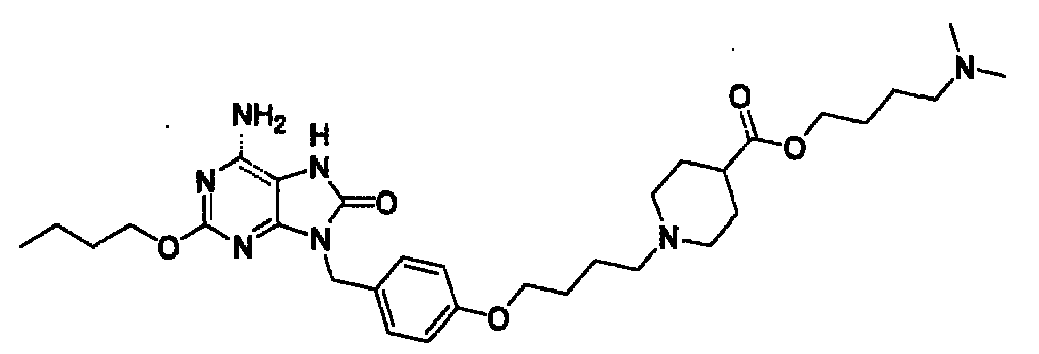
- The compound obtained in Example 2 (65 mg, 0.13 mmol) was dissolved in DMF (5 ml), and thereto were added 4-dimethylaminobutanol (0.084 ml, 0.63 mmol), 1-hydroxybenzotriazole (85 mg, 0.63 mmol) and 1-ethyl-3-(3-dimethylaminopropyl)carbodiimide hydrochloride (122 mg, 0.63 mmol), and the mixture was stirred at room temperature for 6 hours and evaporated. Then, thereto was added saturated sodium bicarbonate water, and the precipitated solid was filtered and washed with water to give the titled compound (28 mg) as a white solid. Yield 35%.
1H NMR (DMSO-d6) δ9.96 (1H, brs), 7.22 (2H, d, J = 8.7 Hz), 6.85 (2H, d, J = 8.7 Hz), 6.45 (2H, brs), 4.76 (2H, s), 4.14 (2H, t, J = 6.6 Hz), 4.01 (2H, t, J = 6.5 Hz), 3.92 (2H, t, J = 6.4 Hz), 2.78-2.68 (2H, m), 2.28-2.23 (1H, m), 2.26 (2H, t, J = 7.1 Hz), 2.17 (2H, t, J = 7.1 Hz), 2.08 (6H, s), 1.95-1.83 (2H, m), 1.80-1.71 (2H, m), 1.68-1.31 (14H, m), 0.91 (3H, t, J = 7.4 Hz). -

-

- The compound obtained in Example 1 Step (iv) (1.50 g, 4.37 mmol) was dissolved in DMF (50 ml), and thereto were added 1,3-dibromopropane (4.4 ml, 43.7 mmol) and potassium carbonate (0.60 g, 4.37 mmol), and the mixture was stirred at 70°C for 6 hours and evaporated. Then, thereto was added water, and the mixture was extracted with chloroform. The organic layer was dried over anhydrous magnesium sulfate, and then concentrated in vacuo. The residue was purified by silica gel column chromatography to give the subtitled compound (0.48 g) as a white solid. Yield 24%.
1H NMR (CDCl3) δ 7.29 (2H, d, J = 8.6 Hz), 6.81 (2H, d, J = 8.6 Hz), 5.26 (2H, brs), 5.03 (2H, s), 4.31 (2H, t, J = 6.6 Hz), 4.09 (3H, s), 4.07 (2H, t, J = 5.8 Hz), 3.58 (2H, t, J = 6.4 Hz), 2.29 (2H, tt, J = 6.4 Hz, 5.8 Hz), 1.78 (2H, tt, J = 7.5 Hz, 6.6 Hz), 1.50 (2H, tq, J = 7.5 Hz, 7.4 Hz), 0.97 (3H, t, J = 7.4 Hz). -

- The compound obtained in Step (i) (0.17 g, 0.37 mmol) was treated using N-methylglycine ethyl ester hydrochloride (0.57 g, 3.7 mmol) in the similar manner to Example 1 Step (vi) to give the subtitled compound (71 mg) as a white solid. Yield 39%.
1H NMR (CDCl3) δ 7.28 (2H, d, J = 8.7 Hz), 6.80 (2H, d, J = 8.7 Hz), 5.16 (2H, brs), 5.02 (2H, s), 4.31 (2H, t, J = 6.7 Hz), 4.16 (2H, q, J = 7.2 Hz), 4.09 (3H, s), 3.98 (2H, t, J = 6.3 Hz), 3.25 (2H, s), 2.65 (2H, t, J = 7.2 Hz), 2.38 (3H, s), 1.98-1.90 (2H, m), 1.82-1.74 (2H, m), 1.54-1.47 (2H, m), 1.26 (3H, t, J = 7.2 Hz), 0.97 (3H, t, J = 7.4 Hz). -

- To the compound obtained in Step (ii) (70 mg, 0.14 mmol) were added methanol (2 ml) and 5M aqueous sodium hydroxide solution (2 ml), and the mixture was heated to stir for 30 minutes under refluxing. The mixture was cooled to 0°C, and then neutralized by concentrated hydrochloric acid and evaporated to dryness. Thereto were added methanol (7 ml) and concentrated sulfuric acid (0.3 ml), and the mixture was heated to stir for 6 hours under refluxing. The mixture was cooled to 0°C, and then thereto wad added saturated sodium bicarbonate water, and the mixture was extracted with chloroform/ethanol (3/1). The organic layer was dried over anhydrous magnesium sulfate, and then concentrated in vacuo to give the titled compound (45 mg) as a white solid. Yield 68%.
1H NMR (DMSO-d6) δ9.95 (1H, brs), 7.22 (2H, d, J = 8.6 Hz), 6.85 (2H, d, J = 8.6 Hz), 6.45 (2H, brs), 4.76 (2H, s), 4.14 (2H, t, J = 6.6 Hz), 3.94 (2H, t, J = 6.4 Hz), 3.58 (3H, s), 3.26 (2H, s), 2.56 (2H, t, J = 7.0 Hz), 2.26 (3H, s), 1.83-1.76 (2H, m), 1.66-1.57 (2H, m), 1.42-1.32 (2H, m), 0.91 (3H, t, J = 7.4 Hz). -

-

- The compound obtained in Example 1 Step (iv) (0.50 g, 1.46 mmol) was dissolved in DMF (20 ml), and thereto were added 4-[2-(methanesulfonyloxy)methyl]-piperidine-1-carboxylic acid tert-butyl ester (0.85 g, 2.91 mmol) and potassium carbonate (0.20 g, 1.46 mmol), and the mixture was stirred at 100°C for 14 hours and evaporated. Then, thereto was added water, and the mixture was extracted with chloroform. The organic layer was dried over anhydrous magnesium sulfate, and then concentrated in vacuo. The residue was purified by silica gel column chromatography to give the subtitled compound (0.53 g) as a pale yellow solid. Yield 68%.
1H NMR (CDCl3) δ 7.29 (2H, d, J = 8.7 Hz), 6.80 (2H, d, J = 8.7 Hz), 5.20 (2H, brs), 5.02 (2H, s), 4.31 (2H, t, J = 6.7 Hz), 4.11 (3H, s), 3.75 (2H, d, J = 6.4 Hz), 2.80-2.60 (2H, m), 1.98-1.89 (1H, m), 1.81-1.71 (4H, m), 1.70-1.45 (3H, m), 1.46 (9H, s), 1.30-1.22 (3H, m), 0.97 (3H, t, J = 7.4 Hz). -

- To the compound obtained in Step (i) (0.53 g, 0.99 mmol) was added trifluoroacetic acid (20 ml), and the mixture was stirred for 30 minutes. Trifluoroacetic acid was distilled away, and then to the mixture was added DMF (20 ml), potassium carbonate (0.66 g, 4.8 mmol) and methyl bromoacetate (0.11 ml, 1.2 mmol), and the mixture was stirred at room temperature for 12 hours and evaporated. Then, thereto was added water, and the mixture was extracted with chloroform/ethanol (3/ 1). The organic layer was dried over anhydrous magnesium sulfate, and then concentrated in vacuo. The residue was purified by silica gel column chromatography to give the subtitled compound (0.39 g) as a pale yellow solid. Yield 77%.
1H NMR (CDCl3) δ 7.28 (2H, d, J = 8.6 Hz), 6.79 (2H, d, J = 8.6 Hz), 5.27 (2H, brs), 5.02 (2H, s), 4.30 (2H, t, J = 6.6 Hz), 4.08 (3H, s), 3.75 (2H, d, J = 5.9 Hz), 3.72 (3H, s), 3.23 (2H, s), 3.00-2.94 (2H, m), 2.21-2.14 (2H, m), 1.83-1.71 (5H, m), 1.53-1.44 (4H, m), 0.97 (3H, t, J = 7.4 Hz). -

- To the compound obtained in Step (ii) (0.39 g, 0.76 mmol) was added 3M hydrochloric acid/methanol solution (15 ml), and the mixture was stirred at room temperature for 12 hours and evaporated. Then, the residue was purified by HPLC and concentrated, and then thereto was added saturated sodium bicarbonate water, and the mixture was extracted with chloroform/ethanol (3/1). The organic layer was dried over anhydrous magnesium sulfate, and then concentrated in vacuo to give the titled compound (0.17 g) as a white solid. Yield 46%.
1H NMR (DMSO-d6) δ9.93 (1H, s), 7.22 (2H, d, J = 8.6 Hz), 6.85 (2H, d, J = 8.6 Hz), 6.44 (2H, brs), 4.76 (2H, s), 4.14 (2H, t, J = 6.6 Hz), 3.76 (2H, d, J = 5.8 Hz), 3.60 (3H, s), 3.20 (2H, s), 2.86-2.80 (2H, m), 2.16-2.12 (2H, m), 1.72-1.56 (5H, m), 1.41-1.23 (4H, m), 0.91 (3H, t, J = 7.4 Hz). -

- The compound obtained in Example 5 (0.15g, 0.29 mmol) was treated in the similar manner to Example 2 to give the titled compound (91 mg) as a white solid. Yield 64%.
1H NMR (DMSO-d6) δ 10.41 (1H, brs), 7.22 (2H, d, J = 8.6 Hz), 6.86 (2H, d, J = 8.6 Hz), 6.60 (2H, brs), 4.76 (2H, s), 4.14 (2H, t, J = 6.6 Hz), 3.78 (2H, d, J = 6.0 Hz), 3.18-3.14 (2H, m), 3.15 (2H, s), 2.56-2.45 (2H, m), 1.80-1.74 (3H, m), 1.66-1.57 (2H, m), 1.44-1.33 (4H, m), 0.91 (3H, t, J = 7.4 Hz). -

- The compound obtained in Example 6 (69 mg, 0.14 mmol) was treated in the similar manner to Example 3 to give the titled compound.
1H NMR (DMSO-d6) δ 9.92 (1H, s), 7.22 (2H, d, J = 8.6 Hz), 6.85 (2H, d, J = 8.6 Hz), 6.43 (2H, brs), 4.76 (2H, s), 4.14 (2H, t, J = 6.6 Hz), 4.03 (2H, t, J = 6.6 Hz), 3.76 (2H, d, J = 5.9 Hz), 3.18 (2H, s), 2.86-2.80 (2H, m), 2.19-2.08 (4H, m), 2.08 (6H, s), 1.68-1.54 (6H, m), 1.42-1.37 (4H, m), 1.35-1.20 (3H, m), 0.91 (3H, t, J = 7.4 Hz). -

-

- To a solution of 2-butoxy-8-methoxyadenine trifluoroacetic acid salt (10 g, 42.1 mmol) in DMF (90 ml) were added potassium carbonate (17.5 g, 126.4 mmol) and (4-hydroxymethyl)benzyl chloride (7.3 g, 46.4 mmol), and the mixture was stirred at room temperature for 18 hours. The carbonate salt in the mixture was filtered off and the filtrate was concentrated. Thereto was added water, and the mixture was extracted with 5% methanol-chloroform (800 ml). The organic layer was sequentially washed with water and saturated saline, and then dried over sodium sulfate. To the residue were added chloroform (125 ml), methanol (25 ml) and diethyl ether (125 ml), and the insoluble solid was filtered off. The filtrate was concentrated in vacuo, and then thereto was added diethyl ether (150 ml), and the white solid was filtered and dried to give the subtitled compound (7.2 g, 20.1 mmol) as a white solid.
Yield 71%.
1H NMR (DMSO-d6) δ 7.26 (2H, d, J = 8.2 Hz), 7.19 (2H, d, J = 8.2 Hz), 6.47 (2H, brs), 5.15 (1H, t, J = 5.6 Hz), 5.01 (2H, s), 4.44 (2H, d, J = 5.6 Hz), 4.17 (2H, t, J = 6.6 Hz), 4.03 (3H, s), 1.68-1.59 (2H, m), 1.44-1.34 (2H, m), 0.91 (3H, t, J = 7.4 Hz). -

- To the compound obtained in Step (i) (7.1 g, 19.6 mmol) was added dichloromethane (140 ml), and to the suspension added thionyl chloride (4.3 ml), and the mixture was stirred at 50°C for 2 hours. Thereto was added toluene (30 ml), and the mixture was evaporated, and then thereto was added additional toluene (100 ml). The mixture was evaporated, and sequentially dried in vacuo to give the subtitled compound (7.2 g, 19.6 mmol) as a pale yellow solid. Yield 99%.
1H NMR (DMSO-d6) δ 7.39 (2H, d, J = 8.2 Hz), 7.30 (2H, d, J = 8.2 Hz), 4.88 (2H, s), 4.73 (2H, s), 4.21 (2H, t, J = 6.6 Hz), 1.68-1.59 (2H, m), 1.43-1.32 (2H, m), 0.90 (3H, t, J = 7.4 Hz). -

- To the compound obtained in Step (ii) (200 mg, 0.55 mmol) was added DMF (5 ml), and to the solution were added diisopropylethylamine (286 µl, 1.66 mmol) and N-ethoxycarbonylmethyl-N-methylamine (130 mg, 1.11 mmol), and the mixture was stirred at 60°C for 3 hours. The filtrate was concentrated, and thereto was added water, and the precipitated solid was filtered and dried in vacuo to give the titled compound as a pale yellow solid.
-

- To the compound obtained in Example 8 (200 mg, 0.45 mmol) was added 1N aqueous sodium hydroxide solution (5 ml), and the mixture was heated to stir at 100°C for 6 hours. The mixture was neutralized by concentrated hydrochloric acid, and then evaporated. To the residue were added methanol (10 ml) and concentrated sulfuric acid (200 µl), and the mixture was heated to stir at 80°C for 12 hours. The mixture was neutralized by 28% aqueous ammonia solution, and then thereto was added water. The insoluble solid was filtered, dried and purified by column chromatography, and then dried in vacuo to give the titled compound (80 mg, 34%) as a white solid.
1H NMR (DMSO-d6) δ9.95 (1H, brs), 7.25 (4H, s), 6.45 (2H, s), 4.83 (2H, s), 4.13 (2H, t, J = 6.6 Hz), 3.60 (5H, s), 3.27 (2H, s), 2.23 (3H, s), 1.60-1.57 (2H, m), 1.42-4.32 (2H, m), 0.90 (3H, t, J = 7.4 Hz). -

- The titled compound was obtained as a white solid in the similar manner to Example 2. Yield 57%.
1H NMR (DMSO-d6) δ 10.01 (1H, brs), 7.32-7.26 (4H, m), 6.48 (2H, brs), 4.85 (2H, s), 4.13 (2H, t, J = 6.6 Hz), 3.78 (2H, s), 3.19 (2H, s), 2.34 (3H, s), 1.65-1.58 (2H, m), 1.41-4.32 (2H, m), 0.90 (3H, t, J = 7.4 Hz). -

-

- The subtitled compound was obtained as a white solid in the similar manner to Example 8 Step (i). Yield 84%.
1H NMR (DMSO-d6) δ 7.26 (2H, d, J = 8.1 Hz), 7.19 (2H, d, J = 8.1 Hz), 6.87 (2H, brs), 5.15 (1H, t, J = 5.7 Hz), 5.01 (2H, s), 4.44 (2H, d, J = 5.7 Hz), 4.29 (2H, dd, J = 4.7, 4.8 Hz), 4.03 (3H, s), 3.60 (2H, d, J = 4.7, 4.8 Hz), 3.16 (3H, s). -

- The subtitled compound was obtained as a white solid in the similar manner to Example 8 Step (ii). Yield 83%.
1H NMR (DMSO-d6) δ 7.39 (2H, d, J = 8.1 Hz), 7.31 (2H, d, J = 8.1 Hz), 4.88 (2H, s), 4.73 (2H, s), 4.34 (2H, dd, J = 4.7, 4.8 Hz), 3.60 (2H, dd, J = 4.7, 4.8 Hz), 3.27 (3H, s). -

- The titled compound was obtained as a white solid in the similar manner to Example 8 Step (iii). Yield 83%.
-
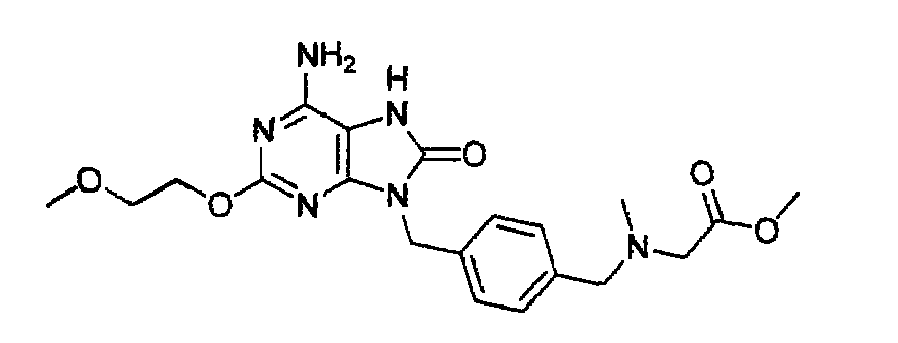
- The titled compound was obtained as a white solid in the similar manner to Example 9. Yield 83%.
1H NMR (DMSO-d6) δ 10.28 (1H, brs), 7.29-7.24 (4H, m), 6.63 (2H, brs), 4.83 (2H, s), 4.25 (2H, dd, J = 4.7, 4.8 Hz), 3.59 (3H, s), 3.58 (2H, dd, J = 4.7, 4.8 Hz), 3.37 (2H, s), 3.26 (2H, s), 3.26 (3H, s), 2.23 (3H, brs). -

- The titled compound was obtained as a white solid in the similar manner to Example 2. Yield 83%.
1H NMR (DMSO-d6) δ 10.22 (1H, brs), 7.29-7.24 (4H, m), 6.58 (2H, m), 4.84 (2H, s), 4.25 (2H, dd, J = 4.7, 4.8 Hz), 3.66 (2H, s), 3.58 (2H, dd, J = 4.7, 4.8 Hz), 3.26 (3H, s), 3.13 (2H, s), 2.26 (3H, s). -

- The compound obtained in Example 8 Step (ii) (200 mg, 0.55 mmol) was dissolved in DMF, and thereto was added diisopropylethylamine (285 µl, 1.66 mmol) and then 4-methoxycarbonylpiperidine (222 µl, 1.66 mmol). The mixture was stirred at room temperature for 3 hours, and then evaporated. To the residue was added water, and the mixture was extracted with chloroform-methanol. The organic layer was washed with water and saturated saline, dried over sodium sulfate, and then concentrated. The residue was purified by column chromatography and dried in vacuo to give the titled compound as a white solid. Yield 62%.
1H NMR (DMSO-d6) δ9.95 (1H, brs), 7.23 (4H, m), 6.46 (2H, brs), 4.82 (2H, s), 4.13 (2H, t, J = 6.6 Hz), 3.58 (3H, s), 3.38 (2H, s), 2.73-2.66 (2H, m), 2.33-2.24 (1H, m), 1.97-1.70 (2H, m), 1.79-1.72 (2H, m), 1.65-1.57 (2H, m), 1.57-1.46 (2H, m), 1.41-1.31 (2H, m), 0.89 (3H, t, J = 7.4 Hz). -

- The titled compound was obtained as a white solid in the similar manner to Example 2. Yield 52%.
1H NMR (DMSO-d6) δ 12.39 (1H, brs), 10.24 (1H, brs), 7.43 (2H, brs), 7.23-7.31 (2H, m), 6.60 (2H, brs), 4.87 (2H, s), 4.25-4.10 (2H, m), 4.12 (2H, t, J = 6.6 Hz), 3.38 (2H, brs), 3.00-2.71 (2H, m), 2.49-2.30 (1H, m), 2.00-1.85 (2H, m), 1.82-1.62 (2H, m), 1.65-1.55 (2H, m), 1.42-1.32 (2H, m), 0.90 (3H, t, J = 7.4 Hz). -

-

- The subtitled compound was obtained as a pale yellow solid in the similar manner to Example 8 Step (i). Yield 55%.
1H NMR (DMSO-d6) δ 7.52 (1H, s), 4.49 (1H, d, J = 7.8 Hz), 6.87 (2H, brs), 6.77 (1H, d, J = 7.8 Hz), 5.05 (2H, t, J = 6.6 Hz), 4.09 (2H, t, J = 6.6 Hz), 4.02 (3H, s), 3.92 (3H, s), 3.84 (3H, s), 1.61-1.54 (2H, m), 1.39-1.30 (2H, m), 0.87 (3H, t, J = 7.4 Hz). -

- The compound obtained in Step (i) (955 mg, 2.3 mmol) was dissolved in THF (52 ml), and thereto was added portionwise lithium aluminum hydride (131 mg, 3.45 mmol) under ice cooling. The mixture was stirred at room temperature for 2 hours, and then the reaction was quenched by 1N aqueous sodium hydroxide solution, and filtered. The filtrate was concentrated, and then thereto was added water, and the mixture was extracted with chloroform-methanol. The organic layer was washed with water and saturated saline, and then dried over sodium sulfate. The mixture was concentrated, and then dried in vacuo to give the subtitled compound as a yellow oil. Yield 99%.
1H NMR (DMSO-d6) δ 6.98 (1H, s), 6.82 (2H, brs), 6.78 (1H, d, J = 7.8 Hz), 6.60 (1H, d, J = 7.8 Hz), 5.17 (1H, t, J = 5.7 Hz), 4.98 (2H, s), 4.45 (2H, d, J = 5.7 Hz), 4.11 (2H, t, J = 6.6 Hz), 4.01 (3H, s), 3.79 (3H, s), 1.62-1.56 (2H, m), 1.39-1.33 (2H, m), 0.89 (3H, t, J = 7.4 Hz). -

- The subtitled compound was obtained as a yellow oil in the similar manner to Example 8 Step (ii). Yield 99%.
-

- The titled compound was obtained as a yellow oil in the similar manner to Example 8 Step (iii). Yield 63%.
1H NMR (DMSO-d6) δ 9.97 (1H, s), 6.96 (1H, s), 6.76 (1H, d, J = 7.8 Hz), 6.66 (1H, d, J = 7.8 Hz), 6.46 (2H, brs), 4.80 (2H, s), 4.08 (2H, t, J = 6.6 Hz), 3.83 (3H, s), 3.60 (2H, s), 3.59 (2H, s), 3.27 (2H, s), 2.25 (3H, s), 1.61-1.54 (2H, m), 1.36-1.30 (2H, m), 0.87 (3H, t, J = 7.4 Hz). -

- The titled compound was obtained as a white solid in the similar manner to Example 2. Yield 83%.
1H NMR (DMSO-d6) δ 10.31 (1H, brs), 7.02 (1H, s), 6.80 (1H, d, J = 7.8 Hz), 6.68 (1H, d, J = 7.8 Hz), 6.65 (2H, brs), 4.80 (2H, s), 4.07 (2H, t, J = 6.6 Hz), 3.84 (3H, s), 3.71 (2H, s), 3.19 (2H, s), 2.31 (3H, s), 1.61-1.54 (2H, m), 1.36-1.30 (2H, m), 0.87 (3H, t, J = 7.4 Hz). -

-

- The subtitled compound was obtained as a yellow oil in the similar manner to Example 8 Step (i). Yield 75%.
1H NMR (DMSO-d6) δ 7.24-7.17 (4H, m), 6.87 (2H, brs), 5.01 (2H, s), 4.16 (2H, t, J = 6.6 Hz), 4.03 (3H, s), 3.64 (2H, s), 3.58 (3H, s), 1.67-1.49 (2H, m), 1.43-1.34 (2H, m), 0.91 (3H, t, J = 7.4 Hz). -

- The subtitled compound was obtained as a yellow oil in the similar manner to Example 16 Step (ii). Yield 99%.
1H NMR (DMSO-d6) δ 7.18-7.13 (4H, m), 6.85 (2H, brs), 4.99 (2H, s), 4.62 (1H, t, J = 5.2 Hz), 4.16 (2H, t, J = 6.6 Hz), 4.03 (3H, s), 3.54 (2H, dt, J = 5.2, 7.0 Hz), 2.66 (2H, t, J = 7.0 Hz), 1.67-1.50 (2H, m), 1.43-1.35 (2H, m), 0.91 (3H, t, J = 7.1 Hz). -

- The compound obtained in Step (ii) (1.57 g, 4.23 mmol) was dissolved in THF (20 ml), and thereto were added triethylamine (694 µl, 5.08 mmol) and 4-dimethylaminopyridine (103 mg, 0.85 mmol), and then thereto was added dropwise methanesulfonyl chloride (360 µl, 4.65 mmol) under ice cooling. The mixture was stirred at room temperature for 2 hours, and then evaporated. To the residue was added water, and the mixture was extracted with chloroform-methanol. Then, the organic layer was washed with water and saturated saline, and dried over sodium sulfate. After concentration, the residue was dried in vacuo to give a yellow oil. The residue (200 mg, 0.44 mmol) was dissolved in DMF (5 ml), and thereto were added diisopropylethylamine (400 µl, 2.3 mmol) and 4-ethoxycarbonyl piperidine (260 mg, 2.22 mmol), and the mixture was heated at 60°C for 6 hours and evaporated. Then, thereto was added 1N aqueous sodium hydroxide solution, and the mixture was heated to stir at 90°C for 2 hours. The mixture was neutralized, and then evaporated, and thereto was added methanol (5 ml) and then concentrated sulfuric acid (200 µl). The mixture was heated to stir at 80°C for 3 hours, and then neutralized by ammonia water and evaporated. Then, thereto was added water, and the white solid was filtered and dried to give the titled compound (20 mg, 0.04 mmol) as a white solid. Yield 62%.
1H NMR (DMSO-d6) δ9.93 (1H, brs), 7.21-7.14 (4H, mz), 6.44 (2H, brs), 4.80 (2H, s), 4.13 (2H, t, J = 6.6 Hz), 3.59 (3H, s), 2.86-2.80 (2H, m), 2.69-2.63 (2H, m), 2.46-2.40 (2H, m), 2.33-2.25 (1H, m), 2.02-1.93 (2H, m), 1.82-1.74 (2H, m), 1.65-1.58 (2H, m), 1.58-1.45 (2H, m), 1.42-1.32 (2H, m), 0.90 (3H, t, J = 7.4). -

- The titled compound was obtained as a white solid in the similar manner to Example 2. Yield 27%.
1H NMR (DMSO-d6) δ 11.33 (1H, brs), 9.97 (1H, brs), 7.23-7.16 (4H, m), 6.47 (2H, brs), 4.81 (2H, s), 4.13 (2H, t, J = 6.6 Hz), 2.86-2.80 (2H, m), 2.69-2.63 (2H, m), 2.46-2.40 (2H, m), 2.33-2.25 (1H, m), 2.02-1.93 (2H, m), 1.82-1.74 (2H, m), 1.65-1.58 (2H, m), 1.58-1.45 (2H, m), 1.42-1.32 (2H, m), 0.90 (3H, t, J = 7.4). -

- The compound obtained in Example 18 Step (i) was treated in the similar manner to Example 18 Step (ii) to give the titled compound as a white solid. Yield 6%.
1H NMR (DMSO-d6) δ 10.46 (1H, brs), 7.21-7.13 (4H, m), 6.61 (2H, brs), 4.80 (2H, s), 4.13 (2H, t, J = 6.6 Hz), 3.58 (3H, s), 3.28 (2H, s), 2.51-2.49 (4H, m), 2.28 (3H, s), 1.65-1.58 (2H, m), 1.42-1.32 (2H, m), 0.90 (3H, t, J = 7.4 Hz). -

-

- The subtitled compound was obtained as a yellow oil in the similar manner to Example 8 Step (i). Yield 75%.
1H NMR (DMSO-d6) δ 7.19-7.13 (4H, m), 6.83 (2H, brs), 4.99 (2H, s), 4.17 (2H, t, J = 6.6 Hz), 4.03 (3H, s), 3.56 (3H, s), 2.80 (2H, t, J = 7.5 Hz), 2.59 (2H, t, J = 7.5 Hz), 1.65-1.60 (2H, m), 1.42-1.36 (2H, m), 0.91 (3H, t, J = 7.4 Hz). -

- The subtitled compound was obtained as a yellow oil in the similar manner to Example 18 Step (i). Yield 80%.
1H NMR (DMSO-d6) δ 7.18 (4H, s), 6.86 (2H, brs), 5.02 (2H, s), 4.47 (1H, t, J = 5.1 Hz), 4.20 (2H, t, J = 6.6 Hz), 4.06 (3H, s), 3.43-3.38 (2H, m), 2.60-2.56 (2H, m), 1.73-1.63 (4H, m), 1.48-1.37 (2H, m), 0.95 (3H, t, J = 7.4 Hz). -

- The compound obtained in Step (ii) (660 mg, 1.71 mmol) was dissolved in THF (30 ml), and thereto were added triethylamine (281 µl, 2.05 mmol) and 4-dimethylaminopyridine (42 mg, 0.34 mmol), and then added dropwise methanesulfonyl chloride (146 µl, 1.88 mmol) under ice cooling. The mixture was stirred at room temperature for 1 hour, and then evaporated. To the residue was added water, and the mixture was extracted with chloroform-methanol. Then, the organic layer was washed with water and saturated saline, and then dried over sodium sulfate. After concentration, the residue was dried in vacuo to give a yellow oil. The residue (400 mg, 0.86 mmol) was dissolved in DMF (10 ml), and thereto were added diisopropylethylamine (446 µl, 2.6 mmol) and N-ethoxycarbonylmethyl-N-methylamine (303 mg, 2.59 mmol), and the mixture was heated at 60°C for 7 hours and evaporated. Then, thereto was added 1N aqueous sodium hydroxide solution, and the mixture was heated to stir at 90°C for 2 hours. The mixture was neutralized and then evaporated, and thereto were added methanol (15 ml) and then concentrated sulfuric acid (200 µl). The mixture was heated to stir at 90°C for 6 hours, and then neutralized by ammonia water and evaporated. Then, thereto was added water, and the white solid was filtered, dried and purified by column chromatography to give the titled compound (100 mg, 0.22 mmol) as a white solid. Yield 25%.
1H NMR (DMSO-d6) δ9.93 (1H, brs), 7.20 (2H, d, J = 8.1 Hz), 7.13 (2H, d, J = 8.1 Hz), 6.43 (2H, brs), 4.80 (2H, s), 4.14 (2H, t, J = 6.6 Hz), 3.58 (3H, s), 3.23 (2H, s), 2.57-2.47 (2H, m), 2.43-2.39 (2H, m), 2.24 (3H, s), 1.67-1.58 (4H, m), 1.42-1.34 (2H, m), 0.90 (3H, t, J = 7.4 Hz). -
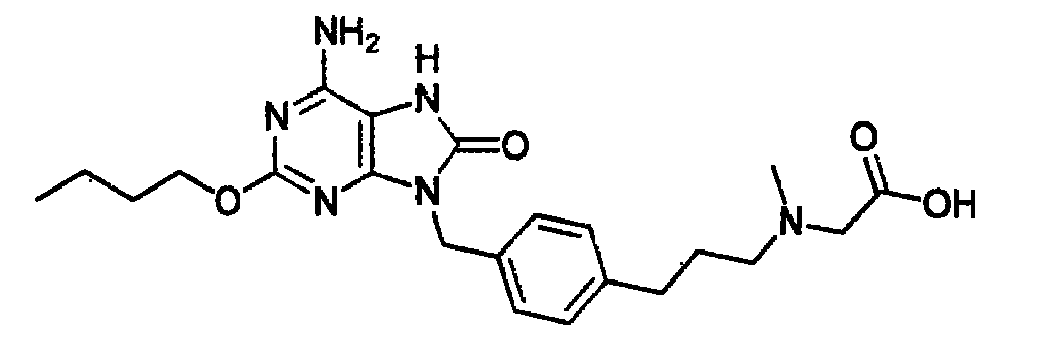
- The titled compound was obtained as a white solid in the similar manner to Example 2. Yield 75%.
1H NMR (DMSO-d6) δ 10.25 (1H, brs), 7.21 (2H, d, J = 8.1 Hz), 7.15 (2H, d, J = 8.1 Hz), 6.56 (2H, brs), 4.80 (2H, s), 4.13 (2H, t, J = 6.6 Hz), 3.14 (2H, s), 2.70-2.63 (2H, m), 2.57-2.50 (2H, m), 2.37 (3H, s), 1.80-1.70 (2H, m), 1.65-1.58 (2H, m), 1.40-1.34 (2H, m), 0.90 (3H, t, J = 7.4 Hz). -

- The compound obtained in Example 16 (50 mg, 0.11 mmol) was dissolved in DMF (5 ml), and thereto were added WSC (108 mg, 0.56 mmol), HOBt (76 mg, 0.56 mmol) and dimethylaminobutanol (75 µl, 0.56 mmol), and the mixture was stirred at room temperature for 9 hours and evaporated. Then, thereto was added water, and the mixture was extracted with chloroform-ethanol. The organic layer was washed with water and saturated saline, dried over sodium sulfate, concentrated, and then dried in vacuo to give the titled compound as a white solid. Yield 65%.
1H NMR (DMSO-d6) δ 10.14 (1H, brs), 7.95 (1H, brs), 6.96 (1H, s), 6.76 (1H, d, J = 8.1 Hz), 6.67 (2H, d, J = 8.1 Hz), 6.55 (2H, brs), 4.79 (2H, s), 4.09-4.05 (4H, m), 3.83 (3H, s), 3.60 (2H, s), 3.26 (2H, s), 2.81-2.73 (2H, m), 2.53 (6H, s), 2.26 (3H, s), 1.59-1.54 (6H, m), 1.36-1.30 (2H, m), 0.87 (3H, t, J = 7.4 Hz). -
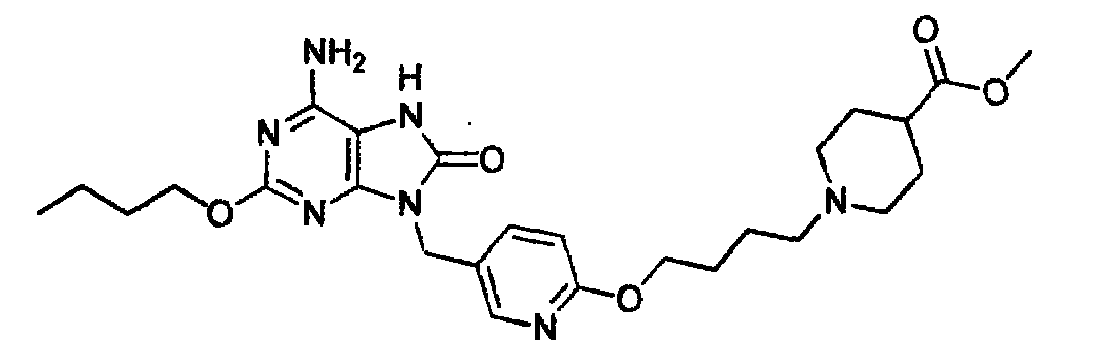
-

- To a solution of 2-butoxyadenine (2.55 g, 12.3 mmol) in DMF (50 ml) were added potassium carbonate (5.11 g, 37.0 mmol) and 2-chloro-5-chloromethylpyridine (2.0 g, 12.3 mmol), and the mixture was stirred at room temperature for 14 hours and evaporated. Then, thereto was added water (80 ml), and the mixture was extracted with 5% methanol-chloroform (100 ml). The organic layer was sequentially washed with water and saturated saline, and then dried over magnesium sulfate, concentrated in vacuo and purified by silica gel column chromatography to give the subtitled compound (2.95 g) as a light brown solid. Yield 72%.
1H NMR (CDCl3) δ 8.46 (1H, d, J= 2.3 Hz), 7.69 (1H, s), 7.64 (1H, dd, J= 8.6 Hz, 2.3 Hz), 7.32 (1H, d, J= 8.6 Hz), 6.14 (2H, brs), 5.29 (2H, s), 4.35 (2H, t, J= 6.8 Hz), 1.81-1.74 (2H, m), 1.54-1.45 (2H, m), 0.97 (3H, t, J= 7.4 Hz). -
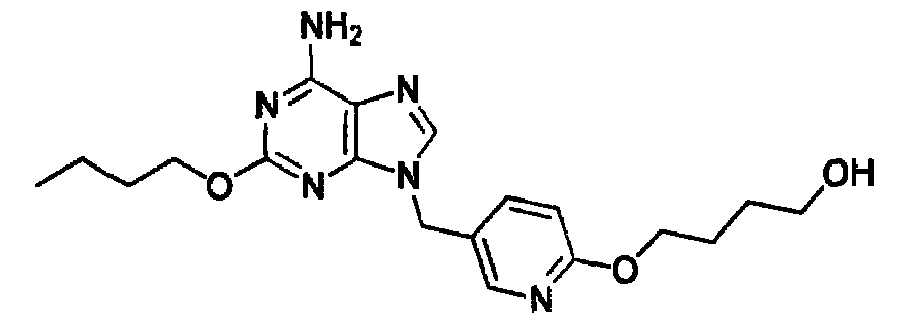
- Sodium (350 mg, 15.0 mmol) was dissolved in 1,4-butanediol (10 ml) to prepare alkoxide, and thereto was added the compound obtained in Step (i) (1.0 g, 3.00 mmol), and the mixture was heated to reflux at 130°C for 3 hours. Thereto was added water (50 ml) at 0°C, and added 1N aqueous hydrochloric acid solution to pH9. The mixture was extracted with 30% methanol-chloroform (100 ml). The organic layer was sequentially washed with water and saturated saline, and then dried over magnesium sulfate, concentrated in vacuo and purified by silica gel column chromatography to give the subtitled compound (892 mg) as a white solid. Yield 83%.
1H NMR (CDCl3) δ 8.18 (1H, d, J= 2.2 Hz), 7.59 (1H, s), 7.56 (1H, dd, J= 8.6 Hz, 2.2 Hz), 6.69 (1H, d, J= 8.6 Hz), 5.60 (2H, brs), 5.19 (2H, s), 4.34-4.29 (4H, m), 3.72 (2H, q, 6.0 Hz), 1.91-1.70 (6H, m), 1.54-1.49 (2H, m), 0.98 (3H, t, J= 7.4 Hz). -

- To a solution of the compound obtained in Step (ii) (892 mg, 2.49 mmol) and sodium acetate (613 mg, 7.47 mmol) in chloroform (30 ml) was added bromine (476 mg), and the mixture was stirred for 1 hour. Thereto was added aqueous sodium thiosulfate solution (10 ml), and the mixture was neutralized by aqueous sodium bicarbonate solution, and extracted with chloroform (100 ml). The organic layer was sequentially washed with water and saline, and dried over magnesium sulfate and evaporated. The residue was purified by silica gel column chromatography to give the subtitled compound (919 mg) as a white solid. Yield 84%.
1H NMR (CDCl3) δ 8.26 (1H, d, J= 2.3 Hz), 7.66 (1H, dd, J= 8.5 Hz, 2.3 Hz), 6.67 (1H, d, J= 8.5 Hz), 5.66 (2H, brs), 5.22 (2H, s), 4.36-4.28 (4H, m), 3.72 (2H, t, 5.5Hz), 1.87-1.70 (6H, m), 1.54-1.50 (2H, m), 0.98 (3H, t, J= 7.4 Hz). -
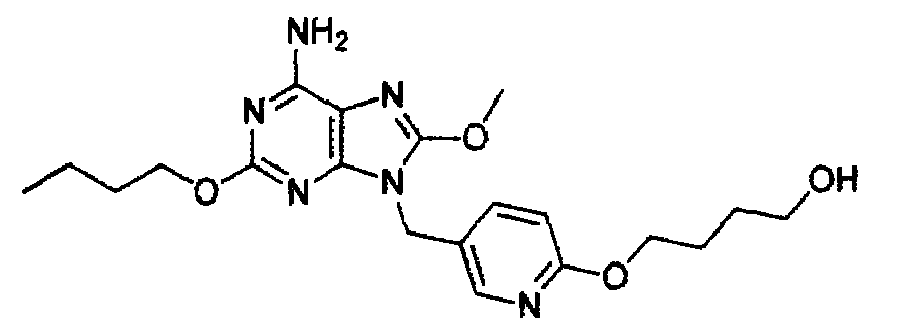
- To a solution of the compound obtained in Step (iii) (919 mg, 2.10 mmol) in methanol (20 ml) was added 5N aqueous sodium hydroxide solution (20 ml), and the mixture was heated to reflux at 100°C for 4 hours. The mixture was neutralized by hydrochloric acid, and extracted with 20% methanol-chloroform (100 ml). The organic layer was washed with saline, dried over magnesium sulfate and concentrated in vacuo to give the subtitled compound (815 mg) as a white solid. Yield 99%.
1H NMR (CDCl3) δ 8.19 (1H, d, J= 2.4 Hz), 7.64 (1H, dd, J= 8.6 Hz, 2.4 Hz), 6.66 (1H, d, J= 8.6 Hz), 5.21 (2H, brs), 5.01 (2H, s), 4.32-4.29 (4H, m), 4.10 (3H, s), 3.71 (2H, t, 6.3 Hz), 1.87-1.70 (6H, m), 1.54-1.50 (2H, m), 0.98 (3H, t, J= 7.4 Hz). -

- To a solution of the compound obtained in Step (iv) (300 mg, 0.72 mmol) in tetrahydrofuran (20 ml) were added triethylamine (201 µl, 1.44 mmol) and 4-dimethylaminopyridine (18 mg, 0.14 mmol), and the mixture was stirred at room temperature for 10 minutes and then cooled to 0°C. Thereto was added methanesulfonyl chloride (67 µl, 0.86 mmol), and the mixture was stirred at room temperature for 30 minutes. Thereto was added water (20 ml), and the mixture was extracted with chloroform (50 ml). The organic layer was washed with saline, and then dried over magnesium sulfate and concentrated in vacuo. To a solution of the resulting residue in dimethyl formamide (10 ml) were added methyl isonipecotate (515 mg, 3.6 mmol) and diisopropylethylamine (465 mg, 3.6 mmol), and the mixture was heated at 60°C for 24 hours and evaporated in vacuo. Thereto was added water (30 ml), and the mixture was extracted with 30% methanol-chloroform (50 ml). The organic layer was dried over magnesium sulfate, concentrated in vacuo and purified by silica gel column chromatography to give the subtitled compound (294 mg) as a colorless oil. Yield 75%.
1H NMR (CDCl3) δ 8.19 (1H, d, J= 2.3 Hz), 7.62 (1H, dd, J= 8.5 Hz, 2.3 Hz), 6.64 (1H, d, J= 8.5 Hz), 5.12 (2H, brs), 5.01 (2H, s), 4.32-4.24 (4H, m), 4.10 (3H, s), 3.67 (3H, s), 2.88 (2H, brs), 2.36 (2H, t, J= 7.6 Hz), 2.28-2.25 (1H, m), 1.98-1.87 (4H, m), 1.80-1.72 (6H, m), 1.65-1.61 (2H, m), 1.54-1.48 (2H, m), 0.97 (3H, t, J= 7.4 Hz). -

- A solution of the compound obtained in Step (v) (293 mg, 0.54 mmol) in 4N hydrochloric acid-methanol (10 ml) was stirred at room temperature for 3 hours, and neutralized by 28% ammonia water and evaporated in vacuo. Thereto was added water (3 ml), and the precipitate was filtered at pH8, and dried to give the titled compound (200 mg) as a white solid. Yield 70%.
1H NMR (DMSO-d6) δ 9.97 (1H, s), 8.13 (1H, d, J= 2.2 Hz), 7.64 (1H, dd, J= 8.5 Hz, 2.2 Hz), 6.75 (1H, d, J= 8.5 Hz), 6.46 (2H, brs), 4.80 (2H, s), 4.22 (2H, t, J= 6.5 Hz), 4.16 (2H, t, J= 6.6 Hz), 3.59 (3H, s), 2.76 (2H, brs), 2.28-2.24 (3H, m), 1.90-1.86 (2H, m), 1.78-1.75 (2H, m), 1.68-1.62 (4H, m), 1,52-1.48 (4H, m), 1.41-1.36 (2H, m), 0.92 (3H, t, J= 7.4 Hz). -

- To a solution of the compound obtained in Example 24 (100 mg, 0.17 mmol) in methanol (5 ml) was added 5N aqueous sodium hydroxide solution (2 ml), and the mixture was stirred at room temperature for 3 hours, neutralized by 1N hydrochloric acid and evaporated in vacuo. Thereto was added water (3 ml), and the precipitate was filtered at pH7 and dried to give the titled compound (68 mg) as a white solid. Yield 75%.
1H NMR (DMSC)-d6) δ 11.43 (1H, brs), 8.13 (1H, d, J= 2.3 Hz), 7.63 (1H, dd, J= 8.5 Hz, 2.3 Hz), 6.86 (2H, brs), 6.74 (1H, d, J= 8.5 Hz), 4.78 (2H, s), 4.22 (2H, t, J= 6.5 Hz), 4.15 (2H, t, J= 6.6 Hz), 3.59 (3H, s), 2.70 (2H, brs), 2.21 (2H, t, J= 7.4 Hz), 1.91-1.87 (3H, m), 1.67-1.61 (6H, m), 1.48-1.38 (6H, m), 0.92 (3H, t, J= 7.4 Hz). -

-

- The compound obtained in Example 24 Step (iv) (200 mg, 0.48 mmol) was treated using N-methylglycine ethyl ester (281 mg, 2.4 mmol) in the similar manner to Example 24 Step (v) to give the subtitled compound (168 mg) as a colorless oil. Yield 68%.
1H NMR (CDCl3) δ 8.19 (1H, d, J= 2.3 Hz), 7.62 (1H, dd, J= 8.5 Hz, 2.3 Hz), 6.64 (1H, d, J= 8.5 Hz), 5.12 (2H, brs), 5.01 (2H, s), 4.31 (2H, t, J= 6.6 Hz), 4.26 (2H, t, J= 6.5 Hz), 4.17 (2H, q, J= 7.1 Hz), 4.10 (3H, s), 3.23 (2H, s), 2.53 (2H, t, J= 7.5 Hz), 2.36 (3H, s), 1.80-1.75 (4H, m), 1.62-1.59 (2H, m), 1.52-1.49 (2H, m), 1,26 (3H, t, J= 7.1 Hz), 0.98 (3H, t, J= 7.4 Hz). -

- To a solution of the compound obtained in Step (i) (168 mg, 0.33 mmol) in methanol (5 ml) was added 5N aqueous sodium hydroxide solution (2 ml), and the mixture was stirred at room temperature for 3 hours, neutralized by 1N hydrochloric acid and evaporated in vacuo. Thereto was added water (3 ml), and the precipitate was filtered at pH7 and dried. To a solution of the residue in methanol (5 ml) was added concentrated sulfuric acid (0.1 ml), and the mixture was heated to reflux for 48 hours, neutralized by 28% ammonia water and evaporated in vacuo. Thereto was added water (3 ml), and the precipitate was filtered at pH8 and dried to give the titled compound (94 mg) as a white solid. Yield 59%.
1H NMR (DMSO-d6) δ 9.94 (1H, brs), 8.13 (1H, d, J= 2.3 Hz), 7.63 (1H, dd, J= 8.6 Hz, 2.3 Hz), 6.75 (1H, d, J= 8.6 Hz), 6.44 (2H, brs), 4.79 (2H, s), 4.20 (2H, t, J= 6.6 Hz), 4.15 (2H, t, J= 6.6 Hz), 3.58 (3H, s), 3.23 (2H, s), 2.44 (2H, t, J= 7.2 Hz), 2.23 (3H, s), 1.68-1.61 (4H, m), 1.50-1.46 (2H, m), 1.41-1.35 (2H, m), 0.98 (3H, t, J= 7.4 Hz). -

- The compound obtained in Example 26 (20 mg, 0.04 mmol) was treated in the similar manner to Example 2 to give the titled compound (14 mg) as a white solid. Yield 70%.
1H NMR (DMSO-d6) δ 10.89 (1H, brs), 8.14 (1H, d, J= 2.3 Hz), 7.64 (1H, dd, J= 8.6 Hz, 2.3 Hz), 6.95 (2H, brs), 6.76 (1H, d, J= 8.6 Hz), 4.79 (2H, s), 4.22 (2H, t, J= 6.6 Hz), 4.15 (2H, t, J= 6.6 Hz), 3.16 (2H, s), 2.78 (2H, t, J= 7.2 Hz), 2.45 (3H, s), 1.68-1.59 (6H, m), 1.41-1.36 (2H, m), 0.92 (3H, t, J= 7.4 Hz). -

- The compound obtained in Example 27 (62 mg, 0.13 mmol) was treated in the similar manner to Example 3 to give the titled compound (25 mg) as a white solid. Yield 33%.
1H NMR (DMSO-d6) δ9.96 (1H, brs), 8.14 (1H, d, J= 2.4 Hz), 7.65 (1H, dd, J= 8.6 Hz, 2.4 Hz), 6.75 (1H, d, J= 8.6 Hz), 6.46 (2H, brs), 4.80 (2H, s), 4.21 (2H, t, J= 6.6 Hz), 4.16 (2H, t, J= 6.6 Hz), 4.03 (2H, t, J= 6.6 Hz), 3.23 (2H, s), 3.23 (2H, s), 3.17 (6H, s), 2.24 (3H, t), 2.20 (4H, brs), 1.66-1.38 (12H, m), 0.92 (3H, t, J= 7.4 Hz). -

-

- The compound obtained in Example 24 Step (i) (1.5 g, 4.51 mmol) was treated using 1,3-propanediol (10 ml) in the similar manner to Example 24 Step (ii) to give the subtitled compound (1.22 g) as a white solid. Yield 73%.
1H NMR (CDCl3) δ 8.17 (1H, d, J= 2.4 Hz), 7.63 (1H, s), 7.58 (1H, dd, J= 8.6 Hz, 2.4 Hz), 6.72 (1H, d, J= 8.6 Hz), 5.95 (2H, brs), 5.20 (2H, s), 4.49 (2H, t, J= 5.9 Hz), 4.33 (2H, t, J= 6.7 Hz), 3.71 (2H, t, 5.9 Hz), 2.92 (1H, brs), 2.01-1.95 (2H, m), 1.82-1.75 (2H, m), 1.54-1.48 (2H, m), 0.98 (3H, t, J= 7.4 Hz). -

- The compound obtained in Step (i) (1.22 g, 2.95 mmol) was treated in the similar manner to Example 24 Step (iii) to give the subtitled compound (1.33 g) as a white solid. Yield 90%.
1H NMR (CDCl3) δ 8.24 (1H, d, J= 2.3 Hz), 7.66 (1H, dd, J= 8.6 Hz, 2.3 Hz), 6.71 (1H, d, J= 8.6 Hz), 6.01 (2H, brs), 5.23 (2H, s), 4.49 (2H, t, J= 5.9 Hz), 4.41 (2H, t, J= 6.7 Hz), 3.70 (2H, t, 5.8Hz), 1.99-1.94 (2H, m), 1.83-1.76 (2H, m), 1.54-1.48 (2H, m), 0.98 (3H, t, J= 7.4 Hz). -

- The compound obtained in Step (ii) (1.33 g, 2.95 mmol) was treated in the similar manner to Example 24 Step (iv) to give the subtitled compound (1.18 g) as a white solid. Yield 99%.
1H NMR (CDCl3) 88.17 (1H, d, J= 2.2 Hz), 7.67 (1H, dd, J= 8.6 Hz, 2.2 Hz), 6.68 (1H, d, J= 8.6 Hz), 5.14 (2H, brs), 5.01 (2H, s), 4.49 (2H, t, J= 5.8 Hz), 4.31 (2H, t, J= 6.7 Hz), 4.11 (3H, s), 3.68 (2H, q, 5.4 Hz), 1.99-1.93 (2H, m), 1.82-1.75 (2H, m), 1.54-1.48 (2H, m), 0.98 (3H, t, J= 7.4 Hz). -

- The compound obtained in Step (iii) (400 mg, 0.99 mmol) was treated in the similar manner to Example 24 Step (v) to give the subtitled compound (253 mg) as a colorless oil. Yield 48%.
1H NMR (CDCl3) δ 7.43-7.40 (2H, m), 6.50 (1H, d, J= 8.9 Hz), 5.15 (2H, brs), 4.81 (2H, s), 4.29 (2H, t, J= 6.6 Hz), 4.13 (3H, s), 3.95 (2H, t, J= 6.8 Hz), 3.69 (3H, s), 2.81 (2H, brs), 2.31-2.26 (2H, m), 1.95-1.87 (6H, m), 1.80-1.70 (4H, m), 1,53-1.48 (2H, m), 0.97 (3H, t, J= 7.4 Hz). -

- The compound obtained in Step (iv) (253 mg, 0.48 mmol) was treated in the similar manner to Example 24 Step (vi) to give the titled compound (199 mg) as a white solid. Yield 81 %.
1H NMR (DMSO-d6) δ9.93 (1H, s), 7.66 (1H, d, J= 2.3 Hz), 7.42 (1H, dd, J= 9.3 Hz, 2.3Hz), 6.45 (2H, brs), 6.34 (1H, d, J= 9.3 Hz), 4.60 (2H, s), 4.16 (2H, t, J= 6.6 Hz), 3.85 (2H, t, J= 6.7 Hz), 3.60 (3H, s), 2.72 (2H, brs), 2.29-2.16 (3H, m), 1.85-1.74 (6H, m), 1.66-1.60 (2H, m), 1.53-1.50 (2H, m), 1.41-1.36 (2H, m), 0.97 (3H, t, J= 7.4 Hz). -

- The compound obtained in Example 29 (80 mg, 0.19 mmol) was treated in the similar manner to Example 2 to give the titled compound (13 mg) as a white solid. Yield 18%.
1H NMR (DMSO-d6) δ 12.28 (1H, brs), 10.11 (1H, s), 7.70 (1H, s), 7.44 (1H, dd, J= 9.4 Hz, 2.2Hz), 6.55 (2H, brs), 6.37 (1H, d, J= 9.4 Hz), 4.61 (2H, s), 4.16 (2H, t, J= 6.6 Hz), 3.88 (2H, t, J= 6.2 Hz), 2.89 (2H, brs), 2.30 (2H, brs), 1.87 (4H, brs), 1.67-1.61 (4H, m), 1.42-1.36 (2H, m), 0.92 (3H, t, J= 7.4 Hz). -

-

- The compound obtained in Example 29 Step (iii) (300 mg, 0.75 mmol) was treated using glycine methyl ester in the similar manner to Example 24 Step (v) to give the subtitled compound (176 mg) as a colorless oil. Yield 50%.
1H NMR (CDCl3) δ 7.50-7.47 (2H, m), 6.53 (1H, d, J= 9.4 Hz), 5.15 (2H, brs), 4.84 (2H, s), 4.29 (2H, t, J= 6.6 Hz), 4.13 (3H, s), 4.07 (2H, t, J= 7.1 Hz), 3.77 (3H, s), 2.73 (2H, brs), 2.08 (2H, brs), 1.79-1.76 (2H, m), 1.62-1.56 (2H, m), 1,50-1.46 (2H, m), 0.98 (3H, t, J= 7.4 Hz). -

- The compound obtained in Step (iv) (176 mg, 0.37 mmol) was treated in the similar manner to Example 24 Step (vi) to give the titled compound (13 mg) as a white solid. Yield 7%.
1H NMR (DMSO-d6) δ 10.00 (1H, s), 7.72 (1H, d, J= 2.3 Hz), 7.45 (1H, dd, J=9.4 Hz, 2.3 Hz), 6.50 (2H, brs), 6.39 (1H, d, J= 9.4 Hz), 4.62 (2H, s), 4.16 (2H, t, J= 6.6 Hz), 3.92 (2H, t, J= 7.1 Hz), 3.71 (3H, s), 2.74 (2H, brs), 1.87 (2H, brs), 1.66-1.63 (2H, m), 1.42-1.36 (2H, m), 1,28-1.23 (2H, m), 0.92 (3H, t, J= 7.4 Hz). -

-

- The compound obtained in Example 24 Step (i) (1.0 g, 3.00 mmol) was treated using ethyleneglycol (10 ml) in the similar manner to Example 24 Step (ii) to give the subtitled compound (892 mg) as a white solid. Yield 83%.
1H NMR (CDCl3) δ 8.18 (1H, d, J= 2.3 Hz), 7.69 (1H, s), 7.59 (1H, dd, J= 8.6 Hz, 2.3 Hz), 6.79 (1H, d, J= 8.6 Hz), 6.56 (2H, brs), 5.22 (2H, s), 4.46 (2H, t, J= 4.4 Hz), 4.38 (2H, t, J= 6.7 Hz), 3.95 (2H, t, 4.4 Hz), 2.81 (1H, brs), 1.83-1.76 (2H, m), 1.55-1.46 (2H, m), 0.98 (3H, t, J= 7.3 Hz). -

- The compound obtained in Step (i) (892 mg, 2.49 mmol) was treated in the similar manner to Example 24 Step (iii) to give the subtitled compound (919 mg) as a white solid. Yield 84%.
1H NMR (CDCl3) δ 8.24 (1H, d, J= 2.3 Hz), 7.68 (1H, dd, J= 8.6 Hz, 2.3 Hz), 6.77 (1H, d, J= 8.6 Hz), 5.99 (2H, brs), 5.24 (2H, s), 4.49 (2H, t, J= 4.4 Hz), 4.37 (2H, t, J= 6.6 Hz), 3.94 (2H, t, 4.4 Hz), 1.87-1.77 (2H, m), 1.56-1.47 (2H, m), 0.98 (3H, t, J= 7.4 Hz). -
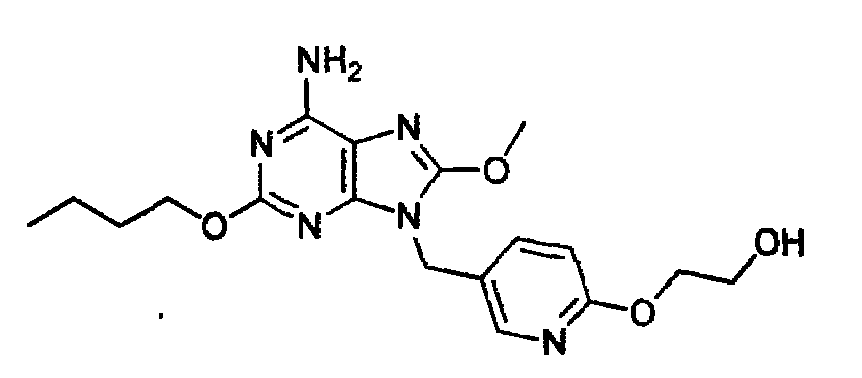
- The compound obtained in Step (ii) (919 mg, 2.10 mmol) was treated in the similar manner to Example 24 Step (iv) to give the subtitled compound (815 mg) as a white solid. Yield 99%.
1H NMR (CDCl3) δ 8.17 (1H, d, J= 2.3 Hz), 7.66 (1H, dd, J= 8.6 Hz, 2.3 Hz), 6.74 (1H, d, J= 8.6Hz), 5.60 (2H, brs), 5.02 (2H, s), 4.44 (2H, t, J= 4.4 Hz), 4.34 (2H, t, J= 6.6 Hz), 4.12 (3H, s), 3.93 (2H, t, 4.4 Hz), 3.49 (1H, brs), 1.82-1.75 (2H, m), 1.55-1.46 (2H, m), 0.98 (3H, t, J= 7.4 Hz). -

- To a solution of the compound obtained in Step (iii) (886 mg, 2.10 mmol) in N,N-dimethylformamide (10 ml) were added triethylamine (350 µl, 2.51 mmol), 4-dimethylaminopyridine (56 mg, 0.46 mmol) and methanesulfonyl chloride (194 µl), and the mixture was stirred at room temperature for 2 hours. The mixture was concentrated in vacuo, extracted with chloroform and dried over anhydrous magnesium sulfate, then concentrated in vacuo and purified by silica gel column chromatography to give the subtitled compound (236 mg) as a white solid. Yield 28%.
1H NMR (CDCl3) δ 7.49-7.46 (2H, m), 6.52 (1H, d, J= 9.3 Hz), 5.14 (2H, brs), 4.84 (2H, s), 4.29 (2H, m, J= 6.7 Hz), 4.19 (2H, t, J= 5.4 Hz), 4.13 (3H, s), 3.87 (2H, t, 5.4 Hz), 1.82-1.75 (2H, m), 1.55-1.46 (2H, m), 0.97 (3H, t, J= 7.4 Hz). -

- To a solution of the compound obtained in Step (iv) (236 mg, 0.58 mmol) in N,N-dimethylformamide (10 ml) were added potassium carbonate (160 mg, 1.16 mmol) and methyl isonipecotate (249 mg, 1.74 mmol), and the mixture was heated at 50°C for 24 hours and concentrated. Thereto was added water (30 ml), and the mixture was extracted with chloroform, dried over anhydrous magnesium sulfate, and evaporated, and then purified by column chromatography to give the subtitled compound (131 mg) as a colorless oil. Yield 44%.
1H NMR (CDCl3) δ 7.44 (1H, dd, J= 9.3 Hz, 2.3 Hz), 7.38 (1H, d, J= 2.3 Hz), 6.49 (1H, d, J= 9.3 Hz), 5.14 (2H, brs), 4.88 (2H, s), 4.29 (2H, t, J= 6.6 Hz), 4.13 (3H, s), 3.97 (2H, t, J= 6.4 Hz), 3.69 (3H, s), 2.82 (2H, brs), 2.62 (2H, t, J= 6.4 Hz), 2.29-2.26 (1H, m), 2.13-2.08 (2H, m), 1.87-1.84 (2H, m), 1.80-1.76 (2H, m), 1.66-1.63 (2H, m), 1.55-1.46 (2H, m), 0.98 (3H, t, J= 7.4 Hz). -

- A solution of the compound obtained in Step (v) (131 mg, 0.26 mmol) in 4N hydrochloric acid-methanol was stirred at room temperature for 5 hours, and then evaporated to give the titled compound (128 mg) as a white solid. Yield 93%.
1H NMR (DMSO-d6) δ 10.54 (1H, s), 7.78 (1H, d, J= 2.3 Hz), 7.53 (1H, dd, J= 9.4 Hz, 2.3 Hz), 7.10 (2H, brs), 6.46 (1H, d, J= 9.4 Hz), 4.59 (2H, s), 4.29-4.21 (4H, m), 3.61-3.57 (5H, m), 3.35-3.33 (2H, m), 3.01-2.98 (2H, m), 2.09-2.06 (2H, m), 1.97-1.94 (1H, m), 1.81-1.78 (2H, m), 1.68-1.64 (2H, m), 1.42-1.37 (2H, m), 0.98 (3H, t, J= 7.4 Hz). -

- The compound obtained in Example 32 (95 mg, 0.18 mmol) was treated in the similar manner to Example 25 to give the titled compound (49 mg) as a white solid. Yield 57%.
1H NMR (DMSO-d6) δ 12.89 (1H, brs), 7.47-7.44 (2H,m), 6.58 (2H, brs), 6.29 (1H, d, J= 9.4 Hz), 4.62 (2H, s), 4.13 (2H, t, J= 6.6 Hz), 3.85 (2H, brs), 3.69 (3H, s), 2.64 (2H, brs), 2.31 (2H, brs), 1.79-1.76 (3H, m), 1.65-1.62 (2H, m), 1.50-1.37 (6H, m), 0.92 (3H, t, J= 7.4 Hz). - Human TLR7 or rat TLR7 plasmid and reporter plasmid (NF-kB-SEAP) stably-induced HEK293 cells were suspended in DMEM media (10% FBS, 1% NEAA, 10 ug/mL blastocidin S HCl, 100 ug/mL Zeocin), and the suspension was seeded in 90 µl/well on 96 well plate (hTLR7/seap-293: 20000 cells/well, rTLR7/seap-293: 25000 cells/well).
To the cells seeded on 96 well plate was added in 10 µl/well a test compound wherein DMSO stock solution (2 µl) was hundredfold diluted with medium (200 µl) (final concentration; 1 nM-10 µM, common ratio 3). The mixture was stirred tapping in the side of the plate, and then incubated for 20 hours in CO2 incubator. To the cells stimulated by a test compound was added a substrate for reporter assay (substrate for SEAP, pNPP) by 50 µl/well. 10 minutes after the addition of substrate, a quenching solution (4N NaOH) was added by 50 µl/well, and the enzymatic reaction was quenched. Top seal A was attached on the plate, and absorbance was measured by microplate reader (405 nm).
Each human TLR7 binding activity (EC50) of each compound is shown in Table 1.Table 1 Compound EC50 (nM) Example 1 5.7 Example 2 30.0 Example 3 7.8 Example 4 7.8 Example 5 3.6 Example 7 5.1 Example 9 8.8 Example 12 252.1 Example 14 1.7 Example 16 15.6 Example 18 2.2 Example 20 18.5 Example 21 6.8 Example 23 15.7 Example 24 <1.0 Example 26 2.8 Example 28 2.0 -

-

- 2-Butoxy-9-[4-(4-chloropropyloxy)benzyl]-8-methoxyadenine (0.35 g, 1.6 mmol) was dissolved in DMSO (3 ml), and thereto were added glycine-tert-butyl ester hydrochloride (4.05 g, 24 mmol) and triethylamine (10.2 ml, 75 mmol), and the mixture was stirred at 100°C for 20 hours. The mixture was cooled to room temperature, and then thereto was added saturated sodium bicarbonate water, and the mixture was neutralized and extracted with ethyl acetate. The organic layer was dried over anhydrous sodium sulfate, and then concentrated in vacuo. The residue was purified by silica gel column chromatography to give the subtitled compound (0.39 g) as a white solid.
Yield 49%.
1H NMR (DMSO-d6) δ 10.06 (1H, s), 7.21 (2H, d, J = 8.8), 6.84 (2H, d, J = 8.8 Hz), δ 6.47 (2H, s), δ 4.75 (2H, s), 4.13 (2H, t, J = 6.4 Hz), 3.95 (2H, t, J = 6.4 Hz), δ 3.16 (2H, s), 2.59 (2H, t, J = 6.8 Hz), 1.81-1.72 (2H, m), 1.65-1.57 (2H, m), 1.41-1.32 (11H, m), 0.89 (3H, t, J = 6.8 Hz). -

- The compound obtained in Step (i) (0.39 g, 0.78 mmol) was dissolved in chloroform (5 ml) and NMP (5 ml), and thereto were added tert-butylmethyl-(2-oxoethyl)-carbamate (0.21 g, 1.17 mmol), acetic acid (0.045 ml, 1.17 mmol) and sodium triacetoxyborohydride (0.248 g, 1.17 mmol), and the mixture was stirred at room temperature for 7 hours. Thereto was added saturated sodium bicarbonate water, and the mixture was neutralized and extracted with ethyl acetate. The organic layer was dried over anhydrous sodium sulfate, and then concentrated in vacuo. The residue was purified by silica gel column chromatography to give the subtitled compound (0.44 g) as a white solid.
Yield 86%.
1H NMR (DMSO-D6) δ 9.99 (1H, s), 7.22 (2H, d, J = 8.8), 6.83 (2H, d, J = 8.8 Hz), δ 6.44 (2H, s), δ 4.75 (2H, s), 4.13 (2H, t, J = 6.4 Hz), 3.93 (2H, t, J = 6.4 Hz), δ 3.24 (2H, s), 3.18-3.10 (2H, m), 2.76-2.60 (7H, m), 1.78-1.72 (2H, m), 1.65-1.58 (2H, m), 1.41-1.30 (20H, m), 0.88 (3H, t, J = 6.8 Hz). -

- The compound obtained in Step (ii) (0.24 g, 0.49 mmol) was dissolved in THF (5 ml), and thereto was added a solution of 4N hydrochloric acid in dioxane (5 ml), and the mixture was stirred at room temperature for 8 hours. The filtrate was concentrated to give a crude product, and the crude product was dissolved in methanol (5 ml). Thereto were added 30% aqueous formalin solution (0.4 ml) and sodium cyanoborohydride (0.30 g, 4.8 mmol), and the mixture was stirred at room temperature for 3 hours. To the reaction solution was added 2N aqueous sodium hydroxide solution to around pH7, and then the mixture was concentrated in vacuo. To the residue was added water (3 ml), and the mixture was stirred for 30 minutes, and then the precipitate was filtered. The resulting precipitate was dried, and then dissolved in methanol (5 ml). Thereto was added concentrated sulfuric acid (0.5 ml), and the mixture was refluxed for 18 hours. After cooling to room temperature, the reaction solution was added to saturated sodium bicarbonate water, neutralized and extracted with a mixture of chloroform:methanol = 10:1. The organic layer was dried over anhydrous sodium sulfate, and then concentrated in vacuo. The residue was purified by silica gel column chromatography to give the titled compound (0.13 g) as a white solid. Yield 49%.
1H NMR (DMSO-d6) δ 9.97 (1H, s), 7.22 (2H, d, J = 8.8), 6.83 (2H, d, J = 8.8 Hz), δ 6.44 (2H, s), δ 4.75 (2H, s), 4.13 (2H, t, J = 6.8 Hz), 3.93 (2H, t, J = 6.4 Hz), δ 3.56 (3H, s), δ 3.37 (2H, s), 2.66 (2H, t, J = 6.8 Hz), 2.62 (2H, t, J = 6.8 Hz), 2.22 (2H, t, J = 6.8 Hz), 2.03 (6H, s), 1.78-1.72 (2H, m), 1.65-1.58 (2H, m), 1.41-1.37 (2H, m), 0.88 (3H, t, J = 6.8 Hz). -

-

- 2-(2-Methoxyethoxy)-9-[4-(chloromethyl)benzyl]-8-oxoadenine obtained in Example 11 Step (ii) (0.25 g, 0.69 mmol) was dissolved in DMF (5 ml), and thereto was added 40% aqueous methylamine solution (2 ml), and the mixture was stirred at room temperature for 30 minutes and evaporated. Then, thereto was added 1% ammonia water, and the precipitated solid was filtered to give the subtitled compound (0.18 g) as a white solid. Yield 75%.
1H NMR (DMSO-d6) δ 7.24-7.22 (4H, m), 6.47 (2H, brs), 4.82 (2H, s), 4.25 (2H, t, J = 4.7 Hz), 3.60-3.56 (2H, m), 3.57 (2H, s), 3.25 (3H, s), 2.22 (3H, s). -

- 9-[4-(N-methylamino)methylbenzyl]-2-(2-methoxyethoxy)-8-oxoadenine obtained in Step (i) (0.18 g, 0.51 mmol) was dissolved in N-methylpiperidone (2 ml), and thereto was added N-(tert-butoxycarbonyl)-4-piperidone (0.20 g, 1.01 mmol). The mixture was stirred at room temperature for 30 minutes, and then thereto was added sodium triacetoxyborohydride (0.16 g, 0.76 mmol), and the mixture was stirred for 1.5 hours. The mixture was cooled to 0°C, and thereto was added dropwise 1% ammonia water (6 ml), and the precipitated solid was filtered, dried, and then purified by silica gel column (chloroform/methanol = 50/1 to 25/1) to give the subtitled compound as a white solid. 0.19g, Yield 70%.
1H NMR (DMSO-d6) δ9.96 (1H, s), 7.24-7.22 (4H, m), 6.47 (2H, brs), 4.82 (2H, s), 4.25 (2H, t, J = 4.7 Hz), 4.24-3.94 (2H, m), 3.58 (2H, t, J = 4.7 Hz), 3.49 (2H, s), 3.26 (3H, s), 2.70-2.60 (2H, m), 2.59-2.48 (1H, m),2.05 (3H, s), 1.72-1.67 (2H, m), 1.38 (9H, s), 1.38-1.26 (2H, m). -

- 9-(4-{[N-methyl-N-(N'-Boc-piperidin-4-yl)]amino}methylbenzyl)-2-(2-methoxyethoxy)-8-oxoadenine obtained in Step (i) (0.19 g, 0.34 mmol) was suspended in methanol (2 ml), and thereto was added 4M hydrochloric acid/dioxane (2 ml), and the mixture was stirred at room temperature for 30 minutes and evaporated. Then, thereto were sequentially added DMF (2 ml), diisopropylethylamine (0.29 ml, 1.7 mmol) and methyl bromoacetate (0.036 ml, 0.38 mmol), and the mixture was stirred for 1.5 hours. The mixture was cooled to 0°C, and then thereto was added dropwise 1% ammonia water (6 ml), and the precipitated solid was filtered, dried, and then thereto was added acetonitrile (2.5 ml), and the mixture was heated to stir for 30 minutes. The mxiture was cooled to room temperature, and then the solid was filtered to give the titled compound (0.11 g). A white solid. Yield 64%.
1H NMR (DMSO-d6) δ 10.08 (1H, s), 7.30-7.22 (4H, m), 6.49 (2H, brs), 4.83 (2H, s), 4.26 (2H, t, J = 4.7 Hz), 3.60 (3H, s), 3.58 (2H, t, J = 4.7 Hz), 3.49 (2H, s), 3.27 (3H, s), 3.18 (2H, s), 2.87-2.83 (2H, m), 2.38-2.29 (1H, m), 2.14-2.08 (2H, m), 2.06 (3H, s), 1.69-1.66 (2H, m), 1.51-1.48 (2H, m). -

-

- 1-Boc-4-piperidinemethanol (1.01 g, 4.69 mmol) was dissolved in toluene (9.5 ml), and thereto were added 50% aqueous sodium hydroxide solution (4.5 ml) and tetrabutylammonium bromide (0.376 g, 1.17 mmol), and the mixture was stirred for 30 minutes. Thereto was added tert-butyl bromoacetate (1.04 ml, 7.04 mmol), and the mixture was stirred for 24 hours. The organic layer was washed with saturated saline twice, and then dried over anhydrous magnesium sulfate. The mixture was concentrated in vacuo, and the residue was purified by silica gel column chromatography (eluent; hexane:ethyl acetate = 8:1 to 6:1) to give the subtitled compound (1.30 g) as a colorless oil. Yield 67%.
1H NMR (CDCl3) δ 4.13-4.10 (2H, m), 3.94 (2H, s), 3.35 (2H, d, J = 6.3 Hz), 2.72-2.67 (2H, m), 1.80-1.72 (3H, m), 1.47 (9H, s), 1.45 (9H, s), 1.21-1.12 (2H, m). -

- The compound obtained in Step (i) (1.30 g, 3.95 mmol) was dissolved in chloroform (6.5 ml), and thereto was added 4N dioxane hydrochloric acid (6.5 ml), and the mixture was stirred for 20 hours. The mixture was evaporated and then dissolved in methanol (10 ml), and thereto was added concentrated hydrochloric acid (0.1 ml), and the mixture was heated to stir for 3 hours under refluxing. The reaction solution was poured into saturated sodium bicarbonate water, and extracted with chloroform. The organic layer was dried over sodium sulfate, and then concentrated in vacuo to give the subtitled compound (427 mg) as a yellow oil. Yield 58%.
1H NMR (CDCl3) 54.07 (2H, s), 3.75 (3H, s), 3.36 (2H, d, J = 6.2 Hz), 3.14-3.11 (2H, m), 2.66-2.60 (2H, m), 1.81-1.76 (3H, m), 1.26-1.19 (2H, m). -

- The compound obtained in Step (ii) was treated using compound obtained in Example 11 Step (ii) in the similar manner to Example 8 Step (iii) to give the titled compound. Yield 12%.
1H NMR (DMSO-d6) δ9.96 (1H, brs), 7.22 (4H, s), 6.47 (2H, brs), 4.81 (2H, s), 4.24 (2H, t, J = 4.7 Hz), 4.06 (2H, s), 3.62 (3H, s), 3.57 (2H, t, J = 4.7 Hz), 3.36 (2H, s), 3.27 (2H, d, J = 6.4 Hz), 3.25 (3H, s), 2.74-2.72 (2H, m), 1.87-1.82 (2H, m), 1.59-1.56 (2H, m), 1.50-1.49 (1H, m), 1.17-1.11 (2H, m). -

-

- The subtitled compound was obtained as a colorless oil in the similar manner to Example 37 Step (i). Yield 57%.
1H NMR (CDCl3) δ 7.34-7.27 (5H, m), 4.51 (2H, s), 3.94 (2H, s), 3.63 (2H, t, J = 5.9 Hz), 3.60 (2H, t, J = 5.9 Hz), 1.93 (2H, qui, J = 5.9 Hz), 1.48 (9H, s). -

- The compound obtained in Step (i) (4.89 g, 17.4 mmol) was dissolved in methanol (25 ml), and thereto was added 10% palladium carbon (1.08 g), and the mixture was stirred for 2 hours and 30 minutes under hydrogen. The reaction mixture was filtered through Celite, and concentrated in vacuo. The residue was purified by silica gel column chromatography (eluent; hexane:ethyl acetate = 2:1) to give the subtitled compound (3.07 g) as a colorless oil. Yield 93%.
1H NMR (CDCl3) δ 3.96 (2H, s), 3.81 (2H, q, J = 5.8 Hz), 3.68 (2H, t, J = 5.7 Hz), 2.97 (1H, t, J = 5.8 Hz), 1.83 (2H, qui, J = 5.6 Hz), 1.48 (9H, s). -

- The compound obtained in Step (ii) (423 mg, 2.22 mmol) was dissolved in dimethylsulfoxide (5 ml), and thereto were added triethylamine (2 ml) and sulfur trioxide pyridine complex (2.83 g, 17.8 g), and the mixture was stirred for 1 hour. Thereto was added aqueous saturated ammonium chloride solution, and the mixture was extracted with ethyl acetate. The organic layer was sequentially washed with saturated sodium bicarbonate water, water and saturated saline, and dried over sodium sulfate. The mixture was concentrated in vacuo, and the residue was purified by silica gel column chromatography (eluent; hexane:ethyl acetate = 4:1 to 2:1) to give the subtitled compound (261 mg) as a colorless oil. Yield 63%.
1H NMR (CDCl3) δ 9.83 (1H, t, J = 1.7 Hz), 3.98 (2H, s), 3.88 (2H, t, J = 6.1 Hz), 2.74 (2H, dt, J = 1.7 Hz, 6.1 Hz), 1.48 (9H, s). -

- The compound obtained in Step (iii) (183 mg, 0.973 mmol) was dissolved in N-methyl-2-pyrrolidone (2.5 ml), and thereto were added the compound obtained in Example 36 Step (i) (204 mg, 0.569 mmol) and sodium triacetoxyborohydride (300 mg, 1.42 mmol), and the mixture was stirred for 15 hours. Thereto was added 1% ammonia water, and the precipitated solid was filtered, washed with water and purified by silica gel column chromatography (chloroform to chloroform:methanol = 50:1 to 25:1) to give the subtitled compound as a colorless amorphous solid. Yield 44%.
1H NMR (DMSO-d6) δ 9.94 (1H, s), 7.24 (4H, s), 6.45 (2H, s), 4.81 (2H, s), 4.24 (2H, t, J = 4.8 Hz), 3.89 (2H, s), 3.57 (2H, t, J = 4.8 Hz), 3.43 (2H, t, J = 6.5 Hz), 3.39 (2H, s), 3.27 (3H, s), 2.34 (2H, t, J = 7.2 Hz), 2.04 (3H, s), 1.66 (2H, qui, J = 6.8 Hz), 1.39 (9H, s). -

- To the compound obtained in Step (iv) (196 mg, 0.369 mmol) were added 4N dioxane hydrochloric acid (5 ml) and chloroform (2 ml), and thereto was added methanol (2 ml), and the solution was stirred for 9 hours and evaporated. The residue was dissolved in methanol (2 ml), and thereto was added concentrated sulfuric acid (0.1 ml), and the mixture was heated to stir for 3 hours under refluxing. Thereto was added 1% ammonia water, and the precipitated solid was washed with water to give the titled compound (139 mg) as a white solid. Yield 73%.
1H NMR (DMSO-d6) δ9.95 (1H, s), 7.22 (4H, s), 6.46 (2H, s), 4.82 (2H, s), 4.24 (2H, t, J = 4.8 Hz), 4.03 (2H, s), 3.62 (3H, s), 3.57 (2H, t, J = 4.8 Hz), 3.45 (2H, t, J = 6.4 Hz), 3.38 (2H, s), 3.25 (3H, s), 2.34 (2H, t, J = 7.2 Hz), 2.05 (3H, s), 1.66 (2H, qui, J = 7.0 Hz). -

- The compound obtained in Example 38 was treated in the similar manner to Example 2 to give the titled compound. Yield 91%.
1H NMR (DMSO-d6) δ 10.05 (1H, s), 7.35 (2H, d, J = 8.0 Hz), 7.27 (2H, d, J = 8.0 Hz), 6.50 (2H, s), 4.84 (2H, s), 4.24 (2H, t, J = 4.7 Hz), 3.81 (2H, s), 3.74 (2H, s), 3.57 (2H, t, J = 4.7 Hz), 3.47 (2H, t, J = 5.5 Hz), 3.25 (3H, s), 2.74 (2H, t, J = 6.4 Hz), 2.30 (3H, s), 1.79 (2H, qui, J = 5.8 Hz). -
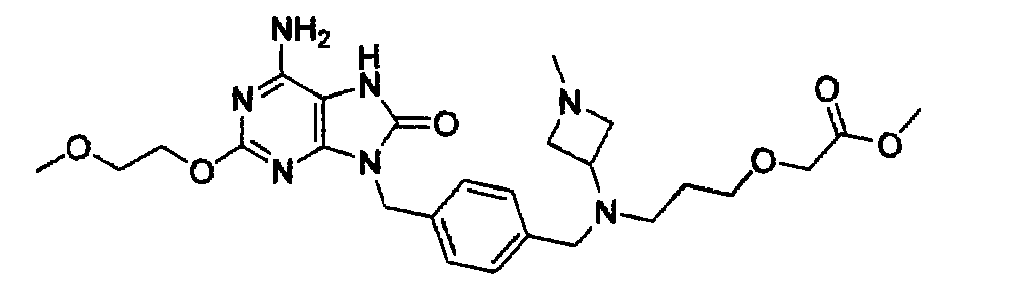
-

- The compound obtained in Example 11 Step (i) (202 mg, 0.562 mmol) was dissolved in chloroform (8 ml), and thereto was added manganese dioxide (488 mg, 5.62 mmol), and the mixture was heated to stir for 2 hours under refluxing. The reaction mixture was filtered through Celite and concentrated in vacuo to give the subtitled compound (191 mg) as a yellow crystal. Yield 95%.
1H NMR (CDCl3) δ 9.98 (1H, s), 7.82 (2H, d, J = 8.2 Hz), 7.45(2H, d, J = 8.2 Hz), 5.20 (2H, s), 5.16 (2H, s), 4.45 (2H, t, J = 5.0 Hz), 4.09 (3H, s), 3.74 (2H, t, J = 5.0 Hz), 3.42 (3H, s). -

- The compound obtained in Step (i) (398 mg, 1.11 mmol) and 1-Boc-3-aminoazetidine were dissolved in chloroform (10 ml), and thereto was added acetic acid (0.064 ml, 1.11 mmol), and the mixture was stirred for 30 minutes. Thereto was added sodium triacetoxyborohydride (704 mg, 3.34 mmol), and the mixture was stirred for 3 hours. Thereto was added saturated sodium bicarbonate water, and the mixture was extracted with chloroform. The organic layer was washed with saturated saline, dried over sodium sulfate, and then concentrated in vacuo. The residue was purified by silica gel column chromatography (chloroform:methanol = 200:1 to 100:1 to 20:1) to give the subtitled compound (570 mg) as a colorless oil. Yield 100%.
1H NMR (CDCl3) δ 7.28 (2H, d, J = 8.1 Hz), 7.22 (2H, d, J = 8.1 Hz), 5.22 (2H, s), 5.07 (2H, s), 4.46 (2H, t, J = 5.0 Hz), 4.08 (3H, s), 4.05 (2H, dd, J = 8.6 Hz, 6.4 Hz), 3.75 (2H, t, J = 5.0 Hz), 3.69 (2H, s), 3.64-3.57 (3H, m), 3.43 (3H, s), 1.42 (9H, s). -

- The compound obtained in Step (ii) (394 mg, 0.768 mmol) and the compound obtained in Example 38 Step (iii) (216 mg, 1.15 mmol) were dissolved in chloroform (8 ml), and the mixture was stirred for 20 minutes. Thereto was added sodium triacetoxyborohydride (322 mg, 1.53 mmol), and the mixture was stirred for 13 hours. Thereto was added saturated sodium bicarbonate water, and the mixture was extracted with chloroform. The organic layer was washed with saturated saline, dried over sodium sulfate, and then concentrated in vacuo. The residue was purified by silica gel column chromatography (chloroform to chloroform:methanol = 50:1) to give the subtitled compound (456 mg) as a colorless oil. Yield 87%.
1H NMR (CDCl3) δ 7.26 (2H, d, J = 8.0 Hz), 7.19 (2H, d, J = 8.0 Hz), 5.16 (2H, s), 5.06 (2H, s), 4.46 (2H, t, J = 5.0 Hz), 4.09 (3H, s), 3.96-3.89 (4H, m), 3.77-3.74 (4H, m), 3.53 (2H, s), 3.51-3.47 (3H, m), 3.43 (3H, s), 2.50 (2H, t, J = 7.2 Hz), 1.71 (2H, qui, J = 7.2 Hz), 1.46 (9H, s), 1.41 (9H, s). -

- The compound obtained in Step (iii) (76 mg, 0.11 mmol) was dissolved in methanol (1 ml), and thereto was added 4N dioxane hydrochloric acid (1 ml), and the mixture was heated to stir for 1 hour under refluxing. The mixture was concentrated in vacuo and dissolved in methanol (2 ml), and thereto were added 35% aqueous formaldehyde solution (0.1 ml) and sodium cyanoborohydride (14 mg, 0.22 mmol), and the mixture was stirred for 2 hours and 30 minutes. Thereto was added saturated sodium bicarbonate water, and the mixture was extracted with chloroform:methanol (10:1). The organic layer was washed with saturated saline, dried over sodium sulfate, and then concentrated in vacuo. The residue was purified by silica gel column chromatography to give the titled compound (33 mg) as a colorless amorphous solid. Yield 55%.
1H NMR (DMSO-d6) δ 9.94 (1H, s), 7.21 (4H, s), 6.45 (2H, s), 4.82 (2H, s), 4.24 (2H, t, J = 4.7 Hz), 4.00 (2H, s), 3.61 (3H, s), 3.57 (2H, t, J = 4.7 Hz), 3.41-3.37 (4H, m), 3.32-3.28 (2H, m), 3.25 (3H, s), 3.09 (1H, qui, J = 7.0 Hz), 2.62 (2H, t, J = 7.0 Hz), 2.29 (2H, t, J = 7.2 Hz), 2.14 (3H, s), 1.55 (2H, qui, J = 6.7 Hz). -

- The compound obtained in Example 40 (27 mg, 0.050 mmol) was dissolved in concentrated hydrochloric acid (1 ml), and the mixture was stirred for 5 hours. The reaction solution was concentrated in vacuo, and thereto was added concentrated hydrochloric acid (1 ml), and the mixture was stirred for 1 hour and evaporated to give the titled compound (33 mg) as a white solid. Yield 100%.
1H NMR (DMSO-d6) δ 10.35 (1H, s), 7.51 (2H, brs), 7.34 (3H, d, J = 7.8 Hz), 6.72 (2H, brs), 4.88 (2H, s), 4.25 (2H, t, J = 4.7 Hz), 3.98 (2H, s), 3.57 (2H, t, J = 4.7 Hz), 3.48-3.42 (12H, m), 3.07-2.87 (5H, m), 1.91-1.83 (2H, m).
the substituted alkyl, substituted alkenyl and substituted alkynyl in R1 is substituted by 1 or more members independently selected from the following (a) to (c):
said substituents being substituted by 1 or 2 substituent(s) where those may be kept in chemically stable state.
Claims (15)
- An adenine compound of the formula (1):
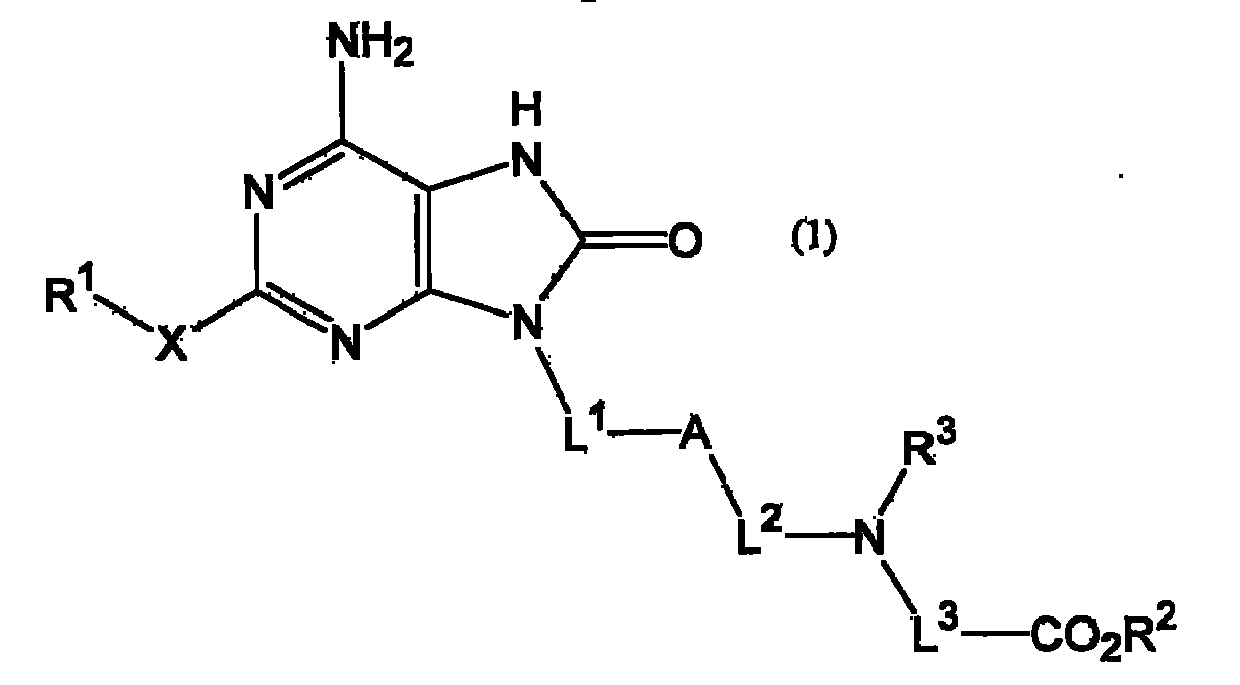
L1 is straight chain or branched chain alkylene, or a single bond;
L2 and L3 are independently straight chain or branched chain alkylene, in which any 1 to 3 of methylene group(s) in the alkylene in L1, L2 and L3 may be replaced by oxygen, sulfur, SO, SO2, carbonyl, NR4CO, CONR4, NR4SO2, SO2NR4, NR4CO2, OCONR4, NR5CONR4, NR6C(=NR4)NR5, C(=NR4)NR5 wherein R4, R5 and R6 are independently hydrogen, or substituted or unsubstituted alkyl;
R1 is halogen, substituted or unsubstituted alkyl, substituted or unsubstituted alkenyl, substituted or unsubstituted alkynyl, substituted or unsubstituted cycloalkyl, substituted or unsubstituted aryl, or substituted or unsubstituted heteroaryl;
R2 is hydrogen, or substituted or unsubstituted alkyl;
R3 is substituted or unsubstituted alkyl, substituted or unsubstituted alkenyl, substituted or unsubstituted alkynyl, substituted or unsubstituted cycloalkyl, or substituted or unsubstituted saturated heterocycle, or R3 may be combined together with L2 or L3 to form nitrogen-containing saturated heterocycle;
X is oxygen, sulfur, SO, SO2, NR7 wherein R7 is hydrogen or alkyl, or a single bond; provided that when R1 is halogen, then X is a single bond; or a pharmaceutically acceptable salt thereof. - The adenine compound according to claim 1, wherein A in the formula (1) is substituted or unsubstituted benzene ring, or substituted or unsubstituted 5- to 6-membered monocyclic nitrogen-containing aromatic heterocycle, in which the substituent on A is selected from halogen, hydroxyl, carboxy, alkyl with 1 to 6 carbon atom(s), alkoxy with 1 to 6 carbon atom(s), alkoxycarbonyl with 2 to 6 carbon atoms, alkylcarbonyl with 2 to 6 carbon atoms, alkylsulfonyl with 1 to 6 carbon atom(s), and alkylsulfinyl with 1 to 6 carbon atom(s), or a pharmaceutically acceptable salt thereof.
- The adenine compound according to claim 1 or 2, wherein in case that R2, R4, R5 or R6 is substituted alkyl, or R3 is substituted alkyl, substituted alkenyl or substituted alkynyl, each group may be substituted by 1 or more substituent(s) selected from the following groups:
halogen, hydroxyl, carboxy, mercapta, alkoxy with 1 to 6 carbon atom(s), haloalkoxy with 1 to 6 carbon atom(s), alkoxycarbonyl with 2 to 6 carbon atoms, alkylsulfonyl with 1 to 6 carbon atom(s), alkylsulfinyl with 1 to 6 carbon atom(s), alkylcarbonyloxy with 2 to 6 carbon atoms, alkylthio with 1 to 6 carbon atom(s), substituted or unsubstituted amino, substituted or unsubstituted carbamoyl, substituted or unsubstituted sulfamoyl, and cycloalkyl in which the cycloalkyl may be substituted by halogen, hydroxyl, carboxy, alkyl with 1 to 4 carbon atom(s) or alkoxy with 1 to 4 carbon atom(s),
the substituted amino, substituted carbamoyl and substituted sulfamoyl may be substituted by 1 or 2 members selected from the following (a') and (b'):(a') alkyl with 1 to 6 carbon atom(s), alkenyl with 2 to 6 carbon atoms, alkynyl with 2 to 6 carbon atoms, alkylcarbonyl with 2 to 6 carbon atoms, alkoxycarbonyl with 2 to 6 carbon atoms, alkylsulfonyl with 1 to 6 carbon atom(s), alkylsulfinyl with 1 to 6 carbon atom(s), 3- to 8-membered cycloalkyl, 3- to 8-membered cycloalkylcarbonyl, 3- to 8-membered cycloalkoxycarbonyl, 3- to 8-membered cycloalkylsulfonyl, 3-to 8-membered cycloalkylsulfinyl,
wherein each group may further be substituted by halogen, hydroxyl, alkyl with 1 to 6 carbon atom(s), alkoxy with 1 to 6 carbon atom(s), carboxy, or alkoxycarbonyl with 2 to 6 carbon atoms;(b') 2 substituents are combined together with nitrogen atom to form 4- to 7-membered nitrogen-containing saturated heterocycle with 1 to 2 heteroatom(s) selected from 1 to 2 nitrogen(s), 0 to 1 oxygen and 0 to 1 sulfur,
wherein the nitrogen-containing saturated heterocycle may be substituted on any carbon atoms or nitrogen atoms by halogen, hydroxyl, carboxy, alkyl with 1 to 6 carbon atom(s), alkoxy with 1 to 6 carbon atom(s), alkoxycarbonyl with 2 to 6 carbon atoms or alkylcarbonyl with 2 to 6 carbon atoms, where the substituent may be kept in chemically stable state,
in case that R3 is substituted cycloalkyl or substituted saturated heterocycle, the substituent is 1 or more members selected from halogen, hydroxyl, alkyl with 1 to 6 carbon atom(s), alkoxy with 1 to 6 carbon atom(s) and amino optionally substituted by 1 or 2 alkyl(s) with 1 to 6 carbon atom(s),
the substituted alkyl, substituted alkenyl and substituted alkynyl in R1 is substituted by 1 or more members independently selected from the following (a) to (c):(a) halogen, hydroxyl, carboxy, haloalkoxy with 1 to 6 carbon atom(s), mercapto;(b) alkoxy with 1 to 6. carbon atom(s), alkylthio with 1 to 6 carbon atom(s), alkylcarbonyl with 2 to 6 carbon atoms, alkylcarbonyloxy with 2 to 6 carbon atoms, alkylsulfonyl with 1 to 6 carbon atom(s), alkylsulfinyl with 1 to 6 carbon atom(s), alkoxycarbonyl with 2 to 6 carbon atoms,
wherein each group may further be substituted by 1 or more group(s) independently selected from halogen, hydroxyl, carboxy, alkoxy with 1 to 6 carbon atom(s), alkoxycarbonyl with 2 to 6 carbon atoms, amino optionally substituted by the same or different 1 or 2 alkyl(s) with 1 to 6 carbon atom(s), carbamoyl optionally substituted by the same or different. 1 or 2 alkyl(s) with 1 to 6 carbon atom(s), sulfamoyl optionally substituted by the same or different 1 or 2 alkyl(s) with 1 to 6 carbon atom(s), and alkylsulfonyl with 1 to 6 carbon atom(s);(c) substituted or unsubstituted amino, substituted or unsubstituted carbamoyl and substituted or unsubstituted sulfamoyl, wherein each group may further be substituted by 1 or 2 substituent(s) selected from the following (j), (k) and (l), substituted or unsubstituted 3- to 8-membered cycloalkyl and substituted or unsubstituted 4- to 8-membered saturated heterocycle, wherein each group may further be substituted by 1 or more substituent(s) selected from the following (d),(e) and (f), and substituted or unsubstituted 6- to 10-membered aryl, substituted or unsubstituted 5- to 10-membered heteroaryl, substituted or unsubstituted 6- to 10-membered aryloxy and substituted or unsubstituted 5- to 10-membered heteroaryloxy, wherein each group may further be substituted by 1 or more substituent(s) selected from the following (g). (h) and (i);
the substituted cycloalkyl in R1 is substituted by 1 or more members independently selected from the following (d) to (f):(d) halogen, hydroxyl, carboxy, mercapto, haloalkyl with 1 to 6 carbon atom(s), haloalkoxy with 1 to 6 carbon atom(s);(e) alkyl with 1 to 6 carbon atom(s), alkenyl with 2 to 6 carbon atoms, alkynyl with 2 to 6 carbon atoms, alkoxy with 1 to 6 carbon atom(s), alkylcarbonyl with 2 to 6 carbon atoms, alkylcarbonyloxy with 2 to 6 carbon atoms, alkoxycarbonyl with 2 to 6 carbon atoms, alkylthio with 1 to 6 carbon atom(s), alkylsulfonyl with 1 to 6 carbon atom(s), alkylsulfinyl with 1 to 6 carbon atom(s);
wherein each group may further be substituted by 1 or more group(s) independently selected from halogen, hydroxyl, carboxy, alkoxy with 1 to 6 carbon atom(s), alkoxycarbonyl with 2 to 6 carbon atoms, amino optionally substituted by the same or different 1 or 2 alkyl(s) with 1 to 6 carbon atom(s), carbamoyl optionally substituted by the same or different 1 or 2 alkyl(s) with 1 to 6 carbon atom(s), sulfamoyl optionally substituted by the same or different 1 or 2 alkyl(s) with 1 to 6 carbon atom(s), and alkylsulfonyl with 1 to 6 carbon atom(s);(f) substituted or unsubstituted amino, substituted or unsubstituted carbamoyl and substituted or unsubstituted sulfamoyl, wherein each group may further be substituted by 1 or 2 substituent(s) selected from the following (j), (k) and (l), and substituted or unsubstituted 6- to 10-membered aryl and substituted or unsubstituted 5- to 10-membered heteroaryl, wherein each group may further be substituted by 1 or more substituent(s) selected from the following (g), (h) and (i);
the substituted aryl and substituted heteroaryl in R1 is substituted by 1 or more members independently selected from the following (g) to (i):(g) halogen, hydroxyl, mercapto, cyano, nitro, haloalkyl with 1 to 6 carbon atom(s), haloalkoxy with 1 to 6 carbon atom(s);(h) alkyl with 1 to 6 carbon atom(s), alkenyl with 2 to 6 carbon atoms, alkynyl with 2 to 6 carbon atoms, alkoxy with 1 to 6 carbon atom(s), alkylcarbonyl with 2 to 6 carbon atoms, alkylcarbonyloxy with 2 to 6 carbon atoms, alkylthio with 1 to 6 carbon atom(s), alkylsulfonyl with 1 to 6 carbon atom(s), alkylsulfinyl with 1 to 6 carbon atom(s), 3- to 8-membered cycloalkyl and 4- to 8-membered saturated heterocycle,
wherein each group may further be substituted by 1 or more group(s) independently selected from halogen, hydroxyl, carboxy, alkyl with 1 to 6 carbon atom(s), alkoxy with 1 to 6 carbon atom(s), alkoxycarbonyl with 2 to 6 carbon atoms, amino optionally substituted by the same or different 1 or 2 alkyl(s) with 1 to 6 carbon atom(s), carbamoyl optionally substituted by the same or different 1 or 2 alkyl(s) with 1 to 6 carbon atam(s), sulfamoyl optionally substituted by the same or different 1 or 2 alkyl(s) with 1 to 6 carbon atom(s), and alkylsulfonyl with 1 to 6 carbon atom(s);(i) substituted or unsubstituted amino, substituted or unsubstituted carbamoyl, substituted or unsubstituted sulfamoyl, wherein each group may further be substituted by 1 or 2 substituent(s) selected from the following (j), (k) and (l);
the substituted amino, substituted carbamoyl and substituted sulfamoyl in the above (a) to (i) are substituted by 1 or 2 members independently selected from the following (j) to (l):(j) alkyl with 1 to 6 carbon atom(s), alkenyl with 2 to 6 carbon atoms, alkynyl with 2 to 6 carbon atoms, alkylcarbonyl with 2 to 6 carbon atoms, alkoxycarbonyl with 2 to 6 carbon atoms, alkylsulfonyl with 1 to 6 carbon atom(s), alkylsulfinyl with 1 to 6 carbon atom(s), 3- to 8-membered cycloalkyl, 3- to 8-membered cycloalkylcarbonyl, 3- to 8-membered cycloalkoxycarbonyl, 3- to 8-membered cycloalkylsulfonyl, 3-to 8-membered cycloalkylsulfinyl,
wherein each group may further be substituted by 1 or more group(s) independently selected from halogen, hydroxyl, carboxy, alkyl with 1 to 6 carbon atom(s), alkoxy with 1 to 6 carbon atom(s), alkoxycarbonyl with 2 to 6 carbon atoms, amino optionally substituted by the same or different 1 or 2 alkyl(s), carbamoyl optionally substituted by the same or different 1 or 2 alkyl(s), sulfamoyl optionally substituted by the same or different 1 or 2 alkyl(s), or alkylsulfonyl;(k) 6- to 10-membered aryl, 6- to 10-membered arylcarbonyl, 6- to 10-membered aryloxycarbonyl, 6- to 10-membered arylsulfonyl, 6- to 10-membered arylsulfinyl, 5- to 10-membered heteroaryl, 5- to 10-membered heteroarylcarbonyl, 5- to 10-membered heteroaryloxycarbonyl, 5- to 10-membered heteroarylsulfonyl, 5- to 10-membered heteroarylsulfinyl,
wherein each group may further be substituted by halogen, hydroxyl, carboxy, alkyl with 1 to 6 carbon atom(s), alkoxy with 1 to 6 carbon atom(s), amino optionally substituted by the same or different 1 or 2 alkyl(s) with 1 to 6 carbon atom(s), carbamoyl optionally substituted by the same or different 1 or 2 alkyl(s) with 1 to 6 carbon atom(s), sulfamoyl optionally substituted by the same or different 1 or 2 alkyl(s) with 1 to 6 carbon atom(s), or alkylsulfonyl with 1 to 6 carbon atom(s);(l) two substituents being combined together with nitrogen atom to form 4- to 7-membered nitrogen-containing saturated heterocycle with 1 to 4 heteroatom(s) selected from 1 to 2 nitrogen(s), 0 to 1 oxygen and 0 to 1 sulfur, - The adenine compound according to any one of claims 1 to 3, wherein "-L2-NR3-L3-" in the formula (1) is a group of the formula (10):

the formula (11):
the formula (12):
the formula (13):
the formula (14):
-(O)p-(CH2)n-NR3'-(CH2)s-(O)p'-(CH2)t-
wherein p, n, t and p' are the same as defined above, s is an integer of 0 to 6 provided that when p' is 1, then s is 2 or more, R3' is hydrogen, alkyl with 1 to 6 carbon atom(s), 3- to 8-membered cycloalkyl or 4- to 8-membered monocyclic saturated heterocycle, in which alkyl, cycloalkyl and saturated heterocycle may be substituted by substituents selected from halogen, hydroxyl, alkyl with 1 to 6 carbon atom(s), alkoxy with 1 to 6 carbon atom(s) and amino optionally substituted by 1 or 2 alkyl(s) with 1 to 6 carbon atom(s);
or a pharmaceutically acceptable salt thereof. - The adenine compound according to any one of claims 1 to 4, wherein L1 is alkylene with 1 to 6 carbon atom(s) in the formula (1), or a pharmaceutically acceptable salt thereof.
- The adenine compound according to any one of claims 1 to 5, wherein R2 is alkyl with 1 to 4 carbon atom(s) in the formula (1), or a pharmaceutically acceptable salt thereof.
- The adenine compound according to claim 6, wherein R2 is methyl in the formula (1), or a pharmaceutically acceptable salt thereof.
- The adenine compound according to any one of claims 1 to 5, wherein R2 is alkyl with 2 to 8 carbon atoms substituted by substituted or unsubstituted amino in the formula (1), or a pharmaceutically acceptable salt thereof.
- The adenine compound according to claim 1, which is selected from the following compounds:2-butoxy-7,8-dihydro-9-[4-{4-[4-(methoxycarbonyl)piperidin-1-yl]-butoxy}benzyl]-8-oxoadenine;2-butoxy-7,8-dihydro-9-[4-{4-[4-(carboxy)pipenam-1-yl]butoxy}benzyl]-8-oxoadenine;2-butoxy-7,8-dihydro-9-(4-[4-{4-[4-(N,N-dimethylamino)-butoxycarbonyl]-piperidin-1-yl}butoxy]benzyl)-8-oxoadenine;2-butoxy-7,8-dihydro-9-[4-{3-[(N-methyl-N-methoxycarbonylmethyl)-amino]propoxy}benzyl]-8-oxoadenine;2-butoxy-7,8-dihydro-9-{4-[1-(methoxycarbonylmethyl)piperidin-4-ylmethyloxy]benzyl}-8-oxoadenine;2-butoxy-7,8-dihydro-9-{4-[1-(carboxymethyl)piperidin-4-ylmethyloxy]-benzyl}-8-oxoadenine;2-butoxy-7,8-dihydro-9-[4-{1-[4-(N,N-dimethylamino)-butoxycarbonylmethyl]-piperidin-4-ylmethyloxy}benzyl]-8-oxoadenine;2-butoxy-7,8-dihydro-9-[4-(N-ethoxycarbonylmothyl-N-methylammomethyl)benzyl]-8-oxoadenine;2-butoxy-7,8-dihydro-9-[4-(N-methoxycarbonylmethyl-N-methylaminomethyl)benayl]-8-oxoadenine;2-butoxy-7,8-clihydro-9-[4-(N-hydroxycarbonylmethyl-N-methylaminomethyl)benzyl]-8-oxoadenme;7,8-dihydro-9-[4-(N-ethoxycarbonyhnethyl-N-niethylaminomethyl)-benzyl]-2-(2-methoxyethoxy)-8-oxoadenine;7,8-dihydro-9-[4-(N-methoxycarbonylmethyl-N-methylaminomethyl)-benzyl]-2-(2-methoxyethoxy)-8-oxoadenine;7,8-dihydro-9-[4-(N-hydroxycarbonylmethyl-N-methylaminomethyl)-benzyl]-2-(2-methoxyethoxy)-8-oxoadenine;7,8-dihydro-9-[4-(4-methoxycarbonylpiperidin-1-ylmethyl)benzyl]-2-(2-methoxyethoxy)-8-oxoadenine;7,8-dihydro-9-[4-(4-hydroxycarbonylpiperidin-1-ylmethyl)benzyl]-2-(2-methoxyethoxy)-8-oxoadenine;2-butoxy-7,8-dihydro-9-[2-methoxy-4-(N-methoxycarbonylmethyl-N-methylaminomethyl)benzyl]-8-oxoadenine;2-butoxy-7,8-dihydro-9-[2-methoxy-4-(N-hydroxycarbonylmethyl-N-methylaminomethyl)benzyl]-8-oxoadenine;2-butoxy-7,8-dihydro-9-{4-[2-(4-methoxycarbonylpiperidm-1-yl)ethyl]-benzyl}-8-oxoadenine;2-butoxy-7,8-dihydro-9-{4-[2-(4-hydroxycarbonylpiperidin-1-yl)ethyl]-benzyl}-8-oxoadenine;2-butoxy-7,8-dihydro-9-{4-[2-(N-methoxycarbonylmethyl-N-methylamino)ethyl]benzyl}-8-oxoadenine;2-butoxy-7,8-dihydro-9-{4-[3-(N-methoxycarbonylmethyl-N-methylamino)ethyl]propyl}-8-oxoadenine;2-butoxy-7,8-dihydro-9-{4-[3-(N-hydroxycarbonylmethyl-N-methylamino)ethyl]propyl}-8-oxoadenine;2-butoxy-7,8-dihydro-9-{4-[N-(4-dimethylaminobutoxycarbonylmethyl)-N-methylaminomethyl]-2-methoxybenzyl}-8-oxoadenine;2-butoxy-7,8-dihydro-9-{6-[4-(4-methnxycarbonylpiperidin-1-yl)butoxy]-pyridin-3-ylmethyl}-8-oxoadenine;2-butoxy-7,8-dihydro-9-{6-[4-(4-hydroxycarbonylpiperidin-1-yl)butoxy]-pyridin-3-ylmethyl}-8-oxoadenine;2-butoxy-7,8-dihydro-9-(6-{4-[(N-methyl-N-methoxycarbonylmethyl)-amino]butoxy}pyridin-3-ylmethyl)-8-oxoadenine;2-butoxy-7,8-dihydro-9-(6-{4-[(N-hydroxycarbonylmethyl-N-methyl)-amino]butoxy}pyridin-3-ylmethyl}-8-oxoadenine;2-butoxy-7,8-dihydro-9-[6-(4-{N'-methyl-N'-[4-(N,N-dimethylamino)-butoxycarbonylmethyl]}aminobutoxy)pyridin-3-ylmethyl]-8-oxoadenine;2-butoxy-7,8-dihydro-9-{6-[3-(4-methoxycarbonylpiperidin-1-yl)-propoxy]pyridin-3-yltnethyl}-8-oxoadenine;2-butoxy-7,8-dihydro-9-{6-[3-(4-hydroxycarbonylpiperidin-1-yl)-butoxy]-pyridin-3-ylmethyl}-8-oxoadenine;2-butoxy-7,8-dihydro-9-{6-[3-(methoxycarbonylmethyl)-aminopropoxy]-pyridin-3-ylmethyl}-8-oxoadenine;2-butoxy-7,8-dihydro-9-{6-[2-(4-methoxycarbonylpiperidin-1-yl)ethoxy]-pyridin-3-ylmethyl}-8-oxoadenine;2-butoxy-7,8-dihydro-9-{6-[2-(4-hydroxycarbonylpiperidin-1-yl)ethoxy]-pyridin-3-ylmethyl}-8-oxoadenine;methyl N-(3-{4-[(6-amino-2-butoxy-8-oxo-7,8-dihydro-9H-purin-9-yl)-methyl]phenoxy}propyl)-N-[2-(dimethylamino)ethyl]glycinate;7,8-dihydro-9-(4-{[N-methyl-N-(N'-methoxycarbonylmethylpiperidin-4-yl)]amino}methylbenzyl)-2-(2-methoxyethoxy)-8-oxoadenine;7,8-dihydro-9-{4-[4-(methoxycarbonylmethoxymethyl)piperidin-1-ylmethyl]benzyl}-2-(2-methoxyethoxy)-8-oxoadenine;7,8-dihydro-9-[4-(3-methoxycarbonylmethoxypropyl)(methyl)-aminomethylbenzyl]-2-(2-methoxyethoxy)-8-oxoadenine;9-[4-(3-carboxymethoxypropyl)(methyl)aminomethylbenzyl]-7,8-dihydro-2-(2-methoxyethoxy)-8-oxoadenine;7,8-dihydro-9-{4-[(3-methoxycarbonylmethoxypropyl)(1-methylazetidin-3-yl)aminomethyl]benzyl}-2-(2-methoxyethoxy)-8-oxoadenine; or9-{4-[(3-carboxymethoxypropyl)(1-methylazetidin-3-yl)aminomethyl]-benzyl}-7,8-dihydro-2-(2-methoxyethoxy)-8-oxoadenine;or a pharmaceutically acceptable salt thereof.
- A pharmaceutical composition comprising as an active ingredient the adenine compound according to any one of claims 1 to 9, or a pharmaceutically acceptable salt thereof.
- An agent for increasing TLR7 activity comprising as an active ingredient the adenine compound according to any one of claims 1 to 9, or a pharmaceutically acceptable salt thereof.
- An immune-regulating agent comprising as an active ingredient the adenine compound according to any one of claims 1 to 9, or a pharmaceutically acceptable salt thereof.
- An agent for the treatment or prevention of allergic disease, viral disease or cancer, which comprises as an active ingredient the adenine compound according to any one of claims 1 to 9, or a pharmaceutically acceptable salt thereof.
- An agent for the treatment or prevention of asthma, COPD, allergic rhinitis, allergic conjunctivitis, atopic dermatitis, cancer, hepatitis B, hepatitis C, HIV, HPV, bacterial infectious disease or dermatitis, which comprises as an active ingredient the adenine compound according to any one of claims 1 to 9, or a pharmaceutically acceptable salt thereof.
- A pharmaceutical composition for local administration, which comprises as an active ingredient the adenine compound according to any one of claims 1 to 9, or a pharmaceutically acceptable salt thereof.
Applications Claiming Priority (2)
| Application Number | Priority Date | Filing Date | Title |
|---|---|---|---|
| JP2005275091 | 2005-09-22 | ||
| PCT/JP2006/318855 WO2007034917A1 (en) | 2005-09-22 | 2006-09-22 | Novel adenine compound |
Publications (2)
| Publication Number | Publication Date |
|---|---|
| EP1939201A1 true EP1939201A1 (en) | 2008-07-02 |
| EP1939201A4 EP1939201A4 (en) | 2010-06-16 |
Family
ID=37888959
Family Applications (1)
| Application Number | Title | Priority Date | Filing Date |
|---|---|---|---|
| EP06798243A Withdrawn EP1939201A4 (en) | 2005-09-22 | 2006-09-22 | NEW ADENINE COMPOUND |
Country Status (4)
| Country | Link |
|---|---|
| US (1) | US20090105212A1 (en) |
| EP (1) | EP1939201A4 (en) |
| JP (1) | JPWO2007034917A1 (en) |
| WO (1) | WO2007034917A1 (en) |
Cited By (12)
| Publication number | Priority date | Publication date | Assignee | Title |
|---|---|---|---|---|
| WO2009034386A1 (en) * | 2007-09-13 | 2009-03-19 | Astrazeneca Ab | Derivatives of adenine and 8-aza-adenine and uses thereof-796 |
| WO2010033074A1 (en) * | 2008-09-18 | 2010-03-25 | Astrazeneca Ab | Use of a tlr7 agonist for the treatment of cancer |
| WO2010077613A1 (en) * | 2008-12-09 | 2010-07-08 | Gilead Sciences, Inc. | Modulators of toll-like receptors |
| WO2012011606A1 (en) * | 2010-07-20 | 2012-01-26 | Dainippon Sumitomo Pharma Co., Ltd. | Process for preparing adenine compounds and intermediates thereof |
| US8476270B2 (en) | 2009-09-14 | 2013-07-02 | Gilead Sciences, Inc. | Dihydropyrido[4,3-b]pyrazine-3-ones as modulators of toll-like receptors |
| US8895570B2 (en) | 2010-12-17 | 2014-11-25 | Astrazeneca Ab | Purine derivatives |
| US9573952B2 (en) | 2014-09-16 | 2017-02-21 | Gilead Sciences, Inc. | Methods of preparing toll-like receptor modulators |
| US10202384B2 (en) | 2014-09-16 | 2019-02-12 | Gilead Sciences, Inc. | Solid forms of a toll-like receptor modulator |
| WO2019196918A1 (en) * | 2018-04-13 | 2019-10-17 | 罗欣药业(上海)有限公司 | Five-membered heterocyclo-pyrimidine compound, pharmaceutical composition and use thereof |
| US11116774B2 (en) | 2014-07-11 | 2021-09-14 | Gilead Sciences, Inc. | Modulators of toll-like receptors for the treatment of HIV |
| WO2024099907A1 (en) | 2022-11-09 | 2024-05-16 | Boehringer Ingelheim International Gmbh | Cyclic benzimidazole derivatives as cgas inhibitors |
| US12611453B2 (en) | 2019-05-22 | 2026-04-28 | Gilead Sciences, Inc. | Method of inducing an HIV-1-specific immune response using a chimpanzee adenovirus vector encoding an hivacat t-cell immunogen and TLR7 agonist |
Families Citing this family (70)
| Publication number | Priority date | Publication date | Assignee | Title |
|---|---|---|---|---|
| KR101111085B1 (en) * | 2002-09-27 | 2012-04-12 | 다이닛본 스미토모 세이야꾸 가부시끼가이샤 | New Adenine Compounds and Their Uses |
| US8012964B2 (en) | 2004-03-26 | 2011-09-06 | Dainippon Sumitomo Pharma Co., Ltd. | 9-substituted 8-oxoadenine compound |
| JP2009504803A (en) * | 2005-08-22 | 2009-02-05 | ザ リージェンツ オブ ザ ユニバーシティ オブ カリフォルニア | TLR agonist |
| TW200801003A (en) * | 2005-09-16 | 2008-01-01 | Astrazeneca Ab | Novel compounds |
| US20090118263A1 (en) * | 2005-09-22 | 2009-05-07 | Dainippon Sumitomo Pharma Co., Ltd. | Novel Adenine Compound |
| EP2029597A4 (en) * | 2006-05-31 | 2011-11-23 | Univ California | ANALOGUES OF THE PURINE |
| WO2008004948A1 (en) * | 2006-07-05 | 2008-01-10 | Astrazeneca Ab | 8-oxoadenine derivatives acting as modulators of tlr7 |
| TW200831105A (en) | 2006-12-14 | 2008-08-01 | Astrazeneca Ab | Novel compounds |
| ES2456964T3 (en) * | 2007-02-07 | 2014-04-24 | The Regents Of The University Of California | Conjugates of synthetic TLR agonists and their uses |
| EP2125792B1 (en) * | 2007-02-19 | 2010-12-01 | GlaxoSmithKline LLC | Purine derivatives as immunomodulators |
| SI2132209T1 (en) | 2007-03-19 | 2014-05-30 | Astrazeneca Ab | 9-substituted-8-oxo-adenine compounds as toll-like receptor (tlr7 ) modulators |
| JP5329444B2 (en) | 2007-03-19 | 2013-10-30 | アストラゼネカ・アクチエボラーグ | 9-Substituted-8-oxo-adenine compounds as TOLL-like receptor (TLR7) modulators |
| EP2138497A4 (en) * | 2007-03-20 | 2012-01-04 | Dainippon Sumitomo Pharma Co | NEW ADENINE COMPOUND |
| AR065784A1 (en) * | 2007-03-20 | 2009-07-01 | Dainippon Sumitomo Pharma Co | DERIVATIVES OF 8-OXO ADENINE, DRUGS THAT CONTAIN THEM AND USES AS THERAPEUTIC AGENTS FOR ALLERGIC, ANTIVIRAL OR ANTIBACTERIAL DISEASES. |
| EP2155743B1 (en) * | 2007-05-08 | 2012-08-29 | AstraZeneca AB | Imidazoquinolines with immuno-modulating properties |
| SI2170888T1 (en) * | 2007-06-29 | 2015-10-30 | Gilead Sciences, Inc. | Purine derivatives and their use as modulators of toll-like receptor 7 |
| PE20091236A1 (en) | 2007-11-22 | 2009-09-16 | Astrazeneca Ab | PYRIMIDINE DERIVATIVES AS IMMUNOMODULATORS OF TLR7 |
| PE20091156A1 (en) | 2007-12-17 | 2009-09-03 | Astrazeneca Ab | SALTS OF (3 - {[[3- (6-AMINO-2-BUTOXY-8-OXO-7,8-DIHIDRO-9H-PURIN-9-IL) PROPYL] (3-MORFOLIN-4-ILPROPIL) AMINO] METHYL} PHENYL) METHYL ACETATE |
| JPWO2009091031A1 (en) * | 2008-01-17 | 2011-05-26 | 大日本住友製薬株式会社 | Method for producing adenine compound |
| WO2009091032A1 (en) | 2008-01-17 | 2009-07-23 | Dainippon Sumitomo Pharma Co., Ltd. | Method for producing adenine compound |
| JP2011511073A (en) * | 2008-02-07 | 2011-04-07 | ザ リージェンツ オブ ザ ユニバーシティ オブ カリフォルニア | Treatment of bladder disease with TLR7 activator |
| UA103195C2 (en) | 2008-08-11 | 2013-09-25 | Глаксосмитклайн Ллк | PURCHASE DERIVATIVES FOR THE APPLICATION IN THE TREATMENT OF ALLERGIES, INFLAMMATORY AND INFECTIOUS DISEASES |
| WO2010088924A1 (en) | 2009-02-06 | 2010-08-12 | Telormedix Sa | Pharmaceutical compositions comprising imidazoquinolin(amines) and derivatives thereof suitable for local administration |
| WO2010093436A2 (en) | 2009-02-11 | 2010-08-19 | Carson Dennis A | Toll-like receptor modulators and treatment of diseases |
| GB0908772D0 (en) | 2009-05-21 | 2009-07-01 | Astrazeneca Ab | New salts 756 |
| AU2010290896B2 (en) | 2009-09-02 | 2014-07-03 | Glaxosmithkline Biologicals S.A. | Immunogenic compositions including TLR activity modulators |
| MX2012004706A (en) | 2009-10-22 | 2012-06-08 | Gilead Sciences Inc | Derivatives of purine or deazapurine useful for the treatment of (inter alia) viral infections. |
| EP2507237A1 (en) * | 2009-12-03 | 2012-10-10 | Dainippon Sumitomo Pharma Co., Ltd. | Imidazoquinolines which act via toll - like receptors (tlr) |
| US20110150836A1 (en) * | 2009-12-22 | 2011-06-23 | Gilead Sciences, Inc. | Methods of treating hbv and hcv infection |
| WO2011134668A1 (en) | 2010-04-30 | 2011-11-03 | Telormedix Sa | Phospholipid drug analogs |
| US9050319B2 (en) | 2010-04-30 | 2015-06-09 | Telormedix, Sa | Phospholipid drug analogs |
| MX343914B (en) | 2010-09-01 | 2016-11-18 | Glaxosmithkline Biologicals Sa | Adsorption of immunopotentiators to insoluble metal salts. |
| WO2012080728A1 (en) | 2010-12-16 | 2012-06-21 | Astrazeneca Ab | Imidazo [4, 5 -c] quinolin- 1 -yl derivative useful in therapy |
| US20140112950A1 (en) | 2011-03-02 | 2014-04-24 | Manmohan Singh | Combination vaccines with lower doses of antigen and/or adjuvant |
| AU2012289042A1 (en) | 2011-07-22 | 2014-03-13 | Glaxosmithkline Llc | Composition |
| BR112014004782A2 (en) | 2011-09-01 | 2017-03-21 | Novartis Ag | adjuvant formulations of staphylococcus aureus antigens |
| CN104519910B (en) | 2012-03-07 | 2017-05-03 | 诺华股份有限公司 | Adjuvanted formulations of streptococcus pneumoniae antigens |
| WO2013131984A1 (en) | 2012-03-07 | 2013-09-12 | Novartis Ag | Adjuvanted formulations of rabies virus immunogens |
| JP6345603B2 (en) | 2012-03-08 | 2018-06-20 | ノバルティス アーゲー | Adjuvanted formulation of booster vaccine |
| EP2850067B1 (en) | 2012-05-18 | 2017-08-16 | Sumitomo Dainippon Pharma Co., Ltd. | Carboxylic acid compounds |
| MX359671B (en) | 2012-08-24 | 2018-10-05 | Glaxosmithkline Llc Star | Pyrazolopyrimidine compounds. |
| EP2892553A1 (en) | 2012-09-06 | 2015-07-15 | Novartis AG | Combination vaccines with serogroup b meningococcus and d/t/p |
| PL2922549T3 (en) | 2012-11-20 | 2017-11-30 | Glaxosmithkline Llc | Novel compounds |
| WO2014081643A1 (en) | 2012-11-20 | 2014-05-30 | Glaxosmithkline Llc | Novel compounds |
| CA2890201A1 (en) | 2012-11-20 | 2014-05-30 | Glaxosmithkline Llc | Novel compounds |
| SG11201608299TA (en) | 2014-05-01 | 2016-11-29 | Novartis Ag | Compounds and compositions as toll-like receptor 7 agonists |
| KR102139847B1 (en) * | 2014-05-01 | 2020-07-31 | 노파르티스 아게 | Compounds and compositions as toll-like receptor 7 agonists |
| US11697851B2 (en) | 2016-05-24 | 2023-07-11 | The Regents Of The University Of California | Early ovarian cancer detection diagnostic test based on mRNA isoforms |
| WO2017219931A1 (en) * | 2016-06-22 | 2017-12-28 | 四川科伦博泰生物医药股份有限公司 | Dihydro pteridinone derivative, preparation method therefor, and application thereof |
| US10508115B2 (en) | 2017-08-16 | 2019-12-17 | Bristol-Myers Squibb Company | Toll-like receptor 7 (TLR7) agonists having heteroatom-linked aromatic moieties, conjugates thereof, and methods and uses therefor |
| US10472361B2 (en) | 2017-08-16 | 2019-11-12 | Bristol-Myers Squibb Company | Toll-like receptor 7 (TLR7) agonists having a benzotriazole moiety, conjugates thereof, and methods and uses therefor |
| US10487084B2 (en) | 2017-08-16 | 2019-11-26 | Bristol-Myers Squibb Company | Toll-like receptor 7 (TLR7) agonists having a heterobiaryl moiety, conjugates thereof, and methods and uses therefor |
| US10494370B2 (en) | 2017-08-16 | 2019-12-03 | Bristol-Myers Squibb Company | Toll-like receptor 7 (TLR7) agonists having a pyridine or pyrazine moiety, conjugates thereof, and methods and uses therefor |
| US10457681B2 (en) | 2017-08-16 | 2019-10-29 | Bristol_Myers Squibb Company | Toll-like receptor 7 (TLR7) agonists having a tricyclic moiety, conjugates thereof, and methods and uses therefor |
| JP2021035910A (en) * | 2017-11-01 | 2021-03-04 | 大日本住友製薬株式会社 | Substituted purine compound |
| WO2019209811A1 (en) | 2018-04-24 | 2019-10-31 | Bristol-Myers Squibb Company | Macrocyclic toll-like receptor 7 (tlr7) agonists |
| US11554120B2 (en) | 2018-08-03 | 2023-01-17 | Bristol-Myers Squibb Company | 1H-pyrazolo[4,3-d]pyrimidine compounds as toll-like receptor 7 (TLR7) agonists and methods and uses therefor |
| CN111072667A (en) * | 2018-10-22 | 2020-04-28 | 罗欣药业(上海)有限公司 | Five-membered or six-membered heterocyclic pyrimidine compound and application thereof |
| CN119455003A (en) * | 2019-02-12 | 2025-02-18 | Ambrx公司 | Compositions, methods and uses comprising antibody-TLR agonist conjugates |
| WO2021154661A1 (en) | 2020-01-27 | 2021-08-05 | Bristol-Myers Squibb Company | 1H-PYRAZOLO[4,3-d]PYRIMIDINE COMPOUNDS AS TOLL-LIKE RECEPTOR 7 (TLR7) AGONISTS |
| KR20220132593A (en) | 2020-01-27 | 2022-09-30 | 브리스톨-마이어스 스큅 컴퍼니 | 1H-pyrazolo[4,3-d]pyrimidine compounds as toll-like receptor 7 (TLR7) agonists |
| JP2023512207A (en) | 2020-01-27 | 2023-03-24 | ブリストル-マイヤーズ スクイブ カンパニー | 1H-pyrazolo[4,3-d]pyrimidine compounds as Toll-like receptor 7 (TLR7) agonists |
| CN115151546A (en) | 2020-01-27 | 2022-10-04 | 百时美施贵宝公司 | C3-substituted 1H-pyrazolo[4,3-d]pyrimidine compounds as Toll-like receptor 7 (TLR7) agonists |
| KR20220132594A (en) | 2020-01-27 | 2022-09-30 | 브리스톨-마이어스 스큅 컴퍼니 | 1H-pyrazolo[4,3-d]pyrimidine compounds as toll-like receptor 7 (TLR7) agonists |
| EP4097105A1 (en) | 2020-01-27 | 2022-12-07 | Bristol-Myers Squibb Company | 1h-pyrazolo[4,3-d]pyrimidine compounds as toll-like receptor 7 (tlr7) agonists |
| JP2023512204A (en) | 2020-01-27 | 2023-03-24 | ブリストル-マイヤーズ スクイブ カンパニー | 1H-pyrazolo[4,3-d]pyrimidine compounds as Toll-like receptor 7 (TLR7) agonists |
| US20230122249A1 (en) | 2020-01-27 | 2023-04-20 | Bristol-Myers Squibb Company | 1H-PYRAZOLO[4,3-d]PYRIMIDINE COMPOUNDS AS TOLL-LIKE RECEPTOR 7 (TLR7) AGONISTS |
| US20230144824A1 (en) | 2020-01-27 | 2023-05-11 | Bristol-Myers Squibb Company | 1H-PYRAZOLO[4,3-d]PYRIMIDINE COMPOUNDS AS TOLL-LIKE RECEPTOR 7 (TLR7) AGONISTS |
| TW202200589A (en) * | 2020-05-28 | 2022-01-01 | 瑞士商諾華公司 | Mll1 inhibitors and anti-cancer agents |
| KR20250038769A (en) * | 2022-07-26 | 2025-03-19 | 자임워크스 비씨 인코포레이티드 | Immunomodulatory purine-derived compounds, conjugates thereof and methods of use thereof |
Family Cites Families (17)
| Publication number | Priority date | Publication date | Assignee | Title |
|---|---|---|---|---|
| IL73534A (en) | 1983-11-18 | 1990-12-23 | Riker Laboratories Inc | 1h-imidazo(4,5-c)quinoline-4-amines,their preparation and pharmaceutical compositions containing certain such compounds |
| US5994361A (en) * | 1994-06-22 | 1999-11-30 | Biochem Pharma | Substituted purinyl derivatives with immunomodulating activity |
| GB9624482D0 (en) | 1995-12-18 | 1997-01-15 | Zeneca Phaema S A | Chemical compounds |
| WO1997030035A1 (en) | 1996-02-13 | 1997-08-21 | Zeneca Limited | Quinazoline derivatives as vegf inhibitors |
| ES2169355T3 (en) | 1996-03-05 | 2002-07-01 | Astrazeneca Ab | DERIVATIVES OF 4-ANILINOQUINAZOLINA. |
| TW552261B (en) | 1996-07-03 | 2003-09-11 | Japan Energy Corp | Novel purine derivative |
| GB9718972D0 (en) | 1996-09-25 | 1997-11-12 | Zeneca Ltd | Chemical compounds |
| GB9714249D0 (en) | 1997-07-08 | 1997-09-10 | Angiogene Pharm Ltd | Vascular damaging agents |
| CA2311742C (en) | 1997-11-28 | 2009-06-16 | Sumitomo Pharmaceuticals Co., Ltd. | 6-amino-9-benzyl-8-hydroxypurine derivatives |
| GB9900334D0 (en) | 1999-01-07 | 1999-02-24 | Angiogene Pharm Ltd | Tricylic vascular damaging agents |
| GB9900752D0 (en) | 1999-01-15 | 1999-03-03 | Angiogene Pharm Ltd | Benzimidazole vascular damaging agents |
| IL152682A0 (en) | 2000-05-31 | 2003-06-24 | Astrazeneca Ab | Indole derivatives with vascular damaging activity |
| HUP0301742A3 (en) | 2000-07-07 | 2005-08-29 | Angiogene Pharm Ltd | Colchinol derivatives as angiogenesis inhibitors, process for producing them, pharmaceutical compositions containing them and their use |
| BR0112224A (en) | 2000-07-07 | 2003-06-10 | Angiogene Pharm Ltd | Compound, pharmaceutical composition, use of a compound or a pharmaceutically acceptable salt, solvate or prodrug thereof, and process for preparing a compound |
| JP4331944B2 (en) | 2001-04-17 | 2009-09-16 | 大日本住友製薬株式会社 | New adenine derivatives |
| KR101111085B1 (en) * | 2002-09-27 | 2012-04-12 | 다이닛본 스미토모 세이야꾸 가부시끼가이샤 | New Adenine Compounds and Their Uses |
| JP2004137157A (en) * | 2002-10-16 | 2004-05-13 | Sumitomo Pharmaceut Co Ltd | Drugs containing novel adenine derivatives as active ingredients |
-
2006
- 2006-09-22 US US12/067,651 patent/US20090105212A1/en not_active Abandoned
- 2006-09-22 WO PCT/JP2006/318855 patent/WO2007034917A1/en not_active Ceased
- 2006-09-22 JP JP2007536576A patent/JPWO2007034917A1/en active Pending
- 2006-09-22 EP EP06798243A patent/EP1939201A4/en not_active Withdrawn
Cited By (33)
| Publication number | Priority date | Publication date | Assignee | Title |
|---|---|---|---|---|
| WO2009034386A1 (en) * | 2007-09-13 | 2009-03-19 | Astrazeneca Ab | Derivatives of adenine and 8-aza-adenine and uses thereof-796 |
| WO2010033074A1 (en) * | 2008-09-18 | 2010-03-25 | Astrazeneca Ab | Use of a tlr7 agonist for the treatment of cancer |
| EA021377B9 (en) * | 2008-12-09 | 2015-09-30 | Джилид Сайэнс, Инк. | Modulators of toll-like receptors |
| KR101687841B1 (en) | 2008-12-09 | 2016-12-19 | 길리애드 사이언시즈, 인코포레이티드 | Modulators of toll-like receptors |
| US11110091B2 (en) | 2008-12-09 | 2021-09-07 | Gilead Sciences, Inc. | Modulators of toll-like receptors |
| JP2012511577A (en) * | 2008-12-09 | 2012-05-24 | ギリアード サイエンシーズ, インコーポレイテッド | Toll-like receptor modulators |
| US8367670B2 (en) | 2008-12-09 | 2013-02-05 | Gilead Sciences, Inc. | Modulators of toll-like receptors |
| US10172860B2 (en) | 2008-12-09 | 2019-01-08 | Gilead Sciences, Inc. | Modulators of toll-like receptors |
| CN102272134B (en) * | 2008-12-09 | 2013-10-16 | 吉里德科学公司 | TOLL-like receptor modulators |
| US8629142B2 (en) | 2008-12-09 | 2014-01-14 | Gilead Sciences, Inc. | Modulators of toll-like receptors |
| US8809527B2 (en) | 2008-12-09 | 2014-08-19 | Gilead Sciences, Inc. | Modulators of toll-like receptors |
| JP2014208692A (en) * | 2008-12-09 | 2014-11-06 | ギリアード サイエンシーズ, インコーポレイテッド | Modulator of toll-like receptor |
| KR101787309B1 (en) | 2008-12-09 | 2017-10-18 | 길리애드 사이언시즈, 인코포레이티드 | Modulators of toll-like receptors |
| EP2818469A1 (en) * | 2008-12-09 | 2014-12-31 | Gilead Sciences, Inc. | Intermediates for the preparation of modulators of toll-like receptors |
| EA021377B1 (en) * | 2008-12-09 | 2015-06-30 | Джилид Сайэнс, Инк. | Modulators of toll-like receptors |
| US9127006B2 (en) | 2008-12-09 | 2015-09-08 | Gilead Sciences, Inc. | Modulators of toll-like receptors |
| KR20110098809A (en) * | 2008-12-09 | 2011-09-01 | 길리애드 사이언시즈, 인코포레이티드 | Modulators of Toll-Like Receptors |
| WO2010077613A1 (en) * | 2008-12-09 | 2010-07-08 | Gilead Sciences, Inc. | Modulators of toll-like receptors |
| EP3210982A1 (en) * | 2008-12-09 | 2017-08-30 | Gilead Sciences, Inc. | Modulators of toll-like receptors |
| US9452166B2 (en) | 2008-12-09 | 2016-09-27 | Gilead Sciences, Inc. | Modulators of toll-like receptors |
| US8476270B2 (en) | 2009-09-14 | 2013-07-02 | Gilead Sciences, Inc. | Dihydropyrido[4,3-b]pyrazine-3-ones as modulators of toll-like receptors |
| WO2012011606A1 (en) * | 2010-07-20 | 2012-01-26 | Dainippon Sumitomo Pharma Co., Ltd. | Process for preparing adenine compounds and intermediates thereof |
| US8895570B2 (en) | 2010-12-17 | 2014-11-25 | Astrazeneca Ab | Purine derivatives |
| US11116774B2 (en) | 2014-07-11 | 2021-09-14 | Gilead Sciences, Inc. | Modulators of toll-like receptors for the treatment of HIV |
| US12486271B2 (en) | 2014-09-16 | 2025-12-02 | Gilead Sciences, Inc. | Solid forms of a toll-like receptor modulator |
| US10508117B2 (en) | 2014-09-16 | 2019-12-17 | Gilead Sciences, Inc. | Solid forms of a toll-like receptor modulator |
| US9573952B2 (en) | 2014-09-16 | 2017-02-21 | Gilead Sciences, Inc. | Methods of preparing toll-like receptor modulators |
| US10202384B2 (en) | 2014-09-16 | 2019-02-12 | Gilead Sciences, Inc. | Solid forms of a toll-like receptor modulator |
| US11773098B2 (en) | 2014-09-16 | 2023-10-03 | Gilead Sciences, Inc. | Solid forms of a toll-like receptor modulator |
| US11072615B2 (en) | 2014-09-16 | 2021-07-27 | Gilead Sciences, Inc. | Solid forms of a toll-like receptor modulator |
| WO2019196918A1 (en) * | 2018-04-13 | 2019-10-17 | 罗欣药业(上海)有限公司 | Five-membered heterocyclo-pyrimidine compound, pharmaceutical composition and use thereof |
| US12611453B2 (en) | 2019-05-22 | 2026-04-28 | Gilead Sciences, Inc. | Method of inducing an HIV-1-specific immune response using a chimpanzee adenovirus vector encoding an hivacat t-cell immunogen and TLR7 agonist |
| WO2024099907A1 (en) | 2022-11-09 | 2024-05-16 | Boehringer Ingelheim International Gmbh | Cyclic benzimidazole derivatives as cgas inhibitors |
Also Published As
| Publication number | Publication date |
|---|---|
| EP1939201A4 (en) | 2010-06-16 |
| JPWO2007034917A1 (en) | 2009-03-26 |
| US20090105212A1 (en) | 2009-04-23 |
| WO2007034917A1 (en) | 2007-03-29 |
Similar Documents
| Publication | Publication Date | Title |
|---|---|---|
| US20090105212A1 (en) | Novel adenine compound | |
| US20090099216A1 (en) | Novel adenine compound | |
| US20090118263A1 (en) | Novel Adenine Compound | |
| JPWO2007034881A1 (en) | New adenine compounds | |
| US20080269240A1 (en) | Novel Adenine Compound | |
| US8044056B2 (en) | Adenine compound | |
| US20100093998A1 (en) | Novel adenine compound | |
| ES2563952T3 (en) | 9-substituted 8-oxoadenine compound | |
| US20070225303A1 (en) | 8-Oxoadenine Compound | |
| US20090082332A1 (en) | Purine derivatives for the treatment of viral or allergic diseases and cancers | |
| MX2008013431A (en) | Purine derivatives for use as adenosin a2a receptor agonists. | |
| JP2010526129A (en) | Imidazoquinolines with immunomodulatory properties | |
| JP2009542645A (en) | 8-oxoadenine derivatives acting as modulators of TLR7 | |
| CA2843836A1 (en) | Uracil derivative and use thereof for medical purposes | |
| HK1137991A (en) | Novel adenine compound |
Legal Events
| Date | Code | Title | Description |
|---|---|---|---|
| PUAI | Public reference made under article 153(3) epc to a published international application that has entered the european phase |
Free format text: ORIGINAL CODE: 0009012 |
|
| 17P | Request for examination filed |
Effective date: 20080318 |
|
| AK | Designated contracting states |
Kind code of ref document: A1 Designated state(s): AT BE BG CH CY CZ DE DK EE ES FI FR GB GR HU IE IS IT LI LT LU LV MC NL PL PT RO SE SI SK TR |
|
| RIN1 | Information on inventor provided before grant (corrected) |
Inventor name: NAKAMURA, TOMOAKI Inventor name: ISOBE, YOSHIAKI Inventor name: KURIMOTO, AYUMU Inventor name: HASHIMOTO, KAZUKI Inventor name: NAKAMURA, KEI |
|
| A4 | Supplementary search report drawn up and despatched |
Effective date: 20100520 |
|
| STAA | Information on the status of an ep patent application or granted ep patent |
Free format text: STATUS: THE APPLICATION IS DEEMED TO BE WITHDRAWN |
|
| 18D | Application deemed to be withdrawn |
Effective date: 20101221 |