EP1939155A2 - Ceramic material and cutting tools made thereof for toughness demanding operations - Google Patents
Ceramic material and cutting tools made thereof for toughness demanding operations Download PDFInfo
- Publication number
- EP1939155A2 EP1939155A2 EP07122618A EP07122618A EP1939155A2 EP 1939155 A2 EP1939155 A2 EP 1939155A2 EP 07122618 A EP07122618 A EP 07122618A EP 07122618 A EP07122618 A EP 07122618A EP 1939155 A2 EP1939155 A2 EP 1939155A2
- Authority
- EP
- European Patent Office
- Prior art keywords
- sialon
- phase
- ceramic material
- tin
- weight
- Prior art date
- Legal status (The legal status is an assumption and is not a legal conclusion. Google has not performed a legal analysis and makes no representation as to the accuracy of the status listed.)
- Withdrawn
Links
- 238000005520 cutting process Methods 0.000 title claims abstract description 22
- 229910010293 ceramic material Inorganic materials 0.000 title claims abstract description 10
- 239000000463 material Substances 0.000 claims abstract description 45
- ATJFFYVFTNAWJD-UHFFFAOYSA-N Tin Chemical compound [Sn] ATJFFYVFTNAWJD-UHFFFAOYSA-N 0.000 claims abstract description 15
- 229910052757 nitrogen Inorganic materials 0.000 claims abstract description 14
- 229910052727 yttrium Inorganic materials 0.000 claims abstract description 6
- VWQVUPCCIRVNHF-UHFFFAOYSA-N yttrium atom Chemical compound [Y] VWQVUPCCIRVNHF-UHFFFAOYSA-N 0.000 claims abstract description 4
- PNEYBMLMFCGWSK-UHFFFAOYSA-N aluminium oxide Inorganic materials [O-2].[O-2].[O-2].[Al+3].[Al+3] PNEYBMLMFCGWSK-UHFFFAOYSA-N 0.000 claims description 16
- 229910003564 SiAlON Inorganic materials 0.000 claims description 7
- 229910052782 aluminium Inorganic materials 0.000 claims description 6
- 238000000576 coating method Methods 0.000 claims description 3
- 229910052593 corundum Inorganic materials 0.000 claims 1
- 229910001845 yogo sapphire Inorganic materials 0.000 claims 1
- 238000003754 machining Methods 0.000 abstract description 7
- 229910000601 superalloy Inorganic materials 0.000 abstract description 4
- 239000000203 mixture Substances 0.000 description 16
- 229910052581 Si3N4 Inorganic materials 0.000 description 12
- 238000005245 sintering Methods 0.000 description 12
- HQVNEWCFYHHQES-UHFFFAOYSA-N silicon nitride Chemical compound N12[Si]34N5[Si]62N3[Si]51N64 HQVNEWCFYHHQES-UHFFFAOYSA-N 0.000 description 11
- 239000010936 titanium Substances 0.000 description 10
- 229910052751 metal Inorganic materials 0.000 description 8
- 239000002184 metal Substances 0.000 description 8
- IJGRMHOSHXDMSA-UHFFFAOYSA-N Atomic nitrogen Chemical compound N#N IJGRMHOSHXDMSA-UHFFFAOYSA-N 0.000 description 6
- 239000000919 ceramic Substances 0.000 description 5
- 239000000843 powder Substances 0.000 description 5
- 239000002994 raw material Substances 0.000 description 5
- RUDFQVOCFDJEEF-UHFFFAOYSA-N yttrium(III) oxide Inorganic materials [O-2].[O-2].[O-2].[Y+3].[Y+3] RUDFQVOCFDJEEF-UHFFFAOYSA-N 0.000 description 5
- 238000003991 Rietveld refinement Methods 0.000 description 4
- 238000002441 X-ray diffraction Methods 0.000 description 4
- 150000002739 metals Chemical class 0.000 description 4
- 238000000034 method Methods 0.000 description 4
- 238000002250 neutron powder diffraction Methods 0.000 description 4
- 239000000654 additive Substances 0.000 description 3
- 239000002826 coolant Substances 0.000 description 3
- 229910000816 inconels 718 Inorganic materials 0.000 description 3
- 229910052747 lanthanoid Inorganic materials 0.000 description 3
- 150000002602 lanthanoids Chemical class 0.000 description 3
- 238000004519 manufacturing process Methods 0.000 description 3
- 238000003801 milling Methods 0.000 description 3
- 229910019901 yttrium aluminum garnet Inorganic materials 0.000 description 3
- 229910017083 AlN Inorganic materials 0.000 description 2
- PIGFYZPCRLYGLF-UHFFFAOYSA-N Aluminum nitride Chemical compound [Al]#N PIGFYZPCRLYGLF-UHFFFAOYSA-N 0.000 description 2
- GWEVSGVZZGPLCZ-UHFFFAOYSA-N Titan oxide Chemical compound O=[Ti]=O GWEVSGVZZGPLCZ-UHFFFAOYSA-N 0.000 description 2
- NRTOMJZYCJJWKI-UHFFFAOYSA-N Titanium nitride Chemical compound [Ti]#N NRTOMJZYCJJWKI-UHFFFAOYSA-N 0.000 description 2
- BLOIXGFLXPCOGW-UHFFFAOYSA-N [Ti].[Sn] Chemical compound [Ti].[Sn] BLOIXGFLXPCOGW-UHFFFAOYSA-N 0.000 description 2
- 239000004411 aluminium Substances 0.000 description 2
- XAGFODPZIPBFFR-UHFFFAOYSA-N aluminium Chemical compound [Al] XAGFODPZIPBFFR-UHFFFAOYSA-N 0.000 description 2
- 238000004458 analytical method Methods 0.000 description 2
- 230000015572 biosynthetic process Effects 0.000 description 2
- 239000002131 composite material Substances 0.000 description 2
- 239000013078 crystal Substances 0.000 description 2
- 230000000694 effects Effects 0.000 description 2
- 229910001719 melilite Inorganic materials 0.000 description 2
- 229910021645 metal ion Inorganic materials 0.000 description 2
- 150000004767 nitrides Chemical class 0.000 description 2
- 238000001228 spectrum Methods 0.000 description 2
- 238000007514 turning Methods 0.000 description 2
- 229910001060 Gray iron Inorganic materials 0.000 description 1
- 229910002795 Si–Al–O–N Inorganic materials 0.000 description 1
- 229910000831 Steel Inorganic materials 0.000 description 1
- RTAQQCXQSZGOHL-UHFFFAOYSA-N Titanium Chemical compound [Ti] RTAQQCXQSZGOHL-UHFFFAOYSA-N 0.000 description 1
- 229910052769 Ytterbium Inorganic materials 0.000 description 1
- QXZUUHYBWMWJHK-UHFFFAOYSA-N [Co].[Ni] Chemical compound [Co].[Ni] QXZUUHYBWMWJHK-UHFFFAOYSA-N 0.000 description 1
- 238000005299 abrasion Methods 0.000 description 1
- 238000007792 addition Methods 0.000 description 1
- 230000000996 additive effect Effects 0.000 description 1
- QVGXLLKOCUKJST-UHFFFAOYSA-N atomic oxygen Chemical compound [O] QVGXLLKOCUKJST-UHFFFAOYSA-N 0.000 description 1
- 230000009286 beneficial effect Effects 0.000 description 1
- 239000011230 binding agent Substances 0.000 description 1
- 229910052791 calcium Inorganic materials 0.000 description 1
- 239000003054 catalyst Substances 0.000 description 1
- 150000001768 cations Chemical class 0.000 description 1
- 238000004590 computer program Methods 0.000 description 1
- 239000000470 constituent Substances 0.000 description 1
- PMHQVHHXPFUNSP-UHFFFAOYSA-M copper(1+);methylsulfanylmethane;bromide Chemical compound Br[Cu].CSC PMHQVHHXPFUNSP-UHFFFAOYSA-M 0.000 description 1
- 239000002178 crystalline material Substances 0.000 description 1
- 238000009826 distribution Methods 0.000 description 1
- 238000005553 drilling Methods 0.000 description 1
- 239000007789 gas Substances 0.000 description 1
- 229910052744 lithium Inorganic materials 0.000 description 1
- 229910052749 magnesium Inorganic materials 0.000 description 1
- 230000014759 maintenance of location Effects 0.000 description 1
- 238000005088 metallography Methods 0.000 description 1
- 230000006911 nucleation Effects 0.000 description 1
- 238000010899 nucleation Methods 0.000 description 1
- TWNQGVIAIRXVLR-UHFFFAOYSA-N oxo(oxoalumanyloxy)alumane Chemical compound O=[Al]O[Al]=O TWNQGVIAIRXVLR-UHFFFAOYSA-N 0.000 description 1
- SIWVEOZUMHYXCS-UHFFFAOYSA-N oxo(oxoyttriooxy)yttrium Chemical compound O=[Y]O[Y]=O SIWVEOZUMHYXCS-UHFFFAOYSA-N 0.000 description 1
- 239000001301 oxygen Substances 0.000 description 1
- 229910052760 oxygen Inorganic materials 0.000 description 1
- 239000002245 particle Substances 0.000 description 1
- 238000003825 pressing Methods 0.000 description 1
- 229910052761 rare earth metal Inorganic materials 0.000 description 1
- 150000002910 rare earth metals Chemical class 0.000 description 1
- 230000002787 reinforcement Effects 0.000 description 1
- 229910052706 scandium Inorganic materials 0.000 description 1
- 238000001878 scanning electron micrograph Methods 0.000 description 1
- 230000035939 shock Effects 0.000 description 1
- 150000004760 silicates Chemical class 0.000 description 1
- 229910052710 silicon Inorganic materials 0.000 description 1
- 239000010703 silicon Substances 0.000 description 1
- 239000002002 slurry Substances 0.000 description 1
- 238000001694 spray drying Methods 0.000 description 1
- 230000000087 stabilizing effect Effects 0.000 description 1
- 239000010959 steel Substances 0.000 description 1
- 229910052719 titanium Inorganic materials 0.000 description 1
- MTPVUVINMAGMJL-UHFFFAOYSA-N trimethyl(1,1,2,2,2-pentafluoroethyl)silane Chemical compound C[Si](C)(C)C(F)(F)C(F)(F)F MTPVUVINMAGMJL-UHFFFAOYSA-N 0.000 description 1
- XLYOFNOQVPJJNP-UHFFFAOYSA-N water Substances O XLYOFNOQVPJJNP-UHFFFAOYSA-N 0.000 description 1
- 239000003643 water by type Substances 0.000 description 1
Images
Classifications
-
- C—CHEMISTRY; METALLURGY
- C04—CEMENTS; CONCRETE; ARTIFICIAL STONE; CERAMICS; REFRACTORIES
- C04B—LIME, MAGNESIA; SLAG; CEMENTS; COMPOSITIONS THEREOF, e.g. MORTARS, CONCRETE OR LIKE BUILDING MATERIALS; ARTIFICIAL STONE; CERAMICS; REFRACTORIES; TREATMENT OF NATURAL STONE
- C04B35/00—Shaped ceramic products characterised by their composition; Ceramics compositions; Processing powders of inorganic compounds preparatory to the manufacturing of ceramic products
- C04B35/515—Shaped ceramic products characterised by their composition; Ceramics compositions; Processing powders of inorganic compounds preparatory to the manufacturing of ceramic products based on non-oxide ceramics
- C04B35/58—Shaped ceramic products characterised by their composition; Ceramics compositions; Processing powders of inorganic compounds preparatory to the manufacturing of ceramic products based on non-oxide ceramics based on borides, nitrides, i.e. nitrides, oxynitrides, carbonitrides or oxycarbonitrides or silicides
- C04B35/597—Shaped ceramic products characterised by their composition; Ceramics compositions; Processing powders of inorganic compounds preparatory to the manufacturing of ceramic products based on non-oxide ceramics based on borides, nitrides, i.e. nitrides, oxynitrides, carbonitrides or oxycarbonitrides or silicides based on silicon oxynitride, e.g. SIALONS
-
- C—CHEMISTRY; METALLURGY
- C04—CEMENTS; CONCRETE; ARTIFICIAL STONE; CERAMICS; REFRACTORIES
- C04B—LIME, MAGNESIA; SLAG; CEMENTS; COMPOSITIONS THEREOF, e.g. MORTARS, CONCRETE OR LIKE BUILDING MATERIALS; ARTIFICIAL STONE; CERAMICS; REFRACTORIES; TREATMENT OF NATURAL STONE
- C04B41/00—After-treatment of mortars, concrete, artificial stone or ceramics; Treatment of natural stone
- C04B41/009—After-treatment of mortars, concrete, artificial stone or ceramics; Treatment of natural stone characterised by the material treated
-
- C—CHEMISTRY; METALLURGY
- C04—CEMENTS; CONCRETE; ARTIFICIAL STONE; CERAMICS; REFRACTORIES
- C04B—LIME, MAGNESIA; SLAG; CEMENTS; COMPOSITIONS THEREOF, e.g. MORTARS, CONCRETE OR LIKE BUILDING MATERIALS; ARTIFICIAL STONE; CERAMICS; REFRACTORIES; TREATMENT OF NATURAL STONE
- C04B41/00—After-treatment of mortars, concrete, artificial stone or ceramics; Treatment of natural stone
- C04B41/45—Coating or impregnating, e.g. injection in masonry, partial coating of green or fired ceramics, organic coating compositions for adhering together two concrete elements
- C04B41/50—Coating or impregnating, e.g. injection in masonry, partial coating of green or fired ceramics, organic coating compositions for adhering together two concrete elements with inorganic materials
- C04B41/5025—Coating or impregnating, e.g. injection in masonry, partial coating of green or fired ceramics, organic coating compositions for adhering together two concrete elements with inorganic materials with ceramic materials
- C04B41/5031—Alumina
-
- C—CHEMISTRY; METALLURGY
- C04—CEMENTS; CONCRETE; ARTIFICIAL STONE; CERAMICS; REFRACTORIES
- C04B—LIME, MAGNESIA; SLAG; CEMENTS; COMPOSITIONS THEREOF, e.g. MORTARS, CONCRETE OR LIKE BUILDING MATERIALS; ARTIFICIAL STONE; CERAMICS; REFRACTORIES; TREATMENT OF NATURAL STONE
- C04B41/00—After-treatment of mortars, concrete, artificial stone or ceramics; Treatment of natural stone
- C04B41/45—Coating or impregnating, e.g. injection in masonry, partial coating of green or fired ceramics, organic coating compositions for adhering together two concrete elements
- C04B41/50—Coating or impregnating, e.g. injection in masonry, partial coating of green or fired ceramics, organic coating compositions for adhering together two concrete elements with inorganic materials
- C04B41/5053—Coating or impregnating, e.g. injection in masonry, partial coating of green or fired ceramics, organic coating compositions for adhering together two concrete elements with inorganic materials non-oxide ceramics
- C04B41/5062—Borides, Nitrides or Silicides
- C04B41/5068—Titanium nitride
-
- C—CHEMISTRY; METALLURGY
- C04—CEMENTS; CONCRETE; ARTIFICIAL STONE; CERAMICS; REFRACTORIES
- C04B—LIME, MAGNESIA; SLAG; CEMENTS; COMPOSITIONS THEREOF, e.g. MORTARS, CONCRETE OR LIKE BUILDING MATERIALS; ARTIFICIAL STONE; CERAMICS; REFRACTORIES; TREATMENT OF NATURAL STONE
- C04B41/00—After-treatment of mortars, concrete, artificial stone or ceramics; Treatment of natural stone
- C04B41/80—After-treatment of mortars, concrete, artificial stone or ceramics; Treatment of natural stone of only ceramics
- C04B41/81—Coating or impregnation
- C04B41/85—Coating or impregnation with inorganic materials
- C04B41/87—Ceramics
-
- C—CHEMISTRY; METALLURGY
- C04—CEMENTS; CONCRETE; ARTIFICIAL STONE; CERAMICS; REFRACTORIES
- C04B—LIME, MAGNESIA; SLAG; CEMENTS; COMPOSITIONS THEREOF, e.g. MORTARS, CONCRETE OR LIKE BUILDING MATERIALS; ARTIFICIAL STONE; CERAMICS; REFRACTORIES; TREATMENT OF NATURAL STONE
- C04B2235/00—Aspects relating to ceramic starting mixtures or sintered ceramic products
- C04B2235/02—Composition of constituents of the starting material or of secondary phases of the final product
- C04B2235/30—Constituents and secondary phases not being of a fibrous nature
- C04B2235/32—Metal oxides, mixed metal oxides, or oxide-forming salts thereof, e.g. carbonates, nitrates, (oxy)hydroxides, chlorides
- C04B2235/3217—Aluminum oxide or oxide forming salts thereof, e.g. bauxite, alpha-alumina
-
- C—CHEMISTRY; METALLURGY
- C04—CEMENTS; CONCRETE; ARTIFICIAL STONE; CERAMICS; REFRACTORIES
- C04B—LIME, MAGNESIA; SLAG; CEMENTS; COMPOSITIONS THEREOF, e.g. MORTARS, CONCRETE OR LIKE BUILDING MATERIALS; ARTIFICIAL STONE; CERAMICS; REFRACTORIES; TREATMENT OF NATURAL STONE
- C04B2235/00—Aspects relating to ceramic starting mixtures or sintered ceramic products
- C04B2235/02—Composition of constituents of the starting material or of secondary phases of the final product
- C04B2235/30—Constituents and secondary phases not being of a fibrous nature
- C04B2235/32—Metal oxides, mixed metal oxides, or oxide-forming salts thereof, e.g. carbonates, nitrates, (oxy)hydroxides, chlorides
- C04B2235/3217—Aluminum oxide or oxide forming salts thereof, e.g. bauxite, alpha-alumina
- C04B2235/3222—Aluminates other than alumino-silicates, e.g. spinel (MgAl2O4)
-
- C—CHEMISTRY; METALLURGY
- C04—CEMENTS; CONCRETE; ARTIFICIAL STONE; CERAMICS; REFRACTORIES
- C04B—LIME, MAGNESIA; SLAG; CEMENTS; COMPOSITIONS THEREOF, e.g. MORTARS, CONCRETE OR LIKE BUILDING MATERIALS; ARTIFICIAL STONE; CERAMICS; REFRACTORIES; TREATMENT OF NATURAL STONE
- C04B2235/00—Aspects relating to ceramic starting mixtures or sintered ceramic products
- C04B2235/02—Composition of constituents of the starting material or of secondary phases of the final product
- C04B2235/30—Constituents and secondary phases not being of a fibrous nature
- C04B2235/32—Metal oxides, mixed metal oxides, or oxide-forming salts thereof, e.g. carbonates, nitrates, (oxy)hydroxides, chlorides
- C04B2235/3224—Rare earth oxide or oxide forming salts thereof, e.g. scandium oxide
- C04B2235/3225—Yttrium oxide or oxide-forming salts thereof
-
- C—CHEMISTRY; METALLURGY
- C04—CEMENTS; CONCRETE; ARTIFICIAL STONE; CERAMICS; REFRACTORIES
- C04B—LIME, MAGNESIA; SLAG; CEMENTS; COMPOSITIONS THEREOF, e.g. MORTARS, CONCRETE OR LIKE BUILDING MATERIALS; ARTIFICIAL STONE; CERAMICS; REFRACTORIES; TREATMENT OF NATURAL STONE
- C04B2235/00—Aspects relating to ceramic starting mixtures or sintered ceramic products
- C04B2235/02—Composition of constituents of the starting material or of secondary phases of the final product
- C04B2235/30—Constituents and secondary phases not being of a fibrous nature
- C04B2235/38—Non-oxide ceramic constituents or additives
- C04B2235/3817—Carbides
- C04B2235/3839—Refractory metal carbides
- C04B2235/3843—Titanium carbides
-
- C—CHEMISTRY; METALLURGY
- C04—CEMENTS; CONCRETE; ARTIFICIAL STONE; CERAMICS; REFRACTORIES
- C04B—LIME, MAGNESIA; SLAG; CEMENTS; COMPOSITIONS THEREOF, e.g. MORTARS, CONCRETE OR LIKE BUILDING MATERIALS; ARTIFICIAL STONE; CERAMICS; REFRACTORIES; TREATMENT OF NATURAL STONE
- C04B2235/00—Aspects relating to ceramic starting mixtures or sintered ceramic products
- C04B2235/02—Composition of constituents of the starting material or of secondary phases of the final product
- C04B2235/30—Constituents and secondary phases not being of a fibrous nature
- C04B2235/38—Non-oxide ceramic constituents or additives
- C04B2235/3852—Nitrides, e.g. oxynitrides, carbonitrides, oxycarbonitrides, lithium nitride, magnesium nitride
- C04B2235/3856—Carbonitrides, e.g. titanium carbonitride, zirconium carbonitride
-
- C—CHEMISTRY; METALLURGY
- C04—CEMENTS; CONCRETE; ARTIFICIAL STONE; CERAMICS; REFRACTORIES
- C04B—LIME, MAGNESIA; SLAG; CEMENTS; COMPOSITIONS THEREOF, e.g. MORTARS, CONCRETE OR LIKE BUILDING MATERIALS; ARTIFICIAL STONE; CERAMICS; REFRACTORIES; TREATMENT OF NATURAL STONE
- C04B2235/00—Aspects relating to ceramic starting mixtures or sintered ceramic products
- C04B2235/02—Composition of constituents of the starting material or of secondary phases of the final product
- C04B2235/30—Constituents and secondary phases not being of a fibrous nature
- C04B2235/38—Non-oxide ceramic constituents or additives
- C04B2235/3852—Nitrides, e.g. oxynitrides, carbonitrides, oxycarbonitrides, lithium nitride, magnesium nitride
- C04B2235/3873—Silicon nitrides, e.g. silicon carbonitride, silicon oxynitride
-
- C—CHEMISTRY; METALLURGY
- C04—CEMENTS; CONCRETE; ARTIFICIAL STONE; CERAMICS; REFRACTORIES
- C04B—LIME, MAGNESIA; SLAG; CEMENTS; COMPOSITIONS THEREOF, e.g. MORTARS, CONCRETE OR LIKE BUILDING MATERIALS; ARTIFICIAL STONE; CERAMICS; REFRACTORIES; TREATMENT OF NATURAL STONE
- C04B2235/00—Aspects relating to ceramic starting mixtures or sintered ceramic products
- C04B2235/02—Composition of constituents of the starting material or of secondary phases of the final product
- C04B2235/30—Constituents and secondary phases not being of a fibrous nature
- C04B2235/38—Non-oxide ceramic constituents or additives
- C04B2235/3852—Nitrides, e.g. oxynitrides, carbonitrides, oxycarbonitrides, lithium nitride, magnesium nitride
- C04B2235/3886—Refractory metal nitrides, e.g. vanadium nitride, tungsten nitride
-
- C—CHEMISTRY; METALLURGY
- C04—CEMENTS; CONCRETE; ARTIFICIAL STONE; CERAMICS; REFRACTORIES
- C04B—LIME, MAGNESIA; SLAG; CEMENTS; COMPOSITIONS THEREOF, e.g. MORTARS, CONCRETE OR LIKE BUILDING MATERIALS; ARTIFICIAL STONE; CERAMICS; REFRACTORIES; TREATMENT OF NATURAL STONE
- C04B2235/00—Aspects relating to ceramic starting mixtures or sintered ceramic products
- C04B2235/70—Aspects relating to sintered or melt-casted ceramic products
- C04B2235/74—Physical characteristics
- C04B2235/76—Crystal structural characteristics, e.g. symmetry
- C04B2235/766—Trigonal symmetry, e.g. alpha-Si3N4 or alpha-Sialon
-
- C—CHEMISTRY; METALLURGY
- C04—CEMENTS; CONCRETE; ARTIFICIAL STONE; CERAMICS; REFRACTORIES
- C04B—LIME, MAGNESIA; SLAG; CEMENTS; COMPOSITIONS THEREOF, e.g. MORTARS, CONCRETE OR LIKE BUILDING MATERIALS; ARTIFICIAL STONE; CERAMICS; REFRACTORIES; TREATMENT OF NATURAL STONE
- C04B2235/00—Aspects relating to ceramic starting mixtures or sintered ceramic products
- C04B2235/70—Aspects relating to sintered or melt-casted ceramic products
- C04B2235/74—Physical characteristics
- C04B2235/76—Crystal structural characteristics, e.g. symmetry
- C04B2235/767—Hexagonal symmetry, e.g. beta-Si3N4, beta-Sialon, alpha-SiC or hexa-ferrites
-
- C—CHEMISTRY; METALLURGY
- C04—CEMENTS; CONCRETE; ARTIFICIAL STONE; CERAMICS; REFRACTORIES
- C04B—LIME, MAGNESIA; SLAG; CEMENTS; COMPOSITIONS THEREOF, e.g. MORTARS, CONCRETE OR LIKE BUILDING MATERIALS; ARTIFICIAL STONE; CERAMICS; REFRACTORIES; TREATMENT OF NATURAL STONE
- C04B2235/00—Aspects relating to ceramic starting mixtures or sintered ceramic products
- C04B2235/70—Aspects relating to sintered or melt-casted ceramic products
- C04B2235/74—Physical characteristics
- C04B2235/77—Density
-
- C—CHEMISTRY; METALLURGY
- C04—CEMENTS; CONCRETE; ARTIFICIAL STONE; CERAMICS; REFRACTORIES
- C04B—LIME, MAGNESIA; SLAG; CEMENTS; COMPOSITIONS THEREOF, e.g. MORTARS, CONCRETE OR LIKE BUILDING MATERIALS; ARTIFICIAL STONE; CERAMICS; REFRACTORIES; TREATMENT OF NATURAL STONE
- C04B2235/00—Aspects relating to ceramic starting mixtures or sintered ceramic products
- C04B2235/70—Aspects relating to sintered or melt-casted ceramic products
- C04B2235/74—Physical characteristics
- C04B2235/78—Grain sizes and shapes, product microstructures, e.g. acicular grains, equiaxed grains, platelet-structures
- C04B2235/786—Micrometer sized grains, i.e. from 1 to 100 micron
-
- C—CHEMISTRY; METALLURGY
- C04—CEMENTS; CONCRETE; ARTIFICIAL STONE; CERAMICS; REFRACTORIES
- C04B—LIME, MAGNESIA; SLAG; CEMENTS; COMPOSITIONS THEREOF, e.g. MORTARS, CONCRETE OR LIKE BUILDING MATERIALS; ARTIFICIAL STONE; CERAMICS; REFRACTORIES; TREATMENT OF NATURAL STONE
- C04B2235/00—Aspects relating to ceramic starting mixtures or sintered ceramic products
- C04B2235/70—Aspects relating to sintered or melt-casted ceramic products
- C04B2235/80—Phases present in the sintered or melt-cast ceramic products other than the main phase
-
- C—CHEMISTRY; METALLURGY
- C04—CEMENTS; CONCRETE; ARTIFICIAL STONE; CERAMICS; REFRACTORIES
- C04B—LIME, MAGNESIA; SLAG; CEMENTS; COMPOSITIONS THEREOF, e.g. MORTARS, CONCRETE OR LIKE BUILDING MATERIALS; ARTIFICIAL STONE; CERAMICS; REFRACTORIES; TREATMENT OF NATURAL STONE
- C04B2235/00—Aspects relating to ceramic starting mixtures or sintered ceramic products
- C04B2235/70—Aspects relating to sintered or melt-casted ceramic products
- C04B2235/80—Phases present in the sintered or melt-cast ceramic products other than the main phase
- C04B2235/85—Intergranular or grain boundary phases
-
- C—CHEMISTRY; METALLURGY
- C04—CEMENTS; CONCRETE; ARTIFICIAL STONE; CERAMICS; REFRACTORIES
- C04B—LIME, MAGNESIA; SLAG; CEMENTS; COMPOSITIONS THEREOF, e.g. MORTARS, CONCRETE OR LIKE BUILDING MATERIALS; ARTIFICIAL STONE; CERAMICS; REFRACTORIES; TREATMENT OF NATURAL STONE
- C04B2235/00—Aspects relating to ceramic starting mixtures or sintered ceramic products
- C04B2235/70—Aspects relating to sintered or melt-casted ceramic products
- C04B2235/96—Properties of ceramic products, e.g. mechanical properties such as strength, toughness, wear resistance
Definitions
- the present invention comprises a ceramic silicon nitride based material suitable for machining of metals by turning, drilling, milling or similar chip forming machining methods.
- Ceramic materials for cutting tool applications are, due to their high hot hardness, suitable for machining work-piece materials of high hardness, high tensile strength at elevated temperatures and low heat-diffusivity, particularly for self-hardening materials such as, e.g., some types of nickel- and cobalt-based materials, sometimes designated as heat resistant super alloys (HRSA) .
- HRSA heat resistant super alloys
- Silicon nitride based cutting tools are often used for machining grey cast iron and HRSA.
- Many silicon nitride based materials for cutting tools are manufactured using aluminium oxide (Al 2 O 3 ) as a sintering aid.
- Aluminium and oxygen have the ability to replace silicon and nitrogen respectively in the crystal structure of silicon nitride, thereby creating a so-called sialon ceramic, consisting of Si-Al-O-N, sometimes additionally stabilized by a cation Me n+ , where Me can be chosen from a large number of (rare-earth) metals and lanthanides of suitable ionic radius (r ⁇ 1.0 ⁇ ), such as Y, Yb, Dy, Lu, Li, Ca, Mg, Sc etc.
- the raw materials used usually a mixture of silicon nitride, alumina and AlN or some sialon polyphase together with an oxide of the metal or lanthanide, form a transitionary melt from which the ⁇ - and ⁇ -sialon phases, and possibly other phases such as YAG (Y 3 Al 5 O 12 ), melilite (Y 2 Si 3 O 3 N 4 ), B-phase (Y 2 SiAlO 5 N), 12H etc. crystallize.
- YAG Y 3 Al 5 O 12
- melilite Y 2 Si 3 O 3 N 4
- B-phase Y 2 SiAlO 5 N
- the metal ion also functions as a catalyst for the formation of sialon crystals during sintering, and aids the formation of elongated sialon grains, usually in the beta phase, but elongated grains of ⁇ -sialon have also been produced, see Fang-Fang X, Shu-Lin W, Nordberg L-O and Ekström T, "Nucleation and Growth of the Elongated ⁇ '-SiAlON", J. Eur. Ceram. Soc. 17(13) 1631-1638 (1997) .
- the z-value in the ⁇ -sialon phase affects the hardness, toughness, and grain size distribution in the sintered material, see Ekström T, Nygren M, "SiAlON ceramics", J. Am. Ceram. Soc. 75(2), 259-276 (1992) . It also affects the cutting tool properties of the material; lower z-value usually means higher toughness and lower notch wear resistance.
- TiN is currently used as an additive in some sialons available commercially for cutting tool applications; its primary function is to decrease abrasive wear and increase fracture toughness, see Ayas E, Kara A, Mandal H, Turan S, Kara F, "Production of alpha-beta SiAlON-TiN/TiCN Composites", Silicates Industriels 69(7-8) 287-292 , although one may also speculate on its beneficial impact on thermal shock resistance due to its relatively high thermal conductivity.
- GB-A-2155007 discloses a range of sialon materials suitable for use in metal cutting tools, with z-values ranging from 0 to 4.2, an ⁇ -sialon content ranging from 10 to 70 % by volume, as well as additions of cubic nitride and carbide particle reinforcement with a weight percent ranging from 0 to 45 % by volume. Different compositions were tried in turning of steel.
- WO 2005/016847 describes a method of making and a composition of a sialon material which as sintered material consists of 10-90 by volume of ⁇ -sialon and 3-30 % by volume of a cubic nitride or carbide phase, such as SiC, Ti(C,N), TiC, TiN etc.
- US 5,432,132 relates to a silicon nitride based composition for manufacturing sintered ceramic articles, in particular cutting tool inserts, having improved density, hardness and fracture toughness characteristics is described.
- the amounts of yttrium oxide, aluminum nitride and titanium nitride contained in the silicon nitride based mixture are interrelated by a formula to attain substantially improved abrasion resistance.
- the object of the present invention is to provide a sialon based ceramic materials for metal cutting tool purposes with optimal compositions for machining metals, preferably heat resistant super alloys, with a superior toughness.
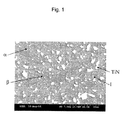
- Fig 1 shows a SEM image in backscattered mode of the structure of a sialon material according to the invention in which ⁇ - ⁇ -sialon ⁇ - ⁇ -sialon I - intergranular phase and TiN - titanium nitride.
- the present invention provides a silicon nitride based material which comprises, in addition to intergranular amorphous and/or crystalline phase, ⁇ -sialon, i.e. Si 6-z Al z O z N, preferably with 0.3 ⁇ z ⁇ 0.8, ⁇ -sialon, i.e.
- the material contains yttrium, 3.5-6 percent by weight, preferably 4-5 percent by weight measured as elemental Y.
- the content of aluminium, measured as elemental Al, is 5-7 weight%.
- the amount of intergranular phase is between 3 and 10 %.
- the material also contains other hard, essentially inert constituents, TiN, TiC or Ti(C,N) or mixtures thereof, preferably TiN or, alternatively, preferably Ti(C,N), in amounts of 10-20 wt-%, preferably 13-17 wt-% of grains with a size of 1-5 ⁇ m.
- the material may contain up 3 percent by weight of YAG, B-phase or melilite. The material has negligible porosity.
- the material is particularly useful a material for cutting tool inserts for machining of heat resistant super alloys (HRSA).
- Such cutting tool inserts can be provided with coatings of TiN, Ti(C,N), Al 2 O 3 or (Ti,Al)N or any combination thereof.
- the application area is primarily toughness demanding operations with forged skin, light intermittence and less stable conditions.
- Sialon materials according to the invention are made by powder metallurgical methods such as milling, pressing and sintering. Suitable proportions of powders of silicon nitride, titanium nitride (or titanium carbide or titanium carbonitride), alumina, yttria and aluminium nitride, polyphase 21R, 12H, 27R or 15H are milled and pressed to blanks. The blanks are placed on sintering trays without embedding in a powder bed and burnt off separately, and then sintered in a gas pressure sintering furnace. The final part of the sintering takes place at 1700-1900°C under nitrogen pressure.
- the blanks may be ground to inserts for metal cutting of desired shape and dimension.
- the inserts are optionally provided with coatings of TiN, Ti(C,N), Al 2 O 3 or (Ti,Al)N or any combination thereof as known in the art.
- Powder raw materials according to the compositions in Table A, except materials I, K and L, which are commercially available sialon cutting tools, were milled in water, using sialon milling media.
- Organic binders were mixed into the slurry, which was then granulated through spray drying.
- the powders were cold-pressed uniaxially to form green bodies, which were then burnt off separately at 650°C.
- the burnt off green bodies were then sintered under nitrogen pressure at a maximum sintering temperature of 1810°C.
- Table A Composition of raw materials Composition, wt-% raw material Elemental composition Material Si 3 N 4 Al 2 O 3 21R-F Y 2 O 3 TiN wt-% Al wt-% Y wt-% A 70.09 1.87 9.35 5.14 13.55 5.9 4 C 71.09 1.9 9.48 3.79 13.75 7 3.5 D 81.07 2.16 10.81 5.95 0 6.9 4.7 E 66.91 0 13.98 4.14 14.98 8.7 3.8 F 77.07 2.04 10.14 5.63 5.11 6.9 4.7 G 74.77 0 15.62 4.61 5 8.7 3.8 I N/A N/A N/A N/A 0 2.2 8.5 K N/A N/A N/A N/A 0 6.1 7 1) J 69.7 1.94 9.3 5.12 13.5 5.9 4 L 68.6 14.8 10.9 5 0 13.6 3.9 1) Yb Table B: Material properties Material Measured z-value Weight ratio alfa/ (alfa +be
- compositions A, D, E, F, G and I in Table 1 were ground to inserts of ISO RPGX120700T01020 type and tested in a double facing operation against a shoulder in Inconel 718 using a speed of 280 m/min, feed 0.2 mm/rev and a cutting depth of 2.5+2.5 mm. Coolant was used.
- the inserts were run in test cycles, where one test cycle corresponds to the described facing operation, in three test runs, each with a fresh set of inserts, and the number of cycles survived by each insert until edge breakage or a flank wear depth (VB) of 1.0 mm or more were recorded.
- VB flank wear depth
- Variant A shows a clear advantage in terms of resistance to flank wear and edge breakage, showing that a alpha/(alpha + beta)-sialon ratio of around 0.3-0.4 but not as high as 0.5 or over, is desirable, as is a TiN content of around 15 wt-% (comparable variants without TiN or lower TiN content did not perform as well).
- Material A was hence selected as the basis for further improvement. Table 1. Material Average life length (no. of cycles) A 12 D 4.3 E 5.7 F 8.7 G 2 I 9.5 K 4.3
- compositions J which is a further development of material A with increased alpha-sialon content, material A, and material C, with lowered yttria content, in Table 1 were ground to inserts of ISO RPGX120700T01020 type and tested in a double facing operation against a shoulder in Inconel 718 using a speed of 280 m/min, feed 0.2 mm/rev and a cutting depth of 2.5+2.5 mm. Coolant was used. The inserts were run in test cycles, where one test cycle corresponds to the described facing operation, in three test runs, each with a fresh set of inserts, and the number of cycles survived by each insert until edge breakage or a flank wear depth (VB) of 1.0 mm or more was recorded.
- VB flank wear depth
- compositions A, I, L and J in Table 1 were ground to inserts of ISO RPGX120700T01020 type and tested in a double facing operation against a shoulder in Inconel 718 using a speed of 250 m/min, feed 0.2 mm/rev and a cutting depth of 2.5+2.5 mm. Coolant was used. This time, the work-piece material batch was significantly more difficult to machine than the batch used in examples 1 and 2. Hence, the cutting speed was lowered, in order to get enough information before edge breakage.
Landscapes
- Chemical & Material Sciences (AREA)
- Engineering & Computer Science (AREA)
- Ceramic Engineering (AREA)
- Materials Engineering (AREA)
- Structural Engineering (AREA)
- Organic Chemistry (AREA)
- Inorganic Chemistry (AREA)
- Manufacturing & Machinery (AREA)
- Ceramic Products (AREA)
- Cutting Tools, Boring Holders, And Turrets (AREA)
Abstract
Description
- The present invention comprises a ceramic silicon nitride based material suitable for machining of metals by turning, drilling, milling or similar chip forming machining methods.
- Ceramic materials for cutting tool applications are, due to their high hot hardness, suitable for machining work-piece materials of high hardness, high tensile strength at elevated temperatures and low heat-diffusivity, particularly for self-hardening materials such as, e.g., some types of nickel- and cobalt-based materials, sometimes designated as heat resistant super alloys (HRSA) .
- Silicon nitride based cutting tools are often used for machining grey cast iron and HRSA. Many silicon nitride based materials for cutting tools are manufactured using aluminium oxide (Al2O3) as a sintering aid. Aluminium and oxygen have the ability to replace silicon and nitrogen respectively in the crystal structure of silicon nitride, thereby creating a so-called sialon ceramic, consisting of Si-Al-O-N, sometimes additionally stabilized by a cation Men+, where Me can be chosen from a large number of (rare-earth) metals and lanthanides of suitable ionic radius (r < 1.0 Å), such as Y, Yb, Dy, Lu, Li, Ca, Mg, Sc etc.
- Many sialon phases have been detected and characterized, see Izhevskiy V A, Genova L A, Bressiani J C and Aldinger F, "Progress in SiAlON ceramics", J. Eur. Ceram. Soc. 20, 2275-2295 (2000), but the predominant phases used in cutting tool materials remain α-sialon phase, RxSi12-(m+n)Al(m+n)OnN(16-n) (1.0 < m < 2.7; n < 1.2), where R is one of the aforementioned metals or lanthanides with ionic radius < 1.0 Å, and β-sialon: Si6-zAlzOzN8-z (0 < z < 4.2).
- During sintering, the raw materials used, usually a mixture of silicon nitride, alumina and AlN or some sialon polyphase together with an oxide of the metal or lanthanide, form a transitionary melt from which the α- and β-sialon phases, and possibly other phases such as YAG (Y3Al5O12), melilite (Y2Si3O3N4), B-phase (Y2SiAlO5N), 12H etc. crystallize. After sintering, an amorphous or partly crystalline intergranular phase between the crystalline grains remains. The amount of amorphous phase produced is influenced by the composition of raw materials used, as well as the sintering conditions.
- Besides stabilizing the α-sialon phase, the metal ion also functions as a catalyst for the formation of sialon crystals during sintering, and aids the formation of elongated sialon grains, usually in the beta phase, but elongated grains of α-sialon have also been produced, see Fang-Fang X, Shu-Lin W, Nordberg L-O and Ekström T, "Nucleation and Growth of the Elongated α'-SiAlON", J. Eur. Ceram. Soc. 17(13) 1631-1638 (1997). It is also clear, that the choice of metal ion used affects the properties of the amorphous phase, see Sun E Y, Becher P F, Plucknett K P, Hsueh C-H, Alexander K B and Waters S B, "Microstructural Design of Silicon Nitride with Improved Fracture Toughness II: Effects of Yttria and Alumina Additives", J. Am. Ceram. Soc. 81(11) 2831-2840 (1998); Hong Z L, Yoshida H, Ikuhara Y, Sakuma T, Nishimura T and Mitomo M, "The effect of additives on sintering behavior and strength retention in silicon nitride with RE-disilicate", J. Eur. Ceram. Soc. 22, 527-534 (2002).
- The z-value in the β-sialon phase affects the hardness, toughness, and grain size distribution in the sintered material, see Ekström T, Nygren M, "SiAlON ceramics", J. Am. Ceram. Soc. 75(2), 259-276 (1992). It also affects the cutting tool properties of the material; lower z-value usually means higher toughness and lower notch wear resistance.
- TiN is currently used as an additive in some sialons available commercially for cutting tool applications; its primary function is to decrease abrasive wear and increase fracture toughness, see Ayas E, Kara A, Mandal H, Turan S, Kara F, "Production of alpha-beta SiAlON-TiN/TiCN Composites", Silicates Industriels 69(7-8) 287-292, although one may also speculate on its beneficial impact on thermal shock resistance due to its relatively high thermal conductivity.
-
GB-A-2155007 -
WO 2005/016847 describes a method of making and a composition of a sialon material which as sintered material consists of 10-90 by volume of α-sialon and 3-30 % by volume of a cubic nitride or carbide phase, such as SiC, Ti(C,N), TiC, TiN etc. -
JP-A-2005231928 -
US 5,432,132 relates to a silicon nitride based composition for manufacturing sintered ceramic articles, in particular cutting tool inserts, having improved density, hardness and fracture toughness characteristics is described. The amounts of yttrium oxide, aluminum nitride and titanium nitride contained in the silicon nitride based mixture are interrelated by a formula to attain substantially improved abrasion resistance. - The object of the present invention is to provide a sialon based ceramic materials for metal cutting tool purposes with optimal compositions for machining metals, preferably heat resistant super alloys, with a superior toughness.
-
Fig 1 shows a SEM image in backscattered mode of the structure of a sialon material according to the invention in which
α - α-sialon
β - β-sialon
I - intergranular phase and
TiN - titanium nitride. - The present invention provides a silicon nitride based material which comprises, in addition to intergranular amorphous and/or crystalline phase, β-sialon, i.e. Si6-zAlzOzN, preferably with 0.3 < z < 0.8, α-sialon, i.e. YxSi12-(m+n)Al(m+n)OnN(16-n), where the weight ratio α-SiAlON/ (α-SiAlON + β-sialon) is 0.2-0.4, as measured by Rietveld refinement, see Rietveld, H.M., Line profiles of neutron powder-diffraction peaks for structure refinement, Acta Cryst. 22, 151-152 (1967); Rietveld, H.M., A profile refinement method for nuclear and magnetic structures, J. Appl. Cryst. 2, 65-71 (1969); Hill, R.J., Howard, C.J., Quantitative phase analysis from neutron powder diffraction data using the Rietveld method, J. Appl. Cryst. 20, 467-474 (1987), of theoretical XRD spectra to the measured spectra.
- The material contains yttrium, 3.5-6 percent by weight, preferably 4-5 percent by weight measured as elemental Y. The content of aluminium, measured as elemental Al, is 5-7 weight%. The amount of intergranular phase is between 3 and 10 %. The material also contains other hard, essentially inert constituents, TiN, TiC or Ti(C,N) or mixtures thereof, preferably TiN or, alternatively, preferably Ti(C,N), in amounts of 10-20 wt-%, preferably 13-17 wt-% of grains with a size of 1-5 µm. In addition, the material may contain up 3 percent by weight of YAG, B-phase or melilite. The material has negligible porosity.
- The material is particularly useful a material for cutting tool inserts for machining of heat resistant super alloys (HRSA). Such cutting tool inserts can be provided with coatings of TiN, Ti(C,N), Al2O3 or (Ti,Al)N or any combination thereof. The application area is primarily toughness demanding operations with forged skin, light intermittence and less stable conditions.
- Sialon materials according to the invention are made by powder metallurgical methods such as milling, pressing and sintering. Suitable proportions of powders of silicon nitride, titanium nitride (or titanium carbide or titanium carbonitride), alumina, yttria and aluminium nitride, polyphase 21R, 12H, 27R or 15H are milled and pressed to blanks. The blanks are placed on sintering trays without embedding in a powder bed and burnt off separately, and then sintered in a gas pressure sintering furnace. The final part of the sintering takes place at 1700-1900°C under nitrogen pressure.
- After sintering the blanks may be ground to inserts for metal cutting of desired shape and dimension. The inserts are optionally provided with coatings of TiN, Ti(C,N), Al2O3 or (Ti,Al)N or any combination thereof as known in the art.
- Powder raw materials according to the compositions in Table A, except materials I, K and L, which are commercially available sialon cutting tools, were milled in water, using sialon milling media. Organic binders were mixed into the slurry, which was then granulated through spray drying.
- The powders were cold-pressed uniaxially to form green bodies, which were then burnt off separately at 650°C. The burnt off green bodies were then sintered under nitrogen pressure at a maximum sintering temperature of 1810°C.
- The materials were analyzed metallographically. Porosity was determined. The porosity for all X-ray diffraction was used to determine the z-value and the weight percentages of the crystalline phases by Rietveld refinement (Rietveld, H.M., Line profiles of neutron powder-diffraction peaks for structure refinement, Acta Cryst. 22, 151-152 (1967); Rietveld, H.M., A profile refinement method for nuclear and magnetic structures, J. Appl. Cryst. 2, 65-71 (1969); Hill, R.J., Howard, C.J., Quantitative phase analysis from neutron powder diffraction data using the Rietveld method, J. Appl. Cryst. 20, 467-474 (1987)) of theoretical XRD spectra to the measured spectra. The computer program Topas v2.1 from Bruker was used for the refinements. A SEM picture showing the structure of composition J is found in
Fig. 1 in which α - α-sialon, β - β-sialon, I - intergranular phase and TiN - titanium nitride. Such images were used to evaluate the amount of intergranular phase by quantitative metallography. The results are summarized in Table B.Table A: Composition of raw materials Composition, wt-% raw material Elemental composition Material Si3N4 Al2O3 21R-F Y2O3 TiN wt-% Al wt-% Y wt-% A 70.09 1.87 9.35 5.14 13.55 5.9 4 C 71.09 1.9 9.48 3.79 13.75 7 3.5 D 81.07 2.16 10.81 5.95 0 6.9 4.7 E 66.91 0 13.98 4.14 14.98 8.7 3.8 F 77.07 2.04 10.14 5.63 5.11 6.9 4.7 G 74.77 0 15.62 4.61 5 8.7 3.8 I N/A N/A N/A N/A 0 2.2 8.5 K N/A N/A N/A N/A 0 6.1 71) J 69.7 1.94 9.3 5.12 13.5 5.9 4 L 68.6 14.8 10.9 5 0 13.6 3.9 1) Yb Table B: Material properties Material Measured z-value Weight ratio alfa/ (alfa +beta) Weight % alfa3) Porosity2) Intergranular phase (%)1) A 0.55 0.25 20 A04/B00 6 C 0.6 0.21 18 A02/B00 4 D 0.46 0.17 17.3 A02/B00 10 E 0.55 0.56 45.9 A02/B02 2 F 0.46 0.28 25.9 A02/B00 9 G 0.6 0.64 59.5 A02/B00 3 I 0.16 0.00 0 A02-06/B00 13 K 0.59 0.30 30 A00/B00 11 J 0.5 0.37 30 A02/B00 4 L 1.4 0.00 0 A04/B00 10 1) measured as the area attributable to this phase in a SEM picture relative to the total area of the picture.
2) According to ISO 4505 Standard on Metallographic Determination of Porosity
3) Expressed as the proportion of the crystalline material in the sample, detectable by X-ray diffraction. - Materials according to compositions A, D, E, F, G and I in Table 1 were ground to inserts of ISO RPGX120700T01020 type and tested in a double facing operation against a shoulder in Inconel 718 using a speed of 280 m/min, feed 0.2 mm/rev and a cutting depth of 2.5+2.5 mm. Coolant was used. The inserts were run in test cycles, where one test cycle corresponds to the described facing operation, in three test runs, each with a fresh set of inserts, and the number of cycles survived by each insert until edge breakage or a flank wear depth (VB) of 1.0 mm or more were recorded. The results, as averages over all three test runs, are shown in Table 1. Variant A shows a clear advantage in terms of resistance to flank wear and edge breakage, showing that a alpha/(alpha + beta)-sialon ratio of around 0.3-0.4 but not as high as 0.5 or over, is desirable, as is a TiN content of around 15 wt-% (comparable variants without TiN or lower TiN content did not perform as well). Material A was hence selected as the basis for further improvement.
Table 1. Material Average life length (no. of cycles) A 12 D 4.3 E 5.7 F 8.7 G 2 I 9.5 K 4.3 - Materials according to compositions J, which is a further development of material A with increased alpha-sialon content, material A, and material C, with lowered yttria content, in Table 1 were ground to inserts of ISO RPGX120700T01020 type and tested in a double facing operation against a shoulder in Inconel 718 using a speed of 280 m/min, feed 0.2 mm/rev and a cutting depth of 2.5+2.5 mm. Coolant was used. The inserts were run in test cycles, where one test cycle corresponds to the described facing operation, in three test runs, each with a fresh set of inserts, and the number of cycles survived by each insert until edge breakage or a flank wear depth (VB) of 1.0 mm or more was recorded. The results, as averages over all three test runs, are shown in Table 2. Material C, which has a composition very close to that of material A, but a significantly lower Y2O3 content, performs significantly worse than material A and J.
Table 2. Material Average life length (min) A 12.3 J 12 C 5 - Materials according to compositions A, I, L and J in Table 1 were ground to inserts of ISO RPGX120700T01020 type and tested in a double facing operation against a shoulder in Inconel 718 using a speed of 250 m/min, feed 0.2 mm/rev and a cutting depth of 2.5+2.5 mm. Coolant was used. This time, the work-piece material batch was significantly more difficult to machine than the batch used in examples 1 and 2. Hence, the cutting speed was lowered, in order to get enough information before edge breakage. As in the previous examples, the inserts were run in test cycles, where one test cycle corresponds to the described facing operation, in three test runs, each with a fresh set of inserts, and the number of cycles survived by each insert until edge breakage or a flank wear depth (VB) of 1.0 mm or more were recorded. The results, as averages over all three test runs, are shown in Table 3. Material J, which has a higher content of α-sialon, performs much better than material A in this hard-to-machine material batch, and also works better than commercially available materials I and L.
Table 3. Material Average life length (no. of cycles) A 3 J 11 I 8 L 6
Claims (8)
- A ceramic material based on β-sialon (Si6-zAlzOzN8-z), α-sialon, a refractory hard phase comprising TiN, Ti(C,N) or TiC, an intergranular amorphous or partly crystalline phase, and containing yttrium, characterised in that the β-sialon phase has a z-value of 0.3-0.8, preferably 0.4-0.7, with a content of refractory hard phase of 10-20 percent by weight, preferably 13-17 % by weight.
- A ceramic material according to claim 1, characterised in that the refractory hard phase is TiN.
- A ceramic material according to claim 1, characterised in that the refractory hard phase is Ti(C,N).
- A ceramic material according to claims 1-3, characterised in a weight ratio α-SiAlON/(α-SiAlON + β-sialon) of 0.2-0.4.
- A ceramic material according to claims 1-3, characterised in that the yttrium content is 3.5-6 percent by weight, preferably 4-5 percent.
- A ceramic material according to claims 1-4, characterised in that the amount of intergranular phase, measured as the area attributable to this phase in a SEM picture relative to the total area of the picture, is between 3 and 7 %.
- Cutting tool inserts made of materials according to claims 1-5.
- Cutting tool inserts according to claim 6 provided with coatings of TiN, Ti(C,N), Al2O3 or (Ti,Al)N or any combination thereof.
Applications Claiming Priority (1)
| Application Number | Priority Date | Filing Date | Title |
|---|---|---|---|
| SE0602811A SE530252C2 (en) | 2006-12-27 | 2006-12-27 | Ceramic silicon nitride material for use in cutting tool applications e.g. machining metals e.g. gray cast iron by e.g. chip forming machining method has predetermined amount of refractory hard phase e.g. titanium nitride |
Publications (2)
| Publication Number | Publication Date |
|---|---|
| EP1939155A2 true EP1939155A2 (en) | 2008-07-02 |
| EP1939155A3 EP1939155A3 (en) | 2011-04-13 |
Family
ID=39111629
Family Applications (1)
| Application Number | Title | Priority Date | Filing Date |
|---|---|---|---|
| EP07122618A Withdrawn EP1939155A3 (en) | 2006-12-27 | 2007-12-07 | Ceramic material and cutting tools made thereof for toughness demanding operations |
Country Status (6)
| Country | Link |
|---|---|
| US (1) | US20080188369A1 (en) |
| EP (1) | EP1939155A3 (en) |
| JP (1) | JP2008162883A (en) |
| CN (1) | CN101209924A (en) |
| IL (1) | IL188209A0 (en) |
| SE (1) | SE530252C2 (en) |
Cited By (3)
| Publication number | Priority date | Publication date | Assignee | Title |
|---|---|---|---|---|
| EP2177492A1 (en) * | 2008-10-16 | 2010-04-21 | Korea Institute Of Machinery & Materials | Sialon having magnetic properties and method of manufacturing the same |
| WO2012085050A1 (en) | 2010-12-22 | 2012-06-28 | Sandvik Intellectual Property Ab | Cutting tool made of sialon based material |
| EP2692711A1 (en) * | 2012-08-02 | 2014-02-05 | MDA Ileri Teknoloji Seramikleri Sanayi Ticaret Ltd. STi. | SiAlON ceramics |
Families Citing this family (5)
| Publication number | Priority date | Publication date | Assignee | Title |
|---|---|---|---|---|
| EP3056895B1 (en) * | 2010-01-07 | 2021-06-23 | Nikkato Corporation | Device for inspecting ceramic sphere |
| WO2013003830A2 (en) * | 2011-06-30 | 2013-01-03 | Saint-Gobain Ceramics & Plastics, Inc. | Abrasive articles including abrasive particles of silicon nitride |
| JP6938227B2 (en) * | 2017-05-31 | 2021-09-22 | 日本特殊陶業株式会社 | Silicon nitride composite sintered body, cutting tool, and friction stir welding tool |
| CN108610057A (en) * | 2018-04-09 | 2018-10-02 | 中国科学院兰州化学物理研究所 | It is a kind of width temperature range antifriction antiwear have both grand based composites of match of high-ductility and preparation method thereof |
| CN114057494B (en) * | 2021-11-29 | 2024-01-23 | 成都美奢锐新材料有限公司 | Ceramic material special for cigar shears and preparation method thereof |
Citations (4)
| Publication number | Priority date | Publication date | Assignee | Title |
|---|---|---|---|---|
| GB2155007A (en) | 1984-02-29 | 1985-09-18 | Santrade Ltd | Ceramic material based upon silicon nitride and refractory hard principle phase |
| US5432132A (en) | 1994-05-25 | 1995-07-11 | The Electrofuel Manufacturing Co. | Silicon nitride based cutting tool insert |
| WO2005016847A1 (en) | 2003-08-07 | 2005-02-24 | Ceramtec Ag Innovative Ceramic Engineering | Material based on sialon's |
| JP2005231928A (en) | 2004-02-18 | 2005-09-02 | Ngk Spark Plug Co Ltd | Sialon sintered body, sialon quality tool, cutting insert, and cutting tool |
Family Cites Families (17)
| Publication number | Priority date | Publication date | Assignee | Title |
|---|---|---|---|---|
| SE451581B (en) * | 1984-04-06 | 1987-10-19 | Sandvik Ab | CERAMIC MATERIAL MAINLY BASED ON SILICON NITRIDE, ALUMINUM NITRIDE AND ALUMINUM OXIDE |
| JPS60239364A (en) * | 1984-05-14 | 1985-11-28 | 三菱マテリアル株式会社 | Heat-resistant abrasion-resistant sialon base ceramic |
| JPS6445777A (en) * | 1987-08-11 | 1989-02-20 | Hitachi Metals Ltd | Electrically conductive sialon sintered form |
| US4900700A (en) * | 1988-05-31 | 1990-02-13 | Carboloy Inc. | Silicon nitride-titanium nitride based ceramic composites and methods of preparing the same |
| US5227346A (en) * | 1992-03-06 | 1993-07-13 | The Dow Chemical Company | Sialon composites and method of preparing the same |
| JPH0656562A (en) * | 1992-08-07 | 1994-03-01 | Toshiba Tungaloy Co Ltd | Silicon nitride sintered compact and coated silicon nitride sintered compact |
| JP3198662B2 (en) * | 1992-09-21 | 2001-08-13 | 住友電気工業株式会社 | Silicon nitride based sintered body and method for producing the same |
| US5370716A (en) * | 1992-11-30 | 1994-12-06 | Kennamental Inc. | High Z sialon and cutting tools made therefrom and method of using |
| US5965471A (en) * | 1997-03-17 | 1999-10-12 | Sandvik Ab | Wear and thermal shock resistant SiAION cutting tool material |
| US6471734B1 (en) * | 1998-07-09 | 2002-10-29 | Kennametal Pc Inc. | Ceramic and process for the continuous sintering thereof |
| US6824727B2 (en) * | 2000-10-02 | 2004-11-30 | Indexable Cutting Tools Of Canada Limited | Method for preparing SiAlON ceramic material |
| KR20020033436A (en) * | 2000-10-19 | 2002-05-06 | 오카무라 가네오 | Cutting tool |
| US6693054B1 (en) * | 2000-11-28 | 2004-02-17 | Kennametal Inc. | Method of making SiAlON containing ytterbium |
| US7049256B2 (en) * | 2000-11-28 | 2006-05-23 | Kennametal Inc. | SiAlON containing ytterbium and method of making |
| DE60233496D1 (en) * | 2001-07-11 | 2009-10-08 | Procter & Gamble | PROCESS FOR SURFACE CLEANING USING A DISPERSED POLYMER |
| EP1837105A4 (en) * | 2004-12-22 | 2011-03-16 | Ngk Spark Plug Co | Sialon insert and cutting tool equipped therewith |
| JP2006305708A (en) * | 2005-05-02 | 2006-11-09 | Ngk Spark Plug Co Ltd | Sialon throwaway inserts and cutting tools |
-
2006
- 2006-12-27 SE SE0602811A patent/SE530252C2/en unknown
-
2007
- 2007-12-07 EP EP07122618A patent/EP1939155A3/en not_active Withdrawn
- 2007-12-18 IL IL188209A patent/IL188209A0/en unknown
- 2007-12-18 US US12/000,849 patent/US20080188369A1/en not_active Abandoned
- 2007-12-27 CN CNA2007101605942A patent/CN101209924A/en active Pending
- 2007-12-27 JP JP2007336312A patent/JP2008162883A/en active Pending
Patent Citations (4)
| Publication number | Priority date | Publication date | Assignee | Title |
|---|---|---|---|---|
| GB2155007A (en) | 1984-02-29 | 1985-09-18 | Santrade Ltd | Ceramic material based upon silicon nitride and refractory hard principle phase |
| US5432132A (en) | 1994-05-25 | 1995-07-11 | The Electrofuel Manufacturing Co. | Silicon nitride based cutting tool insert |
| WO2005016847A1 (en) | 2003-08-07 | 2005-02-24 | Ceramtec Ag Innovative Ceramic Engineering | Material based on sialon's |
| JP2005231928A (en) | 2004-02-18 | 2005-09-02 | Ngk Spark Plug Co Ltd | Sialon sintered body, sialon quality tool, cutting insert, and cutting tool |
Non-Patent Citations (9)
| Title |
|---|
| AYAS E ET AL.: "Production of alpha-beta SiAlON-TiN/TiCN Composites", SILICATES INDUSTRIELS, vol. 69, no. 7-8, pages 287 - 292 |
| EKSTROM T; NYGREN M: "SiAION ceramics", J. AM. CERAM. SOC., vol. 75, no. 2, 1992, pages 259 - 276, XP002726842, DOI: doi:10.1111/j.1151-2916.1992.tb08175.x |
| FANG-FANG X ET AL.: "Nucleation and Growth of the Elongated a"-SiA10N", J. EUR. CERAM. SOC., vol. 17, no. 13, 1997, pages 1631 - 1638, XP004096231, DOI: doi:10.1016/S0955-2219(97)00020-4 |
| HILL, R.J.; HOWARD, C.J.: "Quantitative phase analysis from neutron powder diffraction data using the Rietveld method", J. APPL. CRYST., vol. 20, 1987, pages 467 - 474, XP055007071, DOI: doi:10.1107/S0021889887086199 |
| HONG Z L ET AL.: "The effect of additives on sintering behavior and strength retention in silicon nitride with RE-disilicate", J. EUR. CERAM. SOC., vol. 22, 2002, pages 527 - 534, XP004329652, DOI: doi:10.1016/S0955-2219(01)00298-9 |
| IZHEVSKIY V A ET AL.: "Progress in SiAlON ceramics", J. EUR. CERAM. SOC., vol. 20, 2000, pages 2275 - 2295, XP004216509, DOI: doi:10.1016/S0955-2219(00)00039-X |
| RIETVELD, H.M.: "A profile refinement method for nuclear and magnetic structures", J. APPL. CRYST., vol. 2, 1969, pages 65 - 71 |
| RIETVELD, H.M.: "Line profiles of neutron powder-diffraction peaks for structure refinement", ACTA CRYST., vol. 22, 1967, pages 151 - 152 |
| SUN E Y ET AL.: "Microstructural Design of Silicon Nitride with Improved Fracture Toughness II: Effects of Yttria and Alumina Additives", J. AM. CERAM. SOC., vol. 81, no. 11, 1998, pages 2831 - 2840, XP000785602 |
Cited By (3)
| Publication number | Priority date | Publication date | Assignee | Title |
|---|---|---|---|---|
| EP2177492A1 (en) * | 2008-10-16 | 2010-04-21 | Korea Institute Of Machinery & Materials | Sialon having magnetic properties and method of manufacturing the same |
| WO2012085050A1 (en) | 2010-12-22 | 2012-06-28 | Sandvik Intellectual Property Ab | Cutting tool made of sialon based material |
| EP2692711A1 (en) * | 2012-08-02 | 2014-02-05 | MDA Ileri Teknoloji Seramikleri Sanayi Ticaret Ltd. STi. | SiAlON ceramics |
Also Published As
| Publication number | Publication date |
|---|---|
| US20080188369A1 (en) | 2008-08-07 |
| JP2008162883A (en) | 2008-07-17 |
| CN101209924A (en) | 2008-07-02 |
| SE0602811L (en) | 2008-04-08 |
| IL188209A0 (en) | 2009-02-11 |
| SE530252C2 (en) | 2008-04-08 |
| EP1939155A3 (en) | 2011-04-13 |
Similar Documents
| Publication | Publication Date | Title |
|---|---|---|
| US20080188369A1 (en) | Ceramic material and cutting tools made thereof | |
| CN103269817B (en) | Ceramic material based on sialon, cutting tool insert made of the same and method of manufacturing the same | |
| KR20080061319A (en) | Ceramic materials and cutting tools made from these materials for toughness applications | |
| KR20100014477A (en) | Insert and cutting tool | |
| KR101609090B1 (en) | Sialon sintered body and cutting insert | |
| EP2402098B2 (en) | Sialon insert and cutting tool equipped therewith | |
| KR101912548B1 (en) | Sialon sintered body and cutting insert | |
| EP3218323B1 (en) | Ceramic material and cutting tools made thereof | |
| KR102328802B1 (en) | SiAlON composite and cutting tools made thereof | |
| US7157394B2 (en) | Stoichiometrically balanced silicon nitride ceramic for high performance cutting tools | |
| JPH0531514B2 (en) | ||
| JP4383225B2 (en) | Ceramic sintered body, cutting insert, cutting tool and manufacturing method thereof | |
| JP4798821B2 (en) | Cutting tool and manufacturing method thereof | |
| JPH0764640B2 (en) | Method of manufacturing silicon nitride sintered body for cutting tool | |
| JPH11335168A (en) | High toughness ceramic sintered body | |
| JP2002012473A (en) | Ceramic sintered body and method for producing the same | |
| JP2000007441A (en) | High toughness ceramic sintered body | |
| JPH11217271A (en) | High-toughness silicon nitride-based sintered body, cutting tool using the same, and method of manufacturing the same |
Legal Events
| Date | Code | Title | Description |
|---|---|---|---|
| PUAI | Public reference made under article 153(3) epc to a published international application that has entered the european phase |
Free format text: ORIGINAL CODE: 0009012 |
|
| AK | Designated contracting states |
Kind code of ref document: A2 Designated state(s): AT BE BG CH CY CZ DE DK EE ES FI FR GB GR HU IE IS IT LI LT LU LV MC MT NL PL PT RO SE SI SK TR |
|
| AX | Request for extension of the european patent |
Extension state: AL BA HR MK RS |
|
| PUAL | Search report despatched |
Free format text: ORIGINAL CODE: 0009013 |
|
| AK | Designated contracting states |
Kind code of ref document: A3 Designated state(s): AT BE BG CH CY CZ DE DK EE ES FI FR GB GR HU IE IS IT LI LT LU LV MC MT NL PL PT RO SE SI SK TR |
|
| AX | Request for extension of the european patent |
Extension state: AL BA HR MK RS |
|
| 17P | Request for examination filed |
Effective date: 20111013 |
|
| AKX | Designation fees paid |
Designated state(s): AT BE BG CH CY CZ DE DK EE ES FI FR GB GR HU IE IS IT LI LT LU LV MC MT NL PL PT RO SE SI SK TR |
|
| STAA | Information on the status of an ep patent application or granted ep patent |
Free format text: STATUS: THE APPLICATION IS DEEMED TO BE WITHDRAWN |
|
| 18D | Application deemed to be withdrawn |
Effective date: 20111014 |