EP1935878A1 - Increased moisturization efficacy using hydroxyalkylurea - Google Patents
Increased moisturization efficacy using hydroxyalkylurea Download PDFInfo
- Publication number
- EP1935878A1 EP1935878A1 EP08002026A EP08002026A EP1935878A1 EP 1935878 A1 EP1935878 A1 EP 1935878A1 EP 08002026 A EP08002026 A EP 08002026A EP 08002026 A EP08002026 A EP 08002026A EP 1935878 A1 EP1935878 A1 EP 1935878A1
- Authority
- EP
- European Patent Office
- Prior art keywords
- bis
- hydroxypropyl
- hydroxyethyl
- phase
- personal care
- Prior art date
- Legal status (The legal status is an assumption and is not a legal conclusion. Google has not performed a legal analysis and makes no representation as to the accuracy of the status listed.)
- Granted
Links
Images
Classifications
-
- A—HUMAN NECESSITIES
- A61—MEDICAL OR VETERINARY SCIENCE; HYGIENE
- A61K—PREPARATIONS FOR MEDICAL, DENTAL OR TOILETRY PURPOSES
- A61K8/00—Cosmetics or similar toiletry preparations
- A61K8/18—Cosmetics or similar toiletry preparations characterised by the composition
- A61K8/30—Cosmetics or similar toiletry preparations characterised by the composition containing organic compounds
- A61K8/33—Cosmetics or similar toiletry preparations characterised by the composition containing organic compounds containing oxygen
- A61K8/36—Carboxylic acids; Salts or anhydrides thereof
- A61K8/368—Carboxylic acids; Salts or anhydrides thereof with carboxyl groups directly bound to carbon atoms of aromatic rings
-
- A—HUMAN NECESSITIES
- A61—MEDICAL OR VETERINARY SCIENCE; HYGIENE
- A61K—PREPARATIONS FOR MEDICAL, DENTAL OR TOILETRY PURPOSES
- A61K8/00—Cosmetics or similar toiletry preparations
- A61K8/02—Cosmetics or similar toiletry preparations characterised by special physical form
- A61K8/04—Dispersions; Emulsions
- A61K8/046—Aerosols; Foams
-
- A—HUMAN NECESSITIES
- A61—MEDICAL OR VETERINARY SCIENCE; HYGIENE
- A61K—PREPARATIONS FOR MEDICAL, DENTAL OR TOILETRY PURPOSES
- A61K8/00—Cosmetics or similar toiletry preparations
- A61K8/18—Cosmetics or similar toiletry preparations characterised by the composition
- A61K8/30—Cosmetics or similar toiletry preparations characterised by the composition containing organic compounds
- A61K8/33—Cosmetics or similar toiletry preparations characterised by the composition containing organic compounds containing oxygen
- A61K8/36—Carboxylic acids; Salts or anhydrides thereof
- A61K8/365—Hydroxycarboxylic acids; Ketocarboxylic acids
-
- A—HUMAN NECESSITIES
- A61—MEDICAL OR VETERINARY SCIENCE; HYGIENE
- A61K—PREPARATIONS FOR MEDICAL, DENTAL OR TOILETRY PURPOSES
- A61K8/00—Cosmetics or similar toiletry preparations
- A61K8/18—Cosmetics or similar toiletry preparations characterised by the composition
- A61K8/30—Cosmetics or similar toiletry preparations characterised by the composition containing organic compounds
- A61K8/40—Cosmetics or similar toiletry preparations characterised by the composition containing organic compounds containing nitrogen
- A61K8/41—Amines
- A61K8/416—Quaternary ammonium compounds
-
- A—HUMAN NECESSITIES
- A61—MEDICAL OR VETERINARY SCIENCE; HYGIENE
- A61K—PREPARATIONS FOR MEDICAL, DENTAL OR TOILETRY PURPOSES
- A61K8/00—Cosmetics or similar toiletry preparations
- A61K8/18—Cosmetics or similar toiletry preparations characterised by the composition
- A61K8/30—Cosmetics or similar toiletry preparations characterised by the composition containing organic compounds
- A61K8/40—Cosmetics or similar toiletry preparations characterised by the composition containing organic compounds containing nitrogen
- A61K8/42—Amides
-
- A—HUMAN NECESSITIES
- A61—MEDICAL OR VETERINARY SCIENCE; HYGIENE
- A61K—PREPARATIONS FOR MEDICAL, DENTAL OR TOILETRY PURPOSES
- A61K8/00—Cosmetics or similar toiletry preparations
- A61K8/18—Cosmetics or similar toiletry preparations characterised by the composition
- A61K8/72—Cosmetics or similar toiletry preparations characterised by the composition containing organic macromolecular compounds
- A61K8/73—Polysaccharides
- A61K8/732—Starch; Amylose; Amylopectin; Derivatives thereof
-
- A—HUMAN NECESSITIES
- A61—MEDICAL OR VETERINARY SCIENCE; HYGIENE
- A61Q—SPECIFIC USE OF COSMETICS OR SIMILAR TOILETRY PREPARATIONS
- A61Q19/00—Preparations for care of the skin
-
- A—HUMAN NECESSITIES
- A61—MEDICAL OR VETERINARY SCIENCE; HYGIENE
- A61Q—SPECIFIC USE OF COSMETICS OR SIMILAR TOILETRY PREPARATIONS
- A61Q19/00—Preparations for care of the skin
- A61Q19/007—Preparations for dry skin
-
- A—HUMAN NECESSITIES
- A61—MEDICAL OR VETERINARY SCIENCE; HYGIENE
- A61Q—SPECIFIC USE OF COSMETICS OR SIMILAR TOILETRY PREPARATIONS
- A61Q5/00—Preparations for care of the hair
- A61Q5/06—Preparations for styling the hair, e.g. by temporary shaping or colouring
-
- A—HUMAN NECESSITIES
- A61—MEDICAL OR VETERINARY SCIENCE; HYGIENE
- A61Q—SPECIFIC USE OF COSMETICS OR SIMILAR TOILETRY PREPARATIONS
- A61Q5/00—Preparations for care of the hair
- A61Q5/12—Preparations containing hair conditioners
-
- C—CHEMISTRY; METALLURGY
- C07—ORGANIC CHEMISTRY
- C07C—ACYCLIC OR CARBOCYCLIC COMPOUNDS
- C07C273/00—Preparation of urea or its derivatives, i.e. compounds containing any of the groups, the nitrogen atoms not being part of nitro or nitroso groups
- C07C273/18—Preparation of urea or its derivatives, i.e. compounds containing any of the groups, the nitrogen atoms not being part of nitro or nitroso groups of substituted ureas
- C07C273/1854—Preparation of urea or its derivatives, i.e. compounds containing any of the groups, the nitrogen atoms not being part of nitro or nitroso groups of substituted ureas by reactions not involving the formation of the N-C(O)-N- moiety
- C07C273/1863—Preparation of urea or its derivatives, i.e. compounds containing any of the groups, the nitrogen atoms not being part of nitro or nitroso groups of substituted ureas by reactions not involving the formation of the N-C(O)-N- moiety from urea
-
- A—HUMAN NECESSITIES
- A61—MEDICAL OR VETERINARY SCIENCE; HYGIENE
- A61K—PREPARATIONS FOR MEDICAL, DENTAL OR TOILETRY PURPOSES
- A61K2800/00—Properties of cosmetic compositions or active ingredients thereof or formulation aids used therein and process related aspects
- A61K2800/40—Chemical, physico-chemical or functional or structural properties of particular ingredients
- A61K2800/59—Mixtures
-
- C—CHEMISTRY; METALLURGY
- C08—ORGANIC MACROMOLECULAR COMPOUNDS; THEIR PREPARATION OR CHEMICAL WORKING-UP; COMPOSITIONS BASED THEREON
- C08K—Use of inorganic or non-macromolecular organic substances as compounding ingredients
- C08K5/00—Use of organic ingredients
- C08K5/16—Nitrogen-containing compounds
- C08K5/21—Urea; Derivatives thereof, e.g. biuret
Definitions
- the present invention relates to personal care compositions. More specifically, the present invention relates to personal care compositions that use hydroxyalkylurea for providing improved moisturization efficacy. In another aspect, the present invention relates to personal care compositions that use hydroxyalkylurea in combination with other moisturizing agents in a synergistically moisturizing effective ratio, thereby providing increased moisturization efficacy.
- hydroxyalkylurea in personal care compositions is known in the art.
- U.S. Patent No. 5,858,549 discloses compositions that utilize hydroxyalkylurea crosslinking agents on natural or synthetic substrates or in the preparation of coatings. Hydroxyalkyl ureas are also used in thermosetting binders (see, e.g., U.S. Patent No. 6,140,388 ), in personal care products and detergent compositions (see, e.g., U.S. Patent No. 5,880,076 and German Patent No. 27 03 185 ).
- thermosetting binders see, e.g., U.S. Patent No. 6,140,388
- detergent compositions see, e.g., U.S. Patent No. 5,880,076 and German Patent No. 27 03 185 .
- none of these patents disclose the use of hydroxyalkylurea either alone or in combination with other moisturizing agents to increase the moisturizing efficacy of personal care compositions.
- compositions that include hydroxyalkyl urea alone or in combination with other moisturizing agents provide not only the perception of moisturization, but also actual increased moisturization efficacy.
- Such personal care compositions provide an enhanced smooth feel as well as enhanced flexibility, elasticity, suppleness and firmness without leaving a heavy, tacky or greasy feel.
- the present invention relates to a personal care composition having at least one hydroxyalkylurea optionally in combination with at least one other moisturizing agent, which provides not only the perception of moisturization, but also actual increased moisturization efficacy.
- Such personal care compositions provide an enhanced smooth feel as well as enhanced flexibility, strength, elasticity, suppleness and firmness without leaving a heavy, tacky or greasy feel.
- the hydroxyalkylurea and the moisturizing agent are present in a synergistically moisturizing effective ratio.
- the ratio of hydroxyalkyl urea to moisturizing agent is at least about 0.5:15.0 and no more than about 15.00:0.05.
- the ratio of hydroxyalkyl urea to moisturizing agent is at least about 1:5 and no more than about 5:1.
- the hydroxyalkyl urea is N-2-hydroxyethyl urea.
- the amount of hydroxyalkyl urea is found in the personal care composition is present in an amount of from about 0.5% to 15.0% by weight of the composition.
- the hydroxyalkyl urea is present in an amount of from about 1 to 8% by weight of the personal care composition.
- Moisturizers useful in personal care compositions that provide the improved moisturization efficacy when used in combination with hydroxyalkylurea include petrolatum, mineral and vegetable oils, lanolins, glycerin, sorbitol, polyols, urea, lactic acid, lactates, sugars, alpha hydroxy acids, beta hydroxy acids, sodium hyaluronate, hyaluronic acid, pyrrolidone carboxylic acid.
- the moisturizer(s) can be present in an amount of from about 0.5% to 15% by weight of the personal care composition. In another aspect, the moisturizer is present in an amount of from about 1% to 10% by weight of the personal care composition. In even another aspect, the moisturizer is present in an amount of from about 2% to about 6% by weight of the personal care composition.
- the hydroxyalkylurea is N-2-hydroxyethylurea and the moisturizer is selected from the group consisting of petrolatum, mineral and vegetable oils, lanolins, glycerin, sorbitol, polyols, urea, lactic acid, lactates, sugars, alpha hydroxy acids, beta hydroxy acids, sodium hyaluronate, hyaluronic acid, pyrrolidone carboxylic acid, and combinations thereof.
- Personal care compositions according to the present invention can include, e.g., skin care compositions, hair products and conditioners.
- Hair products according to the present invention can include, e.g., hair gel, hair lotion, hair cream, mousse, shampoo, conditioner and hair spray.
- Conditioners according to the present invention can include, e.g., leave-on conditioners, including leave-on hair and skin conditioners.
- the present invention also relates to a personal care composition having at least one hydroxyalkyl urea and at least one ammonium salt, wherein the hydroxyalkyl urea and the ammonium salt are present in a synergistically moisturizing effective ratio.
- the present invention provides a process for preparing such compositions.
- This process includes reacting at least one ethanolamine with urea to form hydroxyalkyl urea. Any residual ammonia is neutralized with a cosmetically suitable acid to form an ammonium salt.
- the cosmetically suitable acid includes, e.g., lactic acid, glycolic acid, citric acid, maleic acid, acetic acid, salicylic acid and combinations thereof.
- the present invention provides for a hair moisturizing composition having at least one hydroxyalkylurea.
- surfactant means an ingredient that is used in a cosmetic formulation and exhibits the ability to reduce the interfacial tension between two immiscible substances, wets skin and hair surfaces, emulsifies or solubilizes oils, and/or suspends soil and is meant to include amphoteric, anionic, cationic, and nonionic surfactants.
- mousse means a personal care product in which the ingredients foam when dispensed from their container without any mechanical action from the user except possibly the shaking of the product in the container prior to actuation of a valve and subsequent dispensing of the internal contents by actuation.
- shampoo means a cleansing product containing surfactants that is massaged into wet hair, usually thereby creating foam, which is then rinsed from the hair with water, removing at least some soil and/or oils from the hair.
- hair lotion means a composition below 20,000 centipoise at 25° Celsius ('C') and standard pressure that is applied to hair to provide a cosmetic benefit.
- hair cream means a composition equal to or greater than 20,000 centipoise at 25°C and standard pressure that is applied to the hair to provide a cosmetic benefit.
- cosmetic benefit includes, but in no way is limited to, such benefits as moisturizing, sun protection, fragrance, wrinkle reduction, and tanning.
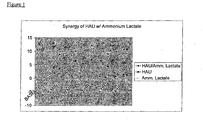
- Figure 1 depicts the relative skin moisture content of the synergy between hydroxyalkyl urea and ammonium lactate at a ratio of 5.00:0.05.
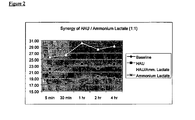
- Figure 2 depicts the relative skin moisture content of the synergy between hydroxyalkylurea and ammonium lactate at a ratio of 1:1.
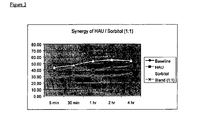
- Figure 3 depicts the relative skin moisture content of the synergy between hydroxyalkylurea and sorbitol at a ratio of 1:1.
- the present invention relates to a personal care composition
- a personal care composition comprising at least one hydroxyalkyl urea optionally in combination with at least one other moisturizing agent, which provides not only the perception of moisturization, but also actual increased moisturization efficacy.
- Such personal care compositions provide an enhanced smooth feel as well as enhanced flexibility, strength, elasticity, suppleness and firmness without leaving a heavy or greasy feel.
- Hydroxyalkyl ureas are derived from urea and are of the general formula: wherein R 1 , R 2 , R 3 and R 4 each independently represent hydrogen, a C 1-4 alkyl or a C 2-6 hydroxyalkyl group that can contain from 1 to 5 hydroxyl or hydroxyalkyl groups providing that at least one of the radicals R 1 -R 4 is a hydroxyalkyl or oligohydroxyalkyl group.
- R 1 , R 2 , R 3 and R 4 each independently represent hydrogen, a C 1-4 alkyl or a C 2-6 hydroxyalkyl group that can contain from 1 to 5 hydroxyl or hydroxyalkyl groups providing that at least one of the radicals R 1 -R 4 is a hydroxyalkyl or oligohydroxyalkyl group.
- An example of a particularly useful hydroxyalkylurea is N-2-hydroxyethylurea having the structure -
- Personal care compositions according to the present invention can also include at least one moisturizing agent.
- moisturizing agents include without limitation occlusion compounds such as petrolatum, mineral oils, vegetable oils, triglycerides, lanolins and their derivatives, unsaturated fatty acids and their derivatives, silicones, and some emollients; humectants such as glycerin, sorbitol, lactates (including, but not limited to sodium, ammonium, and potassium salts), polyols (e.g., propylene glycol), polyethylene glycol (PEG 200-600), and Sorbeth-30; natural moisturizing factors (NMFs) such as urea, lactic acid, and sodium pyrrolidone carboxylic acid (NaPCA); liposomes, natural and vegetal moisturizing agents such as glycerin, serine, chitosan PCA, sodium hyaluronate, hyaluronic acid, microspon
- moisturizers are petrolatum, mineral and vegetable oils, lanolin, glycerin, sorbitol, polyols, urea, lactic acid, lactates (including but not limited to sodium, ammonium, and potassium salts), ⁇ -and ⁇ -hydroxy acids, sodium hyaluronate, hyaluronic acid, sugars, and pyrrolidone carboxylic acid (PCA).
- PCA pyrrolidone carboxylic acid
- the personal care composition can also include other optional ingredients found in such formulations that are commonly used in the industry. These can vary greatly depending upon the type of composition (e.g., skin care or hair care) and the functionality and properties desired. Without limitation, these components include emulsifiers, aesthetic modifiers, UV filters, humectants, moisturizers, emollients, solvents, chelating agents, vitamins, antioxidants, botanical extracts, pH adjusting and neutralizing agents, polymers, surfactants or soaps, thickeners, preservatives, fragrances, active ingredients (such as anti-aging agents, firming or toning agents, etc.), dyes and pigments.
- these components include emulsifiers, aesthetic modifiers, UV filters, humectants, moisturizers, emollients, solvents, chelating agents, vitamins, antioxidants, botanical extracts, pH adjusting and neutralizing agents, polymers, surfactants or soaps, thickeners, preservatives, fragrances, active ingredients (such as anti
- cosmetic compositions may contain one or more other components such as moisturizers, UV filters (both organic and inorganic UV actives), conditioning agents, emulsifiers, pH adjusters and neutralizers, emollients, solvents, antioxidants, vitamins, styling agents, chelating agents, preservatives and fragrances.
- Skin care and cosmetic compositions can also contain at least one component selected from the group consisting of vitamins, anti-aging agents, moisturizers, emollients, emulsifiers, surfactants, opacifiers, foaming agents, preservatives, antioxidants, pigments, dyes and active ingredients.
- the hydroxyalkyl urea of the present invention is present in a moisturizing effective amount. Understandably, this amount can vary depending any number of factors, for example, the type and amount of other moisturizing agents and the type of personal care composition in which it is included.
- the hydroxyalkyl urea is present in an amount of from about 0.25 to about 15.0% by weight of the personal care composition.
- the hydroxyalkylurea is present in an amount of about 1 to about 8% by weight of the composition.
- the hydroxyalkyl urea is present in an amount of about 1.5 to about 5% by weight of the personal care composition.
- a moisturizing agent is present with the hydroxyalkyl urea in a moisturizing effective amount. This amount can vary depending upon a variety of factors such as the type of moisturizing agent, the amount of hydroxyalkyl urea, and the type of personal care composition in which it is to be included. In one embodiment, the moisturizing agent is present in an amount of from about 0.002 to about 15% by weight of the personal care composition. In another embodiment, the moisturizing agent is present in amount of from about 0.1 to about 10% by weight of the personal care composition. In one embodiment, the moisturizing agent is present in an amount of from about 0.5 to about 6% by weight of the personal care composition.
- the ratio of hydroxyalkyl Iurea to moisturizing agent is preferably in a synergistically moisturizing effective ratio. In one embodiment, the ratio is between about 0.25:0.00 and about 20.0:0.0 hydroxyalkyl urea to moisturizing agent. In one embodiment, the ratio is between about 0.5:15.0 and about 15.0:0.05 hydroxyalkyl urea to moisturizing agent. In another embodiment, the hydroxyalkyl Iurea to moisturizing agent ratio is between about 1:5 and about 15.00:0.05.
- the ratio is between about 0.5:15.0 and about 5:1 hydroxyalkyl urea to moisturizing agent. In another embodiment, the hydroxyalkyl urea:moisturizing agent ratio is between about 1:5 and about 5:1.
- This combination of hydroxyalkyl urea and moisturizer produces a synergistic relative moisturization efficacy.
- the combination has an increased moisturization efficacy over that expected, even more than the added moisturization efficacy of the individual components alone.
- hydroxyalkyl ureas Methods of manufacturing hydroxyalkyl ureas are known in the art.
- One known method is by reacting at least one ethanolamine with urea (1:1 molar concentrations) at elevated temperatures of about 80°C to 200°C with adequate sparging. Using this method, residual levels of about 0.1 to 1% ammonia are typically produced and remain in solution.
- the ammonia can be neutralized with any cosmetically suitable acid to form an ammonium salt.
- This ammonium salt and hydroxyalkylurea also produce a synergistic moisturization efficacy.
- Particularly suitable acids include lactic acid, glycolic acid, citric acid, maleic acid, acetic acid, and salicylic acid.
- Personal care compositions include without limitation skin moisturizing lotions and creams including for the face and body, moisturizing cleansers and soaps, anti-aging products, nourishing creams and lotions, firming and toning products, shaving creams, deodorants, color cosmetics including foundations, makeups, and lipsticks, suncare products such as sunscreens, suntan lotions, and after-sun products, hair conditioners and cream rinses, and shampoos, hair styling products including hairsprays, gels, and mousses, personal care wipes, baby care products, hair dyes, hair permanent wave, anti-frizz, volumizing, and bath and shower products.
- Particularly suitable compositions are skin care compositions.
- compositions comprising both hydroxyalkylurea and moisturizer not only have improved moisturization efficacy, but also provide improved aqueous and emulsion freeze-thaw stability. Further, such compositions have a non-tacky, nongreasy feel when applied.
- Aqueous solutions (along with formulated lotions) were applied to the volar forearm of panellists with dry skin. Solutions tested contained between 2.5 and 15% active levels of Hydroxyalkylurea and various moisturizing agents. The various individual moisturizing agents were also used in combination with Hydroxyalkylurea and the relative moisture contents in the skin were compared.
- Moisture levels were measured using a Corneometer ® CM 825 (available from CK Industries) prior to and at various time intervals after application of forty microliters of each sample (Temperature ⁇ 21°C, Relative Humidity ⁇ 35%).
- the treated hair swatches were then placed in a vacuum oven at 45°C and -100 kPa (-30 mmHg) for 20 hours. After drying, the swatches were hung on curl retention boards and placed in a humidity chamber at 37°C and 85% relative humidity for 20 hours. The swatches were reweighed (w HH ) when removed from the humidity chamber. The difference between wi and w HH is the weight of moisture gained in the humidity chamber (w HC ) plus the weight of moisturizing active on the hair. The percent total weight gained (w tot ) is obtained by multiplying the quantity w HC divided by w i by 100.
- the swatches are returned to the vacuum oven at the same conditions given above for another 20 hours, then removed and weighed (W final ) for a final time.
- W HH and w final is the weight of moisture gained in the humidity chabinet (W moist ).
- the percent moisture gained is determined by multiplying by 100 the quantity W moist divided by w i .
- Moisture uptake was also determined using a Surface Measurement Systems Dynamic Vapor Sorption Analyzer 2000 (DVS). The testing was run on blonde damaged hair. The procedure used was as follows -
- HAU Hydroxyethyl urea
- Ammonium lactate Ammonium lactate
- Active levels used for the individual agents were HAU at 5% and ammonium lactate at 0.05%.
- the combination consisted of a total of 5% moisturizing ingredients at a ratio of 5:0.05 of HAU:ammonium lactate.
- Figure 1 shows the relative skin moisture content initially and at 5 minutes, 15 minutes, 1hour, 2hours, and 4hours after application. From Figure 1 it is seen that the blend provides a significant increase in moisture over either individual moisturizing agent alone.
- Hydroxyethylurea and the moisturizing agent glycerin were analyzed alone and in combination. Active levels used for the individual agents were HAU at 15% and glycerin at 15%. The combination consisted of a total of 15% total moisturizing ingredients at a ratio of 1:1 of HAU:glycerin. Table 1 below shows the relative skin moisture content, initially and at 5 minutes, 15 minutes, 1 hour, and 2 hours after application. The blend showed a significant increase in moisture over either individual moisturizing agent.
- FIG. 3 illustrates the relative skin moisture content initially and at 5 minutes, 15 minutes, 1 hour, and 2 hour after application. From Figure 3 it is seen that the blend provides a significant increase in moisture over either individual moisturizing agent, especially after 4 hours time.
- Hydroxyethylurea combined with ammonium lactate was compared to glycerin and a water blank for moisturization of hair.
- Active levels used for the test solutions were as follows: HAU and ammonium lactate together at 49% and 1%, respectively, glycerin at 50%, and the blank at 0%.
- Table 2 below provides the percent moisture uptake measured by DVS on hair after 4 and 20 hours.
- Table 2 Percent moisture uptake by DVS analysis Product 4 Hour @ 85% RH 20 Hour @85% RH Hydroxyethylurea and ammonium lactate 18.72% 47.65% Glycerin 22.10% 44.58% Blank (Water) 13.58% 14.53% Comparing the results of the hydroxyethylurea/ammonium lactate sample to the glycerin and blank samples in Table 2 shows that hydroxyethylurea is superior to the blank and similar or better than glycerin for bringing moisture to hair over time.
- CELQUAT SC-230M is dissolved in water by sifting into water slowly while mixing. In a separate vessel, all remaining ingredients are combined in the order listed above. The formulation is mixed until homogeneous after each addition. When both phases are homogeneous, the CELQUAT SC-230M phase is slowly added to the surfactant phase. The combined phases are then mixed with moderate agitation until homogeneous.
- Example 6 is repeated with, in place of hydroxyethylurea, any one of the following hydroxyalkyl-substituted ureas: N- ( 2-hydroxypropyl), N-(3-hydroxypropyl), N-(2,3- dihydroxypropyl), N -(2-hydroxybutyl), N -(3-hydroxypropyl), N-(4-hydroxybutyl), N-(2,3- dihydroxybutyl), N-(2,4-dihydroxybutyl), N-(3,4-dihydroxybutyl), N -ethyl-N'-(2-hydroxyethyl), N,N -bis-(2-hydroxyethyl), N,N' -bis-(2-hyroxyethyl), N,N -bis-(2-hydroxypropyl), N,N' -bis-(2-hydroxypropyl), N,N bis-(2-hydroxyethyl)- N' -propyl, N,N -bis-(2-hydroxyprop
- Example 7 is repeated with, in place of hydroxyethylurea, any one of the following hydroxyalkyl-substituted ureas: N-(2-hydroxypropyl), N-(3-hydroxypropyl), N-(2,3- dihydroxypropyl), N-(2-hydroxybutyl), N-(3-hydroxypropyl), N-(4-hydroxybutyl), N-(2,3- dihydroxybutyl), N-(2,4-dihydroxybutyl), N-(3,4-dihydroxybutyl), N-ethyl-N'-(2-hydroxyethyl), N,N-bis-(2-hydroxyethyl), N,N'-bis-(2-hyroxyethyl), N,N-bis-(2-hydroxypropyl), N,N'-bis-(2-hydroxypropyl), N,N'-bis-(2-hydroxypropyl), N,N-bis-(2-hydroxypropyl), N,N'-bis-(2-hydroxypropyl
- COMBING CREAM FOR DRY/DAMAGED HAIR FORMULA Ingredient INCI Designation %W/W Supplier Phase A Cetearyl Alcohol 30/70 Cetearyl Alcohol 1.80 Hostacerin CS200 Ceteareth-20 0.20 Clariant Genamin KDMP Behentrimonium Chloride 0.44 Clariant DC 949 Amodimethicone (and) Trideceth-12(and) Cetrimonium Chloride 0.50 Dow Coming Phase B DI Water Water (Aqua) 88.94 STRUCTURE ZEA Hydroxypropyl Starch Phosphate 4.00 National Starch CELQUAT L-200 Polyquaternium-4 0.40 National Starch Phase C Genamin CTAC 50 Cetrimonium Chloride 0.30 Clariant Phase D Glydant DMDM Hydantoin 0.20 Lonza Phenonip Phenoxyethanol (and) Methylparaben (and) Ethylparaben (and) Butylparaben (and) Propylparaben (
- Dissolve STRUCTURE ZEA into the water at room temperature Add CELQUAT L-200 and heat to 80°C while mixing (Phase B). In a separate vessel, combine Phase A and heat to 80°C. Add Phase B to Phase A with agitation. Add Phase C while maintaining temperature (80°C). Continue mixing and cool to 45°C. Add Phase D and adjust pH, if necessary.
- Example 8 is repeated with, in place of hydroxyethylurea, any one of the following hydroxyalkyl-substituted ureas: N -(2-hydroxypropyl), N -(3-hydroxypropyl), N-(2,3- dihydroxypropyl), N -(2-hydroxybutyl), N -(3-hydroxypropyl), N -(4-hydroxybutyl), N-(2,3- dihydroxybutyl), N -(2,4-dihydroxybutyl), N -(3,4-dihydroxybutyl), N -ethyl- N' -(2-hydroxyethyl), N,N -bis-(2-hydroxyethyl), N,N' -bis-(2-hyroxyethyl), N,N -bis-(2-hydroxypropyl), N,N' -bis-(2-hydroxypropyl), N,N -bis-(2-hydroxypropyl), N,N -bis-(2-hydroxypropyl
- Dust AMAZE XT into the water in Part A and mix until completely hydrated. Separately, combine the ingredients of Part B and mix until dissolved. Add Part B to Part A with agitation. Add remaining ingredients and mix until uniform.
- Example 9 is repeated with, in place of hydroxyethylurea, any one of the following hydroxyalkyl-substituted ureas: N -(2-hydroxypropyl), N -(3-hydroxypropyl), N-(2,3- dihydroxypropyl), N -(2-hydroxybutyl), N-(3-hydroxypropyl), N-(4-hydroxybutyl), N-(2,3- dihydroxybutyl), N -(2,4-dihydroxybutyl), N -(3,4-dihydroxybutyl), N -ethyl- N' -(2-hydroxyethyl), N,N -bis-(2-hydroxyethyl), N,N' -bis-(2-hyroxyethyl), N,N-bis-(2-hydroxypropyl), N,N' -bis-(2-hydroxypropyl), N,N' -bis-(2-hydroxypropyl), N,N -bis-(2-hydroxypropyl), N
- Phase A by dispersing and dissolving CELQUAT L-200 in water using good agitation. Mix until solution is clear and homogenous. Add dl-Panthenol and allow to completely dissolve. Prepare Phase B by adding TEA to water and mix well. Add Neo Heliopan and mix until clear. follow with DC 929 cationic emulsion. Combine parts by adding Phase B to Phase A. Mix well and continue to mix for approximately 15 minutes. Add Solu-silk and mix well. Add Versene 100, Glydant, hydroxyethylurea, ammonium lactate, and fragrance, mixing well after each addition.
- Example 10 is repeated with, in place of hydroxyethylurea, any one of the following hydroxyalkyl-substituted ureas: N-(2-hydroxypropyl), N-(3-hydroxypropyl), N-(2,3- dihydroxypropyl), N-(2-hydroxybutyl), N-(3-hydroxypropyl), N-(4-hydroxybutyl), N-(2,3- dihydroxybutyl), N-(2,4-dihydroxybutyl), N-(3,4-dihydroxybutyl), N-ethyl-N' -(2-hydroxyethyl), N,N-bis-(2-hyd,roxyethyl), N,N' -bis-(2-hyroxyethyl), N,N -bis-(2-hydroxypropyl), N,N'-bis-(2-hydroxypropyl), N,N'-bis-(2-hydroxypropyl), N,N -bis-(2-hydroxypropyl), N,N'
- Polyquatemium-4 is dissolved in water with mixing. The remaining ingredients of Phase A are sequentially added with continued mixing. Phase B is combined and then added to Phase A. Continue to mix while slowly adding glycolic acid to Phase AB, taking care to avoid entrapped air. Finally, add beads slowly while mixing.
- Example 11 is repeated with, in place of hydroxyethylurea, any one of the following hydroxyalkyl-substituted ureas: N-(2-hydroxypropyl), N-(3-hydroxypropyl), N-(2,3- dihydroxypropyl), N-(2-hydroxybutyl), N-(3-hydroxypropyl), N-(4-hydroxybutyl), N-(2,3- dihydroxybutyl), N-(2,4-dihydroxybutyl), N-(3,4-dihydroxybutyl), N-ethyl-N'-(2-hydroxyethyl), N,N-bis-(2-hydroxyethyl), N,N'-bis-(2-hyroxyethyl), N,N-bis-(2-hydroxypropyl), N,N'-bis-(2- hydroxypropyl), N,N'-bis-(2- hydroxypropyl), N,N-bis-(2- hydroxypropyl), N,N'-bis-(2-hydroxy
- Example 12 is repeated with, in place of hydroxyethylurea, any one of the following hydroxyalkyl-substituted ureas: N -(2-hydroxypropyl), N -(3-hydroxypropyl), N-(2,3- dihydroxypropyl), N -(2-hydroxybutyl), N -(3-hydroxypropyl), N -(4-hydroxybutyl), N -(2,3-dihydroxybutyl), N -(2,4-dihydroxybutyl), N -(3,4-dihydroxybutyl), N -ethyl- N '-(2-hydroxyethyl), N,N -bis-(2-hydroxyethyl), N,N '-bis-(2-hyroxyethyl), N,N- bis-(2-hydroxypropyl), N,N' -bis-(2-hydroxypropyl), N,N -bis-(2-hydroxypropyl), N,N -bis-(2-hydroxypropy
- Example 13 is repeated with, in place of hydroxyethylurea, any one of the following hydroxyalkyl-substituted ureas: N-(2-hydroxypropyl), N-(3-hydroxypropyl), N-(2,3- dihydroxypropyl), N-(2-hydroxybutyl), N-(3-hydroxypropyl), N-(4-hydroxybutyl), N-(2,3- dihydroxybutyl), N-(2,4-dihydroxybutyl), N-(3,4-dihydroxybutyl), N-ethyl-N'-(2-hydroxyethyl), N,N-bis-(2-hydroxyethyl), N,N'-bis-(2-hyroxyethyl), N,N-bis-(2-hydroxypropyl), N,N'-bis-(2- hydroxypropyl), N,N'-bis-(2- hydroxypropyl), N,N-bis-(2- hydroxypropyl), N,N'-bis-(2-
- Phase B Dissolve STRUCTURE ZEA into the water at room temperature (Phase B). Heat it to 80°C. Melt the components of Phase A (80°C) and stir into Phase B, under agitation. Add Phase C. Keep the temperature for 15 minutes. Cool to 60°C and add Phase D. Continue mixing until cool and then perform pH adjustment.
- Example 14 is repeated with, in place of hydroxyethylurea, any one of the following hydroxyalkyl-substituted ureas: N-(2-hydroxypropyl), N-(3-hydroxypropyl), N-(2,3- dihydroxypropyl), N-(2-hydroxybutyl), N-(3-hydroxypropyl), N-(4-hydroxybutyl), N-(2,3- dihydroxybutyl), N-(2,4-dihydroxybutyl), N-(3,4-dihydroxybutyl), N-ethyl-N'-(2-hydroxyethyl), N,N -bis-(2-hydroxyethyl), N,N '-bis-(2-hyroxyethyl), N,N -bis-(2-hydroxypropyl), N,N '-bis-(2-hydroxypropyl), N,N '-bis-(2-hydroxypropyl), N,N '-bis-(2-hydroxypropyl), N,N '-
- Example 15 is repeated with, in place of hydroxyethylurea, any one of the following hydroxyalkyl-substituted ureas: N -(2-hydroxypropyl), N -(3-hydroxypropyl), N-(2,3- dihydroxypropyl), N -(2-hydroxybutyl), N -(3-hydroxypropyl), N -(4-hydroxybutyl), N-(2,3- dihydroxybutyl), N -(2,4-dihydroxybutyl), N -(3,4-dihydroxybutyl), N ethyl- N '-(2-hydroxyethyl), N,N -bis-(2-hydroxyethyl), N,N' -bis-(2-hyroxyethyl), N,N- bis-(2-hydroxypropyl), N,N' -bis-(2-hydroxypropyl), N,N- bis-(2-hydroxypropyl), N,N- bis-(2-hydroxypropyl), N,N
- CELQUAT SC-230M is dissolved in water by sifting into water slowly while mixing. In a separate vessel, all remaining ingredients are combined in the order listed above. The formulation is mixed until homogeneous after each addition. When both phases are homogeneous, the CELQUAT SC-230M phase is slowly added to the surfactant phase. The combined phases are then mixed with moderate agitation until homogeneous.
- Example 16 is repeated with, in place of hydroxyethylurea, any one of the following hydroxyalkyl-substituted ureas: N-(2-hydroxypropyl), N-(3-hydroxypropyl), N-(2,3- dihydroxypropyl), N-(2-hydroxybutyl), N-(3-hydroxypropyl), N-(4-hydroxybutyl), N-(2,3- dihydroxybutyl), N-(2,4-dihydroxybutyl), N-(3,4-dihydroxybutyl), N-ethyl-N'-(2-hydroxyethyl), N,N-bis-(2-hydroxyethyl), N,N'-bis-(2-hyroxyethyl), N,N-bis-(2-hydroxypropyl), N,N'-bis-(2- hydroxypropyl), N,N'-bis-(2- hydroxypropyl), N,N-bis-(2- hydroxypropyl), N,N'-bis-(2-
- Phase A by dispersing and dissolving CELQUAT L-200 in water using good agitation. Mix until solution is clear and homogenous. Add dl-Panthenol and allow to completely dissolve. Prepare Phase B by adding TEA to water and mix well. Add Neo Heliopan and mix until clear. follow with DC 929 cationic emulsion. Combine parts by adding Phase B to Phase A. Mix well and continue to mix for approximately 15 minutes. Add Solu-silk and mix well. Add Versene 100, Glydant, hydroxyethylurea and fragrance, mixing well after each addition.
- Example 17 is repeated with, in place of hydroxyethylurea, any one of the following hydroxyalkyl-substituted ureas: N-(2-hydroxypropyl), N -(3-hydroxypropyl), N-(2,3- dihydroxypropyl), N-(2-hydroxybutyl), N-(3-hydroxypropyl), N-(4-hydroxybutyl), N-(2,3- dihydroxybutyl), N-(2,4-dihydroxybutyl), N-(3,4-dihydroxybutyl), N- ethyl-N'-(2-hydroxyethyl), N,N-bis-(2-hydroxyethyl), N,N' -bis-(2-hyroxyethyl), N,N -bis-(2-hydroxypropyl), N,N' -bis-(2-hydroxypropyl), N,N' -bis-(2-hydroxypropyl), N,N -bis-(2-hydroxypropyl), N,N' -
- COMBING CREAM FOR DRY/DAMAGED HAIR FORMULA Ingredient INCI Designation %W/W Supplier Phase A Cetearyl Alcohol 30/70 Cetearyl Alcohol 1.80 Hostacerin CS200 Ceteareth-20 0.20 Clariant Genamin KDMP Behentrimonium Chloride 0.44 Clariant DC 949 Amodimethicone (and) Trideceth-12(and) Cetrimonium Chloride 0.50 Dow Coming Phase B DI Water Water (Aqua) 89.00 STRUCTURE ZEA Hydroxypropyl Starch Phosphate 4.00 National Starch CELQUAT L-200 Polyquaternium-4 0.40 National Starch Phase C Genamin CTAC 50 Cetrimonium Chloride 0.30 Clariant Phase D Glydant DMDM Hydantoin 0.20 Lonza Phenonip Phenoxyethanol (and) Methylparaben (and) Ethylparaben (and) Butylparaben (and) Propylparaben (and)
- Dissolve STRUCTURE ZEA into the water at room temperature Add CELQUAT L-200 and heat to 80°C while mixing (Phase B). In a separate vessel, combine Phase A and heat to 80°C. Add Phase B to Phase A with agitation. Add Phase C while maintaining temperature (80°C). Continue mixing and cool to 45°C. Add Phase D and adjust pH, if necessary.
- Example 18 is repeated with, in place of hydroxyethylurea, any one of the following hydroxyalkyl-substituted ureas: N-(2-hydroxypropyl), N-(3-hydroxypropyl), N-(2,3- dihydroxypropyl), N-(2-hydroxybutyl), N-(3-hydroxypropyl), N-(4-hydroxybutyl), N-(2,3- dihydroxybutyl), N-(2,4-dihydroxybutyl), N-(3,4-dihydroxybutyl), N-ethyl-N'-(2-hydroxyethyl), N,N-bis-(2-hydroxyethyl), N,N'-bis-(2-hyroxyethyl), N,N-bis-(2-hydroxypropyl), N,N'-bis-(2- hydroxypropyl), N,N'-bis-(2- hydroxypropyl), N,N-bis-(2- hydroxypropyl), N,N'-bis-(2-hydroxy
Landscapes
- Health & Medical Sciences (AREA)
- Life Sciences & Earth Sciences (AREA)
- Veterinary Medicine (AREA)
- Animal Behavior & Ethology (AREA)
- General Health & Medical Sciences (AREA)
- Public Health (AREA)
- Birds (AREA)
- Epidemiology (AREA)
- Chemical & Material Sciences (AREA)
- Dermatology (AREA)
- Organic Chemistry (AREA)
- Emergency Medicine (AREA)
- Dispersion Chemistry (AREA)
- Chemical Kinetics & Catalysis (AREA)
- Cosmetics (AREA)
Abstract
Description
- The present invention relates to personal care compositions. More specifically, the present invention relates to personal care compositions that use hydroxyalkylurea for providing improved moisturization efficacy. In another aspect, the present invention relates to personal care compositions that use hydroxyalkylurea in combination with other moisturizing agents in a synergistically moisturizing effective ratio, thereby providing increased moisturization efficacy.
- A significant segment of the global population uses products to moisturize their skin and hair, and such segment continues to grow at a substantial rate. Unfortunately, many of these products do not actually moisturize. Instead, they simply give the appearance of moisturization by reducing fine lines and/or flaking and adding shine. When trying to provide or increase moisturizing efficacy, many of the moisturizing products currently on the market also leave a heavy, greasy feel that consumers find undesirable.
- The use of hydroxyalkylurea in personal care compositions is known in the art. For example,
U.S. Patent No. 5,858,549 discloses compositions that utilize hydroxyalkylurea crosslinking agents on natural or synthetic substrates or in the preparation of coatings. Hydroxyalkyl ureas are also used in thermosetting binders (see, e.g.,U.S. Patent No. 6,140,388 ), in personal care products and detergent compositions (see, e.g.,U.S. Patent No. 5,880,076 andGerman Patent No. 27 03 185 ). However, none of these patents disclose the use of hydroxyalkylurea either alone or in combination with other moisturizing agents to increase the moisturizing efficacy of personal care compositions. - Accordingly, there is a need for personal care compositions with improved moisturizing efficacy.
- It has now been found that personal care compositions that include hydroxyalkyl urea alone or in combination with other moisturizing agents provide not only the perception of moisturization, but also actual increased moisturization efficacy. Such personal care compositions provide an enhanced smooth feel as well as enhanced flexibility, elasticity, suppleness and firmness without leaving a heavy, tacky or greasy feel.
- The present invention relates to a personal care composition having at least one hydroxyalkylurea optionally in combination with at least one other moisturizing agent, which provides not only the perception of moisturization, but also actual increased moisturization efficacy. Such personal care compositions provide an enhanced smooth feel as well as enhanced flexibility, strength, elasticity, suppleness and firmness without leaving a heavy, tacky or greasy feel.
- When provided together in a personal care formulation, the hydroxyalkylurea and the moisturizing agent are present in a synergistically moisturizing effective ratio. In one aspect, the ratio of hydroxyalkyl urea to moisturizing agent is at least about 0.5:15.0 and no more than about 15.00:0.05. In another aspect, the ratio of hydroxyalkyl urea to moisturizing agent is at least about 1:5 and no more than about 5:1. In one embodiment, the hydroxyalkyl urea is N-2-hydroxyethyl urea. The amount of hydroxyalkyl urea is found in the personal care composition is present in an amount of from about 0.5% to 15.0% by weight of the composition. In another aspect, the hydroxyalkyl urea is present in an amount of from about 1 to 8% by weight of the personal care composition.
- Moisturizers useful in personal care compositions that provide the improved moisturization efficacy when used in combination with hydroxyalkylurea include petrolatum, mineral and vegetable oils, lanolins, glycerin, sorbitol, polyols, urea, lactic acid, lactates, sugars, alpha hydroxy acids, beta hydroxy acids, sodium hyaluronate, hyaluronic acid, pyrrolidone carboxylic acid. The moisturizer(s) can be present in an amount of from about 0.5% to 15% by weight of the personal care composition. In another aspect, the moisturizer is present in an amount of from about 1% to 10% by weight of the personal care composition. In even another aspect, the moisturizer is present in an amount of from about 2% to about 6% by weight of the personal care composition.
- In one embodiment of the present invention, the hydroxyalkylurea is N-2-hydroxyethylurea and the moisturizer is selected from the group consisting of petrolatum, mineral and vegetable oils, lanolins, glycerin, sorbitol, polyols, urea, lactic acid, lactates, sugars, alpha hydroxy acids, beta hydroxy acids, sodium hyaluronate, hyaluronic acid, pyrrolidone carboxylic acid, and combinations thereof.
- Personal care compositions according to the present invention can include, e.g., skin care compositions, hair products and conditioners. Hair products according to the present invention can include, e.g., hair gel, hair lotion, hair cream, mousse, shampoo, conditioner and hair spray. Conditioners according to the present invention can include, e.g., leave-on conditioners, including leave-on hair and skin conditioners.
- The present invention also relates to a personal care composition having at least one hydroxyalkyl urea and at least one ammonium salt, wherein the hydroxyalkyl urea and the ammonium salt are present in a synergistically moisturizing effective ratio.
- In addition to the above compositions, the present invention provides a process for preparing such compositions. This process includes reacting at least one ethanolamine with urea to form hydroxyalkyl urea. Any residual ammonia is neutralized with a cosmetically suitable acid to form an ammonium salt. The cosmetically suitable acid includes, e.g., lactic acid, glycolic acid, citric acid, maleic acid, acetic acid, salicylic acid and combinations thereof.
- In another aspect, the present invention provides for a hair moisturizing composition having at least one hydroxyalkylurea.
- The terms below have the following meanings as used herein -
- The term "surfactant" means an ingredient that is used in a cosmetic formulation and exhibits the ability to reduce the interfacial tension between two immiscible substances, wets skin and hair surfaces, emulsifies or solubilizes oils, and/or suspends soil and is meant to include amphoteric, anionic, cationic, and nonionic surfactants.
- The term "mousse" means a personal care product in which the ingredients foam when dispensed from their container without any mechanical action from the user except possibly the shaking of the product in the container prior to actuation of a valve and subsequent dispensing of the internal contents by actuation.
- The term "shampoo" means a cleansing product containing surfactants that is massaged into wet hair, usually thereby creating foam, which is then rinsed from the hair with water, removing at least some soil and/or oils from the hair.
- The term "hair lotion" means a composition below 20,000 centipoise at 25° Celsius ('C') and standard pressure that is applied to hair to provide a cosmetic benefit.
- The term "hair cream" means a composition equal to or greater than 20,000 centipoise at 25°C and standard pressure that is applied to the hair to provide a cosmetic benefit.
- The term "cosmetic benefit" includes, but in no way is limited to, such benefits as moisturizing, sun protection, fragrance, wrinkle reduction, and tanning.
-
Figure 1 depicts the relative skin moisture content of the synergy between hydroxyalkyl urea and ammonium lactate at a ratio of 5.00:0.05. -
Figure 2 depicts the relative skin moisture content of the synergy between hydroxyalkylurea and ammonium lactate at a ratio of 1:1. -
Figure 3 depicts the relative skin moisture content of the synergy between hydroxyalkylurea and sorbitol at a ratio of 1:1. - The present invention relates to a personal care composition comprising at least one hydroxyalkyl urea optionally in combination with at least one other moisturizing agent, which provides not only the perception of moisturization, but also actual increased moisturization efficacy. Such personal care compositions provide an enhanced smooth feel as well as enhanced flexibility, strength, elasticity, suppleness and firmness without leaving a heavy or greasy feel.
- Hydroxyalkyl ureas, as used herein, are derived from urea and are of the general formula:


- Personal care compositions according to the present invention can also include at least one moisturizing agent. Such moisturizing agents are known in the art and include without limitation occlusion compounds such as petrolatum, mineral oils, vegetable oils, triglycerides, lanolins and their derivatives, unsaturated fatty acids and their derivatives, silicones, and some emollients; humectants such as glycerin, sorbitol, lactates (including, but not limited to sodium, ammonium, and potassium salts), polyols (e.g., propylene glycol), polyethylene glycol (PEG 200-600), and Sorbeth-30; natural moisturizing factors (NMFs) such as urea, lactic acid, and sodium pyrrolidone carboxylic acid (NaPCA); liposomes, natural and vegetal moisturizing agents such as glycerin, serine, chitosan PCA, sodium hyaluronate, hyaluronic acid, microsponges, soluble collagen, modified protein, sugars, monosodium L-glutamate, lecithins and phospholipids and their derivatives; α- and β-hydroxy acids such as glycolic acid, lactic acid, citric acid, maleic acid and salicylic acid; polymeric moisturizers such as polysaccharides and their derivatives such as modified starch, xanthan gum and dehydroxanthan gum, polyacrylates, and polyquatemium-4, -10 and -51; and amino acids such as glutamic acid, aspartic acid, and lysine. As used herein, all acids are intended to include the salts thereof. Particularly suitable moisturizers are petrolatum, mineral and vegetable oils, lanolin, glycerin, sorbitol, polyols, urea, lactic acid, lactates (including but not limited to sodium, ammonium, and potassium salts), α-and β-hydroxy acids, sodium hyaluronate, hyaluronic acid, sugars, and pyrrolidone carboxylic acid (PCA).
- The personal care composition can also include other optional ingredients found in such formulations that are commonly used in the industry. These can vary greatly depending upon the type of composition (e.g., skin care or hair care) and the functionality and properties desired. Without limitation, these components include emulsifiers, aesthetic modifiers, UV filters, humectants, moisturizers, emollients, solvents, chelating agents, vitamins, antioxidants, botanical extracts, pH adjusting and neutralizing agents, polymers, surfactants or soaps, thickeners, preservatives, fragrances, active ingredients (such as anti-aging agents, firming or toning agents, etc.), dyes and pigments.
- The hydroxyalkyl urea of the present invention is compatible with most other components used in conventional personal care compositions. For example, cosmetic compositions may contain one or more other components such as moisturizers, UV filters (both organic and inorganic UV actives), conditioning agents, emulsifiers, pH adjusters and neutralizers, emollients, solvents, antioxidants, vitamins, styling agents, chelating agents, preservatives and fragrances. Skin care and cosmetic compositions can also contain at least one component selected from the group consisting of vitamins, anti-aging agents, moisturizers, emollients, emulsifiers, surfactants, opacifiers, foaming agents, preservatives, antioxidants, pigments, dyes and active ingredients.
- In one aspect, the hydroxyalkyl urea of the present invention is present in a moisturizing effective amount. Understandably, this amount can vary depending any number of factors, for example, the type and amount of other moisturizing agents and the type of personal care composition in which it is included. In one aspect, the hydroxyalkyl urea is present in an amount of from about 0.25 to about 15.0% by weight of the personal care composition. In another aspect, the hydroxyalkylurea is present in an amount of about 1 to about 8% by weight of the composition. In one aspect, the hydroxyalkyl urea is present in an amount of about 1.5 to about 5% by weight of the personal care composition.
- In another embodiment, a moisturizing agent is present with the hydroxyalkyl urea in a moisturizing effective amount. This amount can vary depending upon a variety of factors such as the type of moisturizing agent, the amount of hydroxyalkyl urea, and the type of personal care composition in which it is to be included. In one embodiment, the moisturizing agent is present in an amount of from about 0.002 to about 15% by weight of the personal care composition. In another embodiment, the moisturizing agent is present in amount of from about 0.1 to about 10% by weight of the personal care composition. In one embodiment, the moisturizing agent is present in an amount of from about 0.5 to about 6% by weight of the personal care composition.
- When the hydroxyalkyl urea is used in combination with a moisturizing agent according to one embodiment of the present invention, the ratio of hydroxyalkyl Iurea to moisturizing agent is preferably in a synergistically moisturizing effective ratio. In one embodiment, the ratio is between about 0.25:0.00 and about 20.0:0.0 hydroxyalkyl urea to moisturizing agent. In one embodiment, the ratio is between about 0.5:15.0 and about 15.0:0.05 hydroxyalkyl urea to moisturizing agent. In another embodiment, the hydroxyalkyl Iurea to moisturizing agent ratio is between about 1:5 and about 15.00:0.05. In another embodiment, the ratio is between about 0.5:15.0 and about 5:1 hydroxyalkyl urea to moisturizing agent. In another embodiment, the hydroxyalkyl urea:moisturizing agent ratio is between about 1:5 and about 5:1.
- This combination of hydroxyalkyl urea and moisturizer produces a synergistic relative moisturization efficacy. Thus, the combination has an increased moisturization efficacy over that expected, even more than the added moisturization efficacy of the individual components alone.
- Methods of manufacturing hydroxyalkyl ureas are known in the art. One known method is by reacting at least one ethanolamine with urea (1:1 molar concentrations) at elevated temperatures of about 80°C to 200°C with adequate sparging. Using this method, residual levels of about 0.1 to 1% ammonia are typically produced and remain in solution. The ammonia can be neutralized with any cosmetically suitable acid to form an ammonium salt. This ammonium salt and hydroxyalkylurea also produce a synergistic moisturization efficacy. Particularly suitable acids include lactic acid, glycolic acid, citric acid, maleic acid, acetic acid, and salicylic acid.
- Personal care compositions include without limitation skin moisturizing lotions and creams including for the face and body, moisturizing cleansers and soaps, anti-aging products, nourishing creams and lotions, firming and toning products, shaving creams, deodorants, color cosmetics including foundations, makeups, and lipsticks, suncare products such as sunscreens, suntan lotions, and after-sun products, hair conditioners and cream rinses, and shampoos, hair styling products including hairsprays, gels, and mousses, personal care wipes, baby care products, hair dyes, hair permanent wave, anti-frizz, volumizing, and bath and shower products. Particularly suitable compositions are skin care compositions.
- The personal care compositions comprising both hydroxyalkylurea and moisturizer not only have improved moisturization efficacy, but also provide improved aqueous and emulsion freeze-thaw stability. Further, such compositions have a non-tacky, nongreasy feel when applied.
- The following examples are presented to further illustrate and explain the present invention and should not be taken as limiting in any regard. All percentages used are on a weight/weight basis.
- Skin Moisturization (Hydration). Aqueous solutions (along with formulated lotions) were applied to the volar forearm of panellists with dry skin. Solutions tested contained between 2.5 and 15% active levels of Hydroxyalkylurea and various moisturizing agents. The various individual moisturizing agents were also used in combination with Hydroxyalkylurea and the relative moisture contents in the skin were compared.
- Moisture levels were measured using a Corneometer® CM 825 (available from CK Industries) prior to and at various time intervals after application of forty microliters of each sample (Temperature ~21°C, Relative Humidity ~35%).
- Hair Moisturization. Moisture retention/uptake on hair was determined using two test methods - a 'Dynamic Vapor Sorption' (DVS) technique and a 'Controlled Humidity Hair Moisturization Analysis'. 50% active aqueous solutions were applied to hair in both test methods.
- In the Controlled Humidity Hair Moisturization Analysis, moisture uptake and retention of the different test samples were compared using hair swatches weighing approximately 4 grams and measuring 1.27 cm in width and 25.4 cm in length. Each test sample solution was evaluated in triplicate. An initial weight (wi) was taken for each swatch. Next, the swatches were soaked for 1 hour in 30 ml of the test solution (50% active). After removal from the test solution, excess product was squeezed off using the analyst's thumb and forefinger and then reweighed (wwet). The swatches were then dried in a 49°C oven for 1.5 hours and weighed (wdry) again. The weight of active deposited on the hair after the water has evaporated (wactive) is the difference between wi and Wdry.
- In order to ensure removal of all moisture from the samples, the treated hair swatches were then placed in a vacuum oven at 45°C and -100 kPa (-30 mmHg) for 20 hours. After drying, the swatches were hung on curl retention boards and placed in a humidity chamber at 37°C and 85% relative humidity for 20 hours. The swatches were reweighed (wHH) when removed from the humidity chamber. The difference between wi and wHH is the weight of moisture gained in the humidity chamber (wHC) plus the weight of moisturizing active on the hair. The percent total weight gained (wtot) is obtained by multiplying the quantity wHC divided by wi by 100.
- After determination of the total weight gained, the swatches are returned to the vacuum oven at the same conditions given above for another 20 hours, then removed and weighed (Wfinal) for a final time. The difference between WHH and wfinal is the weight of moisture gained in the humidity chabinet (Wmoist). The percent moisture gained is determined by multiplying by 100 the quantity Wmoist divided by wi.
- Moisture uptake was also determined using a Surface Measurement Systems Dynamic Vapor Sorption Analyzer 2000 (DVS). The testing was run on blonde damaged hair. The procedure used was as follows -
- Approximately 0.3 - 0.4 grams of hair were weighed. About 11 grams of the 50% solution was added to a weigh boat. The weight of hair was then soaked in the solution in the weigh boat for an hour, and then dried in a 49°C oven for 40 minutes. The hair sample was then wrapped around a small pre-weighed paperclip and put onto a microbalance in the DVS instrument test chamber. The instrument then brought the conditions in the test chamber to 85% relative humidity and 37°C over 30 minutes. Once this target humidity was reached, it was held for 20 hours. The percent moisture uptake is equal to the percent increase in weight of the hair and was determined after 4 and 20 hours.
- Hydroxyethyl urea (HAU) and the moisturizing agent ammonium lactate (Amm. Lactate), were analyzed alone and in combination. Active levels used for the individual agents were HAU at 5% and ammonium lactate at 0.05%. The combination consisted of a total of 5% moisturizing ingredients at a ratio of 5:0.05 of HAU:ammonium lactate.
Figure 1 shows the relative skin moisture content initially and at 5 minutes, 15 minutes, 1hour, 2hours, and 4hours after application. FromFigure 1 it is seen that the blend provides a significant increase in moisture over either individual moisturizing agent alone. - In another study the active levels used for each individual agent were 5% HAU and 5% ammonium lactate, while the combination consisted of a total of 5% moisturizing ingredients at a ratio of 1:1 HAU to ammonium lactate.
Figure 2 shows the relative skin moisture content initially and at 5 minutes, 15 minutes, 1hour, 2hours, and 4hours after application. Once again, the blend provides a significant increase in moisture over either individual moisturizing agent. - Hydroxyethylurea and the moisturizing agent glycerin were analyzed alone and in combination. Active levels used for the individual agents were HAU at 15% and glycerin at 15%. The combination consisted of a total of 15% total moisturizing ingredients at a ratio of 1:1 of HAU:glycerin. Table 1 below shows the relative skin moisture content, initially and at 5 minutes, 15 minutes, 1 hour, and 2 hours after application. The blend showed a significant increase in moisture over either individual moisturizing agent.
Table 1 - Relative Skin Moisture Content Synergy of HAU / Glycerin (1:1) at 15% Active Initial 5 min 30 min 1 hr 2 hr Baseline 46.75 46.75 46.75 46.75 HAU 56.56 60.00 62.95 62.00 Glycerin 52.50 53.50 55.38 48.75 Blend (1:1) 88.25 73.00 71.25 70.00 - Hydroxyethylurea and the moisturizing agent sorbitol were analyzed alone and in combination. Active levels used for the individual agents were HAU at 15% and Sorbitol at 15%. The combination consisted of a total of 15% total moisturizing ingredients at a ratio of 1:1 of HAU:Sorbitol.
Figure 3 illustrates the relative skin moisture content initially and at 5 minutes, 15 minutes, 1 hour, and 2 hour after application. FromFigure 3 it is seen that the blend provides a significant increase in moisture over either individual moisturizing agent, especially after 4 hours time. - Hydroxyethylurea combined with ammonium lactate was compared to glycerin and a water blank for moisturization of hair. Active levels used for the test solutions were as follows: HAU and ammonium lactate together at 49% and 1%, respectively, glycerin at 50%, and the blank at 0%. Table 2 below provides the percent moisture uptake measured by DVS on hair after 4 and 20 hours.
Table 2 - Percent moisture uptake by DVS analysis Product 4 Hour @ 85% RH 20 Hour @85% RH Hydroxyethylurea and ammonium lactate 18.72% 47.65% Glycerin 22.10% 44.58% Blank (Water) 13.58% 14.53% - A 49:1 blend of hydroxyethylurea (HAU) and ammonium lactate was compared to glycerin and a blank in the Controlled Humidity Hair Moisturization Analysis test described in Example 1. The results for % moisture gained are listed in Table 3 below.
Table 3: % Total Moisture Gained Sample % Moisture Gained HAU and ammonium lactate 37.31 Glycerin 38.23 Blank 12.48 -
CLEAR CONDITIONING SHAMPOO FORMULA Ingredients INCI Designation %W/W Supplier CELQUAT SC-230M Polyquaternium-10 0.25 National Starch Hydroxyethylurea Not applicable 3.00 National Starch Ammonium Lactate Ammonium Lactate 0.06 DeIonized Water Water (Aqua) 18.18 Standapol ES-2 Sodium Lauryl Sulfate 33.33 Cognis Corp. Standapol ES-3 Sodium Laureth Sulfate 30.00 Cognis Corp. Dehyton K Cocamidopropyl Betaine 10.00 Cognis Corp. Promodium CO Polypropoxyethoxycocamide 3.18 Uniqema Germaben II Diazolidinyl Urea, Propylene Glycol, Methylparaben, Propylparaben 1.00 Sutton Laboratories Sodium Chloride Sodium Chloride 1.00 J. T. Baker Citric Acid Citric Acid q.s. 100.00 - CELQUAT SC-230M is dissolved in water by sifting into water slowly while mixing. In a separate vessel, all remaining ingredients are combined in the order listed above. The formulation is mixed until homogeneous after each addition. When both phases are homogeneous, the CELQUAT SC-230M phase is slowly added to the surfactant phase. The combined phases are then mixed with moderate agitation until homogeneous.
- Example 6 is repeated with, in place of hydroxyethylurea, any one of the following hydroxyalkyl-substituted ureas: N-(2-hydroxypropyl), N-(3-hydroxypropyl), N-(2,3-dihydroxypropyl), N-(2-hydroxybutyl), N-(3-hydroxypropyl), N-(4-hydroxybutyl), N-(2,3-dihydroxybutyl), N-(2,4-dihydroxybutyl), N-(3,4-dihydroxybutyl), N-ethyl-N'-(2-hydroxyethyl), N,N-bis-(2-hydroxyethyl),N,N'-bis-(2-hyroxyethyl), N,N-bis-(2-hydroxypropyl), N,N'-bis-(2-hydroxypropyl), N,N bis-(2-hydroxyethyl)-N'-propyl, N,N-bis-(2-hydroxypropyl)-N'-(2-hydroxyethyl), N-tert.-butyl-N'-(2-hydroxyethyl)-N'-(2-hydroxypropyl), N,N-bis-(2-hydroxyethyl)-N',N'-dimethyl, N,N,N',N'-tetrakis-(2-hydroxyethyl), and N,N-bis(2-hydroxyethyl)-N',N'-bis-(2-hydroxypropyl) urea.
-
6% VOC ROOT LIFTING AEROSOL MOUSSE FORMULA Ingredient INCI Designation % W/W Supplier Part A AMAZE Corn Starch Modified 2.20 National Starch CELQUAT H-100 Polyquaternium-4 0.25 National Starch Carbopol Ultrez 10 Acrylates/C 10-30 Alkyl Acrylate Crosspolymer (copolymer) 0.05 Noveon Natrosol HHR Hydroxyethylcellulose 0.15 Aqualon Deionized Water Water (Aqua) 70.32 TEA Triethanolamine 99% 0.05 Part B DC-193 PEG-12 Dimethicone 0.07 Dow Coming Versene 100 Tetrasodium EDTA 0.10 Dow Chemical Crovol Pk-70 PEG-45 Palm Kernal Glycerides 0.10 Croda, Inc Cropetide W Hydrolyzed Wheat Protein (and) Hydrolyzed Wheat Starch 0.20 Croda. Inc. Procetyl AWS PPG-5 Ceteth-20 0.10 Croda, Inc dl-Panthenol Panthenol 0.10 Ritapan Rewoteric AM B-14 Cocomidapropyl Betaine 0.05 Goldschmidt Tween 20 Polysorbate 20 0.20 Uniqema Uvinul MS-40 Benzephenone - 4 0.001 BASF Hydroxyethylurea Hydroxyethyl Urea 3.00 National Starch Ammoni umLactate Ammonium Lactate 0.06 National Starch Germaben II Propylene Glycol (and) Diazolidinyl Urea (and) Methylparaben (and) Propylparaben 1.00 Sutton Labs Part C DME Dimethyl Ether 6.00 Dymel 152A Hydrofluorocarbon 152A 16.00 Dupont 100.00 - The Carbopol is slowly sifted into the mixing vortex until completely dispersed. While maintaining good agitation, the Natrosol HHR is then slowly sifted in. Once dispersed, both the AMAZE and the CELQUAT H-100 is sifted in. When the solution is complete, the TEA is added. The ingredients in Part B are then added and mixed until homogeneous. Filter and fill aerosol containers. For Part C, charge with propellant.
- Example 7 is repeated with, in place of hydroxyethylurea, any one of the following hydroxyalkyl-substituted ureas: N-(2-hydroxypropyl), N-(3-hydroxypropyl), N-(2,3-dihydroxypropyl), N-(2-hydroxybutyl), N-(3-hydroxypropyl), N-(4-hydroxybutyl), N-(2,3-dihydroxybutyl), N-(2,4-dihydroxybutyl), N-(3,4-dihydroxybutyl), N-ethyl-N'-(2-hydroxyethyl), N,N-bis-(2-hydroxyethyl), N,N'-bis-(2-hyroxyethyl), N,N-bis-(2-hydroxypropyl), N,N'-bis-(2-hydroxypropyl), N,N-bis-(2-hydroxyethyl)-N'-propyl, N,N-bis-(2-hydroxypropyl)-M-(2-hydroxyethyl), N-tert.-butyl-N'-(2-hydroxyethyl)-N'-(2-hydroxypropyl), N,N-bis-(2-hydroxyethyl)-N',N'-dimethyl, N,N,N',N'-tetrakis-(2-hydroxyethyl), and N,N-bis(2-hydroxyethyl)-N',N'-bis-(2-hydroxypropyl) urea.
-
COMBING CREAM FOR DRY/DAMAGED HAIR FORMULA Ingredient INCI Designation %W/W Supplier Phase A Cetearyl Alcohol 30/70 Cetearyl Alcohol 1.80 Hostacerin CS200 Ceteareth-20 0.20 Clariant Genamin KDMP Behentrimonium Chloride 0.44 Clariant DC 949 Amodimethicone (and) Trideceth-12(and) Cetrimonium Chloride 0.50 Dow Coming Phase B DI Water Water (Aqua) 88.94 STRUCTURE ZEA Hydroxypropyl Starch Phosphate 4.00 National Starch CELQUAT L-200 Polyquaternium-4 0.40 National Starch Phase C Genamin CTAC 50 Cetrimonium Chloride 0.30 Clariant Phase D Glydant DMDM Hydantoin 0.20 Lonza Phenonip Phenoxyethanol (and) Methylparaben (and) Ethylparaben (and) Butylparaben (and) Propylparaben (and) Isobutylparaben 0.15 Nipa/Clariant Hydroxyethylurea Hydroxyethylurea 3.00 National Starch Ammonium Lactate Ammonium Lactate 0.06 Phase E Citric acid (10%) Citric Acid q.s. pH 4.0-5.0 100.00 - Dissolve STRUCTURE ZEA into the water at room temperature. Add CELQUAT L-200 and heat to 80°C while mixing (Phase B). In a separate vessel, combine Phase A and heat to 80°C. Add Phase B to Phase A with agitation. Add Phase C while maintaining temperature (80°C). Continue mixing and cool to 45°C. Add Phase D and adjust pH, if necessary.
- Example 8 is repeated with, in place of hydroxyethylurea, any one of the following hydroxyalkyl-substituted ureas: N-(2-hydroxypropyl), N-(3-hydroxypropyl), N-(2,3-dihydroxypropyl), N-(2-hydroxybutyl), N-(3-hydroxypropyl), N-(4-hydroxybutyl), N-(2,3-dihydroxybutyl), N-(2,4-dihydroxybutyl), N-(3,4-dihydroxybutyl), N-ethyl-N' -(2-hydroxyethyl), N,N-bis-(2-hydroxyethyl), N,N'-bis-(2-hyroxyethyl), N,N-bis-(2-hydroxypropyl), N,N'-bis-(2-hydroxypropyl), N,N-bis-(2-hydroxyethyl)-N'-propyl, N,N-bis-(2-hydroxypropyl)-N'-(2-hydroxyethyl), N-tert.-butyl-N'-(2-hydroxyethyl)-N'-(2-hydroxypropyl), N,N-bis-(2-hydroxyethyl)-N',N'-dimethyl, N,N,N',N'-tetrakis-(2-hydroxyethyl), and N,N-bis(2-hydroxyethyl)-N',N'-bis-(2-hydroxypropyl) urea.
-
CONDITIONING STYLING GEL FORMULA Ingredient INCI Designation %W/W Supplier Part A Deionized Water Water (Aqua) 50.00 AMAZE XT Dehydroxanthan Gum 1.00 National Starch Part B Deionized Water Water (Aqua) 41.74 CELQUAT H-100 Polyquaternium-4 0.15 National Starch Part C Propylene Glycol Propylene Glycol 2.00 DL-Panthenol Panthenol 0.50 Roche Na2EDTA Disodium EDTA 0.05 Hydroxyethylurea Hydroxyethylurea 3.00 Ammonium Ammonium Lactate 0.06 Lactate Cropeptide W Hydrolyzed Wheat Protein and Hydrolyzed Wheat Starch 1.00 Croda DC 193 PEG-12 Dimethicone 0.20 Dow Coming Glydant Plus DMDM Hydantoin and Granular Iodopropynyl Butylcarbamate 0.30 100.00 Lonza - Dust AMAZE XT into the water in Part A and mix until completely hydrated. Separately, combine the ingredients of Part B and mix until dissolved. Add Part B to Part A with agitation. Add remaining ingredients and mix until uniform.
- Example 9 is repeated with, in place of hydroxyethylurea, any one of the following hydroxyalkyl-substituted ureas: N-(2-hydroxypropyl), N-(3-hydroxypropyl), N-(2,3-dihydroxypropyl), N-(2-hydroxybutyl), N-(3-hydroxypropyl), N-(4-hydroxybutyl), N-(2,3-dihydroxybutyl), N-(2,4-dihydroxybutyl), N-(3,4-dihydroxybutyl), N-ethyl-N'-(2-hydroxyethyl), N,N-bis-(2-hydroxyethyl), N,N'-bis-(2-hyroxyethyl), N,N-bis-(2-hydroxypropyl), N,N'-bis-(2-hydroxypropyl), N,N-bis-(2-hydroxyethyl)-N'-propyl, N,N-bis-(2-hydroxypropyl)-N'-(2-hydroxyethyl), N-tert.-butyl-N'-(2-hydroxyethyl)-N'-(2-hydroxypropyl), N,N-bis-(2-hydroxyethyl)-N',N'-dimethyl, N,N,N',N'-tetrakis-(2-hydroxyethyl), and N,N-bis(2-hydroxyethyl)-N',N'-bis-(2-hydroxypropyl) urea.
-
LEAVE-IN CONDITIONER FORMULA Ingredients INCI Designation %W/W Supplier Phase A CELQUAT® L-200 Polyquaternium-4 0.30 National Starch Deionized Water Water (Aqua) 48.00 dl-Panthenol Panthenol 0.50 Tri-K Industries Phase B Deionized Water Water (Aqua) 44.79 TEA Triethanolamine 0.20 Neo Heliopan, Phenyl Type Hydro Benzimidazole Sulfonic Acid 0.20 Haarmann & Reimer DC 929 Cationic Amodimethicone (and) Emulsion Tallowtrimonium Chloride (and) Nonoxynol-10 0.75 Dow Coming Phase C Solu-Silk Protein Hydrolyzed Silk 1.00 Brooks Industries Versene 100 Tetra Sodium EDTA 0.20 Dow Chemical Glydant DMDM Hydantoin 1.00 Lonza Hydroxyethylurea Hydroxyethylurea 3.00 Ammonium Lactate Ammonium Lactate 0.06 Fragrance Fragrance (Perfume) q.s. 100.00 - Prepare Phase A by dispersing and dissolving CELQUAT L-200 in water using good agitation. Mix until solution is clear and homogenous. Add dl-Panthenol and allow to completely dissolve. Prepare Phase B by adding TEA to water and mix well. Add Neo Heliopan and mix until clear. Follow with DC 929 cationic emulsion. Combine parts by adding Phase B to Phase A. Mix well and continue to mix for approximately 15 minutes. Add Solu-silk and mix well. Add Versene 100, Glydant, hydroxyethylurea, ammonium lactate, and fragrance, mixing well after each addition.
- Example 10 is repeated with, in place of hydroxyethylurea, any one of the following hydroxyalkyl-substituted ureas: N-(2-hydroxypropyl), N-(3-hydroxypropyl), N-(2,3-dihydroxypropyl), N-(2-hydroxybutyl), N-(3-hydroxypropyl), N-(4-hydroxybutyl), N-(2,3-dihydroxybutyl), N-(2,4-dihydroxybutyl), N-(3,4-dihydroxybutyl), N-ethyl-N' -(2-hydroxyethyl), N,N-bis-(2-hyd,roxyethyl), N,N'-bis-(2-hyroxyethyl), N,N-bis-(2-hydroxypropyl), N,N'-bis-(2-hydroxypropyl), N,N-bis-(2-hydroxyethyl)-N'-propyl, N,N-bis-(2-hydroxypropyl)-N'-(2-hydroxyethyl), N-tert.-butyl-N'-(2-hydroxyethyl)-N'-(2-hydroxypropyl), N,N-bis-(2-hydroxyethyl)-N',N'-dimethyl, N,N,N',N'-tetrakis-(2-hydroxyethyl), and N,N-bis(2-hydroxyethyl)-N',N'-bis-(2-hydroxypropyl) urea.
-
CLEAR CONDITIONER WITH SUSPENDED BEADS Ingredients INCI Designation %W/W Supplier Phase A Deionized Water Water (Aqua) 78.74 CELQUAT H-100 Polyquaternium-4 0.25 National Starch Glydant DMDM Hydantoin 0.50 Lonza Propylene Glycol Propylene Glycol 2.00 Arquad 16-25W Cetrimonium Chloride 2.00 Akzo-Nobel STRUCTURE PLUS Acrylates / Aminoacrylates / C 10-30 Alkyl PEG-20 Itaconate Copolymer 10.00 National Starch Hydroxyethylurea Hydroxyethylurea 3.00 Ammonium Ammonium Lactate 0.06 Lactate Versene 100 Tetrasodium EDTA 0.05 Dow Chemical Phase B Silsoft A-858 Dimethicone Copolyol Bishydroxyethylamine 2.00 CK Witco OSI Neo Heliopan AV Ethylhexyl Methoxycinnamate 0.05 Haarman & Reimer Phase C Glycolic Acid (70%) Glycolic Acid 0.45 Phase D Florabeads Jojoba Esters 0.80 Floratech 100.00 - Polyquatemium-4 is dissolved in water with mixing. The remaining ingredients of Phase A are sequentially added with continued mixing. Phase B is combined and then added to Phase A. Continue to mix while slowly adding glycolic acid to Phase AB, taking care to avoid entrapped air. Finally, add beads slowly while mixing.
- Example 11 is repeated with, in place of hydroxyethylurea, any one of the following hydroxyalkyl-substituted ureas: N-(2-hydroxypropyl), N-(3-hydroxypropyl), N-(2,3-dihydroxypropyl), N-(2-hydroxybutyl), N-(3-hydroxypropyl), N-(4-hydroxybutyl), N-(2,3-dihydroxybutyl), N-(2,4-dihydroxybutyl), N-(3,4-dihydroxybutyl), N-ethyl-N'-(2-hydroxyethyl), N,N-bis-(2-hydroxyethyl), N,N'-bis-(2-hyroxyethyl), N,N-bis-(2-hydroxypropyl), N,N'-bis-(2-hydroxypropyl), N,N-bis-(2-hydroxyethyl)-N'-propyl, N,N bis-(2-hydroxypropyl)-N'-(2-hydroxyethyl), N-tert.-butyl-N'-(2-hydroxyethyl)-N'-(2-hydroxypropyl), N,N-bis-(2-hydroxyethyl)-N',N'-dimethyl, N,N,N',N'-tetrakis-(2-hydroxyethyl), and N,N-bis(2-hydroxyethyl)-N',N'-bis-(2-hydroxypropyl) urea.
-
NATURAL HOLD STYLING LOTION FORMULA Ingredient INCI Designation %W/W Supplier Phase A Deionized Water Water (Aqua) 72.94 STRUCTURE XL Hydroxypropyl Starch Phosphate 5.00 National Starch Phenochem Phenoxyethanol, Methylparaben, Ethylparaben, Propylparaben, Butylparaben, Isobutylparaben 1.00 Sharon Labs/S Black Ltd AMAZE Corn Starch Modified 3.00 National Starch Hydroxyethylurea Hydroxyethylurea 3.00 Ammonium Ammonium Lactate 0.06 Lactate Phase B Imwitor 380 Glyceryl Cocoate/Citrate/Lactate (E472c/E472b) 5.00 Sasol / S Black Ltd Jojoba Glaze LV Buxus Chinensis, Hydrogenated Ethylene/propylene/styrene Copolymer, Hydrogenated Butylene/Ethylene/styrene Copolymer, BHT 10.00 DWJ / S Black Ltd 100.00 - Premix Phase A for 20 minutes. Premix Phase B. Phase B is then added to Phase A with high speed mixing.
- Example 12 is repeated with, in place of hydroxyethylurea, any one of the following hydroxyalkyl-substituted ureas: N-(2-hydroxypropyl), N-(3-hydroxypropyl), N-(2,3-dihydroxypropyl), N-(2-hydroxybutyl), N-(3-hydroxypropyl), N-(4-hydroxybutyl), N-(2,3-dihydroxybutyl), N-(2,4-dihydroxybutyl), N-(3,4-dihydroxybutyl), N-ethyl-N'-(2-hydroxyethyl), N,N-bis-(2-hydroxyethyl), N,N'-bis-(2-hyroxyethyl), N,N-bis-(2-hydroxypropyl), N,N'-bis-(2-hydroxypropyl), N,N-bis-(2-hydroxyethyl)-N'-propyl, N,N-bis-(2-hydroxypropyl)-N'-(2-hydroxyethyl), N-tert.-butyl-N'-(2-hydroxyethyl)-N'-(2-hydroxypropyl), N,N-bis-(2-hydroxyethyl)-N',N'-dimethyl, N,N,N',N'-tetrakis-(2-hydroxyethyl), and N,N-bis(2-hydroxyethyl)-N',N'-bis-(2-hydroxypropyl) urea.
-
55% VOC FIRM HOLD, CRYSTAL CLEAR PUMP HAIR SPRAY FORMULA Ingredients INCI Designation %W/W Supplier BALANCE 0/55 Acrylates Copolymer 12.00 National Starch AMP (reg) Aminomethyl Propanol 0.85 Dow Chemical Deionized Water Water (Aqua) 29.09 Hydroxyethylurea Hydroxyethylurea 3.00 Ammonium Lactate Ammonium Lactate 0.06 *SD Alcohol 40 SD Alcohol 40 55.00 100.00 - Dissolve AMP in SD Alcohol 40 and water. While maintaining proper agitation, slowly pour in BALANCE 0/55. Add remaining ingredients and mix until homogenous.
- Example 13 is repeated with, in place of hydroxyethylurea, any one of the following hydroxyalkyl-substituted ureas: N-(2-hydroxypropyl), N-(3-hydroxypropyl), N-(2,3-dihydroxypropyl), N-(2-hydroxybutyl), N-(3-hydroxypropyl), N-(4-hydroxybutyl), N-(2,3-dihydroxybutyl), N-(2,4-dihydroxybutyl), N-(3,4-dihydroxybutyl), N-ethyl-N'-(2-hydroxyethyl), N,N-bis-(2-hydroxyethyl), N,N'-bis-(2-hyroxyethyl), N,N-bis-(2-hydroxypropyl), N,N'-bis-(2-hydroxypropyl), N,N-bis-(2-hydroxyethyl)-N'-propyl, N,N-bis-(2-hydroxypropyl)-N'-(2-hydroxyethyl), N-tert.-butyl-N'-(2-hydroxyethyl)-N'-(2-hydroxypropyl), N,N-bis-(2-hydroxyethyl)-N',N'-dimethyl, N,N,N',N'-tetrakis-(2-hydroxyethyl), and N,N-bis(2-hydroxyethyl)-N',N'-bis-(2-hydroxypropyl) urea.
-
CURL DEFINING COMBING CREAM FORMULA Ingredient INCI Designation %W/W Supplier Phase A Cetearyl Alcohol Cetearyl Alcohol 2.20 Hostacerin CS 200 Ceteth-20 0.30 Clariant Phase B DI Water Water (Aqua) 82.30 STRUCTURE ZEA Hydroxypropyl Starch Phosphate 2.00 National Starch Phase C Genamin CTAC Cetrimonium Chloride 2.00 Clariant Phase D DI Water Water (Aqua) 6.94 DynamX Polyurethane-14 (and) AMP Acrylates Copolymer 0.50 National Starch Glydant DMDM Hydantoin 0.70 Lonza Hydroxyethyurea Hydroxyethylurea 3.00 Ammonium Lactate Ammonium Lactate 0.06 Phase E Citric Acid Citric Acid q.s. to pH 4.0 - 5.0 100.00 - Dissolve STRUCTURE ZEA into the water at room temperature (Phase B). Heat it to 80°C. Melt the components of Phase A (80°C) and stir into Phase B, under agitation. Add Phase C. Keep the temperature for 15 minutes. Cool to 60°C and add Phase D. Continue mixing until cool and then perform pH adjustment.
- Example 14 is repeated with, in place of hydroxyethylurea, any one of the following hydroxyalkyl-substituted ureas: N-(2-hydroxypropyl), N-(3-hydroxypropyl), N-(2,3-dihydroxypropyl), N-(2-hydroxybutyl), N-(3-hydroxypropyl), N-(4-hydroxybutyl), N-(2,3-dihydroxybutyl), N-(2,4-dihydroxybutyl), N-(3,4-dihydroxybutyl), N-ethyl-N'-(2-hydroxyethyl), N,N-bis-(2-hydroxyethyl), N,N'-bis-(2-hyroxyethyl), N,N-bis-(2-hydroxypropyl), N,N'-bis-(2-hydroxypropyl), N,N-bis-(2-hydroxyethyl)-N'-propyl; N,N bis-(2-hydroxypropyl)-N'-(2-hydroxyethyl), N-tert.-butyl-N'-(2-hydroxyethyl)-N'-(2-hydroxypropyl), N,N-bis-(2-hydroxyethyl)-N',N'-dimethyl, N,N,N',N'-tetrakis-(2-hydroxyethyl), and N,N-bis(2-hydroxyethyl)-N',N'-bis-(2-hydroxypropyl) urea.
-
SMOOTH MOVE ANTI-FRIZZ LOTION FORMULA Ingredient INCI Designation %W/W Supplier Phase A Deionized Water Water (Aqua) 81.85 EDTA Na2 Disodium EDTA 0.15 Dow STRUCTURE XL Hydroxypropyl Starch Phosphate 5.00 National Starch Germaben II Propylene Glycol, Diazolidinyl Urea, Methylparaben, Propylparaben 1.00 Sutton FLEXAN II Sodium Polystyrene Sulfonate 3.00 National Starch Hydroxyethyurea Hydroxyethylurea 3.00 National Starch Ammonium Lactate Ammonium Lactate 0.06 National Starch Phase B Caprylic/capric . Caprylic/capric Triglyceride Triglyceride 5.00 Monasil PCA PCA Dimethicone 2.00 Uniqema DC 193 PEG-12 Dimethicone 2.00 Dow Coming 100.00 - Dissolve STRUCTURE XL in water, stirring for ten minutes (400 rpm). Add the rest of ingredients of Phase A. Separately mix ingredients of Phase B. Slowly add Phase B to Phase A while stirring intensively (500-600 rpm).
- Example 15 is repeated with, in place of hydroxyethylurea, any one of the following hydroxyalkyl-substituted ureas: N-(2-hydroxypropyl), N-(3-hydroxypropyl), N-(2,3-dihydroxypropyl), N-(2-hydroxybutyl), N-(3-hydroxypropyl), N-(4-hydroxybutyl), N-(2,3-dihydroxybutyl), N-(2,4-dihydroxybutyl), N-(3,4-dihydroxybutyl), N ethyl-N'-(2-hydroxyethyl), N,N-bis-(2-hydroxyethyl), N,N'-bis-(2-hyroxyethyl), N,N-bis-(2-hydroxypropyl), N,N'-bis-(2-hydroxypropyl), N,N-bis-(2-hydroxyethyl)-N'-propyl, N,N-bis-(2-hydroxypropyl)-N'-(2-hydroxyethyl), N-tert.-butyl-N'-(2-hydroxyethyl)-N'-(2-hydroxypropyl), N,N-bis-(2-hydroxyethyl)-N',N'-dimethyl, N,N,N',N'-tetrakis-(2-hydroxyethyl), and N,N bis(2-nydroxyethyl)-N',N'-bis-(2-hydroxypropyl) urea.
-
CLEAR CONDITIONING SHAMPOO FORMULA Ingredients INCI Designation % W/W Supplier CELQUAT SC-230M Polyquaternium-10 0.25 National Starch Hydroxyethylurea Not applicable 3.00 National Starch DeIonized Water Water (Aqua) 18.24 Standapol ES-2 Sodium Lauryl Sulfate 33.33 Cognis Corp. Standapol ES-3 Sodium Laureth Sulfate 30.00 Cognis Corp. Dehyton K Cocamidopropyl Betaine 10.00 Cognis Corp. Promodium CO Polypropoxyethoxycocamide 3.18 Uniqema Germaben II Diazolidinyl Urea, Propylene Glycol, Methylparaben, Propylparaben 1.00 Sutton Laboratories Sodium Chloride Sodium Chloride 1.00 J. T. Baker Citric Acid Citric Acid q.s. 100.00 - CELQUAT SC-230M is dissolved in water by sifting into water slowly while mixing. In a separate vessel, all remaining ingredients are combined in the order listed above. The formulation is mixed until homogeneous after each addition. When both phases are homogeneous, the CELQUAT SC-230M phase is slowly added to the surfactant phase. The combined phases are then mixed with moderate agitation until homogeneous.
- Example 16 is repeated with, in place of hydroxyethylurea, any one of the following hydroxyalkyl-substituted ureas: N-(2-hydroxypropyl), N-(3-hydroxypropyl), N-(2,3-dihydroxypropyl), N-(2-hydroxybutyl), N-(3-hydroxypropyl), N-(4-hydroxybutyl), N-(2,3-dihydroxybutyl), N-(2,4-dihydroxybutyl), N-(3,4-dihydroxybutyl), N-ethyl-N'-(2-hydroxyethyl), N,N-bis-(2-hydroxyethyl), N,N'-bis-(2-hyroxyethyl), N,N-bis-(2-hydroxypropyl), N,N'-bis-(2-hydroxypropyl), N,N-bis-(2-hydroxyethyl)-N'-propyl, N,N-bis-(2-hydroxypropyl)-N'-(2-hydroxyethyl), N-tert.-butyl-N'-(2-hydroxyethyl)-N'-(2-hydroxypropyl), N,N-bis-(2-hydroxyethyl)-N',N'-dimethyl, N,N,N',N'-tetrakis-(2-hydroxyethyl), and N,N-bis(2-hydroxyethyl)-N',N'-bis-(2-hydroxypropyl) urea.
-
LEAVE-IN CONDITIONER FORMULA Ingredients INCI Designation % W/W Supplier Phase A CELQUAT® L-200 Polyquaternium-4 0.30 National Starch Deionized Water Water (Aqua) 48.06 dl-Panthenol Panthenol 0.50 Tri-K Industries Phase B Deionized Water Water (Aqua) 44.79 TEA Triethanolamine 0.20 Neo Heliopan, Phenyl Type Hydro Benzimidazole Sulfonic Acid 0.20 Haarmann & Reimer DC 929 Cationic Amodimethicone (and) Emulsion Tallowtrimonium Chloride (and) Nonoxynol-10 0.75 Dow Coming Phase C Solu-Silk Protein Hydrolyzed Silk 1.00 Brooks Industries Versene 100 Tetra Sodium EDTA 0.20 Dow Chemical Glydant DMDM Hydantoin 1.00 Lonza Hydroxyethylurea Hydroxyethylurea 3.00 Fragrance Fragrance (Perfume) q.s. 100.00 - Prepare Phase A by dispersing and dissolving CELQUAT L-200 in water using good agitation. Mix until solution is clear and homogenous. Add dl-Panthenol and allow to completely dissolve. Prepare Phase B by adding TEA to water and mix well. Add Neo Heliopan and mix until clear. Follow with DC 929 cationic emulsion. Combine parts by adding Phase B to Phase A. Mix well and continue to mix for approximately 15 minutes. Add Solu-silk and mix well. Add Versene 100, Glydant, hydroxyethylurea and fragrance, mixing well after each addition.
- Example 17 is repeated with, in place of hydroxyethylurea, any one of the following hydroxyalkyl-substituted ureas: N-(2-hydroxypropyl), N-(3-hydroxypropyl), N-(2,3-dihydroxypropyl), N-(2-hydroxybutyl), N-(3-hydroxypropyl), N-(4-hydroxybutyl), N-(2,3-dihydroxybutyl), N-(2,4-dihydroxybutyl), N-(3,4-dihydroxybutyl), N-ethyl-N'-(2-hydroxyethyl), N,N-bis-(2-hydroxyethyl), N,N'-bis-(2-hyroxyethyl), N,N-bis-(2-hydroxypropyl), N,N'-bis-(2-hydroxypropyl), N,N-bis-(2-hydroxyethyl)-N'-propyl, N,N-bis'-(2-bydroxypropyl)-N'-(2-hydroxyethyl), N-tert.-butyl-N'-(2-hydroxyethyl)-N'-(2-hydroxypropyl), N,N-bis-(2-hydroxyethyl)-N',N'-dimethyl, N,N,N',N'-tetrakis-(2-hydroxyethyl), and N,N-bis(2-hydroxyethyl)-N',N'-bis-(2-hydroxypropyl) urea.
-
COMBING CREAM FOR DRY/DAMAGED HAIR FORMULA Ingredient INCI Designation %W/W Supplier Phase A Cetearyl Alcohol 30/70 Cetearyl Alcohol 1.80 Hostacerin CS200 Ceteareth-20 0.20 Clariant Genamin KDMP Behentrimonium Chloride 0.44 Clariant DC 949 Amodimethicone (and) Trideceth-12(and) Cetrimonium Chloride 0.50 Dow Coming Phase B DI Water Water (Aqua) 89.00 STRUCTURE ZEA Hydroxypropyl Starch Phosphate 4.00 National Starch CELQUAT L-200 Polyquaternium-4 0.40 National Starch Phase C Genamin CTAC 50 Cetrimonium Chloride 0.30 Clariant Phase D Glydant DMDM Hydantoin 0.20 Lonza Phenonip Phenoxyethanol (and) Methylparaben (and) Ethylparaben (and) Butylparaben (and) Propylparaben (and) Isobutylparaben 0.15 Nipa/Clariant Hydroxyethylurea Hydroxyethylurea 3.00 National Starch Phase E Citric acid (10%) Citric Acid q.s. pH 4.0-5.0 100.00 - Dissolve STRUCTURE ZEA into the water at room temperature. Add CELQUAT L-200 and heat to 80°C while mixing (Phase B). In a separate vessel, combine Phase A and heat to 80°C. Add Phase B to Phase A with agitation. Add Phase C while maintaining temperature (80°C). Continue mixing and cool to 45°C. Add Phase D and adjust pH, if necessary.
- Example 18 is repeated with, in place of hydroxyethylurea, any one of the following hydroxyalkyl-substituted ureas: N-(2-hydroxypropyl), N-(3-hydroxypropyl), N-(2,3-dihydroxypropyl), N-(2-hydroxybutyl), N-(3-hydroxypropyl), N-(4-hydroxybutyl), N-(2,3-dihydroxybutyl), N-(2,4-dihydroxybutyl), N-(3,4-dihydroxybutyl), N-ethyl-N'-(2-hydroxyethyl), N,N-bis-(2-hydroxyethyl), N,N'-bis-(2-hyroxyethyl), N,N-bis-(2-hydroxypropyl), N,N'-bis-(2-hydroxypropyl), N,N-bis-(2-hydroxyethyl)-N'-propyl, N,N bis-(2-hydroxypropyl)-N'-(2-hydroxyethyl), N-tert.-butyl-N'-(2-hydroxyethyl)-N'-(2-hydroxypropyl), N,N-bis-(2-hydroxyethyl)-N',N'-dimethyl, N,N,N',N'-tetrakis-(2-hydroxyethyl), and N,N-bis(2-hydroxyethyl)-N',N'-bis-(2-hydroxypropyl) urea.
- Further embodiments of the present invention are the following:
- 1. A personal care composition comprising:
- at least one hydroxyalkyl urea, and
- at least one moisturizing agent,
- wherein the hydroxyalkyl urea and the moisturizing agent are present in a synergistically moisturizing effective ratio.
- 2. The composition of
embodiment 1, wherein the ratio of hydroxyalkyl urea to moisturizing agent is at least 0.5:15.0 and no more than 15.00:0.05. - 3. The composition of
embodiment 1, wherein the hydroxyalkyl urea is N-2-hydroxyethylurea. - 4. The composition of
embodiment 1, wherein the hydroxyalkyl urea is present in an amount of from 0.5% to 15.0% by weight of the personal care composition. - 5. The composition of
embodiment 1, wherein the moisturizer is selected from the group consisting of petrolatum, mineral and vegetable oils, lanolins, glycerin, sorbitol, polyols, urea, lactic acid, lactates, sugars, alpha hydroxy acids, beta hydroxy acids, sodium hyaluronate, hyaluronic acid, pyrrolidone carboxylic acid. - 6. The composition of
embodiment 1, wherein the moisturizer is present in an amount of from 0.5% to 15% by weight of the personal care composition. - 7. The composition of
embodiment 1, wherein the hydroxyalkylurea is N-2-hydroxyethyl urea and the moisturizer is selected from the group consisting of petrolatum, mineral and vegetable oils, lanolins, glycerin, sorbitol, polyols, urea, lactic acid, lactates, sugars, alpha hydroxy acids, beta hydroxy acids, sodium hyaluronate, hyaluronic acid, pyrrolidone carboxylic acid, and combinations thereof. - 8. The composition of
embodiment 1 wherein the composition is selected from the group consisting of skin care compositions, hair products and conditioners. - 9. The composition of embodiment 8 wherein the composition is a hair product and the hair product is selected from the group consisting of hair gel, hair lotion, hair cream, mousse, shampoo, conditioner and hair spray.
- 10. The composition of embodiment 8 wherein the composition is a conditioner and the conditioner is a leave-on conditioner.
- 11. The composition of embodiment 8 wherein the composition is a conditioner and the conditioner is a hair or skin conditioner.
- 12. A personal care composition comprising:
- at least one hydroxyalkyl urea; and
- at least one ammonium salt,
- wherein the hydroxyalkyl urea and the ammonium salt are present in a synergistically moisturizing effective ratio.
- 13. A process for preparing the composition of embodiment 12 comprising:
- reacting at least one ethanolamine with urea to form hydroxyalkylurea; and
- neutralizing residual ammonia with a cosmetically suitable acid to form an ammonium salt.
- 14. The process according to embodiment 13 wherein the cosmetically suitable acid is selected from the group consisting of lactic acid, glycolic acid, citric acid, maleic acid, acetic acid, salicylic acid and combinations thereof.
- 15. A hair moisturizing composition comprising at least one hydroxyalkylurea.
Claims (3)
- A process for preparing a personal care composition comprising:reacting at least one ethanolamine with urea to form hydroxyalkylurea;neutralizing residual ammonia with a cosmetically suitable acid to form an ammonium salt; andcombining the hydroxyalkylurea and the ammonium salt in a personal care composition,wherein the hydroxyalkylurea and the ammonium salt are present in the personal care composition in a moisturizing effective ratio of at least 0.5:15.0 and no more than 15.00:0.05.
- The process according to claim 1 wherein the cosmetically suitable acid is selected from the group consisting of lactic acid, glycolic acid, citric acid, maleic acid, acetic acid, salicylic acid and combinations thereof.
- A hair moisturizing composition comprising the personal care composition obtained by the process of claims 1 or 2.
Applications Claiming Priority (3)
| Application Number | Priority Date | Filing Date | Title |
|---|---|---|---|
| US10/723,340 US20050113268A1 (en) | 2003-11-26 | 2003-11-26 | Increased moisturization efficacy using hydroxyalkylurea |
| US10/939,204 US7816310B2 (en) | 2003-11-26 | 2004-09-10 | Increased moisturization efficacy using hydroxyalkylurea and ammonium lactate |
| EP04027723.8A EP1535607B1 (en) | 2003-11-26 | 2004-11-23 | Increased moisturization efficacy using hydroxyalkylurea |
Related Parent Applications (2)
| Application Number | Title | Priority Date | Filing Date |
|---|---|---|---|
| EP04027723.8 Division | 2004-11-23 | ||
| EP04027723.8A Division EP1535607B1 (en) | 2003-11-26 | 2004-11-23 | Increased moisturization efficacy using hydroxyalkylurea |
Publications (2)
| Publication Number | Publication Date |
|---|---|
| EP1935878A1 true EP1935878A1 (en) | 2008-06-25 |
| EP1935878B1 EP1935878B1 (en) | 2012-03-28 |
Family
ID=34592240
Family Applications (1)
| Application Number | Title | Priority Date | Filing Date |
|---|---|---|---|
| EP08002026A Expired - Lifetime EP1935878B1 (en) | 2003-11-26 | 2004-11-23 | Increased moisturization efficacy using hydroxyalkylurea |
Country Status (4)
| Country | Link |
|---|---|
| US (2) | US20050113268A1 (en) |
| EP (1) | EP1935878B1 (en) |
| CN (1) | CN1778287B (en) |
| TW (1) | TWI342786B (en) |
Cited By (3)
| Publication number | Priority date | Publication date | Assignee | Title |
|---|---|---|---|---|
| FR2975287A1 (en) * | 2011-05-20 | 2012-11-23 | Oreal | COSMETIC COMPOSITION COMPRISING A SUPERABSORBENT POLYMER AND A COMPOUND SELECTED FROM UREA AND ITS HIGH-RATE DERIVATIVES |
| US10723913B2 (en) | 2016-01-15 | 2020-07-28 | Ppg Industries Ohio, Inc. | Hydroxy functional alkyl polyurea containing compositions |
| US11286401B2 (en) | 2016-01-15 | 2022-03-29 | Ppg Industries Ohio, Inc. | Coating composition comprising a thermoset resin and a thermoplastic resin |
Families Citing this family (32)
| Publication number | Priority date | Publication date | Assignee | Title |
|---|---|---|---|---|
| US20050186231A1 (en) * | 2004-02-19 | 2005-08-25 | Unilever Home & Personal Care Usa, Division Of Conopco, Inc. | Stabilization with substituted ureas against color degradation of personal care products |
| US8609076B2 (en) * | 2004-05-13 | 2013-12-17 | L'oreal | Use of particular polyols for preventing the hair from breaking, composition comprising them and cosmetic hair treatment process |
| US8173144B2 (en) * | 2004-11-04 | 2012-05-08 | L'oreal | Administration of urea compounds for combating signs of cutaneous aging |
| FR2878438B1 (en) * | 2004-11-26 | 2009-07-03 | Oreal | COSMETIC COMPOSITION COMPRISING A TENSOR AGENT AND A HYDROXYALKYL UREA |
| US20060177397A1 (en) * | 2004-12-20 | 2006-08-10 | L'oreal | Self-tanning product comprising two components and means for artificially coloring the skin |
| US20060211588A1 (en) * | 2005-03-17 | 2006-09-21 | L'oreal | Composition containing a urea compound and a polymer, uses thereof |
| US7999008B2 (en) * | 2005-07-13 | 2011-08-16 | L'oreal | Urea compounds that promote desquamation |
| KR101228726B1 (en) * | 2005-08-25 | 2013-02-01 | 콜게이트-파아므올리브캄파니 | Moisturizing compositions |
| FR2902649B1 (en) * | 2006-06-21 | 2008-08-08 | Oreal | ASSEMBLY COMPRISING AN ACIDIC COMPOSITION AND A COMPOSITION BASED ON HYDROXYALKYLUREA |
| DE102006034533A1 (en) * | 2006-07-24 | 2008-01-31 | Beiersdorf Ag | Cosmetic preparation, useful e.g. for hair restructuring, for topical application on skin and/or hair and to prepare shampoo, comprises hydroxyalkyl-urea derivative and cationic caring agent such as cationic- surfactant and/or polymer |
| US8610806B2 (en) | 2006-08-28 | 2013-12-17 | Micron Technology, Inc. | Color filter array, imagers and systems having same, and methods of fabrication and use thereof |
| EP2214634B8 (en) * | 2007-11-15 | 2015-06-03 | Anbas Corporation | External preparations for moisturizing the skin containing litsea polyantha |
| JP4726963B2 (en) * | 2009-01-14 | 2011-07-20 | 株式会社 資生堂 | Hair cosmetics |
| KR101145589B1 (en) * | 2009-03-13 | 2012-05-15 | (주)아모레퍼시픽 | Hair Cosmetic Composition |
| BR112012012450A2 (en) * | 2009-12-11 | 2019-09-24 | Unilever Nv | "multiphase hair conditioner" |
| WO2012024364A2 (en) | 2010-08-18 | 2012-02-23 | Kao Corporation | Hair and skin conditioning compositions |
| WO2012133407A1 (en) * | 2011-03-28 | 2012-10-04 | 株式会社 資生堂 | Film-shaped externally used drug composition |
| CN104940036B (en) * | 2015-06-01 | 2018-05-08 | 佛山市三水协佳化工有限公司 | The preparation method of environment-friendly type large arch dam moisturizer |
| CN105330571A (en) * | 2015-06-19 | 2016-02-17 | 上海珈叶实业有限公司 | Preparation method of hydroxyethylurea crystal or aqueous solution |
| US11154477B2 (en) | 2016-01-29 | 2021-10-26 | Nouryon Chemicals International B.V. | Use of alkanolamine alkylamides as humectants |
| SG11201805822XA (en) | 2016-01-29 | 2018-08-30 | Akzo Nobel Chemicals Int Bv | Synergistic effects of alkanolamine alkylamides and other moisturizing agents |
| BR112018015037B1 (en) | 2016-01-29 | 2021-08-10 | Akzo Nobel Chemicals International B.V. | COMPOSITION PRODUCTION METHOD |
| WO2018040064A1 (en) * | 2016-09-02 | 2018-03-08 | L'oreal | Composition comprising aqueous beads |
| CN107454837B (en) * | 2016-09-12 | 2019-08-20 | 拉芳家化股份有限公司 | A kind of shampoo composite of the complexing agent of moisturizing containing hair |
| WO2018045582A1 (en) * | 2016-09-12 | 2018-03-15 | 拉芳家化股份有限公司 | Moisturising complexing agent-containing hair care composition |
| DE102016219000A1 (en) * | 2016-09-30 | 2018-04-05 | Henkel Ag & Co. Kgaa | improves conditioner hair care products with washout protection |
| DE102016219001A1 (en) * | 2016-09-30 | 2018-04-05 | Henkel Ag & Co. Kgaa | improves conditioner hair care products with washout protection |
| BR102017016433A2 (en) * | 2017-07-31 | 2019-03-19 | Natura Cosméticos S.A. | COSMETIC COMPLEX FOR BIOACTIVE HYDRATION, COSMETIC COMPOSITION, USE AND METHOD |
| US12083207B2 (en) * | 2020-08-31 | 2024-09-10 | L'oreal | Cosmetic compositions, kits thereof, and methods for making and using the same |
| CN113648232B (en) * | 2021-08-19 | 2024-01-23 | 上海家化联合股份有限公司 | Stable composition carrying urea or derivatives thereof |
| EP4486289A1 (en) * | 2022-02-28 | 2025-01-08 | L'oreal | Compositions and methods for curly hair |
| CN116919855B (en) * | 2022-04-02 | 2025-11-18 | 北昊干细胞与再生医学研究院有限公司 | Antioxidant Compositions, Preparation Methods and Applications |
Citations (6)
| Publication number | Priority date | Publication date | Assignee | Title |
|---|---|---|---|---|
| DE2703185A1 (en) | 1977-01-27 | 1978-08-10 | Henkel Kgaa | Cosmetics contg. hydroxyalkyl-urea derivs. - useful as skin moisture regulators |
| EP0876812A2 (en) * | 1997-05-06 | 1998-11-11 | Basf Aktiengesellschaft | Cosmetic compositions comprising saccharic acid ureides |
| US5858549A (en) | 1997-01-07 | 1999-01-12 | National Starch And Chemical Investment Holding Corporation | (Hydroxyalkyl)urea crosslinking agents |
| US5880076A (en) | 1997-08-04 | 1999-03-09 | Lever Brothers Company, Division Of Conopco, Inc. | Compositions comprising glycacarbamate and glycaurea compounds |
| US6140388A (en) | 1997-09-02 | 2000-10-31 | National Starch And Chemical Investment Holding Corporation | Thermosetting binder prepared with mono(hydroxyalkyl)urea and oxazolidone crosslinking agents |
| WO2001000170A1 (en) * | 1999-06-28 | 2001-01-04 | The Procter & Gamble Company | Cosmetic compositions |
Family Cites Families (4)
| Publication number | Priority date | Publication date | Assignee | Title |
|---|---|---|---|---|
| US5868649A (en) * | 1996-02-09 | 1999-02-09 | Hydrosplash Enterprises, Inc. | Aquatic exercise device |
| FR2750334B1 (en) | 1996-07-01 | 1998-09-04 | Oreal | USE OF AMINO-ALCOHOLS DERIVATIVES WITH UREA FUNCTION IN AND FOR THE PREPARATION OF COSMETIC OR DERMATOLOGICAL COMPOSITIONS |
| AU5770300A (en) * | 1999-06-28 | 2001-01-31 | Procter & Gamble Company, The | Cosmetic method |
| JP2001309986A (en) | 2000-05-01 | 2001-11-06 | Lion Corp | External preparation composition for skin in application container |
-
2003
- 2003-11-26 US US10/723,340 patent/US20050113268A1/en not_active Abandoned
-
2004
- 2004-09-10 US US10/939,204 patent/US7816310B2/en not_active Expired - Lifetime
- 2004-11-23 EP EP08002026A patent/EP1935878B1/en not_active Expired - Lifetime
- 2004-11-26 TW TW093136391A patent/TWI342786B/en not_active IP Right Cessation
- 2004-11-26 CN CN2004100104331A patent/CN1778287B/en not_active Expired - Lifetime
Patent Citations (6)
| Publication number | Priority date | Publication date | Assignee | Title |
|---|---|---|---|---|
| DE2703185A1 (en) | 1977-01-27 | 1978-08-10 | Henkel Kgaa | Cosmetics contg. hydroxyalkyl-urea derivs. - useful as skin moisture regulators |
| US5858549A (en) | 1997-01-07 | 1999-01-12 | National Starch And Chemical Investment Holding Corporation | (Hydroxyalkyl)urea crosslinking agents |
| EP0876812A2 (en) * | 1997-05-06 | 1998-11-11 | Basf Aktiengesellschaft | Cosmetic compositions comprising saccharic acid ureides |
| US5880076A (en) | 1997-08-04 | 1999-03-09 | Lever Brothers Company, Division Of Conopco, Inc. | Compositions comprising glycacarbamate and glycaurea compounds |
| US6140388A (en) | 1997-09-02 | 2000-10-31 | National Starch And Chemical Investment Holding Corporation | Thermosetting binder prepared with mono(hydroxyalkyl)urea and oxazolidone crosslinking agents |
| WO2001000170A1 (en) * | 1999-06-28 | 2001-01-04 | The Procter & Gamble Company | Cosmetic compositions |
Cited By (8)
| Publication number | Priority date | Publication date | Assignee | Title |
|---|---|---|---|---|
| FR2975287A1 (en) * | 2011-05-20 | 2012-11-23 | Oreal | COSMETIC COMPOSITION COMPRISING A SUPERABSORBENT POLYMER AND A COMPOUND SELECTED FROM UREA AND ITS HIGH-RATE DERIVATIVES |
| US10723913B2 (en) | 2016-01-15 | 2020-07-28 | Ppg Industries Ohio, Inc. | Hydroxy functional alkyl polyurea containing compositions |
| US10738215B2 (en) | 2016-01-15 | 2020-08-11 | Ppg Industries Ohio, Inc. | Monobloc aerosol tube or can having a coating composition |
| US10738216B2 (en) | 2016-01-15 | 2020-08-11 | Ppg Industries Ohio, Inc. | Carbodiimide curing for packaging coating compositions |
| US10858535B2 (en) | 2016-01-15 | 2020-12-08 | Ppg Industries Ohio, Inc. | Coating composition comprising a powder dispersed in a liquid carrier |
| US10858536B2 (en) | 2016-01-15 | 2020-12-08 | Ppg Industries Ohio, Inc. | Coating composition comprising a thermoset resin and a thermoplastic resin |
| US11203701B2 (en) | 2016-01-15 | 2021-12-21 | Ppg Industries Ohio, Inc. | Hydroxy functional alkyl polyurea crosslinkers |
| US11286401B2 (en) | 2016-01-15 | 2022-03-29 | Ppg Industries Ohio, Inc. | Coating composition comprising a thermoset resin and a thermoplastic resin |
Also Published As
| Publication number | Publication date |
|---|---|
| TWI342786B (en) | 2011-06-01 |
| EP1935878B1 (en) | 2012-03-28 |
| TW200528131A (en) | 2005-09-01 |
| US7816310B2 (en) | 2010-10-19 |
| CN1778287A (en) | 2006-05-31 |
| US20050113268A1 (en) | 2005-05-26 |
| US20050113269A1 (en) | 2005-05-26 |
| CN1778287B (en) | 2012-11-14 |
Similar Documents
| Publication | Publication Date | Title |
|---|---|---|
| EP1535607B1 (en) | Increased moisturization efficacy using hydroxyalkylurea | |
| EP1935878B1 (en) | Increased moisturization efficacy using hydroxyalkylurea | |
| AU2020408132C1 (en) | Surfactants for use in personal care and cosmetic products | |
| KR101351467B1 (en) | Mixed-type Personal Care Product for Skin or Hair | |
| EP4117618B1 (en) | Surfactants for personal care and cosmetic products | |
| KR100778610B1 (en) | Its use in modified starch solutions and personal care products | |
| US20050025736A1 (en) | Hair and skin altering and protecting compositions | |
| EP3403642B1 (en) | Cosmetic | |
| EP0965322B1 (en) | Hair cleansing composition and personal cleansing composition with low skin irritancy | |
| WO1999011224A2 (en) | Use of a combination of active substances and agent for the protection of keratin fibres | |
| DE19540853A1 (en) | Hair treatment agents | |
| AU754383B2 (en) | Agents and method for treating keratinous fibres | |
| DE10128799A1 (en) | Aqueous cosmetic agent, for use in e.g. shampoos, conditioners and liquid soaps, comprises anionic, nonionic and amphoteric surfactant, polymer and copolymer, starch derivatives, thickener and additives in acceptable medium | |
| WO2015086005A1 (en) | Cosmetic composition containing a combination of oligopeptides and ceramides | |
| EP3302416B1 (en) | Styling composition comprising a high internal phase emulsion | |
| AU2021310198B2 (en) | Branched amino acid surfactants for personal care and cosmetic products | |
| EP2785418B1 (en) | Shine-producing hair treatment agent | |
| CN120187292A (en) | Antimicrobial compositions | |
| EP1216017B1 (en) | Hair care composition | |
| JPH06192045A (en) | Hair cosmetic | |
| JPH06247836A (en) | Basic cosmetic | |
| WO2026104830A1 (en) | Uses and compositions | |
| JP2025521656A (en) | Compositions, personal care formulations, methods and uses for treating or preventing damage to hair - Patents.com | |
| US20040265262A1 (en) | Compound derived from polyguanidine and use of such a compound for protection and/or care of keratinous fibres | |
| EP3079774A2 (en) | Hair treatment agent containing carboxylic acid-n-alkylpolyhydroxyalkylamides |
Legal Events
| Date | Code | Title | Description |
|---|---|---|---|
| PUAI | Public reference made under article 153(3) epc to a published international application that has entered the european phase |
Free format text: ORIGINAL CODE: 0009012 |
|
| 17P | Request for examination filed |
Effective date: 20080204 |
|
| AC | Divisional application: reference to earlier application |
Ref document number: 1535607 Country of ref document: EP Kind code of ref document: P |
|
| AK | Designated contracting states |
Kind code of ref document: A1 Designated state(s): DE ES FR GB IT |
|
| 17Q | First examination report despatched |
Effective date: 20090130 |
|
| AKX | Designation fees paid |
Designated state(s): DE ES FR GB IT |
|
| RAP1 | Party data changed (applicant data changed or rights of an application transferred) |
Owner name: AKZO NOBEL N.V. |
|
| GRAP | Despatch of communication of intention to grant a patent |
Free format text: ORIGINAL CODE: EPIDOSNIGR1 |
|
| GRAS | Grant fee paid |
Free format text: ORIGINAL CODE: EPIDOSNIGR3 |
|
| GRAA | (expected) grant |
Free format text: ORIGINAL CODE: 0009210 |
|
| AC | Divisional application: reference to earlier application |
Ref document number: 1535607 Country of ref document: EP Kind code of ref document: P |
|
| AK | Designated contracting states |
Kind code of ref document: B1 Designated state(s): DE ES FR GB IT |
|
| REG | Reference to a national code |
Ref country code: GB Ref legal event code: FG4D |
|
| REG | Reference to a national code |
Ref country code: DE Ref legal event code: R096 Ref document number: 602004037144 Country of ref document: DE Effective date: 20120524 |
|
| PLBE | No opposition filed within time limit |
Free format text: ORIGINAL CODE: 0009261 |
|
| STAA | Information on the status of an ep patent application or granted ep patent |
Free format text: STATUS: NO OPPOSITION FILED WITHIN TIME LIMIT |
|
| PG25 | Lapsed in a contracting state [announced via postgrant information from national office to epo] |
Ref country code: IT Free format text: LAPSE BECAUSE OF FAILURE TO SUBMIT A TRANSLATION OF THE DESCRIPTION OR TO PAY THE FEE WITHIN THE PRESCRIBED TIME-LIMIT Effective date: 20120328 |
|
| 26N | No opposition filed |
Effective date: 20130103 |
|
| REG | Reference to a national code |
Ref country code: DE Ref legal event code: R097 Ref document number: 602004037144 Country of ref document: DE Effective date: 20130103 |
|
| PG25 | Lapsed in a contracting state [announced via postgrant information from national office to epo] |
Ref country code: ES Free format text: LAPSE BECAUSE OF FAILURE TO SUBMIT A TRANSLATION OF THE DESCRIPTION OR TO PAY THE FEE WITHIN THE PRESCRIBED TIME-LIMIT Effective date: 20120709 |
|
| GBPC | Gb: european patent ceased through non-payment of renewal fee |
Effective date: 20121123 |
|
| PG25 | Lapsed in a contracting state [announced via postgrant information from national office to epo] |
Ref country code: GB Free format text: LAPSE BECAUSE OF NON-PAYMENT OF DUE FEES Effective date: 20121123 |
|
| REG | Reference to a national code |
Ref country code: FR Ref legal event code: PLFP Year of fee payment: 12 |
|
| REG | Reference to a national code |
Ref country code: FR Ref legal event code: PLFP Year of fee payment: 13 |
|
| REG | Reference to a national code |
Ref country code: FR Ref legal event code: PLFP Year of fee payment: 14 |
|
| REG | Reference to a national code |
Ref country code: DE Ref legal event code: R082 Ref document number: 602004037144 Country of ref document: DE Representative=s name: VOSSIUS & PARTNER PATENTANWAELTE RECHTSANWAELT, DE Ref country code: DE Ref legal event code: R081 Ref document number: 602004037144 Country of ref document: DE Owner name: AKZO NOBEL CHEMICALS INTERNATIONAL B.V., NL Free format text: FORMER OWNER: AKZO NOBEL N.V., ARNHEM, NL |
|
| REG | Reference to a national code |
Ref country code: FR Ref legal event code: TP Owner name: AKZO NOBEL CHEMICALS INTERNATIONAL B.V., NL Effective date: 20180515 |
|
| P01 | Opt-out of the competence of the unified patent court (upc) registered |
Effective date: 20230515 |
|
| PGFP | Annual fee paid to national office [announced via postgrant information from national office to epo] |
Ref country code: FR Payment date: 20231127 Year of fee payment: 20 Ref country code: DE Payment date: 20231129 Year of fee payment: 20 |
|
| REG | Reference to a national code |
Ref country code: DE Ref legal event code: R071 Ref document number: 602004037144 Country of ref document: DE |